EP2183153B1 - Verbindungselement zum lösbaren verbinden von fahrradschuhen mit fahrradpedalen - Google Patents
Verbindungselement zum lösbaren verbinden von fahrradschuhen mit fahrradpedalen Download PDFInfo
- Publication number
- EP2183153B1 EP2183153B1 EP08803219A EP08803219A EP2183153B1 EP 2183153 B1 EP2183153 B1 EP 2183153B1 EP 08803219 A EP08803219 A EP 08803219A EP 08803219 A EP08803219 A EP 08803219A EP 2183153 B1 EP2183153 B1 EP 2183153B1
- Authority
- EP
- European Patent Office
- Prior art keywords
- cover
- covering
- basic body
- connection
- connection element
- Prior art date
- Legal status (The legal status is an assumption and is not a legal conclusion. Google has not performed a legal analysis and makes no representation as to the accuracy of the status listed.)
- Not-in-force
Links
- 230000001351 cycling effect Effects 0.000 title claims 2
- 238000003780 insertion Methods 0.000 claims abstract description 11
- 230000037431 insertion Effects 0.000 claims abstract description 11
- 238000013459 approach Methods 0.000 description 3
- 238000006073 displacement reaction Methods 0.000 description 2
- 239000002184 metal Substances 0.000 description 2
- 238000005058 metal casting Methods 0.000 description 2
- 210000003371 toe Anatomy 0.000 description 2
- 230000007423 decrease Effects 0.000 description 1
- 238000011161 development Methods 0.000 description 1
- 230000018109 developmental process Effects 0.000 description 1
- 230000000694 effects Effects 0.000 description 1
- 238000007373 indentation Methods 0.000 description 1
- 239000000463 material Substances 0.000 description 1
- 230000002093 peripheral effect Effects 0.000 description 1
- 239000007779 soft material Substances 0.000 description 1
- 239000004575 stone Substances 0.000 description 1
Images


Classifications
-
- B—PERFORMING OPERATIONS; TRANSPORTING
- B62—LAND VEHICLES FOR TRAVELLING OTHERWISE THAN ON RAILS
- B62M—RIDER PROPULSION OF WHEELED VEHICLES OR SLEDGES; POWERED PROPULSION OF SLEDGES OR SINGLE-TRACK CYCLES; TRANSMISSIONS SPECIALLY ADAPTED FOR SUCH VEHICLES
- B62M3/00—Construction of cranks operated by hand or foot
- B62M3/08—Pedals
- B62M3/086—Attachments between shoe and pedal other than toe clips, e.g. cleats
-
- A—HUMAN NECESSITIES
- A43—FOOTWEAR
- A43B—CHARACTERISTIC FEATURES OF FOOTWEAR; PARTS OF FOOTWEAR
- A43B5/00—Footwear for sporting purposes
- A43B5/14—Shoes for cyclists
Definitions
- the invention relates to a connecting element for detachably connecting bicycle shoes with bicycle pedals.
- Such fasteners which are often referred to as cleats, are connected to the shoe sole of a bicycle shoe.
- the connecting elements usually have a front and a rear clamping element, which are connected to a base body of the connecting element.
- the two clamping elements which point in the direction of the toe or heel when fastened to the shoe fastener, are used for connection to a corresponding receiving device, which is provided on the bicycle pedal.
- spring-loaded locking elements are provided on the bicycle pedal, each holding a clamping element. It is thus possible to insert the front clamping element in a first retaining element of the pedal and to effect by applying force down a locking of the rear clamping element with the rear retaining element.
- the base body For attachment of the connecting elements (cleats) to the bicycle shoes, the base body has a usually oval passage opening. Through the passage opening usually two Allen screws are inserted, which are guided through slots in the shoe sole and screwed into a arranged within the shoe support or counter plate. For receiving the two screws, a substantially oval disc is usually arranged in the passage opening, which has two holes for receiving the screws.
- two screws are provided, which are connected to a common or two separate washers and are guided by a passage opening of the base body. The attachment is then by screwing into the back plate.
- cleats of the company Shimano with the name "SPD" prevailed especially in mountain bikes.
- Such cleats are for example in DE 42 01 916 described.
- the SPD cleats are surrounded by studs connected to the shoe sole and, in contrast to look cleats, they are not or only slightly above the bottom of the shoe. This reduces the risk of damaging and wearing out of the cleats while running.
- mountain bike shoes is often run on uneven ground. If, for example, it is rocky (gravel road), damage to the cleats, in particular the fastening elements of the cleat, may occur.
- the screw heads are damaged in such a way that it is difficult or impossible to open the screws even when using Allen screws. This makes it much more difficult to replace the cleats, as the screws may need to be drilled out.
- the object of the invention is to provide a connecting element for detachably connecting bicycle shoes with bicycle pedals, in which the damage during walking, in particular the damage of the fasteners during walking, is reduced.
- the connecting element according to the invention is, in particular, a connecting element recessed in the sole of the shoe, ie a connecting element whose outside does not extend beyond the running surface of the shoe Shoe sole projecting, as is the case in particular in the marketed by the company. Shimano cleats with the name "SPD".
- a cover element is provided, by which the at least one fastening element is covered.
- the cover is according to the invention connected to the base body, wherein the base body preferably has a corresponding recess, so that the cover does not project beyond the outside of the base body.
- the covering element is connected to the main body by insertion into an insertion opening provided in particular laterally on the main body. Possibly.
- a locking of the cover via at least one locking element.
- the insertion opening opens into a particular over the entire circumference of the passage opening provided insertion groove, so that the cover is securely held. If necessary, the insertion opening can be closed by a closure element, such as a stopper or bolt clamped in the opening.
- the base body has a particular peripheral groove for receiving the cover.
- the cover is at least partially disposed in the passage opening.
- the cover is completely disposed within the passage opening and thus preferably does not project beyond an outer side of the base body. In the outside of the base body, this is the side of the main body facing away from the shoe sole.
- locking elements may be provided on the base body and / or the cover element.
- the locking elements serve for firm connection of the cover with the main body.
- the connection of the locking elements by pressing the cover member, i. by moving the cover in the direction of the shoe sole done.
- an elastic or displaceable latching element is provided on the cover, wherein a rather rigid, in particular more stable latching element is provided on the base body. This ensures that the locking element on the cover is destroyed rather than the locking element on the body. This is advantageous because the cover can be readily replaced. Replacing the cleats would be more complicated. Furthermore, the cleat is the more expensive component. Furthermore, the cleat can also be used without a cover element.
- a plurality of latching elements are arranged on the circumference of the cover, which cooperate with corresponding latching elements on the base body.
- a circumferential groove or undercut may be provided on the base body, so that an exact arrangement of the cover is not required relative to the base body.
- the fastening element and / or the cover element has at least one latching element.
- the cover has at its pointing in the direction of the fastener inside at least one approach, which is pressed into a recess provided on the fastening element recess.
- an approach may be provided on the fastening element, which is pressed into a recess of the cover.
- the two openings of the two Allen screws are used as recesses, so that the cover preferably has two in cross-section, in particular cylindrical lugs, which are pressed into the Allen openings.
- slips are provided with the front and / or rear clamping element on a tread surface.
- the tread of the clamping elements is in the mounted state of the shoe sole facing away surface, which is claimed while running with the bicycle shoe. Since cleats are usually made of metal, for example, when running on stone there is a risk of slipping.
- at least one of the two clamping elements is connected to an anti-slip device.
- the anti-slip device may be a plate-shaped plastic element of suitable material.
- the element may be an elastic, relatively soft material.
- the anti-slip device may be a hard element which may possibly also be made of metal, the surface of which is heavily roughened.
- the particular two anti-skid devices are preferably glued to the respective clamping element.
- the anti-slip devices can be arranged in recesses, wherein the anti-slip devices have a greater thickness compared to the depth of the recess.
- the anti-skid devices are molded onto the clamping elements.
- the cover element may preferably have a surface, which additionally serves as a slip protection.
- the covering element described above constitutes an independent invention independent of the connecting element, since the covering element can also be sold as a replacement part.
- the cover is a particular plate-shaped element, which can be connected in different ways with the main body and / or the fastener according to the preferred developments described above.
- the rear clamping element preferably has a cross-sectional taper in the direction of the main body.
- the width of the rear clamping element in plan view thus decreases in the direction of the main body.
- the clamping element on both sides constriction or sidecut.
- a connecting element with such a clamping head, which is particularly hammerhead-shaped in plan view, has the advantage that the weight of the cleat can be reduced.
- Such a cleat represents an independent invention, which is independent of the provision of a cover or a slip-off is. However, preference is given to a combination with these inventions.
- Justagemark isten On an outside, i. On the side facing away from the shoe sole side of the cleats Justagemark isten may be provided. These are, in particular, markings in the form of imprints, notches or the like. By means of the marking, in particular the longitudinal and the transverse axis of the cleat are defined or readable. With the help of Justagemark isten a more accurate alignment of the position of the cleats relative to the shoe is possible.
- the provision of such Justagemark isten on the outside of the body and / or one or both clamping elements also constitutes an independent invention, which is independent of the provision of a cover, a slip protection and / or a cross-sectional taper of the rear clamping member.
- a support plate is connected to the inside of the base body, ie with the side facing in the mounted state in the direction of the shoe sole side of the base body.
- the support plate By the support plate, the bearing surface between the outside of the shoe sole and the cleat is increased.
- a simplified adjustment is possible.
- Rough Rifflept according to the prior art have the disadvantage that in a loosening of the cleats for readjusting this always slides in the caused by the fine corrugation in the sole wells and thus a slight readjustment is not possible.
- the fine corrugation has a height of less than 0.5 mm, in particular less than 0.25 mm.
- the individual elements of the fine corrugation preferably have a cross-sectional area of less than 2 mm 2 , in particular less than 1 mm 2 and particularly preferably less than 0.5 mm 2 .
- the support plate is preferably fixedly connected to the base body and / or one or both clamping elements. Preferably, it is a one-piece component, which is, for example, a cast component.
- Fig. 1 and 2 is a plan view and a view of the assembled connecting element shown from below.
- Fig. 3 then shows the side of the mounted in the state in the direction of the shoe sole connecting element.
- the connecting element has a main body 10, which is connected to a front clamping element 12 and a rear clamping element 14.
- the clamping elements and the base body are integrally formed, in particular as a casting of metal.
- the front clamping element 12 has in the assembled connection element in the direction of the toes and the rear clamping element 14 in the direction of the heel.
- the two clamping elements 12, 14 are constructed in steps, so that each clamping element 12, 14 has a pointing in the direction of the shoe sole bulge 16, 18.
- a gap is provided between the bulges 16, 18 and a clamping surface 20 and 22, respectively. In this distance is used to fix the shoe or the connecting element on
- Pedal introduced the respective holding element of the pedal.
- the holding element of the pedal thus engages in an undercut.
- a through hole 24 is provided in the main body 10.
- the passage opening 24 has a step 26. This makes it possible, in the passage opening a substantially corresponding to the larger outer dimension, disc-shaped shim or insert two separate washers 28 which rest on the step 26.
- the washers or the lower element form two openings 30, through which a respective screw, not shown, can be inserted, which are then bolted to the arranged inside the shoe backplate.
- the cleat is fixed to the shoe sole. Since it is in the through hole 24 is a slot and the dimensions of a one-piece shim in the width are smaller than the width of the passage opening, the cleat can be moved laterally for adjustment.
- a cover element 34 concealing the screw heads (in the through opening 24) can be provided.
- Fig. 1 to be ordered. Different connection possibilities between the cover 34 and the base 10 will be described later with reference to Fig. 4a, 4b; 5a, 5b; 6a, 6b described.
- a connection of the cover directly with the screws of the fastener is exemplified by the Fig. 7a, 7b described later.
- anti-skid devices 40 are provided at a tread surface 36 of the front clamping element and in the illustrated embodiment also at a tread surface 38 of the rear Clamping elements 14 anti-skid devices 40 are provided.
- the anti-slip devices 40 may be glued on.
- the anti-skid devices in order to avoid a lateral displacement and thus a loosening of the anti-slip devices 40, are arranged in a depression, the anti-slip devices 40 projecting beyond the contact surfaces 36, 38.
- the cover 34 is as shown Fig. 4a, 4b can be seen as a disk-shaped element with the in Fig. 4b formed outer contour.
- a circumferential groove 44 is provided in the inner wall 42 of the through hole 24.
- the passage opening completely surrounding latching element 46 and a latching projection is formed.
- the cover member has a certain flexibility, so that it can be pressed in the direction of arrow 48 in the through hole 24.
- the locking projection 46 does not have to be continuous, but may also be interrupted, so that distributed over the circumference a plurality of latching lugs are arranged, which protrude inwardly over the cover in the assembled state.
- the base body 10 laterally on an insertion opening 50. It is thus possible, the cover 34 in Fig. 5a to push from the left through the insertion opening 50 on the two shims 28 and the screws 29 after assembly in the illustrated embodiment. Possibly. can the insertion opening 50 by a plug, not shown, or the like. Be closed.
- Fig. 6a, 6b is the main body 10 as in the Fig. 4a illustrated embodiment and thus has a circumferential locking projection 46 or more circumferentially distributed locking lugs 46.
- the cover 34 has latching elements 52. As a result, the impressions of the cover 34 in the direction of an arrow 48 is simplified.
- the cover element 34 on an in the direction of the fastening element, in particular of the screws 29, facing inner surface 54 for example, cylindrical projections 56 in cross section.
- the two cylindrical projections 56 have a distance corresponding to the screw distance.
- the lugs 56 are pressed for fixing in particular in the Allen openings of the two screws 29.
- an example, oval washer may be provided which has an additional AufNeillung, in which one or more approaches of the cover can be pressed.
- cover member 34 may also be combined with each other.
- a combination of the in the 6 and 7 described embodiments advantageous.
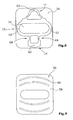
- Fig. 1 and 2 Cleat shown may be in accordance with the in 8 and 9 embodiment shown additionally be connected to a support plate 58.
- the support plate 58 is connected to the main body 10 on the side of the cleat pointing in the direction of the shoe sole.
- a connection with one or both clamping elements 12, 14 may be provided, wherein the connection with the clamping elements 12, 14 then takes place with the bulges 16, 18.
- the cleat is formed integrally with the support plate 58, in particular as a metal casting.
- an enlarged support surface 60 is created for engagement with the outside of the shoe sole.
- a fine corrugation 66 may be provided in the form of a plurality of small webs. Due to the enlarged surface can with many small webs the same slip resistance as in the prior art larger webs (corresponding Fig. 3 ) will be realized.
- adjustment marks such as notches 66, may be provided on the side of the cleat facing away from the shoe sole.
- the notches 66 preferably define the longitudinal and transverse axes of the cleat, so that the cleat on the shoe sole can be aligned more easily.
- Corresponding markings 62 can of course also be found on the in Fig. 1, 2 be provided cleat shown.
- the rear clamping element 14 has a cross-sectional taper or indentation 64. By such a waist, the weight of the cleats can be reduced.
Landscapes
- Engineering & Computer Science (AREA)
- Health & Medical Sciences (AREA)
- General Health & Medical Sciences (AREA)
- Physical Education & Sports Medicine (AREA)
- Chemical & Material Sciences (AREA)
- Combustion & Propulsion (AREA)
- Transportation (AREA)
- Mechanical Engineering (AREA)
- Footwear And Its Accessory, Manufacturing Method And Apparatuses (AREA)
- Motorcycle And Bicycle Frame (AREA)
Description
- Die Erfindung betrifft ein Verbindungselement zum lösbaren Verbinden von Fahrradschuhen mit Fahrradpedalen.
- Derartige Verbindungselemente, die häufig als Cleats bezeichnet werden, werden mit der Schuhsohle eines Fahrradschuhs verbunden. Die Verbindungselemente weisen üblicherweise ein vorderes und ein hinteres Klemmelement auf, die mit einem Grundkörper des Verbindungselements verbunden sind. Die beiden Klemmelemente, die bei an dem Schuh befestigten Verbindungselement in Richtung der Zehen bzw. der Ferse weisen, dienen zur Verbindung mit einer entsprechenden Aufnahmevorrichtung, die am Fahrradpedal vorgesehen ist. Üblicherweise sind am Fahrradpedal federbelastete Rastelemente vorgesehen, die jeweils ein Klemmelement halten. Es ist somit möglich, das vordere Klemmelement in ein erstes Halteelement des Pedals einzuschieben und durch Aufbringen von Kraft nach unten ein Einrasten des hinteren Klemmelements mit dem hinteren Halteelement zu bewirken. Zur Befestigung der Verbindungselemente (Cleats) an den Fahrradschuhen weist der Grundkörper eine üblicherweise ovale Durchgangsöffnung auf. Durch die Durchgangsöffnung werden üblicherweise zwei Inbus-Schrauben gesteckt, die durch Schlitze in der Schuhsohle geführt und in eine innerhalb des Schuhs angeordnete Auflage- oder Gegenplatte geschraubt werden. Zur Aufnahme der beiden Schrauben ist in der Durchgangsöffnung üblicherweise eine im Wesentlichen ovale Scheibe angeordnet, die zur Aufnahme der Schrauben zwei Löcher aufweist. Zur Befestigung des Verbindungselements an dem Fahrradschuh sind somit üblicherweise zwei Schrauben vorgesehen, die mit einer gemeinsamen oder zwei gesonderten Unterlegscheiben verbunden sind und durch eine Durchgangsöffnung des Grundkörpers geführt sind. Die Befestigung erfolgt sodann durch Einschrauben in die Gegenplatte.
- Neben bei Rennradschuhen häufig verwendeten Cleats der Fa. Look haben sich insbesondere bei Mountainbikes Cleats der Fa. Shimano mit der Bezeichnung "SPD" durchgesetzt. Derartige Cleats sind beispielsweise in
DE 42 01 916 beschrieben. Die SPD-Cleats sind von mit der Schuhsohle verbundenen Stollen umgeben und stehen im Unterschied zu Look-Cleats nicht oder nur geringfügig über die Unterseite des Schuhs vor. Hierdurch ist die Gefahr des Beschädigens sowie des Abnutzens des Cleats beim Laufen verringert. Insbesondere mit Mountainbikeschuhen wird jedoch häufig auch über unebenen Untergrund gelaufen. Wenn dieser beispielsweise steinig ist (Schotterweg), kann eine Beschädigung der Cleats, insbesondere der Befestigungselemente des Cleats, erfolgten. Häufig werden die Schraubenköpfe derart beschädigt, dass ein Öffnen der Schrauben auch beim Verwenden von Inbus-Schrauben nur noch schwer oder nicht mehr möglich ist. Dies erschwert das Auswechseln der Cleats erheblich, da die Schrauben ggf. aufgebohrt werden müssen. - Aufgabe der Erfindung ist es, ein Verbindungselement zum lösbaren Verbinden von Fahrradschuhen mit Fahrradpedalen zu schaffen, bei dem die Beschädigung während des Gehens, insbesondere die Beschädigung der Befestigungselemente während des Gehens, verringert ist.
- Die Lösung der Aufgabe erfolgt erfindungsgemäß durch die Merkmale des Anspruchs 1.
- Bei dem erfindungsgemäßen Verbindungselement handelt es sich insbesondere um ein in der Schuhsohle versenktes Verbindungselement, d.h. ein Verbindungselement, dessen Außenseite nicht über die Lauffläche der Schuhsohle vorsteht, wie es insbesondere bei den von der Fa. Shimano vertriebenen Cleats mit der Bezeichnung "SPD" der Fall ist. Um ein Beschädigen des mindestens einen Befestigungselements, das durch eine oder zwei Durchgangsöffnungen des Grundkörpers geführt ist, zu vermeiden oder zumindest erheblich zu verringern, ist erfindungsgemäß ein Abdeckelement vorgesehen, durch das das mindestens eine Befestigungselement abgedeckt ist.
- Das Abdeckelement ist erfindungsgemäß mit dem Grundkörper verbunden, wobei der Grundkörper vorzugsweise eine entsprechende Vertiefung aufweist, so dass das Abdeckelement nicht über die Außenseite des Grundkörpers vorsteht.
- Erfindungsgemäß erfolgt das Verbinden des Abdeckelements mit dem Grundkörper durch ein Einschieben in eine insbesondere seitlich am Grundkörper vorgesehene Einschuböffnung. Ggf. erfolgt zusätzlich ein Einrasten des Abdeckelements über mindestens ein Rastelement. Die Einschuböffnung mündet in eine insbesondere über den gesamten Umfang der Durchgangsöffnung vorgesehene Einschubnut, so dass das Abdeckelement sicher gehalten ist. Die Einschuböffnung kann ggf. durch ein Verschlusselement, wie einen in die Öffnung geklemmten Stopfen oder Riegel, verschlossen werden.
- Bei einer alternativen Ausführungsform der Erfindung weist der Grundkörper eine insbesondere umlaufende Nut zur Aufnahme des Abdeckelements auf.
- Besonders bevorzugt ist es, dass das Abdeckelement zumindest teilweise in der Durchgangsöffnung angeordnet ist. Hierdurch ist die Gefahr des ungewollten Ablösens verringert, da ein gewisser seitlicher Halt durch den Rand der Durchgangsöffnung gewährleistet ist. Vorzugsweise ist das Abdeckelement vollständig innerhalb der Durchgangsöffnung angeordnet und steht somit vorzugsweise nicht über eine Außenseite des Grundkörpers vor. Bei der Außenseite des Grundkörpers handelt es sich hierbei um die von der Schuhsohle weg weisende Seite des Grundkörpers.
- Zusätzlich können an dem Grundkörper und/ oder dem Abdeckelement Rastelemente vorgesehen sein. Die Rastelemente dienen zum festen Verbinden des Abdeckelements mit dem Grundkörper. Insbesondere kann das Verbinden der Rastelemente durch Eindrücken des Abdeckelements, d.h. durch Bewegen des Abdeckelements in Richtung der Schuhsohle, erfolgen. Bevorzugt ist es hierbei, dass ein elastisches bzw. verschiebbares Rastelement an dem Abdeckelement vorgesehen ist, wobei ein eher starres, insbesondere stabileres Rastelement an dem Grundkörper vorgesehen ist. Hierdurch ist sichergestellt, dass das Rastelement am Abdeckelement eher zerstört wird als das Rastelement am Grundkörper. Dies ist vorteilhaft, da das Abdeckelement ohne Weiteres ersetzt werden kann. Das Ersetzen des Cleats wäre aufwändiger. Ferner handelt es sich bei dem Cleat um das teurere Bauteil. Des Weiteren ist das Cleat auch ohne Abdeckelement verwendbar.
- Insbesondere sind am Umfang des Abdeckelements mehrere Rastelemente angeordnet, die mit korrespondierenden Rastelementen am Grundkörper zusammen wirken. Ebenso kann am Grundkörper eine umlaufende Nut bzw. Hinterschneidung vorgesehen sein, so dass eine exakte Anordnung des Abdeckelements relativ zum Grundkörper nicht erforderlich ist.
- Bei einer weiteren bevorzugten Ausführungsform, die ggf. mit den vorstehend beschriebenen Ausführungsformen kombiniert werden kann, weist das Befestigungselement und/ oder das Abdeckelement mindestens ein Rastelement auf. Insbesondere weist das Abdeckelement an seiner in Richtung des Befestigungselements weisenden Innenseite mindestens einen Ansatz auf, der in eine am Befestigungselement vorgesehene Ausnehmung eindrückbar ist. Ebenso kann auch an dem Befestigungselement ein Ansatz vorgesehen sein, der in eine Ausnehmung des Abdeckelements eingedrückt wird. Vorzugsweise werden als Ausnehmungen die üblicherweise beiden Öffnungen der beiden Inbus-Schrauben genutzt, so dass das Abdeckelement vorzugsweise zwei im Querschnitt insbesondere zylindrische Ansätze aufweist, die in die Inbus-Öffnungen gedrückt werden. Diese Ausführungsform der Erfindung hat den Vorteil, dass an dem Grundkörper selbst keine Veränderungen vorgenommen werden müssen. Um sicherzustellen, dass das Abdeckelement auch bei dieser Ausführungsform insbesondere vollständig innerhalb der Durchgangsöffnung angeordnet ist, muss die entsprechende Ausnehmung in den Grundkörper lediglich etwas tiefer ausgestaltet werden.
- Bei einer bevorzugten Weiterbildung der Erfindung sind mit dem vorderen und/ oder dem hinteren Klemmelement an einer Trittfläche Rutschsicherungen vorgesehen. Die Trittfläche der Klemmelemente ist die in montiertem Zustand von der Schuhsohle weg weisende Fläche, die beim Laufen mit dem Fahrradschuh beansprucht wird. Da Cleats üblicherweise aus Metall sind, besteht beispielsweise beim Laufen auf Stein die Gefahr des Wegrutschens. Erfindungsgemäß ist daher bei einer bevorzugten Ausführungsform mit zumindest einem der beiden Klemmelemente eine Rutschsicherung verbunden. Bei der Rutschsicherung kann es sich um ein plattenförmiges Kunststoffelement aus geeignetem Material handeln. Insbesondere kann es sich bei dem Element um ein elastisches, relativ weiches Material handeln.
- Ebenso kann es sich bei der Rutschsicherung um ein zwar hartes Element, das ggf. auch aus Metall hergestellt sein kann, handeln, dessen Oberfläche stark aufgerauht ist. Die insbesondere beiden Rutschsicherungen sind vorzugsweise mit dem jeweiligen Klemmelement verklebt. Um eine genaue Lageanordnung der Rutschsicherungen sicherzustellen, können die Rutschsicherungen in Ausnehmungen angeordnet sein, wobei die Rutschsicherungen eine größere Dicke verglichen mit der Tiefe der Ausnehmung aufweisen. Vorzugsweise sind die Rutschsicherungen an die Klemmelemente angespritzt. Bei dem Vorsehen mindestens einer Rutschsicherung, vorzugsweise je einer Rutschsicherung je Klemmelement, handelt es sich um eine selbständige Erfindung, die unabhängig von dem Vorsehen eines Abdeckelements ist.
- Das Abdeckelement kann vorzugsweise eine Oberfläche aufweisen, die zusätzlich als Rutschsicherung dient.
- Das vorstehend beschriebene Abdeckelement stellt eine selbständige, von dem Verbindungselement unabhängige Erfindung dar, da das Abdeckelement auch als Ersatzteil vertrieben werden kann. Hierbei handelt es sich bei dem Abdeckelement um ein insbesondere plattenförmiges Element, das entsprechend der vorstehend beschriebenen bevorzugten Weiterbildungen auf unterschiedliche Arten mit dem Grundkörper und/ oder dem Befestigungselement verbunden werden kann.
- Das hintere Klemmelement weist vorzugsweise in Richtung des Grundkörpers eine Querschnittsverjüngung auf. Die Breite des hinteren Klemmelements in Draufsicht verringert sich somit in Richtung des Grundkörpers. Insbesondere weist das Klemmelement eine beidseitige Einschnürung oder Taillierung auf. Ein Verbindungselement mit einem derartigen, in Draufsicht insbesondere hammerkopfförmigen Klemmelement weist den Vorteil auf, dass das Gewicht des Cleats verringert werden kann. Ein derartiges Cleat stellt eine selbständige Erfindung dar, die unabhängig von dem Vorsehen eines Abdeckelements oder einer Abrutschsicherung ist. Bevorzugt ist jedoch eine Kombination mit diesen Erfindungen.
- An einer Außenseite, d.h. an der von der Schuhsohle weg weisenden Seite des Cleats, können Justagemarkierungen vorgesehen sein. Hierbei handelt es sich insbesondere um Markierungen in Form von Aufdrucken, Auskerbungen oder dgl. Durch die Markierung ist insbesondere die Längs- und die Querachse des Cleats definiert bzw. ablesbar. Mit Hilfe der Justagemarkierungen ist ein genaueres Ausrichten der Lage des Cleats relativ zum Schuh möglich. Das Vorsehen derartiger Justagemarkierungen an der Außenseite des Grundkörpers und/ oder eines bzw. beider Klemmelemente stellt ebenfalls eine selbständige Erfindung, die unabhängig von dem Vorsehen eines Abdeckelements, einer Rutschsicherung und/ oder einer Querschnittsverjüngung des hinteren Klemmelements ist.
- Bei einer besonders bevorzugten Ausführungsform der Erfindung ist mit der Innenseite des Grundkörpers, d.h. mit der in montiertem Zustand in Richtung der Schuhsohle weisenden Seite des Grundkörpers eine Auflageplatte verbunden. Durch die Auflageplatte ist die Auflagefläche zwischen der Außenseite der Schuhsohle und dem Cleat vergrößert. Hierdurch ist eine vereinfachte Justage möglich. Insbesondere ist es möglich, an der in Richtung der Schuhsohle weisenden Seite der Auflageplatte eine feine Riffelung vorzusehen, so dass eine sehr feine Einstellung der Auflageplatte möglich ist. Grobe Rifflungen nach dem Stand der Technik weisen den Nachteil auf, dass bei einem Lösen des Cleats zum Nachjustieren dieses stets in die durch die Feinriffelung in der Sohle hervorgerufenen Vertiefungen rutscht und somit ein geringfügiges Nachjustieren nicht möglich ist. Auf Grund der erhöhten Andrückfläche kann die Höhe der Riffelungen gegenüber dem Stand der Technik geringer ausgebildet sein, so dass die Einkerbungen in den Schuhsohlen geringer sind. Insbesondere weist die Feinriffelung eine Höhe von weniger als 0,5 mm, insbesondere weniger als 0,25 mm auf. Die einzelnen Elemente der Feinriffelung weisen vorzugsweise eine Querschnittsfläche von weniger als 2 mm2, insbesondere weniger als 1 mm2 und besonders bevorzugt weniger als 0,5 mm2 auf. Die Auflageplatte ist vorzugsweise fest mit dem Grundkörper und/ oder einem bzw. beiden Klemmelementen verbunden. Vorzugsweise handelt es sich um ein einstückiges Bauteil, bei dem es sich beispielsweise um ein Gussbauteil handelt. Das Vorsehen einer Auflageplatte an einem Cleat, die der innerhalb des Schuhs angeordneten Gegenplatte gegenüberliegt und vorzugsweise dieselbe Grundfläche wie die Gegenplatte aufweist, stellt eine von den vorstehend beschriebenen Erfindungen unabhängige Erfindung dar, wobei eine Kombination mit einer oder mehreren der vorstehend beschriebenen Erfindungen bevorzugt ist.
- Nachfolgend werden die Erfindungen anhand bevorzugter Ausführungsformen unter Bezugnahme auf die anliegenden Zeichnungen näher erläutert.
- Es zeigen:
- Fig. 1
- eine schematische Draufsicht eines erfindungsgemäßen Verbindungselements mit Abdeckelement,
- Fig. 2
- eine schematische Draufsicht eines erfindungsgemäßen Verbindungselements ohne Abdeckelement,
- Fig.3
- eine schematische Unter-Ansicht des in den
Fig. 1 und 2 dargestellten Verbindungselements, - Fig. 4a, 4b
- eine schematische Schnittansicht einer ersten Ausführungsform eines Abdeckelements in montiertem Zustand sowie in Draufsicht,
- Fig. 5a, 5b
- eine schematische Schnittansicht einer zweiten Ausführungsform eines Abdeckelements in montiertem Zustand sowie in Draufsicht,
- Fig. 6a, 6b
- eine schematische Schnittansicht einer dritten Ausführungsform eines Abdeckelements in montiertem Zustand sowie in Draufsicht, und
- Fig. 7a
- eine schematische Seitenansicht einer vierten Ausführungsform eines Abdeckelements,
- Fig. 7b
- eine schematische Unteransicht des in
Fig. 7a dargestellten Abdeckelements, - Fig. 8
- eine schematische Draufsicht einer weiteren Ausführungsform eines Verbindungselements, und
- Fig. 9
- eine Ansicht der in Richtung der Schuhsohle weisenden Innenseite des in
Fig. 8 dargestellten Verbindungselements. - In den
Fig. 1 und 2 ist eine Draufsicht bzw. eine Ansicht des montierten Verbindungselements von unten dargestellt.Fig. 3 zeigt sodann die Seite des in montiertem Zustand in Richtung der Schuhsohle weisenden Verbindungselements. - Das Verbindungselement weist einen Grundkörper 10 auf, der mit einem vorderen Klemmelement 12 und einem hinteren Klemmelement 14 verbunden ist. Insbesondere sind die Klemmelemente und der Grundkörper einstückig, insbesondere als Gussteil aus Metall, ausgebildet. Das vordere Klemmelement 12 weist bei montiertem Verbindungselement in Richtung der Zehen und das hintere Klemmelement 14 in Richtung der Ferse. Zum Verbinden der Klemmelemente mit entsprechenden Halteelementen des Pedals sind die beiden Klemmelemente 12, 14 stufenförmig aufgebaut, so dass jedes Klemmelement 12, 14 eine in Richtung der Schuhsohle weisende Ausbuchtung 16, 18 aufweist. In montiertem Zustand ist zwischen den Ausbuchtungen 16, 18 und einer Klemmfläche 20 bzw. 22 ein Abstand vorgesehen. In diesen Abstand wird zum Fixieren des Schuhs bzw. des Verbindungselements am
- Pedal das jeweilige Halteelement des Pedals eingeführt. Das Halteelement des Pedals greift somit in eine Hinterschneidung ein.
- In dem Grundkörper 10 ist eine Durchgangsöffnung 24 vorgesehen. Die Durchgangsöffnung 24 weist eine Stufe 26 auf. Hierdurch ist es möglich, in die Durchgangsöffnung ein im Wesentlichen der größeren Außenabmessung entsprechendes, scheibenförmiges Unterlegelement oder zwei gesonderte Unterlegscheiben 28 einzulegen, die auf der Stufe 26 aufliegen. Die Unterlegscheiben bzw. das Unterlegelement bilden zwei Öffnungen 30 aus, durch die jeweils eine nicht dargestellte Schraube gesteckt werden kann, die sodann mit der innerhalb des Schuhs angeordneten Gegenplatte verschraubt werden. Hierdurch wird das Cleat an der Schuhsohle fixiert. Da es sich bei der Durchgangsöffnung 24 um ein Langloch handelt und die Abmessungen eines einstückigen Unterlegelements in der Breite geringer sind als die Breite der Durchgangsöffnung, kann das Cleat seitlich zur Justage verschoben werden. Da in der Schuhsohle zwei Längsschlitze vorgesehen sind, durch die die Schrauben geführt werden, kann das Cleat in Längsrichtung des Schuhs justiert werden. Um nach dem Anziehen der Schrauben ein Verschieben des Justageelements zu vermeiden, sind an der in Richtung der Schuhsohle weisenden Fläche des Grundkörpers stegförmige Ansätze bzw. eine Riffelung 32 (
Fig. 3 ) vorgesehen. - Nach dem Montieren des Cleats an der Schuhsohle kann in der Durchgangsöffnung 24 ein die Schraubenköpfe verdeckendes Abdeckelement 34 (
Fig. 1 ) angeordnet werden. Unterschiedliche Verbindungsmöglichkeiten zwischen dem Abdeckelement 34 und dem Grundkörper 10 werden später anhand derFig. 4a, 4b; 5a, 5b; 6a, 6b beschrieben. Eine Verbindung des Abdeckelements unmittelbar mit den Schrauben des Befestigungselements wird als Beispiel anhand derFig. 7a, 7b später beschrieben. - Zusätzlich sind an einer Trittfläche 36 des vorderen Klemmelements sowie im dargestellten Ausführungsbeispiel auch an einer Trittfläche 38 des hinteren Klemmelements 14 Rutschsicherungen 40 vorgesehen. Die Rutschsicherungen 40 können aufgeklebt sein. Insbesondere sind die Rutschsicherungen, um ein seitliches Verschieben und damit ein Lösen der Rutschsicherungen 40 zu vermeiden, in einer Vertiefung angeordnet, wobei die Rutschsicherungen 40 über die Trittflächen 36, 38 vorstehen.
- Bei einer ersten Ausführungsform der Erfindung ist das Abdeckelement 34, wie aus
Fig. 4a, 4b ersichtlich, als scheibenförmiges Element mit der inFig. 4b dargestellten Außenkontur ausgebildet. Zur Aufnahme des Abdeckelements 34 ist in der Innenwand 42 der Durchgangsöffnung 24 eine umlaufende Nut 44 vorgesehen. Hierdurch ist in diesem Ausführungsbeispiel die Durchgangsöffnung vollständig umgebendes Rastelement 46 bzw. ein Rastvorsprung ausgebildet. Das Abdeckelement weist eine gewisse Flexibilität auf, so dass dieses in Richtung eines Pfeils 48 in die Durchgangsöffnung 24 eingedrückt werden kann. Der Rastansatz 46 muss nicht durchgehend sein, sondern kann auch unterbrochen sein, so dass am Umfang verteilt mehrere Rastnasen angeordnet sind, die nach innen über das Abdeckelement in montiertem Zustand vorstehen. - Bei einer weiteren Ausführungsform (
Fig. 5a, 5b ) weist der Grundkörper 10 seitlich eine Einschuböffnung 50 auf. Es ist somit möglich, das Abdeckelement 34 inFig. 5a von links durch die Einschuböffnung 50 über die im dargestellten Ausführungsbeispiel zwei Unterlegscheiben 28 und die Schrauben 29 nach der Montage zu schieben. Ggf. kann die Einschuböffnung 50 durch einen nicht dargestellten Stopfen oder dgl. verschlossen werden. - Bei einer weiteren Ausführungsform (
Fig. 6a, 6b ) ist der Grundkörper 10 wie bei dem inFig. 4a dargestellten Ausführungsbeispiel ausgebildet und weist somit einen umlaufenden Rastvorsprung 46 oder mehrere am Umfang verteilte Rastnasen 46 auf. Zusätzlich weist das Abdeckelement 34 Rastelemente 52 auf. Hierdurch ist das Eindrücken des Abdeckelements 34 in Richtung eines Pfeils 48 vereinfacht. - Bei einer weiteren bevorzugten Ausführungsform weist das Abdeckelement 34 an einer in Richtung des Befestigungselements, insbesondere der Schrauben 29, weisenden Innenfläche 54, im Querschnitt beispielsweise zylindrische Ansätze 56 auf. Die beiden zylindrischen Ansätze 56 weisen einen dem Schraubenabstand entsprechenden Abstand auf. Die Ansätze 56 werden zum Fixieren insbesondere in die Inbus-Öffnungen der beiden Schrauben 29 gedrückt. Ebenso kann eine beispielsweise ovale Unterlegscheibe vorgesehen sein, die eine zusätzliche Aufnehmung aufweist, in die ein oder mehrere Ansätze des Abdeckelements gedrückt werden können.
- Die vorstehend beschriebenen Ausführungsformen des Abdeckelements 34 können auch miteinander kombiniert werden. Insbesondere ist eine Kombination der in den
Fig. 6 und 7 beschriebenen Ausführungsformen vorteilhaft. - Das in den
Fig. 1 und 2 dargestellte Cleat kann entsprechend der inFig. 8 und 9 dargestellten Ausführungsform zusätzlich mit einer Auflageplatte 58 verbunden sein. Die Auflageplatte 58 ist auf der in Richtung der Schuhsohle weisenden Seite des Cleats mit dem Grundkörper 10 verbunden. Zusätzlich kann eine Verbindung mit einem oder beiden Klemmelementen 12, 14 vorgesehen sein, wobei die Verbindung mit den Klemmelementen 12, 14 sodann mit den Ausbuchtungen 16, 18 erfolgt. Besonders bevorzugt ist es, dass das Cleat zusammen mit der Auflageplatte 58 einstückig, insbesondere als Metall-Gussteil ausgebildet ist. Durch Vorsehen der Auflageplatte 58 ist eine vergrößerte Auflagefläche 60 zur Anlage an der Außenseite der Schuhsohle geschaffen. Auf der Anlagefläche 60 kann eine Feinriffelung 66 in Form einer Vielzahl von kleinen Stegen vorgesehen sein. Auf Grund der vergrößerten Oberfläche kann mit vielen kleinen Stegen dieselbe Verrutschsicherheit wie bei nach dem Stand der Technik größeren Stegen (entsprechendFig. 3 ) realisiert werden. - Zusätzlich können auf der von der Schuhsohle weg weisenden Seite des Cleats Justagemarkierungen, wie Einkerbungen 66, vorgesehen sein. Durch die Einkerbungen 66 ist vorzugsweise die Längs- und die Querachse des Cleats definiert, so dass das Cleat an der Schuhsohle leichter ausgerichtet werden kann. Entsprechende Markierungen 62 können selbstverständlich auch an dem in
Fig. 1, 2 dargestellten Cleat vorgesehen sein. - Vorzugsweise weist das hintere Klemmelement 14 eine Querschnittsverjüngung bzw. Einbuchtung 64 auf. Durch eine derartige Taillierung kann das Gewicht des Cleats reduziert werden.
Claims (12)
- Verbindungselement zum lösbaren Verbinden von Fahrradschuhen mit Fahrradpedalen, mit
einem Grundkörper (10) mit einer Durchgangsöffnung (24) zur Aufnahme von mindestens einem Befestigungselement (28, 29), und
einem mit dem Grundkörper (10) verbundenen vorderen und einem hintern Klemmelement (12, 14),
gekennzeichnet durch
ein Abdeckelement (34) zur Abdeckung des Befestigungselements, wobei der Grundkörper eine Einschuböffnung (50) zum Einschieben des Abdeckelements (34) und/oder eine umlaufende Nut (44) zur Aufnahme des Abdeckelements (34) aufweist. - Verbindungselement nach Anspruch 1, dadurch gekennzeichnet, dass das Abdeckelement (34) lösbar mit dem Grundkörper (10) und/ oder dem Befestigungselement (28, 29) verbunden ist.
- Verbindungselement nach Anspruch 1 oder 2, dadurch gekennzeichnet, dass das Abdeckelement (34) zumindest teilweise innerhalb der Durchgangsöffnung (24) angeordnet ist.
- Verbindungselement nach einem der Ansprüche 1 bis 3, gekennzeichnet durch mit dem Grundkörper (10) und/ oder dem Abdeckelement (34) verbundene Rastelelemente (46, 52) zum Halten des Abdeckelements (10).
- Verbindungselement nach einem der Ansprüche 1 bis 4, dadurch gekennzeichnet, dass die Einschuböffnung (50) seitlich angeordnet ist.
- Verbindungselement nach einem der Ansprüche 1 bis 5, dadurch gekennzeichnet, dass die Nut (44) umlaufend ist.
- Verbindungselement nach einem der Ansprüche 1 bis 6, dadurch gekennzeichnet, dass das Befestigungselement (28, 29) und/ oder das Abdeckelement (34) ein Rastelelement (56) zum Verbinden des Abdeckelements (34) an dem Befestigungselement (28, 29) aufweist.
- Verbindungselement nach einem der Ansprüche 1 bis 7, dadurch gekennzeichnet, dass das Abdeckelement (34) einen Ansatz (56) aufweist, der zur Verbindung in eine Ausnehmung des Befestigungselements (28, 29) eindrückbar ist.
- Verbindungselement nach einem der Ansprüche 1 bis 8, gekennzeichnet durch eine mit dem vorderen oder dem hinteren Klemmelement (12, 14) an einer Trittfläche (36, 38) vorgesehene Rutschsicherung (40).
- Verbindungselement nach einem der Ansprüche 1 bis 9, dadurch gekennzeichnet, dass das hintere Klemmelement (14) eine Querschnittsverjüngung (64) in Richtung des Grundkörpers (10) aufweist.
- Verbindungselement nach einem der Ansprüche 1 bis 10, gekennzeichnet durch eine an der Außenseite des Grundkörpers und/ oder eines bzw. beider Klemmelemente (12, 14) vorgesehenen Justagemarkierung (62).
- Verbindungselement nach einem der Ansprüche 1 bis 11, gekennzeichnet durch eine auf der Innenseite des Grundkörpers (10) vorgesehene Auflageplatte (58), die insbesondere einstückig mit dem Grundkörper (10) und/ oder den Klemmelementen (12, 14) ausgebildet ist und vorzugsweise eine Feinriffelung (66) aufweist.
Priority Applications (2)
| Application Number | Priority Date | Filing Date | Title |
|---|---|---|---|
| EP11169765A EP2366618A3 (de) | 2007-08-29 | 2008-08-26 | Verbindungselement zum lösbaren Verbinden von Fahrradschuhen mit Fahrradpedalen |
| EP11169764A EP2368790A3 (de) | 2007-08-29 | 2008-08-26 | Verbindungselement zum lösbaren Verbinden von Fahrradschuhen mit Fahrradpedalen |
Applications Claiming Priority (2)
| Application Number | Priority Date | Filing Date | Title |
|---|---|---|---|
| DE202007012112U DE202007012112U1 (de) | 2007-08-29 | 2007-08-29 | Verbindungselement zum lösbaren Verbinden von Fahrradschuhen mit Fahrradpedalen |
| PCT/EP2008/061150 WO2009027399A1 (de) | 2007-08-29 | 2008-08-26 | Verbindungselement zum lösbaren verbinden von fahrradschuhen mit fahrradpedalen |
Publications (2)
| Publication Number | Publication Date |
|---|---|
| EP2183153A1 EP2183153A1 (de) | 2010-05-12 |
| EP2183153B1 true EP2183153B1 (de) | 2011-06-22 |
Family
ID=40011195
Family Applications (3)
| Application Number | Title | Priority Date | Filing Date |
|---|---|---|---|
| EP08803219A Not-in-force EP2183153B1 (de) | 2007-08-29 | 2008-08-26 | Verbindungselement zum lösbaren verbinden von fahrradschuhen mit fahrradpedalen |
| EP11169765A Withdrawn EP2366618A3 (de) | 2007-08-29 | 2008-08-26 | Verbindungselement zum lösbaren Verbinden von Fahrradschuhen mit Fahrradpedalen |
| EP11169764A Withdrawn EP2368790A3 (de) | 2007-08-29 | 2008-08-26 | Verbindungselement zum lösbaren Verbinden von Fahrradschuhen mit Fahrradpedalen |
Family Applications After (2)
| Application Number | Title | Priority Date | Filing Date |
|---|---|---|---|
| EP11169765A Withdrawn EP2366618A3 (de) | 2007-08-29 | 2008-08-26 | Verbindungselement zum lösbaren Verbinden von Fahrradschuhen mit Fahrradpedalen |
| EP11169764A Withdrawn EP2368790A3 (de) | 2007-08-29 | 2008-08-26 | Verbindungselement zum lösbaren Verbinden von Fahrradschuhen mit Fahrradpedalen |
Country Status (6)
| Country | Link |
|---|---|
| EP (3) | EP2183153B1 (de) |
| AT (1) | ATE513733T1 (de) |
| DE (1) | DE202007012112U1 (de) |
| ES (1) | ES2368295T3 (de) |
| TW (1) | TWI452975B (de) |
| WO (1) | WO2009027399A1 (de) |
Families Citing this family (1)
| Publication number | Priority date | Publication date | Assignee | Title |
|---|---|---|---|---|
| FR2968898B1 (fr) * | 2010-12-15 | 2013-07-26 | Salomon Sas | Chaussure de sport |
Family Cites Families (15)
| Publication number | Priority date | Publication date | Assignee | Title |
|---|---|---|---|---|
| GB916161A (en) * | 1957-10-31 | 1963-01-23 | Sidney Geoffrey Young | Improvements in or relating to fixing devices |
| GB1178396A (en) * | 1966-07-22 | 1970-01-21 | Hills Patents Ltd | Improvements in or relating to Screws. |
| FR2464660A1 (fr) * | 1979-09-10 | 1981-03-20 | Camuset | Dispositif cale-pedale pour chaussure de cyclisme |
| CH652006A5 (de) * | 1981-04-16 | 1985-10-31 | Hugo Schaer | Sportschuh fuer radfahrer. |
| DE3135346A1 (de) * | 1981-09-07 | 1983-05-11 | Sportartikelfabrik Karl Uhl, 7460 Balingen | "sohle fuer radrennschuhe" |
| US5007185A (en) * | 1989-10-13 | 1991-04-16 | Lazarski Margaret A | Cleat cover for bicycle shoe |
| US5031342A (en) * | 1989-12-08 | 1991-07-16 | Crook R Igor | Device for enabling walking and protecting cleats on cycling shoes for quick release (clipless) pedals |
| DE4021356A1 (de) * | 1990-07-05 | 1992-01-09 | Look Sa | Fahrrad-pedalanordnung |
| JPH0496202U (de) | 1991-01-25 | 1992-08-20 | ||
| IT1269004B (it) * | 1994-10-04 | 1997-03-18 | Signori Dino Sidi Sport | Calzatura sportiva predisposta per uso ciclistico |
| JPH10184647A (ja) * | 1996-12-24 | 1998-07-14 | Suwa Kikai Seisakusho:Kk | ねじ頭部用カバー |
| DE29702605U1 (de) * | 1997-02-14 | 1997-04-03 | Adidas Ag, 91074 Herzogenaurach | Sportschuh |
| FR2858184B1 (fr) * | 2003-07-30 | 2005-10-21 | Look Cycle Int | Chaussure de cycliste a cale de retenue de la chaussure sur une pedale a fixation automatique |
| DE102005026498A1 (de) * | 2005-06-09 | 2006-12-14 | Dieter Mankau | Fahrradschuh |
| DE202005017838U1 (de) * | 2005-11-16 | 2006-01-19 | Xie, Jin-Long | Schuhfixierung für Rennradschuhe |
-
2007
- 2007-08-29 DE DE202007012112U patent/DE202007012112U1/de not_active Expired - Lifetime
-
2008
- 2008-08-26 EP EP08803219A patent/EP2183153B1/de not_active Not-in-force
- 2008-08-26 EP EP11169765A patent/EP2366618A3/de not_active Withdrawn
- 2008-08-26 ES ES08803219T patent/ES2368295T3/es active Active
- 2008-08-26 EP EP11169764A patent/EP2368790A3/de not_active Withdrawn
- 2008-08-26 WO PCT/EP2008/061150 patent/WO2009027399A1/de not_active Ceased
- 2008-08-26 AT AT08803219T patent/ATE513733T1/de active
- 2008-08-27 TW TW097132791A patent/TWI452975B/zh not_active IP Right Cessation
Also Published As
| Publication number | Publication date |
|---|---|
| EP2366618A2 (de) | 2011-09-21 |
| ATE513733T1 (de) | 2011-07-15 |
| TWI452975B (zh) | 2014-09-21 |
| EP2183153A1 (de) | 2010-05-12 |
| TW200922488A (en) | 2009-06-01 |
| WO2009027399A1 (de) | 2009-03-05 |
| ES2368295T3 (es) | 2011-11-16 |
| EP2366618A3 (de) | 2012-01-25 |
| EP2368790A3 (de) | 2012-01-25 |
| DE202007012112U1 (de) | 2009-01-08 |
| EP2368790A2 (de) | 2011-09-28 |
Similar Documents
| Publication | Publication Date | Title |
|---|---|---|
| DE69728374T2 (de) | Schnellwechsel-spike für schuhwerk | |
| DE69522925T2 (de) | Verbessertes system für fahrradpedal ohne befestigungsclip | |
| DE69013418T2 (de) | Vorrichtung für Fahrradpedale ohne Fussraste. | |
| DE4040727C2 (de) | Fahrradschuh | |
| DE602004004448T2 (de) | Fahrradschuh mit Schuhhalter eines Pedals mit automatischer Befestigung | |
| EP2478155B1 (de) | Unterlegplatte für die befestigung einer schiene auf einem festen untergrund und befestigung einer schiene | |
| DE69122862T2 (de) | Stollen und haltebuchse für stollenschuhe | |
| EP0061715B1 (de) | Sportschuh mit einer mit Greifelementen versehenen Sohle | |
| EP2046464B1 (de) | Skistockteller mit einstellbarer auflagefläche | |
| DE3505665A1 (de) | Sportschuh | |
| EP0464628A1 (de) | Fahrrad-Pedalanordnung | |
| DE2316773A1 (de) | Sportschuh mit stollen oder spikes | |
| EP2183153B1 (de) | Verbindungselement zum lösbaren verbinden von fahrradschuhen mit fahrradpedalen | |
| EP4444607B1 (de) | Fahrradpedal mit pins mit schräger verzahnung | |
| DE4129939A1 (de) | Leisten zur verwendung bei der herstellung von fahrradschuhen, leisten und fahrradschuhsohle, sowie verfahren zur herstellung von schuhen mit hilfe eines leistens | |
| EP3453432B1 (de) | Ultraleichter vorderbacken | |
| DE69612818T2 (de) | Verbindungsvorrichtung auf einem Radfahrerschuh | |
| WO2019180500A1 (de) | Stützelement für ein fahrrad | |
| DE4040728C2 (de) | Fahrradschuh | |
| EP1958526A1 (de) | Sportschuh mit lösbarer Sohle | |
| DE9406441U1 (de) | Bindung für ein Snowboard | |
| DE3526298A1 (de) | Schuh, insbesondere sportschuh mit austauschbarem laufsohlenteil | |
| DE102020004616A1 (de) | Fahrradpedal-System einschliesslich Pedalkörper und Schuhplatte | |
| DE102005022278A1 (de) | Verbindungselement zur Befestigung von einem an einem Unterboden aufsetzbaren Bauteil | |
| DE60307421T2 (de) | Antiblockiersystem eines Fahrrads |
Legal Events
| Date | Code | Title | Description |
|---|---|---|---|
| PUAI | Public reference made under article 153(3) epc to a published international application that has entered the european phase |
Free format text: ORIGINAL CODE: 0009012 |
|
| 17P | Request for examination filed |
Effective date: 20100225 |
|
| AK | Designated contracting states |
Kind code of ref document: A1 Designated state(s): AT BE BG CH CY CZ DE DK EE ES FI FR GB GR HR HU IE IS IT LI LT LU LV MC MT NL NO PL PT RO SE SI SK TR |
|
| AX | Request for extension of the european patent |
Extension state: AL BA MK RS |
|
| DAX | Request for extension of the european patent (deleted) | ||
| GRAP | Despatch of communication of intention to grant a patent |
Free format text: ORIGINAL CODE: EPIDOSNIGR1 |
|
| GRAS | Grant fee paid |
Free format text: ORIGINAL CODE: EPIDOSNIGR3 |
|
| GRAA | (expected) grant |
Free format text: ORIGINAL CODE: 0009210 |
|
| AK | Designated contracting states |
Kind code of ref document: B1 Designated state(s): AT BE BG CH CY CZ DE DK EE ES FI FR GB GR HR HU IE IS IT LI LT LU LV MC MT NL NO PL PT RO SE SI SK TR |
|
| REG | Reference to a national code |
Ref country code: GB Ref legal event code: FG4D Free format text: NOT ENGLISH |
|
| REG | Reference to a national code |
Ref country code: CH Ref legal event code: EP |
|
| REG | Reference to a national code |
Ref country code: IE Ref legal event code: FG4D Free format text: LANGUAGE OF EP DOCUMENT: GERMAN |
|
| REG | Reference to a national code |
Ref country code: DE Ref legal event code: R096 Ref document number: 502008003976 Country of ref document: DE Effective date: 20110804 |
|
| RAP2 | Party data changed (patent owner data changed or rights of a patent transferred) |
Owner name: RTI SPORTS VERTRIEB VON SPORTARTIKELN GMBH |
|
| REG | Reference to a national code |
Ref country code: NL Ref legal event code: T3 |
|
| PG25 | Lapsed in a contracting state [announced via postgrant information from national office to epo] |
Ref country code: LT Free format text: LAPSE BECAUSE OF FAILURE TO SUBMIT A TRANSLATION OF THE DESCRIPTION OR TO PAY THE FEE WITHIN THE PRESCRIBED TIME-LIMIT Effective date: 20110622 Ref country code: SE Free format text: LAPSE BECAUSE OF FAILURE TO SUBMIT A TRANSLATION OF THE DESCRIPTION OR TO PAY THE FEE WITHIN THE PRESCRIBED TIME-LIMIT Effective date: 20110622 Ref country code: NO Free format text: LAPSE BECAUSE OF FAILURE TO SUBMIT A TRANSLATION OF THE DESCRIPTION OR TO PAY THE FEE WITHIN THE PRESCRIBED TIME-LIMIT Effective date: 20110922 Ref country code: HR Free format text: LAPSE BECAUSE OF FAILURE TO SUBMIT A TRANSLATION OF THE DESCRIPTION OR TO PAY THE FEE WITHIN THE PRESCRIBED TIME-LIMIT Effective date: 20110622 |
|
| REG | Reference to a national code |
Ref country code: ES Ref legal event code: FG2A Ref document number: 2368295 Country of ref document: ES Kind code of ref document: T3 Effective date: 20111116 |
|
| PG25 | Lapsed in a contracting state [announced via postgrant information from national office to epo] |
Ref country code: SI Free format text: LAPSE BECAUSE OF FAILURE TO SUBMIT A TRANSLATION OF THE DESCRIPTION OR TO PAY THE FEE WITHIN THE PRESCRIBED TIME-LIMIT Effective date: 20110622 Ref country code: FI Free format text: LAPSE BECAUSE OF FAILURE TO SUBMIT A TRANSLATION OF THE DESCRIPTION OR TO PAY THE FEE WITHIN THE PRESCRIBED TIME-LIMIT Effective date: 20110622 Ref country code: LV Free format text: LAPSE BECAUSE OF FAILURE TO SUBMIT A TRANSLATION OF THE DESCRIPTION OR TO PAY THE FEE WITHIN THE PRESCRIBED TIME-LIMIT Effective date: 20110622 Ref country code: CY Free format text: LAPSE BECAUSE OF FAILURE TO SUBMIT A TRANSLATION OF THE DESCRIPTION OR TO PAY THE FEE WITHIN THE PRESCRIBED TIME-LIMIT Effective date: 20110622 Ref country code: GR Free format text: LAPSE BECAUSE OF FAILURE TO SUBMIT A TRANSLATION OF THE DESCRIPTION OR TO PAY THE FEE WITHIN THE PRESCRIBED TIME-LIMIT Effective date: 20110923 |
|
| PG25 | Lapsed in a contracting state [announced via postgrant information from national office to epo] |
Ref country code: MT Free format text: LAPSE BECAUSE OF FAILURE TO SUBMIT A TRANSLATION OF THE DESCRIPTION OR TO PAY THE FEE WITHIN THE PRESCRIBED TIME-LIMIT Effective date: 20110622 |
|
| REG | Reference to a national code |
Ref country code: IE Ref legal event code: FD4D |
|
| PG25 | Lapsed in a contracting state [announced via postgrant information from national office to epo] |
Ref country code: CZ Free format text: LAPSE BECAUSE OF FAILURE TO SUBMIT A TRANSLATION OF THE DESCRIPTION OR TO PAY THE FEE WITHIN THE PRESCRIBED TIME-LIMIT Effective date: 20110622 Ref country code: PT Free format text: LAPSE BECAUSE OF FAILURE TO SUBMIT A TRANSLATION OF THE DESCRIPTION OR TO PAY THE FEE WITHIN THE PRESCRIBED TIME-LIMIT Effective date: 20111024 Ref country code: IS Free format text: LAPSE BECAUSE OF FAILURE TO SUBMIT A TRANSLATION OF THE DESCRIPTION OR TO PAY THE FEE WITHIN THE PRESCRIBED TIME-LIMIT Effective date: 20111022 Ref country code: IE Free format text: LAPSE BECAUSE OF FAILURE TO SUBMIT A TRANSLATION OF THE DESCRIPTION OR TO PAY THE FEE WITHIN THE PRESCRIBED TIME-LIMIT Effective date: 20110622 Ref country code: EE Free format text: LAPSE BECAUSE OF FAILURE TO SUBMIT A TRANSLATION OF THE DESCRIPTION OR TO PAY THE FEE WITHIN THE PRESCRIBED TIME-LIMIT Effective date: 20110622 |
|
| PG25 | Lapsed in a contracting state [announced via postgrant information from national office to epo] |
Ref country code: PL Free format text: LAPSE BECAUSE OF FAILURE TO SUBMIT A TRANSLATION OF THE DESCRIPTION OR TO PAY THE FEE WITHIN THE PRESCRIBED TIME-LIMIT Effective date: 20110622 Ref country code: SK Free format text: LAPSE BECAUSE OF FAILURE TO SUBMIT A TRANSLATION OF THE DESCRIPTION OR TO PAY THE FEE WITHIN THE PRESCRIBED TIME-LIMIT Effective date: 20110622 Ref country code: RO Free format text: LAPSE BECAUSE OF FAILURE TO SUBMIT A TRANSLATION OF THE DESCRIPTION OR TO PAY THE FEE WITHIN THE PRESCRIBED TIME-LIMIT Effective date: 20110622 |
|
| PG25 | Lapsed in a contracting state [announced via postgrant information from national office to epo] |
Ref country code: MC Free format text: LAPSE BECAUSE OF NON-PAYMENT OF DUE FEES Effective date: 20110831 |
|
| REG | Reference to a national code |
Ref country code: DE Ref legal event code: R082 Ref document number: 502008003976 Country of ref document: DE Representative=s name: VON KREISLER SELTING WERNER, DE |
|
| PLBE | No opposition filed within time limit |
Free format text: ORIGINAL CODE: 0009261 |
|
| STAA | Information on the status of an ep patent application or granted ep patent |
Free format text: STATUS: NO OPPOSITION FILED WITHIN TIME LIMIT |
|
| 26N | No opposition filed |
Effective date: 20120323 |
|
| REG | Reference to a national code |
Ref country code: DE Ref legal event code: R082 Ref document number: 502008003976 Country of ref document: DE Representative=s name: DOMPATENT VON KREISLER SELTING WERNER - PARTNE, DE Effective date: 20120424 Ref country code: DE Ref legal event code: R081 Ref document number: 502008003976 Country of ref document: DE Owner name: RTI SPORTS VERTRIEB VON SPORTARTIKELN GMBH, DE Free format text: FORMER OWNER: RTI SPORTS VERTRIEB VON SPORTARTIKELN GMBH, 56220 URMITZ, DE Effective date: 20120424 Ref country code: DE Ref legal event code: R082 Ref document number: 502008003976 Country of ref document: DE Representative=s name: VON KREISLER SELTING WERNER - PARTNERSCHAFT VO, DE Effective date: 20120424 |
|
| PG25 | Lapsed in a contracting state [announced via postgrant information from national office to epo] |
Ref country code: DK Free format text: LAPSE BECAUSE OF FAILURE TO SUBMIT A TRANSLATION OF THE DESCRIPTION OR TO PAY THE FEE WITHIN THE PRESCRIBED TIME-LIMIT Effective date: 20110622 |
|
| REG | Reference to a national code |
Ref country code: DE Ref legal event code: R097 Ref document number: 502008003976 Country of ref document: DE Effective date: 20120323 |
|
| REG | Reference to a national code |
Ref country code: CH Ref legal event code: PL |
|
| PG25 | Lapsed in a contracting state [announced via postgrant information from national office to epo] |
Ref country code: CH Free format text: LAPSE BECAUSE OF NON-PAYMENT OF DUE FEES Effective date: 20120831 Ref country code: LI Free format text: LAPSE BECAUSE OF NON-PAYMENT OF DUE FEES Effective date: 20120831 |
|
| PGFP | Annual fee paid to national office [announced via postgrant information from national office to epo] |
Ref country code: FR Payment date: 20130207 Year of fee payment: 5 Ref country code: ES Payment date: 20130123 Year of fee payment: 5 |
|
| PG25 | Lapsed in a contracting state [announced via postgrant information from national office to epo] |
Ref country code: LU Free format text: LAPSE BECAUSE OF NON-PAYMENT OF DUE FEES Effective date: 20110826 |
|
| PGFP | Annual fee paid to national office [announced via postgrant information from national office to epo] |
Ref country code: NL Payment date: 20130121 Year of fee payment: 5 Ref country code: BE Payment date: 20130121 Year of fee payment: 5 |
|
| PG25 | Lapsed in a contracting state [announced via postgrant information from national office to epo] |
Ref country code: BG Free format text: LAPSE BECAUSE OF FAILURE TO SUBMIT A TRANSLATION OF THE DESCRIPTION OR TO PAY THE FEE WITHIN THE PRESCRIBED TIME-LIMIT Effective date: 20110922 |
|
| PG25 | Lapsed in a contracting state [announced via postgrant information from national office to epo] |
Ref country code: TR Free format text: LAPSE BECAUSE OF FAILURE TO SUBMIT A TRANSLATION OF THE DESCRIPTION OR TO PAY THE FEE WITHIN THE PRESCRIBED TIME-LIMIT Effective date: 20110622 |
|
| PG25 | Lapsed in a contracting state [announced via postgrant information from national office to epo] |
Ref country code: HU Free format text: LAPSE BECAUSE OF FAILURE TO SUBMIT A TRANSLATION OF THE DESCRIPTION OR TO PAY THE FEE WITHIN THE PRESCRIBED TIME-LIMIT Effective date: 20110622 |
|
| BERE | Be: lapsed |
Owner name: RTI SPORTS VERTRIEB VON SPORTARTIKELN G.M.B.H. Effective date: 20130831 |
|
| REG | Reference to a national code |
Ref country code: NL Ref legal event code: V1 Effective date: 20140301 |
|
| PG25 | Lapsed in a contracting state [announced via postgrant information from national office to epo] |
Ref country code: NL Free format text: LAPSE BECAUSE OF NON-PAYMENT OF DUE FEES Effective date: 20140301 |
|
| REG | Reference to a national code |
Ref country code: FR Ref legal event code: ST Effective date: 20140430 |
|
| PG25 | Lapsed in a contracting state [announced via postgrant information from national office to epo] |
Ref country code: BE Free format text: LAPSE BECAUSE OF NON-PAYMENT OF DUE FEES Effective date: 20130831 Ref country code: IT Free format text: LAPSE BECAUSE OF NON-PAYMENT OF DUE FEES Effective date: 20130826 |
|
| PG25 | Lapsed in a contracting state [announced via postgrant information from national office to epo] |
Ref country code: FR Free format text: LAPSE BECAUSE OF NON-PAYMENT OF DUE FEES Effective date: 20130902 |
|
| REG | Reference to a national code |
Ref country code: ES Ref legal event code: FD2A Effective date: 20140908 |
|
| REG | Reference to a national code |
Ref country code: AT Ref legal event code: MM01 Ref document number: 513733 Country of ref document: AT Kind code of ref document: T Effective date: 20130826 |
|
| PG25 | Lapsed in a contracting state [announced via postgrant information from national office to epo] |
Ref country code: AT Free format text: LAPSE BECAUSE OF NON-PAYMENT OF DUE FEES Effective date: 20130826 Ref country code: ES Free format text: LAPSE BECAUSE OF NON-PAYMENT OF DUE FEES Effective date: 20130827 |
|
| PGFP | Annual fee paid to national office [announced via postgrant information from national office to epo] |
Ref country code: GB Payment date: 20140821 Year of fee payment: 7 |
|
| PGFP | Annual fee paid to national office [announced via postgrant information from national office to epo] |
Ref country code: DE Payment date: 20141029 Year of fee payment: 7 |
|
| REG | Reference to a national code |
Ref country code: DE Ref legal event code: R119 Ref document number: 502008003976 Country of ref document: DE |
|
| GBPC | Gb: european patent ceased through non-payment of renewal fee |
Effective date: 20150826 |
|
| PG25 | Lapsed in a contracting state [announced via postgrant information from national office to epo] |
Ref country code: GB Free format text: LAPSE BECAUSE OF NON-PAYMENT OF DUE FEES Effective date: 20150826 Ref country code: DE Free format text: LAPSE BECAUSE OF NON-PAYMENT OF DUE FEES Effective date: 20160301 |