EP2184384B1 - Bain galvanique et procédé pour la déposition de couches contenant du zinc - Google Patents
Bain galvanique et procédé pour la déposition de couches contenant du zinc Download PDFInfo
- Publication number
- EP2184384B1 EP2184384B1 EP09014111A EP09014111A EP2184384B1 EP 2184384 B1 EP2184384 B1 EP 2184384B1 EP 09014111 A EP09014111 A EP 09014111A EP 09014111 A EP09014111 A EP 09014111A EP 2184384 B1 EP2184384 B1 EP 2184384B1
- Authority
- EP
- European Patent Office
- Prior art keywords
- zinc
- anolyte
- deposition
- galvanic bath
- ions
- Prior art date
- Legal status (The legal status is an assumption and is not a legal conclusion. Google has not performed a legal analysis and makes no representation as to the accuracy of the status listed.)
- Active
Links
Images

Classifications
-
- C—CHEMISTRY; METALLURGY
- C25—ELECTROLYTIC OR ELECTROPHORETIC PROCESSES; APPARATUS THEREFOR
- C25D—PROCESSES FOR THE ELECTROLYTIC OR ELECTROPHORETIC PRODUCTION OF COATINGS; ELECTROFORMING; APPARATUS THEREFOR
- C25D3/00—Electroplating: Baths therefor
- C25D3/02—Electroplating: Baths therefor from solutions
- C25D3/22—Electroplating: Baths therefor from solutions of zinc
-
- C—CHEMISTRY; METALLURGY
- C25—ELECTROLYTIC OR ELECTROPHORETIC PROCESSES; APPARATUS THEREFOR
- C25D—PROCESSES FOR THE ELECTROLYTIC OR ELECTROPHORETIC PRODUCTION OF COATINGS; ELECTROFORMING; APPARATUS THEREFOR
- C25D17/00—Constructional parts, or assemblies thereof, of cells for electrolytic coating
- C25D17/002—Cell separation, e.g. membranes, diaphragms
-
- C—CHEMISTRY; METALLURGY
- C25—ELECTROLYTIC OR ELECTROPHORETIC PROCESSES; APPARATUS THEREFOR
- C25D—PROCESSES FOR THE ELECTROLYTIC OR ELECTROPHORETIC PRODUCTION OF COATINGS; ELECTROFORMING; APPARATUS THEREFOR
- C25D21/00—Processes for servicing or operating cells for electrolytic coating
- C25D21/16—Regeneration of process solutions
- C25D21/22—Regeneration of process solutions by ion-exchange
-
- C—CHEMISTRY; METALLURGY
- C25—ELECTROLYTIC OR ELECTROPHORETIC PROCESSES; APPARATUS THEREFOR
- C25D—PROCESSES FOR THE ELECTROLYTIC OR ELECTROPHORETIC PRODUCTION OF COATINGS; ELECTROFORMING; APPARATUS THEREFOR
- C25D3/00—Electroplating: Baths therefor
- C25D3/02—Electroplating: Baths therefor from solutions
- C25D3/56—Electroplating: Baths therefor from solutions of alloys
- C25D3/565—Electroplating: Baths therefor from solutions of alloys containing more than 50% by weight of zinc
Definitions
- the present invention relates to a galvanic bath and a method for the deposition of zinc-containing layers on substrate surfaces.
- the present invention relates to a galvanic bath and a method for the deposition of zinciferous layers from an acidic deposition electrolyte.
- Zinc-containing layers are characterized in particular by their high corrosion resistance. Due to the appearance of the resulting zinc coatings, zinc layers or zinc-containing layers are used less in the field of decorative coatings than in the field of functional coatings. Thus, for example, it is common to coat small parts such as screws, nuts, washers, prefabricated structural elements such as angle plates or connecting plates and the like in large numbers. In many cases, the small parts are immersed in so-called drum baskets in appropriate Abscheidebäder and it is created between the Abscheidekorb and an anode a Abscheidestrom.
- the obtained properties of the deposited zinc-containing layer can be influenced.
- the appearance, the corrosion resistance and the mechanical properties of the deposited layers can be influenced by appropriate alloying depositions. So it is for example from the DE 103 06 823 A1 known to deposit zinc-manganese alloys. In the DE 101 46 559 describes the galvanic deposition of zinc-nickel alloys.
- the DE 103 22 120 A1 describes a method and an apparatus for extending the useful life of a process solution for the chemical-reductive metal coating.
- European patent application no. 1 717 353 A1 describes an alkaline electroplating bath for applying zinc alloys to substrates, in which the anode space and the cathode space are separated from each other by a filtration membrane.
- a problem with the electrodeposition of zinc-containing layers on substrate surfaces of acidic zinc-containing electrolytes is that the use of dissolving zinc anodes leads to the formation of deposits on the anode surface, which passivate them and adversely affect the production cycle. By these deposits and the effectiveness of the electrodeposition can be reduced.
- a galvanic bath for depositing a zinc-containing layer on a substrate surface comprising a first cell space, which receives an acidic deposition electrolyte, and a second cell space, which receives a neutral or acidic anolyte, wherein the first cell space of the second Cell space is separated by a cation-permeable membrane and wherein in the anolyte receiving cell space a dissolving zinc anode is arranged, which is characterized in that the anolyte receiving cell space is in hydraulic communication with a device which contains any in the anolyte Exchange foreign metal ions for zinc ions and / or protons.
- the object is achieved by a method for electrodeposition of a zinc-containing layer on a substrate surface, wherein the substrate to be coated is brought into contact with an acidic, at least zinc ion-containing deposition electrolyte in a galvanic bath and between the substrate and at least one An anode current is applied, which is suitable to induce the deposition of a zinc-containing layer on the substrate surface, wherein the galvanic bath is divided into at least two cells and the cells separated from each other by a cation-permeable membrane, one cell receiving the acidic deposition electrolyte and the second cell a neutral or acid zinc ion-containing anolyte, and disposing a dissolving zinc anode in the cell receiving the anolyte, which is characterized in that the acid anolyte is at least partially removed from the cell space receiving it and passed through a device in which any foreign metal ions are exchanged for zinc ions and / or protons.
- the device in which any foreign metal ions contained in the anolyte are exchanged can be, for example, a precipitation compartment or a cation exchanger.
- the pH of the anolyte will be increased to a value at which the foreign metal ions possibly contained in the anolyte precipitate out as hydroxides.
- the resulting precipitate can be sedimented. Filtration, centrifugation or the like are separated and the so depleted of any foreign metal ions anolyte back into the anode accommodating cell space.
- the pH is adjusted to a corresponding acidic pH by addition of an acid. As a result, foreign metal ions are finally exchanged for protons.
- the device in which any foreign metal ions contained in the anolyte are exchanged for other cations is a cation exchanger which, for example, has a suitable cation exchange resin.
- the foreign metal ions can advantageously be exchanged for other cations without the addition of anions in the anolyte.
- the foreign metal ions can preferably be exchanged for protons or zinc ions.
- the cation-permeable membrane serves to retain a majority of the foreign metal ions contained in the deposition electrolyte, such as ions of the group consisting of nickel, cobalt, manganese or iron, although the membrane is essentially for these ions is also permeable.
- the Applicant assumes that the voltage gradient of about 1 volt across the membrane is a barrier which is difficult to overcome for the foreign metal ions contained in the deposition electrolyte.
- the foreign metal ions which nevertheless migrate into the anolyte are intercepted via the device to be provided according to the invention for exchanging the foreign metal ions and are preferably exchanged for zinc ions and / or protons.
- the device serves not only to catch any foreign metal ions which may be present in the anolyte, but also to maintain a certain zinc ion level in the anolyte.
- the anolyte has, in addition to zinc ions, an acid and / or alkali metal ions.
- Suitable acids in the anolyte may be, for example, boric acid, acetic acid, citric acid, tartaric acid, aminoacetic acid, methanesulfonic acid, hydrochloric acid, sulfuric acid and the like.
- Suitable sources of zinc ions in the anolyte may be soluble zinc compounds such as zinc chloride, zinc sulfate or organic zinc compounds such as zinc methanesulfonate.
- Suitable sources of alkali ions may be, for example, alkali salts such as sodium fluoride, sodium chloride, sodium bromide, lithium chloride, lithium fluoride, potassium chloride, potassium fluoride, potassium bromide and the like.
- Suitable membranes for separating the cell spaces according to the invention are cation exchange membranes which are permeable to divalent cations, such as, for example, perfluorinated membranes.
- microporous membranes such as dialysis membranes are suitable for use in the galvanic bath according to the invention.
- both this second anode and the zinc anode accommodated in the cell space accommodating the anolyte can be electrically connected to the substrate via a single rectifier.
- the adjustment of the deposition ratio between zinc and the further metal to be deposited is carried out according to the invention by varying the anolyte composition.
- the variation of the alkali metal concentration is decisive, since this has a significant influence on the conductivity of the anolyte and thus on its electrical resistance.
- a plurality of separate cell spaces for receiving the anolyte may be provided in the galvanic bath, which are each equipped with a zinc anode.
- the individual Anolyte dreams are hydraulically connected to each other, so that an exchange of the anolyte between the individual Anolyt society is possible.
- the anolyte is withdrawn in a first anolyte space, fed to the device for exchanging any foreign metal ions contained in the anolyte, and returned from the latter to the anolyte space removed from the first anolyte space.
- ion exchange resin for exchanging the foreign metal ions for zinc ions and / or protons.
- Suitable cation exchangers are, for example, weakly acidic, macroporous resins with chelating iminodiacetic acid groups which selectively bind heavy metal cations.
- care must be taken that it has sufficient selectivity for the exchange of divalent cations and is essentially neutral towards monovalent cations.
- the cation exchange resins are usually conditioned and loaded with zinc ions by means of a zinc ion-containing solution, such as, for example, a zinc chloride solution.
- the cation exchange device When flowing through the anolyte by the cation exchange device then possibly containing in the anolyte Foreign metal ions are taken up by the cation exchange resin and exchanged for zinc ions.
- the cation exchange device acts as a kind of zinc ion buffer, whereby the zinc ion level in the anolyte can be maintained at a desired level.
- Fig. 1 shows an embodiment of a galvanic bath 1 according to the invention, in which a substrate 2 to be coated is arranged, wherein the galvanic bath 1 is divided by means of a cation exchange membrane 3 into a cell space 5 and a cell space 6, wherein the cell space 5 is a neutral or acidic anolyte and the Cell space 6 receives the deposition electrolyte.
- a dissolving zinc anode 4 is arranged in the cell space 5.
- a second anode 7 is provided in the cell space 6, which consists of the mitabzuscheidenden metal and is preferably also designed to dissolve.
- the anode 4, and in the case of the co-deposition of other metals and the anode 7, are electrically connected via rectifier 8 to the substrate 2.
- metal ions are now deposited on the substrate 2 from the deposition electrolyte.
- zinc ions dissolve from the zinc electrode 4 and diffuse out of the cell space 5 through the cation exchange membrane 3 into the cell space 6. This results in a constant level of zinc in the cell space 6.
- At the cation exchange membrane 3 is formed 1 volts, whereby further foreign metal ions contained in the deposition electrolyte, such as nickel, cobalt, manganese or iron ions, are substantially prevented from passing through the cation exchange membrane 3 into the cell space 5.
- the anolyte contained in the cell space 5 is at least partially removed from the cell space 5 by means of suitable conveying devices such as a pump 11 and passed through a cation exchanger 9 before being returned to the cell space 5 becomes.
- the cation exchange device 9 is filled with a cation exchange resin 10 which has been charged with zinc ions in an upstream conditioning step. The foreign ions contained in the anolyte are now absorbed in the cation exchange device 9 on the cation exchange resin 10 and exchanged for zinc ions.
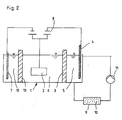
- Fig. 2 shows an embodiment of the galvanic bath 1 according to the invention, in which in addition to the cell space 6, a second cell space 12 is separated by a cation exchange membrane 13 from the cell space 5.
- Cell space 12 in this case takes on a further anolyte, such as a manganese-containing anolyte and a foreign metal anode 7, which may be formed, for example, recorded in a titanium basket Elektrolytmangan.
- the anolyte in cell space 12 has a manganese ion source such as manganese (II) sulfate and is by means of suitable acids such. As sulfuric acid, adjusted to a pH ⁇ 2.
- manganese ions are released through the cation exchange membrane 13 to the deposition electrolyte under current flow.
- Example 1 Deposition of a zinc-nickel layer
- a deposition electrolyte which 40-100 g / l zinc chloride, 60-130 g / l nickel chloride hexahydrate, 140-220 g / l potassium chloride, 10-30 g / l boric acid, 25 g / l sodium acetate trihydrate, 30 g / l aminoacetic acid, 2-12 g / l sodium saccharin, 0.025-0.20 g / l benzalacetone, 0.006-0.01 g / l orthochlorobenzaldehyde, 0.8-1.2 g / l octanol ethoxylate, and 2.5-3.2 g / l potassium salt of the sulfopropylated polyalkoxylated naphthol.
- the pH of the electrolyte composition described herein is between 5 and 6.
- an anolyte containing 120 g / l of zinc chloride, 215 g / l of potassium chloride and 20 g / l of boric acid is charged.
- the concentration of the anolyte-containing components can be varied in a range between 80 g / l and 500 g / l for zinc chloride, 150 g / l to 300 g / l for potassium chloride and 15 g / l to 25 g / l for boric acid , whereby the deposition ratio between zinc and nickel on the substrate surface can be influenced.
- a dissolving zinc anode is arranged, whereas in the cell space 6 a dissolving nickel anode is arranged.
- a substrate to be coated screws are filled in a galvanizing drum, wherein the cathodic contacting takes place via centrally arranged contact pins.
- a temperature of the deposition electrolyte of 25 ° C to 50 ° C and a pH of pH 5 to pH 6 for the deposition electrolyte is at a cathodic current density of 0.1 to 1.5 A / dm 2, a zinc nickel layer with a Deposition speed deposited to about 0.4 microns per minute on the screws serving as a substrate.
- Example 2 Deposition of a zinc-nickel layer
- a deposition electrolyte which 40-100 g / l zinc chloride, 60-130 g / l nickel chloride hexahydrate, 140-220 g / l potassium chloride, 10-30 g / l boric acid, 25 g / l sodium acetate trihydrate, 30 g / l aminoacetic acid, 2 -12 g / l sodium saccharin, 0.025-0.20 g / l benzalacetone, 0.006-0.01 g / l orthochlorobenzaldehyde, 0.8-1.2 g / l octanol ethoxylate and 2.5-3.2 g / l potassium salt of the sulfopropylated polyalkoxylated naphthol.
- the pH of the electrolyte composition described herein is between 5 and 6.
- an anolyte containing 120 g / l of zinc chloride, 215 g / l of potassium chloride and 20 g / l of boric acid is charged.
- the concentration of the anolyte-containing components can be varied in a range between 80 g / l and 500 g / l for zinc chloride, 150 g / l to 300 g / l for potassium chloride and 15 g / l to 25 g / l for boric acid , whereby the deposition ratio between zinc and nickel on the substrate surface can be influenced.
- dissolving zinc pellets are arranged in an anode basket made of titanium, whereas in the cell space 6 a dissolving nickel anode is arranged.
- the substrate to be coated castings are attached to largely insulated racks, wherein the cathodic contacting takes place via the metallic tips of the frame.
- a temperature of the deposition electrolyte of 25 ° C to 50 ° C and a pH of pH 5 to pH 6 for the deposition electrolyte is at a cathodic current density of 0.1 to 4 A / dm 2, a zinc nickel layer with a deposition rate to deposited at 1 micron per minute on the casting used as a substrate.
- Example 3 Deposition of a zinc-cobalt layer
- a deposition electrolyte which 60-70 g / l zinc chloride, 100 - 130 g / l cobalt chloride hexahydrate, 190 - 220 g / l potassium chloride, 15 - 20 g / l boric acid, 25 g / l sodium acetate trihydrate, 30 g / l aminoacetic acid, 2-12 g / l sodium saccharin, 0.025-0.20 g / l benzalacetone, 0.006-0.01 g / l orthochlorobenzaldehyde and 2.5-3.2 g / l potassium salt of the sulfopropylated polyalkoxylated Naphtols contains.
- the pH of the electrolyte composition described herein is between 5 and 6.
- anolyte which consists of 250 g / l zinc chloride.
- concentration of the zinc chloride contained in the anolyte can vary in a range between 80 g / l and 500 g / l zinc chloride.
- dissolving zinc pellets are arranged in a titanium anode basket, whereas in the cell space 6 a dissolving cobalt anode is arranged.
- a substrate to be coated screws are filled in a galvanizing drum, wherein the cathodic contact via contact pins.
- a temperature of the deposition electrolyte of 25 ° C to 50 ° C and a pH of pH 5.3 to pH 5.6 for the deposition electrolyte is at a cathodic current density of 0.2 to 4 A / dm 2, a zinc Cobalt layer deposited with a deposition rate of up to about 1 micron per minute on the serving as a substrate screws.
- Example 4 Deposition of a bright zinc coating
- a deposition electrolyte is presented, which 40-90 g / l zinc chloride, 180 - 230 g / l potassium chloride, 20 - 30 g / l boric acid, 0.025 - 0.20 g / l benzalacetone, 0 , 8-1.2 g / l octanol ethoxylate and 2.5-3.2 g / l potassium salt of the suffopropylated polyalkoxylated naphtol.
- the pH of the electrolyte composition described herein is between 5 and 6.
- anolyte which consists of 250 g / l zinc chloride and 220 g / l potassium chloride.
- concentration of the zinc chloride contained in the anolyte can vary in a range between 80 g / l and 500 g / l zinc chloride.
- Potassium chloride can be used in a concentration of 10 to 300 g / l.
- dissolving zinc pellets are arranged in a titanium anode basket.
- As a substrate to be coated screws are filled in a galvanizing drum, wherein the cathodic contact via contact pins.
- a temperature of the deposition electrolyte of 25 ° C to 50 ° C and a pH of pH 5.3 to pH 5.6 for the deposition electrolyte is at a cathodic current density of 0.1 to 2 A / dm 2, a zinc layer deposited at a deposition rate of up to about 0.5 microns per minute on the serving as a substrate screws.
- Example 5 Deposition of a zinc-manganese layer
- a deposition electrolyte is presented, which 40-62 g / l divalent zinc, 80-110 g / l of divalent manganese, 190-220 g / l of a conductive salt, 30 -100 g / l of a Buffer, 10 -15 g / l of a wetting agent, 0.1-0.6 g / l of a defoamer, 0-10 g / l of an antioxidant and 0-1 g / l of a brightener.
- anolyte which consists of 250 g / l zinc chloride and 220 g / l potassium chloride.
- concentration of the zinc chloride contained in the anolyte can vary in a range between 80 g / l and 500 g / l zinc chloride.
- Potassium chloride can be used in a concentration of 10 to 300 g / l.
- a dissolving zinc plate is arranged in the cell space 5.
- an anolyte containing 150 g / l of manganese (II) sulfate and 30 g / l of sulfuric acid is contained in the third cell space 12, which has no connection to the cation exchange device 12 and which is separated from the cell space 6 by a cation exchange membrane 13, an anolyte containing 150 g / l of manganese (II) sulfate and 30 g / l of sulfuric acid is contained ,
- concentration of the manganese (II) sulfate contained in this anolyte can vary within a range between 50 g / l to 250 g / l manganese (II) sulfate.
- the initially used amount of sulfuric acid of 30 g / l is supplemented during operation so that the pH remains below pH 2.
- broken electrolyte manganese is used in a titanium anode basket.
- a substrate to be coated screws are filled in a galvanizing drum, wherein the cathodic contact via contact pins.
- a temperature of the deposition electrolyte of 25 ° C to 50 ° C and a pH of pH 5 to pH 6 for the deposition electrolyte at a cathodic current density of 0.2 to 2 A / dm 2 a zinc layer with a deposition rate to About 0.5 microns per minute deposited on serving as a substrate screws.
Landscapes
- Chemical & Material Sciences (AREA)
- Engineering & Computer Science (AREA)
- Chemical Kinetics & Catalysis (AREA)
- Electrochemistry (AREA)
- Materials Engineering (AREA)
- Metallurgy (AREA)
- Organic Chemistry (AREA)
- Electroplating And Plating Baths Therefor (AREA)
- Electrolytic Production Of Metals (AREA)
- Water Treatment By Electricity Or Magnetism (AREA)
Claims (13)
- Bain de galvanoplastie destiné au dépôt d'une couche contenant du zinc sur la surface d'un substrat, comportant une première enceinte cellulaire recevant un électrolyte acide de déposition, ainsi qu'une deuxième enceinte cellulaire recevant un anolyte neutre ou acide contenant des ions de zinc, la première enceinte cellulaire étant séparée de la deuxième enceinte cellulaire par une membrane perméable aux cations, et une anode en zinc destinée à se dissoudre étant disposée dans ladite enceinte cellulaire recevant ledit anolyte, caractérisé en ce que ladite enceinte cellulaire recevant ledit anolyte est en communication hydraulique avec un dispositif réalisant l'exchange d'ions métalliques étrangers éventuellement contenus dans ledit anolyte contre des ions de zinc et/ou des protons.
- Bain de galvanoplastie selon la revendication 1, ledit anolyte contenant, outre les ions de zinc, un acide et/ou des ions alcalins.
- Bain de galvanoplastie selon la revendication 2, ledit anolyte comportant entre 80 et 500 g/l de chlorure de zinc.
- Bain de galvanoplastie selon la revendication 2, ledit anolyte comportant entre 150 g/l et 300 g/l d'un halogénure alcalin.
- Bain de galvanoplastie selon l'une des revendications 2 à 3, ledit anolyte comportant entre 10 g/l et 30 g/l d'un acide.
- Bain de galvanoplastie selon l'une des revendications précédentes, ledit électrolyte de déposition comportant, outre les ions de zinc, au moins un métal du groupe constitué de nickel, de cobalt, de manganèse et de fer.
- Bain de galvanoplastie selon l'une des revendications précédentes, ladite membrane perméable aux cations étant une membrane d'échange de cations ou une membrane microporeuse.
- Bain de galvanoplastie selon l'une des revendications précédentes, ledit dispositif destiné à l'échange d'ions métalliques étrangers éventuellement contenus dans ledit anolyte contre des ions de zinc et/ou des protons étant un compartiment de précipitation ou un dispositif échangeur d'ions.
- Bain de galvanoplastie selon l'une des revendications précédentes, ledit bain de galvanoplastie comportant plusieurs enceintes cellulaires recevant ledit anolyte contenant des ions de zinc, chacune d'entre elles étant séparée de l'enceinte cellulaire recevant ledit électrolyte de déposition par une membrane perméable aux cations, les enceintes cellulaires recevant ledit anolyte étant en communication hydraulique les unes avec les autres.
- Bain de galvanoplastie selon l'une des revendications précédentes, ledit bain de galvanoplastie comportant au moins une enceinte cellulaire supplémentaire qui est également séparée du bain recevant ledit électrolyte de déposition par une membrane d'exchange de cations et qui reçoit des ions d'un anolyte comportant des ions d'un métal destiné à être co-déposé, avec le zinc, sur la surface du substrat ainsi qu'une anode destinée à se dissoudre laquelle est constituée du métal destiné à être co-déposé.
- Procédé d'électrodéposition d'une couche contenant du zinc sur la surface d'un substrat, le substrat destiné à être revêtu étant mis en contact, dans un bain de galvanoplastie, avec un électrolyte acide de déposition contenant au moins des ions de zinc, un courant électrique étant mis en place entre ledit substrat et au moins une anode, ledit courant étant apte à induire le dépôt d'une couche contenant du zinc sur la surface du substrat, ledit bain de galvanoplastie étant divisé en au moins deux cellules et lesdites cellules étant séparées les unes des autres par une membrane perméable aux cations, l'une des cellules recevant ledit électrolyte acide à neutre de déposition et la deuxième cellule un anolyte neutre ou acide, et une anode en zinc destinée à se dissoudre étant disposée dans la cellule recevant l'anolyte, caractérisé en que ledit anolyte neutre ou acide est au moins partiellement extrait de l'enceinte cellulaire le recevant puis passé par un dispositif dans lequel d'éventuels ions métalliques étrangers sont échangés contre des ions de zinc et/ou des protons.
- Procédé selon la revendication 11, une autre anode destinée à se dissoudre, outre ladite anode en zinc, étant prévue dans l'objectif de servir de source des métaux qui doivent être déposés, ensemble avec le zinc, sur la surface du substrat et étant disposée dans l'enceinte cellulaire qui reçoit ledit électrolyte de déposition.
- Procédé selon la revendication 12, les deux anodes étant mises en contact électrique, à travers un redresseur commun, avec le substrat, et le rapport des métaux à déposer au sein du dépôt étant influencé à travers la composition de l'anolyte, notamment par sa concentration en ions métalliques alcalins.
Priority Applications (1)
| Application Number | Priority Date | Filing Date | Title |
|---|---|---|---|
| PL09014111T PL2184384T3 (pl) | 2008-11-11 | 2009-11-11 | Wanna galwaniczna i sposób osadzania warstw zawierających cynk |
Applications Claiming Priority (1)
| Application Number | Priority Date | Filing Date | Title |
|---|---|---|---|
| DE102008056776A DE102008056776A1 (de) | 2008-11-11 | 2008-11-11 | Galvanisches Bad und Verfahren zur Abscheidung von zinkhaltigen Schichten |
Publications (2)
| Publication Number | Publication Date |
|---|---|
| EP2184384A1 EP2184384A1 (fr) | 2010-05-12 |
| EP2184384B1 true EP2184384B1 (fr) | 2012-06-06 |
Family
ID=41651434
Family Applications (1)
| Application Number | Title | Priority Date | Filing Date |
|---|---|---|---|
| EP09014111A Active EP2184384B1 (fr) | 2008-11-11 | 2009-11-11 | Bain galvanique et procédé pour la déposition de couches contenant du zinc |
Country Status (4)
| Country | Link |
|---|---|
| US (1) | US8282806B2 (fr) |
| EP (1) | EP2184384B1 (fr) |
| DE (1) | DE102008056776A1 (fr) |
| PL (1) | PL2184384T3 (fr) |
Families Citing this family (6)
| Publication number | Priority date | Publication date | Assignee | Title |
|---|---|---|---|---|
| US9899695B2 (en) | 2015-05-22 | 2018-02-20 | General Electric Company | Zinc-based electrolyte compositions, and related electrochemical processes and articles |
| EP3358045A1 (fr) * | 2017-02-07 | 2018-08-08 | Dr.Ing. Max Schlötter GmbH & Co. KG | Procédé de dépôt par placage de revêtements en zinc et en alliage de zinc à partir d'un bain de revêtement alcalin à élimination réduite des additifs de bain organiques |
| ES2757530T3 (es) | 2017-09-28 | 2020-04-29 | Atotech Deutschland Gmbh | Método para depositar electrolíticamente una capa de aleación de zinc-níquel sobre al menos un sustrato a tratar |
| CN110684997B (zh) * | 2019-10-10 | 2021-02-19 | 广州三孚新材料科技股份有限公司 | 镀锌电镀液及其制备方法 |
| JP6750186B1 (ja) * | 2019-11-28 | 2020-09-02 | ユケン工業株式会社 | めっき液の亜鉛濃度の上昇を抑制する方法および亜鉛系めっき部材の製造方法 |
| US12347852B2 (en) | 2022-12-01 | 2025-07-01 | Li-Metal Corp. | Zinc alloy electrodes for lithium batteries |
Family Cites Families (13)
| Publication number | Priority date | Publication date | Assignee | Title |
|---|---|---|---|---|
| FR2346457A1 (fr) * | 1976-04-02 | 1977-10-28 | Elf Aquitaine | Recuperation du zinc des solutions residuelles de l'electrodeposition |
| US4272338A (en) * | 1979-06-06 | 1981-06-09 | Olin Corporation | Process for the treatment of anolyte brine |
| DE4218915A1 (de) | 1992-06-10 | 1993-12-16 | Heraeus Elektrochemie | Verfahren und Vorrichtung zur Regenerierung einer Metallionen und Schwefelsäure enthaltenden wäßrigen Lösung sowie Verwendung |
| DE19509575A1 (de) * | 1995-03-16 | 1996-09-19 | Rimmel Gmbh | Verfahren zum Aufbereiten von Zink und Chrom enthaltenden Stoffgemischen wie Abwässer, Prozeßbäder, Galvanikschlämme o. dgl. |
| US5435898A (en) | 1994-10-25 | 1995-07-25 | Enthone-Omi Inc. | Alkaline zinc and zinc alloy electroplating baths and processes |
| DE10146559A1 (de) * | 2001-09-21 | 2003-04-10 | Enthone Omi Deutschland Gmbh | Verfahren zur Abscheidung einer Zink-Nickel-Legierung aus einem Elektrolyten |
| US6869519B2 (en) * | 2001-09-27 | 2005-03-22 | National Institute Of Advanced Industrial Science And Technology | Electrolytic process for the production of metallic copper and apparatus therefor |
| DE10306823B4 (de) | 2003-02-19 | 2010-07-08 | Enthone Inc., West Haven | Verfahren und Elektrolyt zur Hochgeschwindigkeitsabscheidung von Zink-Mangan-Legierungen |
| DE10322120A1 (de) * | 2003-05-12 | 2004-12-09 | Blasberg Werra Chemie Gmbh | Verfahren und Vorrichtungen zur Verlängerung der Nutzungsdauer einer Prozesslösung für die chemisch-reduktive Metallbeschichtung |
| US7442286B2 (en) | 2004-02-26 | 2008-10-28 | Atotech Deutschland Gmbh | Articles with electroplated zinc-nickel ternary and higher alloys, electroplating baths, processes and systems for electroplating such alloys |
| DE102004038693B4 (de) * | 2004-08-10 | 2010-02-25 | Blasberg Werra Chemie Gmbh | Vorrichtung und Verfahren zur Entfernung von Fremdstoffen aus Prozesslösungen und Verfahren zur Regenerierung eines Kationenaustauschers |
| ATE429528T1 (de) | 2005-04-26 | 2009-05-15 | Atotech Deutschland Gmbh | Alkalisches galvanikbad mit einer filtrationsmembran |
| DE502005003655D1 (de) | 2005-05-25 | 2008-05-21 | Enthone | Verfahren und Vorrichtung zur Einstellung der Ionenkonzentration in Elektrolyten |
-
2008
- 2008-11-11 DE DE102008056776A patent/DE102008056776A1/de not_active Withdrawn
-
2009
- 2009-11-11 EP EP09014111A patent/EP2184384B1/fr active Active
- 2009-11-11 PL PL09014111T patent/PL2184384T3/pl unknown
- 2009-11-12 US US12/617,202 patent/US8282806B2/en active Active
Also Published As
| Publication number | Publication date |
|---|---|
| EP2184384A1 (fr) | 2010-05-12 |
| PL2184384T3 (pl) | 2012-11-30 |
| DE102008056776A1 (de) | 2010-05-12 |
| US8282806B2 (en) | 2012-10-09 |
| US20100116677A1 (en) | 2010-05-13 |
Similar Documents
| Publication | Publication Date | Title |
|---|---|---|
| EP2184384B1 (fr) | Bain galvanique et procédé pour la déposition de couches contenant du zinc | |
| EP2116634B1 (fr) | Electrolyte de cuivre-zinc modifié et procédé de déposition de couches de bronze | |
| DE102014207778B3 (de) | Verwendung einer Mischung zur Verwendung in einem galvanischen Bad oder eines galvanischen Bades zur Herstellung einer Glanznickelschicht sowie Verfahren zur Herstellung eines Artikels mit einer Glanznickelschicht | |
| DE4023444C2 (de) | Verfahren zum galvanischen Abscheiden von Kupfer aus einem wäßrigen, alkalischen, Cyanid-freien Bad, bei dem sowohl eine lösliche als auch eine unlösliche Anode verwendet wird | |
| DE102010055968A1 (de) | Substrat mit korrosionsbeständigem Überzug und Verfahren zu dessen Herstellung | |
| AT514818B1 (de) | Abscheidung von Cu, Sn, Zn-Beschichtungen auf metallischen Substraten | |
| EP1961840A1 (fr) | Electrolyte de cuivre-étain et procédé pour le dépôt de couches de bronze | |
| EP2103717A1 (fr) | Bain à base de pyrophosphate destiné à la déposition de couches d'alliage d'étain | |
| DE2417952A1 (de) | Verfahren zur galvanischen abscheidung von nickel und/oder kobalt | |
| WO2012031753A1 (fr) | Anode et son utilisation dans un bain galvanique alcalin | |
| EP0037535A2 (fr) | Bain galvanique pour le dépôt de revêtements d'or et d'alliages d'or | |
| DE3029364A1 (de) | Verfahren zur herstellung von kathoden mit niedriger wasserstoffueberspannung und ihre verwendung | |
| DE202008014947U1 (de) | Galvanisches Bad zur Abscheidung von zinkhaltigen Schichten | |
| EP3415665B1 (fr) | Procédé de dépôt galvanique de revêtements d'alliage zinc/nicel à partir d'un bain d'alliage nickel/zinc à élimination réduite des additifs | |
| DE2929305C2 (de) | Verfahren und Vorrichtung zur kontinuierlichen galvanischen Abscheidung von Mangan auf Stahl | |
| DE2352970A1 (de) | Korrosionsbestaendige metallueberzuege, die galvanisch abgeschiedenes nickel und mikroporoeses chrom enthalten | |
| DE3816419C1 (fr) | ||
| CH647821A5 (de) | Verfahren zur elektrolytischen abscheidung von schichten von nickellegierungen mit legierungselementen. | |
| DE2940741C2 (fr) | ||
| DE2333096C3 (de) | Galvanisch aufgebrachter mehrschichtiger Metallüberzug und Verfahren zu seiner Herstellung | |
| DE102012004348B4 (de) | Verwendung von organischen Thioharnstoffverbindungen zur Erhöhung der galvanischen Abscheiderate von Gold und Goldlegierungen | |
| DE4315411C2 (de) | Verfahren zur Regenerierung von verbrauchten Chromsäurelösungen | |
| EP2431500B1 (fr) | Régénération d'électrolytes alcalins en nickel-zinc par suppression de cyanidions à l'aide de composés solubles d'ammonium quaternaire | |
| EP1881090B1 (fr) | Composition électrolytique et procédé pour la déposition d'une couche d'alliage zinc-nickel sur un substrat en fonte ou en acier | |
| DE19610361A1 (de) | Bad und Verfahren für die galvanische Abscheidung von Halbglanznickel |
Legal Events
| Date | Code | Title | Description |
|---|---|---|---|
| PUAI | Public reference made under article 153(3) epc to a published international application that has entered the european phase |
Free format text: ORIGINAL CODE: 0009012 |
|
| AK | Designated contracting states |
Kind code of ref document: A1 Designated state(s): AT BE BG CH CY CZ DE DK EE ES FI FR GB GR HR HU IE IS IT LI LT LU LV MC MK MT NL NO PL PT RO SE SI SK SM TR |
|
| AX | Request for extension of the european patent |
Extension state: AL BA RS |
|
| 17P | Request for examination filed |
Effective date: 20101004 |
|
| 17Q | First examination report despatched |
Effective date: 20101103 |
|
| GRAP | Despatch of communication of intention to grant a patent |
Free format text: ORIGINAL CODE: EPIDOSNIGR1 |
|
| RIC1 | Information provided on ipc code assigned before grant |
Ipc: C25D 3/56 20060101ALI20111024BHEP Ipc: C25D 3/22 20060101AFI20111024BHEP Ipc: C25D 21/22 20060101ALI20111024BHEP |
|
| GRAS | Grant fee paid |
Free format text: ORIGINAL CODE: EPIDOSNIGR3 |
|
| GRAA | (expected) grant |
Free format text: ORIGINAL CODE: 0009210 |
|
| AK | Designated contracting states |
Kind code of ref document: B1 Designated state(s): AT BE BG CH CY CZ DE DK EE ES FI FR GB GR HR HU IE IS IT LI LT LU LV MC MK MT NL NO PL PT RO SE SI SK SM TR |
|
| REG | Reference to a national code |
Ref country code: GB Ref legal event code: FG4D Free format text: NOT ENGLISH |
|
| REG | Reference to a national code |
Ref country code: CH Ref legal event code: EP Ref country code: AT Ref legal event code: REF Ref document number: 561095 Country of ref document: AT Kind code of ref document: T Effective date: 20120615 |
|
| REG | Reference to a national code |
Ref country code: IE Ref legal event code: FG4D Free format text: LANGUAGE OF EP DOCUMENT: GERMAN |
|
| REG | Reference to a national code |
Ref country code: DE Ref legal event code: R096 Ref document number: 502009003719 Country of ref document: DE Effective date: 20120802 |
|
| REG | Reference to a national code |
Ref country code: NL Ref legal event code: VDEP Effective date: 20120606 |
|
| PG25 | Lapsed in a contracting state [announced via postgrant information from national office to epo] |
Ref country code: NO Free format text: LAPSE BECAUSE OF FAILURE TO SUBMIT A TRANSLATION OF THE DESCRIPTION OR TO PAY THE FEE WITHIN THE PRESCRIBED TIME-LIMIT Effective date: 20120906 Ref country code: SE Free format text: LAPSE BECAUSE OF FAILURE TO SUBMIT A TRANSLATION OF THE DESCRIPTION OR TO PAY THE FEE WITHIN THE PRESCRIBED TIME-LIMIT Effective date: 20120606 Ref country code: LT Free format text: LAPSE BECAUSE OF FAILURE TO SUBMIT A TRANSLATION OF THE DESCRIPTION OR TO PAY THE FEE WITHIN THE PRESCRIBED TIME-LIMIT Effective date: 20120606 Ref country code: CY Free format text: LAPSE BECAUSE OF FAILURE TO SUBMIT A TRANSLATION OF THE DESCRIPTION OR TO PAY THE FEE WITHIN THE PRESCRIBED TIME-LIMIT Effective date: 20120606 Ref country code: FI Free format text: LAPSE BECAUSE OF FAILURE TO SUBMIT A TRANSLATION OF THE DESCRIPTION OR TO PAY THE FEE WITHIN THE PRESCRIBED TIME-LIMIT Effective date: 20120606 |
|
| REG | Reference to a national code |
Ref country code: LT Ref legal event code: MG4D Effective date: 20120606 |
|
| PG25 | Lapsed in a contracting state [announced via postgrant information from national office to epo] |
Ref country code: LV Free format text: LAPSE BECAUSE OF FAILURE TO SUBMIT A TRANSLATION OF THE DESCRIPTION OR TO PAY THE FEE WITHIN THE PRESCRIBED TIME-LIMIT Effective date: 20120606 Ref country code: SI Free format text: LAPSE BECAUSE OF FAILURE TO SUBMIT A TRANSLATION OF THE DESCRIPTION OR TO PAY THE FEE WITHIN THE PRESCRIBED TIME-LIMIT Effective date: 20120606 Ref country code: GR Free format text: LAPSE BECAUSE OF FAILURE TO SUBMIT A TRANSLATION OF THE DESCRIPTION OR TO PAY THE FEE WITHIN THE PRESCRIBED TIME-LIMIT Effective date: 20120907 Ref country code: HR Free format text: LAPSE BECAUSE OF FAILURE TO SUBMIT A TRANSLATION OF THE DESCRIPTION OR TO PAY THE FEE WITHIN THE PRESCRIBED TIME-LIMIT Effective date: 20120606 |
|
| REG | Reference to a national code |
Ref country code: PL Ref legal event code: T3 |
|
| PG25 | Lapsed in a contracting state [announced via postgrant information from national office to epo] |
Ref country code: RO Free format text: LAPSE BECAUSE OF FAILURE TO SUBMIT A TRANSLATION OF THE DESCRIPTION OR TO PAY THE FEE WITHIN THE PRESCRIBED TIME-LIMIT Effective date: 20120606 Ref country code: NL Free format text: LAPSE BECAUSE OF FAILURE TO SUBMIT A TRANSLATION OF THE DESCRIPTION OR TO PAY THE FEE WITHIN THE PRESCRIBED TIME-LIMIT Effective date: 20120606 Ref country code: SK Free format text: LAPSE BECAUSE OF FAILURE TO SUBMIT A TRANSLATION OF THE DESCRIPTION OR TO PAY THE FEE WITHIN THE PRESCRIBED TIME-LIMIT Effective date: 20120606 Ref country code: EE Free format text: LAPSE BECAUSE OF FAILURE TO SUBMIT A TRANSLATION OF THE DESCRIPTION OR TO PAY THE FEE WITHIN THE PRESCRIBED TIME-LIMIT Effective date: 20120606 Ref country code: IS Free format text: LAPSE BECAUSE OF FAILURE TO SUBMIT A TRANSLATION OF THE DESCRIPTION OR TO PAY THE FEE WITHIN THE PRESCRIBED TIME-LIMIT Effective date: 20121006 |
|
| PG25 | Lapsed in a contracting state [announced via postgrant information from national office to epo] |
Ref country code: PT Free format text: LAPSE BECAUSE OF FAILURE TO SUBMIT A TRANSLATION OF THE DESCRIPTION OR TO PAY THE FEE WITHIN THE PRESCRIBED TIME-LIMIT Effective date: 20121008 |
|
| PLBE | No opposition filed within time limit |
Free format text: ORIGINAL CODE: 0009261 |
|
| STAA | Information on the status of an ep patent application or granted ep patent |
Free format text: STATUS: NO OPPOSITION FILED WITHIN TIME LIMIT |
|
| PG25 | Lapsed in a contracting state [announced via postgrant information from national office to epo] |
Ref country code: ES Free format text: LAPSE BECAUSE OF FAILURE TO SUBMIT A TRANSLATION OF THE DESCRIPTION OR TO PAY THE FEE WITHIN THE PRESCRIBED TIME-LIMIT Effective date: 20120917 Ref country code: DK Free format text: LAPSE BECAUSE OF FAILURE TO SUBMIT A TRANSLATION OF THE DESCRIPTION OR TO PAY THE FEE WITHIN THE PRESCRIBED TIME-LIMIT Effective date: 20120606 |
|
| 26N | No opposition filed |
Effective date: 20130307 |
|
| BERE | Be: lapsed |
Owner name: ENTHONE, INC. Effective date: 20121130 |
|
| REG | Reference to a national code |
Ref country code: DE Ref legal event code: R097 Ref document number: 502009003719 Country of ref document: DE Effective date: 20130307 |
|
| PG25 | Lapsed in a contracting state [announced via postgrant information from national office to epo] |
Ref country code: BG Free format text: LAPSE BECAUSE OF FAILURE TO SUBMIT A TRANSLATION OF THE DESCRIPTION OR TO PAY THE FEE WITHIN THE PRESCRIBED TIME-LIMIT Effective date: 20120906 |
|
| REG | Reference to a national code |
Ref country code: IE Ref legal event code: MM4A |
|
| PG25 | Lapsed in a contracting state [announced via postgrant information from national office to epo] |
Ref country code: BE Free format text: LAPSE BECAUSE OF NON-PAYMENT OF DUE FEES Effective date: 20121130 |
|
| PG25 | Lapsed in a contracting state [announced via postgrant information from national office to epo] |
Ref country code: IE Free format text: LAPSE BECAUSE OF NON-PAYMENT OF DUE FEES Effective date: 20121111 |
|
| PG25 | Lapsed in a contracting state [announced via postgrant information from national office to epo] |
Ref country code: MT Free format text: LAPSE BECAUSE OF FAILURE TO SUBMIT A TRANSLATION OF THE DESCRIPTION OR TO PAY THE FEE WITHIN THE PRESCRIBED TIME-LIMIT Effective date: 20120606 |
|
| PG25 | Lapsed in a contracting state [announced via postgrant information from national office to epo] |
Ref country code: MC Free format text: LAPSE BECAUSE OF NON-PAYMENT OF DUE FEES Effective date: 20121130 Ref country code: TR Free format text: LAPSE BECAUSE OF FAILURE TO SUBMIT A TRANSLATION OF THE DESCRIPTION OR TO PAY THE FEE WITHIN THE PRESCRIBED TIME-LIMIT Effective date: 20120606 |
|
| PG25 | Lapsed in a contracting state [announced via postgrant information from national office to epo] |
Ref country code: SM Free format text: LAPSE BECAUSE OF FAILURE TO SUBMIT A TRANSLATION OF THE DESCRIPTION OR TO PAY THE FEE WITHIN THE PRESCRIBED TIME-LIMIT Effective date: 20120606 Ref country code: LU Free format text: LAPSE BECAUSE OF NON-PAYMENT OF DUE FEES Effective date: 20121111 |
|
| REG | Reference to a national code |
Ref country code: CH Ref legal event code: PL |
|
| GBPC | Gb: european patent ceased through non-payment of renewal fee |
Effective date: 20131111 |
|
| PG25 | Lapsed in a contracting state [announced via postgrant information from national office to epo] |
Ref country code: CH Free format text: LAPSE BECAUSE OF NON-PAYMENT OF DUE FEES Effective date: 20131130 Ref country code: LI Free format text: LAPSE BECAUSE OF NON-PAYMENT OF DUE FEES Effective date: 20131130 Ref country code: HU Free format text: LAPSE BECAUSE OF FAILURE TO SUBMIT A TRANSLATION OF THE DESCRIPTION OR TO PAY THE FEE WITHIN THE PRESCRIBED TIME-LIMIT Effective date: 20091111 |
|
| PG25 | Lapsed in a contracting state [announced via postgrant information from national office to epo] |
Ref country code: GB Free format text: LAPSE BECAUSE OF NON-PAYMENT OF DUE FEES Effective date: 20131111 |
|
| PG25 | Lapsed in a contracting state [announced via postgrant information from national office to epo] |
Ref country code: MK Free format text: LAPSE BECAUSE OF FAILURE TO SUBMIT A TRANSLATION OF THE DESCRIPTION OR TO PAY THE FEE WITHIN THE PRESCRIBED TIME-LIMIT Effective date: 20120606 |
|
| REG | Reference to a national code |
Ref country code: FR Ref legal event code: PLFP Year of fee payment: 7 |
|
| REG | Reference to a national code |
Ref country code: AT Ref legal event code: MM01 Ref document number: 561095 Country of ref document: AT Kind code of ref document: T Effective date: 20141111 |
|
| PG25 | Lapsed in a contracting state [announced via postgrant information from national office to epo] |
Ref country code: AT Free format text: LAPSE BECAUSE OF NON-PAYMENT OF DUE FEES Effective date: 20141111 |
|
| REG | Reference to a national code |
Ref country code: FR Ref legal event code: PLFP Year of fee payment: 8 |
|
| REG | Reference to a national code |
Ref country code: FR Ref legal event code: PLFP Year of fee payment: 9 |
|
| REG | Reference to a national code |
Ref country code: DE Ref legal event code: R082 Ref document number: 502009003719 Country of ref document: DE Representative=s name: BRINKMANN & PARTNER PATENTANWAELTE PARTNERSCHA, DE Ref country code: DE Ref legal event code: R082 Ref document number: 502009003719 Country of ref document: DE Representative=s name: RAUSCH WANISCHECK-BERGMANN BRINKMANN PARTNERSC, DE |
|
| P01 | Opt-out of the competence of the unified patent court (upc) registered |
Effective date: 20230524 |
|
| PGFP | Annual fee paid to national office [announced via postgrant information from national office to epo] |
Ref country code: DE Payment date: 20251022 Year of fee payment: 17 |
|
| PGFP | Annual fee paid to national office [announced via postgrant information from national office to epo] |
Ref country code: IT Payment date: 20251022 Year of fee payment: 17 |
|
| PGFP | Annual fee paid to national office [announced via postgrant information from national office to epo] |
Ref country code: FR Payment date: 20251022 Year of fee payment: 17 |
|
| PGFP | Annual fee paid to national office [announced via postgrant information from national office to epo] |
Ref country code: CZ Payment date: 20251030 Year of fee payment: 17 |
|
| PGFP | Annual fee paid to national office [announced via postgrant information from national office to epo] |
Ref country code: PL Payment date: 20251022 Year of fee payment: 17 |