EP2186837B1 - Copolymère tribloc aba et son procédé de fabrication - Google Patents
Copolymère tribloc aba et son procédé de fabrication Download PDFInfo
- Publication number
- EP2186837B1 EP2186837B1 EP08765753.2A EP08765753A EP2186837B1 EP 2186837 B1 EP2186837 B1 EP 2186837B1 EP 08765753 A EP08765753 A EP 08765753A EP 2186837 B1 EP2186837 B1 EP 2186837B1
- Authority
- EP
- European Patent Office
- Prior art keywords
- carbon atoms
- group
- vinyl ether
- series
- groups
- Prior art date
- Legal status (The legal status is an assumption and is not a legal conclusion. Google has not performed a legal analysis and makes no representation as to the accuracy of the status listed.)
- Not-in-force
Links
Classifications
-
- C—CHEMISTRY; METALLURGY
- C08—ORGANIC MACROMOLECULAR COMPOUNDS; THEIR PREPARATION OR CHEMICAL WORKING-UP; COMPOSITIONS BASED THEREON
- C08F—MACROMOLECULAR COMPOUNDS OBTAINED BY REACTIONS ONLY INVOLVING CARBON-TO-CARBON UNSATURATED BONDS
- C08F16/00—Homopolymers and copolymers of compounds having one or more unsaturated aliphatic radicals, each having only one carbon-to-carbon double bond, and at least one being terminated by an alcohol, ether, aldehydo, ketonic, acetal or ketal radical
- C08F16/12—Homopolymers and copolymers of compounds having one or more unsaturated aliphatic radicals, each having only one carbon-to-carbon double bond, and at least one being terminated by an alcohol, ether, aldehydo, ketonic, acetal or ketal radical by an ether radical
- C08F16/14—Monomers containing only one unsaturated aliphatic radical
-
- C—CHEMISTRY; METALLURGY
- C08—ORGANIC MACROMOLECULAR COMPOUNDS; THEIR PREPARATION OR CHEMICAL WORKING-UP; COMPOSITIONS BASED THEREON
- C08F—MACROMOLECULAR COMPOUNDS OBTAINED BY REACTIONS ONLY INVOLVING CARBON-TO-CARBON UNSATURATED BONDS
- C08F297/00—Macromolecular compounds obtained by successively polymerising different monomer systems using a catalyst of the ionic or coordination type without deactivating the intermediate polymer
-
- C—CHEMISTRY; METALLURGY
- C08—ORGANIC MACROMOLECULAR COMPOUNDS; THEIR PREPARATION OR CHEMICAL WORKING-UP; COMPOSITIONS BASED THEREON
- C08F—MACROMOLECULAR COMPOUNDS OBTAINED BY REACTIONS ONLY INVOLVING CARBON-TO-CARBON UNSATURATED BONDS
- C08F212/00—Copolymers of compounds having one or more unsaturated aliphatic radicals, each having only one carbon-to-carbon double bond, and at least one being terminated by an aromatic carbocyclic ring
- C08F212/02—Monomers containing only one unsaturated aliphatic radical
- C08F212/04—Monomers containing only one unsaturated aliphatic radical containing one ring
- C08F212/14—Monomers containing only one unsaturated aliphatic radical containing one ring substituted by heteroatoms or groups containing heteroatoms
- C08F212/22—Oxygen
-
- C—CHEMISTRY; METALLURGY
- C08—ORGANIC MACROMOLECULAR COMPOUNDS; THEIR PREPARATION OR CHEMICAL WORKING-UP; COMPOSITIONS BASED THEREON
- C08F—MACROMOLECULAR COMPOUNDS OBTAINED BY REACTIONS ONLY INVOLVING CARBON-TO-CARBON UNSATURATED BONDS
- C08F216/00—Copolymers of compounds having one or more unsaturated aliphatic radicals, each having only one carbon-to-carbon double bond, and at least one being terminated by an alcohol, ether, aldehydo, ketonic, acetal or ketal radical
- C08F216/12—Copolymers of compounds having one or more unsaturated aliphatic radicals, each having only one carbon-to-carbon double bond, and at least one being terminated by an alcohol, ether, aldehydo, ketonic, acetal or ketal radical by an ether radical
- C08F216/14—Monomers containing only one unsaturated aliphatic radical
Definitions
- the present invention relates to an ABA-type triblock copolymer of vinyl ether series and a process of producing the same. More specifically, the invention relates to an ABA-type triblock copolymer comprising polyvinyl ether as the soft segment and an oxystyrene-series polymer as the hard segment, and a process of producing the same.
- Polymers of oxystyrene series primarily including hydroxystyrene are used as functional polymer materials in various industrial fields.
- such polymers are used in the field of electron materials, particularly as raw materials for resin components for semiconductor resists.
- such polymers are now being investigated for use as photosensitive resin components for layer insulation films and surface protective films of semiconductor devices. Improvement in the properties of oxystyrene-series polymers and imparting novel properties to oxystyrene-series polymers are desired due to the high integration and enlarged size of semiconductor devices, the thinner and downsized sealing resin packages, transfer to surface mounting with solder reflow and the like.
- Patent Document 1 proposes a photosensitive resin composition obtained by using a hydroxystyrene-series ABA-type triblock copolymer which uses an elastomer block including butadiene and isoprene as the component B.
- Patent Document 1 describes that the thermal shock resistance of polyhydroxystyrene can be improved by introducing the elastomer block including butadiene and isoprene.
- the segment including butadiene and isoprene has poor solubility in developing solutions and poor adhesion to substrates, so the ratio of the segment could not be raised and the effect of improving the thermal shock resistance was not sufficient.
- oxystyrene-series monomers primarily including hydroxystyrene have cationic polymerization reactivity, being greatly different from those of vinyl ether-series monomers. Hence, it has been very difficult to obtain a copolymer of an oxystyrene-series monomer and a vinyl ether-series monomer.
- Patent Document 2 describes a method for producing a narrowly dispersible copolymer of an oxystyrene-series monomer and a vinyl ether-series monomer by living cationic polymerization, using a halogenated organic compound and a metal halide with Lewis acidity as initiators. Due to the difference in polymerization profiles between the respective monomers, the ratio of the vinyl ether monomer in the copolymer cannot be raised and thus, the ratio of the vinyl ether-series monomer incorporated in the copolymer was about 15 mol % at the most.
- an oxystyrene-series monomer and a vinyl ether-series monomer are preliminarily mixed together and made to react using a monofunctional initiator.
- a monofunctional initiator it is considered that only the vinyl ether-series monomer with fast reactivity is polymerized first and then, the oxystyrene-series monomer is polymerized continuously.
- the vinyl ether-series monomer with significantly different reactivity no longer reacts with the resulting product, so the polymer obtained is not a random copolymer but a diblock copolymer, meaning that ABA-type triblock copolymer could not be obtained. Due to the same reason, it was difficult to synthetically prepare an ABA-type triblock copolymer by sequential reactions of an oxystyrene-series monomer and a vinyl ether-series monomer using a monofunctional initiator.
- Patent Document 3 discloses a method for producing a block polymer comprising a polystyrene-series polymer component and a polyvinyl ether-series polymer component, comprising preparing polyvinyl ether having hydroxyl group at the end of the polymer by living cationic polymerization of vinyl ether using a polymerization initiator with hydroxyl group protected with trimethylsilyl group and the like and subsequently conducting cationic polymerization of styrenes using the resulting polyvinyl ether as a terminator. Even in Patent Document 3, it is only a diblock polymer of polystyrene and poly(t-butyl vinyl ether) that is specifically described about the synthesis thereof.
- Patent Document 3 There are no examples shown in Patent Document 3 of the synthesis of an ABA-type triblock copolymer of polyvinyl ether and an oxystyrene-series polymer. Additionally, a block copolymer obtained by using polyvinyl ether comprising hydroxyl group at the end of the polymer as a terminator is disadvantageous in that it is thermally unstable because the polystyrene-series polymer component and the polyvinyl ether-series polymer component are linked together through an ether bond.
- Patent Document 4 discloses a method for producing polyalkenyl ether with thiol group at both ends of the polymer comprising living cationic polymerization of vinyl ether using alkenyl ether with thiocarbonyl ester bond at a side chain as an initiator and a specific thiocarboxylate salt or a thioester compound as a terminator.
- the polyalkenyl ether with thiol group at both ends as obtained by the above method are used as a chain transfer agent to polymerize various vinyl polymers which are radical-polymerizable to obtain an ABA-type triblock polymer having the polyalkenyl ether as the center block (as the component B).
- Patent Document 4 however does not show any specific synthetic example of the block polymer nor disclose any polymerization method of a ABA-type triblock copolymer of polyvinyl ether and an oxystyrene-series polymer.
- the resulting ABA-type triblock copolymer is thermally unstable because the component A and the component B are bonded together through sulfur atom, so that the triblock copolymer is readily colored during drying or heating, which is disadvantageous.
- the radical polymerization method polymerization can be performed in a simple manner but the molecular weight distribution cannot be controlled. Hence, there is a problem that narrow polymer which is narrowly dispersible can not be obtained by the method.
- JP 8092336 teaches a process of producing a di-block copolymer of a styrene-series monomer and a vinylether-series monomer.
- a di-block copolymer (Examples 1 to 3) which is obtained by simultaneously polymerizing a radically polymerizable monomer, i.e. styrene and a cationically polymerizable monomer, i.e. butyl vinyl ether; and a di-block copolymer (Example 4) which is obtained by simultaneously polymerizing a radically polymerizable monomer, i.e. metoxystyrene and a cationically polymerizable monomer, i.e. cyclohexene oxide.
- JP 6239944 teaches a star-type block copolymer having 3 to 4 di-block arms of a vinylether-series block and an oxystyrene-steries block.
- JP 2003342327 relates to an oxystyrene copolymer which is manufactured by copolymerizing an oxystyrene monomer using a Lewis-acidic metal halide as an initiator.
- an ABA-type triblock copolymer of vinyl ether series comprising polyvinyl ether as the center block could be obtained by synthetically preparing polyvinyl ether via living cationic polymerization using a specific bifunctional initiator, and continuously promoting the living cationic polymerization of an oxystyrene-series polymer while retaining the reactivity during the synthetic preparation.
- the resulting triblock copolymer was thermally stable because the component A and the component B were bonded together with a single bond, thereby completing the present invention.
- the ABA-type triblock copolymer of vinyl ether series in accordance with the invention comprises:
- R 3 represents a linear or branched alkyl group with 1 to 6 carbon atoms, a fluoroalkyl group as a linear or branched alkyl group with 1 to 6 carbon atoms in which all or a part of the hydrogens in the alkyl group is substituted with fluorine, an alkoxyalkyl group with 2 to 6 carbon atoms, a cycloalkyl group with 5 to 10 carbon atoms or an aryl group or arylalkyl group represented by -(CH 2 ) m -X (herein, m is 0, 1, 2 or 3; X represents unsubstituted phenyl group, or phenyl group substituted with one or more linear or branched alkyl groups with 1 to 4 carbon atoms, a fluoroalkyl group as a linear or branched alkyl group with 1 to 4 carbon atoms in which all or a part of the hydrogens is substituted with fluorine, an alk
- the preferred ratio of the repeat unit (a) to the total repeat units contained in the polymer chain is 5 to 80 mol %, while the preferred ratio of the repeat unit (b) thereto is 20 to 95 mol %.
- the weight average molecular weight (Mw) on a polystyrene basis as measured by gel permeation chromatography (GPC) is preferred to be within a range of 1,000 to 100,000, while the dispersion degree (Mw/Mn) represented as the ratio of the weight average molecular weight (Mw) to the number average molecular weight (Mn) is preferred to be 2.0 or less.
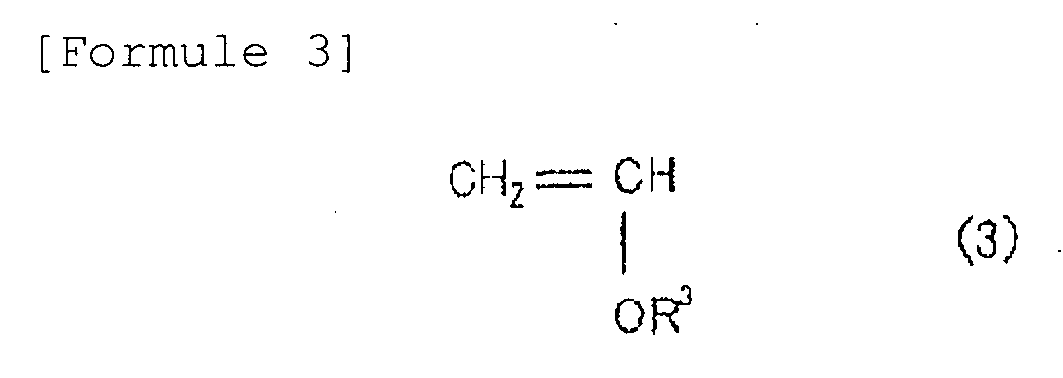
- the ABA-type triblock copolymer can be produced by living cationic polymerization of a vinyl ether-series monomer represented by the following general formula (3) in the presence of a bifunctional initiator, a Lewis acid and a solvent:
- R 1 and R 2 have the same definitions as described above for Formula (1).
- bifunctional initiator those in a structure represented by the following general formula (5) can be used.
- R 4 represents an alkylene group with 1 to 10 carbon atoms
- R 5 represents hydrogen atom or an alkyl group with 1 to 4 carbon atoms
- the ABA-type triblock copolymer of vinyl ether series in accordance with the present invention is an ABA-type triblock copolymer of vinyl ether series, wherein polyvinyl ether is the center block (block B) and the oxystyrene-series polymer is the block at both ends (block A).
- the ABA-type triblock copolymer is thermally stable because the block A and the block B are bonded together with a single bond.
- the thermal shock resistance of polyhydroxystyrene can be improved and it has excellent adhesion to substrates and great solubility in developing solutions, owing to the ether bond derived from vinyl ether.
- the triblock copolymer can preferably be used as a raw material for photosensitive resin components suitable for applications such as layer insulation films and surface protective films of semiconductor devices.
- the polymerization of polyvinyl ether and the polymerization of the oxystyrene-series polymer can continuously be conducted in one pot. Accordingly, the process can simplify the production steps and production equipment therefore and is industrially advantageous.
- the oxystyrene-series repeat unit (a) represented by the general formula (1) can be prepared from an oxystyrene-series monomer represented by the general formula (4).
- the alkyl group with 1 to 4 carbon atoms include, for example, methyl group, ethyl group, propyl group, isopropyl group, n-butyl group, sec-butyl group, tert-butyl group and isobutyl group.
- the alkyl group with 1 to 6 carbon atoms includes, for example, methyl group, ethyl group, propyl group, isopropyl group, n-butyl group, sec-butyl group, tert-butyl group, isobutyl group, n-amyl group and isoamyl group;
- the alkoxyalkyl group with 2 to 6 carbon atoms includes, for example, methoxymethyl group, ethoxymethyl group, 1-methoxyethyl group, 1-ethoxyethyl group, 1-methoxypropyl group, 2-tetrahydropyranyl group, and 2-tetrahydrofuranyl group;
- the acyl group with 2 to 6 carbon atoms includes for example acetyl group, propionyl group and tert-butylcarbonyl group;
- the alkoxycarbonyl group with 2 to 6 carbon atoms includes, for example, meth
- the oxystyrene-series monomer represented by the general formula (4) includes, for example, hydroxystyrenes such as p-hydroxystyrene, m-hydroxystyrene, o-hydroxystyrene, p-isopropenylphenol, m-isopropenylphenol, and o-isopropenylphenol; alkoxystyrenes such as p-methoxystyrene, m-methoxystyrene, p-ethoxystyrene, m-ethoxystyrene, p-propoxystyrene, m-propoxystyrene, p-isopropoxystyrene, m-isopropoxystyrene, p-n-butoxystyrene, m-n-butoxystyrene, p-isobutoxystyrene, m-isobutoxystyren
- p-hydroxystyrene, m-hydroxystyrene, p-isopropenylphenol, m-isopropenylphenol, p-tert-butoxystyrene, m-tert-butoxystyrene, p-acetoxystyrene and m-acetoxystyrene are preferably used.
- the vinyl ether-series repeat unit (b) represented by the general formula (2) in the triblock copolymer of the invention is formed from a vinyl ether-series monomer represented by the general formula (3).
- the linear or branched alkyl group with 1 to 6 carbon atoms includes, for example, methyl group, ethyl group, propyl group, isopropyl group, n-butyl group, sec-butyl group, tert-butyl group, isobutyl group, n-amyl group and isoamyl group;
- the fluoroalkyl group with 1 to 6 carbon atoms includes, for example, trifluoromethyl group, pentafluoroethyl group and 2,2,2-trifluoroethyl group;
- the alkoxyalkyl group with 2 to 6 carbon atoms includes, for example, methoxymethyl group, ethoxymethyl group, 2-methoxyethyl group,
- the vinyl ether-series monomer represented by the general formula (3) includes, for example, alkyl vinyl ethers such as methyl vinyl ether, ethyl vinyl ether, propyl vinyl ether, isopropyl vinyl ether, n-butyl vinyl ether, sec-butyl vinyl ether, tert-butyl vinyl ether, isobutyl vinyl ether, n-amyl vinyl ether, and isoamyl vinyl ether; fluoroalkyl vinyl ethers such as trifluoromethyl vinyl ether, pentafluoroethyl vinyl ether, and 2,2,2-trifluoroethyl vinyl ether; alkoxyalkyl vinyl ethers such as 2-methoxyethyl vinyl ether, 2-ethoxyethyl vinyl ether, 2-tetrahydropyranyl vinyl ether, and 2-tetrahydrofuranyl vinyl ether; cycloalkyl vinyl ethers such as cyclopentyl vinyl ether
- polyvinyl ether is to be introduced as the soft segment so as to improve the flexibility and shock resistance of the oxystyrene-series polymer
- methyl vinyl ether, ethyl vinyl ether, propyl vinyl ether, isopropyl vinyl ether, n-butyl vinyl ether, sec-butyl vinyl ether, tert-butyl vinyl ether, isobutyl vinyl ether, n-amyl vinyl ether, isoamyl vinyl ether, trifluoromethyl vinyl ether, pentafluoroethyl vinyl ether, 2,2,2-trifluoroethyl vinyl ether, 2-methoxyethyl vinyl ether, 2-ethoxyethyl vinyl ether and the like are preferably used.
- lower alkyl vinyl ethers such as methyl vinyl ether, ethyl vinyl ether, propyl vinyl ether, isopropyl vinyl ether, n-butyl vinyl ether, sec-butyl vinyl ether, tert-butyl vinyl ether, isobutyl vinyl ether, n-amyl vinyl ether, and isoamyl vinyl ether are preferably used.
- oxystyrene-series monomers and vinyl ether-series monomers may be used singly or may be used in combination with two or more thereof.
- the ratio of the repeat unit (a) and the repeat unit (b) in the triblock copolymer of the present invention is appropriately determined, depending on the use, the purpose, and the function to be desirably exerted.
- the triblock copolymer of the invention is used as a raw material for photosensitive resin components suitable for applications such as layer insulation films and surface protective films of semiconductor devices
- the preferred ratio of the repeat unit (a) to the total repeat units contained in the polymer chain is 5 to 80 mol %, 10 to 70 mol %being more preferred, while the ratio of the repeat unit (b) thereto is 20 to 95 mol %, 30 to 90 mol % being more preferred.
- the molecular weight of the triblock copolymer of the invention is appropriately determined, depending on the use, the purpose and the function to be desirably exerted.
- the weight average molecular weight (Mw) thereof on a polystyrene basis as measured by gel permeation chromatography (GPC) is preferred to be 1, 000 to 100, 000, 2, 000 to 80,000 being more preferred, and 4,000 to 60,000 being even more preferred.
- the preferred dispersion degree (Mw/Mn) represented by the ratio of the weight average molecular weight (Mw) and the number average molecular weight (Mn) is 1.0 to 2.0, 1.0 to 1.8 being more preferred, and 1.0 to 1.6 being even more preferred.
- Mw is larger than the range, the solubility thereof in a solvent to be used for forming a coat film or in alkaline developing solutions is deteriorated.
- Mw is smaller than the range, the properties of the coat film may sometimes be deteriorated.
- the triblock copolymer of the invention can be obtained by living cationic polymerization of a vinyl ether-series monomer represented by the general formula (3) in the presence of a bifunctional initiator, a Lewis acid and a solvent and subsequently adding an oxystyrene-series monomer represented by the general formula (4) for living cationic polymerization thereof.
- the bifunctional initiator to be used in the polymerization is preferred to be a compound represented by the general formula (5).
- Specific examples of the alkylene group with 1 to 10 carbon atoms as represented by R 4 for the general formula (5) are methylene group, ethylene group, trimethylene group, tetramethylene group, pentamethylene group, hexamethylene group, heptamethylene group, octamethylene group, nonamethylene group, decamethylene group, and cyclohexylene group.
- alkyl group with 1 to 4 carbon atoms in the definition of R 5 include, for example, methyl group, ethyl group, propyl group, isopropyl group, n-butyl group, sec-butyl group, tert-butyl group and isobutyl group.
- Specific examples of the compound represented by the general formula (5) are 1,1-bis(1-acetoxymethoxy)methane, 1,2-bis(1-acetoxymethoxy)ethane, 1,3-bis(1-acetoxymethoxy)propane, 1,4-bis(1-acetoxymethoxy)ethane, 1,2-bis(1-acetoxymethoxy)butane, 1,5-bis(1-acetoxymethoxy)ethane, 1,2-bis(1-acetoxymethoxy)pentane, 1,6-bis(1-acetoxymethoxy)hexane, 1,7-bis(1-acetoxymethoxy)heptane, 1,8-bis(1-acetoxymethoxy)octane, 1,9-bis(1-acetoxymethoxy)nonane, 1,10-bis(1-acetoxymethoxy)decane, 1,1-bis(1-acetoxyethoxy)methane, 1,2-bis(1
- 1,4-bis(1-acetoxyethoxy)butane and 1,4-bis(1-acetoxyethoxy)cyclohexane are preferably used.
- These compounds can be obtained by adding acetic acid to 1,4-buanediol divinyl ether or 1,4-cyclohexanediol divinyl ether.
- the bifunctional initiator may satisfactorily be added at any amount, with no specific limitation.
- the amount may appropriately be determined, depending on the molecular weight of the intended copolymer.
- Lewis acids to be generally used for cationic polymerization of vinyl ether-series monomers may be used with no specific limitation.
- organic metal halides such as Et 1.5 AlCl 1.5
- metal halides such as TiCl 4 , TiBr 4 , BCl 3 , BF 3 , BF 3 -OEt 2 , SnCl 2 , SnCl 4 , SbCl 5 , SbF 5 , WCl 6 , TaCl 5 , VCl 5 , FeCl 3 , ZnBr 2 , AlCl 3 , and AlBr 3 can preferably be used.
- Lewis acids may be used singly or plural Lewis acids may be used in combination.
- a polymerization process using two types of Lewis acids is effective.
- a process of producing the ABA-type triblock copolymer by using an organic metal halide such as Et 1.5 AlCl 1.5 as the Lewis acid during polymerization of the block B and additionally using a metal halide such as SnCl 4 during polymerization of the block A, to accelerate the polymerization rate of the component A is preferred.
- the amount of the Lewis acids to be used is not specifically limited. However, the amount thereof may be determined, taking account of, for example, the polymerization properties or polymerization concentration of a vinyl ether-series monomer to be used. Generally, the Lewis acids can be used at 0.1 to 100 mol % to the vinyl ether-series monomer, the preferable range being 1 to 50 mol %.
- the method for adding the Lewis acids includes, for example, addition in a lump, addition in fractional amounts, and addition in a continuous manner. Addition in fractional amounts and addition in a continuous manner are more preferred. There is an advantage in using the methods of addition in fractional amounts and addition in a continuous manner because living cationic polymerization can be effected under a state in which the polymerization heat is suppressed, thereby a triblock copolymer with a suppressed distribution of the molecular weight can be produced.
- the solvent for the polymerization includes, for example, aromatic hydrocarbon solvents such as benzene, toluene and xylene; aliphatic hydrocarbon-series solvents such as propane, n-butane, isobutane, n-pentane, n-hexane, n-heptane, n-octane, isooctane, decane, hexadecane, isopentane and n-hexane; halogenated hydrocarbon-series solvents such as ethylene chloride, methylene chloride, and carbon tetrachloride; and ether-series solvents such as tetrahydrofuran (THF), dioxane, diethyl ether, dibutyl ether, and ethylene glycol diethyl ether.
- aromatic hydrocarbon solvents such as benzene, toluene and xylene
- the polymerization is carried out by first introducing a solvent, a vinyl ether-series monomer and a bifunctional initiator sequentially in a reactor and subsequently adding a Lewis acid therein.
- the Segment B comprising the vinyl ether-series repeat unit (b) is synthetically prepared.
- an oxystyrene-series monomer is added on termination of the conversion of the vinyl ether-series monomer and a Lewis acid is further added if necessary, promoting the polymerization in a continuous manner in a series of steps within the same reactor.
- the Segment A comprising the oxystyrene-series repeat unit (a) bonded through a single bond to both ends of the Segment B is synthetically prepared to obtain an ABA-type triblock copolymer in which the Segment A and the Segment B are bonded together with a single bond.
- the polymerization conditions vary, depending on the Lewis acid, the bifunctional initiator, the monomer and the solvent to be used.
- the preferred polymerization temperature is, in general, within a range of -80°C to 150°C, more preferred range being -78°C to 80°C.
- the polymerization time period is, in general, within a range of 10 hours to 250 hours.
- an ABA-type triblock copolymer with a hydroxystyrene-series repeat unit by deprotecting the protective group of the oxystyrene-series repeat unit the protective group is eliminated via a reaction in a solvent with an acid catalyst such as hydrochloric acid or sulfuric acid at a reaction temperature of 50 to 150°C for a reaction time of 1 to 30 hours, so that the oxystyrene-series repeat unit is converted to the hydroxystyrene-series repeat unit.
- an acid catalyst such as hydrochloric acid or sulfuric acid
- Weight average molecular weight Mw and molecular weight distribution Mw/Mn as determined on a standard polystyrene curve by gel permeation chromatography (GPC) [RI detector: column KF-801 + KF-805L manufactured by Shodex Corporation; tetrahydrofuran as eluent].
- a glass container with a three way valve was prepared; after the inside of the glass container was substituted with argon, the glass container was heated in argon atmosphere to remove the water adsorbed to the inside of the glass container.
- M ethyl vinyl ether
- EVE ethyl vinyl ether
- mM millimoles
- the EVE conversion ratio was monitored by gas chromatography (GC) periodically over time.
- GC gas chromatography
- PTBOS p-tert-butoxystyrene
- reaction solution was cooled to ambient temperature; and the reaction solution was put into 1,200 parts by mass of water to deposit the resulting polymer, which was filtered and recovered.
- the resulting deposit was dried under reduced pressure, to obtain a triblock polymer of p-hydroxystyrene/EVE/p-hydroxystyrene series.
- a glass container with a three way valve was prepared; after the inside of the glass container was substituted with argon, the glass container was heated in argon atmosphere to remove the water adsorbed to the inside of the glass container.
- 0.85 M of n-butyl vinyl ether (referred to as "NBVE" hereinafter) 1.0 M of ethyl acetate, 4 mM of 1,4-bis(1-acetoxyethoxy)butane, and 60 ml of toluene were placed in the container, and just when the temperature of the system reached 0°C, a toluene solution (20 mM) of Et 1.5 AlCl 1.5 was added to the glass container to initiate the polymerization.
- the NBVE conversion ratio was monitored by GC. On completion of the conversion of the NBVE monomer, 0.51 M of PTBOS was added to the reaction solution and the reaction was continuously promoted at a reaction temperature of 0°C. 160 hours after PTBOS addition, a toluene solution (20 mM) of Et 1.5 AlCl 1.5 was further added to the glass container for 24-hour reaction.
- the reaction solution was cooled to ambient temperature; and the reaction solution was put into 23 parts by mass of water to deposit the resulting polymer, which was filtered.
- the resulting filtered resin was dissolved in 5.5 parts by mass of methyl ethyl ketone (MEK), to which 24 parts by mass of water were added for depositing and filtering the polymer again.
- MEK methyl ethyl ketone
- a glass container with a three way valve was prepared; after the inside of the glass container was substituted with argon, the glass container was heated in argon atmosphere to remove the water adsorbed to the inside of the glass container.
- 0.85 M of EVE, 1.0 M of ethyl acetate, 4 mM of 1,4-bis(1-acetoxyethoxy)butane, and 60 ml of toluene were placed in the container, and just when the temperature of the system reached 0°C, a toluene solution (20 mM) of Et 1.5 AlCl 1.5 was added to the glass container to initiate the polymerization.
- the EVE conversion ratio was monitored by GC. On completion of the conversion of the EVE monomer, 0.3 M of p-acetoxystyrene was added to the reaction solution and the reaction was continuously promoted at a reaction temperature of 0°C. 20 hours after the addition of p-acetoxystyrene a toluene solution (20 mM) of SnCl 4 was further added to the glass container for 120-hour reaction.
- a glass container with a three way valve was prepared; after the inside of the glass container was substituted with argon, the glass container was heated in argon atmosphere to remove the water adsorbed to the inside of the glass container.
- 0.85 M of EVE, 1.0 M of ethyl acetate, 6 mM of 1,4-bis(1-acetoxyethoxy)butane, and 60 ml of toluene were placed in the container, and just when the temperature of the system reached 0°C, a toluene solution (20 mM) of Et 1.5 AlCl 1.5 was added to the glass container to initiate the polymerization.
- the EVE conversion ratio was monitored by GC.
- 0.12 M of p-isopropenylphenol (referred to as "PIPP" hereinafter) was added to the reaction solution and the reaction was continuously promoted at a reaction temperature of 0°C. 60 hours after PIPP addition a toluene solution (20 mM) of Et 1.5 AlCl 1.5 was further added to the glass container for 90-hour reaction.
- a glass container with a three way valve was prepared; after the inside of the glass container was substituted with argon, the glass container was heated in argon atmosphere to remove the water adsorbed to the inside of the glass container.
- 0.35 M of EVE, 0.35 M of ethyl acetate, 14.8 mM of 1,4-bis(1-acetoxyethoxy)butane, and 2.4 L of toluene were placed in the container, and just when the temperature of the system reached 0°C, a toluene solution (10.3 mM) of Et 1.5 AlCl 1.5 was added to the glass container to initiate the polymerization.
- the EVE conversion ratio was monitored by GC periodically over time. On completion of the conversion of the EVE monomer, 1.25 M of PTBOS was added to the reaction solution; subsequenly, a toluene solution (16 mM) of SnCl 4 was added taking time of 16 hours, and the reaction was promoted for another 3 hours.
- a novel ABA-type triblock polymer comprising polyvinyl ether as the soft segment and an oxystyrene-series polymer as the hard segment can be obtained readily, so that a copolymer resin with great thermal shock resistance, thermal stability, solubility in solvents and adhesion to substrate can be obtained.
- the copolymer resin is useful as a raw material for photosensitive resins for applications such as layer insulation films and surface protective films of semiconductor devices.
Landscapes
- Chemical & Material Sciences (AREA)
- Health & Medical Sciences (AREA)
- Chemical Kinetics & Catalysis (AREA)
- Medicinal Chemistry (AREA)
- Polymers & Plastics (AREA)
- Organic Chemistry (AREA)
- Inorganic Chemistry (AREA)
- Graft Or Block Polymers (AREA)
- Polymerization Catalysts (AREA)
Claims (7)
- Copolymère séquencé de type ABA de la série des vinyléthers comprenant :un segment A comprenant un motif répété de la série de l'oxystyrène (a) représenté par la formule générale (1) suivante :

etun segment B comprenant un motif répété de la série des vinyléthers (b) représenté par la formule générale (2) suivante : [dans lequel, dans la formule, R3 représente un groupe alkyle linéaire ou ramifié de 1 à 6 atomes de carbone, un groupe fluoroalkyle en tant que groupe alkyle linéaire ou ramifié de 1 à 6 atomes de carbone dans lequel tout ou partie des hydrogènes dans le groupe alkyle est substitué par du fluor, un groupe alcoxyalkyle de 2 à 6 atomes de carbone, un groupe cycloalkyle de 5 à 10 atomes de carbone ou un groupe aryle ou un groupe arylalkyle représenté par
-(CH2)m-X
(ici, m, vaut 0, 1, 2 ou 3) ; X représente un groupe phényle non substitué, ou un groupe phényle substitué par un ou plusieurs groupes alkyle linéaires ou ramifiés de 1 à 4 atomes de carbone, un groupe fluoroalkyle en tant que groupe alkyle linéaire ou ramifié de 1 à 4 atomes de carbone dans lequel tout ou partie des hydrogènes est substitué par du fluor, un groupe alcoxy de 1 à 4 atomes de carbone, ou un atome d'halogène)]dans lequel le segment A et le segment B sont liés ensemble avec une simple liaison. - Copolymère triséquencé de type ABA de la série des vinyléthers selon la revendication 1, dans lequel le rapport entre le motif répété (a) et le rapport entre le motif répété (b) et les motifs répétés totaux contenus dans la chaîne de polymère sont de 5 à 80 % en mole et 20 à 95 % en mole, respectivement.
- Copolymère triséquencé de type ABA de la série des vinyléthers selon la revendication 1 ou 2, dans lequel la masse moléculaire moyenne en masse (Mw) sur la base du poly(styrène) telle que mesurée par chromatographie par perméation de gel (CPG) est dans une plage de 1 000 à 100 000, et le degré de dispersion (Mw/Mn) représenté comme le rapport entre la masse moléculaire moyenne en masse (Mw) et la masse moléculaire moyenne en nombre (Mn) est de 2,0 ou moins.
- Procédé de production d'un composé séquencé de type ABA de la série des vinyléthers selon la revendication 1, comprenant une polymérisation cationique vivante d'un monomère de la série des vinyléthers représenté par la formule générale (3) suivante en présence d'un initiateur bifonctionnel, d'un acide de Lewis et d'un solvant :
-(CH2)m-X
(ici, m vaut 0, 1, 2 ou 3) ; X représente un groupe phényle non substitué, ou un groupe phényle substitué par un ou plusieurs groupes alkyle linéaires ou ramifiés de 1 à 4 atomes de carbone, un groupe fluoroalkyle en tant que groupe alkyle linéaire ou ramifié de 1 à 4 atomes de carbone dans lequel tout ou partie des hydrogènes est substitué par du fluor, un groupe alcoxy de 1 à 4 atomes de carbone, ou un atome d'halogène)],
et l'addition ultérieure d'un monomère de la série de l'oxystyrène représenté par la formule générale (4) suivante pour une polymérisation cationique vivante :
- Procédé de production d'un composé séquencé de type ABA de la série des vinyléthers selon la revendication 4, dans lequel l'initiateur bifonctionnel est d'une structure représentée par la formule générale (5) suivante :

- Procédé de production d'un composé séquencé de type ABA de la série des vinyléthers selon la revendication 4 ou 5, comprenant l'utilisation de deux types d'acides de Lewis en combinaison pour introduire l'un des deux types d'acides de Lewis dans le système et pour introduire simultanément ou ultérieurement l'autre des deux types d'acides de Lewis.
- Procédé de production d'un composé séquencé de type ABA de la série des vinyléthers selon la revendication 6, comprenant la polymérisation cationique vivante d'un monomère de la série des vinyléthers, représenté par la formule générale (3) en présence d'un halogénure de métal organique en tant qu'acide de Lewis et la polymérisation cationique vivante d'un monomère de la série de l'oxystyrène représenté par la formule générale (4) en présence d'un halogénure de métal en tant qu'acide de Lewis.
Priority Applications (1)
| Application Number | Priority Date | Filing Date | Title |
|---|---|---|---|
| PL08765753T PL2186837T3 (pl) | 2007-07-06 | 2008-06-19 | Kopolimer trójblokowy ABA i proces jego wytwarzania |
Applications Claiming Priority (2)
| Application Number | Priority Date | Filing Date | Title |
|---|---|---|---|
| JP2007178151 | 2007-07-06 | ||
| PCT/JP2008/061198 WO2009008252A1 (fr) | 2007-07-06 | 2008-06-19 | Copolymère tribloc aba et son procédé de fabrication |
Publications (3)
| Publication Number | Publication Date |
|---|---|
| EP2186837A1 EP2186837A1 (fr) | 2010-05-19 |
| EP2186837A4 EP2186837A4 (fr) | 2010-09-22 |
| EP2186837B1 true EP2186837B1 (fr) | 2014-04-16 |
Family
ID=40228431
Family Applications (1)
| Application Number | Title | Priority Date | Filing Date |
|---|---|---|---|
| EP08765753.2A Not-in-force EP2186837B1 (fr) | 2007-07-06 | 2008-06-19 | Copolymère tribloc aba et son procédé de fabrication |
Country Status (6)
| Country | Link |
|---|---|
| US (1) | US8492483B2 (fr) |
| EP (1) | EP2186837B1 (fr) |
| JP (2) | JP5508011B2 (fr) |
| KR (2) | KR101512496B1 (fr) |
| PL (1) | PL2186837T3 (fr) |
| WO (1) | WO2009008252A1 (fr) |
Families Citing this family (37)
| Publication number | Priority date | Publication date | Assignee | Title |
|---|---|---|---|---|
| US8492483B2 (en) * | 2007-07-06 | 2013-07-23 | Maruzen Petrochemical Co., Ltd. | ABA triblock copolymer and process for producing the same |
| JP5096272B2 (ja) * | 2008-09-10 | 2012-12-12 | 丸善石油化学株式会社 | フェノール系硬化剤及び該フェノール系硬化剤を用いたエポキシ樹脂組成物 |
| JP5251452B2 (ja) * | 2008-11-20 | 2013-07-31 | Jsr株式会社 | ポジ型感光性絶縁樹脂組成物及びその硬化物 |
| JP5251424B2 (ja) * | 2008-10-27 | 2013-07-31 | Jsr株式会社 | ネガ型感光性絶縁樹脂組成物及びその硬化物 |
| WO2010050357A1 (fr) * | 2008-10-27 | 2010-05-06 | Jsr株式会社 | Composition de résine isolante photosensible et son produit durci |
| JP5282015B2 (ja) * | 2008-12-09 | 2013-09-04 | 住友化学株式会社 | 樹脂溶解液の精製方法、取得方法及び化学増幅型フォトレジスト組成物の製造方法 |
| JP5770625B2 (ja) * | 2009-03-24 | 2015-08-26 | 丸善石油化学株式会社 | ビニルエーテル系星型ポリマーおよびその製造方法 |
| JP5844640B2 (ja) * | 2009-08-14 | 2016-01-20 | 丸善石油化学株式会社 | ビニルエーテル系星型ポリマーおよびその製造方法 |
| JP5731401B2 (ja) * | 2009-12-09 | 2015-06-10 | 丸善石油化学株式会社 | ビニルエーテル系星型ポリマーの製造方法 |
| JP2013175546A (ja) * | 2012-02-24 | 2013-09-05 | Dexerials Corp | アンダーフィル材、及びそれを用いた半導体装置の製造方法 |
| WO2015084121A1 (fr) | 2013-12-06 | 2015-06-11 | 주식회사 엘지화학 | Copolymère bloc |
| EP3078687B1 (fr) | 2013-12-06 | 2020-06-03 | LG Chem, Ltd. | Copolymère bloc |
| EP3078686B1 (fr) | 2013-12-06 | 2018-10-31 | LG Chem, Ltd. | Copolymère bloc |
| WO2015084131A1 (fr) | 2013-12-06 | 2015-06-11 | 주식회사 엘지화학 | Copolymère bloc |
| JP6419820B2 (ja) | 2013-12-06 | 2018-11-07 | エルジー・ケム・リミテッド | ブロック共重合体 |
| CN105899558B (zh) | 2013-12-06 | 2018-09-18 | 株式会社Lg化学 | 嵌段共聚物 |
| JP6432847B2 (ja) | 2013-12-06 | 2018-12-05 | エルジー・ケム・リミテッド | ブロック共重合体 |
| WO2015084128A1 (fr) | 2013-12-06 | 2015-06-11 | 주식회사 엘지화학 | Copolymère bloc |
| JP6361893B2 (ja) | 2013-12-06 | 2018-07-25 | エルジー・ケム・リミテッド | ブロック共重合体 |
| US10160822B2 (en) | 2013-12-06 | 2018-12-25 | Lg Chem, Ltd. | Monomer and block copolymer |
| WO2015084125A1 (fr) | 2013-12-06 | 2015-06-11 | 주식회사 엘지화학 | Copolymère bloc |
| WO2015084127A1 (fr) | 2013-12-06 | 2015-06-11 | 주식회사 엘지화학 | Copolymère bloc |
| EP3078692B1 (fr) | 2013-12-06 | 2021-01-27 | LG Chem, Ltd. | Copolymère bloc |
| CN106459326B (zh) | 2013-12-06 | 2019-08-13 | 株式会社Lg化学 | 嵌段共聚物 |
| CN107075028B (zh) | 2014-09-30 | 2020-04-03 | 株式会社Lg化学 | 嵌段共聚物 |
| WO2016053010A1 (fr) | 2014-09-30 | 2016-04-07 | 주식회사 엘지화학 | Copolymère séquencé |
| US10633533B2 (en) | 2014-09-30 | 2020-04-28 | Lg Chem, Ltd. | Block copolymer |
| US10287430B2 (en) | 2014-09-30 | 2019-05-14 | Lg Chem, Ltd. | Method of manufacturing patterned substrate |
| JP6633062B2 (ja) | 2014-09-30 | 2020-01-22 | エルジー・ケム・リミテッド | パターン化基板の製造方法 |
| JP6538159B2 (ja) | 2014-09-30 | 2019-07-03 | エルジー・ケム・リミテッド | ブロック共重合体 |
| US10310378B2 (en) | 2014-09-30 | 2019-06-04 | Lg Chem, Ltd. | Block copolymer |
| US10240035B2 (en) | 2014-09-30 | 2019-03-26 | Lg Chem, Ltd. | Block copolymer |
| EP3214102B1 (fr) | 2014-09-30 | 2022-01-05 | LG Chem, Ltd. | Copolymère bloc |
| WO2016053001A1 (fr) | 2014-09-30 | 2016-04-07 | 주식회사 엘지화학 | Copolymère bloc |
| KR20170036995A (ko) | 2015-09-25 | 2017-04-04 | 삼성전자주식회사 | 블록 공중합체 패턴 평가 시스템 |
| JP2017110134A (ja) * | 2015-12-17 | 2017-06-22 | 出光興産株式会社 | ポリビニルエーテル化合物及び潤滑油の製造方法 |
| FR3054223A1 (fr) * | 2016-07-21 | 2018-01-26 | Total Marketing Services | Copolymere et son utilisation comme additif detergent pour carburant |
Family Cites Families (19)
| Publication number | Priority date | Publication date | Assignee | Title |
|---|---|---|---|---|
| NL9101413A (nl) * | 1991-08-21 | 1993-03-16 | Dsm Nv | Werkwijze voor de levende kationische polymerisatie van electronrijke vinylverbindingen. |
| JP3078060B2 (ja) * | 1991-10-25 | 2000-08-21 | 積水化学工業株式会社 | 星型ブロック共重合体およびその製造方法 |
| US5225492A (en) * | 1992-02-13 | 1993-07-06 | The University Of Akron | Living carbocationic polymerization of poly(isobutylene-β-methyl vinyl ether) |
| JP3172598B2 (ja) | 1992-10-05 | 2001-06-04 | 株式会社クラレ | 末端にチオール基を有するポリアルケニルエーテル |
| JPH08511728A (ja) * | 1994-04-13 | 1996-12-10 | フィリップス エレクトロニクス ネムローゼ フェンノートシャップ | 水性分散液の加熱凝集方法 |
| JPH0892336A (ja) * | 1994-09-24 | 1996-04-09 | Nippon P M C Kk | ラジカル重合セグメントとカチオン重合セグメントを有するブロックポリマー、その成形物、組成物及び製造方法 |
| JPH1180221A (ja) * | 1997-09-08 | 1999-03-26 | Kuraray Co Ltd | 重合体の製造方法 |
| DE69921265T2 (de) * | 1998-04-28 | 2005-12-01 | Kaneka Corp. | Blockcopolymer |
| JP4057190B2 (ja) * | 1998-04-28 | 2008-03-05 | 株式会社カネカ | ブロック共重合体 |
| JPH11322942A (ja) | 1998-05-11 | 1999-11-26 | Kuraray Co Ltd | 重合体の製造方法 |
| JP2001019770A (ja) | 1999-07-07 | 2001-01-23 | Kuraray Co Ltd | ポリビニルアルコール系グラフトポリマー、ポリビニルアルコール系ブロックポリマー及びそれらの製造方法 |
| KR100454608B1 (ko) * | 1999-08-31 | 2004-11-03 | 닛뽕소다 가부시키가이샤 | 별형 블록 공중합체 |
| JP2001247656A (ja) * | 2000-03-08 | 2001-09-11 | Jsr Corp | 熱硬化性樹脂組成物およびその硬化物 |
| JP4120267B2 (ja) | 2002-05-24 | 2008-07-16 | 東ソー株式会社 | 狭分散性オキシスチレン系共重合体及びその製造方法 |
| JP2004035637A (ja) | 2002-07-01 | 2004-02-05 | Kanegafuchi Chem Ind Co Ltd | キーパッド用熱可塑性エラストマー組成物及びこれを用いたキーパッド |
| JP4035449B2 (ja) | 2003-01-10 | 2008-01-23 | キヤノン株式会社 | ミセル粒子含有組成物、その薄膜及び薄膜の製造方法 |
| JP4306267B2 (ja) * | 2003-02-05 | 2009-07-29 | Jsr株式会社 | ネガ型感光性樹脂組成物およびその硬化物 |
| JP2004244535A (ja) * | 2003-02-14 | 2004-09-02 | Kyowa Yuka Co Ltd | ビニルエーテルポリマーの製造方法 |
| US8492483B2 (en) * | 2007-07-06 | 2013-07-23 | Maruzen Petrochemical Co., Ltd. | ABA triblock copolymer and process for producing the same |
-
2008
- 2008-06-19 US US12/667,785 patent/US8492483B2/en not_active Expired - Fee Related
- 2008-06-19 WO PCT/JP2008/061198 patent/WO2009008252A1/fr not_active Ceased
- 2008-06-19 KR KR1020097025417A patent/KR101512496B1/ko not_active Expired - Fee Related
- 2008-06-19 EP EP08765753.2A patent/EP2186837B1/fr not_active Not-in-force
- 2008-06-19 KR KR1020147018290A patent/KR101512497B1/ko not_active Expired - Fee Related
- 2008-06-19 JP JP2009522569A patent/JP5508011B2/ja not_active Expired - Fee Related
- 2008-06-19 PL PL08765753T patent/PL2186837T3/pl unknown
-
2013
- 2013-07-16 JP JP2013147211A patent/JP5662526B2/ja not_active Expired - Fee Related
Also Published As
| Publication number | Publication date |
|---|---|
| JP2013213225A (ja) | 2013-10-17 |
| PL2186837T3 (pl) | 2014-10-31 |
| JP5662526B2 (ja) | 2015-01-28 |
| US20100286351A1 (en) | 2010-11-11 |
| US8492483B2 (en) | 2013-07-23 |
| KR20100033962A (ko) | 2010-03-31 |
| EP2186837A1 (fr) | 2010-05-19 |
| EP2186837A4 (fr) | 2010-09-22 |
| KR101512496B1 (ko) | 2015-04-15 |
| KR101512497B1 (ko) | 2015-04-16 |
| JPWO2009008252A1 (ja) | 2010-09-09 |
| JP5508011B2 (ja) | 2014-05-28 |
| KR20140099937A (ko) | 2014-08-13 |
| WO2009008252A1 (fr) | 2009-01-15 |
Similar Documents
| Publication | Publication Date | Title |
|---|---|---|
| US8492483B2 (en) | ABA triblock copolymer and process for producing the same | |
| Ballard et al. | Controlled polymerization of methyl methacrylate using lithium aluminum alkyls | |
| US5514753A (en) | Process for preparing a block copolymer | |
| US6713564B1 (en) | Star block copolymer | |
| IE904263A1 (en) | Polymers, comprising units derived from maleimides, having¹improved heat resistance | |
| CA1052947A (fr) | Procede continu de polymerisation en solution | |
| US7714085B2 (en) | Production method of polymers by using living anionic polymerization method | |
| JP4612272B2 (ja) | 高分子固体電解質用組成物 | |
| JP5844640B2 (ja) | ビニルエーテル系星型ポリマーおよびその製造方法 | |
| US7226979B2 (en) | Copolymers comprising olefin and protected or unprotected hydroxystyrene units | |
| US20120022219A1 (en) | Vinyl ether-based star polymer and process for production thereof | |
| JP5731401B2 (ja) | ビニルエーテル系星型ポリマーの製造方法 | |
| Webster | A comparison of group transfer and anionic polymerization of acrylic monomers | |
| JP2010132717A (ja) | ビニルエーテル系aba型トリブロック共重合体の製造方法 | |
| JPH0258505A (ja) | アニオン重合方法 | |
| JPH11209429A (ja) | アルコキシスチレン重合体の製造方法およびアルコキシスチレン重合体 | |
| JPWO2004106398A1 (ja) | 重合体の製造方法 | |
| JP2009504852A (ja) | オレフィンおよび保護または非保護のヒドロキシスチレン単位を含む共重合体を形成するための方法 | |
| JPH05148324A (ja) | 共重合体及びその製造方法 | |
| JP2000230022A (ja) | ポリ(p−t−ブトキシスチレン)の製造方法 | |
| JPS63139905A (ja) | ビニリデン基を有するスチレン系重合体およびその製造方法 | |
| JP2011012279A (ja) | アニオン重合体の製造方法 | |
| JPH0632840A (ja) | 単分散性共重合体及びその製造方法 |
Legal Events
| Date | Code | Title | Description |
|---|---|---|---|
| PUAI | Public reference made under article 153(3) epc to a published international application that has entered the european phase |
Free format text: ORIGINAL CODE: 0009012 |
|
| 17P | Request for examination filed |
Effective date: 20091203 |
|
| AK | Designated contracting states |
Kind code of ref document: A1 Designated state(s): AT BE BG CH CY CZ DE DK EE ES FI FR GB GR HR HU IE IS IT LI LT LU LV MC MT NL NO PL PT RO SE SI SK TR |
|
| AX | Request for extension of the european patent |
Extension state: AL BA MK RS |
|
| RIN1 | Information on inventor provided before grant (corrected) |
Inventor name: YAMAGUCHI, AMI Inventor name: AOKI, HIJIRI Inventor name: YOSHIDA, NORIHIRO Inventor name: MITA, TAKAHITO Inventor name: SAWADA, GORO Inventor name: HABA, KAZUHIKO |
|
| A4 | Supplementary search report drawn up and despatched |
Effective date: 20100824 |
|
| DAX | Request for extension of the european patent (deleted) | ||
| 17Q | First examination report despatched |
Effective date: 20130228 |
|
| GRAP | Despatch of communication of intention to grant a patent |
Free format text: ORIGINAL CODE: EPIDOSNIGR1 |
|
| INTG | Intention to grant announced |
Effective date: 20131119 |
|
| GRAS | Grant fee paid |
Free format text: ORIGINAL CODE: EPIDOSNIGR3 |
|
| RAP1 | Party data changed (applicant data changed or rights of an application transferred) |
Owner name: MARUZEN PETROCHEMICAL CO., LTD. |
|
| GRAA | (expected) grant |
Free format text: ORIGINAL CODE: 0009210 |
|
| AK | Designated contracting states |
Kind code of ref document: B1 Designated state(s): AT BE BG CH CY CZ DE DK EE ES FI FR GB GR HR HU IE IS IT LI LT LU LV MC MT NL NO PL PT RO SE SI SK TR |
|
| REG | Reference to a national code |
Ref country code: GB Ref legal event code: FG4D |
|
| REG | Reference to a national code |
Ref country code: CH Ref legal event code: EP |
|
| REG | Reference to a national code |
Ref country code: AT Ref legal event code: REF Ref document number: 662530 Country of ref document: AT Kind code of ref document: T Effective date: 20140515 Ref country code: CH Ref legal event code: NV Representative=s name: RENTSCH PARTNER AG, CH |
|
| REG | Reference to a national code |
Ref country code: IE Ref legal event code: FG4D |
|
| REG | Reference to a national code |
Ref country code: DE Ref legal event code: R096 Ref document number: 602008031556 Country of ref document: DE Effective date: 20140528 Ref country code: NL Ref legal event code: T3 |
|
| REG | Reference to a national code |
Ref country code: AT Ref legal event code: MK05 Ref document number: 662530 Country of ref document: AT Kind code of ref document: T Effective date: 20140416 |
|
| REG | Reference to a national code |
Ref country code: LT Ref legal event code: MG4D |
|
| PG25 | Lapsed in a contracting state [announced via postgrant information from national office to epo] |
Ref country code: GR Free format text: LAPSE BECAUSE OF FAILURE TO SUBMIT A TRANSLATION OF THE DESCRIPTION OR TO PAY THE FEE WITHIN THE PRESCRIBED TIME-LIMIT Effective date: 20140717 Ref country code: BG Free format text: LAPSE BECAUSE OF FAILURE TO SUBMIT A TRANSLATION OF THE DESCRIPTION OR TO PAY THE FEE WITHIN THE PRESCRIBED TIME-LIMIT Effective date: 20140716 Ref country code: FI Free format text: LAPSE BECAUSE OF FAILURE TO SUBMIT A TRANSLATION OF THE DESCRIPTION OR TO PAY THE FEE WITHIN THE PRESCRIBED TIME-LIMIT Effective date: 20140416 Ref country code: LT Free format text: LAPSE BECAUSE OF FAILURE TO SUBMIT A TRANSLATION OF THE DESCRIPTION OR TO PAY THE FEE WITHIN THE PRESCRIBED TIME-LIMIT Effective date: 20140416 Ref country code: IS Free format text: LAPSE BECAUSE OF FAILURE TO SUBMIT A TRANSLATION OF THE DESCRIPTION OR TO PAY THE FEE WITHIN THE PRESCRIBED TIME-LIMIT Effective date: 20140816 Ref country code: CY Free format text: LAPSE BECAUSE OF FAILURE TO SUBMIT A TRANSLATION OF THE DESCRIPTION OR TO PAY THE FEE WITHIN THE PRESCRIBED TIME-LIMIT Effective date: 20140416 Ref country code: NO Free format text: LAPSE BECAUSE OF FAILURE TO SUBMIT A TRANSLATION OF THE DESCRIPTION OR TO PAY THE FEE WITHIN THE PRESCRIBED TIME-LIMIT Effective date: 20140716 |
|
| REG | Reference to a national code |
Ref country code: PL Ref legal event code: T3 |
|
| PG25 | Lapsed in a contracting state [announced via postgrant information from national office to epo] |
Ref country code: SE Free format text: LAPSE BECAUSE OF FAILURE TO SUBMIT A TRANSLATION OF THE DESCRIPTION OR TO PAY THE FEE WITHIN THE PRESCRIBED TIME-LIMIT Effective date: 20140416 Ref country code: ES Free format text: LAPSE BECAUSE OF FAILURE TO SUBMIT A TRANSLATION OF THE DESCRIPTION OR TO PAY THE FEE WITHIN THE PRESCRIBED TIME-LIMIT Effective date: 20140416 Ref country code: LV Free format text: LAPSE BECAUSE OF FAILURE TO SUBMIT A TRANSLATION OF THE DESCRIPTION OR TO PAY THE FEE WITHIN THE PRESCRIBED TIME-LIMIT Effective date: 20140416 Ref country code: AT Free format text: LAPSE BECAUSE OF FAILURE TO SUBMIT A TRANSLATION OF THE DESCRIPTION OR TO PAY THE FEE WITHIN THE PRESCRIBED TIME-LIMIT Effective date: 20140416 Ref country code: HR Free format text: LAPSE BECAUSE OF FAILURE TO SUBMIT A TRANSLATION OF THE DESCRIPTION OR TO PAY THE FEE WITHIN THE PRESCRIBED TIME-LIMIT Effective date: 20140416 |
|
| PG25 | Lapsed in a contracting state [announced via postgrant information from national office to epo] |
Ref country code: PT Free format text: LAPSE BECAUSE OF FAILURE TO SUBMIT A TRANSLATION OF THE DESCRIPTION OR TO PAY THE FEE WITHIN THE PRESCRIBED TIME-LIMIT Effective date: 20140818 |
|
| REG | Reference to a national code |
Ref country code: DE Ref legal event code: R097 Ref document number: 602008031556 Country of ref document: DE |
|
| PG25 | Lapsed in a contracting state [announced via postgrant information from national office to epo] |
Ref country code: LU Free format text: LAPSE BECAUSE OF FAILURE TO SUBMIT A TRANSLATION OF THE DESCRIPTION OR TO PAY THE FEE WITHIN THE PRESCRIBED TIME-LIMIT Effective date: 20140619 Ref country code: RO Free format text: LAPSE BECAUSE OF FAILURE TO SUBMIT A TRANSLATION OF THE DESCRIPTION OR TO PAY THE FEE WITHIN THE PRESCRIBED TIME-LIMIT Effective date: 20140416 Ref country code: CZ Free format text: LAPSE BECAUSE OF FAILURE TO SUBMIT A TRANSLATION OF THE DESCRIPTION OR TO PAY THE FEE WITHIN THE PRESCRIBED TIME-LIMIT Effective date: 20140416 Ref country code: EE Free format text: LAPSE BECAUSE OF FAILURE TO SUBMIT A TRANSLATION OF THE DESCRIPTION OR TO PAY THE FEE WITHIN THE PRESCRIBED TIME-LIMIT Effective date: 20140416 Ref country code: MC Free format text: LAPSE BECAUSE OF FAILURE TO SUBMIT A TRANSLATION OF THE DESCRIPTION OR TO PAY THE FEE WITHIN THE PRESCRIBED TIME-LIMIT Effective date: 20140416 Ref country code: DK Free format text: LAPSE BECAUSE OF FAILURE TO SUBMIT A TRANSLATION OF THE DESCRIPTION OR TO PAY THE FEE WITHIN THE PRESCRIBED TIME-LIMIT Effective date: 20140416 Ref country code: SK Free format text: LAPSE BECAUSE OF FAILURE TO SUBMIT A TRANSLATION OF THE DESCRIPTION OR TO PAY THE FEE WITHIN THE PRESCRIBED TIME-LIMIT Effective date: 20140416 |
|
| PLBE | No opposition filed within time limit |
Free format text: ORIGINAL CODE: 0009261 |
|
| STAA | Information on the status of an ep patent application or granted ep patent |
Free format text: STATUS: NO OPPOSITION FILED WITHIN TIME LIMIT |
|
| 26N | No opposition filed |
Effective date: 20150119 |
|
| REG | Reference to a national code |
Ref country code: IE Ref legal event code: MM4A |
|
| PG25 | Lapsed in a contracting state [announced via postgrant information from national office to epo] |
Ref country code: IT Free format text: LAPSE BECAUSE OF FAILURE TO SUBMIT A TRANSLATION OF THE DESCRIPTION OR TO PAY THE FEE WITHIN THE PRESCRIBED TIME-LIMIT Effective date: 20140416 |
|
| PG25 | Lapsed in a contracting state [announced via postgrant information from national office to epo] |
Ref country code: IE Free format text: LAPSE BECAUSE OF NON-PAYMENT OF DUE FEES Effective date: 20140619 |
|
| REG | Reference to a national code |
Ref country code: DE Ref legal event code: R097 Ref document number: 602008031556 Country of ref document: DE Effective date: 20150119 |
|
| REG | Reference to a national code |
Ref country code: FR Ref legal event code: PLFP Year of fee payment: 8 |
|
| PG25 | Lapsed in a contracting state [announced via postgrant information from national office to epo] |
Ref country code: SI Free format text: LAPSE BECAUSE OF FAILURE TO SUBMIT A TRANSLATION OF THE DESCRIPTION OR TO PAY THE FEE WITHIN THE PRESCRIBED TIME-LIMIT Effective date: 20140416 |
|
| PG25 | Lapsed in a contracting state [announced via postgrant information from national office to epo] |
Ref country code: MT Free format text: LAPSE BECAUSE OF FAILURE TO SUBMIT A TRANSLATION OF THE DESCRIPTION OR TO PAY THE FEE WITHIN THE PRESCRIBED TIME-LIMIT Effective date: 20140416 |
|
| REG | Reference to a national code |
Ref country code: FR Ref legal event code: PLFP Year of fee payment: 9 |
|
| PG25 | Lapsed in a contracting state [announced via postgrant information from national office to epo] |
Ref country code: HU Free format text: LAPSE BECAUSE OF FAILURE TO SUBMIT A TRANSLATION OF THE DESCRIPTION OR TO PAY THE FEE WITHIN THE PRESCRIBED TIME-LIMIT; INVALID AB INITIO Effective date: 20080619 Ref country code: TR Free format text: LAPSE BECAUSE OF FAILURE TO SUBMIT A TRANSLATION OF THE DESCRIPTION OR TO PAY THE FEE WITHIN THE PRESCRIBED TIME-LIMIT Effective date: 20140416 |
|
| REG | Reference to a national code |
Ref country code: FR Ref legal event code: PLFP Year of fee payment: 10 |
|
| REG | Reference to a national code |
Ref country code: CH Ref legal event code: PCAR Free format text: NEW ADDRESS: BELLERIVESTRASSE 203 POSTFACH, 8034 ZUERICH (CH) |
|
| REG | Reference to a national code |
Ref country code: FR Ref legal event code: PLFP Year of fee payment: 11 |
|
| PGFP | Annual fee paid to national office [announced via postgrant information from national office to epo] |
Ref country code: CH Payment date: 20180614 Year of fee payment: 11 Ref country code: DE Payment date: 20180605 Year of fee payment: 11 |
|
| PGFP | Annual fee paid to national office [announced via postgrant information from national office to epo] |
Ref country code: FR Payment date: 20180511 Year of fee payment: 11 Ref country code: BE Payment date: 20180515 Year of fee payment: 11 Ref country code: NL Payment date: 20180514 Year of fee payment: 11 Ref country code: PL Payment date: 20180510 Year of fee payment: 11 |
|
| PGFP | Annual fee paid to national office [announced via postgrant information from national office to epo] |
Ref country code: GB Payment date: 20180613 Year of fee payment: 11 |
|
| REG | Reference to a national code |
Ref country code: DE Ref legal event code: R119 Ref document number: 602008031556 Country of ref document: DE |
|
| REG | Reference to a national code |
Ref country code: CH Ref legal event code: PL |
|
| REG | Reference to a national code |
Ref country code: NL Ref legal event code: MM Effective date: 20190701 |
|
| GBPC | Gb: european patent ceased through non-payment of renewal fee |
Effective date: 20190619 |
|
| REG | Reference to a national code |
Ref country code: BE Ref legal event code: MM Effective date: 20190630 |
|
| PG25 | Lapsed in a contracting state [announced via postgrant information from national office to epo] |
Ref country code: GB Free format text: LAPSE BECAUSE OF NON-PAYMENT OF DUE FEES Effective date: 20190619 Ref country code: NL Free format text: LAPSE BECAUSE OF NON-PAYMENT OF DUE FEES Effective date: 20190701 Ref country code: DE Free format text: LAPSE BECAUSE OF NON-PAYMENT OF DUE FEES Effective date: 20200101 |
|
| PG25 | Lapsed in a contracting state [announced via postgrant information from national office to epo] |
Ref country code: CH Free format text: LAPSE BECAUSE OF NON-PAYMENT OF DUE FEES Effective date: 20190630 Ref country code: LI Free format text: LAPSE BECAUSE OF NON-PAYMENT OF DUE FEES Effective date: 20190630 Ref country code: BE Free format text: LAPSE BECAUSE OF NON-PAYMENT OF DUE FEES Effective date: 20190630 |
|
| PG25 | Lapsed in a contracting state [announced via postgrant information from national office to epo] |
Ref country code: FR Free format text: LAPSE BECAUSE OF NON-PAYMENT OF DUE FEES Effective date: 20190630 |
|
| PG25 | Lapsed in a contracting state [announced via postgrant information from national office to epo] |
Ref country code: PL Free format text: LAPSE BECAUSE OF NON-PAYMENT OF DUE FEES Effective date: 20190619 |