EP2187277A1 - Procédé de prévision d'une grandeur caractéristique variable dans le temps d'un processus technique - Google Patents
Procédé de prévision d'une grandeur caractéristique variable dans le temps d'un processus technique Download PDFInfo
- Publication number
- EP2187277A1 EP2187277A1 EP08019906A EP08019906A EP2187277A1 EP 2187277 A1 EP2187277 A1 EP 2187277A1 EP 08019906 A EP08019906 A EP 08019906A EP 08019906 A EP08019906 A EP 08019906A EP 2187277 A1 EP2187277 A1 EP 2187277A1
- Authority
- EP
- European Patent Office
- Prior art keywords
- phase
- time
- duration
- value
- type
- Prior art date
- Legal status (The legal status is an assumption and is not a legal conclusion. Google has not performed a legal analysis and makes no representation as to the accuracy of the status listed.)
- Withdrawn
Links
- 238000000034 method Methods 0.000 title claims abstract description 108
- 230000008569 process Effects 0.000 title claims abstract description 66
- 238000009826 distribution Methods 0.000 claims abstract description 16
- 238000004590 computer program Methods 0.000 claims abstract 9
- 238000004393 prognosis Methods 0.000 claims description 24
- 238000004519 manufacturing process Methods 0.000 claims description 12
- 238000004364 calculation method Methods 0.000 claims description 8
- 238000000342 Monte Carlo simulation Methods 0.000 claims description 2
- 230000008859 change Effects 0.000 description 14
- 229910000831 Steel Inorganic materials 0.000 description 11
- 239000007789 gas Substances 0.000 description 11
- 239000010959 steel Substances 0.000 description 11
- 230000036284 oxygen consumption Effects 0.000 description 8
- QVGXLLKOCUKJST-UHFFFAOYSA-N atomic oxygen Chemical compound [O] QVGXLLKOCUKJST-UHFFFAOYSA-N 0.000 description 7
- 230000006870 function Effects 0.000 description 7
- 239000001301 oxygen Substances 0.000 description 7
- 229910052760 oxygen Inorganic materials 0.000 description 7
- 230000000737 periodic effect Effects 0.000 description 5
- 238000000926 separation method Methods 0.000 description 4
- 230000002349 favourable effect Effects 0.000 description 3
- IJGRMHOSHXDMSA-UHFFFAOYSA-N Atomic nitrogen Chemical compound N#N IJGRMHOSHXDMSA-UHFFFAOYSA-N 0.000 description 2
- 229910000805 Pig iron Inorganic materials 0.000 description 2
- 230000006978 adaptation Effects 0.000 description 2
- 238000007664 blowing Methods 0.000 description 2
- 238000004422 calculation algorithm Methods 0.000 description 2
- 238000010586 diagram Methods 0.000 description 2
- 230000007774 longterm Effects 0.000 description 2
- 230000007257 malfunction Effects 0.000 description 2
- 238000005259 measurement Methods 0.000 description 2
- 238000013439 planning Methods 0.000 description 2
- 238000004088 simulation Methods 0.000 description 2
- 230000009897 systematic effect Effects 0.000 description 2
- 230000002123 temporal effect Effects 0.000 description 2
- 238000012384 transportation and delivery Methods 0.000 description 2
- 229910001341 Crude steel Inorganic materials 0.000 description 1
- 230000032683 aging Effects 0.000 description 1
- 238000004458 analytical method Methods 0.000 description 1
- 238000013459 approach Methods 0.000 description 1
- 230000006399 behavior Effects 0.000 description 1
- 230000008901 benefit Effects 0.000 description 1
- 238000006243 chemical reaction Methods 0.000 description 1
- 238000004140 cleaning Methods 0.000 description 1
- 238000009749 continuous casting Methods 0.000 description 1
- 238000012937 correction Methods 0.000 description 1
- 230000001419 dependent effect Effects 0.000 description 1
- 238000005516 engineering process Methods 0.000 description 1
- 238000013277 forecasting method Methods 0.000 description 1
- 230000016507 interphase Effects 0.000 description 1
- 230000001788 irregular Effects 0.000 description 1
- 238000007726 management method Methods 0.000 description 1
- 239000000463 material Substances 0.000 description 1
- 238000012544 monitoring process Methods 0.000 description 1
- 229910052757 nitrogen Inorganic materials 0.000 description 1
- 230000010363 phase shift Effects 0.000 description 1
- 238000012545 processing Methods 0.000 description 1
- 230000009467 reduction Effects 0.000 description 1
- 230000008439 repair process Effects 0.000 description 1
- 238000005096 rolling process Methods 0.000 description 1
- 239000002893 slag Substances 0.000 description 1
- 230000001360 synchronised effect Effects 0.000 description 1
- 230000003797 telogen phase Effects 0.000 description 1
- 230000007704 transition Effects 0.000 description 1
- XLYOFNOQVPJJNP-UHFFFAOYSA-N water Substances O XLYOFNOQVPJJNP-UHFFFAOYSA-N 0.000 description 1
Images
Classifications
-
- G—PHYSICS
- G05—CONTROLLING; REGULATING
- G05B—CONTROL OR REGULATING SYSTEMS IN GENERAL; FUNCTIONAL ELEMENTS OF SUCH SYSTEMS; MONITORING OR TESTING ARRANGEMENTS FOR SUCH SYSTEMS OR ELEMENTS
- G05B13/00—Adaptive control systems, i.e. systems automatically adjusting themselves to have a performance which is optimum according to some preassigned criterion
- G05B13/02—Adaptive control systems, i.e. systems automatically adjusting themselves to have a performance which is optimum according to some preassigned criterion electric
- G05B13/0205—Adaptive control systems, i.e. systems automatically adjusting themselves to have a performance which is optimum according to some preassigned criterion electric not using a model or a simulator of the controlled system
- G05B13/026—Adaptive control systems, i.e. systems automatically adjusting themselves to have a performance which is optimum according to some preassigned criterion electric not using a model or a simulator of the controlled system using a predictor
-
- G—PHYSICS
- G05—CONTROLLING; REGULATING
- G05B—CONTROL OR REGULATING SYSTEMS IN GENERAL; FUNCTIONAL ELEMENTS OF SUCH SYSTEMS; MONITORING OR TESTING ARRANGEMENTS FOR SUCH SYSTEMS OR ELEMENTS
- G05B13/00—Adaptive control systems, i.e. systems automatically adjusting themselves to have a performance which is optimum according to some preassigned criterion
- G05B13/02—Adaptive control systems, i.e. systems automatically adjusting themselves to have a performance which is optimum according to some preassigned criterion electric
- G05B13/0265—Adaptive control systems, i.e. systems automatically adjusting themselves to have a performance which is optimum according to some preassigned criterion electric the criterion being a learning criterion
Definitions
- the invention relates to a method for predicting a time-variable characteristic of a technical process.
- Fluctuations may follow a timed pattern (periodic processes) or be random (eg a disruption of the technical process).
- z. B. a sinusoid or z. B. a step function and is characterized by a number of parameters.
- the sine function these are, for example, the period (frequency), the starting point of the parameter (phase shift) and the signal level (amplitude) or in the case of the step function, the duration of the operating phase, the duration of the rest phase, the start time and the signal level of the operating phase.
- Other functions sawtooth function, triangular function, operating phases as superposition of different functions
- a technical, quasi-periodic process is a combination of an ideal periodic process, with parameters that are characteristic of the characteristic being subject to natural variation, as well as random disturbances.
- the result is fluctuations in the parameters that determine the clock (pause and operating phases) as well as fluctuations in the signal level (amplitude).
- An example of a technical process consisting largely of periodic processes is the production of steel from pig iron in converters by blowing in oxygen.
- Examples of technical processes that are subject to fluctuations are the supply of oxygen from an air separation plant or the further processing of the resulting converter gases, which occur at the same rate. Similar technical processes can be found z. B. in the provision of electrical energy, in water management, in the operational production etc.
- the "technical process” in the sense of the invention has various "working phases", which are repeatedly passed through during the regular operation over time.
- the number of types of work phases must be at least two, but can also be three or more, these phases can always occur in the same order or in alternating order. In any case, there must be a criterion for each transition from one work phase to another that can occur. In the simplest case, two types alternate working phases, such as periods of operation and rest.
- the invention has for its object to predict the future course of the time-variable characteristic.
- a short-term prognosis is created from the long-term history of a technical process, so that production-dependent production plants or the like can be adapted accordingly and, for example, can be produced in a more resource-saving or energy-saving manner.
- readjusting it is already possible to react to future states by means of an adapted ancestor. For example, buffer systems can thereby be made smaller.
- the actual time course (long-term history over a period of experience) of the parameter to be predicted is first analyzed, specifically in the form of the measurement of the actual duration of the individual work phases.
- the time axis is discrete, since the procedure proceeds numerically, preferably with equidistant time steps. These data should be recorded for as long a period as possible, which is referred to here as the "experience period”.
- the experience period As a criterion for the number n of the work phases to be measured, the
- phase start time which coincides with the time of the last phase change.
- delimitation of each pair of working phases may be adjacent in time (phase change), for example a threshold value of a parameter that has to be exceeded or undershot for a certain time, or another signal that is indirect with the technical process or directly related.
- a special criterion for certain special cases may occur, which does not occur regularly but with a certain frequency.
- the analysis in the Lemmodus leads to a frequency distribution of the time periods ⁇ k of the respective type of working phase.
- a forecast is now created for each type of work phase. It must also be defined in which type of work phase the technical process is currently located.
- the criteria for the phase change are the same or similar in the forecast mode as in the learning mode.
- a threshold may serve as a phase change criterion, with a minimum distance from the last phase change being provided in the prediction mode, while a minimum duration of overshooting or undershooting the threshold is used as the criterion in the learning mode.
- the determination of the current type of working phase is usually carried out by a continuous monitoring for a phase change (ie a phase start time of a new working phase).
- the forecasting system thus knows the last phase beginning.
- the method for determining the phase start time is preferably designed so that it not only clearly determines that and when a phase change takes place, but also what type of working phase begins with this phase change.
- the determination of the current type of working phase and the Determining the current phase start time in this case are not separate work steps, but go hand in hand.
- the "hitherto elapsed phase duration" is formed in the forecasting mode by the difference between the current time and the phase start time.
- prediction means first of all to specify a prognosis value of the parameter for a future point in time; In addition, this can be used to estimate the probability that the process actually follows this prediction. It is a real-time prediction of the characteristic of a technical process simultaneously to the actual consumption for a certain period of time in the future delivered on a discrete time axis whose values can be equidistant or even differently distributed.
- the character of the characteristic of the technical process can be adapted and continuously updated.
- the method offers the prediction of the behavior of individual systems as well as the prediction of an ensemble of individual systems by adding individual systems.
- a confidence interval may be provided as a probability estimate for the predicted value. It should be emphasized that the method is universally applicable to any kind of alternating operations.
- the inventive method makes it possible to determine with limited effort from previous empirical values from the operation of the technical process a reliable prognosis value of the parameter at one or more points in time lying in the future. It thus makes it possible to adapt other technical systems which influence the parameter or are influenced by it to expected changes in the parameter.
- a time profile of the prognosis value of the parameter from the current time to a prognosis horizon is determined.
- This predicted time course allows the forward-looking control of other technical assets that affect or are influenced by the performance to be further improved over forecasts for one or a few single time points.
- time course is meant the specification of a forecast value for at least three future times, preferably 20 to 200 times in the future.
- the prediction method according to the invention can be further refined by determining, in addition to the prognosis value of the characteristic variable, a probability value which represents the probability that a prognosis value determined for a particular point in time occurs.
- the forecast value of the parameter for the future time or times is calculated from the probability of cancellation at the phase duration corresponding to this time.
- this single value of the probability of demolition is included in the forecast, but normalized to the still existing total probability of the demolition, since it is clear that the demolition has not yet taken place and still has to take place.
- the likelihood computed timed course must be disregarded for frequencies that are less than the previously elapsed phase duration, ie, the current abort probability value must be normalized to the integral over the abort probabilities from the current time.
- the forecast value of the parameter for the corresponding time can be calculated, for example, as the product of the probability of termination with an average value (stroke) of the parameter during the corresponding working phase type.
- the average value for the operating phase in the Lemmodus is determined in the form of the average gas consumption during the operating phase, while the gas consumption in the pause phase, for example, zero is.
- a method based on a Monte Carlo method is used in the prediction mode for calculating the prognosis value of the parameter, wherein the calculation includes a number of, in particular, all learned phase of the working phase measured in the learning mode, which have a duration , which is at least equal to the past phase duration and weighted according to the frequency of their occurrence.
- this variant requires a greater computational effort than the previously described, but provides a reliable forecast and also allows the specification of a confidence interval of the forecast. If the parameter represents, for example, a gas consumption quantity, then the system which produces the gas can be set early for an excess consumption, even if this additional consumption is not yet to be expected in the current time step. Since such production systems always need a certain adaptation time, an improved adaptation of the production to the actual consumption can thus be achieved.
- the parameter represents, for example, a gas consumption quantity
- the Lemmodus is thus continued beyond the beginning of the forecasting mode. Data will continue to be collected and processed for the forecast. Through a self-learning algorithm, the character of the characteristic of the technical process is adapted and continuously updated. The quality of the forecast increases.
- the part of the learning mode which takes place before the prediction mode can also be performed by a simulation of the process.
- prognosis mode can then be started immediately when commissioning the process; Continuing the lean mode in predictive mode increases the quality of the forecast and compensates for any inaccuracies in the simulation over time.
- the measured values at the beginning of the previous experience period in the forecast phase are no longer taken into account by a new period of experience is set, which no longer contains the beginning of the previous period of experience.
- the measured values from the past can be stored in a ring buffer.
- the experience period thus has a fixed length.
- the latest readings are constantly replacing the oldest; the latter are therefore no longer taken into account in the forecast.
- the inventive method can thus be applied to a long period.
- the probability that the parameter and its time course changes systematically with the operating time of a process increases, for example due to permanent changes such as wear and tear, deposits in the corresponding system components or also due to repair or conversion measures on system components of the technical process.
- This is taken into account by updating the database by, for example, comparing the latest and oldest thirds, quarters or fifths of the dataset in terms of their mean and standard deviation. If the average value fluctuates too much, then the oldest values are automatically removed from the dataset.
- Real corresponds in the example of a converter process at steel mills the structural change (aging, volume change by, for example, slag deposits or removal of Ausmautationsmaterial) of the converter boiler or a modified converter operation (for example, larger amount of pig iron in the converter vessel).
- one or more types of special operating cases can be taken into account.
- a "special case” is understood to mean a randomly or intentionally introduced change in the work cycle which has an influence on the characteristic but does not represent a "work phase” in the above sense.
- a special case does not occur regularly like the working phases of normal operation, but at random or with systematically changed frequency. This may be, for example, an irregular operation, in a steel converter about a malfunction in the crane and transport system or otherwise short term caused shortage of crude steel (blast furnace failure) or otherwise short-term caused shortage of converter steel (eg a fault in the continuous casting or in the rolling mill or a cleaning process).
- Such malfunctions are remedied after short times (approximately 2 - 10 process cycles).
- Random failures are by nature unpredictable.
- a separate prediction can be made based on data obtained during learning mode during operating times during such manipulations.
- Another possibility of considering a special case in the learning mode is that the data collected in the corresponding time are not used.
- forecast mode a special case is taken into account, for example in the form of special data or manual entries, or the creation of a forecast is suspended.
- a special case of operation can - like the determination of the type of working phase - be determined automatically on the basis of fixed criteria. Alternatively or additionally, information from the operating or supervisory staff can be evaluated. In the simplest case, the operator reports the presence of a specific type of special case at the push of a button, and in forecasting mode, this initiates an altered calculation method for the forecast value of the parameter.
- the inventive method can be used particularly advantageously in a plurality of processes, the same physical size as a parameter exhibit.
- the parameter may, for example, correspond to the consumption or the production of a matter or energy stream.
- plural is meant here "two or more”. For example, if one site has three processes that consume the same gas, they are regularly served by the same production facility or delivery system. In this case, it is favorable if the method described above is carried out for each technical process and the prognosis values of the parameter of the individual technical processes are superimposed to form an overall prognosis value.
- the method according to the invention is applied separately to each of the processes. That is, for each of the engineering processes, in principle, independently of the other parallel processes, for example, the types of work phases and the criteria for the phase start time of each type of work phase are set.
- the learning modes also run independently, and the forecast is also created independently for each individual process. Only the forecast values of all recorded processes are superimposed to an overall forecast value, in particular by addition.
- the different systems may optionally be weighted differently, if this makes sense in individual cases.
- the temporal course of the total forecast value gives a realistic prognosis for the quantities of matter or energy which the production or delivery system must provide in the future. The latter can be adapted early in its operation to the expected load.
- inventive method can also be applied to a plurality of technical processes that qualitatively and / or materially require different matter and / or energy flows.
- processes may consume both nitrogen and oxygen or may require both gas and energy.
- the process can then be carried out in parallel for several parameters (different material flows, a matter flow and an energy flow, etc.).
- the forecasting methods for different parameters can also support each other, in particular with regard to their self-updating.
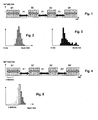
- the steel converter process of the embodiment has two types of work phases, namely, operating phases B1, B2, B3, B4 and pause phases P1, P2, P3, which alternate with each other in regular operation, as shown in the diagram of FIG. 1 for three and a half cycles of learning mode.
- operating phases B1, B2, B3, B4 and pause phases P1, P2, P3, which alternate with each other in regular operation, as shown in the diagram of FIG. 1 for three and a half cycles of learning mode.
- GOX gaseous oxygen
- No oxygen is needed in the pauses between blows.
- the beginning of an operating phase is indicated by the exceeding of a threshold value of the oxygen consumption, the beginning of a pause phase by falling below it.
- Each of the phases has an individual duration ⁇ k , which in FIG. 1 is represented by a double arrow.
- ⁇ k the duration of the operating and pause phases are measured over a large number of working cycles. For the type-identical work phases, these measured values are collected together in an orderly manner. This results in a frequency distribution of the duration of the operating phases ( FIG. 2 ) and the break phases ( FIG. 3 ). In the example, the temporal resolution of the histograms is one minute.
- the highest bar in FIG. 2 indicates the phase duration that occurs most frequently during the operating phases. Phase thaws that are shorter or longer are less common. Very short and very long durations do not occur at all.
- the break phases FIG. 3 ) show a slightly different frequency distribution.
- the probability of termination of the current working phase for the immediate future is now determined, ie the probability that the current operating phase B1 'is over at a certain future time, namely for equidistant times in the future, here Minutes X + 1, X + 2, etc. after phase start.
- the corresponding histogram generated in the Lemmodus is the FIG. 2 evaluated as it is in FIG. 5 is shown.
- the break probability at the future time X + 1 minutes after the beginning of the phase is calculated, for example, as the quotient of the area of the bold-edged, but not hatched, bar and the total fat-edged area in FIG. 5 determined.
- the break probability at the future time X + 2 minutes after the start of the phase is equal to the area of the first (left) hatched bar through the entire bold edged area in FIG. 5 .
- the predictive value of the parameter at the future time is calculated from the break-off probability at the phase duration corresponding to this time by multiplying the value (1-drop-off probability) by the standard value of the oxygen consumption.
- This calculation is performed in the embodiment for a certain number of future minutes, so that a time history of the forecast value for each future minute to a desired forecast horizon results.
- the prognosis system determines this by dropping below the corresponding threshold value of the oxygen consumption.
- the histogram of the FIG. 3 switched over and determined by an analog method, the break probability of the pause phase P1 '.
- the forecast value of the parameter at a future time is calculated from the probability of termination at the phase duration corresponding to this time, namely in the pause phase by multiplying the determined probability of discontinuation by the standard value of the oxygen consumption.
- a control signal for the gas supply system can basically be formed, which supplies the oxygen and has, for example, an air separation plant. With the help of this control signal, the production volume of the air separation plant can be adapted early to the expected consumption.
- the steel mill has a plurality of oxygen-consuming technical systems that are fed from the same gas supply system, namely two blast furnaces and three Steel converter.
- the prediction method described above with reference to the drawings is applied to each of these quasi-periodic technical processes individually.
- differing histograms are found in the learning mode for each individual process, but those of the FIGS. 2 and 3 structurally similar.
- predictive mode the predictive values of the characteristic of each technical process are superimposed into an overall forecast value, for example, by addition, resulting in a time course of the total forecast value and thus a reliable prediction of the total consumption of oxygen for the near future.
- the total consumption in turn serves for the forward-looking control of the gas supply system, in particular the air separation plant.
Landscapes
- Engineering & Computer Science (AREA)
- Artificial Intelligence (AREA)
- Health & Medical Sciences (AREA)
- Computer Vision & Pattern Recognition (AREA)
- Evolutionary Computation (AREA)
- Medical Informatics (AREA)
- Software Systems (AREA)
- Physics & Mathematics (AREA)
- General Physics & Mathematics (AREA)
- Automation & Control Theory (AREA)
- Management, Administration, Business Operations System, And Electronic Commerce (AREA)
- General Factory Administration (AREA)
Priority Applications (2)
| Application Number | Priority Date | Filing Date | Title |
|---|---|---|---|
| EP08019906A EP2187277A1 (fr) | 2008-11-14 | 2008-11-14 | Procédé de prévision d'une grandeur caractéristique variable dans le temps d'un processus technique |
| PCT/EP2009/007880 WO2010054771A2 (fr) | 2008-11-14 | 2009-11-03 | Procédé de prédiction d'un paramètre variant dans le temps dans un processus technique |
Applications Claiming Priority (1)
| Application Number | Priority Date | Filing Date | Title |
|---|---|---|---|
| EP08019906A EP2187277A1 (fr) | 2008-11-14 | 2008-11-14 | Procédé de prévision d'une grandeur caractéristique variable dans le temps d'un processus technique |
Publications (1)
| Publication Number | Publication Date |
|---|---|
| EP2187277A1 true EP2187277A1 (fr) | 2010-05-19 |
Family
ID=40469957
Family Applications (1)
| Application Number | Title | Priority Date | Filing Date |
|---|---|---|---|
| EP08019906A Withdrawn EP2187277A1 (fr) | 2008-11-14 | 2008-11-14 | Procédé de prévision d'une grandeur caractéristique variable dans le temps d'un processus technique |
Country Status (2)
| Country | Link |
|---|---|
| EP (1) | EP2187277A1 (fr) |
| WO (1) | WO2010054771A2 (fr) |
Citations (2)
| Publication number | Priority date | Publication date | Assignee | Title |
|---|---|---|---|---|
| EP1533669A1 (fr) * | 2003-11-18 | 2005-05-25 | Peter Renner | Surveillance d'état des processus techniques |
| US20050159922A1 (en) * | 2000-03-10 | 2005-07-21 | Smiths Detection-Pasadena, Inc. | System for providing control to an industrial process using one or more multidimensional variables |
-
2008
- 2008-11-14 EP EP08019906A patent/EP2187277A1/fr not_active Withdrawn
-
2009
- 2009-11-03 WO PCT/EP2009/007880 patent/WO2010054771A2/fr not_active Ceased
Patent Citations (2)
| Publication number | Priority date | Publication date | Assignee | Title |
|---|---|---|---|---|
| US20050159922A1 (en) * | 2000-03-10 | 2005-07-21 | Smiths Detection-Pasadena, Inc. | System for providing control to an industrial process using one or more multidimensional variables |
| EP1533669A1 (fr) * | 2003-11-18 | 2005-05-25 | Peter Renner | Surveillance d'état des processus techniques |
Also Published As
| Publication number | Publication date |
|---|---|
| WO2010054771A2 (fr) | 2010-05-20 |
| WO2010054771A3 (fr) | 2010-07-29 |
Similar Documents
| Publication | Publication Date | Title |
|---|---|---|
| WO2018145947A9 (fr) | Planification globale de plans de production et/ou de maintenance | |
| DE102017000955A1 (de) | Produktionssteuersystem und integriertes Produktionssteuersystem | |
| DE102016009032A1 (de) | Maschinenlerneinheit, Spindelersatzbeurteilungsvorrichtung, Steuerung, Werkzeugmaschine, Produktionssystem und maschinelles Lernverfahren, die zur Beurteilung der Notwendigkeit eines Spindelersatzes fähig sind | |
| DE102016015332A1 (de) | Präventivwartungsverwaltungssystem und -verfahren zum Erstellen eines Wartungsplans einer Maschine sowie Zellensteuereinrichtung | |
| EP4150419B1 (fr) | Système et procédé de commande d'une usine de production constituée d'une pluralité de parties d'usine, en particulier d'une usine de production pour la production de marchandises industrielles telles que des produits semi-finis métalliques | |
| WO2022063702A1 (fr) | Contrôle qualité pour produits fabriqués en série | |
| WO2020216530A1 (fr) | Procédé servant à définir des cycles d'utilisation restante, circuit de définition de cycle d'utilisation restante, dispositif de définition de cycle d'utilisation restante | |
| EP2881822A1 (fr) | Procédé implémenté par ordinateur et système de surveillance automatique et de détermination de l'état de l'intégralité des étapes de processus dans une unité de traitement | |
| DE19637917C2 (de) | Verfahren und Einrichtung zum Entwurf oder zur Steuerung des Prozeßablaufs einer Anlage der Grundstoffindustrie | |
| EP4158431B1 (fr) | Système de planification de maintenance, procédé et programme d'ordinateur de détermination de mesures de maintenance d'une installation de production, en particulier une installation de production dans l'industrie de production de métaux, l'industrie des métaux non ferreux ou d'acier ou la fabrication d'alliage mère | |
| EP1055180B1 (fr) | Procede et dispositif de conception d'un systeme technique | |
| EP1748529B1 (fr) | Procédé et système pour le pronostic des quantités d'énergie demandées par un consommateur, en particulier un consommateur industriel, à un producteur ou fournisseur d'énergie, et dispositif pour le pronostic de ces besoins en énergie | |
| DE102006020175A1 (de) | Verfahren zur Bestimmung einer aggregierten Prognoseabweichung | |
| DE102019214640A1 (de) | Steuervorrichtung und steuerverfahren | |
| EP3349078A1 (fr) | Dispositif de diagnostic et procédé de surveillance et/ou d'optimisation d'un dispositif de réglage | |
| DE102020200051A1 (de) | Verfahren zum Bestimmen von Restnutzungszyklen, Restnutzungszyklusbestimmungsschaltung, Restnutzungszyklusbestimmungsvorrichtung | |
| EP2847842B1 (fr) | Installation d'alimentation en énergie pourvue d'un dispositif de prétraitement | |
| EP2187277A1 (fr) | Procédé de prévision d'une grandeur caractéristique variable dans le temps d'un processus technique | |
| EP2120118A1 (fr) | Procédé destiné au fonctionnement d'une installation technique de procédé | |
| EP3352326A1 (fr) | Système de génération d'informations en temps réel et de prévision de réglage de la puissance en fonction de la congestion du réseau dans un réseau électrique | |
| DE102021201887A1 (de) | System, Verfahren und Computerprogramm zur betriebswirtschaftlichen Optimierung eines Prozesses in einer Produktionsanlage, insbesondere einer Produktionsanlage der metallerzeugenden Industrie, der nicht-Eisen- oder Stahlindustrie oder der Vorlegierungsherstellung | |
| EP2736003A1 (fr) | Procédé de détermination d'une plage de temps de fonctionnement adaptée pour les travaux de maintenance sur une installation technique | |
| DE19912221A1 (de) | Computersystem zur Auslegung einer Anlage der Grundstoffindustrie, insbesondere eines Walzwerks | |
| EP3959571A1 (fr) | Procédé servant à définir des cycles d'utilisation restante, circuit de définition de cycle d'utilisation restante, dispositif de définition de cycle d'utilisation restante | |
| EP3872721A1 (fr) | Procédés et systèmes d'optimisation de l'entretien de machines industrielles |
Legal Events
| Date | Code | Title | Description |
|---|---|---|---|
| PUAI | Public reference made under article 153(3) epc to a published international application that has entered the european phase |
Free format text: ORIGINAL CODE: 0009012 |
|
| AK | Designated contracting states |
Kind code of ref document: A1 Designated state(s): AT BE BG CH CY CZ DE DK EE ES FI FR GB GR HR HU IE IS IT LI LT LU LV MC MT NL NO PL PT RO SE SI SK TR |
|
| AX | Request for extension of the european patent |
Extension state: AL BA MK RS |
|
| AKY | No designation fees paid | ||
| STAA | Information on the status of an ep patent application or granted ep patent |
Free format text: STATUS: THE APPLICATION IS DEEMED TO BE WITHDRAWN |
|
| 18D | Application deemed to be withdrawn |
Effective date: 20101120 |
|
| REG | Reference to a national code |
Ref country code: DE Ref legal event code: R108 Effective date: 20110510 |