EP2196140A1 - Procédé et dispositif de détermination non invasive du taux de glycémie dans le sang - Google Patents
Procédé et dispositif de détermination non invasive du taux de glycémie dans le sang Download PDFInfo
- Publication number
- EP2196140A1 EP2196140A1 EP09015351A EP09015351A EP2196140A1 EP 2196140 A1 EP2196140 A1 EP 2196140A1 EP 09015351 A EP09015351 A EP 09015351A EP 09015351 A EP09015351 A EP 09015351A EP 2196140 A1 EP2196140 A1 EP 2196140A1
- Authority
- EP
- European Patent Office
- Prior art keywords
- neural network
- patient
- values
- impedance
- blood
- Prior art date
- Legal status (The legal status is an assumption and is not a legal conclusion. Google has not performed a legal analysis and makes no representation as to the accuracy of the status listed.)
- Granted
Links
- 239000008280 blood Substances 0.000 title claims abstract description 81
- 210000004369 blood Anatomy 0.000 title claims abstract description 81
- 238000000034 method Methods 0.000 title claims abstract description 36
- 238000013528 artificial neural network Methods 0.000 claims abstract description 64
- WQZGKKKJIJFFOK-GASJEMHNSA-N Glucose Natural products OC[C@H]1OC(O)[C@H](O)[C@@H](O)[C@@H]1O WQZGKKKJIJFFOK-GASJEMHNSA-N 0.000 claims description 39
- 239000008103 glucose Substances 0.000 claims description 39
- 238000005259 measurement Methods 0.000 claims description 13
- 238000012549 training Methods 0.000 claims description 13
- 238000012897 Levenberg–Marquardt algorithm Methods 0.000 claims description 5
- 238000012545 processing Methods 0.000 claims description 3
- 238000011835 investigation Methods 0.000 claims 1
- 210000002569 neuron Anatomy 0.000 description 17
- 230000006870 function Effects 0.000 description 14
- 238000004364 calculation method Methods 0.000 description 9
- 210000004027 cell Anatomy 0.000 description 8
- 210000001519 tissue Anatomy 0.000 description 8
- 210000002364 input neuron Anatomy 0.000 description 7
- 239000007788 liquid Substances 0.000 description 5
- 230000008569 process Effects 0.000 description 5
- 210000003722 extracellular fluid Anatomy 0.000 description 4
- 239000012530 fluid Substances 0.000 description 4
- 230000003204 osmotic effect Effects 0.000 description 4
- 238000000513 principal component analysis Methods 0.000 description 4
- 238000012546 transfer Methods 0.000 description 4
- 230000036760 body temperature Effects 0.000 description 3
- 230000000875 corresponding effect Effects 0.000 description 3
- 230000007423 decrease Effects 0.000 description 3
- 206010012601 diabetes mellitus Diseases 0.000 description 3
- 230000009466 transformation Effects 0.000 description 3
- 238000012935 Averaging Methods 0.000 description 2
- 208000013016 Hypoglycemia Diseases 0.000 description 2
- 238000004422 calculation algorithm Methods 0.000 description 2
- 230000008859 change Effects 0.000 description 2
- 238000011156 evaluation Methods 0.000 description 2
- 230000002218 hypoglycaemic effect Effects 0.000 description 2
- NOESYZHRGYRDHS-UHFFFAOYSA-N insulin Chemical compound N1C(=O)C(NC(=O)C(CCC(N)=O)NC(=O)C(CCC(O)=O)NC(=O)C(C(C)C)NC(=O)C(NC(=O)CN)C(C)CC)CSSCC(C(NC(CO)C(=O)NC(CC(C)C)C(=O)NC(CC=2C=CC(O)=CC=2)C(=O)NC(CCC(N)=O)C(=O)NC(CC(C)C)C(=O)NC(CCC(O)=O)C(=O)NC(CC(N)=O)C(=O)NC(CC=2C=CC(O)=CC=2)C(=O)NC(CSSCC(NC(=O)C(C(C)C)NC(=O)C(CC(C)C)NC(=O)C(CC=2C=CC(O)=CC=2)NC(=O)C(CC(C)C)NC(=O)C(C)NC(=O)C(CCC(O)=O)NC(=O)C(C(C)C)NC(=O)C(CC(C)C)NC(=O)C(CC=2NC=NC=2)NC(=O)C(CO)NC(=O)CNC2=O)C(=O)NCC(=O)NC(CCC(O)=O)C(=O)NC(CCCNC(N)=N)C(=O)NCC(=O)NC(CC=3C=CC=CC=3)C(=O)NC(CC=3C=CC=CC=3)C(=O)NC(CC=3C=CC(O)=CC=3)C(=O)NC(C(C)O)C(=O)N3C(CCC3)C(=O)NC(CCCCN)C(=O)NC(C)C(O)=O)C(=O)NC(CC(N)=O)C(O)=O)=O)NC(=O)C(C(C)CC)NC(=O)C(CO)NC(=O)C(C(C)O)NC(=O)C1CSSCC2NC(=O)C(CC(C)C)NC(=O)C(NC(=O)C(CCC(N)=O)NC(=O)C(CC(N)=O)NC(=O)C(NC(=O)C(N)CC=1C=CC=CC=1)C(C)C)CC1=CN=CN1 NOESYZHRGYRDHS-UHFFFAOYSA-N 0.000 description 2
- 210000004205 output neuron Anatomy 0.000 description 2
- 241001136792 Alle Species 0.000 description 1
- 102000004877 Insulin Human genes 0.000 description 1
- 108090001061 Insulin Proteins 0.000 description 1
- 208000002193 Pain Diseases 0.000 description 1
- 230000008901 benefit Effects 0.000 description 1
- 230000003750 conditioning effect Effects 0.000 description 1
- 230000002596 correlated effect Effects 0.000 description 1
- 238000009795 derivation Methods 0.000 description 1
- 238000011161 development Methods 0.000 description 1
- 230000018109 developmental process Effects 0.000 description 1
- 238000002845 discoloration Methods 0.000 description 1
- 238000005370 electroosmosis Methods 0.000 description 1
- 230000037406 food intake Effects 0.000 description 1
- 235000012631 food intake Nutrition 0.000 description 1
- 201000001421 hyperglycemia Diseases 0.000 description 1
- 208000015181 infectious disease Diseases 0.000 description 1
- 229940125396 insulin Drugs 0.000 description 1
- 210000002977 intracellular fluid Anatomy 0.000 description 1
- 238000013178 mathematical model Methods 0.000 description 1
- 239000011159 matrix material Substances 0.000 description 1
- 238000012544 monitoring process Methods 0.000 description 1
- 230000001537 neural effect Effects 0.000 description 1
- 235000016709 nutrition Nutrition 0.000 description 1
- 230000037081 physical activity Effects 0.000 description 1
- 230000009467 reduction Effects 0.000 description 1
- 230000004044 response Effects 0.000 description 1
- 238000005070 sampling Methods 0.000 description 1
- 210000000225 synapse Anatomy 0.000 description 1
- 238000012360 testing method Methods 0.000 description 1
- 230000001131 transforming effect Effects 0.000 description 1
Images

Classifications
-
- A—HUMAN NECESSITIES
- A61—MEDICAL OR VETERINARY SCIENCE; HYGIENE
- A61B—DIAGNOSIS; SURGERY; IDENTIFICATION
- A61B5/00—Measuring for diagnostic purposes; Identification of persons
- A61B5/72—Signal processing specially adapted for physiological signals or for diagnostic purposes
- A61B5/7235—Details of waveform analysis
- A61B5/7264—Classification of physiological signals or data, e.g. using neural networks, statistical classifiers, expert systems or fuzzy systems
-
- A—HUMAN NECESSITIES
- A61—MEDICAL OR VETERINARY SCIENCE; HYGIENE
- A61B—DIAGNOSIS; SURGERY; IDENTIFICATION
- A61B5/00—Measuring for diagnostic purposes; Identification of persons
- A61B5/05—Detecting, measuring or recording for diagnosis by means of electric currents or magnetic fields; Measuring using microwaves or radio waves
- A61B5/053—Measuring electrical impedance or conductance of a portion of the body
-
- A—HUMAN NECESSITIES
- A61—MEDICAL OR VETERINARY SCIENCE; HYGIENE
- A61B—DIAGNOSIS; SURGERY; IDENTIFICATION
- A61B5/00—Measuring for diagnostic purposes; Identification of persons
- A61B5/145—Measuring characteristics of blood in vivo, e.g. gas concentration or pH-value ; Measuring characteristics of body fluids or tissues, e.g. interstitial fluid or cerebral tissue
- A61B5/14532—Measuring characteristics of blood in vivo, e.g. gas concentration or pH-value ; Measuring characteristics of body fluids or tissues, e.g. interstitial fluid or cerebral tissue for measuring glucose, e.g. by tissue impedance measurement
-
- A—HUMAN NECESSITIES
- A61—MEDICAL OR VETERINARY SCIENCE; HYGIENE
- A61B—DIAGNOSIS; SURGERY; IDENTIFICATION
- A61B5/00—Measuring for diagnostic purposes; Identification of persons
- A61B5/72—Signal processing specially adapted for physiological signals or for diagnostic purposes
- A61B5/7235—Details of waveform analysis
- A61B5/7264—Classification of physiological signals or data, e.g. using neural networks, statistical classifiers, expert systems or fuzzy systems
- A61B5/7267—Classification of physiological signals or data, e.g. using neural networks, statistical classifiers, expert systems or fuzzy systems involving training the classification device
-
- G—PHYSICS
- G16—INFORMATION AND COMMUNICATION TECHNOLOGY [ICT] SPECIALLY ADAPTED FOR SPECIFIC APPLICATION FIELDS
- G16H—HEALTHCARE INFORMATICS, i.e. INFORMATION AND COMMUNICATION TECHNOLOGY [ICT] SPECIALLY ADAPTED FOR THE HANDLING OR PROCESSING OF MEDICAL OR HEALTHCARE DATA
- G16H50/00—ICT specially adapted for medical diagnosis, medical simulation or medical data mining; ICT specially adapted for detecting, monitoring or modelling epidemics or pandemics
- G16H50/20—ICT specially adapted for medical diagnosis, medical simulation or medical data mining; ICT specially adapted for detecting, monitoring or modelling epidemics or pandemics for computer-aided diagnosis, e.g. based on medical expert systems
Definitions
- the present invention relates to a method and a device for the non-invasive determination of the blood sugar content in the blood by measuring the impedance of the body or a part of the body of a patient.
- the measurement of blood sugar content is of immanent importance to diabetics.
- the knowledge about the current blood sugar content is used for decision making on whether and, if appropriate, how much insulin the diabetic has to supply.
- Such control has to be done several times throughout the day to ensure that larger jumps in sugar levels in the blood are avoided.
- a four to six-fold control of the blood sugar content takes place over a period of 24 hours.
- the calculation module takes into account a change in blood sugar content.
- the coefficients in the nutritional function are initially determined by measuring the blood sugar content by invasive means.
- the calculation methods given in the US specification do not lead to sufficiently accurate results in the determination of the blood sugar value. This is essentially due to the fact that the mathematical models are rigid.
- a non-invasive method for determining the blood sugar content in which the method makes use of at least two input variables, namely the skin impedance and / or the heart rate and / or QT interval (ECG) and / or the alpha waves from the EEG. Based on two or more of the data obtained in this way, the determination of tendencies to determine under- or hypoglycaemia is made.
- the blood sugar value as such can not be determined hereby.
- the object underlying the invention is therefore to provide a method of the type mentioned, which allows with sufficient accuracy, a determination of blood sugar content, ultimately only the impedance of the patient's skin is taken into account.
- the high-frequency current is in the range of 100-400 KHz, in particular of 200 KHz; the low-frequency current is in the range of 10-100 kHz, in particular in the range of 20-50 kHz.
- the size of the frequency determines at what depth subcutaneously in the tissue Impedance is measured. In the areas indicated above, it has been found that a more accurate blood glucose value can be determined from the more precise impedances. This also ensures that the blood sugar content is measured substantially continuously, ie at certain time intervals, for. For example 10 seconds.
- the advantage here is that the patient is thus able to avoid falling below or exceeding limits, ie the occurrence of hypoglycemia or hyperglycemia.
- the invention also relates to a device for the non-invasive determination of the blood sugar content in the blood by measuring the impedance of the patient's body or a part of the patient's body, comprising two spaced apart on the body of the patient attachable electrodes for introducing a low and a high-frequency current in the body of the patient, further comprising a measuring device for detecting the impedances and a computer unit in the form of a microprocessor for processing the determined RF and LF impedances in a installed in the microprocessor neural network, wherein for training the neural network, a plurality of neural networks is generated with different starting values for a more accurate determination of the impedance, wherein of the plurality of networks a number of networks are selected whose values have the least deviation from the invasively determined blood sugar values, furthermore comprising an A display device for displaying the blood sugar content determined by the neural network.
- the device in this case comprises two sleeves, which are applied to the body and by means of which the HF and the LF current is introduced into the body.
- the respective impedance is processed by a microprocessor with the neural network.
- the microprocessor is here housed separately from the LF or HF generator in a separate housing.
- the blood sugar level influences the osmotic pressure and thus the conductivity of the tissue.
- the osmotic pressure As the blood sugar level rises, so does the osmotic pressure.
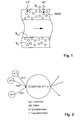
- the cells become smaller, but the liquid volume V out becomes larger, which of course also increases the distance between the individual cells, as a result of which the conductivity C increases and the impedance Z consequently falls. That is, as a result of osmotic processes, the extracellular fluid volume V out increases as the blood sugar level increases. In other words, this means that when the blood sugar level rises, the osmotic Pressure also increases, but due to the increasing pressure, the cell is smaller. As the cell gets smaller, the extracellular volume becomes larger, which leads to an increase in the conductivity, which in turn leads to a fall of the impedance ( Fig. 1 ).
- the impedance value behaves inversely proportional to the low-frequency conductivity and thus inversely proportional to the extra-cellular fluid volume V out .
- the impedance value also behaves inversely proportional to the high-frequency conductivity C and thus inversely proportional to the sum V tot of intercellular fluid volume V in and extracellular fluid volume V out .
- an artificial neural network with multiple networks is that depending on the frequency of the measurements and in particular previous training operations, the whole process in the long run becomes more accurate. This means that over time the procedure will be better adapted to the specific patient. This is because - as already stated - a neural network or network is basically capable of learning.
- a further increase in accuracy is experienced by the method by taking into account the body temperature.
- An increase in the sugar content in the blood leads to a decrease in temperature, resulting in a decrease in the conductivity of the tissue. For example, it has been found that a temperature difference of 1 ° C results in a 2% change in impedance.
- the body temperature on the body of the patient, d. H. on the surface of the skin, in the region of the electrodes is measured, since measurements of the temperature outside the range of the electrodes for introducing the low and the high-frequency current in the body of the patient can lead to a falsification of the relation of the measured values to each other.
- the body temperature is determined at the time of the measurement of the impedance.
- the moisture or dryness of the skin is taken into account. It is known that the resistance increases with increasing dryness of the skin surface.
- the contact influence via the moisture is now compensated by the fact that in each case a second electrode pair is used. That is, the cuffs that abut the patient's arm each have a second pair of electrodes.
- the compensation relates to the contact resistance for the electrodes, which can be compensated by the use of a further electrode pair.
- the increase in glucose leads to a higher conductivity of the tissue, however, the conductivity of the electrodes, z. B. by the dryness of the skin. Due to increasing dryness of the skin the resistance increases.
- the artificial neural network is designed as a network with nine nets and several layers ( Fig. 2 . Fig. 3 ).
- An artificial neural network or network consists of neurons that are arranged in layers and interconnected by synapses. Each neural network has a certain number of input neurons and an output layer containing the output neurons. Furthermore, an artificial neural network usually has at least one hidden layer containing the hidden neurons. About the Input neurons record the existing data and place it in the neural network. The data passes through the neurons of all layers and is thereby processed. Finally, the calculated results are output via the output neurons.
- the transformation of the data as it is passed to the various layers of the neural network is done in such a way that a neuron receives data, either as input to the neural network or as a processed form of previous layer neurons.
- the data is weighted and then added. From the sum of a threshold value is subtracted and from the resulting result is calculated using the transfer function, the value passed on by the neuron
- T n 2 / 1 + e ⁇ ⁇ - 2 ⁇ n - 1 used.
- Tan-sigmoid function is used in the neurons of the hidden layers.
- identity function T (n) n is used as a transfer function.
- Fig. 2 explains how a single neuron works.
- artificial neural networks contain at least one output layer, but advantageously at least one hidden layer and one output layer.
- two hidden layers and one output layer are provided ( Fig. 3
- the first hidden layer contains five neurons
- the second hidden layer behind it contains three neurons and the output layer again a neuron, as is known FIG. 3 results.
- the number of neurons in a neural network is not limited.
- the neural network is self-learning.
- the thresholds and weights within the neural network are initially populated with random arbitrary values.
- the network data ie impedances and temperature values and the associated results (blood sugar content) are presented.
- the network calculates from the given data a value which is compared with the known value, here the invasively measured blood sugar value. Due to the resulting deviations, the thresholds and weights in the network are corrected. This is done by numerical methods, such. By the Levenberg-Marquardt algorithm. This process of learning will for a neural network, until the deviation does not exceed a desired value.
- the blood glucose value determined invasively on the basis of the LF and HF impedances and the temperature through the neural network is compared with the invasively measured blood sugar value, and by means of the Levenberg method. Marquardt algorithm the deviation is reduced.
- the weights and threshold values used in the neural network are corrected by means of the Levenberg-Marquardt algorithm in such a way that the deviation is minimized after repeated calibration procedures.
- the invasively determined blood sugar levels are not necessarily those that are determined with the help of blood glucose monitoring stations, but can also be those that are chemically measured in hospitals and thus more accurate. It may be necessary to repeat the calibration during operation at certain intervals.
- the calculation of the blood sugar content by the neural network not only by a neural network, but by a plurality of neural networks, in particular nine neural networks. This is done in detail by averaging the output values, ie the calculated blood glucose values of the individual networks, and here in particular the seven networks whose output values have the smallest deviation from the invasively measured values.
- the measured values ie the impedances and the temperature
- they are first processed. That is, the impedance and temperature values are determined using various filters, e.g. B. the finite impulse response filter 16th order or the median filter 8th order smoothed to compensate for any measurement errors.
- approximate intermediate values are calculated using spline interpolation.
- an artificial neural network needs a glucose value of the same point in time at the LF, HF impedances and temperature values measured at a particular time.
- the measurement of the LF, RF impedances and temperature values takes place continuously over a certain period of time, resulting in one value per minute.
- the glucose value is only determined at certain times measured invasively (not every minute).
- the artificial neural networks require a corresponding glucose value for all existing LF, HF impedances and temperature values. Therefore, the invasively measured glucose values are linked together using an interpolation function. This is done by spline interpolation.
- the exact number of input neurons is determined by a principal component analysis of the current and z. B. a minute ago and z. B. measured two minutes ago measured impedance and temperature values.
- the principal component analysis is performed over all nine of the measured values obtained at the three times. Principal component analysis makes it possible to reduce the dimension of the data with minimal loss of information, by transforming a set of correlated variables into a set of uncorrelated variables. For calibration, these data are normalized, ie they are adjusted so that their mean and standard deviations are 0 and 1 respectively.
- the normalized data is used to perform a principal component analysis, the resulting data serving as input neurons for the artificial neural network.
- the measured and interpolated blood glucose levels are also normalized.
- the transformation data is saved.
- the Nets are trained with the prepared data.
- the output values of the networks and the input data are de-normalized so that their averages and standard deviations return to their original values.
- the data is normalized using the averages and standard deviations calculated during the training, and the components of the input data are reduced using the stored transformation matrix.
- the output values are de-normalized so that the blood glucose value is output in the desired form. Then, the above-described averaging of all the output values of a certain number of the best networks takes place. This mean is then given as the current blood glucose value.
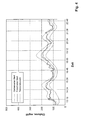
- Out Fig. 4 is an exemplary measurement result recognizable. It can be seen that the calculated blood glucose values are within a given tolerance range. The deviation of the calculated values from the invasively measured values is approximately between 2 and 3%.
Landscapes
- Health & Medical Sciences (AREA)
- Life Sciences & Earth Sciences (AREA)
- Physics & Mathematics (AREA)
- Engineering & Computer Science (AREA)
- General Health & Medical Sciences (AREA)
- Public Health (AREA)
- Pathology (AREA)
- Biophysics (AREA)
- Biomedical Technology (AREA)
- Heart & Thoracic Surgery (AREA)
- Medical Informatics (AREA)
- Molecular Biology (AREA)
- Surgery (AREA)
- Animal Behavior & Ethology (AREA)
- Veterinary Medicine (AREA)
- Artificial Intelligence (AREA)
- Physiology (AREA)
- Optics & Photonics (AREA)
- Evolutionary Computation (AREA)
- Fuzzy Systems (AREA)
- Mathematical Physics (AREA)
- Computer Vision & Pattern Recognition (AREA)
- Emergency Medicine (AREA)
- Psychiatry (AREA)
- Signal Processing (AREA)
- Nuclear Medicine, Radiotherapy & Molecular Imaging (AREA)
- Radiology & Medical Imaging (AREA)
- Measurement Of The Respiration, Hearing Ability, Form, And Blood Characteristics Of Living Organisms (AREA)
- Investigating Or Analyzing Materials By The Use Of Electric Means (AREA)
Priority Applications (1)
| Application Number | Priority Date | Filing Date | Title |
|---|---|---|---|
| EP09015351.1A EP2196140B1 (fr) | 2008-12-11 | 2009-12-11 | Procédé et dispositif de détermination non invasive du taux de glycémie dans le sang |
Applications Claiming Priority (3)
| Application Number | Priority Date | Filing Date | Title |
|---|---|---|---|
| DE102008061900A DE102008061900A1 (de) | 2008-12-11 | 2008-12-11 | Verfahren zur nicht invasiven Bestimmung des Blutzuckergehalts |
| EP09015125 | 2009-12-07 | ||
| EP09015351.1A EP2196140B1 (fr) | 2008-12-11 | 2009-12-11 | Procédé et dispositif de détermination non invasive du taux de glycémie dans le sang |
Publications (2)
| Publication Number | Publication Date |
|---|---|
| EP2196140A1 true EP2196140A1 (fr) | 2010-06-16 |
| EP2196140B1 EP2196140B1 (fr) | 2014-03-19 |
Family
ID=42027857
Family Applications (1)
| Application Number | Title | Priority Date | Filing Date |
|---|---|---|---|
| EP09015351.1A Not-in-force EP2196140B1 (fr) | 2008-12-11 | 2009-12-11 | Procédé et dispositif de détermination non invasive du taux de glycémie dans le sang |
Country Status (1)
| Country | Link |
|---|---|
| EP (1) | EP2196140B1 (fr) |
Cited By (1)
| Publication number | Priority date | Publication date | Assignee | Title |
|---|---|---|---|---|
| CN112336331A (zh) * | 2020-10-19 | 2021-02-09 | 桂林市晶瑞传感技术有限公司 | 一种局部人体成分数据处理方法及分析仪 |
Citations (6)
| Publication number | Priority date | Publication date | Assignee | Title |
|---|---|---|---|---|
| WO1999039627A1 (fr) * | 1998-02-04 | 1999-08-12 | Dermal Therapy (Barbados) Inc. | Technique non effractive de determination du taux de glucose dans des liquides organiques et appareil correspondant |
| WO2000009996A1 (fr) * | 1998-08-10 | 2000-02-24 | Solid State Farms, Inc. | Amelioration de l'analyse spectrale haute frequence pour environnements in-vitro ou in-vivo |
| WO2002069798A1 (fr) | 2001-02-28 | 2002-09-12 | University Of Technology, Sydney | Methode et dispositif non invasifs permettant de determiner l'apparition d'etats physiologiques |
| EP1309271A1 (fr) | 2000-08-18 | 2003-05-14 | Cygnus, Inc. | Procedes et dispositifs permettant de predire des evenements hypoglycemiques |
| US6841389B2 (en) | 2001-02-05 | 2005-01-11 | Glucosens, Inc. | Method of determining concentration of glucose in blood |
| WO2008141306A2 (fr) * | 2007-05-11 | 2008-11-20 | Sigmed, Inc. | Caractérisation non invasive d'un paramètre physiologique |
-
2009
- 2009-12-11 EP EP09015351.1A patent/EP2196140B1/fr not_active Not-in-force
Patent Citations (6)
| Publication number | Priority date | Publication date | Assignee | Title |
|---|---|---|---|---|
| WO1999039627A1 (fr) * | 1998-02-04 | 1999-08-12 | Dermal Therapy (Barbados) Inc. | Technique non effractive de determination du taux de glucose dans des liquides organiques et appareil correspondant |
| WO2000009996A1 (fr) * | 1998-08-10 | 2000-02-24 | Solid State Farms, Inc. | Amelioration de l'analyse spectrale haute frequence pour environnements in-vitro ou in-vivo |
| EP1309271A1 (fr) | 2000-08-18 | 2003-05-14 | Cygnus, Inc. | Procedes et dispositifs permettant de predire des evenements hypoglycemiques |
| US6841389B2 (en) | 2001-02-05 | 2005-01-11 | Glucosens, Inc. | Method of determining concentration of glucose in blood |
| WO2002069798A1 (fr) | 2001-02-28 | 2002-09-12 | University Of Technology, Sydney | Methode et dispositif non invasifs permettant de determiner l'apparition d'etats physiologiques |
| WO2008141306A2 (fr) * | 2007-05-11 | 2008-11-20 | Sigmed, Inc. | Caractérisation non invasive d'un paramètre physiologique |
Cited By (2)
| Publication number | Priority date | Publication date | Assignee | Title |
|---|---|---|---|---|
| CN112336331A (zh) * | 2020-10-19 | 2021-02-09 | 桂林市晶瑞传感技术有限公司 | 一种局部人体成分数据处理方法及分析仪 |
| CN112336331B (zh) * | 2020-10-19 | 2023-11-17 | 桂林市晶瑞传感技术有限公司 | 一种局部人体成分数据处理方法及分析仪 |
Also Published As
| Publication number | Publication date |
|---|---|
| EP2196140B1 (fr) | 2014-03-19 |
Similar Documents
| Publication | Publication Date | Title |
|---|---|---|
| EP1589438B1 (fr) | Procédé et dispositif pour surveillance de la concentration d'un analyte dans un corps vivant humain or animal | |
| EP2470913B1 (fr) | Procédé de calibrage destiné au calibrage prospectif d'un appareil de mesure, produit-programme d'ordinateur et appareil de mesure | |
| EP1728469B1 (fr) | Evaluation de la concentration de glucose pour régler le dosage insulinique | |
| DE60115736T2 (de) | Messung bezüglich des menschlichen Energiestoffwechsels | |
| DE112018003005T5 (de) | Ermüdungserholungsunterstützungsvorrichtung | |
| EP3518757B1 (fr) | Surveillance de signaux biologiques, en particulier d'électrocardiogrammes | |
| EP1733678A1 (fr) | Dispositif de mesure de glucose avec moyen de signalisation | |
| DE4133608A1 (de) | Geraet zum messen des stressniveaus | |
| WO1995031928A1 (fr) | Determination transcutanee, non sanglante, de la concentration de substances dans le sang | |
| EP1785086A2 (fr) | Système implantable d'électrodes, procédé et dispositif de mesure de la concentration d'un analyte dans un corps humain ou animal | |
| DE102013200806A1 (de) | System zur Früherkennung lebensbedrohlicher Zustände von Personen | |
| WO2005030050A1 (fr) | Procede et appareil de mesure de la pression arterielle | |
| EP2409253B1 (fr) | Procédé de production automatique d'un régime de saisie de données de mesure spécifique à l'utilisateur pour une mesure discontinue de la glycémie ainsi que dispositif de traitement des données et lecteur de glycémie | |
| EP3275362B1 (fr) | Dispositif de surveillance d'un etat d'un etre vivant | |
| EP2120691B1 (fr) | Procede de determination de l'intensite d'entrainement | |
| WO2000071025A1 (fr) | Procede et dispositif pour mesurer le degre d'organisation de l'eau dans le corps d'un homme ou d'un animal | |
| EP2196140B1 (fr) | Procédé et dispositif de détermination non invasive du taux de glycémie dans le sang | |
| EP0445809B1 (fr) | Dispositif de mesure de la pression sanguine | |
| EP2799110A1 (fr) | Procédé destiné au fonctionnement d'un appareil de bio-résonance | |
| DE102008061900A1 (de) | Verfahren zur nicht invasiven Bestimmung des Blutzuckergehalts | |
| EP1793321B1 (fr) | Procédé d évaluation et système d analyse d'un analyte dans le fluide corporel humain ou animal | |
| DE19781642B4 (de) | Verfahren zum Bestimmen eines die maximale Sauerstoffaufnahme beschreibenden Wertes eines zu beurteilenden Lebenswesens | |
| EP3849419B1 (fr) | Méthode et dispositif pour déterminer une valeur de glucose actuelle dans un fluide de transport | |
| EP4312760A1 (fr) | Procédé pour déterminer une valeur instantanée de glucose dans un fluide de transport | |
| DE102007050598A1 (de) | Langzeit-Blutdruckmessgerät |
Legal Events
| Date | Code | Title | Description |
|---|---|---|---|
| PUAI | Public reference made under article 153(3) epc to a published international application that has entered the european phase |
Free format text: ORIGINAL CODE: 0009012 |
|
| AK | Designated contracting states |
Kind code of ref document: A1 Designated state(s): AT BE BG CH CY CZ DE DK EE ES FI FR GB GR HR HU IE IS IT LI LT LU LV MC MK MT NL NO PL PT RO SE SI SK SM TR |
|
| AX | Request for extension of the european patent |
Extension state: AL BA RS |
|
| 17P | Request for examination filed |
Effective date: 20100608 |
|
| 17Q | First examination report despatched |
Effective date: 20130103 |
|
| GRAP | Despatch of communication of intention to grant a patent |
Free format text: ORIGINAL CODE: EPIDOSNIGR1 |
|
| INTG | Intention to grant announced |
Effective date: 20131001 |
|
| GRAS | Grant fee paid |
Free format text: ORIGINAL CODE: EPIDOSNIGR3 |
|
| GRAA | (expected) grant |
Free format text: ORIGINAL CODE: 0009210 |
|
| AK | Designated contracting states |
Kind code of ref document: B1 Designated state(s): AT BE BG CH CY CZ DE DK EE ES FI FR GB GR HR HU IE IS IT LI LT LU LV MC MK MT NL NO PL PT RO SE SI SK SM TR |
|
| REG | Reference to a national code |
Ref country code: GB Ref legal event code: FG4D Free format text: NOT ENGLISH |
|
| REG | Reference to a national code |
Ref country code: CH Ref legal event code: EP |
|
| REG | Reference to a national code |
Ref country code: IE Ref legal event code: FG4D Free format text: LANGUAGE OF EP DOCUMENT: GERMAN |
|
| REG | Reference to a national code |
Ref country code: AT Ref legal event code: REF Ref document number: 657107 Country of ref document: AT Kind code of ref document: T Effective date: 20140415 |
|
| REG | Reference to a national code |
Ref country code: DE Ref legal event code: R096 Ref document number: 502009009016 Country of ref document: DE Effective date: 20140430 |
|
| PG25 | Lapsed in a contracting state [announced via postgrant information from national office to epo] |
Ref country code: LT Free format text: LAPSE BECAUSE OF FAILURE TO SUBMIT A TRANSLATION OF THE DESCRIPTION OR TO PAY THE FEE WITHIN THE PRESCRIBED TIME-LIMIT Effective date: 20140319 Ref country code: NO Free format text: LAPSE BECAUSE OF FAILURE TO SUBMIT A TRANSLATION OF THE DESCRIPTION OR TO PAY THE FEE WITHIN THE PRESCRIBED TIME-LIMIT Effective date: 20140619 |
|
| REG | Reference to a national code |
Ref country code: NL Ref legal event code: VDEP Effective date: 20140319 |
|
| REG | Reference to a national code |
Ref country code: LT Ref legal event code: MG4D |
|
| PG25 | Lapsed in a contracting state [announced via postgrant information from national office to epo] |
Ref country code: FI Free format text: LAPSE BECAUSE OF FAILURE TO SUBMIT A TRANSLATION OF THE DESCRIPTION OR TO PAY THE FEE WITHIN THE PRESCRIBED TIME-LIMIT Effective date: 20140319 Ref country code: CY Free format text: LAPSE BECAUSE OF FAILURE TO SUBMIT A TRANSLATION OF THE DESCRIPTION OR TO PAY THE FEE WITHIN THE PRESCRIBED TIME-LIMIT Effective date: 20140319 Ref country code: SE Free format text: LAPSE BECAUSE OF FAILURE TO SUBMIT A TRANSLATION OF THE DESCRIPTION OR TO PAY THE FEE WITHIN THE PRESCRIBED TIME-LIMIT Effective date: 20140319 |
|
| PG25 | Lapsed in a contracting state [announced via postgrant information from national office to epo] |
Ref country code: HR Free format text: LAPSE BECAUSE OF FAILURE TO SUBMIT A TRANSLATION OF THE DESCRIPTION OR TO PAY THE FEE WITHIN THE PRESCRIBED TIME-LIMIT Effective date: 20140319 Ref country code: LV Free format text: LAPSE BECAUSE OF FAILURE TO SUBMIT A TRANSLATION OF THE DESCRIPTION OR TO PAY THE FEE WITHIN THE PRESCRIBED TIME-LIMIT Effective date: 20140319 |
|
| PG25 | Lapsed in a contracting state [announced via postgrant information from national office to epo] |
Ref country code: IS Free format text: LAPSE BECAUSE OF FAILURE TO SUBMIT A TRANSLATION OF THE DESCRIPTION OR TO PAY THE FEE WITHIN THE PRESCRIBED TIME-LIMIT Effective date: 20140719 Ref country code: NL Free format text: LAPSE BECAUSE OF FAILURE TO SUBMIT A TRANSLATION OF THE DESCRIPTION OR TO PAY THE FEE WITHIN THE PRESCRIBED TIME-LIMIT Effective date: 20140319 Ref country code: RO Free format text: LAPSE BECAUSE OF FAILURE TO SUBMIT A TRANSLATION OF THE DESCRIPTION OR TO PAY THE FEE WITHIN THE PRESCRIBED TIME-LIMIT Effective date: 20140319 Ref country code: CZ Free format text: LAPSE BECAUSE OF FAILURE TO SUBMIT A TRANSLATION OF THE DESCRIPTION OR TO PAY THE FEE WITHIN THE PRESCRIBED TIME-LIMIT Effective date: 20140319 Ref country code: EE Free format text: LAPSE BECAUSE OF FAILURE TO SUBMIT A TRANSLATION OF THE DESCRIPTION OR TO PAY THE FEE WITHIN THE PRESCRIBED TIME-LIMIT Effective date: 20140319 Ref country code: BG Free format text: LAPSE BECAUSE OF FAILURE TO SUBMIT A TRANSLATION OF THE DESCRIPTION OR TO PAY THE FEE WITHIN THE PRESCRIBED TIME-LIMIT Effective date: 20140619 |
|
| PG25 | Lapsed in a contracting state [announced via postgrant information from national office to epo] |
Ref country code: PL Free format text: LAPSE BECAUSE OF FAILURE TO SUBMIT A TRANSLATION OF THE DESCRIPTION OR TO PAY THE FEE WITHIN THE PRESCRIBED TIME-LIMIT Effective date: 20140319 Ref country code: ES Free format text: LAPSE BECAUSE OF FAILURE TO SUBMIT A TRANSLATION OF THE DESCRIPTION OR TO PAY THE FEE WITHIN THE PRESCRIBED TIME-LIMIT Effective date: 20140319 Ref country code: SK Free format text: LAPSE BECAUSE OF FAILURE TO SUBMIT A TRANSLATION OF THE DESCRIPTION OR TO PAY THE FEE WITHIN THE PRESCRIBED TIME-LIMIT Effective date: 20140319 |
|
| REG | Reference to a national code |
Ref country code: DE Ref legal event code: R097 Ref document number: 502009009016 Country of ref document: DE |
|
| PG25 | Lapsed in a contracting state [announced via postgrant information from national office to epo] |
Ref country code: PT Free format text: LAPSE BECAUSE OF FAILURE TO SUBMIT A TRANSLATION OF THE DESCRIPTION OR TO PAY THE FEE WITHIN THE PRESCRIBED TIME-LIMIT Effective date: 20140721 |
|
| PLBE | No opposition filed within time limit |
Free format text: ORIGINAL CODE: 0009261 |
|
| STAA | Information on the status of an ep patent application or granted ep patent |
Free format text: STATUS: NO OPPOSITION FILED WITHIN TIME LIMIT |
|
| PG25 | Lapsed in a contracting state [announced via postgrant information from national office to epo] |
Ref country code: DK Free format text: LAPSE BECAUSE OF FAILURE TO SUBMIT A TRANSLATION OF THE DESCRIPTION OR TO PAY THE FEE WITHIN THE PRESCRIBED TIME-LIMIT Effective date: 20140319 |
|
| 26N | No opposition filed |
Effective date: 20141222 |
|
| PG25 | Lapsed in a contracting state [announced via postgrant information from national office to epo] |
Ref country code: IT Free format text: LAPSE BECAUSE OF FAILURE TO SUBMIT A TRANSLATION OF THE DESCRIPTION OR TO PAY THE FEE WITHIN THE PRESCRIBED TIME-LIMIT Effective date: 20140319 |
|
| REG | Reference to a national code |
Ref country code: DE Ref legal event code: R097 Ref document number: 502009009016 Country of ref document: DE Effective date: 20141222 |
|
| PG25 | Lapsed in a contracting state [announced via postgrant information from national office to epo] |
Ref country code: LU Free format text: LAPSE BECAUSE OF FAILURE TO SUBMIT A TRANSLATION OF THE DESCRIPTION OR TO PAY THE FEE WITHIN THE PRESCRIBED TIME-LIMIT Effective date: 20141211 Ref country code: SI Free format text: LAPSE BECAUSE OF FAILURE TO SUBMIT A TRANSLATION OF THE DESCRIPTION OR TO PAY THE FEE WITHIN THE PRESCRIBED TIME-LIMIT Effective date: 20140319 |
|
| REG | Reference to a national code |
Ref country code: IE Ref legal event code: MM4A |
|
| REG | Reference to a national code |
Ref country code: DE Ref legal event code: R082 Ref document number: 502009009016 Country of ref document: DE |
|
| PG25 | Lapsed in a contracting state [announced via postgrant information from national office to epo] |
Ref country code: IE Free format text: LAPSE BECAUSE OF NON-PAYMENT OF DUE FEES Effective date: 20141211 |
|
| REG | Reference to a national code |
Ref country code: FR Ref legal event code: PLFP Year of fee payment: 7 |
|
| PGFP | Annual fee paid to national office [announced via postgrant information from national office to epo] |
Ref country code: FR Payment date: 20151105 Year of fee payment: 7 |
|
| PG25 | Lapsed in a contracting state [announced via postgrant information from national office to epo] |
Ref country code: SM Free format text: LAPSE BECAUSE OF FAILURE TO SUBMIT A TRANSLATION OF THE DESCRIPTION OR TO PAY THE FEE WITHIN THE PRESCRIBED TIME-LIMIT Effective date: 20140319 |
|
| PG25 | Lapsed in a contracting state [announced via postgrant information from national office to epo] |
Ref country code: MC Free format text: LAPSE BECAUSE OF FAILURE TO SUBMIT A TRANSLATION OF THE DESCRIPTION OR TO PAY THE FEE WITHIN THE PRESCRIBED TIME-LIMIT Effective date: 20140319 |
|
| PG25 | Lapsed in a contracting state [announced via postgrant information from national office to epo] |
Ref country code: GR Free format text: LAPSE BECAUSE OF FAILURE TO SUBMIT A TRANSLATION OF THE DESCRIPTION OR TO PAY THE FEE WITHIN THE PRESCRIBED TIME-LIMIT Effective date: 20140620 |
|
| PG25 | Lapsed in a contracting state [announced via postgrant information from national office to epo] |
Ref country code: TR Free format text: LAPSE BECAUSE OF FAILURE TO SUBMIT A TRANSLATION OF THE DESCRIPTION OR TO PAY THE FEE WITHIN THE PRESCRIBED TIME-LIMIT Effective date: 20140319 Ref country code: MT Free format text: LAPSE BECAUSE OF FAILURE TO SUBMIT A TRANSLATION OF THE DESCRIPTION OR TO PAY THE FEE WITHIN THE PRESCRIBED TIME-LIMIT Effective date: 20140319 Ref country code: HU Free format text: LAPSE BECAUSE OF FAILURE TO SUBMIT A TRANSLATION OF THE DESCRIPTION OR TO PAY THE FEE WITHIN THE PRESCRIBED TIME-LIMIT; INVALID AB INITIO Effective date: 20091211 |
|
| PGFP | Annual fee paid to national office [announced via postgrant information from national office to epo] |
Ref country code: BE Payment date: 20170125 Year of fee payment: 8 |
|
| REG | Reference to a national code |
Ref country code: FR Ref legal event code: ST Effective date: 20170831 |
|
| PG25 | Lapsed in a contracting state [announced via postgrant information from national office to epo] |
Ref country code: FR Free format text: LAPSE BECAUSE OF NON-PAYMENT OF DUE FEES Effective date: 20170102 |
|
| PGFP | Annual fee paid to national office [announced via postgrant information from national office to epo] |
Ref country code: AT Payment date: 20180124 Year of fee payment: 9 |
|
| PG25 | Lapsed in a contracting state [announced via postgrant information from national office to epo] |
Ref country code: MK Free format text: LAPSE BECAUSE OF FAILURE TO SUBMIT A TRANSLATION OF THE DESCRIPTION OR TO PAY THE FEE WITHIN THE PRESCRIBED TIME-LIMIT Effective date: 20140319 |
|
| REG | Reference to a national code |
Ref country code: BE Ref legal event code: MM Effective date: 20171231 |
|
| PG25 | Lapsed in a contracting state [announced via postgrant information from national office to epo] |
Ref country code: BE Free format text: LAPSE BECAUSE OF NON-PAYMENT OF DUE FEES Effective date: 20171231 |
|
| REG | Reference to a national code |
Ref country code: AT Ref legal event code: MM01 Ref document number: 657107 Country of ref document: AT Kind code of ref document: T Effective date: 20171211 |
|
| PG25 | Lapsed in a contracting state [announced via postgrant information from national office to epo] |
Ref country code: AT Free format text: LAPSE BECAUSE OF NON-PAYMENT OF DUE FEES Effective date: 20171211 |
|
| REG | Reference to a national code |
Ref country code: DE Ref legal event code: R081 Ref document number: 502009009016 Country of ref document: DE Owner name: EVONIK OPERATIONS GMBH, DE Free format text: FORMER OWNER: TROUT GMBH, 34119 KASSEL, DE |
|
| REG | Reference to a national code |
Ref country code: GB Ref legal event code: 732E Free format text: REGISTERED BETWEEN 20200528 AND 20200603 |
|
| REG | Reference to a national code |
Ref country code: CH Ref legal event code: NV Representative=s name: R. A. EGLI AND CO. PATENTANWAELTE, CH Ref country code: CH Ref legal event code: PUE Owner name: EVONIK DEGUSSA GMBH, DE Free format text: FORMER OWNER: TROUT GMBH, DE |
|
| REG | Reference to a national code |
Ref country code: CH Ref legal event code: PFA Owner name: EVONIK OPERATIONS GMBH, DE Free format text: FORMER OWNER: EVONIK DEGUSSA GMBH, DE |
|
| PGFP | Annual fee paid to national office [announced via postgrant information from national office to epo] |
Ref country code: DE Payment date: 20211210 Year of fee payment: 13 Ref country code: GB Payment date: 20211222 Year of fee payment: 13 |
|
| PGFP | Annual fee paid to national office [announced via postgrant information from national office to epo] |
Ref country code: CH Payment date: 20211221 Year of fee payment: 13 |
|
| REG | Reference to a national code |
Ref country code: DE Ref legal event code: R119 Ref document number: 502009009016 Country of ref document: DE |
|
| REG | Reference to a national code |
Ref country code: CH Ref legal event code: PL |
|
| GBPC | Gb: european patent ceased through non-payment of renewal fee |
Effective date: 20221211 |
|
| PG25 | Lapsed in a contracting state [announced via postgrant information from national office to epo] |
Ref country code: LI Free format text: LAPSE BECAUSE OF NON-PAYMENT OF DUE FEES Effective date: 20221231 Ref country code: GB Free format text: LAPSE BECAUSE OF NON-PAYMENT OF DUE FEES Effective date: 20221211 Ref country code: DE Free format text: LAPSE BECAUSE OF NON-PAYMENT OF DUE FEES Effective date: 20230701 Ref country code: CH Free format text: LAPSE BECAUSE OF NON-PAYMENT OF DUE FEES Effective date: 20221231 |