EP2196237B1 - Bioelektrode - Google Patents
Bioelektrode Download PDFInfo
- Publication number
- EP2196237B1 EP2196237B1 EP20090015126 EP09015126A EP2196237B1 EP 2196237 B1 EP2196237 B1 EP 2196237B1 EP 20090015126 EP20090015126 EP 20090015126 EP 09015126 A EP09015126 A EP 09015126A EP 2196237 B1 EP2196237 B1 EP 2196237B1
- Authority
- EP
- European Patent Office
- Prior art keywords
- layer
- thermoplastic layers
- bioelectrode according
- skin
- connecting cable
- Prior art date
- Legal status (The legal status is an assumption and is not a legal conclusion. Google has not performed a legal analysis and makes no representation as to the accuracy of the status listed.)
- Active
Links
Images



Classifications
-
- A—HUMAN NECESSITIES
- A61—MEDICAL OR VETERINARY SCIENCE; HYGIENE
- A61N—ELECTROTHERAPY; MAGNETOTHERAPY; RADIATION THERAPY; ULTRASOUND THERAPY
- A61N1/00—Electrotherapy; Circuits therefor
- A61N1/02—Details
- A61N1/04—Electrodes
- A61N1/0404—Electrodes for external use
- A61N1/0408—Use-related aspects
- A61N1/046—Specially adapted for shock therapy, e.g. defibrillation
-
- A—HUMAN NECESSITIES
- A61—MEDICAL OR VETERINARY SCIENCE; HYGIENE
- A61B—DIAGNOSIS; SURGERY; IDENTIFICATION
- A61B5/00—Measuring for diagnostic purposes; Identification of persons
- A61B5/24—Detecting, measuring or recording bioelectric or biomagnetic signals of the body or parts thereof
- A61B5/25—Bioelectric electrodes therefor
- A61B5/251—Means for maintaining electrode contact with the body
- A61B5/257—Means for maintaining electrode contact with the body using adhesive means, e.g. adhesive pads or tapes
- A61B5/259—Means for maintaining electrode contact with the body using adhesive means, e.g. adhesive pads or tapes using conductive adhesive means, e.g. gels
-
- A—HUMAN NECESSITIES
- A61—MEDICAL OR VETERINARY SCIENCE; HYGIENE
- A61N—ELECTROTHERAPY; MAGNETOTHERAPY; RADIATION THERAPY; ULTRASOUND THERAPY
- A61N1/00—Electrotherapy; Circuits therefor
- A61N1/02—Details
- A61N1/04—Electrodes
- A61N1/0404—Electrodes for external use
- A61N1/0472—Structure-related aspects
- A61N1/048—Electrodes characterised by a specific connection between lead and electrode
-
- A—HUMAN NECESSITIES
- A61—MEDICAL OR VETERINARY SCIENCE; HYGIENE
- A61N—ELECTROTHERAPY; MAGNETOTHERAPY; RADIATION THERAPY; ULTRASOUND THERAPY
- A61N1/00—Electrotherapy; Circuits therefor
- A61N1/02—Details
- A61N1/04—Electrodes
- A61N1/0404—Electrodes for external use
- A61N1/0472—Structure-related aspects
- A61N1/0492—Patch electrodes
-
- A—HUMAN NECESSITIES
- A61—MEDICAL OR VETERINARY SCIENCE; HYGIENE
- A61B—DIAGNOSIS; SURGERY; IDENTIFICATION
- A61B18/00—Surgical instruments, devices or methods for transferring non-mechanical forms of energy to or from the body
- A61B18/04—Surgical instruments, devices or methods for transferring non-mechanical forms of energy to or from the body by heating
- A61B18/12—Surgical instruments, devices or methods for transferring non-mechanical forms of energy to or from the body by heating by passing a current through the tissue to be heated, e.g. high-frequency current
- A61B18/14—Probes or electrodes therefor
- A61B18/16—Indifferent or passive electrodes for grounding
-
- A—HUMAN NECESSITIES
- A61—MEDICAL OR VETERINARY SCIENCE; HYGIENE
- A61N—ELECTROTHERAPY; MAGNETOTHERAPY; RADIATION THERAPY; ULTRASOUND THERAPY
- A61N1/00—Electrotherapy; Circuits therefor
- A61N1/02—Details
- A61N1/04—Electrodes
- A61N1/0404—Electrodes for external use
- A61N1/0472—Structure-related aspects
- A61N1/0492—Patch electrodes
- A61N1/0496—Patch electrodes characterised by using specific chemical compositions, e.g. hydrogel compositions, adhesives
-
- A—HUMAN NECESSITIES
- A61—MEDICAL OR VETERINARY SCIENCE; HYGIENE
- A61N—ELECTROTHERAPY; MAGNETOTHERAPY; RADIATION THERAPY; ULTRASOUND THERAPY
- A61N1/00—Electrotherapy; Circuits therefor
- A61N1/18—Applying electric currents by contact electrodes
- A61N1/32—Applying electric currents by contact electrodes alternating or intermittent currents
Definitions
- the invention relates to a bioelectrode having a skin-side, electrically conductive adhesive layer, a flexible electrical connection cable which comprises at least one electrical conductor, preferably in the form of a strand consisting of a plurality of individual wires or conductive individual fibers, in an electrically insulating cable sheath, and two thermoplastic layers which are electrically conductive and are electrically connected to the electrical conductor of the connection cable, wherein the electrode-side end of the connection cable between the two thermoplastic layers is arranged.
- Bioelectrodes are used in many ways. As with defibrillation electrodes and stimulation electrodes, current is either supplied to the human or animal body or current is removed from the body (for example neutral electrodes or measuring electrodes).
- connection cable between two electrically conductive adhesive tapes, these two adhesive tapes are glued together only in a simple manner and thus give a relatively poor mechanical grip and poor electrical connection to the ends of the connection cable.
- XP-002572097 of the 3M Technical Bulletin discloses typical properties for electrically conductive adhesive films, wherein, for example, under No. 9713 an electrically conductive adhesive film is shown which can be bonded together at room temperature and low pressure.
- the disadvantage here is that this compound is solvable and that only the adhesive film of the adhesive tape is electrically conductive.
- the object of the invention is to provide a bioelectrode in which the electrical connection cable has a good mechanical hold in the electrode and, in addition, good electrical contact with those layers of the electrode is ensured, which ultimately supply or remove the current from the skin.
- thermoplastic layers are at least partially welded together
- the two thermoplastic layers including the electrode-side connecting cable are thermally or ultrasonically welded together.
- connection according to the invention of the electrode-side connection end between two thermally or ultrasonically welded thermoplastic layers makes it possible, on the one hand, to achieve a good mechanical hold, and at the same time to produce an excellent electrical connection with the two thermoplastic layers, which are designed to be electrically conductive.
- the electrically conductive, thermoplastic layers allow the current supplied via the electrical connecting cable to be distributed uniformly over a larger area or to be removed from a larger area. But it is also possible to incorporate in the electrically conductive thermoplastic layer, which may also consist of several sub-layers, a special resistance profile, for example, such that the surface resistance decreases from the middle point of the electrode-side cable end to the edge of the electrically conductive thermoplastic layer as needed, or increases. In any case, a targeted planar power distribution is possible.
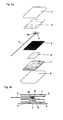
- Fig. 1a shows a first embodiment of the invention in a schematic exploded view.
- Fig. 1b shows the electrode of the Fig. 1a in a schematic cross-sectional view.
- Fig. 1 c shows a cable cross-section.
- Fig. 2a shows a second embodiment of the invention in a schematic exploded view.
- Fig. 2b shows the electrode of the Fig. 2a in a schematic cross-sectional view.
- Fig. 3a shows a third embodiment of the invention in a schematic exploded view.
- Fig. 3b shows the electrode of the Fig. 3a in a schematic cross-sectional view.
- Fig. 4a shows a fourth embodiment of the invention in a schematic exploded view.
- Fig. 4b shows the electrode of the Fig. 4a in a schematic cross-sectional view.
- Fig. 5a shows a fifth embodiment of the invention in a schematic exploded view.
- Fig. 5b shows the electrode of the Fig. 5a in a schematic cross-sectional view.
- Fig. 6a shows a sixth embodiment of the invention in a schematic exploded view.
- Fig. 6b shows the electrode of the Fig. 6a in a schematic cross-sectional view.
- Fig. 1a and 1b show a first embodiment of an electrode according to the invention, in particular defibrillation electrode.
- the electrode of the Fig. 1a and 1b has below a carrier material 1 (eg: foam material consisting of polyethylene or the like, film consisting of polyethylene terephthalate or the like) two thermoplastic layers 2, 3, of which at least the lower (ie skin side) layer 3 is electrically conductive.
- the thermoplastic layers (2, 3) may consist, for example: of polyvinyl chloride, Acrylbutadienstyrol, polyurethane, polyethylene or the like.
- the electrical conductivity of the thermoplastic layer 3 can be achieved, for example, by metallic inclusions and / or inclusions based on carbon (carbon black, graphite). By an appropriate distribution of these inclusions or a multi-layered layer 3, one can vary the electrical resistance across the electrode.
- the electrode-side free end 4a of the connection cable 4 is now arranged between the two thermoplastic layers 2, 3, which are thermally or ultrasonically welded together at least in regions.
- the cross-sectional view according to the Fig. 1b only shows the sequence of layers, but of course the individual layers of the electrode are directly adjacent to each other and connected to each other.
- the schematically illustrated fan of the individual wires / individual fibers of the strand is horizontally flat, as in Fig. 1a shown.
- the layer 2 is with the layer 3, including the electrode-side end 4a the connection cable 4 at least partially intimately welded together.
- the cable end 4a has a good mechanical hold in the electrode and also excellent electrical contact with the conductive thermoplastic layer 3.
- the electrical connection cable 4 comprises - as in Fig. 1c shown in cross section - an electrically insulating cable sheath 5, in which at least one electrical conductor 6 is located.
- this electrical conductor 6 is a strand consisting of several individual wires / Einzelfasem.
- the guidewires may be carbon fiber strands consisting of several thousand to several tens of thousands of individual fibers which may be metallized. As leader even metal strands alone or metal strands combined with carbon fibers can be used.
- Such cable formation makes it possible to strip the cable end, for example, to a length of 0.5 cm to 2 cm, and then fan the individual wires of the strand, as in the Fig. 1 a and 1b is shown schematically. By such a fanning, an even better mechanical and electrical contact of the electrode-side cable end 4 a with the electrically conductive thermoplastic layer 3 can be produced.
- the two thermoplastic layers 2, 3 are at least partially thermally welded together, including the electrode-side free end 4a of the connecting cable 4.
- this welding can be carried out at a temperature between 150 ° C. and 200 ° C. while applying a pressure of approximately 1 N / cm 2 to 5 N / cm 2 make, with the Versch notebookdauer favorably between 5 sec and 20 sec.
- an ultrasound vision method can also be used.
- an operating frequency in the order of, for example, 20 KHz is suitable.
- the energy input is favorably between 200 Ws and 600 Ws.
- the contact pressure is favorably on the order of between 50 N / cm 2 and 100 N / cm 2 .
- the welding times by means of ultrasonic welding are quite short and are conveniently less than one second.
- thermoplastic layer 2 may for example consist of Acrylbutadienstyrol, polyethylene, polyurethane, polyvinyl chloride or the like. If the thermoplastic layer 2 is at least partially electrically conductive, it must be filled with electrically conductive fillers, in particular pigments or fibers, or be constructed like layer 3. If the thermoplastic layer 2 is formed as a carrier layer 1, the layer 2 may not be electrically formed.
- a conductive adhesive layer 7 preferably in the form of a conductive gel.
- the conductive adhesive layer which must be biocompatible, can be both an adhesive hydrogel and a conductive adhesive.
- a metal layer or a metal / metal chloride layer may be arranged, wherein the metal is preferably silver. This layer bears the reference numeral 8.
- a peelable cover material 9 is arranged below the conductive adhesive layer 7, which protects the conductive adhesive layer during transport and storage, and which is withdrawn before use.
- This cover material may consist of plastics such as polyethylene terephthalate, polystyrene, polypropylene or the like, which may also be siliconized.
- the second embodiment according to the Fig. 2a and 2b differs from the first embodiment according to the Fig. 1a and 1b essentially only in that the intermediate layer 8 (ie, the metal layer or the metal / metal chloride layer) has a smaller surface area than the overlying thermoplastic layers 2, 3.
- the intermediate layer 8 ie, the metal layer or the metal / metal chloride layer
- thermoplastic layers 2, 3 formed smaller than the skin-side conductive adhesive layer 7.
- the cable end 4a can still be mechanically good and excellent electrically contacted between the two layers 2, 3 held. While the lower of the two thermoplastic layers, namely the layer 3, performs an electrical current distribution over the surface, the conductive adhesive layer 7 can extend this current distribution even to a larger surface area.
- Fig. 4a and 4b are the two thermoplastic layers, in contrast to the aforementioned embodiments, not the same size, but different sizes.
- the upper, non-conductive thermoplastic layer 2 essentially corresponds to the other size of the electrode, while the lower, electrically conductive layer 3 is made smaller.
- the conductive metal layer is preferably a lacquer. This is at least mixed with metal pigments. Furthermore, it is possible to incorporate metal salts which form a constant inherent potential with their respective metals, for example: Ag / AgCl.
- the metal layer can also be applied by vapor deposition.
- the fifth embodiment according to the Fig. 5a and 5b is between the two thermoplastic, welded together layers 2, 3 nor an additional electrically conductive, preferably metallic layer 10.
- the surface of the metallic layer 10 is smaller than the surface of the two thermoplastic layers 2, 3. This allows the two thermoplastic Layers in the protruding area circumferentially around the metallic layer 10 to be welded together.
- the cable sheath 5 of the connection cable 4 can be welded with a suitable material with the two thermoplastic layers 2, 3. Incidentally, this feature can also be used in the other embodiments.
- a film composite for example: metal / polyethylene terephthalate / sealing wax
- the insulating side being aligned on the skin side.
- the current can be optimally distributed from the layer 10, via the thermoplastic layer 2 to the thermoplastic layer 3, and the further electrical conductive layers, to the skin.
- the intermediate layer 8 (metal layer or metal / metal chloride layer) is missing.
- the skin-side conductive adhesive layer 7 directly adjoins the lower, electrically conductive thermoplastic layer 3.
- the invention is of course not limited to the illustrated embodiments.
- the invention is useful not only for defibrillation electrodes and electrodes that deliver current to the skin (e.g., stimulation electrodes), but also for electrodes that remove current from the skin (eg, neutral electrodes, sensing electrodes).
- the layer structure and the size ratios may differ from the embodiments shown. It is essential that the electrode-side end of the connection cable between two thermoplastic thermally or ultrasonically-welded layers is arranged so that a good mechanical support and a good electrical connection are ensured.
Landscapes
- Health & Medical Sciences (AREA)
- Life Sciences & Earth Sciences (AREA)
- Animal Behavior & Ethology (AREA)
- Veterinary Medicine (AREA)
- Public Health (AREA)
- Engineering & Computer Science (AREA)
- Biomedical Technology (AREA)
- General Health & Medical Sciences (AREA)
- Radiology & Medical Imaging (AREA)
- Nuclear Medicine, Radiotherapy & Molecular Imaging (AREA)
- Biophysics (AREA)
- Molecular Biology (AREA)
- Surgery (AREA)
- Medical Informatics (AREA)
- Heart & Thoracic Surgery (AREA)
- Pathology (AREA)
- Chemical & Material Sciences (AREA)
- Physics & Mathematics (AREA)
- Dispersion Chemistry (AREA)
- Electrotherapy Devices (AREA)
Description
- Die Erfindung betrifft eine Bioelektrode, mit einer hautseitigen, elektrisch leitenden Klebeschicht, einem flexiblen elektrischen Anschlusskabel, das in einem elektrisch isolierenden Kabelmantel zumindest einen elektrischen Leiter, vorzugsweise in Form einer aus mehreren Einzeldrähten bzw. leitenden Einzelfasern bestehenden Litze, umfasst, und zwei thermoplastischen Schichten die elektrisch leitend sind und mit dem elektrischen Leiter des Anschlusskabels elektrisch in Verbindung stehen, wobei das elektrodenseitige Ende des Anschlusskabels zwischen den zwei thermoplastischen Schichten angeordnet ist.
- Bioelektroden kommen in vielfacher Weise zum Einsatz. Es wird entweder wie bei Defibrillationselektroden und Stimulationselektroden Strom dem menschlichen oder tierischen Körper zugeführt oder Strom vom Körper abgeführt (beispielsweise Neutralelektroden oder Messelektroden).
- Aus der
US 2005/0015134 A1 geht hervor, die Enden eines Anschlusskabels zwischen zwei elektrisch leitenden Klebebändern anzuordnen, wobei diese beiden Klebebänder nur auf einfache Art und Weise miteinander verklebt sind und somit einen relativ schlechten mechanischen Halt und schlechte elektrische Verbindung zu den Enden des Anschlusskabels ergeben. - Aus der XP-002572097 des 3M Technical Bulletin gehen typische Eigenschaften für elektrisch leitende Klebefilme hervor, wobei beispielsweise unter der Nr. 9713 ein elektrisch leitender Klebefilm gezeigt ist, der bei Raumtemperatur und geringem Druck miteinander verbunden werden kann. Nachteilig dabei ist, dass diese Verbindung lösbar ist und dass nur der Klebefilm des Klebebands elektrisch leitend ist.
- Aufgabe der Erfindung ist es, eine Bioelektrode zu schaffen, bei der das elektrische Anschlusskabel einen guten mechanischen Halt in der Elektrode hat und außerdem ein guter elektrischer Kontakt zu jenen Schichten der Elektrode gewährleistet ist, die letztlich den Strom der Haut zuführen oder von dieser abnehmen.
- Erfindungsgemäß wird dies dadurch erreicht, dass die zwei thermoplastischen Schichten zumindest bereichsweise miteinander verschweißt sind, wobei die beiden thermoplastischen Schichten unter Einschluss des elektrodenseitigen Anschlusskabels thermisch oder mittels Ultraschall miteinander verschweißt sind.
- Die erfindungsgemäße Anbindung des elektrodenseitigen Anschlussendes zwischen zwei thermisch oder ultraschall-verschweißten thermoplastischen Schichten erlaubt es, einerseits einen guten mechanischen Halt zu erzielen, und gleichzeitig eine hervorragende elektrische Verbindung mit den beiden thermoplastischen Schichten herzustellen, die elektrisch leitend ausgebildet sind.
- Die elektrisch leitenden, thermoplastischen Schichten erlauben es, den über das elektrische Anschlusskabel zugeführten Strom über eine größere Fläche gleichmäßig zu verteilen bzw. von einer größeren Fläche abzunehmen. Es ist aber auch möglich, in der elektrisch leitenden thermoplastischen Schicht, die auch aus mehreren Unterschichten bestehen kann, ein spezielles Widerstandsprofil einzubauen, beispielsweise derart, dass der Flächenwiderstand vom mittleren Anschlusspunkt des elektrodenseitigen Kabelendes zum Rand der elektrisch leitenden thermoplastischen Schicht je nach Bedarf abnimmt oder zunimmt. Jedenfalls ist eine gezielte flächige Stromverteilung möglich.
- Weitere Vorteile und Einzelheiten der Erfindung werden anhand der nachfolgenden Figurenbeschreibung näher erläutert.
- Die
Fig. 1a zeigt ein erstes Ausführungsbeispiel der Erfindung in einer schematischen Explosionsdarstellung.Fig. 1b zeigt die Elektrode derFig. 1a in einer schematischen Querschnittsdarstellung.Fig. 1 c zeigt einen Kabelquerschnitt. - Die
Fig. 2a zeigt ein zweites Ausführungsbeispiel der Erfindung in einer schematischen Explosionsdarstellung.Fig. 2b zeigt die Elektrode derFig. 2a in einer schematischen Querschnittsdarstellung. - Die
Fig. 3a zeigt ein drittes Ausführungsbeispiel der Erfindung in einer schematischen Explosionsdarstellung.Fig. 3b zeigt die Elektrode derFig. 3a in einer schematischen Querschnittsdarstellung. - Die
Fig. 4a zeigt ein viertes Ausführungsbeispiel der Erfindung in einer schematischen Explosionsdarstellung.Fig. 4b zeigt die Elektrode derFig. 4a in einer schematischen Querschnittsdarstellung. - Die
Fig. 5a zeigt ein fünftes Ausführungsbeispiel der Erfindung in einer schematischen Explosionsdarstellung.Fig. 5b zeigt die Elektrode derFig. 5a in einer schematischen Querschnittsdarstellung. - Die
Fig. 6a zeigt ein sechstes Ausführungsbeispiel der Erfindung in einer schematischen Explosionsdarstellung.Fig. 6b zeigt die Elektrode derFig. 6a in einer schematischen Querschnittsdarstellung. - Die
Fig. 1a und 1b zeigen ein erstes Ausführungsbeispiel einer erfindungsgemäßen Elektrode, insbesondere Defibrillationselektrode. - Die Elektrode der
Fig. 1a und 1b weist unterhalb eines Trägermateriales 1 (z.B.: Schaummaterial bestehend aus Polyethylen oder ähnlichem, Folie bestehend aus Polyethylenterephthalat oder ähnlichem) zwei thermoplastische Schichten 2, 3 auf, von denen zumindest die untere (also hautseitig liegende) Schicht 3 elektrisch leitend ausgebildet ist. Die thermoplastischen Schichten (2, 3) können z.B.: aus Polyvinylchlorid, Acrylbutadienstyrol, Polyurethan, Polyethylen oder ähnlichem bestehen. Die elektrische Leitfähigkeit der thermoplastischen Schicht 3 kann beispielsweise durch metallische Einschlüsse und/oder Einschlüsse auf Kohlenstoffbasis (Ruß, Graphit) erzielt werden. Durch eine entsprechende Verteilung dieser Einschlüsse oder eine Mehrschichtigkeit der Schicht 3 kann man den elektrischen Widerstand über die Elektrode variieren. - Erfindungsgemäß ist nun das elektrodenseitige freie Ende 4a des Anschlusskabels 4 zwischen den beiden thermoplastischen Schichten 2, 3 angeordnet, die miteinander zumindest bereichsweise thermisch oder ultraschall-verschweißt sind. Es wird darauf hingewiesen, dass die Querschnittsdarstellung gemäß der
Fig. 1b nur die Schichtfolge anzeigt, die einzelnen Schichten der Elektrode aber natürlich direkt aneinander liegen und miteinander verbunden sind. Insofern liegt auch der schematisch dargestellte Fächer der Einzeldrähte/Einzelfasern der Litze horizontal flach, wie inFig. 1a gezeigt. Die Schicht 2 ist mit der Schicht 3 unter Einschluss des elektrodenseitigen Endes 4a des Anschlusskabels 4 zumindest bereichsweise innig miteinander verschweißt. Damit hat das Kabelende 4a einen guten mechanischen Halt in der Elektrode und außerdem einen hervorragenden elektrischen Kontakt zur leitenden thermoplastischen Schicht 3. - Das elektrische Anschlusskabel 4 umfasst - wie in
Fig. 1c im Querschnitt dargestellt - einen elektrisch isolierenden Kabelmantel 5, in dem sich zumindest ein elektrischer Leiter 6 befindet. Bevorzugt ist dieser elektrische Leiter 6 eine Litze, die aus mehreren Einzeldrähten/Einzelfasem besteht. - Verwendbare Materialien des isolierenden Kabelmantels sind Polyethylen, Polypropylen oder Polyvinylchlordid oder ähnliches. Die Leitadern können Karbonfaserstränge sein, die aus mehreren 1000 bis mehreren 10.000 Einzelfasern bestehen, welche metallisiert sein können. Als Leitader können auch Metalllitzen alleine oder Metalllitzen kombiniert mit Karbonfasern verwendet werden. Eine derartige Kabelausbildung erlaubt es, das Kabelende beispielsweise auf einer Länge von 0,5 cm bis 2 cm abzuisolieren, und dann die Einzeldrähte der Litze aufzufächern, wie dies in den
Fig. 1 a und 1b schematisch dargestellt ist. Durch eine solche Auffächerung lässt sich ein noch besserer mechanischer und elektrischer Kontakt des elektrodenseitigen Kabelendes 4a mit der elektrisch leitenden thermoplastischen Schicht 3 herstellen. Die beiden thermoplastischen Schichten 2, 3 werden unter Einschluss des elektrodenseitigen freien Endes 4a des Anschlusskabels 4 zumindest bereichsweise miteinander thermisch verschweißt. - Bei einer Schichtstärke in der Größenordnung von 50 bis 150 Mikrometer der thermoplastischen Schichten 2, 3 kann man diese Verschweißung bei einer Temperatur zwischen 150° C und 200 °C unter Aufbringung eines Druckes von ca. 1 N/cm2 bis 5 N/cm2 vornehmen, wobei die Verschweißdauer günstigerweise zwischen 5 sec und 20 sec liegt.
- Alternativ kann erfindungsgemäß auch ein Ultraschallsehweißverfahren zum Einsatz kommen. Hier ist eine Arbeitsfrequenz in der Größenordnung von beispielsweise 20 KHz geeignet. Der Energieeintrag liegt günstigerweise zwischen 200 Ws und 600 Ws. Der Anpressdruck liegt günstigerweise in der Größenordnung zwischen 50 N/cm2 und 100 N/cm2. Die Verschweißzeiten mittels Ultraschallverschweißung sind recht kurz und liegen günstigerweise unter einer Sekunde.
- Bei dem in
Fig. 1a und 1b dargestellten Ausführungsbeispiel ist nur die untere der beiden thermoplastischen Schichten, nämlich die Schicht 3, elektrisch leitend ausgebildet. Es kann jedoch auch die obere thermoplastische Schicht 2 zumindest teilweise elektrisch leitend ausgebildet sein. Diese obere thermoplastische Schicht 2 kann auch die oberste Trägerschicht 1 ersetzen, sodass diese entfallen kann. Die thermoplastische Schicht 2 kann beispielsweise aus Acrylbutadienstyrol, Polyethylen, Polyurethan, Polyvinylchlorid oder ähnlichem bestehen. Wird die thermoplastische Schicht 2 zumindest teilweise elektrisch leitfähig ausgebildet, muss diese mit elektrisch leitenden Füllstoffen, insbesondere Pigmenten oder Fasern gefüllt sein, oder wie Schicht 3 aufgebaut sein. Wird die thermoplastische Schicht 2 als Trägerschicht 1 ausgebildet, darf die Schicht 2 nicht elektrisch ausgebildet sein. - Hautseitig weist die Bioelektrode nach den
Fig. 1a bis 1b eine leitfähige Klebeschicht 7, vorzugsweise in Form eines leitfähigen Gels, auf. Die leitfähige Klebeschicht, welche biokompatibel sein muss, kann sowohl ein klebendes Hydrogel, als auch ein leitfähiger Kleber sein. - Zwischen der hautseitigen leitfähigen Klebeschicht 7 und der elektrisch leitenden thermoplastischen Schicht 3 kann eine Metallschicht oder eine Metall-/Metallchloridschicht angeordnet sein, wobei das Metall vorzugsweise Silber ist. Diese Schicht trägt das Bezugszeichen 8.
- Unterhalb der leitfähigen Klebeschicht 7 ist ein abziehbares Abdeckmaterial 9 angeordnet, das die leitfähige Klebeschicht beim Transport und der Lagerung schützt, und das vor Benutzung abgezogen wird. Dieses Abdeckmaterial kann aus Kunststoffen wie Polyethylenterephthalat, Polystyrol, Polypropylen oder ähnlichem bestehen, welche auch silikonisiert sein können.
- Das zweite Ausführungsbeispiel gemäß den
Fig. 2a und 2b unterscheidet sich vom ersten Ausführungsbeispiel gemäß denFig. 1a und 1b im Wesentlichen nur dadurch, dass die Zwischenschicht 8 (also die Metallschicht oder die Metall-/Metalichloridschicht) flächenmäßig kleiner ausgebildet ist als die darüberliegenden thermoplastischen Schichten 2, 3. - Beim dritten Ausführungsbeispiel gemäß den
Fig. 3a und 3b sind auch die thermoplastischen Schichten 2, 3 kleiner ausgebildet als die hautseitige leitfähige Klebeschicht 7. Das Kabelende 4a kann dennoch mechanisch gut und elektrisch hervorragend kontaktiert zwischen den beiden Schichten 2, 3 gehalten sein. Während die untere der beiden thermoplastischen Schichten, nämlich die Schicht 3, eine elektrische Stromverteilung über die Fläche vornimmt, kann die leitfähige Klebeschicht 7 diese Stromverteilung noch auf einen größeren Flächenbereich erweitern. - Beim Ausführungsbeispiel gemäß
Fig. 4a und 4b sind die beiden thermoplastischen Schichten im Gegensatz zu den vorher genannten Ausführungsbeispielen nicht gleich groß, sondern verschieden groß. Die obere, nicht leitende thermoplastische Schicht 2 entspricht im Wesentlichen der sonstigen Größe der Elektrode, während die untere, elektrisch leitfähige Schicht 3 kleiner ausgebildet ist. - Die leitende Metallschicht ist bevorzugt ein Lack. Dieser ist zumindest mit Metallpigmenten versetzt. Weiters können Metallsalze eingearbeitet sein, welche mit ihren jeweiligen Metallen ein konstantes Eigenpotential bilden z.B.: Ag/AgCl. Die Metallschicht kann auch durch Bedampfung aufgebracht werden.
- Beim fünften Ausführungsbeispiel gemäß den
Fig. 5a und 5b liegt zwischen den beiden thermoplastischen, miteinander verschweißten Schichten 2, 3 noch eine zusätzliche elektrisch leitende, vorzugsweise metallische Schicht 10. Die Fläche der metallischen Schicht 10 ist dabei kleiner als die Fläche der beiden thermoplastischen Schichten 2, 3. Dies erlaubt es, die beiden thermoplastischen Schichten im überstehenden Bereich umfangseitig um die metallische Schicht 10 herum miteinander zu verschweißen. Dabei kann auch der Kabelmantel 5 des Anschlusskabels 4 bei geeignetem Material mit den beiden thermoplastischen Schichten 2, 3 verschweißt werden. Dieses Merkmal kann übrigens auch bei den anderen Ausführungsbeispielen eingesetzt werden. - Es kann auch ein Folienverbund als Schicht 10 verwendet werden (z.B.: Metall/Polyethylenterphthalat/Siegellack) wobei die isolierende Seite hautseitig ausgerichtet ist. In diesem Fall kann durch Wahl einer speziellen Geometrie der Schicht 10 (z.B.: sternförmig) der Strom optimal von der Schicht 10, über die thermoplastische Schicht 2 zur thermoplastischen Schicht 3, und den weiteren elektrischen leitenden Schichten, zur Haut verteilt werden.
- Beim sechsten Ausführungsbeispiel gemäß den
Fig. 6a und 6b fehlt die Zwischenschicht 8 (Metallschicht bzw. Metall-/Metallchloridschicht). Damit grenzt die hautseitige leitfähige Klebeschicht 7 direkt an die untere, elektrisch leitende thermoplastische Schicht 3 an. - Die Erfindung ist selbstverständlich nicht auf die dargestellten Ausführungsbeispiele beschränkt. Beispielsweise eignet sich die Erfindung nicht nur für Defibrillationselektroden und Elektroden, die Strom der Haut zuführen (z.B.: Stimulationselektroden), sondern grundsätzlich auch für Elektroden, die Strom von der Haut abnehmen (beispielsweise Neutralelektroden, Messelektroden). Auch der Schichtaufbau und die Größenverhältnisse können von den gezeigten Ausführungsbeispielen abweichen. Wesentlich ist, dass das elektrodenseitige Ende des Anschlusskabels zwischen zwei thermoplastisch miteinander thermisch oder ultraschall-verschweißten Schichten angeordnet ist, sodass ein guter mechanischer Halt und eine gute elektrische Verbindung gewährleistet sind.
Claims (12)
- Bioelektrode, mit- einer hautseitigen, elektrisch leitenden Klebeschicht (7),- einem flexiblen elektrischen Anschlusskabel (4), das in einem elektrisch isolierenden Kabelmantel (5) zumindest einen elektrischen Leiter (6), umfasst, und- zwei thermoplastischen Schichten (2, 3) die elektrisch leitend sind und mit dem elektrischen Leiter (6) des Anschlusskabels (4) elektrisch in Verbindung stehen, wobei das elektrodenseitige Ende (4a) des Anschlusskabels (4) zwischen den zwei thermoplastischen Schichten (2, 3) angeordnet ist,
dadurch gekennzeichnet, dass die zwei thermoplastischen Schichten (2, 3) unter Einschluss des Endes (4a) des Anschlusskabels (4) zumindest bereichsweise thermisch miteinander verschweißt sind oder unter Einschluss des Endes (4a) des Anschlusskabels (4) zumindest bereichsweise ultraschall-verschweißt sind. - Bioelektrode nach Anspruch 1, dadurch gekennzeichnet, dass beide thermoplastischen Schichten (2, 3) durch metallische Einschlüsse und/oder Einschlüsse auf Kohlenstoffbasis elektrisch leitend sind.
- Bioelektrode nach Anspruch 1 oder 2, dadurch gekennzeichnet, dass das Ende (4a) des Anschlusskabels (4) abisoliert ist, sodass der Leiter (6) auf einer zwischen 0,5 cm und 2 cm liegenden Länge freiliegt und in diesem abisolierten Bereich einen elektrischen Kontakt zur elektrisch leitenden thermoplastischen Schicht (3) aufweist.
- Bioelektrode nach Anspruch 3, dadurch gekennzeichnet, dass die Einzeldrähte des Reiters (6) des elektrischen Anschlusskabels (4) im Bereich des abisolierten Endes aufgefächert sind und zwischen den beiden thermoplastischen Schichten (2, 3) liegen.
- Bioelektrode nach einem der Ansprüche 1 bis 4, dadurch gekennzeichnet, dass die beiden thermoplastischen Schichten (2, 3) dieselbe Größe aufweisen.
- Bioelektrode nach einem der Ansprüche 1 bis 5, dadurch gekennzeichnet, dass zwischen den beiden thermoplastischen Schichten (2, 3) eine elektrisch leitende, metallische Schicht (10) eingelegt ist, die mit dem elektrischen Leiter (6) des Anschlusskabels (4) elektrisch in Kontakt steht, wobei die beiden thermoplastischen Schichten größer ausgebildet sind als die metallische Schicht (10) und in dem über die metallische Schicht (10) vorstehenden Bereich miteinander verschweißt sind.
- Bioelektrode nach Anspruch 6, dadurch gekennzeichnet, dass die thermoplastischen Schichten allseitig über die metallische Schicht (10) überstehen und im gesamten Umfangsbereich miteinander verschweißt sind.
- Bioelektrode nach einem der Ansprüche 1 bis 7, dadurch gekennzeichnet, dass die elektrisch leitende hautseitige Klebeschicht (7) aus einem leitfähigen Hydrogel oder elektrisch leitendem Kleber besteht.
- Bioelektrode nach einem der Ansprüche 1 bis 8, dadurch gekennzeichnet, dass zwischen der hautseitigen, elektrisch leitenden Klebeschicht (7) und der hautseitigen (3) der beiden thermoplastischen (2, 3) Schichten eine Metallschicht (8) oder eine Metall-/Metallchloridschicht (8) angeordnet ist.
- Bioelektrode nach Anspruch 9, dadurch gekennzeichnet, dass das Metall Silber ist.
- Bioelektrode nach einem der Ansprüche 1 bis 10. dadurch gekennzeichnet, dass hautseitig der leitfähigen Klebeschicht (7) ein abziehbares Abdeckmaterial (9) angeordnet ist.
- Bioelektrode nach einem der Ansprüche 1 bis 11, dadurch gekennzeichnet, dass auf der der Haut abgewandten Oberseite der Elektrode ein elektrisch nicht leitendes Trägermaterial (1) aus Kunststoff angeordnet ist.
Applications Claiming Priority (1)
| Application Number | Priority Date | Filing Date | Title |
|---|---|---|---|
| AT0193408A AT507549B1 (de) | 2008-12-12 | 2008-12-12 | Bioelektrode |
Publications (2)
| Publication Number | Publication Date |
|---|---|
| EP2196237A1 EP2196237A1 (de) | 2010-06-16 |
| EP2196237B1 true EP2196237B1 (de) | 2015-04-29 |
Family
ID=41719044
Family Applications (1)
| Application Number | Title | Priority Date | Filing Date |
|---|---|---|---|
| EP20090015126 Active EP2196237B1 (de) | 2008-12-12 | 2009-12-07 | Bioelektrode |
Country Status (4)
| Country | Link |
|---|---|
| US (1) | US8190269B2 (de) |
| EP (1) | EP2196237B1 (de) |
| AT (1) | AT507549B1 (de) |
| ES (1) | ES2543476T3 (de) |
Families Citing this family (8)
| Publication number | Priority date | Publication date | Assignee | Title |
|---|---|---|---|---|
| US20120191164A1 (en) * | 2011-01-26 | 2012-07-26 | Gander Nicholas M | Radiant heating apparatus and method for therapeutic heating |
| US9162045B2 (en) | 2011-04-04 | 2015-10-20 | Zoll Medical Corporation | Biomedical electrode |
| US8965534B2 (en) * | 2012-09-13 | 2015-02-24 | Covidien Lp | Apparatus and method for energy distribution in a medical electrode |
| CN104524694B (zh) * | 2014-12-15 | 2017-01-04 | 哈尔滨医科大学 | 心脏电复律除颤仪的电极板 |
| CN109171715B (zh) * | 2018-09-20 | 2019-11-22 | 清华大学 | 使用柔性可延展电极采集脑电信号的可穿戴设备 |
| JP7396867B2 (ja) * | 2019-11-14 | 2023-12-12 | 帝人フロンティア株式会社 | 衣料 |
| EP3847986A1 (de) * | 2020-01-13 | 2021-07-14 | Erbe Elektromedizin GmbH | Neutralelektrode und verfahren zur ausbildung einer solchen |
| WO2025016554A1 (de) * | 2023-07-14 | 2025-01-23 | Ntt New Textile Technologies Gmbh | Hautsensorelement |
Family Cites Families (12)
| Publication number | Priority date | Publication date | Assignee | Title |
|---|---|---|---|---|
| US3547105A (en) * | 1968-08-29 | 1970-12-15 | T O Paine | Flexible conductive disc electrode |
| US4243051A (en) * | 1979-01-08 | 1981-01-06 | Johnson & Johnson | Disposable electrode |
| CA1203286A (en) * | 1982-06-16 | 1986-04-15 | Minnesota Mining And Manufacturing Company | Bioelectrode |
| US5002792A (en) * | 1988-08-11 | 1991-03-26 | Medtronic, Inc. | Process for making biomedical devices utilizing thermoplastic hydrophilic gels |
| US5265579A (en) * | 1992-09-21 | 1993-11-30 | Ferrari R Keith | X-ray transparent monitoring electrode and method for making |
| US5400782A (en) * | 1992-10-07 | 1995-03-28 | Graphic Controls Corporation | Integral medical electrode including a fusible conductive substrate |
| US5450845A (en) * | 1993-01-11 | 1995-09-19 | Axelgaard; Jens | Medical electrode system |
| US5824033A (en) * | 1995-12-08 | 1998-10-20 | Ludlow Corporation | Multifunction electrode |
| US5733324A (en) | 1995-12-08 | 1998-03-31 | Ferrari; R. Keith | X-ray transmissive transcutaneous stimulating electrode |
| US7187985B2 (en) | 2003-07-18 | 2007-03-06 | 3M Innovative Properties Company | Biomedical electrode with current spreading layer |
| US7697997B2 (en) * | 2006-01-10 | 2010-04-13 | Conmed Corporation | Multifunction electrode pad |
| US7742828B2 (en) * | 2006-09-29 | 2010-06-22 | Tyco Healthcare Group Lp | Medical electrode suitable for high-energy stimulation |
-
2008
- 2008-12-12 AT AT0193408A patent/AT507549B1/de active
-
2009
- 2009-12-07 EP EP20090015126 patent/EP2196237B1/de active Active
- 2009-12-07 ES ES09015126.7T patent/ES2543476T3/es active Active
- 2009-12-10 US US12/634,780 patent/US8190269B2/en active Active
Also Published As
| Publication number | Publication date |
|---|---|
| AT507549B1 (de) | 2010-06-15 |
| US20100152827A1 (en) | 2010-06-17 |
| AT507549A4 (de) | 2010-06-15 |
| ES2543476T3 (es) | 2015-08-19 |
| US8190269B2 (en) | 2012-05-29 |
| EP2196237A1 (de) | 2010-06-16 |
Similar Documents
| Publication | Publication Date | Title |
|---|---|---|
| AT507549B1 (de) | Bioelektrode | |
| DE60131997T2 (de) | Schwimmende elektrode | |
| DE69326080T2 (de) | Implantierbare elektrode | |
| DE102006032583A1 (de) | Einführvorrichtung | |
| EP2021068B1 (de) | Oberflächenelektrode | |
| EP3784327B1 (de) | Elektrodenkörper einer elektrodenanordnung und elektrodenanordnung zur elektrischen stimulation sowie verfahren zur herstellung einer elektrodenanordnung | |
| DE2538898A1 (de) | Elektrode fuer elektrokardiographische messungen | |
| EP2208461B1 (de) | Verfahren zur Herstellung einer Bioelektrode | |
| EP3528701B1 (de) | Elektrode zum anbringen auf der menschlichen haut | |
| EP3434317A1 (de) | Halbzeug zur herstellung einer elektrodenleitung oder eines katheters | |
| DE69826177T2 (de) | Biomedizinische Druckknopf-Elektrode | |
| DE102021128427B4 (de) | Elektrode mit geschütztem Randbereich | |
| DE2414584A1 (de) | Elektrode zum verbinden eines elektrischen leiters mit einem patienten | |
| DE3530269C2 (de) | Implantierbare indifferente Elektrode zur Herzstimulation | |
| DE19918963A1 (de) | Biomedizinische Einmalelektrode und Verfahren zu deren Herstellung | |
| EP1021986A2 (de) | Biomedizinische Einmalelektrode und Verfahren zu deren Herstellung | |
| EP3473200B1 (de) | Ablationskatheter mit mikroelektrode und verfahren zum herstellen eines ablationskatheters | |
| EP2000005B1 (de) | Kontaktierungssystem, heizelement und herstellung eines kontaktierungssystems und eines heizelements | |
| DE102021127738B4 (de) | Bi- oder multipolare Leitung für eine medizinische Vorrichtung und Verfahren zur Herstellung einer Leitung | |
| DE202007019061U1 (de) | Körperelektrode | |
| DE102024108531A1 (de) | Leitung für eine medizinische Vorrichtung | |
| EP3181187B1 (de) | Implantierbare elektrode mit hohlzylindrischem mantel | |
| WO2024168370A1 (de) | Elektrode zum anbringen auf der menschlichen haut | |
| DE202021106784U1 (de) | Implantierbare Elektroden auf Basis 3D-strukturierter flexibler Leiterplatten | |
| DE102009056959A1 (de) | Medizinische Elektrode |
Legal Events
| Date | Code | Title | Description |
|---|---|---|---|
| PUAI | Public reference made under article 153(3) epc to a published international application that has entered the european phase |
Free format text: ORIGINAL CODE: 0009012 |
|
| AK | Designated contracting states |
Kind code of ref document: A1 Designated state(s): AT BE BG CH CY CZ DE DK EE ES FI FR GB GR HR HU IE IS IT LI LT LU LV MC MK MT NL NO PL PT RO SE SI SK SM TR |
|
| AX | Request for extension of the european patent |
Extension state: AL BA RS |
|
| 17P | Request for examination filed |
Effective date: 20100809 |
|
| 17Q | First examination report despatched |
Effective date: 20130103 |
|
| GRAP | Despatch of communication of intention to grant a patent |
Free format text: ORIGINAL CODE: EPIDOSNIGR1 |
|
| INTG | Intention to grant announced |
Effective date: 20150209 |
|
| GRAS | Grant fee paid |
Free format text: ORIGINAL CODE: EPIDOSNIGR3 |
|
| GRAA | (expected) grant |
Free format text: ORIGINAL CODE: 0009210 |
|
| AK | Designated contracting states |
Kind code of ref document: B1 Designated state(s): AT BE BG CH CY CZ DE DK EE ES FI FR GB GR HR HU IE IS IT LI LT LU LV MC MK MT NL NO PL PT RO SE SI SK SM TR |
|
| REG | Reference to a national code |
Ref country code: GB Ref legal event code: FG4D Free format text: NOT ENGLISH |
|
| REG | Reference to a national code |
Ref country code: CH Ref legal event code: EP |
|
| REG | Reference to a national code |
Ref country code: AT Ref legal event code: REF Ref document number: 724100 Country of ref document: AT Kind code of ref document: T Effective date: 20150515 |
|
| REG | Reference to a national code |
Ref country code: IE Ref legal event code: FG4D Free format text: LANGUAGE OF EP DOCUMENT: GERMAN |
|
| REG | Reference to a national code |
Ref country code: DE Ref legal event code: R096 Ref document number: 502009010954 Country of ref document: DE Effective date: 20150611 |
|
| REG | Reference to a national code |
Ref country code: ES Ref legal event code: FG2A Ref document number: 2543476 Country of ref document: ES Kind code of ref document: T3 Effective date: 20150819 |
|
| REG | Reference to a national code |
Ref country code: NL Ref legal event code: VDEP Effective date: 20150429 |
|
| REG | Reference to a national code |
Ref country code: LT Ref legal event code: MG4D |
|
| PG25 | Lapsed in a contracting state [announced via postgrant information from national office to epo] |
Ref country code: NL Free format text: LAPSE BECAUSE OF FAILURE TO SUBMIT A TRANSLATION OF THE DESCRIPTION OR TO PAY THE FEE WITHIN THE PRESCRIBED TIME-LIMIT Effective date: 20150429 |
|
| PG25 | Lapsed in a contracting state [announced via postgrant information from national office to epo] |
Ref country code: HR Free format text: LAPSE BECAUSE OF FAILURE TO SUBMIT A TRANSLATION OF THE DESCRIPTION OR TO PAY THE FEE WITHIN THE PRESCRIBED TIME-LIMIT Effective date: 20150429 Ref country code: FI Free format text: LAPSE BECAUSE OF FAILURE TO SUBMIT A TRANSLATION OF THE DESCRIPTION OR TO PAY THE FEE WITHIN THE PRESCRIBED TIME-LIMIT Effective date: 20150429 Ref country code: NO Free format text: LAPSE BECAUSE OF FAILURE TO SUBMIT A TRANSLATION OF THE DESCRIPTION OR TO PAY THE FEE WITHIN THE PRESCRIBED TIME-LIMIT Effective date: 20150729 Ref country code: PT Free format text: LAPSE BECAUSE OF FAILURE TO SUBMIT A TRANSLATION OF THE DESCRIPTION OR TO PAY THE FEE WITHIN THE PRESCRIBED TIME-LIMIT Effective date: 20150831 Ref country code: LT Free format text: LAPSE BECAUSE OF FAILURE TO SUBMIT A TRANSLATION OF THE DESCRIPTION OR TO PAY THE FEE WITHIN THE PRESCRIBED TIME-LIMIT Effective date: 20150429 |
|
| PG25 | Lapsed in a contracting state [announced via postgrant information from national office to epo] |
Ref country code: GR Free format text: LAPSE BECAUSE OF FAILURE TO SUBMIT A TRANSLATION OF THE DESCRIPTION OR TO PAY THE FEE WITHIN THE PRESCRIBED TIME-LIMIT Effective date: 20150730 Ref country code: IS Free format text: LAPSE BECAUSE OF FAILURE TO SUBMIT A TRANSLATION OF THE DESCRIPTION OR TO PAY THE FEE WITHIN THE PRESCRIBED TIME-LIMIT Effective date: 20150829 Ref country code: LV Free format text: LAPSE BECAUSE OF FAILURE TO SUBMIT A TRANSLATION OF THE DESCRIPTION OR TO PAY THE FEE WITHIN THE PRESCRIBED TIME-LIMIT Effective date: 20150429 |
|
| REG | Reference to a national code |
Ref country code: FR Ref legal event code: PLFP Year of fee payment: 7 |
|
| PG25 | Lapsed in a contracting state [announced via postgrant information from national office to epo] |
Ref country code: DK Free format text: LAPSE BECAUSE OF FAILURE TO SUBMIT A TRANSLATION OF THE DESCRIPTION OR TO PAY THE FEE WITHIN THE PRESCRIBED TIME-LIMIT Effective date: 20150429 Ref country code: EE Free format text: LAPSE BECAUSE OF FAILURE TO SUBMIT A TRANSLATION OF THE DESCRIPTION OR TO PAY THE FEE WITHIN THE PRESCRIBED TIME-LIMIT Effective date: 20150429 |
|
| REG | Reference to a national code |
Ref country code: DE Ref legal event code: R097 Ref document number: 502009010954 Country of ref document: DE |
|
| PG25 | Lapsed in a contracting state [announced via postgrant information from national office to epo] |
Ref country code: RO Free format text: LAPSE BECAUSE OF NON-PAYMENT OF DUE FEES Effective date: 20150429 Ref country code: PL Free format text: LAPSE BECAUSE OF FAILURE TO SUBMIT A TRANSLATION OF THE DESCRIPTION OR TO PAY THE FEE WITHIN THE PRESCRIBED TIME-LIMIT Effective date: 20150429 Ref country code: CZ Free format text: LAPSE BECAUSE OF FAILURE TO SUBMIT A TRANSLATION OF THE DESCRIPTION OR TO PAY THE FEE WITHIN THE PRESCRIBED TIME-LIMIT Effective date: 20150429 Ref country code: SK Free format text: LAPSE BECAUSE OF FAILURE TO SUBMIT A TRANSLATION OF THE DESCRIPTION OR TO PAY THE FEE WITHIN THE PRESCRIBED TIME-LIMIT Effective date: 20150429 |
|
| PLBE | No opposition filed within time limit |
Free format text: ORIGINAL CODE: 0009261 |
|
| STAA | Information on the status of an ep patent application or granted ep patent |
Free format text: STATUS: NO OPPOSITION FILED WITHIN TIME LIMIT |
|
| 26N | No opposition filed |
Effective date: 20160201 |
|
| PG25 | Lapsed in a contracting state [announced via postgrant information from national office to epo] |
Ref country code: BE Free format text: LAPSE BECAUSE OF NON-PAYMENT OF DUE FEES Effective date: 20151231 Ref country code: SI Free format text: LAPSE BECAUSE OF FAILURE TO SUBMIT A TRANSLATION OF THE DESCRIPTION OR TO PAY THE FEE WITHIN THE PRESCRIBED TIME-LIMIT Effective date: 20150429 |
|
| PG25 | Lapsed in a contracting state [announced via postgrant information from national office to epo] |
Ref country code: LU Free format text: LAPSE BECAUSE OF FAILURE TO SUBMIT A TRANSLATION OF THE DESCRIPTION OR TO PAY THE FEE WITHIN THE PRESCRIBED TIME-LIMIT Effective date: 20151207 Ref country code: MC Free format text: LAPSE BECAUSE OF FAILURE TO SUBMIT A TRANSLATION OF THE DESCRIPTION OR TO PAY THE FEE WITHIN THE PRESCRIBED TIME-LIMIT Effective date: 20150429 |
|
| REG | Reference to a national code |
Ref country code: CH Ref legal event code: PL |
|
| REG | Reference to a national code |
Ref country code: IE Ref legal event code: MM4A |
|
| PG25 | Lapsed in a contracting state [announced via postgrant information from national office to epo] |
Ref country code: CH Free format text: LAPSE BECAUSE OF NON-PAYMENT OF DUE FEES Effective date: 20151231 Ref country code: IE Free format text: LAPSE BECAUSE OF NON-PAYMENT OF DUE FEES Effective date: 20151207 Ref country code: LI Free format text: LAPSE BECAUSE OF NON-PAYMENT OF DUE FEES Effective date: 20151231 |
|
| REG | Reference to a national code |
Ref country code: FR Ref legal event code: PLFP Year of fee payment: 8 |
|
| REG | Reference to a national code |
Ref country code: AT Ref legal event code: MM01 Ref document number: 724100 Country of ref document: AT Kind code of ref document: T Effective date: 20151207 |
|
| PG25 | Lapsed in a contracting state [announced via postgrant information from national office to epo] |
Ref country code: BG Free format text: LAPSE BECAUSE OF FAILURE TO SUBMIT A TRANSLATION OF THE DESCRIPTION OR TO PAY THE FEE WITHIN THE PRESCRIBED TIME-LIMIT Effective date: 20150429 Ref country code: SM Free format text: LAPSE BECAUSE OF FAILURE TO SUBMIT A TRANSLATION OF THE DESCRIPTION OR TO PAY THE FEE WITHIN THE PRESCRIBED TIME-LIMIT Effective date: 20150429 Ref country code: HU Free format text: LAPSE BECAUSE OF FAILURE TO SUBMIT A TRANSLATION OF THE DESCRIPTION OR TO PAY THE FEE WITHIN THE PRESCRIBED TIME-LIMIT; INVALID AB INITIO Effective date: 20091207 Ref country code: AT Free format text: LAPSE BECAUSE OF NON-PAYMENT OF DUE FEES Effective date: 20151207 |
|
| PG25 | Lapsed in a contracting state [announced via postgrant information from national office to epo] |
Ref country code: SE Free format text: LAPSE BECAUSE OF FAILURE TO SUBMIT A TRANSLATION OF THE DESCRIPTION OR TO PAY THE FEE WITHIN THE PRESCRIBED TIME-LIMIT Effective date: 20150429 Ref country code: CY Free format text: LAPSE BECAUSE OF FAILURE TO SUBMIT A TRANSLATION OF THE DESCRIPTION OR TO PAY THE FEE WITHIN THE PRESCRIBED TIME-LIMIT Effective date: 20150429 |
|
| PG25 | Lapsed in a contracting state [announced via postgrant information from national office to epo] |
Ref country code: TR Free format text: LAPSE BECAUSE OF FAILURE TO SUBMIT A TRANSLATION OF THE DESCRIPTION OR TO PAY THE FEE WITHIN THE PRESCRIBED TIME-LIMIT Effective date: 20150429 Ref country code: MT Free format text: LAPSE BECAUSE OF FAILURE TO SUBMIT A TRANSLATION OF THE DESCRIPTION OR TO PAY THE FEE WITHIN THE PRESCRIBED TIME-LIMIT Effective date: 20150429 |
|
| REG | Reference to a national code |
Ref country code: FR Ref legal event code: PLFP Year of fee payment: 9 |
|
| PG25 | Lapsed in a contracting state [announced via postgrant information from national office to epo] |
Ref country code: MK Free format text: LAPSE BECAUSE OF FAILURE TO SUBMIT A TRANSLATION OF THE DESCRIPTION OR TO PAY THE FEE WITHIN THE PRESCRIBED TIME-LIMIT Effective date: 20150429 |
|
| P01 | Opt-out of the competence of the unified patent court (upc) registered |
Effective date: 20230522 |
|
| PGFP | Annual fee paid to national office [announced via postgrant information from national office to epo] |
Ref country code: GB Payment date: 20251218 Year of fee payment: 17 |
|
| PGFP | Annual fee paid to national office [announced via postgrant information from national office to epo] |
Ref country code: IT Payment date: 20251212 Year of fee payment: 17 |
|
| PGFP | Annual fee paid to national office [announced via postgrant information from national office to epo] |
Ref country code: FR Payment date: 20251223 Year of fee payment: 17 |
|
| PGFP | Annual fee paid to national office [announced via postgrant information from national office to epo] |
Ref country code: ES Payment date: 20260105 Year of fee payment: 17 |
|
| PGFP | Annual fee paid to national office [announced via postgrant information from national office to epo] |
Ref country code: DE Payment date: 20260130 Year of fee payment: 17 |