EP2196384B1 - Im Grätschsitz zu verwendendes Fahrzeug mit Rädern und Rahmen dafür - Google Patents
Im Grätschsitz zu verwendendes Fahrzeug mit Rädern und Rahmen dafür Download PDFInfo
- Publication number
- EP2196384B1 EP2196384B1 EP10156410A EP10156410A EP2196384B1 EP 2196384 B1 EP2196384 B1 EP 2196384B1 EP 10156410 A EP10156410 A EP 10156410A EP 10156410 A EP10156410 A EP 10156410A EP 2196384 B1 EP2196384 B1 EP 2196384B1
- Authority
- EP
- European Patent Office
- Prior art keywords
- vehicle
- frame member
- engine
- upper frame
- disposed
- Prior art date
- Legal status (The legal status is an assumption and is not a legal conclusion. Google has not performed a legal analysis and makes no representation as to the accuracy of the status listed.)
- Expired - Lifetime
Links
Images






Classifications
-
- B—PERFORMING OPERATIONS; TRANSPORTING
- B62—LAND VEHICLES FOR TRAVELLING OTHERWISE THAN ON RAILS
- B62K—CYCLES; CYCLE FRAMES; CYCLE STEERING DEVICES; RIDER-OPERATED TERMINAL CONTROLS SPECIALLY ADAPTED FOR CYCLES; CYCLE AXLE SUSPENSIONS; CYCLE SIDECARS, FORECARS, OR THE LIKE
- B62K5/00—Cycles with handlebars, equipped with three or more main road wheels
- B62K5/02—Tricycles
- B62K5/027—Motorcycles with three wheels
-
- B—PERFORMING OPERATIONS; TRANSPORTING
- B62—LAND VEHICLES FOR TRAVELLING OTHERWISE THAN ON RAILS
- B62K—CYCLES; CYCLE FRAMES; CYCLE STEERING DEVICES; RIDER-OPERATED TERMINAL CONTROLS SPECIALLY ADAPTED FOR CYCLES; CYCLE AXLE SUSPENSIONS; CYCLE SIDECARS, FORECARS, OR THE LIKE
- B62K5/00—Cycles with handlebars, equipped with three or more main road wheels
- B62K5/02—Tricycles
- B62K5/05—Tricycles characterised by a single rear wheel
-
- B—PERFORMING OPERATIONS; TRANSPORTING
- B62—LAND VEHICLES FOR TRAVELLING OTHERWISE THAN ON RAILS
- B62K—CYCLES; CYCLE FRAMES; CYCLE STEERING DEVICES; RIDER-OPERATED TERMINAL CONTROLS SPECIALLY ADAPTED FOR CYCLES; CYCLE AXLE SUSPENSIONS; CYCLE SIDECARS, FORECARS, OR THE LIKE
- B62K5/00—Cycles with handlebars, equipped with three or more main road wheels
- B62K5/08—Cycles with handlebars, equipped with three or more main road wheels with steering devices acting on two or more wheels
Definitions
- the present invention relates to a straddle-type wheeled vehicle, to its frame and to the arrangement of the vehicle components on the frame.
- straddle-type vehicles have been produced commercially for road use.
- One possible configuration of such a vehicle consists in having two wheels at the front of the vehicle and one at the rear of the vehicle.
- the vehicle has to be provided with a frame to mount the wheels and the various components of the vehicle, such as the engine, air box and fuel tank.
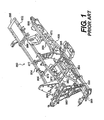
- FIG. 1 illustrates such a frame 850.
- the frame 850 includes a spaced pair of upper tubular members 852, 854 and a spaced pair of lower tubular members 856, 858.
- the upper and lower members 852-858 are interconnected by respective spaced pairs of cross members 860, 862 and 864, 865.
- Respective pairs of the upper and lower members 852, 854 and 856, 858 are connected by laterally extending cross members 866 (connecting the upper members 852, 854) and cross members 868 (connecting the lower members 856, 858).
- a plate 870 is connected between the lower members 856, 858 to thereby add additional rigidity between the lower members 856, 858.
- these frames have been either complex or have used a large amount of material, or both. It is possible to construct the frame with high strength metal alloys to increase strength properties of the frame without relatively increasing the weight. However, these metal alloys are costly and some require additional processing steps (such as post-weld heat treatment) in the manufacture of the frame.
- the frames described therein were designed for four-wheeled ATVs which typically use a McPherson suspension for the front wheels.
- This type of suspension can easily be accommodated by the described frames.
- straddle-type three-wheeled vehicles are intrinsically less stable than four-wheeled vehicles (but it should be noted that the lower stability of a three-wheeled vehicle versus a four-wheeled vehicle should not be understood to mean that a three-wheeled vehicle is unstable to the point that it is dangerous to a user).
- the front wheels of a three-wheeled vehicle should use a type of suspension that helps controlling the roll or sway of the vehicle more than a McPherson suspension.
- three-wheeled vehicles having two front wheels and one rear wheel do not have as much room to accommodate components in the rear portion thereof as four-wheeled vehicles, such as ATVs, due to their reduced width at the back. Therefore, the vehicle components, such as the engine, air box, and fuel tank, cannot be arranged in the same manner. Thus, there is also a need for an arrangement of the vehicle components which is suitable for the space limitations of a straddle-type three-wheeled vehicle having two front wheels while maintaining accessibility to the components which require it.
- Fig. 1 is a perspective view of a prior art frame typically used in an ATV;
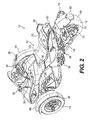
- Fig. 2 is a perspective view, taken from a rear, left side, of a vehicle in accordance with the present invention
- Fig. 3 is a top view of the vehicle of Fig. 2 ;
- Fig. 4 is front view of the vehicle of Fig. 2 ;
- Fig. 5 is a back view of the vehicle of Fig. 2 ;
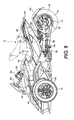
- Fig. 6 is a left side elevation view of the vehicle of Fig. 2 ;
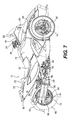
- Fig. 7 is a right side elevation view of the vehicle of Fig. 2 ;
- Fig. 8 is a left side elevation view of the internal components of the vehicle of Fig. 2 with some of the components removed for clarity;
- Fig. 9 is a right side elevation view of the internal components of the vehicle of Fig. 2 with some of the components removed for clarity;
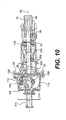
- Fig. 10 is a top view of the internal components of the vehicle of Fig. 2 with some of the components removed for clarity;
- Fig. 11 is a perspective view, taken from a rear, left side, of the internal components of the vehicle of Fig. 2 with some of the components removed for clarity;
- Fig. 12 is a perspective view, taken from a rear, right side, of the internal components of the vehicle of Fig. 2 with some of the components removed for clarity;
- Fig. 13 is a close-up perspective view, taken from a rear, left side, of the front portion of the frame and the front suspension of the vehicle of Fig. 2 ;
- Fig. 14 is a close-up perspective view, taken from a rear, left side, of the front portion of the frame and the front suspension of the vehicle of Fig. 2 ;
- Fig. 15 is a left side elevation view of an alternative embodiment of a frame in accordance with the present invention.
- Fig. 16 is a left side elevation view of another alternative embodiment of a frame in accordance with the present invention.
- the vehicle 10 has a straddle seat 12 located at least partially rearwardly of a center of the vehicle 10 and disposed along the longitudinal centerline 18 ( Fig. 2 ) thereof.
- the straddle seat 12 has a first portion 20 for accommodating a driver, and a second portion 22 for accommodating a passenger behind the driver.
- the second portion 22 is higher than the first portion 20 to permit the passenger to see in front of the vehicle 10 over the driver.
- a pair of handles 24 are provided on either side of the second portion 22 for the passenger to hold onto.
- the straddle seat 12 could be disposed at a different longitudinal location depending on the particular ergonomics of the vehicle 10. It is also contemplated that the straddle seat 12 could only have the first portion 20 for the driver.
- a steering assembly is disposed forwardly of the straddle seat 12 to allow a driver to steer the two front wheels 14.
- the steering assembly has handlebars 26 connected to a steering column 28 ( Fig. 8 ).
- the steering column 28 is connected to the two front wheels 14 via tie rods 27, such that turning the handlebars 26 turns the steering column 28 which, through the tie rods 27, turns the wheels 14.
- the steering assembly can optionally be provided with a power steering unit 29 ( Fig. 8 ) which facilitates steering of the vehicle 10.
- the handlebars 26 are provided with handles 30 for the driver to hold.
- the right handle 30 can twist and acts as the throttle controller for the engine 32 ( Fig. 8 ). It is contemplated, that the throttle could also be controlled by a separate lever disposed near one of the handles 30.
- a brake actuator in the form of a hand brake lever 34, is provided near the right handle 30 for braking the vehicle 10, as will be explained in greater detail below.
- the hand brake lever 34 is provided generally forwardly of the right handle 30 so as to be actuated by multiple fingers of a user, however, it is contemplated that the hand brake lever 34 could be provided generally forwardly of the left handle 30.
- a pair of driver foot pegs 36 are provided on either sides of the vehicle 10 below the first portion 20 of the straddle seat 12 for a driver to rest his feet thereon.
- a pair of passenger foot pegs 38 are provided on either side of the vehicle 10 below the second portion 22 of the straddle seat 12 for a passenger to rest his feet thereon.
- Another brake actuator, in the form of a foot brake lever 40 is provided on a right side of the vehicle 10 below the first portion 20 of the straddle seat 12 for braking the vehicle 10, as will be explained in greater detail below. As best seen in Fig.
- the foot brake lever 40 is preferably provided near the right driver foot peg 36 such that the driver can actuate the foot brake lever 40 while a portion of his foot remains on the right driver foot peg 36.
- the foot brake lever 40 also preferably pivots about an axis which is coaxial with the right driver foot peg 36 in order to facilitate the actuation of the foot brake lever 40 by the driver.
- Each of the two front wheels 14 is mounted to the frame 42 ( Fig. 8 ) of the vehicle 10 via a front suspension 44 as will be described in greater detail below.
- Each of the two front wheels 14 has a tire 46 thereon which is suitable for road use.
- the tires 46 are preferably inflated to a pressure between 138 kPa and 345 kPa.
- a fairing 48 is disposed over each tire 46 to protect the driver from dirt and water which can be lifted by the tire 46 while it is rolling.
- Each of the two front wheels 14 is also provided with a brake 50.
- the brake 50 is preferably a disc brake mounted onto a wheel hub of each wheel 14, however other types of brakes are contemplated.
- the brakes 50 each have a rotor 52 mounted onto the wheel hub and a stationary caliper 54 straddling the rotor 52.
- the brake pads (not shown) are mounted to the caliper 54 so as to be disposed between the rotor 52 and the caliper 54 on either sides of the rotor 52.
- By applying hydraulic pressure to a piston (not shown) inside the caliper 54 the brake pads squeeze the rotor 52 which, through friction, brakes the wheel 14.
- the rear wheel 16 is mounted to the frame 42 via a swing arm 56.
- the swing arm 56 preferably has two arms pivotally mounted at a front thereof to the frame 42 and between which the rear wheel 16 is rotatably mounted at the rear of the two arms.
- a shock absorber unit 58 is disposed between the swing arm 56 and the frame 42, as will be discussed in greater detail below.
- the rear wheel 16 has a tire 60 thereon which is suitable for road use.
- the tire 60 is wider than the tires 46. It is contemplated that the tire 60 could have a smaller width or the same width as the tires 46. It is also contemplated that the rear wheel 16 could have two or more tires disposed next to each other thereon and still be considered a single rear wheel in the context of the present invention.
- the tire 60 is preferably inflated to a pressure between 138 kPa and 345 kPa.
- a fairing 62 is disposed over the tire 60 to protect the driver from dirt and water which can be lifted by the tire 60 while it is rolling.
- the rear wheel 16 is provided with a brake 64.
- the brake 64 is preferably a disc brake mounted to a right side of wheel 16.
- the brake 64 has a rotor 66, caliper 68, brake pads (not shown), and a piston (not shown) similar to those used with brakes 50.
- the brake 64 brakes the rear wheel 16 in the same way as the brakes 50 brake the front wheels 14.
- a wheel sprocket 70 is mounted to a left side of the rear wheel 16.
- a belt 72 is disposed about the wheel sprocket 70 and a driving sprocket 71 to transmit power from the engine 32 to the rear wheel 16.
- the driving sprocket 71 receives power from the engine 32 via a transmission 73.
- the transmission 73 is operatively connected to the crankshaft 74 (schematically illustrated in Fig. 8 ) of the engine 32. It is contemplated that a continuously variable transmission (CVT) could be provided between the crankshaft 74 and the driving sprocket 71.
- CVT continuously variable transmission
- an exhaust pipe 76 extending on the right side of the vehicle 10 towards the rear thereof is attached to an exhaust port (not shown) of the engine 32 to improve engine performance and to reduce the noise level of the engine 32.
- a vehicle body 78 is attached to the frame 42 in order to protect the components mounted to the frame 42 and to make the vehicle 10 aesthetically pleasing. Components necessary to make vehicle 10 suitable for road use, such as lights 80 and a rear view mirror 82, are mounted to the vehicle body 78.
- the frame 42 has an upper frame member 100 and a lower frame member 102 which are interconnected with each other, thus forming a closed perimeter with a space therein.
- a forward cross member 104 interconnects a forward portion of the upper frame member 100 with a forward portion of the lower frame member 102.
- a rearward cross member 106 interconnects a rearward portion of the upper frame member 100 with a rearward portion of the lower frame member 102.
- the upper frame member 100, lower frame member 102, forward cross member 104, and rearward cross member 106 are preferably made of metallic tubular beams having similarly sized rectangular cross-sections.
- the members 100, 102, 104, 106 could have different cross-sectional dimensions, could be made of non-metallic material (composite materials for example), and could also have a different configuration (I-beams or C-channels for example).
- the upper frame member 100 is preferably bent in two locations such that a forward portion thereof is located higher than a rearward portion thereof.
- the forward portion of the frame 42 provides sufficient vertical space to accommodate some of the vehicle components.
- the straddle seat 12, which is mounted on the rearward portion of the upper frame member 100 is maintained at a height from the ground which permits a driver of the vehicle 10 to rest his feet on the ground while sitting on the straddle seat 12 when the vehicle 10 is stopped.
- the upper frame member 100 could have a different geometry.
- the upper frame member 100 could be straight.
- the lower frame member 102 and the rearward cross member 106 are preferably integrally formed as a single beam that is bent in one location. It is also contemplated that these members 102, 106 could be welded to each other.
- the rearward cross member 106 extends rearwardly and upwardly from the lower frame member 102 and is welded to the upper frame member 100. The upper and lower ends of the forward cross member are welded to the upper frame member 100 and the lower frame member 102 respectively.
- the members 100, 102, 104, 106 may be joined by other means. For example, they may be joined by using brackets and fasteners. It is also contemplated that the members 100, 102, 104, 106 could be made of a single beam which could be bent to obtain a closed perimeter.
- the frame 42 also has a strut 108 which extends diagonally from the forward cross member 104 to the lower frame member 102, to which it is preferably welded.
- a reinforcing member 109 (as best seen in Fig. 13 ) is provided at the connection between the strut 108 and the lower frame member 102 to reinforce the connection.
- the strut 108 also provides additional attachment points for some of the vehicle components, as will be discussed in greater detail below.
- the strut 108 is preferably a C-channel, but could have different configurations.
- Two openings 110, 112 are provided on an upper surface of the strut 108. These openings 110, 112 reduce the weight of the strut 108.
- the opening 110 also allows the steering column 28 to pass therethrough.
- Figs. 15 and 16 illustrate alternative embodiments of the frame 42.
- a L-shaped strut 208 extends from the forward cross member 104 to the upper frame member 100 to reinforce the frame 42.
- a straight strut 308 extends diagonally from the upper frame member 100 to the lower frame member 102 to reinforce the frame 42.
- the struts 208 and 308 also provide additional attachment points for some of the vehicle components, as will be described below.
- Other shapes and locations of a strut for reinforcing the frame 42 are also contemplated.
- the upper frame member 100, lower frame member 102, forward cross member 104, rearward cross member 106, and the strut 108 are disposed on the longitudinal centerline 18 of the vehicle. Therefore, all of the members 100, 102, 104, 106 of the frame 42 lie in a in a common vertical plane.
- a forward frame extension 114 is connected to the front portion of the lower frame member 102.
- the forward frame extension 114 supports the front of the vehicle body 78 and a front storage bin (not shown).
- a tubular member 116 is disposed on each side of the frame 42 to provide attachment points for the vehicle body 78.
- Each tubular member 116 is attached at a front end thereof to a connecting member 118, which is itself connected to the forward cross member 104.
- the back end of each tubular member 116 is connected to an end portion of a fuel tank mounting bracket 120, which is itself connected to the lower frame member 102 and the rearward cross member 106 via bracket 122.
- each of the two front wheels 14 is mounted to the frame 42 of the vehicle 10 via a front suspension 44.
- Each of the front suspensions 44 is a double A-arm suspension, also known as a double wishbone suspension.
- Each of the front suspensions 44 has an upper A-arm 124, a lower A-arm 126, and a shock absorber unit 128.
- the shock absorber unit 128 preferably consists of a hydraulic shock absorber with a coil spring disposed around the shock absorber.
- One end of the upper A-arm 124 and of the lower A-arm 126 is connected to a corresponding upper and lower end of a wheel spindle 130 of the wheel 14.
- the other end of each A-arm 124, 126 is connected to suspension attachment points on the frame 42 as described below.
- the shock absorber unit 128 is connected at one end to the lower A-arm 126 and to the forward cross member 104 via the connecting member 118.
- Each A-arm 124, 126 has a front arm and a rear arm. As best seen in Figs. 13 and 14 , both arms of the lower A-arms 126 are connected to the lower frame member 102. The front arms of the upper A-arms 124 are connected to the forward frame cross member 104. The rear arms of the upper A-arms 124 are connected to the strut 108. In the embodiments shown in Figs. 15 and 16 , the rear arms of the upper A-arms are connected to the struts 208 ( Fig. 15 ) and 308 ( Fig. 16 ), as the case may be. This type of front suspension 44 provides a good control on the roll or sway of the vehicle 10.
- Each wheel 14 has a pivot axis defined by a generally vertical line passing through the ends of the upper and lower A-arms 124, 126 to which the wheel spindle 130 is connected.
- the pivot axis of each wheel 14 is preferably located rearwardly of the front of the lower frame member 102.
- the rear wheel 16 is mounted to the frame 42 via a swing arm 56. More specifically, the swing arm 56 is pivotally mounted to a bushing 132 ( Fig. 14 ) in bracket 122.
- the length of the swing arm 56 is preferably selected such that at least a portion of the rear wheel 16 is disposed below the rear portion of the upper frame member 100.
- the shock absorber unit 58 is preferably mounted to the swing arm 56 at one end and to the rearward cross member 106 at the other, so as to be disposed along the longitudinal centerline 18 of the vehicle 10.
- the shock absorber unit 58 preferably consists of a hydraulic shock absorber with a coil spring disposed around the shock absorber.
- the engine 32 and many of its components are disposed inside the space formed by the closed perimeter of the frame 42.
- the engine 32 is mounted at the front thereof to the strut 108 via strut brackets 134 ( Figs. 13 , 14).
- the engine 32 is also mounted at the rear thereof to two bushings 136 ( Figs. 13 , 14) on bracket 122 (which, as previously mentioned, is mounted on the rearward cross member 106) via engine mount bracket 138.
- An elastomeric material, such as rubber, is preferably disposed between the engine 32 and its attachment points 134, 136 so as to reduce the transmission of vibrations from the engine 32 to the frame 42.
- the crankshaft 74 of the engine 32 is disposed horizontally and perpendicularly to the longitudinal center line 18 of the vehicle 10. Furthermore, the engine 32 is preferably mounted to the frame 42 so that it does not sit on the lower frame member 102 also to reduce the transmission of vibrations from the engine 32 to the frame 42.
- the engine 32 is a V-type engine having a front cylinder 140 and a rear cylinder 142. For this reason, the engine 32 is also know as a V-twin engine.
- the front cylinder 140 defines a front cylinder axis 144 passing through a center thereof.
- the rear cylinder 142 defines a rear cylinder axis 146 passing through a center thereof.
- the steering column 28 passes through the upper frame member 100 forwardly of the straddle seat 12 and extends inside the space formed by the closed perimeter of the frame 42. It is contemplated that the steering column 28 could pass to one side of the upper frame member 100 instead of passing through it.
- the steering column 28 is disposed rearwardly of the forward cross member 104 and in front of the engine 32. As best seen in Figs. 13 and 14 , the steering column 28 has a bent portion 148 so as to not interfere with the front cylinder 140.
- the steering column 28 passes through the strut 108.
- the lower end of the steering column 28 is connected to the power steering unit 29 below the strut 108.
- the power steering unit 29 is connected to the forward cross member 104.
- the lower end of the steering column 28 could be pivotally connected directly to the forward cross member 104 in cases where a power steering unit 29 is not being used.
- An air box 150 is provided in fluid communication with an inlet port (not shown) of each cylinder 140, 142 to enhance engine performance, prevent water and dirt from entering the engine 32, and reduce the noise coming out of the inlet ports.
- the air box 150 has an inlet in the form of two tubes 152 having an open end pointing towards a front of the vehicle 10. As seen in Fig. 8 , a portion of the air box 150 is disposed above the engine 32 forwardly of the rear cylinder axis 146. Preferably, a portion of the air box 150 is disposed between the two cylinder axes 144, 146.
- the air box 150 is mounted to and supported by the throttle body (not shown) which is disposed between the cylinders 140, 142.
- the air box 150 is preferably attached to the throttle body with one or more threaded fasteners.
- a rubber support (not shown) is disposed between the engine 32 and the air box 150 to provide additional support to the air box 150.
- the air flows in the tubes 152, enters the air box 150, passes inside the throttle body which is used to regulate the flow of air, and enters the cylinders 140, 142 to be combusted therein.
- the fuel tank 154 of the vehicle 10 is mounted inside the space formed by the closed perimeter of the frame 42 rearwardly of the engine 32 and the air box 150.
- the fuel tank 154 is attached to the upper frame member 100 and to the fuel tank mounting bracket 120.
- the fuel tank is positioned below the upper frame member 100, below the straddle seat 12, such that the fuel tank filler cap 156 can be accessed under the straddle seat 12 to permit refilling of the fuel tank 154.
- the straddle seat 12 is preferably hinged to the vehicle 10 so as to pivot to a position providing access to the fuel tank filler cap 156.
- the straddle seat 12 could be removable.
- a side bracket 158 is provided on each side of the lower frame member 102 to mount additional components of the vehicle 10.
- an oil cooler 160 and an oil tank 162 are mounted to the left side bracket 158.
- an engine radiator 164 having a fan 166 mounted thereon, is mounted to the right side bracket 158. Locating the radiator 164 and the oil cooler 160 on either side of the frame 42 places them in the airflow created by the vehicle 10 when it is moving, thus enhancing the cooling provided by these components.
- a plate 168 is preferably provided on each lower A-arm 126 to direct additional air towards the radiator 164 and the oil cooler 160.
- An electronic brake control unit 170 is mounted to the lower frame member 102.
- the engine coolant reservoir 172 ( Fig. 12 ) is mounted to the forward cross member 104 via the right connecting member 118.
- An electronic control unit (ECU), battery, sensors, (all not shown) and other components necessary to the operation of the vehicle 10 are also mounted to the frame 42.
Landscapes
- Engineering & Computer Science (AREA)
- Mechanical Engineering (AREA)
- Automatic Cycles, And Cycles In General (AREA)
- Cooling, Air Intake And Gas Exhaust, And Fuel Tank Arrangements In Propulsion Units (AREA)
- Seats For Vehicles (AREA)
Claims (6)
- Radfahrzeug (10), umfassend:einen Rahmen (42), umfassend:einem oberen Rahmenglied (100);einem unteren Rahmenglied (102);einen vorderen Querglied (104), einen vorderen Teil des oberen Rahmenglieds mit einem vorderen Teil des unteren Rahmenglieds verbindend;einen hinteren Querglied (106), einen hinteren Teil des oberen Rahmenglieds mit einem hinteren Teil des unteren Rahmenglieds verbindend;wobei der obere Rahmenglied, der untere Rahmenglied, der vordere Querglied und der hintere Querträger in einer Längsachse (18) des Fahrzeugs angeordnet sind und einen geschlossenen Umfang mit einem Raum darin definieren;einen Grätschsitz (12), angebaut auf dem oberen Rahmenglied;ein vorderes linkes Rad (14) und ein vorderes rechtes Rad (14), wobei jedes der Vorderräder über eine Vorderradaufhängung (44) am Rahmen angebaut sind;ein einzelnes Hinterrad (16), angeordnet in der Längsachse des Fahrzeugs;eine Schwinge (56) zum Anbau des einzelnen Hinterrades am Rahmen;eine Hinterradaufhängung (58), operativ zwischen der Schwinge und dem Rahmen angeordnet;eine Lenksäule (28), operativ verbunden mit den Vorderrädern zur Lenkung der Vorderräder, wobei sich die Lenksäule in den Raum hinter dem vorderen Querglied erstreckt;Lenkstangen (26), verbunden mit einem oberen Ende der Lenksäule oberhalb des oberen Rahmenglieds;einen Motor (32), angebaut im Raum am Rahmen und operativ verbunden mit dem Hinterrad zum Antrieb des Hinterrades;eine Airbox (15), angeordnet im Raum und mindestens umfassend einen Teil davon oberhalb mindestens eines Teils des Motors und unterhalb des oberen Rahmenglieds; undeinen Kraftstofftank (154), eingebaut im Raum unterhalb des oberen Rahmenglieds und hinter der Airbox.
- Fahrzeug nach Anspruch 1, ferner umfassend eine Strebe (108), die sich diagonal vom vorderen Querglied bis zum unteren Rahmenglied erstreckt; und
wobei ein Teil des Motors an der Strebe angebaut ist. - Fahrzeug nach Anspruch 1, wobei:der Motor (32) in V-Bauform ist, umfassend:eine Kurbelwelle (74), waagrecht und rechtwinklig zur Längsachse des Fahrzeugs angeordnet;einen vorderen Zylinder (140), der eine vordere Zylinderachse definiert;einen hinteren Zylinder (142), der eine hintere Zylinderachse definiert; undwobei die Airbox in Längsrichtung vor der hinteren Zylinderachse angeordnet ist.
- Fahrzeug nach Anspruch 1, wobei sich die Lenksäule im Inneren des Raums vor dem Motor erstreckt.
- Fahrzeug nach Anspruch 4, wobei die Lenksäule durch das obere Rahmenglied vor dem Grätschsitz geführt ist.
- Fahrzeug nach Anspruch 1, wobei der Kraftstofftank einen Kraftstoffeinfülldeckel (156) aufweist, der unter dem Grätschsitz angeordnet ist; und
wobei der Grätschsitz auf solche Weise auf dem oberen Rahmenglied angebaut ist, dass der Grätschsitz in eine Stellung gebracht werden kann, bei der Zugang zum Kraftstoffeinfülldeckel erhalten wird.
Applications Claiming Priority (2)
| Application Number | Priority Date | Filing Date | Title |
|---|---|---|---|
| PCT/US2006/016352 WO2007130015A1 (en) | 2006-05-01 | 2006-05-01 | Straddle-type wheeled vehicle and frame thereof |
| EP06751840A EP2013075B1 (de) | 2006-05-01 | 2006-05-01 | Im grätschsitz zu verwendendes fahrzeug mit rädern und rahmen dafür |
Related Parent Applications (1)
| Application Number | Title | Priority Date | Filing Date |
|---|---|---|---|
| EP06751840.7 Division | 2006-05-01 |
Publications (2)
| Publication Number | Publication Date |
|---|---|
| EP2196384A1 EP2196384A1 (de) | 2010-06-16 |
| EP2196384B1 true EP2196384B1 (de) | 2011-10-12 |
Family
ID=37533235
Family Applications (2)
| Application Number | Title | Priority Date | Filing Date |
|---|---|---|---|
| EP10156410A Expired - Lifetime EP2196384B1 (de) | 2006-05-01 | 2006-05-01 | Im Grätschsitz zu verwendendes Fahrzeug mit Rädern und Rahmen dafür |
| EP06751840A Expired - Lifetime EP2013075B1 (de) | 2006-05-01 | 2006-05-01 | Im grätschsitz zu verwendendes fahrzeug mit rädern und rahmen dafür |
Family Applications After (1)
| Application Number | Title | Priority Date | Filing Date |
|---|---|---|---|
| EP06751840A Expired - Lifetime EP2013075B1 (de) | 2006-05-01 | 2006-05-01 | Im grätschsitz zu verwendendes fahrzeug mit rädern und rahmen dafür |
Country Status (6)
| Country | Link |
|---|---|
| EP (2) | EP2196384B1 (de) |
| CN (1) | CN101472787B (de) |
| AT (2) | ATE465078T1 (de) |
| DE (1) | DE602006013888D1 (de) |
| ES (2) | ES2344468T3 (de) |
| WO (1) | WO2007130015A1 (de) |
Families Citing this family (8)
| Publication number | Priority date | Publication date | Assignee | Title |
|---|---|---|---|---|
| JP5703130B2 (ja) * | 2011-05-26 | 2015-04-15 | 本田技研工業株式会社 | 揺動式車両 |
| CN103958248B (zh) | 2011-09-30 | 2016-08-24 | Brp传动系有限两合公司 | 混合动力车辆传动系统 |
| TWI494242B (zh) * | 2012-06-28 | 2015-08-01 | Aeon Motor Co Ltd | Tilt Steering and Suspension of Front Wheel Group |
| US10272913B2 (en) | 2015-06-17 | 2019-04-30 | Consortium de Recherche BRP—Universite de Sherbrooke S.E.N.C. | Regenerative braking system and method |
| ITUB20152613A1 (it) * | 2015-07-29 | 2017-01-29 | Piaggio & C Spa | Avantreno di motoveicolo tiltante e relativo motoveicolo |
| WO2017130174A1 (en) * | 2016-01-29 | 2017-08-03 | Bombardier Recreational Products Inc. | Family of three-wheeled straddle-seat vehicles |
| US12162561B2 (en) * | 2019-03-02 | 2024-12-10 | Vijay K Praveen | Cargo-carrying wheeled vehicle |
| CN119975627B (zh) * | 2025-02-07 | 2025-09-23 | 广东建雅摩托车科技有限公司 | 车架及摩托车 |
Family Cites Families (5)
| Publication number | Priority date | Publication date | Assignee | Title |
|---|---|---|---|---|
| US6799781B2 (en) | 2000-03-13 | 2004-10-05 | Bombardier Recreational Products Inc. | Frames for all-terrain vehicles |
| US6572129B1 (en) * | 2000-07-24 | 2003-06-03 | Gregory Bean | Dual power recumbent tricycle |
| WO2003070548A1 (en) * | 2002-02-22 | 2003-08-28 | Bombardier Recreational Products Inc. | Components for a three-wheeled vehicle to permit leaning of the driver |
| US7021664B2 (en) * | 2002-10-18 | 2006-04-04 | Bombardier Recreational Products Inc. | Fuel tank for an all-terrain vehicle |
| US7441788B2 (en) * | 2004-07-09 | 2008-10-28 | Bombardier Recreational Products Inc. | Front drive geometry for an all-terrain vehicle |
-
2006
- 2006-05-01 ES ES06751840T patent/ES2344468T3/es not_active Expired - Lifetime
- 2006-05-01 AT AT06751840T patent/ATE465078T1/de active
- 2006-05-01 EP EP10156410A patent/EP2196384B1/de not_active Expired - Lifetime
- 2006-05-01 DE DE602006013888T patent/DE602006013888D1/de not_active Expired - Lifetime
- 2006-05-01 EP EP06751840A patent/EP2013075B1/de not_active Expired - Lifetime
- 2006-05-01 AT AT10156410T patent/ATE528202T1/de active
- 2006-05-01 ES ES10156410T patent/ES2375264T3/es not_active Expired - Lifetime
- 2006-05-01 CN CN200680055136.6A patent/CN101472787B/zh not_active Expired - Fee Related
- 2006-05-01 WO PCT/US2006/016352 patent/WO2007130015A1/en not_active Ceased
Also Published As
| Publication number | Publication date |
|---|---|
| EP2196384A1 (de) | 2010-06-16 |
| ATE528202T1 (de) | 2011-10-15 |
| DE602006013888D1 (de) | 2010-06-02 |
| CN101472787B (zh) | 2011-02-02 |
| EP2013075B1 (de) | 2010-04-21 |
| EP2013075A1 (de) | 2009-01-14 |
| ES2375264T3 (es) | 2012-02-28 |
| CN101472787A (zh) | 2009-07-01 |
| ATE465078T1 (de) | 2010-05-15 |
| WO2007130015A1 (en) | 2007-11-15 |
| ES2344468T3 (es) | 2010-08-27 |
Similar Documents
| Publication | Publication Date | Title |
|---|---|---|
| US7543672B2 (en) | Straddle-type wheeled vehicle and frame thereof | |
| US20250187693A1 (en) | Two-wheeled vehicle | |
| CN102056788B (zh) | 用于全地形车的动力转向装置 | |
| US10843758B2 (en) | Vehicle having a suspension assembly including a swing arm | |
| US10442264B2 (en) | Vehicle suspension assembly | |
| EP2716536B1 (de) | Zweirädriges motorfahrzeug | |
| US20040035623A1 (en) | Frame configuration for a three-wheel vehicle | |
| US20080277184A1 (en) | Frame for an all-terrain vehicle | |
| CN110997360B (zh) | 车辆的悬架组件 | |
| JP5244127B2 (ja) | 2輪車両 | |
| US6581716B1 (en) | All terrain vehicle with rear-facing rear arm bracket | |
| JP2010516545A5 (de) | ||
| US20180215220A1 (en) | Knuckle for a vehicle suspension assembly | |
| EP2013075B1 (de) | Im grätschsitz zu verwendendes fahrzeug mit rädern und rahmen dafür | |
| CN102039968B (zh) | 骑跨型轮式车辆及其框架 | |
| US11535336B2 (en) | Saddle riding vehicle | |
| CA2587764A1 (en) | Frame for an all-terrain vehicle | |
| HK1156919B (en) | Power steering for an all terrain vehicle |
Legal Events
| Date | Code | Title | Description |
|---|---|---|---|
| PUAI | Public reference made under article 153(3) epc to a published international application that has entered the european phase |
Free format text: ORIGINAL CODE: 0009012 |
|
| AC | Divisional application: reference to earlier application |
Ref document number: 2013075 Country of ref document: EP Kind code of ref document: P |
|
| AK | Designated contracting states |
Kind code of ref document: A1 Designated state(s): AT BE BG CH CY CZ DE DK EE ES FI FR GB GR HU IE IS IT LI LT LU LV MC NL PL PT RO SE SI SK TR |
|
| 17P | Request for examination filed |
Effective date: 20101214 |
|
| GRAP | Despatch of communication of intention to grant a patent |
Free format text: ORIGINAL CODE: EPIDOSNIGR1 |
|
| RIC1 | Information provided on ipc code assigned before grant |
Ipc: B62K 5/08 20060101ALI20110310BHEP Ipc: B62K 5/04 20060101AFI20110310BHEP |
|
| GRAS | Grant fee paid |
Free format text: ORIGINAL CODE: EPIDOSNIGR3 |
|
| GRAA | (expected) grant |
Free format text: ORIGINAL CODE: 0009210 |
|
| AC | Divisional application: reference to earlier application |
Ref document number: 2013075 Country of ref document: EP Kind code of ref document: P |
|
| AK | Designated contracting states |
Kind code of ref document: B1 Designated state(s): AT BE BG CH CY CZ DE DK EE ES FI FR GB GR HU IE IS IT LI LT LU LV MC NL PL PT RO SE SI SK TR |
|
| REG | Reference to a national code |
Ref country code: GB Ref legal event code: FG4D |
|
| REG | Reference to a national code |
Ref country code: CH Ref legal event code: EP |
|
| REG | Reference to a national code |
Ref country code: IE Ref legal event code: FG4D |
|
| REG | Reference to a national code |
Ref country code: DE Ref legal event code: R096 Ref document number: 602006025138 Country of ref document: DE Effective date: 20111208 |
|
| REG | Reference to a national code |
Ref country code: NL Ref legal event code: VDEP Effective date: 20111012 |
|
| REG | Reference to a national code |
Ref country code: ES Ref legal event code: FG2A Ref document number: 2375264 Country of ref document: ES Kind code of ref document: T3 Effective date: 20120228 |
|
| LTIE | Lt: invalidation of european patent or patent extension |
Effective date: 20111012 |
|
| PG25 | Lapsed in a contracting state [announced via postgrant information from national office to epo] |
Ref country code: LT Free format text: LAPSE BECAUSE OF FAILURE TO SUBMIT A TRANSLATION OF THE DESCRIPTION OR TO PAY THE FEE WITHIN THE PRESCRIBED TIME-LIMIT Effective date: 20111012 Ref country code: BE Free format text: LAPSE BECAUSE OF FAILURE TO SUBMIT A TRANSLATION OF THE DESCRIPTION OR TO PAY THE FEE WITHIN THE PRESCRIBED TIME-LIMIT Effective date: 20111012 Ref country code: IS Free format text: LAPSE BECAUSE OF FAILURE TO SUBMIT A TRANSLATION OF THE DESCRIPTION OR TO PAY THE FEE WITHIN THE PRESCRIBED TIME-LIMIT Effective date: 20120212 |
|
| PG25 | Lapsed in a contracting state [announced via postgrant information from national office to epo] |
Ref country code: NL Free format text: LAPSE BECAUSE OF FAILURE TO SUBMIT A TRANSLATION OF THE DESCRIPTION OR TO PAY THE FEE WITHIN THE PRESCRIBED TIME-LIMIT Effective date: 20111012 Ref country code: SI Free format text: LAPSE BECAUSE OF FAILURE TO SUBMIT A TRANSLATION OF THE DESCRIPTION OR TO PAY THE FEE WITHIN THE PRESCRIBED TIME-LIMIT Effective date: 20111012 Ref country code: GR Free format text: LAPSE BECAUSE OF FAILURE TO SUBMIT A TRANSLATION OF THE DESCRIPTION OR TO PAY THE FEE WITHIN THE PRESCRIBED TIME-LIMIT Effective date: 20120113 Ref country code: LV Free format text: LAPSE BECAUSE OF FAILURE TO SUBMIT A TRANSLATION OF THE DESCRIPTION OR TO PAY THE FEE WITHIN THE PRESCRIBED TIME-LIMIT Effective date: 20111012 Ref country code: SE Free format text: LAPSE BECAUSE OF FAILURE TO SUBMIT A TRANSLATION OF THE DESCRIPTION OR TO PAY THE FEE WITHIN THE PRESCRIBED TIME-LIMIT Effective date: 20111012 Ref country code: PT Free format text: LAPSE BECAUSE OF FAILURE TO SUBMIT A TRANSLATION OF THE DESCRIPTION OR TO PAY THE FEE WITHIN THE PRESCRIBED TIME-LIMIT Effective date: 20120213 |
|
| PG25 | Lapsed in a contracting state [announced via postgrant information from national office to epo] |
Ref country code: CY Free format text: LAPSE BECAUSE OF FAILURE TO SUBMIT A TRANSLATION OF THE DESCRIPTION OR TO PAY THE FEE WITHIN THE PRESCRIBED TIME-LIMIT Effective date: 20111012 |
|
| PG25 | Lapsed in a contracting state [announced via postgrant information from national office to epo] |
Ref country code: CZ Free format text: LAPSE BECAUSE OF FAILURE TO SUBMIT A TRANSLATION OF THE DESCRIPTION OR TO PAY THE FEE WITHIN THE PRESCRIBED TIME-LIMIT Effective date: 20111012 Ref country code: DK Free format text: LAPSE BECAUSE OF FAILURE TO SUBMIT A TRANSLATION OF THE DESCRIPTION OR TO PAY THE FEE WITHIN THE PRESCRIBED TIME-LIMIT Effective date: 20111012 Ref country code: BG Free format text: LAPSE BECAUSE OF FAILURE TO SUBMIT A TRANSLATION OF THE DESCRIPTION OR TO PAY THE FEE WITHIN THE PRESCRIBED TIME-LIMIT Effective date: 20120112 Ref country code: SK Free format text: LAPSE BECAUSE OF FAILURE TO SUBMIT A TRANSLATION OF THE DESCRIPTION OR TO PAY THE FEE WITHIN THE PRESCRIBED TIME-LIMIT Effective date: 20111012 Ref country code: EE Free format text: LAPSE BECAUSE OF FAILURE TO SUBMIT A TRANSLATION OF THE DESCRIPTION OR TO PAY THE FEE WITHIN THE PRESCRIBED TIME-LIMIT Effective date: 20111012 |
|
| PLBE | No opposition filed within time limit |
Free format text: ORIGINAL CODE: 0009261 |
|
| STAA | Information on the status of an ep patent application or granted ep patent |
Free format text: STATUS: NO OPPOSITION FILED WITHIN TIME LIMIT |
|
| PG25 | Lapsed in a contracting state [announced via postgrant information from national office to epo] |
Ref country code: RO Free format text: LAPSE BECAUSE OF FAILURE TO SUBMIT A TRANSLATION OF THE DESCRIPTION OR TO PAY THE FEE WITHIN THE PRESCRIBED TIME-LIMIT Effective date: 20111012 Ref country code: PL Free format text: LAPSE BECAUSE OF FAILURE TO SUBMIT A TRANSLATION OF THE DESCRIPTION OR TO PAY THE FEE WITHIN THE PRESCRIBED TIME-LIMIT Effective date: 20111012 |
|
| 26N | No opposition filed |
Effective date: 20120713 |
|
| REG | Reference to a national code |
Ref country code: DE Ref legal event code: R097 Ref document number: 602006025138 Country of ref document: DE Effective date: 20120713 |
|
| PG25 | Lapsed in a contracting state [announced via postgrant information from national office to epo] |
Ref country code: MC Free format text: LAPSE BECAUSE OF NON-PAYMENT OF DUE FEES Effective date: 20120531 |
|
| REG | Reference to a national code |
Ref country code: CH Ref legal event code: PL |
|
| PG25 | Lapsed in a contracting state [announced via postgrant information from national office to epo] |
Ref country code: LI Free format text: LAPSE BECAUSE OF NON-PAYMENT OF DUE FEES Effective date: 20120531 Ref country code: CH Free format text: LAPSE BECAUSE OF NON-PAYMENT OF DUE FEES Effective date: 20120531 |
|
| REG | Reference to a national code |
Ref country code: IE Ref legal event code: MM4A |
|
| PG25 | Lapsed in a contracting state [announced via postgrant information from national office to epo] |
Ref country code: IE Free format text: LAPSE BECAUSE OF NON-PAYMENT OF DUE FEES Effective date: 20120501 |
|
| PG25 | Lapsed in a contracting state [announced via postgrant information from national office to epo] |
Ref country code: FI Free format text: LAPSE BECAUSE OF FAILURE TO SUBMIT A TRANSLATION OF THE DESCRIPTION OR TO PAY THE FEE WITHIN THE PRESCRIBED TIME-LIMIT Effective date: 20111012 |
|
| PG25 | Lapsed in a contracting state [announced via postgrant information from national office to epo] |
Ref country code: TR Free format text: LAPSE BECAUSE OF FAILURE TO SUBMIT A TRANSLATION OF THE DESCRIPTION OR TO PAY THE FEE WITHIN THE PRESCRIBED TIME-LIMIT Effective date: 20111012 |
|
| PG25 | Lapsed in a contracting state [announced via postgrant information from national office to epo] |
Ref country code: LU Free format text: LAPSE BECAUSE OF NON-PAYMENT OF DUE FEES Effective date: 20120501 |
|
| PG25 | Lapsed in a contracting state [announced via postgrant information from national office to epo] |
Ref country code: HU Free format text: LAPSE BECAUSE OF FAILURE TO SUBMIT A TRANSLATION OF THE DESCRIPTION OR TO PAY THE FEE WITHIN THE PRESCRIBED TIME-LIMIT Effective date: 20060501 |
|
| REG | Reference to a national code |
Ref country code: FR Ref legal event code: PLFP Year of fee payment: 11 |
|
| REG | Reference to a national code |
Ref country code: FR Ref legal event code: PLFP Year of fee payment: 12 |
|
| REG | Reference to a national code |
Ref country code: FR Ref legal event code: PLFP Year of fee payment: 13 |
|
| PGFP | Annual fee paid to national office [announced via postgrant information from national office to epo] |
Ref country code: ES Payment date: 20200602 Year of fee payment: 15 Ref country code: DE Payment date: 20200421 Year of fee payment: 15 Ref country code: FR Payment date: 20200422 Year of fee payment: 15 |
|
| PGFP | Annual fee paid to national office [announced via postgrant information from national office to epo] |
Ref country code: GB Payment date: 20200423 Year of fee payment: 15 Ref country code: IT Payment date: 20200421 Year of fee payment: 15 |
|
| PGFP | Annual fee paid to national office [announced via postgrant information from national office to epo] |
Ref country code: AT Payment date: 20200422 Year of fee payment: 15 |
|
| REG | Reference to a national code |
Ref country code: DE Ref legal event code: R119 Ref document number: 602006025138 Country of ref document: DE |
|
| REG | Reference to a national code |
Ref country code: AT Ref legal event code: MM01 Ref document number: 528202 Country of ref document: AT Kind code of ref document: T Effective date: 20210501 |
|
| GBPC | Gb: european patent ceased through non-payment of renewal fee |
Effective date: 20210501 |
|
| PG25 | Lapsed in a contracting state [announced via postgrant information from national office to epo] |
Ref country code: AT Free format text: LAPSE BECAUSE OF NON-PAYMENT OF DUE FEES Effective date: 20210501 |
|
| PG25 | Lapsed in a contracting state [announced via postgrant information from national office to epo] |
Ref country code: GB Free format text: LAPSE BECAUSE OF NON-PAYMENT OF DUE FEES Effective date: 20210501 Ref country code: DE Free format text: LAPSE BECAUSE OF NON-PAYMENT OF DUE FEES Effective date: 20211201 |
|
| PG25 | Lapsed in a contracting state [announced via postgrant information from national office to epo] |
Ref country code: FR Free format text: LAPSE BECAUSE OF NON-PAYMENT OF DUE FEES Effective date: 20210531 |
|
| REG | Reference to a national code |
Ref country code: ES Ref legal event code: FD2A Effective date: 20220727 |
|
| PG25 | Lapsed in a contracting state [announced via postgrant information from national office to epo] |
Ref country code: ES Free format text: LAPSE BECAUSE OF NON-PAYMENT OF DUE FEES Effective date: 20210502 |
|
| PG25 | Lapsed in a contracting state [announced via postgrant information from national office to epo] |
Ref country code: IT Free format text: LAPSE BECAUSE OF NON-PAYMENT OF DUE FEES Effective date: 20200501 |
|
| PG25 | Lapsed in a contracting state [announced via postgrant information from national office to epo] |
Ref country code: IT Free format text: LAPSE BECAUSE OF NON-PAYMENT OF DUE FEES Effective date: 20210501 |