EP2196425A1 - Procédé d'utilisation variable d'une installation d'ascenseur - Google Patents
Procédé d'utilisation variable d'une installation d'ascenseur Download PDFInfo
- Publication number
- EP2196425A1 EP2196425A1 EP08171274A EP08171274A EP2196425A1 EP 2196425 A1 EP2196425 A1 EP 2196425A1 EP 08171274 A EP08171274 A EP 08171274A EP 08171274 A EP08171274 A EP 08171274A EP 2196425 A1 EP2196425 A1 EP 2196425A1
- Authority
- EP
- European Patent Office
- Prior art keywords
- user
- signal
- detected
- state change
- sensor
- Prior art date
- Legal status (The legal status is an assumption and is not a legal conclusion. Google has not performed a legal analysis and makes no representation as to the accuracy of the status listed.)
- Withdrawn
Links
- 238000000034 method Methods 0.000 title claims abstract description 39
- 230000008859 change Effects 0.000 claims abstract description 262
- 238000004891 communication Methods 0.000 claims abstract description 37
- 230000006854 communication Effects 0.000 claims abstract description 37
- 238000004590 computer program Methods 0.000 claims abstract description 31
- 238000001514 detection method Methods 0.000 claims abstract description 28
- 230000033001 locomotion Effects 0.000 claims abstract description 28
- 238000009434 installation Methods 0.000 claims description 62
- 238000010295 mobile communication Methods 0.000 claims description 45
- 238000005303 weighing Methods 0.000 claims description 17
- 230000005540 biological transmission Effects 0.000 claims description 8
- 230000002123 temporal effect Effects 0.000 claims description 8
- 238000011895 specific detection Methods 0.000 claims description 6
- 230000000007 visual effect Effects 0.000 claims description 6
- 241000282465 Canis Species 0.000 claims description 4
- 230000002452 interceptive effect Effects 0.000 claims description 4
- 238000013500 data storage Methods 0.000 claims description 2
- 238000009420 retrofitting Methods 0.000 claims description 2
- 230000008901 benefit Effects 0.000 description 36
- 238000012790 confirmation Methods 0.000 description 7
- 208000020401 Depressive disease Diseases 0.000 description 6
- 210000004379 membrane Anatomy 0.000 description 6
- 241000219739 Lens Species 0.000 description 4
- -1 polypropylene Polymers 0.000 description 4
- 238000013459 approach Methods 0.000 description 3
- 230000005672 electromagnetic field Effects 0.000 description 3
- 239000012528 membrane Substances 0.000 description 3
- 230000003287 optical effect Effects 0.000 description 3
- 230000001681 protective effect Effects 0.000 description 3
- 238000012546 transfer Methods 0.000 description 3
- 239000004698 Polyethylene Substances 0.000 description 2
- 239000004743 Polypropylene Substances 0.000 description 2
- 230000004913 activation Effects 0.000 description 2
- 230000000295 complement effect Effects 0.000 description 2
- 201000010099 disease Diseases 0.000 description 2
- 208000037265 diseases, disorders, signs and symptoms Diseases 0.000 description 2
- 230000002349 favourable effect Effects 0.000 description 2
- 239000011521 glass Substances 0.000 description 2
- 229910044991 metal oxide Inorganic materials 0.000 description 2
- 150000004706 metal oxides Chemical class 0.000 description 2
- 244000052769 pathogen Species 0.000 description 2
- 239000004033 plastic Substances 0.000 description 2
- 229920003023 plastic Polymers 0.000 description 2
- 229920000573 polyethylene Polymers 0.000 description 2
- 229920001155 polypropylene Polymers 0.000 description 2
- 229920002635 polyurethane Polymers 0.000 description 2
- 239000004814 polyurethane Substances 0.000 description 2
- 238000003825 pressing Methods 0.000 description 2
- 230000008569 process Effects 0.000 description 2
- 230000005855 radiation Effects 0.000 description 2
- 239000004065 semiconductor Substances 0.000 description 2
- 230000035945 sensitivity Effects 0.000 description 2
- 239000000725 suspension Substances 0.000 description 2
- 230000032258 transport Effects 0.000 description 2
- 240000004322 Lens culinaris Species 0.000 description 1
- 206010047571 Visual impairment Diseases 0.000 description 1
- 230000007175 bidirectional communication Effects 0.000 description 1
- 230000008878 coupling Effects 0.000 description 1
- 238000010168 coupling process Methods 0.000 description 1
- 238000005859 coupling reaction Methods 0.000 description 1
- 230000001419 dependent effect Effects 0.000 description 1
- 238000011161 development Methods 0.000 description 1
- 230000018109 developmental process Effects 0.000 description 1
- 230000000694 effects Effects 0.000 description 1
- 230000003203 everyday effect Effects 0.000 description 1
- 230000006870 function Effects 0.000 description 1
- 208000016354 hearing loss disease Diseases 0.000 description 1
- 230000001771 impaired effect Effects 0.000 description 1
- 239000004973 liquid crystal related substance Substances 0.000 description 1
- 238000005259 measurement Methods 0.000 description 1
- 230000003340 mental effect Effects 0.000 description 1
- 210000002023 somite Anatomy 0.000 description 1
- 238000001228 spectrum Methods 0.000 description 1
- 238000002604 ultrasonography Methods 0.000 description 1
- 208000029257 vision disease Diseases 0.000 description 1
- 230000004393 visual impairment Effects 0.000 description 1
Images



Classifications
-
- B—PERFORMING OPERATIONS; TRANSPORTING
- B66—HOISTING; LIFTING; HAULING
- B66B—ELEVATORS; ESCALATORS OR MOVING WALKWAYS
- B66B1/00—Control systems of elevators in general
- B66B1/34—Details, e.g. call counting devices, data transmission from car to control system, devices giving information to the control system
- B66B1/46—Adaptations of switches or switchgear
- B66B1/468—Call registering systems
-
- B—PERFORMING OPERATIONS; TRANSPORTING
- B66—HOISTING; LIFTING; HAULING
- B66B—ELEVATORS; ESCALATORS OR MOVING WALKWAYS
- B66B1/00—Control systems of elevators in general
- B66B1/34—Details, e.g. call counting devices, data transmission from car to control system, devices giving information to the control system
- B66B1/46—Adaptations of switches or switchgear
- B66B1/467—Adaptations of switches or switchgear characterised by their mounting position
-
- B—PERFORMING OPERATIONS; TRANSPORTING
- B66—HOISTING; LIFTING; HAULING
- B66B—ELEVATORS; ESCALATORS OR MOVING WALKWAYS
- B66B2201/00—Aspects of control systems of elevators
- B66B2201/40—Details of the change of control mode
- B66B2201/46—Switches or switchgear
- B66B2201/4607—Call registering systems
- B66B2201/4615—Wherein the destination is registered before boarding
-
- B—PERFORMING OPERATIONS; TRANSPORTING
- B66—HOISTING; LIFTING; HAULING
- B66B—ELEVATORS; ESCALATORS OR MOVING WALKWAYS
- B66B2201/00—Aspects of control systems of elevators
- B66B2201/40—Details of the change of control mode
- B66B2201/46—Switches or switchgear
- B66B2201/4607—Call registering systems
- B66B2201/463—Wherein the call is registered through physical contact with the elevator system
-
- B—PERFORMING OPERATIONS; TRANSPORTING
- B66—HOISTING; LIFTING; HAULING
- B66B—ELEVATORS; ESCALATORS OR MOVING WALKWAYS
- B66B2201/00—Aspects of control systems of elevators
- B66B2201/40—Details of the change of control mode
- B66B2201/46—Switches or switchgear
- B66B2201/4607—Call registering systems
- B66B2201/4638—Wherein the call is registered without making physical contact with the elevator system
-
- B—PERFORMING OPERATIONS; TRANSPORTING
- B66—HOISTING; LIFTING; HAULING
- B66B—ELEVATORS; ESCALATORS OR MOVING WALKWAYS
- B66B2201/00—Aspects of control systems of elevators
- B66B2201/40—Details of the change of control mode
- B66B2201/46—Switches or switchgear
- B66B2201/4607—Call registering systems
- B66B2201/4661—Call registering systems for priority users
- B66B2201/4669—Call registering systems for priority users using passenger condition detectors
Definitions
- the invention relates to a method for disadvantaged use of an elevator system with at least one elevator control. Furthermore, the invention relates to an elevator installation.
- an elevator installation with an elevator car transports users between floors of a building.
- call input devices are provided on the floors and / or in the elevator car, at which the users can make call inputs.
- an elevator control controls an elevator drive of the elevator car and a door drive of the elevator car such that the users can enter the elevator car and be transported by the elevator car between floors of the building.
- European Standard 81-70 requires a wheelchair-accessible push-button for calling.
- the elevator system is placed in a special operating mode. In this particular mode of operation, elevator doors on the floors and / or elevator cars are opened and / or closed more slowly and the users with disabilities receive feedback of the call input via visible and / or audible signals.
- the font EP1598298A1 shows an elevator system with a call input device in the elevator car.
- the call input device has a touch screen, which touch screen is not EN81-70 compliant, since it does not have a disabled push button.
- EN81-70 compliant solution teaches EP1598298A1 the attachment of a handicapped-accessible push-button on the touch screen.
- a top of the disabled-accessible push-button is for the visually impaired with a Braille character Relief height of at least 0.8mm clearly recognizable.
- the invention has for its object to provide a method for disadvantaged use of an elevator installation, in which the elevator system can be brought into a disadvantaged operating mode while largely avoiding the touch of controls and also call inputs are possible while largely avoiding the touch of controls. Furthermore, an associated elevator system should be specified.
- At least one sensor changes at least one sensor position as at least one signal; that the detected signal is compared with at least one reference signal; and if the comparison of the detected signal with the reference signal generates at least one signal state change, the elevator system for the generated reference state change is at least partially brought into a disadvantaged operating mode.
- the method according to the invention is based on the knowledge that the user alone can interactively and contactlessly generate a reference state change by changing his position, which reference state change brings the elevator installation from a normal mode into a mode of operation that is in keeping with the disadvantage.
- "Change in position" of the user is understood to mean any type of movement and / or keeping the user quiet, which movement and / or restraint can be detected as a signal from the sensor.
- the extent of the Moving and / or keeping still can vary in the range of given spatial and / or temporal limits.
- the user with disadvantage can thus express his desire to be trafficked by the elevator installation in the deprived mode of operation; and thus he can more easily participate in social life, cultivate social contacts, educate, train and engage in gainful employment.
- the detected signal is compared with a previously recorded reference signal; and if the detected signal does not coincide with the reference signal, the signal state change is generated.
- the detected signal is compared with a previously recorded reference signal; and if the detected signal coincides with the reference signal, the signal state change is generated.
- a change in position of the user is detected by unique signals.
- a user is detected by the sensor with a positive signal; the detected positive signal is compared with a previously detected negative signal as a reference signal.
- a signal is detected per unit time and a non-coincidence of two consecutively detected signals, a signal state change is generated.
- a user who behaves quietly in front of the sensor for a certain period of time is detected as a series of negative signals.
- the detected sequence of negative signals is compared with a previously detected sequence of negative signals as the reference signal, and a match of the sequences of signals produces a signal state change.
- the detected signal is compared by the sensor with a previously recorded reference signal; and if the detected signal does not coincide with the reference signal, the sensor generates the signal state change.
- the detected signal is compared by the sensor with a previously recorded reference signal; and if the detected signal coincides with the reference signal, the sensor generates the signal state change.
- the detected signal is transmitted from the sensor to at least one destination call control and / or elevator control and / or call input device; from the destination call control and / or elevator control and / or call input device is compared whether the transmitted detected signal coincides with a time previously detected reference signal; and if the transmitted detected signal does not coincide with the reference signal, the signal state change is generated.
- the detected signal is transmitted from the sensor to at least one destination call control and / or elevator control and / or call input device; from the destination call control and / or elevator control and / or call input device is compared whether the transmitted detected signal coincides with a time previously detected reference signal; and if the transmitted detected signal coincides with the reference signal, the signal state change is generated.
- the elevator installation is brought by the destination call control and / or elevator control and / or call input device for the generated signal state change for a predetermined period of time at least partially in the disadvantaged operating mode.
- the elevator installation is brought by the destination call control and / or elevator control and / or call input device for the generated signal state change for a predetermined period of time at least partially in the disadvantaged operating mode until at least one call of the user is fully served.
- the elevator installation is brought by the destination call control and / or elevator control and / or call input device for the generated signal state change for a predetermined period of time at least partially in the disadvantaged operating mode until at least one call of the user is fully served.
- the change of the elevator installation into the operating mode that is suitable for a disadvantage can be done partially, ie only a part of the elevator installation is brought into the operating mode that is suitable for the disadvantage.
- only a call input device and / or only an elevator car can be brought into the disadvantaged operating mode.
- different parts of the elevator installation can be brought into the disadvantaged operating mode at different times. Thus, first a call input device and then an elevator car can be brought into the disadvantaged operating mode.
- the call input device is placed in the depresation-appropriate operation mode until a call is entered, and the elevator car assigned to the call is placed in the deprivation mode until the call is fully served.
- various parts of the elevator system are brought only for certain periods in the disadvantaged operating mode. For example, an elevator car is brought into the disadvantaged-friendly operating mode only deliberately during the closing of a car door and an elevator door is closed after the passenger has boarded the elevator car with a particularly great delay and / or is closed particularly slowly; in the remainder of the passenger's journey, the elevator car is not in the operating mode that is suitable for a disadvantage.
- the generated signal state change indicates that a user can only move and / or orient using at least one handicap-specific resource.
- the generated signal state change indicates that a user can only move and / or orient using at least one disability-specific resource; which handicap-specific aids is a wheelchair and / or a bedside table on wheels and / or a crutch and / or a hearing aid and / or a visual aid and / or a canine and / or a guide dog and / or an accompanying user.
- the generated signal state change indicates that a user can only move and / or orient using at least one disability-specific resource; and that for a user with at least one handicap-specific aid, at least one elevator door is closed and / or closed particularly slowly with a particularly great delay.
- the generated signal state change indicates that a user can only move and / or orient using at least one disability-specific resource; and that for a user with at least one handicap-specific aid at least one elevator car is stopped with a particular accuracy in a floor.
- the generated signal state change indicates that a user can only move and / or orient using at least one disability-specific resource; and that a user with at least one handicap-specific aid is assigned a particularly large amount of space in at least one elevator car.
- the generated signal state change indicates that a user can only move using at least one disability-specific resource; and that a user having at least one disability-specific resource of at least one Elevator car is transported from a call input floor to a destination floor.
- the generated signal state change indicates that a user can only move using at least one personal protection-specific resource.
- the generated signal state change indicates that a user can only move using at least one personal protection-specific resource; which personal protection-specific aid is a spatial protection zone and / or a temporal protection zone and / or a bodyguard.
- the generated signal state change indicates that a user can only move using at least one personal protection-specific resource; and that a user with at least one person-specific aid is allocated particularly much space in at least one elevator car.
- the generated signal state change indicates that a user can only move using at least one personal protection-specific resource; and that a user with at least one personal security-specific aid is transported by at least one elevator car from a call input floor directly into a destination floor.
- the position change of the user is detected when the user positions himself in at least one detection range of the sensor.
- the position change of the user is detected when the user leaves at least one detection range of the sensor.
- the position change of the user is detected when the user positions himself near at least one call input device.
- the position change of the user is detected automatically by the sensor.
- the user can trigger sensor detection without contact, simply by changing the position.
- the detection range of the sensor is less than about ten meters, preferably less than one meter.
- the senor is a motion sensor and / or a load sensor and / or a radio sensor.
- the motion sensor is a camera and / or a light sensor and / or an ultrasound sensor or an infrared sensor and / or a microphone and / or a noise level sensor.
- the load sensor is a weighing unit.
- the radio sensor is a transmitting / receiving unit for at least one radio field.
- the change in position of the user is detected by at least one motion sensor as a signal; the detected signal is compared with a previously recorded reference signal; and if the detected signal does not coincide with the reference signal, the signal state change is generated.
- the change in position of the user is detected by at least one load sensor as a signal; the detected signal is recorded with a time previously recorded Reference signal compared; and if the detected signal does not coincide with the reference signal, the signal state change is generated.
- the change in position of the user is detected by at least one radio sensor as a signal; the detected signal is compared with a previously recorded reference signal; and if the detected signal coincides with the reference signal, the signal state change is generated.
- At least one data communication between the radio sensor and at least one mobile communication unit carried by the user is activated within a specific detection range of at least one radio field; and a position change of the user-carried mobile communication unit is detected by the radio sensor as at least one signal.
- at least one data communication between the radio sensor and at least one mobile communication unit carried by the user is activated within a specific detection range of at least one radio field; from the mobile communication unit at least one code is sent to the radio sensor; and the code is detected by the radio sensor as at least one signal.
- a mobile telephone and / or an RFID card is used as the mobile communication unit.
- a near field radio field is used as the radio field; the detection range of the near field radio is less than about ten meters, preferably less than one meter.
- At least one data communication between the radio sensor and at least one mobile communication unit carried by the user is activated within a specific detection range of at least one radio field; from the mobile communication unit at least one code is sent to the radio sensor; the code is detected by the radio sensor as at least one signal; the signal is transmitted from the radio sensor to the destination call control and / or elevator control; and from the destination call control and / or elevator control at least one call allocation is determined for the transmitted signal.
- the senor transmits the detected signal to at least one call input device.
- the sensor transmits the detected signal to at least one call input device and at least one input / output unit of the call input device outputs at least one functional identifier.
- the sensor transmits the detected signal to at least one call input device and on at least one input / output unit of the call input device a plurality of functional identifiers are output.
- the sensor transmits the detected signal to at least one call input device and at least one Input / output unit of the call input device, a plurality of functional identifiers are output in at least one predetermined time sequence.
- the sensor transmits the detected signal to at least one call input device, and on at least one input / output unit of the call input device, a plurality of functional identifiers are output in at least one predetermined order.
- At least one input / output unit of at least one call input device for a generated signal state change at least one functional identifier is output to the user; and that the functional identifier indicates that the user can only move and / or orient within the building using a disability-specific resource.
- the handicapped-specific aid is a wheelchair and / or a bedside table on wheels and / or a crutch and / or a hearing aid and / or a visual aid and / or a canine and / or a guide dog and / or an accompanying passenger.
- At least one input / output unit of at least one call input device for a generated signal state change at least one functional identifier is output to the user; and that the functional identifier indicates that the Can only move users using a personal protection tool.
- the personal protection-specific aid is a spatial protection zone and / or a temporal protection zone and / or a bodyguard.
- At least one input / output unit of at least one call input device for a generated signal state change at least one functional identifier is output to the user; and that the functional identifier indicates that the user desires at least one user-specific communication language, wherein the user may select among a plurality of communication languages.
- At least one input / output unit of at least one call input device for a generated signal state change at least one functional identifier is output to the user; and that the functional identifier indicates that the user desires at least one interactive assistance for the use of the elevator installation, whereby the user can choose among several aids.
- At least one functional identifier is issued to the user; and that the functional identifier indicates that the user desires to make at least one destination call, wherein the user may select between multiple destination floors.
- At least one input / output unit of at least one call input device for a generated signal state change at least one functional identifier is output to the user; and that the functional identifier indicates that the user desires to make at least one landing call, wherein the user may select between multiple start floors.
- At least one input / output unit of at least one call input device for a generated signal state change at least one functional identifier is output to the user; and that the functional identifier indicates that the user wishes to make at least one car call; wherein the user can select between several destination floors.
- At least one input / output unit of at least one call input device for a generated signal state change at least one functional identifier is output to the user; and that the functional identifier indicates that the user desires at least one user-specific elevator car, wherein the user may select between a plurality of elevator cars.
- several functional identifiers are output on at least one input / output unit of at least one call input device for a generated signal state change; in the depres- sion-free operating state, the sensor detects at least one change in position of the user as a further signal; It is compared whether the detected further signal coincides with a reference signal; if the detected further signal does not coincide with a reference signal, a further signal state change is generated; and from the call input device at least one output functional identifier is marked for the generated further signal state change.
- several functional identifiers are output on at least one input / output unit of at least one call input device for a generated signal state change; in the depres- sion-free operating state, the sensor detects at least one change in position of the user as a further signal; the reference signal, which has caused the signal state change, is replaced by the detected signal, which has caused the signal state change; It is compared whether the detected further signal coincides with a reference signal; if the detected further signal does not coincide with a reference signal is generates another signal state change; and from the call input device at least one output functional identifier is marked for the generated further signal state change.
- several functional identifiers are output on at least one input / output unit of at least one call input device for a generated signal state change; in the depres- sion-free operating state, the sensor detects at least one change in position of the user as yet another signal; It is compared whether the detected still further signal coincides with a reference signal; if the detected yet further signal does not coincide with a reference signal, a still further signal state change is generated; and the call input device confirms at least one output functional identifier for the still further signal state change generated.
- several functional identifiers are output on at least one input / output unit of at least one call input device for a generated signal state change; in the depres- sion-free operating state, the sensor detects at least one change in position of the user as yet another signal; the reference signal, which has caused the signal state change, is replaced by the detected signal, which has caused the signal state change; It is compared whether the detected still further signal coincides with a reference signal; if the detected yet further signal does not coincide with a reference signal, a still further signal state change is generated; and from the call input device is for the at least one output functional identifier confirmed.
- several functional identifiers are output on at least one input / output unit of at least one call input device for a generated signal state change; in the depres- sion-free operating state, the sensor detects at least one change in position of the user as a further signal; the reference signal, which has caused the signal state change, is replaced by the detected signal, which has caused the signal state change; It is compared whether the detected further signal coincides with a reference signal; if the detected further signal does not coincide with a reference signal, a further signal state change is generated; at least one output functional identifier is marked by the call input device for the generated further signal state change; in the depres- sion-free operating state, the sensor detects at least one change in position of the user as yet another signal; the reference signal, which has caused the further signal state change is replaced by the further detected signal, which has caused the further signal state change; It is compared whether the detected still further signal coincides with a reference signal; if the detected yet further signal does not coincide with a reference signal, a still further signal
- At least one input / output unit of at least one call input device for a generated signal state change a plurality of functional identifiers are output; and by actuating at least a portion of the input / output unit, at least one output functional identifier is marked.
- at least one input / output unit of at least one call input device for a generated signal state change a plurality of functional identifiers are output; and by actuating at least a portion of the input / output unit, at least one output functional identifier is acknowledged.
- the marked and / or confirmed functional identifier is transmitted from the call input device to the destination call control and / or elevator control; and the user is traversed by the destination call control and / or elevator control for the transmitted functional identifier with the elevator installation in the deprivation-appropriate operating mode.
- an elevator installation for carrying out the method for the disadvantageous use of the elevator installation is proposed for achieving the above-mentioned object.
- at least one sensor detects at least one change in position of a user as at least one signal; the elevator system compares the detected signal with at least one reference signal; and if the comparison of the detected signal with the reference signal generates at least one signal state change, the elevator installation for the generated reference state change at least partially changes into a disadvantaged operating mode.
- a method for retrofitting an elevator installation with at least one destination call control and / or elevator control for carrying out the method for disadvantaged use of the elevator system proposed.
- at least one sensor for detecting at least one change in position of a user is installed as at least one signal; at least one signal line and / or radio field for the transmission of at least one signal detected by the sensor is installed between the sensor and the elevator installation;
- at least one computer program means is loaded into at least one processor of the elevator installation; the computer program means compares the detected signal with at least one reference signal; and if the comparison of the detected signal with the reference signal generates at least one signal state change, the elevator system is at least partially brought into a disadvantaged operating mode by the computer program means for the generated signal state change.
- a computer program product comprises at least one computer program means which is suitable for implementing the method for the disadvantageous use of an elevator installation by carrying out at least one method step if the computer program means comprises at least one processor of at least one call input device and / or at least one destination call controller and / or at least one elevator control and / or at least one sensor is loaded.
- the computer-readable data memory comprises such a computer program product.
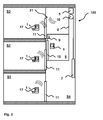
- FIG. 1 and 2 Two embodiments show an elevator installation 100 in a building.
- the building has a larger number of floors S1 to S3, which are served by at least one elevator car 6, 6 '.
- a user can enter and / or access the elevator car 6, 6 'via at least one elevator door 11, 11', 12, 12 ' leave.
- the elevator car 6, 6' is connected to at least one counterweight 7, 7 'via at least one suspension element 8, 8'.
- the suspension element 8, 8 ' is set in motion by at least one elevator drive 10, 10'.
- At least one door drive 9, 9 ' is arranged on the elevator car 6, 6' and actuates the elevator door 11, 11 ', 12, 12'.
- the elevator door 11, 11 ', 12, 12' a distinction is made between a floor door 11, 11 'arranged on each floor S1 to S3 and a car door 12, 12' of the elevator car 6, 6 '.
- the car door 12, 12 ' is operatively engageable with the landing door 11, 11' by mechanical coupling, such that the opening and closing of the car door 12, 12 'and the landing door 11, 11' occur simultaneously.
- two elevator cars 6, 6 ' are arranged in two elevator shafts S4, S4'.
- an elevator car 6 is arranged in an elevator shaft S4.
- an elevator installation 100 with more than three serviced floors S1 to S3 and / or with more than one elevator car 6, 6 'per elevator shaft S4, S4' and / or with a hydraulic drive and / or with an elevator drive realize on the elevator car and / or on the counterweight and of course an elevator system 100 without counterweight.
- At least one elevator control 5, 5 'of the elevator installation 100 has at least one processor and at least one computer-readable data memory. At least one computer program means is loaded into the processor from the computer-readable data memory and executed. The computer program means controls the elevator drive 10, 10 'and the door drive 9, 9'. At least one adapter for at least one radio field 21 and / or at least one adapter for at least one signal line 3, 3 'and at least one electrical power supply are arranged in at least one housing of the elevator control 5, 5'.
- At least one call input device 1, 1 'of the elevator installation 100 is arranged near a storey door 11, 11' and / or in an elevator car 6.
- the Fig. 1 to 13 show several embodiments of a call input device 1,1 '.
- the call input device 1, 1 ' is mounted on a building wall in the floor door area or is isolated in the floor door area of the floors S1 to S3.
- the input / output unit 13 comprises a touch screen 13 'of rectangular and / or circularly symmetrical diameter
- the touch screen 13' has, for example, a diameter of five centimeters and a thickness of two to ten millimeters
- the display is made, for example, of glass or impact-resistant plastic such as polyurethane, polypropylene, polyethylene, etc.
- a front of the touch screen 13 ' is very visible to the user and for example made of glass or impact-resistant plastic such as polyurethane, polypropylene, polyethylene
- Touch screens 13 ' are known as a resistive Ta a touch screen, a capacitive touch screen, an optical touch screen, etc., in which an electromagnetic field or a light beam is changed upon contact.
- the input / output unit 13 may also have a simple screen and / or light indicators.
- the keypad 13 has a plurality of mechanical keys, which keys are permanently assigned elevator functions, for example, the keypad 13" is a ten-key for inputting floor names such as "5" or "16".
- the sounder 15 is, for example, a speaker for outputting spoken alphanumeric strings and / or spoken sentences.
- the sound pressure of the sounder 15 is adjustable in a range of 30 dB to 120 dB, the frequency band ranges from ten Hz to 25 kHz.
- the call input device 1, 1 has at least one processor and at least one computer-readable data storage. At least one computer program means is loaded into the processor from the computer-readable data memory and executed.
- a plurality of computer program means can be loaded, which operate independently of each other and / or together.
- the computer program means controls the adapter and / or the input / output unit 13 and / or the sounder 15.
- At least one destination call control 4 of the elevator installation 100 has at least one processor, at least one computer-readable data memory, at least one adapter for a signal line 2 and at least one electrical power supply.
- the destination call control 4 is a separate electronic unit in at least one separate housing, which is placed, for example, in the floor S3.
- the destination call control 4 may also be an electronic insert, for example in the form of a printed circuit board, which circuit board in the housing of a call input device 1, 1 'and / or an elevator control 5, 5' is arranged.
- the call input device 1, 1 ', the sensor 17, 18, 19 and the destination call control 4 and / or the elevator control 5, 5' communicate bidirectionally via a signal line 2 such as a Universal Serial Bus (USB), Local Operating Network (LON), Modbus , Ethernet, etc.
- the signal line 2 is thus a bus system. With this signal line 2, the communication takes place according to a known protocol.
- Fig. 1 For each floor S1 to S3, two call input devices 1, 1 'and respectively two sensors 19 are communicatively connected to the destination call control 4 via a signal line 2.
- the signal line 2 is according to Fig. 1 represented by dotted lines.
- a radio field 21 such as Bluetooth, ZigBee or Wi-Fi.
- a radio field 21 such as Bluetooth, ZigBee or Wi-Fi.
- a call input device 1 and a sensor 17 are communicatively connected via a radio field 21 to an elevator control 5.
- Each communication user is uniquely identifiable via an address of an adapter of the signal line 2 and / or the radio field 21.
- the radio field 21 is according to Fig. 2 represented by curved triple circle segments.
- the destination call control 4 and the elevator control 5, 5 communicate bidirectionally via a signal line 3, 3' .
- FIG. 1 is the destination call control 4 via a respective signal line 3, 3 'communicatively connected to an elevator control 5, 5'.
- those skilled in the embodiments of an elevator system 100 according to Fig. 1 and 2 combine, for example, such that a call input device 1, 1 'and / or a sensor 17, 18, 19 communicatively connected via a radio field 21 with a plurality of elevator controls 5, 5' and / or that a destination call control 4 via a signal line 3, 3rd 'is communicatively connected to only one elevator control 5, 5'.
- the user may make a call by selecting a functional identifier 16, 16 ', 16 "outputted on the input / output unit 13 of the call input device 1, 1'
- the selection may be made by simply marking and / or confirming a marked functional identifier 16, 16 ', 16 "done.
- Fig. 1 transmits the call input device 1, 1 'the call made as a destination call on the signal line 2 to the destination call control 4.
- Fig. 2 the call input device 1 transmits the call made as floor call and / or as a car call via the radio field 21 to the elevator control 5.
- the user can according to Fig.
- a code to a wireless sensor 19 a call input device 1, 1 'send, which code is received by the radio sensor 19 and to the destination call control 4 and / or elevator control 5, 5' is transmitted.
- the code may be a user-requested call and / or a user identification, the destination call controller 4 and / or elevator controller 5, 5 'assigning at least one predefined call to a transmitted user identification, which predefined call is in the computer-readable data memory of the destination call controller 4 and / or elevator control 5, 5 'is stored.
- the code transmitted to the destination call control 4 and / or elevator control 5, 5 'is thus treated by the destination call control 4 and / or elevator control 5, 5' as a placed call.
- the call may be a landing call or car call or destination call.
- a floor call is according to Fig. 2 first an elevator car 6 moved to the floor of the call input device 1, at which call input device 1 of the floor call has been made. If the floor call has been transmitted as a code, first an elevator car 6, 6 'is moved to the floor of the radio sensor 19, which radio sensor 19 has received the code. This floor is called call input floor. Only after the user has entered the elevator car 6 on the call input floor is, according to Fig. 2 on a call input device 1 of the elevator car 6 a car call on a Destination floor done and the elevator car 6 is moved to this destination floor. This car call can also be transmitted as a code to the elevator control 5, 5 '.
- the elevator control 5, 5 determines at least one call allocation for the landing call and for the car call.
- a designation of the call input floor and of a destination floor desired by the user takes place, so that no more car call is necessary.
- the destination call controller 4 already knows the destination floor and can therefore optimize not only the start of the call input floor, but also that of the destination floor.
- the destination call control 4 determines at least one call allocation for a destination call.
- the call allocation refers to a journey with at least one elevator car 6, 6 'from a start floor to a destination floor with the shortest possible waiting time and / or the shortest possible destination time.
- the start floor does not have to match the call input floor.
- the destination floor does not have to match the destination floor desired by the user according to the destination call.
- the call allocation to the elevator car 6, 6 ' is assigned, at least one start call signal and at least one destination call signal are generated and transmitted via the signal line 3, 3' to the adapter of the elevator control 5, 5 'of this elevator car 6, 6'.
- the elevator installation By generating at least one signal state change, the elevator installation is brought into a disadvantage-free operating mode.
- a user In the disadvantaged-friendly operating mode , a user is transported through the elevator installation 100 without any disadvantages in the building.
- the disadvantage may be a disability of the user and / or a potential safety hazard to the user.
- the signal state change indicates in binary whether the user is disabled or not and / or whether the user is at risk or not.
- the type of disability such as walking disability, visual impairment, hearing impairment, and / or detailed be specified.
- the disability can be a physical disability and / or a mental disability.
- a handicapped-specific aid is, for example, a wheelchair, a bedside table, a crutch, a hearing aid, a visual aid, a canine, a guide dog, etc.
- a severely handicapped user can only move with the help of at least one accompanying user. For example, a companion user pushes the wheelchair of the severely disabled user to make a call for the severely disabled user.
- a personal protection-specific aid is, for example, a spatial protection zone and / or a temporal protection zone and / or a bodyguard.
- a spatial protection zone and / or a temporal protection zone with as few other users in the elevator car 6, 6 'generated.
- further users can be transported to the elevator car 6, 6 'at earlier and / or later times.
- an acutely safety-endangered user is accompanied by at least one bodyguard in the elevator car 6, 6 '.
- the user receives at least one functional identifier 16, 16 ', 16 " via the input / output unit 13 and / or the sounder 15.
- the surface of the input / output unit 13 visible to the user has at least one functional identifier 16, 16 ', 16 "on.
- the functional identifiers 16, 16 ', 16 " are pictograms and / or alphanumeric character strings
- the functional identifiers 16, 16', 16" are identified by at least one light element such as a liquid crystal display (LCD), light emitting display (LED) and / or Organic Light Emitting Display (OLED), etc. produced.
- LCD liquid crystal display
- LED light emitting display
- OLED Organic Light Emitting Display
- Each luminous element is controllable by the computer program means and the number, size, color and shape of the functional designators 16, 16 ', 16 "are freely programmable .
- the functional designator 16, 16', 16" can also be an "empty area", ie a uniform one Be portion of the touch screen 13 ', which is currently not specially marked.
- Fig. 3 Fourteen functional identifiers 16, 16 'are arranged on the input / output unit 13.
- Fig. 5 to 13 For example, three functional identifiers 16, 16 '16 "are arranged on the input / output unit 13.
- the option associated with the functional designator 16, 16 ', 16 "is executed, and marking and confirming of a functional designator 16, 16', 16" can be performed coincidentally in one method step.
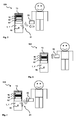
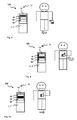
- the detection range of the camera according to Fig. 10 or by leaving the detection range of the weighing unit according to Fig. 13 Both a further signal state change and a still further signal state change can be generated.
- the step of raising the left hand is according to Fig. 9 or the step of the spoken command according to Fig. 12 not necessary. The user therefore only has to move into the detection range of the camera or the weighing unit for several seconds and then leave the latter again in order to carry out the method of using elevator system 100 at a disadvantage.
Landscapes
- Engineering & Computer Science (AREA)
- Automation & Control Theory (AREA)
- Computer Networks & Wireless Communication (AREA)
- Elevator Control (AREA)
- Indicating And Signalling Devices For Elevators (AREA)
- Maintenance And Inspection Apparatuses For Elevators (AREA)
Priority Applications (8)
| Application Number | Priority Date | Filing Date | Title |
|---|---|---|---|
| EP08171274A EP2196425A1 (fr) | 2008-12-11 | 2008-12-11 | Procédé d'utilisation variable d'une installation d'ascenseur |
| EP09765134.3A EP2373563B1 (fr) | 2008-12-11 | 2009-12-11 | Procédé d'utilisation variable d'une installation d'ascenseur |
| SG2011042686A SG172093A1 (en) | 2008-12-11 | 2009-12-11 | Method for enabling the use of an elevator system by disabled persons |
| PCT/EP2009/066883 WO2010066866A1 (fr) | 2008-12-11 | 2009-12-11 | Procédé pour l'utilisation équitable d'une installation d'ascenseur |
| CN200980155207.3A CN102292277B (zh) | 2008-12-11 | 2009-12-11 | 用于针对不利条件使用电梯设备的方法以及电梯设备 |
| PL09765134T PL2373563T3 (pl) | 2008-12-11 | 2009-12-11 | Sposób przystosowanego dla osób upośledzonych używania instalacji dźwigowej |
| US13/133,991 US9045314B2 (en) | 2008-12-11 | 2009-12-11 | Method for enabling the use of an elevator system by disabled persons using position changes, and an elevator system |
| BRPI0922958A BRPI0922958A2 (pt) | 2008-12-11 | 2009-12-11 | método para permitir o uso de um sistema de elevador por pessoas com deficiência |
Applications Claiming Priority (1)
| Application Number | Priority Date | Filing Date | Title |
|---|---|---|---|
| EP08171274A EP2196425A1 (fr) | 2008-12-11 | 2008-12-11 | Procédé d'utilisation variable d'une installation d'ascenseur |
Publications (1)
| Publication Number | Publication Date |
|---|---|
| EP2196425A1 true EP2196425A1 (fr) | 2010-06-16 |
Family
ID=40585533
Family Applications (2)
| Application Number | Title | Priority Date | Filing Date |
|---|---|---|---|
| EP08171274A Withdrawn EP2196425A1 (fr) | 2008-12-11 | 2008-12-11 | Procédé d'utilisation variable d'une installation d'ascenseur |
| EP09765134.3A Active EP2373563B1 (fr) | 2008-12-11 | 2009-12-11 | Procédé d'utilisation variable d'une installation d'ascenseur |
Family Applications After (1)
| Application Number | Title | Priority Date | Filing Date |
|---|---|---|---|
| EP09765134.3A Active EP2373563B1 (fr) | 2008-12-11 | 2009-12-11 | Procédé d'utilisation variable d'une installation d'ascenseur |
Country Status (7)
| Country | Link |
|---|---|
| US (1) | US9045314B2 (fr) |
| EP (2) | EP2196425A1 (fr) |
| CN (1) | CN102292277B (fr) |
| BR (1) | BRPI0922958A2 (fr) |
| PL (1) | PL2373563T3 (fr) |
| SG (1) | SG172093A1 (fr) |
| WO (1) | WO2010066866A1 (fr) |
Cited By (5)
| Publication number | Priority date | Publication date | Assignee | Title |
|---|---|---|---|---|
| WO2015023278A1 (fr) | 2013-08-15 | 2015-02-19 | Otis Elevator Company | Capteurs pour une commande de transport |
| WO2016202644A1 (fr) * | 2015-06-16 | 2016-12-22 | Inventio Ag | Système d'ascenseur muni d'interfaces utilisateur configurables par l'intermédiaire d'une unité de détection de lumière, ainsi qu'appareil de configuration portable |
| EP3060508A4 (fr) * | 2013-10-24 | 2017-07-19 | Otis Elevator Company | Renvoi d'ascenseur à l'aide d'une reconnaissance d'empreinte digitale |
| EP3578493A1 (fr) * | 2018-06-08 | 2019-12-11 | Otis Elevator Company | Support de passager d'ascenseur et systèmes d'appel |
| WO2023274683A1 (fr) * | 2021-06-28 | 2023-01-05 | Inventio Ag | Système d'ascenseur et procédé d'exploitation |
Families Citing this family (48)
| Publication number | Priority date | Publication date | Assignee | Title |
|---|---|---|---|---|
| AU2008320890B2 (en) * | 2007-10-29 | 2014-09-25 | Inventio Ag | Method for determining a destination call for use in a lift system and a lift system |
| JP5355560B2 (ja) * | 2008-05-21 | 2013-11-27 | 三菱電機株式会社 | エレベータシステム |
| US20120175192A1 (en) * | 2011-01-11 | 2012-07-12 | Utechzone Co., Ltd. | Elevator Control System |
| TWI469910B (zh) * | 2011-03-15 | 2015-01-21 | Via Tech Inc | 簡單節點式運輸系統之控制方法與裝置 |
| FI122844B (fi) * | 2011-04-21 | 2012-07-31 | Kone Corp | Kutsunantolaite sekä menetelmä hissikutsun antamiseksi |
| CN102408053B (zh) * | 2011-08-17 | 2014-09-03 | 邓锦诚 | 多层升降机 |
| JP5885850B2 (ja) * | 2011-10-18 | 2016-03-16 | オーチス エレベータ カンパニーOtis Elevator Company | 特別な支援機能を有するエレベータ乗客インターフェイス |
| EP2704104A1 (fr) | 2012-08-31 | 2014-03-05 | Inventio AG | Commandes de verrouillage de saisie |
| CN104684831B (zh) * | 2012-09-26 | 2018-01-02 | 通力股份公司 | 用于维护电梯系统中的偏好楼层列表的装置 |
| SG2013082250A (en) * | 2012-11-12 | 2014-06-27 | Kone Corp | Method, call-giving device, elevator system and computer program product |
| EP2953879B1 (fr) * | 2013-02-05 | 2018-05-23 | Otis Elevator Company | Lecteur de carte de communication en champ proche (nfc) d'équipement périphérique |
| WO2014122357A1 (fr) | 2013-02-07 | 2014-08-14 | Kone Corporation | Personnalisation d'un service d'ascenseur |
| WO2014186976A1 (fr) * | 2013-05-24 | 2014-11-27 | Otis Elevator Company | Saisie et sécurité utilisant l'écriture manuscrite |
| WO2015099882A1 (fr) | 2013-12-23 | 2015-07-02 | Bryant Edward A | Système de commande d'ascenseur |
| WO2015135591A1 (fr) * | 2014-03-14 | 2015-09-17 | Kone Corporation | Système d'ascenseur et méthode de sollicitation de mouvements d'ascenseur |
| US20150329316A1 (en) * | 2014-05-13 | 2015-11-19 | Wen-Sung Lee | Smart elevator control device |
| ES2757910T3 (es) * | 2014-05-28 | 2020-04-30 | Otis Elevator Co | Reconocimiento de gestos sin contacto para servicio de ascensor |
| CN104071656B (zh) * | 2014-06-25 | 2016-05-04 | 日立电梯(中国)有限公司 | 电梯及其运行控制方法 |
| CN104326336B (zh) * | 2014-09-26 | 2017-07-21 | 快意电梯股份有限公司 | 残疾人用电梯及其电梯控制方法 |
| CN107531446B (zh) * | 2015-04-17 | 2020-10-13 | 通力股份公司 | 用于分配目的地呼叫的装置和方法 |
| US10370220B2 (en) * | 2015-05-28 | 2019-08-06 | Otis Elevator Company | Flexible destination dispatch passenger support system |
| CN106315316A (zh) | 2015-06-16 | 2017-01-11 | 奥的斯电梯公司 | 一种电梯系统及其控制方法 |
| KR101613542B1 (ko) * | 2015-07-02 | 2016-04-19 | 김한준 | 동작 인식 엘리베이터 호출 장치 |
| EP3182667B1 (fr) * | 2015-12-18 | 2019-12-04 | Airbus Operations GmbH | Accès au réseau sans fil basé sur l'acoustique |
| US11827491B2 (en) * | 2015-12-22 | 2023-11-28 | Otis Elevator Company | Elevator service request using user device |
| US10294069B2 (en) | 2016-04-28 | 2019-05-21 | Thyssenkrupp Elevator Ag | Multimodal user interface for destination call request of elevator systems using route and car selection methods |
| US10095315B2 (en) | 2016-08-19 | 2018-10-09 | Otis Elevator Company | System and method for distant gesture-based control using a network of sensors across the building |
| US10268166B2 (en) * | 2016-09-15 | 2019-04-23 | Otis Elevator Company | Intelligent surface systems for building solutions |
| EP3299323B1 (fr) | 2016-09-23 | 2020-04-01 | Otis Elevator Company | Tableau de commande secondaire de cabine pour cabines d'ascenseur |
| US20180118522A1 (en) * | 2016-10-28 | 2018-05-03 | Otis Elevator Company | Sensor on escalator landing plate |
| EP3538467B1 (fr) * | 2016-11-11 | 2021-09-08 | Inventio AG | Système de sécurité pour des bâtiments équipés d' installations d'ascenseur |
| EP3366626B1 (fr) * | 2017-02-22 | 2021-01-06 | Otis Elevator Company | Système de sécurité d'ascenseur et procédé de surveillance d'un système d'ascenseur |
| US11634301B2 (en) * | 2017-06-05 | 2023-04-25 | Otis Elevator Company | System and method for detection of a malfunction in an elevator |
| WO2019077646A1 (fr) * | 2017-10-16 | 2019-04-25 | 三菱電機株式会社 | Dispositif de commande d'ascenseur et procédé de commande d'ascenseur |
| JP6443586B1 (ja) * | 2017-11-30 | 2018-12-26 | 三菱電機ビルテクノサービス株式会社 | エレベーターの制御装置 |
| US11242225B2 (en) | 2018-03-15 | 2022-02-08 | Otis Elevator Company | Adaptive elevator door dwell time |
| EP3814262B1 (fr) | 2018-06-27 | 2024-07-31 | Inventio Ag | Dispositif d'acquisition de données pour un système d'ascenseur et un système de contrôle d'accès à un bâtiment |
| US11708240B2 (en) | 2018-07-25 | 2023-07-25 | Otis Elevator Company | Automatic method of detecting visually impaired, pregnant, or disabled elevator passenger(s) |
| CN112585075B (zh) * | 2018-08-23 | 2024-05-31 | 通力股份公司 | 具有调适可视性的电梯信号设备 |
| EP3921263B1 (fr) * | 2019-02-08 | 2023-05-24 | Inventio Ag | Installation d'ascenseur pourvu de dispositifs de commande d'ascenseur pour passagers présentant des limitations physiques |
| US10860115B1 (en) * | 2019-09-19 | 2020-12-08 | Bao Tran | Air transportation systems and methods |
| DE102019214884A1 (de) * | 2019-09-27 | 2021-04-01 | Thyssenkrupp Elevator Innovation And Operations Ag | Aufzugbedienterminal, Aufzuganlage mit Aufzugbedienterminal und Verfahren zum Betreiben eines Aufzugbedienterminals |
| KR20230058632A (ko) * | 2020-08-31 | 2023-05-03 | 인벤티오 아게 | 제한된 이동성을 갖는 승객들을 위한 엘리베이터 동작 디바이스들을 갖는 엘리베이터 시스템 |
| US20220144583A1 (en) * | 2020-11-06 | 2022-05-12 | Otis Elevator Company | Elevator system response to custom passenger attributes |
| US20230373747A1 (en) * | 2022-05-20 | 2023-11-23 | Tk Elevator Innovation And Operations Gmbh | Systems and methods for touchless elevator cab requests |
| DE102023101826A1 (de) * | 2023-01-25 | 2024-01-04 | Tk Elevator Innovation And Operations Gmbh | Aufzugsvorrichtung mit akustischer Haltepositionsinformationsausgabe sowie entsprechendes Ausgabeverfahren und Verwendung |
| DE102023101818A1 (de) * | 2023-01-25 | 2024-07-25 | Tk Elevator Innovation And Operations Gmbh | Aufzugsanlage zum Transport von Personen und/oder Transportgut |
| US20260054960A1 (en) * | 2024-08-26 | 2026-02-26 | Otis Elevator Company | La carte disability features |
Citations (9)
| Publication number | Priority date | Publication date | Assignee | Title |
|---|---|---|---|---|
| US5192836A (en) * | 1990-02-05 | 1993-03-09 | Inventio Ag | Apparatus for selecting an elevator car for physically handicapped persons from a group of elevators with immediate allocation of target calls |
| US5323470A (en) * | 1992-05-08 | 1994-06-21 | Atsushi Kara | Method and apparatus for automatically tracking an object |
| JPH11268879A (ja) * | 1998-03-20 | 1999-10-05 | Mitsubishi Electric Corp | エレベータの運転制御装置 |
| JP2000211833A (ja) * | 1999-01-25 | 2000-08-02 | Hitachi Ltd | エレベ―タ装置 |
| US6161655A (en) * | 1998-12-23 | 2000-12-19 | Otis Elevator Company | Non-contact elevator call button |
| US20020191819A1 (en) * | 2000-12-27 | 2002-12-19 | Manabu Hashimoto | Image processing device and elevator mounting it thereon |
| US20040022439A1 (en) * | 2002-07-30 | 2004-02-05 | Paul Beardsley | Wheelchair detection using stereo vision |
| EP1598298A1 (fr) | 2004-05-17 | 2005-11-23 | Inventio Ag | Ascenseur avec un panneau de commande pour la cabine |
| US20060011419A1 (en) * | 2004-07-13 | 2006-01-19 | Neng-Fu Chuang | Non-contact optical sensor switch assembly of elevators |
Family Cites Families (22)
| Publication number | Priority date | Publication date | Assignee | Title |
|---|---|---|---|---|
| FR2779559B1 (fr) * | 1998-06-09 | 2000-07-21 | Otis Elevator Co | Procede et dispositif d'affichage d'une image virtuelle, notamment du tableau de commande d'une cabine d'ascenseur |
| EP1110899A1 (fr) | 1999-12-24 | 2001-06-27 | Inventio Ag | Methode et dispositif pour entrer sans contact les appels d'un ascenseur |
| JP2001302121A (ja) * | 2000-04-19 | 2001-10-31 | Mitsubishi Electric Corp | エレベータ装置 |
| JP4618757B2 (ja) | 2000-11-16 | 2011-01-26 | 株式会社東京自働機械製作所 | 開封テープ供給装置 |
| US6828918B2 (en) * | 2000-11-29 | 2004-12-07 | International Business Machines Corporation | Personalized accessibility identification receiver/transmitter and method for providing assistance |
| CN1261904C (zh) * | 2000-12-27 | 2006-06-28 | 三菱电机株式会社 | 图象处理装置和装载该装置的电梯 |
| JP2002274764A (ja) * | 2001-03-05 | 2002-09-25 | Otis Elevator Co | 階床呼出音登録方法および点字情報報知装置 |
| JP4232634B2 (ja) * | 2001-12-20 | 2009-03-04 | 三菱電機株式会社 | エレベータ操作装置 |
| US6902041B2 (en) * | 2002-06-27 | 2005-06-07 | Jon E. Eccleston | Method and system to select elevator floors using a single control |
| JP4127545B2 (ja) * | 2002-07-26 | 2008-07-30 | 三菱電機株式会社 | 画像処理装置 |
| US7164784B2 (en) * | 2002-07-30 | 2007-01-16 | Mitsubishi Electric Research Laboratories, Inc. | Edge chaining using smoothly-varying stereo disparity |
| US7031525B2 (en) * | 2002-07-30 | 2006-04-18 | Mitsubishi Electric Research Laboratories, Inc. | Edge detection based on background change |
| US7207422B2 (en) * | 2003-04-01 | 2007-04-24 | Mitsubishi Denki Kabushiki Kaisha | Elevator call recording device |
| FI115521B (fi) * | 2004-06-28 | 2005-05-31 | Kone Corp | Hissijärjestely |
| JP2006160414A (ja) * | 2004-12-03 | 2006-06-22 | Mitsubishi Electric Corp | エレベータの操作盤装置 |
| US7496445B2 (en) * | 2005-04-27 | 2009-02-24 | Proxemics, Llc | Wayfinding |
| US7451937B2 (en) * | 2005-07-13 | 2008-11-18 | Action Talkin Products, Llc | Thermostat with handicap access mode |
| JP5355560B2 (ja) * | 2008-05-21 | 2013-11-27 | 三菱電機株式会社 | エレベータシステム |
| US20120175192A1 (en) * | 2011-01-11 | 2012-07-12 | Utechzone Co., Ltd. | Elevator Control System |
| TWI469910B (zh) * | 2011-03-15 | 2015-01-21 | Via Tech Inc | 簡單節點式運輸系統之控制方法與裝置 |
| FI122844B (fi) * | 2011-04-21 | 2012-07-31 | Kone Corp | Kutsunantolaite sekä menetelmä hissikutsun antamiseksi |
| US20140094997A1 (en) * | 2012-09-28 | 2014-04-03 | Elwha Llc | Automated Systems, Devices, and Methods for Transporting and Supporting Patients Including Multi-Floor Operation |
-
2008
- 2008-12-11 EP EP08171274A patent/EP2196425A1/fr not_active Withdrawn
-
2009
- 2009-12-11 SG SG2011042686A patent/SG172093A1/en unknown
- 2009-12-11 EP EP09765134.3A patent/EP2373563B1/fr active Active
- 2009-12-11 PL PL09765134T patent/PL2373563T3/pl unknown
- 2009-12-11 US US13/133,991 patent/US9045314B2/en active Active
- 2009-12-11 WO PCT/EP2009/066883 patent/WO2010066866A1/fr not_active Ceased
- 2009-12-11 BR BRPI0922958A patent/BRPI0922958A2/pt not_active IP Right Cessation
- 2009-12-11 CN CN200980155207.3A patent/CN102292277B/zh active Active
Patent Citations (9)
| Publication number | Priority date | Publication date | Assignee | Title |
|---|---|---|---|---|
| US5192836A (en) * | 1990-02-05 | 1993-03-09 | Inventio Ag | Apparatus for selecting an elevator car for physically handicapped persons from a group of elevators with immediate allocation of target calls |
| US5323470A (en) * | 1992-05-08 | 1994-06-21 | Atsushi Kara | Method and apparatus for automatically tracking an object |
| JPH11268879A (ja) * | 1998-03-20 | 1999-10-05 | Mitsubishi Electric Corp | エレベータの運転制御装置 |
| US6161655A (en) * | 1998-12-23 | 2000-12-19 | Otis Elevator Company | Non-contact elevator call button |
| JP2000211833A (ja) * | 1999-01-25 | 2000-08-02 | Hitachi Ltd | エレベ―タ装置 |
| US20020191819A1 (en) * | 2000-12-27 | 2002-12-19 | Manabu Hashimoto | Image processing device and elevator mounting it thereon |
| US20040022439A1 (en) * | 2002-07-30 | 2004-02-05 | Paul Beardsley | Wheelchair detection using stereo vision |
| EP1598298A1 (fr) | 2004-05-17 | 2005-11-23 | Inventio Ag | Ascenseur avec un panneau de commande pour la cabine |
| US20060011419A1 (en) * | 2004-07-13 | 2006-01-19 | Neng-Fu Chuang | Non-contact optical sensor switch assembly of elevators |
Cited By (8)
| Publication number | Priority date | Publication date | Assignee | Title |
|---|---|---|---|---|
| WO2015023278A1 (fr) | 2013-08-15 | 2015-02-19 | Otis Elevator Company | Capteurs pour une commande de transport |
| EP3033287A4 (fr) * | 2013-08-15 | 2017-04-12 | Otis Elevator Company | Capteurs pour une commande de transport |
| US10005639B2 (en) | 2013-08-15 | 2018-06-26 | Otis Elevator Company | Sensors for conveyance control |
| EP3060508A4 (fr) * | 2013-10-24 | 2017-07-19 | Otis Elevator Company | Renvoi d'ascenseur à l'aide d'une reconnaissance d'empreinte digitale |
| WO2016202644A1 (fr) * | 2015-06-16 | 2016-12-22 | Inventio Ag | Système d'ascenseur muni d'interfaces utilisateur configurables par l'intermédiaire d'une unité de détection de lumière, ainsi qu'appareil de configuration portable |
| CN107771159A (zh) * | 2015-06-16 | 2018-03-06 | 因温特奥股份公司 | 具有能够借助于光检测单元配置的用户界面的电梯系统以及便携的配置装置 |
| EP3578493A1 (fr) * | 2018-06-08 | 2019-12-11 | Otis Elevator Company | Support de passager d'ascenseur et systèmes d'appel |
| WO2023274683A1 (fr) * | 2021-06-28 | 2023-01-05 | Inventio Ag | Système d'ascenseur et procédé d'exploitation |
Also Published As
| Publication number | Publication date |
|---|---|
| WO2010066866A1 (fr) | 2010-06-17 |
| PL2373563T3 (pl) | 2019-07-31 |
| SG172093A1 (en) | 2011-07-28 |
| BRPI0922958A2 (pt) | 2016-01-19 |
| EP2373563A1 (fr) | 2011-10-12 |
| EP2373563B1 (fr) | 2019-01-30 |
| CN102292277A (zh) | 2011-12-21 |
| US9045314B2 (en) | 2015-06-02 |
| US20120168262A1 (en) | 2012-07-05 |
| CN102292277B (zh) | 2014-09-03 |
Similar Documents
| Publication | Publication Date | Title |
|---|---|---|
| EP2373563B1 (fr) | Procédé d'utilisation variable d'une installation d'ascenseur | |
| EP2307300B1 (fr) | Procédé de commande d'une installation d'ascenseurs tenant compte des personnes handicapées et des utilisateurs privilégiés | |
| EP2475606B1 (fr) | Procédé permettant de faire fonctionner un système d'ascenseur | |
| EP2342153B1 (fr) | Dispositif d'enregistrement des appels d'une installation d'ascenseur | |
| EP2209729B1 (fr) | Procédé destiné à la fixation d'un appel cible en vue de l'utilisation d'une installation d'ascenseur et installation d'ascenseur | |
| EP3307666B2 (fr) | Systeme d'ascenseur dote d'une generation d'appel predictive | |
| EP2238067B2 (fr) | Installation d'ascenseur, procédé de commande d'une telle installation d'ascenseur et procédé de rééquipement d'une installation d'ascenseur existante en une telle installation d'ascenseur | |
| EP2331443A2 (fr) | Procédé pour faire fonctionner une installation d'ascenseur, dispositif d'entrée d'appel, installation d'ascenseur comprenant un tel dispositif d'entrée d'appel et procédé pour équiper a posteriori une installation d'ascenseur d'un tel dispositif d'entrée d'appel | |
| DE112012006728T5 (de) | Aufzugplattformvorrichtung | |
| EP2238065A1 (fr) | Procédé de distribution des appels d'un équipement élévateur et équipement élévateur avec distribution des appels selon ledit procédé | |
| DE102017124044A1 (de) | System zum Transport eines Benutzers mit einem Aufzug zu einem Ziel, Nachrüstsatz und Verfahren | |
| EP4021836B1 (fr) | Procédé de fonctionnement pour un dispositif de commande d'ascenseur doté d'un système d'écran tactile | |
| EP4204347B1 (fr) | Système d'ascenseur ayant des dispositifs de commande d'ascenseur pour passagers à mobilité limitée | |
| EP3921263B1 (fr) | Installation d'ascenseur pourvu de dispositifs de commande d'ascenseur pour passagers présentant des limitations physiques | |
| WO2023274683A1 (fr) | Système d'ascenseur et procédé d'exploitation | |
| CN111115395A (zh) | 一种基于蓝牙的智能人脸识别电梯控制系统 | |
| HK1163043A (en) | Method for discriminatory use of a lift facility | |
| HK1163043B (en) | Method for discriminatory use of a lift facility | |
| HK1159056B (en) | Call input device for an elevator |
Legal Events
| Date | Code | Title | Description |
|---|---|---|---|
| PUAI | Public reference made under article 153(3) epc to a published international application that has entered the european phase |
Free format text: ORIGINAL CODE: 0009012 |
|
| AK | Designated contracting states |
Kind code of ref document: A1 Designated state(s): AT BE BG CH CY CZ DE DK EE ES FI FR GB GR HR HU IE IS IT LI LT LU LV MC MT NL NO PL PT RO SE SI SK TR |
|
| AX | Request for extension of the european patent |
Extension state: AL BA MK RS |
|
| AKY | No designation fees paid | ||
| REG | Reference to a national code |
Ref country code: DE Ref legal event code: 8566 |
|
| STAA | Information on the status of an ep patent application or granted ep patent |
Free format text: STATUS: THE APPLICATION IS DEEMED TO BE WITHDRAWN |
|
| 18D | Application deemed to be withdrawn |
Effective date: 20101217 |