EP2198455B1 - Chipmodul für chipkarte - Google Patents
Chipmodul für chipkarte Download PDFInfo
- Publication number
- EP2198455B1 EP2198455B1 EP08837280.0A EP08837280A EP2198455B1 EP 2198455 B1 EP2198455 B1 EP 2198455B1 EP 08837280 A EP08837280 A EP 08837280A EP 2198455 B1 EP2198455 B1 EP 2198455B1
- Authority
- EP
- European Patent Office
- Prior art keywords
- substrate
- heat
- chip module
- chip
- heat conducting
- Prior art date
- Legal status (The legal status is an assumption and is not a legal conclusion. Google has not performed a legal analysis and makes no representation as to the accuracy of the status listed.)
- Not-in-force
Links
Images
Classifications
-
- H—ELECTRICITY
- H10—SEMICONDUCTOR DEVICES; ELECTRIC SOLID-STATE DEVICES NOT OTHERWISE PROVIDED FOR
- H10W—GENERIC PACKAGES, INTERCONNECTIONS, CONNECTORS OR OTHER CONSTRUCTIONAL DETAILS OF DEVICES COVERED BY CLASS H10
- H10W70/00—Package substrates; Interposers; Redistribution layers [RDL]
- H10W70/60—Insulating or insulated package substrates; Interposers; Redistribution layers
- H10W70/699—Insulating or insulated package substrates; Interposers; Redistribution layers for flat cards, e.g. credit cards
-
- G—PHYSICS
- G06—COMPUTING OR CALCULATING; COUNTING
- G06K—GRAPHICAL DATA READING; PRESENTATION OF DATA; RECORD CARRIERS; HANDLING RECORD CARRIERS
- G06K19/00—Record carriers for use with machines and with at least a part designed to carry digital markings
- G06K19/06—Record carriers for use with machines and with at least a part designed to carry digital markings characterised by the kind of the digital marking, e.g. shape, nature, code
- G06K19/067—Record carriers with conductive marks, printed circuits or semiconductor circuit elements, e.g. credit or identity cards also with resonating or responding marks without active components
- G06K19/07—Record carriers with conductive marks, printed circuits or semiconductor circuit elements, e.g. credit or identity cards also with resonating or responding marks without active components with integrated circuit chips
- G06K19/077—Constructional details, e.g. mounting of circuits in the carrier
- G06K19/07745—Mounting details of integrated circuit chips
-
- G—PHYSICS
- G06—COMPUTING OR CALCULATING; COUNTING
- G06K—GRAPHICAL DATA READING; PRESENTATION OF DATA; RECORD CARRIERS; HANDLING RECORD CARRIERS
- G06K19/00—Record carriers for use with machines and with at least a part designed to carry digital markings
- G06K19/06—Record carriers for use with machines and with at least a part designed to carry digital markings characterised by the kind of the digital marking, e.g. shape, nature, code
- G06K19/067—Record carriers with conductive marks, printed circuits or semiconductor circuit elements, e.g. credit or identity cards also with resonating or responding marks without active components
- G06K19/07—Record carriers with conductive marks, printed circuits or semiconductor circuit elements, e.g. credit or identity cards also with resonating or responding marks without active components with integrated circuit chips
- G06K19/077—Constructional details, e.g. mounting of circuits in the carrier
- G06K19/07745—Mounting details of integrated circuit chips
- G06K19/07747—Mounting details of integrated circuit chips at least one of the integrated circuit chips being mounted as a module
-
- H—ELECTRICITY
- H10—SEMICONDUCTOR DEVICES; ELECTRIC SOLID-STATE DEVICES NOT OTHERWISE PROVIDED FOR
- H10W—GENERIC PACKAGES, INTERCONNECTIONS, CONNECTORS OR OTHER CONSTRUCTIONAL DETAILS OF DEVICES COVERED BY CLASS H10
- H10W90/00—Package configurations
- H10W90/701—Package configurations characterised by the relative positions of pads or connectors relative to package parts
- H10W90/751—Package configurations characterised by the relative positions of pads or connectors relative to package parts of bond wires
- H10W90/754—Package configurations characterised by the relative positions of pads or connectors relative to package parts of bond wires between a chip and a stacked insulating package substrate, interposer or RDL
Definitions
- the invention relates to a chip module and a method for installing a chip module in a recess of a chip card body by means of a heat-activated adhesive and a chip card with a built-in chip module.
- a chip card is for example in the EP 1 684 216 described.
- Chip modules are generally constructed on an electrically insulating carrier tape, for example on a polyimide film tape (trade name: Kapton), and punched out of the carrier tape in a recess of the chip card body shortly before mounting.
- the carrier tape serves as a substrate for the components of the chip module.
- the side of the substrate which points outwards after installation in the chip card body and is therefore referred to below as the "substrate front side” is metallically coated, wherein the metal coating is structured to form spaced-apart contact surfaces for contact-type contacting of the chip module.
- the metallic coating is usually multi-layered and consists of a lowermost copper layer, a topmost gold layer and an intermediate nickel interconnect layer.
- the chip of the chip module is attached. Bonding wires lead from the chip back through free-punched areas in the substrate to the metallic coating on the front side of the substrate in order to establish the necessary electrical connection.
- the chip can also be placed, for example, as a so-called flip chip on the back of the substrate and be electrically conductively connected via vias through the substrate to the contact surfaces on the front side of the substrate.
- the chip with the bonding wires or the flip chip are usually protected by a potting surrounded.
- This so-called Vergusspille is located centrally on the substrate back and is clearly surmounted by the substrate with the front side provided contact surfaces.
- additional Contact surfaces can also be provided on the substrate rear side, for example as antenna or coil connections for antenna or coil structures integrated in the card body in so-called dual-interface cards or dual-interface chip modules or for other purposes.
- For the construction and the materials of chip modules is on "From plastic to chip card", Y.
- Such chip modules are glued in a recess of the chip card body, which is referred to as "implantation".
- implantation There are essentially two variants, on the one hand using reactive adhesive and on the other hand using heat-activated adhesive.
- reactive adhesive systems for example, it takes some time to wait until the chip card has developed its full mechanical stability.
- heat-activatable adhesive the problem is to keep away the heat necessary for activating the adhesive from the chip and / or the chip encapsulation.
- the adhesive can be provided as an adhesive tape or as an adhesive application on the back side of the chip module substrate or possibly also in the recess of the chip card body.
- the activation of the adhesive takes place by using a H geometricpreßst Zis from the substrate front side, with which the chip module is pressed into the recess of the chip card body.
- the heat-activatable adhesive on the sides of the chip module may contact the surface of the card and contaminate it.
- the card back can be greatly deformed by the effect of temperature. Too high temperature peak loads can lead to so-called popcorn effect in chip modules with epoxy resin potting compounds and damage the chip module. This in turn can lead to module buckling and bond wire breaks.
- the H mustpreßst Zi are recessed in the potting compound, since the temperature is needed anyway only in the area of the adhesive surface.
- Object of the present invention is now to optimize the incorporation of the chip module in the recess of the chip card body using the heat-activated adhesive in terms of time.
- the invention is based on the idea of guiding the thermal energy more effectively from the substrate front side to the substrate rear side to the adhesive located either on the substrate or in the recess of the chip card body.
- the substrate front side is connected to the substrate rear side by one or preferably a plurality of heat conducting bridges in a heat-conducting manner.
- the thermal bridges consist of a material which has a significantly higher thermal conductivity than the material of which the substrate of the chip module consists.
- the edge region surrounding the contact surfaces of the substrate front side is coated with the same metallic material from which the contact surfaces are formed, this edge region - as in the prior art - is separated by an interruption of this coating from the contact surfaces to the edge region of the contact surfaces thermally decoupled.
- this edge region is just as possible to make the edge area differently, in particular to coat with another, possibly even better heat conducting material.
- the invention is equally applicable if the thermal bridges are all or partially in the region of the contact surfaces.
- the material of the heat conducting bridges connecting the substrate front side to the substrate rear side in a heat-conducting manner preferably has a thermal conductivity which is more than 100, in particular more than 1000 times, that of the thermal conductivity of the substrate material.
- Heat conducting bridges made of metal are particularly suitable, with copper being preferred for reasons of process economy, because even the lowermost layer of the contact surfaces generally consists of copper. It is thus procedurally ideal to manufacture the heat conducting bridges of the same material as the contact surfaces on the front side of the substrate.
- the heat conducting bridges between the substrate front side and the substrate rear side are passed through the substrate itself, similar to the vias mentioned at the beginning. It can thus be used to generate the thermal bridges on existing manufacturing technologies.
- the thermal bridges can also be guided around the substrate.
- the heat conducting bridges on the substrate rear side are preferably connected in a thermally conductive manner to heat transfer zones specially formed there, which likewise consist of a material with a higher thermal conductivity than the substrate material, ie in particular again of copper.
- heat transfer zones on the substrate front side are provided in the edge region and thermally separated from the contact surfaces, so the heat transfer zones on the substrate back are expediently spaced from the Vergusspille and any leading to the chip electrical conductor tracks.
- the invention can be implemented particularly efficiently in a chip module in which electrical interconnects or connections on the substrate rear side are provided anyway. Because these interconnects and connections usually consist of an electrically conductive material, which at the same time has a high thermal conductivity, in particular of a metal.
- the heat transfer zones on the back of the substrate can then be formed of the same material or metal as, but separate from, the electrical traces / terminals.
- the heat-conducting bridges thus continue on the back of the substrate in pseudo-conductive tracks which do not serve for the electrical conduction during operation of the chip module or the chip card equipped therewith but solely for the temperature distribution.
- the heat transfer zones should not completely cover the substrate underside to be bonded.
- the layout of the heat transfer zones is adjusted accordingly. Preference is given, for example, to heat transfer zones in meandering form or in the form of strips extending side by side, which are each connected to at least one heat conducting bridge. The strips can be of different lengths in order to conduct the heat from the heat conducting bridges arranged in the edge region of the chip module as uniformly as possible to all points on the substrate rear side close to the casting pill.
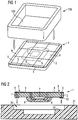
- a chip module 1 is shown schematically in a perspective view from above with a hot press stamp 100 hovering above it.
- the chip module 1 comprises a substrate 2 with a metallic coating 3 on the front side of the substrate.
- the metallic coating forms in the central region of the front side of the substrate eight contact surfaces 4 arranged around a center. Sections 5 in the metallic coating 3, which run approximately parallel to the side edges of the module, separate an edge region 6 from the contact surfaces 4. Through the cuts 5, the edge region 6 is thermally decoupled from the contact surfaces 4.
- the edge region 6 may also be formed wholly or partially contiguous with the contact surfaces 4 formed out of the metallic coating 3.
- the H disclosepreßstkov 2 has a central recess 100 'corresponding to the contour of the cuts 5, so that heat is transmitted by means of the H furnishedpreßstkovs 2 substantially only in the edge region 6 on the chip module 1.
- the edge region 6 forms a heat introduction area.
- a chip 7 is fixed, which by means of bonding wires 8 through the substrate 2 through (see FIG. 2 ) may be electrically connected to the contact surfaces 4.
- the chip 7 and the bonding wires 8 are protected by a Vergusspille 9.
- FIG. 2 shows in cross section a principle of FIG. 1 corresponding chip module 1, which in plan view and as a bottom view in more detail in the FIGS. 3A and 3B is shown, when installed in a recess 20 of a chip card body 21.
- a heat-activatable adhesive 10 is applied on the underside of the substrate 2.
- the adhesive 10 may also be applied as an adhesive film on the substrate back.
- the chip module 1 is inserted here into the recess 20 of the chip card body 21 so that the adhesive 10 strikes shoulders 22 of the recess 20.
- the glue can instead of being provided on the substrate rear side directly in the recess of the chip card body.
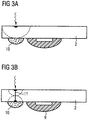
- FIG. 3A schematically shows a conventional chip module with a substrate 2 of Kapton, for example. If heat is then applied in a punctiform manner to the front side of the substrate, the heat in the substrate 2 spreads out spherically in each direction uniformly. Thus, a lot of heat is lost in the substrate 2 until sufficient heat has been added to activate the local heat-activatable adhesive 10 on the substrate back side. Will, however, as in FIG.
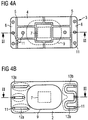
- FIG. 4A shows a concrete contact layout of the metallic coating 3 of a chip module in plan view.
- FIG. 4B shows by way of example a corresponding rear view of the chip module. It is a chip module, as in FIG. 2 is shown in cross section.
- the edge regions 6 function as heat introduction regions and are used in particular for heat input by means of the hot press stamp 100.
- the heat conducting bridges 11 are arranged uniformly distributed in the edge regions 6. In addition, heat conducting bridges 11 may be provided in the contact surfaces 4 in order to also dissipate heat from the contact surface regions to the substrate rear side.
- the connected to the contact surface 4 shall be formed as a conventional via, but does not serve as an electrical conductor in later operation of the smart card but only as a heat conductor.
- the heat conducting bridges 11 do not simply end on the rear side of the substrate 2, but go there in specially designed heat transfer zones 12a and 12b.
- the Heat transfer zones 12a and 12b like the heat conducting bridges 11, consist of a material that is highly heat-conductive in comparison to the substrate material, in particular of a metal such as copper.
- a metal such as copper.
- the substrate material for example, FR4 having a thermal conductivity of 0.3 W / mK can be used.
- the thermal conductivity of copper is 400 W / mK, which is more than 1000 times that of FR4.
- the heat conducting bridges 11 and heat transfer zones 12a, 12b are arranged and structured in such a way that the heat introduced on the substrate front side is conducted as uniformly as possible to the adhesive surfaces on the substrate rear side.
- the adhesive surfaces are in FIG. 4B indicated by dashed lines 13a and 13b.
- the heat transfer zones 12a, 12b may, for example, be formed as strips extending side by side (FIG. 12a, left in FIG FIG. 4B ) or meandering (12b, right in FIG. 4B ). Other geometries are also conceivable.
- conductor track structures are provided on the back side of the substrate 2 in any case, it is expedient to produce the heat transfer zones 12a, 12b from the same material and in the same method step as these conductor track structures.
Landscapes
- Engineering & Computer Science (AREA)
- Computer Hardware Design (AREA)
- Microelectronics & Electronic Packaging (AREA)
- Physics & Mathematics (AREA)
- General Physics & Mathematics (AREA)
- Theoretical Computer Science (AREA)
- Credit Cards Or The Like (AREA)
- Cooling Or The Like Of Semiconductors Or Solid State Devices (AREA)
- Cooling Or The Like Of Electrical Apparatus (AREA)
Description
- Die Erfindung betrifft ein Chipmodul und ein Verfahren zum Einbauen eines Chipmoduls in eine Ausnehmung eines Chipkartenkörpers mittels eines wärmeaktivierbaren Klebstoffs sowie eine Chipkarte mit einem darin eingebauten Chipmodul. Eine solche Chipkarte ist beispielsweise in der
EP 1 684 216 beschrieben. Chipmodule werden in der Regel auf einem elektrisch isolierenden Trägerband, beispielsweise auf einem Polyimid-Folienband (Handelsname: Kapton) aufgebaut und erst kurz vor ihrer Montage in einer Ausnehmung des Chipkartenkörpers aus dem Trägerband ausgestanzt. Das Trägerband dient dabei als Substrat für die Komponenten des Chipmoduls. Diejenige Seite des Substrats, welche nach dem Einbau in den Chipkartenkörper nach außen weist und daher nachfolgend als "Substratvorderseite" bezeichnet wird, ist metallisch beschichtet, wobei die Metallbeschichtung strukturiert ist, um voneinander beabstandete Kontaktflächen zur kontaktbehafteten Kontaktierung des Chipmoduls auszubilden. Die metallische Beschichtung ist in der Regel mehrschichtig und besteht aus einer untersten Kupferschicht, einer obersten Goldschicht und einer dazwischen liegenden Verbindungsschicht aus Nickel. Auf der Rückseite des Substrats ist üblicherweise der Chip des Chipmoduls befestigt. Bonddrähte führen vom Chip durch Freistanzungen in dem Substrat hindurch rückseitig an die metallische Beschichtung auf der Substratvorderseite, um die notwendige elektrische Verbindung herzustellen. Anstatt dieser sogenannten Wirebond-Technik kann der Chip auch beispielsweise als sogenannter Flipchip auf die Substratrückseite aufgesetzt und über Durchkontaktierungen durch das Substrat hindurch mit den Kontaktflächen auf der Substratvorderseite elektrisch leitend verbunden sein. Der Chip mit den Bonddrähten oder der Flipchip sind in aller Regel mit einer Vergußmasse schützend umgeben. Diese sogenannte Vergußpille befindet sich zentral auf der Substratrückseite und wird von dem Substrat mit den vorderseitig vorgesehenen Kontaktflächen deutlich überragt. Zusätzliche Kontaktflächen können auch auf der Substratrückseite vorgesehen sein, beispielsweise als Antennen- oder Spulenanschlüsse für in den Kartenkörper integrierte Antennen- oder Spulenstrukturen in sogenannten Dual-Interface-Karten oder Dual-Interface-Chipmodulen oder zu anderen Zwecken. Zum Aufbau und den Materialien von Chipmodulen wird auf "Vom Plastik zur Chipkarte", Y. Haghiri/T. Tarantino, Kapitel 6.3 verwiesen. Bei neueren Modulen wie dem FCOS-Modul der Firma IFX oder dem sogenannten CardToken von Giesecke & Devrient sind auf der Substratrückseite metallische Schaltungsstrukturen angelegt und es sind Durchkontaktierungen von der vorderen Metallbeschichtung zu den Metallisierungsstrukturen auf der Substratrückseite vorgesehen, die auch als "Vias" bezeichnet werden. - Derartige Chipmodule werden in einer Ausnehmung des Chipkartenkörpers eingeklebt, was als "Implantierung" bezeichnet wird. Dazu gibt es im wesentlichen zwei Varianten, einerseits unter Verwendung reaktiver Kleber und andererseits unter Verwendung wärmeaktivierbarer Kleber. Jede dieser Varianten hat ihre Vor- und Nachteile. Bei reaktiven Klebersystemen muß beispielsweise eine gewisse Zeit abgewartet werden, bis die Chipkarte ihre volle mechanische Stabilität entwickelt hat. Bei der Verwendung eines wärmeaktivierbaren Klebstoffs besteht die Problematik dagegen darin, die zum Aktivieren des Klebstoffs notwendige Wärme vom Chip und/ oder der Chipverkapselung fernzuhalten. Der Kleber kann als Klebeband oder als Klebstoffauftrag auf der Rückseite des Chipmodulsubstrats oder gegebenenfalls auch in der Ausnehmung des Chipkartenkörpers vorgesehen sein. Die Aktivierung des Klebers erfolgt unter Verwendung eines Heißpreßstempels von der Substratvorderseite aus, mit dem das Chipmodul in die Ausnehmung des Chipkartenkörpers eingepreßt wird.
- Wird die Temperatur zu hoch oder die Prozeßzeit zu lange gewählt, kann der wärmeaktivierbare Kleber an den Seiten des Chipmoduls an die Kartenoberfläche treten und diese verschmutzen. Außerdem kann bei einer ungünstig gewählten Kombination der Prozessparameter die Kartenrückseite durch die Temperatureinwirkung stark deformiert werden. Zu hohe Temperaturspitzenbelastungen können bei Chipmodulen mit Epoxidharz-Vergußmassen zum sogenannten Popcorn-Effekt führen und das Chipmodul beschädigen. Dies wiederum kann zur Modulwölbung und zu Bonddrahtabrissen führen. Um dem Popcorn-Effekt entgegenzuwirken, sind die Heißpreßstempel im Bereich der Vergußmasse ausgespart, da die Temperatur ohnehin nur im Bereich der Klebefläche benötigt wird. Darüber hinaus ist es bekannt, die metallische Beschichtung auf der Substratvorderseite umlaufend um die Kontaktflächen herum durch Schnitte in der Metallisierung thermisch von den Kontaktflächen zu entkoppeln, so daß die über den Randbereich eingetragene Wärme nicht über die Kontaktflächen zum Chip/Chipverguß gelangt.
- Wegen dieser Problematik und wegen der geringen Wärmeleitfähigkeit des Chipmodulsubstrats erfolgt das Einkleben des Chipmoduls in der Ausnehmung des Chipkartenkörpers bei relativ niedrigen Temperaturen über eine entsprechend lange Zeitdauer, um trotz der niedrigen Temperaturen die notwendige Wärmeenergie durch das Substrat hindurch auf die Substratrückseite zur dortigen Klebstoffschicht zu bringen.
- Aufgabe der vorliegenden Erfindung ist es nun, das Einbauen des Chipmoduls in die Ausnehmung des Chipkartenkörpers unter Verwendung des wärmeaktivierbaren Klebstoffs in zeitlicher Hinsicht zu optimieren.
- Diese Aufgabe wird durch ein Chipmodul sowie eine entsprechende Chipkarte und ein Verfahren zum Einbauen eines Chipmoduls in einen Chipkartenkörper mit den Merkmalen der nebengeordneten Ansprüche gelöst. In davon abhängigen Ansprüchen sind vorteilhafte Ausgestaltungen und Weiterbildungen der Erfindung angegeben.
- Die Erfindung basiert auf dem Grundgedanken, die Wärmeenergie effektiver von der Substratvorderseite auf die Substratrückseite zu dem dort entweder am Substrat oder in der Ausnehmung des Chipkartenkörpers befindlichen Klebstoff zu leiten. Dazu wird die Substratvorderseite mit der Substratrückseite durch eine oder vorzugsweise mehrere Wärmeleitbrücken in wärmeleitender Weise verbunden. Die Wärmeleitbrücken bestehen aus einem Material, welches eine deutlich höhere Wärmeleitfähigkeit besitzt als das Material, aus welchem das Substrat des Chipmoduls besteht. Auf diese Weise wird die auf der Substratvorderseite mittels des Heißpreßstempels eingebrachte Wärme schneller von der Substratvorderseite zur Substratrückseite geleitet und erwärmt den dort befindlichen wärmeaktivierbaren Klebstoff.
- Insgesamt ist deutlich weniger Energie erforderlich, um den Klebstoff zu aktivieren, da der Wärmeverlust ins Substratmaterial hinein deutlich reduziert ist. Dadurch können die Verarbeitungszeiten verkürzt werden. Weil die Verarbeitungszeiten verkürzt werden, heizt sich das Substratmaterial entsprechend weniger auf und entsprechend weniger Wärme wird zur Vergußpille und dem darin befindlichen Chip geleitet. Konsequenter Weise kann daher auch die Temperatur des Heißpreßstempels im Vergleich zu den heutzutage üblichen Temperaturen erhöht werden und die Verarbeitungszeit dementsprechend weiter reduziert werden, da bei einer Erhöhung der Stempeltemperatur die zur Aktivierung des Klebers notwendige Wärmemenge auf der Substratrückseite früher erreicht ist.
- Vorzugsweise ist der die Kontaktflächen umgebende Randbereich der Substratvorderseite mit demselben metallischen Material beschichtet, aus welchem die Kontaktflächen gebildet sind, wobei dieser Randbereich - wie schon im Stand der Technik - durch eine Unterbrechung dieser Beschichtung von den Kontaktflächen getrennt ist, um den Randbereich von den Kontaktflächen thermisch zu entkoppeln. Es ist aber genauso gut möglich, den Randbereich anders zu gestalten, insbesondere mit einem anderen, möglicherweise noch besser wärmeleitenden Material zu beschichten. In jedem Fall ist es günstig, die Wärme mittels des Heißpreßstempels zumindest hauptsächlich in diesem thermisch entkoppelten Randbereich der metallischen Beschichtung aufzubringen und dementsprechend die Wärmeleitbrücken auch nur in diesem Randbereich anzuordnen. Die Erfindung ist aber gleichermaßen anwendbar, wenn die Wärmeleitbrücken alle oder teilweise im Bereich der Kontaktflächen liegen.
- Das Material der die Substratvorderseite mit der Substratrückseite wärmeleitend verbindenden Wärmeleitbrücken besitzt vorzugsweise eine Wärmeleitfähigkeit, die mehr als 100, insbesondere mehr als 1000-mal so groß ist wie die Wärmeleitfähigkeit des Substratmaterials. Besonders geeignet sind Wärmeleitbrücken aus Metall, wobei Kupfer aus prozessökonomischen Gründen bevorzugt wird, weil auch die unterste Schicht der Kontaktflächen in der Regel aus Kupfer besteht. Es ist somit verfahrenstechnisch ideal, die Wärmeleitbrücken aus demselben Material zu fertigen wie die Kontaktflächen auf der Substratvorderseite.
- In einer bevorzugten Ausführungsform werden die Wärmeleitbrücken zwischen der Substratvorderseite und der Substratrückseite durch das Substrat selbst hindurchgeführt, ähnlich wie die eingangs genannten Vias. Es kann somit zur Erzeugung der Wärmeleitbrücken auf bereits bestehende Fertigungstechnologien zurückgegriffen werden. Die Wärmeleitbrücken können aber auch um das Substrat herumgeführt werden.
- Vorzugsweise sind die Wärmeleitbrücken auf der Substratrückseite mit dort speziell ausgebildeten Wärmeübertragungszonen wärmeleitend verbunden, die ebenfalls aus einem Material mit höherer Wärmeleitfähigkeit als das Substratmaterial bestehen, insbesondere also wieder aus Kupfer. So wie die Wärmeeinbringungsbereiche auf der Substratvorderseite im Randbereich und thermisch getrennt zu den Kontaktflächen vorgesehen sind, so sind auch die Wärmeübertragungszonen auf der Substratrückseite zweckmäßig von der Vergußpille und etwaigen zum Chip führenden elektrischen Leiterbahnen beabstandet.
- Besonders effizient lässt sich die Erfindung in einem Chipmodul realisieren, bei dem elektrische Leiterbahnen oder Anschlüsse auf der Substratrückseite ohnehin vorgesehen sind. Denn diese Leiterbahnen und Anschlüsse bestehen üblicherweise aus einem elektrisch leitfähigen Material, welches gleichzeitig eine hohe Wärmeleitfähigkeit besitzt, insbesondere aus einem Metall. Die Wärmeübertragungszonen auf der Substratrückseite können dann aus demselben Material bzw. Metall wie die elektrischen Leiterbahnen/ Anschlüsse, jedoch getrennt von diesen ausgebildet werden. Die Wärmeleitbrücken setzen sich somit auf der Substratrückseite in Pseudoleiterbahnen fort, die nicht der elektrischen Leitung beim Betrieb des Chipmoduls bzw. der damit ausgestatteten Chipkarte sondern allein der Temperaturverteilung dienen.
- Da die Klebekräfte zwischen dem Klebstoff und den metallischen Wärmeübertragungszonen gering sind und die eigentliche Klebeverbindung zwischen dem Klebstoff und dem Substrat hergestellt werden soll, sollten die Wärmeübertragungszonen die zu verklebende Substratunterseite nicht vollständig bedecken. Zur Erzielung einer optimalen Temperaturverteilung wird daher das Layout der Wärmeübertragungszonen entsprechend angepasst. Bevorzugt werden beispielsweise Wärmeübertragungszonen in Mäanderform oder in Form von sich nebeneinander erstreckenden Streifen, die jeweils mit mindestens einer Wärmeleitbrücke verbunden sind. Die Streifen können unterschiedlich lang sein, um die Wärme von den im Randbereich des Chipmoduls angeordneten Wärmeleitbrücken möglichst gleichmäßig an alle Stellen auf der Substratrückseite bis nahe an die Vergußpille zu leiten.
- Nachfolgend wird die Erfindung beispielhaft anhand der begleitenden Zeichnungen erläutert. Darin zeigen:
- Figur 1
- ein Chipmodul schematisch in perspektivischer Ansicht von oben zusammen mit einem darüber schwebenden Heißpreßstempel,
- Figur 2
- ein erfindungsgemäßes Chipmodul schematisch beim Einsetzen in eine Ausnehmung eines Chipkartenkörpers,
- Figur 3A, 3B
- die Wärmeverteilung im Chipmodulsubstrat nach dem Stand der Technik und gemäß der Erfindung,
- Figur 4A
- das Chipmodul aus
Figur 2 schematisch in Draufsicht und - Figur 4B
- das Chipmodul aus
Figur 2 schematisch in Ansicht von unten. - In
Figur 1 ist ein Chipmodul 1 schematisch in perspektivischer Ansicht von oben mit einem darüber schwebenden Heißpreßstempel 100 dargestellt. Das Chipmodul 1 umfaßt ein Substrat 2 mit einer metallischen Beschichtung 3 auf der Substratvorderseite. Die metallische Beschichtung bildet im zentralen Bereich der Substratvorderseite acht um ein Zentrum herum angeordnete Kontaktflächen 4 aus. Schnitte 5 in der metallischen Beschichtung 3, die in etwa parallel zu den Seitenkanten des Moduls verlaufen, trennen einen Randbereich 6 von den Kontaktflächen 4 ab. Durch die Schnitte 5 ist der Randbereich 6 von den Kontaktflächen 4 thermisch entkoppelt. In einer Variante kann der Randbereich 6 auch ganz oder teilweise zusammenhängend mit den aus der metallischen Beschichtung 3 herausgebildeten Kontaktflächen 4 ausgebildet sein. Der Heißpreßstempel 2 besitzt eine zentrale Aussparung 100' entsprechend der Kontur der Schnitte 5, so daß mittels des Heißpreßstempels 2 Wärme im wesentlichen nur in dem Randbereich 6 auf das Chipmodul 1 übertragen wird. Der Randbereich 6 bildet dabei einen Wärmeeinleitungsbereich. Im Zentrum der Rückseite des Substrats 2 ist ein Chip 7 befestigt, der mittels Bonddrähten 8 durch das Substrat 2 hindurch (siehe dazuFigur 2 ) mit den Kontaktflächen 4 elektrisch leitend verbunden sein kann. Der Chip 7 und die Bonddrähte 8 sind durch eine Vergußpille 9 geschützt. -
Figur 2 zeigt im Querschnitt ein prinzipiell derFigur 1 entsprechendes Chipmodul 1, welches in Draufsicht und als Ansicht von unten genauer in denFiguren 3A und 3B gezeigt ist, beim Einbau in eine Ausnehmung 20 eines Chipkartenkörpers 21. Auf der Unterseite des Substrats 2 ist ein wärmeaktivierbarer Klebstoff 10 aufgetragen. Der Klebstoff 10 kann auch als Klebstofffolie auf die Substratrückseite aufgebracht sein. Das Chipmodul 1 wird hier so in die Ausnehmung 20 des Chipkartenkörpers 21 eingesetzt, daß der Klebstoff 10 auf Schultern 22 der Ausnehmung 20 trifft. Der Klebstoff kann anstatt auf der Substratrückseite auch direkt in der Ausnehmung des Chipkartenkörpers vorgesehen werden. - Wenn dann der Heißpreßstempel 100 (
Figur 1 ) auf das Chipmodul 1 aufgesetzt wird, wird die Wärme des Heißpreßstempels 100 durch das Substrat 2 hindurch auf die gegenüberliegende Seite geleitet, dadurch der Klebstoff 10 aktiviert und so das Chipmodul 1 auf der Schulter 22 der Ausnehmung 20 fixiert. Bei anders gestalteten Chipmodulen und Aussparungen kann eine Fixierung z.B. auch unmittelbar auf dem Boden der Aussparung erfolgen. Die leitende Wärmeübertragung durch das Substrat 2 hindurch wird durch Wärmeleitbrücken 11 unterstützt. Diese Wärmeleitbrücken 11 verbinden die Randbereiche 6 auf der Substratvorderseite unmittelbar oder ggf. auch nur mittelbar mit dem Klebstoff 10 auf der Substratrückseite. - Der dadurch erzielte Effekt wird nachfolgend anhand der
Figuren 3A und 3B erläutert.Figur 3A zeigt schematisch ein herkömmliches Chipmodul mit einem Substrat 2 aus zum Beispiel Kapton. Wird nun Wärme punktförmig auf die Substratvorderseite aufgebracht, breitet sich die Wärme in dem Substrat 2 sphärisch in jede Richtung gleichmäßig aus. Es geht somit viel Wärme in dem Substrat 2 verloren, bis auf der Substratrückseite ausreichend Wärme zur Aktivierung des dortigen wärmeaktivierbaren Klebstoffs 10 angekommen ist. Wird dagegen, wie inFigur 3B gezeigt, die auf der Substratvorderseite punktförmig eingebrachte Wärme mittels einer Wärmeleitbrücke 11 direkt zum Klebstoff 10 auf die Substratrückseite geleitet, breitet sich die Wärme zwar auf der Substratvorderseite und auf der Substratrückseite (und um die Wärmeleitbrücke 11 herum) zwar ebenfalls sphärisch aus, der Wärmeverlust in dem Substrat 3 ist aber insgesamt deutlich geringer. Man erkennt auch, daß die Wärmefront deutlich weiter von der Chipvergußpille 9 entfernt bleibt. -
Figur 4A zeigt ein konkretes Kontaktlayout der metallischen Beschichtung 3 eines Chipmoduls in Draufsicht.Figur 4B zeigt beispielhaft dazu eine entsprechende Rückansicht des Chipmoduls. Es handelt sich dabei um ein Chipmodul, wie es inFigur 2 im Querschnitt dargestellt ist. Es sind in der metallischen Beschichtung 3 zwei gegenüberliegende Randbereiche 6 durch Trennschnitte 5 von Kontaktflächen 4 abgetrennt, um die Randbereiche 6 von dem zentralen Kontaktflächenbereich thermisch zu entkoppeln. Die Randbereiche 6 fungieren als Wärmeeinbringungsbereiche und dienen insbesondere der Wärmeeinbringung mittels des Heißpreßstempels 100. In den Randbereichen 6 sind gleichmäßig verteilt die Wärmeleitbrücken 11 angeordnet. Es können zusätzlich Wärmeleitbrücken 11 in den Kontaktflächen 4 vorgesehen sein, um Wärme aus den Kontaktflächenbereichen ebenfalls auf die Substratrückseite abzuführen. Dies ist insbesondere zweckmäßig, wenn der Heißpreßstempel 2 beim Einpressen des Chipmoduls 1 in die Ausnehmung 20 des Chipkartenkörpers 21 auch die Kontaktflächen 4 teilweise erfasst. Die Wärmeeinbringung im Bereich der Kontaktflächen 4 ist im Vergleich zum Stand der Technik wesentlich unkritischer, da aufgrund der verbesserten Wärmeübertragung von der Substratvorderseite auf die Substratrückseite mit niedrigeren Temperaturen und/ oder kürzeren Temperatureinwirkzeiten gearbeitet werden kann. - Die an die Kontaktfläche 4 angeschlossene Wärmeleitbrücke 11 kann als herkömmliches Via ausgebildet werden, dient aber im späteren Betrieb der Chipkarte nicht als elektrischer Leiter sondern nur als Wärmeleiter.
- Bei dem hier dargestellten Ausführungsbeispiel enden die Wärmeleitbrükken 11 nicht einfach auf der Rückseite des Substrats 2 sondern gehen dort in speziell ausgebildete Wärmeübertragungszonen 12a und 12b über. Die Wärmeübertragungszonen 12a und 12b bestehen genau wie die Wärmeleitbrücken 11 aus einem im Vergleich zum Substratmaterial hochwärmeleitenden Material, insbesondere aus einem Metall wie Kupfer. Als Substratmaterial kann beispielsweise FR4 mit einer Wärmeleitfähigkeit von 0,3 W/mK verwendet werden. Der Wärmeleitkoeffizient von Kupfer beträgt demgegenüber 400 W/mK und liegt somit um mehr als das 1000-fache über dem von FR4.
- Die Wärmeleitbrücken 11 und Wärmeübertragungszonen 12a, 12b sind so angeordnet und strukturiert, daß die auf der Substratvorderseite eingebrachte Wärme möglichst gleichmäßig zu den Klebeflächen auf der Substratrückseite geleitet wird. Die Klebeflächen sind in
Figur 4B durch Strichlinien 13a bzw. 13b angedeutet. Dementsprechend können die Wärmeübertragungszonen 12a, 12b beispielsweise als sich nebeneinander erstreckende Streifen ausgebildet sein (12a, links inFigur 4B ) oder mäanderförmig verlaufen (12b, rechts inFigur 4B ). Andere Geometrien sind gleichfalls denkbar. - Sofern auf der Rückseite des Substrats 2 ohnehin Leiterbahnstrukturen vorgesehen sind, ist es zweckmäßig, die Wärmeübertragungszonen 12a, 12b aus demselben Material und im selben Verfahrensschritt zu erzeugen wie diese Leiterbahnstrukturen.
Claims (17)
- Chipmodul (1) zum Einbau in eine Ausnehmung (20) eines Chipkartenkörpers (21) mittels eines wärmeaktivierbaren Klebstoffs (10), umfassend ein Substrat (2) mit Kontaktflächen (4) in einem zentralen Bereich der Substratvorderseite zur kontaktbehafteten Kontaktierung des Chipmoduls und mit in einem Randbereich (6) der Substratvorderseite ausgebildeten Wärmeeinbringungsbereichen zur Einbringung von Wärme in das Chipmodul (1) und desweiteren umfassend einen mit den Kontaktflächen (4) elektrisch leitend verbundenen Chip (7), dadurch gekennzeichnet, dass- die Wärmeeinbringungsbereiche (6) von den Kontaktflächen (4) getrennt sind und nicht als elektrischer Leiter dienen,- in dem Substrat (2) ein oder mehrere Wärmeleitbrücken (11) ausgebildet sind, die aus einem Material mit höherer Wärmeleitfähigkeit als das Substratmaterial bestehen, und- die Wärmeleitbrücken (11) die Wärmeeinbringungsbereiche (6) auf der Substratvorderseite mit einer Rückseite des Substrats (2) wärmeleitend verbinden.
- Chipmodul nach Anspruch 1, dadurch gekennzeichnet, daß die Wärmeeinbringungsbereiche getrennt von den Kontaktflächen (4) ausgebildet sind.
- Chipmodul nach Anspruch 1, dadurch gekennzeichnet, daß die Wärmeeinbringungsbereiche dasselbe Material umfassen wie die Kontaktflächen (4), von den Kontaktflächen (4) jedoch durch eine Materialunterbrechung (5) getrennt sind.
- Chipmodul nach einem der Ansprüche 1 bis 3, dadurch gekennzeichnet, daß die Wärmeleitfähigkeit des Materials der Wärmeleitbrücken (11) mehr als 100, vorzugsweise mehr als 1000 mal so groß ist wie die Wärmeleitfähigkeit des Substratmaterials.
- Chipmodul nach einem der Ansprüche 1 bis 4, dadurch gekennzeichnet, daß die Wärmeleitbrücken (11) aus Metall, insbesondere Kupfer, bestehen.
- Chipmodul nach einem der Ansprüche 1 bis 5, dadurch gekennzeichnet, daß die Wärmeleitbrücken (11) zwischen der Substratvorderseite und der Substratrückseite durch das Substrat (2) hindurchgeführt sind.
- Chipmodul nach einem der Ansprüche 1 bis 6, dadurch gekennzeichnet, daß die Wärmeleitbrücken (11) mit auf der Substratrückseite ausgebildeten Wärmeübertragungszonen (12a, 12b), die ebenfalls aus einem Material mit höherer Wärmeleitfähigkeit als das Substratmaterial bestehen, wärmeleitend verbunden sind.
- Chipmodul nach Anspruch 7, dadurch gekennzeichnet, daß die Wärmeübertragungszonen (12a, 12b) aus demselben Material bestehen, wie auf der Substratrückseite ausgebildete elektrische Leiterbahnen oder Anschlüsse, jedoch getrennt von diesen angeordnet sind.
- Chipmodul nach einem der Ansprüche 7 oder 8, dadurch gekennzeichnet, daß die Wärmeübertragungszonen (12b) mäanderförmig verlaufen.
- Chipmodul nach einem der Ansprüche 7 oder 8, dadurch gekennzeichnet, daß mehrere Wärmeübertragungszonen (12a) als sich nebeneinander erstreckende Streifen ausgebildet sind, die jeweils mit mindestens einer Wärmeleitbrücke (11) verbunden sind.
- Chipmodul nach einem der Ansprüche 1 bis 10, gekennzeichnet durch einen wärmeaktivierbaren Klebstoff (10) auf der Substratrückseite.
- Chipkarte, umfassend einen Kartenkörper (21) mit einer Ausnehmung (20) in der ein Chipmodul (1) angeordnet ist, welches ein Substrat (2) mit einer nach außen weisenden Vorderseite, auf der Kontaktflächen (4) zur kontaktbehafteten Kontaktierung der Chipkarte vorgesehen sind, und einer Rückseite, mittels der das Chipmodul (1) in der Ausnehmung (20) eingeklebt ist, aufweist, dadurch gekennzeichnet, daß- auf der Vorderseite des Substrats (2) von den Kontaktflächen (4) getrennte Wärmeeinbringungsbereiche (6) ausgebildet sind,- in dem Substrat ein oder mehrere Wärmeleitbrücken (11), die aus einem Material mit höherer Wärmeleitfähigkeit bestehen als das Substratmaterial, ausgebildet sind, und- die Wärmeleitbrücken (11)die Substratvorderseite mit der Substratrückseite wärmeleitend verbinden, wobei die Wärmeleitbrücken (11) keine elektrisch leitende Funktion beim Betrieb der Chipkarte übernehmen.
- Chipkarte nach Anspruch 12, dadurch gekennzeichnet, daß die Wärmeleitbrücken (11) in einem Randbereich (6) der Substratvorderseite neben den Kontaktflächen (4) angeordnet sind.
- Chipkarte nach Anspruch 12 oder 13, dadurch gekennzeichnet, daß zumindest ein oder mehrere de Wärmeleitbrücken (11) im Bereich der Kontaktflächen (4) angeordnet sind.
- Chipkarte nach einem der Ansprüche 12 bis 14, dadurch gekennzeichnet, daß das Chipmodul (1) ein Chipmodul gemäß einem der Ansprüche 1 bis 10 ist.
- Verfahren zum Einbauen eines Chipmoduls (1) in eine Ausnehmung eines Chipkartenkörpers (21), wobei das Chipmodul (1) ein Substrat (2) mit einer Vorderseite, auf der Kontaktflächen (4) zur kontaktbehafteten Kontaktierung der Chipkarte sowie wenigstens einen davon getrennten Wärmeeinbringungsbereich (6) vorgesehen sind, und einer Rückseite, mittels der das Chipmodul (1) in die Ausnehmung (20) eingeklebt wird, aufweist, und ein oder mehrere, mit dem wenigstens einen Wärmeeinbringungsbereichen (6) verbundene Wärmeleitbrücken (11) besitzt, die aus einem Material mit höherer Wärmeleitfähigkeit bestehen als das Substratmaterial und die die Substratvorderseite mit der Substratrückseite wärmeleitend verbinden, umfassend die Schritte:- Einsetzen des Chipmoduls (1) in die Ausnehmung (20) des Chipkartenkörpers (21) derart, daß ein die Wärmeleitbrücken (11) aufweisender Teil der Substratrückseite über einen wärmeaktivierbaren Klebstoff (10) mit einem Boden oder einer Auflageschulter (22) der Ausnehmung (20) in Kontakt kommt, und- Aufbringen von Wärme auf das Chipmodul von der Substratvorderseite des Chipmoduls (1) aus in die Wärmeeinbringungsbereiche (6),wobei das Chipmodul (1) so in die Ausnehmung (20) eingesetzt wird, daß die Wärmeleitbrücken (11) beim späteren Betrieb der Chipkarte keine elektrisch leitende Funktion übernehmen.
- Verfahren nach Anspruch 16, dadurch gekennzeichnet, daß als Chipmodul (1) ein Chipmodul nach einem der Ansprüche 1 bis 10 gewählt wird.
Priority Applications (1)
| Application Number | Priority Date | Filing Date | Title |
|---|---|---|---|
| PL08837280T PL2198455T3 (pl) | 2007-10-08 | 2008-10-07 | Moduł chipa do karty chipowej |
Applications Claiming Priority (2)
| Application Number | Priority Date | Filing Date | Title |
|---|---|---|---|
| DE102007048237A DE102007048237A1 (de) | 2007-10-08 | 2007-10-08 | Chipmodul für Chipkarte |
| PCT/EP2008/008461 WO2009046962A2 (de) | 2007-10-08 | 2008-10-07 | Chipmodul für chipkarte |
Publications (2)
| Publication Number | Publication Date |
|---|---|
| EP2198455A2 EP2198455A2 (de) | 2010-06-23 |
| EP2198455B1 true EP2198455B1 (de) | 2017-05-24 |
Family
ID=40418207
Family Applications (1)
| Application Number | Title | Priority Date | Filing Date |
|---|---|---|---|
| EP08837280.0A Not-in-force EP2198455B1 (de) | 2007-10-08 | 2008-10-07 | Chipmodul für chipkarte |
Country Status (5)
| Country | Link |
|---|---|
| EP (1) | EP2198455B1 (de) |
| DE (1) | DE102007048237A1 (de) |
| ES (1) | ES2635261T3 (de) |
| PL (1) | PL2198455T3 (de) |
| WO (1) | WO2009046962A2 (de) |
Citations (2)
| Publication number | Priority date | Publication date | Assignee | Title |
|---|---|---|---|---|
| WO1997034247A2 (de) * | 1996-03-14 | 1997-09-18 | Pav Card Gmbh | Chipkarte, verbindungsanordnung und verfahren zum herstellen einer chipkarte |
| EP1093082A2 (de) * | 1999-10-12 | 2001-04-18 | Fujitsu Limited | Kombikarte mit einem Chip-Modul |
Family Cites Families (3)
| Publication number | Priority date | Publication date | Assignee | Title |
|---|---|---|---|---|
| DE19535989C3 (de) * | 1995-09-27 | 2003-03-27 | Siemens Ag | Chipmodul |
| FR2769110B1 (fr) * | 1997-09-26 | 1999-12-03 | Gemplus Card Int | Procede de fabrication d'un module ou etiquette electronique, module ou etiquette obtenue et support comportant un tel module ou etiquette |
| DE102005002732A1 (de) * | 2005-01-20 | 2006-08-03 | Giesecke & Devrient Gmbh | Tragbarer Datenträger |
-
2007
- 2007-10-08 DE DE102007048237A patent/DE102007048237A1/de not_active Withdrawn
-
2008
- 2008-10-07 ES ES08837280.0T patent/ES2635261T3/es active Active
- 2008-10-07 WO PCT/EP2008/008461 patent/WO2009046962A2/de not_active Ceased
- 2008-10-07 PL PL08837280T patent/PL2198455T3/pl unknown
- 2008-10-07 EP EP08837280.0A patent/EP2198455B1/de not_active Not-in-force
Patent Citations (2)
| Publication number | Priority date | Publication date | Assignee | Title |
|---|---|---|---|---|
| WO1997034247A2 (de) * | 1996-03-14 | 1997-09-18 | Pav Card Gmbh | Chipkarte, verbindungsanordnung und verfahren zum herstellen einer chipkarte |
| EP1093082A2 (de) * | 1999-10-12 | 2001-04-18 | Fujitsu Limited | Kombikarte mit einem Chip-Modul |
Also Published As
| Publication number | Publication date |
|---|---|
| WO2009046962A3 (de) | 2009-07-02 |
| PL2198455T3 (pl) | 2017-10-31 |
| WO2009046962A2 (de) | 2009-04-16 |
| ES2635261T3 (es) | 2017-10-03 |
| DE102007048237A1 (de) | 2009-04-09 |
| EP2198455A2 (de) | 2010-06-23 |
Similar Documents
| Publication | Publication Date | Title |
|---|---|---|
| DE3688984T2 (de) | IC-Karte. | |
| EP2483848B1 (de) | Funktionelles laminat und herstellungsverfahren | |
| DE19651566B4 (de) | Chip-Modul sowie Verfahren zu dessen Herstellung und eine Chip-Karte | |
| EP2873032B1 (de) | Transponderlage und verfahren zu deren herstellung | |
| EP0140230A1 (de) | Datenträger mit integriertem Schaltkreis und Verfahren zur Herstellung desselben | |
| DE69805404T2 (de) | Verfahren zum herstellen kontaktloser karten mit antennenverbindung durch gelötete drähte | |
| EP1428260B1 (de) | Nicht-leitendes, ein band oder einen nutzen bildendes substrat, auf dem eine vielzahl von trägerelementen ausgebildet ist | |
| DE69213269T2 (de) | Metall-Basisplatte wie Wärmesenke für eine Plastikumhüllte Halbleiteranordnung mit erhöhten Teilen zum Löten von Erdschluss-Verbindungsdrähten | |
| EP4334841A1 (de) | Kartenförmiger datenträger sowie halbzeug und kontaktlayout dafür, und verfahren zur herstellung derselben | |
| DE602004004647T2 (de) | Verfahren zum zusammenbauen eines elektronischen komponent auf einem substrat | |
| DE19646476C2 (de) | Verbindungsstruktur | |
| DE102015114645B4 (de) | Chipkarte, vorrichtung und verfahren | |
| EP2198455B1 (de) | Chipmodul für chipkarte | |
| WO2008138531A1 (de) | Kontaktloses übertragungssystem und verfahren zum herstellen desselben | |
| DE102004055616B4 (de) | Verfahren zum Verbinden einer Modulbrücke mit einem Substrat und mehrschichtiger Transponder | |
| DE102019105123B4 (de) | Halbleiteranordnung, laminierte Halbleiteranordnung und Verfahren zur Herstellung einer Halbleiteranordnung | |
| DE19600388C2 (de) | Chipkarte | |
| DE102006019925B4 (de) | Chipmodul, Chipkarte und Verfahren zum Herstellen dieser | |
| DE102022109547A1 (de) | Kartenförmiger Datenträger sowie Halbzeug und Kontaktlayout dafür, und Verfahren zur Herstellung derselben | |
| DE10133959B4 (de) | Elektronisches Bauteil mit Halbleiterchip | |
| DE102007030650B4 (de) | Verfahren zur Herstellung einer Chipkarte | |
| EP2239692B1 (de) | Chipkarte und Verfahren zu deren Herstellung | |
| DE102005013500A1 (de) | Halbleiteranordnung und Verfahren zum Herstellen einer Halbleiteranordnung | |
| WO1998048378A2 (de) | Karteneinlage für chipkarten | |
| DE19636112A1 (de) | Trägerelement für einen Halbleiterchip |
Legal Events
| Date | Code | Title | Description |
|---|---|---|---|
| PUAI | Public reference made under article 153(3) epc to a published international application that has entered the european phase |
Free format text: ORIGINAL CODE: 0009012 |
|
| 17P | Request for examination filed |
Effective date: 20100510 |
|
| AK | Designated contracting states |
Kind code of ref document: A2 Designated state(s): AT BE BG CH CY CZ DE DK EE ES FI FR GB GR HR HU IE IS IT LI LT LU LV MC MT NL NO PL PT RO SE SI SK TR |
|
| AX | Request for extension of the european patent |
Extension state: AL BA MK RS |
|
| 17Q | First examination report despatched |
Effective date: 20110621 |
|
| DAX | Request for extension of the european patent (deleted) | ||
| GRAP | Despatch of communication of intention to grant a patent |
Free format text: ORIGINAL CODE: EPIDOSNIGR1 |
|
| INTG | Intention to grant announced |
Effective date: 20161207 |
|
| GRAS | Grant fee paid |
Free format text: ORIGINAL CODE: EPIDOSNIGR3 |
|
| GRAA | (expected) grant |
Free format text: ORIGINAL CODE: 0009210 |
|
| AK | Designated contracting states |
Kind code of ref document: B1 Designated state(s): AT BE BG CH CY CZ DE DK EE ES FI FR GB GR HR HU IE IS IT LI LT LU LV MC MT NL NO PL PT RO SE SI SK TR |
|
| REG | Reference to a national code |
Ref country code: GB Ref legal event code: FG4D Free format text: NOT ENGLISH |
|
| REG | Reference to a national code |
Ref country code: CH Ref legal event code: EP |
|
| REG | Reference to a national code |
Ref country code: IE Ref legal event code: FG4D Free format text: LANGUAGE OF EP DOCUMENT: GERMAN |
|
| REG | Reference to a national code |
Ref country code: AT Ref legal event code: REF Ref document number: 896387 Country of ref document: AT Kind code of ref document: T Effective date: 20170615 |
|
| REG | Reference to a national code |
Ref country code: DE Ref legal event code: R096 Ref document number: 502008015332 Country of ref document: DE Ref country code: DE Ref legal event code: R081 Ref document number: 502008015332 Country of ref document: DE Owner name: GIESECKE+DEVRIENT MOBILE SECURITY GMBH, DE Free format text: FORMER OWNER: GIESECKE & DEVRIENT GMBH, 81677 MUENCHEN, DE |
|
| RAP2 | Party data changed (patent owner data changed or rights of a patent transferred) |
Owner name: GIESECKE+DEVRIENT MOBILE SECURITY GMBH |
|
| REG | Reference to a national code |
Ref country code: NL Ref legal event code: MP Effective date: 20170524 |
|
| REG | Reference to a national code |
Ref country code: ES Ref legal event code: FG2A Ref document number: 2635261 Country of ref document: ES Kind code of ref document: T3 Effective date: 20171003 |
|
| REG | Reference to a national code |
Ref country code: LT Ref legal event code: MG4D |
|
| REG | Reference to a national code |
Ref country code: FR Ref legal event code: PLFP Year of fee payment: 10 |
|
| PG25 | Lapsed in a contracting state [announced via postgrant information from national office to epo] |
Ref country code: FI Free format text: LAPSE BECAUSE OF FAILURE TO SUBMIT A TRANSLATION OF THE DESCRIPTION OR TO PAY THE FEE WITHIN THE PRESCRIBED TIME-LIMIT Effective date: 20170524 Ref country code: GR Free format text: LAPSE BECAUSE OF FAILURE TO SUBMIT A TRANSLATION OF THE DESCRIPTION OR TO PAY THE FEE WITHIN THE PRESCRIBED TIME-LIMIT Effective date: 20170825 Ref country code: HR Free format text: LAPSE BECAUSE OF FAILURE TO SUBMIT A TRANSLATION OF THE DESCRIPTION OR TO PAY THE FEE WITHIN THE PRESCRIBED TIME-LIMIT Effective date: 20170524 Ref country code: NO Free format text: LAPSE BECAUSE OF FAILURE TO SUBMIT A TRANSLATION OF THE DESCRIPTION OR TO PAY THE FEE WITHIN THE PRESCRIBED TIME-LIMIT Effective date: 20170824 Ref country code: LT Free format text: LAPSE BECAUSE OF FAILURE TO SUBMIT A TRANSLATION OF THE DESCRIPTION OR TO PAY THE FEE WITHIN THE PRESCRIBED TIME-LIMIT Effective date: 20170524 |
|
| PG25 | Lapsed in a contracting state [announced via postgrant information from national office to epo] |
Ref country code: SE Free format text: LAPSE BECAUSE OF FAILURE TO SUBMIT A TRANSLATION OF THE DESCRIPTION OR TO PAY THE FEE WITHIN THE PRESCRIBED TIME-LIMIT Effective date: 20170524 Ref country code: LV Free format text: LAPSE BECAUSE OF FAILURE TO SUBMIT A TRANSLATION OF THE DESCRIPTION OR TO PAY THE FEE WITHIN THE PRESCRIBED TIME-LIMIT Effective date: 20170524 Ref country code: BG Free format text: LAPSE BECAUSE OF FAILURE TO SUBMIT A TRANSLATION OF THE DESCRIPTION OR TO PAY THE FEE WITHIN THE PRESCRIBED TIME-LIMIT Effective date: 20170824 Ref country code: NL Free format text: LAPSE BECAUSE OF FAILURE TO SUBMIT A TRANSLATION OF THE DESCRIPTION OR TO PAY THE FEE WITHIN THE PRESCRIBED TIME-LIMIT Effective date: 20170524 Ref country code: IS Free format text: LAPSE BECAUSE OF FAILURE TO SUBMIT A TRANSLATION OF THE DESCRIPTION OR TO PAY THE FEE WITHIN THE PRESCRIBED TIME-LIMIT Effective date: 20170924 |
|
| PG25 | Lapsed in a contracting state [announced via postgrant information from national office to epo] |
Ref country code: EE Free format text: LAPSE BECAUSE OF FAILURE TO SUBMIT A TRANSLATION OF THE DESCRIPTION OR TO PAY THE FEE WITHIN THE PRESCRIBED TIME-LIMIT Effective date: 20170524 Ref country code: CZ Free format text: LAPSE BECAUSE OF FAILURE TO SUBMIT A TRANSLATION OF THE DESCRIPTION OR TO PAY THE FEE WITHIN THE PRESCRIBED TIME-LIMIT Effective date: 20170524 Ref country code: DK Free format text: LAPSE BECAUSE OF FAILURE TO SUBMIT A TRANSLATION OF THE DESCRIPTION OR TO PAY THE FEE WITHIN THE PRESCRIBED TIME-LIMIT Effective date: 20170524 Ref country code: SK Free format text: LAPSE BECAUSE OF FAILURE TO SUBMIT A TRANSLATION OF THE DESCRIPTION OR TO PAY THE FEE WITHIN THE PRESCRIBED TIME-LIMIT Effective date: 20170524 Ref country code: RO Free format text: LAPSE BECAUSE OF FAILURE TO SUBMIT A TRANSLATION OF THE DESCRIPTION OR TO PAY THE FEE WITHIN THE PRESCRIBED TIME-LIMIT Effective date: 20170524 |
|
| REG | Reference to a national code |
Ref country code: GB Ref legal event code: 732E Free format text: REGISTERED BETWEEN 20180118 AND 20180124 |
|
| REG | Reference to a national code |
Ref country code: DE Ref legal event code: R097 Ref document number: 502008015332 Country of ref document: DE |
|
| PLBE | No opposition filed within time limit |
Free format text: ORIGINAL CODE: 0009261 |
|
| STAA | Information on the status of an ep patent application or granted ep patent |
Free format text: STATUS: NO OPPOSITION FILED WITHIN TIME LIMIT |
|
| 26N | No opposition filed |
Effective date: 20180227 |
|
| PG25 | Lapsed in a contracting state [announced via postgrant information from national office to epo] |
Ref country code: MC Free format text: LAPSE BECAUSE OF FAILURE TO SUBMIT A TRANSLATION OF THE DESCRIPTION OR TO PAY THE FEE WITHIN THE PRESCRIBED TIME-LIMIT Effective date: 20170524 Ref country code: SI Free format text: LAPSE BECAUSE OF FAILURE TO SUBMIT A TRANSLATION OF THE DESCRIPTION OR TO PAY THE FEE WITHIN THE PRESCRIBED TIME-LIMIT Effective date: 20170524 |
|
| REG | Reference to a national code |
Ref country code: CH Ref legal event code: PL |
|
| REG | Reference to a national code |
Ref country code: FR Ref legal event code: TP Owner name: GIESECKE+DEVRIENT MOBILE SECURITY GMBH, DE Effective date: 20180619 |
|
| REG | Reference to a national code |
Ref country code: IE Ref legal event code: MM4A |
|
| PG25 | Lapsed in a contracting state [announced via postgrant information from national office to epo] |
Ref country code: LI Free format text: LAPSE BECAUSE OF NON-PAYMENT OF DUE FEES Effective date: 20171031 Ref country code: CH Free format text: LAPSE BECAUSE OF NON-PAYMENT OF DUE FEES Effective date: 20171031 Ref country code: LU Free format text: LAPSE BECAUSE OF NON-PAYMENT OF DUE FEES Effective date: 20171007 |
|
| REG | Reference to a national code |
Ref country code: BE Ref legal event code: MM Effective date: 20171031 |
|
| PG25 | Lapsed in a contracting state [announced via postgrant information from national office to epo] |
Ref country code: BE Free format text: LAPSE BECAUSE OF NON-PAYMENT OF DUE FEES Effective date: 20171031 |
|
| PG25 | Lapsed in a contracting state [announced via postgrant information from national office to epo] |
Ref country code: MT Free format text: LAPSE BECAUSE OF FAILURE TO SUBMIT A TRANSLATION OF THE DESCRIPTION OR TO PAY THE FEE WITHIN THE PRESCRIBED TIME-LIMIT Effective date: 20170524 |
|
| REG | Reference to a national code |
Ref country code: FR Ref legal event code: PLFP Year of fee payment: 11 |
|
| PG25 | Lapsed in a contracting state [announced via postgrant information from national office to epo] |
Ref country code: IE Free format text: LAPSE BECAUSE OF NON-PAYMENT OF DUE FEES Effective date: 20171007 |
|
| REG | Reference to a national code |
Ref country code: AT Ref legal event code: MM01 Ref document number: 896387 Country of ref document: AT Kind code of ref document: T Effective date: 20171007 |
|
| PG25 | Lapsed in a contracting state [announced via postgrant information from national office to epo] |
Ref country code: AT Free format text: LAPSE BECAUSE OF NON-PAYMENT OF DUE FEES Effective date: 20171007 |
|
| PG25 | Lapsed in a contracting state [announced via postgrant information from national office to epo] |
Ref country code: HU Free format text: LAPSE BECAUSE OF FAILURE TO SUBMIT A TRANSLATION OF THE DESCRIPTION OR TO PAY THE FEE WITHIN THE PRESCRIBED TIME-LIMIT; INVALID AB INITIO Effective date: 20081007 |
|
| PG25 | Lapsed in a contracting state [announced via postgrant information from national office to epo] |
Ref country code: CY Free format text: LAPSE BECAUSE OF NON-PAYMENT OF DUE FEES Effective date: 20170524 |
|
| PGFP | Annual fee paid to national office [announced via postgrant information from national office to epo] |
Ref country code: PL Payment date: 20190927 Year of fee payment: 12 |
|
| PGFP | Annual fee paid to national office [announced via postgrant information from national office to epo] |
Ref country code: DE Payment date: 20191031 Year of fee payment: 12 |
|
| PGFP | Annual fee paid to national office [announced via postgrant information from national office to epo] |
Ref country code: FR Payment date: 20191022 Year of fee payment: 12 Ref country code: IT Payment date: 20191021 Year of fee payment: 12 Ref country code: ES Payment date: 20191120 Year of fee payment: 12 |
|
| PG25 | Lapsed in a contracting state [announced via postgrant information from national office to epo] |
Ref country code: TR Free format text: LAPSE BECAUSE OF FAILURE TO SUBMIT A TRANSLATION OF THE DESCRIPTION OR TO PAY THE FEE WITHIN THE PRESCRIBED TIME-LIMIT Effective date: 20170524 |
|
| PGFP | Annual fee paid to national office [announced via postgrant information from national office to epo] |
Ref country code: GB Payment date: 20191023 Year of fee payment: 12 |
|
| PG25 | Lapsed in a contracting state [announced via postgrant information from national office to epo] |
Ref country code: PT Free format text: LAPSE BECAUSE OF FAILURE TO SUBMIT A TRANSLATION OF THE DESCRIPTION OR TO PAY THE FEE WITHIN THE PRESCRIBED TIME-LIMIT Effective date: 20170524 |
|
| REG | Reference to a national code |
Ref country code: DE Ref legal event code: R119 Ref document number: 502008015332 Country of ref document: DE |
|
| GBPC | Gb: european patent ceased through non-payment of renewal fee |
Effective date: 20201007 |
|
| PG25 | Lapsed in a contracting state [announced via postgrant information from national office to epo] |
Ref country code: FR Free format text: LAPSE BECAUSE OF NON-PAYMENT OF DUE FEES Effective date: 20201031 Ref country code: DE Free format text: LAPSE BECAUSE OF NON-PAYMENT OF DUE FEES Effective date: 20210501 |
|
| PG25 | Lapsed in a contracting state [announced via postgrant information from national office to epo] |
Ref country code: GB Free format text: LAPSE BECAUSE OF NON-PAYMENT OF DUE FEES Effective date: 20201007 |
|
| PG25 | Lapsed in a contracting state [announced via postgrant information from national office to epo] |
Ref country code: IT Free format text: LAPSE BECAUSE OF NON-PAYMENT OF DUE FEES Effective date: 20201007 |
|
| REG | Reference to a national code |
Ref country code: ES Ref legal event code: FD2A Effective date: 20220121 |
|
| PG25 | Lapsed in a contracting state [announced via postgrant information from national office to epo] |
Ref country code: ES Free format text: LAPSE BECAUSE OF NON-PAYMENT OF DUE FEES Effective date: 20201008 |
|
| PG25 | Lapsed in a contracting state [announced via postgrant information from national office to epo] |
Ref country code: PL Free format text: LAPSE BECAUSE OF NON-PAYMENT OF DUE FEES Effective date: 20201007 |