EP2199110B1 - Pneu rechapé et procédés de préparation - Google Patents
Pneu rechapé et procédés de préparation Download PDFInfo
- Publication number
- EP2199110B1 EP2199110B1 EP09178308A EP09178308A EP2199110B1 EP 2199110 B1 EP2199110 B1 EP 2199110B1 EP 09178308 A EP09178308 A EP 09178308A EP 09178308 A EP09178308 A EP 09178308A EP 2199110 B1 EP2199110 B1 EP 2199110B1
- Authority
- EP
- European Patent Office
- Prior art keywords
- rubber layer
- cured
- rubber
- uncured
- strip
- Prior art date
- Legal status (The legal status is an assumption and is not a legal conclusion. Google has not performed a legal analysis and makes no representation as to the accuracy of the status listed.)
- Not-in-force
Links
- 238000000034 method Methods 0.000 title claims description 22
- 238000002360 preparation method Methods 0.000 title description 6
- 229920001971 elastomer Polymers 0.000 claims description 231
- 239000005060 rubber Substances 0.000 claims description 227
- 239000002131 composite material Substances 0.000 claims description 34
- 239000002184 metal Substances 0.000 claims description 32
- 239000003795 chemical substances by application Substances 0.000 claims description 17
- 229920002292 Nylon 6 Polymers 0.000 claims description 13
- -1 polysiloxane Polymers 0.000 claims description 13
- 241000826860 Trapezium Species 0.000 claims description 12
- 239000011248 coating agent Substances 0.000 claims description 12
- 238000000576 coating method Methods 0.000 claims description 12
- IVSZLXZYQVIEFR-UHFFFAOYSA-N m-xylene Chemical group CC1=CC=CC(C)=C1 IVSZLXZYQVIEFR-UHFFFAOYSA-N 0.000 claims description 12
- 239000000203 mixture Substances 0.000 claims description 9
- 229920005989 resin Polymers 0.000 claims description 9
- 239000011347 resin Substances 0.000 claims description 9
- 239000000155 melt Substances 0.000 claims description 8
- 239000000853 adhesive Substances 0.000 claims description 7
- 230000001070 adhesive effect Effects 0.000 claims description 7
- 239000006082 mold release agent Substances 0.000 claims description 7
- 229920002302 Nylon 6,6 Polymers 0.000 claims description 6
- 150000003949 imides Chemical class 0.000 claims description 6
- 229920001296 polysiloxane Polymers 0.000 claims description 6
- 229920003193 cis-1,4-polybutadiene polymer Polymers 0.000 claims description 5
- 229920001568 phenolic resin Polymers 0.000 claims description 5
- 229920003211 cis-1,4-polyisoprene Polymers 0.000 claims description 4
- 150000001993 dienes Chemical class 0.000 claims description 4
- 239000000806 elastomer Substances 0.000 claims description 4
- SLGWESQGEUXWJQ-UHFFFAOYSA-N formaldehyde;phenol Chemical compound O=C.OC1=CC=CC=C1 SLGWESQGEUXWJQ-UHFFFAOYSA-N 0.000 claims description 4
- 239000000126 substance Substances 0.000 claims description 4
- IPJGAEWUPXWFPL-UHFFFAOYSA-N 1-[3-(2,5-dioxopyrrol-1-yl)phenyl]pyrrole-2,5-dione Chemical compound O=C1C=CC(=O)N1C1=CC=CC(N2C(C=CC2=O)=O)=C1 IPJGAEWUPXWFPL-UHFFFAOYSA-N 0.000 claims description 3
- XQUPVDVFXZDTLT-UHFFFAOYSA-N 1-[4-[[4-(2,5-dioxopyrrol-1-yl)phenyl]methyl]phenyl]pyrrole-2,5-dione Chemical compound O=C1C=CC(=O)N1C(C=C1)=CC=C1CC1=CC=C(N2C(C=CC2=O)=O)C=C1 XQUPVDVFXZDTLT-UHFFFAOYSA-N 0.000 claims description 3
- 239000004677 Nylon Substances 0.000 claims description 2
- 229920001778 nylon Polymers 0.000 claims description 2
- 229920006284 nylon film Polymers 0.000 claims description 2
- FTQWRYSLUYAIRQ-UHFFFAOYSA-N n-[(octadecanoylamino)methyl]octadecanamide Chemical compound CCCCCCCCCCCCCCCCCC(=O)NCNC(=O)CCCCCCCCCCCCCCCCC FTQWRYSLUYAIRQ-UHFFFAOYSA-N 0.000 claims 2
- KXGFMDJXCMQABM-UHFFFAOYSA-N 2-methoxy-6-methylphenol Chemical compound [CH]OC1=CC=CC([CH])=C1O KXGFMDJXCMQABM-UHFFFAOYSA-N 0.000 claims 1
- 230000001681 protective effect Effects 0.000 description 37
- 238000012360 testing method Methods 0.000 description 28
- 239000004744 fabric Substances 0.000 description 8
- 244000043261 Hevea brasiliensis Species 0.000 description 4
- 239000004568 cement Substances 0.000 description 4
- 229920003052 natural elastomer Polymers 0.000 description 4
- 229920001194 natural rubber Polymers 0.000 description 4
- 238000004519 manufacturing process Methods 0.000 description 3
- 238000002844 melting Methods 0.000 description 3
- 230000008018 melting Effects 0.000 description 3
- 239000004698 Polyethylene Substances 0.000 description 2
- 238000011109 contamination Methods 0.000 description 2
- JBKVHLHDHHXQEQ-UHFFFAOYSA-N epsilon-caprolactam Chemical compound O=C1CCCCCN1 JBKVHLHDHHXQEQ-UHFFFAOYSA-N 0.000 description 2
- 238000000465 moulding Methods 0.000 description 2
- 239000002985 plastic film Substances 0.000 description 2
- 229920006255 plastic film Polymers 0.000 description 2
- 229920000573 polyethylene Polymers 0.000 description 2
- 229920002635 polyurethane Polymers 0.000 description 2
- 229920001169 thermoplastic Polymers 0.000 description 2
- 239000004416 thermosoftening plastic Substances 0.000 description 2
- OFOBLEOULBTSOW-UHFFFAOYSA-N Malonic acid Chemical compound OC(=O)CC(O)=O OFOBLEOULBTSOW-UHFFFAOYSA-N 0.000 description 1
- 230000001464 adherent effect Effects 0.000 description 1
- WYTGDNHDOZPMIW-RCBQFDQVSA-N alstonine Natural products C1=CC2=C3C=CC=CC3=NC2=C2N1C[C@H]1[C@H](C)OC=C(C(=O)OC)[C@H]1C2 WYTGDNHDOZPMIW-RCBQFDQVSA-N 0.000 description 1
- 229910052799 carbon Inorganic materials 0.000 description 1
- 125000004432 carbon atom Chemical group C* 0.000 description 1
- 230000001419 dependent effect Effects 0.000 description 1
- 150000004985 diamines Chemical class 0.000 description 1
- 230000002708 enhancing effect Effects 0.000 description 1
- 238000011156 evaluation Methods 0.000 description 1
- 150000003951 lactams Chemical class 0.000 description 1
- 239000000463 material Substances 0.000 description 1
- 230000003647 oxidation Effects 0.000 description 1
- 238000007254 oxidation reaction Methods 0.000 description 1
- 239000004033 plastic Substances 0.000 description 1
- 229920003023 plastic Polymers 0.000 description 1
- 239000004814 polyurethane Substances 0.000 description 1
- 238000007142 ring opening reaction Methods 0.000 description 1
- 238000003860 storage Methods 0.000 description 1
- 238000010301 surface-oxidation reaction Methods 0.000 description 1
Images

Classifications
-
- B—PERFORMING OPERATIONS; TRANSPORTING
- B29—WORKING OF PLASTICS; WORKING OF SUBSTANCES IN A PLASTIC STATE IN GENERAL
- B29D—PRODUCING PARTICULAR ARTICLES FROM PLASTICS OR FROM SUBSTANCES IN A PLASTIC STATE
- B29D30/00—Producing pneumatic or solid tyres or parts thereof
- B29D30/06—Pneumatic tyres or parts thereof (e.g. produced by casting, moulding, compression moulding, injection moulding, centrifugal casting)
- B29D30/52—Unvulcanised treads, e.g. on used tyres; Retreading
- B29D30/54—Retreading
- B29D30/56—Retreading with prevulcanised tread
-
- B—PERFORMING OPERATIONS; TRANSPORTING
- B60—VEHICLES IN GENERAL
- B60C—VEHICLE TYRES; TYRE INFLATION; TYRE CHANGING; CONNECTING VALVES TO INFLATABLE ELASTIC BODIES IN GENERAL; DEVICES OR ARRANGEMENTS RELATED TO TYRES
- B60C11/00—Tyre tread bands; Tread patterns; Anti-skid inserts
- B60C11/02—Replaceable treads
-
- B—PERFORMING OPERATIONS; TRANSPORTING
- B29—WORKING OF PLASTICS; WORKING OF SUBSTANCES IN A PLASTIC STATE IN GENERAL
- B29D—PRODUCING PARTICULAR ARTICLES FROM PLASTICS OR FROM SUBSTANCES IN A PLASTIC STATE
- B29D30/00—Producing pneumatic or solid tyres or parts thereof
- B29D30/06—Pneumatic tyres or parts thereof (e.g. produced by casting, moulding, compression moulding, injection moulding, centrifugal casting)
- B29D30/52—Unvulcanised treads, e.g. on used tyres; Retreading
- B29D30/54—Retreading
- B29D2030/544—Applying an intermediate adhesive layer, e.g. cement or cushioning element between carcass and tread
Definitions
- This invention relates to a retreated tire and methods of its preparation.
- Retreaded tires may be prepared by applying a pre-cured rubber tread (e.g. rubber tread strip which has been cured) to a circumferential uncured rubber layer, usually referred to as a "cushion layer", which overlays a buffed tire rubber carcass from which the original rubber tread has been removed by abrading it away, to form an assembly thereof and the assembly cured at an elevated temperature to form a cured retreaded rubber tire.
- a pre-cured rubber tread e.g. rubber tread strip which has been cured
- a circumferential uncured rubber layer usually referred to as a "cushion layer”
- the uncured cushion rubber layer may be applied to the buffed tire carcass where the cushion layer which has a surface with suitable building tack for which a need of applying a tack enhancing cement to the pre-cured rubber tread can be eliminated.
- Cushion rubber layers with building tack are described in US-A-5,503,940 , US-A- 6,186,202 and US-A- 2005/0211351 .
- a cured rubber tread strip or layer is provided with a plurality of lockable cavities (open cavities) in its bottom surface and which has a protective, polymeric film releasibly (removably) adhered to its bottom surface including the walls of its lockable cavities.
- a retreaded tire is provided with a rubber tread having a plurality of lockable cavities wherein said tread is mechano-chemically bonded to a rubber tire carcass by its lockable cavities.
- Such cured rubber tread strip (which might sometimes be referred to as being a pre-cured rubber tread strip) which contains a plurality of lockable cavities molded into a bottom surface thereof may be prepared by:
- the uncured rubber tread strip may be molded and pre-cured in a suitable mold together with the removable polymeric film which becomes molded onto (removably adhered to) a surface of the tread rubber (tread rubber strip) during its molding and curing operation.
- the removable film may then be removed from the pre-cured tread rubber strip to provide a "clean" rubber surface for the pre-cured rubber tread.
- the "clean" rubber surface is provided without the necessity of buffing the rubber surface of the tread strip.
- This is seen herein as being a particular advantage in a sense that mechanically administered buffing, of abrading, submits the cured rubber surface to additional heat history and promotes surface oxidation of the buffed rubber surface.
- the lockable cavities for the tire tread strip are not limited to a particular shape and configuration.
- the individual lockable cavities in the tread strip may have a circular, oval, rectangular, longitudinal, serpentine, trapezium, or sinusoidal cross-sectional shape.
- the individual lockable cavities in the tread strip may be individually dispersed, transversally oriented or longitudinally oriented insofar as the surface of the tread strip is concerned.
- a typical thermoplastic film such as for example a polyethylene film
- ASTM D98 melting point significantly below 150°C and would therefore normally melt at typical rubber cure temperatures such as for example 150°C (for example, in a range of from 145°C to 180°C).
- a suitable film for such purpose is viewed herein as being significantly dimensionally stable so that it can be removed from the surface of the pre-cured rubber tread surface after the uncured tread strip to which it has been applied has been molded and cured in a suitable mold at an elevated temperature (e.g. at least 145°C and in a range of, for example, from 145°C to 180°C).
- an elevated temperature e.g. at least 145°C and in a range of, for example, from 145°C to 180°C.
- a film comprising nylon 6,6 or nylon 6 may be used in the sense of applying it to a surface of said uncured tread rubber strip to form a removable film bonded (physically adhered) to the bottom surface of the cured tread rubber strip.
- JP-A- 09-070903 which discloses a retreaded tire according to the preamble of claim 1
- GB-A- 1 510 186 describe the retreading of a tire using pre-cured tread strip which is adhered to a tire surface.
- the inner side of the precured tread strip is provided with a rough surface and protected by a protecting sheet made from a polymeric or plastic material.
- DE-A- 1 228 525 describes the manufacturing of a pneumatic tire wherein a tread made from polyurethan is cast onto a tire carcass and then cured with the carcass. The polyurethane tread and the carcass are interlocked using a trapezium figured structure.
- JP-A- 06-286419 describes the manufacturing of a tire wherein a tire base body and a tire tread are interconnected using wedge shaped projecting parts.
- the invention relates to a retreated tire according to claim 1, and methods of preparing a retreaded tire according to claim 5 or 6.
- a cured rubber tire tread strip having a bottom surface with a plurality of lockable cavities, which has a protective, polymeric film releasably adhered to (e.g. releasably bonded to) its bottom surface.
- the lockable cavities in the cured or uncured tread rubber strip are lockable in a sense of being capable of interlocking (e.g. mechano-chemically interlocking) with a rubber cushion layer positioned on a tire cured rubber carcass wherein portions of said rubber cushion layer are caused to protrude into said lockable cavities following which the rubber cushion layer is cured to physically and chemically lock (e.g. secure) said tread rubber strip to said rubber cushion layer and thereby form a tire assembly comprised of a tire carcass and tread strip with said cushion layer therebetween.
- interlocking e.g. mechano-chemically interlocking
- portions of said rubber cushion layer are caused to protrude into said lockable cavities following which the rubber cushion layer is cured to physically and chemically lock (e.g. secure) said tread rubber strip to said rubber cushion layer and thereby form a tire assembly comprised of a tire carcass and tread strip with said cushion layer therebetween.
- a retreaded tire which comprises a circumferential cured rubber tread layer having a surface which contains cavities which are mechano-chemically interlocked with a cushion rubber layer of a tire rubber carcass.
- a pre-cured tread for a retreaded tire is prepared by a process which comprises;
- a cured rubber tread strip is prepared by a process which comprises;
- said polymeric film is not melted onto the tread rubber surface during said molding and curing of the tread rubber strip (because said polymeric film has a melt point significantly higher than the cure temperature for the tread rubber strip) and is thereby removable from the cured rubber tread.
- the protective polymeric film may be removed from the surface of the cured rubber tread strip to yield a cured rubber tread strip having a clean unbuffed rubber surface free from mold release agent coating.
- a cured rubber tread strip may be provided having a clean, unbuffed surface free of mold release agent coating, particularly being prepared by said method.
- said protective polymeric film is applied to the surface of said uncured rubber tread strip.
- a process of preparing a retreaded tire comprises:
- said pre-cured rubber tread layer for said retreaded tire may be prepared by:
- said polymeric film may be, for example, a nylon film.
- nylon based polymeric films are, for example:
- said circumferential cushion rubber layer composition comprises, for example, a layer of an elastomeric rubber composition comprising at least one conjugated diene-based elastomer, for example, cis 1,4-polyisoprene rubber (usually natural rubber) and, optionally cis 1,4-polybutadiene rubber, which contains a bis-imide compound and tackifier resin ( US-A- 5,503,940 ).
- a conjugated diene-based elastomer for example, cis 1,4-polyisoprene rubber (usually natural rubber) and, optionally cis 1,4-polybutadiene rubber, which contains a bis-imide compound and tackifier resin ( US-A- 5,503,940 ).
- said bis-imide compound may comprise an N,N'm-xylene biscitraconic imide as Perkalink 900TM, N,N'-m-phenylene bismaleimide, 1,1'(methylenedi-4,1-phenylene) bis maleimide, or combinations thereof (preferably comprising said N,N'm-xylene biscitraconic imide), the tackifier as a phenol-formaldehyde tackifier resin.
- a significant aspect of the invention is considered herein as both providing a process of providing an improved pre-cured rubber tread with its plurality of lockable cavities, in the production of a cured rubber tread strip retreading a rubber tire with a cured rubber tread strip having a clean, unbuffed surface without a cement coating.
- a further significant aspect of the invention is considered herein as both providing an improved tire retreading process and a resultant retread tire.
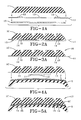
- Figures 1 through 5 and Figures 1A through 5A are provided to depict cross sections of a tread and cushion layer-containing tire to illustrate a tire tread with a plurality of lockable cavities and associated retreaded tire.
- an uncured tread rubber strip 1 is depicted with a heat deformable polymeric film 2 applied to its bottom surface to form a composite of the rubber strip 1 and polymeric film 2.
- a rigid metal plate 3 is also shown with a plurality of protrusions 6 of a trapezium cross-section extending from its upper surface and facing the aforesaid film 2 layer of the composite.
- the polymeric film 2 comprises a protective polymeric film of nylon 6 (melt point in a range of from 200°C to 220°C, ASTM D789) or nylon 6,6 (melt point in a range of from 250°C to 260°C, ASTM D789).
- a release agent coating of a polysiloxane is applied to the surfaces of tread strip 1 and protective film 2.
- the composite of uncured tread rubber strip 1 with its applied protective polymeric film 2 and metal plate 3 are pressed together in a suitable mold to cause the protrusions 6 of the trapezium design (short parallel side affixed to the metal plate) to press into and form a plurality of lockable cavities 7 of a trapezium configuration in the composite.
- the tread rubber strip 1 is then cured within the mold at an elevated temperature of about 180°C to form a cured tread strip 1C containing the protective polymeric film strip 2 and lockable cavities 7 in its bottom surface.
- the metal plate 3 is removed to leave the composite 9 composed of the cured tread 1C with its protective, removable polymeric film strip 2 on its bottom surface and the plurality of lockable cavities 7 of trapezium configurations in its bottom surface.
- the protective polymeric film strip 2 is peeled away from the bottom surface of the cured rubber tread strip 1C leaving the lockable cavities 7 exposed in its bottom surface. Further, a tire casing 5 is provided with its tread having been buffed off and an uncured cushion rubber layer 4 applied to its buffed surface.
- the cured rubber tread 1C is pressed onto the uncured rubber cushion 4 and the resulting assembly placed in an envelope and the enveloped assembly placed in a heated chamber (autoclave).
- the elevated temperature of the chamber and pressure exerted by the envelope causes portions 8 of the uncured rubber cushion 4 to extend into the lockable cavities 7 of the cured tread 1C, to form a retreaded tire 10 by curing the rubber cushion layer 4 to form a cured rubber cushion layer 4C and to thereby both bond the rubber cushion layer 4 to the tire carcass 5 and to create a mechano-chemical interlocking of the trapezium configured lockable cavities of the cured tire tread 1C and cured rubber cushion layer 4C.
- FIG 1A through FIG 5A are identical to the drawings.
- FIG 1A an uncured tread rubber strip 1 is depicted.
- a protective heat deformable polymeric film 11 having a plurality of protrusions 12 thereon its depicted rigid flat surfaced metal plate 13 is also shown.
- the polymeric film 11 comprises a protective polymeric film of nylon 6 (melt point in a range of from 200°C to 220°C, ASTM D789) or nylon 6,6 (melt point in a range of from 250°C to 260°C, ASTM D789).
- a release agent coating of a polysiloxane is applied to the surfaces of the tread strip 1 and the protective film 11.
- the uncured tread rubber strip 1 the protective polymeric strip 11 is provided and fitted to the metal strip 13 to form a composite or plate thereof.
- the composite is placed in a suitable mold to cause the protrusions 12 to press into and form a plurality of lockable cavities 14 in the rubber tread strip while curing the rubber strip within the mold at an elevated temperature of about 180°C to form a cured tread strip 1C containing the protective polymeric film strip 11 and associated lockable cavities 14 in its bottom surface.
- the metal plate 13 is removed to leave a composite 16 composed of the cured tread 1C with its protective, removable polymeric film strip 11 on its bottom surface and the plurality of lockable cavities 14 in its bottom surface.
- the protective polymeric film strip 11 is peeled away from the bottom surface of the cured rubber tread strip 1C leaving the lockable cavities 14 exposed in its bottom surface. Further, a tire casing 5 is provided with its tread having been buffed off and an uncured cushion rubber layer 4 applied to its buffed surface.
- the cured rubber tread 1C is pressed onto the uncured rubber cushion 4 and the resulting assembly placed in an envelope and the enveloped assembly placed in a heated chamber (autoclave).
- the elevated temperature of the chamber and pressure exerted by the envelope causes portions 15 of the uncured rubber cushion 4 to extend into the lockable cavities 14 of the cured tread 1C, to form a retreaded tire 17 by curing the rubber cushion layer 4 to thereby both bond the now cured rubber cushion layer 4C to the tire carcass 5 and to create a mechano-chemical interlocking of lockable cavities 14 of the cured tire tread 1C and cured rubber cushion layer 4C.
- a rubber composition which comprises an elastomeric rubber composition comprising at least one conjugated diene-based elastomer, for example, cis 1,4-polyisoprene natural rubber and, optionally cis 1,4-polybutadiene rubber, which contains a bis-imide compound and tackifier resin ( US-A- 5,503,940 ).
- Said bis-imide compound comprises N,N'm-xylene biscitraconic imide, together with a tackifier as a phenol-formaldehyde tackifier resin.
- Test Samples Pre-cured tread rubber samples were prepared to evaluate their adhesion to a tread cushion rubber composition.
- uncured rubber samples in a shape of 6 inches by 6 inches with a thickness of 0.095 inch (about 15.2 x 15.2 x 0.24 cm) was die-cut from a milled 0.24 cm thick natural rubber based rubber strip.
- the rubber sample was in one sense, although smaller, similar to the uncured tread strip 1 depicted in FIG 1 .
- One side of the rubber sample was reinforced with a 0.033 inch (0.08 cm) thick treated fabric to add dimensional stability to the rubber sample.
- the protrusions had a trapezium shaped cross section similar to the protrusions depicted in FIG 1 of the Drawings.
- the depth of the trapezium shaped protrusion was 0.075 inch (0.2 cm) and the two sides were 0.372 inch (0.1 cm) and 0.5 inch (1.3cm) where the 0.375 inch (0.1 cm) side was affixed to the smooth surface of the metal plate.
- the plate was aligned in such a way that the metal strips were perpendicular to the cords of the fabric on the other side of the Test Sample.
- An uncured rubber sample in a shape of 6 inches by 6 inches with a thickness of about 0.095 inch (15.2 x 15.2 x 0.24 cm) was die-cut from a milled 0.24 cm thick rubber strip.
- the rubber sample was in one sense similar to the uncured cushion rubber strip 4 depicted in FIG 4 and comprise a 40 phr natural rubber and 60 phr cis 1,4-polybutadiene rubber based rubber composition containing an N,N'm-xylene biscitraconic imide, together with a tackifier resin (e.g. phenol-formaldehyde tackifier resin).
- a tackifier resin e.g. phenol-formaldehyde tackifier resin
Landscapes
- Engineering & Computer Science (AREA)
- Mechanical Engineering (AREA)
- Tires In General (AREA)
- Tyre Moulding (AREA)
Claims (14)
- Bandage pneumatique rechapé comprenant une couche circonférentielle de caoutchouc de bande de roulement vulcanisé (1C) et une carcasse (5), la couche de caoutchouc de bande de roulement vulcanisé (1C) comprenant une surface comprenant des cavités (7, 14) qui s'entrecroisent par voie mécano-chimique avec une couche de caoutchouc de rembourrage (4) recouvrant la carcasse (5), caractérisé en ce que le bandage pneumatique rechapé est exempt d'un revêtement adhésif entre la couche de caoutchouc de bande de roulement vulcanisé (1C) et la couche de caoutchouc de rembourrage (4), et en ce que la couche de caoutchouc de rembourrage (4) représente une composition de caoutchouc comprenant au moins un élastomère à base de diène conjugué qui contient un composé de bis-imide et une résine qui rend collant.
- Bandage pneumatique rechapé selon la revendication 1, dans lequel la couche de caoutchouc de rembourrage (4) représente une composition de caoutchouc comprenant du caoutchouc naturel (1,4-cis-polyisoprène) et du caoutchouc de 1,4-cis-polybutadiène, et dans lequel le bis-imide comprend du N,N'-imide biscitraconique de m-xylène, du N,N'-bismaléimide de m-phénylène, du 1,1'-(méthylène-4,1-phénylène)-bismaléimide, ou une de leurs combinaisons.
- Bandage pneumatique rechapé selon la revendication 1 ou 2, dans lequel l'agent rendant collant comprend une résine rendant collant à base de phénol-formaldéhyde.
- Bandage pneumatique rechapé selon la revendication 1, dans lequel les cavités (7, 14) sont des cavités configurées en trapèze.
- Procédé de préparation d'un bandage pneumatique rechapé (10, 17), le procédé comprenant le fait de :(A) appliquer une surface propre, non cémentée et non polie d'une couche de caoutchouc de bande de roulement vulcanisé (1C) sur une couche circonférentielle de caoutchouc de rembourrage non vulcanisé (4), en l'absence d'un revêtement adhésif entre les deux, la couche circonférentielle de caoutchouc de rembourrage non vulcanisé (4) recouvrant une carcasse vulcanisée (5) afin d'obtenir un assemblage ; et(B) vulcaniser l'assemblage à une température élevée pour obtenir le bandage pneumatique rechapé (10, 17) ;
dans lequel on prépare la couche de caoutchouc de bande de roulement vulcanisé (1C) :(1) par l'application d'un film un polymère amovible (2) sur au moins une surface de ruban de caoutchouc de bande de roulement non vulcanisé (1) afin d'obtenir un composite (9) ;(2) par l'application d'un agent de démoulage sur les surfaces du composite (9), y compris sur au moins une portion du film polymère (2) ;(3) par l'application du composite (9) comportant l'agent de démoulage sur une plaque métallique (3) pour obtenir un assemblage, plusieurs saillies (6) étant disposées sur la plaque métallique (3) ;(4) par le positionnement de l'assemblage dans un moule et l'application d'une température élevée et d'une pression élevée pour faire en sorte que les saillies (6) de la plaque métallique (3) s'étendent dans la surface du ruban de caoutchouc de bande de roulement non vulcanisé (1) pour y former des cavités verrouillables (7), et la vulcanisation du ruban de caoutchouc de bande de roulement non vulcanisé (1) contenant les cavités verrouillables à une température élevée pour obtenir un composite de ruban de caoutchouc de bande de roulement vulcanisé comprenant une couche de caoutchouc de bande de roulement vulcanisé (1C) comportant plusieurs cavités verrouillables (7, 14) dans sa surface inférieure et le film polymère amovible (2) moulé sur la couche de caoutchouc de bande de roulement vulcanisé (1C) , y compris sur les parois de ses cavités verrouillables (7, 14) ;(5) par le retrait du film polymère (2) par rapport à la couche de caoutchouc de bande de roulement vulcanisé (1C) afin d'obtenir une surface propre, non polie sur la couche de caoutchouc de bande de roulement vulcanisé (1C) avant d'appliquer la couche de caoutchouc de bande de roulement vulcanisé (1C) sur la couche circonférentielle (4) de caoutchouc de rembourrage non vulcanisé. - Procédé de préparation d'un bandage pneumatique rechapé (10, 17), le procédé comprenant le fait de :(A) appliquer une surface propre, non cémentée et non polie d'une couche de caoutchouc de bande de roulement vulcanisé (1C) sur une couche circonférentielle de caoutchouc de rembourrage non vulcanisé (4), en l'absence d'un revêtement adhésif entre les deux, la couche circonférentielle de caoutchouc de rembourrage non vulcanisé (4) recouvrant une carcasse vulcanisée (5) afin d'obtenir un assemblage ; et(B) vulcaniser l'assemblage à une température élevée pour obtenir le bandage pneumatique rechapé (10, 17) ;
dans lequel on prépare la couche de caoutchouc de bande de roulement vulcanisé (1C) :(1) par l'application d'un film polymère amovible (2) sur au moins une surface de ruban de caoutchouc de bande de roulement non vulcanisé (1) afin d'obtenir un composite, le film polymère (2) possédant un point de fusion, norme ASTM 789, supérieur ou significativement supérieur à la température de vulcanisation pour le ruban de caoutchouc de bande de roulement non vulcanisé (1), plusieurs saillies (6) étant disposées sur le film polymère (2) ;(2) par l'application d'un agent de démoulage sur les surfaces du composite (9), y compris sur au moins une portion de la surface du film polymère (2) sur le ruban de caoutchouc de bande de roulement non vulcanisé (1) ;(3) par l'application du composite (9) comportant l'agent de démoulage sur une plaque métallique (3) possédant une surface plate et la formation d'un assemblage du composite (9) comportant l'agent de démoulage et de la plaque métallique (3) ;(4) par le positionnement de l'assemblage dans un moule et par l'application d'une température élevée et d'une pression élevée pour faire en sorte que les saillies (6) du film polymère (2) s'étendent dans la surface du ruban de caoutchouc de bande de roulement non vulcanisé (1) pour y former des cavités verrouillables (7), et par la vulcanisation du ruban de caoutchouc de bande de roulement non vulcanisé (1) contenant les cavités verrouillables à une température élevée pour obtenir une couche ou un ruban de caoutchouc de bande de roulement vulcanisé (1) sur lequel est moulé le film polymère amovible (2), y compris sur les parois de ses cavités verrouillables (7). - Procédé selon la revendication 5 ou 6, dans lequel la couche de caoutchouc de rembourrage non vulcanisé (4) représente une composition de caoutchouc comprenant au moins un élastomère à base de diène conjugué qui contient un composé de bis-imide et une résine qui rend collant.
- Procédé selon la revendication 7, dans lequel la couche de caoutchouc de rembourrage (4) représente une composition de caoutchouc comprenant du caoutchouc naturel (1,4-cis-polyisoprène) et du caoutchouc de 1,4-cis-polybutadiène, et dans lequel le bis-imide comprend du N,N'-imide biscitraconique de m-xylène, du N,N'-bismaléimide de m-phénylène, du 1,1'-(méthylène-4,1-phénylène)-bismaléimide, ou une de leurs combinaisons.
- Procédé selon la revendication 7, dans lequel l'agent rendant collant comprend une résine rendant collant à base de phénol-formaldéhyde.
- Procédé selon la revendication 5 ou 6, dans lequel le film polymère (2), après son retrait de la couche de caoutchouc de bande de roulement vulcanisé (1C) et des parois associées des cavités verrouillables, procure une surface propre de caoutchouc de la couche de caoutchouc de bande de roulement vulcanisé (1C), y compris des parois des cavités verrouillables, pour ainsi rendre la surface et les cavités verrouillables de la couche de caoutchouc de bande de roulement vulcanisé (1C) disponibles pour l'entrecroisement mécano-chimique avec la couche de caoutchouc de rembourrage non vulcanisé (4) du bandage pneumatique (10, 17).
- Procédé selon la revendication 5 ou 6, dans lequel les cavités (7, 14) sont des cavités configurées en trapèze.
- Procédé selon la revendication 5 ou 6, dans lequel le film polymère (2) comprend du nylon 6,6 ou du nylon 6 ou représente le film de nylon ou un film polymère à base de nylon.
- Procédé selon la revendication 5 ou 6, dans lequel l'agent de démoulage est un agent de démoulage à base de polysiloxane.
- Procédé selon la revendication 5 ou 6, dans lequel le bandage pneumatique rechapé (10, 17) est exempt d'un revêtement adhésif entre la couche de caoutchouc de bande de roulement vulcanisé (1C) et la couche de caoutchouc de rembourrage non vulcanisé (4).
Applications Claiming Priority (1)
| Application Number | Priority Date | Filing Date | Title |
|---|---|---|---|
| US12/337,692 US20130146189A1 (en) | 2008-12-18 | 2008-12-18 | Retreaded tire and method of preparation |
Publications (3)
| Publication Number | Publication Date |
|---|---|
| EP2199110A2 EP2199110A2 (fr) | 2010-06-23 |
| EP2199110A3 EP2199110A3 (fr) | 2010-09-08 |
| EP2199110B1 true EP2199110B1 (fr) | 2013-03-20 |
Family
ID=42046306
Family Applications (1)
| Application Number | Title | Priority Date | Filing Date |
|---|---|---|---|
| EP09178308A Not-in-force EP2199110B1 (fr) | 2008-12-18 | 2009-12-08 | Pneu rechapé et procédés de préparation |
Country Status (2)
| Country | Link |
|---|---|
| US (1) | US20130146189A1 (fr) |
| EP (1) | EP2199110B1 (fr) |
Cited By (1)
| Publication number | Priority date | Publication date | Assignee | Title |
|---|---|---|---|---|
| US11247424B1 (en) | 2016-12-13 | 2022-02-15 | Bridgestone Americas Tire Operations, Llc | Methods for retreading tires |
Families Citing this family (9)
| Publication number | Priority date | Publication date | Assignee | Title |
|---|---|---|---|---|
| US20130276944A1 (en) * | 2010-12-29 | 2013-10-24 | Compagnie Generale Des Etablissements Michelin | Custom pre-cured retread |
| US9370971B2 (en) | 2010-12-29 | 2016-06-21 | Compagnie Generale Des Etablissements Michelin | Methods for retreading a tire |
| CN102336121B (zh) * | 2011-08-15 | 2013-02-13 | 江苏通用科技股份有限公司 | 轮胎胎冠结构 |
| WO2013029974A1 (fr) * | 2011-08-29 | 2013-03-07 | Kraiburg Austria Gmbh & Co. Kg | Procédé et dispositif de rechapage d'un pneu de véhicule et bande de roulement destinée à être utilisée au cours du procédé |
| US20160221288A1 (en) * | 2013-09-12 | 2016-08-04 | Cesar Enrique Zarak | Method of making pre-cured tread with textured bottom |
| BR112016014087A2 (pt) * | 2013-12-23 | 2017-08-08 | Bridgestone Americas Tire Operations Llc | Banda de rodagem de um pneu pré-moldado com camada de reforço de tecido |
| FR3022488B1 (fr) * | 2014-06-20 | 2017-02-24 | Michelin & Cie | Procede de moulage d'un composite thermoplastique elastomerique pour pneumatique |
| FR3035027A1 (fr) * | 2015-04-20 | 2016-10-21 | Daniel Chazot | Pneumatique avec bande de roulement amovible |
| WO2018022876A1 (fr) | 2016-07-28 | 2018-02-01 | Bridgestone Americas Tire Operations, Llc | Résine de carbamate pour adhérence au polyuréthane |
Family Cites Families (10)
| Publication number | Priority date | Publication date | Assignee | Title |
|---|---|---|---|---|
| DE1228525B (de) * | 1958-03-06 | 1966-11-10 | Lemfoerder Kunststoff G M B H | Kraftfahrzeugreifen |
| DE2244391B2 (de) * | 1972-09-09 | 1978-03-02 | Vakuum Vulk Holdings Ltd., Nassau | Verfahren und Vulkanisierformen zum Runderneuern von Fahrzeugreifen |
| ZA746058B (en) * | 1974-09-24 | 1976-04-28 | Republic Rubber Ind Ltd | Improvements in or relating to the retreading of tyress |
| JP2671287B2 (ja) * | 1993-02-04 | 1997-10-29 | 泰太郎 藤井 | タイヤ |
| US5503940A (en) * | 1994-10-24 | 1996-04-02 | The Goodyear Tire & Rubber Company | Elastomeric laminates containing a solventless elastomeric adhesive composition |
| JPH0970903A (ja) * | 1995-06-26 | 1997-03-18 | Yokohama Rubber Co Ltd:The | 再生タイヤ用プレキュアトレッドとその製造方法 |
| JP2000079641A (ja) * | 1998-06-30 | 2000-03-21 | Bridgestone Corp | 更生タイヤ用プレキュアトレッドおよびその製造方法 |
| US6397910B1 (en) * | 2000-01-12 | 2002-06-04 | The Goodyear Tire & Rubber Company | Retreaded tire having tread with oil rich rubber-based adhesive |
| US7419557B2 (en) * | 2005-09-08 | 2008-09-02 | The Goodyear Tire & Rubber Company | Method for protecting tire innerliner using thermoformable film coated with pressure-sensitive adhesive |
| BRPI0622133B1 (pt) * | 2006-11-30 | 2019-05-14 | Compagnie Generale Des Etablissements Michelin | Método para tornar áspera a única superfície lateral de uma banda de rodagem, rolo de suporte para texturizar uma banda de rodagem, suporte para texturizar uma banda de rodagem, e, bandeja de banda de rodagem |
-
2008
- 2008-12-18 US US12/337,692 patent/US20130146189A1/en not_active Abandoned
-
2009
- 2009-12-08 EP EP09178308A patent/EP2199110B1/fr not_active Not-in-force
Cited By (1)
| Publication number | Priority date | Publication date | Assignee | Title |
|---|---|---|---|---|
| US11247424B1 (en) | 2016-12-13 | 2022-02-15 | Bridgestone Americas Tire Operations, Llc | Methods for retreading tires |
Also Published As
| Publication number | Publication date |
|---|---|
| US20130146189A1 (en) | 2013-06-13 |
| EP2199110A2 (fr) | 2010-06-23 |
| EP2199110A3 (fr) | 2010-09-08 |
Similar Documents
| Publication | Publication Date | Title |
|---|---|---|
| EP2199110B1 (fr) | Pneu rechapé et procédés de préparation | |
| EP2199109B1 (fr) | Couche de bande de roulement d'un pneu et procédés de préparation | |
| US20090159165A1 (en) | Tire tread composite and retreaded rubber tire | |
| EP2172349B1 (fr) | Pneu pneumatique avec couche de protection | |
| US20040115299A1 (en) | Seal-less reusable vacuum bag | |
| EP2397347B1 (fr) | Procédé de fabrication de pneu avec amortisseur de bruit en mousse et pneu avec amortisseur de bruit | |
| EP1435286B1 (fr) | Film barrière adherent et amovible pour une carcasse de pneu | |
| EP1990179B1 (fr) | Procede de fabrication de pneumatique | |
| JPH1193141A (ja) | 防舷材及びその製造方法 | |
| EP1579985B1 (fr) | Procédé de rechapage d'un pneumatique ayant une couche de liaison détectable | |
| US6598634B1 (en) | Cured tire including encapsulated high modulus composite | |
| CA2088896A1 (fr) | Pneu presentant un applique decoratif, et methode permettant de poser un tel applique sur un pneu | |
| WO2017072560A1 (fr) | Fabrication de rayon pour une roue non pneumatique | |
| CN103228430B (zh) | 充气轮胎的制造方法 | |
| WO2014088064A1 (fr) | Pneumatique équipé d'un élément de fixation autoagrippant et procédé de fabrication dudit pneu | |
| US4262719A (en) | Tire liner and method of preparation | |
| EP1645404B1 (fr) | Procede de formation de pneumatiques, et tambour de mise en forme | |
| US5645674A (en) | Methods for achieving improved bond strength between unvulcanized and vulcanized rubbers | |
| EP0552620B1 (fr) | Structure composite caoutchouc-caoutchouc | |
| US6117258A (en) | Band element and method for building same for a run flat banded tire | |
| US4263074A (en) | Tire liner and method of preparation | |
| EP3086930A1 (fr) | Bande de roulement pré-vulcanisée comprenant une couche de renforcement en tissu | |
| JP2001138408A (ja) | 押し出し可能な更生トレッドタイヤスプライシング | |
| EP4335631B1 (fr) | Ensemble de structure composite et production de pneu non pneumatique | |
| JPH09239855A (ja) | 複合積層体の製造方法 |
Legal Events
| Date | Code | Title | Description |
|---|---|---|---|
| PUAI | Public reference made under article 153(3) epc to a published international application that has entered the european phase |
Free format text: ORIGINAL CODE: 0009012 |
|
| AK | Designated contracting states |
Kind code of ref document: A2 Designated state(s): AT BE BG CH CY CZ DE DK EE ES FI FR GB GR HR HU IE IS IT LI LT LU LV MC MK MT NL NO PL PT RO SE SI SK SM TR |
|
| AX | Request for extension of the european patent |
Extension state: AL BA RS |
|
| PUAL | Search report despatched |
Free format text: ORIGINAL CODE: 0009013 |
|
| AK | Designated contracting states |
Kind code of ref document: A3 Designated state(s): AT BE BG CH CY CZ DE DK EE ES FI FR GB GR HR HU IE IS IT LI LT LU LV MC MK MT NL NO PL PT RO SE SI SK SM TR |
|
| AX | Request for extension of the european patent |
Extension state: AL BA RS |
|
| RIC1 | Information provided on ipc code assigned before grant |
Ipc: B29D 30/56 20060101ALI20100802BHEP Ipc: B60C 11/02 20060101AFI20100401BHEP |
|
| 17P | Request for examination filed |
Effective date: 20110308 |
|
| GRAP | Despatch of communication of intention to grant a patent |
Free format text: ORIGINAL CODE: EPIDOSNIGR1 |
|
| GRAS | Grant fee paid |
Free format text: ORIGINAL CODE: EPIDOSNIGR3 |
|
| GRAA | (expected) grant |
Free format text: ORIGINAL CODE: 0009210 |
|
| AK | Designated contracting states |
Kind code of ref document: B1 Designated state(s): AT BE BG CH CY CZ DE DK EE ES FI FR GB GR HR HU IE IS IT LI LT LU LV MC MK MT NL NO PL PT RO SE SI SK SM TR |
|
| REG | Reference to a national code |
Ref country code: GB Ref legal event code: FG4D |
|
| REG | Reference to a national code |
Ref country code: CH Ref legal event code: EP |
|
| REG | Reference to a national code |
Ref country code: IE Ref legal event code: FG4D |
|
| REG | Reference to a national code |
Ref country code: AT Ref legal event code: REF Ref document number: 601829 Country of ref document: AT Kind code of ref document: T Effective date: 20130415 |
|
| REG | Reference to a national code |
Ref country code: DE Ref legal event code: R096 Ref document number: 602009014110 Country of ref document: DE Effective date: 20130516 |
|
| PG25 | Lapsed in a contracting state [announced via postgrant information from national office to epo] |
Ref country code: NO Free format text: LAPSE BECAUSE OF FAILURE TO SUBMIT A TRANSLATION OF THE DESCRIPTION OR TO PAY THE FEE WITHIN THE PRESCRIBED TIME-LIMIT Effective date: 20130620 Ref country code: ES Free format text: LAPSE BECAUSE OF FAILURE TO SUBMIT A TRANSLATION OF THE DESCRIPTION OR TO PAY THE FEE WITHIN THE PRESCRIBED TIME-LIMIT Effective date: 20130701 Ref country code: LT Free format text: LAPSE BECAUSE OF FAILURE TO SUBMIT A TRANSLATION OF THE DESCRIPTION OR TO PAY THE FEE WITHIN THE PRESCRIBED TIME-LIMIT Effective date: 20130320 Ref country code: SE Free format text: LAPSE BECAUSE OF FAILURE TO SUBMIT A TRANSLATION OF THE DESCRIPTION OR TO PAY THE FEE WITHIN THE PRESCRIBED TIME-LIMIT Effective date: 20130320 Ref country code: BG Free format text: LAPSE BECAUSE OF FAILURE TO SUBMIT A TRANSLATION OF THE DESCRIPTION OR TO PAY THE FEE WITHIN THE PRESCRIBED TIME-LIMIT Effective date: 20130620 |
|
| REG | Reference to a national code |
Ref country code: AT Ref legal event code: MK05 Ref document number: 601829 Country of ref document: AT Kind code of ref document: T Effective date: 20130320 |
|
| REG | Reference to a national code |
Ref country code: LT Ref legal event code: MG4D |
|
| PG25 | Lapsed in a contracting state [announced via postgrant information from national office to epo] |
Ref country code: GR Free format text: LAPSE BECAUSE OF FAILURE TO SUBMIT A TRANSLATION OF THE DESCRIPTION OR TO PAY THE FEE WITHIN THE PRESCRIBED TIME-LIMIT Effective date: 20130621 Ref country code: LV Free format text: LAPSE BECAUSE OF FAILURE TO SUBMIT A TRANSLATION OF THE DESCRIPTION OR TO PAY THE FEE WITHIN THE PRESCRIBED TIME-LIMIT Effective date: 20130320 Ref country code: SI Free format text: LAPSE BECAUSE OF FAILURE TO SUBMIT A TRANSLATION OF THE DESCRIPTION OR TO PAY THE FEE WITHIN THE PRESCRIBED TIME-LIMIT Effective date: 20130320 Ref country code: FI Free format text: LAPSE BECAUSE OF FAILURE TO SUBMIT A TRANSLATION OF THE DESCRIPTION OR TO PAY THE FEE WITHIN THE PRESCRIBED TIME-LIMIT Effective date: 20130320 |
|
| REG | Reference to a national code |
Ref country code: NL Ref legal event code: VDEP Effective date: 20130320 |
|
| PG25 | Lapsed in a contracting state [announced via postgrant information from national office to epo] |
Ref country code: HR Free format text: LAPSE BECAUSE OF FAILURE TO SUBMIT A TRANSLATION OF THE DESCRIPTION OR TO PAY THE FEE WITHIN THE PRESCRIBED TIME-LIMIT Effective date: 20130320 Ref country code: BE Free format text: LAPSE BECAUSE OF FAILURE TO SUBMIT A TRANSLATION OF THE DESCRIPTION OR TO PAY THE FEE WITHIN THE PRESCRIBED TIME-LIMIT Effective date: 20130320 |
|
| PG25 | Lapsed in a contracting state [announced via postgrant information from national office to epo] |
Ref country code: AT Free format text: LAPSE BECAUSE OF FAILURE TO SUBMIT A TRANSLATION OF THE DESCRIPTION OR TO PAY THE FEE WITHIN THE PRESCRIBED TIME-LIMIT Effective date: 20130320 Ref country code: SK Free format text: LAPSE BECAUSE OF FAILURE TO SUBMIT A TRANSLATION OF THE DESCRIPTION OR TO PAY THE FEE WITHIN THE PRESCRIBED TIME-LIMIT Effective date: 20130320 Ref country code: PT Free format text: LAPSE BECAUSE OF FAILURE TO SUBMIT A TRANSLATION OF THE DESCRIPTION OR TO PAY THE FEE WITHIN THE PRESCRIBED TIME-LIMIT Effective date: 20130722 Ref country code: EE Free format text: LAPSE BECAUSE OF FAILURE TO SUBMIT A TRANSLATION OF THE DESCRIPTION OR TO PAY THE FEE WITHIN THE PRESCRIBED TIME-LIMIT Effective date: 20130320 Ref country code: IS Free format text: LAPSE BECAUSE OF FAILURE TO SUBMIT A TRANSLATION OF THE DESCRIPTION OR TO PAY THE FEE WITHIN THE PRESCRIBED TIME-LIMIT Effective date: 20130720 Ref country code: NL Free format text: LAPSE BECAUSE OF FAILURE TO SUBMIT A TRANSLATION OF THE DESCRIPTION OR TO PAY THE FEE WITHIN THE PRESCRIBED TIME-LIMIT Effective date: 20130320 Ref country code: RO Free format text: LAPSE BECAUSE OF FAILURE TO SUBMIT A TRANSLATION OF THE DESCRIPTION OR TO PAY THE FEE WITHIN THE PRESCRIBED TIME-LIMIT Effective date: 20130320 Ref country code: CZ Free format text: LAPSE BECAUSE OF FAILURE TO SUBMIT A TRANSLATION OF THE DESCRIPTION OR TO PAY THE FEE WITHIN THE PRESCRIBED TIME-LIMIT Effective date: 20130320 |
|
| PG25 | Lapsed in a contracting state [announced via postgrant information from national office to epo] |
Ref country code: PL Free format text: LAPSE BECAUSE OF FAILURE TO SUBMIT A TRANSLATION OF THE DESCRIPTION OR TO PAY THE FEE WITHIN THE PRESCRIBED TIME-LIMIT Effective date: 20130320 Ref country code: CY Free format text: LAPSE BECAUSE OF FAILURE TO SUBMIT A TRANSLATION OF THE DESCRIPTION OR TO PAY THE FEE WITHIN THE PRESCRIBED TIME-LIMIT Effective date: 20130320 |
|
| PLBE | No opposition filed within time limit |
Free format text: ORIGINAL CODE: 0009261 |
|
| STAA | Information on the status of an ep patent application or granted ep patent |
Free format text: STATUS: NO OPPOSITION FILED WITHIN TIME LIMIT |
|
| PG25 | Lapsed in a contracting state [announced via postgrant information from national office to epo] |
Ref country code: DK Free format text: LAPSE BECAUSE OF FAILURE TO SUBMIT A TRANSLATION OF THE DESCRIPTION OR TO PAY THE FEE WITHIN THE PRESCRIBED TIME-LIMIT Effective date: 20130320 |
|
| 26N | No opposition filed |
Effective date: 20140102 |
|
| PGFP | Annual fee paid to national office [announced via postgrant information from national office to epo] |
Ref country code: TR Payment date: 20131122 Year of fee payment: 5 |
|
| REG | Reference to a national code |
Ref country code: DE Ref legal event code: R097 Ref document number: 602009014110 Country of ref document: DE Effective date: 20140102 |
|
| REG | Reference to a national code |
Ref country code: CH Ref legal event code: PL |
|
| GBPC | Gb: european patent ceased through non-payment of renewal fee |
Effective date: 20131208 |
|
| PG25 | Lapsed in a contracting state [announced via postgrant information from national office to epo] |
Ref country code: MC Free format text: LAPSE BECAUSE OF FAILURE TO SUBMIT A TRANSLATION OF THE DESCRIPTION OR TO PAY THE FEE WITHIN THE PRESCRIBED TIME-LIMIT Effective date: 20130320 Ref country code: LU Free format text: LAPSE BECAUSE OF FAILURE TO SUBMIT A TRANSLATION OF THE DESCRIPTION OR TO PAY THE FEE WITHIN THE PRESCRIBED TIME-LIMIT Effective date: 20131208 |
|
| REG | Reference to a national code |
Ref country code: IE Ref legal event code: MM4A |
|
| PG25 | Lapsed in a contracting state [announced via postgrant information from national office to epo] |
Ref country code: LI Free format text: LAPSE BECAUSE OF NON-PAYMENT OF DUE FEES Effective date: 20131231 Ref country code: IE Free format text: LAPSE BECAUSE OF NON-PAYMENT OF DUE FEES Effective date: 20131208 Ref country code: CH Free format text: LAPSE BECAUSE OF NON-PAYMENT OF DUE FEES Effective date: 20131231 |
|
| PG25 | Lapsed in a contracting state [announced via postgrant information from national office to epo] |
Ref country code: GB Free format text: LAPSE BECAUSE OF NON-PAYMENT OF DUE FEES Effective date: 20131208 |
|
| PG25 | Lapsed in a contracting state [announced via postgrant information from national office to epo] |
Ref country code: SM Free format text: LAPSE BECAUSE OF FAILURE TO SUBMIT A TRANSLATION OF THE DESCRIPTION OR TO PAY THE FEE WITHIN THE PRESCRIBED TIME-LIMIT Effective date: 20130320 |
|
| PG25 | Lapsed in a contracting state [announced via postgrant information from national office to epo] |
Ref country code: HU Free format text: LAPSE BECAUSE OF FAILURE TO SUBMIT A TRANSLATION OF THE DESCRIPTION OR TO PAY THE FEE WITHIN THE PRESCRIBED TIME-LIMIT; INVALID AB INITIO Effective date: 20091208 Ref country code: MK Free format text: LAPSE BECAUSE OF FAILURE TO SUBMIT A TRANSLATION OF THE DESCRIPTION OR TO PAY THE FEE WITHIN THE PRESCRIBED TIME-LIMIT Effective date: 20130320 |
|
| PG25 | Lapsed in a contracting state [announced via postgrant information from national office to epo] |
Ref country code: MT Free format text: LAPSE BECAUSE OF FAILURE TO SUBMIT A TRANSLATION OF THE DESCRIPTION OR TO PAY THE FEE WITHIN THE PRESCRIBED TIME-LIMIT Effective date: 20130320 |
|
| REG | Reference to a national code |
Ref country code: FR Ref legal event code: PLFP Year of fee payment: 7 |
|
| REG | Reference to a national code |
Ref country code: FR Ref legal event code: PLFP Year of fee payment: 8 |
|
| PG25 | Lapsed in a contracting state [announced via postgrant information from national office to epo] |
Ref country code: TR Free format text: LAPSE BECAUSE OF NON-PAYMENT OF DUE FEES Effective date: 20141208 |
|
| REG | Reference to a national code |
Ref country code: FR Ref legal event code: PLFP Year of fee payment: 9 |
|
| PGFP | Annual fee paid to national office [announced via postgrant information from national office to epo] |
Ref country code: FR Payment date: 20171120 Year of fee payment: 9 |
|
| PGFP | Annual fee paid to national office [announced via postgrant information from national office to epo] |
Ref country code: IT Payment date: 20171219 Year of fee payment: 9 |
|
| PGFP | Annual fee paid to national office [announced via postgrant information from national office to epo] |
Ref country code: DE Payment date: 20171221 Year of fee payment: 9 |
|
| REG | Reference to a national code |
Ref country code: DE Ref legal event code: R119 Ref document number: 602009014110 Country of ref document: DE |
|
| PG25 | Lapsed in a contracting state [announced via postgrant information from national office to epo] |
Ref country code: FR Free format text: LAPSE BECAUSE OF NON-PAYMENT OF DUE FEES Effective date: 20181231 Ref country code: IT Free format text: LAPSE BECAUSE OF NON-PAYMENT OF DUE FEES Effective date: 20181208 Ref country code: DE Free format text: LAPSE BECAUSE OF NON-PAYMENT OF DUE FEES Effective date: 20190702 |