EP2199316A1 - Procédé amélioré pur la production d'un raccord pour liquides et raccord correspondant - Google Patents
Procédé amélioré pur la production d'un raccord pour liquides et raccord correspondant Download PDFInfo
- Publication number
- EP2199316A1 EP2199316A1 EP09178960A EP09178960A EP2199316A1 EP 2199316 A1 EP2199316 A1 EP 2199316A1 EP 09178960 A EP09178960 A EP 09178960A EP 09178960 A EP09178960 A EP 09178960A EP 2199316 A1 EP2199316 A1 EP 2199316A1
- Authority
- EP
- European Patent Office
- Prior art keywords
- kneading
- process stage
- stirring device
- sio
- optionally
- Prior art date
- Legal status (The legal status is an assumption and is not a legal conclusion. Google has not performed a legal analysis and makes no representation as to the accuracy of the status listed.)
- Granted
Links
Images


Classifications
-
- C—CHEMISTRY; METALLURGY
- C08—ORGANIC MACROMOLECULAR COMPOUNDS; THEIR PREPARATION OR CHEMICAL WORKING-UP; COMPOSITIONS BASED THEREON
- C08L—COMPOSITIONS OF MACROMOLECULAR COMPOUNDS
- C08L83/00—Compositions of macromolecular compounds obtained by reactions forming in the main chain of the macromolecule a linkage containing silicon with or without sulfur, nitrogen, oxygen or carbon only; Compositions of derivatives of such polymers
- C08L83/04—Polysiloxanes
-
- B—PERFORMING OPERATIONS; TRANSPORTING
- B01—PHYSICAL OR CHEMICAL PROCESSES OR APPARATUS IN GENERAL
- B01F—MIXING, e.g. DISSOLVING, EMULSIFYING OR DISPERSING
- B01F27/00—Mixers with rotary stirring devices in fixed receptacles; Kneaders
- B01F27/80—Mixers with rotary stirring devices in fixed receptacles; Kneaders with stirrers rotating about a substantially vertical axis
-
- B—PERFORMING OPERATIONS; TRANSPORTING
- B29—WORKING OF PLASTICS; WORKING OF SUBSTANCES IN A PLASTIC STATE IN GENERAL
- B29B—PREPARATION OR PRETREATMENT OF THE MATERIAL TO BE SHAPED; MAKING GRANULES OR PREFORMS; RECOVERY OF PLASTICS OR OTHER CONSTITUENTS OF WASTE MATERIAL CONTAINING PLASTICS
- B29B7/00—Mixing; Kneading
- B29B7/30—Mixing; Kneading continuous, with mechanical mixing or kneading devices
- B29B7/34—Mixing; Kneading continuous, with mechanical mixing or kneading devices with movable mixing or kneading devices
- B29B7/38—Mixing; Kneading continuous, with mechanical mixing or kneading devices with movable mixing or kneading devices rotary
- B29B7/40—Mixing; Kneading continuous, with mechanical mixing or kneading devices with movable mixing or kneading devices rotary with single shaft
- B29B7/44—Mixing; Kneading continuous, with mechanical mixing or kneading devices with movable mixing or kneading devices rotary with single shaft with paddles or arms
-
- B—PERFORMING OPERATIONS; TRANSPORTING
- B29—WORKING OF PLASTICS; WORKING OF SUBSTANCES IN A PLASTIC STATE IN GENERAL
- B29B—PREPARATION OR PRETREATMENT OF THE MATERIAL TO BE SHAPED; MAKING GRANULES OR PREFORMS; RECOVERY OF PLASTICS OR OTHER CONSTITUENTS OF WASTE MATERIAL CONTAINING PLASTICS
- B29B7/00—Mixing; Kneading
- B29B7/30—Mixing; Kneading continuous, with mechanical mixing or kneading devices
- B29B7/34—Mixing; Kneading continuous, with mechanical mixing or kneading devices with movable mixing or kneading devices
- B29B7/38—Mixing; Kneading continuous, with mechanical mixing or kneading devices with movable mixing or kneading devices rotary
- B29B7/46—Mixing; Kneading continuous, with mechanical mixing or kneading devices with movable mixing or kneading devices rotary with more than one shaft
- B29B7/48—Mixing; Kneading continuous, with mechanical mixing or kneading devices with movable mixing or kneading devices rotary with more than one shaft with intermeshing devices, e.g. screws
-
- B—PERFORMING OPERATIONS; TRANSPORTING
- B29—WORKING OF PLASTICS; WORKING OF SUBSTANCES IN A PLASTIC STATE IN GENERAL
- B29B—PREPARATION OR PRETREATMENT OF THE MATERIAL TO BE SHAPED; MAKING GRANULES OR PREFORMS; RECOVERY OF PLASTICS OR OTHER CONSTITUENTS OF WASTE MATERIAL CONTAINING PLASTICS
- B29B7/00—Mixing; Kneading
- B29B7/74—Mixing; Kneading using other mixers or combinations of mixers, e.g. of dissimilar mixers ; Plant
- B29B7/7461—Combinations of dissimilar mixers
-
- B—PERFORMING OPERATIONS; TRANSPORTING
- B29—WORKING OF PLASTICS; WORKING OF SUBSTANCES IN A PLASTIC STATE IN GENERAL
- B29B—PREPARATION OR PRETREATMENT OF THE MATERIAL TO BE SHAPED; MAKING GRANULES OR PREFORMS; RECOVERY OF PLASTICS OR OTHER CONSTITUENTS OF WASTE MATERIAL CONTAINING PLASTICS
- B29B7/00—Mixing; Kneading
- B29B7/74—Mixing; Kneading using other mixers or combinations of mixers, e.g. of dissimilar mixers ; Plant
- B29B7/7466—Combinations of similar mixers
-
- B—PERFORMING OPERATIONS; TRANSPORTING
- B29—WORKING OF PLASTICS; WORKING OF SUBSTANCES IN A PLASTIC STATE IN GENERAL
- B29B—PREPARATION OR PRETREATMENT OF THE MATERIAL TO BE SHAPED; MAKING GRANULES OR PREFORMS; RECOVERY OF PLASTICS OR OTHER CONSTITUENTS OF WASTE MATERIAL CONTAINING PLASTICS
- B29B7/00—Mixing; Kneading
- B29B7/74—Mixing; Kneading using other mixers or combinations of mixers, e.g. of dissimilar mixers ; Plant
- B29B7/7476—Systems, i.e. flow charts or diagrams; Plants
- B29B7/7495—Systems, i.e. flow charts or diagrams; Plants for mixing rubber
-
- B—PERFORMING OPERATIONS; TRANSPORTING
- B29—WORKING OF PLASTICS; WORKING OF SUBSTANCES IN A PLASTIC STATE IN GENERAL
- B29C—SHAPING OR JOINING OF PLASTICS; SHAPING OF MATERIAL IN A PLASTIC STATE, NOT OTHERWISE PROVIDED FOR; AFTER-TREATMENT OF THE SHAPED PRODUCTS, e.g. REPAIRING
- B29C48/00—Extrusion moulding, i.e. expressing the moulding material through a die or nozzle which imparts the desired form; Apparatus therefor
- B29C48/25—Component parts, details or accessories; Auxiliary operations
- B29C48/36—Means for plasticising or homogenising the moulding material or forcing it through the nozzle or die
- B29C48/50—Details of extruders
- B29C48/505—Screws
- B29C48/57—Screws provided with kneading disc-like elements, e.g. with oval-shaped elements
-
- B—PERFORMING OPERATIONS; TRANSPORTING
- B29—WORKING OF PLASTICS; WORKING OF SUBSTANCES IN A PLASTIC STATE IN GENERAL
- B29C—SHAPING OR JOINING OF PLASTICS; SHAPING OF MATERIAL IN A PLASTIC STATE, NOT OTHERWISE PROVIDED FOR; AFTER-TREATMENT OF THE SHAPED PRODUCTS, e.g. REPAIRING
- B29C48/00—Extrusion moulding, i.e. expressing the moulding material through a die or nozzle which imparts the desired form; Apparatus therefor
- B29C48/25—Component parts, details or accessories; Auxiliary operations
- B29C48/36—Means for plasticising or homogenising the moulding material or forcing it through the nozzle or die
- B29C48/50—Details of extruders
- B29C48/505—Screws
- B29C48/625—Screws characterised by the ratio of the threaded length of the screw to its outside diameter [L/D ratio]
-
- C—CHEMISTRY; METALLURGY
- C08—ORGANIC MACROMOLECULAR COMPOUNDS; THEIR PREPARATION OR CHEMICAL WORKING-UP; COMPOSITIONS BASED THEREON
- C08G—MACROMOLECULAR COMPOUNDS OBTAINED OTHERWISE THAN BY REACTIONS ONLY INVOLVING UNSATURATED CARBON-TO-CARBON BONDS
- C08G77/00—Macromolecular compounds obtained by reactions forming a linkage containing silicon with or without sulfur, nitrogen, oxygen or carbon in the main chain of the macromolecule
- C08G77/04—Polysiloxanes
- C08G77/06—Preparatory processes
-
- C—CHEMISTRY; METALLURGY
- C08—ORGANIC MACROMOLECULAR COMPOUNDS; THEIR PREPARATION OR CHEMICAL WORKING-UP; COMPOSITIONS BASED THEREON
- C08J—WORKING-UP; GENERAL PROCESSES OF COMPOUNDING; AFTER-TREATMENT NOT COVERED BY SUBCLASSES C08B, C08C, C08F, C08G or C08H
- C08J3/00—Processes of treating or compounding macromolecular substances
- C08J3/20—Compounding polymers with additives, e.g. colouring
-
- C—CHEMISTRY; METALLURGY
- C08—ORGANIC MACROMOLECULAR COMPOUNDS; THEIR PREPARATION OR CHEMICAL WORKING-UP; COMPOSITIONS BASED THEREON
- C08K—Use of inorganic or non-macromolecular organic substances as compounding ingredients
- C08K3/00—Use of inorganic substances as compounding ingredients
- C08K3/34—Silicon-containing compounds
- C08K3/36—Silica
-
- C—CHEMISTRY; METALLURGY
- C08—ORGANIC MACROMOLECULAR COMPOUNDS; THEIR PREPARATION OR CHEMICAL WORKING-UP; COMPOSITIONS BASED THEREON
- C08J—WORKING-UP; GENERAL PROCESSES OF COMPOUNDING; AFTER-TREATMENT NOT COVERED BY SUBCLASSES C08B, C08C, C08F, C08G or C08H
- C08J2383/00—Characterised by the use of macromolecular compounds obtained by reactions forming in the main chain of the macromolecule a linkage containing silicon with or without sulfur, nitrogen, oxygen, or carbon only; Derivatives of such polymers
- C08J2383/04—Polysiloxanes
Definitions
- the present invention relates to a continuous process for preparing masterbatches for addition-crosslinking silicone compositions having improved stability to viscosity increase, SiH degradation, change in reactivity, and additive degradation upon storage.
- LSR liquid silicone rubber
- base materials are mixed homogeneously with a vulcanization agent and with other typical constituents of addition-crosslinking silicone compositions, which are used to adjust certain end properties of the silicone elastomers obtained after vulcanization.
- pre-hydrophobized fillers are used for the preparation of base materials which are homogeneously mixed and kneaded together with corresponding organopolysiloxanes.
- Another way to make masterbatches is to use hydrophilic fillers that are rendered hydrophobic in-situ during the so-called compounding process using suitable treatment agents.
- the training process usually takes place in one Planetendissolver or kneaders, such as sigma kneader or Doppelmuldenkneter, which are in principle unsuitable for a continuous production process.
- silicone compositions can be prepared from base materials consisting of organopolysiloxanes and prehydrophobized oxidic reinforcing fillers with high storage stability, the silicone elastomers prepared on the basis of these basic materials being distinguished by a very balanced mechanical property profile.
- the continuous process steps may relate both to the continuous preparation of base stocks and to the continuous production of finished silicone compositions, the latter consisting in most cases of one or at least two components.
- Silicone compositions which are built up from continuously produced base materials and in which pre-hydrophobized fillers are used, generally have a reduced stability in comparison with silicone compositions containing discontinuously prepared base materials.
- the aforesaid reduced stability of the silicone compositions prepared from continuously prepared base materials according to the prior art can be manifested, for example, in the form of an increase in the viscosity of the silicone compositions after storage, in particular at elevated temperatures, for example during transport of the silicone compositions.
- EP 0 462 032 A1 describes a continuous in situ process for the preparation of base materials which are suitable for the preparation of silicone compositions which are crosslinkable via a polyaddition reaction.
- the compounding takes place in a twin-screw extruder by continuous and simultaneous metered addition of a vinyl-bearing organopolysiloxane, a filler and a liquid polysilazane and water.
- EP 0 776 751 A1 there is described a continuous in-situ process for making masterbatches wherein the masterbatch is made in a biaxially continuously extruding and mixing machine.
- the biaxially continuously extruding and mixing machine has a two-lumen inlet tube, via which the hydrophobizing agent consisting of hydrolyzable organosilicon compound and water, and the filler via the outer lumen and the organopolysiloxane via the inner lumen are metered.
- the US 6,749,786 B2 describes a continuous in-situ process for the preparation of low volatility liquid silicone rubber (LSR) bases using an extruder having an L / D ratio (length to diameter) of at least greater than 70.
- LSR liquid silicone rubber
- the Degassing occurs at several ports positioned just before the outlet of the extruder.
- EP 0 807 509 A1 discloses the continuous preparation of shelf-stable addition-crosslinking liquid silicone rubbers using a special kneading machine cascade.
- the degassing of the basic masses produced by means of the kneading machine via a simple degassing but does not include aftertreatment of the matrix via a specially designed aftertreatment device with shear force input and high average residence time.
- the silicone compositions prepared from these basic compositions are already characterized by a good stability with regard to an increase in viscosity during storage, but this still needs to be improved, since a disturbing increase in viscosity can still be found which leads to a reduction in the durability of the finished silicone compositions.
- Another object was to provide a method in which volume flows of more than 300 kg / h are possible.
- radicals R 1 of at least one diorganopolysiloxane (A) are alkyl radicals, such as methyl, ethyl, propyl, isopropyl, tert-butyl, n-pentyl, iso-pentyl, neoPentyl, tert.
- radicals R 1 contain 1 to 10 carbon atoms and optionally halogen substituents. Particularly preferred radicals R 1 are methyl, phenyl and 3,3,3-trifluoropropyl, in particular the methyl radical.
- the radicals R 2 are accessible to a hydrosilylation reaction.
- alkenyl and alkynyl radicals such as vinyl, allyl, isopropenyl, 3-butenyl, 2,4-pentadienyl, butadienyl, 5-hexenyl, undecenyl, ethynyl, propynyl and hexynyl radical
- Cycloalkenyl radicals such as cyclopentenyl, cyclohexenyl, 3-cyclohexenylethyl, 5-bicycloheptenyl, norbornenyl, 4-cyclooctenyl or cyclooctadienyl radical
- Alkenylaryl radicals such as styryl or styrylethyl radical, and halogenated and heteroatom-containing derivatives of the above radicals, such as 2-bromovinyl, 3-bromo-1-propynyl, 1-chloro
- the viscosity determined at 25 ° C. is preferably 1 to 40,000,000 mPa * s, more preferably 1 to 8,000,000 mPa * s, especially 1 to 800,000 mPa * s.
- the diorganopolysiloxane (A) of the general formula (I) may be a diorganopolysiloxane having a monomodal or multimodal molecular weight distribution, or mixtures of different diorganopolysiloxanes having a monomodal or multimodal molecular weight distribution.
- the diorganopolysiloxane (A) of the general formula (I) preferably has an average of 1 to 15, particularly preferably 1 to 10, in particular 1 to 4, monovalent, aliphatically unsaturated, optionally halogen-substituted, optionally O, N, S, or P. -Atom-containing hydrocarbon radicals having 2 to 10 carbon atoms, on.
- the diorganopolysiloxane (A) of the general formula (I) may have a low content, typically less than 100 ppm by weight of Si-bonded OH groups.
- the diorganopolysiloxane (A) of the general formula (I) is free of aromatic groups.
- the reinforcing fillers (B) are pre-hydrophobized.
- the prehydrophobized reinforcing fillers (B) are preferably, in each case oxidically prehydrophobized pulverulent fillers, such as fumed silica, precipitated silica and silicon-aluminum mixed oxides or fibrous fillers, such as asbestos, or mixtures thereof.
- the carbon content of the fillers (B) obtained by the hydrophobization is preferably at least 0.5% by weight and preferably at most 6% by weight. When determining the carbon content of the fillers, it is ensured by drying for at least 2 hours at a minimum of 200 ° C that the measured carbon content relates to the hydrophobized layer of the fillers (B).
- Particularly preferred reinforcing fillers (B) are pyrogenic silica and precipitated silica.
- the specific surface area of these active reinforcing fillers should be at least 50 m 2 / g or preferably in the range from 100 to 400 m 2 / g as determined by the BET method.
- Such actively reinforcing fillers are materials well known to those skilled in the silicone rubber art.
- the fillers (B) are rendered hydrophobic by treatment with, for example, organosilanes, silazanes or siloxanes or by etherification of hydroxyl groups to alkoxy groups.
- a preferred method of hydrophobing is in US 5,057,151 described.
- the content of prehydrophobized, oxidic, reinforcing filler (B) in the matrix produced by the process according to the invention is preferably in the range from 0 to 70% by weight, more preferably in the range from 0 to 50% by weight, in particular in the range from 20 to 40 wt .-%.
- the base materials prepared by the process according to the invention may optionally contain as component further additives (H) to a proportion of preferably up to 70 wt .-%, preferably 0.0001 to 40 wt .-%.
- the additives (H) can be added in the first process stage, in the second process stage and before or after the process according to the invention.
- These additives may be, for example, stabilizers, pigments or other additives which facilitate the processing or wetting of the filler used with the organopolysiloxane or serve to adjust certain end properties of the silicone elastomers obtained after vulcanization.
- additives may also be, for example, inactive fillers such as quartz, talc, resinous polyorganosiloxanes, dispersing aids, solvents, adhesion promoters, pigments, dyes, plasticizers, organic polymers, heat stabilizers and the like.
- inactive fillers such as quartz, talc, resinous polyorganosiloxanes, dispersing aids, solvents, adhesion promoters, pigments, dyes, plasticizers, organic polymers, heat stabilizers and the like.
- additives such as activated carbon, quartz powder, Diatomaceous earth, clays, chalk, lithopone, carbon black, graphite, Metal oxides, metal carbonates, sulfates, metal salts of carboxylic acids, metal dusts, fibers such as glass fibers, plastic fibers, plastic powder, dyes, pigments, etc ..
- the base materials prepared by the process according to the invention are preferably used for the production of liquid silicone rubbers.
- the diorganopolysiloxane (A) and the pre-hydrophobized oxidic reinforcing filler (B) with a carbon content of at least Obtained by the hydrophobic treatment 0.5 wt .-%, homogeneously mixed together and kneaded.
- silicone elastomers which are prepared by crosslinking of silicone compositions containing the basic materials according to the invention, easy mold release from particular metallic vulcanization immediately after vulcanization and a high level of performance properties such as transparency, and mechanical property profile such as tear propagation resistance, tear strength, elongation at break and compression set on.
- Another advantage of the method according to the invention is that volume flows of more than 300 kg / h are possible. This brings significant economic advantages over the prior art.
- the method in the first process stage is additionally equipped with at least one degassing device, such as a degassing dome, in which a vacuum is applied.
- a degassing device such as a degassing dome
- the vacuum is applied in the rigid phase.
- the mass produced according to the first process stage is subjected to an after-treatment in a stirring device (8) which has a feed opening (9) via which the mass produced via the first process stage is mixed with a defined volume flow X of the stirring device ( 8) supplied, with continuous renewal of the surface (14) below
- a stirring device (8) which has a feed opening (9) via which the mass produced via the first process stage is mixed with a defined volume flow X of the stirring device ( 8) supplied, with continuous renewal of the surface (14) below
- the mean residence time of the matrix is longer than in the first process stage.
- the residence time for the base material produced in the second process stage is defined as the quotient of the system volume occupied by the matrix to the exiting volume flow Y.
- the residence time is in a range between 0.1 and 15 h, preferably between 0.5 and 10 h more preferably between 1 to 10 hours.
- the mixing / kneading tools (10) used in the second process stage can be both pure mixing elements and shearing elements.
- the stirring device (8) contains mixing elements as well as shearing elements as mixing / kneading tools (10).
- different residence times can be set with the continuously operating stirring device (8) become.
- the stirring device (8) of the second process stage is operated so that the basic mass adjoins a sufficiently large gas space (13) within the stirring device.
- the stirring device (8) of the second process stage is operated so that - based on the total volume of the stirring device (8) 20 to 90% basic mass are contained, in particular 30 to 80%.
- the masses produced according to the first process stage are subjected to a stirring process with a lower introduction of shearing force than in the first process stage.
- the masses produced according to the first process stage are subjected to a vacuum treatment at elevated temperature in the second process stage.
- the temperature is in a range between 80 and 250 ° C, preferably between 120 and 250 ° C and particularly preferably between 140 and 230 ° C.
- the pressure is in a range between 1 and 900 mbar, preferably between 1 and 300 mbar and particularly preferably between 1 and 100 mbar.
- the surface volume ratio is greater than that of the first process stage.
- the surface volume ratio the ratio of the surface area (14) of the matrix adjacent to a vacuum (13) or a gas space (13) to the volume (15) defining the matrix in the agitator (8) takes, understood.
- the surface volume ratio should be in a range between 0.1 and 10, preferably between 0.25 and 10 and more preferably between 0.5 and 8.
- mixing / kneading tools (10) are used in the second process stage, which are selected from the group comprising: planetary or Doppelplanetenrlickwerkmaschine, crossbar mixing tool, Wendelrschreibwerkmaschine, Dissolverinwerkmaschine, Propellerrroundwerkmaschine, scrapers.
- combinations of the described tools (10) can be used.
- Particularly preferred in the second process stage mixing / kneading tools (10) are used, which are selected from the group consisting of: planetary or Doppelplanetenrlickwerkmaschinemaschine, crossbar mixing tool, dissolver disc tool, scrapers, or combinations thereof.
- mixing / kneading tools (10) are used in the second process stage, which are driven by independently operating drive devices (12).
- the can Mixing / kneading tools (10) are driven in the same direction or in opposite directions.
- the second process stage is equipped with a heating device, with which the mass can be increased to a temperature of up to 250 ° C.
- a heating device with which the mass can be increased to a temperature of up to 250 ° C.
- This can be realized for example via at least one heating jacket, which is mounted on the outer wall of the stirring device.
- at least one heating element in the interior of the stirring device is fixedly mounted, via which a corresponding heat input into the ground can be done.
- the volume flow X in relation to the volume flow Y is set in a range from 0.5 to 1.5.
- the degassing of the mass takes place in the stirring device (8) of the second process stage by means of a continuous or discontinuous gas flow (16) in a vacuum (13), wherein the so-called towing gas introduced into the stirring device for better removal of volatile constituents serves.
- inert gases are used as towing gas, in particular nitrogen.
- the first process stage is directly connected to the second process stage. This is preferably done in such a way that the base mass produced in the first stage of the process via a Pipe system, optionally with the aid of a conveying device (17), such as a pump, is directly connected to the second process stage. This ensures a fully continuous mass production with the inventive method.
- the inventively used second process stage is controlled in continuous operation so that always a sufficient amount of mass is contained in the stirring device. This is realized mainly by setting the volume flows X and Y.
- the rotational speeds of the mixing / kneading tools (10) are in a range from 0.1 to 150 s -1 , particularly preferably in a range from 1 to 100 s -1 .
- the speed (s) of the dissolver disk tool / s are / are Dissolver disc tools in a range of 50 to 1000 s -1 , more preferably in a range of 200 to 600 s -1 .
- the mixing / kneading tools (10) are designed so that the matrix is conveyed to the discharge opening (11). They can also be conveyed to the discharge opening by means of a conveying device (17), such as, for example, a pumping aid.
- the stirring device (8) of the second process stage in addition to the feed opening (9) for the Base material from the first stage of the process further feed openings (18) present, which allow a continuous supply of, for example, processing aids, other organopolysiloxanes or additives.
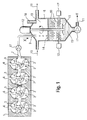
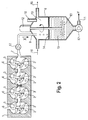
- FIGS. 1 to 4 Possible embodiments of the first and second process stages are in the FIGS. 1 to 4 shown as sectional drawings. In the figures, like elements are indicated by the same numbers.
- the kneading cascade (1) has in all FIGS. 1 to 4 four in series juxtaposed kneading chambers (2). These figures represent only a few possible embodiments of the apparatus which can be used for the method according to the invention, but without restricting the method to these apparatuses.
- the kneading cascade of (1) of the first process stage preferably has at least three, in particular at least five kneading chambers (2).
- the coating openings (6) can lead directly into kneading chambers (2) or are arranged between two kneading chambers (2).
- the last kneading chamber has pumping blades for improving the product discharge.
- the addition and mixing of the starting materials such as the organopolysiloxanes (A), the fillers (B), and optionally of other additives in the matrix can be done in any order; also, the metering z. B. the fillers (B) in one or more kneading chambers (2) of the kneading cascade (1).
- the dosage of the organopolysiloxanes (A) can both in the first kneading chamber (2) as well as - at least in parts - in one or more downstream kneading chambers (2), for example, to reduce the viscosity of the mass.
- the required fillers (B) can be dosed, preferably in the last chamber (2) no filler (B) is metered. It is possible to add the entire required amount of filler only in, for example, one / two / three or four of the first chambers (2), but a filler distribution over all is also possible.
- the in the FIGS. 1 to 4 Stirring devices (8) of the second process stage outlined as possible embodiments consist of a preferably metallic container which has a feed opening (9) via which the mass from the first process stage is supplied with a volume flow X.
- the mixing / kneading tools (10) can optionally also be supplemented by scrapers (19). They are rotated by means of a drive device (12), such as an electric motor or a hydraulic unit and can be controlled independently of each other, for example via a torque controller.
- the stirring device (8) has a gas inlet and outlet (16), wherein a drag gas is preferably introduced via the gas inlet and preferably a vacuum is applied to the gas outlet. About the discharge opening (11) of the second process stage, the discharge of the matrix takes place.
- a matrix was prepared with the following ingredients:
- Wacker® HDK SKS 300 pyrogenic silica having a BET specific surface area of 300 m 2 / g and a carbon content of 3.9-4.2% by weight.
- Example 1 (not according to the invention):
- the speeds of the kneading tools in the chambers 9-11 are about 200 rpm.
- the chamber 12 is equipped with pump wings, which promote the product in a degassing vessel.
- the residence time of the matrix in the kneading machine is about 28 minutes.
- the degassing vessel is rinsed with about 5m 3 / h of N 2 at a negative pressure of about 200 mbar to tow small amounts of volatile siloxanes in an exhaust gas purification system.
- the basic mass is discharged from the degassing container by means of a pump via a straining unit into a storage container. There are 258 kg / h basic mass 1 produced.
- the matrix 1 is transparent and has no inhomogeneities or Knörzel.
- the speeds of the kneading tools in the chambers 9-11 are about 200 rpm.
- the chamber 12 is equipped with pump wings, which promote the product in a degassing vessel.
- the degassing vessel is rinsed with about 5m 3 / h of N 2 at a negative pressure of about 200 mbar to tow small amounts of volatile siloxanes in an exhaust gas purification system.
- the basic mass is discharged from the degassing container by means of a pump via a straining unit into a storage container.
- the matrix 2 is transparent, but already has low inhomogeneities (haze), but no knobs on.
- the speeds of the kneading tools in the chambers 9-11 are about 200 rpm.
- the chamber 12 is equipped with pump wings, which promote via a pipe system in the downstream stirring device.
- the stirring device corresponds to the second process stage of the method according to the invention and is analogous to the schematic representation of the stirring device (8) according to FIG. 1 built up.
- the stirring device (8) during continuous operation to about 60% filled with basic mass.
- the volume of the stirring device (8) is 1.00 m 3 .
- the residence time of the mass in the kneading machine is about 19 min.
- the residence time of the mass in the stirring device (8) is about 96 min.
- the stirring device (8) is equipped with a plurality of cross-beam mixing tools (10) and a plurality of scrapers (19).
- the scrapers (19) are used at the Strip the inside wall of the stirrer (8) adhering mass.
- the speeds of the tools are 10 U / min.
- the mass is heated to a temperature of about 150 ° C with a heating jacket, which is mounted on the outer wall of the stirring device (8).
- the stirring device (8) is rinsed with about 1 m 3 / h of N 2 at a reduced pressure of about 70 mbar.
- the basic mass is then discharged from the stirring device (8) by means of a pump (17) via a straining unit into a storage container.
- the matrix 3 is transparent and has no inhomogeneities or nodules.
- the viscosity of the base compositions prepared according to Example 1-3 is in the range of 1,000 to 1,500 Pa * s immediately after production.
- the components A and B of the addition-crosslinking liquid silicone rubber formulations were homogeneously mixed in a ratio of 1: 1 using a paddle stirrer and then immersed in a hot press at a temperature of 165 ° C. over a period of 5 minutes elastic state transferred (vulcanized).
- the stability against SiH degradation was checked by measuring the SiH content by 1 H-NMR over the given period of time in the above-mentioned storage of the different B components, that is to say measurements were carried out at defined time intervals.
- the SiH content of the B component which is produced from the basic composition 3 according to the invention, has the lowest SiH degradation.
- B components with base weights 1 to 3 were prepared and the viscosity increase was monitored after storage at a temperature of 25 ° C. over a period of 3 months.
- the adhesion promoter content was quantified by infrared spectroscopy.
Landscapes
- Chemical & Material Sciences (AREA)
- Engineering & Computer Science (AREA)
- Mechanical Engineering (AREA)
- Chemical Kinetics & Catalysis (AREA)
- Health & Medical Sciences (AREA)
- Medicinal Chemistry (AREA)
- Polymers & Plastics (AREA)
- Organic Chemistry (AREA)
- Compositions Of Macromolecular Compounds (AREA)
- Processes Of Treating Macromolecular Substances (AREA)
- Processing And Handling Of Plastics And Other Materials For Molding In General (AREA)
Applications Claiming Priority (1)
| Application Number | Priority Date | Filing Date | Title |
|---|---|---|---|
| DE102008055035A DE102008055035A1 (de) | 2008-12-19 | 2008-12-19 | Kontinuierliches Verfahren zur Herstellung von Grundmassen für Siliconzusammensetzungen mit verbesserter Stabilität |
Publications (2)
| Publication Number | Publication Date |
|---|---|
| EP2199316A1 true EP2199316A1 (fr) | 2010-06-23 |
| EP2199316B1 EP2199316B1 (fr) | 2011-08-31 |
Family
ID=42110059
Family Applications (1)
| Application Number | Title | Priority Date | Filing Date |
|---|---|---|---|
| EP09178960A Active EP2199316B1 (fr) | 2008-12-19 | 2009-12-11 | Procédé continu de production de composition silicone plus stable |
Country Status (7)
| Country | Link |
|---|---|
| US (1) | US8287174B2 (fr) |
| EP (1) | EP2199316B1 (fr) |
| JP (1) | JP5306978B2 (fr) |
| KR (1) | KR101232697B1 (fr) |
| CN (1) | CN101747516B (fr) |
| AT (1) | ATE522565T1 (fr) |
| DE (1) | DE102008055035A1 (fr) |
Cited By (1)
| Publication number | Priority date | Publication date | Assignee | Title |
|---|---|---|---|---|
| CN108394851A (zh) * | 2018-04-19 | 2018-08-14 | 南安市创培电子科技有限公司 | 一种清洗液的混合搅拌及定量装瓶的一体化设备 |
Families Citing this family (6)
| Publication number | Priority date | Publication date | Assignee | Title |
|---|---|---|---|---|
| DE102008054536A1 (de) * | 2008-12-11 | 2010-06-17 | Wacker Chemie Ag | Verfahren zur kontinuierlichen Herstellung von hochviskosen Siliconmassen |
| ITPD20130022A1 (it) * | 2013-01-31 | 2014-08-01 | Christian Schiavolin | Dispositivo di trattamento per materiale scorrevole |
| CN118480270A (zh) * | 2019-10-30 | 2024-08-13 | 瓦克化学股份公司 | 含硅酸的含cnt硅氧烷的配制品 |
| CN112892345B (zh) * | 2021-01-19 | 2022-04-22 | 安徽沙丰新材料有限公司 | 反应抽真空机构以及捏合装置 |
| CN115957676A (zh) * | 2022-12-29 | 2023-04-14 | 西安近代化学研究所 | 一种立式多腔连续捏合机 |
| IT202300005352A1 (it) * | 2023-03-21 | 2024-09-21 | Colmec S P A | Processo di produzione di silicone base |
Citations (4)
| Publication number | Priority date | Publication date | Assignee | Title |
|---|---|---|---|---|
| EP0807509A1 (fr) * | 1996-05-02 | 1997-11-19 | Wacker-Chemie GmbH | Procédé continu de fabrication de compositions d'organopolysiloxanes stables au stockage |
| GB2384488A (en) * | 2001-02-16 | 2003-07-30 | Dow Corning Toray Silicone | Continuous mixing of silicone rubber base |
| US6749786B2 (en) * | 2000-12-20 | 2004-06-15 | General Electric Company | Continuous preparation of a liquid silicone rubber composition |
| US20060140048A1 (en) * | 2000-11-28 | 2006-06-29 | Rudi Ulzheimer | Process for preparing siloxane-filler compositions using an extruder mixer |
Family Cites Families (8)
| Publication number | Priority date | Publication date | Assignee | Title |
|---|---|---|---|---|
| DE3839900A1 (de) | 1988-11-25 | 1990-05-31 | Wacker Chemie Gmbh | Verfahren zur hydrophobierung von si-oh-gruppen enthaltendem, teilchenfoermigem feststoff und verwendung des erhaltenen, hydrophoben, teilchenfoermigen feststoffes in einem verfahren zur herstellung von zu elastomeren haertbaren massen auf basis von diorganopolysiloxanen |
| FR2663340B1 (fr) | 1990-06-13 | 1994-04-08 | Rhone Poulenc Chimie | Procede de preparation d'empatage en extrudeuse double-vis pour compositions rtv sih/sivi. |
| JP3694080B2 (ja) | 1995-11-30 | 2005-09-14 | 東レ・ダウコーニング株式会社 | ジオルガノポリシロキサン・微粉状シリカ混合物の製造方法 |
| JP3413715B2 (ja) * | 1996-12-09 | 2003-06-09 | 信越化学工業株式会社 | 液状シリコーンゴムベースの製造方法及び液状シリコーンゴム組成物の製造方法 |
| US6391234B1 (en) * | 1999-12-21 | 2002-05-21 | General Electric Company | Compounding filled silicone compositions |
| US6511217B1 (en) | 2000-11-03 | 2003-01-28 | General Electric Company | Method and system to compound silicone compositions |
| DE10313941A1 (de) * | 2003-03-27 | 2004-10-14 | Wacker-Chemie Gmbh | Verfahren zur kontinuierlichen Herstellung von hochviskosen Siliconmassen |
| DE102005019874A1 (de) * | 2005-04-28 | 2006-11-02 | Wacker Chemie Ag | Verfahren zur kontinuierlichen Herstellung von hochviskosen vernetzbaren Siliconmassen |
-
2008
- 2008-12-19 DE DE102008055035A patent/DE102008055035A1/de not_active Withdrawn
-
2009
- 2009-12-11 EP EP09178960A patent/EP2199316B1/fr active Active
- 2009-12-11 AT AT09178960T patent/ATE522565T1/de active
- 2009-12-17 US US12/640,291 patent/US8287174B2/en active Active
- 2009-12-18 JP JP2009287594A patent/JP5306978B2/ja active Active
- 2009-12-18 CN CN2009102624530A patent/CN101747516B/zh active Active
- 2009-12-18 KR KR1020090126907A patent/KR101232697B1/ko active Active
Patent Citations (4)
| Publication number | Priority date | Publication date | Assignee | Title |
|---|---|---|---|---|
| EP0807509A1 (fr) * | 1996-05-02 | 1997-11-19 | Wacker-Chemie GmbH | Procédé continu de fabrication de compositions d'organopolysiloxanes stables au stockage |
| US20060140048A1 (en) * | 2000-11-28 | 2006-06-29 | Rudi Ulzheimer | Process for preparing siloxane-filler compositions using an extruder mixer |
| US6749786B2 (en) * | 2000-12-20 | 2004-06-15 | General Electric Company | Continuous preparation of a liquid silicone rubber composition |
| GB2384488A (en) * | 2001-02-16 | 2003-07-30 | Dow Corning Toray Silicone | Continuous mixing of silicone rubber base |
Cited By (2)
| Publication number | Priority date | Publication date | Assignee | Title |
|---|---|---|---|---|
| CN108394851A (zh) * | 2018-04-19 | 2018-08-14 | 南安市创培电子科技有限公司 | 一种清洗液的混合搅拌及定量装瓶的一体化设备 |
| CN108394851B (zh) * | 2018-04-19 | 2020-08-21 | 南安市创培电子科技有限公司 | 一种清洗液的混合搅拌及定量装瓶的一体化设备 |
Also Published As
| Publication number | Publication date |
|---|---|
| JP5306978B2 (ja) | 2013-10-02 |
| ATE522565T1 (de) | 2011-09-15 |
| US20100160543A1 (en) | 2010-06-24 |
| DE102008055035A1 (de) | 2010-07-01 |
| KR101232697B1 (ko) | 2013-02-13 |
| KR20100071931A (ko) | 2010-06-29 |
| CN101747516B (zh) | 2012-09-26 |
| CN101747516A (zh) | 2010-06-23 |
| JP2010144174A (ja) | 2010-07-01 |
| US8287174B2 (en) | 2012-10-16 |
| EP2199316B1 (fr) | 2011-08-31 |
Similar Documents
| Publication | Publication Date | Title |
|---|---|---|
| EP2199316B1 (fr) | Procédé continu de production de composition silicone plus stable | |
| EP1106662B1 (fr) | Compositions d'élastomères de silicone auto-adhésives réticulantes par addition | |
| EP1792944B1 (fr) | Préparation de caoutchouc de silicone liquide en continu | |
| DE69223384T2 (de) | Mit Silikonkautschukpulver modifizierte Polyphenylenetherharze | |
| DE60121896T2 (de) | Verfahren und System zum Mischen von Silikonzusammensetzungen | |
| EP1958988B1 (fr) | Compositions de silicone réticulables par addition présentant und faible coefficient de friction | |
| DE69810869T2 (de) | Verfahren zur kontinuierlichen Herstellung von Silikongummi-Zusammensetzungen | |
| EP1266948B1 (fr) | Compositions de silicone thermodurcissable à un composant | |
| EP1884541B1 (fr) | Procédé continu destiné à la fabrication de masses polysiloxane organiques réticulables | |
| EP1717002B1 (fr) | Procédé pour la production continue de compositions durcissables à hautes viscosités à base de silicones | |
| EP1344792A1 (fr) | Matières réticulables à base de composés organo-silicium | |
| EP1468803B1 (fr) | Procédé de préparation de compositions de silicones de viscosité élevée vulcanisables à chaud | |
| EP2334736B1 (fr) | Elastomères silicones dotés d une meilleure résistance aux déchirures | |
| EP1882010B1 (fr) | Procede pour produire des masses de silicone contenant des matieres de charge fortement dispersees | |
| EP1640416B1 (fr) | Masses réticulables a base des composés d'organosilicium | |
| EP1033389B1 (fr) | Procédé de préparation de compositions à haute viscosite de silicone chargées | |
| DE3689975T2 (de) | Verfahren zur Herstellung einer Mischung von einem Polysiloxan und einem Füllstoff. | |
| EP2206737B1 (fr) | Procédé de préparation en continu de silicone de viscosité élevé | |
| EP2199345B1 (fr) | Dispositif à faisceaux de particules chargées et son procédé de préparation | |
| EP1375567B1 (fr) | Procédé pour la production en continu de pates de silicone réticulable par addition, à base de deux composants | |
| EP0807509B1 (fr) | Procédé continu de fabrication de compositions d'organopolysiloxanes stables au stockage | |
| DE60026123T2 (de) | Verfahren zur Herstellung von hitzevulkanisierbaren Silikonzusammensetzungen | |
| DE2549027A1 (de) | Verfahren zum herstellen von silikonkautschuk | |
| EP0927739A1 (fr) | Procédé pour melanger des polymères de silicone et des matières solides utilisables pour des compositions fluides RTV2 de silicone à faible limite élastique |
Legal Events
| Date | Code | Title | Description |
|---|---|---|---|
| PUAI | Public reference made under article 153(3) epc to a published international application that has entered the european phase |
Free format text: ORIGINAL CODE: 0009012 |
|
| 17P | Request for examination filed |
Effective date: 20091211 |
|
| AK | Designated contracting states |
Kind code of ref document: A1 Designated state(s): AT BE BG CH CY CZ DE DK EE ES FI FR GB GR HR HU IE IS IT LI LT LU LV MC MK MT NL NO PL PT RO SE SI SK SM TR |
|
| 17Q | First examination report despatched |
Effective date: 20100625 |
|
| GRAP | Despatch of communication of intention to grant a patent |
Free format text: ORIGINAL CODE: EPIDOSNIGR1 |
|
| RTI1 | Title (correction) |
Free format text: CONTINUOUS PROCESS FOR THE PRODUCTION OF SILICONE COMPOSITIONS WITH IMPROVED STABILITY |
|
| GRAS | Grant fee paid |
Free format text: ORIGINAL CODE: EPIDOSNIGR3 |
|
| GRAA | (expected) grant |
Free format text: ORIGINAL CODE: 0009210 |
|
| AK | Designated contracting states |
Kind code of ref document: B1 Designated state(s): AT BE BG CH CY CZ DE DK EE ES FI FR GB GR HR HU IE IS IT LI LT LU LV MC MK MT NL NO PL PT RO SE SI SK SM TR |
|
| REG | Reference to a national code |
Ref country code: CH Ref legal event code: EP Ref country code: GB Ref legal event code: FG4D Free format text: NOT ENGLISH |
|
| REG | Reference to a national code |
Ref country code: IE Ref legal event code: FG4D Free format text: LANGUAGE OF EP DOCUMENT: GERMAN |
|
| REG | Reference to a national code |
Ref country code: NL Ref legal event code: T3 |
|
| REG | Reference to a national code |
Ref country code: DE Ref legal event code: R096 Ref document number: 502009001245 Country of ref document: DE Effective date: 20111027 |
|
| LTIE | Lt: invalidation of european patent or patent extension |
Effective date: 20110831 |
|
| PG25 | Lapsed in a contracting state [announced via postgrant information from national office to epo] |
Ref country code: FI Free format text: LAPSE BECAUSE OF FAILURE TO SUBMIT A TRANSLATION OF THE DESCRIPTION OR TO PAY THE FEE WITHIN THE PRESCRIBED TIME-LIMIT Effective date: 20110831 Ref country code: SE Free format text: LAPSE BECAUSE OF FAILURE TO SUBMIT A TRANSLATION OF THE DESCRIPTION OR TO PAY THE FEE WITHIN THE PRESCRIBED TIME-LIMIT Effective date: 20110831 Ref country code: HR Free format text: LAPSE BECAUSE OF FAILURE TO SUBMIT A TRANSLATION OF THE DESCRIPTION OR TO PAY THE FEE WITHIN THE PRESCRIBED TIME-LIMIT Effective date: 20110831 Ref country code: LT Free format text: LAPSE BECAUSE OF FAILURE TO SUBMIT A TRANSLATION OF THE DESCRIPTION OR TO PAY THE FEE WITHIN THE PRESCRIBED TIME-LIMIT Effective date: 20110831 Ref country code: IS Free format text: LAPSE BECAUSE OF FAILURE TO SUBMIT A TRANSLATION OF THE DESCRIPTION OR TO PAY THE FEE WITHIN THE PRESCRIBED TIME-LIMIT Effective date: 20111231 Ref country code: NO Free format text: LAPSE BECAUSE OF FAILURE TO SUBMIT A TRANSLATION OF THE DESCRIPTION OR TO PAY THE FEE WITHIN THE PRESCRIBED TIME-LIMIT Effective date: 20111130 |
|
| PG25 | Lapsed in a contracting state [announced via postgrant information from national office to epo] |
Ref country code: LV Free format text: LAPSE BECAUSE OF FAILURE TO SUBMIT A TRANSLATION OF THE DESCRIPTION OR TO PAY THE FEE WITHIN THE PRESCRIBED TIME-LIMIT Effective date: 20110831 Ref country code: CY Free format text: LAPSE BECAUSE OF FAILURE TO SUBMIT A TRANSLATION OF THE DESCRIPTION OR TO PAY THE FEE WITHIN THE PRESCRIBED TIME-LIMIT Effective date: 20110831 Ref country code: GR Free format text: LAPSE BECAUSE OF FAILURE TO SUBMIT A TRANSLATION OF THE DESCRIPTION OR TO PAY THE FEE WITHIN THE PRESCRIBED TIME-LIMIT Effective date: 20111201 Ref country code: SI Free format text: LAPSE BECAUSE OF FAILURE TO SUBMIT A TRANSLATION OF THE DESCRIPTION OR TO PAY THE FEE WITHIN THE PRESCRIBED TIME-LIMIT Effective date: 20110831 |
|
| REG | Reference to a national code |
Ref country code: IE Ref legal event code: FD4D |
|
| PG25 | Lapsed in a contracting state [announced via postgrant information from national office to epo] |
Ref country code: SK Free format text: LAPSE BECAUSE OF FAILURE TO SUBMIT A TRANSLATION OF THE DESCRIPTION OR TO PAY THE FEE WITHIN THE PRESCRIBED TIME-LIMIT Effective date: 20110831 Ref country code: CZ Free format text: LAPSE BECAUSE OF FAILURE TO SUBMIT A TRANSLATION OF THE DESCRIPTION OR TO PAY THE FEE WITHIN THE PRESCRIBED TIME-LIMIT Effective date: 20110831 Ref country code: IE Free format text: LAPSE BECAUSE OF FAILURE TO SUBMIT A TRANSLATION OF THE DESCRIPTION OR TO PAY THE FEE WITHIN THE PRESCRIBED TIME-LIMIT Effective date: 20110831 |
|
| PG25 | Lapsed in a contracting state [announced via postgrant information from national office to epo] |
Ref country code: EE Free format text: LAPSE BECAUSE OF FAILURE TO SUBMIT A TRANSLATION OF THE DESCRIPTION OR TO PAY THE FEE WITHIN THE PRESCRIBED TIME-LIMIT Effective date: 20110831 Ref country code: RO Free format text: LAPSE BECAUSE OF FAILURE TO SUBMIT A TRANSLATION OF THE DESCRIPTION OR TO PAY THE FEE WITHIN THE PRESCRIBED TIME-LIMIT Effective date: 20110831 Ref country code: PL Free format text: LAPSE BECAUSE OF FAILURE TO SUBMIT A TRANSLATION OF THE DESCRIPTION OR TO PAY THE FEE WITHIN THE PRESCRIBED TIME-LIMIT Effective date: 20110831 Ref country code: PT Free format text: LAPSE BECAUSE OF FAILURE TO SUBMIT A TRANSLATION OF THE DESCRIPTION OR TO PAY THE FEE WITHIN THE PRESCRIBED TIME-LIMIT Effective date: 20120102 Ref country code: IT Free format text: LAPSE BECAUSE OF FAILURE TO SUBMIT A TRANSLATION OF THE DESCRIPTION OR TO PAY THE FEE WITHIN THE PRESCRIBED TIME-LIMIT Effective date: 20110831 |
|
| PG25 | Lapsed in a contracting state [announced via postgrant information from national office to epo] |
Ref country code: DK Free format text: LAPSE BECAUSE OF FAILURE TO SUBMIT A TRANSLATION OF THE DESCRIPTION OR TO PAY THE FEE WITHIN THE PRESCRIBED TIME-LIMIT Effective date: 20110831 |
|
| PLBE | No opposition filed within time limit |
Free format text: ORIGINAL CODE: 0009261 |
|
| STAA | Information on the status of an ep patent application or granted ep patent |
Free format text: STATUS: NO OPPOSITION FILED WITHIN TIME LIMIT |
|
| PG25 | Lapsed in a contracting state [announced via postgrant information from national office to epo] |
Ref country code: MC Free format text: LAPSE BECAUSE OF NON-PAYMENT OF DUE FEES Effective date: 20111231 |
|
| 26N | No opposition filed |
Effective date: 20120601 |
|
| REG | Reference to a national code |
Ref country code: DE Ref legal event code: R097 Ref document number: 502009001245 Country of ref document: DE Effective date: 20120601 |
|
| PG25 | Lapsed in a contracting state [announced via postgrant information from national office to epo] |
Ref country code: MK Free format text: LAPSE BECAUSE OF FAILURE TO SUBMIT A TRANSLATION OF THE DESCRIPTION OR TO PAY THE FEE WITHIN THE PRESCRIBED TIME-LIMIT Effective date: 20110831 Ref country code: MT Free format text: LAPSE BECAUSE OF FAILURE TO SUBMIT A TRANSLATION OF THE DESCRIPTION OR TO PAY THE FEE WITHIN THE PRESCRIBED TIME-LIMIT Effective date: 20110831 |
|
| PG25 | Lapsed in a contracting state [announced via postgrant information from national office to epo] |
Ref country code: ES Free format text: LAPSE BECAUSE OF FAILURE TO SUBMIT A TRANSLATION OF THE DESCRIPTION OR TO PAY THE FEE WITHIN THE PRESCRIBED TIME-LIMIT Effective date: 20111211 Ref country code: SM Free format text: LAPSE BECAUSE OF FAILURE TO SUBMIT A TRANSLATION OF THE DESCRIPTION OR TO PAY THE FEE WITHIN THE PRESCRIBED TIME-LIMIT Effective date: 20110831 |
|
| PG25 | Lapsed in a contracting state [announced via postgrant information from national office to epo] |
Ref country code: LU Free format text: LAPSE BECAUSE OF NON-PAYMENT OF DUE FEES Effective date: 20111211 |
|
| PG25 | Lapsed in a contracting state [announced via postgrant information from national office to epo] |
Ref country code: BG Free format text: LAPSE BECAUSE OF FAILURE TO SUBMIT A TRANSLATION OF THE DESCRIPTION OR TO PAY THE FEE WITHIN THE PRESCRIBED TIME-LIMIT Effective date: 20111130 |
|
| PG25 | Lapsed in a contracting state [announced via postgrant information from national office to epo] |
Ref country code: TR Free format text: LAPSE BECAUSE OF FAILURE TO SUBMIT A TRANSLATION OF THE DESCRIPTION OR TO PAY THE FEE WITHIN THE PRESCRIBED TIME-LIMIT Effective date: 20110831 |
|
| PG25 | Lapsed in a contracting state [announced via postgrant information from national office to epo] |
Ref country code: HU Free format text: LAPSE BECAUSE OF FAILURE TO SUBMIT A TRANSLATION OF THE DESCRIPTION OR TO PAY THE FEE WITHIN THE PRESCRIBED TIME-LIMIT Effective date: 20110831 |
|
| PGFP | Annual fee paid to national office [announced via postgrant information from national office to epo] |
Ref country code: NL Payment date: 20131219 Year of fee payment: 5 |
|
| PGFP | Annual fee paid to national office [announced via postgrant information from national office to epo] |
Ref country code: BE Payment date: 20131219 Year of fee payment: 5 |
|
| REG | Reference to a national code |
Ref country code: CH Ref legal event code: PL |
|
| PG25 | Lapsed in a contracting state [announced via postgrant information from national office to epo] |
Ref country code: LI Free format text: LAPSE BECAUSE OF NON-PAYMENT OF DUE FEES Effective date: 20131231 Ref country code: CH Free format text: LAPSE BECAUSE OF NON-PAYMENT OF DUE FEES Effective date: 20131231 |
|
| PG25 | Lapsed in a contracting state [announced via postgrant information from national office to epo] |
Ref country code: BE Free format text: LAPSE BECAUSE OF NON-PAYMENT OF DUE FEES Effective date: 20141231 |
|
| REG | Reference to a national code |
Ref country code: NL Ref legal event code: V1 Effective date: 20150701 |
|
| REG | Reference to a national code |
Ref country code: NL Ref legal event code: V1 Effective date: 20150701 |
|
| PG25 | Lapsed in a contracting state [announced via postgrant information from national office to epo] |
Ref country code: NL Free format text: LAPSE BECAUSE OF NON-PAYMENT OF DUE FEES Effective date: 20150701 |
|
| REG | Reference to a national code |
Ref country code: FR Ref legal event code: PLFP Year of fee payment: 7 |
|
| REG | Reference to a national code |
Ref country code: AT Ref legal event code: MM01 Ref document number: 522565 Country of ref document: AT Kind code of ref document: T Effective date: 20141211 |
|
| PG25 | Lapsed in a contracting state [announced via postgrant information from national office to epo] |
Ref country code: AT Free format text: LAPSE BECAUSE OF NON-PAYMENT OF DUE FEES Effective date: 20141211 |
|
| REG | Reference to a national code |
Ref country code: FR Ref legal event code: PLFP Year of fee payment: 8 |
|
| REG | Reference to a national code |
Ref country code: FR Ref legal event code: PLFP Year of fee payment: 9 |
|
| P01 | Opt-out of the competence of the unified patent court (upc) registered |
Effective date: 20230510 |
|
| REG | Reference to a national code |
Ref country code: DE Ref legal event code: R081 Ref document number: 502009001245 Country of ref document: DE Owner name: WACKER CHEMIE AG, DE Free format text: FORMER OWNER: WACKER CHEMIE AG, 81737 MUENCHEN, DE |
|
| PGFP | Annual fee paid to national office [announced via postgrant information from national office to epo] |
Ref country code: DE Payment date: 20251211 Year of fee payment: 17 |
|
| PGFP | Annual fee paid to national office [announced via postgrant information from national office to epo] |
Ref country code: GB Payment date: 20251219 Year of fee payment: 17 |
|
| PGFP | Annual fee paid to national office [announced via postgrant information from national office to epo] |
Ref country code: FR Payment date: 20251222 Year of fee payment: 17 |