EP2199553A1 - Fehlererkennungsvorrichtung für Abgasreinigungsfilter - Google Patents
Fehlererkennungsvorrichtung für Abgasreinigungsfilter Download PDFInfo
- Publication number
- EP2199553A1 EP2199553A1 EP09176901A EP09176901A EP2199553A1 EP 2199553 A1 EP2199553 A1 EP 2199553A1 EP 09176901 A EP09176901 A EP 09176901A EP 09176901 A EP09176901 A EP 09176901A EP 2199553 A1 EP2199553 A1 EP 2199553A1
- Authority
- EP
- European Patent Office
- Prior art keywords
- operating state
- electrode unit
- sampling process
- exhaust gas
- failure
- Prior art date
- Legal status (The legal status is an assumption and is not a legal conclusion. Google has not performed a legal analysis and makes no representation as to the accuracy of the status listed.)
- Granted
Links
Images




Classifications
-
- F—MECHANICAL ENGINEERING; LIGHTING; HEATING; WEAPONS; BLASTING
- F01—MACHINES OR ENGINES IN GENERAL; ENGINE PLANTS IN GENERAL; STEAM ENGINES
- F01N—GAS-FLOW SILENCERS OR EXHAUST APPARATUS FOR MACHINES OR ENGINES IN GENERAL; GAS-FLOW SILENCERS OR EXHAUST APPARATUS FOR INTERNAL-COMBUSTION ENGINES
- F01N11/00—Monitoring or diagnostic devices for exhaust-gas treatment apparatus
-
- F—MECHANICAL ENGINEERING; LIGHTING; HEATING; WEAPONS; BLASTING
- F01—MACHINES OR ENGINES IN GENERAL; ENGINE PLANTS IN GENERAL; STEAM ENGINES
- F01N—GAS-FLOW SILENCERS OR EXHAUST APPARATUS FOR MACHINES OR ENGINES IN GENERAL; GAS-FLOW SILENCERS OR EXHAUST APPARATUS FOR INTERNAL-COMBUSTION ENGINES
- F01N3/00—Exhaust or silencing apparatus having means for purifying, rendering innocuous, or otherwise treating exhaust
- F01N3/02—Exhaust or silencing apparatus having means for purifying, rendering innocuous, or otherwise treating exhaust for cooling, or for removing solid constituents of, exhaust
- F01N3/021—Exhaust or silencing apparatus having means for purifying, rendering innocuous, or otherwise treating exhaust for cooling, or for removing solid constituents of, exhaust by means of filters
-
- G—PHYSICS
- G01—MEASURING; TESTING
- G01N—INVESTIGATING OR ANALYSING MATERIALS BY DETERMINING THEIR CHEMICAL OR PHYSICAL PROPERTIES
- G01N15/00—Investigating characteristics of particles; Investigating permeability, pore-volume or surface-area of porous materials
- G01N15/06—Investigating concentration of particle suspensions
- G01N15/0606—Investigating concentration of particle suspensions by collecting particles on a support
-
- G—PHYSICS
- G01—MEASURING; TESTING
- G01N—INVESTIGATING OR ANALYSING MATERIALS BY DETERMINING THEIR CHEMICAL OR PHYSICAL PROPERTIES
- G01N15/00—Investigating characteristics of particles; Investigating permeability, pore-volume or surface-area of porous materials
- G01N15/06—Investigating concentration of particle suspensions
- G01N15/0656—Investigating concentration of particle suspensions using electric, e.g. electrostatic methods or magnetic methods
-
- F—MECHANICAL ENGINEERING; LIGHTING; HEATING; WEAPONS; BLASTING
- F01—MACHINES OR ENGINES IN GENERAL; ENGINE PLANTS IN GENERAL; STEAM ENGINES
- F01N—GAS-FLOW SILENCERS OR EXHAUST APPARATUS FOR MACHINES OR ENGINES IN GENERAL; GAS-FLOW SILENCERS OR EXHAUST APPARATUS FOR INTERNAL-COMBUSTION ENGINES
- F01N2550/00—Monitoring or diagnosing the deterioration of exhaust systems
- F01N2550/04—Filtering activity of particulate filters
-
- F—MECHANICAL ENGINEERING; LIGHTING; HEATING; WEAPONS; BLASTING
- F01—MACHINES OR ENGINES IN GENERAL; ENGINE PLANTS IN GENERAL; STEAM ENGINES
- F01N—GAS-FLOW SILENCERS OR EXHAUST APPARATUS FOR MACHINES OR ENGINES IN GENERAL; GAS-FLOW SILENCERS OR EXHAUST APPARATUS FOR INTERNAL-COMBUSTION ENGINES
- F01N2560/00—Exhaust systems with means for detecting or measuring exhaust gas components or characteristics
- F01N2560/05—Exhaust systems with means for detecting or measuring exhaust gas components or characteristics the means being a particulate sensor
-
- Y—GENERAL TAGGING OF NEW TECHNOLOGICAL DEVELOPMENTS; GENERAL TAGGING OF CROSS-SECTIONAL TECHNOLOGIES SPANNING OVER SEVERAL SECTIONS OF THE IPC; TECHNICAL SUBJECTS COVERED BY FORMER USPC CROSS-REFERENCE ART COLLECTIONS [XRACs] AND DIGESTS
- Y02—TECHNOLOGIES OR APPLICATIONS FOR MITIGATION OR ADAPTATION AGAINST CLIMATE CHANGE
- Y02T—CLIMATE CHANGE MITIGATION TECHNOLOGIES RELATED TO TRANSPORTATION
- Y02T10/00—Road transport of goods or passengers
- Y02T10/10—Internal combustion engine [ICE] based vehicles
- Y02T10/12—Improving ICE efficiencies
-
- Y—GENERAL TAGGING OF NEW TECHNOLOGICAL DEVELOPMENTS; GENERAL TAGGING OF CROSS-SECTIONAL TECHNOLOGIES SPANNING OVER SEVERAL SECTIONS OF THE IPC; TECHNICAL SUBJECTS COVERED BY FORMER USPC CROSS-REFERENCE ART COLLECTIONS [XRACs] AND DIGESTS
- Y02—TECHNOLOGIES OR APPLICATIONS FOR MITIGATION OR ADAPTATION AGAINST CLIMATE CHANGE
- Y02T—CLIMATE CHANGE MITIGATION TECHNOLOGIES RELATED TO TRANSPORTATION
- Y02T10/00—Road transport of goods or passengers
- Y02T10/10—Internal combustion engine [ICE] based vehicles
- Y02T10/40—Engine management systems
Definitions
- the present invention relates to failure detection apparatus for an exhaust gas purifying filter.
- the present invention relates to failure detection apparatus for an exhaust gas purifying filter that uses an electrostatic dust collection type of particulate matter sensor.
- Japanese Unexamined Patent Application Publication Nos. 2008-115765 and 2007-315275 disclose failure detection apparatuses provided with a particulate matter sensor detecting particulate matter in exhaust gas, which is provided at the downstream side of the exhaust gas purifying filter, to detect the failure of the exhaust gas purifying filter based on outputs from this sensor.
- Japanese Unexamined Patent Application Publication No. 2008-115765 discloses that an electrical discharge sensor generating a discharge voltage corresponding to the concentration of particulate matter in exhaust gas is used as a particulate matter sensor.
- Japanese Unexamined Patent Application Publication No. 2007-132290 discloses a failure detection apparatus provided with particulate matter sensors upstream and downstream of the exhaust gas purifying filter, respectively.
- This failure detection apparatus calculates the ratio of the amount of particulate matter flowing in the exhaust gas purifying filter to the amount of particulate matter flowing out from the exhaust gas purifying filter based on the output from each of the sensors, and then compares the calculated ratio with that when the filter is in a normal state, thereby detecting the failure of the exhaust gas purifying filter.
- the particulate matter sensor used for the above-mentioned failure detection apparatus is demanded not only to be capable of high accuracy detection, but also to have excellent durability for mounting in an exhaust gas path.
- it is demanded to have a simple configuration to be equipped in a vehicle.
- an electrostatic dust collection type of particulate matter sensor has been proposed as a particulate matter sensor that satisfies such demands (refer to Japanese Unexamined Patent Application Publication No. 2008-139294 ).
- an electrode unit composed of a pair of electrode plates is provided in an exhaust pipe, and particulate matter is thus deposited on this electrode unit by applying a predetermined voltage to the electrode unit. Then, the concentration of particulate matter in the exhaust gas in the exhaust pipe can be detected by measuring an electrical characteristic such as the capacitance of the electrode unit on which particulate matter is deposited.
- the detection of the concentration of particulate matter by the above-mentioned electrostatic dust collection type of particulate matter sensor is performed in two steps: a step of performing a sampling process of depositing particulate matter on the electrode unit, and a step of performing a measurement process of measuring the electrical characteristic of the electrode unit after this sampling process, it lacks readiness.
- the failure detection accuracy may be lowered. Specifically, since the operating state of the internal combustion engine changes in accordance with the driver's operation and the like, using an electrostatic dust collection type of particulate matter sensor makes a difference between the operating state in the performance of the sampling process and the operating state in the performance of the measurement process, failure may not be correctly detected.
- the present invention was made by taking the above such issues into account, and an object thereof is to provide a failure detection apparatus for an exhaust gas purifying filter that uses an electrostatic dust collection type of particulate matter sensor while being capable of detecting failure with high-accuracy.
- the present invention provides a failure detection apparatus for an exhaust gas purifying filter (3) that is provided in an exhaust gas path (4) of an internal combustion engine (1), and that collects particulate matter contained in exhaust gas emitted from the internal combustion engine.
- the failure detection apparatus includes: an operating state detection means (5, 7, 8) for detecting an operating state of the internal combustion engine; an electrode unit (24) provided downstream of the exhaust gas purifying filter in the exhaust gas path; a particulate matter detection means (5,21) for performing a sampling process of causing particulate matter to deposit on the electrode unit by applying a predetermined voltage to the electrode unit, and then performing a measurement process of measuring a predetermined electrical characteristic of the electrode unit; and a failure detection means (5) for detecting failure of the exhaust gas purifying filter based on an operating state parameter (N, W, N MEAS_AVE , W MEAS_AVE ) indicating the operating state of the internal combustion engine while performing the sampling process and a measured value ( ⁇ C) measured by performing the measurement process.
- an operating state detection means 5, 7, 8) for detecting an operating state of the internal combustion engine
- an electrode unit (24) provided downstream of the exhaust gas purifying filter in the exhaust gas path
- a particulate matter detection means for performing a sampling process of causing particulate matter
- the sampling process of causing particulate matter to deposit on the electrode unit by applying a predetermined voltage to the electrode unit is performed, and then the measurement process of measuring a predetermined electrical characteristic of this electrode unit is performed.
- failure of the exhaust gas purifying filter is detected based on a measured value measured by this measurement process and the operating state parameter.
- an operating state parameter indicating the operating status of the internal combustion engine while performing the sampling process it is possible to detect failure of the exhaust gas purifying filter with high accuracy even if the operating state while performing the sampling process differs from that while performing the measurement process.
- the failure detection means sets a first threshold value (C TH ) in accordance with the operating state parameter, and then compares the first threshold value with the measured value (N,W,N MEAS_AVE , W MEAS_AVE ) measured by performing the measurement process to detect failure of the exhaust gas purifying filter.
- the first threshold value is set in accordance with the operating state parameter while performing the sampling process, and then failure of the exhaust gas purifying filter is detected by comparing this first threshold value with the measured value. For example, by using the control map and the like that are set based on preliminarily performed experimentation when the first threshold value is set from the operating state parameter, the failure detection accuracy of the exhaust gas purifying filter can be further improved.
- the electrical characteristic is a variation amount in capacitance ( ⁇ C) from before and after performing the sampling process.
- the variation amount in capacitance from before and after performing the sampling process is measured as a predetermined electrical characteristic of the electrode unit in the measurement process.
- the capacitance of the electrode unit significantly changes when particulate matter is deposited on the electrode unit.
- the concentration of particulate matter contained in exhaust gas downstream of the exhaust gas purifying filter can be detected accurately. Therefore, the failure detection accuracy of the exhaust gas purifying filter can be further improved.
- the operating state parameter is a mean value (N MEAS_AVE , W MEAS_AVE ) of a detection value detected by the operating state detection means while performing the sampling process.
- a mean value of the detection value which is detected by the operating state detection means while performing the sampling process, is used as the operating state parameter.
- the operating state of the internal combustion engine can be more accurately reflected in the operating state parameter. Therefore, by detecting the failure of the exhaust gas purifying filter with such an operating state parameter, the failure detection accuracy of the exhaust gas purifying filter can be further improved.
- the failure detection apparatus further includes a perform sampling determination means (5) for determining whether or not the detection value detected by the operating state detection means before performing the sampling process is within a predetermined first determination range ([N MIN, N MAX ], [M MIN, W MAX ]) over a predetermined first determination time (T PRE ), in which the sampling process is performed only in a case where the detection value is determined to be within the first determination range over the first determination time.
- a perform sampling determination means (5) for determining whether or not the detection value detected by the operating state detection means before performing the sampling process is within a predetermined first determination range ([N MIN, N MAX ], [M MIN, W MAX ]) over a predetermined first determination time (T PRE ), in which the sampling process is performed only in a case where the detection value is determined to be within the first determination range over the first determination time.
- the sampling process is performed only in a case where the detection value detected by the operating state detection means before performing the sampling process is within the first determination range over the first determination time, or only in a case where the operating state of the internal combustion engine is stable.
- the concentration of particulate matter in exhaust gas cannot be accurately reflected in the measured value measured in the measurement process.
- the failure detection apparatus further includes a perform measurement determination means (5) for determining whether or not the detection value detected by the operating state detection means while performing the sampling process is within a predetermined second determination range ([N MIN ,N MAX ], [W MIN, W MAX ]) over a predetermined second determination time (T MEAS ), in which the sampling process is performed only in a case where the detection value is determined to be within the second determination range over the second determination time.
- a perform measurement determination means (5) for determining whether or not the detection value detected by the operating state detection means while performing the sampling process is within a predetermined second determination range ([N MIN ,N MAX ], [W MIN, W MAX ]) over a predetermined second determination time (T MEAS ), in which the sampling process is performed only in a case where the detection value is determined to be within the second determination range over the second determination time.
- the measurement process is performed only in a case where the detection value detected by the operating state detection means while performing the sampling process is within the second determination range over the second determination time, or only in a case where the sampling process has been performed in a state in which the operating state of the internal combustion engine was stable. Therefore, the failure detection accuracy of the exhaust gas purifying filter can be further improved.
- the failure detection apparatus further includes: a test particulate matter detection means (5,21) for performing a test sampling process of causing particulate matter to deposit on the electrode unit by applying a predetermined voltage to the electrode unit, and then performing a test measurement process of measuring a predetermined electrical characteristic of the electrode unit; a determination means (5) for determining whether or not to perform the sampling process and the measurement process, by comparing a predetermined second threshold value (C THT ) with the measured value ( ⁇ C T ) measured by performing the test measurement process; and a prevention means (5) for preventing the sampling process and the measurement process from being performed in a case where the determination means determines that the sampling process and the measurement process are not to be performed.
- a test particulate matter detection means for performing a test sampling process of causing particulate matter to deposit on the electrode unit by applying a predetermined voltage to the electrode unit, and then performing a test measurement process of measuring a predetermined electrical characteristic of the electrode unit
- a determination means (5) for determining whether or not to perform the sampling
- the test sampling process and the test measurement process are performed, and then it is determined whether or not to perform the above-mentioned sampling process and the above-mentioned measurement process by comparing the second threshold value with the measured value measured by performing this test measurement process. In a case where it is determined that the sampling process and the measurement process are not to be performed, the sampling process and the measurement process are prevented from being performed.
- the sampling process and the measurement process are performed only in a case where the operating state of the internal combustion engine is stable. Therefore, in a case where the operating state substantially changes while performing the sampling process, for example, it is necessary to temporarily interrupt the sampling process so as not to be performed consecutively, remove particulate matter deposited on the electrode unit, this electrode unit is regenerated, and then repeat performing the sampling process once more after regenerating this sensor electrode unit.
- Such regeneration of the electrode unit is conducted, for example, by heating the electrode unit with heaters over a predetermined time to combust particulate matter. That is, in a case where the operating state of the internal combustion engine is unstable, the electrode unit is regenerated more frequently, which causes the detection for failure of the exhaust gas purifying filter to be performed less frequently.
- the test sampling process and the test measurement process are performed provisionally, and then it is determined whether or not to perform the sampling process and the measurement process for detecting failure based on these results.
- the sampling process and the measurement process can be performed less frequently, and the electrode unit can be regenerated less frequently. As a result, it is possible to improve the frequency at which detection for failure of the exhaust gas purifying filter is performed.
- the determination means compares the second threshold value (C THT ) with the measured value ( ⁇ C T ) measured by performing the test measurement process, and determines that the sampling process and the measurement process are not to be performed in a case where the measured value is smaller than the second threshold value.
- the measured value measured by performing the test measurement process is compared with the second threshold value, and in a case where the measured value is smaller than the second threshold value, the sampling process and the measurement process are prevented from being performed.
- setting the second threshold value to an extremely small value can prevent the sampling process and the measurement process for detecting the failure of the exhaust gas purifying filter from being performed, even though the exhaust gas purifying filter is normal. As a result, it is possible to improve the frequency at which detection for failure of the exhaust gas purifying filter is performed.
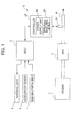
- FIG. 1 is a diagram illustrating the structure of an internal combustion engine and a control unit thereof including a failure detection apparatus for an exhaust gas purifying filter according to the present embodiment of the present invention.
- An internal combustion engine 1 (hereinafter simply referred to as “engine”) is a diesel engine that directly injects fuel into each cylinder and a fuel injector (not shown) is provided in each cylinder. These fuel injectors are electrically connected with an electronic control unit 5 (hereinafter referred to as "ECU”) that controls a valve-opening time and a valve-closing time of the fuel injectors.
- ECU electronice control unit 5
- An exhaust pipe 4 in which exhaust gas from the engine 1 flows is provided with, in this order from the upstream side, a diesel particulate filter (hereinafter referred to as "DPF") 3 and a particulate matter (hereinafter referred to as "PM”) sensor 2 detecting PM, the principal component of which is carbon contained in exhaust gas.
- DPF diesel particulate filter
- PM particulate matter
- the DPF 3 is provided with filter walls of a porous media and, when exhaust gas passes through fine pores of this filter wall, PM contained in the exhaust gas is collected by being deposited on the surface of the filter wall and in the pores of the filter wall.
- porous media made of aluminum titanate, cordierite, and the like are used as a constituent material of the filter wall.
- the PM sensor 2 is a so-called electrostatic dust collection type of particulate matter sensor provided with a sensor electrode unit 24 provided at the downstream side of the DPF 3 along an exhaust gas pipe 4 and a controller 21 controlling this sensor electrode unit 24.
- FIGs. 2A and 2B are perspective views illustrating the structure of the sensor electrode unit 24. More specifically, FIG. 2A is a perspective view illustrating the structure of an electrode plate 25 of the sensor electrode unit 24, and FIG. 2B is a perspective view illustrating the structure of the sensor electrode unit 24 configured to including the two electrode plates 25, 25.
- the electrode plate 25 is provided with a substantially rectangular alumina substrate 251 and a tungsten conductive layer 252 formed on the surface of this alumina substrate 251.
- This tungsten conductive layer 252 is configured to including a conductive part formed in a substantially square shape at substantially the center part of the alumina substrate 251, and a conductive wire part extending from this conductive part to a first end side of the alumina substrate 251.
- a tungsten printed part 253 provided by being stacked on the conductive wire part of this tungsten conductive layer 252 is formed.
- the thickness of the alumina substrate 251 is about 1 mm, and the length on a side of the conductive part of the tungsten conductive layer 252 is about 10 mm.
- the sensor electrode unit 24 is configured by disposing plate-like spacers 26, 26 between a pair of electrode plates 25, 25 to be combined. These spacers 26, 26 are provided at both end sides of each electrode plate 25, and a cavity 27 in which PM is collected is, therefore, formed at the conductive part of the tungsten conductive layer 252 of each electrode plate 25.
- the heaters (not shown) are installed in a pair of electrode plates 25, 25 configuring this sensor electrode unit 24, respectively.
- a controller 21 of the PM sensor 2 is configured to including a power supply unit 22 supplying electric power to the sensor electrode unit 24 and impedance measuring equipment 23 detecting an electrical characteristic of the sensor electrode unit 24.
- the power supply unit 22 operates based on control signals transmitted from the ECU 5 to apply a predetermined voltage to the sensor electrode unit 24 over a predetermined time. Accordingly, PM contained in the exhaust gas is deposited in a cavity of the sensor electrode unit 24. In addition, by applying a current to the above-mentioned heaters provided in the sensor electrode unit 24, this power supply unit 22 can warm up this sensor electrode unit 24 and can combust deposited PM to regenerate the sensor electrode unit 24.
- the impedance measuring equipment 23 operates based on control signals transmitted from the ECU 5 to detect the capacitance of the sensor electrode unit 24 with an alternating current signal applied at a predetermined measured voltage over a predetermined measurement period, and outputs a detection signal substantially proportional to the capacitance value thus detected to the ECU 5.
- the ECU 5 is connected to a warning light 6, a crank angle position sensor 7, an accelerator sensor 8, and the like in addition to the above-mentioned PM sensor 2.
- the warning light 6 is provided in an instrument panel of a vehicle, and lights up based on a control signal transmitted from the ECU 5. In a case where it is determined that the DPF 3 has failed, the ECU 5 turns on this warning light 6, as described below. Thus, the fact that the DPF 3 has failed can be informed to the driver.
- the crank angle position sensor 7 detects the rotation angle of the crankshaft of the engine 1 and outputs a detection signal to the ECU 5.
- the accelerator sensor 8 detects the amount by which the accelerator pedal of a vehicle has been depressed, and outputs a detection signal to the ECU 5. Revolution speed N and fuel consumption amount W as the operating state parameters indicating the operating state of the engine 1 are calculated by the ECU 5 based on outputs from the crank angle position sensor 7 and the accelerator sensor 8.
- the ECU 5 is provided with an input circuit having functions such as shaping signal waveforms that are input from various kinds of sensors, correcting voltage levels to a predetermined level, and converting analog signal values into digital signal values, and a central processing unit (hereinafter referred to as "CPU"). Furthermore, the ECU 5 is provided with a memory circuit that stores various kinds of calculation programs to be executed by the CPU, calculation results, and the like, and an output circuit that outputs control signals to the controller 21 of the PM sensor 2, the warning light 6, the fuel injectors of the engine 1, etc.
- CPU central processing unit
- FIG. 3 is a flow chart illustrating the procedure of the DPF failure detection process. This DPF failure detection process is executed by the ECU 5 after the engine starts.
- Step S1 warm-up, regeneration, and calibration of the PM sensor are performed.
- Step S2 the capacitance of the sensor electrode unit is measured, and then recorded as an initial capacitance C I .
- Step S3 while a sampling process is being performed over a predetermined time, the operating state parameters (revolution speed N, fuel consumption amount W) while performing this sampling process are recorded. More specifically, in this sampling process, PM contained in the exhaust gas is caused to deposit in the cavity of the sensor electrode unit by applying a voltage to the sensor electrode unit over a predetermined time.
- Step S5 a failure determination value C TH is set in accordance with the recorded operating state parameters (revolution speed N, fuel consumption amount W). More specifically, in Step S5, the failure determination value C TH is set based on a control map as shown in the following table, in which the failure determination value C TH is set in relation to each operating state parameter (revolution speed N, fuel consumption amount W).
- Table 1 REVOLUTION SPEED N N 1 N 2 ⁇ FUEL CONSUMPTION AMOUNT W W 1 C 11 C 12 ⁇ W 2 C 21 C 22 ⁇ ⁇ ⁇ ⁇ ⁇
- Step S6 it is determined whether or not the variation amount of capacitance ⁇ C thus measured is smaller than the failure determination value C TH . In a case where this determination is "YES”, it is determined that the DPF is in a normal state, and the process proceeds to Step S7. In a case where this determination is "NO”, it is determined that the DPF is in a failed state, and the process proceeds to Step S8.
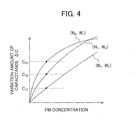
- FIG. 4 is a diagram illustrating the relationship between the variation amount of capacitance ⁇ C and the PM concentration. More specifically, FIG. 4 is a diagram obtained by running the engine at each of the operating states (N 1 ,W 1 ), (N 1 ,W 2 ), and (N 2 ,W 1 ), while changing the PM concentration downstream of the DPF by intentionally damaging the DPF, and measuring the variation amount of capacitance ⁇ C at each of the PM concentrations.
- the above-mentioned control map is set by selecting the points at which it is determined that the DPF has failed, from the measurement result in relation to each of the operating states (N 1 ,W 1 ), (N 1 ,W 2 ), and (N 2 ,W 1 ) shown in FIG. 4 , and then defining the respective variation amounts of capacitance ⁇ C at these points as failure determination values C 11 , C 12 , and C 21 .
- a control map is made in order to set a failure determination value C TH in accordance with the recorded operating state parameters (revolution speed N, fuel consumption amount W).
- Step S7 the sensor electrode unit is regenerated, and then the process returns to Step S2.
- Step S8 the warning light is turned on in response to the determination that the DPF is in a failed state, and then the process proceeds to Step S7.
- FIG. 7 is a flow chart illustrating the procedure of the DPF failure detection process according to the present embodiment. As shown in FIG. 7 , the present embodiment differs from the second embodiment in the point that the test detection process is performed in Step S32, and the main detection process is performed in Step S35 only in a case where performing the main detection process is determined to be required.
- Step S31 warm-up, regeneration, and calibration of the PM sensor are performed.
- Step S32 the test detection process described in detail below with reference to FIG. 8 is performed.
- Step S33 it is determined whether or not a first determination flag F 1ST_CHK is "1.” In a case where this determination is "YES”, the process proceeds to Step S34, and in a case where this determination is "NO", the process proceeds to Step S32.
- the first determination flag F 1ST_CHK is a flag indicating that performing the main detection process is required, and is set to "1" in Step S49 of the test detection process described below with reference to FIG. 8 .
- this first determination flag F 1ST_CHK is set to "0" immediately after performing this DPF failure detection process.
- Step S34 the sensor electrode unit is regenerated.
- Step S35 the main detection process described in detail below with reference to FIG. 9 is performed.
- Step S36 it is determined whether or not a second determination flag F 2ND_CHK is "1." In a case where this determination is "YES”, the process proceeds to Step S37, and in a case where this determination is "NO", the process proceeds to Step S38.
- the second determination flag F 2ND_CHK is a flag indicating that the DPF is in a failed state, and is set to "1" in Step S61 of the main detection process illustrated in FIG. 9 described later. This second determination flag F 2ND_CHK is set to "0" immediately after performing this DPF failure detection process.
- Step S37 the warning light is turned on in response to the determination that the DPF is in a failed state, and then the process proceeds to Step S38.
- Step S38 the sensor electrode unit is regenerated, and then the process returns to Step S35.
- FIG. 8 is a flow chart illustrating the procedure of the test detection process.
- Step S41 a test count variable I 1ST_REG is incremented by "1."
- This test count variable I 1ST_REG represents the number of times that the test detection process is performed consecutively without regenerating the sensor electrode unit.
- Step S42 it is determined whether or not a predetermined upper limit value of the consecutive times N 1ST_REG is equal to the test count variable I 1ST_REG . In a case where this determination is "YES”, the process proceeds to Step S43, and in a case where this determination is "NO”, the process proceeds to Step S44.
- Step S43 a test count variable I 1ST_REG is reset to "0" after regenerating the sensor electrode unit.
- Step S44 the capacitance of the sensor electrode unit is measured, and then recorded as an initial capacitance C IT .
- Step S45 the test sampling process is performed over a predetermined time. More specifically, in this test sampling process, PM contained in the exhaust gas is caused to deposit in the cavity of the sensor electrode unit by applying a voltage to the sensor electrode unit over a predetermined time.
- Step S47 it is determined whether or not the measured variation amount ⁇ C T of capacitance is smaller than a predetermined execution determination value C THT .
- the execution determination value C THT is a threshold value that is set to determine whether or not to perform the main detection process, and is set to an extremely small value.
- Step S48 the first determination flag F 1ST_CHK is set to "0" to prevent the main detection process from being performed.
- Step S49 the first determination flag F 1ST_CHK is set to "1" to allow the main detection process to be performed.
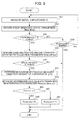
- FIG. 9 is a flow chart illustrating the procedure of the main failure detection process.
- Steps S51 to S58 are the same as Steps S12 to S19 of the flow chart shown in FIG. 5 , and a detailed explanation is, therefore, omitted.
- Step S59 it is determined whether or not the variation amount of capacitance ⁇ C thus measured is smaller than the failure determination value C TH . In a case where this determination is "YES”, it is determined that the DPF is in a normal state, and then the process proceeds to Step S60 in which the second determination flag F 2ND_CHK is set to "0.” In a case where this determination is "NO”, it is determined that the DPF is in a failed state, and then the process proceeds to Step S61 in which set the second determination flag F 2ND_CHK is set to "1.”
- the following effects can be attained in addition to the above-mentioned effects (1) to (6).
- the means involved in performing Steps S58 and S59 in FIG. 9 configure the failure detection means
- the means involved in performing Steps S55 and S57 in FIG. 9 configure the particulate matter detection means
- the means involved in performing Step S53 in FIG. 9 configure the perform sampling determination means
- the means involved in performing Step S56 in FIG. 9 configure the perform measurement determination means
- the means involved in performing Steps S45 and S46 in FIG. 8 configure the test particulate matter detection means
- the means involved in performing Step S47 in FIG. 8 configure the determination means
- the means involved in performing Step S48 in FIG. 8 configure the prevention means.
- the revolution speed N and the fuel consumption amount W are used as the operating state parameters indicating the operating state of the engine; however, the type or the number of operating state parameters is not limited thereto. Any operating state parameters may be used to obtain the emission amount of PM exhausted from the engine, such as the amount of intake air.
- a failure detection apparatus for an exhaust gas purifying filter uses an electrostatic dust collection type of particulate matter sensor, while being capable of high-accuracy detection of failure.
- the failure detection apparatus for a DPF performs a sampling process (S3) that causes PM to deposit on a sensor electrode unit by applying a predetermined voltage to the sensor electrode unit, and then performs the measurement process (S4) to measure the variation amount of capacitance ⁇ C of the sensor electrode unit.
- the failure detection apparatus for a DPF records operating state parameters (revolution speed N, fuel consumption amount W) in the performance of this sampling process, and then detects DPF failure based on these operating state parameters (revolution speed N, fuel consumption amount W) and the variation amount of capacitance ⁇ C.
Landscapes
- Chemical & Material Sciences (AREA)
- Engineering & Computer Science (AREA)
- Life Sciences & Earth Sciences (AREA)
- Immunology (AREA)
- Physics & Mathematics (AREA)
- Analytical Chemistry (AREA)
- Biochemistry (AREA)
- General Health & Medical Sciences (AREA)
- General Physics & Mathematics (AREA)
- Health & Medical Sciences (AREA)
- Pathology (AREA)
- General Engineering & Computer Science (AREA)
- Dispersion Chemistry (AREA)
- Combustion & Propulsion (AREA)
- Mechanical Engineering (AREA)
- Chemical Kinetics & Catalysis (AREA)
- Processes For Solid Components From Exhaust (AREA)
- Investigating Or Analyzing Materials By The Use Of Electric Means (AREA)
Applications Claiming Priority (1)
| Application Number | Priority Date | Filing Date | Title |
|---|---|---|---|
| JP2008325978A JP4756068B2 (ja) | 2008-12-22 | 2008-12-22 | 排気浄化フィルタの故障検知装置 |
Publications (2)
| Publication Number | Publication Date |
|---|---|
| EP2199553A1 true EP2199553A1 (de) | 2010-06-23 |
| EP2199553B1 EP2199553B1 (de) | 2012-08-01 |
Family
ID=41571562
Family Applications (1)
| Application Number | Title | Priority Date | Filing Date |
|---|---|---|---|
| EP09176901A Not-in-force EP2199553B1 (de) | 2008-12-22 | 2009-11-24 | Fehlererkennungsvorrichtung für Abgasreinigungsfilter |
Country Status (2)
| Country | Link |
|---|---|
| EP (1) | EP2199553B1 (de) |
| JP (1) | JP4756068B2 (de) |
Cited By (8)
| Publication number | Priority date | Publication date | Assignee | Title |
|---|---|---|---|---|
| DE102010054671A1 (de) * | 2010-12-15 | 2012-06-21 | Continental Automotive Gmbh | Verfahren zum Betreiben eines Rußsensors |
| CN102520024A (zh) * | 2011-11-24 | 2012-06-27 | 王万年 | 一种产品质量检测仪 |
| CN103717849A (zh) * | 2011-08-04 | 2014-04-09 | 丰田自动车株式会社 | 内燃机的控制装置 |
| RU2594090C2 (ru) * | 2012-05-22 | 2016-08-10 | Тойота Дзидося Кабусики Кайся | Устройство для очистки отработавших газов двигателя внутреннего сгорания |
| EP2407773A4 (de) * | 2009-03-11 | 2017-01-04 | Honda Motor Co., Ltd. | Fehlererkennungsvorrichtung für abgasreinigungsfilter |
| CN107923295A (zh) * | 2015-08-27 | 2018-04-17 | 康明斯排放处理公司 | 具有设计的颗粒尺寸分割点的颗粒物质传感器 |
| EP3260673A4 (de) * | 2015-02-20 | 2018-08-01 | Isuzu Motors Limited | Abgasreinigungsvorrichtung |
| CN108593757A (zh) * | 2018-06-29 | 2018-09-28 | 北京沃斯彤科技有限公司 | 一种自诊断式均值离子检测仪及故障诊断方法 |
Families Citing this family (7)
| Publication number | Priority date | Publication date | Assignee | Title |
|---|---|---|---|---|
| JP5088391B2 (ja) | 2010-03-09 | 2012-12-05 | トヨタ自動車株式会社 | パティキュレートフィルタの故障判別装置 |
| JP5533477B2 (ja) * | 2010-09-14 | 2014-06-25 | 株式会社デンソー | エンジン制御装置 |
| JP5605112B2 (ja) * | 2010-09-15 | 2014-10-15 | マツダ株式会社 | エンジンの排気浄化装置 |
| WO2012095943A1 (ja) * | 2011-01-11 | 2012-07-19 | トヨタ自動車株式会社 | Pm量検出装置及びパティキュレートフィルタの故障検出装置 |
| JP2013019389A (ja) * | 2011-07-13 | 2013-01-31 | Toyota Motor Corp | パティキュレートフィルタの故障診断装置 |
| JP6107768B2 (ja) | 2014-08-11 | 2017-04-05 | トヨタ自動車株式会社 | 排気浄化システムの故障診断装置 |
| JP6256391B2 (ja) | 2015-03-13 | 2018-01-10 | トヨタ自動車株式会社 | 排気浄化システムの故障診断装置 |
Citations (10)
| Publication number | Priority date | Publication date | Assignee | Title |
|---|---|---|---|---|
| DE4139325C1 (en) * | 1991-11-29 | 1993-01-07 | Mercedes-Benz Aktiengesellschaft, 7000 Stuttgart, De | Function monitoring soot filter in exhaust pipe of IC engine |
| EP1106797A1 (de) * | 1999-12-10 | 2001-06-13 | Heraeus Electro-Nite International N.V. | Messanordnung und Verfahren zur Überwachung der Funktionsfähigkeit eines Russfilters |
| JP2007132290A (ja) | 2005-11-11 | 2007-05-31 | Toyota Motor Corp | Pmトラッパ故障検出装置 |
| DE102006057528A1 (de) * | 2005-12-06 | 2007-06-14 | Ford Global Technologies, LLC, Dearborn | System und Verfahren zum Überwachen von Partikelfilterleistung |
| JP2007315275A (ja) | 2006-05-25 | 2007-12-06 | Nissan Motor Co Ltd | 排気浄化フィルタ故障診断装置及び方法 |
| DE102006029990A1 (de) * | 2006-06-29 | 2008-01-03 | Robert Bosch Gmbh | Verfahren zur Diagnose eines Partikelfilters und Vorrichtung zur Durchführung des Verfahrens |
| JP2008115765A (ja) | 2006-11-06 | 2008-05-22 | Ngk Spark Plug Co Ltd | パティキュレートフィルタの故障判定装置及び故障判定方法 |
| JP2008139294A (ja) | 2006-11-08 | 2008-06-19 | Honda Motor Co Ltd | 検知装置及び方法 |
| WO2009115542A1 (de) * | 2008-03-20 | 2009-09-24 | Continental Automotive Gmbh | Diagnoseverfahren und diagnosesystem für einen partikelfilter eines verbrennungsmotors, insbesondere für einen russfilter in einem dieselkraftfahrzeug |
| EP2120044A1 (de) * | 2007-03-15 | 2009-11-18 | NGK Insulators, Ltd. | Detektor für granulare substanzen und verfahren zur erkennung granularer substanzen |
Family Cites Families (2)
| Publication number | Priority date | Publication date | Assignee | Title |
|---|---|---|---|---|
| JP3352002B2 (ja) * | 1997-10-14 | 2002-12-03 | 日本特殊陶業株式会社 | 窒素酸化物吸蔵触媒の機能低下検出方法及び装置 |
| JP2005325812A (ja) * | 2004-05-17 | 2005-11-24 | Honda Motor Co Ltd | フィルタの故障判定装置 |
-
2008
- 2008-12-22 JP JP2008325978A patent/JP4756068B2/ja not_active Expired - Fee Related
-
2009
- 2009-11-24 EP EP09176901A patent/EP2199553B1/de not_active Not-in-force
Patent Citations (10)
| Publication number | Priority date | Publication date | Assignee | Title |
|---|---|---|---|---|
| DE4139325C1 (en) * | 1991-11-29 | 1993-01-07 | Mercedes-Benz Aktiengesellschaft, 7000 Stuttgart, De | Function monitoring soot filter in exhaust pipe of IC engine |
| EP1106797A1 (de) * | 1999-12-10 | 2001-06-13 | Heraeus Electro-Nite International N.V. | Messanordnung und Verfahren zur Überwachung der Funktionsfähigkeit eines Russfilters |
| JP2007132290A (ja) | 2005-11-11 | 2007-05-31 | Toyota Motor Corp | Pmトラッパ故障検出装置 |
| DE102006057528A1 (de) * | 2005-12-06 | 2007-06-14 | Ford Global Technologies, LLC, Dearborn | System und Verfahren zum Überwachen von Partikelfilterleistung |
| JP2007315275A (ja) | 2006-05-25 | 2007-12-06 | Nissan Motor Co Ltd | 排気浄化フィルタ故障診断装置及び方法 |
| DE102006029990A1 (de) * | 2006-06-29 | 2008-01-03 | Robert Bosch Gmbh | Verfahren zur Diagnose eines Partikelfilters und Vorrichtung zur Durchführung des Verfahrens |
| JP2008115765A (ja) | 2006-11-06 | 2008-05-22 | Ngk Spark Plug Co Ltd | パティキュレートフィルタの故障判定装置及び故障判定方法 |
| JP2008139294A (ja) | 2006-11-08 | 2008-06-19 | Honda Motor Co Ltd | 検知装置及び方法 |
| EP2120044A1 (de) * | 2007-03-15 | 2009-11-18 | NGK Insulators, Ltd. | Detektor für granulare substanzen und verfahren zur erkennung granularer substanzen |
| WO2009115542A1 (de) * | 2008-03-20 | 2009-09-24 | Continental Automotive Gmbh | Diagnoseverfahren und diagnosesystem für einen partikelfilter eines verbrennungsmotors, insbesondere für einen russfilter in einem dieselkraftfahrzeug |
Cited By (15)
| Publication number | Priority date | Publication date | Assignee | Title |
|---|---|---|---|---|
| EP2407773A4 (de) * | 2009-03-11 | 2017-01-04 | Honda Motor Co., Ltd. | Fehlererkennungsvorrichtung für abgasreinigungsfilter |
| DE102010054671A1 (de) * | 2010-12-15 | 2012-06-21 | Continental Automotive Gmbh | Verfahren zum Betreiben eines Rußsensors |
| EP2652280A2 (de) * | 2010-12-15 | 2013-10-23 | Continental Automotive GmbH | Verfahren zum betreiben eines russsensors |
| CN103717849A (zh) * | 2011-08-04 | 2014-04-09 | 丰田自动车株式会社 | 内燃机的控制装置 |
| RU2555430C1 (ru) * | 2011-08-04 | 2015-07-10 | Тойота Дзидося Кабусики Кайся | Блок управления для двигателя внутреннего сгорания |
| CN102520024A (zh) * | 2011-11-24 | 2012-06-27 | 王万年 | 一种产品质量检测仪 |
| RU2594090C9 (ru) * | 2012-05-22 | 2016-12-20 | Тойота Дзидося Кабусики Кайся | Устройство для очистки отработавших газов двигателя внутреннего сгорания |
| RU2594090C2 (ru) * | 2012-05-22 | 2016-08-10 | Тойота Дзидося Кабусики Кайся | Устройство для очистки отработавших газов двигателя внутреннего сгорания |
| EP3260673A4 (de) * | 2015-02-20 | 2018-08-01 | Isuzu Motors Limited | Abgasreinigungsvorrichtung |
| US10677123B2 (en) | 2015-02-20 | 2020-06-09 | Isuzu Motors Limited | Exhaust purification device |
| CN107923295A (zh) * | 2015-08-27 | 2018-04-17 | 康明斯排放处理公司 | 具有设计的颗粒尺寸分割点的颗粒物质传感器 |
| US10641154B2 (en) | 2015-08-27 | 2020-05-05 | Cummins Emission Solutions Inc. | Particulate matter sensor with engineered particle size cut-point |
| CN107923295B (zh) * | 2015-08-27 | 2020-08-04 | 康明斯排放处理公司 | 具有设计的颗粒尺寸分割点的颗粒物质传感器 |
| DE112015006842B4 (de) | 2015-08-27 | 2023-02-23 | Cummins Emission Solutions, Inc. | Feinstaubsensor mit konstruierter Partikelgrößentrenngrenze |
| CN108593757A (zh) * | 2018-06-29 | 2018-09-28 | 北京沃斯彤科技有限公司 | 一种自诊断式均值离子检测仪及故障诊断方法 |
Also Published As
| Publication number | Publication date |
|---|---|
| JP4756068B2 (ja) | 2011-08-24 |
| EP2199553B1 (de) | 2012-08-01 |
| JP2010144695A (ja) | 2010-07-01 |
Similar Documents
| Publication | Publication Date | Title |
|---|---|---|
| EP2199553B1 (de) | Fehlererkennungsvorrichtung für Abgasreinigungsfilter | |
| EP2407773A1 (de) | Fehlererkennungsvorrichtung für abgasreinigungsfilter | |
| US8382884B2 (en) | Particulate matter detection device | |
| EP1529931B1 (de) | Filtersteuervorrichtung | |
| US11105289B2 (en) | Method and control device for monitoring the function of a particulate filter | |
| US6136169A (en) | Abnormality diagnosis for air-fuel ratio sensor system | |
| CN107002525B (zh) | 诊断装置和传感器 | |
| US7587925B2 (en) | Method for operating a sensor for recording particles in a gas stream and device for implementing the method | |
| CN108343496A (zh) | 催化器劣化诊断方法和催化器劣化诊断系统 | |
| US9732659B2 (en) | SOx concentration detection device of internal combustion engine | |
| JP2010275977A (ja) | 粒子状物質検出手段の故障判定装置 | |
| US6347277B2 (en) | Method and device for calibrating a probe system | |
| JP4095138B2 (ja) | 内燃機関用炭化水素センサの感度の決定方法および装置 | |
| JP4325054B2 (ja) | ガス濃度検出装置 | |
| JP3525545B2 (ja) | 空燃比センサの異常診断装置 | |
| JP3834898B2 (ja) | 空燃比センサの異常診断装置 | |
| US6602471B1 (en) | Adsorption amount sensor and coking sensor for internal combustion engine | |
| KR20070085566A (ko) | 내연엔진의 작동을 위한 장치 | |
| US20070215470A1 (en) | Gas concentration measuring apparatus designed to enhance response of sensor | |
| WO2010143657A1 (ja) | Pmセンサ | |
| JP2012068150A (ja) | 酸素センサの異常診断装置 | |
| JP2011089430A (ja) | 排気浄化装置 | |
| JP2000321229A (ja) | 内燃機関用のコーキングセンサ | |
| JP2011226295A (ja) | フィルタの故障検出装置及び故障検出方法 | |
| US11199148B2 (en) | Control device for exhaust sensor |
Legal Events
| Date | Code | Title | Description |
|---|---|---|---|
| PUAI | Public reference made under article 153(3) epc to a published international application that has entered the european phase |
Free format text: ORIGINAL CODE: 0009012 |
|
| 17P | Request for examination filed |
Effective date: 20091124 |
|
| AK | Designated contracting states |
Kind code of ref document: A1 Designated state(s): AT BE BG CH CY CZ DE DK EE ES FI FR GB GR HR HU IE IS IT LI LT LU LV MC MK MT NL NO PL PT RO SE SI SK SM TR |
|
| AX | Request for extension of the european patent |
Extension state: AL BA RS |
|
| GRAP | Despatch of communication of intention to grant a patent |
Free format text: ORIGINAL CODE: EPIDOSNIGR1 |
|
| GRAS | Grant fee paid |
Free format text: ORIGINAL CODE: EPIDOSNIGR3 |
|
| GRAA | (expected) grant |
Free format text: ORIGINAL CODE: 0009210 |
|
| AK | Designated contracting states |
Kind code of ref document: B1 Designated state(s): AT BE BG CH CY CZ DE DK EE ES FI FR GB GR HR HU IE IS IT LI LT LU LV MC MK MT NL NO PL PT RO SE SI SK SM TR |
|
| REG | Reference to a national code |
Ref country code: GB Ref legal event code: FG4D |
|
| REG | Reference to a national code |
Ref country code: AT Ref legal event code: REF Ref document number: 568829 Country of ref document: AT Kind code of ref document: T Effective date: 20120815 Ref country code: CH Ref legal event code: EP |
|
| REG | Reference to a national code |
Ref country code: IE Ref legal event code: FG4D |
|
| REG | Reference to a national code |
Ref country code: DE Ref legal event code: R096 Ref document number: 602009008615 Country of ref document: DE Effective date: 20120927 |
|
| REG | Reference to a national code |
Ref country code: NL Ref legal event code: VDEP Effective date: 20120801 |
|
| REG | Reference to a national code |
Ref country code: AT Ref legal event code: MK05 Ref document number: 568829 Country of ref document: AT Kind code of ref document: T Effective date: 20120801 |
|
| REG | Reference to a national code |
Ref country code: LT Ref legal event code: MG4D Effective date: 20120801 |
|
| PG25 | Lapsed in a contracting state [announced via postgrant information from national office to epo] |
Ref country code: CY Free format text: LAPSE BECAUSE OF FAILURE TO SUBMIT A TRANSLATION OF THE DESCRIPTION OR TO PAY THE FEE WITHIN THE PRESCRIBED TIME-LIMIT Effective date: 20120801 Ref country code: IS Free format text: LAPSE BECAUSE OF FAILURE TO SUBMIT A TRANSLATION OF THE DESCRIPTION OR TO PAY THE FEE WITHIN THE PRESCRIBED TIME-LIMIT Effective date: 20121201 Ref country code: FI Free format text: LAPSE BECAUSE OF FAILURE TO SUBMIT A TRANSLATION OF THE DESCRIPTION OR TO PAY THE FEE WITHIN THE PRESCRIBED TIME-LIMIT Effective date: 20120801 Ref country code: AT Free format text: LAPSE BECAUSE OF FAILURE TO SUBMIT A TRANSLATION OF THE DESCRIPTION OR TO PAY THE FEE WITHIN THE PRESCRIBED TIME-LIMIT Effective date: 20120801 Ref country code: LT Free format text: LAPSE BECAUSE OF FAILURE TO SUBMIT A TRANSLATION OF THE DESCRIPTION OR TO PAY THE FEE WITHIN THE PRESCRIBED TIME-LIMIT Effective date: 20120801 Ref country code: NO Free format text: LAPSE BECAUSE OF FAILURE TO SUBMIT A TRANSLATION OF THE DESCRIPTION OR TO PAY THE FEE WITHIN THE PRESCRIBED TIME-LIMIT Effective date: 20121101 Ref country code: HR Free format text: LAPSE BECAUSE OF FAILURE TO SUBMIT A TRANSLATION OF THE DESCRIPTION OR TO PAY THE FEE WITHIN THE PRESCRIBED TIME-LIMIT Effective date: 20120801 |
|
| PG25 | Lapsed in a contracting state [announced via postgrant information from national office to epo] |
Ref country code: PT Free format text: LAPSE BECAUSE OF FAILURE TO SUBMIT A TRANSLATION OF THE DESCRIPTION OR TO PAY THE FEE WITHIN THE PRESCRIBED TIME-LIMIT Effective date: 20121203 Ref country code: PL Free format text: LAPSE BECAUSE OF FAILURE TO SUBMIT A TRANSLATION OF THE DESCRIPTION OR TO PAY THE FEE WITHIN THE PRESCRIBED TIME-LIMIT Effective date: 20120801 Ref country code: LV Free format text: LAPSE BECAUSE OF FAILURE TO SUBMIT A TRANSLATION OF THE DESCRIPTION OR TO PAY THE FEE WITHIN THE PRESCRIBED TIME-LIMIT Effective date: 20120801 Ref country code: GR Free format text: LAPSE BECAUSE OF FAILURE TO SUBMIT A TRANSLATION OF THE DESCRIPTION OR TO PAY THE FEE WITHIN THE PRESCRIBED TIME-LIMIT Effective date: 20121102 Ref country code: BE Free format text: LAPSE BECAUSE OF FAILURE TO SUBMIT A TRANSLATION OF THE DESCRIPTION OR TO PAY THE FEE WITHIN THE PRESCRIBED TIME-LIMIT Effective date: 20120801 Ref country code: SE Free format text: LAPSE BECAUSE OF FAILURE TO SUBMIT A TRANSLATION OF THE DESCRIPTION OR TO PAY THE FEE WITHIN THE PRESCRIBED TIME-LIMIT Effective date: 20120801 Ref country code: SI Free format text: LAPSE BECAUSE OF FAILURE TO SUBMIT A TRANSLATION OF THE DESCRIPTION OR TO PAY THE FEE WITHIN THE PRESCRIBED TIME-LIMIT Effective date: 20120801 |
|
| PG25 | Lapsed in a contracting state [announced via postgrant information from national office to epo] |
Ref country code: NL Free format text: LAPSE BECAUSE OF FAILURE TO SUBMIT A TRANSLATION OF THE DESCRIPTION OR TO PAY THE FEE WITHIN THE PRESCRIBED TIME-LIMIT Effective date: 20120801 |
|
| PG25 | Lapsed in a contracting state [announced via postgrant information from national office to epo] |
Ref country code: RO Free format text: LAPSE BECAUSE OF FAILURE TO SUBMIT A TRANSLATION OF THE DESCRIPTION OR TO PAY THE FEE WITHIN THE PRESCRIBED TIME-LIMIT Effective date: 20120801 Ref country code: DK Free format text: LAPSE BECAUSE OF FAILURE TO SUBMIT A TRANSLATION OF THE DESCRIPTION OR TO PAY THE FEE WITHIN THE PRESCRIBED TIME-LIMIT Effective date: 20120801 Ref country code: EE Free format text: LAPSE BECAUSE OF FAILURE TO SUBMIT A TRANSLATION OF THE DESCRIPTION OR TO PAY THE FEE WITHIN THE PRESCRIBED TIME-LIMIT Effective date: 20120801 Ref country code: CZ Free format text: LAPSE BECAUSE OF FAILURE TO SUBMIT A TRANSLATION OF THE DESCRIPTION OR TO PAY THE FEE WITHIN THE PRESCRIBED TIME-LIMIT Effective date: 20120801 Ref country code: ES Free format text: LAPSE BECAUSE OF FAILURE TO SUBMIT A TRANSLATION OF THE DESCRIPTION OR TO PAY THE FEE WITHIN THE PRESCRIBED TIME-LIMIT Effective date: 20121112 |
|
| PG25 | Lapsed in a contracting state [announced via postgrant information from national office to epo] |
Ref country code: IT Free format text: LAPSE BECAUSE OF FAILURE TO SUBMIT A TRANSLATION OF THE DESCRIPTION OR TO PAY THE FEE WITHIN THE PRESCRIBED TIME-LIMIT Effective date: 20120801 Ref country code: SK Free format text: LAPSE BECAUSE OF FAILURE TO SUBMIT A TRANSLATION OF THE DESCRIPTION OR TO PAY THE FEE WITHIN THE PRESCRIBED TIME-LIMIT Effective date: 20120801 |
|
| PLBE | No opposition filed within time limit |
Free format text: ORIGINAL CODE: 0009261 |
|
| STAA | Information on the status of an ep patent application or granted ep patent |
Free format text: STATUS: NO OPPOSITION FILED WITHIN TIME LIMIT |
|
| 26N | No opposition filed |
Effective date: 20130503 |
|
| PG25 | Lapsed in a contracting state [announced via postgrant information from national office to epo] |
Ref country code: BG Free format text: LAPSE BECAUSE OF FAILURE TO SUBMIT A TRANSLATION OF THE DESCRIPTION OR TO PAY THE FEE WITHIN THE PRESCRIBED TIME-LIMIT Effective date: 20121101 |
|
| REG | Reference to a national code |
Ref country code: IE Ref legal event code: MM4A |
|
| REG | Reference to a national code |
Ref country code: FR Ref legal event code: ST Effective date: 20130731 |
|
| REG | Reference to a national code |
Ref country code: DE Ref legal event code: R097 Ref document number: 602009008615 Country of ref document: DE Effective date: 20130503 |
|
| REG | Reference to a national code |
Ref country code: DE Ref legal event code: R084 Ref document number: 602009008615 Country of ref document: DE Effective date: 20130802 |
|
| PG25 | Lapsed in a contracting state [announced via postgrant information from national office to epo] |
Ref country code: IE Free format text: LAPSE BECAUSE OF NON-PAYMENT OF DUE FEES Effective date: 20121124 |
|
| PG25 | Lapsed in a contracting state [announced via postgrant information from national office to epo] |
Ref country code: FR Free format text: LAPSE BECAUSE OF NON-PAYMENT OF DUE FEES Effective date: 20121130 Ref country code: MT Free format text: LAPSE BECAUSE OF FAILURE TO SUBMIT A TRANSLATION OF THE DESCRIPTION OR TO PAY THE FEE WITHIN THE PRESCRIBED TIME-LIMIT Effective date: 20120801 |
|
| PG25 | Lapsed in a contracting state [announced via postgrant information from national office to epo] |
Ref country code: TR Free format text: LAPSE BECAUSE OF FAILURE TO SUBMIT A TRANSLATION OF THE DESCRIPTION OR TO PAY THE FEE WITHIN THE PRESCRIBED TIME-LIMIT Effective date: 20120801 Ref country code: MC Free format text: LAPSE BECAUSE OF NON-PAYMENT OF DUE FEES Effective date: 20121130 |
|
| PG25 | Lapsed in a contracting state [announced via postgrant information from national office to epo] |
Ref country code: SM Free format text: LAPSE BECAUSE OF FAILURE TO SUBMIT A TRANSLATION OF THE DESCRIPTION OR TO PAY THE FEE WITHIN THE PRESCRIBED TIME-LIMIT Effective date: 20120801 Ref country code: LU Free format text: LAPSE BECAUSE OF NON-PAYMENT OF DUE FEES Effective date: 20121124 |
|
| REG | Reference to a national code |
Ref country code: CH Ref legal event code: PL |
|
| GBPC | Gb: european patent ceased through non-payment of renewal fee |
Effective date: 20131124 |
|
| PG25 | Lapsed in a contracting state [announced via postgrant information from national office to epo] |
Ref country code: CH Free format text: LAPSE BECAUSE OF NON-PAYMENT OF DUE FEES Effective date: 20131130 Ref country code: HU Free format text: LAPSE BECAUSE OF FAILURE TO SUBMIT A TRANSLATION OF THE DESCRIPTION OR TO PAY THE FEE WITHIN THE PRESCRIBED TIME-LIMIT Effective date: 20091124 Ref country code: LI Free format text: LAPSE BECAUSE OF NON-PAYMENT OF DUE FEES Effective date: 20131130 |
|
| PG25 | Lapsed in a contracting state [announced via postgrant information from national office to epo] |
Ref country code: GB Free format text: LAPSE BECAUSE OF NON-PAYMENT OF DUE FEES Effective date: 20131124 |
|
| PG25 | Lapsed in a contracting state [announced via postgrant information from national office to epo] |
Ref country code: MK Free format text: LAPSE BECAUSE OF FAILURE TO SUBMIT A TRANSLATION OF THE DESCRIPTION OR TO PAY THE FEE WITHIN THE PRESCRIBED TIME-LIMIT Effective date: 20120801 |
|
| PGFP | Annual fee paid to national office [announced via postgrant information from national office to epo] |
Ref country code: DE Payment date: 20161116 Year of fee payment: 8 |
|
| REG | Reference to a national code |
Ref country code: DE Ref legal event code: R119 Ref document number: 602009008615 Country of ref document: DE |
|
| PG25 | Lapsed in a contracting state [announced via postgrant information from national office to epo] |
Ref country code: DE Free format text: LAPSE BECAUSE OF NON-PAYMENT OF DUE FEES Effective date: 20180602 |