EP2200655B1 - Kontrastmittel - Google Patents
Kontrastmittel Download PDFInfo
- Publication number
- EP2200655B1 EP2200655B1 EP08805209A EP08805209A EP2200655B1 EP 2200655 B1 EP2200655 B1 EP 2200655B1 EP 08805209 A EP08805209 A EP 08805209A EP 08805209 A EP08805209 A EP 08805209A EP 2200655 B1 EP2200655 B1 EP 2200655B1
- Authority
- EP
- European Patent Office
- Prior art keywords
- compounds
- compound
- contrast
- triiodo
- denote
- Prior art date
- Legal status (The legal status is an assumption and is not a legal conclusion. Google has not performed a legal analysis and makes no representation as to the accuracy of the status listed.)
- Not-in-force
Links
- 239000002872 contrast media Substances 0.000 title abstract description 71
- 150000001875 compounds Chemical class 0.000 claims abstract description 74
- 239000000203 mixture Substances 0.000 claims abstract description 24
- 125000000217 alkyl group Chemical group 0.000 claims abstract description 18
- 125000004435 hydrogen atom Chemical group [H]* 0.000 claims abstract description 11
- 230000003287 optical effect Effects 0.000 claims abstract description 5
- 150000003839 salts Chemical class 0.000 claims abstract description 4
- -1 2,3-dihydroxypropyl moieties Chemical group 0.000 claims description 11
- 125000002496 methyl group Chemical group [H]C([H])([H])* 0.000 claims description 6
- 125000002887 hydroxy group Chemical group [H]O* 0.000 claims description 4
- 239000000546 pharmaceutical excipient Substances 0.000 claims description 4
- 125000004029 hydroxymethyl group Chemical group [H]OC([H])([H])* 0.000 claims description 3
- NQTNWQMPKXCABU-UHFFFAOYSA-N 1-n-(2,3-dihydroxypropyl)-3-n-[4-[[3-(2,3-dihydroxypropylcarbamoyl)-5-[(2-hydroxyacetyl)amino]-2,4,6-triiodobenzoyl]-methylamino]-2,3-dihydroxybutyl]-5-[(2-hydroxyacetyl)amino]-2,4,6-triiodo-3-n-methylbenzene-1,3-dicarboxamide Chemical compound IC=1C(NC(=O)CO)=C(I)C(C(=O)NCC(O)CO)=C(I)C=1C(=O)N(C)CC(O)C(O)CN(C)C(=O)C1=C(I)C(NC(=O)CO)=C(I)C(C(=O)NCC(O)CO)=C1I NQTNWQMPKXCABU-UHFFFAOYSA-N 0.000 claims description 2
- 239000003937 drug carrier Substances 0.000 claims description 2
- 125000001436 propyl group Chemical group [H]C([*])([H])C([H])([H])C([H])([H])[H] 0.000 claims description 2
- FJMSRZTZAIUWQW-CAODYFQJSA-N 1-n-(2,3-dihydroxypropyl)-3-n-[(2s,3r)-4-[[3-(2,3-dihydroxypropylcarbamoyl)-5-[(2-hydroxyacetyl)amino]-2,4,6-triiodobenzoyl]amino]-2,3-dihydroxybutyl]-5-[(2-hydroxyacetyl)amino]-2,4,6-triiodobenzene-1,3-dicarboxamide Chemical compound OCC(O)CNC(=O)C1=C(I)C(NC(=O)CO)=C(I)C(C(=O)NC[C@H](O)[C@H](O)CNC(=O)C=2C(=C(C(=O)NCC(O)CO)C(I)=C(NC(=O)CO)C=2I)I)=C1I FJMSRZTZAIUWQW-CAODYFQJSA-N 0.000 claims 1
- RUIZSECJLXEILJ-UHFFFAOYSA-N 1-n-(2,3-dihydroxypropyl)-3-n-[4-[[3-[2,3-dihydroxypropyl(methyl)carbamoyl]-5-[(2-hydroxyacetyl)amino]-2,4,6-triiodobenzoyl]-methylamino]-2,3-dihydroxybutyl]-5-[(2-hydroxyacetyl)amino]-2,4,6-triiodo-1-n,3-n-dimethylbenzene-1,3-dicarboxamide Chemical compound OCC(O)CN(C)C(=O)C1=C(I)C(NC(=O)CO)=C(I)C(C(=O)N(C)CC(O)C(O)CN(C)C(=O)C=2C(=C(C(=O)N(C)CC(O)CO)C(I)=C(NC(=O)CO)C=2I)I)=C1I RUIZSECJLXEILJ-UHFFFAOYSA-N 0.000 claims 1
- QYCZKKMLIPXDFW-UHFFFAOYSA-N 5-(2,3-dihydroxypropanoylamino)-3-n-[4-[[3-(2,3-dihydroxypropanoylamino)-5-[2,3-dihydroxypropyl(methyl)carbamoyl]-2,4,6-triiodobenzoyl]-methylamino]-2,3-dihydroxybutyl]-1-n-(2,3-dihydroxypropyl)-2,4,6-triiodo-1-n,3-n-dimethylbenzene-1,3-dicarboxamide Chemical compound OCC(O)CN(C)C(=O)C1=C(I)C(NC(=O)C(O)CO)=C(I)C(C(=O)N(C)CC(O)C(O)CN(C)C(=O)C=2C(=C(C(=O)N(C)CC(O)CO)C(I)=C(NC(=O)C(O)CO)C=2I)I)=C1I QYCZKKMLIPXDFW-UHFFFAOYSA-N 0.000 claims 1
- 229940039231 contrast media Drugs 0.000 abstract description 26
- 229910052740 iodine Inorganic materials 0.000 abstract description 25
- ZCYVEMRRCGMTRW-UHFFFAOYSA-N 7553-56-2 Chemical compound [I] ZCYVEMRRCGMTRW-UHFFFAOYSA-N 0.000 abstract description 24
- 239000011630 iodine Substances 0.000 abstract description 24
- 238000003384 imaging method Methods 0.000 abstract description 8
- 238000002059 diagnostic imaging Methods 0.000 abstract description 4
- 125000001997 phenyl group Chemical group [H]C1=C([H])C([H])=C(*)C([H])=C1[H] 0.000 abstract description 4
- 238000000034 method Methods 0.000 description 16
- ZMANZCXQSJIPKH-UHFFFAOYSA-N Triethylamine Chemical compound CCN(CC)CC ZMANZCXQSJIPKH-UHFFFAOYSA-N 0.000 description 14
- OKKJLVBELUTLKV-UHFFFAOYSA-N Methanol Chemical compound OC OKKJLVBELUTLKV-UHFFFAOYSA-N 0.000 description 12
- FXHOOIRPVKKKFG-UHFFFAOYSA-N N,N-Dimethylacetamide Chemical compound CN(C)C(C)=O FXHOOIRPVKKKFG-UHFFFAOYSA-N 0.000 description 12
- 239000000539 dimer Substances 0.000 description 10
- XEKOWRVHYACXOJ-UHFFFAOYSA-N Ethyl acetate Chemical compound CCOC(C)=O XEKOWRVHYACXOJ-UHFFFAOYSA-N 0.000 description 9
- 230000000694 effects Effects 0.000 description 9
- 239000011541 reaction mixture Substances 0.000 description 9
- CSNNHWWHGAXBCP-UHFFFAOYSA-L Magnesium sulfate Chemical compound [Mg+2].[O-][S+2]([O-])([O-])[O-] CSNNHWWHGAXBCP-UHFFFAOYSA-L 0.000 description 8
- 238000006243 chemical reaction Methods 0.000 description 8
- 230000002708 enhancing effect Effects 0.000 description 8
- 238000002347 injection Methods 0.000 description 8
- 239000007924 injection Substances 0.000 description 8
- 239000000243 solution Substances 0.000 description 8
- XLYOFNOQVPJJNP-UHFFFAOYSA-N water Chemical compound O XLYOFNOQVPJJNP-UHFFFAOYSA-N 0.000 description 8
- 238000002360 preparation method Methods 0.000 description 7
- 238000005160 1H NMR spectroscopy Methods 0.000 description 6
- HEDRZPFGACZZDS-MICDWDOJSA-N Trichloro(2H)methane Chemical compound [2H]C(Cl)(Cl)Cl HEDRZPFGACZZDS-MICDWDOJSA-N 0.000 description 6
- 238000004949 mass spectrometry Methods 0.000 description 6
- 230000002411 adverse Effects 0.000 description 5
- 231100000419 toxicity Toxicity 0.000 description 5
- 230000001988 toxicity Effects 0.000 description 5
- VEXZGXHMUGYJMC-UHFFFAOYSA-N Hydrochloric acid Chemical compound Cl VEXZGXHMUGYJMC-UHFFFAOYSA-N 0.000 description 4
- 239000003795 chemical substances by application Substances 0.000 description 4
- 238000003745 diagnosis Methods 0.000 description 4
- 239000000032 diagnostic agent Substances 0.000 description 4
- 229940039227 diagnostic agent Drugs 0.000 description 4
- 229960004359 iodixanol Drugs 0.000 description 4
- NBQNWMBBSKPBAY-UHFFFAOYSA-N iodixanol Chemical compound IC=1C(C(=O)NCC(O)CO)=C(I)C(C(=O)NCC(O)CO)=C(I)C=1N(C(=O)C)CC(O)CN(C(C)=O)C1=C(I)C(C(=O)NCC(O)CO)=C(I)C(C(=O)NCC(O)CO)=C1I NBQNWMBBSKPBAY-UHFFFAOYSA-N 0.000 description 4
- 229910052943 magnesium sulfate Inorganic materials 0.000 description 4
- 239000000178 monomer Substances 0.000 description 4
- 231100000417 nephrotoxicity Toxicity 0.000 description 4
- 239000000047 product Substances 0.000 description 4
- FYSNRJHAOHDILO-UHFFFAOYSA-N thionyl chloride Chemical compound ClS(Cl)=O FYSNRJHAOHDILO-UHFFFAOYSA-N 0.000 description 4
- FBJVWRITWDYUAC-UHFFFAOYSA-N 5-amino-2,4,6-triiodobenzene-1,3-dicarbonyl chloride Chemical compound NC1=C(I)C(C(Cl)=O)=C(I)C(C(Cl)=O)=C1I FBJVWRITWDYUAC-UHFFFAOYSA-N 0.000 description 3
- QTBSBXVTEAMEQO-UHFFFAOYSA-N Acetic acid Chemical compound CC(O)=O QTBSBXVTEAMEQO-UHFFFAOYSA-N 0.000 description 3
- 0 Cc(c(I(N(C)CC(CO)O)=O)c1I)c(C(N(C)CC(*)C(CN(C)C(c(c(I)c(C(N(C)CC(CO)O)=O)c(I)c2NC(C(CO)O)=O)c2I)=O)O)O)c([I+])c1NC(C(CO)O)=O Chemical compound Cc(c(I(N(C)CC(CO)O)=O)c1I)c(C(N(C)CC(*)C(CN(C)C(c(c(I)c(C(N(C)CC(CO)O)=O)c(I)c2NC(C(CO)O)=O)c2I)=O)O)O)c([I+])c1NC(C(CO)O)=O 0.000 description 3
- IAZDPXIOMUYVGZ-UHFFFAOYSA-N Dimethylsulphoxide Chemical compound CS(C)=O IAZDPXIOMUYVGZ-UHFFFAOYSA-N 0.000 description 3
- VYPSYNLAJGMNEJ-UHFFFAOYSA-N Silicium dioxide Chemical compound O=[Si]=O VYPSYNLAJGMNEJ-UHFFFAOYSA-N 0.000 description 3
- ILKOAZYEYNMUPD-UHFFFAOYSA-N [2-[3-carbonochloridoyl-5-[(2,2-dimethyl-1,3-dioxolan-4-yl)methylcarbamoyl]-2,4,6-triiodoanilino]-2-oxoethyl] acetate Chemical compound CC(=O)OCC(=O)NC1=C(I)C(C(Cl)=O)=C(I)C(C(=O)NCC2OC(C)(C)OC2)=C1I ILKOAZYEYNMUPD-UHFFFAOYSA-N 0.000 description 3
- 150000001768 cations Chemical class 0.000 description 3
- 238000010511 deprotection reaction Methods 0.000 description 3
- 239000000706 filtrate Substances 0.000 description 3
- 238000009472 formulation Methods 0.000 description 3
- 230000001965 increasing effect Effects 0.000 description 3
- 150000002500 ions Chemical class 0.000 description 3
- 235000019341 magnesium sulphate Nutrition 0.000 description 3
- 239000000463 material Substances 0.000 description 3
- 239000012044 organic layer Substances 0.000 description 3
- 238000000746 purification Methods 0.000 description 3
- 238000010992 reflux Methods 0.000 description 3
- HZDNNJABYXNPPV-UHFFFAOYSA-N (2-chloro-2-oxoethyl) acetate Chemical compound CC(=O)OCC(Cl)=O HZDNNJABYXNPPV-UHFFFAOYSA-N 0.000 description 2
- HYXRUUHQXNAFAJ-UHFFFAOYSA-N 1,4-diaminobutane-2,3-diol Chemical compound NCC(O)C(O)CN HYXRUUHQXNAFAJ-UHFFFAOYSA-N 0.000 description 2
- VHUUQVKOLVNVRT-UHFFFAOYSA-N Ammonium hydroxide Chemical compound [NH4+].[OH-] VHUUQVKOLVNVRT-UHFFFAOYSA-N 0.000 description 2
- IJGRMHOSHXDMSA-UHFFFAOYSA-N Atomic nitrogen Chemical compound N#N IJGRMHOSHXDMSA-UHFFFAOYSA-N 0.000 description 2
- IAZDPXIOMUYVGZ-WFGJKAKNSA-N Dimethyl sulfoxide Chemical compound [2H]C([2H])([2H])S(=O)C([2H])([2H])[2H] IAZDPXIOMUYVGZ-WFGJKAKNSA-N 0.000 description 2
- 241001465754 Metazoa Species 0.000 description 2
- PQZLQOGLMSANKA-UHFFFAOYSA-N [2-(3,5-dicarbonochloridoyl-2,4,6-triiodoanilino)-2-oxoethyl] acetate Chemical compound CC(=O)OCC(=O)NC1=C(I)C(C(Cl)=O)=C(I)C(C(Cl)=O)=C1I PQZLQOGLMSANKA-UHFFFAOYSA-N 0.000 description 2
- RLGDPEHNFDDLFP-UHFFFAOYSA-N [2-[3-carbonochloridoyl-5-[2,3-dihydroxypropyl(methyl)carbamoyl]-2,4,6-triiodoanilino]-2-oxoethyl] acetate Chemical compound OCC(O)CN(C)C(=O)C1=C(I)C(NC(=O)COC(C)=O)=C(I)C(C(Cl)=O)=C1I RLGDPEHNFDDLFP-UHFFFAOYSA-N 0.000 description 2
- LVAQZJSDFSMWPZ-UHFFFAOYSA-N [2-acetyloxy-3-[3-carbonochloridoyl-5-(2,3-dihydroxypropylcarbamoyl)-2,4,6-triiodoanilino]-3-oxopropyl] acetate Chemical compound CC(=O)OCC(OC(C)=O)C(=O)NC1=C(I)C(C(Cl)=O)=C(I)C(C(=O)NCC(O)CO)=C1I LVAQZJSDFSMWPZ-UHFFFAOYSA-N 0.000 description 2
- 239000008186 active pharmaceutical agent Substances 0.000 description 2
- QGZKDVFQNNGYKY-UHFFFAOYSA-N ammonia Natural products N QGZKDVFQNNGYKY-UHFFFAOYSA-N 0.000 description 2
- 239000008280 blood Substances 0.000 description 2
- 210000004369 blood Anatomy 0.000 description 2
- 239000013058 crude material Substances 0.000 description 2
- 125000001495 ethyl group Chemical group [H]C([H])([H])C([H])([H])* 0.000 description 2
- 239000012467 final product Substances 0.000 description 2
- 229910052739 hydrogen Inorganic materials 0.000 description 2
- 239000000815 hypotonic solution Substances 0.000 description 2
- 239000005457 ice water Substances 0.000 description 2
- 238000001802 infusion Methods 0.000 description 2
- 239000000193 iodinated contrast media Substances 0.000 description 2
- TYYBFXNZMFNZJT-UHFFFAOYSA-N ioxaglic acid Chemical compound CNC(=O)C1=C(I)C(N(C)C(C)=O)=C(I)C(C(=O)NCC(=O)NC=2C(=C(C(=O)NCCO)C(I)=C(C(O)=O)C=2I)I)=C1I TYYBFXNZMFNZJT-UHFFFAOYSA-N 0.000 description 2
- 208000017169 kidney disease Diseases 0.000 description 2
- 238000004895 liquid chromatography mass spectrometry Methods 0.000 description 2
- 238000004519 manufacturing process Methods 0.000 description 2
- 239000002609 medium Substances 0.000 description 2
- 238000002953 preparative HPLC Methods 0.000 description 2
- 239000007858 starting material Substances 0.000 description 2
- 238000003756 stirring Methods 0.000 description 2
- 238000003860 storage Methods 0.000 description 2
- 125000001424 substituent group Chemical group 0.000 description 2
- XINQFOMFQFGGCQ-UHFFFAOYSA-L (2-dodecoxy-2-oxoethyl)-[6-[(2-dodecoxy-2-oxoethyl)-dimethylazaniumyl]hexyl]-dimethylazanium;dichloride Chemical compound [Cl-].[Cl-].CCCCCCCCCCCCOC(=O)C[N+](C)(C)CCCCCC[N+](C)(C)CC(=O)OCCCCCCCCCCCC XINQFOMFQFGGCQ-UHFFFAOYSA-L 0.000 description 1
- KQIGMPWTAHJUMN-UHFFFAOYSA-N 3-aminopropane-1,2-diol Chemical compound NCC(O)CO KQIGMPWTAHJUMN-UHFFFAOYSA-N 0.000 description 1
- WOMTYMDHLQTCHY-UHFFFAOYSA-N 3-methylamino-1,2-propanediol Chemical compound CNCC(O)CO WOMTYMDHLQTCHY-UHFFFAOYSA-N 0.000 description 1
- 208000009304 Acute Kidney Injury Diseases 0.000 description 1
- 206010067484 Adverse reaction Diseases 0.000 description 1
- BVKZGUZCCUSVTD-UHFFFAOYSA-M Bicarbonate Chemical compound OC([O-])=O BVKZGUZCCUSVTD-UHFFFAOYSA-M 0.000 description 1
- BHPQYMZQTOCNFJ-UHFFFAOYSA-N Calcium cation Chemical compound [Ca+2] BHPQYMZQTOCNFJ-UHFFFAOYSA-N 0.000 description 1
- VEXZGXHMUGYJMC-UHFFFAOYSA-M Chloride anion Chemical compound [Cl-] VEXZGXHMUGYJMC-UHFFFAOYSA-M 0.000 description 1
- 206010020852 Hypertonia Diseases 0.000 description 1
- DGAQECJNVWCQMB-PUAWFVPOSA-M Ilexoside XXIX Chemical compound C[C@@H]1CC[C@@]2(CC[C@@]3(C(=CC[C@H]4[C@]3(CC[C@@H]5[C@@]4(CC[C@@H](C5(C)C)OS(=O)(=O)[O-])C)C)[C@@H]2[C@]1(C)O)C)C(=O)O[C@H]6[C@@H]([C@H]([C@@H]([C@H](O6)CO)O)O)O.[Na+] DGAQECJNVWCQMB-PUAWFVPOSA-M 0.000 description 1
- 238000005481 NMR spectroscopy Methods 0.000 description 1
- 206010029155 Nephropathy toxic Diseases 0.000 description 1
- MHABMANUFPZXEB-UHFFFAOYSA-N O-demethyl-aloesaponarin I Natural products O=C1C2=CC=CC(O)=C2C(=O)C2=C1C=C(O)C(C(O)=O)=C2C MHABMANUFPZXEB-UHFFFAOYSA-N 0.000 description 1
- 229910019142 PO4 Inorganic materials 0.000 description 1
- 208000033626 Renal failure acute Diseases 0.000 description 1
- 229910006124 SOCl2 Inorganic materials 0.000 description 1
- QAOWNCQODCNURD-UHFFFAOYSA-L Sulfate Chemical compound [O-]S([O-])(=O)=O QAOWNCQODCNURD-UHFFFAOYSA-L 0.000 description 1
- KNMSLNABTMPMSL-UHFFFAOYSA-N [2,3-diacetyloxy-4-(3,5-dicarbonochloridoyl-2,4,6-triiodoanilino)-4-oxobutyl] acetate Chemical compound CC(=O)OCC(OC(C)=O)C(OC(C)=O)C(=O)NC1=C(I)C(C(Cl)=O)=C(I)C(C(Cl)=O)=C1I KNMSLNABTMPMSL-UHFFFAOYSA-N 0.000 description 1
- YMOKNEDYUYIZOC-UHFFFAOYSA-N [2,3-diacetyloxy-4-[3-carbonochloridoyl-5-(2,3-dihydroxypropylcarbamoyl)-2,4,6-triiodoanilino]-4-oxobutyl] acetate Chemical compound CC(=O)OCC(OC(C)=O)C(OC(C)=O)C(=O)NC1=C(I)C(C(Cl)=O)=C(I)C(C(=O)NCC(O)CO)=C1I YMOKNEDYUYIZOC-UHFFFAOYSA-N 0.000 description 1
- HXOGQNMRISQKJS-UHFFFAOYSA-N [2,3-diacetyloxy-4-[3-carbonochloridoyl-5-[2,3-dihydroxypropyl(methyl)carbamoyl]-2,4,6-triiodoanilino]-4-oxobutyl] acetate Chemical compound OCC(O)CN(C)C(=O)C1=C(I)C(NC(=O)C(OC(C)=O)C(COC(C)=O)OC(C)=O)=C(I)C(C(Cl)=O)=C1I HXOGQNMRISQKJS-UHFFFAOYSA-N 0.000 description 1
- USXCDMPTMKLDPE-UHFFFAOYSA-N [2-[3-[bis(2,3-dihydroxypropyl)carbamoyl]-5-carbonochloridoyl-2,4,6-triiodoanilino]-2-oxoethyl] acetate Chemical compound CC(=O)OCC(=O)NC1=C(I)C(C(Cl)=O)=C(I)C(C(=O)N(CC(O)CO)CC(O)CO)=C1I USXCDMPTMKLDPE-UHFFFAOYSA-N 0.000 description 1
- SRJASBHGBFOKSN-UHFFFAOYSA-N [2-[3-carbonochloridoyl-5-(2,3-dihydroxypropylcarbamoyl)-2,4,6-triiodoanilino]-2-oxoethyl] acetate Chemical compound CC(=O)OCC(=O)NC1=C(I)C(C(Cl)=O)=C(I)C(C(=O)NCC(O)CO)=C1I SRJASBHGBFOKSN-UHFFFAOYSA-N 0.000 description 1
- LLWMNRMHBHLGRC-UHFFFAOYSA-N [2-acetyloxy-3-(3,5-dicarbonochloridoyl-2,4,6-triiodoanilino)-3-oxopropyl] acetate Chemical compound CC(=O)OCC(OC(C)=O)C(=O)NC1=C(I)C(C(Cl)=O)=C(I)C(C(Cl)=O)=C1I LLWMNRMHBHLGRC-UHFFFAOYSA-N 0.000 description 1
- OLKUTDDOFCJRJP-UHFFFAOYSA-N [2-acetyloxy-3-[3-carbonochloridoyl-5-[2,3-dihydroxypropyl(methyl)carbamoyl]-2,4,6-triiodoanilino]-3-oxopropyl] acetate Chemical compound OCC(O)CN(C)C(=O)C1=C(I)C(NC(=O)C(COC(C)=O)OC(C)=O)=C(I)C(C(Cl)=O)=C1I OLKUTDDOFCJRJP-UHFFFAOYSA-N 0.000 description 1
- 239000002253 acid Substances 0.000 description 1
- 201000011040 acute kidney failure Diseases 0.000 description 1
- 208000012998 acute renal failure Diseases 0.000 description 1
- 230000006838 adverse reaction Effects 0.000 description 1
- YVPYQUNUQOZFHG-UHFFFAOYSA-N amidotrizoic acid Chemical compound CC(=O)NC1=C(I)C(NC(C)=O)=C(I)C(C(O)=O)=C1I YVPYQUNUQOZFHG-UHFFFAOYSA-N 0.000 description 1
- 150000001412 amines Chemical class 0.000 description 1
- 238000002583 angiography Methods 0.000 description 1
- 150000001450 anions Chemical class 0.000 description 1
- 238000013459 approach Methods 0.000 description 1
- 239000012736 aqueous medium Substances 0.000 description 1
- 239000007864 aqueous solution Substances 0.000 description 1
- 230000006793 arrhythmia Effects 0.000 description 1
- 206010003119 arrhythmia Diseases 0.000 description 1
- QVGXLLKOCUKJST-UHFFFAOYSA-N atomic oxygen Chemical compound [O] QVGXLLKOCUKJST-UHFFFAOYSA-N 0.000 description 1
- 159000000009 barium salts Chemical class 0.000 description 1
- 230000004071 biological effect Effects 0.000 description 1
- 230000007321 biological mechanism Effects 0.000 description 1
- 230000017531 blood circulation Effects 0.000 description 1
- 210000001124 body fluid Anatomy 0.000 description 1
- 239000010839 body fluid Substances 0.000 description 1
- 210000000746 body region Anatomy 0.000 description 1
- 239000012267 brine Substances 0.000 description 1
- 229910001424 calcium ion Inorganic materials 0.000 description 1
- 239000002775 capsule Substances 0.000 description 1
- 125000004432 carbon atom Chemical group C* 0.000 description 1
- 230000000747 cardiac effect Effects 0.000 description 1
- 238000004587 chromatography analysis Methods 0.000 description 1
- 230000007012 clinical effect Effects 0.000 description 1
- 238000004440 column chromatography Methods 0.000 description 1
- 239000012141 concentrate Substances 0.000 description 1
- 239000012050 conventional carrier Substances 0.000 description 1
- 238000002586 coronary angiography Methods 0.000 description 1
- 238000012937 correction Methods 0.000 description 1
- 230000001419 dependent effect Effects 0.000 description 1
- 238000011161 development Methods 0.000 description 1
- 229960005423 diatrizoate Drugs 0.000 description 1
- 238000010790 dilution Methods 0.000 description 1
- 239000012895 dilution Substances 0.000 description 1
- 229940113088 dimethylacetamide Drugs 0.000 description 1
- 229940079593 drug Drugs 0.000 description 1
- 239000003814 drug Substances 0.000 description 1
- 230000002526 effect on cardiovascular system Effects 0.000 description 1
- 239000003792 electrolyte Substances 0.000 description 1
- 230000007062 hydrolysis Effects 0.000 description 1
- 238000006460 hydrolysis reaction Methods 0.000 description 1
- 125000002768 hydroxyalkyl group Chemical group 0.000 description 1
- 238000001727 in vivo Methods 0.000 description 1
- 231100000268 induced nephrotoxicity Toxicity 0.000 description 1
- 239000000543 intermediate Substances 0.000 description 1
- 150000002496 iodine Chemical class 0.000 description 1
- 229960001025 iohexol Drugs 0.000 description 1
- NTHXOOBQLCIOLC-UHFFFAOYSA-N iohexol Chemical compound OCC(O)CN(C(=O)C)C1=C(I)C(C(=O)NCC(O)CO)=C(I)C(C(=O)NCC(O)CO)=C1I NTHXOOBQLCIOLC-UHFFFAOYSA-N 0.000 description 1
- 229960000780 iomeprol Drugs 0.000 description 1
- NJKDOADNQSYQEV-UHFFFAOYSA-N iomeprol Chemical compound OCC(=O)N(C)C1=C(I)C(C(=O)NCC(O)CO)=C(I)C(C(=O)NCC(O)CO)=C1I NJKDOADNQSYQEV-UHFFFAOYSA-N 0.000 description 1
- 150000008040 ionic compounds Chemical class 0.000 description 1
- 229960004647 iopamidol Drugs 0.000 description 1
- XQZXYNRDCRIARQ-LURJTMIESA-N iopamidol Chemical compound C[C@H](O)C(=O)NC1=C(I)C(C(=O)NC(CO)CO)=C(I)C(C(=O)NC(CO)CO)=C1I XQZXYNRDCRIARQ-LURJTMIESA-N 0.000 description 1
- 229940029407 ioxaglate Drugs 0.000 description 1
- 229960001707 ioxaglic acid Drugs 0.000 description 1
- 125000005647 linker group Chemical group 0.000 description 1
- 239000006193 liquid solution Substances 0.000 description 1
- 231100000053 low toxicity Toxicity 0.000 description 1
- 238000002595 magnetic resonance imaging Methods 0.000 description 1
- 239000002207 metabolite Substances 0.000 description 1
- 230000007694 nephrotoxicity Effects 0.000 description 1
- 229910052757 nitrogen Inorganic materials 0.000 description 1
- 239000012299 nitrogen atmosphere Substances 0.000 description 1
- 229910000069 nitrogen hydride Inorganic materials 0.000 description 1
- 239000003690 nonionic contrast media Substances 0.000 description 1
- 239000001301 oxygen Substances 0.000 description 1
- 229910052760 oxygen Inorganic materials 0.000 description 1
- 239000002245 particle Substances 0.000 description 1
- 239000010452 phosphate Substances 0.000 description 1
- NBIIXXVUZAFLBC-UHFFFAOYSA-K phosphate Chemical compound [O-]P([O-])([O-])=O NBIIXXVUZAFLBC-UHFFFAOYSA-K 0.000 description 1
- 239000002244 precipitate Substances 0.000 description 1
- 125000006239 protecting group Chemical group 0.000 description 1
- 230000005855 radiation Effects 0.000 description 1
- 238000002601 radiography Methods 0.000 description 1
- 239000000741 silica gel Substances 0.000 description 1
- 229910002027 silica gel Inorganic materials 0.000 description 1
- 239000000377 silicon dioxide Substances 0.000 description 1
- 239000011734 sodium Substances 0.000 description 1
- 229910001415 sodium ion Inorganic materials 0.000 description 1
- HPALAKNZSZLMCH-UHFFFAOYSA-M sodium;chloride;hydrate Chemical compound O.[Na+].[Cl-] HPALAKNZSZLMCH-UHFFFAOYSA-M 0.000 description 1
- 239000007787 solid Substances 0.000 description 1
- 239000002904 solvent Substances 0.000 description 1
- 239000000126 substance Substances 0.000 description 1
- 229910021653 sulphate ion Inorganic materials 0.000 description 1
- 238000012360 testing method Methods 0.000 description 1
- 230000001225 therapeutic effect Effects 0.000 description 1
- 238000002604 ultrasonography Methods 0.000 description 1
Classifications
-
- A—HUMAN NECESSITIES
- A61—MEDICAL OR VETERINARY SCIENCE; HYGIENE
- A61K—PREPARATIONS FOR MEDICAL, DENTAL OR TOILETRY PURPOSES
- A61K49/00—Preparations for testing in vivo
- A61K49/04—X-ray contrast preparations
- A61K49/0433—X-ray contrast preparations containing an organic halogenated X-ray contrast-enhancing agent
- A61K49/0438—Organic X-ray contrast-enhancing agent comprising an iodinated group or an iodine atom, e.g. iopamidol
-
- C—CHEMISTRY; METALLURGY
- C07—ORGANIC CHEMISTRY
- C07C—ACYCLIC OR CARBOCYCLIC COMPOUNDS
- C07C237/00—Carboxylic acid amides, the carbon skeleton of the acid part being further substituted by amino groups
- C07C237/28—Carboxylic acid amides, the carbon skeleton of the acid part being further substituted by amino groups having the carbon atom of at least one of the carboxamide groups bound to a carbon atom of a non-condensed six-membered aromatic ring of the carbon skeleton
- C07C237/46—Carboxylic acid amides, the carbon skeleton of the acid part being further substituted by amino groups having the carbon atom of at least one of the carboxamide groups bound to a carbon atom of a non-condensed six-membered aromatic ring of the carbon skeleton having carbon atoms of carboxamide groups, amino groups and at least three atoms of bromine or iodine, bound to carbon atoms of the same non-condensed six-membered aromatic ring
Definitions
- the present invention relates to a class of compounds and to diagnostic compositions containing such compounds where the compounds are iodine containing compounds. More specifically the iodine containing compounds are chemical compounds containing two linked iodinated phenyl groups.
- the invention also relates to such diagnostic compositions for use in diagnostic imaging as contrast agents and in particular in X-ray imaging, and to contrast media containing such compounds.
- All diagnostic imaging is based on the achievement of different signal levels from different structures within the body.
- X-ray imaging for example, for a given body structure to be visible in the image, the X-ray attenuation by that structure must differ from that of the surrounding tissues.
- the difference in signal between the body structure and its surroundings is frequently termed contrast and much effort has been devoted to means of enhancing contrast in diagnostic imaging since the greater the contrast between a body structure and its surroundings the higher the quality of the images and the greater their value to the physician performing the diagnosis.
- the greater the contrast the smaller the body structures that may be visualized in the imaging procedures i.e. increased contrast can lead to increased spatial resolution.
- the diagnostic quality of images is strongly dependent on the inherent noise level in the imaging procedure, and the ratio of the contrast level to the noise level can thus be seen to represent an effective diagnostic quality factor for diagnostic images.
- contrast agents were insoluble inorganic barium salts which enhanced X-ray attenuation in the body zones into which they distributed.
- the field of X-ray contrast agents has been dominated by soluble iodine containing compounds.
- Commercial available contrast media containing iodinated contrast agents are usually classified as ionic monomers such as diatrizoate (marketed e.g. under the trade name GastrografenTM), ionic dimers such as ioxaglate (marketed e.g. under the trade name HexabrixTM), nonionic monomers such as iohexol (marketed e.g.
- OmnipaqueTM iopamidol
- IsovueTM trade name IsovueTM
- iomeprol marketed e.g. under the trade name IomeronTM
- non-ionic dimer iodixanol marketed under the trade name and VisipaqueTM.
- Contrast media containing iodinated contrast agents are used in more that 20 millions of X-ray examinations annually in the USA and the number of adverse reactions is considered acceptable. However, since a contrast enhanced X-ray examination will require up to about 200 ml contrast media administered in a total dose, there is a continuous drive to provide improved contrast media.
- the utility of the contrast media is governed largely by its toxicity, by its diagnostic efficacy, by adverse effects it may have on the subject to which the contrast medium is administered, and by the ease of storage and ease of administration. Since such media are conventionally used for diagnostic purposes rather than to achieve direct therapeutic effect, it is generally desirable to provide media having as little as possible effect on the various biological mechanisms of the cells or the body as this will lead to lower toxicity and lower adverse clinical effect.
- the toxicity and adverse biological effects of a contrast medium are contributed to by the components of the formulation medium, e.g. the solvent or carrier as well as the contrast agent itself and its components such as ions for the ionic contrast agents and also by its metabolites.
- the major contributing factors to the toxicity of the contrast medium are identified as the chemotoxicity of the contrast agent, the osmolality of the contrast medium and the ionic composition or lack thereof of the contrast medium.
- Desirable characteristics of an iodinated contrast agent are low toxicity of the compound itself (chemotoxicity), low viscosity of the contrast medium wherein the compound is dissolved, low osmolality of the contrast medium and a high iodine content (frequently measured in g iodine per ml of the formulated contrast medium for administration).
- the iodinated contrast agent must also be completely soluble in the formulation medium, usually an aqueous medium, and remain in solution during storage.
- the osmolalities of the commercial products, and in particular of the non-ionic compounds is acceptable for most media containing dimers and non-ionic monomers although there is still room for improvement.
- injection into the circulatory system of a bolus dose of contrast medium has caused severe side effects.
- contrast medium rather than blood flows through the system for a short period of time, and differences in the chemical and physiochemical nature of the contrast medium and the blood that it replaces can cause undesirable adverse effects such as arrhythmias, QT prolongation and reduction in cardiac contractive force.
- Such effects are seen in particular with ionic contrast agents where osmotoxic effects are associated with hypertonicity of the injected contrast medium.
- Contrast media that are isotonic or slightly hypotonic with the body fluids are particularly desired.
- Low osmolar contrast media have low renal toxicity which is particularly desirable.
- the osmolality is a function of the number of particles per volume unit of the formulated contrast medium.
- nephropathy induced by contrast medium remains one of the most clinically important complications of the use of iodinated contrast medium. Aspelin, P et al, The New England Journal of Medicine, Vol. 348:491-499 (2003 ) concluded that nephropathy induced by contrast medium may be less likely to develop in high risk patients when iodixanol is used rather than a low-osmolar, non-ionic contrast medium.
- contrast media To keep the injection volume of the contrast media as low as possible it is highly desirable to formulate contrast media with high concentration of iodine/ml, and still maintain the osmolality of the media at a low level, preferably below or close to isotonicity.
- non-ionic monomeric contrast agents and in particular non-ionic bis(triiodophenyl) dimers such as iodixanol has provided contrast media with reduced osmotoxicity allowing contrast effective iodine concentration to be achieved with hypotonic solution, and has even allowed correction of ionic imbalance by inclusion of plasma ions while still maintaining the contrast medium VisipaqueTM at the desired osmolality ( WO 90/01194 and WO 91/13636 ).
- the X-ray contrast media at commercial high iodine concentration have relative high viscosity, ranging from about 15 to about 60 mPas at ambient temperature.
- contrast media where the contrast enhancing agent is a dimer has higher viscosity than the corresponding contrast media where the contrast enhancing agent is the monomer corresponding to the dimer.
- Such high viscosities may pose problems to the administrators of the contrast medium, requiring relatively large bore needles or high applied pressure, and are particularly pronounced in pediatric radiography and in radiographic techniques which require rapid bolus administration, e.g. in angiography.
- X-ray contrast media containing a chemical compound as the active pharmaceutical ingredient(s) having two triiodinated phenyl groups linked by a linking group are usually referred to as dimeric contrast agents or dimers.
- dimeric contrast agents or dimers During the years a wide variety of iodinated dimers have been proposed.
- Relevant patent publications comprises EP 1186305 , EP 686046 , EP108638 , EP 0049745 , EP 0023992 , WO 2003080554 , WO2000026179 , WO 1997000240 , WO 9208691 , US3804892 , US4239747 , US3763226 , US3763227 and US3678152 .
- one contrast medium having an iodinated non-ionic dimer as the active pharmaceutical ingredient is one the market, the product VisipaqueTM containing the compound iodixanol.
- the compound HexabrixTM, containing the ionic dimeric compound ioxaglic acid is also on the market.
- WO92/08691 of Dibra and Bracco proposes symmetrical or asymmetrical 1,3-bis-[3-(mono- or poly-hydroxy)acylamino-5-(mono- or poly-hydroxyalkyl)aminocarbonyl-2,4,6-triiodo-benzoyl-amino]-hydroxy or hydroxyalkyl-propanes and exemplifies a number of these compounds.
- Tables 1 and 2 provide some test results of the compounds of Examples 1 and 10 of the patent specification. However, none of the compounds prepared in WO92/08691 are developed and brought to the market.
- Such agents should ideally have improved properties over the soluble iodine containing compounds on the market in one or more of the following properties: renal toxicity, osmolality, viscosity, solubility, injection volumes/iodine concentration and attenuation/radiation dose and any additional adverse effect known or discovered for such iodinated compounds.
- the present invention provides compounds useful as contrast media having desired properties with regards to at least one of the criteria mentioned above and in particular to renal toxicity, osmolality, viscosity and solubility.
- the contrast media comprises iodine containing contrast enhancing compounds where iodine containing compounds are chemical compounds containing two linked iodinated phenyl groups.
- the iodine containing contrast enhancing compounds can be synthesized from commercially available and relatively inexpensive starting materials.
- contrast enhancing compounds are synthetic chemical compounds of formula (I) and salts or optical active isomers thereof , wherein
- the R 1 , R 2 and R 3 groups each preferably denote a hydrogen atom and/or a methyl group. Further, each of the R 1 groups are preferably the same, each of the R 2 groups are preferably the same, and each of the R 3 groups are preferably also the same. Most preferred each of the R 1 groups denotes a methyl group, each of the R 2 groups preferably denotes a hydrogen atom and each of the R 3 groups preferably denotes a hydrogen atom or methyl group.
- the substituents R 4 each preferably denote a mono-, di- and tri-hydroxylated C 1 to C 6 straight chain alkyl group. It is further preferred that the alkyl groups carry a hydroxyl group in the ⁇ position and that the alkyl chain is not substituted in the ⁇ position. More preferred R 4 denotes mono- or di hydroxylated propyl moieties and/or hydroxyethyl moieties. Still more preferred each R 4 group is also the same, and most preferably denotes a 2,3 di-hydroxypropyl moieties.
- the substituent R 5 preferably denotes a di- and tri-hydroxylated C 1 to C 6 straight chain alkyl group. It is further preferred that the alkyl groups carry a hydroxyl group in the ⁇ position. More preferred R 5 are di-hydroxy-ethyl and/or hydroxymethyl moieties. Still more preferred R 5 are the same and are 1,2-dihydroxyethyl or hydroxymethyl moieties
- preferred structures according to the invention include the compounds of formula (IIa) to (IId):
- the concentration of the compound of formula (I) will be approximately 0.42 M (Molar).
- the contrast medium will also be hypoosmolar at this iodine concentration, and this is an advantageous property with regards to the nephrotoxicity of the contrast medium. It is also possible to add electrolytes to the contrast medium to lower the cardiovascular effects as explained in WO 90/01194 and WO 91/13636 .
- Compounds of formula (I) also comprises optical active isomers and may exist in several isomeric forms due to chiral carbon atoms. In addition, the compounds exhibit exo/endo isomerism due to the restricted rotation of the amide bond caused by the proximity of the bulk iodine atom. Both enantiomerically pure products as well as mixtures of optical isomers are included.
- the compounds of the invention may be used as contrast agents and may be formulated with conventional carriers and excipients to produce diagnostic contrast media.
- the invention provides a diagnostic composition
- a diagnostic composition comprising a compound of formula (I) as described above together with at least one physiologically tolerable carrier or excipient, e.g. in aqueous solution for injection optionally together with added plasma ions or dissolved oxygen.
- the contrast agent composition of the invention may be in a ready to use concentration or may be a concentrate form for dilution prior to administration.
- compositions in a ready to use form will have iodine concentrations of at least 100 mg I/ml, preferably at least 150 mg I/ml, with concentrations of at least 300 mg I/ml, e.g. 320 mg I/ml being preferred.
- the higher the iodine concentration the higher is the diagnostic value in the form of X-ray attenuation of the contrast media.
- the higher the iodine concentration the higher is the viscosity and the osmolality of the composition.
- the maximum iodine concentration for a given contrast media will be determined by the solubility of the contrast enhancing agent, e.g. the iodinated compound, and the tolerable limits for viscosity and osmolality.
- the desired upper limit for the solution's viscosity at ambient temperature (20°C) is about 30 mPas, however viscosities of up to 50 to 60 mPas and even more than 60 mPas can be tolerated.
- osmotoxic effects must be considered and preferably the osmolality should be below 1 Osm/kg H 2 O, preferably below 850 mOsm/kg H 2 O, and more preferably about 300 mOsm/kg H 2 O.
- the plasma cations may be provided in the form of salts with physiologically tolerable counterions, e.g. chloride, sulphate, phosphate, hydrogen carbonate etc., with plasma anions preferably being used.
- contrast media containing compounds of formula (I) can be administered by injection or infusion, e.g. by intervascular administration.
- contrast media containing compounds of formula (I) may also be administered orally.
- the contrast medium may be in the form of a capsule, tablet or as liquid solution.
- the invention provides diagnostic agents comprising a compound of formula (I) and diagnostic compositions comprising a compound of formula (I) together with pharmaceutically acceptable carriers or excipients.
- the diagnostic agents and composition are preferably for use in X-ray diagnosis.
- the invention further embraces use of a diagnostic agent and a diagnostic composition containing a compound of formula (I) in X-ray contrast examinations and use of a compound of formula (I) for the manufacture of a diagnostic composition for use as an X-ray contrast agent.
- compounds of formula (I) for use in a method of diagnosis comprising administration of compounds of formula (I) to the human or animal body, examining the body with a diagnostic device and compiling data from the examination.
- the body may also be preadministrated with compounds of formula (I).
- a method of imaging specifically X-ray imaging is provided, which comprises administration of compounds of formula (I) to the human or animal body, examining the body with a diagnostic device and compiling data from the examination and optionally analysing the data.
- the body may also be preadministrated with compounds of formula (I).
- the compounds of the general formula (I) can be synthesized by multistep procedures from starting materials that are either known from the state of art or that are commercially available or can readily be produced from commercially available materials.
- 5-amino-2,4,6-triiodo-isophtalic acid available from Aldrich is treated with thionyl chloride to form the corresponding 5-amino-2,4,6-triiodo-isophthaloyl dichloride (1).
- 5-Amino-2,4,6-triiodo-isophthaloyl dichloride is next reacted with either acetoxyacetyl chloride commercially available from Aldrich to form the desired N-acyl derivatives (2).
- N-acyl-amino-2,4,6-triiodo-isophthaloyl dichloride is then reacted with an appropriate amine such as 3-amino-1,2-propanediol to form the desired mono-amide derivatives (3).
- the dimer (4) is finally formed by reacting with an appropriate di-amine such as 1,4 -diaminobutane-2,3-diol with the desired mono-amide (3), follow by hydrolysis of the protecting groups.
- 1,4 -diamino-butane-2,3-diol HCl is commercially available, e.g from Fluka.
- Acetic acid (3,5-bis-chlorocarbonyl-2,4,6-triiodo-phenylcarbamoyl)-methyl ester
- Acetic acid 2,3-diacetoxy-1-(3,5-bis-chlorocarbonyl-2,4,6-triiodo-phenylcarbamoyl)-propyl ester
- the bis-acid chloride from the previous step was dissolved in DMAC in a dry flask under a nitrogen atmosphere. Triethylamine (2eq) was added to the solution immediately followed by the addition of 3-Methylamino-propane-1,2-diol (2eq). After stirring overnight, the reaction mixture was concentrated to dryness, and the residue purified by chromatography using silica gel to give the desired product.
- Acetic acid 2,3-diacetoxy-1- ⁇ 3-chlorocarbonyl-5-[(2,3-dihydroxy-propyl)-methylcarbamoyl]-2,4,6-triiodo-phenylcarbamoyl ⁇ -propyl ester
- Acetic acid 2,3-diacetoxy-1-[3-chlorocarbonyl-5-(2,3-dihydroxy-propylcarbamoyl)-2,4,6-triiodo-phenylcarbamoyl]-propyl ester
- Acetic acid (3,5-bis-chlorocarbonyl-2,4,6-triiodo-phenylcarbamoyl)-methyl ester (20g, 25.5mmol) was dissolved in dry DMA (100ml) and 2,2,-dimethyl-1,3-dioxolane-4-methanaine (6.62ml, 51 mmol) was added. The reaction was stirred for 24 hours at room temperature under nitrogen. The reaction mixture was diluted with ethyl acetate and washed with ice-water (50ml x 3) and brine. The organics were collected, dried over MgSO 4 , filtered and evaporated to give as brown oil.
- 1,4-dimethylamine-2,3-butanediol (0.5 eq) and triethylamine (1.2eq) were added to a solution of acetic acid ⁇ 3-chlorocarbonyl-5-[(2,3-dihydroxy-propyl)-methylcarbamoyl]-2,4,6-triiodo-phenylcarbamoyl ⁇ -methyl ester (2.5g,3.27mmol) in DMA (5mL).
- DMA 5mL
- the reaction was stirred at ambient temperature until the reaction proceeds no further.
- the reaction mixture was extracted into ethyl actetate and washed with water to remove the DMA.
- 1,4-dimethylamine-2,3-butanediol (0.5 eq) and triethylamine (1.2eq) were added to a solution of Acetic acid 2-acetoxy-1-[3-chlorocarbonyl-5-(2,3-dihydroxy-propylcarbamoyl)-2,4,6-triiodo-phenylcarbamoyl]-ethyl ester (2.5g,2.90 mmol) in DMA (5mL).
- DMA 2-acetoxy-1-[3-chlorocarbonyl-5-(2,3-dihydroxy-propylcarbamoyl)-2,4,6-triiodo-phenylcarbamoyl]-ethyl ester (2.5g,2.90 mmol) in DMA (5mL).
- DMA dimethyl methyl
- 1,4-dimethylamine-2,3-butanediol (0.5eq) and triethylamine (1.2eq) were added to a solution of acetic acid ⁇ 3-chlorocarbonyl-5[(2,2-dimethyl-[1,3]dioxolan-4-ylmethyl)carbamoyl]-2,4,6-triiodo-phenylcarbamoyl ⁇ methyl-ester (2.5g, 3.16mmol) in DMA (5mL).
- DMA 5mL
- the reaction mixture was extracted into ethyl acetate and washed with water to remove the DMA.
Landscapes
- Chemical & Material Sciences (AREA)
- Organic Chemistry (AREA)
- Health & Medical Sciences (AREA)
- Epidemiology (AREA)
- Life Sciences & Earth Sciences (AREA)
- Animal Behavior & Ethology (AREA)
- General Health & Medical Sciences (AREA)
- Public Health (AREA)
- Veterinary Medicine (AREA)
- Medicines Containing Antibodies Or Antigens For Use As Internal Diagnostic Agents (AREA)
- Organic Low-Molecular-Weight Compounds And Preparation Thereof (AREA)
Claims (12)
- Verbindungen der Formel (I)
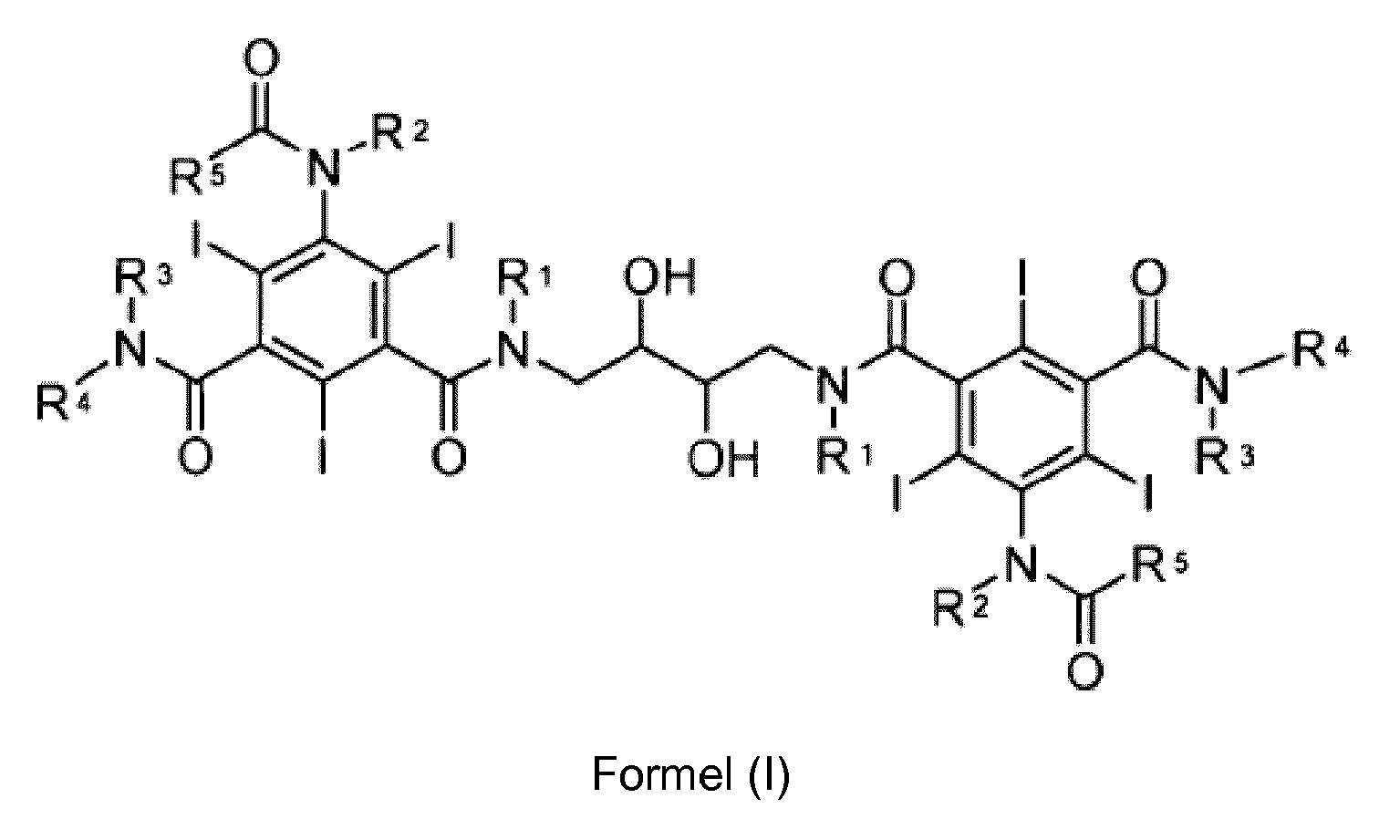
worinjedes von R1, R2 und R3 unabhängig gleich oder verschieden ist und ein Wasserstoffatom oder eine gerade oder verzweigte C1- bis C4-Alkylgruppe bedeutet;jedes R4 unabhängig gleich oder verschieden ist und eine gerade oder verzweigte C1- bis C6-Alkyleinheit, substituiert durch bis zu 6 -OH-Gruppen, bedeutet; undjedes R5 unabhängig gleich oder verschieden ist und eine gerade oder verzweigte C1- bis C6-Alkyleinheit, substituiert durch bis zu 6 -OH-Gruppen, bedeutet. - Verbindung nach Anspruch 1, worin jedes R1, R2 und R3 ein Wasserstoffatom und/oder eine Methylgruppe bedeutet.
- Verbindung nach Anspruch 1 oder 2, worin jedes R1 eine Methylgruppe bedeutet, jedes R2 ein Wasserstoffatom bedeutet, und jedes R3 ein Wasserstoffatom oder eine Methylgruppe bedeutet.
- Verbindung nach einem der vorstehenden Ansprüche, worin jedes R4 eine mono-, di- und tri-hydroxylierte geradkettige C1- bis C6-Alkylgruppe bedeutet.
- Verbindung nach Anspruch 4, worin R4 eine Hydroxygruppe in der ω-Position trägt und in der α-Position nicht substituiert ist.
- Verbindung nach Ansprüchen 5 und 6, worin alle R4 gleich sind und für 2,3-Dihydroxypropyl-Einheiten stehen.
- Verbindung nach einem der vorstehenden Ansprüche, worin R5 eine di- oder tri-hydroxylierte geradkettige C1- bis C6-Alkylgruppe bedeutet.
- Verbindung nach Anspruch 7, worin R5 für eine di- oder tri-hydroxylierte Propyleinheit und/oder eine Di-Hydroxy-Ethyl-Einheit steht.
- Verbindung nach Anspruch 7 oder 8, worin jedes R5 gleich ist und für eine 1,2-Dihydroxyethyl- oder Hydroxymethyl-Einheit steht.
- Verbindung nach einem der vorstehenden Ansprüche, die gewählt ist aus der Gruppe
N1,N1'-(2,3-Dihydroxybutan-1,4-diyl)bis(N3-(2,3-dihydroxypropyl)-5-(2-hydroxyacetamido)-2,4,6-trijod-N1,N3-dimethylisophthalamid);
N1,N1'-(2,3-Dihydroxybutan-1,4-diyl)bis(5-(2,3-dihydroxypropanamido)-N3-(2,3-dihydroxypropyl)-2,4,6-trijod-N1,N3-dimethylisophthalamid);
N1,N1'-(2,3-Dihydroxybutan-1,4-diyl)bis(N3-(2,3-dihydroxypropyl)-5-(2-hydroxyacetamido)-2,4,6-trijod-N1-methylisophthalamid); und
N1,N1'-((2R,3S)-2,3-Dihydroxybutan-1,4-diyl)bis(N3-(2,3-dihydroxypropyl)-5-(2-hydroxyacetamido)-2,4,6-trijodisophthalamid). - Röntgendiagnostische Zusammensetzung, die eine Verbindung der Formel (I), wie in einem der vorstehenden Ansprüche definiert, zusammen mit pharmazeutisch unbedenklichen Trägern oder Exzipienten umfasst.
- Diagnostische Zusammensetzung, die eine Verbindung der Formel (I), wie in einem der vorstehenden Ansprüche definiert, zur Verwendung in Röntgenkontrastuntersuchungen enthält.
Applications Claiming Priority (3)
| Application Number | Priority Date | Filing Date | Title |
|---|---|---|---|
| NO20075257 | 2007-10-12 | ||
| NO20076193 | 2007-11-30 | ||
| PCT/EP2008/063588 WO2009047318A1 (en) | 2007-10-12 | 2008-10-10 | Contrast agents |
Publications (2)
| Publication Number | Publication Date |
|---|---|
| EP2200655A1 EP2200655A1 (de) | 2010-06-30 |
| EP2200655B1 true EP2200655B1 (de) | 2012-07-18 |
Family
ID=39998987
Family Applications (1)
| Application Number | Title | Priority Date | Filing Date |
|---|---|---|---|
| EP08805209A Not-in-force EP2200655B1 (de) | 2007-10-12 | 2008-10-10 | Kontrastmittel |
Country Status (6)
| Country | Link |
|---|---|
| US (1) | US20100221192A1 (de) |
| EP (1) | EP2200655B1 (de) |
| JP (1) | JP2011500532A (de) |
| CN (1) | CN101820922A (de) |
| ES (1) | ES2389975T3 (de) |
| WO (1) | WO2009047318A1 (de) |
Family Cites Families (16)
| Publication number | Priority date | Publication date | Assignee | Title |
|---|---|---|---|---|
| SE344166B (de) | 1966-12-13 | 1972-04-04 | Pharmacia Ab | |
| US3763227A (en) | 1967-12-28 | 1973-10-02 | Pharmacia Ab | Novel 3,5-substituted 2,4,6-triiodobenzoic acids and salts thereof |
| US3804892A (en) | 1967-12-28 | 1974-04-16 | Pharmacia Ab | Novel 3,5-substituted 2,4,6-triiodobenzoic acids and salts thereof |
| SE315974B (de) | 1967-12-28 | 1969-10-13 | Pharmacia Ab | |
| DE2628517C2 (de) | 1976-06-23 | 1985-02-21 | Schering AG, 1000 Berlin und 4709 Bergkamen | Dicarbonsäure-bis(3,5-dicarbamoyl-2,4,6-trijodanilid)-Verbindungen, Verfahren zu ihrer Herstellung und Röntgenkontrastmittel |
| IT1207226B (it) * | 1979-08-09 | 1989-05-17 | Bracco Ind Chimica Spa | Derivati dell'acido 2,4,6-triiodo-isoftalico, metodo per la loro preparazione e mezzi di contrasto che li contengono. |
| DE3038853A1 (de) | 1980-10-10 | 1982-05-27 | Schering Ag, 1000 Berlin Und 4619 Bergkamen | Neue n-hydroxy-alkylierte dicarbonsaeure-bis-(3,5-dicarbamoyl-2,4,6-trijodanilide), deren herstellung und diese enthaltende roentgenkonstrastmittel (ii) |
| ATE20733T1 (de) | 1982-11-08 | 1986-08-15 | Nyegaard & Co As | Roentgenkontrastmittel. |
| FR2634571B1 (fr) | 1988-07-19 | 1990-10-19 | Kodak Pathe | Procede d'organisation et de lecture d'un support magnetique et support en faisant application |
| GB9020091D0 (en) | 1990-09-14 | 1990-10-24 | Nycomed As | Contrast media |
| IT1245853B (it) * | 1990-11-16 | 1994-10-25 | Bracco Spa | 1,3-bis(3-(mono o poliidrossi)acilamino-5-(mono o poliidrossi-alchil) aminocarbonil-2,4,6-triiodo-benzoil-amino)-idrossi- o idrossi-alchil- propani, loro metodo di preparazione e mezzi di contrasto roentgenografici che li contengono |
| GB9303992D0 (en) | 1993-02-26 | 1993-04-14 | Nycomed Imaging As | Contrast agents |
| WO1997000240A1 (en) | 1995-06-16 | 1997-01-03 | Biophysica Foundation | Formyl derivatives as nonionic contrast media |
| US6072069A (en) | 1998-11-04 | 2000-06-06 | Biophysica, Inc. | Biodegradable nonionic contrast media |
| EP1186305A1 (de) | 2000-09-07 | 2002-03-13 | Schering Aktiengesellschaft | Neue bromierte Verbindungen als Kontrastmedien für Röntgenmammography |
| DE60324401D1 (de) | 2002-03-27 | 2008-12-11 | Fujifilm Corp | Iodierte triglycerid-derivate |
-
2008
- 2008-10-10 US US12/682,070 patent/US20100221192A1/en not_active Abandoned
- 2008-10-10 EP EP08805209A patent/EP2200655B1/de not_active Not-in-force
- 2008-10-10 WO PCT/EP2008/063588 patent/WO2009047318A1/en not_active Ceased
- 2008-10-10 JP JP2010528407A patent/JP2011500532A/ja active Pending
- 2008-10-10 CN CN200880111007A patent/CN101820922A/zh active Pending
- 2008-10-10 ES ES08805209T patent/ES2389975T3/es active Active
Also Published As
| Publication number | Publication date |
|---|---|
| WO2009047318A1 (en) | 2009-04-16 |
| US20100221192A1 (en) | 2010-09-02 |
| JP2011500532A (ja) | 2011-01-06 |
| EP2200655A1 (de) | 2010-06-30 |
| ES2389975T3 (es) | 2012-11-05 |
| CN101820922A (zh) | 2010-09-01 |
Similar Documents
| Publication | Publication Date | Title |
|---|---|---|
| EP2178568B1 (de) | Kontrastmittel | |
| EP2200656B1 (de) | Kontrastmittel | |
| US20110256068A1 (en) | Contrast media compositions | |
| US8323619B2 (en) | Contrast agents | |
| US20100303734A1 (en) | Contrast agents | |
| EP1986993B1 (de) | Kontrastmittel | |
| EP2200971B1 (de) | Kontrastmittel | |
| WO2009056555A1 (en) | Contrast agents | |
| WO2009047317A1 (en) | Contrast agents | |
| US8066970B2 (en) | Contrast agents | |
| EP2203189B1 (de) | Kontrastmittel | |
| US20090098059A1 (en) | Contrast agents | |
| US20100111875A1 (en) | Trisubstituted triazamacrocyclic compounds and their use as contrast agents | |
| US20100221192A1 (en) | Contrast agents | |
| GB2457358A (en) | X-Ray contrast agents comprising three iodinated phenyl groups | |
| WO2007055580A1 (en) | Contrast agents and diagnostic compositions based on iodine-containing cyanuric acid derivatives | |
| GB2453654A (en) | A compound for use in X-ray contrast examinations | |
| LI et al. | PRODUITS DE CONTRASTE |
Legal Events
| Date | Code | Title | Description |
|---|---|---|---|
| PUAI | Public reference made under article 153(3) epc to a published international application that has entered the european phase |
Free format text: ORIGINAL CODE: 0009012 |
|
| 17P | Request for examination filed |
Effective date: 20100412 |
|
| AK | Designated contracting states |
Kind code of ref document: A1 Designated state(s): AT BE BG CH CY CZ DE DK EE ES FI FR GB GR HR HU IE IS IT LI LT LU LV MC MT NL NO PL PT RO SE SI SK TR |
|
| AX | Request for extension of the european patent |
Extension state: AL BA MK RS |
|
| 17Q | First examination report despatched |
Effective date: 20101011 |
|
| DAX | Request for extension of the european patent (deleted) | ||
| GRAP | Despatch of communication of intention to grant a patent |
Free format text: ORIGINAL CODE: EPIDOSNIGR1 |
|
| GRAS | Grant fee paid |
Free format text: ORIGINAL CODE: EPIDOSNIGR3 |
|
| GRAA | (expected) grant |
Free format text: ORIGINAL CODE: 0009210 |
|
| RIN1 | Information on inventor provided before grant (corrected) |
Inventor name: WISTRAND, LARS-GOERAN Inventor name: WYNN, DUNCAN, GEORGE |
|
| AK | Designated contracting states |
Kind code of ref document: B1 Designated state(s): AT BE BG CH CY CZ DE DK EE ES FI FR GB GR HR HU IE IS IT LI LT LU LV MC MT NL NO PL PT RO SE SI SK TR |
|
| REG | Reference to a national code |
Ref country code: GB Ref legal event code: FG4D |
|
| REG | Reference to a national code |
Ref country code: CH Ref legal event code: EP |
|
| REG | Reference to a national code |
Ref country code: AT Ref legal event code: REF Ref document number: 566781 Country of ref document: AT Kind code of ref document: T Effective date: 20120815 Ref country code: IE Ref legal event code: FG4D |
|
| REG | Reference to a national code |
Ref country code: DE Ref legal event code: R096 Ref document number: 602008017301 Country of ref document: DE Effective date: 20120913 |
|
| REG | Reference to a national code |
Ref country code: ES Ref legal event code: FG2A Ref document number: 2389975 Country of ref document: ES Kind code of ref document: T3 Effective date: 20121105 |
|
| REG | Reference to a national code |
Ref country code: NL Ref legal event code: VDEP Effective date: 20120718 |
|
| REG | Reference to a national code |
Ref country code: AT Ref legal event code: MK05 Ref document number: 566781 Country of ref document: AT Kind code of ref document: T Effective date: 20120718 |
|
| REG | Reference to a national code |
Ref country code: LT Ref legal event code: MG4D Effective date: 20120718 |
|
| PG25 | Lapsed in a contracting state [announced via postgrant information from national office to epo] |
Ref country code: IS Free format text: LAPSE BECAUSE OF FAILURE TO SUBMIT A TRANSLATION OF THE DESCRIPTION OR TO PAY THE FEE WITHIN THE PRESCRIBED TIME-LIMIT Effective date: 20121118 Ref country code: HR Free format text: LAPSE BECAUSE OF FAILURE TO SUBMIT A TRANSLATION OF THE DESCRIPTION OR TO PAY THE FEE WITHIN THE PRESCRIBED TIME-LIMIT Effective date: 20120718 Ref country code: AT Free format text: LAPSE BECAUSE OF FAILURE TO SUBMIT A TRANSLATION OF THE DESCRIPTION OR TO PAY THE FEE WITHIN THE PRESCRIBED TIME-LIMIT Effective date: 20120718 Ref country code: NO Free format text: LAPSE BECAUSE OF FAILURE TO SUBMIT A TRANSLATION OF THE DESCRIPTION OR TO PAY THE FEE WITHIN THE PRESCRIBED TIME-LIMIT Effective date: 20121018 Ref country code: LT Free format text: LAPSE BECAUSE OF FAILURE TO SUBMIT A TRANSLATION OF THE DESCRIPTION OR TO PAY THE FEE WITHIN THE PRESCRIBED TIME-LIMIT Effective date: 20120718 Ref country code: FI Free format text: LAPSE BECAUSE OF FAILURE TO SUBMIT A TRANSLATION OF THE DESCRIPTION OR TO PAY THE FEE WITHIN THE PRESCRIBED TIME-LIMIT Effective date: 20120718 Ref country code: BE Free format text: LAPSE BECAUSE OF FAILURE TO SUBMIT A TRANSLATION OF THE DESCRIPTION OR TO PAY THE FEE WITHIN THE PRESCRIBED TIME-LIMIT Effective date: 20120718 Ref country code: CY Free format text: LAPSE BECAUSE OF FAILURE TO SUBMIT A TRANSLATION OF THE DESCRIPTION OR TO PAY THE FEE WITHIN THE PRESCRIBED TIME-LIMIT Effective date: 20120718 |
|
| PG25 | Lapsed in a contracting state [announced via postgrant information from national office to epo] |
Ref country code: SE Free format text: LAPSE BECAUSE OF FAILURE TO SUBMIT A TRANSLATION OF THE DESCRIPTION OR TO PAY THE FEE WITHIN THE PRESCRIBED TIME-LIMIT Effective date: 20120718 Ref country code: GR Free format text: LAPSE BECAUSE OF FAILURE TO SUBMIT A TRANSLATION OF THE DESCRIPTION OR TO PAY THE FEE WITHIN THE PRESCRIBED TIME-LIMIT Effective date: 20121019 Ref country code: PL Free format text: LAPSE BECAUSE OF FAILURE TO SUBMIT A TRANSLATION OF THE DESCRIPTION OR TO PAY THE FEE WITHIN THE PRESCRIBED TIME-LIMIT Effective date: 20120718 Ref country code: PT Free format text: LAPSE BECAUSE OF FAILURE TO SUBMIT A TRANSLATION OF THE DESCRIPTION OR TO PAY THE FEE WITHIN THE PRESCRIBED TIME-LIMIT Effective date: 20121119 Ref country code: LV Free format text: LAPSE BECAUSE OF FAILURE TO SUBMIT A TRANSLATION OF THE DESCRIPTION OR TO PAY THE FEE WITHIN THE PRESCRIBED TIME-LIMIT Effective date: 20120718 Ref country code: SI Free format text: LAPSE BECAUSE OF FAILURE TO SUBMIT A TRANSLATION OF THE DESCRIPTION OR TO PAY THE FEE WITHIN THE PRESCRIBED TIME-LIMIT Effective date: 20120718 |
|
| PG25 | Lapsed in a contracting state [announced via postgrant information from national office to epo] |
Ref country code: NL Free format text: LAPSE BECAUSE OF FAILURE TO SUBMIT A TRANSLATION OF THE DESCRIPTION OR TO PAY THE FEE WITHIN THE PRESCRIBED TIME-LIMIT Effective date: 20120718 |
|
| PG25 | Lapsed in a contracting state [announced via postgrant information from national office to epo] |
Ref country code: RO Free format text: LAPSE BECAUSE OF FAILURE TO SUBMIT A TRANSLATION OF THE DESCRIPTION OR TO PAY THE FEE WITHIN THE PRESCRIBED TIME-LIMIT Effective date: 20120718 Ref country code: CZ Free format text: LAPSE BECAUSE OF FAILURE TO SUBMIT A TRANSLATION OF THE DESCRIPTION OR TO PAY THE FEE WITHIN THE PRESCRIBED TIME-LIMIT Effective date: 20120718 Ref country code: DK Free format text: LAPSE BECAUSE OF FAILURE TO SUBMIT A TRANSLATION OF THE DESCRIPTION OR TO PAY THE FEE WITHIN THE PRESCRIBED TIME-LIMIT Effective date: 20120718 Ref country code: EE Free format text: LAPSE BECAUSE OF FAILURE TO SUBMIT A TRANSLATION OF THE DESCRIPTION OR TO PAY THE FEE WITHIN THE PRESCRIBED TIME-LIMIT Effective date: 20120718 |
|
| PLBE | No opposition filed within time limit |
Free format text: ORIGINAL CODE: 0009261 |
|
| STAA | Information on the status of an ep patent application or granted ep patent |
Free format text: STATUS: NO OPPOSITION FILED WITHIN TIME LIMIT |
|
| PG25 | Lapsed in a contracting state [announced via postgrant information from national office to epo] |
Ref country code: SK Free format text: LAPSE BECAUSE OF FAILURE TO SUBMIT A TRANSLATION OF THE DESCRIPTION OR TO PAY THE FEE WITHIN THE PRESCRIBED TIME-LIMIT Effective date: 20120718 Ref country code: MC Free format text: LAPSE BECAUSE OF NON-PAYMENT OF DUE FEES Effective date: 20121031 |
|
| REG | Reference to a national code |
Ref country code: CH Ref legal event code: PL |
|
| 26N | No opposition filed |
Effective date: 20130419 |
|
| REG | Reference to a national code |
Ref country code: IE Ref legal event code: MM4A |
|
| PG25 | Lapsed in a contracting state [announced via postgrant information from national office to epo] |
Ref country code: BG Free format text: LAPSE BECAUSE OF FAILURE TO SUBMIT A TRANSLATION OF THE DESCRIPTION OR TO PAY THE FEE WITHIN THE PRESCRIBED TIME-LIMIT Effective date: 20121018 Ref country code: IE Free format text: LAPSE BECAUSE OF NON-PAYMENT OF DUE FEES Effective date: 20121010 Ref country code: CH Free format text: LAPSE BECAUSE OF NON-PAYMENT OF DUE FEES Effective date: 20121031 Ref country code: LI Free format text: LAPSE BECAUSE OF NON-PAYMENT OF DUE FEES Effective date: 20121031 |
|
| REG | Reference to a national code |
Ref country code: DE Ref legal event code: R097 Ref document number: 602008017301 Country of ref document: DE Effective date: 20130419 |
|
| PG25 | Lapsed in a contracting state [announced via postgrant information from national office to epo] |
Ref country code: MT Free format text: LAPSE BECAUSE OF FAILURE TO SUBMIT A TRANSLATION OF THE DESCRIPTION OR TO PAY THE FEE WITHIN THE PRESCRIBED TIME-LIMIT Effective date: 20120718 |
|
| PGFP | Annual fee paid to national office [announced via postgrant information from national office to epo] |
Ref country code: GB Payment date: 20131028 Year of fee payment: 6 Ref country code: FR Payment date: 20131017 Year of fee payment: 6 Ref country code: DE Payment date: 20131029 Year of fee payment: 6 |
|
| PGFP | Annual fee paid to national office [announced via postgrant information from national office to epo] |
Ref country code: IT Payment date: 20131023 Year of fee payment: 6 Ref country code: ES Payment date: 20131028 Year of fee payment: 6 |
|
| PG25 | Lapsed in a contracting state [announced via postgrant information from national office to epo] |
Ref country code: TR Free format text: LAPSE BECAUSE OF FAILURE TO SUBMIT A TRANSLATION OF THE DESCRIPTION OR TO PAY THE FEE WITHIN THE PRESCRIBED TIME-LIMIT Effective date: 20120718 |
|
| PG25 | Lapsed in a contracting state [announced via postgrant information from national office to epo] |
Ref country code: LU Free format text: LAPSE BECAUSE OF NON-PAYMENT OF DUE FEES Effective date: 20121010 |
|
| PG25 | Lapsed in a contracting state [announced via postgrant information from national office to epo] |
Ref country code: HU Free format text: LAPSE BECAUSE OF FAILURE TO SUBMIT A TRANSLATION OF THE DESCRIPTION OR TO PAY THE FEE WITHIN THE PRESCRIBED TIME-LIMIT Effective date: 20081010 |
|
| REG | Reference to a national code |
Ref country code: DE Ref legal event code: R119 Ref document number: 602008017301 Country of ref document: DE |
|
| GBPC | Gb: european patent ceased through non-payment of renewal fee |
Effective date: 20141010 |
|
| PG25 | Lapsed in a contracting state [announced via postgrant information from national office to epo] |
Ref country code: DE Free format text: LAPSE BECAUSE OF NON-PAYMENT OF DUE FEES Effective date: 20150501 Ref country code: GB Free format text: LAPSE BECAUSE OF NON-PAYMENT OF DUE FEES Effective date: 20141010 |
|
| REG | Reference to a national code |
Ref country code: FR Ref legal event code: ST Effective date: 20150630 |
|
| PG25 | Lapsed in a contracting state [announced via postgrant information from national office to epo] |
Ref country code: IT Free format text: LAPSE BECAUSE OF NON-PAYMENT OF DUE FEES Effective date: 20141010 Ref country code: FR Free format text: LAPSE BECAUSE OF NON-PAYMENT OF DUE FEES Effective date: 20141031 |
|
| REG | Reference to a national code |
Ref country code: ES Ref legal event code: FD2A Effective date: 20151126 |
|
| PG25 | Lapsed in a contracting state [announced via postgrant information from national office to epo] |
Ref country code: ES Free format text: LAPSE BECAUSE OF NON-PAYMENT OF DUE FEES Effective date: 20141011 |