EP2201429B1 - Zeitindikatoreinrichtung - Google Patents
Zeitindikatoreinrichtung Download PDFInfo
- Publication number
- EP2201429B1 EP2201429B1 EP08806430A EP08806430A EP2201429B1 EP 2201429 B1 EP2201429 B1 EP 2201429B1 EP 08806430 A EP08806430 A EP 08806430A EP 08806430 A EP08806430 A EP 08806430A EP 2201429 B1 EP2201429 B1 EP 2201429B1
- Authority
- EP
- European Patent Office
- Prior art keywords
- liquid
- reservoir
- barrier
- conduit
- substance
- Prior art date
- Legal status (The legal status is an assumption and is not a legal conclusion. Google has not performed a legal analysis and makes no representation as to the accuracy of the status listed.)
- Not-in-force
Links
Images

Classifications
-
- G—PHYSICS
- G04—HOROLOGY
- G04F—TIME-INTERVAL MEASURING
- G04F1/00—Apparatus which can be set and started to measure-off predetermined or adjustably-fixed time intervals without driving mechanisms, e.g. egg timers
Definitions
- the present invention relates to a time indicator device, particularly but not exclusively, a time indicator device suitable for use on food and other perishable products, such as pharmaceuticals and cosmetics.
- a 'Sell By' date the date after which the retailer should no longer offer a product for sale. This is an indicator to the retailer of the expected shelf life of a product, but provides the consumer with no useful information as to how long after this date a product is still safe or desirable to consume.
- a 'Best Before' date the date after which the product may not be at its premium quality of performance. This does provide the consumer with an indication of the 'best product life', but is not an indicator of the actual freshness or performance of a product. Furthermore, this date is generally only a reliable measure if the primary packaging is in an unopened state and the product has been stored properly.
- a 'Once opened, use within XX days' date, this date attempts to reflect the accelerated decay of the produce following breach of the primary packaging. Whilst the use of a 'Once opened, use within XX days' date is an advance on the previous state of the art, but its effectiveness relies totally on the consumer remembering when a product was first opened. This is fine when the open life is short (e.g. 3 days for orange juice); however, some products have an open life of several weeks or even months, at which point the consumer's memory becomes an unreliable measure, with people tending to rely on the smell of the product or assuming it will be alright and using it anyway.
- the timer is started upon manufacture or application of the device, whereas in other devices user initiation is employed. Both these systems have inherent problems, certain devices are fine as 'Use By' indicators, but due to their initiation at manufacture can take no account of the accelerated rate of product decay upon breach of primary packaging exposing the product to oxygen, locally introduced bacteria and other suchlike present in the atmosphere. Equally the user-activated devices rely on a consumer remembering to activate the device upon opening their product, this is easily forgotten and could leave unaffected exactly the problems they are intended to address.
- a reservoir may be breached by the act of opening the closure/lid of a container holding the perishable product.
- a multi-component lid can be used with various moving parts designed to puncture a reservoir containing a reactive compound.
- a color changing device for monitoring perishable products is described in WO 92/09870 , wherein a three layer device with an indicator tape, an activator tape and a barrier matrix layer. Once the device is activated, the activator diffuses through the barrier matrix into the indicator matrix where it will react with the indicator to introduce a color change.
- An object of the present invention is to obviate or mitigate one or more of the problems and/or drawbacks associated with prior art time indicator devices mentioned above.
- a time indicator device comprised of first and second interconnected reservoirs containing first and second liquids respectively, a first barrier being provided between said first and second liquids to prevent said liquids mixing, wherein said first barrier is connected via a conduit to a third reservoir containing a third liquid which is adapted to pass along said conduit over a first predetermined time period and to effect removal of said first barrier upon contact to facilitate mixing of said first and second liquids and generation of a liquid mixture within the second reservoir of different colour to the second liquid prior to mixing and thereby provide an indication of when said first predetermined time period has elapsed.
- the present invention thus provides a means of providing a consumer with a clear and reliable visual indication of how safe a particular perishable item, such as a foodstuff, pharmaceutical or cosmetic, is to use.
- the first predetermined time period is controlled primarily by the rate at which the third liquid passes along the conduit from the third reservoir to the first barrier. Once the third liquid has passed along the conduit and reaches the first barrier, contact between the third liquid and the first barrier causes the first barrier to be removed, thereby releasing the first and second liquids so that they can mix together and produce a liquid mixture of different colour to the original colour of the second liquid before mixing.
- the second liquid contains a Universal pH indicator solution and is initially green in colour by virtue of possessing an approximately neutral pH (i.e. around pH 7).
- the time indicator device is activated (e.g. by opening a jar containing a perishable food item)
- the third liquid passes down the conduit over the first predetermined time period until it contacts the first barrier, causing the barrier to be removed and allowing the first liquid to mix with the green second liquid.
- the first liquid contains a suitable amount of a food-safe acid compound which, when mixed with the second liquid containing the pH indicator solution, produces a liquid mixture which is more acidic than the original neutral second liquid. In this way, the user can observe a change in colour of the liquid present in the second reservoir from green to red indicating that the first predetermined time period has elapsed and that the perishable food item is no longer safe to be consumed.
- the second liquid is clear but is supported within the second reservoir on a green-coloured backing layer so as to present a green colouration to the user.
- colourants such as dyes and/or pigments
- the first liquid can be provided with a red dye which, when mixed with the second liquid within the second reservoir, causes the resulting liquid mixture within the second reservoir to exhibit a red colouration indicating that the item is no longer suitable for use.
- the first liquid may contain both an amount of acid and a colourant to ensure that the appropriate colouration is afforded to the user.
- the first aspect of the present invention is not limited to just a single colour change from, e.g. green to red, but that any desirable colour change may be utilised.
- the second reservoir can be connected to at least one further reservoir and mixing of the contents of the further reservoir(s) with the liquid within the second reservoir controlled in a similar manner to the first liquid such that the colour of the liquid mixture within the second reservoir can be changed after not only a first time period, but also after a second, and optionally further, time periods.
- the second reservoir is connected to two reservoirs and mixing of the liquids in the two reservoirs with the liquid within the second reservoir occurs over two different time periods.
- a two-step colour change can be employed to indicate firstly when a perishable item has begun to perish but is still suitable for use, and secondly, when the item has perished to such an extent that it is deemed no longer suitable to use.
- a simple and universally recognised two-step colour change indicator is the "traffic-light" indicator system whereby a green colouration initially changes to an amber colouration, indicating a warning of some sort, followed by a second colour change to a red colouration.
- the preferred embodiment of the present invention mentioned above in which two reservoirs are connected to the second reservoir can therefore employ the "traffic-light" warning system to provide a user with an initial colour change from green to amber to indicate that an item, while still fit for purpose, has begun to perish, followed by a further colour change from amber to red to indicate that the item should no longer be used.
- An example not being part of the present invention provides a time indicator device comprised of first and second interconnected reservoirs containing first and second liquids respectively, and a barrier being provided between said first and second liquids to prevent said liquids mixing, wherein the barrier comprises a chemically and/or enzymatically degradable substance which is adapted to be sufficiently degradable after a first predetermined time period to permit the first and second liquids to mix and generate a liquid mixture within the second reservoir of different colour to the second liquid prior to mixing and thereby provide an indication of when said first predetermined time period has elapsed.
- the example not being part of the present invention relates to a time indicator device in which at least two liquids are prevented from mixing by a particular type of barrier until a predetermined time period has elapsed.
- This aspect of the invention provides a chemically and/or enzymatically degradable barrier between the at least two liquids, thereby enabling timing to be controlled by the rate at which a suitable chemical agent or enzyme passes from a reservoir to the barrier and initiates the barrier's degradation and/or by the rate at which the chemical agent or enzyme degrades the barrier following initial contact. This provides the designer/manufacturer of the device with a great deal of flexibility in how best to arrange the components of the device to suit its intended purpose.
- timing by having the chemical agent / enzyme pass along a conduit of a particular length after activation of the device such that the distance over which the chemical agent / enzyme travels from its reservoir to the barrier essentially determines the first predetermined time period.
- a combination of the above timing mechanisms may be employed such that a predetermined time period is controlled both by the rate at which the chemical agent / enzyme passes along a conduit and the rate at which the chemical agent / enzyme degrades the barrier.
- a time indicator device comprised of a first reservoir containing a first liquid comprising a colourant and a second reservoir containing a second liquid comprising a dispersant for said colourant, a viewing window being associated with said second reservoir, said first and second reservoirs being interconnected by a conduit, and a barrier being provided between at least one of said first and second liquids and said conduit, wherein the conduit contains a first substance that is a liquid or gel, and removal of the barrier permits dispersion of said colourant from the first reservoir to the second reservoir over a predetermined time period thereby providing an indication via said viewing window of when said predetermined time period has elapsed.
- any potential problems associated with the use of gas (e.g. air) filled conduits linking the two reservoirs are avoided. Since the movement of the colourant species within the liquid mixture formed throughout the reservoirs and conduit(s) does not rely solely upon the flow of fluids (i.e. liquids or gases) within the device, fluid dynamic and fluid displacement issues associated with some earlier devices are avoided.
- gas e.g. air
- dispersion of the colourant from the first reservoir to the second reservoir may be controlled, at least in part, by providing a higher concentration of the colourant in the first reservoir than in the second reservoir. This may, of course, be achieved by providing a predetermined concentration of the colourant in the first reservoir and no colourant in the second reservoir, although the present invention is not limited to this particular configuration.
- the same or different colourants may be provided in both the first and second reservoirs, but the relative concentrations of the colourants in the two reservoirs may be selected so as to ensure that the colourant in the first reservoir has a tendency to disperse from the first reservoir into the second reservoir.
- colourant' as used herein is intended to refer to any substance which provides colouration and, when used without further qualification, encompasses both dyes and pigments.
- 'dispersant' refers to any substance which is capable of dispersing or dissolving a first entity, such as but not limited to a dye or pigment, in a second entity, such as but not limited to a liquid, for example water.
- a first entity such as but not limited to a dye or pigment
- a second entity such as but not limited to a liquid, for example water.
- the term 'dispersant' should be understood as encompassing substances which dissolve, partially dissolve or disperse the first entity in the second entity. In this way, the term 'dispersant' encompasses but is not limited to a solvent for a particular substance.
- 'conduit' refers to any type of passageway along which a liquid can flow or molecules can pass and is not intended to be restricted to tubes, channels or capillaries of circular cross section. Where the term 'conduit' is used without further qualification, the term in intended to encompass passageways which may be open or closed along at least a part of their length and which are of appropriate dimension and construction to permit liquid flow.
- liquid' in no way implies any restriction to a pure liquid and is intended to encompass liquid mixtures or solutions, as well as pure liquids.
- the term should be interpreted broadly, suggesting only that the substance discussed is liquid in nature, i.e. it is a non-gaseous fluid with flow characteristics.
- 'gel' and 'gel-like' used herein will be understood as referring to an apparently solid, often jelly-like material, the composition of which is typically mostly liquid and thus possesses a density similar to a liquid, but possess the structural coherence of a solid.
- the time indicator device of the present invention may be provided in the form of a label or tag to be affixed to a perishable item or product, or it may be incorporated directly into the product packaging.
- the device may be incorporated into a laminated sheet of material which is then wrapped around the item or product, or which is formed as a sleeve of material and wrapped around further product packaging.
- a second barrier is provided between the third reservoir and the conduit.
- the second barrier is preferably adapted such that, upon removal, the first predetermined time period is initiated by permitting the passage of the third liquid along the conduit.
- the second barrier may be adapted to be removable as a result of opening a product to which the device is attached and/or removable as a result of attaching the device to a product.
- the first barrier comprises a chemically and/or enzymatically degradable substance.
- the first barrier incorporates a chemically and/or enzymatically degradable substance
- any appropriate substance may be used provided it can satisfactorily prevent mixing of the first and second liquids until degradation by a chemical agent or enzyme.
- the substance may be a relatively high molecular weight compound or polymer, which may be either natural, synthetic (i.e. artificial) or semi-synthetic.
- a particularly suitable substance is a lipid.
- preferred substances are lipophilic species, including fats, oils (e.g. hard palm kernel oil), waxes, and glycerides (mono-, di- and tri-glycerides).
- the degradable substance has a relatively high viscosity, preferably higher than the first, second and/or third liquids.
- the viscosity of the degradable substance comprised in the first barrier is at least around 2000 cP (at 20 °C), more preferably at least around 4000 cP (at 20 °C), and most preferably at least around 10000 cP (at 20 °C).
- the viscosity of the degradable substance is around 5000 to around 20000 cP (at 20 °C).
- the degradable substance possesses a melting point above around 40°C, more preferably above around 60 °C, and still more preferably above around 80°C.
- the degradable substance has a lower melting point, such as around 5 to 10 °C or lower, for example when it is desirable to have the degradable substance melt and the barrier therefore fail at relatively low temperatures.
- Exemplary applications requiring a lower melting point degradable substance include use on frozen or chilled goods where it is desirable for the device to indicate that the goods have been thawed out or warmed beyond the melting point of the degradable substance and subsequently refrozen or rechilled.
- the degradable substance may be at least partially foamed, i.e. at least partly in the form of a foam, so as to increase its surface area compared to the substance when unfoamed. In this way, the surface area of the substance available to contact the chemical agent / enzyme is increased which may increase the rate at which degradation of the barrier takes place facilitating essentially instantaneous degradation in some applications. It may also be possible to use a smaller amount of the degradable substance if it is foamed than unfoamed, which would be desirable from a cost and environmental point of view, as well as reducing the weight of the barrier.
- the first barrier comprises a dehydrated enzyme capable, upon hydration, of degrading the degradable substance also comprised in the first barrier. While any appropriate dehydrated enzyme may be used it is particularly preferred that the dehydrated enzyme is a lipase.
- the first barrier is connected via a conduit to a third reservoir containing a third liquid and the time taken for the third liquid to pass along the conduit contributes to determining the first predetermined time period.
- the conduit may contain any desirable substance in any appropriate physical state.
- the conduit may contain a gas such as air, it is preferred that the conduit contains substantially no gas and instead contains a liquid or gel whose properties may contribute to controlling the speed at which the third liquid passes along the conduit from the third reservoir to the first barrier.
- the first substance in the conduit exhibits a higher viscosity than the first and/or second liquids.
- the viscosity of the first substance may be greater than around 100 cP (at 20 °C), greater than around 300 cP (at 20 °C), and more preferably greater than around 1000 cP (at 20 °C).
- the first substance has a viscosity which is in the range of around 500 to around 2000 cP (at 20 °C), more preferably around 700 to 1400 cP (at 20 °C).
- the first substance may comprise any suitable to chemical to bestow the desired physical and/or chemical characteristics to the first substance to control passage of the third liquid along the conduit.
- the first substance within the conduit comprises carboxymethyl cellulose (or a salt thereof), hydroxyethyl cellulose, glycerol, ethylene glycol, diethylene glycol or mixtures thereof.
- the composition of the first substance e.g. the weight percentage of each component, may be selected to suit a particular application and may be selected from the compositions described below in relation to the second example not being part of the present invention for the composition of the first higher viscosity substance employed in that device.
- the third liquid is substantially miscible with the first substance and/or the third liquid comprises a solvent or dispersant for the first substance.
- the third liquid can mix with the first substance to a satisfactory extent such that the third liquid can, over a predetermined time period, pass along the conduit from the third reservoir to the barrier and then effect removal of the barrier.
- the third liquid comprises a chemical species or enzyme capable of degrading the degradable substance comprised in the first barrier.
- the third liquid may include any desirable component, but it is preferred that it comprises water since water is safe, cheap and acts as a good solvent for many other components that one may wish to provide in the third liquid. It is particularly preferred that the third liquid comprises saline solution. One reason for favouring saline is that it provides a stable environment for many chemical species and enzymes which may be contained within the third liquid. Any appropriate enzyme may be used and a preferred enzyme is a lipase.
- the viscosity of at least one of the first and second liquids is preferably greater than around 1 cP (at 20 °C), more preferably greater than around 3 cP (at 20 °C) and most preferably greater than around 8 cP (at 20 °C).
- At least one of the first and second liquids may have a viscosity of around 1 to 100 cP (at 20 °C), more preferably around 1 to 50 cP (at 20 °C) and most preferably around 10 cP (at 20 °C).
- the first and second liquids may contain any desirable combination of components to suit a particular application.
- at least one of the first and second liquids may comprise water; preferably both the first and second liquids comprise water.
- the second liquid preferably comprises a pH indicator species (e.g. a Universal pH indicator).
- the first liquid comprises an acid whose presence in the liquid mixture produced by mixing the first and second liquids can be detected by virtue of the presence of the pH indicator in the second liquid. In this way, mixing of the first and second liquids could be used to effect a change in pH of the liquid within the second reservoir which could be identified by the user as a change in colour of the liquid within the second reservoir after mixing.
- the first liquid comprises a sufficient quantity of the acid such that, after mixing with the second liquid, the resulting liquid mixture within the second reservoir is more acidic than the second liquid before mixing.
- the second liquid is initially at approximately neutral pH, i.e. around pH 7, but, after mixing the first and second liquids, the resulting liquid mixture has a pH of less than 7.
- the liquid mixture may be moderately acidic, e.g. a pH less than around pH 7 but higher than around pH 2; or a pH in the range of around 3 to around 6.
- the liquid mixture may be more strongly acidic and possess a pH of less than around 2, for example a pH of around 1.
- a colour change to red may be the most appropriate option.
- an acid safe for use in consumer products such as foodstuffs is used, e.g. a food acid, such as acetic acid or citric acid.
- the first liquid preferably comprises a colourant, which may be a dye or a pigment, that affords any desirable colouration to the device for identification by a user.
- a colourant which may be a dye or a pigment, that affords any desirable colouration to the device for identification by a user.
- Exemplary colourants that may be used include those providing an amber or red colouration, which would clearly be desirable if the device was intended make use of the "traffic-light" colour warning system.
- At least one of the first, second and third liquids may comprise any additional or alternative components such as fluorescent species to afford the desired indicator that a predetermined time period has elapsed and/or exothermic reagents which, when reacted, generate heat which may accelerate mixing of the various liquids and so, in turn, accelerate the rate of colour change.
- said conduit connecting the third reservoir and the first barrier possesses a predetermined length which defines a distance over which the third liquid must pass from the third reservoir to contact the first barrier, said distance at least partly determining said first predetermined time period.
- the device may define a single conduit of the predetermined length to suit a particular application, however, in other embodiments the device may define a plurality of partial conduits which are selectively connectable to form said conduit with said predetermined length.
- the device is assembled from components which define a plurality of partial conduits of differing length then this affords the manufacturer a greater degree of flexibility in selecting the desired conduit length to ensure that the final device informs the user of the optimum predetermined time period(s) to suit the intended application of the device.
- This flexibility in selection of timing periods may be advantageous in allowing the conduit length to be adjusted during assembly of the device to take account of variations in the properties of other components which might influence the device timing periods, such as the viscosity of the various liquids and substances which will reside in the conduit and the three reservoirs.
- a surface of the second reservoir is coloured, for example green, and the colour of said surface is visible prior to mixing of the first and second liquids.
- a user of the device can be presented with a first colour resulting from the coloured surface of the second reservoir before being presented with a second, and optionally further, colour(s) resulting from mixing of liquids within the second reservoir after one or more predetermined time periods.
- a viewing window is associated with said second reservoir such that said indication of the when the first predetermined time period has elapsed can be observed via said viewing window.
- the device comprises a fourth reservoir connected to the second reservoir, said fourth reservoir containing a fourth liquid, a third barrier being provided between said fourth liquid and the second liquid within the second reservoir to prevent said liquids mixing, said third barrier being connected via a further conduit to a fifth reservoir containing a fifth liquid which is adapted to pass along said further conduit over a second longer predetermined time period and to effect removal of said third barrier upon contact to facilitate mixing of said fourth liquid with said first liquid mixture within the second reservoir and generation of a second liquid mixture within the second reservoir of different colour to the first liquid mixture and thereby provide an indication of when said second predetermined time period has elapsed.
- This preferred embodiment of the present invention thus introduces a second set of reservoirs and a barrier which employ the same general methodology as the first set defined above in the first aspect of the present invention to provide the device with the ability to provide an indication of when a second predetermined time period has elapsed, which is longer than the first time period. Since the second time period is longer than the first, the liquid residing in the second reservoir when the fourth liquid enters is the first liquid mixture generated as a result of the first and second liquids mixing after the first predetermined time period had elapsed.
- the third barrier may take any convenient form but preferably comprises a chemically and/or enzymatically degradable substance, which may be the same or similar to the substance comprised in the first barrier described in detail above.
- the viscosity of the degradable substance comprised in the third barrier is similar to or the same as that of the degradable substance utilised in the first barrier, thus, by way of example only, the viscosity of the degradable substance in the third barrier may be at least around 2000 cP (at 20 °C).
- the third barrier may comprise a dehydrated enzyme capable, upon hydration, of degrading the degradable substance comprised in the third barrier.
- the nature of the dehydrated enzyme in the third barrier may be the same, similar of different to that employed in the first barrier.
- the further conduit may contain a second substance that is the same or similar to the first substance provided within the conduit linking the third reservoir to the first barrier.
- the further conduit linking the fifth reservoir to the third barrier preferably contains a second substance that is a liquid or gel.
- said second substance in the further conduit exhibits a higher viscosity than the second and/or fourth liquids.
- the fifth liquid is substantially miscible with the second substance in the further conduit and/or that the fifth liquid comprises a solvent or dispersant for the second substance in the further conduit.
- the fifth liquid comprises saline solution.
- the fifth liquid preferably comprises a chemical species or enzyme capable of degrading the degradable substance comprised in the third barrier.
- a fourth barrier is provided between the fifth reservoir and the further conduit.
- the fourth barrier may take any appropriate form, although it is preferred that the fourth barrier is adapted such that, upon removal, the second predetermined time period is initiated by permitting the passage of the fifth liquid along the further conduit. In this way, once the fourth barrier is removed the fifth liquid can pass along the further conduit and eventually contact the third barrier. This contact initiates degradation of the third barrier, thereby removing the barrier between the second and fourth reservoirs and allowing the fourth liquid to mix with the first liquid mixture already resident in the second reservoir.
- the fourth barrier may be adapted to be removable as a result of opening a product to which the device is attached and/or removable as a result of attaching the device to a product.
- the fourth liquid may have the same or similar properties to the first liquid initially resident in the first reservoir.
- the viscosity of the fourth liquid is preferably in the range of around 1 to around 100 cP (at 20 °C).
- the fourth liquid preferably comprises an acid. It is preferred that the fourth liquid comprises a sufficient quantity of an acid such that, after mixing with the first liquid mixture within the second reservoir, the resulting second liquid mixture within the second reservoir has a different pH (e.g. is more highly acidic) than the first liquid mixture.
- the second liquid initially resident in the second reservoir contains a pH indicator solution it will be appreciated that by causing a change in pH of the liquid resident in the second reservoir, the colour of that liquid will also change, thereby provided a means to accurately and reliably control the colouration presented to a user of the device.
- the fourth liquid comprises a sufficient quantity of acid such that, after mixing with the first liquid mixture within the second reservoir, the resulting second liquid mixture within the second reservoir possesses a pH of less than or equal to around 2.
- a pH this low will cause a solution containing a Universal pH indicator solution to present a red colouration, which a user of the device can easily identify. In most, but not necessarily all, circumstances a user presented with a red colouration will understand this as an indication that the product to which the device is attached in no longer suitable for use. This will be particularly useful when using a preferred embodiment of the device in which the "traffic-light" warning system is being used as described above.
- the device in the embodiment of the device incorporating two reservoirs connected to the second reservoir containing the pH indicator solution, can be used to present two colour changes to the user.
- the fourth liquid may comprise a colourant, such as a dye or pigment, of any desirable colour.
- a colourant such as a dye or pigment
- the fourth liquid may comprise a fluorescent species and/or exothermic reagents.
- said further conduit connecting the fifth reservoir to the third barrier possesses a second predetermined length which defines a second distance over which the fifth liquid must pass from the fifth reservoir to contact the third barrier, said second distance at least partly determining said second predetermined time period.
- the further conduit may be defined by a single conduit, the device may define a plurality of partial further conduits which are selectively connectable to form said further conduit with said second predetermined length.
- the first example not being part of the present invention provides a time indicator device comprising at least two reservoirs containing liquids which are initially prevented from mixing by a barrier which comprises a chemically and/or enzymatically degradable substance.
- the barrier is sufficiently degradable after a first predetermined time period to permit the first and second liquids to mix and generate a colour change which can be identified by a user as an indication of when said first predetermined time period has elapsed.
- the degradable barrier comprised in this example may take any of the features of the degradable barrier employed in the first aspect of the present invention as described above.
- the degradable substance within the degradable barrier comprises a lipid, such as a hard palm kernel oil.
- the viscosity of the degradable substance may take any appropriate value depending upon the intended application and the properties of other substances incorporated in the device (e.g. the viscosity of the first and second liquids).
- the viscosity of the substance comprised in the first barrier may be at least around 2000 cP (at 20 °C), and is preferably around 5000 to around 20000 cP (at 20 °C).
- the barrier may be advantageous to provide the barrier with a degradable substance which possesses a melting point above around 60 °C, while in other application it will be desirable that the degradable substance has a lower melting point, such as around 5 to 10°C or lower.
- the degradable substance, forming part of the barrier in this example is at least partially foamed.
- the first barrier used in this example comprises a dehydrated enzyme capable, upon hydration, of degrading the degradable substance comprised in the first barrier.
- a dehydrated enzyme capable, upon hydration, of degrading the degradable substance comprised in the first barrier.
- any suitable dehydrated enzyme can be used, although it is preferred that said dehydrated enzyme is a lipase.
- the time indicator device may comprise a fourth reservoir connected to the second reservoir, said fourth reservoir containing a fourth liquid, a third barrier being provided between said fourth liquid and the second liquid within the second reservoir to prevent said liquids mixing, said third barrier comprising a chemically and/or enzymatically degradable substance which is adapted to be sufficiently degradable after a second longer predetermined time period to permit mixing of said fourth liquid with said first liquid mixture within the second reservoir and generation of a second liquid mixture within the second reservoir of different colour to the first liquid mixture and thereby provide an indication of when said second predetermined time period has elapsed.
- This embodiment enables a second colour change to be presented by the device of the first example.
- the device can be used to provide a "traffic-light" type warning system, whereby a green colouration is first presented to a user from the second (unmixed) liquid initially resident within the second reservoir, followed by an amber colouration from the first liquid mixture after the first predetermined time period has elapsed, and then a red colouration from the second liquid mixture after the second predetermined time period has elapsed.
- the device according to the first and second aspects of the present invention is preferably of a multi-layer construction.
- the multi-layer construction preferably comprises a base layer defining the reservoirs which is formed of an impermeable material, and constructed from either a single layer or a lamination of two or more component materials.
- the multi-layer construction preferably then comprises an intermediate layer, again formed from an impermeable material, and constructed from either a single layer or a lamination of two or more component materials so as to define the various conduits connecting the reservoirs as described above.
- the multi-layer construction preferably comprises an upper layer, again formed from an impermeable material, which has built up areas on its underside (i.e. the side facing the intermediate layer, which, when laminated to the intermediate layer, serve to compress and block selected areas of the conduits defined by the second layer to prevent or delay the movement of liquids within the device until the desired point of activation.
- Said reservoirs and conduits are preferably formed by a combination of embossing, die cutting, lamination, ultrasonic welding and/or laser ablation processes, which are preferably inline processes.
- the conduit interconnecting the third reservoir and the first barrier and the optional fifth reservoir and third barrier is/are preferably defined by a combination of a plurality of incomplete or partial conduits of varying length defined by the intermediate layer of the device. Connection of said partial conduits to form the complete conduit connecting a reservoir to its respective barrier may be achieved using any appropriate technique and is preferably achieved selective laser ablation of a "via" in the intermediate layer of the device.
- the built-up area(s) within the upper layer of the device is/are preferably printed onto the underside of the upper layer using a high viscosity ink, a process which is preferably carried out inline.
- each reservoir possesses a volume that is at least 10 times greater, more preferably at least 20 times greater than the volume of one of the conduits.
- the device is activated by a portion of the upper layer containing said built-up areas being removed, said removal causing the conduits to become unblocked as a result of the internal pressure created by the viscous substances retained within the conduits.
- the device according to the first and/or second aspects of the present invention may further comprise a gutter, which is preferably relatively wide compared to the width of the conduits and is preferably defined by said intermediate layer, said gutter serving to catch any excess material which may be squeezed out of other regions of the device during the lamination and conduit forming processes.
- a gutter which is preferably relatively wide compared to the width of the conduits and is preferably defined by said intermediate layer, said gutter serving to catch any excess material which may be squeezed out of other regions of the device during the lamination and conduit forming processes.
- the second example not being part of the present invention relates to another design of time indicator device comprising a first reservoir containing a first liquid comprising a colourant and a second reservoir containing a second liquid comprising a dispersant for said colourant.
- a viewing window is associated with said second reservoir, said first and second reservoirs being interconnected by a conduit, and a barrier being provided between at least one of said first and second liquids and said conduit.
- the conduit contains a first substance that is a liquid or gel, and removal of the barrier permits dispersion of said colourant from the first reservoir to the second reservoir over a predetermined time period thereby providing an indication via said viewing window of when said predetermined time period has elapsed.
- said first substance in the conduit exhibits a higher viscosity than the first and/or second liquids, and removal of the barrier permits said at least one of said first and second liquids to disperse through the first higher viscosity substance until the first and second liquids contact one another and mix to form a first mixture whereupon the colourant disperses throughout said first mixture thereby providing said indication via said viewing window of when said first predetermined time period has elapsed.
- the manner in which the above preferred embodiment of the indicator device according to the second example functions may be summarised as follows. Following activation, at least one of the lower viscosity first and second liquids begins to breakdown and disperse through the higher viscosity substance contained in the conduit connecting the two reservoirs. It will be appreciated that the rate at which dispersion occurs is determined at least in part by the physical and chemical nature of the liquids/substances and the physical form of the conduit. The rate of admixture of the liquids/substances, and therefore ultimately the rate of colourant diffusion, is controlled so as to act as the primary timing mechanism.
- the first and second liquids contact, mix and disperse throughout one and allow the colourant to rapidly diffuse through the liquid mixture in the conduit and into the liquid mixture in the first reservoir, at which point the colourant becomes visible via the viewing window associated with the second reservoir, providing a visual indication of when the first predetermined time period has elapsed.
- An important feature of the present invention is that tracking of the colourant along the or each conduit can be accurately controlled by appropriate selection of the physical and chemical nature of the various liquids and gels contained in the reservoirs and conduit(s) and the physical form, i.e. shape of the reservoirs and conduit(s). Moreover, the present invention provides that the colourant diffuses rapidly throughout the liquid mixture as soon as the first and second liquids contact and mix with one another regardless of the length of time it has taken the first and second liquids to disperse through the first higher viscosity gel.
- said device comprises a third reservoir containing a third liquid comprising a further colourant, said third reservoir being connected to the second reservoir by a further conduit containing a second substance that is a liquid or gel, a further barrier being provided between the third liquid and the further conduit, removal of said further barrier permitting dispersion of said further colourant from the third reservoir to the second reservoir over a second predetermined time period thereby providing an indication via said viewing window of when said second predetermined time period has elapsed.
- said second substance in the conduit exhibits a higher viscosity than the third liquid, and removal of said further barrier permits said third liquid to disperse through the second higher viscosity substance until the second and third liquids contact one another and mix to form a second mixture whereupon the further colourant disperses throughout said second mixture thereby providing said indication via said viewing window of when said second predetermined time period has elapsed.
- An important feature of the present invention is that a consumer may be presented with a simple to understand "Traffic Light” system of product suitability. When green is viewed through the viewing window this is an indication that the product is still at its best, when amber is viewed the consumer is asked to exercise caution and carefully assess the suitability to use or consume, and when red is viewed the consumer is advised to dispose of the product and re-purchase.
- Research shows that the "Traffic Light” principal is universally understood across the world, and the present invention is arranged to be able to provide the conventional green to amber to red colour change and the more simplified green to red change, as well as any other desirable colour change(s).
- the rate of colour change is important in that the product may be perfectly good for an extended period of time, say 28 days, over which period a green indication will be desired, but will rapidly change through the caution state (indicated as amber) to a red condition, say at 30 days, where upon the product is no longer safe for consumption.
- the present invention provides a means by which the desired rate of colour change can be achieved.
- the rate at which the viscosity of the first higher viscosity substance varies with temperature is related to the rate at which the decay of a perishable item, to which the device is applied, varies with temperature.
- the time indicator device of the present invention operates correctly and provides the appropriate time indication regardless of whether or not the perishable item is stored in accordance with the manufacturer's directions.
- the time indicator device of the present invention can take account of the consumer's mistake and still function correctly.
- the first time period and, where applicable, the second time period must be shortened by the appropriate amount to provide the consumer with the correct information. This may be achieved by appropriate selection of the first and, where applicable, the second higher viscosity substances such that the rate at which their viscosity varies with temperature is related to, or more preferably substantially matches the rate at which the decay of the perishable item varies with temperature.
- the viscosity of the first higher viscosity substance provided in the conduit is in the range of around 4000 to around 16000 cP (at 20 °C). More preferably the viscosity of the first higher viscosity substance is in the range of around 6000 to around 14000 cP (at 20 °C), still more preferably in the range of around 10000 to around 14000 cP (at 20 °C), and most preferably around 12000 cP (at 20 °C).
- the viscosity of at least one of the first and second liquids is greater than around 1 cP (at 20 °C).
- the viscosity of at least one of the first and second liquids is in the range or around 1 to around 2000 cP (at 20 °C). More preferably the viscosity of at least one of the first and second liquids is in the range of around 50 to around 1500 cP (at 20 °C), yet more preferably in the range of around 500 to around 1500.
- the viscosity of the first liquid is around 1000 to around 1400 cP (at 20°C) and/or the viscosity of the second liquid is around 1000 to around 1400 cP (at 20 °C).
- a ratio of the viscosity of at least one of the first and second liquids compared to the first higher viscosity substance (1 st /2 nd liq. : 1 st high. vis. subst.) may lie in the range 1 : 16000 to 1 : 2 (at 20 °C), more preferably in the range 1 : 20 to 1 : 5 (at 20 °C). It is most preferred that the ratio of the viscosity of at least one of the first and second liquids compared to the first higher viscosity substance is around 1:10 (1 st /2 nd liq. : 1 st high. vis. subst.).
- the first higher viscosity substance is substantially miscible with at least one of said first and second liquids. More preferably the first higher viscosity substance is substantially miscible with both of said first and second liquids. In this way, when the first liquid contacts and mixes with the second liquid the first mixture thus formed is an essentially homogeneous mixture of the first and second liquids and the first higher viscosity substance throughout the first and second reservoirs and the interconnecting conduit.
- At least one of the first and second liquids may comprise water.
- both the first and second liquids comprise water.
- the first and/or second liquid may comprise around 20 to 70 wt% water, more preferably around 30 to 60 wt% water. Most preferably the first liquid comprises around 50 wt% water and/or the second liquid comprises around 50 wt% water.
- At least one of the first liquid, second liquid and the first higher viscosity substance provided in the conduit may comprise a substance selected from the group consisting of carboxymethyl cellulose (or a salt thereof), hydroxyethyl cellulose, glycerol, ethylene glycol, diethylene glycol and mixtures thereof.
- the first higher viscosity substance comprises a mixture of glycerol and carboxymethyl cellulose and/or hydroxyethyl cellulose.
- the first substance preferably further comprises water, and may include still further species, such as a biocide.
- the first higher viscosity substance preferably comprises around 1 to 5 wt% carboxymethyl cellulose, more preferably around 2 to 4 wt% carboxymethyl cellulose, and most preferably around 3 to 4 wt% carboxymethyl cellulose.
- the first higher viscosity substance preferably comprises around 40 to 90 wt% glycerol, more preferably around 50 to 80 wt% glycerol, and most preferably around 60 to 70 wt% glycerol.
- the first higher viscosity substance preferably comprises around 10 to 50 wt% water, more preferably around 20 to 40 wt% water, and most preferably around 30 to 40 wt% water.
- the colourant is a dye.
- the dye may take any appropriate colour and should be non-toxic and suitable for use in the desired application. Thus where the indicator device is to be employed on foodstuffs it is desired that the dye is safe for use with edible products. It is particularly preferred that the dye is orange or red since these colours are eminently suitable for application into the device of the present invention to provide a "Traffic Light" colour change pattern, which as mentioned above, is easily and widely understood by consumers.
- An example of a preferred orange dye is 105101 Duasyn Sauregelb xxSF and an example of a preferred red dye is 105112 Duasyn Saurerhodamin B-SF.
- the colourant may be a pigment, which should again be safe to use in the intended application. That is, if the device is to be used on a food product, it is preferred that the pigment is food safe and will not harm a consumer if accidentally ingested.
- barriers are provided between the first liquid and the conduit, and the second liquid and the conduit, and removal of the barriers permits the first and second liquids to disperse through the first higher viscosity substance over the predetermined time period until the first and second liquids contact one another.
- the barrier(s) may be removed in any convenient way. One preferred way is as a result of a user opening a product to which the device is attached.
- a surface of the second reservoir is preferably coloured in such a way that the colour of that surface is visible via the viewing window associated with the second reservoir prior to the colourant dispersing throughout the first mixture.
- the device provides a visual indication to a user that the device has not yet been activated.
- the coloured surface may be coloured white or green to indicate that a product to which the device has been applied has not yet been opened.
- the device comprises a third reservoir a further colourant can be dispersed from the third reservoir to the second reservoir over a second time period and thereby provide a visual indication of when the second predetermined time period has elapsed.
- the second predetermined time period may be shorter, substantially the same, or longer than the first predetermined time period. If the first and second colourants impart different colouration to the liquid viewable via the viewing window then a user can be presented with a first colour (e.g. orange or amber) after the first time period and a second, different colour (e.g. red) after the second time period.
- a first colour e.g. orange or amber
- a second, different colour e.g. red
- the viscosity of the second higher viscosity substance provided in the further conduit is in the range of around 4000 to around 16000 cP (at 20 °C). More preferably the viscosity of the second higher viscosity substance is in the range of around 6000 to around 14000 cP (at 20 °C), still more preferably in the range of around 10000 to around 14000 cP (at 20 °C), and most preferably around 12000 cP (at 20 °C).
- the viscosity of the third liquid is greater than around 1 cP (at 20 °C).
- the viscosity of the third liquid is preferably in the range of around 1 to around 2000 cP (at 20 °C). More preferably the viscosity of the third liquid is in the range of around 50 to around 1500 cP (at 20 °C), yet more preferably in the range of around 500 to around 1500. Most preferably the viscosity of the third liquid is around 1000 to around 1400 cP (at 20 °C).
- a ratio of the viscosity of the third liquid compared to the second higher viscosity substance (3 rd liq. : 2 nd high. vis. subst.) may lie in the range 1 : 16000 to 1 : 2 (at 20 °C), more preferably in the range 1 : 20 to 1 : 5 (at 20 °C). It is most preferred that the ratio of the viscosity of the third liquid compared to the second higher viscosity substance is around 1:10 (3 rd liq. : 2 nd high. vis. subst.).
- the second higher viscosity liquid may exhibit a viscosity that is higher, lower or substantially the same as the viscosity of the first higher viscosity liquid.
- a second predetermined time period that is longer than the first predetermined time period
- one way in which this can be achieved is by formulating the second substance so as to exhibit a higher viscosity than the first substance. It will be appreciated that a further way in which this can be achieved, either independently of the relative viscosities of the first and second substances or in combination with the second substance exhibiting a higher viscosity than the first substance, is to increase the volume of the second substance relative to the first substance.
- This may be achieved, for example, by increasing the length of the further conduit connecting the third reservoir to the second reservoir compared to the length of the conduit connecting the first reservoir to the second reservoir, optionally in combination with increasing the depth and/or width of the further conduit connecting the second and third conduits relative to the depth and/or width of the conduit connecting the first and second conduits.
- the second predetermined time period is longer than the first predetermined time period, the volumes of the first and second higher viscosity substances is substantially the same, and the viscosity of the second substance is greater than the viscosity of the first substance.
- the second reservoir possesses a surface that is coloured green so as to present a green colouration via the viewing window prior to activation of the device.
- the first colourant which initially resides in the first reservoir is an orange dye, such as 105101 Duasyn Sauregelb xxSF
- the second colourant which initially resides in the third reservoir is a red dye, such as 105112 Duasyn Saurerhodamin B-SF, although it will be appreciated that any suitable orange and red dyes or pigments may be used.
- the orange dye diffuses more quickly to the second reservoir than the red dye. In this way, the user is first presented with a green colouration, followed by an orange colouration after the first predetermined time period has elapsed and finally a red colouration after the expiry of the second predetermined time period.
- the second higher viscosity substance is substantially miscible with at least one of said second and third liquids.
- Said second higher viscosity substance is preferably substantially miscible with both of said second and third liquids.
- the third liquid comprises water.
- the third liquid may comprise around 20 to 70 wt% water, more preferably around 30 to 60 wt% water. Most preferably the third liquid comprises around 50 wt% water.
- the third liquid and/or the second higher viscosity substance provided in the further conduit preferably comprises a substance selected from the group consisting of carboxymethyl cellulose (or a salt thereof), hydroxyethyl cellulose, glycerol, ethylene glycol, diethylene glycol and mixtures thereof.
- the second higher viscosity substance comprises a mixture of glycerol and carboxymethyl cellulose and/or hydroxyethyl cellulose.
- the second substance preferably further comprises water, and may include still further species, such as a biocide.
- the second higher viscosity substance preferably comprises around 1 to 5 wt% carboxymethyl cellulose, more preferably around 2 to 4 wt% carboxymethyl cellulose, and most preferably around 3 to 4 wt% carboxymethyl cellulose.
- the second higher viscosity substance preferably comprises around 40 to 90 wt% glycerol, more preferably around 50 to 80 wt% glycerol, and most preferably around 60 to 70 wt% glycerol.
- the second higher viscosity substance preferably comprises around 10 to 50 wt% water, more preferably around 20 to 40 wt% water, and most preferably around 30 to 40 wt% water.
- the further colourant is a dye.
- the dye may take any appropriate colour and should be non-toxic and suitable for use in the desired application. It is preferred that the dye is orange or red since these colours are eminently suitable to provide a "Traffic Light" colour change pattern, as described above.
- An example of a preferred orange dye is 105101 Duasyn Sauregelb xxSF and an example of a preferred red dye is 105112 Duasyn Saurerhodamin B-SF.
- the further colourant may be a pigment, which for the reasons outlined above, should be safe to use in the intended application, e.g. with food products.
- the second example is not limited to the use of just a single colourant in the first liquid and, where applicable, the third liquid.
- the first, second and third liquids may each comprise one or more colourants to provide the desired overall colouration properties.
- the first and third liquids Prior to activation of the device, contain a single dye colourant and the second liquid contains no colourant.
- the first, second and third liquids all contain a dye colourant prior to activation of the device.
- the first liquid may contain an orange dye
- the second liquid a green dye
- the third liquid a red dye.
- the consumer will be presented with a colour sequence in accordance with the well-known '"Traffic Light”' principle, i.e. first green, then orange, then finally red.
- the further barrier is adapted to be removable as a result of opening a product to which the device is attached.
- the or each barrier is preferably defined by a depression formed in a cover layer provided over at least a portion of said device.
- a surface of the device according to the first aspect, second or third examples may be provided with adhesive to facilitate attachment of the device to a product.
- the adhesive may be applied to any suitable region of the packaging so afford attachment of the packaging, incorporating the indicator device, to the product.
- At least one of the reservoirs and the conduit(s) may be formed in a supporting layer by a technique selected from the group consisting of hot forming, embossing, welding, laser ablation, cutting and lamination, printing and etching.
- At least one of the first and second liquids may be provided in its respective reservoir by a printing process. Where a third, fourth or fifth liquid is employed, it may further be provided in its respective reservoir using a printing process.
- various features of the devices of the various aspects of the present invention can be manipulated to control the rate at which the various liquids dissolve, disperse and flow through the substances (e.g. the liquid or gel) contained in the interconnecting conduit(s) and the rate at which the colourant or acid diffuses throughout the eventual liquid mixture resulting from the different liquids contacting one another and.
- the features include, but are not necessarily limited to: the viscosity of the liquids and gels; the dimensions of the or each conduit (depth, width, length); the shape of the or each conduit; and the solubility of the or each colourant.
- the devices according to the first aspect, second and third examples can incorporate a plurality of partial conduits which can be selectively combined as necessary to define the conduit required to provide the device with the desired timing capability.
- a device according to the present invention When applied to a jar of mayonnaise will now be described.
- the device Upon opening the jar, the device is activated and a green underprint is visible through a clear liquid retained in a target reservoir, informing a consumer that the mayonnaise is good to use.
- a mildly acidic solution and/or an amber dye previously retained in a first source reservoir prior to opening of the jar, discolours the previously clear liquid to an amber colour (covering or masking the green underprint) informing the consumer that the mayonnaise is nearing the end of its usable life, and that caution should be exercised and consideration given to purchasing a replacement jar.
- a more strongly acidic solution and/or red dye previously retained in a second source reservoir prior to opening of the jar, overpowers the orange dye and discolours the liquid in the target reservoir to a strong red colour, thereby informing the consumer that the mayonnaise is no longer safe to use and should be discarded.
- the amber warning period gives the consumer notice that the product is approaching the end of its useful life, thereby allowing the consumer to avoid running out of an important product without notice.
- the presentation of the freshness or fitness for use indication to a consumer uses the "'Traffic Light"' convention, in that a green observable target on a product is seen as good, fit, or fresh, and a red target is seen as bad, unfit, or due for disposal.
- An embodiment of the invention and examples allow for a simple two colour green to red colour change, or alternatively a more complex three colour green to amber to red colour change.
- the benefits of the triple colour system are that the consumer is presented with an 'early warning' which acts as a stimulus to re-purchase the product before the current product becomes unsuitable for use.
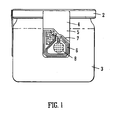
- a container 1 suitable to retain a food item which comprises a twist-off lid 2 and a body 3.
- a time indicator device is shown in the form of a label 4 connected to both the lid 2 and body 3 of the container 1.
- the label 4 comprises an upper section 5 in the form of a peelable tab which is connected using an adhesive (not shown) to the lid 2 of the container 1 and a lower section 6 in the form of a permanent patch which is connected using an adhesive (not shown) to the body 3 of the container 1.
- the upper and lower sections 5, 6 of the label 4 are joined together along a frangible seam 7, such that when the lid 2 of the container 1 is unscrewed from the body 3 of the container 1 the upper and lower sections 5, 6 of the label 4 separate along the seam 7.
- the upper section 5 of the indicator label 4 remains adhered to the lid 2 of the container 1
- the lower section 6 of the label 4 remains adhered to the body 3 of the container 1 and the label 4 is activated.
- the manner in which activation of the label 4 is achieved is explained in more detail below with reference to Figures 3, 4 and 5 .
- the lower section 6 of the label 4 incorporates a viewing window 8 through which different colouration can be observed to provide a user of the container 1 with a visible indication of the freshness of the contents of the container 1.
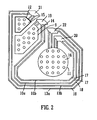
- the components comprise a first dye source reservoir 9 which is connected via a first set of conduits 10a, 10b to a target reservoir 11.
- a second dye source reservoir 12 is also connected to the target reservoir 11 via a separate second set of, longer, conduits 13a, 13b.
- an orange dye 105101 Duasyn Sauregelb xxSF
- other additives co-solvent, thickener, deformer and biocide
- a third low viscosity liquid mixture 16 is provided in the target reservoir 11.
- the third low viscosity liquid mixture is a relatively dilute aqueous solutions of ethylene glycol, glycerol, carboxymethyl cellulose and minor amounts of other additives (co-solvent, thickener, deformer and biocide) but with no colourant added such that the third low viscosity liquid mixture 16 is clear.
- the first and/or second and/or third low viscosity mixtures 14, 15, 16 optionally include hydroxyethyl cellulose in addition to carboxymethyl cellulose or instead of carboxymethyl cellulose.
- the third low viscosity liquid mixture liquid acts as a dispersant for the dye colourants contained in the first and second low viscosity liquid mixtures 14, 15 since as soon as the third low viscosity liquid mixture 16 contacts and mixes with the first and second low viscosity liquid mixtures 14, 15 to form a further liquid mixture (not shown) the dyes previously contained in the first and second liquid mixtures 14, 15 disperse throughout the further liquid mixture.
- the lowermost surface of the target reservoir 11 is provided with a green colouration, which is initially visible via the viewing window 8 (see Figure 1 ) because the viewing window 8 overlies the target reservoir 11 and the third low viscosity liquid mixture 16 is clear.
- the conduits 10a, 10b connecting the first dye source reservoir 9 to the target reservoir 11 are filled with a first high viscosity gel 17 comprising a relatively concentrated aqueous mixture of glycerol and carboxymethyl cellulose (in alternative embodiments the carboxymethyl cellulose may be replaced or supplemented with hydroxyethyl cellulose), and the conduits 13a, 13b connecting the second dye source reservoir 12 to the target reservoir 11 are filled with a second high viscosity gel 18 comprising a relatively concentrated aqueous mixture of glycerol and carboxymethyl cellulose (in alternative embodiments the carboxymethyl cellulose may be replaced or supplemented with hydroxyethyl cellulose).
- a first barrier region 19 is provided in conduits 10a, 10b near to the first dye source reservoir 9 and a second barrier region 20 is provided in conduits 10a, 10b near to the target reservoir 11.
- a third barrier region 21 is provided in conduits 13a, 13b near to the second dye source reservoir 12, and a fourth barrier region 22 is provided in conduits 13a, 13b near to the target reservoir 11.
- the label 4 comprises a substrate layer 23 of, for example, polypropylene.
- the substrate layer 23 has been embossed so as to define the first and second dye store reservoirs 9, 12, the target reservoir 11, the interconnecting conduits 10a, 10b, 13a, 13b, and the barrier regions 19, 20, 21, 22.
- the substrate layer 23 is provided with a layer of adhesive 24 to permit attachment of the label 4 to the container 1.
- the adhesive layer 24 is provided with a glassine protective layer 25 to protect the adhesive layer 24 prior to application to the container 1 but which can be peeled away immediately prior to attachment of the label 4 to the container 1.
- a barrier layer 26 is laminated over the substrate layer 23 and an outermost clear peelable layer 27 is laminated over the barrier layer 26.
- the method of lamination of the outermost layer 27 is such that a series of de-bosses 28 are formed in the outermost layer 27 which overlie the barrier regions 19, 20, 21, 22 formed in the substrate layer (only barrier region 22 is visible in Figure 3 ).
- the de-bosses 28 deform the underlying barrier layer 26 downwardly into the barrier regions 19, 20, 21, 22 and thereby prevent the first, second and third low viscosity liquid mixtures 14, 15, 16 in the two source reservoirs 9, 12 and the target reservoir 11 from contacting the high viscosity gels 17, 18 in the conduits 10a, 10b, 13a, 13b until the label 4 is activated.
- time indicator label 4 Activation of the time indicator label 4 is initiated by the consumer unscrewing the lid 2 of the container 1. This results in the label 4 fracturing along the seam 7 and thereby separating the upper and lower sections 5, 6 of the label 4 to provide the two sections 5, 6 as shown separately in Figures 4 and 5 respectively. Separation of the two sections 5, 6 of the label 4 is controlled by the provision of a back cut 29 through the adhesive, substrate and barrier layers 25, 24, 26 above the de-bosses 28 and a partial cut through the outermost layer 27 below the de-bosses 28.
- the de-bosses 28 formed in the outermost layer 27 are urged away from the underlying barrier layer 26 thereby freeing the barrier layer 26 to deform upwardly away from the barrier regions 19, 20, 21, 22 and permitting the liquid mixtures 14, 15, 16 to contact and mix with the higher viscosity gels 17, 18 contained in the conduits 10a, 10b, 13a, 13b.
- the low viscosity liquid mixtures 14, 15, 16 mix with the high viscosity gels 17, 18 new lower viscosity mixtures are formed in the conduits 10a, 10b and 13a, 13b.
- the dyes 14, 15 begin to diffuse through the new lower viscosity mixtures and along the conduits 10a, 10b and 13a, 13b towards the target reservoir 11.
- the first low viscosity mixture 14 contacts the third low viscosity mixture 16 to form a single essentially homogeneous liquid mixture throughout the first dye source reservoir 9, conduits 10a, 10b and the target reservoir 11 and the orange dye diffuses rapidly throughout the homogeneous liquid mixture to provide an orange colouration in the target reservoir 11 which is visible via the viewing window 8.
- the orange dye discolours the target reservoir 11, presenting a visible amber colouration denoting that the contents of the container may soon not be safe to consume
- the red dye discolours the (already discoloured) target reservoir 11, presenting a vivid red colouration indicating that the contents of the container 1 are no longer safe to consume.
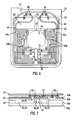
- FIG. 6 and 7 there is shown a time indicator device according to the first aspect of the present invention and to the examples in the form of a label 30 which is suitable to be connected to both a lid and body of a container (not shown) so that it can be activated in an analogous fashion to the laber 4 described above with reference to Figures 1 to 5 .
- the label 30 in Figures 6 and 7 comprises an upper section 31 in the form of a peelable tab which is to be connected using an adhesive (not shown) to the lid of the container and a lower section 32 in the form of a permanent patch which is to be connected using an adhesive (not shown) to the body of the container.
- the upper and lower sections 31, 32 of the label 30 are joined together along a frangible seam 33, such that when attached to the container and the lid of the container is unscrewed the upper and lower sections 31, 32 of the label 30 separate along the seam 33.
- the upper section 31 of the indicator label 30 remains adhered to the lid of the container
- the lower section 32 of the label 30 remains adhered to the body of the container and the label 30 is activated.
- the lower section 32 of the label 30 incorporates a viewing window 34 through which different colouration can be observed to provide a user with a visible indication of the freshness of the contents of the container.
- the label 30 incorporates a first acid-containing reservoir 35 which is connected via a first short relatively wide conduit 36 to a target reservoir 37 which lies immediately beneath the viewing window 34.
- the viewing window 34 enables a user to determine the colour of liquid present within the target reservoir 37.
- a second acid-containing reservoir 38 is also connected to the target reservoir 37 via a separate second relatively short conduit 39.
- Each short, wide conduit 36, 39 is initially blocked by an enzymatically degradable barrier 40, 41 to prevent the acidic solutions (not shown) escaping from their respective reservoirs 35, 38 into the target reservoir 37.
- Each of the enzymatically degradable barriers 40, 41 is in fluid communication with a respective enzyme-containing source reservoir 42, 43 via a dedicated set of relatively long, narrow conduits 44, 45 respectively.
- each conduit 44, 45 is comprised of a series of shorter partial conduits 44A, 44B and 45A, 45B respectively which are selectively connected together during assembly of the various component parts of the label 30 to define single conduits 44, 45 of the desired length extending from the enzyme-containing source reservoirs 42, 43 to the enzymatically degradable barriers 40, 41.
- a single set of partial conduits can be used to define a plurality of conduits of differing length to suit the intended application of the label 30.
- Two pairs of barriers 46, 47 are provided across the conduits 44, 45 respectively to prevent enzyme-containing liquid flowing out of the source reservoirs 42, 43 until such time as the label 30 is activated.
- the pairs of barriers 46, 47 blocking the conduits 44, 45 are connected to the upper portion 31 of the label 30 and so, as the upper portion 31 of the label 30 is removed, so too are the pairs of barriers 46, 47.
- the enzyme-containing liquids initially resident in each source reservoir 42, 43 are then free to flow out of their respective reservoir 42, 43 along their respective conduit 44, 45 to their designated enzymatically degradable barrier 40, 41.
- One way in which two different time periods can be indicated by the label 30 is by assembling the label 30 so that one of the conduits 44, 45 is shorter than the other. In this way, it will take less time for one of the acid-containing solutions to travel from its reservoir 42, 43 to its barrier 40, 41 than the other acid-containing solution (assuming all other factors relating to the two solutions and the contents of the conduits are equal).
- the label 30 is also provided with a gutter 48 extending around the periphery of the label 30. This is to catch any excess fluids forced out of the label 30 during its assembly which might otherwise hamper the correct functioning of the label 30. This also ensures that each region of the label 30 can be completely filled with the appropriate liquid or substance to ensure that no potentially problematic air pockets remain within the structure of the label 30 after assembly.
- the first acid-containing reservoir 35 contains a first low viscosity liquid mixture including water, acid to pH 3, an orange dye (e.g. 105101 Duasyn Sauregelb xxSF), and optionally a fluorescent species, exothermic reagents and/or minor amounts of other additives (co-solvent, thickener, deformer and biocide).
- This liquid mixture possesses a pH of 3 and a viscosity of 10 cP (at 20 °C).
- the second acid-containing reservoir 38 contains a second low viscosity liquid mixture including water, acid to pH 1.5, a red dye (e.g.
- This liquid mixture possesses a pH of 1.5 and a viscosity of 10 cP (at 20 °C).
- the target reservoir 37 contains a third low viscosity liquid mixture including water, Universal pH indicator solution, no dye or pigment, and optionally a fluorescent species, exothermic reagents and/or minor amounts of other additives (co-solvent, thickener, deformer and biocide).
- This liquid mixture possesses a pH of 7 (and is therefore green due to the pH indicator) and a viscosity of 10 cP (at 20 °C).
- the third low viscosity liquid mixture liquid acts as a dispersant for the dye colourants contained in the first and second low viscosity liquid mixtures since as soon as the third low viscosity liquid mixture contacts and mixes with the first and second low viscosity liquid mixtures to form first and then second liquid mixtures the dyes previously contained in the first and second liquid mixtures disperse throughout the liquid mixtures.
- the enzyme-containing source reservoirs 42 43 each contain liquids comprising an aqueous saline solution and lipase enzyme. Each solution possesses a pH of 7.5 and a viscosity of 10 cP (at 20 °C).
- the enzymatically degradable barriers 40, 41 which initially separate the acid-containing reservoirs 35, 38 from the target reservoir 37 are each comprised of a lipid, hard palm kernel oil, and a dehydrated lipase enzyme.
- the barrier material is at pH 7 and possesses a viscosity of over 16000 cP (at 20 °C).
- the conduits 44, 45 connecting the enzyme-containing source reservoirs 42, 43 to the degradable barriers 40, 41 are filled with a high viscosity gel comprising a relatively concentrated aqueous mixture of glycerol and carboxymethyl cellulose (in alternative embodiments the carboxymethyl cellulose may be replaced or supplemented with hydroxyethyl cellulose).
- the substance contained in the conduits 44, 45 is at pH 7 and possesses a viscosity of 1400 cP (at 20 °C).
- the label 30 is a multi-layer construction, comprising a base layer 49 formed of an impermeable material, and constructed from a lamination of two component materials 49A, 49B.
- the base layer 49 defines the reservoirs 35, 37, 38, 42, 43 within which the various liquids are initially retained before activation of the label 30.
- the base layer 49 also defines the relatively short and wide conduits 36, 39 linking the acid-containing reservoirs 35, 38 to the target reservoir 37 and which contain the lipid barriers 40, 41.
- An intermediate layer 50 again formed from an impermeable material, and constructed from a lamination of two component materials 50A, 50B defines the conduits 44, 45 which link the reservoirs 35, 38, 42, 43.
- An upper layer 51 again formed from an impermeable material, has built up areas 52 on its underside facing the intermediate layer 50, which, when laminated to the intermediate layer 50, serve to compress and block selected areas of the conduits 44, 45 defined by the intermediate layer 50 to prevent or delay the movement of liquids within the label 30 until the desired moment of activation.
- the label 30 works as follows, when a product upon which the label 30 is being used is opened a portion of said upper layer 51 is removed from the remainder of the label 30, said portion containing the built up areas 52 corresponding to the barriers 46, 47 which had previously blocked the conduits 44, 45 leading from the saline enzyme solution-containing reservoirs 42, 43. Upon removal of the barriers 46, 47, the saline enzyme solution begins to mix with the high viscosity substance within the conduits 44, 45.
- the saline solution containing the enzyme from one of the reservoirs 42 reaches the conduit 36 containing the hard palm kernel oil barriers 40, at which point the enzyme digests the oil, thereby removing the barriers 40 and allowing the acidic dye solution to pass quickly (since conduit 36 is short and wide) from the acid-containing reservoir 35 into the target reservoir 37.
- Test devices were fabricated so as to have the same basic structure as follows: Area / mm 2 Volume / mm 3 Red Source Reservoir 23.497 1.175 Orange Source Reservoir 51.625 2.581 Target Reservoir 84.477 4.224 Length / mm Volume / mm 3 Conduit 1 Red Source to Target 105.68 2.241 Conduit 2 Red Source to Target 96.81 2.064 Conduit 3 Orange Source to Target 78.51 1.980 Conduit 4 Orange Source to Target 74.09 1.874
- red ADS red dye source solution
- orange ADS orange dye source solution
- target ADS target ADS
- HVM High Viscosity Media
- Source 2 (Orange ADS)
- a first device employed conduits filled with a high viscosity media gel exhibiting a viscosity of 6000 cp (at 20°C) (HMV 6000).
- the device exhibited the following dye diffusion times (DDTs) along conduits 1 and 2 connecting the red dye source reservoir to the target reservoir and along conduits 3 and 4 connecting the orange dye source reservoir to the target reservoir: DDT / days Conduit 1 Red Source to Target 52.84 Conduit 2 Red Source to Target 48.40 Conduit 3 Orange Source to Target 39.25 Conduit 4 Orange Source to Target 37.05
- DDTs dye diffusion times
- a second device employed conduits filled with a high viscosity media gel exhibiting a viscosity of 12000 cp (at 20°C) (HMV 12000).
- the device exhibited the following dye diffusion times (DDTs) along conduits 1 and 2 connecting the red dye source reservoir to the target reservoir and along conduits 3 and 4 connecting the orange dye source reservoir to the target reservoir: DDT / days Conduit 1 Red Source to Target 66.05 Conduit 2 Red Source to Target 60.51 Conduit 3 Orange Source to Target 49.07 Conduit 4 Orange Source to Target 46.31
- DDTs dye diffusion times
- the viscosity of the source liquids was lowered whilst using the high viscosity media gel exhibiting a viscosity of 12000 cp (at 20°C) (HMV 12000) in the conduits of the third test device.
Landscapes
- Physics & Mathematics (AREA)
- General Physics & Mathematics (AREA)
- Investigating Or Analysing Materials By The Use Of Chemical Reactions (AREA)
- Investigating Or Analyzing Non-Biological Materials By The Use Of Chemical Means (AREA)
- Measurement Of Unknown Time Intervals (AREA)
- Electrophonic Musical Instruments (AREA)
- Financial Or Insurance-Related Operations Such As Payment And Settlement (AREA)
- Led Device Packages (AREA)
- Accessories For Mixers (AREA)
- Level Indicators Using A Float (AREA)
- Basic Packing Technique (AREA)
Claims (25)
- Zeitindikatorvorrichtung, bestehend aus ersten und zweiten, miteinander verbundenen Behältern, die eine erste bzw. eine zweite Flüssigkeit enthalten, wobei zwischen den ersten und zweiten Flüssigkeiten eine erste Barriere vorgesehen ist, um eine Vermischung der Flüssigkeiten zu verhindern, wobei die erste Barriere über eine Röhre mit einem dritten Behälter verbunden ist, der eine dritte Flüssigkeit enthält, die so angepasst ist, dass sie während einer ersten vorgegebenen Zeitspanne durch die Röhre fließt und nach Kontakt die Entfernung der ersten Barriere bewirkt, um die Vermischung der ersten und zweiten Flüssigkeiten und die Erzeugung eines ersten Flüssigkeitsgemischs innerhalb des zweiten Behälters zu erleichtern, das eine andere Farbe als die zweite Flüssigkeit vor der Vermischung aufweist, und dadurch anzuzeigen, wann die erste vorgegebene Zeitspanne abgelaufen ist.
- Zeitindikatorvorrichtung nach Anspruch 1, wobei zwischen dem dritten Behälter und der Röhre eine zweite Barriere vorgesehen ist.
- Zeitindikatorvorrichtung nach Anspruch 2, wobei die zweite Barriere so angepasst ist, dass nach ihrer Entfernung die erste vorgegebene Zeitspanne initiiert wird, indem der Durchfluss der dritten Flüssigkeit durch die Röhre zugelassen wird.
- Zeitindikatorvorrichtung nach Anspruch 2 oder 3, wobei die zweite Barriere so angepasst ist, dass sie als Ergebnis des Öffnend eines Produkts, an dem die Vorrichtung befestigt ist, oder als Ergebnis der Befestigung der Vorrichtung an einem Produkt entfernbar ist,
- Zeitindikatorvorrichtung nach einem der vorstehenden Ansprüche, wobei die erste Barriere eine chemisch und/oder enzymatisch abbaubare Substanz aufweist.
- Zeitindikatorvorrichtung nach Anspruch 5, wobei die Viskosität der in der ersten Barriere enthaltenen abbaubaren Substanz mindestens 2000 cP (bei 20°C) beträgt und/oder die abbaubare Substanz einen Schmelzpunkt oberhalb etwa 60°C aufweist.
- Zeitindikatorvorrichtung nach Anspruch 5 oder 6, wobei die erste Barriere ein dehydratisiertes Enzym aufweist, das nach Hydratisierung imstande ist, die in der ersten Barriere enthaltene abbaubare Substanz abzubauen.
- Zeitindikatorvorrichtung nach einem der vorstehenden Ansprüche, wobei die Röhre eine erste Substanz enthält, die eine Flüssigkeit oder ein Gel ist.
- Zeitindikatorvorrichtung nach Anspruch 8, wobei die erste Substanz in der Röhre eine höhere Viskosität als die erste und/oder die zweite Flüssigkeit aufweist.
- Zeitindikatorvorrichtung nach Anspruch 8 oder 9, wobei die erste Substanz Carboxymethylcellulose (oder ein Salz davon), Hydroxyethylcellulose, Glycerin, Ethylenglycol, Diethylenglycol oder ein Gemisch davon aufweist.
- Zeitindikatorvorrichtung nach einem der Ansprüche 8 bis 10, wobei die dritte Flüssigkeit weitgehend mit der ersten Substanz mischbar ist.
- Zeitindikatorvorrichtung nach einem der Ansprüche 8 bis 11, wobei die dritte Flüssigkeit ein Lösungsmittel oder Dispergiermittel für die erste Substanz aufweist.
- Zeitindikatorvorrichtung nach einem der vorstehenden, von Anspruch 5 abhängigen Ansprüche, wobei die dritte Flüssigkeit eine chemische Spezies oder ein Enzym aufweist, die (das) imstande ist, die in der ersten Barriere enthaltene abbaubare Substanz abzubauen.
- Zeitindikatorvorrichtung nach einem der vorstehenden Ansprüche, wobei die erste Flüssigkeit eine ausreichende Menge einer Säure aufweist, so dass nach dem Vermischen mit der zweiten Flüssigkeit das entstehende Flüssigkeitsgemisch innerhalb des zweiten Behälters einen anderen pH-Wert als die zweite Flüssigkeit vor dem Vermischen aufweist, oder dass nach dem Vermischen mit der zweiten Flüssigkeit das entstehende Flüssigkeitsgemisch innerhalb des zweiten Behälters einen pH-Wert von weniger als etwa 7 aufweist.
- Zeitindikatorvorrichtung nach einem der vorstehenden Ansprüche, wobei die erste Flüssigkeit ein Färbemittel aufweist und/oder die zweite Flüssigkeit eine pH-Indikator-Spezies aufweist.
- Zeitindikatorvorrichtung nach einem der vorstehenden Ansprüche, wobei die Röhre eine vorgegebene Länge besitzt, die eine Distanz definiert, die von der dritten Flüssigkeit vom dritten Behälter aus zurückgelegt werden muss, um in Kontakt mit der ersten Barriere zu kommen, wobei die Distanz zumindest teilweise die vorgegeben Zeitspanne festlegt.
- Zeitindikatorvorrichtung nach einem der vorstehenden Ansprüche, wobei die Vorrichtung mehrere Teilröhren definiert, die selektiv miteinander verbunden werden können, um die Röhre mit der vorgegebenen Länge zu bilden,
- Zeitindikatorvorrichtung nach einem der vorstehenden Ansprüche, wobei die Vorrichtung einen mit dem zweiten Behälter verbundenen vierten Behälter aufweist, wobei der vierte Behälter eine vierte Flüssigkeit enthält, wobei zwischen der vierten Flüssigkeit und der zweiten Flüssigkeit innerhalb des zweiten Behälters eine dritte Barriere vorgesehen ist, um eine Vermischung der Flüssigkeiten zu verhindern, wobei die dritte Barriere über eine weitere Röhre mit einem fünften Behälter verbunden ist, der eine fünfte Flüssigkeit enthält, die so angepasst ist, dass sie während einer zweiten, längeren Zeitspanne durch die weitere Röhre fließt und nach Kontakt das Entfernen der dritten Barriere bewirkt, um das Vermischen der vierten Flüssigkeit mit dem ersten Flüssigkeitsgemisch innerhalb des zweiten Behälters und die Erzeugung eines zweiten Flüssigkeüsgemischs innerhalb des zweiten Behälters zu erleichtern, das eine andere Farbe als das erste Flüssigkeitsgemisch aufweist, und dadurch anzuzeigen, wann die zweite vorgegebene Zeitspanne abgelaufen ist.
- Zeitindikatorvorrichtung nach Anspruch 18, wobei zwischen dem fünften Behälter und der weiteren Röhre eine vierte Barriere vorgesehen ist.
- Zeitindikatorvorrichtung nach Anspruch 19, wobei die vierte Barriere so angepasst ist, dass nach ihrer Entfernung die zweite vorgegebene Zeitspanne initiiert wird, indem der Durchfluss der fünften Flüssigkeit entlang der weiteren Röhre zugelassen wird.
- Zeitindikatorvorrichtung nach einem der Ansprüche 18 bis 20, wobei die weitere Röhre eine zweite vorgegebene Länge besitzt, die eine zweite Distanz definiert, die von der fünften Flüssigkeit vom fünften Behälter aus zurückgelegt werden muss, um in Kontakt mit der dritten Barriere zu kommen, wobei die zweite Distanz zumindest teilweise die zweite vorgegebene Zeitspanne festlegt.
- Zeitindikatorvorrichtung nach einem der Ansprüche 18 bis 21, wobei die Vorrichtung eine Vielzahl von weiteren Teilröhren definiert, die selektiv miteinander verbunden werden können, um die weitere Röhre mit der zweiten vorgegebenen Länge zu bilden.
- Vorrichtung nach einem der vorstehenden Ansprüche, wobei die oder jede Barriere durch eine Vertiefung definiert ist, die in einer Deckschicht ausgebildet ist, die zumindest über einem Teil der Vorrichtung vorgesehen ist.
- Vorrichtung nach einem der vorstehenden Ansprüche, wobei eine Oberfläche der Vorrichtung mit einem Klebstoff versehen ist, um die Befestigung der Vorrichtung an einem Produkt zu erleichtern.
- Vorrichtung nach einem der vorstehenden Ansprüche, wobei von den Behältern und der Röhre mindestens eine(r) in einer Trägerschicht ausgebildet ist.
Applications Claiming Priority (2)
| Application Number | Priority Date | Filing Date | Title |
|---|---|---|---|
| GBGB0718816.2A GB0718816D0 (en) | 2007-09-26 | 2007-09-26 | Time indicator device |
| PCT/GB2008/003279 WO2009040547A2 (en) | 2007-09-26 | 2008-09-26 | Time indicator device |
Publications (2)
| Publication Number | Publication Date |
|---|---|
| EP2201429A2 EP2201429A2 (de) | 2010-06-30 |
| EP2201429B1 true EP2201429B1 (de) | 2011-06-15 |
Family
ID=38701713
Family Applications (1)
| Application Number | Title | Priority Date | Filing Date |
|---|---|---|---|
| EP08806430A Not-in-force EP2201429B1 (de) | 2007-09-26 | 2008-09-26 | Zeitindikatoreinrichtung |
Country Status (13)
| Country | Link |
|---|---|
| US (1) | US8104949B2 (de) |
| EP (1) | EP2201429B1 (de) |
| JP (1) | JP5438010B2 (de) |
| CN (1) | CN101874228B (de) |
| AT (1) | ATE513256T1 (de) |
| AU (1) | AU2008303390B2 (de) |
| CA (1) | CA2736940C (de) |
| ES (1) | ES2366270T3 (de) |
| GB (1) | GB0718816D0 (de) |
| MX (1) | MX2010003395A (de) |
| NZ (1) | NZ584880A (de) |
| WO (1) | WO2009040547A2 (de) |
| ZA (1) | ZA201002846B (de) |
Families Citing this family (19)
| Publication number | Priority date | Publication date | Assignee | Title |
|---|---|---|---|---|
| GB0900453D0 (en) * | 2009-01-13 | 2009-02-11 | Eastman Kodak Co | Indicators |
| WO2011057416A1 (en) | 2009-11-13 | 2011-05-19 | Packers Plus Energy Services Inc. | Stage tool for wellbore cementing |
| JP2013516637A (ja) * | 2009-12-31 | 2013-05-13 | ビーエーエスエフ ソシエタス・ヨーロピア | 物理的又は化学的現象を表示するための装置及び方法 |
| GB201001235D0 (en) | 2010-01-26 | 2010-03-10 | Uwl Technology Ltd | Elapsed time indicator |
| SG195148A1 (en) * | 2011-05-24 | 2013-12-30 | Mark Andy Inc | Methods of and apparatus for making a flexible composite having reservoirsand capillaries |
| US20130029919A1 (en) * | 2011-07-26 | 2013-01-31 | Allergan, Inc. | Two part formulation system for opthalmic delivery |
| CN102789743B (zh) * | 2012-08-24 | 2014-09-17 | 浙江大学 | 一种用于指示环境温度变化的视觉标签 |
| EP2819065B1 (de) * | 2013-06-27 | 2015-10-28 | Nxp B.V. | Zeitreferenz ohne Energieversorgung |
| CN106659387A (zh) * | 2014-05-29 | 2017-05-10 | 森维尔有限公司 | 监测与医疗装置相关的时间段 |
| GB201520229D0 (en) * | 2015-11-17 | 2015-12-30 | Uwi Technology Ltd | Microfluidic elapsed time indicator |
| GB2552167A (en) * | 2016-07-11 | 2018-01-17 | Intray Ltd | Time temerature indicator label |
| AU2017320346B2 (en) * | 2016-08-31 | 2022-09-15 | Bluechiip Limited | A device, system and method for temperature limit indication and detection of temperature-sensitive items |
| NO20170237A1 (en) | 2017-02-16 | 2018-08-17 | Keep It Tech As | Screw cap system |
| GB201800698D0 (en) * | 2018-01-16 | 2018-02-28 | Intray Ltd | Time temperature indicator label |
| GB2570496A (en) | 2018-01-29 | 2019-07-31 | Timestrip Uk Ltd | Elapsed time temperature indicator and method of activation |
| US11579128B2 (en) * | 2018-05-11 | 2023-02-14 | Temptime Corporation | Activatable temperature indicator with time delay |
| GB2582162A (en) * | 2019-03-13 | 2020-09-16 | Singh Arwinder | Transdermal patch |
| US12399163B2 (en) | 2019-07-30 | 2025-08-26 | Consolidated Nuclear Security, LLC | Passive chronometric tamper-indicating device and method |
| WO2022147269A1 (en) * | 2020-12-31 | 2022-07-07 | Claralert, Inc. | System and method for time expiration reminder for medical care |
Family Cites Families (16)
| Publication number | Priority date | Publication date | Assignee | Title |
|---|---|---|---|---|
| US3954011A (en) * | 1973-09-24 | 1976-05-04 | Minnesota Mining And Manufacturing Company | Selected time interval indicating device |
| US4028876A (en) * | 1976-03-05 | 1977-06-14 | Lawrence Peska Associates, Inc. | Apparatus for visually indicating elapsed time by a color change |
| JPS6199829A (ja) * | 1984-10-22 | 1986-05-17 | Canon Inc | 温度履歴表示素子 |
| NZ230716A (en) * | 1989-09-20 | 1993-08-26 | Time Ticket Int Ltd | Timer ticket with visibly indicating elapsed time: porous wick permeated by released liquid |
| GB9020364D0 (en) * | 1990-09-18 | 1990-10-31 | Cambridge Consultants | Time temperature indicator |
| US5043558A (en) * | 1990-09-26 | 1991-08-27 | Weed Instrument Company, Inc. | Deicing apparatus and method utilizing heat distributing means contained within surface channels |
| DE69032106D1 (de) * | 1990-11-21 | 1998-04-09 | Jp Lab Inc | Indikator mit farbänderung zur zeitlichen erfassung des ablaufs leichtverderblicher produkte |
| US5667303A (en) | 1995-03-10 | 1997-09-16 | Minnesota Mining And Manufacturing Company | Time-temperature integrating indicator device |
| US6452873B1 (en) * | 1999-06-14 | 2002-09-17 | Temtec, Inc | Visually changing paper time indicator employing controllable barrier |
| US6231229B1 (en) | 2000-05-26 | 2001-05-15 | Advanced Micro Devices, Inc. | Instrument and method to measure the duration of exposure to temperature by determining the amount of an indicator material |
| GB0116878D0 (en) * | 2001-07-11 | 2001-09-05 | Timestrip Ltd | Time indicator |
| US6787108B2 (en) * | 2002-04-02 | 2004-09-07 | Cmc Daymark Corporation | Plural intrinsic expiration initiation application indicators |
| DE10332873B4 (de) * | 2003-07-19 | 2014-02-13 | Braun Gmbh | Anzeigevorrichtung für zeitabhängige Vorgänge |
| US7280441B2 (en) * | 2004-11-30 | 2007-10-09 | Kimberly-Clark Worldwide, Inc. | Visual indicator chronograph and the use of the same |
| WO2006077413A2 (en) * | 2005-01-21 | 2006-07-27 | Intray Ltd | Open life indicator label for food produce and suchlike |
| US7517146B2 (en) * | 2006-08-30 | 2009-04-14 | Temptime Corporation | Color-retaining excess-temperature exposure indicator |
-
2007
- 2007-09-26 GB GBGB0718816.2A patent/GB0718816D0/en not_active Ceased
-
2008
- 2008-09-26 CA CA2736940A patent/CA2736940C/en active Active
- 2008-09-26 MX MX2010003395A patent/MX2010003395A/es active IP Right Grant
- 2008-09-26 JP JP2010526359A patent/JP5438010B2/ja not_active Expired - Fee Related
- 2008-09-26 AU AU2008303390A patent/AU2008303390B2/en not_active Ceased
- 2008-09-26 US US12/680,388 patent/US8104949B2/en active Active
- 2008-09-26 CN CN2008801174554A patent/CN101874228B/zh not_active Expired - Fee Related
- 2008-09-26 EP EP08806430A patent/EP2201429B1/de not_active Not-in-force
- 2008-09-26 AT AT08806430T patent/ATE513256T1/de not_active IP Right Cessation
- 2008-09-26 WO PCT/GB2008/003279 patent/WO2009040547A2/en not_active Ceased
- 2008-09-26 ES ES08806430T patent/ES2366270T3/es active Active
- 2008-09-26 NZ NZ584880A patent/NZ584880A/xx not_active IP Right Cessation
-
2010
- 2010-04-22 ZA ZA2010/02846A patent/ZA201002846B/en unknown
Also Published As
| Publication number | Publication date |
|---|---|
| ES2366270T3 (es) | 2011-10-18 |
| CN101874228B (zh) | 2013-07-17 |
| EP2201429A2 (de) | 2010-06-30 |
| GB0718816D0 (en) | 2007-11-07 |
| WO2009040547A3 (en) | 2009-09-11 |
| CA2736940C (en) | 2015-07-21 |
| JP2010540923A (ja) | 2010-12-24 |
| ATE513256T1 (de) | 2011-07-15 |
| CN101874228A (zh) | 2010-10-27 |
| CA2736940A1 (en) | 2009-04-02 |
| HK1140283A1 (en) | 2010-10-08 |
| US20100322037A1 (en) | 2010-12-23 |
| US8104949B2 (en) | 2012-01-31 |
| MX2010003395A (es) | 2010-06-25 |
| JP5438010B2 (ja) | 2014-03-12 |
| ZA201002846B (en) | 2011-07-27 |
| WO2009040547A2 (en) | 2009-04-02 |
| NZ584880A (en) | 2012-08-31 |
| AU2008303390B2 (en) | 2013-03-21 |
| AU2008303390A1 (en) | 2009-04-02 |
Similar Documents
| Publication | Publication Date | Title |
|---|---|---|
| EP2201429B1 (de) | Zeitindikatoreinrichtung | |
| US6787108B2 (en) | Plural intrinsic expiration initiation application indicators | |
| AU2012243476B2 (en) | Time-temperature indicator system I | |
| EP0484578B1 (de) | Multifunktioneller Zeit- und Temperaturanzeiger | |
| US5633836A (en) | Accelerated development time-delayed message system | |
| US10168307B1 (en) | Tunable directional color transition compositions and methods of making and using the same | |
| KR20140035906A (ko) | 시간-온도 표시기 시스템 | |
| EP0250217B1 (de) | Temperatursensible Vorrichtungen | |
| US2971852A (en) | Temperature telltale | |
| JP2003525464A (ja) | 活性化可能な時間−温度インジケータ・システム | |
| EP1159593A1 (de) | Temperaturgeschichte-indikatoren | |
| CN104144624A (zh) | 高级多元素一次性耗材产品 | |
| DE2547638A1 (de) | Vorrichtung zur irreversiblen anzeige zeitweiliger ueberschreitung der lagerhoechsttemperatur an in gefrorenem oder tiefgefrorenem zustand gelagerten produkten | |
| WO2004092697A1 (en) | A temperature indicator, a package for goods and a method of monitoring the freshness of goods kept in packages | |
| HK1140283B (en) | Time indicator device | |
| KR101813093B1 (ko) | 제품 신선도 측정 라벨지 | |
| DE69032351T2 (de) | Multifunktioneller Zeit- und Temperaturanzeiger | |
| RU61693U1 (ru) | Индикатор качества шоковой заморозки пищевого продукта | |
| HK1072099B (en) | Changed condition indicator | |
| CA2204187A1 (fr) | Indicateur irreversible de rupture de temperature specifique de congelation | |
| DE10226716A1 (de) | Indikationssystem |
Legal Events
| Date | Code | Title | Description |
|---|---|---|---|
| PUAI | Public reference made under article 153(3) epc to a published international application that has entered the european phase |
Free format text: ORIGINAL CODE: 0009012 |
|
| 17P | Request for examination filed |
Effective date: 20100414 |
|
| AK | Designated contracting states |
Kind code of ref document: A2 Designated state(s): AT BE BG CH CY CZ DE DK EE ES FI FR GB GR HR HU IE IS IT LI LT LU LV MC MT NL NO PL PT RO SE SI SK TR |
|
| AX | Request for extension of the european patent |
Extension state: AL BA MK RS |
|
| REG | Reference to a national code |
Ref country code: HK Ref legal event code: DE Ref document number: 1140283 Country of ref document: HK |
|
| DAX | Request for extension of the european patent (deleted) | ||
| GRAP | Despatch of communication of intention to grant a patent |
Free format text: ORIGINAL CODE: EPIDOSNIGR1 |
|
| GRAS | Grant fee paid |
Free format text: ORIGINAL CODE: EPIDOSNIGR3 |
|
| GRAA | (expected) grant |
Free format text: ORIGINAL CODE: 0009210 |
|
| AK | Designated contracting states |
Kind code of ref document: B1 Designated state(s): AT BE BG CH CY CZ DE DK EE ES FI FR GB GR HR HU IE IS IT LI LT LU LV MC MT NL NO PL PT RO SE SI SK TR |
|
| REG | Reference to a national code |
Ref country code: GB Ref legal event code: FG4D Ref country code: CH Ref legal event code: EP |
|
| REG | Reference to a national code |
Ref country code: IE Ref legal event code: FG4D |
|
| REG | Reference to a national code |
Ref country code: DE Ref legal event code: R096 Ref document number: 602008007664 Country of ref document: DE Effective date: 20110804 |
|
| REG | Reference to a national code |
Ref country code: NL Ref legal event code: T3 |
|
| REG | Reference to a national code |
Ref country code: ES Ref legal event code: FG2A Ref document number: 2366270 Country of ref document: ES Kind code of ref document: T3 Effective date: 20111018 |
|
| REG | Reference to a national code |
Ref country code: HK Ref legal event code: GR Ref document number: 1140283 Country of ref document: HK |
|
| PG25 | Lapsed in a contracting state [announced via postgrant information from national office to epo] |
Ref country code: SE Free format text: LAPSE BECAUSE OF FAILURE TO SUBMIT A TRANSLATION OF THE DESCRIPTION OR TO PAY THE FEE WITHIN THE PRESCRIBED TIME-LIMIT Effective date: 20110615 Ref country code: NO Free format text: LAPSE BECAUSE OF FAILURE TO SUBMIT A TRANSLATION OF THE DESCRIPTION OR TO PAY THE FEE WITHIN THE PRESCRIBED TIME-LIMIT Effective date: 20110915 Ref country code: LT Free format text: LAPSE BECAUSE OF FAILURE TO SUBMIT A TRANSLATION OF THE DESCRIPTION OR TO PAY THE FEE WITHIN THE PRESCRIBED TIME-LIMIT Effective date: 20110615 Ref country code: HR Free format text: LAPSE BECAUSE OF FAILURE TO SUBMIT A TRANSLATION OF THE DESCRIPTION OR TO PAY THE FEE WITHIN THE PRESCRIBED TIME-LIMIT Effective date: 20110615 |
|
| PG25 | Lapsed in a contracting state [announced via postgrant information from national office to epo] |
Ref country code: AT Free format text: LAPSE BECAUSE OF FAILURE TO SUBMIT A TRANSLATION OF THE DESCRIPTION OR TO PAY THE FEE WITHIN THE PRESCRIBED TIME-LIMIT Effective date: 20110615 Ref country code: CY Free format text: LAPSE BECAUSE OF FAILURE TO SUBMIT A TRANSLATION OF THE DESCRIPTION OR TO PAY THE FEE WITHIN THE PRESCRIBED TIME-LIMIT Effective date: 20110615 Ref country code: GR Free format text: LAPSE BECAUSE OF FAILURE TO SUBMIT A TRANSLATION OF THE DESCRIPTION OR TO PAY THE FEE WITHIN THE PRESCRIBED TIME-LIMIT Effective date: 20110916 Ref country code: FI Free format text: LAPSE BECAUSE OF FAILURE TO SUBMIT A TRANSLATION OF THE DESCRIPTION OR TO PAY THE FEE WITHIN THE PRESCRIBED TIME-LIMIT Effective date: 20110615 Ref country code: LV Free format text: LAPSE BECAUSE OF FAILURE TO SUBMIT A TRANSLATION OF THE DESCRIPTION OR TO PAY THE FEE WITHIN THE PRESCRIBED TIME-LIMIT Effective date: 20110615 Ref country code: SI Free format text: LAPSE BECAUSE OF FAILURE TO SUBMIT A TRANSLATION OF THE DESCRIPTION OR TO PAY THE FEE WITHIN THE PRESCRIBED TIME-LIMIT Effective date: 20110615 |
|
| PG25 | Lapsed in a contracting state [announced via postgrant information from national office to epo] |
Ref country code: BE Free format text: LAPSE BECAUSE OF FAILURE TO SUBMIT A TRANSLATION OF THE DESCRIPTION OR TO PAY THE FEE WITHIN THE PRESCRIBED TIME-LIMIT Effective date: 20110615 |
|
| PG25 | Lapsed in a contracting state [announced via postgrant information from national office to epo] |
Ref country code: CZ Free format text: LAPSE BECAUSE OF FAILURE TO SUBMIT A TRANSLATION OF THE DESCRIPTION OR TO PAY THE FEE WITHIN THE PRESCRIBED TIME-LIMIT Effective date: 20110615 Ref country code: EE Free format text: LAPSE BECAUSE OF FAILURE TO SUBMIT A TRANSLATION OF THE DESCRIPTION OR TO PAY THE FEE WITHIN THE PRESCRIBED TIME-LIMIT Effective date: 20110615 Ref country code: IS Free format text: LAPSE BECAUSE OF FAILURE TO SUBMIT A TRANSLATION OF THE DESCRIPTION OR TO PAY THE FEE WITHIN THE PRESCRIBED TIME-LIMIT Effective date: 20111015 Ref country code: PT Free format text: LAPSE BECAUSE OF FAILURE TO SUBMIT A TRANSLATION OF THE DESCRIPTION OR TO PAY THE FEE WITHIN THE PRESCRIBED TIME-LIMIT Effective date: 20111017 |
|
| PG25 | Lapsed in a contracting state [announced via postgrant information from national office to epo] |
Ref country code: PL Free format text: LAPSE BECAUSE OF FAILURE TO SUBMIT A TRANSLATION OF THE DESCRIPTION OR TO PAY THE FEE WITHIN THE PRESCRIBED TIME-LIMIT Effective date: 20110615 Ref country code: RO Free format text: LAPSE BECAUSE OF FAILURE TO SUBMIT A TRANSLATION OF THE DESCRIPTION OR TO PAY THE FEE WITHIN THE PRESCRIBED TIME-LIMIT Effective date: 20110615 Ref country code: SK Free format text: LAPSE BECAUSE OF FAILURE TO SUBMIT A TRANSLATION OF THE DESCRIPTION OR TO PAY THE FEE WITHIN THE PRESCRIBED TIME-LIMIT Effective date: 20110615 |
|
| PLBE | No opposition filed within time limit |
Free format text: ORIGINAL CODE: 0009261 |
|
| STAA | Information on the status of an ep patent application or granted ep patent |
Free format text: STATUS: NO OPPOSITION FILED WITHIN TIME LIMIT |
|
| PG25 | Lapsed in a contracting state [announced via postgrant information from national office to epo] |
Ref country code: MC Free format text: LAPSE BECAUSE OF NON-PAYMENT OF DUE FEES Effective date: 20110930 |
|
| 26N | No opposition filed |
Effective date: 20120316 |
|
| PG25 | Lapsed in a contracting state [announced via postgrant information from national office to epo] |
Ref country code: DK Free format text: LAPSE BECAUSE OF FAILURE TO SUBMIT A TRANSLATION OF THE DESCRIPTION OR TO PAY THE FEE WITHIN THE PRESCRIBED TIME-LIMIT Effective date: 20110615 |
|
| REG | Reference to a national code |
Ref country code: DE Ref legal event code: R097 Ref document number: 602008007664 Country of ref document: DE Effective date: 20120316 |
|
| PG25 | Lapsed in a contracting state [announced via postgrant information from national office to epo] |
Ref country code: MT Free format text: LAPSE BECAUSE OF FAILURE TO SUBMIT A TRANSLATION OF THE DESCRIPTION OR TO PAY THE FEE WITHIN THE PRESCRIBED TIME-LIMIT Effective date: 20110615 |
|
| REG | Reference to a national code |
Ref country code: CH Ref legal event code: PL |
|
| PG25 | Lapsed in a contracting state [announced via postgrant information from national office to epo] |
Ref country code: LU Free format text: LAPSE BECAUSE OF NON-PAYMENT OF DUE FEES Effective date: 20110926 |
|
| PG25 | Lapsed in a contracting state [announced via postgrant information from national office to epo] |
Ref country code: BG Free format text: LAPSE BECAUSE OF FAILURE TO SUBMIT A TRANSLATION OF THE DESCRIPTION OR TO PAY THE FEE WITHIN THE PRESCRIBED TIME-LIMIT Effective date: 20110915 |
|
| PG25 | Lapsed in a contracting state [announced via postgrant information from national office to epo] |
Ref country code: LI Free format text: LAPSE BECAUSE OF NON-PAYMENT OF DUE FEES Effective date: 20120930 Ref country code: CH Free format text: LAPSE BECAUSE OF NON-PAYMENT OF DUE FEES Effective date: 20120930 |
|
| PG25 | Lapsed in a contracting state [announced via postgrant information from national office to epo] |
Ref country code: TR Free format text: LAPSE BECAUSE OF FAILURE TO SUBMIT A TRANSLATION OF THE DESCRIPTION OR TO PAY THE FEE WITHIN THE PRESCRIBED TIME-LIMIT Effective date: 20110615 |
|
| PG25 | Lapsed in a contracting state [announced via postgrant information from national office to epo] |
Ref country code: HU Free format text: LAPSE BECAUSE OF FAILURE TO SUBMIT A TRANSLATION OF THE DESCRIPTION OR TO PAY THE FEE WITHIN THE PRESCRIBED TIME-LIMIT Effective date: 20110615 |
|
| REG | Reference to a national code |
Ref country code: FR Ref legal event code: PLFP Year of fee payment: 8 |
|
| REG | Reference to a national code |
Ref country code: FR Ref legal event code: PLFP Year of fee payment: 9 |
|
| REG | Reference to a national code |
Ref country code: FR Ref legal event code: PLFP Year of fee payment: 10 |
|
| REG | Reference to a national code |
Ref country code: FR Ref legal event code: PLFP Year of fee payment: 11 |
|
| PGFP | Annual fee paid to national office [announced via postgrant information from national office to epo] |
Ref country code: NL Payment date: 20200924 Year of fee payment: 13 |
|
| PGFP | Annual fee paid to national office [announced via postgrant information from national office to epo] |
Ref country code: IT Payment date: 20200928 Year of fee payment: 13 |
|
| REG | Reference to a national code |
Ref country code: NL Ref legal event code: MM Effective date: 20211001 |
|
| PG25 | Lapsed in a contracting state [announced via postgrant information from national office to epo] |
Ref country code: NL Free format text: LAPSE BECAUSE OF NON-PAYMENT OF DUE FEES Effective date: 20211001 |
|
| PG25 | Lapsed in a contracting state [announced via postgrant information from national office to epo] |
Ref country code: IT Free format text: LAPSE BECAUSE OF NON-PAYMENT OF DUE FEES Effective date: 20210926 |
|
| PGFP | Annual fee paid to national office [announced via postgrant information from national office to epo] |
Ref country code: GB Payment date: 20230928 Year of fee payment: 16 |
|
| PGFP | Annual fee paid to national office [announced via postgrant information from national office to epo] |
Ref country code: FR Payment date: 20230925 Year of fee payment: 16 Ref country code: DE Payment date: 20230926 Year of fee payment: 16 |
|
| PGFP | Annual fee paid to national office [announced via postgrant information from national office to epo] |
Ref country code: ES Payment date: 20231031 Year of fee payment: 16 |
|
| PGFP | Annual fee paid to national office [announced via postgrant information from national office to epo] |
Ref country code: IE Payment date: 20231009 Year of fee payment: 16 |
|
| REG | Reference to a national code |
Ref country code: DE Ref legal event code: R119 Ref document number: 602008007664 Country of ref document: DE |
|
| GBPC | Gb: european patent ceased through non-payment of renewal fee |
Effective date: 20240926 |
|
| PG25 | Lapsed in a contracting state [announced via postgrant information from national office to epo] |
Ref country code: DE Free format text: LAPSE BECAUSE OF NON-PAYMENT OF DUE FEES Effective date: 20250401 |
|
| PG25 | Lapsed in a contracting state [announced via postgrant information from national office to epo] |
Ref country code: GB Free format text: LAPSE BECAUSE OF NON-PAYMENT OF DUE FEES Effective date: 20240926 |
|
| PG25 | Lapsed in a contracting state [announced via postgrant information from national office to epo] |
Ref country code: FR Free format text: LAPSE BECAUSE OF NON-PAYMENT OF DUE FEES Effective date: 20240930 |
|
| PG25 | Lapsed in a contracting state [announced via postgrant information from national office to epo] |
Ref country code: IE Free format text: LAPSE BECAUSE OF NON-PAYMENT OF DUE FEES Effective date: 20240926 |
|
| REG | Reference to a national code |
Ref country code: ES Ref legal event code: FD2A Effective date: 20251103 |
|
| PG25 | Lapsed in a contracting state [announced via postgrant information from national office to epo] |
Ref country code: ES Free format text: LAPSE BECAUSE OF NON-PAYMENT OF DUE FEES Effective date: 20240927 |