EP2202375A2 - Porte coulissante - Google Patents
Porte coulissante Download PDFInfo
- Publication number
- EP2202375A2 EP2202375A2 EP09179131A EP09179131A EP2202375A2 EP 2202375 A2 EP2202375 A2 EP 2202375A2 EP 09179131 A EP09179131 A EP 09179131A EP 09179131 A EP09179131 A EP 09179131A EP 2202375 A2 EP2202375 A2 EP 2202375A2
- Authority
- EP
- European Patent Office
- Prior art keywords
- locking
- frame
- guide rail
- sliding door
- door
- Prior art date
- Legal status (The legal status is an assumption and is not a legal conclusion. Google has not performed a legal analysis and makes no representation as to the accuracy of the status listed.)
- Withdrawn
Links
Images



Classifications
-
- E—FIXED CONSTRUCTIONS
- E05—LOCKS; KEYS; WINDOW OR DOOR FITTINGS; SAFES
- E05D—HINGES OR SUSPENSION DEVICES FOR DOORS, WINDOWS OR WINGS
- E05D15/00—Suspension arrangements for wings
- E05D15/06—Suspension arrangements for wings for wings sliding horizontally more or less in their own plane
- E05D15/10—Suspension arrangements for wings for wings sliding horizontally more or less in their own plane movable out of one plane into a second parallel plane
- E05D15/1065—Suspension arrangements for wings for wings sliding horizontally more or less in their own plane movable out of one plane into a second parallel plane with transversely moving track
-
- B—PERFORMING OPERATIONS; TRANSPORTING
- B63—SHIPS OR OTHER WATERBORNE VESSELS; RELATED EQUIPMENT
- B63B—SHIPS OR OTHER WATERBORNE VESSELS; EQUIPMENT FOR SHIPPING
- B63B19/00—Arrangements or adaptations of ports, doors, windows, port-holes, or other openings or covers
- B63B19/08—Ports or like openings in vessels' sides or at the vessels' bow or stern
-
- B—PERFORMING OPERATIONS; TRANSPORTING
- B63—SHIPS OR OTHER WATERBORNE VESSELS; RELATED EQUIPMENT
- B63B—SHIPS OR OTHER WATERBORNE VESSELS; EQUIPMENT FOR SHIPPING
- B63B19/00—Arrangements or adaptations of ports, doors, windows, port-holes, or other openings or covers
- B63B19/08—Ports or like openings in vessels' sides or at the vessels' bow or stern
- B63B2019/083—Bow ports, e.g. for ferries
-
- E—FIXED CONSTRUCTIONS
- E05—LOCKS; KEYS; WINDOW OR DOOR FITTINGS; SAFES
- E05D—HINGES OR SUSPENSION DEVICES FOR DOORS, WINDOWS OR WINGS
- E05D15/00—Suspension arrangements for wings
- E05D15/06—Suspension arrangements for wings for wings sliding horizontally more or less in their own plane
- E05D15/10—Suspension arrangements for wings for wings sliding horizontally more or less in their own plane movable out of one plane into a second parallel plane
- E05D15/1065—Suspension arrangements for wings for wings sliding horizontally more or less in their own plane movable out of one plane into a second parallel plane with transversely moving track
- E05D2015/1071—Suspension arrangements for wings for wings sliding horizontally more or less in their own plane movable out of one plane into a second parallel plane with transversely moving track the track being directly linked to the fixed frame, e.g. slidingly
- E05D2015/1076—Suspension arrangements for wings for wings sliding horizontally more or less in their own plane movable out of one plane into a second parallel plane with transversely moving track the track being directly linked to the fixed frame, e.g. slidingly swinging transversely, e.g. on arms
-
- E—FIXED CONSTRUCTIONS
- E05—LOCKS; KEYS; WINDOW OR DOOR FITTINGS; SAFES
- E05Y—INDEXING SCHEME ASSOCIATED WITH SUBCLASSES E05D AND E05F, RELATING TO CONSTRUCTION ELEMENTS, ELECTRIC CONTROL, POWER SUPPLY, POWER SIGNAL OR TRANSMISSION, USER INTERFACES, MOUNTING OR COUPLING, DETAILS, ACCESSORIES, AUXILIARY OPERATIONS NOT OTHERWISE PROVIDED FOR, APPLICATION THEREOF
- E05Y2201/00—Constructional elements; Accessories therefor
- E05Y2201/20—Brakes; Disengaging means; Holders; Stops; Valves; Accessories therefor
- E05Y2201/218—Holders
- E05Y2201/22—Locks
-
- E—FIXED CONSTRUCTIONS
- E05—LOCKS; KEYS; WINDOW OR DOOR FITTINGS; SAFES
- E05Y—INDEXING SCHEME ASSOCIATED WITH SUBCLASSES E05D AND E05F, RELATING TO CONSTRUCTION ELEMENTS, ELECTRIC CONTROL, POWER SUPPLY, POWER SIGNAL OR TRANSMISSION, USER INTERFACES, MOUNTING OR COUPLING, DETAILS, ACCESSORIES, AUXILIARY OPERATIONS NOT OTHERWISE PROVIDED FOR, APPLICATION THEREOF
- E05Y2201/00—Constructional elements; Accessories therefor
- E05Y2201/20—Brakes; Disengaging means; Holders; Stops; Valves; Accessories therefor
- E05Y2201/23—Actuation thereof
- E05Y2201/246—Actuation thereof by auxiliary motors, magnets, springs or weights
-
- E—FIXED CONSTRUCTIONS
- E05—LOCKS; KEYS; WINDOW OR DOOR FITTINGS; SAFES
- E05Y—INDEXING SCHEME ASSOCIATED WITH SUBCLASSES E05D AND E05F, RELATING TO CONSTRUCTION ELEMENTS, ELECTRIC CONTROL, POWER SUPPLY, POWER SIGNAL OR TRANSMISSION, USER INTERFACES, MOUNTING OR COUPLING, DETAILS, ACCESSORIES, AUXILIARY OPERATIONS NOT OTHERWISE PROVIDED FOR, APPLICATION THEREOF
- E05Y2201/00—Constructional elements; Accessories therefor
- E05Y2201/40—Motors; Magnets; Springs; Weights; Accessories therefor
- E05Y2201/404—Function thereof
- E05Y2201/406—Function thereof for a secondary movement of the wing
-
- E—FIXED CONSTRUCTIONS
- E05—LOCKS; KEYS; WINDOW OR DOOR FITTINGS; SAFES
- E05Y—INDEXING SCHEME ASSOCIATED WITH SUBCLASSES E05D AND E05F, RELATING TO CONSTRUCTION ELEMENTS, ELECTRIC CONTROL, POWER SUPPLY, POWER SIGNAL OR TRANSMISSION, USER INTERFACES, MOUNTING OR COUPLING, DETAILS, ACCESSORIES, AUXILIARY OPERATIONS NOT OTHERWISE PROVIDED FOR, APPLICATION THEREOF
- E05Y2201/00—Constructional elements; Accessories therefor
- E05Y2201/60—Suspension or transmission members; Accessories therefor
- E05Y2201/622—Suspension or transmission members elements
- E05Y2201/706—Shafts
-
- E—FIXED CONSTRUCTIONS
- E05—LOCKS; KEYS; WINDOW OR DOOR FITTINGS; SAFES
- E05Y—INDEXING SCHEME ASSOCIATED WITH SUBCLASSES E05D AND E05F, RELATING TO CONSTRUCTION ELEMENTS, ELECTRIC CONTROL, POWER SUPPLY, POWER SIGNAL OR TRANSMISSION, USER INTERFACES, MOUNTING OR COUPLING, DETAILS, ACCESSORIES, AUXILIARY OPERATIONS NOT OTHERWISE PROVIDED FOR, APPLICATION THEREOF
- E05Y2900/00—Application of doors, windows, wings or fittings thereof
- E05Y2900/50—Application of doors, windows, wings or fittings thereof for vehicles
- E05Y2900/514—Application of doors, windows, wings or fittings thereof for vehicles for ships
Definitions
- the invention relates to a sliding door, with the aid of which an opening can be opened and closed by displacing at least part of the sliding door.
- Sliding doors are used, for example, within residential buildings to open or close a passageway.
- the sliding door for example, a linearly movable door, which can be moved parallel to the opening plane of the opening to be opened or closed.
- the sliding door is connected at its two lateral edges in each case via a pivoting lever with a sliding shoe which is movable perpendicular to the closing movement and guided in a guide rail.
- the sliding door according to the invention in particular the outer door for a watercraft, for opening and closing an opening has a frame and a guide rail, via which the frame is displaceably guided along a sliding direction.
- the guide rail is displaceable in a locking direction extending substantially perpendicularly to the sliding direction of the sliding door between a locking position in which the movement of the frame along the guide rail can be blocked by a door frame, and an unlocking position in which the frame can be arranged offset relative to the door frame.
- a first frame and a second frame are provided, which are configured substantially mirror-inverted and in particular can be moved corresponding to each other. Due to the sliding guide rail, at the same time the frame movably connected to the guide rail can be moved. It is therefore initially not moved for the opening and closing of the sliding door, the frame relative to the guide rail but the frame is moved together with the guide rail. This makes it possible to sink the respective frame in the opening to be opened or closed, whereby the movement of the frame through the edge of the opening, that is, the door frame, is locked. In the unlocked position, the frame is pushed out of the opening by the movement of the guide rail, so that the frame can then be moved along the guide rail.
- the movement of the guide rail can be particularly simple, for example, by a sliding guide are given, so that tilting of the sliding door can be avoided within the opening and the sliding door can not strike a door frame.
- This makes it possible to provide a uniform contact force for a door surface seal between the sliding door and the door frame, whereby a homogeneous sealing effect along the door surface seal can be achieved. This improves the sealing effect, since leaks are avoided.
- the operation is simplified because a short displacement of the guide rail is already sufficient to lock or unlock the sliding door.
- the sliding door can flush in a wall, in particular a ship's wall of a watercraft, are sunk, so that the sliding door offers only a particularly low attack surface for wind, rain or seawater.
- the sliding door can be pressed with a particularly high force to a door frame, as over the guide rails, a sufficiently large force can be exerted on the frame of the sliding door.
- the guide rail preferably essentially represents a parallel displacement relative to the guide rail in the locking position.
- the displacement of the sliding door takes place in particular purely linearly, that is to say without significant pivoting portions.
- the displacement of the sliding door between the locking position and the unlocking position can in particular be rotationally free, that is to say essentially without a temporary rotation about a pivot point.
- a lateral displacement of the guide rail, in particular during the movement along the Verriegungslungsraum is avoided. An abutment or tilting on the door frame is thereby avoided.
- the guide rail is connected via a locking joint with a rotatable locking shaft.
- the locking shaft can be installed to save space, and easily connected to a drive, such as a motor.
- the motor can be driven electrically, pneumatically or hydraulically.
- a pivoting angle of approximately 180 ° or ⁇ 170 ° is already sufficient to provide the movement required for the guide rail between the locking position and the unlocking position.
- the linear movement of the sliding door between the locking position and the unlocking takes place exclusively by means of the locking joint.
- only guide rails for the movement of the sliding door along the sliding direction are provided in particular parallel to a wall.
- the locking joint can be fixed on one side to the guide rail and on another side, in particular to be connected to a wall. Upon rotation of the locking shaft, the locking joint can translate the rotational movement of the locking shaft through correspondingly configured interconnected intermediate elements such that the point of attachment of the locking hinge to the guide rail makes a linear movement to the point of attachment of the locking hinge to the wall.
- the fastening points can be connected to pivotable intermediate elements which change their pivot point as a function of the angular position of the locking shaft in such a way that the shear parts caused by the respective intermediate element and the locking shaft compensate each other and a purely linear movement remains.
- Such a kinematics can be provided for example by a so-called "Roberts joint".
- the locking joint has a first leg mounted about a first fixed point and a second leg mounted about a second fixed point, wherein the first leg and the second leg are each hingedly connected to a common connecting arm and the connecting arm with the guide rail connected via a connecting joint associated actuating arm, wherein the actuating arm is pivotally connected to an eccentrically connected to the locking shaft drive arm.
- the lengths of the first leg, the second leg, the connecting arm and the actuating arm are selected such that a substantially linear movement, in particular a parallel displacement, for the connecting joint of the actuating arm between the locking position and the unlocking position is executable.
- the connecting arm is not articulated at a fixed point, but couples the movement of the first leg with the second leg, it is possible that the connecting arm exerts a movement over which a pivoting movement in the region of the connecting joint of the actuating arm is compensated.
- This allows a substantially linear parallel displacement of the connection joint connected to the guide rail.
- the connecting joint moves in particular along a line imagined between the first fixed point and the second fixed point.
- a stop for the actuating arm is formed by the first leg and the second leg, so that defined for the locking position and the unlocking position extreme positions can be specified.
- the drive arm connected to the actuating arm is in particular connected to an eccentric, wherein the eccentric is rigidly connected to the locking shaft.
- the eccentric is, for example, a protruding from the locking shaft lever.
- the length of the eccentric that is the extent of the eccentricity, is particularly adapted to the movement possibilities of the actuating arm between the legs.
- the eccentric can be moved in an angular range of approximately 180 °, with suitable stops being provided in particular for the end positions of the eccentric, so that the eccentric can not be moved beyond an extreme position. This prevents by a further rotation of the locking shaft which is already in its locked position or unlocking located sliding door is moved back unintentionally.
- a comparatively small space requirement compared to aticiancell-Lipkin joint.
- the locking joint is designed substantially two-dimensionally, so that the locking joint can not be arranged visible together with the guide rail under a floor and / or a ceiling. This results in a small space requirement and improved appearance for the sliding door.
- the first leg and / or the second leg on a slot for performing the Antriebarms.
- Via the slot it is possible to connect a locking shaft arranged outside the connecting joint with the actuating arm of the locking joint, without colliding with the legs.
- an actuating lever in particular via a ratchet mechanism, releasably connectable, in particular a locking rotation is locked to lock the sliding door via a releasable lock.
- the locking shaft can be operated manually by means of the operating lever. For this it is only necessary to bring the operating lever with the locking shaft in engagement.
- at least one pawl is connected to the actuating lever, which in each case only allows rotation of the locking shaft in one direction and acts as a freewheel in the other direction. With the help of the pawl can be ensured that in an emergency, for example, in case of failure of the drive technology for the sliding door, the sliding door only opened, but can not be closed.
- two pawls are provided to both manually open the door by means of the actuating lever and to be able to close manually.
- at least one pawl is provided with a lock, so that only after removal of the lock rotation of the locking shaft in the direction of the locking rotation can be done to close the sliding door.
- at least one of the pawls is spring loaded, so that first the corresponding spring force must be overcome in order to bring the pawls in use.
- the actuating lever is uncoupled in the unused state of the locking shaft, for example, by both pawls are not engaged with a corresponding gear of the locking shaft. This reduces the resistance when opening and closing the sliding door and reduces the noise that occurs when locking and unlocking the sliding door.
- the guide rail is equidistantly connected to the frame during the movement along the locking direction.
- a sliding arm provided, which is guided displaceably both in the guide rail and in the frame.
- the sliding arm extends, for example, substantially along the locking direction and defines a constant distance of the respective frame with the guide rail.
- a force can be exerted on the respective frame via the sliding arm, so that the frame can move parallel to the guide rail during the locking and / or unlocking of the sliding door.
- the sliding arm is in particular dimensioned such that it can remove the weight of the respective frame as a cantilever.
- the respective frame is held by a support rail, which can remove a large part of the weight of the frame.
- the sliding arm is adjustable in length in the locking direction and can preferably be infinitely locked at a certain length.
- manufacturing tolerances can be compensated for and adjust the contact pressure in the locking direction between the frame and the door frame individually.
- the sliding arm is yielding in the locking direction, in particular elastically. Due to the resilience of the sliding arm in the locking direction, larger forces pointing inwards in the locking direction can be removed via the door frame, thereby avoiding a higher load on bearings, in particular bearings for the locking joints. Wear and damage to these bearings by a wave on the sliding door are thereby prevented.
- an actuating device for moving the frame along the guide rail, wherein the guide rail is relatively movable to the actuating device and the actuating device is connected via a compensating joint, in particular a Watts joint to compensate for movement of the frame transversely to the sliding direction with the frame.
- the actuating device in particular a drive unit, such as a Electric motor or a pneumatic or hydraulic motor may be carried out in particular immovable.
- the actuating device may for example be connected to a wall in which the opening to be opened and closed is provided, which is to be opened and / or closed by the sliding door.
- the actuator can compensate for the linear movement of the frame in the locking direction, which is transverse to the sliding direction of the frame.
- the actuating device has a mounting rail, via which the respective frame is guided by means of support bearings in the sliding direction.
- the support bearings can be connected, for example, via profiles which can be length-adjusted in the locking direction.
- pivoting lever may be particularly preferably connected, whose movements are coupled to each other via a Watts joint such that a compensation of the linear movement of the frame along the locking direction can take place.
- the actuating device can first move the at least one frame along the sliding direction onto the opening to be closed until the frame strikes against a stop, in particular a mirror-image arranged and moved further frame. If the actuator continues to exert a force on the frame, movement is allowed in the opening to be closed via the compensating joint, so that the force exerted by the actuating force forces the frame into the opening to be closed, in particular by the locking joint, a parallel displacement of Frame is enforced and unintentional striking of the frame is avoided on an inner side of the opening.
- a suitable compensating joint for such a sliding door in the form of a Watts joint, for example, in DE 10 2009 004 824 described.
- the guide rail is preferably connected to a first locking joint connected to a first frame with a second locking joint connected in mirror image to the first locking joint and connected to a second frame, wherein the movements of the first locking joint and the second locking joint are positively coupled via a coupling gear.
- the guide rail can be held at their lateral ends in each case by a locking joint.
- About the positive coupling ensures that the two locking joints move uniformly and in particular a linear parallel displacement of the guide rail can be ensured. This ensures a uniform and symmetrical movement of the first frame to the second frame.
- a common guide rail can be used for the first frame and the second frame, so that it is not necessary to provide a separate guide rail for each side of the sliding door associated with a specific frame.
- a first guide rail for a bottom region of the sliding door and a second guide rail designed as a mirror image of the first guide rail are provided for a ceiling region of the sliding door, wherein the movements of the first guide rail and the second guide rail are positively coupled with a coupling gear.
- the at least one frame of the sliding door can thus be guided both in a lower region and in an upper region, whereby the risk of tilting of the respective frame during locking and unlocking of the sliding door can be reduced.
- the forces acting on the respective frame can thus be made even and easier to remove.
- the smoothness of the sliding door is improved.
- a door seal facing in the locking direction arranged between the frame and an at least partially outwardly facing door frame.
- a door seal facing in the locking direction arranged between the frame and an at least partially outwardly facing door frame.
- inwardly facing door surface seal is connected to the frame.
- the door surface seal can be pressed evenly onto the door frame, which allows a high sealing effect to be set.
- the respective frame can be pressed with a high force in the locking position and locked in this position.
- the invention further relates to a wall, in particular a watercraft wall, with an opening and a sliding door for opening and closing the opening, wherein the sliding door, as described above and can be further developed.
- the sliding door ensures a sufficient tightness for the wall, even when the weather is at sea, and ensures easy operation when opening and closing the opening.
- the wall has an outwardly facing wall outside.
- the sliding door has at least one movable door leaf with an outwardly facing door outside and an inwardly facing door inside.
- the outside of the door In the locking position, the outside of the door is flush with the outside of the wall or the outside of the door is offset inwards towards the outside of the wall.
- the inside of the door In the unlocked position, the inside of the door is offset outward relative to the wall outside.
- the movable door is thus completely sunk in the opening of the wall, wherein the outside of the door can be aligned in particular with the wall outside to form a substantially flat outside, whereby a smooth outer surface is formed with a low flow resistance.
- the unlocked position the door panel is fully moved out of the opening of the wall so that the door panel can be slid substantially parallel to the wall without striking a door frame of the opening or on the wall exterior to open and / or close the opening.
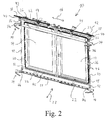
- dargixie sliding door 10 for a watercraft has a first door 12 and a second door 14, which are guided along a sliding direction 16 relative to each other movable.
- the first door 12 has a first frame 18, while the second door 14 has a second frame 20.
- the first frame 18 and the second frame 20 are each connected via a sliding arm 22 in the bottom region with a first guide rail 24 and slidably connected to the ceiling region with a second guide rail 26.
- a locking shaft 30 is rotated by approximately 180 °, so that via a cam 32, a locking joint 34 can be actuated.
- the locking joint 34 By the locking joint 34, the rotational movement of the Verrieglungswelle 30 is converted into a linear movement of the guide rail 24, 26 along the locking direction 28 by means of the eccentric 32.
- the locking shaft 30 can be driven by means of a motor, not shown, or by means of an actuating lever 36.
- the frames 18, 20 are each supported by a support rail 38, with the sliding shoes 40 are slidably connected.
- a respective lever 42 can be connected to the respective sliding shoes 40, which are coupled to one another via a Watts joint 44 such that the linear movement of the frames 18, 20 in the locking direction 28 can be compensated relative to the mounting rail 38.
- FIG. 3 shown locking position is connected to the frame 18, 20 door surface seal 46 on a door frame 48 at.
- the frame 18, 20 can be locked by means of a locking device 50.
- the door frame 48 merges into a wall 52 which has an outwardly facing wall 54 outside.
- the wall outer side 54 is substantially aligned with a door outer side 56 of the door leaf 12, 14.
- the in Fig. 4 shown unlocking position of the door leaf 12, 14 so far moved out of an opening defined by the door frame 48 opening 58 that an inwardly facing door inner side 60 of the door leaf 12, 14 is arranged offset to the outside wall 54 to the outside.
- the frame 18. 20 can be moved substantially parallel to the wall outer side 54.
- Locking joint 34 shown is connected via the eccentric 32 with the locking shaft 30.
- the locking joint 34 has a first leg 62, which is articulated at a first fixed point 64.
- the locking joint 34 has a second leg 66, which is articulated at a second fixed point 68.
- the first leg 62 and the second leg 66 are connected via a connecting arm 70, wherein the first leg 62 and the second leg 66 are each pivotally connected to the connecting arm 70.
- an actuating arm 72 is integrally connected to the connecting arm 70.
- the actuating arm 72 is pivotally connected to a drive arm 74 which is pivotally connected to the eccentric 32.
- the actuating arm 32 is connected via an only partially illustrated connecting joint 76 with the guide rail 24, 26, not shown, articulated.
- the connecting joint 76 is located substantially on a line between the fixed points 64, 68 imaginary line.
- the first leg 62 and the second leg 66 each have a slot 78 through which the drive arm 74 can be guided.
- the eccentric 32 may strike on reaching the locking position on the first leg 62.
- the actuator arm 72 may abut against the first leg 62.
- connecting joint 76 of the actuating arm 72 is a merely linear movement in the locking direction 28 which extends transversely to the sliding direction 16 of the frame 12, 14, so that with the connecting joint 76 connected guide rail 24, 26 can also perform a purely linear parallel displacement without a proportion of movement in the sliding direction 16. Since the link arm 70 is pivotally connected to the first leg 62 and to the second leg 66, the link arm 70 and the drive arm 74 can not lock as its pivotal and translational movement is permitted by the first and second legs 26, 26.
- actuating lever 36 may be used in the event that the operating lever 36 is not needed, in a corresponding recess 80 of a housing 82.
- the actuating lever 36 is, for example, easily locked or frictionally held in the recess 80.
- the actuating lever 36 can be pivoted out of the housing 82 via a lever joint 84, so that the lever 36 projects substantially perpendicularly from the housing 82.
- the lever 36 may be connected to the lock shaft 30 via a ratchet mechanism.
- a first pawl 86 and a second pawl 88 are provided.
- the first pawl 86 is engaged with a gear 90, which can be connected via a keyway 92 with the locking shaft 30.
- a spring 94 ensures that initially only the first pawl 86 engages the gear 90. This can ensure that in case of panic a person can operate the operating lever 36 only in such a way that the sliding door 10 is unlocked. Only after releasing a lock, not shown, the first pawl 86 can be released and the second pawl 88 are brought into engagement with the gear 90 to lock the sliding door 10, if necessary, manually.
- non-use position of the actuating lever 36 are preferably both pawls 86, 88 released so that the gear 90 can move on a movement of the locking shaft 30 without contact with the pawls 86, 88 on the pawls 86, 88 past.
Landscapes
- Engineering & Computer Science (AREA)
- Mechanical Engineering (AREA)
- Chemical & Material Sciences (AREA)
- Combustion & Propulsion (AREA)
- Ocean & Marine Engineering (AREA)
- Power-Operated Mechanisms For Wings (AREA)
Applications Claiming Priority (2)
| Application Number | Priority Date | Filing Date | Title |
|---|---|---|---|
| DE102008063074 | 2008-12-23 | ||
| DE102009004823A DE102009004823B4 (de) | 2008-12-23 | 2009-01-13 | Schiebetür |
Publications (1)
| Publication Number | Publication Date |
|---|---|
| EP2202375A2 true EP2202375A2 (fr) | 2010-06-30 |
Family
ID=42194234
Family Applications (1)
| Application Number | Title | Priority Date | Filing Date |
|---|---|---|---|
| EP09179131A Withdrawn EP2202375A2 (fr) | 2008-12-23 | 2009-12-14 | Porte coulissante |
Country Status (2)
| Country | Link |
|---|---|
| EP (1) | EP2202375A2 (fr) |
| DE (1) | DE102009004823B4 (fr) |
Cited By (3)
| Publication number | Priority date | Publication date | Assignee | Title |
|---|---|---|---|---|
| CN108974321A (zh) * | 2018-08-30 | 2018-12-11 | 长光卫星技术有限公司 | 一种塞拉式舱门 |
| CN114412321A (zh) * | 2021-12-27 | 2022-04-29 | 江苏和天下节能科技股份有限公司 | 一种断桥隔热节能门窗 |
| CN118958829A (zh) * | 2024-10-15 | 2024-11-15 | 济南瑞那斯门窗幕墙有限公司 | 一种安全型铝合金门窗 |
Families Citing this family (1)
| Publication number | Priority date | Publication date | Assignee | Title |
|---|---|---|---|---|
| CN114809867B (zh) * | 2022-04-08 | 2024-07-02 | 中船海为高科技有限公司 | 一种安全门门机系统 |
Family Cites Families (3)
| Publication number | Priority date | Publication date | Assignee | Title |
|---|---|---|---|---|
| DE566546C (de) * | 1930-02-23 | 1932-12-19 | Richard Ermecke | Ausschwenkvorrichtung fuer an Leitschienen waagerecht verschiebbare Fenster und Tueren |
| DE853646C (de) * | 1941-08-30 | 1952-10-27 | Glasbau Heinrich Hahn | Rahmenlose, laengs und quer verschiebbare Glastuer fuer Vitrinen, Schraenke u. dgl. |
| GB9401124D0 (en) * | 1994-01-21 | 1994-03-16 | Tidy Anthony A | Hinge mechanism |
-
2009
- 2009-01-13 DE DE102009004823A patent/DE102009004823B4/de not_active Expired - Fee Related
- 2009-12-14 EP EP09179131A patent/EP2202375A2/fr not_active Withdrawn
Cited By (4)
| Publication number | Priority date | Publication date | Assignee | Title |
|---|---|---|---|---|
| CN108974321A (zh) * | 2018-08-30 | 2018-12-11 | 长光卫星技术有限公司 | 一种塞拉式舱门 |
| CN114412321A (zh) * | 2021-12-27 | 2022-04-29 | 江苏和天下节能科技股份有限公司 | 一种断桥隔热节能门窗 |
| CN114412321B (zh) * | 2021-12-27 | 2024-01-05 | 江苏和天下节能科技股份有限公司 | 一种断桥隔热节能门窗 |
| CN118958829A (zh) * | 2024-10-15 | 2024-11-15 | 济南瑞那斯门窗幕墙有限公司 | 一种安全型铝合金门窗 |
Also Published As
| Publication number | Publication date |
|---|---|
| DE102009004823B4 (de) | 2011-01-05 |
| DE102009004823A1 (de) | 2010-06-24 |
Similar Documents
| Publication | Publication Date | Title |
|---|---|---|
| WO2015177148A1 (fr) | Dispositif de verrouillage pour portes louvoyantes-coulissantes de véhicules de transport public ; porte louvoyante-coulissante équipée d'un dispositif de verrouillage | |
| DE102017129427B3 (de) | Scharnierverschluss | |
| EP1767388B1 (fr) | Porte pivotante-coulissante pour véhicules de transport de personnes | |
| EP2268526B1 (fr) | Verrouillage pour porte pivotante extérieure | |
| EP3550102B1 (fr) | Assemblage pour une porte de bâtiment avec une unité d'étanchéité et un dispositif de verrouillage | |
| EP1187963A1 (fr) | Dispositif de blocage et dispositif d'entrainement de porte pourvu d'un tel dispositif de blocage et destine a une porte entrainee par un groupe moteur | |
| DE102009004823B4 (de) | Schiebetür | |
| EP2290181A2 (fr) | Dispositif de verrouillage ou déverrouillage d'un ouvrant coullissant | |
| EP2146032B1 (fr) | Dispositif destiné à ouvrir et/ou fermer ainsi qu'à verrouiller un état fermé d'un dispositif de fermeture destiné à fermer une ouverture de salle ainsi que dispositif de fermeture doté d'un tel dispositif | |
| DE102011085177B4 (de) | Antriebssystem für ein KFZ-Dachsystem | |
| DE19902150A1 (de) | Ausstellvorrichtung für einen an einem Rahmen schwenkbar angebrachten Kipp- oder Dreh-Kipp-Flügel | |
| EP3665349A1 (fr) | Serrure de porte | |
| DE102018115985B4 (de) | Schlossgegenkasten für ein Aktivflügelschloss mit Falzluftausgleich | |
| DE2852670C2 (fr) | ||
| EP4174266B1 (fr) | Agencement de battant | |
| DE102009004824B4 (de) | Schiebetür | |
| WO2020169245A1 (fr) | Fenêtre pour un véhicule ou un conteneur comprenant un mécanisme de verrouillage | |
| DE20102570U1 (de) | Drehkippbeschlag | |
| DE10031820A1 (de) | Ausstellvorrichtung für einen an einem Rahmen schwenkbar angebrachten Kipp- oder Dreh-Kipp-Flügel | |
| EP1414689B1 (fr) | Véhicule ferroviaire avec une paroi coulissante et un système de verrouillage en partie basse de la paroi | |
| DE102006002830B4 (de) | Ausstellvorrichtung für den Flügel eines Fensters oder dergleichen | |
| EP1862623A1 (fr) | Sécurité anti-basculement | |
| EP4174264B1 (fr) | Agencement de battant | |
| DE102014111131A1 (de) | Vorrichtung zur Ver- und Entriegelung eines Fensterflügels, einer Lüftungsklappe oder dergleichen an einem Blendrahmen | |
| DE29818045U1 (de) | Beschlag für Klappfenster, insbesondere von Wohnwagen, Mobilheimen u.dgl. |
Legal Events
| Date | Code | Title | Description |
|---|---|---|---|
| PUAI | Public reference made under article 153(3) epc to a published international application that has entered the european phase |
Free format text: ORIGINAL CODE: 0009012 |
|
| AK | Designated contracting states |
Kind code of ref document: A2 Designated state(s): AT BE BG CH CY CZ DE DK EE ES FI FR GB GR HR HU IE IS IT LI LT LU LV MC MK MT NL NO PL PT RO SE SI SK SM TR |
|
| AX | Request for extension of the european patent |
Extension state: AL BA RS |
|
| STAA | Information on the status of an ep patent application or granted ep patent |
Free format text: STATUS: THE APPLICATION IS DEEMED TO BE WITHDRAWN |
|
| 18D | Application deemed to be withdrawn |
Effective date: 20120703 |