EP2203425B1 - Biozide Mischungen - Google Patents
Biozide Mischungen Download PDFInfo
- Publication number
- EP2203425B1 EP2203425B1 EP08804676.8A EP08804676A EP2203425B1 EP 2203425 B1 EP2203425 B1 EP 2203425B1 EP 08804676 A EP08804676 A EP 08804676A EP 2203425 B1 EP2203425 B1 EP 2203425B1
- Authority
- EP
- European Patent Office
- Prior art keywords
- mixtures according
- biocidal mixtures
- wie
- polyamines
- und
- Prior art date
- Legal status (The legal status is an assumption and is not a legal conclusion. Google has not performed a legal analysis and makes no representation as to the accuracy of the status listed.)
- Active
Links
Classifications
-
- C—CHEMISTRY; METALLURGY
- C07—ORGANIC CHEMISTRY
- C07D—HETEROCYCLIC COMPOUNDS
- C07D213/00—Heterocyclic compounds containing six-membered rings, not condensed with other rings, with one nitrogen atom as the only ring hetero atom and three or more double bonds between ring members or between ring members and non-ring members
- C07D213/02—Heterocyclic compounds containing six-membered rings, not condensed with other rings, with one nitrogen atom as the only ring hetero atom and three or more double bonds between ring members or between ring members and non-ring members having three double bonds between ring members or between ring members and non-ring members
- C07D213/04—Heterocyclic compounds containing six-membered rings, not condensed with other rings, with one nitrogen atom as the only ring hetero atom and three or more double bonds between ring members or between ring members and non-ring members having three double bonds between ring members or between ring members and non-ring members having no bond between the ring nitrogen atom and a non-ring member or having only hydrogen or carbon atoms directly attached to the ring nitrogen atom
- C07D213/60—Heterocyclic compounds containing six-membered rings, not condensed with other rings, with one nitrogen atom as the only ring hetero atom and three or more double bonds between ring members or between ring members and non-ring members having three double bonds between ring members or between ring members and non-ring members having no bond between the ring nitrogen atom and a non-ring member or having only hydrogen or carbon atoms directly attached to the ring nitrogen atom with hetero atoms or with carbon atoms having three bonds to hetero atoms with at the most one bond to halogen, e.g. ester or nitrile radicals, directly attached to ring carbon atoms
- C07D213/62—Oxygen or sulfur atoms
- C07D213/70—Sulfur atoms
Definitions
- the present invention relates to biocidal mixtures containing at least one biocide which is not a polyamine and at least one polyamine, as well as the use of the aforementioned biocidal mixtures in the protection of materials.
- the disclosure further relates to a process for discoloring and / or preventing discoloration of pyrithione-containing technical materials by polyamines.
- Biocide mixtures containing at least one biocide and at least one polyamine are known in principle.
- DE 40 33 272 C1 discloses a composition containing 1,2-benzisothiazolin-3-one (BIT) and an amine such as lauryldipropylenetriamine further containing as solvent water and water-miscible solvents such as butyldiglycol.
- BIT 1,2-benzisothiazolin-3-one
- an amine such as lauryldipropylenetriamine
- solvent water and water-miscible solvents such as butyldiglycol.
- aqueous solutions of crude BIT are known which are known for improving the storage stability with two or more amine compounds from the group consisting of diethanolamine, triethanolamines, diisopropanolamine, triisopropanolamine and morpholine.
- liquid preparations of BIT and ethoxylated, tertiary amines are known, which further contain water, water-miscible solvents such as polyglycols and other auxiliaries such as complexing agents and / or water-softening agents.
- Disinfectants which include specific glycol ethers and at least one secondary or tertiary hydroxy-free amine.
- the aforementioned disinfectants should have a shorter exposure time or improved effectiveness.
- pyrithione Special biocides are pyrithione. Pyrithiones are known antimicrobials that are useful in a variety of preservative applications.
- Sodium pyrithione (CAS 3811-73-2) is a water-soluble pyrithione salt with very good antimicrobial properties and is used, for example, as a preservative (biocide) in technical process fluids and auxiliaries such as metalworking fluids, lubricants, binders, adhesives, sealants, leather auxiliaries, paper coating agents and even used cosmetic preparations.
- the production of sodium pyrithione was first reported in US 3,159,640 described.
- Zinc pyrithione has the property of entering into heavy metals, especially iron ions, intensely colored (dark green, blue, black) compounds. Even if they are only present in traces, e.g. as catalyst residues in chemicals or natural impurities (iron) of additives for paints and varnishes (etc. mentioned above). These discolorations are not only acceptable for aesthetic reasons, but also lead to massive technical problems such as e.g. Loss of effect.
- oil concentrates of a particular specification are subject to color, e.g. brown.
- a black product is not for sale.
- Metalworking fluids are normally used as white emulsions or pale yellowish colored solutions. Dark blue to black liquids, which color workpieces and machines black, lead to blatant financial losses. In the past, there have been attempts to solve the discoloration, all of which lead to more or less severe side effects. In these cases, it is attempted to displace the heavy metals, especially iron ions, by other metal ions or to eliminate them by complex formation.
- biocidal mixtures which on the one hand have a reduced proportion of biocides with at least comparable activity and which, in particular when using pyrithiones, can retain this activity even in the presence of metal ions ,
- aliphatic primary polyamine are understood to mean those compounds within the scope of the invention which have at least two primary amino groups, which are bound to an sp 3 -hybridized carbon atom. Typically, such polyamines, taken by themselves, do not have applicable biocidal properties.
- Suitable biocides which are not aliphatic, primary polyamines, according to the invention for example, fungicides, bactericides or algicides or mixtures of such agents are used, preferably fungicides or bactericides or mixtures of such agents.
- Preferred algicides are triazine compounds such as terbutryn, cybutryn, propazine or terbutone, urea compounds such as diuron, benzthiazuron, methabenzthiazuron, tebuthiuron, and isoproturon, or uracils such as terbacil.
- the mixtures according to the invention contain neither pyrithione nor salts thereof.
- the mixtures according to the invention furthermore contain at least one aliphatic, primary polyamine which has at least 5 carbon atoms and does not carry any secondary, tertiary or quaternary amino groups.
- Particularly preferred aliphatic primary polyamines which have at least 5 carbon atoms and do not bear secondary, tertiary or quaternary amino groups are: 1,5-diamino-2-methylpentane, 1,3-bisaminomethylcyclohexane and 1,3-xylylenediamine and also polyetheramines of the formulas I and II, with the meanings given there including their preferred ranges and mixtures of the aforementioned polyamines.
- the weight ratio of biocides to polyamines in the mixtures according to the invention can be, for example, 100: 1 to 1: 100, preferably 10: 1 to 1:10 and more preferably 2: 1 to 1: 5.
- the mixtures of the invention may further contain acidic substances.
- acidic substances are acids having a standard pK a value of 2.0 to 6.0 and acid salts which have a pH of 2, measured or calculated on an aqueous scale and a concentration of 1 mol / l , 0 to 6.0 at standard temperature.
- Preferred acidic substances are: formic acid, acetic acid, propionic acid, butyric acid succinic acid, lactic acid, citric acid, benzoic acid, adipic acid, fumaric acid, sorbic acid, salicylic acid, sorbic acid, nonanoic acid.
- the invention also encompasses the mixtures according to the invention in any desired formulation.
- Preferred formulations are capsule suspensions (CS), water-soluble concentrates (SL), suspension concentrates (SC) and emulsifiable concentrates (EC), water-soluble concentrates (SL), suspension concentrates (SC) and emulsifiable concentrates (EC) being generally preferred due to the physical properties of the polyamines are.
- suitable formulation types depend essentially on the mixture components used and their physical properties. However, since these are known, it is common practice for the skilled person to determine in a few experiments further preferred formulation type.
- the particular advantage of the mixtures according to the invention is that the content of polyamines can improve the effect of the biocide components used and the anionic surfactants, which are frequently constituents of biocidal formulations, do not deactivate or only insignificantly deactivate them.
- the invention therefore further relates to the use of the mixtures according to the invention for the protection of technical materials.
- Adhesives, concrete, polymer dispersions, pigment slurries, inks, glues, paints, coating compositions, plasters, cooling lubricants and heat transfer fluids or functional fluids for protecting the abovementioned technical materials come into consideration in particular as technical materials. Very particular preference is given to cooling lubricants and adhesives.
- the invention also relates to a process for the protection of industrial materials against attack and / or destruction by microorganisms, which comprises allowing the mixtures according to the invention undiluted or diluted to act on the microorganism or its habitat.
- the invention also relates to technical materials obtainable by treating technical materials with the mixtures according to the invention.
- bacteria, mold, yeasts, algae and slime organisms may be mentioned.
- Called mucus organisms for example, the mixtures according to the invention are used against bacteria, mold and yeasts.
- the application rate of the mixtures according to the invention depends on the type and occurrence of the microorganisms to be controlled and on the composition of the material to be protected. The optimum amount of use can be determined by testing easily and in a manner well known to those skilled in the art.
- polyamines of the formulas III and IV are diethylenetriamine (CAS 111-40-0), bis (3-aminopropyl) ether (CAS 2579-20-6), 1,3-bis (aminomethyl) cyclohexane (CAS 2579-20 -6), polyetheramine (CAS 39423-51-3), diethylaminoethylamine (CAS 100-36-7), diethylamino-propylamine (CAS 104-78-9), N-aminopropylpiperidine and N-aminopropylmorpholine (CAS 123-00-2 ,
- polystyrene resin preferred polyamines
- aliphatic primary polyamines which have at least 5 carbon atoms and carry no secondary, tertiary or quaternary amino groups, with the same ranges and preferred ranges as mentioned above.
- pyrithione-containing mixtures with respect to the other ingredients such as other biocides, water, surfactants, emulsifiers, dispersants, stabilizers, spreading agents, organic solvents ,. Fragrances and dyes, as well as buffer substances, buffer systems or pH regulators, the disclosure shown above, including the areas mentioned therein and preferred ranges completely analog.
- HHT hexahydrotriazine
- MBO methylenebisoxazolidine
- MBM methylenebismorpholine
- DMDMHy DMDM-hydantoin
- BIT benzisothiazolinone
- OPP o-phenylphenol
- IPBC iodopropynyl butylcarbamate
- This general recipe shows the combination of pyrithione or its salts with polyamines.
- the necessary dosage of the polyamines is, for example, 0.2 to 10 times the concentration of sodium pyrithione and is in particular in the approximately same concentration.
- the polyamines described are not only suitable for preventing discoloration, but can also replace amines, which must be used for the specified in the recipe amine soaps.
- the polyamines used can also contribute to emulsification and corrosion protection.
- the dosage of the polyamines can thus be used advantageously in the emulsifier system / corrosion protection.
- the use of the polyamines described is not limited to high oil coolants, but is universally suitable for semi-synthetic products to clear water-soluble Vollsythesen.
- the disclosure therefore discloses the use of polyamines for decoloring and / or preventing discoloration of pyrithione and / or salts thereof caused by heavy metal ions, in particular iron (III) ions, preferably oil concentrates, in particular cooling lubricant concentrates, paints and varnishes, Adhesives, sealants, leather auxiliaries, paper coating agents and cosmetics, as well as the substances, characterized by a proportion of one or more polyamine (s) and / or their derivatives themselves.
- heavy metal ions in particular iron (III) ions
- oil concentrates in particular cooling lubricant concentrates, paints and varnishes
- Adhesives, sealants, leather auxiliaries, paper coating agents and cosmetics as well as the substances, characterized by a proportion of one or more polyamine (s) and / or their derivatives themselves.
- the disclosure comprises a method for decolorizing and / or preventing discoloration of pyrithione and / or salts thereof caused by heavy metal ions, especially ferric ions, by the addition or provision of a portion of one or more polyamines and / or their derivatives.
- the preservative effect of the mixtures according to the invention was investigated in a cooling lubricant emulsion (5% mineral oil-based cooling lubricant concentrate / 95% water).
- a cooling lubricant emulsion 5% mineral oil-based cooling lubricant concentrate / 95% water.
- preserved samples of the coolant lubricant emulsion were repeatedly exposed to a microbiological load with the following microorganisms at weekly intervals: Bacteria: Pseudomonas aeruginosa Pseudomonas fluorescens Pseudomonas oleovorans Pseudomonas rubescens Pseudomonas stutzeri Alcaligenes faecalis
- Corynebacterium sp yeast Rhodotorula rubra molds: Acremonium strictum Fusarium solani Geotrichum candidum
- the mixture according to the invention exhibits a significantly improved overall effect compared with the individual active ingredient BIT, which is documented in particular by the significantly improved bacterial action.
- OPP o-phenylphenol
- the mixture according to the invention exhibits a significantly improved overall effect compared with the single active substance OPP, which is documented in particular by the significantly improved bacterial action.
- a fully synthetic coolant (clear, colorless liquid) or its 5% aqueous solution contains 0.1% of a preservative containing 10% sodium pyrithione.
- the clear solution contains 100 ppm sodium pyrithione.
- 0.01 g of a 5% strength NH 4 Fe (III) (SO 4 ) 2 solution are added dropwise to this solution. There was spontaneously an intense deep blue colored liquid. After addition of 0.05 g of diethylaminoethylamine, the solution was spontaneously decolorized.
Landscapes
- Chemical & Material Sciences (AREA)
- Organic Chemistry (AREA)
- Agricultural Chemicals And Associated Chemicals (AREA)
- Lubricants (AREA)
Description
- Vorliegende Erfindung betrifft biozide Mischungen enthaltend zumindest ein Biozid, das kein Polyamin ist und zumindest ein Polyamin, sowie die Verwendung der vorgenannten bioziden Mischungen im Materialschutz. Die Offenbarung betrifft weiterhin ein Verfahren zum Entfärben und/oder zum Verhindern von Verfärbungen von Pyrithion enthaltenden technischen Stoffen durch Polyamine.
- Biozide Mischungen enthaltend zumindest ein Biozid und zumindest ein Polyamin sind prinzipiell bekannt.
- So ist in
DE 40 33 272 C1 eine Zusammensetzung enthaltend 1,2-Benzisothiazolin-3-on (BIT) und ein Amin wie beispielsweise Lauryldipropylentriamin beschrieben, die weiterhin als Lösungsmittel Wasser und mit Wasser vollständig mischbare Lösungsmittel wie z.B. Butyldiglykol beinhalten. - Aus
GB 1 191 253 - Ferner sind aus
GB 1 330 531 - Aus DE sind 36 099 39 lagerstabile, flüssige Zubereitungen aus BIT und ethoxylierten, tertiären Aminen bekannt, die weiterhin Wasser, mit Wasser mischbare Lösungsmittel wie Polyglykole sowie weitere Hilfsstoffe wie Komplexbildner und/oder Wasserenthärtungsmittel enthalten.
- Letztlich sind aus
EP 612 470 A - Spezielle Biozide sind Pyrithione. Pyrithione sind bekannte antimikrobielle Stoffe, die in einer Vielzahl von Anwendungen zur Konservierung nützlich verwendet werden. Natrium-Pyrithion (CAS 3811-73-2) ist ein wasserlösliches Pyrithion-Salz mit sehr guten antimikrobiellen Eigenschaften und wird z.B. als Konservierungsmittel (Biozid) in technischen Prozessflüssigkeiten und Hilfsmitteln wie z.B. Metallbearbeitungsflüssigkeiten, Schmierstoffen, Bindemitteln, Klebstoffen, Dichtungsmitteln, Lederhilfsmitteln, Papierbeschichtungsmitteln und sogar kosmetischen Präparaten verwendet. Die Herstellung von Natriumpyrithion wurde erstmals in
US 3,159,640 beschrieben. - Leider besitzt Natriumpyrithion wie weitere Salze, z.B. Zinkpyrithion die Eigenschaft mit Schwermetallen, vor allem Eisenionen, intensiv gefärbte (dunkelgrün, blau, schwarz) Verbindungen einzugehen. Selbst wenn diese nur in Spuren vorhanden sind, z.B. als Katalysatorreste in Chemikalien oder natürliche Begleitstoffe (Eisen) von Additiven für Farben und Lacke (etc. oben genannte). Diese Verfärbungen sind nicht nur aus ästhetischen Gründen nicht akzeptabel, sondern führen auch zu massiven technischen Problemen wie z.B. Wirkungsverlust.
- Beispielsweise unterliegen Ölkonzentrate einer bestimmten Spezifikation bei der Farbe, z.B. braun. Ein schwarzes Produkt ist nicht verkäuflich.
- Metallbearbeitungsflüssigkeiten werden normalerweise als weiße Emulsionen oder schwach gelblich gefärbte Lösungen verwendet. Dunkelblaue bis schwarze Flüssigkeiten, die Werkstücke und Maschinen schwarz einfärben, führen zu eklatanten finanziellen Verlusten. In der Vergangenheit hat es Versuche zur Lösung der Verfärbung gegeben, die alle zu mehr oder weniger starken Nebeneffekten führen. In diesen Fällen wird versucht die Schwermetalle, besonders Eisenionen, durch andere Metallionen zu verdrängen bzw. durch Komplexbildung zu beseitigen. (Die Reaktion von Fe-III-Ionen mit Pyrithion führt zu einem schwarzen Niederschlag und wird so dem System entzogen. Damit verbunden ist ein Verlust an biozider Wirkung.) In Metallbearbeitungsflüssigkeiten führt die Verwendung von Komplexbildnern zwar zur Entfärbung von Fe-Pyrithion, vermindert allerdings auch die Wasserhärte und führt fast immer zur unerwünschten Schaumbildung der Flüssigkeit und Schaum kann weder schmieren noch kühlen. Eine weitere Möglichkeit ist die Verwendung von Salzen, die mit Pyrithion zu ungefärbten Komplexsalzen führen, z.B. Zink-Salzen (
US 4,161,526 ). Auch diese Verfahrensweise führt zwar zu einer Entfärbung, allerdings auch zu einer Verminderung der bioziden Wirkung des Pyrithions und zu unerwünschten Folgeschäden. - Vor dem Hintergrund des vorstehend aufgeführten Standes der Technik war es wünschenswert, weitere biozide Mischungen bereitzustellen, die sich einerseits durch einen verringerten Anteil an Bioziden bei zumindest vergleichbarer Wirksamkeit auszeichnen und die weiterhin, insbesondere bei Verwendung von Pyrithionen diese Wirksamkeit auch in Gegenwart von Metallionen beibehalten können.
- Es wurden nun biozide Mischungen gefunden enthaltend
- zumindest ein Biozid, das kein aliphatisches, primäres Polyamin ist und
- zumindest ein aliphatisches, primäres Polyamin, das zumindest 5 Kohlenstoffatome aufweist und keine sekundären, tertiären oder quartären Aminogruppen trägt,
- Unter dem Begriff "aliphatisches, primäres Polyamin" sind im Rahmen der Erfindung solche Verbindungen zu verstehen, die zumindest zwei primäre Aminogruppen besitzen, die an ein sp3-hybridisiertes Kohlenstoffatom gebunden sind. Typischerweise weisen solche Polyamine für sich genommen keine anwendbaren bioziden Eigenschaften auf.
- Es sei an dieser Stelle angemerkt, dass der Rahmen der Erfindung alle beliebigen und möglichen Kombinationen der oben stehenden und im Folgenden aufgeführten, allgemeinen oder in Vorzugsbereichen genannten Komponenten, Wertebereiche bzw. Verfahrensparameter umfasst.
- Als Biozide, die keine aliphatischen, primären Polyamine sind, kommen erfindungsgemäß beispielsweise Fungizide, Bakterizide oder Algizide bzw. Mischungen solcher Wirkstoffe zum Einsatz, bevorzugt Fungizide oder Bakterizide oder Mischungen solcher Wirkstoffe.
- Fungizide bzw. Bakterizide sind beispielsweise geeignet:
- Aldehyde wie Zimtaldehyd, Formaldehyd, Glutardialdehyd, β-Bromzimtaldehyd, o-Phthaldialdehyd;
- Benzimidazole wie Carbendazim, Benomyl, Fuberidazole, Thiabendazol oder deren Salze;
- Benzthiazole wie: 2-Mercaptobenzothiazol;
- Benzthiophendioxide wie:Benzo[b]thiophen-S,S-dioxid-carbonsäurecyclohexylamid;
- Benzamide wie: 2,6-Dichloro-N-(4-trifluoromethylbenzyl)-benzamid, Tecloftalam;
- Chinoline wie: 8-Hydroxychinolin und deren Cu-Salze;
- Dithiocarbamate wie Cufraneb, Ferban, Kalium-N-hydroxymethyl-N'-methyl-dithiobarbamat, Na- oder K-dimethyldithiocarbamat, Macozeb, Maneb, Metam, Metiram, Thiram, Zineb, Ziram;
- Formaldehyd und formaldehydabspaltende Verbindungen wie Benzylalkoholmono-(poly)-hemiformal, 1,3-Bis(hydroxymethyl)-5,5-dimethy-limidazolidine-2,4-dione (DMDMH), Bisoxazolidine, n-Butanol-hemiformal, Cis 1-(3-Chlorallyl)-3,5,7-triaza-1-azoniaadamantane chlorid, 1-[1,3-Bis(hydroxymethyl-2,5-dioxoimidazolidin-4-yl]-1,3-bis(hydroxymethyl)urea, Dazomet, Dimethylol-harnstoff, 4,4-Dimethyl-oxazolidine, Ethylenglycol-hemiformal, 7-Ethylbicyclooxazolidine, Hexa-hydro-S-triazine, Hexamethylentetramin, N-Hydroxymethyl-N'-methylthioharnstoff, Methylenbis-morpholin, Natrium N-(Hydroxy-methyl)glycinat, N-Methylolchloracetamid, Oxazolidine, Paraformaldehyd, Taurolin, Tetrahydro-1,3-oxazin, N-(2-Hydroxypropyl)-amin-methanol, Tetramethylol-acetylen-diharnstoff (TMAD);
- Imidazole wie Clotrimazol, Bifonazol, Climbazol, Econazol, Fenapamil, Imazalil, Isoconazol, Ketoconazol, Lombazol, Miconazol, Pefurazoat, Prochloraz, Triflumizol, Thiazolcar 1-Imidazolyl-1-(4'-chlorophenoxy)-3,3-dimethylbutan-2-on sowie deren Metallsalze und Säureaddukte;
- Iodderivate wie Diiodmethyl-p-tolylsulfon, 3-Iod-2-propinyl-alkohol, 4-Chlorphenyl-3-iodpropargylformal, 3-Brom-2,3-diiod-2-propenylethylcarbamat, 2,3,3-Triiodallylalkohol, 3-Brom-2,3-diiod-2-propenylalkohol, 3-Iod-2-propinyl-n-hexylcarbamat, 3-Iod-2-propinyl-cyclohexylcarbamat, 3-Iod-2-propinyl-phenylcarbamat;
- Isothiazolinone wie N-Methylisothiazolin-3-on, 5-Chlor-N-methylisothiazolin-3-on, 4,5-Trimethylenisothiazolinon, Benzisothiazolinon;
- Methoxyacrylate oder Ähnliche wie Azoxystrobin, Dimoxystrobin, Fluoxastrobin, Kresoxim-methyl, Metominostrobin, Orysastrobin, Picoxystrobin, Pyraclostrobin, Trifloxystrobin, 2,4-dihydro-5-methoxy-2-methyl-4-[2-[[[[1-[3-(trifluoromethyl)phenyl]-ethylidene]amino]oxy]methyl]phenyl]-3H-1,2,4-triazol-3-one (CAS-Nr. 185336-79-2);
- Mikrobizide mit aktivierter Halogengruppe wie Bronidox, 2-Brom-2-nitro-1,3-propandiol, 2-Brom-4'-hydroxy-acetophenon, 1-Brom-3-chlor-4,4,5,5-tetramethyl-2-imidazoldinone, β-Brom-β-nitrostyrol, Chloracetamid, Chloramin T, 1,3-Dibrom-4,4,5,5-tetrametyl-2-imidazoldinone, Dichloramin T, 3,4-Dichlor-(3H)-1,2-dithiol-3-on, 2,2-Dibrom-3-nitril-propionamid, 1,2-Dibrom-2,4-dicyanobutan, Halane, Halazone, Mucochlorsäure, Phenyl-(2-chlor-cyan-vinyl)sulfon, Phenyl-(1,2-dichlor-2-cyanvinyl)sulfon, Trichlorisocyanur-säure;
- Morpholinderivate wie Aldimorph, Dimethomorph, Dodemorph, Falimorph, Fenpropidin, Fenpropimorph, Tridemorph, Trimorphamid und ihre arylsulfonsauren Salze, wie z.B. p-Toluolsulfonsäure und p-Dodecylphenylsulfonsäure;
- Naphthalin-Derivate wie Terbinafin, Naftifin, Butenafin, 3-Chloro-7-(2-aza-2,7,7-trimethyl-oct-3-en-5-in);
- Nitrile wie 2,4,5,6-Tetrachlorisophthalodinitril, Dinatrium-cyano-dithioimidocarbamat;
- Phenole wie Tribromphenol, Tetrachlorphenol, 3-Methyl-4-chlorphenol, 3,5-Dimethyl-4-chlorphenol, Dichlorphen, 2-Benzyl-4-chlorphenol, Triclosan, Diclosan, Hexachlorophen, p-Hydroxybenzoesäuremethylester, p-Hydroxybenzoesäureethylester, p-Hydroxybenzoesäurepropylester, p-Hydroxybenzoesäurebutylester, p-Hydroxybenzoesäureoctylester ,o-Phenylphenol, m-Phenylphenol, p-Phenylphenol, 4-(2-tert.-Butyl-4-methyl-phenoxy)-phenol, 4-(2-Isopropyl-4-methyl-phenoxy)-phenol, 4-(2,4-Dimethyl-phenoxy)-phenol und deren Alkali- und Erdalkalimetallsalze;
- Pyridine und Pyrimidine wie Ancymidol, Buthiobat, Fenarimol, Mepanipyrin, Nuarimol, Pyroxyfur, Triamirol; 1-Hydroxy-2-pyridinthion (und ihre Cu-, Na-, Fe-, Mn-, Zn-Salze), Tetrachlor-4-methylsulfonylpyridin, Pyrimethanol, Mepanipyrim, Dipyrithion, 1-Hydroxy-4-methyl-6-(2,4,4-trimethylpentyl)-2(1H)-pyridin und Pyrithion und seine Salze, wie insbesondere seine Zink- und ;
- Quartäre Ammoniumverbindungen und Guanidine wie Benzalkoniumchlorid, Benzyldimethyltetradecylammoniumchlorid, Benzyldimethyldodecylammoniumchlorid, Dichlorbenzyldimethylalkylammoniumchlorid, Didecyldimethylammoniumchlorid, Dioctyldimethylammoniumchlorid, N-Hexadecyltrimethylammoniumchlorid, 1-Hexadecylpyridiniumchlorid, Iminoctadine-tris(albesilat);
- Thiocyanate wie: Thiocyanatomethylthiobenzothiazol, Methylenbisthiocyanat;
- Triazole wie Azaconazol, Azocyclotin, Bitertanol, Bromuconazol, Cyproconazol, Diclobutrazol, Difenoconazol, Diniconazol, Epoxyconazol, Etaconazol, Fenbuconazol, Fenchlorazol, Fenethanil, Fluquinconazol, Flusilazol, Flutriafol, Furconazol, Hexaconazol, Imibenconazol, Ipconazol, Isozofos, Myclobutanil, Metconazol, Paclobutrazol, Penconazol, Propioconazol, Prothioconazol, Simeoconazol, (±)-cis-1-(4-chlorphenyl)-2-(1H-1,2,4-triazol-1-yl)-cycloheptanol, 2-(1-tert-Butyl)-1-(2-chlorphenyl)-3-(1,2,4-triazol-1-yl)-propan-2-ol, Tebuconazol, Tetraconazol, Triadimefon, Triadimenol, Triapenthenol, Triflumizol, Triticonazol, Uniconazol sowie deren Metallsalze und Säureaddukte;
- Succinat-Dehydrogenase-Inhibitoren wie Benodanil, Carboxim, Carboximsulfoxid, Cyclafluramid, Fenfuram, Flutanil, Furcarbanil, Furmecyclox, Mebenil, Mepronil, Methfuroxam, Metsulfovax, Nicobifen, Pyrocarbolid, Oxycarboxin, Shirlan, Seedvax;
- Sulfenamide wie Dichlorfluanid, Tolylfluanid, Folpet, Fluorfolpet; Captan, Captofol;
- sonstige Biozide wie Bethoxazin, 5-Hydroxy-2(5H)-furanon; 4,5-Benzdithiazolinon, 4,5-Trimethylendithiazolinon, N-(2-p-Chlorbenzoylethyl)-hexaminiumchlorid, 2-Oxo-2-(4-hydroxyphenyl)acethydroximsäure-chlorid, Tris-N-(cyclohexyldiazeniumdioxy)-aluminium, N-(Cyclohexyldiazeniumdioxy)-tributylzinn bzw. K-Salze, Bis-N-(cyclohexyldiazeniumdioxy)-kupfer, Iprovalicarb, Fenhexamid, Spiroxamin, Carpropamid, Diflumetorin, Quinoxyfen, Famoxadone, Polyoxorim, Acibenzolar-S-methyl, Furametpyr, Thifluzamide, Methalaxyl-M, Benthiavalicarb, Metrafenon, Cyflufenamid, Tiadinil, Teebaumöl, Phenoxyethanol,
- Bevorzugte Fungizide bzw. Bakterizide sind:
- Azaconazol, Bromuconazol, Cyproconazol, Dichlobutrazol, Diniconazol" Hexaconazol, Metaconazol, Penconazol, Propiconazol, Tebuconazol, Dichlofluanid, Tolylfluanid, Triadimefon, Fluorfolpet, Methfuroxam, N-Methyl-isothiazolin-3-on, 5-Chlor-N-methylisothiazolin-3-on, Dichlor-N-octylisothiazolinon, Mercaptobenzthiazol, Thiocyanatomethylthiobenzothiazol, Thiabendazol, Benzisothiazolinon, Pyrithion und seine Salze, 2-Brom-2-nitro-1,3-propandiol und o-Phenylphenol. Ganz besonders bevorzugt sind N-Methyl-isothiazolin-3-on, 5-Chlor-N-methylisothiazolin-3-on, Dichlor-N-octylisothiazolinon, Mercaptobenzthiazol, Thiocyanatomethylthiobenzothiazol, Thiabendazol, Benzisothiazolinon, Pyrithion bzw seine Alkalimetallsalze und o-Phenylphenol, wobei N-Methyl-isothiazolin-3-on, 5-Chlor-N-methylisothiazolin-3-on, Dichlor-N-octylisothiazolinon, Thiabendazol, Benzisothiazolinon und o-Phenylphenol noch weiter bevorzugt sind.
- Als Algizide sind beispielsweise geeignet:
- Acetochlor, Acifluorfen, Aclonifen, Acrolein, Alachlor, Alloxydim, Ametryn, Amidosulfuron, Amitrole, Ammonium sulfamate, Anilofos, Asulam, Atrazine, Azafenidin, Aziptrotryn, Azimsulfuron,
- Benazolin, Benfluralin, Benfuresat, Bensulfuron, Bensulfid, Bentazon, Benzofencap, Benzthiazuron, Bifenox, Bispyribac, Bispyribac-Natrium, Borax, Bromacil, Bromobutide, Bromofenoxim, Bromoxynil, Butachlor, Butamifos, Butralin, Butylat, Bialaphos, Benzoyl-prop, Bromobutide, Butroxydim,
- Carbetamid, Carfentrazone-ethyl, Carfenstrol, Chlomethoxyfen, Chloramben, Chlorbromuron, Chlorflurenol, Chloridazon, Chlorimuron, Chlornitrofen, Chloressigsäure, Chloransulam-methyl, Cinidon-ethyl, Chlorotoluron, Chloroxuron, Chlorpropham, Chlorsulfuron, Chlorthal, Chlorthiamid, Cinmethylin, Cinofulsuron, Clefoxydim, Clethodim, Clomazone, Chlomeprop, Clopyralid, Cyanamide, Cyanazine, Cycloat, Cycloxydim, Chloroxynil, Clodinafop-propargyl, Cumyluron, Clometoxyfen, Cyhalofop, Cyhalofop-butyl, Clopyrasuluron, Cyclosulfamuron,
- Diclosulam, Dichlorprop, Dichlorprop-P, Diclofop, Diethatyl, Difenoxuron, Difenzoquat, Diflufenican, Diflufenzopyr, Dimefuron, Dimepiperate, Dimethachlor, Dimethipin, Dinitramine, Dinoseb, Dinoseb Acetate, Dinoterb, Diphenamid, Dipropetryn, Diquat, Dithiopyr, Diduron, DNOC, DSMA, 2,4-D, Daimuron, Dalapon, Dazomet, 2,4-DB, Desmedipham, Desmetryn, Dicamba, Dichlobenil, Dimethamid, Dithiopyr, Dimethametryn,
- Eglinazin, Endothal, EPTC, Esprocarb, Ethalfluralin, Ethidimuron, Ethofumesat, Ethobenzanid, Ethoxyfen, Ethametsulfuron, Ethoxysulfuron,
- Fenoxaprop, Fenoxaprop-P, Fenuron, Flamprop, Flamprop-M, Flazasulfuron, Fluazifop, Fluazifop-P, Fuenachlor, Fluchloralin, Flufenacet Flumeturon, Fluorocglycofen, Fluoronitrofen, Flupropanate, Flurenol, Fluridone, Flurochloridone, Fluroxypyr, Fomesafen, Fosamine, Fosametine, Flamprop-isopropyl, Flamprop-isopropyl-L, Flufenpyr, Flumiclorac-pentyl, Flumipropyn, Flumioxzim, Flurtamon, Flumioxzim, Flupyrsulfuron-methyl, Fluthiacet-methyl,
- Glyphosate, Glufosinate-ammonium
- Haloxyfop, Hexazinon,
- Imazamethabenz, Isoproturon, Isoxaben, Isoxapyrifop, Imazapyr, Imazaquin, Imazethapyr, Ioxynil, Isopropalin, Imazosulfuron, Imazomox, Isoxaflutole, Imazapic,
- Ketospiradox,
- Lactofen, Lenacil, Linuron,
- MCPA, MCPA-hydrazid, MCPA-thioethyl, MCPB, Mecoprop, Mecoprop-P, Mefenacet, Mefluidid, Mesosulfuron, Metam, Metamifop, Metamitron, Metazachlor, Methabenzthiazuron, Methazol, Methoroptryne, Methyldymron, Methylisothiocyanat, Metobromuron, Metoxuron, Metribuzin, Metsulfuron, Molinat, Monalid, Monolinuron, MSMA, Metolachlor, Metosulam, Metobenzuron,
- Naproanilid, Napropamid, Naptalam, Neburon, Nicosulfuron, Norflurazon, Natriumchlorat,
- Oxadiazon, Oxyfluorfen, Oxysulfuron, Orbencarb, Oryzalin, Oxadiargyl,
- Propyzamid, Prosulfocarb, Pyrazolate, Pyrazolsulfuron, Pyrazoxyfen, Pyribenzoxim, Pyributicarb, Pyridat, Paraquat, Pebulat, Pendimethalin, Pentachlorophenol, Pentoxazon, Pentanochlor, Petroleumöle, Phenmedipham, Picloram, Piperophos, Pretilachlor, Primisulfuron, Prodiamine, Profoxydim, Prometryn, Propachlor, Propanil, Propaquizafob, Propazine, Propham, Propisochlor, Pyriminobac-methyl, Pelargonsäure, Pyrithiobac, Pyraflufen-ethyl,
- Quinmerac, Quinocloamine, Quizalofop, Quizalofop-P, Quinchlorac,
- Rimsulfuron
- Sethoxydim, Sifuron, Simazine, Simetryn, Sulfosulfuron, Sulfometuron, Sulfentrazone, Sulcotrione, Sulfosate,
- Teeröle, TCA, TCA-Natrium, Tebutam, Tebuthiuron, Terbacil, Terbumeton, Terbutylazine, Terbutryn, Thiazafluoron, Thifensulfuron, Thiobencarb, Thiocarbazil, Tralkoxydim, Triallate, Triasulfuron, Tribenuron, Triclopyr, Tridiphane, Trietazine, Trifluralin, Tycor, Thdiazimin, Thiazopyr, Triflusulfuron,
- Vernolat.
- Bevorzugte Algizide sind Triazinverbindungen, wie beispielsweise Terbutryn, Cybutryn, Propazin oder Terbuton, Harnstoffverbindungen, wie beispielsweise Diuron, Benzthiazuron, Methabenzthiazuron, Tebuthiuron, und Isoproturon, oder Uracile wie beispielsweise Terbacil.
- In einer Variante der Erfindung enthalten die erfindungsgemäßen Mischungen weder Pyrithion noch Salze davon.
- Die erfindungsgemäßen Mischungen enthalten weiterhin zumindest ein aliphatisches, primäres Polyamin, das zumindest 5 Kohlenstoffatome aufweist und keine sekundären, tertiären oder quartären Aminogruppen trägt.
- Bevorzugte aliphatische, primäre Polyamine, die zumindest 5 Kohlenstoffatome aufweisen und keine sekundären, tertiären oder quartären Aminogruppen tragen sind:
- Nicht-cyclische C5-C10 1,w-Diamine wie 1,5-Pentandiamin, 1,5-Diamino-2-methylpentan, 1,7-Heptandiamin, 1,8-Octandiamin und 1,9 Nonandiamin;
- cyclische C6-C10-Diamine wie 1,3-Bisaminomethyl-cyclohexan und 1,3-Xylylendiamin,
- nicht-cyclische Polyetheramine wie Polyetheramine der Formeln I und II

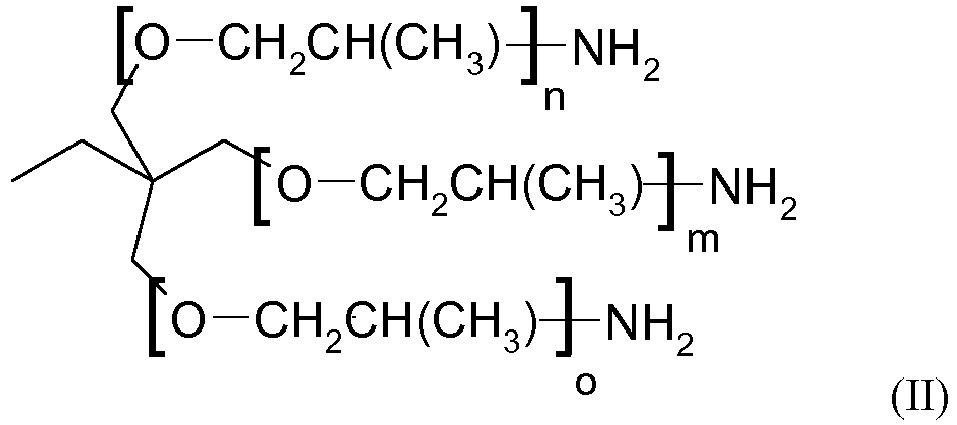
- n bzw. n, m und o
- jeweils unabhängig voneinander für eine natürliche Zahl, bevorzugt für eine natürliche Zahl von 1 bis 10 und besonders bevorzugt 2 bis 5 steht
- Vorgenannte Amine der Formeln I und II sind beispielsweise als Polyetheramin D230 und Polyetheramin T403 kommerziell erhältlich.
- Besonders bevorzugte aliphatische, primäre Polyamine, die zumindest 5 Kohlenstoffatome aufweisen und keine sekundären, tertiären oder quartären Aminogruppen tragen sind: 1,5-Diamino-2-methylpentan, 1,3-Bisaminomethyl-cyclohexan und 1,3-Xylylendiamin sowie Polyetheramine der Formeln I und II, mit den dort genannten Bedeutungen einschließlich ihrer Vorzugsbereiche sowie Mischungen der vorgenannten Polyamine.
- Das Gewichtsverhältnis von Bioziden zu Polyaminen in den erfindungsgemäßen Mischungen kann beispielsweise 100:1 bis 1:100, bevorzugt 10:1 bis 1:10 und besonders bevorzugt 2:1 bis 1:5 betragen.
- Gegebenenfalls können die erfindungsgemäßen Mischungen weiterhin saure Substanzen enthalten. Im Rahmen der Erfindung sind saure Substanzen Säuren mit einem Standard-pKA-Wert von 2,0 bis 6,0 und saure Salze, die gemessen oder berechnet auf eine wässrige Skala und eine Konzentration von 1 mol/l einen pH-Wert von 2,0 bis 6,0 bei Standardtemperatur erzeugen.
- Bevorzugte saure Substanzen sind: Ameisensäure, Essigsäure, Propionsäure, Buttersäure Bernsteinsäure, Milchsäure, Zitronensäure, Benzoesäure, Adipinsäure, Fumarsäure, Sorbinsäure, Salizylsäure, Sorbinsäure, Nonansäure.
- Die erfindungsgemäßen Mischungen können weiterhin verschiedene Zusatzstoffe enthalten. Für die nachstehend genannten Zusatzstoffe besteht jeweils unabhängig voneinander auch die Möglichkeit, dass sie nicht enthalten sind. Mögliche Zusatzstoffe sind beispielsweise:
- Wasser. Die erfindungsgemäßen Mischungen können dabei beispielsweise 0,01 bis 98, vorzugsweise 5 bis 90 Gew-% an Wasser enthalten. Geeignete pH-Werte bei Standardbedingungen reichen in Abhängigkeit von der gewünschten Anwendung von 2 bis 11.
- Grenzflächenaktive Stoffe, wie beispielsweise Tenside. Tenside können beispielsweise nichtionische, kationische und amphotere Tenside, vorzugsweise anionische Tenside sein. Geeignete anionische Tenside sind beispielsweise Alkylsulfate, Alkylethersulfate, Alkylarylsulfonate, Alkylsuccinate, Alkylsulfosuccinate, N-Alkoylsarkosinate, Acyltaurate, Acylisethionate, Alkylphosphate, Alkyletherphosphate, Alkylethercarboxylate, Alpha-Olefinsulfonate, insbesondere die Alkali- und Erdalkalimetallsalze, z.B. Natrium, Kalium, Magnesium, Calcium, sowie Ammonium-, Triethanolamin-Salze und Ammoniumsalze der vorgenannten Polyamine. Die Alkylethersulfate, Alkyletherphosphate und Alkylethercarboxylate können jeweils beispielsweise zwischen 1 bis 10 Ethylenoxid- oder Propylenoxid-Einheiten, bevorzugt 1 bis 3 Ethylenoxideinheiten aufweisen. Geeignet sind zum Beispiel Natriumlaurylsulfat, Ammoniumlaurylsulfat, Natriumlaurylethersulfat, Ammoniumlaurylethersulfat, Natriumlaurylsarkosinat, Natriumoleylsuccinat, Ammoniumlaurylsulfosuccinat, Natriumdodecylbenzolsulfonat, Triethanolamindodecylbenzolsulfonat. Die erfindungsgemäßen Mischungen können dabei beispielsweise 0,01 bis 10, vorzugsweise 0,2 bis 8 Gew-% an grenzflächenaktiven Stoffen enthalten.
- Emulgatoren, wie beispielsweise Natrium-, Kalium-, Ammonium- und Ammoniumsalze der vorgenannten Polyamine von gradkettigen aliphatischen Carbonsäuren der Kettenlänge C12-C20, Natriumhydroxyoctadecansulfonat, Natrium-, Kalium-, Ammonium- und Ammoniumsalze der vorgenannten Polyamine von Hydroxyfettsäuren der Kettenlänge C12-C 20 und deren Sulfierungs-bzw. Acetylierungsprodukte, Alkylsulfate, auch als Triethanolaminsalze, Alkyl-(C10-C20)-sulfonate, Alkyl(C10-C20)-arylsulfonate, Dimethyldialkyl(C8-C18)-ammoniumchlorid, Acyl-, Alkyl-, Oleyl-und Alkylaryloxethylate und ihre Sulfierungsprodukte, Alkalisalze der Sulfobernsteinsäureester mit aliphatischen gesättigten einwertigen Alkoholen der Kettenlänge C4-C16, Sulfobernsteinsäure-4-Ester mit Polyethylenglykolethern von einwertigen aliphatischen Alkoholen der Kettenlänge C10-C12 (Di-Natriumsalz), Sulfobernsteinsäure-4-Ester mit Polyethylenglykolnonylphenylether (Di-Natriumsalz), Sulfobernsteinsäure bis-cyclohexylester (Natriumsalz), Ligninsulfonsäure sowie deren Calcium-, Magnesium-, Natrium-und Ammoniumsalze, Polyoxyethylensorbitanmonooleat mit 20 Ethylenoxidgruppen, Harzsäuren, hydrierte und dehydrierte Harzsäuren sowie deren Alkalisalze, dodecyliertes Diphenyletherdisulfonsaures Natrium sowie Copolymere aus Ethylenoxyd und Propylenoxyd mit einem Mindestgehalt von 10 Gew.-% Ethylenoxid. Vorzugsweise werden als Emulgatoren verwendet: Natriumlaurylsulfat, Natriumlaurylethersulfat, ethoxyliert (3 Ethylenoxidgruppen); die Polyethylenglykol(4-20)ether des Oleylalkohols sowie die Polyethenoxid-(4-14)ether von Nonylphenol. Die erfindungsgemäßen Mischungen können dabei beispielsweise 0,01 bis 15, vorzugsweise 0,2 bis 8, besonders bevorzugt 0,5 bis 6 und ganz besonders bevorzugt 1 bis 5 Gew.-% an Emulgatoren enthalten.
- Dispergiermittel, wie beispielsweise Alkylphenolpolyglycolether. Die erfindungsgemäßen Mittel können dabei beispielsweise 0,01 bis 8, vorzugsweise 0,1 bis 6, besonders bevorzugt 0,2 bis 5 und ganz besonders bevorzugt 0,2 bis 3 Gew.-% an Dispergiermitteln enthalten.
- Stabilisatoren, wie z.B. Cellulose und Cellulosederivate. Die erfindungsgemäßen Mittel können dabei beispielsweise 0,01 bis 6, vorzugsweise 00,1 bis 3, besonders bevorzugt 0,01 bis 2 und ganz besonders bevorzugt 0,01 bis 1 Gew.-% an Stabilisatoren enthalten.
- Spreitmittel, wie beispielsweise Isopropylmyristat Polyoxyethylennonylphenylether und Polyoxyethylenlaurylphenylether. Die erfindungsgemäßen Mischungen können dabei beispielsweise 0,01 bis 20, vorzugsweise 0,1 bis 10, besonders bevorzugt 0,1 bis 5 und ganz besonders bevorzugt 0,1 bis 2 Gew.-% an Spreitmitteln enthalten.
- Organische Lösungsmittel, wie beispielsweise ein- oder mehrwertige Alkohole, Polyether, Polyetheralkohole, Ester, Polyester, Polyesteralkohole, Ketone und Kohlenwasserstoffe. Die erfindungsgemäßen Mischungen können dabei beispielsweise 0,01 bis 95 an organischen Lösungsmittel enthalten.
- Duftstoffe und Farbstoffe, wie anorganische Pigmente, z.B. Eisenoxid, Titanoxid, Ferrocyanblau und organische Farbstoffe.
- Puffersubstanzen, Puffersysteme oder pH-Wert-Regulatoren. Die erfindungsgemäßen Mischungen können dabei beispielsweise jeweils 0,01 bis 10, vorzugsweise 0,1 bis 5, Gew.-% an Puffersubstanzen, Puffersystemen oder pH-Wert-Regulatoren enthalten Vorgenannte Polyamine können dabei ebenfalls als Bestandteil von Puffersystemen wirken, was sie zu wertvollen, multifunktionellen Komponenten in den erfindungsgemäßen Mischungen macht..
- Von der Erfindung sind auch die erfindungsgemäßen Mischungen in beliebiger Formulierung umfasst. Bevorzugte Formulierungen sind Kapselsuspensionen (CS), Wasserlösliche Konzentrate (SL), Suspensionskonzentrate (SC) und Emulgierbare Konzentrate (EC), wobei Wasserlösliche Konzentrate (SL), Suspensionskonzentrate (SC) und Emulgierbare Konzentrate (EC) aufgrund der physikalischen Eigenschaften der Polyamine generell bevorzugt sind. Grundsätzlich hängen geeignete Formulierungsarten im Wesentlichen von den eingesetzten Mischungskomponenten und ihren physikalischen Eigenschaften ab. Da diese jedoch bekannt sind, ist es für den Fachmann gängige Praxis, in wenigen Versuchen weitere bevorzugte Formulierungsart zu ermitteln.
- Der besondere Vorteil der erfindungsgemäßen Mischungen ist, dass der Gehalt an Polyaminen die Wirkung des oder der eingesetzten Biozidkomponenten verbessern können und anionische Tenside, die häufig Bestandteil von bioziden Formulierungen sind, nicht oder nur unwesentlich desaktivieren.
- Die Erfindung betrifft daher weiterhin die Verwendung der erfindungsgemäßen Mischungen zum Schutz von technischen Materialien. Als technische Materialien kommen insbesondere Klebstoffe, Beton, Polymerdispersionen, Pigmentslurries, Tinten, Leime, Anstrichmittel, Beschichtungsmittel, Putze, Kühlschmiermittel und Wärmeüberleitungsflüssigkeiten bzw. funktionelle Flüssigkeiten zum Schutz der vorgenannten technischen Materialien in Frage. Ganz besonders bevorzugt sind Kühlschmiermittel und Klebstoffe.
- Die Erfindung betrifft außerdem ein Verfahren zum Schutz von technischen Materialien vor Befall und/oder Zerstörung durch Mikroorganismen, das dadurch gekennzeichnet ist, dass man die erfindungsgemäßen Mischungen unverdünnt oder verdünnt auf den Mikroorganismus oder dessen Lebensraum einwirken lässt.
- Die Erfindung betrifft außerdem technische Materialien, erhältlich durch Behandlung von technischen Materialien mit den erfindungsgemäßen Mischungen.
- Als Mikroorganismen, die einen Abbau oder eine Veränderung der technischen Materialien bewirken können, seien beispielsweise Bakterien, Schimmel, Hefen, Algen und Schleimorganismen genannt. Schleimorganismen genannt. Vorzugsweise werden die erfindungsgemäßen Mischungen gegen Bakterien, Schimmel und Hefen eingesetzt.
- Es seien beispielsweise Mikroorganismen der folgenden Gattung genannt:
- Alternaria, wie Alternaria tenuis, Aspergillus, wie Aspergillus niger, Candids, wie candida albicans, Geotrichum wie Geotrichum candidum, Rhodotorula wie Rhodotorula rubra, saccharomyes wie Saccharomyces cerevisiae, Chaetomium, wie Chaetomium globosum,Coniophora, wie Coniophora puetana, Fusarium wie Fusarium solani, Lentinus, wie Lentinus tigrinus, Paecilomyces wie Paecilomyces variotti, Penicillium, wie Penicillium glaucum, Polyporus, wie Polyporus versicolor, Aureobasidium, wie Aureobasidium pullulans, Sclerophoma, wie Sclerophoma pityophila, Trichoderma, wie Trichoderma viride, Alcaligenes, wie Alcaligenes faecalis, Bacillus wie Bacillus subtilis, Escherichia, wie Escherichia coli, Proteus wie Proteus vulgaris, Pseudomonas, wie Pseudomonas aeruginosa und Pseudomonas fluorescens, Staphylococcus, wie Staphylococcus aureus.
- Die Aufwandmenge der erfindungsgemäßen Mischungen richtet sich nach der Art und dem Vorkommen der zu bekämpfenden Mikroorganismen sowie nach der Zusammensetzung des zu schützenden Materials. Die optimale Einsatzmenge kann durch Testreihen einfach und in einer dem Fachmann hinlänglich bekannten Weise ermittelt werden.
- Die Offenbarung betrifft biozide Mischungen enthaltend
- zumindest Pyrithion oder ein Salz davon
- gegebenenfalls zumindest ein weiteres Biozid, das kein aliphatisches, primäres Polyamin ist und
- zumindest ein Polyamin
- Polyamine sind alle Verbindungen die zumindest zwei Aminogruppen enthalten. Bevorzugte Polyamine sind solche der Formeln III und IV


- R1, R2, R3 und R4
- für Wasserstoff, gesättigtes oder ungesättigtes, verzweigtes oder lineares C1-C10-Alkyl, Cycloalkyl, Ethoxylate, Propoxylate, Alkylaryl oder Heterocyclyl stehen kann
- Y
- für O, NH, NR1, R1-C=C-R2, Cycloalkyl, Ethoxyl, Propoxyl oder CH2 stehen kann
- x, y und z
- für eine natürliche Zahl N stehen
- Beispiele für Polyamine der Formeln III und IV sind Diethylentriamin (CAS 111-40-0), Bis-(3-aminopropyl)ether (CAS 2579-20-6), 1,3-Bis(aminomethyl)cyclohexan (CAS 2579-20-6), Polyetheramin (CAS 39423-51-3), Diethylaminoethylamin (CAS 100-36-7), Diethylamino-propylamin (CAS 104-78-9), N-Aminopropylpiperidin und N-Aminopropylmorpholin (CAS 123-00-2.
- Weitere bevorzugte Polyamine sind aliphatische, primäre Polyamine, die zumindest 5 Kohlenstoffatome aufweisen und keine sekundären, tertiären oder quartären Aminogruppen tragen, wobei die gleichen Bereiche und Vorzugsbereiche gelten wie sie oben genannt wurden.
- Generell gelten für die Pyrithion enthaltenden Mischungen bezüglich der weiteren Inhaltsstoffe wie weitere Biozide, Wasser, grenzflächenaktive Stoffe, Emulgatoren, Dispergiermittel, Stabilisatoren, Spreitmittel, Organische Lösungsmittel,. Duftstoffe und Farbstoffe, sowie Puffersubstanzen, Puffersysteme oder pH-Wert-Regulatoren die oben dargestellte Offenbarung einschließlich der dort genannten Bereiche und Vorzugsbereiche völlig analog.
- Als weitere Biozide sind allerdings weiterhin Hexahydrotriazin (HHT), Methylenbisoxazolidin (MBO), Methylenbismorpholin (MBM), DMDM-Hydantoin,(DMDMHy), Tetrahydro-1,3,4,6-tetrakis (hydroxymethyl)imidazo(4,5-d)imidazol-2,5(1H,3H)-dion, Benzisothiazolinon (BIT),o-Phenylphenol (OPP), Iodpropinylbutylcarbamat (IPBC) und Mischungen davon besonders bevorzugt.
- Die Offenbarung betrifft weiterhin Ölkonzentrate, die allgemein wie folgt aufgebaut sind und bei Raumtemperatur in der angegebenen Reihenfolge gemischt werden können:
- bis 70% Basisöl (naphthalbasisch, paraffinbasisch, z.B. Nynäs T22)
- 20% - 40% Emulgatorsystem/Korrosionsschutz (Petrolsulfonate, Kalium- oder Aminseifen, Nichtionische Tenside, C12-C18 Ethoxylate). Weitere Emulgatoren sind obenstehend genannt.
- bis 40% Lösungsvermittler/Wasser
- 0,01 -5,0%, bevorzugt 0,1% - 3% Natriumpyrithion
- 0,01% - 20% Polyamine und deren Derivate
- Diese allgemeine Rezeptur zeigt die Kombination von Pyrithion bzw. seinen Salzen mit Polyaminen. Die notwendige Dosierung der Polyamine beträgt beispielsweise das 0,2 bis 10-fache der Konzentration wie Natriumpyrithion und liegt insbesondere in der ungefähr gleichen Konzentration. Die beschriebenen Polyamine sind nicht nur zur Verhinderung von Verfärbungen geeignet, sondern können auch Amine ersetzen, die für die in der Rezeptur angegebenen Aminseifen aufgewandt werden müssen. Die eingesetzten Polyamine können ebenfalls zum Emulgieren wie zum Korrosionsschutz beitragen. Die Dosierung der Polyamine kann also vorteilhaft im Emulgatorsystem/Korrosionsschutz eingesetzt werden. Die Verwendung der beschriebenen Polyamine beschränkt sich nicht nur auf hoch ölhaltige Kühlschmierstoffe, sondern ist universell über halbsynthetische Produkte bis zu klar wasserlöslichen Vollsythesen geeignet.
- Von der Offenbarung ist daher die Verwendung von Polyaminen zum Entfärben und/oder zum Verhindern von durch Schwermetallionen, insbesondere Eisen-III-Ionen, hervorgerufener Verfärbungen von Pyrithion und/oder Salze desselben enthaltenden Stoffen, bevorzugt von Ölkonzentraten, insbesondere Kühlschmierstoffkonzentraten, Farben und Lacken, Klebstoffen, Dichtungsmitteln, Lederhilfsmitteln, Papierbeschichtungsmitteln und Kosmetika umfasst, sowie die Stoffe, gekennzeichnet durch einen Anteil von einem oder mehreren Polyamin(en) und/oder deren Derivaten selbst.
- Weiterhin umfasst die Offenbarung ein Verfahren zum Entfärben und/oder zum Verhindern von durch Schwermetallionen, insbesondere Eisen-III-Ionen, hervorgerufenen Verfärbungen von Pyrithion und/oder Salze desselben enthaltenden Stoffen, durch die Zugabe oder das Vorsehen eines Anteils von einem oder mehreren Polyaminen und/oder deren Derivaten.
- Untersucht wurde die konservierende Wirkung der erfindungsgemäßen Gemische in einer Kühlschmierstoffemulsion (5 % Kühlschmierstoff-Konzentrat auf Mineralölbasis / 95 % Wasser). Hierzu wurden konservierte Proben der Kühlschmierstoffemulsion im wöchentlichen Rhythmus wiederholt einer mikrobiologischen Belastung mit folgenden Mikroorganismen ausgesetzt:
Bakterien: Pseudomonas aeruginosa Pseudomonas fluorescens Pseudomonas oleovorans Pseudomonas rubescens Pseudomonas stutzeri Alcaligenes faecalis Citrobacter freundii Corynebacterium sp Hefen: Rhodotorula rubra Schimmelpilze: Acremonium strictum Fusarium solani Geotrichum candidum - Die Zugabe des Bakteriengemischs erfolgte jeweils getrennt von den Hefen/Schimmelpilzen. Die maximale Versuchsdauer betrug 10 Wochen (= 10 Kontaminationen/Impfzyklen), sofern bei der wöchentlichen Keimzahlbestimmung (jeweils 7 Tage nach der Kontamination) die folgenden Grenzwerte eingehalten wurden:
- Bakterien < 10 6 KBE/g
- Hefen/ Schimmelpilze < 10 3-4 KBE/g
- Bei 2-maliger aufeinander folgender Überschreitung der genannten Werte wurde der Versuch angebrochen.
- Versuch mit Benzisothiazolinon als Einzelkomponente in einer Konzentration von 0,05 % Benzisothiazolinon (= 500 ppm bzw. 2.500 ppm einer handelsüblichen 20 Gew%-igen Zubereitung) bezogen auf die Masse an Kühlschmierstoffemulsion.
- Anzahl Wochen, in denen das Mikroorganismenwachstum unterhalb der Grenzwerte lag:
Bakterien = 1 Woche (von max. 10 Wochen) Schimmelpilze = 1 Woche (von max. 10 Wochen) Hefen = 7 Wochen (von max. 10 Wochen) - Versuch mit erfindungsgemäßer Mischung enthaltend 20 Gew.% Benzisothiazolinon, 35 Gew.-% Polyetheramin D230, einem Amin der Formel I mit einem Molgewicht von ca. 230, 15 Gew.-% 1,5-Diamino-2-methylpentan und 30 Gew.-% Wasser. Vorstehend genannte, erfindungsgemäße Mischung wurde in einer Menge eingesetzt, so dass in der Kühlschmierstoffemulsion eine Wirkstoffmenge von 0,05 % (= 500 ppm) BIT resultierte:
Anzahl Wochen, in denen das Mikroorganismenwachstum unterhalb der Grenzwerte lag: BIT/Amin BIT Bakterien = 7 Wochen 1 Woche Schimmelpilze = 1 Woche 1 Woche Hefen = 10 Wochen 7 Wochen - Die erfindungsgemäße Mischung zeigt eine gegenüber dem Einzelwirkstoff BIT deutlich verbesserte Gesamtwirkung, was insbesondere durch die wesentlich verbesserte Bakterienwirkung dokumentiert wird.
- Versuch mit o-Phenylphenol (OPP) als Einzelkomponente mit einer OPP-Konzentration von 0,18 % OPP (= 1.800 ppm) bezogen auf die Masse an Kühlschmierstoffemulsion
Anzahl Wochen, in denen das Mikroorganismenwachstum unterhalb der Grenzwerte lag: Bakterien = 2 Wochen (von max. 10 Wochen) Schimmelpilze = 10 Wochen (von max. 10 Wochen) Hefen = 10 Wochen (von max. 10 Wochen) - Versuch mit erfindungsgemäßer Mischung enthaltend 55 Gew.% OPP (45 Gew.-% in Wasser), 30 Gew.-% Polyetheramin D230 und 15 Gew.-% 1,5-Diamino-2-methylpentan.
- Vorstehend genannte, erfindungsgemäße Mischung wurde in einer Menge eingesetzt, so dass in der Kühlschmierstoffemulsion eine Wirkstoffmenge von 0,1 % (= 1.000 ppm) OPP resultierte:
Anzahl Wochen, in denen das Mikroorganismenwachstum unterhalb der Grenzwerte lag: OPP/Amin OPP Schimmelpilze = 10 Wochen 10 Wochen Hefen = 10 Wochen 10 Wochen - Die erfindungsgemäße Mischung zeigt eine gegenüber dem Einzelwirkstoff OPP deutlich verbesserte Gesamtwirkung, was insbesondere durch die wesentlich verbesserte Bakterienwirkung dokumentiert wird.
- Ein vollsynthetischer Kühlschmierstoff (klare, farblose Flüssigkeit) bzw. dessen 5 %ige wässrige Lösung enthält 0,1 % eines Konservierungsmittels enthaltend 10 % Natriumpyrithion. In der klaren Lösung befinden sich also 100 ppm Natriumpyrithion. Dieser Lösung werden 0,01 g einer 5 %igen NH4 Fe(III) (SO4)2 -Lösung zugetropft. Es entstand spontan eine intensiv tiefblau gefärbte Flüssigkeit. Nach Zugabe von 0,05 g Diethylaminoethylamin wurde die Lösung spontan entfärbt.
- Für den gleichen Zweck eignen sich besonders:
- Diethylaminoethylamin CAS 100-36-7, Diethylaminopropylamin CAS 104-78-9, N-Aminopropylpiperidin und, N-Aminopropylmorpholin CAS 123-00-2.
- In einer klaren Lösung eines Kühlschmierstoffes befanden sich 100 ppm Natriumpyrithion. Dieser Mischung wurden 0,01 g einer 5 %igen NH4 Fe(III) (SO4)2-Lösung zugetropft. Es entstand ummittelbar eine tiefblaue Lösung. Nach Zugabe von 0,05 g Diethylentriamin erhielt man sofort eine wasserklare Flüssigkeit.
- Für den gleichen Zweck eignen sich besonders:
- Diethylentriamin CAS 111-40-0, Bis-(3-aminopropyl)Ether CAS 2579-20-6, 1,3-Bis(aminomethyl)Cyclohexan CAS 2579-20-6, Polyetheramin CAS 39423-51-3
Claims (13)
- Biozide Mischungen enthaltend• zumindest ein Biozid, das kein aliphatisches, primäres Polyamin ist und• zumindest ein aliphatisches, primäres Polyamin, das zumindest 5 Kohlenstoffatome aufweist und keine sekundären, tertiären oder quartären Aminogruppen trägt,wobei solche bioziden Mischungen ausgenommen sind, die Diaminohexan und 1,2-Benzisothiazolin-3-on enthalten, wie sie in GB 1 330 531 beschrieben sind.
- Biozide Mischungen nach Anspruch 1 dadurch gekennzeichnet, dass als Biozide, die keine aliphatischen, primären Polyamine sind Fungizide, Bakterizide und Algizide eingesetzt werden.
- Biozide Mischungen nach Anspruch 1 oder 2, dadurch gekennzeichnet, dass als Biozide, die keine aliphatischen, primären Polyamine sind solche aus der Gruppe bestehend aus Azaconazol, Bromuconazol, Cyproconazol, Dichlobutrazol, Diniconazol,, Hexaconazol, Metaconazol, Penconazol, Propiconazol, Tebuconazol, Dichlofluanid, Tolylfluanid, Triadimefon, Fluorfolpet, Methfuroxam, N-Methyl-isothiazolin-3-on, 5-Chlor-N-methylisothiazolin-3-on, Dichlor-N-octylisothiazolinon, Mercaptobenzthiazol, Thiocyanatomethylthiobenzothiazol, Thiabendazol, Benzisothiazolinon, Pyrithion und seine Salze, 2-Brom-2-nitro-1,3-propandiol und o-Phenylphenol eingesetzt werden.
- Biozide Mischungen nach einem der Ansprüche 1 bis 3, dadurch gekennzeichnet, dass sie weder Pyrithion noch Salze davon enthalten.
- Biozide Mischungen nach einem der Ansprüche 1 bis 4, dadurch gekennzeichnet, dass als aliphatische, primäre Polyamine, die zumindest 5 Kohlenstoffatome aufweisen und keine sekundären, tertiären oder quartären Aminogruppen tragen solche eingesetzt werden, die ausgewählt sind aus der Gruppe bestehend aus 1,5-Pentandiamin, 1,5-Diamino-2-methylpentan, 1,7-Heptandiamin, 1,8-Octandiamin und 1,9 Nonandiamin, 1,3-Bisaminomethyl-cyclohexan, 1,3-Xylylendiamin und nicht-cyclischen Polyetheraminen der Formeln I und II

 n bzw. n, m und o jeweils unabhängig voneinander für eine natürliche Zahl steht,sowie Mischungen der vorstehenden Polyamine.
 - Biozide Mischungen nach einem der Ansprüche 1 bis 5, dadurch gekennzeichnet, dass das Gewichtsverhältnis von Bioziden zu Polyaminen 100:1 bis 1:100 beträgt.
- Biozide Mischungen nach einem der Ansprüche 1 bis 6, dadurch gekennzeichnet, dass sie weiterhin saure Substanzen enthalten.
- Biozide Mischungen nach einem der Ansprüche 1 bis 7, dadurch gekennzeichnet, dass sie als Kapselsuspensionen (CS), Wasserlösliche Konzentrate (SL), Suspensionskonzentrate (SC) und Emulgierbare Konzentrate (EC) formuliert sind.
- Verwendung von bioziden Mischungen nach einem der Ansprüche 1 bis 8 zum Schutz von technischen Materialien.
- Verwendung nach Anspruch 9, dadurch gekennzeichnet, dass technische Materialien Klebstoffe, Beton, Polymerdispersionen, Pigmentslurries, Tinten, Leime, Anstrichmittel, Beschichtungsmittel, Putze, Kühlschmiermittel und Wärmeüberleitungsflüssigkeiten bzw. funktionelle Flüssigkeiten zum Schutz der vorgenannten technischen Materialien sind.
- Verfahren zum Schutz von technischen Materialien vor Befall und/oder Zerstörung durch Mikroorganismen, dadurch gekennzeichnet ist, dass man die bioziden Mischungen nach einem der Ansprüche 1 bis 8 unverdünnt oder verdünnt auf den Mikroorganismus oder dessen Lebensraum einwirken lässt.
- Verfahren nach Anspruch 11, dadurch gekennzeichnet, dass Mikroorganismen Bakterien, Pilze, Hefen, Algen und Schleimorganismen sind.
- Technische Materialien, erhältlich durch Behandlung von technischen Materialien mit bioziden Mischungen nach einem der Ansprüche 1 bis 8.
Priority Applications (2)
| Application Number | Priority Date | Filing Date | Title |
|---|---|---|---|
| EP08804676.8A EP2203425B1 (de) | 2007-09-26 | 2008-09-24 | Biozide Mischungen |
| PL08804676T PL2203425T3 (pl) | 2007-09-26 | 2008-09-24 | Mieszaniny biobójcze |
Applications Claiming Priority (3)
| Application Number | Priority Date | Filing Date | Title |
|---|---|---|---|
| EP07117221A EP2042489A1 (de) | 2007-09-26 | 2007-09-26 | Beseitigen und Verhindern von Verfärbungen Pyrithion enthaltender Stoffe |
| EP08804676.8A EP2203425B1 (de) | 2007-09-26 | 2008-09-24 | Biozide Mischungen |
| PCT/EP2008/062771 WO2009043773A1 (de) | 2007-09-26 | 2008-09-24 | Biozide mischungen |
Publications (2)
| Publication Number | Publication Date |
|---|---|
| EP2203425A1 EP2203425A1 (de) | 2010-07-07 |
| EP2203425B1 true EP2203425B1 (de) | 2017-06-14 |
Family
ID=39247712
Family Applications (2)
| Application Number | Title | Priority Date | Filing Date |
|---|---|---|---|
| EP07117221A Withdrawn EP2042489A1 (de) | 2007-09-26 | 2007-09-26 | Beseitigen und Verhindern von Verfärbungen Pyrithion enthaltender Stoffe |
| EP08804676.8A Active EP2203425B1 (de) | 2007-09-26 | 2008-09-24 | Biozide Mischungen |
Family Applications Before (1)
| Application Number | Title | Priority Date | Filing Date |
|---|---|---|---|
| EP07117221A Withdrawn EP2042489A1 (de) | 2007-09-26 | 2007-09-26 | Beseitigen und Verhindern von Verfärbungen Pyrithion enthaltender Stoffe |
Country Status (7)
| Country | Link |
|---|---|
| US (1) | US20100264359A1 (de) |
| EP (2) | EP2042489A1 (de) |
| JP (2) | JP5341897B2 (de) |
| CN (2) | CN102939967B (de) |
| ES (1) | ES2634420T3 (de) |
| PL (1) | PL2203425T3 (de) |
| WO (1) | WO2009043773A1 (de) |
Families Citing this family (19)
| Publication number | Priority date | Publication date | Assignee | Title |
|---|---|---|---|---|
| JP5364936B2 (ja) * | 2010-11-09 | 2013-12-11 | ダウ グローバル テクノロジーズ エルエルシー | フルメツラムまたはジクロスラムとジヨードメチル−p−トリルスルホンとの相乗的組み合わせ |
| JP5529834B2 (ja) * | 2010-12-22 | 2014-06-25 | ダウ グローバル テクノロジーズ エルエルシー | グリホサート化合物とzptとの相乗的組み合わせ |
| EP2596702B1 (de) * | 2011-11-25 | 2015-05-27 | Omya International AG | Verfahren zur Bekämpfung von Bakterien in wässrigen Dispersionen von gemahlenem natürlichen Calciumcarbonat und/oder ausgefälltem Calciumcarbonat und/oder Dolomit und/oder oberflächebehandelten calciumcarbonathaltigen Mineralpräparaten |
| CN109054378B (zh) | 2012-02-20 | 2021-10-01 | 巴斯夫欧洲公司 | 用聚合物提高生物杀伤剂的抗微生物活性 |
| EP2925130B1 (de) * | 2012-11-30 | 2016-10-26 | Rohm and Haas Company | Synergistische kombination von lenacil mit zink-pyrithion und ihre verwendung zum schutz von trockenen filmen |
| NZ740080A (en) * | 2015-09-02 | 2022-05-27 | Lanxess Deutschland Gmbh | Biocidal mixtures |
| WO2017112113A1 (en) | 2015-12-21 | 2017-06-29 | Henkel Ag & Co. Kgaa | Metalworking fluid |
| CN105400709B (zh) * | 2015-12-21 | 2018-12-11 | 湖南省植物保护研究所 | 粘质红酵母菌株、菌剂及其制备方法和应用 |
| EP3393530B1 (de) | 2015-12-23 | 2022-08-31 | Henkel AG & Co. KGaA | Metallbearbeitungsflüssigkeit |
| US10988703B2 (en) * | 2019-07-16 | 2021-04-27 | Italmatch Chemicals SC LLC | Metal working fluid |
| CN116529346A (zh) * | 2020-11-10 | 2023-08-01 | 特洛伊技术第二股份有限公司 | 具有明显改进活性的bit组合物 |
| WO2022229984A1 (en) * | 2021-04-29 | 2022-11-03 | Ahire Mrs Sunita | Natural composition of plant extracts to control parasitic pathogens and plant nematodes |
| CN116940657A (zh) * | 2021-08-24 | 2023-10-24 | 陶氏环球技术有限责任公司 | 金属加工流体杀生物剂 |
| JP7762618B2 (ja) * | 2022-04-08 | 2025-10-30 | 上野製薬株式会社 | 抗酵母剤 |
| US12606716B2 (en) | 2022-10-27 | 2026-04-21 | Hewlett-Packard Development Company, L.P. | Biocide composition |
| CN118767991B (zh) * | 2023-03-30 | 2025-12-30 | 万华化学集团股份有限公司 | 一种催化剂及其制备方法和在环十二酮合成中的应用 |
| CN117247848B (zh) * | 2023-11-20 | 2024-01-30 | 鲁东大学 | 一株产腈水解酶的菌株、发酵方法及应用 |
| WO2025250965A1 (en) * | 2024-05-31 | 2025-12-04 | Troy Technology Ii, Inc. | Polyetheramine-based preservative compositions |
| WO2025250952A1 (en) * | 2024-05-31 | 2025-12-04 | Troy Technology Ii, Inc. | Polyetheramine-based preservative compositions |
Family Cites Families (36)
| Publication number | Priority date | Publication date | Assignee | Title |
|---|---|---|---|---|
| US3159640A (en) * | 1963-04-23 | 1964-12-01 | Olin Mathieson | Process for preparing 2-mercaptopyridine-nu oxide |
| US3489686A (en) * | 1965-07-30 | 1970-01-13 | Procter & Gamble | Detergent compositions containing particle deposition enhancing agents |
| GB1330531A (en) * | 1970-03-31 | 1973-09-19 | Ici Ltd | 1,2-benzisothiazolone solutions |
| US3785985A (en) * | 1971-04-21 | 1974-01-15 | Colgate Palmolive Co | Cosmetic and textile-treating compositions |
| DE2262375B2 (de) * | 1972-12-20 | 1976-08-19 | Henkel & Cie GmbH, 4000 Düsseldorf | Haarbehandlungsmittel mit antischuppenwirkung |
| GB1524966A (en) * | 1974-10-25 | 1978-09-13 | Reckitt & Colmann Prod Ltd | Shampoo compositions |
| US4161526A (en) * | 1978-07-20 | 1979-07-17 | Sterling Drug Inc. | Zinc salt prevention or removal of discoloration in pyrithione, pyrithione salt and dipyrithione compositions |
| JPS5649316A (en) * | 1979-09-10 | 1981-05-02 | Nelson Res & Dev | Triethylenetetraamineecontaining locally medicinal composition and its use |
| DE3263149D1 (en) * | 1981-10-21 | 1985-05-23 | Beecham Group Plc | Topical antimicrobial compositions |
| US4443222A (en) * | 1983-08-30 | 1984-04-17 | The United States Of America As Represented By The Secretary Of Agriculture | Zinc pyrithione process to impart antimicrobial properties to textiles |
| JPS6157503A (ja) * | 1984-08-29 | 1986-03-24 | Kao Corp | 抗菌剤懸濁液および抗菌性毛髪処理剤組成物 |
| DE3609939A1 (de) * | 1986-03-24 | 1987-10-01 | Cassella Ag | Fluessige zubereitung von 1,2-benzisothiazolin-3-on, ihre herstellung und verwendung |
| US4818436A (en) * | 1987-08-31 | 1989-04-04 | Olin Corporation | Process and composition for providing reduced discoloration of pyrithiones |
| JP2877440B2 (ja) * | 1989-06-09 | 1999-03-31 | ナルコ ケミカル カンパニー | コロイド状シリカ研磨性スラリー |
| US5104645A (en) * | 1990-02-02 | 1992-04-14 | The Proctor & Gamble Company | Antidandruff shampoo compositions |
| US5112397A (en) * | 1991-06-17 | 1992-05-12 | Olin Corporation | Process for stabilizing zinc pyrithione plus cuprous oxide in paint |
| JP3863913B2 (ja) * | 1992-12-01 | 2006-12-27 | スリーエム カンパニー | 永続性抗菌剤 |
| DE4306344C1 (de) * | 1993-02-25 | 1994-08-04 | Schuelke & Mayr Gmbh | Desinfektionsmittelkonzentrat und Desinfektionsmittel auf Amin- und Alkoholbasis |
| JPH07241590A (ja) * | 1994-03-03 | 1995-09-19 | Katayama Chem Works Co Ltd | 活性汚泥のバルキング防止剤及び防止方法 |
| FR2729965B1 (fr) * | 1995-01-26 | 2000-05-19 | France Etat | Peintures anti-salissures autopolissables |
| US5562995A (en) * | 1995-02-03 | 1996-10-08 | Olin Corporation | Discoloration prevention in pyrithione-containing coating compositions |
| JPH08217607A (ja) * | 1995-02-09 | 1996-08-27 | Permachem Asia Ltd | 工業用防腐剤組成物 |
| US5886031A (en) * | 1997-01-27 | 1999-03-23 | Pacific Corporation | Hair-care cosmetic compositions having dandruff formation-suppressing effect |
| US5863524A (en) * | 1997-03-26 | 1999-01-26 | Church & Dwight Co., Inc. | Transparent bicarbonate salt containing deodorant cosmetic stick product |
| WO1999066014A1 (fr) * | 1998-06-18 | 1999-12-23 | Yasuo Fukutani | Fluide de refroidissement soluble dans l'eau |
| US6042877A (en) * | 1998-07-28 | 2000-03-28 | 3M Innovative Properties Company | Method for the manufacture of anti-microbial articles |
| JP2000119111A (ja) * | 1998-10-16 | 2000-04-25 | Somar Corp | 増粘多糖類含有スラリー用防腐剤 |
| JP2001009362A (ja) * | 1999-06-29 | 2001-01-16 | Nippon Light Metal Co Ltd | 親水性表面処理組成物及び親水性表面処理皮膜 |
| WO2001076729A2 (en) * | 2000-04-06 | 2001-10-18 | Huntsman Petrochemical Corporation | Defoamer compositions and uses therefor |
| US6936187B2 (en) * | 2001-02-21 | 2005-08-30 | Matthew Lawrence Lynch | Functionalized cubic liquid crystalline phase materials and methods for their preparation and use |
| AU2002368500A1 (en) * | 2002-12-19 | 2004-07-22 | Arch Chemicals, Inc. | Pyrithione biocides enhanced by zinc metal ions and organic amines |
| JP4117484B2 (ja) * | 2004-01-06 | 2008-07-16 | 三菱瓦斯化学株式会社 | 植物鮮度保持材料 |
| US20050191270A1 (en) * | 2004-02-27 | 2005-09-01 | Hydromer, Inc. | Anti-infectious hydrogel compositions |
| JP4606091B2 (ja) * | 2004-08-30 | 2011-01-05 | 株式会社ネオス | 水溶性金属加工油剤用防腐剤 |
| JP5237101B2 (ja) * | 2005-10-25 | 2013-07-17 | ダウ グローバル テクノロジーズ エルエルシー | 抗菌性組成物および方法 |
| JP5116295B2 (ja) * | 2006-11-30 | 2013-01-09 | 日本曹達株式会社 | 塗料用抗菌・防カビ組成物および水性抗菌・防カビ性塗料 |
-
2007
- 2007-09-26 EP EP07117221A patent/EP2042489A1/de not_active Withdrawn
-
2008
- 2008-09-24 US US12/679,319 patent/US20100264359A1/en not_active Abandoned
- 2008-09-24 PL PL08804676T patent/PL2203425T3/pl unknown
- 2008-09-24 WO PCT/EP2008/062771 patent/WO2009043773A1/de not_active Ceased
- 2008-09-24 CN CN201210458133.4A patent/CN102939967B/zh not_active Expired - Fee Related
- 2008-09-24 CN CN200880109019.2A patent/CN101808993B/zh not_active Expired - Fee Related
- 2008-09-24 ES ES08804676.8T patent/ES2634420T3/es active Active
- 2008-09-24 EP EP08804676.8A patent/EP2203425B1/de active Active
- 2008-09-24 JP JP2010526279A patent/JP5341897B2/ja not_active Expired - Fee Related
-
2013
- 2013-08-07 JP JP2013164032A patent/JP2013224335A/ja active Pending
Non-Patent Citations (1)
| Title |
|---|
| None * |
Also Published As
| Publication number | Publication date |
|---|---|
| EP2042489A1 (de) | 2009-04-01 |
| JP5341897B2 (ja) | 2013-11-13 |
| EP2203425A1 (de) | 2010-07-07 |
| ES2634420T3 (es) | 2017-09-27 |
| WO2009043773A1 (de) | 2009-04-09 |
| US20100264359A1 (en) | 2010-10-21 |
| CN102939967B (zh) | 2016-02-17 |
| JP2010540490A (ja) | 2010-12-24 |
| CN101808993A (zh) | 2010-08-18 |
| CN101808993B (zh) | 2014-06-25 |
| PL2203425T3 (pl) | 2017-11-30 |
| JP2013224335A (ja) | 2013-10-31 |
| CN102939967A (zh) | 2013-02-27 |
Similar Documents
| Publication | Publication Date | Title |
|---|---|---|
| EP2203425B1 (de) | Biozide Mischungen | |
| EP2152072B1 (de) | Iodpropargylverbindungen haltige dispersionen | |
| EP1395117B2 (de) | Verwendung von triazolopyrimidin-derivaten als mikrobizide im materialschutz | |
| WO2015150430A1 (de) | Biozide mittel | |
| WO2012076699A1 (de) | Biozide mikrokapsel -formulierungen enthaltend stabilisierte iodhaltige verbindungen | |
| EP2315523B1 (de) | Antifungische flüssigformulierungen enthaltend 3-iodpropargylbutylcarbamat (ipbc) und n-octylisothiazolinon (noit) | |
| WO2002048100A2 (de) | Thiosulfonsäure-s-ester als materialschutzmittel | |
| EP0950055A1 (de) | Arylthio-dithiazindioxide und ihre verwendung als schädlingsbekämpfungsmittel | |
| EP1773125B1 (de) | 5-iodtetrazole | |
| DE10130706A1 (de) | Thiazine und Thiazole als Materialschutzmittel | |
| DE19721627A1 (de) | S-Pyridyl-dithiazoldioxide | |
| DE10256187A1 (de) | 2-Oxyamino-1-cyclopenten-1-nitrile als Materialschutzmittel | |
| DE10256186A1 (de) | Cyclopenta(c)isoxazol-3-amine als Materialschutzmittel | |
| DE10053160A1 (de) | 3-Nitroisoxazole und deren Verwendung im Materialschutz | |
| DE102005032209A1 (de) | 1-Cycloalkyl-5-Iodtetrazole | |
| EP0975611A1 (de) | 3-alkoxyisothiazole |
Legal Events
| Date | Code | Title | Description |
|---|---|---|---|
| PUAI | Public reference made under article 153(3) epc to a published international application that has entered the european phase |
Free format text: ORIGINAL CODE: 0009012 |
|
| 17P | Request for examination filed |
Effective date: 20100426 |
|
| AK | Designated contracting states |
Kind code of ref document: A1 Designated state(s): AT BE BG CH CY CZ DE DK EE ES FI FR GB GR HR HU IE IS IT LI LT LU LV MC MT NL NO PL PT RO SE SI SK TR |
|
| AX | Request for extension of the european patent |
Extension state: AL BA MK RS |
|
| DAX | Request for extension of the european patent (deleted) | ||
| RAP1 | Party data changed (applicant data changed or rights of an application transferred) |
Owner name: LANXESS DEUTSCHLAND GMBH |
|
| 17Q | First examination report despatched |
Effective date: 20150204 |
|
| GRAP | Despatch of communication of intention to grant a patent |
Free format text: ORIGINAL CODE: EPIDOSNIGR1 |
|
| INTG | Intention to grant announced |
Effective date: 20161007 |
|
| GRAJ | Information related to disapproval of communication of intention to grant by the applicant or resumption of examination proceedings by the epo deleted |
Free format text: ORIGINAL CODE: EPIDOSDIGR1 |
|
| GRAP | Despatch of communication of intention to grant a patent |
Free format text: ORIGINAL CODE: EPIDOSNIGR1 |
|
| INTC | Intention to grant announced (deleted) | ||
| INTG | Intention to grant announced |
Effective date: 20170103 |
|
| GRAJ | Information related to disapproval of communication of intention to grant by the applicant or resumption of examination proceedings by the epo deleted |
Free format text: ORIGINAL CODE: EPIDOSDIGR1 |
|
| GRAP | Despatch of communication of intention to grant a patent |
Free format text: ORIGINAL CODE: EPIDOSNIGR1 |
|
| INTC | Intention to grant announced (deleted) | ||
| INTG | Intention to grant announced |
Effective date: 20170221 |
|
| GRAS | Grant fee paid |
Free format text: ORIGINAL CODE: EPIDOSNIGR3 |
|
| GRAA | (expected) grant |
Free format text: ORIGINAL CODE: 0009210 |
|
| AK | Designated contracting states |
Kind code of ref document: B1 Designated state(s): AT BE BG CH CY CZ DE DK EE ES FI FR GB GR HR HU IE IS IT LI LT LU LV MC MT NL NO PL PT RO SE SI SK TR |
|
| REG | Reference to a national code |
Ref country code: GB Ref legal event code: FG4D Free format text: NOT ENGLISH |
|
| REG | Reference to a national code |
Ref country code: CH Ref legal event code: EP Ref country code: AT Ref legal event code: REF Ref document number: 900816 Country of ref document: AT Kind code of ref document: T Effective date: 20170615 |
|
| REG | Reference to a national code |
Ref country code: IE Ref legal event code: FG4D Free format text: LANGUAGE OF EP DOCUMENT: GERMAN |
|
| REG | Reference to a national code |
Ref country code: DE Ref legal event code: R096 Ref document number: 502008015397 Country of ref document: DE |
|
| REG | Reference to a national code |
Ref country code: FR Ref legal event code: PLFP Year of fee payment: 10 |
|
| REG | Reference to a national code |
Ref country code: NL Ref legal event code: FP |
|
| REG | Reference to a national code |
Ref country code: ES Ref legal event code: FG2A Ref document number: 2634420 Country of ref document: ES Kind code of ref document: T3 Effective date: 20170927 |
|
| REG | Reference to a national code |
Ref country code: LT Ref legal event code: MG4D |
|
| PG25 | Lapsed in a contracting state [announced via postgrant information from national office to epo] |
Ref country code: LT Free format text: LAPSE BECAUSE OF FAILURE TO SUBMIT A TRANSLATION OF THE DESCRIPTION OR TO PAY THE FEE WITHIN THE PRESCRIBED TIME-LIMIT Effective date: 20170614 Ref country code: HR Free format text: LAPSE BECAUSE OF FAILURE TO SUBMIT A TRANSLATION OF THE DESCRIPTION OR TO PAY THE FEE WITHIN THE PRESCRIBED TIME-LIMIT Effective date: 20170614 Ref country code: FI Free format text: LAPSE BECAUSE OF FAILURE TO SUBMIT A TRANSLATION OF THE DESCRIPTION OR TO PAY THE FEE WITHIN THE PRESCRIBED TIME-LIMIT Effective date: 20170614 Ref country code: NO Free format text: LAPSE BECAUSE OF FAILURE TO SUBMIT A TRANSLATION OF THE DESCRIPTION OR TO PAY THE FEE WITHIN THE PRESCRIBED TIME-LIMIT Effective date: 20170914 Ref country code: GR Free format text: LAPSE BECAUSE OF FAILURE TO SUBMIT A TRANSLATION OF THE DESCRIPTION OR TO PAY THE FEE WITHIN THE PRESCRIBED TIME-LIMIT Effective date: 20170915 |
|
| PG25 | Lapsed in a contracting state [announced via postgrant information from national office to epo] |
Ref country code: LV Free format text: LAPSE BECAUSE OF FAILURE TO SUBMIT A TRANSLATION OF THE DESCRIPTION OR TO PAY THE FEE WITHIN THE PRESCRIBED TIME-LIMIT Effective date: 20170614 Ref country code: BG Free format text: LAPSE BECAUSE OF FAILURE TO SUBMIT A TRANSLATION OF THE DESCRIPTION OR TO PAY THE FEE WITHIN THE PRESCRIBED TIME-LIMIT Effective date: 20170914 Ref country code: SE Free format text: LAPSE BECAUSE OF FAILURE TO SUBMIT A TRANSLATION OF THE DESCRIPTION OR TO PAY THE FEE WITHIN THE PRESCRIBED TIME-LIMIT Effective date: 20170614 |
|
| PG25 | Lapsed in a contracting state [announced via postgrant information from national office to epo] |
Ref country code: EE Free format text: LAPSE BECAUSE OF FAILURE TO SUBMIT A TRANSLATION OF THE DESCRIPTION OR TO PAY THE FEE WITHIN THE PRESCRIBED TIME-LIMIT Effective date: 20170614 Ref country code: SK Free format text: LAPSE BECAUSE OF FAILURE TO SUBMIT A TRANSLATION OF THE DESCRIPTION OR TO PAY THE FEE WITHIN THE PRESCRIBED TIME-LIMIT Effective date: 20170614 Ref country code: CZ Free format text: LAPSE BECAUSE OF FAILURE TO SUBMIT A TRANSLATION OF THE DESCRIPTION OR TO PAY THE FEE WITHIN THE PRESCRIBED TIME-LIMIT Effective date: 20170614 Ref country code: RO Free format text: LAPSE BECAUSE OF FAILURE TO SUBMIT A TRANSLATION OF THE DESCRIPTION OR TO PAY THE FEE WITHIN THE PRESCRIBED TIME-LIMIT Effective date: 20170614 |
|
| PG25 | Lapsed in a contracting state [announced via postgrant information from national office to epo] |
Ref country code: IS Free format text: LAPSE BECAUSE OF FAILURE TO SUBMIT A TRANSLATION OF THE DESCRIPTION OR TO PAY THE FEE WITHIN THE PRESCRIBED TIME-LIMIT Effective date: 20171014 |
|
| REG | Reference to a national code |
Ref country code: DE Ref legal event code: R097 Ref document number: 502008015397 Country of ref document: DE |
|
| PLBE | No opposition filed within time limit |
Free format text: ORIGINAL CODE: 0009261 |
|
| STAA | Information on the status of an ep patent application or granted ep patent |
Free format text: STATUS: NO OPPOSITION FILED WITHIN TIME LIMIT |
|
| PG25 | Lapsed in a contracting state [announced via postgrant information from national office to epo] |
Ref country code: DK Free format text: LAPSE BECAUSE OF FAILURE TO SUBMIT A TRANSLATION OF THE DESCRIPTION OR TO PAY THE FEE WITHIN THE PRESCRIBED TIME-LIMIT Effective date: 20170614 |
|
| 26N | No opposition filed |
Effective date: 20180315 |
|
| PG25 | Lapsed in a contracting state [announced via postgrant information from national office to epo] |
Ref country code: MC Free format text: LAPSE BECAUSE OF FAILURE TO SUBMIT A TRANSLATION OF THE DESCRIPTION OR TO PAY THE FEE WITHIN THE PRESCRIBED TIME-LIMIT Effective date: 20170614 |
|
| REG | Reference to a national code |
Ref country code: IE Ref legal event code: MM4A |
|
| PG25 | Lapsed in a contracting state [announced via postgrant information from national office to epo] |
Ref country code: LU Free format text: LAPSE BECAUSE OF NON-PAYMENT OF DUE FEES Effective date: 20170924 |
|
| PG25 | Lapsed in a contracting state [announced via postgrant information from national office to epo] |
Ref country code: IE Free format text: LAPSE BECAUSE OF NON-PAYMENT OF DUE FEES Effective date: 20170924 |
|
| REG | Reference to a national code |
Ref country code: FR Ref legal event code: PLFP Year of fee payment: 11 |
|
| PG25 | Lapsed in a contracting state [announced via postgrant information from national office to epo] |
Ref country code: SI Free format text: LAPSE BECAUSE OF FAILURE TO SUBMIT A TRANSLATION OF THE DESCRIPTION OR TO PAY THE FEE WITHIN THE PRESCRIBED TIME-LIMIT Effective date: 20170614 |
|
| PG25 | Lapsed in a contracting state [announced via postgrant information from national office to epo] |
Ref country code: MT Free format text: LAPSE BECAUSE OF FAILURE TO SUBMIT A TRANSLATION OF THE DESCRIPTION OR TO PAY THE FEE WITHIN THE PRESCRIBED TIME-LIMIT Effective date: 20170614 |
|
| PG25 | Lapsed in a contracting state [announced via postgrant information from national office to epo] |
Ref country code: HU Free format text: LAPSE BECAUSE OF FAILURE TO SUBMIT A TRANSLATION OF THE DESCRIPTION OR TO PAY THE FEE WITHIN THE PRESCRIBED TIME-LIMIT; INVALID AB INITIO Effective date: 20080924 |
|
| PG25 | Lapsed in a contracting state [announced via postgrant information from national office to epo] |
Ref country code: CY Free format text: LAPSE BECAUSE OF NON-PAYMENT OF DUE FEES Effective date: 20170614 |
|
| PG25 | Lapsed in a contracting state [announced via postgrant information from national office to epo] |
Ref country code: PT Free format text: LAPSE BECAUSE OF FAILURE TO SUBMIT A TRANSLATION OF THE DESCRIPTION OR TO PAY THE FEE WITHIN THE PRESCRIBED TIME-LIMIT Effective date: 20170614 |
|
| PGFP | Annual fee paid to national office [announced via postgrant information from national office to epo] |
Ref country code: TR Payment date: 20220921 Year of fee payment: 15 Ref country code: AT Payment date: 20220825 Year of fee payment: 15 |
|
| PGFP | Annual fee paid to national office [announced via postgrant information from national office to epo] |
Ref country code: ES Payment date: 20221005 Year of fee payment: 15 |
|
| P01 | Opt-out of the competence of the unified patent court (upc) registered |
Effective date: 20230714 |
|
| PGFP | Annual fee paid to national office [announced via postgrant information from national office to epo] |
Ref country code: NL Payment date: 20230816 Year of fee payment: 16 |
|
| PGFP | Annual fee paid to national office [announced via postgrant information from national office to epo] |
Ref country code: IT Payment date: 20230810 Year of fee payment: 16 Ref country code: GB Payment date: 20230803 Year of fee payment: 16 |
|
| PGFP | Annual fee paid to national office [announced via postgrant information from national office to epo] |
Ref country code: PL Payment date: 20230712 Year of fee payment: 16 Ref country code: FR Payment date: 20230808 Year of fee payment: 16 Ref country code: DE Payment date: 20230802 Year of fee payment: 16 Ref country code: BE Payment date: 20230818 Year of fee payment: 16 |
|
| PGFP | Annual fee paid to national office [announced via postgrant information from national office to epo] |
Ref country code: CH Payment date: 20231001 Year of fee payment: 16 |
|
| REG | Reference to a national code |
Ref country code: AT Ref legal event code: MM01 Ref document number: 900816 Country of ref document: AT Kind code of ref document: T Effective date: 20230924 |
|
| PG25 | Lapsed in a contracting state [announced via postgrant information from national office to epo] |
Ref country code: AT Free format text: LAPSE BECAUSE OF NON-PAYMENT OF DUE FEES Effective date: 20230924 |
|
| PG25 | Lapsed in a contracting state [announced via postgrant information from national office to epo] |
Ref country code: AT Free format text: LAPSE BECAUSE OF NON-PAYMENT OF DUE FEES Effective date: 20230924 |
|
| REG | Reference to a national code |
Ref country code: ES Ref legal event code: FD2A Effective date: 20241031 |
|
| PG25 | Lapsed in a contracting state [announced via postgrant information from national office to epo] |
Ref country code: ES Free format text: LAPSE BECAUSE OF NON-PAYMENT OF DUE FEES Effective date: 20230925 |
|
| PG25 | Lapsed in a contracting state [announced via postgrant information from national office to epo] |
Ref country code: ES Free format text: LAPSE BECAUSE OF NON-PAYMENT OF DUE FEES Effective date: 20230925 |
|
| REG | Reference to a national code |
Ref country code: DE Ref legal event code: R119 Ref document number: 502008015397 Country of ref document: DE |
|
| REG | Reference to a national code |
Ref country code: CH Ref legal event code: PL |
|
| REG | Reference to a national code |
Ref country code: NL Ref legal event code: MM Effective date: 20241001 |
|
| GBPC | Gb: european patent ceased through non-payment of renewal fee |
Effective date: 20240924 |
|
| PG25 | Lapsed in a contracting state [announced via postgrant information from national office to epo] |
Ref country code: NL Free format text: LAPSE BECAUSE OF NON-PAYMENT OF DUE FEES Effective date: 20241001 |
|
| PG25 | Lapsed in a contracting state [announced via postgrant information from national office to epo] |
Ref country code: DE Free format text: LAPSE BECAUSE OF NON-PAYMENT OF DUE FEES Effective date: 20250401 |
|
| PG25 | Lapsed in a contracting state [announced via postgrant information from national office to epo] |
Ref country code: GB Free format text: LAPSE BECAUSE OF NON-PAYMENT OF DUE FEES Effective date: 20240924 |
|
| REG | Reference to a national code |
Ref country code: BE Ref legal event code: MM Effective date: 20240930 |
|
| PG25 | Lapsed in a contracting state [announced via postgrant information from national office to epo] |
Ref country code: IT Free format text: LAPSE BECAUSE OF NON-PAYMENT OF DUE FEES Effective date: 20240924 Ref country code: BE Free format text: LAPSE BECAUSE OF NON-PAYMENT OF DUE FEES Effective date: 20240930 |
|
| PG25 | Lapsed in a contracting state [announced via postgrant information from national office to epo] |
Ref country code: FR Free format text: LAPSE BECAUSE OF NON-PAYMENT OF DUE FEES Effective date: 20240930 |
|
| PG25 | Lapsed in a contracting state [announced via postgrant information from national office to epo] |
Ref country code: CH Free format text: LAPSE BECAUSE OF NON-PAYMENT OF DUE FEES Effective date: 20240930 |