EP2206521B1 - Appareil de stérilisation - Google Patents
Appareil de stérilisation Download PDFInfo
- Publication number
- EP2206521B1 EP2206521B1 EP08833279.6A EP08833279A EP2206521B1 EP 2206521 B1 EP2206521 B1 EP 2206521B1 EP 08833279 A EP08833279 A EP 08833279A EP 2206521 B1 EP2206521 B1 EP 2206521B1
- Authority
- EP
- European Patent Office
- Prior art keywords
- plasma
- liquid
- sterilization
- gas
- value
- Prior art date
- Legal status (The legal status is an assumption and is not a legal conclusion. Google has not performed a legal analysis and makes no representation as to the accuracy of the status listed.)
- Not-in-force
Links
Images









Classifications
-
- A—HUMAN NECESSITIES
- A61—MEDICAL OR VETERINARY SCIENCE; HYGIENE
- A61L—METHODS OR APPARATUS FOR STERILISING MATERIALS OR OBJECTS IN GENERAL; DISINFECTION, STERILISATION OR DEODORISATION OF AIR; CHEMICAL ASPECTS OF BANDAGES, DRESSINGS, ABSORBENT PADS OR SURGICAL ARTICLES; MATERIALS FOR BANDAGES, DRESSINGS, ABSORBENT PADS OR SURGICAL ARTICLES
- A61L2/00—Disinfection or sterilisation of materials or objects, in general; Accessories therefor
- A61L2/02—Disinfection or sterilisation of materials or objects, in general; Accessories therefor using physical processes
- A61L2/14—Plasma, i.e. ionised gases
-
- A—HUMAN NECESSITIES
- A23—FOODS OR FOODSTUFFS; TREATMENT THEREOF, NOT COVERED BY OTHER CLASSES
- A23B—PRESERVATION OF FOODS, FOODSTUFFS OR NON-ALCOHOLIC BEVERAGES; CHEMICAL RIPENING OF FRUIT OR VEGETABLES
- A23B2/00—Preservation of foods or foodstuffs, in general
- A23B2/50—Preservation of foods or foodstuffs, in general by irradiation without heating
-
- C—CHEMISTRY; METALLURGY
- C02—TREATMENT OF WATER, WASTE WATER, SEWAGE, OR SLUDGE
- C02F—TREATMENT OF WATER, WASTE WATER, SEWAGE, OR SLUDGE
- C02F1/00—Treatment of water, waste water, or sewage
- C02F1/30—Treatment of water, waste water, or sewage by irradiation
-
- C—CHEMISTRY; METALLURGY
- C02—TREATMENT OF WATER, WASTE WATER, SEWAGE, OR SLUDGE
- C02F—TREATMENT OF WATER, WASTE WATER, SEWAGE, OR SLUDGE
- C02F1/00—Treatment of water, waste water, or sewage
- C02F1/50—Treatment of water, waste water, or sewage by addition or application of a germicide or by oligodynamic treatment
-
- C—CHEMISTRY; METALLURGY
- C02—TREATMENT OF WATER, WASTE WATER, SEWAGE, OR SLUDGE
- C02F—TREATMENT OF WATER, WASTE WATER, SEWAGE, OR SLUDGE
- C02F1/00—Treatment of water, waste water, or sewage
- C02F1/46—Treatment of water, waste water, or sewage by electrochemical methods
- C02F1/4608—Treatment of water, waste water, or sewage by electrochemical methods using electrical discharges
-
- C—CHEMISTRY; METALLURGY
- C02—TREATMENT OF WATER, WASTE WATER, SEWAGE, OR SLUDGE
- C02F—TREATMENT OF WATER, WASTE WATER, SEWAGE, OR SLUDGE
- C02F1/00—Treatment of water, waste water, or sewage
- C02F1/72—Treatment of water, waste water, or sewage by oxidation
- C02F1/722—Oxidation by peroxides
-
- C—CHEMISTRY; METALLURGY
- C02—TREATMENT OF WATER, WASTE WATER, SEWAGE, OR SLUDGE
- C02F—TREATMENT OF WATER, WASTE WATER, SEWAGE, OR SLUDGE
- C02F2201/00—Apparatus for treatment of water, waste water or sewage
- C02F2201/32—Details relating to UV-irradiation devices
- C02F2201/322—Lamp arrangement
- C02F2201/3226—Units using UV-light emitting lasers
-
- C—CHEMISTRY; METALLURGY
- C02—TREATMENT OF WATER, WASTE WATER, SEWAGE, OR SLUDGE
- C02F—TREATMENT OF WATER, WASTE WATER, SEWAGE, OR SLUDGE
- C02F2305/00—Use of specific compounds during water treatment
- C02F2305/02—Specific form of oxidant
- C02F2305/023—Reactive oxygen species, singlet oxygen, OH radical
Definitions
- the present invention relates to a sterilization apparatus using plasma, particularly to a technology to enhance a sterilization capability for sterilizing microorganisms present in a liquid or on a surface thereof by adjusting pH by using an atmospheric pressure plasma as a radicals generating source.
- the method for sterilizing or completely sterilizing various microorganisms such as bacteria or viruses can be broadly divided into two types, i.e., a physical method (mechanical method) using heat, pressure, or the like, and a chemical method using chemical agents.
- the physical method includes a high-pressure steam sterilization method (autoclaved sterilization), a gamma sterilization method, an electron beam sterilization method, and the like.
- the chemical method includes an ethylene oxide gas (EOG) sterilization method, a reduced-pressure hydrogen peroxide plasma sterilization method, and the like.
- EOG ethylene oxide gas
- the physical method is mainly used for complete sterilization of medical equipment.
- an object to be sterilized is exposed to an extreme physical condition in many cases, the type of object to be sterilized is limited.
- the autoclave is not applicable to a plastic product that is easily affected by heat, and it is not desirable to sterilize, using gamma rays, materials, precision equipment, or the like that are easily degraded by ultraviolet rays or the like.
- a large-scaled apparatus is required in most cases except for using the autoclave, which, in many cases, makes it difficult to choose a place to install the apparatus.
- the chemical agents to be used may exert a harmful influence on the human body. Therefore, a process for securely rendering the agent residue harmless is necessary, which, as a result, requires more cost and time. Particularly, guidance is provided to restrict the use of EOG because it has acute toxicity and a mutagenic property. Especially, when chemical agents are used, complete sterilization in a liquid is difficult. Even if such sterilization is realized, high-concentration chemical agents remain in the liquid as a result. It becomes, then, extremely difficult to detoxify the sterilization agents dissolved in the liquid, i.e., substantially impossible by conventional technologies.
- the plasma is an expression referring to a state of substance in addition to solid, liquid, and gas. Atoms turn into a plasma state consisting of ions and electrons, and acquire a high chemical activity at a high temperature of about 10,000 °C or higher.
- the plasma is used as a light source represented by a fluorescent lamp or processing used in the semiconductor industry.
- HLPS hydrogen peroxide plasma sterilization method
- a pressure in a chamber is reduced to, for example, as low as 0.3 Torr; hydrogen peroxide is injected and diffused; and high-frequency discharges (10eV, 13.56MHz, 400W) by means of air are performed. Thereafter, clean air is blown into the chamber to bring the pressure therein back to the atmospheric pressure.
- Non-patent Document 1 “ Features and Problems on the Plasma Sterilization and Future Prospect of the New Sterilization using Low-temperature-plasma", by Kaoru Tamazawa, Bokin Bobai Vol. 32, No.1, pp.13 ⁇ 30 ).
- JP-A-2004-290612 discloses a sterilization method which uses hydrogen peroxide as a sterilization chemical agent and combines the same with plasma.
- Non-patent Document 2 “ Plasma Sterilization", by Masaaki Nagatsu, J. Plasma Fusion Res., vol.83, No.7 (2007) 601-606 ).
- Non-patent Document 2 discloses sterilizing medical equipment such as a knife, a scalpel, and a tube disposed in a non-woven fabric that allows gas to pass therethrough but prevents microorganisms from passing therethrough.
- a pressure vessel is required to use plasma under a vacuum environment in a low pressure.
- the sterilization is performed only in such a pressure vessel, which casts a lot of restrictions in performing the sterilization.
- the non-equilibrium plasma is chemically active because it has a sufficiently high electron temperature despite a low neutral gas temperature and formed by creating a non-equilibrium state while ingeniously contriving a way to prevent a thermal relaxation state from being generated.
- the non-equilibrium plasma is sometimes called low-temperature plasma because the neutral gas temperature is about a room temperature, which is significantly low as compared with the electron temperature.
- WO 03/011346 A1 describes a method for atmospheric pressure plasma sterilization of surfaces.
- WO2006/119997A2 discloses a handling probe for treating a tooth or other biological part.
- the present invention is made in light of the problem described above, and it is an object of the present invention to provide a sterilization apparatus with which microorganisms present in a liquid or on a surface thereof can be sterilized effectively.
- the present invention is defined in and by the appended claims.
- Plasma is generated in a vicinity of or in a manner to make contact with a liquid whose pH value is adjusted to become 4.8 or lower, and radicals generated by the plasma are made contact with the liquid.
- the plasma be generated in an atmosphere containing nitrogen gas.
- the plasma may be generated in the air, instead.
- the pH value of the liquid be 4.5 or lower, and more preferable that the pH value be 2 or higher but 3.5 or lower.
- Superoxide anion radicals (O 2 - •) that are generated by the plasma by making contact with a liquid having a pH value of 4.8 or lower and being diffused in the liquid, react with protons (H + ) in the liquid to thereby form hydroperoxy radicals (HOO•).
- hydroperoxy radicals (HOO•) for example, nitrogen and oxygen included in the air are combined together by the action of plasma to thereby form nitrogen oxide such as nitric oxide (NO•) or nitrogen dioxide (NO 2 •).
- the nitric oxide (NO•) combines with the hydroperoxy radicals (HOO•) to become peroxynitrite (ONOO - ) having a high microbiocidal activity.
- a powerful antimicrobial effect is provided by these hydroperoxy radicals (HOO•), peroxynitrite (ONOO - ), and the like.
- the present invention may be implemented in various embodiments described below.
- plasma may be generated in a vicinity of or in a manner to make contact with a liquid whose pH value is adjusted to become 4.8 or lower, and radicals (free radicals) generated by the plasma are brought into contact with the liquid.
- the plasma may be generated in an atmosphere containing nitrogen gas.
- the plasma is generated in the air.
- the method includes adjusting the pH value of the liquid to 4.8 or lower and bringing the liquid into contact with the plasma following the step of adjusting.
- the method includes applying the liquid having the pH value of 4.8 or lower to the surface of the object, and exposing the liquid present on the surface of the object to the plasma.
- the method includes immersing the object in the liquid having the pH value of 4.8 or lower, and exposing the liquid with the object immersed therein to the plasma.
- the method includes applying the liquid having the pH value of 4.8 or lower to the surface of the living body, and exposing the liquid present on the surface of the living body to low-temperature plasma.
- the liquid is applied in a form of a gelatin sheet to the surface of the living body.
- a sterilization apparatus for sterilizing microorganisms present in a liquid or on a surface thereof, includes a pH adjustment device that adjusts a pH value of the liquid at 4.8 or lower, and a plasma generation device that emits plasma to the liquid.
- the apparatus For sterilizing microorganisms present in an object or on a surface thereof, the apparatus includes a housing capable of surrounding and hermetically enclosing at least a part of the object, a pH adjustment device that supplies a pH adjusting substance such that a pH value of said at least the part of the object becomes 4.8 or lower, the plasma generation device that generates plasma inside the housing, an introduction portion that introduces an atmospheric gas containing nitrogen gas into the housing, and an exhaust portion that draws out the atmospheric gas.
- the pH value be adjusted to become 4.5 or lower. It is more preferably that the pH value be adjusted to become 2 or higher but 3.5 or lower.
- the sterilization means a state in which the number of microorganisms is reduced to 1/10 3 or less of the original microorganisms concentration.
- the complete sterilization means a case in which the survival probability of microorganisms is reduced to 1 ⁇ 10 -6 or less.
- the microorganisms may increase in numbers depending on the conditions provided thereafter.
- the microorganisms since the microorganisms have been entirely annihilated in the case of complete sterilization, the microorganisms will never grow, for example, in retort-packed foods or canned foods unless they are opened.
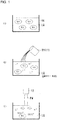
- preparation is made by feeding a container YK with a liquid LQ, i.e., a target for sterilization.
- a liquid LQ i.e., a target for sterilization.
- Used as the liquid LQ is water, an aqueous solution, physiological saline, or various other types of liquids.
- the liquid LQ includes microorganisms such as fungi, bacteria, or viruses, or pathogenetic biological macromolecules such as prions or lipopolysaccharide.
- the liquid LQ is adjusted to have a pH value of 4.8 or lower.
- the pH value is adjusted to become 4.5 or lower, or more preferably 3.5 or lower.
- charging acid, or salt that indicates acidity such as, for example, citric acid (C 6 H 8 O 7 ) or phosphate (e.g., KH 2 PO 4 ) from a charging container TY into the liquid LQ, or blowing a carbonic acid gas (CO 2 ) into the liquid LQ.
- citric acid C 6 H 8 O 7
- phosphate e.g., KH 2 PO 4
- CO 2 carbonic acid gas
- Fig. 1(C) illustrates that the surface of the liquid LQ is exposed to a plasma jet that is jetted from a plasma generation device 12.
- the container YK containing the liquid LQ therein is placed in a plasma environment generated by the plasma generation device.
- the plasma generation device having an electrode thereof arranged in the liquid LQ and generate the plasma PM in the liquid LQ. For example, low-temperature plasma is used as the plasma PM.
- the plasma PM in an atmosphere containing a mixed gas including nitrogen gas and oxygen gas at an appropriate ratio .
- the oxygen can be obtained from the components of the liquid, for example, when the liquid is water, it is also possible to generate the plasma in an atmosphere containing the nitrogen gas but excluding the oxygen gas. In this case, it is deemed that oxygen radicals are supplied by means of decomposition of the water.
- Nitrogen may be fed into the liquid instead of using an atmosphere containing the nitrogen gas to generate the plasma. For example, this is achieved by putting nitric acid or powders of nitrate salt into the liquid and making them dissolve therein. Instead, various substances including nitrogen may be put into the liquid.
- Active species such as radicals are supplied primarily from a gas phase kept in contact with the plasma, and therefore the plasma is not necessarily brought into contact with the liquid for performing sterilization of the liquid. It is possible to emit the plasma into an atmosphere of air, or a mixed gas containing nitrogen and oxygen to thereby generate radicals in a large amount and supply the radicals thus generated to the target liquid. In this way, it is possible to attain biocidal activities similar to the case where the plasma is made contact with the liquid.
- the plasma PM may be generated in the vicinity of the liquid LQ.
- radicals are generated by the plasma PM thus generated, and the generated radicals make contact with the liquid LQ.
- the concentration of the radicals is almost constant in the vicinity of the plasma PM.
- a distance R1 measured from the tip end of the plasma PM to the surface of the liquid LQ be made as small as possible. For example, in the case where a diameter of a jet port of the plasma PM is 4 mm, the distance R1 is about 10 to 20 mm at the maximum.
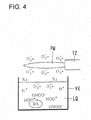
- the plasma PM may also be generated, as illustrated in Fig. 4 , in the upper and vicinity area of the liquid LQ. In this case, the radicals generated by the plasma PM make contact with the liquid LQ.
- the diffused superoxide anion radicals (O 2 - •) react with protons (H + ) in the liquid LQ to thereby form hydroperoxy radicals (HOO•).
- H + hydroperoxy radicals
- the right-hand and left-hand sides of the above-mentioned chemical formula are in an equilibrium relationship.
- the reaction progresses either from the right-hand side to the left-hand side or from the left-hand side to the right-hand side depending on the concentration.
- the hydroperoxy radicals (HOO•) formed in this way have a powerful antimicrobial effect which sterilize the microorganisms in the liquid LQ.
- a value representing the equilibrium constant of this equilibrium reaction is "4.8", which means that the superoxide anion radicals (O 2 - •) and the hydroperoxy radicals (HOO•) are present in equal densities when the pH is at 4.8.
- This also indicates that, in a state in which the pH value is higher than 4.8, the amount of the hydroperoxy radicals (HOO•) reduces extremely, and that, contrary, in a state in which the pH value is lower than 4.8, the amount of the hydroperoxy radicals (HOO•) increases rapidly.
- the pH value of the liquid LQ is adjusted to be 4.8 or lower, and the liquid LQ is made contact with the plasma PM to thereby generate the hydroperoxy radicals (HOO•) with which the microorganisms in the liquid LQ are sterilized.
- the pH value of the liquid LQ is adjusted at 4.8 or lower, preferably 4.5 or lower and the liquid LQ is made contact with the plasma PM, it is possible to attain a significantly increased microbiocidal activity.
- Hydroxyl radicals OH•
- hydroperoxy radicals HOO•
- superoxide anion radicals O 2 - •
- Sterilization is performed by generating such active species by the plasma that makes contact with the liquid and infiltrating the active species into the liquid. In doing so, it is possible to dramatically enhance the microbiocidal activity by adjusting the pH value of the liquid toward an acidity side, i.e., 4.8 or lower.
- the superoxide anion radicals have a relatively long life time but are weak in oxidizability, and are in an equilibrium relationship expressed in Formula (1) with protons (H + ) in the liquid. Accordingly, in an acidic environment with a lot of protons (H + ), the hydroperoxy radicals (HOO•) having high oxidative potential are prone to be formed. Particularly, at a pH value of 4.8 or lower, which corresponds to the p K a, the ratio of presence of the hydroperoxy radicals (HOO•) increases significantly.
- nitrogen and oxygen included in the air are combined together by the action of plasma to thereby form nitrogen oxide, which is a radical of oxygen and nitrogen, such as nitric oxide (NO•) or nitrogen dioxide (NO 2 •).
- the nitric oxide (NO•) combines with the hydroperoxy radicals (HOO•) to become peroxynitrite (ONOO - ) having a high microbiocidal activity, which, as a result, provides further high microbiocidal activities.
- HOO• hydroperoxy radicals
- ONOO - peroxynitrite
- various active species formed from oxygen and nitrogen generate a synergistic effect to provide a high microbiocidal activity.
- the microbiocidal activity is attained by the hydroperoxy radicals (HOO•) generated by the liquid LQ having a pH value of 4.8 or lower and the plasma PM, and further the peroxynitrite (ONOO - ) is generated because of the presence of nitrogen, which helps attain a further enhanced microbiocidal activity.
- HEO• hydroperoxy radicals
- Biological materials constituting the microorganisms are altered in properties by the radicals in the liquid, which prevents the microorganisms from further growing or sterilization progresses.
- This method is applicable to inactivate protein such as pathogenic viruses and prions which are not contained in the microorganisms, and also applicable to chemical modification of biological macromolecules such as protein.
- a liquid LQ having a pH value adjusted at 4.8 or lower is prepared (#11), and the liquid LQ is made as a sterilization target as required.
- Plasma PM is generated in the vicinity of the liquid LQ (#12) to thereby bring radicals into contact with the liquid LQ (#13).
- a liquid LQ which is a sterilization target is prepared (#21), the liquid LQ is adjusted to have a pH value of 4.8 or lower (#22), and subsequently the liquid LQ is brought into contact with plasma PM (#23).
- active species are produced by making the plasma contact with a surface of the liquid or generating the plasma in the vicinity of the liquid in the air, a nitrogen gas atmosphere, or an atmosphere containing nitrogen gas and oxygen gas. Then, the action of the active species thus produced are strengthened by adjusting the pH in the liquid to thereby effectively perform sterilization of the liquid itself or various articles such as equipment immersed in the liquid.
- the low-temperature plasma When the low-temperature plasma is used, it causes less chemical and mechanical damages because the temperature is low and no special chemical agents are required, and does not cause problems by residual gas. This means that it is possible to sterilize , without adverse effects, plastic products and medical equipment having a precision structure such as the one represented by a gastrocamera.
- the sterilization is performed effectively under two conditions which overlap with each other, i.e., a region with a lowered pH value and a region where radicals produced by the plasma can reach, it becomes possible to perform local sterilization by adjusting each of the regions appropriately. For example, it becomes possible to sterilize a surface layer of wounds of human body.
- the charging device for charging acid or salt by means of the charging container TY, or the blowing device that blows the carbonic acid gas into the liquid LQ corresponds to the pH adjustment device 11.
- the pH adjustment device 11 may also include the container YK, a pH sensor, an adjustment device for adjusting the pH at a predetermined value, and the like. It is also possible to use, as the charging device, a manipulator that, for example, holds and moves the charging container TY, or a spewing device that spews out acid or salt.
- the plasma generation device 12 corresponds to the plasma generation device according to the present invention.
- An entirety including the plasma generation device 12 and the pH adjustment device 11 corresponds to the sterilization apparatus 1 according to the present invention.
- the pH adjustment device 11 and the plasma generation device 12 are not limited to the examples described above, and the pH adjustment device 11 and the plasma generation device having various structures, shapes, or principles may be used.
- the evaluation of the number of microorganisms is usually performed by counting the number of colonies formed on the agar plate medium and is expressed in colony forming unit (CFU).
- the colony is a state in which microbial bodies of a single kind are sufficiently distributed and grown to an extent that can be visible.
- the CFU is equal to the number of living microorganisms included in an obj ect to be evaluated.
- D value a time period for the CFU to decrease to 1/10 of the original value is provided. It is determined that, the smaller the D value is, the greater the microbiocidal 1 activity is.
- a sterility assurance level indicates a state in which the survival probability of microorganisms is reduced to, as low as 1 ⁇ 10 -6 , and the time required to reach the state is referred to as a sterility assurance time.
- the initial concentration is assumed to be 1.0 ⁇ 10 6 CFU/ml, and the time required to reach the SAL is calculated by multiplying the D value by 12.
- the time required to reach the SAL is 15 minutes in a complete sterilization operation by autoclave at a temperature of 121°C. Such a case indicates that the D value is 75 seconds. In actual cases, since it takes an extra time for the temperature to increase to 121°C and an extra time for cooling, the entire complete sterilization operation takes about 1 to 1.5 hours.
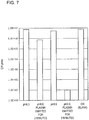
- microbial suspension containing Escherichia coli are prepared. Each set is made up of two types of pH values individually adjusted at "6.0" and "3.5". One of the sets is exposed to the plasma PM for two minutes, and the other is not exposed. The result of counting the number of bacteria by a colony counting method is illustrated in Fig. 7 .
- a sterilization target is indirectly sterilized by immersing the target in a liquid whose pH is adjusted or by spraying a liquid whose pH is adjusted onto the target, and thereafter the liquid or the target is exposed to the atmospheric plasma.
- Escherichia coli or lactic acid bacteria shaking-cultured using a liquid culture medium for over 18 hours at 30°C are diluted with sterilized water and adjusted to have a concentration of about 7.0 ⁇ 10 7 CFU/ml, which is used as microbial suspension.
- turbidity and concentration (CFU/ml) of microorganisms are in a proportional relationship. It is known that, in the case of Escherichia coli, when the optical density for light having a wavelength of 600 nm (OD600) is 1.0, the bacteria concentration becomes about 7.0 ⁇ 10 8 CFU/ml. Therefore, it is possible to obtain microbial suspension having the aforementioned concentration of 7.0 ⁇ 10 7 CFU/ml by recovering the cultured Escherichia coli through centrifugal separation, diluting the suspension by adding thereafter sterilized water so that OD600 becomes 0.1. The relationship between the turbidity (OD600) and concentration (CFU/ml) is about the same for lactic acid.
- the microbial suspension is added to 0.45 ml of sterilized water or to 2.0 mM (or 10 mM) or citric acid-NaOH buffer solution whose pH value has been adjusted at a predetermined value, and the mixture is put into a well of a microplate made of polystyrene and having 24 wells.
- the mixture is exposed to an LF plasma jet (3.0 litters/min, He gas, and a primary voltage of 70V) for a predetermined period of time.
- the LF plasma jet will be described later.
- the mixture After being exposed to the plasma, the mixture is recovered, serially diluted, applied onto the agar plate medium, and measured for the number of colonies after sixteen-hour cultivation.
- the recovered microbial suspension is diluted to 1/10 of concentration by sterilized water, and further diluted to 1/10 of concentration to thereby produce a diluent having 1/10 2 of the original concentration. This way, diluents down to 1/10 4 of the original concentration are prepared, and 0.1 ml each of individual diluents are dispersed on the agar plate medium for overnight cultivation at 30°C.
- the plasma used in Experiment 2 is called an LF plasma jet.
- the LF plasma jet was invented by Kitano et al, who are also inventors of the present invention, and is disclosed in International Application PCT/JP2007/061837 .
- the LF plasma jet it is possible to generate a low-temperature atmospheric plasma jet easily.
- a liquid to such plasma By exposing a liquid to such plasma to thereby supply various types of active species (electrons, ions, radicals, electric field, etc.) into the liquid, plasma processing in the liquid conventionally unachieved is aimed.
- active species electrons, ions, radicals, electric field, etc.
- the LF plasma jet is in a stable state as compared with arc discharges or spark discharges, it is possible to perform plasma processing without physically destroying the liquid itself and substances present in the liquid by heat or shock waves .
- One example of which is the plasma sterilization according to the present embodiment.
- the LF plasma jet uses helium gas.
- oxygen and nitrogen are respectively energized and thereby excited to possibly become reactive species.
- only jetting the plasma in the air causes ozone to be generated and accompanying smell of ozone as well.
- evaluation is performed on the influence of the atmospheric gas by not only emitting the plasma in a jet form but also arranging an atmospheric gas with the helium gas alone or the helium gas mixed with air.
- the results of sterilization experiments illustrated in the same drawing indicate that the experiment is conducted under the same plasma generation condition. However, the results of experiments illustrated in different drawings do not necessarily mean that the same plasma generation condition is used.
- Experiment 2 is implemented by using the LF plasma jet having a variety of characteristics as described above. When the reaction mechanism is verified scientifically, it is finally found that any type can be used as long as it is plasma.
- An evaluation of biocidal activity can be performed through a similar operation even when mixture is prepared according to the conditions described above and the liquid is processed using a plasma source other than the LF plasma jet (e.g., a chamber-type plasma emitting device).
- a plasma source other than the LF plasma jet e.g., a chamber-type plasma emitting device.
- how the oxygen is supplied is not restricted to a method in which the oxygen gas is simply mixed with the plasma gas. It is also considered effective, for example, to increase in advance dissolved oxygen in a liquid by means of microbubbles, add a reagent which is supposed to supply oxygen into the liquid by chemical reaction, or the like. By using such a method, an increase in microbiocidal activity by way of adjusting the pH value is expected even when a plasma source that discharges directly in the liquid is used.
- Figs. 8-11 illustrate experimental results comparing the microbiocidal activities by the LF plasma jet when the pH of the liquids are maintained at different constant values.
- Figs. 8 and 9 are graphs comparing microbiocidal activities on Escherichia coli
- Fig. 10 is a graph comparing microbiocidal activities on lactic acid bacteria
- Fig. 11 is a graph comparing microbiocidal activities on spores of Bacillus subtilis.
- the horizontal axis shows plasma exposure time in seconds.
- Fig. 9 little change is observed in microbiocidal activity depending on pH values when the pH of the buffer solution is 5.20 or higher, and the D value is 150 seconds at a pH value of 5.2.
- the pH value is 4.7 or lower, the microbiocidal activity is increased and further increased depending on the change in pH value.
- the D values at pH values of 4.7, 4.2, and 3.7 are 58, 35, and 13 seconds, respectively. It is found that the microbiocidal activity increases by about 10 times when the pH value changes from 5.2 to 3.7. The sterility assurance time is decreased from 23 minutes to 2.6 minutes.
- the microbiocidal activity by the plasma does not depend on the pH values at least under the condition in which the pH value is 7.8-4.77.
- the change in pH sharply contributes to the enhancement of the microbiocidal activity when the pH value is 4.5 or less.
- the sterilization effect by the plasma can be significantly increased by adjusting the pH value of a liquid to be sterilized to become 4.5 or lower.
- a similar experiment is conducted on lactic acid bacteria, and no sterilization effect by the plasma exposure is observed when the pH of the buffer solution is 5.2 or higher.
- the microbiocidal activity is attained when the pH value is 4.7 or lower, and the sterilization effect is significantly increased depending on the change in pH value.
- the D values at pH values of 4.7, 4.2, and 3.7 are 31, 10, and 5 seconds, respectively. It is found that the microbiocidal activity increases by about 6 times when the pH value changes from 4.7 to 3.7.
- Hydroxyl radicals are radicals that are highly reactive but can barely move in a solution because the hydroxyl radicals have a shorter life time. For this reason, it is considered that the hydroxyl radicals (OH•) are produced only in the vicinity of a surface of the liquid where the plasma makes contact with the liquid. It is found, from a result of the experiment, that the biocidal activity penetrates in a depth direction by 1.0 cm or more. Accordingly, another type of active species having a longer life time is supposed to be involved.
- superoxide anion radicals Contrary to the hydroxyl radicals (OH•), superoxide anion radicals (O 2 - •) have a relatively longer life time and it is considered that they can exist even in water for a few seconds. Although the superoxide anion radicals (O 2 - •) can be produced easily when oxygen in the air is excited by the plasma, the superoxide anion radicals, per se, have low reactivity and a fairly low microbiocidal activity. However, the superoxide anion radicals (O 2 - •) are considered to react with hydrogen ions (H + ) in the water and maintain the equilibrium state shown by Formula (1) discussed above.
- the superoxide anion radicals (O 2 - •) react with the hydrogen ions (H + ) in the liquid to form hydroperoxy radicals (HOO•).
- the hydroperoxy radicals (HOO•) are known to have an extremely strong microbiocidal activity. According to one theory, the hydroperoxy radicals (HOO•) are said to have microbiocidal activity 100,000 times strong as that of the superoxide anion radicals (O 2 - •).
- the equilibrium state shown in Formula (1) indicates that the higher the concentration of the hydrogen ions (H + ) becomes, i.e., the lower the pH value becomes, the greater the amount of the hydroperoxy radicals (HOO•) increases.
- Fig. 12 in the case where the SOD is not added but the plasma is emitted for 120 seconds, the number of bacteria is decreased to 1/10,000. However, in the case where 4 ⁇ g/ml of SOD is added and the plasma is exposed for 120 seconds, the number of bacteria is merely decreased to 1/100 or less. From this, it is found that there is an improvement in survival rate of bacteria by at least 100 times by adding the SOD.
- the limit for detection is 1.0 ⁇ 10 3 CFU/ml
- the number of bacteria is actually reduced more when the SOD is not added but the plasma is emitted.
- the improvement in survival rate of bacteria is expected to be 10,000 times or more when the SOD is added.
- the superoxide anion radicals (O 2 - •), one type of oxygen radical are combined with the hydrogen ions (H + ) in the liquid to form the hydroperoxy radicals (HOO•) to thereby show the microbiocidal effect.
- the effect is considered to be dramatically enhanced by raising the concentration of the hydrogen ions (H + ), i.e., lowering the pH. It is important that such a pH should be lower than 4.8 which is a value of p K a in the equilibrium reaction represented by Formula (1) described above. From the results of the experiment illustrated in Figs. 8-11 , it is preferable that the pH be 4.8 or lower, and it is more preferable that the pH be 4.5 or lower.
- the nitrogen in the air is oxidized by the plasma to become NO 2 .
- the NO 2 by dissolving in water, turns to HNO 2 or HNO 3 , which reduces the pH value as a result.
- HNO 2 or HNO 3 since dissolved nitrogen included in the water is also oxidized under the influence of the plasma, a slight reduction in pH is caused even with the plasma exposure in an atmosphere that does not contain nitrogen.
- the reduction in pH from this kind of cause is not constant due to a change in the environment in which the plasma is used or a change in volume of an object to be sterilized. Therefore, it is difficult to define the sterilization time.
- H 2 O 2 is also generated as a result of a reaction between oxygen and water with plasma exposure.
- the amount of H 2 O 2 thus generated under the condition of the sterilization experiment is merely 50 mg/l at the maximum, which is not such a concentration that affects the sterilization effect.
- the amount of produced H 2 O 2 is constant regardless of the pH value.
- Sterilization by plasma can be divided into two cases, i.e., (a) the plasma directly exerts influences on microorganisms, and (b) active species such as radicals that are generated secondarily exert influences.
- the plasma barely works in the liquid and on a target that has a complicated structure.
- the active species generated secondarily can act upon the microorganisms in the liquid by dissolving therein.
- the superoxide anion radicals (O 2 - •) having a relatively longer life time in the aqueous solution are combined with the hydrogen ions (H + ) to turn into the hydroperoxy radicals (HOO•) having an extremely powerful microbiocidal activity, and the concentration of which depends on the concentration of the hydrogen ions (H + ), that is, pH.
- p K a of the equilibrium reaction expressed in Formula (1) above is 4.8
- a proportion of the hydroperoxy radicals (HOO•) is expected to increase in a case where pH is lower than that value.
- the abundance ratio of the hydroperoxy radicals (HOO•) to the superoxide anion radicals (O 2 - •) is 1 to 1.
- the ratio becomes 2 to 1 at a pH value of 4.5 and 20 to 1 at a pH value of 3.5. In this way, the abundance ratio of the hydroperoxy radicals (HOO•) having a strong microbiocidal activity increases depending on the pH value .
- the microbiocidal activity by plasma by adjusting pH of a liquid at 4.8 or lower (ideally at 3.5 or lower) when the liquid or a target in the liquid is sterilized by bringing the plasma into contact with the liquid.
- the chemical agents used for adjusting the pH are not particularly limited, and such chemical agents are not required at all to have a microbiocidal activity or oxidizability.
- microorganisms present on a surface of a living body or in the vicinity thereof are sterilized.
- Such a sterilization method is implemented by a step of applying a liquid having a pH value of 4.8 or lower to the surface of the living body and a step of exposing a liquid present on the surface of the living body to low-temperature plasma.
- a description will be given of a method for sterilizing wounds of a human body by using a gel-patch.
- a wound with seriously damaged skin by burn or bedsore is accompanied by infection. It is possible to sterilize such a wound, without using a bactericide or an antibiotic, by exposing the wound to the LF plasma jet. In doing so, by applying an acidic liquid to the human body beforehand, effective sterilization is expected, and a sterilization effect not only on the surface of the skin but also inside is expected. The following method is used to prevent the human body from the influence exerted by the plasma.
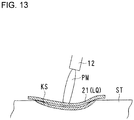
- a gel-like gelatin sheet 21 that is swelled by an acidic liquid (pH of about 3.5) is put on a wound KS of a living body ST, and the plasma PM is emitted thereto.
- the gelatin sheet 21 is produced by, for example, dissolving gelatin in an acidic aqueous solution having a pH value of about 2-4.5 and molding the resultant into a sheet having a thickness of about one to a few millimeters. With this gelatin sheet 21, a liquid having a adjusted pH value is applied to the surface of the living body ST. It is also possible to use such a gelatin sheet available on the market for medical use.
- an acidic aqueous solution having a pH value of about 2 to 4.5 may be applied to the wound KS by a brush in lieu of or together with the gelatin sheet 21.
- an acidic material may be gradually applied in a form of a liquid or a gas though a tip of a pen or the like during the operation.
- a rolled sheet moistened with an acidic liquid is applied to the wound KS, and the wound KS is exposed to the plasma indirectly through the rolled sheet.
- the rolled sheet is arranged to be sequentially fed so that a fresh sheet is used at any time.
- the sterilization method adopting adjustment of pH and the plasma PM is applicable not only to simple sterilization of the skin surface but also a dental treatment. It is recognized that what is required is complete sterilization but not normal microbiocidal treatment of a tooth, dental pulp, or gum. Conventionally, sterilization is performed using chemical agents, which causes a postoperative infectious disease due to insufficient sterilization. In contrast, a new completely sterilizing effect is expected from the sterilization using the pH adjustment and the plasma PM.
- the pH value of the tooth, dental pulp, or gum is adjusted to become acidic, and the plasma is emitted thereto.
- an acidic aqueous solution having a pH value of about 2-4.5 is coated or injected to or around the tooth, dental pulp, or gum, or the acidic aqueous solution is used for gargling to turn these areas acidic.
- hydroperoxy radicals HEO•
- sterilized water is used for rinsing, and thereafter the tooth, the dental pulp, or the like is sealed to complete the treatment.
- the plasma generation device 12 When the plasma generation device 12 is used to perform sterilization, there is a possibility that a toxic gas such as ozone or NOx is generated as a byproduct along with generation of the plasma PM. This means that, when the sterilization method according to the present embodiment is applied near someone's presence, it is necessary to provide a device for exhausting such gases. Particularly, when the method is applied to the dental treatment or the like, plasma processing is performed in the oral cavity of a patient. Therefore, it is necessary to enclose a portion subjected to the plasma processing so that the toxic gas does not leak into the oral cavity.
- a toxic gas such as ozone or NOx
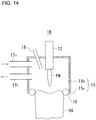
- the sterilization apparatus 1B includes a plasma generation device 12, a housing 15, a seal member 16, an atmospheric gas introduction pipe line 17a, a gas exhausting pipe line 17b, and a pH adjustment pipe line 18.
- the plasma generation device 12 generates the plasma PM within the housing 15.
- the timing at which the plasma PM is generated is controlled by means of an unillustrated control mechanism automatically or based on the instructions of the operator.
- the housing 15 has a container-like shape having, at one portion thereof, an opening 15a so that a surface of a part of a tooth HA to be targeted is surrounded and hermetically enclosed.
- the opening 15a should be shaped in accordance with a shape of the tooth HA, a periphery of a body portion 15b may be arranged in a cylindrical shape, a rectangular envelope shape, a spherical shape, or the like.
- the housing 15 may be formed by molding using such a material as a synthetic resin or glass.
- the seal member 16 is provided in the opening 15a of the housing 15 and seals a gap between the opening 15a and the tooth HA to maintain airtightness of the housing 15.
- the seal member 16 may be produced using silicon rubber, other synthetic rubber, synthetic resin, or the like.
- An O-ring, another type of sealing member, or a gasket may be used as the seal member 16. It is also possible to form the housing 15 integrally with the seal member 16.
- the atmospheric gas introduction pipe line 17a is a pipe line for introducing an atmospheric gas containing nitrogen gas into the housing 15. An amount of the atmospheric gas, timing at which the gas is introduced, or the like through the atmospheric gas introduction pipe line 17a is controlled by means of an unillustrated atmospheric gas control mechanism automatically or based on the instructions of the operator.
- the gas exhausting pipe line 17b is a pipe line for exhausting the atmospheric gas inside the housing 15 to outside. It is possible to use a flexible tube made of a synthetic resin or a synthetic rubber for the atmospheric gas introduction pipe line 17a and the gas exhausting pipe line 17b.
- the pH adjustment pipe line 18 is a pipe line for feeding a pH adjustment substance so that at least a part of the tooth HA as a target is adjusted to have a pH value of 4.8 or lower.
- the opening at a tip end of the pH adjustment pipe line 18 is directed toward the surface of the tooth HA to be treated.
- a liquid containing acid or salt, a gas such as carbonic acid gas, and other chemical agents can be used as the substance that is fed through the pH adjustment pipe line 18.
- the substance used for adjusting the pH is a gas, it is preferable that the surface of the tooth HA be moistened in advance.
- An amount of the substance to be fed through, timing at which the gas is introduced, or the like is controlled by means of an unillustrated substance control mechanism automatically or based on the instructions of the operator.
- the operator places the housing 15 of the sterilization apparatus 1B over the tooth HA which is a target for treatment. Then, the substance is supplied through the pH adjustment pipe line 18 and decreases the pH value of the surface of the tooth HA to 4.8 or lower.
- An atmospheric gas containing nitrogen gas, for example, the air, is fed into the housing 15. Along with this, the plasma PM is generated by the plasma generation device 12.
- the atmospheric gas, and toxic gases etc. produced by plasma processing are exhausted to outside through the gas exhausting pipe line 17b so as not to leak into the oral cavity.
- Radicals produced by the plasma PM make contact with the surface of the tooth HA, and the hydroperoxy radicals (HOO•) and the peroxynitrite (ONOO - ) as described above are generated, which sterilize the tooth HA.
- the plasma processing by the plasma generation device 12 is carried out in a space hermetically enclosed by the housing 15 and the seal member 16, a toxic gas, even if generated, is exhausted to outside through the gas exhausting pipe line 17b and does not leak into the oral cavity. Consequently, there is no chance of the patient to inhale the toxic gas, and, as a result, unnecessary damage caused to the respiratory system can be avoided.
- the pH adjustment pipe line 18 is provided, through which a substance for decreasing the pH is also supplied.
- a pipe line that can be opened and closed or merely a hole as the pH adjustment pipe line 18. Then, the operator inserts a nozzle of an injector or an atomizer into the pipe line or the hole and manually operates the injector or the atomizer to thereby feed the substance.
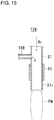
- a gas supply pipe 31 may be used for feeding the substance as well.
- a pH adjustment pipe line 18B is provided in a manner to branch off from the gas supply pipe 31 in an upper portion of a high-potential electrode 33.
- the gas supply pipe 31 is used for supplying helium gas when the plasma PM is generated, a substance for adjusting the pH value is supplied from the pH adjustment pipe line 18b to the tooth HA via the gas supply pipe 31 prior to generating the plasma PM.
- an on-off valve or a passage changeover valve is provided in a portion upstream of the pH adjustment pipe line 18B and the gas supply pipe 31.
- pH adjustment pipe line 18B branches off from the gas supply pipe 31, a position and an angle of the branch, sizes of individual pipes, and so on may be decided in a diversifying manner differently from what are illustrated in Fig. 15 .
- the gas supply pipe 31 and the high-potential electrode 33 will be described later with reference to Fig. 19 .
- the sterilization apparatus 1B is placed over the tooth HA, thereafter a substance for adjusting the pH value is supplied through the pH adjustment pipe line 18B, and then helium gas is supplied to the gas supply pipe 31 to generate the plasma PM.
- a liquid having a pH value of 4.5 or lower is infiltrated in absorbent cotton and applied to the tooth HA.
- a liquid or a gas for adjusting the pH is sprayed onto the tooth HA using an atomizer or the like. Thereafter, the sterilization apparatus 1B is placed over the tooth HA, and plasma processing is performed.
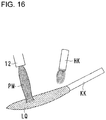
- an acidic liquid having a pH value of about 1-4.5 is coated on a surface of a device KK with a brush HK, and the device KK is exposed to the plasma PM from the plasma generation device 12.
- hydroperoxy radicals (HOO•) are produced on a surface of the device KK to thereby sterilize the device KK.
- the acidic liquid may be sprayed thereto using an atomizer, or the device KK may be immersed in the acidic liquid for a predetermined period of time.
- a container YK is provided with an acidic liquid LQ having a pH value of about 1-4.5.
- a device to be sterilized is put into the container YK and immersed in the liquid LQ.
- the entirety of the container YK is carried into a plasma generation device 12E, and the plasma PM is made contact with a surface of the liquid LQ.
- hydroperoxy radicals (HOO•) are produced in the liquid LQ, and sterilization of the device KK is performed.
- the plasma generation device 12E is filled with helium gas and a mixed gas containing small amounts of nitrogen and oxygen. Therefore, the plasma PM with helium gas serving as a medium gas is generated.
- helium gas serving as a medium gas
- other gasses than the helium gas may be used. It is preferable that the depth of the container YK be shallow so that the hydroperoxy radicals (HOO•) produced in the liquid LQ by the action of plasma PM can sufficiently reach the surface of the device KK. However, even with a substantial depth, sufficient agitation compensates it.
- the liquid is exposed to metastable atoms that are in a metastable state of a noble gas such as helium to thereby promote generation of radicals in the liquid.
- a noble gas such as helium
- the reverse jet is produced by arranging a ground electrode in the vicinity of a plasma jetting port so that an electric field does not leak outside. By this arrangement, unnecessary emission of charged particles can be controlled.
- Oxygen-based radicals exerting sterilization ability are generated when the metastable collides with oxygen molecules or water molecules in the air.
- a chamber of a plasma generation device 12F has a shape as illustrated in Fig. 18 .
- helium is supplied into a chamber 41 through a helium pipe line 42 located at an uppermost position therein; air is supplied into the chamber 41 through an air pipe line 43 located in a middle position therein; and discharge is performed through an exhaust pipe line 44 located in a lowermost position therein. Voltage is applied to an electrode 45 through an electric wire 46 to generate plasma PM on the lower side in the chamber 41.
- a pipe as a glass tube, a rubber tube, or a synthetic resin tube is used as the helium pipe line 42, the air pipe line 43, and the exhaust pipe line 44.
- Such a structure using the three pipes provides relatively a better efficiency. Since the helium having a low concentration tends to stay in an upper portion of the chamber 41, it is possible to reduce the consumption of the relatively expensive helium.
- the interface portion of the chamber 41 i.e., a contact portion located in the lowest position thereof, is made to have a soft structure using a silicone resin or the like so that air tightness is also maintained.
- sterilization is performed by bringing the plasma PM into contact with a liquid having a adjusted pH value.
- liquid sterilization When liquid sterilization is performed, the liquid is treated to become acid, and then discharges made available at a low cost such as spark discharges, arc discharges, or impulse discharges are performed. Through this process, an enhanced liquid sterilization performance is expected.
- This type of sterilization method is applicable to sewage treatment or the like.
- the carbonic acid gas (carbon dioxide) is harmless to human body. Therefore, it is possible to perform neutralization treatment on a liquid, which has been subjected to a pH adjustment process, by using the carbonic acid gas dissolved in a liquid and merely leaving the liquid as is.
- distilled water turns into an equilibrium state when the carbonic acid gas in the air dissolves thereinto, and maintains a pH value of approximately 5.6.
- the form of a chemical agent for adjusting the pH is not particularly important.
- a chemical agent for adjusting the pH is not particularly important.
- it is solid such as citric acid, it may be charged into the liquid as is and dissolved.
- it is also possible to add such a solution that has been prepared by adjusting the pH.
- a gas such as the carbonic acid gas which can dissolve in the water and function to lower the pH, and it is possible to lower the pH by actively dissolving the chemical agent or placing the liquid in the high concentration gas atmosphere.
- the pH value on the surface of the object is adjusted by applying or spraying a liquid having a adjusted pH value onto the surface.
- spraying can be divided and performed in multiple times so as to prevent the acidic liquid from evaporating.
- the acidic liquid is supplied by spraying in a form of droplets while the plasma PM is generated. Additional spraying is performed as required while the plasma PM is generated.
- an acidic liquid having a adjusted pH value is used in each embodiment, it is also possible to generate the plasma PM to perform sterilization and, at the same time, increase the pH of the liquid by decomposing the acidic substances.
- it can be arranged to increase the pH value to an appropriate value, e.g., 5.0 or higher when a liquid having a pH value of 3.0 is used, sterilization is performed by emitting the plasma PM for a predetermined period of time, and the sterilization is completed as the predetermined period has elapsed. In this way, by the time the sterilization is completed, the liquid has turned almost neutral and can be disposed of as is.
- an appropriate value e.g., 5.0 or higher when a liquid having a pH value of 3.0 is used
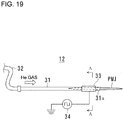
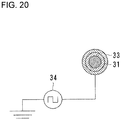
- a plasma generation device 12 is configured of a gas supply pipe 31, a gas tube 32, a high-potential electrode 33, a voltage applying device 34, and so on.
- the gas supply pipe 31 is formed of a dielectric such as a quartz pipe or a plastic tube and has a rear end thereof to which the gas tube 32 is connected.
- a dielectric such as a quartz pipe or a plastic tube
- helium (He) gas is supplied from an unillustrated medium gas source.
- the helium gas that has passed through a bore of the gas supply pipe 31 is jetted out from a jet port 31a to constitute a gas stream generating portion for forming a gas stream of a medium gas.
- a pipe having, for example, an inner diameter of 50 ⁇ m to 50 mm can be used as the gas supply pipe 31.
- a coaxial single high-potential electrode 33 for generating plasma is provided on an outer circumference of an end portion on a side of the jet port 31a of the gas supply pipe 31.
- a voltage applying device 34 is connected to the high-potential electrode 33 to which a positive voltage in a form of pulse train having a predetermined frequency is applied.
- the voltage value to be applied by the voltage applying device 34 is set, for example, at 10 kV, and the frequency is set, for example, at about 10 kHz.
- the gas supply pipe 31 and the gas tube 32 function as a gas stream generating portion that generates a medium gas flux
- the high-potential electrode 33 and the voltage applying device 34 function as an electric field forming portion that forms an electric field corresponding to each medium gas stream.
- the voltage applying device 34 applies a positive voltage in a form of pulse train having a predetermined frequency to the high-potential electrode 33.
- the voltage applying device 34 outputs, for example, a voltage having a waveform as illustrated in Fig. 21 . If a voltage alternating in time is applied, plasma is likely to be generated by the alternating component in the voltage, particularly in the case of dielectric barrier discharge , since plasma is ignited via a capacitor of glass. Specifically, a voltage having a frequency of about 10 kHz can be used. However, it is sometimes a case in which glow-type atmospheric plasma may be obtained even with a voltage having a low frequency of about 60 Hz.
- helium gas is preferred as a medium gas
- another gas may also be used as long as conditions are set appropriately.
- a mixed gas of argon and ketone also can be used.
- various processes can be performed by supplying vapor of a chemical agent such as a monomer, or an aerosol such as sprayed mist or fine particles.
- the LF plasma jet is a thermally non-equilibrium low-temperature plasma, which can be emitted to a base material such as thin nylon without causing any damage thereto but has energy sufficient for effecting a surface treatment, ozone generation, and a plasma polymerization.
- an increase in power consumption resulted from short-circuit discharges can be suppressed, and energy conversion efficiency can be improved, as compared with a conventional coaxial bi-electrode system.
- any medium gas flux is ionized to become plasma stably by causing only a partial discharge.
- the ignition of plasma can be realized on a wide scale of about 50 ⁇ m to 50 mm, and an increase in an aperture size is also possible in principle, using the above procedure.
- the plasma generation device 12 only a high voltage in a form of pulse train is applied to the high-potential electrode 33 connected to the gas supply pipe 31 through which the medium gas flows, whereby a partial discharge is allowed to occur along the medium gas stream diffused from the gas supply pipe 31 to the atmosphere, which can generate a plasma stream.
- a high voltage in a form of pulse train is applied to the high-potential electrode 33 connected to the gas supply pipe 31 through which the medium gas flows, whereby a partial discharge is allowed to occur along the medium gas stream diffused from the gas supply pipe 31 to the atmosphere, which can generate a plasma stream.
- the LF plasma jet has two characteristics: "generation of a gas flux in the atmosphere” and “partial discharge in the vicinity of a high-potential electrode". Although discharge is allowed to occur by applying a periodic high voltage, plasma parameters can be controlled not only by the applied voltage but also by the applied frequency. In addition to these, the parameters of plasma to be generated can be also controlled by controlling the waveform (polarity) of a high voltage to be applied.
- Fig. 21(B) illustrates a voltage waveform when only a positive high voltage is applied.
- Fig. 21(C) illustrates a voltage waveform when only a negative high voltage is applied.
- Fig. 21(D) illustrates a voltage waveform when positive and negative high voltages are applied alternately.
- discharge in a pulse form occurs at a moment when the applied voltage exceeds a predetermined absolute value that varies between the positive and negative voltages. For example, in the case of using a power source producing a voltage with a frequency of 10 kHz, one period is 100 psec, and the discharge in the pulse form is observed within a few microseconds from the start.
- the polarity of the high voltage that is being applied determines the densities and temperature distribution of ions, electrons, metastable atoms, and the like which are all generated from the plasma, and the plasma itself.
- Positive corona discharge occurs in the case of a positive voltage
- negative corona discharge occurs in the case of a negative voltage.
- the positive corona discharge and the negative corona discharge have different physical discharge mechanisms, so that the plasma production state varies.
- using the plasma while individual polarities are controlled makes it possible to control the effect of plasma on an object which is exposed to the plasma.
- Fig. 21 (D) discharges of both the polarities occur.
- the positive and negative corona discharges are generated in turn.
- the voltage applying device 34 be configured so as to change the peak value of an applied voltage at a time of the ignition of plasma and the peak value of an applied voltage at a time of maintaining generation of plasma, as shown in Fig. 21 (E) . More specifically, for igniting the plasma jet PMJ, a high peak voltage of V0 is supplied from times t0 to tl, and a reduced peak voltage V1 is supplied after the time t1.
- the voltage V0 has a level sufficient for igniting a plasma jet PMJ, and the voltage V1 is a level required for maintaining the generation of a plasma jet PMJ.
- the high-potential electrode 33 is not always required to be provided coaxial ly on the outer circumferential surface of the gas supply pipe 31.
- the LF plasma jet can be generated even with an electrode attached to a part of the outer circumferential surface or inner circumferential surface of the gas supply pipe 31. More specifically, it is preferred that an electrode be attached to the inner surface or the outer surface of a member made of a dielectric for forming a medium gas stream, and that the dielectric and the electrode be integrally structured. When an electrode is attached to the inner surface of a member made of a dielectric, medium gas comes into contact with both the dielectric and the electrode.
- the medium gas does not necessarily form a stream.
- a plasma generation device so as to generate plasma from a medium gas mass.
- an electric field forming portion that forms an electric field in a medium gas mass is provided. If the medium gas mass has an elongated shape, an electric field is formed so as to cause partial discharges from the electric field forming portion toward both directions in the longitudinal direction of the medium gas mass.
- the medium gas mass may be arranged in such a manner that the medium gas is sealed in a tube provided with an electrode. Even in this case, the electrode may be provided either on the inner surface or the outer surface of the tube.
- a needle may be fitted to the vicinity of the nozzle aperture for the jet and used as an electrode .
- the plasma PM can be generated while the electrolysis of a liquid is performed at the same time by applying, to the electrode provided in the liquid LQ, a voltage resulted from superimposing a voltage required for generation of the plasma PM on a DC voltage required for performing electrolysis.
- Sterilization is performed by exposing microorganisms to plasma in the gas phase according to the conventional sterilization by plasma.
- the sterilization in the liquid it is difficult for active species of the plasma to penetrate into the liquid, resulting in an extremely low sterilization effect.
- it is possible to significantly increase the microbiocidal activity by merely adjusting the pH value without involving use of particular chemical agents.
- the sterilization of a liquid using the chamber can not be applied in a conventional method, whereas, in this embodiment, it becomes possible.
Landscapes
- Life Sciences & Earth Sciences (AREA)
- Engineering & Computer Science (AREA)
- Health & Medical Sciences (AREA)
- Chemical & Material Sciences (AREA)
- Organic Chemistry (AREA)
- Hydrology & Water Resources (AREA)
- Water Supply & Treatment (AREA)
- Environmental & Geological Engineering (AREA)
- Veterinary Medicine (AREA)
- Physics & Mathematics (AREA)
- Toxicology (AREA)
- Public Health (AREA)
- General Health & Medical Sciences (AREA)
- Animal Behavior & Ethology (AREA)
- Plasma & Fusion (AREA)
- Epidemiology (AREA)
- Wood Science & Technology (AREA)
- Zoology (AREA)
- Food Science & Technology (AREA)
- Polymers & Plastics (AREA)
- Apparatus For Disinfection Or Sterilisation (AREA)
- Surgical Instruments (AREA)
- Food Preservation Except Freezing, Refrigeration, And Drying (AREA)
Claims (1)
- Un appareil de stérilisation pour stériliser les micro-organismes présents dans une dent, ou un élément biologique autre qu'une dent, ou sur une surface de celle-ci, comprenant :un boîtier capable d'entourer et d'enfermer hermétiquement au moins une partie de la dent, ou l'élément biologique autre qu'une dent ;un dispositif d'ajustement du pH qui fournit une substance d'ajustement du pH de telle sorte qu'une valeur de pH de ladite au moins la partie de la dent, ou la partie biologique autre qu'une dent, devienne 4,8 ou moins ;un dispositif de génération de plasma qui génère du plasma à l'intérieur du boîtier ;une partie d'introduction qui introduit un gaz atmosphérique contenant de l'azote dans le boîtier ; etune partie des gaz d'évacuation qui rejette les gaz atmosphériques ;dans lequel le boîtier a une ouverture et un élément d'étanchéité est prévu dans l'ouverture pour sceller un espace entre l'ouverture et la dent, ou l'élément biologique autre qu'une dent.
Applications Claiming Priority (2)
| Application Number | Priority Date | Filing Date | Title |
|---|---|---|---|
| JP2007251194 | 2007-09-27 | ||
| PCT/JP2008/002670 WO2009041049A1 (fr) | 2007-09-27 | 2008-09-25 | Procédé et appareil de pasteurisation |
Publications (3)
| Publication Number | Publication Date |
|---|---|
| EP2206521A1 EP2206521A1 (fr) | 2010-07-14 |
| EP2206521A4 EP2206521A4 (fr) | 2010-09-29 |
| EP2206521B1 true EP2206521B1 (fr) | 2019-07-17 |
Family
ID=40510954
Family Applications (1)
| Application Number | Title | Priority Date | Filing Date |
|---|---|---|---|
| EP08833279.6A Not-in-force EP2206521B1 (fr) | 2007-09-27 | 2008-09-25 | Appareil de stérilisation |
Country Status (4)
| Country | Link |
|---|---|
| US (1) | US8871146B2 (fr) |
| EP (1) | EP2206521B1 (fr) |
| JP (1) | JP4408957B2 (fr) |
| WO (1) | WO2009041049A1 (fr) |
Families Citing this family (44)
| Publication number | Priority date | Publication date | Assignee | Title |
|---|---|---|---|---|
| WO2010008062A1 (fr) * | 2008-07-18 | 2010-01-21 | 株式会社吉田製作所 | Appareil clinique dentaire et dispositif d'application de jet de plasma pour dentisterie |
| CN102282916A (zh) * | 2009-01-13 | 2011-12-14 | 里巴贝鲁株式会社 | 等离子体生成装置及方法 |
| WO2011027542A1 (fr) * | 2009-09-03 | 2011-03-10 | 国立大学法人大阪大学 | Procédé et dispositif pour introduire des ions dans un liquide, et procédé et dispositif de stérilisation |
| JP2013529352A (ja) * | 2010-03-31 | 2013-07-18 | コロラド ステート ユニバーシティー リサーチ ファウンデーション | 液体−気体界面プラズマデバイス |
| EP2552340A4 (fr) * | 2010-03-31 | 2015-10-14 | Univ Colorado State Res Found | Dispositif à plasma à interface liquide-gaz |
| WO2012157034A1 (fr) * | 2011-05-17 | 2012-11-22 | パナソニック株式会社 | Dispositif de traitement de liquide et procédé de traitement de liquide |
| JP5362934B2 (ja) | 2011-05-17 | 2013-12-11 | パナソニック株式会社 | プラズマ発生装置およびプラズマ発生方法 |
| JP5948531B2 (ja) * | 2011-07-06 | 2016-07-06 | 名古屋市 | プラズマ処理装置及び処理方法 |
| JP5818176B2 (ja) * | 2012-01-13 | 2015-11-18 | 国立大学法人大阪大学 | 活性種照射装置、活性種照射方法 |
| WO2013147610A2 (fr) | 2012-03-30 | 2013-10-03 | Jetze Botma | Sélection automatique de microorganismes et identification à l'aide d'une dilam |
| JPWO2013161327A1 (ja) * | 2012-04-27 | 2015-12-24 | 国立大学法人大阪大学 | 殺菌処理方法、殺菌用製剤、殺菌用結氷体およびその生成方法および装置、並びに殺菌用液体の生成方法 |
| DE102012103777A1 (de) * | 2012-05-22 | 2013-11-28 | Reinhausen Plasma Gmbh | Verfahren und vorrichtung zur beständigkeitsprüfung eines werkstoffs |
| US9339572B2 (en) | 2013-03-15 | 2016-05-17 | EP Technologies LLC | Methods and solutions for killing or deactivating spores |
| JP6180016B2 (ja) * | 2013-04-23 | 2017-08-16 | 沖野 晃俊 | 大気圧プラズマを用いた生物細胞および外皮系のケア装置 |
| WO2014188725A1 (fr) | 2013-05-24 | 2014-11-27 | 国立大学法人大阪大学 | Procédé et dispositif de production de liquide bactéricide |
| CA2921952C (fr) * | 2013-08-21 | 2022-12-13 | Children's National Medical Center | Implant soluble sur commande |
| JP5899455B2 (ja) * | 2013-10-25 | 2016-04-06 | パナソニックIpマネジメント株式会社 | 液体処理装置及び液体処理方法 |
| JP6271223B2 (ja) * | 2013-11-14 | 2018-01-31 | 沖野 晃俊 | ラジカル機能液およびその製造方法並びにラジカル機能液の使用方法 |
| EP3176130A4 (fr) * | 2014-07-28 | 2018-01-10 | NGK Insulators, Ltd. | Dispositif de traitement, dispositif de stérilisation, eau de stérilisation et procédé de stérilisation |
| EP3189857B1 (fr) * | 2014-09-02 | 2020-11-04 | Katsuhisa Kitano | Procédé de stérilisation, préparation pour stérilisation, et dispositif de production d'un liquide bactéricide |
| JP6840326B2 (ja) * | 2015-02-18 | 2021-03-10 | 国立大学法人東海国立大学機構 | プラズマ殺菌水溶液とその製造方法および殺菌方法 |
| JP2016169164A (ja) * | 2015-03-11 | 2016-09-23 | 国立大学法人名古屋大学 | 抗腫瘍水溶液とその製造方法 |
| JP2016203082A (ja) * | 2015-04-21 | 2016-12-08 | 沖野 晃俊 | ラジカル機能液の製造方法およびラジカル機能液を用いた浄化方法 |
| CN106166301A (zh) * | 2015-05-18 | 2016-11-30 | 松下知识产权经营株式会社 | 液体处理方法、液体处理装置及洗衣机 |
| CA2993803A1 (fr) | 2015-07-28 | 2017-02-02 | EP Technologies LLC | Dispositif de recurage pour le nettoyage, l'assainissement ou la desinfection |
| US10897894B2 (en) | 2015-08-31 | 2021-01-26 | Gojo Industries, Inc. | Methods of and system for generating antimicrobial wipes |
| US10194672B2 (en) | 2015-10-23 | 2019-02-05 | NanoGuard Technologies, LLC | Reactive gas, reactive gas generation system and product treatment using reactive gas |
| US10307938B2 (en) * | 2015-11-17 | 2019-06-04 | Great Plains Coatings, Inc. | Chemical resistant composite support pad mold and method of manufacturing the support pad |
| WO2017161153A1 (fr) * | 2016-03-18 | 2017-09-21 | The George Washington University | Compositions pour le traitement du cancer, procédés et systèmes pour leur formation |
| WO2018021528A1 (fr) * | 2016-07-28 | 2018-02-01 | 日本碍子株式会社 | Dispositif de production d'eau stérile, procédé de stérilisation d'un objet à traiter et procédé de production d'eau stérile |
| WO2018026026A1 (fr) * | 2016-08-02 | 2018-02-08 | 주식회사 피글 | Élément d'amélioration du plasma, dispositif d'alimentation en plasma et dispositif médical le comprenant |
| WO2018089577A1 (fr) | 2016-11-10 | 2018-05-17 | EP Technologies LLC | Procédés et systèmes pour la génération de liquide activé par plasma |
| CN108703973A (zh) * | 2017-04-10 | 2018-10-26 | 北京大学 | 一种用于治疗牙周炎的外用凝胶其制备方法 |
| JP7624199B2 (ja) * | 2018-01-26 | 2025-01-30 | ヴェストファーリッシュ ヴィルヘルム-ユニバーシテート ミュンスター | 創傷の処置のための創傷すすぎ溶液および冷プラズマの組み合わせ |
| WO2019219220A1 (fr) | 2018-05-18 | 2019-11-21 | Leibniz-Institut für Plasmaforschung und Technologie e.V. | Procédé de désinfection comprenant un principe actif désinfectant formé in situ par réaction de h2o2 et de no2- |
| CN116018882A (zh) | 2018-06-28 | 2023-04-25 | Csp高级解决方案株式会社 | 流行性角膜结膜炎的治疗用滴眼剂、生成该滴眼剂的等离子体活性滴眼剂生成装置及流行性角膜结膜炎的治疗方法 |
| WO2020065814A1 (fr) * | 2018-09-27 | 2020-04-02 | 日本碍子株式会社 | Dispositif de production d'eau stérilisante, procédé de production d'eau stérilisante et procédé de fabrication d'objet stérilisé |
| FR3090324B1 (fr) * | 2018-12-21 | 2021-12-10 | Oreal | Procédé de traitement des matières kératiniques humaines |
| US10925144B2 (en) | 2019-06-14 | 2021-02-16 | NanoGuard Technologies, LLC | Electrode assembly, dielectric barrier discharge system and use thereof |
| US11896731B2 (en) | 2020-04-03 | 2024-02-13 | NanoGuard Technologies, LLC | Methods of disarming viruses using reactive gas |
| JP2023528038A (ja) * | 2020-06-02 | 2023-07-03 | ザ、トラスティーズ オブ プリンストン ユニバーシティ | 低温布製誘電体バリア放電デバイス |
| KR102440967B1 (ko) * | 2020-11-16 | 2022-09-13 | 주식회사 플라리트 | 플라즈마 라디칼 용액 및 이의 제조방법 |
| CN115040786B (zh) * | 2022-06-21 | 2025-09-05 | 中国科学技术大学先进技术研究院 | 皮肤黏膜受损用等离子体治疗仪 |
| CN117623547B (zh) * | 2023-12-19 | 2025-12-19 | 天津大学 | 一种低温等离子体污水处理设备以及处理方法 |
Family Cites Families (36)
| Publication number | Priority date | Publication date | Assignee | Title |
|---|---|---|---|---|
| US5897831A (en) * | 1987-02-25 | 1999-04-27 | Adir Jacob | Process for dry sterilization of medical devices and materials |
| JP2627020B2 (ja) * | 1989-09-18 | 1997-07-02 | ハウス食品株式会社 | 高電圧パルスによる殺菌方法 |
| JP2750931B2 (ja) * | 1989-09-18 | 1998-05-18 | ハウス食品株式会社 | 高電圧パルスによる殺菌方法 |
| JP2651740B2 (ja) * | 1990-07-26 | 1997-09-10 | ハウス食品株式会社 | 高電圧パルスによる殺菌方法 |
| US5749895A (en) * | 1991-02-13 | 1998-05-12 | Fusion Medical Technologies, Inc. | Method for bonding or fusion of biological tissue and material |
| JP2772588B2 (ja) * | 1991-03-13 | 1998-07-02 | ハウス食品株式会社 | 高電圧パルスによる殺菌方法 |
| US5447733A (en) * | 1994-01-06 | 1995-09-05 | Purepulse Technologies, Inc. | Prevention of electrochemical and electrophoretic effects in high-strength-electric-field pumpable-food-product treatment systems |
| US5514391A (en) * | 1995-06-07 | 1996-05-07 | Pure Pulse Technologies | Process for reducing levels of microorganisms in pumpable food products using a high pulsed voltage system |
| US6505078B1 (en) * | 1996-04-04 | 2003-01-07 | Medtronic, Inc. | Technique for adjusting the locus of excitation of electrically excitable tissue |
| JP3501961B2 (ja) * | 1998-09-29 | 2004-03-02 | 株式会社荏原製作所 | プラズマによる液体処理装置 |
| FR2790962B1 (fr) * | 1999-03-16 | 2003-10-10 | Absys | Procede et dispositifs de sterilisation par plasma |
| EP1229852A4 (fr) * | 1999-10-08 | 2006-03-15 | Britesmile Inc | Appareil d'eclairage simultane des dents |
| JP2001245643A (ja) * | 2000-03-09 | 2001-09-11 | Nissin Electric Co Ltd | 液状物の殺菌方法およびその装置 |
| FR2814079B1 (fr) * | 2000-09-15 | 2005-05-13 | Absys | Systeme de sterilisation par plasma |
| RU2272787C2 (ru) * | 2000-12-27 | 2006-03-27 | Хайдро Энтерпрайзес, Инк. | Устройство для получения активированной воды и способы ее использования |
| WO2002062711A1 (fr) * | 2001-02-02 | 2002-08-15 | Mikasavets Inc. | Dispositif de production de solution aqueuse a atome libre, procede de production de solution aqueuse a atome libre, et solution aqueuse a atome libre |
| US20020155594A1 (en) * | 2001-03-27 | 2002-10-24 | Hsieh Helen V. | Method and apparatus for culturing cells |
| US7011790B2 (en) * | 2001-05-07 | 2006-03-14 | Regents Of The University Of Minnesota | Non-thermal disinfection of biological fluids using non-thermal plasma |
| US6562386B2 (en) * | 2001-05-07 | 2003-05-13 | Regents Of The University Of Minnesota | Method and apparatus for non-thermal pasteurization |
| US6911225B2 (en) | 2001-05-07 | 2005-06-28 | Regents Of The University Of Minnesota | Method and apparatus for non-thermal pasteurization of living-mammal-instillable liquids |
| FR2827777B1 (fr) * | 2001-07-27 | 2005-09-02 | Ecole Superieure Electricite | Procede et machine de sterilisation par plasma |
| GB0208261D0 (en) * | 2002-04-10 | 2002-05-22 | Dow Corning | An atmospheric pressure plasma assembly |
| AUPS220302A0 (en) | 2002-05-08 | 2002-06-06 | Chang, Chak Man Thomas | A plasma formed within bubbles in an aqueous medium and uses therefore |
| JP2004143519A (ja) * | 2002-10-23 | 2004-05-20 | Denso Corp | 水処理方法および水処理装置 |
| JP2004290612A (ja) | 2003-03-28 | 2004-10-21 | Advance Food Tekku Kk | 高電圧放電を用いたまな板殺菌装置と殺菌方法 |
| BRPI0400237A (pt) * | 2004-01-16 | 2005-08-16 | Tadashi Shiosawa | Processo de esterelização a vácuo com aplicação de vapor de uma mistura de ácido peracético com peróxido de hidrogênio e plasma de gás residual de ar atmosférico excitado por descarga elétrica dc pulsada; dispositivos e métodos operacionais utilizados no processo de esterilização |
| US7450987B2 (en) * | 2004-04-12 | 2008-11-11 | Advanced Neuromodulation Systems, Inc. | Systems and methods for precharging circuitry for pulse generation |
| KR100720356B1 (ko) * | 2004-07-27 | 2007-05-22 | 삼성전자주식회사 | 이온 발생기 |
| WO2006137832A2 (fr) * | 2004-09-01 | 2006-12-28 | Amarante Technologies, Inc. | Systemes portables de plasma micro-ondes comprenant une ligne d'alimentation destinee a du gaz et a des micro-ondes |
| US8282805B2 (en) * | 2004-11-02 | 2012-10-09 | Daigle Edward O | Process and apparatus for cleaning and/or coating conductive metal surfaces using electro-plasma processing |
| MX2007008327A (es) | 2005-01-08 | 2007-09-07 | Biozon D O O Za Trgovinu I | Aparato para tratamiento. |
| DE202005012281U1 (de) * | 2005-05-12 | 2005-12-22 | Mylius, Harald W., Dipl.-Ing. | Behandlungssonde |
| GB0501460D0 (en) * | 2005-01-25 | 2005-03-02 | Univ Edinburgh | Improved plasma cleaning method |
| KR100805225B1 (ko) * | 2005-02-04 | 2008-02-21 | 삼성전자주식회사 | 살균장치 및 이온발생장치 |
| US7658155B2 (en) * | 2005-06-29 | 2010-02-09 | Advanced Plasma Power Limited | Waste treatment process and apparatus |
| EP2586488B1 (fr) * | 2009-04-22 | 2017-03-15 | Nevro Corporation | Modulation haute fréquence sélective de la moelle épinière pour inhiber la douleur avec des effets secondaires réduits, systèmes associés |
-
2008
- 2008-09-25 EP EP08833279.6A patent/EP2206521B1/fr not_active Not-in-force
- 2008-09-25 WO PCT/JP2008/002670 patent/WO2009041049A1/fr not_active Ceased
- 2008-09-25 JP JP2009534183A patent/JP4408957B2/ja active Active
-
2010
- 2010-04-30 US US12/771,088 patent/US8871146B2/en active Active
Non-Patent Citations (1)
| Title |
|---|
| None * |
Also Published As
| Publication number | Publication date |
|---|---|
| US8871146B2 (en) | 2014-10-28 |
| EP2206521A4 (fr) | 2010-09-29 |
| EP2206521A1 (fr) | 2010-07-14 |
| JP4408957B2 (ja) | 2010-02-03 |
| US20100209293A1 (en) | 2010-08-19 |
| JPWO2009041049A1 (ja) | 2011-01-20 |
| WO2009041049A1 (fr) | 2009-04-02 |
Similar Documents
| Publication | Publication Date | Title |
|---|---|---|
| EP2206521B1 (fr) | Appareil de stérilisation | |
| CN102625730B (zh) | 向液体供给离子的方法和装置以及杀菌方法和装置 | |
| Ghimire et al. | Enhancement of hydrogen peroxide production from an atmospheric pressure argon plasma jet and implications to the antibacterial activity of plasma activated water | |
| Mai-Prochnow et al. | Interactions of plasma-activated water with biofilms: inactivation, dispersal effects and mechanisms of action | |
| US20090317295A1 (en) | Sterilizer and Sterilization Method Using the Same | |
| JP2016519596A (ja) | 胞子の急速殺菌又は不活性化の方法及び溶液 | |
| WO2016094658A1 (fr) | Dispositifs de désinfection, de désodorisation et/ou de stérilisation d'objets | |
| TWI691237B (zh) | 常壓電漿束產生裝置 | |
| Korachi et al. | Low temperature atmospheric plasma for microbial decontamination | |
| KR102006304B1 (ko) | 플라즈마를 이용한 소독액 분무장치 | |
| EP1942951B1 (fr) | Méthode pour la préparation des solutions activées et biocides d'eau | |
| KR101320291B1 (ko) | 국부소독 및 살균 가능한 핸드피스형 플라즈마 장치 | |
| US20160228592A1 (en) | Plasma vapor chamber and antimicrobial applications thereof | |
| Morent et al. | Inactivation of bacteria by non-thermal plasmas | |
| CN101370527A (zh) | 消毒方法及等离子体消毒装置 | |
| CN105381492B (zh) | 向空间环境释放二氧化氯的方法和装置 | |
| KR101905030B1 (ko) | 이온화된 과산화수소 에어로졸을 생성하기 위한 플라즈마 전원 장치 | |
| Birania et al. | Cold Plasma: Principles and Applications | |
| Akpor et al. | Non-Thermodynamic Equilibrium Plasma, an Oxidation Process for Environmental Protection: Principles, Mechanisms, and Prospects | |
| Yao et al. | Study on inactivation of Escherichia coli by double dielectric barrier discharge | |
| JP2013094468A (ja) | 大気圧プラズマによる微生物の殺滅装置及び方法 | |
| RU2207152C2 (ru) | Способ стерилизации объектов | |
| Blajan et al. | Inactivation of Staphylococcus aureus by microplasma | |
| JP2014204814A (ja) | 電子線照射による不活化方法および処理装置 | |
| KR20230035779A (ko) | 제트 플라즈마로 활성화된 기상/액상 복합 플라즈마를 이용한 분사 소독 장치 및 방법 |
Legal Events
| Date | Code | Title | Description |
|---|---|---|---|
| PUAI | Public reference made under article 153(3) epc to a published international application that has entered the european phase |
Free format text: ORIGINAL CODE: 0009012 |
|
| 17P | Request for examination filed |
Effective date: 20100421 |
|
| AK | Designated contracting states |
Kind code of ref document: A1 Designated state(s): AT BE BG CH CY CZ DE DK EE ES FI FR GB GR HR HU IE IS IT LI LT LU LV MC MT NL NO PL PT RO SE SI SK TR |
|
| AX | Request for extension of the european patent |
Extension state: AL BA MK RS |
|
| A4 | Supplementary search report drawn up and despatched |
Effective date: 20100826 |
|
| DAX | Request for extension of the european patent (deleted) | ||
| 17Q | First examination report despatched |
Effective date: 20130911 |
|
| STAA | Information on the status of an ep patent application or granted ep patent |
Free format text: STATUS: EXAMINATION IS IN PROGRESS |
|
| GRAP | Despatch of communication of intention to grant a patent |
Free format text: ORIGINAL CODE: EPIDOSNIGR1 |
|
| STAA | Information on the status of an ep patent application or granted ep patent |
Free format text: STATUS: GRANT OF PATENT IS INTENDED |
|
| RIC1 | Information provided on ipc code assigned before grant |
Ipc: A23L 3/26 20060101ALI20180220BHEP Ipc: C02F 1/30 20060101ALI20180220BHEP Ipc: A61L 2/14 20060101AFI20180220BHEP Ipc: A61L 2/00 20060101ALI20180220BHEP |
|
| INTG | Intention to grant announced |
Effective date: 20180313 |
|
| GRAJ | Information related to disapproval of communication of intention to grant by the applicant or resumption of examination proceedings by the epo deleted |
Free format text: ORIGINAL CODE: EPIDOSDIGR1 |
|
| STAA | Information on the status of an ep patent application or granted ep patent |
Free format text: STATUS: EXAMINATION IS IN PROGRESS |
|
| GRAS | Grant fee paid |
Free format text: ORIGINAL CODE: EPIDOSNIGR3 |
|
| STAA | Information on the status of an ep patent application or granted ep patent |
Free format text: STATUS: GRANT OF PATENT IS INTENDED |
|
| GRAP | Despatch of communication of intention to grant a patent |
Free format text: ORIGINAL CODE: EPIDOSNIGR1 |
|
| INTC | Intention to grant announced (deleted) | ||
| INTG | Intention to grant announced |
Effective date: 20181218 |
|
| RAP1 | Party data changed (applicant data changed or rights of an application transferred) |
Owner name: IKAWA, SATOSHI Owner name: KITANO, KATSUHISA Owner name: HAMAGUCHI, SATOSHI |
|
| RIN1 | Information on inventor provided before grant (corrected) |
Inventor name: HAMAGUCHI, SATOSHI Inventor name: IKAWA, SATOSHI Inventor name: KITANO, KATSUHISA |
|
| GRAA | (expected) grant |
Free format text: ORIGINAL CODE: 0009210 |
|
| STAA | Information on the status of an ep patent application or granted ep patent |
Free format text: STATUS: THE PATENT HAS BEEN GRANTED |
|
| AK | Designated contracting states |
Kind code of ref document: B1 Designated state(s): AT BE BG CH CY CZ DE DK EE ES FI FR GB GR HR HU IE IS IT LI LT LU LV MC MT NL NO PL PT RO SE SI SK TR |
|
| REG | Reference to a national code |
Ref country code: GB Ref legal event code: FG4D |
|
| REG | Reference to a national code |
Ref country code: CH Ref legal event code: EP |
|
| REG | Reference to a national code |
Ref country code: IE Ref legal event code: FG4D |
|
| REG | Reference to a national code |
Ref country code: DE Ref legal event code: R096 Ref document number: 602008060696 Country of ref document: DE |
|
| REG | Reference to a national code |
Ref country code: AT Ref legal event code: REF Ref document number: 1155227 Country of ref document: AT Kind code of ref document: T Effective date: 20190815 |
|
| REG | Reference to a national code |
Ref country code: NL Ref legal event code: MP Effective date: 20190717 |
|
| REG | Reference to a national code |
Ref country code: LT Ref legal event code: MG4D |
|
| REG | Reference to a national code |
Ref country code: AT Ref legal event code: MK05 Ref document number: 1155227 Country of ref document: AT Kind code of ref document: T Effective date: 20190717 |
|
| PG25 | Lapsed in a contracting state [announced via postgrant information from national office to epo] |
Ref country code: NO Free format text: LAPSE BECAUSE OF FAILURE TO SUBMIT A TRANSLATION OF THE DESCRIPTION OR TO PAY THE FEE WITHIN THE PRESCRIBED TIME-LIMIT Effective date: 20191017 Ref country code: AT Free format text: LAPSE BECAUSE OF FAILURE TO SUBMIT A TRANSLATION OF THE DESCRIPTION OR TO PAY THE FEE WITHIN THE PRESCRIBED TIME-LIMIT Effective date: 20190717 Ref country code: PT Free format text: LAPSE BECAUSE OF FAILURE TO SUBMIT A TRANSLATION OF THE DESCRIPTION OR TO PAY THE FEE WITHIN THE PRESCRIBED TIME-LIMIT Effective date: 20191118 Ref country code: LT Free format text: LAPSE BECAUSE OF FAILURE TO SUBMIT A TRANSLATION OF THE DESCRIPTION OR TO PAY THE FEE WITHIN THE PRESCRIBED TIME-LIMIT Effective date: 20190717 Ref country code: BG Free format text: LAPSE BECAUSE OF FAILURE TO SUBMIT A TRANSLATION OF THE DESCRIPTION OR TO PAY THE FEE WITHIN THE PRESCRIBED TIME-LIMIT Effective date: 20191017 Ref country code: NL Free format text: LAPSE BECAUSE OF FAILURE TO SUBMIT A TRANSLATION OF THE DESCRIPTION OR TO PAY THE FEE WITHIN THE PRESCRIBED TIME-LIMIT Effective date: 20190717 Ref country code: FI Free format text: LAPSE BECAUSE OF FAILURE TO SUBMIT A TRANSLATION OF THE DESCRIPTION OR TO PAY THE FEE WITHIN THE PRESCRIBED TIME-LIMIT Effective date: 20190717 Ref country code: HR Free format text: LAPSE BECAUSE OF FAILURE TO SUBMIT A TRANSLATION OF THE DESCRIPTION OR TO PAY THE FEE WITHIN THE PRESCRIBED TIME-LIMIT Effective date: 20190717 Ref country code: SE Free format text: LAPSE BECAUSE OF FAILURE TO SUBMIT A TRANSLATION OF THE DESCRIPTION OR TO PAY THE FEE WITHIN THE PRESCRIBED TIME-LIMIT Effective date: 20190717 |
|
| PG25 | Lapsed in a contracting state [announced via postgrant information from national office to epo] |
Ref country code: GR Free format text: LAPSE BECAUSE OF FAILURE TO SUBMIT A TRANSLATION OF THE DESCRIPTION OR TO PAY THE FEE WITHIN THE PRESCRIBED TIME-LIMIT Effective date: 20191018 Ref country code: ES Free format text: LAPSE BECAUSE OF FAILURE TO SUBMIT A TRANSLATION OF THE DESCRIPTION OR TO PAY THE FEE WITHIN THE PRESCRIBED TIME-LIMIT Effective date: 20190717 Ref country code: IS Free format text: LAPSE BECAUSE OF FAILURE TO SUBMIT A TRANSLATION OF THE DESCRIPTION OR TO PAY THE FEE WITHIN THE PRESCRIBED TIME-LIMIT Effective date: 20191117 Ref country code: LV Free format text: LAPSE BECAUSE OF FAILURE TO SUBMIT A TRANSLATION OF THE DESCRIPTION OR TO PAY THE FEE WITHIN THE PRESCRIBED TIME-LIMIT Effective date: 20190717 |
|
| PG25 | Lapsed in a contracting state [announced via postgrant information from national office to epo] |
Ref country code: TR Free format text: LAPSE BECAUSE OF FAILURE TO SUBMIT A TRANSLATION OF THE DESCRIPTION OR TO PAY THE FEE WITHIN THE PRESCRIBED TIME-LIMIT Effective date: 20190717 |
|
| PG25 | Lapsed in a contracting state [announced via postgrant information from national office to epo] |
Ref country code: RO Free format text: LAPSE BECAUSE OF FAILURE TO SUBMIT A TRANSLATION OF THE DESCRIPTION OR TO PAY THE FEE WITHIN THE PRESCRIBED TIME-LIMIT Effective date: 20190717 Ref country code: DK Free format text: LAPSE BECAUSE OF FAILURE TO SUBMIT A TRANSLATION OF THE DESCRIPTION OR TO PAY THE FEE WITHIN THE PRESCRIBED TIME-LIMIT Effective date: 20190717 Ref country code: IT Free format text: LAPSE BECAUSE OF FAILURE TO SUBMIT A TRANSLATION OF THE DESCRIPTION OR TO PAY THE FEE WITHIN THE PRESCRIBED TIME-LIMIT Effective date: 20190717 Ref country code: EE Free format text: LAPSE BECAUSE OF FAILURE TO SUBMIT A TRANSLATION OF THE DESCRIPTION OR TO PAY THE FEE WITHIN THE PRESCRIBED TIME-LIMIT Effective date: 20190717 Ref country code: PL Free format text: LAPSE BECAUSE OF FAILURE TO SUBMIT A TRANSLATION OF THE DESCRIPTION OR TO PAY THE FEE WITHIN THE PRESCRIBED TIME-LIMIT Effective date: 20190717 |
|
| PG25 | Lapsed in a contracting state [announced via postgrant information from national office to epo] |
Ref country code: MC Free format text: LAPSE BECAUSE OF FAILURE TO SUBMIT A TRANSLATION OF THE DESCRIPTION OR TO PAY THE FEE WITHIN THE PRESCRIBED TIME-LIMIT Effective date: 20190717 Ref country code: SK Free format text: LAPSE BECAUSE OF FAILURE TO SUBMIT A TRANSLATION OF THE DESCRIPTION OR TO PAY THE FEE WITHIN THE PRESCRIBED TIME-LIMIT Effective date: 20190717 Ref country code: CZ Free format text: LAPSE BECAUSE OF FAILURE TO SUBMIT A TRANSLATION OF THE DESCRIPTION OR TO PAY THE FEE WITHIN THE PRESCRIBED TIME-LIMIT Effective date: 20190717 Ref country code: IS Free format text: LAPSE BECAUSE OF FAILURE TO SUBMIT A TRANSLATION OF THE DESCRIPTION OR TO PAY THE FEE WITHIN THE PRESCRIBED TIME-LIMIT Effective date: 20200224 |
|
| REG | Reference to a national code |
Ref country code: CH Ref legal event code: PL |
|
| REG | Reference to a national code |
Ref country code: DE Ref legal event code: R097 Ref document number: 602008060696 Country of ref document: DE |
|
| PLBE | No opposition filed within time limit |
Free format text: ORIGINAL CODE: 0009261 |
|
| STAA | Information on the status of an ep patent application or granted ep patent |
Free format text: STATUS: NO OPPOSITION FILED WITHIN TIME LIMIT |
|
| PG2D | Information on lapse in contracting state deleted |
Ref country code: IS |
|
| PG25 | Lapsed in a contracting state [announced via postgrant information from national office to epo] |
Ref country code: LU Free format text: LAPSE BECAUSE OF NON-PAYMENT OF DUE FEES Effective date: 20190925 Ref country code: IE Free format text: LAPSE BECAUSE OF NON-PAYMENT OF DUE FEES Effective date: 20190925 Ref country code: CH Free format text: LAPSE BECAUSE OF NON-PAYMENT OF DUE FEES Effective date: 20190930 Ref country code: LI Free format text: LAPSE BECAUSE OF NON-PAYMENT OF DUE FEES Effective date: 20190930 |
|
| REG | Reference to a national code |
Ref country code: BE Ref legal event code: MM Effective date: 20190930 |
|
| 26N | No opposition filed |
Effective date: 20200603 |
|
| PG25 | Lapsed in a contracting state [announced via postgrant information from national office to epo] |
Ref country code: SI Free format text: LAPSE BECAUSE OF FAILURE TO SUBMIT A TRANSLATION OF THE DESCRIPTION OR TO PAY THE FEE WITHIN THE PRESCRIBED TIME-LIMIT Effective date: 20190717 Ref country code: BE Free format text: LAPSE BECAUSE OF NON-PAYMENT OF DUE FEES Effective date: 20190930 |
|
| REG | Reference to a national code |
Ref country code: DE Ref legal event code: R082 Ref document number: 602008060696 Country of ref document: DE Representative=s name: HL KEMPNER PATENTANWAELTE, SOLICITORS (ENGLAND, DE Ref country code: DE Ref legal event code: R082 Ref document number: 602008060696 Country of ref document: DE Representative=s name: HL KEMPNER PATENTANWALT, RECHTSANWALT, SOLICIT, DE |
|
| PG25 | Lapsed in a contracting state [announced via postgrant information from national office to epo] |
Ref country code: CY Free format text: LAPSE BECAUSE OF FAILURE TO SUBMIT A TRANSLATION OF THE DESCRIPTION OR TO PAY THE FEE WITHIN THE PRESCRIBED TIME-LIMIT Effective date: 20190717 |
|
| PG25 | Lapsed in a contracting state [announced via postgrant information from national office to epo] |
Ref country code: MT Free format text: LAPSE BECAUSE OF FAILURE TO SUBMIT A TRANSLATION OF THE DESCRIPTION OR TO PAY THE FEE WITHIN THE PRESCRIBED TIME-LIMIT Effective date: 20190717 Ref country code: HU Free format text: LAPSE BECAUSE OF FAILURE TO SUBMIT A TRANSLATION OF THE DESCRIPTION OR TO PAY THE FEE WITHIN THE PRESCRIBED TIME-LIMIT; INVALID AB INITIO Effective date: 20080925 |
|
| PGFP | Annual fee paid to national office [announced via postgrant information from national office to epo] |
Ref country code: GB Payment date: 20220804 Year of fee payment: 15 Ref country code: DE Payment date: 20220809 Year of fee payment: 15 |
|
| PGFP | Annual fee paid to national office [announced via postgrant information from national office to epo] |
Ref country code: FR Payment date: 20220808 Year of fee payment: 15 |
|
| REG | Reference to a national code |
Ref country code: DE Ref legal event code: R119 Ref document number: 602008060696 Country of ref document: DE |
|
| GBPC | Gb: european patent ceased through non-payment of renewal fee |
Effective date: 20230925 |
|
| PG25 | Lapsed in a contracting state [announced via postgrant information from national office to epo] |
Ref country code: GB Free format text: LAPSE BECAUSE OF NON-PAYMENT OF DUE FEES Effective date: 20230925 |
|
| PG25 | Lapsed in a contracting state [announced via postgrant information from national office to epo] |
Ref country code: GB Free format text: LAPSE BECAUSE OF NON-PAYMENT OF DUE FEES Effective date: 20230925 Ref country code: FR Free format text: LAPSE BECAUSE OF NON-PAYMENT OF DUE FEES Effective date: 20230930 Ref country code: DE Free format text: LAPSE BECAUSE OF NON-PAYMENT OF DUE FEES Effective date: 20240403 |