EP2207376A1 - Procédé d'affectation de ressources radio entre des stations de base partageant la même bande passante de fréquences, dans un réseau cellulaire sans fil - Google Patents
Procédé d'affectation de ressources radio entre des stations de base partageant la même bande passante de fréquences, dans un réseau cellulaire sans fil Download PDFInfo
- Publication number
- EP2207376A1 EP2207376A1 EP09305028A EP09305028A EP2207376A1 EP 2207376 A1 EP2207376 A1 EP 2207376A1 EP 09305028 A EP09305028 A EP 09305028A EP 09305028 A EP09305028 A EP 09305028A EP 2207376 A1 EP2207376 A1 EP 2207376A1
- Authority
- EP
- European Patent Office
- Prior art keywords
- base stations
- network
- base station
- tokens
- radio resources
- Prior art date
- Legal status (The legal status is an assumption and is not a legal conclusion. Google has not performed a legal analysis and makes no representation as to the accuracy of the status listed.)
- Granted
Links
- 238000000034 method Methods 0.000 title claims abstract description 26
- 230000001413 cellular effect Effects 0.000 title claims abstract description 9
- 230000003247 decreasing effect Effects 0.000 claims description 5
- 238000013459 approach Methods 0.000 description 9
- 238000004891 communication Methods 0.000 description 6
- 230000008901 benefit Effects 0.000 description 4
- 230000007423 decrease Effects 0.000 description 4
- 238000010586 diagram Methods 0.000 description 4
- 230000005540 biological transmission Effects 0.000 description 3
- 230000009467 reduction Effects 0.000 description 3
- 238000004088 simulation Methods 0.000 description 3
- 241001436793 Meru Species 0.000 description 2
- 238000005516 engineering process Methods 0.000 description 2
- 238000007519 figuring Methods 0.000 description 2
- 238000012545 processing Methods 0.000 description 2
- 238000012546 transfer Methods 0.000 description 2
- 239000000969 carrier Substances 0.000 description 1
- 230000008859 change Effects 0.000 description 1
- 230000000295 complement effect Effects 0.000 description 1
- 238000000280 densification Methods 0.000 description 1
- 238000001914 filtration Methods 0.000 description 1
- 230000012447 hatching Effects 0.000 description 1
- 230000006872 improvement Effects 0.000 description 1
- 238000005457 optimization Methods 0.000 description 1
- URWAJWIAIPFPJE-YFMIWBNJSA-N sisomycin Chemical compound O1C[C@@](O)(C)[C@H](NC)[C@@H](O)[C@H]1O[C@@H]1[C@@H](O)[C@H](O[C@@H]2[C@@H](CC=C(CN)O2)N)[C@@H](N)C[C@H]1N URWAJWIAIPFPJE-YFMIWBNJSA-N 0.000 description 1
- 238000001228 spectrum Methods 0.000 description 1
- 230000007480 spreading Effects 0.000 description 1
Images

Classifications
-
- H—ELECTRICITY
- H04—ELECTRIC COMMUNICATION TECHNIQUE
- H04W—WIRELESS COMMUNICATION NETWORKS
- H04W16/00—Network planning, e.g. coverage or traffic planning tools; Network deployment, e.g. resource partitioning or cells structures
- H04W16/02—Resource partitioning among network components, e.g. reuse partitioning
- H04W16/04—Traffic adaptive resource partitioning
-
- H—ELECTRICITY
- H04—ELECTRIC COMMUNICATION TECHNIQUE
- H04W—WIRELESS COMMUNICATION NETWORKS
- H04W16/00—Network planning, e.g. coverage or traffic planning tools; Network deployment, e.g. resource partitioning or cells structures
- H04W16/02—Resource partitioning among network components, e.g. reuse partitioning
- H04W16/10—Dynamic resource partitioning
-
- H—ELECTRICITY
- H04—ELECTRIC COMMUNICATION TECHNIQUE
- H04W—WIRELESS COMMUNICATION NETWORKS
- H04W28/00—Network traffic management; Network resource management
- H04W28/16—Central resource management; Negotiation of resources or communication parameters, e.g. negotiating bandwidth or QoS [Quality of Service]
-
- H—ELECTRICITY
- H04—ELECTRIC COMMUNICATION TECHNIQUE
- H04W—WIRELESS COMMUNICATION NETWORKS
- H04W92/00—Interfaces specially adapted for wireless communication networks
- H04W92/16—Interfaces between hierarchically similar devices
- H04W92/20—Interfaces between hierarchically similar devices between access points
Definitions
- the technical domain of the invention is wireless cellular broadband communication networks.
- the invention concerns a method for allocating radio resources between base stations sharing the same frequency bandwidth, in a wireless cellular network.
- a wireless network comprises a plurality of cells, parting a covered area.
- a base station manages the radio emissions and transmissions with mobile sets located in said cell. Two problems occur in a wireless network when trying to broaden the throughput.
- a wireless infrastructure comprising many base stations covering small ranges is used.
- power emission of each base station is tuned (that is reduced) in order to avoid or at least reduce interferences with neighboring base stations.
- the burden caused by interferences can be measured by a Carrier over Interference Noise Ratio (CINR). Said CINR ratio decreases when either power emission is reduced or when interferences are present.
- CINR Carrier over Interference Noise Ratio
- Different radio modulation schemes may be used to communicate between a base station and a mobile set.
- the base station and the mobile set periodically negotiate said modulation scheme in order to select the most performing scheme possible according to the quality of the radio communication.
- Modulation schemes BPSK, QPSK, 16QAM or even 64QAM may be used. These schemes are here above ordered by increasing performances.
- a more performing scheme can carry more data bits but also needs a higher CINR.
- a CINR of 20dB would allow a 64QAM scheme permitting a transmission of 6 bits per time block, when a CINR of 7dB would only allow a BPSK scheme and a transmission of 1 bit per time block.
- a CINR of less than 7dB is considered unable to transmit any data bit and corresponds to a hole in the network coverage.
- a first target of the invention is to organize cells and to allocate radio resources so as to maximize CINR distribution on the whole cell in dense urban area.
- a second target of the invention is to reduce the wireless network total cost of ownership while ensuring broadband services in dense urban areas.
- TDMA Time Division Multiple Access
- Dynamic TDMA Dynamic TDMA.
- TDMA shares the radio medium between several users.
- the same frequency channel is divided into different time slots.
- the users transmit in rapid succession, one after the other, each using his own time slot. This allows multiple stations to share the same radio frequency channel.
- the drawbacks are:
- UMTS uses Time Division Duplex, TDD, or Frequency division Duplex, FDD.
- UMTS-TDD uses increments of 5MHz of spectrum, with each slice divided into 10ms frames containing fifteen time slots (1500 per second). The time slots are allocated in fixed percentage for downlink and uplink.
- Code Division Multiple Access, CDMA is used within each time slot to multiplex streams from or to multiple transceivers.
- FDD Frequency division Duplex
- CDMA Code Division Multiple Access
- FDD Frequency division Duplex
- FDD Frequency division Duplex
- SDMA Spatial Division Multiple Access
- MIMO multiple-input and multiple-output
- SISO single-input and single-output
- the present invention addresses and solves these problems in a very convenient way.
- the object of the invention is a method for allocating radio resources between base stations sharing the same frequency bandwidth, in a wireless cellular network, comprising the steps of:
- the base stations pertaining to a set of neighbouring base stations of different token dynamically negotiate the relative width of their tokens.
- the base stations pertaining to a set of neighbouring base stations of different token share a data frame.
- the number of tokens N is less than or equal to 7.
- N is dynamically optimized according to the network topology.
- N is automatically determined by trial and error and negotiated between base stations.
- N is set equal to a maximum value Nmax for all base stations at start and progressively decreased until an optimal value is reached.
- N is set equal to a minimum value Nmin for all base stations at start and progressively increased until an optimal value is reached.
- the network is a WIMAX network using a scalable orthogonal frequency division multiple access, S-OFDMA, modulation scheme.
- Another object of the invention is a base station able to cope with neighbouring base stations according to said method.
- Another object of the invention is a network comprising base stations according to previous embodiment, said base stations being deployed following a pattern as regular as possible.
- the distance between two neighbour base stations is less than 100 m.
- the network is a WIMAX network using a scalable orthogonal frequency division multiple access, S-OFDMA, modulation scheme.
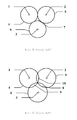
- a cellular network tries to cover a given area with base stations 1, 2, 3, managing radio communications with mobile sets in a sector around said base station 1, 2, 3.
- Said sector covered by a base station is called a cell.
- Said sector is here figured by a circle around said base station 1, 2, 3.
- Base stations 1, 2, 3, are spread/deployed over an area to cover, following a pattern as regular as possible.
- base stations are ideally located according to a triangular/hexagonal network pattern. All base stations 1, 2, 3, use the same frequency bandwidth.
- Around each base station 1, 2, 3, is figured the respective range 4, 5, 6, of said base station.
- the emission power and thus the CINR is maximum, while on the periphery of the circle the CINR equal 0dB.
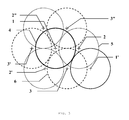
- the range 4 of a base station 1 overlaps the range 5 of its neighbour 2, interferences occur.
- the power emission is tuned for each base station 1, 2, 3, in order to reduce said interferences.
- Ranges 4, 5, 6 may be adjusted by reducing power emission in order to not overlap as figured in figure 1 . This leads to a dead zone 7 also called a hole in the coverage.
- Ranges 4, 5, 6 may be reduced in order not to create a dead zone 7, as figured in figure 2 , but this leads to interferences in overlapping zones 8, 9, 10.
- the main idea of the invention is to part the time into non overlapping tokens and to allocate a different token to each of neighbor base stations 1, 2, 3, so that, each base station 1, 2, 3, can use the radio media, that is the common frequency bandwidth, during its allocated token, one after the other. Out off its allocated token a base station remains silent. So doing, during a given token only one base station in a given neighboring is using the radio media. Accordingly, no interferences can occur in said neighboring. Such a parting of time is periodically repeated during each time block.
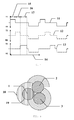
- Figure 4 illustrates an example by way of time diagrams.
- Three diagrams are figured representing from top to down the respective allocation of the commonly used frequency bandwidth to base station 1, 2, 3, where Ti figures the allocation to the transmitter of base station i and Ri figures the allocation to the receiver of base station i.
- the time block 14 is parted in order to create three tokens 15, 16, 17, since a neighboring of three cells/base stations 1, 2, 3, is considered. It can be seen that the tokens are not overlapping with one another or with any other allocation. It may be noted that not necessary the whole time block 14 is used to provide tokens.
- the end of the time block 14 is dedicated to receptors Ri, and all receptors are listening at the same time.
- the time parting is only used for transmitting, that is for the downlink, DL, direction.
- Figure 5 illustrates the improvement to the coverage that may be obtained by the invention.
- Three base stations 1, 2, 3, are displayed, each with a different token figured by a different type of hatching.
- the time reuse factor (or the number N of different tokens) is 3.
- a Dmin small-circle 19 represents the coverage area of one base station 1 at 20dB CINR.
- a Dmax big-circle 18 represents coverage area of this base station 1 at 0dB CINR level.
- 0dB CiNR level is considered as interference limit for one base station 1.
- Curve 21 represents the percentage of covered area as a function of CINR with a first propagation model. 62% of the area has a CINR > 19dB. Histogram 23 represents the percentage of the area covered by the same symbol coding. 45% of the area is covered with 6 3 ⁇ 4 symbol coding.
- Curve 20 is analogous to the curve 21 with a different propagation model (Open Area model).
- Histogram 22 is analogous to the histogram 23 with a different propagation model (Open Area model)
- the base stations 1, 2, 3, pertaining to a set of neighbouring base stations of different token dynamically negotiate the relative width of their tokens.
- Such a set may conveniently be called a virtual cell, since it acts as a prior art cell in many way.
- said base stations 1, 2, 3 regularly exchange information by any communication means or protocol, in order to reach a deal.
- a currently more loaded base station would, for instance, ask for more radio resources, that is bandwidth, allocation obtained by a broadening of its token.
- Said broadening may e.g. be obtained from the shrinkage of the token of at least one other lesser loaded base station.
- Such negotiation may be done permanently or periodically in order to adapt the load sharing between base stations of a virtual cell to better conform to the needs as expressed by the demands of the mobile sets located in the respective ranges of each said base station.
- base station 1 pertains to the virtual cell composed of base stations 1, 2, 3, and negotiates with said bases stations 2 and 3.
- base station 1 may also pertains to the virtual cell composed of base stations 1, 2', 3', in order to negotiate with neighbouring bases stations 2' and 3'.
- a virtual cell is also a useful association when it comes to transmit a frame. Since all base stations of a given virtual cell, by way of tokens, share a time block 14, the concatenation of all the bits transmitted by the base stations of said virtual cell among the several complementary tokens can be merged into one digital frame for travel across the network. For example in WIMAX network a frame is transmitted during each time block. Such a frame is then shared between the base stations of a virtual cell. In such a WIMAX network the time block 14 lasts 5ms.
- the number N of tokens is an important parameter to determine in order to optimize the global use of radio resources in the network.
- N increases, the size of a neighbouring set of base station or virtual cell also increases.
- the parting of the time block 14 to form an increased number of tokens leads to a reduction of the radio resources / bandwidth allocated to each base station.
- the optimal N is then difficult to accurately determine.
- the number N may be decreased.
- Such a determination of the number N can be done statically, one time, i.e. when installing the network. This may be suited to a network whose topology does not evolve to much. Said determination can also, advantageously be done dynamically, in order to take into account an ever possible change in network topology: addition of a base station, removal or failure of a base station.
- a first method is global in that it is managed by a global controller that can discuss with all the base stations among the network. Knowing the states of all bases stations and their respective locations, said global controller can determine the optimal N, using a known global simulation method.
- Number N can also be determined dynamically, for instance when at least one state of a base station changes, for example when said base station encounters a failure.
- Another way is to optimize said number N of tokens, without the use of a global controller, but just step by step, negotiating between neighbouring base stations. Such an optimization can be done for instance by negotiations between base stations combined with a trial and error method.
- Nmax a token
- the network can thus reach a functioning state.
- Said performance measures may comprise: bit error rates (BER), CINR estimations, interference estimations based either on network topology or on power emission levels obtained by auto-adjustment, or rate of coverage.
- BER bit error rates
- CINR estimations CINR estimations
- interference estimations based either on network topology or on power emission levels obtained by auto-adjustment, or rate of coverage.
- Said method is particularly targeted to wireless networks using the Scalable-Orthogonal Frequency Division Multiple Access, S-OFDMA, radio access technology.
- S-OFDMA Scalable-Orthogonal Frequency Division Multiple Access
- the method necessitates at least amendment of base stations to be able to apply said method, and for instance to be able to cope with neighbouring base stations during negotiation steps.
- the method may either be applied to upgrade existing base stations or may also preferentially be applied to a new network.
- a particular embodiment of the invention may be applied to the densification of a hot zone, i.e. a zone where a high density of users/mobile sets are asking for frequent numerous broadband services, e.g. a dense urban area.
- a secondary network may be deployed. Said secondary network must use a different frequency bandwidth from the one used by the existing primary network. Coverage in the served area is improved thanks to said secondary network comprising high density of base stations according to the invention, also called micro or pico base stations. Said micro or pico base stations offer smaller ranges but are much more numerous compared to macro base stations.
- Such a secondary network is advantageously organized following a regular pattern.
- the distance between two neighbours such micro or pico base stations is typically less than 100 m.
- a 1km 2 zone needs at least 100 such micro or pico base stations.
- high throughput modulation such as e.g. 64 QAM may be used on a large part of the zone (more than 75% of the footprint).
- Such a network may provide a minimum throughput of 1Gbps/km 2 in wireless to share between the users concentrated in said high density zone. This is to be compared with the prior art performance that never tops a 35 Mbits/km 2 limit.
Landscapes
- Engineering & Computer Science (AREA)
- Computer Networks & Wireless Communication (AREA)
- Signal Processing (AREA)
- Mobile Radio Communication Systems (AREA)
Priority Applications (2)
| Application Number | Priority Date | Filing Date | Title |
|---|---|---|---|
| ES09305028T ES2449216T3 (es) | 2009-01-12 | 2009-01-12 | Procedimiento para asignar recursos de radio entre estaciones de base que comparten el mismo ancho de banda de frecuencia, en una red celular inalámbrica |
| EP20090305028 EP2207376B1 (fr) | 2009-01-12 | 2009-01-12 | Procédé d'affectation de ressources radio entre des stations de base partageant la même bande passante de fréquences, dans un réseau cellulaire sans fil |
Applications Claiming Priority (1)
| Application Number | Priority Date | Filing Date | Title |
|---|---|---|---|
| EP20090305028 EP2207376B1 (fr) | 2009-01-12 | 2009-01-12 | Procédé d'affectation de ressources radio entre des stations de base partageant la même bande passante de fréquences, dans un réseau cellulaire sans fil |
Publications (2)
| Publication Number | Publication Date |
|---|---|
| EP2207376A1 true EP2207376A1 (fr) | 2010-07-14 |
| EP2207376B1 EP2207376B1 (fr) | 2014-01-08 |
Family
ID=40775159
Family Applications (1)
| Application Number | Title | Priority Date | Filing Date |
|---|---|---|---|
| EP20090305028 Not-in-force EP2207376B1 (fr) | 2009-01-12 | 2009-01-12 | Procédé d'affectation de ressources radio entre des stations de base partageant la même bande passante de fréquences, dans un réseau cellulaire sans fil |
Country Status (2)
| Country | Link |
|---|---|
| EP (1) | EP2207376B1 (fr) |
| ES (1) | ES2449216T3 (fr) |
Cited By (2)
| Publication number | Priority date | Publication date | Assignee | Title |
|---|---|---|---|---|
| EP3002970A1 (fr) * | 2014-09-30 | 2016-04-06 | Samsung Electro-Mechanics Co., Ltd. | Système de réseau radio et son procédé de fonctionnement |
| CN107835515A (zh) * | 2017-12-18 | 2018-03-23 | 海能达通信股份有限公司 | 一种分配带宽资源的方法及基站 |
Citations (3)
| Publication number | Priority date | Publication date | Assignee | Title |
|---|---|---|---|---|
| EP1037484A1 (fr) * | 1999-03-15 | 2000-09-20 | Motorola, Inc. | Partage temporel de ressources de communication dans des reseaux cellulaires de communication |
| EP1641295A1 (fr) * | 2004-09-23 | 2006-03-29 | Siemens Aktiengesellschaft | Attribution dynamique décentralisée des tranches de temps d'une bande de fréquences aux stations de base d'un système de radiocommunication |
| WO2008066214A1 (fr) * | 2006-12-01 | 2008-06-05 | Kmw Inc. | Procédé et appareil destinés à la gestion de secteurs d'une station de base dans des systèmes de télécommunication |
-
2009
- 2009-01-12 EP EP20090305028 patent/EP2207376B1/fr not_active Not-in-force
- 2009-01-12 ES ES09305028T patent/ES2449216T3/es active Active
Patent Citations (3)
| Publication number | Priority date | Publication date | Assignee | Title |
|---|---|---|---|---|
| EP1037484A1 (fr) * | 1999-03-15 | 2000-09-20 | Motorola, Inc. | Partage temporel de ressources de communication dans des reseaux cellulaires de communication |
| EP1641295A1 (fr) * | 2004-09-23 | 2006-03-29 | Siemens Aktiengesellschaft | Attribution dynamique décentralisée des tranches de temps d'une bande de fréquences aux stations de base d'un système de radiocommunication |
| WO2008066214A1 (fr) * | 2006-12-01 | 2008-06-05 | Kmw Inc. | Procédé et appareil destinés à la gestion de secteurs d'une station de base dans des systèmes de télécommunication |
Cited By (2)
| Publication number | Priority date | Publication date | Assignee | Title |
|---|---|---|---|---|
| EP3002970A1 (fr) * | 2014-09-30 | 2016-04-06 | Samsung Electro-Mechanics Co., Ltd. | Système de réseau radio et son procédé de fonctionnement |
| CN107835515A (zh) * | 2017-12-18 | 2018-03-23 | 海能达通信股份有限公司 | 一种分配带宽资源的方法及基站 |
Also Published As
| Publication number | Publication date |
|---|---|
| EP2207376B1 (fr) | 2014-01-08 |
| ES2449216T3 (es) | 2014-03-18 |
Similar Documents
| Publication | Publication Date | Title |
|---|---|---|
| DK1997334T3 (en) | Measuring supported dynamic frequency re-use in mobile telecommunications networks | |
| JP5249384B2 (ja) | Sc−fdmaシステムにおける隣接セル干渉の管理 | |
| JP4834326B2 (ja) | Ofdm移動通信システムのための電力プランニングを用いたセル間干渉調整方法 | |
| TWI406524B (zh) | 於一網路中配置次頻道之系統及方法 | |
| EP2044787B1 (fr) | Mécanisme perfectionné d'allocation de ressources radio | |
| KR101093854B1 (ko) | 시분할이중화/가상주파수분할 이중화 계층적 셀룰러 통신시스템 및 그 운용 방법 | |
| US7218936B2 (en) | Transmitting of cell management information in a cellular communication network | |
| CN100484294C (zh) | 在宽带无线接入通信系统中的切换方法和系统 | |
| CN102246575A (zh) | 用于针对无线通信系统中设备对设备通信的动态通信资源分配的装置和方法 | |
| CN1605220A (zh) | 用于蜂窝系统中最佳频谱利用的移动终端 | |
| CN101940019A (zh) | 在包括一组小区的蜂窝网络中根据射频频谱分配带宽的方法 | |
| US10349421B2 (en) | Resource allocation system and method adapted to implement device-to-device communications in wireless communication networks | |
| US7899463B2 (en) | Communication resource control enhancing time-based frequency reuse | |
| US7200407B1 (en) | Multiple reuse patterns for channels of wireless networks | |
| EP2207376B1 (fr) | Procédé d'affectation de ressources radio entre des stations de base partageant la même bande passante de fréquences, dans un réseau cellulaire sans fil | |
| WO2012003695A1 (fr) | Procédé d'affectation de ressources de liaison descendante et station de base | |
| EP2487976A1 (fr) | Appareil, système, procédé et programme informatique pour attribuer une ressource radio | |
| EP1694091B1 (fr) | Procédé de gestion de ressources pour améliorer la réutilisation des fréquences basée sur le temps dans un système de communication mobile | |
| EP2854301B1 (fr) | Procédé d'exploitation d'un système de communication sans fil, contrôleur d'antenne correspondant et noeud d'accès radio | |
| Shi et al. | Self-coexistence and spectrum sharing in device-to-device WRANs | |
| EP2207375A1 (fr) | Procédé de distribution de ressource d'un ensemble de ressources vers des cellules ou des secteurs d'un réseau de communication, dispositif central et réseau de communication correspondant | |
| Fang et al. | Joint Slot and Sub-channel Allocation Scheme in Wireless Self-Backhaul HetNets | |
| JP2009060179A (ja) | 通信装置および通信方法 | |
| KR20060056210A (ko) | 직교 주파수 분할 다중 접속 통신 시스템에서 핸드오버서비스 방법 | |
| KR20060056141A (ko) | 직교 주파수 다중 접속 방식의 무선 통신 시스템에서자원할당 방법 및 시스템 |
Legal Events
| Date | Code | Title | Description |
|---|---|---|---|
| PUAI | Public reference made under article 153(3) epc to a published international application that has entered the european phase |
Free format text: ORIGINAL CODE: 0009012 |
|
| AK | Designated contracting states |
Kind code of ref document: A1 Designated state(s): AT BE BG CH CY CZ DE DK EE ES FI FR GB GR HR HU IE IS IT LI LT LU LV MC MK MT NL NO PL PT RO SE SI SK TR |
|
| AX | Request for extension of the european patent |
Extension state: AL BA RS |
|
| 17P | Request for examination filed |
Effective date: 20110114 |
|
| AKX | Designation fees paid |
Designated state(s): AT BE BG CH CY CZ DE DK EE ES FI FR GB GR HR HU IE IS IT LI LT LU LV MC MK MT NL NO PL PT RO SE SI SK TR |
|
| RAP1 | Party data changed (applicant data changed or rights of an application transferred) |
Owner name: ALCATEL LUCENT |
|
| GRAP | Despatch of communication of intention to grant a patent |
Free format text: ORIGINAL CODE: EPIDOSNIGR1 |
|
| INTG | Intention to grant announced |
Effective date: 20130821 |
|
| RIN1 | Information on inventor provided before grant (corrected) |
Inventor name: LECLERC, BRICE Inventor name: BOUSQUET, THIERRY Inventor name: LIBCHABER, JACQUES |
|
| 111Z | Information provided on other rights and legal means of execution |
Free format text: AT BE BG CH CY CZ DE DK EE ES FI FR GB GR HR HU IE IS IT LI LT LU LV MC MK MT NL NO PL PT RO SE SI SK TR Effective date: 20130410 |
|
| GRAS | Grant fee paid |
Free format text: ORIGINAL CODE: EPIDOSNIGR3 |
|
| GRAA | (expected) grant |
Free format text: ORIGINAL CODE: 0009210 |
|
| AK | Designated contracting states |
Kind code of ref document: B1 Designated state(s): AT BE BG CH CY CZ DE DK EE ES FI FR GB GR HR HU IE IS IT LI LT LU LV MC MK MT NL NO PL PT RO SE SI SK TR |
|
| REG | Reference to a national code |
Ref country code: GB Ref legal event code: FG4D |
|
| REG | Reference to a national code |
Ref country code: CH Ref legal event code: EP |
|
| REG | Reference to a national code |
Ref country code: IE Ref legal event code: FG4D |
|
| REG | Reference to a national code |
Ref country code: AT Ref legal event code: REF Ref document number: 649341 Country of ref document: AT Kind code of ref document: T Effective date: 20140215 |
|
| REG | Reference to a national code |
Ref country code: DE Ref legal event code: R096 Ref document number: 602009021264 Country of ref document: DE Effective date: 20140220 |
|
| REG | Reference to a national code |
Ref country code: ES Ref legal event code: FG2A Ref document number: 2449216 Country of ref document: ES Kind code of ref document: T3 Effective date: 20140318 |
|
| REG | Reference to a national code |
Ref country code: AT Ref legal event code: MK05 Ref document number: 649341 Country of ref document: AT Kind code of ref document: T Effective date: 20140108 |
|
| REG | Reference to a national code |
Ref country code: NL Ref legal event code: VDEP Effective date: 20140108 |
|
| REG | Reference to a national code |
Ref country code: LT Ref legal event code: MG4D Ref country code: GB Ref legal event code: 732E Free format text: REGISTERED BETWEEN 20140529 AND 20140604 |
|
| PG25 | Lapsed in a contracting state [announced via postgrant information from national office to epo] |
Ref country code: NO Free format text: LAPSE BECAUSE OF FAILURE TO SUBMIT A TRANSLATION OF THE DESCRIPTION OR TO PAY THE FEE WITHIN THE PRESCRIBED TIME-LIMIT Effective date: 20140408 Ref country code: LT Free format text: LAPSE BECAUSE OF FAILURE TO SUBMIT A TRANSLATION OF THE DESCRIPTION OR TO PAY THE FEE WITHIN THE PRESCRIBED TIME-LIMIT Effective date: 20140108 Ref country code: IS Free format text: LAPSE BECAUSE OF FAILURE TO SUBMIT A TRANSLATION OF THE DESCRIPTION OR TO PAY THE FEE WITHIN THE PRESCRIBED TIME-LIMIT Effective date: 20140508 |
|
| REG | Reference to a national code |
Ref country code: CH Ref legal event code: PCOW Free format text: NEW ADDRESS: 148/152 ROUTE DE LA REINE, 92100 BOULOGNE-BILLANCOURT (FR) |
|
| REG | Reference to a national code |
Ref country code: FR Ref legal event code: GC Effective date: 20140602 |
|
| RAP2 | Party data changed (patent owner data changed or rights of a patent transferred) |
Owner name: ALCATEL LUCENT |
|
| PG25 | Lapsed in a contracting state [announced via postgrant information from national office to epo] |
Ref country code: NL Free format text: LAPSE BECAUSE OF FAILURE TO SUBMIT A TRANSLATION OF THE DESCRIPTION OR TO PAY THE FEE WITHIN THE PRESCRIBED TIME-LIMIT Effective date: 20140108 Ref country code: SE Free format text: LAPSE BECAUSE OF FAILURE TO SUBMIT A TRANSLATION OF THE DESCRIPTION OR TO PAY THE FEE WITHIN THE PRESCRIBED TIME-LIMIT Effective date: 20140108 Ref country code: CY Free format text: LAPSE BECAUSE OF FAILURE TO SUBMIT A TRANSLATION OF THE DESCRIPTION OR TO PAY THE FEE WITHIN THE PRESCRIBED TIME-LIMIT Effective date: 20140108 Ref country code: PT Free format text: LAPSE BECAUSE OF FAILURE TO SUBMIT A TRANSLATION OF THE DESCRIPTION OR TO PAY THE FEE WITHIN THE PRESCRIBED TIME-LIMIT Effective date: 20140508 Ref country code: AT Free format text: LAPSE BECAUSE OF FAILURE TO SUBMIT A TRANSLATION OF THE DESCRIPTION OR TO PAY THE FEE WITHIN THE PRESCRIBED TIME-LIMIT Effective date: 20140108 Ref country code: FI Free format text: LAPSE BECAUSE OF FAILURE TO SUBMIT A TRANSLATION OF THE DESCRIPTION OR TO PAY THE FEE WITHIN THE PRESCRIBED TIME-LIMIT Effective date: 20140108 |
|
| REG | Reference to a national code |
Ref country code: CH Ref legal event code: PL |
|
| PG25 | Lapsed in a contracting state [announced via postgrant information from national office to epo] |
Ref country code: HR Free format text: LAPSE BECAUSE OF FAILURE TO SUBMIT A TRANSLATION OF THE DESCRIPTION OR TO PAY THE FEE WITHIN THE PRESCRIBED TIME-LIMIT Effective date: 20140108 Ref country code: LV Free format text: LAPSE BECAUSE OF FAILURE TO SUBMIT A TRANSLATION OF THE DESCRIPTION OR TO PAY THE FEE WITHIN THE PRESCRIBED TIME-LIMIT Effective date: 20140108 Ref country code: BE Free format text: LAPSE BECAUSE OF FAILURE TO SUBMIT A TRANSLATION OF THE DESCRIPTION OR TO PAY THE FEE WITHIN THE PRESCRIBED TIME-LIMIT Effective date: 20140108 |
|
| REG | Reference to a national code |
Ref country code: DE Ref legal event code: R097 Ref document number: 602009021264 Country of ref document: DE |
|
| PG25 | Lapsed in a contracting state [announced via postgrant information from national office to epo] |
Ref country code: RO Free format text: LAPSE BECAUSE OF FAILURE TO SUBMIT A TRANSLATION OF THE DESCRIPTION OR TO PAY THE FEE WITHIN THE PRESCRIBED TIME-LIMIT Effective date: 20140108 Ref country code: CZ Free format text: LAPSE BECAUSE OF FAILURE TO SUBMIT A TRANSLATION OF THE DESCRIPTION OR TO PAY THE FEE WITHIN THE PRESCRIBED TIME-LIMIT Effective date: 20140108 Ref country code: LI Free format text: LAPSE BECAUSE OF NON-PAYMENT OF DUE FEES Effective date: 20140131 Ref country code: MC Free format text: LAPSE BECAUSE OF FAILURE TO SUBMIT A TRANSLATION OF THE DESCRIPTION OR TO PAY THE FEE WITHIN THE PRESCRIBED TIME-LIMIT Effective date: 20140108 Ref country code: EE Free format text: LAPSE BECAUSE OF FAILURE TO SUBMIT A TRANSLATION OF THE DESCRIPTION OR TO PAY THE FEE WITHIN THE PRESCRIBED TIME-LIMIT Effective date: 20140108 Ref country code: CH Free format text: LAPSE BECAUSE OF NON-PAYMENT OF DUE FEES Effective date: 20140131 Ref country code: DK Free format text: LAPSE BECAUSE OF FAILURE TO SUBMIT A TRANSLATION OF THE DESCRIPTION OR TO PAY THE FEE WITHIN THE PRESCRIBED TIME-LIMIT Effective date: 20140108 |
|
| REG | Reference to a national code |
Ref country code: IE Ref legal event code: MM4A |
|
| PLBE | No opposition filed within time limit |
Free format text: ORIGINAL CODE: 0009261 |
|
| STAA | Information on the status of an ep patent application or granted ep patent |
Free format text: STATUS: NO OPPOSITION FILED WITHIN TIME LIMIT |
|
| PG25 | Lapsed in a contracting state [announced via postgrant information from national office to epo] |
Ref country code: SK Free format text: LAPSE BECAUSE OF FAILURE TO SUBMIT A TRANSLATION OF THE DESCRIPTION OR TO PAY THE FEE WITHIN THE PRESCRIBED TIME-LIMIT Effective date: 20140108 Ref country code: PL Free format text: LAPSE BECAUSE OF FAILURE TO SUBMIT A TRANSLATION OF THE DESCRIPTION OR TO PAY THE FEE WITHIN THE PRESCRIBED TIME-LIMIT Effective date: 20140108 |
|
| REG | Reference to a national code |
Ref country code: FR Ref legal event code: RG Effective date: 20141016 |
|
| 26N | No opposition filed |
Effective date: 20141009 |
|
| REG | Reference to a national code |
Ref country code: DE Ref legal event code: R097 Ref document number: 602009021264 Country of ref document: DE Effective date: 20141009 |
|
| REG | Reference to a national code |
Ref country code: FR Ref legal event code: PLFP Year of fee payment: 7 |
|
| PG25 | Lapsed in a contracting state [announced via postgrant information from national office to epo] |
Ref country code: IE Free format text: LAPSE BECAUSE OF NON-PAYMENT OF DUE FEES Effective date: 20140112 |
|
| PG25 | Lapsed in a contracting state [announced via postgrant information from national office to epo] |
Ref country code: SI Free format text: LAPSE BECAUSE OF FAILURE TO SUBMIT A TRANSLATION OF THE DESCRIPTION OR TO PAY THE FEE WITHIN THE PRESCRIBED TIME-LIMIT Effective date: 20140108 |
|
| REG | Reference to a national code |
Ref country code: FR Ref legal event code: PLFP Year of fee payment: 8 |
|
| PG25 | Lapsed in a contracting state [announced via postgrant information from national office to epo] |
Ref country code: MT Free format text: LAPSE BECAUSE OF FAILURE TO SUBMIT A TRANSLATION OF THE DESCRIPTION OR TO PAY THE FEE WITHIN THE PRESCRIBED TIME-LIMIT Effective date: 20140108 |
|
| PG25 | Lapsed in a contracting state [announced via postgrant information from national office to epo] |
Ref country code: BG Free format text: LAPSE BECAUSE OF FAILURE TO SUBMIT A TRANSLATION OF THE DESCRIPTION OR TO PAY THE FEE WITHIN THE PRESCRIBED TIME-LIMIT Effective date: 20140108 |
|
| PG25 | Lapsed in a contracting state [announced via postgrant information from national office to epo] |
Ref country code: GR Free format text: LAPSE BECAUSE OF FAILURE TO SUBMIT A TRANSLATION OF THE DESCRIPTION OR TO PAY THE FEE WITHIN THE PRESCRIBED TIME-LIMIT Effective date: 20140409 |
|
| PG25 | Lapsed in a contracting state [announced via postgrant information from national office to epo] |
Ref country code: TR Free format text: LAPSE BECAUSE OF FAILURE TO SUBMIT A TRANSLATION OF THE DESCRIPTION OR TO PAY THE FEE WITHIN THE PRESCRIBED TIME-LIMIT Effective date: 20140108 Ref country code: HU Free format text: LAPSE BECAUSE OF FAILURE TO SUBMIT A TRANSLATION OF THE DESCRIPTION OR TO PAY THE FEE WITHIN THE PRESCRIBED TIME-LIMIT; INVALID AB INITIO Effective date: 20090112 Ref country code: LU Free format text: LAPSE BECAUSE OF NON-PAYMENT OF DUE FEES Effective date: 20140112 |
|
| REG | Reference to a national code |
Ref country code: FR Ref legal event code: PLFP Year of fee payment: 9 |
|
| REG | Reference to a national code |
Ref country code: FR Ref legal event code: PLFP Year of fee payment: 10 |
|
| PG25 | Lapsed in a contracting state [announced via postgrant information from national office to epo] |
Ref country code: MK Free format text: LAPSE BECAUSE OF FAILURE TO SUBMIT A TRANSLATION OF THE DESCRIPTION OR TO PAY THE FEE WITHIN THE PRESCRIBED TIME-LIMIT Effective date: 20140108 |
|
| PGFP | Annual fee paid to national office [announced via postgrant information from national office to epo] |
Ref country code: FR Payment date: 20191216 Year of fee payment: 12 |
|
| PGFP | Annual fee paid to national office [announced via postgrant information from national office to epo] |
Ref country code: IT Payment date: 20200114 Year of fee payment: 12 Ref country code: ES Payment date: 20200203 Year of fee payment: 12 Ref country code: DE Payment date: 20191231 Year of fee payment: 12 Ref country code: GB Payment date: 20200102 Year of fee payment: 12 |
|
| REG | Reference to a national code |
Ref country code: DE Ref legal event code: R119 Ref document number: 602009021264 Country of ref document: DE |
|
| GBPC | Gb: european patent ceased through non-payment of renewal fee |
Effective date: 20210112 |
|
| PG25 | Lapsed in a contracting state [announced via postgrant information from national office to epo] |
Ref country code: FR Free format text: LAPSE BECAUSE OF NON-PAYMENT OF DUE FEES Effective date: 20210131 |
|
| PG25 | Lapsed in a contracting state [announced via postgrant information from national office to epo] |
Ref country code: GB Free format text: LAPSE BECAUSE OF NON-PAYMENT OF DUE FEES Effective date: 20210112 Ref country code: DE Free format text: LAPSE BECAUSE OF NON-PAYMENT OF DUE FEES Effective date: 20210803 |
|
| REG | Reference to a national code |
Ref country code: ES Ref legal event code: FD2A Effective date: 20220422 |
|
| PG25 | Lapsed in a contracting state [announced via postgrant information from national office to epo] |
Ref country code: IT Free format text: LAPSE BECAUSE OF NON-PAYMENT OF DUE FEES Effective date: 20210112 |
|
| PG25 | Lapsed in a contracting state [announced via postgrant information from national office to epo] |
Ref country code: ES Free format text: LAPSE BECAUSE OF NON-PAYMENT OF DUE FEES Effective date: 20210113 |