EP2207904B1 - Cuir revêtu - Google Patents
Cuir revêtu Download PDFInfo
- Publication number
- EP2207904B1 EP2207904B1 EP20080802045 EP08802045A EP2207904B1 EP 2207904 B1 EP2207904 B1 EP 2207904B1 EP 20080802045 EP20080802045 EP 20080802045 EP 08802045 A EP08802045 A EP 08802045A EP 2207904 B1 EP2207904 B1 EP 2207904B1
- Authority
- EP
- European Patent Office
- Prior art keywords
- leather
- layer
- polyurethane
- exterior
- silicone
- Prior art date
- Legal status (The legal status is an assumption and is not a legal conclusion. Google has not performed a legal analysis and makes no representation as to the accuracy of the status listed.)
- Not-in-force
Links
- 239000010985 leather Substances 0.000 title claims description 232
- 239000010410 layer Substances 0.000 claims description 342
- 229920001296 polysiloxane Polymers 0.000 claims description 86
- 238000000576 coating method Methods 0.000 claims description 60
- 239000011248 coating agent Substances 0.000 claims description 57
- XLYOFNOQVPJJNP-UHFFFAOYSA-N water Substances O XLYOFNOQVPJJNP-UHFFFAOYSA-N 0.000 claims description 54
- 229920002635 polyurethane Polymers 0.000 claims description 53
- 239000004814 polyurethane Substances 0.000 claims description 53
- 239000011148 porous material Substances 0.000 claims description 28
- 239000000839 emulsion Substances 0.000 claims description 27
- 239000002245 particle Substances 0.000 claims description 24
- 239000006185 dispersion Substances 0.000 claims description 22
- -1 polysiloxane Polymers 0.000 claims description 22
- 239000000463 material Substances 0.000 claims description 20
- 229920000642 polymer Polymers 0.000 claims description 20
- 229920003009 polyurethane dispersion Polymers 0.000 claims description 14
- 239000003981 vehicle Substances 0.000 claims description 14
- 230000035699 permeability Effects 0.000 claims description 13
- 239000005871 repellent Substances 0.000 claims description 12
- 230000001070 adhesive effect Effects 0.000 claims description 8
- 238000000227 grinding Methods 0.000 claims description 8
- 239000007787 solid Substances 0.000 claims description 8
- 238000004132 cross linking Methods 0.000 claims description 7
- 239000004744 fabric Substances 0.000 claims description 7
- 239000000654 additive Substances 0.000 claims description 6
- 239000003995 emulsifying agent Substances 0.000 claims description 6
- 238000012856 packing Methods 0.000 claims description 6
- 229920002379 silicone rubber Polymers 0.000 claims description 6
- 239000004945 silicone rubber Substances 0.000 claims description 6
- ATJFFYVFTNAWJD-UHFFFAOYSA-N Tin Chemical compound [Sn] ATJFFYVFTNAWJD-UHFFFAOYSA-N 0.000 claims description 5
- 239000004005 microsphere Substances 0.000 claims description 5
- 239000011527 polyurethane coating Substances 0.000 claims description 5
- 239000002344 surface layer Substances 0.000 claims description 5
- 229920001169 thermoplastic Polymers 0.000 claims description 5
- 239000000758 substrate Substances 0.000 claims description 4
- 239000004416 thermosoftening plastic Substances 0.000 claims description 4
- 229920003235 aromatic polyamide Polymers 0.000 claims description 3
- 150000001875 compounds Chemical class 0.000 claims description 3
- 230000000996 additive effect Effects 0.000 claims description 2
- 125000000956 methoxy group Chemical group [H]C([H])([H])O* 0.000 claims description 2
- 239000000203 mixture Substances 0.000 claims description 2
- 230000001464 adherent effect Effects 0.000 claims 5
- 229920005573 silicon-containing polymer Polymers 0.000 claims 2
- 230000001413 cellular effect Effects 0.000 claims 1
- 229920001971 elastomer Polymers 0.000 claims 1
- 230000035784 germination Effects 0.000 claims 1
- 238000005213 imbibition Methods 0.000 claims 1
- 230000001681 protective effect Effects 0.000 claims 1
- 230000007704 transition Effects 0.000 claims 1
- 239000012790 adhesive layer Substances 0.000 description 21
- 238000005299 abrasion Methods 0.000 description 18
- 239000002105 nanoparticle Substances 0.000 description 16
- 230000000694 effects Effects 0.000 description 12
- 238000012360 testing method Methods 0.000 description 12
- 230000008859 change Effects 0.000 description 10
- 239000011859 microparticle Substances 0.000 description 9
- 239000000835 fiber Substances 0.000 description 8
- 230000002209 hydrophobic effect Effects 0.000 description 8
- 210000004209 hair Anatomy 0.000 description 6
- 238000004519 manufacturing process Methods 0.000 description 5
- 239000002861 polymer material Substances 0.000 description 5
- 238000011109 contamination Methods 0.000 description 4
- 230000007062 hydrolysis Effects 0.000 description 4
- 238000006460 hydrolysis reaction Methods 0.000 description 4
- 238000005470 impregnation Methods 0.000 description 4
- 239000007788 liquid Substances 0.000 description 4
- 238000000034 method Methods 0.000 description 4
- 239000000049 pigment Substances 0.000 description 4
- 239000004753 textile Substances 0.000 description 4
- 239000000853 adhesive Substances 0.000 description 3
- 238000004873 anchoring Methods 0.000 description 3
- 230000008901 benefit Effects 0.000 description 3
- 239000000356 contaminant Substances 0.000 description 3
- 230000000149 penetrating effect Effects 0.000 description 3
- 230000008569 process Effects 0.000 description 3
- 230000002829 reductive effect Effects 0.000 description 3
- 238000001878 scanning electron micrograph Methods 0.000 description 3
- 229920002050 silicone resin Polymers 0.000 description 3
- 238000007711 solidification Methods 0.000 description 3
- 230000008023 solidification Effects 0.000 description 3
- 239000000126 substance Substances 0.000 description 3
- 239000004971 Cross linker Substances 0.000 description 2
- 238000010521 absorption reaction Methods 0.000 description 2
- 230000002411 adverse Effects 0.000 description 2
- 230000015572 biosynthetic process Effects 0.000 description 2
- 239000000470 constituent Substances 0.000 description 2
- 125000000118 dimethyl group Chemical group [H]C([H])([H])* 0.000 description 2
- KPUWHANPEXNPJT-UHFFFAOYSA-N disiloxane Chemical class [SiH3]O[SiH3] KPUWHANPEXNPJT-UHFFFAOYSA-N 0.000 description 2
- 239000000428 dust Substances 0.000 description 2
- 239000006260 foam Substances 0.000 description 2
- 230000005661 hydrophobic surface Effects 0.000 description 2
- 230000006872 improvement Effects 0.000 description 2
- 238000007373 indentation Methods 0.000 description 2
- 230000003993 interaction Effects 0.000 description 2
- 239000011159 matrix material Substances 0.000 description 2
- 238000005259 measurement Methods 0.000 description 2
- 239000002052 molecular layer Substances 0.000 description 2
- 239000003921 oil Substances 0.000 description 2
- 230000000704 physical effect Effects 0.000 description 2
- 229920003023 plastic Polymers 0.000 description 2
- 239000004033 plastic Substances 0.000 description 2
- BASFCYQUMIYNBI-UHFFFAOYSA-N platinum Chemical compound [Pt] BASFCYQUMIYNBI-UHFFFAOYSA-N 0.000 description 2
- 230000008092 positive effect Effects 0.000 description 2
- 235000020095 red wine Nutrition 0.000 description 2
- 229920005989 resin Polymers 0.000 description 2
- 239000011347 resin Substances 0.000 description 2
- 239000002356 single layer Substances 0.000 description 2
- 239000002689 soil Substances 0.000 description 2
- 238000003860 storage Methods 0.000 description 2
- POAOYUHQDCAZBD-UHFFFAOYSA-N 2-butoxyethanol Chemical compound CCCCOCCO POAOYUHQDCAZBD-UHFFFAOYSA-N 0.000 description 1
- NIXOWILDQLNWCW-UHFFFAOYSA-M Acrylate Chemical compound [O-]C(=O)C=C NIXOWILDQLNWCW-UHFFFAOYSA-M 0.000 description 1
- 241000283707 Capra Species 0.000 description 1
- 240000002853 Nelumbo nucifera Species 0.000 description 1
- 235000006508 Nelumbo nucifera Nutrition 0.000 description 1
- 235000006510 Nelumbo pentapetala Nutrition 0.000 description 1
- 239000000020 Nitrocellulose Substances 0.000 description 1
- 229920005830 Polyurethane Foam Polymers 0.000 description 1
- 229920002472 Starch Polymers 0.000 description 1
- 230000002745 absorbent Effects 0.000 description 1
- 239000002250 absorbent Substances 0.000 description 1
- 150000001252 acrylic acid derivatives Chemical class 0.000 description 1
- 230000009471 action Effects 0.000 description 1
- 238000005452 bending Methods 0.000 description 1
- 239000003054 catalyst Substances 0.000 description 1
- 238000005253 cladding Methods 0.000 description 1
- 235000016213 coffee Nutrition 0.000 description 1
- 235000013353 coffee beverage Nutrition 0.000 description 1
- 230000001427 coherent effect Effects 0.000 description 1
- 239000003086 colorant Substances 0.000 description 1
- 125000004122 cyclic group Chemical group 0.000 description 1
- 230000001419 dependent effect Effects 0.000 description 1
- 238000001514 detection method Methods 0.000 description 1
- 238000002845 discoloration Methods 0.000 description 1
- 239000004815 dispersion polymer Substances 0.000 description 1
- 238000004043 dyeing Methods 0.000 description 1
- 238000004049 embossing Methods 0.000 description 1
- 238000005516 engineering process Methods 0.000 description 1
- 230000007613 environmental effect Effects 0.000 description 1
- 230000008020 evaporation Effects 0.000 description 1
- 238000001704 evaporation Methods 0.000 description 1
- 230000002349 favourable effect Effects 0.000 description 1
- 239000005002 finish coating Substances 0.000 description 1
- 239000003063 flame retardant Substances 0.000 description 1
- 230000002538 fungal effect Effects 0.000 description 1
- 239000011521 glass Substances 0.000 description 1
- 235000008960 ketchup Nutrition 0.000 description 1
- 239000000314 lubricant Substances 0.000 description 1
- 235000013336 milk Nutrition 0.000 description 1
- 239000008267 milk Substances 0.000 description 1
- 210000004080 milk Anatomy 0.000 description 1
- 239000002103 nanocoating Substances 0.000 description 1
- 229920001220 nitrocellulos Polymers 0.000 description 1
- 235000019645 odor Nutrition 0.000 description 1
- 230000003287 optical effect Effects 0.000 description 1
- 239000003973 paint Substances 0.000 description 1
- 230000035515 penetration Effects 0.000 description 1
- 238000011056 performance test Methods 0.000 description 1
- 229910052697 platinum Inorganic materials 0.000 description 1
- 229920006264 polyurethane film Polymers 0.000 description 1
- 239000011496 polyurethane foam Substances 0.000 description 1
- 238000003825 pressing Methods 0.000 description 1
- 230000002265 prevention Effects 0.000 description 1
- 238000012545 processing Methods 0.000 description 1
- 239000011241 protective layer Substances 0.000 description 1
- 230000009467 reduction Effects 0.000 description 1
- 230000002940 repellent Effects 0.000 description 1
- 230000000717 retained effect Effects 0.000 description 1
- 238000005096 rolling process Methods 0.000 description 1
- 150000003839 salts Chemical class 0.000 description 1
- 231100000241 scar Toxicity 0.000 description 1
- 238000007789 sealing Methods 0.000 description 1
- 238000009958 sewing Methods 0.000 description 1
- 238000005507 spraying Methods 0.000 description 1
- 235000019698 starch Nutrition 0.000 description 1
- 239000008107 starch Substances 0.000 description 1
- 230000003068 static effect Effects 0.000 description 1
- 230000002889 sympathetic effect Effects 0.000 description 1
- 230000000007 visual effect Effects 0.000 description 1
- 230000002087 whitening effect Effects 0.000 description 1
Images




Classifications
-
- C—CHEMISTRY; METALLURGY
- C14—SKINS; HIDES; PELTS; LEATHER
- C14C—CHEMICAL TREATMENT OF HIDES, SKINS OR LEATHER, e.g. TANNING, IMPREGNATING, FINISHING; APPARATUS THEREFOR; COMPOSITIONS FOR TANNING
- C14C11/00—Surface finishing of leather
- C14C11/003—Surface finishing of leather using macromolecular compounds
- C14C11/006—Surface finishing of leather using macromolecular compounds using polymeric products of isocyanates (or isothiocyanates) with compounds having active hydrogen
-
- A—HUMAN NECESSITIES
- A43—FOOTWEAR
- A43B—CHARACTERISTIC FEATURES OF FOOTWEAR; PARTS OF FOOTWEAR
- A43B7/00—Footwear with health or hygienic arrangements
- A43B7/12—Special watertight footwear
-
- A—HUMAN NECESSITIES
- A43—FOOTWEAR
- A43B—CHARACTERISTIC FEATURES OF FOOTWEAR; PARTS OF FOOTWEAR
- A43B7/00—Footwear with health or hygienic arrangements
- A43B7/12—Special watertight footwear
- A43B7/125—Special watertight footwear provided with a vapour permeable member, e.g. a membrane
-
- Y—GENERAL TAGGING OF NEW TECHNOLOGICAL DEVELOPMENTS; GENERAL TAGGING OF CROSS-SECTIONAL TECHNOLOGIES SPANNING OVER SEVERAL SECTIONS OF THE IPC; TECHNICAL SUBJECTS COVERED BY FORMER USPC CROSS-REFERENCE ART COLLECTIONS [XRACs] AND DIGESTS
- Y10—TECHNICAL SUBJECTS COVERED BY FORMER USPC
- Y10T—TECHNICAL SUBJECTS COVERED BY FORMER US CLASSIFICATION
- Y10T428/00—Stock material or miscellaneous articles
- Y10T428/24—Structurally defined web or sheet [e.g., overall dimension, etc.]
- Y10T428/24355—Continuous and nonuniform or irregular surface on layer or component [e.g., roofing, etc.]
-
- Y—GENERAL TAGGING OF NEW TECHNOLOGICAL DEVELOPMENTS; GENERAL TAGGING OF CROSS-SECTIONAL TECHNOLOGIES SPANNING OVER SEVERAL SECTIONS OF THE IPC; TECHNICAL SUBJECTS COVERED BY FORMER USPC CROSS-REFERENCE ART COLLECTIONS [XRACs] AND DIGESTS
- Y10—TECHNICAL SUBJECTS COVERED BY FORMER USPC
- Y10T—TECHNICAL SUBJECTS COVERED BY FORMER US CLASSIFICATION
- Y10T428/00—Stock material or miscellaneous articles
- Y10T428/25—Web or sheet containing structurally defined element or component and including a second component containing structurally defined particles
- Y10T428/254—Polymeric or resinous material
-
- Y—GENERAL TAGGING OF NEW TECHNOLOGICAL DEVELOPMENTS; GENERAL TAGGING OF CROSS-SECTIONAL TECHNOLOGIES SPANNING OVER SEVERAL SECTIONS OF THE IPC; TECHNICAL SUBJECTS COVERED BY FORMER USPC CROSS-REFERENCE ART COLLECTIONS [XRACs] AND DIGESTS
- Y10—TECHNICAL SUBJECTS COVERED BY FORMER USPC
- Y10T—TECHNICAL SUBJECTS COVERED BY FORMER US CLASSIFICATION
- Y10T428/00—Stock material or miscellaneous articles
- Y10T428/29—Coated or structually defined flake, particle, cell, strand, strand portion, rod, filament, macroscopic fiber or mass thereof
- Y10T428/2982—Particulate matter [e.g., sphere, flake, etc.]
- Y10T428/2991—Coated
-
- Y—GENERAL TAGGING OF NEW TECHNOLOGICAL DEVELOPMENTS; GENERAL TAGGING OF CROSS-SECTIONAL TECHNOLOGIES SPANNING OVER SEVERAL SECTIONS OF THE IPC; TECHNICAL SUBJECTS COVERED BY FORMER USPC CROSS-REFERENCE ART COLLECTIONS [XRACs] AND DIGESTS
- Y10—TECHNICAL SUBJECTS COVERED BY FORMER USPC
- Y10T—TECHNICAL SUBJECTS COVERED BY FORMER US CLASSIFICATION
- Y10T428/00—Stock material or miscellaneous articles
- Y10T428/31504—Composite [nonstructural laminate]
- Y10T428/31551—Of polyamidoester [polyurethane, polyisocyanate, polycarbamate, etc.]
- Y10T428/31558—Next to animal skin or membrane
Definitions
- the present invention relates to a novel coated leather, preferably split leather, in particular cow split leather, according to the preamble of claim 1, which has the features mentioned in the characterizing part of this claim.
- It refers to a leather which is characterized by a perfect nubuck handle and nubuck look, which is suitable for shoes, sandals and special shoes, for saddles for motorcycles and bicycles as well as for the interior equipment of boats, for medical and hospital equipment and the like. Furthermore, it is to be used for cladding vehicle interior components and has a new nubuck equivalent optical and haptic quality.
- the model for the new coated leather is genuine nubuck leather: The same results from sanding the grain top side. It forms fine fibers and the surface is dull and fine-grained rough. Nubuck leather has an interesting and beautiful appearance in the new state and has an optimal feel.
- the abrasion resistance is not sufficient especially for safety shoes and sports shoes, because even after a short use of the shoes at the stressed areas an abrasion wear, which is always associated with a color change shows.
- nubuck leather in particular in the automotive sector, as good as not used and in shoes and other commodities leathers are impregnated with oily and waxy substances, which although the performance characteristics are improved, the appearance and feel but deteriorate significantly.
- the object of the invention was to provide a leather whose surface is similar in terms of look and feel of the surface of a real Nubukleders, but without the, as mentioned above, use-limiting To show disadvantages.
- the object of the invention is that the new nubuck leather does not become soiled and that it does not become shiny under extreme conditions and does not change its surface texture and color.
- the main drawback is that very much which polymeric foam coatings do not grind well on the leather.
- the softness of a polymer is essential for a good feel.
- DE 2010 332 A1 have been known to coagulate produced, trimmed polyurethane films to hide on leather. These films are thermoplastic, so not abrasion resistant, their cell structure is sponge-like open-celled, so that contamination can easily penetrate, anchor themselves in the cells and bad if not impossible to remove.
- EP 1644 539 B1 It is known to produce a nubuck effect on leather by reversibly producing in a silicone mold a film of polyurethane from which fine hairs, which consist of the same material, protrude and connect this film with the leather. These hairs have a microscopically rough surface, a maximum diameter of 100 microns and tend due to the roughness and their arrangement also to contamination. The resulting haptic is in itself high quality, as well as the look, but the overall impression is closer to a textile suede material than a nubuck leather. For heavy use, the fine hairs can be rubbed off and the Oberfiambae is unsightly and loses its sympathetic grip.
- the optimal nubuck surface is therefore a hybrid.
- the smooth surfaces of the recesses are larger in area than the matte surfaces of the sheathing webs, the surface has the same languidness as a natural nubuck leather.
- the smooth surfaces of the microwells are not perceived, even if, as particularly preferred, they are not only smooth but even shiny.
- the eye only recognizes a uniformly matt surface with the look of real nubuck leather. Even when you touch the micro-wells are not perceived. Due to the matt surfaces of the borders and their softness, the thin polymer surface feels like a high quality natural nubuck leather.
- black nubuck leathers In a gloss grading according to DIN 67530, measured at a light incidence angle of 60 °, black nubuck leathers have a gloss level between 0.1 and 0.4, as does the leather according to the invention. The same applies to measurements in other colors.
- the new coated leather preferably split leather, with coating
- the surface in particular of a soft cross-linked polyurethane, preferably based on or from a known solidified polyurethane dispersion, it can of course be used in the leather industry finishing additives such.
- a soft cross-linked polyurethane preferably based on or from a known solidified polyurethane dispersion
- the surface was formed on a removable silicone rubber backing and bonded to the leather by one or more polyurethane-based adhesive layers.
- the adhesive layer or its layers are also crosslinked.
- the adhesive layer or layer layers are formed from polyurethane dispersions, preferably from those which have a crystalline structure.
- total coating includes the outer layer as well as the adhesive layer, which may be multi-layered, e.g. has a middle and a tie layer layer.
- the new leather absorbs no water from the surface, furthermore it has an excellent resistance to abrasion of paint in both dry and wet condition, it is mechanically extremely resistant to abrasion and the individual layers or layers separate under extreme loads and at Do not interact with moisture. It also provides protection against wet surface soiling.
- the significantly reduced dirt pickup results from the smooth surface of the wells as well as from the small cross section of the openings. Coarser dirt can not penetrate at all.
- the soft, elastic webs transport when moving dirt from the hemispherical, hollow and inside smooth depressions.
- the microstructure of the surfaces of the new leather is in itself completely opposite to the known, dirt-repellent lotus structure with finest hairs, the new surfaces are not prone to contamination and tend to move and / or presence of water for self-emptying of dirt particles, which is completely surprising.
- the depressions are smooth according to the invention, their inner surface is preferably glossy in itself. However, the overall surface of the new leather or its visual impression is always dull, similar to real nubuck leather.
- the surface of the new leather is extremely easy to handle and has a feel, as they have only very high quality, nubuck leather.
- a coated leather preferably split leather
- already high adhesive properties are required and this meets the new coated leather or split leather according to the invention easily.
- Due to the known use of polyurethane dispersions having a crystalline structure, which additionally contains a crosslinker, for the adhesive or adhesive layers or layer layers creates a nearly inseparable connection with each other and with the leather, especially when one of the adhesive or adhesive layers is still wet when brought together before pressing.
- the complete coating advantageously has a maximum thickness of only 0.15 mm, so that the coated leather can be referred to as "genuine leather".
- the overall coating may be two or more layers. A preferably provided, very thin silicone pad remains unconsidered.
- a split leather for example, parts of the dashboard of motor vehicles, which, if it is foamed, does not absorb water from the surface, to hinder or exclude the expansion and shrinkage effects usually caused by leather .
- the leather used in this way is durable for a long time in the climate change test and in hot exposure and thus meets in particular the requirements of the vehicle industry for all types of vehicles.
- the new leather is the task of the new leather to use the same for safety shoes of groups 1 and 2.
- the leather may have a mechanical hole perforation, as will be explained in more detail later.
- the new coated leather in which this re-dyeing is not necessary, shows the same or even better results than the genuine nubuck leather in a gloss level detection, measured according to DIN 67530 at 60 ° incidence angle, with the new leather in the preferred embodiment with direct Incident light and corresponding magnification recognizes the smooth, preferably shiny surface of the wells.
- the leathers which are equipped with the novel nubuck-like surface layer, meet all the requirements and parameters of the vehicle and safety shoe industry. They are resistant to bending, soft and extremely abrasion resistant. Tested in accordance with DIN EN ISO 14327 with the friction wheel H22, the surface has e.g. after 30,000 cycles still no damage.
- nubuck leather For nubuck leather, however, damage with color changes is visible after only 1,000 cycles. Also tested according to DIN EN ISO 12947-1 after 50,000 cycles, in the dry state, this finding has been confirmed, in contrast to nubuck leather, which already changes after 1000 cycles.
- the adhesion after a storage of water for 24 h in accordance with ISO 11644 is easily met with 10 N.
- the value is about three times higher than conventional car springs. Since no water can penetrate into the leather due to the coating surface, it is also fully suitable for motorcycle saddles as well as riding and bicycle saddles.
- the coating of the invention also does not change its properties in the cyclic change test, the coating effectively acts as a seal and prevents the ingress of moisture to the leather which, if it had access, would adversely affect the stretch and shrink properties of the leather.
- the new coated leathers are optimally suited for foam-backed components and for parts which come into contact with human skin, in particular for steering wheels, center consoles, shifter knobs, armrests and the like, but also for boat equipment, hospital and Sanitary products u. Like. And further for clothes, shoes and gloves and especially for safety shoes.
- the thickness of the new overall coating of the new leather is as small as 0.15 mm at most, it not only has excellent mechanical and physical properties, but is also very soft, cuddly and comfortable to the touch, and virtually immune to any kind of soiling.
- the new surface or outer layer can, as already mentioned, show any, in particular impressed, surface structure.
- the leather according to the invention in particular split leather, optimally not only for automotive, but also for truck and bus seat covers especially in combination with textiles and furthermore especially for safety, work and sports Shoes, motorcycle, bicycle and riding saddles u. Like. Can be used.
- a particularly preferred embodiment within the scope of the present invention which ensures a particularly good, practically inseparable adhesion of the outer layer to the adhesive or adhesive layer responsible for the binding to the leather, is disclosed in claim 2.
- the leathers described therein have poor adhesive properties of the coating towards the leather at higher temperatures. In addition, they do not fulfill the haptic and grip properties, as they are particularly required for the automotive industry. Furthermore, it is prescribed there to use nitrocellulose in the outer layer, which leads to discoloration in combination with polyurethane foams.
- the outer layer provided there contains no silicone additives and has no capillaries or other pores or openings.
- the US 6,177,198 B1 describes a grain leather in which the coating consists of three layers. The provided there outer layer has pores, which are only partially lined by the thin middle layer. The middle layer and the tie layer together have a thickness of less than 0.03mm. The outer layer contains only about 1% of a silicone additive. The middle and tie layers provided there are unsuitable for split leather and are unable to actually close said capillaries and depressions in the outer layer. Furthermore, these leathers take according to this US 6,177,198 B1 water over its surface, which is absolutely unfavorable.
- W02005047549A discloses a nubuck-like leather, which has capillaries running through the entire dressing and thus has a high water vapor permeability. This dressing is connected by only one bonding layer to the carrier.
- DE29812075U1 also discloses a coated leather whose dressing consists of several polyurethane layers of different hardness.
- AT 7408U1 a leather is claimed, which is coated with a predominantly porous polyurethane coating, which has weak points of reduced thickness and interruptions to ensure increased water vapor permeability.
- the US 4,751,116 A describes a split leather whose outer layer has been formed on a textured silicone backing.
- the coating described therein is thick, in no way has the properties required by the automotive industry, and contains no silicone additives and, in particular, no depressions, capillaries or the like in the outer layer.
- An essential aspect of the present invention is that the outer layer in a conventional manner on a warm silicone or polysiloxane underlay or -Matrize with - the pores, tubes, aisles u. Like. - From the base towering pins, pins, surveys is formed and that the surface of the outer layer, in addition to the respective surface structure has also received a degree of dullness to a certain degree, which is durable and not at high stress during rubbing under pressure changed.
- a matrix for the formation of the finishing layer in which the crosslinking with platinum is carried out as a crosslinking catalyst.
- the outer layer contains between 2.5 and 20 wt .-%, based on the total weight of the outer layer, preferably between 6 and 12 wt .-%, polysiloxane.
- the polysiloxane is embedded in the predominantly polyurethane-formed outer layer in the form of the smallest, solid particles or of solid microparticles.
- solid microparticles which preferably have properties such as a very soft silicone rubber, higher molecular weight silicones introduced via a dispersion or emulsion may also be present.
- Small solid particles of polysiloxane are also particles of polysiloxane to understand, which are incorporated into the outer layer.
- the main constituents of the outer layer preferably consist of a medium-hard branched polyurethane which is formed by an ultimately solidified dispersion.
- the inventively fully filled cavities and capillaries, or better said, the same wall-connected or-anchored filling form-filling in the outer layer are integral with the middle layer layer components of the middle layer layer of the adhesive layer.
- the middle layer layer itself also advantageously consists of an ultimately solidified, known per se polyurethane dispersion, which has exhibited thermoplastic properties before crosslinking.
- the middle layer layer advantageously has a somewhat unbranched or linear structure and has excellent adhesive properties. By then cross-linking their mechanical properties are significantly improved and repealed the previously passed thermoplastic properties.
- the material of the middle layer layer penetrates into the capillaries, openings, cavities, cavities, pores, hollow tubes or the like originally present in the outer layer, penetrates them completely and connects with their walls or anchors there, wherein a particularly high adhesion of the two said layers or layers to each other is achieved by the additional mechanical anchoring.
- outer layer to the affiliated preferably formed as a homogeneous adhesive layer, middle layer position per cm 2 between 20 and 3, in particular between 18 and 5, capillaries, tubes, pores or the like or back side depressions od.
- outer layer to the affiliated preferably formed as a homogeneous adhesive layer, middle layer position per cm 2 between 20 and 3, in particular between 18 and 5, capillaries, tubes, pores or the like or back side depressions od.
- the middle layer layer and the tie layer layer advantageously have a higher layer thickness together than the outer layer.
- They preferably have both the almost same chemical structure, but which is deliberately different from the chemical structure of the outer layer.
- the outer layer with its inventively relatively high silicone content has due to the high proportion of polysiloxanes on the desired soft feel and a high abrasion and Farbabriebsfesttechnik.
- the bonding layer layer of the adhesive layer formed with the solidified polyurethane dispersion ensures that the entire coating is also firmly bonded to the ground (known) and / or milled and / or staked split leather. Not only is an inseparable adhesion of the layers and layer layers to one another achieved by the interlocking or nested structure of the coating, but all the pores, capillaries, openings or the like of the outer layer itself are fully and watertight.
- the total thickness of the coating is at most 0.15 mm, but is better thinner than 0.15 mm, and preferably less than 0.12 mm, it is water-repellent or waterproof from the top. Water bubbles off or does not penetrate the leather.
- the thickness of the outer layer is advantageously between 30 and 45% and that of the middle layer and the tie layer layer together between 70 and 55% of the overall structure of the new coating.
- the coated split leather according to the invention fulfill all the parameters of the vehicle industry. They are durable, soft and extremely resistant to abrasion. The abrasion resistance of the same is about ten times that of conventional scar leather for vehicles.
- the coating according to the invention also does not change its properties during the climate change test, the coating effectively acts as a seal and prevents the ingress of moisture from the outside which, if it had access, would adversely affect the stretching and shrinking properties of the leather.
- coated split leathers are optimally suited for back-foamed components and for parts which come into contact with the human skin, such as e.g. Steering wheels, center consoles, shifter knobs, armrests and the like, as well as for boat equipment, hospital and sanitary articles etc ..
- Neither the middle nor the tie layer contain silicones.
- the total coating of the new leather is thinner than 0.15 mm, not only does it have excellent mechanical and physical properties, it is in consequence the high silicone content of its outer layer is very soft and comfortable to the touch and virtually immune to waterborne contaminants. This is especially important for nubuck-like surfaces.
- the haptic properties can be further improved if the middle and / or tie layer layer contains per se known hollow microspheres with a volume fraction of less than 10% or contain.
- the leathers according to the invention are soft if they are not only ground in a known manner prior to coating, but also, as may be provided according to the invention, have undergone a rolling and / or staking process. As a result, the adhesion is further improved because abrasive dust and loose fibers are removed from the leather surface or at least reduced there.
- the outer layer is at most, especially less than, 45% of the total thickness of the overall thin finish, it can exhibit any surface texture.
- the outer layer has the look and feel of a nubuck leather. According to the invention, this is achieved by the silicone die for the outer surface of the outer layer having a negative nubuck-like, rough surface with elevations and depressions in the range between 0.0005 and 0.008 mm, which is also a consequence of the high silicone content in the outer layer.
- round cells are opened more or less widely on its surface and open cells are formed on the plastic body. This structure is transferred to the surface of the outer layer via a warm silicone matrix.
- This - as with a nubuck leather looking - surface can also be z. B. additionally have an embossed structure.
- the layer absorbs no water and, of course, does not allow water to pass through.
- the outer layer has a layer of a silicone rubber, which has a thickness of less than 0.005 mm and is formed from an aqueous silicone emulsion with a particle size in the nanometer range. This further improves the prevention of wet contamination, as well as the creaking behavior. Last but not least, this extremely thin layer also improves the fire-retardant behavior of the new coated split leather.
- the split leather according to the invention according to claim 2 and claim 3 can be optimally used for truck seat covers as well as for bus seat covers especially in combination with textiles.
- Another essential object of the invention is a further improvement of the essential new properties of the leather according to the invention by applying a finish layer on its outer layer.
- This finish layer has been mostly on a polymer or polyurethane layer and is formed for environmental reasons from aqueous polyurethane dispersions. This finish is relatively thick, usually even more than 0.01 mm. Such polyurethane finish layers are usually hard and do not have good hydrolysis properties.
- the outer layers applied to the outer layers then contain leather silicone emulsions and / or dispersions or are constructed with these.
- These silicone emulsions are e.g. made of low to medium molecular weight oils with the concomitant use of emulsifiers. The emulsifiers and oils emigrate to the surface over time and are worn away in use.
- absorbent materials such as e.g. To impregnate fabric or leather with silicone emulsions.
- a disadvantage of the conventional polyurethane-containing finish layers is that, due to their relatively high thickness of about 0.01 mm, they close the pores present in the underlying layers, which leads to the reduction of a pre-existing air and water vapor permeability. In the fresh state, so long as the silicone emulsions are still present as such, these finish layers are also slightly hydrophobic. With perforated leather, aqueous liquids penetrate unhindered through the entire finish into the leather and lead to fungal growth and bad odors. Aqueous products such as coffee, red wine or ketchup leave non-removable contaminants, especially if the silicone emulsion has emigrated in whole or in part.
- a further object of the present invention is therefore to provide a natural leather with a coating or dressing in which the outer finish layer does not have these disadvantages, ie is itself resistant to hydrolysis and the underlying, formed from a solidified, polyurethane-containing dispersion Outer layer protects.
- the finish layer should be thin so that it does not close existing or introduced pores.
- finishing layer should not be able to be polished and the products equipped therewith, e.g. Car seats, steering wheels, furniture covers or shoes should not change their gloss over time.
- a further object of the invention is to ensure that continuous perforations in the leather and optionally provided in the dressing or coating capillaries and / or pores for improving the water vapor and air permeability are open or remain and that further also the possibility consists of eliminating the wicking of sewing threads or a water transport, eg in shoes, from the outside in, to prevent what e.g. in so-called Semianilinleder still represents a major problem.
- the applied finish layer should mechanically, physically or chemically protect the underlying polyurethane-formed outer layer and thus also the leather surface.
- the invention thus provides that an emulsifier-free, extremely finely divided, almost water-clear, transparent aqueous silicone emulsion having particle sizes in the nanometer range and having a solids content of less than 5%, preferably less than 2.5%, and a viscosity similar to water on the polyurethane layer applied and firmly connected to this.
- a hydrophobic finish layer is formed which, in the solidified state, is thinner than 0.009 mm, preferably thinner than 0.007 mm.
- This finish layer is advantageously colorless transparent and also penetrates into capillaries, hair pores, as well as in perforations and pores in the polyurethane coating of the leather, in particular in its outer opening area and prevents even with perforated leather that a drop of water under static conditions through the perforations, etc Does not penetrate into the leather, even if the perforations od.
- This finish layer has a diameter of 0.5 mm.
- the surface tension of the water on this finish layer is so great that a droplet stops on the hydrophobic surface and can not penetrate into a perforation or capillary.
- a previously existing air and water vapor permeability of natural leather is not or not significantly changed by the applied finish layer.
- the finish layer is so thin that, for example, 1m 2 of leather with the finishing layer only weighs about 4 grams more than the leather without the layer.
- the leather provided with the silicone finish layer according to the invention is not only water-repellent, but also has outstanding properties with respect to its creaking behavior.
- the finish layer penetrates water, aqueous soil and other water-containing liquids, such as water. Milk, red wine, e.g. in perforated leather car seats, prevented or permanently difficult. Rain showers leave no damage on the seats of a cabriolet, especially not because the wicking effect of the suture can be eliminated by means of the material of the finish layer in the region of the seams.
- the finish layer which advantageously has a density of less than 1, gives the leather a particularly pleasant feel and a "silky” feel, which does not change its properties even during long use.
- the thin, transparent "silky-glossy” finish layer reflects the color depth of the pigmented underlying polyurethane outer layer well.
- the leather provided with the finish layer according to the invention has a particularly good flex life. Especially at low temperatures, it is far superior to a leather with conventional finishes. Thus, at temperatures of -20 ° C, 50,000 flexes are achieved, whereas with conventional leathers the surface already shows damage at 5,000 flexes.
- Silicone emulsions in the polyurethane outer layer which otherwise tend to emigrate and, because of their separating action, have an adhesive effect, even have a positive effect because they have an affinity for the silicone nanoparticles, resulting in a good bond between the solidified, polyurethane-containing aqueous dispersion outer layer and the finish layer leads.
- the finish layer prevents even the emigration of the oily components in the Polyurethane layer coating or in the outer layer present silicone emulsion.
- Claims 11 and 12 relate to further details of the adhesive layer, or of their middle layer layer and tie layer layer of the leather according to the invention.
- Claim 13 deals with that described in the leathers in the various embodiments described so far, e.g. manufacturing technology present and introduced in particular in their coatings pore channels and perforations.
- the coating of the leather can be perforated mechanically or physically, preferably so that only the coating in its entirety - ie through the coating throughout - Is perforated, and the perforations from the top or surface of the outer layer her only partially penetrated into the leather, eg up to about 50% or 60%.
- perforating e.g. understood the piercing with blunt needles with a diameter of less than 0.3 and 1.6 mm.
- the thin coating with the silicone nanoparticle dispersion forming the finish layer is as disclosed in a thickness but such that the walls of the perforations are also lined, but the perforations are not clogged thereby and are thus water vapor permeable to the outside ,
- the mechanical or physical perforation may be applied to the entire split leather piece or to a size part, e.g. a shoe or saddle done.
- the thin silicone nanoparticle coating can also be applied to the finished shoe or the finished part of a vehicle seat.
- capillaries which penetrate the entire coating, are produced due to the production.
- these capillaries are so small or narrow, namely on average less than 0.03 mm that they can not be visually perceived and in relation to the hemispherical recesses on the outside, which are closed inwards to the surface portion in these closed hemispherical recesses between 1 and a maximum of 10%.
- the coating can additionally be mechanically perforated.
- the silicone nano-coating not only improves soiling behavior, it also prevents water from penetrating from the outside to and into the leather.
- leather according to the invention have proven to claim 14, in which between the micro-recesses provided with the polyurethane outer layer and the substrate leather, so for example in the adhesive layer, a woven or knitted fabric of a highly resistant yarn material, in particular based on polyaramid fibers or - filaments, preferably with a basis weight of 40 to 85 g / m 2 , is arranged.
- the total coating without tissue insert should be a maximum of 0.15 mm.
- the coating will increase approximately by the thickness of the fabric or knitted fabric, with the result that the thickness of the overall coating increases to approximately at least 0.30 mm.
- the polymer coating is separated from the leather separately from leather fibers and determined with a starch meter at a contact pressure of 1000 g per 1 cm 2 . Without fabric insert, the thickness is between 0.09 and 0.15 mm.
- the thin monolayer on the surface and the nano-impregnation on the leather backside practically do not affect the water vapor permeability.
- the leathers are and therefore remain waterproof from the outside, but they are water vapor permeable from the inside.
- This back impregnation with the nano-silicone dispersion or emulsion not only prevents or not only reduces the water absorption from the back of the leather, it also has a very positive effect on the fire behavior of the leather according to the invention. Especially if this thin nano-layer is on the top of the finish and on the back of the leather and as impregnation, which has penetrated about 0.2 mm into the leather.
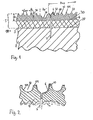
- Fig. 1 the view of a section through the new leather, as it basically corresponds to claim 1
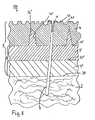
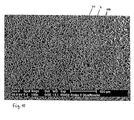
- Fig. 2 a detail sectional view of the surface layer of this new leather and the 3 and 4 SEM images of the surfaces of this leather with different magnifications.
- Fig. 5 to 8 show schematic views of the cross sections through the near-surface region of the new, provided with coating leather or split leather according to the invention and the Fig. 9 and 10 enlarged photographs of the outer surface of the finish layer, the structure here using a foamed Polymer has been formed.
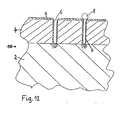
- Fig. 11 and Fig. 12 show enlarged schematic sections through the surface structure of a provided with a already as mentioned finish layer new leather.
- the Fig. 1 shows how, for example, the ground, surface 20 of the substrate forming split leather 2 a coating 5 - here single-layer adhesive layer 3, for example, based on polyurethane surface is bound, to which in turn or to its surface 30, the novel, nubuck character having outer layer 4 is bound surface.
- Said outer layer 4 which has a thickness do, has on its surface, in the regions Bnp not embossed 41, a multiplicity of micro-indentations 42 of inner width lw, which are recessed into the surface and open towards the surface, approximately hemispherical-shell-like. preferably in the range of 20 to 80 microns, on.
- the inner surfaces 421 of the spherical shell or dome-like micro-recesses 42 are at least microscopically smooth and therefore have a high light-reflecting capacity, they shine so, however, which is hidden from the unaided eye, however, when viewed with the microscope is quite visible.
- the surfaces 431 of the webs 43 which surround the micro-depressions 42, in each case delimiting and interconnected with each other, are substantially rougher, they are matt to very finely fibrous, which has a surface finish, e.g. from the ground surfaces of the negatives used to make the micro-wells 42.
- the thickness or width ds of the webs 43 is a fraction of the inner width lw of approximately strichkugelschalen-like concave micro-wells 42.
- the same are all the adhesive layer 3 towards the bottom closed and guarantee in addition to the full moisture resistance of the new coated leather 100, in particular its high Schmutzabweisemor.
- the depth tv of the microwells 42 is of course related to their inner width lw and is for example 5 to 60 microns.
- the narrow surfaces 431 of the borders or webs 43 are matt to extremely fine-fiber soft and flexible and convey the typical nubuck handle and the nubuck-like appearance in combination with the dirt-repellent smooth micro-depressions 42.
- the micro-recesses 42 have, as already mentioned, a very smooth, homogeneous, that is, in themselves shiny, light-reflecting concave surface 421, which is under a light microscope at e.g. 50x magnification is clearly visible.
- the mentioned micro-depressions 42 or their surfaces 421 are smooth, homogeneous and liquid-tight on all sides.
- nubuck leather-looking also so appealing new surface, consists in all parts in one piece of a soft cross-linked polyurethane.
- the polyurethane has a hardness of at least less than 75 Shore A.
- the outer layer 4 can of course also pigments and other additives known per se in finishing layers, such as in particular handle, lubricants od. Like. Contain.
- the soil-repellent effect is also improved by the outer layer 4 contains per se known silicone particles, which are added to the polyurethane dispersion prior to solidification as a silicone dispersion or silicone emulsion.
- the Shore hardness is determined after solidification of the polyurethane dispersion mixture into a film with a thickness of 5 mm.
- the novel nubuck-like top or outer layer is preferably formed by evaporation of water from a polyurethane dispersion applied to a silicone rubber negative support having a multiplicity of positive spherical caps on the surface.
- perforations 7 can be introduced into the coating, which extend into the leather 2 inside.
- a silicone finish layer 6 is applied to the outer layer 4, which ultimately also covers the walls of the perforations 7 and optionally impregnates the leather 2.
- the beginning of the perforation 7 is in the Fig. 2 shown closer.
- the Fig. 2 illustrates - with otherwise constant reference numerals - the ratios described in the novel outer layer 4. There is the difference between the matte to fine-grained outer surface 431 of the micro-wells 42 surrounding ridges 43 and the light-reflecting smooth concave inner surface 421 of approximately hemispherical micro-wells 42 made clear.
- micro-depressions 42 which have self-contained borders, are not quite regular, and it should not go unmentioned that in extreme cases, for example, they may also have polyhedral, in particular hexahedral, shape or cross-sectional shape.
- the Fig. 5 again shows the base forming split leather 2, the surface 20 is freed from its grain layer. At this surface 20, the bonding to the same surface, formed from a solidified, predominantly polyurethane-containing dispersion layer layer 3 "of the adhesive layer 3, whose top-side outer surface 30" to a preferably similar compound and with the same, possibly even partially chemically, connected middle layer layer 3 'of the adhesive layer 3 is adjacent.
- This middle-layer layer 3 ' is provided on its surface 30' with the silicone- or polysiloxane-containing, on its surface 40 a e.g. connected about hill-like structure 41 having outer layer 4.
- the three layers or layers 3 and 3 ", 3 'and 4 just described form the db thick coating 5 of the leather 100 coated according to the invention, the common thickness dvm of the layer layers 3' and 3" being higher than the thickness df of the outer layer 4.
- outer layer 4 formed there by surveys of the template, from its lower boundary surface 40 'of the outer layer 4 either to the surface 40 through fully continuous tubes, passages, pores, cavities 45 od. Like. Extend and / or recesses, "depressions" 45 'od. Like. In the outer layer at least there, but still within the outer layer 4 ends.
- passages 45 or the like and / or recesses, "depressions” 45 'or the like protrude -with the polymer material of the middle-layer layer 3 and formed integrally therewith, here schematically as an approximately cylindrical pin 36'. shown, the said tubes, aisles 45 od. Like. And the recesses, recesses 45 'od. Like. Always fully fulfilling and on the side walls conclusively bound form-packing or -Füllausstülpept 36 'and 360, which in the case of through pores 45 od. Like. There to the surface 40 of the outer layer 4 rich.
- the mold-filling bodies 36 ', 360 are formed from a high-tack prior to solidification polymer dispersion, which in the same way as the rest of the middle layer layer 3' z. B. by crosslinking, has been solidified to the middle layer layer 3 '.
- an average of about 5 to 10 pores or recesses 45, 45 'which are present on the outer layer 4 and / or are not fully penetrating per cm 2 of finish layer surface 40 are present.
- FIG. 5 is schematically shown one of the introduced into the coating 5 hole perforations 7, as well as a bonded to the outer surface 40 nano-silicone finish layer 6, which also covers the wall of the perforation 7 and the leather 2 at least slightly impregnated at its bottom.
- FIG. 7 shows Fig. 7 with otherwise constant reference numerals, a further embodiment of the leather 100 according to the invention with a frustoconical pore 45 extending to the outer surface 40 of the outer layer 4 or the like, which is provided with a continuous peg 36 'or the like from the polymer material of the middle layer 3'. fully satisfied.
- the pin 36 'or the like itself also has a pore 35' which reaches fully to the surface 40 of the outer layer 4 and which in turn is completely filled with an inner pin 36 "or the like from the polymer material of the bonding layer 3" is, which also only at the outer layer surface 40, there exposed, ends.
- an inner pin 36 "or the like from the polymer material of the bonding layer 3" is, which also only at the outer layer surface 40, there exposed, ends.
- the Fig. 8 shows - with otherwise constant reference numerals - a section through an inventive coated split leather 100, where there the Anchoring pores 45 'or the like in the outer layer 4 do not pass to the outer surface 40 and thus not the same filling layer anchoring pins 36' od. Like. From the polymer material of the middle layer layer 3 '.
- the outer surface 40 of the outer layer 4 is formed by the "multi-spherical" surface, eg a spherically foamed polymer, having a hemispherical structure 41 and has a nubuck-like appearance.
- Fig. 9 and 10 show - with otherwise constant reference numerals - in 100x magnification - each have a plan view of the just mentioned, many approximately hemispherical depressions having, outer surface 40 of the outer layer 4 of the in the Fig. 8 coated split leather 100 shown.
- polysiloxanes In the finishing layer, a total of 1.5 to 20 wt .-% polysiloxanes are included. In the case of grain leather or leather with a technical surface, this content of polysiloxanes is preferably 4 to 12% by weight, in the case of leather having a nubuck-like surface, preferably 10 to 18% by weight.
- a dressing 5 here with only one outer layer 4, which is optionally bonded to the leather 2 with an adhesive layer 3 and in the form of at least two polymer layer layers 4 ', 4 "formed with aqueous polymer dispersions, in particular polyurethane dispersion.
- At least two polyurethane layers 4, 4 are expediently applied to the leather 2 as finish or coating 5.
- the inner (s) polyurethane layer (s) 4 ' may be somewhat softer, in particular in order to improve the adhesion to the leather 2.
- the outboard (s) outer layer 4 'based on polyurethane can be made somewhat harder. Micro hollow spheres may be arranged or contained in at least one of these polymer layers.
- This finish layer 6 denotes a finish layer applied to the polyurethane layer or to the outermost polyurethane layer, that is to say outer layer 4.
- This finish layer 6 is a thin, emulsifier-free, finely divided silicone finishing layer which comprises silicone particles in the nanometer range, in particular in the range from 1 to 25 nm, preferably 8 to 16 nm.
- the thickness of the finish layer 6 applied to the outer layer 4 is about 0.0005 to 0.009 mm, preferably 0.003 to 0.007 mm.
- a finish layer 6 is also formed and the silicone emulsion also penetrates into the capillaries 7, but does not clog them, but forms at least in the upper or outer end region capillaries 7, as seen Fig. 11 it can be seen on the wall of a surface finishing or protective layer 6 from.
- Fig. 12 shows a full-grain leather, the surface of which was at best polished with a very fine-grained sandpaper (finer than 350 grit) before applying the polyurethane outer layer 4.
- the outer layer 4 containing, in particular, pigments, a crosslinker and a silicone emulsion with a thickness of, for example, about 0.015 mm is applied by spraying directly onto the grain surface of a, preferably colored, leather 2.
- the nanoparticles in the finish layer 6 in a first form, namely poly [3 - ((2-aminoethyl) amino) propyl] methyl (dimethyl) siloxane, in particular 2-hexyloxyethoxy-terminated, and / or in a second Form, namely poly [3 - ((2-aminoethyl) amino) propyl] methyl (dimethyl) siloxane, in particular methoxy terminated.
- random size is meant that at least 50 to 80%, in particular 60 to 95%, of the nano-particles present have the size specified in the characterizing portion of claim 23.
- the inventively provided finish layer 6 adapts perfectly to the surface structure of the polyurethane-containing outer layer 4.
- the outer layer 4 can be so thin that you can see the hair pores of a full-grain leather. It can also be thicker and have an embossing; she may have a fantasy or manmade interface; it may have been applied indirectly or directly to the natural leather 2. Particularly preferred is their application to the new leather with nubuck-like outer surface.
- the finish layer 6 leads to unadulterated test results, in particular when determining abrasion resistance, whereas hitherto known abradable silicone emulsions deposit on the test specimen and falsify the test result.
- the finish layer 6 may also contain minor amounts of organic components such as e.g. Contain ethylene glycol monobutyl ether, with which the nanoparticles are connected to each other and with the polyurethane-containing outer layer 2. These crosslinked or compound components have so far been disregarded except polysiloxane, in the enumeration of the constituents of the finish layer 6.
- the sealing effect of the suture can be eliminated by a subsequent application of the thin, transparent nano-silicone dispersion.
- An existing finish layer 6 does not interfere with this.
- the polyurethane-containing, solidified aqueous or applied as aqueous dispersion outer layer 4 contains pigments and is in particular crosslinked with a modified Polyisocyannat.
- a modified Polyisocyannat Preferably, it can also coarser silicone particles with sizes between 1 and 100 microns and / or liquid silicone, which is added via an emulsifier containing aqueous silicone emulsion of the polyurethane dispersion.
- this dressing has continuous capillaries, - watery no longer removable contaminants neither on their surface 3 nor in the leather 1 arise because, as in Fig. 11 Even the leather 2 itself is partially hydrophobic and the setting and sticking of dirt in the leather itself is prevented or hindered.
- the dirt-repellent effect is achieved by a nubuck-like formation of the outer surface 40 of the outer layer 4, as shown in the Fig. 11 is implied, much reinforced.
- the thin, extremely finely divided silicone emulsion penetrates the finest capillaries 7 in the case of full-grain leather 2 and partially penetrates into the leather 2 at the end of the capillaries 7 in the region 4.
- leather coated in this way behaves in a similar manner to water-repellent leather as fully waterproofed leather in barrels, but without the disadvantages that these leathers have.
- the extremely fine polysiloxane nanoparticles of the layer 6 also penetrate into the microscopically rough surface depressions of the polyurethane outer layer 4.
- the microscopic roughness of the outer layer 4 is unavoidable, because it results solely from the fact that the particles of the polyurethane dispersion forming them are greater than 2 microns and often greater than 5 microns. This allows the nano-particles of the finish layer 6 to deposit in these microscopically rough depressions.
- Another advantage is the high temperature resistance, which shows no changes in the temperature range between - 30 ° C and + 200 ° C.
- the outer layer 4 or the polyurethane coating advantageously contains coarser silicone particles between 1 and 100 ⁇ . These solid particles are to be understood as meaning polysiloxane particles or polysiloxane resin particles.
- a silicone dispersion applied to the surface of the outer layer 4 - as well as the finish layer 6 - is still has a hydrophobic effect if not only nanoparticles but also microparticles are contained or used therein, ie if nanoparticles and microparticles form this layer 6. It is also expedient to use a dispersion which forms the layer 6 only with microparticles.
- a dispersion which forms the layer 6 only with microparticles 40 to 60% by weight or by volume of microparticles and 40 to 60% by volume or by weight of nanoparticles are used. In particular, equal amounts can be used.
- the adhesive layer is soft in use, to improve the feel.
- acrylates are added to the crystalline polyurethane-containing dispersion or the polyurethane dispersions as softening components, namely those which would lead to extremely soft, sticky films having a hardness of less than 15 Shore A alone, in an amount such that the connecting layer 3 or connecting layers 3 ', 3 "are formed with 10 and 45 vol .-% acrylate, based on the polyurethane content of the bonding layer or layers.
- goat leather can also be provided or used with the coating according to the invention.
- the nubuck optics is of special interest for this purpose.
- silicone resin particles having a size of less than 20 ⁇ , preferably less than 6 ⁇ may be present in the outer layer 4 alone or in addition to the other silicone rubber particles and / or higher molecular weight silicone particles with a volume fraction of up to 7%.
- the silicone resin particles can also form layer 6 on nubuck leather alone.
- the resin particles are applied to the coated leather as dispersion or emulsion at the end of the manufacturing process.
- the surface layer 4 may have production-related pores and capillaries. These openings can be closed again; such a surface is considered waterproof, but not necessarily water vapor-tight and airtight.
- Water resistance thus does not mean that no steam passes.
- a water vapor permeability from the leather side is always present. If the case occurs that the water vapor permeability for safety shoes is too small, perforations could be formed. Even if there are pores and capillaries in the outer layer 4, however, this layer does not absorb water because it contains considerable amounts of silicone and because it is additionally hydrophobic due to the hydrophobic layer 6.
Landscapes
- Health & Medical Sciences (AREA)
- Epidemiology (AREA)
- General Health & Medical Sciences (AREA)
- Public Health (AREA)
- Chemical & Material Sciences (AREA)
- Chemical Kinetics & Catalysis (AREA)
- General Chemical & Material Sciences (AREA)
- Organic Chemistry (AREA)
- Treatment And Processing Of Natural Fur Or Leather (AREA)
- Laminated Bodies (AREA)
Claims (15)
- Cuir revêtu, notamment cuir croûte de bovin, à structure de surface d'apparence de type nubuck, le revêtement étant formé avec une couche de surface formée avec un polymère mécaniquement stable et stable à l'humidité, qui est reliée par une couche adhésive à base de polymère à la surface du cuir ou du cuir croûte,
caractérisé en ce que
la couche extérieure (4) de type nubuck, formée avec un polyuréthane souple, caractérisée par un lissage inférieur, reliée à la surface du cuir ou du cuir croûte, présente dans la zone non gaufrée (Bnp) des micro-concavités (42) agencées étroitement de manière très rapprochée les unes des autres, de type cellules de mousse de savon, présentant une largueur intérieure (Iw) inférieure à 130 µm, notamment inférieure à 80 µm, essentiellement fermées dans la direction du cuir (2), mais toutefois ouvertes vers l'extérieur, et
en ce que les micro-concavités (42) sont chacune délimitées les unes des autres par des traverses minces (43) reliées les unes avec les autres, présentant vers l'extérieur une surface à structure finement rugueuse matte ou à grain fin, et présentent une surface intérieure (421) concave, lisse, brillante et homogène, orientée vers l'extérieur, essentiellement sous la forme d'une enveloppe (semi-)sphérique. - Cuir selon la revendication 1, caractérisé en ce que la couche adhésive (3) est configurée par une couche intermédiaire (3') et une couche de liaison (3"), et est formée par une couche extérieure (4) préfabriquée en une dispersion aqueuse de plastique contentant principalement du polyuréthane sur un substrat ou une matrice en silicone chaude, de préférence comprenant des soulèvements, notamment à structure de type nubuck, exempte d'étain ou de composés organiques d'étain, et une couche adhésive (3) formée sur celle-ci, reliée avec celle-ci et au final agencée sous celle-ci, formée également principalement à partir d'une dispersion de plastique contentant un polyuréthane, comprenant une couche intermédiaire (3') et une couche de liaison (3''), qui est également fabriquée principalement à partir d'une dispersion de plastique contenant un polyuréthane, qui a été appliquée sur le cuir et est reliée avec la couche intermédiaire (3'),- en ce que la couche extérieure (4) formée avec un polymère contentant au moins un polymère de silicone ou un additif de silicone, notamment avec un polyuréthane, présentant de préférence une surface extérieure (40) exempte d'étain, formée avec un gaufrage de type nubuck négatif, est configurée avec une pluralité de cavités, de passages creux, de capillaires, de pores ou d'ouvertures (45) et/ou d'évidements, de creux ou de concavités (45') présentant une largeur intérieure faible, commençant sur son côté orienté vers la couche intermédiaire (3') et traversant entièrement la couche extérieure (4) jusqu'à son côté extérieur ou sa surface extérieure (40) et/ou finissant encore à l'intérieur de la couche extérieure (4),- qui sont remplis avec des corps moulés ou de remplissage (360, 36'), des stalagmites, des bouchons, des baguettes, des cylindres ou des billes, s'introduisant dans ceux-ci et les fermant, reliés étroitement au niveau de leurs parois intérieures et éventuellement ancrés à cet emplacement, d'un seul tenant avec le matériau polymère, notamment polyuréthane, de la couche intermédiaire (3') de la couche adhésive (3).
- Cuir selon la revendication 2, caractérisé en ce que non seulement le matériau polymère, notamment polyuréthane, d'un seul tenant et identique au matériau polymère, notamment polyuréthane, de la couche intermédiaire (3') est introduit dans les cavités, les passages creux, les capillaires, les pores (45) ou les ouvertures, les évidements ou les concavités (45') de la couche extérieure (4) et remplit entièrement ceux-ci en tant que corps de remplissage (36), mais en ce que des corps moulés de remplissage (26', 26) en un matériau polymère, notamment polyuréthane, d'un seul tenant et identique au matériau polymère, notamment polyuréthane, de la couche de liaison (3''), sont également entièrement introduits dans les corps de remplissage moulés (36) ou dans des cavités (35', 35) des corps de remplissage ou moulés (36', 36) remplissant les cavités de la couche extérieure (4'), commençant en dessous et finissant à l'intérieur de ceux-ci ou les traversant jusqu'à la surface (40) de la couche extérieure (4), et y sont ancrés par leur paroi.
- Cuir selon l'une quelconque des revendications 1 à 3, caractérisé- en ce que la couche extérieure (4) est formée avec les micro-concavités (42) et les traverses (43) à surface matte entourant celles-ci en un polyuréthane réticulé souple d'une dureté inférieure à 75 Shore A, notamment inférieure à 55 Shore A, et/ou- en ce que les micro-concavités (42) présentent à chaque fois dans la couche extérieure (4) des bordures (traverses) fermées, imbriquées les unes dans les autres, et présentent éventuellement des formes de section polyédriques ou hexagonales, et/ou- en ce que la largeur intérieure (Iw) des micro-concavités (42) est de 20 à 100 µm, notamment de 30 à 80 µm,- en ce que la profondeur (tv) des micro-concavités (42) est de 5 à 80 µm, notamment de 10 à 60 µm, et- en ce que l'épaisseur (ds) des traverses (43) entre les micro-concavités (42) est de 1 à 30 µm.
- Cuir selon l'une quelconque des revendications 1 à 4, caractérisé- en ce que la couche extérieure (4) présente une structure de surface (41) de préférence à cellules rondes, notamment sphériques creuses, formée lors du ponçage d'un matériau plastique moussé ou de caoutchouc, portée par la matrice de silicone prévue pour la configuration de sa surface extérieure ou supérieure (40) et des pores (45) sur celle-ci, et/ou- en ce que la couche extérieure (4) continent entre 1,5 et 20 % en poids, de préférence dans le cas d'un cuir pleine fleur ou d'un cuir à surface technique entre 4 et 12 % en poids, ou de préférence dans le cas d'une surface de type cuir nubuck entre 10 et 18 % en poids, d'au moins une silicone ou un polysiloxane, à chaque fois par rapport au poids total de la couche (4) mentionnée.
- Cuir selon l'une quelconque des revendications 1 à 5, caractérisé- en ce que la couche extérieure (4) présente une structure de surface ou de gaufrage (41) quelconque et/ou une matité, de préférence toutefois l'apparence et le toucher d'un cuir nubuck avec une surface microscopiquement rugueuse comprenant des soulèvements et des concavités dans la plage comprise entre 0,005 et 0,02 mm, et/ou- en ce que le polyuréthane réticulé de la couche extérieure (4) contient de très petites particules de polysiloxane d'une taille de particule d'au plus 30 µm jusqu'en une proportion volumique d'au plus 15 %, et/ou- en ce que le polyuréthane réticulé de la couche extérieure (4) contient des microbilles creuses, de préférence en un plastique thermoplastique, d'un diamètre d'au plus 60 µm et en une quantité comprise entre 0,3 et 8 % en poids, à chaque fois par rapport au revêtement total (5), et/ou- en ce que l'épaisseur (do) de la couche extérieure (4) est de 0,04 à 0,1 mm.
- Cuir selon l'une quelconque des revendications 1 à 6, caractérisé en ce qu'en plus des très petites particules de silicone ou de polysiloxane solides, ayant de préférence les propriétés d'un caoutchouc de silicone très souple, des silicones de poids moléculaire élevé, introduites par le biais d'une émulsion, sont également introduites dans la couche extérieure (4) formée à partir d'une dispersion formée avec un polyuréthane ramifié de dureté moyenne et ensuite solidifié ou réticulé.
- Cuir, de préférence cuir croûte revêtu, notamment cuir croûte de bovin, selon l'une quelconque des revendications 1 à 7, caractérisé en ce que la couche intermédiaire (3') est formée à partir d'une dispersion de polyuréthane au final solidifiée ou réticulée, connue en soi, qui présente avant la réticulation des propriétés thermoplastique et une structure essentiellement non ramifiée ou linéaire et des propriétés adhésives importantes, la couche intermédiaire (3") et/ou la couche de liaison (3'') contenant de préférence des microbilles creuses en une proportion volumique d'au plus 10 %.
- Cuir, notamment selon l'une quelconque des revendications 1 à 8, caractérisé en ce qu'il comprend sur le côté extérieur (40) de sa couche extérieure (4) une couche de finition mince finale hydrophobe (6), qui est formée avec des particules de silicone dans le domaine manométrique, notamment constituée de particules de silicone dans le domaine manométrique, et qui est exempte d'émulsifiant, et qui est reliée avec le matériau polyuréthane de la couche extérieure (4) de manière essentiellement inséparable, les nanoparticules se présentant de préférence dans la couche de finition (6) sous une première forme, à savoir sous la forme de poly[3-((2-aminoéthyl)amino)propyl]méthyl(diméthyl)siloxane, notamment à terminaison 2-hexyloxyéthoxy, et/ou sous une seconde forme, à savoir sous la forme de poly[3-((2-aminoéthyl)amino)propyl]méthyl(diméthyl)siloxane, notamment à terminaison méthoxy, le rapport entre la première forme et la seconde forme étant éventuellement compris entre 7:1 et 3:1, de préférence entre 6:1 et 4:1.
- Cuir selon l'une quelconque des revendications 1 à 9, caractérisé en ce que le revêtement polyuréthane (5), notamment configuré à pores ouverts, contient des capillaires, des perforations et/ou des pores (7), qui sont habillés ou revêtus dans ou sur leurs zones de surface de paroi intérieure ou sur leurs surfaces avec la couche de finition (6).
- Cuir selon l'une quelconque des revendications 1 à 10, caractérisé en ce que les matériaux polymères, notamment polyuréthane, de la couche intermédiaire (3') et de la couche de liaison (3'') présentent des compositions et/ou des tailles de molécule de départ essentiellement semblables l'un à l'autre ou presque identiques.
- Cuir selon l'une quelconque des revendications 1 à 11, caractérisé en ce que son revêtement hydrophobe (5) présente une épaisseur de couche d'au plus 0,15 mm, de préférence inférieure à 0,15 mm et de manière particulièrement préférée inférieure à 0,12 mm, et ne présente pas de perméabilité à la vapeur d'eau appréciable ou présente une perméabilité à la vapeur d'eau prévue, et/ou- en ce que l'épaisseur (df) de la couche extérieure (4) est comprise entre 30 et 45 % et l'épaisseur commune (dmv) de la couche intermédiaire (3') et de la couche de liaison (3'') est comprise entre 70 et 55 %, à chaque fois par rapport à l'épaisseur totale (db) du revêtement (5).
- Cuir, notamment selon l'une quelconque des revendications 1 à 12, caractérisé en ce que son revêtement (5) ou sa couche extérieure (4) est pénétré jusqu'au cuir (2) par des perforations formées d'une manière mécanique, par exemple par des tuyaux ou des aiguilles de perforation, de préférence 3 à 65, notamment 8 à 18, perforations (7) par cm2 étant prévues, et les perforations présentant de préférence une largeur intérieure de 0,01 à 0,8 mm, et aussi bien le revêtement (5) ou la couche extérieure (4) que les surfaces intérieures des perforations (7) aussi bien dans le revêtement (5) ou la couche extérieure (4) que dans le cuir (2) étant de préférence munis de la nanocouche hydrophobe (6) en polymère de silicone, de préférence en une épaisseur de 0,001 à 0,004 mm.
- Cuir selon la revendication 13, caractérisé en ce qu'un tissu ou un tricot en fibres d'un matériau résistant aux coupures, notamment en fibres de polyaramide, de préférence avant un poids superficiel de 40 à 85 g/m2, est agencé entre le cuir substrat (2) et la couche de surface ou extérieure (4), notamment pour des chaussures de sécurité ou des parties de celles-ci, et/ou- en ce que le côté intérieur du cuir substrat (2) est revêtu avec une émulsion de silicone et/ou en ce que le côté arrière du cuir (2) est revêtu ou imprégné avec une dispersion de silicone ou une émulsion de silicone solidifiée, qui contient des particules de polysiloxane solides dans la plage nano- et/ou micrométrique, pour réduire l'absorption d'eau.
- Produits en un cuir selon l'une quelconque des revendications 1 à 14, notamment sous la forme de chaussures, de chaussures de sécurité, notamment leur matériau de gaine, sacs à main, vêtements en cuir, surfaces et revêtements dans des automobiles, vêtements de projection, valises, et fauteuils et/ou fauteuils inclinables.
Priority Applications (1)
| Application Number | Priority Date | Filing Date | Title |
|---|---|---|---|
| EP13189912.2A EP2711438B1 (fr) | 2007-10-12 | 2008-09-11 | Cuir revêtu |
Applications Claiming Priority (5)
| Application Number | Priority Date | Filing Date | Title |
|---|---|---|---|
| AT0062007U AT10576U1 (de) | 2007-10-12 | 2007-10-12 | Hydrophobes naturleder |
| AT0008308U AT10577U1 (de) | 2008-02-12 | 2008-02-12 | Beschichtetes spaltleder |
| AT7562008A AT506075B1 (de) | 2008-05-09 | 2008-05-09 | Beschichtetes leder |
| DE200820007288 DE202008007288U1 (de) | 2008-05-09 | 2008-05-30 | Beschichtetes Leder |
| PCT/EP2008/007485 WO2009049728A2 (fr) | 2007-10-12 | 2008-09-11 | Cuir revêtu |
Related Child Applications (2)
| Application Number | Title | Priority Date | Filing Date |
|---|---|---|---|
| EP13189912.2A Division-Into EP2711438B1 (fr) | 2007-10-12 | 2008-09-11 | Cuir revêtu |
| EP13189912.2A Division EP2711438B1 (fr) | 2007-10-12 | 2008-09-11 | Cuir revêtu |
Publications (2)
| Publication Number | Publication Date |
|---|---|
| EP2207904A2 EP2207904A2 (fr) | 2010-07-21 |
| EP2207904B1 true EP2207904B1 (fr) | 2014-02-12 |
Family
ID=40463711
Family Applications (2)
| Application Number | Title | Priority Date | Filing Date |
|---|---|---|---|
| EP20080802045 Not-in-force EP2207904B1 (fr) | 2007-10-12 | 2008-09-11 | Cuir revêtu |
| EP13189912.2A Not-in-force EP2711438B1 (fr) | 2007-10-12 | 2008-09-11 | Cuir revêtu |
Family Applications After (1)
| Application Number | Title | Priority Date | Filing Date |
|---|---|---|---|
| EP13189912.2A Not-in-force EP2711438B1 (fr) | 2007-10-12 | 2008-09-11 | Cuir revêtu |
Country Status (4)
| Country | Link |
|---|---|
| US (1) | US8426022B2 (fr) |
| EP (2) | EP2207904B1 (fr) |
| ES (2) | ES2845276T3 (fr) |
| WO (1) | WO2009049728A2 (fr) |
Families Citing this family (18)
| Publication number | Priority date | Publication date | Assignee | Title |
|---|---|---|---|---|
| DE202010011015U1 (de) * | 2010-08-04 | 2011-11-16 | Philipp Schaefer | Formatzuschnitt |
| AT12513U1 (de) * | 2010-12-02 | 2012-06-15 | Schaefer Philipp | Verbundmaterial |
| AT12366U1 (de) | 2011-06-17 | 2012-04-15 | Schaefer Philipp | Leder |
| JP2013028152A (ja) * | 2011-06-24 | 2013-02-07 | Nissan Motor Co Ltd | 物品の表面構造 |
| US8776554B2 (en) * | 2012-11-21 | 2014-07-15 | Lear Corporation | Method of processing leather material |
| DE102014211511A1 (de) * | 2014-06-16 | 2015-12-17 | Bayerische Motoren Werke Aktiengesellschaft | Verfahren zur Herstellung eines atmungsaktiven Ledermaterials und Verwendung eines durch das Verfahren hergestellten Ledermaterials |
| WO2017053818A1 (fr) * | 2015-09-25 | 2017-03-30 | Ironclad Performace Wear Corporation | Gant à adhérence et durabilité améliorées |
| DE102016120519A1 (de) * | 2015-10-30 | 2017-05-04 | Sleevematix Gmbh | Hülle zum Halten und Tragen von Bechern und Behältern mit heißem oder kaltem Inhalt |
| AT517576B1 (de) | 2015-11-27 | 2017-03-15 | Hornschuch Ag K | Verfahren zur Herstellung eines Verbundmaterials und Verbundmaterial |
| USD825886S1 (en) | 2016-09-23 | 2018-08-21 | Brighton-Best International, Inc. | Glove palm |
| EP3449757A1 (fr) | 2017-09-05 | 2019-03-06 | Helcor-Leder-Tec GmbH | Fixation de matériaux durs sur cuir |
| EP3486334B1 (fr) | 2017-11-21 | 2021-06-16 | Helcor-Leder-Tec GmbH | Cuir à usage médicale |
| WO2020119961A1 (fr) * | 2018-12-13 | 2020-06-18 | Schaefer Philipp | Matériau stratifié et procédé de production d'un matériau stratifié |
| DE202019006021U1 (de) * | 2018-12-13 | 2024-03-11 | Philipp Schaefer | Schichtmaterial |
| DE102020113705B4 (de) * | 2020-05-20 | 2024-09-12 | Lisa Dräxlmaier GmbH | Verfahren zum Herstellen eines Bauteils |
| ES2971924T3 (es) * | 2021-08-24 | 2024-06-10 | Antolin Grupo Ing Sa | Envoltura para revestir partes interiores de vehículos retroiluminadas, procedimiento e instalación para su fabricación |
| CN116218229B (zh) * | 2022-11-22 | 2024-05-14 | 国能龙源环保泰州有限公司 | 集水橡胶板及其制备方法和除湿装置及含尘高湿气体的净化处理方法 |
| JP2024150985A (ja) * | 2023-04-11 | 2024-10-24 | オカモト株式会社 | 合成樹脂レザー及びその製造方法 |
Family Cites Families (6)
| Publication number | Priority date | Publication date | Assignee | Title |
|---|---|---|---|---|
| US6177198B1 (en) * | 1998-07-07 | 2001-01-23 | Philipp Schaefer | Leather with a finish on the buffed surface, and process for producing a leather of this type |
| DE29812075U1 (de) * | 1998-07-07 | 1998-09-24 | Schaefer, Philipp, 30519 Hannover | Mit einer Zurichtung versehenes Naturleder |
| AT4947U3 (de) * | 2001-10-04 | 2002-06-25 | Schaefer Philipp | Vollnarbiges rindnappaleder und verfahren zur herstellung desselben |
| AT5980U1 (de) * | 2002-04-15 | 2003-02-25 | Schaefer Philipp | Vollnarbiges walknappaleder und verfahren zur herstellung desselben |
| AT7408U1 (de) | 2003-12-22 | 2005-03-25 | Schaefer Philipp | Mit einer zurichtung versehenes leder |
| BRPI0416595B1 (pt) | 2003-11-15 | 2014-06-17 | Basf Ag | Substrato, e, proceso para produzir um acabamento provido com um substrato |
-
2008
- 2008-09-11 EP EP20080802045 patent/EP2207904B1/fr not_active Not-in-force
- 2008-09-11 ES ES13189912T patent/ES2845276T3/es active Active
- 2008-09-11 ES ES08802045T patent/ES2450996T3/es active Active
- 2008-09-11 EP EP13189912.2A patent/EP2711438B1/fr not_active Not-in-force
- 2008-09-11 WO PCT/EP2008/007485 patent/WO2009049728A2/fr not_active Ceased
- 2008-09-11 US US12/682,619 patent/US8426022B2/en active Active
Also Published As
| Publication number | Publication date |
|---|---|
| EP2207904A2 (fr) | 2010-07-21 |
| ES2450996T3 (es) | 2014-03-26 |
| US20100263235A1 (en) | 2010-10-21 |
| EP2711438A2 (fr) | 2014-03-26 |
| WO2009049728A2 (fr) | 2009-04-23 |
| EP2711438B1 (fr) | 2020-11-11 |
| EP2711438A3 (fr) | 2017-04-26 |
| ES2845276T3 (es) | 2021-07-26 |
| WO2009049728A3 (fr) | 2010-01-07 |
| US8426022B2 (en) | 2013-04-23 |
Similar Documents
| Publication | Publication Date | Title |
|---|---|---|
| EP2711438B1 (fr) | Cuir revêtu | |
| EP2646287B1 (fr) | Materiau stratifie | |
| EP1644539A1 (fr) | Substrat pourvu d'un appret | |
| KR101027365B1 (ko) | 피혁형 시트상물 및 그 제조 방법 | |
| EP2582874B1 (fr) | Découpe au format | |
| DE10217056B4 (de) | Vollnarbiges Walknappaleder und Verfahren zur Herstellung desselben | |
| US9072334B2 (en) | Coated leather | |
| DE69432773T2 (de) | Hochflexibles lederartiges Material und Verfahren zu dessen Herstellung | |
| EP1882610A2 (fr) | Siège de véhicule et substrat adapté | |
| DE102013021148A1 (de) | Lederaustauschmaterial | |
| DE29819703U1 (de) | Lederlaminat | |
| EP0331214B1 (fr) | Cuirs fendus ou matériaux à base de fibres de cuirs | |
| DE102008008934B3 (de) | Beschichtetes Spaltleder | |
| AT8006U1 (de) | An seiner oberseite mit einer zurichtung versehener träger | |
| DE202009002479U1 (de) | Lederartikel, insbesondere Schuh, mit wasserdichter Vernähung der Lederteile | |
| DE202008002503U1 (de) | Kunstleder | |
| AT506075B1 (de) | Beschichtetes leder | |
| DE202010009073U1 (de) | Formatzuschnitt | |
| DE202008004906U1 (de) | Beschichtetes Spaltleder | |
| DE29903664U1 (de) | An seiner faserigen Oberfläche mit einer Zurichtung versehenes Substrat | |
| AT412882B (de) | Kunstleder | |
| DE202006011724U1 (de) | Fahrzeugsitz | |
| DE60302357T2 (de) | Bodenbelag mit textilrücken | |
| DE20318306U1 (de) | Eine veloursartige Oberfläche aufweisender, mit einer Zurichtung versehener Träger | |
| AT9697U1 (de) | Fahrzeugsitz |
Legal Events
| Date | Code | Title | Description |
|---|---|---|---|
| PUAI | Public reference made under article 153(3) epc to a published international application that has entered the european phase |
Free format text: ORIGINAL CODE: 0009012 |
|
| 17P | Request for examination filed |
Effective date: 20100406 |
|
| AK | Designated contracting states |
Kind code of ref document: A2 Designated state(s): AT BE BG CH CY CZ DE DK EE ES FI FR GB GR HR HU IE IS IT LI LT LU LV MC MT NL NO PL PT RO SE SI SK TR |
|
| AX | Request for extension of the european patent |
Extension state: AL BA MK RS |
|
| DAX | Request for extension of the european patent (deleted) | ||
| RAP1 | Party data changed (applicant data changed or rights of an application transferred) |
Owner name: LANXESS DEUTSCHLAND GMBH |
|
| RIN1 | Information on inventor provided before grant (corrected) |
Inventor name: LANXESS DEUTSCHLAND GMBH |
|
| 17Q | First examination report despatched |
Effective date: 20130507 |
|
| RAP1 | Party data changed (applicant data changed or rights of an application transferred) |
Owner name: LANXESS DEUTSCHLAND GMBH |
|
| RIN1 | Information on inventor provided before grant (corrected) |
Inventor name: LANXESS DEUTSCHLAND GMBH |
|
| RIC1 | Information provided on ipc code assigned before grant |
Ipc: A43B 7/12 20060101ALI20130917BHEP Ipc: C14C 11/00 20060101AFI20130917BHEP |
|
| GRAP | Despatch of communication of intention to grant a patent |
Free format text: ORIGINAL CODE: EPIDOSNIGR1 |
|
| INTG | Intention to grant announced |
Effective date: 20131025 |
|
| RIN1 | Information on inventor provided before grant (corrected) |
Inventor name: SCHAEFER, PHILIPP |
|
| RIN1 | Information on inventor provided before grant (corrected) |
Inventor name: SCHAEFER, PHILIPP |
|
| GRAS | Grant fee paid |
Free format text: ORIGINAL CODE: EPIDOSNIGR3 |
|
| GRAA | (expected) grant |
Free format text: ORIGINAL CODE: 0009210 |
|
| AK | Designated contracting states |
Kind code of ref document: B1 Designated state(s): AT BE BG CH CY CZ DE DK EE ES FI FR GB GR HR HU IE IS IT LI LT LU LV MC MT NL NO PL PT RO SE SI SK TR |
|
| REG | Reference to a national code |
Ref country code: GB Ref legal event code: FG4D Free format text: NOT ENGLISH |
|
| REG | Reference to a national code |
Ref country code: CH Ref legal event code: EP |
|
| REG | Reference to a national code |
Ref country code: AT Ref legal event code: REF Ref document number: 652196 Country of ref document: AT Kind code of ref document: T Effective date: 20140215 |
|
| REG | Reference to a national code |
Ref country code: DE Ref legal event code: R096 Ref document number: 502008011312 Country of ref document: DE Effective date: 20140320 |
|
| REG | Reference to a national code |
Ref country code: IE Ref legal event code: FG4D Free format text: LANGUAGE OF EP DOCUMENT: GERMAN Ref country code: ES Ref legal event code: FG2A Ref document number: 2450996 Country of ref document: ES Kind code of ref document: T3 Effective date: 20140326 |
|
| REG | Reference to a national code |
Ref country code: NL Ref legal event code: VDEP Effective date: 20140212 |
|
| REG | Reference to a national code |
Ref country code: LT Ref legal event code: MG4D |
|
| PG25 | Lapsed in a contracting state [announced via postgrant information from national office to epo] |
Ref country code: NO Free format text: LAPSE BECAUSE OF FAILURE TO SUBMIT A TRANSLATION OF THE DESCRIPTION OR TO PAY THE FEE WITHIN THE PRESCRIBED TIME-LIMIT Effective date: 20140512 Ref country code: LT Free format text: LAPSE BECAUSE OF FAILURE TO SUBMIT A TRANSLATION OF THE DESCRIPTION OR TO PAY THE FEE WITHIN THE PRESCRIBED TIME-LIMIT Effective date: 20140212 Ref country code: IS Free format text: LAPSE BECAUSE OF FAILURE TO SUBMIT A TRANSLATION OF THE DESCRIPTION OR TO PAY THE FEE WITHIN THE PRESCRIBED TIME-LIMIT Effective date: 20140612 |
|
| PG25 | Lapsed in a contracting state [announced via postgrant information from national office to epo] |
Ref country code: PT Free format text: LAPSE BECAUSE OF FAILURE TO SUBMIT A TRANSLATION OF THE DESCRIPTION OR TO PAY THE FEE WITHIN THE PRESCRIBED TIME-LIMIT Effective date: 20140612 Ref country code: CY Free format text: LAPSE BECAUSE OF FAILURE TO SUBMIT A TRANSLATION OF THE DESCRIPTION OR TO PAY THE FEE WITHIN THE PRESCRIBED TIME-LIMIT Effective date: 20140212 Ref country code: SE Free format text: LAPSE BECAUSE OF FAILURE TO SUBMIT A TRANSLATION OF THE DESCRIPTION OR TO PAY THE FEE WITHIN THE PRESCRIBED TIME-LIMIT Effective date: 20140212 Ref country code: NL Free format text: LAPSE BECAUSE OF FAILURE TO SUBMIT A TRANSLATION OF THE DESCRIPTION OR TO PAY THE FEE WITHIN THE PRESCRIBED TIME-LIMIT Effective date: 20140212 Ref country code: FI Free format text: LAPSE BECAUSE OF FAILURE TO SUBMIT A TRANSLATION OF THE DESCRIPTION OR TO PAY THE FEE WITHIN THE PRESCRIBED TIME-LIMIT Effective date: 20140212 |
|
| PG25 | Lapsed in a contracting state [announced via postgrant information from national office to epo] |
Ref country code: LV Free format text: LAPSE BECAUSE OF FAILURE TO SUBMIT A TRANSLATION OF THE DESCRIPTION OR TO PAY THE FEE WITHIN THE PRESCRIBED TIME-LIMIT Effective date: 20140212 Ref country code: HR Free format text: LAPSE BECAUSE OF FAILURE TO SUBMIT A TRANSLATION OF THE DESCRIPTION OR TO PAY THE FEE WITHIN THE PRESCRIBED TIME-LIMIT Effective date: 20140212 |
|
| PG25 | Lapsed in a contracting state [announced via postgrant information from national office to epo] |
Ref country code: CZ Free format text: LAPSE BECAUSE OF FAILURE TO SUBMIT A TRANSLATION OF THE DESCRIPTION OR TO PAY THE FEE WITHIN THE PRESCRIBED TIME-LIMIT Effective date: 20140212 Ref country code: RO Free format text: LAPSE BECAUSE OF FAILURE TO SUBMIT A TRANSLATION OF THE DESCRIPTION OR TO PAY THE FEE WITHIN THE PRESCRIBED TIME-LIMIT Effective date: 20140212 Ref country code: DK Free format text: LAPSE BECAUSE OF FAILURE TO SUBMIT A TRANSLATION OF THE DESCRIPTION OR TO PAY THE FEE WITHIN THE PRESCRIBED TIME-LIMIT Effective date: 20140212 Ref country code: EE Free format text: LAPSE BECAUSE OF FAILURE TO SUBMIT A TRANSLATION OF THE DESCRIPTION OR TO PAY THE FEE WITHIN THE PRESCRIBED TIME-LIMIT Effective date: 20140212 |
|
| REG | Reference to a national code |
Ref country code: DE Ref legal event code: R097 Ref document number: 502008011312 Country of ref document: DE |
|
| PG25 | Lapsed in a contracting state [announced via postgrant information from national office to epo] |
Ref country code: SK Free format text: LAPSE BECAUSE OF FAILURE TO SUBMIT A TRANSLATION OF THE DESCRIPTION OR TO PAY THE FEE WITHIN THE PRESCRIBED TIME-LIMIT Effective date: 20140212 Ref country code: PL Free format text: LAPSE BECAUSE OF FAILURE TO SUBMIT A TRANSLATION OF THE DESCRIPTION OR TO PAY THE FEE WITHIN THE PRESCRIBED TIME-LIMIT Effective date: 20140212 |
|
| PLBE | No opposition filed within time limit |
Free format text: ORIGINAL CODE: 0009261 |
|
| STAA | Information on the status of an ep patent application or granted ep patent |
Free format text: STATUS: NO OPPOSITION FILED WITHIN TIME LIMIT |
|
| 26N | No opposition filed |
Effective date: 20141113 |
|
| REG | Reference to a national code |
Ref country code: DE Ref legal event code: R097 Ref document number: 502008011312 Country of ref document: DE Effective date: 20141113 |
|
| PG25 | Lapsed in a contracting state [announced via postgrant information from national office to epo] |
Ref country code: LU Free format text: LAPSE BECAUSE OF FAILURE TO SUBMIT A TRANSLATION OF THE DESCRIPTION OR TO PAY THE FEE WITHIN THE PRESCRIBED TIME-LIMIT Effective date: 20140911 Ref country code: MC Free format text: LAPSE BECAUSE OF FAILURE TO SUBMIT A TRANSLATION OF THE DESCRIPTION OR TO PAY THE FEE WITHIN THE PRESCRIBED TIME-LIMIT Effective date: 20140212 |
|
| REG | Reference to a national code |
Ref country code: CH Ref legal event code: PL |
|
| GBPC | Gb: european patent ceased through non-payment of renewal fee |
Effective date: 20140911 |
|
| PG25 | Lapsed in a contracting state [announced via postgrant information from national office to epo] |
Ref country code: SI Free format text: LAPSE BECAUSE OF FAILURE TO SUBMIT A TRANSLATION OF THE DESCRIPTION OR TO PAY THE FEE WITHIN THE PRESCRIBED TIME-LIMIT Effective date: 20140212 |
|
| REG | Reference to a national code |
Ref country code: IE Ref legal event code: MM4A |
|
| REG | Reference to a national code |
Ref country code: FR Ref legal event code: ST Effective date: 20150529 |
|
| PG25 | Lapsed in a contracting state [announced via postgrant information from national office to epo] |
Ref country code: BE Free format text: LAPSE BECAUSE OF NON-PAYMENT OF DUE FEES Effective date: 20140930 |
|
| REG | Reference to a national code |
Ref country code: HU Ref legal event code: AG4A Ref document number: E023181 Country of ref document: HU |
|
| PG25 | Lapsed in a contracting state [announced via postgrant information from national office to epo] |
Ref country code: GB Free format text: LAPSE BECAUSE OF NON-PAYMENT OF DUE FEES Effective date: 20140911 Ref country code: LI Free format text: LAPSE BECAUSE OF NON-PAYMENT OF DUE FEES Effective date: 20140930 Ref country code: CH Free format text: LAPSE BECAUSE OF NON-PAYMENT OF DUE FEES Effective date: 20140930 |
|
| PG25 | Lapsed in a contracting state [announced via postgrant information from national office to epo] |
Ref country code: IE Free format text: LAPSE BECAUSE OF NON-PAYMENT OF DUE FEES Effective date: 20140911 Ref country code: FR Free format text: LAPSE BECAUSE OF NON-PAYMENT OF DUE FEES Effective date: 20140930 |
|
| REG | Reference to a national code |
Ref country code: AT Ref legal event code: MM01 Ref document number: 652196 Country of ref document: AT Kind code of ref document: T Effective date: 20140911 |
|
| PG25 | Lapsed in a contracting state [announced via postgrant information from national office to epo] |
Ref country code: AT Free format text: LAPSE BECAUSE OF NON-PAYMENT OF DUE FEES Effective date: 20140911 |
|
| PG25 | Lapsed in a contracting state [announced via postgrant information from national office to epo] |
Ref country code: BG Free format text: LAPSE BECAUSE OF FAILURE TO SUBMIT A TRANSLATION OF THE DESCRIPTION OR TO PAY THE FEE WITHIN THE PRESCRIBED TIME-LIMIT Effective date: 20140212 |
|
| PG25 | Lapsed in a contracting state [announced via postgrant information from national office to epo] |
Ref country code: GR Free format text: LAPSE BECAUSE OF FAILURE TO SUBMIT A TRANSLATION OF THE DESCRIPTION OR TO PAY THE FEE WITHIN THE PRESCRIBED TIME-LIMIT Effective date: 20140513 Ref country code: MT Free format text: LAPSE BECAUSE OF FAILURE TO SUBMIT A TRANSLATION OF THE DESCRIPTION OR TO PAY THE FEE WITHIN THE PRESCRIBED TIME-LIMIT Effective date: 20140212 |
|
| PG25 | Lapsed in a contracting state [announced via postgrant information from national office to epo] |
Ref country code: TR Free format text: LAPSE BECAUSE OF FAILURE TO SUBMIT A TRANSLATION OF THE DESCRIPTION OR TO PAY THE FEE WITHIN THE PRESCRIBED TIME-LIMIT Effective date: 20140212 |
|
| PGFP | Annual fee paid to national office [announced via postgrant information from national office to epo] |
Ref country code: IT Payment date: 20210811 Year of fee payment: 14 |
|
| PGFP | Annual fee paid to national office [announced via postgrant information from national office to epo] |
Ref country code: DE Payment date: 20210803 Year of fee payment: 14 |
|
| PGFP | Annual fee paid to national office [announced via postgrant information from national office to epo] |
Ref country code: ES Payment date: 20211005 Year of fee payment: 14 |
|
| REG | Reference to a national code |
Ref country code: HU Ref legal event code: GB9C Owner name: TFL LEDERTECHNIK GMBH, DE Free format text: FORMER OWNER(S): LANXESS DEUTSCHLAND GMBH, DE |
|
| PGFP | Annual fee paid to national office [announced via postgrant information from national office to epo] |
Ref country code: HU Payment date: 20210901 Year of fee payment: 15 |
|
| REG | Reference to a national code |
Ref country code: ES Ref legal event code: PC2A Owner name: TFL LEDERTECHNIK GMBH Effective date: 20230203 |
|
| REG | Reference to a national code |
Ref country code: DE Ref legal event code: R119 Ref document number: 502008011312 Country of ref document: DE |
|
| PG25 | Lapsed in a contracting state [announced via postgrant information from national office to epo] |
Ref country code: DE Free format text: LAPSE BECAUSE OF NON-PAYMENT OF DUE FEES Effective date: 20230401 |
|
| REG | Reference to a national code |
Ref country code: ES Ref legal event code: FD2A Effective date: 20231027 |
|
| PG25 | Lapsed in a contracting state [announced via postgrant information from national office to epo] |
Ref country code: IT Free format text: LAPSE BECAUSE OF NON-PAYMENT OF DUE FEES Effective date: 20220911 |
|
| PG25 | Lapsed in a contracting state [announced via postgrant information from national office to epo] |
Ref country code: ES Free format text: LAPSE BECAUSE OF NON-PAYMENT OF DUE FEES Effective date: 20220912 |
|
| PG25 | Lapsed in a contracting state [announced via postgrant information from national office to epo] |
Ref country code: ES Free format text: LAPSE BECAUSE OF NON-PAYMENT OF DUE FEES Effective date: 20220912 |
|
| PG25 | Lapsed in a contracting state [announced via postgrant information from national office to epo] |
Ref country code: HU Free format text: LAPSE BECAUSE OF NON-PAYMENT OF DUE FEES Effective date: 20230912 |