EP2208507A1 - Stimulation nerveuse électrique basée sur des séquences d'échantillonnage spécifiques de canaux - Google Patents
Stimulation nerveuse électrique basée sur des séquences d'échantillonnage spécifiques de canaux Download PDFInfo
- Publication number
- EP2208507A1 EP2208507A1 EP10003323A EP10003323A EP2208507A1 EP 2208507 A1 EP2208507 A1 EP 2208507A1 EP 10003323 A EP10003323 A EP 10003323A EP 10003323 A EP10003323 A EP 10003323A EP 2208507 A1 EP2208507 A1 EP 2208507A1
- Authority
- EP
- European Patent Office
- Prior art keywords
- channel
- electrode
- specific sampling
- channel specific
- sampling sequence
- Prior art date
- Legal status (The legal status is an assumption and is not a legal conclusion. Google has not performed a legal analysis and makes no representation as to the accuracy of the status listed.)
- Granted
Links
Images




Classifications
-
- A—HUMAN NECESSITIES
- A61—MEDICAL OR VETERINARY SCIENCE; HYGIENE
- A61N—ELECTROTHERAPY; MAGNETOTHERAPY; RADIATION THERAPY; ULTRASOUND THERAPY
- A61N1/00—Electrotherapy; Circuits therefor
- A61N1/18—Applying electric currents by contact electrodes
- A61N1/32—Applying electric currents by contact electrodes alternating or intermittent currents
- A61N1/36—Applying electric currents by contact electrodes alternating or intermittent currents for stimulation
- A61N1/36036—Applying electric currents by contact electrodes alternating or intermittent currents for stimulation of the outer, middle or inner ear
- A61N1/36038—Cochlear stimulation
-
- A—HUMAN NECESSITIES
- A61—MEDICAL OR VETERINARY SCIENCE; HYGIENE
- A61N—ELECTROTHERAPY; MAGNETOTHERAPY; RADIATION THERAPY; ULTRASOUND THERAPY
- A61N1/00—Electrotherapy; Circuits therefor
- A61N1/02—Details
- A61N1/04—Electrodes
- A61N1/05—Electrodes for implantation or insertion into the body, e.g. heart electrode
- A61N1/0526—Head electrodes
- A61N1/0541—Cochlear electrodes
-
- H—ELECTRICITY
- H04—ELECTRIC COMMUNICATION TECHNIQUE
- H04R—LOUDSPEAKERS, MICROPHONES, GRAMOPHONE PICK-UPS OR LIKE ACOUSTIC ELECTROMECHANICAL TRANSDUCERS; ELECTRIC HEARING AIDS; PUBLIC ADDRESS SYSTEMS
- H04R2225/00—Details of deaf aids covered by H04R25/00, not provided for in any of its subgroups
- H04R2225/67—Implantable hearing aids or parts thereof not covered by H04R25/606
Definitions
- the present invention relates to electrical nerve stimulation, and more particularly, electrostimulation of the nerve based on channel specific sampling sequences.
- Cochlear implants are a possibility to help profoundly deaf or severely hearing impaired persons.
- a cochlear implant is based on direct electrical stimulation of the acoustic nerve. The intention of a cochlear implant is to stimulate nervous structures in the inner ear electrically in such a way that hearing impressions most similar to normal hearing are obtained.
- a cochlear prosthesis essentially consists of two parts, the speech processor and the implanted stimulator.
- the speech processor contains the power supply (batteries) of the overall system and is used to perform signal processing of the acoustic signal to extract the stimulation parameters.
- the stimulator generates the stimulation patterns and conducts them to the nervous tissue by means of an electrode array which usually is positioned in the scala tympani in the inner ear.
- the connection between speech processor and stimulator is established either by means of a radio frequency link (transcutaneous) or by means of a plug in the skin (percutaneous).
- CIS continuous-interleaved-sampling strategy
- Signal processing for CIS in the speech processor involves the following steps:
- each stimulation electrode in the scala tympani is associated with a band pass filter of the external filter bank.
- symmetrical biphasic current pulses are applied.
- the amplitudes of the stimulation pulses are directly obtained from the compressed envelope signals (step (3) of above). These signals are sampled sequentially, and the stimulation pulses are applied in a strictly non-overlapping sequence.
- the overall stimulation rate is comparatively high. For example, assuming an overall stimulation rate of 18kpps, and using an 12 channel filter bank, the stimulation rate per channel is 1.5kpps. Such a stimulation rate per channel usually is sufficient for adequate temporal representation of the envelope signal.
- the maximum overall stimulation rate is limited by the minimum phase duration per pulse.
- the phase duration cannot be chosen arbitrarily short, because the shorter the pulses, the higher the current amplitudes have to be to elicit action potentials in neurons, and current amplitudes are limited for various practical reasons.
- the phase duration is 27 ⁇ s, which is at the lower limit.
- the envelope signals only are used for further processing, i.e., they contain the entire stimulation information.
- the envelope is represented as a sequence of biphasic pulses at constant repetition rate.
- this repetition rate typically 1.5kpps
- the repetition rate is not a temporal cue for the patient, i.e., it should be sufficiently high, so that the patient does not percept tones with a frequency equal to the repetition rate.
- the repetition rate is usually chosen greater than at twice the bandwidth of the envelope signals (Nyquist theorem).
- electrodes in a multichannel electrode array are activated using channel specific sampling sequences.
- a channel specific sampling sequence for each electrode is defined, having a particular duration, amplitude, and number of pulses.
- a weighting factor is applied to the channel specific sampling sequence, creating a weighted channel specific sampling sequence.
- Each electrode in the multichannel electrode array is then simultaneously activated using sign-correlated pulses, the sign-correlated pulses based on parameters of spatial channel interaction, non-linear compression, and each electrode's weighted channel specific sampling sequence.
- the electrodes stimulate the acoustic nerve.
- the multichannel electrode array can be used in a monopolar electrode configuration having a remote ground.
- the pulse amplitudes can be derived by sampling a signal waveform, for example, one half the period of a sinusoid between 0 and ⁇ , or one quarter of a sinusoid between 0 and ⁇ /2 so that the amplitude distribution is monotonically increasing.
- Symmetrical biphasic current pulses can be used to sample the signal waveform.
- the channel specific sampling sequence pulse rate may be between 5-10 kpps.
- the parameters of spatial channel interaction can be based on a single electrode model having exponential decays of the potentials at both sides of the electrode, the sign-correlated pulses having amplitudes which are calculated using properties of a tri-diagonal matrix.
- the multichannel electrode array can be in a cochlear implant, whereby the weighting factor is transmitted to the cochlear implant. Start and stop bits, and addresses associated with an electrode can also be transmitted to the cochlear implant.
- electrodes in a multichannel electrode array are activated using channel specific sampling sequences by applying an acoustic signal to a bank of filters, each filter in the bank of filters associated with a channel having an electrode.
- a weighting factor is derived for each channel based on the output of each channel's filter.
- the weighting factor is then applied to a channel specific sampling sequence having a particular duration, amplitude and number of pulses, creating a weighted channel specific sampling sequence.
- Each channel's electrode is simultaneously activated using sign-correlated pulses, the sign-correlated pulses based on the weighted channel specific sampling sequence, non-linear compression, and parameters of spatial channel interaction.
- the electrodes can stimulate the acoustic nerve.
- the weighting factor can be derived by rectifying the output of each filter, and then determining the maximum amplitude of each half-wave in the rectified signal.
- the multichannel electrode array can used a monopolar electrode configuration having a remote ground.
- the pulse amplitudes of the channel specific sampling sequence can be derived by sampling a signal waveform, such as one half the period of a sinusoid between 0 and ⁇ , or one quarter of a sinusoid so that the amplitude distribution is monotonically increasing. Symmetrical biphasic current pulses can be used to sample the waveform.
- Each channel filter can be a bandpass filter.
- the duration and number of pulses in the channel specific sampling sequence can then be derived from the center frequency of the channel's bandpass filter.
- the duration of the channel specific sampling sequence can be one half of the period of the bandpass filter's center frequency.
- the parameters of spatial channel interaction can be based on a single electrode model having exponential decays of the potentials at both sides of the electrode, the sign-correlated pulses having amplitudes determined by using properties of a tri-diagonal matrix.
- the multichannel electrode array can be in a cochlear implant, whereby the weighting factor is transmitted to the cochlear implant. Start and stop bits, and addresses associated with an electrode can also be transmitted to the cochlear implant.
- electrodes are simultaneously activated in a multichannel electrode array using channel specific sampling sequences.
- Sign-correlated pulses are used.
- the amplitudes of the sign-correlated pulses are calculated by taking into account parameters of spatial channel interaction.
- a single electrode model having exponential decays of the potentials at both sides of the electrode can be used.
- the amplitudes of the sign-correlated pulses can be calculated using properties of a tri-diagonal matrix.
- channel specific sampling sequence having a pulse descriptive characterization are defined.
- the channel specific sampling sequence is used to activate electrodes in a multichannel electrode array, each filter in a bank of filters associated with a channel having an electrode.
- Pulse amplitudes of the channel sampling sequence are derived by sampling a signal waveform.
- the duration and number of pulses of the channel specific sampling sequence are derived from a frequency associated with the channel's filter.
- the sampling is of a half period of a sinusoid between 0 and ⁇ .
- the sampling can also be of a quarter period of a sinusoid between 0 and ⁇ /2, so that pulse amplitude distribution monotonically increases.
- the sampling can use biphasic current pulses.
- Each filter can be a bandpass filter.
- the duration and number of pulses in the channel specific sampling sequence can be derived from the center frequency of the channel's bandpass filter.
- the duration of the channel specific sampling sequence can be one half of the period of the bandpass filter's center frequency.
- a weighting factor for a channel specific sampling sequence is derived, the channel specific sampling sequence being used to activate electrodes in a multichannel electrode array, each filter in a bank of filters associated with a channel having an electrode. The output of each filter is rectified, creating a half-wave rectified signal. The maximum amplitude of each half-wave in the half-wave rectified signal is then determined.
- the stimulation strategy utilized is based on channel specific sampling sequences (CSSS).
- CSSS channel specific sampling sequences
- the basic idea is to a apply a stimulation pattern, where a particular relationship to the center frequencies of the filter channels is preserved, i.e., the center frequencies are represented in the temporal waveforms of the stimulation patterns, and are not fully removed, as in CIS.
- Each stimulation channel is associated with a particular CSSS, which is a sequence of ultra-high-rate biphasic pulses (typically 5-10kpps).
- Each CSSS has a distinct length (number of pulses) and distinct amplitude distribution.
- the length of a CSSS is derived from the center frequency of the associated band pass filter.
- a CSSS associated with a lower filter channel is longer than a CSSS associated with a higher filter channel. Typically, it is one half of the period of the center frequency.
- the amplitude distribution can be adjusted to patient specific requirements. For convenience, the amplitude of the maximum biphasic pulse within a CSSS is normalized to one. For illustration, two examples for a 6-channel system are shown.
- the CSSS's are derived by sampling one half of a period of a sinusoid, whose frequency is equal to the center frequency of the band pass filter (center frequencies at 440Hz, 696Hz, 1103Hz, 1745Hz, 2762Hz, and 4372Hz). Sampling is achieved by means of biphasic pulses at a rate of 10kpps and a phase duration of 25 ⁇ s. For channels #5 and #6, one half of a period of the center frequencies is too short to give space for more than one stimulation pulse, i.e., the "sequences" consist of only one pulse, respectively.
- Fig.1(b) the sequences are derived by sampling one quarter of a sinusoid with a frequency, which is half the center frequency of the band pass filters.
- These CSSS's have about the same durations as the CSSS's in Fig.1(a) respectively, but the amplitude distribution is monotonically increasing. Such monotonic distributions might be advantageous, because each pulse of the sequence can theoretically stimulate neurons at sites which cannot be reached by its predecessors. This is a pure "geometric" effect, and could possibly result in a broader temporal distribution of the firing pattern of the neurons.
- FIG.2 An example of a stimulation pattern based on CSSS is depicted in Fig.2 for a voiced speech segment. For reasons of clarity, the influence of spatial channel interaction is neglected here. In addition, and in the following text, the instantaneous non-linear compression is omitted for convenience, however it is realized that such conversion is required for actual stimulation patterns.
- Fig. 2(a) shows the output of a band pass filter (cut off frequencies at 553Hz and 876Hz).
- Fig. 2(b) illustrates the half-wave rectified version of the signal.
- each half-wave-pulse is replaced by a CSSS, where the amplitude of the maximum pulse within each CSSS is equal to the maximum of the associated half-wave-pulse.
- Fig. 3 represents a sequence of weighted and time-shifted CSSS's.
- the CSSS used for this example is equal to the CSSS in Fig. 1(a) for channel CH2, and for convenience, each biphasic pulse is represented as a single vertical line.
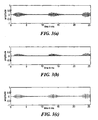
- FIG. 3 An example of a stimulation pattern based on CSSS for a higher frequency channel is shown in Fig. 3 (the input speech segment is the same as for Fig. 2 , spatial channel interaction is neglected again).
- the band pass filter here selects a range between 3475Hz and 5500Hz. With a center frequency of 4273Hz, the period is 229 ⁇ s, and sampling one half of this period gives space for only one pulse (cf. CSSS as shown in Fig. 1 for channel CH5).
- the envelope sampling is reduced to a sampling with single pulses at a rate equal to about the center frequency of 4273Hz.
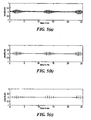
- Fig. 4 stimulation sequences of the new approach are directly compared to the corresponding CIS-sequences at 1.5kpps.
- the CSSS-based sequence in Fig. 4(b) clearly represents the temporal fine structure plus the envelope information of the band pass output shown in Fig. 4(a)
- the CIS-pattern in Fig. 4(c) is obtained by sampling the envelope, and thus any temporal fine structure is removed.
- Figs. 5(b) and (c) are derived by envelope sampling with single pulses. However, in this frequency range, neurons are only able to track the envelope signals, but cannot follow the stimulation frequency itself.
- the difference between traces 2 and 3 is the sampling rate, which is considerably lower for CIS.
- channel interaction in connection with pulsatile stimulation strategies occurs as a spatial and as a temporal effect. Temporal interaction could be further separated into “physical” and “physiological” interaction.
- Physical temporal channel interaction means that the electrical properties of a stimulation pulse in the nervous tissue are biased by its predecessor, e.g., due to residual charge stored in the tissue and in the membrane capacitances of the neurons. Physical temporal interaction is suppressed to a great extent by using symmetrical, biphasic stimulation pulses. Most of the charge delivered to the excitable tissue during the first phase of a stimulation pulse is removed during the second. However, since the tissue shows some capacitative behavior, some residual charge remains after the end of the stimulation pulse and possibly may bias the subsequent stimulation pulse. Theoretically, triphasic pulses (with zero net charge) would help to further reduce physical temporal channel interaction.
- Physiological interaction means effects associated with the refractory properties of the neurons.
- CIS strategy the influence of spatial channel interaction is reduced by employing pulses which are not overlapping in time (interleaved sampling).
- the conductivity in the scala tympani here leads to a considerable spread and a de-focusing of the electrical field at the site of the excitable tissue.
- an additional effect occurs, if simultaneous stimulation of two or more electrodes against a remote ground electrode is considered.
- the conductivity represents a shunt conductance between active electrodes, which in general results in a temporal mixture of constructive and destructive superposition of electrical fields at the position of the neurons. For example, if two simultaneous stimulation channels produce currents with equal amplitudes, but different signs, most of the current will flow through the shunt conductance and will not reach the intended neurons.
- Sign-correlation means that the signs of the phases of simultaneous stimulation pulses are equal. This ensures that the sum of the magnitudes of the single stimulation currents is forced to flow into the reference electrode. Thus, at the site of the excitable neurons, only constructive superposition of currents is possible.
- the idea here is to modify stimulation currents such that at least the potentials at the position of the electrodes are equal as in the case of single channel stimulation.
- coefficients of matrix H reflect spatial channel interaction.
- a coefficient at row i and column j describes the fraction of the single channel potential caused by electrode #j at the position of electrode #i.
- H -1 is the inverse matrix of H.
- matrix H -1 in general is a tri-diagonal matrix with non-zero elements only in the main-, the upper and lower neighboring diagonals (see Appendix).
- a space constant ⁇ 3.6mm is assumed.
- the y-axis is normalized to the maximum potential of electrode #4 at position 4.
- Fig.6(a) depicts the single voltage distributions in the scala tympani as responses to single electrode currents at different amplitudes.
- the electrodes are activated sequentially, and thus each of the single potential distribution applies for the duration of a pulse phase. Assuming a pulse repetition rate of 1.5kppulses/s for each channel, the overall time necessary to present all six distributions is 666 ⁇ s, which is just about the duration of the absolute refractory period (t a ⁇ 700 ⁇ s). This allows the following rough approximation: for CIS, due to physiological channel interaction, the "effective" stimulation pattern is the contour of the single potential distributions, as shown in Fig.6(b) , (asterisks).
- This is in contradiction to the concept of sign-correlated pulses, which requires the same sign for all simultaneously activated channels.
- the 5 th row and 5 th column of Matrix H are deleted, resulting in a modified 5x5-Matrix H mod .
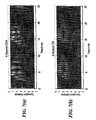
- the envelope sampling sequences for each channel are chosen as shown in Fig.1(a) .
- the spatial channel interaction is taken into account.
- the stimulation pattern reflects the temporal fine structure.
- the center frequency of channel #2 is represented in the temporal waveform.
- a so-called "hole-effect" can be observed: if electrode #2 is not active, i.e., if the output of filter channel #2 is negative, then other spectral maxima are not masked (due to spatial channel interaction) and appear in the waveform.
- the CIS system, Fig. 7(b) is based on an overall sampling rate of 10kpps, resulting in a rate of 1667pps per channel for the 6-channel system.
- Envelope detection for each channel is achieved with a full-wave rectifier and a low pass filter with a cut off frequency of 400Hz (Butterworth filter of 2 nd order), respectively. Obviously, the envelope signal is sampled and presented, but the temporal fine structure is lost.
- One data word consists of 16 bits, including START and STOP bits.
- the two special bits SPEC1 and SPEC0 represent a low rate information channel and are used for the initialization of the implant.
- the implant is permanently supplied with data defining the amplitude distributions and pules repetition rate of the normalized CSSS's, as well as data defining the reference current levels for each channel. These data are stored in particular implant memories.
- safety bits e.g., for cyclic redundancy check (CRC)
- CRC cyclic redundancy check
- the four address bits ADD3-ADDO define the channel address, and bits W7-W0 the weighting factor of the associated CSSS.
- the repetition rate of the Tab.1: Data word Bit # Definition 1 START 2 ADD3 3 ADD2 4 ADD1 5 ADD0 6 W7 7 W6 8 W5 9 W4 10 W3 11 W2 12 W1 13 W0 14 SPEC1 15 SPEC0 16 STOP CSSS's is comparatively low, especially at the low frequency channels. It is not necessary to transmit the amplitudes of the individual ultra-high rate pulses, since the amplitude distributions are already stored in the implant.
- a bit rate of 600kbit/s for a practical cochlear implant is sufficient for complete information transfer.
- this is a moderate rate as compared to the case, if each stimulation pulse has to be defined independently.
- a frame-rate of 10kpps of simultaneous stimulation pulses and a data word of 16bit per pulse an overall bit rate of 1920kbit/s results.
- Such a bit rate is almost impossible to realize with a inductive link system at reasonable power consumption.
- the correction of the amplitudes due to spatial channel interaction has to be performed for each simultaneous stimulation frame.
- CSSS stimulation approach may be summarized as follows.
Landscapes
- Health & Medical Sciences (AREA)
- Otolaryngology (AREA)
- Life Sciences & Earth Sciences (AREA)
- Biomedical Technology (AREA)
- Nuclear Medicine, Radiotherapy & Molecular Imaging (AREA)
- Radiology & Medical Imaging (AREA)
- Engineering & Computer Science (AREA)
- Animal Behavior & Ethology (AREA)
- General Health & Medical Sciences (AREA)
- Public Health (AREA)
- Veterinary Medicine (AREA)
- Electrotherapy Devices (AREA)
- Prostheses (AREA)
- Measurement And Recording Of Electrical Phenomena And Electrical Characteristics Of The Living Body (AREA)
- Medicinal Preparation (AREA)
Applications Claiming Priority (3)
| Application Number | Priority Date | Filing Date | Title |
|---|---|---|---|
| US15077399P | 1999-08-26 | 1999-08-26 | |
| EP07075655A EP1854504B1 (fr) | 1999-08-26 | 2000-08-25 | Stimulation nerveuse électrique basée sur des séquences d'échantillonnage spécifiques de canaux |
| EP00958940A EP1207938B1 (fr) | 1999-08-26 | 2000-08-25 | Stimulation nerveuse electrique fondee sur des sequences d'echantillonnage specifiques a une voie |
Related Parent Applications (3)
| Application Number | Title | Priority Date | Filing Date |
|---|---|---|---|
| EP00958940.9 Division | 2000-08-25 | ||
| EP07075655A Division-Into EP1854504B1 (fr) | 1999-08-26 | 2000-08-25 | Stimulation nerveuse électrique basée sur des séquences d'échantillonnage spécifiques de canaux |
| EP07075655.6 Division | 2007-08-01 |
Publications (2)
| Publication Number | Publication Date |
|---|---|
| EP2208507A1 true EP2208507A1 (fr) | 2010-07-21 |
| EP2208507B1 EP2208507B1 (fr) | 2011-11-16 |
Family
ID=22535931
Family Applications (3)
| Application Number | Title | Priority Date | Filing Date |
|---|---|---|---|
| EP00958940A Expired - Lifetime EP1207938B1 (fr) | 1999-08-26 | 2000-08-25 | Stimulation nerveuse electrique fondee sur des sequences d'echantillonnage specifiques a une voie |
| EP07075655A Expired - Lifetime EP1854504B1 (fr) | 1999-08-26 | 2000-08-25 | Stimulation nerveuse électrique basée sur des séquences d'échantillonnage spécifiques de canaux |
| EP10003323A Expired - Lifetime EP2208507B1 (fr) | 1999-08-26 | 2000-08-25 | Stimulation nerveuse électrique basée sur des séquences d'échantillonnage spécifiques de canaux |
Family Applications Before (2)
| Application Number | Title | Priority Date | Filing Date |
|---|---|---|---|
| EP00958940A Expired - Lifetime EP1207938B1 (fr) | 1999-08-26 | 2000-08-25 | Stimulation nerveuse electrique fondee sur des sequences d'echantillonnage specifiques a une voie |
| EP07075655A Expired - Lifetime EP1854504B1 (fr) | 1999-08-26 | 2000-08-25 | Stimulation nerveuse électrique basée sur des séquences d'échantillonnage spécifiques de canaux |
Country Status (10)
| Country | Link |
|---|---|
| US (5) | US6594525B1 (fr) |
| EP (3) | EP1207938B1 (fr) |
| JP (1) | JP4819268B2 (fr) |
| AT (2) | ATE533532T1 (fr) |
| AU (4) | AU775268B2 (fr) |
| BR (1) | BR0014147A (fr) |
| CA (1) | CA2382964C (fr) |
| DE (1) | DE60036875T2 (fr) |
| ES (1) | ES2293921T3 (fr) |
| WO (1) | WO2001013991A1 (fr) |
Cited By (2)
| Publication number | Priority date | Publication date | Assignee | Title |
|---|---|---|---|---|
| US7917224B2 (en) | 1999-07-21 | 2011-03-29 | Med-El Elektromedizinische Geraete Gmbh | Simultaneous stimulation for low power consumption |
| US7937157B2 (en) | 1999-08-26 | 2011-05-03 | Med-El Elektromedizinische Geraete Gmbh | Electrical nerve stimulation based on channel specific sequences |
Families Citing this family (95)
| Publication number | Priority date | Publication date | Assignee | Title |
|---|---|---|---|---|
| US8260430B2 (en) | 2010-07-01 | 2012-09-04 | Cochlear Limited | Stimulation channel selection for a stimulating medical device |
| US8165686B2 (en) | 1999-08-26 | 2012-04-24 | Med-El Elektromedizinische Geraete Gmbh | Simultaneous intracochlear stimulation |
| AUPQ952800A0 (en) * | 2000-08-21 | 2000-09-14 | Cochlear Limited | Power efficient electrical stimulation |
| US9008786B2 (en) * | 2000-08-21 | 2015-04-14 | Cochlear Limited | Determining stimulation signals for neural stimulation |
| US8285382B2 (en) | 2000-08-21 | 2012-10-09 | Cochlear Limited | Determining stimulation signals for neural stimulation |
| US7822478B2 (en) * | 2000-08-21 | 2010-10-26 | Cochlear Limited | Compressed neural coding |
| WO2002082982A1 (fr) | 2001-04-18 | 2002-10-24 | Cochlear Limited | Procede et appareil de mesure de reponses neuronales evoquees |
| AUPR604801A0 (en) * | 2001-06-29 | 2001-07-26 | Cochlear Limited | Multi-electrode cochlear implant system with distributed electronics |
| ATE446784T1 (de) | 2001-07-06 | 2009-11-15 | Cochlear Ltd | Konfiguration implantierter vorrichtungen |
| US10576275B2 (en) | 2001-07-06 | 2020-03-03 | Cochlear Limited | System and method for configuring an external device using operating parameters from an implanted device |
| AU2002363103B2 (en) * | 2001-10-24 | 2008-10-16 | Med-El Elektromedizinische Gerate Ges.M.B.H. | Implantable fluid delivery apparatuses and implantable electrode |
| US20070088335A1 (en) * | 2001-10-24 | 2007-04-19 | Med-El Elektromedizinische Geraete Gmbh | Implantable neuro-stimulation electrode with fluid reservoir |
| US7130694B1 (en) * | 2001-12-26 | 2006-10-31 | Advanced Bionics Corporation | Pulse skipping strategy |
| AUPS318202A0 (en) | 2002-06-26 | 2002-07-18 | Cochlear Limited | Parametric fitting of a cochlear implant |
| AU2002951218A0 (en) | 2002-09-04 | 2002-09-19 | Cochlear Limited | Method and apparatus for measurement of evoked neural response |
| ATE499139T1 (de) * | 2002-12-02 | 2011-03-15 | Med El Elektromed Geraete Gmbh | Transdermal durch magnetische kraft kontrollierter flüssigkeitsschalter |
| ATE517655T1 (de) | 2003-08-07 | 2011-08-15 | Hamamatsu Found Sci & Tech Pro | Verfahren zur sprachumwandlung für ein cochlea- implantat und cochlea-implantat |
| WO2005113064A1 (fr) | 2004-03-08 | 2005-12-01 | Med-El Elektromedizinische Geraete Gmbh | Stimulation electrique du nerf auditif fondee sur des groupes selectionnes |
| US8577473B2 (en) | 2004-03-08 | 2013-11-05 | Med-El Elektromedizinische Geraete Gmbh | Cochlear implant stimulation with low frequency channel privilege |
| US7941223B2 (en) * | 2004-03-08 | 2011-05-10 | Med-El Elektromedizinische Geraete Gmbh | Cochlear implant stimulation with variable number of electrodes |
| CA2569724A1 (fr) | 2004-06-15 | 2005-12-29 | Cochlear Americas | Determination automatique du seuil d'une reponse neuronale evoquee |
| US7801617B2 (en) | 2005-10-31 | 2010-09-21 | Cochlear Limited | Automatic measurement of neural response concurrent with psychophysics measurement of stimulating device recipient |
| US8190268B2 (en) | 2004-06-15 | 2012-05-29 | Cochlear Limited | Automatic measurement of an evoked neural response concurrent with an indication of a psychophysics reaction |
| CA2606787A1 (fr) | 2005-04-29 | 2006-11-09 | Cochlear Americas | Stimulation focalisee dans un dispositif de stimulation medical |
| DE102005030327A1 (de) * | 2005-06-29 | 2007-01-04 | Fraunhofer-Gesellschaft zur Förderung der angewandten Forschung e.V. | Vorrichtung, Verfahren und Computerprogramm zur Analyse eine Audiosignals |
| WO2007091180A2 (fr) * | 2006-02-07 | 2007-08-16 | Med-El Elektromedizinische Geraete Gmbh | Implant cochléaire de suppression d'acouphène |
| US20100121411A1 (en) * | 2006-02-07 | 2010-05-13 | Med-El Elektromedizinische Geraete Gmbh | Tinnitus Suppressing Cochlear Implant |
| US8784312B2 (en) | 2006-02-10 | 2014-07-22 | Cochlear Limited | Recognition of implantable medical device |
| AR059786A1 (es) * | 2006-03-09 | 2008-04-30 | Med El Elektromed Geraete Gmbh | Configuracion de electrodo de implante coclear para eluir farmacos |
| US8209018B2 (en) * | 2006-03-10 | 2012-06-26 | Medtronic, Inc. | Probabilistic neurological disorder treatment |
| US7835804B2 (en) * | 2006-04-18 | 2010-11-16 | Advanced Bionics, Llc | Removing artifact in evoked compound action potential recordings in neural stimulators |
| US8571675B2 (en) | 2006-04-21 | 2013-10-29 | Cochlear Limited | Determining operating parameters for a stimulating medical device |
| US7769467B1 (en) | 2007-01-31 | 2010-08-03 | Advanced Bionics, Llc | Level-dependent stimulation methods and systems |
| US8391993B2 (en) | 2007-07-13 | 2013-03-05 | Cochlear Limited | Using interaction to measure neural excitation |
| AU2008276262B2 (en) * | 2007-07-13 | 2012-08-09 | Med-El Elektromedizinische Geraete Gmbh | Electrical nerve stimulation with broad band low frequency filter |
| JP5377488B2 (ja) * | 2007-08-10 | 2013-12-25 | メド−エル エレクトロメディジニシェ ゲラテ ゲーエムベーハー | 誘導リンクのためのパルス幅適合 |
| KR101543814B1 (ko) * | 2007-09-11 | 2015-08-11 | 메드-엘 엘렉트로메디지니쉐 게라에테 게엠베하 | 등시성 와우내 자극 |
| JP5550559B2 (ja) * | 2007-11-09 | 2014-07-16 | メド−エル エレクトロメディジニシェ ゲラテ ゲーエムベーハー | 拍動性移植蝸牛刺激装置の刺激ストラテジ |
| US9011508B2 (en) * | 2007-11-30 | 2015-04-21 | Lockheed Martin Corporation | Broad wavelength profile to homogenize the absorption profile in optical stimulation of nerves |
| AU2009233699B2 (en) * | 2008-04-08 | 2014-05-15 | Med-El Elektromedizinische Geraete Gmbh | Electrical stimulation of the acoustic nerve with coherent fine structure |
| US9180295B2 (en) * | 2008-04-22 | 2015-11-10 | Med-El Elektromedizinische Geraete Gmbh | Tonotopic implant stimulation |
| WO2010033483A1 (fr) * | 2008-09-18 | 2010-03-25 | Advanced Bionics, Llc | Procédés et systèmes permettant de faire parvenir des informations de structure fine à un patient porteur d'un implant cochléaire |
| US8532781B1 (en) * | 2008-09-18 | 2013-09-10 | Advanced Bionics, Llc | Methods and systems of generating a graphical representation of an intracochlear trajectory of electrodes |
| CN102176947A (zh) * | 2008-10-07 | 2011-09-07 | Med-El电气医疗器械有限公司 | 用于睡眠中的具有耳鸣抑制及报警功能的耳蜗植入体声音处理器 |
| CN102186528B (zh) * | 2008-10-15 | 2013-08-07 | Med-El电气医疗器械有限公司 | 内耳给药装置 |
| AU2009313316B2 (en) | 2008-11-10 | 2013-07-18 | Med-El Elektromedizinische Geraete Gmbh | Hydrogel-filled drug delivery reservoirs |
| AU2009333567B2 (en) * | 2008-12-08 | 2012-11-01 | Med-El Elektromedizinische Geraete Gmbh | Method for fitting a cochlear implant with patient feedback |
| AU2010206911B2 (en) * | 2009-01-20 | 2013-08-01 | Med-El Elektromedizinische Geraete Gmbh | High accuracy tonotopic and periodic coding with enhanced harmonic resolution |
| WO2010088324A1 (fr) * | 2009-01-28 | 2010-08-05 | Med-El Elktromedizinische Geraete Gmbh | Commande de gain spécifique au canal avec suppression latérale |
| US8954158B2 (en) | 2009-02-05 | 2015-02-10 | Cochlear Limited | Multi-electrode channel configurations |
| WO2010091240A1 (fr) * | 2009-02-06 | 2010-08-12 | Med-El Elektromedizinische Geraete Gmbh | Échantillonneur d'enveloppe déclenché en phase |
| AU2010230035A1 (en) * | 2009-03-24 | 2011-11-10 | Med-El Elektromedizinische Geraete Gmbh | Musical fitting of cochlear implants |
| EP2340081B1 (fr) * | 2009-03-24 | 2012-09-26 | MED-EL Elektromedizinische Geräte GmbH | Stimulation cochleaire declenchee par porteur et enveloppe |
| US8554329B1 (en) * | 2009-06-16 | 2013-10-08 | Advanced Bionics | Percutaneous cochlear implant systems and methods |
| WO2010148169A1 (fr) * | 2009-06-17 | 2010-12-23 | Med-El Elektromedizinische Geraete Gmbh | Décodeur et post-processeur de codage spatial d'objet audio (saoc) pour aides auditives |
| US9393412B2 (en) | 2009-06-17 | 2016-07-19 | Med-El Elektromedizinische Geraete Gmbh | Multi-channel object-oriented audio bitstream processor for cochlear implants |
| US20110098784A1 (en) * | 2009-10-23 | 2011-04-28 | Med-El Elektromedizinische Geraete Gmbh | Channel-Specific Loudness Mapping for Prosthetic Hearing Systems |
| EP2542302B1 (fr) * | 2010-03-04 | 2014-04-30 | Fraunhofer Gesellschaft zur Förderung der angewandten Forschung e.V. | Procédé et appareil de génération d'un signal de stimulation d'électrode dans une prothèse auditive neurale |
| US9031661B2 (en) * | 2010-05-18 | 2015-05-12 | Cochlear Limited | Multi-electrode channel configurations for a hearing prosthesis |
| EP2575960B1 (fr) | 2010-05-28 | 2017-01-25 | Advanced Bionics AG | Systèmes pour minimiser un effet d'interaction de canaux dans un système d'implant cochléaire |
| US9320896B2 (en) | 2010-09-15 | 2016-04-26 | Med-El Elektromedizinische Geraete Gmbh | Accelerated fitting of cochlear implants based on current spread |
| US9669213B2 (en) | 2011-01-24 | 2017-06-06 | David Tsai | Stimulation method for maintaining the responsiveness of electrically excitable cells to repeated electrical stimulation |
| US8706181B2 (en) * | 2011-01-25 | 2014-04-22 | Medtronic, Inc. | Target therapy delivery site selection |
| WO2012112383A1 (fr) * | 2011-02-14 | 2012-08-23 | Med-Elektromedizinische Geraete Gmbh | Amélioration de la transmission de structure à réglage de précision pour un système d'implant auditif |
| US8515540B2 (en) | 2011-02-24 | 2013-08-20 | Cochlear Limited | Feedthrough having a non-linear conductor |
| AU2012256122B2 (en) * | 2011-05-13 | 2015-01-22 | Med-El Elektromedizinische Geraete Gmbh | Optimal model constants for simultaneous stimulation with channel interaction compensation |
| US9326075B2 (en) | 2011-10-07 | 2016-04-26 | Cochlear Limited | Flexible protocol for an implanted prosthesis |
| US9216288B2 (en) | 2011-12-22 | 2015-12-22 | Cochlear Limited | Stimulation prosthesis with configurable data link |
| US8694114B2 (en) | 2012-02-21 | 2014-04-08 | Wisconsin Alumni Research Foundation | System and method for fine-structure processing for hearing assistance devices |
| US20130245717A1 (en) * | 2012-03-15 | 2013-09-19 | Med-El Elektromedizinische Geraete Gmbh | Using Alternative Stimulus Waveforms To Improve Pitch Percepts Elicited With Cochlear Implant Systems |
| PL2887997T3 (pl) | 2012-08-27 | 2018-04-30 | Med-El Elektromedizinische Geräte GmbH | Redukcja dźwięków transjentowych w implancie słuchowym |
| AU2013338341B2 (en) | 2012-10-31 | 2017-08-24 | Med-El Elektromedizinische Geraete Gmbh | Temporal coding for hearing implants |
| US9320887B2 (en) | 2013-10-17 | 2016-04-26 | Med-El Elektromedizinische Geraete Gmbh | Objective allocation of implant electrode bands based on excitation spread |
| EP3079760B1 (fr) | 2013-12-11 | 2020-08-12 | MED-EL Elektromedizinische Geräte GmbH | Sélection automatique de réduction ou d'amélioration de sons transitoires |
| US9999769B2 (en) | 2014-03-10 | 2018-06-19 | Cisco Technology, Inc. | Excitation modeling and matching |
| WO2016057855A1 (fr) * | 2014-10-08 | 2016-04-14 | Massachusetts Institute Of Technology | Procédés et appareil de stimulation de tissu biologique |
| US9775997B2 (en) | 2014-10-08 | 2017-10-03 | Med-El Elektromedizinische Geraete Gmbh | Neural coding with short inter pulse intervals |
| EP3226963B1 (fr) | 2014-12-03 | 2020-02-05 | Med-El Elektromedizinische Geraete GmbH | Mise en correspondance bilatérale d'implant auditif de différences de niveaux interauriculaires (ild) sur la base d'un retard de temps interauriculaire (itd) mesuré |
| US10105539B2 (en) | 2014-12-17 | 2018-10-23 | Cochlear Limited | Configuring a stimulation unit of a hearing device |
| DE102015104614A1 (de) | 2015-03-26 | 2016-09-29 | Med-El Elektromedizinische Geräte GmbH | Vorrichtung und Verfahren zur elektrischen Stimulation mit Hilfe eines Cochlea-Implantats |
| US10814126B2 (en) | 2015-05-22 | 2020-10-27 | Cochlear Limited | Dynamic current steering |
| US9776001B2 (en) | 2015-06-11 | 2017-10-03 | Med-El Elektromedizinische Geraete Gmbh | Interaural coherence based cochlear stimulation using adapted envelope processing |
| US9808624B2 (en) | 2015-06-11 | 2017-11-07 | Med-El Elektromedizinische Geraete Gmbh | Interaural coherence based cochlear stimulation using adapted fine structure processing |
| CN107708797B (zh) | 2015-06-11 | 2021-01-19 | Med-El电气医疗器械有限公司 | 切换听力植入物编码策略 |
| GB201511205D0 (en) | 2015-06-25 | 2015-08-12 | Sky Medical Technology Ltd | Multiple negative electrodes |
| EP3335072B1 (fr) | 2015-08-11 | 2025-05-21 | MED-EL Elektromedizinische Geräte GmbH | Systéme de stimulation opto-mécanique multicanal |
| CN107925829B (zh) * | 2015-09-01 | 2020-05-15 | Med-El电气医疗器械有限公司 | 与瞬时频率匹配的刺激速率和位置 |
| CN109310862A (zh) | 2016-05-31 | 2019-02-05 | 领先仿生公司 | 利用精细结构信息的通道选择系统和方法 |
| US10602284B2 (en) | 2016-07-18 | 2020-03-24 | Cochlear Limited | Transducer management |
| US10743114B2 (en) * | 2016-11-22 | 2020-08-11 | Cochlear Limited | Dynamic stimulus resolution adaption |
| CN106897769A (zh) * | 2017-01-20 | 2017-06-27 | 清华大学 | 具有深度时间划窗的神经元信息处理方法和系统 |
| US11529516B2 (en) | 2017-06-28 | 2022-12-20 | Universidad De Salamanca | Medial olivocochlear reflex sound coding with bandwidth normalization |
| US10512775B2 (en) * | 2017-08-30 | 2019-12-24 | Cochlear Limited | Noise reduction for implantable hearing prostheses |
| EP3881564B1 (fr) | 2018-11-16 | 2025-10-15 | Cochlear Limited | Procédés de mise au point d'une prothèse |
| WO2021053045A1 (fr) | 2019-09-17 | 2021-03-25 | Med-El Elektromedizinische Geräte Ges.m.b.H. | Adaptation d'un implant cochléaire sur la base de l'état neuronal |
Citations (4)
| Publication number | Priority date | Publication date | Assignee | Title |
|---|---|---|---|---|
| US5601617A (en) | 1995-04-26 | 1997-02-11 | Advanced Bionics Corporation | Multichannel cochlear prosthesis with flexible control of stimulus waveforms |
| US5749912A (en) | 1994-10-24 | 1998-05-12 | House Ear Institute | Low-cost, four-channel cochlear implant |
| WO1998049775A1 (fr) | 1997-05-01 | 1998-11-05 | Murphy, Timothy, M. | Appareil et procede relatif a un banc de filtres numeriques a faible puissance |
| WO1999035882A1 (fr) | 1998-01-12 | 1999-07-15 | Imperial College Of Science, Technology & Medicine | Processeurs de signaux audio |
Family Cites Families (22)
| Publication number | Priority date | Publication date | Assignee | Title |
|---|---|---|---|---|
| US4284856A (en) | 1979-09-24 | 1981-08-18 | Hochmair Ingeborg | Multi-frequency system and method for enhancing auditory stimulation and the like |
| DE3008677C2 (de) * | 1980-03-06 | 1983-08-25 | Siemens AG, 1000 Berlin und 8000 München | Hörprothese zur elektrischen Stimulation des Hörnervs |
| CA1189147A (fr) * | 1980-12-12 | 1985-06-18 | James F. Patrick | Amelioration dans les dispositifs de traitement de la parole |
| US4823795A (en) * | 1987-03-13 | 1989-04-25 | Minnesota Mining And Manufacturing Company | Signal processor for and an auditory prosthesis having spectral to temporal transformation |
| DE3821970C1 (fr) * | 1988-06-29 | 1989-12-14 | Ernst-Ludwig Von Dr. 8137 Berg De Wallenberg-Pachaly | |
| US5603726A (en) | 1989-09-22 | 1997-02-18 | Alfred E. Mann Foundation For Scientific Research | Multichannel cochlear implant system including wearable speech processor |
| US5938691A (en) | 1989-09-22 | 1999-08-17 | Alfred E. Mann Foundation | Multichannel implantable cochlear stimulator |
| US5597380A (en) | 1991-07-02 | 1997-01-28 | Cochlear Ltd. | Spectral maxima sound processor |
| GB2259365B (en) * | 1991-09-04 | 1995-08-02 | Nippon Denso Co | Knock control apparatus for an internal combustion engine |
| US6219580B1 (en) * | 1995-04-26 | 2001-04-17 | Advanced Bionics Corporation | Multichannel cochlear prosthesis with flexible control of stimulus waveforms |
| US5626629A (en) | 1995-05-31 | 1997-05-06 | Advanced Bionics Corporation | Programming of a speech processor for an implantable cochlear stimulator |
| US5824022A (en) * | 1996-03-07 | 1998-10-20 | Advanced Bionics Corporation | Cochlear stimulation system employing behind-the-ear speech processor with remote control |
| JP3801212B2 (ja) * | 1996-05-24 | 2006-07-26 | エス ジョージ レジンスキー | 埋込み可能な補聴器用改良マイクロフォン |
| US6078838A (en) * | 1998-02-13 | 2000-06-20 | University Of Iowa Research Foundation | Pseudospontaneous neural stimulation system and method |
| BR9909336A (pt) | 1998-04-01 | 2001-11-06 | James H Doyle Sr | Estimulador de ouvido interno, implantável, de canais múltiplos |
| US6175767B1 (en) * | 1998-04-01 | 2001-01-16 | James H. Doyle, Sr. | Multichannel implantable inner ear stimulator |
| US6289247B1 (en) * | 1998-06-02 | 2001-09-11 | Advanced Bionics Corporation | Strategy selector for multichannel cochlear prosthesis |
| US7917224B2 (en) | 1999-07-21 | 2011-03-29 | Med-El Elektromedizinische Geraete Gmbh | Simultaneous stimulation for low power consumption |
| US6594525B1 (en) | 1999-08-26 | 2003-07-15 | Med-El Elektromedizinische Geraete Gmbh | Electrical nerve stimulation based on channel specific sampling sequences |
| EP2291005B1 (fr) * | 1999-07-21 | 2016-09-07 | MED-EL Elektromedizinische Geräte GmbH | Implant cochléaire à plusieurs canaux à télémesure de réaction neuronale |
| CA2381725C (fr) | 1999-09-16 | 2008-01-22 | Advanced Bionics N.V. | Implant cochleaire |
| DE60107062T2 (de) | 2000-03-31 | 2005-11-24 | Advanced Bionics Corp., Sylmar | Vollständig implantierbare cochlea-microprothese mit einer vielzahl von kontakten |
-
2000
- 2000-08-25 US US09/648,687 patent/US6594525B1/en not_active Expired - Lifetime
- 2000-08-25 BR BR0014147-0A patent/BR0014147A/pt not_active Application Discontinuation
- 2000-08-25 CA CA2382964A patent/CA2382964C/fr not_active Expired - Lifetime
- 2000-08-25 DE DE60036875T patent/DE60036875T2/de not_active Expired - Lifetime
- 2000-08-25 AU AU70344/00A patent/AU775268B2/en not_active Expired
- 2000-08-25 EP EP00958940A patent/EP1207938B1/fr not_active Expired - Lifetime
- 2000-08-25 EP EP07075655A patent/EP1854504B1/fr not_active Expired - Lifetime
- 2000-08-25 JP JP2001518123A patent/JP4819268B2/ja not_active Expired - Lifetime
- 2000-08-25 AT AT10003323T patent/ATE533532T1/de active
- 2000-08-25 EP EP10003323A patent/EP2208507B1/fr not_active Expired - Lifetime
- 2000-08-25 ES ES00958940T patent/ES2293921T3/es not_active Expired - Lifetime
- 2000-08-25 WO PCT/IB2000/001338 patent/WO2001013991A1/fr not_active Ceased
- 2000-08-25 AT AT00958940T patent/ATE376443T1/de active
-
2002
- 2002-11-25 US US10/303,568 patent/US7209789B2/en not_active Expired - Lifetime
-
2004
- 2004-10-28 AU AU2004224917A patent/AU2004224917B2/en not_active Expired
-
2006
- 2006-10-12 AU AU2006228050A patent/AU2006228050B2/en not_active Expired
-
2007
- 2007-03-14 US US11/685,887 patent/US7937157B2/en not_active Expired - Fee Related
-
2008
- 2008-12-11 AU AU2008255249A patent/AU2008255249B2/en not_active Expired
-
2011
- 2011-03-24 US US13/070,880 patent/US8798758B2/en not_active Expired - Fee Related
-
2014
- 2014-07-09 US US14/326,986 patent/US9566434B2/en not_active Expired - Fee Related
Patent Citations (4)
| Publication number | Priority date | Publication date | Assignee | Title |
|---|---|---|---|---|
| US5749912A (en) | 1994-10-24 | 1998-05-12 | House Ear Institute | Low-cost, four-channel cochlear implant |
| US5601617A (en) | 1995-04-26 | 1997-02-11 | Advanced Bionics Corporation | Multichannel cochlear prosthesis with flexible control of stimulus waveforms |
| WO1998049775A1 (fr) | 1997-05-01 | 1998-11-05 | Murphy, Timothy, M. | Appareil et procede relatif a un banc de filtres numeriques a faible puissance |
| WO1999035882A1 (fr) | 1998-01-12 | 1999-07-15 | Imperial College Of Science, Technology & Medicine | Processeurs de signaux audio |
Non-Patent Citations (1)
| Title |
|---|
| LOIZOU P C ED - SODERSTRAND M A ET AL: "Signal processing for cochlear prosthesis: a tutorial review", CIRCUITS AND SYSTEMS, 1997. PROCEEDINGS OF THE 40TH MIDWEST SYMPOSIUM ON SACRAMENTO, CA, USA 3-6 AUG. 1997, NEW YORK, NY, USA,IEEE, US, vol. 2, 3 August 1997 (1997-08-03), pages 881 - 885, XP010272248, ISBN: 978-0-7803-3694-0 * |
Cited By (5)
| Publication number | Priority date | Publication date | Assignee | Title |
|---|---|---|---|---|
| US7917224B2 (en) | 1999-07-21 | 2011-03-29 | Med-El Elektromedizinische Geraete Gmbh | Simultaneous stimulation for low power consumption |
| US8428742B2 (en) | 1999-07-21 | 2013-04-23 | Med-El Elektromedizinische Geraete Gmbh | Simultaneous stimulation for low power consumption |
| US7937157B2 (en) | 1999-08-26 | 2011-05-03 | Med-El Elektromedizinische Geraete Gmbh | Electrical nerve stimulation based on channel specific sequences |
| US8798758B2 (en) | 1999-08-26 | 2014-08-05 | Med-El Elektromedizinische Geraete Gmbh | Electrical nerve stimulation based on channel specific sampling sequences |
| US9566434B2 (en) | 1999-08-26 | 2017-02-14 | Med-El Elektromedizinische Geraete Gmbh | Electrical nerve stimulation based on channel specific sampling sequences |
Also Published As
Similar Documents
| Publication | Publication Date | Title |
|---|---|---|
| EP2208507A1 (fr) | Stimulation nerveuse électrique basée sur des séquences d'échantillonnage spécifiques de canaux | |
| US8428742B2 (en) | Simultaneous stimulation for low power consumption | |
| US7283876B2 (en) | Electrical stimulation of the acoustic nerve based on selected groups | |
| AU2011265365B2 (en) | Electrical nerve stimulation based on channel specific sampling sequences |
Legal Events
| Date | Code | Title | Description |
|---|---|---|---|
| PUAI | Public reference made under article 153(3) epc to a published international application that has entered the european phase |
Free format text: ORIGINAL CODE: 0009012 |
|
| 17P | Request for examination filed |
Effective date: 20100409 |
|
| AC | Divisional application: reference to earlier application |
Ref document number: 1207938 Country of ref document: EP Kind code of ref document: P Ref document number: 1854504 Country of ref document: EP Kind code of ref document: P |
|
| AK | Designated contracting states |
Kind code of ref document: A1 Designated state(s): AT BE CH CY DE DK ES FI FR GB GR IE IT LI LU MC NL PT SE |
|
| GRAP | Despatch of communication of intention to grant a patent |
Free format text: ORIGINAL CODE: EPIDOSNIGR1 |
|
| RIC1 | Information provided on ipc code assigned before grant |
Ipc: A61F 11/04 20060101ALI20110511BHEP Ipc: A61N 1/36 20060101AFI20110511BHEP Ipc: H04R 25/00 20060101ALI20110511BHEP |
|
| GRAS | Grant fee paid |
Free format text: ORIGINAL CODE: EPIDOSNIGR3 |
|
| GRAA | (expected) grant |
Free format text: ORIGINAL CODE: 0009210 |
|
| AC | Divisional application: reference to earlier application |
Ref document number: 1207938 Country of ref document: EP Kind code of ref document: P Ref document number: 1854504 Country of ref document: EP Kind code of ref document: P |
|
| AK | Designated contracting states |
Kind code of ref document: B1 Designated state(s): AT BE CH CY DE DK ES FI FR GB GR IE IT LI LU MC NL PT SE |
|
| REG | Reference to a national code |
Ref country code: GB Ref legal event code: FG4D |
|
| REG | Reference to a national code |
Ref country code: CH Ref legal event code: EP |
|
| REG | Reference to a national code |
Ref country code: IE Ref legal event code: FG4D |
|
| REG | Reference to a national code |
Ref country code: DE Ref legal event code: R096 Ref document number: 60046679 Country of ref document: DE Effective date: 20120126 |
|
| REG | Reference to a national code |
Ref country code: NL Ref legal event code: VDEP Effective date: 20111116 |
|
| PG25 | Lapsed in a contracting state [announced via postgrant information from national office to epo] |
Ref country code: BE Free format text: LAPSE BECAUSE OF FAILURE TO SUBMIT A TRANSLATION OF THE DESCRIPTION OR TO PAY THE FEE WITHIN THE PRESCRIBED TIME-LIMIT Effective date: 20111116 Ref country code: PT Free format text: LAPSE BECAUSE OF FAILURE TO SUBMIT A TRANSLATION OF THE DESCRIPTION OR TO PAY THE FEE WITHIN THE PRESCRIBED TIME-LIMIT Effective date: 20120316 Ref country code: SE Free format text: LAPSE BECAUSE OF FAILURE TO SUBMIT A TRANSLATION OF THE DESCRIPTION OR TO PAY THE FEE WITHIN THE PRESCRIBED TIME-LIMIT Effective date: 20111116 Ref country code: NL Free format text: LAPSE BECAUSE OF FAILURE TO SUBMIT A TRANSLATION OF THE DESCRIPTION OR TO PAY THE FEE WITHIN THE PRESCRIBED TIME-LIMIT Effective date: 20111116 Ref country code: GR Free format text: LAPSE BECAUSE OF FAILURE TO SUBMIT A TRANSLATION OF THE DESCRIPTION OR TO PAY THE FEE WITHIN THE PRESCRIBED TIME-LIMIT Effective date: 20120217 |
|
| PG25 | Lapsed in a contracting state [announced via postgrant information from national office to epo] |
Ref country code: CY Free format text: LAPSE BECAUSE OF FAILURE TO SUBMIT A TRANSLATION OF THE DESCRIPTION OR TO PAY THE FEE WITHIN THE PRESCRIBED TIME-LIMIT Effective date: 20111116 |
|
| PG25 | Lapsed in a contracting state [announced via postgrant information from national office to epo] |
Ref country code: DK Free format text: LAPSE BECAUSE OF FAILURE TO SUBMIT A TRANSLATION OF THE DESCRIPTION OR TO PAY THE FEE WITHIN THE PRESCRIBED TIME-LIMIT Effective date: 20111116 |
|
| PG25 | Lapsed in a contracting state [announced via postgrant information from national office to epo] |
Ref country code: IT Free format text: LAPSE BECAUSE OF FAILURE TO SUBMIT A TRANSLATION OF THE DESCRIPTION OR TO PAY THE FEE WITHIN THE PRESCRIBED TIME-LIMIT Effective date: 20111116 |
|
| REG | Reference to a national code |
Ref country code: AT Ref legal event code: MK05 Ref document number: 533532 Country of ref document: AT Kind code of ref document: T Effective date: 20111116 |
|
| PLBE | No opposition filed within time limit |
Free format text: ORIGINAL CODE: 0009261 |
|
| STAA | Information on the status of an ep patent application or granted ep patent |
Free format text: STATUS: NO OPPOSITION FILED WITHIN TIME LIMIT |
|
| 26N | No opposition filed |
Effective date: 20120817 |
|
| REG | Reference to a national code |
Ref country code: DE Ref legal event code: R097 Ref document number: 60046679 Country of ref document: DE Effective date: 20120817 |
|
| PG25 | Lapsed in a contracting state [announced via postgrant information from national office to epo] |
Ref country code: AT Free format text: LAPSE BECAUSE OF FAILURE TO SUBMIT A TRANSLATION OF THE DESCRIPTION OR TO PAY THE FEE WITHIN THE PRESCRIBED TIME-LIMIT Effective date: 20111116 |
|
| REG | Reference to a national code |
Ref country code: CH Ref legal event code: PL |
|
| PG25 | Lapsed in a contracting state [announced via postgrant information from national office to epo] |
Ref country code: MC Free format text: LAPSE BECAUSE OF NON-PAYMENT OF DUE FEES Effective date: 20120831 |
|
| GBPC | Gb: european patent ceased through non-payment of renewal fee |
Effective date: 20120825 |
|
| PG25 | Lapsed in a contracting state [announced via postgrant information from national office to epo] |
Ref country code: ES Free format text: LAPSE BECAUSE OF FAILURE TO SUBMIT A TRANSLATION OF THE DESCRIPTION OR TO PAY THE FEE WITHIN THE PRESCRIBED TIME-LIMIT Effective date: 20120227 Ref country code: LI Free format text: LAPSE BECAUSE OF NON-PAYMENT OF DUE FEES Effective date: 20120831 Ref country code: CH Free format text: LAPSE BECAUSE OF NON-PAYMENT OF DUE FEES Effective date: 20120831 |
|
| REG | Reference to a national code |
Ref country code: IE Ref legal event code: MM4A |
|
| PG25 | Lapsed in a contracting state [announced via postgrant information from national office to epo] |
Ref country code: FI Free format text: LAPSE BECAUSE OF FAILURE TO SUBMIT A TRANSLATION OF THE DESCRIPTION OR TO PAY THE FEE WITHIN THE PRESCRIBED TIME-LIMIT Effective date: 20111116 |
|
| PG25 | Lapsed in a contracting state [announced via postgrant information from national office to epo] |
Ref country code: GB Free format text: LAPSE BECAUSE OF NON-PAYMENT OF DUE FEES Effective date: 20120825 Ref country code: IE Free format text: LAPSE BECAUSE OF NON-PAYMENT OF DUE FEES Effective date: 20120825 |
|
| PG25 | Lapsed in a contracting state [announced via postgrant information from national office to epo] |
Ref country code: LU Free format text: LAPSE BECAUSE OF NON-PAYMENT OF DUE FEES Effective date: 20120825 |
|
| REG | Reference to a national code |
Ref country code: FR Ref legal event code: PLFP Year of fee payment: 17 |
|
| REG | Reference to a national code |
Ref country code: FR Ref legal event code: PLFP Year of fee payment: 18 |
|
| REG | Reference to a national code |
Ref country code: FR Ref legal event code: PLFP Year of fee payment: 19 |
|
| PGFP | Annual fee paid to national office [announced via postgrant information from national office to epo] |
Ref country code: FR Payment date: 20190828 Year of fee payment: 20 |
|
| PGFP | Annual fee paid to national office [announced via postgrant information from national office to epo] |
Ref country code: DE Payment date: 20191031 Year of fee payment: 20 |
|
| REG | Reference to a national code |
Ref country code: DE Ref legal event code: R071 Ref document number: 60046679 Country of ref document: DE |