EP2210954A1 - Bestimmung des DNA-Methylierungsgrads - Google Patents
Bestimmung des DNA-Methylierungsgrads Download PDFInfo
- Publication number
- EP2210954A1 EP2210954A1 EP09151141A EP09151141A EP2210954A1 EP 2210954 A1 EP2210954 A1 EP 2210954A1 EP 09151141 A EP09151141 A EP 09151141A EP 09151141 A EP09151141 A EP 09151141A EP 2210954 A1 EP2210954 A1 EP 2210954A1
- Authority
- EP
- European Patent Office
- Prior art keywords
- seq
- dna
- transposon
- methylation
- fragment
- Prior art date
- Legal status (The legal status is an assumption and is not a legal conclusion. Google has not performed a legal analysis and makes no representation as to the accuracy of the status listed.)
- Granted
Links
Images
Classifications
-
- C—CHEMISTRY; METALLURGY
- C12—BIOCHEMISTRY; BEER; SPIRITS; WINE; VINEGAR; MICROBIOLOGY; ENZYMOLOGY; MUTATION OR GENETIC ENGINEERING
- C12Q—MEASURING OR TESTING PROCESSES INVOLVING ENZYMES, NUCLEIC ACIDS OR MICROORGANISMS; COMPOSITIONS OR TEST PAPERS THEREFOR; PROCESSES OF PREPARING SUCH COMPOSITIONS; CONDITION-RESPONSIVE CONTROL IN MICROBIOLOGICAL OR ENZYMOLOGICAL PROCESSES
- C12Q1/00—Measuring or testing processes involving enzymes, nucleic acids or microorganisms; Compositions therefor; Processes of preparing such compositions
- C12Q1/68—Measuring or testing processes involving enzymes, nucleic acids or microorganisms; Compositions therefor; Processes of preparing such compositions involving nucleic acids
- C12Q1/6844—Nucleic acid amplification reactions
- C12Q1/6858—Allele-specific amplification
-
- C—CHEMISTRY; METALLURGY
- C12—BIOCHEMISTRY; BEER; SPIRITS; WINE; VINEGAR; MICROBIOLOGY; ENZYMOLOGY; MUTATION OR GENETIC ENGINEERING
- C12Q—MEASURING OR TESTING PROCESSES INVOLVING ENZYMES, NUCLEIC ACIDS OR MICROORGANISMS; COMPOSITIONS OR TEST PAPERS THEREFOR; PROCESSES OF PREPARING SUCH COMPOSITIONS; CONDITION-RESPONSIVE CONTROL IN MICROBIOLOGICAL OR ENZYMOLOGICAL PROCESSES
- C12Q1/00—Measuring or testing processes involving enzymes, nucleic acids or microorganisms; Compositions therefor; Processes of preparing such compositions
- C12Q1/68—Measuring or testing processes involving enzymes, nucleic acids or microorganisms; Compositions therefor; Processes of preparing such compositions involving nucleic acids
- C12Q1/6876—Nucleic acid products used in the analysis of nucleic acids, e.g. primers or probes
- C12Q1/6883—Nucleic acid products used in the analysis of nucleic acids, e.g. primers or probes for diseases caused by alterations of genetic material
- C12Q1/6886—Nucleic acid products used in the analysis of nucleic acids, e.g. primers or probes for diseases caused by alterations of genetic material for cancer
-
- C—CHEMISTRY; METALLURGY
- C12—BIOCHEMISTRY; BEER; SPIRITS; WINE; VINEGAR; MICROBIOLOGY; ENZYMOLOGY; MUTATION OR GENETIC ENGINEERING
- C12Q—MEASURING OR TESTING PROCESSES INVOLVING ENZYMES, NUCLEIC ACIDS OR MICROORGANISMS; COMPOSITIONS OR TEST PAPERS THEREFOR; PROCESSES OF PREPARING SUCH COMPOSITIONS; CONDITION-RESPONSIVE CONTROL IN MICROBIOLOGICAL OR ENZYMOLOGICAL PROCESSES
- C12Q2600/00—Oligonucleotides characterized by their use
- C12Q2600/154—Methylation markers
Definitions
- the invention is in the field of epigenetics, in particular DNA methylation. It provides an amplification method for the detection of epigenetic changes, which are particularly relevant for clinical diagnostics. Furthermore, specific primers are provided for this amplification process.
- Epigenetic mechanisms cause changes in gene expression, which are not associated with a change in the coding sequence of the genes, but can be mitotic inherited, for example.
- the DNA methylation patterns are replication-coupled transferred from the mother cell to the daughter cells.
- the inheritance of epigenetic genetic information is ensured.
- DNA methylation is the most studied epigenetic mechanism ( Serman et al., Coll Antropol. 2006; 30 (3): 665-71 ).
- the human genome has in a differentiated healthy cell a specific and largely immutable DNA methylation pattern, which is crucial in determining gene expression.
- genomic regions with regulative In many cases, the transcriptional function is unmethylated, whereas transcriptionally inactive genomic portions are methylated.
- DNA methylation occurs at the cytosine residues of the nucleic acid and preferably at dinucleotides with a cytosine-guanine sequence (CpG).
- CpG cytosine-guanine sequence
- tumor tissue has chromosomal abnormalities, i. This tissue has different genomic properties compared to healthy tissue, the fundamental problem is to determine such aberrant DNA methylation not only qualitatively but also quantitatively and normalized. Only such a determination allows a direct comparison of two samples, one of which may have chromosomal anomalies.
- a method of determining the normalized degree of DNA methylation comprising the steps of: a) quantifying the presence of a transposon or fragment thereof in a DNA; b) quantifying the presence of at least one differentially methylated C of a CpG dinucleotide from the transposon or fragment thereof; and c) determining the normalized degree of DNA methylation over the values determined in steps a) and b).
- the present invention makes use of the surprising finding that the degree of methylation of randomly distributed over the entire genome transposon can be regarded as representative of the degree of methylation of the total genome.
- the principle of the invention is in a first step quantitatively the presence of a transposon (or fragment thereof) in a DNA of e.g. determine a sample and to determine in a further step quantitatively the presence of at least one differentially methylated cytosine of a CpG dinucleotide of the same transposon (or fragments thereof) in the same DNA.
- the ratio of the determined values can then be used to determine a normalized degree of DNA methylation, which is representative of the entire genome.
- Methylation of DNA is a post-replicative epigenetic mechanism that is of considerable importance for gene regulation in eukaryotes.
- the addition of a methyl group to the carbon atom no. 5 of the pyrimidine base of cytosine plays the dominant role in the formation of 5-methylcytosine ( 5m C).
- This methyl addition is catalyzed in vivo by transfer of the methyl group from S-adenosylmethionine (methyl donor) to cytosine (methyl acceptor) using DNA methylases (DNMTs) and occurs preferentially at cytosines located 5 'to a guanine (CpG).
- 5m C occurs exclusively in CpG dinucleotides ( Bestor. The DNA methyltransferases of mammals. Hum Mol Genet 2000; 2395-2402 ) and in the human genome, both cytosines of the palindromic CpG dinucleotide are mostly methylated.
- CpG dinucleotides are strongly under-represented at least 0.8% in the mammalian genome due to evolutionary mechanisms and the propensity of methylcytosine to spontaneously deaminate (the average GC content in humans is about 40%, which leads to a calculated frequency of CpG dinucleotide of 4%), and are generally clustered only in "CpG islands," which are often located in the 5 'or 3' NTRs of genes ( Gardiner-Garden & Frommer. CpG islands in vertebrate genomes. J Mol Biol 1987; 261-282 ). The reason for this restriction to non-coding regions is probably the increased risk of point mutations due to the deamination of 5m C to thymine ( Laird & Jaenisch. The role of DNA methylation in cancer genetic and epigenetics. Annu Rev Genet 1996; 441-464 ).
- CpG islands have a size of about 500 bp - 4 kb and an increased GC content of> 55%. They have a ten- to twenty-fold increased frequency of the dinucleotide 5'-CpG-3 '. More than three-quarters of all (approximately 25,000) human genes have CpG islands in their starting areas.
- genes with high transcriptional activity are in unmethylated genomic regions.
- genes that are transcriptionally little or not at all active are genes that are transcriptionally little or not at all active.
- There is a cross-linking of DNA methylation and chromatin condensation since generally genes in densely packed heterochromatin are inactive.
- Such a denser packing of chromatin is initiated by the deacetylation and methylation of histones H3 and H4, resulting in a more tight binding of the nucleosomes to the DNA, thus resulting in a reduced accessibility of the DNA to the transcriptional machinery ( Jenuwein. Re-inserting heterochromatin by histone methyltransferases. Trends Cell Biol 2001; 266-273 ).
- the CpG-methylated DNA binding protein MeCP2 can recruit histone deacetylases and initiate chromatin condensation ( Razin & Razin. CpG methylation, chromatin structure and gene silencing-a three-way connection. EMBO J. 1998; 4905-4908 ).
- histone methylases can also direct DNA methyltransferases into heterochromatic regions and thus trigger DNA methylation there ( Tamaru & Selker.
- a histone H3 methyltransferase controls DNA methylation in Neurospora crassa. Nature 2001; 277-283 ).
- histone acetylation presumably leads to active demethylation of the affected gene segment ( Cervoni & Scyf. Demethylase activity is directed by histone acetylation. J. Biol. Chem. 2001; 40778-40787 ).
- defective DNA methylations are usually stably inherited by daughter cells and can therefore often be the cause of diseases at the organism level.
- tumor cells often show methylation patterns that differ significantly from those of healthy tissues. Therefore, it is considered to use the analysis of the methylation degree for eg diagnostic applications.
- a directed change / correction of the methylation state for the purpose of gene regulation is also considered.
- the bisulfite reaction therefore leads to nucleic acid sequences with a different sequence, after whose analysis, among other things by PCR or sequencing, the methylation state of the starting nucleic acid can be deduced.
- the present invention makes use of the surprising finding that the degree of methylation of transposons randomly distributed throughout the genome can be considered representative of the degree of methylation of the whole genome.
- a normalized determination of the degree of methylation of the genome is possible if, in addition to the quantitative presence of at least one differential methylation within a transposon, the quantitative presence of the transposon "per se" in the genome is determined.
- transposon refers to a DNA segment of particular length in the genome.
- a transposon comprises one or more genes and has the ability to change its location in the genome (transposition).
- Transposons may be elements whose mobile intermediate is formed by RNA (retroelements, class I transposon), or those whose mobile phase is DNA (DNA transposon, class II transposon).
- transposon as used herein always includes fragments of such transposon. Such fragments of a transposon arise in the course of evolution in the genome, as a "jumped" transposon is exposed to no selection pressure and thus the original sequence can be altered by mutations in the genome. Thus, in the genome, it is often the case that not all the transposons are found, but only partial regions thereof, which are e.g. by a further insertion of a transposon or deletions, which are in most cases in the 5 'region, have arisen.
- a fragment of a transposon is preferably understood to mean a contiguous nucleic acid region with a length of ⁇ 40 bp, ⁇ 80 bp, ⁇ 100 bp, preferably ⁇ 150 bp, more preferably ⁇ 200 bp, having at least one homology of 75%, 80%, 85 %, 90%, 95%, 97%, 98%, preferably 98.5%, 99%, 99.5%, and more preferably 99.7%, 99.9% or more to the corresponding nucleic acid region of the transposon.
- Such homology is e.g. determinable via the FASTA algorithm. Synonymous with Transposon is also to understand "transposable element".
- Autonomous DNA transposons consist of DNA sequences encoding the enzyme transposase.
- the transposase is able to "excise” a transposon from the genome, transport it to a new site in the genome and insert it into the genome. This process is called conservative transposition.
- Examples of DNA transposons are: Ac (activator) transposable elements (autonomous transposon) or Ds (dissociator) transposable elements (non-autonomous transposon without its own transposase).
- Retrotransposons represent the majority of eukaryotic transposable elements and are more complex. They are recognized by the host cell as a "normal" DNA sequence within the genome and thus read by the transcription machinery of the host cell and transcribed into RNA. However, retrotransposons encode a reverse transcriptase that allows conversion of this RNA into DNA. This transposase also carries out the insertion of the formed DNA into the genome of the host cell. This process is called replicative transposition. As long as the retrotransposon remains functional, multiple copies will be generated in the genome.
- the number of active transposons in the genome of an organism varies widely with the species. In the human genome, e.g. only a very small part of the transposons active. It is assumed that only about 50 LINE transposons (s.u.) and virtually no DNA transposons are active, so that the number of transposons in the course of a person's life can be regarded as almost constant.
- retrotransposons There are two main types of retrotransposons: viral and non-viral retrotransposons.
- Viral retrotransposons have very similar properties to retroviruses in the broadest sense. Examples of viral retrotransposons are: Ty transposable elements and drosophilacopia transposable elements.
- Non-viral retrotransposons represent the majority of mammalian transposons. Examples include LINEs (long interspersed elements), SINEs (short interspersed elements), and Alu elements.
- SINEs there are approximately 850,000 LINEs and 1,500,000 SINEs in the human genome.
- SINEs are also the Alu elements, which represent the most abundant group of transposable elements in the human genome, accounting for about 5% of the genome.
- the viral retrotransposons also include the HERVs (human endogenous retroviruses). They are classified into subfamilies based on a characteristic amino acid position (eg, HERV-K, HERV-W). They account for approximately 8% of the human genome. They have their origin in retroviral infections of the germline, which have repeatedly occurred in the course of human evolution. However, through mutations and deletions, most of these genetic elements have become transcriptionally inactive. Only a few have a full-length organization, with the viral genes gag, pol and env. These are then flanked by LTR (long terminal repeat) sequences which contain regulatory sequence modules. By DNA methylation, potentially active HERVs are shut down so that they can not interfere with the integrity of gene expression of a healthy cell. On the other hand, in various tumor entities increased HERV transcription and also protein biosynthesis are found.
- degree of methylation is meant in this case the demethylation or methylation of a DNA.
- a DNA of interest may be either methylated or un-demethylated at at least one site. Since this condition is a binary one and thus demethylation and methylation are directly related to one another at a particular position, the degree of methylation can be determined either via demethylation and / or methylation at this at least one site. Thus, the normalized degree of DNA methylation, as well as the relative degree of methylation on the methylation and / or demethylation of the DNA can be determined.
- primer and "oligonucleotide” are used interchangeably.
- a primer is considered to be specific for a given sequence if ⁇ 75%, ⁇ 80%, ⁇ 85%, ⁇ 90%, preferably ⁇ 95%, ⁇ 97%, more preferably ⁇ 99%, or ⁇ 99.5% sequence identity to the considered sequence or its complement.
- the primer has 100% sequence identity to the considered sequence or its complement.
- the primer is considered to be specific for a given sequence when it hybridizes under high salt conditions with this (or its complement).
- high salt conditions is understood below to mean a medium which uses a high salt buffer, preferably a high salt buffer containing chaotropic salts.
- high salt preferably having chaotropic salts
- the solubility of nucleic acids in water is reduced.
- Reason is the break-up of hydrogen bonds and with it a reduction of the stabilization of secondary and tertiary structures of the nucleic acids in water. If a polar surface is now offered as a hydrogen bond donor, the nucleic acids bind to this surface, since they experience better stabilization there than in water. When the salt concentration is reduced, water again becomes a better hydrogen-bond donor than the polar surface, and the nucleic acids are released from the surface again.
- high salt buffer in particular but not limited to a buffer having a high salt concentration (preferably chaotropic substances), preferably ⁇ 100 mM, more preferably ⁇ 500 mM and even more preferably ⁇ 1 M.
- chaotropic substances or “chaotropic salts” are in particular - but not limited to - substances that change the secondary, tertiary and / or quaternary structure of proteins and / or nucleic acids and leave at least the primary structure intact, the solubility reduce polar substances in water and / or enhance hydrophobic interactions, understood.
- Preferred chaotropic substances are guanidine hydrochloride, guanidinium (iso) thiocyanate, sodium iodide, sodium perchlorate, potassium iodide, sodium (iso) thiocyanate and / or urea.
- amplification or "amplification reaction” is understood to mean a process which makes it possible to at least double the concentration of a nucleic acid sequence under consideration.
- thermocyclic amplification reactions A distinction is made here between isothermal and thermocyclic amplification reactions. In the former, the temperature remains the same throughout the process, while in the latter, thermal cycles are passed through which the reaction and amplification are controlled.
- PCR polymerase chain reaction
- LCR ligase chain reaction
- LAMP loop-mediated isothermal amplification
- RNA matrix is added to a reaction mixture, and a first primer binds to the complementary sequence in the region of the 3 'end of the matrix. Subsequently, the complementary to the matrix DNA strand is polymerized with a reverse transcriptase. With the help of RNase H, the RNA matrix is then digested (RNase H digests only RNA in RNA-DNA hybrids, not single-stranded RNA). Subsequently, a second primer is attached to the 5 'end of the DNA strand.
- NASBA is performed at a constant temperature of typically 41 ° C, and in some circumstances provides faster and better results than PCR.
- TMA transcription mediated amplification
- Gen-Probe is understood to mean an isothermal amplification method developed by the US company Gen-Probe which is similar to NASBA and also uses RNA polymerase and reverse transcriptase (Hill, 2001).
- rolling circle chain reaction RCCR
- rolling circle amplification RCA
- real-time PCR also quantitative PCR or qPCR (not to be confused with reverse transcribed PCR) is a method based on the principle of the known polymerase chain reaction (PCR), and in addition the quantification of amplified DNA allows.
- the quantification is performed using fluorescence measurements collected during a PCR cycle (hence the name "Real Time”). Fluorescence increases proportionally with the amount of PCR products.
- Real Time Fluorescence increases proportionally with the amount of PCR products.
- quantification is carried out in the exponential phase of the PCR on the basis of fluorescence signals obtained. Only in the exponential phase of the PCR (which lasts a few cycles in one run) is the correct quantification possible, since during this phase the optimal reaction conditions prevail.
- This method thus differs from other quantitative PCR methods, which perform a quantitative evaluation (eg competitive PCR) only after the end of the PCR, usually involving a gel electrophoretic separation of the PCR fragments.
- dyes such as e.g. Ethidium bromide, SYBR Green I and FRET probes or so-called double-dye oligos (also referred to as TaqMan probes) in question.
- CT value Thineshold Cycle
- the fluorescence is usually measured and the cycle is indicated, at which the latter increases significantly above the background fluorescence for the first time.
- the amount of template ie DNA to be amplified
- the amount of the products increases to inhibit them, product fragments increasingly hybridize to one another, and the starting materials be consumed slowly.
- Exponential phase Only in the intermediate phase is there an exponential relationship between the number of amplification cycles and the amount of amplicon ("exponential phase"). To determine the time at which the exponential phase begins, one makes use of the mentioned CT value.
- a low CT value indicates that even a small number of PCR cycles is sufficient for a first significant increase in fluorescence over the background noise (ie, a relatively large amount of template was present), while a high CT value accordingly indicates that there are many PCRs Cycles are needed (so relatively little template was present).
- the present invention relates to a method of determining the normalized degree of DNA methylation comprising the steps of: a) quantifying the presence of a transposon or fragment thereof in a DNA; b) quantifying the presence of at least one differentially methylated C of a CpG dinucleotide from the transposon or fragment thereof; and c) determining the normalized degree of DNA methylation over the values determined in steps a) and b).
- a transposon in a given DNA is quantified.
- This step provides a value that provides information about the density / frequency (in terms of DNA used) or number of transposons in the DNA being studied, e.g. how many copies of the transposon are present in the examined DNA.
- this determination is performed on a previously bisulfited DNA.
- a second step the presence of at least one differentially methylated cytosine of a CpG dinucleotide within the transposon detected in the first step is then quantified.
- the same DNA is used as in the first step.
- the DNA isolated from a sample may be divided into two parts, each part preferably containing the same amount of DNA.
- this determination is carried out in the second step on a bisulfited DNA (this step will be discussed in more detail below).
- the obtained value thus provides information about the presence of methylated or unmethylated cytosines at many different, randomly distributed positions in the genome.
- This second step thus provides information about the number / amount of differentially methylated cytosines within the transposon determined in the first step. Accordingly, the degree of differential methylation of cytosines in the examined transposons is determined.
- transposons are randomly distributed over the genome, normalization can be carried out by means of the two values obtained in a next step, in which the values determined in the first and second step are related to one another. Due to the high number of transposons in the genome, a good sample size is given.
- the obtained value of the normalized DNA methylation thus reflects a value of the differential Methylation, which can be regarded as normalized to the respective genome considered.
- first and second steps may be interchanged in their timing or simultaneously, e.g. by means of real time PCR.
- quantitative determination is meant herein a detection of the presence of a transposon or the presence of a differential methylation. This is not intended to be a mere qualitative detection, i. the question whether a transposon or a differential methylation is present in the DNA under study, but this presence also be quantified (for example, by amounts, numbers of copies and the like).
- this quantitative determination is carried out via an amplification with subsequent measurement of the amount of the amplificate produced.
- the amplification is a PCR.
- the quantitative determination is carried out by means of real time PCR for the determination of the CT value.
- the quantification is by hybridization of a labeled probe (e.g., nucleic acid probe), followed by determination of the level of signal generated by the label (directly or indirectly).
- an in situ hybridization e.g., FISH
- FISH in situ hybridization
- the DNA is derived from organisms, tissues, cells, bioptate, or a sample.
- the DNA is isolated DNA.
- the isolated DNA is genomic and / or eukaryotic DNA.
- this DNA is the DNA of a vertebrate, more preferably that of a human.
- the provision of the DNA does not include the sampling itself, but builds on already collected sample material.
- the tissues, cells, biopsies, samples from which the DNA is derived are from a healthy individual or a diseased individual or patient.
- the sample is selected from the group consisting of a blood sample, a tissue sample, a saliva sample, a urine sample, a swab, and a stool sample.
- the sample is a urine sample. This is particularly advantageous for the detection of bladder and / or prostate carcinoma.
- the transposon is selected from the group consisting of a LINE element, an Alu element (Alu consensus sequence; Kariya et al. Genes. , 1987; 53 (1): 1-10 ), a HERV element or a fragment thereof.
- the transposon is a LINE-1 element (GenBank Accession M80343) or a fragment thereof. More preferably, the fragment of the transposon is the promoter region of a transposon. This has the advantage that a high frequency of CpG is present and thus the degree of methylation can be better determined. In the most preferred embodiment, the fragment of the transposon is the promoter region of a LINE-1 element.
- methylation is meant herein the methylation state of a given DNA present in the various possible forms of expression. If a “differential methylation of a cytosine” (C) is mentioned, it is understood as the methylation state of the cytosine in question. This may be either methylated in binary, ie this cytosine is present as 5m C, or it may be unmethylated (or demethylated), ie the cytosine in question has no 5-methyl group.
- a preferred method for determining the presence of differential methylation is based on bisulfiting DNA followed by analysis of the generated bisulfited DNA.
- nucleic acid containing, for example, 2 cytosines can lead to 4 different variants after bisulfitation, since either none, the first, the second, or both of the cytosines can be unmethylated and is converted into uracil. become.
- the conversion may be followed by another step of purifying the bisulfited DNA.
- the bisulfitation of DNA is included as a further step by the method of the invention. Preferably as a first step, or before quantitatively determining the presence of a differentially methylated cytosine of a CpG dinucleotide.
- step a) comprises amplifying the non-bisulfited DNA with at least one primer pair specific for a transposon or fragment thereof, or alternatively amplifying the bisulfited DNA with at least one primer pair specific for a bisulfited transposon or fragment thereof, wherein the primers do not comprise a differentially methylated position of the transposon, ie do not comprise C or converted U / T of a CpG dinucleotide; Furthermore, step b) comprises the amplification of the bisulfited DNA with at least one primer pair which is specific for the transposon or fragment thereof (which was determined in step a) and which comprises at least one primer which comprises at least one differentially methylated position of the transposon, ie between at least one C of a methylated CpG and at least one U / T of a bisulfited unmethylated CpG can discriminate; Furthermore, step c) comprises the determination of the normalized DNA methylation degree
- the DNA may either be non-bisulfited (ie, for example, directly after isolation from a sample) or already bisulfited.
- any transposon specific primer can be used for its amplification; in the latter case care should be taken that the primers used do not comprise a differentially methylated site (ie no cytosine of a CpG dinucleotide).
- the same volume of DNA is used in steps a) and b), in which case the DNA is preferably in a batch from a sample isolated. Even more preferably, equal amounts of DNA are used in step a) and b). Again, the DNA has preferably been isolated in a batch from a sample.
- step b) which is always carried out with bisulfited DNA, this is exactly the opposite;
- at least one primer should comprise at least one differentially methylated site of the transposon amplified in step a) (ie at least one cytosine of a CpG dinucleotide). It does not matter whether the at least one primer for the at least one differentially methylated site on the sense or antisense strand of the DNA is specific. By means of these primers, a methylation of the starting DNA existing or not existing at the examined position can thus be detected. If an amplicon is obtained with primers specific for a CpG, methylation of the original DNA was present at the site of interest as there was no conversion in the bisulfite reaction.
- the degree of methylation can be determined for the determination of the degree of methylation according to the invention either the methylation or the demethylation of the DNA of the transposon, since these two states correspond directly to each other. Accordingly, if a CpG-specific primer pair is used, the degree of DNA methylation is determined by methylation; if a primer pair specific for a bisulfited CpG is used, the degree of DNA methylation is determined by demethylation.
- At least one primer of the at least one primer pair is specific for at least one differentially methylated position of the transposon; even more preferably both primers of the at least one primer pair are specific for at least one differentially methylated position of the transposon.
- the primers used are specific for more than one differentially methylated position.
- Such primers are specific for more than one cytosine of a CpG or bisulfited CpG, respectively.
- the primers are specific for 2, 3, 4 or more than 4 differentially methylated position.
- the primers are specific for a transposon, in a preferred embodiment they are specific for a LINE element, an Alu element, an HERV element, an HERV-K element or a fragment thereof. In a particularly preferred embodiment, the primers are specific for a LINE-1 element or a fragment thereof. More preferably, the primers are specific for the promoter region of a transposon. This has the advantage that a high frequency of CpG is present and thus the degree of methylation can be better determined. In the most preferred embodiment, the primers are specific for the promoter region of a LINE-1 element.
- the primers used are at least 15 nucleotides long, preferably 18, 19, 20, 21, 22, 23, 24, 25 or more than 25 nucleotides long.
- a primer pair may comprise different length primers.
- the primers are 18 to 35 nucleotides in length, in another preferred embodiment the primers are 20-30 nucleotides in length.
- the primers of a primer pair are either exclusively specific for at least one cytosine of a CpG dinucleotide or exclusively for at least one cytosine of a bisulfited CpG dinucleotide.
- the primers may comprise the at least one nucleotide specific for a differentially methylated position at each site, i. at the 5 'end of the primer oligonucleotide, at the 3' end or any position in between.
- the at least one nucleotide specific for a differentially methylated position is at the 3 'end of the primer oligonucleotide. This has the advantage of increased specificity.
- the primer pairs used in step a) and step b) are in the immediate vicinity of the amplified region of the transposon.
- the term "direct neighborhood" is to be understood here as meaning that between the regions of the transposon amplified in step a) and in step b) a distance of ⁇ 6000 bp, ⁇ 5000 bp, ⁇ 4000 bp, ⁇ 3000 bp ⁇ 000 bp, ⁇ 000 bp, ⁇ 800 bp, ⁇ 00 bp, ⁇ 500 bp, more preferably ⁇ 400 bp or ⁇ 300 bp and even more preferably ⁇ 200 bp or ⁇ 100 bp. In even more preferred embodiments, this distance is ⁇ 80 bp, ⁇ 50 bp, or ⁇ 10 bp. In further more preferred embodiments, the distance is 0 bp, or the amplified regions overlap.
- nucleic acid sequence of this promoter region of the LINE-1 element is: where CpG were highlighted in capital letters.
- primers for discriminating between DNA differentially methylated at at least one site can be selected.
- an antisense strand to the sense strand shown.
- corresponding to the 5'-CpG-3 'dinucleotides corresponding 5'-CpG-3' dinucleotides are present, which are also differentially methylated. Accordingly, it is also possible to select primers based on the sequence information of the antisense strand.
- primers specific for one or more (bisulfited) cytosines of CpG dinucleotides and thus specific for at least one differentially methylated position of a transposon are shown in SEQ ID NO 3 - 1048 or Tables 1-12 given.
- Tables 1-4 indicate particularly preferred primers for the LINE-1 element
- Tables 5-8 particularly preferred primers for the Alu element
- Tables 9-12 particularly preferred primers for the HERV-K element.
- the primers are indicated in 5'-3 'orientation.
- each of the oligonucleotide sequences listed in Tables 1-12 is merely a core sequence that can be shortened or extended from the 5 'end and / or from the 3' end. This applies to all oligonucleotides / primers disclosed in this invention.
- the oligonucleotides shown in Tables 1-12 are extended by between 1-20 nucleotides from the 5 'end and / or from the 3' end; even more preferably, the oligonucleotides are extended by between 5 and 15 nucleotides from the 5 'end and / or from the 3' end.
- the oligonucleotides are shortened by up to a total of 5 nucleotides from the 5 'end and / or 3' end, wherein the oligonucleotide always remains specific for at least one CpG or bisulfited CpG.
- the primers of a primer pair have a virtually identical T m , preferably a T m , ⁇ 3 ° C., ⁇ 2 ° C., ⁇ 1 ° C., ⁇ 0.5 ° C., ⁇ 0.2 ° C. or ⁇ 0.1 ° C is different from each other.
- sequence regions enclosed by the primers have a length of ⁇ 1 and ⁇ 3000 bp, more preferably ⁇ 10 and ⁇ 2000 bp, more preferably ⁇ 30 and ⁇ 800 bp, and most preferably ⁇ 50 and ⁇ 300 bp.
- the method is carried out with 2, 3, 4, 5 or more than 5 primer pairs specific for a transposon or fragment thereof and each comprising at least one primer encoding at least one cytosine of a CpG dinucleotide bisulfited cytosine of a CpG dinucleotide is specific.
- these multiple primer pairs have a nearly identical T m .
- step a) either the non-bisulfited DNA is amplified with at least one primer pair whose primer pair are specific for regions of the same transposon or fragment thereof; or it becomes a bisulfited DNA with at least one primer pair which is also specific for the transposon, but the primers do not comprise a differentially methylated position of the transposon.
- primers are used which are specific for always unmethylated regions of the transposon.
- the skilled person can determine by prior sequence analyzes which positions are always unmethylated in a given genome. Since in vertebrates 5m C occur exclusively in CpG dinucleotides, thus areas can be selected for these cases that do not contain cytosines of such CpG sequences.
- Tables 13-18 set forth preferred such oligonucleotides for standardization that can be used for step a) of the method and using bisulfited DNA.
- Tables 13-14 disclose preferred primers for the LINE-1 element
- Tables 15-16 disclose preferred primers for the Alu element
- Tables 17-18 disclose preferred primers for the HERV-K element. The amplificates generated by this amplification step can then be used for the standardization according to the invention.
- the determination of the normalized DNA methylation degree is determined according to the invention via the ratio of the amplificates formed in the two amplification steps (step a) and b)).
- the ratio is determined by the amounts of amplicon formed, more preferably by the increase in amplicon formed per amplification cycle, more preferably by the cycle threshold (ct) value during real time PCR.
- the total amount of the two amplificates formed is determined after an equal number of cycles of amplification and related.
- a number of different methods are known to those skilled in the art, including spectroscopic methods, staining with ethidium bromide or silver and densitometric determination, or radiolabelling with subsequent determination via, e.g., scintillation measurement.
- the amplificates formed in the two amplification steps are determined with the aid of real-time PCR during the formation of the amplificates themselves. In a further preferred embodiment, the amplificates formed in the two amplification steps are determined simultaneously during a real-time PCR.
- the value for the amplificate in the second amplification step (step b)) is normalized by means of the value for the amplificate in the first amplification step (step a)); e.g. by division or subtraction of the determined values.
- cycle threshold (ct) values are determined, both for the primer pair, which is specific for at least one differentially methylated position of the transposon (step b), ct m ), and for the primer pair, which is for a non-differentially methylated region of the transposon is specific (step a), ct k ).
- the ct value describes the cycle of the PCR in which the fluorescence signal increases significantly above the background fluorescence for the first time and thus marks the beginning of the exponential phase of the PCR.
- ⁇ ct c m - ct k .
- the method according to the invention also permits the comparison of the degree of methylation of two genomes with different genomic features (for example in the case of defective duplications of individual chromosomes occurring partially in tumor cells, trisomies or the like).
- different degrees of methylation between the two genomes may give evidence of disease.
- the method according to the invention for determining a relative degree of DNA methylation is therefore of immense importance for (clinical) diagnostics.
- a second aspect of the present invention therefore relates to a method for determining the relative degree of DNA methylation comprising the steps of: a) determining the normalized degree of methylation according to steps a) to c) of the first aspect of the invention for a first DNA and a second DNA; and b) determining the relative degree of DNA methylation via the ratio of the normalized methylation levels determined for the first and second DNA.
- the above-described method of the first aspect of the invention is performed for two different DNAs, which may be derived, for example, from different (clinical) samples, and the resulting normalized methylation degrees of the two DNAs are related to each other. From the ratio of the two degrees of methylation each other then conclusions and / or diagnoses can be made, for example with regard to a cancer.
- the relative degree of methylation of more than two DNAs is determined.
- the degree of methylation of at least one DNA to be examined is compared with an average of the degrees of methylation from more than one "normal genome". For example, this will be the normalized degree of methylation the DNA of ⁇ 10, ⁇ 50, or ⁇ 100 healthy volunteers and the mean calculated therewith in relation to the normalized degree of DNA methylation of a patient.
- the normalized DNA methylation level of a patient is related to the normalized DNA methylation level of a single sample or the average normalized DNA methylation level of several samples / DNAs (preferably ⁇ 10, ⁇ 50, or ⁇ 100)
- the latter samples contain DNA that has the methylation pattern of a disease.
- At least one of the two DNAs is from a sample; Preferably, the DNA was isolated from this sample. In a preferred embodiment, both DNAs originate from one sample each.
- the first sample is a sample of a healthy individual while the second sample is a sample of a patient.
- the first sample is a sample comprising at least one tumor cell and the second sample is the sample of a patient.
- the first sample / DNA serves as a negative or positive control with which the sample of the patient is compared. In another embodiment, the positive control is HT1376 DNA.
- the determination of the normalized degree of methylation of one of the two DNAs has already been carried out more than one day, one week, one month or one year before the determination of the normalized degree of methylation of the second DNA.
- At least one of the two samples is selected from the group consisting of a blood sample, a tissue sample, a saliva sample, a urine sample, a swab, and a stool sample.
- the sample is a urine sample.
- the determination of the relative degree of DNA methylation is made by the ratio of the normalized methylation levels determined for the first and second DNA, e.g. by division or subtraction of the determined values.
- the relative methylation of the second DNA to the first DNA is calculated if primers specific for a cytosine of a CpG were used for amplification and the relative demethylation is calculated if primers were used for the amplification corresponding to the bisulfited cytosine of a CpG were specific.
- the ratio of the amplificates formed in the two amplification steps can be determined by means of repeated measurement and averaging in order to increase the accuracy of the method. In one embodiment of the invention, therefore, an average of a plurality of amplificate amounts or ct values determined for a DNA is calculated.
- the invention discloses a method for detecting or diagnosing a disorder associated with altered DNA methylation.
- a disorder is a tumor.
- the relative degree of methylation of the DNA is formed from a reference sample and a sample to be examined (for example from one of the above-mentioned samples, such as a urine or saliva sample from a patient).
- the tumor is diagnosed / detected in an individual or in a sample of an individual.
- the reference sample is from a healthy individual and / or the DNA obtained therefrom has a degree of methylation predominant in the absence of a tumor.
- the reference sample is derived from an individual suffering from a tumor and / or has a degree of methylation predominant in the presence of a tumor.
- the reference sample is derived from a diseased individual in whom the tumor disease has been typed.
- the reference sample may also consist of cultured and preferably typed tumor cells, such as HT1376 Cells. As mentioned above, mean values from several reference samples can also be used for the reference sample.
- obtaining the samples from the individual is part of the methods of the invention, in a further particular embodiment of the invention the recovery of the samples from the individual is not part of the methods of the invention.
- the normalized DNA methylation level of the patient sample deviates from the normalized DNA methylation level of the reference sample, i. For example, dividing the two values to form the relative degree of DNA methylation, if not equal to 1, is indicative of the presence of a disorder associated with altered DNA methylation; preferably a tumor.
- decreased DNA methylation, decreased DNA demethylation, increased DNA methylation, or increased DNA demethylation of DNA from the sample relative to DNA from the reference to the presence of such disease is decreased.
- decreased DNA methylation or increased DNA demethylation of the DNA from the sample relative to the DNA from the reference to the presence of a tumor.
- the difference in the reduction of DNA methylation or increase in DNA demethylation correlates with the aggressiveness of the tumor.
- this tumor is selected from the group consisting of: bladder tumor, prostate tumor, breast carcinoma, bronchial carcinoma, leukemia, colon cancer, testicular tumor, nasopharyngeal carcinoma, cervical cancer, pancreatic carcinoma and / or gastric cancer.
- the invention is directed to an oligonucleotide which can be used, for example, as a primer in the amplification steps in the methods of the present invention.
- the oligonucleotide is specific for a transposon or fragment thereof, wherein the transposon is selected from the group consisting of a LINE element, an Alu element, an HERV element, an HERV-K element or a fragment thereof.
- the transposon is a LINE-1 element or a fragment thereof. More preferably, the fragment of the transposon is the promoter region of the LINE-1 element.
- the oligonucleotide is sequence-identical or complementary to the sense or the antisense strand of the bisulfited transposon and comprises at least one differentially methylated position of the transposon. In a further preferred embodiment, the oligonucleotide is sequence-identical or complementary to the sense or antisense strand of the bisulfited transposon and does not comprise a differentially methylated position of the transposon.
- the oligonucleotide comprises at least one differentially methylated position of the transposon.
- the oligonucleotide is specific for a region of the transposon that is always unmethylated; preferred for a region that does not contain cytosines of CpG dinucleotides.
- the oligonucleotide has a length of ⁇ 15 nucleotides; preferably ⁇ 18, ⁇ 19, ⁇ 20, ⁇ 21, ⁇ 22, ⁇ 23, ⁇ 24, or ⁇ 25 nucleotides. In another preferred embodiment, the oligonucleotide is ⁇ 18 and ⁇ 35 nucleotides in length; more preferably, it is ⁇ 20 and ⁇ 30 nucleotides long.
- the oligonucleotide has the sequence selected from the group consisting of SEQ ID NOs: 3 - 1415.
- the oligonucleotide comprises a sequence which is selected from the group consisting of SEQ ID NO 3 - 1048, wherein the sequence is shortened from the 5 'end and / or from the 3' end or (according to the respective transposon ) can be extended.
- the oligonucleotide of the invention is extended by between 1-20 nucleotides from the 5 'end and / or from the 3'end; more preferably, the oligonucleotide is extended by between 5 and 15 nucleotides from the 5 'end and / or from the 3' end.
- the oligonucleotide is shortened by up to a total of 5 nucleotides from the 5 'end and / or 3' end, wherein the oligonucleotide always remains specific for at least one CpG or bisulfited CpG.
- the oligonucleotide comprises the at least one nucleotide specific for a differentially methylated position at any position in the oligonucleotide, i. at the 5 'end of the oligonucleotide, at the 3' end or any position in between.
- the at least one nucleotide specific for a differentially methylated position is at the 3 'end of the oligonucleotide. This has the advantage of increased specificity.
- the oligonucleotide is selected from the group consisting of SEQ ID NOs: 436; preferred SEQ ID NO 3 - 112, or SEQ ID NO 113 - 220, or SEQ ID NO 221 - 336, or SEQ ID NO 337 - 436; even more preferred SEQ ID NO. 3 - 57, or SEQ ID NO. 58 - 112, or SEQ ID NO. 113 - 166, or SEQ ID NO. 167 - 220, or SEQ ID NO. 221 - 278, or SEQ ID NO. 279 - 336, or SEQ ID NO 337-386, or SEQ ID NO 387-436.
- the oligonucleotide is selected from the group consisting of SEQ ID NOs 437-612; preferred SEQ ID NO 437-476, or SEQ ID NO 477-522, or SEQ ID NO 523-570, or SEQ ID NO 571-612; even more preferred SEQ ID NO 437-456, or SEQ ID NO 457-476, or SEQ ID NO 477-499, or SEQ ID NO 500-5222, or SEQ ID NO 523-546, or SEQ ID NO 547-570, or SEQ ID NO 571-591, or SEQ ID NO 592-612.
- the oligonucleotide is selected from the group consisting of SEQ ID NO 613-1048; preferred SEQ ID NO 613-708, or SEQ ID NO 709-796, or SEQ ID NO 797-922, or SEQ ID NO 923-1048; even more preferred SEQ ID NO 613-660, or SEQ ID NO 661-708, or SEQ ID NO 709-752, or SEQ ID NO 753-796, or SEQ ID NO 797-859, or SEQ ID NO 860-922, or SEQ ID NO 923-985, or SEQ ID NO 986-1048.
- the oligonucleotide is selected from the group consisting of SEQ ID NO 1049-1227; preferred SEQ ID NO 1049-1145, or SEQ ID NO 1146-1227; more preferably SEQ ID NO 1049-1096, or SEQ ID NO 1097-1145, or SEQ ID NO 1146-1192, or SEQ ID NO 1193-1227.
- the oligonucleotide is selected from the group consisting of SEQ ID NO 1228-1257; preferred SEQ ID NO 1228-1243, or SEQ ID NO 1244 -1257; more preferably SEQ ID NO 1228-1237, or SEQ ID NO 1238-1243, or SEQ ID NO 1244-1250, or SEQ ID NO 1251-1257.
- DNA from the urothelial carcinoma cell line HT1376 DNA, from a urothelial carcinoma as well as healthy bladder epithelium were isolated with a commercially available kit (Qiagen; QIAamp DNA blood kit).
- the DNA of the urothelial carcinoma cell line was diluted at different dilution levels with DNA from the healthy bladder epithelium. This was followed by bisulfitation of the DNA in the different batches by means of the EpiTect Bisulfite Kit (Qiagen). This was followed by the determination according to the invention of the relative degree of methylation of the individual samples compared to the DNA from the healthy bladder epithelium.
- the amplification was carried out by means of real time PCR.
- Primers specific for the following LINE-1 promoter sequences were used: 5'-GCGCGAGTCGAAGTAGGGC for the forward primer 5'-CTCCGAACCAAATATAAAATATAATCTCG for the reverse primer
- These two primers include a 193 bp region of the LINE-1 element and are specific for methylated DNA.
- primers with the following sequences were used: 5'-AGGTTTATTTTTGGGGGTAGGGTATAG as a forward primer 5'-CCCCTACTAAAAATACCTCCCAATTAAAC as a reverse primer
- the PCR was carried out under the following conditions (per reaction):
- Example 1 was repeated with primers specific for the demethylated LINE1 sequence.
- These two primers include a 207 bp region of the LINE-1 element and are specific for demethylated DNA.
- urine samples from healthy volunteers and urothelial carcinoma patients were used as samples. 1 ml urine and 10 ng bisulfited DNA were used.
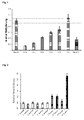
- Fig. 2 shows the result of this experiment. It can be seen that in 3 of 4 samples of the urothelial carcinoma patients a significant hypomethylation could be detected compared to the 6 control samples used.
Landscapes
- Chemical & Material Sciences (AREA)
- Life Sciences & Earth Sciences (AREA)
- Organic Chemistry (AREA)
- Health & Medical Sciences (AREA)
- Proteomics, Peptides & Aminoacids (AREA)
- Zoology (AREA)
- Wood Science & Technology (AREA)
- Engineering & Computer Science (AREA)
- Genetics & Genomics (AREA)
- Analytical Chemistry (AREA)
- Immunology (AREA)
- Molecular Biology (AREA)
- General Engineering & Computer Science (AREA)
- Biotechnology (AREA)
- Biophysics (AREA)
- Physics & Mathematics (AREA)
- Biochemistry (AREA)
- Bioinformatics & Cheminformatics (AREA)
- Microbiology (AREA)
- General Health & Medical Sciences (AREA)
- Pathology (AREA)
- Chemical Kinetics & Catalysis (AREA)
- Hospice & Palliative Care (AREA)
- Oncology (AREA)
- Measuring Or Testing Involving Enzymes Or Micro-Organisms (AREA)
Abstract
Description
- Die Erfindung liegt auf dem Gebiet der Epigenetik, insbesondere der DNA-Methylierung. Sie stellt ein Amplifikationsverfahren für die Detektion epigenetischer Veränderungen bereit, die insbesondere für die klinische Diagnostik relevant sind. Weiterhin werden spezifische Primer für dieses Amplifikationsverfahren bereitgestellt.
- Epigenetische Mechanismen verursachen Änderungen der Genexpression, die nicht mit einer Veränderung der kodierenden Sequenz der Gene einhergehen, jedoch z.B. mitotisch vererbt werden können. Die DNA-Methylierungsmuster werden replikationsgekoppelt von der Mutterzelle auf die Tochterzellen übertragen. Somit ist die Vererbung epigenetischer Erbinformation sichergestellt. In höheren Eukaryoten stellt neben RNA-assoziiertem Silencing und Histonmodifikation die DNA-Methylierung den am besten untersuchten epigenetischen Mechanismus dar (Serman et al., Coll Antropol. 2006; 30(3):665-71).
- Das humane Genom besitzt in einer ausdifferenzierten gesunden Zelle ein spezifisches und weitgehend unveränderliches DNA-Methylierungsmuster, welches in entscheidender Art und Weise die Genexpression mitbestimmt. Hierbei sind genomische Regionen mit regulativer Funktion für die Transkription in vielen Fällen unmethyliert, wohingegen transkriptionell inaktive genomische Abschnitte methyliert sind.
- Die DNA-Methylierung findet an den Cytosinresten der Nukleinsäure und vorzugsweise bei Dinukleotiden mit einer Cytosin-Guanin-Sequenz (CpG) statt. Die wichtigste Basenmodifizierung bei Eukaryoten ist die Methylierung an der 5'-Position des Cytosin.
- In einer Tumorzelle, die sich u.a. durch eine erhöhte Proliferationsrate, eine veränderte Genexpression und chromosomale Anomalien auszeichnet, ist das genomische Methylierungsmuster aberrant (Schulz, DNA methylation in urological malignancies. Int J Oncol. 1998; 151-67). In vielen einschlägigen Reviews aus diesem Fachgebiet wird einhellig die Auffassung vertreten, dass diese epigenetischen Veränderungen ein immenses, diagnostisch und prognostisch relevantes Potential bergen, dessen Evaluierung zu modernen Verfahren der Krebsfrüherkennung, -prognose und -nachsorge führen kann.
- Da jedoch bei Tumorgewebe chromosomale Anomalien auftreten, d.h. dieses Gewebe im Vergleich zu gesundem Gewebe eine unterschiedliche genomische Ausstattung aufweist, besteht das grundlegende Problem darin, eine solche aberrante DNA-Methylierung nicht nur qualitativ, sondern auch quantitativ und normiert zu bestimmen. Nur eine solche Bestimmung lässt einen direkten Vergleich von zwei Proben zu, von denen eine möglicherweise chromosomale Anomalien aufweist.
- Diese Aufgabe wird erfindungsgemäß gelöst durch das Verfahren gemäß Anspruch 1, sowie durch die vorteilhaften Aus- und Weiterbildungen der abhängigen Ansprüche. Die vorliegende Erfahrung stellt zur Lösung dieser Probleme Methoden zur Bestimmung der normierten DNA-Methylierung und Methoden zur Bestimmung des relativen DNA-Methylierungsgrads zwischen zumindest zwei Proben bereit.
- In einem ersten Aspekt wird ein Verfahren zur Bestimmung des normierten DNA-Methylierungsgrads offenbart, umfassend die Schritte: a) Quantitative Bestimmung der Gegenwart eines Transposons oder Fragments davon in einer DNA; b) Quantitative Bestimmung des Vorliegens von zumindest einem differentiell methylierten C eines CpG Dinukleotids aus dem Transposon oder Fragment davon; und c) Bestimmung des normierten DNA-Methylierungsgrads über die in den Schritten a) und b) bestimmten Werte.
- Hierbei macht sich die vorliegende Erfindung die überraschende Feststellung zu nutze, dass der Methylierungsgrad von zufällig über das gesamte Genom verteilten Transposons als repräsentativ für den Methylierungsgrad des Gesamtgenoms angesehen werden kann. Das Prinzip der Erfindung liegt darin, in einem ersten Schritt quantitativ die Gegenwart eines Transposons (oder Fragments davon) in einer DNA aus z.B. einer Probe zu ermitteln und in einem weiteren Schritt quantitativ das Vorliegen von zumindest einem differentiell methylierten Cytosin eines CpG Dinukleotids desselben Transposons (oder Fragments davon) in derselben DNA zu ermitteln. Über das Verhältnis der bestimmten Werte kann dann ein normierter DNA-Methylierungsgrads bestimmt werden, der für das gesamte Genom repräsentativ ist.
- Die Methylierung von DNA ist ein post-replikativer, epigenetischer Mechanismus, der in Eukaryoten von erheblicher Bedeutung für die Genregulation ist. Bei Eukaryoten spielt die Addition einer Methylgruppe an das Kohlenstoffatom Nr. 5 der Pyrimidinbase des Cytosins zur Bildung von 5-Methylcytosin (5mC) die dominierende Rolle. Diese Methyladdition wird in vivo durch einen Transfer der Methylgruppe von S-Adenosylmethionin (Methyldonor) auf Cytosin (Methylakzeptor) mithilfe von DNA-Methylasen (DNMTs) katalysiert und tritt bevorzugt bei Cytosinen auf, die 5' zu einem Guanin lokalisiert liegen (CpG).
- Im Vertebraten-Genom tritt 5mC ausschließlich in CpG-Dinukleotiden auf (Bestor. The DNA methyltransferases of mammals. Hum Mol Genet 2000; 2395-2402) und im menschlichen Genom sind meistens beide Cytosine des palindromischen CpG-Dinukleotids methyliert.
- CpG-Dinukleotide sind aufgrund evolutionärer Mechanismen und der Neigung von Methylcytosin spontan zu deaminieren zumindest im Säuger-Genom mit einer Häufigkeit von 0,8% stark unterrepräsentiert (der durchschnittliche GC-Gehalt beim Menschen beträgt ca. 40%, was zu einer rechnerischen Häufigkeit des CpG-Dinukleotids von 4% führen sollte) und treten in der Regel nur in "CpG-Inseln" gehäuft auf, die oft in den 5' oder 3'-NTRs von Genen liegen (Gardiner-Garden & Frommer. CpG islands in vertebrate genomes. J Mol Biol 1987; 261-282). Ursache für diese Begrenzung auf nicht-codierende Bereiche ist vermutlich das erhöhte Risiko von Punktmutationen durch die Desaminierung von 5mC zu Thymin (Laird & Jaenisch. The role of DNA methylation in cancer genetic and epigenetics. Annu Rev Genet 1996; 441-464).
- CpG-Inseln haben eine Größe von ca. 500 bp - 4 kb und einen erhöhten GC-Gehalt von > 55%. Sie weisen eine zehn- bis zwanzigfach erhöhte Frequenz des Dinukleotids 5'-CpG-3' auf. Mehr als drei Viertel aller (ca. 25.000) menschlichen Gene weisen CpG-Inseln in ihren Startbereichen auf.
- Generell liegen Gene mit hoher transkriptioneller Aktivität in unmethylierten genomischen Bereichen. Demgegenüber liegen in methylierten Bereichen Gene, die transkriptionell nur wenig oder gar nicht aktiv sind. Es besteht eine Vernetzung von DNA-Methylierung und Chromatin-Kondensation, da generell Gene in dicht gepacktem Heterochromatin inaktiv sind. Eine solche dichtere Packung des Chromatins wird durch die Deacetylierung und Methylierung der Histone H3 und H4 eingeleitet, was in einer festeren Bindung der Nukleosomen an die DNA führt und somit eine schlechtere Zugänglichkeit der DNA für die Transkriptionsmaschinerie resultiert (Jenuwein. Re-SET-ting heterochromatin by histone methyltransferases. Trends Cell Biol 2001; 266-273). Das an CpG-methylierte DNA bindende Protein MeCP2 kann Histon-Deacetylasen rekrutieren und die Kondensierung des Chromatins einleiten (Razin & Razin. CpG methylation, chromatin structure and gene silencing-a three-way connection. EMBO J. 1998; 4905-4908). Auch Histon-Methylasen können jedoch DNA-Methyltransferasen in heterochromatische Regionen leiten und somit dort die DNA-Methylierung auslösen (Tamaru & Selker. A histone H3 methyltransferase controls DNA methylation in Neurospora crassa. Nature 2001; 277-283). Weiterhin führt die Histon-Acetylierung vermutlich zur aktiven Demethylierung des betroffenen Genabschnitts (Cervoni & Szyf. Demethylase activity is directed by histone acetylation. J. Biol. Chem. 2001; 40778-40787).
- Wie eingangs erwähnt werden fehlerhafte DNA-Methylierungen meist stabil an Tochterzellen vererbt und können daher auf Organismenebene häufig die Ursache für Krankheiten sein. Insbesondere zeigen z.B. Tumorzellen oft Methylierungsmuster, die von denjenigen gesunder Gewebe signifikant abweichen. Daher wird erwogen, die Analyse des Methylierungsgrads für z.B. diagnostische Anwendungen einzusetzen. Weiterhin wird auch eine gerichtete Änderung/Korrektur des Methylierungszustands zum Zwecke der Genregulation erwogen.
- Für die Analyse des Methylierungzustands von Nukleinsäuren, insbesondere des Methylierungsstatus von spezifischen CpG-Stellen, hat sich die Bisulfitierung mit z.B. anschließender Amplifikation/Sequenzierung bewährt, die erstmals durch Frommer et al. (Proc Natl Acad Sci U S A. 1992; 89(5):1827-31) beschrieben wurde. Bei der Bisulfitierung werden unmethylierte Cytosinbasen der Nukleinsäure in Uracilbasen umgewandelt, während methylierte Cytosinbasen unverändert bleiben. Eine Übersicht über verschiedene Techniken zur Analyse des Methylierungszustands von Nukleinsäuren, insbesondere die Bisulfitierung, findet sich in Fraga et al., Biotechniques. 2002; 33(3):632, 634, 636-49 und Laird, Nat Rev Cancer. 2003;3(4):253-66. Die Bisulfitierungreaktion führt daher abhängig vom Methylierungszustand der Ausgangsnukleinsäure zu Nukleinsäuresequenzen mit unterschiedlicher Sequenz, nach deren Analyse, unter anderem durch PCR oder Sequenzierung, auf den Methylierungszustand der Ausgangsnukleinsäure zurückgeschlossen werden kann.
- Diese Analyse des Methylierungsgrads einer Probe, wie z.B. Gewebe oder einem Bioptat, stößt mit herkömmlichen Verfahren schnell an ihre Grenzen, sobald ein Vergleich diese Probe mit einer weiteren Probe erfolgen soll und zwischen den beiden Proben eine unterschiedliche genomische Ausstattung vorliegt. Wie oben erwähnt weisen nämlich Tumorzellen in vielen Fällen nicht balancierte chromosomale Anomalien auf. Darunter fallen Gewinne und Verluste ganzer Chromosomen, einzelner Chromosomenarme und kürzerer DNA Sequenzabschnitte. Mehrere Studien liefern Evidenzen dafür, dass diese genomische Instabilitäten der Tumorzellen durch einen geringen Grad der DNA Methylierung hervorgerufen werden. Hierbei zeigt sich der Grad der DNA Hypomethylierung proportional zur genomischen Instabilität und zur Tumoragressivität.
- Die vorliegende Erfindung macht sich die überraschende Feststellung zu nutze, dass der Methylierungsgrad von zufällig über das gesamte Genom verteilten Transposons als repräsentativ für den Methylierungsgrad des Gesamtgenoms angesehen werden kann. Somit ist eine normierte Bestimmung des Methylierungsgrads des Genoms möglich, wenn neben der quantitativen Gegenwart zumindest einer differentiellen Methylierung innerhalb eines Transposons auch die quantitative Gegenwart des Transposons "an sich" im Genom bestimmt wird.
- Der Begriff "Transposon", wie hierin verwendet, bezeichnet einen DNA-Abschnitt bestimmter Länge im Genom. Ein Transposon umfasst ein oder mehrere Gene und hat die Möglichkeit seinen Ort im Genom zu verändern (Transposition). Transposons können Elemente sein, deren mobile Zwischenstufe von RNA gebildet wird (Retroelemente; Klasse-I-Transposon), oder solche, deren mobile Phase DNA ist (DNA-Transposon; Klasse-II-Transposon).
- Der Begriff "Transposon", wie hierin verwendet, schließt immer auch Fragmente eines solchen Transposons ein. Solche Fragmente eines Transposons entstehen im Laufe der Evolution im Genom, da ein "gesprungenes" Transposon keinem Selektionsdruck ausgesetzt ist und somit die ursprüngliche Sequenz durch Mutationen im Genom verändert werden kann. So finden sich im Genom häufig nicht die kompletten Transposons, sondern nur noch Teilbereiche derselben wieder, die z.B. durch eine weitere Insertion eines Transposons oder Deletionen, die in den meisten Fällen im 5'-Bereich liegen, entstanden sind. Unter einem Fragment eines Transposons wird bevorzugt ein zusammenhängender Nukleinsäurebereich mit einer Länge von ≥ 40 bp, ≥ 80 bp, ≥ 100 bp, bevorzugt ≥ 150 bp, noch bevorzugter ≥ 200 bp verstanden, der zumindest eine Homologie von 75%, 80%, 85%, 90%, 95%, 97%, 98%, bevorzugt 98,5%, 99%, 99,5% und noch bevorzugter 99,7%, 99,9% oder mehr zu dem korrespondierenden Nukleinsäurebereich des Transposons aufweist. Eine solche Homologie ist z.B. über den FASTA-Algorithmus bestimmbar. Gleichbedeutend mit Transposon ist auch "transposables Element" zu verstehen.
- Autonome DNA-Transposons bestehen aus DNA-Sequenzen, die für das Enzym Transposase codieren. Die Transposase ist in der Lage, ein Transposon aus dem Genom "herauszuschneiden", es an eine neue Stelle im Genom zu transportieren und dort in das Genom zu inserieren. Dieser Prozess wird konservative Transposition genannt. Beispiele für DNA-Transposons sind: Ac (Activator) transposable elements (autonomes Transposon) oder Ds (Dissociator) transposable elements (nicht-autonomes Transposon ohne eigene Transposase).
- Retrotransposons stellen die Mehrheit der eukaryotischen transposablen Elemente dar und sind komplexer aufgebaut. Sie werden von der Wirtszelle als "normale" DNA-Sequenz innerhalb des Genoms erkannt und somit durch die Transkriptions-Maschinerie der Wirtszelle abgelesen und in RNA umgeschrieben. Retrotransposons codieren jedoch für eine reverse Transkriptase, die eine Umwandlung dieser RNA in DNA ermöglicht. Diese Transposase führt auch die Insertion der gebildeten DNA in das Genom der Wirtszelle durch. Dieser Prozess wird replikative Transposition genannt. Solange das Retrotransposon funktionell bleibt, werden daher mehrere Kopien im Genom erzeugt.
- Die Anzahl der aktiven Transposons im Genom eines Organismus variiert in großem Maße mit der Spezies. Im menschlichen Genom ist z.B. lediglich ein sehr kleiner Teil der Transposons aktiv. Es wird hierbei davon ausgegangen, dass nur ca. 50 LINE Transposons (s.u.) und so gut wie keine DNA-Transposons aktiv sind, womit die Anzahl der Transposons im Laufe des Lebens eines Menschens als nahezu konstant angesehen werden kann.
- Es gibt zwei Hauptarten von Retrotransposons: virale und nicht-virale Retrotransposons.
- Virale Retrotransposons haben im weitesten sehr ähnliche Eigenschaften wie die Retroviruse. Beispiele für virale Retrotransposons sind: Ty transposable elements und drosophilacopia transposable elements.
- Nicht-virale Retrotransposons stellen die Mehrheit aller Transposons in Säugetieren dar. Als Beispiele sind insbesondere zu nennen: LINEs (long interspersed (transposable) elements), SINEs (short interspersed (transposable) elements), und Alu Elemente.
- Im menschlichen Genom kommen ungefähr 850.000 LINEs und 1.500.00 SINEs vor. Unter den SINEs befinden sich auch die Alu Elemente, die die im menschlichen Genom am häufigsten vorkommende Gruppe der transposablen Elemente darstellen und etwa 5% des Genoms ausmachen.
- Zu den viralen Retrotransposons sind auch die HERVs (human endogenous retroviruses) zu zählen. Sie werden anhand einer charakteristischen Aminosäureposition in Unterfamilien eingeordnet (z.B. HERV-K, HERV-W). Sie machen schätzungsweise 8% des humanen Genoms aus. Ihren Ursprung haben sie in retroviralen Infektionen der Keimbahn, welche im Zuge der Evolution des Menschen wiederholt stattgefunden haben. Durch Mutationen und Deletionen sind die meisten dieser genetischen Elemente jedoch transkriptionell inaktiv geworden. Nur wenige weisen eine full-length Organisation, mit den viralen Genen gag, pol und env, auf. Diese sind dann von LTR (long terminal repeat) Sequenzen flankiert, welche regulatorische Sequenzmodule beinhalten. Durch DNA Methylierung sind potentiell aktive HERVs stillgelegt damit sie nicht mit der Integrität der Genexpression einer gesunden Zelle interferieren können. Hingegen findet man in verschiedenen Tumorentitäten eine erhöhte HERV-Transkription und auch -Proteinbiosynthese.
- Mit der Bezeichnung "Methylierungsgrad" soll vorliegend die Demethylierung oder Methylierung einer DNA gemeint sein. Eine betrachtete DNA kann an zumindest einer Stelle entweder methyliert oder un- bzw. demethyliert vorliegen. Da dieser Zustand ein binärer ist und damit Demethylierung und Methylierung an einer bestimmten Position direkt miteinander in Verbindung stehen, kann der Methylierungsgrad entweder über die Demethylierung und/oder die Methylierung an dieser zumindest einen Stelle bestimmt werden. Somit kann der normierte DNA-Methylierungsgrad, sowie auch der relative Methylierungsgrad über die Methylierung und/oder Demethylierung der DNA bestimmt werden.
- Vorliegend werden die Begriffe "Primer" und "Oligonukleotid" synonym verwendet. Ein Primer wird als spezifisch für eine gegebene Sequenz angesehen, wenn ≥ 75 %, ≥ 80 %, ≥ 85 %, ≥ 90 %, bevorzugt ≥ 95 %, ≥ 97 %, noch bevorzugter ≥ 99 %, oder ≥ 99,5 % Sequenzidentität zu der betrachteten Sequenz oder deren Komplement aufweist. In einer besonders bevorzugten Form weist der Primer 100% Sequenzidentität zu der betrachteten Sequenz oder deren Komplement auf. In anderen bevorzugten Ausführungsformen wird der Primer dann als spezifisch für eine gegebene Sequenz angesehen, wenn er unter Hochsalzbedingungen mit dieser (oder deren Komplement) hybridisiert.
- Unter dem Term "Hochsalzbedingungen" wird im Folgenden ein Milieu verstanden, das einen Hochsalzpuffer verwendet, bevorzugt einen Hochsalzpuffer enthaltend chaotrope Salze. Durch Hochsalz, bevorzugt aufweisend chaotrope Salze, wird die Löslichkeit von Nukleinsäuren in Wasser herabgesetzt. Grund ist das Aufbrechen von Wasserstoffbrücken und damit verbunden eine Verringerung der Stabilisierung von Sekundär- und Tertiär- Strukturen der Nukleinsäuren in Wasser. Wird nun eine polare Oberfläche als Wasserstoffbrückendonor angeboten, binden die Nukleinsäuren an dieser Oberfläche, da sie dort eine bessere Stabilisierung erfahren als in Wasser. Wird die Salzkonzentration verringert, wird Wasser wieder ein besserer Wasserstoffbrückendonor als die polare Oberfläche, und die Nukleinsäuren lassen sich wieder von der Oberfläche ablösen.
- Unter dem Term "Hochsalzpuffer" wird insbesondere - aber nicht darauf beschränkt - ein Puffer aufweisend eine hohe Salzkonzentration (bevorzugt chaotrope Substanzen), bevorzugt ≥ 100 mM, bevorzugter ≥ 500 mM und noch bevorzugter ≥ 1 M, verstanden.
- Unter dem Term "chaotrope Substanzen" bzw. "chaotrope Salze" werden insbesondere - aber nicht darauf beschränkt - Substanzen, die die Sekundär-, Tertiär- und/oder Quartärstruktur von Proteinen und/oder Nukleinsäuren ändern und zumindest die Primärstruktur intakt lassen, die Löslichkeit polarer Substanzen in Wasser verringern und/oder hydrophobe Wechselwirkungen verstärken, verstanden. Bevorzugte chaotrope Substanzen sind Guanidinhydrochlorid, Guanidinium(iso)thiocyanat, Natriumiodid, Natriumperchlorat, Kaliumiodid, Natrium(iso)thiocyanat und/oder Harnstoff.
- Unter dem Begriff "Amplifikation" oder "Amplifikationsreaktion" wird ein Verfahren verstanden, das es ermöglicht, die Konzentration einer betrachteten Nukleinsäuresequenz mindestens zu verdoppeln.
- Man unterscheidet hier zwischen isothermen und thermocyclischen Amplifikationsreaktionen. Bei ersteren bleibt die Temperatur während des gesamten Verfahren stets gleich, während bei letzterer thermische Zyklen durchlaufen werden, mit deren Hilfe die Reaktion und die Amplifikation gesteuert wird.
- Bevorzugte isotherme Amplifikationsreaktionen sind z.B.
- Loop mediated isothermal amplification (LAMP),
- Nucleic Acid Sequence Based Amplification (NASBA),
- Rolling Circle Chain Reaction (RCCR), oder Rolling Circle Amplification (RCA), und/oder
- Transcription mediated amplification (TMA)
- Bevorzugte thermocyclische Amplifikationsreaktionen sind z.B.
- Ligase-Kettenreaktion (LCR), und/oder
- Polymerase Ketttenreaktion (PCR)
- Unter dem Term "Polymerase Kettenreaktion" (PCR) wird ein Verfahren zur in vitro-Vervielfältigung von Nukleinsäuren verstanden, wie es z.B. in Bartlett & Stirling (2003) beschrieben ist.
- Unter dem Term "Ligase-Kettenreaktion" (LCR) wird ein Nachweisverfahren für geringste Mengen von Nukleinsäuren verstanden, das ähnlich wie die Polymerase-Kettenreaktion funktioniert, nur unter Verwendung eines anderen Enzyms (anstatt der Polymerase eine Ligase). Zwei Proben pro DNA-Strang werden zu einer Probe ligiert. Die entstehenden, oft nur 30-50 bp langen Amplifikate eines Zyklus dienen in den folgenden Zyklen selbst wieder als Ansatzpunkt für die supplementierten Primer.
- Unter dem Term "Loop-mediated Isothermal Amplification" (LAMP) wird eine Methode zur isothermalen Nukleinsäureamplifikation verstanden, bei welcher 6 verschiedene Primer eingesetzt werden, die bestimmte Regionen auf der Target-Sequenz erkennen und daran binden. LAMP nutzt eine DNA-Polymerase mit Strand-displacement Aktivität und läuft bei einer konstanten Temperatur von etwa 65°C ab. Amplifikation und Detektion der Target-Sequenz findet in einem einzigen Schritt statt.
- Unter dem Term "Nucleic Acid Sequence Based Amplification" (NASBA), wird ein Verfahren zur Amplifikation von RNA verstanden (Compton 1991). Dabei wird eine RNA-Matrix zu einem Reaktionsgemisch gegeben, und ein erster Primer bindet an die komplementäre Sequenz im Bereich des 3'-Endes der Matrix. Anschließend wird mit einer Reversen Transkriptase der zur Matrix komplementäre DNA-Strang polymerisiert. Mit Hilfe von RNase H wird dann die RNA-Matrix verdaut (RNase H verdaut nur RNA in RNA-DNA Hybriden, nicht single-stranded RNA). Anschließend wird ein zweiter Primer an das 5' Ende des DNA-Stranges gebunden. Dieser wird von der T7 RNA Polymerase als Startpunkt für die Synthese eines zum DNA-Strang komplementären RNA-Moleküls verwendet, welches dann wieder als Ausgangsmatrix verwendet werden kann. NASBA wird bei einer konstanten Temperatur von normalerweise 41°C, durchgeführt und liefert unter bestimmten Umständen schnellere und bessere Resultate als PCR.
- Unter dem Term "Transcription Mediated Amplification" (TMA) wird ein von der US-Firma Gen-Probe entwickeltes isothermales Amplifikationsverfahren verstanden, das der NASBA ähnlich ist und bei dem ebenfalls RNA Polymerase und Reverse Transkriptase verwendet werden (Hill, 2001)
- Der Term "Rolling Circle Chain Reaction" (RCCR) oder "Rolling circle Amplification" (RCA) betrifft ein Amplifikationsverfahren, das die allgemeine Nukleinsäure-Replikation nach dem rolling-circle-Prinzip imitiert und unter anderem in der
US5854033 beschrieben ist. - Unter dem Term "Real-Time-PCR" auch quantitative PCR oder qPCR (nicht zu verwechseln mit revers transkribierter PCR) wird ein Verfahren verstanden, das auf dem Prinzip der bekannten Polymerase-Kettenreaktion (PCR) beruht, und zusätzlich die Quantifizierung der amplifizierten DNA ermöglicht. Die Quantifizierung wird mit Hilfe von Fluoreszenz-Messungen durchgeführt, die während eines PCR-Zyklus erfasst werden (daher der Name "Real Time"). Die Fluoreszenz nimmt proportional mit der Menge der PCR-Produkte zu. Am Ende eines Laufs (der aus mehreren Zyklen besteht) wird anhand von erhaltenen Fluoreszenzsignalen die Quantifizierung in der exponentiellen Phase der PCR vorgenommen. Nur in der exponentiellen Phase der PCR (die wenige Zyklen in einem Lauf dauert) ist die korrekte Quantifizierung möglich, da während dieser Phase die optimalen Reaktionsbedingungen herrschen. Diese Methode unterscheidet sich somit von anderen quantitativen PCR-Methoden, die erst nach Ablauf der PCR eine quantitative Auswertung (z. B. kompetitive PCR), meist unter Einbeziehung einer gelelektrophoretischen Auftrennung der PCR-Fragmente, vornehmen.
- Für die Detektion kommen Farbstoffe wie z.B. Ethidiumbromid, SYBR Green I sowie FRET-Sonden oder sogenannte Double-Dye-Oligos (auch als TaqMan-Sonden bezeichnet) in Frage.
- Der Begriff "CT-Wert" (Threshold Cycle = "Schwellenwert-Zyklus") bezeichnet den PCR-Zyklus, an dem erstmals ein Amplifikat nachweisbar ist; hierbei wird in der Regel die Fluoreszenz gemessen und der Zyklus angegeben, bei welcher letztere erstmalig signifikant über die Hintergrund-Fluoreszenz ansteigt.
- In der Anfangsphase einer PCR-Reaktion ist die Menge an Template (d.h. an zu amplifiziernder DNA) noch begrenzt, während in der Schlussphase der Amplifikation die Menge der Produkte derart ansteigt, dass es zur Hemmung durch diese kommt, Produktfragmente zunehmend miteinander hybridisieren und die Edukte langsam verbraucht werden. Nur in der dazwischenliegenden Phase besteht ein exponentieller Zusammenhang zwischen Anzahl der Amplifikationszyklen und Amplifikatmenge ("exponentielle Phase"). Für die Bestimmung des Zeitpunkts, an welchem die exponentielle Phase beginnt, macht man sich den erwähnten CT-Wert zunutze.
- Ein niedriger CT-Wert gibt überdies an, dass bereits eine geringe PCR-Zyklenzahl für einen erstmaligen signifikanten Anstieg der Fluoreszenz über das Grundrauschen ausreichend ist (also relativ viel Template vorhanden war), während ein hoher CT-Wert dementsprechend angibt, dass hierfür viele PCR-Zyklen benötigt werden (also relativ wenig Template vorhanden war).
- In einem ersten Aspekt betrifft die vorliegende Erfindung ein Verfahren zur Bestimmung des normierten DNA-Methylierungsgrads umfassend die Schritte: a) Quantitative Bestimmung der Gegenwart eines Transposons oder Fragments davon in einer DNA; b) Quantitative Bestimmung des Vorliegens von zumindest einem differentiell methylierten C eines CpG Dinukleotids aus dem Transposon oder Fragment davon; und c) Bestimmung des normierten DNA-Methylierungsgrads über die in den Schritten a) und b) bestimmten Werte.
- Erfindungsgemäß wird somit in einem ersten Schritt die Gegenwart eines Transposons in einer gegebenen (z.B. aus einem Bioptat isolierten) DNA mengenmäßig bestimmt. Dieser Schritt liefert einen Wert, der Auskunft über die Dichte/Frequenz (in Bezug auf die eingesetzte DNA) oder Anzahl des Transposons in der untersuchten DNA gibt, also z.B. wie viele Kopien des Transposons in der untersuchten DNA vorhanden sind. In einer bevorzugten Ausführungsform wird diese Bestimmung an einer zuvor bisulfitierten DNA durchgeführt.
- In einem zweiten Schritt wird dann das Vorliegen von zumindest einem differentiell methylierten Cytosin eines CpG Dinukleotids innerhalb der im ersten Schritt detektierten Transposons mengenmäßig bestimmt. In einer bevorzugten Ausführungsform wird hierbei dieselbe DNA wie im ersten Schritt verwendet. Zum Beispiel kann die aus einer Probe isolierte DNA in zwei Teile geteilt werden, wobei jedes Teil vorzugsweise die gleiche Menge an DNA enthält. In einer weiteren bevorzugten Ausführungsform wird diese Bestimmung im zweiten Schritt an einer bisulfitierten DNA durchgeführt (auf diesen Schritt wird weiter unten detaillierter eingegangen). Der erhaltene Wert gibt demnach Auskunft über die Gegenwart von methylierten oder unmethylierten Cytosinen an vielen verschiedenen, zufällig verteilten Positionen im Genom. Dieser zweite Schritt gibt somit Auskunft über die Anzahl/Menge von differentiell methylierten Cytosinen innerhalb des im ersten Schritt bestimmten Transposons. Demnach wird der Grad der differentiellen Methylierung der Cytosine in den untersuchten Transposons bestimmt.
- Da Transposons zufällig über das Genom verteilt sind, kann mittels der beiden erhaltenen Werte in einem nächsten Schritt eine Normierung durchgeführt werden, bei der die im ersten und zweiten Schritt bestimmten Werte zueinander in Beziehung gesetzt werden. Aufgrund der hohen Anzahl der Transposons im Genom ist ein guter Stichprobenumfang gegeben. Der erhaltene Wert der normierten DNA-Methylierung spiegelt somit einen Wert der differentiellen Methylierung wieder, der als auf das jeweilige betrachtete Genom normiert angesehen werden kann.
- In weiteren Ausführungsformen können der erste und der zweite Schritt von ihrer zeitlichen Abfolge vertauscht werden oder gleichzeitig, z.B. mittels real time PCR, ausgeführt werden.
- Unter "quantitativer Bestimmung" soll vorliegend eine Detektion des Vorhandenseins eines Transposons oder des Vorhandenseins einer differentiellen Methylierung verstanden werden. Hierbei soll nicht eine bloße qualitative Detektion erfolgen, d.h. die Frage beantwortet werden, ob ein Transposon oder eine differentielle Methylierung in der untersuchten DNA vorhanden ist, sondern dieses Vorhandensein auch quantifiziert werden (zum Beispiel durch Mengenangaben, Anzahlen von Kopien und dergleichen).
- Dem Fachmann sind verschiedene Verfahren bekannt, um eine solche quantitative Bestimmung durchzuführen. In einer bevorzugten Ausführungsform erfolgt diese quantitative Bestimmung über eine Amplifikation mit anschließender Messung der Menge des erzeugten Amplifikats. In einer bevorzugteren Ausführungsform ist die Amplifikation eine PCR. In einer weiteren noch bevorzugteren Ausführungsform erfolgt die quantitative Bestimmung mittels real time PCR zur Bestimmung des CT-Werts. In einer weiteren Ausführungsform erfolgt die quantitative Bestimmung über Hybridisierung einer markierten Sonde (z.B. Nukleinsäuresonde) mit anschließender Bestimmung der Höhe des durch die Markierung (direkt oder indirekt) erzeugten Signals. In einer weiteren Ausführungsform wird eine in situ Hybridisierung (z.B. FISH) durchgeführt mit anschließender Bestimmung der Höhe des durch die Markierung erzeugten Signals. Weitere Verfahren für solche quantitative Bestimmungen sind die Detektion mit 5-methyl-Cytosin-spezifischen Antikörpern, oder der indirekte Nachweis von an methylierte DNA bindenden Faktoren mittels spezifischer Antikörper. Zu solchen Faktoren gehören beispielsweise der nukleäre Repressor MeCP2, der an symmetrisch methylierte CpG Positionen des Genoms bindet, sowie MBD1, MBD2, MBD4.
- In weiteren Ausführungsformen stammt die DNA aus Organismen, Gewebe, Zellen, Bioptat, oder einer Probe. Vorzugsweise ist die DNA isolierte DNA. In einer Ausführungsform ist die isolierte DNA genomische und/oder eukaryotische DNA. Bevorzugt ist diese DNA die DNA eines Vertebraten, noch bevorzugter die eines Menschen. In einer weiteren bevorzugten Ausführungsform umfasst das Bereitstellen der DNA nicht die Probenentnahme selbst, sondern baut auf bereits gewonnenem Probenmaterial auf. In einer weiteren bevorzugten Ausführungsform stammen die Gewebe, Zellen, Bioptate, Proben aus denen die DNA stammt von einem gesunden Individuum oder einem erkrankten Individuum oder Patienten.
- In weiteren Ausführungsformen ist die Probe ausgewählt aus der Gruppe bestehend aus einer Blutprobe, einer Gewebeprobe, einer Speichelprobe, einer Urinprobe, einem Abstrich und einer Stuhlprobe. In einer bevorzugten Ausführungsform ist die Probe eine Urinprobe. Dies ist insbesondere für den Nachweis eines Blasen- und/oder Prostatakarzinoms vorteilhaft.
- In weiteren Ausführungsformen der Erfindung ist das Transposon ausgewählt aus der Gruppe bestehend aus einem LINE Element, einem Alu Element (Alu Konsensussequenz; Kariya et al. Gene. 1987;53(1):1-10), einem HERV Element oder einem Fragment derselben. In einer besonderen Ausführungsform ist das Transposon ein LINE-1 Element (GenBank Accession M80343) oder ein Fragment davon. Noch bevorzugter ist das Fragment des Transposons der Promotorbereich eines Transposons. Dies hat den Vorteil, dass eine hohe Frequenz von CpG vorhanden ist und somit die der Methylierungsgrad besser bestimmt werden kann. In der bevorzugtesten Ausführungsform ist das Fragment des Transposons der Promotorbereich eines LINE-1 Elements.
- Unter "differentieller Methylierung" wird vorliegend der in den verschiedenen möglichen Ausprägungsformen vorliegende Methylierungszustand einer gegebenen DNA verstanden. Ist von einer "differentiellen Methylierung eines Cytosins" (C) die Rede, so wird darunter der Methylierungszustand des betreffenden Cytosins verstanden. Dieser kann binär entweder methyliert sein, d.h. dieses Cytosin liegt als 5mC vor, oder er kann unmethyliert (oder demethyliert) sein, d.h. das betrachtete Cytosin weist keine 5-Methylgruppe auf.
- Ein bevorzugtes Verfahren zur Bestimmung des Vorliegens einer differentiellen Methylierung (bzw. des Vorliegens einer differentiellen Methylierung eines Cytosins) basiert auf der Bisulfitierung von DNA mit anschließender Analyse der erzeugten bisulfitierten DNA.
- Um von isolierter DNA zu Bisulfit-konvertierter DNA zu gelangen, wird diese durch eine dem Fachmann hinlänglich bekannte Bisulfitierungsreaktion umgewandelt. Hierbei werden die unmethylierten Cytosine der DNA durch das Bisulfit in Uracil umgewandelt. Als Folge der Umwandlung können verschiedene Varianten einer umgewandelten Nukleinsäure vorliegen, die von der Anzahl der unmethylierten Cytosine dieser Nukleinsäure abhängen. Eine Nukleinsäure, die beispielsweise 2 Cytosine enthält kann demnach, je nach Methylierungszustand dieser Cytosine, zu 4 unterschiedlichen Varianten nach der Bisulfitierung führen, da entweder keines, das erste, das zweite, oder beide der Cytosine unmethyliert vorliegen kann/können und in Uracil umgewandelt wird/werden. Diese unterschiedlichen Varianten können in einer bevorzugten Ausführungsform mittels spezifischer Primer oder Primersätze detektiert werden. An die Umwandlung kann sich in einer Ausführungsform ein weiterer Schritt der Aufreinigung der bisulfitierten DNA anschließen. In einer weiteren Ausführungsform wird die Bisulfitierung der DNA als weiterer Schritt von dem Verfahren der Erfindung umfasst. Vorzugsweise als erster Schritt, oder vor der quantitativen Bestimmung des Vorliegens eines differentiell methylierten Cytosins eines CpG Dinukleotids.
- In einer weiteren, besonders bevorzugten Ausführungsform umfasst Schritt a) die Amplifikation der nicht-bisulfitierten DNA mit zumindest einem Primerpaar, das spezifisch für ein Transposon oder Fragment davon ist, oder alternativ die Amplifikation der bisulfitierten DNA mit zumindest einem Primerpaar das spezifisch für ein bisulfitiertes Transposon oder Fragment davon ist, wobei die Primer keine differentiell methylierte Position des Transposons umfassen, d.h. kein C oder umgewandeltes U/T eines CpG Dinukleotids umfassen; weiterhin umfasst Schritt b) die Amplifikation der bisulfitierten DNA mit zumindest einem Primerpaar, das spezifisch für das Transposon oder Fragment davon ist (welches in Schritt a) bestimmt wurde) und das zumindest einen Primer umfasst, der zumindest eine differentiell methylierte Position des Transposons umfasst, d.h. zwischen zumindest einem C eines methylierten CpG und zumindest einem U/T eines bisulfitierten unmethylierten CpG diskriminieren kann; weiterhin umfasst Schritt c) die Bestimmung des normierten DNA-Methylierungsgrads über das Verhältnis der in den Schritten a) und b) gebildeten Amplifikate.
- In anderen Worten kann für die Bestimmung in Schritt a) die DNA entweder nicht-bisulfitiert (also z.B. direkt nach der Isolation aus einer Probe) oder bereits bisulfitiert vorliegen. In ersterem Fall können beliebige für das Transposon spezifische Primer zu dessen Amplifizierung verwendet werden; in letzterem Fall sollte dafür Sorge getragen werden, dass die verwendeten Primer keine differentiell methylierte Stelle umfassen (also kein Cytosin eines CpG Dinukleotids). In einer bevorzugten Ausführungsform wird in den Schritten a) und b) das gleiche Volumen von DNA eingesetzt, dabei ist die DNA bevorzugt in einem Ansatz aus einer Probe isoliert worden. Noch bevorzugter werden in Schritt a) und b) gleiche Mengen an DNA eingesetzt. Auch hierbei ist die DNA bevorzugt in einem Ansatz aus einer Probe isoliert worden.
- In Schritt b), der immer mit bisulfitierter DNA ausgeführt wird, ist dies genau umgekehrt; hier sollte zumindest ein Primer zumindest eine differentiell methylierte Stelle des in Schritt a) amplifizierten Transposons umfassen (also zumindest ein Cytosin eines CpG Dinukleotids). Es spielt hierbei keine Rolle, ob der zumindest eine Primer für die zumindest eine differentiell methylierte Stelle auf dem sense oder dem antisense Strang der DNA spezifisch ist. Über diese(n) Primer kann somit eine an der untersuchten gegebenen Position bestehende oder nicht bestehende Methylierung der Ausgangs-DNA nachgewiesen werden. Wird ein Amplifikat mit Primern erhalten, die spezifisch für ein CpG sind, so lag an der betreffenden Stelle eine Methylierung der ursprünglichen DNA vor, da keine Umwandlung bei der Bisulfitierungsreaktion erfolgte. Wird ein Amplifikat mit Primern erhalten, die spezifisch für ein bisulfitiertes CpG sind, so lag an der betreffenden Stelle keine Methylierung (eine Demethylierung) der ursprünglichen DNA vor. Demgemäß kann - je nach der Art der verwendeten Primer - die Methylierung oder die Demethylierung nachgewiesen werden.
- Es kann für die erfindungsgemäße Bestimmung des Methylierungsgrads entweder die Methylierung oder die Demethylierung der DNA des Transposons bestimmt werden, da diese beiden Zustände direkt miteinander korrespondieren. Wird demnach ein CpG-spezifisches Primerpaar verwendet, so wird der DNA-Methylierungsgrad über die Methylierung bestimmt; wird ein für ein bisulfitiertes CpG spezifisches Primerpaar verwendet, so wird der DNA-Methylierungsgrad über die Demethylierung bestimmt.
- In einer bevorzugten Ausführungsform ist zumindest ein Primer des zumindest einen Primerpaars für zumindest eine differentiell methylierte Position des Transposons spezifisch; noch bevorzugter sind beide Primer des zumindest einen Primerpaars für zumindest eine differentiell methylierte Position des Transposons spezifisch. Dies hat den Vorteil, dass eine bessere Spezifität und verbesserte Amplifikation erreicht wird.
- In weiteren bevorzugten Ausführungsformen sind die verwendeten Primer für mehr als eine differentiell methylierte Position spezifisch. Solche Primer sind für mehr als ein Cytosin eines CpG bzw. bisulfitierten CpG spezifisch. In besonders bevorzugten Ausführungsformen sind die Primer für 2, 3, 4 oder mehr als 4 differentiell methylierte Position spezifisch.
- Da die Primer weiterhin spezifisch für ein Transposon sind, sind sie in einer bevorzugten Ausführungsform spezifisch für ein LINE Element, ein Alu Element, ein HERV Element, ein HERV-K Element oder einem Fragment derselben. In einer besonders bevorzugten Ausführungsform ist sind die Primer spezifisch für ein LINE-1 Element oder ein Fragment davon. Noch bevorzugter sind die Primer spezifisch für den Promotorbereich eines Transposons. Dies hat den Vorteil, dass eine hohe Frequenz von CpG vorhanden ist und somit die der Methylierungsgrad besser bestimmt werden kann. In der bevorzugtesten Ausführungsform sind die Primer spezifisch für den Promotorbereich eines LINE-1 Elements.
- In einer anderen Ausführungsform sind die verwendeten Primer wenigstens 15 Nukleotide lang, bevorzugt 18, 19, 20, 21, 22, 23, 24, 25 oder mehr als 25 Nukleotide lang. Ein Primerpaar kann Primer mit verschiedener Länge umfassen. In einer bevorzugten Ausführungsform sind die Primer 18 bis 35 Nukleotide lang, in einer weiteren bevorzugten Ausführungsform sind die Primer 20-30 Nukleotide lang.
- In einer bevorzugten Ausführungsform sind die Primer eines Primerpaars entweder ausschließlich für zumindest ein Cytosin eines CpG Dinukleotids oder ausschließlich für zumindest ein Cytosin eines bisulfitierten CpG Dinukleotids spezifisch.
- Die Primer können das zumindest eine für eine differentiell methylierte Position spezifische Nukleotid an jeder Stelle umfassen, d.h. am 5'-Ende des Primeroligonukleotids, am 3'-Ende oder jeder Position dazwischen. In einer besonders bevorzugten Ausführungsform liegt das zumindest eine, für eine differentiell methylierte Position spezifische Nukleotid am 3'-Ende des Primeroligonukleotids. Dies hat den Vorteil einer erhöhten Spezifität.
- In einer weiteren besonders bevorzugten Ausführungsform liegen die in Schritt a) und Schritt b) verwendeten Primerpaare in direkter Nachbarschaft auf dem amplifizierten Bereich des Transposons. Der Term "direkte Nachbarschaft" soll hierbei so verstanden werden, dass zwischen den von dem in Schritt a) und dem in Schritt b) amplifizierten Bereichen des Transposons eine Distanz von ≤ 6000 bp , ≤ 5000 bp , ≤ 4000 bp , ≤ 3000 bp ≤ 000 bp, ≤ 000 bp, < 800 bp, ≤ 00 bp, ≤ 500 bp, bevorzugter ≤ 400 bp oder ≤ 300 bp und noch bevorzugter ≤ 200 bp oder ≤ 100 bp liegen. In noch bevorzugteren Ausführungsformen ist diese Distanz ≤ 80 bp, ≤ 50 bp, oder ≤ 10 bp. In weiteren noch bevorzugteren Ausführungsformen ist die Distanz 0 bp, oder die amplifizierten Bereiche überlappen.
- Der Fachmann ist aufgrund seines Fachwissens in der Lage eine Vielzahl von erfindungsgemäßen Primern zu erzeugen, die für zumindest eine differentiell methylierte Position eines Transposons spezifisch sind. Dies soll im Folgenden anhand des Promotorbereichs des LINE-1 Elements beschrieben werden.
- Die Nukleinsäuresequenz dieses Promotorbereichs des LINE-1 Elements (GenBank Accession M80343) ist:wobei CpG durch Großschrift hervorgehoben wurden.

- Im Falle einer kompletten Methylierung dieser Promotorsequenz mit anschließender Bisulfitierung ergibt sich demnach folgende Nukleinsäuresequenz (SEQ ID NO 1):wobei die methylierten CpG und die durch die Bisulfitierung von C in U (bzw T) umgewandelten Nukleotide in Großschrift dargestellt sind.

- Im Falle einer kompletten Demethylierung dieser Promotorsequenz mit anschließender Bisulfitierung ergibt sich demnach folgende Nukleinsäuresequenz (SEQ ID NO 2):wobei die demethylierten (und umgewandelten) CpG und die durch die Bisulfitierung von C in U (bzw T) umgewandelten Nukleotide in Großschrift dargestellt sind.

- Aufgrund von SEQI ID NO 1 und SEQ ID NO 2 können demnach Primer zur Diskriminierung zwischen an zumindest einer Stelle differentiell methylierter DNA ausgewählt werden. Selbstverständlich ist dem Fachmann geläufig, dass es auch einen antisense Strang zu dem gezeigten sense Strang gibt. Hier sind zu den 5'-CpG-3' Dinukleotiden korrespondierende 5'-CpG-3' Dinukleotide vorhanden, die ebenfalls differentiell methyliert vorliegen. Demnach können auch Primer anhand der Sequenzinformation des antisense Stranges ausgewählt werden.
- Da nach der Bisulfitierungsreaktion sense und antisense Strang nicht mehr komplementär zueinander sind, können so bei Vorliegen einer differentiell methylierten Position zunächst vier verschiedene spezifische Primer generiert werden: 1) sequenzidentisch und spezifisch für den konvertierten sense Strang, 2) komplementär und spezifisch für den konvertierten sense Strang, 3) sequenzidentisch und spezifisch für den konvertierten antisense Strang, 4) komplementär und spezifisch für den konvertierten antisense Strang. Da die differentiell methylierte Position in zwei Zuständen vorliegen kann, ergeben sich somit acht mögliche Primer.
- Als Beispiel sei ausgegangen von der doppelsträngigen DNA Sequenz:
5'-AGCACGT-3' (sense)
3'-TCGTGCA-5' (antisense) - Nach der Bisulfitierungsreaktion ergeben sich hieraus je nach Methylierungszustand jeweils die zwei nicht mehr komplementären Stränge:
- Methyliert:
- 5'-AGUACGT-3' und 3'-TUGTGCA-5';
- Demethyliert:
- 5'-AGUAUGT-3' und 3'-TUGTGUA-5'.
- Für jede dieser 4 Sequenzen kann nun für die Amplifikation ein sequenzidentischer Primer und ein Primer erzeugt werden, der komplementär zu der Sequenz ist, also:
- Methyliert:
5'-AGUACGT-3' und 5'-ACGTACT-3', 5'-ACGTGUT-3' und 5'-AACACGT-3', - Demethyliert:
5'-AGUAUGT-3' und 5'-ACATACT-3', 5'-AUGTGUT-3' und 5'-AACACAT-3'. - Beispiele und noch bevorzugtere Ausführungsformen für solche Primer, die für ein oder mehrere (bisulfitierte) Cytosine von CpG Dinukleotiden spezifisch sind und damit für zumindest eine differentiell methylierte Position eines Transposons spezifisch sind, sind in SEQ ID NO 3 - 1048 oder den Tabellen 1 - 12 gegeben. Hierbei geben Tabellen 1 - 4 besonders bevorzugte Primer für das LINE-1 Element, Tabellen 5 - 8 besonders bevorzugte Primer für das Alu Element und Tabellen 9 - 12 besonders bevorzugte Primer für das HERV-K Element an. Die Primer sind in 5' - 3' Orientierung angegeben.
- In bevorzugten Ausführungsformen bezieht sich die Erfindung auf folgende solcher Oligonukleotide und deren Verwendung in den erfindungsgemäßen Verfahren:
- Sequenzidentische oder komplementäre Primersequenzen, die spezifisch für den Bisulfit-konvertierten methylierten oder demethylierten sense oder antisense Strang des Promotorbereichs des LINE-1 Elements sind, d.h. SEQ ID NO 3 - 436; bevorzugter SEQ ID NO 3 - 112, oder SEQ ID NO 113 - 220, oder SEQ ID NO 221 - 336, oder SEQ ID NO 337 - 436; noch bevorzugter SEQ ID NO 3 - 57, oder SEQ ID NO 58 -112, oder SEQ ID NO 113 - 166, oder SEQ ID NO 167 - 220, oder SEQ ID NO 221 - 278, oder SEQ ID NO 279 - 336, oder SEQ ID NO 337 - 386, oder SEQ ID NO 387 - 436.
- Sequenzidentische oder komplementäre Primersequenzen, die spezifisch für den Bisulfit-konvertierten methylierten oder demethylierten sense oder antisense Strang des Alu Elements sind, d.h. SEQ ID NO 437 - 612; bevorzugter SEQ ID NO 437 -476, oder SEQ ID NO 477 - 522, oder SEQ ID NO 523 - 570, oder SEQ ID NO 571 - 612; noch bevorzugter SEQ ID NO 437 - 456, oder SEQ ID NO 457 - 476, oder SEQ ID NO 477 - 499, oder SEQ ID NO 500 - 522, oder SEQ ID NO 523 - 546, oder SEQ ID NO 547 - 570, oder SEQ ID NO 571 - 591, oder SEQ ID NO 592 - 612.
- Sequenzidentische oder komplementäre Primersequenzen, die spezifisch für den Bisulfit-konvertierten methylierten oder demethylierten sense oder antisense Strang des HERV-K Elements sind, d.h. SEQ ID NO 613 - 1048; bevorzugter SEQ ID NO 613 - 708, oder SEQ ID NO 709 - 796, oder SEQ ID NO 797 - 922, oder SEQ ID NO 923 - 1048; noch bevorzugter SEQ ID NO 613 - 660, oder SEQ ID NO 661 - 708, oder SEQ ID NO 709 - 752, oder SEQ ID NO 753 - 796, oder SEQ ID NO 797 - 859, oder SEQ ID NO 860 - 922, oder SEQ ID NO 923 - 985, oder SEQ ID NO 986 - 1048.
- Der Fachmann wird erkennen, dass jede der in den Tabellen 1 - 12 aufgeführten Oligonukleotidsequenzen lediglich als Kernsequenz zu verstehen ist, die vom 5'-Ende her und/oder vom 3'-Ende her verkürzt oder verlängert werden kann. Dies gilt für alle in dieser Erfindung offenbarten Oligonukleotide/Primer. In einer bevorzugten Ausführungsform sind die in den Tabellen 1 - 12 dargestellten Oligonukleotide um zwischen 1 - 20 Nukleotide vom 5'-Ende und/oder vom 3'-Ende her verlängert; noch bevorzugter sind die Oligonukleotide um zwischen 5 - 15 Nukleotide vom 5'-Ende und/oder vom 3'-Ende her verlängert. In einer anderen Ausführungsform sind die Oligonukleotide um bis zu insgesamt 5 Nukleotide vom 5'-Ende und/oder 3'-Ende her verkürzt, wobei das Oligonukleotid immer für zumindest ein CpG oder bisulfitiertes CpG spezifisch bleibt.
- In einer weiteren bevorzugten Ausführungsform haben die Primer eines Primerpaars einen nahezu identischen Tm, bevorzugt einen Tm, der ≤ 3° C, ≤ 2° C, ≤ 1° C, ≤ 0.5° C, ≤ 0.2° C oder ≤ 0.1° C voneinander abweicht.
- In einer weiteren bevorzugten Ausführungsform haben die von den Primern eingeschlossenen Sequenzbereiche eine Länge von ≥ 1 und ≥ 3000 bp, bevorzugter ≥ 10 und ≥ 2000 bp, noch bevorzugter ≥ 30 und ≥ 800 bp und am bevorzugtesten ≥ 50 und ≥ 300 bp.
- Der Fachmann wird erkennen, dass nicht nur ein Primerpaar eingesetzt werden kann, sondern auch eine Vielzahl derselben. In einer weiteren Ausführungsform wird das Verfahren daher mit 2, 3, 4, 5 oder mehr als 5 Primerpaaren durchgeführt, die spezifisch für ein Transposon oder Fragment davon sind und die jeweils zumindest einen Primer umfassen, der für zumindest ein Cytosin eines CpG Dinukleotids oder ein bisulfitiertes Cytosin eines CpG Dinukleotid spezifisch ist. Bevorzugt haben diese mehreren Primerpaare einen nahezu identischen Tm.
- Weiterhin wird in Schritt a) entweder die nicht-bisulfitierte DNA mit zumindest einem Primerpaar amplifiziert, dessen Primerpaar spezifisch für Bereiche desselben Transposons oder Fragments davon sind; oder es wird eine bisulfitierte DNA mit zumindest einem Primerpaar amplifiziert, das ebenfalls spezifisch für das Transposon ist, wobei jedoch die Primer keine differentiell methylierte Position des Transposons umfassen. In einer bevorzugten Ausführungsform werden hierbei Primer verwendet, die spezifisch für stets unmethylierte Bereiche des Transposons sind. Hierbei kann der Fachmann durch vorherige Sequenzanalysen bestimmen, welche Positionen in einem gegebenen Genom stets unmethyliert vorliegen. Da bei Vertebraten 5mC ausschließlich in CpG-Dinukleotiden auftreten, können somit für diese Fälle Bereiche gewählt werden, die keine Cytosine solcher CpG Sequenzen enthalten.
- Tabellen 13 - 18 geben bevorzugte solcher Oligonukleotide zur Normierung wieder, die für Schritt a) des Verfahrens und bei Einsatz von bisulfitierter DNA verwendet werden können. Tabellen 13 - 14 offenbaren bevorzugte Primer für das LINE-1 Element, Tabellen 15 - 16 offenbaren bevorzugte Primer für das Alu Element und Tabellen 17 - 18 offenbaren bevorzugte Primer für das HERV-K Element. Die durch diesen Amplifikationsschritt erzeugten Amplifikate können dann für die erfindungsgemäße Normierung herangezogen werden.
- In bevorzugten Ausführungsformen bezieht sich die Erfindung auf folgende solcher Oligonukleotide für die Normierung und deren Verwendung in den erfindungsgemäßen Verfahren:
- Sequenzidentische oder komplementäre Primersequenzen, die spezifisch für den Bisulfit-konvertierten sense oder antisense Strang des Promotorbereichs des LINE-1 Elements sind, d.h. SEQ ID NO 1049 - 1227; bevorzugter SEQ ID NO 1049 - 1145, oder SEQ ID NO 1146 -1227; noch bevorzugter SEQ ID NO 1049 - 1096, oder SEQ ID NO 1097 - 1145, oder SEQ ID NO 1146 - 1192, oder SEQ ID NO 1193 - 1227.
- Sequenzidentische oder komplementäre Primersequenzen, die spezifisch für den Bisulfit-konvertierten sense oder antisense Strang des Alu Elements sind, d.h. SEQ ID NO 1228 - 1257; bevorzugter SEQ ID NO 1228 - 1243, oder SEQ ID NO 1244 - 1257; noch bevorzugter SEQ ID NO 1228 - 1237, oder SEQ ID NO 1238 - 1243, oder SEQ ID NO 1244 - 1250, oder SEQ ID NO 1251 - 1257.
- Sequenzidentische oder komplementäre Primersequenzen, die spezifisch für den Bisulfit-konvertierten sense oder antisense Strang des HERV-K Elements sind, d.h. SEQ ID NO 1258 - 1415; bevorzugter SEQ ID NO 1258 - 1323, oder SEQ ID NO 1324 - 1415; noch bevorzugter SEQ ID NO 1258 - 1289, oder SEQ ID NO 1290 - 1323, oder SEQ ID NO 1324 - 1371, oder SEQ ID NO 1372 - 1415.
- Der Fachmann wird auch für jedes andere Transposon oder Fragment davon Primer nach dem zuvor erklärten Schema bereitstellen können.
- Die Bestimmung des normierten DNA-Methylierungsgrads wird erfindungsgemäß über das Verhältnis der in den beiden Amplifikationsschritten (Schritt a) und b)) gebildeten Amplifikate bestimmt. In besonderen Ausführungsformen wird das Verhältnis über die gebildeten Mengen an Amplifikat bestimmt, bevorzugter über die Zunahme des pro Amplifikations-Zyklus gebildeten Amplifikats, noch bevorzugter über den cycle threshold (ct) Wert während einer real time PCR.
- In einer Ausführungsform wird die Gesamtmenge der beiden gebildeten Amplifikate nach einer gleichen Anzahl von Amplifikationszyklen bestimmt und miteinander in Beziehung gesetzt. Für die Bestimmung der gebildeten Amplifikate sind dem Fachmann eine Reihe von unterschiedlichen Verfahren bekannt, einschließlich spektroskopischer Verfahren, der Anfärbung mittels Ethidiumbromid oder Silber und densitometrischer Bestimmung, oder der radioaktiven Markierung mit anschließender Bestimmung über, z.B., Szintillationsmessung.
- In einer bevorzugten Ausführungsform erfolgt die Bestimmung der in den beiden Amplifikationsschritten gebildeten Amplifikate mit Hilfe der real time PCR während der Bildung der Amplifikate selbst. In einer weiteren bevorzugten Ausführungsform erfolgt die Bestimmung der in den beiden Amplifikationsschritten gebildeten Amplifikate simultan während einer real time PCR.
- Nach der Bestimmung der in beiden Amplifikationsschritten gebildeten Amplifikate wird der Wert für das Amplifikat im zweiten Amplifikationsschritt (Schritt b)) mittels des Werts für das Amplifikat im ersten Amplifikationsschritts (Schritt a)) normiert; z.B. durch Division oder Subtraktion der ermittelten Werte. Hierdurch wird ein auf das Gesamtvorkommen des untersuchten DNA-Bereichs normierter Methylierungsgrad bestimmt (d.h. die normierte (De)-Methylierung), der als repräsentativ für den Methylierungsgrad des Gesamtgenoms angenommen werden kann.
- In einer bevorzugten Ausführungsform erfolgten die Amplifikationen der Schritte a) und b) sowie die Bestimmung der gebildeten Amplifikate mittels der real time PCR. Hierbei werden cycle threshold (ct) Werte bestimmt, sowohl für das Primerpaar, welches für zumindest eine differentiell methylierte Position des Transposons spezifisch ist (Schritt b), ctm), als auch für das Primerpaar, welches für einen nicht differentiell methylierten Bereich des Transposons spezifisch ist (Schritt a), ctk). Der ct-Wert beschreibt den Zyklus der PCR, in dem das Fluoreszenzsignal erstmals signifikant über die Hintergrundfluoreszenz ansteigt und markiert damit den Anfang der exponentiellen Phase der PCR. Danach wird der ct-Wert aus Schritt a) vom ct-Wert aus Schritt b) abgezogen, um zum normierten Methylierungsgrad (Δct) zu gelangen. Δct läßt sich also berechnen als: Δct = cm - ctk.
- Wie eingangs erwähnt erlaubt das erfindungsgemäße Verfahren ebenfalls den Vergleich des Methylierungsgrads zweier Genome mit unterschiedlicher genomischer Ausstattung (z.B. bei teilweise in Tumorzellen auftretenden fehlerhaften Vervielfältigungen von einzelnen Chromosomen; Trisomien o.ä.). Bei einem Vergleich des normierten Methylierungsgrads einer DNA aus einem "Normalgenom" (Kontrolle) mit der eines Patienten können unterschiedliche Methylierungsgrade zwischen den beiden Genomen Hinweise auf eine Erkrankung geben. Das erfindungsgemäße Verfahren zur Bestimmung eines relativen DNA-Methylierungsgrads ist damit für die (klinische) Diagnostik von immenser Bedeutung.
- Ein zweiter Aspekt der vorliegenden Erfindung betrifft daher ein Verfahren zur Bestimmung des relativen DNA-Methylierungsgrads umfassend die Schritte: a) Bestimmung des normierten Methylierungsgrads gemäß der Schritte a) bis c) des ersten Aspekts der Erfindung für eine erste DNA und eine zweite DNA; und b) Bestimmung des relativen DNA-Methylierungsgrads über das Verhältnis der für die erste und die zweite DNA bestimmten normierten Methylierungsgrade.
- In anderen Worten wird das oben beschriebene Verfahren des ersten Aspekts der Erfindung für zwei verschiedene DNAs, die beispielsweise aus unterschiedlichen (klinischen) Proben stammen können, durchgeführt und die erhaltenen normierten Methylierungsgrade der beiden DNAs zueinander ins Verhältnis gesetzt. Aus dem Verhältnis der beiden Methylierungsgrade zueinander können dann Rückschlüsse und/oder Diagnosen gestellt werden, zum Beispiel hinsichtlich einer Krebserkrankung.
- In einer Ausführungsform wird der relative Methylierungsgrad von mehr als zwei DNAs bestimmt. In einer weiteren Ausführungsform wird der Methylierungsgrad von zumindest einer zu untersuchenden DNA mit einem Mittelwert der Methylierungsgrade aus mehr als einem "Normalgenom" ins Verhältnis gesetzt. Zum Beispiel wird dazu der normierte Methylierungsgrad der DNA von ≥ 10, ≥ 50, oder ≥ 100 gesunden Probanden ermittelt und der daraus errechnete Mittelwert mit dem normierten DNA-Methylierungsgrad eines Patienten ins Verhältnis gesetzt. In einer anderen Ausführungsform wird der normierte DNA-Methylierungsgrad eines Patienten mit dem normierten DNA-Methylierungsgrad einer einzelnen Probe oder dem durchschnittlichen normierten DNA-Methylierungsgrad mehrerer Proben/DNAs (vorzugsweise ≥ 10, ≥50, oder ≥ 100) ins Verhältnis gesetzt, wobei diese letzteren Proben DNA enthalten, die das Methylierungsmuster einer Erkrankung aufweist.
- In einer Ausführungsform stammt zumindest eine der beiden DNAs aus einer Probe; vorzugsweise wurde die DNA aus dieser Probe isoliert. In einer bevorzugten Ausführungsform stammen beide DNAs aus jeweils einer Probe. In einer weiteren bevorzugten Ausführungsform ist die erste Probe eine Probe eines gesunden Individuums, während die zweite Probe die Probe eines Patienten ist. In einer weiteren bevorzugten Ausführungsform ist die erste Probe eine Probe umfassend zumindest eine Tumorzelle und die zweite Probe die Probe eines Patienten. Die erste Probe/DNA dient damit als Negativ- bzw. Positivkontrolle mit der die Probe des Patienten verglichen wird. In einer weiteren Ausführungsform ist die Positivkontrolle HT1376-DNA.
- In einer weiteren Ausführungsform wurde die Bestimmung des normierten Methylierungsgrads einer der beiden DNAs bereits mehr als einen Tag, eine Woche, einen Monat oder ein Jahr vor der Bestimmung des normierten Methylierungsgrads der zweiten DNA durchgeführt.
- In einer weiteren Ausführungsform ist zumindest eine der beiden Proben ausgewählt aus der Gruppe bestehend aus einer Blutprobe, einer Gewebeprobe, einer Speichelprobe, einer Urinprobe, einem Abstrich und einer Stuhlprobe. In einer bevorzugten Ausführungsform ist die Probe eine Urinprobe.
- In einem weiteren Schritt des erfindungsgemäßen Verfahrens erfolgt die Bestimmung des relativen DNA-Methylierungsgrads über das Verhältnis der für die erste und für die zweite DNA bestimmten normierten Methylierungsgrade, z.B. durch Division oder Subtraktion der ermittelten Werte.
- In einer bevorzugten Ausführungsform erfolgte die Bestimmung des normierten Methylierungsgrads wie oben beschrieben mittels der real time PCR. Wird die Differenz aus dem Δct Wert der zweiten DNA (Δct2), die zum Beispiel aus einer zu untersuchenden Patientenprobe stammen kann und dem Δct Wert der ersten DNA (Δct1), die zum Beispiel aus einer Referenzprobe stammen kann als ΔΔct = Δct2 - Δct1 berechnet, so kann der relative Methylierungsgrad der zweiten DNA angegeben werden als 2-ΔΔct. Hierbei wird die relative Methylierung der zweiten DNA zur ersten DNA errechnet, falls zur Amplifikation Primer verwendet wurden, die für ein Cytosin eines CpG spezifisch waren und es wird die relative Demethylierung berechnet, falls zur Amplifikation Primer verwendet wurden, die für das bisulfitierte Cytosin eines CpG spezifisch waren.
- Dem Fachmann ist bekannt, dass das Verhältnis der in den beiden Amplifikationsschritten gebildeten Amplifikate mittels wiederholter Messung und Mittelwertbildung bestimmt werden kann, um die Genauigkeit des Verfahrens zu erhöhen. In einer Ausführungsform der Erfindung wird daher ein Mittelwert von mehreren für eine DNA bestimmten Amplifikatmengen oder ct-Werten errechnet.
- In einer weiteren Ausführungsform offenbart die Erfindung ein Verfahren zum Nachweis oder zur Diagnose einer Erkrankung, die mit einer veränderten DNA-Methylierung in Verbindung gebracht wird. In einer bevorzugten Ausführungsform ist eine solche Erkrankung ein Tumor. In einer weiteren bevorzugten Ausführungsform wird hierbei der relative Methylierungsgrad der DNA aus einer Referenzprobe und einer zu untersuchenden Probe (z.B. aus einer der oben aufgeführten Proben wie einer Urin- oder Speichelprobe aus einem Patienten) gebildet. In einer bevorzugten Ausführungsform wird der Tumor bei einem Individuum oder in einer Probe eines Individuums diagnostiziert/nachgewiesen.
- In einer Ausführungsform der Erfindung stammt die Referenzprobe aus einem gesunden Individuum und/oder die daraus gewonnene DNA weist einen Methylierungsgrad auf, der bei Abwesenheit eines Tumors vorherrscht. In einer anderen Ausführungsform der Erfindung stammt die Referenzprobe aus einem an einem Tumor erkrankten Individuum und/oder sie weist einen Methylierungsgrad auf, der bei Anwesenheit eines Tumors vorherrscht. In einer bevorzugten Ausführungsform der Erfindung stammt die Referenzprobe aus einem erkrankten Individuum, bei dem die Tumorerkrankung typisiert wurde. Die Referenzprobe kann auch aus kultivierten und vorzugsweise typisierten Tumorzellen bestehen, wie zum Beispiel HT1376 Zellen. Wie oben erwähnt können für die Referenzprobe auch Mittelwerte aus mehreren Referenzproben verwendet werden.
- In einer Ausführungsform der Erfindung ist die Gewinnung der Proben aus dem Individuum Teil der erfindungsgemäßen Verfahren, in einer weiteren besonderen Ausführungsform der Erfindung ist die Gewinnung der Proben aus dem Individuum nicht Teil der erfindungsgemäßen Verfahren.
- Weicht der normierte DNA-Methylierungsgrad der Patientenprobe von dem normierten DNA-Methylierungsgrad der Referenzprobe ab, d.h. ergibt zum Beispiel eine Division der beiden Werte zur Bildung des relativen DNA-Methylierungsgrads einen Wert von ungleich 1, so ist dies ein Indiz für das Vorliegen einer Erkrankung, die mit einer veränderten DNA-Methylierung in Verbindung gebracht wird; vorzugsweise einem Tumor.
- In einer Ausführungsform deutet eine erniedrigte DNA-Methylierung, eine erniedrigte DNA-Demethylierung, eine erhöhte DNA-Methylierung, oder eine erhöhte DNA-Demethylierung der DNA aus der Probe gegenüber der DNA aus der Referenz auf das Vorliegen einer solchen Erkrankung hin.
- In einer bevorzugten Ausführungsform deutet eine erniedrigte DNA-Methylierung oder eine erhöhte DNA-Demethylierung der DNA aus der Probe gegenüber der DNA aus der Referenz auf das Vorliegen eines Tumors hin. In einer noch bevorzugteren Ausführungsform der Erfindung korreliert die Differenz in der Erniedrigung der DNA-Methylierung bzw. der Erhöhung der DNA-Demethylierung mit der Aggressivität des Tumors.
- In weiteren bevorzugten Ausführungsformen ist dieser Tumor ausgewählt aus der Gruppe bestehend aus: Blasentumor, Prostatatumor, Mammakarzinom, Bronchialkarzinom, Leukämien, Darmkrebs, Hodentumor, Nasopharyngealkarzinom, Gebährmutterhalskrebs, Pankreaskarzinom und/oder Magenkrebs.
- In einem weiteren Aspekt ist die Erfindung gerichtet auf ein Oligonukleotid, welches zum Beispiel als Primer bei den Amplifikationsschritten in den Verfahren der vorliegenden Erfindung verwendet werden kann.
- In einer Ausführungsform ist das Oligonukleotid spezifisch für ein Transposon oder Fragment davon, wobei das Transposon ausgewählt ist aus der Gruppe bestehend aus einem LINE Element, einem Alu Element, einem HERV Element, ein HERV-K Element oder einem Fragment derselben. In einer besonderen Ausführungsform ist das Transposon ein LINE-1 Element oder ein Fragment davon. Noch bevorzugter ist das Fragment des Transposons der Promotorbereich des LINE-1 Elements. In einer bevorzugten Ausführungsform ist das Oligonukleotid sequenzidentisch oder komplementär zum sense oder dem antisense Strang des bisulfitierten Transposons und umfasst zumindest eine differentiell methylierte Position des Transposons. In einer weiteren bevorzugten Ausführungsform ist das Oligonukleotid sequenzidentisch oder komplementär zum sense oder dem antisense Strang des bisulfitierten Transposons und umfasst keine differentiell methylierte Position des Transposons.
- In einer bevorzugten Ausführungsform umfasst das Oligonukleotid zumindest eine differentiell methylierte Position des Transposons. In einer weiteren Ausführungsform ist das Oligonukleotid für einen Bereich des Transposons spezifisch, der stets unmethyliert vorliegt; bevorzugt für einen Bereich, der keine Cytosine von CpG-Dinukleotiden enthält.
- In einer weiteren bevorzugten Ausführungsform hat das Oligonukleotid eine Länge von ≥ 15 Nukleotide; bevorzugt ≥ 18, ≥ 19, ≥ 20, ≥ 21, ≥ 22, ≥ 23, ≥ 24, oder ≥ 25 Nukleotide. In einer weiteren bevorzugten Ausführungsform ist das Oligonukleotid ≥ 18 und ≤ 35 Nukleotide lang; noch bevorzugter ist es ≥ 20 und ≤ 30 Nukleotide lang.
- In einer weiteren Ausführungsform weist das Oligonukleotid die Sequenz auf, die ausgewählt ist aus der Gruppe bestehend aus SEQ ID NO 3 - 1415.
- In einer weiteren Ausführungsform umfasst das Oligonukleotid eine Sequenz, die ausgewählt ist aus der Gruppe bestehend aus SEQ ID NO 3 - 1048, wobei die Sequenz vom 5'-Ende her und/oder vom 3'-Ende her verkürzt oder (gemäß des jeweiligen Transposons) verlängert werden kann. In einer bevorzugten Ausführungsform ist das erfindungsgemäße Oligonukleotid um zwischen 1-20 Nukleotide vom 5'-Ende und/oder vom 3'-Ende her verlängert; noch bevorzugter ist das Oligonukleotid um zwischen 5 - 15 Nukleotide vom 5'-Ende und/oder vom 3'-Ende her verlängert. In einer anderen Ausführungsform ist das Oligonukleotid um bis zu insgesamt 5 Nukleotide vom 5'-Ende und/oder 3'-Ende her verkürzt, wobei das Oligonukleotid immer für zumindest ein CpG oder bisulfitiertes CpG spezifisch bleibt.
- In einer weiteren Ausführungsform umfasst das Oligonukleotid das zumindest eine für eine differentiell methylierte Position spezifische Nukleotid an einer beliebigen Position im Oligonukleotid, d.h. am 5'-Ende des Oligonukleotids, am 3'-Ende oder jeder Position dazwischen. In einer besonders bevorzugten Ausführungsform liegt das zumindest eine, für eine differentiell methylierte Position spezifische Nukleotid am 3'-Ende des Oligonukleotids. Dies hat den Vorteil einer erhöhten Spezifität.
- In weiteren Ausführungsformen ist das Oligonukleotid ausgewählt aus der Gruppe bestehend aus SEQ ID NO 3 - 436; bevorzugter SEQ ID NO 3 - 112, oder SEQ ID NO 113 - 220, oder SEQ ID NO 221 - 336, oder SEQ ID NO 337 - 436; noch bevorzugter SEQ ID NO 3 - 57, oder SEQ ID NO 58 - 112, oder SEQ ID NO 113 - 166, oder SEQ ID NO 167 - 220, oder SEQ ID NO 221 - 278, oder SEQ ID NO 279 - 336, oder SEQ ID NO 337 - 386, oder SEQ ID NO 387 - 436.
- In weiteren Ausführungsformen ist das Oligonukleotid ausgewählt aus der Gruppe bestehend aus SEQ ID NO 437 - 612; bevorzugter SEQ ID NO 437 -476, oder SEQ ID NO 477 - 522, oder SEQ ID NO 523 - 570, oder SEQ ID NO 571 - 612; noch bevorzugter SEQ ID NO 437 - 456, oder SEQ ID NO 457 - 476, oder SEQ ID NO 477 - 499, oder SEQ ID NO 500 - 522, oder SEQ ID NO 523 - 546, oder SEQ ID NO 547 - 570, oder SEQ ID NO 571 - 591, oder SEQ ID NO 592 - 612.
- In weiteren Ausführungsformen ist das Oligonukleotid ausgewählt aus der Gruppe bestehend aus SEQ ID NO 613 - 1048; bevorzugter SEQ ID NO 613 - 708, oder SEQ ID NO 709 - 796, oder SEQ ID NO 797 - 922, oder SEQ ID NO 923 - 1048; noch bevorzugter SEQ ID NO 613 - 660, oder SEQ ID NO 661 - 708, oder SEQ ID NO 709 - 752, oder SEQ ID NO 753 - 796, oder SEQ ID NO 797 - 859, oder SEQ ID NO 860 - 922, oder SEQ ID NO 923 - 985, oder SEQ ID NO 986 - 1048.
- In weiteren Ausführungsformen ist das Oligonukleotid ausgewählt aus der Gruppe bestehend aus SEQ ID NO 1049 - 1227; bevorzugter SEQ ID NO 1049 - 1145, oder SEQ ID NO 1146 -1227; noch bevorzugter SEQ ID NO 1049 - 1096, oder SEQ ID NO 1097 - 1145, oder SEQ ID NO 1146 - 1192, oder SEQ ID NO 1193 - 1227.
- In weiteren Ausführungsformen ist das Oligonukleotid ausgewählt aus der Gruppe bestehend aus SEQ ID NO 1228 - 1257; bevorzugter SEQ ID NO 1228 - 1243, oder SEQ ID NO 1244 -1257; noch bevorzugter SEQ ID NO 1228 -1237, oder SEQ ID NO 1238 - 1243, oder SEQ ID NO 1244 - 1250, oder SEQ ID NO 1251 - 1257.
- In weiteren Ausführungsformen ist das Oligonukleotid ausgewählt aus der Gruppe bestehend aus SEQ ID NO 1258 - 1415; bevorzugter SEQ ID NO 1258 - 1323, oder SEQ ID NO 1324 - 1415; noch bevorzugter SEQ ID NO 1258 - 1289, oder SEQ ID NO 1290 - 1323, oder SEQ ID NO 1324 - 1371, oder SEQ ID NO 1372 - 1415.
-
Fig. 1 zeigt das Ergebnis der Bestimmung der relativen DNA-Methylierung von Tumor-DNA in verschiedenen Verdünnungsstufen (mit gesundem Urothel) gemäß einer bevorzugten Ausführungsform der Erfindung. -
Fig. 2 zeigt das Ergebnis der Bestimmung der relativen DNA-Demethylierung von 4 Patientenproben im Vergleich zu gesunden Probanden gemäß einer bevorzugten Ausführungsform der Erfindung. - DNA aus der Urothelkarzinomzellinie HT1376-DNA, aus einem Urothelkarzinom sowie aus gesundem Blasenepithel wurden mit einem kommerziell erhältlichen Kit (Qiagen; QIAamp DNA blood kit) isoliert. Die DNA der Urothelkarzinomzellinie wurde in verschiedenen Verdünnungsstufen mit DNA aus dem gesunden Blasenepithel verdünnt. Danach erfolgte eine Bisulfitierung der DNA in den unterschiedlichen Ansätzen mittels des EpiTect Bisulfite Kit (Qiagen). Daran anschließend erfolgte die erfindungsgemäße Bestimmung des relativen Methylierungsgrads der einzelnen Proben gegenüber der DNA aus dem gesunden Blasenepithel.
- Für jede Probe wurde jeder Wert dreifach bestimmt und es wurden Mittelwerte gebildet.
- Die Amplifikation erfolgte mittels real time PCR. Es wurden Primer verwendet, die für folgende LINE-1 Promotorsequenzen spezifisch waren:
5'-GCGCGAGTCGAAGTAGGGC für den forward-Primer
5'-CTCCGAACCAAATATAAAATATAATCTCG für den reverse-Primer - Diese beiden Primer schließen einen 193 bp Bereich des LINE-1 Elements ein und sind spezifisch für methylierte DNA.
- Für den stets unmethylierten Bereich wurden Primer mit den folgenden Sequenzen verwendet:
5'-AGGTTTTATTTTTGGGGGTAGGGTATAG als forward-Primer
5'-CCCCTACTAAAAAATACCTCCCAATTAAAC als reverse-Primer - Die PCR wurde mit folgenden Bedingungen (pro Reaktion) durchgeführt:

- Das Ergebnis der Untersuchung unter Verwendung der Primer die für methylierte DNA spezifisch sind, ist in
Fig. 1 zu sehen. Es ist zu erkennen, dass ein sicherer Nachweis von 2 ng der Tumor-DNA aus einem 1:10 Gemisch mit DNA aus gesundem Urothel erfolgen kann. - Beispiel 1 wurde mit Primern, die spezifisch für die demethylierte LINE1 Sequenz sind, wiederholt.
- Diese Primer hatten die folgenden Sequenzen:
5'-GTGTGTATTGTGTGTGAGTTGAAGTAGGGT für den forward-Primer
5'-ACCCTCCAAACCAAATATAAAATATAATCTCA für den reverse-Primer - Diese beiden Primer schließen einen 207 bp Bereich des LINE-1 Elements ein und sind spezifisch für demethylierte DNA.
- Hierbei kamen als Proben jedoch Urinproben aus gesunden Probanden und Urothelkarzinompatienten zum Einsatz. Es wurden 1 ml Urin und 10 ng bisulfitierte DNA eingesetzt.
-
Fig. 2 zeigt das Ergebnis dieses Experiments. Es ist erkennbar, dass in 3 von 4 Proben der Urothelkarzinompatienten eine signifikante Hypomethylierung im Vergleich zu den verwendeten 6 Kontrollproben nachgewiesen werden konnte.








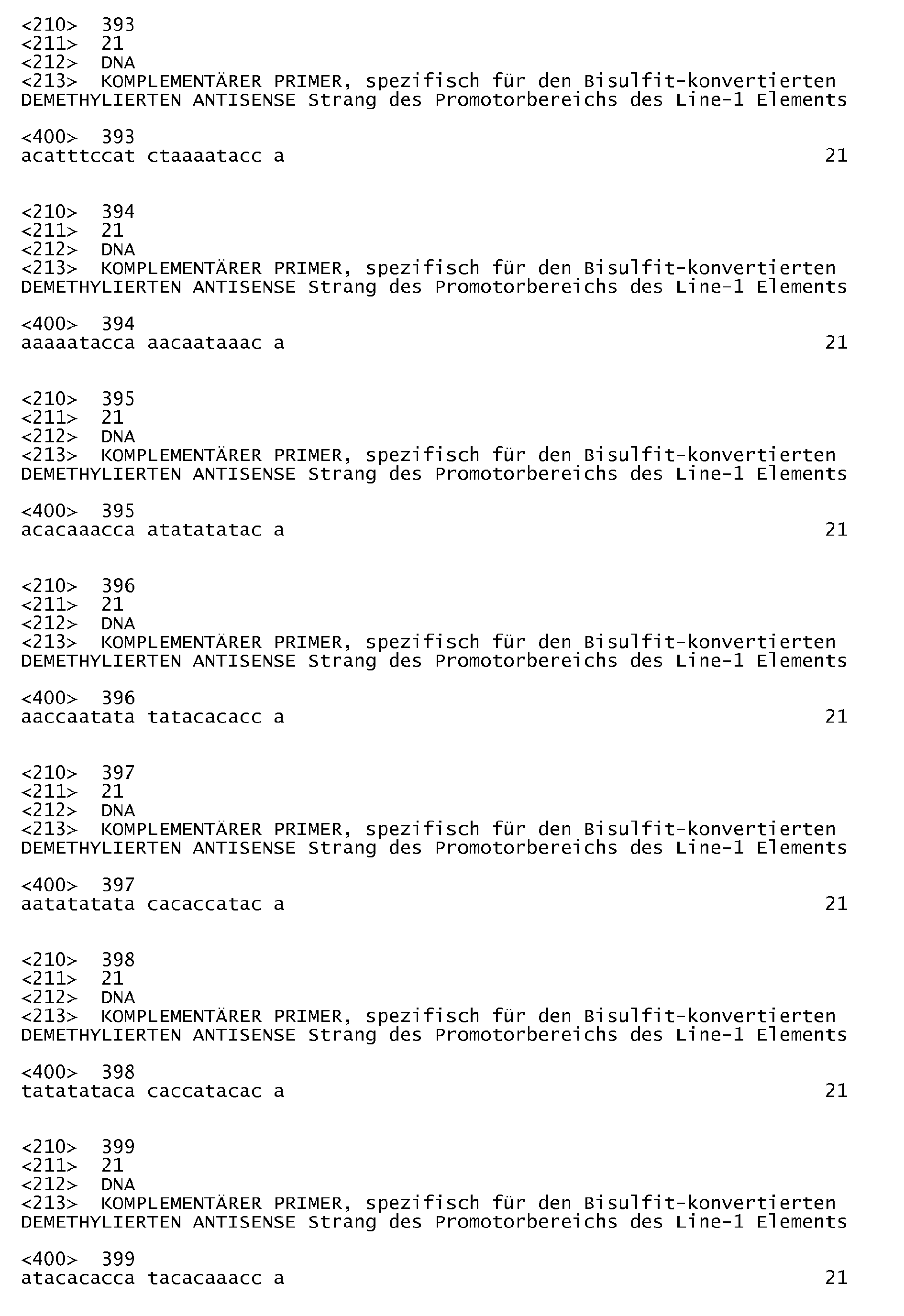


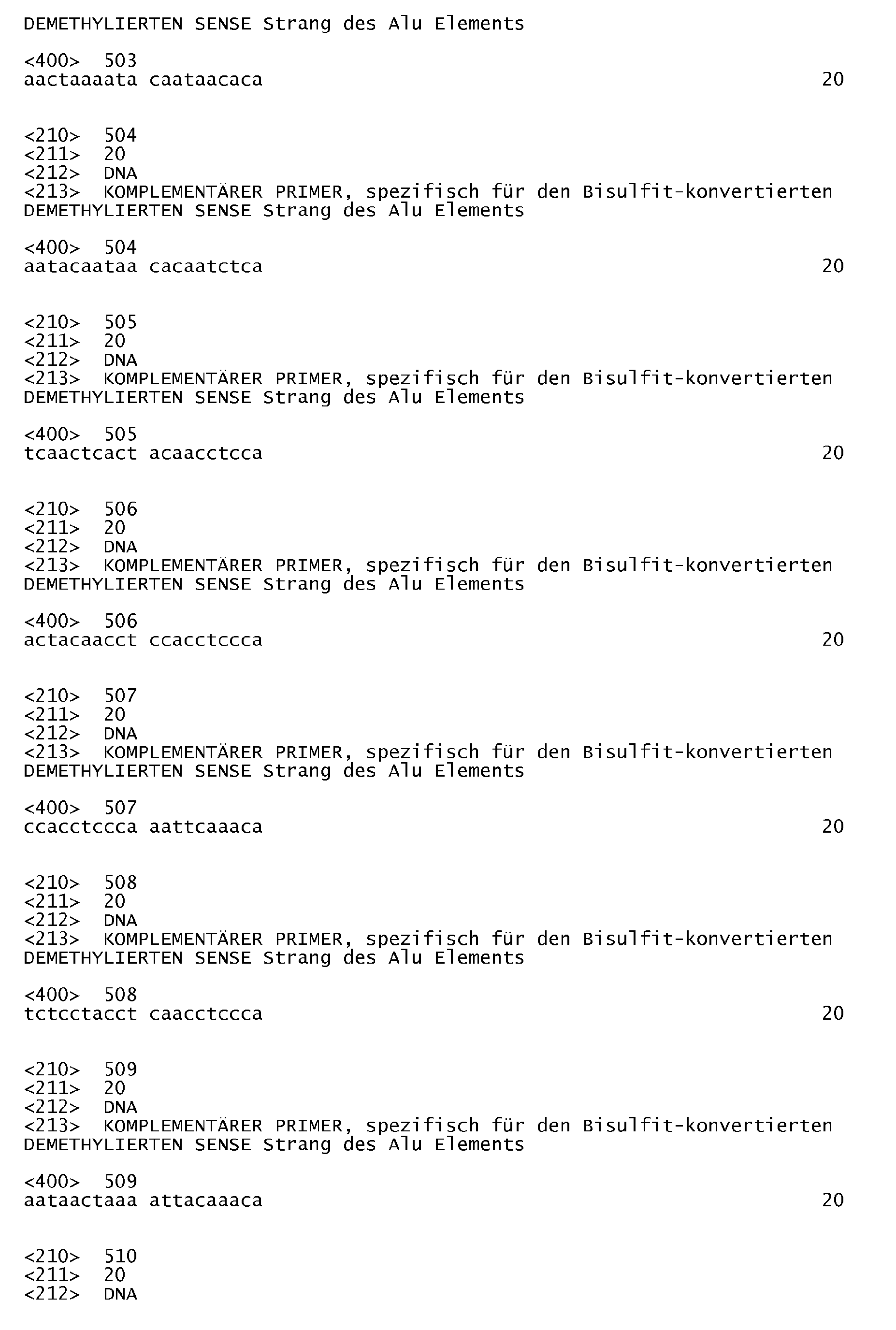

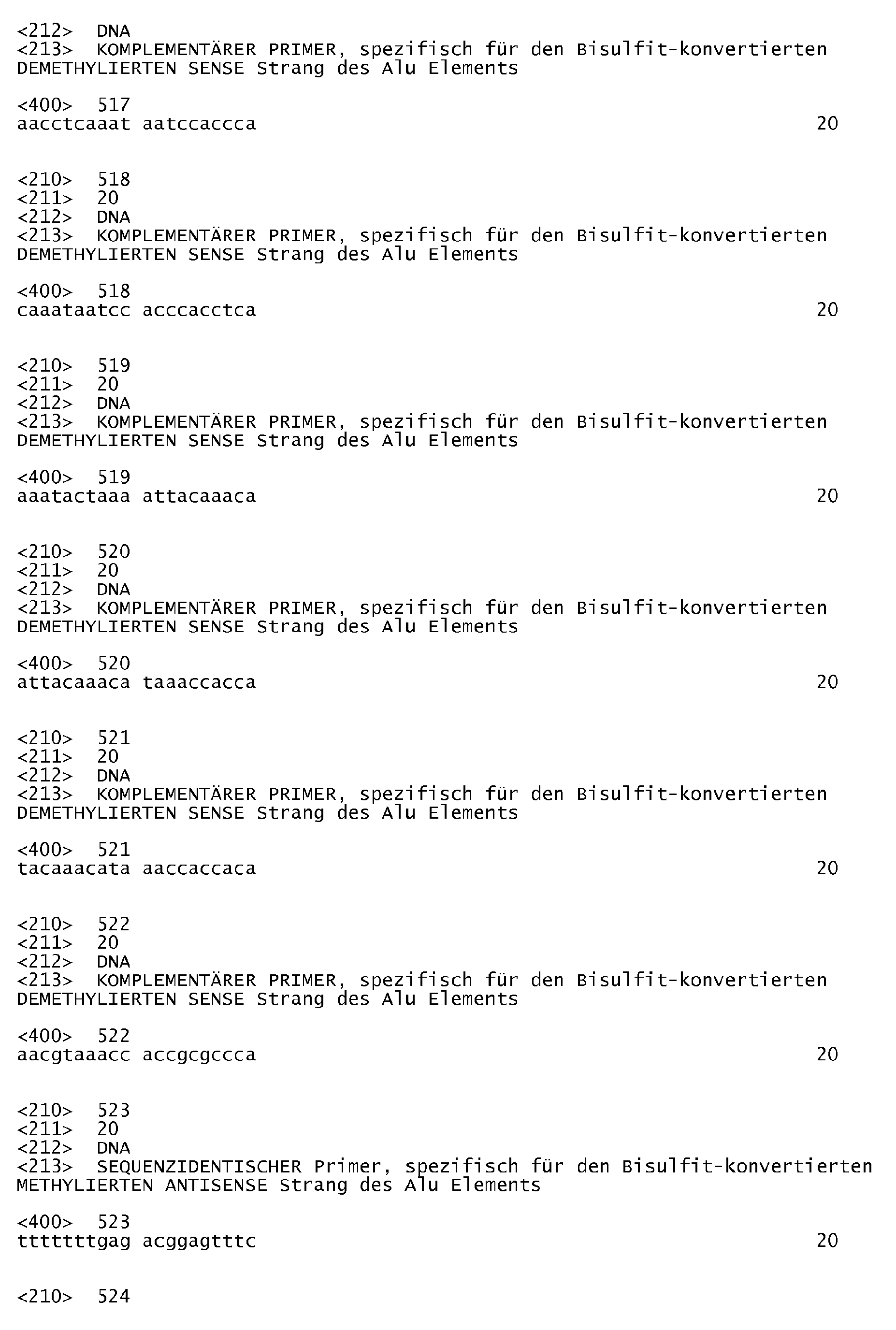


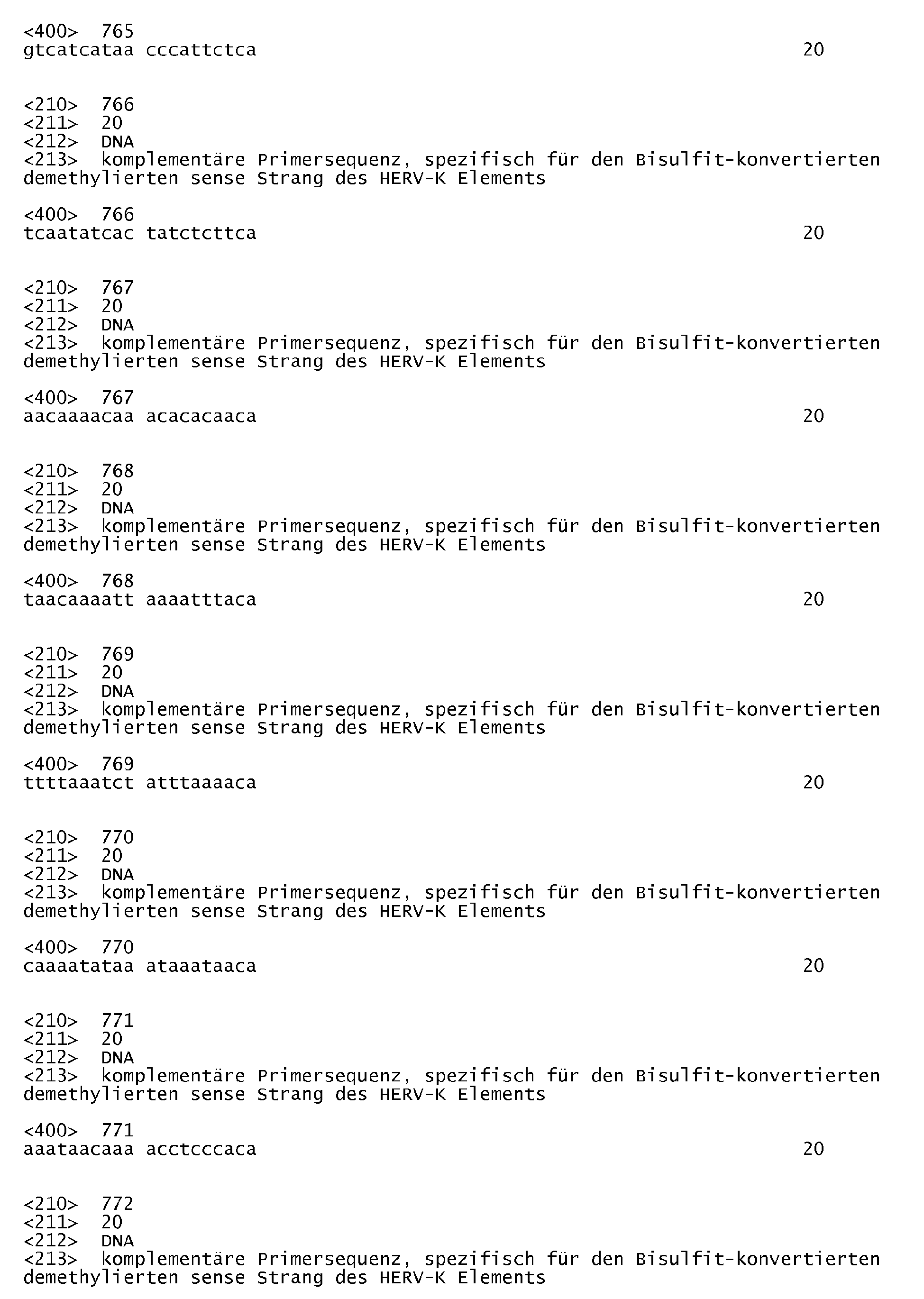
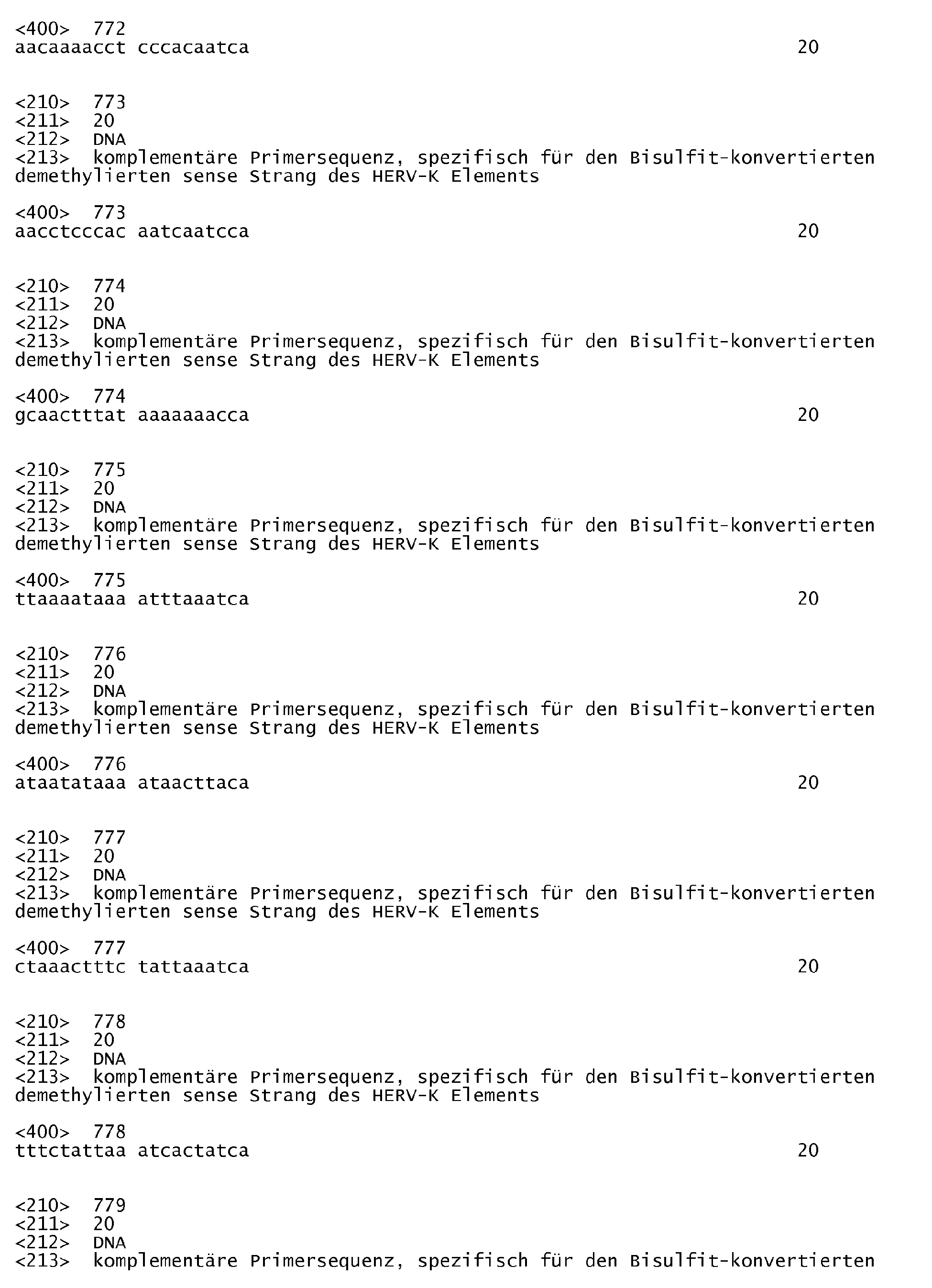


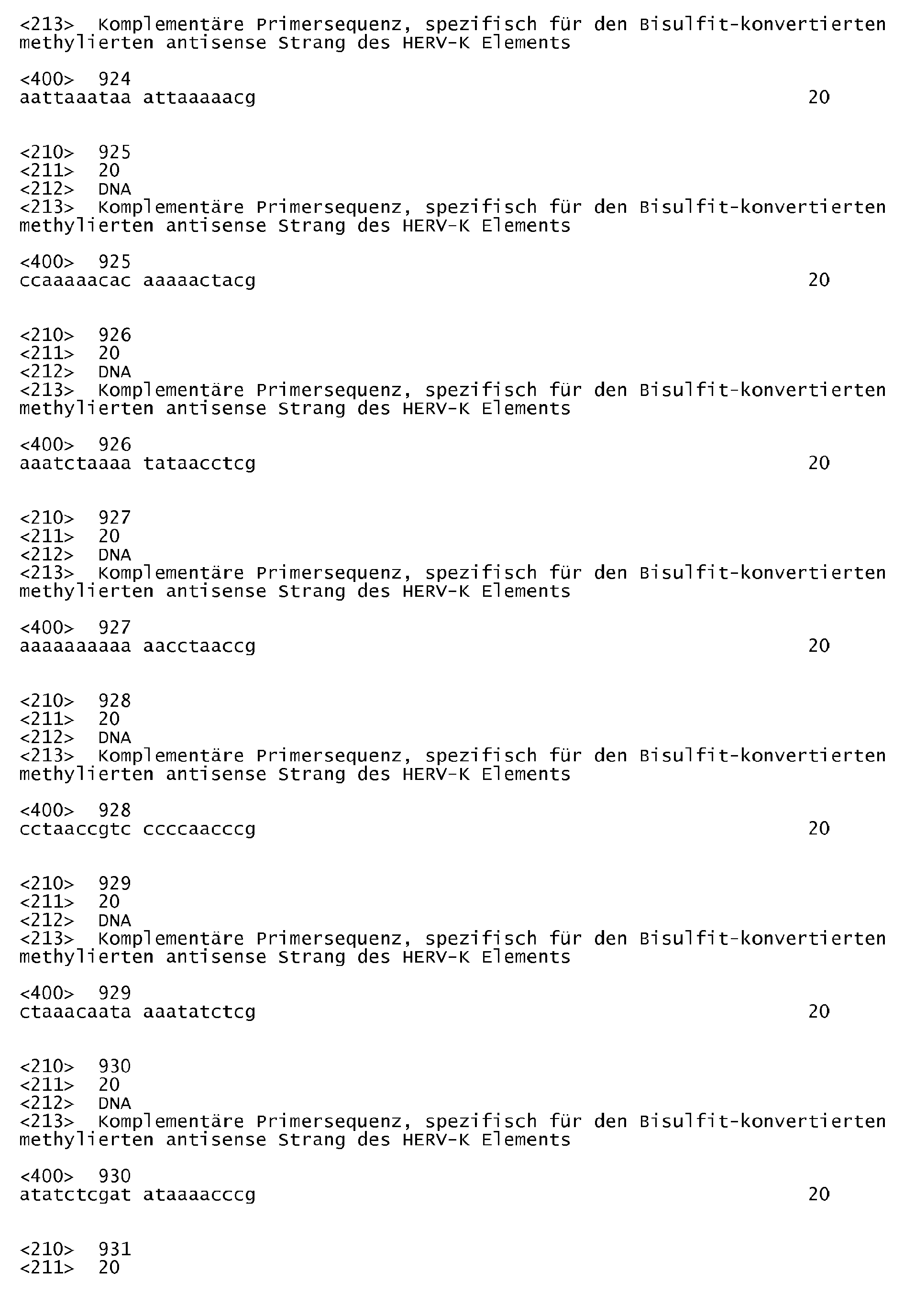


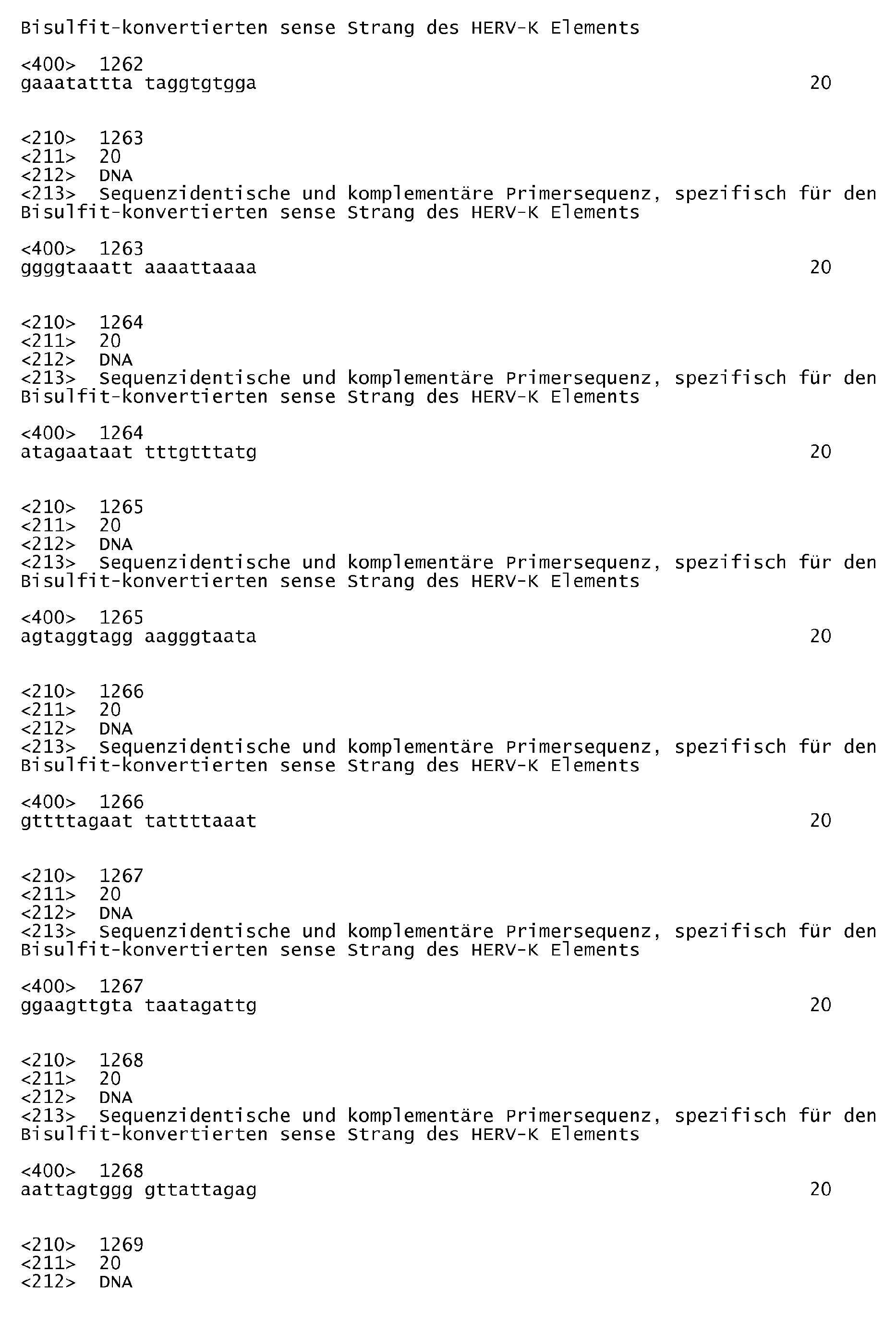


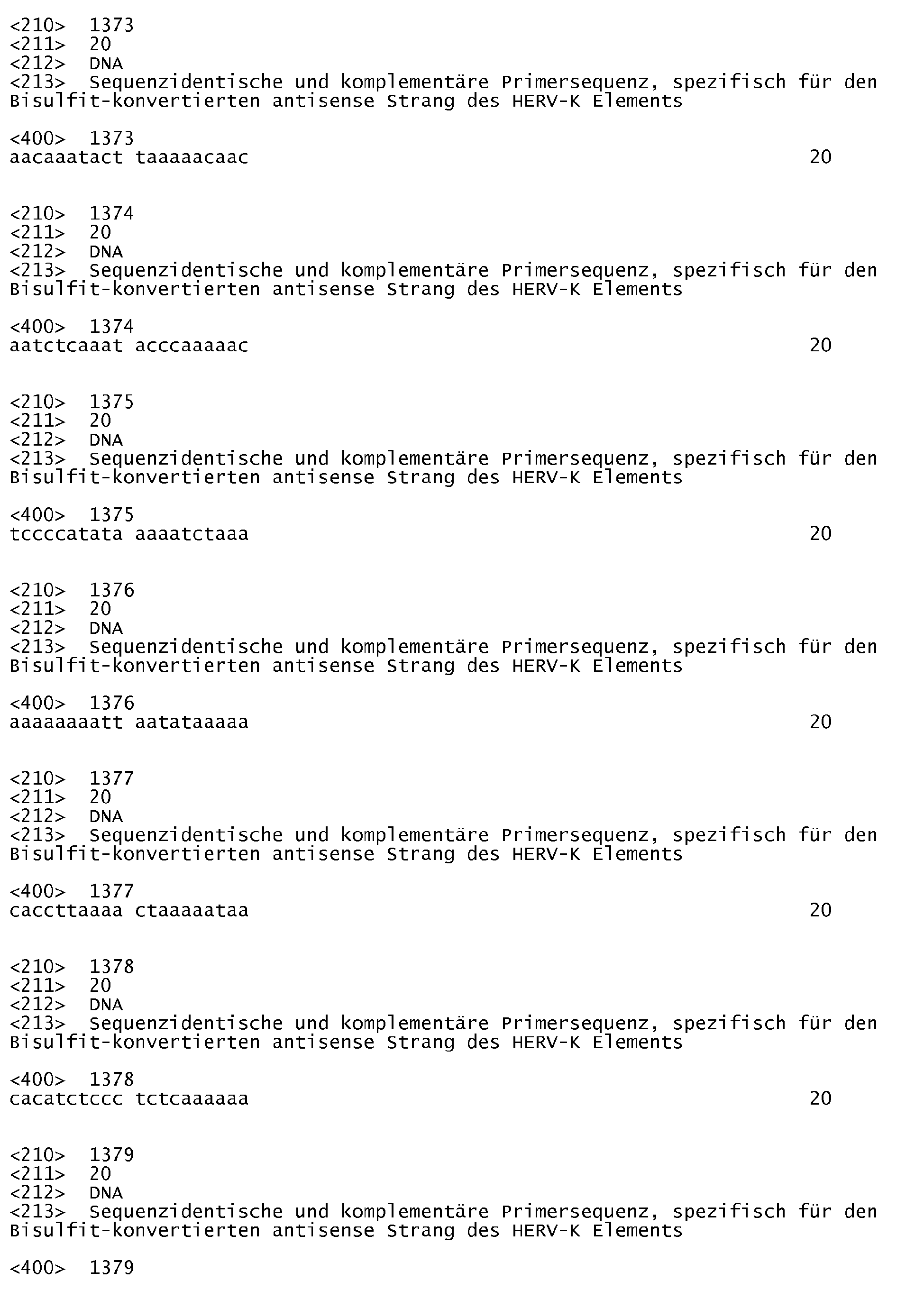


| Methyliert | SEQ ID NO | Demethyliert | SEQ ID NO |
| GGGGAGGAGTTAAGATGGTC | 3 | GGGGAGGAGTTAAGATGGTT | 58 |
| GGTCGAATAGGAATAGTTTC | 4 | GGTTGAATAGGAATAGTTTT | 59 |
| TTCGGTTTATAGTTTTTAGC | 5 | TTTGGTTTATAGTTTTTAGT | 60 |
| TTATAGTTTTTAGCGTGAGC | 6 | TTATAGTTTTTAGTGTGAGT | 61 |
| TAGTTTTTAGCGTGAGCGAC | 7 | TAGTTTTTAGTGTGAGTGAT | 62 |
| GCGTGAGCGACGTAGAAGAC | 8 | GTGTGAGTGATGTAGAAGAT | 63 |
| GTATTTTTATTTGAGGTATC | 9 | GTATTTTTATTTGAGGTATT | 64 |
| GGGAGTGTTAGATAGTGGGC | 10 | GGGAGTGTTAGATAGTGGGT | 65 |
| GCGTAGGTTAGTGTGTGTGC | 11 | GTGTAGGTTAGTGTGTGTGT | 66 |
| GGTTAGTGTGTGTGCGTATC | 12 | GGTTAGTGTGTGTGTGTATT | 67 |
| AGTGTGTGTGCGTATCGTGC | 13 | AGTGTGTGTGTGTATTGTGT | 68 |
| TGTGTGTGCGTATCGTGCGC | 14 | TGTGTGTGTGTATTGTGTGT | 69 |
| GTGCGTATCGTGCGCGAGTC | 15 | GTGTGTATTGTGTGTGAGTT | 70 |
| TGCGCGAGTCGAAGTAGGGC | 16 | TGTGTGAGTTGAAGTAGGGT | 71 |
| TATTGTTTTATTTGGGAAGC | 17 | TATTGTTTTATTTGGGAAGT | 72 |
| GAGTTAAAGAAAGGGGTGAC | 18 | GAGTTAAAGAAAGGGGTGAT | 73 |
| TAAAGAAAGGGGTGACGGTC | 19 | TAAAGAAAGGGGTGATGGTT | 74 |
| ACGGTCGTATTTGGAAAATC | 20 | ATGGTTGTATTTGGAAAATT | 75 |
| AAATCGGGTTATTTTTATTC | 21 | AAATTGGGTTATTTTTATTT | 76 |
| TATTTTTATTCGAATATTGC | 22 | TATTTTTATTTGAATATTGT | 77 |
| AATATTGCGTTTTTTAGATC | 23 | AATATTGTGTTTTTTAGATT | 78 |
| TTTAGATCGGTTTAAGAAAC | 24 | TTTAGATTGGTTTAAGAAAT | 79 |
| AGATCGGTTTAAGAAACGGC | 25 | AGATTGGTTTAAGAAATGGT | 80 |
| TTTAAGAAACGGCGTATTAC | 26 | TTTAAGAAATGGTGTATTAT | 81 |
| TTATATTTTATATTTGGTTC | 27 | TTATATTTTATATTTGGTTT | 82 |
| TTTGGTTCGGAGGGTTTTAC | 28 | TTTGGTTTGGAGGGTTTTAT | 83 |
| TCGGAGGGTTTTACGTTTAC | 29 | TTGGAGGGTTTTATGTTTAT | 84 |
| TTTTACGTTTACGGAATTTC | 30 | TTTTATGTTTATGGAATTTT | 85 |
| TTGAGATTAAATTGTAAGGC | 31 | TTGAGATTAAATTGTAAGGT | 86 |
| TTAAATTGTAAGGCGGTAAC | 32 | TTAAATTGTAAGGTGGTAAT | 87 |
| AACGAGGTTGGGGGAGGGGC | 33 | AATGAGGTTGGGGGAGGGGT | 88 |
| AGGTTGGGGGAGGGGCGTTC | 34 | AGGTTGGGGGAGGGGTGTTT | 89 |
| TTTAGGTAAATAAAGTAGTC | 35 | TTTAGGTAAATAAAGTAGTT | 90 |
| ATAAAGTAGTCGGGAAGTTC | 36 | ATAAAGTAGTTGGGAAGTTT | 91 |
| AGTAGTGGTTTTTTTAGTAC | 37 | AGTAGTGGTTTTTTTAGTAT | 92 |
| GTAGTTGGAGATTTGAGAAC | 38 | GTAGTTGGAGATTTGAGAAT | 93 |
| GTTTTTGATTTTTGATTTTC | 39 | GTTTTTGATTTTTGATTTTT | 94 |
| GGTATATTGATATTTTATAC | 40 | GGTATATTGATATTTTATAT | 95 |
| TTAGAAAGGATATTTATATC | 41 | TTAGAAAGGATATTTATATT | 96 |
| AAAATTGGAAATTTTAAAAC | 42 | AAAATTGGAAATTTTAAAAT | 97 |
| GAAATTTTAAAACGTAGAGC | 43 | GAAATTTTAAAATGTAGAGT | 98 |
| TTTTTTTTTTTTAAAGGAAC | 44 | TTTTTTTTTTTTAAAGGAAT | 99 |
| GGATGGAGAATGATTTTGAC | 45 | GGATGGAGAATGATTTTGAT | 100 |
| GAGAGAAGAAGGTTTTAGAC | 46 | GAGAGAAGAAGGTTTTAGAT | 101 |
| ATTAAATTATTTTGAGTTAC | 47 | ATTAAATTATTTTGAGTTAT | 102 |
| GGAGTTGAAAATTAAGGTTC | 48 | GGAGTTGAAAATTAAGGTTT | 103 |
| AATTAAGGTTCGAGAATTAC | 49 | AATTAAGGTTTGAGAATTAT | 104 |
| ATGTAGAAGTTTTAGGAGTC | 50 | ATGTAGAAGTTTTAGGAGTT | 105 |
| GAAGTTTTAGGAGTCGATGC | 51 | GAAGTTTTAGGAGTTGATGT | 106 |
| TGAAATGAATGAAATGAAGC | 52 | TGAAATGAATGAAATGAAGT | 107 |
| TGTGAAAAGATTAAATTTAC | 53 | TGTGAAAAGATTAAATTTAT | 108 |
| ATTTAGTAAGGTAGGTTAAC | 54 | ATTTAGTAAGGTAGGTTAAT | 109 |
| ATTTAGGAAATATAGAGAAC | 55 | ATTTAGGAAATATAGAGAAT | 110 |
| GTTATAAAGATATTTTTC | 56 | GTTATAAAGATATTTTTT | 111 |
| GGTAGTTAGAGAGAAAGGTC | 57 | GGTAGTTAGAGAGAAAGGTT | 112 |
| Methyliert | SEQ ID NO | Demethyliert | SEQ ID NO |
| TTTCCTTTAAAAATAACCCG | 113 | TTTCCTTTAAAAATAACCCA | 167 |
| TCTTAAAATTACTCTTCTCG | 114 | TCTTAAAATTACTCTTCTCA | 168 |
| CGAAAAATATCTTTATAACG | 115 | CAAAAAATATCTTTATAACA | 169 |
| ATATTTCCTAAATCTAAACG | 116 | ATATTTCCTAAATCTAAACA | 170 |
| TCAAATACACCAATCAAACG | 117 | TCAAATACACCAATCAAACA | 171 |
| TCTCTAAACTTCCCTTCTCG | 118 | TCTCTAAACTTCCCTTCTCA | 172 |
| CCCTTTCTTCCAATTAATCG | 119 | CCCTTTCTTCCAATTAATCA | 173 |
| TCTTCCAATTAATCGCATCG | 120 | TCTTCCAATTAATCACATCA | 174 |
| AAACTTCTACATTCTTCACG | 121 | AAACTTCTACATTCTTCACA | 175 |
| CATTCTTCACGTAATTCTCG | 122 | CATTCTTCACATAATTCTCA | 176 |
| TTAATTTAAATATCCTCCCG | 123 | TTAATTTAAATATCCTCCCA | 177 |
| AACTCAAAATAATTTAATCG | 124 | AACTCAAAATAATTTAATCA | 178 |
| AACCTTCTTCTCTCAACTCG | 125 | AACCTTCTTCTCTCAACTCA | 179 |
| ATTACTAATAAAAAACTACG | 126 | ATTACTAATAAAAAACTACA | 180 |
| CCTTTAAAAAAAAAAAAACG | 127 | CCTTTAAAAAAAAAAAAACA | 181 |
| AAAAAAAAAAACGCTCTACG | 128 | AAAAAAAAAAACACTCTACA | 182 |
| AATATACAAATAAATTTTCG | 129 | AATATACAAATAAATTTTCA | 183 |
| TCTATTAAAATACCCTACCG | 130 | TCTATTAAAATACCCTACCA | 184 |
| CCTCCCAATTAAACTACTCG | 131 | CCTCCCAATTAAACTACTCA | 185 |
| AAAAACAATCTATCTACCCG | 132 | AAAAACAATCTATCTACCCA | 186 |
| TTCTCAAATCTCCAACTACG | 133 | TTCTCAAATCTCCAACTACA | 187 |
| AATAAACTCCACCCAATTCG | 134 | AATAAACTCCACCCAATTCA | 188 |
| CACCCAATTCGAACTTCCCG | 135 | CACCCAATTCAAACTTCCCA | 189 |
| AACCTAAACAATAACGAACG | 136 | AACCTAAACAATAACAAACA | 190 |
| ACGCCCCTCCCCCAACCTCG | 137 | ACACCCCTCCCCCAACCTCA | 191 |
| CTCCCCCAACCTCGTTACCG | 138 | CTCCCCCAACCTCATTACCA | 192 |
| TACTATACTAACAATCAACG | 139 | TACTATACTAACAATCAACA | 193 |
| TAACAATCAACGAAATTCCG | 140 | TAACAATCAACAAAATTCCA | 194 |
| TCAACGAAATTCCGTAAACG | 141 | TCAACAAAATTCCATAAACA | 195 |
| CGTAAACGTAAAACCCTCCG | 142 | CATAAACATAAAACCCTCCA | 196 |
| AAATATAAAATATAATCTCG | 143 | AAATATAAAATATAATCTCA | 197 |
| AAATATAATCTCGTAATACG | 144 | AAATATAATCTCATAATACA | 198 |
| TATAATCTCGTAATACGCCG | 145 | TATAATCTCATAATACACCA | 199 |
| ATACGCCGTTTCTTAAACCG | 146 | ATACACCATTTCTTAAACCA | 200 |
| TTAAACCGATCTAAAAAACG | 147 | TTAAACCAATCTAAAAAACA | 201 |
| TCTAAAAAACGCAATATTCG | 148 | TCTAAAAAACACAATATTCA | 202 |
| ATTCGAATAAAAATAACCCG | 149 | ATTCAAATAAAAATAACCCA | 203 |
| AACCCGATTTTCCAAATACG | 150 | AACCCAATTTTCCAAATACA | 204 |
| CGATTTTCCAAATACGACCG | 151 | CAATTTTCCAAATACAACCA | 205 |
| AAACTCCCTAACCCCTTACG | 152 | AAACTCCCTAACCCCTTACA | 206 |
| CCAAATAAAACAATACCTCG | 153 | CCAAATAAAACAATACCTCA | 207 |
| CAATACCTCGCCCTACTTCG | 154 | CAATACCTCACCCTACTTCA | 208 |
| CCTCGCCCTACTTCGACTCG | 155 | CCTCACCCTACTTCAACTCA | 209 |
| TCGCCCTACTTCGACTCGCG | 156 | TCACCCTACTTCAACTCACA | 210 |
| CCTACTTCGACTCGCGCACG | 157 | CCTACTTCAACTCACACACA | 211 |
| TTCGACTCGCGCACGATACG | 158 | TTCAACTCACACACAATACA | 212 |
| CGCACACACACTAACCTACG | 159 | CACACACACACTAACCTACA | 213 |
| TCCCTAATAAAATAAACCCG | 160 | TCCCTAATAAAATAAACCCA | 214 |
| TAAAAATACAAAAATCACCG | 161 | TAAAAATACAAAAATCACCA | 215 |
| AAAAATCACCGTCTTCTACG | 162 | AAAAATCACCATCTTCTACA | 216 |
| AATCACCGTCTTCTACGTCG | 163 | AATCACCATCTTCTACATCA | 217 |
| CGTCTTCTACGTCGCTCACG | 164 | CATCTTCTACATCACTCACA | 218 |
| ACGCTAAAAACTATAAACCG | 165 | ACACTAAAAACTATAAACCA | 219 |
| ACCGAAACTATTCCTATTCG | 166 | ACCAAAACTATTCCTATTCA | 220 |
| Methyliert | SEQ ID NO | Demethyliert | SEQ ID NO |
| TGTAGTTTTTTTTTAGTTTC | 221 | TGTAGTTTTTTTTTAGTTTT | 279 |
| TTTTGGTATGATTTTGTAGC | 222 | TTTTGGTATGATTTTGTAGT | 280 |
| ATTTTGTAGCGGTTGGTATC | 223 | ATTTTGTAGTGGTTGGTATT | 281 |
| TGGTTTGTAGGGTTTTTGTC | 224 | TGGTTTGTAGGGTTTTTGTT | 282 |
| TTTTTTTTTGAGGGTAATTC | 225 | TTTTTTTTTGAGGGTAATTT | 283 |
| GTTTTGGAGTTGTTTTTTTC | 226 | GTTTTGGAGTTGTTTTTTTT | 284 |
| TGTATTTTTTGAATTTGAAC | 227 | TGTATTTTTTGAATTTGAAT | 285 |
| TTTAGGTATATTAATTAGAC | 228 | TTTAGGTATATTAATTAGAT | 286 |
| TTTTTTAAATTTTTTTTTTC | 229 | TTTTTTAAATTTTTTTTTTT | 287 |
| ATTTTTTTTTTTAGTTGATC | 230 | ATTTTTTTTTTTAGTTGATT | 288 |
| TTTTTTTAGTTGATCGTATC | 231 | TTTTTTTAGTTGATTGTATT | 289 |
| GAGGTTTTTGTATTTTTTAC | 232 | GAGGTTTTTGTATTTTTTAT | 290 |
| GTATTTTTTACGTAGTTTTC | 233 | GTATTTTTTATGTAGTTTTT | 291 |
| TTTGGTTTGAATGTTTTTTC | 234 | TTTGGTTTGAATGTTTTTTT | 292 |
| TAGTTTAGAGTAATTTGATC | 235 | TAGTTTAGAGTAATTTGATT | 293 |
| AAGTTTTTTTTTTTTAGTTC | 236 | AAGTTTTTTTTTTTTAGTTT | 294 |
| TGTTGTTGGTGAGGAATTGC | 237 | TGTTGTTGGTGAGGAATTGT | 295 |
| TTTTTTGGAGGAGGAGAGGC | 238 | TTTTTTGGAGGAGGAGAGGT | 296 |
| GAGGAGGAGAGGCGTTTTGC | 239 | GAGGAGGAGAGGTGTTTTGT | 297 |
| TGATGTATAGATGGGTTTTC | 240 | TGATGTATAGATGGGTTTTT | 298 |
| GTTTGTTGGAATATTTTGTC | 241 | GTTTGTTGGAATATTTTGTT | 299 |
| GTTTTTTAGTTAGGTTGTTC | 242 | GTTTTTTAGTTAGGTTGTTT | 300 |
| AGGAGGTAGTTTGTTTGTTC | 243 | AGGAGGTAGTTTGTTTGTTT | 301 |
| GTTTTTAGATTTTTAGTTGC | 244 | GTTTTTAGATTTTTAGTTGT | 302 |
| TGGTGGGTTTTATTTAGTTC | 245 | TGGTGGGTTTTATTTAGTTT | 303 |
| TTATTTAGTTCGAGTTTTTC | 246 | TTATTTAGTTTGAGTTTTTT | 304 |
| AAGTAAGTTTGGGTAATGGC | 247 | AAGTAAGTTTGGGTAATGGT | 305 |
| AAGTTTGGGTAATGGCGGGC | 248 | AAGTTTGGGTAATGGTGGGT | 306 |
| GGCGTTTTTTTTTTAGTTTC | 249 | GGTGTTTTTTTTTTAGTTTT | 307 |
| TTTTTTTTAGTTTCGTTGTC | 250 | TTTTTTTTAGTTTTGTTGTT | 308 |
| TTGTTGTGTTAGTAATTAGC | 251 | TTGTTGTGTTAGTAATTAGT | 309 |
| TTAGTAATTAGCGAGATTTC | 252 | TTAGTAATTAGTGAGATTTT | 310 |
| ATTAGCGAGATTTCGTGGGC | 253 | ATTAGTGAGATTTTGTGGGT | 311 |
| TCGTGGGCGTAGGATTTTTC | 254 | TTGTGGGTGTAGGATTTTTT | 312 |
| TAGGTGTGGGATATAGTTTC | 255 | TAGGTGTGGGATATAGTTTT | 313 |
| GGGATATAGTTTCGTGGTGC | 256 | GGGATATAGTTTTGTGGTGT | 314 |
| ATATAGTTTCGTGGTGCGTC | 257 | ATATAGTTTTGTGGTGTGTT | 315 |
| GGTGCGTCGTTTTTTAAGTC | 258 | GGTGTGTTGTTTTTTAAGTT | 316 |
| TTTAAGTCGGTTTGAAAAGC | 259 | TTTAAGTTGGTTTGAAAAGT | 317 |
| GTTTGAAAAGCGTAATATTC | 260 | GTTTGAAAAGTGTAATATTT | 318 |
| TATTCGGGTGGGAGTGATTC | 261 | TATTTGGGTGGGAGTGATTT | 319 |
| TGATTCGATTTTTTAGGTGC | 262 | TGATTTGATTTTTTAGGTGT | 320 |
| TCGATTTTTTAGGTGCGATC | 263 | TTGATTTTTTAGGTGTGATT | 321 |
| GGAATTTTTTGATTTTTTGC | 264 | GGAATTTTTTGATTTTTTGT | 322 |
| TTTAGGTGAGGTAATGTTTC | 265 | TTTAGGTGAGGTAATGTTTT | 323 |
| GTAATGTTTCGTTTTGTTTC | 266 | GTAATGTTTTGTTTTGTTTT | 324 |
| GTTTCGTTTTGTTTCGGTTC | 267 | GTTTTGTTTTGTTTTGGTTT | 325 |
| TTCGTTTTGTTTCGGTTCGC | 268 | TTTGTTTTGTTTTGGTTTGT | 326 |
| TTTTGTTTCGGTTCGCGTAC | 269 | TTTTGTTTTGGTTTGTGTAT | 327 |
| TTTCGGTTCGCGTACGGTGC | 270 | TTTTGGTTTGTGTATGGTGT | 328 |
| GCGTATATATATTGGTTTGC | 271 | GTGTATATATATTGGTTTGT | 329 |
| TTTTTTAGTGAGATGAATTC | 272 | TTTTTTAGTGAGATGAATTT | 330 |
| ATGGAAATGTAGAAATTATC | 273 | ATGGAAATGTAGAAATTATT | 331 |
| TAGAAATTATCGTTTTTTGC | 274 | TAGAAATTATTGTTTTTTGT | 332 |
| AAATTATCGTTTTTTGCGTC | 275 | AAATTATTGTTTTTTGTGTT | 333 |
| TCGTTTTTTGCGTCGTTTAC | 276 | TTGTTTTTTGTGTTGTTTAT | 334 |
| TACGTTGGGAGTTGTAGATC | 277 | TATGTTGGGAGTTGTAGATT | 335 |
| GATCGGAGTTGTTTTTATTC | 278 | GATTGGAGTTGTTTTTATTT | 336 |
| Methyliert | SEQ ID NO | Demethyliert | SEQ ID NO |
| AAAAAAAAACCAAAATAACCG | 337 | AAAAAAAAACCAAAATAACCA | 387 |
| AACCGAATAAAAACAACTCCG | 338 | AACCAAATAAAAACAACTCCA | 388 |
| TCCGATCTACAACTCCCAACG | 339 | TCCAATCTACAACTCCCAACA | 389 |
| CTACAACTCCCAACGTAAACG | 340 | CTACAACTCCCAACATAAACA | 390 |
| CAACTCCCAACGTAAACGACG | 341 | CAACTCCCAACATAAACAACA | 391 |
| ACGTAAACGACGCAAAAAACG | 342 | ACATAAACAACACAAAAAACA | 392 |
| ACATTTCCATCTAAAATACCG | 343 | ACATTTCCATCTAAAATACCA | 393 |
| AAAAATACCAAACAATAAACG | 344 | AAAAATACCAAACAATAAACA | 394 |
| ACGCAAACCAATATATATACG | 345 | ACACAAACCAATATATATACA | 395 |
| AACCAATATATATACGCACCG | 346 | AACCAATATATATACACACCA | 396 |
| AATATATATACGCACCGTACG | 347 | AATATATATACACACCATACA | 397 |
| TATATATACGCACCGTACGCG | 348 | TATATATACACACCATACACA | 398 |
| ATACGCACCGTACGCGAACCG | 349 | ATACACACCATACACAAACCA | 399 |
| TACGCGAACCGAAACAAAACG | 350 | TACACAAACCAAAACAAAACA | 400 |
| CATTACCTCACCTAAAAAACG | 351 | CATTACCTCACCTAAAAAACA | 401 |
| AAATCAAAAAAAAAAATAACG | 352 | AAATCAAAAAAAAAAATAACA | 402 |
| CAAAAAAAAAAATAACGATCG | 353 | CAAAAAAAAAAATAACAATCA | 403 |
| ACGATCGCACCTAAAAAATCG | 354 | ACAATCACACCTAAAAAATCA | 404 |
| AAATCGAATCACTCCCACCCG | 355 | AAATCAAATCACTCCCACCCA | 405 |
| CACTCCCACCCGAATATTACG | 356 | CACTCCCACCCAAATATTACA | 406 |
| AATATTACGCTTTTCAAACCG | 357 | AATATTACACTTTTCAAACCA | 407 |
| TTCAAACCGACTTAAAAAACG | 358 | TTCAAACCAACTTAAAAAACA | 408 |
| AAACCGACTTAAAAAACGACG | 359 | AAACCAACTTAAAAAACAACA | 409 |
| CTTAAAAAACGACGCACCACG | 360 | CTTAAAAAACAACACACCACA | 410 |
| CTATATCCCACACCTAACTCG | 361 | CTATATCCCACACCTAACTCA | 411 |
| CCTAACTCGAAAAATCCTACG | 362 | CCTAACTCAAAAAATCCTACA | 412 |
| TCGAAAAATCCTACGCCCACG | 363 | TCAAAAAATCCTACACCCACA | 413 |
| TCCTACGCCCACGAAATCTCG | 364 | TCCTACACCCACAAAATCTCA | 414 |
| CTAAAATCAAACTACAAAACG | 365 | CTAAAATCAAACTACAAAACA | 415 |
| TCAAACTACAAAACGACAACG | 366 | TCAAACTACAAAACAACAACA | 416 |
| AACGAAACTAAAAAAAAAACG | 367 | AACAAAACTAAAAAAAAAACA | 417 |
| AAACTAAAAAAAAAACGCCCG | 368 | AAACTAAAAAAAAAACACCCA | 418 |
| CTTAAATAAACAAAACAACCG | 369 | CTTAAATAAACAAAACAACCA | 419 |
| ACAAAACAACCGAAAAACTCG | 370 | ACAAAACAACCAAAAAACTCA | 420 |
| AACAATAATTCTCCCAACACG | 371 | AACAATAATTCTCCCAACACA | 421 |
| GCAACTAAAAATCTAAAAACG | 372 | GCAACTAAAAATCTAAAAACA | 422 |
| ATCCCTAACTCCTAACCCCCG | 373 | ATCCCTAACTCCTAACCCCCA | 423 |
| AACACACTAACACCTCACACG | 374 | AACACACTAACACCTCACACA | 424 |
| CCAAAAAAAACATCTACACCG | 375 | CCAAAAAAAACATCTACACCA | 425 |
| AAAACTAAAAACTCTAAAACG | 376 | AAAACTAAAAACTCTAAAACA | 426 |
| AAAACTCTAAAACGCAAAACG | 377 | AAAACTCTAAAACACAAAACA | 427 |
| CTCTCCTCCTCCAAAAAAACG | 378 | CTCTCCTCCTCCAAAAAAACA | 428 |
| AAATAAAAAATAATTTTAACG | 379 | AAATAAAAAATAATTTTAACA | 429 |
| AAAAAAAAAAAACTTCAAACG | 380 | AAAAAAAAAAAACTTCAAACA | 430 |
| ATCAAATTACTCTAAACTACG | 381 | ATCAAATTACTCTAAACTACA | 431 |
| AAAACTAAAAACCAAAACTCG | 382 | AAAACTAAAAACCAAAACTCA | 432 |
| AACCAAAACTCGAAAACTACG | 383 | AACCAAAACTCAAAAACTACA | 433 |
| ATACAAAAACCTCAAAAACCG | 384 | ATACAAAAACCTCAAAAACCA | 434 |
| AAAACCTCAAAAACCGATACG | 385 | AAAACCTCAAAAACCAATACA | 435 |
| TAAAATAAATAAAATAAAACG | 386 | TAAAATAAATAAAATAAAACA | 436 |
| Methyliert | SEQ ID NO | Demethyliert | SEQ ID NO |
| GGTCGGGCGCGGTGGTTTAC | 437 | GGTTGGGTGTGGTGGTTTAT | 457 |
| TTTTAGTATTTTGGGAGGTC | 438 | TTTTAGTATTTTGGGAGGTT | 458 |
| GTATTTTGGGAGGTCGAGGC | 439 | GTATTTTGGGAGGTTGAGGT | 459 |
| TTTGGGAGGTCGAGGCGGGC | 440 | TTTGGGAGGTTGAGGTGGGT | 460 |
| TTATTTGAGGTTAGGAGATC | 441 | TTATTTGAGGTTAGGAGATT | 461 |
| GGTTAATATGGTGAAATTTC | 442 | GGTTAATATGGTGAAATTTT | 462 |
| TAAAAATATAAAAATTAGTC | 443 | TAAAAATATAAAAATTAGTT | 463 |
| AATATAAAAATTAGTCGGGC | 444 | AATATAAAAATTAGTTGGGT | 464 |
| AATTAGTCGGGCGTGGTGGC | 445 | AATTAGTTGGGTGTGGTGGT | 465 |
| TTAGTCGGGCGTGGTGGCGC | 446 | TTAGTTGGGTGTGGTGGTGT | 466 |
| AGTCGGGCGTGGTGGCGCGC | 447 | AGTTGGGTGTGGTGGTGTGT | 467 |
| GTTTGTAATTTTAGTTATTC | 448 | GTTTGTAATTTTAGTTATTT | 468 |
| GAGGTTGAGGTAGGAGAATC | 449 | GAGGTTGAGGTAGGAGAATT | 469 |
| TAGGAGAATCGTTTGAATTC | 450 | TAGGAGAATTGTTTGAATTT | 470 |
| ATCGTTTGAATTCGGGAGGC | 451 | ATTGTTTGAATTTGGGAGGT | 471 |
| GGTTGTAGTGAGTCGAGATC | 452 | GGTTGTAGTGAGTTGAGATT | 472 |
| TTGTAGTGAGTCGAGATCGC | 453 | TTGTAGTGAGTTGAGATTGT | 473 |
| TATTGTATTTTAGTTTGGGC | 454 | TATTGTATTTTAGTTTGGGT | 474 |
| TTTAGTTTGGGCGATAGAGC | 455 | TTTAGTTTGGGTGATAGAGT | 475 |
| GGGCGATAGAGCGAGATTTC | 456 | GGGTGATAGAGTGAGATTTT | 476 |
| Methyliert | SEQ ID NO | Demethyliert | SEQ ID NO |
| TTTTTTAAAACGAAATCTCG | 477 | TTTTTTAAAACAAAATCTCA | 500 |
| AACGAAATCTCGCTCTATCG | 478 | AACAAAATCTCACTCTATCA | 501 |
| CAAACTAAAATACAATAACG | 479 | CAAACTAAAATACAATAACA | 502 |
| AACTAAAATACAATAACGCG | 480 | AACTAAAATACAATAACACA | 503 |
| AATACAATAACGCGATCTCG | 481 | AATACAATAACACAATCTCA | 504 |
| TCGACTCACTACAACCTCCG | 482 | TCAACTCACTACAACCTCCA | 505 |
| ACTACAACCTCCGCCTCCCG | 483 | ACTACAACCTCCACCTCCCA | 506 |
| CCGCCTCCCGAATTCAAACG | 484 | CCACCTCCCAAATTCAAACA | 507 |
| TCTCCTACCTCAACCTCCCG | 485 | TCTCCTACCTCAACCTCCCA | 508 |
| AATAACTAAAATTACAAACG | 486 | AATAACTAAAATTACAAACA | 509 |
| TAACTAAAATTACAAACGCG | 487 | TAACTAAAATTACAAACACA | 510 |
| ACTAAAATTACAAACGCGCG | 488 | ACTAAAATTACAAACACACA | 511 |
| TACAAACGCGCGCCACCACG | 489 | TACAAACACACACCACCACA | 512 |
| AACGCGCGCCACCACGCCCG | 490 | AACACACACCACCACACCCA | 513 |
| TTATATTTTTAATAAAAACG | 491 | TTATATTTTTAATAAAAACA | 514 |
| TATTAACCAAAATAATCTCG | 492 | TATTAACCAAAATAATCTCA | 515 |
| TCCTAACCTCAAATAATCCG | 493 | TCCTAACCTCAAATAATCCA | 516 |
| AACCTCAAATAATCCGCCCG | 494 | AACCTCAAATAATCCACCCA | 517 |
| CAAATAATCCGCCCGCCTCG | 495 | CAAATAATCCACCCACCTCA | 518 |
| AAATACTAAAATTACAAACG | 496 | AAATACTAAAATTACAAACA | 519 |
| ATTACAAACGTAAACCACCG | 497 | ATTACAAACATAAACCACCA | 520 |
| TACAAACGTAAACCACCGCG | 498 | TACAAACATAAACCACCACA | 521 |
| AACGTAAACCACCGCGCCCG | 499 | AACGTAAACCACCGCGCCCA | 522 |
| Methyliert | SEQ ID NO | Demethyliert | SEQ ID NO |
| TTTTTTTGAGACGGAGTTTC | 523 | TTTTTTTGAGACTGAGTTTT | 547 |
| AGACGGAGTTTCGTTTTGTC | 524 | AGACTGAGTTTCTTTTTGTT | 548 |
| AGACGGAGTTTCGTTTTGTC | 525 | AGACTGAGTTTCTTTTTGTT | 549 |
| TTAGGTTGGAGTGTAGTGGC | 526 | TTAGGTTGGAGTGTAGTGGT | 550 |
| AGGTTGGAGTGTAGTGGCGC | 527 | AGGTTGGAGTGTAGTGGCTT | 551 |
| GAGTGTAGTGGCGCGATTTC | 528 | GAGTGTAGTGGCTCTATTTT | 552 |
| TTCGGTTTATTGTAATTTTC | 529 | TTCTGTTTATTGTAATTTTT | 553 |
| TATTGTAATTTTCGTTTTTC | 530 | TATTGTAATTTTCTTTTTTT | 554 |
| TTCGTTTTTCGGGTTTAAGC | 531 | TTCTTTTTTCTGGTTTAAGT | 555 |
| TTTTTTTGTTTTAGTTTTTC | 532 | TTTTTTTGTTTTAGTTTTTT | 556 |
| GAGTAGTTGGGATTATAGGC | 533 | GAGTAGTTGGGATTATAGGT | 557 |
| GTAGTTGGGATTATAGGCGC | 534 | GTAGTTGGGATTATAGGCTT | 558 |
| AGTTGGGATTATAGGCGCGC | 535 | AGTTGGGATTATAGGCTCTT | 559 |
| TTATAGGCGCGCGTTATTAC | 536 | TTATAGGCTCTCTTTATTAT | 560 |
| AGGCGCGCGTTATTACGTTC | 537 | AGGCTCTCTTTATTACTTTT | 561 |
| TTTGTATTTTTAGTAGAGAC | 538 | TTTGTATTTTTAGTAGAGAT | 562 |
| ATGTTGGTTAGGATGGTTTC | 539 | ATGTTGGTTAGGATGGTTTT | 563 |
| TTTTTGATTTTAGGTGATTC | 540 | TTTTTGATTTTAGGTGATTT | 564 |
| TGATTTTAGGTGATTCGTTC | 541 | TGATTTTAGGTGATTCTTTT | 565 |
| TTAGGTGATTCGTTCGTTTC | 542 | TTAGGTGATTCTTTCTTTTT | 566 |
| AAAGTGTTGGGATTATAGGC | 543 | AAAGTGTTGGGATTATAGGT | 567 |
| GATTATAGGCGTGAGTTATC | 544 | GATTATAGGCTTGAGTTATT | 568 |
| TTATAGGCGTGAGTTATCGC | 545 | TTATAGGCTTGAGTTATCTT | 569 |
| AGGCGTGAGTTATCGCGTTC | 546 | AGGCTTGAGTTATCTCTTTT | 570 |
| Methyliert | SEQ ID NO | Demethyliert | SEQ ID NO |
| ACCGAACGCGATAACTCACG | 571 | ACCAAACACAATAACTCACA | 592 |
| CCCAACACTTTAAAAAACCG | 572 | CCCAACACTTTAAAAAACCA | 593 |
| CACTTTAAAAAACCGAAACG | 573 | CACTTTAAAAAACCAAAACA | 594 |
| TTAAAAAACCGAAACGAACG | 574 | TTAAAAAACCAAAACAAACA | 595 |
| CACCTAAAATCAAAAAATCG | 575 | CACCTAAAATCAAAAAATCA | 596 |
| ACCAACATAATAAAACCCCG | 576 | ACCAACATAATAAAACCCCA | 597 |
| AAAAATACAAAAATTAACCG | 577 | AAAAATACAAAAATTAACCA | 598 |
| ATACAAAAATTAACCGAACG | 578 | ATACAAAAATTAACCAAACA | 599 |
| ATTAACCGAACGTAATAACG | 579 | ATTAACCAAACATAATAACA | 600 |
| TAACCGAACGTAATAACGCG | 580 | TAACCAAACATAATAACACA | 601 |
| ACCGAACGTAATAACGCGCG | 581 | ACCAAACATAATAACACACA | 602 |
| CCTATAATCCCAACTACTCG | 582 | CCTATAATCCCAACTACTCA | 603 |
| GAACTAAAACAAAAAAATCG | 583 | GAACTAAAACAAAAAAATCA | 604 |
| AAAAAAATCGCTTAAACCCG | 584 | AAAAAAATCACTTAAACCCA | 605 |
| TCGCTTAAACCCGAAAAACG | 585 | TCACTTAAACCCAAAAAACA | 606 |
| ACGAAAATTACAATAAACCG | 586 | ACAAAAATTACAATAAACCA | 607 |
| ATTACAATAAACCGAAATCG | 587 | ATTACAATAAACCAAAATCA | 608 |
| TACAATAAACCGAAATCGCG | 588 | TACAATAAACCAAAATCACA | 609 |
| ACTACACTCCAACCTAAACG | 589 | ACTACACTCCAACCTAAACA | 610 |
| CCAACCTAAACGACAAAACG | 590 | CCAACCTAAACAACAAAACA | 611 |
| AACGACAAAACGAAACTCCG | 591 | AACAACAAAACAAAACTCCA | 612 |
| Methyliert | SEQ ID NO | Demethyliert | SEQ ID NO |
| ATGATTTTATTTTTAATTTC | 613 | ATGATTTTATTTTTAATTTT | 661 |
| GGGTTAAATGGATTAAGGGC | 614 | GGGTTAAATGGATTAAGGGT | 662 |
| TTTAGGGATATAAAAATTGC | 615 | TTTAGGGATATAAAAATTGT | 663 |
| AGAGTTTGAAATATGGTTTC | 616 | AGAGTTTGAAATATGGTTTT | 664 |
| GGGAAGGGAAAGATTTGATC | 617 | GGGAAGGGAAAGATTTGATT | 665 |
| ATTTGATCGTTTTTTAGTTC | 618 | ATTTGATCTTTTTTTAGTTT | 666 |
| TTTGGGTAATGGAATGTTTC | 619 | TTTGGGTAATGGAATGTTTT | 667 |
| AATGTTTCGGTATAAAATTC | 620 | AATGTTTCTGTATAAAATTT | 668 |
| GGTATAAAATTCGATTGTAC | 621 | GGTATAAAATTCTATTGTAT | 669 |
| ATGTAAAGATTTTTGTTTAC | 622 | ATGTAAAGATTTTTGTTTAT | 670 |
| TTTTTTAGAGAAATATTTAC | 623 | TTTTTTAGAGAAATATTTAT | 671 |
| GGATTTTTTATATGTTGAAC | 624 | GGATTTTTTATATGTTGAAT | 672 |
| ATGTTGAACGTTGGTTTTTC | 625 | ATGTTGAACTTTGGTTTTTT | 673 |
| AGTTTTTTATTGTATTTTAC | 626 | AGTTTTTTATTGTATTTTAT | 674 |
| TTTTTTATTTGGTGTTTAAC | 627 | TTTTTTATTTGGTGTTTAAT | 675 |
| TTTGGGGTGAAGGTATATTC | 628 | TTTGGGGTGAAGGTATATTT | 676 |
| GGGTGAAGGTATATTCGAGC | 629 | GGGTGAAGGTATATTCTAGT | 677 |
| GTGGTTATTGAGGATAAGTC | 630 | GTGGTTATTGAGGATAAGTT | 678 |
| ATAAGTCGATAAGAGATTTC | 631 | ATAAGTCTATAAGAGATTTT | 679 |
| ATATTTATAGTTAGTTTTAC | 632 | ATATTTATAGTTAGTTTTAT | 680 |
| TACGGTAAGTTTGTGTATTC | 633 | TACTGTAAGTTTGTGTATTT | 681 |
| TATTTTAAATAGAAGATAGC | 634 | TATTTTAAATAGAAGATAGT | 682 |
| AAAAAATTTTAGAAGGAAAC | 635 | AAAAAATTTTAGAAGGAAAT | 683 |
| AAACGGAAATTTTATATTGC | 636 | AAACTGAAATTTTATATTGT | 684 |
| TGCGAATATGTAGTAGAGTC | 637 | TGCTAATATGTAGTAGAGTT | 685 |
| TCGTTAATGGTTTAGTTAAC | 638 | TCTTTAATGGTTTAGTTAAT | 686 |
| GTTATTAGAGTTTAAATTAC | 639 | GTTATTAGAGTTTAAATTAT | 687 |
| TTTTAGTAGGTTAGGTGATC | 640 | TTTTAGTAGGTTAGGTGATT | 688 |
| GTAATATTATAATTTTAAGC | 641 | GTAATATTATAATTTTAAGT | 689 |
| GTTTATTAATATTGGTTATC | 642 | GTTTATTAATATTGGTTATT | 690 |
| ATTAATATTGGTTATCGGTC | 643 | ATTAATATTGGTTATCTGTT | 691 |
| ATCGGTCGAATTTTAGTATC | 644 | ATCTGTCTAATTTTAGTATT | 692 |
| AGGGAGTTATATTTTTAGTC | 645 | AGGGAGTTATATTTTTAGTT | 693 |
| AAGGAAGGAGATATTGAGGC | 646 | AAGGAAGGAGATATTGAGGT | 694 |
| GCGTGGTAATTTTTAGTAAC | 647 | GCTTGGTAATTTTTAGTAAT | 695 |
| TTTTTAGTAACGTTAGAATC | 648 | TTTTTAGTAACTTTAGAATT | 696 |
| ATGTGGATTTTTGTGTTTAC | 649 | ATGTGGATTTTTGTGTTTAT | 697 |
| GATTTTTGTGTTTACGGATC | 650 | GATTTTTGTGTTTACTGATT | 698 |
| TTTGTGTTTACGGATCGATC | 651 | TTTGTGTTTACTGATCTATT | 699 |
| GATCGATCGTGGGAGGTTTC | 652 | GATCTATCTTGGGAGGTTTT | 700 |
| TGATTGAAATATTAAAAGGC | 653 | TGATTGAAATATTAAAAGGT | 701 |
| TTATAAATTTTATATTAATC | 654 | TTATAAATTTTATATTAATT | 702 |
| TAGGTGTATTTAATAGTTTC | 655 | TAGGTGTATTTAATAGTTTT | 703 |
| TTCGAAGAGATAGTGATATC | 656 | TTCTAAGAGATAGTGATATT | 704 |
| GAGATAGTGATATCGAGAAC | 657 | GAGATAGTGATATCTAGAAT | 705 |
| CGAGAACGGGTTATGATGAC | 658 | CTAGAACTGGTTATGATGAT | 706 |
| CGGGTTATGATGACGATGGC | 659 | CTGGTTATGATGACTATGGT | 707 |
| ATGACGATGGCGGTTTTGTC | 660 | ATGACTATGGCTGTTTTGTT | 708 |
| Methyliert | SEQ ID NO | Demethyliert | SEQ ID NO |
| AAAAAAAATAAAAAAACCCG | 709 | AAAAAAAATAAAAAAACCCA | 753 |
| AAAAACCCGAAAAACCAACG | 710 | AAAAACCCAAAAAACCAACA | 754 |
| TCAACATATAAAAAATCCCG | 711 | TCAACATATAAAAAATCCCA | 755 |
| CATTCATAAATATTTCTCCG | 712 | CATTCATAAATATTTCTCCA | 756 |
| AAAATCAACAAACAAACACG | 713 | AAAATCAACAAACAAACACA | 757 |
| AAACATCTCAATACTTTACG | 714 | AAACATCTCAATACTTTACA | 758 |
| ATAAATAAAATATTCAATCG | 715 | ATAAATAAAATATTCAATCA | 759 |
| AAAATCCCTACGACCTTTCG | 716 | AAAATCCCTACAACCTTTCA | 760 |
| ATTTCCCCCTTTTCTTTTCG | 717 | ATTTCCCCCTTTTCTTTTCA | 761 |
| TTTTCTTTTCGACAAAACCG | 718 | TTTTCTTTTCAACAAAACCA | 762 |
| TTTCGACAAAACCGCCATCG | 719 | TTTCAACAAAACCACCATCA | 763 |
| GCCATCGTCATCATAACCCG | 720 | GCCATCATCATCATAACCCA | 764 |
| GTCATCATAACCCGTTCTCG | 721 | GTCATCATAACCCATTCTCA | 765 |
| TCGATATCACTATCTCTTCG | 722 | TCAATATCACTATCTCTTCA | 766 |
| AACAAAACAAACACACAACG | 723 | AACAAAACAAACACACAACA | 767 |
| TAACAAAATTAAAATTTACG | 724 | TAACAAAATTAAAATTTACA | 768 |
| TTTTAAATCTATTTAAAACG | 725 | TTTTAAATCTATTTAAAACA | 769 |
| CAAAATATAAATAAATAACG | 726 | CAAAATATAAATAAATAACA | 770 |
| AAATAACGAAACCTCCCACG | 727 | AAATAACAAAACCTCCCACA | 771 |
| AACGAAACCTCCCACGATCG | 728 | AACAAAACCTCCCACAATCA | 772 |
| AACCTCCCACGATCGATCCG | 729 | AACCTCCCACAATCAATCCA | 773 |
| GCAACTTTATAAAAAAACCG | 730 | GCAACTTTATAAAAAAACCA | 774 |
| TTAAAATAAAATTTAAATCG | 731 | TTAAAATAAAATTTAAATCA | 775 |
| ATAATATAAAATAACTTACG | 732 | ATAATATAAAATAACTTACA | 776 |
| CTAAACTTTCTATTAAATCG | 733 | CTAAACTTTCTATTAAATCA | 777 |
| TTTCTATTAAATCGCTATCG | 734 | TTTCTATTAAATCACTATCA | 778 |
| AACGATCATAATAATTTCCG | 735 | AACAATCATAATAATTTCCA | 779 |
| CATTATTATAACAAATCTCG | 736 | CATTATTATAACAAATCTCA | 780 |
| CTTCTAAAACTATACCTACG | 737 | CTTCTAAAACTATACCTACA | 781 |
| CTAAAACTATACCTACGCCG | 738 | CTAAAACTATACCTACACCA | 782 |
| ACATTATCTCCTAATAAACG | 739 | ACATTATCTCCTAATAAACA | 783 |
| TAACTTTCTAAAAATAACCG | 740 | TAACTTTCTAAAAATAACCA | 784 |
| ATAACCGATACTAAAATTCG | 741 | ATAACCAATACTAAAATTCA | 785 |
| CCGATACTAAAATTCGACCG | 742 | CCAATACTAAAATTCAACCA | 786 |
| CTTATTTTCTCTAACCTACG | 743 | CTTATTTTCTCTAACCTACA | 787 |
| TTCGCAATATAAAATTTCCG | 744 | TTCACAATATAAAATTTCCA | 788 |
| TATCACCCTAACTTCTTCCG | 745 | TATCACCCTAACTTCTTCCA | 789 |
| CCGAATACACAAACTTACCG | 746 | CCAAATACACAAACTTACCA | 790 |
| ACTAACTATAAATATACTCG | 747 | ACTAACTATAAATATACTCA | 791 |
| ACTTATCCTCAATAACCACG | 748 | ACTTATCCTCAATAACCACA | 792 |
| ATCCTCAATAACCACGCTCG | 749 | ATCCTCAATAACCACACTCA | 793 |
| ACACCTATAAATATTTCTCG | 750 | ACACCTATAAATATTTCTCA | 794 |
| AAAAACCCGAAAAACCAACG | 751 | AAAAACCCAAAAAACCAACA | 795 |
| AAAATAAACAAACAAACACG | 752 | AAAATAAACAAACAAACACA | 796 |
| Methyliert | SEQ ID NO | Demethyliert | SEQ ID NO |
| AGAAAGAAATAAGGGGGTTC | 797 | AGAAAGAAATAAGGGGGTTT | 860 |
| AGGGGGTTCGGGGAATTAGC | 798 | AGGGGGTTCTGGGAATTAGT | 861 |
| TTTAGTATATGGAGGATTTC | 799 | TTTAGTATATGGAGGATTTT | 862 |
| TTAGTATTTATTGATTATTC | 800 | TTAGTATTTATTGATTATTT | 863 |
| TTATTCGTGGGTGTTTTTTC | 801 | TTATTCTTGGGTGTTTTTTT | 864 |
| GAGGGTTAGTAGATAAATAC | 802 | GAGGGTTAGTAGATAAATAT | 865 |
| TAAATATTTTAATGTTTTAC | 803 | TAAATATTTTAATGTTTTAT | 866 |
| AGTAGATGGAATGTTTAATC | 804 | AGTAGATGGAATGTTTAATT | 867 |
| TTTTAGTATAGATTTTTTAC | 805 | TTTTAGTATAGATTTTTTAT | 868 |
| ATAGATTTTTTACGGGTGTC | 806 | ATAGATTTTTTACTGGTGTT | 869 |
| TTAGGTTTTTTTTTTTTTAC | 807 | TTAGGTTTTTTTTTTTTTAT | 870 |
| TTTTAGGTAGAGGTTTTTGC | 808 | TTTTAGGTAGAGGTTTTTGT | 871 |
| AGAGGTTTTTGCGGTTTTTC | 809 | AGAGGTTTTTGCTGTTTTTT | 872 |
| GTATATGTTTTAGAGAGTAC | 810 | GTATATGTTTTAGAGAGTAT | 873 |
| TATTTTTTTTTTTTTTTTTC | 811 | TATTTTTTTTTTTTTTTTTT | 874 |
| TTTTTTTTTTCGATAAAATC | 812 | TTTTTTTTTTCTATAAAATT | 875 |
| TTTTCGATAAAATCGTTATC | 813 | TTTTCTATAAAATCTTTATT | 876 |
| CGTTATCGTTATTATGGTTC | 814 | CTTTATCTTTATTATGGTTT | 877 |
| CGTTATTATGGTTCGTTTTC | 815 | CTTTATTATGGTTCTTTTTT | 878 |
| TTCGATGTTATTGTTTTTTC | 816 | TTCTATGTTATTGTTTTTTT | 879 |
| AGATAAAATAGGTATATAAC | 817 | AGATAAAATAGGTATATAAT | 880 |
| GTGATAGGGTTAAGATTTGC | 818 | GTGATAGGGTTAAGATTTGT | 881 |
| TAATTTTTGTTATAGTAGTC | 819 | TAATTTTTGTTATAGTAGTT | 882 |
| TTTTTGGATTTATTTAAAAC | 820 | TTTTTGGATTTATTTAAAAT | 883 |
| TTAAAATATGGATGGATGGC | 821 | TTAAAATATGGATGGATGGT | 884 |
| TGGATGGCGAGGTTTTTTAC | 822 | TGGATGGCTAGGTTTTTTAT | 885 |
| TGGCGAGGTTTTTTACGGTC | 823 | TGGCTAGGTTTTTTACTGTT | 886 |
| AGGTTTTTTACGGTCGGTTC | 824 | AGGTTTTTTACTGTCTGTTT | 887 |
| TGTTTTTATTAGTAGAATAC | 825 | TGTTTTTATTAGTAGAATAT | 888 |
| CGTAATTTTGTAAAGGAATC | 826 | CTTAATTTTGTAAAGGAATT | 889 |
| GTTAGAATGGAATTTAGGTC | 827 | GTTAGAATGGAATTTAGGTT | 890 |
| GATAGTATAAAATGGTTTAC | 828 | GATAGTATAAAATGGTTTAT | 891 |
| TTATTTGTGTATTTGGATAC | 829 | TTATTTGTGTATTTGGATAT | 892 |
| ATTGTGGTAGAATTGATTTC | 830 | ATTGTGGTAGAATTGATTTT | 893 |
| GTTTAATTTATAATAGTTTC | 831 | GTTTAATTTATAATAGTTTT | 894 |
| GTTTTGTAAATAATTTATTC | 832 | GTTTTGTAAATAATTTATTT | 895 |
| CGTGGTTTGAGTGATATTTC | 833 | CTTGGTTTGAGTGATATTTT | 896 |
| TTTAGGTTTGGTAGGGTAGC | 834 | TTTAGGTTTGGTAGGGTAGT | 897 |
| TGATTGGTGTTATTATTTTC | 835 | TGATTGGTGTTATTATTTTT | 898 |
| GTTATTATTTTCGTGGAGGC | 836 | GTTATTATTTTCTTGGAGGT | 899 |
| GTATTATATATGTAGAATTC | 837 | GTATTATATATGTAGAATTT | 900 |
| AGTATTTTTTAAAGGTTTAC | 838 | AGTATTTTTTAAAGGTTTAT | 901 |
| AGGAATGTTTAGAGTTGGTC | 839 | AGGAATGTTTAGAGTTGGTT | 902 |
| ATGGGGTTATATAATGTAGC | 840 | ATGGGGTTATATAATGTAGT | 903 |
| TTATTGTTGTAATAAATTTC | 841 | TTATTGTTGTAATAAATTTT | 904 |
| ATTTTTGAGGTTGTGTTTAC | 842 | ATTTTTGAGGTTGTGTTTAT | 905 |
| TTTGAGGTTGTGTTTACGTC | 843 | TTTGAGGTTGTGTTTACTTT | 906 |
| TTATAAGTATAGTTTTATGC | 844 | TTATAAGTATAGTTTTATGT | 907 |
| TTTTTTTTTTAGGTGGTATC | 845 | TTTTTTTTTTAGGTGGTATT | 908 |
| TAGGTGGTATCGGTTTTAAC | 846 | TAGGTGGTATCTGTTTTAAT | 909 |
| TTGATTTTTTGGGGGTGGTC | 847 | TTGATTTTTTGGGGGTGGTT | 910 |
| GGTGGTCGATATTGAAGTTC | 848 | GGTGGTCTATATTGAAGTTT | 911 |
| GTCGATATTGAAGTTCGGTC | 849 | GTCTATATTGAAGTTCTGTT | 912 |
| TTTTATTTTTTTTAATTTGC | 850 | TTTTATTTTTTTTAATTTGT | 913 |
| GTTTGAGGTTGTAATGTTAC | 851 | GTTTGAGGTTGTAATGTTAT | 914 |
| GCGTTGATTGAGTTATTAAC | 852 | GCTTTGATTGAGTTATTAAT | 915 |
| TTGTTATTTTAGTTTTTTTC | 853 | TTGTTATTTTAGTTTTTTTT | 916 |
| TTCGAGTGTATAAGTTTATC | 854 | TTCTAGTGTATAAGTTTATT | 917 |
| GATTTGTTTTTAATGATTAC | 855 | GATTTGTTTTTAATGATTAT | 918 |
| TGTTTTTAATGATTACGTTC | 856 | TGTTTTTAATGATTACTTTT | 919 |
| TATATTTGTGGGTGTTTTTC | 857 | TATATTTGTGGGTGTTTTTT | 920 |
| AGAAAGAAATAAGGGGGTTC | 858 | AGAAAGAAATAAGGGGGTTT | 921 |
| AGGGGGTTCGGGGAATTAAC | 859 | AGGGGGTTCTGGGAATTAAT | 922 |
| Methyliert | SEQ ID NO | Demethyliert | SEQ ID NO |
| TAACCTTACCCCCAACCCCG | 923 | TAACCTTACCCCCAACCCCA | 986 |
| AATTAAATAAATTAAAAACG | 924 | AATTAAATAAATTAAAAACA | 987 |
| CCAAAAACACAAAAACTACG | 925 | CCAAAAACACAAAAACTACA | 988 |
| AAATCTAAAATATAACCTCG | 926 | AAATCTAAAATATAACCTCA | 989 |
| AAAAAAAAAAAACCTAACCG | 927 | AAAAAAAAAAAACCTAACCA | 990 |
| CCTAACCGTCCCCCAACCCG | 928 | CCTAACCATCCCCCAACCCA | 991 |
| CTAAACAATAAAATATCTCG | 929 | CTAAACAATAAAATATCTCA | 992 |
| ATATCTCGATATAAAACCCG | 930 | ATATCTCAATATAAAACCCA | 993 |
| ATATAAAACCCGATTATACG | 931 | ATATAAAACCCAATTATACA | 994 |
| TACAAAAACCTTTATTCACG | 932 | TACAAAAACCTTTATTCACA | 995 |
| CTCTCAAAAAAACACCCACG | 933 | CTCTCAAAAAAACACCCACA | 996 |
| AATCCTCCATATACTAAACG | 934 | AATCCTCCATATACTAAACA | 997 |
| TACTAAACGTTAATTCCCCG | 935 | TACTAAACATTAATTCCCCA | 998 |
| ATCTCTCATTACACCTTACG | 936 | ATCTCTCATTACACCTTACA | 999 |
| CCTTCATCTAATACCCAACG | 937 | CCTTCATCTAATACCCAACA | 1000 |
| CTAAAATAAAAATACACTCG | 938 | CTAAAATAAAAATACACTCA | 1001 |
| AATAAAAATACACTCGAACG | 939 | AATAAAAATACACTCAAACA | 1002 |
| TAATCATTAAAAACAAATCG | 940 | TAATCATTAAAAACAAATCA | 1003 |
| ATTTCAAACAAAAAATAACG | 941 | ATTTCAAACAAAAAATAACA | 1004 |
| AAAAATCCCAAAAAAAAACG | 942 | AAAAATCCCAAAAAAAAACA | 1005 |
| AACGAAAACTTTACATTACG | 943 | AACAAAAACTTTACATTACA | 1006 |
| ACGAATATATAACAAAACCG | 944 | ACAAATATATAACAAAACCA | 1007 |
| CGTTAATAACTCAATCAACG | 945 | CATTAATAACTCAATCAACA | 1008 |
| CCATTAAAATCTAAACCACG | 946 | CCATTAAAATCTAAACCACA | 1009 |
| TTCAACAAATCAAATAACCG | 947 | TTCAACAAATCAAATAACCA | 1010 |
| TAACATTACAACCTCAAACG | 948 | TAACATTACAACCTCAAACA | 1011 |
| CTTATCAATACTAACCACCG | 949 | CTTATCAATACTAACCACCA | 1012 |
| TCAATACTAACCACCGACCG | 950 | TCAATACTAACCACCAACCA | 1013 |
| CCGACCGAACTTCAATATCG | 951 | CCAACCAAACTTCAATATCA | 1014 |
| ATTACCAATAAAAAAACCCG | 952 | ATTACCAATAAAAAAACCCA | 1015 |
| AATAAAATTAATAACATACG | 953 | AATAAAATTAATAACATACA | 1016 |
| ATTAATAACATACGAAAACG | 954 | ATTAATAACATACAAAAACA | 1017 |
| TCAAAATATATAAAAACCCG | 955 | TCAAAATATATAAAAACCCA | 1018 |
| ATAAAATTAAAAAAACTACG | 956 | ATAAAATTAAAAAAACTACA | 1019 |
| AAAATAAACAACCATTATCG | 957 | AAAATAAACAACCATTATCA | 1020 |
| CTAATCTTAAAAAAATCACG | 958 | CTAATCTTAAAAAAATCACA | 1021 |
| AATTTAAAAACACTAATCCG | 959 | AATTTAAAAACACTAATCCA | 1022 |
| AACTATTACAAAACTTATCG | 960 | AACTATTACAAAACTTATCA | 1023 |
| TATTACAAAACTTATCGACG | 961 | TATTACAAAACTTATCAACA | 1024 |
| TATTACAACAATAAAATACG | 962 | TATTACAACAATAAAATACA | 1025 |
| AAAAATATTAATTAAATTCG | 963 | AAAAATATTAATTAAATTCA | 1026 |
| ATTAATCCGACAAAATTACG | 964 | ATTAATCCAACAAAATTACA | 1027 |
| TCAAAACTCCATATCAATCG | 965 | TCAAAACTCCATATCAATCA | 1028 |
| CAAAAAAAAACGCCTCCACG | 966 | CAAAAAAAAACACCTCCACA | 1029 |
| GAAATATCACTCAAACCACG | 967 | GAAATATCACTCAAACCACA | 1030 |
| ATTATAAATTAAACACCTCG | 968 | ATTATAAATTAAACACCTCA | 1031 |
| ACTCAAAACAAACTCAATCG | 969 | ACTCAAAACAAACTCAATCA | 1032 |
| ACAAATAAATCCAACTATCG | 970 | ACAAATAAATCCAACTATCA | 1033 |
| AAATCCAACTATCGATAACG | 971 | AAATCCAACTATCAATAACA | 1034 |
| ACTTTAAAAACAAAATATCG | 972 | ACTTTAAAAACAAAATATCA | 1035 |
| TAAACCATTTTATACTATCG | 973 | TAAACCATTTTATACTATCA | 1036 |
| ACCTAAATTCCATTCTAACG | 974 | ACCTAAATTCCATTCTAACA | 1037 |
| TATAAATCCCTATATCCACG | 975 | TATAAATCCCTATATCCACA | 1038 |
| ATCCCTATATCCACGAACCG | 976 | ATCCCTATATCCACAAACCA | 1039 |
| CTATATCCACGAACCGACCG | 977 | CTATATCCACAAACCAACCA | 1040 |
| ACCGACCGTAAAAAACCTCG | 978 | ACCAACCATAAAAAACCTCA | 1041 |
| CACTAAAACATAATTAAACG | 979 | CACTAAAACATAATTAAACA | 1042 |
| AAAAATTACTAATAACCTCG | 980 | AAAAATTACTAATAACCTCA | 1043 |
| CCGAAAAAACAATAACATCG | 981 | CCAAAAAAACAATAACATCA | 1044 |
| AAACAATAACATCGAAAACG | 982 | AAACAATAACATCAAAAACA | 1045 |
| GAAAACGAACCATAATAACG | 983 | GAAAACAAACCATAATAACA | 1046 |
| GAACCATAATAACGATAACG | 984 | GAACCATAATAACAATAACA | 1047 |
| TAACGATAACGATTTTATCG | 985 | TAACAATAACAATTTTATCA | 1048 |
| Sequenzidentisch | SEQ ID NO | Komplementär | SEQ ID NO |
| GTGATTTTTGTATTTTTATT | 1049 | CTCTATATTTCCTAAATCTA | 1097 |
| GGTTTATTTTATTAGGGAGT | 1050 | TTAACCTACCTTACTAAATT | 1098 |
| AGGGAGTGTTAGATAGTGGG | 1051 | TAAATAATATCCTACAAAAT | 1099 |
| AGGTATTGTTTTATTTGGGA | 1052 | CACATCACTTTCAAATACAC | 1100 |
| TAAGGGGTTAGGGAGTTTTT | 1053 | ATTTAATCTTTTCACATAAT | 1101 |
| TTTTTGAGTTAAAGAAAGGG | 1054 | CTTAAAAACTTTACTCATTT | 1102 |
| AGATTATATTTTATATTTGG | 1055 | TTATTCTTTTTTCTCTAAAC | 1103 |
| TTGATTGTTAGTATAGTAGT | 1056 | TTCATTTCATTCATTTCATC | 1104 |
| TTTGAGATTAAATTGTAAGG | 1057 | ATACCCTTTCTTCCAATTAA | 1105 |
| TTATTGTTTAGGTTTGTTTA | 1058 | CCTAAAACTTCTACATTCTT | 1106 |
| GTTTAGGTAAATAAAGTAGT | 1059 | ATTTTCAACTCCATCAACTC | 1107 |
| AATTGGGTGGAGTTTATTAT | 1060 | TTATTCTAATTATACATTCT | 1108 |
| TAGTTTAAGGAGGTTTGTTT | 1061 | AAAATTTTCAACTTCTTTAC | 1109 |
| GTTTTTGTAGGTTTTATTTT | 1062 | GTAACTCAAAATAATTTAAT | 1110 |
| TGGGGGTAGGGTATAGATAA | 1063 | AAAACCTTCTTCTCTCAACT | 1111 |
| ATAAAAAGATAGTAGTAATT | 1064 | GTCAAAATCATTCTCCATCC | 1112 |
| TTTGTAGATTTAAGTGTTTT | 1065 | ATTCTATTACTAATAAAAAA | 1113 |
| TGTTTGATAGTTTTGAAGAG | 1066 | GTTCCTTTAAAAAAAAAAAA | 1114 |
| GAGTAGTGGTTTTTTTAGTA | 1067 | TTTAAAATTTCCAATTTTTC | 1115 |
| GGTAGATAGATTGTTTTTTT | 1068 | CCCATCTTTATAATTTTATC | 1116 |
| AAGTGGGTTTTTGATTTTTG | 1069 | TAATCTTTAATAATAATAAT | 1117 |
| ATTTTCGAGTAGTTTAATTG | 1070 | TAAATATCCTTTCTAATTAT | 1118 |
| GGAGGTATTTTTTAGTAGGG | 1071 | CAAACAAAACCCTCAACTAC | 1119 |
| GGGTATATTGATATTTTATA | 1072 | GTATAAAATATCAATATACC | 1120 |
| GTAGGGTATTTTAATAGATT | 1073 | AAATACCTCCCAATTAAACT | 1121 |
| TGTAGTTGAGGGTTTTGTTT | 1074 | AAAATCAAAAACCCACTTAA | 1122 |
| TTAGAAGGAAAATTAATAAT | 1075 | AAAAAAACAATCTATCTACC | 1123 |
| ATTAGAAAGGATATTTATAT | 1076 | GTTCTCAAATCTCCAACTA | 1124 |
| AAAATTTATTTGTATATTAT | 1077 | ACTAAAAAAACCACTACTCT | 1125 |
| TATTATTAAAGATTAAAAGT | 1078 | AAACAAAAACACTTAAATCT | 1126 |
| AGATAAAATTATAAAGATGG | 1079 | ATTACTACTATCTTTTTATT | 1127 |
| GGAAAAAATAGAATAGAAAA | 1080 | CCCCAAAAATAAAACCTACA | 1128 |
| AAAAATTGGAAATTTTAAAA | 1081 | CAAACCTCCTTAAACTATAA | 1129 |
| TTTTTTTTTTTTTAAAGGAA | 1082 | TTTACCTAAACAAACCTAAA | 1130 |
| TAGTTTTTTATTAGTAATAG | 1083 | CAATTTAATCTCAAACTACT | 1131 |
| AATAAAGTTGGATGGAGAAT | 1084 | CCAAATATAAAATATAATCT | 1132 |
| AGTTGAGAGAAGAAGGTTTT | 1085 | CACCCCTTTCTTTAACTCAA | 1133 |
| AGACGATTAAATTATTTTGA | 1086 | AAAAACTCCCTAACCCCTTA | 1134 |
| GGAGGATATTTAAATTAAAG | 1087 | TCCCAAATAAAACAATACCT | 1135 |
| GTAAAGAAGTTGAAAATTTT | 1088 | TCTAACACTCCCTAATAAAA | 1136 |
| TGAAAAAAATTTAGAAGAAT | 1089 | ACCTCAAATAAAAATACAAA | 1137 |
| GTATAATTAGAATAATTAAT | 1090 | ACCATCTTAACTCCTCCCCC | 1138 |
| ATAGAGAAGTGTTTAAAGGA | 1091 | CACTAAAACATAATTAAACA | 1139 |
| GTTGATGGAGTTGAAAATTA | 1092 | AAAAATTACTAATAACCTCA | 1140 |
| TGAAGAATGTAGAAGTTTTA | 1093 | CCAAAAAAACAATAACATCA | 1141 |
| ATTAATTGGAAGAAAGGGTA | 1094 | AAACAATAACATCAAAAACA | 1142 |
| TTAGTAATGGAAGATGAAAT | 1095 | GAAAACAAACCATAATAACA | 1143 |
| AGAAGGGAAGTTTAGAGAAA | 1096 | GAACCATAATAACAATAACA | 1144 |
| TAACAATAACAATTTTATCA | 1145 |
| Sequenzidentisch | SEQ ID NO | Komplementär | SEQ ID NO |
| AattttgttgatTTtttTaa | 1146 | tctAcatttccatctAaAAt | 1193 |
| gtgtTtTtatttTTttTagt | 1147 | taAAAaAtAccaAacaAtAA | 1194 |
| aatgtgtttgTtTttgTttt | 1148 | AaAttccctttctAaAtcaa | 1195 |
| TaattttggatTtttTTtgT | 1149 | actatatcccacacctAAct | 1196 |
| tTTTtTtaTaTaTtgTtttg | 1150 | acaAcaAtctAaAatcaaac | 1197 |
| gtatgtggtgtTtttgttTt | 1151 | AActtActtaAAtaaacaaa | 1198 |
| aTatTtttatttTtgTTttT | 1152 | caccacaActcaaAAaAAcc | 1199 |
| aggttgttTagtttTTatgt | 1153 | ctAAAAAcaAAAcacaAaca | 1200 |
| tgTaTtgtggtTtgagagat | 1154 | AacttaaAtAtccctAtctA | 1201 |
| aTtatgtggtTaattttgga | 1155 | aaAaAaAcaAtAAttctccc | 1202 |
| gatttggggtggagagttTt | 1156 | caaAtAAAtccctAactcct | 1203 |
| ttTTtgggtatTTttgttga | 1157 | ccaAcaAAAAcacactAaca | 1204 |
| tgttaaagtTtTTTattatt | 1158 | tAaAAAtcctAtctAttaAa | 1205 |
| gTtttatgaatTtgggtgTt | 1159 | AaaAaccaaaaAtaAataaa | 1206 |
| tgttgaattgatTTTtttaT | 1160 | aacaAaacaaaActAAatAA | 1207 |
| atTagagaTtaggattgTaa | 1161 | tAaAaAaaAaaAActtcaAa | 1208 |
| ttggtagatTttTTtTTatT | 1162 | aaccaaaAAcaaaAaaAttA | 1209 |
| gTaTaTtgatgggtTttgaT | 1163 | tataactaAaataaccaata | 1210 |
| tTttttaattgTagaattta | 1164 | AatAAaActAaaaaccaaAA | 1211 |
| tttgTtTattagttgatgTa | 1165 | aatAcaAaaAcctcaAAaAc | 1212 |
| ttaTattttggTatgatttt | 1166 | caAcaatAAaaAatAaaatA | 1213 |
| gtgTttTTttTaggagTtTt | 1167 | aAaAaaaaaaAaataaaaaA | 1214 |
| aaagtattttatttTtTTtt | 1168 | AaaatatAAAactatAtAaa | 1215 |
| aaattTtgggttgaaaattT | 1169 | tAaaaAtAatAtAAaAaatA | 1216 |
| ggTtgTTTttaaTatttttt | 1170 | tAcaAAatattatccaAAaA | 1217 |
| aTaattatgtgtTttggagt | 1171 | AattcaAAaaatacaAaAaa | 1218 |
| gttTTattTtTTaTatTaTt | 1172 | AattcaccaaaAttAaaatA | 1219 |
| aTatagtTTTatatttTttg | 1173 | aaaAcccatcaAactaacaA | 1220 |
| TtgataTTTtttTttTTagt | 1174 | AaaAaAaAtAAAAAccaata | 1221 |
| TTtgaggTttTtgTattTtt | 1175 | aAccaaactaaActtcataa | 1222 |
| atTagTtTTtttaagTaTtt | 1176 | aaatAttAaAaAattttAtc | 1223 |
| tttTaaTttTtttgTTtttg | 1177 | AcactaaacatAAaaaAAaa | 1224 |
| gaagTTttTttTtTtTagTt | 1178 | atcatAccaaaatAtaaaAa | 1225 |
| tgttTtgttgTtggtgagga | 1179 | atcaactaatAaAcaaaatc | 1226 |
| tgatggtgatgtaTagatgg | 1180 | caAAatcaaattcacacata | 1227 |
| TTtTagTtgTaggtTtgttg | 1181 | ||
| agtgtgTTTTtgTtgggggg | 1182 | ||
| TTTaTttgaggaggTagtTt | 1183 | ||
| gTtgtTagaTagggaTaTtt | 1184 | ||
| TtgtgTTTtgTTTTTagagg | 1185 | ||
| agTtgtggtgggTtTTaTTT | 1186 | ||
| ttaagTaagTTtgggTaatg | 1187 | ||
| ttgatTtTagaTtgTtgtgT | 1188 | ||
| TTaggtgtgggatatagtTt | 1189 | ||
| tttTtttgaTtTagaaaggg | 1190 | ||
| TtggTaTtTTTtagtgagat | 1191 | ||
| TagatggaaatgTagaaatT | 1192 |
| Sequenzidentisch | SEQ ID NO | Komplementär | SEQ ID NO |
| GTTTGTAATTTTAGTATTTT | 1228 | CCCAAACTAAAATACAATAA | 1238 |
| ATTTTAGTATTTTGGGAGGT | 1229 | ATTCTCCTACCTCAACCTCC | 1239 |
| GGATTATTTGAGGTTAGGAG | 1230 | TTTTATATTTTTAATAAAAA | 1240 |
| GAGATTATTTTGGTTAATAT | 1231 | CATATTAACCAAAATAATCT | 1241 |
| TGGTTAATATGGTGAAATTT | 1232 | TCTCCTAACCTCAAATAATC | 1242 |
| GTTTTTATTAAAAATATAAA | 1233 | CAAAATACTAAAATTACAAA | 1243 |
| TTAAAAATATAAAAATTAGT | 1234 | ||
| GTTTGTAATTTTAGTTATT | 1235 | ||
| GGGAGGTTGAGGTAGGAGAA | 1236 | ||
| GTTATTGTATTTTAGTTTGG | 1237 |
| Sequenzidentisch | SEQ ID NO | Komplementär | SEQ ID NO |
| TTTAGGTTGGAGTGTAGTGG | 1244 | ATCCCAACACTTTAAAAAAC | 1251 |
| ATTTTTTTGTTTTAGTTTTT | 1245 | AATCACCTAAAATCAAAAAA | 1252 |
| GAGTAGTTGGGATTATAGG | 1246 | TCCTAACCAACATAATAAAA | 1253 |
| TTTTTGTATTTTTAGTAGAG | 1247 | TACTAAAAATACAAAAATTA | 1254 |
| TTTTATTATGTTGGTTAGGA | 1248 | GCCTATAATCCCAACTACT | 1255 |
| ATTTTTTGATTTTAGGTGAT | 1249 | GAAAAACTAAAACAAAAAAA | 1256 |
| TTTTTAAAGTGTTGGGATTA | 1250 | CCACTACACTCCAACCTAAA | 1257 |
| Sequenzidentisch | SEQ ID NO | Komplementär | SEQ ID NO |
| gtagttgagataagaggaag | 1258 | cttaatatttattaatcatt | 1290 |
| agggagaaattattttaggg | 1259 | tacatacacataaacatctc | 1291 |
| taaagtattgagatgtttat | 1260 | ttccctatctcaataaataa | 1292 |
| atatattttttttttagaga | 1261 | aacattccattacccaaaaa | 1293 |
| gaaatatttataggtgtgga | 1262 | ctcacataaaaaaaaacctt | 1294 |
| ggggtaaattaaaattaaaa | 1263 | taaaaaataataataactct | 1295 |
| atagaataattttgtttatg | 1264 | tccatttaacccaaaattta | 1296 |
| agtaggtaggaagggtaata | 1265 | aacaaaaaaatttttcttaa | 1297 |
| gttttagaattattttaaat | 1266 | actaacaacaaacaaaacaa | 1298 |
| Ggaagttgtataatagattg | 1267 | tcctaacaccaaatttaaat | 1299 |
| aattagtggggttattagag | 1268 | ctaaaataaaattatcttct | 1300 |
| gatttaattgttagtagttt | 1269 | tattctaaaatcataaacct | 1301 |
| tatggtattatttagtaggt | 1270 | aacttaccaatttttaatca | 1302 |
| gaaagagggagtaaaatagt | 1271 | aatcaaaatataaataaata | 1303 |
| gaattgatggggtataagaa | 1272 | aactaatttaataactatat | 1304 |
| taagtattaatgtaaaatga | 1273 | tatacttatatttatctaaa | 1305 |
| agagtttgggaaaaaattta | 1274 | cttaaaacaaattttccctt | 1306 |
| atagtaagataaggtttaaa | 1275 | catcctaatactctccctaa | 1307 |
| gatgtaattttagagtatgt | 1276 | cattataaaacttcaaatat | 1308 |
| atattgggttagttaatgtt | 1277 | taaaattttccactaactta | 1309 |
| ataaaaaatttttataggag | 1278 | cattactaaaaccatcaata | 1310 |
| ttagaagtgtattaaagtat | 1279 | tttactaataaatataaaac | 1311 |
| tggtttatatagggttaaaa | 1280 | atataaaatctcaatacttt | 1312 |
| ttagttatatggatggataa | 1281 | aaccttaatatataacaaaa | 1313 |
| gatttaatttttaattggta | 1282 | aactcccctaaaaacaaaaa | 1314 |
| atattttgattgaaatatta | 1283 | ctctacctattattataata | 1315 |
| gagtattattgggatatggt | 1284 | tctaaaattacatctaatcc | 1316 |
| ttatgattataaattttata | 1285 | accctacctactaaataata | 1317 |
| agtagatataggagatttta | 1286 | acctcctataattaattata | 1318 |
| tttgtttaggaaagttaggt | 1287 | attttaataaaactaaaata | 1319 |
| tttattgagatagggaaaaa | 1288 | cataaacaaaataaaaaatt | 1320 |
| ataaatattaagggaattta | 1289 | ctaatcctcctcaacacaaa | 1321 |
| ccttcaaacatctatttaac | 1322 | ||
| ttaacaacatctcaaaacaa | 1323 |
| Sequenzidentisch | SEQ ID NO | Komplementär | SEQ ID NO |
| tTTTttagtatttattgatT | 1324 | atctatAaccttacccccaa | 1372 |
| ggggatgtgtTagggtTaTa | 1325 | aacaAatActtAaaAAcaAc | 1373 |
| tgTatTatagaTaaggtaaa | 1326 | aatctcaaAtacccaAAAac | 1374 |
| atatgTataTaTataaaTat | 1327 | tccccatAtAaAaAtctAaa | 1375 |
| tttttTTTtatTtTagtaga | 1328 | AaAAaAAattaAtataaAaA | 1376 |
| gatgtTttTTtTttTtTtTa | 1329 | caccttaAAActAAaAAtAA | 1377 |
| ggatggtTaggtTtttTTTt | 1330 | cacatctccctctcaAaAaa | 1378 |
| agattagggagtggtgatga | 1331 | tttttcttttccaaAtctct | 1379 |
| ttgaTaTagTaTatgtttTa | 1332 | tttctctAAAAtAaaAAtac | 1380 |
| gattaaTagTatTtTaaggT | 1333 | cttaActtcattaaaattct | 1381 |
| gtaaTaatTtTatTtTtTtt | 1334 | aAcaAAtaAAaaAAAtaata | 1382 |
| gatttataatTatagtaTtt | 1335 | aattacaAAaAAtAatatat | 1383 |
| aaTtTTtgTaattgTTtTag | 1336 | ccaactAccaAtaActtatc | 1384 |
| tggaaatgtTtaaagtgaga | 1337 | aAtaAAcaAAAtaAtAaatt | 1385 |
| gTtTagaTtTattataaatt | 1338 | ccaAataaaAAtctttttaA | 1386 |
| TtgTaattaaagtaaaaatg | 1339 | tttacaatttaaAacttAAt | 1387 |
| ggtttaataaTtatatttTT | 1340 | aAttaAaActatctAcctta | 1388 |
| tTttggggtagagattTTtt | 1341 | ccattaaAccattaaaaAAa | 1389 |
| TtgagTaattgtggtagaat | 1342 | AtcaaaatAAtcatttaaaa | 1390 |
| TTaaaTtaaaaTttTtgtat | 1343 | tAataaaaatAAAcaaccat | 1391 |
| gataagtgaatTtaTtgtta | 1344 | caacccccactAtcccaaAt | 1392 |
| aggTattaaaTatTTtggtg | 1345 | AtAccaAtccaAAaAacaAA | 1393 |
| taTttTtataggattatTTa | 1346 | aaatcaAtAAccaaaaaatt | 1394 |
| aTttTaaatgtTtagtgggt | 1347 | tAaccaaAatAAAatatata | 1395 |
| tatttTTTatgtTttatttt | 1348 | taattcaAaaAaaatccaAc | 1396 |
| gTtagattaagttgTatTtg | 1349 | AaAAttAccaatAcaAAact | 1397 |
| agttgTaTaTatgaaatgtg | 1350 | atcccttaAccccactccaa | 1398 |
| tTtTaaTatTTTttgtagTT | 1351 | AtAAaaatAacccaAacaaa | 1399 |
| gTTaTttttTTattgTtgga | 1352 | AAaaaaAtAActtacacaAA | 1400 |
| TtattttgtTtgggtTattt | 1353 | aaAaaacttcccattttata | 1401 |
| tatTtTTTagTaatttttga | 1354 | acttattcacatttcatAtA | 1402 |
| GatttTttTtgaattaTaaa | 1355 | cacatAaaAAaaaactaatt | 1403 |
| TTTatTttggtTataatttt | 1356 | taatAataAtAtatAAAtac | 1404 |
| ggTTTtaagTaatgtaaaat | 1357 | cttatcaaaAatcattaaaa | 1405 |
| aatTTttTaagTtgttttTT | 1358 | tAcacaaAtAaAtccaActA | 1406 |
| TTttaatatatggTaggagt | 1359 | ctataacctAtAaaaattAt | 1407 |
| aagattagtTTtaTagtTtT | 1360 | AcaaaaAaattctacaaAat | 1408 |
| tTaaatttagaatgaTattg | 1361 | tAaAtctAaAcatcactAAA | 1409 |
| tgTttgggTTataagTatag | 1362 | tAttAttaAtctAcaAAtAt | 1410 |
| gTtTttttgaaTTttgtTtt | 1363 | aAAAtAAtAcaaAatAtAct | 1411 |
| atagttgatTtgTatTtatg | 1364 | taAtataaAaAAaaaAcatA | 1412 |
| taTtgttttaTtTTTtTttt | 1365 | actAccttaAAActAAaAAt | 1413 |
| gaTttTtTaataatttTatg | 1366 | tattAtcttAtAaccctAac | 1414 |
| aaatggttTtaaagTtgTtt | 1367 | tccaccttatAaAaaacacc | 1415 |
| TTtTTaTaTTtgtgggtgtt | 1368 | ||
| Taatagtggggagagggtga | 1369 | ||
| ggaaaTagatgTTttTTtTt | 1370 | ||
| Tttgagattagggagtggtg | 1371 |
Claims (14)
- Verfahren zur Bestimmung des normierten DNA-Methylierungsgrads umfassend die Schritte:a) Quantitative Bestimmung der Gegenwart eines Transposons oder Fragments davon in einer DNA;b) Quantitative Bestimmung des Vorliegens von zumindest einem differentiell methylierten C eines CpG Dinukleotids innerhalb des Transposons oder Fragments davon; undc) Bestimmung des normierten DNA-Methylierungsgrads über die in den Schritten a) und b) bestimmten Werte.
- Verfahren nach Anspruch 1, wobei das Transposon oder Fragment davon ausgewählt ist aus der Gruppe bestehend aus einem LINE Element, einem LINE-1 Element, einem Alu Element, einem HERV Element und bevorzugt dem Promotorbereich eines LINE-1 Elements.
- Verfahren nach Anspruch 1, wobei die DNA in Schritt a) und/oder in Schritt b) bisulfitierte DNA ist.
- Verfahren nach Anspruch 3, wobei:Schritt a) umfasst: Amplifikation der nicht-bisulfitierten DNA mit zumindest einem Primerpaar, das spezifisch für ein Transposon oder Fragment davon ist, oder Amplifikation der bisulfitierten DNA mit zumindest einem Primerpaar das spezifisch für ein bisulfitierte Transposon oder Fragment davon ist, wobei die Primer keine differentiell methylierte Position des Transposons umfassen;Schritt b) umfasst: Amplifikation der bisulfitierten DNA mit zumindest einem Primerpaar, das spezifisch für das Transposon oder Fragment davon ist und das zumindest einen Primer umfasst, der zumindest eine differentiell methylierte Position des Transposons umfasst; undSchritt c) umfasst: Bestimmung des normierten DNA-Methylierungsgrads über das Verhältnis der in den Schritten a) und b) gebildeten Amplifikate.
- Verfahren nach Anspruch 4, wobei beide Primer des Primerpaars in Schritt b) zumindest eine differentiell methylierte Position des Transposons umfassen.
- Verfahren nach Anspruch 4, wobei der Primer in Schritt b) 2, 3, oder 4 differentiell methylierte Positionen des Transposons umfasst.
- Verfahren nach Anspruch 4, wobei der Primer an seinem 3'-Ende eine differentiell methylierte Position des Transposons aufweist.
- Verfahren nach Anspruch 4, wobei der zumindest eine Primer in Schritt b) ein Oligonukleotid umfasst, das ausgewählt ist aus der Gruppe bestehend aus SEQ ID NO 3 - 1048.
- Verfahren nach Anspruch 4, wobei die Amplifikation in den Schritten a) und b) mittels der real time PCR durchgeführt wird.
- Verfahren zur Bestimmung des relativen DNA-Methylierungsgrads umfassend die Schritte:a) Bestimmung des Methylierungsgrads gemäß der Schritte a) bis c) nach Anspruch 1 für eine erste DNA und eine zweite DNA; undb) Bestimmung des relativen DNA-Methylierungsgrads über das Verhältnis der für die erste und die zweite DNA bestimmten Methylierungsgrade.
- Verfahren nach Anspruch 10 zur Diagnose einer Erkrankung, die mit einer veränderten DNA-Methylierung in Verbindung gebracht wird, wobei die erste DNA eine Referenzprobe ist und die zweite DNA aus einer zu untersuchenden Probe stammt.
- Verfahren nach Anspruch 11, wobei die Erkrankung ein Tumor ist.
- Oligonukleotid ausgewählt aus der Gruppe bestehend aus SEQ ID NO 3 - SEQ ID NO 1415, bevorzugt SEQ ID NO 3 - 436 und/oder SEQ ID NO 1049 - 1227.
- Verwendung zumindest eines Oligonukleotids nach Anspruch 13 zur Bestimmung des normierten und/oder relativen DNA-Methylierungsgrads.
Priority Applications (13)
| Application Number | Priority Date | Filing Date | Title |
|---|---|---|---|
| AT09151141T ATE513930T1 (de) | 2009-01-22 | 2009-01-22 | Bestimmung des dna-methylierungsgrads |
| PL09151141T PL2210954T3 (pl) | 2009-01-22 | 2009-01-22 | Określanie stopnia metylacji DNA |
| ES09151141T ES2368862T3 (es) | 2009-01-22 | 2009-01-22 | Determinación del grado de metilación de adn. |
| EP09151141A EP2210954B1 (de) | 2009-01-22 | 2009-01-22 | Bestimmung des DNA-Methylierungsgrads |
| DK09151141.0T DK2210954T3 (da) | 2009-01-22 | 2009-01-22 | Bestemmelse af DNA-methyleringsniveau |
| CA2749196A CA2749196A1 (en) | 2009-01-22 | 2010-01-21 | Determination of the dna methylation level |
| EP10701233A EP2389451A2 (de) | 2009-01-22 | 2010-01-21 | Bestimmung des dna-methylierungsgrads |
| CN2010800061912A CN102356160A (zh) | 2009-01-22 | 2010-01-21 | Dna甲基化水平的测定 |
| JP2011546789A JP2012523218A (ja) | 2009-01-22 | 2010-01-21 | Dnaメチル化レベルの決定 |
| AU2010206163A AU2010206163B2 (en) | 2009-01-22 | 2010-01-21 | Determination of the degree of DNA methylation |
| US13/145,164 US9850528B2 (en) | 2009-01-22 | 2010-01-21 | Determination of the normalized degree of DNA methylation |
| PCT/EP2010/050687 WO2010084154A2 (de) | 2009-01-22 | 2010-01-21 | Bestimmung des dna-methylierungsgrads |
| JP2015151532A JP6189375B2 (ja) | 2009-01-22 | 2015-07-31 | Dnaメチル化レベルの決定 |
Applications Claiming Priority (1)
| Application Number | Priority Date | Filing Date | Title |
|---|---|---|---|
| EP09151141A EP2210954B1 (de) | 2009-01-22 | 2009-01-22 | Bestimmung des DNA-Methylierungsgrads |
Publications (2)
| Publication Number | Publication Date |
|---|---|
| EP2210954A1 true EP2210954A1 (de) | 2010-07-28 |
| EP2210954B1 EP2210954B1 (de) | 2011-06-22 |
Family
ID=40626877
Family Applications (2)
| Application Number | Title | Priority Date | Filing Date |
|---|---|---|---|
| EP09151141A Active EP2210954B1 (de) | 2009-01-22 | 2009-01-22 | Bestimmung des DNA-Methylierungsgrads |
| EP10701233A Withdrawn EP2389451A2 (de) | 2009-01-22 | 2010-01-21 | Bestimmung des dna-methylierungsgrads |
Family Applications After (1)
| Application Number | Title | Priority Date | Filing Date |
|---|---|---|---|
| EP10701233A Withdrawn EP2389451A2 (de) | 2009-01-22 | 2010-01-21 | Bestimmung des dna-methylierungsgrads |
Country Status (11)
| Country | Link |
|---|---|
| US (1) | US9850528B2 (de) |
| EP (2) | EP2210954B1 (de) |
| JP (2) | JP2012523218A (de) |
| CN (1) | CN102356160A (de) |
| AT (1) | ATE513930T1 (de) |
| AU (1) | AU2010206163B2 (de) |
| CA (1) | CA2749196A1 (de) |
| DK (1) | DK2210954T3 (de) |
| ES (1) | ES2368862T3 (de) |
| PL (1) | PL2210954T3 (de) |
| WO (1) | WO2010084154A2 (de) |
Cited By (1)
| Publication number | Priority date | Publication date | Assignee | Title |
|---|---|---|---|---|
| WO2019081507A1 (en) * | 2017-10-23 | 2019-05-02 | Universität Heidelberg | NEW MARKERS DERIVED FROM BLOOD FOR CANCER DETECTION |
Families Citing this family (11)
| Publication number | Priority date | Publication date | Assignee | Title |
|---|---|---|---|---|
| CN102982253B (zh) * | 2011-09-02 | 2015-11-25 | 深圳华大基因科技服务有限公司 | 一种多样本间甲基化差异检测方法及装置 |
| EP2746403A1 (de) * | 2012-12-21 | 2014-06-25 | Life Science Inkubator GmbH & Co. KG | Verfahren zur Bestimmung des DNA-Methylierungsgrades |
| CN105008551B (zh) * | 2013-03-08 | 2020-05-05 | 国立大学法人熊本大学 | Rna修饰的简易检测方法及用该检测方法的2型糖尿病的检查方法 |
| KR101553870B1 (ko) | 2013-10-11 | 2015-09-17 | 서울대학교산학협력단 | Dna 탈메틸효소를 이용한 pcr 기반의 dna 메틸화 분석 방법 |
| CN103710452B (zh) * | 2013-12-27 | 2015-05-27 | 朱运峰 | 检测外周血游离dna的试剂盒及寡核苷酸 |
| CN104498591B (zh) * | 2014-11-24 | 2016-06-29 | 南通大学附属医院 | 基于液相芯片定量检测Alu基因甲基化水平的方法 |
| WO2019060722A2 (en) * | 2017-09-22 | 2019-03-28 | X Gen Us Co. | METHODS AND COMPOSITIONS FOR USE IN PREPARING POLYNUCLEOTIDES |
| WO2019210049A1 (en) | 2018-04-27 | 2019-10-31 | X Gen Us Co. | Methods and compositions for preparing polynucleotides |
| CN110872631B (zh) * | 2019-12-26 | 2021-08-10 | 广州市基准医疗有限责任公司 | Dna甲基化生物标志物组合、检测方法和试剂盒 |
| CN117568475B (zh) * | 2023-01-04 | 2025-02-25 | 唐山市人民医院 | 一种人line转座子dna甲基化的icon探针、检测试剂盒和应用 |
| KR20250147902A (ko) * | 2024-04-01 | 2025-10-14 | (주) 제노텍 | Dna 메틸화 분석 방법 및 그 활용 |
Citations (8)
| Publication number | Priority date | Publication date | Assignee | Title |
|---|---|---|---|---|
| US6017704A (en) | 1996-06-03 | 2000-01-25 | The Johns Hopkins University School Of Medicine | Method of detection of methylated nucleic acid using agents which modify unmethylated cytosine and distinguishing modified methylated and non-methylated nucleic acids |
| US6462187B1 (en) | 2000-06-15 | 2002-10-08 | Millennium Pharmaceuticals, Inc. | 22109, a novel human thioredoxin family member and uses thereof |
| US6756196B2 (en) | 1999-06-28 | 2004-06-29 | Millennium Pharmaceuticals, Inc. | Molecules of the card-related protein family and uses thereof |
| US20060019270A1 (en) * | 2004-04-01 | 2006-01-26 | Board Of Regents The University Of Texas System | Global DNA methylation assessment using bisulfite PCR |
| US20060115806A1 (en) * | 2003-04-29 | 2006-06-01 | University Of Georgia Research Foundation, Inc. | Global analysis of transposable elements as molecular markers of cancer |
| WO2006060308A2 (en) * | 2004-11-10 | 2006-06-08 | University Of Southern California | High throughput methods comprising analysis of repetitive element dna methylation |
| WO2006111586A2 (es) * | 2005-04-20 | 2006-10-26 | Proyecto De Biomedicina Cima, S.L. | Procedimiento para la determinación in vitro del grado de metilación del promotor de line-1 |
| WO2008134596A2 (en) * | 2007-04-25 | 2008-11-06 | John Wayne Cancer Institute | Use of methylated or unmethylated line-i dna as a cancer marker |
Family Cites Families (3)
| Publication number | Priority date | Publication date | Assignee | Title |
|---|---|---|---|---|
| US5854033A (en) | 1995-11-21 | 1998-12-29 | Yale University | Rolling circle replication reporter systems |
| DE10338308B4 (de) * | 2003-08-15 | 2006-10-19 | Epigenomics Ag | Verfahren zum Nachweis von Cytosin-Methylierungen in DNA |
| US20100151468A1 (en) | 2007-04-11 | 2010-06-17 | Manel Esteller | Epigenetic biomarkers for early detection, therapeutic effectiveness, and relapse monitoring of cancer |
-
2009
- 2009-01-22 DK DK09151141.0T patent/DK2210954T3/da active
- 2009-01-22 EP EP09151141A patent/EP2210954B1/de active Active
- 2009-01-22 PL PL09151141T patent/PL2210954T3/pl unknown
- 2009-01-22 AT AT09151141T patent/ATE513930T1/de active
- 2009-01-22 ES ES09151141T patent/ES2368862T3/es active Active
-
2010
- 2010-01-21 CA CA2749196A patent/CA2749196A1/en not_active Abandoned
- 2010-01-21 JP JP2011546789A patent/JP2012523218A/ja active Pending
- 2010-01-21 EP EP10701233A patent/EP2389451A2/de not_active Withdrawn
- 2010-01-21 US US13/145,164 patent/US9850528B2/en active Active
- 2010-01-21 CN CN2010800061912A patent/CN102356160A/zh active Pending
- 2010-01-21 AU AU2010206163A patent/AU2010206163B2/en not_active Ceased
- 2010-01-21 WO PCT/EP2010/050687 patent/WO2010084154A2/de not_active Ceased
-
2015
- 2015-07-31 JP JP2015151532A patent/JP6189375B2/ja active Active
Patent Citations (8)
| Publication number | Priority date | Publication date | Assignee | Title |
|---|---|---|---|---|
| US6017704A (en) | 1996-06-03 | 2000-01-25 | The Johns Hopkins University School Of Medicine | Method of detection of methylated nucleic acid using agents which modify unmethylated cytosine and distinguishing modified methylated and non-methylated nucleic acids |
| US6756196B2 (en) | 1999-06-28 | 2004-06-29 | Millennium Pharmaceuticals, Inc. | Molecules of the card-related protein family and uses thereof |
| US6462187B1 (en) | 2000-06-15 | 2002-10-08 | Millennium Pharmaceuticals, Inc. | 22109, a novel human thioredoxin family member and uses thereof |
| US20060115806A1 (en) * | 2003-04-29 | 2006-06-01 | University Of Georgia Research Foundation, Inc. | Global analysis of transposable elements as molecular markers of cancer |
| US20060019270A1 (en) * | 2004-04-01 | 2006-01-26 | Board Of Regents The University Of Texas System | Global DNA methylation assessment using bisulfite PCR |
| WO2006060308A2 (en) * | 2004-11-10 | 2006-06-08 | University Of Southern California | High throughput methods comprising analysis of repetitive element dna methylation |
| WO2006111586A2 (es) * | 2005-04-20 | 2006-10-26 | Proyecto De Biomedicina Cima, S.L. | Procedimiento para la determinación in vitro del grado de metilación del promotor de line-1 |
| WO2008134596A2 (en) * | 2007-04-25 | 2008-11-06 | John Wayne Cancer Institute | Use of methylated or unmethylated line-i dna as a cancer marker |
Non-Patent Citations (25)
Cited By (1)
| Publication number | Priority date | Publication date | Assignee | Title |
|---|---|---|---|---|
| WO2019081507A1 (en) * | 2017-10-23 | 2019-05-02 | Universität Heidelberg | NEW MARKERS DERIVED FROM BLOOD FOR CANCER DETECTION |
Also Published As
| Publication number | Publication date |
|---|---|
| AU2010206163B2 (en) | 2015-02-26 |
| EP2210954B1 (de) | 2011-06-22 |
| WO2010084154A3 (de) | 2010-12-02 |
| ES2368862T3 (es) | 2011-11-23 |
| JP2012523218A (ja) | 2012-10-04 |
| EP2389451A2 (de) | 2011-11-30 |
| ATE513930T1 (de) | 2011-07-15 |
| US20110318739A1 (en) | 2011-12-29 |
| CN102356160A (zh) | 2012-02-15 |
| DK2210954T3 (da) | 2011-10-10 |
| JP6189375B2 (ja) | 2017-08-30 |
| JP2016019526A (ja) | 2016-02-04 |
| US9850528B2 (en) | 2017-12-26 |
| AU2010206163A1 (en) | 2011-07-21 |
| CA2749196A1 (en) | 2010-07-29 |
| PL2210954T3 (pl) | 2011-12-30 |
| WO2010084154A2 (de) | 2010-07-29 |
| AU2010206163A2 (en) | 2011-07-28 |
Similar Documents
| Publication | Publication Date | Title |
|---|---|---|
| EP2389451A2 (de) | Bestimmung des dna-methylierungsgrads | |
| DE60029323T3 (de) | Verfahren zur analyse der dna-methylierung mit hoher durchsatzrate | |
| EP3322819B1 (de) | Verfahren zur bestimmung einer mutation in genomischer dna, verwendung des verfahrens und kit zur durchführung des verfahrens | |
| DE102016005947B3 (de) | Verfahren zur Abschätzung der Prognose und zur Prädiktion des Ansprechens auf eine Immuntherapie von Patienten mit malignen Erkrankungen | |
| EP3140421B1 (de) | Nachweis von aus einem spezifischen zelltyp stammender dna | |
| DE10056802B4 (de) | Verfahren zur Detektion von Methylierungszuständen zur toxikologischen Diagnostik | |
| DE202013012824U1 (de) | Systeme zum Erfassen von seltenen Mutationen und einer Kopienzahlvariation | |
| EP3740590B1 (de) | Kits und verfahren zur diagnose von lungenkrebs | |
| EP2935621B1 (de) | Verfahren zur bestiummung des dna-methylierungsgrads | |
| EP3704273B1 (de) | Verfahren zur bestimmung des ansprechens einer malignen erkrankung auf eine immuntherapie | |
| DE60025871T2 (de) | Genetisches Screening Verfahren und Vorrichtung | |
| DE10392538T5 (de) | Verfahren zur Analyse von methylierten Nukleinsäuren | |
| CN118652975B (zh) | 检测血友病a的引物组、试剂盒和检测装置 | |
| EP3004384B1 (de) | Verfahren zur identifikation von biologischem material und verwendung eines kits dazu | |
| KR102720023B1 (ko) | 바이설파이트 변환 평가용 키트 및 이를 이용한 평가 방법 | |
| DE102006035600B3 (de) | Verfahren zum Nachweis eines Methylierungsmusters | |
| Menif et al. | Quantitative detection of bcr-abl transcripts in chronic myeloid leukemia | |
| DE112023002556T5 (de) | Methylierungsspezifische Primer für die Diagnose von Tumoren | |
| CN116656792A (zh) | 一种基于MassARRAY的甲基化水平检测方法 | |
| WO2010103010A1 (de) | Quantifizierung von nukleinsäuren | |
| HK1234785A1 (en) | Detection of dna that originates from a specific cell-type and related methods | |
| HK1234785B (en) | Detection of dna that originates from a specific cell-type and related methods |
Legal Events
| Date | Code | Title | Description |
|---|---|---|---|
| PUAI | Public reference made under article 153(3) epc to a published international application that has entered the european phase |
Free format text: ORIGINAL CODE: 0009012 |
|
| 17P | Request for examination filed |
Effective date: 20091026 |
|
| AK | Designated contracting states |
Kind code of ref document: A1 Designated state(s): AT BE BG CH CY CZ DE DK EE ES FI FR GB GR HR HU IE IS IT LI LT LU LV MC MK MT NL NO PL PT RO SE SI SK TR |
|
| AX | Request for extension of the european patent |
Extension state: AL BA RS |
|
| GRAP | Despatch of communication of intention to grant a patent |
Free format text: ORIGINAL CODE: EPIDOSNIGR1 |
|
| AKX | Designation fees paid |
Designated state(s): AT BE BG CH CY CZ DE DK EE ES FI FR GB GR HR HU IE IS IT LI LT LU LV MC MK MT NL NO PL PT RO SE SI SK TR |
|
| GRAS | Grant fee paid |
Free format text: ORIGINAL CODE: EPIDOSNIGR3 |
|
| GRAA | (expected) grant |
Free format text: ORIGINAL CODE: 0009210 |
|
| AK | Designated contracting states |
Kind code of ref document: B1 Designated state(s): AT BE BG CH CY CZ DE DK EE ES FI FR GB GR HR HU IE IS IT LI LT LU LV MC MK MT NL NO PL PT RO SE SI SK TR |
|
| REG | Reference to a national code |
Ref country code: GB Ref legal event code: FG4D Free format text: NOT ENGLISH |
|
| REG | Reference to a national code |
Ref country code: CH Ref legal event code: EP |
|
| REG | Reference to a national code |
Ref country code: IE Ref legal event code: FG4D Free format text: LANGUAGE OF EP DOCUMENT: GERMAN |
|
| REG | Reference to a national code |
Ref country code: DE Ref legal event code: R096 Ref document number: 502009000812 Country of ref document: DE Effective date: 20110811 |
|
| REG | Reference to a national code |
Ref country code: CH Ref legal event code: NV Representative=s name: SCHMAUDER & PARTNER AG PATENT- UND MARKENANWAELTE |
|
| REG | Reference to a national code |
Ref country code: NL Ref legal event code: T3 |
|
| REG | Reference to a national code |
Ref country code: DK Ref legal event code: T3 |
|
| REG | Reference to a national code |
Ref country code: SE Ref legal event code: TRGR |
|
| PG25 | Lapsed in a contracting state [announced via postgrant information from national office to epo] |
Ref country code: HR Free format text: LAPSE BECAUSE OF FAILURE TO SUBMIT A TRANSLATION OF THE DESCRIPTION OR TO PAY THE FEE WITHIN THE PRESCRIBED TIME-LIMIT Effective date: 20110622 Ref country code: LT Free format text: LAPSE BECAUSE OF FAILURE TO SUBMIT A TRANSLATION OF THE DESCRIPTION OR TO PAY THE FEE WITHIN THE PRESCRIBED TIME-LIMIT Effective date: 20110622 |
|
| REG | Reference to a national code |
Ref country code: NO Ref legal event code: T2 Effective date: 20110622 |
|
| REG | Reference to a national code |
Ref country code: ES Ref legal event code: FG2A Ref document number: 2368862 Country of ref document: ES Kind code of ref document: T3 Effective date: 20111123 |
|
| PG25 | Lapsed in a contracting state [announced via postgrant information from national office to epo] |
Ref country code: CY Free format text: LAPSE BECAUSE OF FAILURE TO SUBMIT A TRANSLATION OF THE DESCRIPTION OR TO PAY THE FEE WITHIN THE PRESCRIBED TIME-LIMIT Effective date: 20110622 Ref country code: GR Free format text: LAPSE BECAUSE OF FAILURE TO SUBMIT A TRANSLATION OF THE DESCRIPTION OR TO PAY THE FEE WITHIN THE PRESCRIBED TIME-LIMIT Effective date: 20110923 Ref country code: SI Free format text: LAPSE BECAUSE OF FAILURE TO SUBMIT A TRANSLATION OF THE DESCRIPTION OR TO PAY THE FEE WITHIN THE PRESCRIBED TIME-LIMIT Effective date: 20110622 Ref country code: LV Free format text: LAPSE BECAUSE OF FAILURE TO SUBMIT A TRANSLATION OF THE DESCRIPTION OR TO PAY THE FEE WITHIN THE PRESCRIBED TIME-LIMIT Effective date: 20110622 |
|
| REG | Reference to a national code |
Ref country code: PL Ref legal event code: T3 |
|
| REG | Reference to a national code |
Ref country code: IE Ref legal event code: FD4D |
|
| PG25 | Lapsed in a contracting state [announced via postgrant information from national office to epo] |
Ref country code: IE Free format text: LAPSE BECAUSE OF FAILURE TO SUBMIT A TRANSLATION OF THE DESCRIPTION OR TO PAY THE FEE WITHIN THE PRESCRIBED TIME-LIMIT Effective date: 20110622 Ref country code: CZ Free format text: LAPSE BECAUSE OF FAILURE TO SUBMIT A TRANSLATION OF THE DESCRIPTION OR TO PAY THE FEE WITHIN THE PRESCRIBED TIME-LIMIT Effective date: 20110622 Ref country code: PT Free format text: LAPSE BECAUSE OF FAILURE TO SUBMIT A TRANSLATION OF THE DESCRIPTION OR TO PAY THE FEE WITHIN THE PRESCRIBED TIME-LIMIT Effective date: 20111024 Ref country code: EE Free format text: LAPSE BECAUSE OF FAILURE TO SUBMIT A TRANSLATION OF THE DESCRIPTION OR TO PAY THE FEE WITHIN THE PRESCRIBED TIME-LIMIT Effective date: 20110622 Ref country code: IS Free format text: LAPSE BECAUSE OF FAILURE TO SUBMIT A TRANSLATION OF THE DESCRIPTION OR TO PAY THE FEE WITHIN THE PRESCRIBED TIME-LIMIT Effective date: 20111022 |
|
| PG25 | Lapsed in a contracting state [announced via postgrant information from national office to epo] |
Ref country code: RO Free format text: LAPSE BECAUSE OF FAILURE TO SUBMIT A TRANSLATION OF THE DESCRIPTION OR TO PAY THE FEE WITHIN THE PRESCRIBED TIME-LIMIT Effective date: 20110622 Ref country code: SK Free format text: LAPSE BECAUSE OF FAILURE TO SUBMIT A TRANSLATION OF THE DESCRIPTION OR TO PAY THE FEE WITHIN THE PRESCRIBED TIME-LIMIT Effective date: 20110622 |
|
| PLBE | No opposition filed within time limit |
Free format text: ORIGINAL CODE: 0009261 |
|
| STAA | Information on the status of an ep patent application or granted ep patent |
Free format text: STATUS: NO OPPOSITION FILED WITHIN TIME LIMIT |
|
| 26N | No opposition filed |
Effective date: 20120323 |
|
| REG | Reference to a national code |
Ref country code: DE Ref legal event code: R097 Ref document number: 502009000812 Country of ref document: DE Effective date: 20120323 |
|
| PG25 | Lapsed in a contracting state [announced via postgrant information from national office to epo] |
Ref country code: MC Free format text: LAPSE BECAUSE OF NON-PAYMENT OF DUE FEES Effective date: 20120131 |
|
| PG25 | Lapsed in a contracting state [announced via postgrant information from national office to epo] |
Ref country code: MK Free format text: LAPSE BECAUSE OF FAILURE TO SUBMIT A TRANSLATION OF THE DESCRIPTION OR TO PAY THE FEE WITHIN THE PRESCRIBED TIME-LIMIT Effective date: 20110622 |
|
| PG25 | Lapsed in a contracting state [announced via postgrant information from national office to epo] |
Ref country code: BG Free format text: LAPSE BECAUSE OF FAILURE TO SUBMIT A TRANSLATION OF THE DESCRIPTION OR TO PAY THE FEE WITHIN THE PRESCRIBED TIME-LIMIT Effective date: 20110922 |
|
| PG25 | Lapsed in a contracting state [announced via postgrant information from national office to epo] |
Ref country code: MT Free format text: LAPSE BECAUSE OF FAILURE TO SUBMIT A TRANSLATION OF THE DESCRIPTION OR TO PAY THE FEE WITHIN THE PRESCRIBED TIME-LIMIT Effective date: 20110622 |
|
| PG25 | Lapsed in a contracting state [announced via postgrant information from national office to epo] |
Ref country code: TR Free format text: LAPSE BECAUSE OF FAILURE TO SUBMIT A TRANSLATION OF THE DESCRIPTION OR TO PAY THE FEE WITHIN THE PRESCRIBED TIME-LIMIT Effective date: 20110622 |
|
| PG25 | Lapsed in a contracting state [announced via postgrant information from national office to epo] |
Ref country code: LU Free format text: LAPSE BECAUSE OF NON-PAYMENT OF DUE FEES Effective date: 20120122 |
|
| PG25 | Lapsed in a contracting state [announced via postgrant information from national office to epo] |
Ref country code: HU Free format text: LAPSE BECAUSE OF FAILURE TO SUBMIT A TRANSLATION OF THE DESCRIPTION OR TO PAY THE FEE WITHIN THE PRESCRIBED TIME-LIMIT Effective date: 20090122 |
|
| REG | Reference to a national code |
Ref country code: FR Ref legal event code: PLFP Year of fee payment: 7 |
|
| PGFP | Annual fee paid to national office [announced via postgrant information from national office to epo] |
Ref country code: IT Payment date: 20150127 Year of fee payment: 7 Ref country code: ES Payment date: 20150122 Year of fee payment: 7 |
|
| PGFP | Annual fee paid to national office [announced via postgrant information from national office to epo] |
Ref country code: PL Payment date: 20150116 Year of fee payment: 7 |
|
| PGFP | Annual fee paid to national office [announced via postgrant information from national office to epo] |
Ref country code: BE Payment date: 20150119 Year of fee payment: 7 |
|
| PG25 | Lapsed in a contracting state [announced via postgrant information from national office to epo] |
Ref country code: BE Free format text: LAPSE BECAUSE OF NON-PAYMENT OF DUE FEES Effective date: 20160131 |
|
| REG | Reference to a national code |
Ref country code: FR Ref legal event code: PLFP Year of fee payment: 8 |
|
| PG25 | Lapsed in a contracting state [announced via postgrant information from national office to epo] |
Ref country code: IT Free format text: LAPSE BECAUSE OF NON-PAYMENT OF DUE FEES Effective date: 20160122 |
|
| REG | Reference to a national code |
Ref country code: FR Ref legal event code: PLFP Year of fee payment: 9 |
|
| PG25 | Lapsed in a contracting state [announced via postgrant information from national office to epo] |
Ref country code: ES Free format text: LAPSE BECAUSE OF NON-PAYMENT OF DUE FEES Effective date: 20160123 Ref country code: PL Free format text: LAPSE BECAUSE OF NON-PAYMENT OF DUE FEES Effective date: 20160122 |
|
| REG | Reference to a national code |
Ref country code: FR Ref legal event code: PLFP Year of fee payment: 10 |
|
| PGFP | Annual fee paid to national office [announced via postgrant information from national office to epo] |
Ref country code: NO Payment date: 20230127 Year of fee payment: 15 Ref country code: FI Payment date: 20230125 Year of fee payment: 15 Ref country code: DK Payment date: 20230124 Year of fee payment: 15 Ref country code: AT Payment date: 20230125 Year of fee payment: 15 |
|
| PGFP | Annual fee paid to national office [announced via postgrant information from national office to epo] |
Ref country code: SE Payment date: 20230124 Year of fee payment: 15 |
|
| P01 | Opt-out of the competence of the unified patent court (upc) registered |
Effective date: 20230510 |
|
| PGFP | Annual fee paid to national office [announced via postgrant information from national office to epo] |
Ref country code: NL Payment date: 20230125 Year of fee payment: 15 |
|
| PGFP | Annual fee paid to national office [announced via postgrant information from national office to epo] |
Ref country code: GB Payment date: 20240222 Year of fee payment: 16 Ref country code: CH Payment date: 20240227 Year of fee payment: 16 |
|
| PGFP | Annual fee paid to national office [announced via postgrant information from national office to epo] |
Ref country code: FR Payment date: 20240130 Year of fee payment: 16 |
|
| REG | Reference to a national code |
Ref country code: DK Ref legal event code: EBP Effective date: 20240131 |
|
| REG | Reference to a national code |
Ref country code: SE Ref legal event code: EUG |
|
| REG | Reference to a national code |
Ref country code: NL Ref legal event code: MM Effective date: 20240201 |
|
| REG | Reference to a national code |
Ref country code: AT Ref legal event code: MM01 Ref document number: 513930 Country of ref document: AT Kind code of ref document: T Effective date: 20240122 |
|
| PG25 | Lapsed in a contracting state [announced via postgrant information from national office to epo] |
Ref country code: FI Free format text: LAPSE BECAUSE OF NON-PAYMENT OF DUE FEES Effective date: 20240122 |
|
| PG25 | Lapsed in a contracting state [announced via postgrant information from national office to epo] |
Ref country code: NL Free format text: LAPSE BECAUSE OF NON-PAYMENT OF DUE FEES Effective date: 20240201 |
|
| PG25 | Lapsed in a contracting state [announced via postgrant information from national office to epo] |
Ref country code: AT Free format text: LAPSE BECAUSE OF NON-PAYMENT OF DUE FEES Effective date: 20240122 |
|
| PG25 | Lapsed in a contracting state [announced via postgrant information from national office to epo] |
Ref country code: NO Free format text: LAPSE BECAUSE OF NON-PAYMENT OF DUE FEES Effective date: 20240131 Ref country code: NL Free format text: LAPSE BECAUSE OF NON-PAYMENT OF DUE FEES Effective date: 20240201 Ref country code: FI Free format text: LAPSE BECAUSE OF NON-PAYMENT OF DUE FEES Effective date: 20240122 Ref country code: AT Free format text: LAPSE BECAUSE OF NON-PAYMENT OF DUE FEES Effective date: 20240122 |
|
| PG25 | Lapsed in a contracting state [announced via postgrant information from national office to epo] |
Ref country code: DK Free format text: LAPSE BECAUSE OF NON-PAYMENT OF DUE FEES Effective date: 20240131 |
|
| PG25 | Lapsed in a contracting state [announced via postgrant information from national office to epo] |
Ref country code: DK Free format text: LAPSE BECAUSE OF NON-PAYMENT OF DUE FEES Effective date: 20240131 |
|
| REG | Reference to a national code |
Ref country code: CH Ref legal event code: PL |
|
| GBPC | Gb: european patent ceased through non-payment of renewal fee |
Effective date: 20250122 |
|
| PG25 | Lapsed in a contracting state [announced via postgrant information from national office to epo] |
Ref country code: SE Free format text: LAPSE BECAUSE OF NON-PAYMENT OF DUE FEES Effective date: 20240123 |
|
| PG25 | Lapsed in a contracting state [announced via postgrant information from national office to epo] |
Ref country code: GB Free format text: LAPSE BECAUSE OF NON-PAYMENT OF DUE FEES Effective date: 20250122 |
|
| PG25 | Lapsed in a contracting state [announced via postgrant information from national office to epo] |
Ref country code: FR Free format text: LAPSE BECAUSE OF NON-PAYMENT OF DUE FEES Effective date: 20250131 |
|
| PG25 | Lapsed in a contracting state [announced via postgrant information from national office to epo] |
Ref country code: CH Free format text: LAPSE BECAUSE OF NON-PAYMENT OF DUE FEES Effective date: 20250131 |
|
| PGFP | Annual fee paid to national office [announced via postgrant information from national office to epo] |
Ref country code: DE Payment date: 20260213 Year of fee payment: 18 |