EP2220932A1 - Système d'allaitement automatique pour veaux avec stress de sevrage minimum - Google Patents
Système d'allaitement automatique pour veaux avec stress de sevrage minimum Download PDFInfo
- Publication number
- EP2220932A1 EP2220932A1 EP09250477A EP09250477A EP2220932A1 EP 2220932 A1 EP2220932 A1 EP 2220932A1 EP 09250477 A EP09250477 A EP 09250477A EP 09250477 A EP09250477 A EP 09250477A EP 2220932 A1 EP2220932 A1 EP 2220932A1
- Authority
- EP
- European Patent Office
- Prior art keywords
- milk
- suckling
- calves
- automatic
- unit
- Prior art date
- Legal status (The legal status is an assumption and is not a legal conclusion. Google has not performed a legal analysis and makes no representation as to the accuracy of the status listed.)
- Withdrawn
Links
- 244000309466 calf Species 0.000 title claims abstract description 104
- 235000013336 milk Nutrition 0.000 claims abstract description 101
- 239000008267 milk Substances 0.000 claims abstract description 101
- 210000004080 milk Anatomy 0.000 claims abstract description 101
- 239000000203 mixture Substances 0.000 claims description 10
- 235000008476 powdered milk Nutrition 0.000 claims description 8
- 238000003860 storage Methods 0.000 claims description 8
- 239000007788 liquid Substances 0.000 claims description 7
- 241001465754 Metazoa Species 0.000 claims 2
- 210000004251 human milk Anatomy 0.000 abstract description 4
- 235000020256 human milk Nutrition 0.000 abstract description 4
- XLYOFNOQVPJJNP-UHFFFAOYSA-N water Substances O XLYOFNOQVPJJNP-UHFFFAOYSA-N 0.000 description 19
- 238000000034 method Methods 0.000 description 18
- 230000037396 body weight Effects 0.000 description 17
- 239000007787 solid Substances 0.000 description 8
- 241000283690 Bos taurus Species 0.000 description 6
- 230000002354 daily effect Effects 0.000 description 5
- 235000013365 dairy product Nutrition 0.000 description 5
- 238000004140 cleaning Methods 0.000 description 4
- 238000004519 manufacturing process Methods 0.000 description 4
- 235000016709 nutrition Nutrition 0.000 description 3
- 230000035764 nutrition Effects 0.000 description 3
- 239000007858 starting material Substances 0.000 description 3
- 210000000481 breast Anatomy 0.000 description 2
- 238000007796 conventional method Methods 0.000 description 2
- 230000007423 decrease Effects 0.000 description 2
- 230000032696 parturition Effects 0.000 description 2
- 238000005406 washing Methods 0.000 description 2
- 206010061598 Immunodeficiency Diseases 0.000 description 1
- 208000029462 Immunodeficiency disease Diseases 0.000 description 1
- 208000002720 Malnutrition Diseases 0.000 description 1
- 241000124008 Mammalia Species 0.000 description 1
- 235000021128 adult diet Nutrition 0.000 description 1
- 239000010828 animal waste Substances 0.000 description 1
- 238000013459 approach Methods 0.000 description 1
- 230000006399 behavior Effects 0.000 description 1
- 210000000621 bronchi Anatomy 0.000 description 1
- 230000003749 cleanliness Effects 0.000 description 1
- 238000004891 communication Methods 0.000 description 1
- 238000011109 contamination Methods 0.000 description 1
- 238000003977 dairy farming Methods 0.000 description 1
- 230000003247 decreasing effect Effects 0.000 description 1
- 238000011161 development Methods 0.000 description 1
- 238000010586 diagram Methods 0.000 description 1
- 230000003203 everyday effect Effects 0.000 description 1
- 230000001747 exhibiting effect Effects 0.000 description 1
- 235000013305 food Nutrition 0.000 description 1
- 230000037406 food intake Effects 0.000 description 1
- 239000011521 glass Substances 0.000 description 1
- 230000007813 immunodeficiency Effects 0.000 description 1
- 230000007257 malfunction Effects 0.000 description 1
- 230000001071 malnutrition Effects 0.000 description 1
- 235000000824 malnutrition Nutrition 0.000 description 1
- 239000000463 material Substances 0.000 description 1
- 238000005259 measurement Methods 0.000 description 1
- 235000015097 nutrients Nutrition 0.000 description 1
- 208000015380 nutritional deficiency disease Diseases 0.000 description 1
- 235000008935 nutritious Nutrition 0.000 description 1
- 238000013021 overheating Methods 0.000 description 1
- 235000021055 solid food Nutrition 0.000 description 1
- 210000002784 stomach Anatomy 0.000 description 1
- 239000013589 supplement Substances 0.000 description 1
- 238000012549 training Methods 0.000 description 1
- 230000004584 weight gain Effects 0.000 description 1
- 235000019786 weight gain Nutrition 0.000 description 1
Images

Classifications
-
- A—HUMAN NECESSITIES
- A01—AGRICULTURE; FORESTRY; ANIMAL HUSBANDRY; HUNTING; TRAPPING; FISHING
- A01K—ANIMAL HUSBANDRY; AVICULTURE; APICULTURE; PISCICULTURE; FISHING; REARING OR BREEDING ANIMALS, NOT OTHERWISE PROVIDED FOR; NEW BREEDS OF ANIMALS
- A01K9/00—Sucking apparatus for young stock ; Devices for mixing solid food with liquids
-
- A—HUMAN NECESSITIES
- A01—AGRICULTURE; FORESTRY; ANIMAL HUSBANDRY; HUNTING; TRAPPING; FISHING
- A01K—ANIMAL HUSBANDRY; AVICULTURE; APICULTURE; PISCICULTURE; FISHING; REARING OR BREEDING ANIMALS, NOT OTHERWISE PROVIDED FOR; NEW BREEDS OF ANIMALS
- A01K9/00—Sucking apparatus for young stock ; Devices for mixing solid food with liquids
- A01K9/005—Teats or nipples
Definitions
- the present invention relates to an automatic suckling system for calves with minimal weaning stress wherein newborn calves undergo minimal weaning stress and are thus raised into healthy and strong cows.
- dairy farmers feed calves with milk at a dose of 2 kg twice a day, amounting to 4 kg in total, using a milk bottle, or at a dose of 1.5 kg three or four times a day, amounting to 10% of the body weight in total.
- calves which used to be satiated with milk undergo greater stress and thus require a longer time period to recover from stress.
- Dairy farmers are reluctant to allow young calves to freely approach udders or milk bottles for the following reasons. It takes a lot of labor to separate newborns from the mother cow every time suckling occurs. Also, the production of milk from the cows is reduced. Further, upon weaning, the young calves undergo psychological stress in addition to physical stress, so that they may become physically weak.
- the problem of the conventional suckling methods resides in the fact that young calves are weaned without being sufficiently adapted to solid feedstuff, or such that they are undernourished. Therefore, there was a need for a precise suckling method that can minimize the weaning stress of calves, and for a system therefor.
- This patent provides a method for suckling a newborn calf, comprising: feeding newborn calves with a sufficient amount of milk corresponding to 15-25% of body weight for 3-4 weeks following birth, and then with a stepwise decrease in amount of milk corresponding finally to 8-15% of body weight for 3-7 days, with the differential amount replaced with water and then with gradually decreased amounts of milk from 8-15% to zero % of the body weight and with solid feedstuffs for a period from 3-5 weeks to 6-8 weeks after birth.
- This method exhibits data quite different from the report in which there is no difference in the body weight of calves bred for 180 or 200 days after birth between a conventional suckling method, in which milk is fed in an amount of 10% of body weight, and a free-access method.
- calves were observed to increase their intake of dry feedstuff by 31% or greater until 50 days after birth and by 16% or greater until 120 days after birth, compared to when fed according to the conventional method.
- the weight gain of the calves fed according to the method of the present invention was found to increase by 75% until 50 days after birth and by 54% until 120 days after birth, compared to that of calves fed according to a conventional method.
- an automatic suckling system for calves with minimal weaning stress including a suckling unit and a milk feed unit to feed milk to calves, wherein the suckling unit includes a teat member and the teat member controls its height and is forwardly and reversely movable.
- the suckling unit may include a weight scale.
- the suckling unit may include a suckling frame in which a calf is loaded, and a subject identification device to identify the presence of the calf in the suckling frame.
- the automatic suckling system may further include a washer to wash the teat member and the milk feed unit.
- the washer may include a heater.
- the milk feed unit may include a heat exchanger to heat milk stored in a storage tank and a mix tank to store the heated milk or liquid powdered milk.
- an automatic suckling system for calves with minimal weaning stress including: a suckling unit and a milk feed unit to feed milk to calves; and a control module to control the units, wherein the suckling unit includes a weight scale, and the control module measures the weight of calves and controls a feed amount of the milk feed unit, based on the weight.
- the control module may include a detector to input calf information.
- an automatic suckling system for calves with minimal weaning stress including a suckling unit and a milk feed unit to feed milk to calves, wherein the milk feed unit includes a heat exchanger to heat milk stored in a storage tank and a mix tank to store the heated milk or liquid powdered milk.
- FIG. 1 illustrates an automatic suckling system for calves with minimal weaning stress (hereinafter, simply referred to as a "suckling system”) according to one embodiment of the present invention.
- the suckling system comprises an input module 10 to receive calf information, a control module 20 to control milk feed amount depending on the input information, and an execution module 30 to perform milk-feeding.
- the input module 10 comprises a detector 12 to identify a specific number assigned to calves, and a weight sensor 14 to measure weight of the calves.
- the detector 12 may be a necklace worn round the neck of calves or an earmark attached to the ear and may use an electric tag such as a radio frequency identification tag (RFID) capable of sending/receiving data wirelessly.
- RFID radio frequency identification tag
- the weight sensor 14 may use a weight scale.
- the control module 20 determines an amount of milk to be fed to calves depending on information input from the detector 12 and the weight sensor 14, and comprises a communication interface such as RS422 to receive information from the input module 10 and send information thereto.
- the control module 20 may be a general computer including a monitor, a body, a keyboard, a mouse, etc.
- the control module 20 comprises a memory 22 in which individual nutrition control programs and an automatic milk intake monitoring program are stored, to control and monitor intake behaviors of calves.
- the control module 20 further comprises a database 24 to store calf information including subject name, monthly age, weight, intake frequency and period, intake amount, intake ratio, warning indication (subjects exhibiting an intake ratio less than 75% are indicated in red), total intake ratio (total intake amount/total feed amount), average feed amount and average intake amount.
- the execution module 30 comprises a milk feeder 32 to feed an appropriate amount of milk, depending on the input calf information and management programs, and a washer 34 to wash the suckling system after completion of suckling.
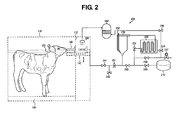
- FIG. 2 illustrates a suckling system according to the present invention.
- the suckling system comprises a suckling unit 100 and a milk-feeding unit 200.
- the suckling unit 100 comprises a suckling frame 110 in which a calf is loaded, a subject identification device 120 to identify the presence of the calf in the suckling frame 110, and a weight scale 130 to measure the weight of the calf and a teat member 140.
- the suckling frame 110 may be a rectangular frame.
- the suckling frame 110 has a predetermined height and a narrow width such that the calf enters and exits the suckling frame in one direction.
- the subject identification device 120 to determine the presence of the calf is installed in the middle of the suckling frame 110 and may use a general device such as a photosensor.
- the weight scale 130 performs weight measurement using a device connected to the ground of the suckling frame 110, when the calf completely enters the suckling frame 110.
- the weight scale 130 may use a hanging scale to reduce malfunction due to animal wastes or foreign materials.
- the teat member 140 is provided on one end 112 of the suckling frame 110, that is, on one surface, with which the calf comes in contact, provided that it completely enters the suckling frame 110.
- the height of the teat member 140 is automatically controllable.
- the height of the teat member 140 is controlled, based on five grades, according to height and weight of the calves and is in the range of about 70 to 110 cm.
- the milk may be injected into the stomach or bronchus of the calves.
- Weight of calf ⁇ 45 kg ⁇ 60 kg ⁇ 75 kg ⁇ 90 kg ⁇ 90 kg Grade 1 2 3 4 5 Height of teat(cm) 70 85 95 105 110
- the teat member 140 is capable of moving in forward and reverse, to avoid breakage caused by the reverse movement, when the suckling is completed.
- the exit of the calf is carried out by training the calf to respond to a bell signal and applying an electric pulse for 2 to 3 seconds thereto.
- a moving device of the teat member 140 is represented by the reference numeral "142".
- the milk feed unit 200 comprises a heat exchanger 220 to heat the milk stored in a storage tank 210 and a mix tank 230 to dilute the milk or mix the same with a liquid powdered milk.
- Milk (or solid powdered milk) and water in a ratio of about 7 : 1 to about 8 : 1 are refrigerated at an average temperature of about 4°C in the storage tank 210.
- the heat exchanger 220 renders the temperature of the milk or solid powdered milk (substitute milk) which is stored at an average cold temperature of about 4°C in the storage tank 210 to be adjusted to a level suitable for the calf to drink.
- the heat exchanger 220 is provided with a circulation motor, a water feed sensor, an overheating warning sensor, an overload, etc.
- the heated (diluted) milk or water is stored in an amount of 200 mL every cycle in the mix tank 230.
- the mix tank 230 may comprise a sensor 232 so as to recharge the milk or water, if further required, after the calf completely consumes the milk.
- the mix tank 130 is preferably made of heat-resistant glass to secure cleanliness and transparency, since milk often forms milk stones.
- a first valve 241 allows milk to be fed to the teat member 140, and a second valve 242 allows water to be supplied.
- a third valve 243 is used to clean the line housed in the system, and rotates the line through a pump 251 to remove milk residues left in the line. When the third valve 243 opens, the first valve 241 and the second valve 242 close.
- a fourth valve 244 allows water to be supplied and a fifth valve 245 allows milk to be supplied. Since the water supplied through a water pipe is at high pressure, a pressure-reducing valve 247 controls the pressure to a level suitable for the system.
- the fifth valve 246 is used to clean the teat member 140.
- a seventh valve 248 supplies water to the heat exchanger, and a heat exchanger-operating pump 252 supplies milk or water to the heat exchanger 220.
- the operation pump 252 may be a magnetic-circulating pump causing no contamination of milk passing through the line.
- a nozzle 260 of the washer 30 to clean the teat member 140 receives cleaning water through a sixth valve 246, and the cleaning water passes through a heater 262 and then maintains a high temperature not less than 90°C to sterilize the teat member 140, before it reaches the nozzle 260.
- the milk feed unit 200 is washed using a washing pump 251, as mentioned above, under the condition that the first and second valves 241 and 242 close, and the third valve 243 opens.
- the cleaning water is discharged through the second valve 242 to the outside.
- the method utilizes a step-down suckling method for minimizing weaning stress in newborn calves, disclosed in Korean Patent No. 10-2006-71228 .
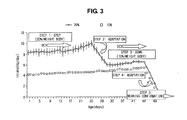
- the method comprises five steps, as illustrated in FIG. 3 .
- a first step calves are measured for body weight every 3 to 7 days and fed with milk in a total daily amount amounting to 15 ⁇ 25% of the respective body weights.
- the dose is restricted within the amount from 1,500 to 2,000 cc.
- a calf starter feedstuff is fed to the calves in an amount sufficient for them to nibble.
- a second step is to adapt the calves to a reduced amount of milk.
- Milk is diluted with water at an amount of 1.5 ⁇ 2.5% of the total daily feed amounting to 15 ⁇ 25% of the body weight, the calves are fed with the diluted milk for a period of 3 to 7 days from 3-5 weeks following birth, and with milk in an amount of 8 ⁇ 15% of the respective body weights from 4-5 weeks after birth.
- an increased amount of calf starter feedstuff is provided, along with quality hay, so as to encourage the calves to improve their ability to ingest solid feedstuff.
- a third step is a down-suckling step in which calves are fed milk in an amount of 8 ⁇ 15% of their respective body weights and are provided with highly nutritious calf starter and quality hay in an amount of 1 kg per head from 4-5 weeks after birth to the weaning day (set by the dairy farmer, generally 6-8 weeks after birth).
- the calves are secondarily adapted to milk reduction. From 3-7 days before the weaning day, the calves are fed with milk which amounts to 8 ⁇ 15% of the body weight and is diluted with water at an increasing rate of 1.5 ⁇ 2.5% of the fed milk everyday, and are finally fed only 100% water from 6-8 weeks after birth.
- a fifth step is to confirm the weaning by verifying that the calves are fed with only water for 3-7 days from 6-8 weeks after birth.
- the suckling system according to the embodiment used to perform the step-down suckling method performs system check-up operations, for example, preheating the weight scale and the heat exchanger, and cleaning lines, and then is readied, when power is applied.
- the subject identification device 120 detects that a calf enters the suckling frame 110, the body weight of the calf is measured and the electric tag information is read and then transmitted to the control module 20.
- the control module 20 calculates milk feed amount, depending on respective information and body weight, and allows milk-feeding to start, while the teat member 140 moves forward while under automatic height control.
- the weight of the calf is continuously checked. After feeding, the calf exits and the teat member 140 is retracted. The retracted teat member 140 is sterilized with heated washing water and the line is washed therewith, to prepare the following milk-feeding.
- the amount of milk fed to the calf is stored in the database 24, according to items such as age in days, period, step and subject.
- an automatic suckling system for calves with minimal weaning stress has the following advantages.
- milk or liquid powered milk set to the temperature of the mother's milk can be homogeneously fed.
- a predetermined amount of milk depending on age and body weight can be automatically fed to calves.
- the height of teat member is controllable within a range suitable for calves.
- the teat member and milk feed unit can be automatically cleaned.
Landscapes
- Life Sciences & Earth Sciences (AREA)
- Environmental Sciences (AREA)
- Animal Husbandry (AREA)
- Biodiversity & Conservation Biology (AREA)
- Feeding And Watering For Cattle Raising And Animal Husbandry (AREA)
- Feed For Specific Animals (AREA)
Priority Applications (1)
| Application Number | Priority Date | Filing Date | Title |
|---|---|---|---|
| EP09250477A EP2220932A1 (fr) | 2009-02-24 | 2009-02-24 | Système d'allaitement automatique pour veaux avec stress de sevrage minimum |
Applications Claiming Priority (1)
| Application Number | Priority Date | Filing Date | Title |
|---|---|---|---|
| EP09250477A EP2220932A1 (fr) | 2009-02-24 | 2009-02-24 | Système d'allaitement automatique pour veaux avec stress de sevrage minimum |
Publications (1)
| Publication Number | Publication Date |
|---|---|
| EP2220932A1 true EP2220932A1 (fr) | 2010-08-25 |
Family
ID=40756461
Family Applications (1)
| Application Number | Title | Priority Date | Filing Date |
|---|---|---|---|
| EP09250477A Withdrawn EP2220932A1 (fr) | 2009-02-24 | 2009-02-24 | Système d'allaitement automatique pour veaux avec stress de sevrage minimum |
Country Status (1)
| Country | Link |
|---|---|
| EP (1) | EP2220932A1 (fr) |
Cited By (3)
| Publication number | Priority date | Publication date | Assignee | Title |
|---|---|---|---|---|
| US10123513B2 (en) | 2016-07-22 | 2018-11-13 | Kenneth Holman | Calf weaning assembly |
| CN115606505A (zh) * | 2022-11-04 | 2023-01-17 | 四川省畜牧科学研究院 | 一种羔羊保育装置 |
| EP4555857A1 (fr) * | 2023-11-17 | 2025-05-21 | Hannes Holm | Tétines pour l'alimentation d'animaux d'élevage |
Citations (8)
| Publication number | Priority date | Publication date | Assignee | Title |
|---|---|---|---|---|
| FR1154433A (fr) * | 1956-02-21 | 1958-04-10 | Procédé et appareillage pour l'alimentation des jeunes animaux | |
| FR1519220A (fr) * | 1967-04-10 | 1968-07-11 | Nourrisseur pour jeunes animaux | |
| US3425398A (en) * | 1965-10-18 | 1969-02-04 | B E Specialites Alimentaires P | Apparatus for dispensing artificial food to young animals |
| AU415851B2 (en) * | 1969-03-17 | 1971-08-02 | ARTHUR GRAHAM TYACK, RONALD JOHN TYACK and GORDON RALPH TYACK | Feeding device |
| WO2000021359A1 (fr) * | 1998-10-13 | 2000-04-20 | Maasland N.V. | Procede et dispositif pour l'alimentation automatique d'animaux |
| WO2004095916A1 (fr) * | 2003-05-02 | 2004-11-11 | Delaval Holding Ab | Dispositif d'alimentation permettant de delivrer un liquide a un animal |
| WO2007067037A1 (fr) * | 2005-12-07 | 2007-06-14 | Maasland N.V. | Installation pour fournir une distribution de liquide à un animal et un véhicule déplaçable de manière autonome pour une utilisation dans une telle installation |
| KR20080010802A (ko) | 2006-07-28 | 2008-01-31 | 대한민국(관리부서:농촌진흥청장) | 송아지의 이유시 스트레스 최소화를 위한 정밀감량포유방법 |
-
2009
- 2009-02-24 EP EP09250477A patent/EP2220932A1/fr not_active Withdrawn
Patent Citations (10)
| Publication number | Priority date | Publication date | Assignee | Title |
|---|---|---|---|---|
| FR1154433A (fr) * | 1956-02-21 | 1958-04-10 | Procédé et appareillage pour l'alimentation des jeunes animaux | |
| US3425398A (en) * | 1965-10-18 | 1969-02-04 | B E Specialites Alimentaires P | Apparatus for dispensing artificial food to young animals |
| FR1519220A (fr) * | 1967-04-10 | 1968-07-11 | Nourrisseur pour jeunes animaux | |
| AU415851B2 (en) * | 1969-03-17 | 1971-08-02 | ARTHUR GRAHAM TYACK, RONALD JOHN TYACK and GORDON RALPH TYACK | Feeding device |
| WO2000021359A1 (fr) * | 1998-10-13 | 2000-04-20 | Maasland N.V. | Procede et dispositif pour l'alimentation automatique d'animaux |
| WO2004095916A1 (fr) * | 2003-05-02 | 2004-11-11 | Delaval Holding Ab | Dispositif d'alimentation permettant de delivrer un liquide a un animal |
| WO2007067037A1 (fr) * | 2005-12-07 | 2007-06-14 | Maasland N.V. | Installation pour fournir une distribution de liquide à un animal et un véhicule déplaçable de manière autonome pour une utilisation dans une telle installation |
| KR20080010802A (ko) | 2006-07-28 | 2008-01-31 | 대한민국(관리부서:농촌진흥청장) | 송아지의 이유시 스트레스 최소화를 위한 정밀감량포유방법 |
| WO2008013344A1 (fr) | 2006-07-28 | 2008-01-31 | Republic Of Korea(Rural Development Administrati On) | Procédé d'allaitement dégressif pour réduire le stress du sévrage chez le veau néonate |
| KR100804309B1 (ko) | 2006-07-28 | 2008-02-18 | 대한민국 | 송아지의 이유시 스트레스 최소화를 위한 정밀감량포유방법 |
Cited By (3)
| Publication number | Priority date | Publication date | Assignee | Title |
|---|---|---|---|---|
| US10123513B2 (en) | 2016-07-22 | 2018-11-13 | Kenneth Holman | Calf weaning assembly |
| CN115606505A (zh) * | 2022-11-04 | 2023-01-17 | 四川省畜牧科学研究院 | 一种羔羊保育装置 |
| EP4555857A1 (fr) * | 2023-11-17 | 2025-05-21 | Hannes Holm | Tétines pour l'alimentation d'animaux d'élevage |
Similar Documents
| Publication | Publication Date | Title |
|---|---|---|
| US20100224131A1 (en) | Automatic suckling system for calves with minimal weaning stress | |
| Eckert et al. | Weaning age affects growth, feed intake, gastrointestinal development, and behavior in Holstein calves fed an elevated plane of nutrition during the preweaning stage | |
| De Passillé | Sucking motivation and related problems in calves | |
| Hill et al. | Evaluation of ad libitum acidified milk replacer programs for dairy calves | |
| Kobek-Kjeldager et al. | Impact of supplemental liquid feed pre-weaning and piglet weaning age on feed intake post-weaning | |
| Kargar et al. | Extended transition milk feeding for 3 weeks improves growth performance and reduces the susceptibility to diarrhea in newborn female Holstein calves | |
| CN101836598A (zh) | 具有最小断奶应激的小牛自动喂奶系统 | |
| KR101334768B1 (ko) | 공급우유의 위생성이 강화된 송아지 개체별 맞춤형 전자동 정밀감량포유시스템 | |
| Henriksen et al. | Short-term responses in production and behavior during periods of change in concentrate allowance for dairy cows | |
| Shilov et al. | Milk production on a modern dairy farm | |
| JP2010213624A (ja) | 全自動子牛離乳ストレス最小化ほ乳装置 | |
| US8012518B2 (en) | Step-down suckling method for minimizing weaning stress in newborn calf | |
| Paradis | Feeding the orphan foal. | |
| CN115119799A (zh) | 犊牛智慧养殖一体化培育管理方法 | |
| CN114617075A (zh) | 一种分娩母猪水拌料高精度饲喂的控制方法及装置 | |
| Fröberg et al. | Early interaction between the high-producing dairy cow and calf | |
| Hamilton | Dairy grazing: heifer development (2013) | |
| CN104920285A (zh) | 黄牛饲养方法 | |
| Janzekovic et al. | Automatic and conventional system for feeding calves | |
| Bajus et al. | Colostrum for the Dairy Calf | |
| Sandoval | Effects of Alternative Protein Milk Replacer Versus All-Milk Protein Milk Replacer on Weight Gain and Grain Intake in Pre-weaned Dairy Calves | |
| Karapetkovska-Hristova et al. | The Influence of growth rate on productive characteristics at dairy heifers fed with maternal whole milk and milk replacer | |
| Kargar et al. | The international journal of animal biosciences | |
| Earleywine | Best practices for raising lambs on milk replacer | |
| Czerniawska-Piatkowska et al. | The comparison of yield, composition and quality of cow milk depending on twice-a-day and four-times-a-day milking |
Legal Events
| Date | Code | Title | Description |
|---|---|---|---|
| PUAI | Public reference made under article 153(3) epc to a published international application that has entered the european phase |
Free format text: ORIGINAL CODE: 0009012 |
|
| 17P | Request for examination filed |
Effective date: 20090312 |
|
| AK | Designated contracting states |
Kind code of ref document: A1 Designated state(s): AT BE BG CH CY CZ DE DK EE ES FI FR GB GR HR HU IE IS IT LI LT LU LV MC MK MT NL NO PL PT RO SE SI SK TR |
|
| AX | Request for extension of the european patent |
Extension state: AL BA RS |
|
| 17Q | First examination report despatched |
Effective date: 20101123 |
|
| AKX | Designation fees paid |
Designated state(s): AT BE BG CH CY CZ DE DK EE ES FI FR GB GR HR HU IE IS IT LI LT LU LV MC MK MT NL NO PL PT RO SE SI SK TR |
|
| STAA | Information on the status of an ep patent application or granted ep patent |
Free format text: STATUS: THE APPLICATION IS DEEMED TO BE WITHDRAWN |
|
| 18D | Application deemed to be withdrawn |
Effective date: 20141014 |