EP4555857A1 - Tétines pour l'alimentation d'animaux d'élevage - Google Patents
Tétines pour l'alimentation d'animaux d'élevage Download PDFInfo
- Publication number
- EP4555857A1 EP4555857A1 EP23210662.5A EP23210662A EP4555857A1 EP 4555857 A1 EP4555857 A1 EP 4555857A1 EP 23210662 A EP23210662 A EP 23210662A EP 4555857 A1 EP4555857 A1 EP 4555857A1
- Authority
- EP
- European Patent Office
- Prior art keywords
- teat
- outlet opening
- longitudinal axis
- central longitudinal
- dispensing device
- Prior art date
- Legal status (The legal status is an assumption and is not a legal conclusion. Google has not performed a legal analysis and makes no representation as to the accuracy of the status listed.)
- Pending
Links
Images
Classifications
-
- A—HUMAN NECESSITIES
- A01—AGRICULTURE; FORESTRY; ANIMAL HUSBANDRY; HUNTING; TRAPPING; FISHING
- A01K—ANIMAL HUSBANDRY; AVICULTURE; APICULTURE; PISCICULTURE; FISHING; REARING OR BREEDING ANIMALS, NOT OTHERWISE PROVIDED FOR; NEW BREEDS OF ANIMALS
- A01K9/00—Sucking apparatus for young stock ; Devices for mixing solid food with liquids
- A01K9/005—Teats or nipples
Definitions
- the invention relates to a teat for feeding farm animals, in particular calves.
- the teat has a holding section at a rear end and an outlet opening at the front end.
- the animals enclose such teats with their mouths and use the teat to supply themselves with a liquid feed, similar to the way a mother animal feeds from her udder in nature.
- the teat is connected to a reservoir for the liquid feed.
- the teat is attached to a drinking bucket or bottle, but more often it is attached to an automatic feeder, which can be used to control the preparation and dispensing of the feed and, if necessary, to monitor the animals' drinking behavior.
- the teat is usually fixed, with the front end with the opening pointing downwards to a greater or lesser extent.
- a horizontal arrangement of the teat is also possible.
- the opening of conventional teats is located centrally at the front end.
- teats To maintain hygienic feeding conditions for the health of farm animals, various measures can be taken regarding teats. When using drinking bottles or buckets, frequent manual or mechanical cleaning of the teats is required. Automatic drinking systems are known to have an automatic rinsing process, using fresh water and, if necessary, a cleaning agent. In the case of so-called “on-demand” systems, the outside of the teat is additionally sprayed with a disinfectant. For this purpose, the teat is removed from the farm animals for the duration of the disinfection process, for example, by means of a flap.
- the object of the invention is to provide a teat for feeding farm animals which creates more hygienic feeding conditions using simple means.
- the teat is used for feeding farm animals, in particular calves, and has a holding section at a rear end of the teat and an outlet opening at a front end of the teat, wherein the outlet opening is formed asymmetrically to a central longitudinal axis of the teat.
- the holding section allows the teat to be attached to a drinking bucket or the dispensing station of an automatic feeder, for example.
- the farm animal can remove the liquid feed through the outlet.
- the teat can have a substantially cylindrical shaft.
- the front end of the shaft can merge into the front end of the teat.
- the holding section is arranged at the rear end of the shaft section and can, for example, have a flange or a thickened portion for a clamp.
- Inside the teat there is a cavity through which the liquid food can flow from the rear end of the teat to the outlet opening. This cavity is delimited by a wall of the teat.
- the outlet opening passes through the wall.
- the wall can have a thickness of, for example, at least 2 mm in the area of the shaft and/or the front end.
- the central longitudinal axis corresponds to the central axis of this rotationally symmetrical shape. It usually passes through the center of the front section and through the center of the holding section.
- the outlet opening is designed asymmetrically to the central longitudinal axis of the teat. This allows the teat to be positioned in use so that the outlet opening is located approximately at the lowest point of the teat. Compared to conventional teats with a centrally positioned outlet opening, this prevents a residual amount of liquid food from remaining in the teat's cavity in an area below the outlet opening.
- the inventor recognized that residues remaining in the teat after a feeding session quickly lead to increased bacterial contamination during subsequent feeding sessions.
- the asymmetrical arrangement of the outlet opening promotes complete emptying of the teat and effectively prevents or even noticeably reduces the bacterial contamination associated with a residual amount.
- the outlet opening and/or a center point of the outlet opening is arranged at a distance from the central longitudinal axis.
- the center point of the outlet opening is defined by the center of gravity of the opening cross-section. It can be located at a distance from the central longitudinal axis, even if the central longitudinal axis passes through a lateral region of the opening cross-section.
- the outlet opening is located at a distance from the central longitudinal axis, no part of the opening's cross-section lies on the central longitudinal axis. In any case, by choosing a suitable distance, ideally adapted to the intended use position of the teat, the outlet opening can be positioned at the lowest point of the teat.
- the distance is at least 5 mm.
- the optimal distance depends on the geometry of the front end of the teat and the position of use. Once the position of use is known, an optimal distance can be determined for each teat geometry, with the outlet opening at the lowest point of the teat.
- the teat has a hemispherical, conical, or cup-shaped tip at the front end with an outer diameter such that a line from the outlet opening to a point on the central longitudinal axis, which is half the outer diameter away from the front end of the tip, forms an angle with the central longitudinal axis in the range of 15° to 90°.
- the angle can preferably be selected such that it corresponds to the inclination of the central longitudinal axis of the teat in the use position relative to the horizontal.
- the outlet opening is then located at the lowest point of the teat, at least with a hemispherical or approximately hemispherical tip geometry.
- the outlet opening has an opening cross-section of 1 mm 2 or more in the undeformed state of the teat.
- the opening cross-section can optionally also have 2 mm 2 or more or even 5 mm 2 or more.
- a sufficient size of the outlet opening ensures that any residual amount remaining in the cavity of the teat after a feeding process is discharged from the outlet opening by gravity. If the opening cross-section is too small, adhesion and viscosity of the liquid can prevent complete emptying.
- the outlet opening is closed when the teat is undeformed. This is the case, for example, with an outlet opening formed by one or more slits.
- the outlet opening only opens when the teat is deformed by the farm animal and/or sucked on. If the teat is combined with a simple storage container such as a drinking bottle or a feeding bucket, the automatic closure of the outlet opening prevents uncontrolled leakage of the container. The most complete emptying of the teat, which is important for the invention, nevertheless occurs provided the farm animal completely consumes the food ration.
- the outlet opening has at least one slit that opens when the teat is deformed and/or when a farm animal sucks on the teat.
- two or more slits can be combined to form a cross or a star. Deforming the teat creates a sufficiently large outlet opening.
- the at least one slit has a longitudinal direction that points toward the central longitudinal axis. This means that an imaginary straight line traversing the slit intersects the central longitudinal axis.
- the particular advantage of this arrangement is that the slit is aligned approximately vertically in the intended use position of the teat, in which the outlet opening points downward. The deformation of the teat by the farm animal occurs primarily through the application of force from above and below, so a vertically arranged slit opens particularly well.
- the holding section has a cross-section that is not point-symmetrical to the central longitudinal axis. This ensures that the teat can be mounted in or on a suitably shaped teat receptacle (in particular, one that is completely or partially complementary in shape) in only one rotational position. In conjunction with a corresponding teat receptacle, this ensures that the outlet opening always points downward in the desired direction in the use position.
- the holding section has a projection and/or a recess at a distance from the central longitudinal axis.
- the projection or recess is located opposite the outlet opening with respect to the central longitudinal axis.
- the feature of the teat that needs to be viewed for alignment is then located at the top during assembly, which further simplifies the process.
- the teat is combined with a dispensing device comprising a teat receptacle and a container for a liquid food.
- the teat receptacle is provided for mounting the teat to the dispensing device and can, in particular, be designed such that mounting is only possible in the desired orientation with the teat outlet facing downward.
- the dispensing device has a pump and/or a valve so that the dispensing of the liquid food via the teat can be controlled
- dispensing can be stopped by closing the valve or stopping the pump.
- This variant of the invention is particularly suitable for combination with a teat with a permanently open outlet opening. When dispensing is stopped, the teat can be completely emptied through the outlet opening without the reservoir leaking. To promote complete emptying of the teat, the dispensing device can open a ventilation line when dispensing of the liquid food has stopped, through which air can flow into the cavity of the teat.
- the dispensing device is designed to pressurize the teat with compressed air, so that the compressed air exits through the outlet opening.
- This embodiment can also be used effectively with a conventional teat in which the outlet opening is centrally located.
- the compressed air can expel any residual amount in the teat through the outlet opening. This largely completely removes even the smallest residual amounts that might otherwise remain in the teat due to adhesion in the area of the outlet opening, which further reduces the potential bacterial contamination.
- the dispensing device can, for example, have a pressure vessel and/or a pump with which compressed air can be generated.
- a feed pump for the liquid food located in the dispensing device can also be used temporarily to generate the compressed air.
- the dispensing device has an electronic control system configured to use compressed air to empty the teat after a liquid feed has been provided.
- the control system can, in particular, be programmed to automatically release a suitable burst of compressed air after each feeding process.
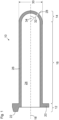
- the pacifier 10 from Figure 1 has a holding section 12, which forms a rear end of the teat 10, and a front section 14. Between the holding section 12 and the front section 14 is a shaft 16, which has an approximately circular cylindrical cross-section. The central longitudinal axis 18 of the teat 10 runs from the center of the holding section 12 through the center of the front section 14.
- the holding section 12 has an annular outwardly facing flange 20 and a rearwardly facing projection 22 which, in conjunction with a suitable, in particular complementarily shaped teat receptacle (not shown), forms an "anti-twist device" which ensures the desired rotational position of the teat 10 in the use position.
- the teat 10 Inside the teat 10 is a cavity 24 surrounded by the wall 26 of the teat 10. At the front end 14, the teat 10 has an outlet opening 28 that extends through the wall 26.
- the outlet opening 28 has a cross-section of a few square millimeters and is open when the teat 10 is undeformed.
- the outlet opening 28 is arranged asymmetrically to the central longitudinal axis 18 of the teat 10 and is spaced from the central longitudinal axis 18.
- the teat 10 has an approximately hemispherical tip with an outer diameter of 30.
- the hemispherical tip merges into the shaft 16, which has the same outer diameter.
- FIG. 1 An imaginary line 32 is drawn, which begins at a point on the central longitudinal axis 18 that is located half the outer diameter 30 from the front end of the tip. From this point, the line 32 runs through the outlet opening 28.
- the line 32 forms an angle 34 with the central longitudinal axis 18, which in the example shown is approximately 45°.
- the outlet opening 28 In a use position in which the central longitudinal axis 18 of the teat 10 is inclined downwards by the angle 34 relative to the horizontal, the outlet opening 28 then forms the lowest point of the teat 10.
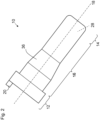
- FIG. 2 shows another teat 10, which is shown in a simplified schematic side view. It has a holding section 12, a front end 14, which is approximately cup-shaped, and a shaft 16 located therebetween. The position of the outlet opening 28 is indicated by a dashed line. It is located in the Figure 2 shown use position of the teat 10 at the lowest point of the teat 10.
- the holding section 12 of the teat 10 from Figure 2 also has a projection 22 which is arranged opposite the central longitudinal axis 18 of the outlet opening 28.
- the shaft 16 has a conical section 36 in the middle.
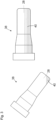
- FIG 3 shows a conventional teat 38, the basic shape of which is similar to that of the teat 10 from Figure 2
- the outlet opening 28 of the teat 38 is not arranged asymmetrically to the central longitudinal axis, but centrally, exactly on the central longitudinal axis.
- Figure 3 shows the teat 38 in the left part in a position of use in which the central longitudinal axis points downwards at an angle of approximately 45°, which is typical for many feeding devices with a teat 38.
- the outlet opening 28 is located significantly above a lowest point of the teat 38, so that a residual amount 40 of the liquid food accumulates inside the teat 38, which can neither drain through the outlet opening 28 nor be removed by sucking.
Landscapes
- Life Sciences & Earth Sciences (AREA)
- Environmental Sciences (AREA)
- Animal Husbandry (AREA)
- Biodiversity & Conservation Biology (AREA)
- Feeding And Watering For Cattle Raising And Animal Husbandry (AREA)
Priority Applications (1)
| Application Number | Priority Date | Filing Date | Title |
|---|---|---|---|
| EP23210662.5A EP4555857A1 (fr) | 2023-11-17 | 2023-11-17 | Tétines pour l'alimentation d'animaux d'élevage |
Applications Claiming Priority (1)
| Application Number | Priority Date | Filing Date | Title |
|---|---|---|---|
| EP23210662.5A EP4555857A1 (fr) | 2023-11-17 | 2023-11-17 | Tétines pour l'alimentation d'animaux d'élevage |
Publications (1)
| Publication Number | Publication Date |
|---|---|
| EP4555857A1 true EP4555857A1 (fr) | 2025-05-21 |
Family
ID=88839539
Family Applications (1)
| Application Number | Title | Priority Date | Filing Date |
|---|---|---|---|
| EP23210662.5A Pending EP4555857A1 (fr) | 2023-11-17 | 2023-11-17 | Tétines pour l'alimentation d'animaux d'élevage |
Country Status (1)
| Country | Link |
|---|---|
| EP (1) | EP4555857A1 (fr) |
Citations (4)
| Publication number | Priority date | Publication date | Assignee | Title |
|---|---|---|---|---|
| GB531916A (en) * | 1939-05-22 | 1941-01-14 | Armour & Co | Improvements in feeding apparatus for suckling animals |
| EP0744890B1 (fr) * | 1994-02-14 | 1997-12-29 | McINNES, Ross, Gordon | Teton |
| EP2220932A1 (fr) * | 2009-02-24 | 2010-08-25 | Republic of Korea (Management: Rural Development Administration) | Système d'allaitement automatique pour veaux avec stress de sevrage minimum |
| DE102018007998A1 (de) * | 2018-10-10 | 2020-04-16 | Fritz Kutschera | Trinkflaschen-Auslauf mit Saug- und Druck- Raum |
-
2023
- 2023-11-17 EP EP23210662.5A patent/EP4555857A1/fr active Pending
Patent Citations (4)
| Publication number | Priority date | Publication date | Assignee | Title |
|---|---|---|---|---|
| GB531916A (en) * | 1939-05-22 | 1941-01-14 | Armour & Co | Improvements in feeding apparatus for suckling animals |
| EP0744890B1 (fr) * | 1994-02-14 | 1997-12-29 | McINNES, Ross, Gordon | Teton |
| EP2220932A1 (fr) * | 2009-02-24 | 2010-08-25 | Republic of Korea (Management: Rural Development Administration) | Système d'allaitement automatique pour veaux avec stress de sevrage minimum |
| DE102018007998A1 (de) * | 2018-10-10 | 2020-04-16 | Fritz Kutschera | Trinkflaschen-Auslauf mit Saug- und Druck- Raum |
Similar Documents
| Publication | Publication Date | Title |
|---|---|---|
| DE60214556T2 (de) | Einzelne pflanzenbewässerungsvorrichtung | |
| EP0457245B1 (fr) | Capuchon de fermeture | |
| EP3427839B1 (fr) | Distributeur de liquide ayant une bouteille ventilée et une tête de distribution associée | |
| WO2007137885A1 (fr) | Tétine destinée à des bouteilles de lait | |
| DE102018133067A1 (de) | Sprühdüse und Verfahren | |
| DE102009053350A1 (de) | Füllelement | |
| EP2020980B1 (fr) | Tétine destinée à des bouteilles de lait | |
| DE69527647T2 (de) | Fütterungseinrichtung, insbesondere für schweine | |
| CH630578A5 (en) | Bottle with metering closure | |
| DE202020001428U1 (de) | Reinigungsvorrichtung für Transportkanister für chemische und/oder biologische Wirkstoffe und damit ausgestattete Feldspritze | |
| DE102009055000B4 (de) | Pelletzuführung | |
| DE2328902A1 (de) | Traenkbecher fuer gefluegel | |
| DE69518328T2 (de) | Vorrichtung zur reinigung des äusseren gehörganges | |
| DE19602443C2 (de) | Dosiervorrichtung, insbesondere für pulver- oder partikelförmige Reinigungsmittel | |
| EP2952092B1 (fr) | Dispositif d'abreuvage automatique de veaux | |
| EP3014988B1 (fr) | Système de tétine pour un abreuvoir automatique | |
| EP3487289B1 (fr) | Valve d'entrée pour un gobelet trayeur | |
| WO2006012769A1 (fr) | Dosimetre de precision | |
| DE602004005555T2 (de) | Sauger für Säuglingsflasche | |
| DE212016000211U1 (de) | Verbesserungen an oder in Bezug auf Futterautomaten | |
| DE3022555C2 (de) | Zweiraum-Melkbecher | |
| EP1179332A2 (fr) | Dispositif de rinçage des yeux | |
| AT520248A2 (de) | Einweg-Milchbehälter für eine Kaffeemaschine | |
| EP1070476A2 (fr) | Distributeur de produits de soins | |
| DE102022131924A1 (de) | Tränkvorrichtung |
Legal Events
| Date | Code | Title | Description |
|---|---|---|---|
| PUAI | Public reference made under article 153(3) epc to a published international application that has entered the european phase |
Free format text: ORIGINAL CODE: 0009012 |
|
| STAA | Information on the status of an ep patent application or granted ep patent |
Free format text: STATUS: THE APPLICATION HAS BEEN PUBLISHED |
|
| AK | Designated contracting states |
Kind code of ref document: A1 Designated state(s): AL AT BE BG CH CY CZ DE DK EE ES FI FR GB GR HR HU IE IS IT LI LT LU LV MC ME MK MT NL NO PL PT RO RS SE SI SK SM TR |
|
| STAA | Information on the status of an ep patent application or granted ep patent |
Free format text: STATUS: REQUEST FOR EXAMINATION WAS MADE |
|
| 17P | Request for examination filed |
Effective date: 20250922 |