EP2225232B1 - Verfahren zur herstellung substituierter 1,3-oxathiolane - Google Patents
Verfahren zur herstellung substituierter 1,3-oxathiolane Download PDFInfo
- Publication number
- EP2225232B1 EP2225232B1 EP08738051A EP08738051A EP2225232B1 EP 2225232 B1 EP2225232 B1 EP 2225232B1 EP 08738051 A EP08738051 A EP 08738051A EP 08738051 A EP08738051 A EP 08738051A EP 2225232 B1 EP2225232 B1 EP 2225232B1
- Authority
- EP
- European Patent Office
- Prior art keywords
- formula
- compound
- group
- substituted
- lewis acid
- Prior art date
- Legal status (The legal status is an assumption and is not a legal conclusion. Google has not performed a legal analysis and makes no representation as to the accuracy of the status listed.)
- Active
Links
- 0 *C(O)=N[C@](C(*)=C(*)N1)NC1=O Chemical compound *C(O)=N[C@](C(*)=C(*)N1)NC1=O 0.000 description 3
- BLCKUSOXHJZXRC-WVZVXSGGSA-N C[C@@H]1O[C@@H](C(OI)=O)SC1 Chemical compound C[C@@H]1O[C@@H](C(OI)=O)SC1 BLCKUSOXHJZXRC-WVZVXSGGSA-N 0.000 description 1
- JTEGQNOMFQHVDC-PKPIPKONSA-N NC(C=CN1[C@H]2OC(CO)SC2)=NC1=O Chemical compound NC(C=CN1[C@H]2OC(CO)SC2)=NC1=O JTEGQNOMFQHVDC-PKPIPKONSA-N 0.000 description 1
- OQDACUKVOKJTHJ-URVZRBSTSA-N O=C([C@H](O1)SCC1I)OI Chemical compound O=C([C@H](O1)SCC1I)OI OQDACUKVOKJTHJ-URVZRBSTSA-N 0.000 description 1
- WWGLSJQXAUCDMJ-STHAYSLISA-N [O-][NH+]([C@H](O1)SC[C@H]1I)OI Chemical compound [O-][NH+]([C@H](O1)SC[C@H]1I)OI WWGLSJQXAUCDMJ-STHAYSLISA-N 0.000 description 1
Classifications
-
- C—CHEMISTRY; METALLURGY
- C07—ORGANIC CHEMISTRY
- C07D—HETEROCYCLIC COMPOUNDS
- C07D411/00—Heterocyclic compounds containing two or more hetero rings, at least one ring having oxygen and sulfur atoms as the only ring hetero atoms
- C07D411/02—Heterocyclic compounds containing two or more hetero rings, at least one ring having oxygen and sulfur atoms as the only ring hetero atoms containing two hetero rings
- C07D411/04—Heterocyclic compounds containing two or more hetero rings, at least one ring having oxygen and sulfur atoms as the only ring hetero atoms containing two hetero rings directly linked by a ring-member-to-ring-member bond
Definitions
- the present invention relates to a process for the preparation of substituted 1,3-oxathiolanes.
- the present invention specifically relates to a process for the preparation of lamivudine.
- Substituted 1,3-oxathiolanes of Formula I and stereoisomers thereof, wherein R 1 is hydrogen, alkyl or aryl, and R 2 is a substituted or unsubstituted purine or pyrimidine base or an analogue or derivative thereof, are an important class of therapeutic agents and they have shown antiviral activity against retroviruses such as human immunodeficiency virus (HIV), hepatitis B virus (HBV) and human T-lymphotropic virus (HTLV).
- HIV human immunodeficiency virus
- HBV hepatitis B virus
- HTLV human T-lymphotropic virus
- Lamivudine is a substituted 1,3-oxathiolane and it is presently available in the market as an antiretroviral agent.
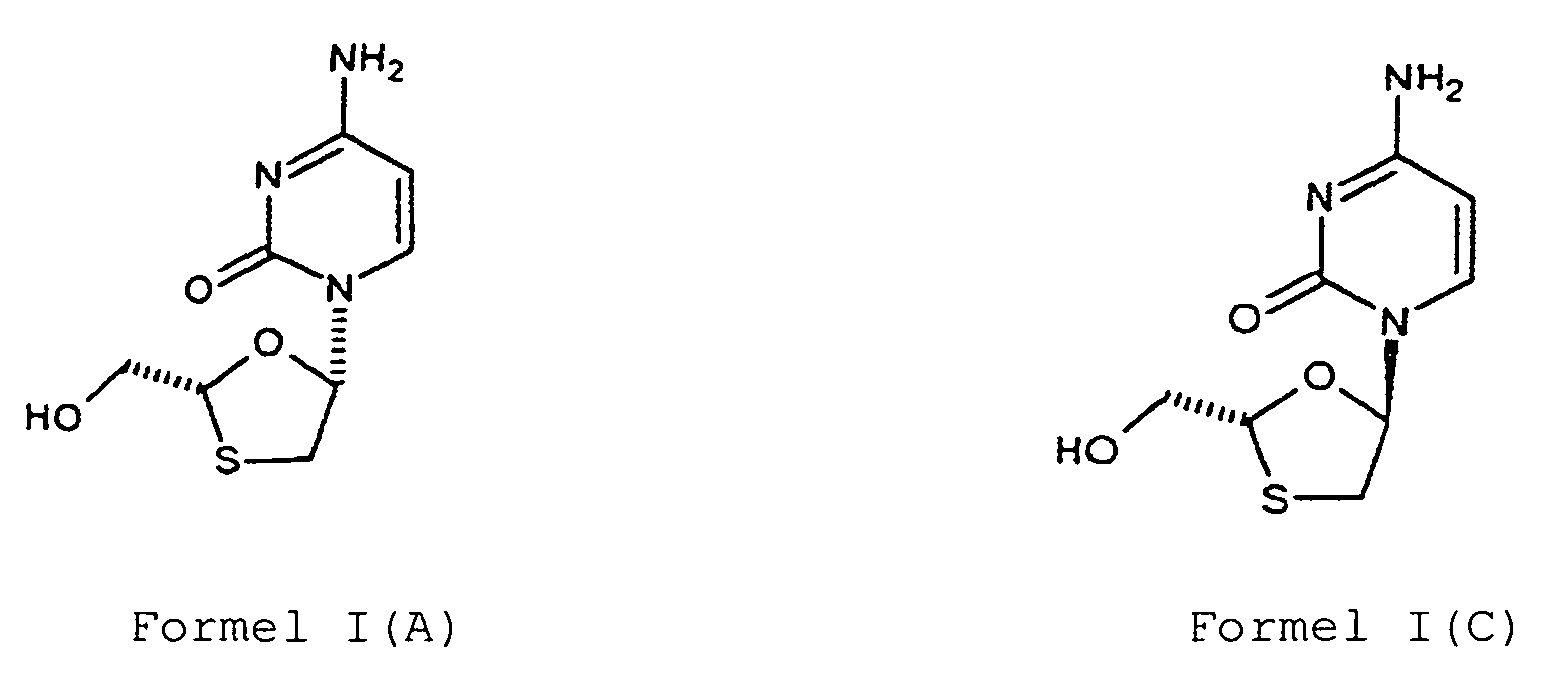
- Lamivudine is the cis-(-)-isomer and it is chemically (2R,cis)-4-amino-1-(2-hydroxymethyl-1,3-oxathiolan-5-yl)-(1H)-pyrimidin-2-one as represented by Formula I (A).
- the first approach involves condensing an intermediate of Formula II, or its stereoisomers thereof wherein P 1 is a protecting group and L 1 is OCH 3 , OC 2 H 5 or OCOCH 3 , with a silyl and/or acetyl protected pyrimidine or purine base.
- the condensed product is finally deprotected to obtain desired substituted 1,3-oxathiolanes.
- This approach is provided in U.S. Patent Nos. 5,047,407 and 5,905,082 , J. Org. Chem., (1992), 57:2217-2219 , J. Med. Chem., (1993), 36:181-195 , and J. Org. Chem., (1991), 56:6503-6505 .
- the second approach involves condensing an intermediate of Formula III, or its stereoisomers thereof wherein P 1 is a protecting group, L 2 is OCOCH 3 , L 3 is halo, with a silyl and/or acetyl protected pyrimidine or purine base.
- the condensed product is finally reduced and deprotected to obtain desired substituted 1,3-oxathiolanes.
- U.S. Patent No. 5,663,320 provides a method to carry out the condensation in the presence of silyl Lewis acids such as iodotrimethyl silane.
- U.S. '320 patent employs the compound of Formula III with OCOCH 3 group at 5-position (L 2 ) as an intermediate.
- 6,329,522 provide a method to carry out the condensation in the absence of any Lewis acid catalyst by selectively using the compound of Formula III with a halo group at 5-position (L 3 ) as an intermediate.
- this method requires stereoselective synthesis of the compound of Formula III with halo group at 5-position and the condensation step requires reflux temperature conditions in a high boiling solvent such as toluene.
- U.S. Patent No. 6,329,522 also provides a method to purify lamivudine by preparing the salicylate salt of lamivudine.
- the process involves dissolving a mixture of lamivudine with excess of salicylic acid in water by heating at 71°C, cooling to 58°C and seeding with standard lamivudine salicylate.
- the solution of lamivudine salicylate seeded with authentic lamivudine salicylate is cooled to 5° to 10°C and stirred at this temperature for 4 hours to obtain solid lamivudine salicylate.
- the lamivudine salicylate is isolated by filtration and treated with triethylamine in the presence of industrial methylated spirit.
- the solution is concentrated and the concentrated solution is seeded.
- the seeded mixture is treated with isopropyl acetate to obtain lamivudine.
- this method requires heating the reaction mixture to 70°C to 75°C while treating with triethylamine and while seeding.
- US '522 does not disclose or suggest any method to obtain the seed of lamivudine salicylate or lamivudine base.
- U.S. '522 patent also does not disclose the quantities of seeds to be used in the process.
- U.S. '522 patent does not provide any method for efficient removal of the residual salicylic acid from lamivudine.
- substituted 1,3-oxathiolanes such as lamivudine
- This process also provides a way to obtain substituted 1,3-oxathiolanes with better yield.
- a chiral auxiliary may need to be used in executing the process but the use of optically pure intermediates and high temperature conditions in the condensation step are not required.
- the present process can be carried out at a temperature of about 50°C or less.
- the salt purification step of the present invention can be carried out at temperature conditions of about 55°C or below.
- the process reported herein also provides pure lamivudine, which is substantially free of salicylic acid.
- the present process is also suitable to prepare lamivudine at industrial scale.
- purine or pyrimidine base or an analogue or derivative thereof refers to a purine or pyrimidine base, which may be found in native nucleosides or synthetic nucleotides that mimic or are derived from such bases in their structures, which may either possess certain additional functional properties of native bases or lack certain functional properties of native bases.
- the analogues or derivatives include but are not limited to those compounds derived by replacement of a CH 2 moiety by a nitrogen atom or replacement of a nitrogen atom by a CH 2 moiety, or both, or those compounds wherein the ring substituents are either incorporated, removed or modified by conventional substituents known in the art.
- the functional groups of purine or pyrimidine base or an analogue or derivative thereof may also be protected with hydroxy, amino or carboxyl protecting groups.
- protecting group in the present invention refers to those known and used in the art and serve the function of blocking the carboxyl, amino or hydroxyl groups while the reactions are carried out at other sites of the molecule.
- Examples of a carboxyl protecting group include, but are not limited to, substituted or unsubstituted alkyl, substituted or unsubstituted alkenyl, substituted or unsubstituted aralkyl, substituted or unsubstituted aryl, substituted or unsubstituted amino, hydrocarbonated silyl, hydrocarbonated stannyl, and a pharmaceutically active ester forming group.
- hydroxyl and amino protecting groups include, but are not limited to, lower alkylsilyl groups, lower alkoxymethyl groups, aralkyl groups, acyl groups, lower alkoxycarbonyl groups, alkenyloxycarbonyl groups and aralkyloxycarbonyl groups.
- amino protecting groups include but are not limited to alkylidene groups substituted with optionally protected hydroxy groups.
- the hydroxyl or carboxyl protecting groups can also be chiral auxiliaries, which may possess one or more chiral centers.
- leaving group in the present invention refers to an atom or a group which is displaceable upon reaction with a purine or pyrimidine base or an analogue or derivative thereof.
- leaving groups include but are not limited to substituted or unsubstituted, saturated or unsaturated acyloxy groups, alkoxy groups, alkoxy carbonyl groups, halogens, amido, azido, cyano, isocyanato, substituted or unsubstituted, saturated or unsaturated thiolates, and substituted or unsubstituted seleno, seleninyl or selenonyl.
- leaving groups also include but are not limited to - OX, wherein X is substituted or unsubstituted aryl, heteroaryl, phosphonate, sulfinyl or sulfonoyl group.
- a first aspect of the present invention provides a process for the preparation of a substituted 1,3-oxathiolane of Formula I or its stereoisomers, and salts thereof, wherein R 1 is hydrogen, alkyl or aryl, and R 2 is a substituted or unsubstituted purine or pyrimidine base or an analogue or derivative thereof, wherein the process comprises,
- the compound of Formula III or its stereoisomers thereof can be prepared according to the methods provided in U.S. Patent No. 5,663,320 or Tetrahedron Letters, (2005), 46:8535-8538 .
- the compound of Formula III may be used as a single isomer or as a mixture of two or more isomers.
- the leaving group L of the compound of Formula III is preferably selected from the group consisting of acyloxy groups, alkoxy groups, and alkoxy carbonyl groups.
- the leaving group is more preferably acetyloxy group.
- the compound of Formula III is reacted with a substituted or unsubstituted purine or pyrimidine base or an analogue or derivative thereof, in the presence of a Lewis acid with the provisothat the Lewis acid does not contain any silyl group.
- the purine or pyrimidine base or an analogue or derivative thereof is selected from the group consisting of: wherein P 1 is a protecting group, R 3 and R 4 are independently selected from the group consisting of hydrogen, hydroxyl, amino, and substituted or unsubstituted C 1-6 alkyl, C 1-6 alkenyl, C 1-6 alkynyl, C 1-6 acyl or aracyl; R 5 and R 6 are independently selected from the group consisting of hydrogen, halogen, hydroxyl, amino, cyano, carboxy, carbamoyl, alkoxycarbonyl, hydroxymethyl, trifluoromethyl, thioaryl, and substituted or unsubstituted C 1-6 alkyl, C 1-6 alkenyl, C 1-6 alkynyl, or C 1-10 acyloxy; R 7 is C 1-6 alkyl, C 1-6 alkenyl, or C 1-6 alkynyl; R 8 is selected from the group consisting of hydrogen, hydroxy, alkoxy
- the Lewis acid is preferably stannic chloride or titanium tetrachloride.
- the Lewis acid is used in about 0.5 to about 1.5 molar equivalents to the quantity of the compound of Formula III.
- the Lewis acid is preferably used in about 0.8 to about 1.1 molar equivalents.
- the reaction is carried out in the presence of an organic solvent selected from the group consisting of aliphatic hydrocarbons, aromatic hydrocarbons, halogenated hydrocarbons, nitriles, amides, esters, and ketones.
- the reaction is preferably carried out at a temperature of about 50°C or below.
- the reaction is carried out for about 10 minutes to about 100 hours.
- the compound of Formula IV or its stereoisomers can be isolated from the reaction mixture or directly used in the subsequent step without isolation.
- the compound of Formula IV or its stereoisomers are preferably isolated from the reaction mixture.
- the compound of Formula IV or its stereoisomers may be subjected to purification to remove chemical impurities and/or undesired isomers.
- the protecting groups, if any, present in the compound of Formula IV can be removed and the deprotected compound reduced to obtain the compound of Formula I or its stereoisomers.
- the reduction is carried out by using a reducing agent.
- the reducing agent can be, for example, sodium borohydride, lithium aluminium hydride or lithium borohydride.
- the compound of Formula I or its stereoisomers can be further purified by salt formation, crystallization, isomer separation or chromatographic methods or a combination thereof.
- a second aspect of the present invention provides a process for the preparation of lamivudine of Formula I (A) or a compound of Formula I (C), or mixtures thereof, wherein the process comprises,
- the compound of Formula III (A) or Formula III (B), or mixtures thereof can be prepared according to the methods provided in U.S. Patent No. 5,663,320 or Tetrahedron Letters, (2005), 46:8535-8538 .
- the leaving group L of the compound of Formula III (A) or Formula III (B), or mixtures thereof is preferably selected from the group consisting of acyloxy groups, alkoxy groups, and alkoxy carbonyl groups.
- the leaving group is more preferably acetyloxy group.
- the chiral auxiliary P 1 of the compound of Formula III (A) or Formula III (B), or mixtures thereof, is preferably an L-menthyl group.
- the compound of Formula III (A) or Formula III (B), or mixtures thereof is reacted with cytosine, wherein the amino or hydroxy, or both the groups of cytosine are optionally protected with protecting groups.
- the cytosine is preferably protected with acetyl and/or silyl protecting groups.
- the reaction is carried out in the presence of a Lewis acid with the provisothat the Lewis acid does not contain any silyl group.
- the Lewis acid is preferably stannic chloride or titanium tetrachloride.
- the Lewis acid is used in about 0.5 to about 1.5 molar equivalents to the quantity of the compound of Formula III.
- the Lewis acid is preferably used in about 0.8 to about 1.1 molar equivalents.
- the reaction is carried out in the presence of an organic solvent selected from the group consisting of aliphatic hydrocarbons, aromatic hydrocarbons, halogenated hydrocarbon, nitriles, amides, esters, and ketones,
- an organic solvent selected from the group consisting of aliphatic hydrocarbons, aromatic hydrocarbons, halogenated hydrocarbon, nitriles, amides, esters, and ketones.
- the reaction is preferably carried out at a temperature of about 50°C or below.
- the reaction is carried out for about 10 minutes to about 100 hours.
- the compound of Formula IV (A) or Formula IV (B), or mixtures thereof can be isolated from the reaction mixture or directly used in the subsequent step without isolation.
- the compound of Formula IV (A) or Formula IV (B), or mixtures thereof are preferably isolated from the reaction mixture.
- a deprotection step may be carried out to remove the protecting groups, if any, present in R 2 of the compound of Formula IV (A) or Formula IV (B), or mixtures thereof.
- the compound of Formula IV (A) or Formula IV (B), or mixtures thereof may be subjected to purification to remove chemical impurities and/or undesired isomers.
- the compound of Formula IV (A) or Formula IV (B), or mixtures thereof are reduced to obtain lamivudine of Formula I (A) or the compound of Formula I (C), or mixtures thereof.
- the reduction is carried out by using a reducing agent.
- the reducing agent can be, for example, sodium borohydride, lithium aluminium hydride, lithium borohydride, lithium-tri-ethyl borohydride or lithium-tri-sec-butyl borohydride.
- Lamivudine of Formula I (A) or the compound of Formula I (C), or mixtures thereof can be further purified by salt formation, crystallization, isomer separation or chromatographic methods or a combination thereof.
- a third aspect of the present invention provides a process for the preparation of lamivudine of Formula I (A), wherein the process comprises,
- the compound of Formula III (C) can be prepared according to the methods provided in U.S. Patent No. 5,663,320 or Tetrahedron Letters, (2005), 46:8535-8538 .
- the leaving group L of the compound of Formula III (C) is preferably selected from the group consisting of acyloxy groups, alkoxy groups, and alkoxy carbonyl groups. The leaving group is more preferably acetyloxy group.
- the chiral auxiliary P 1 of the compound of Formula III (C) is preferably an L-menthyl group.
- the compound of Formula III (C) is reacted with cytosine, wherein the amino or hydroxy, or both the groups of said cytosine are optionally protected with protecting groups.
- the cytosine is preferably protected with acetyl and/or silyl protecting groups.
- the reaction is carried out in the presence of a Lewis acid with the provisothat the Lewis acid does not contain any silyl group.
- the Lewis acid is preferably stannic chloride or titanium tetrachloride.
- the Lewis acid is used in about 0.5 to about 1.5 molar equivalents to the quantity of the compound of Formula III.
- the Lewis acid is preferably used in about 0.8 to about 1.1 molar equivalents.
- the reaction is carried out in the presence of an organic solvent selected from the group consisting of aliphatic hydrocarbons, aromatic hydrocarbons, halogenated hydrocarbon, nitriles, amides, esters, and ketones.
- the reaction is preferably carried out at a temperature of about 50°C or below.
- the reaction is carried out for about 10 minutes to about 100 hours.
- the compound of Formula IV (C) so obtained may be subjected to deprotection to remove the silyl protecting groups, if any, present in the cytosine group.
- the compound of Formula IV (C) is isolated from the reaction mixture by concentrating the reaction mixture.
- the compound of Formula IV (A) is separated from the compound of Formula IV (C) by selective crystallization methods, chiral chromatographic methods or by chiral salt formation, or a combination thereof.
- the compound of Formula IV (A) is preferably separated by treating the compound of Formula IV (C) with a solvent, which selectively dissolves the undesired isomers while the compound of Formula IV (A) is partially or completely insoluble in said solvent.
- the treatment with the solvent may be carried out once or more than once to achieve desired optical purity.
- the solvent is preferably a C 1-3 alkanol or an aliphatic ester, or a mixture thereof, more preferably methanol or isopropyl acetate, or a mixture thereof.
- the compound of Formula IV (A) may be isolated from the reaction mixture by filtration after treating with the solvent.
- the compound of Formula IV (A) is deprotected to remove the acetyl protecting groups, if any, present in R 2 of the compound of Formula IV (A), and reduced to obtain lamivudine of Formula I (A).
- the reduction is carried out by using a reducing agent.
- the reducing agent can be, for example, sodium borohydride, lithium aluminium hydride, lithium borohydride, lithium-tri-ethyl borohydride or lithium-tri-sec-butyl borohydride.
- the reducing agent is preferably sodium borohydride.
- the reduction is carried out in the presence of a phosphate or borate buffer.
- the buffer is preferably dipotassium hydrogen phosphate.
- Lamivudine of Formula I (A) can be further purified by salt formation, crystallization, or chromatographic methods, or a combination thereof.
- Example 1 Preparation of (1 R ,2 S ,5 R )-2-isopropyl-5-methylcyclohexyl (2 R ,5 S )-5-[4-(acetylamino)-2-oxopyrimidin-1(2 H )-yl]-1,3-oxathiolane-2-carboxylate
- N-Acetyl cytosine 100 g was added to xylene (200 mL), followed by the addition of hexamethyldisilazane (200 mL) and trimethylchlorosilane (5.0 mL).
- the reaction mixture was heated in at 140° to 145°C for 3 to 4 hours.
- the reaction mixture was cooled to 100°C and xylene (200 mL) was added to the reaction mixture.
- the reaction mixture was distilled under vacuum at 120° to 130°C.
- Xylene 200 mL was added to the reaction mixture and recovered under vacuum to obtain a residue.
- the reaction mixture was added slowly to a mixture of dichloromethane (1 L) and aqueous sodium bicarbonate solution (28 g of sodium bicarbonate dissolved in 1.2 L of water.) The reaction mixture was stirred for 5 to 10 minutes and allowed to settle. The layers were separated and the aqueous layer was reextracted with dichloromethane (250 mL). The organic layers were combined and concentrated, followed by the addition of hexane (500 mL). The reaction mixture was stirred for about 2 hours and filtered. The solid was washed with hexane (100 mL) and subsequently with isopropyl acetate (200 mL), and dried at 45° to 50°C to obtain the title compound. Yield: 82 g
- Dipotassium hydrogen orthophosphate (205.5 g) was added to deionised water (423 mL) and stirred at 25° to 30°C to obtain a solution.
- the solution was cooled to 17° to 22°C, followed by the addition of denaturated spirit (900 mL) at the same temperature and stirred for 5 minutes.
- the pH of the combined organic layer was adjusted to 6.0 to 6.5 with dilute hydrochloric acid (20 mL; prepared by mixing 10 mL of concentrated hydrochloric acid with 10 mL of deionised water) at 18° to 25°C, followed by stirring for 10 minutes at the same temperature.
- the pH of the reaction mixture was adjusted to 8.0 to 8.5 with aqueous sodium hydroxide solution (28 mL; prepared by dissolving 2.1 g of sodium hydroxide in 27 mL of deionised water) at 18° to 25°C.
- the reaction mixture was concentrated under vacuum at about 55°C till the residual volume was about 375 mL.
- Deionised water 300 mL was added to the concentrated reaction mixture at 25° to 30°C and stirred for 10 minutes.
- the reaction mixture was washed with toluene (2 X 150 mL) at 25° to 30°C and the toluene layer was extracted with deionised water (150 mL) at 25° to 30°C.
- the aqueous layers were combined and salicylic acid (57 g) was added at 25° to 30°C.
- Deionised water 150 mL was added to the reaction mixture and heated to 78° to 82°C to get a clear solution.
- the reaction mixture was cooled to 25° to 30°C over a period of 2 hours and stirred at the same temperature for 4 hours.
- the reaction mixture was further cooled to 10° to 15°C and stirred for 2 hours at 10° to 15°C.
- the solid was filtered, washed with deionised water (150 mL) and dried by suction.
- the solid so obtained was washed with methanol (90 mL, pre-cooled to 5° to 10°C) and dried at 45° to 50°C in hot air oven to obtain the title compound. Yield: 132 g
- Lamivudine salicylate (120 g) obtained from Example 3 was added to a mixture of ethyl acetate (720 mL) and water (6 mL) at 25° to 35°C.
- the reaction mixture was heated to 45° to 50°C, followed by the addition of triethylamine (104.76 g) over 30 minutes at 45° to 50°C.
- the reaction mixture was stirred for 4 hours at the same temperature and cooled to 25° to 30°C.
- the reaction mixture was stirred for further 30 minutes at 25° to 30°C, filtered and dried by suction.
- the solid obtained was washed with ethyl acetate.
- Lamivudine (60 g) obtained from Example 4 was added to absolute alcohol (1.2 L) at 25° to 35°C.
- the reaction mixture was heated to 75° to 78°C and stirred to obtain a solution.
- Activated carbon (6 g) was added to the solution so obtained at 75° to 78°C, stirred for 30 minutes at the same temperature and filtered through Celite bed at the same temperature.
- the carbon bed was washed with absolute alcohol (60 mL; preheated to 75° to 76°C) and the reaction mixture was concentrated under vacuum to obtain a volume of about 300 mL.
- the concentrated reaction mixture was heated to 74° to 76°C, stirred for 15 minutes and cooled to 20° to 25°C in 1 hour time.
Landscapes
- Chemical & Material Sciences (AREA)
- Organic Chemistry (AREA)
- Plural Heterocyclic Compounds (AREA)
- Pharmaceuticals Containing Other Organic And Inorganic Compounds (AREA)
- Heterocyclic Compounds Containing Sulfur Atoms (AREA)
Claims (16)
- Verfahren zur Herstellung eines substituierten 1,3-Oxathiolans der Formel I oder seiner Stereoisomere und deren Salze,


 a) Umsetzung einer Verbindung der Formel III oder ihrer Stereoisomeren
 b) Reduktion der Verbindung der Formel IV oder ihrer Stereoisomeren zur Gewinnung der Verbindung der Formel I oder ihrer Stereoisomeren undc) Isolierung der Verbindung der Formel I oder ihrer Stereoisomeren und deren Salze aus deren Reaktionsgemisch.
 - Verfahren nach Anspruch 1, wobei die Lewissäure Zinn(IV)-chlorid oder Titantetrachlorid ist.
- Verfahren nach Anspruch 2, worin die Lewissäure Zinn(IV)-chlorid ist.
- Verfahren nach Anspruch 1, worin Stufe b) unter Verwendung eines Reduktionsmittels ausgeführt wird.
- Verfahren nach Anspruch 1, worin die Verbindung der Formel I Lamivudin ist.
- Verfahren zur Herstellung von Lamivudin der Formel I(A) oder einer Verbindung der Formel I(C) oder von Gemischen aus diesen
 a) Umsetzen einer Verbindung der Formel III(A) oder Formel III (B)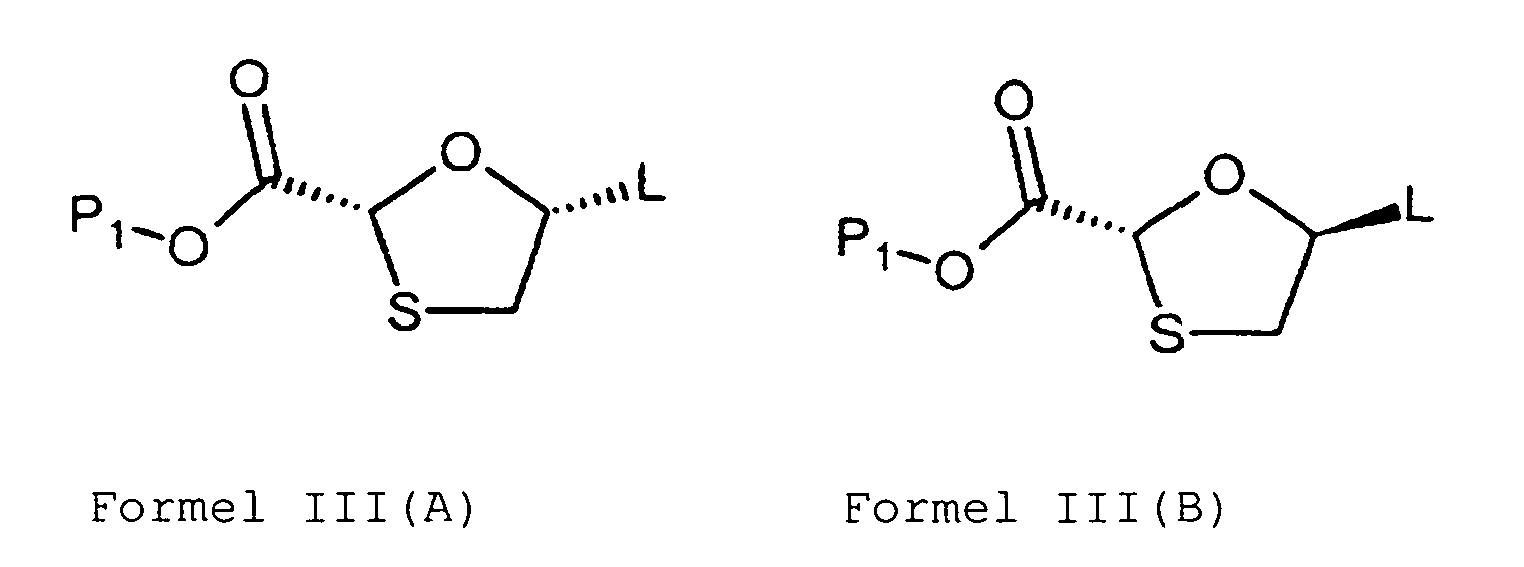
 b) Reduzieren der Verbindung der Formel IV(A) oder Formel IV(B) oder Gemischen aus diesen zur Gewinnung von Lamivudin der Formel I(A) oder der Verbindung der Formel I(C) oder Gemischen aus diesen, undc) Isolieren des Lamivudins der Formel I(A) oder der Verbindung der Formel I(C) oder eines Gemisches aus diesen aus dem Reaktionsgemisch.
 - Verfahren nach Anspruch 6, worin die chirale Hilfsgruppe P1 der Verbindung der Formel III(A) oder Formel III(B) oder von Gemischen aus diesen, und jener der Verbindung der Formel IV(A) oder Formel IV(B) oder von Gemischen aus diesen eine L-Menthylgruppe ist.
- Verfahren nach Anspruch 6, worin das Cytosin mit Acetyl- und/oder Silylschutzgruppen geschützt ist.
- Verfahren nach Anspruch 6, worin die Lewissäure Zinn(IV)-chlorid oder Titantetrachlorid ist.
- Verfahren nach Anspruch 9, worin die Lewissäure Zinn(IV)-chlorid ist.
- Verfahren zur Herstellung von Lamivudin der Formel I(A)
 a) Umsetzung einer Verbindung der Formel III(C)
 b) Abtrennung einer Verbindung der Formel IV(A) aus dem Reaktionsgemisch,
 c) Reduzieren der Verbindung der Formel IV(A) undd) Isolieren von Lamivudin der Formel I(A) aus dem Reaktionsgemisch.
 - Verfahren nach Anspruch 11, worin die Lewissäure Zinn(IV)-chlorid oder Titantetrachlorid ist.
- Verfahren nach Anspruch 12, worin die Lewissäure Zinn(IV)-chlorid ist.
- Verfahren nach Anspruch 11, worin die Verbindung der Formel IV(A) im Schritt b) durch Behandeln der Verbindung der Formel IV(C) mit einem Lösemittel, das die unerwünschten Isomeren selektiv löst, während die Verbindung der Formel IV(A) teilweise oder völlig in diesem Lösungsmittel unlöslich ist, abgetrennt wird.
- Verfahren nach Anspruch 14, worin das Lösemittel ein C1-3-Alkanol oder ein aliphatischer Ester oder ein Gemisch aus diesen ist.
- Verfahren nach Anspruch 15, worin das Lösemittel Methanol oder Isopropylacetat oder ein Gemisch aus diesen ist.
Priority Applications (1)
| Application Number | Priority Date | Filing Date | Title |
|---|---|---|---|
| SI200830812T SI2225232T1 (sl) | 2007-11-29 | 2008-04-30 | Postopek za pripravo substituiranih 1,3-oksatiolanov |
Applications Claiming Priority (2)
| Application Number | Priority Date | Filing Date | Title |
|---|---|---|---|
| IN2500DE2007 | 2007-11-29 | ||
| PCT/IB2008/051689 WO2009069011A1 (en) | 2007-11-29 | 2008-04-30 | Process for the preparation of substituted 1,3-oxathiolanes |
Publications (2)
| Publication Number | Publication Date |
|---|---|
| EP2225232A1 EP2225232A1 (de) | 2010-09-08 |
| EP2225232B1 true EP2225232B1 (de) | 2012-09-26 |
Family
ID=39745034
Family Applications (1)
| Application Number | Title | Priority Date | Filing Date |
|---|---|---|---|
| EP08738051A Active EP2225232B1 (de) | 2007-11-29 | 2008-04-30 | Verfahren zur herstellung substituierter 1,3-oxathiolane |
Country Status (8)
| Country | Link |
|---|---|
| US (1) | US20100311970A1 (de) |
| EP (1) | EP2225232B1 (de) |
| CN (1) | CN101918394A (de) |
| AU (1) | AU2008331166B2 (de) |
| BR (1) | BRPI0820226A2 (de) |
| HR (1) | HRP20120971T1 (de) |
| SI (1) | SI2225232T1 (de) |
| WO (1) | WO2009069011A1 (de) |
Families Citing this family (6)
| Publication number | Priority date | Publication date | Assignee | Title |
|---|---|---|---|---|
| US20140046062A1 (en) * | 2010-01-08 | 2014-02-13 | Bandi Parthasaradhi Reddy | Process for nucleosides |
| WO2011095987A1 (en) | 2010-02-03 | 2011-08-11 | Matrix Laboratories Ltd. | Novel process for the preparation of cis-nucleoside derivative |
| CN102153545B (zh) * | 2011-03-04 | 2012-11-21 | 杭州科本药业有限公司 | 一种拉米夫定的制备方法 |
| US20130296562A1 (en) | 2011-08-05 | 2013-11-07 | Lupin Limited | Stereoselective process for preparation of 1,3-oxathiolane nucleosides |
| CN119350314B (zh) * | 2024-10-24 | 2026-04-10 | 浙江外国语学院 | 一种拉米夫定中间体的制备方法 |
| CN119350115A (zh) * | 2024-10-24 | 2025-01-24 | 浙江外国语学院 | 一种从含有β和α两种异构体的CME溶液中回收β异构体的方法 |
Family Cites Families (12)
| Publication number | Priority date | Publication date | Assignee | Title |
|---|---|---|---|---|
| US5684164A (en) | 1988-04-11 | 1997-11-04 | Biochem Pharma Inc. | Processes for preparing substituted 1,3-oxathiolanes with antiviral properties |
| US5047407A (en) * | 1989-02-08 | 1991-09-10 | Iaf Biochem International, Inc. | 2-substituted-5-substituted-1,3-oxathiolanes with antiviral properties |
| DK0674634T3 (da) | 1989-02-08 | 2003-08-04 | Iaf Biochem Int | Fremgangsmåde til fremstilling af substituerede 1,3-oxathiolaner med antivirale egenskaber |
| US5204466A (en) * | 1990-02-01 | 1993-04-20 | Emory University | Method and compositions for the synthesis of bch-189 and related compounds |
| GB9009861D0 (en) | 1990-05-02 | 1990-06-27 | Glaxo Group Ltd | Chemical compounds |
| ZA923640B (en) * | 1991-05-21 | 1993-02-24 | Iaf Biochem Int | Processes for the diastereoselective synthesis of nucleosides |
| GB9111902D0 (en) * | 1991-06-03 | 1991-07-24 | Glaxo Group Ltd | Chemical compounds |
| IL113432A (en) * | 1994-04-23 | 2000-11-21 | Glaxo Group Ltd | Process for the diastereoselective synthesis of nucleoside analogues |
| US6113920A (en) * | 1996-10-31 | 2000-09-05 | Glaxo Wellcome Inc. | Pharmaceutical compositions |
| GB9909154D0 (en) * | 1999-04-22 | 1999-06-16 | Nippon Glaxo Limited | Pharmaceutical formulation |
| ES2233703T3 (es) * | 2000-11-02 | 2005-06-16 | F. Hoffmann-La Roche Ag | Benzo(b)tiofenos y benzo (d)isotiazoles hipocolesterolemiantes.. |
| EP1644314B1 (de) * | 2003-07-01 | 2011-08-10 | Bayer Cropscience AG | Verfahren zum herstellen von difluoracetessigs urealkylestern |
-
2008
- 2008-04-30 WO PCT/IB2008/051689 patent/WO2009069011A1/en not_active Ceased
- 2008-04-30 CN CN2008801256253A patent/CN101918394A/zh active Pending
- 2008-04-30 BR BRPI0820226-5A patent/BRPI0820226A2/pt not_active IP Right Cessation
- 2008-04-30 AU AU2008331166A patent/AU2008331166B2/en not_active Ceased
- 2008-04-30 SI SI200830812T patent/SI2225232T1/sl unknown
- 2008-04-30 HR HRP20120971AT patent/HRP20120971T1/hr unknown
- 2008-04-30 EP EP08738051A patent/EP2225232B1/de active Active
- 2008-04-30 US US12/745,094 patent/US20100311970A1/en not_active Abandoned
Also Published As
| Publication number | Publication date |
|---|---|
| AU2008331166B2 (en) | 2013-10-10 |
| CN101918394A (zh) | 2010-12-15 |
| SI2225232T1 (sl) | 2012-12-31 |
| HRP20120971T1 (hr) | 2012-12-31 |
| WO2009069011A1 (en) | 2009-06-04 |
| AU2008331166A1 (en) | 2009-06-04 |
| BRPI0820226A2 (pt) | 2015-06-16 |
| EP2225232A1 (de) | 2010-09-08 |
| US20100311970A1 (en) | 2010-12-09 |
Similar Documents
| Publication | Publication Date | Title |
|---|---|---|
| RU2105009C1 (ru) | Способ диастереоселективного получения оптически активных цис-нуклеозидов, аналогов нуклеозидов или производных и промежуточные продукты для этого способа | |
| AP704A (en) | Process for the diastereoselective synthesis of nucleoside analogues. | |
| US20020198224A1 (en) | Method for the synthesis of 2',3'-dideoxy-2',3'-didehydronucleosides | |
| EP2594569B1 (de) | Syntheseverfahren für entecavair und zwischenverbindung daraus | |
| EP2225232B1 (de) | Verfahren zur herstellung substituierter 1,3-oxathiolane | |
| CA2351049C (en) | Process for recovery of the desired cis-1,3-oxathiolane nucleosides from their undesired trans-isomers | |
| AU2011222471B2 (en) | A process for stereoselective synthesis of 5-fluoro-1-(2R,5S)-[2-(hydroxymethyl)-1,3-oxathiolan-5-yl]cytosine | |
| WO2010082128A1 (en) | Process for the preparation of cis-nucleoside derivative | |
| EP1608644B8 (de) | Verfahren und zwischenprodukte für die herstellung von emtricitabin | |
| CZ293942B6 (cs) | Způsob zvýšení výtěžku jednoho z enanciomerů alkoholů | |
| US20100311961A1 (en) | Process and intermediates for the preparation of substituted 1,3-oxathiolanes, especially lamivudine | |
| NZ267379A (en) | Process for production of cis-2-carboxylic or thiocarboxylic acid nucleoside analogues using a bicyclic intermediate | |
| EP2739620A1 (de) | Stereoselektives verfahren zur herstellung von 1,3-oxathiolan-nukleosiden | |
| CA2188306C (en) | Process for the diastereoselective synthesis of nucleoside analogues | |
| KR20110081383A (ko) | 라미부딘의 제조방법 및 이에 사용되는 신규 중간체 | |
| HK1152043A (en) | Process and intermediates for the preparation of substituted 1,3-oxathiolanes, especially lamivudine | |
| WO2003040139A1 (en) | Diastereoselective process for the preparation of the antiviral agent4-amino-1-(2r-hydroxymethyl-[1,3]oxathiolan-5s-yl)-1h-pyrimidin-2-one | |
| MXPA96004880A (en) | Procedure for the diasteros synthesiselectives of nucleus analogs | |
| HK1004221B (en) | Process for the diastereoselective synthesis of nucleoside analogues |
Legal Events
| Date | Code | Title | Description |
|---|---|---|---|
| PUAI | Public reference made under article 153(3) epc to a published international application that has entered the european phase |
Free format text: ORIGINAL CODE: 0009012 |
|
| 17P | Request for examination filed |
Effective date: 20100629 |
|
| AK | Designated contracting states |
Kind code of ref document: A1 Designated state(s): AT BE BG CH CY CZ DE DK EE ES FI FR GB GR HR HU IE IS IT LI LT LU LV MC MT NL NO PL PT RO SE SI SK TR |
|
| AX | Request for extension of the european patent |
Extension state: AL BA MK RS |
|
| 17Q | First examination report despatched |
Effective date: 20110127 |
|
| REG | Reference to a national code |
Ref country code: HK Ref legal event code: DE Ref document number: 1148003 Country of ref document: HK |
|
| TPAC | Observations filed by third parties |
Free format text: ORIGINAL CODE: EPIDOSNTIPA |
|
| GRAP | Despatch of communication of intention to grant a patent |
Free format text: ORIGINAL CODE: EPIDOSNIGR1 |
|
| TPAC | Observations filed by third parties |
Free format text: ORIGINAL CODE: EPIDOSNTIPA |
|
| TPAA | Information related to observations by third parties modified |
Free format text: ORIGINAL CODE: EPIDOSCTIPA |
|
| TPAC | Observations filed by third parties |
Free format text: ORIGINAL CODE: EPIDOSNTIPA |
|
| RAP1 | Party data changed (applicant data changed or rights of an application transferred) |
Owner name: RANBAXY LABORATORIES LIMITED |
|
| GRAS | Grant fee paid |
Free format text: ORIGINAL CODE: EPIDOSNIGR3 |
|
| GRAA | (expected) grant |
Free format text: ORIGINAL CODE: 0009210 |
|
| AK | Designated contracting states |
Kind code of ref document: B1 Designated state(s): AT BE BG CH CY CZ DE DK EE ES FI FR GB GR HR HU IE IS IT LI LT LU LV MC MT NL NO PL PT RO SE SI SK TR |
|
| AX | Request for extension of the european patent |
Extension state: AL BA MK RS |
|
| REG | Reference to a national code |
Ref country code: GB Ref legal event code: FG4D |
|
| REG | Reference to a national code |
Ref country code: CH Ref legal event code: EP |
|
| REG | Reference to a national code |
Ref country code: AT Ref legal event code: REF Ref document number: 576994 Country of ref document: AT Kind code of ref document: T Effective date: 20121015 |
|
| REG | Reference to a national code |
Ref country code: IE Ref legal event code: FG4D |
|
| REG | Reference to a national code |
Ref country code: CH Ref legal event code: NV Representative=s name: CRONIN INTELLECTUAL PROPERTY, CH |
|
| REG | Reference to a national code |
Ref country code: DE Ref legal event code: R096 Ref document number: 602008019010 Country of ref document: DE Effective date: 20121122 |
|
| REG | Reference to a national code |
Ref country code: HR Ref legal event code: TUEP Ref document number: P20120971 Country of ref document: HR |
|
| REG | Reference to a national code |
Ref country code: HR Ref legal event code: T1PR Ref document number: P20120971 Country of ref document: HR |
|
| PG25 | Lapsed in a contracting state [announced via postgrant information from national office to epo] |
Ref country code: NO Free format text: LAPSE BECAUSE OF FAILURE TO SUBMIT A TRANSLATION OF THE DESCRIPTION OR TO PAY THE FEE WITHIN THE PRESCRIBED TIME-LIMIT Effective date: 20121226 Ref country code: LT Free format text: LAPSE BECAUSE OF FAILURE TO SUBMIT A TRANSLATION OF THE DESCRIPTION OR TO PAY THE FEE WITHIN THE PRESCRIBED TIME-LIMIT Effective date: 20120926 |
|
| REG | Reference to a national code |
Ref country code: NL Ref legal event code: T3 |
|
| REG | Reference to a national code |
Ref country code: AT Ref legal event code: MK05 Ref document number: 576994 Country of ref document: AT Kind code of ref document: T Effective date: 20120926 |
|
| REG | Reference to a national code |
Ref country code: LT Ref legal event code: MG4D Effective date: 20120926 |
|
| PG25 | Lapsed in a contracting state [announced via postgrant information from national office to epo] |
Ref country code: LV Free format text: LAPSE BECAUSE OF FAILURE TO SUBMIT A TRANSLATION OF THE DESCRIPTION OR TO PAY THE FEE WITHIN THE PRESCRIBED TIME-LIMIT Effective date: 20120926 Ref country code: SE Free format text: LAPSE BECAUSE OF FAILURE TO SUBMIT A TRANSLATION OF THE DESCRIPTION OR TO PAY THE FEE WITHIN THE PRESCRIBED TIME-LIMIT Effective date: 20120926 Ref country code: GR Free format text: LAPSE BECAUSE OF FAILURE TO SUBMIT A TRANSLATION OF THE DESCRIPTION OR TO PAY THE FEE WITHIN THE PRESCRIBED TIME-LIMIT Effective date: 20121227 |
|
| PG25 | Lapsed in a contracting state [announced via postgrant information from national office to epo] |
Ref country code: EE Free format text: LAPSE BECAUSE OF FAILURE TO SUBMIT A TRANSLATION OF THE DESCRIPTION OR TO PAY THE FEE WITHIN THE PRESCRIBED TIME-LIMIT Effective date: 20120926 Ref country code: CZ Free format text: LAPSE BECAUSE OF FAILURE TO SUBMIT A TRANSLATION OF THE DESCRIPTION OR TO PAY THE FEE WITHIN THE PRESCRIBED TIME-LIMIT Effective date: 20120926 Ref country code: IS Free format text: LAPSE BECAUSE OF FAILURE TO SUBMIT A TRANSLATION OF THE DESCRIPTION OR TO PAY THE FEE WITHIN THE PRESCRIBED TIME-LIMIT Effective date: 20130126 Ref country code: ES Free format text: LAPSE BECAUSE OF FAILURE TO SUBMIT A TRANSLATION OF THE DESCRIPTION OR TO PAY THE FEE WITHIN THE PRESCRIBED TIME-LIMIT Effective date: 20130106 Ref country code: RO Free format text: LAPSE BECAUSE OF FAILURE TO SUBMIT A TRANSLATION OF THE DESCRIPTION OR TO PAY THE FEE WITHIN THE PRESCRIBED TIME-LIMIT Effective date: 20120926 Ref country code: BE Free format text: LAPSE BECAUSE OF FAILURE TO SUBMIT A TRANSLATION OF THE DESCRIPTION OR TO PAY THE FEE WITHIN THE PRESCRIBED TIME-LIMIT Effective date: 20120926 |
|
| PG25 | Lapsed in a contracting state [announced via postgrant information from national office to epo] |
Ref country code: SK Free format text: LAPSE BECAUSE OF FAILURE TO SUBMIT A TRANSLATION OF THE DESCRIPTION OR TO PAY THE FEE WITHIN THE PRESCRIBED TIME-LIMIT Effective date: 20120926 Ref country code: PT Free format text: LAPSE BECAUSE OF FAILURE TO SUBMIT A TRANSLATION OF THE DESCRIPTION OR TO PAY THE FEE WITHIN THE PRESCRIBED TIME-LIMIT Effective date: 20130128 Ref country code: PL Free format text: LAPSE BECAUSE OF FAILURE TO SUBMIT A TRANSLATION OF THE DESCRIPTION OR TO PAY THE FEE WITHIN THE PRESCRIBED TIME-LIMIT Effective date: 20120926 |
|
| PG25 | Lapsed in a contracting state [announced via postgrant information from national office to epo] |
Ref country code: AT Free format text: LAPSE BECAUSE OF FAILURE TO SUBMIT A TRANSLATION OF THE DESCRIPTION OR TO PAY THE FEE WITHIN THE PRESCRIBED TIME-LIMIT Effective date: 20120926 |
|
| PG25 | Lapsed in a contracting state [announced via postgrant information from national office to epo] |
Ref country code: DK Free format text: LAPSE BECAUSE OF FAILURE TO SUBMIT A TRANSLATION OF THE DESCRIPTION OR TO PAY THE FEE WITHIN THE PRESCRIBED TIME-LIMIT Effective date: 20120926 Ref country code: BG Free format text: LAPSE BECAUSE OF FAILURE TO SUBMIT A TRANSLATION OF THE DESCRIPTION OR TO PAY THE FEE WITHIN THE PRESCRIBED TIME-LIMIT Effective date: 20121226 |
|
| PLBE | No opposition filed within time limit |
Free format text: ORIGINAL CODE: 0009261 |
|
| STAA | Information on the status of an ep patent application or granted ep patent |
Free format text: STATUS: NO OPPOSITION FILED WITHIN TIME LIMIT |
|
| PG25 | Lapsed in a contracting state [announced via postgrant information from national office to epo] |
Ref country code: IT Free format text: LAPSE BECAUSE OF FAILURE TO SUBMIT A TRANSLATION OF THE DESCRIPTION OR TO PAY THE FEE WITHIN THE PRESCRIBED TIME-LIMIT Effective date: 20120926 |
|
| 26N | No opposition filed |
Effective date: 20130627 |
|
| REG | Reference to a national code |
Ref country code: DE Ref legal event code: R097 Ref document number: 602008019010 Country of ref document: DE Effective date: 20130627 |
|
| REG | Reference to a national code |
Ref country code: HR Ref legal event code: PBON Ref document number: P20120971 Country of ref document: HR Effective date: 20130430 |
|
| REG | Reference to a national code |
Ref country code: NL Ref legal event code: V1 Effective date: 20131101 |
|
| PG25 | Lapsed in a contracting state [announced via postgrant information from national office to epo] |
Ref country code: CY Free format text: LAPSE BECAUSE OF FAILURE TO SUBMIT A TRANSLATION OF THE DESCRIPTION OR TO PAY THE FEE WITHIN THE PRESCRIBED TIME-LIMIT Effective date: 20120926 Ref country code: MC Free format text: LAPSE BECAUSE OF FAILURE TO SUBMIT A TRANSLATION OF THE DESCRIPTION OR TO PAY THE FEE WITHIN THE PRESCRIBED TIME-LIMIT Effective date: 20120926 |
|
| REG | Reference to a national code |
Ref country code: CH Ref legal event code: PL |
|
| GBPC | Gb: european patent ceased through non-payment of renewal fee |
Effective date: 20130430 |
|
| REG | Reference to a national code |
Ref country code: IE Ref legal event code: MM4A |
|
| PG25 | Lapsed in a contracting state [announced via postgrant information from national office to epo] |
Ref country code: HR Free format text: LAPSE BECAUSE OF NON-PAYMENT OF DUE FEES Effective date: 20130430 Ref country code: LI Free format text: LAPSE BECAUSE OF NON-PAYMENT OF DUE FEES Effective date: 20130430 Ref country code: GB Free format text: LAPSE BECAUSE OF NON-PAYMENT OF DUE FEES Effective date: 20130430 Ref country code: DE Free format text: LAPSE BECAUSE OF NON-PAYMENT OF DUE FEES Effective date: 20131101 Ref country code: CH Free format text: LAPSE BECAUSE OF NON-PAYMENT OF DUE FEES Effective date: 20130430 |
|
| REG | Reference to a national code |
Ref country code: FR Ref legal event code: ST Effective date: 20131231 Ref country code: SI Ref legal event code: KO00 Effective date: 20131206 |
|
| REG | Reference to a national code |
Ref country code: DE Ref legal event code: R119 Ref document number: 602008019010 Country of ref document: DE Effective date: 20131101 |
|
| PG25 | Lapsed in a contracting state [announced via postgrant information from national office to epo] |
Ref country code: NL Free format text: LAPSE BECAUSE OF NON-PAYMENT OF DUE FEES Effective date: 20131101 Ref country code: FR Free format text: LAPSE BECAUSE OF NON-PAYMENT OF DUE FEES Effective date: 20130430 Ref country code: FI Free format text: LAPSE BECAUSE OF NON-PAYMENT OF DUE FEES Effective date: 20130430 Ref country code: SI Free format text: LAPSE BECAUSE OF NON-PAYMENT OF DUE FEES Effective date: 20130501 |
|
| PG25 | Lapsed in a contracting state [announced via postgrant information from national office to epo] |
Ref country code: IE Free format text: LAPSE BECAUSE OF NON-PAYMENT OF DUE FEES Effective date: 20130430 |
|
| PG25 | Lapsed in a contracting state [announced via postgrant information from national office to epo] |
Ref country code: MT Free format text: LAPSE BECAUSE OF FAILURE TO SUBMIT A TRANSLATION OF THE DESCRIPTION OR TO PAY THE FEE WITHIN THE PRESCRIBED TIME-LIMIT Effective date: 20120926 |
|
| PG25 | Lapsed in a contracting state [announced via postgrant information from national office to epo] |
Ref country code: TR Free format text: LAPSE BECAUSE OF FAILURE TO SUBMIT A TRANSLATION OF THE DESCRIPTION OR TO PAY THE FEE WITHIN THE PRESCRIBED TIME-LIMIT Effective date: 20120926 |
|
| PG25 | Lapsed in a contracting state [announced via postgrant information from national office to epo] |
Ref country code: HU Free format text: LAPSE BECAUSE OF FAILURE TO SUBMIT A TRANSLATION OF THE DESCRIPTION OR TO PAY THE FEE WITHIN THE PRESCRIBED TIME-LIMIT; INVALID AB INITIO Effective date: 20080430 Ref country code: LU Free format text: LAPSE BECAUSE OF NON-PAYMENT OF DUE FEES Effective date: 20130430 |
|
| REG | Reference to a national code |
Ref country code: HK Ref legal event code: WD Ref document number: 1148003 Country of ref document: HK |
|
| PG25 | Lapsed in a contracting state [announced via postgrant information from national office to epo] |
Ref country code: MT Free format text: LAPSE BECAUSE OF FAILURE TO SUBMIT A TRANSLATION OF THE DESCRIPTION OR TO PAY THE FEE WITHIN THE PRESCRIBED TIME-LIMIT Effective date: 20130430 |