EP2226317B1 - Aryl (1h-1,2,4-triazol-1-yl)-verbindung und verfahren zu ihrer herstellung - Google Patents
Aryl (1h-1,2,4-triazol-1-yl)-verbindung und verfahren zu ihrer herstellung Download PDFInfo
- Publication number
- EP2226317B1 EP2226317B1 EP08854741.9A EP08854741A EP2226317B1 EP 2226317 B1 EP2226317 B1 EP 2226317B1 EP 08854741 A EP08854741 A EP 08854741A EP 2226317 B1 EP2226317 B1 EP 2226317B1
- Authority
- EP
- European Patent Office
- Prior art keywords
- general formula
- compound represented
- triazol
- group
- given above
- Prior art date
- Legal status (The legal status is an assumption and is not a legal conclusion. Google has not performed a legal analysis and makes no representation as to the accuracy of the status listed.)
- Active
Links
- 0 */C(/[N+])=N\C(C(F)(F)F)=N Chemical compound */C(/[N+])=N\C(C(F)(F)F)=N 0.000 description 14
Classifications
-
- C—CHEMISTRY; METALLURGY
- C07—ORGANIC CHEMISTRY
- C07D—HETEROCYCLIC COMPOUNDS
- C07D249/00—Heterocyclic compounds containing five-membered rings having three nitrogen atoms as the only ring hetero atoms
- C07D249/02—Heterocyclic compounds containing five-membered rings having three nitrogen atoms as the only ring hetero atoms not condensed with other rings
- C07D249/08—1,2,4-Triazoles; Hydrogenated 1,2,4-triazoles
-
- C—CHEMISTRY; METALLURGY
- C07—ORGANIC CHEMISTRY
- C07D—HETEROCYCLIC COMPOUNDS
- C07D249/00—Heterocyclic compounds containing five-membered rings having three nitrogen atoms as the only ring hetero atoms
- C07D249/02—Heterocyclic compounds containing five-membered rings having three nitrogen atoms as the only ring hetero atoms not condensed with other rings
- C07D249/08—1,2,4-Triazoles; Hydrogenated 1,2,4-triazoles
- C07D249/10—1,2,4-Triazoles; Hydrogenated 1,2,4-triazoles with hetero atoms or with carbon atoms having three bonds to hetero atoms with at the most one bond to halogen, e.g. ester or nitrile radicals, directly attached to ring carbon atoms
- C07D249/14—Nitrogen atoms
Definitions
- the present invention relates to an aryl (1H-1,2,4-triazol-1-yl) compound and a process for production of the compound, as further defined in the claims.
- a 3-(1H-1,2,4-triazol-1-yl)phenyl sulfide compound is known to be useful as an insecticide, miticide or nematicide (Patent Literature 1).
- Patent Literature 1 A 3-(1H-1,2,4-triazol-1-yl)phenyl sulfide compound is known to be useful as an insecticide, miticide or nematicide (Patent Literature 1).
- a method for production of 3-(1H-1,2,4-triazol-1-yl)phenyl sulfide compound which comprises subjecting a precursor of the compound, i.e. a 3-(1H-1,2,4-triazol-1-yl)phenylmercaptan compound to alkylation.
- the present inventor made a study on the 3-(1H-1,2,4-triazol-1-yl)phenylmercaptan compound, the 3-(1H-1,2,4-triazol-1-yl)benzenesulfonyl halide compound which is an intermediate for production of the 3-(1H-1,2,4-triazol-1-yl)phenylmercaptan compound, the (1H-1,2,4-triazol-1-yl)benzene compound which is a precursor for the 3-(1H-1,2,4-triazol-1-yl)benzenesulfonyl halide compound, and the processes for producing these compounds.
- the present invention provides an aryl (1H-1,2,4-triazol-1-yl) compound and a process for producing the compound easily and efficiently, as further defined in the claims.
- an aryl (1H-1,2,4-triazol-1-yl) compound which is useful for easy and efficient production of a 3-(1H-1,2,4-triazol-1-yl)phenyl sulfide compound useful as an insecticide, miticide or nematicide, can be produced by the above-mentioned series of steps, under mild conditions, at a high selectivity, efficiently and in an easy operation, without using any special reaction equipment.
- the present invention has achieved the above-mentioned task by providing the inventions shown in the following [1] to [25].
- the present invention provides an aryl (1H-1,2,4-triazol-1-yl) compound represented by the general formula (1) and a process for production of the compound, an intermediate for producing the compound, and a precursor thereof.
- R is a methyl group
- a 1 is an amino group
- a 2 is a fluorine atom
- Z is a hydrogen atom, a chlorosulfonyl group, or a mercapto group.
- the process for production of an aryl (1H-1,2,4-triazol-1-yl) compound represented by the general formula (1) includes the followings:
- the compounds represented by the general formula (5), the general formula (8), the general formula (10) and the general formula (11) are all included in the present invention compound represented by the general formula (1).
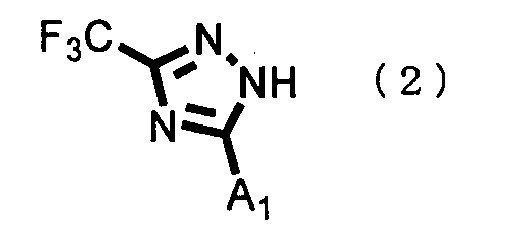
- the general formula (2), the general formula (3) and the general formula (4), R, A 1 and A 2 have the same definitions as given previously.
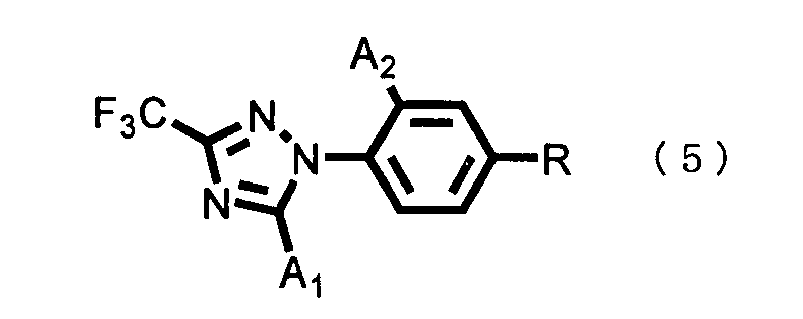
- the unsubstituted compound represented by the general formula (5), the triazole compound represented by the general formula (2) used as a raw material of the coupling, the boronic acid compound represented by the general formula (3) and the boroxine compound represented by the general formula (4) are all known compounds.
- a triazole compound represented by the general formula (2) is reacted with a boronic acid compound represented by the general formula (3) or a boroxine compound represented by the general formula (4), whereby an intended unsubstituted compound represented by the general formula (5) can be produced.
- the compound to be reacted with the triazole compound represented by the general formula (2) is ordinarily selected from a boronic acid compound represented by the general formula (3) and a boroxine compound represented by the general formula (4); however, a mixture thereof may be used as the compound to be reacted with the triazole compound.
- the molar ratio of the triazole compound represented by the general formula (2) and the boronic acid compound represented by the general formula (3) or the boroxine compound represented by the general formula (4) may be any molar ratio, and intended reaction proceeds.
- the triazole compound represented by the general formula (2) is reacted with the boronic acid compound represented by the general formula (3)
- the boronic acid compound represented by the general formula (3) is used, for example, ordinarily by 0.1 to 10.0 mols, preferably by 0.33 to 3.0 mols per 1 mol of the triazole compound represented by the general formula (2).
- the boroxine compound represented by the general formula (4) is used, for example, ordinarily by 0.033 to 3.33 mols, preferably by 0.1 to 1.0 mol per 1 mol of the triazole compound represented by the general formula (2).
- a copper catalyst is used.
- the copper catalyst used in the reaction may be any copper compound as long as it can give rise to the coupling reaction.
- copper (metallic copper), copper (II) acetate, copper (I) acetate, copper (II) oxide, copper (I) oxide, copper (II) chloride, copper (I) chloride, copper (II) sulfate and copper (II) nitrate can be mentioned copper (metallic copper), copper (II) acetate, copper (I) acetate, copper (II) oxide, copper (I) oxide, copper (II) chloride, copper (II) sulfate and copper (II) nitrate.
- Copper (metallic copper), copper (II) acetate, copper (I) acetate, copper (II) oxide and copper (I) oxide are used preferably, and copper (metallic copper) and copper (II) acetate are used more preferably, from the standpoints of the low reactivity of counter anion, the high availability and easy handling, the reactivity, etc.
- These copper catalysts may be used singly or in admixture of any mixing ratio. These copper catalysts are known compounds.
- the use amount of the copper catalyst in the coupling reaction is 0.01 to 0.5 mol, preferably 0.05 to 0.2 mol per 1 mol of the triazole compound represented by the general formula (2).
- the coupling reaction may be conducted in the absence of a base.
- a base is preferred.
- tertiary amine compounds such as pyridine, diisopropylethylamine, triethylamine and the like
- inorganic bases such as alkali metal hydroxide (e.g. sodium hydroxide), alkali metal carbonate (e.g. potassium carbonate) and the like. These bases may be used singly or in admixture of any mixing ratio.
- Tertiary amine compounds such as pyridine, diisopropylethylamine, triethylamine and the like are used preferably, and pyridine and diisopropylethylamine are used more preferably, from the standpoints of the high availability and easy handling, the reactivity, etc.
- bases are known compounds.
- the use amount of the base in the coupling reaction may be any molar ratio relative to the triazole compound represented by the general formula (2), and intended reaction proceeds. However, the amount is, for example, ordinarily 0.1 to 10 mols, preferably 0.33 to 3.0 mols, more preferably 1.0 to 2.0 mols per 1 mol of the triazole compound represented by the general formula (2).
- the coupling reaction may be conducted in a solvent-free state.
- a solvent is preferably used for smooth progress of the reaction.
- the solvent usable in the coupling reaction may be any solvent as long as it does not hinder the reaction.
- aprotic polar solvents such as N,N-dimethylformamide, N,N-dimethylacetamide, acetonitrile, acetone, propylene carbonate and the like; alcohols such as ethanol, isopropanol, ethylene glycol and the like; ethers such as diphenyl ether, tetrahydrofuran and the like; aromatic hydrocarbons such as toluene, xylene and the like; and aliphatic hydrocarbons such as pentane, n-hexane and the like.
- aprotic polar solvents such as N,N-dimethylformamide, N,N-dimethylacetamide, acetonitrile, acetone, propylene carbonate and the like, and particularly preferred is N,N-dimethylformamide.
- the solvents may be used singly or in admixture of any mixing ratio.
- the use amount of the solvent may be such an amount that enables sufficient stirring of the reaction system; however, the amount may be ordinarily 0.05 to 10 liters, preferably 0.3 to 2 liters per 1 mol of the triazole compound represented by the general formula (2).
- the reaction temperature of the coupling reaction is, for example, 0°C to the reflux temperature of the solvent used, preferably 10 to 100°C.
- the reaction time of the coupling reaction is not particularly restricted; however, it is preferably 1 hour to 30 hours from the standpoints of the suppression of by-product formation, etc.
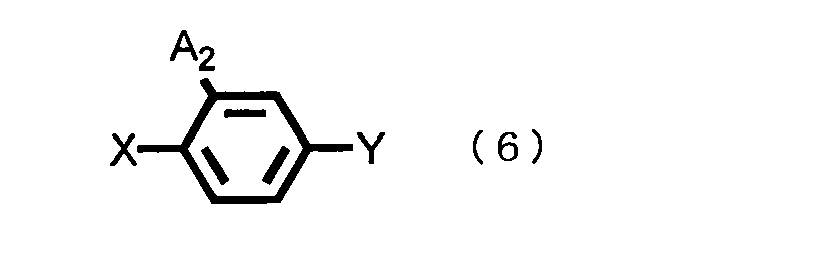
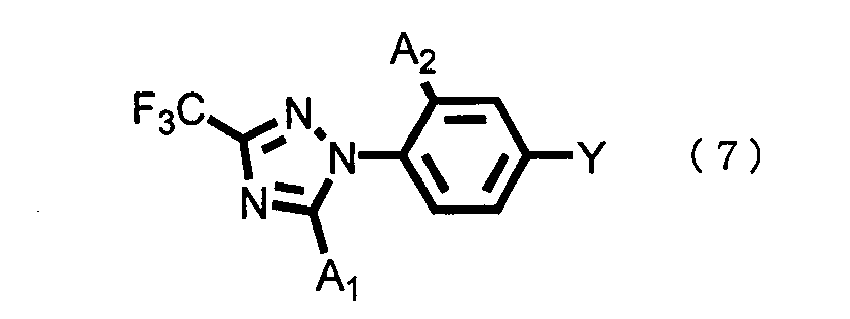
- the general formula (2) and the general formula (6), A 1 and A 2 have the same definitions as given above;
- X is a halogen atom such as chlorine atom, fluorine atom, bromine atom or the like; and
- Y is a cyano group, a formyl group, a carboxyl group or a metal salt thereof, or an alkoxycarbonyl group.
- the use amount of the 4-substituted halobenzene compound represented by the general formula (6) may be any molar ratio, and intended reaction proceeds; however, the amount is, for example, ordinarily 0.1 to 10.0 mols, preferably 0.33 to 3.0 mols per 1 mol of the triazole compound represented by the general formula (2).
- a base is used in the nucleophilic substitution reaction.
- the base used in the nucleophilic substitution reaction there can be mentioned alkali metal carbonates such as potassium carbonate, sodium carbonate, potassium hydrogencarbonate, sodium hydrogencarbonate and the like; alkali metal hydroxides such as sodium hydroxide, potassium hydroxide and the like; and tertiary amine compounds such as pyridine, diisopropylethylamine, triethylamine and the like. These bases may be used singly or in admixture of any mixing ratio.
- alkali metal carbonates such as potassium carbonate, sodium carbonate, potassium hydrogencarbonate, sodium hydrogencarbonate and the like and more preferred is potassium carbonate, from the standpoints of the availability, the easy handling, the reactivity, etc.
- bases are known compounds.
- the use amount of the base may be any molar ratio to the triazole compound represented by the general formula (2), and intended reaction proceeds; however, the amount is, for example, ordinarily 0.1 to 10.0 mols, preferably 0.33 to 3.0 mols, more preferably 1.0 to 2.0 mols per 1 mol of the triazole compound represented by the general formula (2).
- the nucleophilic substitution reaction may be conducted in a solvent-free state.
- a solvent is preferably used for smooth progress of the reaction.
- the solvent usable in the nucleophilic substitution reaction may be any solvent as long as it does not hinder the reaction.
- aprotic polar solvents such as N,N-dimethylformamide, N,N-dimethylacetamide, acetonitrile, acetone, propylene carbonate and the like
- alcohols such as ethanol, isopropanol, ethylene glycol and the like
- ethers such as diphenyl ether, tetrahydrofuran and the like
- aromatic hydrocarbons such as toluene, xylene and the like
- aliphatic hydrocarbons such as pentane, n-hexane and the like.
- aprotic polar solvents such as N,N-dimethylformamide, N,N-dimethylacetamide, acetonitrile, acetone, propylene carbonate and the like, and particularly preferred is N,N-dimethylformamide.
- These solvents may be used singly or as a mixed solvent of any mixing ratio.
- the use amount of the solvent may be such an amount that can cause sufficient stirring of the reaction system; however, it is ordinarily 0.05 to 10 liters, preferably 0.3 to 2 liters per 1 mol of the triazole compound represented by the general formula (2).
- the reaction temperature of the nucleophilic substitution reaction is, for example, 0°C to the reflux temperature of the solvent used, preferably 20 to 150°C.
- the reaction time of the nucleophilic substitution reaction is not particularly restricted, but is preferably 1 hour to 30 hours in view of, for example, the suppression of by-product formation.
- a heterogeneous metal catalyst is preferably used in the reduction reaction.
- the heterogeneous metal catalyst used in the reduction reaction there can be mentioned palladium carbon, palladium-loaded alumina, palladium-loaded barium sulfate, palladium-loaded calcium carbonate, platinum-loaded carbon, platinum-loaded alumina, rhodium-loaded carbon, ruthenium-loaded carbon, nickel-loaded carbon and Raney nickel.
- palladium carbon and palladium-loaded alumina which have high reactivity and are easy in recovery of expensive noble metal catalyst, and palladium carbon is preferred from the standpoints of the availability, the easy handling, the reactivity, etc.
- These heterogeneous metal catalysts are known compounds.
- the use amount of the heterogeneous metal catalyst in the reduction reaction may be any amount relative to the 4-substituted (1H-1,2,4-triazol-1-yl)benzene compound represented by the general formula (7), and intended reaction proceeds; however, the amount in terms of the metal weight in catalyst is, for example, ordinarily 0.1 to 10.0 times, preferably 0.1 to 5 times of the weight of the 4-substituted (1H-1,2,4-triazol-1-yl)benzene compound represented by the general formula (7).
- a reducing agent is used in the reduction reaction.
- ammonium formate and hydrogen can be mentioned.
- Ammonium formate is preferred from the standpoints of the availability, the easy handling, the reactivity, etc.
- These reducing agents are known compounds.
- the use amount of the reducing agent may be any amount relative to the 4-substituted (1H-1,2,4-triazol-1-yl)benzene compound represented by the general formula (7), and intended reaction proceeds; however, the amount is, for example, ordinarily 0.1 to 20.0 mols, preferably 1.0 to 10 mols per 1 mol of the 4-substituted (1H-1,2,4-triazol-1-yl)benzene compound represented by the general formula (7).
- the reduction reaction may be conducted in a solvent-free state.
- a solvent is preferably used for smooth progress of the reaction.
- the solvent usable in the reduction reaction may be any solvent as long as it does not hinder the reaction.
- alcohols such as methanol, ethanol, isopropanol, ethylene glycol and the like
- aprotic polar solvents such as N,N-dimethylformamide, N,N-dimethylacetamide, acetonitrile, acetone, propylene carbonate and the like
- ethers such as diphenyl ether, tetrahydrofuran and the like
- aromatic hydrocarbons such as toluene, xylene and the like
- aliphatic hydrocarbons such as pentane, n-hexane and the like.
- alcohols such as methanol, ethanol, isopropanol, ethylene glycol and the like, and particularly preferred is methanol.
- These solvents may be used singly or in admixture of any mixing ratio.
- the use amount of the solvent may be such an amount that can cause sufficient stirring of the reaction system; however, the amount is ordinarily 0.05 to 10 liters, preferably 0.3 to 2 liters per 1 mol of the 4-substituted (1H-1,2,4-triazol-1-yl)benzene compound represented by the general formula (7).
- the reaction temperature of the reduction reaction is, for example, 0°C to the reflux temperature of the solvent used, preferably 10 to 100°C.
- the reaction time of the reduction reaction is not particularly restricted; however, it is preferably 1 hour to 100 hours from the standpoints of the suppression of by-product formation, etc.
- a Raney nickel catalyst is used in the reaction.
- the Raney nickel catalyst is used after activation by an appropriate method.
- the use amount of the Raney nickel catalyst in the reaction may be any amount relative to the 4-cyano-(1H-1,2,4-triazol-1-yl)benzene compound represented by the general formula (7'), and intended reaction proceeds; however, the amount in terms of the metal weight of the catalyst is, for example, ordinarily 1.0 to 10.0 times, preferably 2.0 to 7.0 times of the use weight of the 4-cyano-(1H-1,2,4-triazol-1-yl)benzene compound represented by the general formula (7').
- the reaction may be conducted in a solvent-free state, but a solvent is preferably used for smooth progress of the reaction.
- the solvent used in the reduction reaction may be any solvent as long as it does not hinder the reaction.
- alcohols such as methanol, ethanol, isopropanol, ethylene glycol and the like
- aprotic polar solvents such as N,N-dimethylformamide, N,N-dimethylacetamide, acetonitrile, acetone, propylene carbonate and the like
- ethers such as diphenyl ether, tetrahydrofuran and the like
- aromatic hydrocarbons such as toluene, xylene and the like
- aliphatic hydrocarbons such as pentane, n-hexane and the like.
- alcohols such as methanol, ethanol, isopropanol, ethylene glycol and the like, and particularly preferred is ethanol.
- These solvents may be used singly or in admixture of any mixing ratio.
- the use amount of the solvent may be such an amount that can cause sufficient stirring of the reaction system; however, the amount is ordinarily 0.05 to 10 liters, preferably 0.3 to 2 liters per 1 mol of the 4-cyano-(1H-1,2,4-triazol-1-yl)benzene compound represented by the general formula (7').
- the reaction temperature of the reaction is, for example, 0°C to the reflux temperature of the solvent used, preferably 10 to 100°C.
- the reaction time of the reaction is not particularly restricted; however, it is preferably 1 hour to 100 hours from the standpoints of the suppression of by-product formation, etc.
- a heterogeneous metal catalyst is used in the reduction reaction.
- the heterogeneous metal catalyst used in the reaction there can be mentioned palladium (II) hydroxide carbon, palladium carbon, palladium-loaded alumina, palladium-loaded barium sulfate, palladium-loaded calcium carbonate, platinum-loaded carbon, platinum-loaded alumina, rhodium-loaded carbon, ruthenium-loaded carbon, nickel-loaded carbon and Raney nickel.
- palladium (II) hydroxide carbon which has high reactivity and is easy in recovery of expensive noble metal catalyst after the reaction.
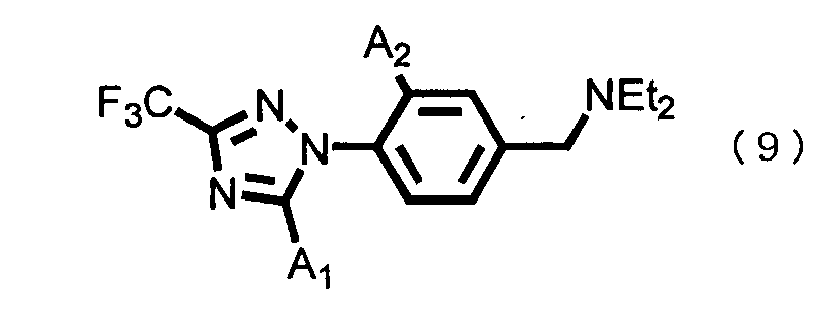
- the use amount of the heterogeneous metal catalyst in the reduction reaction may be any amount relative to the diethylamine compound represented by the general formula (9), and intended reaction proceeds; however, the amount in terms of the metal weight in catalyst is, for example, ordinarily 0.001 to 1.0 time, preferably 0.01 to 0.1 time, more preferably 0.01 to 0.05 time of the use weight of the dimethylamine compound represented by the general formula (9).
- a reducing agent is used in the reduction reaction.
- the reducing agent used in the reaction ammonium formate and hydrogen can be mentioned. Hydrogen is preferred from the standpoints of the availability, the easy handling, the reactivity, etc.
- These reducing agents are known compounds.
- the use amount of the reducing agent may be any molar ratio relative to the dimethylamine compound represented by the general formula (9), and intended reaction proceeds; however, the amount is, for example, ordinarily 0.1 to 20.0 mols, preferably 1.0 to 10 mols per 1 mol of the dimethylamine compound represented by the general formula (9).
- the reduction reaction may be conducted in a solvent-free state.
- a solvent is preferably used for smooth progress of the reaction.
- the solvent usable in the reduction reaction may be any solvent as long as it does not hinder the reaction.
- alcohols such as methanol, ethanol, isopropanol, ethylene glycol and the like
- aprotic polar solvents such as N,N-dimethylformamide, N,N-dimethylacetamide, acetonitrile, acetone, propylene carbonate and the like
- ethers such as diphenyl ether, tetrahydrofuran and the like
- aromatic hydrocarbons such as toluene, xylene and the like
- aliphatic hydrocarbons such as pentane, n-hexane and the like.
- alcohols such as methanol, ethanol, isopropanol, ethylene glycol and the like, and particularly preferred is methanol.
- These solvents may be used singly or in admixture of any mixing ratio.
- the use amount of the solvent may be such an amount that can cause sufficient stirring of the reaction system; however, the amount is ordinarily 0.05 to 10 liters, preferably 0.3 to 2 liters per 1 mol of the diethylamine compound represented by the general formula (9).
- the reaction temperature of the reduction reaction is, for example, 0°C to the reflux temperature of the solvent used, preferably 10 to 100°C.
- the reaction time of the reduction reaction is not particularly restricted; however, it is preferably 1 hour to 100 hours from the standpoints of the suppression of by-product formation, etc.
- halosulfonylating agent is used in the halosulfonylation reaction.
- halosulfonylating agent used in the reaction there can be mentioned halosulfonic acid compounds such as chlorosulfonic acid, bromosulfonic acid and the like. These halosulfonylating agents may be used singly or in admixture of any mixing ratio. Preferred is chlorosulfonic acid from the standpoints of the availability, the easy handling, the reactivity, etc. These halosulfonylating agents are known compounds.
- the use amount of the halosulfonylating agent in the halosulfonylation reaction may be any molar ratio, and intended reaction proceeds; however, the amount is, for example, ordinarily 0.033 to 100.0 mols, preferably 1.0 to 10.0 mols per 1 mol of the (1H-1,2,4-triazol-1-yl)benzene compound represented by the general formula (5).
- the halosulfonylation reaction may be conducted in a solvent-free state.
- a solvent may be used for smooth progress of the reaction.
- the solvent usable in the halosulfonylation may be any solvent as long as it does not hinder the reaction.
- halogenated hydrocarbons such as dichloroethane, chloroform and the like
- aprotic polar solvents such as N,N-dimethylformamide, N,N-dimethylacetamide, acetonitrile, acetone, propylene carbonate and the like
- ethers such as phenyl ether, tetrahydrofuran and the like
- aromatic hydrocarbons such as toluene, xylene and the like
- aliphatic hydrocarbons such as pentane, n-hexane and the like.
- halogenated hydrocarbons such as dichloroethane, chloroform and the like, and particularly preferred is dichloroethane.
- These solvents may be used singly or in admixture of any mixing ratio.
- the use amount of the solvent may be any amount as long as it can cause sufficient stirring of the reaction system. However, the amount is ordinarily 0.05 to 10 liters, preferably 0.3 to 2 liters per 1 mol of the (1H-1,2,4-triazol-1-yl)benzene compound represented by the general formula (5).
- the reaction temperature of the halosulfonylation reaction is, for example, 0°C to the reflux temperature of the solvent used, preferably 10 to 100°C.
- the reaction time of the halosulfonylation reaction is not particularly restricted; however, it is preferably 1 hour to 30 hours from the standpoints of the suppression of by-product formation, etc.
- a reducing agent is used in the reduction reaction.
- metal compounds of zinc, tin, iron, etc. can be mentioned. These reducing agents may be used singly or in admixture of any mixing ratio. Zinc is preferred from the standpoints of the availability, the easy handling, the reactivity, etc. These reducing agents are known compounds.
- the use amount of the reducing agent may be any molar ratio, and intended reaction proceeds; however, the amount is, for example, ordinarily 0.1 to 100.0 mols, preferably 1.0 to 10.0 mols per 1 mol of the 3-(1H-1,2,4-triazol-1-yl)benzenesulfonyl halide compound represented by the general formula (10).
- An acid is preferably used in the reduction reaction.
- the acid used in the reaction there can be mentioned inorganic acids such as hydrochloric acid, sulfuric acid, nitric acid, phosphoric acid and the like; Lewis acids such as aluminum chloride, poly-phosphoric acid and the like; organic acids such as acetic acid and the like; and solid acids such as montmorillonite K-10 and the like. These acids may be used singly or in admixture of any mixing ratio.
- the use amount of the acid in the reduction reaction may be any molar ratio, and intended reaction proceeds; however, the amount is, for example, ordinarily 0.066 to 200.0 mols, preferably 2.0 to 20.0 mols per 1 mol of the 3-(1H-1,2,4-triazol-1-yl)benzenesulfonyl halide compound represented by the general formula (10).
- the reduction reaction may be conducted in a solvent-free state.
- a solvent may be used for smooth progress of the reaction.
- the solvent usable in the reduction reaction may be any solvent as long as it does not hinder the reaction.
- alcohols such as ethanol, isopropanol, ethylene glycol and the like
- halogenated hydrocarbons such as dichloroethane, chloroform and the like
- aprotic polar solvents such as N,N-dimethylformamide, N,N-dimethylacetamide, acetonitrile, acetone, propylene carbonate and the like
- ethers such as phenyl ether, tetrahydrofuran and the like
- aromatic hydrocarbons such as toluene, xylene and the like
- aliphatic hydrocarbons such as pentane, n-hexane and the like.
- alcohols such as ethanol, isopropanol, ethylene glycol and the like, and particularly preferred is ethanol.
- These solvents may be used singly or in admixture of any mixing ratio.
- the use amount of the solvent may be any amount as long as it can cause sufficient stirring of the reaction system. However, the amount is ordinarily 0.05 to 10 liters, preferably 0.3 to 2 liters per 1 mol of the 3-(1H-1,2,4-triazol-1-yl)benzenesulfonyl halide compound represented by the general formula (10).
- the reaction temperature of the reduction reaction is, for example, 0°C to the reflux temperature of the solvent used, preferably 10 to 100°C.
- the reaction time of the reduction reaction is not particularly restricted; however, it is preferably 1 hour to 30 hours from the standpoints of the suppression of by-product formation, etc.
- the process of the present invention enables production of an aryl (1H-1,2,4-triazol-1-yl) compound represented by the general formula (1) at a high selectivity under mild conditions easily employable industrially, without using any special reaction equipment.
- the obtained aryl (1H-1,2,4-triazol-1-yl) compound represented by the general formula (1) is useful as an intermediate for medicine and agricultural chemical.
- the aqueous phase was extracted with 30 ml of ethyl acetate.
- the ethyl acetate phase was washed with 3% hydrochloric acid and then with a saturated aqueous sodium chloride solution.
- the ethyl acetate phase was dried over anhydrous sodium sulfate and subjected to vacuum distillation to distil off ethyl acetate.
- the residue was recrystallized from an ethyl acetate/n-hexane system to obtain a title compound as 2.45 g of a crystal. Yield: 47% 1 H NMR (300 MHz, CDCl 3 ) ⁇ :
- the aqueous phase was extracted with 30 ml of ethyl acetate.
- the ethyl acetate phase was washed with 3% hydrochloric acid and then with a saturated aqueous sodium chloride solution.
- the ethyl acetate phase was dried over anhydrous sodium sulfate and subjected to vacuum distillation to distil off ethyl acetate.
- the residue was purified by silica gel column chromatography to obtain a title compound as 2.6 g of a crystal. Yield: 50% 1 H NMR (300 MHz, CDCl 3 ) ⁇ :
- the aqueous phase was extracted with 20 ml of ethyl acetate.
- the ethyl acetate phase was washed with water and then with a saturated aqueous sodium chloride solution.
- the ethyl acetate phase was dried over anhydrous sodium sulfate and then subjected to vacuum distillation to distil off ethyl acetate, to obtain 0.22 g of a crystal.
Landscapes
- Chemical & Material Sciences (AREA)
- Organic Chemistry (AREA)
- Low-Molecular Organic Synthesis Reactions Using Catalysts (AREA)
- Organic Low-Molecular-Weight Compounds And Preparation Thereof (AREA)
- Plural Heterocyclic Compounds (AREA)
- Heterocyclic Carbon Compounds Containing A Hetero Ring Having Nitrogen And Oxygen As The Only Ring Hetero Atoms (AREA)
- Agricultural Chemicals And Associated Chemicals (AREA)
Claims (13)
- Eine Aryl(1H-1,2,4-triazol-1-yl)-Verbindung der allgemeinen Formel (1)

- Eine Aryl(1H-1,2,4-triazol-1-yl)-Verbindung gemäß Anspruch 1, wobei Z ein Wasserstoffatom ist.
- Eine Aryl(1H-1,2,4-triazol-1-yl)-Verbindung gemäß Anspruch 1, wobei Z eine Chlorsulfonylgruppe ist.
- Eine Aryl(1H-1,2,4-triazol-1-yl)-Verbindung gemäß Anspruch 1, wobei Z eine Mercaptogruppe ist.
- Ein Verfahren zur Herstellung:(i) einer (1H-1,2,4-Triazol-1-yl)benzol-Verbindung der allgemeinen Formel (5)


 (ii) einer 4-substituierten 1-(1H-1,2,4-Triazol-1-yl)benzol-Verbindung der allgemeinen Formel (7)
 (iii) einer 4-(1H-1,2,4-Triazol-1-yl)toluol-Verbindung der allgemeinen Formel (8)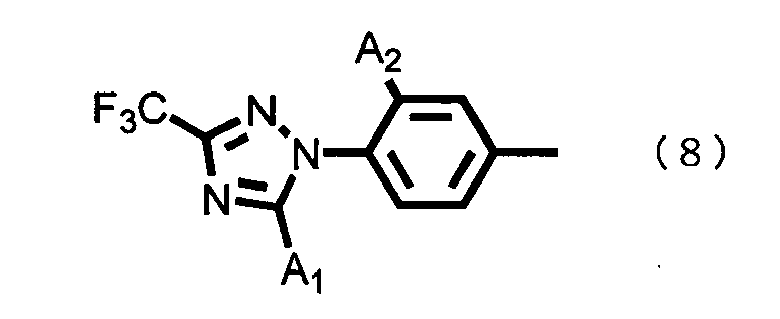
 (iv) einer 3-(1H-1,2,4-Triazol-1-yl)benzolsulfonsäurehalogenid-Verbindung der allgemeinen Formel (10)
 (v) einer 3-(1H-1,2,4-Triazol-1-yl)phenylmercaptan-Verbindung der allgemeinen Formel (11)
welches das Umsetzen einer (1H-1,2,4-Triazol-1-yl)benzol-Verbindung der allgemeinen Formel (5)

- Ein Verfahren zur Herstellung einer (1H-1,2,4-Triazol-1-yl)benzol-Verbindung der allgemeinen Formel (5), gemäß Anspruch 5,



- Ein Verfahren zur Herstellung einer (1H-1,2,4-Triazol-1-yl)benzol-Verbindung, gemäß Anspruch 6, wobei der Kupferkatalysator eine Kupferverbindung mit einer Valenz von 0 bis 2 ist.
- Ein Verfahren zur Herstellung einer 4-substituierten 1-(1H-1,2,4-Triazol-1-yl)benzol-Verbindung der allgemeinen Formel (7), gemäß Anspruch 5,


- Ein Verfahren zur Herstellung einer 4-(1H-1,2,4-Triazol-1-yl)toluol-Verbindung der allgemeinen Formel (8), gemäß Anspruch 5,


- Ein Verfahren zur Herstellung einer 4-(1H-1,2,4-Triazol-1-yl)toluol-Verbindung, gemäß Anspruch 9, wobei die Reduktion in Gegenwart eines Reduktionsmittels und eines heterogenen Metallkatalysators durchgeführt wird.
- Ein Verfahren zur Herstellung einer 4-(1H-1,2,4-Triazol-1-yl)toluol-Verbindung, gemäß Anspruch 10, wobei die Verbindung durch die allgemeine Formel (8) dargestellt ist


- Ein Verfahren zur Herstellung einer 3-(1H-1,2,4-Triazol-1-yl)benzolsulfonsäurehalogenid-Verbindung der allgemeinen Formel (10), gemäß Anspruch 5,

- Ein Verfahren zur Herstellung einer 3-(1H-1,2,4-Triazol-1-yl)phenylmercaptan-Verbindung der allgemeinen Formel (11), gemäß Anspruch 5,
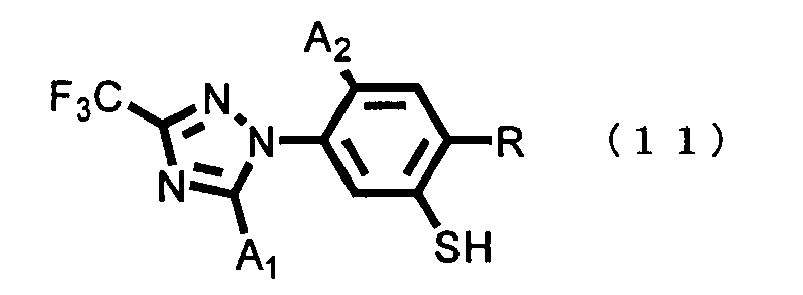


das Reduzieren der 3-(1H-1,2,4-Triazol-1-yl)benzolsulfonsäurehalogenid-Verbindung der allgemeinen Formel (10) umfasst.
Applications Claiming Priority (2)
| Application Number | Priority Date | Filing Date | Title |
|---|---|---|---|
| JP2007310537 | 2007-11-30 | ||
| PCT/JP2008/003520 WO2009069312A1 (ja) | 2007-11-30 | 2008-11-28 | (1h-1,2,4-トリアゾール-1-イル)アリール化合物及びその製造方法 |
Publications (3)
| Publication Number | Publication Date |
|---|---|
| EP2226317A1 EP2226317A1 (de) | 2010-09-08 |
| EP2226317A4 EP2226317A4 (de) | 2012-03-21 |
| EP2226317B1 true EP2226317B1 (de) | 2015-08-12 |
Family
ID=40678224
Family Applications (1)
| Application Number | Title | Priority Date | Filing Date |
|---|---|---|---|
| EP08854741.9A Active EP2226317B1 (de) | 2007-11-30 | 2008-11-28 | Aryl (1h-1,2,4-triazol-1-yl)-verbindung und verfahren zu ihrer herstellung |
Country Status (6)
| Country | Link |
|---|---|
| US (2) | US8440838B2 (de) |
| EP (1) | EP2226317B1 (de) |
| JP (1) | JP5507257B2 (de) |
| KR (1) | KR101574655B1 (de) |
| CN (2) | CN103664811B (de) |
| WO (1) | WO2009069312A1 (de) |
Families Citing this family (7)
| Publication number | Priority date | Publication date | Assignee | Title |
|---|---|---|---|---|
| CN102471290B (zh) * | 2009-07-16 | 2016-02-03 | 拜耳知识产权有限责任公司 | 手性3-三唑基亚砜衍生物的制备方法 |
| EP2274982A1 (de) * | 2009-07-16 | 2011-01-19 | Bayer CropScience AG | Verwendung von Phenyltriazolen zur Bekämpfung von Insekten und Spinnmilben durch Angiessen, Tröpfchen- oder Tauchapplikation oder durch Behandlung von Saatgut |
| BR112012003698B1 (pt) * | 2009-08-20 | 2018-12-26 | Bayer Intellectual Property Gmbh | Compostos derivados de 3-[1-(3-haloalquil)-triazolil]-fenil-sulfeto, processos para preparação de compostos, compostos intermediários, composições, composiçõesagroquímicas e uso dos compostos e composições como acaricidas e inseticidas |
| WO2011020567A1 (de) * | 2009-08-20 | 2011-02-24 | Bayer Cropscience Ag | 3-triazolylphenyl-substituierte sulfid-derivate als akarizide und insektizide |
| LT5937B (lt) | 2011-09-01 | 2013-05-27 | Uab "Precizika - Met Sc" | Puslaidininkinis elementas, turintis legiruotas p/n struktūras, ir būdas jas izoliuoti naudojant ultratrumpus ultravioletinius lazerio impulsus |
| EP3002279A1 (de) | 2014-10-02 | 2016-04-06 | Bayer CropScience AG | Verfahren zur Herstellung von 3-(5-Aminotriazolyl)-Sulfid-Derivaten |
| CN111825585B (zh) | 2019-09-23 | 2021-12-14 | 山东康乔生物科技有限公司 | 一种含苄胺结构的芳基硫化物及其合成方法和应用 |
Citations (2)
| Publication number | Priority date | Publication date | Assignee | Title |
|---|---|---|---|---|
| WO2007114532A1 (en) * | 2006-04-03 | 2007-10-11 | Industry-Academic Cooperation Foundation Gyeongsang National University | Novel chalcone derivatives, pharmaceutically acceptable salt, method for preparation and uses thereof |
| WO2008129288A2 (en) * | 2007-04-19 | 2008-10-30 | Boehringer Ingelheim International Gmbh | Disulfonamides useful in the treatment of inflammation |
Family Cites Families (11)
| Publication number | Priority date | Publication date | Assignee | Title |
|---|---|---|---|---|
| DE3869167D1 (de) * | 1987-03-27 | 1992-04-23 | Kumiai Chemical Industry Co | Phenyltriazol-derivate und insectizid. |
| JP2729810B2 (ja) * | 1988-09-27 | 1998-03-18 | クミアイ化学工業株式会社 | フェニルトリアゾール誘導体及び殺虫剤 |
| TW226993B (de) * | 1992-05-29 | 1994-07-21 | Kumiai Chemical Industry Co | |
| JP3682075B2 (ja) * | 1993-04-16 | 2005-08-10 | クミアイ化学工業株式会社 | トリアゾール誘導体及び殺虫、殺ダニ剤 |
| JPH07258227A (ja) * | 1994-03-25 | 1995-10-09 | Kumiai Chem Ind Co Ltd | フェニルトリアゾール誘導体及び殺虫剤 |
| DE19548415A1 (de) * | 1995-12-22 | 1997-06-26 | Bayer Ag | 1-Aryl-3-halogenalkyl-5-arylaminotriazole |
| DE69934224T2 (de) * | 1998-04-27 | 2007-10-04 | Kumiai Chemical Industry Co., Ltd. | 3-arylphenylsulfid-derivate und insektizide und mitizide |
| JP4209995B2 (ja) | 1998-04-27 | 2009-01-14 | クミアイ化学工業株式会社 | 3−アリールフェニルスルフィド誘導体及び殺虫、殺ダニ剤 |
| JP2000239262A (ja) * | 1999-02-17 | 2000-09-05 | Sumitomo Chem Co Ltd | トリアゾール化合物およびその用途 |
| JP4970950B2 (ja) * | 2004-10-20 | 2012-07-11 | クミアイ化学工業株式会社 | 3−トリアゾリルフェニルスルフィド誘導体及びそれを有効成分として含有する殺虫・殺ダニ・殺線虫剤 |
| JP2007284356A (ja) * | 2006-04-12 | 2007-11-01 | Kumiai Chem Ind Co Ltd | 3−トリアゾリルフェニルスルフィド誘導体及びそれを有効成分として含有する農園芸用殺虫・殺ダニ・殺線虫剤 |
-
2008
- 2008-11-28 CN CN201310682983.7A patent/CN103664811B/zh not_active Expired - Fee Related
- 2008-11-28 WO PCT/JP2008/003520 patent/WO2009069312A1/ja not_active Ceased
- 2008-11-28 US US12/743,730 patent/US8440838B2/en not_active Expired - Fee Related
- 2008-11-28 CN CN2008801237500A patent/CN101910140A/zh active Pending
- 2008-11-28 EP EP08854741.9A patent/EP2226317B1/de active Active
- 2008-11-28 JP JP2009543675A patent/JP5507257B2/ja not_active Expired - Fee Related
- 2008-11-28 KR KR1020107011596A patent/KR101574655B1/ko not_active Expired - Fee Related
-
2012
- 2012-09-21 US US13/624,107 patent/US8648207B2/en not_active Expired - Fee Related
Patent Citations (2)
| Publication number | Priority date | Publication date | Assignee | Title |
|---|---|---|---|---|
| WO2007114532A1 (en) * | 2006-04-03 | 2007-10-11 | Industry-Academic Cooperation Foundation Gyeongsang National University | Novel chalcone derivatives, pharmaceutically acceptable salt, method for preparation and uses thereof |
| WO2008129288A2 (en) * | 2007-04-19 | 2008-10-30 | Boehringer Ingelheim International Gmbh | Disulfonamides useful in the treatment of inflammation |
Non-Patent Citations (2)
| Title |
|---|
| CREMLYN R J: "Aromatic Amines and Related Compounds", 1 January 2002, CHLOROSULFONIC ACID: A VERSATILE REAGENT,, PAGE(S) 97 - 101, XP009163136 * |
| RIFANI M ET AL: "Solid State Lasers from Stereospecific Host-Guest Interactions", JOURNAL OF THE AMERICAN CHEMICAL SOCIETY, ACS PUBLICATIONS, US, vol. 117, no. 28, 1 January 1995 (1995-01-01), pages 7572 - 7573, XP002121746, ISSN: 0002-7863, DOI: 10.1021/JA00133A042 * |
Also Published As
| Publication number | Publication date |
|---|---|
| CN103664811B (zh) | 2015-09-16 |
| US20100256386A1 (en) | 2010-10-07 |
| CN103664811A (zh) | 2014-03-26 |
| JP5507257B2 (ja) | 2014-05-28 |
| EP2226317A4 (de) | 2012-03-21 |
| CN101910140A (zh) | 2010-12-08 |
| JPWO2009069312A1 (ja) | 2011-04-07 |
| US8648207B2 (en) | 2014-02-11 |
| US20130023666A1 (en) | 2013-01-24 |
| KR101574655B1 (ko) | 2015-12-04 |
| WO2009069312A1 (ja) | 2009-06-04 |
| US8440838B2 (en) | 2013-05-14 |
| KR20100087025A (ko) | 2010-08-02 |
| EP2226317A1 (de) | 2010-09-08 |
Similar Documents
| Publication | Publication Date | Title |
|---|---|---|
| EP2226317B1 (de) | Aryl (1h-1,2,4-triazol-1-yl)-verbindung und verfahren zu ihrer herstellung | |
| EP2230234A1 (de) | Verfahren zur Hertellung von Rufaminid | |
| EP4506334A1 (de) | Trifluormethansulfonylierungsmittelzusammensetzung und verfahren zur herstellung einer trifluormethansulfonyloxyverbindung oder trifluormethansulfonylverbindung | |
| DK2931703T3 (en) | METHOD FOR PREPARING BIS (3-AMINOPHENYL) -DISULPHIDES AND 3-AMINOTHIOLS | |
| KR20200110381A (ko) | 술펜트라존의 합성 방법 | |
| EP2674420B1 (de) | Verfahren zur herstellung eines aminophenyl-pyrimidinyl-alkoholderivats und synthesezwischenprodukt dafür | |
| Islam et al. | A direct approach for the expedient synthesis of unsymmetrical ethers by employing bromodimethylsulfonium bromide (BDMS) mediated C–S bond cleavage of naphthalene-2-ol sulfides | |
| JP5498798B2 (ja) | 3−メルカプトアニリン化合物の製造方法 | |
| CN100349879C (zh) | 制备芳基三唑啉酮的方法及其新中间体 | |
| EP2043970B1 (de) | Co-katalysiertes eisen-kupfer-verfahren für kohlenstoff-kohlenstoff- oder kohlenstoff-heteroatom-bindung | |
| EP2980079A1 (de) | Verfahren zur herstellung einer pyridazinonverbindung | |
| JP2023086860A (ja) | キノリン‐4(1h)-オン誘導体の製造方法 | |
| JP5663482B2 (ja) | ピリミジニルアセトニトリル誘導体の製造方法及びその合成中間体 | |
| EP2141151A1 (de) | Verfahren zur herstellung einer 2-haloimidazol-verbindung | |
| CN102250024B (zh) | 1-取代-4-氨基甲酰基-1,2,4-三唑-5-酮衍生物的制备方法 | |
| EP3205639B1 (de) | Mittel zum einführen einer schutzgruppe für die hydroxygruppe und/oder für die mercaptogruppe | |
| EP2888250A1 (de) | Verfahren zur synthese substituierter gamma-lactame | |
| JP4465674B2 (ja) | ベンジル(ジフルオロメチル)スルフィド化合物の製造方法 | |
| EP1777216A1 (de) | Ein Verfahren für die Vorbereitung und die Reinigung von Bicalutamide | |
| JP3174968B2 (ja) | 2−ハロゲノ−6−置換チオベンゾニトリル類の製造法 | |
| JP6697467B2 (ja) | オスペミフェン及びフィスペミフェンを調製するためのプロセス | |
| JP5205875B2 (ja) | 2−(4−ビニルアリールスルファニル)テトラヒドロピラン化合物の製造方法、及びその芳香族炭化水素溶液 | |
| JP3821747B2 (ja) | ジヒドロキシジフェニルスルホンモノエーテル類の製造方法 | |
| WO2008004543A1 (en) | Process for production of alcohol compound | |
| EP0234350A2 (de) | Verfahren zur Herstellung von Imidazolylthiophenaldehyden |
Legal Events
| Date | Code | Title | Description |
|---|---|---|---|
| PUAI | Public reference made under article 153(3) epc to a published international application that has entered the european phase |
Free format text: ORIGINAL CODE: 0009012 |
|
| 17P | Request for examination filed |
Effective date: 20100624 |
|
| AK | Designated contracting states |
Kind code of ref document: A1 Designated state(s): AT BE BG CH CY CZ DE DK EE ES FI FR GB GR HR HU IE IS IT LI LT LU LV MC MT NL NO PL PT RO SE SI SK TR |
|
| AX | Request for extension of the european patent |
Extension state: AL BA MK RS |
|
| A4 | Supplementary search report drawn up and despatched |
Effective date: 20120216 |
|
| RIC1 | Information provided on ipc code assigned before grant |
Ipc: C07B 61/00 20060101ALI20120210BHEP Ipc: C07D 249/14 20060101AFI20120210BHEP Ipc: C07D 249/08 20060101ALI20120210BHEP |
|
| 17Q | First examination report despatched |
Effective date: 20121005 |
|
| GRAP | Despatch of communication of intention to grant a patent |
Free format text: ORIGINAL CODE: EPIDOSNIGR1 |
|
| INTG | Intention to grant announced |
Effective date: 20150218 |
|
| GRAS | Grant fee paid |
Free format text: ORIGINAL CODE: EPIDOSNIGR3 |
|
| GRAA | (expected) grant |
Free format text: ORIGINAL CODE: 0009210 |
|
| AK | Designated contracting states |
Kind code of ref document: B1 Designated state(s): AT BE BG CH CY CZ DE DK EE ES FI FR GB GR HR HU IE IS IT LI LT LU LV MC MT NL NO PL PT RO SE SI SK TR |
|
| AX | Request for extension of the european patent |
Extension state: AL BA MK RS |
|
| REG | Reference to a national code |
Ref country code: GB Ref legal event code: FG4D |
|
| REG | Reference to a national code |
Ref country code: CH Ref legal event code: EP |
|
| REG | Reference to a national code |
Ref country code: AT Ref legal event code: REF Ref document number: 742026 Country of ref document: AT Kind code of ref document: T Effective date: 20150815 |
|
| REG | Reference to a national code |
Ref country code: IE Ref legal event code: FG4D |
|
| REG | Reference to a national code |
Ref country code: DE Ref legal event code: R096 Ref document number: 602008039569 Country of ref document: DE |
|
| REG | Reference to a national code |
Ref country code: FR Ref legal event code: PLFP Year of fee payment: 8 |
|
| REG | Reference to a national code |
Ref country code: LT Ref legal event code: MG4D |
|
| REG | Reference to a national code |
Ref country code: AT Ref legal event code: MK05 Ref document number: 742026 Country of ref document: AT Kind code of ref document: T Effective date: 20150812 |
|
| REG | Reference to a national code |
Ref country code: NL Ref legal event code: MP Effective date: 20150812 |
|
| PG25 | Lapsed in a contracting state [announced via postgrant information from national office to epo] |
Ref country code: LV Free format text: LAPSE BECAUSE OF FAILURE TO SUBMIT A TRANSLATION OF THE DESCRIPTION OR TO PAY THE FEE WITHIN THE PRESCRIBED TIME-LIMIT Effective date: 20150812 Ref country code: NO Free format text: LAPSE BECAUSE OF FAILURE TO SUBMIT A TRANSLATION OF THE DESCRIPTION OR TO PAY THE FEE WITHIN THE PRESCRIBED TIME-LIMIT Effective date: 20151112 Ref country code: GR Free format text: LAPSE BECAUSE OF FAILURE TO SUBMIT A TRANSLATION OF THE DESCRIPTION OR TO PAY THE FEE WITHIN THE PRESCRIBED TIME-LIMIT Effective date: 20151113 Ref country code: FI Free format text: LAPSE BECAUSE OF FAILURE TO SUBMIT A TRANSLATION OF THE DESCRIPTION OR TO PAY THE FEE WITHIN THE PRESCRIBED TIME-LIMIT Effective date: 20150812 Ref country code: LT Free format text: LAPSE BECAUSE OF FAILURE TO SUBMIT A TRANSLATION OF THE DESCRIPTION OR TO PAY THE FEE WITHIN THE PRESCRIBED TIME-LIMIT Effective date: 20150812 |
|
| PG25 | Lapsed in a contracting state [announced via postgrant information from national office to epo] |
Ref country code: PT Free format text: LAPSE BECAUSE OF FAILURE TO SUBMIT A TRANSLATION OF THE DESCRIPTION OR TO PAY THE FEE WITHIN THE PRESCRIBED TIME-LIMIT Effective date: 20151214 Ref country code: PL Free format text: LAPSE BECAUSE OF FAILURE TO SUBMIT A TRANSLATION OF THE DESCRIPTION OR TO PAY THE FEE WITHIN THE PRESCRIBED TIME-LIMIT Effective date: 20150812 Ref country code: IS Free format text: LAPSE BECAUSE OF FAILURE TO SUBMIT A TRANSLATION OF THE DESCRIPTION OR TO PAY THE FEE WITHIN THE PRESCRIBED TIME-LIMIT Effective date: 20151212 Ref country code: AT Free format text: LAPSE BECAUSE OF FAILURE TO SUBMIT A TRANSLATION OF THE DESCRIPTION OR TO PAY THE FEE WITHIN THE PRESCRIBED TIME-LIMIT Effective date: 20150812 Ref country code: HR Free format text: LAPSE BECAUSE OF FAILURE TO SUBMIT A TRANSLATION OF THE DESCRIPTION OR TO PAY THE FEE WITHIN THE PRESCRIBED TIME-LIMIT Effective date: 20150812 Ref country code: ES Free format text: LAPSE BECAUSE OF FAILURE TO SUBMIT A TRANSLATION OF THE DESCRIPTION OR TO PAY THE FEE WITHIN THE PRESCRIBED TIME-LIMIT Effective date: 20150812 Ref country code: SE Free format text: LAPSE BECAUSE OF FAILURE TO SUBMIT A TRANSLATION OF THE DESCRIPTION OR TO PAY THE FEE WITHIN THE PRESCRIBED TIME-LIMIT Effective date: 20150812 |
|
| PG25 | Lapsed in a contracting state [announced via postgrant information from national office to epo] |
Ref country code: NL Free format text: LAPSE BECAUSE OF FAILURE TO SUBMIT A TRANSLATION OF THE DESCRIPTION OR TO PAY THE FEE WITHIN THE PRESCRIBED TIME-LIMIT Effective date: 20150812 |
|
| PG25 | Lapsed in a contracting state [announced via postgrant information from national office to epo] |
Ref country code: SK Free format text: LAPSE BECAUSE OF FAILURE TO SUBMIT A TRANSLATION OF THE DESCRIPTION OR TO PAY THE FEE WITHIN THE PRESCRIBED TIME-LIMIT Effective date: 20150812 Ref country code: EE Free format text: LAPSE BECAUSE OF FAILURE TO SUBMIT A TRANSLATION OF THE DESCRIPTION OR TO PAY THE FEE WITHIN THE PRESCRIBED TIME-LIMIT Effective date: 20150812 Ref country code: DK Free format text: LAPSE BECAUSE OF FAILURE TO SUBMIT A TRANSLATION OF THE DESCRIPTION OR TO PAY THE FEE WITHIN THE PRESCRIBED TIME-LIMIT Effective date: 20150812 Ref country code: CZ Free format text: LAPSE BECAUSE OF FAILURE TO SUBMIT A TRANSLATION OF THE DESCRIPTION OR TO PAY THE FEE WITHIN THE PRESCRIBED TIME-LIMIT Effective date: 20150812 |
|
| REG | Reference to a national code |
Ref country code: DE Ref legal event code: R097 Ref document number: 602008039569 Country of ref document: DE |
|
| PG25 | Lapsed in a contracting state [announced via postgrant information from national office to epo] |
Ref country code: RO Free format text: LAPSE BECAUSE OF FAILURE TO SUBMIT A TRANSLATION OF THE DESCRIPTION OR TO PAY THE FEE WITHIN THE PRESCRIBED TIME-LIMIT Effective date: 20150812 |
|
| PLBE | No opposition filed within time limit |
Free format text: ORIGINAL CODE: 0009261 |
|
| STAA | Information on the status of an ep patent application or granted ep patent |
Free format text: STATUS: NO OPPOSITION FILED WITHIN TIME LIMIT |
|
| PG25 | Lapsed in a contracting state [announced via postgrant information from national office to epo] |
Ref country code: MC Free format text: LAPSE BECAUSE OF FAILURE TO SUBMIT A TRANSLATION OF THE DESCRIPTION OR TO PAY THE FEE WITHIN THE PRESCRIBED TIME-LIMIT Effective date: 20150812 Ref country code: LU Free format text: LAPSE BECAUSE OF FAILURE TO SUBMIT A TRANSLATION OF THE DESCRIPTION OR TO PAY THE FEE WITHIN THE PRESCRIBED TIME-LIMIT Effective date: 20151128 |
|
| REG | Reference to a national code |
Ref country code: CH Ref legal event code: PL |
|
| 26N | No opposition filed |
Effective date: 20160513 |
|
| PG25 | Lapsed in a contracting state [announced via postgrant information from national office to epo] |
Ref country code: CH Free format text: LAPSE BECAUSE OF NON-PAYMENT OF DUE FEES Effective date: 20151130 Ref country code: LI Free format text: LAPSE BECAUSE OF NON-PAYMENT OF DUE FEES Effective date: 20151130 |
|
| REG | Reference to a national code |
Ref country code: IE Ref legal event code: MM4A |
|
| PG25 | Lapsed in a contracting state [announced via postgrant information from national office to epo] |
Ref country code: SI Free format text: LAPSE BECAUSE OF FAILURE TO SUBMIT A TRANSLATION OF THE DESCRIPTION OR TO PAY THE FEE WITHIN THE PRESCRIBED TIME-LIMIT Effective date: 20150812 |
|
| REG | Reference to a national code |
Ref country code: FR Ref legal event code: PLFP Year of fee payment: 9 |
|
| PG25 | Lapsed in a contracting state [announced via postgrant information from national office to epo] |
Ref country code: IE Free format text: LAPSE BECAUSE OF NON-PAYMENT OF DUE FEES Effective date: 20151128 |
|
| PG25 | Lapsed in a contracting state [announced via postgrant information from national office to epo] |
Ref country code: BE Free format text: LAPSE BECAUSE OF FAILURE TO SUBMIT A TRANSLATION OF THE DESCRIPTION OR TO PAY THE FEE WITHIN THE PRESCRIBED TIME-LIMIT Effective date: 20150812 |
|
| PGFP | Annual fee paid to national office [announced via postgrant information from national office to epo] |
Ref country code: GB Payment date: 20161123 Year of fee payment: 9 Ref country code: FR Payment date: 20161028 Year of fee payment: 9 Ref country code: DE Payment date: 20161123 Year of fee payment: 9 |
|
| PGFP | Annual fee paid to national office [announced via postgrant information from national office to epo] |
Ref country code: IT Payment date: 20161122 Year of fee payment: 9 |
|
| PG25 | Lapsed in a contracting state [announced via postgrant information from national office to epo] |
Ref country code: HU Free format text: LAPSE BECAUSE OF FAILURE TO SUBMIT A TRANSLATION OF THE DESCRIPTION OR TO PAY THE FEE WITHIN THE PRESCRIBED TIME-LIMIT; INVALID AB INITIO Effective date: 20081128 Ref country code: BG Free format text: LAPSE BECAUSE OF FAILURE TO SUBMIT A TRANSLATION OF THE DESCRIPTION OR TO PAY THE FEE WITHIN THE PRESCRIBED TIME-LIMIT Effective date: 20150812 |
|
| PG25 | Lapsed in a contracting state [announced via postgrant information from national office to epo] |
Ref country code: CY Free format text: LAPSE BECAUSE OF FAILURE TO SUBMIT A TRANSLATION OF THE DESCRIPTION OR TO PAY THE FEE WITHIN THE PRESCRIBED TIME-LIMIT Effective date: 20150812 |
|
| PG25 | Lapsed in a contracting state [announced via postgrant information from national office to epo] |
Ref country code: TR Free format text: LAPSE BECAUSE OF FAILURE TO SUBMIT A TRANSLATION OF THE DESCRIPTION OR TO PAY THE FEE WITHIN THE PRESCRIBED TIME-LIMIT Effective date: 20150812 Ref country code: MT Free format text: LAPSE BECAUSE OF FAILURE TO SUBMIT A TRANSLATION OF THE DESCRIPTION OR TO PAY THE FEE WITHIN THE PRESCRIBED TIME-LIMIT Effective date: 20150812 |
|
| REG | Reference to a national code |
Ref country code: DE Ref legal event code: R119 Ref document number: 602008039569 Country of ref document: DE |
|
| GBPC | Gb: european patent ceased through non-payment of renewal fee |
Effective date: 20171128 |
|
| REG | Reference to a national code |
Ref country code: FR Ref legal event code: ST Effective date: 20180731 |
|
| PG25 | Lapsed in a contracting state [announced via postgrant information from national office to epo] |
Ref country code: IT Free format text: LAPSE BECAUSE OF NON-PAYMENT OF DUE FEES Effective date: 20171128 Ref country code: DE Free format text: LAPSE BECAUSE OF NON-PAYMENT OF DUE FEES Effective date: 20180602 Ref country code: FR Free format text: LAPSE BECAUSE OF NON-PAYMENT OF DUE FEES Effective date: 20171130 |
|
| PG25 | Lapsed in a contracting state [announced via postgrant information from national office to epo] |
Ref country code: GB Free format text: LAPSE BECAUSE OF NON-PAYMENT OF DUE FEES Effective date: 20171128 |