EP2232489B1 - Auf transformation basierende codierung/decodierung mit adaptiven fenstern - Google Patents
Auf transformation basierende codierung/decodierung mit adaptiven fenstern Download PDFInfo
- Publication number
- EP2232489B1 EP2232489B1 EP08865193.0A EP08865193A EP2232489B1 EP 2232489 B1 EP2232489 B1 EP 2232489B1 EP 08865193 A EP08865193 A EP 08865193A EP 2232489 B1 EP2232489 B1 EP 2232489B1
- Authority
- EP
- European Patent Office
- Prior art keywords
- window
- windows
- coding
- analysis
- weighting
- Prior art date
- Legal status (The legal status is an assumption and is not a legal conclusion. Google has not performed a legal analysis and makes no representation as to the accuracy of the status listed.)
- Active
Links
Images



Classifications
-
- H—ELECTRICITY
- H04—ELECTRIC COMMUNICATION TECHNIQUE
- H04N—PICTORIAL COMMUNICATION, e.g. TELEVISION
- H04N19/00—Methods or arrangements for coding, decoding, compressing or decompressing digital video signals
- H04N19/60—Methods or arrangements for coding, decoding, compressing or decompressing digital video signals using transform coding
-
- G—PHYSICS
- G10—MUSICAL INSTRUMENTS; ACOUSTICS
- G10L—SPEECH ANALYSIS TECHNIQUES OR SPEECH SYNTHESIS; SPEECH RECOGNITION; SPEECH OR VOICE PROCESSING TECHNIQUES; SPEECH OR AUDIO CODING OR DECODING
- G10L19/00—Speech or audio signals analysis-synthesis techniques for redundancy reduction, e.g. in vocoders; Coding or decoding of speech or audio signals, using source filter models or psychoacoustic analysis
- G10L19/02—Speech or audio signals analysis-synthesis techniques for redundancy reduction, e.g. in vocoders; Coding or decoding of speech or audio signals, using source filter models or psychoacoustic analysis using spectral analysis, e.g. transform vocoders or subband vocoders
- G10L19/0212—Speech or audio signals analysis-synthesis techniques for redundancy reduction, e.g. in vocoders; Coding or decoding of speech or audio signals, using source filter models or psychoacoustic analysis using spectral analysis, e.g. transform vocoders or subband vocoders using orthogonal transformation
-
- G—PHYSICS
- G10—MUSICAL INSTRUMENTS; ACOUSTICS
- G10L—SPEECH ANALYSIS TECHNIQUES OR SPEECH SYNTHESIS; SPEECH RECOGNITION; SPEECH OR VOICE PROCESSING TECHNIQUES; SPEECH OR AUDIO CODING OR DECODING
- G10L19/00—Speech or audio signals analysis-synthesis techniques for redundancy reduction, e.g. in vocoders; Coding or decoding of speech or audio signals, using source filter models or psychoacoustic analysis
- G10L19/02—Speech or audio signals analysis-synthesis techniques for redundancy reduction, e.g. in vocoders; Coding or decoding of speech or audio signals, using source filter models or psychoacoustic analysis using spectral analysis, e.g. transform vocoders or subband vocoders
- G10L19/022—Blocking, i.e. grouping of samples in time; Choice of analysis windows; Overlap factoring
Definitions
- the present invention relates to the encoding / decoding of digital signals.
- a transform coding scheme In a transform coding scheme, to obtain a rate reduction, it is usually sought to reduce the precision given to the coding of the samples, by ensuring that a minimum of degradation is perceived. To this end, the reduction in precision, performed by a quantization operation, is controlled from perceptual weightings.
- This model based on a knowledge of the properties of the eye (for example for video coding) or the human ear (for audio coding), makes it possible to measure the quantization noise in the least perceptible frequency bands.
- the quantized frequency samples are encoded, often using a coding called "entropic" (coding without loss).
- the quantization is performed conventionally by a scalar quantizer, uniform or not, or by a vector quantizer.
- the noise introduced into the quantization step is shaped by the synthesis filter bank (also called "inverse transformation").
- the inverse transformation linked to the analysis transform, must therefore be chosen in order to focus the quantization noise, frequency or time, in order to avoid it becoming perceptible.
- the signal-to-noise ratio obtained is proportional to the number of bits per sample selected (denoted R in relation (1) above) plus the component G TC which represents the coding gain of the transform.
- the standard audio coding techniques incorporate cosine modulated filter banks that enable these coding techniques to be implemented using fast algorithms, based on cosine transforms or transforms. Fast Fourier.
- This transform applies to sound processing. It also applies to the processing of video, in particular in fixed image coding, where the transform is successively applied in a conventional manner on the rows and columns. This principle extends even to signals of dimension greater than two.
- the following inverse transform, at decoding, is applied in order to reconstruct the samples 0 n n ⁇ M which are then in an overlapping area of two consecutive transforms.
- This other presentation of the reconstruction equation amounts to considering that two inverse cosine transforms can be carried out successively on the samples in the transformed domain X k t and X k t + 1 , their result is then combined by a weighting and addition operation.
- This reconstruction process is presented on the figure 2 (The samples in the transformed domain are denoted X t, k and the reconstructed samples in the time domain are denoted x n ).
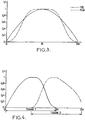
- the windows are of even symmetry with respect to a central sample, as illustrated in the examples presented on the figure 3 .
- T 1 and T 2 the transition for two consecutive frames denoted T 1 and T 2 is explained as follows.
- the first frame T 1 uses an analysis window h a1 and the second frame T 2 uses an analysis window h a2 .
- the weighting coefficient h has 1 ( n + M ) can be independent of the coefficient h a 1 ( n ).
- the coefficient h a 2 ( n ) can be independent of the coefficient h a 2 ( n + M ).
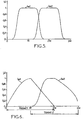
- the analysis window used in the first half of the frame T 2 (dotted line curve of the figure 4 ) is a " mirror " version of the analysis window used in the second half of the frame T 1 (curve in solid line of the figure 4 ).
- EDLER B "CODIERUNG VON AUDIOSIGNALEN MIT UEBERLAPPENDER TRANSFORMATION UND ADAPTIVEN FENSTERFUNKTIONEN", FREQUENZ, SCHIELE UND SCHON, BERLIN, DE, vol. 43, no. 9, September 1, 1989 (1989-09-01), pages 252-256 (XP000052987 - ISSN: 0016-1136 ).
- the decoder is therefore slave to the encoder and faithfully applies the window types decided by the encoder.
- the present invention improves the situation.
- it firstly aims at a method for encoding a digital signal, using an overlap transform using weighting windows, in which two blocks of signal samples, consecutive and of the same size 2 M , are weighted respectively by a first and a second analysis window. These windows each having a rising edge and a falling edge, the rising edge of the second window is different from the falling edge of the first window returned temporally.
- first and second windows can be chosen completely independently of one another, for example according to a criterion specific to characteristics of the signal determined on each of the two blocks.
- At least two types of weighting window are provided, in particular for the analysis with coding, and it is possible to change the type of weighting window to code a current block in which a particular event has been detected for example.
- This particular event may typically be a change in the statistical behavior of the signal, or the appearance of a particular phenomenon, such as a large jump of energy in the digital signal contained in the current frame.
- the aforementioned blocks may, by way of example, correspond to signal frames as indicated above.
- the invention already makes it possible to perform coding with windows adapted to each of the signals covered by these windows. This results in a better coding gain on each of the signal segments covered by the windows.
- the present invention is directed to a method for decoding a digital signal, using an overlap transform using weighting windows, in which two blocks of signal samples, consecutive and of the same size, are respectively weighted by a first and a second synthesis window, each of which comprises a rising edge and a falling edge with, in particular, the rising edge of the second window different from the falling edge of the first window returned temporally.
- the analysis windows of at least one of the two aforementioned types of analysis window include at least one end portion comprising coefficients that are all zero.
- the synthesis windows then have zeros at the beginning of the window. This implementation makes it possible to reduce a coding / decoding delay related to the transforms applied.
- the invention thus finds an advantageous application in interactive communications for which it is important that the delay be as small as possible.
- analysis windows chosen for the coding are independent of each other, which contributes to improving the quality of the coding.
- the determination of the best analysis window h a2 is preferably performed in a limited set of combinations. Indeed, a constraint remains imposed: the type of analysis filter used (in particular the prototype analysis filter corresponding to the coding weighting window) must be known by the decoder and must therefore be transmitted to the decoder.
- the choice of the window h a2 can therefore be performed from a dictionary of analysis windows ⁇ h 0 , h 1 , h 2 , ⁇ , h Nb -1 ⁇ where Nb represents the number of possible choices. He can then it is expected to code the index of the chosen window shape to an integer bit greater than or equal to log 2 ( Nb ) and then transmit this coded index to the decoder.
- synthesis windows On decoding, upon reception of the type of analysis window h a2 used in the coding, and after decoding of the frequency samples X k , then application of an inverse DCT transform, the synthesis windows must be applied in order to reconstitute the temporal samples. In order to limit the degradations on the reconstructed signal, preferentially, synthesis windows are chosen ensuring a " perfect " reconstruction at the level of the transform. In the absence of quantification, this inverse transform to direct transformation does not result in distortion. However, here we will retain as a criterion a reconstruction error of the transform remaining negligible, perceptibly, with respect to a predetermined perception threshold.
- the window h s 1 ( n + M ) is constructed by inversion of the temporal indices of the analysis window h a 2 ( n ) and, conversely, the window h s 2 ( n ) is constructed by inverting the temporal indices from the analysis window h to 1 ( n + M ).
- time reversal or “time index inversion” is used to define the shape of a window as a function of the opposite ( -n ) of the current index n .
- the weighting 1 / D ( n ) is a simple gain factor that corrects an amplitude distortion.
- the reconstruction operation involving the windows h 2 (M -1- n) and h 1 (2 M -1- n) provides a reconstructed signal devoid of temporal aliasing components.
- the gain D ' ( n ) can therefore be considered as a simple corrective term of amplitude.
- D ( n ) D ( M- 1- n ), which results in the fact that only M / 2 gain coefficients D ( n ) need to be calculated and / or stored. This property is also found for the gain D ' ( n ) in the synthesis.
- the gain functions D i, j ( n ) and their inverse functions D ' i, j ( n ) can be computed at the moment of their use or can be stored initially for use as needed, according to one or other of the aforementioned achievements.
- integral portions of weighting windows are set to zero in the analysis window h a 1 ( n + M ). More particularly, the window h a 1 ( n + M ) will contain a portion of M z zeros in the interval 2 M-M z ⁇ n ⁇ 2 M with M z ⁇ M / 2, as illustrated in FIG. figure 7 representing two typical windows in the sense of this realization.
- the windows h a1 and h a2 are independent of each other in the range between M and 2M.
- the only condition for choosing windows h a1 and h a2 is that the value D ( n ) is not zero for 0 ⁇ n ⁇ M.
- This zeroing of a portion of the analysis window h a 1 ( n + M ) has an advantageous influence on the reconstruction delay of the samples, as will be seen below.
- the T1 frame (having a size of 2 M samples) is processed by applying the window h a1 .
- the result of this weighting is processed by the DCT transform.
- the window h a1 contains zeros, the T1 frame can simply be encoded and emitted after 2M-M z samples. It is indeed not necessary to wait until the end of the 2 M samples of the T1 frame to send the corresponding coded frame, but simply to wait for the processing of its 2M-M first z samples. We thus gain an advance corresponding to the processing time of M z end samples of the frame T1 compared to the use of a conventional window in the sense of the state of the art.
- the homologous synthesis window h s1 has M z prime coefficients at zero (no longer at the end but at the beginning of the window), which allows, in the same way, to reconstruct the decoded samples with an advance of M z samples.
- the M z samples corresponding to the beginning of the synthesis window are, since the influence of the beginning of window h s1 is zero, reconstituted in reality by the previous window h s0 of the figure 8 .
- an analysis transform more adapted than others to the signal to be encoded, may be selected from analysis filters containing zeros at their termination (for example in a prototype filter dictionary), thus leading to a coding / decoding best suited to the signal and reduced delay of 2 M z compared to the state of the art.
- the gain D ' ( n ) at the decoding is 1 for all n and the reconstruction at the synthesis is carried out by weighting by the same analysis windows h a1 and h a2 simply returned temporally, this weighting being followed a simple addition.
- ⁇ not h not h 2 M - 1 - not + h not + M h M - 1 - not ⁇ 0 with 0 ⁇ n ⁇ M.
- Dashed lines are shown on the figure 11 the appearance of a global synthesis window hs i resulting from the two window portions h s1 and h s2 obtained from the initialization window h ( n ) of sinusoidal expression illustrated in solid line, according to this embodiment.
- the present invention also aims at a coding / decoding system as illustrated on the figure 9 in an embodiment described here by way of example.
- a coder COD receives a digital signal S to be coded and comprising a succession of samples X n . This succession of samples is treated in successive blocks B i , B i + 1 , etc., of 2 M samples each (step 101 of the figure 10A ).
- ⁇ P processing means of the encoder analyze the contents of the blocks B i one by one (step 102 of FIG.
- FIG. 10A for example according to a given criterion (entropy, coding gain, distortion / bitrate, or others) and deduce therefrom the analysis window ha i from a dictionary DIC of the encoder, which window is the most adapted to this block B i according to the aforementioned criterion.
- the analysis weighting window h i thus chosen is applied to the current block B i (step 103 of FIG. figure 10A ), which is then coded (step 104).
- a block B ' i resulting from this coding is then sent to the DECOD decoder of the figure 9 in the coded signal S ', with a code in the dictionary DIC of the selected analysis window ha i (step 105 of the figure 10A ).
- the DECOD decoder has received with a previous block B ' i-1 a dictionary code DIC designating a previously used analysis window ha i-1 .
- the decoder DECOD on reception of the coded signal S 'comprising a succession of coded blocks B' i , B ' i + 1 , etc. and window codes ha i having been used for analysis in the coding of the blocks B i (step 106 of FIG.
- figure 10B determines from its own dictionary DIC '(homologue of the dictionary DIC of the encoder) the half-windows hs i-1 ( n + M ) and hs i ( n ) to be used for the synthesis (step 107).
- the processing continues with the actual decoding of the weighted blocks B ' i with the windows hs i (corrected if necessary by the factor D') in the step 111, to deliver decoded blocks B i , B i +1 , etc. of the decoded signal S whose samples X n (without loss) are worth the initial samples X n since the perfect reconstruction is ensured.
- the present invention also aims at a coder COD of the type represented on the figure 9 , as well as a computer program intended to be stored in memory of such an encoder and whose algorithm can be represented by the flowchart of the figure 10A . It also relates to a DECOD decoder of the type represented on the figure 9 , as well as a computer program intended to be stored in memory of such a decoder and of which an algorithm can be represented by the flowchart of the figure 10B .
Landscapes
- Engineering & Computer Science (AREA)
- Physics & Mathematics (AREA)
- Multimedia (AREA)
- Signal Processing (AREA)
- Spectroscopy & Molecular Physics (AREA)
- Computational Linguistics (AREA)
- Health & Medical Sciences (AREA)
- Audiology, Speech & Language Pathology (AREA)
- Human Computer Interaction (AREA)
- Acoustics & Sound (AREA)
- Compression, Expansion, Code Conversion, And Decoders (AREA)
- Compression Or Coding Systems Of Tv Signals (AREA)
Claims (17)
- Verfahren zur Codierung eines digitalen Signals durch Transformation mit Überlagerung unter Verwendung von Gewichtungsfenstern,
wobei zwei Tastprobenblöcke des Signals, aufeinanderfolgend und von gleicher Größe (2M), von einem ersten (ha1) bzw. einem zweiten Analysefenster (ha2) gewichtet werden, und die ersten und zweiten Fenster je eine ansteigende und eine abfallende Flanke aufweisen, wobei die ansteigende Flanke des zweiten Fensters (ha2) sich von der abfallenden Flanke des zeitlich umgekehrten ersten Fensters (ha1) unterscheidet. - Codierverfahren nach Anspruch 1, wobei die ersten und zweiten Fenster unabhängig voneinander gemäß einem Kriterium gewählt werden, das Merkmalen des Signals eigen ist, die in jedem der zwei Blöcke bestimmt werden.
- Codierverfahren nach Anspruch 2, wobei das Wahlkriterium eines Gewichtungsfensters ein Element oder eine Kombination von Elementen ist von:- einer Maximierung (GTC) des Codiergewinns,- einer Entropie-Minimierung (JH) der transformierten Tastproben,- einer Optimierung (JRD) zwischen einer Verzerrung aufgrund der Codierung/Decodierung und einem von der Codierung geforderten Durchsatz.
- Codierverfahren nach einem der Ansprüche 1 bis 3, wobei jedes für die Codierung eines Blocks gewählte Gewichtungsfenster aus einem Verzeichnis möglicher Gewichtungsfenster ausgewählt wird, wobei jedem Fenster des Verzeichnisses ein Fensterindex zugeordnet ist,
und wobei der Index des ausgewählten Fensters an einen Decodierer übertragen wird, um bei der Decodierung ein Fenster entsprechend dem bei der Codierung ausgewählten Fenster zu verwenden. - Codierverfahren nach einem der vorhergehenden Ansprüche, wobei mindestens ein Teil der Analysefenster eine gewählte Anzahl (Mz) von aufeinanderfolgenden Gewichtungskoeffizienten des Werts Null am Fensterende aufweist, und die gewählte Anzahl von Koeffizienten Null (Mz) niedriger als ein Viertel der Gesamtanzahl von Koeffizienten (2M) eines Fensters ist.
- Verfahren zur Decodierung eines digitalen Signals durch Transformation mit Überlagerung unter Verwendung von Gewichtungsfenstern,
wobei zwei Tastprobenblöcke des Signals, aufeinanderfolgend und von gleicher Größe (2M), von einem ersten (hs1) bzw. zweiten Synthesefenster (hs2) gewichtet werden, wobei, da die ersten und zweiten Fenster je eine ansteigende Flanke und eine abfallende Flanke aufweisen, die ansteigende Flanke des zweiten Fensters (hs2) sich von der abfallenden Flanke des zeitlich umgekehrten ersten Fensters (hs1) unterscheidet,
und wobei von einem Codierer Informationen (cod(hai)) über Analysefenster erhalten werden, die nacheinander bei der Codierung verwendet werden, und die ersten und zweiten Synthesefenster (hs1, hs2) sich von ersten und zweiten Analysefenstern (ha1, ha2) ableiten, die nacheinander bei der Codierung verwendet werden,
wobei das erste bzw. zweite Synthesefenster sich vom zweiten bzw. ersten Analysefenster durch Invertierung zeitlicher Positionen von Gewichtskoeffizienten des zweiten bzw. ersten Analysefensters und durch Anwendung eines Korrekturfaktors (1/D(n)) an jeden Gewichtungskoeffizienten des zweiten bzw. ersten Analysefensters ableiten. - Decodierverfahren nach Anspruch 6, wobei das mit hs1 bezeichnete erste Synthesefenster und das mit hs2 bezeichnete zweite Synthesefenster sich vom mit ha1 und ha2 bezeichneten ersten bzw. zweiten Analysefenster durch Beziehungen der folgenden Art ableiten:
 - die Anzahl M so ist, dass ein Tastprobenblock 2M Tastproben aufweist,- n ein Index zeitlicher Position zwischen 0 und M-1 ist,- die Schreibweise h(n) den Gewichtungskoeffizienten des Fensters h und einer zeitlichen Position mit dem Index n bezeichnet,- die Schreibweise -n das Gegenteil des Index n bezeichnet, das die Invertierung zeitlicher Positionen ausdrückt,- und D(n) den Korrekturfaktor bezeichnet, der an einen Koeffizienten zeitlicher Position n anzuwenden ist, wobei dieser Faktor ungleich Null für n zwischen 0 und M-1 ist und vorgegeben wird durch
- Decodierverfahren nach einem der Ansprüche 6 und 7, wobei die Informationen über die Analysefenster Indices eines bei der Codierung verwendeten Verzeichnisses (DIC) von Fenstern sind, und wobei bei der Decodierung ein entsprechendes Verzeichnis (DIC') vorgesehen wird, das Synthesefenster entsprechend den bei der Codierung verwendeten Analysefenstern und durch den Korrekturfaktor (1/D(n)) vorkorrigiert aufweist, wobei jedes Fenster des entsprechenden Verzeichnisses einen Verzeichnisindex hat, der ausgehend vom an den Decodierer übertragenen Analysefensterindex bestimmbar ist.
- Decodierverfahren nach einem der Ansprüche 6 und 7, wobei die Informationen über die Analysefenster Indices eines bei der Codierung verwendeten Verzeichnisses (DIC) von Fenstern sind, und wobei bei der Decodierung ein gleiches Verzeichnis vorgesehen wird, das jeweilige Fenster aufweist, die von Prototyp-Filtern einer Analysefilterbank bei der Codierung stammen, und wobei bei der Decodierung angewendet wird:- eine Invertierung zeitlicher Positionen,- und der Korrekturfaktor (1/D(n)) der Koeffizienten eines Fensters des Verzeichnisses, wenn die Schätzung des Korrekturfaktors für einen Koeffizienten bis auf eine vorbestimmte Schwelle deutlich anders als 1 ist.
- Decodierverfahren nach einem der Ansprüche 6 bis 9, wobei mindestens ein Teil der Synthesefenster eine gewählte Anzahl von aufeinanderfolgenden Gewichtungskoeffizienten des Werts Null am Fensteranfang aufweist, und die gewählte Anzahl von Koeffizienten Null (Mz) niedriger als ein Viertel der Gesamtanzahl von Koeffizienten (2M) eines Fensters ist.
- Decodierverfahren nach Anspruch 10, wobei ein Synthesevorgang vorgesehen wird, indem ein Gewichtungsfenster entsprechend zwei Teilen von zeitlich umgekehrten Analysefenstern verwendet wird, wobei der Gewichtungsvorgang durch das Synthesefenster durch eine Addition fortgesetzt wird,
wobei die mit ha1 und ha2 bezeichneten Analysefensterteile abhängig von einem mit h(n) bezeichneten Initialisierungsfenster gemäß Ausdrücken der Art:ha1(n+M)=h(n+M)/Δ(n) und ha2(n)=h(n)/Δ(n) ausgedrückt werden, wobei die Anzahl M so ist, dass ein Block 2M Tastproben aufweist, und n ein zeitlicher Index ist, derart, dass gilt 0≤n<M, wobei Δ(n) ein Normalisierungsfaktor ungleich Null ist, der für jeden Index n so definiert wird, dass gilt 0≤n<M. - Decodierverfahren nach einem der Ansprüche 10 und 11, wobei zwei mit hs1 und hs2 bezeichnete Synthesefensterteile direkt ausgehend von einem mit h(n) bezeichneten Initialisierungsfenster bestimmt werden, das eine gewählte Anzahl (Mz) von Koeffizienten Null an seinem Anfang enthält, gemäß Ausdrücken der Art:hs1(n+M)=h(n+M)/Δ(n) und hs2(n)=h(n)/Δ(n), 0≤n<M, wobei die Anzahl M so ist, dass ein Block 2M Tastproben aufweist, und n ein zeitlicher Index derart ist, dass gilt 0≤n<M,wobei Δ(n) ein Normalisierungsfaktor ungleich Null ist, der für jeden Index n derart definiert ist, dass gilt 0≤n<M.
- Verfahren nach einem der Ansprüche 11 und 12, wobei der Normalisierungsfaktor durch einen Ausdruck der Art:

- Verfahren nach einem der Ansprüche 12 und 13, dadurch gekennzeichnet, dass das Initialisierungsfenster h(n) ausgedrückt wird durch:h(n)=0 für 0≤n<Mz und
 wobei Mz die gewählte Anzahl von Koeffizienten Null am Anfang des Initialisierungsfensters ist.
 - Codiervorrichtung eines digitalen Signals durch Transformation mit Überlagerung, die Gewichtungsfenster verwendet, dadurch gekennzeichnet, dass sie für die Durchführung des Verfahrens nach einem der Ansprüche 1 bis 5 konfiguriert ist.
- Decodiervorrichtung eines digitalen Signals durch Transformation mit Überlagerung, die Gewichtungsfenster verwendet, dadurch gekennzeichnet, dass sie für die Durchführung des Verfahrens nach einem der Ansprüche 6 bis 14 konfiguriert ist.
- EDV-Programm, das dazu bestimmt ist, im Speicher einer Codier- oder Decodiervorrichtung gespeichert zu werden, dadurch gekennzeichnet, dass es Anweisungen für die Durchführung des Codierverfahrens nach einem der Ansprüche 1 bis 5 oder des Decodierverfahrens nach einem der Ansprüche 6 bis 14 aufweist, wenn die Anweisungen von einem Prozessor der Vorrichtung ausgeführt werden.
Applications Claiming Priority (2)
| Application Number | Priority Date | Filing Date | Title |
|---|---|---|---|
| FR0760258 | 2007-12-21 | ||
| PCT/FR2008/052286 WO2009081003A1 (fr) | 2007-12-21 | 2008-12-11 | Codage/decodage par transformee, a fenetres adaptatives |
Publications (2)
| Publication Number | Publication Date |
|---|---|
| EP2232489A1 EP2232489A1 (de) | 2010-09-29 |
| EP2232489B1 true EP2232489B1 (de) | 2018-02-07 |
Family
ID=39689331
Family Applications (1)
| Application Number | Title | Priority Date | Filing Date |
|---|---|---|---|
| EP08865193.0A Active EP2232489B1 (de) | 2007-12-21 | 2008-12-11 | Auf transformation basierende codierung/decodierung mit adaptiven fenstern |
Country Status (9)
| Country | Link |
|---|---|
| US (1) | US8253609B2 (de) |
| EP (1) | EP2232489B1 (de) |
| JP (1) | JP5328804B2 (de) |
| KR (1) | KR101408183B1 (de) |
| CN (1) | CN101952888B (de) |
| BR (1) | BRPI0821091B1 (de) |
| ES (1) | ES2666719T3 (de) |
| RU (1) | RU2488898C2 (de) |
| WO (1) | WO2009081003A1 (de) |
Families Citing this family (7)
| Publication number | Priority date | Publication date | Assignee | Title |
|---|---|---|---|---|
| FR2977439A1 (fr) * | 2011-06-28 | 2013-01-04 | France Telecom | Fenetres de ponderation en codage/decodage par transformee avec recouvrement, optimisees en retard. |
| FR2977969A1 (fr) * | 2011-07-12 | 2013-01-18 | France Telecom | Adaptation de fenetres de ponderation d'analyse ou de synthese pour un codage ou decodage par transformee |
| EP2665208A1 (de) * | 2012-05-14 | 2013-11-20 | Thomson Licensing | Verfahren und Vorrichtung zur Komprimierung und Dekomprimierung einer High Order Ambisonics-Signaldarstellung |
| WO2013183928A1 (ko) * | 2012-06-04 | 2013-12-12 | 삼성전자 주식회사 | 오디오 부호화방법 및 장치, 오디오 복호화방법 및 장치, 및 이를 채용하는 멀티미디어 기기 |
| CA2921192C (en) * | 2013-08-23 | 2019-04-30 | Fraunhofer-Gesellschaft Zur Foerderung Der Angewandten Forschung E.V. | Apparatus and method for processing an audio signal using an aliasing error signal |
| US10224042B2 (en) * | 2016-10-31 | 2019-03-05 | Qualcomm Incorporated | Encoding of multiple audio signals |
| CN113630104B (zh) * | 2021-08-18 | 2022-08-23 | 杭州电子科技大学 | 图滤波器的滤波器组频率选择性误差交替优化设计方法 |
Family Cites Families (16)
| Publication number | Priority date | Publication date | Assignee | Title |
|---|---|---|---|---|
| JP3093178B2 (ja) * | 1989-01-27 | 2000-10-03 | ドルビー・ラボラトリーズ・ライセンシング・コーポレーション | 高品質オーディオ用低ビットレート変換エンコーダ及びデコーダ |
| CN1062963C (zh) | 1990-04-12 | 2001-03-07 | 多尔拜实验特许公司 | 用于产生高质量声音信号的解码器和编码器 |
| US5848391A (en) | 1996-07-11 | 1998-12-08 | Fraunhofer-Gesellschaft Zur Forderung Der Angewandten Forschung E.V. | Method subband of coding and decoding audio signals using variable length windows |
| US5899969A (en) * | 1997-10-17 | 1999-05-04 | Dolby Laboratories Licensing Corporation | Frame-based audio coding with gain-control words |
| US5903872A (en) * | 1997-10-17 | 1999-05-11 | Dolby Laboratories Licensing Corporation | Frame-based audio coding with additional filterbank to attenuate spectral splatter at frame boundaries |
| US5913190A (en) * | 1997-10-17 | 1999-06-15 | Dolby Laboratories Licensing Corporation | Frame-based audio coding with video/audio data synchronization by audio sample rate conversion |
| DK1386312T3 (da) * | 2001-05-10 | 2008-06-09 | Dolby Lab Licensing Corp | Forbedring af transient ydeevne af audio kodningssystemer med lav bithastighed ved reduktion af forudgående stöj |
| US6963842B2 (en) * | 2001-09-05 | 2005-11-08 | Creative Technology Ltd. | Efficient system and method for converting between different transform-domain signal representations |
| US7302111B2 (en) * | 2001-09-12 | 2007-11-27 | Micronic Laser Systems A.B. | Graphics engine for high precision lithography |
| WO2003038812A1 (en) * | 2001-11-02 | 2003-05-08 | Matsushita Electric Industrial Co., Ltd. | Audio encoding and decoding device |
| JP3881943B2 (ja) * | 2002-09-06 | 2007-02-14 | 松下電器産業株式会社 | 音響符号化装置及び音響符号化方法 |
| WO2004082288A1 (en) * | 2003-03-11 | 2004-09-23 | Nokia Corporation | Switching between coding schemes |
| FR2911228A1 (fr) * | 2007-01-05 | 2008-07-11 | France Telecom | Codage par transformee, utilisant des fenetres de ponderation et a faible retard. |
| EP2107556A1 (de) * | 2008-04-04 | 2009-10-07 | Fraunhofer-Gesellschaft zur Förderung der angewandten Forschung e.V. | Transform basierte Audiokodierung mittels Grundfrequenzkorrektur |
| EP3002750B1 (de) * | 2008-07-11 | 2017-11-08 | Fraunhofer-Gesellschaft zur Förderung der angewandten Forschung e.V. | Audiocodierer und -decodierer zur codierung und decodierung von audioabtastwerten |
| US8457975B2 (en) * | 2009-01-28 | 2013-06-04 | Fraunhofer-Gesellschaft Zur Foerderung Der Angewandten Forschung E.V. | Audio decoder, audio encoder, methods for decoding and encoding an audio signal and computer program |
-
2008
- 2008-12-11 BR BRPI0821091-8A patent/BRPI0821091B1/pt active IP Right Grant
- 2008-12-11 ES ES08865193.0T patent/ES2666719T3/es active Active
- 2008-12-11 CN CN2008801273013A patent/CN101952888B/zh active Active
- 2008-12-11 JP JP2010538857A patent/JP5328804B2/ja active Active
- 2008-12-11 WO PCT/FR2008/052286 patent/WO2009081003A1/fr not_active Ceased
- 2008-12-11 KR KR1020107016422A patent/KR101408183B1/ko active Active
- 2008-12-11 RU RU2010130311/08A patent/RU2488898C2/ru active
- 2008-12-11 US US12/809,666 patent/US8253609B2/en active Active
- 2008-12-11 EP EP08865193.0A patent/EP2232489B1/de active Active
Also Published As
| Publication number | Publication date |
|---|---|
| KR20110111231A (ko) | 2011-10-10 |
| WO2009081003A1 (fr) | 2009-07-02 |
| RU2010130311A (ru) | 2012-01-27 |
| ES2666719T3 (es) | 2018-05-07 |
| JP5328804B2 (ja) | 2013-10-30 |
| CN101952888B (zh) | 2013-10-09 |
| BRPI0821091B1 (pt) | 2020-11-10 |
| EP2232489A1 (de) | 2010-09-29 |
| CN101952888A (zh) | 2011-01-19 |
| US8253609B2 (en) | 2012-08-28 |
| RU2488898C2 (ru) | 2013-07-27 |
| BRPI0821091A2 (pt) | 2015-06-16 |
| JP2011507440A (ja) | 2011-03-03 |
| KR101408183B1 (ko) | 2014-06-19 |
| US20100283639A1 (en) | 2010-11-11 |
Similar Documents
| Publication | Publication Date | Title |
|---|---|---|
| EP2104936B1 (de) | Transformationsködierung mit geringer verzögerung unter verwendung von gewichtgsfenstern | |
| EP2232489B1 (de) | Auf transformation basierende codierung/decodierung mit adaptiven fenstern | |
| EP3161659B1 (de) | Wiederabtastung eines tonsignals durch interpolation zur codierung/decodierung mit geringer verzögerung | |
| EP1989706B1 (de) | Vorrichtung für wahrnehmungsgewichtung bei der tonkodierung/-dekodierung | |
| EP3391370B1 (de) | Adaptive kanalreduktionsverarbeitung zur codierung eines mehrkanalaudiosignals | |
| EP2452337B1 (de) | Zuweisung von bits bei einer verstärkten codierung/decodierung zur verbesserung einer hierarchischen codierung/decodierung digitaler tonsignale | |
| EP2452336B1 (de) | Verbesserte codierung/decodierung digitaler audiosignale | |
| WO2012131253A1 (fr) | Allocation par sous-bandes de bits de quantification de paramètres d'information spatiale pour un codage paramétrique | |
| EP2183851A1 (de) | Codierung/decodierung durch symbolpläne mit dynamischer berechnung von wahrscheinlichkeitstabellen | |
| EP2727107B1 (de) | Verzögerungsoptimierte kodierungs-/dekodierungs-gewichtungsfenster durch überlappungstransformation | |
| EP2080194B1 (de) | Dämpfung von stimmüberlagerung, im besonderen zur erregungserzeugung bei einem decoder in abwesenheit von informationen | |
| EP2347411B1 (de) | Vor-echo-dämpfung in einem digitalaudiosignal | |
| WO2015071613A2 (fr) | Transition d'un codage/décodage par transformée vers un codage/décodage prédictif | |
| EP2345029B1 (de) | Verfahren, Computerprogramm und Vorrichtung zur Dekodierung eines digitalen Audiosignals | |
| EP3138095B1 (de) | Verbesserte frameverlustkorrektur mit sprachinformationen | |
| WO2023165946A1 (fr) | Codage et décodage optimisé d'un signal audio utilisant un auto-encodeur à base de réseau de neurones | |
| EP2203915B1 (de) | Übertragungsfehlerverdeckung bei einem digitalem signal mit komplexitätsverteilung | |
| FR2884989A1 (fr) | Procede d'adaptation pour une interoperabilite entre modeles de correlation a court terme de signaux numeriques. | |
| FR2911227A1 (fr) | Codage par transformee, utilisant des fenetres de ponderation et a faible retard | |
| FR3164561A1 (fr) | Post-traitement d’un signal audio selon un modèle de post-traitement issu d’un entrainement optimisé | |
| WO2015145050A1 (fr) | Estimation d'un bruit de codage introduit par un codage en compression de type micda | |
| FR2980620A1 (fr) | Traitement d'amelioration de la qualite des signaux audiofrequences decodes |
Legal Events
| Date | Code | Title | Description |
|---|---|---|---|
| PUAI | Public reference made under article 153(3) epc to a published international application that has entered the european phase |
Free format text: ORIGINAL CODE: 0009012 |
|
| 17P | Request for examination filed |
Effective date: 20100709 |
|
| AK | Designated contracting states |
Kind code of ref document: A1 Designated state(s): AT BE BG CH CY CZ DE DK EE ES FI FR GB GR HR HU IE IS IT LI LT LU LV MC MT NL NO PL PT RO SE SI SK TR |
|
| AX | Request for extension of the european patent |
Extension state: AL BA MK RS |
|
| 17Q | First examination report despatched |
Effective date: 20101115 |
|
| DAX | Request for extension of the european patent (deleted) | ||
| APBK | Appeal reference recorded |
Free format text: ORIGINAL CODE: EPIDOSNREFNE |
|
| APBN | Date of receipt of notice of appeal recorded |
Free format text: ORIGINAL CODE: EPIDOSNNOA2E |
|
| APBR | Date of receipt of statement of grounds of appeal recorded |
Free format text: ORIGINAL CODE: EPIDOSNNOA3E |
|
| APAF | Appeal reference modified |
Free format text: ORIGINAL CODE: EPIDOSCREFNE |
|
| RAP1 | Party data changed (applicant data changed or rights of an application transferred) |
Owner name: ORANGE |
|
| APBT | Appeal procedure closed |
Free format text: ORIGINAL CODE: EPIDOSNNOA9E |
|
| TPAC | Observations filed by third parties |
Free format text: ORIGINAL CODE: EPIDOSNTIPA |
|
| GRAP | Despatch of communication of intention to grant a patent |
Free format text: ORIGINAL CODE: EPIDOSNIGR1 |
|
| STAA | Information on the status of an ep patent application or granted ep patent |
Free format text: STATUS: GRANT OF PATENT IS INTENDED |
|
| INTG | Intention to grant announced |
Effective date: 20170811 |
|
| RIC1 | Information provided on ipc code assigned before grant |
Ipc: G10L 19/02 20130101AFI20170803BHEP Ipc: H04N 19/60 20140101ALI20170803BHEP |
|
| GRAS | Grant fee paid |
Free format text: ORIGINAL CODE: EPIDOSNIGR3 |
|
| GRAA | (expected) grant |
Free format text: ORIGINAL CODE: 0009210 |
|
| STAA | Information on the status of an ep patent application or granted ep patent |
Free format text: STATUS: THE PATENT HAS BEEN GRANTED |
|
| AK | Designated contracting states |
Kind code of ref document: B1 Designated state(s): AT BE BG CH CY CZ DE DK EE ES FI FR GB GR HR HU IE IS IT LI LT LU LV MC MT NL NO PL PT RO SE SI SK TR |
|
| REG | Reference to a national code |
Ref country code: GB Ref legal event code: FG4D Free format text: NOT ENGLISH |
|
| REG | Reference to a national code |
Ref country code: AT Ref legal event code: REF Ref document number: 969083 Country of ref document: AT Kind code of ref document: T Effective date: 20180215 Ref country code: CH Ref legal event code: EP |
|
| REG | Reference to a national code |
Ref country code: IE Ref legal event code: FG4D Free format text: LANGUAGE OF EP DOCUMENT: FRENCH |
|
| REG | Reference to a national code |
Ref country code: DE Ref legal event code: R096 Ref document number: 602008053979 Country of ref document: DE |
|
| REG | Reference to a national code |
Ref country code: ES Ref legal event code: FG2A Ref document number: 2666719 Country of ref document: ES Kind code of ref document: T3 Effective date: 20180507 |
|
| REG | Reference to a national code |
Ref country code: NL Ref legal event code: MP Effective date: 20180207 |
|
| REG | Reference to a national code |
Ref country code: AT Ref legal event code: MK05 Ref document number: 969083 Country of ref document: AT Kind code of ref document: T Effective date: 20180207 |
|
| PG25 | Lapsed in a contracting state [announced via postgrant information from national office to epo] |
Ref country code: FI Free format text: LAPSE BECAUSE OF FAILURE TO SUBMIT A TRANSLATION OF THE DESCRIPTION OR TO PAY THE FEE WITHIN THE PRESCRIBED TIME-LIMIT Effective date: 20180207 Ref country code: LT Free format text: LAPSE BECAUSE OF FAILURE TO SUBMIT A TRANSLATION OF THE DESCRIPTION OR TO PAY THE FEE WITHIN THE PRESCRIBED TIME-LIMIT Effective date: 20180207 Ref country code: HR Free format text: LAPSE BECAUSE OF FAILURE TO SUBMIT A TRANSLATION OF THE DESCRIPTION OR TO PAY THE FEE WITHIN THE PRESCRIBED TIME-LIMIT Effective date: 20180207 Ref country code: NO Free format text: LAPSE BECAUSE OF FAILURE TO SUBMIT A TRANSLATION OF THE DESCRIPTION OR TO PAY THE FEE WITHIN THE PRESCRIBED TIME-LIMIT Effective date: 20180507 Ref country code: NL Free format text: LAPSE BECAUSE OF FAILURE TO SUBMIT A TRANSLATION OF THE DESCRIPTION OR TO PAY THE FEE WITHIN THE PRESCRIBED TIME-LIMIT Effective date: 20180207 Ref country code: CY Free format text: LAPSE BECAUSE OF FAILURE TO SUBMIT A TRANSLATION OF THE DESCRIPTION OR TO PAY THE FEE WITHIN THE PRESCRIBED TIME-LIMIT Effective date: 20180207 |
|
| PG25 | Lapsed in a contracting state [announced via postgrant information from national office to epo] |
Ref country code: PL Free format text: LAPSE BECAUSE OF FAILURE TO SUBMIT A TRANSLATION OF THE DESCRIPTION OR TO PAY THE FEE WITHIN THE PRESCRIBED TIME-LIMIT Effective date: 20180207 Ref country code: BG Free format text: LAPSE BECAUSE OF FAILURE TO SUBMIT A TRANSLATION OF THE DESCRIPTION OR TO PAY THE FEE WITHIN THE PRESCRIBED TIME-LIMIT Effective date: 20180507 Ref country code: IS Free format text: LAPSE BECAUSE OF FAILURE TO SUBMIT A TRANSLATION OF THE DESCRIPTION OR TO PAY THE FEE WITHIN THE PRESCRIBED TIME-LIMIT Effective date: 20180607 Ref country code: GR Free format text: LAPSE BECAUSE OF FAILURE TO SUBMIT A TRANSLATION OF THE DESCRIPTION OR TO PAY THE FEE WITHIN THE PRESCRIBED TIME-LIMIT Effective date: 20180508 Ref country code: SE Free format text: LAPSE BECAUSE OF FAILURE TO SUBMIT A TRANSLATION OF THE DESCRIPTION OR TO PAY THE FEE WITHIN THE PRESCRIBED TIME-LIMIT Effective date: 20180207 Ref country code: LV Free format text: LAPSE BECAUSE OF FAILURE TO SUBMIT A TRANSLATION OF THE DESCRIPTION OR TO PAY THE FEE WITHIN THE PRESCRIBED TIME-LIMIT Effective date: 20180207 Ref country code: AT Free format text: LAPSE BECAUSE OF FAILURE TO SUBMIT A TRANSLATION OF THE DESCRIPTION OR TO PAY THE FEE WITHIN THE PRESCRIBED TIME-LIMIT Effective date: 20180207 |
|
| PG25 | Lapsed in a contracting state [announced via postgrant information from national office to epo] |
Ref country code: MT Free format text: LAPSE BECAUSE OF FAILURE TO SUBMIT A TRANSLATION OF THE DESCRIPTION OR TO PAY THE FEE WITHIN THE PRESCRIBED TIME-LIMIT Effective date: 20180207 |
|
| PG25 | Lapsed in a contracting state [announced via postgrant information from national office to epo] |
Ref country code: EE Free format text: LAPSE BECAUSE OF FAILURE TO SUBMIT A TRANSLATION OF THE DESCRIPTION OR TO PAY THE FEE WITHIN THE PRESCRIBED TIME-LIMIT Effective date: 20180207 Ref country code: RO Free format text: LAPSE BECAUSE OF FAILURE TO SUBMIT A TRANSLATION OF THE DESCRIPTION OR TO PAY THE FEE WITHIN THE PRESCRIBED TIME-LIMIT Effective date: 20180207 |
|
| REG | Reference to a national code |
Ref country code: DE Ref legal event code: R097 Ref document number: 602008053979 Country of ref document: DE |
|
| PG25 | Lapsed in a contracting state [announced via postgrant information from national office to epo] |
Ref country code: CZ Free format text: LAPSE BECAUSE OF FAILURE TO SUBMIT A TRANSLATION OF THE DESCRIPTION OR TO PAY THE FEE WITHIN THE PRESCRIBED TIME-LIMIT Effective date: 20180207 Ref country code: SK Free format text: LAPSE BECAUSE OF FAILURE TO SUBMIT A TRANSLATION OF THE DESCRIPTION OR TO PAY THE FEE WITHIN THE PRESCRIBED TIME-LIMIT Effective date: 20180207 Ref country code: DK Free format text: LAPSE BECAUSE OF FAILURE TO SUBMIT A TRANSLATION OF THE DESCRIPTION OR TO PAY THE FEE WITHIN THE PRESCRIBED TIME-LIMIT Effective date: 20180207 |
|
| PLBE | No opposition filed within time limit |
Free format text: ORIGINAL CODE: 0009261 |
|
| STAA | Information on the status of an ep patent application or granted ep patent |
Free format text: STATUS: NO OPPOSITION FILED WITHIN TIME LIMIT |
|
| 26N | No opposition filed |
Effective date: 20181108 |
|
| PG25 | Lapsed in a contracting state [announced via postgrant information from national office to epo] |
Ref country code: SI Free format text: LAPSE BECAUSE OF FAILURE TO SUBMIT A TRANSLATION OF THE DESCRIPTION OR TO PAY THE FEE WITHIN THE PRESCRIBED TIME-LIMIT Effective date: 20180207 |
|
| REG | Reference to a national code |
Ref country code: CH Ref legal event code: PL |
|
| PG25 | Lapsed in a contracting state [announced via postgrant information from national office to epo] |
Ref country code: MC Free format text: LAPSE BECAUSE OF FAILURE TO SUBMIT A TRANSLATION OF THE DESCRIPTION OR TO PAY THE FEE WITHIN THE PRESCRIBED TIME-LIMIT Effective date: 20180207 Ref country code: LU Free format text: LAPSE BECAUSE OF NON-PAYMENT OF DUE FEES Effective date: 20181211 |
|
| REG | Reference to a national code |
Ref country code: IE Ref legal event code: MM4A |
|
| REG | Reference to a national code |
Ref country code: BE Ref legal event code: MM Effective date: 20181231 |
|
| PG25 | Lapsed in a contracting state [announced via postgrant information from national office to epo] |
Ref country code: IE Free format text: LAPSE BECAUSE OF NON-PAYMENT OF DUE FEES Effective date: 20181211 |
|
| PG25 | Lapsed in a contracting state [announced via postgrant information from national office to epo] |
Ref country code: BE Free format text: LAPSE BECAUSE OF NON-PAYMENT OF DUE FEES Effective date: 20181231 |
|
| PG25 | Lapsed in a contracting state [announced via postgrant information from national office to epo] |
Ref country code: CH Free format text: LAPSE BECAUSE OF NON-PAYMENT OF DUE FEES Effective date: 20181231 Ref country code: LI Free format text: LAPSE BECAUSE OF NON-PAYMENT OF DUE FEES Effective date: 20181231 |
|
| PG25 | Lapsed in a contracting state [announced via postgrant information from national office to epo] |
Ref country code: TR Free format text: LAPSE BECAUSE OF FAILURE TO SUBMIT A TRANSLATION OF THE DESCRIPTION OR TO PAY THE FEE WITHIN THE PRESCRIBED TIME-LIMIT Effective date: 20180207 |
|
| PG25 | Lapsed in a contracting state [announced via postgrant information from national office to epo] |
Ref country code: PT Free format text: LAPSE BECAUSE OF FAILURE TO SUBMIT A TRANSLATION OF THE DESCRIPTION OR TO PAY THE FEE WITHIN THE PRESCRIBED TIME-LIMIT Effective date: 20180207 |
|
| PG25 | Lapsed in a contracting state [announced via postgrant information from national office to epo] |
Ref country code: HU Free format text: LAPSE BECAUSE OF FAILURE TO SUBMIT A TRANSLATION OF THE DESCRIPTION OR TO PAY THE FEE WITHIN THE PRESCRIBED TIME-LIMIT; INVALID AB INITIO Effective date: 20081211 |
|
| PGFP | Annual fee paid to national office [announced via postgrant information from national office to epo] |
Ref country code: DE Payment date: 20251126 Year of fee payment: 18 |
|
| PGFP | Annual fee paid to national office [announced via postgrant information from national office to epo] |
Ref country code: GB Payment date: 20251119 Year of fee payment: 18 |
|
| PGFP | Annual fee paid to national office [announced via postgrant information from national office to epo] |
Ref country code: IT Payment date: 20251119 Year of fee payment: 18 |
|
| PGFP | Annual fee paid to national office [announced via postgrant information from national office to epo] |
Ref country code: FR Payment date: 20251120 Year of fee payment: 18 |
|
| PGFP | Annual fee paid to national office [announced via postgrant information from national office to epo] |
Ref country code: ES Payment date: 20260102 Year of fee payment: 18 |