EP2236171A2 - Apparat zur Behandlung von glandulären Erkrankungen und bösartigen Erkrankungen - Google Patents
Apparat zur Behandlung von glandulären Erkrankungen und bösartigen Erkrankungen Download PDFInfo
- Publication number
- EP2236171A2 EP2236171A2 EP10170460A EP10170460A EP2236171A2 EP 2236171 A2 EP2236171 A2 EP 2236171A2 EP 10170460 A EP10170460 A EP 10170460A EP 10170460 A EP10170460 A EP 10170460A EP 2236171 A2 EP2236171 A2 EP 2236171A2
- Authority
- EP
- European Patent Office
- Prior art keywords
- blood
- catheter
- gland
- major vein
- vein
- Prior art date
- Legal status (The legal status is an assumption and is not a legal conclusion. Google has not performed a legal analysis and makes no representation as to the accuracy of the status listed.)
- Withdrawn
Links
- 206010028980 Neoplasm Diseases 0.000 title claims abstract description 29
- 230000036210 malignancy Effects 0.000 title claims abstract description 21
- 201000010099 disease Diseases 0.000 title claims abstract description 16
- 208000037265 diseases, disorders, signs and symptoms Diseases 0.000 title claims abstract description 16
- 230000000762 glandular Effects 0.000 title description 2
- 210000004369 blood Anatomy 0.000 claims abstract description 106
- 239000008280 blood Substances 0.000 claims abstract description 106
- 210000003462 vein Anatomy 0.000 claims abstract description 103
- 238000011282 treatment Methods 0.000 claims abstract description 13
- 210000004907 gland Anatomy 0.000 claims description 76
- 239000003814 drug Substances 0.000 claims description 25
- 229940124597 therapeutic agent Drugs 0.000 claims description 24
- 210000000496 pancreas Anatomy 0.000 claims description 19
- 201000011510 cancer Diseases 0.000 claims description 9
- 210000001367 artery Anatomy 0.000 claims description 8
- 230000000849 parathyroid Effects 0.000 claims description 5
- 210000001685 thyroid gland Anatomy 0.000 claims description 5
- 239000003124 biologic agent Substances 0.000 claims description 4
- 239000012530 fluid Substances 0.000 claims description 4
- 210000002307 prostate Anatomy 0.000 claims description 4
- 238000011065 in-situ storage Methods 0.000 abstract description 7
- 238000000034 method Methods 0.000 description 44
- 210000000056 organ Anatomy 0.000 description 28
- 230000004087 circulation Effects 0.000 description 13
- 230000017531 blood circulation Effects 0.000 description 11
- 230000003211 malignant effect Effects 0.000 description 11
- 210000004027 cell Anatomy 0.000 description 9
- 238000001356 surgical procedure Methods 0.000 description 9
- 210000001519 tissue Anatomy 0.000 description 9
- 210000003171 tumor-infiltrating lymphocyte Anatomy 0.000 description 8
- 108010002350 Interleukin-2 Proteins 0.000 description 6
- 239000003795 chemical substances by application Substances 0.000 description 6
- 238000002560 therapeutic procedure Methods 0.000 description 5
- 238000013459 approach Methods 0.000 description 4
- 210000004204 blood vessel Anatomy 0.000 description 4
- 238000004113 cell culture Methods 0.000 description 3
- 239000000356 contaminant Substances 0.000 description 3
- 210000001198 duodenum Anatomy 0.000 description 3
- 238000001914 filtration Methods 0.000 description 3
- 230000001225 therapeutic effect Effects 0.000 description 3
- 208000001976 Endocrine Gland Neoplasms Diseases 0.000 description 2
- 230000002411 adverse Effects 0.000 description 2
- 239000002246 antineoplastic agent Substances 0.000 description 2
- 230000008901 benefit Effects 0.000 description 2
- 229940127089 cytotoxic agent Drugs 0.000 description 2
- 201000011523 endocrine gland cancer Diseases 0.000 description 2
- 208000028270 functioning endocrine neoplasm Diseases 0.000 description 2
- NOESYZHRGYRDHS-UHFFFAOYSA-N insulin Chemical compound N1C(=O)C(NC(=O)C(CCC(N)=O)NC(=O)C(CCC(O)=O)NC(=O)C(C(C)C)NC(=O)C(NC(=O)CN)C(C)CC)CSSCC(C(NC(CO)C(=O)NC(CC(C)C)C(=O)NC(CC=2C=CC(O)=CC=2)C(=O)NC(CCC(N)=O)C(=O)NC(CC(C)C)C(=O)NC(CCC(O)=O)C(=O)NC(CC(N)=O)C(=O)NC(CC=2C=CC(O)=CC=2)C(=O)NC(CSSCC(NC(=O)C(C(C)C)NC(=O)C(CC(C)C)NC(=O)C(CC=2C=CC(O)=CC=2)NC(=O)C(CC(C)C)NC(=O)C(C)NC(=O)C(CCC(O)=O)NC(=O)C(C(C)C)NC(=O)C(CC(C)C)NC(=O)C(CC=2NC=NC=2)NC(=O)C(CO)NC(=O)CNC2=O)C(=O)NCC(=O)NC(CCC(O)=O)C(=O)NC(CCCNC(N)=N)C(=O)NCC(=O)NC(CC=3C=CC=CC=3)C(=O)NC(CC=3C=CC=CC=3)C(=O)NC(CC=3C=CC(O)=CC=3)C(=O)NC(C(C)O)C(=O)N3C(CCC3)C(=O)NC(CCCCN)C(=O)NC(C)C(O)=O)C(=O)NC(CC(N)=O)C(O)=O)=O)NC(=O)C(C(C)CC)NC(=O)C(CO)NC(=O)C(C(C)O)NC(=O)C1CSSCC2NC(=O)C(CC(C)C)NC(=O)C(NC(=O)C(CCC(N)=O)NC(=O)C(CC(N)=O)NC(=O)C(NC(=O)C(N)CC=1C=CC=CC=1)C(C)C)CC1=CN=CN1 NOESYZHRGYRDHS-UHFFFAOYSA-N 0.000 description 2
- 201000010985 invasive ductal carcinoma Diseases 0.000 description 2
- 210000003734 kidney Anatomy 0.000 description 2
- 210000004185 liver Anatomy 0.000 description 2
- 208000026529 non-functioning endocrine neoplasm Diseases 0.000 description 2
- 230000008092 positive effect Effects 0.000 description 2
- 230000004044 response Effects 0.000 description 2
- 231100000331 toxic Toxicity 0.000 description 2
- 230000002588 toxic effect Effects 0.000 description 2
- 239000003053 toxin Substances 0.000 description 2
- 231100000765 toxin Toxicity 0.000 description 2
- 108700012359 toxins Proteins 0.000 description 2
- 206010000077 Abdominal mass Diseases 0.000 description 1
- 206010007270 Carcinoid syndrome Diseases 0.000 description 1
- 208000013016 Hypoglycemia Diseases 0.000 description 1
- 208000019025 Hypokalemia Diseases 0.000 description 1
- 102000004877 Insulin Human genes 0.000 description 1
- 108090001061 Insulin Proteins 0.000 description 1
- 230000000259 anti-tumor effect Effects 0.000 description 1
- 210000003445 biliary tract Anatomy 0.000 description 1
- 230000000740 bleeding effect Effects 0.000 description 1
- 230000000903 blocking effect Effects 0.000 description 1
- 230000036770 blood supply Effects 0.000 description 1
- 238000011109 contamination Methods 0.000 description 1
- 238000012258 culturing Methods 0.000 description 1
- 230000001461 cytolytic effect Effects 0.000 description 1
- 230000001079 digestive effect Effects 0.000 description 1
- 229940079593 drug Drugs 0.000 description 1
- 230000000694 effects Effects 0.000 description 1
- 230000002349 favourable effect Effects 0.000 description 1
- 235000011389 fruit/vegetable juice Nutrition 0.000 description 1
- 239000001963 growth medium Substances 0.000 description 1
- 238000001631 haemodialysis Methods 0.000 description 1
- 230000000322 hemodialysis Effects 0.000 description 1
- 238000002615 hemofiltration Methods 0.000 description 1
- 230000001951 hemoperfusion Effects 0.000 description 1
- 230000002218 hypoglycaemic effect Effects 0.000 description 1
- 210000002865 immune cell Anatomy 0.000 description 1
- 210000000987 immune system Anatomy 0.000 description 1
- 208000015181 infectious disease Diseases 0.000 description 1
- 238000001802 infusion Methods 0.000 description 1
- 239000007924 injection Substances 0.000 description 1
- 238000002347 injection Methods 0.000 description 1
- 238000003780 insertion Methods 0.000 description 1
- 230000037431 insertion Effects 0.000 description 1
- 229940125396 insulin Drugs 0.000 description 1
- 238000002955 isolation Methods 0.000 description 1
- 239000003446 ligand Substances 0.000 description 1
- 210000004698 lymphocyte Anatomy 0.000 description 1
- 230000000527 lymphocytic effect Effects 0.000 description 1
- 238000012986 modification Methods 0.000 description 1
- 230000004048 modification Effects 0.000 description 1
- 208000024896 potassium deficiency disease Diseases 0.000 description 1
- 230000003389 potentiating effect Effects 0.000 description 1
- 230000005855 radiation Effects 0.000 description 1
- 230000004936 stimulating effect Effects 0.000 description 1
- 210000002784 stomach Anatomy 0.000 description 1
- 230000002459 sustained effect Effects 0.000 description 1
- 208000024891 symptom Diseases 0.000 description 1
- 208000011580 syndromic disease Diseases 0.000 description 1
- 231100000057 systemic toxicity Toxicity 0.000 description 1
- 230000004797 therapeutic response Effects 0.000 description 1
- 231100000167 toxic agent Toxicity 0.000 description 1
- 239000003440 toxic substance Substances 0.000 description 1
- 231100000419 toxicity Toxicity 0.000 description 1
- 230000001988 toxicity Effects 0.000 description 1
- 210000001631 vena cava inferior Anatomy 0.000 description 1
Images


Classifications
-
- A—HUMAN NECESSITIES
- A61—MEDICAL OR VETERINARY SCIENCE; HYGIENE
- A61M—DEVICES FOR INTRODUCING MEDIA INTO, OR ONTO, THE BODY; DEVICES FOR TRANSDUCING BODY MEDIA OR FOR TAKING MEDIA FROM THE BODY; DEVICES FOR PRODUCING OR ENDING SLEEP OR STUPOR
- A61M25/00—Catheters; Hollow probes
- A61M25/10—Balloon catheters
- A61M25/1011—Multiple balloon catheters
-
- A—HUMAN NECESSITIES
- A61—MEDICAL OR VETERINARY SCIENCE; HYGIENE
- A61M—DEVICES FOR INTRODUCING MEDIA INTO, OR ONTO, THE BODY; DEVICES FOR TRANSDUCING BODY MEDIA OR FOR TAKING MEDIA FROM THE BODY; DEVICES FOR PRODUCING OR ENDING SLEEP OR STUPOR
- A61M1/00—Suction or pumping devices for medical purposes; Devices for carrying-off, for treatment of, or for carrying-over, body-liquids; Drainage systems
- A61M1/36—Other treatment of blood in a by-pass of the natural circulatory system, e.g. temperature adaptation, irradiation ; Extra-corporeal blood circuits
- A61M1/3613—Reperfusion, e.g. of the coronary vessels, e.g. retroperfusion
-
- A—HUMAN NECESSITIES
- A61—MEDICAL OR VETERINARY SCIENCE; HYGIENE
- A61M—DEVICES FOR INTRODUCING MEDIA INTO, OR ONTO, THE BODY; DEVICES FOR TRANSDUCING BODY MEDIA OR FOR TAKING MEDIA FROM THE BODY; DEVICES FOR PRODUCING OR ENDING SLEEP OR STUPOR
- A61M1/00—Suction or pumping devices for medical purposes; Devices for carrying-off, for treatment of, or for carrying-over, body-liquids; Drainage systems
- A61M1/36—Other treatment of blood in a by-pass of the natural circulatory system, e.g. temperature adaptation, irradiation ; Extra-corporeal blood circuits
- A61M1/3615—Cleaning blood contaminated by local chemotherapy of a body part temporarily isolated from the blood circuit
-
- A—HUMAN NECESSITIES
- A61—MEDICAL OR VETERINARY SCIENCE; HYGIENE
- A61M—DEVICES FOR INTRODUCING MEDIA INTO, OR ONTO, THE BODY; DEVICES FOR TRANSDUCING BODY MEDIA OR FOR TAKING MEDIA FROM THE BODY; DEVICES FOR PRODUCING OR ENDING SLEEP OR STUPOR
- A61M25/00—Catheters; Hollow probes
- A61M25/10—Balloon catheters
- A61M2025/1043—Balloon catheters with special features or adapted for special applications
- A61M2025/1052—Balloon catheters with special features or adapted for special applications for temporarily occluding a vessel for isolating a sector
Definitions
- This invention is directed to a method for treating glandular diseases and malignancies such as tumors and cancer in a human body. More particularly, the method of this invention includes isolating the diseased or malignant gland from the general circulation system of the body and treating the gland in situ without affecting other glands, organs or tissue of the body. Even more particularly, the method of this invention includes directly infusing the diseased or malignant gland with a therapeutic agent through the blood supplying the gland while eliminating contaminated blood from the affected gland and maintaining normal blood circulation throughout the body.
- organ malignancies have also been treated in situ with toxic agents such as chemotherapeutic agents and biological agents that are toxic moieties obtained from organic sources.
- toxic agents such as chemotherapeutic agents and biological agents that are toxic moieties obtained from organic sources.
- these agents cannot generally be introduced into the main blood circulation of the body in sufficient strength and/or quantity to achieve desired therapeutic responses in the affected organs as their negative toxic effects on other organs and tissues of the body off-set their potential positive therapeutic effect in the afflicted organ.
- TIL cells Tumor infiltrating Lymphocytic cell
- a further method treating malignant organs involves the surgical removal of the cancerous tumors from the affected organ and cultivating TIL cells in sufficient quantity so that the cultivated cells can be infused back into the patient for therapeutic treatment of the affected organ.
- this approach requires time to cultivate a sufficient quantity of the cells for adequate and effective treatment and the patient may not have the time necessary to benefit from this approach.
- pancreas is located behind the stomach and comprises two portions: one portion secretes digestive juices which pass into the duodenum ; the other portion secretes insulin which passes into the bloodstream.
- the pancreas can become afflicted with two major types of tumors : ductal adenocarcinoma and endocrine tumors that can be either non-functioning tumors or functioning tumors.
- Non-functioning tumors can result in obstruction of the biliary tract or the duodenum, bleeding into the Gl tract or be evidenced as abdominal masses.
- Functioning tumors can cause severe symptoms such as hypoglycemia, Zolinger-Elison syndrome, hypokalemia, carcinoid syndrome, and the like.
- Processes for treating diseased tissues and organs of the body such as the liver and the kidney are known such as those disclosed in US Patents 6,186,146 B1 to Glickman ; 5,411,479 to Bodden ; and, 5,089,662 to Bodden , et. al.
- these processes include the use of a double balloon catheter that is percutaneously inserted into the inferior vena cava of the affected organ to prepare it for the delivery of blood flowing between the organ and the heart. Blood vessels carrying blood from the organ are blocked by inflating the balloons in the catheter to prevent contaminated blood in the organ from entering the general circulation system of the body. The viscous blood from the organ contaminated with the therapeutic agent is then withdrawn from the body.
- the balloons in the double balloon catheter are positioned to span the vessels that carry the blood exiting from the organ and are expanded to block the vessels above and below the exit vessels to effectively isolate the blood flowing from the treated organ.
- the contaminated blood is removed from the body by means of an opening in a lumen provided in the catheter positioned between the expanded balloons.
- the contaminated blood is treated outside the body to remove the contaminants from it whereupon the cleaned, detoxified blood is returned to the general circulation system of the body.
- the method of this invention treats a diseased gland of the body by stimulating a response in the diseased gland in situ by infusing a therapeutic agent into the gland via the blood entering the gland and recovering the blood containing the therapeutic agent and removing it from the gland before the contaminated blood enters the general circulation system of the body. This is accomplished by blocking a section of a major vein of the gland without interrupting the blood flowing through the major veins and through the general circulation system of the body.
- the method of the invention comprises exposing a diseased or malignant gland of the body to an effective amount of a therapeutic agent by infusing said agent into the blood entering said gland ; creating an isolated section in a major vein that spans the area where tributary veins connect with said major vein, said major vein and said tributary veins being directly associated with said gland ; passing contaminated effluent blood from the tributary veins of said gland to said isolated section and capturing said contaminated blood therein; positioning a shunt in said major vein that by-passes said isolated section so that blood is able to concurrently and continuously flow through said major vein; and, evacuating said captured blood from said isolated section without exposing other glands, organs or tissue of the body to said contaminated effluent blood and without interrupting the general blood circulation in the system of said body.
- the isolated section is formed by inserting a catheter having spaced apart expandable means into the major vein so that when the expandable means are expanded, the isolated section is created.
- the spaced apart expandable means prevents contaminated effluent blood from circulating to the heart of a body.
- the evacuated, contaminated blood is withdrawn from the host body, cleaned, detoxified and then returned to the general circulation system of the host body.
- the method of the invention can be readily used to treat such glands of the body as the adrenals, pancreas, prostate, thyroid and parathyroid of a living host body and is particularly useful to treat diseases and malignancies of the pancreas.
- a significant and important advantage of the method of the invention over currently practiced protocols is that the toxicity or strength of the therapeutic agent used to treat the diseased or malignant gland is limited only by the level that the treated gland can withstand rather than by the adverse affect that the agent may have on other glands, organs or tissues of the body. It is also significant and important to note that blood contaminated with the therapeutic agent that flows from the treated gland can be isolated, removed and evacuated from the body, detoxified and cleansed and then be returned to the body without disrupting, interrupting or stopping the normal circulation of blood flowing through the body.
- TIL cells Tumor Infiltrating Lymphocytes
- This approach requires that IL-2 be used in sufficient quantity in the culture medium to expand and activate the TIL cells. It typically takes from about four to about six weeks to cultivate a sufficient number of cells to treat a patient. After a sufficient number of cells have been cultivated, they are placed in a transfusion device for delivery to a patient. As these cells are delivered to a patient, the patient also receives bolus injections of IL-2 every eight hours for five continuous days. This treatment protocol is commonly referred to as TIL/IL-2 therapy.
- TIL/1L-2 therapy is not always effective or successful. Cultivating an adequate supply of cells is labor intensive and expensive and can fail for many reasons relating to the cultivation conditions, the most common being contamination of the cell culture. Thus, each step of the cultivating process increases the likelihood of failure. When this occurs, precious time can easily be lost further delaying therapy, often discouraging a patient from undergoing another attempt.
- the method of this invention permits IL-2 to be delivered directly to a diseased area or malignancy in the patient rather than removing a diseased area or malignancy from a patient for cell cultivation. Since the method of the invention permits high doses of IL-2 to be infused directly to a diseased area or malignancy, surgical procedures are not necessary, side effects of administered therapy, especially infection, are avoided and potential failure and subsequent delay of cell cultivation are eliminated. By using the method of the invention, the anti-tumor of the body's immune system is enhanced.
- the method of the invention includes the insertion of a catheter into an artery feeding blood to a gland to be treated and infusing a therapeutic agent into the gland through the blood flowing into it.
- the catheter that can be used is one normally employed for such procedures.
- a second catheter containing a double balloon catheter having two, spaced apart inflatable balloons is inserted into a major vein of the circulation system and positioned therein so that the spaced balloons span that portion or section of the major vein where the tributary veins coming out of the gland connect with the major vein.
- the spaced balloons are then inflated so that they contact the inner wall of the major vein forming spaced blocks or plugs to effectively block the spanned portion within the major vein.
- the method of the invention also employs a by-pass that shunts blood flowing in a major vein through and past the section in the major vein that is blocked by the inflated, spaced balloons thereby permitting blood to flow through the major vein while blood flowing into the major vein from the gland undergoing therapeutic treatment is isolated and contained within the blocked section.
- the by-pass serves as an internal conduit or lumen within the double balloon catheter with its ends extending and protruding beyond the ends of the double balloon section of the catheter.
- the protruding ends of the lumen each has an opening formed in them, one of which is anterior (or cephalod) to and the other of which is posterior (or cauded) of the isolated section created by the spaced, inflated balloons.
- the shunt or by-pass can be opened to provide a blood flow path around the blocked section created by the inflated balloons enabling the normal flow of blood to be continued through the major vein without interruption.
- Blood flowing from the treated gland into the isolated section formed between the inflated balloons and containing a contaminating therapeutic agent is evacuated from the isolated section by means of one or more internal conduits or lumens provided within the double balloon catheter that are positioned between the spaced balloons.
- the internal conduits or lumens have a plurality of openings formed in them and the ends of these lumens also extend beyond the ends of the double balloon catheter. This permits the contaminated blood to enter these lumens through their openings enabling the contaminated blood to be evacuated from the isolated section between the inflated balloons that are contained in the major vein via the protruding ends of the internal lumens.
- the protruding ends of the internal lumens are connected to an external blood cleansing apparatus that removes the contaminating therapeutic agent from the blood and then returns the cleaned and detoxified blood back into the general circulation system of the body.
- the contaminated blood can be cleaned and detoxified by commercial means and techniques well known to the medical practitioner. These means and techniques include, among others, hemoperfusion cartridges, hemodialysis, hemofiltration, and hemoadsorption wherein antibodies, biological ligands, are used that are capable of detoxifying the blood. After the contaminating therapeutic agent has been removed from the blood, the cleaned, detoxified blood can be readministered back into the patient. Representative devices and apparatus that incorporate these techniques and means are disclosed in US Patents 4,820,261 ; 4,637,880 ; and 4,362,155 .
- a front end or head end portion of a double balloon catheter that is positioned in the blood vessel of a major vein 10 such as a section of a major vein.
- Blood vessel groups 11,12 and 13 represent tributary veins that deliver blood to the major vein and then return blood to the heart.
- the group of tributary veins 11 represent those veins that carry blood from a gland such as the pancreas to a major vein while the other groups of tributary veins 12 and 13 represent those that deliver blood to the major vein from other parts of the body.
- the catheter head end portion contains spaced apart inflatable balloons 15 and 16 which are shown in a deflated condition in Fig. 1 and in an inflated condition in Fig. 2 at 15a and 16a.
- the outer surface of the inflated balloons 15 and 16 contact the interior wall of the major vein to form a blockage or isolated area 10a in the vein 10 in which the catheter has been positioned as illustrated in Fig. 2 .
- This blocked and enclosed isolated area 10a spans the entry points of tributary veins 11 thereby capturing and containing blood entering the isolated area 10a created in the major vein from the tributary veins 11. This blockage interrupts the flow of blood through the major vein.
- a blood shunt having an internal conduit or lumen 17 is contained within the double balloon catheter so that it is longitudinally co-extensive within the interior of the double balloon catheter between the extremities of balloons 15 and 16 thereby providing a by-pass for the flow of blood.
- a plurality of openings 18 and 19 are formed in the outer ends of internal conduit or lumen 17 that extend beyond balloons 15 and 16.
- conduit or lumen 25 that communicate with the interiors of balloons 15 and 16.
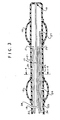
- Conduit or lumen 25 is also disposed longitudinally co-extensive within the double balloon catheter with the outer end of conduit or lumen 25 connected to an external control 42 as shown in Fig. 5 .
- conduits or lumens 22 and 24 can also be disposed longitudinally co-extensive within the double balloon catheter to its outer ends. These conduits or lumens 22 and 24 have a plurality of openings 21 and 23 formed therein that communicate with the interior of the double balloon catheter as shown in Fig. 3 . Although conduits or lumens 22 and 24 can be used for either infusion or evacuation purposes, they are used, in practicing the method of this invention, to evacuate blood from the isolated section 10a of the major vein. Conduits or lumens/openings 21/22 and 23/24 can be used separately or in combination depending upon the viscosity of the blood flowing through the tributary veins 11.
- This arrangement permits blood captured and contained within the isolated section 10a to be evacuated therefrom through either openings 21 in conduit or lumen 22 and/or openings 23 in conduit or lumen 24 through the outer end of the double balloon catheter while permitting blood to flow through the major vein by means of blood shunt 17 and its ports 18 and 19.
- the outer wall of the double balloon catheter is shown in Fig. 4 having internal conduits or lumens 17,22, 24, and 25 positioned within it.
- the central, internal portion 30 of the double balloon catheter is open along its longitudinal length enabling a guide wire (not shown) to be inserted into the central portion 30 so that the double balloon catheter can be slid along its length when positioning the double balloon catheter in the circulation system as is typically practiced in current medical procedures.
- FIG. 5 there is schematically illustrated in Fig. 5 conventional, external instrumentation associated with a host body 35.
- a catheter such as those used to deliver or evacuate fluids to or from internal parts of the body through arteries or veins of the circulation system, is inserted into an artery 34 between the heart and the gland, such as the pancreas, 37 to be treated.
- a small incision is made in the body 35 so that a medically acceptable guide wire can be inserted into the body and through an artery 34 in the opposite direction as the blood is flowing in the artery to the gland 37. This procedure is typically performed with observation through a fluoroscopic instrument.
- a therapeutic agent delivery means such as syringe 46, is connected to the outer end of and communicates with the catheter in delivering a therapeutic agent to the gland 37 to be treated.
- a second guide wire is inserted into the body and fed along a major vein 41 in the same direction that blood is flowing in that vein to the gland 37 to be treated.
- the outer end of the second guide wire is inserted into the open end of a rigid catheter having a tip that is tapered to a point so that it can be tightly fitted to the second guide wire.
- the body of the rigid catheter is encased in a tightly fitted, thin walled sheath and this catheter assemblage is then advanced into the vein over the second guide wire and the double balloon catheter is then urged along the second guide wire into the body through a major vein and positioned at the gland 37 to be treated.
- the major vein 10 with associated tributary veins 11 represent a like section of the major vein 41 shown in Fig. 5 where the tributary veins from the gland 37 to be treated connect with the major vein.
- the second catheter 40 represents the double balloon catheter with its interior blood shunt and its interior conduits and lumens as are illustrated in Figs. 1, 2 and 3 .
- Catheter 40 is inserted into a major vein 41 that is carrying blood from the gland 37 to be treated and from other parts of the body to the heart of the host body and is positioned substantially as shown in Figs. 1 and 2 with balloons 15 and 16 spanning the tributary veins 11 that are carrying blood from the gland 37 to be treated to the major vein.
- the double balloon catheter 40 When the double balloon catheter 40 is properly positioned in a major vein 41, it spans the tributary veins 11 from the gland 37 to be treated so that the blood flowing from the gland 37 can be captured and contained in the isolated section 10a of the major vein 41 when balloons 15 and 16 are expanded to their inflated conditions 15a and 16a to create the isolated section 10a in the major vein 41 that contains the tributary veins 11.
- Control 42 also includes a means for evacuating blood from the isolated section 10a by means of internal conduits or lumens 22 and 24 and their associated openings 21 and 23, respectively. Blood evacuated from the isolated section 10a is then fed to a filtering device 44 that is equipped with means to remove contaminants and toxins from the blood. Filtering device 44 that is equipped with means to remove contaminants and toxins from the blood. Filtering device 44 then returns the cleaned decontaminated and detoxified blood to the host body via a conduit 45 that is inserted into the general circulation system of the body 35.
- control 42 is activated to expand balloons 15 and 16 in the double balloon catheter 40 to their fully inflated condition 15a and 16a securely contacting and held against the interior wall of the major vein 41 ( Fig. 3 ).
- Inflated balloons 15a and 16a form anterior and posterior blockages creating isolated section 10a that brackets or spans tributary veins 11 from gland 37 permitting effluent blood from the gland 37 to be captured and maintained in the isolated section 10a until subsequently evacuated. Although this blockage is formed in the major vein 41, blood is permitted to continuously flow through the major vein 41 from the gland 37 by means of the blood shunt spanning the blocked portion of the major vein.
- a therapeutic agent such as a biological agent or IL-2 can be infused into the gland 37 to be treated with the blood flowing into the gland. After being contaminated with the therapeutic agent, this blood can be isolated and captured and then be subsequently evacuated from the body, cleaned and detoxified and then returned to the body. During this time, normal blood continues to flow through the rest of the body by means of the blood shunt by-pass.
- more than one catheter can be used to accommodate and overcome these complications.
- separate catheters can be employed to accomplish isolation and evacuation or shunt means for transporting blood past the isolated section of the vein.
- a second catheter can be used to block the blood flow through the branch of a vessel that extends from the isolated section.
- more than one catheter 36 can be used to infuse a therapeutic agent into a gland or a group of glands that have more than one source or arterial blood supply.
Landscapes
- Health & Medical Sciences (AREA)
- Heart & Thoracic Surgery (AREA)
- Life Sciences & Earth Sciences (AREA)
- Vascular Medicine (AREA)
- Engineering & Computer Science (AREA)
- Veterinary Medicine (AREA)
- Biomedical Technology (AREA)
- Hematology (AREA)
- Anesthesiology (AREA)
- Animal Behavior & Ethology (AREA)
- General Health & Medical Sciences (AREA)
- Public Health (AREA)
- Cardiology (AREA)
- Child & Adolescent Psychology (AREA)
- Biophysics (AREA)
- Pulmonology (AREA)
- Oncology (AREA)
- External Artificial Organs (AREA)
- Electrotherapy Devices (AREA)
Applications Claiming Priority (2)
| Application Number | Priority Date | Filing Date | Title |
|---|---|---|---|
| US10/435,579 US7022097B2 (en) | 2003-05-09 | 2003-05-09 | Method for treating glandular diseases and malignancies |
| EP04760908A EP1622674A4 (de) | 2003-05-09 | 2004-05-07 | Verfahren zur behandlung von glandulären erkrankungen und bösartigen erkrankungen |
Related Parent Applications (1)
| Application Number | Title | Priority Date | Filing Date |
|---|---|---|---|
| EP04760908.6 Division | 2004-05-07 |
Publications (2)
| Publication Number | Publication Date |
|---|---|
| EP2236171A2 true EP2236171A2 (de) | 2010-10-06 |
| EP2236171A3 EP2236171A3 (de) | 2010-10-27 |
Family
ID=33416975
Family Applications (2)
| Application Number | Title | Priority Date | Filing Date |
|---|---|---|---|
| EP04760908A Withdrawn EP1622674A4 (de) | 2003-05-09 | 2004-05-07 | Verfahren zur behandlung von glandulären erkrankungen und bösartigen erkrankungen |
| EP10170460A Withdrawn EP2236171A3 (de) | 2003-05-09 | 2004-05-07 | Apparat zur Behandlung von glandulären Erkrankungen und bösartigen Erkrankungen |
Family Applications Before (1)
| Application Number | Title | Priority Date | Filing Date |
|---|---|---|---|
| EP04760908A Withdrawn EP1622674A4 (de) | 2003-05-09 | 2004-05-07 | Verfahren zur behandlung von glandulären erkrankungen und bösartigen erkrankungen |
Country Status (4)
| Country | Link |
|---|---|
| US (1) | US7022097B2 (de) |
| EP (2) | EP1622674A4 (de) |
| CA (1) | CA2524858A1 (de) |
| WO (1) | WO2004101024A2 (de) |
Families Citing this family (23)
| Publication number | Priority date | Publication date | Assignee | Title |
|---|---|---|---|---|
| WO2007050628A2 (en) * | 2005-10-24 | 2007-05-03 | Andrew Young | Biliary/pancreatic shunt device and method for treatment of metabolic and other diseases |
| CA2727706A1 (en) * | 2008-06-10 | 2009-12-17 | Cornell University | Method and apparatus for repairing vacular abnormalties and/or other body lumen abnormalties using an endoluminal approach and a flowable forming material |
| US9295818B2 (en) * | 2008-08-21 | 2016-03-29 | Cornell University | Method and apparatus for accessing the wall of a vascular structure or other body lumen while simultaneously providing zone isolation and fluid bypass capability |
| CN102711894A (zh) * | 2009-11-09 | 2012-10-03 | 德尔凯斯系统公司 | 通过局部输送治疗剂以维持内稳态的方式治疗器官疾病的系统和方法 |
| WO2011112463A1 (en) | 2010-03-06 | 2011-09-15 | Fulton Richard Eustis Iii | Recovery catheter assembly |
| US9108029B2 (en) | 2012-05-21 | 2015-08-18 | Nfusion Vascular Systems, Llc | Recovery catheter assembly and method |
| US9901722B2 (en) | 2014-06-01 | 2018-02-27 | White Swell Medical Ltd | System and method for treatment of pulmonary edema |
| AU2016259860B2 (en) | 2015-05-11 | 2020-05-07 | White Swell Medical Ltd | Systems and methods for reducing pressure at an outflow of a duct |
| US11166729B2 (en) | 2015-12-22 | 2021-11-09 | Basis Medical, Llc | Method and device for secluding a body vessel |
| US11571217B2 (en) * | 2015-12-22 | 2023-02-07 | Basis Medical, Llc | Method and device for secluding a body vessel |
| IL266273B (en) | 2016-11-01 | 2022-09-01 | White Swell Medical Ltd | Systems and methods for treating excess fluids |
| WO2018158636A1 (en) | 2017-03-02 | 2018-09-07 | White Swell Medical Ltd | Systems and methods for reducing pressure at outflow of a duct |
| WO2018172848A2 (en) | 2017-03-19 | 2018-09-27 | White Swell Medical Ltd | Methods and devices for reducing pressure |
| US12144977B2 (en) | 2018-02-13 | 2024-11-19 | White Swell Medical Ltd | Intravascular catheters |
| US11931560B2 (en) | 2019-02-26 | 2024-03-19 | White Swell Medical Ltd | Devices and methods for treating edema |
| US11724095B2 (en) | 2019-02-26 | 2023-08-15 | White Swell Medical Ltd | Devices and methods for treating edema |
| US11717652B2 (en) | 2019-02-26 | 2023-08-08 | White Swell Medical Ltd | Devices and methods for treating edema |
| US11660426B2 (en) | 2019-02-26 | 2023-05-30 | White Swell Medical Ltd | Devices and methods for treating edema |
| US11793996B2 (en) | 2019-02-26 | 2023-10-24 | White Swell Medical Ltd | Devices and methods for treating edema |
| EP4710983A2 (de) | 2019-09-25 | 2026-03-18 | White Swell Medical Ltd | Vorrichtungen und verfahren zur interstitiellen entstauung |
| AU2021278107A1 (en) * | 2020-05-29 | 2023-01-05 | Basis Medical, Llc | Method and device for secluding a body vessel |
| US20210378678A1 (en) | 2020-06-08 | 2021-12-09 | White Swell Medical Ltd | Non-thrombogenic devices for treating edema |
| IL301495A (en) | 2020-10-01 | 2023-05-01 | White Swell Medical Ltd | Intravascular devices that limit flow to treat edema |
Citations (6)
| Publication number | Priority date | Publication date | Assignee | Title |
|---|---|---|---|---|
| US4362155A (en) | 1981-03-24 | 1982-12-07 | Skurkovich Simon V | Method and apparatus for the treatment of autoimmune and allergic diseases |
| US4637880A (en) | 1981-11-30 | 1987-01-20 | Cordis Laboratories, Inc. | Apparatus and method for therapeutic immunodepletion |
| US4820261A (en) | 1987-02-21 | 1989-04-11 | Bissendorf Peptide Gmbh | Device for the removal of therapeutic substances locally applied for use against solid tumors |
| US5089662A (en) | 1987-11-27 | 1992-02-18 | Schering Aktiengesellschaft | 2,2-difluorocyclopropylethane derivatives, processes for their preparation and their use as pesticides |
| US5411479A (en) | 1988-10-21 | 1995-05-02 | Bgh Medical Products Inc | Cancer treatment and catheter for use in treatment |
| US6186146B1 (en) | 1996-08-30 | 2001-02-13 | Delcath Systems Inc | Cancer treatment method |
Family Cites Families (6)
| Publication number | Priority date | Publication date | Assignee | Title |
|---|---|---|---|---|
| US5062662A (en) * | 1990-05-16 | 1991-11-05 | Cameron Robert W | Vehicle seatbelt having an integral airbag |
| WO1995005209A1 (en) * | 1993-08-18 | 1995-02-23 | Technology Development Center | Treatment chamber catheter |
| US5817046A (en) * | 1997-07-14 | 1998-10-06 | Delcath Systems, Inc. | Apparatus and method for isolated pelvic perfusion |
| WO1999033407A1 (en) * | 1997-12-31 | 1999-07-08 | Heartport, Inc. | Methods and apparatus for perfusion of isolated tissue structure |
| US6722370B1 (en) * | 1998-07-17 | 2004-04-20 | Corgentech, Inc. | Delivery of a composition to the liver by utilizing the portal vein |
| SE516215C2 (sv) * | 1999-07-10 | 2001-12-03 | Argmed Kb | Perfusionssystem samt pumpanordning och styrsystem för användning i perfusionssystemet |
-
2003
- 2003-05-09 US US10/435,579 patent/US7022097B2/en not_active Expired - Lifetime
-
2004
- 2004-05-07 CA CA002524858A patent/CA2524858A1/en not_active Abandoned
- 2004-05-07 EP EP04760908A patent/EP1622674A4/de not_active Withdrawn
- 2004-05-07 WO PCT/US2004/014191 patent/WO2004101024A2/en not_active Ceased
- 2004-05-07 EP EP10170460A patent/EP2236171A3/de not_active Withdrawn
Patent Citations (6)
| Publication number | Priority date | Publication date | Assignee | Title |
|---|---|---|---|---|
| US4362155A (en) | 1981-03-24 | 1982-12-07 | Skurkovich Simon V | Method and apparatus for the treatment of autoimmune and allergic diseases |
| US4637880A (en) | 1981-11-30 | 1987-01-20 | Cordis Laboratories, Inc. | Apparatus and method for therapeutic immunodepletion |
| US4820261A (en) | 1987-02-21 | 1989-04-11 | Bissendorf Peptide Gmbh | Device for the removal of therapeutic substances locally applied for use against solid tumors |
| US5089662A (en) | 1987-11-27 | 1992-02-18 | Schering Aktiengesellschaft | 2,2-difluorocyclopropylethane derivatives, processes for their preparation and their use as pesticides |
| US5411479A (en) | 1988-10-21 | 1995-05-02 | Bgh Medical Products Inc | Cancer treatment and catheter for use in treatment |
| US6186146B1 (en) | 1996-08-30 | 2001-02-13 | Delcath Systems Inc | Cancer treatment method |
Also Published As
| Publication number | Publication date |
|---|---|
| WO2004101024A2 (en) | 2004-11-25 |
| WO2004101024A3 (en) | 2005-10-20 |
| US20040225251A1 (en) | 2004-11-11 |
| EP2236171A3 (de) | 2010-10-27 |
| EP1622674A2 (de) | 2006-02-08 |
| CA2524858A1 (en) | 2004-11-25 |
| US7022097B2 (en) | 2006-04-04 |
| EP1622674A4 (de) | 2008-03-05 |
Similar Documents
| Publication | Publication Date | Title |
|---|---|---|
| US7022097B2 (en) | Method for treating glandular diseases and malignancies | |
| US6186146B1 (en) | Cancer treatment method | |
| CA2297080C (en) | Novel apparatus and method for isolated pelvic perfusion | |
| JPH02193676A (ja) | 癌の治療のためのカテーテル及び使い捨てキット | |
| EP0691866B1 (de) | Ballonkatheter und vorrichtung zur perfusion mit dem ballonkatheter | |
| Kock et al. | Implantable vascular access systems: experience in 1500 patients with totally implanted central venous port systems | |
| EP1444001B1 (de) | Katheteranordnung zur arzneimittelabgabe mit aufblasbarem ballon | |
| US20010041862A1 (en) | Novel apparatus and method of treating a tumor in the extremity of a patient | |
| JP3704151B2 (ja) | 身体の奥深い疾患部分の薬剤による治療装置 | |
| US6126631A (en) | Multi-lumen catheter system used in a blood treatment process | |
| CN201603254U (zh) | 导管和包括该导管的装置 | |
| JPH11504826A (ja) | 移殖式カテーテルとその使用方法 | |
| US8679058B2 (en) | System for treating arterial obstructions | |
| US20020138031A1 (en) | Methods and systems for subcutaneous graft implantation | |
| DE212017000340U1 (de) | Injektionsverfahren und Dilatationsvorrichtung für Druck und Verhältnis für gewünschtes Verhältnis für Flüssigkeiten und/oder Medikation in einer Vene mit einem Ballonkatheter | |
| US20060206048A1 (en) | Multi-lumen catheter system used in a blood treatment process | |
| WO1999002202A2 (en) | Catheter with slidable balloon | |
| US8172783B1 (en) | Conduit system for isolation of fluids in biological tissues | |
| US6641572B2 (en) | Interstitial space saturation | |
| HK1149515A (en) | Apparatus for treating glandular diseases and malignancies | |
| US20010014767A1 (en) | Tip configuration for radiation source wires | |
| JPH1147265A (ja) | 2バルーンカテーテル | |
| CA2361039A1 (en) | Access system and methods having reversible cannulas |
Legal Events
| Date | Code | Title | Description |
|---|---|---|---|
| PUAI | Public reference made under article 153(3) epc to a published international application that has entered the european phase |
Free format text: ORIGINAL CODE: 0009012 |
|
| PUAL | Search report despatched |
Free format text: ORIGINAL CODE: 0009013 |
|
| AC | Divisional application: reference to earlier application |
Ref document number: 1622674 Country of ref document: EP Kind code of ref document: P |
|
| AK | Designated contracting states |
Kind code of ref document: A2 Designated state(s): AT BE BG CH CY CZ DE DK EE ES FI FR GB GR HU IE IT LI LU MC NL PL PT RO SE SI SK TR |
|
| AK | Designated contracting states |
Kind code of ref document: A3 Designated state(s): AT BE BG CH CY CZ DE DK EE ES FI FR GB GR HU IE IT LI LU MC NL PL PT RO SE SI SK TR |
|
| 17P | Request for examination filed |
Effective date: 20110512 |
|
| 17Q | First examination report despatched |
Effective date: 20110718 |
|
| REG | Reference to a national code |
Ref country code: HK Ref legal event code: DE Ref document number: 1149515 Country of ref document: HK |
|
| STAA | Information on the status of an ep patent application or granted ep patent |
Free format text: STATUS: THE APPLICATION IS DEEMED TO BE WITHDRAWN |
|
| 18D | Application deemed to be withdrawn |
Effective date: 20141202 |
|
| REG | Reference to a national code |
Ref country code: HK Ref legal event code: WD Ref document number: 1149515 Country of ref document: HK |