EP2240542B1 - Schwachklebrige zusatzzusammensetzung für anwendungen im kraftfahrzeuginnenraum - Google Patents
Schwachklebrige zusatzzusammensetzung für anwendungen im kraftfahrzeuginnenraum Download PDFInfo
- Publication number
- EP2240542B1 EP2240542B1 EP09703955A EP09703955A EP2240542B1 EP 2240542 B1 EP2240542 B1 EP 2240542B1 EP 09703955 A EP09703955 A EP 09703955A EP 09703955 A EP09703955 A EP 09703955A EP 2240542 B1 EP2240542 B1 EP 2240542B1
- Authority
- EP
- European Patent Office
- Prior art keywords
- mol
- composition
- hindered amine
- amine light
- light stabilizer
- Prior art date
- Legal status (The legal status is an assumption and is not a legal conclusion. Google has not performed a legal analysis and makes no representation as to the accuracy of the status listed.)
- Active
Links
- 0 CCCC(C)C1=C*(C2*C2)C=CC(*)=C1C12*3(CCC4)C14C23 Chemical compound CCCC(C)C1=C*(C2*C2)C=CC(*)=C1C12*3(CCC4)C14C23 0.000 description 2
- CVTQNFKFUGOVCA-UHFFFAOYSA-N CC(C)(C1)NC(C)(C)CC1OC(CCCCCCCC(OC1CC(C)(C)NC(C)(C)C1)=O)=O Chemical compound CC(C)(C1)NC(C)(C)CC1OC(CCCCCCCC(OC1CC(C)(C)NC(C)(C)C1)=O)=O CVTQNFKFUGOVCA-UHFFFAOYSA-N 0.000 description 1
- LFQKGSGEHQLTOT-UHFFFAOYSA-N CC(C)COC(CCc(cc1C(C)(C)C)cc(C(C)(C)C)c1O)=O Chemical compound CC(C)COC(CCc(cc1C(C)(C)C)cc(C(C)(C)C)c1O)=O LFQKGSGEHQLTOT-UHFFFAOYSA-N 0.000 description 1
Classifications
-
- C—CHEMISTRY; METALLURGY
- C08—ORGANIC MACROMOLECULAR COMPOUNDS; THEIR PREPARATION OR CHEMICAL WORKING-UP; COMPOSITIONS BASED THEREON
- C08K—Use of inorganic or non-macromolecular organic substances as compounding ingredients
- C08K3/00—Use of inorganic substances as compounding ingredients
- C08K3/34—Silicon-containing compounds
-
- C—CHEMISTRY; METALLURGY
- C08—ORGANIC MACROMOLECULAR COMPOUNDS; THEIR PREPARATION OR CHEMICAL WORKING-UP; COMPOSITIONS BASED THEREON
- C08L—COMPOSITIONS OF MACROMOLECULAR COMPOUNDS
- C08L23/00—Compositions of homopolymers or copolymers of unsaturated aliphatic hydrocarbons having only one carbon-to-carbon double bond; Compositions of derivatives of such polymers
- C08L23/02—Compositions of homopolymers or copolymers of unsaturated aliphatic hydrocarbons having only one carbon-to-carbon double bond; Compositions of derivatives of such polymers not modified by chemical after-treatment
- C08L23/10—Homopolymers or copolymers of propene
-
- C—CHEMISTRY; METALLURGY
- C08—ORGANIC MACROMOLECULAR COMPOUNDS; THEIR PREPARATION OR CHEMICAL WORKING-UP; COMPOSITIONS BASED THEREON
- C08K—Use of inorganic or non-macromolecular organic substances as compounding ingredients
- C08K5/00—Use of organic ingredients
- C08K5/04—Oxygen-containing compounds
- C08K5/13—Phenols; Phenolates
- C08K5/134—Phenols containing ester groups
- C08K5/1345—Carboxylic esters of phenolcarboxylic acids
-
- C—CHEMISTRY; METALLURGY
- C08—ORGANIC MACROMOLECULAR COMPOUNDS; THEIR PREPARATION OR CHEMICAL WORKING-UP; COMPOSITIONS BASED THEREON
- C08K—Use of inorganic or non-macromolecular organic substances as compounding ingredients
- C08K5/00—Use of organic ingredients
- C08K5/16—Nitrogen-containing compounds
- C08K5/20—Carboxylic acid amides
-
- C—CHEMISTRY; METALLURGY
- C08—ORGANIC MACROMOLECULAR COMPOUNDS; THEIR PREPARATION OR CHEMICAL WORKING-UP; COMPOSITIONS BASED THEREON
- C08K—Use of inorganic or non-macromolecular organic substances as compounding ingredients
- C08K5/00—Use of organic ingredients
- C08K5/16—Nitrogen-containing compounds
- C08K5/34—Heterocyclic compounds having nitrogen in the ring
-
- C—CHEMISTRY; METALLURGY
- C08—ORGANIC MACROMOLECULAR COMPOUNDS; THEIR PREPARATION OR CHEMICAL WORKING-UP; COMPOSITIONS BASED THEREON
- C08L—COMPOSITIONS OF MACROMOLECULAR COMPOUNDS
- C08L2207/00—Properties characterising the ingredient of the composition
- C08L2207/02—Heterophasic composition
-
- C—CHEMISTRY; METALLURGY
- C08—ORGANIC MACROMOLECULAR COMPOUNDS; THEIR PREPARATION OR CHEMICAL WORKING-UP; COMPOSITIONS BASED THEREON
- C08L—COMPOSITIONS OF MACROMOLECULAR COMPOUNDS
- C08L23/00—Compositions of homopolymers or copolymers of unsaturated aliphatic hydrocarbons having only one carbon-to-carbon double bond; Compositions of derivatives of such polymers
- C08L23/02—Compositions of homopolymers or copolymers of unsaturated aliphatic hydrocarbons having only one carbon-to-carbon double bond; Compositions of derivatives of such polymers not modified by chemical after-treatment
- C08L23/04—Homopolymers or copolymers of ethene
- C08L23/06—Polyethylene
-
- C—CHEMISTRY; METALLURGY
- C08—ORGANIC MACROMOLECULAR COMPOUNDS; THEIR PREPARATION OR CHEMICAL WORKING-UP; COMPOSITIONS BASED THEREON
- C08L—COMPOSITIONS OF MACROMOLECULAR COMPOUNDS
- C08L23/00—Compositions of homopolymers or copolymers of unsaturated aliphatic hydrocarbons having only one carbon-to-carbon double bond; Compositions of derivatives of such polymers
- C08L23/02—Compositions of homopolymers or copolymers of unsaturated aliphatic hydrocarbons having only one carbon-to-carbon double bond; Compositions of derivatives of such polymers not modified by chemical after-treatment
- C08L23/10—Homopolymers or copolymers of propene
- C08L23/12—Polypropene
-
- C—CHEMISTRY; METALLURGY
- C08—ORGANIC MACROMOLECULAR COMPOUNDS; THEIR PREPARATION OR CHEMICAL WORKING-UP; COMPOSITIONS BASED THEREON
- C08L—COMPOSITIONS OF MACROMOLECULAR COMPOUNDS
- C08L23/00—Compositions of homopolymers or copolymers of unsaturated aliphatic hydrocarbons having only one carbon-to-carbon double bond; Compositions of derivatives of such polymers
- C08L23/02—Compositions of homopolymers or copolymers of unsaturated aliphatic hydrocarbons having only one carbon-to-carbon double bond; Compositions of derivatives of such polymers not modified by chemical after-treatment
- C08L23/16—Ethylene-propylene or ethylene-propylene-diene copolymers
-
- C—CHEMISTRY; METALLURGY
- C08—ORGANIC MACROMOLECULAR COMPOUNDS; THEIR PREPARATION OR CHEMICAL WORKING-UP; COMPOSITIONS BASED THEREON
- C08L—COMPOSITIONS OF MACROMOLECULAR COMPOUNDS
- C08L63/00—Compositions of epoxy resins; Compositions of derivatives of epoxy resins
Definitions
- the present invention relates to a new (extruded) polypropylene composition suitable for automotive interior as well as to its use.
- Polypropylene is the material of choice for articles in the automotive interior as it is - general speaking - resistant against many environmental influences.
- material used in automotive interior must fulfil in particular UV-stability, long term heat resistance as well as scratch resistance which cannot be achieved by the pure polymer material itself, like polypropylene.
- the polymer used must therefore blended with different additives.
- the standard requirements for UV-stability, long term heat resistance and scratch resistance have been steadily tighten.
- the amounts of additives have been increased to satisfy the ambitioned desires of the automotive industry.
- additives to improve for instance the scratch resistance or the long term heat resistance other important properties are negatively influenced.
- the material shows undesired stickiness, especially after storage at elevated temperatures and/or after UV-exposure.
- the object of the present invention is to provide an (extruded) composition which does not show any stickiness problems, in particular when stored for 90 hours and 500 hours respectively, at elevated temperatures, like 90 °C, and/or under UV-exposure.
- elevated temperatures like 90 °C
- UV-exposure the other desired properties for materials used in the automotive interior, like UV-stability, long term heat resistance as well as scratch resistance must be kept on a high level.
- the finding of the present invention is to provide an (extruded) polypropylene composition in which a certain amount of phenolic antioxidants and UV-stabilizers are replaced by a bisphenol A epoxy resin.
- extruded composition or the term “extruded polypropylene composition” throughout the present application shall indicate that the composition is not a dry blend of polypropylene and its additives but that the polypropylene and the additives after dry blending are extruded by an extruder and optionally pelletized.
- composition more preferably the extruded composition, as defined in the instant invention does not comprise, i.e. is free of, polyorganosiloxane. Additionally it is appreciated that the composition, preferably the extruded composition, according to the instant invention does not comprise, i.e. is free of, distearylthiodipropionate and/or zinc stearate.
- the invention is directed to a composition, preferably an extruded composition, comprising polypropylene, and
- the composition, preferably the extruded composition, as defined in the previous paragraph does not comprise, i.e. is free of, polyorganosiloxane. Yet more preferably the composition, preferably the extruded composition, as defined in the previous paragraph does not comprise, i.e. is free of, polyorganosiloxane, distearylthiodipropionate and zinc stearate. It is especially appreciated that the composition, preferably the extruded composition, as defined herein consists of the polypropylene and the additives (A) to (F) as defined in the instant invention.
- 1 ppm of additive corresponds to 1 mg additive in 1 kg (extruded) composition.
- the polypropylene composition preferably the extruded polypropylene composition
- the inventive polypropylene composition preferably the inventive extruded polypropylene composition, comprises only one phenolic antioxidant (A).
- phenolic antioxidant stands for any compound capable of slowing or preventing the oxidation of the polymer component, i.e. the polypropylene. Additionally such a phenolic antioxidant must of course comprise a phenolic residue.
- phenolic antioxidant(s) (A) is(are) sterically hindered.
- “Sterically hindered” according to this invention means that the hydroxyl group (HO-) of the phenolic residue is surrounded by sterical alkyl residues.
- the phenolic antioxidant(s) (A) comprise(s) preferably the residue of formula (I) wherein R 1 is (CH 3 ) 3 C-, CH 3 - or H, preferably (CH 3 ) 3 C-, and A 1 constitutes the remaining part of the phenolic antioxidant (A).
- a 1 is in para-position to the hydroxyl-group.
- the phenolic antioxidant shall preferably exceed a specific molecular weight.
- the phenolic antioxidant(s) (A) has(have) preferably a molecular weight (M w ) of more than 785 g/mol, more preferably more than 1100 g/mol.
- M w molecular weight
- the molecular weight should be not too high, i.e. not higher than 1300 g/mol.
- a preferred range is from 785 to 1300 g/mol, more preferably from 1000 to 1300 g/mol, yet more preferably from 1100 to 1300 g/mol.
- the phenolic antioxidant(s) (A) can be additionally defined by the amount of phenolic residues, in particular by the amount of phenolic residues of formula (I). Accordingly the phenolic antioxidant(s) (A) may comprise(s) 1, 2, 4 or more phenolic residue(s), preferably 1, 2, 4 or more phenolic residue(s) of formula (I).
- the antioxidant(s) (A) comprise mainly only carbon atoms, hydrogen atoms and minor amounts of O-atoms, mainly caused due to the hydroxyl group (HO-) of the phenolic residue.
- the antioxidant(s) (A) may comprise additionally minor amounts of N, S and P atoms.
- the antioxidant(s) (A) is(are) constituted by C, H, O, N and S atoms only, more preferably the antioxidant(s) (A) is(are) constituted by C, H and O only.
- the phenolic antioxidant(s) (A) shall have a rather high molecular weight.
- a high molecular weight is an indicator for several phenolic residues.
- the phenolic antioxidant(s) (A) has(have) 4 or more, especially 4, phenolic residue(s), like the phenolic residue of formula (I).
- phenolic antioxidant(s) (A) have been recognized compounds comprising at least one residue of formula (II) wherein R 4 is (CH 3 ) 3 C-, CH 3 -, or H, preferably (CH 3 ) 3 C-, and A 2 constitutes the remaining part of the phenolic antioxidant (A).
- the stickiness problems are mainly caused by the phenolic antioxidants as well as to some extent by the amine hindered UV-stabilizers, in particular low molecular weight amine hindered UV-stabilizers.
- the slip agents (C) are the main causer for the stickiness problems. Slip agents normally migrate continuously from the interior of the polymer material to its surface and guarantee thereby a permanent scratch resistance. Accordingly the slip agents have been regarded as the main causer of the stickiness problems.
- the special phenolic antioxidants and to some extent also specific UV-stabilizers influence significantly the stickiness behaviour of the polymer material.
- the phenolic antioxidant(s) (A) does(do) not comprise the moiety of formula (III) wherein R 2 is selected from the group consisting of -CH 2 -R 31 , -CH 2 -CH 2 -R 32 , -CH 2 -CH 2 -CH 2 -R 33 and -CH 2 -CH 2 -CH 2 -R 34 , preferably R 2 is -CH 2 -R 31 , and R 31 , R 32 , R 33 and R 34 can be independently any organic residue with the proviso that at least one of the R 31 , R 32 , R 33 and R 34 is a phenolic residue, preferably a phenolic residue of formula (I).
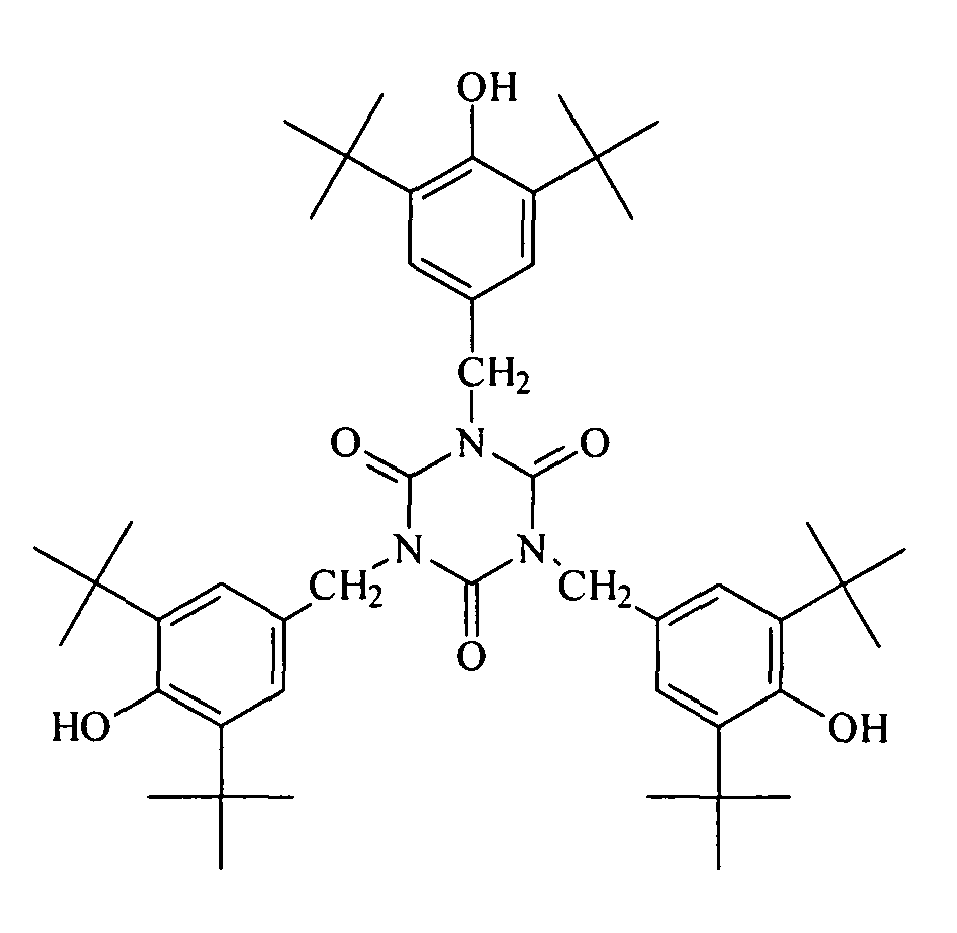
- inventive polypropylene composition preferably the inventive extruded polypropylene composition, is preferably free of phenolic antioxidants (A) which comprise the moiety of formula (IV) wherein R is any residue which may comprise a phenolic moiety.
- phenolic antioxidant (A) of formula (V) shall be not part of the inventive (extruded) polypropylene composition.
- the phenolic antioxidant(s) (A) is(are) selected from the group consisting of 2,6-di-tert-butyl-4-methylphenol (CAS no. 128-37-0; 220 g/mol), pentaerythrityl-tetrakis (3-(3,5-di-tert-butyl-4-hydroxyphenyl) propionate (CAS no. 6683-19-8; 1178 g/mol), octadecyl 3-(3',5'-di-tert-butyl-4-hydroxyphenyl)propionate (CAS no.
- the phenolic antioxidant(s) (A) is(are) selected from the group consisting of pentaerythrityl-tetrakis (3-(3,5-di-tert-butyl-4-hydroxyphenyl) propionate (CAS no. 6683-19-8; 1178 g/mol), octadecyl 3-(3',5'-di-tert-butyl-4-hydroxyphenyl)propionate (CAS no. 2082-79-3; 531 g/mol) bis(3,3-bis(3'-tert-butyl-4'-hydroxyphenyl)butanic acid) glycolester (CAS no.
- the most preferred phenolic antioxidant (A) is pentaerythrityl-tetrakis (3-(3,5-di-tert-butyl-4-hydroxyphenyl) propionate (CAS no. 6683-19-8; 1178 g/mol) having the formula (VI)
- the present polypropylene composition can additionally to the phenolic antioxidants (A) comprise one or more phosphorous antioxidant (F). More preferably the polypropylene composition, yet more preferably the extruded polypropylene composition, comprises only one type of phosphorous antioxidant (F).
- Preferred phosphorous antioxidants (F) are selected from the group consisting of tris-(2,4-di-tert-butylphenyl) phosphite (CAS no. 31570-04-4; 647 g/mol), tetrakis-(2,4-di-tert-butylphenyl)-4,4'-biphenylen-di-phosphonite (CAS no.
- organic phosphites in particular those as defined in the above list, as phosphorous antioxidants (F).
- the most preferred phosphorous antioxidant (F) is tris-(2,4-di-tert-butylphenyl) phosphite (CAS no. 31570-04-4; 647 g/mol).
- the inventive polypropylene composition preferably the inventive extruded polypropylene composition, must comprise at least one hindered amine light stabilizer (B).
- Hindered amine light stabilizers HALS are known in the art.
- such hindered amine light stabilizers are 2,6-alkyl-piperidine derivatives in particular 2,2,6,6-tetramethyl-piperidine derivatives.
- Especially suitable are hindered amine light stabilizers (B) of the formula (VII) wherein U constitutes the remaining part of the hindered amine light stabilizer (B).
- the hindered amine light stabilizers (B) do not absorb UV radiation, but act to inhibit degradation of the polypropylene. They slow down the photochemically initiated degradation reactions, to some extent in a similar way to antioxidants.
- the hindered amine light stabilizers (B) show a high efficiency and longevity due to a cyclic process wherein the hindered amine light stabilizers (B) are regenerated rather than consumed during the stabilization process. Accordingly, one advantage of the hindered amine light stabilizers (B) is that significant levels of stabilization are achieved at relatively low concentrations.
- hindered amine light stabilizer(s) (B) is(are) preferably selected from the group consisting of bis-(2,2,6,6-tetramethyl-4-piperidyl) sebacate (CAS no. 52829-07-9; 481 g/mol), bis-(1,2,2,6,6-pentamethyl-4-piperidyl) sebacate (CAS no. 41556-26-7; 509 g/mol), tetrakis (2,2,6,6-tetramethyl-4-piperidyl)-1,2,3,4-butane tetracarboxylate (CAS no.
- dimethyl succinate polymer with 4-hydroxy-2,2,6,6-tetramethyl-1-piperidin ethanol (CAS no. 65447-77-0; M w >2500 g/mol), poly((6-((1,1,3,3-tetramethylbutyl)amino)-1,3,5-triazin-2,4-diyl)-(2,2,6,6-tetramethyl-4-piperidyl)imino)-hexamethylen-((2,2,6,6-tetramethyl-4-piperidyl)imino)) (CAS no.
- 1,2,3,4-butanetetracarboxylic acid polymer with beta, beta, beta', beta'-tetramethyl-2,4,8,10-tetraoxospiro(5.5) undecane-3,9-diethanol, 1,2,2,6,6-pentamethyl-4-piperidinyl ester (CAS no. 101357-36-2; M w ca.
- hindered amine light stabilizer(s) (B) is(are) selected from the group consisting of bis-(2,2,6,6-tetramethyl-4-piperidyl) sebacate (CAS no. 52829-07-9; 481 g/mol), bis-(1,2,2,6,6-pentamethyl-4-piperidyl) sebacate (CAS no. 41556-26-7; 509 g/mol), tetrakis (2,2,6,6-tetramethyl-4-piperidyl)-1,2,3,4-butane tetracarboxylate (CAS no.
- the most preferred hindered amine light stabilizer(s) (B) is(are) 1,3,5-triazine-2,4,6-triamine, N 5 N"'-1,2-ethanediylbis[N-[3-[[4,6-bis[butyl(1,2,2,6,6-pentamethyl-4-piperidinyl)amino]-1,3,5-triazin-2-yl]amino]propyl]-N',N"-dibutyl-N',N"-bis(1,2,2,6,6-pentamethyl-4-piperidinyl)- (CAS no.
- hindered amine stabilizers (B) have a rather high molecular weight, i.e. a M w higher than 1000 g/mol, more preferably higher than 2000 g/mol. Accordingly hindered amine stabilizers (B) of the above mentioned list with a M w higher than 1000 g/mol, more preferably higher than 2000 g/mol are especially preferred.
- inventive polypropylene composition preferably the inventive extruded polypropylene composition, comprises at least one hindered amine light stabilizer (B) as defined above.
- the present invention comprises one or two different hindered amine light stabilizers (B).
- the inventive polypropylene composition preferably the inventive extruded polypropylene composition, comprises only one hindered amine light stabilizer (B).
- the inventive polypropylene composition preferably the inventive extruded polypropylene composition
- such hindered amine light stabilizer (B') comprises at least four residues, preferably at least 8 residues, more preferably 16 residues, of the formula (VII).
- One preferred example of such a hindered amine light stabilizer (B') is the compound of formula (VIII).
- inventive polypropylene composition preferably the inventive extruded polypropylene composition, may comprises two different hindered amine light stabilizer (B), preferably wherein at least one of the hindered amine light stabilizers (B) is a hindered amine light stabilizer (B') as defined in the previous paragraph.
- inventive polypropylene composition preferably the inventive extruded polypropylene composition, comprises at least one hindered amine light stabilizer (B') as defined in the previous paragraph and at least one further hindered amine light stabilizer (B"), wherein the hindered amine light stabilizers (B") has a lower molecular weight than the hindered amine light stabilizer (B'), i.e.
- the hindered amine light stabilizer (B') has a more residues of formula (VII) than the hindered amine light stabilizer (B").
- the hindered amine light stabilizer (B") is a 2,6 alkyl piperidine derivative in particular a 2,2,6,6-tetramethyl piperidine derivative or a 1,2,2,6,6-pentamethyl piperidine derivative (formula VII).
- the hindered amine light stabilizer (B") is a 2,2,6,6-tetramethyl piperidine derivative, like bis-(2,2,6,6-tetramethyl-4-piperidyl) sebacate (CAS no. 52829-07-9; M w 481 g/mol) (formula (X))
- the inventive polypropylene composition preferably the inventive extruded polypropylene composition, comprises two hindered amine light stabilizer (B), i.e. the hindered amine light stabilizers (B') and (B")
- the weight ratio of the hindered amine light stabilizer (B') to the hindered amine light stabilizer (B") [B'/B"] is at least 2.0 : 1.0, more preferably at least 2.5 : 1.0, yet more preferably 2.6 :1.0.
- the amount of the hindered amine light stabilizer (B") within the inventive extruded composition shall not exceed 500 ppm, more preferably shall not exceed 300 ppm. It is in particular preferred, as stated above, that the inventive polypropylene composition, preferably the inventive extruded polypropylene composition, comprises as hindered amine light stabilizer (B) only the hindered amine light stabilizer (B').
- inventive polypropylene composition preferably the inventive extruded polypropylene composition, must comprise at least one slip agent (C) being a fatty acid amide. More preferably the inventive polypropylene composition, preferably the inventive extruded polypropylene composition, comprises only one slip agent (C). Preferred types of slip agents (C) are unsaturated fatty acid amides. The amount of carbons of the fatty acids is preferably in the range of C10 to C25 carbon atoms.
- the slip agent(s) (C) is(are) preferably selected from the group consisting of cis-13-docosenoic amide (CAS no. 112-84-5; M w 337.6 g/mol), cis-9,10 octadecenoamide (CAS no. 301-02-0; M w 281.5 g/mol) octadecanoylamide (CAS no. 124-26-5; M w 283.5 g/mol), behenamide (CAS no. 3061-75-4; M w 339.5 g/mol), N,N'-ethylene-bis-stearamide (CAS no.
- cis-13-docosenoic amide (CAS no. 112-84-5; M w 337.6 g/mol) and/or cis-9,10 octadecenoamide (CAS no. 301-02-0; M w 281.5 g/mol).
- a further essential requirement of the present invention is the use of a specific epoxy resin (D).
- the specific selection of the epoxy resin (D) enables to reduce the amount of antioxidants and to some extent also the hindered amine light stabilizers and therewith the amount of the main causers in the (extruded) polypropylene composition of the stickiness problems at elevated temperatures and/or UV-exposure.
- the inventive polypropylene composition preferably the inventive extruded polypropylene composition, comprises a bisphenol A epoxy resin being a condensation product of 2,2-bis(p-glycidyloxyphenyl) propane with 2,2-bis(p-hydroxyphenyl) propane.
- such a bisphenol A epoxy resin has an average molecular weight (M w ) below 2000 g/mol (D). More preferably the epoxy resin (D) has an average molecular weight (M w ) in the range of 1100 to 2000 g/mol.
- the most preferred bisphenol A epoxy resin is that one with the CAS no. 25036-25-3 (M w 1100 to 1500 g/mol).
- the inventive polypropylene composition preferably the inventive extruded polypropylene composition, comprises only the bisphenol A epoxy resin (D) as defined in this paragraph but no other types of epoxy resins.
- the inventive polypropylene composition preferably the inventive extruded polypropylene composition, must comprise talc (E).
- Talc (E) is a mineral composed of hydrated magnesium silicate.
- the talc (E) according to this invention has a particle size (d50%) of below 3.0 ⁇ m (d50% indicates that 50 wt-% of the talc has a particle size below 3.0 ⁇ m) and/or a particle size (d98%) of below 15.0 ⁇ m (d98% indicates that 98 wt-% of the talc has a particle size below 15.0 ⁇ m), more preferably a particle size (d50%) of below 2.0 ⁇ m and/or a particle size (d98%) of below 10.0 ⁇ m, yet more preferably more preferably a particle size (d50%) of below 1.0 ⁇ m and/or a particle size (d98%) of below 5.0 ⁇ m.
- the components of the inventive polypropylene composition preferably the inventive extruded polypropylene composition, should be present in specific amounts.
- the weight ratio of the bisphenol A epoxy resin (D) to the talc (E) is 1.0 : 60, more preferably 1.0 : 64.
- inventive polypropylene composition preferably the inventive extruded polypropylene composition
- inventive polypropylene composition can comprise 50000 to 400000 ppm, preferably 100000 to 300000 ppm, yet more preferably of 140000 to 200000 ppm, of talc (E).
- inventive polypropylene composition preferably the inventive extruded polypropylene composition, comprises
- inventive polypropylene composition preferably the inventive extruded polypropylene composition, as defined in the previous paragraph does not comprise, i.e. is free of, polyorganosiloxane.
- inventive polypropylene composition preferably the inventive extruded polypropylene composition, as defined in the previous paragraph does not comprise, i.e. is free of, polyorganosiloxane, distearylthiodipropionate and zinc stearate.
- the polypropylene used in the inventive polypropylene composition can be any polypropylene, in particular polypropylenes suitable for the automotive interior.
- a preferred polypropylene is a heterophasic propylene copolymer.
- Heterophasic polypropylene systems are well known in the art and are systems in particular obtained in an at least two step process resulting in a multiphase structure comprising a propylene matrix and inclusions therein comprising amorphous elastomer. Such systems can be easily tailored for the automotive requirements by setting the comonomer content in the matrix and in the elastomeric phase respectively.
- Such a heterophasic propylene copolymer may have an MFR 2 in the range of 8.0 to 20.0 g/10min, more preferably in the range of 9.0 to 15.0 g/10min.
- a heterophasic propylene copolymer has a rubber phase being a propylene-ethylene rubber (EPR).
- the total comonomer, preferably ethylene, content is in the range of 10 to 30 wt.-% based on the total heterophasic propylene copolymer.
- the amount of xylene solubles may be in the range of 20 to 35 wt.-%, preferably 25 to 30 wt.-%.
- the polypropylene according to this invention may comprise further polymer components like a (isotactic) propylene homopolymer, preferably with an MFR 2 (230 °C) in the range of 10.0 to 30.0 g/10min, more preferably in the range of 15.0 to 25.0 g/10min, and/or a high density polyethylene (HDPE), preferably a high density polyethylene (HDPE) with a density of 0.962 to 0.966 g/cm 3 , like 0.964 g/cm 3 .
- the high density polyethylene (HDPE) may have an MFR 2 (190 °C) of 7.0 to 12 g/10min, more preferably of 7.5 to 8.5 g/10min, like 8 g/10min.
- the polypropylene according to this invention is a mixture of a heterophasic propylene copolymer and a high density polyethylene (HDPE).
- HDPE high density polyethylene
- an (isotactic) propylene homopolymer is present.
- the polypropylene is present in the inventive polypropylene composition, preferably the inventive extruded polypropylene composition, in the amount of at least 60.0 wt.-% , more preferably at least 70.0 wt.-%, yet more preferably at least 75.0 wt.-%, still more preferably of at least 80.0 wt.-%.
- the polypropylene is a polymer mixture in which at least one polymer component is a heterophasic propylene copolymer, like one as defined above
- the inventive polypropylene composition comprises at least 55.0 wt.-%, more preferably at least 60.0 wt.-%, of said heterophasic propylene copolymer.
- said mixture may comprise up to 15.0 wt.-%, like 11.5 to 12.5 wt.-% of an (isotactic) propylene homopolymer and/or up to 13.0 wt.-%, like 9.5 to 10.5 wt.-%, of a high density polyethylene (HDPE).
- HDPE high density polyethylene
- the present invention may comprise further additives like pigments, for instance in the form of a master batch. However it shall preferably not contain such additives which are explicitly excluded by this invention.
- the inventive polypropylene composition preferably the inventive extruded polypropylene composition
- a twin-screw extruder is used, like the twin-screw extruder ZSK40, to form preferably a strand.
- the (extruded) composition is pelletelized, preferably by pelletizing the extruded strand using well-known conventional techniques and apparatus. Accordingly the present invention is in particular directed to pellets of the extruded polypropylene composition according to this invention.
- the present invention is additionally directed to the use of a bisphenol A epoxy resin with an average molecular weight (M w ) below 2000 g/mol (D) for the regulation of stickiness, in particular to reduce the stickiness, of (extruded) compositions comprising
- reducing stickiness throughout the present invention shall indicate that (extruded) compositions (or articles) comprising the bisphenol A epoxy resin (D) have reduced stickiness (as defined in the example section) compared to (extruded) compositions (or articles) comprising the same components but no bisphenol A epoxy resin (D).
- the bisphenol A epoxy resin (D) Concerning the preferred embodiments of the bisphenol A epoxy resin (D), the polypropylene, the phenolic antioxidant (A), the hindered amine light stabilizer (B), the slip agent (C), the talc (E) and the phosphorous antioxidant (F) it is referred to the definitions made above.
- amounts of additives to be used in the (extruded) composition are the same as defined above. This applies in particular to the used amounts of the bisphenol A epoxy resin (D) to regulate, in particular to reduce, the stickiness of (extruded) compositions.
- the bisphenol A epoxy resin (D) as defined in the instant invention is used for (extruded) composition as defined herein, in particular to those compositions being free of polyorganosiloxane, distearylthiodipropionate and zinc stearate.
- the present invention has in particular discovered that surprisingly the phenolic antioxidants (A) and the hindered amine light stabilizers (B) in an (extruded) polypropylene composition comprising additionally talc (E) and optionally a slip agent (C) being a fatty acid amide contribute to the stickiness problems at elevated temperatures and/or UV-exposure.
- the present invention has further discovered that bisphenol A epoxy resin (D) can partially replace the phenolic antioxidants (A) and the hindered amine light stabilizers (B) without compromising other important properties like scratch resistance and long term heat resistance and on the other hand such a replacement significantly contributes to the reduction of stickiness.
- the present invention is preferably directed to the use of a bisphenol A epoxy resin with an average molecular weight (M w ) below 2000 g/mol (D) for the regulation of stickiness, in particular to reduce the stickiness, of (extruded) compositions comprising
- the present invention is directed to the use of a bisphenol A epoxy resin with an average molecular weight (M w ) below 2000 g/mol (D) for the regulation of stickiness, in particular to reduce the stickiness, of (extruded) compositions comprising
- the present invention is additionally directed to the use of the inventive (extruded) polypropylene composition, in particular to the use of pellets of the inventive (extruded) polypropylene composition, to regulate the stickiness, preferably to reduce the stickiness, of articles, in particular of moulded articles, made out of it.
- a preferred use of the inventive (extruded) polypropylene composition, i.e. of the pellets of the inventive (extruded) polypropylene composition is to regulate the stickiness, preferably to reduce the stickiness, of covering elements, like covering elements for vehicles.
- the present invention is directed to automotive articles, preferably automotive interior articles, like dashboards, door claddings, armrests or other interior trims, comprising the (extruded) polypropylene composition as defined herein.
- a Waters Alliance GPCV 2000 instrument equipped with refractive index detector and online viscosimeter is used with 3 x TSK-gel columns (GMHXL-HT) from TosoHaas and 1,2,4-trichlorobenzene (TCB, stabilized with 200 mg/L 2,6-Di tert butyl-4-methyl-phenol) as solvent at 145 °C and at a constant flow rate of 1 mL/min. 216.5 ⁇ L of sample solution are injected per analysis.
- the column set is calibrated using relative calibration with 19 narrow MWD polystyrene (PS) standards in the range of 0.5 kg/mol to 11 500 kg/mol and a set of well characterized broad polypropylene standards. All samples are prepared by dissolving 5 to 10 mg of polymer in 10 mL (at 160 °C) of stabilized TCB (same as mobile phase) and keeping for 3 hours with continuous shaking prior sampling in into the GPC instrument.
- PS polystyrene
- MFR 2 (230 °C) is measured according to ISO 1133 (230 °C, 2.16 kg load).
- MFR 2 (190 °C) is measured according to ISO 1133 (190 °C, 2.16 kg load).
- Ethylene content, in particular of the matrix, i.e. polypropylene (A), is measured with Fourier transform infrared spectroscopy (FTIR) calibrated with 13 C-NMR.
- FTIR Fourier transform infrared spectroscopy
- the xylene solubles (XS, wt.-%): Content of Xylene solubles (XS) is determined at 23 °C according ISO 6427.
- This testing method is being used to measure and define the surface stickiness of materials being used in automotive interior grades.
- Three plaques (not smaller than 100x50x4 mm, smooth surface on at least one side) or cut plaques from final parts shall be stored under specific conditions and afterwards undergo finger-testing as explained below (see Table 2).
- Testing conditions may be either oven testing at 90 °C for a period of 90 h and 500 h respectively or alternatively artificial weathering (UV testing) at conditions as described in table 1.
- Table 1 Test conditions artificial weathering black-panel-temperature 100+/-3°C chamber temperature 65+/-3°C rel. humidity 20+/-10% radiation intensity 60 W/m 2 filter system 3 UV-Special Suprax period of storage 5 x 72 h
- Finger tests shall be made on the warm parts (smooth surface) one minute after removal from oven.
- the tester's hands shall be dry and clean. After touching a sticky specimen the tester must wash hands to not influence the following tests.
- the test shall be carried out by 3 persons on 3 different plaques.
- the impression of finger testing shall be classified on the following stickiness index (see Table 2).
- the final stickiness index shall be calculated from the average of all three testers. Table 2: Stickiness Index: 1 Not sticky 2 Almost not sticky 3 Minor stickiness, not disturbing 4 Sticky (plate does not stick on finger when being lifted) 5 Very sticky (plate sticks on finger when being lifted)
- UV Stability was measured using the testing device XENO 1200 CPS (Co. HERAEUS).
- the grey scale (according DIN EN 20 105-A02) shall be measured. To pass the test, greyscale values not smaller than 4 must be measured.
- Apparatus XENO 1200 CPS (Co. HERAEUS) Table 3: Test conditions artificial weathering black-panel-temperature 90+/-2 °C chamber temperature 50+/-2 °C rel. humidity 20+/-10 % radiation intensity 75 W/m 2 filter system 3 UV-Special Suprax period of storage 1500 h
- Specimens must withstand at least 400 h of heat exposure without showing the for PP typical degradation appearance.
- the minimum period between injection moulding of specimens and scratch-testing was 7 days
- a minimum of 20 scratches parallel to each other are brought up at a load of 10 N with a distance of 2 mm.
- the application of the scratches is repeated perpendicular to each other, so that the result is a scratching screen.
- the scratching direction shall be unidirectional.
- the scratch resistance is reported as the difference of the luminance ⁇ L of the unscratched from the scratched areas. ⁇ L values can be measured using a spectrophotometer that fulfils the requirements to DIN 5033.
- Measured ⁇ L Values must be below a maximum of 1.5.
- the components are injection moulded using the machines ES 1050/250 HL (Co. ENGEL).
- the melt temperature is 240 °C, tool temperature 30 °C; injection time 2 s, cycle time 1 min, dwell pressure time 20 s at 50 bar, cooling time 25 s.
- the propylene copolymer is a heterophasic propylene copolymer having an MFR (230 °C/2.16 kg) of 11.5 g/10min and a total ethylene content of 16.0 wt.-%.
- the xylene solubles are in the range of 27.5 to 30.5 wt.-%.
- the propylene homopolymer is the commercial product HF 955 MO of Borealis (MFR (230 °C/2.16 kg) 20 g/10min; density 920 kg/m 3 ).
- the HDPE is the commercial product MG 9641 of Borealis (MFR (190 °C/2.16 kg) 8 g/10min; density 964 kg/m 3 ).
- Table 4 Properties of the examples CEX 1 CEX 2 IEX 3 IEX 4 CEX 5 CEX 6 PP Copolym. [wt.-%] ca. 58 1 ca. 58 1 ca.58 1 ca.58 1 ca.58 1 ca.58 1 PP Homopol.
Landscapes
- Chemical & Material Sciences (AREA)
- Health & Medical Sciences (AREA)
- Chemical Kinetics & Catalysis (AREA)
- Medicinal Chemistry (AREA)
- Polymers & Plastics (AREA)
- Organic Chemistry (AREA)
- Compositions Of Macromolecular Compounds (AREA)
- Vehicle Interior And Exterior Ornaments, Soundproofing, And Insulation (AREA)
Claims (21)
- Zusammensetzung umfassend Polypropylen und(a) 400 bis 2400 ppm an phenolischen Antioxidans (phenolischen Antioxidantien) (A)(b) 1000 bis 2500 ppm an einem gehinderten Aminlichtstabilisators (Aminlichtstabilisatoren) (B)(c) 1000 bis 2000 ppm an einem Gleitmittel (Gleitmitteln) (C), besagte(s) Gleitmittel ist ein Fettsäureamid,(d) 2000 bis 3000 ppm an Bisphenol A Epoxidharz mit einem mittleren Molekulargewicht (Mw) unterhalb von 2000 g/mol (D),(e) 50000 bis 400000 ppm an Talk (E), und(f) 500 bis 1500 ppm an zumindest einem phosphorischen Antioxidans (F) basierend auf besagter Zusammensetzung,
worin weiterhin besagte Zusammensetzung kein(g) Polyorganosiloxan,
und/oder(h) Distearylthiodipropionat
und/oder(i) Zinkstearat umfasst. - Zusammensetzung nach Anspruch 1, worin die Zusammensetzung eine extrudierte Zusammensetzung ist.
- Zusammensetzung nach irgendeinem der vorhergehenden Ansprüche, worin(a) das Gewichtsverhältnis an Bisphenol A Epoxidharz (D) zu Talk (E) 1,0 : 60, vorzugsweise 1,0 : 64, ist,
und/oder(b) die Zusammensetzung nur ein phenolisches Antioxidans (A) umfasst. - Zusammensetzung nach irgendeinem der vorhergehenden Ansprüche, worin das (die) phenolische(n) Antioxidans (Antioxidantien) (A)(a) sterisch gehindert ist (sind),
und/oder(b) ein Molekulargewicht (Mw) von mehr als 785 g/mol hat (haben). - Zusammensetzung nach irgendeinem der vorhergehenden Ansprüche, worin das (die) phenolische(n) Antioxidans (Antioxidantien) (A) den Rest der Formel (I) umfasst (umfassen)

R1 (CH3)3C-, CH3- oder H, vorzugsweise (CH3)3C- ist, und
A1 den verbleibenden Anteil des phenolischen Antioxidans (A) darstellt. - Zusammensetzung nach irgendeinem der vorhergehenden Ansprüche, worin das (die) phenolische(n) Antioxidans (Antioxidantien) (A) umfasst (umfassen) 1, 2, 4 oder mehr phenolische Reste, vorzugsweise 1, 2, 4 oder mehr phenolische Reste der Formel (I) wie in Anspruch 5 definiert.
- Zusammensetzung nach irgendeinem der vorhergehenden Ansprüche, worin das (die) phenolische(n) Antioxidans (Antioxidantien) (A)(a) mindestens einen Rest der Formel (II) umfasst (umfassen),

R4 (CH3)3C-, CH3-, oder H, vorzugsweise (CH3)3C- ist und,
A2 den verbleibenden Anteil des phenolischen Antioxidans (A) darstellt, und/oder(b) den Rest der Formel (III) nicht umfasst,
R2 ausgewählt ist aus der Gruppe bestehend aus -CH2-R31, -CH2-CH2-R32, -CH2-CH2-CH2-R33 und -CH2-CH2-CH2-CH2-R34, vorzugsweise R2 ausgewählt ist aus -CH2-R31, und R31, R32, R33 und R34 können unabhängig voneinander irgendein organischer Rest sein mit der Maßgabe, dass mindestens eines der R31, R32, R33 und R34 ein phenolischer Rest ist, vorzugsweise ein phenolischer Rest wie in Anspruch 5 definiert. - Zusammensetzung nach irgendeinem der vorhergehenden Ansprüche, worin(a) das phenolische Antioxidans (A) die Formel (VI) hat
 (b) die Zusammensetzung frei von phenolischen Antioxidantien (A) ist, die den Rest der Formel (IV) umfassen
- Zusammensetzung nach irgendeinem der vorhergehenden Ansprüche, worin(a) der (die) gehinderte(n) Aminlichtstabilisator (Aminlichtstabilisatoren) (B) den Rest der Formel (VII) umfasst (umfassen)

und/oder(b) die Zusammensetzung mindestens einen gehinderten Aminlichtstabilisator (B') mit einem Mw höher als 1000 g/mol, vorzugsweise höher als 2000 g/mol, umfasst. - Zusammensetzung nach irgendeinem der vorhergehenden Ansprüche, worin die Zusammensetzung(a) zwei verschiedene Aminlichtstabilisatoren (B), vorzugsweise worin einer der gehinderten Aminlichtstabilisatoren (B) mindesten einen Rest der Formel (VII), wie in Anspruch 9 definiert, umfasst
und/oder(b) mindestens ein gehinderter Aminlichtstabilisator (B'), der mindestens vier Reste, vorzugsweise mindestens acht Reste, noch bevorzugter 16 Reste, der Formel (VII), wie in Anspruch 9 definiert, umfasst. - Zusammensetzung nach irgendeinem der vorhergehenden Ansprüche, worin(a) die Zusammensetzung nicht mehr als 500 ppm an gehinderten Aminlichtstabilisatore(n) (B") mit einem Mw unter 1000 g/mol, noch bevorzugter unter 700 g/mol, umfasst,
und/oder(b) die Zusammensetzung mindestens einen gehinderten Aminlichtstabilisator (B'), wie in Anspruch 9 definiert, und mindestens einen weiteren gehinderten Aminlichstabilisator (B") umfasst, worin der gehinderte Aminlichtstabilisator (B') mehr Reste der Formel (VII), wie in Anspruch 9 definiert, hat, als der gehinderte Lichtstabilisator (B")
und/oder(c) das Gewichtsverhältnis des gehinderten Aminlichtstabilisators (B') zu dem gehinderten Aminlichtstabilisator (B") (B'/B") mindestens 2,0 : 1,0 ist, noch bevorzugter mindestens 2,5 : 1,0, ist. - Zusammensetzung nach irgendeinem der vorhergehenden Ansprüche, worin(a) die Zusammensetzung mindestens einen gehinderten Aminlichtstabilisator (B`) umfasst
und/oder(b) der gehinderte Aminlichstabilisator (B'), durch Formel (VIII) definiert ist, (c) der gehinderte Aminlichtstabilisator (B"), durch Formel (IX) definiert ist
- Zusammensetzung nach irgendeinem der vorhergehenden Ansprüche, worin zumindest ein Gleitmittel (C), vorzugsweise alle Gleitmittel (C), (eine) ungesättigte Fettsäureamid(e) ist (sind).
- Zusammensetzung nach irgendeinem der vorhergehenden Ansprüche, worin(a) das (die) Gleitmittel (C) ein Fettsäureamid ist (sind), welche(s) C10 bis C25 Kohlenstoffatome umfasst,
und/oder(b) die Zusammensetzung nur ein Gleitmittel (C) umfasst,
und/oder(c) das Gleitmittel (C) Cis-13-Docosenoidamid (mit der CAS Nr. 112-84-5; Mw 337.6 g/mol) und/oder Cis-9,10 Oktadecenoamid ist. - Zusammensetzung nach irgendeinem der vorhergehenden Ansprüche, worin das Bisphenol A Epoxidharz (D)(a) ein mittleres Molekulargewicht (Mw) im Bereich von 1100 bis 2000 g/mol hat, und/oder(b) ein Kondensationsprodukt von 2,2-Bis(p-Glycidyloxyphenyl)propan mit 2,2-Bis(p-Hydroxyphenyl)propan ist
und/oder(c) die CAS Nr. 25036-25-3 hat, d.h. Bisphenol A Diglycidylether Bisphenol A Polymer ist. - Automotivteil umfassend eine Zusammensetzung nach irgendeinem der vorhergehenden Ansprüche.
- Verwendung von Bisphenol A Epoxidharz mit einem mittleren Molekulargewicht (mm) unter 2000 g/mol für die Regulation der Klebrigkeit, insbesondere zur Reduzierung der Klebrigkeit einer (extrudierten) Zusammensetzung umfassend(a) Polypropylen,(d) mindestens ein, vorzugsweise ein, phenolisches Antioxidans (A),(e) mindestens einen gehinderten Aminlichtstabilisator (B),
optional mindestens ein, vorzugsweise ein, Gleitmittel (C), welches ein Fettsäureamid ist,(f) Talk (E), und(b) optional mindestens ein Phosphorantioxidans (F). - Verwendung nach Anspruch 17, worin das Bisphenol A Epoxidharz (D) die Klebrigkeit reguliert, wobei die Langzeithitzebeständigkeit konstant bleibt.
- Verwendung nach Anspruch 17 oder 18, worin die Menge an phenolischem Antioxidans (A) und/oder gehinderten Aminlichtstabilisator (B) mindestens um 30 Gew.-% in einer (extrudierten) Zusammensetzung durch die Verwendung des Bisphenol A Epoxidharzes (D) verglichen zu einer (extrudierten) Zusammensetzung, die die gleichen Komponenten enthält, aber kein Bisphenol A Epoxidharz (D) gesenkt wird.
- Verwendung nach irgendeinem der Ansprüche 17 bis 19, worin(a) die Zusammensetzung eine Zusammensetzung, wie in einem der Ansprüche 1 bis 15 definiert ist, aber ohne Bisphenol A Epoxidharz (D), und(b) das Bisphenol A Epoxidharz (D) ein Epoxidharz wie, in Ansprüchen 1 oder 15 definiert, ist.
- Verwendung der Zusammensetzung nach irgendeinem der Ansprüche 1 bis 15, um die Klebrigkeit eines Artikels, insbesondere von Abdeckelementen von Fahrzeugen zu regulieren.
Priority Applications (1)
| Application Number | Priority Date | Filing Date | Title |
|---|---|---|---|
| EP09703955A EP2240542B9 (de) | 2008-01-25 | 2009-01-19 | Schwachklebrige zusatzzusammensetzung für anwendungen im kraftfahrzeuginnenraum |
Applications Claiming Priority (4)
| Application Number | Priority Date | Filing Date | Title |
|---|---|---|---|
| EP08150670 | 2008-01-25 | ||
| EP08161364 | 2008-07-29 | ||
| PCT/EP2009/050555 WO2009092691A1 (en) | 2008-01-25 | 2009-01-19 | Low-sticky additive package for automotive interior applications |
| EP09703955A EP2240542B9 (de) | 2008-01-25 | 2009-01-19 | Schwachklebrige zusatzzusammensetzung für anwendungen im kraftfahrzeuginnenraum |
Publications (3)
| Publication Number | Publication Date |
|---|---|
| EP2240542A1 EP2240542A1 (de) | 2010-10-20 |
| EP2240542B1 true EP2240542B1 (de) | 2011-06-15 |
| EP2240542B9 EP2240542B9 (de) | 2012-01-11 |
Family
ID=40352459
Family Applications (1)
| Application Number | Title | Priority Date | Filing Date |
|---|---|---|---|
| EP09703955A Active EP2240542B9 (de) | 2008-01-25 | 2009-01-19 | Schwachklebrige zusatzzusammensetzung für anwendungen im kraftfahrzeuginnenraum |
Country Status (6)
| Country | Link |
|---|---|
| US (1) | US8721946B2 (de) |
| EP (1) | EP2240542B9 (de) |
| CN (1) | CN101970568B (de) |
| AT (1) | ATE513013T1 (de) |
| BR (1) | BRPI0906582B1 (de) |
| WO (1) | WO2009092691A1 (de) |
Families Citing this family (26)
| Publication number | Priority date | Publication date | Assignee | Title |
|---|---|---|---|---|
| MX2011012777A (es) * | 2009-06-08 | 2012-06-08 | Arcelormittal Investigacion Y Desarrollo Sl | Pieza compuesta a base de un metal y de un polimero, con aplicacion especialmente al campo de los automoviles. |
| WO2011023594A1 (en) * | 2009-08-28 | 2011-03-03 | Borealis Ag | Polypropylene-talc composite with reduced malodour |
| ES2430856T3 (es) | 2010-06-29 | 2013-11-22 | Borealis Ag | Composición de polietileno bimodal para artículos moldeados por inyección |
| BR112014000551B1 (pt) * | 2011-07-15 | 2020-03-03 | Borealis Ag | Composição de alto fluxo de poliolefina com baixo encolhimento e CLTE, artigo automotivo compreendendo a referida composição e método para preparar a referida composição |
| EP2557117B1 (de) * | 2011-08-11 | 2014-06-11 | Borealis AG | Zusammensetzung mit verbesserter Kratzbeständigkeit und Reduzieren von deren Oberflächenklebrigkeit |
| EP2742093B1 (de) * | 2011-08-11 | 2016-09-28 | Borealis AG | Polypropylenharzzusammensetzung mit verbesserter oberflächenhärte und kratzfestigkeit |
| ES2488415T3 (es) * | 2011-10-28 | 2014-08-27 | Borealis Ag | Composición blanda de polipropileno de alta fluidez |
| ES2651456T3 (es) | 2013-08-14 | 2018-01-26 | Borealis Ag | Composición de propileno con mejor resistencia al impacto a baja temperatura |
| JP6190961B2 (ja) | 2013-08-21 | 2017-08-30 | ボレアリス・アクチェンゲゼルシャフトBorealis Ag | 高い剛性および靭性を有する高流動ポリオレフィン組成物 |
| EP2860031B1 (de) | 2013-10-11 | 2016-03-30 | Borealis AG | In Maschinenrichtung ausgerichtete Folien für Etiketten |
| MX368147B (es) | 2013-11-22 | 2019-09-20 | Borealis Ag | Homopolímero de propileno de baja emisión con alto flujo de masa fundida. |
| BR112016011829B1 (pt) | 2013-12-04 | 2022-01-18 | Borealis Ag | Composição de polipropileno, fibra e trama soprada em fusão, artigo e uso da composição de polipropileno |
| CN105829364B (zh) | 2014-01-17 | 2017-11-10 | 博里利斯股份公司 | 用于制备丙烯/1‑丁烯共聚物的方法 |
| WO2015117958A1 (en) | 2014-02-06 | 2015-08-13 | Borealis Ag | Soft copolymers with high impact strength |
| PL3102634T3 (pl) | 2014-02-06 | 2020-11-16 | Borealis Ag | Miękkie i przezroczyste kopolimery odporne na uderzenia |
| CN114539675A (zh) | 2014-05-15 | 2022-05-27 | Sabic环球技术有限责任公司 | 稳定的树脂组合物 |
| ES2659731T3 (es) * | 2014-05-20 | 2018-03-19 | Borealis Ag | Composición de polipropileno para aplicaciones en interiores de automóviles |
| WO2016101139A1 (en) * | 2014-12-23 | 2016-06-30 | Borouge Compounding Shanghai Co., Ltd. | Fiber reinforced polypropylene composite |
| GB2549061B (en) | 2015-09-03 | 2020-04-01 | Si Group Switzerland Chaa Gmbh | Stabilising Compositions |
| JP6772685B2 (ja) * | 2016-09-06 | 2020-10-21 | 三菱ケミカル株式会社 | エポキシ化合物、エポキシ化合物の製造方法、エポキシ化合物含有組成物及びその硬化物 |
| CN109642049B (zh) | 2016-09-12 | 2021-07-09 | 巴斯夫欧洲公司 | 添加剂混合物 |
| CN109923164B (zh) * | 2016-11-09 | 2021-07-06 | 博里利斯股份公司 | 聚丙烯组合物 |
| EP3645616A1 (de) * | 2017-06-26 | 2020-05-06 | SABIC Global Technologies B.V. | Uv- und wärmestabile flammhemmende zusammensetzung aus glasgefülltem polymer und verstärkte artikel daraus |
| EP3898816A1 (de) | 2018-12-19 | 2021-10-27 | SABIC Global Technologies B.V. | Polymerzusammensetzung, artikel mit dieser zusammensetzung und verwendung des artikels |
| CN111471241A (zh) | 2019-01-24 | 2020-07-31 | Sabic环球技术有限责任公司 | 具有改进的落锤冲击抗性的天线壳体 |
| KR20230116038A (ko) * | 2020-12-09 | 2023-08-03 | 바스프 에스이 | 유기 물질 기반의 성형 물품 |
Family Cites Families (7)
| Publication number | Priority date | Publication date | Assignee | Title |
|---|---|---|---|---|
| JPH03137146A (ja) | 1989-10-24 | 1991-06-11 | Ube Ind Ltd | ポリプロピレン系樹脂組成物 |
| US5731376A (en) | 1991-07-29 | 1998-03-24 | Imperial Chemical Industries Plc | Scratch resistant polymer compositions and articles |
| GB9116356D0 (en) | 1991-07-29 | 1991-09-11 | Ici Plc | Scratch resistance polymer compositions and articles |
| GB9302069D0 (en) * | 1993-02-03 | 1993-03-24 | Ici Plc | Scratch resistant polymer compositions |
| DE59808425D1 (de) * | 1997-09-29 | 2003-06-26 | Ciba Sc Holding Ag | Staubfreie epoxidhaltige Stabilisatorgranulate und Verfahren zur Herstellung |
| US7390574B2 (en) | 2004-07-07 | 2008-06-24 | Ciba Specialty Chemicals Corporation | Scratch resistant polyolefins |
| CA2610329C (en) * | 2005-06-07 | 2014-01-21 | Ciba Specialty Chemicals Holding Inc. | Scratch resistant polyolefins |
-
2009
- 2009-01-19 AT AT09703955T patent/ATE513013T1/de not_active IP Right Cessation
- 2009-01-19 CN CN2009801031748A patent/CN101970568B/zh active Active
- 2009-01-19 EP EP09703955A patent/EP2240542B9/de active Active
- 2009-01-19 WO PCT/EP2009/050555 patent/WO2009092691A1/en not_active Ceased
- 2009-01-19 BR BRPI0906582A patent/BRPI0906582B1/pt active IP Right Grant
- 2009-01-19 US US12/735,460 patent/US8721946B2/en active Active
Also Published As
| Publication number | Publication date |
|---|---|
| CN101970568A (zh) | 2011-02-09 |
| US8721946B2 (en) | 2014-05-13 |
| ATE513013T1 (de) | 2011-07-15 |
| CN101970568B (zh) | 2013-11-20 |
| US20100286310A1 (en) | 2010-11-11 |
| EP2240542B9 (de) | 2012-01-11 |
| EP2240542A1 (de) | 2010-10-20 |
| BRPI0906582B1 (pt) | 2019-08-13 |
| BRPI0906582A2 (pt) | 2015-07-07 |
| BRPI0906582A8 (pt) | 2015-09-29 |
| WO2009092691A1 (en) | 2009-07-30 |
Similar Documents
| Publication | Publication Date | Title |
|---|---|---|
| EP2240542B9 (de) | Schwachklebrige zusatzzusammensetzung für anwendungen im kraftfahrzeuginnenraum | |
| EP2530116B1 (de) | Polypropylen-Talkum-Verbundstoff mit verringertem schlechten Geruch | |
| EP2445963B1 (de) | Geruchsneutrale innenbekleidung für kraftfahrzeuge | |
| EP2445957B1 (de) | Polypropylenmineralverbindung mit reduzierten flüchtigen Verbindungen | |
| US20100081741A1 (en) | Colour stabilised polyolefins | |
| EP2141193B1 (de) | Reduzierung flüchtiger Bestandteile stabilisierter Polypropylen-/Talkumzusammensetzungen mithilfe einer spezifischen sauren Umgebung | |
| CN107001741A (zh) | 纤维增强聚丙烯组合物 | |
| EP2445960B1 (de) | Stabilisierter polypropylen/talkum-verbundstoff | |
| EP2141196B1 (de) | Reduzierung flüchtiger Bestandteile stabilisierter Polypropylen-/Talkumzusammensetzungen mithilfe spezifischer Absorptionsmittel | |
| ES2367239T3 (es) | Conjunto de aditivos de baja pegajosidad para aplicaciones en interior de automóviles. | |
| EP2141197B1 (de) | Polypropylenzusammensetzung mit verbesserten Eigenschaften |
Legal Events
| Date | Code | Title | Description |
|---|---|---|---|
| PUAI | Public reference made under article 153(3) epc to a published international application that has entered the european phase |
Free format text: ORIGINAL CODE: 0009012 |
|
| 17P | Request for examination filed |
Effective date: 20100803 |
|
| AK | Designated contracting states |
Kind code of ref document: A1 Designated state(s): AT BE BG CH CY CZ DE DK EE ES FI FR GB GR HR HU IE IS IT LI LT LU LV MC MK MT NL NO PL PT RO SE SI SK TR |
|
| AX | Request for extension of the european patent |
Extension state: AL BA RS |
|
| GRAP | Despatch of communication of intention to grant a patent |
Free format text: ORIGINAL CODE: EPIDOSNIGR1 |
|
| DAX | Request for extension of the european patent (deleted) | ||
| GRAS | Grant fee paid |
Free format text: ORIGINAL CODE: EPIDOSNIGR3 |
|
| GRAA | (expected) grant |
Free format text: ORIGINAL CODE: 0009210 |
|
| AK | Designated contracting states |
Kind code of ref document: B1 Designated state(s): AT BE BG CH CY CZ DE DK EE ES FI FR GB GR HR HU IE IS IT LI LT LU LV MC MK MT NL NO PL PT RO SE SI SK TR |
|
| REG | Reference to a national code |
Ref country code: GB Ref legal event code: FG4D Ref country code: CH Ref legal event code: EP |
|
| REG | Reference to a national code |
Ref country code: IE Ref legal event code: FG4D |
|
| REG | Reference to a national code |
Ref country code: DE Ref legal event code: R096 Ref document number: 602009001564 Country of ref document: DE Effective date: 20110721 |
|
| REG | Reference to a national code |
Ref country code: NL Ref legal event code: VDEP Effective date: 20110615 |
|
| PG25 | Lapsed in a contracting state [announced via postgrant information from national office to epo] |
Ref country code: NO Free format text: LAPSE BECAUSE OF FAILURE TO SUBMIT A TRANSLATION OF THE DESCRIPTION OR TO PAY THE FEE WITHIN THE PRESCRIBED TIME-LIMIT Effective date: 20110915 Ref country code: HR Free format text: LAPSE BECAUSE OF FAILURE TO SUBMIT A TRANSLATION OF THE DESCRIPTION OR TO PAY THE FEE WITHIN THE PRESCRIBED TIME-LIMIT Effective date: 20110615 Ref country code: SE Free format text: LAPSE BECAUSE OF FAILURE TO SUBMIT A TRANSLATION OF THE DESCRIPTION OR TO PAY THE FEE WITHIN THE PRESCRIBED TIME-LIMIT Effective date: 20110615 Ref country code: LT Free format text: LAPSE BECAUSE OF FAILURE TO SUBMIT A TRANSLATION OF THE DESCRIPTION OR TO PAY THE FEE WITHIN THE PRESCRIBED TIME-LIMIT Effective date: 20110615 |
|
| REG | Reference to a national code |
Ref country code: ES Ref legal event code: FG2A Ref document number: 2367239 Country of ref document: ES Kind code of ref document: T3 Effective date: 20111031 |
|
| PG25 | Lapsed in a contracting state [announced via postgrant information from national office to epo] |
Ref country code: SI Free format text: LAPSE BECAUSE OF FAILURE TO SUBMIT A TRANSLATION OF THE DESCRIPTION OR TO PAY THE FEE WITHIN THE PRESCRIBED TIME-LIMIT Effective date: 20110615 Ref country code: GR Free format text: LAPSE BECAUSE OF FAILURE TO SUBMIT A TRANSLATION OF THE DESCRIPTION OR TO PAY THE FEE WITHIN THE PRESCRIBED TIME-LIMIT Effective date: 20110916 Ref country code: CY Free format text: LAPSE BECAUSE OF FAILURE TO SUBMIT A TRANSLATION OF THE DESCRIPTION OR TO PAY THE FEE WITHIN THE PRESCRIBED TIME-LIMIT Effective date: 20110615 Ref country code: FI Free format text: LAPSE BECAUSE OF FAILURE TO SUBMIT A TRANSLATION OF THE DESCRIPTION OR TO PAY THE FEE WITHIN THE PRESCRIBED TIME-LIMIT Effective date: 20110615 Ref country code: LV Free format text: LAPSE BECAUSE OF FAILURE TO SUBMIT A TRANSLATION OF THE DESCRIPTION OR TO PAY THE FEE WITHIN THE PRESCRIBED TIME-LIMIT Effective date: 20110615 Ref country code: AT Free format text: LAPSE BECAUSE OF FAILURE TO SUBMIT A TRANSLATION OF THE DESCRIPTION OR TO PAY THE FEE WITHIN THE PRESCRIBED TIME-LIMIT Effective date: 20110615 |
|
| PG25 | Lapsed in a contracting state [announced via postgrant information from national office to epo] |
Ref country code: BE Free format text: LAPSE BECAUSE OF FAILURE TO SUBMIT A TRANSLATION OF THE DESCRIPTION OR TO PAY THE FEE WITHIN THE PRESCRIBED TIME-LIMIT Effective date: 20110615 Ref country code: NL Free format text: LAPSE BECAUSE OF FAILURE TO SUBMIT A TRANSLATION OF THE DESCRIPTION OR TO PAY THE FEE WITHIN THE PRESCRIBED TIME-LIMIT Effective date: 20110615 |
|
| PG25 | Lapsed in a contracting state [announced via postgrant information from national office to epo] |
Ref country code: IS Free format text: LAPSE BECAUSE OF FAILURE TO SUBMIT A TRANSLATION OF THE DESCRIPTION OR TO PAY THE FEE WITHIN THE PRESCRIBED TIME-LIMIT Effective date: 20111015 Ref country code: EE Free format text: LAPSE BECAUSE OF FAILURE TO SUBMIT A TRANSLATION OF THE DESCRIPTION OR TO PAY THE FEE WITHIN THE PRESCRIBED TIME-LIMIT Effective date: 20110615 Ref country code: PT Free format text: LAPSE BECAUSE OF FAILURE TO SUBMIT A TRANSLATION OF THE DESCRIPTION OR TO PAY THE FEE WITHIN THE PRESCRIBED TIME-LIMIT Effective date: 20111017 Ref country code: CZ Free format text: LAPSE BECAUSE OF FAILURE TO SUBMIT A TRANSLATION OF THE DESCRIPTION OR TO PAY THE FEE WITHIN THE PRESCRIBED TIME-LIMIT Effective date: 20110615 |
|
| PG25 | Lapsed in a contracting state [announced via postgrant information from national office to epo] |
Ref country code: PL Free format text: LAPSE BECAUSE OF FAILURE TO SUBMIT A TRANSLATION OF THE DESCRIPTION OR TO PAY THE FEE WITHIN THE PRESCRIBED TIME-LIMIT Effective date: 20110615 Ref country code: SK Free format text: LAPSE BECAUSE OF FAILURE TO SUBMIT A TRANSLATION OF THE DESCRIPTION OR TO PAY THE FEE WITHIN THE PRESCRIBED TIME-LIMIT Effective date: 20110615 |
|
| PLBE | No opposition filed within time limit |
Free format text: ORIGINAL CODE: 0009261 |
|
| STAA | Information on the status of an ep patent application or granted ep patent |
Free format text: STATUS: NO OPPOSITION FILED WITHIN TIME LIMIT |
|
| 26N | No opposition filed |
Effective date: 20120316 |
|
| PG25 | Lapsed in a contracting state [announced via postgrant information from national office to epo] |
Ref country code: DK Free format text: LAPSE BECAUSE OF FAILURE TO SUBMIT A TRANSLATION OF THE DESCRIPTION OR TO PAY THE FEE WITHIN THE PRESCRIBED TIME-LIMIT Effective date: 20110615 |
|
| REG | Reference to a national code |
Ref country code: DE Ref legal event code: R097 Ref document number: 602009001564 Country of ref document: DE Effective date: 20120316 |
|
| PG25 | Lapsed in a contracting state [announced via postgrant information from national office to epo] |
Ref country code: MC Free format text: LAPSE BECAUSE OF NON-PAYMENT OF DUE FEES Effective date: 20120131 |
|
| REG | Reference to a national code |
Ref country code: IE Ref legal event code: MM4A |
|
| PG25 | Lapsed in a contracting state [announced via postgrant information from national office to epo] |
Ref country code: IE Free format text: LAPSE BECAUSE OF NON-PAYMENT OF DUE FEES Effective date: 20120119 |
|
| PG25 | Lapsed in a contracting state [announced via postgrant information from national office to epo] |
Ref country code: MK Free format text: LAPSE BECAUSE OF FAILURE TO SUBMIT A TRANSLATION OF THE DESCRIPTION OR TO PAY THE FEE WITHIN THE PRESCRIBED TIME-LIMIT Effective date: 20110615 |
|
| PG25 | Lapsed in a contracting state [announced via postgrant information from national office to epo] |
Ref country code: BG Free format text: LAPSE BECAUSE OF FAILURE TO SUBMIT A TRANSLATION OF THE DESCRIPTION OR TO PAY THE FEE WITHIN THE PRESCRIBED TIME-LIMIT Effective date: 20110915 |
|
| PG25 | Lapsed in a contracting state [announced via postgrant information from national office to epo] |
Ref country code: MT Free format text: LAPSE BECAUSE OF FAILURE TO SUBMIT A TRANSLATION OF THE DESCRIPTION OR TO PAY THE FEE WITHIN THE PRESCRIBED TIME-LIMIT Effective date: 20110615 |
|
| REG | Reference to a national code |
Ref country code: CH Ref legal event code: PL |
|
| PG25 | Lapsed in a contracting state [announced via postgrant information from national office to epo] |
Ref country code: LI Free format text: LAPSE BECAUSE OF NON-PAYMENT OF DUE FEES Effective date: 20130131 Ref country code: CH Free format text: LAPSE BECAUSE OF NON-PAYMENT OF DUE FEES Effective date: 20130131 |
|
| PG25 | Lapsed in a contracting state [announced via postgrant information from national office to epo] |
Ref country code: TR Free format text: LAPSE BECAUSE OF FAILURE TO SUBMIT A TRANSLATION OF THE DESCRIPTION OR TO PAY THE FEE WITHIN THE PRESCRIBED TIME-LIMIT Effective date: 20110615 |
|
| PG25 | Lapsed in a contracting state [announced via postgrant information from national office to epo] |
Ref country code: LU Free format text: LAPSE BECAUSE OF NON-PAYMENT OF DUE FEES Effective date: 20120119 |
|
| PG25 | Lapsed in a contracting state [announced via postgrant information from national office to epo] |
Ref country code: HU Free format text: LAPSE BECAUSE OF FAILURE TO SUBMIT A TRANSLATION OF THE DESCRIPTION OR TO PAY THE FEE WITHIN THE PRESCRIBED TIME-LIMIT Effective date: 20090119 |
|
| REG | Reference to a national code |
Ref country code: FR Ref legal event code: PLFP Year of fee payment: 8 |
|
| REG | Reference to a national code |
Ref country code: FR Ref legal event code: PLFP Year of fee payment: 9 |
|
| REG | Reference to a national code |
Ref country code: FR Ref legal event code: PLFP Year of fee payment: 10 |
|
| P01 | Opt-out of the competence of the unified patent court (upc) registered |
Effective date: 20230602 |
|
| PGFP | Annual fee paid to national office [announced via postgrant information from national office to epo] |
Ref country code: ES Payment date: 20250225 Year of fee payment: 17 |
|
| PGFP | Annual fee paid to national office [announced via postgrant information from national office to epo] |
Ref country code: GB Payment date: 20250128 Year of fee payment: 17 |
|
| PGFP | Annual fee paid to national office [announced via postgrant information from national office to epo] |
Ref country code: DE Payment date: 20260121 Year of fee payment: 18 |
|
| PGFP | Annual fee paid to national office [announced via postgrant information from national office to epo] |
Ref country code: IT Payment date: 20260126 Year of fee payment: 18 |
|
| PGFP | Annual fee paid to national office [announced via postgrant information from national office to epo] |
Ref country code: FR Payment date: 20260123 Year of fee payment: 18 |