EP2241206A1 - Article cousu et vêtement - Google Patents
Article cousu et vêtement Download PDFInfo
- Publication number
- EP2241206A1 EP2241206A1 EP08869297A EP08869297A EP2241206A1 EP 2241206 A1 EP2241206 A1 EP 2241206A1 EP 08869297 A EP08869297 A EP 08869297A EP 08869297 A EP08869297 A EP 08869297A EP 2241206 A1 EP2241206 A1 EP 2241206A1
- Authority
- EP
- European Patent Office
- Prior art keywords
- seam
- yarn
- conductive
- sewn
- fabric
- Prior art date
- Legal status (The legal status is an assumption and is not a legal conclusion. Google has not performed a legal analysis and makes no representation as to the accuracy of the status listed.)
- Withdrawn
Links
- 239000004744 fabric Substances 0.000 claims abstract description 100
- 238000000034 method Methods 0.000 claims abstract description 60
- 238000005406 washing Methods 0.000 claims abstract description 48
- 238000009958 sewing Methods 0.000 claims description 58
- 239000002585 base Substances 0.000 description 22
- 239000000835 fiber Substances 0.000 description 8
- 229920000728 polyester Polymers 0.000 description 8
- 230000003068 static effect Effects 0.000 description 8
- 230000000694 effects Effects 0.000 description 7
- 230000005611 electricity Effects 0.000 description 7
- 238000010586 diagram Methods 0.000 description 5
- 239000004677 Nylon Substances 0.000 description 4
- 230000006866 deterioration Effects 0.000 description 4
- 229920001778 nylon Polymers 0.000 description 4
- 238000011084 recovery Methods 0.000 description 4
- OKTJSMMVPCPJKN-UHFFFAOYSA-N Carbon Chemical compound [C] OKTJSMMVPCPJKN-UHFFFAOYSA-N 0.000 description 3
- 239000004952 Polyamide Substances 0.000 description 3
- 229920006223 adhesive resin Polymers 0.000 description 3
- 229910052799 carbon Inorganic materials 0.000 description 3
- 230000000052 comparative effect Effects 0.000 description 3
- 239000000428 dust Substances 0.000 description 3
- 230000001747 exhibiting effect Effects 0.000 description 3
- 238000004898 kneading Methods 0.000 description 3
- 238000004519 manufacturing process Methods 0.000 description 3
- 229920002647 polyamide Polymers 0.000 description 3
- 239000004840 adhesive resin Substances 0.000 description 2
- 229920005601 base polymer Polymers 0.000 description 2
- 239000004020 conductor Substances 0.000 description 2
- 238000009792 diffusion process Methods 0.000 description 2
- 239000010419 fine particle Substances 0.000 description 2
- 239000012943 hotmelt Substances 0.000 description 2
- 238000002844 melting Methods 0.000 description 2
- 230000008018 melting Effects 0.000 description 2
- 238000006386 neutralization reaction Methods 0.000 description 2
- 229920000098 polyolefin Polymers 0.000 description 2
- 229920002635 polyurethane Polymers 0.000 description 2
- 239000004814 polyurethane Substances 0.000 description 2
- 229920001169 thermoplastic Polymers 0.000 description 2
- 238000009941 weaving Methods 0.000 description 2
- 229920000742 Cotton Polymers 0.000 description 1
- 239000004831 Hot glue Substances 0.000 description 1
- 229920000297 Rayon Polymers 0.000 description 1
- 238000005299 abrasion Methods 0.000 description 1
- 239000002253 acid Substances 0.000 description 1
- 239000000853 adhesive Substances 0.000 description 1
- 230000001070 adhesive effect Effects 0.000 description 1
- 239000012790 adhesive layer Substances 0.000 description 1
- 239000003513 alkali Substances 0.000 description 1
- 238000007664 blowing Methods 0.000 description 1
- 239000000919 ceramic Substances 0.000 description 1
- 239000011248 coating agent Substances 0.000 description 1
- 238000000576 coating method Methods 0.000 description 1
- 239000002131 composite material Substances 0.000 description 1
- 238000013329 compounding Methods 0.000 description 1
- 238000011109 contamination Methods 0.000 description 1
- 229920001971 elastomer Polymers 0.000 description 1
- 238000010438 heat treatment Methods 0.000 description 1
- 229920001477 hydrophilic polymer Polymers 0.000 description 1
- 230000001788 irregular Effects 0.000 description 1
- 239000010410 layer Substances 0.000 description 1
- 239000011159 matrix material Substances 0.000 description 1
- 238000005259 measurement Methods 0.000 description 1
- 239000000155 melt Substances 0.000 description 1
- 239000002184 metal Substances 0.000 description 1
- 150000002736 metal compounds Chemical class 0.000 description 1
- 230000003472 neutralizing effect Effects 0.000 description 1
- 230000002093 peripheral effect Effects 0.000 description 1
- 229920006149 polyester-amide block copolymer Polymers 0.000 description 1
- 229920000642 polymer Polymers 0.000 description 1
- 230000002265 prevention Effects 0.000 description 1
- 239000002964 rayon Substances 0.000 description 1
- 230000001105 regulatory effect Effects 0.000 description 1
- 229920005989 resin Polymers 0.000 description 1
- 239000011347 resin Substances 0.000 description 1
- 238000005096 rolling process Methods 0.000 description 1
- 239000000523 sample Substances 0.000 description 1
- 229920006395 saturated elastomer Polymers 0.000 description 1
- 238000007789 sealing Methods 0.000 description 1
- 238000004904 shortening Methods 0.000 description 1
- 238000009987 spinning Methods 0.000 description 1
- 238000005728 strengthening Methods 0.000 description 1
- 239000000126 substance Substances 0.000 description 1
- 239000004416 thermosoftening plastic Substances 0.000 description 1
Images


Classifications
-
- D—TEXTILES; PAPER
- D03—WEAVING
- D03D—WOVEN FABRICS; METHODS OF WEAVING; LOOMS
- D03D1/00—Woven fabrics designed to make specified articles
- D03D1/0035—Protective fabrics
- D03D1/0041—Cut or abrasion resistant
-
- D—TEXTILES; PAPER
- D03—WEAVING
- D03D—WOVEN FABRICS; METHODS OF WEAVING; LOOMS
- D03D15/00—Woven fabrics characterised by the material, structure or properties of the fibres, filaments, yarns, threads or other warp or weft elements used
- D03D15/20—Woven fabrics characterised by the material, structure or properties of the fibres, filaments, yarns, threads or other warp or weft elements used characterised by the material of the fibres or filaments constituting the yarns or threads
- D03D15/283—Woven fabrics characterised by the material, structure or properties of the fibres, filaments, yarns, threads or other warp or weft elements used characterised by the material of the fibres or filaments constituting the yarns or threads synthetic polymer-based, e.g. polyamide or polyester fibres
-
- D—TEXTILES; PAPER
- D03—WEAVING
- D03D—WOVEN FABRICS; METHODS OF WEAVING; LOOMS
- D03D15/00—Woven fabrics characterised by the material, structure or properties of the fibres, filaments, yarns, threads or other warp or weft elements used
- D03D15/30—Woven fabrics characterised by the material, structure or properties of the fibres, filaments, yarns, threads or other warp or weft elements used characterised by the structure of the fibres or filaments
- D03D15/37—Woven fabrics characterised by the material, structure or properties of the fibres, filaments, yarns, threads or other warp or weft elements used characterised by the structure of the fibres or filaments with specific cross-section or surface shape
-
- D—TEXTILES; PAPER
- D03—WEAVING
- D03D—WOVEN FABRICS; METHODS OF WEAVING; LOOMS
- D03D15/00—Woven fabrics characterised by the material, structure or properties of the fibres, filaments, yarns, threads or other warp or weft elements used
- D03D15/40—Woven fabrics characterised by the material, structure or properties of the fibres, filaments, yarns, threads or other warp or weft elements used characterised by the structure of the yarns or threads
- D03D15/47—Woven fabrics characterised by the material, structure or properties of the fibres, filaments, yarns, threads or other warp or weft elements used characterised by the structure of the yarns or threads multicomponent, e.g. blended yarns or threads
-
- A—HUMAN NECESSITIES
- A41—WEARING APPAREL
- A41D—OUTERWEAR; PROTECTIVE GARMENTS; ACCESSORIES
- A41D31/00—Materials specially adapted for outerwear
- A41D31/04—Materials specially adapted for outerwear characterised by special function or use
- A41D31/26—Electrically protective, e.g. preventing static electricity or electric shock
-
- D—TEXTILES; PAPER
- D10—INDEXING SCHEME ASSOCIATED WITH SUBLASSES OF SECTION D, RELATING TO TEXTILES
- D10B—INDEXING SCHEME ASSOCIATED WITH SUBLASSES OF SECTION D, RELATING TO TEXTILES
- D10B2101/00—Inorganic fibres
- D10B2101/10—Inorganic fibres based on non-oxides other than metals
- D10B2101/12—Carbon; Pitch
-
- D—TEXTILES; PAPER
- D10—INDEXING SCHEME ASSOCIATED WITH SUBLASSES OF SECTION D, RELATING TO TEXTILES
- D10B—INDEXING SCHEME ASSOCIATED WITH SUBLASSES OF SECTION D, RELATING TO TEXTILES
- D10B2101/00—Inorganic fibres
- D10B2101/20—Metallic fibres
-
- D—TEXTILES; PAPER
- D10—INDEXING SCHEME ASSOCIATED WITH SUBLASSES OF SECTION D, RELATING TO TEXTILES
- D10B—INDEXING SCHEME ASSOCIATED WITH SUBLASSES OF SECTION D, RELATING TO TEXTILES
- D10B2201/00—Cellulose-based fibres, e.g. vegetable fibres
- D10B2201/01—Natural vegetable fibres
- D10B2201/02—Cotton
-
- D—TEXTILES; PAPER
- D10—INDEXING SCHEME ASSOCIATED WITH SUBLASSES OF SECTION D, RELATING TO TEXTILES
- D10B—INDEXING SCHEME ASSOCIATED WITH SUBLASSES OF SECTION D, RELATING TO TEXTILES
- D10B2201/00—Cellulose-based fibres, e.g. vegetable fibres
- D10B2201/20—Cellulose-derived artificial fibres
- D10B2201/22—Cellulose-derived artificial fibres made from cellulose solutions
- D10B2201/24—Viscose
-
- D—TEXTILES; PAPER
- D10—INDEXING SCHEME ASSOCIATED WITH SUBLASSES OF SECTION D, RELATING TO TEXTILES
- D10B—INDEXING SCHEME ASSOCIATED WITH SUBLASSES OF SECTION D, RELATING TO TEXTILES
- D10B2331/00—Fibres made from polymers obtained otherwise than by reactions only involving carbon-to-carbon unsaturated bonds, e.g. polycondensation products
- D10B2331/02—Fibres made from polymers obtained otherwise than by reactions only involving carbon-to-carbon unsaturated bonds, e.g. polycondensation products polyamides
-
- D—TEXTILES; PAPER
- D10—INDEXING SCHEME ASSOCIATED WITH SUBLASSES OF SECTION D, RELATING TO TEXTILES
- D10B—INDEXING SCHEME ASSOCIATED WITH SUBLASSES OF SECTION D, RELATING TO TEXTILES
- D10B2331/00—Fibres made from polymers obtained otherwise than by reactions only involving carbon-to-carbon unsaturated bonds, e.g. polycondensation products
- D10B2331/04—Fibres made from polymers obtained otherwise than by reactions only involving carbon-to-carbon unsaturated bonds, e.g. polycondensation products polyesters, e.g. polyethylene terephthalate [PET]
-
- D—TEXTILES; PAPER
- D10—INDEXING SCHEME ASSOCIATED WITH SUBLASSES OF SECTION D, RELATING TO TEXTILES
- D10B—INDEXING SCHEME ASSOCIATED WITH SUBLASSES OF SECTION D, RELATING TO TEXTILES
- D10B2401/00—Physical properties
- D10B2401/02—Moisture-responsive characteristics
- D10B2401/022—Moisture-responsive characteristics hydrophylic
-
- D—TEXTILES; PAPER
- D10—INDEXING SCHEME ASSOCIATED WITH SUBLASSES OF SECTION D, RELATING TO TEXTILES
- D10B—INDEXING SCHEME ASSOCIATED WITH SUBLASSES OF SECTION D, RELATING TO TEXTILES
- D10B2401/00—Physical properties
- D10B2401/16—Physical properties antistatic; conductive
-
- D—TEXTILES; PAPER
- D10—INDEXING SCHEME ASSOCIATED WITH SUBLASSES OF SECTION D, RELATING TO TEXTILES
- D10B—INDEXING SCHEME ASSOCIATED WITH SUBLASSES OF SECTION D, RELATING TO TEXTILES
- D10B2501/00—Wearing apparel
Definitions
- the present invention relates to sewn products and clothes excellent in washing durability on surface electroconductive and antistatic properties. Further specifically it relates to sewn products and clothes capable of continually exhibiting excellent surface electroconductive and antistatic properties in the whole region of clothes without damaging surface electroconductive and antistatic properties largely by repeated washing.
- Conductive clothes have been conventionally used for preventing electrostatic attraction of dust in a workshop or clean room handling parts and chemicals to which static electricity is an obstacle.
- conductive yarns are woven into the clothes for taking measures against static electricity. For example, electrostatic attraction of dust is prevented by weaving conductive yarns are woven at a certain interval in a stripe or lattice and neutralizing and diffusing static electricity by corona discharge.
- Patent document 1 discloses a method that conductive yarn is partially used in sewing thread.
- Patent document 2 discloses a method that conductive yarn is partially used in sewing thread.
- this method there also remains a problem that the electroconductive property across seam is not satisfied, and further, the electroconductive property is extremely lowered when puckering occurs by washing.
- the object of the present invention is, in the light of present situations of the above-described conventional art, to provide sewn products and clothes excellent in washing durability of surface electroconductive and antistatic properties. More specifically, the object is to provide sewn products and clothes capable of continually exhibiting excellent surface electroconductivety and antistatic properties in the whole region of clothes without being damaged surface electroconductivety and antistatic properties of fabric largely by repeated washing, by means of strengthening the contact of conductive yarns between fabrics in seam through devising the stitching method.
- the present invention has the following constitution to solve the problems described above.
- the sewn product and clothes of the present invention are composed of conductive fabric.
- the fabric may be composed of only conductive yarn just for exhibiting electrical conductivity; however, in order to exhibit electrical conductivity inexpensively, it is preferably composed of nonconductive yarn and conductive yarn.
- nonconductive yarn there are preferably used a synthetic yarn and natural yarn, namely, a filament yarn of polyester, nylon etc., spun yarn, a blended yarn of staple of polyester, nylon etc. with rayon staple, cotton yarn etc., further, an antistatic polyester filament yarn or antistatic nylon yarn that a hydrophilic polymer is blended or an hydrophilic group is introduced, and the like.
- the conductive yarn may be a yarn containing a conductive component.
- it is a metal-covered yarn; a yarn composed of conductive yarn that a nonconductive base polymer of polyester or polyamide to be yarn base, and a conductive fine particle of carbon or metal and metal compound etc., or a white-color conductive ceramic fine particle etc., are contained by composite spinning; or a yarn containing these conductive yarns.
- a conductive yarn with carbon as a conductive component is preferable from the points of durability under acid or alkali environment and washing durability.
- a method for compounding a conductive component there are methods for yarn making, such as core-in-sheath, covering and partially surface exposing types.
- a covering type conductive yarn that core yarn was covered by a conductive component, and a partially surface exposing type yarn that a conductive component was exposed partially at the surface may lead to dust generation from the conductive component and contamination of workshop.
- core-in-sheath type yarn that a conductive component was included inside is preferably used.
- a workshop where that high cleanness is not required by using the above-described partially surface exposing type yarn, it is possible to obtain cloth of lower surface electric resistance.
- the partially surface exposing type yarn means a yarn where a conductive component is exposed partially in the circumferential direction in the cross section of single fiber composing a yarn, and the conductive component exposed is exposed continuously in the longitudinal direction of single fiber.
- the cross-sectional shape or the like is not limited, but it is preferable that a conductive component is exposed at the convex part of cross section of single fiber. In this state, probability that the conductive component makes contact between conductive yarns becomes high, and the delivery and receipt of electric charges becomes smooth. Additionally, a convex part of cross section is not flat but a curved line or horn in the peripheral direction of cross section, including circumference of circular cross section.
- such yarn is a conductive yarn composed of fibers with a circular cross section shown in Fig. 2 (a) or with an irregular cross section having a convex part shown in Fig. 2 (b) .
- the place where the conductive component is exposed is not restricted; from the viewpoint of the conductive component exposing ratio in the fabric surface and the delivery and receipt of electric charges between single fibers of conductive yarn, it is preferable that at the outer circumferential surface of the single fiber, a conductive component is exposed in at least 3 places in the circumferential direction and continuously in the longitudinal direction.
- the conductive component may be exposed at the whole outer circumferential surface of single fiber. In this case, although there remains a problem of yarn strength and peeling due to abrasion, the delivery and receipt of electric charges between conductive yarns is done without disturbance.
- a conductive yarn in the present invention can be formed by doubling, twisting or commingling a yarn containing these conductive components with a synthetic yarn or natural yarn.
- the conductive yarn for example, one with a single fiber finess of 1 to 10 dtex and the total yarn finess of 10 to 150 dtex is used.
- the electric resistance of conductive yarn is preferably 10 9 ⁇ /cm or less, in particular, 10 8 ⁇ /cm or less. Additionally, electric resistance of conductive yarn means specific resistance that under the environment of 20°C and 30% RH, electric voltage is loaded on both ends filament-cut to 10 cm (500 V set in this case).
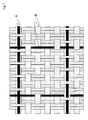
- the fabric is a fabric that conductive yarns are inserted in the warp direction and the weft direction and disposed in a lattice at intervals.
- a textured yarn such covering yarn or textured yarn called TASURAN
- TASURAN a textured yarn
- exposing a conductive yarn by having a difference in yarn length around a nonconductive yarn so that the conductive yarns between clothing fabrics contact easily when sewn for the conductive yarns to be exposed at the fabric surface relative to base weave composing a fabric.
- suitable is a method that conductive yarns are inserted as double weave to be a float yarn on the fabric surface, namely, they are exposed in a shape protruded from the base weave.
- conductive yarns are inserted as double weave to be a float yarn on the fabric surface.
- the conductive yarns are incorporated in one of the warp direction and the weft direction, or in both as double weave to be disposed on (or beneath in the reverse side of) base yarn (ordinarily nonconductive yarn) composing the base weave of the same direction.
- the conductive yarn is exposed on the fabric as a float yarn to be a protruded shape from the base weave. In this way, the area exposed at the fabric surface is increased, and contact with conductive yarn in other direction is improved, so that the neutralization and diffusion of static electricity becomes easy.
- the conductive yarn is easy to take a position being disposed on the base yarn (nonconductive yarn), and the delivery and receipt of electric charges is efficiently done at the intersection of the conductive yarns to be able to improve electroconductive property.
- a force pushing down by the orthogonal other yarns is operated on the conductive yarn in fabric, and by satisfying D1 ⁇ D2, the conductive yarn inserted in double weave is easily disposed on the base yarn.
- the conductive yarn is not disposed on (or beneath) the nonconductive yarn (base yarn) of the same direction but disposed between nonconductive yarns of the same direction, the conductive yarn is buried easily in the base yarn (nonconductive yarn) and the contact with orthogonal conductive yarn lowers; thus, the neutralization and diffusion of static electricity tends to become insufficient.
- the finess of conductive yarn is preferably equal to or more than the finess of base yarn of the same direction.
- conductive yarns are inserted and disposed at least in each the warp direction and the weft direction into a stripe at a certain interval.
- the interval that the conductive yarns are inserted and disposed the narrower it is, the better the conductive characteristic becomes.
- the pitch is less than 1 mm, the number of conductive yarns disposed becomes too large, which is not preferable from the points of drape, appearance and quality, and production cost of conductive yarn.
- the pitch is more than 20 mm, it is necessary to have more seam allowance width not so as to increase surface resistance across seam, which is not preferable from the production cost of fabric.
- the pitch is more preferably about 1 to 10 mm.
- the sewn product of the present invention is one that the fabrics described above are sewn.
- the first mode of the sewn product in the present invention is a sewn product where at least two stitches in at least one place of seam are provided, and the interval of the stitches (needle interval) is not more than 5 mm.
- the needle interval exceeds 5 mm, from a kneading effect and shrinkage of fabric by repeated washing, there arise a tendency to take an undulated shape in seam allowance.
- the conductive yarn contacted among fabrics in seam is peeled off, and the electroconductive property across seam deteriorates. Therefore, by shortening the needle interval, it is possible to prevent the conductive yarn from peeling off due to a kneading effect and shrinkage of fabric by repeated washing.
- the needle interval is preferably set to 2 mm or more. Further, in order to achieve a good balance between sewing workability and washing durability of surface resistance, the needle interval is preferably set to be not less than 2 mm and not more than 3 mm. Additionally, the number of stitches is determined by seam allowance width and needle interval.
- Needle interval herein is a distance in the perpendicular direction to the two parallel lines of seams in seam allowance; the intervals at 5 places randomly chosen in the seam direction are measured using a scale measurable in an accuracy of 0.5 mm, and a value as the needle interval is calculated from the measured values that tenth place is rounded off in arithmetic average. Arithmetic average is a value that all values measured are summed, which is divided by the number of data (n number). Additionally, in the case that seam is not a straight line, a central axis line showing the sewing direction of seam is assumed, and a distance till a perpendicular line drawn from the central axis line intersects the other central axis line is the needle interval. For example, in the case that a zigzag pattern is formed, a line passing through the center of the width is a central axis line.
- the second mode of the sewn product of the present invention is that in sewing the above-described fabrics, the number of piles of clothing fabrics in seam allowance is 5 or more.
- the number of piles is the number of clothing fabrics through which a needle is penetrated in seam; for example, in the case of using a piping tape in seam, the number of the tapes is to be counted.
- the number of piles of clothing fabrics in seam allowance is 5 or more, it is possible to increase adhesion pressure among fabrics in the sewn part and to prevent the electroconductive property in seam from being damaged largely by repeated washing. Namely, an increase in surface resistance is suppressed even when it is measured across seam after washing.
- stitching when the number of piles of seam allowance is less than 5 fastening seam becomes insufficient due to a kneading effect by washing, or a possibility that puckering occurs due to shrinkage of fabric becomes high. Hence, peeling of the contact of conductive yarn occurs, thereby increasing the surface resistance across seam extremely.
- the number of piles of seam allowance becomes more than 7, contact pressure between conductive yarns becomes strong, and the surface resistance across seam lowers; although that is a preferable, since thickness and rigidity of the sewn part become large, uncomfortable feeling in wearing tends to increase. Therefore, the number of piles is preferably 7 or less.
- the piling method of clothing fabrics in seam is not particularly limited.
- stitching methods such as three-rolled seam (j), piping (k), safety stitch (1) and bag seam (m) are listed.
- j three-rolled seam
- piping k
- safety stitch (1) bag seam
- bag seam m
- target surface resistance R ⁇ 1.0 ⁇ 10 12 ⁇ can be achieved even if the number of piles of seam allowance is less than 5.
- seam allowance width may be determined by the pitch of conductive yarns in a conductive fabric.
- two or more conductive yarns running in parallel with the seam direction are inserted each in seam allowances of both fabrics, and the seam allowance width is set to 5 mm or more.
- seam allowance width is less than 5 mm, it is not preferable from the viewpoints of workload of sewing product and strength of seam.
- the number of conductive yarns in seam allowance is each preferably 2 to 5.
- Stitching of seam allowance is carried out by a stitching method selected from the group consisting of lock stitch, single chain stitch, double chain stitch, overedge chain stitch and covering chain stitch.
- Lock stitch is a seam produced generally by using a sewing machine, the constitution of seam is independent in every stitch, front-back seams are the same, and it is a characteristic sewing method that hardly unravels.
- Single chain stitch is a sewing method that seam is produced by only one needle yarn; in the reverse side, loops of needle yarn continue in forming a chain shape each other continuously.
- “Double chain stitch” is sewing method that there are top threads above and looper threads below, and the looper thread and top thread are tangled each other.
- This stitching method has a characteristic that even when thread is broken, it hardly unravels unless being raveled from the sewing end to the reverse direction, having a high strength in seam and a sufficient stretch.
- "Overedge chain stitch” is a sewing method that end of cloth is sewn like wrapping, and it is a characteristic sewing method giving a sufficient stretch.
- "Covering chain stitch” is ordinarily called flat seam stitch, seam is composed of three kinds of threads, that is, needle thread above, looper thread below and covering thread, it is sewing method capable of producing a stable seam with sufficient stretch and excellent strength.
- needle swing width is preferably 5 mm or less (6 needles/3 cm or more). When more than 5 mm, it becomes a cause for generating undulation of clothing fabric after washing, and leads to deterioration of electroconductive property between fabrics. It is more preferably 3 mm or less (10 needles/3 cm or more). When less than 1 mm (30 needles/3 cm or more), deterioration of electroconductive property is prevented, but load in work becomes large.
- a crimped yarn for stitching of fabric, using a crimped yarn is preferable.
- contact pressure between clothing fabrics is enhanced by a strong shrinkage recovery of crimped yarn, and electroconductive property between clothing fabrics is enhanced as well.
- crimped yarn a false twist yarn or a potentially crimped yarn conjugated is suitably used.
- kind of crimped yarn there is listed a multifilament yarn made of one kind or various kinds of thermoplastic polymers, in addition to nylon or polyester.
- a crimped yarn can be used for one of upper yarn and lower yarn, or for both.
- a crimped yarn is used only for lower yarn; and for upper yarn, a common filament or spun sewing yarn can be used without problem.
- the total yarn finess of crimped yarn is not particularly limited.
- a crimped sewing yarn of 100 to 300 decitex is used, a sufficient shrinkage recovery is obtained, and washing durability of surface resistance between two points across seam is easily achieved.
- the total yarn finess of crimped yarn is less than 100 decitex, contact pressure of seam after washing becomes small since the intrinsic shrinkage recovery is not sufficiently exhibited, and surface resistance tends to become bad.
- strain of sewing is generated in the part of seam by washing and appearance sometimes becomes bad although shrinkage recovery is sufficiently exhibited.
- seam allowance is entirely or partially melt-bonded, or reinforced with a seam tape, and the like.
- conductive yarns included in seam allowance of clothing fabric sewn are pressure bonded or melt-bonded each other to strengthen the contact; thus, it becomes possible to greatly reduce surface resistance across the seam of clothes.
- durability becomes very good.
- seam tape contact between fabrics becomes strong, and the same effect is obtained.
- the melt-bonding method of seam allowance is by no means limited; there are listed a method that melt-bonding is carried out by bringing the clothing fabric piled into contact with or approach to a heating element (hot plate etc.), or by blowing hot air thereto.
- a heating element hot plate etc.
- the surface of clothing fabric contacted with a hot plate or blown with hot air is sometimes damaged notably, also melt-bonding takes time, and there is a case that the melt-bonded part is inferior in aesthetic property. Therefore, more preferably, a method of hot melt bonding by giving an ultrasonic vibration via horn is listed.
- melt-bonding it is preferable that intersection of conductive yarns of clothing fabrics piled in two pieces to be stitched exists in the melt-bonding part.
- melt-bonding the part including the intersection of conductive yarns it is possible to pressure bond the conductive yarns each other more strongly, and further to melt-bond the conductive yarns each other. Even if the part including intersection of conductive yarns is not melt-bonded, pressure bonding of conductive yarns can be done by melt-bonding the periphery.
- seam allowance is melt-bonded in whole.
- melt-bonding width needs to be widen; however, when melt-bonding is carried out in the width at least equal to the interval of conductive yarns, the intersection of conductive yarns is melt-bonded, and the surface resistance across seam can be reduced greatly. Additionally, in the case that clothing fabric is sewn obliquely (oblique to warp and weft of fabric), points that conductive yarns intersect with each other between fabrics in seam allowance increase; thus, it becomes possible to shorten the melt-bonding width.
- the order is basically not restricted.
- a sewing thread contains a thermoplastic component
- the sewing thread melts in melt-bonding treatment to cause the lowering of strength. Therefore, from the viewpoint of strength of seam, it is preferable to carry out stitching treatment by sewing thread after melt-bonding treatment.
- the stitching by sewing thread is preferably carried out in conjunction with top-stitched plain seam or rolled seam. Even in flat felled seam and piping, or change stitching methods based on bag seam, unless contact of conductive yarns by melt-bonding is done, it is good because washing durability of surface resistance is achieved.
- the order is not restricted; however, carrying out melt-bonding treatment before attaching a seam tape is preferable because melt-bonding treatment can be uniformly done since thickness of clothing fabric is thin.
- seam tape for example, there can be used a well-known hot-melt type seam tape where resins such as high melting point polyamide, polyolefin, polyester and polyurethane are used as a base cloth layer, and hot melt adhesive resins such as low melting point polyamide, polyolefin, polyester and polyurethane are used as a adhesive layer.
- resins such as high melting point polyamide, polyolefin, polyester and polyurethane are used as a base cloth layer
- hot melt adhesive resins such as low melting point polyamide, polyolefin, polyester and polyurethane are used as a adhesive layer.
- seam tape is contacted with a seam part, and the thermal adhesive resin is melt-bonded thereto by high frequency wave, ultrasonic wave, hot press or the like, or a method of sealing by bonding after thermal adhesive resin is melted by hot air or the like, or a method of bonding a base cloth to be sealed by coating a sticking-type adhesive typified by rubber system onto a seam part, or the like.
- a sewn product becomes one satisfying a demand characteristic specified by IEC (International Electrotechnical Commission) 61340-5-1, 5-2 being electrostatic control regulation.
- the demand characteristic specified by IEC (International Electrotechnical Commission) 61340-5-1, 5-2 being electrostatic control regulation is that "under the temperature and humidity environment of 23°C and 25% RH, when surface resistance is measured at an applied voltage of 10 V or 100 V between two points separated by 30 cm in the oblique direction across at least one seam, the surface resistance R is not more than 1.0 ⁇ 10 12 ⁇ ".
- the applied voltage is chosen according to the surface resistance of test piece, 10 V in the region of not more than 10 5 ⁇ , and 100 V in the region of not less than 10 6 ⁇ are chosen.
- the surface resistance R of the fabric to be sewn satisfies R ⁇ 1.0 ⁇ 10 12 ⁇ when the fabric is measured in the same way as IEC (International Electrotechnical Commission) 61340-5-1, 5-2 except for the change being not across seam.
- R in such measurement is further preferably not more than 1.0 ⁇ 10 10 ⁇ , and 1.0 ⁇ 10 6 ⁇ to 1.0 ⁇ 10 9 ⁇ is most preferable. In such range, static electricity is diffused efficiently and quickly, spark electric shock from a charged body can be prevented, and it becomes possible to be used suitably as antistatic working clothes and dust-proof clothing applications.
- the sewn product of the present invention as described above is excellent in washing durability, thus it can be suitably used as clothes and the like. Namely, even if static electricity is generated in any part after repeated washing, corona discharge from conductive yarns occurs or earthing is positively done since fabric and clothes overall are stably electroconductive.
- Arithmetic average is a value calculated from summing up all the values measured and dividing by the number of data (n number).
- Clothes are produced by carrying out a predetermined stitching by a sewing machine. Thereafter, using a surface resistance tester (Model 152AP-5P manufactured by Trek Japan Co., Ltd.), in a laboratory of the temperature and humidity environment of 23°C and 25% RH, measuring probes are mounted at an interval of 30 cm across the seam of the sewn product, and surface electric resistance is measured at an applied voltage of 100 V. In this time, the two points are taken so that the coaxial conductive yarns of fabric specimen are not included. This is repeated at arbitrary three places to calculate the arithmetic average.
- Fig. 3 shows a schematic diagram after sewing
- Fig. 4 shows a schematic diagram for measuring surface electric resistance.
- polyester false twist yarn (84 decitex, 36 filaments) as a warp forming base weave and polyester false twist yarn (334 decitex, 96 filament) as a weft, and as a warp conductive yarn and a weft conductive yarn
- a conductive yarn (84 decitex, 9 filaments) composed of surface exposing type yarn shown in Fig. 2 was used.
- the weave was made as shown in Fig. 1 in such manner that base weave was plain fabric (one-sided mat), and the warp conductive yarns were disposed by dobby weave in a ratio of every 24 yarns of base warps (pitch 5 mm) in skipping over 2 yarns in the obverse side, and one yarn in the reverse side.
- the weave was made as shown in Fig. 1 in such manner that the weft conductive yarns were inserted in a ratio of every 11 yarns of base wefts in weft double weave (pitch 5 mm), and disposed on the base weft (namely being float yarn) in skipping over 3 yarns in the obverse side, and one yarn in the reverse side.
- a gray fabric of 141 yarns/2.54 cm in warp density and 57 yarns/2.54 cm in weft density was produced.
- This gray fabric was refined, dyed and finished according to the common method to obtain a fabric of 153 yarns/2.54 cm in finish warp density and 62 yarns/2.54 cm in weft density.
- Example 1 Using the fabric obtained in Example 1 and setting seam allowance width to 15 mm, stitching was carried out by a double chain stitch sewing machine. A twisted yarn of 60 count filament was used as a sewing thread, and stitching was carried out by 2 stitches (seam) in three-rolled seam (see Fig. 5 (j) ) and needle interval of 6 mm. After carrying out washing treatment in the same condition as Example 1, surface resistances were measured. Various data are shown in Table 1.
- the weave was made as shown in Fig. 1 in such manner that base weave was plain fabric (one-sided mat), and the warp conductive yarns were disposed by dobby weave in a ratio of every 48 yarns of base warps (pitch 10 mm) in skipping over 2 yarns in the obverse side, and one yarn in the reverse side.
- the weave was made as shown in Fig. 1 in such manner that the weft conductive yarns were inserted in a ratio of every 22 yarns of base wefts in weft double weave (pitch 10 mm), and disposed on the base weft (namely being float yarn) in skipping over 3 yarns in the obverse side, and one yarn in the reverse side.
- Example 1 Using the fabric obtained in Example 1, setting seam allowance width to 15 mm, safety stitching and top-stitching (see Fig. 5 (l) ) were carried out. A twisted yarn of 60 count filament was used as the upper yarn of sewing thread, and a crimped yarn of 220 decitex was used as the lower yarn; stitching was carried out by 3 stitches (seam) in needle interval of 3 mm. After carrying out washing treatment in JIS L0217(1995) 103 method once and 20 times, and after carrying out washing treatment in the same condition as Example 1, surface resistances were measured. Various data are shown in Table 1.
- Example 1 Using the fabric obtained in Example 1 and setting seam allowance width to 20 mm, stitching was carried out by using a lock stitch sewing machine. A twisted yarn of 60 count filament (upper yarn) and a crimped yarn of 220 decitex (lower yarn) were used as a sewing thread, and stitching was carried out by 2 stitches (seam) in flat felled seam (see Fig. 4 (H) ) and needle interval of 8 mm. After carrying out washing treatment by the same condition as Example 1, surface resistances were measured. Various data are shown in Table 1.
- the sewn product of the present invention described above can be suitably used in clothes such as uniform, cap, dust-proof clothing, and other sewn product required for prevention of static charge.
Landscapes
- Engineering & Computer Science (AREA)
- Textile Engineering (AREA)
- Professional, Industrial, Or Sporting Protective Garments (AREA)
- Treatment Of Fiber Materials (AREA)
- Details Of Garments (AREA)
Applications Claiming Priority (2)
| Application Number | Priority Date | Filing Date | Title |
|---|---|---|---|
| JP2008004053A JP2009167538A (ja) | 2008-01-11 | 2008-01-11 | 導電性織物の縫合方法およびその方法を用いてなる導電性衣服 |
| PCT/JP2008/073599 WO2009087914A1 (fr) | 2008-01-11 | 2008-12-25 | Article cousu et vêtement |
Publications (2)
| Publication Number | Publication Date |
|---|---|
| EP2241206A1 true EP2241206A1 (fr) | 2010-10-20 |
| EP2241206A4 EP2241206A4 (fr) | 2018-01-24 |
Family
ID=40853038
Family Applications (1)
| Application Number | Title | Priority Date | Filing Date |
|---|---|---|---|
| EP08869297.5A Withdrawn EP2241206A4 (fr) | 2008-01-11 | 2008-12-25 | Article cousu et vêtement |
Country Status (5)
| Country | Link |
|---|---|
| US (1) | US8393282B2 (fr) |
| EP (1) | EP2241206A4 (fr) |
| JP (1) | JP2009167538A (fr) |
| CN (1) | CN101909469A (fr) |
| WO (1) | WO2009087914A1 (fr) |
Cited By (1)
| Publication number | Priority date | Publication date | Assignee | Title |
|---|---|---|---|---|
| WO2018067635A1 (fr) * | 2016-10-04 | 2018-04-12 | Nike Innovate C.V. | Textiles et vêtements formés au moyen de fils traités par espaces, dotés de finitions fonctionnelles |
Families Citing this family (13)
| Publication number | Priority date | Publication date | Assignee | Title |
|---|---|---|---|---|
| US20120199056A1 (en) * | 2011-01-20 | 2012-08-09 | Yakup Bayram | Conformal electronic device |
| CN102150953A (zh) * | 2011-03-25 | 2011-08-17 | 山东如意科技集团有限公司 | 一种具有可塑性的服装 |
| JP5436491B2 (ja) * | 2011-05-20 | 2014-03-05 | 北陸エステアール協同組合 | 面状発熱体 |
| US20130255103A1 (en) | 2012-04-03 | 2013-10-03 | Nike, Inc. | Apparel And Other Products Incorporating A Thermoplastic Polymer Material |
| US9582072B2 (en) | 2013-09-17 | 2017-02-28 | Medibotics Llc | Motion recognition clothing [TM] with flexible electromagnetic, light, or sonic energy pathways |
| US9588582B2 (en) | 2013-09-17 | 2017-03-07 | Medibotics Llc | Motion recognition clothing (TM) with two different sets of tubes spanning a body joint |
| US9974170B1 (en) | 2015-05-19 | 2018-05-15 | Apple Inc. | Conductive strands for fabric-based items |
| US10514772B1 (en) | 2016-09-15 | 2019-12-24 | Apple Inc. | Keyboard with touch sensor illumination |
| DE102016224568A1 (de) * | 2016-12-09 | 2018-06-14 | Robert Bosch Gmbh | Verfahren zur Herstellung einer leitfähigen Verbindung zwischen zumindest zwei Textil- und/oder Bekleidungseinheiten |
| EP3995024A4 (fr) * | 2019-07-05 | 2023-01-18 | Medical-Aid Co., Ltd. | Protection contre les ondes électromagnétiques |
| CN114304810A (zh) | 2019-08-02 | 2022-04-12 | 耐克创新有限合伙公司 | 用于鞋类物品的鞋面 |
| CN114729480B (zh) | 2019-11-18 | 2025-01-03 | 耐克创新有限合伙公司 | 具有泡沫表面特征的针织部件 |
| US11952087B2 (en) | 2020-12-11 | 2024-04-09 | Alessandra E. Myslinski | Smart apparel and backpack system |
Family Cites Families (19)
| Publication number | Priority date | Publication date | Assignee | Title |
|---|---|---|---|---|
| JPS55135014U (fr) | 1979-03-19 | 1980-09-25 | ||
| JPS55135014A (en) | 1979-04-11 | 1980-10-21 | Nikkei:Kk | Transfer apparatus for tile, etc. |
| JPS58160209A (ja) | 1982-03-05 | 1983-09-22 | 日立バッテリ−販売サ−ビス株式会社 | 包装装置のシ−ラかみ込み防止装置及びその方法 |
| JPS58160209U (ja) | 1982-04-15 | 1983-10-25 | ミドリ安全工業株式会社 | 静電気帯電防止用の被服 |
| DE3214836C2 (de) * | 1982-04-21 | 1987-02-12 | Ifm Electronic Gmbh, 4300 Essen | Elektronisches, vorzugsweise berührungslos arbeitendes Schaltgerät |
| JPS63249705A (ja) | 1987-04-03 | 1988-10-17 | 帝人株式会社 | 帯電防止衣服 |
| US4776160A (en) * | 1987-05-08 | 1988-10-11 | Coats & Clark, Inc. | Conductive yarn |
| US5105056A (en) * | 1990-10-26 | 1992-04-14 | Schlegel Corporation | Electromagentic shielding with discontinuous adhesive |
| US5335372A (en) * | 1992-03-12 | 1994-08-09 | Rotecno Ag | Article of clothing, in particular for the medical or chemical field |
| US8801681B2 (en) * | 1995-09-05 | 2014-08-12 | Argentum Medical, Llc | Medical device |
| JPH09250007A (ja) * | 1996-03-14 | 1997-09-22 | Teijin Ltd | 制電衣服 |
| CA2219848C (fr) * | 1996-12-26 | 2001-07-31 | David L. Banks | Vetement eliminateur d'electricite statique |
| GB9803927D0 (en) * | 1998-02-26 | 1998-04-22 | Fenland Laundries Limited | Dissipation of static electricity in workwear |
| JP3880743B2 (ja) * | 1998-03-31 | 2007-02-14 | セーレン株式会社 | 導通性及び制電性に優れた織物並びに防塵衣 |
| US6432850B1 (en) | 1998-03-31 | 2002-08-13 | Seiren Co., Ltd. | Fabrics and rust proof clothes excellent in conductivity and antistatic property |
| JP2001073207A (ja) * | 1999-08-31 | 2001-03-21 | Teijin Ltd | 制電衣服 |
| US6710303B1 (en) * | 2002-11-13 | 2004-03-23 | W.E.T. Automotive Systems Ag | Intermediate electrical connecting device for seat-heating systems |
| DE102004046579A1 (de) * | 2004-09-23 | 2006-04-06 | Nordenia Deutschland Emsdetten Gmbh | Flexibler Schüttgutbehälter |
| US8283602B2 (en) * | 2007-03-19 | 2012-10-09 | Augustine Temperature Management LLC | Heating blanket |
-
2008
- 2008-01-11 JP JP2008004053A patent/JP2009167538A/ja active Pending
- 2008-12-25 US US12/812,307 patent/US8393282B2/en active Active
- 2008-12-25 CN CN2008801244275A patent/CN101909469A/zh active Pending
- 2008-12-25 EP EP08869297.5A patent/EP2241206A4/fr not_active Withdrawn
- 2008-12-25 WO PCT/JP2008/073599 patent/WO2009087914A1/fr not_active Ceased
Non-Patent Citations (1)
| Title |
|---|
| See references of WO2009087914A1 * |
Cited By (3)
| Publication number | Priority date | Publication date | Assignee | Title |
|---|---|---|---|---|
| WO2018067635A1 (fr) * | 2016-10-04 | 2018-04-12 | Nike Innovate C.V. | Textiles et vêtements formés au moyen de fils traités par espaces, dotés de finitions fonctionnelles |
| US11060212B2 (en) | 2016-10-04 | 2021-07-13 | Nike, Inc. | Textiles and garments formed using yarns space-treated with functional finishes |
| US11655567B2 (en) | 2016-10-04 | 2023-05-23 | Nike, Inc. | Textiles and garments formed using yarns space-treated with functional finishes |
Also Published As
| Publication number | Publication date |
|---|---|
| JP2009167538A (ja) | 2009-07-30 |
| CN101909469A (zh) | 2010-12-08 |
| US20100287679A1 (en) | 2010-11-18 |
| WO2009087914A1 (fr) | 2009-07-16 |
| EP2241206A4 (fr) | 2018-01-24 |
| US8393282B2 (en) | 2013-03-12 |
Similar Documents
| Publication | Publication Date | Title |
|---|---|---|
| US8393282B2 (en) | Sewn product and clothes | |
| JP5326316B2 (ja) | 導電性織物の縫合方法およびそれを用いてなる導電性衣服 | |
| US6432850B1 (en) | Fabrics and rust proof clothes excellent in conductivity and antistatic property | |
| CN101910484B (zh) | 织物以及使用该织物制成的衣服 | |
| US4856299A (en) | Knitted fabric having improved electrical charge dissipation and absorption properties | |
| KR100562531B1 (ko) | 높은 번수의 실을 포함하는 심지 직물 및 이를 이용한 보강방법 | |
| JP3880743B2 (ja) | 導通性及び制電性に優れた織物並びに防塵衣 | |
| JP2010047847A (ja) | 衣服 | |
| EP4488060A1 (fr) | Article lié | |
| CN214218984U (zh) | 一种舒适型梭织面料 | |
| JP6932285B1 (ja) | 制電性経編地 | |
| JP7726063B2 (ja) | 導電性複合加工糸並びに織物及び衣服 | |
| EP4417412A1 (fr) | Tissu stratifié et tissu tricoté circulaire unique | |
| KR20190072488A (ko) | 섬유 기반 정전용량형 압력센서 | |
| CA1296196C (fr) | Tricot presentant des proprietes ameliorees du point de vue de la dissipation des charges electriques et de l'absorption | |
| WO2023136107A1 (fr) | Tissu anti-effilochage | |
| CN210911530U (zh) | 防水型涤纶布 | |
| CN207435649U (zh) | 一种蕾丝面料 | |
| WO2025204848A1 (fr) | Tissu et vêtement l'utilisant | |
| JPS61225333A (ja) | 紡機用針布 | |
| WO2024195775A1 (fr) | Article tricoté |
Legal Events
| Date | Code | Title | Description |
|---|---|---|---|
| PUAI | Public reference made under article 153(3) epc to a published international application that has entered the european phase |
Free format text: ORIGINAL CODE: 0009012 |
|
| 17P | Request for examination filed |
Effective date: 20100730 |
|
| AK | Designated contracting states |
Kind code of ref document: A1 Designated state(s): AT BE BG CH CY CZ DE DK EE ES FI FR GB GR HR HU IE IS IT LI LT LU LV MC MT NL NO PL PT RO SE SI SK TR |
|
| AX | Request for extension of the european patent |
Extension state: AL BA MK RS |
|
| DAX | Request for extension of the european patent (deleted) | ||
| RA4 | Supplementary search report drawn up and despatched (corrected) |
Effective date: 20180104 |
|
| RIC1 | Information provided on ipc code assigned before grant |
Ipc: A41D 13/00 20060101AFI20171219BHEP Ipc: A41D 31/00 20060101ALI20171219BHEP Ipc: A41D 27/24 20060101ALI20171219BHEP |
|
| STAA | Information on the status of an ep patent application or granted ep patent |
Free format text: STATUS: THE APPLICATION IS DEEMED TO BE WITHDRAWN |
|
| 18D | Application deemed to be withdrawn |
Effective date: 20180803 |