EP2241882A1 - Elektrochemischer amperometrischer Sensor und sein Herstellungsverfahren - Google Patents
Elektrochemischer amperometrischer Sensor und sein Herstellungsverfahren Download PDFInfo
- Publication number
- EP2241882A1 EP2241882A1 EP09157979A EP09157979A EP2241882A1 EP 2241882 A1 EP2241882 A1 EP 2241882A1 EP 09157979 A EP09157979 A EP 09157979A EP 09157979 A EP09157979 A EP 09157979A EP 2241882 A1 EP2241882 A1 EP 2241882A1
- Authority
- EP
- European Patent Office
- Prior art keywords
- electrode
- insulating layer
- sensor
- sensor according
- membrane
- Prior art date
- Legal status (The legal status is an assumption and is not a legal conclusion. Google has not performed a legal analysis and makes no representation as to the accuracy of the status listed.)
- Withdrawn
Links
Images

Classifications
-
- G—PHYSICS
- G01—MEASURING; TESTING
- G01N—INVESTIGATING OR ANALYSING MATERIALS BY DETERMINING THEIR CHEMICAL OR PHYSICAL PROPERTIES
- G01N27/00—Investigating or analysing materials by the use of electric, electrochemical, or magnetic means
- G01N27/26—Investigating or analysing materials by the use of electric, electrochemical, or magnetic means by investigating electrochemical variables; by using electrolysis or electrophoresis
- G01N27/403—Cells and electrode assemblies
- G01N27/404—Cells with anode, cathode and cell electrolyte on the same side of a permeable membrane which separates them from the sample fluid, e.g. Clark-type oxygen sensors
- G01N27/4045—Cells with anode, cathode and cell electrolyte on the same side of a permeable membrane which separates them from the sample fluid, e.g. Clark-type oxygen sensors for gases other than oxygen
Definitions
- the present invention relates to the field of electrochemical sensors. More particularly, it relates to an amperometric electrochemical sensor for use in a probe for measuring the content of an oxidoreducible substance in a liquid, and in particular the chlorine content.
- the first patent discloses a conventional electrochemical probe with noble metal macroscopic metal electrodes immersed in a chloramine-containing reagent liquid separated from the aqueous medium by a permeable membrane screwed onto the probe body.
- the patent EP0586982 discloses a first type of integrated sensor comprising an insulating substrate on which are formed three electrodes, namely a working electrode, a counter-electrode and a reference electrode. The electrodes are then covered with a diffusion membrane, which covers all three electrodes.
- Another type of sensor is also described and comprises an insulating substrate comprising an insulation layer, in which openings are made. Each opening receives a metal deposit for forming one of the electrodes.
- a diffusion membrane completely covers the active conductive part of the working electrode by overflowing through its entire peripheral zone.
- Such a type of sensor requires adapting the insulation layer to each embodiment of the electrodes and thus to modify the entire manufacturing process according to the desired shape of the electrodes.
- the arrangement of the layers requires the provision of a contact zone under the electrodes.
- the geometric dimension of the working electrode must be sufficient, from several hundred micrometers to one millimeter, to allow to deposit the membrane.
- An object of the present invention is therefore to overcome these disadvantages by proposing a sensor that can be produced according to a simple embodiment and only one step of which must be modified to produce electrodes having the desired shape, all the other steps of the method being common regardless of the type of electrodes.
- Another object of the present invention is to provide a sensor whose life is improved, in particular by increasing the adhesion of the polymer membrane used as diffusion membrane on a chosen insulation.
- Another object of the present invention is to provide a manufacturing method for producing a nanoscale insulation structure between the membrane and the electrodes.
- Another object of the present invention is to provide a sensor for direct access to the electrodes for making the connections.
- Another object of the present invention is to provide a sensor for having a substrate other than a silicon substrate, and in particular a transparent substrate.
- Another object of the present invention is to provide a sensor for being miniaturized, without liquid electrolyte, and use in the same probe two same sensors in a limited space.
- an amperometric electrochemical sensor for measuring the content of an oxidoreducible substance in a liquid, comprising an insulating substrate, a set of electrodes composed of a working electrode, a counter-electrode electrode and a reference electrode, at least one of said working electrode and counter electrode being configured on said insulating substrate.
- at least one of said working electrode and against electrode is covered with a layer of insulation, and said insulating layer comprises at least one aperture showing at least one of said working electrode and counter electrode, so that the periphery of the electrode is covered by the insulating layer.
- said opening may have been formed by etching the insulating layer by means of a mask, in particular a photolithographic mask, the configuration of which is variable depending on the configuration of the desired electrode.
- the senor may further comprise at least a first polymer membrane deposited in said opening.
- the membrane can completely cover said opening by projecting over the insulating layer through its entire peripheral zone.
- the senor may comprise a non-planar working electrode disposed in the insulating substrate, said membrane being made so that its upper surface is at the level of the insulating substrate comprising the counter-electrode.
- the senor may comprise a first polymer membrane to define a diffusion layer and a second polymer membrane deposited on the first membrane to select the species to be measured.
- the insulating layer may comprise several openings separated by islands of insulating material, so as to let appear a set of electrode elements.
- the first polymer membrane may then cover all the openings or may comprise a plurality of membrane elements respectively covering each opening individually projecting over the insulation layer over their entire respective peripheral zone.
- the insulating layer may comprise homogeneous nanostructured openings distributed over the surface of the electrode randomly or geometrically.
- the substrate may be made of a material selected from the group consisting of silicon, glass, ceramics and quartz.
- At least one of the working electrode and the counter-electrode may have a shape chosen from the group of circular, microperforated or interdigitated shape.
- the senor may comprise connection means for connecting the electrodes to a measurement circuit, said connection means being directly connected to the electrodes.
- the step of making at least one opening in the insulating layer is performed by etching using a photolithographic mask whose configuration is variable depending on the configuration of the desired electrode.
- This method makes it possible to modify only the last step defined above by modifying the mask used to make the openings so that it corresponds to the desired shape of the electrodes.
- the other steps of the process remain common to all forms of electrodes.
- the method may further comprise a step of covering the insulating layer and its openings with at least one polymer membrane.
- the present invention also relates to an amperometric probe for measuring the content of an oxidoreducible substance in a liquid comprising at least one sensor as defined above.
- the probe may comprise a body containing data processing means and transmission means and a dry head, without electrolyte and detachable, in which is disposed the sensor or sensors for redundancy.
- the detachable head is disposable and contains the calibration information of the probe and a unique numerical identifier of the head.
- Such an electrochemical measuring probe makes it possible to carry out measuring operations in a fluid under pressure up to 10 bars without any maintenance and without re-calibration over a period of one year.
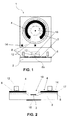
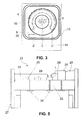
- an amperometric electrochemical sensor 1 for measuring the content of an oxidoreducible substance in a liquid, comprising an insulating substrate 2, a set of electrodes composed of a working electrode 3, a counter-electrode electrode 4 and a reference electrode (not shown), the working electrode 3 and the counter-electrode 4 being configured on said insulating substrate 2.
- the term "insulating substrate” designates a plane substrate, intrinsically insulating (glass, ceramic or quartz for example) or a conductive substrate (silicon for example) made insulating by the application of a first layer of insulation. When the substrate is intrinsically insulating, the first layer of insulation is not necessary.
- the amperometric measurement principle is based on that of a Clark cell with a working electrode, a counter-electrode and a reference electrode. This amperometry principle is based on the measurement of the current between the working electrode and the counter-electrode which is induced by a redox reaction at the working electrode.
- the reference is chosen so that the current measured at the working electrode is directly proportional to the concentration of an oxidoreducible substance in the liquid to be analyzed.
- This oxidoreducible substance may be, for example, chlorine in the form of HOCI or ClO 2 .
- the sensor also detects bio-chlorines, or the chlorine produced by water-salt electrolysis systems.
- the electrical potential of the working electrode relative to the measured liquid is obtained by a separate reference electrode and is controlled by a potentiostatic electronic system.
- the substrate 2 is made of silicon, cut, after the appropriate photolithographic treatments, of a silicon wafer in a manner traditionally used in the manufacturing technique of semiconductor components. It is then covered with a first insulating layer 6, for example silicon oxide SiO 2, so as to obtain an insulating substrate.
- the working electrode 3 and the counter-electrode 4 are deposited in the form of a thin metal film on the first insulating layer 6.
- the electrodes may be platinum, gold, titanium, ruthenium or amorphous diamond.
- the working electrode 3 and the counter-electrode 4 are covered with a second insulating layer 8, preferably made of silicon nitride (Si 3 N 4 ), said second layer of insulator 8 comprising various openings allowing the appearance of the metal to form the active surfaces of the working electrode 3 and the counter-electrode 4.
- the periphery of the electrodes remains covered and protected by the second insulating layer 8.
- This second layer of insulation is deposited at low temperature so as not to harm the conductive layers constituting the working electrode 3 and the counter-electrode 4, which can be made of different types of metals for example.
- the openings, microscopic or nanoscopic, can be formed in the second insulating layer 8 by traditional techniques of etching by means of a photolithographic mask.
- This technique makes it possible to produce an insulating substrate comprising a metal film and the second insulating layer common to all the sensors, and to provide only, during the etching step of the second insulating layer, a photolithographic mask of geometry adapted to the desired shape of the working electrode and the counter-electrode.
- the second insulating layer 8 is etched to form circular openings leaving an element or island 8a of insulating material in the center of the working electrode 3.
- the second insulating layer 8 may also comprise nanostructured openings formed by producing random nanostructures on the second insulating layer 8, which are then etched to form said nanostructured apertures arranged randomly on the surface of the electrode but in a homogeneous manner .
- the nanostructures can be formed by phase separation of two immiscible polymers by spin coating. The average lateral size of the openings can be adjusted by adjusting the parameters of the process (nature of the polymers, speed of the centrifugal coating and weight of the polymers).
- the openings made in the second insulating layer 8 are filled by a first polymer membrane 10 which defines the diffusion layer of the oxidation or electrochemical reduction.
- the membrane 10 completely covers the openings overflowing on the insulating layer 8 through its entire peripheral zone.
- a single first continuous polymer membrane can be used to cover all the openings.
- the first polymer membrane is formed of several membrane elements which respectively cover each opening individually overflowing on the different elements of the second insulating layer 8 over their entire respective peripheral zone.
- the diffusion membrane 10 adheres to the metal electrodes but also adheres to the second insulating layer 8 at the periphery of the openings and islands of insulating material left between the openings.
- the shape of the apertures and electrodes can be chosen to adjust the proportion of polymer membrane / insulator layer and polymer membrane / electrode contact area.
- the material of the second insulating layer 8, such as nitride or silicon oxide, makes it possible to establish covalent bonds with the polymer membrane 10 by means of chemical surface treatments during the manufacturing process.
- the adhesion of the membrane 10 is greatly improved, which leads to increase the performance of the sensor in terms of selectivity, stability and reliability over a period of one year in water without recalibration or maintenance.
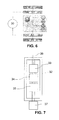
- the first polymer membrane 10 is preferably a poly-hydroxyethyl-methacrylate (polyHEMA) membrane. It is light-cured on the silicon wafer with a mask whose geometry is defined so that the membrane 10 covers either the openings of the second insulating layer 8 delimiting the working electrode alone, such as the circle shown in FIG. figure 1 , or the working electrode and the counter-electrode, ie the entire sensor, as shown on the figure 3 .
- polyHEMA poly-hydroxyethyl-methacrylate
- the first polymer membrane 10 defines the diffusion conditions, and thus creates a reproducible limit diffusion condition, defined by the thickness of the membrane, to obtain an amperometric signal independent of the liquid flow around the sensor, and to protect the electrodes of particle deposits.
- the sensor obtained does not require maintenance for a year. If changed after one year, the sensor will not require any intermediate maintenance.
- the membrane deposited on the electrodes also makes it possible to use a simple potentiostat, since the membrane protects the electrodes from any deposit.
- the selectivity of the sensor for the oxidoreducible substance is defined by the appropriate potential applied between the reference electrode and the working electrode, as well as by the definition of the polymerization of the polyHEMA membrane.
- a second polymer membrane 12 may be deposited on top of the first polymer membrane 10, for example with a thickness three to six times greater than that of the first polymer membrane 10.
- Such a second membrane 12 may be made of photopolymerized polysiloxane on the silicon wafer. Its function is to choose the species to be measured, such as dissolved oxygen. It also makes it possible to define the lateral limits of the epoxy resin used for the final encapsulation. The final step of encapsulation of the sensor is thus facilitated.
- the reference electrode is made by a thin layer of Ag-AgCl on the silicon wafer or by a metallic flat structure bonded to the wafer or simply by a wafer bonded wire composed of Ag-AgCl, producing a pseudo-reference.
- the sensor also includes openings in the second insulating layer 8 on the side of the chip, also connected to the electrodes below, allowing the electrical contacts 14 of the connecting wires to connect the electrodes to a measurement circuit external to the amperometric sensor. .
- the second insulating layer 8 being disposed over the entire metal layer to produce the electrodes, the latter are therefore directly accessible on the sensor side through this layer to make the electrical contacts.
- the sensor according to the invention can be obtained according to the method shown schematically on the figure 4 .
- Step a) starts from a silicon wafer 16.
- this wafer is oxidized to form the first insulating layer 6 and thus constitute the insulating substrate 2.
- a thin metal layer 17 is deposited on the substrate, in which the working electrode 3 and the counter-electrode 4 are formed.
- step d) the metal layer 17 is etched to roughly define the electrodes 3 and 4.
- a second insulating layer 8 is deposited at low temperature on the metal layer 17.
- the openings are formed in the insulating layer 8 to reveal precisely the active surface of the working electrode 3 and the counter-electrode 4.
- an island 8a of insulation is held in the center of the electrode.
- This island can be of various sizes, even repeat periodically on the surface of the electrode, and have microscopic dimensions, of the order of a few micrometers to a few tens of micrometers, or nanometer, less than one micrometer. Its repetition can be geometric or random, but homogeneous on the electrode.
- a photolithographic mask and an etching method are used which, in a single step, enables the working electrode and the counter-electrode of the desired configuration to be formed simply by using a mask having the corresponding configuration. .
- the other previous steps can be common to all sensors, regardless of the geometry of the electrodes.
- step g) the first polyethylene polymer membrane 10 is deposited by photopolymerization and by means of an appropriate mask on the openings of the second insulating layer 8 delimiting the working electrode 3. seen above, the first membrane 10 defines the diffusion layer and has an improved adhesion because of its preferential adhesion to the different elements of the second insulating layer 8.
- step h the second polymer membrane 12 based on polysiloxane is deposited by photopolymerization to prepare the sensor encapsulation step.
- this second membrane 12 may also cover the surface of the first polymer membrane 10, and allow to confer another selectivity to the sensor.
- the sensor of the invention can be produced according to the photolithography methods conventionally used for producing the semiconductor components from silicon wafers.
- the advantages of the batch production of silicon wafers allow excellent reproducibility of the thickness of the membranes, as well as an excellent reproducibility of the sensitivity of the probe obtained for the oxidoreducible species.
- the signal-to-noise ratio is very high due to the geometry of the well-defined active surface of the electrodes and the well-controlled diffusion layer.
- the substrate 2 has a non-planar structure, obtained for example anisotropic chemical etching of a p-type doped conductive silicon.
- the first insulating layer 6, the metal layer 17 and the second insulating layer 8 are applied as described above.
- the working electrode 3 and the counter-electrode 4 are formed by the openings in the second insulating layer 8.
- a first poly HEMA membrane is applied to the second insulating layer 8 and its opening defining the electrode 3.
- a second polysiloxane membrane 12 is deposited to prepare the encapsulation.
- the electrical contacts 14 are provided as well as rear contacts 18 for the working electrode 3.
- the working electrode 3 has been applied following the configuration of the substrate 2, so that it is recessed into the silicon wafer and is thus protected. In addition, in this configuration, the contact of the working electrode is made by directly using the silicon wafer.
- the working electrode 3 is in the form of a microelectrode array and elements of the first polymer membrane 10 cover the second insulating layer 8 and the microstructured or nanostructured openings delimiting the electrode.
- this network can be dimensioned in the form of nanostructure distributed randomly but in a homogeneous manner on the electrode.
- the reference electrode Ag-AgCl is integrated in the sensor, and is surrounded by the second polymer membrane 12, allowing its contact with the aqueous medium after encapsulation of the sensor in the resin.
- the electrical contacts are indicated by 14.
- the sensor according to the invention is used in an amperometric probe to measure the content of an oxidoreducible substance in a liquid.
- the sensor is integrated in a dry, therefore electroless, detachable measuring head, which can be removably mounted to a probe body, comprising the data processing and transmission means.
- Such a detachable head 22 is shown on the figure 5 . It comprises a printed circuit 23 on which are mounted, on the opposite side to the body of the probe, the sensor according to the invention 1 comprising the working electrode and the counter electrode, the reference electrode, an integrated circuit of interface for amplification and processing of the signal 24 to transform the current signal of the sensor 1 into a voltage signal and amplify it, this integrated circuit 24 can also measure the temperature, as well as a memory type integrated circuit 25.
- memory type IC contains the calibration parameters of the detachable head as well as the manufacturing references and a unique identification number. This number can be used to encode the communication with the probe body. Thus, each probe can only operate with a selection of head, selected during manufacture.
- the rear face of the printed circuit 23 comprises simple contacts 26 for transmitting the electrical signal coming from the body of the probe, and proportional to the oxidoreductable species to be measured.
- the printed circuit 23 and all its components are encapsulated or molded in a plastic housing 27, such as PVC, and are covered with a layer of polymer protective resin, for example epoxy 28, leaving the sensor 1 accessible. and the reference electrode 20.
- the measuring head of the probe 22 therefore contains no chemical or reagent and is therefore biocompatible with water or any other liquid.
- Calibration parameters such as zero or sensitivity, and a coding and identification number, may be recorded in the memory circuit of the head during manufacture. They will then be recovered by the body of the probe for self-calibration.
- the measuring head can be easily removed and replaced on site by the user without the assistance of a specialized technician.
- two sensors according to the invention can be provided in the measuring head. These sensors are mounted and connected to obtain two electronic signals of the species to be measured.
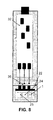
- the circuit diagram of the two sensors is represented on the figure 6 .
- the circuit comprises a battery 30, supplying a first potentiostat P1 and a second potentiostat P2.
- the potentiostat P1 is connected to the reference electrode RE1, to the working electrode WE1 and to the counter-electrode CE1 of the first sensor, as well as to the counter-electrode CE2 of the second sensor.
- the second potentiostat P2 is connected to the working electrode WE2 of the second sensor.
- the first potentiostat P1 gives a first signal S1 and the second potentiostat P2 gives a second signal S2. This allows redundancy in the signal with two chlorine signals but a single reference electrode.
- the signal processing circuit can then linearly combine the two signals, delivering the sum and the difference, so as to obtain an operational state signal of the probe, in particular the quality of the measurement of the detected electrochemical species.
- a simple algorithm can be introduced in the software of the body of the probe to calculate the quality of the measurement, thus the aging of the probe, and in particular to emit an alarm signal if one of the two sensors is defective.
- the housing 27 of the measuring head 22 may comprise a screw thread cooperating with a corresponding thread provided on the body of the probe.
- the body 32 of the probe may be made of plastic or metal. It comprises a printed circuit board on which are mounted an interface circuit 33, a decoding and data processing circuit 34, such as a microcontroller, and data transmission means 35 for transmitting the signal representing the content of the data. the oxidoreducible species measured outside the probe. These transmission means may be a radio system, for example GSM, or an electric cable.
- the body of the probe also comprises connection means 36, arranged to connect the printed circuit of the body of the probe to the contacts 26 provided on the measuring head 22. There is also provided a battery 37, feeding the printed circuit of the body of the probe. the probe. These means can also be made by electromagnetic wave of short range between the measuring head and the body of the probe.
- the probe obtained allows in particular to measure the quality of the water online, directly in the pipes. It has the advantage of withstanding high pressures (10 bar), and not requiring maintenance. Only the measuring head comprising the sensor can be easily changed, for example once a year. It does not use chemical reagents to detect the species to be analyzed and is therefore particularly ecological and can not pollute the fluid to be measured, for example drinking water.
- the senor can be integrated in a probe in one piece.
Landscapes
- Chemical & Material Sciences (AREA)
- Life Sciences & Earth Sciences (AREA)
- Health & Medical Sciences (AREA)
- Physics & Mathematics (AREA)
- Chemical Kinetics & Catalysis (AREA)
- Electrochemistry (AREA)
- Molecular Biology (AREA)
- Analytical Chemistry (AREA)
- Biochemistry (AREA)
- General Health & Medical Sciences (AREA)
- General Physics & Mathematics (AREA)
- Immunology (AREA)
- Pathology (AREA)
- Investigating Or Analyzing Materials By The Use Of Electric Means (AREA)
- Measurement Of The Respiration, Hearing Ability, Form, And Blood Characteristics Of Living Organisms (AREA)
Priority Applications (7)
| Application Number | Priority Date | Filing Date | Title |
|---|---|---|---|
| EP09157979A EP2241882A1 (de) | 2009-04-15 | 2009-04-15 | Elektrochemischer amperometrischer Sensor und sein Herstellungsverfahren |
| PCT/EP2010/054854 WO2010119045A1 (fr) | 2009-04-15 | 2010-04-14 | Capteur electrochimique amperometrique et son procede de fabrication |
| US13/263,247 US8784640B2 (en) | 2009-04-15 | 2010-04-14 | Amperometric electrochemical sensor and method for manufacturing same |
| EP10713935.4A EP2419721B1 (de) | 2009-04-15 | 2010-04-14 | Elektrochemischer amperometrischer sensor und dessen herstellungsverfahren |
| BRPI1014652A BRPI1014652A2 (pt) | 2009-04-15 | 2010-04-14 | sensor eletroquímico amperométrico, método para fabricar o mesmo, sonda amperométrica de medição do teor de uma substância de oxirredução dissolvida em um líquido e uso de um sensor. |
| JP2012505150A JP5659222B2 (ja) | 2009-04-15 | 2010-04-14 | アンペロメトリック電気化学センサ及びその製造方法 |
| CN201080016887.3A CN102395879B (zh) | 2009-04-15 | 2010-04-14 | 电流型电化学传感器及其制造方法 |
Applications Claiming Priority (1)
| Application Number | Priority Date | Filing Date | Title |
|---|---|---|---|
| EP09157979A EP2241882A1 (de) | 2009-04-15 | 2009-04-15 | Elektrochemischer amperometrischer Sensor und sein Herstellungsverfahren |
Publications (1)
| Publication Number | Publication Date |
|---|---|
| EP2241882A1 true EP2241882A1 (de) | 2010-10-20 |
Family
ID=40852917
Family Applications (2)
| Application Number | Title | Priority Date | Filing Date |
|---|---|---|---|
| EP09157979A Withdrawn EP2241882A1 (de) | 2009-04-15 | 2009-04-15 | Elektrochemischer amperometrischer Sensor und sein Herstellungsverfahren |
| EP10713935.4A Active EP2419721B1 (de) | 2009-04-15 | 2010-04-14 | Elektrochemischer amperometrischer sensor und dessen herstellungsverfahren |
Family Applications After (1)
| Application Number | Title | Priority Date | Filing Date |
|---|---|---|---|
| EP10713935.4A Active EP2419721B1 (de) | 2009-04-15 | 2010-04-14 | Elektrochemischer amperometrischer sensor und dessen herstellungsverfahren |
Country Status (6)
| Country | Link |
|---|---|
| US (1) | US8784640B2 (de) |
| EP (2) | EP2241882A1 (de) |
| JP (1) | JP5659222B2 (de) |
| CN (1) | CN102395879B (de) |
| BR (1) | BRPI1014652A2 (de) |
| WO (1) | WO2010119045A1 (de) |
Families Citing this family (19)
| Publication number | Priority date | Publication date | Assignee | Title |
|---|---|---|---|---|
| EP2759832B1 (de) | 2013-01-23 | 2020-11-11 | Sciosense B.V. | Elektrochemische Sensorvorrichtung |
| US9513247B2 (en) * | 2014-02-27 | 2016-12-06 | Ams International Ag | Electrochemical sensor |
| JP6653490B2 (ja) | 2014-12-12 | 2020-02-26 | パナソニックIpマネジメント株式会社 | 電気化学測定装置 |
| US11268927B2 (en) | 2016-08-30 | 2022-03-08 | Analog Devices International Unlimited Company | Electrochemical sensor, and a method of forming an electrochemical sensor |
| US12188893B2 (en) | 2016-08-30 | 2025-01-07 | Analog Devices International Unlimited Company | Electrochemical sensor, and a method of forming an electrochemical sensor |
| US10620151B2 (en) * | 2016-08-30 | 2020-04-14 | Analog Devices Global | Electrochemical sensor, and a method of forming an electrochemical sensor |
| DE102016123700B4 (de) * | 2016-12-07 | 2025-06-05 | Endress+Hauser Conducta Gmbh+Co. Kg | Sensor zur Bestimmung einer von einer Konzentration reaktiver Sauerstoffspezies abhängigen Messgröße |
| CN107091874A (zh) * | 2017-04-06 | 2017-08-25 | 上海理工大学 | 半导体纳米紫外光探测及气体传感集成器件的制作和应用 |
| CN108169299B (zh) * | 2018-01-12 | 2023-07-14 | 山东省科学院海洋仪器仪表研究所 | 一种基于mems技术的金刚石海水盐度传感器及其制作方法 |
| US11022579B2 (en) | 2018-02-05 | 2021-06-01 | Analog Devices International Unlimited Company | Retaining cap |
| US11406299B2 (en) * | 2019-02-22 | 2022-08-09 | International Business Machines Corporation | Biosensors with programmable sensing cavities |
| JP2021060363A (ja) * | 2019-10-09 | 2021-04-15 | 昭和電工マテリアルズ株式会社 | 水質監視システム |
| CN111044592B (zh) * | 2020-01-14 | 2024-12-17 | 山东卓越生物技术股份有限公司 | 传感器模块及其制造方法 |
| CN112683976A (zh) * | 2020-12-24 | 2021-04-20 | 南京云优生物科技有限公司 | 电化学磁性生物传感器及其制备方法 |
| CN114235675B (zh) * | 2021-12-08 | 2023-12-15 | 潍柴动力股份有限公司 | 发动机排放系统腐蚀监测系统及方法 |
| CN115014977B (zh) * | 2022-06-02 | 2023-11-28 | 无锡市城市道桥科技有限公司 | 一种钢渣沥青混合料水稳定性测试工艺 |
| CN116593638A (zh) * | 2023-03-21 | 2023-08-15 | 徐州芯源诚达传感科技有限公司 | 一种柴油车用氮氧传感器替换探头的方法 |
| US20250041864A1 (en) * | 2023-07-31 | 2025-02-06 | Analog Devices International Unlimited Company | Well structures for biosensor devices |
| US20250041863A1 (en) * | 2023-07-31 | 2025-02-06 | Analog Devices International Unlimited Company | Textured well structures for biosensor devices |
Citations (2)
| Publication number | Priority date | Publication date | Assignee | Title |
|---|---|---|---|---|
| EP0586982A1 (de) | 1992-09-07 | 1994-03-16 | Gie Cylergie | Amperometrisches Messgerät mit einem elektrochemischen Sensor |
| US7087150B2 (en) | 2002-05-03 | 2006-08-08 | Rosemount Analytical Inc. | Chloramine amperometric sensor |
Family Cites Families (5)
| Publication number | Priority date | Publication date | Assignee | Title |
|---|---|---|---|---|
| JP2502666B2 (ja) * | 1988-01-29 | 1996-05-29 | 松下電器産業株式会社 | バイオセンサ及びその製造方法 |
| JPH01216251A (ja) * | 1988-02-24 | 1989-08-30 | Matsushita Electric Works Ltd | 電気化学式センサ |
| DE59909242D1 (de) * | 1998-03-10 | 2004-05-27 | Micronas Gmbh | Referenzelektrode |
| US7572356B2 (en) * | 2004-08-31 | 2009-08-11 | Lifescan Scotland Limited | Electrochemical-based sensor with a redox polymer and redox enzyme entrapped by a dialysis membrane |
| EP1715334A1 (de) * | 2005-04-22 | 2006-10-25 | Adamant Technologies SA | Verfahren unter Verwendung eines Elektrochemischen Sensors und Elektroden, die diesen Sensor bilden |
-
2009
- 2009-04-15 EP EP09157979A patent/EP2241882A1/de not_active Withdrawn
-
2010
- 2010-04-14 WO PCT/EP2010/054854 patent/WO2010119045A1/fr not_active Ceased
- 2010-04-14 JP JP2012505150A patent/JP5659222B2/ja active Active
- 2010-04-14 EP EP10713935.4A patent/EP2419721B1/de active Active
- 2010-04-14 BR BRPI1014652A patent/BRPI1014652A2/pt not_active IP Right Cessation
- 2010-04-14 CN CN201080016887.3A patent/CN102395879B/zh active Active
- 2010-04-14 US US13/263,247 patent/US8784640B2/en active Active
Patent Citations (2)
| Publication number | Priority date | Publication date | Assignee | Title |
|---|---|---|---|---|
| EP0586982A1 (de) | 1992-09-07 | 1994-03-16 | Gie Cylergie | Amperometrisches Messgerät mit einem elektrochemischen Sensor |
| US7087150B2 (en) | 2002-05-03 | 2006-08-08 | Rosemount Analytical Inc. | Chloramine amperometric sensor |
Non-Patent Citations (6)
| Title |
|---|
| ALONSO LOMILLO M A ET AL: "Biosensor based on platinum chips for glucose determination", ANALYTICA CHIMICA ACTA, ELSEVIER, AMSTERDAM, NL, vol. 547, no. 2, 22 August 2005 (2005-08-22), pages 209 - 214, XP004999141, ISSN: 0003-2670 * |
| KIM H-J ET AL: "A direct analysis of nanomolar metal ions in environmental water samples with Nafion-coated microelectrodes", ELECTROCHIMICA ACTA, ELSEVIER SCIENCE PUBLISHERS, BARKING, GB, vol. 50, no. 1, 15 November 2004 (2004-11-15), pages 205 - 210, XP004603611, ISSN: 0013-4686 * |
| KIM P ET AL: "An electrochemical interface for integrated biosensors", PROCEEDINGS OF IEEE SENSORS 2003. 2ND. IEEE INTERNATIONAL CONFERENCE ON SENSORS. TORONTO, CANADA, OCT. 22 - 24, 2003; [IEEE INTERNATIONAL CONFERENCE ON SENSORS], NEW YORK, NY : IEEE, US, vol. CONF. 2, 22 October 2003 (2003-10-22), pages 1036 - 1040Vol.2, XP010691066, ISBN: 978-0-7803-8133-9 * |
| NEUMAN M R ET AL: "Batch-produced microfabricated ion-selective electrodes: reproducibility, reliability and yields", ENGINEERING IN MEDICINE AND BIOLOGY SOCIETY, 1995., IEEE 17TH ANNUAL C ONFERENCE MONTREAL, QUE., CANADA 20-23 SEPT. 1995, NEW YORK, NY, USA,IEEE, US, vol. 2, 20 September 1995 (1995-09-20), pages 1557 - 1558, XP010214855, ISBN: 978-0-7803-2475-6 * |
| UL HAQUE ET AL: "A MEMS fabricated cell electrophysiology biochip for in silico calcium measurements", SENSORS AND ACTUATORS B, ELSEVIER SEQUOIA S.A., LAUSANNE, CH, vol. 123, no. 1, 30 March 2007 (2007-03-30), pages 391 - 399, XP022011225, ISSN: 0925-4005 * |
| WANG S-H ET AL: "Development of a solid-state thick film calcium ion-selective electrode", SENSORS AND ACTUATORS B, ELSEVIER SEQUOIA S.A., LAUSANNE, CH, vol. 96, no. 3, 1 December 2003 (2003-12-01), pages 709 - 716, XP004475599, ISSN: 0925-4005 * |
Also Published As
| Publication number | Publication date |
|---|---|
| US20120036921A1 (en) | 2012-02-16 |
| BRPI1014652A2 (pt) | 2016-04-12 |
| US8784640B2 (en) | 2014-07-22 |
| CN102395879A (zh) | 2012-03-28 |
| WO2010119045A1 (fr) | 2010-10-21 |
| CN102395879B (zh) | 2015-08-26 |
| EP2419721B1 (de) | 2019-04-10 |
| JP2012527600A (ja) | 2012-11-08 |
| JP5659222B2 (ja) | 2015-01-28 |
| EP2419721A1 (de) | 2012-02-22 |
Similar Documents
| Publication | Publication Date | Title |
|---|---|---|
| EP2419721B1 (de) | Elektrochemischer amperometrischer sensor und dessen herstellungsverfahren | |
| US11246518B2 (en) | Sensors for analyte detection and methods of manufacture thereof | |
| EP1872116B1 (de) | Verfahren unter verwendung eines elektrochemischen sensors und diesen sensor bildender elektroden | |
| FR2986329A1 (fr) | Dispositif de capteur a electrolyte solide micromecanique et son procede de fabrication | |
| EP0586982A1 (de) | Amperometrisches Messgerät mit einem elektrochemischen Sensor | |
| WO2007096225A1 (fr) | Capteur de pression a jauges resistives | |
| EP2593781B1 (de) | Miniatur-referenzelektrode | |
| EP2343543A1 (de) | Elektrochemischer und/oder elektrischer Biosensor mit integrierten Diamantenelektrode und elektronischem Schaltkreis | |
| EP1390734A1 (de) | Elektrodensystem für elektrochemischen sensor | |
| WO2011064265A1 (fr) | Dispositif électrochimique pour la détermination de propriétés antioxydantes de la peau | |
| EP1557665A1 (de) | Elektrodenanordnung für einen elektrochemischen Sensor | |
| WO2005029063A1 (fr) | Procede de realisation d'electrodes, circuit integre a electrode(s) protegee(s) et sonde electrochimique | |
| EP4643119A1 (de) | Elementare elektrode, elektrode und elektrochemische detektionsvorrichtung mit einer solchen elektrode | |
| NL1018062C2 (nl) | Capacitieve vochtsensor en een werkwijze voor het vervaardigen van een capacitieve vochtsensor. | |
| EP4484932A1 (de) | Fluoreszenznachweisvorrichtung mit nanofotodetektoren | |
| EP4256327A2 (de) | Nanostrukturplattform für zellulare schnittstelle und entsprechendes herstellungsverfahren | |
| WO2021110705A1 (fr) | Formation de nanofils | |
| EP4069883A1 (de) | Vorrichtung mit nanodrähten | |
| FR3044307A1 (fr) | Procede de fabrication de nanostructures dans des composants micromecaniques ainsi que composants micromecaniques obtenus | |
| FR3094089A1 (fr) | Capteur de gaz par mesure gravimétrique | |
| FR2961600A1 (fr) | Dispositif pour la detection d’especes chimiques ou biologiques et procede de fabrication d’un tel dispositif | |
| JP2016006433A (ja) | 個別にアドレス可能なバンド電極アレイを製造する方法および使用する方法 |
Legal Events
| Date | Code | Title | Description |
|---|---|---|---|
| PUAI | Public reference made under article 153(3) epc to a published international application that has entered the european phase |
Free format text: ORIGINAL CODE: 0009012 |
|
| AK | Designated contracting states |
Kind code of ref document: A1 Designated state(s): AT BE BG CH CY CZ DE DK EE ES FI FR GB GR HR HU IE IS IT LI LT LU LV MC MK MT NL NO PL PT RO SE SI SK TR |
|
| AX | Request for extension of the european patent |
Extension state: AL BA RS |
|
| STAA | Information on the status of an ep patent application or granted ep patent |
Free format text: STATUS: THE APPLICATION IS DEEMED TO BE WITHDRAWN |
|
| 18D | Application deemed to be withdrawn |
Effective date: 20110421 |