EP2243686A2 - Elektrische Servolenkung - Google Patents
Elektrische Servolenkung Download PDFInfo
- Publication number
- EP2243686A2 EP2243686A2 EP10160777A EP10160777A EP2243686A2 EP 2243686 A2 EP2243686 A2 EP 2243686A2 EP 10160777 A EP10160777 A EP 10160777A EP 10160777 A EP10160777 A EP 10160777A EP 2243686 A2 EP2243686 A2 EP 2243686A2
- Authority
- EP
- European Patent Office
- Prior art keywords
- sensor
- reference point
- vehicle
- yaw rate
- neutral position
- Prior art date
- Legal status (The legal status is an assumption and is not a legal conclusion. Google has not performed a legal analysis and makes no representation as to the accuracy of the status listed.)
- Granted
Links
- 230000007935 neutral effect Effects 0.000 claims abstract description 413
- 238000012937 correction Methods 0.000 claims abstract description 364
- 238000000034 method Methods 0.000 claims abstract description 92
- 230000006399 behavior Effects 0.000 claims description 125
- 238000001514 detection method Methods 0.000 claims description 36
- 230000006870 function Effects 0.000 claims description 14
- 230000002040 relaxant effect Effects 0.000 claims description 2
- 239000003570 air Substances 0.000 description 42
- 238000012545 processing Methods 0.000 description 36
- 230000005611 electricity Effects 0.000 description 35
- 238000004891 communication Methods 0.000 description 25
- 230000008569 process Effects 0.000 description 20
- 230000001133 acceleration Effects 0.000 description 15
- 230000008859 change Effects 0.000 description 11
- 238000010586 diagram Methods 0.000 description 10
- 230000007246 mechanism Effects 0.000 description 9
- 239000012080 ambient air Substances 0.000 description 6
- 230000002093 peripheral effect Effects 0.000 description 6
- 230000003247 decreasing effect Effects 0.000 description 4
- 101100209899 Arabidopsis thaliana VIL3 gene Proteins 0.000 description 3
- 101001068136 Homo sapiens Hepatitis A virus cellular receptor 1 Proteins 0.000 description 3
- 101000831286 Homo sapiens Protein timeless homolog Proteins 0.000 description 3
- 101000752245 Homo sapiens Rho guanine nucleotide exchange factor 5 Proteins 0.000 description 3
- 102100021688 Rho guanine nucleotide exchange factor 5 Human genes 0.000 description 3
- 101150003646 VEL2 gene Proteins 0.000 description 3
- 238000013016 damping Methods 0.000 description 3
- 230000007613 environmental effect Effects 0.000 description 2
- 238000002474 experimental method Methods 0.000 description 2
- 238000012986 modification Methods 0.000 description 2
- 230000004048 modification Effects 0.000 description 2
- 230000001537 neural effect Effects 0.000 description 2
- 239000004065 semiconductor Substances 0.000 description 2
- 230000035945 sensitivity Effects 0.000 description 2
- 101100428553 Arabidopsis thaliana VIL2 gene Proteins 0.000 description 1
- 101150074789 Timd2 gene Proteins 0.000 description 1
- 101150065932 VEL1 gene Proteins 0.000 description 1
- 230000006866 deterioration Effects 0.000 description 1
- 239000000446 fuel Substances 0.000 description 1
- 238000012544 monitoring process Methods 0.000 description 1
- 230000004044 response Effects 0.000 description 1
- 229920006395 saturated elastomer Polymers 0.000 description 1
- 238000004904 shortening Methods 0.000 description 1
Images





Classifications
-
- B—PERFORMING OPERATIONS; TRANSPORTING
- B62—LAND VEHICLES FOR TRAVELLING OTHERWISE THAN ON RAILS
- B62D—MOTOR VEHICLES; TRAILERS
- B62D6/00—Arrangements for automatically controlling steering depending on driving conditions sensed and responded to, e.g. control circuits
- B62D6/002—Arrangements for automatically controlling steering depending on driving conditions sensed and responded to, e.g. control circuits computing target steering angles for front or rear wheels
- B62D6/003—Arrangements for automatically controlling steering depending on driving conditions sensed and responded to, e.g. control circuits computing target steering angles for front or rear wheels in order to control vehicle yaw movement, i.e. around a vertical axis
- B62D6/005—Arrangements for automatically controlling steering depending on driving conditions sensed and responded to, e.g. control circuits computing target steering angles for front or rear wheels in order to control vehicle yaw movement, i.e. around a vertical axis treating sensor outputs to obtain the actual yaw rate
-
- B—PERFORMING OPERATIONS; TRANSPORTING
- B62—LAND VEHICLES FOR TRAVELLING OTHERWISE THAN ON RAILS
- B62D—MOTOR VEHICLES; TRAILERS
- B62D5/00—Power-assisted or power-driven steering
- B62D5/04—Power-assisted or power-driven steering electrical, e.g. using an electric servo-motor connected to, or forming part of, the steering gear
- B62D5/0457—Power-assisted or power-driven steering electrical, e.g. using an electric servo-motor connected to, or forming part of, the steering gear characterised by control features of the drive means as such
-
- G—PHYSICS
- G01—MEASURING; TESTING
- G01D—MEASURING NOT SPECIALLY ADAPTED FOR A SPECIFIC VARIABLE; ARRANGEMENTS FOR MEASURING TWO OR MORE VARIABLES NOT COVERED IN A SINGLE OTHER SUBCLASS; TARIFF METERING APPARATUS; MEASURING OR TESTING NOT OTHERWISE PROVIDED FOR
- G01D18/00—Testing or calibrating apparatus or arrangements provided for in groups G01D1/00 - G01D15/00
- G01D18/002—Automatic recalibration
- G01D18/006—Intermittent recalibration
-
- G—PHYSICS
- G01—MEASURING; TESTING
- G01D—MEASURING NOT SPECIALLY ADAPTED FOR A SPECIFIC VARIABLE; ARRANGEMENTS FOR MEASURING TWO OR MORE VARIABLES NOT COVERED IN A SINGLE OTHER SUBCLASS; TARIFF METERING APPARATUS; MEASURING OR TESTING NOT OTHERWISE PROVIDED FOR
- G01D18/00—Testing or calibrating apparatus or arrangements provided for in groups G01D1/00 - G01D15/00
- G01D18/008—Testing or calibrating apparatus or arrangements provided for in groups G01D1/00 - G01D15/00 with calibration coefficients stored in memory
Definitions
- the present invention relates to a method for correcting a reference point of a sensor provided to a vehicle and an electric power steering device using the method.
- a vehicle which includes an electric power steering (EPS : Electric Power Steering) device for reducing a steering force of a driver.
- EPS Electric Power Steering
- Such a vehicle includes an EPS ECU (Electronic Control Unit) for controlling the electric power steering device.
- EPS ECU Electric Control Unit
- VSA Vehicle Stability Assist
- ABS Anti Lock Brake System
- TCS Traction Control System
- a yaw rate sensor such as those disclosed in Patent document 1 which includes a semiconductor element.
- a yaw rate sensor has a characteristic that the detected value is largely varied depending on a temperature (sensor temperature).
- the temperature of the yaw rate sensor is also continuously changed. Therefore, in order to accurately detect the yaw rate of the driving vehicle, it is preferable that the neutral position of the yaw rate sensor in a state where the yaw rate is 0 (not in a turning state) is learned appropriately (i.e. the reference point is corrected as appropriate).
- "Correcting the reference point of the yaw rate sensor in the state where the yaw rate is 0" described here corresponds to "correcting a reference point of a sensor" described in Claims.
- the neutral position learning of "yaw rate”, “acceleration” and “steering angle”, etc. is performed taking a vehicle speed or a detected time, etc. into consideration as well as the output value of each vehicle behavior sensor.
- the neutral position learning of vehicle behavior sensors described herein corresponds to "correcting a reference point of a sensor” recited in Claims.
- Patent Document 2 it is determined whether or not a vehicle is running straight based on the detected value from the yaw rate sensor.
- Patent Document 2 does not disclose learning of the neutral position of the yaw rate sensor, and thus the technique disclosed in Patent Document 2 has a problem that steering angle middle point can not be accurately learned if the detected value of the yaw rate sensor is fluctuated depending on the variation of the sensor temperature (i.e. if the neutral position of the yaw rate sensor is not correct).
- the neutral position of the yaw rate sensor can be accurately corrected immediately after the start of the vehicle.
- the neutral position learning during running is performed under a basal condition that the vehicle runs straight under a constant speed. Even under this basal condition, small behavior change is always occurred in the vehicle due to the change of wind or a road condition. Thus, in the neutral position learning of the vehicle behavior sensor during running, an allowable range of fluctuation of the detected value of the vehicle behavior sensor is set.
- the vehicle running state which should not be determined as a neutral position detection state may be determined as the neutral position detection state because of the combined influence of wind, a road condition and the driving technique of the driver.
- this allowable condition (corresponding to a learning condition described later) is, for example, an allowable condition (learning condition) that the variation of the steering torque and the steering angle during running is within a specified range; a low to intermediate speed range is excluded as vehicle speed restriction; and the yaw rate fluctuation in a specified correction determining time period is small enough.
- the vehicle status may meet the allowable condition, and the yaw rate detected at this time may be determined as an appropriate neutral position and is falsely learned.
- a control difference may be generated between a right yaw rate and left yaw rate which are the same value in the vehicle behavior control device using the yaw rate sensor.
- the sensor reference point correction method of Claim 5 includes, in addition to the configuration of Claim 1, a step of correcting the reference point of the sensor at the time when a second predetermined time has passed with the vehicle being stopped since the vehicle was stopped, wherein the reference point of the sensor is not corrected after the second predetermined time has passed with the vehicle being stopped.
- the sensor reference point correction method of Claim 6 includes, in addition to the configuration of the invention of Claim 1, steps of calculating reference point correction values sequentially from values output by the sensor; and correcting the reference point when substantially the same values of the reference point correction values are calculated continuously, wherein the reference point is not corrected when a previous reference point correction value and a current reference point correction value are different.
- the reference point correction value is calculated only if the output value of the sensor meets a reference point correction condition, and a new reference point correction value is calculated if the output value of the sensor did not meet the reference point correction condition before but the output value of the sensor is changed to meet the reference point correction condition in the step of calculating the reference point correction values.
- the reference point correction value of the yaw rate sensor is calculated in the step of calculating the reference point correction value.
- the reference point correction value may be calculated.
- This reference point correction condition is, for example, that the variation of the steering torque and the steering angle during running is within a specified range; a low to intermediate speed range is excluded as vehicle speed restriction (because the fluctuation of the yaw rate is too large in the slow to intermediate speed range); and the yaw rate fluctuation in a specified correction determining time period is small enough.
- conditions of the lateral acceleration or a longitudinal acceleration may be included.
- the sensor reference point correction method of the invention of Claim 8 in addition to the configuration of the invention of Claim 1, includes a step of obtaining a signal from the sensor as the reference point of the sensor when vehicle behavior information of the vehicle including at least the vehicle speed meets a reference point correction condition of the sensor which is set in advance and the difference between a temperature of the sensor and an outer air temperature is smaller than a predetermined threshold value, while the signal from the sensor is not obtained when the difference between the temperature of the sensor and the outer air temperature is greater than the predetermined threshold value.
- the sensor reference point correction method of the invention of Claim 9 includes the configuration of the invention of Claim 1 and is a method which is applied to a vehicle behavior detection system including a reference point storage unit which stores a signal from the sensor as the reference point and a correction unit which corrects the signal from the sensor with the stored reference point and outputs the corrected signal to a vehicle behavior control device which controls a vehicle behavior.
- the pinion gear (not shown) is integrally revolved with the pinion shaft 11, moving the rack shaft 4a right or left, whereby the right and left wheels 2 FL , 2 FR , which are steered wheels connected to the rack shaft 4a, are steered.
- the vehicle 1 includes a steering angle sensor S HA for detecting the operation angle of the steering wheel 21.
- the steering angle sensor S HA is comprised of a sensor for detecting the angle change amount of the steering wheel 21 when the driver operates the steering wheel 21 and outputs a signal indicating an operation angle ⁇ s of the steering wheel 21.
- the signal indicating the operation angle ⁇ s is input to the EPS_ECU 20 and the EPS_ECU 20 calculates the steering angles ⁇ of the steered wheels 2 FL , 2 FR based on the signal indicating the operation angle ⁇ s.
- the EPS_ECU 20 regularly learns the steering angle middle point in order to accurately detect the steering angle ⁇ which corresponds to the operation angle ⁇ s of the steering wheel 21.
- the EPS_ECU 20 determines, as the steering angle neutral position, a steering angle ⁇ which is calculated based on the operation angle signal ⁇ s input from the steering angle sensor S HA when the yaw rate is not generated in the driving vehicle 1 in the steering angle middle point learning.
- the EPS_ECU 20 of the vehicle 1 includes a function for learning the steering angle middle point based on the detected value of the steering angle sensor S HA when the yaw rate ⁇ detected by the yaw rate sensor S Y is equal to or less than a predetermined value YAW1.
- a predetermined value YAW1 As the yaw rate ⁇ detected by the yaw rate sensor S Y is used for the learning of the steering angle middle point by the EPS_ECU 20, it is preferable that a reference point of the yaw rate sensor S Y is corrected as necessary in order to enhance the accuracy of detection of the yaw rate by the yaw rate sensor S Y .
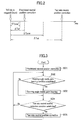
- the EPS_ECU 20 determines as the yaw rate neutral position a value detected by the yaw rate sensor S Y when a predetermined time ⁇ Tyaw, which is shorter than the predetermined time ⁇ Tst, has passed since the vehicle 1 was stopped.
- the yaw rate sensor S Y can be stabilized as described above.
- the EPS_ECU 20 can accurately correct the yaw rate neutral position by determining as the yaw rate neutral position a value of the yaw rate sensor S Y detected when the yaw rate sensor S Y is stabilized.
- a time by which the yaw rate sensor S Y is stabilized may be set as the predetermined time ⁇ Tst in advance based on an experiment.
- the predetermined time ⁇ Tyaw is not limited to a specified unique time and may be set appropriately according to the characteristic of the yaw rate sensor S Y .
- the predetermined time ⁇ Tyaw may also be set to be equal to the predetermined time ⁇ Tst.
- the EPS_ECU 20 when the EPS_ECU 20 is in an unlearned state where the EPS_ECU 20 has not learned the steering angle middle point, such as immediately after the engine of the vehicle 1 is started, conditions for performing the yaw rate neutral position correction are moderated. More specifically, as for the yaw rate neutral position correction performed for the first time after the start of the engine, the predetermined time ⁇ Tst of Fig. 2 , which is the parking time of the vehicle 1, is substantially shortened to be ⁇ Tst'. With this configuration, the EPS_ECU 20 can correct the yaw rate neutral position in a shorter parking time. Further, the EPS_ECU 20 can learn the steering angle middle point based on the detected value of the yaw rate sensor on which the yaw rate neutral position correction is performed.
- the operation angle ⁇ s of the steering wheel 21 is detected as the steering angle sensor S HA , and the EPS_ECU 20 calculates the steering angles ⁇ of the steered wheels 2 FL , 2 FR based on the operation angle ⁇ s, however, an embodiment of the present invention is not limited to this.
- the method of the first embodiment of the present invention for correcting a reference point of a sensor can be applied to a vehicle which is configured such that the movement amount of the rack shaft 4a is detected to allow the EPS_ECU20 to calculate and obtain the steering angle ⁇ .
- the yaw rate sensor S Y in which the neutral position is fluctuated may output a value indicating that the yaw rate ⁇ is not generated even when the driver operates the steering wheel 21 and the vehicle 1 is turning.
- the EPS_ECU 20 may determine that the vehicle 1 runs straight even if the vehicle 1 is turning, whereby the EPS_ECU20 may wrongly learn the steering angle middle point.
- the method of the second embodiment is configured such that when the running vehicle 1 is stopped, the yaw rate neutral position is corrected before the temperature of the engine room 3 is increased by the heat of the engine, and if the temperature of the engine room 3 is increased, the yaw rate neutral position is not corrected.
- the EPS_ECU 20 can prevent the yaw rate sensor S Y from being affected by the temperature increase of the engine room 3 by correcting the yaw rate neutral position immediately after the vehicle 1 is stopped. More specifically, the EPS_ECU 20 can correct the yaw rate neutral position at a sensor temperature close to that of the yaw rate sensor S Y of the running vehicle 1, which allows to reduce the neutral position value fluctuation generated in the yaw rate sensor S Y of the running vehicle 1.
- the EPS_ECU 20 makes it possible to learn the steering angle middle point by using the value detected by the yaw rate sensor S Y on which the yaw rate neutral position correction has been performed, whereby the learning accuracy of the steering angle middle point can be enhanced.
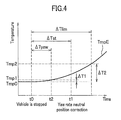
- a time course in which the EPS_ECU 20 corrects the yaw rate neutral position when the vehicle 1 is parked is explained in association with the temperature increase of the engine room 3 indicated by a symbol TmpE.
- Fig. 4 is a graph showing the relationship of the parking time of a vehicle according to the second embodiment and a temperature increase of the engine room.
- the value detected by the yaw rate sensor S Y is fluctuated depending on the variation of the sensor temperature which is affected by the variation of the ambient air temperature, the value detected by the yaw rate sensor S Y is changed when the temperature TmpE of the engine room 3 is changed.
- the temperature difference ⁇ T1 from the running vehicle temperature Tmp0 is small. Therefore, if the yaw rate neutral position is corrected when the temperature TmpE of the engine room 3 is the temperature Tmp1, it is possible to make the neutral position fluctuation generated in the yaw rate sensor SY be smaller in the running vehicle 1.
- the allowable range of the neutral position fluctuation generated in the yaw rate sensor S Y (allowed value) during running of the vehicle 1 is set in advance when the yaw rate neutral position correction is performed in the parking vehicle 1.
- the temperature difference ⁇ T2 can be obtained and set by experiment in advance such that a neutral position fluctuation exceeding the allowed value is generated in the yaw rate sensor S Y of the running vehicle 1 if the yaw rate neutral position is corrected when the temperature difference of the temperature TmpE of the engine room 3 of the parked vehicle 1 and the running vehicle temperature Tmp0 is more than ⁇ T2.
- the time period ⁇ Tlim which is the time period from the time when the running vehicle was stopped to the time when the temperature TmpE of the engine room 3 is increased so that the temperature difference between the temperature TmpE and the running vehicle temperature Tmp0 reaches ⁇ T2 can be measured under various conditions and set. It is preferable that the predetermined time period ⁇ Tst is set to be shorter than the time period ⁇ Tlim which is a time period from the time when the running vehicle stopped to the time when the temperature TmpE of the engine room 3 is increased so that the temperature difference between the temperature TmpE and the running vehicle temperature Tmp0 reaches ⁇ T2.
- the predetermined time ⁇ Tst according to the second embodiment is different from that of the first embodiment in that the predetermined time ⁇ Tst according to the second embodiment is set to be shorter than the time period ⁇ Tlim which is set based on the allowed value of the neutral position fluctuation which is allowed in the yaw rate sensor S Y of the vehicle 1.
- the predetermined time ⁇ Tst according to the second embodiment corresponds to "a second predetermined time” described in Claims. "When the yaw rate neutral position correction condition is met" described in accordance with the second embodiment corresponds to "when a status of the vehicle meets a predetermined condition" described in Claims.
- the EPS_ECU 20 can correct the yaw rate neutral position when the temperature difference between the temperature TmpE of the engine room 3 and the running vehicle temperature Tmp0 is smaller than ⁇ T2 in a case where the running vehicle 1 is stopped.
- the neutral position fluctuation generated in the yaw rate sensor S Y of the running vehicle 1 can be made smaller than the allowed value.
- the allowed value of the neutral position fluctuation generated in the yaw rate sensor S Y of the running vehicle 1 may be set appropriately based on the performance (sensitivity) of the yaw rate sensor S Y or a driving performance required for the vehicle 1, etc.
- the predetermined time ⁇ Tyaw may also be set to be equal to the predetermined time ⁇ Tst).
- the neutral position fluctuation generated in the yaw rate sensor S Y of the running vehicle 1 becomes greater than the allowed value.
- the neutral position fluctuation generated in the yaw rate sensor S Y has a large influence on the learning of the steering angle middle point by the EPS_ECU 20, which deteriorates the learning accuracy of the steering angle middle point by the EPS_ECU 20.
- the second embodiment is configured to solve the above problem, and the characteristic thereof is that in a case where the running vehicle 1 is stopped the EPS_ECU 20 corrects the yaw rate neutral position only once at the time t1 when the vehicle 1 has been stopped for the predetermined time ⁇ Tst since the vehicle 1 was stopped.
- the steering angle middle point learning is a process performed when the vehicle 1 is running.
- the EPS_ECU 20 does not determine that the vehicle 1 runs straight if the vehicle 1 is actually turning.
- the learning accuracy of the steering angle middle point is enhanced.
- the EPS_ECU 20 according to the second embodiment can correct the yaw rate neutral position of the yaw rate sensor S Y only once when the temperature difference between the temperature TmpE of the engine room 3 and the running vehicle temperature Tmp0 is smaller than ⁇ T2.
- the EPS_ECU 20 according to the second embodiment can prevent the yaw rate sensor S Y from being affected by the temperature increase of the engine room 3 when correcting the yaw rate neutral position.
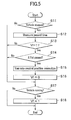
- step S17 the EPS_ECU20 checks whether or not the vehicle 1 is running. If the EPS_ECU 20 determines that the vehicle 1 is running (Yes), the processing proceeds to step S 18 and sets the running determination flag Vf to be "1". If the EPS_ECU20 determines that the vehicle 1 is not running in step S17 (No), the processing is terminated without changing the value of the running determination flag Vf. The processing then returns to step S 11 and repeats the following steps.
- step S 17 the EPS_ECU 20 determines that the vehicle 1 starts to run when the vehicle 1 runs for a predetermined time set in advance at a speed equal to or faster than a predetermined speed set in advance.
- the predetermined speed and the predetermined time may be set to be a speed and a time required for the temperature of the engine room 3 of the vehicle 1 to be decreased to a temperature close to the ambient temperature.
- the EPS_ECU 20 corrects the yaw rate neutral position only once when the predetermined time ⁇ Tst has passed for the first time with the vehicle 1 being parked since the running vehicle was stopped.
- the EPS_ECU 20 can correct the yaw rate neutral position when the temperature difference between the temperature TmpE of the engine room 3 and the running vehicle temperature Tmp0 is small (e.g. smaller than ⁇ T2 shown in Fig. 4 ).
- the EPS_ECU 20 can correct the yaw rate neutral position when the sensor temperature of the yaw rate sensor S Y is close to that when the vehicle 1 is running.
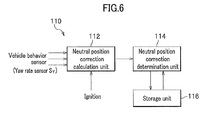
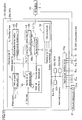
- Fig. 6 is a block diagram showing the reference point correcting device to which the method of the third embodiment is applied.
- Fig. 7 is a flow chart showing the control process for correcting a reference point of a sensor according to the third embodiment.
- step S22 If the neutral position correction value is not obtained (i.e. the neutral position correction condition is not met) in step S22 (No), signals from the yaw rate sensor S Y and other vehicle behavior sensors are repeatedly input to the neutral position correction calculation unit 112. In short, the processing of step S22 is repeatedly performed to determine whether or not the neutral position correction condition is met.
- step S24 the neutral position correction determination unit 114 reads out a previous yaw rate correction value stored in the storage unit 116 and determines whether or not there is the previous yaw rate correction value. At this time, if the previous neutral position correction value is not stored (No), the processing proceeds to step S25 where the present neutral position correction value is stored in the storage unit 116 as the neutral position correction value (stored data), and the processing returns to step S22.
- step S23 the processing of step S23 for obtaining the neutral position correction value is executed at least two times.
- the neutral position correction values can be narrowed down by the reference point correction condition before the reference point correction determining step, which allows the vehicle to appropriately cope with the fluctuation of the detected value of the vehicle behavior sensor in the running vehicle.
- a correction determination time period for comparing the previous neutral position correction value with the present neutral position correction value is set longer than the time period in which the vehicle runs on such a cant road.
- the yaw rate sensor S Y and the temperature sensor S TY is incorporated in the VSA_ECU 30, for example.
- the yaw rate sensor S Y is a sensor which uses a semiconductor element, and its detected value is varied depending on the temperature fluctuation of the yaw rate sensor S Y .
- the VSA_ECU 30 is connected to a braking device B (shown as “B FL , B FR , B FL , B RR " in Fig. 8 ) provided to each wheel 2 FL , 2 FR , 2 RL , 2 RR such that the VSA_ECU 30 is communicated with a hydraulic circuit control unit 31a which drives a control valve (not shown) included in a hydraulic circuit 31 which individually supplies a hydraulic pressure to each braking device B.
- the VSA_ECU 30 controls each braking device B FL , B FR , B FL , B RR via the hydraulic circuit control unit 31a by outputting a control signal to the hydraulic circuit control unit 31a or receiving a hydraulic pressure signal from the hydraulic circuit control unit 31 a.
- the yaw rate sensor S Y and the neutral position learning condition establishment determination unit 42, the neutral position determination unit 43, the learned neutral position storing unit 44, the yaw rate correction unit 45 and the non volatile memory 30f of the VSA_ECU 30 corresponds to "vehicle behavior detection system" described in Claims.
- the neutral position learning condition establishment determination unit 42a does not output a signal which allows the neutral position learning to the neutral position determination unit 43.
- the present vehicle speed Vs, the steering angle ⁇ , the steering torque Trq and the yaw rate ⁇ which is the detected value corresponds to "vehicle behavior information" described in Claims.
- the learned neutral position storing unit 44 stores the yaw rate neutral position value ⁇ 0 which is output from the neutral position determination unit 43 in the neutral position data unit 44a in the non volatile memory 30f.
- the yaw rate correction unit 45 outputs the yaw rate ⁇ * which is obtained by correcting the current yaw rate ⁇ based on the corrected neutral position to the VSA controlling unit 46.
- the yaw rate correction unit 45 outputs the yaw rate ⁇ * on which the neutral position correction has been performed to the EPS_ECU20 via the CAN communication.
- the VSA controlling unit 46 performs the VSA control of the vehicle 1 by controlling the braking devices B of each wheel 2 via the hydraulic circuit 31 based on the vehicle speed Vs, the yaw rate ⁇ * which has been corrected based on the corrected neutral position, the steering angle ⁇ , and the lateral acceleration ⁇ X .
- the VSA controlling unit 46 also performs a braking control via the hydraulic circuit 31 and monitors the wheel speed V W of the wheel 2 to perform the ABS control to prevent the wheels 2 from being locked when the driver steps on the brake pedal PB (see Fig. 8 ).
- step S32 the neutral position determination unit 43 checks whether or not the difference between the outer air temperature T Air and the yaw rate sensor temperature T Y is smaller than a threshold value ⁇ TY . If the difference between the outer air temperature T Air and the yaw rate sensor temperature T Y is smaller than the threshold value ⁇ TY (Yes), the neutral position determination unit 43 outputs the current yaw rate ⁇ , which is the detected value, to the learned neutral position storing unit 44 as the yaw rate neutral position value ⁇ 0 (obtains the reference point), and the processing proceeds to step S33.
- the neutral position of the yaw rate sensor S Y is learned only when the temperature of the vehicle 1 (see Fig. 8 ) is at the yaw rate sensor temperature T Y which is close to the outer air temperature T Air .
- T Y which is close to the outer air temperature T Air .
- the VSA_ECU 30 is described to learn the neutral position of the yaw rate sensor S Y in the fourth embodiment; however, an embodiment of the present invention is not limited to this.
- the VSA_ECU 30 may transmit the yaw rate ⁇ which is the detected value to the EPS_ECU 20 via the CAN communication line 50 and the EPS_ECU 20 may learn the neutral position in the method as described above and may transmit the yaw rate ⁇ * which has been corrected based on the corrected neutral position to other ECU, such as the VSA_ECU 30, via the CAN communication line 50 to use the yaw rate ⁇ * which has been corrected based on the corrected neutral position in the VSA control.
- An embodiment of the present invention may also be configured that the yaw rate ⁇ which is the detected value of the yaw rate sensor S Y is directly input to the EPS_ECU 20, and the EPS_ECU 20 learns the neutral position by the method as described above and transmits the yaw rate ⁇ * which has been corrected based on the corrected neutral position to other ECU, such as the VSA_ECU 30, via the CAN communication line 50 to use the yaw rate ⁇ * which has been corrected based on the corrected neutral position in the VSA control.
- the CPU 30a of the VSA_ECU 30 includes a vehicle speed calculation unit 41, an neutral position learning condition establishment determination unit 42, an neutral position determination unit 43, a learned neutral position storing unit (reference point storage unit, the reference point correction time temperature storage unit) 44, a yaw rate correction unit 45 and a VSA controlling unit 46 as functional configuration units which are realized by executing the programs stored in the ROM 30c.
- the vehicle speed calculation unit 41 reads signals indicating the wheel speed V W from the wheel speed sensor S VW , calculates the vehicle speed Vs of the vehicle 1 and outputs the vehicle speed Vs to the neutral position learning condition establishment determination unit 42 and the VSA controlling unit 46.
- the neutral position learning condition establishment determination unit 42 includes a neutral position learning condition data 42a which is stored in the ROM 30c in advance, and determines whether or not the learning condition of the neutral position of the yaw rate sensor S Y is met based on the current vehicle speed Vs, steering angle ⁇ , steering torque Trq and the yaw rate ⁇ which is the detected value. If the learning condition is met, the neutral position learning condition establishment determination unit 42 outputs a signal allowing the learning of the neutral position to the neutral position determination unit 43. If the learning condition is not met, the neutral position learning condition establishment determination unit 42 does not output a signal allowing the learning of the neutral position to the neutral position determination unit 43.
- the learned neutral position storing unit 44 stores the yaw rate neutral position value ⁇ 0 output from the neutral position determination unit 43 in the neutral position data unit 44a of the non volatile memory (reference point storage unit, reference point correction time temperature storage unit) 30f.
- the learned neutral position storing unit 44 also stores the neutral position learning time temperature T Y * in the neutral position learning time temperature data unit 44b of the non volatile memory 30f.
- the yaw rate correction unit 45 outputs the yaw rate ⁇ * which is obtained by correcting the current yaw rate ⁇ based on the corrected neutral position to the VSA controlling unit 46.
- the yaw rate correction unit 45 outputs the yaw rate ⁇ * which has been corrected based on the corrected neutral position, the neutral position learning time temperature T Y * and the current yaw rate sensor temperature T Y to the EPS_ECU 20 via the CAN communication.
- the VSA controlling unit 46 performs the VSA control of the vehicle 1 by controlling the braking devices B of each wheel 2 via the hydraulic circuit 31 based on the vehicle speed Vs, the yaw rate ⁇ * on which the neutral position correction is performed, the steering angle ⁇ , and the lateral acceleration ⁇ x .
- the VSA controlling unit 46 also performs a braking control via the hydraulic circuit 31 and the ABS control to prevent the wheels 2 from being locked by monitoring the wheel speed V W of the wheel 2 when the driver steps on the brake pedal PB (see Fig. 8 ).
- Fig. 12 is a functional block diagram of the EPS_ECU according to the fifth embodiment.
- Fig. 13 is a graph for explaining a yaw rate reaction force correction restriction factor in the fifth embodiment.
- the EPS_ECU 20 includes a basic control unit 51, a steering reaction force control unit 52, a subtracter 53 and a drive electricity control unit 54.
- a target electricity It corresponding to a steering assistance force to be generated by the motor 23 is calculated in the subtracter 53.
- the basic control unit 51 calculates a base electricity Ib which is the base of the target electricity It corresponding to the steering assistance force generated in the motor 23 based on the manual steering force input from the steering wheel 21 (see Fig. 8 ).
- the basic control unit 51 also performs required correction on the base electricity Ib to obtain an assist electricity Ia.
- the basic control unit 51 includes a base electricity calculation unit 61, an inertia compensation unit 62 for compensating the inertia of the steering system and a damper compensation unit 63 for compensating the damping of the steering system.
- the steering system of the description "inertia of the steering system” and “damping of the steering system” means to include the motor 23 in the steering system in addition to the steering mechanism such as the pinion shaft 11 and the rack shaft.
- the vertical axis in the function data or the map data 66a indicates a yaw rate reaction force correction restriction factor C which is to be multiplied with the yaw rate reaction force correction electricity Iy.
- the yaw rate reaction force correction restriction factor C is 1.0 when the
- the yaw rate reaction force correction restriction factor C is decreased as current temperature T Y - learning time temperature T Y *
- a process performed by the yaw rate reaction force restriction unit 66 to calculate the difference between the neutral position learning time yaw rate sensor temperature T Y * and the current yaw rate sensor temperature T Y and to multiply the yaw rate reaction force correction electricity Iy with the yaw rate reaction force correction restriction factor C determined based on the function data or map data 66a with reference to the difference corresponds to a process "adjusts a correction amount of a control performed according to a detected value of the vehicle behavior sensor based on a difference between the reference point correction time temperature and a current vehicle behavior sensor temperature" recited in Claims.
- the basic control unit 51 sets an assist electricity Ia to increase as a manual steering torque is increased.
- the steering reaction force control unit 52 sets a yaw rate reaction force correction electricity Iy in such a manner that the absolute value of the yaw rate reaction force correction electricity Iy is increased as the absolute value of an actual yaw rate (corrected yaw rate) ⁇ * is increased.
- the steering assistance force of the motor 23 is reduced and a steering reaction force applied to the driver becomes larger.
- the steering wheel 21 is felt to be heavy, which allows the driver to recognize the instability of the vehicle 1 and to suppress the rotation operation of the steering wheel 21 by the driver.
- it is possible to enhance the running stability of the vehicle 1 as well as to enhance the operability of the vehicle 1 for the driver.
- the yaw rate reaction force correction electricity Iy* is subtracted from the assist electricity Ia which is input from the basic control unit 51 and the target electricity It is input to the drive electricity control unit 54.
- the drive electricity control unit 54 controls electricity supplied to the motor 23 from the motor driving circuit 22 in such a manner that a deviation between an actual electricity (indicated as "IU, IV, IW” in Fig. 12 ) in U-phase, V-phase and W-phase which are supplied to the motor 23 from the motor driving circuit 22 and the target electricity It becomes small. More specifically, the drive electricity control unit 54 controls a duty signal which is to be input to a switching element included in the motor driving circuit 22 in such a manner that the deviation becomes small.
- the yaw rate reaction force restriction unit 66 in the EPS_ECU 20 controls a yaw rate reaction force correction electricity Iy which is calculated in the yaw rate reaction force correction electricity calculation unit 65 based on the actual yaw rate ⁇ * which has been corrected on the basis of the neutral position value ⁇ 0 learned at the yaw rate sensor temperature T Y * to be smaller as the difference between the neutral position learning time yaw rate sensor temperature T Y * and the current yaw rate sensor temperature T Y becomes larger.
- the neutral position of the yaw rate sensor S Y is learned in the VSA_ECU 30 (see Fig. 11 ) in the fifth embodiment, however, an embodiment of the present invention is not limited.
- an embodiment of the present invention may be configured that the VSA_ECU 30 transmits the yaw rate ⁇ , which is a detected value, to the EPS_ECU20 via the CAN communication line 50 and the EPS_ECU 20 learns the neutral position in the method as described above and transmits the yaw rate ⁇ * which has been corrected based on the corrected neutral position to other ECU, such as the VSA_ECU 30 via the CAN communication line 50 to use the yaw rate ⁇ * corrected based on the corrected neutral position in a VSA control.
- An embodiment of the present invention may also be configured that the yaw rate ⁇ which is a value detected by the yaw rate sensor S Y is directly input to the EPS_ECU 20 and the EPS_ECU 20 learns the neutral position in the method as described above and transmits the yaw rate ⁇ * corrected based on the corrected neutral position to other ECU, such as the VSA_ECU 30 via the CAN communication line 50 to use the yaw rate ⁇ * corrected based on the corrected neutral position in the VSA control.
- the yaw rate ⁇ which is a value detected by the yaw rate sensor S Y is directly input to the EPS_ECU 20 and the EPS_ECU 20 learns the neutral position in the method as described above and transmits the yaw rate ⁇ * corrected based on the corrected neutral position to other ECU, such as the VSA_ECU 30 via the CAN communication line 50 to use the yaw rate ⁇ * corrected based on the corrected neutral position in the VSA control
- the temperature of the vehicle behavior sensor corresponds to “the yaw rate sensor temperature T Y " in the fifth embodiment, however, "the temperature of the vehicle behavior sensor” recited in Claims may be the temperature of the yaw rate sensor S Y or the environmental temperature of the yaw rate sensor S Y .
- the steering reaction force control unit 52 of the CPU 20a of the EPS_ECU 20 controls the reaction force component of the steering assistance force based on the yaw rate ⁇ *, however, as disclosed in Japanese Unexamined Patent Application Publication No. 2006 - 256425 , the steering reaction force control unit 52 may control the reaction force component of the steering assistance force based on the yaw rate ⁇ * and the steering angle ⁇ .
- the vehicle 1 to which methods for correcting a sensor reference point according to the first to fifth embodiments are applied is not limited to a vehicle including an engine such as gasoline engine or diesel engine as a driving source, but may be a EV vehicle (electric vehicle) which includes a motor as a driving source.
- a sensor reference point correction method which corrects the yaw rate neutral position of a yaw rate sensor when a predetermined time ⁇ Tst has passed with a vehicle being parked since the running vehicle was stopped.
- a provisional neutral position correction of the yaw rate sensor is performed when a predetermined time ⁇ Tst' which is shorter than a predetermined time ⁇ Tst has passed with the vehicle being parked.
Landscapes
- Engineering & Computer Science (AREA)
- Physics & Mathematics (AREA)
- Chemical & Material Sciences (AREA)
- Combustion & Propulsion (AREA)
- Transportation (AREA)
- Mechanical Engineering (AREA)
- General Physics & Mathematics (AREA)
- Mathematical Physics (AREA)
- Steering Control In Accordance With Driving Conditions (AREA)
Applications Claiming Priority (5)
| Application Number | Priority Date | Filing Date | Title |
|---|---|---|---|
| JP2009105469A JP4713653B2 (ja) | 2009-04-23 | 2009-04-23 | 電動パワーステアリング装置 |
| JP2009105460A JP4871370B2 (ja) | 2009-04-23 | 2009-04-23 | 車両挙動センサの中点学習方法と車両挙動検出システム |
| JP2009112327A JP2010260430A (ja) | 2009-05-01 | 2009-05-01 | センサの基準点補正方法 |
| JP2009112329A JP4928581B2 (ja) | 2009-05-01 | 2009-05-01 | センサの中点補正方法 |
| JP2009113352A JP4928582B2 (ja) | 2009-05-08 | 2009-05-08 | 車両挙動センサの中点補正方法 |
Publications (3)
| Publication Number | Publication Date |
|---|---|
| EP2243686A2 true EP2243686A2 (de) | 2010-10-27 |
| EP2243686A3 EP2243686A3 (de) | 2010-11-17 |
| EP2243686B1 EP2243686B1 (de) | 2014-03-05 |
Family
ID=42371384
Family Applications (1)
| Application Number | Title | Priority Date | Filing Date |
|---|---|---|---|
| EP20100160777 Not-in-force EP2243686B1 (de) | 2009-04-23 | 2010-04-22 | Elektrische Servolenkung |
Country Status (1)
| Country | Link |
|---|---|
| EP (1) | EP2243686B1 (de) |
Cited By (2)
| Publication number | Priority date | Publication date | Assignee | Title |
|---|---|---|---|---|
| CN109682409A (zh) * | 2019-02-24 | 2019-04-26 | 苏州迈步自动化系统有限公司 | 电动助力转向系统的传感器对中标定设备 |
| CN116639137A (zh) * | 2022-02-16 | 2023-08-25 | 本田技研工业株式会社 | 可移动物体的控制装置 |
Families Citing this family (2)
| Publication number | Priority date | Publication date | Assignee | Title |
|---|---|---|---|---|
| CN103879446B (zh) * | 2014-03-28 | 2017-09-29 | 奇瑞汽车股份有限公司 | 一种方向盘歪斜校正系统及其控制方法 |
| DE102020211769A1 (de) | 2020-09-21 | 2022-03-24 | Volkswagen Aktiengesellschaft | Ermitteln eines Lenkreferenzzustands mittels Radgeschwindigkeitsgrößen |
Citations (5)
| Publication number | Priority date | Publication date | Assignee | Title |
|---|---|---|---|---|
| JPH04213067A (ja) | 1990-09-20 | 1992-08-04 | Honda Motor Co Ltd | 加速度センサ中点補正装置 |
| JP2000081335A (ja) | 1998-09-07 | 2000-03-21 | Denso Corp | ヨーレートセンサ |
| JP3728991B2 (ja) | 1999-09-09 | 2005-12-21 | 株式会社デンソー | 操舵角中立学習装置及び記録媒体 |
| JP2006256425A (ja) | 2005-03-16 | 2006-09-28 | Honda Motor Co Ltd | 操舵装置 |
| JP2008221869A (ja) | 2007-03-08 | 2008-09-25 | Honda Motor Co Ltd | 電動パワーステアリング装置 |
Family Cites Families (6)
| Publication number | Priority date | Publication date | Assignee | Title |
|---|---|---|---|---|
| JPH05278626A (ja) * | 1992-03-31 | 1993-10-26 | Mazda Motor Corp | 車両の後輪操舵装置 |
| JPH1151668A (ja) * | 1997-08-07 | 1999-02-26 | Toyota Motor Corp | 角速度検出装置 |
| JP3334647B2 (ja) * | 1998-10-13 | 2002-10-15 | アイシン精機株式会社 | 車両のヨーレイト検出装置 |
| JP4292439B2 (ja) * | 1999-11-01 | 2009-07-08 | 株式会社ジェイテクト | 車両用操舵装置 |
| JP4700329B2 (ja) * | 2004-11-25 | 2011-06-15 | 本田技研工業株式会社 | 角速度センサの中点補正装置 |
| DE102006018974A1 (de) * | 2006-04-25 | 2007-10-31 | Adc Automotive Distance Control Systems Gmbh | Verfahren zur Kalibrierung einer Gierratenmessung |
-
2010
- 2010-04-22 EP EP20100160777 patent/EP2243686B1/de not_active Not-in-force
Patent Citations (5)
| Publication number | Priority date | Publication date | Assignee | Title |
|---|---|---|---|---|
| JPH04213067A (ja) | 1990-09-20 | 1992-08-04 | Honda Motor Co Ltd | 加速度センサ中点補正装置 |
| JP2000081335A (ja) | 1998-09-07 | 2000-03-21 | Denso Corp | ヨーレートセンサ |
| JP3728991B2 (ja) | 1999-09-09 | 2005-12-21 | 株式会社デンソー | 操舵角中立学習装置及び記録媒体 |
| JP2006256425A (ja) | 2005-03-16 | 2006-09-28 | Honda Motor Co Ltd | 操舵装置 |
| JP2008221869A (ja) | 2007-03-08 | 2008-09-25 | Honda Motor Co Ltd | 電動パワーステアリング装置 |
Cited By (3)
| Publication number | Priority date | Publication date | Assignee | Title |
|---|---|---|---|---|
| CN109682409A (zh) * | 2019-02-24 | 2019-04-26 | 苏州迈步自动化系统有限公司 | 电动助力转向系统的传感器对中标定设备 |
| CN109682409B (zh) * | 2019-02-24 | 2023-12-01 | 苏州埃尔迪菲智能机器人有限公司 | 电动助力转向系统的传感器对中标定设备 |
| CN116639137A (zh) * | 2022-02-16 | 2023-08-25 | 本田技研工业株式会社 | 可移动物体的控制装置 |
Also Published As
| Publication number | Publication date |
|---|---|
| EP2243686A3 (de) | 2010-11-17 |
| EP2243686B1 (de) | 2014-03-05 |
Similar Documents
| Publication | Publication Date | Title |
|---|---|---|
| US9043087B2 (en) | Method of determining a steering angle in a motor vehicle | |
| US8423257B2 (en) | System for and method of maintaining a driver intended path | |
| CN100540381C (zh) | 用于控制转向辅助扭矩的车辆转向控制装置 | |
| US9150245B2 (en) | Methods and systems for controlling steering systems of vehicles | |
| EP2248711A2 (de) | Elektrisches Servolenksystem | |
| US10106192B2 (en) | Method for teaching permissible steering angles in a steering device of a motor vehicle | |
| JP2004148889A (ja) | 車輌の運動制御装置 | |
| US9278697B2 (en) | Vehicle running control apparatus and method | |
| JP4137041B2 (ja) | 車輌の制御装置 | |
| CN111216785B (zh) | 用于控制车辆的转向系统的装置和方法 | |
| JP2022024356A (ja) | 自動操舵システム | |
| EP2243686B1 (de) | Elektrische Servolenkung | |
| JP4713653B2 (ja) | 電動パワーステアリング装置 | |
| JP2009276098A (ja) | 車両用舵角検出装置及びこれを使用した電動パワーステアリング装置 | |
| JP2005184911A (ja) | 車輪独立駆動電気自動車のモータ入出力係数修正装置 | |
| JP4871370B2 (ja) | 車両挙動センサの中点学習方法と車両挙動検出システム | |
| JP4810940B2 (ja) | 車輌の操舵補助力制御装置 | |
| JP2006312421A (ja) | 車両制御装置 | |
| JP4928581B2 (ja) | センサの中点補正方法 | |
| US20050182542A1 (en) | Device and procedure for a steering support for vehicles with electromechanical steering system | |
| CN118306472A (zh) | 一种基于轮速差的车辆跑偏补偿控制方法和系统 | |
| JP2008081115A (ja) | 車輌の制御装置 | |
| JP2010260430A (ja) | センサの基準点補正方法 | |
| JP4411999B2 (ja) | 車両用操舵装置 | |
| JP2005239006A (ja) | 車両用電動モータの制御装置 |
Legal Events
| Date | Code | Title | Description |
|---|---|---|---|
| PUAI | Public reference made under article 153(3) epc to a published international application that has entered the european phase |
Free format text: ORIGINAL CODE: 0009012 |
|
| PUAL | Search report despatched |
Free format text: ORIGINAL CODE: 0009013 |
|
| 17P | Request for examination filed |
Effective date: 20100422 |
|
| AK | Designated contracting states |
Kind code of ref document: A2 Designated state(s): AT BE BG CH CY CZ DE DK EE ES FI FR GB GR HR HU IE IS IT LI LT LU LV MC MK MT NL NO PL PT RO SE SI SK SM TR |
|
| AX | Request for extension of the european patent |
Extension state: AL BA ME RS |
|
| AK | Designated contracting states |
Kind code of ref document: A3 Designated state(s): AT BE BG CH CY CZ DE DK EE ES FI FR GB GR HR HU IE IS IT LI LT LU LV MC MK MT NL NO PL PT RO SE SI SK SM TR |
|
| AX | Request for extension of the european patent |
Extension state: AL BA ME RS |
|
| RIC1 | Information provided on ipc code assigned before grant |
Ipc: G01D 18/00 20060101ALI20101012BHEP Ipc: G01C 25/00 20060101ALI20101012BHEP Ipc: B62D 6/00 20060101AFI20100813BHEP Ipc: B62D 5/04 20060101ALI20101012BHEP |
|
| 17Q | First examination report despatched |
Effective date: 20101111 |
|
| GRAP | Despatch of communication of intention to grant a patent |
Free format text: ORIGINAL CODE: EPIDOSNIGR1 |
|
| INTG | Intention to grant announced |
Effective date: 20130926 |
|
| GRAS | Grant fee paid |
Free format text: ORIGINAL CODE: EPIDOSNIGR3 |
|
| GRAA | (expected) grant |
Free format text: ORIGINAL CODE: 0009210 |
|
| AK | Designated contracting states |
Kind code of ref document: B1 Designated state(s): AT BE BG CH CY CZ DE DK EE ES FI FR GB GR HR HU IE IS IT LI LT LU LV MC MK MT NL NO PL PT RO SE SI SK SM TR |
|
| REG | Reference to a national code |
Ref country code: GB Ref legal event code: FG4D |
|
| REG | Reference to a national code |
Ref country code: CH Ref legal event code: EP |
|
| REG | Reference to a national code |
Ref country code: AT Ref legal event code: REF Ref document number: 654660 Country of ref document: AT Kind code of ref document: T Effective date: 20140315 |
|
| REG | Reference to a national code |
Ref country code: IE Ref legal event code: FG4D |
|
| REG | Reference to a national code |
Ref country code: DE Ref legal event code: R096 Ref document number: 602010013893 Country of ref document: DE Effective date: 20140417 |
|
| REG | Reference to a national code |
Ref country code: AT Ref legal event code: MK05 Ref document number: 654660 Country of ref document: AT Kind code of ref document: T Effective date: 20140305 |
|
| REG | Reference to a national code |
Ref country code: NL Ref legal event code: VDEP Effective date: 20140305 |
|
| PG25 | Lapsed in a contracting state [announced via postgrant information from national office to epo] |
Ref country code: NO Free format text: LAPSE BECAUSE OF FAILURE TO SUBMIT A TRANSLATION OF THE DESCRIPTION OR TO PAY THE FEE WITHIN THE PRESCRIBED TIME-LIMIT Effective date: 20140605 Ref country code: LT Free format text: LAPSE BECAUSE OF FAILURE TO SUBMIT A TRANSLATION OF THE DESCRIPTION OR TO PAY THE FEE WITHIN THE PRESCRIBED TIME-LIMIT Effective date: 20140305 |
|
| REG | Reference to a national code |
Ref country code: LT Ref legal event code: MG4D |
|
| PG25 | Lapsed in a contracting state [announced via postgrant information from national office to epo] |
Ref country code: FI Free format text: LAPSE BECAUSE OF FAILURE TO SUBMIT A TRANSLATION OF THE DESCRIPTION OR TO PAY THE FEE WITHIN THE PRESCRIBED TIME-LIMIT Effective date: 20140305 Ref country code: CY Free format text: LAPSE BECAUSE OF FAILURE TO SUBMIT A TRANSLATION OF THE DESCRIPTION OR TO PAY THE FEE WITHIN THE PRESCRIBED TIME-LIMIT Effective date: 20140305 Ref country code: AT Free format text: LAPSE BECAUSE OF FAILURE TO SUBMIT A TRANSLATION OF THE DESCRIPTION OR TO PAY THE FEE WITHIN THE PRESCRIBED TIME-LIMIT Effective date: 20140305 Ref country code: SE Free format text: LAPSE BECAUSE OF FAILURE TO SUBMIT A TRANSLATION OF THE DESCRIPTION OR TO PAY THE FEE WITHIN THE PRESCRIBED TIME-LIMIT Effective date: 20140305 |
|
| PGFP | Annual fee paid to national office [announced via postgrant information from national office to epo] |
Ref country code: FR Payment date: 20140409 Year of fee payment: 5 |
|
| PG25 | Lapsed in a contracting state [announced via postgrant information from national office to epo] |
Ref country code: HR Free format text: LAPSE BECAUSE OF FAILURE TO SUBMIT A TRANSLATION OF THE DESCRIPTION OR TO PAY THE FEE WITHIN THE PRESCRIBED TIME-LIMIT Effective date: 20140305 Ref country code: LV Free format text: LAPSE BECAUSE OF FAILURE TO SUBMIT A TRANSLATION OF THE DESCRIPTION OR TO PAY THE FEE WITHIN THE PRESCRIBED TIME-LIMIT Effective date: 20140305 |
|
| PG25 | Lapsed in a contracting state [announced via postgrant information from national office to epo] |
Ref country code: BG Free format text: LAPSE BECAUSE OF FAILURE TO SUBMIT A TRANSLATION OF THE DESCRIPTION OR TO PAY THE FEE WITHIN THE PRESCRIBED TIME-LIMIT Effective date: 20140605 Ref country code: RO Free format text: LAPSE BECAUSE OF FAILURE TO SUBMIT A TRANSLATION OF THE DESCRIPTION OR TO PAY THE FEE WITHIN THE PRESCRIBED TIME-LIMIT Effective date: 20140305 Ref country code: IS Free format text: LAPSE BECAUSE OF FAILURE TO SUBMIT A TRANSLATION OF THE DESCRIPTION OR TO PAY THE FEE WITHIN THE PRESCRIBED TIME-LIMIT Effective date: 20140705 Ref country code: BE Free format text: LAPSE BECAUSE OF FAILURE TO SUBMIT A TRANSLATION OF THE DESCRIPTION OR TO PAY THE FEE WITHIN THE PRESCRIBED TIME-LIMIT Effective date: 20140305 Ref country code: CZ Free format text: LAPSE BECAUSE OF FAILURE TO SUBMIT A TRANSLATION OF THE DESCRIPTION OR TO PAY THE FEE WITHIN THE PRESCRIBED TIME-LIMIT Effective date: 20140305 Ref country code: NL Free format text: LAPSE BECAUSE OF FAILURE TO SUBMIT A TRANSLATION OF THE DESCRIPTION OR TO PAY THE FEE WITHIN THE PRESCRIBED TIME-LIMIT Effective date: 20140305 Ref country code: EE Free format text: LAPSE BECAUSE OF FAILURE TO SUBMIT A TRANSLATION OF THE DESCRIPTION OR TO PAY THE FEE WITHIN THE PRESCRIBED TIME-LIMIT Effective date: 20140305 |
|
| PG25 | Lapsed in a contracting state [announced via postgrant information from national office to epo] |
Ref country code: SK Free format text: LAPSE BECAUSE OF FAILURE TO SUBMIT A TRANSLATION OF THE DESCRIPTION OR TO PAY THE FEE WITHIN THE PRESCRIBED TIME-LIMIT Effective date: 20140305 Ref country code: PL Free format text: LAPSE BECAUSE OF FAILURE TO SUBMIT A TRANSLATION OF THE DESCRIPTION OR TO PAY THE FEE WITHIN THE PRESCRIBED TIME-LIMIT Effective date: 20140305 Ref country code: MC Free format text: LAPSE BECAUSE OF FAILURE TO SUBMIT A TRANSLATION OF THE DESCRIPTION OR TO PAY THE FEE WITHIN THE PRESCRIBED TIME-LIMIT Effective date: 20140305 Ref country code: ES Free format text: LAPSE BECAUSE OF FAILURE TO SUBMIT A TRANSLATION OF THE DESCRIPTION OR TO PAY THE FEE WITHIN THE PRESCRIBED TIME-LIMIT Effective date: 20140305 |
|
| REG | Reference to a national code |
Ref country code: CH Ref legal event code: PL |
|
| REG | Reference to a national code |
Ref country code: DE Ref legal event code: R097 Ref document number: 602010013893 Country of ref document: DE |
|
| PG25 | Lapsed in a contracting state [announced via postgrant information from national office to epo] |
Ref country code: PT Free format text: LAPSE BECAUSE OF FAILURE TO SUBMIT A TRANSLATION OF THE DESCRIPTION OR TO PAY THE FEE WITHIN THE PRESCRIBED TIME-LIMIT Effective date: 20140707 |
|
| PLBE | No opposition filed within time limit |
Free format text: ORIGINAL CODE: 0009261 |
|
| STAA | Information on the status of an ep patent application or granted ep patent |
Free format text: STATUS: NO OPPOSITION FILED WITHIN TIME LIMIT |
|
| REG | Reference to a national code |
Ref country code: IE Ref legal event code: MM4A |
|
| PG25 | Lapsed in a contracting state [announced via postgrant information from national office to epo] |
Ref country code: LI Free format text: LAPSE BECAUSE OF NON-PAYMENT OF DUE FEES Effective date: 20140430 Ref country code: CH Free format text: LAPSE BECAUSE OF NON-PAYMENT OF DUE FEES Effective date: 20140430 Ref country code: DK Free format text: LAPSE BECAUSE OF FAILURE TO SUBMIT A TRANSLATION OF THE DESCRIPTION OR TO PAY THE FEE WITHIN THE PRESCRIBED TIME-LIMIT Effective date: 20140305 |
|
| REG | Reference to a national code |
Ref country code: DE Ref legal event code: R084 Ref document number: 602010013893 Country of ref document: DE |
|
| 26N | No opposition filed |
Effective date: 20141208 |
|
| GBPC | Gb: european patent ceased through non-payment of renewal fee |
Effective date: 20140605 |
|
| REG | Reference to a national code |
Ref country code: DE Ref legal event code: R097 Ref document number: 602010013893 Country of ref document: DE Effective date: 20141208 |
|
| PG25 | Lapsed in a contracting state [announced via postgrant information from national office to epo] |
Ref country code: IT Free format text: LAPSE BECAUSE OF FAILURE TO SUBMIT A TRANSLATION OF THE DESCRIPTION OR TO PAY THE FEE WITHIN THE PRESCRIBED TIME-LIMIT Effective date: 20140305 |
|
| REG | Reference to a national code |
Ref country code: DE Ref legal event code: R084 Ref document number: 602010013893 Country of ref document: DE Effective date: 20150210 |
|
| PG25 | Lapsed in a contracting state [announced via postgrant information from national office to epo] |
Ref country code: IE Free format text: LAPSE BECAUSE OF NON-PAYMENT OF DUE FEES Effective date: 20140422 |
|
| PG25 | Lapsed in a contracting state [announced via postgrant information from national office to epo] |
Ref country code: GB Free format text: LAPSE BECAUSE OF NON-PAYMENT OF DUE FEES Effective date: 20140605 Ref country code: SI Free format text: LAPSE BECAUSE OF FAILURE TO SUBMIT A TRANSLATION OF THE DESCRIPTION OR TO PAY THE FEE WITHIN THE PRESCRIBED TIME-LIMIT Effective date: 20140305 |
|
| REG | Reference to a national code |
Ref country code: FR Ref legal event code: ST Effective date: 20151231 |
|
| PG25 | Lapsed in a contracting state [announced via postgrant information from national office to epo] |
Ref country code: FR Free format text: LAPSE BECAUSE OF NON-PAYMENT OF DUE FEES Effective date: 20150430 |
|
| PG25 | Lapsed in a contracting state [announced via postgrant information from national office to epo] |
Ref country code: MT Free format text: LAPSE BECAUSE OF FAILURE TO SUBMIT A TRANSLATION OF THE DESCRIPTION OR TO PAY THE FEE WITHIN THE PRESCRIBED TIME-LIMIT Effective date: 20140305 |
|
| PG25 | Lapsed in a contracting state [announced via postgrant information from national office to epo] |
Ref country code: SM Free format text: LAPSE BECAUSE OF FAILURE TO SUBMIT A TRANSLATION OF THE DESCRIPTION OR TO PAY THE FEE WITHIN THE PRESCRIBED TIME-LIMIT Effective date: 20140305 |
|
| PG25 | Lapsed in a contracting state [announced via postgrant information from national office to epo] |
Ref country code: GR Free format text: LAPSE BECAUSE OF FAILURE TO SUBMIT A TRANSLATION OF THE DESCRIPTION OR TO PAY THE FEE WITHIN THE PRESCRIBED TIME-LIMIT Effective date: 20140606 |
|
| PG25 | Lapsed in a contracting state [announced via postgrant information from national office to epo] |
Ref country code: TR Free format text: LAPSE BECAUSE OF FAILURE TO SUBMIT A TRANSLATION OF THE DESCRIPTION OR TO PAY THE FEE WITHIN THE PRESCRIBED TIME-LIMIT Effective date: 20140305 Ref country code: HU Free format text: LAPSE BECAUSE OF FAILURE TO SUBMIT A TRANSLATION OF THE DESCRIPTION OR TO PAY THE FEE WITHIN THE PRESCRIBED TIME-LIMIT; INVALID AB INITIO Effective date: 20100422 Ref country code: LU Free format text: LAPSE BECAUSE OF NON-PAYMENT OF DUE FEES Effective date: 20140422 |
|
| PG25 | Lapsed in a contracting state [announced via postgrant information from national office to epo] |
Ref country code: MK Free format text: LAPSE BECAUSE OF FAILURE TO SUBMIT A TRANSLATION OF THE DESCRIPTION OR TO PAY THE FEE WITHIN THE PRESCRIBED TIME-LIMIT Effective date: 20140305 |
|
| PGFP | Annual fee paid to national office [announced via postgrant information from national office to epo] |
Ref country code: DE Payment date: 20210323 Year of fee payment: 12 |
|
| REG | Reference to a national code |
Ref country code: DE Ref legal event code: R119 Ref document number: 602010013893 Country of ref document: DE |
|
| PG25 | Lapsed in a contracting state [announced via postgrant information from national office to epo] |
Ref country code: DE Free format text: LAPSE BECAUSE OF NON-PAYMENT OF DUE FEES Effective date: 20221103 |