EP2243754A1 - Procédé de fabrication d'un liant contenant du plomb - Google Patents
Procédé de fabrication d'un liant contenant du plomb Download PDFInfo
- Publication number
- EP2243754A1 EP2243754A1 EP10003318A EP10003318A EP2243754A1 EP 2243754 A1 EP2243754 A1 EP 2243754A1 EP 10003318 A EP10003318 A EP 10003318A EP 10003318 A EP10003318 A EP 10003318A EP 2243754 A1 EP2243754 A1 EP 2243754A1
- Authority
- EP
- European Patent Office
- Prior art keywords
- starting material
- water
- atoms
- calcium
- silicon
- Prior art date
- Legal status (The legal status is an assumption and is not a legal conclusion. Google has not performed a legal analysis and makes no representation as to the accuracy of the status listed.)
- Granted
Links
Images



Classifications
-
- C—CHEMISTRY; METALLURGY
- C04—CEMENTS; CONCRETE; ARTIFICIAL STONE; CERAMICS; REFRACTORIES
- C04B—LIME, MAGNESIA; SLAG; CEMENTS; COMPOSITIONS THEREOF, e.g. MORTARS, CONCRETE OR LIKE BUILDING MATERIALS; ARTIFICIAL STONE; CERAMICS; REFRACTORIES; TREATMENT OF NATURAL STONE
- C04B7/00—Hydraulic cements
- C04B7/345—Hydraulic cements not provided for in one of the groups C04B7/02 - C04B7/34
- C04B7/3453—Belite cements, e.g. self-disintegrating cements based on dicalciumsilicate
-
- Y—GENERAL TAGGING OF NEW TECHNOLOGICAL DEVELOPMENTS; GENERAL TAGGING OF CROSS-SECTIONAL TECHNOLOGIES SPANNING OVER SEVERAL SECTIONS OF THE IPC; TECHNICAL SUBJECTS COVERED BY FORMER USPC CROSS-REFERENCE ART COLLECTIONS [XRACs] AND DIGESTS
- Y02—TECHNOLOGIES OR APPLICATIONS FOR MITIGATION OR ADAPTATION AGAINST CLIMATE CHANGE
- Y02P—CLIMATE CHANGE MITIGATION TECHNOLOGIES IN THE PRODUCTION OR PROCESSING OF GOODS
- Y02P40/00—Technologies relating to the processing of minerals
- Y02P40/10—Production of cement, e.g. improving or optimising the production methods; Cement grinding
Definitions
- the invention relates to a process for the preparation of a belit ambiencen binder, the reactive dicalcium silicate such.
- B. ⁇ -C 2 S contains Belit and is hydraulically active, ie hardens with water and under water.
- Belit cements are known from the cement industry and are produced by the traditional cement clinker production process for specific applications. They are characterized by their low heat of hydration and their high final strength. Therefore, they are preferably used for the production of solid components such as dam construction. However, previous binders on Belitbasis are inert and therefore show a low early strength, whereby the construction progress is significantly delayed. A broader deployment in place of Portland cement is not yet possible, although this would be desirable for reasons of climate protection, as Belit's specific CO 2 emissions are lower.
- belit ambiencen binders is similar energy-intensive as the production of Portland cement.
- the raw materials lime and silicate are ground and mixed in a molar ratio Ca: Si of about 2.
- the product is first deacidified at about 800 ° C and then fired at about 1250 ° C in a rotary kiln. After cooling, the resulting Belit clinker is ground together with Zumahlstoffen.
- ⁇ -C 2 SH converts to various C 2 S modifications, which on further heating to 920-960 ° C in the ⁇ ' L phase and on cooling ⁇ -C 2 S form.
- a disadvantage of this is the use of expensive because of their high reactivity silica.
- Old building materials come from the treatment of cementitious binders in building materials, old concrete and cement.
- the finer grain fractions from this treatment can currently not be utilized, but are outstanding for this process.
- the deacidified starting materials are ground and mixed so that a mixture with a molar ratio Ca / Si between 1.5: 1 and 2.5: 1 is present; a possible CaO deficit must be compensated by adding quicklime or lime milk.
- a mixture with a molar ratio Ca / Si between 1.5: 1 and 2.5: 1 is present; a possible CaO deficit must be compensated by adding quicklime or lime milk.
- an intermediate product containing ⁇ -Ca 2 SiO 4 (OH) 2 is formed. After filtration and drying, this intermediate converted at baking temperatures of 600 ° C to 900 ° C in a belite-containing binder and then ground.
- a disadvantage of this is the requirement of two thermal treatment stages (hydrothermal and burning). The product produced by this process is similarly slow to react as the material produced in the rotary kiln.
- a method for producing a belit ambiencen hydraulic binder should be specified, wherein the reactivity of the product should be so high that the product can be used as Portland cement. Likewise, the number of process steps and the specific energy requirement in the production should be reduced.
- a non-thermal dehydration of calcium silicates such as ⁇ -C 2 SH from cementitious materials or Afwillit to an intermediate from which by reactive milling ⁇ -C 2 S while avoiding energy-intensive heating, carbon dioxide emissions and undesirable side reactions, eg. B. formation of free lime is formed.
- the low grinding temperature is crucial for the reactivity of the product.
- the inventive method uses as raw materials already deacidified calcium carriers and silicate raw materials, wherein at most 50%, preferably up to 33.3%, of the silicon atoms are replaced by aluminum atoms. This also makes it possible to use residual materials such as old concrete or fly ashes.
- the in the DE 10 2005 037 771 B4 described hydrothermal synthesis can be used for the preparation of the calcium silicate intermediate.
- the raw materials are ground in accordance with process step a) and mixed so that a starting material with a defined molar ratio Ca / (Si + Al) of 1.5: 1 to 2.5: 1, preferably from 1.9: 1 to 2, 1: 1 is present.
- a starting material with a defined molar ratio Ca / (Si + Al) of 1.5: 1 to 2.5: 1, preferably from 1.9: 1 to 2, 1: 1 is present.
- Mixs eg. B. Altbaustoffen
- modal calcium sulfite (CaSO 3 ) or modal calcium sulfate (CaSO 4 ) may not be reactive and are therefore not taken into account in the calculation.
- a CaO deficit must be avoided by adding quicklime or milk of lime, eg. B. from residues, be compensated.
- the intermediate product according to process step c) either pure or together with other silicate-containing materials in a mill ground ( reaction milling ), wherein under reaction and dehydration, but without additional heating, wholly or partially Belit, ⁇ -Ca 2 SiO 4 , a hydraulically reactive phase is formed.
- the otherwise required burning of the intermediate product is eliminated.
- the belit Vietnamese binder is highly reactive. Complete reaction with water was observed in 3 days.
- Belit is formed in the grinding step when the stress between two solid surfaces is predominantly determined by pressure and shear forces. Under these conditions, near-surface regions of the claimed particles are changed under the grinding action.
- mills as mechano-reactors, Chemie Ingenieurtechnik 73, 1529, 2001 A consistent characterization of mills and milling processes is not possible, the desired force effect can be achieved with strain rates up to 5 m / s in different types of mill.
- temperatures of 100 ° C to 200 ° C preferably from 120 ° C to 150 ° C, in particular achieved by 130 ° C at a grinding time of 5 to 30 minutes. Therefore, a temperature control over the range of 100 ° C to 200 ° C makes sense. In this temperature range is proven to be a conversion of the starting material in Belit.
- the hydrothermal intermediate further reactants such as Ca or Si-containing solids to adjust a suitable molar Ca / Si ratio or reaction-influencing substances, including water are added.
- Suitable additives are pure quartz sand, but also contaminated sands of low quality, such as very small grain size.
- the inventive method has in particular the following advantages.
- the belitumble binder according to the invention replaces conventional cementitious binders or can be added to these. This results in a reduction of the energy consumption and the carbon dioxide emission, since the method of the invention is based on significantly lower process temperatures than the conventional cement clinker production and the material used does not have to be decarbonated in contrast to conventional cement clinker production.
- a decarbonation can be useful only as a starting material when using CaCO 3 or CaCO 3 -containing mixtures, eg weathered cement stone so Altbaustoff.
- the raw material is converted at about 900 ° C with CO 2 release in CaO.
- belit cement can either only be produced by conventional means (so-called clinker process ) or by thermal treatment of hydrothermal precursors.
- thermal treatment particle growth occurs, which is inevitable too a strongly decreasing reactivity leads.
- the process according to the invention makes it possible to produce a highly reactive binder comparable to Portland cement with low reaction heat and high early strength.
- the inventive method allows the energy-efficient and carbon dioxide emissions avoiding recycling of waste to be deposited so far. Replacing conventional, cementitious binders makes it possible to save on raw materials by using residual materials.
- an intermediate product was first prepared, which was subsequently converted to the lime-containing binder.
- the intermediate product was prepared hydrothermally from Ca (OH) 2 , quartz, 1M NaOH and H 2 O in a steel autoclave at 190 ° C. for 6 hours and then dried.
- a mixture of ⁇ -C 2 SH and minor components was obtained. From a quantitative X-ray diffratometry, the composition resulted in 80% by weight of ⁇ -C 2 SH, about 7% by weight of jaffeite, 4% by weight of quartz and small amounts of portlandite and CaCO 3 (see Table 1 ).
- FIG . 4 shows an X-ray diffractogram of the intermediate A dominated by reflections of the ⁇ -C 2 SH ( International Center for Diffraction Data (ICDD) card no. 82-1211) and the X-ray diffractograms of the products P 6m, P 12m and P 18m , wherein the main component ⁇ -C 2 SH decreases with increasing grinding time.
- ICDD International Center for Diffraction Data
- Fig. 1 newly formed reflections at 0.278 nm, 0.274 nm and 0.219 nm. These are clearly the reflections (200, 022), (-121, -103) and (031) of ⁇ -Ca 2 SiO 4 , Belit, (ICDD card no 83-0461).
- the intensity of these reflexes increases significantly with increasing grinding time.
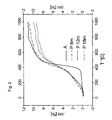
- Fig. 2 represents the percentage weight loss ⁇ m (%) of the samples as a function of temperature in the range of 25 ° C to 1000 ° C.
- the main weight loss of the intermediate A is between 400 ° C and 600 ° C, which corresponds to the dehydration of the main component ⁇ -C 2 SH.
- all the ground products P 6m, P 12m and P 18m have a reduced weight loss in this temperature range.
- a shift of the weight loss maximum to lower temperatures in the range above 100 ° C can be seen.
- This demonstrates a restructuring of the water content, especially in ⁇ -C 2 SH, from hydroxyl-OH to molecular H 2 O as a result of milling.
- the total weight loss decreases with increasing milling time of 11.1% in the intermediate A, over 11% in the 6-min. product P 6m, 10% in the 12-min. product P 12m to 9.4% in the 18-min. product P 18m.
- Partial dehydration occurs as a result of the milling process, resulting in the conversion of ⁇ -C 2 SH to ⁇ -C 2 S.
- a comparison of differential thermoanalysis shows that the temperature of complete conversion of the intermediate into ⁇ -C 2 S is dependent on the milling time. For example, it is 640 ° C for the intermediate product and 590 ° C for the ground products.
- the ground product can be further modified by a heat treatment, whereby its reactivity is influenced by changing the particle size distribution of the Belits.
- the 18-min. Product was heated in a heating chamber, from room temperature to 1000 ° C at 10 K / min, and radiographically at different holding temperatures, from room temperature to 300 ° C every 10 ° C, from 300 ° C every 50 ° C, examined.
- Belit is present in all diffractograms from room temperature up to 600 ° C. From 400 ° C the X-ray specific Belitkristallit size increases. From 500 ° C to 1000 ° C ⁇ ' L -C 2 S occurs. After cooling, however, belite is the stable phase.
- the intermediate product as well as the products P6m, P12m and P18m were heated at 400 ° C and 500 ° C for 5 hours each and finally cooled. Subsequently, the samples were examined by means of X-ray diffraction. After heating at 400 ° C (and cooling to room temperature), the intermediate (A in Fig. 3 ) mainly of ⁇ -Ca 2 SiO 4 ( ⁇ -C 2 S, ICDD card No. 87-1257). Secondary components are quartz and jaffeite. Thus, the intermediate treated at 400 ° C is not hydraulically reactive. By contrast, the products P6m, P12m and P18m increasingly contain ⁇ -Ca 2 SiO 4 ( ⁇ -C 2 S, ICDD card No.
- the intermediate (in Fig. 4 designated as A) from a mixture of ⁇ -Ca 2 SiO 4 and ⁇ -Ca 2 SiO 4 .
- the products P6m, P12m and P18m treated at 500 ° C. do not contain ⁇ -Ca 2 SiO 4 .
- This is demonstrated by the strong decrease in the intensity of the reflection at d 0.305 nm (indicated as 1 3 0) in the diffractograms of the ground products.
- the samples heated to 500 ° C. increasingly show reflections of ⁇ -Ca 2 SiO 4 .
- new reflexes occur which belong to a room temperature stabilized ⁇ 'L-Ca 2 SiO 4 modification (referred to as ⁇ 'LC 2 S).
- the ⁇ 'L-Ca 2 SiO 4 modification is normally stable only at high temperatures (675 ° C - 1177 ° C).
- ⁇ 'LC 2 S In order for ⁇ 'LC 2 S to remain stable at room temperature, it must be stabilized either by structural incorporation of foreign ions or by rapid cooling from 1300 ° C to room temperature.
- the investigation of the products initially ground at room temperature P6m, P12m and P18m, which were then heated to 500 ° C shows that stabilization of ⁇ 'LC 2 S takes place by the milling process.
- the intermediate product prepared as in Embodiment 1 was treated with varying amounts of sand for 12 minutes in a disc vibratory mill.
- Three different intermediate to sand weight ratios were investigated: 50/50, 70/30 and 85/15.
- the X-ray diffractogram of the intermediate shows that the major component is ⁇ -C 2 SH.
- the X-ray diffractograms of the products show, in addition to quartz as the main constituent, a marked decrease in the ⁇ -C 2 SH.
- Newly formed reflections at 0.278 nm, 0.274 nm and 0.219 nm clearly correspond to the reflections (200, 022) -, (-121, -103) - and (031) - of ⁇ -Ca 2 SiO 4 .
- the intensity of these reflexes is the higher, the greater the intermediate product content in the starting mixture.
- thermogravimetric investigations show great differences in the thermal behavior of the intermediate product or the products of the milling process.
- the main weight loss of the intermediate between 400 ° C and 600 ° C corresponds to the dehydration of ⁇ -C 2 SH.
- the milling products show a reduced weight loss in this temperature range, on the one hand because of the reduction of the ⁇ -C 2 SH content, on the other hand because of a partial dehydration during milling.
- the IR spectrum of the intermediate is 754 cm -1 (Si-O (H) stretching vibrations) due to the ⁇ -C 2 SH typical bands, 985 cm -1 (Si-O stretching vibrations), 1270 cm -1 ( ⁇ -OH (Si) -Biegeschwingung) and 3540 cm -1 (OH (Ca) stretching vibration).
- Fig. 5 shows the IR spectra of the precursor A and the ground products P 50/50, P 70/30 and P 85/15 in the range of 730 to 1070 cm -1 , ie in the range of Si-O stretching vibrations.
- the IR spectrum of pure Belit ⁇ -C 2 S is shown.
- the bands marked with a Q are assigned to quartz.
- the IR spectra of the products are characterized by shorter milling times ⁇ -C 2 SH bands.
- this decrease in intensity relates to the bands with a proton contribution, eg the ⁇ 1 - [Si-O (H)] stretching at 760 cm -1 .
- the bands at 860 cm -1 , 945 cm -1 and 985 cm -1 are significantly broadened by milling.
- an increased absorption between 3200 and 3750 cm -1 is present, which is due to a restructuring of the OH groups of the ⁇ -C 2 SH and resulting, weakly bonded silanol groups and molecular H 2 O.
Landscapes
- Chemical & Material Sciences (AREA)
- Engineering & Computer Science (AREA)
- Ceramic Engineering (AREA)
- Materials Engineering (AREA)
- Structural Engineering (AREA)
- Organic Chemistry (AREA)
- Silicates, Zeolites, And Molecular Sieves (AREA)
Applications Claiming Priority (1)
| Application Number | Priority Date | Filing Date | Title |
|---|---|---|---|
| DE102009018632A DE102009018632B4 (de) | 2009-04-23 | 2009-04-23 | Verfahren zur Herstellung eines belithaltigen Bindemittels |
Publications (2)
| Publication Number | Publication Date |
|---|---|
| EP2243754A1 true EP2243754A1 (fr) | 2010-10-27 |
| EP2243754B1 EP2243754B1 (fr) | 2012-10-24 |
Family
ID=42199752
Family Applications (1)
| Application Number | Title | Priority Date | Filing Date |
|---|---|---|---|
| EP10003318A Active EP2243754B1 (fr) | 2009-04-23 | 2010-03-27 | Procédé de fabrication d'un liant contenant de la bélite |
Country Status (3)
| Country | Link |
|---|---|
| EP (1) | EP2243754B1 (fr) |
| DE (1) | DE102009018632B4 (fr) |
| ES (1) | ES2398198T3 (fr) |
Cited By (9)
| Publication number | Priority date | Publication date | Assignee | Title |
|---|---|---|---|---|
| WO2013119826A1 (fr) * | 2012-02-07 | 2013-08-15 | Massachusetts Institute Of Technology | Compositions d'hydrate de ciment et procédés de synthèse |
| EP2676943A1 (fr) * | 2012-06-20 | 2013-12-25 | HeidelbergCement AG | Procédé de fabrication d'un ciment de bélite hautement réactif avec un rapport calcium/silicate faible |
| WO2014072337A1 (fr) | 2012-11-09 | 2014-05-15 | Thyssenkrupp Resource Technologies Gmbh | Procédé de fabrication d'un liant hydraulique |
| EP2801557A1 (fr) * | 2013-05-11 | 2014-11-12 | HeidelbergCement AG | Procédé de fabrication d'un ciment de silicate de magnésium-bélite-aluminate de calcium |
| EP3106445A1 (fr) | 2015-06-16 | 2016-12-21 | HeidelbergCement AG | Procédé de fabrication de ciments hautement réactifs |
| WO2018154012A1 (fr) | 2017-02-22 | 2018-08-30 | Basf Se | Composition contenant un silicate de calcium hydraté semi-ordonné |
| WO2018154013A1 (fr) | 2017-02-22 | 2018-08-30 | Cirkel Gmbh & Co. Kg | Composition à base d'oxydes contenant un silicate de calcium hydraté semi-ordonné |
| EP3368495A4 (fr) * | 2015-10-28 | 2019-06-26 | Solidia Technologies, Inc. | Production assistée à la vapeur de ciments de silicate métallique, compositions et procédés correspondants |
| WO2022073961A1 (fr) | 2020-10-09 | 2022-04-14 | Basf Se | Procédé pour la production de silicate de calcium hydraté |
Families Citing this family (3)
| Publication number | Priority date | Publication date | Assignee | Title |
|---|---|---|---|---|
| DE102012107022B3 (de) | 2012-08-01 | 2013-12-19 | Karlsruher Institut für Technologie | Verfahren zur Herstellung von Dicalciumsilikat |
| DE102014114090A1 (de) | 2014-09-29 | 2016-03-31 | Karlsruher Institut für Technologie | Verfahren zur Abtrennung von Aluminium bei der Calciumsilikatproduktion |
| EP3459917A1 (fr) | 2017-09-26 | 2019-03-27 | HeidelbergCement AG | Fabrication d'un liant à teneur en bélite beta élevée |
Citations (2)
| Publication number | Priority date | Publication date | Assignee | Title |
|---|---|---|---|---|
| EP1719741A1 (fr) * | 2004-02-26 | 2006-11-08 | Fundacion Labein | Ciment de construction, et procede d'obtention d'un ciment de construction |
| WO2007017142A2 (fr) * | 2005-08-10 | 2007-02-15 | Forschungszentrum Karlsruhe Gmbh | Procede pour produire un liant a base de belite |
-
2009
- 2009-04-23 DE DE102009018632A patent/DE102009018632B4/de not_active Expired - Fee Related
-
2010
- 2010-03-27 ES ES10003318T patent/ES2398198T3/es active Active
- 2010-03-27 EP EP10003318A patent/EP2243754B1/fr active Active
Patent Citations (2)
| Publication number | Priority date | Publication date | Assignee | Title |
|---|---|---|---|---|
| EP1719741A1 (fr) * | 2004-02-26 | 2006-11-08 | Fundacion Labein | Ciment de construction, et procede d'obtention d'un ciment de construction |
| WO2007017142A2 (fr) * | 2005-08-10 | 2007-02-15 | Forschungszentrum Karlsruhe Gmbh | Procede pour produire un liant a base de belite |
Non-Patent Citations (7)
| Title |
|---|
| A.GUERRERO,S.GONI,I.CAMPILLO,A.MORAGUES: "Belite Cement Clinker from Coal Fly Ash of High Ca Content Optimization of Synthesis Parameters", ENVIRON.SCI.TECHNOL., vol. 38, 2004, pages 3209 - 3213, XP002585887 * |
| E.HIDEKI ISHIDA, N.ISU: "Innovative Processing for Cement Materials", MRS BULLETIN, November 2001 (2001-11-01), pages 895 - 898, XP002585885 * |
| K. GARBEV: "Struktur, Eigenschaften und quantitative Rietveldanalyse von hydrothermal kristallisierten Calciumsilikathydraten (C-S-H-Phasen)", 2004, WISS. BERICHT DES FORSCHUNGSZENTRUMS KARLSRUHE, pages: 178 - 87 |
| K.GARBEV,B.GASHAROVA,G.BEUCHLE,S.KREISZ,P.STEMMERMANN: "First Observation of alpha-Ca2[SiO3(OH)]-Ca6[Si2O7][SiO4](OH)2 Phase Transformation upon Thermal Treatment in Air", J.AM.CERAM.SOC., vol. 91, no. 1, 2008, pages 263 - 271, XP002585877 * |
| K.GARBEV: "Struktur, Eigenschaften und quantitative Rietveldanalyse von hydrothermal kristallisierten Calciumsilikathydraten (CSH Phasen).", FORSCHUNGSZENTRUM KARLSRUHE WISSENSCHAFTLICHE BERICHTE, vol. FZKA 6877, 2004, Karlsruhe, XP002585876 * |
| K.SASAKI,T.MASUDA,H.ISHIDA,T,MITSUDA: "Synthesis of Calcium Silicate Hydrate with Ca/Si=2 by Mechanochemical Treatment", J.AM.CERAM.SOC., vol. 80, no. 2, 1996, pages 472 - 476, XP002585888 * |
| N.STEVULOVA,M.BALINTOVA,J.BRIANCIN,Z.SZEGHYOVA: "Mechanochemical Synthesis of Belite Cements from coal Fly Ash/Portlandite Mixture", CHEMISTRY FOR SUSTAINABLE DEVELOPMENT, vol. 15, 2007, pages 225 - 229, XP002585886 * |
Cited By (33)
| Publication number | Priority date | Publication date | Assignee | Title |
|---|---|---|---|---|
| WO2013119826A1 (fr) * | 2012-02-07 | 2013-08-15 | Massachusetts Institute Of Technology | Compositions d'hydrate de ciment et procédés de synthèse |
| CN104540792A (zh) * | 2012-06-20 | 2015-04-22 | 海德堡水泥公司 | 制造具有高反应性和低的钙/硅酸盐比例的贝利特水泥的方法 |
| EP2676943A1 (fr) * | 2012-06-20 | 2013-12-25 | HeidelbergCement AG | Procédé de fabrication d'un ciment de bélite hautement réactif avec un rapport calcium/silicate faible |
| WO2013189573A1 (fr) * | 2012-06-20 | 2013-12-27 | Heidelbergcement Ag | Procédé de production d'un ciment bélitique à haute réactivité et à faible rapport calcium/silicate |
| CN104540792B (zh) * | 2012-06-20 | 2017-08-29 | 海德堡水泥公司 | 制造具有高反应性和低的钙/硅酸盐比例的贝利特水泥的方法 |
| EA031022B1 (ru) * | 2012-06-20 | 2018-11-30 | Хайдельбергцемент Аг | Способ изготовления белитового цемента с высокой реактивностью и низким соотношением кальций/силикат |
| US9321682B2 (en) | 2012-06-20 | 2016-04-26 | Heidelbergcement Ag | Process for producing a belite cement having a high reactivity and a low calcium/silicate ratio |
| WO2014072337A1 (fr) | 2012-11-09 | 2014-05-15 | Thyssenkrupp Resource Technologies Gmbh | Procédé de fabrication d'un liant hydraulique |
| DE102012110743A1 (de) | 2012-11-09 | 2014-05-15 | Thyssenkrupp Resource Technologies Gmbh | Verfahren zur Herstellung eines hydraulischen Bindemittels |
| US9878946B2 (en) | 2012-11-09 | 2018-01-30 | Thyssenkrupp Industrial Solutions Ag | Method for producing a hydraulic binding agent |
| EP2917163A1 (fr) * | 2012-11-09 | 2015-09-16 | ThyssenKrupp Industrial Solutions GmbH | Procédé de fabrication d'un liant hydraulique |
| EP2801559A1 (fr) * | 2013-05-11 | 2014-11-12 | HeidelbergCement AG | Procédé d'amélioration de la réactivité hydraulique et/ou pouzzolanique latente de matériaux |
| WO2014183846A1 (fr) * | 2013-05-11 | 2014-11-20 | Heidelbergcement Ag | Procédé permettant d'améliorer la réactivité hydraulique et/ou pouzzolanique latente des matériaux |
| CN105143139A (zh) * | 2013-05-11 | 2015-12-09 | 海德堡水泥公司 | 制备硅酸镁-贝利特-铝酸钙水泥的方法 |
| WO2014183845A1 (fr) * | 2013-05-11 | 2014-11-20 | Heidelbergcement Ag | Aluminate de calcium-bélite comme additif |
| WO2014183844A1 (fr) * | 2013-05-11 | 2014-11-20 | Heidelbergcement Ag | Procédé de production d'un ciment de silicate de magnésium-bélite aluminate de calcium |
| EP2801558A1 (fr) * | 2013-05-11 | 2014-11-12 | HeidelbergCement AG | Bélite-aluminate de calcium comme additif |
| US9604879B2 (en) | 2013-05-11 | 2017-03-28 | Heidelbergcement Ag | Belite-calcium aluminate as an additive |
| US9718731B2 (en) | 2013-05-11 | 2017-08-01 | Heidelbergcement Ag | Method for producing magnesium silicate-belite-calcium aluminate cement |
| AU2014267718B2 (en) * | 2013-05-11 | 2017-08-24 | Heidelbergcement Ag | Belite-calcium aluminate as an additive |
| US10065888B2 (en) | 2013-05-11 | 2018-09-04 | Heidelbergcement Ag | Method of enhancing the latent hydraulic and/or pozzolanic reactivity of materials |
| EA028010B1 (ru) * | 2013-05-11 | 2017-09-29 | Хайдельбергцемент Аг | Способ получения магний-силикат-белит-кальций-алюминатного цемента |
| EP2801557A1 (fr) * | 2013-05-11 | 2014-11-12 | HeidelbergCement AG | Procédé de fabrication d'un ciment de silicate de magnésium-bélite-aluminate de calcium |
| EA029898B1 (ru) * | 2013-05-11 | 2018-05-31 | Хайдельбергцемент Аг | Способ улучшения латентной гидравлической и/или пуццолановой активности материалов |
| WO2016202439A1 (fr) | 2015-06-16 | 2016-12-22 | Heidelbergcement Ag | Procédé de fabrication de ciment à réactivité élevée |
| EP3106445A1 (fr) | 2015-06-16 | 2016-12-21 | HeidelbergCement AG | Procédé de fabrication de ciments hautement réactifs |
| EP3368495A4 (fr) * | 2015-10-28 | 2019-06-26 | Solidia Technologies, Inc. | Production assistée à la vapeur de ciments de silicate métallique, compositions et procédés correspondants |
| US10752545B2 (en) | 2015-10-28 | 2020-08-25 | Solidia Technologies, Inc. | Steam-assisted production of metal silicate cements, compositions and methods thereof |
| WO2018154013A1 (fr) | 2017-02-22 | 2018-08-30 | Cirkel Gmbh & Co. Kg | Composition à base d'oxydes contenant un silicate de calcium hydraté semi-ordonné |
| WO2018154012A1 (fr) | 2017-02-22 | 2018-08-30 | Basf Se | Composition contenant un silicate de calcium hydraté semi-ordonné |
| US11667569B2 (en) | 2017-02-22 | 2023-06-06 | Basf Se | Composition containing a semi-ordered calcium silicate hydrate |
| WO2022073961A1 (fr) | 2020-10-09 | 2022-04-14 | Basf Se | Procédé pour la production de silicate de calcium hydraté |
| US12454486B2 (en) | 2020-10-09 | 2025-10-28 | Basf Se | Process for producing calcium silicate hydrate |
Also Published As
| Publication number | Publication date |
|---|---|
| DE102009018632A1 (de) | 2011-09-15 |
| ES2398198T3 (es) | 2013-03-14 |
| EP2243754B1 (fr) | 2012-10-24 |
| DE102009018632B4 (de) | 2011-11-24 |
Similar Documents
| Publication | Publication Date | Title |
|---|---|---|
| EP2243754B1 (fr) | Procédé de fabrication d'un liant contenant de la bélite | |
| EP2183194B1 (fr) | Liant hydraulique monophasique, procédés de production et matériau de construction fabriqué avec ce liant | |
| EP2183193B1 (fr) | Liant hydraulique monophasique, procédés de production et matériau de construction fabriqué avec ce liant | |
| EP2183195B1 (fr) | Liant hydraulique monophasique, procédés de production et matériau de construction fabriqué avec ce liant | |
| EP3106445B1 (fr) | Procédé de fabrication de ciments hautement réactifs | |
| EP2676943B2 (fr) | Procédé de fabrication d'un ciment de bélite hautement réactif avec un rapport calcium/silicate faible | |
| DE102005037771B4 (de) | Verfahren zur Herstellung von Belit-Bindemittel | |
| DE102007062062B3 (de) | Verfahren zur Herstellung von hydraulischem Kalk, Verwendung des hydraulischen Kalks und nach dem Verfahren hergestellte Briketts | |
| EP2874978B1 (fr) | Utilisation de germes accélérant l'hydratation comme additif pour du ciment et/ou du béton | |
| EP3939945A1 (fr) | Procédé de fabrication d'un matériau de construction | |
| EP2192095A1 (fr) | Hydraulique liant mélangé et procédé de manufacture | |
| WO2006111241A1 (fr) | Procede de fabrication de composants | |
| WO2023156358A1 (fr) | Argile calcinée | |
| EP3038991B1 (fr) | Procédé et dispositif pour la préparation de produits à base de chaux et de pouzzolane | |
| DE102024122202A1 (de) | Verfahren zur Herstellung eines Klinkerersatzstoffes und dessen Verwendung, Zementmischungen, Verfahren zur Herstellung der Zementmischungen, Trockenbetonmischung, Trockenmörtelmischung, Frischbetonmasse und Frischmörtelmasse jeweils mit einer Zementmischung | |
| DE102023208724A9 (de) | Verfahren zur Herstellung von hydrothermal gehärteten Poren- oder Schaumbetonformkörpern und mittels des Verfahrens hergestellter Poren- oder Schaumbetonformkörper | |
| WO2024245559A1 (fr) | Procédé de production d'un matériau composite | |
| EP4662186A1 (fr) | Procédé de production de moulages en béton aéré ou de mousse hydrothermiquement durcis et moulage de béton aéré ou de mousse produit selon le procédé | |
| DE2137860C3 (de) | Verfahren zur Herstellung von Putzgipsen | |
| EP4620935A1 (fr) | Procédé de fabrication d'une sable-calcaire brique de construction | |
| EP4680583A1 (fr) | Additif pour ciment fabriqué à partir de vieux béton | |
| DE3118949A1 (de) | Wasserfester calciumsilicat enthaltender gipsbaustoff und verfahren zu seiner herstellung |
Legal Events
| Date | Code | Title | Description |
|---|---|---|---|
| PUAI | Public reference made under article 153(3) epc to a published international application that has entered the european phase |
Free format text: ORIGINAL CODE: 0009012 |
|
| AK | Designated contracting states |
Kind code of ref document: A1 Designated state(s): AT BE BG CH CY CZ DE DK EE ES FI FR GB GR HR HU IE IS IT LI LT LU LV MC MK MT NL NO PL PT RO SE SI SK SM TR |
|
| AX | Request for extension of the european patent |
Extension state: AL BA ME RS |
|
| 17P | Request for examination filed |
Effective date: 20110319 |
|
| GRAP | Despatch of communication of intention to grant a patent |
Free format text: ORIGINAL CODE: EPIDOSNIGR1 |
|
| RIC1 | Information provided on ipc code assigned before grant |
Ipc: C04B 7/345 20060101AFI20120605BHEP |
|
| GRAS | Grant fee paid |
Free format text: ORIGINAL CODE: EPIDOSNIGR3 |
|
| GRAA | (expected) grant |
Free format text: ORIGINAL CODE: 0009210 |
|
| AK | Designated contracting states |
Kind code of ref document: B1 Designated state(s): AT BE BG CH CY CZ DE DK EE ES FI FR GB GR HR HU IE IS IT LI LT LU LV MC MK MT NL NO PL PT RO SE SI SK SM TR |
|
| REG | Reference to a national code |
Ref country code: GB Ref legal event code: FG4D Free format text: NOT ENGLISH |
|
| REG | Reference to a national code |
Ref country code: CH Ref legal event code: EP |
|
| REG | Reference to a national code |
Ref country code: AT Ref legal event code: REF Ref document number: 580830 Country of ref document: AT Kind code of ref document: T Effective date: 20121115 |
|
| REG | Reference to a national code |
Ref country code: IE Ref legal event code: FG4D Free format text: LANGUAGE OF EP DOCUMENT: GERMAN |
|
| REG | Reference to a national code |
Ref country code: DE Ref legal event code: R096 Ref document number: 502010001471 Country of ref document: DE Effective date: 20121220 |
|
| REG | Reference to a national code |
Ref country code: ES Ref legal event code: FG2A Ref document number: 2398198 Country of ref document: ES Kind code of ref document: T3 Effective date: 20130314 |
|
| REG | Reference to a national code |
Ref country code: NL Ref legal event code: VDEP Effective date: 20121024 |
|
| PG25 | Lapsed in a contracting state [announced via postgrant information from national office to epo] |
Ref country code: FI Free format text: LAPSE BECAUSE OF FAILURE TO SUBMIT A TRANSLATION OF THE DESCRIPTION OR TO PAY THE FEE WITHIN THE PRESCRIBED TIME-LIMIT Effective date: 20121024 Ref country code: SE Free format text: LAPSE BECAUSE OF FAILURE TO SUBMIT A TRANSLATION OF THE DESCRIPTION OR TO PAY THE FEE WITHIN THE PRESCRIBED TIME-LIMIT Effective date: 20121024 Ref country code: NL Free format text: LAPSE BECAUSE OF FAILURE TO SUBMIT A TRANSLATION OF THE DESCRIPTION OR TO PAY THE FEE WITHIN THE PRESCRIBED TIME-LIMIT Effective date: 20121024 Ref country code: NO Free format text: LAPSE BECAUSE OF FAILURE TO SUBMIT A TRANSLATION OF THE DESCRIPTION OR TO PAY THE FEE WITHIN THE PRESCRIBED TIME-LIMIT Effective date: 20130124 Ref country code: HR Free format text: LAPSE BECAUSE OF FAILURE TO SUBMIT A TRANSLATION OF THE DESCRIPTION OR TO PAY THE FEE WITHIN THE PRESCRIBED TIME-LIMIT Effective date: 20121024 Ref country code: IS Free format text: LAPSE BECAUSE OF FAILURE TO SUBMIT A TRANSLATION OF THE DESCRIPTION OR TO PAY THE FEE WITHIN THE PRESCRIBED TIME-LIMIT Effective date: 20130224 |
|
| PG25 | Lapsed in a contracting state [announced via postgrant information from national office to epo] |
Ref country code: GR Free format text: LAPSE BECAUSE OF FAILURE TO SUBMIT A TRANSLATION OF THE DESCRIPTION OR TO PAY THE FEE WITHIN THE PRESCRIBED TIME-LIMIT Effective date: 20130125 Ref country code: SI Free format text: LAPSE BECAUSE OF FAILURE TO SUBMIT A TRANSLATION OF THE DESCRIPTION OR TO PAY THE FEE WITHIN THE PRESCRIBED TIME-LIMIT Effective date: 20121024 Ref country code: PT Free format text: LAPSE BECAUSE OF FAILURE TO SUBMIT A TRANSLATION OF THE DESCRIPTION OR TO PAY THE FEE WITHIN THE PRESCRIBED TIME-LIMIT Effective date: 20130225 Ref country code: LV Free format text: LAPSE BECAUSE OF FAILURE TO SUBMIT A TRANSLATION OF THE DESCRIPTION OR TO PAY THE FEE WITHIN THE PRESCRIBED TIME-LIMIT Effective date: 20121024 Ref country code: PL Free format text: LAPSE BECAUSE OF FAILURE TO SUBMIT A TRANSLATION OF THE DESCRIPTION OR TO PAY THE FEE WITHIN THE PRESCRIBED TIME-LIMIT Effective date: 20121024 |
|
| PG25 | Lapsed in a contracting state [announced via postgrant information from national office to epo] |
Ref country code: DK Free format text: LAPSE BECAUSE OF FAILURE TO SUBMIT A TRANSLATION OF THE DESCRIPTION OR TO PAY THE FEE WITHIN THE PRESCRIBED TIME-LIMIT Effective date: 20121024 Ref country code: EE Free format text: LAPSE BECAUSE OF FAILURE TO SUBMIT A TRANSLATION OF THE DESCRIPTION OR TO PAY THE FEE WITHIN THE PRESCRIBED TIME-LIMIT Effective date: 20121024 Ref country code: SK Free format text: LAPSE BECAUSE OF FAILURE TO SUBMIT A TRANSLATION OF THE DESCRIPTION OR TO PAY THE FEE WITHIN THE PRESCRIBED TIME-LIMIT Effective date: 20121024 Ref country code: CZ Free format text: LAPSE BECAUSE OF FAILURE TO SUBMIT A TRANSLATION OF THE DESCRIPTION OR TO PAY THE FEE WITHIN THE PRESCRIBED TIME-LIMIT Effective date: 20121024 Ref country code: BG Free format text: LAPSE BECAUSE OF FAILURE TO SUBMIT A TRANSLATION OF THE DESCRIPTION OR TO PAY THE FEE WITHIN THE PRESCRIBED TIME-LIMIT Effective date: 20130124 |
|
| PG25 | Lapsed in a contracting state [announced via postgrant information from national office to epo] |
Ref country code: RO Free format text: LAPSE BECAUSE OF FAILURE TO SUBMIT A TRANSLATION OF THE DESCRIPTION OR TO PAY THE FEE WITHIN THE PRESCRIBED TIME-LIMIT Effective date: 20121024 |
|
| PLBE | No opposition filed within time limit |
Free format text: ORIGINAL CODE: 0009261 |
|
| STAA | Information on the status of an ep patent application or granted ep patent |
Free format text: STATUS: NO OPPOSITION FILED WITHIN TIME LIMIT |
|
| BERE | Be: lapsed |
Owner name: KARLSRUHER INSTITUT FUR TECHNOLOGIE Effective date: 20130331 |
|
| 26N | No opposition filed |
Effective date: 20130725 |
|
| PG25 | Lapsed in a contracting state [announced via postgrant information from national office to epo] |
Ref country code: MC Free format text: LAPSE BECAUSE OF NON-PAYMENT OF DUE FEES Effective date: 20130331 |
|
| REG | Reference to a national code |
Ref country code: DE Ref legal event code: R097 Ref document number: 502010001471 Country of ref document: DE Effective date: 20130725 |
|
| PG25 | Lapsed in a contracting state [announced via postgrant information from national office to epo] |
Ref country code: CY Free format text: LAPSE BECAUSE OF FAILURE TO SUBMIT A TRANSLATION OF THE DESCRIPTION OR TO PAY THE FEE WITHIN THE PRESCRIBED TIME-LIMIT Effective date: 20121024 |
|
| REG | Reference to a national code |
Ref country code: IE Ref legal event code: MM4A |
|
| PG25 | Lapsed in a contracting state [announced via postgrant information from national office to epo] |
Ref country code: BE Free format text: LAPSE BECAUSE OF NON-PAYMENT OF DUE FEES Effective date: 20130331 Ref country code: IE Free format text: LAPSE BECAUSE OF NON-PAYMENT OF DUE FEES Effective date: 20130327 |
|
| PG25 | Lapsed in a contracting state [announced via postgrant information from national office to epo] |
Ref country code: LT Free format text: LAPSE BECAUSE OF FAILURE TO SUBMIT A TRANSLATION OF THE DESCRIPTION OR TO PAY THE FEE WITHIN THE PRESCRIBED TIME-LIMIT Effective date: 20121024 Ref country code: MT Free format text: LAPSE BECAUSE OF FAILURE TO SUBMIT A TRANSLATION OF THE DESCRIPTION OR TO PAY THE FEE WITHIN THE PRESCRIBED TIME-LIMIT Effective date: 20121024 |
|
| REG | Reference to a national code |
Ref country code: CH Ref legal event code: PL |
|
| PG25 | Lapsed in a contracting state [announced via postgrant information from national office to epo] |
Ref country code: CH Free format text: LAPSE BECAUSE OF NON-PAYMENT OF DUE FEES Effective date: 20140331 Ref country code: LI Free format text: LAPSE BECAUSE OF NON-PAYMENT OF DUE FEES Effective date: 20140331 |
|
| PG25 | Lapsed in a contracting state [announced via postgrant information from national office to epo] |
Ref country code: SM Free format text: LAPSE BECAUSE OF FAILURE TO SUBMIT A TRANSLATION OF THE DESCRIPTION OR TO PAY THE FEE WITHIN THE PRESCRIBED TIME-LIMIT Effective date: 20121024 |
|
| PG25 | Lapsed in a contracting state [announced via postgrant information from national office to epo] |
Ref country code: TR Free format text: LAPSE BECAUSE OF FAILURE TO SUBMIT A TRANSLATION OF THE DESCRIPTION OR TO PAY THE FEE WITHIN THE PRESCRIBED TIME-LIMIT Effective date: 20121024 |
|
| PG25 | Lapsed in a contracting state [announced via postgrant information from national office to epo] |
Ref country code: MK Free format text: LAPSE BECAUSE OF FAILURE TO SUBMIT A TRANSLATION OF THE DESCRIPTION OR TO PAY THE FEE WITHIN THE PRESCRIBED TIME-LIMIT Effective date: 20121024 Ref country code: HU Free format text: LAPSE BECAUSE OF FAILURE TO SUBMIT A TRANSLATION OF THE DESCRIPTION OR TO PAY THE FEE WITHIN THE PRESCRIBED TIME-LIMIT; INVALID AB INITIO Effective date: 20100327 Ref country code: LU Free format text: LAPSE BECAUSE OF NON-PAYMENT OF DUE FEES Effective date: 20130327 |
|
| REG | Reference to a national code |
Ref country code: FR Ref legal event code: PLFP Year of fee payment: 7 |
|
| REG | Reference to a national code |
Ref country code: AT Ref legal event code: MM01 Ref document number: 580830 Country of ref document: AT Kind code of ref document: T Effective date: 20150327 |
|
| PG25 | Lapsed in a contracting state [announced via postgrant information from national office to epo] |
Ref country code: AT Free format text: LAPSE BECAUSE OF NON-PAYMENT OF DUE FEES Effective date: 20150327 |
|
| REG | Reference to a national code |
Ref country code: FR Ref legal event code: PLFP Year of fee payment: 8 |
|
| REG | Reference to a national code |
Ref country code: FR Ref legal event code: PLFP Year of fee payment: 9 |
|
| PGFP | Annual fee paid to national office [announced via postgrant information from national office to epo] |
Ref country code: GB Payment date: 20240322 Year of fee payment: 15 |
|
| PGFP | Annual fee paid to national office [announced via postgrant information from national office to epo] |
Ref country code: ES Payment date: 20240417 Year of fee payment: 15 |
|
| PGFP | Annual fee paid to national office [announced via postgrant information from national office to epo] |
Ref country code: FR Payment date: 20250324 Year of fee payment: 16 |
|
| PGFP | Annual fee paid to national office [announced via postgrant information from national office to epo] |
Ref country code: IT Payment date: 20250331 Year of fee payment: 16 |
|
| GBPC | Gb: european patent ceased through non-payment of renewal fee |
Effective date: 20250327 |
|
| PG25 | Lapsed in a contracting state [announced via postgrant information from national office to epo] |
Ref country code: GB Free format text: LAPSE BECAUSE OF NON-PAYMENT OF DUE FEES Effective date: 20250327 |
|
| PGFP | Annual fee paid to national office [announced via postgrant information from national office to epo] |
Ref country code: DE Payment date: 20260320 Year of fee payment: 17 |