EP1719741A1 - Ciment de construction, et procede d'obtention d'un ciment de construction - Google Patents
Ciment de construction, et procede d'obtention d'un ciment de construction Download PDFInfo
- Publication number
- EP1719741A1 EP1719741A1 EP04714808A EP04714808A EP1719741A1 EP 1719741 A1 EP1719741 A1 EP 1719741A1 EP 04714808 A EP04714808 A EP 04714808A EP 04714808 A EP04714808 A EP 04714808A EP 1719741 A1 EP1719741 A1 EP 1719741A1
- Authority
- EP
- European Patent Office
- Prior art keywords
- component
- cement
- fact
- belite
- clinker
- Prior art date
- Legal status (The legal status is an assumption and is not a legal conclusion. Google has not performed a legal analysis and makes no representation as to the accuracy of the status listed.)
- Granted
Links
Images


Classifications
-
- C—CHEMISTRY; METALLURGY
- C04—CEMENTS; CONCRETE; ARTIFICIAL STONE; CERAMICS; REFRACTORIES
- C04B—LIME, MAGNESIA; SLAG; CEMENTS; COMPOSITIONS THEREOF, e.g. MORTARS, CONCRETE OR LIKE BUILDING MATERIALS; ARTIFICIAL STONE; CERAMICS; REFRACTORIES; TREATMENT OF NATURAL STONE
- C04B7/00—Hydraulic cements
- C04B7/345—Hydraulic cements not provided for in one of the groups C04B7/02 - C04B7/34
- C04B7/3453—Belite cements, e.g. self-disintegrating cements based on dicalciumsilicate
-
- C—CHEMISTRY; METALLURGY
- C04—CEMENTS; CONCRETE; ARTIFICIAL STONE; CERAMICS; REFRACTORIES
- C04B—LIME, MAGNESIA; SLAG; CEMENTS; COMPOSITIONS THEREOF, e.g. MORTARS, CONCRETE OR LIKE BUILDING MATERIALS; ARTIFICIAL STONE; CERAMICS; REFRACTORIES; TREATMENT OF NATURAL STONE
- C04B28/00—Compositions of mortars, concrete or artificial stone, containing inorganic binders or the reaction product of an inorganic and an organic binder, e.g. polycarboxylate cements
- C04B28/02—Compositions of mortars, concrete or artificial stone, containing inorganic binders or the reaction product of an inorganic and an organic binder, e.g. polycarboxylate cements containing hydraulic cements other than calcium sulfates
- C04B28/025—Belite cements
-
- Y—GENERAL TAGGING OF NEW TECHNOLOGICAL DEVELOPMENTS; GENERAL TAGGING OF CROSS-SECTIONAL TECHNOLOGIES SPANNING OVER SEVERAL SECTIONS OF THE IPC; TECHNICAL SUBJECTS COVERED BY FORMER USPC CROSS-REFERENCE ART COLLECTIONS [XRACs] AND DIGESTS
- Y02—TECHNOLOGIES OR APPLICATIONS FOR MITIGATION OR ADAPTATION AGAINST CLIMATE CHANGE
- Y02P—CLIMATE CHANGE MITIGATION TECHNOLOGIES IN THE PRODUCTION OR PROCESSING OF GOODS
- Y02P40/00—Technologies relating to the processing of minerals
- Y02P40/10—Production of cement, e.g. improving or optimising the production methods; Cement grinding
Definitions
- This invention relates to building cement comprising, as a first component, belite clinker, and which is suitable for, among others, mortars and concretes. It also relates to a process of obtaining building cement.
- belite cement primarily consists of the structural ⁇ variety of dicalcium silicate (belite), a compound that is obtained from mixtures of CaCO 3 and clay heated up to 1400 °C.
- This type of cement has certain properties, distinguished from ordinary Portland cement, necessary for certain applications. First, it has slower hydration kinetics, so the heat that is released is more gradual, preventing shrinkage problems. This makes it suitable for the mass manufacture of large concrete blocks, such as in the case of dams. Secondly, it is a more microstructurally stable cement compared to some aggressive processes taking place in highly alkaline mediums, such as ordinary Portland cement usually is. Furthermore, the minimum amount of Ca(OH) 2 that is produced during its hydration assures its stability against sulphate attack.
- the manufacturing process is similar to that of a Portland cement, using raw material formulations appropriate for obtaining the ⁇ variety belite phase of dicalcium silicate. Said phase is active by means of the fast cooling of the sintered mixture in a temperature range of 1350 °C and 1450 °C.
- British patent GB2128180 published on April 26, 1984, by RUMPLER KARLHEINZ et al. , entitled “Method and apparatus for manufacturing cement of the Belite type", claims a belite cement clinker sintered at 1350 °C-1450 °C followed by fast cooling, preferably with a cooling gradient in the range of 1350 °C-1250 °C as the upper limit and 1000 °C-800 °C as the lower limit.
- German patent DE3414196 published on October 31, 1985 by TOEPFER PAUL et al. , entitled “Alkali-active belite cement”
- German patent DE3414196 published on October 31, 1985 by TOEPFER PAUL et al. , entitled “Alkali-active belite cement”
- the alkalis together with a fast cooling improve the properties of the belite cement clinker.
- the main differences of the synthesis process are: omitting the first heating at 80°C for 10 hours of the mixture of FA, CaO and water; heating the precursor hydrated phases of the cement up to 600°C at a heating rate of 10°C/min and from 600°C up to 900°C at a rate of 5°C/min, and immediately cooling the mixture at room temperature.
- the building cement according to this invention is characterized by the fact that it comprises a second component consisting of particles of at least one ceramic material.
- the ceramic material particles have an activating effect on the belite component and allow increasing its hydration rate.
- the cement according to the invention thus maintains all the advantages of the conventional belite cement with respect to Portland cement that have been indicated, and it is further appropriate for the large-scale application thereof.
- the activation of the belite component of the new cement by means of a ceramic material is not susceptible to harmful arid-alkali reactions and therefore is the only process known to date which allows activation without the implication of harmful side effects.
- the activation mechanism is valid for any type of belite component, i.e. regardless of the synthesis route chosen to obtain it. This implies a reduction in the environmental impact because lime decalcification to produce the major belite phase of the belite cement clinker implies 33% less CO 2 emissions.
- said ceramic material shows a particle size under 100 nm, and more preferably between 5 nm and 50 nm, since particle size greatly affects the activating effect of the belite component. Furthermore, it has been verified that belite activation does not occur with particle sizes over 100 nm.
- nanomaterials either nanosilica or nanoalumina, react directly with the C-S-H gel. They thus act as nucleation "points" for gel growth and thus accelerate their formation. More specifically, it is thought that nanoparticle addition promotes the growth of silica chains in the gel, giving therefore a gel with a lower Ca/Si ratio and therefore more stable and microstructurally more complex (with less defects in the manner of vacancies and discontinuities). Thus high initial resistances are obtained, because the C-S-H gel is the major component of the hydrated cement matrix and is responsible for mechanical resistance.
- the cement comprises a proportion of said second component between 0.2% and 15% by weight of the belite component. Improvements in mechanical resistance at 7 days of up to 200% with respect to belite component resistance have been obtained with these proportions without ceramic nanomaterial. In specific examples which have given very good results the cement comprises a proportion of said second component between 2% and 10% by weight of the belite component.
- the second component comprises particles of at least one silica material (SiO 2 ) and/or at least one alumina material (Al 2 O 3 ).
- the second component comprises a colloidal dispersion of ceramic material particles.
- a colloidal dispersion stabilises the nanomaterial, preventing its particles from clustering in larger grains, and therefore allowing the particles to have a greater reactivity and a greater activating effect.
- the second component may comprise particles made of two different ceramic materials which may have different particle sizes.
- the belite component is obtained from low lime content fly ash, and with low energy synthesis methods, with synthesis temperatures of approximately 800°C.
- belite component of these characteristics means a clear reduction in production costs, due to the drastic reduction in synthesis temperature (800°C versus 1450°C) and the reduction in grinding needs; furthermore, from the ecological point of view, CO 2 emissions are reduced during the oven process and an industrial process residue is used as the raw material, which implies a reduction in natural resource exploitation and a resulting reduction in quarry exploitation costs.
- the present invention refers to a process for obtaining building cement characterised in that it comprises the steps of:
- the belite clinker cement is preferably obtained with a low energy synthesis method.
- a cement according to the invention presents a first component which is a belite clinker A and a second component B made up of a ceramic nanomaterial.
- Nanomaterial in the present document is understood as a material with some of its dimensions under 100 nanometers; and ceramic material is understood as a material made up by at least one metal element and one non-metal element, such that the interatomic bonds are of a predominantly ionic character.
- Typical examples of ceramic compounds would be NaCl, MgO, FeO, ZnS, Al 2 O 3 , SiO 2 , Fe 2 O 3 , BaTiO 3 , etc.
- a belite cement is used as component A which is obtained from fly ash from the combustion of low lime content coal as raw material for obtaining the clinker.
- This raw material needs an additional contribution of lime (CaO) in order to reach a CaO/SiO 2 molar ratio approximately equal to 2 and to obtain a cement with the appropriate composition.
- Belite component A is preferably obtained by means of low energy synthesis methods such as those described in the articles described in the introduction, with a low synthesis temperature (800 °C versus the 1450 °C for Portland cement and the 1350 °C for a traditional belite cement), a lower need for grinding the clinker since at said temperature (800 °C) phase fusion is not reached, and a low need for grinding the raw material since this is mainly fly ash with a great surface area. Therefore the energetic and environmental impact of the production process of this cement is clearly less than that of a normal Portland cement.
- the ceramic nanomaterial (component B) performs the function of belite clinker A hydration reaction activator.
- silica (SiO 2 ) and alumina (Al 2 O 3 ) ceramic nanomaterials with particle sizes comprised between 5 and 50 nanometers may be used; component B is more reactive the smaller its particle size is.
- Ceramic nanomaterial B may be added in the form of a colloidal dispersion, such that its particles are prevented from clustering and a greater activating effect is favoured.
- Component proportions in the mixture forming the new cement determines its mechanical properties, which at early ages ( ⁇ 28 days) are clearly greater than those of belite cement component A (i.e. without nanomaterial) and comparable to those of a normal Portland cement, and particularly a cement of class cem I 32.5.
- proportions of component B comprised between from 0.2% to 15% by weight of component A, improvements in mechanical strength are obtained at 7 days of up to 200% with respect to the resistance of component A without nanomaterial.
- the process for obtaining cement paste, mortar, etc. with the cements according to the invention depend on the product to be obtained, but it can be said that in general a greater water/cement ratio is used, generally over 0.5% (although this depends on the type of starting belite cement), and that a mixing time exceeding 4 minutes (including resting times) is used and with a typical reference sequence such as:
- CBCV belite cement
- the main crystalline phases are: ⁇ -SiO 2 ( ⁇ -quartz), ⁇ -Fe 2 O 3 (hematite) and Al 6 Si 2 O 13 (mullite).
- ⁇ -SiO 2 ⁇ -quartz
- ⁇ -Fe 2 O 3 hematite
- Al 6 Si 2 O 13 mullite
- Figure 1 shows an X-ray diffractogram of the starting ash, in which M is mullite, H is hematite and Q is ⁇ -quartz.
- This cement will be component A of the examples set forth below.
- the crystalline solid phases of component A have been characterized by X-ray diffraction.
- Figure 2 shows the X-ray diffraction analysis for component A.
- C represents CaCO 3
- ⁇ represents ⁇ -Ca 2 SiO 4
- ⁇ represents ⁇ '-L-Ca 2 SiO 4
- C 3 A represents CaO
- M represents C 12 A 7 .
- the major crystalline phases are the ⁇ '-L and ⁇ -C 2 S varieties of dicalcium silicate together with greater amounts of mayenite (C 12 A 7 ), C 3 A (tricalcium aluminate), free CaO and calcite (CaCO 3 ).
- Component A has been described in the introduction to the "Examples” section.
- Component B is a commercial type of nanoalumina Al 2 O 3 (Nyacol ® AL20SD) with the characteristics provided by the manufacturer shown in Table 2.
- TABLE 2 Reactive nanomaterial (%) Medium Primary particle size (nm) Appearance > 80 Dry powder 50 nm White powder
- the particulate nanoalumina in this Example tends to agglomerate in grains with sizes ranging from 0.1 microns to 1 micron.
- Trial mixes of 1 ⁇ 1 ⁇ 6 cm of mortar with a water/(component A) ratio of 0.8 and a sand/(component A) ratio of 3 were manufactured. Three batches where made with these reference amounts, producing six trial mixes with the aforementioned dimensions for each one. The first batch did not have component B, which will be taken as a reference to estimate the percent of improvement achieved by adding component B. In the second trial mix component B was added in 3% by weight of component A and in the third in 9% by weight of component A.
- Table 3 shows mechanical resistance to compression (MPa). The values demanded by the UNE-196-1 regulation for a normal Portland cement of class cem I 32.5 are shown in the first row. The percent of improvement for each mixture of component A with component B regarding the value of component A without component B is shown (separated by a dotted line).
- component B in low percentages with respect to component A means doubling the resistances both at 7 and at 28 days.
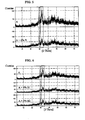
- Hydration of the cement obtained in this Example 1 shows several essential features which may be inferred from an X-ray diffraction study (Figure 3) of the hydration products.
- Figure 3 shows an X-ray diffractogram of hydration at 7 days of component A and of component A plus component B in a proportion by weight of 3 and 9%.
- the main peak of the belite phases of component A has been framed ( Figure 2) in order to stress its consumption as the concentration of component B increases.
- the mortars and concretes manufactured with the new cement will show good durability in aggressive environments, such as in the case of attacks by sulphates.
- the mixture component A and component B proposed in this invention maintains the durability properties of component A, whereas obtaining a product with notable mechanical properties at an early age.
- Component A has been described in the introduction to the "Examples” section.
- Component B is a commercial type of nanoalumina Al 2 O 3 (Nyacol TM AL20) with the characteristics provided by the manufacturer shown in Table 4. TABLE 4 Reactive nanomaterial (%) Medium Primary particle size (nm) Appearance 20 Water 50 nm Milky
- the nanoalumina of the current Example is shown as a colloidal dispersion, i.e. alumina particles of a mean size of 50 nm dispersed in a liquid medium, which in this case is water.
- a liquid medium which in this case is water.
- Trial mixes of 1 ⁇ 1 ⁇ 6 cm of mortar with a water/(component A) ratio of 0.8 and a sand/(component A) ratio of 3 were manufactured. Three batches where made with these reference amounts, producing six trial mixes with the aforementioned dimensions for each one. The first batch did not have component B, which will be taken as a reference to estimate the percent of improvement achieved by adding component B. In the second trial mix component B was added in 3% by weight of component A and in the third in 9% by weight of component A. Knowing that the nanoalumina content in component B is 20% (TABLE 4), the percent of active ingredient (nanoalumina) is less than that of the product used in this example as component B (Nyacol ® AL20).
- Table 5 shows mechanical resistance to compression (MPa). The values demanded by the UNE-196-1 regulation for a normal Portland cement of class cem I 32.5 are shown in the first row. The percent of improvement for each mixture of component A with component B regarding the value of component A without component B is shown (separated by a dotted line).
- component B in low percentages with respect to component A means doubling the resistances both at 7 and at 28 days (at this age, with 9% of component B the resistance value is actually doubled).
- Example 1 shows an apparently greater effectiveness of component B in Example 1 with respect to the present Example.
- component B in the present example contains at least 4 times less nanoalumina (20% concentration, TABLE 4) than component B in Example 1. Therefore, a greater activation of component A of the invention is achieved with a smaller amount of active ingredient (nanoalumina in this case). This is due to the fact that component B in Example 2 maintains its nanometric character (size under 100 nm) and thus a greater reactivity given that the nanoalumina is stabilized by the water and is not clustered in larger grains, such as occurs with the nanoalumina in Example 1. All this will have important consequences in the hydration, as discussed below.
- Example 2 Hydration of the present invention, according to this Example 2, has the same features as those shown in Example 1 (speed of hydration, absence of ettringite and portlandite and presence of an amorphous halo), although with some quantitative differences worth mentioning:
- Example 2 From all of this a high durability may be inferred, as mentioned already in Example 1, by maintaining the same features. Furthermore, the quantitative differences mentioned lead to assume a greater quality microstructure in the present example than in Example 1. That is, at the same age of 7 days in Example 2 there is more hydrated cement (more belite consumed, as can be seen in the lower characteristic peak 2 ⁇ ⁇ 33°) and therefore a better formed microstructure.
- Component A has been described in the introduction to the "Examples” section.
- Component B is a commercial type of nanosilica (Nyacol ® Nyasil 5) with the characteristics provided by the manufacturer shown in Table 6. TABLE 6 Reactive nanomaterial (%) Medium Primary particle size (nm) Appearance >96 Dry powder 5 nm White powder
- the particular nanosilica in this example tends to cluster in grains with variable sizes around 1 micron.
- Trial mixes of 1 ⁇ 1 ⁇ 6 cm of cement paste (without sand) with a water/(component A) ratio of 0.8 were manufactured. Two batches were made with these reference amounts, producing 6 trial mixes with the aforementioned dimensions for each one. The first batch did not contain component B, which will be taken as a reference for estimating the percent improvement achieved by adding component B. In the second trial mix component B was added in 6% by weight of component A.
- Hydration of the cement of this Example 3 has the same features as those shown in Examples 1 and 2 (hydration speed, absence of ettringite and portlandite and presence of an amorphous halo).
- Figure 5 shows an X-ray diffractogram for hydration at 7 days of component A and for component A plus component B in a 6% proportion by weight.
- the main peak for the belite phases of component A ( Figure 2) has been framed to stress its consumption when adding component B. It is worth mentioning a greater belite consumption with respect to Example 1, as evidenced by the lower height of peak 2 ⁇ ⁇ 33° in the case of the component A and component B mixture (lower panel in Figure 5) versus that of component A without component B (upper panel in Figure 5).
- not including alumina will not give rise to non-crystalline phases formed by hydration products containing Al, being mainly Ca and Si compositions.
- Component A has been described in the introduction to the "Examples” section.
- Colloidal nanosilica has been used as component B, but with two different particle sizes. That which will be called component B1 is a commercial type of nanosilica (Levasil ® Grade 100) and that which will be called component B2 is another type of commercial nanosilica (Levasil ® Grade VPAC 4038) with the characteristics provided by the manufacturer shown in Tables 8-1 and 8-2, respectively.
- Reactive nanomaterial %) Medium Primary particle size (nm) Appearance 30 Water 15 nm Transparent, slightly opalescent liquid
- the nanosilica of the current Example is shown as a colloidal dispersion, i.e. silica particles with a mean size of 30 and 15 nm, respectively, dispersed in a liquid medium, which in this case is water.
- a colloidal dispersion i.e. silica particles with a mean size of 30 and 15 nm, respectively, dispersed in a liquid medium, which in this case is water.
- Trial mixes of 1 ⁇ 1 ⁇ 6 cm of cement paste (without sand) with a water/(component A) ratio of 0.8 were manufactured. Two batches were made with these reference amounts, producing 6 trial mixes with the aforementioned dimensions for each one. The first batch did not contain component B, which will be taken as a reference for estimating the percent improvement achieved by adding component B. In the second trial mix component B was added in 6% by weight of component A.
- the percent of active ingredient (nanosilica) is lower than that of the product used in this example as component B (2.7% Levasil ® Grade 100 as B1 and 1.8% Levasil ® Grade VPAC 4038 as B2).
- Table 9 shows the mechanical resistance to compression (MPa). The percent of improvement for the mixture of component A with component B regarding the value of component A without component B is shown (first row).
- Example 3 shows a greater effectiveness of the two components B of the present Example with respect to Example 3.
- Example 2 With respect to Example 1, the fact that the components B of this Example maintain their nanometric character due to their being in a dispersion (there are no clusters) has a strong impact in the increase in final mechanical properties.
- the influence of the particle size is also shown.
- nanosilica in component B1 than in component B2 there is less resistance to compression. This is due to the increase in reactivity with the reduction in particle size (30 nm in B1 and 15 nm in B2).
- the same can be said if comparing with respect to examples 1 and 2, although in this case the different nature of the addition must be taken into account and the fact that in Examples 1 and 2 it is cement paste and not mortar that is being worked with.
- Hydration of the material obtained in Example 4 has the same features as those in Examples 1, 2 and 3 (hydration speed, absence of ettringite and portlandite and presence of an amorphous halo). It has similar features to those of Example 3 regarding non-crystalline phase composition insofar as that they will not contain Al. On the other hand, a similar consumption of belite as that in Example 3 is observed. However, the fact that greater mechanical resistance is obtained suggests the presence of more polymerized non-crystalline phases, which unfortunately cannot be detected by X-ray diffraction. In any case, this fact, as is well-known, will not negatively affect durability, but on the contrary, it is also a sign of greater hydration speed.
- Figure 6 shows the X-ray diffractogram of hydration at 7 days for component A and component A plus component B in a proportion by weight of 9%.
- the main peak of the belite phases of component A ( Figure 2) has been framed to stress its consumption with the addition of component B.
Landscapes
- Chemical & Material Sciences (AREA)
- Engineering & Computer Science (AREA)
- Ceramic Engineering (AREA)
- Materials Engineering (AREA)
- Structural Engineering (AREA)
- Organic Chemistry (AREA)
- Chemical Kinetics & Catalysis (AREA)
- Inorganic Chemistry (AREA)
- Curing Cements, Concrete, And Artificial Stone (AREA)
Applications Claiming Priority (1)
| Application Number | Priority Date | Filing Date | Title |
|---|---|---|---|
| PCT/ES2004/000092 WO2005082802A1 (fr) | 2004-02-26 | 2004-02-26 | Ciment de construction, et procede d'obtention d'un ciment de construction |
Publications (2)
| Publication Number | Publication Date |
|---|---|
| EP1719741A1 true EP1719741A1 (fr) | 2006-11-08 |
| EP1719741B1 EP1719741B1 (fr) | 2008-05-14 |
Family
ID=34896220
Family Applications (1)
| Application Number | Title | Priority Date | Filing Date |
|---|---|---|---|
| EP04714808A Expired - Lifetime EP1719741B1 (fr) | 2004-02-26 | 2004-02-26 | Ciment de construction, et procede d'obtention d'un ciment de construction |
Country Status (7)
| Country | Link |
|---|---|
| US (1) | US20060260513A1 (fr) |
| EP (1) | EP1719741B1 (fr) |
| AT (1) | ATE395310T1 (fr) |
| CA (1) | CA2537283C (fr) |
| DE (1) | DE602004013840D1 (fr) |
| ES (1) | ES2306992T3 (fr) |
| WO (1) | WO2005082802A1 (fr) |
Cited By (11)
| Publication number | Priority date | Publication date | Assignee | Title |
|---|---|---|---|---|
| EP2243754A1 (fr) * | 2009-04-23 | 2010-10-27 | Karlsruher Institut für Technologie | Procédé de fabrication d'un liant contenant du plomb |
| WO2011080522A1 (fr) * | 2010-01-04 | 2011-07-07 | Halliburton Energy Services, Inc. | Compositions de ciment comprenant de l'alumine submicronique et procédés correspondants |
| US8586512B2 (en) | 2007-05-10 | 2013-11-19 | Halliburton Energy Services, Inc. | Cement compositions and methods utilizing nano-clay |
| US8598093B2 (en) | 2007-05-10 | 2013-12-03 | Halliburton Energy Services, Inc. | Cement compositions comprising latex and a nano-particle |
| EP2676943A1 (fr) * | 2012-06-20 | 2013-12-25 | HeidelbergCement AG | Procédé de fabrication d'un ciment de bélite hautement réactif avec un rapport calcium/silicate faible |
| US8685903B2 (en) | 2007-05-10 | 2014-04-01 | Halliburton Energy Services, Inc. | Lost circulation compositions and associated methods |
| EP2801557A1 (fr) * | 2013-05-11 | 2014-11-12 | HeidelbergCement AG | Procédé de fabrication d'un ciment de silicate de magnésium-bélite-aluminate de calcium |
| US9199879B2 (en) | 2007-05-10 | 2015-12-01 | Halliburton Energy Serives, Inc. | Well treatment compositions and methods utilizing nano-particles |
| US9206344B2 (en) | 2007-05-10 | 2015-12-08 | Halliburton Energy Services, Inc. | Sealant compositions and methods utilizing nano-particles |
| US9512351B2 (en) | 2007-05-10 | 2016-12-06 | Halliburton Energy Services, Inc. | Well treatment fluids and methods utilizing nano-particles |
| US9512346B2 (en) | 2004-02-10 | 2016-12-06 | Halliburton Energy Services, Inc. | Cement compositions and methods utilizing nano-hydraulic cement |
Families Citing this family (7)
| Publication number | Priority date | Publication date | Assignee | Title |
|---|---|---|---|---|
| US7559369B2 (en) * | 2007-05-10 | 2009-07-14 | Halliubrton Energy Services, Inc. | Well treatment composition and methods utilizing nano-particles |
| FR2873366B1 (fr) * | 2004-07-20 | 2006-11-24 | Lafarge Sa | Clinker sulfoalumineux a haute teneur en belite, procede de fabrication d'un tel clinker et son utilisation pour la preparation de liants hydrauliques. |
| US7806183B2 (en) * | 2007-05-10 | 2010-10-05 | Halliburton Energy Services Inc. | Well treatment compositions and methods utilizing nano-particles |
| US8157009B2 (en) | 2009-09-03 | 2012-04-17 | Halliburton Energy Services Inc. | Cement compositions and associated methods comprising sub-micron calcium carbonate and latex |
| CN104591563B (zh) * | 2015-01-13 | 2016-08-24 | 河海大学 | 一种以粉煤灰为原料的胶凝材料及其制备方法 |
| CN113511828B (zh) * | 2021-07-27 | 2022-09-09 | 江苏润邦再生资源科技股份有限公司 | 激发剂及其制备及以其激发粉煤灰制备水泥熟料的方法 |
| CN113998954B (zh) * | 2021-11-26 | 2023-04-14 | 中建八局第二建设有限公司 | 改性复合超细粉道面混凝土、制备方法及应用 |
Family Cites Families (7)
| Publication number | Priority date | Publication date | Assignee | Title |
|---|---|---|---|---|
| US4162238A (en) * | 1973-07-17 | 1979-07-24 | E. I. Du Pont De Nemours And Company | Foundry mold or core compositions and method |
| DD210675A1 (de) * | 1982-10-06 | 1984-06-20 | Dessau Zementanlagenbau Veb | Verfahren und anordnung zur herstellung von zement nach dem belit-typ |
| US5509962A (en) * | 1994-05-20 | 1996-04-23 | Construction Technology Laboratories, Inc. | Cement containing activated belite |
| FR2748270B1 (fr) * | 1996-05-06 | 1998-08-07 | Lafarge Aluminates | Procede et installation de fabrication de ciment alumineux et ciment alumineux |
| HUP0301285A3 (en) * | 2000-10-05 | 2004-05-28 | Ko Suz Chung | Slag cement |
| FR2832401B1 (fr) * | 2001-11-19 | 2004-12-10 | Carrieres Du Boulonnais | Ciment blanc, procede et installation de fabrication |
| US7559369B2 (en) * | 2007-05-10 | 2009-07-14 | Halliubrton Energy Services, Inc. | Well treatment composition and methods utilizing nano-particles |
-
2004
- 2004-02-26 AT AT04714808T patent/ATE395310T1/de not_active IP Right Cessation
- 2004-02-26 EP EP04714808A patent/EP1719741B1/fr not_active Expired - Lifetime
- 2004-02-26 CA CA2537283A patent/CA2537283C/fr not_active Expired - Fee Related
- 2004-02-26 US US10/569,407 patent/US20060260513A1/en not_active Abandoned
- 2004-02-26 WO PCT/ES2004/000092 patent/WO2005082802A1/fr not_active Ceased
- 2004-02-26 ES ES04714808T patent/ES2306992T3/es not_active Expired - Lifetime
- 2004-02-26 DE DE602004013840T patent/DE602004013840D1/de not_active Expired - Lifetime
Non-Patent Citations (1)
| Title |
|---|
| See references of WO2005082802A1 * |
Cited By (33)
| Publication number | Priority date | Publication date | Assignee | Title |
|---|---|---|---|---|
| US9512346B2 (en) | 2004-02-10 | 2016-12-06 | Halliburton Energy Services, Inc. | Cement compositions and methods utilizing nano-hydraulic cement |
| US9512352B2 (en) | 2007-05-10 | 2016-12-06 | Halliburton Energy Services, Inc. | Well treatment fluids and methods utilizing nano-particles |
| US8476203B2 (en) | 2007-05-10 | 2013-07-02 | Halliburton Energy Services, Inc. | Cement compositions comprising sub-micron alumina and associated methods |
| US8586512B2 (en) | 2007-05-10 | 2013-11-19 | Halliburton Energy Services, Inc. | Cement compositions and methods utilizing nano-clay |
| US8598093B2 (en) | 2007-05-10 | 2013-12-03 | Halliburton Energy Services, Inc. | Cement compositions comprising latex and a nano-particle |
| US8603952B2 (en) | 2007-05-10 | 2013-12-10 | Halliburton Energy Services, Inc. | Cement compositions and methods utilizing nano-clay |
| US9765252B2 (en) | 2007-05-10 | 2017-09-19 | Halliburton Energy Services, Inc. | Sealant compositions and methods utilizing nano-particles |
| US8685903B2 (en) | 2007-05-10 | 2014-04-01 | Halliburton Energy Services, Inc. | Lost circulation compositions and associated methods |
| US8940670B2 (en) | 2007-05-10 | 2015-01-27 | Halliburton Energy Services, Inc. | Cement compositions comprising sub-micron alumina and associated methods |
| US9512351B2 (en) | 2007-05-10 | 2016-12-06 | Halliburton Energy Services, Inc. | Well treatment fluids and methods utilizing nano-particles |
| US9206344B2 (en) | 2007-05-10 | 2015-12-08 | Halliburton Energy Services, Inc. | Sealant compositions and methods utilizing nano-particles |
| US9199879B2 (en) | 2007-05-10 | 2015-12-01 | Halliburton Energy Serives, Inc. | Well treatment compositions and methods utilizing nano-particles |
| US8741818B2 (en) | 2007-05-10 | 2014-06-03 | Halliburton Energy Services, Inc. | Lost circulation compositions and associated methods |
| EP2243754A1 (fr) * | 2009-04-23 | 2010-10-27 | Karlsruher Institut für Technologie | Procédé de fabrication d'un liant contenant du plomb |
| WO2011080522A1 (fr) * | 2010-01-04 | 2011-07-07 | Halliburton Energy Services, Inc. | Compositions de ciment comprenant de l'alumine submicronique et procédés correspondants |
| AU2011203389B2 (en) * | 2010-01-04 | 2014-10-02 | Halliburton Energy Services Inc. | Cement compositions comprising sub-micron alumina and associated methods |
| CN104540792A (zh) * | 2012-06-20 | 2015-04-22 | 海德堡水泥公司 | 制造具有高反应性和低的钙/硅酸盐比例的贝利特水泥的方法 |
| EA031022B1 (ru) * | 2012-06-20 | 2018-11-30 | Хайдельбергцемент Аг | Способ изготовления белитового цемента с высокой реактивностью и низким соотношением кальций/силикат |
| EP2676943A1 (fr) * | 2012-06-20 | 2013-12-25 | HeidelbergCement AG | Procédé de fabrication d'un ciment de bélite hautement réactif avec un rapport calcium/silicate faible |
| CN104540792B (zh) * | 2012-06-20 | 2017-08-29 | 海德堡水泥公司 | 制造具有高反应性和低的钙/硅酸盐比例的贝利特水泥的方法 |
| WO2013189573A1 (fr) * | 2012-06-20 | 2013-12-27 | Heidelbergcement Ag | Procédé de production d'un ciment bélitique à haute réactivité et à faible rapport calcium/silicate |
| US9321682B2 (en) | 2012-06-20 | 2016-04-26 | Heidelbergcement Ag | Process for producing a belite cement having a high reactivity and a low calcium/silicate ratio |
| EP2801558A1 (fr) * | 2013-05-11 | 2014-11-12 | HeidelbergCement AG | Bélite-aluminate de calcium comme additif |
| WO2014183844A1 (fr) * | 2013-05-11 | 2014-11-20 | Heidelbergcement Ag | Procédé de production d'un ciment de silicate de magnésium-bélite aluminate de calcium |
| EP2801557A1 (fr) * | 2013-05-11 | 2014-11-12 | HeidelbergCement AG | Procédé de fabrication d'un ciment de silicate de magnésium-bélite-aluminate de calcium |
| US9604879B2 (en) | 2013-05-11 | 2017-03-28 | Heidelbergcement Ag | Belite-calcium aluminate as an additive |
| US9718731B2 (en) | 2013-05-11 | 2017-08-01 | Heidelbergcement Ag | Method for producing magnesium silicate-belite-calcium aluminate cement |
| WO2014183846A1 (fr) * | 2013-05-11 | 2014-11-20 | Heidelbergcement Ag | Procédé permettant d'améliorer la réactivité hydraulique et/ou pouzzolanique latente des matériaux |
| WO2014183845A1 (fr) * | 2013-05-11 | 2014-11-20 | Heidelbergcement Ag | Aluminate de calcium-bélite comme additif |
| EA028010B1 (ru) * | 2013-05-11 | 2017-09-29 | Хайдельбергцемент Аг | Способ получения магний-силикат-белит-кальций-алюминатного цемента |
| EA029898B1 (ru) * | 2013-05-11 | 2018-05-31 | Хайдельбергцемент Аг | Способ улучшения латентной гидравлической и/или пуццолановой активности материалов |
| US10065888B2 (en) | 2013-05-11 | 2018-09-04 | Heidelbergcement Ag | Method of enhancing the latent hydraulic and/or pozzolanic reactivity of materials |
| EP2801559A1 (fr) * | 2013-05-11 | 2014-11-12 | HeidelbergCement AG | Procédé d'amélioration de la réactivité hydraulique et/ou pouzzolanique latente de matériaux |
Also Published As
| Publication number | Publication date |
|---|---|
| ES2306992T3 (es) | 2008-11-16 |
| ATE395310T1 (de) | 2008-05-15 |
| DE602004013840D1 (de) | 2008-06-26 |
| EP1719741B1 (fr) | 2008-05-14 |
| CA2537283C (fr) | 2010-09-21 |
| WO2005082802A1 (fr) | 2005-09-09 |
| US20060260513A1 (en) | 2006-11-23 |
| CA2537283A1 (fr) | 2005-09-09 |
Similar Documents
| Publication | Publication Date | Title |
|---|---|---|
| EP1719741B1 (fr) | Ciment de construction, et procede d'obtention d'un ciment de construction | |
| CA2248559C (fr) | Additifs de transformation ameliores pour ciments hydrauliques | |
| US5484480A (en) | Use of alumina clay with cement fly ash mixtures | |
| Khalil et al. | Beneficiation of the huge waste quantities of barley and rice husks as well as coal fly ashes as additives for Portland cement | |
| GB2093006A (en) | High strength aggregate for concrete | |
| CN116425435B (zh) | 一种白云石可循环胶凝材料及其制备方法和应用 | |
| EP2878585B1 (fr) | Procédé pour la fabrication de germes C-S-H cimentaires | |
| WO2022203642A1 (fr) | Procédé de production d'un liant géopolymère | |
| FR3105219A1 (fr) | Procédé de fabrication de ciments sursulfatés | |
| Li et al. | Study on high-strength composite portland cement with a larger amount of industrial wastes | |
| KR101904172B1 (ko) | 도로포장용 초조강시멘트 조성물 및 이를 이용한 포장공법 | |
| KR101074486B1 (ko) | 조분시멘트를 이용한 시멘트 결합재 조성물 및 이를 이용한 극초고강도 콘크리트 조성물과 극초고강도 프리캐스트 콘크리트 제품의 제조방법 | |
| JP5135127B2 (ja) | カルシウムアルミネート | |
| JPH01172252A (ja) | 早強ポルトランドセメントの製造方法 | |
| CN107265868B (zh) | 一种利用青石粉制备的微晶玻璃及其制备方法 | |
| RU2656270C1 (ru) | Цемент низкой водопотребности и способ его получения | |
| JP7392946B2 (ja) | コンクリート組成物 | |
| Dinh et al. | Effect of limestone content on properties of portland limestone cement produced by intergrinding | |
| Stanescu et al. | Brick and glass waste valorisation in the manufacture of aerated autoclaved concrete | |
| CN117209179B (zh) | 一种建筑用硬石膏胶结料的生产工艺 | |
| CN1312233A (zh) | 一种膨胀混凝土及其低碱高效混凝土膨胀剂 | |
| JPH06206745A (ja) | 改良ポルトランドセメントおよびalcの製造方法 | |
| JP2916486B2 (ja) | 水硬性セメント組成物 | |
| CEYLAN | EFFECTS OF VOLCANIC TUFF AS A PARTIAL REPLACEMENT FOR CEMENT ON THE COMPRESSIVE STRENGTH OF CONCRETE. | |
| Yin et al. | Reaction between carbonaceous rocks and water glass |
Legal Events
| Date | Code | Title | Description |
|---|---|---|---|
| PUAI | Public reference made under article 153(3) epc to a published international application that has entered the european phase |
Free format text: ORIGINAL CODE: 0009012 |
|
| 17P | Request for examination filed |
Effective date: 20060225 |
|
| AK | Designated contracting states |
Kind code of ref document: A1 Designated state(s): AT BE BG CH CY CZ DE DK EE ES FI FR GB GR HU IE IT LI LU MC NL PT RO SE SI SK TR |
|
| DAX | Request for extension of the european patent (deleted) | ||
| 17Q | First examination report despatched |
Effective date: 20070522 |
|
| R17C | First examination report despatched (corrected) |
Effective date: 20070709 |
|
| GRAP | Despatch of communication of intention to grant a patent |
Free format text: ORIGINAL CODE: EPIDOSNIGR1 |
|
| GRAS | Grant fee paid |
Free format text: ORIGINAL CODE: EPIDOSNIGR3 |
|
| GRAA | (expected) grant |
Free format text: ORIGINAL CODE: 0009210 |
|
| AK | Designated contracting states |
Kind code of ref document: B1 Designated state(s): AT BE BG CH CY CZ DE DK EE ES FI FR GB GR HU IE IT LI LU MC NL PT RO SE SI SK TR |
|
| REG | Reference to a national code |
Ref country code: GB Ref legal event code: FG4D |
|
| REG | Reference to a national code |
Ref country code: CH Ref legal event code: EP |
|
| REG | Reference to a national code |
Ref country code: IE Ref legal event code: FG4D Free format text: LANGUAGE OF EP DOCUMENT: FRENCH |
|
| REF | Corresponds to: |
Ref document number: 602004013840 Country of ref document: DE Date of ref document: 20080626 Kind code of ref document: P |
|
| PG25 | Lapsed in a contracting state [announced via postgrant information from national office to epo] |
Ref country code: SI Free format text: LAPSE BECAUSE OF FAILURE TO SUBMIT A TRANSLATION OF THE DESCRIPTION OR TO PAY THE FEE WITHIN THE PRESCRIBED TIME-LIMIT Effective date: 20080514 |
|
| PG25 | Lapsed in a contracting state [announced via postgrant information from national office to epo] |
Ref country code: FI Free format text: LAPSE BECAUSE OF FAILURE TO SUBMIT A TRANSLATION OF THE DESCRIPTION OR TO PAY THE FEE WITHIN THE PRESCRIBED TIME-LIMIT Effective date: 20080514 |
|
| NLV1 | Nl: lapsed or annulled due to failure to fulfill the requirements of art. 29p and 29m of the patents act | ||
| REG | Reference to a national code |
Ref country code: ES Ref legal event code: FG2A Ref document number: 2306992 Country of ref document: ES Kind code of ref document: T3 |
|
| PG25 | Lapsed in a contracting state [announced via postgrant information from national office to epo] |
Ref country code: NL Free format text: LAPSE BECAUSE OF FAILURE TO SUBMIT A TRANSLATION OF THE DESCRIPTION OR TO PAY THE FEE WITHIN THE PRESCRIBED TIME-LIMIT Effective date: 20080514 Ref country code: AT Free format text: LAPSE BECAUSE OF FAILURE TO SUBMIT A TRANSLATION OF THE DESCRIPTION OR TO PAY THE FEE WITHIN THE PRESCRIBED TIME-LIMIT Effective date: 20080514 |
|
| PG25 | Lapsed in a contracting state [announced via postgrant information from national office to epo] |
Ref country code: SE Free format text: LAPSE BECAUSE OF FAILURE TO SUBMIT A TRANSLATION OF THE DESCRIPTION OR TO PAY THE FEE WITHIN THE PRESCRIBED TIME-LIMIT Effective date: 20080814 Ref country code: PT Free format text: LAPSE BECAUSE OF FAILURE TO SUBMIT A TRANSLATION OF THE DESCRIPTION OR TO PAY THE FEE WITHIN THE PRESCRIBED TIME-LIMIT Effective date: 20081014 Ref country code: DK Free format text: LAPSE BECAUSE OF FAILURE TO SUBMIT A TRANSLATION OF THE DESCRIPTION OR TO PAY THE FEE WITHIN THE PRESCRIBED TIME-LIMIT Effective date: 20080514 Ref country code: CZ Free format text: LAPSE BECAUSE OF FAILURE TO SUBMIT A TRANSLATION OF THE DESCRIPTION OR TO PAY THE FEE WITHIN THE PRESCRIBED TIME-LIMIT Effective date: 20080514 |
|
| PG25 | Lapsed in a contracting state [announced via postgrant information from national office to epo] |
Ref country code: SK Free format text: LAPSE BECAUSE OF FAILURE TO SUBMIT A TRANSLATION OF THE DESCRIPTION OR TO PAY THE FEE WITHIN THE PRESCRIBED TIME-LIMIT Effective date: 20080514 Ref country code: RO Free format text: LAPSE BECAUSE OF FAILURE TO SUBMIT A TRANSLATION OF THE DESCRIPTION OR TO PAY THE FEE WITHIN THE PRESCRIBED TIME-LIMIT Effective date: 20080514 Ref country code: BE Free format text: LAPSE BECAUSE OF FAILURE TO SUBMIT A TRANSLATION OF THE DESCRIPTION OR TO PAY THE FEE WITHIN THE PRESCRIBED TIME-LIMIT Effective date: 20080514 |
|
| PLBE | No opposition filed within time limit |
Free format text: ORIGINAL CODE: 0009261 |
|
| STAA | Information on the status of an ep patent application or granted ep patent |
Free format text: STATUS: NO OPPOSITION FILED WITHIN TIME LIMIT |
|
| 26N | No opposition filed |
Effective date: 20090217 |
|
| PG25 | Lapsed in a contracting state [announced via postgrant information from national office to epo] |
Ref country code: EE Free format text: LAPSE BECAUSE OF FAILURE TO SUBMIT A TRANSLATION OF THE DESCRIPTION OR TO PAY THE FEE WITHIN THE PRESCRIBED TIME-LIMIT Effective date: 20080514 Ref country code: BG Free format text: LAPSE BECAUSE OF FAILURE TO SUBMIT A TRANSLATION OF THE DESCRIPTION OR TO PAY THE FEE WITHIN THE PRESCRIBED TIME-LIMIT Effective date: 20080814 |
|
| PG25 | Lapsed in a contracting state [announced via postgrant information from national office to epo] |
Ref country code: MC Free format text: LAPSE BECAUSE OF NON-PAYMENT OF DUE FEES Effective date: 20090228 |
|
| REG | Reference to a national code |
Ref country code: CH Ref legal event code: PL |
|
| PG25 | Lapsed in a contracting state [announced via postgrant information from national office to epo] |
Ref country code: CH Free format text: LAPSE BECAUSE OF NON-PAYMENT OF DUE FEES Effective date: 20090228 Ref country code: LI Free format text: LAPSE BECAUSE OF NON-PAYMENT OF DUE FEES Effective date: 20090228 |
|
| REG | Reference to a national code |
Ref country code: IE Ref legal event code: MM4A |
|
| PG25 | Lapsed in a contracting state [announced via postgrant information from national office to epo] |
Ref country code: IE Free format text: LAPSE BECAUSE OF NON-PAYMENT OF DUE FEES Effective date: 20090226 |
|
| PG25 | Lapsed in a contracting state [announced via postgrant information from national office to epo] |
Ref country code: GR Free format text: LAPSE BECAUSE OF FAILURE TO SUBMIT A TRANSLATION OF THE DESCRIPTION OR TO PAY THE FEE WITHIN THE PRESCRIBED TIME-LIMIT Effective date: 20080815 |
|
| PG25 | Lapsed in a contracting state [announced via postgrant information from national office to epo] |
Ref country code: LU Free format text: LAPSE BECAUSE OF NON-PAYMENT OF DUE FEES Effective date: 20090226 |
|
| PG25 | Lapsed in a contracting state [announced via postgrant information from national office to epo] |
Ref country code: HU Free format text: LAPSE BECAUSE OF FAILURE TO SUBMIT A TRANSLATION OF THE DESCRIPTION OR TO PAY THE FEE WITHIN THE PRESCRIBED TIME-LIMIT Effective date: 20081115 |
|
| PG25 | Lapsed in a contracting state [announced via postgrant information from national office to epo] |
Ref country code: TR Free format text: LAPSE BECAUSE OF FAILURE TO SUBMIT A TRANSLATION OF THE DESCRIPTION OR TO PAY THE FEE WITHIN THE PRESCRIBED TIME-LIMIT Effective date: 20080514 |
|
| PG25 | Lapsed in a contracting state [announced via postgrant information from national office to epo] |
Ref country code: CY Free format text: LAPSE BECAUSE OF FAILURE TO SUBMIT A TRANSLATION OF THE DESCRIPTION OR TO PAY THE FEE WITHIN THE PRESCRIBED TIME-LIMIT Effective date: 20080514 |
|
| REG | Reference to a national code |
Ref country code: FR Ref legal event code: PLFP Year of fee payment: 13 |
|
| REG | Reference to a national code |
Ref country code: FR Ref legal event code: PLFP Year of fee payment: 14 |
|
| REG | Reference to a national code |
Ref country code: FR Ref legal event code: PLFP Year of fee payment: 15 |
|
| PGFP | Annual fee paid to national office [announced via postgrant information from national office to epo] |
Ref country code: IT Payment date: 20190222 Year of fee payment: 16 Ref country code: ES Payment date: 20190301 Year of fee payment: 16 Ref country code: GB Payment date: 20190227 Year of fee payment: 16 Ref country code: DE Payment date: 20190227 Year of fee payment: 16 |
|
| PGFP | Annual fee paid to national office [announced via postgrant information from national office to epo] |
Ref country code: FR Payment date: 20190225 Year of fee payment: 16 |
|
| REG | Reference to a national code |
Ref country code: DE Ref legal event code: R119 Ref document number: 602004013840 Country of ref document: DE |
|
| GBPC | Gb: european patent ceased through non-payment of renewal fee |
Effective date: 20200226 |
|
| PG25 | Lapsed in a contracting state [announced via postgrant information from national office to epo] |
Ref country code: FR Free format text: LAPSE BECAUSE OF NON-PAYMENT OF DUE FEES Effective date: 20200229 Ref country code: DE Free format text: LAPSE BECAUSE OF NON-PAYMENT OF DUE FEES Effective date: 20200901 Ref country code: GB Free format text: LAPSE BECAUSE OF NON-PAYMENT OF DUE FEES Effective date: 20200226 |
|
| REG | Reference to a national code |
Ref country code: ES Ref legal event code: FD2A Effective date: 20210708 |
|
| PG25 | Lapsed in a contracting state [announced via postgrant information from national office to epo] |
Ref country code: IT Free format text: LAPSE BECAUSE OF NON-PAYMENT OF DUE FEES Effective date: 20200226 |
|
| PG25 | Lapsed in a contracting state [announced via postgrant information from national office to epo] |
Ref country code: ES Free format text: LAPSE BECAUSE OF NON-PAYMENT OF DUE FEES Effective date: 20200227 |