EP2243783B1 - Bisporphyrinkonjugate als Zwei-Photonen-Absorptionsmaterial - Google Patents
Bisporphyrinkonjugate als Zwei-Photonen-Absorptionsmaterial Download PDFInfo
- Publication number
- EP2243783B1 EP2243783B1 EP10170353.6A EP10170353A EP2243783B1 EP 2243783 B1 EP2243783 B1 EP 2243783B1 EP 10170353 A EP10170353 A EP 10170353A EP 2243783 B1 EP2243783 B1 EP 2243783B1
- Authority
- EP
- European Patent Office
- Prior art keywords
- photon absorption
- group
- photon
- light
- optical
- Prior art date
- Legal status (The legal status is an assumption and is not a legal conclusion. Google has not performed a legal analysis and makes no representation as to the accuracy of the status listed.)
- Not-in-force
Links
- 238000010521 absorption reaction Methods 0.000 title claims description 240
- 239000000463 material Substances 0.000 title claims description 173
- 230000003287 optical effect Effects 0.000 claims description 150
- 230000005284 excitation Effects 0.000 claims description 38
- 125000004435 hydrogen atom Chemical group [H]* 0.000 claims description 36
- 125000000217 alkyl group Chemical group 0.000 claims description 33
- 125000005843 halogen group Chemical group 0.000 claims description 28
- 125000001424 substituent group Chemical group 0.000 claims description 24
- 229910052751 metal Inorganic materials 0.000 claims description 22
- 239000002184 metal Substances 0.000 claims description 22
- 125000001997 phenyl group Chemical group [H]C1=C([H])C([H])=C(*)C([H])=C1[H] 0.000 claims description 19
- 125000003262 carboxylic acid ester group Chemical group [H]C([H])([*:2])OC(=O)C([H])([H])[*:1] 0.000 claims description 13
- 125000004076 pyridyl group Chemical group 0.000 claims description 13
- 125000003545 alkoxy group Chemical group 0.000 claims description 11
- 125000003118 aryl group Chemical group 0.000 claims description 9
- 125000004429 atom Chemical group 0.000 claims description 9
- 125000002023 trifluoromethyl group Chemical group FC(F)(F)* 0.000 claims description 8
- 125000003178 carboxy group Chemical group [H]OC(*)=O 0.000 claims description 7
- 125000004430 oxygen atom Chemical group O* 0.000 claims description 7
- 125000004093 cyano group Chemical group *C#N 0.000 claims description 6
- 239000012778 molding material Substances 0.000 claims description 6
- 125000000449 nitro group Chemical group [O-][N+](*)=O 0.000 claims description 6
- 229910052725 zinc Inorganic materials 0.000 claims description 3
- HCHKCACWOHOZIP-UHFFFAOYSA-N Zinc Chemical group [Zn] HCHKCACWOHOZIP-UHFFFAOYSA-N 0.000 claims description 2
- -1 polyethylene terephthalate Polymers 0.000 description 98
- 150000001875 compounds Chemical class 0.000 description 54
- 238000000034 method Methods 0.000 description 33
- 239000010410 layer Substances 0.000 description 32
- 239000011347 resin Substances 0.000 description 31
- 229920005989 resin Polymers 0.000 description 31
- 238000000465 moulding Methods 0.000 description 28
- 150000004032 porphyrins Chemical class 0.000 description 20
- 239000010408 film Substances 0.000 description 16
- 239000000523 sample Substances 0.000 description 15
- WYURNTSHIVDZCO-UHFFFAOYSA-N Tetrahydrofuran Chemical compound C1CCOC1 WYURNTSHIVDZCO-UHFFFAOYSA-N 0.000 description 14
- 238000004020 luminiscence type Methods 0.000 description 12
- 210000004027 cell Anatomy 0.000 description 11
- 230000008859 change Effects 0.000 description 10
- 150000004033 porphyrin derivatives Chemical class 0.000 description 10
- 239000011241 protective layer Substances 0.000 description 10
- 239000012491 analyte Substances 0.000 description 9
- 230000005684 electric field Effects 0.000 description 8
- 230000005281 excited state Effects 0.000 description 8
- 238000004519 manufacturing process Methods 0.000 description 8
- 150000002739 metals Chemical class 0.000 description 8
- 239000011701 zinc Substances 0.000 description 8
- 206010034972 Photosensitivity reaction Diseases 0.000 description 7
- 239000007850 fluorescent dye Substances 0.000 description 7
- 239000011521 glass Substances 0.000 description 7
- 238000005259 measurement Methods 0.000 description 7
- 229920000139 polyethylene terephthalate Polymers 0.000 description 7
- 230000035945 sensitivity Effects 0.000 description 7
- 239000007787 solid Substances 0.000 description 7
- YLQBMQCUIZJEEH-UHFFFAOYSA-N tetrahydrofuran Natural products C=1C=COC=1 YLQBMQCUIZJEEH-UHFFFAOYSA-N 0.000 description 7
- 238000002834 transmittance Methods 0.000 description 7
- 238000006243 chemical reaction Methods 0.000 description 6
- 238000011156 evaluation Methods 0.000 description 6
- 238000002428 photodynamic therapy Methods 0.000 description 6
- 239000005020 polyethylene terephthalate Substances 0.000 description 6
- 229920000642 polymer Polymers 0.000 description 6
- 230000002829 reductive effect Effects 0.000 description 6
- 239000010409 thin film Substances 0.000 description 6
- 238000012546 transfer Methods 0.000 description 6
- 230000007704 transition Effects 0.000 description 6
- 238000000482 two photon fluorescence microscopy Methods 0.000 description 6
- 206010028980 Neoplasm Diseases 0.000 description 5
- 238000009826 distribution Methods 0.000 description 5
- 125000001495 ethyl group Chemical group [H]C([H])([H])C([H])([H])* 0.000 description 5
- 230000007774 longterm Effects 0.000 description 5
- 238000006116 polymerization reaction Methods 0.000 description 5
- 229920002451 polyvinyl alcohol Polymers 0.000 description 5
- 235000019422 polyvinyl alcohol Nutrition 0.000 description 5
- 239000000126 substance Substances 0.000 description 5
- 239000004372 Polyvinyl alcohol Substances 0.000 description 4
- KAESVJOAVNADME-UHFFFAOYSA-N Pyrrole Chemical compound C=1C=CNC=1 KAESVJOAVNADME-UHFFFAOYSA-N 0.000 description 4
- QVGXLLKOCUKJST-UHFFFAOYSA-N atomic oxygen Chemical compound [O] QVGXLLKOCUKJST-UHFFFAOYSA-N 0.000 description 4
- 238000002512 chemotherapy Methods 0.000 description 4
- 230000000052 comparative effect Effects 0.000 description 4
- 238000013461 design Methods 0.000 description 4
- 238000001917 fluorescence detection Methods 0.000 description 4
- 230000001678 irradiating effect Effects 0.000 description 4
- 239000013307 optical fiber Substances 0.000 description 4
- 229910052760 oxygen Inorganic materials 0.000 description 4
- 239000001301 oxygen Substances 0.000 description 4
- 239000003505 polymerization initiator Substances 0.000 description 4
- 230000004044 response Effects 0.000 description 4
- 239000012488 sample solution Substances 0.000 description 4
- 239000002904 solvent Substances 0.000 description 4
- 229910052719 titanium Inorganic materials 0.000 description 4
- 239000010936 titanium Substances 0.000 description 4
- 125000006617 triphenylamine group Chemical group 0.000 description 4
- 229920000298 Cellophane Polymers 0.000 description 3
- YMWUJEATGCHHMB-UHFFFAOYSA-N Dichloromethane Chemical compound ClCCl YMWUJEATGCHHMB-UHFFFAOYSA-N 0.000 description 3
- 239000004698 Polyethylene Substances 0.000 description 3
- 239000004743 Polypropylene Substances 0.000 description 3
- 230000009471 action Effects 0.000 description 3
- 239000000853 adhesive Substances 0.000 description 3
- 230000001070 adhesive effect Effects 0.000 description 3
- 125000003277 amino group Chemical group 0.000 description 3
- 238000004891 communication Methods 0.000 description 3
- 239000003085 diluting agent Substances 0.000 description 3
- 239000000975 dye Substances 0.000 description 3
- 230000002427 irreversible effect Effects 0.000 description 3
- 239000007788 liquid Substances 0.000 description 3
- 230000007246 mechanism Effects 0.000 description 3
- 239000000203 mixture Substances 0.000 description 3
- 239000011368 organic material Substances 0.000 description 3
- 229920006255 plastic film Polymers 0.000 description 3
- 239000002985 plastic film Substances 0.000 description 3
- 230000010287 polarization Effects 0.000 description 3
- 229920000573 polyethylene Polymers 0.000 description 3
- 229920000098 polyolefin Polymers 0.000 description 3
- 229920001155 polypropylene Polymers 0.000 description 3
- 229920000915 polyvinyl chloride Polymers 0.000 description 3
- 239000004800 polyvinyl chloride Substances 0.000 description 3
- 239000010453 quartz Substances 0.000 description 3
- VYPSYNLAJGMNEJ-UHFFFAOYSA-N silicon dioxide Inorganic materials O=[Si]=O VYPSYNLAJGMNEJ-UHFFFAOYSA-N 0.000 description 3
- 238000001228 spectrum Methods 0.000 description 3
- 125000000547 substituted alkyl group Chemical group 0.000 description 3
- 238000002560 therapeutic procedure Methods 0.000 description 3
- DTGKSKDOIYIVQL-WEDXCCLWSA-N (+)-borneol Chemical group C1C[C@@]2(C)[C@@H](O)C[C@@H]1C2(C)C DTGKSKDOIYIVQL-WEDXCCLWSA-N 0.000 description 2
- KZMAWJRXKGLWGS-UHFFFAOYSA-N 2-chloro-n-[4-(4-methoxyphenyl)-1,3-thiazol-2-yl]-n-(3-methoxypropyl)acetamide Chemical compound S1C(N(C(=O)CCl)CCCOC)=NC(C=2C=CC(OC)=CC=2)=C1 KZMAWJRXKGLWGS-UHFFFAOYSA-N 0.000 description 2
- 0 CCC(C(C)(CC)C1=*2*(C(C(C)(CC)C3CC)=C4c5ccc(*)cc5)=C3C(c(cc3C5(CC([Cn])=C)**)ccc3-c(cc3)c5cc3C(C3=C(CC)C(CC)=C5*3*36*78)=C(C(CC)=C9CC)*3=C9C(c(cc3)ccc3[N+]([O-])=O)=C7C(CC)=C(CC)C8=CC(C(CC)=C3CC)=*6C3=C5c3ccc(*)cc3)=C(*3*5)C(CC)=C(CC)C3(C)C1C1C=CC(*)=CC1C)C2=CC1(C)*5C4=C(CC)C1CC Chemical compound CCC(C(C)(CC)C1=*2*(C(C(C)(CC)C3CC)=C4c5ccc(*)cc5)=C3C(c(cc3C5(CC([Cn])=C)**)ccc3-c(cc3)c5cc3C(C3=C(CC)C(CC)=C5*3*36*78)=C(C(CC)=C9CC)*3=C9C(c(cc3)ccc3[N+]([O-])=O)=C7C(CC)=C(CC)C8=CC(C(CC)=C3CC)=*6C3=C5c3ccc(*)cc3)=C(*3*5)C(CC)=C(CC)C3(C)C1C1C=CC(*)=CC1C)C2=CC1(C)*5C4=C(CC)C1CC 0.000 description 2
- 229920001328 Polyvinylidene chloride Polymers 0.000 description 2
- RTAQQCXQSZGOHL-UHFFFAOYSA-N Titanium Chemical compound [Ti] RTAQQCXQSZGOHL-UHFFFAOYSA-N 0.000 description 2
- DTQVDTLACAAQTR-UHFFFAOYSA-N Trifluoroacetic acid Chemical compound OC(=O)C(F)(F)F DTQVDTLACAAQTR-UHFFFAOYSA-N 0.000 description 2
- 150000001299 aldehydes Chemical class 0.000 description 2
- 229910052782 aluminium Inorganic materials 0.000 description 2
- 125000003828 azulenyl group Chemical group 0.000 description 2
- 230000008901 benefit Effects 0.000 description 2
- 230000005540 biological transmission Effects 0.000 description 2
- 230000015572 biosynthetic process Effects 0.000 description 2
- 125000006226 butoxyethyl group Chemical group 0.000 description 2
- 125000000753 cycloalkyl group Chemical group 0.000 description 2
- 125000000113 cyclohexyl group Chemical group [H]C1([H])C([H])([H])C([H])([H])C([H])(*)C([H])([H])C1([H])[H] 0.000 description 2
- 230000003247 decreasing effect Effects 0.000 description 2
- 238000001035 drying Methods 0.000 description 2
- 238000005516 engineering process Methods 0.000 description 2
- 238000001704 evaporation Methods 0.000 description 2
- 230000008020 evaporation Effects 0.000 description 2
- 230000006870 function Effects 0.000 description 2
- 229910052732 germanium Inorganic materials 0.000 description 2
- 230000005283 ground state Effects 0.000 description 2
- 150000004820 halides Chemical class 0.000 description 2
- 238000010438 heat treatment Methods 0.000 description 2
- 238000001093 holography Methods 0.000 description 2
- 150000004679 hydroxides Chemical class 0.000 description 2
- 125000001041 indolyl group Chemical group 0.000 description 2
- 229910010272 inorganic material Inorganic materials 0.000 description 2
- 239000011147 inorganic material Substances 0.000 description 2
- 230000000670 limiting effect Effects 0.000 description 2
- 150000002894 organic compounds Chemical class 0.000 description 2
- 230000002093 peripheral effect Effects 0.000 description 2
- 229920003229 poly(methyl methacrylate) Polymers 0.000 description 2
- 229920000515 polycarbonate Polymers 0.000 description 2
- 239000004417 polycarbonate Substances 0.000 description 2
- 229920000728 polyester Polymers 0.000 description 2
- 229920006254 polymer film Polymers 0.000 description 2
- 239000005033 polyvinylidene chloride Substances 0.000 description 2
- 238000012545 processing Methods 0.000 description 2
- 125000006225 propoxyethyl group Chemical group [H]C([H])([H])C([H])([H])C([H])([H])OC([H])([H])C([H])([H])* 0.000 description 2
- 230000005701 quantum confined stark effect Effects 0.000 description 2
- 238000002310 reflectometry Methods 0.000 description 2
- 230000002441 reversible effect Effects 0.000 description 2
- 239000007858 starting material Substances 0.000 description 2
- 238000003860 storage Methods 0.000 description 2
- 229910052718 tin Inorganic materials 0.000 description 2
- 210000004881 tumor cell Anatomy 0.000 description 2
- 125000005918 1,2-dimethylbutyl group Chemical group 0.000 description 1
- RMSGQZDGSZOJMU-UHFFFAOYSA-N 1-butyl-2-phenylbenzene Chemical group CCCCC1=CC=CC=C1C1=CC=CC=C1 RMSGQZDGSZOJMU-UHFFFAOYSA-N 0.000 description 1
- 125000006218 1-ethylbutyl group Chemical group [H]C([H])([H])C([H])([H])C([H])([H])C([H])(*)C([H])([H])C([H])([H])[H] 0.000 description 1
- 125000004206 2,2,2-trifluoroethyl group Chemical group [H]C([H])(*)C(F)(F)F 0.000 description 1
- OEPOKWHJYJXUGD-UHFFFAOYSA-N 2-(3-phenylmethoxyphenyl)-1,3-thiazole-4-carbaldehyde Chemical compound O=CC1=CSC(C=2C=C(OCC=3C=CC=CC=3)C=CC=2)=N1 OEPOKWHJYJXUGD-UHFFFAOYSA-N 0.000 description 1
- 125000000022 2-aminoethyl group Chemical group [H]C([*])([H])C([H])([H])N([H])[H] 0.000 description 1
- 125000000143 2-carboxyethyl group Chemical group [H]OC(=O)C([H])([H])C([H])([H])* 0.000 description 1
- 125000001340 2-chloroethyl group Chemical group [H]C([H])(Cl)C([H])([H])* 0.000 description 1
- KKZUMAMOMRDVKA-UHFFFAOYSA-N 2-chloropropane Chemical group [CH2]C(C)Cl KKZUMAMOMRDVKA-UHFFFAOYSA-N 0.000 description 1
- 125000001731 2-cyanoethyl group Chemical group [H]C([H])(*)C([H])([H])C#N 0.000 description 1
- 125000006176 2-ethylbutyl group Chemical group [H]C([H])([H])C([H])([H])C([H])(C([H])([H])*)C([H])([H])C([H])([H])[H] 0.000 description 1
- 125000000954 2-hydroxyethyl group Chemical group [H]C([*])([H])C([H])([H])O[H] 0.000 description 1
- 125000004200 2-methoxyethyl group Chemical group [H]C([H])([H])OC([H])([H])C([H])([H])* 0.000 description 1
- 125000004493 2-methylbut-1-yl group Chemical group CC(C*)CC 0.000 description 1
- 125000003229 2-methylhexyl group Chemical group [H]C([H])([H])C([H])([H])C([H])([H])C([H])([H])C([H])(C([H])([H])[H])C([H])([H])* 0.000 description 1
- 125000005916 2-methylpentyl group Chemical group 0.000 description 1
- 125000000094 2-phenylethyl group Chemical group [H]C1=C([H])C([H])=C(C([H])=C1[H])C([H])([H])C([H])([H])* 0.000 description 1
- ZPSJGADGUYYRKE-UHFFFAOYSA-N 2H-pyran-2-one Chemical compound O=C1C=CC=CO1 ZPSJGADGUYYRKE-UHFFFAOYSA-N 0.000 description 1
- 125000004337 3-ethylpentyl group Chemical group [H]C([H])([H])C([H])([H])C([H])(C([H])([H])C([H])([H])[H])C([H])([H])C([H])([H])* 0.000 description 1
- QOXOZONBQWIKDA-UHFFFAOYSA-N 3-hydroxypropyl Chemical group [CH2]CCO QOXOZONBQWIKDA-UHFFFAOYSA-N 0.000 description 1
- 125000003542 3-methylbutan-2-yl group Chemical group [H]C([H])([H])C([H])(*)C([H])(C([H])([H])[H])C([H])([H])[H] 0.000 description 1
- 125000003469 3-methylhexyl group Chemical group [H]C([H])([H])C([H])([H])C([H])([H])C([H])(C([H])([H])[H])C([H])([H])C([H])([H])* 0.000 description 1
- 125000005917 3-methylpentyl group Chemical group 0.000 description 1
- 125000006283 4-chlorobenzyl group Chemical group [H]C1=C([H])C(=C([H])C([H])=C1Cl)C([H])([H])* 0.000 description 1
- SXIFAEWFOJETOA-UHFFFAOYSA-N 4-hydroxy-butyl Chemical group [CH2]CCCO SXIFAEWFOJETOA-UHFFFAOYSA-N 0.000 description 1
- 229910006111 GeCl2 Inorganic materials 0.000 description 1
- 229910021617 Indium monochloride Inorganic materials 0.000 description 1
- 229910021626 Tin(II) chloride Inorganic materials 0.000 description 1
- 125000004423 acyloxy group Chemical group 0.000 description 1
- ORILYTVJVMAKLC-UHFFFAOYSA-N adamantane Chemical compound C1C(C2)CC3CC1CC2C3 ORILYTVJVMAKLC-UHFFFAOYSA-N 0.000 description 1
- 229910001573 adamantine Inorganic materials 0.000 description 1
- 230000002411 adverse Effects 0.000 description 1
- WNROFYMDJYEPJX-UHFFFAOYSA-K aluminium hydroxide Chemical compound [OH-].[OH-].[OH-].[Al+3] WNROFYMDJYEPJX-UHFFFAOYSA-K 0.000 description 1
- 229910021502 aluminium hydroxide Inorganic materials 0.000 description 1
- 150000003934 aromatic aldehydes Chemical class 0.000 description 1
- 125000004104 aryloxy group Chemical group 0.000 description 1
- QGKVXWDADKTZHW-UHFFFAOYSA-N azaporphyrin Chemical compound C1=C(N=2)C=CC=2C=C(N=2)C=CC=2C=C(N2)C=CC2=CC2=CNC1=N2 QGKVXWDADKTZHW-UHFFFAOYSA-N 0.000 description 1
- 125000001797 benzyl group Chemical group [H]C1=C([H])C([H])=C(C([H])=C1[H])C([H])([H])* 0.000 description 1
- 229920000249 biocompatible polymer Polymers 0.000 description 1
- YFNONBGXNFCTMM-UHFFFAOYSA-N butoxybenzene Chemical group CCCCOC1=CC=CC=C1 YFNONBGXNFCTMM-UHFFFAOYSA-N 0.000 description 1
- 201000011510 cancer Diseases 0.000 description 1
- 229910052799 carbon Inorganic materials 0.000 description 1
- 125000004432 carbon atom Chemical group C* 0.000 description 1
- 125000002057 carboxymethyl group Chemical group [H]OC(=O)C([H])([H])[*] 0.000 description 1
- 230000015556 catabolic process Effects 0.000 description 1
- 230000003197 catalytic effect Effects 0.000 description 1
- 229920002301 cellulose acetate Polymers 0.000 description 1
- 229910052804 chromium Inorganic materials 0.000 description 1
- 239000011248 coating agent Substances 0.000 description 1
- 238000000576 coating method Methods 0.000 description 1
- 230000001427 coherent effect Effects 0.000 description 1
- 229910052802 copper Inorganic materials 0.000 description 1
- 125000001511 cyclopentyl group Chemical group [H]C1([H])C([H])([H])C([H])([H])C([H])(*)C1([H])[H] 0.000 description 1
- 238000006731 degradation reaction Methods 0.000 description 1
- 238000001514 detection method Methods 0.000 description 1
- 238000011161 development Methods 0.000 description 1
- 238000002059 diagnostic imaging Methods 0.000 description 1
- BUMGIEFFCMBQDG-UHFFFAOYSA-N dichlorosilicon Chemical compound Cl[Si]Cl BUMGIEFFCMBQDG-UHFFFAOYSA-N 0.000 description 1
- 125000005805 dimethoxy phenyl group Chemical group 0.000 description 1
- 230000008034 disappearance Effects 0.000 description 1
- 239000006185 dispersion Substances 0.000 description 1
- HKNRNTYTYUWGLN-UHFFFAOYSA-N dithieno[3,2-a:2',3'-d]thiophene Chemical class C1=CSC2=C1SC1=C2C=CS1 HKNRNTYTYUWGLN-UHFFFAOYSA-N 0.000 description 1
- 239000003814 drug Substances 0.000 description 1
- 230000000694 effects Effects 0.000 description 1
- 210000002889 endothelial cell Anatomy 0.000 description 1
- 230000001747 exhibiting effect Effects 0.000 description 1
- 125000001153 fluoro group Chemical group F* 0.000 description 1
- QHGIKMVOLGCZIP-UHFFFAOYSA-N germanium dichloride Chemical compound Cl[Ge]Cl QHGIKMVOLGCZIP-UHFFFAOYSA-N 0.000 description 1
- 229910001679 gibbsite Inorganic materials 0.000 description 1
- 230000026030 halogenation Effects 0.000 description 1
- 238000005658 halogenation reaction Methods 0.000 description 1
- 238000003384 imaging method Methods 0.000 description 1
- 229910052738 indium Inorganic materials 0.000 description 1
- APHGZSBLRQFRCA-UHFFFAOYSA-M indium(1+);chloride Chemical compound [In]Cl APHGZSBLRQFRCA-UHFFFAOYSA-M 0.000 description 1
- 230000010365 information processing Effects 0.000 description 1
- 239000003999 initiator Substances 0.000 description 1
- 230000000977 initiatory effect Effects 0.000 description 1
- 239000000976 ink Substances 0.000 description 1
- 229910052742 iron Inorganic materials 0.000 description 1
- 125000000959 isobutyl group Chemical group [H]C([H])([H])C([H])(C([H])([H])[H])C([H])([H])* 0.000 description 1
- 125000004491 isohexyl group Chemical group C(CCC(C)C)* 0.000 description 1
- 125000001972 isopentyl group Chemical group [H]C([H])([H])C([H])(C([H])([H])[H])C([H])([H])C([H])([H])* 0.000 description 1
- 125000001449 isopropyl group Chemical group [H]C([H])([H])C([H])(*)C([H])([H])[H] 0.000 description 1
- 229910052745 lead Inorganic materials 0.000 description 1
- 229910052749 magnesium Inorganic materials 0.000 description 1
- 229910052748 manganese Inorganic materials 0.000 description 1
- 125000002496 methyl group Chemical group [H]C([H])([H])* 0.000 description 1
- 229910052750 molybdenum Inorganic materials 0.000 description 1
- 125000004108 n-butyl group Chemical group [H]C([H])([H])C([H])([H])C([H])([H])C([H])([H])* 0.000 description 1
- 125000003136 n-heptyl group Chemical group [H]C([H])([H])C([H])([H])C([H])([H])C([H])([H])C([H])([H])C([H])([H])C([H])([H])* 0.000 description 1
- 125000001280 n-hexyl group Chemical group C(CCCCC)* 0.000 description 1
- 125000000740 n-pentyl group Chemical group [H]C([H])([H])C([H])([H])C([H])([H])C([H])([H])C([H])([H])* 0.000 description 1
- 125000004123 n-propyl group Chemical group [H]C([H])([H])C([H])([H])C([H])([H])* 0.000 description 1
- 125000001971 neopentyl group Chemical group [H]C([*])([H])C(C([H])([H])[H])(C([H])([H])[H])C([H])([H])[H] 0.000 description 1
- 229910052759 nickel Inorganic materials 0.000 description 1
- 229910052757 nitrogen Inorganic materials 0.000 description 1
- 125000004433 nitrogen atom Chemical group N* 0.000 description 1
- 239000003960 organic solvent Substances 0.000 description 1
- 238000007254 oxidation reaction Methods 0.000 description 1
- 229910052763 palladium Inorganic materials 0.000 description 1
- 238000005192 partition Methods 0.000 description 1
- 125000003538 pentan-3-yl group Chemical group [H]C([H])([H])C([H])([H])C([H])(*)C([H])([H])C([H])([H])[H] 0.000 description 1
- 230000036211 photosensitivity Effects 0.000 description 1
- 229910052697 platinum Inorganic materials 0.000 description 1
- 239000004926 polymethyl methacrylate Substances 0.000 description 1
- 230000001681 protective effect Effects 0.000 description 1
- 230000009257 reactivity Effects 0.000 description 1
- PYWVYCXTNDRMGF-UHFFFAOYSA-N rhodamine B Chemical compound [Cl-].C=12C=CC(=[N+](CC)CC)C=C2OC2=CC(N(CC)CC)=CC=C2C=1C1=CC=CC=C1C(O)=O PYWVYCXTNDRMGF-UHFFFAOYSA-N 0.000 description 1
- 125000002914 sec-butyl group Chemical group [H]C([H])([H])C([H])([H])C([H])(*)C([H])([H])[H] 0.000 description 1
- 125000003548 sec-pentyl group Chemical group [H]C([H])([H])C([H])([H])C([H])([H])C([H])(*)C([H])([H])[H] 0.000 description 1
- 229910052710 silicon Inorganic materials 0.000 description 1
- 230000003595 spectral effect Effects 0.000 description 1
- 238000010186 staining Methods 0.000 description 1
- 125000000999 tert-butyl group Chemical group [H]C([H])([H])C(*)(C([H])([H])[H])C([H])([H])[H] 0.000 description 1
- UGNWTBMOAKPKBL-UHFFFAOYSA-N tetrachloro-1,4-benzoquinone Chemical compound ClC1=C(Cl)C(=O)C(Cl)=C(Cl)C1=O UGNWTBMOAKPKBL-UHFFFAOYSA-N 0.000 description 1
- AXZWODMDQAVCJE-UHFFFAOYSA-L tin(II) chloride (anhydrous) Chemical compound [Cl-].[Cl-].[Sn+2] AXZWODMDQAVCJE-UHFFFAOYSA-L 0.000 description 1
- 229910021509 tin(II) hydroxide Inorganic materials 0.000 description 1
- 125000003944 tolyl group Chemical group 0.000 description 1
- 125000001680 trimethoxyphenyl group Chemical group 0.000 description 1
Images





Classifications
-
- C—CHEMISTRY; METALLURGY
- C07—ORGANIC CHEMISTRY
- C07D—HETEROCYCLIC COMPOUNDS
- C07D487/00—Heterocyclic compounds containing nitrogen atoms as the only ring hetero atoms in the condensed system, not provided for by groups C07D451/00 - C07D477/00
- C07D487/22—Heterocyclic compounds containing nitrogen atoms as the only ring hetero atoms in the condensed system, not provided for by groups C07D451/00 - C07D477/00 in which the condensed system contains four or more hetero rings
-
- A—HUMAN NECESSITIES
- A61—MEDICAL OR VETERINARY SCIENCE; HYGIENE
- A61K—PREPARATIONS FOR MEDICAL, DENTAL OR TOILETRY PURPOSES
- A61K41/00—Medicinal preparations obtained by treating materials with wave energy or particle radiation ; Therapies using these preparations
- A61K41/0057—Photodynamic therapy with a photosensitizer, i.e. agent able to produce reactive oxygen species upon exposure to light or radiation, e.g. UV or visible light; photocleavage of nucleic acids with an agent
- A61K41/008—Two-Photon or Multi-Photon PDT, e.g. with upconverting dyes or photosensitisers
-
- B—PERFORMING OPERATIONS; TRANSPORTING
- B82—NANOTECHNOLOGY
- B82Y—SPECIFIC USES OR APPLICATIONS OF NANOSTRUCTURES; MEASUREMENT OR ANALYSIS OF NANOSTRUCTURES; MANUFACTURE OR TREATMENT OF NANOSTRUCTURES
- B82Y10/00—Nanotechnology for information processing, storage or transmission, e.g. quantum computing or single electron logic
-
- C—CHEMISTRY; METALLURGY
- C07—ORGANIC CHEMISTRY
- C07D—HETEROCYCLIC COMPOUNDS
- C07D519/00—Heterocyclic compounds containing more than one system of two or more relevant hetero rings condensed among themselves or condensed with a common carbocyclic ring system not provided for in groups C07D453/00 or C07D455/00
-
- G—PHYSICS
- G11—INFORMATION STORAGE
- G11B—INFORMATION STORAGE BASED ON RELATIVE MOVEMENT BETWEEN RECORD CARRIER AND TRANSDUCER
- G11B7/00—Recording or reproducing by optical means, e.g. recording using a thermal beam of optical radiation by modifying optical properties or the physical structure, reproducing using an optical beam at lower power by sensing optical properties; Record carriers therefor
- G11B7/004—Recording, reproducing or erasing methods; Read, write or erase circuits therefor
- G11B7/0045—Recording
- G11B7/00455—Recording involving reflectivity, absorption or colour changes
-
- G—PHYSICS
- G11—INFORMATION STORAGE
- G11B—INFORMATION STORAGE BASED ON RELATIVE MOVEMENT BETWEEN RECORD CARRIER AND TRANSDUCER
- G11B7/00—Recording or reproducing by optical means, e.g. recording using a thermal beam of optical radiation by modifying optical properties or the physical structure, reproducing using an optical beam at lower power by sensing optical properties; Record carriers therefor
- G11B7/24—Record carriers characterised by shape, structure or physical properties, or by the selection of the material
- G11B7/241—Record carriers characterised by shape, structure or physical properties, or by the selection of the material characterised by the selection of the material
- G11B7/242—Record carriers characterised by shape, structure or physical properties, or by the selection of the material characterised by the selection of the material of recording layers
- G11B7/244—Record carriers characterised by shape, structure or physical properties, or by the selection of the material characterised by the selection of the material of recording layers comprising organic materials only
- G11B7/246—Record carriers characterised by shape, structure or physical properties, or by the selection of the material characterised by the selection of the material of recording layers comprising organic materials only containing dyes
- G11B7/248—Record carriers characterised by shape, structure or physical properties, or by the selection of the material characterised by the selection of the material of recording layers comprising organic materials only containing dyes porphines; azaporphines, e.g. phthalocyanines
-
- G—PHYSICS
- G11—INFORMATION STORAGE
- G11B—INFORMATION STORAGE BASED ON RELATIVE MOVEMENT BETWEEN RECORD CARRIER AND TRANSDUCER
- G11B7/00—Recording or reproducing by optical means, e.g. recording using a thermal beam of optical radiation by modifying optical properties or the physical structure, reproducing using an optical beam at lower power by sensing optical properties; Record carriers therefor
- G11B7/24—Record carriers characterised by shape, structure or physical properties, or by the selection of the material
- G11B7/241—Record carriers characterised by shape, structure or physical properties, or by the selection of the material characterised by the selection of the material
- G11B7/242—Record carriers characterised by shape, structure or physical properties, or by the selection of the material characterised by the selection of the material of recording layers
- G11B7/244—Record carriers characterised by shape, structure or physical properties, or by the selection of the material characterised by the selection of the material of recording layers comprising organic materials only
- G11B7/249—Record carriers characterised by shape, structure or physical properties, or by the selection of the material characterised by the selection of the material of recording layers comprising organic materials only containing organometallic compounds
- G11B7/2492—Record carriers characterised by shape, structure or physical properties, or by the selection of the material characterised by the selection of the material of recording layers comprising organic materials only containing organometallic compounds neutral compounds
-
- G—PHYSICS
- G11—INFORMATION STORAGE
- G11B—INFORMATION STORAGE BASED ON RELATIVE MOVEMENT BETWEEN RECORD CARRIER AND TRANSDUCER
- G11B7/00—Recording or reproducing by optical means, e.g. recording using a thermal beam of optical radiation by modifying optical properties or the physical structure, reproducing using an optical beam at lower power by sensing optical properties; Record carriers therefor
- G11B2007/0003—Recording, reproducing or erasing systems characterised by the structure or type of the carrier
- G11B2007/0009—Recording, reproducing or erasing systems characterised by the structure or type of the carrier for carriers having data stored in three dimensions, e.g. volume storage
-
- G—PHYSICS
- G11—INFORMATION STORAGE
- G11B—INFORMATION STORAGE BASED ON RELATIVE MOVEMENT BETWEEN RECORD CARRIER AND TRANSDUCER
- G11B7/00—Recording or reproducing by optical means, e.g. recording using a thermal beam of optical radiation by modifying optical properties or the physical structure, reproducing using an optical beam at lower power by sensing optical properties; Record carriers therefor
- G11B7/24—Record carriers characterised by shape, structure or physical properties, or by the selection of the material
- G11B7/241—Record carriers characterised by shape, structure or physical properties, or by the selection of the material characterised by the selection of the material
- G11B7/242—Record carriers characterised by shape, structure or physical properties, or by the selection of the material characterised by the selection of the material of recording layers
- G11B7/244—Record carriers characterised by shape, structure or physical properties, or by the selection of the material characterised by the selection of the material of recording layers comprising organic materials only
- G11B7/246—Record carriers characterised by shape, structure or physical properties, or by the selection of the material characterised by the selection of the material of recording layers comprising organic materials only containing dyes
- G11B2007/24624—Record carriers characterised by shape, structure or physical properties, or by the selection of the material characterised by the selection of the material of recording layers comprising organic materials only containing dyes fluorescent dyes
Definitions
- the present invention relates to a two-photon absorption material, in particular, a two-photon absorption material having a large two-photon absorption cross-sectional area, which is applied to, for example, materials for various organic electronics devices such as three-dimensional memory materials, light restricting materials, photocurable resins for optical molding (curable materials), materials for photo-chemotherapy, and fluorescent dyes for two-photon fluorescence microscopy.
- materials for various organic electronics devices such as three-dimensional memory materials, light restricting materials, photocurable resins for optical molding (curable materials), materials for photo-chemotherapy, and fluorescent dyes for two-photon fluorescence microscopy.
- Two-photon absorption is a type of three-dimensional nonlinear optical effects. This is a phenomenon in which one molecule absorbs two photons simultaneously to transit from the ground state to the excited state.
- the two-photon absorption has been known for a long period of time.
- studies on materials having two-photon absorptivity have been advanced, since Jean-Luc Bredas et al. unraveled the relationship between the molecular structure and the mechanism (Science, 281, 1653 (1998 )).
- Two-photon absorption materials can be excited with light having a wavelength falling within a non-resonant region.
- the actual excited state thereof is at an energy level about twice as much as that of photons used for the excitation.
- the efficiency of transition caused by two-photon absorption is proportional to the square of the intensity of an optical field applied (square-law characteristics of two-photon absorption).
- two-photon absorption occurs only at a position where the electric field intensity is high; i.e., the center of a laser spot, and two-photon absorption does not occur at all at a position where the electric field intensity is low; i.e., the peripheral portion.
- JP-A Japanese Patent Application Laid-Open Nos. 2005-213434 , 2005-82507 , 2004-168690 , 2007-178585 and other patent literatures disclose two-photon absorption materials.
- JP-A Nos. 2005-500394 , 2004-168690 , 2004-339435 , 2005-263738 , 2006-178399 , 2006-209059 , 2006-251351 , 2007-91684 , 2007-119443 and other patent literatures disclose porphyrin derivatives serving as two-photon absorption materials.
- two-photon absorption occurs only at an area where the electric field intensity is high; i.e., a focal point of the laser beam condensed by a lens. Meanwhile, two-photon absorption does not occur at all at an area where the electric field intensity is low; i.e., an area other than the focal point.
- excitation occurs only at a pinpoint region in the space by virtue of the square-law characteristics.
- spatial resolution is remarkably improved.
- three-dimensional memory has been studied which records bit data by changing spectrum, refractive index, or polarized light at predetermined positions of recording media. And, attempts have been made to apply two-photon absorption materials to three-dimensional multi-layer memory.
- networks e.g., the Internet
- high-vision TVs become popular rapidly, and high-definition television (HDTV) broadcast is starting soon.
- HDTV high-definition television
- JP-A No. 08-320422 and other patent literatures disclose a light restricting device (material).
- JP-A No. 2005-134873 and other patent literatures disclose optical molding.
- JP-A Nos. 09-230246 , 10-142507 , 2005-165212 and other patent literatures disclose (fluorescent) microscopes utilizing two-photon absorption.
- optical recording media have been demanded for business applications (e.g., computer and broadcast backups) in order to inexpensively record mass information of about 1 TB or higher at high speed.
- business applications e.g., computer and broadcast backups
- the capacity of conventional two-dimensional optical recording media is at most about 25 GB on physical principles, even if a recording/reproducing wavelength is shortened. This capacity is not enough considering use thereof in future.
- three-dimensional optical recording media have been prominently expected as ultimate high-density, high-capacity recording media.
- information can be recorded in the form of several tens or several hundreds of superposed layers in a three-dimensional (thickness) direction to achieve ultra high-density, ultra high-capacity recording which is several ten or several hundred times higher than conventional two-dimensional recording media.
- bit recording which can record information several ten or several hundred times as much as conventional recording, can be attained based on the aforementioned physical principles, thereby achieving higher-density recording.
- bit recording which can record information several ten or several hundred times as much as conventional recording, can be attained based on the aforementioned physical principles, thereby achieving higher-density recording.
- the three-dimensional optical recording media are ultimately high-density, high-capacity optical recording media.
- the photochromic compounds described in these patent literatures are reversible materials and thus, there are problems in nondestructive readout, long-term archivability of recorded information, an S/N ratio concerning reproduction, and the like. Thus, the photochromic compounds are not suitably used for optical recording media in practical use.
- irreversible materials are preferably used since reproduction can be performed based on change in reflectivity (indices of refraction and absorptivity) or luminescence intensity.
- none of them specifically discloses two-photon absorption materials having such properties.
- JP-A Nos. 06-28672 and 06-118306 disclose three-dimensional recording apparatuses, reproducing apparatuses therefor, readout methods therefor, and the like, but do not describe a method using a two-photon absorption, three-dimensional optical recording material.
- Two-photon absorption can be applied to various applications requiring very high spatial resolution.
- two-photon absorption compounds available at the present time have low two-photon absorptivity and thus, requires expensive, extremely high-power laser as a light source used for causing two-photon absorption. Therefore, in order to employ a small-scale, inexpensive laser to realize practical uses based on two-photon absorption, it is required to develop highly sensitive two-photon absorption materials.
- porphyrin-based two-photon absorption materials two-photon absorptivity is imparted to them, for example, as follows. Specifically, a specific color-developing moiety is introduced into a porphyrin skeleton ( JP-A No. 2005-500394 ), porphyrin skeletons are linked to each other ( JP-A No. 2004-168690 ), porphyrin skeletons are condensated with each other ( JP-A Nos. 2005-263738 and 2006-178399 ), and a porphyrin skeleton is elongated ( JP-A No. 2006-209059 ).
- any of the formed skeletons have complicated structures, making it difficult to produce compounds of interest on an industrial scale. In addition, they exhibit an insufficiently large two-photon absorption cross-sectional area.
- the present inventors have found that a specific azaporphyrin, in which a carbon atom at a meso position of the porphyrin skeleton has been substituted with a nitrogen atom, exhibits excellent two-photon absorptivity, and have previously disclosed it in JP-A No. 2008-163184 . But, this compound does not exhibit a sufficiently large two-photon absorption cross-sectional area.
- two-photon absorption can be applied to various applications requiring very high spatial resolution.
- two-photon absorption compounds available at the present time have low two-photon absorptivity and thus, requires expensive, extremely high-power laser as a light source used for causing two-photon absorption.
- a material containing a two-photon absorption compound and a recording component is effective, wherein the two-photon absorption compound can be at an excited state by absorbing two photons with high efficiency, and the recording component can efficiently form the differences of optical characteristics (e.g., luminescence and reflection) of the two-photon absorption optical recording material by a method utilizing the excited state of the two-photon absorption compound.
- the two-photon absorption compound can be at an excited state by absorbing two photons with high efficiency
- the recording component can efficiently form the differences of optical characteristics (e.g., luminescence and reflection) of the two-photon absorption optical recording material by a method utilizing the excited state of the two-photon absorption compound.
- An object of the present invention is to provide a two-photon absorption optical recording material and a recording medium formed therefrom which contain at least a two-photon absorption compound having a large two-photon absorption cross-sectional area, the recording medium achieving recording/reproducing characterized in that information recording is performed in a non-rewritable mode by utilizing two-photon absorption of the two-photon absorption compound, and then information reproducing is performed by irradiating the medium with light to detect the differences in the intensities of luminescence, reflection, etc.
- the present invention provides the following:
- the present invention can provide a two-photon absorption compound which highly efficiently exhibits transition caused by photon absorption.
- This two-photon absorption compound can be practically applied to production of various materials using a small-scale, inexpensive laser (e.g., three-dimensional memory materials, light restricting materials, photocurable resins for optical molding (curable materials), materials for photo-chemotherapy, and fluorescent dyes for two-photon fluorescence microscopy).
- the present invention can provide an industrially advantageous two-photon absorption material.
- a two-photon absorption material of the present invention can be excited with light having a wavelength falling within a non-resonant region.
- the actual excited state thereof is at an energy level twice as much as that of photons used for the excitation.
- Two-photon absorption is a type of three-dimensional nonlinear optical effects. This is a phenomenon in which one molecule absorbs two photons simultaneously to transit from the ground state to the excited state.
- the two-photon absorption has been known for a long period of time.
- studies on materials having two-photon absorptivity have been advanced, since Jean-Luc Bredas et al. unraveled the relationship between the molecular structure and the mechanism in 1998 (Science, 281, 1653 (1998 )).
- the efficiency of transition caused by this simultaneous two-photon absorption is much less than that of transition caused by one-photon absorption, and the two-photon absorption requires photons having an extremely large power density. Accordingly, two-photon absorption is hardly observed with a generally used laser light intensity.
- an ultrashort (femtosecond) pulse laser e.g., a mode locking laser, whose peak light intensity (light intensity at the maximum luminous wavelength) is high
- the efficiency of transition caused by two-photon absorption is proportional to the square of the intensity of an optical field applied (square-law characteristics of two-photon absorption). Accordingly, when a laser beam is applied, two-photon absorption occurs only at a position where the electric field intensity is high; i.e., the center of a laser spot, and two-photon absorption does not occur at all at a position where the electric field intensity is low; i.e., the peripheral portion. In a three-dimensional space, two-photon absorption occurs only at an area where the electric field intensity is high; i.e., a focal point of the laser beam condensed by a lens.
- two-photon absorption does not occur at all at an area where the electric field intensity is low; i.e., an area other than the focal point.
- excitation occurs only at a pinpoint region in the space by virtue of the square-law characteristics.
- spatial resolution is remarkably improved.
- three-dimensional memory has been studied which records bit data by changing spectrum, refractive index, or polarized light at predetermined positions of recording media.
- two-photon absorption occurs proportionally to the square of the light intensity.
- the memory utilizing two-photon absorption realizes ultra resolution recording since its spot size is smaller than that in the memory utilizing one-photon absorption.
- a short pulse laser of the near infrared region whose wavelengths are longer than those within a wavelength region in which the compound has a linear absorption band and no absorption. Since near infrared light of a transparent region, in which the compound does not have a linear absorption band, is employed, excited light can reach, for example, the inside of a sample, without being absorbed or scattered. Besides, a pinpoint region in the sample can be excited at high spatial resolution by virtue of the square characteristics of two-photon absorption.
- two-photon absorption and two-photon luminescence are expected to be applied to two-photon contrast imaging of a biological tissue and photo-chemotherapy such as two-photon photodynamic therapy (PDT).
- PDT two-photon photodynamic therapy
- photons having higher energy than that of incident photons can be taken out.
- up-conversion lasing have been reported in terms of wavelength-conversion devices.
- Dye compounds e.g., rhodamine and coumalin
- dithienothiophene derivatives oligophenylenevinylene derivatives
- other compounds are known as conventional organic two-photon absorption materials.
- any of these compounds are small in a two-photon absorption cross-sectional area, which indicates two-photon absorptivity per molecule.
- industrial applications of these compounds have not yet been made.
- three-dimensional optical recording media have been prominently expected as ultimately high-density, high-capacity recording media.
- information can be recorded in the form of several tens or several hundreds of superposed layers in a three-dimensional (thickness) direction to achieve ultra high-density, ultra high-capacity recording which is several ten or several hundred times higher than conventional two-dimensional recording media.
- information needs to be written with access to a predetermined area in a three-dimensional (thickness) direction. To achieve this, a two-photon absorption material or holography (interference) may be used.
- three-dimensional optical recording media using a two-photon absorption material, so-called bit recording, which can record information several ten or several hundred times as much as conventional recording, can be attained based on the aforementioned physical principles, thereby achieving higher recording density.
- bit recording which can record information several ten or several hundred times as much as conventional recording, can be attained based on the aforementioned physical principles, thereby achieving higher recording density.
- three-dimensional optical recording media are ultimately high-density, high-capacity optical recording media.
- the photochromic compounds described in these patent literatures are reversible materials and thus, there are problems in nondestructive readout, long-term archivability of recorded information, an S/N ratio concerning reproduction, and the like. Thus, the photochromic compounds are not suitably used for optical recording media in practical use.
- irreversible materials are preferably used since reproduction can be performed based on change in reflectivity (indices of refraction and absorptivity) or luminescence intensity.
- none of them specifically discloses two-photon absorption materials having such properties.
- JP-A Nos. 06-28672 and 06-118306 disclose three-dimensional recording apparatuses, reproducing apparatuses therefor, readout methods therefor, and the like, but do not describe methods using a two-photon absorption, three-dimensional optical recording material.
- the reaction of interest is caused by using excitation energy obtained through non-resonant two-photon absorption.
- luminescence/reflection intensity can be modulated in a non-rewritable mode when a laser focal portion (recording portion) and a laser non-focal portion (non-recording portion) are irradiated with light, it is possible to cause modulation of luminescence/reflection intensity with extremely high spatial resolution at a predetermined area in a three-dimensional space. This can be applied to three-dimensional optical recording media considered as ultimately high-density recording media.
- nondestructive readout can be performed.
- the material used is an irreversible material and thus, excellent long-term archivability of recorded information can be expected to be attained.
- two-photon absorption compounds available at the present time have low two-photon absorptivity.
- a material containing a two-photon absorption compound and a recording component is effective, wherein the two-photon absorption compound can be at an excited state by absorbing two photons with high efficiency, and the recording component can efficiently form the differences (e.g., luminescence and reflection) of optical characteristics of the two-photon absorption optical recording material by a predetermined method based on the excited state of the two-photon absorption compound.
- the two-photon absorption compound can be at an excited state by absorbing two photons with high efficiency
- the recording component can efficiently form the differences (e.g., luminescence and reflection) of optical characteristics of the two-photon absorption optical recording material by a predetermined method based on the excited state of the two-photon absorption compound.
- a two-photon absorption optical recording material of the present invention can be directly applied to a base with, for example, a spin coater, a roll coater or a bar coater; or can be cast as a film and then laminated on a base by a commonly-used method.
- the "base” refers to any natural or synthetic support, which suitably has a form of a soft or rigid film, a sheet, or a board.
- the base may be made of, for example, polyethylene terephthalate, resin-undercoated polyethylene terephthalate, polyethylene terephthalate subjected to flame or electrostatic discharge, cellulose acetate, polycarbonate, polymethyl methacrylate, polyester, polyvinyl alcohol or glass.
- a guide groove for tracking and address information may be given to the base in advance.
- the solvent used may be removed through evaporation during drying of the product under heating or reduced pressure.
- a protective layer may be formed on a photosensitive film, which is made of two-photon absorption optical recording material, to prevent oxygen permeation and crosstalk between layers.
- the protective layer is made of polyolefin (e.g., polypropylene or polyethylene), polyvinyl chloride, polyvinylidene chloride, polyvinyl alcohol, or polyethylene terephthalate.
- the protective layer may be a plastic film or board made of cellophane, which is laminated by an extruder on or electrostatically closely attached to the photosensitive film.
- a solution of the above-listed polymer may be applied on the photosensitive film, or a glass plate may be attached thereto.
- an adhesive or a liquid substance may be applied between a protective layer and a photosensitive film and/or between a base and a photosensitive film, to thereby enhance airtightness.
- a protective layer (intermediate layer) disposed between photosensitive films may be provided with a guide groove for tracking and address information in advance.
- a three-dimensional recording medium of the present invention When light is focused on a predetermined layer of the above three-dimensional multilayered optical recording medium for recording/reproducing, a three-dimensional recording medium of the present invention functions. Even if a protective layer (intermediate layer) is not provided between the layers, it is possible to perform three-dimensional recording in a depth direction by utilizing characteristics of two-photon absorption materials.
- FIG. 1A shows an exemplary three-dimensional optical recording medium employing, as an optical recording material, a two-photon absorption material of the present invention.
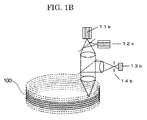
- FIG. 1B shows an exemplary recording apparatus employing the optical recording medium.
- an optical medium of the present invention is not limited to the embodiment shown in FIGs. 1A , and may have any other structures so long as three-dimensional recording (recording in plane and thickness directions) can be attained.
- FIG. 1A shows a three-dimensional optical recording media 100 in which recording layers 13a made of a two-photon absorption material of the present invention and intermediate layers 14a (protective layers) are alternately laminated on a flat support (base: 11a) so that the number of layers is 50.
- each recording layer has a thickness of 0.01 ⁇ m to 0.5 ⁇ m
- each intermediate layer has a thickness of 0.1 ⁇ m to 5 ⁇ m.
- Three-dimensional information recording is performed by focusing light 15a, which is emitted form a light source 11b, on a desired position of each recording layer 13a.
- the light source may be a single beam light source such as a light source emitting ultrashort pulse light of femtosecond order or a commonly-used LD. Recording can be performed in both bit unit and a depth-direction unit. Also, parallel recording utilizing a surface illuminant is preferably performed from the viewpoint of realizing a higher transfer rate.
- a recording medium 100 having no intermediate layers i.e., a bulk recording layer, similar to hologram recording, page data is collectively recorded to realize a high transfer rate.
- the support 11a or 12a is a natural or synthetic support, which suitably has a form of a soft or rigid film, a sheet, or a board.
- the recording layer 13a can be formed by directly applying, onto a base, a two-photon absorption material of the present invention using, for example, a spin coater, a roll coater or a bar coater.
- the recording layer may be made of only a two-photon absorption material of the present invention; or may further contain, for example, an organic material, a polymer and a photosensitized material in a mixed or dispersed state.
- the solvent may be removed through evaporation during drying of the product under heating or reduced pressure.
- the intermediate layer 14a is formed for the purposes of, among others, preventing oxygen permeation and crosstalk between layers.
- the intermediate layer is made of, for example, polyolefin (e.g., polypropylene or polyethylene), polyvinyl chloride, polyvinylidene chloride, polyvinyl alcohol, or polyethylene terephthalate.
- the intermediate layer may be a plastic film or board made of cellophane, which is laminated by an extruder on or electrostatically closely attached to the recording layer (photosensitive film).
- a solution of the above polymer may be applied on the recording layer, or a glass plate may be attached thereto.
- an adhesive or a liquid substance may be applied between a protective layer and a photosensitive film and/or between a base and a photosensitive film, to thereby enhance airtightness.
- a protective layer (intermediate layer) disposed between photosensitive films may be provided with a guide groove for tracking and address information in advance.
- Information reproducing is performed by irradiating recorded and non-recorded areas with a laser beam having a lower intensity than the beam used for recording, and then detecting the differences in luminescence/reflection intensities between the areas by a detector 13b.
- Reproducing light may be light with a different wavelength from the beam used for data recording, or light having the same wavelength and lower power. Similar to recording, reproducing can be performed in both bit unit and a depth-direction unit.
- parallel recording utilizing, for example, a surface illuminant or two-dimensional detector is preferably performed from the viewpoint of realizing a higher transfer rate.
- an optical recording medium of the present invention may be card, plate, tape or drum (not shown).
- Photocurable resins used for two-photon optical molding change from a liquid into a solid as a result of two-photon polymerization caused by light irradiation.
- the resins mainly contain a resin component formed of an oligomer and a reactive diluent; a photopolymerization initiator; and, if necessary, further contain a photosensitized material.
- the oligomer is a polymer having a polymerization degree of about 2 to about 20 and having many reactive groups at its ends.
- the reactive diluent is used for controlling the obtained resins in viscosity, hardness, etc.
- the polymerization initiator or photosensitized material absorbs two photons.
- the polymerization initiator directly forms reactive species, or the photosensitized material forms reactive species by the action of the polymerization initiator.
- the thus-formed reactive species react with the reactive groups of the oligomer and the reactive diluent to initiate polymerization.
- a polymerization chain reaction occurs between these compounds to form three-dimensional cross linkage.
- the resins immediately change into a solid resin having a three-dimensional network structure.
- the photocurable resins are used for photocurable inks, photo adhesives, lamination-type 3D optical molding, etc., and have been improved so as to have various characteristics.
- lamination-type 3D optical molding it is important that they have good reactivity, small volume shrinkage upon curing, and excellent mechanical characteristics after curing.
- the two-photon absorption material of the present invention can be used as a two-photon absorption polymerization initiator or two-photon absorption photosensitized material which meets the above-described requirements. Since the two-photon absorption material of the present invention has higher two-photon absorption sensitivity than that of conventional two-photon absorption materials, high-speed optical molding can be attained. Also, by virtue of two-photon absorption, fine, three-dimensional optical molding is realized.
- the two-photon absorption material of the present invention serving as a photosensitized material is dispersed in, for example, a UV-curable resin to form a photosensitive solid; and the thus-formed photosensitive solid is irradiated with light at its desired points to cause curing reaction only at a portion in the vicinity of the focal point of the irradiated light, whereby an ultrafine three-dimensional optically molded product can be obtained.
- FIG. 2 shows an exemplary optical molding apparatus of the present invention used in optical molding using a two-photon absorption material.
- the position of the collecting point can be changed, as desired, in photocurable resin by controlling a movable mirror 22 and/or a movable stage 25 (a galvanometer mirror and a Z stage) and thus, the resin can be locally cured at its any points on the order of nanometers to readily form a desired three-dimensionally processed product.
- an optical waveguide 101 shown in FIG. 3 is taken.
- reference numerals 102 and 103 denote an optical fiber and an optical fiber array, respectively.
- WDM wavelength division multiplexing
- the optical waveguide having such a structure that utilizes change in refractive index depending on a light wavelength can be produced by optically molding a thin film containing the two-photon absorption material of the present invention or a solid obtained through dispersing the material in, for example, a photocurable resin with an optical molding apparatus shown in FIG. 2 .
- JP-A No. 2005-134873 is one of patent literatures which are useful for understanding optical molding in the present invention. From this literature, a pulse laser beam is applied through no mask to a surface of a photosensitive polymer film for interference exposure.
- the laser beam is composed of light (wavelength) which enables the photosensitive polymer film to exhibit its photosensitivity, and is selected in consideration of the type of a photosensitive polymer used, or the photosensitive group or moiety of the polymer.
- JP-A Nos. 08-320422 discloses an optical waveguide formed by irradiating a light refractive index material with light.
- optical controls e.g., modulation and switching
- This type of optical control conventionally employs an electrical-optical control method using an electric signal.
- the electrical-optical control method is limited in terms of bands, due to CR time constant of an electrical circuit, and of a processing speed (> 10 ps), due to a response speed of a device itself and to a difference in speed between electric signals and optical signals.
- an optical-optical control technology which controls an optical signal by an optical signal, is very important to make full use of advantages of light such as its broad band and high-speed performance.
- Optical devices fabricated by processing the two-photon absorption material of the present invention in order to meet the requirements can be applied to, for example, high-speed optical switches in optical communication, optical switching, optical computers, optical interconnection, etc. by utilizing optical changes in, for example, transmittance, refractive index, and an absorption coefficient caused by light irradiation to modulate light intensity and frequency without an electronic circuit technology.
- the light restricting device in the present invention utilizing optical characteristics changes caused by two-photon absorption exhibits a much higher response speed ( ⁇ 1 ps) than commonly-used light restricting devices which are formed from a semiconductive material or based on one-photon excitation. Also, by virtue of its high sensitivity, there can be provided light restricting devices which exhibit excellent signal characteristics and a high S/N ratio.
- optical switches utilizing one-photon absorption/supersaturation absorption are described as follows. They are based on, for example, spectral hole burning (SHB), excitation/absorption, intersubband transition (ISBT) and quantum confined stark effect (QCSE).
- SHB spectral hole burning
- ISBT intersubband transition
- QCSE quantum confined stark effect
- optical switches utilizing two-photon absorption can employ nonlineality thereof.
- they are advantageous in that ultra high-speed response can be attained in principle, device manufacturing (composition and structure) is readily performed, an employable wavelength region is broad (i.e., high selectivity in wavelengths), and dependency on polarization is not observed.
- FIG. 4 shows an exemplary optical controlling device in which the two-photon absorption material of the present invention is two-photon excited using a control light having a wavelength capable of causing two-photon excitation, to thereby optically switch a signal light having a wavelength capable of causing one-photon excitation.
- the optical device shown in FIG. 4 is a device having two protective layers and a two-photon absorption material disposed therebetween, which is not construed as limiting the present invention thereto.
- Laser beams emitted as a control light 201 and a signal light 202 are focused by a focusing apparatus. Only when the control light 201 has a very high intensity, the control light is absorbed by an optical device 203, which changes transmittance with respect to light having a wavelength capable of causing one-photon excitation. Using change in transmittance depending on nonlineality of two-photon absorption, it is possible that the signal light is optically switched depending on the intensity of the control light.
- reference numerals 204, 205 and 206 denote protective films, a color filter and a detector, respectively.
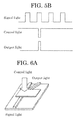
- FIGs. 5A and 5B each exemplarily illustrate operation of an optical controlling device in which all-optical switching is performed by two-photon exciting the two-photon absorption material of the present invention using a signal light with a wavelength ( ⁇ 1) capable of causing two-photon excitation and a control light with a wavelength ( ⁇ 2) capable of causing two-photon excitation.
- Laser beams serving as the control and signal lights are focused by a focusing apparatus on a light restricting device having, as a main component, an element made of the two-photon absorption material.
- a light restricting device having, as a main component, an element made of the two-photon absorption material.
- FIGs. 6A and 6B each illustrate an exemplary optical controlling device in which light paths for light output are optically switched by two-photon exciting the two-photon absorption material of the present invention with a control light having a wavelength capable of causing two-photon absorption.
- Laser beams emitted as a control light and a signal light are focused by a focusing apparatus on a branching point of an optical waveguide made mainly of the two-photon absorption material. Only when the control light has a very high intensity, the control light is absorbed in the branching point, causing change in refractive index at the point.
- the light path for the output light can be switched. In this manner, optical switching for an optical waveguide can be performed by utilizing change in refractive index depending on nonlineality of two-photon absorption.
- JP-A No. 08-320422 is one of patent literatures which are useful for understanding a light restricting device in the present invention. From this literature, a material whose refractive index changes through light irradiation is irradiated with light having a wavelength capable of changing its refractive index for focusing, to thereby produce an optical waveguide having a refractive index distribution.
- the two-photon absorption material having high two-photon absorptivity, a thin film formed therefrom, or a solid obtained through dispersing the material in, for example, a photocurable resin is used as an optical device.
- ⁇ 1 light with a wavelength of ⁇ 1 is applied to the device for excitation, and then light with a wavelength of ⁇ 2 is applied to the thus-excited device for further excitation, whereby an optical waveguide utilizing a refractive index distribution depending on a light wavelength can be designed.
- many two-photon absorption materials emit a fluorescent light.
- a fluorescent substance is disposed on one output end or in the vicinity thereof in an optical device, and then an excitation light ( ⁇ 1) is caused to emit from the other output end, whereby a refractive index distribution can be formed using the excitation light and the fluorescent light ( ⁇ 2).
- the fluorescent light is generally lower in intensity than the excitation light and thus, sensitivity is preferably higher to a wavelength of the fluorescent light.
- the fluorescent substance include dispersions prepared by dispersing fluorescent dyes in a photocurable substance, various resins, etc.
- the two-photon excited fluorescence detection method is a detection method in which a near-infrared pulse laser beam is focused for scanning on a sample containing an analyte labeled with a two-photon fluorescent material, and then fluorescent light emitted from the analyte through two-photon excitation to obtain a three-dimensional image thereof.
- FIG. 7 shows a two-photon excitation fluorescence microscope as one example of such optical devices.
- a near-infrared subpicosecond monochromatic coherent pulse laser beam emitted from a light source 51 is focused via a dichroic mirror 52 using a focusing apparatus 53 in a sample 54 containing an analyte labeled with a two-photon absorption material of the present invention, causing the analyte to emit two-photon fluorescent light.
- the laser beam is focused on some points of the sample, and the fluorescent intensity of each point is detected with an optical detector 56.
- the thus-obtained fluorescent intensity and position-related information of the point are plotted against each other on a computer, to thereby form a three-dimensional fluorescent image.
- the microscope is provided with a scanning mechanism in which a laser beam is focused on a desired point.
- a sample may be moved on a stage 55 or a movable mirror (e.g., a galvanometer mirror) may be used for scanning of laser beam.
- the two-photon excitation fluorescence microscope having the above-described configuration can provide a high-resolution image in an optical axis direction. Also, using a confocal pinhole plate, further increased resolution can be attained in both in-plane and optical axis directions.
- Such a two-photon fluorescent material can be used for staining an analyte, or dispersed in an analyte in use. It can be used not only for industrial applications but also for three-dimensional microimaging of, for example, living cells. In addition, when mixed with a biocompatible polymer, it can be used as a photosensitive material in photodynamic therapy (PDT).
- PDT photodynamic therapy
- JP-A No. 09-230246 is one of patent literatures which are useful for understanding a two-photon excitation fluorescence microscope in the present invention.
- a scanning fluorescent microscope has a laser beam irradiation optical system which emits a collimated light enlarged to a desired size, and a base on which surface a plurality of light-focusing elements are formed. Each light-focusing element is arranged so that the position where light is focused is identical to the position where an image is formed in an objective lens system.
- a beam splitter that transmits a long-wavelength light and reflects short-wavelength light is disposed between the base and the objective lens system. In such a microscope, a fluorescent light is emitted from the surface of a sample as a result of multi-photon absorption.
- such a two-photon optical device may be an optical device which is made of the two-photon absorption material of the present invention having high two-photon absorptivity, a thin film formed therefrom, or a solid obtained through dispersing the material in, for example, a photocurable resin.
- the two-photon absorption material of the present invention can be applied to an apparatus in which a two-photon excitation fluorescent light is detected (e.g., a two-photon excitation laser scanning microscope).
- This two-photon absorption material has a larger two-photon absorption cross-sectional area than conventional two-photon excitation fluorescent materials. Thus, even when used at low concentration, it exhibits high two-photon absorption (light emitting) characteristics.
- the present invention can provide a high sensitive two-photon absorption material. Thus, it is not necessary to irradiate the material with light having high intensity, avoiding degradation or breakage of an analyte. In addition, it is possible to reduce adverse effects against characteristics of other components in the analyte. Similarly, when it is applied in biological subjects, the intensity of light irradiated can be decreased to reduce damage thereto.
- Photodynamic therapy is a therapeutic method which has already been clinically applied to the treatment of some early-stage malignant tumors in human medicine.
- a photosensitive compound (two-photon absorption material) is made to be taken in tumor cells and/or endothelial cells of neovascular vessels in tumor tissues, and then an affected area (i.e., these cells) is irradiated with a laser beam to generate active oxygen.
- an affected area i.e., these cells
- tumor cells/tissues are given damage by the action of active oxygen, leading to disappearance of tumor.
- PDT employs photodynamic reaction. It uses a low-toxic photosensitive compound and a laser beam having low intensity and thus, advantageously gives less damage to biological subjects.
- the photosensitive compound used is a two-photon absorption material and the light used has such a long wavelength that can transmit biological subjects, damage to biological subjects is further reduced.
- diagnostic imaging e.g., CT
- an optical fiber is placed so as to irradiate the entire tumor with a laser beam, followed by irradiation of a laser beam.
- PDT can advantageously save normal tissues to the greatest extent possible.
- the two-photon absorption material of the present invention can be applied to various devices as a bulk or a thin film formed exclusively of the material, or a mixture of the material and various resins.
- the thin film is in contact with a base.
- the material for the base include polyethylene terephthalates, polycarbonates, polymethyl methacrylates, polyesters, polyvinyl alcohols and glass.
- the thin film is in contact with an intermediate layer (partition layer).
- the intermediate layer is plastic films made, for example, of polyolefin (e.g., polypropylene and polyethylene), polyvinyl chloride, vinylidene chloride, polyvinyl alcohol, polyethylene terephthalate, cellophane, or various photocurable resin.
- the two-photon absorption material is in use mixed with various resins or photocurable resins.
- the two-photon absorption material of the present invention is required to be mixed with various resins or glass; or a layer made of the two-photon absorption material is required to be in contact with various resins or glass.
- the two-photon absorption material of the present invention is in contact with various resins or glass at the micro or macro level.
- One of the general production methods is the below-described Lindsey method found by Lindsey et al. Specifically, pyrrole is reacted with aromatic aldehyde at 10 -2 M in methylene chloride in the presence of a catalytic amount of BF 3 (10 -3 M) or trifluoroacetic acid (10 -2 M) to form a tetramer, followed by oxydation with p-chloranil. With this method, commonly-used porphyrins can be synthesized at relatively high yield.
- porphyrins produced from pyrrole and aldehyde virtually have a four axisymmetric structure, and are disadvantageous in that they do not exhibit high two-photon absorption in terms of low polarity thereof.
- a substituted or unsubstituted dipyrrolomethane is synthesized, and the thus-obtained dipyrrolomethane, serving as a starting material, is reacted with aldehyde in accordance with the Lindsey method, whereby low-symmetry porphyrins can be produced.
- an electron-donating substituent i.e., a substituent having high electron donating property
- a triphenylamine group has high electron donating property and is a bulky substituent.
- porphyrins containing, as a substituent, such a triphenylamine group can be dissolved in various organic solvent by virtue of a triphenylamine group, and this substituent is particularly useful for film formation.
- Zn is used as a central metal in the porphyrins
- the formed porphyrins exhibit sharp absorption and improve in two-photon absorptivity.
- the optimum central metal is Zn.
- inclusion of Zn in a porphyrin ring can be performed at higher yield as compared with the case where the other metals are used and thus, Zn is the most suitable metal for industrial applications.
- a two-photon absorption material not according to the present invention is a compound represented by the following General Formula (I).
- R 1 to R 8 each represent a hydrogen atom, a halogen atom, a carboxyl group, a carboxylic acid ester group, a substituted or unsubstituted aryl group, or a substituted or unsubstituted alkyl group;
- one to three of X 1 to X 4 each represent a substituted or unsubstituted amino group, a substituted or unsubstituted aminophenyl group, a substituted or unsubstituted dialkylaminophenyl group, a substituted or unsubstituted N,N-diphenyl-aminophenyl group, a substituted or unsubstituted indolyl group, or a substituted or unsubstituted azulenyl group, and the other represents or the others each represent a hydrogen atom, a halogen
- X 1 to X 4 each represent a substituted or unsubstituted amino group, a substituted or unsubstituted aminophenyl group, a substituted or unsubstituted dialkylaminophenyl group, a substituted or unsubstituted N,N-diphenyl-aminophenyl group, a substituted or unsubstituted indolyl group, or a substituted or unsubstituted azulenyl group, and the other is or the others each are a trifluoromethyl group.
- X 1 to X 4 each are a substituted or unsubstituted N,N-diphenyl-aminophenyl group.
- Examples of the alkyl group represented by each of X 1 to X 4 and R 1 to Rs in General Formula (I) include linear or branched alkyl groups and substituted alkyl groups.
- Examples of the substituted alkyl groups include hydroxy-substituted alkyl groups such as 2-hydroxyethyl, 3-hydroxypropyl, 4-hydroxybutyl and 2-hydroxypropyl; carboxy-substituted alkyl groups such as carboxymethyl, 2-carboxyethyl and 3-carboxypropyl; cyano-substituted alkyl groups such as 2-cyanoethyl and cyanomethyl; amino-substituted alkyl groups such as 2-aminoethyl; halogen-substituted alkyl groups such as 2-chloroethyl, 3-chloropropyl, 2-chloropropyl and 2,2,2-trifluoroethyl; phenyl-substituted alkyl groups such as benzy
- examples of cycloalkyl groups include cyclopentyl and cyclohexyl.
- alkyl group examples include primary alkyl groups such as methyl, ethyl, n-propyl, n-butyl, isobutyl, n-pentyl, neopentyl, isoamyl, 2-methylbutyl, n-hexyl, 2-methylpentyl, 3-methylpentyl, 4-methylpentyl, 2-ethylbutyl, n-heptyl, 2-methylhexyl, 3-methylhexyl, 4-methylhexyl, 5-methylhexyl, 2-ethylpentyl, 3-ethylpentyl, n-octyl, 2-methylheptyl, 3-methylheptyl, 4-methylheptyl, 5-methylheptyl, 2-ethylhexyl, 3-ethylhexyl, n-nonyl, n-decyl and n-dodecyl; secondary alkyl groups
- aryl group represented by each of X 1 to X 4 and R 1 to R 8 in General Formulas include phenyl, methylphenyl, dimethylphenyl, trimethylphenyl, ethylphenyl, tert-butylphenyl, di(tert-butyl)phenyl, butylphenyl, methoxyphenyl, dimethoxyphenyl, trimethoxyphenyl and butoxyphenyl.
- these aryl groups may have a substituent such as a halogen atom.
- M represents two hydrogen atoms or a divalent, trivalent or tetravalent metal atom which may have an oxygen atom or a halogen atom.
- the metal atom represented by M include metals belonging to Groups Ib, IIa, IIb, IIIa, IVa, IVb, Vb, VIb, VIIb and VIII, oxides of the metals, halides of the metals, hydroxides of the metals, and the metals having a substituent(s).
- the metals include Cu, Zn, Mg, Al, Ge, Ti, Sn, Pb, Cr, Mo, Mn, Fe, Co, Ni, In, Pt and Pd.
- Specific examples of the oxides include TiO and VO.
- Specific examples of the halides include AlCl, GeCl2, SiCl 2 , FeCl, SnCl 2 and InCl.
- Specific examples of the hydroxides include Al(OH) 3 , Si(OH) 2 , Ge(OH) 2 and Sn(OH) 2 .
- the metal is, for example, Al, Ti, Si, Ge or Sn; and the substituent is, for example, an aryloxyl group, an alkoxyl group, a trialkylsiloxyl group, a triarysiloxyl group, a trialkoxysiloxyl group, a triaryloxysiloxyl group, a trityloxyl group or an acyloxyl group.
- a two-photon absorption material not according to the present invention is represented by General Formula (I) in which at least one of X 1 and X 3 is a phenyl group having, as a substitutent, an alkyl group, an alkoxy group, a trifluoromethyl group, a nitro group, a cyano group or a carboxylic acid ester group, or a substituted or unsubstituted pyridinyl group, with the proviso that when only one of X 1 and X 3 is the phenyl group or the pyridinyl group, the other is a hydrogen atom or a halogen atom; and at least one of X 2 and X 4 is a substituent represented by (a) or (b) given below, with the proviso that when only one of X 2 and X 4 is the substituent, the other is preferably a hydrogen atom or a halogen atom.
- the two-photon absorption material not according to the present invention is two-photon absorption materials represented by the following General Formula (I)': where R 1 to R 8 each represent a hydrogen atom, a halogen atom, a carboxyl group, a carboxylic acid ester group, a substituted or unsubstituted aryl group or a substituted or unsubstituted alkyl group; at least one of X 1 and X 2 is a phenyl group having, as a substituent, an alkyl group, an alkoxy group, a trifluoromethyl group, a nitro group, a cyano group or a carboxylic acid ester group, or a substituted or unsubstituted pyridinyl group, with the proviso that when only one of X 1 and X 2 is the phenyl group or the pyridinyl group, the other is a hydrogen atom or a halogen atom; at least one of Y
- R 1 to R 8 each represent a hydrogen atom, a halogen atom, a carboxyl group, a carboxylic acid ester group, a substituted or unsubstituted aryl group or a substituted or unsubstituted alkyl group;
- R 14 represents an alkyl group, an alkoxy group or a hydrogen atom;
- at least one of X 1 and X 2 is a phenyl group having, as a substituent, an alkyl group, an alkoxy group, a trifluoromethyl group, a nitro group, a cyano group or a carboxylic acid ester group, or a substituted or unsubstituted pyridinyl group, with the proviso that when only one of X 1 and X 2 is the phenyl group or the pyridinyl group, the other is a hydrogen atom or a
- R 1 to R 8 each represent a hydrogen atom, a halogen atom, a carboxyl group, a carboxylic acid ester group, a substituted or unsubstituted aryl group or a substituted or unsubstituted alkyl group;
- R 15 represents an alkyl group or a hydrogen atom;
- at least one of X 1 and X 2 is a phenyl group having, as a substituent, an alkyl group, an alkoxy group, a trifluoromethyl group, a nitro group, a cyano group or a carboxylic acid ester group, or a substituted or unsubstituted pyridinyl group, with the proviso that when only one of X 1 and X 2 is the phenyl group or the pyridinyl group, the other is a hydrogen atom or a halogen atom;
- FIG. 8 schematically illustrates a system of the method.
- a quartz cell filled with each sample solution was placed in a light path through which a focused laser beam was passed. Then, the cell was moved along the light path for Z-scan measurement.
- T ln ⁇ 1 + I ⁇ 0 ⁇ L ⁇ 0 ⁇ ⁇ / I ⁇ 0 ⁇ L ⁇ 0 ⁇ ⁇
- T denotes a transmittance (%)
- 10 denotes an excited light density [GW/cm 2 ]
- L0 denotes a sample cell length [cm]
- ⁇ denotes a nonlinear absorption coefficient [cm/GW].
- the two-photon absorption materials of the present invention were found to show two-photon absorption cross-sectional areas at least 10 times those of conventionally known two-photon absorption materials and thus, exhibit improved two-photon absorptivity.
- porphyrin derivatives of the present invention were found to show large two-photon absorption cross-sectional areas.
- the compounds of the present invention excellent in two-photon absorptivity require no high-output laser; i.e., require an intensity about 1/10 times the intensity required for conventionally known materials.
- the present invention can provide materials which can be used for various applications with an inexpensive laser; i.e., can provide promising materials applicable to three-dimensional memory, light restricting devices, optical molding materials, dyes used for two-photon fluorescence microscopy, etc.
- FIG. 8 schematically illustrates a system of the method.
- a quartz cell filled with each sample solution was placed in a light path through which a focused laser beam was passed. Then, the cell was moved along the light path for Z-scan measurement.
- T ln ⁇ 1 + I ⁇ 0 ⁇ L ⁇ 0 ⁇ ⁇ / I ⁇ 0 ⁇ L ⁇ 0 ⁇ ⁇
- T denotes a transmittance (%)
- 10 denotes an excited light density [GW/cm 2 ]
- L0 denotes a sample cell length [cm]
- ⁇ denotes a nonlinear absorption coefficient [cm/GW].
- the two-photon absorption materials of the present invention were found to show two-photon absorption cross-sectional areas at least 10 times those of conventionally known two-photon absorption materials and thus, exhibit improved two-photon absorptivity.
- porphyrin derivatives of the present invention were found to show large two-photon absorption cross-sectional areas.
- porphyrin derivatives of the present invention were found to show two-photon absorption cross-sectional areas about 10 times that (about 100 GM) of a conventional two-photon absorption material having a similar structure (disclosed in JP-A No. 2005-500394 ).
- the compounds of the present invention excellent in two-photon absorptivity require no high-output laser; i.e., require an intensity about 1/10 times the intensity required for conventionally known materials.
- the present invention can provide materials which can be used for various applications with an inexpensive laser; i.e., can provide promising materials applicable to three-dimensional memory, light restricting devices, optical molding materials, dyes used for two-photon fluorescence microscopy, etc.
- the compound of the present invention having excellent two-photon absorption properties can provide high-quality, three-dimensional memory materials, light restricting materials, photocurable resins for optical molding (curable materials), materials for photo-chemotherapy, and fluorescent dyes for two-photon fluorescence microscopy.
Landscapes
- Chemical & Material Sciences (AREA)
- Organic Chemistry (AREA)
- Health & Medical Sciences (AREA)
- Engineering & Computer Science (AREA)
- Nanotechnology (AREA)
- Life Sciences & Earth Sciences (AREA)
- Biochemistry (AREA)
- Animal Behavior & Ethology (AREA)
- Theoretical Computer Science (AREA)
- Mathematical Physics (AREA)
- Physics & Mathematics (AREA)
- Molecular Biology (AREA)
- Medicinal Chemistry (AREA)
- Pharmacology & Pharmacy (AREA)
- Epidemiology (AREA)
- Crystallography & Structural Chemistry (AREA)
- General Health & Medical Sciences (AREA)
- Public Health (AREA)
- Veterinary Medicine (AREA)
- Optical Modulation, Optical Deflection, Nonlinear Optics, Optical Demodulation, Optical Logic Elements (AREA)
- Optical Record Carriers And Manufacture Thereof (AREA)
- Organic Low-Molecular-Weight Compounds And Preparation Thereof (AREA)
- Optical Integrated Circuits (AREA)
Claims (3)
- Zwei-Photonen-Absorptionsmaterial, das durch die folgende allgemeine Formel (III) dargestellt ist:


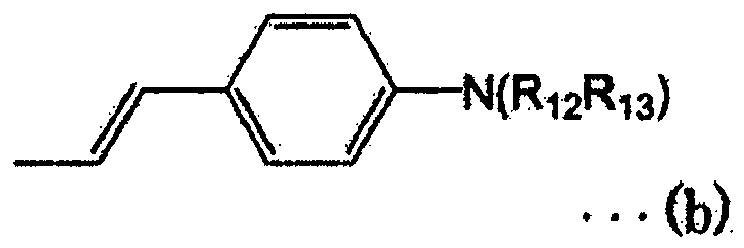
- Zwei-Photonen-Absorptionsmaterial nach Anspruch 1, wobei M ein Zinkatom ist.
- Zwei-Photonen-Absorptionsmaterial nach irgendeinem von Anspruch 1 oder Anspruch 2 zur Verwendung in irgendeinem von einem optischen Aufzeichnungsmaterial, einem optischen Formmaterial, einem Lichtbegrenzungsmaterial, einem Zwei-Photonen-Anregungs-Fluoreszenzmaterial und einem dreidimensionalen optischen Aufzeichnungsmedium.
Applications Claiming Priority (3)
| Application Number | Priority Date | Filing Date | Title |
|---|---|---|---|
| JP2008217276A JP2010054623A (ja) | 2008-08-26 | 2008-08-26 | 二光子吸収材料とその用途 |
| JP2009009719A JP5453818B2 (ja) | 2008-02-01 | 2009-01-20 | 二光子吸収材料とその用途 |
| EP09157985.4A EP2159227B1 (de) | 2008-08-26 | 2009-04-15 | Zwei-Photonen-Absorptionsmaterial und Anwendung davon |
Related Parent Applications (3)
| Application Number | Title | Priority Date | Filing Date |
|---|---|---|---|
| EP09157985 Previously-Filed-Application | 2009-04-15 | ||
| EP09157985.4A Division-Into EP2159227B1 (de) | 2008-08-26 | 2009-04-15 | Zwei-Photonen-Absorptionsmaterial und Anwendung davon |
| EP09157985.4 Division | 2009-04-15 |
Publications (2)
| Publication Number | Publication Date |
|---|---|
| EP2243783A1 EP2243783A1 (de) | 2010-10-27 |
| EP2243783B1 true EP2243783B1 (de) | 2014-01-01 |
Family
ID=40802090
Family Applications (3)
| Application Number | Title | Priority Date | Filing Date |
|---|---|---|---|
| EP10170353.6A Not-in-force EP2243783B1 (de) | 2008-08-26 | 2009-04-15 | Bisporphyrinkonjugate als Zwei-Photonen-Absorptionsmaterial |
| EP09157985.4A Not-in-force EP2159227B1 (de) | 2008-08-26 | 2009-04-15 | Zwei-Photonen-Absorptionsmaterial und Anwendung davon |
| EP10170352A Withdrawn EP2243782A3 (de) | 2008-08-26 | 2009-04-15 | Zwei-Photonen-Absorptionsmaterial und Anwendung davon |
Family Applications After (2)
| Application Number | Title | Priority Date | Filing Date |
|---|---|---|---|
| EP09157985.4A Not-in-force EP2159227B1 (de) | 2008-08-26 | 2009-04-15 | Zwei-Photonen-Absorptionsmaterial und Anwendung davon |
| EP10170352A Withdrawn EP2243782A3 (de) | 2008-08-26 | 2009-04-15 | Zwei-Photonen-Absorptionsmaterial und Anwendung davon |
Country Status (3)
| Country | Link |
|---|---|
| US (1) | US8207330B2 (de) |
| EP (3) | EP2243783B1 (de) |
| JP (1) | JP2010054623A (de) |
Families Citing this family (10)
| Publication number | Priority date | Publication date | Assignee | Title |
|---|---|---|---|---|
| KR102146842B1 (ko) * | 2011-06-09 | 2020-08-24 | 케이스 웨스턴 리저브 유니버시티 | 광학적 정보 스토리지 매체 |
| US11211091B2 (en) | 2011-06-09 | 2021-12-28 | Case Western Reserve University | Optical information storage medium |
| JP5705049B2 (ja) * | 2011-07-13 | 2015-04-22 | 富士フイルム株式会社 | 多層構造シートとその製造方法、光情報記録媒体および多層構造シートを用いた光情報記録媒体の製造方法 |
| CN103724363B (zh) * | 2013-12-30 | 2016-03-23 | 重庆大学 | 含有酸酐键对称分子钳系列卟啉化合物及其制备方法 |
| CN103724361B (zh) * | 2013-12-30 | 2016-03-23 | 重庆大学 | 含有酯键对称分子钳系列卟啉化合物及其制备方法 |
| JP2016033185A (ja) * | 2014-07-31 | 2016-03-10 | 積水化学工業株式会社 | 波長変換材料及び光エネルギーデバイス |
| CN113826162B (zh) * | 2019-03-12 | 2024-03-26 | 卡斯西部储备大学 | 光学信息存储介质 |
| PL237684B1 (pl) * | 2019-05-21 | 2021-05-17 | Politechnika Warszawska | Wzorzec rozkładu współczynnika załamania |
| WO2020233665A1 (zh) * | 2019-05-21 | 2020-11-26 | 上海必修福企业管理有限公司 | 一种光学系统及光学方法 |
| KR102765595B1 (ko) * | 2020-08-03 | 2025-02-12 | 삼성전자주식회사 | 음성 데이터 처리 방법 및 이를 지원하는 전자 장치 |
Family Cites Families (42)
| Publication number | Priority date | Publication date | Assignee | Title |
|---|---|---|---|---|
| JPH0628672A (ja) | 1992-06-12 | 1994-02-04 | Senri Oyo Keisoku Kenkyusho:Kk | 光学的データ記憶体並びにこの記録装置及び記録再生装置 |
| JPH06118306A (ja) | 1992-10-02 | 1994-04-28 | Senri Oyo Keisoku Kenkyusho:Kk | 光学的記憶装置の読み出し方法 |
| JPH08320422A (ja) | 1994-06-22 | 1996-12-03 | Fujitsu Ltd | 光導波路系の作製方法およびそれを用いた光デバイス |
| JPH09230246A (ja) | 1996-02-22 | 1997-09-05 | Olympus Optical Co Ltd | 走査型光学顕微鏡 |
| JPH10142507A (ja) | 1996-11-11 | 1998-05-29 | Olympus Optical Co Ltd | レーザ走査顕微鏡 |
| US6071671A (en) | 1996-12-05 | 2000-06-06 | Omd Devices Llc | Fluorescent optical memory |
| US5936878A (en) | 1997-01-06 | 1999-08-10 | Omd Devices Llc | Polymeric photo-chromic composition |
| RO114383B1 (ro) | 1997-05-21 | 2000-02-28 | Storex Technologies S.R.L. | Dispozitiv pentru înscrierea tridimensională a informaţiei digitale într-o memorie optică de tip worm |
| WO1999023650A1 (en) | 1997-10-31 | 1999-05-14 | Omd Devices Llc | Multi-layered photochromic optical data disk |
| JPH11167036A (ja) | 1997-12-04 | 1999-06-22 | Japan Science & Technology Corp | 光導波回路及び非線形光学装置 |
| EP1406890A4 (de) | 2001-07-13 | 2004-11-24 | Trustees Boston College | Phthalidverbindungen, die sich für optische aufnahmen eignen |
| JP4521800B2 (ja) | 2001-07-19 | 2010-08-11 | 株式会社リコー | 画像形成装置 |
| KR100406994B1 (ko) * | 2001-08-08 | 2003-11-28 | 삼성전자주식회사 | 화상의 농도 보상이 가능한 화상형성장치 |
| DE60230636D1 (de) * | 2001-08-22 | 2009-02-12 | Univ Montana State | Porphyrine mit verbesserten multi-photonen-absorptionsquerschnitten für die photodynamische therapie |
| WO2003070689A2 (en) | 2002-02-21 | 2003-08-28 | Mempile Inc. | Polymer bound donor-acceptor-donor compounds and their use in a 3-dimensional optical memory |
| US6951935B2 (en) * | 2002-03-28 | 2005-10-04 | University Of Tennessee Research Foundation | Heteroatom-substituted porphyrins and methods for synthesis of same |
| JP4235726B2 (ja) | 2002-11-19 | 2009-03-11 | 国立大学法人 奈良先端科学技術大学院大学 | 大きな二光子吸収特性を示すアセチレン結合により連結されたビス(イミダゾリルポルフィリン金属錯体)を構成単位とするポルフィリン連鎖体及びその製造方法 |
| JP2004277416A (ja) | 2003-02-27 | 2004-10-07 | Masahiro Irie | ジアリールエテン系化合物、フォトクロミック材料および光機能素子 |
| JP2004339435A (ja) | 2003-05-19 | 2004-12-02 | Fuji Photo Film Co Ltd | 非共鳴2光子吸収色素および非共鳴2光子吸収誘起方法 |
| JP2005100606A (ja) | 2003-09-04 | 2005-04-14 | Fuji Photo Film Co Ltd | 2光子吸収光記録再生方法及び2光子吸収光記録材料 |
| JP2005082507A (ja) | 2003-09-05 | 2005-03-31 | Mitsubishi Chemicals Corp | ジアリールエテン化合物、フォトクロミック材料、カラー線量計および光メモリ素子 |
| JP4463033B2 (ja) | 2003-10-06 | 2010-05-12 | 日東電工株式会社 | 感光性高分子膜表面上への釣鐘型凸状構造部の形成方法 |
| JP4468684B2 (ja) | 2003-12-05 | 2010-05-26 | オリンパス株式会社 | 走査型共焦点顕微鏡装置 |
| JP2005213434A (ja) | 2004-01-30 | 2005-08-11 | Kyoto Univ | ジアリールアミノ基を有するピラン誘導体からなる二光子吸収材料 |
| JP4352944B2 (ja) | 2004-03-09 | 2009-10-28 | 株式会社豊田中央研究所 | 光回路の製造方法 |
| JP2005263738A (ja) | 2004-03-19 | 2005-09-29 | Kyoto Univ | ポルフィリンオリゴマー誘導体からなる2光子吸収材料 |
| JP2006178399A (ja) | 2004-11-24 | 2006-07-06 | Kyoto Univ | ポルフィリンアレイからなる2光子吸収材料 |
| JP2006209059A (ja) | 2004-12-28 | 2006-08-10 | Kyoto Univ | 2光子吸収材料 |
| JP2006251351A (ja) | 2005-03-10 | 2006-09-21 | Kyushu Univ | 有機非線形光学材料 |
| JP5117679B2 (ja) * | 2005-04-27 | 2013-01-16 | 株式会社リコー | 多光子吸収材料を用いた色素材料、色素材料の製造方法、多光子吸収反応材料、多光子吸収反応材料の反応生成物、多光子吸収反応助剤、および色素溶液 |
| JP2007119443A (ja) | 2005-09-30 | 2007-05-17 | Kyoto Univ | ポルフィリン−アズレン縮合体および二光子吸収材料 |
| JP2007091684A (ja) | 2005-09-30 | 2007-04-12 | Kyoto Univ | ポルフィリン系化合物および2光子吸収材料 |
| JP2007178585A (ja) | 2005-12-27 | 2007-07-12 | National Univ Corp Shizuoka Univ | 二光子吸収材料 |
| JP4906371B2 (ja) | 2006-03-13 | 2012-03-28 | 株式会社リコー | 二光子吸収材料及びその用途 |
| JP4963367B2 (ja) | 2006-03-13 | 2012-06-27 | 株式会社リコー | 二光子吸収材料 |
| JP4996115B2 (ja) | 2006-03-15 | 2012-08-08 | 株式会社リコー | 二光子吸収材料とその用途 |
| JP4969881B2 (ja) | 2006-03-17 | 2012-07-04 | 株式会社リコー | 二光子吸収材料とその用途 |
| JP5042513B2 (ja) | 2006-03-17 | 2012-10-03 | 株式会社リコー | 二光子吸収材料とその用途 |
| JP5229521B2 (ja) | 2006-09-15 | 2013-07-03 | 株式会社リコー | π共役系化合物とその用途、およびそれらを用いた素子、装置 |
| JP2008163184A (ja) | 2006-12-28 | 2008-07-17 | Ricoh Co Ltd | 二光子吸収材料とその用途 |
| JP5047651B2 (ja) | 2007-03-07 | 2012-10-10 | 株式会社リコー | 二光子吸収材料とその用途 |
| GB0706335D0 (en) | 2007-03-31 | 2007-05-09 | Isis Innovation | Porphyrin compounds |
-
2008
- 2008-08-26 JP JP2008217276A patent/JP2010054623A/ja active Pending
-
2009
- 2009-04-14 US US12/423,475 patent/US8207330B2/en not_active Expired - Fee Related
- 2009-04-15 EP EP10170353.6A patent/EP2243783B1/de not_active Not-in-force
- 2009-04-15 EP EP09157985.4A patent/EP2159227B1/de not_active Not-in-force
- 2009-04-15 EP EP10170352A patent/EP2243782A3/de not_active Withdrawn
Also Published As
| Publication number | Publication date |
|---|---|
| EP2243782A3 (de) | 2011-02-09 |
| US20100056775A1 (en) | 2010-03-04 |
| EP2159227B1 (de) | 2014-08-06 |
| EP2243783A1 (de) | 2010-10-27 |
| JP2010054623A (ja) | 2010-03-11 |
| US8207330B2 (en) | 2012-06-26 |
| EP2159227A1 (de) | 2010-03-03 |
| EP2243782A2 (de) | 2010-10-27 |
Similar Documents
| Publication | Publication Date | Title |
|---|---|---|
| EP2243783B1 (de) | Bisporphyrinkonjugate als Zwei-Photonen-Absorptionsmaterial | |
| JP5157284B2 (ja) | 光増感型複合材料及び三次元メモリ材料と記録媒体、光制限材料と素子、光硬化材料と光造形システム、多光子蛍光顕微鏡用蛍光材料と装置 | |
| CN101535886B (zh) | 多光子吸收功能材料、具有多光子吸收功能的复合层和混合物,以及使用它们的光学记录介质、光电转换元件、光学控制元件、和光学造型系统 | |
| JP5117679B2 (ja) | 多光子吸収材料を用いた色素材料、色素材料の製造方法、多光子吸収反応材料、多光子吸収反応材料の反応生成物、多光子吸収反応助剤、および色素溶液 | |
| TW200841106A (en) | Multiphoton absorption functional material, composite layer having multiphoton absorption function and mixture, and optical recording medium, photoelectric conversion element, optical control element, and optical modeling system using the same | |
| JP2009221563A (ja) | 金ナノロッドとその製造方法、金ナノロッドを用いた電磁波吸収体、色材、光記録材料および二光子反応材料 | |
| JP5339242B2 (ja) | 二光子吸収材料とその用途 | |
| JP2010217579A (ja) | 二光子吸収材料とその用途 | |
| JP5343479B2 (ja) | 二光子吸収有機材料とその用途 | |
| US20060013115A1 (en) | Multi-stack optical information carrier | |
| JP5458471B2 (ja) | 二光子吸収材料、並びに光機能付与方法、光機能検出方法、光記録再生方法、光記録材料、及び三次元光記録媒体 | |
| JP4154132B2 (ja) | 光情報記録媒体 | |
| JP2013241415A (ja) | 二光子吸収材料とその用途 | |
| JP5453818B2 (ja) | 二光子吸収材料とその用途 | |
| JP5047651B2 (ja) | 二光子吸収材料とその用途 | |
| JP4963367B2 (ja) | 二光子吸収材料 | |
| JP2008163184A (ja) | 二光子吸収材料とその用途 | |
| JP5229521B2 (ja) | π共役系化合物とその用途、およびそれらを用いた素子、装置 | |
| JP4605796B2 (ja) | 多光子吸収機能材料、及びこれを用いた光記録媒体、光制限素子、及び光造形システム | |
| JP5105808B2 (ja) | ジスチリルベンゼン誘導体及びこれを用いた三次元メモリ材料、光制限材料、光造形用光硬化樹脂の硬化材料、並びに二光子蛍光顕微鏡用蛍光色素材料。 | |
| JP2009282159A (ja) | 複合部材、複合部材を具備した三次元記録媒体、光制限素子及び光造形システム、並びに光制限方法、多光子蛍光強度増強方法 | |
| JP5151124B2 (ja) | 光制限素子及び光造形システム | |
| JP5321941B2 (ja) | 二光子吸収材料とその用途 | |
| Ryan | Three dimensional optical data storage in polymeric systems | |
| WO2008146288A1 (en) | Recording media for an optical information carrier, and method and system for recording/reading data in such optical information carrier |
Legal Events
| Date | Code | Title | Description |
|---|---|---|---|
| PUAI | Public reference made under article 153(3) epc to a published international application that has entered the european phase |
Free format text: ORIGINAL CODE: 0009012 |
|
| AC | Divisional application: reference to earlier application |
Ref document number: 2159227 Country of ref document: EP Kind code of ref document: P |
|
| AK | Designated contracting states |
Kind code of ref document: A1 Designated state(s): AT BE BG CH CY CZ DE DK EE ES FI FR GB GR HR HU IE IS IT LI LT LU LV MC MK MT NL NO PL PT RO SE SI SK TR |
|
| 17P | Request for examination filed |
Effective date: 20110421 |
|
| 17Q | First examination report despatched |
Effective date: 20121011 |
|
| GRAP | Despatch of communication of intention to grant a patent |
Free format text: ORIGINAL CODE: EPIDOSNIGR1 |
|
| INTG | Intention to grant announced |
Effective date: 20130710 |
|
| GRAS | Grant fee paid |
Free format text: ORIGINAL CODE: EPIDOSNIGR3 |
|
| GRAA | (expected) grant |
Free format text: ORIGINAL CODE: 0009210 |
|
| RIN1 | Information on inventor provided before grant (corrected) |
Inventor name: TOMURA, TATSUYA Inventor name: SATO, TSUTOMU Inventor name: MIKI, TAKESHI Inventor name: KAMEZAKI, HISAMITSU Inventor name: TAKADA, MIKIKO |
|
| AC | Divisional application: reference to earlier application |
Ref document number: 2159227 Country of ref document: EP Kind code of ref document: P |
|
| AK | Designated contracting states |
Kind code of ref document: B1 Designated state(s): AT BE BG CH CY CZ DE DK EE ES FI FR GB GR HR HU IE IS IT LI LT LU LV MC MK MT NL NO PL PT RO SE SI SK TR |
|
| REG | Reference to a national code |
Ref country code: GB Ref legal event code: FG4D |
|
| REG | Reference to a national code |
Ref country code: CH Ref legal event code: EP |
|
| REG | Reference to a national code |
Ref country code: IE Ref legal event code: FG4D |
|
| REG | Reference to a national code |
Ref country code: AT Ref legal event code: REF Ref document number: 647569 Country of ref document: AT Kind code of ref document: T Effective date: 20140215 |
|
| REG | Reference to a national code |
Ref country code: DE Ref legal event code: R096 Ref document number: 602009021218 Country of ref document: DE Effective date: 20140220 |
|
| REG | Reference to a national code |
Ref country code: NL Ref legal event code: VDEP Effective date: 20140101 |
|
| REG | Reference to a national code |
Ref country code: AT Ref legal event code: MK05 Ref document number: 647569 Country of ref document: AT Kind code of ref document: T Effective date: 20140101 |
|
| REG | Reference to a national code |
Ref country code: LT Ref legal event code: MG4D |
|
| PG25 | Lapsed in a contracting state [announced via postgrant information from national office to epo] |
Ref country code: LT Free format text: LAPSE BECAUSE OF FAILURE TO SUBMIT A TRANSLATION OF THE DESCRIPTION OR TO PAY THE FEE WITHIN THE PRESCRIBED TIME-LIMIT Effective date: 20140101 Ref country code: IS Free format text: LAPSE BECAUSE OF FAILURE TO SUBMIT A TRANSLATION OF THE DESCRIPTION OR TO PAY THE FEE WITHIN THE PRESCRIBED TIME-LIMIT Effective date: 20140501 |
|
| PGFP | Annual fee paid to national office [announced via postgrant information from national office to epo] |
Ref country code: GB Payment date: 20140422 Year of fee payment: 6 |
|
| PG25 | Lapsed in a contracting state [announced via postgrant information from national office to epo] |
Ref country code: NL Free format text: LAPSE BECAUSE OF FAILURE TO SUBMIT A TRANSLATION OF THE DESCRIPTION OR TO PAY THE FEE WITHIN THE PRESCRIBED TIME-LIMIT Effective date: 20140101 Ref country code: PT Free format text: LAPSE BECAUSE OF FAILURE TO SUBMIT A TRANSLATION OF THE DESCRIPTION OR TO PAY THE FEE WITHIN THE PRESCRIBED TIME-LIMIT Effective date: 20140502 Ref country code: CY Free format text: LAPSE BECAUSE OF FAILURE TO SUBMIT A TRANSLATION OF THE DESCRIPTION OR TO PAY THE FEE WITHIN THE PRESCRIBED TIME-LIMIT Effective date: 20140101 Ref country code: SE Free format text: LAPSE BECAUSE OF FAILURE TO SUBMIT A TRANSLATION OF THE DESCRIPTION OR TO PAY THE FEE WITHIN THE PRESCRIBED TIME-LIMIT Effective date: 20140101 Ref country code: ES Free format text: LAPSE BECAUSE OF FAILURE TO SUBMIT A TRANSLATION OF THE DESCRIPTION OR TO PAY THE FEE WITHIN THE PRESCRIBED TIME-LIMIT Effective date: 20140101 Ref country code: AT Free format text: LAPSE BECAUSE OF FAILURE TO SUBMIT A TRANSLATION OF THE DESCRIPTION OR TO PAY THE FEE WITHIN THE PRESCRIBED TIME-LIMIT Effective date: 20140101 Ref country code: FI Free format text: LAPSE BECAUSE OF FAILURE TO SUBMIT A TRANSLATION OF THE DESCRIPTION OR TO PAY THE FEE WITHIN THE PRESCRIBED TIME-LIMIT Effective date: 20140101 |
|
| PGFP | Annual fee paid to national office [announced via postgrant information from national office to epo] |
Ref country code: DE Payment date: 20140418 Year of fee payment: 6 Ref country code: FR Payment date: 20140422 Year of fee payment: 6 |
|
| PG25 | Lapsed in a contracting state [announced via postgrant information from national office to epo] |
Ref country code: BE Free format text: LAPSE BECAUSE OF FAILURE TO SUBMIT A TRANSLATION OF THE DESCRIPTION OR TO PAY THE FEE WITHIN THE PRESCRIBED TIME-LIMIT Effective date: 20140101 Ref country code: HR Free format text: LAPSE BECAUSE OF FAILURE TO SUBMIT A TRANSLATION OF THE DESCRIPTION OR TO PAY THE FEE WITHIN THE PRESCRIBED TIME-LIMIT Effective date: 20140101 Ref country code: LV Free format text: LAPSE BECAUSE OF FAILURE TO SUBMIT A TRANSLATION OF THE DESCRIPTION OR TO PAY THE FEE WITHIN THE PRESCRIBED TIME-LIMIT Effective date: 20140101 |
|
| REG | Reference to a national code |
Ref country code: DE Ref legal event code: R097 Ref document number: 602009021218 Country of ref document: DE |
|
| PG25 | Lapsed in a contracting state [announced via postgrant information from national office to epo] |
Ref country code: CZ Free format text: LAPSE BECAUSE OF FAILURE TO SUBMIT A TRANSLATION OF THE DESCRIPTION OR TO PAY THE FEE WITHIN THE PRESCRIBED TIME-LIMIT Effective date: 20140101 Ref country code: RO Free format text: LAPSE BECAUSE OF FAILURE TO SUBMIT A TRANSLATION OF THE DESCRIPTION OR TO PAY THE FEE WITHIN THE PRESCRIBED TIME-LIMIT Effective date: 20140101 Ref country code: EE Free format text: LAPSE BECAUSE OF FAILURE TO SUBMIT A TRANSLATION OF THE DESCRIPTION OR TO PAY THE FEE WITHIN THE PRESCRIBED TIME-LIMIT Effective date: 20140101 Ref country code: DK Free format text: LAPSE BECAUSE OF FAILURE TO SUBMIT A TRANSLATION OF THE DESCRIPTION OR TO PAY THE FEE WITHIN THE PRESCRIBED TIME-LIMIT Effective date: 20140101 |
|
| PLBE | No opposition filed within time limit |
Free format text: ORIGINAL CODE: 0009261 |
|
| STAA | Information on the status of an ep patent application or granted ep patent |
Free format text: STATUS: NO OPPOSITION FILED WITHIN TIME LIMIT |
|
| PG25 | Lapsed in a contracting state [announced via postgrant information from national office to epo] |
Ref country code: LU Free format text: LAPSE BECAUSE OF FAILURE TO SUBMIT A TRANSLATION OF THE DESCRIPTION OR TO PAY THE FEE WITHIN THE PRESCRIBED TIME-LIMIT Effective date: 20140415 Ref country code: PL Free format text: LAPSE BECAUSE OF FAILURE TO SUBMIT A TRANSLATION OF THE DESCRIPTION OR TO PAY THE FEE WITHIN THE PRESCRIBED TIME-LIMIT Effective date: 20140101 Ref country code: SK Free format text: LAPSE BECAUSE OF FAILURE TO SUBMIT A TRANSLATION OF THE DESCRIPTION OR TO PAY THE FEE WITHIN THE PRESCRIBED TIME-LIMIT Effective date: 20140101 Ref country code: MC Free format text: LAPSE BECAUSE OF FAILURE TO SUBMIT A TRANSLATION OF THE DESCRIPTION OR TO PAY THE FEE WITHIN THE PRESCRIBED TIME-LIMIT Effective date: 20140101 |
|
| REG | Reference to a national code |
Ref country code: CH Ref legal event code: PL |
|
| 26N | No opposition filed |
Effective date: 20141002 |
|
| REG | Reference to a national code |
Ref country code: DE Ref legal event code: R097 Ref document number: 602009021218 Country of ref document: DE Effective date: 20141002 |
|
| REG | Reference to a national code |
Ref country code: IE Ref legal event code: MM4A |
|
| PG25 | Lapsed in a contracting state [announced via postgrant information from national office to epo] |
Ref country code: CH Free format text: LAPSE BECAUSE OF NON-PAYMENT OF DUE FEES Effective date: 20140430 Ref country code: LI Free format text: LAPSE BECAUSE OF NON-PAYMENT OF DUE FEES Effective date: 20140430 |
|
| PG25 | Lapsed in a contracting state [announced via postgrant information from national office to epo] |
Ref country code: IE Free format text: LAPSE BECAUSE OF NON-PAYMENT OF DUE FEES Effective date: 20140415 |
|
| PG25 | Lapsed in a contracting state [announced via postgrant information from national office to epo] |
Ref country code: SI Free format text: LAPSE BECAUSE OF FAILURE TO SUBMIT A TRANSLATION OF THE DESCRIPTION OR TO PAY THE FEE WITHIN THE PRESCRIBED TIME-LIMIT Effective date: 20140101 |
|
| REG | Reference to a national code |
Ref country code: DE Ref legal event code: R119 Ref document number: 602009021218 Country of ref document: DE |
|
| GBPC | Gb: european patent ceased through non-payment of renewal fee |
Effective date: 20150415 |
|
| PG25 | Lapsed in a contracting state [announced via postgrant information from national office to epo] |
Ref country code: DE Free format text: LAPSE BECAUSE OF NON-PAYMENT OF DUE FEES Effective date: 20151103 Ref country code: GB Free format text: LAPSE BECAUSE OF NON-PAYMENT OF DUE FEES Effective date: 20150415 |
|
| REG | Reference to a national code |
Ref country code: FR Ref legal event code: ST Effective date: 20151231 |
|
| PG25 | Lapsed in a contracting state [announced via postgrant information from national office to epo] |
Ref country code: FR Free format text: LAPSE BECAUSE OF NON-PAYMENT OF DUE FEES Effective date: 20150430 |
|
| PG25 | Lapsed in a contracting state [announced via postgrant information from national office to epo] |
Ref country code: MT Free format text: LAPSE BECAUSE OF FAILURE TO SUBMIT A TRANSLATION OF THE DESCRIPTION OR TO PAY THE FEE WITHIN THE PRESCRIBED TIME-LIMIT Effective date: 20140101 |
|
| PG25 | Lapsed in a contracting state [announced via postgrant information from national office to epo] |
Ref country code: NO Free format text: LAPSE BECAUSE OF FAILURE TO SUBMIT A TRANSLATION OF THE DESCRIPTION OR TO PAY THE FEE WITHIN THE PRESCRIBED TIME-LIMIT Effective date: 20140401 |
|
| PG25 | Lapsed in a contracting state [announced via postgrant information from national office to epo] |
Ref country code: BG Free format text: LAPSE BECAUSE OF FAILURE TO SUBMIT A TRANSLATION OF THE DESCRIPTION OR TO PAY THE FEE WITHIN THE PRESCRIBED TIME-LIMIT Effective date: 20140101 Ref country code: GR Free format text: LAPSE BECAUSE OF FAILURE TO SUBMIT A TRANSLATION OF THE DESCRIPTION OR TO PAY THE FEE WITHIN THE PRESCRIBED TIME-LIMIT Effective date: 20140402 Ref country code: IT Free format text: LAPSE BECAUSE OF FAILURE TO SUBMIT A TRANSLATION OF THE DESCRIPTION OR TO PAY THE FEE WITHIN THE PRESCRIBED TIME-LIMIT Effective date: 20140101 |
|
| PG25 | Lapsed in a contracting state [announced via postgrant information from national office to epo] |
Ref country code: HU Free format text: LAPSE BECAUSE OF FAILURE TO SUBMIT A TRANSLATION OF THE DESCRIPTION OR TO PAY THE FEE WITHIN THE PRESCRIBED TIME-LIMIT; INVALID AB INITIO Effective date: 20090415 Ref country code: TR Free format text: LAPSE BECAUSE OF FAILURE TO SUBMIT A TRANSLATION OF THE DESCRIPTION OR TO PAY THE FEE WITHIN THE PRESCRIBED TIME-LIMIT Effective date: 20140101 |
|
| PG25 | Lapsed in a contracting state [announced via postgrant information from national office to epo] |
Ref country code: MK Free format text: LAPSE BECAUSE OF FAILURE TO SUBMIT A TRANSLATION OF THE DESCRIPTION OR TO PAY THE FEE WITHIN THE PRESCRIBED TIME-LIMIT Effective date: 20140101 |