EP2245925A2 - Vibrationsdämpfendes Gehäuse für eine Bellensteuerungsvorrichtung sowie Verfahren zur Konstruktion eines solchen Gehäuses - Google Patents
Vibrationsdämpfendes Gehäuse für eine Bellensteuerungsvorrichtung sowie Verfahren zur Konstruktion eines solchen Gehäuses Download PDFInfo
- Publication number
- EP2245925A2 EP2245925A2 EP10008696A EP10008696A EP2245925A2 EP 2245925 A2 EP2245925 A2 EP 2245925A2 EP 10008696 A EP10008696 A EP 10008696A EP 10008696 A EP10008696 A EP 10008696A EP 2245925 A2 EP2245925 A2 EP 2245925A2
- Authority
- EP
- European Patent Office
- Prior art keywords
- bark
- dog
- vibration dampening
- housing
- coating
- Prior art date
- Legal status (The legal status is an assumption and is not a legal conclusion. Google has not performed a legal analysis and makes no representation as to the accuracy of the status listed.)
- Withdrawn
Links
Images



Classifications
-
- A—HUMAN NECESSITIES
- A01—AGRICULTURE; FORESTRY; ANIMAL HUSBANDRY; HUNTING; TRAPPING; FISHING
- A01K—ANIMAL HUSBANDRY; AVICULTURE; APICULTURE; PISCICULTURE; FISHING; REARING OR BREEDING ANIMALS, NOT OTHERWISE PROVIDED FOR; NEW BREEDS OF ANIMALS
- A01K15/00—Devices for taming animals, e.g. nose-rings or hobbles; Devices for overturning animals in general; Training or exercising equipment; Covering boxes
- A01K15/02—Training or exercising equipment, e.g. mazes or labyrinths for animals ; Electric shock devices; Toys specially adapted for animals
- A01K15/021—Electronic training devices specially adapted for dogs or cats
- A01K15/022—Anti-barking devices
Definitions
- This invention relates to devices and systems that control the barking of pet dogs. More specifically, the present invention is related to a bark control device having an associated vibration dampening housing which decreases the possibility of false corrections being given to the dog. The invention also relates to a method for manufacturing a vibration dampening housing for a bark control device.
- Electronic bark control devices and systems that controlling the barking of pet dogs by delivering a correction stimulus to the dog are known in the art. Such devices use various correction stimuli such as, for example, an audible warning sound, and, more commonly, an electric shock. Further, such devices use various triggering mechanisms to determine when a bark has occurred and when a correction stimulus is to be delivered to a dog. Certain systems utilize a vibration sensor carried by the dog that detects vibrations generated by a bark and triggers the delivery of a correction stimulus.
- the vibration sensor can be a piezoelectric device in contact with the throat of the dog as in the case of the system described in U.S. Patent No. 5,601,054 .
- bark control systems which utilize vibration sensors in contact with the throat of the dog to detect the barking of the dog can be prone to delivering false corrections to the dog.
- the vibration sensor and associated electronic circuitry of the bark control device are typically disposed within a housing secured to the dog's neck with a collar.
- the housing During the normal activities of the dog it is not uncommon for the housing to rub or scrape against objects such as furniture, bushes, food or water bowls, etc., causing vibrations.
- Such vibrations can be interpreted by the bark control device as a bark, resulting in a false correction being delivered to the dog. In this regard, false corrections can confuse the dog and undermine the training process.
- some bark control devices utilize a microphone which detects sound waves in addition to a vibration sensor which detects vibrations directly from the throat of the dog. Such devices can better discriminate between an actual bark by the dog wearing the device and other outside influences which could be mistakenly interpreted as a bark.
- devices utilizing microphones tend to be expensive, and tend to be less energy efficient such that the life of the batteries powering the devices can be significantly shortened. Therefore, bark control devices utilizing direct vibration monitors alone remain a popular alternative, notwithstanding the possibility of false corrections. Examples of various bark control devices are disclosed in U.S. Letters Patent Nos. 4,180,013 ; 5,927,233 ; 6,588,376 ; and 6,668,760 .
- the present invention provides a bark control device to be carried by a dog for deterring the dog from barking and provides an associated vibration dampening housing, which reduces the possibility of false corrections being delivered to the dog.
- the bark control device includes a bark detection mechanism for detecting a bark emanating from the dog, this mechanism being a vibration monitor in one embodiment.
- the bark control device also includes a stimulus delivery system and circuitry for activating the stimulus delivery system in response to the detection by the bark detection mechanism of a bark by the dog.
- the circuitry for activating the stimulus delivery system includes a signal conditioning circuit disposed within the vibration dampening housing for conditioning the signal received from the bark detection mechanism.
- the circuitry also includes a processing device disposed within the housing for monitoring the conditioned signal from the signal conditioning circuit and activating the stimulus delivery system upon determination that the dog has barked.
- the vibration dampening housing of the bark control device has a vibration dampening outer surface which makes the device less prone to misinterpreting vibrations from sources other than the vocal cords of the dog as a bark.
- the entire housing can be fabricated of an elastomer material so as to provide the vibration dampening outer surface
- an outer vibration dampening shell or coating of elastomer material is provided over an inner casing.
- the elastomer material can be a natural or synthetic rubber material, or other resilient material. Accordingly, when the housing comes into contact with, or rubs against, another object, the resilient elastomer surface dampens any vibrations which may result from such contact.
- the vibrations which are produced from such contact are characterized by an irregular stuttering pattern due to the drag produced by the elastomer surface.
- This stuttering pattern is dissimilar to the regular vibration pattern produced by a bark. Accordingly, the vibration dampening coating makes it less likely that vibrations will be produced which will be misinterpreted by the device as a bark from the dog.
- the invention also provides a method for manufacturing a vibration dampening housing for a bark control device.
- the method includes the steps of molding an inner casing for enclosing at least a portion of the electronic components of the bark control device, and coating the inner casing with an elastomer material so as to produce a resilient outer surface.
- a bark control device of the present invention is illustrated generally at 10 in the drawings, and the associated vibration dampening housing is illustrated generally at 12.
- the bark control device 10 is designed to deliver a correction stimulus to a dog in response to the dog barking in order to train the dog not to bark.
- the housing 12 of the device 10 has an outer vibration dampening surface 13, which in one embodiment is defined by an elastomer shell or coating 15.
- the vibration dampening surface 13 makes the device 10 less prone to delivering false correction stimuli to the dog and, therefore, provides for more effective training of the dog.
- the vibration dampening housing 12 can be used with various types of bark control systems.
- housing 12 is described below as being used in connection with a system employing a piezoelectric vibration sensor to detect barking and a stimulus delivery system which delivers a mild shock to a dog, it will be understood that there is no intent to limit the scope of the invention to devices employing this specifically described system.
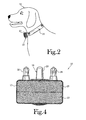
- the bark control device 10 is designed to be mounted on a dog collar 14 which is received about the neck of a dog 16.
- the device 10 includes a bark detection mechanism, which in the illustrated embodiment is a vibration sensor. More specifically, in the illustrated embodiment the vibration sensor is a piezoelectric vibration sensor 18 that includes a probe 20 which is placed in contact with the throat of the dog 16 so as to directly detect vibrations generated by the vocal cords of the dog when the dog barks.
- the piezoelectric vibration sensor 18 is a low current device compared to other devices used for detecting the barking of a dog and, therefore, allows the device 10 to have a longer battery life.
- the bark detection mechanism can be a microphone, or a combination of a microphone and other vibration sensing mechanisms, such as, for example, the bark detection mechanism disclosed in U.S. Patent No. 5,927,233 .
- a signal conditioning circuit 22 is disposed within the housing 12 and conditions the vibration signal received from the vibration sensor 18.
- the specific conditioning employed will depend upon the application and the desired level of sophistication of the bark detection circuit. However, typically, the signal conditioning circuit amplifies the output of the vibration sensor 18 to increase the level of the sensor output for further processing and accurate sampling.
- the signal conditioning circuit 22 may also serve to discriminate among the vibrations measured by the vibration sensor 18 so as to pass only measured vibrations that meet specified criteria. For example, the signal conditioning circuit 22 may be configured to pass only those vibrations occurring within a specified frequency range or those meeting certain durational limits or may be configured to remove unwanted components of the sensor output.
- the various filters, amplifiers, and other signal conditioning devices that can be used to prepare the measured vibrations for further processing.
- the type of signal conditioning depends upon the input signal, the corresponding sensor, and the desired characteristics of the input signal that are to be monitored.
- the filter may be active or passive and may be set to pass a specific frequency range or remove high or low frequency noise.
- the output signal may not require additional amplification.
- other conditioning may be required to present a useable sensor output to the remainder of the circuit.
- a controller or processing device 24 is also disposed within the housing 12 and monitors the amplified output of the signal conditioning circuit 22 and activates a stimulus delivery mechanism 26 as necessary. Decision-making logic within the processor 24 determines whether a stimulus is needed. Typically, the input to the processor 24 is compared against a reference value to determine whether a stimulus is warranted.
- a conventional processing device includes an internal timer, memory registers, and math capabilities allowing sophisticated signal processing to occur; however, those skilled in the art will recognize that these capabilities can be achieved using other components without departing from the spirit and scope of the present invention. Further, those skilled in the art will recognize that the components used depend on various factors including the cost of manufacture, size and weight constraints, and the complexity of the decision process.
- the size and weight of the training collar worn by the animal are reduced by implementing the controller in a single application specific integrated circuit (ASIC) or a microprocessor, both of which allow complex decision making capabilities.
- ASIC application specific integrated circuit
- microprocessor a microprocessor
- ASIC application specific integrated circuit
- the device 10 illustrated in the Figures utilizes the stimulus delivery mechanism 26 which delivers an electric shock as a correction stimulus.
- the stimulus delivery mechanism 26 incorporates a pair of electrodes 28 and 30 for transferring the electrostatic shock corrective stimulus to the dog when the delivery mechanism 26 is activated by the processing device 24.
- the housing 12 of the device 10 has an outer vibration dampening surface 13 which makes the device 10 less prone to delivering false correction stimuli to the dog and, therefore, provides for more effective training of the dog.
- the entire housing 12 can be fabricated of an elastomer material so as to provide the vibration dampening outer surface 13
- the surface 13 is defined by a shell or coating 15 made from an elastomer material, such as natural or synthetic rubber material.
- a thermoplastic elastomer such as, for example, Santoprene® can be used.
- various resilient rubber, or rubber-like materials could be used.
- the resilient elastomeric surface 13 dampens any vibrations which may result from such contact.
- the vibrations which do result from the housing 12 contacting other objects are characterized by an irregular, stuttering pattern due to the drag produced by the elastomeric surface 13. This stuttering pattern is dissimilar to the regular vibration pattern produced by a bark. Accordingly, the surface 13 makes it less likely that vibrations will be produced which will be misinterpreted by the device 10 as a bark from the dog.
- an object scraping against the surface 13 produces vibrations which are at a lower frequency than vibrations produced by the barking of the dog or an object scraping against the conventional hard surface of a prior art housing. Accordingly, the processing device 24 can be configured to more easily discriminate between vibrations generated by the barking of the dog and vibrations directed to the housing but generated by objects scraping against the surface 13. Therefore, it is less likely that false corrections will be delivered to the dog.
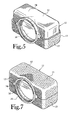
- the housing 12 includes an inner casing 32 having first and second casing components 34 and 36, respectively, which cooperatively serve to enclose various components of the bark control device 10.
- the coating 15 covers both of the casing components 34 and 36.
- the casing components 34 and 36 cooperatively define an opening 38 for receiving and accessing a battery (not shown) which powers the device 10.
- the housing 12 is provided with a releasable closure 40 for selectively covering the opening 38, and the exterior surface of the closure 40 can also be provided with the vibration dampening coating 15.
- the inner casing 32 is mold from a strong, rigid material such as, for example, a strong, durable plastic material.
- the components 34 and 36 are separately molded.
- the coating 15 can be applied to the casing 32 using various methods, such as painting or spraying the coating 15 on the exterior of the casing, or dipping the casing 32 in the coating material.
- the coating 15 is over-molded onto the exterior surface of the casing components 34 and 36. Over-molding insures a more uniform coating thickness and results in better bonding of the coating 15 to the casing 32.
- the electronic components of the device 10 can be positioned within casing components 34 and 36 and the casing components can be secured together with, for example, an adhesive or, alternatively, suitable mechanical fasteners.
- the coating 15 need not be directly bonded to, or adhere directly to, the casing 32.
- the coating 15 can be a sleeve or cover that is closely received about the casing 32 without being bonded thereto.
- the desired thickness of the coating 15 will depend upon the particular material used to fabricate the coating, and other factors such as the cost the particular material used.
- the device 10 with its vibration dampening housing 12 provides great advantages over the prior art.
- the vibration dampening surface 13 greatly reduces the possibility of false corrections being delivered to the dog, while allowing the use of a low cost, energy efficient piezoelectric vibration sensor as the bark detection mechanism. Further, the surface 13 reduces the need for complex and expensive circuitry for discriminating between vibration patterns produced by a bark and those produced by other sources, thereby reducing the overall cost of the bark control device.
Landscapes
- Life Sciences & Earth Sciences (AREA)
- Environmental Sciences (AREA)
- Health & Medical Sciences (AREA)
- General Health & Medical Sciences (AREA)
- Physical Education & Sports Medicine (AREA)
- Animal Behavior & Ethology (AREA)
- Zoology (AREA)
- Animal Husbandry (AREA)
- Biodiversity & Conservation Biology (AREA)
- Measurement Of Mechanical Vibrations Or Ultrasonic Waves (AREA)
- Percussion Or Vibration Massage (AREA)
- Soundproofing, Sound Blocking, And Sound Damping (AREA)
Applications Claiming Priority (2)
| Application Number | Priority Date | Filing Date | Title |
|---|---|---|---|
| US11/754,994 US8342134B2 (en) | 2004-04-23 | 2007-05-29 | Vibration dampening bark control device |
| EP08754389A EP2150101A1 (de) | 2007-05-29 | 2008-05-13 | Schiffsteuerungsvorrichtung und vibrationsdämpfendes gehäuse dafür sowie verfahren zur konstruktion eines solchen gehäuses |
Related Parent Applications (1)
| Application Number | Title | Priority Date | Filing Date |
|---|---|---|---|
| EP08754389.8 Division | 2008-05-13 |
Publications (1)
| Publication Number | Publication Date |
|---|---|
| EP2245925A2 true EP2245925A2 (de) | 2010-11-03 |
Family
ID=40130594
Family Applications (2)
| Application Number | Title | Priority Date | Filing Date |
|---|---|---|---|
| EP10008696A Withdrawn EP2245925A2 (de) | 2007-05-29 | 2008-05-13 | Vibrationsdämpfendes Gehäuse für eine Bellensteuerungsvorrichtung sowie Verfahren zur Konstruktion eines solchen Gehäuses |
| EP08754389A Withdrawn EP2150101A1 (de) | 2007-05-29 | 2008-05-13 | Schiffsteuerungsvorrichtung und vibrationsdämpfendes gehäuse dafür sowie verfahren zur konstruktion eines solchen gehäuses |
Family Applications After (1)
| Application Number | Title | Priority Date | Filing Date |
|---|---|---|---|
| EP08754389A Withdrawn EP2150101A1 (de) | 2007-05-29 | 2008-05-13 | Schiffsteuerungsvorrichtung und vibrationsdämpfendes gehäuse dafür sowie verfahren zur konstruktion eines solchen gehäuses |
Country Status (7)
| Country | Link |
|---|---|
| US (1) | US8342134B2 (de) |
| EP (2) | EP2245925A2 (de) |
| JP (1) | JP2010527632A (de) |
| CN (1) | CN101686654A (de) |
| AU (1) | AU2008262497A1 (de) |
| CA (1) | CA2684289A1 (de) |
| WO (1) | WO2008153657A1 (de) |
Families Citing this family (40)
| Publication number | Priority date | Publication date | Assignee | Title |
|---|---|---|---|---|
| US20090289844A1 (en) * | 2008-05-23 | 2009-11-26 | White Bear Technologies | Position monitoring system |
| US8714113B2 (en) * | 2008-09-04 | 2014-05-06 | Radio Systems Corporation | Bark deterrent apparatus with internal vibration sensor |
| US8438999B2 (en) * | 2009-09-12 | 2013-05-14 | Titan Pet Products, Inc. | Systems and methods for animal containment, training, and tracking |
| USD630389S1 (en) | 2010-03-26 | 2011-01-04 | Telebrands Corp. | Dog bark response device and holder |
| USD630388S1 (en) | 2010-03-26 | 2011-01-04 | Telebrands Corp. | Dog bark response device |
| CN101984788B (zh) * | 2010-11-17 | 2013-02-06 | 李再强 | 一种声控止吠器 |
| CN103874409B (zh) * | 2011-08-04 | 2017-03-01 | 光达家电用品公司 | 犬吠控制装置 |
| US11470814B2 (en) * | 2011-12-05 | 2022-10-18 | Radio Systems Corporation | Piezoelectric detection coupling of a bark collar |
| US10154651B2 (en) | 2011-12-05 | 2018-12-18 | Radio Systems Corporation | Integrated dog tracking and stimulus delivery system |
| US10674709B2 (en) * | 2011-12-05 | 2020-06-09 | Radio Systems Corporation | Piezoelectric detection coupling of a bark collar |
| US11553692B2 (en) | 2011-12-05 | 2023-01-17 | Radio Systems Corporation | Piezoelectric detection coupling of a bark collar |
| USD725849S1 (en) * | 2012-07-02 | 2015-03-31 | Dogtra Co., Ltd. | Portion of a bark control receiver |
| USD725848S1 (en) * | 2012-07-02 | 2015-03-31 | Dogtra Co., Ltd. | Bark control receiver |
| US9756833B2 (en) | 2013-03-15 | 2017-09-12 | SOS Co. Inc. | Conductive polymer multi-ridge electrode animal collar |
| US10228447B2 (en) | 2013-03-15 | 2019-03-12 | Radio Systems Corporation | Integrated apparatus and method to combine a wireless fence collar with GPS tracking capability |
| GB2515018A (en) * | 2013-06-10 | 2014-12-17 | Paul Michael James | An animal release tool |
| US20150083053A1 (en) * | 2013-09-24 | 2015-03-26 | Dogwatch Inc. | Contact unit for an animal training system |
| GB2538758A (en) | 2015-05-27 | 2016-11-30 | Green Lizard Tech Ltd | Process for removing chloropropanols and/or glycidol |
| US10231440B2 (en) | 2015-06-16 | 2019-03-19 | Radio Systems Corporation | RF beacon proximity determination enhancement |
| US10645908B2 (en) | 2015-06-16 | 2020-05-12 | Radio Systems Corporation | Systems and methods for providing a sound masking environment |
| US9943067B2 (en) | 2015-11-25 | 2018-04-17 | Radio Systems Corporation | Pet spray training system |
| USD788999S1 (en) | 2016-03-11 | 2017-06-06 | Radio Systems Corporation | Receiver for a pet collar |
| USD880082S1 (en) | 2016-03-11 | 2020-03-31 | Radio Systems Corporation | Receiver for a pet collar |
| US10268220B2 (en) | 2016-07-14 | 2019-04-23 | Radio Systems Corporation | Apparatus, systems and methods for generating voltage excitation waveforms |
| EP3568007B1 (de) * | 2017-01-16 | 2025-04-09 | Radio Systems Corporation | Piezoelektrische detektionskopplung eines hundehalsbandes |
| AU2018224313B2 (en) | 2017-02-27 | 2023-10-12 | Radio Systems Corporation | Threshold barrier system |
| USD815372S1 (en) | 2017-03-03 | 2018-04-10 | Radio Systems Corporation | Handheld transmitter for a pet trainer |
| US11197461B2 (en) | 2017-04-21 | 2021-12-14 | Radio Systems Corporation | Pet spray training system |
| US11185052B2 (en) | 2017-04-21 | 2021-11-30 | Radio Systems Corporation | Pet spray training system |
| USD858904S1 (en) | 2017-06-05 | 2019-09-03 | Radio Systems Corporation | Receiver for pet collar |
| US11394196B2 (en) | 2017-11-10 | 2022-07-19 | Radio Systems Corporation | Interactive application to protect pet containment systems from external surge damage |
| US10842128B2 (en) | 2017-12-12 | 2020-11-24 | Radio Systems Corporation | Method and apparatus for applying, monitoring, and adjusting a stimulus to a pet |
| US10986813B2 (en) | 2017-12-12 | 2021-04-27 | Radio Systems Corporation | Method and apparatus for applying, monitoring, and adjusting a stimulus to a pet |
| US11372077B2 (en) | 2017-12-15 | 2022-06-28 | Radio Systems Corporation | Location based wireless pet containment system using single base unit |
| US10514439B2 (en) | 2017-12-15 | 2019-12-24 | Radio Systems Corporation | Location based wireless pet containment system using single base unit |
| CA3116326A1 (en) * | 2018-10-23 | 2020-04-30 | Radio Systems Corporation | Pet spray training system |
| CN110063267B (zh) | 2019-06-11 | 2021-07-02 | 深圳派特科技有限公司 | 一种自动检测和校正动物行为的系统 |
| US11238889B2 (en) | 2019-07-25 | 2022-02-01 | Radio Systems Corporation | Systems and methods for remote multi-directional bark deterrence |
| CN110864710A (zh) * | 2019-12-20 | 2020-03-06 | 泉州明逸达科技有限公司 | 一种吠叫的检测方法及检测装置以及具有该装置的止吠器 |
| US11490597B2 (en) | 2020-07-04 | 2022-11-08 | Radio Systems Corporation | Systems, methods, and apparatus for establishing keep out zones within wireless containment regions |
Citations (5)
| Publication number | Priority date | Publication date | Assignee | Title |
|---|---|---|---|---|
| US4180013A (en) | 1977-11-14 | 1979-12-25 | Smith Thomas M | Animal behavioral control device |
| US5601054A (en) | 1994-10-18 | 1997-02-11 | Han Seung Enterprise Co., Ltd. | Dog barking restraining device |
| US5927233A (en) | 1998-03-10 | 1999-07-27 | Radio Systems Corporation | Bark control system for pet dogs |
| US6588376B1 (en) | 2002-02-25 | 2003-07-08 | Radio Systems Corporation | Appliance for dissuasion of a dog from barking |
| US6668760B2 (en) | 2002-02-20 | 2003-12-30 | Radio Systems Corporation | Spray control anti-bark collar |
Family Cites Families (10)
| Publication number | Priority date | Publication date | Assignee | Title |
|---|---|---|---|---|
| US2741224A (en) * | 1953-12-29 | 1956-04-10 | Tracy J Putnam | Device for training animals |
| GB2113346A (en) * | 1981-12-01 | 1983-08-03 | Bekaert Sa Nv | Structure for dampening mechanical vibrations |
| US4762088A (en) * | 1986-08-15 | 1988-08-09 | Compucap, Inc. | Release mechanism for animal telemetry and data acquisition devices |
| JPH0834089A (ja) * | 1994-07-25 | 1996-02-06 | Lintec Corp | 制振シート |
| US5799618A (en) * | 1996-08-12 | 1998-09-01 | Innotek, Inc. | Combination confinement system and bark inhibitor |
| KR100417198B1 (ko) * | 2001-12-21 | 2004-02-05 | 김준수 | 동물 짖음방지/훈련 장치 |
| US6928958B2 (en) * | 2004-01-07 | 2005-08-16 | Tri-Tronics, Inc. | Vibration sensor assembly and method for bark controller |
| US7198009B2 (en) | 2004-01-07 | 2007-04-03 | Tri-Tronics, Inc. | Frequency spectrum capture and compare technique for valid bark detection |
| US7222589B2 (en) | 2004-04-23 | 2007-05-29 | Radio Systems Corporation | Bark control device and associated vibration dampening housing and method for constructing such housing |
| US7267081B2 (en) * | 2004-05-14 | 2007-09-11 | Radio Systems Corporation | Housing for a collar-mounted pet accessory and associated collar mounting system |
-
2007
- 2007-05-29 US US11/754,994 patent/US8342134B2/en not_active Expired - Fee Related
-
2008
- 2008-05-13 AU AU2008262497A patent/AU2008262497A1/en not_active Abandoned
- 2008-05-13 EP EP10008696A patent/EP2245925A2/de not_active Withdrawn
- 2008-05-13 CA CA002684289A patent/CA2684289A1/en not_active Abandoned
- 2008-05-13 CN CN200880017870A patent/CN101686654A/zh active Pending
- 2008-05-13 WO PCT/US2008/006080 patent/WO2008153657A1/en not_active Ceased
- 2008-05-13 EP EP08754389A patent/EP2150101A1/de not_active Withdrawn
- 2008-05-13 JP JP2010510286A patent/JP2010527632A/ja active Pending
Patent Citations (5)
| Publication number | Priority date | Publication date | Assignee | Title |
|---|---|---|---|---|
| US4180013A (en) | 1977-11-14 | 1979-12-25 | Smith Thomas M | Animal behavioral control device |
| US5601054A (en) | 1994-10-18 | 1997-02-11 | Han Seung Enterprise Co., Ltd. | Dog barking restraining device |
| US5927233A (en) | 1998-03-10 | 1999-07-27 | Radio Systems Corporation | Bark control system for pet dogs |
| US6668760B2 (en) | 2002-02-20 | 2003-12-30 | Radio Systems Corporation | Spray control anti-bark collar |
| US6588376B1 (en) | 2002-02-25 | 2003-07-08 | Radio Systems Corporation | Appliance for dissuasion of a dog from barking |
Also Published As
| Publication number | Publication date |
|---|---|
| CA2684289A1 (en) | 2008-12-18 |
| WO2008153657A1 (en) | 2008-12-18 |
| US20080134987A1 (en) | 2008-06-12 |
| CN101686654A (zh) | 2010-03-31 |
| JP2010527632A (ja) | 2010-08-19 |
| EP2150101A1 (de) | 2010-02-10 |
| AU2008262497A1 (en) | 2008-12-18 |
| US8342134B2 (en) | 2013-01-01 |
Similar Documents
| Publication | Publication Date | Title |
|---|---|---|
| EP2245925A2 (de) | Vibrationsdämpfendes Gehäuse für eine Bellensteuerungsvorrichtung sowie Verfahren zur Konstruktion eines solchen Gehäuses | |
| US7222589B2 (en) | Bark control device and associated vibration dampening housing and method for constructing such housing | |
| CA2733088C (en) | Bark deterrent apparatus with internal vibration sensor | |
| US5927233A (en) | Bark control system for pet dogs | |
| US7900585B2 (en) | Two-probe bark control device and method for making such | |
| AU2008203914B2 (en) | An animal training device using a vibration probe to deliver a vibration stimulus to an animal | |
| CN103874409B (zh) | 犬吠控制装置 | |
| US6935274B1 (en) | Pet toy | |
| EP1836892B1 (de) | Verfahren und Vorrichtung zum Einstellen des Korrekturniveaus des Empfängers eines Dressurgeräts | |
| EP0926947B1 (de) | Tierhalsband | |
| WO2011038418A2 (en) | Animal control devices, systems and methods of using animal control devices | |
| CN101984788B (zh) | 一种声控止吠器 | |
| US20190124887A1 (en) | Training device | |
| WO2007015186A1 (en) | A device to be attached to or to be worn by an animal for indicating the physiological status of the animal | |
| CN109792964B (zh) | 一种可穿戴设备的控制方法 | |
| AU711413B2 (en) | An animal collar | |
| GB2626122A (en) | A system, device and method for imparting an electric shock to an animal | |
| GB2427533A (en) | Device for controlling horse behaviour | |
| WO2006040824A1 (ja) | 無駄吠え防止装置 |
Legal Events
| Date | Code | Title | Description |
|---|---|---|---|
| PUAI | Public reference made under article 153(3) epc to a published international application that has entered the european phase |
Free format text: ORIGINAL CODE: 0009012 |
|
| 17P | Request for examination filed |
Effective date: 20100820 |
|
| AC | Divisional application: reference to earlier application |
Ref document number: 2150101 Country of ref document: EP Kind code of ref document: P |
|
| AK | Designated contracting states |
Kind code of ref document: A2 Designated state(s): AT BE BG CH CY CZ DE DK EE ES FI FR GB GR HR HU IE IS IT LI LT LU LV MC MT NL NO PL PT RO SE SI SK TR |
|
| STAA | Information on the status of an ep patent application or granted ep patent |
Free format text: STATUS: THE APPLICATION IS DEEMED TO BE WITHDRAWN |
|
| 18D | Application deemed to be withdrawn |
Effective date: 20121201 |