EP2247645B1 - Hydrogels à base de polyalkylèneimines réticulées à taux de dégradation ajustable - Google Patents
Hydrogels à base de polyalkylèneimines réticulées à taux de dégradation ajustable Download PDFInfo
- Publication number
- EP2247645B1 EP2247645B1 EP09709785.1A EP09709785A EP2247645B1 EP 2247645 B1 EP2247645 B1 EP 2247645B1 EP 09709785 A EP09709785 A EP 09709785A EP 2247645 B1 EP2247645 B1 EP 2247645B1
- Authority
- EP
- European Patent Office
- Prior art keywords
- pei
- certain embodiments
- agents
- peg
- formulation
- Prior art date
- Legal status (The legal status is an assumption and is not a legal conclusion. Google has not performed a legal analysis and makes no representation as to the accuracy of the status listed.)
- Active
Links
- 0 CC*(C(*)(*)*(CC)C(ON(C(CC1)=O)C1=O)=O)C(OCCOCC(C)COC(C(C)C(*)(*)C(C)C(ON(C(CC1)=O)C1=O)=O)=O)=O Chemical compound CC*(C(*)(*)*(CC)C(ON(C(CC1)=O)C1=O)=O)C(OCCOCC(C)COC(C(C)C(*)(*)C(C)C(ON(C(CC1)=O)C1=O)=O)=O)=O 0.000 description 1
Images


Classifications
-
- C—CHEMISTRY; METALLURGY
- C08—ORGANIC MACROMOLECULAR COMPOUNDS; THEIR PREPARATION OR CHEMICAL WORKING-UP; COMPOSITIONS BASED THEREON
- C08G—MACROMOLECULAR COMPOUNDS OBTAINED OTHERWISE THAN BY REACTIONS ONLY INVOLVING UNSATURATED CARBON-TO-CARBON BONDS
- C08G65/00—Macromolecular compounds obtained by reactions forming an ether link in the main chain of the macromolecule
- C08G65/02—Macromolecular compounds obtained by reactions forming an ether link in the main chain of the macromolecule from cyclic ethers by opening of the heterocyclic ring
- C08G65/32—Polymers modified by chemical after-treatment
- C08G65/329—Polymers modified by chemical after-treatment with organic compounds
- C08G65/337—Polymers modified by chemical after-treatment with organic compounds containing other elements
-
- A—HUMAN NECESSITIES
- A61—MEDICAL OR VETERINARY SCIENCE; HYGIENE
- A61L—METHODS OR APPARATUS FOR STERILISING MATERIALS OR OBJECTS IN GENERAL; DISINFECTION, STERILISATION OR DEODORISATION OF AIR; CHEMICAL ASPECTS OF BANDAGES, DRESSINGS, ABSORBENT PADS OR SURGICAL ARTICLES; MATERIALS FOR BANDAGES, DRESSINGS, ABSORBENT PADS OR SURGICAL ARTICLES
- A61L24/00—Surgical adhesives or cements; Adhesives for colostomy devices
- A61L24/04—Surgical adhesives or cements; Adhesives for colostomy devices containing macromolecular materials
- A61L24/046—Surgical adhesives or cements; Adhesives for colostomy devices containing macromolecular materials obtained otherwise than by reactions only involving carbon-to-carbon unsaturated bonds
-
- A—HUMAN NECESSITIES
- A61—MEDICAL OR VETERINARY SCIENCE; HYGIENE
- A61P—SPECIFIC THERAPEUTIC ACTIVITY OF CHEMICAL COMPOUNDS OR MEDICINAL PREPARATIONS
- A61P41/00—Drugs used in surgical methods, e.g. surgery adjuvants for preventing adhesion or for vitreum substitution
-
- C—CHEMISTRY; METALLURGY
- C08—ORGANIC MACROMOLECULAR COMPOUNDS; THEIR PREPARATION OR CHEMICAL WORKING-UP; COMPOSITIONS BASED THEREON
- C08G—MACROMOLECULAR COMPOUNDS OBTAINED OTHERWISE THAN BY REACTIONS ONLY INVOLVING UNSATURATED CARBON-TO-CARBON BONDS
- C08G65/00—Macromolecular compounds obtained by reactions forming an ether link in the main chain of the macromolecule
- C08G65/02—Macromolecular compounds obtained by reactions forming an ether link in the main chain of the macromolecule from cyclic ethers by opening of the heterocyclic ring
- C08G65/32—Polymers modified by chemical after-treatment
- C08G65/321—Polymers modified by chemical after-treatment with inorganic compounds
- C08G65/326—Polymers modified by chemical after-treatment with inorganic compounds containing sulfur
-
- C—CHEMISTRY; METALLURGY
- C08—ORGANIC MACROMOLECULAR COMPOUNDS; THEIR PREPARATION OR CHEMICAL WORKING-UP; COMPOSITIONS BASED THEREON
- C08G—MACROMOLECULAR COMPOUNDS OBTAINED OTHERWISE THAN BY REACTIONS ONLY INVOLVING UNSATURATED CARBON-TO-CARBON BONDS
- C08G65/00—Macromolecular compounds obtained by reactions forming an ether link in the main chain of the macromolecule
- C08G65/02—Macromolecular compounds obtained by reactions forming an ether link in the main chain of the macromolecule from cyclic ethers by opening of the heterocyclic ring
- C08G65/32—Polymers modified by chemical after-treatment
- C08G65/329—Polymers modified by chemical after-treatment with organic compounds
- C08G65/333—Polymers modified by chemical after-treatment with organic compounds containing nitrogen
- C08G65/33331—Polymers modified by chemical after-treatment with organic compounds containing nitrogen containing imide group
- C08G65/33337—Polymers modified by chemical after-treatment with organic compounds containing nitrogen containing imide group cyclic
-
- C—CHEMISTRY; METALLURGY
- C08—ORGANIC MACROMOLECULAR COMPOUNDS; THEIR PREPARATION OR CHEMICAL WORKING-UP; COMPOSITIONS BASED THEREON
- C08L—COMPOSITIONS OF MACROMOLECULAR COMPOUNDS
- C08L71/00—Compositions of polyethers obtained by reactions forming an ether link in the main chain; Compositions of derivatives of such polymers
- C08L71/02—Polyalkylene oxides
-
- C—CHEMISTRY; METALLURGY
- C08—ORGANIC MACROMOLECULAR COMPOUNDS; THEIR PREPARATION OR CHEMICAL WORKING-UP; COMPOSITIONS BASED THEREON
- C08K—Use of inorganic or non-macromolecular organic substances as compounding ingredients
- C08K5/00—Use of organic ingredients
- C08K5/0008—Organic ingredients according to more than one of the "one dot" groups of C08K5/01 - C08K5/59
- C08K5/0025—Crosslinking or vulcanising agents; including accelerators
-
- C—CHEMISTRY; METALLURGY
- C08—ORGANIC MACROMOLECULAR COMPOUNDS; THEIR PREPARATION OR CHEMICAL WORKING-UP; COMPOSITIONS BASED THEREON
- C08K—Use of inorganic or non-macromolecular organic substances as compounding ingredients
- C08K5/00—Use of organic ingredients
- C08K5/16—Nitrogen-containing compounds
- C08K5/34—Heterocyclic compounds having nitrogen in the ring
- C08K5/3412—Heterocyclic compounds having nitrogen in the ring having one nitrogen atom in the ring
- C08K5/3415—Five-membered rings
-
- C—CHEMISTRY; METALLURGY
- C08—ORGANIC MACROMOLECULAR COMPOUNDS; THEIR PREPARATION OR CHEMICAL WORKING-UP; COMPOSITIONS BASED THEREON
- C08L—COMPOSITIONS OF MACROMOLECULAR COMPOUNDS
- C08L2203/00—Applications
- C08L2203/02—Applications for biomedical use
-
- C—CHEMISTRY; METALLURGY
- C08—ORGANIC MACROMOLECULAR COMPOUNDS; THEIR PREPARATION OR CHEMICAL WORKING-UP; COMPOSITIONS BASED THEREON
- C08L—COMPOSITIONS OF MACROMOLECULAR COMPOUNDS
- C08L77/00—Compositions of polyamides obtained by reactions forming a carboxylic amide link in the main chain; Compositions of derivatives of such polymers
- C08L77/04—Polyamides derived from alpha-amino carboxylic acids
-
- C—CHEMISTRY; METALLURGY
- C08—ORGANIC MACROMOLECULAR COMPOUNDS; THEIR PREPARATION OR CHEMICAL WORKING-UP; COMPOSITIONS BASED THEREON
- C08L—COMPOSITIONS OF MACROMOLECULAR COMPOUNDS
- C08L79/00—Compositions of macromolecular compounds obtained by reactions forming in the main chain of the macromolecule a linkage containing nitrogen with or without oxygen or carbon only, not provided for in groups C08L61/00 - C08L77/00
- C08L79/02—Polyamines
Definitions
- Sealants, adhesives and mechanical barriers play an important role in helping patients recover from surgery or trauma. Sealants, adhesives and mechanical barriers are useful in treating patients suffering from a variety of in vivo (e.g., internal) or topical conditions, including lacerations, tears, wounds, ulcers, anastamoses, and surgical procedures. Sealants or adhesives can generally be used in any indication or application for which a suture or staple is presently used, and the sealant or adhesive often provides a better outcome than a suture or staple. Sealants or adhesives can also be applied more quickly to the injury site and often provide a better seal over the wound and healing. Various medicinal applications for sealants, adhesives and mechanical barriers are described below.
- Skin lacerations are tears in the skin produced by accidents, trauma, or as a result of a surgical procedure. Lacerations often require treatment in order to close the hole in the skin, stop bleeding, and prevent infection. Minor lacerations in the skin may be treated using an adhesive tissue to cover the wound. However, larger lacerations often require sutures or a glue to help seal the wound. For example, it is generally recommended that sutures or a glue be used to treat lacerations deeper than 6.35 mm (0.25 inches) having a jagged edge or loose flap of tissue. The location of the laceration may also affect the form of treatment. For example, it is advantageous to treat a skin laceration on a joint using a glue because an adhesive bandage tends to limit mobility of the joint. The use of sutures or glues to treat skin lacerations can also reduce the chance of scar formation.
- Lacerations of the liver can occur from trauma or as a result of a surgical procedure.
- the liver is a highly vascularized organ and bleeds profusely when lacerated or traumatized.
- Liver lacerations are difficult to repair owing to the nature of liver tissue.
- Liver tissue has very weak cohesive strength, and, consequently, sutures and staples are not satisfactory because they may pull through the liver tissue.
- the lack of satisfactory wound treatment methods for liver lacerations combined with the fact that it is difficult to reach the arteries that feed the liver renders liver lacerations particularly serious. In fact, severe lacerations of the liver often result in the patient's death due to bleeding. Thus, new materials to treat liver lacerations are needed.
- the sealants and methods of the present invention are useful in lung surgery.
- Types of lung surgery include lobectomy, lung biopsy, lung-tissue removal, and pneumonectomy. Risks associated with lung surgery include wound infection; post-surgical internal bleeding; air leaks; pain or numbness at the incision site; and infection of the lungs (pneumonia). Further, air leakage is frequently observed after thoracic procedures, such as pulmonary resection and decortication. It is important to create an air-tight seal so as to prevent or reduce severe complications, such as bronchopleural fistulas and infection resulting from extended chest tube drainage, extended recovery time, and postoperative morbidity related to pulmonary surgery.
- the sealants and methods of the invention should decrease or eliminate some of the problematic aspects of lung surgery, such as treatment of pneumothorax and pulmonary leaks.
- Corneal perforations are produced by a variety of medical conditions (e.g., infection, inflammation, xerosis, neurotrophication, and degeneration) and traumas (chemical, thermal, surgical, and penetrating).
- corneal perforations often lead to loss of vision and a decrease in an individual's quality of life.
- different treatments may be effective, ranging from suturing the wound to a cornea graft.
- the surgical procedures are difficult given the delicate composition of the cornea and the severity of the wound which increase the likelihood for leakage and severe astigmatism after surgery.
- tissue adhesives glues
- an adhesive include: 1) bind to the tissue (necrosed or not, very often wet) with an adequate adhesion force; 2) be non-toxic; 3) be biodegradable or resorbable; 4) be sterilizable; and 5) not interfere with the healing process.
- alkyl-cyanoacrylates are available for the repair of small perforations.
- these "super glues” present major inconveniences.
- Their monomers, in particular those with short alkyl chains, can be toxic, in part due to their ability to produce formaldehyde in situ. They also polymerize too quickly leading to applications that might be difficult and, once polymerized, the surface of the glue is rough and hard which leads to patient discomfort and a need to wear contact lens.
- cyanoacrylate is tolerated as a corneal sealant, a number of complications have been reported including cataract formation, corneal infiltration, glaucoma, giant papillary conjunctivitis, and symblepharon formation.
- additional surgical intervention is needed.
- An ideal sealant for corneal perforations should 1) not impair normal vision, 2) quickly restore the intraocular pressure (IOP), 3) maintain the structural integrity of the eye, 4) promote healing, 5) adhere to moist tissue surfaces, 6) possess solute diffusion properties which are molecular weight dependent and favorable for normal cornea function, 7) possess rheological properties that allow for controlled placement of the polymer on the wound, and 8) polymerize under mild conditions.
- sutures have limitations and drawbacks.
- suture placement itself inflicts trauma to corneal tissues, especially when multiple passes are needed.
- sutures such as 10-0 nylon (which is the suture of choice in the cornea and elsewhere) can act as a nidus for infection and incite corneal inflammation and vascularization. With persistent inflammation and vascularization, the propensity for corneal scarring increases.
- corneal suturing often yields uneven healing and resultant regular and irregular astigmatism. Postoperatively, sutures are also prone to becoming loose and/or broken and require additional attention for prompt removal.
- effective suturing necessitates an acquired technical skill that can vary widely from surgeon to surgeon and can also involve prolonged operative time.
- a corneal transplant or penetrating keratoplasty surgery the diseased cornea is removed with a special round cutting tool called a trephine.
- the donor cornea is cut to a matching size.
- the donor cornea is placed upon the eye and secured in place with approximately 16 sutures around the transplant to secure the new cornea in place.
- a sutureless procedure would be highly desirable because sutures are associated with the following drawbacks and others: (1) sutures provide a site for infection, (2) the sutured cornea takes 3 months to heal before the sutures need to be removed, and (3) the strain applied to the new cornea tissue from the sutures can distort the cornea.
- An ocular adhesive may also serve as an adjuvant to sutures and/or reduce the necessary number of sutures.
- phacoemulsification Clear corneal incisions in the temporal cornea offer several advantages with phacoemulsification.
- the major advantage associated with phacoemulsification is the reduction in size of the entrance wound. Smaller wounds require fewer sutures or even no sutures at all, minimizing induction of astigmatism, decreasing bleeding and subconjunctival hemorrhage, and speeding the recovery of visual acuity. See Agapitos, P. J. Curr. Opin. Ophthalmol. 1993, 4, 39-43 and Lyle, W. A.; Jin, G. J. J. Cataract Refract. Surg. 1996, 22, 1456-1460 .
- OCT optical coherence tomography
- Laser-assisted in situ keratomileusis is the popular refractive surgical procedure where a thin, hinged corneal flap is created by a microkeratome blade. This flap is then moved aside to allow an excimer laser beam to ablate the corneal stromal tissue with extreme precision for the correction of myopia (near-sightedness) and astigmatism. At the conclusion of the procedure, the flap is repositioned and allowed to heal. However, with trauma, this flap can become dislocated prior to healing, resulting in flap striae (folds) and severe visual loss. When this complication occurs, treatment involves prompt replacement of the flap and flap suturing. The use of sutures has limitations and drawbacks as discussed above.
- Cataracts or other diseases or injuires that lead to poorly functioning or damaged lens require the natural lens to be replaced.
- the optical properties of the normal eye lens are the consequence of a high concentration of proteins called "crystallins" forming a natural hydrogel.
- crystallins proteins that form a natural hydrogel.
- the anatomical basis of accommodation includes the lens substance, lens capsule, zonular fibers, ciliary muscle and the elastic part of the choroid. Accommodation occurs through accurately controlled adjustments in the shape and thickness of the lens.
- the capsular bag is essential in transmitting the various extralenticular forces to the lens substance.
- Modern cataract surgery can be done through a small incision (usually 2.5-3.5 mm). Once the incision is made, the anterior chamber is filled with a viscoelastic and the capsular bag is pricked with a needle. From this incision, a small continuous circular capsulorhexis (CCC) approximately 1.5 mm in diameter is performed using capsulorhexis forceps. Next endocapsular phacoemulsification is performed and the lens epithelial cells are removed by aspiration.
- CCC circular capsulorhexis
- the normal function of the lens is to focus light onto the retina. Since removing the cataract leaves the eye without a lens to focus light, an artificial (intraocular) lens is commonly placed inside the eye. Most intraocular lenses are made of plastic, silicone, or acrylic compounds; have no moving parts; and last for the remainder of a person's life. These intraocular lens implants are held in place by the posterior capsule are not able to provide ocular accommodation. Refilling the lens capsule with in situ crosslinking materials described herein offers the potential to produce a synthetic hydrogel with mechanical properties similar to the lens of a twenty year old.
- the invention describes materials that reproduce the properties of the natural lens and these synthetic hydrogels maintain the integrity of the capsule to gain partial or full accommodation and restore vision to the patient.
- the dendritic polymers of the invention are incorporated in current IOL materials, such as PMMA, to alter hydrophilicity, water transport, refractive index, mechanical properties or biological response.
- the polymerization can be slowed down by adding iophendylate to the monomers but still the reaction occurs in two to three seconds. Risks of retinal tear at the edge of the treated hole can also be observed because of the hardness of cyanoacrylate once polymerized.
- the vitreous is a normally clear, gel-like substance that fills the center of the eye. It makes up approximately 2/3 of the eye's volume, giving it form and shape before birth. Certain problems affecting the back of the eye may require a vitrectomy, or surgical removal of the vitreous.
- a vitrectomy the surgeon creates small incisions/punctures in the eye (sclerotomies) for separate instruments. These incisions are placed in the pars plana of the eye, which is located just behind the iris but in front of the retina.
- the instruments which pass through these incisions include a light pipe, an infusion port, and the vitrectomy cutting device.
- each sclerotomy site is closed with a single interrupted suture of 8-0 silk or 7-0 polyglycolic acid suture.
- the eye is filled with fluid until the vitreous is replaced as the eye secretes aqueous and nutritive fluids.
- Some of the most common eye conditions that require vitrectomy include: 1) complications from diabetic retinopathy, such as retinal detachment or bleeding, 2) macular hole, 3) retinal detachment, 4) pre-retinal membrane fibrosis, 5) bleeding inside the eye (vitreous hemorrhage), 6) injury or infection, and 7) certain problems related to previous eye surgery.
- Filtering blebs can result in hypotony and shallowing of the anterior chamber, choroidal effusion, maculopathy, retinal, and choroidal folds, suprachoroidal hemorrhage, corneal decompensation, peripheral anterior synechiae, and cataract formation.
- a filtering bleb can also lead to the loss of bleb function and to the severe complications of endophthalmaitis.
- the incidence of bleb leaks increases with the use of antimetabolites. Bleb leaks in eyes treated with 5-fluorouracil or mitomycin C may occur in as many as 20 to 40% of patients.
- Bleb leaks in eyes treated with antimetabolities may be difficult to heal because of thin avascular tissue and because of abnormal fibrovascular response. If the leak persists despite the use of conservative management, a 9-0 to 10-0 nylon or absorbable suture on a tapered vascular needle can be used to close the conjunctival wound. In a thin-walled or avascular bleb, a suture may not be advisable because it could tear the tissue and cause a larger leak.
- Fibrin adhesives have been used to close bleb leaks. The adhesive is applied to conjunctival wound simultaneously with thrombin to form a fibrin clot at the application site. The operative field must be dry during the application because fibrin will not adhere to wet tissue.
- Cyanoacrylate glue may be used to close a conjuctival opening.
- the surrounding tissue must be dried and a single drop of the cyanoacrylate is placed.
- the operative surgeon must be careful not to seal the applicator to the tissue or to seal surrounding tissue with glue given its quick reaction.
- a soft contact lens is then applied over the glue to decrease patient discomfort.
- this procedure can actually worsen the problem if the cyanoacrylate tears from the bleb and causes a larger wound.
- Blepharoplasty is an operation to remove excess skin and fat, and to reinforce surrounding muscle and tendons, around the eyes to correct droopy eyelids and bagginess under the eyes. It can be performed on the upper lids and lower lids, at the same time or separately. The operation may be done using either conventional or laser techniques. For surgery on the upper eyelids, cuts are made into the natural lines and creases in the lid, and into the laughter lines at the corner of the eye. For surgery on the lower eyelids, a cut is usually made just below the eyelashes. This means the scars run along the eye's natural folds, concealing them as much as possible. Excess fat and loose skin are removed, and the cut is closed using sutures. If only fat is being removed, sometimes the cut is made on the inside of the lower eyelid, leaving no visible scar. A tissue adhesive could provide a more effective means to secure the cuts made during surgery.
- Gastrointestinal anastomosis is the technique of joining two pieces of bowel together.
- the technique may involve a simple end-end anastomosis of two pieces of jejunum, a more complex colo-anal anastomosis, or a biliary enteric join.
- One problem with techniques employing sutures or staples is that leakage may occur around the sutures or staples. See, for example, Bruce et al. Br. J. Surg. 88:1157-1168 (2001 ) reporting leakage rates of 5-8%.
- sealants and methods of the invention could be used to supplement the sutures or staples used in intestinal anastomoses, providing a better seal that reduces leakage.
- Compositions and procedures for proper sealing the consequences of a failed anastomosis are severe and frequently life-threatening.
- failures can be caused by myriad factors, including poor surgical technique (e.g., sutures that were not inserted correctly; knots that were tied too tightly rendering the ends ischaemic; or incorrect use of a staple gun), the sealants and methods of the invention should decrease or eliminate some of the causes of failed gastrointestinal anastomosis procedures.
- the sealants and methods of the present invention should be useful in prostatectomy urethral-bladder anastomosis procedures.
- Prostatectomy urethral-bladder anastomosis is the technique of joining together a patient's ureter and bladder after surgical removal of his prostate gland. Failures are caused by myriad factors, including poor surgical technique (e.g., sutures that were not inserted correctly; knots that were tied too tightly rendering the ends ischaemic).
- the sealants and methods of the invention should decrease or eliminate some of the causes of failed prostatectomy urethral-bladder anastomosis procedures.
- Cartilaginous tissues play important roles in contributing to load support and energy dissipation in the joints of the musculoskeletal system.
- These tissues include articular cartilage which is predominantly an avascular and alymphatic tissue with very low cell-density.
- articular cartilage has limited capacity for self-repair following injury or aging. Degeneration of cartilage in the meniscus, interverebral disks, or joints can lead to severe and debilitating pain in patients. Injuries to these tissues are often retained for many years and may eventually lead to more severe secondary damage. See Moskowitz, R. W., Osteoarthritis: diagnosis and medical/surgical management. 2nd ed.; W.B. Saunders Company: 1984 .
- the materials of the invention can be applied to two planes of tissue and then these two tissues can be sealed together. Over time the sealant/hydrogel degrades as new tissue grows into the area.
- Applications include a number of cosmetic and tissue restoration surgeries.
- the sealant is used when the procedures involve significant tissue plane separation that may result in formation of seroma with associated complications, such as infection, e.g., general surgery procedures, such as mastectomies and lumpectomies, and plastic surgery procedures, such as abdominoplastys, rhytidectomy or rhinoplastys, mammaplasty and other cosmetic or reconstructive surguries or procedures, forehead lifts and buttocks lifts, as well as skin grafts, biopsy closure, cleft-palate reconstruction, hernia repair, lymph node resection, groin repair, Caesarean section, laparoscopic trocar repair, vaginal tear repair, and hand surgery.
- compositions and methods of the invention may be used for repairing, closing, and/or securing vascular and cardiovascular tissue.
- Representative procedures include coronary artery bypass grafts, coronary angioplasty, diagnostic cardiac catheterization, carotid endarterectomy, and valve repair.
- An additional use of the sealant is for the repair of cardiac tissue after a myocardial infarction.
- the polymer would be applied to the infarcted tissue to provide structural support to the weakened tissue.
- the material would act as a sleeve for the cardiac tissue.
- Dura tissue is a fibrous membrane covering the brain and the spinal cord and lining the inner surface of the skull.
- Standard methods of dural repair involve the application of interrupted sutures and the use of dural replacement materials (duraplasty). This is a meticulous surgery and suffers from the limitation that pinholes produced by surgical needles can cause leakage.
- intraoperative dehydration can shrink the dura creating a difficult closure since it is difficult to approximate the edges with sutures.
- the dura is often more susceptiable to tearing when stretched and/or sutured because the dura can be thin and fragile.
- Adhesives such as fibrin have been explored for repair of dura tissue, but have had limited success.
- sealants and methods of the present invention should be useful in repairing the dura after a craniotomy or laminectomy and prevent postoperative leakage of cerebrospinal fluid. See Preul et al. Neurosurgery 2003, 53, 1189-1199 and Balance, C.A. in "Some Points in the Surgery of the Brain and Its Membranes” London, Macmillan & Co.
- ATD age-related macular degeneration
- Age-related macular degeneration is a disease that blurs the sharp, central vision needed for "straight-ahead” activities such as reading and driving.
- AMD is a progressive disease of the retina where the light-sensing cells in the central area of vision (the macula) stop working and eventually die.
- the disease is caused by a combination of genetic and environmental factors, and it is most common in people who are age sixty and over.
- AMD is the leading cause of visual impairment in the elderly population. It is estimated that fifteen million people in the United States have AMD, with approximately two million new cases diagnosed annually.
- AMD -- wet and dry There are two types of AMD -- wet and dry. Wet AMD occurs when abnormal blood vessels behind the retina start to grow under the macula. These new blood vessels tend to be very fragile and often leak blood and fluid.
- VEGF Vascular Endothelial Growth Factor
- antiangiogenic drugs are given the patient. In most cases, the drugs are injected into the vitreous of the eyeball, then pass into the subretinal space where the vessels proliferate. These drugs include mucagenm squalamine lactate, combretastatin 4 prodrug, and avastin.
- sealants and methods of the present invention should be useful in sealing injection site wounds.
- the injection can be given and then the sealant applied to the injection site, or alternatively the sealant can be applied and then the injection can be done through the sealant.
- PAIs polyalkyleneimines
- PAGs polyalkylene glycols
- PAIs have been combined with difunctionally activated PEG in dilute solution to produce linear block copolymers of PAI and PAG, or in an emulsion polymerization process to produce small PAI/PAG microspheres.
- PAI/PAG block copolymers were synthesized in vitro for the purpose of condensing with polynucleic acids for gene transfection.
- United States patent publication number US 2007-0196454 A1 describes inter alia compositions and methods of use of crosslinked gels comprising polyalkyleneimines. This document describes a method of sealing wound or tissue plane or filling a void space using polyethyleneimine which is treated with a cross-linking reagent to cause it to polymerise and form a seal.
- the present invention concerns a polymeric composition according to claim 1, which may be used in methods of sealing a wound or tissue plane or filling a void space, or securing meshes, films or other devices within the body.
- the wound is an ophthalmic, pleural or dural wound, or a hernia repair mesh.
- compositions used to seal the wound or tissue plane comprise a crosslinking agent.
- the crosslinking agent is a polyethyleneimine.
- treatment of the polyethyleneimine with a crosslinker causes the polyethyleneimine to polymerize to form a hydrogel seal or barrier.
- the polyethyleneimine may have a lysine, cysteine, isocysteine or other nucleophilic group attached to the periphery of the polymer.
- compositions and/or methods of use of crosslinked hydrogels comprising polyalkyleneimines, an example of a crosslinking agent.
- polyalkyleneimines an example of a crosslinking agent.
- the use of certain crosslinkers in combination with polyalkyleneimines at specific concentrations can result in hydrogels with tunable degradation properties.
- compositions which comprise polyalkyleneimines are prepared by reacting a polyalkyleneimine (PAI) with a crosslinker, such as an activated polyethylene glycol.
- PAI polyalkyleneimine
- the gels of the invention are amendable to a variety of clinical treatments, such as incisions created during general surgery or wounds/incisions in the dura during neurosurgery.
- the polyalkyleneimine gels of the invention offer the advantage that the secondary and tertiary amino groups of the gel can be converted to secondary and tertiary ammonium cations which may encourage cell attachment and cell ingrowth.
- the secondary and tertiary amines of the polyethyleneimine (PEI) can be converted to ammonium cations by placing the PEI in an aqueous solution.
- the polyalkyleneimine (PAI) gels of the invention have superior adhesion properties. Their superior tissue-adhesion properties may be due to two factors. First, the cationic properties of PEI promote interaction with, and possibly penetration within, an anionic tissue substrate. See Rep. Prog. Phys. 1998, 61, 1325-1365 . Cationic interactions could occur through the secondary and tertiary ammonium cations of the PEI backbone or through primary amino groups that did not react with the crosslinker. Second, PEI contains a large number of functional groups per molecule, thus providing an increased number of crosslinkable sites within the polymer network. The increased number of crosslinkable sites within the polymer network affords dense, interpenetrating networks between the hydrogel and the tissue surface.
- the number of free amino groups in the resulting hydrogel can be controlled by varying the ratio of PEI to activated PEG.
- the ability to control the number of free amino groups is significant because greater cell ingrowth was observed in tissue ingrowth experiments using hydrogels that contained a larger percentage of PEI. Indeed, the relative rates of ingrowth in vivo of some embodiments of the invention are discussed in Example 7.
- the molecular weight of the PEI may be adjusted in order to tune the swelling-effects of the resultant hydrogel.
- PAI derivatives are amenable to the present invention.
- the amino groups of the PAI may be functionalized with a fatty acid, lower alkyl, an alkenyl, or alkynyl group.
- the amino groups or a portion of the amino groups may be functionalized to contain active agents, pharmaceutical agents, preservatives, radio isotopic ions, magnetically detectable ions, antibodies, medical contrast agents, colorants, dyes, or other visualization agents.
- active agents pharmaceutical agents, preservatives, radio isotopic ions, magnetically detectable ions, antibodies, medical contrast agents, colorants, dyes, or other visualization agents.
- about 1% to about 70% of the primary amines of the PEI are functionalized.
- the PAI derivatives may contain hydrolytically and/or enzymatically degradable linkages capable of releasing the functional derivatives, active agents, pharmaceutical agents, preservatives, radio isotopic ions, magnetically detectable ions, antibodies, colorants, dyes, or other visualization agents.
- a different nucleophile can be added to the PEI, such as a cysteine, isocysteine, thiol, or other such nucleophilic group.
- a PEI can be modified such that all the primary amines are modified with a cysteine thus affording a PEI derivative which can form crosslinked gel/networks using the amine, thiol, or both the amine and thio.
- an ureido, urea, acetoacetoxy, RGD peptide, EDTA, or carbohydrate group may be bonded to one or more of the amino groups of the PEI.
- Representative carbohydrates include erythrose, threose, ribose, arabinose, xylose, lyxose, allose, altrose, glucose, mannose, gulose, idose, galactose, talose, sucrose, lactose, and the like. It is possible that the ureido group and urea group will impart adhesion partially via a cation/anion interaction.
- the acetoacetoxy group may adhere to tissue by making a metal complex on the surface of the tissue.
- the PEI is functionalized to include thiol moieties, so that both primary amino groups (-NH 2 ) and thiol groups (-SH) could react with electrophilic groups of a crosslinker or a combination of them, such as an acrylate, succinimidyl ester, maleimide, ester, or aldehyde.
- the electrophilic groups can be attached to poly(alkyleneoxide) polymers ( e.g ., PEG, PPG or PEG-PPG). Two or more electrophilic groups are required in the crosslinker.
- the degree of PEI functionalization may be varied in order to obtain the desired physical properties of the resultant gel.
- only about 1% of the primary amino groups of the PEI are functionalized. In other instances, about 5% to about 25% of the primary amino groups of the PEI are functionalized. In other instances, about 25% to about 50% of the primary amino groups of the PEI are functionalized. In other instances, about 99% of the primary amino groups of the PEI are functionalized. In certain embodiments, one or more of the amino groups are reacted with an epoxide or acylating agent. In certain embodiments, one or more of the amino groups are reacted with an isocyanate.
- the molecular weight of the PEI may be adjusted to tune the physical properties of the gel formed by addition of the crosslinker.
- the PEI has a weight average molecular weight of about 400 g/mol to about 2,000,000 g/mol. In certain embodiments, the PEI has a weight average molecular weight of about 400 g/mol to about 1,000,000 g/mol. In certain embodiments, the PEI has a weight average molecular weight of about 400 g/mol to about 500,000 g/mol. In certain embodiments, the PEI has a weight average molecular weight of about 400 g/mol to about 100,000 g/mol.
- the PEI has a weight average molecular weight of about 400 g/mol to about 50,000 g/mol. In certain embodiments, the PEI has a weight average molecular weight of about 400 g/mol to about 10,000 g/mol. In certain embodiments, the PEI has a weight average molecular weight of about 400 g/mol to about 5,000 g/mol. In certain embodiments, the PEI has a weight average molecular weight of about 400 g/mol to about 2,000 g/mol.
- the polyalkyleneimine has a weight average molecular weight of about 600 to about 10,000 Daltons
- the polyalkylene glycol has a weight average molecular weight of about 500 to about 20,000 Daltons
- the molar ratio of the polyalkyleneimine to the polyalkylene glycol is within a molar range of about 0.025:1 to about 3.0:1.
- the hydrogel reaches equilibrium swelling in about 5 to about 30 hours. In certain embodiments, the hydrogel reaches equilibrium swelling in about 18 hours.
- the aforementioned polyalkyleneimine / polyalkylene glycol hydrogels may be used or modified to non-covalently carry or contain active agents, pharmaceutical agents, preservatives, radio isotopic ions, magnetically detectable ions, antibodies, medical contrast agents, colorants, dyes, or other visualization agents (see below).
- FIG. 2B illustrates the number of primary, secondary and tertiary amines contained in various crosslinking agents based on a polymer system having eighteen primary amines.
- the trilysine crosslinking agent contains only primary amines and a pendant carboxylate while a PPI(DAB)-G1 dendrimer adds 9 units of potential cationic charge with the addition of 9 tertiary amines.
- the PEI 800 adds 14 units of potentially charged species (i.e., 155% more charge) compared to the PPI(DAB)-G1 dendrimer, while the PEI 2000 adds 26% more potentially charged species than PEI 800 . Finally, PEI 25000 adds 24% more potentially charged species than PEI 2000 , owing to the increased number of secondary and tertiary amines. Since the number of secondary and tertiary amino groups increases with increasing molecular weight of the polyalkyleneimine, the polyalkyleneimine hydrogels of the invention can be tuned by incorporating crosslinking agents of various molecular weights, and hence charge density, in order to affect the tissue ingrowth and degradation properties of the resulting hydrogel. These properties were investigated in various embodiments of the invention, and the results are discussed in Example 7.
- Polyalkyleneimine hydrogels offer an advantage over other hydrogels because they should have antimicrobial and antiviral activity. Recent reports indicate that both polyalkyleneimines and derivatives thereof have antimicrobial properties, while lacking activity against mammalian cells. See Biotechnol. Bioeng. 2005, 90, 715-722 ; Biotechnol. Bioeng. 2003, 83, 168-172 ; Biotechnology Letters 2003, 25, 1661-1665 ; Biotechnol. Prog. 2002, 18, 1082-1086 ; Chem. Commun. 1999, 1585-1586 ; and Proc. Nat. Acad. Sci. USA 2006, 103, 17667-17671 . Additionally, the antimicrobial properties of PEI are enhanced with alkylation.
- hydrogels prepared from polyalkyleneimines may help fight, inhibit, prevent or even eliminate the chance for infection when applied to the tissue of a patient.
- the PAI in certain embodiments, may be derivatized with one or more quaternary amines.
- the PAI may be derivatized with four or more quaternary amines.
- the PAI may be derivatized with ten or more quaternary amines.
- the PAI may be derivatized with one or more quaternary amines and one or more fatty acid, lower alkyl, alkenyl, or alkynyl groups.
- Examples 4 and 5 describe in detail the antimicrobial properties of various embodiments of the invention.
- a certain diacid length on the PAG end-group modification may be necessary to confer significant antimicrobial properties to the hydrogel formulation.
- two embodiments of the invention (formulations 2 and 4) were composed of the same materials at the same ratio and concentration, except that one embodiment had a glutaric acid-based structure (C 5 ) on the terminus of the PEG and another embodiment had a sebacic acid-based structure (C 10 ) on the terminus of the PEG. It is possible that the change to sebacic acid and the hydrophobicity associated with the longer alkyl chain may be important in conferring significant antimicrobial properties.
- antimicrobial properties may also be either PAI-concentration dependent and/or dependent upon the number of free primary amines following crosslinking.
- Increasing the overall amount of PEI within the systems described in Examples 4 and 5 changes the hydrogel properties by moving from an excess of PEG active esters to an excess of PEI primary amines.
- formulation 1 would not have any free primary amines and the overall amount of PEI would be the lowest amongst formulations 1, 2, or 3.
- Both formulation 2 and formulation 3 demonstrated significant antimicrobial properties independent of PEI concentration, at least with a 10 5 population of inoculum.
- compositions of the present invention possess remarkable antimicrobial properties.
- Polyalkyleneimine hydrogels offer the additional advantage that the amino groups of the polyalkyleneimine can act as a buffering agent.
- the ability to control the pH during preparation of the hydrogel is important because certain pHs are optimal for crosslinking of the components.
- the pH of a mixture of crosslinking components can affect the rate at which the crosslinking reaction takes places.
- the desired pH can be achieved by adding a buffering agent, such as phosphates, carbonates, borates, and the like, to the solution containing the crosslinking components.
- a buffering agent such as phosphates, carbonates, borates, and the like
- the primary, secondary, and tertiary amines act as buffering agents to provide some buffering capacity throughout a wide range of pHs.
- the materials of the invention may be formed by reacting a polyalkyleneimine (an example of a "crosslinking agent"), or other amine-containing polymer, with a crosslinker.
- a crosslinker is an activated polyethylene glycol.
- the activating group is an electrophilic group.
- the polyethylene glycol contains a N-hydroxysuccinimide ester group at each end of the polymer.
- the N-hydroxysuccinimide is functionalized with a sulfonic acid moiety.
- the polyethylene glycol contains an aldehyde at each end of the polyethylene glycol.
- the polyethylene glycol is a star, dendritic, or branched polymer with three or more terminal activating groups.
- the polyethylene glycol crosslinker contains two or more different electrophiles.
- the different electrophiles may have similar or dissimilar reactivities.
- the different electrophiles provide linkages having similar or dissimilar degradation rates.
- the selection of electrophiles allows for control over the crosslinking reactions to form the hydrogels; and the adhesive properties and the degradation rate of the resulting hydrogel.
- a polyethylene glycol can be derivatized such that one end of the polyethylene glycol contains a SPA and another end contains a SG.
- both electrophilic moieties are activated esters, but the degradation rates of the two resulting linkages are different under a particular set of conditions.
- a hydrogel prepared with only PEG-(SPA) 2 termini is generally stable at 37°C for more than about four months, whereas a hydrogel prepared with PEG-(SG) 2 termini is often stable for less than about one week.
- the stability of the hydrogel can be tuned by judicious selection of crosslinker and crosslinking agent.
- more than one polyethylene glycol crosslinker can be used.
- a hydrogel may be formed from a mixture of a crosslinking agent (e.g., PEI), and PEG-(SPA) 2 and PEG-(SG) 2 .
- PEI crosslinking agent
- PEG-(SPA) 2 and PEG-(SG) 2 The use of different crosslinkers typically provides linkages having distinct degradation rates, thus allowing the properties of the resulting hydrogel to be controlled and manipulated.
- the swelling profile of a gel likewise may be tuned such that the gel will swell quickly over a short period of time to a desired initial size as one crosslinker degrades from the network, followed by a longer period during which the swelling will plateau or increase gradually as the second crosslinker begins slowly to degrade.
- the polyethylene glycol crosslinker is represented by the formula below, wherein w is an integer in the range from about 5 to 1,000; and m is an integer in the range from about 1 to about 50.
- a further embodiment of the invention is the use of a chemical peptide ligation reaction to create a crosslinked gel comprising a dendritic polymer.
- a chemical peptide ligation reaction to create a crosslinked gel comprising a dendritic polymer.
- an aldehyde, aldehyde-acid or aldehyde-ester reacts with a cysteine-functionalized polymer to form a gel or crosslinked network.
- the dendritic polymers have nucleophilic groups, such as primary amino groups or thiol groups, which can react with electrophilic groups, such as acrylate, succinimidyl ester, maleimide, ester aldehyde, or aldehyde.
- the dendritic polymer has nucleophilic groups capable of reacting with an activated diester of sebacic acid.
- Certain aspects of the invention relate to unexpected properties of hydrogels comprised of certain crosslinkers in combination with polyalkyleneimines, at specific concentrations.
- Confluent Surgical's DuraSeal a dural sealant composed of PEG 10000 -(SG) 4 and trilysine
- a dural sealant composed of PEG 10000 -(SG) 4 and trilysine
- the crosslinked gels of PEG 10000 -(SG) 4 and trilysine swelled approximately 115% and then slowly degraded (determined by gravimetrically by incremental uptake in water) over 21 days, the gels remained visible for 29 days, but they could not be isolated and weighed.
- Lys-Lys-Lys (trilysine) was procured and combined with PEG 3350 -(SG) 2 , in a ratio of 14.6:1 PEG:Trilysine (w/w), to make a 15 wt% hydrogel that set in 22 seconds. These samples swelled to approximately 121% at equilibrium (approximately 24 hours) and then slowly degraded over 10 to 13 days in a manner similar to the PEG 10000 -(SG) 4 and trilysine system described above.
- PEI 2000 was combined with PEG 10000 -(SG) 4 in a ratio of 46.1:1 PEG:Trilysine (w/w), to make a 15 wt% hydrogel that set in 18 seconds. Theses samples swelled to approximately 150% at equilibrium (approximately 24 hours) and then rapidly degraded in three to four days in a manner similar to the PEG 3350 -(SG) 2 and PEI 2000 system discussed above.
- a first generation polypropyleneimine dendrimer with a diaminobutane core [G1-PPI(DAB)], a small polyalkyleneimine crosslinking agent having a similar molecular weight and number of primary amines such as Lys-Lys-Lys, were combined with PEG 3350 -(SG) 2 at a ratio of 29.3:1 PEG:PPI (w/w), to make a 15 wt% hydrogel that set in approximately 7 seconds.
- These samples swelled to approximately 158% at equilibrium (approximately 24 hours) and then rapidly degraded in two to three days in a manner similar to the PEG 3350 -(SG) 2 and PEI 2000 system described above.
- the amines on the polyalkyleneimine crosslinking agents might either raise the pH of the local environments surrounding the ester linkages or complex with the ester derivative, thereby catalyzing ester hydrolysis.
- the polyalkyleneimines may take part in acyl transfer reactions.
- polyethyleneimine with a molecular weight of 2000 was used in the following experiments as the representative polyalkyleneimine. However, it is understood that any of the observations with reference to formulations containing PEI 2000 should also be applicable to other formulations containing polyalkyleneimines as previously mentioned.
- the crosslinking agent solution for the two cross-linking agents of interest were held constant for each activated polyethylene glycol derivative.
- the solution was prepared to produce a 15 wt% gel with ratio of activated esters on the crosslinker to primary amines on the crosslinking agent of either 0.75:1 for the PEI 2000 crosslinking agent or 1:1 for the Lys-Lys-Lys crosslinking agent. These ratios produced the lowest swelling gels for each crosslinking agent.
- the resulting hydrogels from each specified combination were placed in phosphate buffered saline (PBS) at a pH of 7.4 and a temperature of 37 °C.
- PBS phosphate buffered saline
- the gels were removed from solution, blotted dry, and weighed periodically to determine a gravimetric change in mass and the bathing solution from each hydrogel was changed after each weighing.
- the percent swelling over time was recorded in triplicate for each combination. The gradual increase in percent swelling over time was attributed to degradation within the polymer network.
- the hydrogels exhibited a decrease in the rate of degradation and a trend toward decreased swelling as the carbon spacer length of the diacid was increased. While this observation was predicted based on previous reports, it was unexpected that the hydrogel formulations with a common crosslinker composition degraded more rapidly with a crosslinking agent composition of PEI 2000 versus the crosslinking agent composition of Lys-Lys-Lys. Moreover, as the carbon spacer length of the diacid was increased, the relative difference in the rate of degradation decreased. In other words, with an increase in the carbon spacer length of the diacid, the difference in the composition of the crosslinking agent became less important. These observations supports the hypothesis that the degradation times may be enhanced due to increased spacing between the ester functionality and the environment created by the presence of the polyalkyleneimine crosslinking agents.
- the concentration of the crosslinking agent is also critical, remarkably. From the previous experiments, the degradation times were thought to be enhanced due to increased spacing between the ester functionality and the environment created by the presence of the polyalkyleneimine crosslinking agents. In other words, the polyalkyleneimine crosslinking agents appear to catalyze the degradation of the hydrogel. This observation/hypothesis is similar to other experiments with poly amines and polyethyleneimines (e.g., Everaerts, A. et al.
- hydrogels were prepared using the same crosslinker, PEG 3350 -(SSeb) 2 , and crosslinking agent, PEI 2000 , but varying the PEG active ester to PEI primary amine ratio; the PEG active ester to PEI primary amine ratio was varied to 0.5:1, 0.75:1, or 1.15:1 (w/w).
- the hydrogels were prepared according to the table in Figure 6A .
- the hydrogels were placed in PBS at a pH of 7.4 and incubated at a temperature of 37 °C for the length of the study.
- the gels were gravimetrically monitored and the soaking solution was exchanged at least once per week.
- a summary of the gravimetric analysis is shown in Figure 6B . Although there was a difference in equilibrium swelling, the rate of degradation, evidenced by a increase in swelling, decreases with a higher PEG active ester to PEI primary amine ratio.
- the hydrogels were further monitored, after it became difficult/impossible to isolate the hydrogel, for time to visual degradation.
- the time to visual degradation is plotted in Figure 7A .
- a 0.5:1 (w/w) ratio to the 0.75:1 (w/w) ratio with a 33.3% decrease in the amount of PEI the hydrogels were visually present approximately 60 % longer.
- a 0.75:1 (w/w) ratio to the 1.15:1 (w/w) ratio with a 34.7% decrease in the amount of PEI the hydrogels were visually present approximately 65 % longer.
- PEI 2000 compositions typically swelled less than a comparative hydrogel with a Lys-Lys-Lys crosslinking agent (see Figure 7B ). This difference was not observed when the crosslinker PEG 3350 -(SG) 2 was used, but the higher equilibrium swelling when using PEI 2000 may be attributed to significant degradation which has already occurred around 24 hours. Differences in swelling between the crosslinking agents may be related to the change in crosslink density imparted when using the hyperbranched polymer PEI 2000 with approximately 18 primary amines versus the trimer Lys-Lys-Lys with 4 primary amines.
- crosslink density of the compositions containing either PEI 2000 or Lys-Lys-Lys may be different, the crosslinking mechanism and crosslinkers were the same.
- the main difference between the crosslinking agents has to do with the number of carboxylic acids, primary, secondary, and tertiary amines (or their respective ions) on the crosslinking agent and the overall charge of the resulting hydrogel assuming complete reaction/crosslinking of the active groups.
- any differences in swelling and degradation may be attributed to the crosslink density and/or the increased spacing between the degradable ester functionality and the environment created by the presence of the polyalkyleneimine crosslinking agents.
- the table in Figure 7C shows the swelling of gels prepared at 15 wt% with a series of polyamine base crosslinker which varied in the number of functional crosslinking groups.
- the swelling data was chosen at 40 hours as it was the last common time point before some of the gels had degraded.
- hydrogels composed of PEG 3350 -(SS) 2 or a derivative thereof could serve as temporary space fillers, scaffolds for other hydrogels or biocompatible materials, or other applications requiring a temporary hydrogel which will degrade almost immediately.
- Hydrogels composed of PEG 3350 -(SG) 2 or a derivative thereof could be used in similar applications as PEG 3350 -(SS) 2 or in instances where only approximately one day of useful mechanical life is needed or desired.
- compositions may be useful in cardiovascular applications or ophthalmic applications where wounds or lacerations have been known to re-endothelialize or re-epithelialize within 24 hours.
- Compositions composed of a PEG 3350 -(succinimidyl adipate) 2 [PEG 3350 -(SA) 2 ] crosslinker or a derivative thereof could be used when approximately one week of useful mechanical life is needed or desired.
- This type of composition may be useful in cardiovascular or pulmonary applications or for other incisions or wounds that typically heal in less than one week.
- compositions composed of a PEG 3350 -(SSeb) 2 crosslinker, or a longer carbon spacer chain, could be used when about three weeks or more of useful mechanical life is needed or desired.
- This type of composition may be useful in cardiovascular or pulmonary applications, neurosurgery, plastic surgery or for other incisions or wounds that typically heal on the order of weeks.
- polyalkyleneimine crosslinking agent and the short spacing between the degradable ester functionality i.e., m is 2 or 3; see Figure 2 )
- the degradation rate within a certain carbon spacer length of the diacid can also be modified to achieve a broad range of degradation rates depending on the PEG:PEI ratio. Within certain ranges of PEG active ester to PEI primary amine ratios (approximately 0.75:1 to 1.3:1), the degradation rate may be modified significantly while minimally impacting swelling and mechanical properties.
- certain embodiments of the present materials may contain a basic functional group, such as amino or alkylamino, and are, thus, capable of forming pharmaceutically-acceptable salts with pharmaceutically-acceptable acids.
- pharmaceutically-acceptable salts refers to the relatively non-toxic, inorganic and organic acid addition salts of compounds of the present invention. These salts can be prepared in situ in the administration vehicle or the dosage form manufacturing process, or by separately reacting a purified compound of the invention in its free base form with a suitable organic or inorganic acid, and isolating the salt thus formed during subsequent purification.
- Representative salts include the hydrobromide, hydrochloride, sulfate, bisulfate, phosphate, nitrate, acetate, valerate, oleate, palmitate, stearate, laurate, benzoate, lactate, phosphate, tosylate, citrate, maleate, fumarate, succinate, tartrate, napthylate, mesylate, glucoheptonate, lactobionate, and laurylsulphonate salts and the like. See, for example, J. Pharm. Sci. 1977, 66, 1-19 .
- the pharmaceutically acceptable salts of the subject compounds include the conventional nontoxic salts or ammonium salts of the compounds, e.g., from non-toxic organic or inorganic acids.
- such as conventional nontoxic salts include those derived from inorganic acids such as hydrochloride, hydrobromic, sulfuric, sulfamic, phosphoric, nitric, and the like; and the salts prepared from organic acids such as acetic, propionic, succinic, glycolic, stearic, lactic, malic, tartaric, citric, ascorbic, palmitic, maleic, hydroxymaleic, phenylacetic, glutamic, benzoic, salicyclic, sulfanilic, 2-acetoxybenzoic, fumaric, toluenesulfonic, methanesulfonic, ethane disulfonic, oxalic, isothionic, and the like.
- the compounds of the present invention may contain one or more acidic functional groups and, thus, are capable of forming pharmaceutically-acceptable salts with pharmaceutically-acceptable bases.
- pharmaceutically-acceptable salts refers to the relatively non-toxic, inorganic and organic base addition salts of compounds of the present invention. These salts can likewise be prepared in situ in the administration vehicle or the dosage form manufacturing process, or by separately reacting the purified compound in its free acid form with a suitable base, such as the hydroxide, carbonate or bicarbonate of a pharmaceutically-acceptable metal cation, with ammonia, or with a pharmaceutically-acceptable organic primary, secondary or tertiary amine.
- a suitable base such as the hydroxide, carbonate or bicarbonate of a pharmaceutically-acceptable metal cation, with ammonia, or with a pharmaceutically-acceptable organic primary, secondary or tertiary amine.
- Representative alkali or alkaline earth salts include the lithium, sodium, potassium, calcium, magnesium, and aluminum salts and the like.
- Representative organic amines useful for the formation of base addition salts include ethylamine, diethylamine, ethylenediamine, ethanolamine, diethanolamine, piperazine and the like.
- biologically active agents may be incorporated in the compositions of the invention.
- Active agents amenable for use in the compositions of the present invention include growth factors, such as transforming growth factors (TGFs), fibroblast growth factors (FGFs), platelet derived growth factors (PDGFs), epidermal growth factors (EGFs), connective tissue ctivated peptides (CTAPs), osteogenic factors, and biologically active analogs, fragments, and derivatives of such growth factors.
- TGFs transforming growth factors
- FGFs fibroblast growth factors
- PDGFs platelet derived growth factors
- EGFs epidermal growth factors
- CAPs connective tissue ctivated peptides
- osteogenic factors and biologically active analogs, fragments, and derivatives of such growth factors.
- TGF transforming growth factor
- TGF transforming growth factor
- FGFs fibroblast growth factors
- PDGFs platelet derived growth factors
- EGFs epidermal growth factors
- CAPs connective tissue
- TGF supergene family include the beta transforming growth factors (for example, TGF- ⁇ 1, TGF- ⁇ 2, TGF- ⁇ 3); bone morphogenetic proteins (for example, BMP-1, BMP-2, BMP-3, BMP-4, BMP-5, BMP-6, BMP-7, BMP-8, BMP-9); heparin-binding growth factors (for example, fibroblast growth factor (FGF), epidermal growth factor (EGF), platelet-derived growth factor (PDGF), insulin-like growth factor (IGF)); Inhibins (for example, Inhibin A, Inhibin B); growth differentiating factors (for example, GDF- 1); and Activins (for example, Activin A, Activin B, Activin AB).
- FGF fibroblast growth factor
- EGF epidermal growth factor
- PDGF platelet-derived growth factor
- IGF insulin-like growth factor
- Inhibins for example, Inhibin A, Inhibin B
- growth differentiating factors for example, G
- pharmaceutical agent includes without limitation, medicaments; vitamins; mineral supplements; substances used for the treatment, prevention, diagnosis, cure or mitigation of disease or illness; or substances which affect the structure or function of the body; or pro-drugs, which become biologically active or more active after they have been placed in a predetermined physiological environment.
- Non-limiting examples of broad categories of useful pharmaceutical agents include the following therapeutic categories: anabolic agents, antacids, anti-asthmatic agents, anti-cholesterolemic and anti-lipid agents, anti-coagulants, anti-convulsants, anti-diarrheals, antiemetics, anti-infective agents, anti-inflammatory agents, anti-manic agents, anti-nauseants, anti-neoplastic agents, anti-obesity agents, anti-pyretic and analgesic agents, anti-spasmodic agents, anti-thrombotic agents, anti-uricemic agents, anti-anginal agents, antihistamines, anti-tussives, appetite suppressants, biologicals, cerebral dilators, coronary dilators, decongestants, diuretics, diagnostic agents, erythropoietic agents, expectorants, gastrointestinal sedatives, hyperglycemic agents, hypnotics, hypoglycemic agents, ion exchange resins, laxatives, mineral
- non-limiting examples of useful pharmaceutical agents include the following therapeutic categories: analgesics, such as nonsteroidal anti-inflammatory drugs, opiate agonists and salicylates; antihistamines, such as H 1 -blockers and H 2 -blockers; anti-infective agents, such as anthelmintics, antianaerobics, antibiotics, aminoglycoside antibiotics, antifungal antibiotics, cephalosporin antibiotics, macrolide antibiotics, miscellaneous beta-lactam antibiotics, penicillin antibiotics, quinolone antibiotics, sulfonamide antibiotics, tetracycline antibiotics, antimycobacterials, antituberculosis antimycobacterials, antiprotozoals, antimalarial antiprotozoals, antiviral agents, anti-retroviral agents, scabicides, and urinary anti-infectives; antineoplastic agents, such as alkylating agents, nitrogen mustard aklylating agents, nitrosourea,
- Preferred classes of useful pharmaceutical agents from the above categories include:
- the following less common drugs may also be used: chlorhexidine; estradiol cypionate in oil; estradiol valerate in oil; flurbiprofen; flurbiprofen sodium; ivermectin; levodopa; nafarelin; and somatropin.
- the following drugs may also be used: recombinant beta-glucan; bovine immunoglobulin concentrate; bovine superoxide dismutase; the formulation comprising fluorouracil, epinephrine, and bovine collagen; recombinant hirudin (r-Hir), HIV-1 immunogen; human anti-TAC antibody; recombinant human growth hormone (r-hGH); recombinant human hemoglobin (r-Hb); recombinant human mecasermin (r-IGF-1); recombinant interferon ⁇ -1a; lenograstim (G-CSF); olanzapine; recombinant thyroid stimulating hormone (r-TSH); and topotecan.
- recombinant beta-glucan bovine immunoglobulin concentrate
- bovine superoxide dismutase the formulation comprising fluorouracil, epinephrine, and bovine collagen
- r-Hir hirudin
- intravenous products may be used: acyclovir sodium; aldesleukin; atenolol; bleomycin sulfate, human calcitonin; salmon calcitonin; carboplatin; carmustine; dactinomycin, daunorubicin HCl; docetaxel; doxorubicin HCl; epoetin alfa; etoposide (VP-16); fluorouracil (5-FU); ganciclovir sodium; gentamicin sulfate; interferon alfa; leuprolide acetate; meperidine HCl; methadone HCl; methotrexate sodium; paclitaxel; ranitidine HCl; vinblastin sulfate; and zidovudine (AZT).
- aldesleukin aldesleukin
- salmon calcitonin carbo
- useful pharmaceutical agents from the above categories include: (a) anti-neoplastics such as androgen inhibitors, antimetabolites, cytotoxic agents, and immunomodulators; (b) anti-tussives such as dextromethorphan, dextromethorphan hydrobromide, noscapine, carbetapentane citrate, and chlorphedianol hydrochloride; (c) antihistamines such as chlorpheniramine maleate, phenindamine tartrate, pyrilamine maleate, doxylamine succinate, and phenyltoloxamine citrate; (d) decongestants such as phenylephrine hydrochloride, phenylpropanolamine hydrochloride, pseudoephedrine hydrochloride, and ephedrine; (e) various alkaloids such as codeine phosphate, codeine sulfate and morphine; (f) mineral supplements such as potassium chloride, zinc chloride, calcium carbonates, magnesium
- TGF-beta fibroblast growth factor
- FGF tumor necrosis factor-alpha & beta
- NGF-alpha & beta nerve growth factor
- GRF growth hormone releasing factor
- EGF epidermal growth factor
- FGFHF fibroblast growth factor homologous factor
- HGF hepatocyte growth factor
- IGF insulin growth factor
- IIF-2 invasion inhibiting factor-2
- BMP 1--7 bone morphogenetic proteins 1-7
- SOD superoxide dismutase
- complement factors hGH, tPA, calcitonin, ANF, EPO and insulin
- anti-infective agents such as antifungals, anti-virals, antiseptics and antibiotics.
- the pharmaceutical agent may be a radio sensitizer, such as metoclopramide, sensamide or neusensamide (manufactured by Oxigene); profiromycin (made by Vion); RSR13 (made by Allos); Thymitaq (made by Agouron), etanidazole or lobenguane (manufactured by Nycomed); gadolinium texaphrin (made by Pharmacyclics); BuDR/Broxine (made by NeoPharm); IPdR (made by Sparta); CR2412 (made by Cell Therapeutic); L1X (made by Terrapin); or the like.
- a radio sensitizer such as metoclopramide, sensamide or neusensamide (manufactured by Oxigene); profiromycin (made by Vion); RSR13 (made by Allos); Thymitaq (made by Agouron), etanidazole or lobenguane (manufactured by Nycom
- the biologically active substance is selected from the group consisting of peptides, poly-peptides, proteins, amino acids, polysaccharides, growth factors, hormones, anti-angiogenesis factors, interferons or cytokines, and pro-drugs.
- the biologically active substance is a therapeutic drug or pro-drug, most preferably a drug selected from the group consisting of chemotherapeutic agents and other anti-neoplastics such as paclitaxel, antibiotics, anti-virals, antifungals, anti-inflammatories, and anticoagulants.
- the biologically active substances are used in amounts that are therapeutically effective. While the effective amount of a biologically active substance will depend on the particular material being used, amounts of the biologically active substance from about 1% to about 65% may be desirable. Lesser amounts may be used to achieve efficacious levels of treatment for certain biologically active substances.
- compositions of the invention may also be mixed with natural polymers such as collagen, hyaluronic acid, gelatin, heparin, fibrin and/or heparan sulfate.
- natural polymers such as collagen, hyaluronic acid, gelatin, heparin, fibrin and/or heparan sulfate.
- a synthetic or natural polymer which may or may not be involved in the crosslinking reaction is added either before, during, and/or after mixing of the polalkyleneimine and the polymerization agent.
- the synthetic or natural polymers can enhance the mechanical properties, affect adhesion, alter the degradation rates, alter viscosity, and/or provide signaling to specific cells.
- compositions of the invention include collagen, hyaluronic acid, albumin, cellulose, elastin, fibrin, fibronectin, polylysine, and RGD-containing peptides.
- synthetic polymers include poly(vinyl acetate), polyvinylpyrrolidone, poly(acrylic acid), poly(ethylene glycol), poly(propylene glycol)-poly(ethylene glycol) copolymer, and trimethylene carbonate.
- the synthetic or natural polymers to be added can be soluble in aqueous solution or can be insoluble in aqueous solution and dispersed throughout the compositions of the invention to create a composite material.
- a polyalkylene glycol containing nucleophilic groups is added to the polyalkyleneimine prior to mixing the polyalkyleneimine with a polyalkylene glycol containing electrophilic groups.
- a PEG is modified to contain amine groups and/or thiol groups. The modified PEG is mixed with the polyalkyleneimine, and then the polyalkyleneimine/modified-PEG solution is added to the PEG-electrophile solution to form the hydrogel. Incorporation of this third active component into the hydrogel can affect hydrogel properties. For example, the resultant hydrogel may swell more, be less mechanically strong, and/or degrade faster compared to a hydrogel prepared without a PEG containing nucleophilic groups.
- a polyalkylene glycol containing nucleophilic groups is added to the polyalkyleneimine containing electrophilic groups.
- the polyalkylene glycol contains amino and/or thiol groups.
- the polyalkyleneimine contains an N-hydroxysuccinimide group optionally substituted with a sulfonic acid group.
- the hydrogel formed by reaction of a polalkyleneimine and a polymerization agent is treated with an acrylate to form a photo-polymerization agent. Then, the photo-polymerization agent is treated with visible or ultra-violet light sufficient to polymerize the photo-polymerization agent.
- a polyalkyleneimine containing a plurality of photopolymerizable groups is treated with visible light or ultraviolet light sufficient to polyermize the polalkyleneimine.
- the photopolymerizable group is an acrylate, such as methacrylate.
- a photoinitiator is admixed with the polyalkyleneimine.
- a large number of photoinitiators are known in the art and are amenable to the present invention. For example, eosin y is a photoinitiator that may be used with the polalkyleneimines described herein.
- a variety of procedures are known in the art for sterilizing a chemical composition. Sterilization may be accomplished by chemical, physical, or irradiation techniques. Examples of chemical methods include exposure to ethylene oxide or hydrogen peroxide vapor. Examples of physical methods include sterilization by heat (dry or moist), retort canning, and filtration. The British Pharmacopoeia recommends heating at a minimum of 160 °C for not less than 2 hours, a minimum of 170 °C for not less than 1 hour and a minimum of 180 °C for not less than 30 minutes for effective sterilization. For examples of heat sterilization, see U.S. Patent No. 6,136,326 . Passing the chemical composition through a membrane can be used to sterilize a composition.
- the composition is filtered through a small pore filter such as a 0.22 micron filter which comprises material inert to the composition being filtered.
- the filtration is conducted in a Class 100,000 or better clean room.
- irradiation methods include gamma irradiation, electron beam irradiation, microwave irradiation, and irradiation using visible light.
- One preferred method is electron beam irradiation, as described in U.S. Patents Nos. 6,743,858 ; 6,248,800 ; and 6,143,805 .
- the two main groups of electron beam accelerators are: (1) a Dynamitron, which uses an insulated core transformer, and (2) radio frequency (RF) linear accelerators (linacs).
- the Dynamitron is a particle accelerator (4.5 MeV) designed to impart energy to electrons.
- the high energy electrons are generated and accelerated by the electrostatic fields of the accelerator electrodes arranged within the length of the glass-insulated beam tube (acceleration tube).
- These electrons traveling through an extension of the evacuation beam tube and beam transport (drift pipe) are subjected to a magnet deflection system in order to produce a "scanned" beam, prior to leaving the vacuum enclosure through a beam window.
- the dose can be adjusted with the control of the percent scan, the beam current, and the conveyor speed.
- the electron-beam radiation employed may be maintained at an initial fluence of at least about 2 ⁇ Curie/cm 2 , at least about 5 ⁇ Curie/cm 2 , at least about 8 ⁇ Curie/cm 2 , or at least about 10 ⁇ Curie/cm 2 .
- the electron-beam radiation employed has an initial fluence of from about 2 to about 25 ⁇ Curie/cm 2 .
- the electron-beam dosage is from about 5 to 50 kGray, or from about 15 to about 20 kGray with the specific dosage being selected relative to the density of material being subjected to electron-beam radiation as well as the amount of bioburden estimated to be therein. Such factors are well within the skill of the art.
- the composition to be sterilized may be in any type of at least partially electron beam permeable container such as glass or plastic.
- the container may be sealed or have an opening.
- glass containers include ampuoles, vials, syringes, pipettes, applicators, and the like.
- the penetration of electron beam irradiation is a function of the packaging. If there is not enough penetration from the side of a stationary electron beam, the container may be flipped or rotated to achieve adequate penetration. Alternatively, the electron beam source can be moved about a stationary package. In order to determine the dose distribution and dose penetration in product load, a dose map can be performed. This will identify the minimum and maximum dose zone within a product.
- the visible light for sterilization can be generated using any conventional generator of sufficient power and breadth of wavelength to effect sterilization. Generators are commercially available under the tradename PureBright® in-line sterilization systems from PurePulse Technologies, Inc. 4241 Ponderosa Ave, San Diego, Calif. 92123, USA.
- PureBright® in-line sterilization system employs visible light to sterilize clear liquids at an intensity approximately 90,000 times greater than surface sunlight. If the amount of UV light penetration is of concern, conventional UV absorbing materials can be used to filter out the UV light.
- the composition is sterilized to provide a Sterility Assurance Level (SAL) of at least about 10 -3 .
- SAL Sterility Assurance Level
- the Sterility Assurance Level measurement standard is described, for example, in ISO/CD 14937.
- the Sterility Assurance Level may be at least about 10 -4 , at least about 10 -5 , or at least about 10 -6 .
- one or more of the compositions, reagents, or components of a kit has been sterilized.
- the sterilization may be achieved using gamma radiation, e-beam radiation, dry heat sterilization, ethylene oxide sterilization, or a combination of any of them.
- the compositions, reagents, or components of the kits can be sterilized in an aqueous solution or neat.
- the present invention relates to the aforementioned method, wherein said sterilizing is performed by treatment with ethylene oxide, hydrogen peroxide, heat, gamma irradiation, electron beam irradiation, microwave irradiation, or visible light irradiation.
- the composition of the present invention may be delivered, for example, to the wound, void, or damaged tissue of a patient using a large number of known delivery devices.
- the delivery system may be a single-barrel syringe system.
- the single-barrel syringe is a double acting, single-barrel syringe system.
- a double- or multi-barrel syringe system may be preferable.
- a delivery device that flows two or more streams of liquid in a mixing chamber may be preferable.
- a delivery device that mixes two solids and two liquids and then separately flows these streams of liquid to a mixing chamber may be advantageous.
- delivery may be assisted with machines, compressed air or gases, and the like.
- variations may be made in the size of the delivery device, the length of the delivery device, and/or the use of machines to aid in delivery.
- a delivery system is used to deliver the materials to a patient, wherein at least two dry, reactive components are stored together in a dry state and introduced into a liquid component(s) at the time of use to form a mixture that forms a hydrogel.
- both components could be dissolved in aqueous solution prior to use. Once mixed, the solutions would polymerize in a predetermined amount of time.
- Another aspect of the invention relates to a method of preparing a hydrogel, comprising the steps of combining an aqueous solution of a first component, and a neat form of a second component to give a mixture; and applying the mixture to a tissue site.
- the present invention relates to the aforementioned method, wherein said step of combining to give said mixture occurs shortly before said step of applying.
- the present invention relates to the aforementioned method, wherein said step of combining to give said mixture occurs less than about 30 minutes before said step of applying.
- the present invention relates to the aforementioned method, wherein said step of combining to give said mixture occurs less than about 20 minutes before said step of applying.
- the present invention relates to the aforementioned method, wherein said step of combining to give said mixture occurs less than about 10 minutes before said step of applying. In certain embodiments, the present invention relates to the aforementioned method, wherein said step of combining to give said mixture occurs less than about 5 minutes before said step of applying.
- Another aspect of the invention relates to a method of controlling the polymerization of a two component hydrogel system through combining the two components in an aqueous solution in one container with a final solution pH in a range unsuitable for crosslinking, and expressing the solution through an ion exchange resin to either lower or raise the pH of the solution to a range suitable for crosslinking.
- the two components could be mixed (without gelation) prior to applying the mixture to a patient.
- the pH of the mixing solution may be adjusted in order to slow or prevent crosslinking of hydrogel components.
- the resultant solution may be contacted with a frit or resin designed to raise or lower the pH to a level suitable for crosslinking.
- Another aspect of the invention relates to a method of controlling the polymerization of a two component hydrogel system through combining an aqueous solution of the first component with a neat form of the second component with a final solution pH in a range unsuitable for crosslinking, and expressing the solution through an ion exchange resin to either lower or raise the pH of the solution to a range suitable for crosslinking.
- PEG-NHS and a PEI could be mixed during packaging and dissolved prior to use in a buffer designed to provide a solution with a pH of about 6.
- the solution is mixed, and then the solution is contacted with a resin embedded in the delivery device.
- the resin would raise the pH to about 7 or 8 for initiate crosslinking.
- Another aspect of the invention relates to one the methods described herein for sealing a wound, void, or damaged tissue wherein the components are PEG-NHS and PEI 2000 , the initial pH of the solution containing the combined components is below approximately pH 7, and the ion exchange resin is an anion exchange resin (including but not limited to MTO-Dowex M43, Dowex 66, or Dowex 1X2-200).
- the components are PEG-NHS and PEI 2000
- the initial pH of the solution containing the combined components is below approximately pH 7
- the ion exchange resin is an anion exchange resin (including but not limited to MTO-Dowex M43, Dowex 66, or Dowex 1X2-200).
- Another aspect of the invention relates to a method of controlling the polymerization of a two component hydrogel system through combining the two components in an aqueous solution in one container with a final solution pH in a range unsuitable for crosslinking, and expressing the solution through an frit/resin coated/loaded with an acidic or basic media to lower or raise the pH of the solution to a range suitable for crosslinking.
- Another aspect of the invention relates to a method of controlling the polymerization of a two component hydrogel system through combining the two components in an aqueous solution in one container with a final solution pH in a range unsuitable for crosslinking, and contacting the solution with an applicator loaded with either an acidic or basic media to lower or raise the pH of the solution to a range suitable for crosslinking.
- the above methods may be optimized by modifying, inter alia, the size and shape of the instrument that that delivers the solution suitable for crosslinking.
- the diameter and/or length of the crosslinking-solution holding chamber can be altered, or the diameter and/or length of the chamber housing the frit/resin loaded with an acidic or basic media can be altered.
- the applicator tip of the delivery instrument can be permanent or disposable.
- the delivery instrument may be constructed so that the crosslinking solution is applied as a spray, mist, or liquid.
- the delivery instrument is a single or double barrel syringe.
- the above methods may involve gas-assisted delivery of the crosslinking solution.
- the above methods may employ a brush or sponge to delivery the hydrogel to the tissue.
- One aspect of the invention relates to a polymeric composition for uses in contact with tissue, comprising an activated polyalkylene glycol diacid derivative and a PEI crosslinking agent; wherein the activated polyalkylene glycol diacid derivative is represented by formula I: wherein, independently for each occurrence, R is H; m is 2-20 inclusive; and w is 5 to 120 inclusive.
- the invention relates to an aformentioned compositon, wherein the crosslinking agent is a polyalkyleneimine.
- the invention relates to an aformentioned compositon, wherein the crosslinking agent is a polyethyleneimine (PEI).
- the invention relates to an aformentioned compositon, wherein the crosslinking agent is PEI 25000 , PEI 5000 , PEI 2000 , PEI 1300 , PEI 800 , or a PEI-based or PPI-based dendritic structure.
- the invention relates to an aformentioned compositon, wherein the crosslinking agent is PEI 2000 .
- the invention relates to an aformentioned compositon, wherein the crosslinking agent is trilysine.
- the invention relates to an aformentioned compositon, wherein m is 5. In certain embodiments, the invention relates to an aformentioned compositon, wherein m is 6. In certain embodiments, the invention relates to an aformentioned compositon, wherein m is 7. In certain embodiments, the invention relates to an aformentioned compositon, wherein m is 8. In certain embodiments, the invention relates to an aformentioned compositon, wherein m is 9. In certain embodiments, the invention relates to an aformentioned compositon, wherein m is 10. The invention relates to an aformentioned compositon, wherein w is 20 to 120 inclusive.
- the invention relates to an aformentioned compositon, wherein the activated polyalkylene glycol diacid derivative is R-PEG n -R; wherein n represents the number average molecular weight of the PEG and is about 2000 to about 12,000 inclusive; and R is SS, SG, SA, SSub, or SSeb.
- the invention relates to an aformentioned compositon, wherein the activated polyalkylene glycol diacid derivative is R-PEG n -R; wherein n represents the number average molecular weight of the PEG and is 3350, 4600, 6000, 8000, or 10000; and R is SS, SG, SA, SSub, or SSeb.
- the invention relates to an aformentioned compositon, wherein the activated polyalkylene glycol diacid derivative is PEG 3350 -(SS) 2 .
- the invention relates to an aformentioned compositon, wherein the activated polyalkylene glycol diacid derivative is PEG 3350 -(SG) 2 . In certain embodiments, the invention relates to an aformentioned compositon, wherein the activated polyalkylene glycol diacid derivative is PEG 3350 -(SA) 2 . In certain embodiments, the invention relates to an aformentioned compositon, wherein the activated polyalkylene glycol diacid derivative is PEG 3350 -(SSeb) 2 . In certain embodiments, the invention relates to an aformentioned compositon, wherein the activated polyalkylene glycol diacid derivative is PEG 3350 -(Ssub) 2 .
- the invention relates to an aformentioned compositon, wherein the weight percent crosslinker is between about 5% and about 50%. In certain embodiments, the invention relates to an aformentioned compositon, wherein the weight percent crosslinker is between about 5% and about 20%. In certain embodiments, the invention relates to an aformentioned compositon, wherein the weight percent crosslinker is about 15%.
- the invention relates to an aformentioned compositon, wherein the ratio of activated esters on the polyalkylene glycol diacid derivatives to primary amines on the crosslinking agent is in the range from about 0.10:1 to about 10:1. In certain embodiments, the invention relates to an aformentioned compositon, wherein the ratio of activated esters on the polyalkylene glycol diacid derivatives to primary amines on the crosslinking agent is in the range from about 0.50:1 to about 1.5:1.
- the invention relates to an aformentioned compositon, wherein the ratio of activated esters on the polyalkylene glycol diacid derivatives to primary amines on the crosslinking agent is in the range from about 0.75:1 to about 1.3:1.
- the invention relates to an aformentioned compositon, wherein the ratio (w/w) of activated polyalkylene glycol diacid derivative to crosslinking agent is about 2:1 to 10:1. In certain embodiments, the invention relates to an aformentioned compositon, wherein the ratio (w/w) of activated polyalkylene glycol diacid derivative to crosslinking agent is about 11:1 to 20:1. In certain embodiments, the invention relates to an aformentioned compositon, wherein the ratio (w/w) of activated polyalkylene glycol diacid derivative to crosslinking agent is about 21:1 to 30:1.
- the invention relates to an aformentioned compositon, wherein the ratio (w/w) of activated polyalkylene glycol diacid derivative to crosslinking agent is about 31:1 to 40:1. In certain embodiments, the invention relates to an aformentioned compositon, wherein the ratio (w/w) of activated polyalkylene glycol diacid derivative to crosslinking agent is about 41:1 to 50:1. In certain embodiments, the invention relates to an aformentioned compositon, wherein the ratio (w/w) of activated polyalkylene glycol diacid derivative to crosslinking agent is about 51:1 to 60:1. In certain embodiments, the invention relates to an aformentioned compositon, wherein the ratio (w/w) of activated polyalkylene glycol diacid derivative to crosslinking agent is about 61:1 to 70:1.
- One aspect of the invention relates to a method of sealing a wound of a patient, comprising the steps of: combining effective amounts of an activated polyalkylene glycol diacid derivative and a crosslinking agent to form a composition, and applying said composition to a wound of a patient; wherein the activated polyalkylene glycol diacid derivative is represented by formula I.
- One aspect of the invention relates to a method of augmenting soft tissue or filling a void of a patient, comprising the steps of: combining effective amounts of an activated polyalkylene glycol diacid derivative and a crosslinking agent to form a composition, and applying said composition to soft tissue or a void of a patient; wherein the activated polyalkylene glycol diacid derivative is represented by formula I. wherein, independently for each occurrence, R is H or lower alkyl; m is 2-20 inclusive; and w is 5 to 1,000 inclusive.
- One aspect of the invention relates to a method of adhering tissues of a patient, comprising the steps of: combining effective amounts of an activated polyalkylene glycol diacid derivative and a crosslinking agent to form a composition, applying said composition to a first tissue of a patient to form a modified tissue, and contacting said modified tissue with a second tissue of a patient; wherein the activated polyalkylene glycol diacid derivative is represented by formula I .
- One aspect of the invention relates to a method of securing a prosthetic material to a tissue of a patient, comprising the steps of: combining effective amounts of an activated polyalkylene glycol diacid derivative and a crosslinking agent to form a composition; applying said composition to the prosthetic material, thereby forming a modified prosthetic material; contacting the modified prosthetic material to the tissue of the patient, thereby securing the modified prosthetic material to the tissue of the patient; wherein the activated polyalkylene glycol diacid derivative is represented by formula I.
- One aspect of the invention relates to a method of substantially minimizing a microbial population, comprising the steps of: combining effective amounts of an activated polyalkylene glycol diacid derivative and a crosslinking agent to form a composition; applying said composition to the microbial population, wherein the activated polyalkylene glycol diacid derivative is represented by formula I.
- the invention relates to an aformentioned method, wherein the crosslinking agent is a polyalkyleneimine or trilysine.
- the invention relates to an aformentioned method, wherein the crosslinking agent is a polyethyleneimine (PEI).
- the invention relates to an aformentioned method, wherein the crosslinking agent is PEI 25000 , PEI 5000 , PEI 2000 , PEI 1300 , PEI 800 , or a PEI-based or PPI-based dendritic structure. In certain embodiments, the invention relates to an aformentioned method, wherein the crosslinking agent is PEI 2000 .
- the invention relates to an aformentioned method, wherein the activated polyalkylene glycol diacid derivative is R-PEG n -R; wherein n represents the number average molecular weight of the PEG and is about 2000 to about 12,000 inclusive; and R is SS, SG, SA, SSub, or SSeb.
- the invention relates to an aformentioned method, wherein the activated polyalkylene glycol diacid derivative is R-PEG n -R; wherein represents the number average molecular weight of the PEG and n is 3350, 4600, 6000, 8000, or 10000; and R is SS, SG, SA, SSub, or SSeb.
- the invention relates to an aformentioned method, wherein the activated polyalkylene glycol diacid derivative is PEG 3350 -(SS) 2 . In certain embodiments, the invention relates to an aformentioned method, wherein the activated polyalkylene glycol diacid derivative is PEG 3350 -(SG) 2 . In certain embodiments, the invention relates to an aformentioned method, wherein the activated polyalkylene glycol diacid derivative is PEG 3350 -(SA) 2 . In certain embodiments, the invention relates to an aformentioned method, wherein the activated polyalkylene glycol diacid derivative is PEG 3350 -(SSeb) 2 .
- the invention relates to an aformentioned method, wherein the weight percent crosslinker is between about 5% and about 50%. In certain embodiments, the invention relates to an aformentioned method, wherein the weight percent crosslinker is between about 5% and about 20%. In certain embodiments, the invention relates to an aformentioned method, wherein the weight percent crosslinker is about 15%.
- the invention relates to an aformentioned method, wherein the ratio of activated esters on the polyalkylene glycol diacid derivatives to primary amines on the crosslinking agent is in the range from about 0.10:1 to about 10:1. In certain embodiments, the invention relates to an aformentioned method, wherein the ratio of activated esters on the polyalkylene glycol diacid derivatives to primary amines on the crosslinking agent is in the range from about 0.50:1 to about 1.5:1.
- the invention relates to an aformentioned method, wherein the ratio of activated esters on the polyalkylene glycol diacid derivatives to primary amines on the crosslinking agent is in the range from about 0.75:1 to about 1.3:1.
- the invention relates to an aformentioned method, wherein the ratio (w/w) of activated polyalkylene glycol diacid derivative to crosslinking agent is about 2:1 to 10:1. In certain embodiments, the invention relates to an aformentioned method, wherein the ratio (w/w) of activated polyalkylene glycol diacid derivative to crosslinking agent is about 11:1 to 20:1. In certain embodiments, the invention relates to an aformentioned method, wherein the ratio (w/w) of activated polyalkylene glycol diacid derivative to crosslinking agent is about 21:1 to 30:1.
- the invention relates to an aformentioned method, wherein the ratio (w/w) of activated polyalkylene glycol diacid derivative to crosslinking agent is about 31:1 to 40:1. In certain embodiments, the invention relates to an aformentioned method, wherein the ratio (w/w) of activated polyalkylene glycol diacid derivative to crosslinking agent is about 41:1 to 50:1. In certain embodiments, the invention relates to an aformentioned method, wherein the ratio (w/w) of activated polyalkylene glycol diacid derivative to crosslinking agent is about 51:1 to 60:1. In certain embodiments, the invention relates to an aformentioned method, wherein the ratio (w/w) of activated polyalkylene glycol diacid derivative to crosslinking agent is about 61:1 to 70:1.
- the invention relates to an aformentioned method, further comprising the step of applying a biodegradable polymer to the wound, void, or tissue of a patient; wherein said biodegradable polymer is poly(lactic acid), poly(glycolic acid), or a copolymer thereof.
- the invention relates to an aformentioned method, further comprising the step of applying a polymer to the wound, void, or tissue of a patient; wherein said polymer is collagen, hyaluronic acid, albumin, cellulose, elastin, fibrin, fibronectin, gelatine, heparin, heparin sulfate, polylysine, poly(vinyl acetate), polyvinylpyrrolidone, poly(acrylic acid), poly(ethylene glycol), poly(propylene glycol)-poly(ethylene glycol) copolymer, trimethylene carbonate, or a polypeptide comprising the tripeptide Arg-Gly-Asp.
- a polymer is collagen, hyaluronic acid, albumin, cellulose, elastin, fibrin, fibronectin, gelatine, heparin, heparin sulfate, polylysine, poly(vinyl acetate), polyvinylpyrroli
- the invention relates to an aformentioned method, further comprising the step of applying a pre-formed hydrogel to the wound, void, or tissue of a patient; wherein said pre-formed hydrogel is a polyalkyleneimine hydrogel as described herein.
- the invention relates to an aformentioned method, further comprising the step of applying a dissolvable polymer or inorganic salt to the wound, void, or tissue of a patient.
- the invention relates to an aformentioned method, wherein said dissolvable polymer is formulated as a microsphere or nanosphere.
- the invention relates to an aformentioned method, further comprising the step of applying a mesh to the wound, void, or tissue of a patient.
- the invention relates to an aformentioned method, wherein the hydrogel formed has pores in the range from about 1 micron to about 100 microns in diameter.
- the invention relates to an aformentioned method, wherein the activated polyalkylene glycol diacid derivative and the crosslinking agent are combined in an aqueous solution; and wherein immediately following combination said aqueous solution has an osmolality of 100-700 mOs/kg.
- the invention relates to an aformentioned method, wherein the area of said wound is less than about 2000 cm 2 .
- the invention relates to an aformentioned method, wherein said wound is in the eye. In certain embodiments, the invention relates to an aformentioned method, wherein said wound is in the liver. In certain embodiments, the invention relates to an aformentioned method, wherein said wound is in the lung. In certain embodiments, the invention relates to an aformentioned method, wherein said wound is in the heart. In certain embodiments, the invention relates to an aformentioned method, wherein said wound is the pancreas. In certain embodiments, the invention relates to an aformentioned method, wherein said wound is in the dura matter.
- the invention relates to an aformentioned method, wherein said wound is in an artery or vein. In certain embodiments, the invention relates to an aformentioned method, wherein said wound is in cartilage. In certain embodiments, the invention relates to an aformentioned method, wherein said wound is in a vertebral disk. In certain embodiments, the invention relates to an aformentioned method, wherein said wound is in a sinus cavity. In certain embodiments, the invention relates to an aformentioned method, wherein said wound is in or around the ear. In certain embodiments, the invention relates to an aformentioned method, wherein said wound is of the type classified as a tissue plane.
- the invention relates to an aformentioned method, wherein said wound is associated with a mastectomy. In certain embodiments, the invention relates to an aformentioned method, wherein said wound is in the dura mater of the nervous system. In certain embodiments, the invention relates to an aformentioned method, wherein said wound is in a cardiac artery or cardiac vein.
- the invention relates to an aformentioned method, further comprising applying a medicament, colorant, flavoring, scent, fibrous additive, thickener or plasticizer.
- the invention relates to an aformentioned method, wherein said patient is a primate, bovine, equine, feline, or canine. In certain embodiments, the invention relates to an aformentioned method, wherein the patient is a human.
- the invention relates to an aformentioned method, further comprising the step of sterilizing the activated polyalkylene glycol diacid derivative with e-beam radiation. In certain embodiments, the invention relates to an aformentioned method, further comprising the step of sterilizing the crosslinking agent with e-beam radiation. In certain embodiments, the invention relates to an aformentioned method, wherein said e-beam radiation is between 2 and 40 kGy.
- the invention relates to an aformentioned method, further comprising the step of sterilizing the activated polyalkylene glycol diacid derivative to provide a Sterility Assurance Level (SAL) of at least about 10 -3 .
- the invention relates to an aformentioned method, further comprising the step of sterilizing the crosslinking agent to provide a Sterility Assurance Level (SAL) of at least about 10 -3 .
- the invention relates to an aformentioned method, further comprising the step of sterilizing the activated polyalkylene glycol diacid derivative to provide a Sterility Assurance Level (SAL) of at least about 10 -4 .
- the invention relates to an aformentioned method, further comprising the step of sterilizing the crosslinking agent to provide a Sterility Assurance Level (SAL) of at least about 10 -4 .
- the invention relates to an aformentioned method, further comprising the step of sterilizing the activated polyalkylene glycol diacid derivative to provide a Sterility Assurance Level (SAL) of at least about 10 -5 .
- the invention relates to an aformentioned method, further comprising the step of sterilizing the crosslinking agent to provide a Sterility Assurance Level (SAL) of at least about 10 -5 .
- the invention relates to an aformentioned method, further comprising the step of sterilizing the activated polyalkylene glycol diacid derivative to provide a Sterility Assurance Level (SAL) of at least about 10 -6 .
- the invention relates to an aformentioned method, further comprising the step of sterilizing the crosslinking agent to provide a Sterility Assurance Level (SAL) of at least about 10 -6 .
- the invention relates to an aformentioned method, further comprising the step of applying a prosthetic material to the wound, void, or tissue of a patient.
- the invention relates to an aformentioned method, wherein the prosthetic material is mesh.
- the invention relates to an aformentioned method, wherein said wound is in the dura mater of the nervous system.
- the invention relates to an aforementioned composition, wherein R is methyl or H. In certain embodiments, the invention relates to an aformentioned compositon, wherein R is H.
- the invention relates to an aformentioned method, wherein R is methyl or H. In certain embodiments, the invention relates to an aformentioned method, wherein R is H.
- the invention relates to an aformentioned method, wherein the microbial population comprises bacteria or viruses. In certain embodiments, the invention relates to an aformentioned method, wherein the microbial population comprises bacteria. In certain embodiments, the invention relates to an aformentioned method, wherein the microbial population comprises S. aureus. In certain embodiments, the invention relates to an aformentioned method, wherein the microbial population comprises K. pneumoniae.
- a reference to "A and/or B", when used in conjunction with open-ended language such as “comprising” can refer, in one embodiment, to A only (optionally including elements other than B); in another embodiment, to B only (optionally including elements other than A); in yet another embodiment, to both A and B (optionally including other elements); etc.
- the phrase "at least one,” in reference to a list of one or more elements, should be understood to mean at least one element selected from any one or more of the elements in the list of elements, but not necessarily including at least one of each and every element specifically listed within the list of elements and not excluding any combinations of elements in the list of elements.
- This definition also allows that elements may optionally be present other than the elements specifically identified within the list of elements to which the phrase "at least one" refers, whether related or unrelated to those elements specifically identified.
- At least one of A and B can refer, in one embodiment, to at least one, optionally including more than one, A, with no B present (and optionally including elements other than B); in another embodiment, to at least one, optionally including more than one, B, with no A present (and optionally including elements other than A); in yet another embodiment, to at least one, optionally including more than one, A, and at least one, optionally including more than one, B (and optionally including other elements); etc.
- nucleophile is recognized in the art, and as used herein means a chemical moiety having a reactive pair of electrons.
- Electrophilic moieties useful in the method of the present invention include halides and sulfonates.
- tissue plane refers to separated anatomical structures or tissues which allow for the collection of sersanguinous fluid and blood.
- polymerize refers to the process of converting a monomer to a chain of monomers, wherein the chain of monomers comprises at least about 5 monomers. In certain embodiments, the chain of monomers comprises at least about 10 or 15 monomers. In certain embodiments, the chain of monomers comprises at least about 25 or 40 monomers. In certain embodiments, the chain of monomers comprises at least about 50 or 75 monomers. In certain embodiments, the chain of monomers comprises at least about 100 or 150 monomers.
- the term "polymerize" indicates that at least one of functional groups capable of forming a bond in the polymerization reaction forms a bond with another compound, generally speaking, the other compound is another monomer.
- at least about 10% of the functional groups capable of forming a bond in a polymerization reaction form a bond to another monomer.
- at least about 25% of the functional groups capable of forming a bond in a polymerization reaction form a bond to another monomer.
- at least about 50% of the functional groups capable of forming a bond in a polymerization reaction form a bond to another monomer.
- At least about 75% of the functional groups capable of forming a bond in a polymerization reaction form a bond to another monomer. In certain embodiments, about 20% to about 50% of the functional groups capable of forming a bond in a polymerization reaction form a bond to another monomer.
- crosslinker refers to a moiety or reagent that connects two or more polymers or segments of a polymer.
- a covalent crosslinker forms a covalent bond to one or more of the polymers or segments of the polymer crosslinked.
- a polymer that comprises a crosslinker may be said to be a crosslinked polymer.
- adhesive refers to a material that bonds two items to each other, either permanently or temporarily.
- an adhesive may bond to each other two tissue surfaces.
- the term "seal" as used herein indicates that a protective barrier is formed over the wound.
- the protective barrier is a continuous layer.
- the protective barrier is a discontinuous layer, i.e., a layer that has holes or pores in the layer.
- the discontinuous layer comprises less than about 25% holes.
- the discontinuous layer comprises about less than 15% holes.
- the discontinuous layer comprises about less than 5% holes.
- certain fluids or gases can penetrate through the layer.
- heteroatom is art-recognized and refers to an atom of any element other than carbon or hydrogen.
- Illustrative heteroatoms include boron, nitrogen, oxygen, phosphorus, sulfur and selenium.
- alkyl is art-recognized, and includes saturated aliphatic groups, including straight-chain alkyl groups, branched-chain alkyl groups, cycloalkyl (alicyclic) groups, alkyl substituted cycloalkyl groups, and cycloalkyl substituted alkyl groups.
- a straight chain or branched chain alkyl has about 30 or fewer carbon atoms in its backbone (e.g., C 1 -C 30 for straight chain, C 3 -C 30 for branched chain), and alternatively, about 20 or fewer.
- cycloalkyls have from about 3 to about 10 carbon atoms in their ring structure, and alternatively about 5, 6 or 7 carbons in the ring structure.
- lower alkyl refers to an alkyl group, as defined above, but having from one to about ten carbons, alternatively from one to about six carbon atoms in its backbone structure.
- lower alkenyl and “lower alkynyl” have similar chain lengths.
- aralkyl refers to an alkyl group substituted with an aryl group (e.g., an aromatic or heteroaromatic group).
- alkenyl and alkynyl are art-recognized and refer to unsaturated aliphatic groups analogous in length and possible substitution to the alkyls described above, but that contain at least one double or triple bond respectively.
- aryl is art-recognized and refers to 5-, 6- and 7-membered single-ring aromatic groups that may include from zero to four heteroatoms, for example, benzene, naphthalene, anthracene, pyrene, pyrrole, furan, thiophene, imidazole, oxazole, thiazole, triazole, pyrazole, pyridine, pyrazine, pyridazine and pyrimidine, and the like.
- aryl groups having heteroatoms in the ring structure may also be referred to as "aryl heterocycles" or “heteroaromatics.”
- the aromatic ring may be substituted at one or more ring positions with such substituents as described herein, for example, halogen, azide, alkyl, aralkyl, alkenyl, alkynyl, cycloalkyl, hydroxyl, alkoxyl, amino, nitro, sulfhydryl, imino, amido, phosphonate, phosphinate, carbonyl, carboxyl, silyl, alkylthio, sulfonyl, sulfonamido, ketone, aldehyde, ester, heterocyclyl, aromatic or heteroaromatic moieties, trifluoroalkyl, cyano, or the like.
- aryl also includes polycyclic ring systems having two or more cyclic rings in which two or more carbons are common to two adjoining rings (the rings are "fused rings") wherein at least one of the rings is aromatic, e.g ., the other cyclic rings may be cycloalkyls, cycloalkenyls, cycloalkynyls, aryls and/or heterocyclyls.
- ortho, meta and para are art-recognized and refer to 1,2-, 1,3- and 1,4-disubstituted benzenes, respectively.
- 1,2-dimethylbenzene and ortho-dimethylbenzene are synonymous.
- heterocyclyl refers to 3- to about 10-membered ring structures, alternatively 3- to about 7-membered rings, whose ring structures include one to four heteroatoms.
- Heterocycles may also be polycycles.
- Heterocyclyl groups include, for example, thiophene, thianthrene, furan, pyran, isobenzofuran, chromene, xanthene, phenoxanthene, pyrrole, imidazole, pyrazole, isothiazole, isoxazole, pyridine, pyrazine, pyrimidine, pyridazine, indolizine, isoindole, indole, indazole, purine, quinolizine, isoquinoline, quinoline, phthalazine, naphthyridine, quinoxaline, quinazoline, cinnoline, pteridine, carbazole, carboline, phenanthridine, acridine, pyrimidine, phenanthroline, phenazine, phenarsazine, phenothiazine, furazan, phenoxazine, pyrrolidine, o
- the heterocyclic ring may be substituted at one or more positions with such substituents as described above, as for example, halogen, alkyl, aralkyl, alkenyl, alkynyl, cycloalkyl, hydroxyl, amino, nitro, sulfhydryl, imino, amido, phosphonate, phosphinate, carbonyl, carboxyl, silyl, alkylthio, sulfonyl, ketone, aldehyde, ester, a heterocyclyl, an aromatic or heteroaromatic moiety, trifluoroalkyl, cyano, or the like.
- substituents as described above, as for example, halogen, alkyl, aralkyl, alkenyl, alkynyl, cycloalkyl, hydroxyl, amino, nitro, sulfhydryl, imino, amido, phosphonate, phosphinate, carbonyl, carboxyl
- polycyclyl or “polycyclic group” are art-recognized and refer to two or more rings (e.g., cycloalkyls, cycloalkenyls, cycloalkynyls, aryls and/or heterocyclyls) in which two or more carbons are common to two adjoining rings, e.g ., the rings are "fused rings". Rings that are joined through non-adjacent atoms are termed "bridged" rings.
- Each of the rings of the polycycle may be substituted with such substituents as described above, as for example, halogen, alkyl, aralkyl, alkenyl, alkynyl, cycloalkyl, hydroxyl, amino, nitro, sulfhydryl, imino, amido, phosphonate, phosphinate, carbonyl, carboxyl, silyl, alkylthio, sulfonyl, ketone, aldehyde, ester, a heterocyclyl, an aromatic or heteroaromatic moiety, trifluoroalkyl, cyano, or the like.
- substituents as described above, as for example, halogen, alkyl, aralkyl, alkenyl, alkynyl, cycloalkyl, hydroxyl, amino, nitro, sulfhydryl, imino, amido, phosphonate, phosphinate, carbonyl, carboxyl, sily
- carrier is art-recognized and refers to an aromatic or non-aromatic ring in which each atom of the ring is carbon.
- nitro is art-recognized and refers to -NO 2 ;
- halogen is art-recognized and refers to -F, -Cl, -Br or -I;
- sulfhydryl is art-recognized and refers to -SH;
- hydroxyl means -OH;
- sulfonyl is art-recognized and refers to -SO 2 - .
- Halide designates the corresponding anion of the halogens
- pseudohalide has the definition set forth on page 560 of "Advanced Inorganic Chemistry” by Cotton and Wilkinson, that is, for example, monovalent anionic groups sufficiently electronegative to exhibit a positive Hammett sigma value at least equaling that of a halide (e.g., CN, OCN, SCN, SeCN, TeCN, N 3 , and C(CN) 3 ).
- a halide e.g., CN, OCN, SCN, SeCN, TeCN, N 3 , and C(CN) 3 .
- amine and “amino” are art-recognized and refer to both unsubstituted and substituted amines, e.g., a moiety that may be represented by the general formulas: wherein R50, R51, R52 and R53 each independently represent a hydrogen, an alkyl, an alkenyl, -(CH 2 ) m -R61, or R50 and R51 or R52, taken together with the N atom to which they are attached complete a heterocycle having from 4 to 8 atoms in the ring structure; R61 represents an aryl, a cycloalkyl, a cycloalkenyl, a heterocycle or a polycycle; and m is zero or an integer in the range of 1 to 8.
- R50 and R51 each independently represent a hydrogen, an alkyl, an alkenyl, or -(CH 2 ) m -R61.
- alkylamine includes an amine group, as defined above, having a substituted or unsubstituted alkyl attached thereto, i.e ., at least one of R50 and R51 is an alkyl group.
- amide is art recognized as an amino-substituted carbonyl and includes a moiety that may be represented by the general formula: wherein R50 and R51 are as defined above. Certain embodiments of the amide in the present invention will not include imides which may be unstable.
- alkylthio refers to an alkyl group, as defined above, having a sulfur radical attached thereto.
- the "alkylthio" moiety is represented by one of -S-alkyl, -S-alkenyl, -S-alkynyl, and -S-(CH 2 ) m -R61, wherein m and R61 are defined above.
- Representative alkylthio groups include methylthio, ethyl thio, and the like.
- Carboxyl is art recognized and includes such moieties as may be represented by the general formulas: wherein X50 is a bond or represents an oxygen or a sulfur, and R55 and R56 represents a hydrogen, an alkyl, an alkenyl, -(CH 2 ) m -R61or a pharmaceutically acceptable salt, R56 represents a hydrogen, an alkyl, an alkenyl or -(CH 2 ) m -R61, where m and R61 are defined above. Where X50 is an oxygen and R55 or R56 is not hydrogen, the formula represents an "ester".
- oxime and oxime ether are art-recognized and refer to moieties that may be represented by the general formula: wherein R75 is hydrogen, alkyl, cycloalkyl, alkenyl, alkynyl, aryl, aralkyl, or -(CH 2 ) m -R61.
- R75 is hydrogen, alkyl, cycloalkyl, alkenyl, alkynyl, aryl, aralkyl, or -(CH 2 ) m -R61.
- R75 is hydrogen, alkyl, cycloalkyl, alkenyl, alkynyl, aryl, aralkyl, or -(CH 2 ) m -R61.
- alkoxyl or "alkoxy” are art-recognized and refer to an alkyl group, as defined above, having an oxygen radical attached thereto.
- Representative alkoxyl groups include methoxy, ethoxy, propyloxy, tert-butoxy and the like.
- An "ether” is two hydrocarbons covalently linked by an oxygen. Accordingly, the substituent of an alkyl that renders that alkyl an ether is or resembles an alkoxyl, such as may be represented by one of - O-alkyl, -O-alkenyl, -O-alkynyl, -O-(CH 2 ) m -R61, where m and R61 are described above.
- sulfonate is art recognized and refers to a moiety that may be represented by the general formula: in which R57 is an electron pair, hydrogen, alkyl, cycloalkyl, or aryl.
- sulfonamido is art recognized and includes a moiety that may be represented by the general formula: in which R50 and R56 are as defined above.
- sulfonyl is art-recognized and refers to a moiety that may be represented by the general formula: in which R58 is one of the following: hydrogen, alkyl, alkenyl, alkynyl, cycloalkyl, heterocyclyl, aryl or heteroaryl.
- sulfoxido is art-recognized and refers to a moiety that may be represented by the general formula: in which R58 is defined above.
- phosphoryl is art-recognized and may in general be represented by the formula: wherein Q50 represents S or O, and R59 represents hydrogen, a lower alkyl or an aryl.
- the phosphoryl group of the phosphorylalkyl may be represented by the general formulas: wherein Q50 and R59, each independently, are defined above, and Q51 represents O, S or N.
- Q50 is S
- the phosphoryl moiety is a "phosphorothioate”.
- phosphonamidite is art-recognized and may be represented in the general formulas: wherein Q51, R50, R51 and R59 are as defined above, and R60 represents a lower alkyl or an aryl.
- Analogous substitutions may be made to alkenyl and alkynyl groups to produce, for example, aminoalkenyls, aminoalkynyls, amidoalkenyls, amidoalkynyls, iminoalkenyls, iminoalkynyls, thioalkenyls, thioalkynyls, carbonyl-substituted alkenyls or alkynyls.
- selenoalkyl is art-recognized and refers to an alkyl group having a substituted seleno group attached thereto.
- exemplary "selenoethers" which may be substituted on the alkyl are selected from one of -Se-alkyl, -Se-alkenyl, -Se-alkynyl, and -Se-(CH 2 ) m -R61, m and R61 being defined above.
- PEG(NHS) 2 refers to a polyethylene glycol having the following functional group at both ends of the polymer chain:
- PEG(NHS) 2 can be prepared using either of the following methods.
- method 1 a polyethylene glycol is subjected to oxidative conditions in order to oxidize the two termini to the corresponding carboxylic acids [HO 2 CCH 2 O-PEG-OCH 2 CO 2 H], followed by transformation to the bis(NHS ester).
- method 2 PEG(NHS) 2 is prepared by alkylation of the two termini of a polyethylene glycol with acrylonitrile to give NCCH 2 CH 2 O-PEG-OCH 2 CH 2 CN, followed by hydrolysis to the bis(acid) [HO 2 CCH 2 CH 2 O-PEG-OCH 2 CH 2 CO 2 H], and then transformation to the bis(NHS ester).
- SS refers to the following chemical group:
- SA refers to the following chemical group:
- triflyl, tosyl, mesyl, and nonaflyl are art-recognized and refer to trifluoromethanesulfonyl, p -toluenesulfonyl, methanesulfonyl, and nonafluorobutanesulfonyl groups, respectively.
- triflate, tosylate, mesylate, and nonaflate are art-recognized and refer to trifluoromethanesulfonate ester, p -toluenesulfonate ester, methanesulfonate ester, and nonafluorobutanesulfonate ester functional groups and molecules that contain said groups, respectively.
- each expression e.g., alkyl, m, n, and the like, when it occurs more than once in any structure, is intended to be independent of its definition elsewhere in the same structure.
- Me, Et, Ph, Tf, Nf, Ts, and Ms represent methyl, ethyl, phenyl, trifluoromethanesulfonyl, nonafluorobutanesulfonyl, p -toluenesulfonyl and methanesulfonyl, respectively.
- a more comprehensive list of the abbreviations utilized by organic chemists of ordinary skill in the art appears in the first issue of each volume of the Journal of Organic Chemistry; this list is typically presented in a table entitled Standard List of Abbreviations.
- compositions of the present invention may exist in particular geometric or stereoisomeric forms.
- polymers of the present invention may also be optically active.
- the present invention contemplates all such compounds, including cis- and trans-isomers, R- and S-enantiomers, diastereomers, (D)-isomers, (L)-isomers, the racemic mixtures thereof, and other mixtures thereof, as falling within the scope of the invention.
- Additional asymmetric carbon atoms may be present in a substituent such as an alkyl group. All such isomers, as well as mixtures thereof, are intended to be included in this invention.
- a particular enantiomer of compound of the present invention may be prepared by asymmetric synthesis, or by derivation with a chiral auxiliary, where the resulting diastereomeric mixture is separated and the auxiliary group cleaved to provide the pure desired enantiomers.
- the molecule contains a basic functional group, such as amino, or an acidic functional group, such as carboxyl, diastereomeric salts are formed with an appropriate optically-active acid or base, followed by resolution of the diastereomers thus formed by fractional crystallization or chromatographic means well known in the art, and subsequent recovery of the pure enantiomers.
- substitution or “substituted with” includes the implicit proviso that such substitution is in accordance with permitted valence of the substituted atom and the substituent, and that the substitution results in a stable compound, e.g., which does not spontaneously undergo transformation such as by rearrangement, cyclization, elimination, or other reaction.
- substituted is also contemplated to include all permissible substituents of organic compounds.
- the permissible substituents include acyclic and cyclic, branched and unbranched, carbocyclic and heterocyclic, aromatic and nonaromatic substituents of organic compounds.
- Illustrative substituents include, for example, those described herein above.
- the permissible substituents may be one or more and the same or different for appropriate organic compounds.
- the heteroatoms such as nitrogen may have hydrogen substituents and/or any permissible substituents of organic compounds described herein which satisfy the valences of the heteroatoms. This invention is not intended to be limited in any manner by the permissible substituents of organic compounds.
- protecting group means temporary substituents which protect a potentially reactive functional group from undesired chemical transformations.
- protecting groups include esters of carboxylic acids, silyl ethers of alcohols, and acetals and ketals of aldehydes and ketones, respectively.
- the field of protecting group chemistry has been reviewed ( Greene, T.W.; Wuts, P.G.M. Protective Groups in Organic Synthesis, 2nd ed.; Wiley: New York, 1991 ). Protected forms of the inventive compounds are included within the scope of this invention.
- a general synthetic process is as follows, the detailed list of various PEGs, linkages, and amounts of various reagents are listed in the table.
- difunctional PEG-OH was added to a 3-neck, dry round bottom flask affixed with a nitrogen/vacuum line, heating apparatus and stirring mechanism. While being stirred, the flask was heated to ⁇ 120 °C until all PEG had melted. The flask was then allowed to stir for 30 minutes under high vacuum, with the temperature being lowered to ⁇ 80 °C for the duration of the reaction. Prior to any subsequent reagent addition, the flask was purged three times with nitrogen. To the flask, a catalytic amount of a diacid acid was added and allowed to dissolve.
- the resulting solution was then concentrated before a volume of diethyl ether approximately five times the volume of the concentrate was slowly added while stirring at room temperature.
- the precipitate was filtered and rinsed with a minimum of diethyl ether using vacuum filtration. While still wet with ether, the precipitate was then added to a Soxhlet extractor thimble and extracted with diethyl ether for 72 hours. The precipitate was then transferred to a round bottom flask and allowed to dry under vacuum. See Figure 8A .
- a general synthetic process is as follows, the detailed list of various PEGs, linkages, and amounts of various reagents are listed in the table.
- difunctional PEG-OH was added to a 3-neck, dry round bottom flask affixed with a Dean-Stark apparatus / reflux condenser, heating apparatus, and stirring mechanism. While stirring under nitrogen, an amount of toluene equal to seven times the amount of derivatized PEG was added. To the flask, an excess of the diacid was added followed by a catalytic amount of 50 wt% sulfuric acid and the system was put under nitrogen. The reaction was allowed to stir at reflux for a minimum of 5 hours.
- the flask was then cooled, the toluene was removed under reduced pressure, and the remaining contents were dissolved in an amount of dichloromethane (DCM) equal to twice the amount of PEG.
- DCM dichloromethane
- This solution was slowly added to approximately five times that volume of diethyl ether while stirring at room temperature. Using vacuum filtration, the precipitate was isolated and rinsed with a minimum of diethyl ether. The precipitate was then transferred to a round bottom flask and allowed to dry under high vacuum.
- the derivatized PEG was transferred to a 3-neck, dry round bottom flask and affixed with a nitrogen line, chilling apparatus, liquid addition apparatus and stirring mechanism.
- the resulting solution was then concentrated before a volume of diethyl ether approximately five times the volume of the concentrate was slowly added while stirring at room temperature.
- the precipitate was filtered and rinsed with a minimum of diethyl ether using vacuum filtration. While still wet with ether, the precipitate was then added to a Soxhlet extractor thimble and extracted with diethyl ether for 72 hours. The precipitate was then transferred to a round bottom flask and allowed to dry under vacuum. See Figure 8B .
- the following table lists the activated PAG and either polyalkyleneimine or trilysine combinations that that were used to make various hydrogels for analysis. All of the following gels were prepared by creating one polyalkyleneimine and one trilysine crosslinking agent solution and mixing the solutions at the appropriate ratio or concentration of components with the list of activated polyalkylene glycols.
- the table lists the composition and molecular weight of the PAI and activated PAG, the weight percent of PAI and activated PAG used in the formulation, the weight ratio of PAG:PAI, the swelling at 24 hours in PBS pH 6.0 at 37 °C, the set time of the formulation, and the amounts of various components used to achieve the reported set time. See Figure 9 for a chart comparing the swelling of the formulations in 24 hours in PBS pH 7.4 at 37 °C.
- Antimicrobial Assays Gram Positive and Gram Negative Bacteria
- formulation 1 and formulation 3 A study was done in order to determine the antimicrobial properties of formulation 1 and formulation 3, following a modified version of AATCC Test Method 100.
- the identities of formulation 1 and formulation 3 are as follows:
- two samples of formulation 1 and two samples of formulation 3 were prepared in the sanitized laminar flow hood.
- the samples were prepared in 48-mm discs.
- the inoculum carrier was nutrient broth and the neutralizer was letheen broth.
- Formulation 1 showed no reduction (NR) for S. aureus (a gram positive bacteria) and 74.35% reduction for K. pneumoniae (a gram negative bacteria).
- Formulation 3 showed >99.95% reduction for S. aureus (a gram positive bacteria) and >99.85% reduction for K. pneumoniae (a gram negative bacteria).
- Example 4 To confirm the results of the Example 4, and to further explore the proper components and ratios necessary to confer anti-microbial activity, 50 mm diameter films of formulation 1, a formulation 2, formulation 3, and formulation 4 were prepared in the sanitized laminar flow hood. AATCC Test Method 100 was used, as previously.
- Formulations 1, 2, and 3 all contain the same PEG 3350 -SSeb and PEI2000, they are all 15 weight percent hydrogels, and they are all buffered to set in approximately 1 second. The only difference between formulations 1, 2, and 3 is the PEG active ester to PEI primary amine ratio (R value) and the final extract pH of the formulation. This information is depicted in Figure 11 .
- Formulation 4 also forms a 15 weight percent hydrogel and has a PEG active ester to PEI primary amine ratio (R value) of 0.75 - the same ratio as Formulation 2.
- R value PEG active ester to PEI primary amine ratio
- Formulation 4 is different in that the PEG diacid composition is switched to glutaric acid, so the two active components are PEG 3350 -SG and PEI 2000 which, when mixed, have been buffered to set in approximately 30-45 seconds. Due to the slower set time the extract pH of formulation 4 is also lower - 6.54 pH.
- the extract pHs reported here should not affect the overall survival of the bacteria on test. If anything were to be affected, the lower pH extracts may begin to limit growth of bacteria since the bacteria excrete acidic waste, lowering the pH further.
- formulation 1 did not appear to inhibit the growth of S. aureus during a triplicate re-test.
- formulation 2 and formulation 3 exhibited substantial antimicrobial properties against S. aureus.
- Formulation 4 did not appear to inhibit the growth of S. aureus or K. pneumoniae during a duplicate test of each organism.
- Formulation 1 was tested as a dural sealant in dogs. Typically, the formulation is mixed and applied (1:1 ratio of PEI solution to PEG solution) through an applicator. It sets within approximately 1 second.
- the durotomy site was tested for CSF leakage with a Valsalva maneuver up to 20 cm H 2 O.
- the test article was allowed to cure and the bone flap was replaced, held in place with 2-0 nylon sutures and dental acrylic.
- CSF leakage was verified by a Valsalva maneuver up to 20 cm H 2 O (no test article was applied); the bone flap was replaced and held in place with 2-0 nylon sutures and dental acrylic.
- MRI serial magnetic resonance imaging
- Multiple MRI sequences were used, including T2 weighted coronal, T1 coronal ( ⁇ contrast) and fluid attenuated inversion recovery (FLAIR).
- the hydrogel was tough and flexible and did not allow CSF to leak at pressures up to 68 cm H 2 O.
- a summary of the pressure data obtained on Day 8 is presented in Figure 18 .
- the formulation 1-treated group had higher initial ICP and maximum ICP compared to control animals. Additionally, the formulation 1-treated animals had no signs of CSF leakage at the dural incision at baseline, however all of the control animals exhibited CSF leakage at baseline. Animals in the formulation 1-treated group did not have evidence of peridural adhesions; however peridural adhesions were noted in all animals in the control group. Histopathological evaluations at Day 8 indicated that the single topical administration of formulation 1 to a durotomy site in dogs was not associated with any adverse morphologic changes. Based on the histopathology, there were not sufficient differences to indicate a distinct effect (positive or negative) of the test article on healing the durotomy site. Test article was visible at the durotomy site in the animals examined seven days after surgery.
- the intracranial pressure (ICP) was measured using the ICP transducer. A summary of the pressure data obtained at 6 months is presented in Figure 19 .
- the formulation 1-treated group had higher initial ICP and maximum ICP compared to control animals. Additionally, the formulation 1-treated animals had no signs of CSF leakage at the dural incision at baseline, however two of the three control animals exhibited CSF leakage at baseline. One of the control animals exhibited strong adhesions between the dura and the bone flap, making it impossible to determine whether the wound was leaking spontaneously or as a result of dural tearing during bone flap removal.
- formulation 1 is effective in preventing cerebrospinal fluid leaks when applied as an adjunct to sutures in the canine durotomy model.
- Formulations 3 and 4 were described previously.
- Formulation 3 is typically mixed (1:1 raio of PEI solution to PEG solution) and applied through an applicator, setting in approximately 1 second.
- Formulation 4 is typically mixed and applied through a brush applicator, setting in approximately 30 seconds (set time was adjusted with phosphate and borate buffers).
- the PEG and PEI are typically dissolved in separate phosphate and/or borate buffers at time of use.
- the stoichiometry of the PEG and PEI components were adjusted to provide a PEG activated ester to PEI primary amine ratio of 1.05:1.
- the formulation is typically mixed and applied (1:1 ratio of solutions) through an applicator, setting in approximately 1 second.
- the meshes were implanted in a linear fashion 2-3 cm from the linea alba and 2-3 cm apart from each other.
- 4 patches were placed linearly (in random order) representing the 4 treatment groups: mesh adhered using formulation 3, mesh adhered using formulation 4, mesh adhered using formulation 5, and mesh adhered using Endopath EMS 5 mm titanium staples (positive control).
- the same procedure was repeated on each animal's left intraabdominal wall, resulting in 2 replicates of the 4 treatments per animal.
- the order of application for each pig was randomized so that every pig received a specific sample type in each of the four superior to inferior positions with the replicate sample placed in the same position on the other side of the animal.
- the linea alba and body wall was closed with #3 Vicryl suture in a near-far, far-near pattern.
- Subcutaneous tissue and skin was closed with 2-0 PDS in a running pattern with buried knots.
- 2 of the pigs were euthanized.
- tissue from each treatment site was assessed for adhesion formation and patch migration.
- the sample sites were grossly assessed for adhesion formation and migration of the patch by a general surgeon. All sites samples were graded on extent of adhesions (0-4 scale) and the tenacity of the adhesions (1-3 scale). In general, the first two sites were placed above the liver resulting in full tenacious adhesions in almost all cases. Sites five through eight were considered the best sites for adhesion extent and tenacity. During this study, there were no significant differences in the strength of adhesion formation between the different fixation methods.
- the implant sites were evaluated histologically and mechanically.
- formulation 5 and formulation 3 did demonstrate a significant enhanced level of cellular ingrowth compared to the other fixation groups. Further statistical tests revealed mesh location/treatment location had an effect but did not overshadow the differences detected for fibrosis. This increase in ingrowth was remarkable considering polypropylene meshes were already known to incorporate strongly into the host tissue. Otherwise, there were no other significant differences in the formation of fibrosis between the different fixation methods. Further, there were no significant differences in the granulomatous and suppurative inflammation or the amount of covering between the different fixation methods.
- hydrogel formulations served effectively as a mesh fixation devices.
- formulation 3 was the most effective hydrogel for this particular application.
- Formulation 3 was the only hydrogel formulation that fixated hernia mesh and prevented all mesh migration and roll-ups.
- Formulation 3 and formulation 5 were also the only formulations that demonstrated a significant enhancement in the level of cellular ingrowth between the different fixation groups.
- a formulation 5-treated mesh at three weeks did partially roll, and another mesh at one week became dislodged before mechanical testing.
- formulation 3 had similar pull-out strength and adhesion formation when compared to conventional fixation.
Landscapes
- Chemical & Material Sciences (AREA)
- Health & Medical Sciences (AREA)
- Chemical Kinetics & Catalysis (AREA)
- Medicinal Chemistry (AREA)
- Organic Chemistry (AREA)
- Polymers & Plastics (AREA)
- General Chemical & Material Sciences (AREA)
- Animal Behavior & Ethology (AREA)
- Veterinary Medicine (AREA)
- Surgery (AREA)
- Life Sciences & Earth Sciences (AREA)
- General Health & Medical Sciences (AREA)
- Public Health (AREA)
- Epidemiology (AREA)
- Inorganic Chemistry (AREA)
- Engineering & Computer Science (AREA)
- Nuclear Medicine, Radiotherapy & Molecular Imaging (AREA)
- Bioinformatics & Cheminformatics (AREA)
- Pharmacology & Pharmacy (AREA)
- Materials For Medical Uses (AREA)
- Compositions Of Macromolecular Compounds (AREA)
- Processes Of Treating Macromolecular Substances (AREA)
- Polyethers (AREA)
- Medicinal Preparation (AREA)
Claims (11)
- Composition polymérique, comprenant un dérivé de diacide de polyalkylène glycol activé et un agent de réticulation, dans laquelle l'agent de réticulation est un polyéthylèneimine (PEI) ; le rapport molaire des esters activés sur les dérivés de diacide de polyalkylène glycol aux amines primaires sur le PEI est dans la gamme de 0,5:1 à 1,5:1, et dans laquelle le dérivé de diacide de polyalkylène glycol activé est représenté par la formule I :
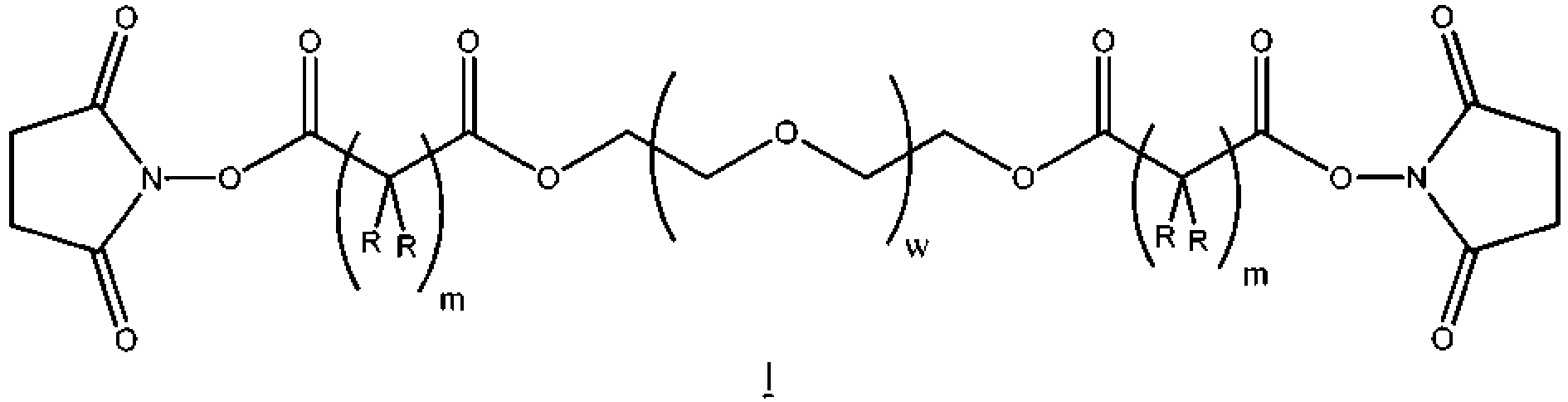 R est H ;m est 5-10 inclus ; etw est 20 à 120 inclus.
 - Composition polymérique selon la revendication 1, dans laquelle l'agent de réticulation est PEI25000, PEI5000, PEI2000, PEI1300 ou PEI800.
- Composition polymérique selon la revendication 1, dans laquelle l'agent de réticulation est PEI2000.
- Composition polymérique selon l'une quelconque des revendications précédentes, dans laquelle le dérivé de diacide de polyalkylène glycol activé est PEG3350-(SSeb)2, où 3350 représente le poids moléculaire moyen du polyéthylène glycol (PEG), et SSeb est

- Composition polymérique selon la revendication 1, pour, ou pour utilisation dans, l'obturation d'une blessure d'un patient.
- Composition polymérique selon la revendication 1, pour, ou pour utilisation dans l'augmentation d'un tissu mou ou le remplissage d'une cavité chez un patient.
- Composition polymérique selon la revendication 1, pour, ou pour utilisation dans l'adhérence de tissus d'un patient.
- Composition polymérique selon la revendication 1, pour, ou pour utilisation dans la fixation d'un matériau prothétique aux tissus d'un patient.
- Composition polymérique pour, ou pour utilisation conformément à l'une quelconque des revendications 5 à 8, dans laquelle l'agent de réticulation est PEI25000, PEI5000, PEI2000, PEI1300 ou PEI800.
- Composition polymérique pour, ou pour utilisation conformément à l'une quelconque des revendications 5 à 8, dans laquelle l'agent de réticulation est PEI2000.
- Composition polymérique pour, ou pour utilisation conformément à l'une quelconque des revendications 5 à 8, dans laquelle le dérivé de diacide de polyalkylène glycol activé est PEG3350-(SSeb)2, où 3350 représente le poids moléculaire moyen du polyéthylène glycol (PEG), et SSeb est

Applications Claiming Priority (2)
| Application Number | Priority Date | Filing Date | Title |
|---|---|---|---|
| US2828808P | 2008-02-13 | 2008-02-13 | |
| PCT/US2009/034050 WO2009102952A2 (fr) | 2008-02-13 | 2009-02-13 | Hydrogels à base de polyalkylèneimines réticulées à taux de dégradation ajustable |
Publications (3)
| Publication Number | Publication Date |
|---|---|
| EP2247645A2 EP2247645A2 (fr) | 2010-11-10 |
| EP2247645A4 EP2247645A4 (fr) | 2013-12-04 |
| EP2247645B1 true EP2247645B1 (fr) | 2017-12-06 |
Family
ID=40957511
Family Applications (1)
| Application Number | Title | Priority Date | Filing Date |
|---|---|---|---|
| EP09709785.1A Active EP2247645B1 (fr) | 2008-02-13 | 2009-02-13 | Hydrogels à base de polyalkylèneimines réticulées à taux de dégradation ajustable |
Country Status (6)
| Country | Link |
|---|---|
| US (2) | US8410189B2 (fr) |
| EP (1) | EP2247645B1 (fr) |
| JP (2) | JP5739668B2 (fr) |
| AU (1) | AU2009214615B2 (fr) |
| CA (1) | CA2711455C (fr) |
| WO (1) | WO2009102952A2 (fr) |
Cited By (2)
| Publication number | Priority date | Publication date | Assignee | Title |
|---|---|---|---|---|
| US10786581B2 (en) | 2009-12-15 | 2020-09-29 | Incept, Llc | Implants and biodegradable tissue markers |
| US20240050627A1 (en) * | 2020-12-18 | 2024-02-15 | Vanderbilt University | Class of biomaterials for promoting large blood vessel growth |
Families Citing this family (61)
| Publication number | Priority date | Publication date | Assignee | Title |
|---|---|---|---|---|
| EP1996243B1 (fr) | 2006-01-11 | 2014-04-23 | HyperBranch Medical Technology, Inc. | Gels réticulés comprenant des polyalkylène-imines et utilisation de ceux-ci en tant que dispositifs médicaux |
| US8262608B2 (en) * | 2007-01-25 | 2012-09-11 | Hyperbranch Medical Technology, Inc. | Applicators for multiple component formulations and the like, and methods of use thereof |
| US9125807B2 (en) * | 2007-07-09 | 2015-09-08 | Incept Llc | Adhesive hydrogels for ophthalmic drug delivery |
| HUE049431T2 (hu) | 2007-11-21 | 2020-09-28 | Smith & Nephew | Sebkötözés |
| GB0722820D0 (en) | 2007-11-21 | 2008-01-02 | Smith & Nephew | Vacuum assisted wound dressing |
| US8808259B2 (en) | 2007-11-21 | 2014-08-19 | T.J. Smith & Nephew Limited | Suction device and dressing |
| US20130096518A1 (en) | 2007-12-06 | 2013-04-18 | Smith & Nephew Plc | Wound filling apparatuses and methods |
| GB0723875D0 (en) | 2007-12-06 | 2008-01-16 | Smith & Nephew | Wound management |
| US11253399B2 (en) | 2007-12-06 | 2022-02-22 | Smith & Nephew Plc | Wound filling apparatuses and methods |
| GB0803564D0 (en) | 2008-02-27 | 2008-04-02 | Smith & Nephew | Fluid collection |
| KR101020050B1 (ko) * | 2008-10-06 | 2011-03-09 | 포항공과대학교 산학협력단 | 선형 폴리에틸렌이민-가지형폴리에틸렌글리콜 화합물을 이용한 유전자 전달체 및 그 합성 방법 |
| JP5890182B2 (ja) | 2009-02-12 | 2016-03-22 | インセプト エルエルシー | ヒドロゲルプラグによる薬物送達 |
| GB0902816D0 (en) | 2009-02-19 | 2009-04-08 | Smith & Nephew | Fluid communication path |
| EP3153194B1 (fr) | 2009-05-04 | 2019-04-10 | Incept, LLC | Biomatériaux pour fermeture de perforation et de voie |
| KR20120089843A (ko) | 2009-07-31 | 2012-08-14 | 사노피-아벤티스 도이칠란트 게엠베하 | 인슐린 링커 접합체를 포함한 프로드럭 |
| DK2459171T3 (en) | 2009-07-31 | 2017-09-25 | Sanofi Aventis Deutschland | Long-acting insulin composition |
| US8470355B2 (en) * | 2009-10-01 | 2013-06-25 | Covidien Lp | Mesh implant |
| AU2010311421B2 (en) * | 2009-10-29 | 2014-11-20 | Ascendis Pharma A/S | Sterilization of biodegradable hydrogels |
| CA2730598C (fr) * | 2010-03-16 | 2018-03-13 | Confluent Surgical, Inc. | Modulation de la vitesse de liberation de medicaments en controlant la transition du ph dans des hydrogels |
| US9061095B2 (en) | 2010-04-27 | 2015-06-23 | Smith & Nephew Plc | Wound dressing and method of use |
| US10227289B2 (en) | 2010-05-07 | 2019-03-12 | Medicus Biosciences, Llc | Methods for treating diseases of the lung |
| GB201011173D0 (en) | 2010-07-02 | 2010-08-18 | Smith & Nephew | Provision of wound filler |
| EP2438930A1 (fr) | 2010-09-17 | 2012-04-11 | Sanofi-Aventis Deutschland GmbH | Promédicaments comprenant un conjugué de liaison d'exendine |
| US8961501B2 (en) | 2010-09-17 | 2015-02-24 | Incept, Llc | Method for applying flowable hydrogels to a cornea |
| GB201020005D0 (en) | 2010-11-25 | 2011-01-12 | Smith & Nephew | Composition 1-1 |
| MX337627B (es) | 2010-11-25 | 2016-03-10 | Smith & Nephew | Composiciones i-ii y productos y usos de la misma. |
| US11083821B2 (en) | 2011-08-10 | 2021-08-10 | C.P. Medical Corporation | Biocompatible hydrogel polymer formulations for the controlled delivery of biomolecules |
| US10111985B2 (en) | 2011-08-10 | 2018-10-30 | Medicus Biosciences, Llc | Biocompatible hydrogel polymer formulations for the controlled delivery of biomolecules |
| US10226417B2 (en) | 2011-09-16 | 2019-03-12 | Peter Jarrett | Drug delivery systems and applications |
| US20150159066A1 (en) | 2011-11-25 | 2015-06-11 | Smith & Nephew Plc | Composition, apparatus, kit and method and uses thereof |
| CA2873105C (fr) * | 2012-05-11 | 2018-01-16 | Medicus Biosciences, Llc | Traitements a base d'hydrogel biocompatible pour traiter un decollement de la retine |
| EP2861257B1 (fr) | 2012-06-14 | 2021-12-08 | Microvention, Inc. | Compositions de traitement polymères |
| JP6271566B2 (ja) * | 2012-10-11 | 2018-01-31 | アセンディス ファーマ エー/エス | ヒドロゲルプロドラッグ |
| BR112015008245B1 (pt) | 2012-10-15 | 2022-09-27 | Microvention, Inc | Composições poliméricas de tratamento |
| CA2901753C (fr) | 2013-03-04 | 2023-08-22 | DERMELLE, LLC d/b/a ETERNOGEN, LLC | Composition de collagene polymerisable in situ injectable |
| WO2014164731A1 (fr) | 2013-03-11 | 2014-10-09 | University Of Utah Research Foundation | Systèmes de capteur |
| JP6516721B2 (ja) * | 2013-03-14 | 2019-05-22 | メディカス バイオサイエンシーズ エルエルシー | 固形のポリグリコールをベースとする生体適合性の事前処方物 |
| US20160120706A1 (en) | 2013-03-15 | 2016-05-05 | Smith & Nephew Plc | Wound dressing sealant and use thereof |
| EP2968647B1 (fr) | 2013-03-15 | 2022-06-29 | Smith & Nephew plc | Scellement de pansement et son utilisation |
| DE102013016750B4 (de) | 2013-10-02 | 2026-07-30 | Smartdyelivery Gmbh | Neue Poly(ethylenimin) basierte Copolymere zur Anbindung und Freisetzung von genetischem Material, insbesondere von DNA/RNA, sowie Verfahren zu deren Herstellung und Verwendung |
| US9295752B1 (en) | 2014-09-30 | 2016-03-29 | Covidien Lp | Bioadhesive for occluding vessels |
| CN105963792B (zh) * | 2016-04-29 | 2019-03-22 | 深圳迈普再生医学科技有限公司 | 医用水凝胶组合物,医用水凝胶及其制备方法与应用 |
| US10368874B2 (en) | 2016-08-26 | 2019-08-06 | Microvention, Inc. | Embolic compositions |
| AU2017329216B2 (en) * | 2016-09-22 | 2019-08-08 | Essity Hygiene And Health Aktiebolag | Absorbent article with PH controlled topsheet |
| CN111200976B (zh) | 2017-10-09 | 2023-07-07 | 微仙美国有限公司 | 放射性液体栓塞 |
| WO2019101929A1 (fr) | 2017-11-23 | 2019-05-31 | Loewenhielm Peter | Composition d'hydrogel et utilisations de celle-ci |
| CN107778476B (zh) * | 2017-11-27 | 2020-04-10 | 淮阴师范学院 | 一种超分子水凝胶材料的构建方法及应用 |
| CN109939065B (zh) * | 2018-08-10 | 2021-08-03 | 上海瑞凝生物科技有限公司 | 医用水凝胶 |
| CN109796608A (zh) * | 2019-01-21 | 2019-05-24 | 福建农林大学 | 一种pH响应的具粘附性、抗菌、耐压的快速自修复胶原基水凝胶的制备方法 |
| CN109646723B (zh) * | 2019-02-02 | 2020-05-22 | 上海瑞凝生物科技有限公司 | 具有辐射防护作用的医用水凝胶 |
| US11904067B2 (en) * | 2019-05-10 | 2024-02-20 | Massachusetts Institute Of Technology | Dry double-sided material for adhesion of wet tissues and devices |
| CN110801528A (zh) * | 2019-10-30 | 2020-02-18 | 金路平 | 一种硬脊膜封合水凝胶及其制备方法与应用 |
| US12398255B2 (en) | 2020-03-17 | 2025-08-26 | Saint Louis University | Biocompatible crosslinkers for controlled degradation of polymer hydrogels |
| US12629445B2 (en) | 2020-03-20 | 2026-05-19 | Bard Peripheral Vascular, Inc. | Reactive hydrogel forming formulations and related methods, including methods of preparation |
| EP4149431A4 (fr) * | 2020-05-13 | 2024-05-29 | Spiral Therapeutics Inc. | Solutions gélifiantes pour l'administration de composés à l'oreille interne |
| US12161777B2 (en) | 2020-07-02 | 2024-12-10 | Davol Inc. | Flowable hemostatic suspension |
| US11739166B2 (en) | 2020-07-02 | 2023-08-29 | Davol Inc. | Reactive polysaccharide-based hemostatic agent |
| WO2022146917A1 (fr) | 2020-12-28 | 2022-07-07 | Davol Inc. | Matériaux hémostatiques pulvérulents secs réactifs comprenant une protéine et un agent de réticulation à base de polyéthylène glycol modifié multifonctionnalisé |
| IL328013A (en) * | 2023-11-01 | 2026-06-01 | Entrega Inc | Oral dosage form with ionically chargeable hydrogel for delivery of active agent and permeation enhancer |
| WO2026132905A2 (fr) | 2024-12-18 | 2026-06-25 | Stryker European Operations Limited | Applicateur de pulvérisation pour produit d'étanchéité chirurgical à deux composants et ses procédés d'utilisation |
| CN122230093A (zh) * | 2026-05-20 | 2026-06-19 | 武汉纺织大学 | 可吸收丝素蛋白医用止血海绵及其制备方法 |
Family Cites Families (30)
| Publication number | Priority date | Publication date | Assignee | Title |
|---|---|---|---|---|
| JPS61205209A (ja) * | 1985-03-09 | 1986-09-11 | Nippon Oil & Fats Co Ltd | パツプ剤用膏体 |
| US4920158A (en) | 1989-10-11 | 1990-04-24 | Medipro Sciences Limited | Hydrogel-forming wound dressing or skin coating material |
| US5162430A (en) * | 1988-11-21 | 1992-11-10 | Collagen Corporation | Collagen-polymer conjugates |
| US5936035A (en) * | 1988-11-21 | 1999-08-10 | Cohesion Technologies, Inc. | Biocompatible adhesive compositions |
| US5143071A (en) | 1989-03-30 | 1992-09-01 | Nepera, Inc. | Non-stringy adhesive hydrophilic gels |
| US5122614A (en) * | 1989-04-19 | 1992-06-16 | Enzon, Inc. | Active carbonates of polyalkylene oxides for modification of polypeptides |
| US5142071A (en) * | 1989-12-19 | 1992-08-25 | The Procter & Gamble Company | Selective esterification of long chain fatty acid monoglycerides with medium chain fatty acids |
| AU682266B2 (en) * | 1994-04-04 | 1997-09-25 | Collagen Corporation | Cell-gels |
| US5900245A (en) | 1996-03-22 | 1999-05-04 | Focal, Inc. | Compliant tissue sealants |
| US5672638A (en) | 1995-08-22 | 1997-09-30 | Medtronic, Inc. | Biocompatability for solid surfaces |
| US6230683B1 (en) * | 1997-08-22 | 2001-05-15 | Cummins Engine Company, Inc. | Premixed charge compression ignition engine with optimal combustion control |
| US20020064546A1 (en) | 1996-09-13 | 2002-05-30 | J. Milton Harris | Degradable poly(ethylene glycol) hydrogels with controlled half-life and precursors therefor |
| US6258351B1 (en) | 1996-11-06 | 2001-07-10 | Shearwater Corporation | Delivery of poly(ethylene glycol)-modified molecules from degradable hydrogels |
| ES2211033T3 (es) | 1998-01-07 | 2004-07-01 | Debio Recherche Pharmaceutique S.A. | Acrilatos de polietilenglicol heterobifuncionales degradables y geles y conjugados derivados de dichos acrilatos. |
| US6818018B1 (en) | 1998-08-14 | 2004-11-16 | Incept Llc | In situ polymerizable hydrogels |
| EP1137373A4 (fr) * | 1998-12-04 | 2004-05-19 | Chandrashekhar P Pathak | Polymeres reticules biocompatibles |
| US7074878B1 (en) | 1999-12-10 | 2006-07-11 | Harris J Milton | Hydrolytically degradable polymers and hydrogels made therefrom |
| US6348558B1 (en) | 1999-12-10 | 2002-02-19 | Shearwater Corporation | Hydrolytically degradable polymers and hydrogels made therefrom |
| US7053150B2 (en) | 2000-12-18 | 2006-05-30 | Nektar Therapeutics Al, Corporation | Segmented polymers and their conjugates |
| US20040147466A1 (en) * | 2002-01-17 | 2004-07-29 | Barman Shikha P. | Nucleic acid delivery formulations |
| ES2304501T3 (es) | 2002-02-15 | 2008-10-16 | Nektar Therapeutics Al, Corporation | Polimeros a base de oxido de alquileno degradables hidroliticamente. |
| JP4489437B2 (ja) | 2002-02-21 | 2010-06-23 | エンセル,インコーポレイテッド | 表面コーティングとしての固定化生物活性ヒドロゲルマトリックス |
| WO2004014969A1 (fr) | 2002-08-09 | 2004-02-19 | Ottawa Health Research Institute | Matrice biosynthetique et utilisations de cette derniere |
| US7405321B2 (en) * | 2003-06-06 | 2008-07-29 | Basf Aktiengesellschaft | (Meth)acrylic ester of alkenylene glycols and the use thereof |
| US20050266086A1 (en) * | 2004-06-01 | 2005-12-01 | Sawhney Amarpreet S | Intrauterine applications of materials formed in situ |
| US8790632B2 (en) * | 2004-10-07 | 2014-07-29 | Actamax Surgical Materials, Llc | Polymer-based tissue-adhesive form medical use |
| AU2006292752A1 (en) | 2005-09-15 | 2007-03-29 | University Of Utah Research Foundation | Polymeric compositions and methods of making and using thereof |
| US7432069B2 (en) | 2005-12-05 | 2008-10-07 | Sontra Medical Corporation | Biocompatible chemically crosslinked hydrogels for glucose sensing |
| EP1996243B1 (fr) * | 2006-01-11 | 2014-04-23 | HyperBranch Medical Technology, Inc. | Gels réticulés comprenant des polyalkylène-imines et utilisation de ceux-ci en tant que dispositifs médicaux |
| US20080287633A1 (en) * | 2007-05-18 | 2008-11-20 | Drumheller Paul D | Hydrogel Materials |
-
2009
- 2009-02-13 EP EP09709785.1A patent/EP2247645B1/fr active Active
- 2009-02-13 JP JP2010546918A patent/JP5739668B2/ja active Active
- 2009-02-13 AU AU2009214615A patent/AU2009214615B2/en active Active
- 2009-02-13 US US12/371,113 patent/US8410189B2/en active Active
- 2009-02-13 CA CA2711455A patent/CA2711455C/fr active Active
- 2009-02-13 WO PCT/US2009/034050 patent/WO2009102952A2/fr not_active Ceased
-
2010
- 2010-10-21 US US12/909,611 patent/US8846022B2/en active Active
-
2014
- 2014-12-17 JP JP2014254921A patent/JP2015061927A/ja not_active Withdrawn
Non-Patent Citations (1)
| Title |
|---|
| None * |
Cited By (7)
| Publication number | Priority date | Publication date | Assignee | Title |
|---|---|---|---|---|
| US10786581B2 (en) | 2009-12-15 | 2020-09-29 | Incept, Llc | Implants and biodegradable tissue markers |
| US11083802B2 (en) | 2009-12-15 | 2021-08-10 | Incept, Llc | Echolucent implant compositions and methods |
| US11154624B2 (en) | 2009-12-15 | 2021-10-26 | Incept, Llc | Echolucent implant compositions and methods |
| US11160883B2 (en) | 2009-12-15 | 2021-11-02 | Incept, Llc | Echolucent implant composition and methods |
| US11786612B2 (en) | 2009-12-15 | 2023-10-17 | Incept, Llc | Implant and biodegradable tissue marker compositions and methods |
| US12622982B2 (en) | 2009-12-15 | 2026-05-12 | Incept, Llc | Implants and biodegradable tissue markers |
| US20240050627A1 (en) * | 2020-12-18 | 2024-02-15 | Vanderbilt University | Class of biomaterials for promoting large blood vessel growth |
Also Published As
| Publication number | Publication date |
|---|---|
| JP5739668B2 (ja) | 2015-06-24 |
| CA2711455C (fr) | 2016-06-07 |
| WO2009102952A2 (fr) | 2009-08-20 |
| EP2247645A4 (fr) | 2013-12-04 |
| US20110044932A1 (en) | 2011-02-24 |
| CA2711455A1 (fr) | 2009-08-20 |
| JP2011511880A (ja) | 2011-04-14 |
| AU2009214615B2 (en) | 2014-06-12 |
| US20090215923A1 (en) | 2009-08-27 |
| WO2009102952A3 (fr) | 2009-11-05 |
| US8410189B2 (en) | 2013-04-02 |
| AU2009214615A1 (en) | 2009-08-20 |
| JP2015061927A (ja) | 2015-04-02 |
| US8846022B2 (en) | 2014-09-30 |
| EP2247645A2 (fr) | 2010-11-10 |
Similar Documents
| Publication | Publication Date | Title |
|---|---|---|
| CA2711455C (fr) | Hydrogels a base de polyalkyleneimines reticulees a taux de degradation ajustable | |
| US11826485B2 (en) | Crosslinked gels comprising polyalkyleneimines, and their uses as medical devices | |
| EP2120971B1 (fr) | Adhésif biopolymère imidé et hydrogel | |
| US20100069927A1 (en) | Polymeric Masking Materials for Spanning Wound Sites, and Methods of Use Thereof | |
| WO2006031358A2 (fr) | Polymeres dendritiques, gels reticules, et leurs utilisations comme agents de scellement et lentilles ophtalmiques | |
| US20040096422A1 (en) | Compositions of polyacids and polyethers and methods for their use in reducing pain | |
| US20210222035A1 (en) | Biocompatible adhesive materials with ionic and covalent interaction |
Legal Events
| Date | Code | Title | Description |
|---|---|---|---|
| PUAI | Public reference made under article 153(3) epc to a published international application that has entered the european phase |
Free format text: ORIGINAL CODE: 0009012 |
|
| 17P | Request for examination filed |
Effective date: 20100906 |
|
| AK | Designated contracting states |
Kind code of ref document: A2 Designated state(s): AT BE BG CH CY CZ DE DK EE ES FI FR GB GR HR HU IE IS IT LI LT LU LV MC MK MT NL NO PL PT RO SE SI SK TR |
|
| AX | Request for extension of the european patent |
Extension state: AL BA RS |
|
| DAX | Request for extension of the european patent (deleted) | ||
| A4 | Supplementary search report drawn up and despatched |
Effective date: 20131107 |
|
| RIC1 | Information provided on ipc code assigned before grant |
Ipc: C08L 71/02 20060101ALI20131031BHEP Ipc: C08G 65/333 20060101ALI20131031BHEP Ipc: C08G 65/32 20060101ALI20131031BHEP Ipc: C08G 73/00 20060101ALI20131031BHEP Ipc: C08G 73/04 20060101ALI20131031BHEP Ipc: C08G 65/00 20060101ALI20131031BHEP Ipc: C08G 65/326 20060101ALI20131031BHEP Ipc: C08K 5/00 20060101ALI20131031BHEP Ipc: C08L 77/04 20060101ALI20131031BHEP Ipc: C08K 5/3415 20060101ALI20131031BHEP Ipc: C08J 3/075 20060101ALI20131031BHEP Ipc: C08L 79/02 20060101ALI20131031BHEP Ipc: C08G 65/48 20060101AFI20131031BHEP Ipc: A61L 24/04 20060101ALI20131031BHEP Ipc: C08G 65/337 20060101ALI20131031BHEP |
|
| 17Q | First examination report despatched |
Effective date: 20160808 |
|
| GRAP | Despatch of communication of intention to grant a patent |
Free format text: ORIGINAL CODE: EPIDOSNIGR1 |
|
| INTG | Intention to grant announced |
Effective date: 20170725 |
|
| GRAJ | Information related to disapproval of communication of intention to grant by the applicant or resumption of examination proceedings by the epo deleted |
Free format text: ORIGINAL CODE: EPIDOSDIGR1 |
|
| GRAR | Information related to intention to grant a patent recorded |
Free format text: ORIGINAL CODE: EPIDOSNIGR71 |
|
| GRAS | Grant fee paid |
Free format text: ORIGINAL CODE: EPIDOSNIGR3 |
|
| GRAA | (expected) grant |
Free format text: ORIGINAL CODE: 0009210 |
|
| INTC | Intention to grant announced (deleted) | ||
| AK | Designated contracting states |
Kind code of ref document: B1 Designated state(s): AT BE BG CH CY CZ DE DK EE ES FI FR GB GR HR HU IE IS IT LI LT LU LV MC MK MT NL NO PL PT RO SE SI SK TR |
|
| INTG | Intention to grant announced |
Effective date: 20171027 |
|
| REG | Reference to a national code |
Ref country code: GB Ref legal event code: FG4D |
|
| REG | Reference to a national code |
Ref country code: AT Ref legal event code: REF Ref document number: 952314 Country of ref document: AT Kind code of ref document: T Effective date: 20171215 Ref country code: CH Ref legal event code: EP |
|
| REG | Reference to a national code |
Ref country code: IE Ref legal event code: FG4D |
|
| REG | Reference to a national code |
Ref country code: DE Ref legal event code: R096 Ref document number: 602009049723 Country of ref document: DE |
|
| REG | Reference to a national code |
Ref country code: FR Ref legal event code: PLFP Year of fee payment: 10 |
|
| REG | Reference to a national code |
Ref country code: NL Ref legal event code: MP Effective date: 20171206 |
|
| REG | Reference to a national code |
Ref country code: LT Ref legal event code: MG4D |
|
| PG25 | Lapsed in a contracting state [announced via postgrant information from national office to epo] |
Ref country code: ES Free format text: LAPSE BECAUSE OF FAILURE TO SUBMIT A TRANSLATION OF THE DESCRIPTION OR TO PAY THE FEE WITHIN THE PRESCRIBED TIME-LIMIT Effective date: 20171206 Ref country code: NO Free format text: LAPSE BECAUSE OF FAILURE TO SUBMIT A TRANSLATION OF THE DESCRIPTION OR TO PAY THE FEE WITHIN THE PRESCRIBED TIME-LIMIT Effective date: 20180306 Ref country code: FI Free format text: LAPSE BECAUSE OF FAILURE TO SUBMIT A TRANSLATION OF THE DESCRIPTION OR TO PAY THE FEE WITHIN THE PRESCRIBED TIME-LIMIT Effective date: 20171206 Ref country code: SE Free format text: LAPSE BECAUSE OF FAILURE TO SUBMIT A TRANSLATION OF THE DESCRIPTION OR TO PAY THE FEE WITHIN THE PRESCRIBED TIME-LIMIT Effective date: 20171206 Ref country code: LT Free format text: LAPSE BECAUSE OF FAILURE TO SUBMIT A TRANSLATION OF THE DESCRIPTION OR TO PAY THE FEE WITHIN THE PRESCRIBED TIME-LIMIT Effective date: 20171206 |
|
| REG | Reference to a national code |
Ref country code: AT Ref legal event code: MK05 Ref document number: 952314 Country of ref document: AT Kind code of ref document: T Effective date: 20171206 |
|
| PG25 | Lapsed in a contracting state [announced via postgrant information from national office to epo] |
Ref country code: LV Free format text: LAPSE BECAUSE OF FAILURE TO SUBMIT A TRANSLATION OF THE DESCRIPTION OR TO PAY THE FEE WITHIN THE PRESCRIBED TIME-LIMIT Effective date: 20171206 Ref country code: HR Free format text: LAPSE BECAUSE OF FAILURE TO SUBMIT A TRANSLATION OF THE DESCRIPTION OR TO PAY THE FEE WITHIN THE PRESCRIBED TIME-LIMIT Effective date: 20171206 Ref country code: BG Free format text: LAPSE BECAUSE OF FAILURE TO SUBMIT A TRANSLATION OF THE DESCRIPTION OR TO PAY THE FEE WITHIN THE PRESCRIBED TIME-LIMIT Effective date: 20180306 Ref country code: GR Free format text: LAPSE BECAUSE OF FAILURE TO SUBMIT A TRANSLATION OF THE DESCRIPTION OR TO PAY THE FEE WITHIN THE PRESCRIBED TIME-LIMIT Effective date: 20180307 |
|
| PG25 | Lapsed in a contracting state [announced via postgrant information from national office to epo] |
Ref country code: NL Free format text: LAPSE BECAUSE OF FAILURE TO SUBMIT A TRANSLATION OF THE DESCRIPTION OR TO PAY THE FEE WITHIN THE PRESCRIBED TIME-LIMIT Effective date: 20171206 |
|
| PG25 | Lapsed in a contracting state [announced via postgrant information from national office to epo] |
Ref country code: CZ Free format text: LAPSE BECAUSE OF FAILURE TO SUBMIT A TRANSLATION OF THE DESCRIPTION OR TO PAY THE FEE WITHIN THE PRESCRIBED TIME-LIMIT Effective date: 20171206 Ref country code: EE Free format text: LAPSE BECAUSE OF FAILURE TO SUBMIT A TRANSLATION OF THE DESCRIPTION OR TO PAY THE FEE WITHIN THE PRESCRIBED TIME-LIMIT Effective date: 20171206 Ref country code: SK Free format text: LAPSE BECAUSE OF FAILURE TO SUBMIT A TRANSLATION OF THE DESCRIPTION OR TO PAY THE FEE WITHIN THE PRESCRIBED TIME-LIMIT Effective date: 20171206 |
|
| PG25 | Lapsed in a contracting state [announced via postgrant information from national office to epo] |
Ref country code: RO Free format text: LAPSE BECAUSE OF FAILURE TO SUBMIT A TRANSLATION OF THE DESCRIPTION OR TO PAY THE FEE WITHIN THE PRESCRIBED TIME-LIMIT Effective date: 20171206 Ref country code: IT Free format text: LAPSE BECAUSE OF FAILURE TO SUBMIT A TRANSLATION OF THE DESCRIPTION OR TO PAY THE FEE WITHIN THE PRESCRIBED TIME-LIMIT Effective date: 20171206 Ref country code: AT Free format text: LAPSE BECAUSE OF FAILURE TO SUBMIT A TRANSLATION OF THE DESCRIPTION OR TO PAY THE FEE WITHIN THE PRESCRIBED TIME-LIMIT Effective date: 20171206 Ref country code: PL Free format text: LAPSE BECAUSE OF FAILURE TO SUBMIT A TRANSLATION OF THE DESCRIPTION OR TO PAY THE FEE WITHIN THE PRESCRIBED TIME-LIMIT Effective date: 20171206 |
|
| REG | Reference to a national code |
Ref country code: DE Ref legal event code: R097 Ref document number: 602009049723 Country of ref document: DE |
|
| REG | Reference to a national code |
Ref country code: CH Ref legal event code: PL |
|
| PG25 | Lapsed in a contracting state [announced via postgrant information from national office to epo] |
Ref country code: MC Free format text: LAPSE BECAUSE OF FAILURE TO SUBMIT A TRANSLATION OF THE DESCRIPTION OR TO PAY THE FEE WITHIN THE PRESCRIBED TIME-LIMIT Effective date: 20171206 |
|
| PLBE | No opposition filed within time limit |
Free format text: ORIGINAL CODE: 0009261 |
|
| STAA | Information on the status of an ep patent application or granted ep patent |
Free format text: STATUS: NO OPPOSITION FILED WITHIN TIME LIMIT |
|
| 26N | No opposition filed |
Effective date: 20180907 |
|
| REG | Reference to a national code |
Ref country code: IE Ref legal event code: MM4A |
|
| REG | Reference to a national code |
Ref country code: BE Ref legal event code: MM Effective date: 20180228 |
|
| PG25 | Lapsed in a contracting state [announced via postgrant information from national office to epo] |
Ref country code: DK Free format text: LAPSE BECAUSE OF FAILURE TO SUBMIT A TRANSLATION OF THE DESCRIPTION OR TO PAY THE FEE WITHIN THE PRESCRIBED TIME-LIMIT Effective date: 20171206 Ref country code: LI Free format text: LAPSE BECAUSE OF NON-PAYMENT OF DUE FEES Effective date: 20180228 Ref country code: LU Free format text: LAPSE BECAUSE OF NON-PAYMENT OF DUE FEES Effective date: 20180213 Ref country code: SI Free format text: LAPSE BECAUSE OF FAILURE TO SUBMIT A TRANSLATION OF THE DESCRIPTION OR TO PAY THE FEE WITHIN THE PRESCRIBED TIME-LIMIT Effective date: 20171206 Ref country code: CH Free format text: LAPSE BECAUSE OF NON-PAYMENT OF DUE FEES Effective date: 20180228 |
|
| PG25 | Lapsed in a contracting state [announced via postgrant information from national office to epo] |
Ref country code: IE Free format text: LAPSE BECAUSE OF NON-PAYMENT OF DUE FEES Effective date: 20180213 |
|
| PG25 | Lapsed in a contracting state [announced via postgrant information from national office to epo] |
Ref country code: BE Free format text: LAPSE BECAUSE OF NON-PAYMENT OF DUE FEES Effective date: 20180228 |
|
| PG25 | Lapsed in a contracting state [announced via postgrant information from national office to epo] |
Ref country code: MT Free format text: LAPSE BECAUSE OF NON-PAYMENT OF DUE FEES Effective date: 20180213 |
|
| PG25 | Lapsed in a contracting state [announced via postgrant information from national office to epo] |
Ref country code: TR Free format text: LAPSE BECAUSE OF FAILURE TO SUBMIT A TRANSLATION OF THE DESCRIPTION OR TO PAY THE FEE WITHIN THE PRESCRIBED TIME-LIMIT Effective date: 20171206 |
|
| PG25 | Lapsed in a contracting state [announced via postgrant information from national office to epo] |
Ref country code: PT Free format text: LAPSE BECAUSE OF FAILURE TO SUBMIT A TRANSLATION OF THE DESCRIPTION OR TO PAY THE FEE WITHIN THE PRESCRIBED TIME-LIMIT Effective date: 20171206 Ref country code: HU Free format text: LAPSE BECAUSE OF FAILURE TO SUBMIT A TRANSLATION OF THE DESCRIPTION OR TO PAY THE FEE WITHIN THE PRESCRIBED TIME-LIMIT; INVALID AB INITIO Effective date: 20090213 |
|
| PG25 | Lapsed in a contracting state [announced via postgrant information from national office to epo] |
Ref country code: MK Free format text: LAPSE BECAUSE OF NON-PAYMENT OF DUE FEES Effective date: 20171206 Ref country code: CY Free format text: LAPSE BECAUSE OF FAILURE TO SUBMIT A TRANSLATION OF THE DESCRIPTION OR TO PAY THE FEE WITHIN THE PRESCRIBED TIME-LIMIT Effective date: 20171206 |
|
| PG25 | Lapsed in a contracting state [announced via postgrant information from national office to epo] |
Ref country code: IS Free format text: LAPSE BECAUSE OF FAILURE TO SUBMIT A TRANSLATION OF THE DESCRIPTION OR TO PAY THE FEE WITHIN THE PRESCRIBED TIME-LIMIT Effective date: 20180406 |
|
| P01 | Opt-out of the competence of the unified patent court (upc) registered |
Effective date: 20230522 |
|
| PGFP | Annual fee paid to national office [announced via postgrant information from national office to epo] |
Ref country code: GB Payment date: 20260112 Year of fee payment: 18 |
|
| PGFP | Annual fee paid to national office [announced via postgrant information from national office to epo] |
Ref country code: DE Payment date: 20260107 Year of fee payment: 18 |
|
| PGFP | Annual fee paid to national office [announced via postgrant information from national office to epo] |
Ref country code: FR Payment date: 20260108 Year of fee payment: 18 |