EP2249176A1 - Technique de positionnement terminal - Google Patents
Technique de positionnement terminal Download PDFInfo
- Publication number
- EP2249176A1 EP2249176A1 EP10275033A EP10275033A EP2249176A1 EP 2249176 A1 EP2249176 A1 EP 2249176A1 EP 10275033 A EP10275033 A EP 10275033A EP 10275033 A EP10275033 A EP 10275033A EP 2249176 A1 EP2249176 A1 EP 2249176A1
- Authority
- EP
- European Patent Office
- Prior art keywords
- estimator
- terminal
- rss
- distance
- mobile terminal
- Prior art date
- Legal status (The legal status is an assumption and is not a legal conclusion. Google has not performed a legal analysis and makes no representation as to the accuracy of the status listed.)
- Granted
Links
Images




Classifications
-
- G—PHYSICS
- G01—MEASURING; TESTING
- G01S—RADIO DIRECTION-FINDING; RADIO NAVIGATION; DETERMINING DISTANCE OR VELOCITY BY USE OF RADIO WAVES; LOCATING OR PRESENCE-DETECTING BY USE OF THE REFLECTION OR RERADIATION OF RADIO WAVES; ANALOGOUS ARRANGEMENTS USING OTHER WAVES
- G01S11/00—Systems for determining distance or velocity not using reflection or reradiation
- G01S11/02—Systems for determining distance or velocity not using reflection or reradiation using radio waves
- G01S11/06—Systems for determining distance or velocity not using reflection or reradiation using radio waves using intensity measurements
-
- G—PHYSICS
- G01—MEASURING; TESTING
- G01S—RADIO DIRECTION-FINDING; RADIO NAVIGATION; DETERMINING DISTANCE OR VELOCITY BY USE OF RADIO WAVES; LOCATING OR PRESENCE-DETECTING BY USE OF THE REFLECTION OR RERADIATION OF RADIO WAVES; ANALOGOUS ARRANGEMENTS USING OTHER WAVES
- G01S5/00—Position-fixing by co-ordinating two or more direction or position line determinations; Position-fixing by co-ordinating two or more distance determinations
- G01S5/02—Position-fixing by co-ordinating two or more direction or position line determinations; Position-fixing by co-ordinating two or more distance determinations using radio waves
- G01S5/14—Determining absolute distances from a plurality of spaced points of known location
-
- H—ELECTRICITY
- H04—ELECTRIC COMMUNICATION TECHNIQUE
- H04W—WIRELESS COMMUNICATION NETWORKS
- H04W64/00—Locating users or terminals or network equipment for network management purposes, e.g. mobility management
Definitions
- This invention relates to a mobile terminal positioning and/or tracking technique and associated equipment. More particularly the present invention relates to the positioning and/or tracking of a mobile communication terminal the terminal itself in a mobile communication network and associated communication network equipment. More specifically, the present invention relates to a system for and method of estimating the position of a mobile terminal in a mobile communications network.
- LBS Location Based Services
- LBS provide a mobile terminal user with location based content delivery, such as local weather forecasts, and can also enable the mobile terminal user to identify people or outlets near their vicinity. For instance, a mobile phone user can contact a LBS provider to identify their closest petrol station, restaurant, bank or the like, based upon the user's current mobile terminal (MT) location. Similarly, it can be used to find the location of friends or family, such as for reasons of safety or emergency, or simply meeting up, by requesting the LBS provider for a location update on one or more person. These services can assist users, by saving them time, rather than travelling around a given geographical area, looking for a particular outlet/person, thus potentially avoiding traffic jams. It can also assist people in emergency situations, such as by helping to quickly identify their nearest hospital or the location of someone requiring emergency assistance.
- MT mobile terminal
- A-GPS Assisted Global Positioning System
- GSM Global System for Mobile communications
- A-GPS is quite a costly approach, and the relatively slow commercial uptake of Location Based Services combined with the high costs associated with GPS point towards it being a relatively long period of time before legacy 2G and 2G/3G mobile terminals will be equipped with GPS receivers on an extensive basis. Further, even after the introduction of GPS receivers in a large proportion of mobile terminals, since GPS requires direct contact with the satellites to function, the limited availability of satellite signals in indoor and certain outdoor environments (e.g. due to the urban canyon effect) indicate the need for hybrid techniques which combine A-GPS with a cellular based positioning.
- One simple cellular based method uses the nearest cell as a means to provide an approximate terminal position. For instance the cell which provides the terminal with the strongest Received Signal Strength (RSS) measurement is determined, and the terminal is then assumed to be within the coverage area of that cell.
- RSS Received Signal Strength
- the accuracy of this method of course depends upon the coverage area of the cell, and so will typically provide a mobile terminal position that is accurate to a range from 600m to a couple of kilometres (i.e. 600m-2000m depending on the cell size).
- This method is one of the techniques currently being used by operators that have already introduced commercial LBS.
- RSS Received Signal Strength
- GB2416461 a technique was disclosed which was termed "Statistical Terminal Assisted Mobile Positioning" or briefly “STAMP". This technique allows for the exploitation of multiple RSS historical measurements collected while the terminal is in idle mode. During a set-up phase of a LBS, these RSS measurements are used with a positioning technique to estimate the terminal's position, and this estimate is then statistically processed so as to improve the accuracy of the determined terminal position. In this way, the "STAMP" technique was able to improve the accuracy of most existing tracing techniques, rendering them more useful for LBS applications. The STAMP technique, however, when applied over RSS measurements, is also susceptible to signal variability, particularly in regard to the multi-path effect affecting its accuracy. In GB2416461 , this problem was addressed by eliminating measurements with high error content (e.g. due to fast fading).
- the present invention seeks to overcome or alleviate at least one of these problems.
- the present invention provides a method of estimating the location of a mobile terminal in a mobile communications network having a plurality of base stations, the method including:
- the filtering component of the estimator may include a Kalman filtering component:
- the step of using at least one estimator includes using an estimator to obtain a refined distance estimation of the mobile terminal from each of the plurality of base stations.
- the at least one signal parameter measurement determined is a Received Signal Strength (RSS) measurement and a RSS based positioning technique, such as Enhanced Cell Global Identity (ECGI) or STAMP, is used to obtain the first distance estimation of the mobile terminal location.
- RSS Received Signal Strength
- ECGI Enhanced Cell Global Identity
- STAMP Enhanced Cell Global Identity
- the estimators minimise the impact of the position calculation process on the resulting accuracy of the positioning technique.
- the estimators are preferably statistical estimators that can be applied to a distance estimation of the mobile terminal from each of the base stations and/or applied to a trilateration/triangulation estimation of the actual position of the mobile terminal, based upon estimated distances of the mobile terminal from the plurality of base stations.
- the estimators are preferably derived by taking into account the nature of path-loss propagation models (like Hata and Cost231), the error introduced in the estimation of the Mobile Terminal-Base Station distance as well as the error introduced in the triangulation process.
- Other aspects of the invention relate to a mobile telecommunications terminal and a communications network element, such as a Base Station, configured to implement the inventive aspect, particularly as set out in the attached claims.
- Each cell corresponds to a respective base station (BS) of its cellular or mobile telecommunications network that receives calls from and terminates calls at any mobile terminal in that cell by wireless radio communication in one or both of the circuit switched or packet switched domains.
- BS base station
- UE User Equipment
- the mobile terminal may be any portable communication device such as a handheld mobile telephone, a personal digital assistant (PDA) or a laptop computer equipped with a network datacard.
- PDA personal digital assistant
- the base station subsystem comprises of the base transceiver stations (BTS) and the base station controller (BSC).
- BTS base transceiver stations
- BSC base station controller
- a BSC may control more than one BTS.
- the BTSs and BSCs comprise the radio access network.
- the base stations are arranged in groups and each group of base stations is controlled by one mobile switching centre (MSC), such as MSC 2 for base stations 3, 4 and 5.
- MSC mobile switching centre
- the network has another MSC 6, which is controlling a further three base stations 7, 8 and 9.
- the network will incorporate many more MSCs and base stations than shown in Figure 1 .
- the base stations 3, 4, 5, 7, 8 and 9 each have dedicated (not shared) connection to their MSC2 or MSC6 - typically a cable connection. This prevents transmission speeds being reduced due to congestion caused by other traffic.
- Each subscriber to the network is provided with a smart card or SIM which, when associated with the user's mobile terminal identifies the subscriber to the network.
- the SIM card is pre-programmed with a unique identification number, the "International Mobile Subscriber Identity” (IMSI) which is not visible on the card and is not generally known to the subscriber.
- IMSI International Mobile Subscriber Identity
- the subscriber is issued with a publicly known number, that is, the subscriber's telephone number, by means of which calls to the subscriber are initiated by callers. This number is the MSISDN.
- the core network 12 includes a home location register (HLR) 10 which, for each subscriber to the network, stores the IMSI and the corresponding MSISDN together with other subscriber data, such as the current or last known Location Area of the subscriber's mobile terminal.
- HLR home location register
- a mobile terminal When a mobile terminal is in idle mode it selects one cell to be synchronised with (the primary cell) based on the strongest received signal strength. To achieve this, the terminal periodically monitors the received signal strength from the primary and a set of up to six neighbouring cells. As the terminal moves, the set of monitored cells as well as the primary cell may change.
- a mobile terminal Whenever a mobile terminal (being in idle mode) selects a new primary cell, it will detect that it belongs to a different Location Area (through the Location Area Identity that each cell is broadcasting) from that of its previously selected primarily cell. The mobile terminal will therefore then send a location area update request to the core network 12.
- LBS Location Based Service
- the terminal When a user wishes to use the mobile terminal to initiate a LBS, the terminal will transfer from idle mode to active or dedicated mode, and commence the set-up phase for the LBS session.
- the RSS can be exploited for supporting a LBS service:
- base station is to be taken to encompass both standard macro base stations supporting multiple cells, and also micro or pico-cells as well as Access Points like femto-cells.
- the number of neighbouring cells being monitored by the mobile terminal usually varies from one up to six, depending on the location and the density of the cells. In an urban environment, the typical number of visible neighbouring cells can be six due to the high density of base stations. As base stations support one or more cells (typical number is three in a cellular network) the number of monitored neighbouring cells corresponds to one up to six different base stations.
- one process of calculating the mobile terminal position based on a single set of RSS measurements involves the following steps:
- the RSS from a Base Station at a certain location is time-varying and consists of two main factors, namely:
- RSS is periodically measured and averaged over a given time period.
- GSM measurements are made every 480msec while in dedicated mode and every 2-5 seconds while in idle mode.
- the remaining slow fading component expressed in decibels can be modeled as a Gaussian random variable with a standard deviation in the order of 8db-12db.
- the signal should be averaged for longer time periods corresponding to a distance of hundreds of wavelengths covered by a moving terminal (i.e. in the order of 100m-200m for 900MHz operation).
- the averaged signal provides the so-called "median component" which corresponds to the RSS which is a direct function of the path loss occurring due to the distance of the MT from the BS.
- Radio propagation loss models e.g.
- Hata and Cost231 can then be exploited so as to estimate the distance between the MT and a BS.
- These models indicate that the MT-BS distance is a non-linear function of RSS, a fact that greatly affects the way that RSS errors are propagated to the estimation of MT positioning.
- path loss prediction models provide the RSS as a function of the distance of the MT from the BS.
- R x (i) corresponds to the RSS value provided by Eq. (1) when the actual MT-BS distance d(i) is used.
- the distribution provided in Eq. (3) assumes that the error of the rest of the parameters involved in Eq. (1) is negligible compared to the RSS error.
- the above equations apply for omni-directional cell antennas. From Eq.
- MSE Minimum Mean Squared Error
- Figure 3 provides a comparison of the mean square root error of the MT-BS distance for three different ⁇ Rx values (4db, 8db and 12db) for the following estimators:
- the index "j" has been arbitrarily assigned to assist in identifying the estimators in subsequent formulae. As it can be seen from Figure 3 , even though the error increases with increasing values of RSS standard deviation ⁇ Rx , the unbiased estimator and the minimum MSE estimator, in particular, deliver significant improvement in the distance estimation error especially for high ⁇ Rx values.
- the distance determination is one component of the RSS based terminal positioning technique, with another component being trilateration/triangulation. Therefore this is another area where the calculations of the distance estimators may be refined to reduce the error in the positional estimation.
- triangulation is a geometrical method which uses estimated distances between the MT and three different BSs to provide the MT position.
- Trilateration is a related technique that, in addition to MT position, can determine MT speed and elevation.
- (x,y) are the mobile terminal position coordinates
- a mobile terminal (MT) position estimator is provided, which is based on the trilateration/triangulation process calculations.
- a sub-optimal MSE estimator of the mobile terminal (MT) position is provided, which is based on the outcome of the triangulation process, using an appropriate distance estimator.
- the error in the estimation of the terminal position will be analyzed based on the error introduced in the estimation of the terminal coordinates through the triangulation method using this estimator.
- Rice distribution is considered: e ⁇ j ⁇ Rice u e j , ⁇ e 2 j
- the above approximation is based on the following assumptions: ⁇ x ⁇ j and ⁇ ⁇ j are assumed to be independent random variables with Gaussian distribution with mean values E ( ⁇ x ⁇ j ), E ( ⁇ ⁇ j ) respectively and
- Eq. (16) can be exploited, which defines the error of the MT position as estimated through triangulation.
- parameter ⁇ e 2 j since the assumption of common variance for ⁇ x ⁇ j and ⁇ ⁇ j is not valid the following approximation is applied from the definition of the error variance and Eqs.
- V ( ⁇ x ⁇ j ) and V ( ⁇ ⁇ j ) for a given MT location are provided by Eq. (17) as:
- the model considered a geographical area with a set of base stations each supporting three cells, with each cell corresponding to a 120 degree sector of equal radius.
- the position of the mobile terminal was randomly selected within this area and the RSS levels from each of the base stations estimated from the Hata model.
- CGI Cell Global Identity
- CGI+TA CGI+TA
- the distance between the MT and the BS is estimated based on the Timing Advance parameter.
- the Timing Advance parameter is an integer with a range of 0 to 63 and allows the MT while in dedicated mode to estimate the correct transmission timing towards the BS.
- One Timing Advance unit corresponds to a distance of approximately 550m.
- the distance from the BS of the primary cell is also estimated based on the Timing Advance according to Eq. (33). Then based on RSS the distance from another two BSs is estimated and triangulation is applied. Therefore, the analysis for the RSS based MT-BS distance estimators also applies to the ECGI technique.
- the estimators are utilized in the STAMP technique described in GB2416461 .
- this technique collects a time series of RSS measurements while the MT is in idle mode.
- the terminal position estimation process according to the STAMP technique in this example is undertaken by applying an adaptive Kalman filter to the estimated terminal position coordinates (i.e. the output of the Figure 2 process).
- the main assumption required by Kalman filter in this case is that the difference between the estimated and the actual terminal coordinates follow a zero mean normal distribution. As shown in the analysis of the previous section of the paper this assumption can be approximated by using the MT-BS distance estimator which leads to unbiased estimation of the terminal coordinates (see Eq.(19)).
- estimator 3 i.e. the Unbiased MT coordinates estimator
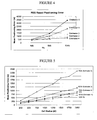
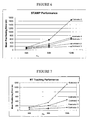
- This graph shows estimator 3 (i.e. the Unbiased MT coordinates estimator) to be the best performing estimator, with a mean positioning error of the order of 200m (c.f. Figure 4 where the mean positioning error for the best estimator in RSS based positioning was of the order of 550m).
- MT Tracking is a technique in which after the setup phase of an LBS session the network constantly monitors the Mobile Terminal position exploiting the regular measurements of RSS and TA. Therefore compared to STAMP technique in MT tracking the RSS measurements are more frequent (every 480ms in GSM) and TA parameter is always available (as the terminal is in dedicated mode).
- Figure 8 provides an overall comparison of the various techniques, showing the overall difference between the worst performing approach (i.e. RSS based positioning using Estimator 0) and the best performing techniques, STAMP and MT Tracking using Estimator 3.
- the worst performing approach i.e. RSS based positioning using Estimator 0
- the best performing techniques STAMP and MT Tracking using Estimator 3.
- Figure 8 provides a comparison between the accuracy provided by RSS based positioning (Estimator 1), CGI, CGI+TA, ECGI (Estimator 4), STAMP (Estimator 0 and 3) and MT Tracking.
- RSS based positioning Estimator 1
- CGI CGI+TA
- ECGI Estimatimator 4
- STAMP Estimatimator 0 and 3
- MT Tracking MT Tracking
- the accuracy of MT tracking based on estimator 3 i.e. which uses estimator 3 for estimating the distances between the MT and the second and third BS and the known Tracking Area (TA) for the estimation of the distance from the first BS
- estimator 3 i.e. which uses estimator 3 for estimating the distances between the MT and the second and third BS and the known Tracking Area (TA) for the estimation of the distance from the first BS
- Figure 8 shows the empirical benefits that are achievable by the estimators of the present invention, particularly when combined with existing position determining techniques, such as STAMP and MT Tracking.
- estimators of these embodiments of the present invention have been derived, taking into account the nature of path-loss propagation models (like Hata and Cost231) and also the error introduced in the estimation of the MT-BS distance as well as the error introduced in the triangulation process.
- the estimators have been shown, via Figures 6 to 8 , to minimise the impact of the position calculation process on the resulting accuracy.
- the results indicate a very significant improvement in the RSS based positioning when applied to a single set of RSS measurements.
- statistical filtering ideally Kalman filtering or an equivalent recursive filter, is applied to the measurements/estimations used and derived in the position determining techniques using the estimators, in order to enhance their accuracy.
- the measurements/estimations in the terminal position estimation to which the Kalman filtering will be applied include the RSS measurements, the MT-BS distance estimation and the trilateration estimation.
- the parameters defined in the vectors of Eq. (35) differ depending on the measurement/estimate to which the Kalman filter is applied. For instance, for:
- W k is a zero mean Gaussian distributed random vector parameter which represents the process noise with a covariance matrix Q :
- W k w 1 t k ⁇ w N t k
- Q ⁇ Q 2 1 0 ... 0 0 ⁇ Q 2 2 ... 0 ... ... ... ... 0 0 ... ⁇ Q 2 N
- U k is also a zero mean Gaussian random vector parameter which represents the measurement noise with a covariance matrix R :
- Kalman Filtering will now be used in three different embodiments of the invention, namely with reference to Figure 2 , being applied to the output of the RSS measurements 21 (Option A), the MT-BS Distance Estimation 22 (Option B) and the MT Position Coordinates Estimation after Trilateration 23 (Option C) and appropriate combined estimators defined.
- the measured RSS is considered to be following a Normal distribution: R ⁇ x i ⁇ N R x i , ⁇ Rx 2
- Figure 9 provides the Kalman Filter gain factor f Rx versus ⁇ Rx based on the theoretical steady state KF performance, as well as according to the simulation which will be discussed below. This Figure shows that the simulation closely follows the theoretical performance, with the RSS KF gain decreasing exponentially as the standard deviation of the RSS measurements increases.
- This model of Figure 10 can be used in order to produce the revised MT-BS distance estimators which fit the RSS Kalman Filtering (option A).
- the revised MT-BS distance estimators in the case of RSS Kalman filtering will be the following:
- Figure 11 also shows an equivalent simplified MT position calculation model where the Kalman Filter has been replaced with the proper statistical characteristics of MT-BS distances. The validity of this equivalent model will be illustrated in the simulation which will be outlined below.
- Kalman filtering on the probability density function of the filter output can be approximated by the following: d ⁇ oB i ⁇ LN ⁇ dB i , ⁇ dB 2 i
- Figure 12 also shows an equivalent simplified MT position calculation model where the Kalman Filter has been replaced with equivalent MT-BS distance statistical characteristics. The validity of this equivalent model will be illustrated in the simulation which will be outlined below.
- This simulation model is based on a mobile network with a geographical area having a set of Base Stations each supporting three cells of equal radius (each cell corresponds to a 120° sector of the geographic area). During the simulation, the position of the MT is randomly selected within this area and the RSS levels from each of the Base Stations are estimated from the Hata model. Also, a Gaussian white noise with variance ⁇ Rx 2 is added to the resulting RSS and a set of RSS measurements is produced at a period ⁇ t.
- MT mobility a Manhattan grid street network is considered and the MT is moving at a speed which is selected uniformly in a range between 10km/hr-60km/hr (typical for an Urban environment). At each cross-road the motion direction of the MT is selected with equal probability from the possible alternative street segments, while the MT speed is reselected from the same range mentioned above. Based on the produced time series of RSS measurements, the MT positioning based on the alternative Kalman Filtering options is applied and the estimated MT position was then compared to the actual MT position to determine the positioning error.
- Tables 1, 2 and 3 provide the MT positioning error for the three different Kalman Filtering options versus the standard deviation of the measured RSS ( ⁇ Rx ). This is provided for both the original estimators (i.e. Estimators 0-4, without KF) and the revised MT-BS distance estimators (i.e. Estimators 1A-4A, 1B-4B and 1C-4C, with KF).
- Table 1 The performance of the RSS Kalman filtering vs. the applied MT-BS distance estimator.
- Estimator 1 which is identical to Estimator 1B (Unbiased MT-BS Distance Estimator) is very close to the optimum performing estimator (revised Estimator 4B).
- the resulting output maintains the bias of the input leading possibly to a higher error, although it has a lower variance (due to the KF gain).
- the best performing estimator (revised estimator 4A) for all KF options actually provides a sub-optimal solution to MT coordinates MSE by balancing the resulting bias and the variance.
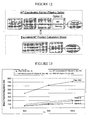
- FIG 13 compares the performance of the KF options based on their best performing estimator (4A, 4B and 4C respectively) as well as the performance of the plain RSS positioning (for Estimator 4).
- RSS Kalman filtering option A remains the best performing Kalman filtering option.
- the above analysis has illustrated the RSS based positioning accuracy optimization in the presence of Kalman filtering and has adapted the error optimization analysis of plain RSS MT positioning to define revised estimators for the following Kalman Filtering options: RSS Kalman filtering, MT-BS distance Kalman Filtering and MT coordinates Kalman filtering.
- a set of MT-BS estimators were derived for each of the Kalman Filtering options.
- Kalman filter as described herein is only to be considered illustrative, and that alternative Kalman configurations are within the scope of the invention.
- alternative filters are possible, particularly other statistical recursive filters capable of estimating the state of a dynamic system. Examples of possible alternatives include Double Exponential Smoothing Filters and Dynamic Data Reconciliation filters.
- Kalman filtering embodiments of the invention were illustrated only in relation to RSS measurements derived from the STAMP and MT Tracking position determining techniques, however the embodiments are applicable to any other tracking technique in which RSS measurements are collected, such as CGI, CGI+TA and ECGI.
- the embodiments of the invention have been described in relation to the mobile terminal monitoring and determining RSS measurements. This is not essential to the invention, and the same functionality may be implemented external to the terminal. For instance, the terminal may forward the RSS measurements to the core network for processing.
- any other suitable parameter applying to communications between the mobile terminal and its adjacent base stations may be used (e.g. Observed Time Difference) as well as measurements associated to other technologies like GPS. More particularly, it is to be appreciated that the estimators according to the embodiments of the invention are particularly applicable to the RSS parameter because of its statistical nature, and other parameters with a similar error distribution.
Landscapes
- Engineering & Computer Science (AREA)
- Physics & Mathematics (AREA)
- General Physics & Mathematics (AREA)
- Radar, Positioning & Navigation (AREA)
- Remote Sensing (AREA)
- Computer Networks & Wireless Communication (AREA)
- Signal Processing (AREA)
- Mobile Radio Communication Systems (AREA)
Applications Claiming Priority (1)
| Application Number | Priority Date | Filing Date | Title |
|---|---|---|---|
| GB0906283A GB2469444A (en) | 2009-04-14 | 2009-04-14 | Terminal positioning |
Related Parent Applications (1)
| Application Number | Title | Priority Date | Filing Date |
|---|---|---|---|
| GB0906283 Previously-Filed-Application | 2009-04-14 |
Publications (2)
| Publication Number | Publication Date |
|---|---|
| EP2249176A1 true EP2249176A1 (fr) | 2010-11-10 |
| EP2249176B1 EP2249176B1 (fr) | 2013-10-09 |
Family
ID=40750461
Family Applications (1)
| Application Number | Title | Priority Date | Filing Date |
|---|---|---|---|
| EP10275033.8A Not-in-force EP2249176B1 (fr) | 2009-04-14 | 2010-04-14 | Technique de positionnement terminal |
Country Status (3)
| Country | Link |
|---|---|
| EP (1) | EP2249176B1 (fr) |
| ES (1) | ES2434015T3 (fr) |
| GB (1) | GB2469444A (fr) |
Cited By (3)
| Publication number | Priority date | Publication date | Assignee | Title |
|---|---|---|---|---|
| US20140171128A1 (en) * | 2011-08-09 | 2014-06-19 | Blackberry Limited | Harvesting communication parameter observations in gnss-denied environments |
| CN110087191A (zh) * | 2018-01-24 | 2019-08-02 | 海能达通信股份有限公司 | 一种时间提前量估算方法及装置 |
| CN116193569A (zh) * | 2021-11-29 | 2023-05-30 | 中移(成都)信息通信科技有限公司 | 一种定位方法、定位装置、定位平台和存储介质 |
Citations (4)
| Publication number | Priority date | Publication date | Assignee | Title |
|---|---|---|---|---|
| EP1315393A1 (fr) * | 2001-11-27 | 2003-05-28 | Alcatel | Procédé pour déterminer la position d'une station mobile sur la base de modèles de propagation |
| WO2003071303A1 (fr) * | 2002-02-25 | 2003-08-28 | Telia Ab (Publ) | Procede de localisation de stations mobiles |
| GB2416461A (en) | 2004-07-20 | 2006-01-25 | Vodafone Plc | System and method for tracing the whereabouts of mobile terminals in mobile communications system |
| WO2006096923A1 (fr) * | 2005-03-18 | 2006-09-21 | Seeker Wireless Pty Limited | Emplacement mobile ameliore |
Family Cites Families (6)
| Publication number | Priority date | Publication date | Assignee | Title |
|---|---|---|---|---|
| FR2754968B1 (fr) * | 1996-10-22 | 1999-06-04 | Sagem | Terminal de telephonie mobile cellulaire localisable |
| DE10159086A1 (de) * | 2001-12-01 | 2003-06-12 | Alcatel Sa | Verfahren zur Bestimmung der Entfernung zwischen einer Mobilstation und einer Basisstation |
| WO2003086005A1 (fr) * | 2002-04-09 | 2003-10-16 | Siemens Aktiengesellschaft | Procede, dispositif, programme informatique comportant des elements de code de programme et produit de programme destines a determiner une position d'un appareil de communication mobile dans un reseau de communication |
| EP1602202A4 (fr) * | 2003-03-13 | 2007-05-23 | Meshnetworks Inc | Systeme et procede en temps reel d'amelioration de la precision de l'emplacement calcule d'abonnes mobiles dans un reseau sans fil ad hoc utilisant une unite de traitement centrale a vitesse lente |
| FR2886501A1 (fr) * | 2005-05-31 | 2006-12-01 | France Telecom | Procede et dispositif de localisattion d'un terminal dans un reseau local sans fil |
| RU2413959C2 (ru) * | 2006-03-06 | 2011-03-10 | Квэлкомм Инкорпорейтед | Способ определения положения путем сшивания измерений |
-
2009
- 2009-04-14 GB GB0906283A patent/GB2469444A/en not_active Withdrawn
-
2010
- 2010-04-14 EP EP10275033.8A patent/EP2249176B1/fr not_active Not-in-force
- 2010-04-14 ES ES10275033T patent/ES2434015T3/es active Active
Patent Citations (4)
| Publication number | Priority date | Publication date | Assignee | Title |
|---|---|---|---|---|
| EP1315393A1 (fr) * | 2001-11-27 | 2003-05-28 | Alcatel | Procédé pour déterminer la position d'une station mobile sur la base de modèles de propagation |
| WO2003071303A1 (fr) * | 2002-02-25 | 2003-08-28 | Telia Ab (Publ) | Procede de localisation de stations mobiles |
| GB2416461A (en) | 2004-07-20 | 2006-01-25 | Vodafone Plc | System and method for tracing the whereabouts of mobile terminals in mobile communications system |
| WO2006096923A1 (fr) * | 2005-03-18 | 2006-09-21 | Seeker Wireless Pty Limited | Emplacement mobile ameliore |
Non-Patent Citations (3)
| Title |
|---|
| HATA M: "EMPIRICAL FORMULA FOR PROPAGATION LOSS IN LAND MOBILE RADIO SERVICES", IEEE TRANSACTIONS ON VEHICULAR TECHNOLOGY, IEEE SERVICE CENTER, PISCATAWAY, NJ, US, vol. VT-29, no. 3, 1 August 1980 (1980-08-01), pages 317 - 325, XP000647130, ISSN: 0018-9545 * |
| MARKOULIDAKIS J G ET AL: "Stamp Accuracy Enhancement Through Received Signal Strength Adaptive Kalman Filtering", IEEE INTERNATIONAL SYMPOSIUM ON PERSONAL, INDOOR AND MOBILE RADIO COMMUNICATIONS. PIMRC, IEEE; PI, XX, 1 September 2007 (2007-09-01), pages 1 - 5, XP031168109, ISBN: 978-1-4244-1143-6 * |
| OROOJI M ET AL: "New Method for Estimation of Mobile Location Based on Signal Attenuation and Hata Model Signal Prediction", ENGINEERING IN MEDICINE AND BIOLOGY SOCIETY, 2005. IEEE-EMBS 2005. 27T H ANNUAL INTERNATIONAL CONFERENCE OF THE SHANGHAI, CHINA 01-04 SEPT. 2005, PISCATAWAY, NJ, USA,IEEE LNKD- DOI:10.1109/IEMBS.2005.1615865, 1 September 2005 (2005-09-01), pages 6025 - 6028, XP010907208, ISBN: 978-0-7803-8741-6 * |
Cited By (4)
| Publication number | Priority date | Publication date | Assignee | Title |
|---|---|---|---|---|
| US20140171128A1 (en) * | 2011-08-09 | 2014-06-19 | Blackberry Limited | Harvesting communication parameter observations in gnss-denied environments |
| US9942698B2 (en) * | 2011-08-09 | 2018-04-10 | Blackberry Limited | Harvesting communication parameter observations in GNSS-denied environments |
| CN110087191A (zh) * | 2018-01-24 | 2019-08-02 | 海能达通信股份有限公司 | 一种时间提前量估算方法及装置 |
| CN116193569A (zh) * | 2021-11-29 | 2023-05-30 | 中移(成都)信息通信科技有限公司 | 一种定位方法、定位装置、定位平台和存储介质 |
Also Published As
| Publication number | Publication date |
|---|---|
| ES2434015T3 (es) | 2013-12-13 |
| EP2249176B1 (fr) | 2013-10-09 |
| GB2469444A (en) | 2010-10-20 |
| GB0906283D0 (en) | 2009-05-20 |
Similar Documents
| Publication | Publication Date | Title |
|---|---|---|
| EP2199820B1 (fr) | Technique de positionnement d'un terminal | |
| CN100367819C (zh) | 用于移动站位置估计的方法和装置 | |
| EP1872150B1 (fr) | Localisation d'unite mobile | |
| JP3740953B2 (ja) | 無線位置測定端末および無線位置測定システム | |
| EP1062825B1 (fr) | Systeme et procede permettant de faire connaitre au reseau les techniques de positionnement gerees par un terminal | |
| CA2782805C (fr) | Determination de la position par zone des terminaux d'un reseau sans fil | |
| EP2046087B1 (fr) | Technique de positionnement terminal | |
| EP3930353B1 (fr) | Appareil et procédé pour la localisation d'un équipement utilisateur | |
| WO2020146711A1 (fr) | Procédé et dispositif de positionnement au moyen d'informations de faisceau | |
| WO2009084859A2 (fr) | Procédé d'estimation d'un différentiel de temps pour des services basés sur la position dans un réseau cellulaire | |
| US8068852B2 (en) | Method and system for detecting position of mobile communication terminal by using pilot strength measurement message | |
| WO2003071303A1 (fr) | Procede de localisation de stations mobiles | |
| EP2249176B1 (fr) | Technique de positionnement terminal | |
| Kouyoumdjieva et al. | Experimental evaluation of precision of a proximity-based indoor positioning system | |
| CN1787679B (zh) | 无线网络控制器确定待定位用户设备的定位方法 | |
| KR100775284B1 (ko) | 무선 측위 시스템을 위한 비가시경로 오차 보정 방법 | |
| KR100625431B1 (ko) | 무선통신망에서의 단말기 위치결정장치 및 그 방법 | |
| US11368812B2 (en) | Method and system for adapting positioning techniques using spatial distribution probabilities | |
| Raja | Critical analysis and modelling of location finding services | |
| Baloch | UMTS Positioning Methods and Accuracy in Urban Environments | |
| KR20070038718A (ko) | 통화 품질 개선 맵 구축 방법 및 시스템 |
Legal Events
| Date | Code | Title | Description |
|---|---|---|---|
| PUAI | Public reference made under article 153(3) epc to a published international application that has entered the european phase |
Free format text: ORIGINAL CODE: 0009012 |
|
| AK | Designated contracting states |
Kind code of ref document: A1 Designated state(s): AT BE BG CH CY CZ DE DK EE ES FI FR GB GR HR HU IE IS IT LI LT LU LV MC MK MT NL NO PL PT RO SE SI SK SM TR |
|
| 17P | Request for examination filed |
Effective date: 20110510 |
|
| 17Q | First examination report despatched |
Effective date: 20120413 |
|
| 17Q | First examination report despatched |
Effective date: 20120427 |
|
| GRAP | Despatch of communication of intention to grant a patent |
Free format text: ORIGINAL CODE: EPIDOSNIGR1 |
|
| GRAJ | Information related to disapproval of communication of intention to grant by the applicant or resumption of examination proceedings by the epo deleted |
Free format text: ORIGINAL CODE: EPIDOSDIGR1 |
|
| RIC1 | Information provided on ipc code assigned before grant |
Ipc: G01S 5/14 20060101ALI20130327BHEP Ipc: G01S 11/06 20060101AFI20130327BHEP |
|
| GRAP | Despatch of communication of intention to grant a patent |
Free format text: ORIGINAL CODE: EPIDOSNIGR1 |
|
| INTG | Intention to grant announced |
Effective date: 20130423 |
|
| INTG | Intention to grant announced |
Effective date: 20130507 |
|
| GRAS | Grant fee paid |
Free format text: ORIGINAL CODE: EPIDOSNIGR3 |
|
| GRAA | (expected) grant |
Free format text: ORIGINAL CODE: 0009210 |
|
| AK | Designated contracting states |
Kind code of ref document: B1 Designated state(s): AT BE BG CH CY CZ DE DK EE ES FI FR GB GR HR HU IE IS IT LI LT LU LV MC MK MT NL NO PL PT RO SE SI SK SM TR |
|
| REG | Reference to a national code |
Ref country code: GB Ref legal event code: FG4D |
|
| REG | Reference to a national code |
Ref country code: CH Ref legal event code: EP Ref country code: AT Ref legal event code: REF Ref document number: 635789 Country of ref document: AT Kind code of ref document: T Effective date: 20131015 |
|
| REG | Reference to a national code |
Ref country code: IE Ref legal event code: FG4D |
|
| REG | Reference to a national code |
Ref country code: DE Ref legal event code: R096 Ref document number: 602010010805 Country of ref document: DE Effective date: 20131205 |
|
| REG | Reference to a national code |
Ref country code: ES Ref legal event code: FG2A Ref document number: 2434015 Country of ref document: ES Kind code of ref document: T3 Effective date: 20131213 |
|
| REG | Reference to a national code |
Ref country code: AT Ref legal event code: MK05 Ref document number: 635789 Country of ref document: AT Kind code of ref document: T Effective date: 20131009 |
|
| REG | Reference to a national code |
Ref country code: NL Ref legal event code: VDEP Effective date: 20131009 |
|
| PG25 | Lapsed in a contracting state [announced via postgrant information from national office to epo] |
Ref country code: SI Free format text: LAPSE BECAUSE OF FAILURE TO SUBMIT A TRANSLATION OF THE DESCRIPTION OR TO PAY THE FEE WITHIN THE PRESCRIBED TIME-LIMIT Effective date: 20131009 |
|
| REG | Reference to a national code |
Ref country code: LT Ref legal event code: MG4D |
|
| PG25 | Lapsed in a contracting state [announced via postgrant information from national office to epo] |
Ref country code: IS Free format text: LAPSE BECAUSE OF FAILURE TO SUBMIT A TRANSLATION OF THE DESCRIPTION OR TO PAY THE FEE WITHIN THE PRESCRIBED TIME-LIMIT Effective date: 20140209 Ref country code: NL Free format text: LAPSE BECAUSE OF FAILURE TO SUBMIT A TRANSLATION OF THE DESCRIPTION OR TO PAY THE FEE WITHIN THE PRESCRIBED TIME-LIMIT Effective date: 20131009 Ref country code: LT Free format text: LAPSE BECAUSE OF FAILURE TO SUBMIT A TRANSLATION OF THE DESCRIPTION OR TO PAY THE FEE WITHIN THE PRESCRIBED TIME-LIMIT Effective date: 20131009 Ref country code: BE Free format text: LAPSE BECAUSE OF FAILURE TO SUBMIT A TRANSLATION OF THE DESCRIPTION OR TO PAY THE FEE WITHIN THE PRESCRIBED TIME-LIMIT Effective date: 20131009 Ref country code: HR Free format text: LAPSE BECAUSE OF FAILURE TO SUBMIT A TRANSLATION OF THE DESCRIPTION OR TO PAY THE FEE WITHIN THE PRESCRIBED TIME-LIMIT Effective date: 20131009 Ref country code: NO Free format text: LAPSE BECAUSE OF FAILURE TO SUBMIT A TRANSLATION OF THE DESCRIPTION OR TO PAY THE FEE WITHIN THE PRESCRIBED TIME-LIMIT Effective date: 20140109 Ref country code: SE Free format text: LAPSE BECAUSE OF FAILURE TO SUBMIT A TRANSLATION OF THE DESCRIPTION OR TO PAY THE FEE WITHIN THE PRESCRIBED TIME-LIMIT Effective date: 20131009 Ref country code: FI Free format text: LAPSE BECAUSE OF FAILURE TO SUBMIT A TRANSLATION OF THE DESCRIPTION OR TO PAY THE FEE WITHIN THE PRESCRIBED TIME-LIMIT Effective date: 20131009 |
|
| PG25 | Lapsed in a contracting state [announced via postgrant information from national office to epo] |
Ref country code: AT Free format text: LAPSE BECAUSE OF FAILURE TO SUBMIT A TRANSLATION OF THE DESCRIPTION OR TO PAY THE FEE WITHIN THE PRESCRIBED TIME-LIMIT Effective date: 20131009 Ref country code: LV Free format text: LAPSE BECAUSE OF FAILURE TO SUBMIT A TRANSLATION OF THE DESCRIPTION OR TO PAY THE FEE WITHIN THE PRESCRIBED TIME-LIMIT Effective date: 20131009 Ref country code: CY Free format text: LAPSE BECAUSE OF FAILURE TO SUBMIT A TRANSLATION OF THE DESCRIPTION OR TO PAY THE FEE WITHIN THE PRESCRIBED TIME-LIMIT Effective date: 20131009 Ref country code: PL Free format text: LAPSE BECAUSE OF FAILURE TO SUBMIT A TRANSLATION OF THE DESCRIPTION OR TO PAY THE FEE WITHIN THE PRESCRIBED TIME-LIMIT Effective date: 20131009 |
|
| PG25 | Lapsed in a contracting state [announced via postgrant information from national office to epo] |
Ref country code: PT Free format text: LAPSE BECAUSE OF FAILURE TO SUBMIT A TRANSLATION OF THE DESCRIPTION OR TO PAY THE FEE WITHIN THE PRESCRIBED TIME-LIMIT Effective date: 20140210 |
|
| REG | Reference to a national code |
Ref country code: DE Ref legal event code: R097 Ref document number: 602010010805 Country of ref document: DE |
|
| PG25 | Lapsed in a contracting state [announced via postgrant information from national office to epo] |
Ref country code: EE Free format text: LAPSE BECAUSE OF FAILURE TO SUBMIT A TRANSLATION OF THE DESCRIPTION OR TO PAY THE FEE WITHIN THE PRESCRIBED TIME-LIMIT Effective date: 20131009 |
|
| PLBE | No opposition filed within time limit |
Free format text: ORIGINAL CODE: 0009261 |
|
| STAA | Information on the status of an ep patent application or granted ep patent |
Free format text: STATUS: NO OPPOSITION FILED WITHIN TIME LIMIT |
|
| PG25 | Lapsed in a contracting state [announced via postgrant information from national office to epo] |
Ref country code: SK Free format text: LAPSE BECAUSE OF FAILURE TO SUBMIT A TRANSLATION OF THE DESCRIPTION OR TO PAY THE FEE WITHIN THE PRESCRIBED TIME-LIMIT Effective date: 20131009 Ref country code: RO Free format text: LAPSE BECAUSE OF FAILURE TO SUBMIT A TRANSLATION OF THE DESCRIPTION OR TO PAY THE FEE WITHIN THE PRESCRIBED TIME-LIMIT Effective date: 20131009 Ref country code: CZ Free format text: LAPSE BECAUSE OF FAILURE TO SUBMIT A TRANSLATION OF THE DESCRIPTION OR TO PAY THE FEE WITHIN THE PRESCRIBED TIME-LIMIT Effective date: 20131009 |
|
| 26N | No opposition filed |
Effective date: 20140710 |
|
| PG25 | Lapsed in a contracting state [announced via postgrant information from national office to epo] |
Ref country code: DK Free format text: LAPSE BECAUSE OF FAILURE TO SUBMIT A TRANSLATION OF THE DESCRIPTION OR TO PAY THE FEE WITHIN THE PRESCRIBED TIME-LIMIT Effective date: 20131009 |
|
| REG | Reference to a national code |
Ref country code: DE Ref legal event code: R097 Ref document number: 602010010805 Country of ref document: DE Effective date: 20140710 |
|
| PG25 | Lapsed in a contracting state [announced via postgrant information from national office to epo] |
Ref country code: MC Free format text: LAPSE BECAUSE OF FAILURE TO SUBMIT A TRANSLATION OF THE DESCRIPTION OR TO PAY THE FEE WITHIN THE PRESCRIBED TIME-LIMIT Effective date: 20131009 Ref country code: LU Free format text: LAPSE BECAUSE OF FAILURE TO SUBMIT A TRANSLATION OF THE DESCRIPTION OR TO PAY THE FEE WITHIN THE PRESCRIBED TIME-LIMIT Effective date: 20140414 |
|
| REG | Reference to a national code |
Ref country code: CH Ref legal event code: PL |
|
| REG | Reference to a national code |
Ref country code: IE Ref legal event code: MM4A |
|
| PG25 | Lapsed in a contracting state [announced via postgrant information from national office to epo] |
Ref country code: LI Free format text: LAPSE BECAUSE OF NON-PAYMENT OF DUE FEES Effective date: 20140430 Ref country code: CH Free format text: LAPSE BECAUSE OF NON-PAYMENT OF DUE FEES Effective date: 20140430 |
|
| REG | Reference to a national code |
Ref country code: FR Ref legal event code: PLFP Year of fee payment: 6 |
|
| PG25 | Lapsed in a contracting state [announced via postgrant information from national office to epo] |
Ref country code: IE Free format text: LAPSE BECAUSE OF NON-PAYMENT OF DUE FEES Effective date: 20140414 |
|
| PGFP | Annual fee paid to national office [announced via postgrant information from national office to epo] |
Ref country code: GB Payment date: 20150420 Year of fee payment: 6 Ref country code: ES Payment date: 20150427 Year of fee payment: 6 Ref country code: DE Payment date: 20150421 Year of fee payment: 6 |
|
| PGFP | Annual fee paid to national office [announced via postgrant information from national office to epo] |
Ref country code: FR Payment date: 20150421 Year of fee payment: 6 Ref country code: IT Payment date: 20150422 Year of fee payment: 6 |
|
| PG25 | Lapsed in a contracting state [announced via postgrant information from national office to epo] |
Ref country code: MT Free format text: LAPSE BECAUSE OF FAILURE TO SUBMIT A TRANSLATION OF THE DESCRIPTION OR TO PAY THE FEE WITHIN THE PRESCRIBED TIME-LIMIT Effective date: 20131009 |
|
| PG25 | Lapsed in a contracting state [announced via postgrant information from national office to epo] |
Ref country code: SM Free format text: LAPSE BECAUSE OF FAILURE TO SUBMIT A TRANSLATION OF THE DESCRIPTION OR TO PAY THE FEE WITHIN THE PRESCRIBED TIME-LIMIT Effective date: 20131009 |
|
| PG25 | Lapsed in a contracting state [announced via postgrant information from national office to epo] |
Ref country code: GR Free format text: LAPSE BECAUSE OF FAILURE TO SUBMIT A TRANSLATION OF THE DESCRIPTION OR TO PAY THE FEE WITHIN THE PRESCRIBED TIME-LIMIT Effective date: 20140110 Ref country code: BG Free format text: LAPSE BECAUSE OF FAILURE TO SUBMIT A TRANSLATION OF THE DESCRIPTION OR TO PAY THE FEE WITHIN THE PRESCRIBED TIME-LIMIT Effective date: 20131009 |
|
| PG25 | Lapsed in a contracting state [announced via postgrant information from national office to epo] |
Ref country code: TR Free format text: LAPSE BECAUSE OF FAILURE TO SUBMIT A TRANSLATION OF THE DESCRIPTION OR TO PAY THE FEE WITHIN THE PRESCRIBED TIME-LIMIT Effective date: 20131009 Ref country code: HU Free format text: LAPSE BECAUSE OF FAILURE TO SUBMIT A TRANSLATION OF THE DESCRIPTION OR TO PAY THE FEE WITHIN THE PRESCRIBED TIME-LIMIT; INVALID AB INITIO Effective date: 20100414 |
|
| REG | Reference to a national code |
Ref country code: DE Ref legal event code: R119 Ref document number: 602010010805 Country of ref document: DE |
|
| GBPC | Gb: european patent ceased through non-payment of renewal fee |
Effective date: 20160414 |
|
| REG | Reference to a national code |
Ref country code: FR Ref legal event code: ST Effective date: 20161230 |
|
| PG25 | Lapsed in a contracting state [announced via postgrant information from national office to epo] |
Ref country code: DE Free format text: LAPSE BECAUSE OF NON-PAYMENT OF DUE FEES Effective date: 20161101 Ref country code: GB Free format text: LAPSE BECAUSE OF NON-PAYMENT OF DUE FEES Effective date: 20160414 Ref country code: FR Free format text: LAPSE BECAUSE OF NON-PAYMENT OF DUE FEES Effective date: 20160502 |
|
| PG25 | Lapsed in a contracting state [announced via postgrant information from national office to epo] |
Ref country code: IT Free format text: LAPSE BECAUSE OF NON-PAYMENT OF DUE FEES Effective date: 20160414 |
|
| PG25 | Lapsed in a contracting state [announced via postgrant information from national office to epo] |
Ref country code: ES Free format text: LAPSE BECAUSE OF NON-PAYMENT OF DUE FEES Effective date: 20160415 |
|
| PG25 | Lapsed in a contracting state [announced via postgrant information from national office to epo] |
Ref country code: MK Free format text: LAPSE BECAUSE OF FAILURE TO SUBMIT A TRANSLATION OF THE DESCRIPTION OR TO PAY THE FEE WITHIN THE PRESCRIBED TIME-LIMIT Effective date: 20131009 |
|
| REG | Reference to a national code |
Ref country code: ES Ref legal event code: FD2A Effective date: 20181122 |