EP2249958B1 - Réacteur pour la préparation de méthanol - Google Patents
Réacteur pour la préparation de méthanol Download PDFInfo
- Publication number
- EP2249958B1 EP2249958B1 EP09714360A EP09714360A EP2249958B1 EP 2249958 B1 EP2249958 B1 EP 2249958B1 EP 09714360 A EP09714360 A EP 09714360A EP 09714360 A EP09714360 A EP 09714360A EP 2249958 B1 EP2249958 B1 EP 2249958B1
- Authority
- EP
- European Patent Office
- Prior art keywords
- catalyst
- methanol
- deq
- tbw
- synthesis gas
- Prior art date
- Legal status (The legal status is an assumption and is not a legal conclusion. Google has not performed a legal analysis and makes no representation as to the accuracy of the status listed.)
- Active
Links
Images




Classifications
-
- B—PERFORMING OPERATIONS; TRANSPORTING
- B01—PHYSICAL OR CHEMICAL PROCESSES OR APPARATUS IN GENERAL
- B01J—CHEMICAL OR PHYSICAL PROCESSES, e.g. CATALYSIS OR COLLOID CHEMISTRY; THEIR RELEVANT APPARATUS
- B01J8/00—Chemical or physical processes in general, conducted in the presence of fluids and solid particles; Apparatus for such processes
- B01J8/02—Chemical or physical processes in general, conducted in the presence of fluids and solid particles; Apparatus for such processes with stationary particles, e.g. in fixed beds
- B01J8/06—Chemical or physical processes in general, conducted in the presence of fluids and solid particles; Apparatus for such processes with stationary particles, e.g. in fixed beds in tube reactors; the solid particles being arranged in tubes
-
- B—PERFORMING OPERATIONS; TRANSPORTING
- B01—PHYSICAL OR CHEMICAL PROCESSES OR APPARATUS IN GENERAL
- B01J—CHEMICAL OR PHYSICAL PROCESSES, e.g. CATALYSIS OR COLLOID CHEMISTRY; THEIR RELEVANT APPARATUS
- B01J8/00—Chemical or physical processes in general, conducted in the presence of fluids and solid particles; Apparatus for such processes
- B01J8/02—Chemical or physical processes in general, conducted in the presence of fluids and solid particles; Apparatus for such processes with stationary particles, e.g. in fixed beds
- B01J8/0285—Heating or cooling the reactor
-
- B—PERFORMING OPERATIONS; TRANSPORTING
- B01—PHYSICAL OR CHEMICAL PROCESSES OR APPARATUS IN GENERAL
- B01J—CHEMICAL OR PHYSICAL PROCESSES, e.g. CATALYSIS OR COLLOID CHEMISTRY; THEIR RELEVANT APPARATUS
- B01J8/00—Chemical or physical processes in general, conducted in the presence of fluids and solid particles; Apparatus for such processes
- B01J8/008—Details of the reactor or of the particulate material; Processes to increase or to retard the rate of reaction
- B01J8/009—Membranes, e.g. feeding or removing reactants or products to or from the catalyst bed through a membrane
-
- B—PERFORMING OPERATIONS; TRANSPORTING
- B01—PHYSICAL OR CHEMICAL PROCESSES OR APPARATUS IN GENERAL
- B01J—CHEMICAL OR PHYSICAL PROCESSES, e.g. CATALYSIS OR COLLOID CHEMISTRY; THEIR RELEVANT APPARATUS
- B01J8/00—Chemical or physical processes in general, conducted in the presence of fluids and solid particles; Apparatus for such processes
- B01J8/02—Chemical or physical processes in general, conducted in the presence of fluids and solid particles; Apparatus for such processes with stationary particles, e.g. in fixed beds
- B01J8/0207—Chemical or physical processes in general, conducted in the presence of fluids and solid particles; Apparatus for such processes with stationary particles, e.g. in fixed beds the fluid flow within the bed being predominantly horizontal
- B01J8/0214—Chemical or physical processes in general, conducted in the presence of fluids and solid particles; Apparatus for such processes with stationary particles, e.g. in fixed beds the fluid flow within the bed being predominantly horizontal in a cylindrical annular shaped bed
-
- B—PERFORMING OPERATIONS; TRANSPORTING
- B01—PHYSICAL OR CHEMICAL PROCESSES OR APPARATUS IN GENERAL
- B01J—CHEMICAL OR PHYSICAL PROCESSES, e.g. CATALYSIS OR COLLOID CHEMISTRY; THEIR RELEVANT APPARATUS
- B01J8/00—Chemical or physical processes in general, conducted in the presence of fluids and solid particles; Apparatus for such processes
- B01J8/02—Chemical or physical processes in general, conducted in the presence of fluids and solid particles; Apparatus for such processes with stationary particles, e.g. in fixed beds
- B01J8/0292—Chemical or physical processes in general, conducted in the presence of fluids and solid particles; Apparatus for such processes with stationary particles, e.g. in fixed beds with stationary packing material in the bed, e.g. bricks, wire rings, baffles
-
- B—PERFORMING OPERATIONS; TRANSPORTING
- B01—PHYSICAL OR CHEMICAL PROCESSES OR APPARATUS IN GENERAL
- B01J—CHEMICAL OR PHYSICAL PROCESSES, e.g. CATALYSIS OR COLLOID CHEMISTRY; THEIR RELEVANT APPARATUS
- B01J8/00—Chemical or physical processes in general, conducted in the presence of fluids and solid particles; Apparatus for such processes
- B01J8/02—Chemical or physical processes in general, conducted in the presence of fluids and solid particles; Apparatus for such processes with stationary particles, e.g. in fixed beds
- B01J8/06—Chemical or physical processes in general, conducted in the presence of fluids and solid particles; Apparatus for such processes with stationary particles, e.g. in fixed beds in tube reactors; the solid particles being arranged in tubes
- B01J8/065—Feeding reactive fluids
-
- B—PERFORMING OPERATIONS; TRANSPORTING
- B01—PHYSICAL OR CHEMICAL PROCESSES OR APPARATUS IN GENERAL
- B01J—CHEMICAL OR PHYSICAL PROCESSES, e.g. CATALYSIS OR COLLOID CHEMISTRY; THEIR RELEVANT APPARATUS
- B01J8/00—Chemical or physical processes in general, conducted in the presence of fluids and solid particles; Apparatus for such processes
- B01J8/02—Chemical or physical processes in general, conducted in the presence of fluids and solid particles; Apparatus for such processes with stationary particles, e.g. in fixed beds
- B01J8/06—Chemical or physical processes in general, conducted in the presence of fluids and solid particles; Apparatus for such processes with stationary particles, e.g. in fixed beds in tube reactors; the solid particles being arranged in tubes
- B01J8/067—Heating or cooling the reactor
-
- C—CHEMISTRY; METALLURGY
- C07—ORGANIC CHEMISTRY
- C07C—ACYCLIC OR CARBOCYCLIC COMPOUNDS
- C07C29/00—Preparation of compounds having hydroxy or O-metal groups bound to a carbon atom not belonging to a six-membered aromatic ring
- C07C29/15—Preparation of compounds having hydroxy or O-metal groups bound to a carbon atom not belonging to a six-membered aromatic ring by reduction of oxides of carbon exclusively
- C07C29/151—Preparation of compounds having hydroxy or O-metal groups bound to a carbon atom not belonging to a six-membered aromatic ring by reduction of oxides of carbon exclusively with hydrogen or hydrogen-containing gases
- C07C29/152—Preparation of compounds having hydroxy or O-metal groups bound to a carbon atom not belonging to a six-membered aromatic ring by reduction of oxides of carbon exclusively with hydrogen or hydrogen-containing gases characterised by the reactor used
-
- C—CHEMISTRY; METALLURGY
- C07—ORGANIC CHEMISTRY
- C07C—ACYCLIC OR CARBOCYCLIC COMPOUNDS
- C07C31/00—Saturated compounds having hydroxy or O-metal groups bound to acyclic carbon atoms
- C07C31/02—Monohydroxylic acyclic alcohols
- C07C31/04—Methanol
-
- B—PERFORMING OPERATIONS; TRANSPORTING
- B01—PHYSICAL OR CHEMICAL PROCESSES OR APPARATUS IN GENERAL
- B01J—CHEMICAL OR PHYSICAL PROCESSES, e.g. CATALYSIS OR COLLOID CHEMISTRY; THEIR RELEVANT APPARATUS
- B01J2208/00—Processes carried out in the presence of solid particles; Reactors therefor
- B01J2208/00008—Controlling the process
- B01J2208/00017—Controlling the temperature
- B01J2208/00106—Controlling the temperature by indirect heat exchange
- B01J2208/00115—Controlling the temperature by indirect heat exchange with heat exchange elements inside the bed of solid particles
-
- B—PERFORMING OPERATIONS; TRANSPORTING
- B01—PHYSICAL OR CHEMICAL PROCESSES OR APPARATUS IN GENERAL
- B01J—CHEMICAL OR PHYSICAL PROCESSES, e.g. CATALYSIS OR COLLOID CHEMISTRY; THEIR RELEVANT APPARATUS
- B01J2208/00—Processes carried out in the presence of solid particles; Reactors therefor
- B01J2208/00008—Controlling the process
- B01J2208/00017—Controlling the temperature
- B01J2208/00106—Controlling the temperature by indirect heat exchange
- B01J2208/00115—Controlling the temperature by indirect heat exchange with heat exchange elements inside the bed of solid particles
- B01J2208/00123—Fingers
-
- B—PERFORMING OPERATIONS; TRANSPORTING
- B01—PHYSICAL OR CHEMICAL PROCESSES OR APPARATUS IN GENERAL
- B01J—CHEMICAL OR PHYSICAL PROCESSES, e.g. CATALYSIS OR COLLOID CHEMISTRY; THEIR RELEVANT APPARATUS
- B01J2208/00—Processes carried out in the presence of solid particles; Reactors therefor
- B01J2208/00008—Controlling the process
- B01J2208/00017—Controlling the temperature
- B01J2208/00106—Controlling the temperature by indirect heat exchange
- B01J2208/00115—Controlling the temperature by indirect heat exchange with heat exchange elements inside the bed of solid particles
- B01J2208/00132—Tubes
-
- B—PERFORMING OPERATIONS; TRANSPORTING
- B01—PHYSICAL OR CHEMICAL PROCESSES OR APPARATUS IN GENERAL
- B01J—CHEMICAL OR PHYSICAL PROCESSES, e.g. CATALYSIS OR COLLOID CHEMISTRY; THEIR RELEVANT APPARATUS
- B01J2208/00—Processes carried out in the presence of solid particles; Reactors therefor
- B01J2208/00008—Controlling the process
- B01J2208/00017—Controlling the temperature
- B01J2208/00106—Controlling the temperature by indirect heat exchange
- B01J2208/00115—Controlling the temperature by indirect heat exchange with heat exchange elements inside the bed of solid particles
- B01J2208/0015—Plates; Cylinders
-
- B—PERFORMING OPERATIONS; TRANSPORTING
- B01—PHYSICAL OR CHEMICAL PROCESSES OR APPARATUS IN GENERAL
- B01J—CHEMICAL OR PHYSICAL PROCESSES, e.g. CATALYSIS OR COLLOID CHEMISTRY; THEIR RELEVANT APPARATUS
- B01J2208/00—Processes carried out in the presence of solid particles; Reactors therefor
- B01J2208/00008—Controlling the process
- B01J2208/00017—Controlling the temperature
- B01J2208/00106—Controlling the temperature by indirect heat exchange
- B01J2208/00168—Controlling the temperature by indirect heat exchange with heat exchange elements outside the bed of solid particles
- B01J2208/00212—Plates; Jackets; Cylinders
-
- B—PERFORMING OPERATIONS; TRANSPORTING
- B01—PHYSICAL OR CHEMICAL PROCESSES OR APPARATUS IN GENERAL
- B01J—CHEMICAL OR PHYSICAL PROCESSES, e.g. CATALYSIS OR COLLOID CHEMISTRY; THEIR RELEVANT APPARATUS
- B01J2219/00—Chemical, physical or physico-chemical processes in general; Their relevant apparatus
- B01J2219/00761—Details of the reactor
- B01J2219/00763—Baffles
- B01J2219/00765—Baffles attached to the reactor wall
- B01J2219/0077—Baffles attached to the reactor wall inclined
- B01J2219/00772—Baffles attached to the reactor wall inclined in a helix
-
- Y—GENERAL TAGGING OF NEW TECHNOLOGICAL DEVELOPMENTS; GENERAL TAGGING OF CROSS-SECTIONAL TECHNOLOGIES SPANNING OVER SEVERAL SECTIONS OF THE IPC; TECHNICAL SUBJECTS COVERED BY FORMER USPC CROSS-REFERENCE ART COLLECTIONS [XRACs] AND DIGESTS
- Y02—TECHNOLOGIES OR APPLICATIONS FOR MITIGATION OR ADAPTATION AGAINST CLIMATE CHANGE
- Y02P—CLIMATE CHANGE MITIGATION TECHNOLOGIES IN THE PRODUCTION OR PROCESSING OF GOODS
- Y02P20/00—Technologies relating to chemical industry
- Y02P20/50—Improvements relating to the production of bulk chemicals
- Y02P20/52—Improvements relating to the production of bulk chemicals using catalysts, e.g. selective catalysts
Definitions
- the present invention relates to the industrial production of methanol by conversion of a synthesis gas containing hydrogen, carbon monoxide and carbon dioxide in the presence of a methanol synthesis catalyst.
- the invention relates in particular to a reactor allowing improved methanol reaction equilibrium condition and thereby reduced or eliminated synthesis gas recirculation by in situ separation of methanol as it is formed from the synthesis gas.
- the catalyst temperature In order to operate below the gas dew point, the catalyst temperature has to be reduced below the optimal temperature level for the catalytic reaction.
- the lower temperature results in a lower activity, which increases the necessary catalyst volume and cost of the reactor.
- the second problem involves the condensation of methanol in the porous catalyst.
- the synthesis gas has to diffuse inside the catalyst through the pore system to initiate the catalytic reaction. If the pores are filled with methanol, the diffusion rate and catalytic activity are severely reduced.
- the present invention provides in general an improved design of a catalytic method and reactor for the production of methanol at equilibrium conditions, whereby methanol as it is formed is separated from the gaseous phase into the liquid phase within the reactor without reducing the catalytic activity of the methanol catalyst.
- This is achieved by adjusting the boiling point or temperature of a liquid cooling agent being in indirect contact with the catalyst particles and by providing a specific ratio of catalyst bed volume to cooling surface area. Thereby, condensation of methanol as it is formed in the gaseous phase takes place at the cooling surface being arranged evenly distributed within the reactor.
- the invention is a reactor for the production of methanol in accordance with claims 1 to 3.
- a specific embodiment of the reactor is defined in claim 4.
- the invention provides furthermore a method for the production of methanol in accordance with claims 5 to 7.
- the type of reactor for use in the invention is of minor importance.
- the required temperature or boiling point of the liquid cooling agent will be the same for any of the reactor types and the catalyst volume to cooling surface area will be identical after correction for the different geometry.
- the “temperature” of the liquid cooling agent is the average temperature, defined as the cooling agent temperature after having received half of the total transferred heat. For vapour rising reactors the average temperature will be close to the bubble point temperature of the liquid cooling agent.
- vapour rising methanol reactors Most useful methanol reactors are the vapour rising types of reactor.
- the three principal vapour rising methanol reactor types are:
- Reactor type 2 where synthesis gas enters at the top of the catalytic bed and the liquid cooling agent is indirectly surrounded by a catalyst bed, and the synthesis gas and condensed liquid moves concurrently downwards.
- An example of such a reactor is shown in Figure 9 .
- Reactor type 3 where synthesis gas enters perpendicular to the cylindrical reactor axis and the liquid cooling agent is indirectly surrounded by a catalyst bed and the synthesis gas and condensed liquid methanol pass in radial manner through the reactor.
- An example of such a reactor is shown in Figure 11 .
- the catalytic activity is kept high by avoiding condensation through adjustment of the ratio between the catalyst volume and the cooling surface area together with a specific temperature of the liquid cooling agent as described in detail below.
- the length of transport path of methanol being produced in the catalyst bed is adjusted to a length at which the methanol concentration in the catalytic bed is suitable low that the heat of reaction increases to a temperature, where it compensates for the amount of heat removed by the same transport length. At the same time ensures the temperature of cooling surface that the temperature is sufficiently low that condensation takes place, and the catalytic bed temperature is so high that condensation on the catalyst is avoided and a high reaction rate is maintained.
- the heat that needs to be removed from the reactor is of such a magnitude that for any practical reason it can only be removed by evaporation heat or by heat exchange with a liquid cooling agent.
- the surface temperature of the cooling area is close to that of the temperature of the liquid cooling agent.
- the heat of production must be sufficiently high to compensate for the heat removed on the cooling area by increasing the ratio of catalyst volume to cooling surface area and the ratio of catalyst volume to cooling surface area must be adequate to the transport of the produced methanol vapour to the cooling surface.
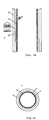
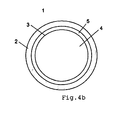
- Liquid re-entrainment may be avoided by reducing the flow resistance of the downwards flowing raw methanol on the cooling surface, by employing e.g. catalyst particles with an equivalent diameter of more than 0.002m and/or by means of a liquid film stabilizer, as shown in Figures 1-7 .
- Liquid methanol re-entrainment into the catalyst bed may also be avoided by introducing a heating area into the reactor that maintains temperature of the catalyst bed above the dew point of methanol.
- the heating area will also keep the catalyst temperature above the dew point in cases where the heat production is insufficient for maintaining the catalyst temperature above the dew point.
- the heating area shall, as for the cooling area, be evenly distributed within the catalyst bed in order to obtain a forced temperature gradient in the bed. Since the heat production is higher at the synthesis gas inlet side of the reactor as compared to the outlet side of the reactor, the heating area may cool the catalyst bed at the inlet region of the reactor and solely heat the catalyst bed in the reactor outlet region. It is preferred to introduce the cooling agent in a concurrent flow direction with the synthesis gas.
- the heating agent for use in the heating area is preferably boiler feed water, steam or a mixture of these.
- the pressure of the heating agent is preferably between about 2.3 MPa and about 6.4 MPa.
- the main advantage of the method and reactor of this invention is a high conversion of methanol synthesis gas in the reactor obtained by continuous removal of the formed methanol from the gaseous phase into the liquid phase on a cooling surface through condensation. Therefore, the methanol process can be carried out in once through mode without recirculation of unconverted synthesis gas.
- an advantage of the present invention is an increased steam production, since the heat of condensation is utilized in the reactor for steam production, whereas the condensation heat typically is removed in a subsequent water cooled condenser. If the reaction heat is removed by heating boiler feed water, the boiler feed water can subsequently be cooled by flashing of the formed steam in an external flash drum.
- the ratio of catalyst volume to cooling surface area can be calculated by Equation 2 using the design value L, which has a number of between 0.4 and 5:
- VCAT / ACOOL m 3 / m 2 K * L * G * DEQ m * 220 - TBW 0.5 where:
- ACOOL is the total inner area of the catalyst tubes. If the catalyst tubes have longitudinal inner fins, ACOOL is the outer area of the largest cylinders enclosed by the finned tubes.
- ACOOL is the total outer area of the cooling tubes containing the liquid cooling agent with an average temperature of TBW. If the catalyst tubes have longitudinal fins, ACOOL is the outer area of the smallest cylinders enclosing the finned tubes.
- ACOOL is the total outer area of the smallest rectangular enclosing the heat exchange plates.
- a second heating area AREHEAT [m 2 ] into reactor types 2 and 3 as defined previously. This second heating area will ensure that the catalyst temperature is maintained above the dew point of methanol.
- the heating agent used in the heat area can be boiler feed water, steam or a mixture of these with a boiling point of between 220°C and 280°C for the liquid media or a dew point must be between 220°C and 280°C for steam.
- Reactor design and process conditions for a method and reactor of the above discussed type 1 are determined by means of the following equations based on predetermined values of:
Landscapes
- Chemical & Material Sciences (AREA)
- Organic Chemistry (AREA)
- Chemical Kinetics & Catalysis (AREA)
- Physics & Mathematics (AREA)
- Fluid Mechanics (AREA)
- Organic Low-Molecular-Weight Compounds And Preparation Thereof (AREA)
- Devices And Processes Conducted In The Presence Of Fluids And Solid Particles (AREA)
- Low-Molecular Organic Synthesis Reactions Using Catalysts (AREA)
- Catalysts (AREA)
Claims (7)
- Un réacteur pour la production de méthanol comprenant, dans une coquille commune, une pluralité de tubes de catalyseur, avec des particules de catalyseur fixées du côté tube de ces tubes de catalyseur, aux fins de conversion d'un gaz de synthèse comprenant de l'hydrogène, du monoxyde de carbone et du dioxyde de carbone, chacun d'entre eux en une proportion permettant d'obtenir une valeur de module d'entrée M, et contenant une fraction d'inertes A, et un agent de refroidissement liquide sous pression, du côté coquille de ces tubes de catalyseur, présentant une température du point d'ébullition (TBW) conduisant à une valeur H comprise entre 0,5 et 1,8 conforme à l'équation 1, et un rapport volume tassé des particules de catalyseur stabilisées/surface des tubes de catalyseur (VCAT/ACOOL) correspondant à une valeur L comprise entre 0,4 et 5 conforme à l'équation 2, et où:


équations dans lesquelles:M = {Y(H2)-Y(CO2)} / {Y(CO)+Y(CO2)};A = 1,0-Y(CO)-Y(H2)-Y(CO2)-Y{(CH3OH)-Y(H2O};B = Y (CO) / Y (CO2);C = 1,0 si M est inférieur à 2,0, sinon C= Exp [(0,2* (M - 2,0)];D = [0,072*Ln(B)+0,244]*C*(1,125-2,5*A)*(0,478+ P / 25,2);E = Exp {(P-13,2) / 30,1};K = 0,027 (constante géométrique);G = {[MW-Y(CH3OH)*32-15,5*J} / [(1-D)*29*J];J = {(Y(CO)+Y(CO2} si M est supérieur à 2,0, sinon J= Y(H2)*(B+1) / (2*B+3)DEQ1 = {6*(volume de particules du catalyseur de synthèse du méthanol [m3] /3,14}0,33, avec des particules de catalyseur de même dimension et avec des particules de catalyseur de dimensions différentes;DEQ2 = {∑w(i)*DEQ(i)3} 0,33, où w(i) est la fraction pondérale de particules de catalyseur présentant un diamètre équivalent à DEQ(i)/[m];et
P [MPa] est la pression absolue du gaz de synthèse à l'entrée du réacteur; MW[kg/kmol] est le poids moléculaire moyen du gaz de synthèse à l'entrée du réacteurY(x) (fraction molaire) est la concentration de chacun des composants à l'entrée du réacteur;LN est le logarithme naturel pour de base 2,71828;et
Exp est l'antilogarithme naturel ou la fonction exponentielle de base 2,71828 - Un réacteur pour la production de méthanol comprenant, dans une coquille commune, un lit catalytique contenant une charge de catalyseur, aux fins de conversion en méthanol d'un gaz de synthèse comprenant de l'hydrogène, du monoxyde de carbone et du dioxyde de carbone, en une proportion permettant d'obtenir une valeur de module d'entrée M, et contenant une fraction d'inertes A, et dans la charge catalytique une unité d'échange de chaleur, cette unité d'échange de chaleur consistant en une pluralité de tubes, une pluralité de tubes ailettés ou une pluralité d'échangeurs de chaleur plats répartis de façon homogène dans la charge catalytique et formant une surface de refroidissement, l'unité d'échange thermique étant refroidie par un agent de refroidissement liquide sous pression, procédé dans lequel la température du point d'ébullition de l'agent de refroidissement liquide a une température de point d'ébullition (TBW) conduisant à une valeur H comprise entre 0,5 et 1,8, déterminée à l'aide de l'équation 1, et dans lequel le rapport volume tassé de la charge de catalyseur / surface de l'unité d'échange thermique (VCAT/ACOOL) est réglé pour conduire à une valeur L comprise entre 0,4 et 5 calculée à l'aide de l'équation 2 et où:


équations dans lesquelles:M = {Y(H2)-Y(CO2)} / {Y(CO)+Y(CO2)} ;A = 1,0-Y(CO)-Y(H2)-Y(CO2)-Y{(CH3OH)-Y(H2O} ;B = Y(CO)/Y(CO2);C = 1,0 si M est inférieur à 2,0, sinon C= Exp [(0,2* (M - 2,0)];D = [0,072*Ln(B)+0,244]*C*(1,125-2,5*A)*(0,478+ P / 25,2);E = Exp {(P-13,2) / 30,1};K = 0,027 (constante géométrique);G = {[MW-Y(CH3OH)*32-15,5*J} / [(1-D)*29*J];J = {(Y(CO)+Y(CO2} si M est supérieur à 2,0, sinon J= Y(H2)*(B+1 ) / (2*B+3)DEQ1 = {6*(volume de particules du catalyseur de synthèse du méthanol [m3] /3,14}0,33, avec des particules de catalyseur de même dimension et avec des particules de catalyseur de dimensions différentes;DEQ2 = {∑W(i)*DEQ(i)3}0,33, où w(i) est la fraction pondérale de particules de catalyseur présentant un diamètre équivalent à DEQ(i)/[m];et
P [MPa] est la pression absolue du gaz de synthèse à l'entrée du réacteur; MW[kg/kmol] est le poids moléculaire moyen du gaz de synthèse à l'entrée du réacteurY(x) (fraction molaire) est la concentration de chacun des composants à l'entrée du réacteur;LN est le logarithme naturel pour de base 2,71828; et Exp est l'antilogarithme naturel ou la fonction exponentielle de base 2,71828 - Un réacteur pour la production de méthanol comprenant, dans une coquille commune, un lit catalytique contenant des particules de catalyseur aux fins de conversion en méthanol d'un gaz de synthèse comprenant de l'hydrogène, du monoxyde de carbone et du dioxyde de carbone, en une proportion permettant d'obtenir une valeur de module d'entrée M, et contenant une fraction d'inertes A, des moyens pour assurer une direction d'écoulement du gaz de synthèse perpendiculaire à l'axe de la coquille du réacteur, une unité d'échange thermique étant disposée à l'intérieur du lit catalytique, cette unité d'échange de chaleur consistant en une pluralité de tubes, une pluralité de tubes ailettés ou une pluralité d'échangeurs de chaleur plats répartis de façon homogène dans le lit catalytique formant une surface de refroidissement, réacteur dans lequel l'unité d'échange thermique est refroidie par un agent de refroidissement liquide sous pression présentant une température de point d'ébullition (TBW) conduisant à une valeur H comprise entre 0,5 et 1,8, déterminée à partir de l'équation 1, et dans lequel le rapport volume tassé des particules de catalyseur/surface de l'unité d'échange thermique (VCAT/ACOOL) est réglé pour conduire à une valeur L comprise entre 0,4 et 15 calculée au moyen de l'équation 2 et où:


équations dans lesquelles:M = {Y(H2)-Y(CO2)} / {Y(CO)+Y(CO2)};A = 1,0-Y(CO)-Y(H2)-Y(CO2)-Y {(CH3OH)-Y(H2O} ;B = Y (CO) / Y (CO2);C = 1,0 si M est inférieur à 2,0, sinon C= Exp [(0,2* (M - 2,0)];D = [0,072*Ln(B)+0,244]*C*(1,125-2,5*A)*(0,478+ P / 25,2);E = Exp {(P-13,2) / 30,1};K = 0,027 (constante géométrique);G = {[MW-Y(CH3OH)*32-15,5*J} / [(1-D)*29*J];J = {(Y(CO)+Y(CO2} si M est supérieur à 2,0, sinon J= Y(H2)*(B+1) / (2*B+3)DEQ1 = {6*(volume de particules du catalyseur de synthèse du méthanol [m3] /3,14}0,33, avec des particules de catalyseur de même dimension et avec des particules de catalyseur de dimensions différentes;DEQ2 = {∑W(i)*DEQ(i)3}0,33, où w(i) est la fraction pondérale de particules de catalyseur présentant un diamètre équivalent à DEQ(i)/[m];et
P [MPa] est la pression absolue du gaz de synthèse à l'entrée du réacteur; MW[kg/kmol] est le poids moléculaire moyen du gaz de synthèse à l'entrée du réacteurY(x) (fraction molaire) est la concentration de chacun des composants à l'entrée du réacteur;LN est le logarithme naturel pour de base 2,71828; et Exp est l'antilogarithme naturel ou la fonction exponentielle de base 2,71 s28. - Un réacteur pour la production de méthanol selon l'une quelconque des revendications précédentes, comprenant, dans une coquille commune, des moyens de chauffage convenant au maintien indirect de la température des particules du catalyseur au-dessus du point de rosée du méthanol à l'aide d'un agent de chauffage, les moyens de chauffage ayant une surface telle que le rapport de surface des moyens de chauffage/surface des moyens de refroidissement soit compris entre 0,3 et 3,0.
- Un procédé de production de méthanol dans un réacteur selon la revendication 1 ou 4, comprenant l'étape de conversion d'un gaz de synthèse du méthanol dans un réacteur comprenant, dans une coquille commune, une pluralité de tubes de catalyseur, avec des particules de catalyseur fixées du côté tube de ces tubes de catalyseur, selon un rapport volume tassé des particules de catalyseur fixées/surface des tubes de catalyseur (VCAT/ACOOL) correspondant à une valeur L comprise entre 0,4 et 5 en accord avec l'équation 2, le gaz de synthèse comprenant de l'hydrogène, du monoxyde de carbone et du dioxyde de carbone, en une proportion permettant d'obtenir une valeur de module d'entrée M, et contenant une fraction d'inertes A, et à faire réagir le gaz de synthèse en présence d'un agent de refroidissement liquide sous pression qui se trouve du côté de la coquille des tubes catalytiques, dans lequel l'agent de refroidissement du liquide est réglé à une valeur de la température du point d'ébullition (TBW) conduisant à une valeur H comprise entre 0,5 et 1,8 en accord avec l'équation 1 et dans lesquelles


équations dans lesquelles:M = {Y(H2)-Y(CO2)} / {Y(CO)+Y(CO2)};A = 1,0-Y(CO)-Y(H2)-Y(CO2)-Y{(CH3OH)-Y(H2O) ;B = Y(CO)/Y(CO2);C = 1,0 si M est inférieur à 2,0, sinon C= Exp [(0,2* (M - 2,0)];D = [0,072*Ln(B)+0,244]*C*(1,125-2,5*A)*(0,478+ P / 25,2),E = Exp {(P-13,2) / 30,1};K = 0,027 (constante géométrique);G = {[MW-Y(CH3OH)*32-15,5*J} / [(1-D)*29*J];J = {(Y(CO)+Y(CO2} si M est supérieur à 2,0, smon J= Y(H2)*(B+1) / (2*B+3)

et
P [MPa] est la pression absolue du gaz de synthèse à l'entrée du réacteur; MW[kg/kmol] est le poids moléculaire moyen du gaz de synthèse à l'entrée du réacteurY(x) (fraction molaire) est la concentration de chacun des composants à l'entrée du réacteur;LN est le logarithme naturel pour de base 2,71828; etExp est l'antilogarithme naturel ou la fonction exponentielle de base 2,71828. - Un procédé de production de méthanol dans un réacteur selon la revendication 2 ou 4, comprenant l'étape de conversion d'un gaz de synthèse de méthanol dans un réacteur comprenant, dans une coquille commune, un lit de catalyseurs contenant une charge de catalyseur pour la conversion d'un gaz de synthèse en méthanol, et une unité d'échange thermique au sein de la charge de catalyseur, cette unité d'échange de chaleur consistant en une pluralité de tubes, une pluralité de tubes ailettés ou une pluralité d'échangeurs de chaleur plats répartis de façon homogène dans la charge de catalyseur et formant une surface de refroidissement, l'unité d'échange thermique est refroidie par un agent de refroidissement liquide sous pression, le gaz de synthèse comprend de l'hydrogène, du monoxyde de carbone et du dioxyde de carbone chacun en une proportion permettant d'obtenir une valeur du module d'entrée M et contient une fraction d'inertes A, procédé dans lequel la température de point d'ébullition de l'agent de refroidissement liquide est réglé à une température (TBW) conduisant à une valeur H comprise entre 0,5 et 1,8 calculée au moyen de l'équation 1, et dans lequel le rapport volume tassé des particules de la charge de catalyseur/surface de l'unité d'échange thermique (VCAT/ACOOL) est réglé pour conduire à une valeur L comprise entre 0,4 et 5 calculée au moyen de l'équation 2 et dans lesquelles :


équations dans lesquelles:M = {Y(H2)-Y(CO2)} / {Y(CO)+Y(CO2)};A = 1,0-Y(CO)-Y(H2)-Y(CO2)-Y(CH3OH)-Y(H2O};B = Y (CO) / Y (CO2);C = 1,0 si M est inférieur à 2,0, sinon C= Exp [(0,2* (M - 2,0)];D = [0,072*Ln(B)+0,244]*C*(1,125-2,5*A)*(0,478+ P / 25,2);E = Exp {(P - 13,2) /30,1};K = 0,027 (constante géométrique);G = {[MW-Y(CH3OH)*32-15,5*J} / [(1-D)*29*J];J = {(Y(CO)+Y(CO2} si M est supérieur à 2,0, sinon J= Y(H2)*(B+1) / (2*B+3)

et
P [MPa] est la pression absolue du gaz de synthèse à l'entrée du réacteur; MW[kg/kmol] est le poids moléculaire moyen du gaz de synthèse à l'entrée du réacteurY(x) (fraction molaire) est la concentration de chacun des composants à l'entrée du réacteur;LN est le logarithme naturel pour de base 2,71828; etExp est l'antilogarithme naturel ou la fonction exponentielle de base 2,71828. - Un procédé de production de méthanol dans un réacteur selon la revendication 3 ou 4, comprenant l'étape de conversion d'un gaz de synthèse de méthanol dans un réacteur comprenant, dans une coquille commune, un lit de catalyseurs contenant des particules de catalyseur pour la conversion d'un gaz de synthèse en méthanol, et une unité d'échange thermique disposée au sein du lit de catalyseur, cette unité d'échange de chaleur consistant en une pluralité de tubes, une pluralité de tubes ailettés ou une pluralité d'échangeurs de chaleur plats répartis de façon homogène dans le lit de catalyseur formant une surface de refroidissement, l'étape de passage du gaz de synthèse à travers le lit de catalyseur selon une direction d'écoulement perpendiculaire à l'axe de la coquille du réacteur, le gaz de synthèse comprend de l'hydrogène, du monoxyde de carbone et du dioxyde de carbone chacun en une proportion permettant d'obtenir une valeur du module d'entrée M et contient une fraction d'inertes A, procédé dans lequel l'unité d'échange thermique est refroidie par un agent de refroidissement liquide sous pression présentant une température de point d'ébullition (TBW) conduisant à une valeur H comprise entre 0,5 et 1,8 calculée au moyen de l'équation 1, et dans lequel le rapport volume tassé des particules de la charge de catalyseur/surface de l'unité d'échange thermique (VCAT/ACOOL) est réglé pour conduire à une valeur L comprise entre 0,4 et 5 calculée au moyen de l'équation 2 et dans lesquelles :


équations dans lesquelles:M = {Y(H2)-Y(CO2)} / {Y(CO)+Y(CO2)};A = 1,0-Y(CO)-Y(H2)-Y(CO2)-Y{(CH3OH)-Y(H2O} ;B = Y(CO)/Y(CO2),C = 1,0 si M est inférieur à 2,0, sinon C= Exp [(0,2* (M - 2,0)];D = [0,072*Ln(B)+0,244]*C*(1,125-2,5*A)*(0,478+ P / 25,2),E = Exp {(P-13,2) / 30,1};K = 0,027 (constante géométrique);G = {[MW-Y(CH3OH)*32-15,5*J} / [(1-D)*29*J];J = {(Y(CO)+Y(CO2} si M est supérieur à 2,0, sinon J= Y(H2)*(B+1) / (2*B+3)

et
P [MPa] est la pression absolue du gaz de synthèse à l'entrée du réacteur; MW[kg/kmol] est le poids moléculaire moyen du gaz de synthèse à l'entrée du réacteurY(x) (fraction molaire) est la concentration de chacun des composants à l'entrée du réacteur;LN est le logarithme naturel pour de base 2,71828; etExp est l'antilogarithme naturel ou la fonction exponentielle de base 2,71828
Priority Applications (1)
| Application Number | Priority Date | Filing Date | Title |
|---|---|---|---|
| PL09714360T PL2249958T3 (pl) | 2008-02-25 | 2009-02-12 | Reaktor do wytwarzania metanolu |
Applications Claiming Priority (3)
| Application Number | Priority Date | Filing Date | Title |
|---|---|---|---|
| DKPA200800260 | 2008-02-25 | ||
| DKPA200800261 | 2008-02-25 | ||
| PCT/EP2009/000972 WO2009106231A1 (fr) | 2008-02-25 | 2009-02-12 | Réacteur pour la préparation de méthanol |
Publications (2)
| Publication Number | Publication Date |
|---|---|
| EP2249958A1 EP2249958A1 (fr) | 2010-11-17 |
| EP2249958B1 true EP2249958B1 (fr) | 2011-08-24 |
Family
ID=40586790
Family Applications (3)
| Application Number | Title | Priority Date | Filing Date |
|---|---|---|---|
| EP09714360A Active EP2249958B1 (fr) | 2008-02-25 | 2009-02-12 | Réacteur pour la préparation de méthanol |
| EP11005512.6A Active EP2374533B8 (fr) | 2008-02-25 | 2009-02-12 | Procédé et réacteur pour la préparation de méthanol |
| EP09715912A Active EP2257366B1 (fr) | 2008-02-25 | 2009-02-12 | Procédé et réacteur pour la préparation de méthanol |
Family Applications After (2)
| Application Number | Title | Priority Date | Filing Date |
|---|---|---|---|
| EP11005512.6A Active EP2374533B8 (fr) | 2008-02-25 | 2009-02-12 | Procédé et réacteur pour la préparation de méthanol |
| EP09715912A Active EP2257366B1 (fr) | 2008-02-25 | 2009-02-12 | Procédé et réacteur pour la préparation de méthanol |
Country Status (17)
| Country | Link |
|---|---|
| US (3) | US8202915B2 (fr) |
| EP (3) | EP2249958B1 (fr) |
| JP (2) | JP2011515333A (fr) |
| KR (2) | KR20100122898A (fr) |
| CN (2) | CN101959585B (fr) |
| AT (2) | ATE521407T1 (fr) |
| AU (2) | AU2009218828B2 (fr) |
| BR (2) | BRPI0907815B1 (fr) |
| CA (2) | CA2713874C (fr) |
| EA (2) | EA201001350A1 (fr) |
| ES (3) | ES2372670T3 (fr) |
| MX (2) | MX2010008947A (fr) |
| NZ (2) | NZ586789A (fr) |
| PL (3) | PL2257366T3 (fr) |
| RU (1) | RU2481151C2 (fr) |
| WO (2) | WO2009106232A1 (fr) |
| ZA (2) | ZA201004473B (fr) |
Families Citing this family (35)
| Publication number | Priority date | Publication date | Assignee | Title |
|---|---|---|---|---|
| CN102917782B (zh) * | 2010-05-20 | 2015-05-27 | 赫多特普索化工设备公司 | 用于催化反应器中液体与供气流的分离的方法和设备 |
| CN102985398B (zh) | 2010-06-24 | 2015-04-15 | 赫多特普索化工设备公司 | 甲醇和氨的共同生产 |
| US20130153188A1 (en) * | 2011-12-16 | 2013-06-20 | L'air Liquide Societe Anonyme Pour L'etude Et L'exploitation Des Procedes Georges Claude | Advanced smr reactor design featuring high thermal efficiency |
| EP3034161A1 (fr) * | 2014-12-18 | 2016-06-22 | Haldor Topsøe A/S | Procédé et conception de réacteur pour la production de méthanol |
| DE102015202680A1 (de) | 2015-02-13 | 2016-08-18 | Friedrich-Alexander-Universität Erlangen-Nürnberg | Verfahren zur Durchführung einer chemischen Synthese und Synthesereaktor |
| US10589243B2 (en) * | 2015-07-15 | 2020-03-17 | Haldor Topsoe A/S | Catalytic reactor |
| CA2993958A1 (fr) * | 2015-07-29 | 2017-02-02 | Primus Green Energy Inc. | Reacteur a deux etages pour des reactions exothermiques et reversibles et procedes correspondants |
| EP3400098B1 (fr) | 2016-01-07 | 2019-12-04 | Total Raffinage Chimie | Procédé de synthèse de méthanol utilisant un catalyseur d'oxyde d'indium supporté et leurs catalyseurs supportés |
| EP3400099B1 (fr) | 2016-01-07 | 2020-03-18 | Total Raffinage Chimie | Procédé de synthèse de méthanol utilisant un catalyseur à base d'oxyde d'indium et catalyseur correspondant |
| CN105797653A (zh) * | 2016-03-19 | 2016-07-27 | 江苏怡达化学股份有限公司 | 直接氧化法制备环氧丙烷的绿色合成反应装置及工艺 |
| DE102016204717A1 (de) * | 2016-03-22 | 2017-09-28 | Siemens Aktiengesellschaft | Reaktor zur Durchführung von gleichgewichtslimitierten Reaktionen |
| DE102016204718A1 (de) | 2016-03-22 | 2017-09-28 | Siemens Aktiengesellschaft | Reaktor |
| US10478798B2 (en) * | 2016-03-30 | 2019-11-19 | Haldor Topsoe A/S | Methanol synthesis process layout for large production capacity |
| EP3401300B1 (fr) * | 2017-05-12 | 2021-06-23 | L'air Liquide, Société Anonyme Pour L'Étude Et L'exploitation Des Procédés Georges Claude | Procédé pour la production du méthanol |
| EP3404005A1 (fr) | 2017-05-17 | 2018-11-21 | Total Research & Technology Feluy | Procédé d'oligomérisation d'éthylène à partir d'un flux dilué |
| WO2018210827A1 (fr) | 2017-05-17 | 2018-11-22 | Total Research & Technology Feluy | Procédé de valorisation de mto-ocp pour maximiser la sélectivité en propylène |
| WO2018210826A1 (fr) | 2017-05-17 | 2018-11-22 | Total Research & Technology Feluy | Procédé d'aromatisation d'éthylène à partir d'un flux dilué |
| AR113649A1 (es) | 2017-12-20 | 2020-05-27 | Haldor Topsoe As | Convertidor de flujo axial enfriado |
| EP3593900A1 (fr) | 2018-07-10 | 2020-01-15 | Total Raffinage Chimie | Composition catalytique à base de cuivre et de fer pour la conversion de gaz de synthèse en alcools supérieurs et procédé utilisant une telle composition catalytique |
| EP3599075A1 (fr) | 2018-07-27 | 2020-01-29 | Siemens Aktiengesellschaft | Réacteur destiné à la mise en uvre d'une réaction d'équilibre chimique |
| EP3846936A1 (fr) | 2018-09-06 | 2021-07-14 | Total Se | Catalyseur d'oxyde d'indium supporté par un métal noble pour l'hydrogénation de co2 en méthanol et procédé utilisant ledit catalyseur |
| EP3917669B1 (fr) | 2019-02-01 | 2023-08-16 | TotalEnergies OneTech | Composition catalytique cuivre-fer comprenant des zéolites, procédé de production d'une telle composition catalytique et procédé utilisant cette composition catalytique pour la conversion de gaz de synthèse en alcools supérieurs |
| WO2020157049A1 (fr) | 2019-02-01 | 2020-08-06 | Total S.A. | Procédé utilisant une composition catalytique pour la conversion de gaz de synthèse en alcools supérieurs |
| US12303859B2 (en) | 2019-08-27 | 2025-05-20 | Sabic Global Technologies B.V. | Mass transfer swirler including distribution member |
| US12434213B2 (en) | 2019-09-20 | 2025-10-07 | Sabic Global Technologies B.V. | Reactor tube assembly |
| JP7515493B2 (ja) | 2019-09-27 | 2024-07-12 | 住友化学株式会社 | 化学反応方法および化学反応装置 |
| JP2021154230A (ja) * | 2020-03-27 | 2021-10-07 | 三菱パワー株式会社 | ガス状生成物を得るための装置およびガス状生成物を得るための方法 |
| JP7719082B2 (ja) * | 2020-08-31 | 2025-08-05 | 住友化学株式会社 | 化学反応方法、化学反応装置および製造方法 |
| US20230312444A1 (en) * | 2020-08-31 | 2023-10-05 | Sumitomo Chemical Company, Limited | Method for producing methanol |
| EP4247776B1 (fr) | 2020-11-17 | 2025-01-01 | Totalenergies Onetech | Procédé de synthèse de méthanol à partir de gaz de synthèse riche en co2 |
| ES2914350B2 (es) * | 2020-12-09 | 2023-01-30 | Blueplasma Power S L | Dispositivo y proceso para producir carbonato de dimetilo |
| CN114148553B (zh) * | 2021-11-12 | 2024-06-25 | 中国运载火箭技术研究院 | 一种类失重流体分布形态构建系统及控制系统 |
| CN115597405A (zh) * | 2022-10-11 | 2023-01-13 | 浙江软控智能科技有限公司(Cn) | 浆料高效冷却器 |
| WO2024257435A1 (fr) * | 2023-06-14 | 2024-12-19 | 本田技研工業株式会社 | Réacteur |
| WO2026032912A1 (fr) | 2024-08-05 | 2026-02-12 | Totalenergies Onetech | Procédé de synthèse de méthanol assisté par plasma |
Family Cites Families (37)
| Publication number | Priority date | Publication date | Assignee | Title |
|---|---|---|---|---|
| US1894768A (en) * | 1929-04-03 | 1933-01-17 | Chemical Construction Corp | Catalytic apparatus |
| US2028326A (en) * | 1931-01-23 | 1936-01-21 | Standard Oil Dev Co | Apparatus for the production of hydrogen |
| US2185928A (en) * | 1937-09-01 | 1940-01-02 | Socony Vacuum Oil Co Inc | Apparatus for catalytic conversions and other contact mass operations |
| US2521538A (en) * | 1945-06-20 | 1950-09-05 | Texaco Development Corp | Process for synthesis of hydrocarbons and the like |
| US3174084A (en) * | 1962-12-28 | 1965-03-16 | Gen Electric | Electron beam delection system |
| US3518055A (en) * | 1968-03-06 | 1970-06-30 | Japan Gasoline | Hydrocarbon reforming process |
| DE2153437B2 (de) * | 1971-10-27 | 1974-11-21 | Metallgesellschaft Ag, 6000 Frankfurt | Reaktor zur Herstellung von Methanol |
| US3970435A (en) * | 1975-03-27 | 1976-07-20 | Midland-Ross Corporation | Apparatus and method for methanation |
| GB1565824A (en) * | 1976-11-15 | 1980-04-23 | Ici Ltd | Exothermic process and apparatus therefor |
| US4134908A (en) * | 1977-04-28 | 1979-01-16 | Foster Wheeler Energy Corporation | Methanation process |
| DE3062221D1 (en) * | 1979-10-15 | 1983-04-07 | Ici Plc | Catalytic process and apparatus therefor |
| DE3266054D1 (en) * | 1981-11-19 | 1985-10-10 | Ici Plc | Synthesis process and reactor |
| AU4695985A (en) * | 1984-09-04 | 1986-03-13 | Mitsubishi Jukogyo Kabushiki Kaisha | Process for reforming methanol |
| DE3605792A1 (de) * | 1985-09-27 | 1987-04-02 | Gutehoffnungshuette Man | Stehender reaktor fuer katalytische exotherme und endotherme reaktionen, insbesondere zur herstellung von methanol, ammoniak, synthesegas und hoeheren alkoholen |
| GB8524025D0 (en) | 1985-09-30 | 1985-11-06 | Shell Int Research | Chemical equilibrium reaction |
| JPS62106834A (ja) * | 1985-11-01 | 1987-05-18 | Hitachi Ltd | リフオ−マの反応管 |
| DK167242B1 (da) * | 1989-02-16 | 1993-09-27 | Topsoe Haldor As | Apparat og fremgangsmaade til exoterme reaktioner |
| DE3913387A1 (de) * | 1989-04-24 | 1990-10-25 | Henkel Kgaa | Verfahren zur katalytischen hydrierung von fluessigen fettsaeure-methylestern |
| DK163578C (da) * | 1990-03-19 | 1992-08-03 | Haldor Topsoe As | Fremgangsmaade til fremstilling af metanol |
| US5262443A (en) * | 1990-03-19 | 1993-11-16 | Haldor Topsoe A/S | Method of preparing methanol |
| US5861353A (en) * | 1992-10-06 | 1999-01-19 | Montecatini Tecnologie S.R.L. | Catalyst in granular form for 1,2-dichloroethane synthesis |
| EP0767000B1 (fr) | 1993-07-05 | 2001-10-10 | Packinox | Procédé catalytique et appareil pour la régulation de températures réactionnelles |
| SG59974A1 (en) * | 1995-04-10 | 1999-02-22 | Air Prod & Chem | Process for operating equilibrium controlled reactions |
| EP0914200A1 (fr) * | 1996-07-25 | 1999-05-12 | Syntroleum Corporation | Reacteur catalytique a lit fixe et procede de fabrication associe |
| JP3559456B2 (ja) * | 1998-09-18 | 2004-09-02 | 株式会社日本触媒 | 接触気相酸化方法及び多管式反応器 |
| DK1008577T4 (da) * | 1998-12-07 | 2006-06-06 | Mitsubishi Heavy Ind Ltd | Fremgangsmåde til fremstilling af methanol |
| JP4427131B2 (ja) * | 1999-06-28 | 2010-03-03 | 三菱重工業株式会社 | メタノール合成用触媒装置 |
| EP1080780B1 (fr) * | 1999-08-31 | 2007-08-01 | Nippon Shokubai Co., Ltd. | Réacteur pour l'oxydation catalytique en phase gazeuse |
| JP5089008B2 (ja) * | 2000-09-26 | 2012-12-05 | シエル・インターナシヨナル・リサーチ・マートスハツペイ・ベー・ヴエー | 反応管におけるロッド状インサート |
| US20030068260A1 (en) * | 2001-03-05 | 2003-04-10 | Wellington Scott Lee | Integrated flameless distributed combustion/membrane steam reforming reactor and zero emissions hybrid power system |
| GB0116894D0 (en) * | 2001-07-11 | 2001-09-05 | Accentus Plc | Catalytic reactor |
| KR100440479B1 (ko) * | 2002-04-23 | 2004-07-14 | 주식회사 엘지화학 | 탄화수소의 열분해 공정 |
| GB0301323D0 (en) * | 2003-01-21 | 2003-02-19 | Johnson Matthey Plc | Methanol synthesis |
| US7161044B2 (en) * | 2003-10-22 | 2007-01-09 | Nippon Shokubai Co., Ltd. | Catalytic gas phase oxidation reaction |
| JP4487103B2 (ja) * | 2004-04-13 | 2010-06-23 | 財団法人北九州産業学術推進機構 | メタノールの高効率合成法及びそのための装置 |
| EP1600208A1 (fr) * | 2004-05-24 | 2005-11-30 | Methanol Casale S.A. | Echangeur de chaleur à plaques |
| JP4967517B2 (ja) * | 2006-08-10 | 2012-07-04 | 株式会社Ihi | メタノール合成方法 |
-
2009
- 2009-02-12 US US12/812,480 patent/US8202915B2/en active Active
- 2009-02-12 NZ NZ586789A patent/NZ586789A/en not_active IP Right Cessation
- 2009-02-12 BR BRPI0907815-0A patent/BRPI0907815B1/pt active IP Right Grant
- 2009-02-12 KR KR1020107014940A patent/KR20100122898A/ko not_active Ceased
- 2009-02-12 CA CA2713874A patent/CA2713874C/fr active Active
- 2009-02-12 PL PL09715912T patent/PL2257366T3/pl unknown
- 2009-02-12 PL PL11005512T patent/PL2374533T3/pl unknown
- 2009-02-12 US US12/863,011 patent/US8513314B2/en active Active
- 2009-02-12 WO PCT/EP2009/000974 patent/WO2009106232A1/fr not_active Ceased
- 2009-02-12 RU RU2010139275/05A patent/RU2481151C2/ru active
- 2009-02-12 CA CA2730916A patent/CA2730916C/fr active Active
- 2009-02-12 WO PCT/EP2009/000972 patent/WO2009106231A1/fr not_active Ceased
- 2009-02-12 KR KR1020107018226A patent/KR20100138884A/ko not_active Ceased
- 2009-02-12 AU AU2009218828A patent/AU2009218828B2/en active Active
- 2009-02-12 ES ES09714360T patent/ES2372670T3/es active Active
- 2009-02-12 MX MX2010008947A patent/MX2010008947A/es active IP Right Grant
- 2009-02-12 NZ NZ587453A patent/NZ587453A/en not_active IP Right Cessation
- 2009-02-12 EA EA201001350A patent/EA201001350A1/ru unknown
- 2009-02-12 MX MX2010007376A patent/MX2010007376A/es active IP Right Grant
- 2009-02-12 AT AT09714360T patent/ATE521407T1/de not_active IP Right Cessation
- 2009-02-12 EA EA201001351A patent/EA019311B1/ru unknown
- 2009-02-12 CN CN2009801063965A patent/CN101959585B/zh active Active
- 2009-02-12 CN CN2009801064012A patent/CN101959586B/zh active Active
- 2009-02-12 PL PL09714360T patent/PL2249958T3/pl unknown
- 2009-02-12 ES ES11005512T patent/ES2409714T3/es active Active
- 2009-02-12 JP JP2010547085A patent/JP2011515333A/ja active Pending
- 2009-02-12 BR BRPI0906447-8A patent/BRPI0906447B1/pt active IP Right Grant
- 2009-02-12 AT AT09715912T patent/ATE516876T1/de not_active IP Right Cessation
- 2009-02-12 EP EP09714360A patent/EP2249958B1/fr active Active
- 2009-02-12 EP EP11005512.6A patent/EP2374533B8/fr active Active
- 2009-02-12 EP EP09715912A patent/EP2257366B1/fr active Active
- 2009-02-12 AU AU2009218827A patent/AU2009218827B2/en active Active
- 2009-02-12 ES ES09715912T patent/ES2368027T3/es active Active
- 2009-02-12 JP JP2010547086A patent/JP2011515334A/ja active Pending
-
2010
- 2010-06-24 ZA ZA2010/04473A patent/ZA201004473B/en unknown
- 2010-07-27 ZA ZA2010/05343A patent/ZA201005343B/en unknown
-
2012
- 2012-06-15 US US13/524,910 patent/US8557192B2/en active Active
Also Published As
Similar Documents
| Publication | Publication Date | Title |
|---|---|---|
| US8513314B2 (en) | Reactor for the preparation of methanol | |
| CN209138593U (zh) | 用于进行放热平衡反应的反应器 | |
| EP0994072B1 (fr) | Procédé pour synthèse d'ammoniac | |
| JP2011515333A5 (fr) | ||
| JPS5892456A (ja) | 反応器 | |
| US4767791A (en) | Process for synthesizing methanol with an optimal temperature profile using a concentric pipe reactor | |
| CN110603241B (zh) | 用于进行放热平衡反应的方法 | |
| JP4970750B2 (ja) | 擬似アイソサーマルのアンモニア合成法 | |
| NO333822B1 (no) | Fremgangsmåte for å gjennomføre Fisher-Tropsch syntese | |
| JPH0782185A (ja) | メタノール製造方法 |
Legal Events
| Date | Code | Title | Description |
|---|---|---|---|
| PUAI | Public reference made under article 153(3) epc to a published international application that has entered the european phase |
Free format text: ORIGINAL CODE: 0009012 |
|
| 17P | Request for examination filed |
Effective date: 20100927 |
|
| AK | Designated contracting states |
Kind code of ref document: A1 Designated state(s): AT BE BG CH CY CZ DE DK EE ES FI FR GB GR HR HU IE IS IT LI LT LU LV MC MK MT NL NO PL PT RO SE SI SK TR |
|
| AX | Request for extension of the european patent |
Extension state: AL BA RS |
|
| GRAP | Despatch of communication of intention to grant a patent |
Free format text: ORIGINAL CODE: EPIDOSNIGR1 |
|
| DAX | Request for extension of the european patent (deleted) | ||
| GRAS | Grant fee paid |
Free format text: ORIGINAL CODE: EPIDOSNIGR3 |
|
| GRAA | (expected) grant |
Free format text: ORIGINAL CODE: 0009210 |
|
| RAP1 | Party data changed (applicant data changed or rights of an application transferred) |
Owner name: HALDOR TOPSOE A/S |
|
| AK | Designated contracting states |
Kind code of ref document: B1 Designated state(s): AT BE BG CH CY CZ DE DK EE ES FI FR GB GR HR HU IE IS IT LI LT LU LV MC MK MT NL NO PL PT RO SE SI SK TR |
|
| REG | Reference to a national code |
Ref country code: GB Ref legal event code: FG4D |
|
| REG | Reference to a national code |
Ref country code: CH Ref legal event code: EP |
|
| REG | Reference to a national code |
Ref country code: IE Ref legal event code: FG4D |
|
| REG | Reference to a national code |
Ref country code: NL Ref legal event code: T3 |
|
| REG | Reference to a national code |
Ref country code: RO Ref legal event code: EPE |
|
| REG | Reference to a national code |
Ref country code: SE Ref legal event code: TRGR |
|
| REG | Reference to a national code |
Ref country code: NL Ref legal event code: T3 |
|
| REG | Reference to a national code |
Ref country code: DE Ref legal event code: R096 Ref document number: 602009002293 Country of ref document: DE Effective date: 20111103 |
|
| REG | Reference to a national code |
Ref country code: NO Ref legal event code: T2 Effective date: 20110824 |
|
| LTIE | Lt: invalidation of european patent or patent extension |
Effective date: 20110824 |
|
| REG | Reference to a national code |
Ref country code: ES Ref legal event code: FG2A Ref document number: 2372670 Country of ref document: ES Kind code of ref document: T3 Effective date: 20120125 |
|
| PG25 | Lapsed in a contracting state [announced via postgrant information from national office to epo] |
Ref country code: LT Free format text: LAPSE BECAUSE OF FAILURE TO SUBMIT A TRANSLATION OF THE DESCRIPTION OR TO PAY THE FEE WITHIN THE PRESCRIBED TIME-LIMIT Effective date: 20110824 Ref country code: PT Free format text: LAPSE BECAUSE OF FAILURE TO SUBMIT A TRANSLATION OF THE DESCRIPTION OR TO PAY THE FEE WITHIN THE PRESCRIBED TIME-LIMIT Effective date: 20111226 Ref country code: HR Free format text: LAPSE BECAUSE OF FAILURE TO SUBMIT A TRANSLATION OF THE DESCRIPTION OR TO PAY THE FEE WITHIN THE PRESCRIBED TIME-LIMIT Effective date: 20110824 Ref country code: IS Free format text: LAPSE BECAUSE OF FAILURE TO SUBMIT A TRANSLATION OF THE DESCRIPTION OR TO PAY THE FEE WITHIN THE PRESCRIBED TIME-LIMIT Effective date: 20111224 |
|
| REG | Reference to a national code |
Ref country code: PL Ref legal event code: T3 |
|
| REG | Reference to a national code |
Ref country code: AT Ref legal event code: MK05 Ref document number: 521407 Country of ref document: AT Kind code of ref document: T Effective date: 20110824 |
|
| PG25 | Lapsed in a contracting state [announced via postgrant information from national office to epo] |
Ref country code: CY Free format text: LAPSE BECAUSE OF FAILURE TO SUBMIT A TRANSLATION OF THE DESCRIPTION OR TO PAY THE FEE WITHIN THE PRESCRIBED TIME-LIMIT Effective date: 20110824 Ref country code: LV Free format text: LAPSE BECAUSE OF FAILURE TO SUBMIT A TRANSLATION OF THE DESCRIPTION OR TO PAY THE FEE WITHIN THE PRESCRIBED TIME-LIMIT Effective date: 20110824 Ref country code: SI Free format text: LAPSE BECAUSE OF FAILURE TO SUBMIT A TRANSLATION OF THE DESCRIPTION OR TO PAY THE FEE WITHIN THE PRESCRIBED TIME-LIMIT Effective date: 20110824 Ref country code: AT Free format text: LAPSE BECAUSE OF FAILURE TO SUBMIT A TRANSLATION OF THE DESCRIPTION OR TO PAY THE FEE WITHIN THE PRESCRIBED TIME-LIMIT Effective date: 20110824 Ref country code: GR Free format text: LAPSE BECAUSE OF FAILURE TO SUBMIT A TRANSLATION OF THE DESCRIPTION OR TO PAY THE FEE WITHIN THE PRESCRIBED TIME-LIMIT Effective date: 20111125 |
|
| PG25 | Lapsed in a contracting state [announced via postgrant information from national office to epo] |
Ref country code: BE Free format text: LAPSE BECAUSE OF FAILURE TO SUBMIT A TRANSLATION OF THE DESCRIPTION OR TO PAY THE FEE WITHIN THE PRESCRIBED TIME-LIMIT Effective date: 20110824 |
|
| PG25 | Lapsed in a contracting state [announced via postgrant information from national office to epo] |
Ref country code: SK Free format text: LAPSE BECAUSE OF FAILURE TO SUBMIT A TRANSLATION OF THE DESCRIPTION OR TO PAY THE FEE WITHIN THE PRESCRIBED TIME-LIMIT Effective date: 20110824 |
|
| PG25 | Lapsed in a contracting state [announced via postgrant information from national office to epo] |
Ref country code: EE Free format text: LAPSE BECAUSE OF FAILURE TO SUBMIT A TRANSLATION OF THE DESCRIPTION OR TO PAY THE FEE WITHIN THE PRESCRIBED TIME-LIMIT Effective date: 20110824 |
|
| PG25 | Lapsed in a contracting state [announced via postgrant information from national office to epo] |
Ref country code: DK Free format text: LAPSE BECAUSE OF FAILURE TO SUBMIT A TRANSLATION OF THE DESCRIPTION OR TO PAY THE FEE WITHIN THE PRESCRIBED TIME-LIMIT Effective date: 20110824 |
|
| PLBE | No opposition filed within time limit |
Free format text: ORIGINAL CODE: 0009261 |
|
| STAA | Information on the status of an ep patent application or granted ep patent |
Free format text: STATUS: NO OPPOSITION FILED WITHIN TIME LIMIT |
|
| 26N | No opposition filed |
Effective date: 20120525 |
|
| REG | Reference to a national code |
Ref country code: DE Ref legal event code: R097 Ref document number: 602009002293 Country of ref document: DE Effective date: 20120525 |
|
| PG25 | Lapsed in a contracting state [announced via postgrant information from national office to epo] |
Ref country code: MC Free format text: LAPSE BECAUSE OF NON-PAYMENT OF DUE FEES Effective date: 20120229 |
|
| REG | Reference to a national code |
Ref country code: IE Ref legal event code: MM4A |
|
| PG25 | Lapsed in a contracting state [announced via postgrant information from national office to epo] |
Ref country code: IE Free format text: LAPSE BECAUSE OF NON-PAYMENT OF DUE FEES Effective date: 20120212 |
|
| PG25 | Lapsed in a contracting state [announced via postgrant information from national office to epo] |
Ref country code: MK Free format text: LAPSE BECAUSE OF FAILURE TO SUBMIT A TRANSLATION OF THE DESCRIPTION OR TO PAY THE FEE WITHIN THE PRESCRIBED TIME-LIMIT Effective date: 20110824 |
|
| PG25 | Lapsed in a contracting state [announced via postgrant information from national office to epo] |
Ref country code: BG Free format text: LAPSE BECAUSE OF FAILURE TO SUBMIT A TRANSLATION OF THE DESCRIPTION OR TO PAY THE FEE WITHIN THE PRESCRIBED TIME-LIMIT Effective date: 20111124 |
|
| PG25 | Lapsed in a contracting state [announced via postgrant information from national office to epo] |
Ref country code: MT Free format text: LAPSE BECAUSE OF FAILURE TO SUBMIT A TRANSLATION OF THE DESCRIPTION OR TO PAY THE FEE WITHIN THE PRESCRIBED TIME-LIMIT Effective date: 20110824 |
|
| PG25 | Lapsed in a contracting state [announced via postgrant information from national office to epo] |
Ref country code: TR Free format text: LAPSE BECAUSE OF FAILURE TO SUBMIT A TRANSLATION OF THE DESCRIPTION OR TO PAY THE FEE WITHIN THE PRESCRIBED TIME-LIMIT Effective date: 20110824 |
|
| PG25 | Lapsed in a contracting state [announced via postgrant information from national office to epo] |
Ref country code: LU Free format text: LAPSE BECAUSE OF NON-PAYMENT OF DUE FEES Effective date: 20120212 |
|
| PG25 | Lapsed in a contracting state [announced via postgrant information from national office to epo] |
Ref country code: HU Free format text: LAPSE BECAUSE OF FAILURE TO SUBMIT A TRANSLATION OF THE DESCRIPTION OR TO PAY THE FEE WITHIN THE PRESCRIBED TIME-LIMIT Effective date: 20090212 |
|
| REG | Reference to a national code |
Ref country code: FR Ref legal event code: PLFP Year of fee payment: 8 |
|
| REG | Reference to a national code |
Ref country code: FR Ref legal event code: PLFP Year of fee payment: 9 |
|
| REG | Reference to a national code |
Ref country code: FR Ref legal event code: PLFP Year of fee payment: 10 |
|
| PGFP | Annual fee paid to national office [announced via postgrant information from national office to epo] |
Ref country code: CH Payment date: 20220218 Year of fee payment: 14 |
|
| PGFP | Annual fee paid to national office [announced via postgrant information from national office to epo] |
Ref country code: SE Payment date: 20220218 Year of fee payment: 14 Ref country code: NL Payment date: 20220224 Year of fee payment: 14 |
|
| PGFP | Annual fee paid to national office [announced via postgrant information from national office to epo] |
Ref country code: RO Payment date: 20230206 Year of fee payment: 15 Ref country code: CZ Payment date: 20230213 Year of fee payment: 15 |
|
| P01 | Opt-out of the competence of the unified patent court (upc) registered |
Effective date: 20230602 |
|
| REG | Reference to a national code |
Ref country code: CH Ref legal event code: PL |
|
| REG | Reference to a national code |
Ref country code: SE Ref legal event code: EUG |
|
| REG | Reference to a national code |
Ref country code: NL Ref legal event code: MM Effective date: 20230301 |
|
| PG25 | Lapsed in a contracting state [announced via postgrant information from national office to epo] |
Ref country code: SE Free format text: LAPSE BECAUSE OF NON-PAYMENT OF DUE FEES Effective date: 20230213 Ref country code: LI Free format text: LAPSE BECAUSE OF NON-PAYMENT OF DUE FEES Effective date: 20230228 Ref country code: CH Free format text: LAPSE BECAUSE OF NON-PAYMENT OF DUE FEES Effective date: 20230228 |
|
| PG25 | Lapsed in a contracting state [announced via postgrant information from national office to epo] |
Ref country code: NL Free format text: LAPSE BECAUSE OF NON-PAYMENT OF DUE FEES Effective date: 20230301 |
|
| PG25 | Lapsed in a contracting state [announced via postgrant information from national office to epo] |
Ref country code: CZ Free format text: LAPSE BECAUSE OF NON-PAYMENT OF DUE FEES Effective date: 20240212 |
|
| PG25 | Lapsed in a contracting state [announced via postgrant information from national office to epo] |
Ref country code: RO Free format text: LAPSE BECAUSE OF NON-PAYMENT OF DUE FEES Effective date: 20240212 Ref country code: CZ Free format text: LAPSE BECAUSE OF NON-PAYMENT OF DUE FEES Effective date: 20240212 |
|
| PGFP | Annual fee paid to national office [announced via postgrant information from national office to epo] |
Ref country code: DE Payment date: 20250226 Year of fee payment: 17 |
|
| PGFP | Annual fee paid to national office [announced via postgrant information from national office to epo] |
Ref country code: FI Payment date: 20250224 Year of fee payment: 17 |
|
| PGFP | Annual fee paid to national office [announced via postgrant information from national office to epo] |
Ref country code: ES Payment date: 20250312 Year of fee payment: 17 |
|
| PGFP | Annual fee paid to national office [announced via postgrant information from national office to epo] |
Ref country code: NO Payment date: 20250218 Year of fee payment: 17 |
|
| PGFP | Annual fee paid to national office [announced via postgrant information from national office to epo] |
Ref country code: PL Payment date: 20250205 Year of fee payment: 17 Ref country code: FR Payment date: 20250224 Year of fee payment: 17 |
|
| PGFP | Annual fee paid to national office [announced via postgrant information from national office to epo] |
Ref country code: IT Payment date: 20250225 Year of fee payment: 17 Ref country code: GB Payment date: 20250218 Year of fee payment: 17 |