EP2253638A2 - Fluoralkylfluorphosphatsalze - Google Patents
Fluoralkylfluorphosphatsalze Download PDFInfo
- Publication number
- EP2253638A2 EP2253638A2 EP10008348A EP10008348A EP2253638A2 EP 2253638 A2 EP2253638 A2 EP 2253638A2 EP 10008348 A EP10008348 A EP 10008348A EP 10008348 A EP10008348 A EP 10008348A EP 2253638 A2 EP2253638 A2 EP 2253638A2
- Authority
- EP
- European Patent Office
- Prior art keywords
- atoms
- alkyl
- substituted
- salts
- partially
- Prior art date
- Legal status (The legal status is an assumption and is not a legal conclusion. Google has not performed a legal analysis and makes no representation as to the accuracy of the status listed.)
- Withdrawn
Links
- 150000003839 salts Chemical class 0.000 title claims description 52
- 229910052731 fluorine Inorganic materials 0.000 claims abstract description 65
- 125000001997 phenyl group Chemical group [H]C1=C([H])C([H])=C(*)C([H])=C1[H] 0.000 claims abstract description 34
- 150000001450 anions Chemical class 0.000 claims abstract description 30
- 229910052801 chlorine Inorganic materials 0.000 claims abstract description 25
- 229910052794 bromium Inorganic materials 0.000 claims abstract description 23
- 150000001768 cations Chemical class 0.000 claims abstract description 20
- 125000000623 heterocyclic group Chemical group 0.000 claims abstract description 20
- 229920006395 saturated elastomer Polymers 0.000 claims abstract description 16
- 125000005842 heteroatom Chemical group 0.000 claims abstract description 13
- 125000005843 halogen group Chemical group 0.000 claims abstract description 3
- 125000004432 carbon atom Chemical group C* 0.000 claims description 87
- 125000001424 substituent group Chemical group 0.000 claims description 54
- 125000000217 alkyl group Chemical group 0.000 claims description 52
- 229910052739 hydrogen Inorganic materials 0.000 claims description 45
- 125000006340 pentafluoro ethyl group Chemical group FC(F)(F)C(F)(F)* 0.000 claims description 42
- 239000007983 Tris buffer Substances 0.000 claims description 39
- JFZKOODUSFUFIZ-UHFFFAOYSA-N trifluoro phosphate Chemical compound FOP(=O)(OF)OF JFZKOODUSFUFIZ-UHFFFAOYSA-N 0.000 claims description 38
- 125000000753 cycloalkyl group Chemical group 0.000 claims description 21
- 239000000203 mixture Substances 0.000 claims description 21
- 239000001257 hydrogen Substances 0.000 claims description 17
- 239000002904 solvent Substances 0.000 claims description 15
- 125000003342 alkenyl group Chemical group 0.000 claims description 14
- 125000004429 atom Chemical group 0.000 claims description 13
- 125000000304 alkynyl group Chemical group 0.000 claims description 12
- UFHFLCQGNIYNRP-UHFFFAOYSA-N Hydrogen Chemical compound [H][H] UFHFLCQGNIYNRP-UHFFFAOYSA-N 0.000 claims description 10
- 229910052736 halogen Inorganic materials 0.000 claims description 8
- 229910004013 NO 2 Inorganic materials 0.000 claims description 7
- 125000004663 dialkyl amino group Chemical group 0.000 claims description 7
- 125000003545 alkoxy group Chemical group 0.000 claims description 5
- RWRDLPDLKQPQOW-UHFFFAOYSA-O Pyrrolidinium ion Chemical compound C1CC[NH2+]C1 RWRDLPDLKQPQOW-UHFFFAOYSA-O 0.000 claims description 4
- NQRYJNQNLNOLGT-UHFFFAOYSA-O Piperidinium(1+) Chemical compound C1CC[NH2+]CC1 NQRYJNQNLNOLGT-UHFFFAOYSA-O 0.000 claims description 3
- 125000004183 alkoxy alkyl group Chemical group 0.000 claims description 3
- PXELHGDYRQLRQO-UHFFFAOYSA-N 1-butyl-1-methylpyrrolidin-1-ium Chemical compound CCCC[N+]1(C)CCCC1 PXELHGDYRQLRQO-UHFFFAOYSA-N 0.000 claims description 2
- RNFJDJUURJAICM-UHFFFAOYSA-N 2,2,4,4,6,6-hexaphenoxy-1,3,5-triaza-2$l^{5},4$l^{5},6$l^{5}-triphosphacyclohexa-1,3,5-triene Chemical compound N=1P(OC=2C=CC=CC=2)(OC=2C=CC=CC=2)=NP(OC=2C=CC=CC=2)(OC=2C=CC=CC=2)=NP=1(OC=1C=CC=CC=1)OC1=CC=CC=C1 RNFJDJUURJAICM-UHFFFAOYSA-N 0.000 claims description 2
- 239000000654 additive Substances 0.000 claims description 2
- 230000000996 additive effect Effects 0.000 claims description 2
- 239000003063 flame retardant Substances 0.000 claims description 2
- 239000003444 phase transfer catalyst Substances 0.000 claims description 2
- 239000004014 plasticizer Substances 0.000 claims description 2
- 239000004094 surface-active agent Substances 0.000 claims description 2
- 238000012546 transfer Methods 0.000 claims description 2
- 125000004435 hydrogen atom Chemical class [H]* 0.000 claims 2
- 239000003795 chemical substances by application Substances 0.000 claims 1
- 238000000605 extraction Methods 0.000 claims 1
- YNAVUWVOSKDBBP-UHFFFAOYSA-O morpholinium Chemical compound [H+].C1COCCN1 YNAVUWVOSKDBBP-UHFFFAOYSA-O 0.000 claims 1
- RWSOTUBLDIXVET-UHFFFAOYSA-N Dihydrogen sulfide Chemical class S RWSOTUBLDIXVET-UHFFFAOYSA-N 0.000 abstract description 20
- XLYOFNOQVPJJNP-UHFFFAOYSA-N water Chemical class O XLYOFNOQVPJJNP-UHFFFAOYSA-N 0.000 abstract description 18
- 238000000034 method Methods 0.000 abstract description 15
- 125000005010 perfluoroalkyl group Chemical group 0.000 abstract description 6
- 238000002360 preparation method Methods 0.000 abstract description 6
- KMHJKRGRIJONSV-UHFFFAOYSA-N dioxygen(.1+) Chemical compound [O+]=O KMHJKRGRIJONSV-UHFFFAOYSA-N 0.000 abstract 2
- RWSOTUBLDIXVET-UHFFFAOYSA-O sulfonium Chemical compound [SH3+] RWSOTUBLDIXVET-UHFFFAOYSA-O 0.000 abstract 2
- -1 sulfonium cations Chemical class 0.000 description 113
- 229910052698 phosphorus Inorganic materials 0.000 description 36
- 238000005481 NMR spectroscopy Methods 0.000 description 24
- YMWUJEATGCHHMB-UHFFFAOYSA-N Dichloromethane Chemical compound ClCCl YMWUJEATGCHHMB-UHFFFAOYSA-N 0.000 description 18
- 239000012299 nitrogen atmosphere Substances 0.000 description 18
- 238000000425 proton nuclear magnetic resonance spectrum Methods 0.000 description 17
- 238000000806 fluorine-19 nuclear magnetic resonance spectrum Methods 0.000 description 16
- 239000002608 ionic liquid Substances 0.000 description 16
- DWCSXQCXXITVKE-UHFFFAOYSA-N triethyloxidanium Chemical compound CC[O+](CC)CC DWCSXQCXXITVKE-UHFFFAOYSA-N 0.000 description 16
- 150000003949 imides Chemical class 0.000 description 15
- 238000006243 chemical reaction Methods 0.000 description 14
- NJMWOUFKYKNWDW-UHFFFAOYSA-N 1-ethyl-3-methylimidazolium Chemical compound CCN1C=C[N+](C)=C1 NJMWOUFKYKNWDW-UHFFFAOYSA-N 0.000 description 12
- 150000001875 compounds Chemical class 0.000 description 12
- 125000002496 methyl group Chemical group [H]C([H])([H])* 0.000 description 11
- 125000001495 ethyl group Chemical group [H]C([H])([H])C([H])([H])* 0.000 description 10
- 239000007788 liquid Substances 0.000 description 10
- RTZKZFJDLAIYFH-UHFFFAOYSA-N Diethyl ether Chemical compound CCOCC RTZKZFJDLAIYFH-UHFFFAOYSA-N 0.000 description 9
- JDICMOLUAHZVDS-UHFFFAOYSA-N 4-fluoro-3-phenoxybenzaldehyde Chemical compound FC1=CC=C(C=O)C=C1OC1=CC=CC=C1 JDICMOLUAHZVDS-UHFFFAOYSA-N 0.000 description 8
- 150000004820 halides Chemical class 0.000 description 8
- 229910052740 iodine Inorganic materials 0.000 description 8
- 150000002892 organic cations Chemical class 0.000 description 8
- 125000002914 sec-butyl group Chemical group [H]C([H])([H])C([H])([H])C([H])(*)C([H])([H])[H] 0.000 description 8
- 125000000484 butyl group Chemical group [H]C([*])([H])C([H])([H])C([H])([H])C([H])([H])[H] 0.000 description 7
- 150000002367 halogens Chemical class 0.000 description 7
- 150000002431 hydrogen Chemical class 0.000 description 7
- 125000001449 isopropyl group Chemical group [H]C([H])([H])C([H])(*)C([H])([H])[H] 0.000 description 7
- 238000001394 phosphorus-31 nuclear magnetic resonance spectrum Methods 0.000 description 7
- 239000007787 solid Substances 0.000 description 7
- 239000000243 solution Substances 0.000 description 7
- AIHDUTVBOYDXOW-UHFFFAOYSA-N 4-(dimethylamino)pyridin-1-ium-1-carbonitrile Chemical compound CN(C)C1=CC=[N+](C#N)C=C1 AIHDUTVBOYDXOW-UHFFFAOYSA-N 0.000 description 6
- 229910052799 carbon Inorganic materials 0.000 description 6
- 125000004051 hexyl group Chemical group [H]C([H])([H])C([H])([H])C([H])([H])C([H])([H])C([H])([H])C([H])([H])* 0.000 description 6
- WCZKTXKOKMXREO-UHFFFAOYSA-N triethylsulfanium Chemical compound CC[S+](CC)CC WCZKTXKOKMXREO-UHFFFAOYSA-N 0.000 description 6
- 125000001797 benzyl group Chemical group [H]C1=C([H])C([H])=C(C([H])=C1[H])C([H])([H])* 0.000 description 5
- 125000000113 cyclohexyl group Chemical group [H]C1([H])C([H])([H])C([H])([H])C([H])(*)C([H])([H])C1([H])[H] 0.000 description 5
- 125000001436 propyl group Chemical group [H]C([*])([H])C([H])([H])C([H])([H])[H] 0.000 description 5
- 238000003786 synthesis reaction Methods 0.000 description 5
- BMQZYMYBQZGEEY-UHFFFAOYSA-M 1-ethyl-3-methylimidazolium chloride Chemical compound [Cl-].CCN1C=C[N+](C)=C1 BMQZYMYBQZGEEY-UHFFFAOYSA-M 0.000 description 4
- WBOURNUBSRYUJE-UHFFFAOYSA-M 4-(dimethylamino)pyridin-1-ium-1-carbonitrile;bromide Chemical compound [Br-].CN(C)C1=CC=[N+](C#N)C=C1 WBOURNUBSRYUJE-UHFFFAOYSA-M 0.000 description 4
- QGZKDVFQNNGYKY-UHFFFAOYSA-O Ammonium Chemical compound [NH4+] QGZKDVFQNNGYKY-UHFFFAOYSA-O 0.000 description 4
- CSNNHWWHGAXBCP-UHFFFAOYSA-L Magnesium sulfate Chemical compound [Mg+2].[O-][S+2]([O-])([O-])[O-] CSNNHWWHGAXBCP-UHFFFAOYSA-L 0.000 description 4
- 230000015572 biosynthetic process Effects 0.000 description 4
- HEJQMLUVXZXFRS-UHFFFAOYSA-N difluoro-tris(1,1,2,2,2-pentafluoroethyl)-$l^{5}-phosphane Chemical compound FC(F)(F)C(F)(F)P(F)(F)(C(F)(F)C(F)(F)F)C(F)(F)C(F)(F)F HEJQMLUVXZXFRS-UHFFFAOYSA-N 0.000 description 4
- 125000000524 functional group Chemical group 0.000 description 4
- XLYOFNOQVPJJNP-UHFFFAOYSA-O oxonium Chemical compound [OH3+] XLYOFNOQVPJJNP-UHFFFAOYSA-O 0.000 description 4
- OLFPYUPGPBITMH-UHFFFAOYSA-N tritylium Chemical compound C1=CC=CC=C1[C+](C=1C=CC=CC=1)C1=CC=CC=C1 OLFPYUPGPBITMH-UHFFFAOYSA-N 0.000 description 4
- 125000005500 uronium group Chemical group 0.000 description 4
- 125000004169 (C1-C6) alkyl group Chemical group 0.000 description 3
- WEVYAHXRMPXWCK-UHFFFAOYSA-N Acetonitrile Chemical compound CC#N WEVYAHXRMPXWCK-UHFFFAOYSA-N 0.000 description 3
- 241001136792 Alle Species 0.000 description 3
- WEVYAHXRMPXWCK-FIBGUPNXSA-N acetonitrile-d3 Chemical compound [2H]C([2H])([2H])C#N WEVYAHXRMPXWCK-FIBGUPNXSA-N 0.000 description 3
- 238000006555 catalytic reaction Methods 0.000 description 3
- 125000002704 decyl group Chemical group [H]C([H])([H])C([H])([H])C([H])([H])C([H])([H])C([H])([H])C([H])([H])C([H])([H])C([H])([H])C([H])([H])C([H])([H])* 0.000 description 3
- 239000005457 ice water Substances 0.000 description 3
- 238000002844 melting Methods 0.000 description 3
- 230000008018 melting Effects 0.000 description 3
- 125000004108 n-butyl group Chemical group [H]C([H])([H])C([H])([H])C([H])([H])C([H])([H])* 0.000 description 3
- 229910052757 nitrogen Inorganic materials 0.000 description 3
- 125000002347 octyl group Chemical group [H]C([*])([H])C([H])([H])C([H])([H])C([H])([H])C([H])([H])C([H])([H])C([H])([H])C([H])([H])[H] 0.000 description 3
- 229910052760 oxygen Inorganic materials 0.000 description 3
- 125000001147 pentyl group Chemical group C(CCCC)* 0.000 description 3
- 125000004344 phenylpropyl group Chemical group 0.000 description 3
- 238000001308 synthesis method Methods 0.000 description 3
- 125000000999 tert-butyl group Chemical group [H]C([H])([H])C(*)(C([H])([H])[H])C([H])([H])[H] 0.000 description 3
- LDVVBLGHGCHZBJ-UHFFFAOYSA-N 1-decyl-3-methylimidazolium Chemical compound CCCCCCCCCCN1C=C[N+](C)=C1 LDVVBLGHGCHZBJ-UHFFFAOYSA-N 0.000 description 2
- SVONMDAUOJGXHL-UHFFFAOYSA-N 1-hexyl-1-methylpyrrolidin-1-ium Chemical compound CCCCCC[N+]1(C)CCCC1 SVONMDAUOJGXHL-UHFFFAOYSA-N 0.000 description 2
- 125000000530 1-propynyl group Chemical group [H]C([H])([H])C#C* 0.000 description 2
- 125000004974 2-butenyl group Chemical group C(C=CC)* 0.000 description 2
- 125000000069 2-butynyl group Chemical group [H]C([H])([H])C#CC([H])([H])* 0.000 description 2
- 125000003903 2-propenyl group Chemical group [H]C([*])([H])C([H])=C([H])[H] 0.000 description 2
- 125000001494 2-propynyl group Chemical group [H]C#CC([H])([H])* 0.000 description 2
- 125000004975 3-butenyl group Chemical group C(CC=C)* 0.000 description 2
- 125000000474 3-butynyl group Chemical group [H]C#CC([H])([H])C([H])([H])* 0.000 description 2
- IAZDPXIOMUYVGZ-UHFFFAOYSA-N Dimethylsulphoxide Chemical compound CS(C)=O IAZDPXIOMUYVGZ-UHFFFAOYSA-N 0.000 description 2
- YCKRFDGAMUMZLT-UHFFFAOYSA-N Fluorine atom Chemical compound [F] YCKRFDGAMUMZLT-UHFFFAOYSA-N 0.000 description 2
- 229910006080 SO2X Inorganic materials 0.000 description 2
- WYURNTSHIVDZCO-UHFFFAOYSA-N Tetrahydrofuran Chemical compound C1CCOC1 WYURNTSHIVDZCO-UHFFFAOYSA-N 0.000 description 2
- 239000002253 acid Substances 0.000 description 2
- 150000007513 acids Chemical class 0.000 description 2
- 229910052784 alkaline earth metal Inorganic materials 0.000 description 2
- 125000006193 alkinyl group Chemical group 0.000 description 2
- 125000002947 alkylene group Chemical group 0.000 description 2
- HSFWRNGVRCDJHI-UHFFFAOYSA-N alpha-acetylene Natural products C#C HSFWRNGVRCDJHI-UHFFFAOYSA-N 0.000 description 2
- 239000012736 aqueous medium Substances 0.000 description 2
- 125000003118 aryl group Chemical group 0.000 description 2
- FCPMOQKUPRKDAN-UHFFFAOYSA-N bis(dimethylamino)methylidene-dimethylazanium Chemical compound CN(C)C(N(C)C)=[N+](C)C FCPMOQKUPRKDAN-UHFFFAOYSA-N 0.000 description 2
- WKHWMSFGRUVCNP-UHFFFAOYSA-M bis(dimethylamino)methylidene-dimethylazanium;chloride Chemical compound [Cl-].CN(C)C(N(C)C)=[N+](C)C WKHWMSFGRUVCNP-UHFFFAOYSA-M 0.000 description 2
- 238000001897 boron-11 nuclear magnetic resonance spectrum Methods 0.000 description 2
- 239000003054 catalyst Substances 0.000 description 2
- 239000003153 chemical reaction reagent Substances 0.000 description 2
- 239000000470 constituent Substances 0.000 description 2
- 125000001995 cyclobutyl group Chemical group [H]C1([H])C([H])([H])C([H])(*)C1([H])[H] 0.000 description 2
- 125000000582 cycloheptyl group Chemical group [H]C1([H])C([H])([H])C([H])([H])C([H])([H])C([H])(*)C([H])([H])C1([H])[H] 0.000 description 2
- 125000001511 cyclopentyl group Chemical group [H]C1([H])C([H])([H])C([H])([H])C([H])(*)C1([H])[H] 0.000 description 2
- 125000001559 cyclopropyl group Chemical group [H]C1([H])C([H])([H])C1([H])* 0.000 description 2
- 125000002147 dimethylamino group Chemical group [H]C([H])([H])N(*)C([H])([H])[H] 0.000 description 2
- 125000002534 ethynyl group Chemical group [H]C#C* 0.000 description 2
- 238000001914 filtration Methods 0.000 description 2
- 239000011737 fluorine Substances 0.000 description 2
- ZRALSGWEFCBTJO-UHFFFAOYSA-O guanidinium Chemical compound NC(N)=[NH2+] ZRALSGWEFCBTJO-UHFFFAOYSA-O 0.000 description 2
- 125000006038 hexenyl group Chemical group 0.000 description 2
- 125000005980 hexynyl group Chemical group 0.000 description 2
- 229910052744 lithium Inorganic materials 0.000 description 2
- 229910052943 magnesium sulfate Inorganic materials 0.000 description 2
- 235000019341 magnesium sulphate Nutrition 0.000 description 2
- 238000004519 manufacturing process Methods 0.000 description 2
- 125000000956 methoxy group Chemical group [H]C([H])([H])O* 0.000 description 2
- 125000001421 myristyl group Chemical group [H]C([*])([H])C([H])([H])C([H])([H])C([H])([H])C([H])([H])C([H])([H])C([H])([H])C([H])([H])C([H])([H])C([H])([H])C([H])([H])C([H])([H])C([H])([H])C([H])([H])[H] 0.000 description 2
- 125000004123 n-propyl group Chemical group [H]C([H])([H])C([H])([H])C([H])([H])* 0.000 description 2
- 125000004433 nitrogen atom Chemical group N* 0.000 description 2
- XYFCBTPGUUZFHI-UHFFFAOYSA-O phosphonium Chemical compound [PH4+] XYFCBTPGUUZFHI-UHFFFAOYSA-O 0.000 description 2
- 238000003756 stirring Methods 0.000 description 2
- 239000000758 substrate Substances 0.000 description 2
- 229910052717 sulfur Inorganic materials 0.000 description 2
- 239000000725 suspension Substances 0.000 description 2
- PBIMIGNDTBRRPI-UHFFFAOYSA-N trifluoro borate Chemical compound FOB(OF)OF PBIMIGNDTBRRPI-UHFFFAOYSA-N 0.000 description 2
- 125000002023 trifluoromethyl group Chemical group FC(F)(F)* 0.000 description 2
- NRZWQKGABZFFKE-UHFFFAOYSA-N trimethylsulfonium Chemical compound C[S+](C)C NRZWQKGABZFFKE-UHFFFAOYSA-N 0.000 description 2
- 125000004178 (C1-C4) alkyl group Chemical group 0.000 description 1
- 0 *C(C(*)=C(*)C(*)=C(*)N*)=C Chemical compound *C(C(*)=C(*)C(*)=C(*)N*)=C 0.000 description 1
- RYHBNJHYFVUHQT-UHFFFAOYSA-N 1,4-Dioxane Chemical compound C1COCCO1 RYHBNJHYFVUHQT-UHFFFAOYSA-N 0.000 description 1
- HTZVLLVRJHAJJF-UHFFFAOYSA-M 1-decyl-3-methylimidazolium chloride Chemical compound [Cl-].CCCCCCCCCCN1C=C[N+](C)=C1 HTZVLLVRJHAJJF-UHFFFAOYSA-M 0.000 description 1
- NUTXZTVTZOEIEY-UHFFFAOYSA-M 1-hexyl-1-methylpyrrolidin-1-ium;chloride Chemical compound [Cl-].CCCCCC[N+]1(C)CCCC1 NUTXZTVTZOEIEY-UHFFFAOYSA-M 0.000 description 1
- MMJMYYUZGLJBST-UHFFFAOYSA-N 1-methyl-3-octadecylimidazol-1-ium Chemical compound CCCCCCCCCCCCCCCCCCN1C=C[N+](C)=C1 MMJMYYUZGLJBST-UHFFFAOYSA-N 0.000 description 1
- SLPWXZZHNSOZPX-UHFFFAOYSA-O 1h-imidazol-3-ium-3-carbonitrile Chemical class N#C[N+]=1C=CNC=1 SLPWXZZHNSOZPX-UHFFFAOYSA-O 0.000 description 1
- 125000006276 2-bromophenyl group Chemical group [H]C1=C([H])C(Br)=C(*)C([H])=C1[H] 0.000 description 1
- 125000004182 2-chlorophenyl group Chemical group [H]C1=C([H])C(Cl)=C(*)C([H])=C1[H] 0.000 description 1
- 125000004198 2-fluorophenyl group Chemical group [H]C1=C([H])C(F)=C(*)C([H])=C1[H] 0.000 description 1
- 125000006304 2-iodophenyl group Chemical group [H]C1=C([H])C(I)=C(*)C([H])=C1[H] 0.000 description 1
- 125000004493 2-methylbut-1-yl group Chemical group CC(C*)CC 0.000 description 1
- 125000005809 3,4,5-trimethoxyphenyl group Chemical group [H]C1=C(OC([H])([H])[H])C(OC([H])([H])[H])=C(OC([H])([H])[H])C([H])=C1* 0.000 description 1
- 125000004211 3,5-difluorophenyl group Chemical group [H]C1=C(F)C([H])=C(*)C([H])=C1F 0.000 description 1
- 125000006275 3-bromophenyl group Chemical group [H]C1=C([H])C(Br)=C([H])C(*)=C1[H] 0.000 description 1
- 125000004179 3-chlorophenyl group Chemical group [H]C1=C([H])C(*)=C([H])C(Cl)=C1[H] 0.000 description 1
- 125000004180 3-fluorophenyl group Chemical group [H]C1=C([H])C(*)=C([H])C(F)=C1[H] 0.000 description 1
- 125000006305 3-iodophenyl group Chemical group [H]C1=C([H])C(I)=C([H])C(*)=C1[H] 0.000 description 1
- 125000004800 4-bromophenyl group Chemical group [H]C1=C([H])C(*)=C([H])C([H])=C1Br 0.000 description 1
- 125000001255 4-fluorophenyl group Chemical group [H]C1=C([H])C(*)=C([H])C([H])=C1F 0.000 description 1
- 125000006306 4-iodophenyl group Chemical group [H]C1=C([H])C(*)=C([H])C([H])=C1I 0.000 description 1
- 125000004172 4-methoxyphenyl group Chemical group [H]C1=C([H])C(OC([H])([H])[H])=C([H])C([H])=C1* 0.000 description 1
- 125000000590 4-methylphenyl group Chemical group [H]C1=C([H])C(=C([H])C([H])=C1*)C([H])([H])[H] 0.000 description 1
- 125000006539 C12 alkyl group Chemical group [H]C([H])([H])C([H])([H])C([H])([H])C([H])([H])C([H])([H])C([H])([H])C([H])([H])C([H])([H])C([H])([H])C([H])([H])C([H])([H])C([H])([H])* 0.000 description 1
- JOTQIXXCBHIDKJ-UHFFFAOYSA-N CCN1CN(C)CC1 Chemical compound CCN1CN(C)CC1 JOTQIXXCBHIDKJ-UHFFFAOYSA-N 0.000 description 1
- SMWUDAKKCDQTPV-UHFFFAOYSA-N CN1CN(C)CC1 Chemical compound CN1CN(C)CC1 SMWUDAKKCDQTPV-UHFFFAOYSA-N 0.000 description 1
- VEXZGXHMUGYJMC-UHFFFAOYSA-M Chloride anion Chemical compound [Cl-] VEXZGXHMUGYJMC-UHFFFAOYSA-M 0.000 description 1
- XTHFKEDIFFGKHM-UHFFFAOYSA-N Dimethoxyethane Chemical compound COCCOC XTHFKEDIFFGKHM-UHFFFAOYSA-N 0.000 description 1
- SNRUBQQJIBEYMU-UHFFFAOYSA-N Dodecane Natural products CCCCCCCCCCCC SNRUBQQJIBEYMU-UHFFFAOYSA-N 0.000 description 1
- RAXXELZNTBOGNW-UHFFFAOYSA-O Imidazolium Chemical compound C1=C[NH+]=CN1 RAXXELZNTBOGNW-UHFFFAOYSA-O 0.000 description 1
- XYFCBTPGUUZFHI-UHFFFAOYSA-N Phosphine Chemical compound P XYFCBTPGUUZFHI-UHFFFAOYSA-N 0.000 description 1
- 229910018286 SbF 6 Inorganic materials 0.000 description 1
- 239000003513 alkali Substances 0.000 description 1
- 125000004848 alkoxyethyl group Chemical group 0.000 description 1
- 239000002168 alkylating agent Substances 0.000 description 1
- 229940100198 alkylating agent Drugs 0.000 description 1
- 238000005349 anion exchange Methods 0.000 description 1
- 150000001449 anionic compounds Chemical class 0.000 description 1
- 125000003236 benzoyl group Chemical group [H]C1=C([H])C([H])=C(C([H])=C1[H])C(*)=O 0.000 description 1
- 239000004327 boric acid Substances 0.000 description 1
- 150000003842 bromide salts Chemical class 0.000 description 1
- 150000001720 carbohydrates Chemical class 0.000 description 1
- 235000014633 carbohydrates Nutrition 0.000 description 1
- 238000010538 cationic polymerization reaction Methods 0.000 description 1
- 238000007333 cyanation reaction Methods 0.000 description 1
- 125000004093 cyano group Chemical group *C#N 0.000 description 1
- 125000001162 cycloheptenyl group Chemical group C1(=CCCCCC1)* 0.000 description 1
- 125000002100 cyclohexa-1,3-dienyl group Chemical group [H]C1([*])C([H])=C([H])C([H])=C([H])C1([H])[H] 0.000 description 1
- 125000002150 cyclohexa-1,4-dienyl group Chemical group [H]C1=C([H])C([H])(*)C([H])=C([H])C1([H])[H] 0.000 description 1
- 125000000596 cyclohexenyl group Chemical group C1(=CCCCC1)* 0.000 description 1
- 125000002433 cyclopentenyl group Chemical group C1(=CCCC1)* 0.000 description 1
- QBSKGCKEHQKJDE-UHFFFAOYSA-N di(butan-2-yl)-methylsulfanium Chemical compound CCC(C)[S+](C)C(C)CC QBSKGCKEHQKJDE-UHFFFAOYSA-N 0.000 description 1
- PASFIQXJEUGATN-UHFFFAOYSA-N diethyl(methyl)sulfanium Chemical compound CC[S+](C)CC PASFIQXJEUGATN-UHFFFAOYSA-N 0.000 description 1
- 125000001028 difluoromethyl group Chemical group [H]C(F)(F)* 0.000 description 1
- 125000003438 dodecyl group Chemical group [H]C([H])([H])C([H])([H])C([H])([H])C([H])([H])C([H])([H])C([H])([H])C([H])([H])C([H])([H])C([H])([H])C([H])([H])C([H])([H])C([H])([H])* 0.000 description 1
- GNOGEOVZOOFKIA-UHFFFAOYSA-N ethyl(dimethyl)sulfanium Chemical compound CC[S+](C)C GNOGEOVZOOFKIA-UHFFFAOYSA-N 0.000 description 1
- PPMSZCYDMBJSSA-UHFFFAOYSA-N ethyl(dipropyl)sulfanium Chemical compound CCC[S+](CC)CCC PPMSZCYDMBJSSA-UHFFFAOYSA-N 0.000 description 1
- 238000002474 experimental method Methods 0.000 description 1
- 238000003682 fluorination reaction Methods 0.000 description 1
- 125000006343 heptafluoro propyl group Chemical group 0.000 description 1
- 125000003187 heptyl group Chemical group [H]C([*])([H])C([H])([H])C([H])([H])C([H])([H])C([H])([H])C([H])([H])C([H])([H])[H] 0.000 description 1
- PAUPUUZSICTYGB-UHFFFAOYSA-N indole-1-carbonitrile Chemical class C1=CC=C2N(C#N)C=CC2=C1 PAUPUUZSICTYGB-UHFFFAOYSA-N 0.000 description 1
- LPAGFVYQRIESJQ-UHFFFAOYSA-N indoline Chemical class C1=CC=C2NCCC2=C1 LPAGFVYQRIESJQ-UHFFFAOYSA-N 0.000 description 1
- 229910001412 inorganic anion Inorganic materials 0.000 description 1
- 150000004694 iodide salts Chemical class 0.000 description 1
- 125000000959 isobutyl group Chemical group [H]C([H])([H])C([H])(C([H])([H])[H])C([H])([H])* 0.000 description 1
- 125000001972 isopentyl group Chemical group [H]C([H])([H])C([H])(C([H])([H])[H])C([H])([H])C([H])([H])* 0.000 description 1
- FYRCNJTWVHIQOG-UHFFFAOYSA-N isoquinolin-2-ium-2-carbonitrile Chemical class C1=CC=CC2=C[N+](C#N)=CC=C21 FYRCNJTWVHIQOG-UHFFFAOYSA-N 0.000 description 1
- 238000005259 measurement Methods 0.000 description 1
- 239000002609 medium Substances 0.000 description 1
- OAAIJTVKKHCOGM-UHFFFAOYSA-N methyl(dipropyl)sulfanium Chemical compound CCC[S+](C)CCC OAAIJTVKKHCOGM-UHFFFAOYSA-N 0.000 description 1
- DDNBBCHHUAMSOE-UHFFFAOYSA-M methyl-tris(trifluoromethyl)azanium;chloride Chemical compound [Cl-].FC(F)(F)[N+](C)(C(F)(F)F)C(F)(F)F DDNBBCHHUAMSOE-UHFFFAOYSA-M 0.000 description 1
- BHQWMAULSYXHEV-UHFFFAOYSA-M methyl-tris(trifluoromethyl)phosphanium;chloride Chemical compound [Cl-].FC(F)(F)[P+](C)(C(F)(F)F)C(F)(F)F BHQWMAULSYXHEV-UHFFFAOYSA-M 0.000 description 1
- 238000002156 mixing Methods 0.000 description 1
- 125000001971 neopentyl group Chemical group [H]C([*])([H])C(C([H])([H])[H])(C([H])([H])[H])C([H])([H])[H] 0.000 description 1
- 230000007935 neutral effect Effects 0.000 description 1
- IJGRMHOSHXDMSA-UHFFFAOYSA-N nitrogen Substances N#N IJGRMHOSHXDMSA-UHFFFAOYSA-N 0.000 description 1
- QJGQUHMNIGDVPM-UHFFFAOYSA-N nitrogen group Chemical group [N] QJGQUHMNIGDVPM-UHFFFAOYSA-N 0.000 description 1
- 125000005246 nonafluorobutyl group Chemical group FC(F)(F)C(F)(F)C(F)(F)C(F)(F)* 0.000 description 1
- 125000001400 nonyl group Chemical group [H]C([*])([H])C([H])([H])C([H])([H])C([H])([H])C([H])([H])C([H])([H])C([H])([H])C([H])([H])C([H])([H])[H] 0.000 description 1
- 125000004365 octenyl group Chemical group C(=CCCCCCC)* 0.000 description 1
- 125000005069 octynyl group Chemical group [H]C([H])([H])C([H])([H])C([H])([H])C([H])([H])C([H])([H])C([H])([H])C#C* 0.000 description 1
- 150000002894 organic compounds Chemical class 0.000 description 1
- 239000003960 organic solvent Substances 0.000 description 1
- 125000003854 p-chlorophenyl group Chemical group [H]C1=C([H])C(*)=C([H])C([H])=C1Cl 0.000 description 1
- 125000000636 p-nitrophenyl group Chemical group [H]C1=C([H])C(=C([H])C([H])=C1*)[N+]([O-])=O 0.000 description 1
- 125000003538 pentan-3-yl group Chemical group [H]C([H])([H])C([H])([H])C([H])(*)C([H])([H])C([H])([H])[H] 0.000 description 1
- 125000000286 phenylethyl group Chemical group [H]C1=C([H])C([H])=C(C([H])=C1[H])C([H])([H])C([H])([H])* 0.000 description 1
- 125000004346 phenylpentyl group Chemical group C1(=CC=CC=C1)CCCCC* 0.000 description 1
- VBQCHPIMZGQLAZ-UHFFFAOYSA-N phosphorane Chemical class [PH5] VBQCHPIMZGQLAZ-UHFFFAOYSA-N 0.000 description 1
- FFUQCRZBKUBHQT-UHFFFAOYSA-N phosphoryl fluoride Chemical compound FP(F)(F)=O FFUQCRZBKUBHQT-UHFFFAOYSA-N 0.000 description 1
- 238000006116 polymerization reaction Methods 0.000 description 1
- 229920001184 polypeptide Polymers 0.000 description 1
- 102000004196 processed proteins & peptides Human genes 0.000 description 1
- 108090000765 processed proteins & peptides Proteins 0.000 description 1
- FVSKHRXBFJPNKK-UHFFFAOYSA-N propionitrile Chemical compound CCC#N FVSKHRXBFJPNKK-UHFFFAOYSA-N 0.000 description 1
- 102000004169 proteins and genes Human genes 0.000 description 1
- 108090000623 proteins and genes Proteins 0.000 description 1
- VHHHSAYEJZVRFW-UHFFFAOYSA-N pyrazin-1-ium-1-carbonitrile Chemical class N#C[N+]1=CC=NC=C1 VHHHSAYEJZVRFW-UHFFFAOYSA-N 0.000 description 1
- CSPHPKQCLCBONW-UHFFFAOYSA-N pyridin-1-ium-1-carbonitrile Chemical class N#C[N+]1=CC=CC=C1 CSPHPKQCLCBONW-UHFFFAOYSA-N 0.000 description 1
- JUJWROOIHBZHMG-UHFFFAOYSA-O pyridinium Chemical compound C1=CC=[NH+]C=C1 JUJWROOIHBZHMG-UHFFFAOYSA-O 0.000 description 1
- SDANNGXFFBBFRP-UHFFFAOYSA-N pyrimidin-1-ium-1-carbonitrile Chemical class N#C[N+]1=CC=CN=C1 SDANNGXFFBBFRP-UHFFFAOYSA-N 0.000 description 1
- JKPNSZXIGMIBBZ-UHFFFAOYSA-N quinolin-1-ium-1-carbonitrile Chemical class C1=CC=C2[N+](C#N)=CC=CC2=C1 JKPNSZXIGMIBBZ-UHFFFAOYSA-N 0.000 description 1
- 239000012429 reaction media Substances 0.000 description 1
- 238000012958 reprocessing Methods 0.000 description 1
- 238000011160 research Methods 0.000 description 1
- 238000012552 review Methods 0.000 description 1
- 125000003548 sec-pentyl group Chemical group [H]C([H])([H])C([H])([H])C([H])([H])C([H])(*)C([H])([H])[H] 0.000 description 1
- 241000894007 species Species 0.000 description 1
- 238000001228 spectrum Methods 0.000 description 1
- 239000000126 substance Substances 0.000 description 1
- 125000005207 tetraalkylammonium group Chemical group 0.000 description 1
- 125000005497 tetraalkylphosphonium group Chemical group 0.000 description 1
- YLQBMQCUIZJEEH-UHFFFAOYSA-N tetrahydrofuran Natural products C=1C=COC=1 YLQBMQCUIZJEEH-UHFFFAOYSA-N 0.000 description 1
- KEZIKXZRXWNGEE-UHFFFAOYSA-M tetrakis(1,1,2,2,3,3,4,4,4-nonafluorobutyl)azanium;chloride Chemical compound [Cl-].FC(F)(F)C(F)(F)C(F)(F)C(F)(F)[N+](C(F)(F)C(F)(F)C(F)(F)C(F)(F)F)(C(F)(F)C(F)(F)C(F)(F)C(F)(F)F)C(F)(F)C(F)(F)C(F)(F)C(F)(F)F KEZIKXZRXWNGEE-UHFFFAOYSA-M 0.000 description 1
- AFIKEVKSMTZWTR-UHFFFAOYSA-M tetrakis(1,1,2,2,3,3,4,4,4-nonafluorobutyl)phosphanium;chloride Chemical compound [Cl-].FC(F)(F)C(F)(F)C(F)(F)C(F)(F)[P+](C(F)(F)C(F)(F)C(F)(F)C(F)(F)F)(C(F)(F)C(F)(F)C(F)(F)C(F)(F)F)C(F)(F)C(F)(F)C(F)(F)C(F)(F)F AFIKEVKSMTZWTR-UHFFFAOYSA-M 0.000 description 1
- OMVFGTCJDNFVEY-UHFFFAOYSA-M tetrakis(trifluoromethyl)azanium;chloride Chemical compound [Cl-].FC(F)(F)[N+](C(F)(F)F)(C(F)(F)F)C(F)(F)F OMVFGTCJDNFVEY-UHFFFAOYSA-M 0.000 description 1
- ABOJVCOBZKALMP-UHFFFAOYSA-M tetrakis(trifluoromethyl)phosphanium;chloride Chemical compound [Cl-].FC(F)(F)[P+](C(F)(F)F)(C(F)(F)F)C(F)(F)F ABOJVCOBZKALMP-UHFFFAOYSA-M 0.000 description 1
- 230000009466 transformation Effects 0.000 description 1
- 238000000844 transformation Methods 0.000 description 1
- 229910052723 transition metal Inorganic materials 0.000 description 1
- 150000003624 transition metals Chemical class 0.000 description 1
- 125000002889 tridecyl group Chemical group [H]C([*])([H])C([H])([H])C([H])([H])C([H])([H])C([H])([H])C([H])([H])C([H])([H])C([H])([H])C([H])([H])C([H])([H])C([H])([H])C([H])([H])C([H])([H])[H] 0.000 description 1
- QDNCLIPKBNMUPP-UHFFFAOYSA-N trimethyloxidanium Chemical group C[O+](C)C QDNCLIPKBNMUPP-UHFFFAOYSA-N 0.000 description 1
- 239000012953 triphenylsulfonium Substances 0.000 description 1
- 125000002948 undecyl group Chemical group [H]C([*])([H])C([H])([H])C([H])([H])C([H])([H])C([H])([H])C([H])([H])C([H])([H])C([H])([H])C([H])([H])C([H])([H])C([H])([H])[H] 0.000 description 1
- 125000000391 vinyl group Chemical group [H]C([*])=C([H])[H] 0.000 description 1
- 229920002554 vinyl polymer Polymers 0.000 description 1
Classifications
-
- C—CHEMISTRY; METALLURGY
- C07—ORGANIC CHEMISTRY
- C07F—ACYCLIC, CARBOCYCLIC OR HETEROCYCLIC COMPOUNDS CONTAINING ELEMENTS OTHER THAN CARBON, HYDROGEN, HALOGEN, OXYGEN, NITROGEN, SULFUR, SELENIUM OR TELLURIUM
- C07F9/00—Compounds containing elements of Groups 5 or 15 of the Periodic Table
- C07F9/02—Phosphorus compounds
- C07F9/28—Phosphorus compounds with one or more P—C bonds
- C07F9/50—Organo-phosphines
-
- C—CHEMISTRY; METALLURGY
- C07—ORGANIC CHEMISTRY
- C07C—ACYCLIC OR CARBOCYCLIC COMPOUNDS
- C07C43/00—Ethers; Compounds having groups, groups or groups
-
- B—PERFORMING OPERATIONS; TRANSPORTING
- B01—PHYSICAL OR CHEMICAL PROCESSES OR APPARATUS IN GENERAL
- B01J—CHEMICAL OR PHYSICAL PROCESSES, e.g. CATALYSIS OR COLLOID CHEMISTRY; THEIR RELEVANT APPARATUS
- B01J31/00—Catalysts comprising hydrides, coordination complexes or organic compounds
- B01J31/02—Catalysts comprising hydrides, coordination complexes or organic compounds containing organic compounds or metal hydrides
- B01J31/0277—Catalysts comprising hydrides, coordination complexes or organic compounds containing organic compounds or metal hydrides comprising ionic liquids, as components in catalyst systems or catalysts per se, the ionic liquid compounds being used in the molten state at the respective reaction temperature
- B01J31/0278—Catalysts comprising hydrides, coordination complexes or organic compounds containing organic compounds or metal hydrides comprising ionic liquids, as components in catalyst systems or catalysts per se, the ionic liquid compounds being used in the molten state at the respective reaction temperature containing nitrogen as cationic centre
- B01J31/0281—Catalysts comprising hydrides, coordination complexes or organic compounds containing organic compounds or metal hydrides comprising ionic liquids, as components in catalyst systems or catalysts per se, the ionic liquid compounds being used in the molten state at the respective reaction temperature containing nitrogen as cationic centre the nitrogen being a ring member
- B01J31/0282—Catalysts comprising hydrides, coordination complexes or organic compounds containing organic compounds or metal hydrides comprising ionic liquids, as components in catalyst systems or catalysts per se, the ionic liquid compounds being used in the molten state at the respective reaction temperature containing nitrogen as cationic centre the nitrogen being a ring member of an aliphatic ring, e.g. morpholinium
-
- B—PERFORMING OPERATIONS; TRANSPORTING
- B01—PHYSICAL OR CHEMICAL PROCESSES OR APPARATUS IN GENERAL
- B01J—CHEMICAL OR PHYSICAL PROCESSES, e.g. CATALYSIS OR COLLOID CHEMISTRY; THEIR RELEVANT APPARATUS
- B01J31/00—Catalysts comprising hydrides, coordination complexes or organic compounds
- B01J31/02—Catalysts comprising hydrides, coordination complexes or organic compounds containing organic compounds or metal hydrides
- B01J31/0277—Catalysts comprising hydrides, coordination complexes or organic compounds containing organic compounds or metal hydrides comprising ionic liquids, as components in catalyst systems or catalysts per se, the ionic liquid compounds being used in the molten state at the respective reaction temperature
- B01J31/0278—Catalysts comprising hydrides, coordination complexes or organic compounds containing organic compounds or metal hydrides comprising ionic liquids, as components in catalyst systems or catalysts per se, the ionic liquid compounds being used in the molten state at the respective reaction temperature containing nitrogen as cationic centre
- B01J31/0281—Catalysts comprising hydrides, coordination complexes or organic compounds containing organic compounds or metal hydrides comprising ionic liquids, as components in catalyst systems or catalysts per se, the ionic liquid compounds being used in the molten state at the respective reaction temperature containing nitrogen as cationic centre the nitrogen being a ring member
- B01J31/0284—Catalysts comprising hydrides, coordination complexes or organic compounds containing organic compounds or metal hydrides comprising ionic liquids, as components in catalyst systems or catalysts per se, the ionic liquid compounds being used in the molten state at the respective reaction temperature containing nitrogen as cationic centre the nitrogen being a ring member of an aromatic ring, e.g. pyridinium
-
- B—PERFORMING OPERATIONS; TRANSPORTING
- B01—PHYSICAL OR CHEMICAL PROCESSES OR APPARATUS IN GENERAL
- B01J—CHEMICAL OR PHYSICAL PROCESSES, e.g. CATALYSIS OR COLLOID CHEMISTRY; THEIR RELEVANT APPARATUS
- B01J31/00—Catalysts comprising hydrides, coordination complexes or organic compounds
- B01J31/02—Catalysts comprising hydrides, coordination complexes or organic compounds containing organic compounds or metal hydrides
- B01J31/0277—Catalysts comprising hydrides, coordination complexes or organic compounds containing organic compounds or metal hydrides comprising ionic liquids, as components in catalyst systems or catalysts per se, the ionic liquid compounds being used in the molten state at the respective reaction temperature
- B01J31/0287—Catalysts comprising hydrides, coordination complexes or organic compounds containing organic compounds or metal hydrides comprising ionic liquids, as components in catalyst systems or catalysts per se, the ionic liquid compounds being used in the molten state at the respective reaction temperature containing atoms other than nitrogen as cationic centre
-
- B—PERFORMING OPERATIONS; TRANSPORTING
- B01—PHYSICAL OR CHEMICAL PROCESSES OR APPARATUS IN GENERAL
- B01J—CHEMICAL OR PHYSICAL PROCESSES, e.g. CATALYSIS OR COLLOID CHEMISTRY; THEIR RELEVANT APPARATUS
- B01J31/00—Catalysts comprising hydrides, coordination complexes or organic compounds
- B01J31/02—Catalysts comprising hydrides, coordination complexes or organic compounds containing organic compounds or metal hydrides
- B01J31/0277—Catalysts comprising hydrides, coordination complexes or organic compounds containing organic compounds or metal hydrides comprising ionic liquids, as components in catalyst systems or catalysts per se, the ionic liquid compounds being used in the molten state at the respective reaction temperature
- B01J31/0287—Catalysts comprising hydrides, coordination complexes or organic compounds containing organic compounds or metal hydrides comprising ionic liquids, as components in catalyst systems or catalysts per se, the ionic liquid compounds being used in the molten state at the respective reaction temperature containing atoms other than nitrogen as cationic centre
- B01J31/0288—Phosphorus
-
- B—PERFORMING OPERATIONS; TRANSPORTING
- B01—PHYSICAL OR CHEMICAL PROCESSES OR APPARATUS IN GENERAL
- B01J—CHEMICAL OR PHYSICAL PROCESSES, e.g. CATALYSIS OR COLLOID CHEMISTRY; THEIR RELEVANT APPARATUS
- B01J31/00—Catalysts comprising hydrides, coordination complexes or organic compounds
- B01J31/02—Catalysts comprising hydrides, coordination complexes or organic compounds containing organic compounds or metal hydrides
- B01J31/0277—Catalysts comprising hydrides, coordination complexes or organic compounds containing organic compounds or metal hydrides comprising ionic liquids, as components in catalyst systems or catalysts per se, the ionic liquid compounds being used in the molten state at the respective reaction temperature
- B01J31/0287—Catalysts comprising hydrides, coordination complexes or organic compounds containing organic compounds or metal hydrides comprising ionic liquids, as components in catalyst systems or catalysts per se, the ionic liquid compounds being used in the molten state at the respective reaction temperature containing atoms other than nitrogen as cationic centre
- B01J31/0289—Sulfur
-
- C—CHEMISTRY; METALLURGY
- C07—ORGANIC CHEMISTRY
- C07C—ACYCLIC OR CARBOCYCLIC COMPOUNDS
- C07C311/00—Amides of sulfonic acids, i.e. compounds having singly-bound oxygen atoms of sulfo groups replaced by nitrogen atoms, not being part of nitro or nitroso groups
- C07C311/48—Amides of sulfonic acids, i.e. compounds having singly-bound oxygen atoms of sulfo groups replaced by nitrogen atoms, not being part of nitro or nitroso groups having nitrogen atoms of sulfonamide groups further bound to another hetero atom
-
- C—CHEMISTRY; METALLURGY
- C07—ORGANIC CHEMISTRY
- C07C—ACYCLIC OR CARBOCYCLIC COMPOUNDS
- C07C381/00—Compounds containing carbon and sulfur and having functional groups not covered by groups C07C301/00 - C07C337/00
- C07C381/12—Sulfonium compounds
-
- C—CHEMISTRY; METALLURGY
- C07—ORGANIC CHEMISTRY
- C07D—HETEROCYCLIC COMPOUNDS
- C07D213/00—Heterocyclic compounds containing six-membered rings, not condensed with other rings, with one nitrogen atom as the only ring hetero atom and three or more double bonds between ring members or between ring members and non-ring members
- C07D213/02—Heterocyclic compounds containing six-membered rings, not condensed with other rings, with one nitrogen atom as the only ring hetero atom and three or more double bonds between ring members or between ring members and non-ring members having three double bonds between ring members or between ring members and non-ring members
- C07D213/04—Heterocyclic compounds containing six-membered rings, not condensed with other rings, with one nitrogen atom as the only ring hetero atom and three or more double bonds between ring members or between ring members and non-ring members having three double bonds between ring members or between ring members and non-ring members having no bond between the ring nitrogen atom and a non-ring member or having only hydrogen or carbon atoms directly attached to the ring nitrogen atom
- C07D213/60—Heterocyclic compounds containing six-membered rings, not condensed with other rings, with one nitrogen atom as the only ring hetero atom and three or more double bonds between ring members or between ring members and non-ring members having three double bonds between ring members or between ring members and non-ring members having no bond between the ring nitrogen atom and a non-ring member or having only hydrogen or carbon atoms directly attached to the ring nitrogen atom with hetero atoms or with carbon atoms having three bonds to hetero atoms with at the most one bond to halogen, e.g. ester or nitrile radicals, directly attached to ring carbon atoms
- C07D213/72—Nitrogen atoms
- C07D213/74—Amino or imino radicals substituted by hydrocarbon or substituted hydrocarbon radicals
-
- C—CHEMISTRY; METALLURGY
- C07—ORGANIC CHEMISTRY
- C07D—HETEROCYCLIC COMPOUNDS
- C07D233/00—Heterocyclic compounds containing 1,3-diazole or hydrogenated 1,3-diazole rings, not condensed with other rings
- C07D233/54—Heterocyclic compounds containing 1,3-diazole or hydrogenated 1,3-diazole rings, not condensed with other rings having two double bonds between ring members or between ring members and non-ring members
- C07D233/56—Heterocyclic compounds containing 1,3-diazole or hydrogenated 1,3-diazole rings, not condensed with other rings having two double bonds between ring members or between ring members and non-ring members with only hydrogen atoms or radicals containing only hydrogen and carbon atoms, attached to ring carbon atoms
- C07D233/58—Heterocyclic compounds containing 1,3-diazole or hydrogenated 1,3-diazole rings, not condensed with other rings having two double bonds between ring members or between ring members and non-ring members with only hydrogen atoms or radicals containing only hydrogen and carbon atoms, attached to ring carbon atoms with only hydrogen atoms or radicals containing only hydrogen and carbon atoms, attached to ring nitrogen atoms
-
- C—CHEMISTRY; METALLURGY
- C07—ORGANIC CHEMISTRY
- C07F—ACYCLIC, CARBOCYCLIC OR HETEROCYCLIC COMPOUNDS CONTAINING ELEMENTS OTHER THAN CARBON, HYDROGEN, HALOGEN, OXYGEN, NITROGEN, SULFUR, SELENIUM OR TELLURIUM
- C07F9/00—Compounds containing elements of Groups 5 or 15 of the Periodic Table
- C07F9/02—Phosphorus compounds
- C07F9/28—Phosphorus compounds with one or more P—C bonds
- C07F9/54—Quaternary phosphonium compounds
- C07F9/5407—Acyclic saturated phosphonium compounds
Definitions
- Ionic liquids through their properties in modern research, are an effective alternative to traditional volatile organic solvents for organic synthesis.
- the use of ionic liquids as a novel reaction medium could continue to be a practical solution for both solvent emission and reprocessing problems of catalysts.
- Ionic liquids or liquid salts are ionic species consisting of an organic cation and a generally inorganic anion. They contain no neutral molecules and usually have melting points less than 373 K. However, the melting point may also be higher without restricting the applicability of the salts in all fields of application.
- organic cations include tetraalkylammonium, tetraalkylphosphonium, N-alkylpyridinium, 1,3-dialkylimidazolium or trialkylsulfonium.
- Suitable anions are, for example, BF 4 - , PF 6 - , SbF 6 - , NO 3 - , CF 3 SO 3 - , (CF 3 SO 2 ) 2 N - , ArylSO 3 - , CF 3 CO 2 - , CH 3 CO 2 - or Al 2 Cl 7 - to call.
- ionic liquids such as melting point, thermal and electrochemical stability or viscosity
- properties of ionic liquids are determined by the choice of cations and anions.
- reviews on ionic liquids are R. Sheldon “Catalytic reactions in ionic liquids", Chem. Commun., 2001, 2399-2407 ; MJ Earle, KR Seddon “Lonic Liquids, Green Solvent for the Future", Pure Appl. Chem., 72 (2000), 1391-1398 ; P. Wasserscheid, W. Keim "Ionic Liquids - Novel Solutions for Transition-Metal Catalysis," Angew. Chem., 112 (2000), 3926-3945 ; T.
- a large number of onium salts with perfluoroalkylfluorophosphate, bis (perfluoroalkylsulphonyl) imide, perfluoroalkylborate or tetracyanoborate anions are ionic liquids.
- Suitable anions in the oxonium salts according to the invention are, for example, [(CF 3 SO 2 ) 2 N] - , [(C 2 F 5 SO 2 ) 2 N] - , [(FSO 2 ) 2 N] -, [P (C 2 F 5 ) 3 F 3 ] - , [P (CF 3 ) 3 F 3 ] - , [P (C 2 F 4 H) (CF 3 ) 2 F 3 ] - , [P (C 2 F 3 H 2 ) 3 F 3 ] - , [P (C 2 F 5 ) (CF 3 ) 2 F 3 ] - , [P (C 3 F 7 ) 3 F 3 ] - , [P (C 4 F 9 ) 3 F 3 ] - , [P (C 2 F 5 ) 2 F 4 ] - , [BF 3 (CF 3 )] - , [BF 2 (C 2 F 5 ) 2 F 4 ] - , [
- Very preferred anions of this group are [(CF 3 SO 2 ) 2 N] - , [(C 2 F 5 SO 2 ) 2 N] - , [B (CN) 4 ] - , [(C 2 F 5 ) 3 PF 3 ] - , [(C 2 F 5 ) 2 PF 4 ] - , [(C 4 F 9 ) 3 PF 3 ] - , [(C 3 F 7 ) 3 PF 3 ] - , [B (C 2 F 5 ) F 3 ] - or [B (CF 3 ) 4 ] - .
- Very particularly preferred anions of this group are [(CF 3 SO 2 ) 2 N] - , [B (CN) 4 ] - , [(C 2 F 5 ) 3 PF 3 ] - or [B (C 2 F 5 ) F 3 ] - .
- R o of the [(R o ) 3 O] + cation or [(R o ) 3 S] + cation is preferably straight-chain alkyl having 1-8 C atoms, preferably having 1-4 C atoms, in particular methyl or Ethyl, most preferably ethyl.
- a further subject of the present invention is a process for the preparation of the oxonium salts and sulfonium salts according to the invention with [PF x (C y F 2y + 1-z H z ) 6-x ] - anions or onium salts of organic cations with [PF x ( C y F 2y + 1-z H z ) 6-x ] - anions, wherein a [(R o ) 3 O] + tetrafluoroborate or hexafluorophosphate or a [(R o ) 3 S] + tetrafluoroborate or Hexafluorophosphate or an onium tetrafluoroborate or hexafluorophosphate with a phosphorane of general formula PF a (C y F 2y + 1-z H z ) 5-a is reacted, wherein 1 ⁇ a ⁇ 4, and R o , y and z have the meaning given above.
- the phosphoranes used in the process according to the invention are accessible, for example, via electrochemical fluorination of alkylphosphoranes or alkylphosphines. Methods of this kind are for example the expert from EP 1 037 896 known.
- inventive method other onium salts [PF x (C y F 2y + 1-z H z) x 6] in addition to the inventive oxonium and sulfonium salts - anions accessible.
- the previous synthesis of these onium salts is carried out, for example, by reacting corresponding onium halides with corresponding lithium perfluoroalkyl fluorophosphates. These processes have the disadvantage that the main product is contaminated with lithium halide. With the method according to the invention corresponding onium salts are more easily accessible and can be obtained with higher purity.
- the organic cation may be an ammonium, phosphonium, guanidinium, uronium, thiouronium cation or a heterocyclic cation. Suitable cations are mentioned and described in the further course of this application in the description of analogous onium halides.
- the oxonium salts and sulfonium salts according to the invention can be prepared by reacting a [(R o ) 3 O] + tetrafluoroborate or hexafluorophosphate or a [(R o ) 3 S] + tetrafluoroborate or hexafluorophosphate with H + [PF x ( C y F 2y + 1-z H z ) 6-x ] - , H + [BF n (CN) 4-n ] - , H + [(R f1 SO 2 ) 2 N] - or H + [BF w R f2 4-w ] - or with an alkali or alkaline earth metal salt of H + [PF x (C y F 2y + 1-z H z ) 6-x ] - , H + [BF n (CN) 4-n ] - , H + [(R f1 SO 2 ) 2 N] - or H
- Acids of the type H + [PF x (C y F 2y + 1-z H z ) 6-x ] - can be prepared by synthesis methods as described in the literature, eg EP 1 399 453 , are known.
- Corresponding acids of the type H + [BF n (CN) 4-n ] - , or H + [BF w R f2 4-w ] - can according to the German in the application DE 10 2004 051 278.7 can be obtained.
- an oxonium tetrafluoroborate having straight-chain or branched alkyl groups having 1-8 C atoms, preferably having 1-4 C atoms, is preferably used, each of which is independent of each other. Preference is given to using oxonium tetrafluoroborates in which the alkyl groups are identical.
- sulfonium tetrafluoroborate having the formula [(R o ) 3 S] + [BF 4 ] - a sulfonium tetrafluoroborate having straight-chain or branched alkyl groups having 1-8 C atoms, preferably having 1-4 C atoms, is preferably used, each of which is independent of each other. Preference is given to using sulfonium tetrafluoroborates in which the alkyl groups are identical.
- oxonium tetrafluoroborates or sulfonium tetrafluoroborates used are generally commercially available or can be prepared by synthesis processes as described in the literature, for example in the standard works such Houben-Weyl, Methods of Organic Chemistry, Georg-Thieme-Verlag, Stuttgart or Richard C. Larock, Comprehensive Organic Transformations, 2nd Edition, Wiley-VCH, New York, 1999 are known. One can also make use of known per se, not mentioned here variants.
- oxonium tetrafluoroborates are trimethyloxonium tetrafluoroborate, triethyloxonium tetrafluoroborate (Meerwein salt), tris (n-propyl) oxonium tetrafluoroborate, dimethyl ethyloxonium tetrafluoroborate, diethyl methyloxonium tetrafluoroborate or tris (i-propyl) oxonium tetrafluoroborate.
- trimethyl- or triethyloxonium tetrafluoroborate triethyloxonium tetrafluoroborate
- sulfonium tetrafluoroborates are trimethylsulfonium, triethylsulfonium, dimethylethylsulfonium, diethylmethylsulfonium, dipropylmethylsulfonium, dipropylethylsulfonium, dibutylmethylsulfonium, di-sec-butylmethylsulfonium, dibutylethylsulfonium tetrafluoroborate.
- Very particular preference is given to using trimethylsulfonium and triethylsulfonium tetrafluoroborate.
- a suitable solvent is, for example, dichloromethane or diethyl ether.
- the processes preferably take place without addition of a solvent.
- reaction temperatures are in the range of 0 ° C to 150 ° C, preferably in the range of 50 to 100 ° C.
- the oxonium salts and sulfonium salts according to the invention are versatile and allow access to a variety of derivatives.
- a further subject of the present invention is in particular the use of the oxonium salts and sulfonium salts according to the invention for the preparation of onium salts from organic cations with [PF x (C y F 2y + 1-z H z ) 6-x ] - -, [BF n (CN ) 4-n] - - [(R f1 SO 2) 2 N] - or - [R BF w f2 4-w] - anions, where x, y, z, n, R f1 , R f2 and w have the meaning given above.
- the onium salts prepared using the oxonium salts and sulfonium salts of the invention are ionic liquids and thus of great interest for many applications.
- the provision of the oxonium salts and sulfonium salts according to the invention provides an alternative access to common ionic liquids, or even enables the synthesis of individual ionic liquids. This applies in particular to those ionic liquids in which the cation is not stable in the aqueous media used in the customary synthesis methods.
- the organic cation of the onium salts may be a tritylium, ammonium, phosphonium, guanidinium, uronium, thiouronium cation or a heterocyclic cation.
- the preparation of the corresponding onium salts is carried out with [PF x (C y F 2y + -z H z ) 6-x ] - -, [BF n (CN) 4-n ] - -, [(R f1 SO 2 ) 2 N] - or [BF w R f2 4-w ] - anions by reacting a corresponding onium halide of the organic cation with a corresponding oxonium salt or sulfonium salt according to the present invention.
- the corresponding onium tetrafluoroborates or hexafluorophosphates are also suitable for the reaction with an oxonium or sulfonium salt according to the invention.
- Halides having a heterocyclic cation can be represented, for example, by the formula (4) be described, wherein Hal Cl, Br or I and HetN + a heterocyclic cation selected from the group means, wherein the substituents R 1 'to R 4 ' are each independently Hydrogen or CN, straight-chain or branched alkyl having 1-20 C atoms, straight-chain or branched alkenyl having 2-20 C atoms and one or more double bonds, straight-chain or branched alkynyl having 2-20 C atoms and one or more triple bonds, Dialkylamino having alkyl groups with 1-4 C atoms, which, however, is not bound to the heteroatom of the heterocycle.
- Suitable substituents R and R 1 to R 7 of the compounds of the formulas (1) to (3) according to the invention are preferably hydrogen in addition to hydrogen: C 1 - to C 20 -, in particular C 1 - to C 14 -alkyl groups, and saturated or unsaturated, that is also aromatic, C 3 - to C 7 -cycloalkyl groups which may be substituted by C 1 - to C 6 -alkyl groups, in particular phenyl.
- R and R 1 to R 7 can likewise be substituted by further functional groups, for example by CN, SO 2 R ', SO 2 OR' or COOR '.
- R 'does not mean partially or perfluorinated C 1 to C 6 alkyl, C 3 to C 7 cycloalkyl, unsubstituted or substituted phenyl.
- the substituents R in the compounds of the formula (1) may be identical or different. Preferably, three substituents in formula (1) are the same and one substituent different.
- the substituent R is particularly preferably methyl, ethyl, isopropyl, propyl, butyl, sec-butyl, pentyl, hexyl, octyl, decyl, tetradecyl or alkoxyalkyl, wherein alkoxy is -O- (C 1 -C 8 -alkyl) .
- examples of such guanidinium cations are: or wherein the substituents R 1 to R 3 and R 6 is a previously given or particularly preferred meaning.
- the carbocycles or heterocycles of the above-mentioned guanidinium cations can still be replaced by C 1 - to C 6 -alkyl, C 1 - to C 6 -alkenyl, NO 2 , F, Cl, Br, I, C 1 -C 6 -alkoxy , SCF 3 , SO 2 CH 3 , SO 2 CF 3 , COOR ", SO 2 NR" 2 , SO 2 X ', SO 3 R ", substituted or unsubstituted phenyl, where X' and R" are previously or later have meaning indicated.
- the carbocycles or heterocycles of the above-mentioned guanidinium cations can still be replaced by C 1 - to C 6 -alkyl, C 1 - to C 6 -alkenyl, NO 2 , F, Cl, Br, I, C 1 -C 6 -alkoxy , SCF 3 , SO 2 CH 3 , SO 2 CF 3 , COOR ", SO 2 NR" 2 , SO 2 X ', SO 3 R ", substituted or unsubstituted phenyl, where X' and R" are previously or later have meaning indicated.
- the C 1 -C 14 -alkyl group is, for example, methyl, ethyl, isopropyl, propyl, butyl, sec-butyl or tert-butyl, and also pentyl, 1-, 2- or 3-methylbutyl, 1,1-, 1,2- or 2,2-dimethylpropyl, 1-ethylpropyl, hexyl, heptyl, octyl, nonyl, decyl, undecyl, dodecyl, tridecyl or tetradecyl.
- perfluorinated for example as difluoromethyl, trifluoromethyl, pentafluoroethyl, heptafluoropropyl or nonafluorobutyl.
- a straight-chain or branched alkenyl having 2 to 20 C atoms, wherein several double bonds may also be present, is, for example, vinyl, allyl, 2- or 3-butenyl, isobutenyl, sec-butenyl, furthermore 4-pentenyl, iso-pentenyl, Hexenyl, heptenyl, octenyl, -C 9 H 17 , -C 10 H 19 to -C 20 H 39 ; preferably allyl, 2- or 3-butenyl, isobutenyl, sec-butenyl, furthermore preferred is 4-pentenyl, iso-pentenyl or hexenyl.
- a straight-chain or branched alkynyl having 2 to 20 C atoms, wherein a plurality of triple bonds may also be present, is, for example, ethynyl, 1- or 2-propynyl, 2- or 3-butynyl, furthermore 4-pentynyl, 3-pentynyl, hexynyl, Heptynyl, octynyl, -C 9 H 15 , -C 10 H 17 to -C 20 H 37 , preferably ethynyl, 1- or 2-propynyl, 2- or 3-butynyl, 4-pentynyl, 3-pentynyl or hexynyl.
- Aryl-C 1 -C 6 -alkyl is, for example, benzyl, phenylethyl, phenylpropyl, phenylbutyl, phenylpentyl or phenylhexyl, where both the phenyl ring and the alkylene chain, as described above, may be partially or completely substituted by F, more preferably benzyl or phenylpropyl.
- phenyl ring or the alkylene chain can likewise be substituted by further functional groups, for example by CN, SO 2 R ', SO 2 OR' or COOR '.
- R ' has a previously defined meaning.
- Unsubstituted saturated or partially or fully unsaturated cycloalkyl groups having 3-7 C atoms are therefore cyclopropyl, cyclobutyl, cyclopentyl, cyclohexyl, cycloheptyl, cyclopentenyl, cyclopenta-1,3-dienyl, cyclohexenyl, cyclohexa-1,3-dienyl, cyclohexa-1 , 4-dienyl, phenyl, Cycloheptenyl, cyclohepta-1,3-dienyl, cyclohepta-1,4-dienyl or cyclohepta-1,5-dienyl which may be substituted by C 1 - to C 6 -alkyl groups, in which case the cycloalkyl group or C 1 - to C 6 alkyl substituted cycloalkyl group may also be substituted by halogen atoms such as F, Cl, Br
- substituents R, R 1 to R 6 or R 1 ' to R 4' one or two non-adjacent and not ⁇ -bonded to the heteroatom carbon atoms, by atoms and / or atomic groups selected from the group -O-, - S, -S (O) -, -SO 2 - and -NR'- be replaced.
- C 3 - to C 7 -cycloalkyl is, for example, cyclopropyl, cyclobutyl, cyclopentyl, cyclohexyl or cycloheptyl.
- R ' is substituted phenyl, by C 1 - to C 6 alkyl, C 1 - to C 6 alkenyl, NO 2 , F, Cl, Br, I, C 1 -C 6 alkoxy, SCF 3 , SO 2 CH 3 , SO 2 CF 3 , COOR ", SO 2 X ', SO 2 NR" 2 or SO 3 R "substituted phenyl, wherein X' is F, Cl or Br and R" is an unsubstituted or partially fluorinated C 1 - to C 6 -alkyl or C 3 - to C 7 -cycloalkyl as defined for R ', for example, o-, m- or p-methylphenyl, o-, m- or p-ethylphenyl, o-, m- or p-propylphenyl , o, m or p-isopropylphenyl, o-, m- or p
- the substituents R 1 to R 7 are each, independently of one another, preferably a straight-chain or branched alkyl group having 1 to 10 C atoms.
- the substituents R 1 and R 2 , R 3 and R 4 and R 5 and R 6 in compounds of the formulas (2) and (3) may be the same or different. More preferably, R 1 to R 7 are each independently methyl, ethyl, n-propyl, isopropyl, n-butyl, sec-butyl, phenyl or cyclohexyl, most preferably methyl, ethyl, n-propyl, isopropyl or n-butyl ,
- Suitable substituents R 1 ' to R 4' of compounds of the formula (4) according to the invention are, besides hydrogen, preferably: CN, C 1 - to C 20 -, in particular C 1 - to C 12 -alkyl groups, and saturated or unsaturated, ie also aromatic, C 3 - to C 7 -cycloalkyl groups which may be substituted by C 1 - to C 6 -alkyl groups, in particular phenyl or aryl-C 1 -C 6 -alkyl or diaminoalkyl having C 1 -C 4 -alkyl groups, if this is not bound to the heteroatom.
- R 1 ' to R 4' may likewise be substituted by further functional groups, for example by CN, SO 2 R ', SO 2 OR' or COOR '.
- R ' is H, not, partially or perfluorinated C 1 - to C 6 -alkyl, C 3 - to C 7 -cycloalkyl, unsubstituted or substituted phenyl, or unsubstituted or substituted heterocycle.
- the substituents R 1 ' and R 4' are each, in each case independently of one another, more preferably CN, alkoxyethyl, where alkoxy is -O- (C 1 -C 8 -alkyl), in particular methoxyethyl, methyl, ethyl, isopropyl, propyl, butyl, sec. Butyl, pentyl, hexyl, octyl, decyl, cyclohexyl, phenyl, phenylpropyl or benzyl. They are very particularly preferably CN, methyl, ethyl, n-butyl or hexyl. In pyrrolidinium, piperidinium or indolinium compounds, the two substituents R 1 ' and R 4' are preferably different.
- R 2 ' or R 3' is, in each case independently of one another, in particular hydrogen, methyl, ethyl, isopropyl, propyl, butyl, sec-butyl, tert-butyl, cyclohexyl, dimethylamino, diethylamino, methylethylamino, phenyl or benzyl.
- R 2 ' is particularly preferably dimethylamino, hydrogen, methyl, ethyl, isopropyl, propyl, butyl, sec-butyl or tert-butyl.
- R 2 ' and R 3' are hydrogen, dimethylamino or methyl.
- HetN + of the formula (4) is preferable wherein the substituents R 1 ' to R 4' each independently have a meaning as described above.
- HetN + is particularly preferably imidazolium, pyrrolidinium or pyridinium, as defined above, wherein the substituents R 1 ' to R 4' each independently have a meaning as described above.
- the reaction between the oxonium salts and the onium halides, onium tetrafluoroborates, or hexafluorophosphates is usually carried out at temperatures between 0 ° C and 100 ° C, preferably at 20 ° C to 60 ° C, more preferably at room temperature.
- the reaction is carried out at temperatures between 0 ° C and 150 ° C, preferably at 20 ° C to 100 ° C. No solvent is needed.
- solvents for example dimethoxyethane, acetonitrile, dichloromethane, tetrahydrofuran, dimethyl sulfoxide, dioxane, propionitrile or mixtures with one another.
- reaction is carried out with an excess or equimolar amount of the corresponding oxonium salt or sulfonium salt according to the invention.
- the reaction can be carried out at pressures between atmospheric pressure and 0.1 mbar. To accelerate the reaction, preferably reduced pressures of up to 0.1 mbar are used. This is especially true for reactions of onium bromides or iodides.
- the oxonium salts and sulfonium salts according to the invention are also suitable as alkylating agents or as catalysts for cationic polymerizations or photochemically induced polymerizations, sulfonium salts with triphenylsulfonium cations appearing particularly suitable.
- salts which, as described above, can be obtained by reaction with the oxonium and sulfonium salts according to the invention.
- another object of the present invention is to provide salts (I) with cations selected from the group comprising , or where the substituent R 1 'CN and R 2 ' to R 4 'each independently have the meaning Hydrogen, straight-chain or branched alkyl having 1-20 C atoms, straight-chain or branched alkenyl having 2-20 C atoms and one or more double bonds, straight-chain or branched alkynyl having 2-20 C atoms and one or more triple bonds, Dialkylamino having alkyl groups with 1-4 C atoms, which, however, is not bound to the heteroatom of the heterocycle, saturated, partially or fully unsaturated cycloalkyl having 3-7 C atoms, which may be substituted by alkyl groups having 1-6 C atoms or aryl-C 1 -C 6 -alkyl, where the substituents R 2 'and R 4 ' may be partially or completely substituted by F, where the substituents R 2 ' and R 3'
- the anion of the salts (I) is selected from the group comprising [(CF 3 SO 2 ) 2 N] - , [(C 2 F 5 SO 2 ) 2 N] - , [(FSO 2 ) 2 N] - , [P (C 2 F 5 ) 3 F 3 ] - , [P (CF 3 ) 3 F 3 ] - , [P (C 2 F 4 H) (CF 3 ) 2 F 3 ] - , [P (C 2 F 3 H 2 ) 3 F 3 ] - , [P (C 2 F 5 ) (CF 3 ) 2 F 3 ] - , [P (C 3 F 7 ) 3 F 3 ] - , [P (C 4 F 9 ) 3 F 3 ] - , [P (C 2 F 5 ) 2 F 4 ] - , [BF 3 (CF 3 )] -, [BF 3 (CF 3 )] -, [BF 3 (CF 3 )] -, [
- the salts (I) mentioned are N-cyanopyridinium salts, N-cyanoimidazolium salts, N-cyanopyrazinium salts, N-cyanopyrimidinium salts, N-cyanoquinolinium salts, N-cyanoisoquinolinium salts, N-cyanoindolium salts, which can be used in a variety of ways.
- R 2 'to R 4 ' is preferably selected from hydrogen which is not bonded to nitrogen, straight-chain or branched alkyl having 1-20 C atoms or from dialkylamino groups, in which alkyl is C 1 -C 4 - Alkyl means.
- the salts (I) are very particularly preferably the compounds 1-cyano-4-dimethylaminopyridinium tris (pentafluoroethyl) trifluorophosphate, 1-cyano-4-dimethylaminopyridinium bis (trifluoromethylsulfony) imide, 1-cyano-4-dimethylaminopyridinium tetracyanoborate and 1-cyano-4-dimethylaminopyridinium (pentafluoroethyl) trifluoroborate.
- the invention also provides salts (II) with cations selected from the group comprising where the substituents R 1 'to R 4 ' in each case independently of one another have the meaning of hydrogen or CN, straight-chain or branched alkyl having 1-20 C atoms, straight-chain or branched alkenyl having 2-20 C atoms and one or more double bonds, straight-chain or branched alkynyl having 2-20 C atoms and one or more triple bonds, dialkylamino having alkyl groups having 1-4 C atoms, which, however, is not bonded to the heteroatom of the heterocycle, saturated, partially or completely unsaturated cycloalkyl having 3-7 C.
- the anion of the salts (II) is selected from the group comprising [P (C 2 F 5 ) 3 F 3 ] - , [P (CF 3 ) 3 F 3 ] - , [P (C 2 F 4 H) ( CF 3 ) 2 F 3 ] - , [P (C 2 F 3 H 2 ) 3 F 3 ] - , [P (C 2 F 5 ) (CF 3 ) 2 F 3 ] - , [P (C 3 F 7 ) 3 F 3 ] - , [P (C 4 F 9 ) 3 F 3 ] - and [P (C 2 F 5 ) 2 F 4 ] - .
- R 1 'to R 4 ' is selected from hydrogen, straight-chain or branched alkyl having 1-20 C atoms or alkoxyalkyl, wherein alkoxy C 1 -C 8 alkoxy and alkyl C 1 -C 8 alkyl.
- the salts (II) are those with pyrrolidinium, piperidinium and morpholinium cations.
- the subject of the present invention are salts (III) with cations selected from the group comprising , or means where the substituents R 1 'to R 4 ' each independently of one another have straight-chain or branched alkyl having 1-20 C atoms, with the proviso that at least one of the substituents R 1 'or R 4 ' is straight-chain or branched alkyl having 9-20 C atoms Atoms is, straight-chain or branched alkenyl having 2-20 C atoms and one or more double bonds, straight-chain or branched alkynyl having 2-20 C atoms and one or more triple bonds, saturated, partially or fully unsaturated cycloalkyl having 3-7 C atoms, which may be substituted by alkyl groups having 1-6 C atoms wherein the substituents R 1 'and R 4 ' may be partially or completely substituted with F, but not at the same time R 1 ' and R 4' may be completely substituted by F, wherein the substituents R 1
- the anion of the salts (III) is selected from the group comprising [P (C 2 F 5 ) 3 F 3 ] - , [P (CF 3 ) 3 F 3 ] - , [P (C 2 F 4 H) ( CF 3 ) 2 F 3 ] - , [P (C 2 F 3 H 2 ) 3 F 3 ] - , [P (C 2 F 5 ) (CF 3 ) 2 F 3 ] - , [P (C 3 F 7 ) 3 F 3 ] - , [P (C 4 F 9 ) 3 F 3 ] - and [P (C 2 F 5 ) 2 F 4 ] - .
- R 1 'to R 4 ' is preferably selected from straight-chain or branched alkyl having 1-20 C atoms, with the proviso that at least one of the substituents R 1 'or R 4 ' straight-chain or branched alkyl having 9-20 C-atoms is.
- the salts (III) to compounds having imidazolium cations in which R 1 'is straight-chain or branched alkyl having 1-8 C atoms and R 4' is straight-chain or branched alkyl having 9-20 C atoms means.
- the salts (III) are compounds with pyridinium cations in which R 1 'is straight-chain or branched alkyl having 9-20 C atoms and R 2 ' is straight-chain or branched alkyl having 1-8 C atoms means.
- the abovementioned salts (I), (II) and (III) or the mixture thereof are particularly suitable as solvent or solvent additive, as phase transfer catalyst, as extractant, as heat transfer medium, as surface-active substance, as plasticizer, as flame retardant and / or as Conducting salt for electrochemical cells.
- the salts of the formula (I) are particularly suitable as cyanating reagents for organic substrates.
- Organic substrates in the context of the present invention are understood as meaning all organic compounds into which a cyano group can be introduced by means of the salts (I). These can be simple chemical structures, but also complex biochemically relevant compounds, such as, for example, proteins, carbohydrates, polypeptides, RNA, DNA, etc., which can be activated with the aid of these cyanating reagents for further reactions.
- the salts (I) according to the invention have the advantage that they are more stable than the currently used N-cyano-3- (dimethylamino) -pyridinium tetrafluoroborate. Since the salts mentioned have other mixing properties, for example with solvents, the reaction conditions for the cyanilation reaction can be adapted as required. The process management for carrying out the reaction can therefore be simplified for the user by using the salts according to the invention.
- the 1 H, 19 F and 31 P NMR spectra are measured on a Bruker Avance 250 spectrometer (250.13 MHz for 1 H, 235.36 for 19 F and 101.25 for 31 P) in acetonitrile-D 3 , unless otherwise stated given the examples.
- CCl 3 F and TMS are used as internal reference in the measurement of the 19 F NMR and proton NMR spectra.
- 85% H 3 PO 4 in D 2 O in acetonitrile-D 3 is measured as external reference in a separate experiment at a frequency of 230.11 Hz.
- the yield of triethylsulfonium pentafluoroethyltrifluoroborate is 83.5%, calculated on the triethylsulfonium tetrafluoroborate used.
- the product is analyzed by NMR spectroscopy.
- 1 H NMR spectrum, ppm: 1.39 t (3CH 3 ), 3.22 q (3CH 2 ); J 3 H, H 7.5 Hz.
- a mixture of 1.00 g (5.26 mmol) of triethyloxonium tetrafluoroborate and 2.35 g (5.27 mmol) of tris (pentafluoroethyl) trifluorophosphoric acid in 2.8 cm 3 of diethyl ether is heated to 75-80 ° C (temperature of the oil bath) and stirred under nitrogen atmosphere for three hours. Volatile components are pumped off under reduced pressure (7 Pa) at 75-80 ° C (temperature of the oil bath) within one hour. There are obtained 2.76 g of an oil. The yield of triethyloxonium tris (pentafluoroethyl) trifluorophosphate is 95.7%.
- a mixture of 5.93 g (25.90 mmol) 1-cyano-4-dimethylaminopyridinium bromide and 14.30 g (26.09 mmol) triethyloxonium tris (pentafluoroethyl) trifluorophosphate from Example 1 is heated to 60 ° C (temperature of the oil bath) and under nitrogen atmosphere for five hours touched. Volatile components are pumped off under reduced pressure (7 Pa) at 50 ° C. (temperature of the oil bath) within one hour. There are obtained 14.32 g of a solid.
- a mixture of 1.12 g (7.64 mmol) of 1-ethyl-3-methylimidazolium chloride and 4.19 g (7.64 mmol) of triethyloxonium tris (pentafluoroethyl) trifluorophosphate from Example 1 is heated to 70-80 ° C (temperature of the oil bath) and under nitrogen atmosphere for three hours touched. Volatile components are pumped off under reduced pressure (7 Pa) at 70 ° C. (temperature of the oil bath) within one hour. 4.20 g of a liquid are obtained.
- a mixture of 0.54 g (2.73 mmol) of 1-ethyl-3-methylimidazolium tetrafluoroborate and 1.50 g (2.74 mmol) of triethyloxonium tris (pentafluoroethyl) trifluorophosphate from Example 1 is heated to 100 ° C. (temperature of the oil bath) and stirred under nitrogen atmosphere for ten hours , Volatile components are pumped off under reduced pressure (7 Pa) at 100 ° C. (temperature of the oil bath) within one hour. There are obtained 1.37 g of a liquid.
- a mixture of 1.73 g (6.75 mmol) of 1-ethyl-3-methylimidazolium hexafluorophosphate and 3.70 g (6.75 mmol) of triethyloxonium tris (pentafluoroethyl) trifluorophosphate from Example 1 is heated to 100 ° C. (temperature of the oil bath) and stirred under nitrogen atmosphere for ten hours , Volatile components are pumped off under reduced pressure (7 Pa) at 100 ° C. (temperature of the oil bath) within one hour. 3.71 g of a liquid are obtained.
- a mixture of 1.81 g (10.07 mmol) of hexamethylguanidinium chloride and 5.53 g (10.09 mmol) triethyloxonium tris (pentafluoroethyl) trifluorophosphate from Example 1 is heated to 70-80 ° C (temperature of the oil bath) and stirred under nitrogen atmosphere for three hours. Volatile components are pumped off under reduced pressure (7 Pa) at 70 ° C. (temperature of the oil bath) within one hour. There are obtained 5.88 g of a solid.
- a mixture of 5.22 g (22.89 mmol) of 1-cyano-4-dimethylaminopyridinium bromide and 8.77 g (22.88 mmol) of triethyloxonium bis (trifluoromethylsulfony) imide from Example 3 is heated to 60 ° C. (temperature of the oil bath) and under a nitrogen atmosphere for five hours touched. Volatile components are pumped off under reduced pressure (7 Pa) at 50 ° C. (temperature of the oil bath) within one hour. There are obtained 14.32 g of a solid.
- a mixture of 1.32 g (9.0 mmol) of 1-ethyl-3-methylimidazolium chloride and 3.45 g (9.0 mmol) of triethyloxonium bis (trifluoromethylsulfony) imide from Example 3 is heated to 70-80 ° C (temperature of the oil bath) and under nitrogen atmosphere for four hours touched. Volatile components are pumped off under reduced pressure (7 Pa) at 70 ° C. (temperature of the oil bath) within one hour. There are obtained 3.45 g of a liquid.
- a mixture of 0.47 g (2.37 mmol) of 1-ethyl-3-methylimidazolium tetrafluoroborate and 1.12 g (2.63 mmol) of tris (pentafluoroethyl) difluorophosphorane is heated to 70-80 ° C (temperature of the oil bath) and stirred under nitrogen atmosphere for 10 hours. Volatile components are pumped off under reduced pressure (7 Pa) at 70 ° C. (temperature of the oil bath) within one hour. There are obtained 1.30 g of a liquid.
- a mixture of 2.34 g (9.14 mmol) of 1-ethyl-3-methylimidazolium hexafluorophosphate and 4.28 g (10.05 mmol) of tris (pentafluoroethyl) difluorophosphorane is heated to 70-80 ° C (temperature of the oil bath) and stirred under nitrogen atmosphere for 10 hours. Volatile components are pumped off under reduced pressure (7 Pa) at 70 ° C. (temperature of the oil bath) within one hour. There are obtained 4.95 g of a liquid.
- a mixture of 1.12 g (4.02 mmol) tritylium chloride and 2.20 g (4.02 mmol) triethyloxonium tris (pentafluoroethyl) trifluorophosphate from Example 1 is heated to 70-80 ° C (temperature of the oil bath) and stirred under nitrogen atmosphere for ten hours. Volatile components are pumped off under reduced pressure (7 Pa) at 70 ° C. (temperature of the oil bath) within one hour. There are obtained 2.59 g of a solid. The yield of tritylium tris (pentafluoroethyl) trifluorophosphate is 93.6%. The product is analyzed by NMR spectroscopy.
- a mixture of 0.34 g (1.31 mmol) 1-decyl-3-methylimidazolium chloride and 0.72 g (1.31 mmol) triethyloxonium tris (pentafluoroethyl) trifluorophosphate from Example 1 is heated to 80 ° C (temperature of the oil bath) and stirred under nitrogen atmosphere for three hours. Volatile constituents are pumped off under reduced pressure (7 Pa) at 80 ° C. (temperature of the oil bath) within one hour. There are obtained 0.84 g of a liquid. The yield of 1-decyl-3-methylimidazolium tris (pentafluoroethyl) trifluorophosphate is 96%.
- a mixture of 0.20 g (0.97 mmol) 1-hexyl-1-methylpyrrolidinium chloride and 0.53 g (0.97 mmol) triethyloxonium tris (pentafluoroethyl) trifluorophosphate from Example 1 is heated to 80 ° C (temperature of the oil bath) and under nitrogen atmosphere for three Hours stirred. Volatile constituents are pumped off under reduced pressure (7 Pa) at 80 ° C. (temperature of the oil bath) within one hour. There are obtained 0.55 g of a liquid. The yield of 1-hexyl-1-methylpyrrolidinium tris (pentafluoroethyl) trifluorophosphate is 93%.
Landscapes
- Chemical & Material Sciences (AREA)
- Organic Chemistry (AREA)
- Engineering & Computer Science (AREA)
- Materials Engineering (AREA)
- Chemical Kinetics & Catalysis (AREA)
- Health & Medical Sciences (AREA)
- Life Sciences & Earth Sciences (AREA)
- Biochemistry (AREA)
- General Health & Medical Sciences (AREA)
- Molecular Biology (AREA)
- Organic Low-Molecular-Weight Compounds And Preparation Thereof (AREA)
- Pyridine Compounds (AREA)
Abstract
Description
- Die vorliegende Erfindung betrifft Oxoniumsalze mit [(Ro)3O]+-Kationen und Sulfoniumsalze mit [(Ro)3S]+-Kationen, wobei Ro geradkettige oder verzweigte Alkylgruppen mit 1-8 C-Atomen oder unsubstituiertes oder mit Ro, ORo, N(Ro)2, CN oder Halogen substituiertes Phenyl bedeutet, und Anionen ausgewählt aus der Gruppe von [PFx(CyF2y+1-zHz)6-x]--Anionen mit 2≤x≤5, 1≤y≤8 und 0≤z≤2y+1, oder Anionen ausgewählt aus der Gruppe von [BFn(CN)4-n]--Anionen mit n = 0, 1, 2 oder 3, oder Anionen ausgewählt aus der Gruppe von [(Rf1SO2)2N]--Anionen oder Anionen ausgewählt aus der Gruppe von [BFwRf2 4-w]--Anionen, Verfahren zu deren Herstellung, sowie deren Verwendung, insbesondere zur Herstellung von ionischen Flüssigkeiten.
- Ionische Flüssigkeiten stellen durch Ihre Eigenschaften in der modernen Forschung eine wirksame Alternative zu traditionellen flüchtigen organischen Solventien für die organische Synthese dar. Die Verwendung von ionischen Flüssigkeiten als neues Reaktionsmedium könnte weiterhin eine praktische Lösung sowohl für die Lösungsmittel-Emission als auch für Probleme in der Wiederaufbereitung von Katalysatoren sein.
- Ionische Flüssigkeiten oder flüssige Salze sind ionische Spezies, die aus einem organischen Kation und einem in der Regel anorganischen Anion bestehen. Sie enthalten keine neutralen Moleküle und weisen meistens Schmelzpunkte kleiner 373 K auf. Der Schmelzpunkt kann jedoch auch höher liegen, ohne die Anwendbarkeit der Salze auf allen Anwendungsgebieten zu beschränken. Beispiele für organische Kationen sind unter anderem Tetraalkylammonium, Tetraalkylphosphonium, N-Alkylpyridinium, 1,3-Dialkylimidazolium oder Trialkylsulfonium. Unter einer Vielzahl von geeigneten Anionen sind beispielsweise BF4 -, PF6 -, SbF6 -, NO3 -, CF3SO3 -, (CF3SO2)2N-, ArylSO3 -, CF3CO2 -, CH3CO2 - oder Al2Cl7 - zu nennen.
- Die Eigenschaften der ionischen Flüssigkeiten, beispielsweise der Schmelzpunkt, die thermische und elektrochemische Stabilität oder Viskosität, werden durch die Auswahl der Kationen und Anionen bestimmt. Übersichtsartikel zu ionischen Flüssigkeiten sind beispielsweise R. Sheldon "Catalytic reactions in ionic liquids", Chem. Commun., 2001, 2399-2407; M.J. Earle, K.R. Seddon "lonic liquids. Green solvent for the future", Pure Appl. Chem., 72 (2000), 1391-1398; P. Wasserscheid, W. Keim "Ionische Flüssigkeiten - neue Lösungen für die Übergangsmetallkatalyse", Angew. Chem., 112 (2000), 3926-3945; T. Welton "Room temperature ionic liquids. Solvents for synthesis and catalysis", Chem. Rev., 92 (1999), 2071-2083 oder R. Hagiwara, Ya. Ito "Room temperature ionic liquids of alkylimidazolium cations and fluoroanions", J. Fluorine Chem., 105 (2000), 221-227).
- Eine große Anzahl von Onium-Salzen mit Perfluoralkylfluorphosphat-, Bis(perfluoralkylsulfonyl)imid-, Perfluoralkylborat- oder Tetracyanoborat-Anionen sind ionische Flüssigkeiten.
- Üblicherweise werden entsprechende Onium-Salze mit den oben genannten Anionen durch Anionenaustausch z.B. aus einem Onium-Halogenid in wässrigen Medien erzeugt. Dieser Verfahrensweg erweist sich aber als wenig praktikabel, wenn das Onium-Halogenid gegenüber Wasser nicht stabil ist. Dies gilt beispielsweise für eine Reihe von Oxonium- oder Sulfonium-Kationen.
- Es besteht daher ein Bedarf an einem Zugang zu Onium-Salzen mit Perfluoralkylfluorphosphat-, Bis(perfluoralkylsulfonyl)imid-, Perfluorlkylborat- oder Tetracyanoborat-Anionen, der die oben genannten Nachteile nicht aufweist. Die Bereitstellung eines alternativen Syntheseverfahrens ist demgemäß die Aufgabe der vorliegenden Erfindung.
- Die oben genannte Aufgabe wird durch Oxoniumsalze und Sulfoniumsalze gemäß der vorliegenden Erfindung gelöst, sowie durch deren Verwendung zur Herstellung von Onium-Salzen mit den genannten Anionen.
- Ein erster Gegenstand der vorliegenden Erfindung sind demgemäß Oxoniumsalze mit [(Ro)3O]+-Kationen und Sulfoniumsalze mit [(Ro)3S]+-Kationen, wobei Ro geradkettige oder verzweigte Alkylgruppen mit 1-8 C-Atomen oder unsubstituiertes oder mit Ro, ORo, N(Ro)2, CN oder Halogen substituiertes Phenyl bedeutet, und Anionen ausgewählt aus der Gruppe von [PFx(CyF2y+1-zHz)6-x]--Anionen mit 2≤x≤5, 1≤y≤8 und 0≤z≤2y+1, oder Anionen ausgewählt aus der Gruppe von [BFn(CN)4-n]--Anionen mit n = 0, 1, 2 oder 3, oder Anionen ausgewählt aus der Gruppe von [(Rf1SO2)2N]--Anionen, wobei Rf1 F oder perfluoriertes und geradkettiges oder verzweigtes Alkyl mit 1-20 C-Atomen, bevorzugt mit 1-12 C-Atomen, perfluoriertes und geradkettiges oder verzweigtes Alkenyl mit 2-20 C-Atomen und einer oder mehreren Doppelbindungen, perfluoriertes und geradkettiges oder verzweigtes Alkinyl mit 2-20 C-Atomen und einer oder mehreren Dreifachbindungen, perfluoriertes und gesättigtes, teilweise oder vollständig ungesättigtes Cycloalkyl mit 3-7 C-Atomen, insbesondere Phenyl, das mit Perfluoralkylgruppen substituiert sein kann, bedeutet, oder Anionen ausgewählt aus der Gruppe von [BFwRf2 4-w]--Anionen mit w = 0, 1, 2 oder 3, wobei Rf2 perfluoriertes und geradkettiges oder verzweigtes Alkyl mit 1-20 C-Atomen, bevorzugt mit 1-12 C-Atomen, perfluoriertes und geradkettiges oder verzweigtes Alkenyl mit 2-20 C-Atomen und einer oder mehreren Doppelbindungen, perfluoriertes und geradkettiges oder verzweigtes Alkinyl mit 2-20 C-Atomen und einer oder mehreren Dreifachbindungen, perfluoriertes und gesättigtes, teilweise oder vollständig ungesättigtes Cycloalkyl mit 3-7 C-Atomen, insbesondere Phenyl, das mit Perfluoralkylgruppen substituiert sein kann, bedeutet, wobei Rf1 oder Rf2 jeweils gleich oder verschieden sein können, wobei Rf1 oder Rf2 paarweise durch Einfach- oder Doppelbindungen miteinander verbunden sein können,
und wobei ein oder zwei nicht benachbarte und nicht zum Heteroatom αständige Kohlenstoffatome von Rf1 oder Rf2 durch Atome und/oder Atomgruppierungen ausgewählt aus der Gruppe -O-, -SO2- und -NR'- oder durch die Endgruppe -SO2X' mit R' = nicht, teilweise oder perfluoriertes C1-bis C6-Alkyl, C3- bis C7-Cycloalkyl, unsubstituiertes oder substituiertes Phenyl, inklusive -C6F5, und X' = F, Cl oder Br, ersetzt sein können. - Geeignete Anionen in den erfindungsgemäßen Oxoniumsalzen sind beispielsweise [(CF3SO2)2N]-, [(C2F5SO2)2N]-, [(FSO2)2N]-, [P(C2F5)3F3]-, [P(CF3)3F3]-, [P(C2F4H)(CF3)2F3]-, [P(C2F3H2)3F3]-, [P(C2F5)(CF3)2F3]-, [P(C3F7)3F3]-, [P(C4F9)3F3]-, [P(C2F5)2F4]-, [BF3(CF3)]-, [BF2(C2F5)2]-, [BF3(C2F5)]-, [BF2(CF3)2]-, [B(C2F5)4]-, [BF3(CN)]-, [BF2(CN)2]-, [B(CN)4]-, [B(CF3)4]-. Ganz bevorzugte Anionen dieser Gruppe sind [(CF3SO2)2N]-, [(C2F5SO2)2N]-, [B(CN)4]-, [(C2F5)3PF3]-, [(C2F5)2PF4]-, [(C4F9)3PF3]-, [(C3F7)3PF3]-, [B(C2F5)F3]- oder [B(CF3)4]-. Ganz besonders bevorzugte Anionen dieser Gruppe sind [(CF3SO2)2N]-, [B(CN)4]-, [(C2F5)3PF3]- oder [B(C2F5)F3]-.
- Ro des [(Ro)3O]+-Kations oder [(Ro)3S]+-Kations ist vorzugsweise geradkettiges Alkyl mit 1-8 C-Atomen, bevorzugt mit 1-4 C-Atomen, insbesondere Methyl oder Ethyl, ganz besonders bevorzugt Ethyl.
- Ein weiterer Gegenstand der vorliegenden Erfindung ist ein Verfahren zur Herstellung der erfindungsgemäßen Oxoniumsalze und Sulfoniumsalze mit [PFx(CyF2y+1-zHz)6-x]--Anionen oder von Oniumsalzen aus organischen Kationen mit [PFx(CyF2y+1-zHz)6-x]- -Anionen, wobei ein [(Ro)3O]+-Tetrafluoroborat oder -Hexafluorophosphat oder ein [(Ro)3S]+-Tetrafluoroborat oder -Hexafluorophosphat oder ein Onium-Tetrafluoroborat oder -Hexafluorophosphat mit einem Phosphoran der allgemeinen Formel PFa(CyF2y+1-zHz)5-a umgesetzt wird, wobei 1≤a≤4, und Ro, y und z die vorab angegebene Bedeutung haben.
- Die in dem erfindungsgemäßen Verfahren eingesetzten Phosphorane sind beispielsweise über elektrochemische Fluorierung von Alkylphosphoranen oder Alkylphosphanen zugänglich. Verfahren dieser Art sind dem Fachmann beispielsweise aus
EP 1 037 896 bekannt. Über das erfindungsgemäße Verfahren sind neben den erfindungsgemäßen Oxonium- und Sulfoniumsalzen auch andere Oniumsalze mit [PFx(CyF2y+1-zHz)6-x]--Anionen zugänglich. Die bisherige Synthese dieser Oniumsalze erfolgt beispielsweise durch Umsetzung entsprechender Oniumhalogenide mit entsprechenden Lithiumperfluoralkylfluorophosphaten. Diese Verfahren haben den Nachteil, dass das Hauptprodukt mit Lithiumhalogenid verunreinigt ist. Mit dem erfindungsgemäßen Verfahren sind entsprechende Oniumsalze einfacher zugänglich und können mit höherer Reinheit erhalten werden. - Bei in dem erfindungsgemäßen Verfahren eingesetzten Oniumsalzen mit organischen Kationen kann das organische Kation ein Ammonium-, Phosphonium-, Guanidinium, Uronium-, Thiouronium-Kation oder ein heterocyclisches Kation sein. Geeignete Kationen sind im weiteren Verlauf dieser Anmeldung bei der Beschreibung analoger Oniumhalogenide genannt und beschrieben.
- In einer alternativen Variante können die erfindungsgemäßen Oxoniumsalze und Sulfoniumsalze durch Umsetzung eines [(Ro)3O]+-Tetrafluoroborats oder -Hexafluorophosphats oder eines [(Ro)3S]+-Tetrafluoroborats oder -Hexafluorophosphats mit H+[PFx(CyF2y+1-zHz)6-x]-, H+[BFn(CN)4-n]-, H+[(Rf1SO2)2N]- oder H+[BFwRf2 4-w]- oder mit einem Alkali-oder Erdalkalimetallsalz von H+[PFx(CyF2y+1-zHz)6-x]-, H+[BFn(CN)4-n]-, H+[(Rf1SO2)2N]- oder H+[BFwRf2 4-w]-, wobei Ro, x, y, z, n, Rf1, Rf2 und w die vorab angegebene Bedeutung haben, erhalten werden.
- Säuren des Typs H+[PFx(CyF2y+1-zHz)6-x]- können nach Syntheseverfahren hergestellt werden, wie sie aus der Literatur, z.B. aus
EP 1 399 453 , bekannt sind. Korrespondierende Säuren des Typus H+[BFn(CN)4-n]-, oder H+[BFwRf2 4-w]- können nach dem in der deutschen AnmeldungDE 10 2004 051 278.7 beschriebenen Verfahren erhalten werden. - Verbindungen des Typs H+[(Rf1SO2)2N]- sind beispielsweise aus D.D. Desmarteau, M. Witz, J. Fluorine Chem. 52 (1991) p.7-12; T. Netscher, W. Bonrath, A. Haas, E. Hoppmann, H. Pauling, Chimia, 58 (2004), p.153-155 bekannt.
- Als Oxonium-Tetrafluoroborat mit der Formel [(Ro)3O]+ [BF4]- wird bevorzugt ein Oxonium-Tetrafluoroborat mit geradkettigen oder verzweigten Alkylgruppen mit 1-8 C-Atomen, bevorzugt mit 1-4 C-Atomen eingesetzt, die jeweils unabhängig voneinander sind. Bevorzugt werden Oxonium-Tetrafluoroborate eingesetzt, bei denen die Alkylgruppen gleich sind.
- Als Sulfonium-Tetrafluoroborat mit der Formel [(Ro)3S]+ [BF4]- wird bevorzugt ein Sulfonium-Tetrafluoroborat mit geradkettigen oder verzweigten Alkylgruppen mit 1-8 C-Atomen, bevorzugt mit 1-4 C-Atomen eingesetzt, die jeweils unabhängig voneinander sind. Bevorzugt werden Sulfonium-Tetrafluoroborate eingesetzt, bei denen die Alkylgruppen gleich sind.
- Die eingesetzten Oxonium-Tetrafluoroborate oder Sulfonium-Tetrafluoroborate sind in der Regel kommerziell erhältlich oder können nach Syntheseverfahren hergestellt werden, wie sie aus der Literatur, z.B. in den Standardwerken wie Houben-Weyl, Methoden der organischen Chemie, Georg-Thieme-Verlag, Stuttgart oder Richard C. Larock, Comprehensive Organic Transformations, 2nd Edition, Wiley-VCH, New York, 1999 bekannt sind. Dabei kann man auch von an sich bekannten, hier nicht näher erwähnten Varianten Gebrauch machen.
- Beispiele für Oxonium-Tetrafluoroborate sind Trimethyloxonium-Tetrafluoroborat, Triethyloxonium-Tetrafluoroborat (Meerwein-Salz), Tris-(n-propyl)oxonium-Tetrafluoroborat, Dimethyl-ethyloxonium-Tetrafluoroborat, Diethyl-methyloxonium-Tetrafluoroborat oder Tris-(i-propyl)oxonium-Tetrafluoroborat. Ganz besonders bevorzugt wird Trimethyl- oder Triethyloxonium-Tetrafluoroborat eingesetzt.
- Beispiele für Sulfonium-Tetrafluoroborate sind Trimethylsulfonium- , Triethylsulfonium- , Dimethylethylsulfonium-, Diethylmethylsulfonium-, Dipropylmethylsulfonium-, Dipropylethylsulfonium-, Dibutylmethylsulfonium-, Di-sec-butylmethylsulfonium-, Dibutylethylsulfonium-Tetrafluoroborat. Ganz besonders bevorzugt wird Trimethylsulfonium- und Triethylsulfonium-Tetrafluoroborat eingesetzt.
- Die erfindungsgemäßen Verfahren können in einem Lösungsmittel oder ohne Zusatz eines Lösungsmittels durchgeführt werden. Ein geeignetes Lösungsmittel ist beispielsweise Dichlormethan oder Diethylether.
- Vorzugsweise erfolgen die Verfahren ohne Zusatz eines Lösungsmittels.
- Die Reaktionstemperaturen liegen im Bereich von 0°C bis 150°C, vorzugsweise im Bereich von 50 bis 100°C.
- Die erfindungsgemäßen Oxoniumsalze und Sulfoniumsalze sind vielseitig einsetzbar und ermöglichen den Zugang zu einer Vielzahl von Derivaten. Ein weiterer Gegenstand der vorliegenden Erfindung ist insbesondere die Verwendung der erfindungsgemäßen Oxoniumsalze und Sulfoniumsalze zur Herstellung von Oniumsalzen aus organischen Kationen mit [PFx(CyF2y+1-zHz)6-x]--, [BFn(CN)4-n]--, [(Rf1SO2)2N]-- oder [BFwRf2 4-w]--Anionen, wobei x, y, z, n, Rf1, Rf2 und w die vorab angegebene Bedeutung haben. Viele der unter Verwendung der erfindungsgemäßen Oxoniumsalze und Sulfoniumsalze hergestellten Oniumsalze sind ionische Flüssigkeiten und damit für viele Anwendungen von großem Interesse. Insgesamt wird durch die Bereitstellung der erfindungsgemäßen Oxoniumsalze und Sulfoniumsalze ein alternativer Zugang zu gängigen ionischen Flüssigkeiten bereitgestellt, beziehungsweise die Synthese einzelner ionischer Flüssigkeiten überhaupt ermöglicht. Dies betrifft insbesondere diejenigen ionischen Flüssigkeiten, bei denen das Kation in den bei den üblichen Synthesemethoden verwendeten wässrigen Medien nicht stabil ist.
- Das organische Kation der Oniumsalze kann ein Tritylium-, Ammonium-, Phosphonium-, Guanidinium, Uronium-, Thiouronium-Kation oder ein heterocyclisches Kation sein.
- Im einfachsten Fall erfolgt die Herstellung der entsprechenden Onium-Salze mit [PFx(CyF2y+-zHz)6-x]--, [BFn(CN)4-n]--, [(Rf1SO2)2N]-- oder [BFwRf2 4-w]- -Anionen durch Umsetzung eines entsprechenden Onium-Halogenids des organischen Kations mit einem entsprechenden Oxoniumsalz oder Sulfoniumsalz gemäß der vorliegenden Erfindung. Darüber hinaus eignen sich auch die entsprechenden Onium-Tetrafluoroborate oder - Hexafluorophosphate für die Umsetzung mit einem erfindungsgemäßen Oxonium- oder Sulfoniumsalz.
- Ammonium- oder Phosphoniumhalogenide können beispielsweise durch die Formel (1)

wobei - X N, P
- Hal
- Cl, Br oder I und
- R
- jeweils unabhängig voneinander
- H,
- wobei nicht alle Substituenten R gleichzeitig H sein dürfen, geradkettiges oder verzweigtes Alkyl mit 1-20 C-Atomen, geradkettiges oder verzweigtes Alkenyl mit 2-20 C-Atomen und einer oder mehreren Doppelbindungen, geradkettiges oder verzweigtes Alkinyl mit 2-20 C-Atomen und einer oder mehreren Dreifachbindungen, gesättigtes, teilweise oder vollständig ungesättigtes Cycloalkyl mit 3-7 C- Atomen, das mit Alkylgruppen mit 1-6 C-Atomen substituiert sein kann bedeutet,
- Ausgeschlossen sind jedoch Verbindungen der Formeln (1), in denen alle vier oder drei Substituenten R vollständig mit Halogenen substituiert sind, beispielsweise Tris(trifluormethyl)methylammoniumchlorid, Tetra(trifluormethyl)ammoniumchlorid oder Tetra(nonafluorbutyl)-ammoniumchlorid,Tris(trifluormethyl)methylphosphoniumchlorid, Tetra(trifluormethyl)phosphoniumchlorid oder Tetra(nonafluorbutyl)-phosphoniumchlorid.
- Die entsprechenden Ammonium- oder Phosphoniumtetrafluoroborate oder -Hexafluorophosphate können ebenfalls in analoger Weise eingesetzt werden.
Uronium- oder Thiouroniumhalogenide können beispielsweise durch die Formel (2)

wobei - X
- bei Formel (2) O oder S bedeutet, Hal bei Formel (2) Br oder I bedeutet und bei Formel (3) Cl, Br oder I bedeutet, und
- R1 bis R7
- jeweils unabhängig voneinander Wasserstoff oder CN, wobei Wasserstoff für R7 ausgeschlossen wird, geradkettiges oder verzweigtes Alkyl mit 1 bis 20 C-Atomen, geradkettiges oder verzweigtes Alkenyl mit 2-20 C-Atomen und einer oder mehreren Doppelbindungen, geradkettiges oder verzweigtes Alkinyl mit 2-20 C-Atomen und einer oder mehreren Dreifachbindungen, gesättigtes, teilweise oder vollständig ungesättigtes Cycloalkyl mit 3-7 C- Atomen, das mit Alkylgruppen mit 1-6 C-Atomen substituiert sein kann, bedeutet,
- Halogenide mit heterocyclischem Kation können beispielsweise durch die Formel (4)

Hal Cl, Br oder I und
HetN+ ein heterocyclisches Kation, ausgewählt aus der Gruppe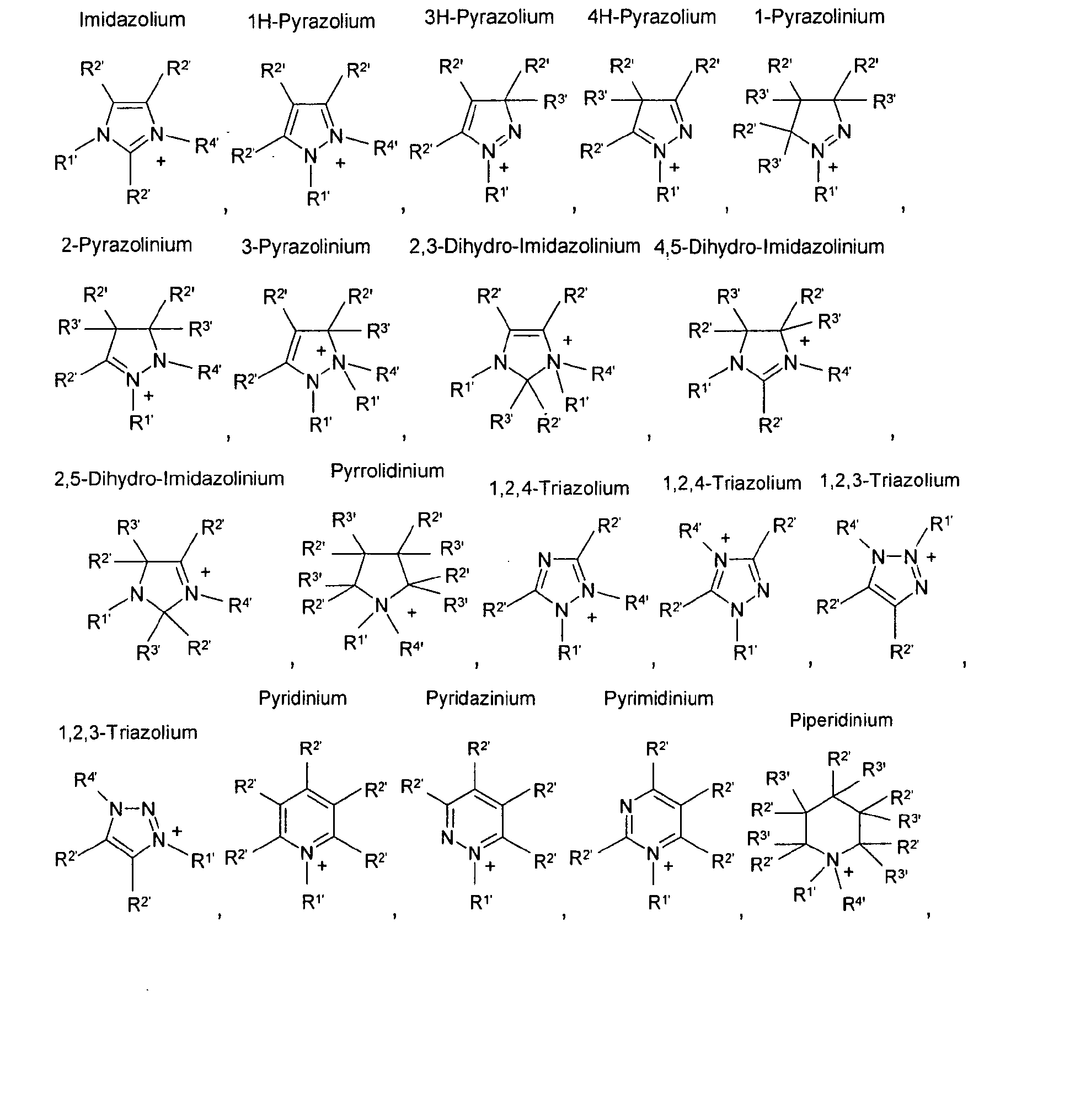

R1' bis R4' jeweils unabhängig voneinander
Wasserstoff oder CN,
geradkettiges oder verzweigtes Alkyl mit 1-20 C-Atomen,
geradkettiges oder verzweigtes Alkenyl mit 2-20 C-Atomen und einer oder mehreren Doppelbindungen,
geradkettiges oder verzweigtes Alkinyl mit 2-20 C-Atomen und einer oder mehreren Dreifachbindungen,
Dialkylamino mit Alkylgruppen mit 1-4 C-Atomen, welches jedoch nicht am Heteroatom des Heterocyclus gebunden vorliegt.
gesättigtes, teilweise oder vollständig ungesättigtes Cycloalkyl mit 3-7 C-Atomen, das mit Alkylgruppen mit 1-6 C-Atomen substituiert sein kann oder Aryl-C1-C6-alkyl bedeutet,
wobei die Substituenten R1, und R4, teilweise oder vollständig mit F substituiert sein können, wobei jedoch nicht gleichzeitig R1' und R4' vollständig mit F substituiert sein dürfen,
wobei die Substituenten R1' bis R4' teilweise oder vollständig mit OR', N(R')2, CN oder Halogen substituiert sein können und wobei ein oder zwei nicht benachbarte und nicht zum Heteroatom α-ständige Kohlenstoffatome von R1' bis R4' durch Atome und/oder Atomgruppierungen ausgewählt aus der Gruppe -O-, -S-, -SO2- und -NR'- oder durch die Endgruppe CN, - C(O)X' oder -SO2X' mit R' = H, nicht, teilweise oder perfluoriertes C1- bis C6-Alkyl, C3- bis C7-Cycloalkyl, unsubstituiertes oder substituiertes Phenyl, oder unsubstituierter oder substituierter Heterocyclus und X' = OH, F, Cl oder Br, ersetzt sein können. - Unter vollständig ungesättigten Substituenten werden im Sinne der vorliegenden Erfindung auch aromatische Substituenten verstanden.
- Als Substituenten R und R1 bis R7 der Verbindungen der Formeln (1) bis (3) kommen erfindungsgemäß dabei neben Wasserstoff bevorzugt in Frage: C1- bis C20-, insbesondere C1- bis C14-Alkylgruppen, und gesättigte oder ungesättigte, d.h. auch aromatische, C3- bis C7-Cycloalkylgruppen, die mit C1- bis C6-Alkylgruppen substituiert sein können, insbesondere Phenyl.
- Die Substituenten R und R1 bis R7 können jedoch ebenfalls durch weitere funktionelle Gruppen substituiert sein, beispielsweise durch CN, SO2R', SO2OR' oder COOR'. R' bedeutet nicht, teilweise oder perfluoriertes C1- bis C6 Alkyl, C3- bis C7-Cycloalkyl, unsubstituiertes oder substituiertes Phenyl.
- Die Substituenten R in den Verbindungen der Formel (1) können dabei gleich oder verschieden sein. Bevorzugt sind drei Substituenten in Formel (1) gleich und ein Substituent verschieden.
- Der Substituent R ist insbesondere bevorzugt Methyl, Ethyl, Isopropyl, Propyl, Butyl, sek.-Butyl, Pentyl, Hexyl, Octyl, Decyl, ,Tetradecyl oder Alkoxyalkyl, worin Alkoxy ein -O-(C1-C8-Alkyl) bedeutet,.
- Bis zu vier Substituenten des Guanidinium-Kations können auch paarweise derart verbunden sein, dass mono-, bi- oder polycyclische Kationen entstehen.
- Ohne Einschränkung der Allgemeinheit sind Beispiele für solche Guanidinium-Kationen:

, wobei die Substituenten R1 bis R3 und R6 eine
zuvor angegebene oder besonders bevorzugte Bedeutung haben können. - Gegebenenfalls können die Carbocyclen oder Heterocyclen der zuvor angegebenen Guanidinium-Kationen noch durch C1- bis C6-Alkyl, C1- bis C6-Alkenyl, NO2, F, Cl, Br, I, C1-C6-Alkoxy, SCF3, SO2CH3, SO2CF3, COOR", SO2NR"2, SO2X', SO3R", substituiertes oder unsubstituiertes Phenyl substituiert sein, wobei X' und R" eine zuvor oder später angegebene Bedeutung haben.
- Bis zu vier Substituenten des des Uroniums- oder Thiouroniumkations [(R1R2N)-C(=XR7)(NR3R4)]+ können auch paarweise derart verbunden sein, dass mono-, bi- oder polycyclische Kationen entstehen.
- Ohne Einschränkung der Allgemeinheit sind Beispiele für solche Kationen im Folgenden angegeben:

, wobei X = O oder S bedeutet und die
Substituenten, R1, R3 und R7 eine zuvor angegebene oder besonders bevorzugte Bedeutung haben können. - Gegebenenfalls können die Carbocyclen oder Heterocyclen der zuvor angegebenen Guanidinium-Kationen noch durch C1- bis C6-Alkyl, C1- bis C6-Alkenyl, NO2, F, Cl, Br, I, C1-C6-Alkoxy, SCF3, SO2CH3, SO2CF3, COOR", SO2NR"2, SO2X', SO3R", substituiertes oder unsubstituiertes Phenyl substituiert sein, wobei X' und R" eine zuvor oder später angegebene Bedeutung haben.
- Die C1-C14-Alkylgruppe ist beispielsweise Methyl, Ethyl, Isopropyl, Propyl, Butyl, sek.-Butyl oder tert.-Butyl, ferner auch Pentyl, 1-, 2- oder 3-Methylbutyl, 1,1-, 1,2- oder 2,2-Dimethylpropyl, 1-Ethylpropyl, Hexyl, Heptyl, Octyl, Nonyl, Decyl, Undecyl, Dodecyl, Tridecyl oder Tetradecyl. Gegebenenfalls perfluoriert, beispielsweise als Difluormethyl, Trifluormethyl, Pentafluorethyl, Heptafluorpropyl oder Nonafluorbutyl.
- Ein geradkettiges oder verzweigtes Alkenyl mit 2 bis 20 C-Atomen, wobei auch mehrere Doppelbindungen vorhanden sein können, ist beispielsweise Vinyl, Allyl, 2- oder 3-Butenyl, Isobutenyl, sek.-Butenyl, ferner 4-Pentenyl, iso-Pentenyl, Hexenyl, Heptenyl, Octenyl, -C9H17, -C10H19 bis -C20H39; vorzugsweise Allyl, 2- oder 3-Butenyl, Isobutenyl, sek.-Butenyl, ferner bevorzugt ist 4-Pentenyl, iso-Pentenyl oder Hexenyl.
- Ein geradkettiges oder verzweigtes Alkinyl mit 2 bis 20 C-Atomen, wobei auch mehrere Dreifachbindungen vorhanden sein können, ist beispielsweise Ethinyl, 1- oder 2-Propinyl, 2- oder 3-Butinyl, ferner 4-Pentinyl, 3-Pentinyl, Hexinyl, Heptinyl, Octinyl, -C9H15, -C10H17 bis -C20H37, vorzugsweise Ethinyl, 1- oder 2-Propinyl, 2- oder 3-Butinyl, 4-Pentinyl, 3-Pentinyl oder Hexinyl.
- Aryl-C1-C6-alkyl bedeutet beispielsweise Benzyl, Phenylethyl, Phenylpropyl, Phenylbutyl, Phenylpentyl oder Phenylhexyl, wobei sowohl der Phenylring als auch die Alkylenkette, wie zuvor beschrieben teilweise oder vollständig mit F substituiert sein können, besonders bevorzugt Benzyl oder Phenylpropyl.
- Der Phenylring oder auch die Alkylenkette können jedoch ebenfalls durch weitere funktionelle Gruppen substituiert sein, beispielsweise durch CN, SO2R', SO2OR' oder COOR'. R' hat dabei eine zuvor definierte Bedeutung.
- Unsubstituierte gesättigte oder teilweise oder vollständig ungesättigte Cycloalkylgruppen mit 3-7 C-Atomen sind daher Cyclopropyl, Cyclobutyl, Cyclopentyl, Cyclohexyl, Cycloheptyl, Cyclopentenyl, Cyclopenta-1,3-dienyl, Cyclohexenyl, Cyclohexa-1,3-dienyl, Cyclohexa-1,4-dienyl, Phenyl, Cycloheptenyl, Cyclohepta-1,3-dienyl, Cyclohepta-1,4-dienyl oder Cyclohepta-1,5-dienyl, welche mit C1- bis C6-Alkylgruppen substituiert sein können, wobei wiederum die Cycloalkylgruppe oder die mit C1- bis C6-Alkylgruppen substituierte Cycloalkylgruppe auch mit Halogenatomen wie F, Cl, Br oder I, insbesondere F oder Cl oder NO2 substituiert sein kann. Die Cycloalkylgruppen können jedoch ebenfalls durch weitere funktionelle Gruppen substituiert sein, beispielsweise durch CN, SO2R', SO2OR' oder COOR'. R' hat dabei eine zuvor definierte Bedeutung.
- In den Substituenten R, R1 bis R6 oder R1' bis R4' können auch ein oder zwei nicht benachbarte und nicht α-ständig zum Heteroatom gebundene Kohlenstoffatome, durch Atome und/oder Atomgruppierungen ausgewählt aus der Gruppe -O-, -S-, -S(O)-, -SO2- und -NR'- ersetzt sein.
- Ohne Einschränkung der Allgemeinheit sind Beispiele für derart modifizierte Substituenten R, R1 bis R6 und R1' bis R4':
- OCH3, -OCH(CH3)2, -CH2OCH3, -CH2-CH2-O-CH3, -C2H4OCH(CH3)2, -C2H4SC2H5, -C2H4SCH(CH3)2, -S(O)CH3, -SO2CH3, -SO2C6H5, -SO2C3H7, -SO2CH(CH3)2, -SO2CH2CF3, -CH2SO2CH3, -O-C4H8-O-C4H9, -CF3, -C2F5, -C3F7, -C4F9, -CF2CF2H, -CF2CHFCF3, -CF2CH(CF3)2, -C2F4N(C2F5)C2F5, -CHF2, -CH2CF3, -C2F2H3, -C3FH6, -CH2C3F7, -CH2C(O)OCH3, -CH2C6H5 oder -C(O)C6H5.
- In R' ist C3- bis C7-Cycloalkyl beispielweise Cyclopropyl, Cyclobutyl, Cyclopentyl, Cyclohexyl oder Cycloheptyl.
- In R' bedeutet substituiertes Phenyl, durch C1- bis C6-Alkyl, C1- bis C6-Alkenyl, NO2, F, Cl, Br, I, C1-C6-Alkoxy, SCF3, SO2CH3, SO2CF3, COOR", SO2X', SO2NR"2 oder SO3R" substituiertes Phenyl, wobei X' F, Cl oder Br und R" ein nicht oder teilweise fluoriertes C1- bis C6-Alkyl oder C3- bis C7-Cycloalkyl wie für R' definiert bedeutet, beispielsweise, o-, m- oder p-Methylphenyl, o-, m- oder p-Ethylphenyl, o-, m- oder p-Propylphenyl, o-, m-oder p-Isopropylphenyl, o-, m- oder p-tert.-Butylphenyl, o-, m- oder p-Nitrophenyl, o-, m- oder p-Methoxyphenyl, o-, m- oder p-Ethoxyphenyl, o-, m-, p-(Trifluormethyl)phenyl, o-, m-, p-(Trifluormethoxy)phenyl, o-, m-, p-(Trifluormethylsulfonyl)phenyl, o-, m- oder p-Fluorphenyl, o-, m- oder p-Chlorphenyl, o-, m- oder p-Bromphenyl, o-, m- oder p-Iodphenyl, weiter bevorzugt 2,3-, 2,4-, 2,5-, 2,6-, 3,4- oder 3,5-Dimethylphenyl, 2,3-, 2,4-, 2,5-, ,6-, 3,4- oder 3,5-Difluorphenyl, 2,3-, 2,4-, 2,5-, 2,6-, 3,4- oder 3,5-Dichlorphenyl, 2,3-, 2,4-, 2,5-, 2,6-, 3,4- oder 3,5-Dibromphenyl, 2,3-, 2,4-, 2,5-, 2,6-, 3,4- oder 3,5-Dimethoxyphenyl, 5-Fluor-2-methylphenyl, 3,4,5-Trimethoxyphenyl oder 2,4,5-Trimethylphenyl.
- Die Substituenten R1 bis R7 sind jeweils unabhängig voneinander bevorzugt eine geradkettige oder verzweigte Alkylgruppe mit 1 bis 10 C-Atomen. Die Substituenten R1 und R2, R3 und R4 und R5 und R6 in Verbindungen der Formeln (2) und (3) können dabei gleich oder verschieden sein. Besonders bevorzugt sind R1 bis R7 jeweils unabhängig voneinander Methyl, Ethyl, n-Propyl, Isopropyl, n-Butyl, sek.-Butyl, Phenyl oder Cyclohexyl, ganz besonders bevorzugt Methyl, Ethyl, n-Propyl, Isopropyl oder n-Butyl.
- Als Substituenten R1' bis R4' von Verbindungen der Formel (4) kommen erfindungsgemäß dabei neben Wasserstoff bevorzugt in Frage: CN, C1- bis C20-, insbesondere C1- bis C12-Alkylgruppen, und gesättigte oder ungesättigte, d.h. auch aromatische, C3- bis C7-Cycloalkylgruppen, die mit C1- bis C6-Alkylgruppen substituiert sein können, insbesondere Phenyl oder Aryl-C1-C6-alkyl oder Diaminoalkyl mit C1-C4-Alkylgruppen, sofern dieses nicht an das Heteroatom gebunden vorliegt.
- Die Substituenten R1' bis R4', insbesondere R2' und R3', können jedoch ebenfalls durch weitere funktionelle Gruppen substituiert sein, beispielsweise durch CN, SO2R', SO2OR' oder COOR'. R' bedeutet H, nicht, teilweise oder perfluoriertes C1- bis C6-Alkyl, C3- bis C7-Cycloalkyl, unsubstituiertes oder substituiertes Phenyl, oder unsubstituierter oder substituierter Heterocyclus.
- Die Substituenten R1' und R4' sind jeweils unabhängig voneinander insbesondere bevorzugt CN, Alkoxyethyl, worin Alkoxy -O-(C1-C8-Alkyl) bedeutet, insbesondere Methoxyethyl, Methyl, Ethyl, Isopropyl, Propyl, Butyl, sek.-Butyl, Pentyl, Hexyl, Octyl, Decyl, Cyclohexyl, Phenyl, Phenylpropyl oder Benzyl. Sie sind ganz besonders bevorzugt CN, Methyl, Ethyl, n-Butyl oder Hexyl. In Pyrrolidinium-, Piperidinium oder Indolinium-Verbindungen sind die beiden Substituenten R1' und R4' bevorzugt unterschiedlich.
- Der Substituent R2' oder R3' ist jeweils unabhängig voneinander insbesondere Wasserstoff, Methyl, Ethyl, Isopropyl, Propyl, Butyl, sek.-Butyl, tert.-Butyl, Cyclohexyl, Dimethylamino, Diethylamino, Methylethylamino, Phenyl oder Benzyl. Besonders bevorzugt ist R2' Dimethylamino, Wasserstoff, Methyl, Ethyl, Isopropyl, Propyl, Butyl, sek.-Butyl oder tert.-Butyl. Ganz besonders bevorzugt sind R2' und R3' Wasserstoff, Dimethylamino oder Methyl.
- HetN+ der Formel (4) ist bevorzugt

- HetN+ ist besonders bevorzugt Imidazolium, Pyrrolidinium oder Pyridinium, wie zuvor definiert, wobei die Substituenten R1' bis R4' jeweils unabhängig voneinander eine zuvor beschriebene Bedeutung haben.
- Die Reaktion zwischen den Oxoniumsalzen und den Onium-Halogeniden, Onium-Tetrafluoroboraten, oder -Hexafluorophosphaten wird üblicherweise bei Temperaturen zwischen 0°C und 100°C, bevorzugt bei 20°C bis 60°C, besonders bevorzugt bei Raumtemperatur durchgeführt. Bei Umsetzung mit den erfindungsgemäßen Sulfonium-Salzen erfolgt die Reaktion bei Temperaturen zwischen 0°C und 150°C, bevorzugt bei 20°C bis 100°C. Es wird kein Lösungsmittel benötigt. Es können jedoch auch Lösungsmittel eingesetzt werden, beispielsweise Dimethoxyethan, Acetonitril, Dichlormethan, Tetrahydrofuran, Dimethylsulfoxid, Dioxan, Propionitril oder Gemische untereinander.
- Die Umsetzung wird mit einem Überschuss oder equimolarer Menge an dem entsprechenden erfindungsgemäßen Oxonium-Salz bzw. SulfoniumSalz durchgeführt.
- Die Reaktion kann bei Drücken zwischen Normaldruck und 0.1 mbar erfolgen. Um die Reaktion zu beschleunigen werden vorzugsweise reduzierte Drücke bis 0.1 mbar eingesetzt. Dies gilt insbesondere für Umsetzungen von Onium-Bromiden oder -Iodiden.
- Neben der Verwendung zur Herstellung von ionischen Flüssigkeiten eignen sich die erfindungsgemäßen Oxoniumsalze und Sulfoniumsalze auch als Alkylierungsmittel oder als Katalysatoren für kationische Polymerisationen oder photochemisch induzierte Polymerisationen, wobei Sulfoniumsalze mit Triphenylsulfoniumkationen besonders geeignet erscheinen.
- Ebenfalls Gegenstand der vorliegenden Erfindung sind ausgewählte Salze, die, wie oben beschrieben, durch Umsetzung mit den erfindungsgemäßen Oxonium- und Sulfoniumsalzen erhalten werden können.
- Demgemäß ist ein weiterer Gegenstand der vorliegenden Erfindung die Bereitstellung von Salzen (I) mit Kationen ausgewählt aus der Gruppe umfassend

wobei der Substituent
R1' CN bedeutet und R2' bis R4' jeweils unabhängig voneinander die Bedeutung haben
Wasserstoff,
geradkettiges oder verzweigtes Alkyl mit 1-20 C-Atomen,
geradkettiges oder verzweigtes Alkenyl mit 2-20 C-Atomen und einer oder mehreren Doppelbindungen,
geradkettiges oder verzweigtes Alkinyl mit 2-20 C-Atomen und einer oder mehreren Dreifachbindungen,
Dialkylamino mit Alkylgruppen mit 1-4 C-Atomen, welches jedoch nicht am Heteroatom des Heterocyclus gebunden vorliegt,
gesättigtes, teilweise oder vollständig ungesättigtes Cycloalkyl mit 3-7 C-Atomen, das mit Alkylgruppen mit 1-6 C-Atomen substituiert sein kann
oder Aryl-C1-C6-alkyl bedeutet,
wobei die Substituenten R2' und R4' teilweise oder vollständig mit F substituiert sein können,
wobei die Substituenten R2' und R3' teilweise oder vollständig mit Halogenen oder teilweise mit NO2 oder CN substituiert sein dürfen,
und wobei ein oder zwei nicht benachbarte und nicht direkt am Heteroatom gebundene Kohlenstoffatome der Substituenten R2' bis R4', durch Atome und/oder Atomgruppierungen ausgewählt aus der Gruppe -O-, -S-, -S(O)-oder -SO2- ersetzt sein können,
und Anionen ausgewählt aus der Gruppe von [PFx(CyF2y+1-zHz)6-x]--Anionen mit 2≤x≤5, 1≤y≤8 und 0≤z≤2y+1,
oder Anionen ausgewählt aus der Gruppe von [BFn(CN)4-n]--Anionen mit n = 0, 1, 2 oder 3,
oder Anionen ausgewählt aus der Gruppe von [(Rf1SO2)2N]--Anionen, wobei Rf1 F oder perfluoriertes und geradkettiges oder verzweigtes Alkyl mit 1-20 C-Atomen, perfluoriertes und geradkettiges oder verzweigtes Alkenyl mit 2-20 C-Atomen und einer oder mehreren Doppelbindungen, perfluoriertes und geradkettiges oder verzweigtes Alkinyl mit 2-20 C-Atomen und einer oder mehreren Dreifachbindungen, perfluoriertes und gesättigtes, teilweise oder vollständig ungesättigtes Cycloalkyl mit 3-7 C-Atomen, das mit Perfluoralkylgruppen substituiert sein kann, bedeutet,
oder Anionen ausgewählt aus der Gruppe von [BFwRf2 4-w]--Anionen mit w = 0, 1, 2 oder 3, wobei Rf2 perfluoriertes und geradkettiges oder verzweigtes Alkyl mit 1-20 C-Atomen, perfluoriertes und geradkettiges oder verzweigtes Alkenyl mit 2-20 C-Atomen und einer oder mehreren Doppelbindungen, perfluoriertes und geradkettiges oder verzweigtes Alkinyl mit 2-20 C-Atomen und einer oder mehreren Dreifachbindungen, perfluoriertes und gesättigtes, teilweise oder vollständig ungesättigtes Cycloalkyl mit 3-7 C-Atomen, das mit Perfluoralkylgruppen substituiert sein kann, bedeutet, wobei Rf1 oder Rf2 jeweils gleich oder verschieden sein können,
wobei Rf1 oder Rf2 paarweise durch Einfach- oder Doppelbindungen miteinander verbunden sein können,
und wobei ein oder zwei nicht benachbarte und nicht zum Heteroatom αständige Kohlenstoffatome von Rf1 oder Rf2 durch Atome und/oder Atomgruppierungen ausgewählt aus der Gruppe -O-, -SO2- und -NR'- oder durch die Endgruppe -SO2X' mit R' = nicht, teilweise oder perfluoriertes C1-bis C6-Alkyl, C3- bis C7-Cycloalkyl, unsubstituiertes oder substituiertes Phenyl, oder unsubstituierter oder substituierter Heterocyclus und X' = F, Cl oder Br, ersetzt sein können. - Vorzugsweise ist das Anion der Salze (I) ausgewählt aus der Gruppe umfassend [(CF3SO2)2N]-, [(C2F5SO2)2N]-, [(FSO2)2N]-, [P(C2F5)3F3]-, [P(CF3)3F3]-, [P(C2F4H)(CF3)2F3]-, [P(C2F3H2)3F3]-, [P(C2F5)(CF3)2F3]-, [P(C3F7)3F3]-, [P(C4F9)3F3]-, [P(C2F5)2F4]-, [BF3(CF3)]-, [BF2(C2F5)2]-, [BF3(C2F5)]-, [BF2(CF3)2]-, [B(C2F5)4]-, [BF3(CN)]-, [BF2(CN)2]-, [B(CN)4]-, [B(CF3)4]--Anionen.
- Bei den genannten Salzen (I) handelt es sich um N-Cyanopyridiniumsalze, N-Cyanoimidazoliumsalze, N-Cyanopyrazinium-salze, N-Cyanopyrimidiniumsalze, N-Cyanochinoliniumsalze, N-Cyanoisochinoliniumsalze, N-Cyanoindoliumsalze, die vielfältig eingesetzt werden können.
- In den genannten Salzen (I) ist R2' bis R4' vorzugsweise ausgewählt aus Wasserstoff, der nicht am Stickstoff gebunden vorliegt, geradkettigem oder verzweigten Alkyl mit 1-20 C-Atomen oder aus Dialkylaminogruppen, worin Alkyl C1-C4-Alkyl bedeutet.
- Ganz besonders bevorzugt handelt es sich bei den Salzen (I) um die Verbindungen 1-Cyano-4-dimethylaminopyridiniumtris(pentafluorethyl)-trifluorphosphat, 1-Cyano-4-dimethylaminopyridiniumbis(trifluormethyl-sulfony)imid, 1-Cyano-4-dimethylaminopyridiniumtetracyanoborat und 1-Cyano-4-dimethylaminopyridinium(pentafluoroethyl)trifluorborat.
- Weiterhin sind ebenfalls Gegenstand der Erfindung Salze (II) mit Kationen ausgewählt aus der Gruppe umfassend

- Vorzugsweise ist das Anion der Salze (II) ausgewählt aus der Gruppe umfassend [P(C2F5)3F3]-, [P(CF3)3F3]-, [P(C2F4H)(CF3)2F3]-, [P(C2F3H2)3F3]- , [P(C2F5)(CF3)2F3]-, [P(C3F7)3F3]-, [P(C4F9)3F3]- und [P(C2F5)2F4]-.
- In den genannten Salzen (II) ist R1' bis R4' vorzugsweise ausgewählt aus Wasserstoff, geradkettigem oder verzweigten Alkyl mit 1-20 C-Atomen, Dialkylamino mit Alkylgruppen mit 1-4 C-Atomen, welches jedoch nicht am Heteroatom des Heterocyclus gebunden vorliegt, und wobei ein oder zwei nicht benachbarte und nicht direkt am Heteroatom gebundene Kohlenstoffatome der Substituenten R1' bis R4', durch Atome und/oder Atomgruppierungen ausgewählt aus der Gruppe -O-, -S-, -S(O)-, -SO2- und -NR'- oder durch die Endgruppe CN, -C(O)X' oder -SO2X' mit R' = H, nicht, teilweise oder perfluoriertes C1- bis C6-Alkyl, C3- bis C7-Cycloalkyl, unsubstituiertes oder substituiertes Phenyl, oder unsubstituierter oder substituierter Heterocyclus und X' = OH, F, Cl oder Br, ersetzt sein können. Beispiele der genannten Substituenten sind bereits vorab genannt. Insbesondere bevorzugt ist in den genannten Salzen (II) R1' bis R4' ausgewählt aus Wasserstoff, geradkettigem oder verzweigten Alkyl mit 1-20 C-Atomen oder Alkoxyalkyl, worin Alkoxy C1-C8-Alkoxy und Alkyl C1-C8-Alkyl bedeutet.
- Ganz besonders bevorzugt handelt es sich bei den Salzen (II) um jene mit Pyrrolidinium-, Piperidinium- und Morpholinium-Kationen.
- Weiterhin sind Gegenstand der vorliegenden Erfindung Salze (III) mit Kationen ausgewählt aus der Gruppe umfassend
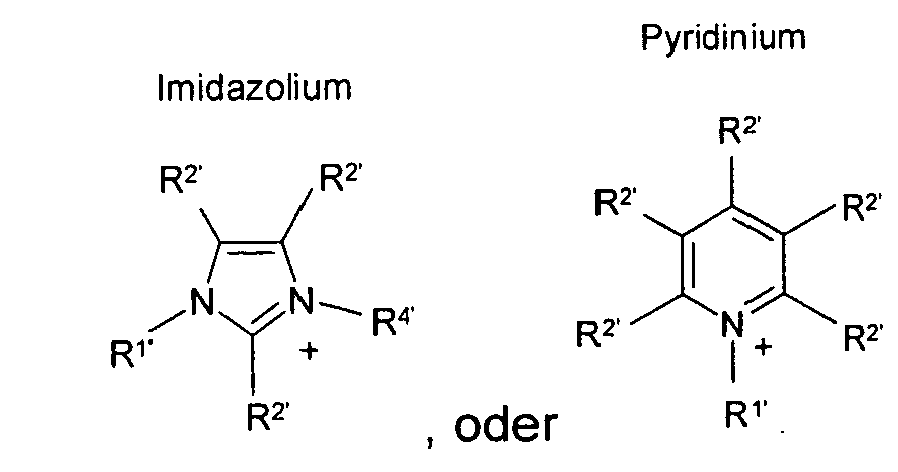
bedeutet,
wobei die Substituenten
R1' bis R4' jeweils unabhängig voneinander die Bedeutung haben geradkettiges oder verzweigtes Alkyl mit 1-20 C-Atomen mit der Maßgabe, dass mindestens einer der Substituenten R1' oder R4' geradkettiges oder verzweigtes Alkyl mit 9-20 C-Atomen ist,
geradkettiges oder verzweigtes Alkenyl mit 2-20 C-Atomen und einer oder mehreren Doppelbindungen,
geradkettiges oder verzweigtes Alkinyl mit 2-20 C-Atomen und einer oder mehreren Dreifachbindungen,
gesättigtes, teilweise oder vollständig ungesättigtes Cycloalkyl mit 3-7 C-Atomen, das mit Alkylgruppen mit 1-6 C-Atomen substituiert sein kann wobei die Substituenten R1' und R4' teilweise oder vollständig mit F substituiert sein können, wobei jedoch nicht gleichzeitig R1' und R4' vollständig mit F substituiert sein dürfen,
wobei die Substituenten R2' und R3' teilweise oder vollständig mit OR', N(R')2, CN oder Halogen substituiert sein können und wobei ein oder zwei nicht benachbarte und nicht zum Heteroatom α-ständige Kohlenstoffatome von R1' bis R4' durch Atome und/oder Atomgruppierungen ausgewählt aus der Gruppe -O-, -S-, -SO2- und -NR'- oder durch die Endgruppe CN, - C(O)X' oder -SO2X' mit R' = H, nicht, teilweise oder perfluoriertes C1- bis C6-Alkyl, C3- bis C7-Cycloalkyl, unsubstituiertes oder substituiertes Phenyl, oder unsubstituierter oder substituierter Heterocyclus und X' = OH, F, Cl oder Br, ersetzt sein können und Anionen ausgewählt aus der Gruppe von [PFx(CyF2y+1-zHz)6-x]--Anionen mit 2≤x≤5, 1≤y≤8 und 0≤z≤2y+1, wobei 3-Methyl-1-octadecylimidazoliumtris(pentafluorethyl)trifluorphosphat ausgenommen ist. Vorzugsweise ist das Anion der Salze (III) ausgewählt aus der Gruppe umfassend [P(C2F5)3F3]-, [P(CF3)3F3]-, [P(C2F4H)(CF3)2F3]-, [P(C2F3H2)3F3]- , [P(C2F5)(CF3)2F3]-, [P(C3F7)3F3]-, [P(C4F9)3F3]- und [P(C2F5)2F4]-. - In den genannten Salzen (III) ist R1' bis R4' vorzugsweise ausgewählt aus geradkettigem oder verzweigten Alkyl mit 1-20 C-Atomen mit der Maßgabe, dass mindestens einer der Substituenten R1' oder R4' geradkettiges oder verzweigtes Alkyl mit 9-20 C-Atomen ist, wobei die Substituenten R2' und R3' teilweise oder vollständig mit OR', N(R')2, CN oder Halogen substituiert sein können und wobei ein oder zwei nicht benachbarte und nicht zum Heteroatom α-ständige Kohlenstoffatome von R1' bis R4' durch Atome und/oder Atomgruppierungen ausgewählt aus der Gruppe -O-, -S-, -SO2-und -NR'- oder durch die Endgruppe CN, -C(O)X' oder -SO2X' mit R' = H, nicht, teilweise oder perfluoriertes C1- bis C6-Alkyl, C3- bis C7-Cycloalkyl, unsubstituiertes oder substituiertes Phenyl, oder unsubstituierter oder substituierter Heterocyclus und X' = OH, F, Cl oder Br, ersetzt sein können. Vorzugsweise ist R1' bis R4' vorzugsweise ausgewählt aus geradkettigem oder verzweigten Alkyl mit 1-20 C-Atomen mit der Maßgabe, dass mindestens einer der Substituenten R1' oder R4' geradkettiges oder verzweigtes Alkyl mit 9-20 C-Atomen ist.
- Ganz besonders bevorzugt handelt es sich bei den Salzen (III) um Verbindungen mit Imidazolium-Kationen, bei denen R1' geradkettiges oder verzweigtes Alkyl mit 1-8 C-Atomen und R4' geradkettiges oder verzweigtes Alkyl mit 9-20 C-Atomen bedeutet. Ebenfalls besonders bevorzugt handelt es sich bei den Salzen (III) um Verbindungen mit Pyridinium-Kationen, bei denen R1' geradkettiges oder verzweigtes Alkyl mit 9-20 C-Atomen und R2' geradkettiges oder verzweigtes Alkyl mit 1-8 C-Atomen bedeutet.
- Die genannten Salze (I), (II) und (III) oder das Gemisch dieser eignen sich in besonderer Weise als Lösungsmittel oder Lösungsmittelzusatz, als Phasentransferkatalysator, als Extraktionsmittel, als Wärmeträger, als oberflächenaktive Substanz, als Weichmacher, als Flammschutzmittel und/oder als Leitsalz für elektrochemische Zellen. Die Salze der Formel (I) eignen sich darüber hinaus in besonderer Weise als Cyanilierungsreagenzien für organische Substrate. Als organische Substrate im Sinne der vorliegenden Erfindung werden alle organischen Verbindungen verstanden, in die mittels der Salze (I) eine Cyanogruppe eingeführt werden kann. Hierbei kann es sich um einfache chemische Strukturen, aber auch um komplexe biochemisch relevante Verbindungen, wie beispielsweise Proteine, Kohlenhydrate, Polypeptide, RNA, DNA etc., die mit Hilfe dieser Cyanilierungs-reagenzien für weitere Umsetzungen aktiviert werden können, handeln.
- Die entsprechenden Verwendungen sowie die Durchführung dieser Reaktionen sind dem Fachmann bekannt. In den genannten Cyanilierungsreaktionen haben die erfindungsgemäßen Salze (I) den Vorteil, dass sie stabiler sind als das derzeit eingesetzte N-Cyano-3-(dimethylamino)-pyridiniumtetrafluoroborat. Da die genannten Salze andere Mischungseigenschaften, mit beispielsweise Lösungsmitteln, haben, können die Reaktionsbedingungen für die Cyanilierungsreaktion entsprechend den Bedürfnissen angepasst werden. Die Prozessführung für die Durchführung der Reaktion kann also für den Anwender durch Einsatz der erfindungsgemäßen Salze vereinfacht werden.
- Auch ohne weitere Ausführungen wird davon ausgegangen, dass ein Fachmann die obige Beschreibung im weitesten Umfang nutzen kann. Die bevorzugten Ausführungsformen und Beispiele sind deswegen lediglich als beschreibende, keineswegs als in irgendeiner Weise limitierende Offenbarung aufzufassen.
- Es versteht sich für den Fachmann von selbst, dass in den vorab und nachfolgend genannten Verbindungen Substituenten wie beispielsweise H, N, O, Cl, F durch die entsprechenden Isotope ersetzt sein können.
- Die 1H-, 19F- und 31P-NMR-Spektren werden an einem Bruker Avance 250 Spektrometer (250.13 MHz für 1H, 235.36 für 19F and 101.25 für 31P) in Acetonitril-D3 gemessen, falls nicht anders in den Beispielen angegeben. CCl3F und TMS werden als interne Referenz bei der Vermessung der 19F NMR- und Protonen-NMR-Spektren eingesetzt. Für die 31P NMR-Spektren wird als externe Referenz 85%-ige H3PO4 in D2O in Acetonitril-D3 bei einer Frequenz von 230.11 Hz in einem separaten Experiment vermessen.
-

- Eine Mischung aus 5.2 g (27.37 mmol) Triethyloxoniumtetrafluoroborat und 12.8 g (30.05 mmol) Tris(pentafluorethyl)difluorphosphoran wird auf 75-80°C erhitzt (Temperatur des Ölbades) und unter Stickstoffatmosphäre für drei Stunden gerührt. Flüchtige Bestandteile werden unter reduziertem Druck (7 Pa) bei 75-80°C (Temperatur des Ölbades) innerhalb einer Stunde abgepumpt. Es werden 14.7 g eines Feststoffs erhalten. Die Ausbeute an Triethyloxoniumtris(pentafluorethyl)trifluorphosphat beträgt 98.0 %, berechnet nach eingesetztem Triethyloxoniumtetrafluoroborat. Das Produkt wird NMR-spektroskopisch untersucht.
1H NMR-Spektrum, ppm: 1.52 t (3CH3), 4.66 q (3CH2); J3 H,H = 7.1 Hz. - 19F NMR-Spektrum, ppm: -43.57 dm (PF), -79.62 m (CF3), -81.30 m (2CF3), -87.04 dm (PF2), -115.01 dm (CF2), -115.56 dm (2CF2); J1 P,F = 889 Hz, J1 P,F = 906 Hz, J2 P,F = 86 Hz, J2 P,F = 107 Hz.
-

- Eine Mischung aus 3.0 g (14.56 mmol) Triethylsulfoniumtetrafluoroborat und 6.8 g (15.97 mmol) Tris(pentafluorethyl)difluorphosphoran wird auf 75-80°C erhitzt (Temperatur des Ölbades) und unter Stickstoffatmosphäre für drei Stunden gerührt. Flüchtige Bestandteile werden unter reduziertem Druck (7 Pa) bei 75-80°C (Temperatur des Ölbades) innerhalb einer Stunde abgepumpt. Es werden 14.7 g eines Feststoffs erhalten. Die Ausbeute an Triethylsulfoniumtris(pentafluorethyl)trifluorphosphat beträgt 97.4 %, berechnet nach eingesetztem Triethylsulfoniumtetrafluoroborat. Das Produkt wird NMR-spektroskopisch untersucht.
1H NMR-Spektrum, ppm: 1.40 t (3CH3), 3.21 q (3CH2); J3 H,H = 7.4 Hz.
19F NMR-Spektrum, ppm: -43.62 dm (PF), -79.67 m (CF3), -81.36 m (2CF3), -87.03 dm (PF2), -115.09 dm (CF2), -115.62 dm (2CF2); J1 P,F = 889 Hz, J1 P,F = 906 Hz, J2 P,F = 84 Hz, J2 P,F = 105 Hz.
31P NMR-Spektrum, ppm: -149.0 d,t,m. -

- Eine Mischung aus 3.7 g (19.47 mmol) Triethyloxoniumtetrafluoroborat und 5.47 g (19.46 mmol) Bis(trifluormethylsulfony)imid wird auf 75-80°C erhitzt (Temperatur des Ölbades) und unter Stickstoffatmosphäre für drei Stunden gerührt. Flüchtige Bestandteile werden unter reduziertem Druck (7 Pa) bei 75-80°C (Temperatur des Ölbades) innerhalb einer Stunde abgepumpt. Es werden 7.46 g eines Öls erhalten. Die Ausbeute an Triethyloxoniumbis(trifluormethylsulfony)imid ist nahezu quantitativ. Das Produkt wurde NMR-spektroskopisch untersucht.
1H NMR-Spektrum, ppm: 1.51 t (3CH3), 4.68 q (3CH2); J3 H,H = 7.1 Hz.
19F NMR-Spektrum, ppm: -78.98 s -

- Eine Mischung aus 2.82 g (13.69 mmol) Triethylsulfoniumtetrafluoroborat und 3.85 g (13.69 mmol) Bis(trifluormethylsulfony)imid wird auf 75-80°C erhitzt (Temperatur des Ölbades) und unter Stickstoffatmosphäre für drei Stunden gerührt. Flüchtige Bestandteile werden unter reduziertem Druck (7 Pa) bei 75-80°C (Temperatur des Ölbades) innerhalb einer Stunde abgepumpt. Es werden 5.35 g eines Feststoffs erhalten. Die Ausbeute an Triethylsulfoniumbis(trifluormethylsulfony)imid beträgt 97.9 %. Das Produkt wird NMR-spektroskopisch untersucht.
1H NMR-Spektrum, ppm: 1.39 t (3CH3), 3.22 q (3CH2); J3 H,H = 7.4 Hz.
19F NMR-Spektrum, ppm: -78.89 s (CF3). -

- Eine Mischung aus 1.00 g (5.26 mmol) Triethyloxoniumtetrafluoroborat und 1.195 g (5.26 mmol) ein Komplexes von Tetracyanoborsäure mit Diethylether, H[B(CN)4]·1.5 Et2O, wird auf 75-80°C erhitzt (Temperatur des Ölbades) und unter Stickstoffatmosphäre für drei Stunden gerührt. Flüchtige Bestandteile werden unter reduziertem Druck (7 Pa) bei 75-80°C (Temperatur des Ölbades) innerhalb einer Stunde abgepumpt. Es werden 0.98 g eines Öls erhalten. Die Ausbeute an Triethyloxoniumtetracyanoborat beträgt 85.4 %. Das Produkt wird NMR-spektroskopisch untersucht.
1H NMR-Spektrum, ppm: 1.51 t (3CH3), 4.68 q (3CH2); J3 H,H = 7.1 Hz.
11B NMR-Spektrum, (Lösungsmittel: Acetonitril-D3; Referenz: BF3-Etherat extern) ppm: -38.6 s. -

- 1.3 g (5.34 mmol) Pentafluorethyltrifluorborsäure-Trihydrat, H[C2F5BF3]·3H2O, wird zu einer Lösung von 1.0 g (4.85 mmol) Triethylsulfoniumtetrafluoroborat in 10 ml Eis-Wasser unter Rühren zugegeben. Die Suspension wird sofort mit Dichlormethan (3 x 20 ml) extrahiert und die erhaltene Lösung mit Magnesiumsulfat getrocknet. Nach Abfiltration von MgSO4, wird das Dichlormethan im Vakuum (7 Pa) bei Raumtemperatur entfernt und der Rückstand für weitere drei Stunden im Vakuum getrocknet. Es werden 1.24 g eines leicht gelblichen Öls erhalten. Die Ausbeute an Triethylsulfoniumpentafluorethyltrifluorborat beträgt 83.5 %, berechnet nach dem eingesetzten Triethylsulfoniumtetrafluoroborat. Das Produkt wird NMR-spektroskopisch untersucht.
1H NMR-Spektrum, ppm: 1.39 t (3CH3), 3.22 q (3CH2); J3 H,H = 7.5 Hz.
19F NMR-Spektrum, ppm: -83.17 q (CF3), -136.00 q (CF2), -152.83 q,q (BF3); J1 B,F = 40.7 Hz, J2 B,F = 19.6 Hz, J4 F,F = 5.0 Hz.
11B NMR-Spektrum, (Referenz: BF3-Etherat extern) ppm: -0.61 q,t; J1 B,F = 40.7 Hz, J2 B,F = 20.4 Hz. -

- Eine Lösung von 1.03 g (4.56 mmol) Kaliumpentafluorethyltrifluorborat, K[C2F5BF3], in 10 ml Eis-Wasser wird zu einer Lösung von 0.87 g (4.22 mmol) Triethylsulfoniumtetrafluoroborat in 5 ml Eis-Wasser unter Rühren zugegeben. Die Suspension wird sofort mit Dichlormethan (3 x 20 ml) extrahiert und die erhaltene Lösung mit Magnesiumsulfat getrocknet. Nach Abfiltration von MgSO4, wird das Dichlormethan im Vakuum (7 Pa) bei Raumtemperatur entfernt und der Rückstand für weitere drei Stunden im Vakuum getrocknet. Es werden 1.11 g eines leicht gelblichen Öls erhalten. Die Ausbeute an Triethylsulfoniumpentafluorethyltrifluorborat beträgt 85.9 %, berechnet nach dem eingesetzten Triethylsulfoniumtetrafluoroborat. Das Produkt wird NMR-spektroskopisch untersucht. Die Spektren entsprechen denen gemäß Beispiel 7.
-

- Eine Mischung aus 1.00 g (5.26 mmol) Triethyloxoniumtetrafluoroborat und 2.35 g (5.27 mmol) von Tris(pentafluoroethyl)trifluorophosphorsäure in 2.8 cm3 von Diethylether wird auf 75-80°C erhitzt (Temperatur des Ölbades) und unter Stickstoffatmosphäre für drei Stunden gerührt. Flüchtige Bestandteile werden unter reduziertem Druck (7 Pa) bei 75-80°C (Temperatur des Ölbades) innerhalb einer Stunde abgepumpt. Es werden 2.76 g eines Öls erhalten. Die Ausbeute an Triethyloxonium-tris(pentafluoroethyl)trifluorophosphate ist 95.7 %. Das Produkt wird NMR-spektroskopisch untersucht.
1H NMR-Spektrum, ppm: 1.51 t (3CH3), 4.68 q (3CH2); J3 H,H = 7.1 Hz.
19F NMR-Spektrum, ppm: -43.59 dm (PF), -79.64 m (CF3), -81.33 m (2CF3), -87.07 dm (PF2), -115.08 dm (CF2), -115.59 dm (2CF2); J1 P,F = 889 Hz, J1 P,F = 905 Hz, J2 P,F = 83 Hz, J2 P,F = 107 Hz. -

- Eine Mischung aus 5.93 g (25.90 mmol) 1-Cyano-4-dimethylaminopyridiniumbromid und 14.30 g (26.09 mmol) Triethyloxonium-tris(pentafluorethyl)trifluorophosphat aus Beispiel 1 wird auf 60°C erhitzt (Temperatur des Ölbades) und unter Stickstoffatmosphäre für fünf Stunden gerührt. Flüchtige Bestandteile werden unter reduziertem Druck (7 Pa) bei 50°C (Temperatur des Ölbades) innerhalb einer Stunde abgepumpt. Es werden 14.32 g eines Feststoffs erhalten. Die Ausbeute an 1-Cyano-4-dimethylaminopyridiniumtris(pentafluorethyl)trifluorphosphat beträgt 93.2 %, bezogen auf das eingesetzte 1-Cyano-4-dimethylaminopyridiniumbromid. Das Produkt wird NMR-spektroskopisch untersucht.
1H NMR-Spektrum, ppm: 3.34 s (2CH3), 6.99 d (CH), 7.03 d (CH), 8.04 d (CH), 8.20 d (CH); J3 H,H = 8.2 Hz.
19F NMR-Spektrum, ppm: -43.57 dm (PF), -79.60 m (CF3), -81.30 m (2CF3), -87.00 dm (PF2), -115.05 dm (CF2), -115.60 dm (2CF2); J1 P,F = 889 Hz, J1 P,F = 906 Hz, J2 P,F = 81 Hz, J2 P,F = 107 Hz. -

- Eine Mischung aus 1.12 g (7.64 mmol) 1-Ethyl-3-methylimidazoliumchlorid und 4.19 g (7.64 mmol) Triethyloxoniumtris(pentafluorethyl)trifluorphosphat aus Beispiel 1 wird auf 70-80 °C erhitzt (Temperatur des Ölbades) und unter Stickstoffatmosphäre für drei Stunden gerührt. Flüchtige Bestandteile werden unter reduziertem Druck (7 Pa) bei 70°C (Temperatur des Ölbades) innerhalb einer Stunde abgepumpt. Es werden 4.20 g einer Flüssigkeit erhalten. Die Ausbeute an 1-Ethyl-3-methylimidazoliumtris(pentafluorethyl)-trifluorphosphat beträgt 98.9 %, bezogen auf das eingesetzte 1-Ethyl-3-methylimidazoliumchlorid. Das Produkt wird NMR-spektroskopisch untersucht.
1H NMR-Spektrum, ppm: 1.47 t (CH3), 3.84 s (CH3), 4.18 q (CH2), 7.34 m (CH), 7.39 m (CH), 8.43 br. s. (CH); J3 H,H = 7.3 Hz.
19F NMR-Spektrum, ppm: -43.54 dm (PF), -79.60 m (CF3), -81.29 m (2CF3), -86.96 dm (PF2), -115.03 dm (CF2), -115.55 dm (2CF2); J1 P,F = 889 Hz, J1 P,F = 906 Hz, J2 P,F = 84 Hz, J2 P,F = 106 Hz.
31P NMR-Spektrum, ppm: -149.0 d,t,m. -

- Eine Mischung aus 0.54 g (2.73 mmol) 1-Ethyl-3-methylimidazoliumtetrafluoroborat und 1.50 g (2.74 mmol) Triethyloxoniumtris(pentafluorethyl)-trifluorphosphat aus Beispiel 1 wird auf 100 °C erhitzt (Temperatur des Ölbades) und unter Stickstoffatmosphäre für zehn Stunden gerührt. Flüchtige Bestandteile werden unter reduziertem Druck (7 Pa) bei 100°C (Temperatur des Ölbades) innerhalb einer Stunde abgepumpt. Es werden 1.37 g einer Flüssigkeit erhalten. Die Ausbeute an 1-Ethyl-3-methylimidazoliumtris(pentafluorethyl)trifluorphosphat beträgt 90.3 %, bezogen auf das eingesetzte 1-Ethyl-3-methylimidazoliumtetrafluoroborat. Das Produkt wird NMR-spektroskopisch untersucht.
NMR-Daten: siehe Beispiel 10 -

- Eine Mischung aus 1.73 g (6.75 mmol) 1-Ethyl-3-methylimidazoliumhexafluorophosphat und 3.70 g (6.75 mmol) Triethyloxoniumtris(pentafluorethyl)-trifluorphosphat aus Beispiel 1 wird auf 100 °C erhitzt (Temperatur des Ölbades) und unter Stickstoffatmosphäre für zehn Stunden gerührt. Flüchtige Bestandteile werden unter reduziertem Druck (7 Pa) bei 100°C (Temperatur des Ölbades) innerhalb einer Stunde abgepumpt. Es werden 3.71 g einer Flüssigkeit erhalten. Die Ausbeute an 1-Ethyl-3-methylimidazoliumtris(pentafluorethyl)trifluorphosphat beträgt 98.7 %, bezogen auf das eingesetzte 1-Ethyl-3-methylimidazoliumhexafluorophosphat. Das Produkt wird NMR-spektroskopisch untersucht.
NMR-Daten: siehe Beispiel 10 -

- Eine Mischung aus 1.81 g (10.07 mmol) Hexamethylguanidiniumchlorid und 5.53 g (10.09 mmol) Triethyloxoniumtris(pentafluorethyl)trifluorphosphat aus Beispiel 1 wird auf 70-80 °C erhitzt (Temperatur des Ölbades) und unter Stickstoffatmosphäre für drei Stunden gerührt. Flüchtige Bestandteile werden unter reduziertem Druck (7 Pa) bei 70°C (Temperatur des Ölbades) innerhalb einer Stunde abgepumpt. Es werden 5.88 g eines Feststoffs erhalten. Die Ausbeute an Hexamethylguanidiniumtris(pentafluorethyl)trifluorphosphat beträgt 98.9 %, bezogen auf das eingesetzte Hexamethylguanidiniumchlorid. Das Produkt wird NMR-spektroskopisch untersucht.
1H NMR-Spektrum, ppm: 2.89 s (6CH3).
19F NMR-Spektrum, ppm: -43.63 dm (PF), -79.68 m (CF3), -81.37 m (2CF3), -87.05 dm (PF2), -115.07 dm (CF2), -115.64 dm (2CF2); J1 P,F = 891 Hz, J1 P,F = 906 Hz, J2 P,F = 84 Hz, J2 P,F = 105 Hz.
31P NMR-Spektrum, ppm: -149.0 d,t,m. -

- Eine Mischung aus 5.22 g (22.89 mmol) 1-Cyano-4-dimethylaminopyridiniumbromid und 8.77 g (22.88 mmol) Triethyloxonium-bis(trifluormethylsulfony)imid aus Beispiel 3 wird auf 60°C erhitzt (Temperatur des Ölbades) und unter Stickstoffatmosphäre für fünf Stunden gerührt. Flüchtige Bestandteile werden unter reduziertem Druck (7 Pa) bei 50°C (Temperatur des Ölbades) innerhalb einer Stunde abgepumpt. Es werden 14.32 g eines Feststoffs erhalten. Die Ausbeute an 1-Cyano-4-dimethylaminopyridiniumbis(trifluormethylsulfony)imid beträgt 98.2 %, bezogen auf das eingesetzte 1-Cyano-4-dimethylaminopyridiniumbromid. Das Produkt wird NMR-spektroskopisch untersucht.
1H NMR-Spektrum, ppm: 3.34 s (2CH3), 6.99 d (CH), 7.03 d (CH), 8.04 d (CH), 8.19 d (CH); J3 H,H = 8.2 Hz.
19F NMR-Spektrum, ppm: -78.96 s. -

- Eine Mischung aus 1.32 g (9.0 mmol) 1-Ethyl-3-methylimidazoliumchlorid und 3.45 g (9.0 mmol) Triethyloxoniumbis(trifluormethylsulfony)imid aus Beispiel 3 wird auf 70-80°C erhitzt (Temperatur des Ölbades) und unter Stickstoffatmosphäre für vier Stunden gerührt. Flüchtige Bestandteile werden unter reduziertem Druck (7 Pa) bei 70°C (Temperatur des Ölbades) innerhalb einer Stunde abgepumpt. Es werden 3.45 g einer Flüssigkeit erhalten. Die Ausbeute an 1-Ethyl-3-methylimidazoliumbis(trifluormethyl-sulfony)imid beträgt 97.9 %, bezogen auf das eingesetzte 1-Ethyl-3-methylimidazoliumchlorid. Das Produkt wird NMR-spektroskopisch untersucht.
1H NMR-Spektrum, ppm: 1.45 t (CH3); 3.83 s (CH3); 4.17 q (CH2); 7.37 m (CH); 7.43 m (CH); 8.57 br. s. (CH); 3JH,H = 7.3 Hz.
19F NMR-Spektrum, ppm: -78.91 s (CF3). -

- Eine Mischung aus 0.47 g (2.37 mmol) 1-Ethyl-3-methylimidazoliumtetrafluoroborat und 1.12 g (2.63 mmol) Tris(pentafluorethyl)difluorphosphoran wird auf 70-80°C erhitzt (Temperatur des Ölbades) und unter Stickstoffatmosphäre für 10 Stunden gerührt. Flüchtige Bestandteile werden unter reduziertem Druck (7 Pa) bei 70°C (Temperatur des Ölbades) innerhalb einer Stunde abgepumpt. Es werden 1.30 g einer Flüssigkeit erhalten. Die Ausbeute an 1-Ethyl-3-methylimidazoliumtris(pentafluorethyl)-trifluorophosphat beträgt 98.5 %, bezogen auf das eingesetzte 1-Ethyl-3-methylimidazoliumtetrafluoroborat. Das Produkt wird NMR-spektroskopisch untersucht.
NMR-Daten: siehe Beispiel 10 -

- Eine Mischung aus 2.34 g (9.14 mmol) 1-Ethyl-3-methylimidazoliumhexafluorophosphat und 4.28 g (10.05 mmol) Tris(pentafluorethyl)difluorphosphoran wird auf 70-80°C erhitzt (Temperatur des Ölbades) und unter Stickstoffatmosphäre für 10 Stunden gerührt. Flüchtige Bestandteile werden unter reduziertem Druck (7 Pa) bei 70°C (Temperatur des Ölbades) innerhalb einer Stunde abgepumpt. Es werden 4.95 g einer Flüssigkeit erhalten. Die Ausbeute an 1-Ethyl-3-methylimidazoliumtris(pentafluorethyl)-trifluorophosphat beträgt 97.4 %, bezogen auf das eingesetzte 1-Ethyl-3-methylimidazoliumhexafluorophosphat. Das Produkt wird NMR-spektroskopisch untersucht.
NMR-Daten: siehe Beispiel 10 -

- Eine Mischung aus 1.12 g (4.02 mmol) Trityliumchlorid und 2.20 g (4.02 mmol) Triethyloxoniumtris(pentafluorethyl)trifluorphosphat aus Beispiel 1 wird auf 70-80°C erhitzt (Temperatur des Ölbades) und unter Stickstoffatmosphäre für zehn Stunden gerührt. Flüchtige Bestandteile werden unter reduziertem Druck (7 Pa) bei 70°C (Temperatur des Ölbades) innerhalb einer Stunde abgepumpt. Es werden 2.59 g eines Feststoffs erhalten. Die Ausbeute an Trityliumtris(pentafluorethyl)trifluorphosphat beträgt 93.6 %. Das Produkt wird NMR-spektroskopisch untersucht.
1H NMR-Spektrum, ppm: 7.18-740 m (3C6H5);
19F NMR-Spektrum, ppm: -43.65 dm (PF), -79.69 m (CF3), -81.39 m (2CF3), -87.07 dm (PF2), -115.14 dm (CF2), -115.68 dm (2CF2); J1 P,F = 891 Hz, J1 P,F = 902 Hz, J2 P,F = 87 Hz, J2 P,F = 105 Hz. -

- Eine Mischung aus 0.34 g (1.31 mmol) 1-Decyl-3-methylimidazoliumchlorid und 0.72 g (1.31 mmol) Triethyloxoniumtris(pentafluorethyl)trifluorphosphat aus Beispiel 1 wird auf 80°C erhitzt (Temperatur des Ölbades) und unter Stickstoffatmosphäre für drei Stunden gerührt. Flüchtige Bestandteile werden unter reduziertem Druck (7 Pa) bei 80°C (Temperatur des Ölbades) innerhalb einer Stunde abgepumpt. Es werden 0.84 g einer Flüssigkeit erhalten. Die Ausbeute an 1-Decyl-3-methylimidazoliumtris-(pentafluorethyl)trifluorphosphat beträgt 96 %. Das Produkt wird NMR-spektroskopisch untersucht.
1H NMR-Spektrum, ppm: 0.90 m (CH3), 1.30 m (7CH2), 1.82 m (CH2), 3.82 s (CH3), 4.11 t (CH2), 7.32 d,d (CH), 7.36 d,d (CH), 8.37 m (CH); J3 H,H = 7.4 Hz, J4 H,H = 1.8 Hz..
19F NMR-Spektrum, ppm: -43.61 dm (PF), -79.65 m (CF3), -81.34 m (2CF3), -87.07 dm (PF2), -115.09 dm (CF2), -115.61 dm (2CF2); J1 P,F = 891 Hz, J1 P,F = 906 Hz, J2 P,F = 83 Hz, J2 P,F = 105 Hz.
31P NMR-Spektrum, ppm: -148.1 d,t,m. -

- Eine Mischung aus 0.20 g (0.97 mmol) 1-Hexyl-1-methylpyrrolidinium-chlorid und 0.53 g (0.97 mmol) Triethyloxoniumtris(pentafluorethyl)-trifluorphosphat aus Beispiel 1 wird auf 80°C erhitzt (Temperatur des Ölbades) und unter Stickstoffatmosphäre für drei Stunden gerührt. Flüchtige Bestandteile werden unter reduziertem Druck (7 Pa) bei 80°C (Temperatur des Ölbades) innerhalb einer Stunde abgepumpt. Es werden 0.55 g einer Flüssigkeit erhalten. Die Ausbeute an 1-Hexyl-1-methylpyrrolidiniumtris(pentafluorethyl)trifluorphosphat beträgt 93 %. Das Produkt wird NMR-spektroskopisch untersucht.
1H NMR-Spektrum, ppm: 0.92 m (CH3), 1.35 m (3CH2), 1.74 m (CH2), 2.16 m (2CH2), 2.93 s (CH3), 3.18 m (CH2), 3.40 m (2CH2).
19F NMR-Spektrum, ppm: -43.58 dm (PF), -79.64 m (CF3), -81.34 m (2CF3), -87.00 dm (PF2), -115.03 dm (CF2), -115.58 dm (2CF2); J1 P,F = 891 Hz, J1 P,F = 906 Hz, J2 P,F = 84 Hz, J2 P,F = 106 Hz.
31P NMR-Spektrum, ppm: -148.1 d,t,m. - Alternative, im Rahmen der vorliegenden Erfindung genannte Verbindungen lassen sich in für den Fachmann nahe liegender Weise analog herstellen.
und wobei ein oder zwei nicht benachbarte und nicht α-ständige Kohlenstoffatome des R, durch Atome und/oder Atomgruppierungen ausgewählt aus der Gruppe -O-, -S-, -S(O)-, -SO2- und -NR'- oder durch die Endgruppe CN, -C(O)X' oder -SO2X' mit R' = H, nicht, teilweise oder perfluoriertes C1- bis C6-Alkyl, C3- bis C7-Cycloalkyl, unsubstituiertes oder substituiertes Phenyl, oder unsubstituierter oder substituierter Heterocyclus und X' = OH, F, Cl oder Br, ersetzt sein können.
und wobei ein oder zwei nicht benachbarte und nicht direkt am Heteroatom gebundene Kohlenstoffatome der Substituenten R1 bis R6 durch Atome
und/oder Atomgruppierungen ausgewählt aus der Gruppe -O-, -S-, -S(O)-, - SO2- und -NR'- oder durch die Endgruppe CN, -C(O)X' oder -SO2X' mit R' = H, nicht, teilweise oder perfluoriertes C1- bis C6-Alkyl, C3- bis C7-Cycloalkyl,
unsubstituiertes oder substituiertes Phenyl, oder unsubstituierter oder substituierter Heterocyclus und X' = OH, F, Cl oder Br, ersetzt sein können.
Claims (6)
- Salze mit Kationen ausgewählt aus der Gruppe umfassend

oder
R1, bis R4, jeweils unabhängig voneinander die Bedeutung haben Wasserstoff oder CN,
geradkettiges oder verzweigtes Alkyl mit 1-20 C-Atomen, geradkettiges oder verzweigtes Alkenyl mit 2-20 C-Atomen und einer oder mehreren Doppelbindungen,
geradkettiges oder verzweigtes Alkinyl mit 2-20 C-Atomen und einer oder mehreren Dreifachbindungen,
Dialkylamino mit Alkylgruppen mit 1-4 C-Atomen, welches jedoch nicht am Heteroatom des Heterocyclus gebunden vorliegt, gesättigtes, teilweise oder vollständig ungesättigtes Cycloalkyl mit 3-7 C-Atomen, das mit Alkylgruppen mit 1-6 C-Atomen substituiert sein kann
oder Aryl-C1-C6-alkyl bedeutet,
wobei die Substituenten R1, und R4, teilweise oder vollständig mit F substituiert sein können, wobei jedoch nicht gleichzeitig R1' und R4' CN sind oder vollständig mit F substituiert sein dürfen,
wobei die Substituenten R2' und R3' teilweise oder vollständig mit Halogenen oder teilweise mit NO2 oder CN substituiert sein dürfen, und wobei ein oder zwei nicht benachbarte und nicht direkt am Heteroatom gebundene Kohlenstoffatome der Substituenten R1, bis R4,, durch Atome und/oder Atomgruppierungen ausgewählt aus der Gruppe -O-, -S-, -S(O)-, -SO2- und -NR'- oder durch die Endgruppe CN, -C(O)X' oder -SO2X' mit R' = H, nicht, teilweise oder perfluoriertes C1- bis C6-Alkyl, C3- bis C7-Cycloalkyl, unsubstituiertes oder substituiertes Phenyl, oder unsubstituierter oder substituierter Heterocyclus und X' = OH, F, CI oder Br, ersetzt sein können, und Anionen ausgewählt aus der Gruppe von [PFx(CyF2y+1-zHz)6-x]--Anionen mit 2≤x≤5, 1≤y≤8 und 0≤z≤2y+1, wobei 1-Butyl-1-methylpyrrolidiniumtris(pentafluroethyl)trifluorphosphat ausgenommen ist. - Salze gemäß Anspruch 1, dadurch gekennzeichnet, dass das Anion ausgewählt ist aus der Gruppe umfassend [P(C2FshF3], [P(CF3hF3]-, [P(C2F 4H)(CF3)2F3]-, [P(C2F3H2)3F3]-, IP(C2F5)(CF3)2F3]-, [P(C3F7hF3]-, [P(C4F9)3F3]-, [P(C2F5)2F4]--Anionen.
- Salze gemäß Anspruch 1 oder 2, dadurch gekennzeichnet, dass R1 , bis R4' ausgewählt wird aus Wasserstoff, geradkettigem oder verzweigten Alkyl mit 1-20 C-Atomen, Dialkylamino mit Alkylgruppen mit 1-4 C-Atomen, welches jedoch nicht am Heteroatom des Heterocyclus gebunden vorliegt, und wobei ein oder zwei nicht benachbarte und nicht direkt am Heteroatom gebundene Kohlenstoffatome der Substituenten R1, bis R4,, durch Atome und/oder Atomgruppierungen ausgewählt aus der Gruppe -O-, -S-, -S(O)-, -SO2- und -NR'- oder durch die Endgruppe CN, -C(O)X' oder -SO2X' mit R' = H, nicht, teilweise oder perfluoriertes C1- bis C6-Alkyl, C3- bis C7-Cycloalkyl, unsubstituiertes oder substituiertes Phenyl, oder unsubstituierter oder substituierter Heterocyclus und X' = OH, F, Cl oder Br, ersetzt sein können.
- Salze gemäß einem oder mehreren der Ansprüche 1 bis 3, dadurch gekennzeichnet, dass R1, bis R4, ausgewählt wird aus Wasserstoff, geradkettigem oder verzweigten Alkyl mit 1-20 C-Atomen oder Alkoxyalkyl, worin Alkoxy C1-C8-Alkoxy und Alkyl C1-C8-Alkyl bedeutet.
- Salze gemäß einem oder mehreren der Ansprüche 1 bis 4, dadurch gekennzeichnet, dass die Kationen ausgewählt werden aus der Gruppe Pyrrolidinium, Piperidinium oder Morpholinium.
- Verwendung von Salzen oder das Gemisch dieser gemäß einem oder mehreren der Ansprüche 1 bis 5 als Lösungsmittel oder Lösungsmittelzusatz, als Phasentransferkatalysator, als Extraktionsmittel, als Wärmeträger, als oberflächenaktive Substanz, als Weichmacher, als Flammschutzmittel und/oder als Leitsalz für elektrochemische Zellen.
Applications Claiming Priority (2)
| Application Number | Priority Date | Filing Date | Title |
|---|---|---|---|
| DE102006005103A DE102006005103A1 (de) | 2006-02-04 | 2006-02-04 | Oxonium- und Sulfoniumsalze |
| EP07702589A EP1979361B1 (de) | 2006-02-04 | 2007-01-05 | Oxonium- und sulfoniumsalze |
Related Parent Applications (1)
| Application Number | Title | Priority Date | Filing Date |
|---|---|---|---|
| EP07702589.8 Division | 2007-01-05 |
Publications (2)
| Publication Number | Publication Date |
|---|---|
| EP2253638A2 true EP2253638A2 (de) | 2010-11-24 |
| EP2253638A3 EP2253638A3 (de) | 2011-11-23 |
Family
ID=38158072
Family Applications (2)
| Application Number | Title | Priority Date | Filing Date |
|---|---|---|---|
| EP10008348A Withdrawn EP2253638A3 (de) | 2006-02-04 | 2007-01-05 | Fluoralkylfluorphosphatsalze |
| EP07702589A Not-in-force EP1979361B1 (de) | 2006-02-04 | 2007-01-05 | Oxonium- und sulfoniumsalze |
Family Applications After (1)
| Application Number | Title | Priority Date | Filing Date |
|---|---|---|---|
| EP07702589A Not-in-force EP1979361B1 (de) | 2006-02-04 | 2007-01-05 | Oxonium- und sulfoniumsalze |
Country Status (10)
| Country | Link |
|---|---|
| US (2) | US7842804B2 (de) |
| EP (2) | EP2253638A3 (de) |
| JP (1) | JP5234634B2 (de) |
| KR (1) | KR101287231B1 (de) |
| CN (1) | CN101379070A (de) |
| AT (1) | ATE489392T1 (de) |
| AU (1) | AU2007211694A1 (de) |
| CA (1) | CA2641288A1 (de) |
| DE (2) | DE102006005103A1 (de) |
| WO (1) | WO2007087949A2 (de) |
Families Citing this family (6)
| Publication number | Priority date | Publication date | Assignee | Title |
|---|---|---|---|---|
| JP5591797B2 (ja) * | 2008-05-26 | 2014-09-17 | メルク パテント ゲゼルシャフト ミット ベシュレンクテル ハフツング | 水溶液からアルコールを抽出するための溶媒としてのテトラシアノボレートアニオンを含むイオン液体の使用 |
| JP2010215514A (ja) * | 2009-03-13 | 2010-09-30 | Japan Carlit Co Ltd:The | イオン導電剤とそれを用いた導電性樹脂組成物及び導電性樹脂成型体 |
| US9278951B2 (en) * | 2011-04-29 | 2016-03-08 | The University Of Akron | Azolium and purinium salt anticancer and antimicrobial agents |
| CN105541704B (zh) * | 2015-12-24 | 2018-03-23 | 北京百灵威科技有限公司 | 1‑氰基‑4‑二甲氨基吡啶四氟硼酸酯的合成方法 |
| EP3886854A4 (de) | 2018-11-30 | 2022-07-06 | Nuvation Bio Inc. | Pyrrol- und pyrazolverbindungen und verfahren zu deren verwendung |
| CN112210023B (zh) * | 2019-07-10 | 2022-02-22 | 中国科学院烟台海岸带研究所 | 一种含锍盐的羧甲基壳聚糖衍生物及其制备方法和应用 |
Citations (2)
| Publication number | Priority date | Publication date | Assignee | Title |
|---|---|---|---|---|
| EP1037896A1 (de) | 1998-10-09 | 2000-09-27 | MERCK PATENT GmbH | Elektrochemische synthese von perfluoralkylfluorophosphoranen |
| EP1399453A1 (de) | 2001-06-27 | 2004-03-24 | MERCK PATENT GmbH | Neue starke säuren, deren herstellungsverfahren und deren verwendungen |
Family Cites Families (40)
| Publication number | Priority date | Publication date | Assignee | Title |
|---|---|---|---|---|
| US2946770A (en) * | 1954-07-30 | 1960-07-26 | Degussa | Polymerization of vinylidene compounds using organic peroxide, organic sulfur and quaternary ammonium compounds as catalysts |
| FR2688783A1 (fr) * | 1992-03-23 | 1993-09-24 | Rhone Poulenc Chimie | Nouveaux borates d'onium ou de complexe organometallique amorceurs cationiques de polymerisation. |
| FR2727416A1 (fr) | 1994-11-24 | 1996-05-31 | Rhone Poulenc Chimie | Nouveaux amorceurs cationiques thermoactivables, de polymerisation et/ou de reticulation et compositions monomeres et/ou polymeres fonctionnels les mettant en oeuvre |
| US5827602A (en) * | 1995-06-30 | 1998-10-27 | Covalent Associates Incorporated | Hydrophobic ionic liquids |
| JP3870462B2 (ja) * | 1996-11-25 | 2007-01-17 | 東洋インキ製造株式会社 | カラーフィルター用レジスト材料 |
| FR2757870B1 (fr) * | 1996-12-30 | 1999-03-26 | Rhodia Chimie Sa | Utilisation de compositions silicones reticulables par voie cationique sous uv et d'un photoamorceur du type borate d'onium, pour le revetements de joints plats, notamment de joints de culasse |
| JP4939679B2 (ja) * | 1997-07-25 | 2012-05-30 | アセップ・インク | 非局在化アニオン電荷を有するイオン化合物、及びそれらのイオン伝導性成分又は触媒としての使用 |
| DE10027995A1 (de) * | 2000-06-09 | 2001-12-13 | Merck Patent Gmbh | Ionische Flüssigkeiten II |
| GB2383962B (en) | 2001-08-31 | 2005-06-01 | Inst Francais Du Petrole | Catalytic composition and use therefor |
| US6863838B2 (en) * | 2001-10-25 | 2005-03-08 | 3M Innovative Properties Company | Zwitterionic imides |
| JP4193478B2 (ja) * | 2001-12-03 | 2008-12-10 | 住友化学株式会社 | スルホニウム塩及びその用途 |
| US6818379B2 (en) * | 2001-12-03 | 2004-11-16 | Sumitomo Chemical Company, Limited | Sulfonium salt and use thereof |
| DE10303931B4 (de) | 2002-02-04 | 2013-04-18 | Institut Français du Pétrole | Katalytische Zusammensetzung zur Dimerisierung, Co-Dimerisierung, Oligomerisierung und Polymerisation der Olefine |
| FR2840916B1 (fr) * | 2002-06-17 | 2004-08-20 | Inst Francais Du Petrole | Procede d'elimination des composes soufres et azotes de coupes hydrocarbonees |
| US6911297B2 (en) | 2002-06-26 | 2005-06-28 | Arch Specialty Chemicals, Inc. | Photoresist compositions |
| JP2004051922A (ja) * | 2002-07-24 | 2004-02-19 | Konica Minolta Holdings Inc | 活性光線硬化型インク、画像形成方法、印刷物、記録装置 |
| JP2004123631A (ja) * | 2002-10-03 | 2004-04-22 | Tokuyama Corp | オニウム塩 |
| ATE469126T1 (de) * | 2002-12-23 | 2010-06-15 | Stx Aprilis Inc | Fluorarylsulfonium fotosäure erzeugende verbindungen |
| CN100432041C (zh) * | 2003-03-26 | 2008-11-12 | 住友化学株式会社 | 含氧化合物的制造方法 |
| JP4734850B2 (ja) * | 2003-05-12 | 2011-07-27 | 住友化学株式会社 | 高分子発光体組成物 |
| DE10333239A1 (de) * | 2003-07-21 | 2005-03-10 | Basf Ag | Verfahren zur Herstellung von gereinigten 1,3- substituierten Imidazoliumsalzen |
| EP1648845B1 (de) * | 2003-07-21 | 2008-05-14 | Basf Se | Verfahren zur extraktion von verunreinigungen mit ionischen flüssigkeiten |
| JP2005059263A (ja) * | 2003-08-08 | 2005-03-10 | Konica Minolta Medical & Graphic Inc | 画像形成方法 |
| US8172998B2 (en) * | 2003-08-21 | 2012-05-08 | Virginia Tech Intellectual Properties, Inc. | Ionic solvents used in ionic polymer transducers, sensors and actuators |
| US7192991B2 (en) * | 2003-11-26 | 2007-03-20 | 3M Innovative Properties Company | Cationically curable composition |
| US20070099079A1 (en) * | 2003-12-26 | 2007-05-03 | National Institute Of Advanced Industrial Science And Technology | Ionic liquid, method for producing same, double layer capacitor comprising same, and lithium battery |
| CA2492344C (en) * | 2004-01-15 | 2010-08-10 | Matsushita Electric Industrial Co., Ltd. | Nonaqueous electrolyte for electrochemical devices |
| JP4557576B2 (ja) | 2004-03-25 | 2010-10-06 | 富士フイルム株式会社 | 感光性組成物及びこれを用いたパターン形成方法 |
| WO2005116038A1 (ja) * | 2004-05-28 | 2005-12-08 | San-Apro Limited | 新規なオニウムおよび遷移金属錯体のフッ素化アルキルフルオロリン酸塩 |
| JP2008510741A (ja) * | 2004-08-24 | 2008-04-10 | ビーエーエスエフ ソシエタス・ヨーロピア | イオン液体を製造するための出発化合物としてのイミダゾリウム−メチルスルファイト |
| US7687513B1 (en) * | 2004-10-21 | 2010-03-30 | University Of Notre Dame Du Lac | Aminopyridinium ionic liquids |
| JP4706067B2 (ja) * | 2004-12-27 | 2011-06-22 | 独立行政法人産業技術総合研究所 | イオン液体 |
| EP1679307A1 (de) * | 2005-01-10 | 2006-07-12 | Solvent Innovation GmbH | Herstellung und Verwendung von Sulfoniumdicyanamiden |
| JP2006258925A (ja) * | 2005-03-15 | 2006-09-28 | Fuji Photo Film Co Ltd | 感光性組成物及び該感光性組成物を用いたパターン形成方法 |
| US7480778B2 (en) * | 2005-06-29 | 2009-01-20 | Netapp, Inc. | Method and system for managing point-in-time images |
| GB2431517B (en) * | 2005-10-19 | 2008-08-27 | Kidde Ip Holdings Ltd | Temperature switch |
| JP5081627B2 (ja) * | 2005-11-25 | 2012-11-28 | サンアプロ株式会社 | フッ素化アルキルフルオロリン酸スルホニウムの製造方法 |
| JP2007254454A (ja) * | 2006-02-23 | 2007-10-04 | Fujifilm Corp | スルホニウム塩、硬化性組成物、インク組成物、インクジェット記録方法、印刷物、平版印刷版の製造方法、及び、平版印刷版 |
| JP4435113B2 (ja) * | 2006-05-30 | 2010-03-17 | 株式会社東芝 | 非水電解質電池 |
| US20100023353A1 (en) * | 2007-09-20 | 2010-01-28 | Stoffiere Richard L | Method for establishing, tracking and auditing compliance |
-
2006
- 2006-02-04 DE DE102006005103A patent/DE102006005103A1/de not_active Withdrawn
-
2007
- 2007-01-05 EP EP10008348A patent/EP2253638A3/de not_active Withdrawn
- 2007-01-05 CN CNA2007800044385A patent/CN101379070A/zh active Pending
- 2007-01-05 AT AT07702589T patent/ATE489392T1/de active
- 2007-01-05 DE DE502007005751T patent/DE502007005751D1/de active Active
- 2007-01-05 EP EP07702589A patent/EP1979361B1/de not_active Not-in-force
- 2007-01-05 JP JP2008552701A patent/JP5234634B2/ja not_active Expired - Fee Related
- 2007-01-05 WO PCT/EP2007/000051 patent/WO2007087949A2/de not_active Ceased
- 2007-01-05 CA CA002641288A patent/CA2641288A1/en not_active Abandoned
- 2007-01-05 AU AU2007211694A patent/AU2007211694A1/en not_active Abandoned
- 2007-01-05 US US12/278,213 patent/US7842804B2/en not_active Expired - Fee Related
- 2007-01-05 KR KR1020087021220A patent/KR101287231B1/ko not_active Expired - Fee Related
-
2010
- 2010-10-20 US US12/908,479 patent/US8148443B2/en not_active Expired - Fee Related
Patent Citations (2)
| Publication number | Priority date | Publication date | Assignee | Title |
|---|---|---|---|---|
| EP1037896A1 (de) | 1998-10-09 | 2000-09-27 | MERCK PATENT GmbH | Elektrochemische synthese von perfluoralkylfluorophosphoranen |
| EP1399453A1 (de) | 2001-06-27 | 2004-03-24 | MERCK PATENT GmbH | Neue starke säuren, deren herstellungsverfahren und deren verwendungen |
Non-Patent Citations (9)
| Title |
|---|
| D.D. DESMARTEAU; M. WITZ, J. FLUORINE CHEM., vol. 52, 1991, pages 7 - 12 |
| HOUBEN-WEYL: "Methoden der organischen Chemie", GEORG-THIEME-VERLAG |
| M.J. EARLE; K.R. SEDDON: "lonic liquids. Green solvent for the future", PURE APPL. CHEM., vol. 72, 2000, pages 1391 - 1398 |
| P. WASSERSCHEID; W. KEIM: "lonische Flüssigkeiten - neue Lösungen für die Übergangsmetallkatalyse", ANGEW. CHEM., vol. 112, 2000, pages 3926 - 3945 |
| R. HAGIWARA; YA. ITO: "Room temperature ionic liquids of alkylimidazolium cations and fluoroanions", J. FLUORINE CHEM., vol. 105, 2000, pages 221 - 227 |
| R. SHELDON: "Catalytic reactions in ionic liquids", CHEM. COMMUN., 2001, pages 2399 - 2407 |
| RICHARD C. LAROCK: "Comprehensive Organic Transformations", 1999, WILEY-VCH |
| T. NETSCHER; W. BONRATH; A. HAAS; E. HOPPMANN; H. PAULING, CHIMIA, vol. 58, 2004, pages 153 - 155 |
| T. WELTON: "Room temperature ionic liquids. Solvents for synthesis and catalysis", CHEM. REV., vol. 92, 1999, pages 2071 - 2083 |
Also Published As
| Publication number | Publication date |
|---|---|
| JP5234634B2 (ja) | 2013-07-10 |
| EP1979361B1 (de) | 2010-11-24 |
| ATE489392T1 (de) | 2010-12-15 |
| DE102006005103A1 (de) | 2007-08-09 |
| US7842804B2 (en) | 2010-11-30 |
| AU2007211694A1 (en) | 2007-08-09 |
| WO2007087949A3 (de) | 2007-10-11 |
| CA2641288A1 (en) | 2007-08-09 |
| CN101379070A (zh) | 2009-03-04 |
| EP2253638A3 (de) | 2011-11-23 |
| US20110034698A1 (en) | 2011-02-10 |
| EP1979361A2 (de) | 2008-10-15 |
| JP2009531282A (ja) | 2009-09-03 |
| US8148443B2 (en) | 2012-04-03 |
| DE502007005751D1 (de) | 2011-01-05 |
| KR20080091498A (ko) | 2008-10-13 |
| WO2007087949A2 (de) | 2007-08-09 |
| KR101287231B1 (ko) | 2013-07-17 |
| US20090036628A1 (en) | 2009-02-05 |
Similar Documents
| Publication | Publication Date | Title |
|---|---|---|
| EP1888605A1 (de) | Ionische flüssigkeiten mit niedriger viskosität | |
| EP2114965B1 (de) | Verbindungen enthaltend organofluorochlorophosphatanionen | |
| WO2004106288A2 (de) | Ionische flüssigkeiten mit guanidinium-kationen | |
| US8148443B2 (en) | Oxonium and sulfonium salts | |
| DE102005035103A1 (de) | Verfahren zur Herstellung von Onium-Salzen mit Tetrafluoroborat-Anion mit reduziertem Halogenid-Gehalt | |
| EP1730157B1 (de) | Ionische flüssigkeiten mit fluoralkyltriffluorborat-anionen | |
| EP1768962B1 (de) | Verfahren zur herstellung von onium-salzen mit geringem chlorid-gehalt | |
| EP2180002B1 (de) | Verfahren zur Herstellung von Onium-Salzen mit Diakylphosphinat Anionen mit geringem Halogenid-Gehalt | |
| EP2621939B1 (de) | Funktionalisierte fluoralkylfluorphosphat-salze | |
| EP1628952B1 (de) | Ionische flüssigkeiten mit uronium- oder thiouronium-kationen | |
| EP1831179B1 (de) | Verfahren zur herstellung von onium-salzen mit tetrafluoroborat-anion mit reduziertem halogenid-gehalt | |
| EP1902035B1 (de) | Verfahren zur herstellung von onium-alkylsulfiten | |
| EP2513123B1 (de) | Verbindungen mit (perfluoralkyl)fluorohydrogenphosphat-anionen | |
| DE102004060076A1 (de) | Verfahren zur Herstellung von Onium-Salzen mit Alkyl- oder Arylsulfonat-Anionen oder Alkyl- oder Arylcarboxylat-Anionen mit geringem Halogenid-Gehalt | |
| EP1773848B1 (de) | Salze mit alkoxytris(fluoralkyl)borat-anionen | |
| DE102004060073A1 (de) | Verfahren zur Hertellung von Onium-Salzen mit Tetrafluoroborat-Anion mit reduziertem Halogenid-Gehalt | |
| DE102005032836A1 (de) | Verfahren zur Herstellung von Onium-Alkylsulfonaten | |
| DE102005032838A1 (de) | Mischung von Onium-Alkylsulfonaten und Onium-Alkylsulfiten |
Legal Events
| Date | Code | Title | Description |
|---|---|---|---|
| PUAI | Public reference made under article 153(3) epc to a published international application that has entered the european phase |
Free format text: ORIGINAL CODE: 0009012 |
|
| 17P | Request for examination filed |
Effective date: 20100811 |
|
| AC | Divisional application: reference to earlier application |
Ref document number: 1979361 Country of ref document: EP Kind code of ref document: P |
|
| AK | Designated contracting states |
Kind code of ref document: A2 Designated state(s): AT BE BG CH CY CZ DE DK EE ES FI FR GB GR HU IE IS IT LI LT LU LV MC NL PL PT RO SE SI SK TR |
|
| PUAL | Search report despatched |
Free format text: ORIGINAL CODE: 0009013 |
|
| AK | Designated contracting states |
Kind code of ref document: A3 Designated state(s): AT BE BG CH CY CZ DE DK EE ES FI FR GB GR HU IE IS IT LI LT LU LV MC NL PL PT RO SE SI SK TR |
|
| RIC1 | Information provided on ipc code assigned before grant |
Ipc: C07C 381/12 20060101ALI20111020BHEP Ipc: C07F 5/02 20060101AFI20111020BHEP Ipc: C07C 311/48 20060101ALI20111020BHEP Ipc: B01J 31/02 20060101ALI20111020BHEP Ipc: C07F 9/52 20060101ALI20111020BHEP |
|
| STAA | Information on the status of an ep patent application or granted ep patent |
Free format text: STATUS: THE APPLICATION IS DEEMED TO BE WITHDRAWN |
|
| 18D | Application deemed to be withdrawn |
Effective date: 20120524 |