EP2256406A2 - Procédé pour utiliser la chaleur dissipée d'und réaction chimique - Google Patents
Procédé pour utiliser la chaleur dissipée d'und réaction chimique Download PDFInfo
- Publication number
- EP2256406A2 EP2256406A2 EP09405103A EP09405103A EP2256406A2 EP 2256406 A2 EP2256406 A2 EP 2256406A2 EP 09405103 A EP09405103 A EP 09405103A EP 09405103 A EP09405103 A EP 09405103A EP 2256406 A2 EP2256406 A2 EP 2256406A2
- Authority
- EP
- European Patent Office
- Prior art keywords
- water
- reaction
- steam
- heat
- temperature
- Prior art date
- Legal status (The legal status is an assumption and is not a legal conclusion. Google has not performed a legal analysis and makes no representation as to the accuracy of the status listed.)
- Granted
Links
Images
Classifications
-
- F—MECHANICAL ENGINEERING; LIGHTING; HEATING; WEAPONS; BLASTING
- F01—MACHINES OR ENGINES IN GENERAL; ENGINE PLANTS IN GENERAL; STEAM ENGINES
- F01K—STEAM ENGINE PLANTS; STEAM ACCUMULATORS; ENGINE PLANTS NOT OTHERWISE PROVIDED FOR; ENGINES USING SPECIAL WORKING FLUIDS OR CYCLES
- F01K1/00—Steam accumulators
-
- F—MECHANICAL ENGINEERING; LIGHTING; HEATING; WEAPONS; BLASTING
- F01—MACHINES OR ENGINES IN GENERAL; ENGINE PLANTS IN GENERAL; STEAM ENGINES
- F01K—STEAM ENGINE PLANTS; STEAM ACCUMULATORS; ENGINE PLANTS NOT OTHERWISE PROVIDED FOR; ENGINES USING SPECIAL WORKING FLUIDS OR CYCLES
- F01K3/00—Plants characterised by the use of steam or heat accumulators, or intermediate steam heaters, therein
- F01K3/004—Accumulation in the liquid branch of the circuit
-
- F—MECHANICAL ENGINEERING; LIGHTING; HEATING; WEAPONS; BLASTING
- F01—MACHINES OR ENGINES IN GENERAL; ENGINE PLANTS IN GENERAL; STEAM ENGINES
- F01K—STEAM ENGINE PLANTS; STEAM ACCUMULATORS; ENGINE PLANTS NOT OTHERWISE PROVIDED FOR; ENGINES USING SPECIAL WORKING FLUIDS OR CYCLES
- F01K3/00—Plants characterised by the use of steam or heat accumulators, or intermediate steam heaters, therein
- F01K3/18—Plants characterised by the use of steam or heat accumulators, or intermediate steam heaters, therein having heaters
- F01K3/188—Plants characterised by the use of steam or heat accumulators, or intermediate steam heaters, therein having heaters using heat from a specified chemical reaction
-
- F—MECHANICAL ENGINEERING; LIGHTING; HEATING; WEAPONS; BLASTING
- F22—STEAM GENERATION
- F22B—METHODS OF STEAM GENERATION; STEAM BOILERS
- F22B33/00—Steam-generation plants, e.g. comprising steam boilers of different types in mutual association
- F22B33/18—Combinations of steam boilers with other apparatus
- F22B33/185—Combinations of steam boilers with other apparatus in combination with a steam accumulator
-
- F—MECHANICAL ENGINEERING; LIGHTING; HEATING; WEAPONS; BLASTING
- F22—STEAM GENERATION
- F22D—PREHEATING, OR ACCUMULATING PREHEATED, FEED-WATER FOR STEAM GENERATION; FEED-WATER SUPPLY FOR STEAM GENERATION; CONTROLLING WATER LEVEL FOR STEAM GENERATION; AUXILIARY DEVICES FOR PROMOTING WATER CIRCULATION WITHIN STEAM BOILERS
- F22D3/00—Accumulators for preheated water
- F22D3/06—Accumulators for preheated water directly connected to boilers
Definitions
- the present invention relates to a method for using waste heat of an exothermic chemical reaction or for heat recovery.
- the EP 0 158 747 A1 describes a method for using waste heat from a continuous chemical reaction, namely the production of phthalic anhydride, or maleic anhydride, wherein the waste heat of the reaction is first converted into high-pressure steam and then released in this form to a steam reservoir.
- the vapor storage By using the vapor storage, the water vapor discharged from the reactor can be kept relatively constant.
- steam storage is fed with steam from a boiler which generates steam in a fluctuating manner. From the steam storage then steam is provided to other facilities for further use.
- pressurized water is stored in a steam accumulator. Reducing the pressure of water stored at its saturation point results in an excess of energy in the water, causing some of the water to turn into steam (so-called "flashing").
- flashing In the steam storage water is kept as a saturated liquid at elevated pressure and elevated temperature.
- the solution to this problem is achieved in that a method for using the heat of reaction in a reaction vessel discontinuously conducted exothermic chemical reaction is presented, in which the heat of reaction supplied water of a first, lower temperature in a heat exchanger at least indirectly to a second, higher Temperature is heated, and this water of the second, higher temperature is fed to a steam storage.
- the chemical reaction is advantageously a polymerization reaction, an addition reaction, or generally an exothermic reaction.
- this is an alkoxylation reaction, preferably an ethoxylation reaction or a propoxylation reaction or a butoxylation reaction or a mixed form of such reactions.
- alkoxylation reaction preferably an ethoxylation reaction or a propoxylation reaction or a butoxylation reaction or a mixed form of such reactions.
- batch reactions ie at least partially discontinuous reactions.
- a batch process is to be understood as meaning a process in which (compared to purely continuously conducted reactions in which all reagents are added continuously, ie successively) at least one reagent (starting material or raw material) is batchwise or in one Thrust is submitted.
- the heat of reaction or waste heat of such discontinuous reactions is thus also discontinuous, or not constant, i. variably delivered.
- a memory preferably a steam accumulator ("steam accumulator" called) provided in front of the device in which the steam is used, such as. a boiler, or other possible uses, is switched.
- water is understood as a chemical compound (H 2 O). Possibly. may be added to the water additives, and it may, for example, small amounts of salts, etc. are present dissolved.
- water is always used here for the liquid state of matter.
- steam in connection with the steam area in the steam accumulator, for example.
- the heat of reaction is thus supplied to the steam reservoir as water in the liquid state of aggregation, namely as water of the second, higher temperature.
- the steam accumulator is steamed fed. If it is not about steam from a boiler, but the recovery of waste heat from a chemical reaction, so must be interposed between the heat exchanger and the steam storage still an evaporation step, which is not necessary here.
- the medium exiting the heat exchanger namely hot / hot water, is used directly to feed the vapor storage without any vaporization between them.
- the first, lower temperature, water supplied to the heat exchanger is liquid state water, which may be recycled, i. e.g. decalcified, deionized, or degassed.
- the first lower temperature water supplied to the heat exchanger is at least partially, but possibly completely, from a condensate tank, i. it is preferably at least partially circulating, i. recycled or recycled water.
- the condensate tank is refilled directly by the amount of water which is withdrawn from the condensate tank and is no longer returned there in the form of possibly treated fresh water.
- the heat exchanger at least partially directly with fresh water, which may be processed, i. e.g. decalcified, deionized, or was degassed, is fed and so the condensate tank is replenished indirectly via the steam storage path.
- the water delivered by the heat exchanger to the steam reservoir has, according to a preferred embodiment of the invention, a pressure of in the range of 2-6 bar, preferably about 4-5 bar and a temperature of about 130-160 degrees Celsius, preferably about 140- 150 degrees Celsius.
- the heat of reaction is transferred via the reaction solution or the reaction mixture to the supplied water of the first temperature.
- the waste heat of the chemical reaction is preferably transferred to the water by at least part of the reaction mixture or the reaction solution as a heat transfer fluid for the Heat transfer from the reaction vessel to a heat exchanger is used.
- a portion of the reaction solution can be removed from the reaction vessel and passed into the heat exchanger.
- the reaction mixture or the reaction solution or even the reaction product is cooled in the heat exchanger and flows back to the reaction vessel, to react further, and to remove heat again.
- the reaction solution is conveyed or circulated by a pump from the reaction vessel into the heat exchanger and / or from there back into the reaction vessel.
- the reaction mixture thus transfers the heat of reaction to the water supplied in the heat exchanger.
- the waste heat produced in the reaction vessel is transferred to the water, whereby the water is heated.
- the heated water then exits the heat exchanger and is directed into the steam reservoir.
- the water of a first temperature which is either supplied as treated fresh water or comes from the condensate tank, on the way to the steam storage through a arranged in the reaction vessel heat exchanger, or eg is passed through a kind of "cooling coil", wherein the water receives there heat of reaction, and thus at the same time the reaction or the reaction solution is cooled in the reaction vessel.
- the heated water of the second temperature then exits the heat exchanger again and is supplied in heated form to the steam storage.
- a secondary circuit such as e.g. a molten salt cycle, be interposed between the heat exchanger and the reaction vessel.
- the entering into the steam reservoir water has a pressure of preferably about 4-5 bar and a temperature of preferably about 140-150 ° C.
- the temperature in the steam accumulator is preferably about 120-135 ° C at a pressure of about 2-3 bar, and after loading the steam battery with water about 150-155 ° C at a pressure of about 5-6 bar.
- the steam accumulator has an upper area where hot steam is and a lower area where hot water is is on. At phase equilibrium in the steam accumulator, the temperature of the steam corresponds to the temperature of the water and the pressure of the steam corresponds to the pressure of the water.
- the steam storage is filled at the initial start-up for the initial load with recycled water from the condensate tank, which has a temperature of about 100 degrees Celsius.
- the condensate tank may be either directly, i. regardless of the operating state of the heat recovery system with possibly treated fresh water are filled, or indirectly during operation of the heat recovery system with fresh water or recycled water after passing through the heat exchanger and the steam accumulator.
- steam i. "Water” in the gaseous state of aggregation, as well as water supplied in the liquid state of aggregation further uses.
- steam i. "Water” in the gaseous state of aggregation, as well as water supplied in the liquid state of aggregation further uses.
- At least a portion of the water discharged from the vapor storage is, in a next preferred embodiment, used to heat raw materials, i. Educts used for the chemical reaction.
- At least a portion of the water discharged from the steam reservoir is used to feed a boiler.
- a boiler preferably so-called "high-quality" steam is generated, which has a pressure of about 5-9 bar, preferably about 6-8 bar, and a temperature of about 160-170 degrees Celsius. (about 25-30 m 3 per 24 h, average about 1.2 m 3 per h).
- steam is emitted from the steam reservoir, which has a pressure of about 2-5 bar, preferably about 2-4 bar and a temperature of about 120-150 degrees Celsius, preferably about 130-140 degrees Celsius having. It is advantageously at least a part of the steam storage discharged steam for the heating of at least one mobile container, preferably a removable storage container, used (so-called "WAB-Heating").
- Modern boilers or water tanks are very efficient when properly loaded, and they respond quickly to charge fluctuations.
- ordinary "shell boilers” can not adequately cover large peak demands and should be protected from large fluctuations in the cargo.
- the present method allows a stable charging pattern for boilers or other uses to avoid the negative effects of large charge variations.
- steam from the boiler can be immediately made available to meet peak demand.
- the steam storage is thus to a certain extent an "expansion" of the energy storage capacity of the boiler.
- water discharged from the steam storage to the boiler or other uses is replaced intermittently by supplying hot water from the heat exchanger or by the water heated by the waste heat of the chemical reaction.
- the duty cycle of the batch reaction or recovery device according to the invention is preferably characterized in that heat of reaction is given off and transferred to the water for preferably 30-60 minutes, followed by a period of preferably about 2 h, in which no heat emission takes place.
- heat of reaction is given off and transferred to the water for preferably 30-60 minutes, followed by a period of preferably about 2 h, in which no heat emission takes place.
- further vapor is used for further chemical reactions, e.g. for preheating other raw materials derived from the steam storage.
- the characteristics of the present invention reduce the energy requirement of the production plant. At the same time, the CO 2 - or GHG emissions ("greenhouse gas”) and thus the environmental and energy costs can be reduced.
- the system to use the waste heat of the chemical reaction has at least one control and / or control mechanism.
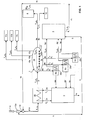
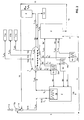
- FIGS. 1 and 2 in each case a scheme according to a first or a second embodiment of a system for using heat of reaction from an exothermic chemical reaction is shown.
- the system for using the heat of reaction has a reaction vessel 2 in which an exothermic chemical reaction takes place.
- the chemical reaction is a discontinuously conducted reaction, preferably a so-called "batch process".
- the empty reactor is filled with the starting materials and any necessary solvents and the chemical reaction starts.
- the contents are taken with the products and any remaining educts.
- the chemical reaction is exothermic Reaction, such as a polymerization or chain extension reaction, especially preferably an alkoxylation reaction, for example an ethoxylation, propoxylation or butoxylation reaction.
- a fatty alcohol and an epoxide react with one another to form at least one reaction product 16, which can be removed from the reaction vessel 2.
- FIG. 1 are three raw materials 6a-c shown, with less, or even more starting materials are possible.
- the reaction vessel 2 preferably has a typical volume in the range of about 10 m 3 to 50 m 3 .
- the delivery rate is preferably about 2000-4000 kWh per batch, i. per 25 t.
- the heat of reaction is transferred in the heat exchanger 19 to supplied water 5 and 15 respectively.
- This has a first, low temperature T1 of in the range of about 100 degrees Celsius and a first pressure p1 of in the range of about 0 bar.
- the water 5, 15 supplied to the heat exchanger 19 may be either cold fresh water 5, which may be previously stored in a conditioner 13, e.g. a de-ionizer or descaler or degasser. It may also be totally or partially recycled, i. recycled water 15 from a condensate tank 3, i. Condensate, which was possibly also processed.
- a switching point 14 is arranged in the system, at the fresh water supply to the water cycle, and / or vice versa, can be switched. It is also possible that a mixture of fresh water 5 and recycled water 15 is supplied to the heat exchanger 19.
- the water 5/15 is then heated to a second temperature T2 of in the range of about 140 to 160 degrees Celsius at a second pressure p2 in the range of about 3 bar to 5 bar.
- a first temperature T1 'to the supplied water 5/15 a first temperature T1 transmitted.
- at least part of the reaction solution 2a is branched out of the reaction vessel 2 and passed into a heat exchanger 19 arranged outside the reaction vessel 2, and then passed through the heat exchanger 19 before the reaction solution 2a is returned to the reaction vessel 2 again.
- This circulation is preferably achieved by a pump (not shown).
- the reaction solution 2b leaving the heat exchanger 19 again has a second, lower temperature T2 'than the reaction solution 2a conducted from the reaction vessel 2 to the heat exchanger 19, since the water 5/15 "cools" the reaction solution 2a in the heat exchanger 19.
- the reaction heat is transferred to the supplied water 5/15 a first temperature T1 as an alternative to the above heat exchange by circulation of the reaction solution by the supplied water 5/15 by a arranged in the reaction vessel 2 "heat exchanger" 19, eg a cooling coil or arranged in the reaction vessel 2 other cooling device is guided.
- the water leaving the heat exchanger 19 5 'here also has a second temperature T2 of about 140 to about 160 degrees Celsius and a second pressure p2 of about 3-5 bar.
- the water exiting from the heat exchanger 19 5 ' is supplied in the liquid state of aggregation a steam storage 1.
- the steam accumulator 1 is usually made of a cylindrical pressure vessel, which is partially filled with water, preferably to 50% -90%. It typically has a volume in the range of about 50 m 3 to 200 m 3 .
- the steam reservoir 1 has in its interior an upper steam region 1a and a lower water region 1b, the water surface of the water region 1b being the interface with the steam region 1a, ie these two regions 1a, 1b are not separated by a wall, the two aggregate states essentially in phase equilibrium.
- the water preferably occurs and as shown in FIG Fig. 1 and 2 via a water pipe 1c with inlet openings or
- Nozzles in the water area 1 b of the steam accumulator 1 a are preferably in the phase equilibrium.
- the temperature prevailing in the steam storage temperature T8, T9 is preferably in the range of about 120 degrees Celsius to 150 degrees Celsius, at a pressure p8, p9 of in the range of about 2 bar to 5 bar.
- Steam 10a-10c at a temperature T4 of about 120 to 150 degrees Celsius at a pressure p4 in the range of about 2 to 5 bar, ie preferably so-called "low-grade steam", can be withdrawn from the steam region 1a.
- This vapor 10a-10c may be supplied to multiple uses 11a-11c, such as e.g. heating a mobile container 11a, preferably a swap body, and / or the steam 10b may react with other chemical reactions 11b e.g. be fed to the preheating of raw materials.
- Other uses 11c are alternatively or additionally possible.
- Water 8a-8c, 9a-9b may be withdrawn from the water region 1b at a temperature T3 of in the range of about 120 degrees Celsius to about 150 degrees Celsius and a pressure of in the range of about 2 to 5 bar, and various uses. 6c, 4, 12 are supplied.
- raw materials 6a-6c for the said chemical reaction can be preheated with the water 8a-8c, preferably via heat exchangers 20a-20c, so that they can be supplied to the reaction vessel 2 as preheated educts 6a'-6c '. It is also possible that the preheating of the educts 6a-6c via closed circuits in combination with a heat exchanger takes place (not shown).
- a Condensate tank 3 are supplied. This preferably has a volume of in the range of 50 m 3 up to 200 m 3 .
- this condensate tank 3 can deliver water 15 for recycling, which has a temperature T6 of in the range of approximately 100 degrees Celsius and a pressure p6 of approximately 0 bar. This water 15 is then according to the embodiments in Fig.
- fresh water 5 which has been treated in a conditioner 13 may also be supplied directly to the condensate tank 3 in order to replace the amount of water 15 which is withdrawn therefrom and does not flow back there again.
- hot water 9a, 9b can also be supplied to other uses.
- a portion 9a of the water which preferably has a temperature T3 of in the range of about 120 to 150 degrees Celsius and a pressure p3 of in the range of about 2 to 5 bar, are fed to a boiler 4, in which the water 9a is further heated and converted into steam.
- the boiler provides this so-called "high quality" steam 18 to other uses, preferably at a temperature T5 of in the range of about 160 degrees Celsius to 180 degrees Celsius and a pressure P5 of in the range of about 6 to about 10 bar ,
Landscapes
- Engineering & Computer Science (AREA)
- Mechanical Engineering (AREA)
- General Engineering & Computer Science (AREA)
- Chemical & Material Sciences (AREA)
- Combustion & Propulsion (AREA)
- Physics & Mathematics (AREA)
- Thermal Sciences (AREA)
- Chemical Kinetics & Catalysis (AREA)
- Physical Or Chemical Processes And Apparatus (AREA)
- Processing Of Solid Wastes (AREA)
- Organic Low-Molecular-Weight Compounds And Preparation Thereof (AREA)
Applications Claiming Priority (1)
| Application Number | Priority Date | Filing Date | Title |
|---|---|---|---|
| CH9532008 | 2008-06-20 |
Publications (3)
| Publication Number | Publication Date |
|---|---|
| EP2256406A2 true EP2256406A2 (fr) | 2010-12-01 |
| EP2256406A3 EP2256406A3 (fr) | 2012-06-13 |
| EP2256406B1 EP2256406B1 (fr) | 2018-07-18 |
Family
ID=40076712
Family Applications (1)
| Application Number | Title | Priority Date | Filing Date |
|---|---|---|---|
| EP09405103.4A Active EP2256406B1 (fr) | 2008-06-20 | 2009-06-18 | Procédé pour utiliser la chaleur dissipée d'und réaction chimique |
Country Status (1)
| Country | Link |
|---|---|
| EP (1) | EP2256406B1 (fr) |
Cited By (6)
| Publication number | Priority date | Publication date | Assignee | Title |
|---|---|---|---|---|
| WO2016091578A1 (fr) * | 2014-12-12 | 2016-06-16 | Siemens Aktiengesellschaft | Procédé de fonctionnement d'un accumulateur de chaleur thermochimique |
| DE102015219391A1 (de) * | 2015-10-07 | 2017-04-13 | Siemens Aktiengesellschaft | Verfahren zum Betreiben eines Gas-und-Dampf-Kombinationskraftwerks |
| WO2019242899A1 (fr) * | 2018-06-20 | 2019-12-26 | Singulus Technologies Ag | Procédé et dispositif de préparation de vapeur |
| CN115875664A (zh) * | 2022-12-06 | 2023-03-31 | 海澜智云科技有限公司 | 用于苯酚丙酮生产的节能降耗系统以及节能降耗智能控制方法 |
| WO2026052840A1 (fr) * | 2024-09-09 | 2026-03-12 | Basf Se | Appareil et procédé d'utilisation de chaleur perdue |
| WO2026052841A1 (fr) * | 2024-09-09 | 2026-03-12 | Basf Se | Appareil et procédé d'utilisation de chaleur perdue |
Citations (3)
| Publication number | Priority date | Publication date | Assignee | Title |
|---|---|---|---|---|
| US1867143A (en) | 1928-02-17 | 1932-07-12 | Ruthsaccumulator Aktiebolag | Method and apparatus for controlling steam generation |
| EP0158747A1 (fr) | 1984-03-30 | 1985-10-23 | Metallgesellschaft Ag | Procédé pour le chauffage périodique du séparateur de produit d'une installation pour préparer de l'anhydride phtalique ou de l'anhydride maléique |
| JP2003097800A (ja) | 2001-09-25 | 2003-04-03 | Nippon Steel Corp | 蒸気アキュムレータによる蒸気供給方法 |
Family Cites Families (5)
| Publication number | Priority date | Publication date | Assignee | Title |
|---|---|---|---|---|
| DE1288614B (de) * | 1960-06-04 | 1969-02-06 | Waagner Biro Ag | Verfahren und Vorrichtung zum Abbau von Dampfspitzen aus Prozessabfallwaermeverwertern mit variabler Dampferzeugung |
| CH379531A (de) * | 1960-12-28 | 1964-07-15 | Sulzer Ag | Zwangdurchlauf-Dampferzeuger mit Zwischenüberhitzung |
| DE59807318D1 (de) * | 1998-07-29 | 2003-04-03 | Alstom Switzerland Ltd | Vorrichtung sowie Verfahren zur schnellen Bereitstellung von Leistungsreserven bei kombinierten Gas- und Dampfturbinenanlagen |
| DE19918346A1 (de) * | 1999-04-22 | 2000-10-26 | Asea Brown Boveri | Verfahren und Vorrichtung zur schnellen Leistungssteigerung und Sicherstellung einer Zusatzleistung einer Gasturbinenanlage |
| WO2006128311A2 (fr) * | 2005-05-31 | 2006-12-07 | Dampflokomotiv Und Maschinenfabrik Dlm Ag | Vehicule fonctionnant a la chaleur, comprenant un dispositif de production d'energie externe |
-
2009
- 2009-06-18 EP EP09405103.4A patent/EP2256406B1/fr active Active
Patent Citations (3)
| Publication number | Priority date | Publication date | Assignee | Title |
|---|---|---|---|---|
| US1867143A (en) | 1928-02-17 | 1932-07-12 | Ruthsaccumulator Aktiebolag | Method and apparatus for controlling steam generation |
| EP0158747A1 (fr) | 1984-03-30 | 1985-10-23 | Metallgesellschaft Ag | Procédé pour le chauffage périodique du séparateur de produit d'une installation pour préparer de l'anhydride phtalique ou de l'anhydride maléique |
| JP2003097800A (ja) | 2001-09-25 | 2003-04-03 | Nippon Steel Corp | 蒸気アキュムレータによる蒸気供給方法 |
Cited By (11)
| Publication number | Priority date | Publication date | Assignee | Title |
|---|---|---|---|---|
| WO2016091578A1 (fr) * | 2014-12-12 | 2016-06-16 | Siemens Aktiengesellschaft | Procédé de fonctionnement d'un accumulateur de chaleur thermochimique |
| CN107003080A (zh) * | 2014-12-12 | 2017-08-01 | 西门子公司 | 用于运行热化学的储热器的方法 |
| US10072894B2 (en) | 2014-12-12 | 2018-09-11 | Siemens Aktiengesellschaft | Thermochemical heat storage unit |
| CN107003080B (zh) * | 2014-12-12 | 2019-05-10 | 西门子公司 | 用于运行热化学的储热器的方法 |
| DE102015219391A1 (de) * | 2015-10-07 | 2017-04-13 | Siemens Aktiengesellschaft | Verfahren zum Betreiben eines Gas-und-Dampf-Kombinationskraftwerks |
| US11015490B2 (en) | 2015-10-07 | 2021-05-25 | Siemens Energy Global GmbH & Co. KG | Method for operating a combined gas and steam power plant with steam heated by an exothermic chemical reaction |
| WO2019242899A1 (fr) * | 2018-06-20 | 2019-12-26 | Singulus Technologies Ag | Procédé et dispositif de préparation de vapeur |
| US12188122B2 (en) | 2018-06-20 | 2025-01-07 | Singulus Technologies Ag | Process and device for providing vapor |
| CN115875664A (zh) * | 2022-12-06 | 2023-03-31 | 海澜智云科技有限公司 | 用于苯酚丙酮生产的节能降耗系统以及节能降耗智能控制方法 |
| WO2026052840A1 (fr) * | 2024-09-09 | 2026-03-12 | Basf Se | Appareil et procédé d'utilisation de chaleur perdue |
| WO2026052841A1 (fr) * | 2024-09-09 | 2026-03-12 | Basf Se | Appareil et procédé d'utilisation de chaleur perdue |
Also Published As
| Publication number | Publication date |
|---|---|
| EP2256406B1 (fr) | 2018-07-18 |
| EP2256406A3 (fr) | 2012-06-13 |
Similar Documents
| Publication | Publication Date | Title |
|---|---|---|
| EP2256406B1 (fr) | Procédé pour utiliser la chaleur dissipée d'und réaction chimique | |
| DE2943797C2 (de) | Verfahren und Vorrichtung zum abwechselnden Heizen und Kühlen eines Wärmetauschers | |
| DE3130986C2 (de) | Einrichtung für die Durchführung einer chemischen Reaktion | |
| DE3225403C2 (de) | Verfahren zum stufenweisen Aufheizen eines Gutes in einer Behandlungsvorrichtung und anschließendem Abkühlen | |
| DE2645251A1 (de) | Verfahren und vorrichtung zur herstellung bzw. rueckgewinnung von alkanolamin aus einem oxazolidon enthaltenden gemisch | |
| DE69705505T2 (de) | Verfahren zur kontinuierlichen führung von flüssigkeiten während des kochens eines zellstoffs in einem kocher | |
| CH636829A5 (de) | Einrichtungen und verfahren zum betrieb von einrichtungen zur regeneration von ionenaustausch- und adsorptionsmassen insbesondere in wasseraufbereitungs-anlagen. | |
| EP4335298A1 (fr) | Procédé et dispositif de chauffage direct de produits alimentaires liquides | |
| DE102021210836A1 (de) | Verfahren und Vorrichtung zum Freisetzen von chemisch gebundenem Wasserstoff aus einem Trägermaterial | |
| WO2013170916A1 (fr) | Procédé et dispositif d'épuration d'eaux usées industrielles | |
| DE1288614B (de) | Verfahren und Vorrichtung zum Abbau von Dampfspitzen aus Prozessabfallwaermeverwertern mit variabler Dampferzeugung | |
| DE102007035260A1 (de) | Reaktionsapparat | |
| DE69010892T2 (de) | Verfahren zur herstellung von nitrosylfluorid. | |
| DE19747218B4 (de) | Verfahren zur Gewinnung und Trocknung eines in einer pumpbaren Flüssigkeit enthaltenen Feststoffs | |
| DE1288081B (de) | Verfahren und Sättiger zur Herstellung von Ammoniumnitrat | |
| EP0158747B1 (fr) | Procédé pour le chauffage périodique du séparateur de produit d'une installation pour préparer de l'anhydride phtalique ou de l'anhydride maléique | |
| DE102016204719A1 (de) | Reaktor | |
| EP3269460A1 (fr) | Dispositif de nettoyage de bouteilles et procédé pour un circuit d'eau de processus utilisé par le dispositif de nettoyage de bouteilles | |
| EP0452653A1 (fr) | Procédé pour gazéifier des combustibles finement divisés en poudre avec l'addition d'une centrale combinée à turbine à gaz et/ou à vapeur | |
| DE2135769C3 (de) | Verfahren zum raschen Herstellen von ungesättigtem Dampf, der reich an einem mit Wasser mischbaren, aber weniger flüchtigen Stoff als Wasser ist | |
| DE3512930A1 (de) | Desublimationsanlage | |
| DE891686C (de) | Verfahren und Vorrichtung zur Herstellung von Ammoniumcarbonat und -bicarbonat durchSaettigung von Ammoniakwasser mit Kohlensaeure | |
| EP2339247A2 (fr) | Procédé de chauffage d'eau non potable | |
| WO2017125452A1 (fr) | Procédé de transfert de chaleur et échangeur de chaleur | |
| DE1090632B (de) | Verfahren zum Aufheizen von Waermetraegern fuer eine einem Dampfkessel zugeordnete Entgasungsvorrichtung |
Legal Events
| Date | Code | Title | Description |
|---|---|---|---|
| PUAI | Public reference made under article 153(3) epc to a published international application that has entered the european phase |
Free format text: ORIGINAL CODE: 0009012 |
|
| AK | Designated contracting states |
Kind code of ref document: A2 Designated state(s): AT BE BG CH CY CZ DE DK EE ES FI FR GB GR HR HU IE IS IT LI LT LU LV MC MK MT NL NO PL PT RO SE SI SK TR |
|
| AX | Request for extension of the european patent |
Extension state: AL BA RS |
|
| PUAL | Search report despatched |
Free format text: ORIGINAL CODE: 0009013 |
|
| AK | Designated contracting states |
Kind code of ref document: A3 Designated state(s): AT BE BG CH CY CZ DE DK EE ES FI FR GB GR HR HU IE IS IT LI LT LU LV MC MK MT NL NO PL PT RO SE SI SK TR |
|
| AX | Request for extension of the european patent |
Extension state: AL BA RS |
|
| RIC1 | Information provided on ipc code assigned before grant |
Ipc: F01K 1/00 20060101ALI20120504BHEP Ipc: F01K 3/18 20060101ALI20120504BHEP Ipc: F22D 3/06 20060101AFI20120504BHEP Ipc: F01K 3/00 20060101ALI20120504BHEP Ipc: F22B 33/18 20060101ALI20120504BHEP |
|
| 17P | Request for examination filed |
Effective date: 20120827 |
|
| STAA | Information on the status of an ep patent application or granted ep patent |
Free format text: STATUS: EXAMINATION IS IN PROGRESS |
|
| 17Q | First examination report despatched |
Effective date: 20161221 |
|
| GRAP | Despatch of communication of intention to grant a patent |
Free format text: ORIGINAL CODE: EPIDOSNIGR1 |
|
| STAA | Information on the status of an ep patent application or granted ep patent |
Free format text: STATUS: GRANT OF PATENT IS INTENDED |
|
| INTG | Intention to grant announced |
Effective date: 20180124 |
|
| GRAS | Grant fee paid |
Free format text: ORIGINAL CODE: EPIDOSNIGR3 |
|
| GRAA | (expected) grant |
Free format text: ORIGINAL CODE: 0009210 |
|
| STAA | Information on the status of an ep patent application or granted ep patent |
Free format text: STATUS: THE PATENT HAS BEEN GRANTED |
|
| AK | Designated contracting states |
Kind code of ref document: B1 Designated state(s): AT BE BG CH CY CZ DE DK EE ES FI FR GB GR HR HU IE IS IT LI LT LU LV MC MK MT NL NO PL PT RO SE SI SK TR |
|
| AX | Request for extension of the european patent |
Extension state: AL BA RS |
|
| REG | Reference to a national code |
Ref country code: GB Ref legal event code: FG4D Free format text: NOT ENGLISH |
|
| REG | Reference to a national code |
Ref country code: CH Ref legal event code: EP |
|
| REG | Reference to a national code |
Ref country code: IE Ref legal event code: FG4D Free format text: LANGUAGE OF EP DOCUMENT: GERMAN |
|
| REG | Reference to a national code |
Ref country code: AT Ref legal event code: REF Ref document number: 1019765 Country of ref document: AT Kind code of ref document: T Effective date: 20180815 |
|
| REG | Reference to a national code |
Ref country code: DE Ref legal event code: R096 Ref document number: 502009015097 Country of ref document: DE |
|
| REG | Reference to a national code |
Ref country code: CH Ref legal event code: NV Representative=s name: ISLER AND PEDRAZZINI AG, CH |
|
| REG | Reference to a national code |
Ref country code: NL Ref legal event code: FP |
|
| REG | Reference to a national code |
Ref country code: LT Ref legal event code: MG4D |
|
| PG25 | Lapsed in a contracting state [announced via postgrant information from national office to epo] |
Ref country code: NO Free format text: LAPSE BECAUSE OF FAILURE TO SUBMIT A TRANSLATION OF THE DESCRIPTION OR TO PAY THE FEE WITHIN THE PRESCRIBED TIME-LIMIT Effective date: 20181018 Ref country code: GR Free format text: LAPSE BECAUSE OF FAILURE TO SUBMIT A TRANSLATION OF THE DESCRIPTION OR TO PAY THE FEE WITHIN THE PRESCRIBED TIME-LIMIT Effective date: 20181019 Ref country code: SE Free format text: LAPSE BECAUSE OF FAILURE TO SUBMIT A TRANSLATION OF THE DESCRIPTION OR TO PAY THE FEE WITHIN THE PRESCRIBED TIME-LIMIT Effective date: 20180718 Ref country code: BG Free format text: LAPSE BECAUSE OF FAILURE TO SUBMIT A TRANSLATION OF THE DESCRIPTION OR TO PAY THE FEE WITHIN THE PRESCRIBED TIME-LIMIT Effective date: 20181018 Ref country code: PL Free format text: LAPSE BECAUSE OF FAILURE TO SUBMIT A TRANSLATION OF THE DESCRIPTION OR TO PAY THE FEE WITHIN THE PRESCRIBED TIME-LIMIT Effective date: 20180718 Ref country code: FI Free format text: LAPSE BECAUSE OF FAILURE TO SUBMIT A TRANSLATION OF THE DESCRIPTION OR TO PAY THE FEE WITHIN THE PRESCRIBED TIME-LIMIT Effective date: 20180718 Ref country code: LT Free format text: LAPSE BECAUSE OF FAILURE TO SUBMIT A TRANSLATION OF THE DESCRIPTION OR TO PAY THE FEE WITHIN THE PRESCRIBED TIME-LIMIT Effective date: 20180718 Ref country code: IS Free format text: LAPSE BECAUSE OF FAILURE TO SUBMIT A TRANSLATION OF THE DESCRIPTION OR TO PAY THE FEE WITHIN THE PRESCRIBED TIME-LIMIT Effective date: 20181118 |
|
| PG25 | Lapsed in a contracting state [announced via postgrant information from national office to epo] |
Ref country code: LV Free format text: LAPSE BECAUSE OF FAILURE TO SUBMIT A TRANSLATION OF THE DESCRIPTION OR TO PAY THE FEE WITHIN THE PRESCRIBED TIME-LIMIT Effective date: 20180718 Ref country code: HR Free format text: LAPSE BECAUSE OF FAILURE TO SUBMIT A TRANSLATION OF THE DESCRIPTION OR TO PAY THE FEE WITHIN THE PRESCRIBED TIME-LIMIT Effective date: 20180718 Ref country code: ES Free format text: LAPSE BECAUSE OF FAILURE TO SUBMIT A TRANSLATION OF THE DESCRIPTION OR TO PAY THE FEE WITHIN THE PRESCRIBED TIME-LIMIT Effective date: 20180718 |
|
| REG | Reference to a national code |
Ref country code: DE Ref legal event code: R097 Ref document number: 502009015097 Country of ref document: DE |
|
| PG25 | Lapsed in a contracting state [announced via postgrant information from national office to epo] |
Ref country code: EE Free format text: LAPSE BECAUSE OF FAILURE TO SUBMIT A TRANSLATION OF THE DESCRIPTION OR TO PAY THE FEE WITHIN THE PRESCRIBED TIME-LIMIT Effective date: 20180718 Ref country code: RO Free format text: LAPSE BECAUSE OF FAILURE TO SUBMIT A TRANSLATION OF THE DESCRIPTION OR TO PAY THE FEE WITHIN THE PRESCRIBED TIME-LIMIT Effective date: 20180718 Ref country code: CZ Free format text: LAPSE BECAUSE OF FAILURE TO SUBMIT A TRANSLATION OF THE DESCRIPTION OR TO PAY THE FEE WITHIN THE PRESCRIBED TIME-LIMIT Effective date: 20180718 |
|
| PLBE | No opposition filed within time limit |
Free format text: ORIGINAL CODE: 0009261 |
|
| STAA | Information on the status of an ep patent application or granted ep patent |
Free format text: STATUS: NO OPPOSITION FILED WITHIN TIME LIMIT |
|
| PG25 | Lapsed in a contracting state [announced via postgrant information from national office to epo] |
Ref country code: SK Free format text: LAPSE BECAUSE OF FAILURE TO SUBMIT A TRANSLATION OF THE DESCRIPTION OR TO PAY THE FEE WITHIN THE PRESCRIBED TIME-LIMIT Effective date: 20180718 Ref country code: DK Free format text: LAPSE BECAUSE OF FAILURE TO SUBMIT A TRANSLATION OF THE DESCRIPTION OR TO PAY THE FEE WITHIN THE PRESCRIBED TIME-LIMIT Effective date: 20180718 |
|
| 26N | No opposition filed |
Effective date: 20190423 |
|
| PG25 | Lapsed in a contracting state [announced via postgrant information from national office to epo] |
Ref country code: SI Free format text: LAPSE BECAUSE OF FAILURE TO SUBMIT A TRANSLATION OF THE DESCRIPTION OR TO PAY THE FEE WITHIN THE PRESCRIBED TIME-LIMIT Effective date: 20180718 |
|
| PG25 | Lapsed in a contracting state [announced via postgrant information from national office to epo] |
Ref country code: MC Free format text: LAPSE BECAUSE OF FAILURE TO SUBMIT A TRANSLATION OF THE DESCRIPTION OR TO PAY THE FEE WITHIN THE PRESCRIBED TIME-LIMIT Effective date: 20180718 |
|
| GBPC | Gb: european patent ceased through non-payment of renewal fee |
Effective date: 20190618 |
|
| REG | Reference to a national code |
Ref country code: BE Ref legal event code: MM Effective date: 20190630 |
|
| PG25 | Lapsed in a contracting state [announced via postgrant information from national office to epo] |
Ref country code: TR Free format text: LAPSE BECAUSE OF FAILURE TO SUBMIT A TRANSLATION OF THE DESCRIPTION OR TO PAY THE FEE WITHIN THE PRESCRIBED TIME-LIMIT Effective date: 20180718 |
|
| PG25 | Lapsed in a contracting state [announced via postgrant information from national office to epo] |
Ref country code: IE Free format text: LAPSE BECAUSE OF NON-PAYMENT OF DUE FEES Effective date: 20190618 Ref country code: GB Free format text: LAPSE BECAUSE OF NON-PAYMENT OF DUE FEES Effective date: 20190618 |
|
| PG25 | Lapsed in a contracting state [announced via postgrant information from national office to epo] |
Ref country code: LU Free format text: LAPSE BECAUSE OF NON-PAYMENT OF DUE FEES Effective date: 20190618 Ref country code: BE Free format text: LAPSE BECAUSE OF NON-PAYMENT OF DUE FEES Effective date: 20190630 |
|
| PG25 | Lapsed in a contracting state [announced via postgrant information from national office to epo] |
Ref country code: PT Free format text: LAPSE BECAUSE OF FAILURE TO SUBMIT A TRANSLATION OF THE DESCRIPTION OR TO PAY THE FEE WITHIN THE PRESCRIBED TIME-LIMIT Effective date: 20181118 |
|
| REG | Reference to a national code |
Ref country code: AT Ref legal event code: MM01 Ref document number: 1019765 Country of ref document: AT Kind code of ref document: T Effective date: 20190618 |
|
| PG25 | Lapsed in a contracting state [announced via postgrant information from national office to epo] |
Ref country code: AT Free format text: LAPSE BECAUSE OF NON-PAYMENT OF DUE FEES Effective date: 20190618 |
|
| PG25 | Lapsed in a contracting state [announced via postgrant information from national office to epo] |
Ref country code: CY Free format text: LAPSE BECAUSE OF FAILURE TO SUBMIT A TRANSLATION OF THE DESCRIPTION OR TO PAY THE FEE WITHIN THE PRESCRIBED TIME-LIMIT Effective date: 20180718 |
|
| PG25 | Lapsed in a contracting state [announced via postgrant information from national office to epo] |
Ref country code: HU Free format text: LAPSE BECAUSE OF FAILURE TO SUBMIT A TRANSLATION OF THE DESCRIPTION OR TO PAY THE FEE WITHIN THE PRESCRIBED TIME-LIMIT; INVALID AB INITIO Effective date: 20090618 Ref country code: MT Free format text: LAPSE BECAUSE OF FAILURE TO SUBMIT A TRANSLATION OF THE DESCRIPTION OR TO PAY THE FEE WITHIN THE PRESCRIBED TIME-LIMIT Effective date: 20180718 |
|
| PG25 | Lapsed in a contracting state [announced via postgrant information from national office to epo] |
Ref country code: MK Free format text: LAPSE BECAUSE OF FAILURE TO SUBMIT A TRANSLATION OF THE DESCRIPTION OR TO PAY THE FEE WITHIN THE PRESCRIBED TIME-LIMIT Effective date: 20180718 |
|
| PGFP | Annual fee paid to national office [announced via postgrant information from national office to epo] |
Ref country code: DE Payment date: 20250618 Year of fee payment: 17 |
|
| PGFP | Annual fee paid to national office [announced via postgrant information from national office to epo] |
Ref country code: NL Payment date: 20250618 Year of fee payment: 17 |
|
| PGFP | Annual fee paid to national office [announced via postgrant information from national office to epo] |
Ref country code: FR Payment date: 20250624 Year of fee payment: 17 |
|
| PGFP | Annual fee paid to national office [announced via postgrant information from national office to epo] |
Ref country code: IT Payment date: 20250619 Year of fee payment: 17 |
|
| PGFP | Annual fee paid to national office [announced via postgrant information from national office to epo] |
Ref country code: CH Payment date: 20250701 Year of fee payment: 17 |