EP2258563A1 - Abziehbarer film für eine übertragungsfolien-rohfaser ohne folienfall und übertragungsfolien-rohfaser - Google Patents
Abziehbarer film für eine übertragungsfolien-rohfaser ohne folienfall und übertragungsfolien-rohfaser Download PDFInfo
- Publication number
- EP2258563A1 EP2258563A1 EP09806647A EP09806647A EP2258563A1 EP 2258563 A1 EP2258563 A1 EP 2258563A1 EP 09806647 A EP09806647 A EP 09806647A EP 09806647 A EP09806647 A EP 09806647A EP 2258563 A1 EP2258563 A1 EP 2258563A1
- Authority
- EP
- European Patent Office
- Prior art keywords
- treatment
- peeling
- raw fabric
- film
- easy
- Prior art date
- Legal status (The legal status is an assumption and is not a legal conclusion. Google has not performed a legal analysis and makes no representation as to the accuracy of the status listed.)
- Granted
Links
- 239000011888 foil Substances 0.000 title claims abstract description 137
- 239000004744 fabric Substances 0.000 title claims abstract description 85
- 238000011282 treatment Methods 0.000 claims abstract description 136
- 238000012546 transfer Methods 0.000 claims abstract description 128
- 238000012986 modification Methods 0.000 claims abstract description 12
- 230000004048 modification Effects 0.000 claims abstract description 12
- 238000013532 laser treatment Methods 0.000 claims description 17
- 238000009832 plasma treatment Methods 0.000 claims description 17
- 239000002904 solvent Substances 0.000 claims description 14
- 239000000654 additive Substances 0.000 claims description 13
- 230000000996 additive effect Effects 0.000 claims description 11
- 238000003851 corona treatment Methods 0.000 claims description 10
- 239000002932 luster Substances 0.000 claims description 6
- 239000013043 chemical agent Substances 0.000 claims description 4
- 239000010408 film Substances 0.000 description 154
- 239000010410 layer Substances 0.000 description 142
- 229920005989 resin Polymers 0.000 description 45
- 239000011347 resin Substances 0.000 description 45
- 238000000034 method Methods 0.000 description 42
- 238000007639 printing Methods 0.000 description 22
- 238000000576 coating method Methods 0.000 description 21
- 239000003795 chemical substances by application Substances 0.000 description 20
- 229910052751 metal Inorganic materials 0.000 description 19
- 239000002184 metal Substances 0.000 description 19
- -1 poly(vinyl chloride) Polymers 0.000 description 16
- 238000007646 gravure printing Methods 0.000 description 15
- 239000012790 adhesive layer Substances 0.000 description 12
- 239000002585 base Substances 0.000 description 12
- 239000000463 material Substances 0.000 description 12
- 239000010409 thin film Substances 0.000 description 10
- 239000004925 Acrylic resin Substances 0.000 description 9
- 238000000465 moulding Methods 0.000 description 8
- XKRFYHLGVUSROY-UHFFFAOYSA-N Argon Chemical compound [Ar] XKRFYHLGVUSROY-UHFFFAOYSA-N 0.000 description 6
- 229920000877 Melamine resin Polymers 0.000 description 6
- 239000000975 dye Substances 0.000 description 6
- 229920000139 polyethylene terephthalate Polymers 0.000 description 6
- 239000005020 polyethylene terephthalate Substances 0.000 description 6
- 239000004593 Epoxy Substances 0.000 description 5
- 230000015572 biosynthetic process Effects 0.000 description 5
- 239000007789 gas Substances 0.000 description 5
- COHYTHOBJLSHDF-UHFFFAOYSA-N indigo powder Natural products N1C2=CC=CC=C2C(=O)C1=C1C(=O)C2=CC=CC=C2N1 COHYTHOBJLSHDF-UHFFFAOYSA-N 0.000 description 5
- 238000007650 screen-printing Methods 0.000 description 5
- CURLTUGMZLYLDI-UHFFFAOYSA-N Carbon dioxide Chemical compound O=C=O CURLTUGMZLYLDI-UHFFFAOYSA-N 0.000 description 4
- ATUOYWHBWRKTHZ-UHFFFAOYSA-N Propane Chemical compound CCC ATUOYWHBWRKTHZ-UHFFFAOYSA-N 0.000 description 4
- 229920002678 cellulose Polymers 0.000 description 4
- 238000007796 conventional method Methods 0.000 description 4
- 230000002950 deficient Effects 0.000 description 4
- 238000007756 gravure coating Methods 0.000 description 4
- COHYTHOBJLSHDF-BUHFOSPRSA-N indigo dye Chemical compound N\1C2=CC=CC=C2C(=O)C/1=C1/C(=O)C2=CC=CC=C2N1 COHYTHOBJLSHDF-BUHFOSPRSA-N 0.000 description 4
- 239000000049 pigment Substances 0.000 description 4
- 229920003023 plastic Polymers 0.000 description 4
- 239000004033 plastic Substances 0.000 description 4
- 229920002554 vinyl polymer Polymers 0.000 description 4
- 229920000178 Acrylic resin Polymers 0.000 description 3
- 239000004640 Melamine resin Substances 0.000 description 3
- 239000004793 Polystyrene Substances 0.000 description 3
- RTAQQCXQSZGOHL-UHFFFAOYSA-N Titanium Chemical compound [Ti] RTAQQCXQSZGOHL-UHFFFAOYSA-N 0.000 description 3
- 229910052786 argon Inorganic materials 0.000 description 3
- 229910002092 carbon dioxide Inorganic materials 0.000 description 3
- 239000003086 colorant Substances 0.000 description 3
- 239000002131 composite material Substances 0.000 description 3
- 230000007547 defect Effects 0.000 description 3
- 230000000694 effects Effects 0.000 description 3
- 229920001971 elastomer Polymers 0.000 description 3
- 238000010894 electron beam technology Methods 0.000 description 3
- 238000001704 evaporation Methods 0.000 description 3
- 230000008020 evaporation Effects 0.000 description 3
- 239000007850 fluorescent dye Substances 0.000 description 3
- 239000011133 lead Substances 0.000 description 3
- 230000001590 oxidative effect Effects 0.000 description 3
- 229920002647 polyamide Polymers 0.000 description 3
- 229920001225 polyester resin Polymers 0.000 description 3
- 229920001296 polysiloxane Polymers 0.000 description 3
- 229920002223 polystyrene Polymers 0.000 description 3
- 239000005060 rubber Substances 0.000 description 3
- YBYIRNPNPLQARY-UHFFFAOYSA-N 1H-indene Chemical compound C1=CC=C2CC=CC2=C1 YBYIRNPNPLQARY-UHFFFAOYSA-N 0.000 description 2
- IJGRMHOSHXDMSA-UHFFFAOYSA-N Atomic nitrogen Chemical compound N#N IJGRMHOSHXDMSA-UHFFFAOYSA-N 0.000 description 2
- ZAMOUSCENKQFHK-UHFFFAOYSA-N Chlorine atom Chemical compound [Cl] ZAMOUSCENKQFHK-UHFFFAOYSA-N 0.000 description 2
- VYZAMTAEIAYCRO-UHFFFAOYSA-N Chromium Chemical compound [Cr] VYZAMTAEIAYCRO-UHFFFAOYSA-N 0.000 description 2
- XEEYBQQBJWHFJM-UHFFFAOYSA-N Iron Chemical compound [Fe] XEEYBQQBJWHFJM-UHFFFAOYSA-N 0.000 description 2
- UQSXHKLRYXJYBZ-UHFFFAOYSA-N Iron oxide Chemical compound [Fe]=O UQSXHKLRYXJYBZ-UHFFFAOYSA-N 0.000 description 2
- PXHVJJICTQNCMI-UHFFFAOYSA-N Nickel Chemical compound [Ni] PXHVJJICTQNCMI-UHFFFAOYSA-N 0.000 description 2
- GWEVSGVZZGPLCZ-UHFFFAOYSA-N Titan oxide Chemical compound O=[Ti]=O GWEVSGVZZGPLCZ-UHFFFAOYSA-N 0.000 description 2
- XLOMVQKBTHCTTD-UHFFFAOYSA-N Zinc monoxide Chemical compound [Zn]=O XLOMVQKBTHCTTD-UHFFFAOYSA-N 0.000 description 2
- AUNAPVYQLLNFOI-UHFFFAOYSA-L [Pb++].[Pb++].[Pb++].[O-]S([O-])(=O)=O.[O-][Cr]([O-])(=O)=O.[O-][Mo]([O-])(=O)=O Chemical compound [Pb++].[Pb++].[Pb++].[O-]S([O-])(=O)=O.[O-][Cr]([O-])(=O)=O.[O-][Mo]([O-])(=O)=O AUNAPVYQLLNFOI-UHFFFAOYSA-L 0.000 description 2
- 229920006243 acrylic copolymer Polymers 0.000 description 2
- 230000004075 alteration Effects 0.000 description 2
- PYKYMHQGRFAEBM-UHFFFAOYSA-N anthraquinone Natural products CCC(=O)c1c(O)c2C(=O)C3C(C=CC=C3O)C(=O)c2cc1CC(=O)OC PYKYMHQGRFAEBM-UHFFFAOYSA-N 0.000 description 2
- 150000004056 anthraquinones Chemical class 0.000 description 2
- ADCOVFLJGNWWNZ-UHFFFAOYSA-N antimony trioxide Chemical compound O=[Sb]O[Sb]=O ADCOVFLJGNWWNZ-UHFFFAOYSA-N 0.000 description 2
- QVGXLLKOCUKJST-UHFFFAOYSA-N atomic oxygen Chemical compound [O] QVGXLLKOCUKJST-UHFFFAOYSA-N 0.000 description 2
- IOJUPLGTWVMSFF-UHFFFAOYSA-N benzothiazole Chemical compound C1=CC=C2SC=NC2=C1 IOJUPLGTWVMSFF-UHFFFAOYSA-N 0.000 description 2
- 239000001913 cellulose Substances 0.000 description 2
- 239000000460 chlorine Substances 0.000 description 2
- 229910052801 chlorine Inorganic materials 0.000 description 2
- 229910052804 chromium Inorganic materials 0.000 description 2
- 239000011651 chromium Substances 0.000 description 2
- 239000011248 coating agent Substances 0.000 description 2
- 229920001577 copolymer Polymers 0.000 description 2
- 238000005034 decoration Methods 0.000 description 2
- 239000000986 disperse dye Substances 0.000 description 2
- 239000005038 ethylene vinyl acetate Substances 0.000 description 2
- 239000012634 fragment Substances 0.000 description 2
- 238000010438 heat treatment Methods 0.000 description 2
- 239000011229 interlayer Substances 0.000 description 2
- 238000010030 laminating Methods 0.000 description 2
- JDSHMPZPIAZGSV-UHFFFAOYSA-N melamine Chemical compound NC1=NC(N)=NC(N)=N1 JDSHMPZPIAZGSV-UHFFFAOYSA-N 0.000 description 2
- 125000001434 methanylylidene group Chemical group [H]C#[*] 0.000 description 2
- 238000007645 offset printing Methods 0.000 description 2
- 239000001301 oxygen Substances 0.000 description 2
- 229910052760 oxygen Inorganic materials 0.000 description 2
- BASFCYQUMIYNBI-UHFFFAOYSA-N platinum Chemical compound [Pt] BASFCYQUMIYNBI-UHFFFAOYSA-N 0.000 description 2
- 229920001200 poly(ethylene-vinyl acetate) Polymers 0.000 description 2
- 229920002635 polyurethane Polymers 0.000 description 2
- 239000004814 polyurethane Substances 0.000 description 2
- 229920000915 polyvinyl chloride Polymers 0.000 description 2
- 239000004800 polyvinyl chloride Substances 0.000 description 2
- 239000001294 propane Substances 0.000 description 2
- 230000005855 radiation Effects 0.000 description 2
- 238000000926 separation method Methods 0.000 description 2
- 229920001169 thermoplastic Polymers 0.000 description 2
- 229920002803 thermoplastic polyurethane Polymers 0.000 description 2
- 229920001187 thermosetting polymer Polymers 0.000 description 2
- 239000004416 thermosoftening plastic Substances 0.000 description 2
- 125000000391 vinyl group Chemical group [H]C([*])=C([H])[H] 0.000 description 2
- 238000005406 washing Methods 0.000 description 2
- IANQTJSKSUMEQM-UHFFFAOYSA-N 1-benzofuran Chemical compound C1=CC=C2OC=CC2=C1 IANQTJSKSUMEQM-UHFFFAOYSA-N 0.000 description 1
- MREIFUWKYMNYTK-UHFFFAOYSA-N 1H-pyrrole Chemical compound C=1C=CNC=1.C=1C=CNC=1 MREIFUWKYMNYTK-UHFFFAOYSA-N 0.000 description 1
- BCHZICNRHXRCHY-UHFFFAOYSA-N 2h-oxazine Chemical compound N1OC=CC=C1 BCHZICNRHXRCHY-UHFFFAOYSA-N 0.000 description 1
- AGIJRRREJXSQJR-UHFFFAOYSA-N 2h-thiazine Chemical compound N1SC=CC=C1 AGIJRRREJXSQJR-UHFFFAOYSA-N 0.000 description 1
- WUPHOULIZUERAE-UHFFFAOYSA-N 3-(oxolan-2-yl)propanoic acid Chemical compound OC(=O)CCC1CCCO1 WUPHOULIZUERAE-UHFFFAOYSA-N 0.000 description 1
- PQJUJGAVDBINPI-UHFFFAOYSA-N 9H-thioxanthene Chemical compound C1=CC=C2CC3=CC=CC=C3SC2=C1 PQJUJGAVDBINPI-UHFFFAOYSA-N 0.000 description 1
- GJCOSYZMQJWQCA-UHFFFAOYSA-N 9H-xanthene Chemical compound C1=CC=C2CC3=CC=CC=C3OC2=C1 GJCOSYZMQJWQCA-UHFFFAOYSA-N 0.000 description 1
- OKTJSMMVPCPJKN-UHFFFAOYSA-N Carbon Chemical compound [C] OKTJSMMVPCPJKN-UHFFFAOYSA-N 0.000 description 1
- 229910000684 Cobalt-chrome Inorganic materials 0.000 description 1
- RYGMFSIKBFXOCR-UHFFFAOYSA-N Copper Chemical compound [Cu] RYGMFSIKBFXOCR-UHFFFAOYSA-N 0.000 description 1
- PQMOXTJVIYEOQL-UHFFFAOYSA-N Cumarin Natural products CC(C)=CCC1=C(O)C(C(=O)C(C)CC)=C(O)C2=C1OC(=O)C=C2CCC PQMOXTJVIYEOQL-UHFFFAOYSA-N 0.000 description 1
- BWGNESOTFCXPMA-UHFFFAOYSA-N Dihydrogen disulfide Chemical compound SS BWGNESOTFCXPMA-UHFFFAOYSA-N 0.000 description 1
- MYMOFIZGZYHOMD-UHFFFAOYSA-N Dioxygen Chemical compound O=O MYMOFIZGZYHOMD-UHFFFAOYSA-N 0.000 description 1
- JOYRKODLDBILNP-UHFFFAOYSA-N Ethyl urethane Chemical compound CCOC(N)=O JOYRKODLDBILNP-UHFFFAOYSA-N 0.000 description 1
- YCKRFDGAMUMZLT-UHFFFAOYSA-N Fluorine atom Chemical compound [F] YCKRFDGAMUMZLT-UHFFFAOYSA-N 0.000 description 1
- 235000000177 Indigofera tinctoria Nutrition 0.000 description 1
- PWHULOQIROXLJO-UHFFFAOYSA-N Manganese Chemical compound [Mn] PWHULOQIROXLJO-UHFFFAOYSA-N 0.000 description 1
- FSOGIJPGPZWNGO-UHFFFAOYSA-N Meomammein Natural products CCC(C)C(=O)C1=C(O)C(CC=C(C)C)=C(O)C2=C1OC(=O)C=C2CCC FSOGIJPGPZWNGO-UHFFFAOYSA-N 0.000 description 1
- BPQQTUXANYXVAA-UHFFFAOYSA-N Orthosilicate Chemical compound [O-][Si]([O-])([O-])[O-] BPQQTUXANYXVAA-UHFFFAOYSA-N 0.000 description 1
- 229920000265 Polyparaphenylene Polymers 0.000 description 1
- 239000004743 Polypropylene Substances 0.000 description 1
- NRCMAYZCPIVABH-UHFFFAOYSA-N Quinacridone Chemical compound N1C2=CC=CC=C2C(=O)C2=C1C=C1C(=O)C3=CC=CC=C3NC1=C2 NRCMAYZCPIVABH-UHFFFAOYSA-N 0.000 description 1
- 241000220317 Rosa Species 0.000 description 1
- BQCADISMDOOEFD-UHFFFAOYSA-N Silver Chemical compound [Ag] BQCADISMDOOEFD-UHFFFAOYSA-N 0.000 description 1
- PPBRXRYQALVLMV-UHFFFAOYSA-N Styrene Natural products C=CC1=CC=CC=C1 PPBRXRYQALVLMV-UHFFFAOYSA-N 0.000 description 1
- ATJFFYVFTNAWJD-UHFFFAOYSA-N Tin Chemical compound [Sn] ATJFFYVFTNAWJD-UHFFFAOYSA-N 0.000 description 1
- WGLPBDUCMAPZCE-UHFFFAOYSA-N Trioxochromium Chemical compound O=[Cr](=O)=O WGLPBDUCMAPZCE-UHFFFAOYSA-N 0.000 description 1
- XSQUKJJJFZCRTK-UHFFFAOYSA-N Urea Chemical compound NC(N)=O XSQUKJJJFZCRTK-UHFFFAOYSA-N 0.000 description 1
- 229920002433 Vinyl chloride-vinyl acetate copolymer Polymers 0.000 description 1
- 229910000004 White lead Inorganic materials 0.000 description 1
- HCHKCACWOHOZIP-UHFFFAOYSA-N Zinc Chemical compound [Zn] HCHKCACWOHOZIP-UHFFFAOYSA-N 0.000 description 1
- 239000005083 Zinc sulfide Substances 0.000 description 1
- WAIPAZQMEIHHTJ-UHFFFAOYSA-N [Cr].[Co] Chemical compound [Cr].[Co] WAIPAZQMEIHHTJ-UHFFFAOYSA-N 0.000 description 1
- DHKHKXVYLBGOIT-UHFFFAOYSA-N acetaldehyde Diethyl Acetal Natural products CCOC(C)OCC DHKHKXVYLBGOIT-UHFFFAOYSA-N 0.000 description 1
- 125000002777 acetyl group Chemical class [H]C([H])([H])C(*)=O 0.000 description 1
- 239000002253 acid Substances 0.000 description 1
- DZBUGLKDJFMEHC-UHFFFAOYSA-N acridine Chemical compound C1=CC=CC2=CC3=CC=CC=C3N=C21 DZBUGLKDJFMEHC-UHFFFAOYSA-N 0.000 description 1
- NIXOWILDQLNWCW-UHFFFAOYSA-N acrylic acid group Chemical group C(C=C)(=O)O NIXOWILDQLNWCW-UHFFFAOYSA-N 0.000 description 1
- 239000002390 adhesive tape Substances 0.000 description 1
- 239000003513 alkali Substances 0.000 description 1
- 229920000180 alkyd Polymers 0.000 description 1
- 125000000217 alkyl group Chemical group 0.000 description 1
- 229910045601 alloy Inorganic materials 0.000 description 1
- 239000000956 alloy Substances 0.000 description 1
- 229910052782 aluminium Inorganic materials 0.000 description 1
- XAGFODPZIPBFFR-UHFFFAOYSA-N aluminium Chemical compound [Al] XAGFODPZIPBFFR-UHFFFAOYSA-N 0.000 description 1
- 229940007424 antimony trisulfide Drugs 0.000 description 1
- NVWBARWTDVQPJD-UHFFFAOYSA-N antimony(3+);trisulfide Chemical compound [S-2].[S-2].[S-2].[Sb+3].[Sb+3] NVWBARWTDVQPJD-UHFFFAOYSA-N 0.000 description 1
- KECAIQNCFZTEBM-UHFFFAOYSA-N antimony;chromium Chemical compound [Sb]#[Cr] KECAIQNCFZTEBM-UHFFFAOYSA-N 0.000 description 1
- TUFZVLHKHTYNTN-UHFFFAOYSA-N antimony;nickel Chemical compound [Sb]#[Ni] TUFZVLHKHTYNTN-UHFFFAOYSA-N 0.000 description 1
- 239000007864 aqueous solution Substances 0.000 description 1
- 229910052785 arsenic Inorganic materials 0.000 description 1
- RQNWIZPPADIBDY-UHFFFAOYSA-N arsenic atom Chemical compound [As] RQNWIZPPADIBDY-UHFFFAOYSA-N 0.000 description 1
- UHHXUPJJDHEMGX-UHFFFAOYSA-K azanium;manganese(3+);phosphonato phosphate Chemical compound [NH4+].[Mn+3].[O-]P([O-])(=O)OP([O-])([O-])=O UHHXUPJJDHEMGX-UHFFFAOYSA-K 0.000 description 1
- 239000000987 azo dye Substances 0.000 description 1
- IRERQBUNZFJFGC-UHFFFAOYSA-L azure blue Chemical compound [Na+].[Na+].[Na+].[Na+].[Na+].[Na+].[Na+].[Na+].[Al+3].[Al+3].[Al+3].[Al+3].[Al+3].[Al+3].[S-]S[S-].[O-][Si]([O-])([O-])[O-].[O-][Si]([O-])([O-])[O-].[O-][Si]([O-])([O-])[O-].[O-][Si]([O-])([O-])[O-].[O-][Si]([O-])([O-])[O-].[O-][Si]([O-])([O-])[O-] IRERQBUNZFJFGC-UHFFFAOYSA-L 0.000 description 1
- XJHABGPPCLHLLV-UHFFFAOYSA-N benzo[de]isoquinoline-1,3-dione Chemical compound C1=CC(C(=O)NC2=O)=C3C2=CC=CC3=C1 XJHABGPPCLHLLV-UHFFFAOYSA-N 0.000 description 1
- 239000011230 binding agent Substances 0.000 description 1
- 238000007664 blowing Methods 0.000 description 1
- DQXBYHZEEUGOBF-UHFFFAOYSA-N but-3-enoic acid;ethene Chemical class C=C.OC(=O)CC=C DQXBYHZEEUGOBF-UHFFFAOYSA-N 0.000 description 1
- 229910052980 cadmium sulfide Inorganic materials 0.000 description 1
- 239000004202 carbamide Substances 0.000 description 1
- 239000006229 carbon black Substances 0.000 description 1
- 239000001569 carbon dioxide Substances 0.000 description 1
- 125000003178 carboxy group Chemical group [H]OC(*)=O 0.000 description 1
- 230000015556 catabolic process Effects 0.000 description 1
- 229910000423 chromium oxide Inorganic materials 0.000 description 1
- 229920006026 co-polymeric resin Polymers 0.000 description 1
- 229910017052 cobalt Inorganic materials 0.000 description 1
- 239000010941 cobalt Substances 0.000 description 1
- GUTLYIVDDKVIGB-UHFFFAOYSA-N cobalt atom Chemical compound [Co] GUTLYIVDDKVIGB-UHFFFAOYSA-N 0.000 description 1
- NVIVJPRCKQTWLY-UHFFFAOYSA-N cobalt nickel Chemical compound [Co][Ni][Co] NVIVJPRCKQTWLY-UHFFFAOYSA-N 0.000 description 1
- 239000010952 cobalt-chrome Substances 0.000 description 1
- 238000004040 coloring Methods 0.000 description 1
- 150000001875 compounds Chemical class 0.000 description 1
- 229910052802 copper Inorganic materials 0.000 description 1
- 239000010949 copper Substances 0.000 description 1
- ZYGHJZDHTFUPRJ-UHFFFAOYSA-N coumarin Chemical compound C1=CC=C2OC(=O)C=CC2=C1 ZYGHJZDHTFUPRJ-UHFFFAOYSA-N 0.000 description 1
- PGWFQHBXMJMAPN-UHFFFAOYSA-N ctk4b5078 Chemical class [Cd].OS(=O)(=O)[Se]S(O)(=O)=O PGWFQHBXMJMAPN-UHFFFAOYSA-N 0.000 description 1
- 238000005520 cutting process Methods 0.000 description 1
- 230000003247 decreasing effect Effects 0.000 description 1
- 238000006731 degradation reaction Methods 0.000 description 1
- PPSZHCXTGRHULJ-UHFFFAOYSA-N dioxazine Chemical compound O1ON=CC=C1 PPSZHCXTGRHULJ-UHFFFAOYSA-N 0.000 description 1
- 229910001882 dioxygen Inorganic materials 0.000 description 1
- 208000028659 discharge Diseases 0.000 description 1
- 238000002845 discoloration Methods 0.000 description 1
- 230000005592 electrolytic dissociation Effects 0.000 description 1
- 238000005530 etching Methods 0.000 description 1
- 239000011737 fluorine Substances 0.000 description 1
- 229910052731 fluorine Inorganic materials 0.000 description 1
- 239000011521 glass Substances 0.000 description 1
- PCHJSUWPFVWCPO-UHFFFAOYSA-N gold Chemical compound [Au] PCHJSUWPFVWCPO-UHFFFAOYSA-N 0.000 description 1
- 229910052737 gold Inorganic materials 0.000 description 1
- 239000010931 gold Substances 0.000 description 1
- 229910002804 graphite Inorganic materials 0.000 description 1
- 239000010439 graphite Substances 0.000 description 1
- 239000001307 helium Substances 0.000 description 1
- 229910052734 helium Inorganic materials 0.000 description 1
- SWQJXJOGLNCZEY-UHFFFAOYSA-N helium atom Chemical compound [He] SWQJXJOGLNCZEY-UHFFFAOYSA-N 0.000 description 1
- 239000001257 hydrogen Substances 0.000 description 1
- 229910052739 hydrogen Inorganic materials 0.000 description 1
- 125000004435 hydrogen atom Chemical class [H]* 0.000 description 1
- 125000002887 hydroxy group Chemical group [H]O* 0.000 description 1
- 235000019239 indanthrene blue RS Nutrition 0.000 description 1
- UHOKSCJSTAHBSO-UHFFFAOYSA-N indanthrone blue Chemical compound C1=CC=C2C(=O)C3=CC=C4NC5=C6C(=O)C7=CC=CC=C7C(=O)C6=CC=C5NC4=C3C(=O)C2=C1 UHOKSCJSTAHBSO-UHFFFAOYSA-N 0.000 description 1
- 229940097275 indigo Drugs 0.000 description 1
- 229910052738 indium Inorganic materials 0.000 description 1
- APFVFJFRJDLVQX-UHFFFAOYSA-N indium atom Chemical compound [In] APFVFJFRJDLVQX-UHFFFAOYSA-N 0.000 description 1
- 239000001023 inorganic pigment Substances 0.000 description 1
- 238000007733 ion plating Methods 0.000 description 1
- 229910052742 iron Inorganic materials 0.000 description 1
- DCYOBGZUOMKFPA-UHFFFAOYSA-N iron(2+);iron(3+);octadecacyanide Chemical compound [Fe+2].[Fe+2].[Fe+2].[Fe+3].[Fe+3].[Fe+3].[Fe+3].N#[C-].N#[C-].N#[C-].N#[C-].N#[C-].N#[C-].N#[C-].N#[C-].N#[C-].N#[C-].N#[C-].N#[C-].N#[C-].N#[C-].N#[C-].N#[C-].N#[C-].N#[C-] DCYOBGZUOMKFPA-UHFFFAOYSA-N 0.000 description 1
- PXZQEOJJUGGUIB-UHFFFAOYSA-N isoindolin-1-one Chemical compound C1=CC=C2C(=O)NCC2=C1 PXZQEOJJUGGUIB-UHFFFAOYSA-N 0.000 description 1
- GWVMLCQWXVFZCN-UHFFFAOYSA-N isoindoline Chemical compound C1=CC=C2CNCC2=C1 GWVMLCQWXVFZCN-UHFFFAOYSA-N 0.000 description 1
- 239000002346 layers by function Substances 0.000 description 1
- MOUPNEIJQCETIW-UHFFFAOYSA-N lead chromate Chemical compound [Pb+2].[O-][Cr]([O-])(=O)=O MOUPNEIJQCETIW-UHFFFAOYSA-N 0.000 description 1
- PIJPYDMVFNTHIP-UHFFFAOYSA-L lead sulfate Chemical compound [PbH4+2].[O-]S([O-])(=O)=O PIJPYDMVFNTHIP-UHFFFAOYSA-L 0.000 description 1
- RYZCLUQMCYZBJQ-UHFFFAOYSA-H lead(2+);dicarbonate;dihydroxide Chemical compound [OH-].[OH-].[Pb+2].[Pb+2].[Pb+2].[O-]C([O-])=O.[O-]C([O-])=O RYZCLUQMCYZBJQ-UHFFFAOYSA-H 0.000 description 1
- QDLAGTHXVHQKRE-UHFFFAOYSA-N lichenxanthone Natural products COC1=CC(O)=C2C(=O)C3=C(C)C=C(OC)C=C3OC2=C1 QDLAGTHXVHQKRE-UHFFFAOYSA-N 0.000 description 1
- 229910052748 manganese Inorganic materials 0.000 description 1
- 239000011572 manganese Substances 0.000 description 1
- 230000000873 masking effect Effects 0.000 description 1
- 229910044991 metal oxide Inorganic materials 0.000 description 1
- 150000004706 metal oxides Chemical class 0.000 description 1
- 229910052976 metal sulfide Inorganic materials 0.000 description 1
- 150000002739 metals Chemical class 0.000 description 1
- NYGZLYXAPMMJTE-UHFFFAOYSA-M metanil yellow Chemical group [Na+].[O-]S(=O)(=O)C1=CC=CC(N=NC=2C=CC(NC=3C=CC=CC=3)=CC=2)=C1 NYGZLYXAPMMJTE-UHFFFAOYSA-M 0.000 description 1
- 229910052759 nickel Inorganic materials 0.000 description 1
- 229910052757 nitrogen Inorganic materials 0.000 description 1
- 239000012860 organic pigment Substances 0.000 description 1
- 238000007254 oxidation reaction Methods 0.000 description 1
- 239000002245 particle Substances 0.000 description 1
- 238000007719 peel strength test Methods 0.000 description 1
- DGBWPZSGHAXYGK-UHFFFAOYSA-N perinone Chemical compound C12=NC3=CC=CC=C3N2C(=O)C2=CC=C3C4=C2C1=CC=C4C(=O)N1C2=CC=CC=C2N=C13 DGBWPZSGHAXYGK-UHFFFAOYSA-N 0.000 description 1
- 125000002080 perylenyl group Chemical group C1(=CC=C2C=CC=C3C4=CC=CC5=CC=CC(C1=C23)=C45)* 0.000 description 1
- CSHWQDPOILHKBI-UHFFFAOYSA-N peryrene Natural products C1=CC(C2=CC=CC=3C2=C2C=CC=3)=C3C2=CC=CC3=C1 CSHWQDPOILHKBI-UHFFFAOYSA-N 0.000 description 1
- IEQIEDJGQAUEQZ-UHFFFAOYSA-N phthalocyanine Chemical compound N1C(N=C2C3=CC=CC=C3C(N=C3C4=CC=CC=C4C(=N4)N3)=N2)=C(C=CC=C2)C2=C1N=C1C2=CC=CC=C2C4=N1 IEQIEDJGQAUEQZ-UHFFFAOYSA-N 0.000 description 1
- 238000007747 plating Methods 0.000 description 1
- 229910052697 platinum Inorganic materials 0.000 description 1
- 239000004417 polycarbonate Substances 0.000 description 1
- 229920000515 polycarbonate Polymers 0.000 description 1
- 229920000728 polyester Polymers 0.000 description 1
- 229920005678 polyethylene based resin Polymers 0.000 description 1
- 229920000098 polyolefin Polymers 0.000 description 1
- 229920005672 polyolefin resin Polymers 0.000 description 1
- 229920001155 polypropylene Polymers 0.000 description 1
- 229920005673 polypropylene based resin Polymers 0.000 description 1
- 229920002689 polyvinyl acetate Polymers 0.000 description 1
- 239000011118 polyvinyl acetate Substances 0.000 description 1
- LLBIOIRWAYBCKK-UHFFFAOYSA-N pyranthrene-8,16-dione Chemical compound C12=CC=CC=C2C(=O)C2=CC=C3C=C4C5=CC=CC=C5C(=O)C5=C4C4=C3C2=C1C=C4C=C5 LLBIOIRWAYBCKK-UHFFFAOYSA-N 0.000 description 1
- DNXIASIHZYFFRO-UHFFFAOYSA-N pyrazoline Chemical compound C1CN=NC1 DNXIASIHZYFFRO-UHFFFAOYSA-N 0.000 description 1
- IZMJMCDDWKSTTK-UHFFFAOYSA-N quinoline yellow Chemical compound C1=CC=CC2=NC(C3C(C4=CC=CC=C4C3=O)=O)=CC=C21 IZMJMCDDWKSTTK-UHFFFAOYSA-N 0.000 description 1
- 150000003254 radicals Chemical class 0.000 description 1
- 230000000630 rising effect Effects 0.000 description 1
- 238000007788 roughening Methods 0.000 description 1
- 150000003839 salts Chemical class 0.000 description 1
- 230000035939 shock Effects 0.000 description 1
- 229910052709 silver Inorganic materials 0.000 description 1
- 239000004332 silver Substances 0.000 description 1
- 238000004544 sputter deposition Methods 0.000 description 1
- 239000000126 substance Substances 0.000 description 1
- 238000012360 testing method Methods 0.000 description 1
- TXEYQDLBPFQVAA-UHFFFAOYSA-N tetrafluoromethane Chemical compound FC(F)(F)F TXEYQDLBPFQVAA-UHFFFAOYSA-N 0.000 description 1
- JOUDBUYBGJYFFP-FOCLMDBBSA-N thioindigo Chemical compound S\1C2=CC=CC=C2C(=O)C/1=C1/C(=O)C2=CC=CC=C2S1 JOUDBUYBGJYFFP-FOCLMDBBSA-N 0.000 description 1
- 239000011135 tin Substances 0.000 description 1
- 229910052718 tin Inorganic materials 0.000 description 1
- 229910052719 titanium Inorganic materials 0.000 description 1
- 239000010936 titanium Substances 0.000 description 1
- 239000004408 titanium dioxide Substances 0.000 description 1
- 235000013799 ultramarine blue Nutrition 0.000 description 1
- 238000001771 vacuum deposition Methods 0.000 description 1
- 238000007740 vapor deposition Methods 0.000 description 1
- XLYOFNOQVPJJNP-UHFFFAOYSA-N water Substances O XLYOFNOQVPJJNP-UHFFFAOYSA-N 0.000 description 1
- 238000004804 winding Methods 0.000 description 1
- 229910052725 zinc Inorganic materials 0.000 description 1
- 239000011701 zinc Substances 0.000 description 1
- 239000011787 zinc oxide Substances 0.000 description 1
- 229910052984 zinc sulfide Inorganic materials 0.000 description 1
- DRDVZXDWVBGGMH-UHFFFAOYSA-N zinc;sulfide Chemical compound [S-2].[Zn+2] DRDVZXDWVBGGMH-UHFFFAOYSA-N 0.000 description 1
- GFQYVLUOOAAOGM-UHFFFAOYSA-N zirconium(iv) silicate Chemical compound [Zr+4].[O-][Si]([O-])([O-])[O-] GFQYVLUOOAAOGM-UHFFFAOYSA-N 0.000 description 1
Images


Classifications
-
- B—PERFORMING OPERATIONS; TRANSPORTING
- B44—DECORATIVE ARTS
- B44C—PRODUCING DECORATIVE EFFECTS; MOSAICS; TARSIA WORK; PAPERHANGING
- B44C1/00—Processes, not specifically provided for elsewhere, for producing decorative surface effects
- B44C1/16—Processes, not specifically provided for elsewhere, for producing decorative surface effects for applying transfer pictures or the like
- B44C1/165—Processes, not specifically provided for elsewhere, for producing decorative surface effects for applying transfer pictures or the like for decalcomanias; sheet material therefor
- B44C1/17—Dry transfer
- B44C1/1708—Decalcomanias provided with a layer being specially adapted to facilitate their release from a temporary carrier
-
- Y—GENERAL TAGGING OF NEW TECHNOLOGICAL DEVELOPMENTS; GENERAL TAGGING OF CROSS-SECTIONAL TECHNOLOGIES SPANNING OVER SEVERAL SECTIONS OF THE IPC; TECHNICAL SUBJECTS COVERED BY FORMER USPC CROSS-REFERENCE ART COLLECTIONS [XRACs] AND DIGESTS
- Y10—TECHNICAL SUBJECTS COVERED BY FORMER USPC
- Y10T—TECHNICAL SUBJECTS COVERED BY FORMER US CLASSIFICATION
- Y10T428/00—Stock material or miscellaneous articles
- Y10T428/24—Structurally defined web or sheet [e.g., overall dimension, etc.]
- Y10T428/24802—Discontinuous or differential coating, impregnation or bond [e.g., artwork, printing, retouched photograph, etc.]
- Y10T428/24851—Intermediate layer is discontinuous or differential
- Y10T428/2486—Intermediate layer is discontinuous or differential with outer strippable or release layer
-
- Y—GENERAL TAGGING OF NEW TECHNOLOGICAL DEVELOPMENTS; GENERAL TAGGING OF CROSS-SECTIONAL TECHNOLOGIES SPANNING OVER SEVERAL SECTIONS OF THE IPC; TECHNICAL SUBJECTS COVERED BY FORMER USPC CROSS-REFERENCE ART COLLECTIONS [XRACs] AND DIGESTS
- Y10—TECHNICAL SUBJECTS COVERED BY FORMER USPC
- Y10T—TECHNICAL SUBJECTS COVERED BY FORMER US CLASSIFICATION
- Y10T428/00—Stock material or miscellaneous articles
- Y10T428/31—Surface property or characteristic of web, sheet or block
Definitions
- the present invention relates to a transfer-foil raw fabric with no foil fall at the time of slitting the film into a width proper for transfer and a peeling film therefor.
- a thermal transfer method for decoration which involves closely attaching a transfer foil made by laminating a transfer layer including a peeling layer, a pattern layer, an adhesive layer, etc., on a peeling film to an object to be decorated such as a plastic molded product, a glass molded product, a metal molded product, etc. by heating and pressurizing and thereafter, transferring only the transfer layer to the surface of the object to be decorated by peeling the peeling film.
- a method also known is a molding simultaneous transfer method for carrying out decoration by sandwiching a transfer foil in a molding die, injecting and filling a resin in the cavity, and obtaining a plastic molded product and simultaneously closely attaching a transfer layer to the surface of the product, and transferring only the transfer layer to the surface of the object to be decorated by peeing a peeling film.
- a transfer foil to be used for the thermal transfer method and for the molding simultaneous transfer method is used in such a manner that an raw fabric of a transfer foil 109 is generally produced with a wide width as shown in Fig. 5 and is thereafter slit in a proper width corresponding to the size of an object 108 to be decorated since it is not economical if the sheet is produced separately for a width corresponding to the size of the object to be decorated at the time of transfer.
- This disadvantage is more significant as a whole in a case where the thickness of the transfer layer is thicker, for example, in a case where there are many pattern layers as the transfer layer, or in a case where a vapor-deposition layer needs to be formed as the pattern layer, or in a case where the peeling layer inevitably becomes thick like a hard coat foil, or in a case where there are many functional layers, etc.
- the foil falling fragments are stuck to the transfer foil 109 with a prescribed width obtained by slitting the raw fabric and are incorporated as dusts between the object 108 to be decorated and the transfer layer at the time of transfer. Further, besides the above-mentioned phenomenon, in the case of the molding simultaneous transfer method, the falling fragments of the foil stuck to the rear surface of the transfer foil 109 are transferred to the molding die to generate dots-like recessed parts called as dents in the surface of a plastic molded product.
- a transfer foil raw fabric 100 As a countermeasure for the foil fall, as shown in Fig. 6 , a transfer foil raw fabric 100 is known, which has a foil fall-prevention layer 102 that does not cause interlayer separation between a peeling film 101 and a transfer layer and is formed like a band between the peeling film 101 and the transfer layer in the slitting part of the transfer foil raw fabric 100 (see Patent Document 1).
- a transfer foil raw fabric 100 is known, which is obtained by forming a peeling layer 107 on portions excluding a slitting part and forming a foil fall-prevention layer 102 in a manner of covering at least the slitting part of the peeling layer 107 (see Patent Document 2).
- a transfer foil raw fabric 100 which is obtained by carrying out an easy-adhesion treatment on one surface of a peeling film 101, forming a release layer on a tackiness improved surface 103 excluding a slitting part, successively forming a peeling layer 107 entirely thereon, and further laminating a pattern layer 105 and an adhesive layer 106 thereon (see Patent Document 3).
- the transfer foil raw fabric 100 shown in Fig. 6 has a portion where the foil fall-prevention layer 102 in a band-like shape rose upward as compared with other portions and in a state where the transfer foil raw fabric 100 is spread, the rise is slight; however in a case where the transfer foil raw fabric with a long length is wound like a roll, the foil fall-prevention layer 102 is overlapped to rise upward significantly and therefore, there is a problem that the transfer foil raw fabric 100 is deformed in a case where the raw fabric roll is stored for a long time.
- the transfer foil raw fabric 100 shown in Fig. 7 has the peeling layer 107 of the peeling film 101 formed by pattern printing excluding a slitting part for controlling the peeling property and the foil fall-prevention layer 102 formed on the slitting part over the peeling layer 107, and since a printing step is indispensably carried out, an ink is deposited on portions of the film on which the ink should not be deposited normally; that is, the step is inevitably accompanied with a defection risk, so-called, "scumming". If scumming with the ink of the peeling layer occurs in portions where the foil fall-prevention layer 102 is formed, the adhesiveness of the surface of the peeling film 101 in the slitting part is deteriorated and thus the foil fall cannot be prevented.
- the transfer foil raw fabric 100 shown in Fig. 8 also has a release layer 104 formed by pattern printing on the tackiness improved surface 103 of the peeling film 101 excluding a slitting part for controlling the peeling property; however if scumming with the ink of the peeling layer occurs, the adhesiveness of the surface of the peeling film 101 in the slitting part is deteriorated and thus the foil fall cannot be prevented.
- the present invention has been made in consideration of the problems of the conventional techniques as described above, and the invention aims to provide a peeling film for a transfer foil raw fabric and a transfer foil raw fabric without forming a printed layer for partially controlling the peeling property and no foil fall at the time of slitting the peeling film into the width of a transfer foil.
- the present invention provides a peeling film for a transfer foil raw fabric and a transfer foil raw fabric with the following configurations.
- a peeling film for a transfer foil raw fabric having no foil fall to be used as an raw fabric of a transfer foil comprising a peeling layer formed entirely on the peeling film and at least a pattern layer on the peeling layer, wherein an easy-adhesion treatment in a band-like shape by surface modification is carried out on a peeling surface of the peeling film corresponding to a slitting position in the transfer foil raw fabric.
- the peeling film includes a release layer formed entirely on a base film
- the release layer surface is subjected to the easy-adhesion treatment.
- the easy-adhesion treatment is any one of flame treatment, corona treatment, plasma treatment, UV treatment, EB treatment, laser treatment, solvent or chemical agent treatment.
- the peeling film preferably provides an appearance difference distinguishable between a treated region subjected to the easy-adhesion treatment and an untreated region not subjected to the easy-adhesion treatment and the peeling film contains an additive for causing the appearance difference by the easy-adhesion treatment.
- the appearance difference is based on the difference of color types, luster difference, brightness difference, chromaticness difference, or combinations thereof.
- a transfer foil raw fabric having no foil fall comprising a peeling film, a peeling layer formed entirely on the peeling film and at least a pattern layer on the peeling layer, wherein an easy-adhesion treatment in a band-like shape by surface modification is carried out on a peeling surface of the peeling film corresponding to a slitting position of the transfer foil raw fabric.
- the peeling film includes a release layer formed entirely on a base film
- the release layer surface is subjected to the easy-adhesion treatment.
- the easy-adhesion treatment is any one of flame treatment, corona treatment, plasma treatment, UV treatment, EB treatment, laser treatment, solvent or chemical agent treatment.
- the peeling film preferably provides an appearance difference distinguishable between a treated region subjected to the easy-adhesion treatment and an untreated region not subjected to the easy-adhesion treatment and the peeling film contains an additive for causing the appearance difference by the easy-adhesion treatment.
- the appearance difference is based on the difference of color types, luster difference, brightness difference, chromaticness difference, or combinations thereof.
- the peeling raw fabric for a transfer foil and the transfer foil of the present invention have the following configurations and therefore have the following excellent effects.
- the peeling surface of the peeling film is subjected to the easy-adhesion treatment in a band-like shape by surface modification in the slitting part of the transfer foil raw fabric, when the transfer foil raw fabric is slit to give a proper width for transfer, interlayer separation is not caused between the peeling film and the transfer layer and thus the foil fall can be prevented.
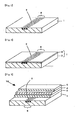
- Fig. 1 is a perspective view showing one example of the peeling film for a transfer foil raw fabric of the present invention.
- the peeling surface of the peeling film 1 is subjected to an easy-adhesion treatment in a band-like shape by surface modification in a slitting part 6 of a transfer foil raw fabric 10 (see Fig. 3 ).
- Fig. 3 is a perspective view showing one example of the transfer foil raw fabric 10 using the peeling film 1.
- a peeling layer 3 is formed entirely on the peeling film 1 and a pattern layer 4 and an adhesive layer 5 are successively laminated on the peeling layer 3.
- those commonly used as a base film for a transfer foil are usable and examples thereof include simple substance films such as a polyethylene-based resin, a polypropylene-based resin, a polyester-based resin, a polyamide-based resin, a polyacrylic-based resin, and a poly(vinyl chloride)-based resin or composites thereof, or composites of these films with paper or the like.
- the peeling film 1 may include a film material as a base film 7 and a release layer 8 formed entirely thereon.
- the release layer 8 is a layer to be released from the peeling layer 3 together with the base film 7 at the time of separating the peeling film 1 after thermal transfer or current molding transfer.
- a material of the release layer 8 may be an epoxy resin-type release agent, an epoxy-melamine resin-type release agent, a melamine resin-type release agent, a silicone resin-type release agent, a fluorine resin-type release agent, a cellulose derivative-type release agent, an alkyl resin-type release agent, a urea resin-type release agent, a polyolefin resin-type release agent, a paraffin-type release agent, and composite type release agents thereof.
- a method for forming the release layer 8 on the entire surface of the base film 7 may be a printing method such as gravure printing, screen printing, and flexo printing and a coating method such as reverse coat. These methods may be carried out in an off-line manner after film formation of the based film 7; however it is also possible to form the layer by coating the release agent (in-line coating) in the same line as that for forming the base film 7.
- the easy-adhesion treatment is carried out in a band-like shape in the slitting part 6 of the transfer foil raw fabric 10 (the reference numeral 2 in Figs. 2 and 4 shows a tackiness improved part).
- the easy-adhesion treatment is a treatment for close adhesion so as not to separate the peeling layer 3 from the peeling film 1 at the time of slitting the transfer foil raw fabric 10 in order to have a proper transfer foil width for transfer.
- the easy-adhesion treatment include flame treatment, corona treatment, plasma treatment, UV treatment, EB treatment, laser treatment, solvent/agent treatment, etc.
- the flame treatment is generally a treatment in which a combustible gas such as propane gas is burned on the film surface while blowing oxygen to cause oxidation reaction and a basic group having polarity is produced on the film surface.
- a combustible gas such as propane gas
- the corona treatment is a treatment in which a discharge treatment is carried out on the film surface to produce a carboxyl or hydroxyl group having polarity on the film surface and the surface is roughened.
- the plasma treatment is generally a treatment in which a basic group having polarity is produced on the film surface by utilizing the electric charge of particles generated by the electrolytic dissociation of a gas on the film surface.
- the UV treatment is generally a treatment in which the ambient radicals are produced by high energy ultraviolet rays and simultaneously the bonds among molecules of the film surface are cut by the energy of ultraviolet rays and thus the film surface is subjected to a hydrophilic treatment or oxidative evaporation.
- the EB treatment is generally a treatment in which the film is irradiated by electron beam through an electron beam radiation apparatus and the bonds among molecules of the film surface are cut by the energy of electron beam and thus the film surface is subjected to a hydrophilic treatment or oxidative evaporation.
- the laser treatment is generally a treatment in which the film surface is irradiated by laser beam such as CO 2 laser, argon laser, or the like and the bonds among molecules of the film surface are cut by the energy of laser beam and thus the film surface is subjected to a hydrophilic treatment or oxidative evaporation.
- laser beam such as CO 2 laser, argon laser, or the like
- the solvent/agent treatment is generally a treatment in which the film surface is brought into contact with a solvent/agent to modify (including surface-roughening) the surface. Additionally, in the case of using a solvent, it is unnecessary because the solvent is evaporated; whereas in the case of using an agent, the agent is removed by washing after the surface modification.
- the slitting part 6 is a part with a width of about 5 to 10 mm around a line planed to be slit as a center in the transfer foil.
- the width of the slitting part 6 may be widened although it is more or less uneconomical.
- narrowing the width of the slitting part 6 becomes a problem in terms of the slitting precision. That is, in a case where the extent of meandering generated at the time of transportation of the peeling film 1 while being unwound is significant, there is a risk that a slitting blade would be detached from the slitting part 6.
- the peeling film 1 is easy to be separated from the peeling layer 3 in the portions where the easy-adhesion treatment in a band-like shape is not carried out.
- a peel strength test in the 90° direction is carried out by peeling a tape (adhesive tape used: Cellotape (registered trade name), manufactured by Nichiban Co., Ltd.; tape width: 18 mm; peeling test speed: 20 mm/min; peeling length: 30 mm) with a push-pull gauge to find that the peel strength is 0 to 11 g.
- the peel strength of the slitting part 6 subjected to the easy-adhesion treatment is 85 g or higher.
- Fig. 9 shows the situation of common gravure rotary printing.
- a plate cylinder 14 is a cylinder-like plate having small holes (dents) and the ink applied to a furnisher roll 18 is transferred to the entire surface of the plate cylinder 14 and the ink on a portion having no holes (non-printing part) is scraped off by a doctor 19 and the ink remaining in the holes is pushed by an impression cylinder 15 and transferred to a film 13 and as a result, a printed pattern 16 is formed.
- One of printing defects generated in this printing step is a position gap 17 between a printing plate formed in the plate cylinder 14 and the film 13 to be printed in the width direction.
- the pattern layer 4 is overlapped on the treated region 11 subjected to the easy-adhesion treatment of the peeling film 1 due to the position gap 17 (see Fig. 10 ), the overlapped part of the pattern layer 4 causes peeling failure at the time of transfer.
- the loss can be decreased by cutting only the section where the pattern layer 4 and the treated region 11 subjected to the easy-adhesion treatment is carried out are overlapped in the total scale of the obtaining transfer foil raw fabric, however in the state of the transfer foil raw fabric, it is not easy to distinguish the treated region 11 subjected to the easy-adhesion treatment and the untreated region 12 and if the distinction is impossible, whichever section the peeling failure occurs cannot be determined.
- the peeling film 1 is so configured as to have an appearance difference to distinguish the treated region 11 subjected to the easy-adhesion treatment and the untreated region 12 (see Fig. 11 ) and in a case where the pattern layer 4 overlaps on the treated region 11 subjected to the easy-adhesion treatment due to the position gap through the succeeding printing step, it is made easy to find the defective section and remove the section.
- the appearance difference may be, for example, a difference of color types between the treated region 11 subjected to the easy-adhesion treatment and the untreated region 12.
- the appearance difference may be a gloss difference between the treated region 11 subjected to the easy-adhesion treatment and the untreated region 12.
- the appearance difference may be both differences; the difference of color types and the gloss difference.
- an appearance difference distinguishable between the treated region 11 subjected to the easy-adhesion treatment and the untreated region 12 for example, it may be a brightness difference or chromaticness difference besides color or gloss as a standard.
- the appearance difference is not limited to those distinguishable with eyes by reflected light and may be an appearance difference distinguishable with eyes by transmitted light.
- the appearance difference may be distinguishable by emitting fluorescence only from the treated region 11 or emitting no fluorescence from the treated region 11 but emitting fluorescence only from the untreated region 12.
- the appearance difference may be distinguishable by a camera or sensor even if the distinction is impossible with eyes.
- a method for providing the appearance difference for distinguishing the treated region 11 subjected to the easy-adhesion treatment and the untreated region 12 of the peeling film 1 is preferably carried out simultaneously with the easy-adhesion treatment by flame treatment, corona treatment, plasma treatment, UV treatment, EB treatment, laser treatment, solvent/agent treatment, etc.
- an additive which can generate the appearance difference by any of the above-mentioned easy-adhesion treatments is previously added to the peeling film before the easy-adhesion treatment. That is, not only the easy-adhesion property of the peeling surface is imparted to the slitting part 6 of the transfer foil raw fabric 10 by the easy-adhesion treatment but also an appearance change such as color or gloss is generated simultaneously in the slitting part 6.
- the appearance change is a color change
- besides discoloration to a different color for example, from red color to blue color, decoloration, color degradation, coloration, and light emission are included.
- the color tone, brightness of color, chromaticness, and brightness are not limited.
- additives examples include dyes, fluorescent dyes, pigments, materials having photochromism and a proper combination may be appropriately selected among flame treatment, corona treatment, plasma treatment, UV treatment, EB treatment, laser treatment, solvent/agent treatment, etc. for generating the appearance change.
- the following additives may be used.
- examples thereof include inorganic pigments such as white pigments (titanium dioxide, zinc oxide, antimony trioxide, zinc sulfide, lithopone, basic lead carbonate, basic lead sulfate, basic lead silicate, etc.), metal oxides (iron oxide, chromium oxide, etc.), nickel-antimony titanate, chromium-antimony titanate, manganese blue, manganese violet, cobalt blue, cobalt chromium blue, cobalt nickel gray, ultramarine blue, Berlin blue, lead chromate, lead sulfochromate, molybdate orange, molybdate red, metal sulfides (cadmium sulfide, arsenic disulfide, antimony trisulfide), cadmium sulfoselenides, zirconium silicate, low concentration carbon black, and graphite.
- white pigments titanium dioxide, zinc oxide, antimony trioxide, zinc sulfide, lithopone, basic lead carbonate
- Examples thereof further include organic pigments such as azo, azomethine, methine, anthraquinone, indanthrone, pyranthrone, flavanthrone, benzathrone, phthalocyanine, perinone, perylene, dioxazine, thioindigo, isoindoline, isoindolinone, quinacridone, pyrrole-pyrrole, and quinophthalone pigments, and also metal complexes of azo, azomethine, or methine dyes, and metal salts of azo compounds.
- organic pigments such as azo, azomethine, methine, anthraquinone, indanthrone, pyranthrone, flavanthrone, benzathrone, phthalocyanine, perinone, perylene, dioxazine, thioindigo, isoindoline, isoindolinone, quinacridone, pyrrol
- examples thereof include disperse dyes (e.g. anthraquinone type disperse dyes), as well as polymer-soluble dyes such as metal complexes of azo dyes particularly including monoazo dye 1 : 2 chromium or cobalt complex compounds, as well as fluorescent dyes (e.g. cumarin, naphthalimide, pyrazoline, acrydine, xanthene, thioxanthene, oxazine, thiazine, and benzothiazole type fluorescent dyes).
- disperse dyes e.g. anthraquinone type disperse dyes
- polymer-soluble dyes such as metal complexes of azo dyes particularly including monoazo dye 1 : 2 chromium or cobalt complex compounds
- fluorescent dyes e.g. cumarin, naphthalimide, pyrazoline, acrydine, xanthene, thioxanthene, oxazine,
- combination examples include additives such as indigo dyes in the case of changing the color by, for example, plasma treatment.
- the appearance difference can be imparted simultaneously with the easy-adhesion treatment by flame treatment, corona treatment, plasma treatment, UV treatment, EB treatment, laser treatment, solvent/agent treatment, etc., even in a case where an additive causing the appearance difference by the easy-adhesion treatment is not previously added to the peeling film before the easy-adhesion treatment, it may be acceptable.
- it may include those which cause an appearance change by the falling off of the release layer by the easy-adhesion treatment and those which cause a gloss change due to unevenness of the surface.
- the release layer is fallen off by the easy-adhesion treatment, the release layer is removed by the falling off, it results in easy-adhesion.
- the additive may be added to the base film or the additive may be added to the release layer 8.
- Another method for imparting a distinguishable appearance difference between the treated region 11 subjected to the easy-adhesion treatment and the untreated region 12 of the peeling film 1 may be carried out by another apparatus or method different from the easy-adhesion treatment to form a distinction mark conforming with the treated region 11 subjected to the easy-adhesion treatment.
- an additive which causes the appearance difference by laser treatment is previously added to the peeling film before the easy-adhesion treatment and the easy-adhesion treatment itself is carried out by plasma treatment and successively laser treatment is carried out in the same line with the plasma treatment to form a distinction mark.
- a plurality of plasma exposure heads 21a to 21c are installed in the width direction of a film 20 and plasma generation apparatus is installed in each plasma exposure head 21a to 21c toward the film 20.
- the plasma generation apparatus is so configured as to generate plasma in the atmospheric pressure environment and does not require large scale equipments unlike a conventional one for carrying out treatment in a vacuum chamber.
- Each plasma generation apparatus is connected with a gas source of, for example, argon, helium, nitrogen, oxygen, hydrogen, carbon dioxide, carbon tetrafluoride and steam and a power source and when the film 20 is transported in the direction shown by the arrow A, plasma is radiated from each plasma generation apparatus to the surface of the film to carry out the easy-adhesion treatment, that is, formation of treated regions 11a to 11c in band-like shapes causing no peeling in parallel.
- a plurality of leaser printing heads 22a to 22c are installed in the traces of the treated regions 11a to 11c in band-like shapes downstream of the plasma exposure heads 21a to 21c in the film transportation direction to further print the distinction mark for the treated regions 11a to 11c in band-like shapes.
- the easy-adhesion treatment and the treatment for imparting an appearance difference for distinguishing the treated region 11 subjected to the easy-adhesion treatment and the untreated region 12 can be carried out in the same line.
- an additive which causes the appearance difference by laser treatment is previously added to the peeling film before the easy-adhesion treatment and the easy-adhesion treatment itself is carried out by plasma treatment and at the same time laser treatment is carried out for the surface reverse to the easy-adhesion surface to form a distinction mark.
- a distinction mark conforming with the treated region 11 subjected to the easy-adhesion treatment may be formed by installing a coloring mechanism such as a pen on the reverse surface to the surface of the peeling film 1 subjected to the easy-adhesion treatment and drawing a line.
- the conformation in the case of this simple method may not be required to have the same width as that of the treated part.
- the peeling layer 3 becomes the outermost layer of the transfer layer transferred to the object to be decorated at the time of peeling the peeling film 1 after the transfer or after the molding simultaneous transfer.
- the peeling layer 3 is formed on the entire surface of the peeling film 1 and a part to be brought into contact with a part 1a in a band-like shape of the peeling film 1 subjected to the easy-adhesion treatment, that is, the slitting part 6 is a layer closely attached to and remaining on the peeling film 1 without being separated from the peeling film 1. Consequently, since the peeling layer 3 is closely attached to the peeling film 1 in the slitting part 6, no foil fall is caused at the time of slitting to give a proper width for transfer.
- a material for the peeling layer 3 may be a polyacrylic resin, a polyester-based resin, a poly(vinyl chloride)-based resin, a cellulose-based resin, a rubber-based resin, a polyurethane-based resin, a poly(vinyl acetate)-based resin, as well as copolymers such as a vinyl chloride-vinyl acetate copolymer-based resin and an ethylene-vinyl acetate copolymer-based resin.
- a light cure resin such as an ultraviolet curable resin, a radiation curable resin such as an electron beam-curable resin, and a thermosetting resin may be selected and used.
- Methods for forming the peeling layer 3 include coating methods such as a gravure coating method, a roll coating method, a comma coating method and a lip coating method, and printing methods such as a gravure printing method and a screen printing method.
- the pattern layer 4 is formed generally as a printed layer on the peeling layer 3.
- a material for the printed layer may be a colored ink containing, as a binder, resins such as a polyvinyl-based resin, a polyamide-based resin, a polyester-based resin, a polyacrylic resin, a polyurethane-based resin, a polyvinyl acetal-based resin, a polyester urethane-based resin, a cellulose ester-based resin and an alkyd resin, and as a coloring agent, a pigment or dye with proper color.
- resins such as a polyvinyl-based resin, a polyamide-based resin, a polyester-based resin, a polyacrylic resin, a polyurethane-based resin, a polyvinyl acetal-based resin, a polyester urethane-based resin, a cellulose ester-based resin and an alkyd resin, and as a coloring agent, a pigment or dye with proper color.
- Methods for forming the printed layer include common printing methods such as an offset printing method, a gravure printing method and a screen printing method. Particularly, in order to carry out multicolor printing or gradation expression, an offset printing method and a gravure printing method are suitable. In the case of monochrome, coating methods such as a gravure coating method, a roll coating method, a comma coating method and a lip coating method may be employed.
- the printed layer is generally formed entirely or partially in accordance with a pattern to be expressed.
- the pattern layer 4 may include a metal thin film layer or a combination of a printed layer and a metal thin film layer.
- the metal thin film layer is for expressing metal luster as the pattern layer 4 and may be formed by a vacuum deposition method or a plating method such as a resistance heating method, a sputtering method and an ion plating method.
- metals such as aluminum, nickel, gold, platinum, chromium, iron, copper, tin, indium, silver, titanium, lead and zinc, and alloys and compounds thereof may be used.
- One example of a method for partially forming a metal thin film layer may be a method in which a solvent-soluble resin layer is formed on a portion where no metal thin film is needed, thereafter a metal thin film is entirely formed thereon, and the solvent-soluble resin layer and unnecessary metal thin film are removed by washing with a solvent.
- a solvent to be used often is water or aqueous solution.
- another example thereof is a method in which a metal thin film is entirely formed, successively, a resist layer is formed on a portion where the metal thin film is to be left, etching with an acid or alkali is carried out, and thus the metal thin film in the portion other than the portion covered with the resist layer is removed.
- a pre-anchor layer and a post-anchor layer may be formed.
- Materials for the pre-anchor layer and post-anchor layer may be a two-component curable urethane resin, a thermosetting urethane resin, a melamine-based resin, a cellulose ester-based resin, a chlorine-containing rubber-based resin, a chlorine-containing vinyl-based resin, a polyacrylic resin, an epoxy-based resin, a vinyl type copolymer resin.
- Methods for forming the pre-anchor layer and the post-anchor layer include coating methods such as a gravure coating method, a roll coating method, a comma coating method and a lip coating method, and printing methods such as a gravure printing method and a screen printing method.
- the adhesion layer 5 is for sticking each of the layers on the surface of the object 8 to be decorated.
- the adhesive layer 5 is formed in a portion to be stuck. That is, if the portion to be stuck is the entire surface, the adhesive layer 5 is formed entirely. If the portion to be stuck is partial, the adhesive layer is formed partially.
- a heat sensitive resin or pressure sensitive resin proper for a material of the object 8 to be decorated is appropriately used.
- a material for the object 8 to be decorated is a polyacrylic resin
- a polyacrylic resin may be used.
- the material for the object to be decorated is a polyphenylene oxide-polystyrene-based resin, a polycarbonate-based resin, a styrene copolymer-based resin, or a polystyrene-based blended resin
- a polyacrylic resin, a polystyrene-based resin and a polyamide-based resin having a compatibility with these resins may be used.
- the material for the object 8 to be decorated is a polypropylene resin
- a chlorinated polyolefin resin a chlorinated ethylene-vinyl acetate copolymer resin, cyclized rubber, and a cumarone indene resin are usable.
- Methods for forming the adhesive layer 5 include coating methods such as a gravure coating method, a roll coating method, a comma coating method and a lip coating method, and printing methods such as a gravure printing method and a screen printing method.
- the configuration of the transfer foil raw fabric with no foil fall is not limited to the aspects and if one excellent in adhesiveness to an object to be decorated is used as a material for the pattern layer 4, the adhesive layer 5 can be omitted.
- a biaxially stretched polyethylene terephthalate film with a width of 650 mm and a thickness of 38 ⁇ m was masked excluding a slitting part of a transfer foil raw fabric 10 and passed at 50 m/min under flames of propane gas to carry out flame treatment on one surface of the film (easy-adhesion treatment) in a band-like shape with a pitch of 150 mm and a width of 10 mm and thus a peeling film for a transfer foil raw fabric was obtained.
- the release layer was masked excluding a slitting part of a transfer foil raw fabric and the release layer was irradiated by plasma from above to carry out plasma treatment on the surface of the film on which the release layer was formed (easy-adhesion treatment) in a band-like shape with a pitch of 150 mm and a width of 10 mm and thus a peeling film for a transfer foil raw fabric was obtained. Thereafter, a transfer foil raw fabric was obtained in the same manner as in Example 1.
- the release layer was masked excluding a slitting part of a transfer foil raw fabric and the release layer was irradiated by UV rays from above to carry out an easy-adhesion treatment on the surface of the film on which the release layer was formed in a band-like shape with a pitch of 150 mm and a width of 10 mm and thus a peeling film for a transfer foil raw fabric was obtained. Thereafter, a transfer foil raw fabric was obtained in the same manner as in Example 1.
- the release layer was masked excluding a slitting part of a transfer foil raw fabric and corona treatment was carried out thereon to carry out an easy-adhesion treatment on the surface of the film on which the release layer was formed in a band-like shape with a pitch of 150 mm and a width of 10 mm and thus a peeling film for a transfer foil raw fabric was obtained. Thereafter, a transfer foil raw fabric was obtained in the same manner as in Example 1.
- a silicone layer with thickness of 0.02 ⁇ m and colored with a pale concentration with an indigo dye was formed entirely on one surface of the film as a release layer by an in-line coating method.
- Plasma treatment with argon + oxygen gas was carried out on the release layer surface of the film on which the release layer was formed, that is, the peeling surface, in a band-like shape (band width of 10 mm, and pitch of 150 mm) along with the longitudinal direction of the film to obtain a peeling film.
- the indigo dye was discolored by the plasma treatment and the color became almost colorless to form an appearance difference distinguishable between a treated region subjected to the easy-adhesion treatment and an untreated region of the peeling film.
- a silicone layer with thickness of 0.02 ⁇ m and colored with a pale concentration with an indigo dye was formed entirely on one surface of the film as a release layer by an in-line coating method.
- CO 2 laser treatment was carried out on the release layer surface of the film on which the release layer was formed, that is, the peeling surface, in a band-like shape (band width of 10 mm, and pitch of 150 mm) along with the longitudinal direction of the film to obtain a peeling film.
- the peeling layer colored with the indigo dye was dropped off the film by the laser treatment and the color became colorless and the lust was eliminated because the surface of the film became uneven to form an appearance difference distinguishable between a treated region subjected to the easy-adhesion treatment and an untreated region of the peeling film.
- a peeling layer, a pattern layer, and an adhesive layer were formed in the same manner as in Example 1 on the peeling film to obtain a transfer foil.
- the peeling films had an appearance difference distinguishable between the treated region subjected to the easy-adhesion treatment and the untreated region of the peeling film, even if a defective section where the pattern layer was overlapped on the region subjected to the easy-adhesion treatment was generated due to a position gap in the printing step, merely the defective section could be easily removed based on the appearance difference and when transfer was carried out using the transfer foil after slitting, no peeling defects of the pattern layer occurred.
- the present invention provide a peeling film for a transfer foil raw fabric and a transfer foil raw fabric to be use for a thermal transfer method and a molding simultaneous transfer method.
Landscapes
- Decoration By Transfer Pictures (AREA)
- Laminated Bodies (AREA)
Applications Claiming Priority (3)
| Application Number | Priority Date | Filing Date | Title |
|---|---|---|---|
| JP2008208759 | 2008-08-13 | ||
| JP2008280647 | 2008-10-31 | ||
| PCT/JP2009/063637 WO2010018754A1 (ja) | 2008-08-13 | 2009-07-31 | 箔こぼれしない転写箔原反用剥離フィルム及び転写箔原反 |
Publications (3)
| Publication Number | Publication Date |
|---|---|
| EP2258563A1 true EP2258563A1 (de) | 2010-12-08 |
| EP2258563A4 EP2258563A4 (de) | 2011-04-27 |
| EP2258563B1 EP2258563B1 (de) | 2012-11-21 |
Family
ID=41668898
Family Applications (1)
| Application Number | Title | Priority Date | Filing Date |
|---|---|---|---|
| EP09806647A Not-in-force EP2258563B1 (de) | 2008-08-13 | 2009-07-31 | Abziehbarer film für ein transferfolienhalbzeug ohne folienfall und transferfolienhalbzeug |
Country Status (7)
| Country | Link |
|---|---|
| US (1) | US20110020620A1 (de) |
| EP (1) | EP2258563B1 (de) |
| JP (1) | JP4779056B2 (de) |
| KR (1) | KR101142683B1 (de) |
| CN (1) | CN101998908B (de) |
| TW (1) | TW201016484A (de) |
| WO (1) | WO2010018754A1 (de) |
Families Citing this family (3)
| Publication number | Priority date | Publication date | Assignee | Title |
|---|---|---|---|---|
| US10093076B2 (en) * | 2015-07-23 | 2018-10-09 | Daniel J. Gittere | Multilayer film |
| CN120829756A (zh) | 2018-11-19 | 2025-10-24 | 日产化学株式会社 | 光照射剥离用粘接剂组合物、层叠体、层叠体的制造方法以及剥离方法 |
| KR102498697B1 (ko) * | 2018-12-26 | 2023-02-13 | 후지필름 가부시키가이샤 | 적층체 |
Citations (4)
| Publication number | Priority date | Publication date | Assignee | Title |
|---|---|---|---|---|
| US5731064A (en) * | 1994-07-02 | 1998-03-24 | Leonhard Kurz Gmbh & Co. | Stamping foil, in particular a hot stamping foil with decorative or security elements |
| JPH1158584A (ja) * | 1997-08-12 | 1999-03-02 | Nissha Printing Co Ltd | 箔こぼれしない転写箔 |
| JP2003291594A (ja) * | 2002-04-04 | 2003-10-15 | Dainippon Printing Co Ltd | 転写箔 |
| US20060068135A1 (en) * | 2002-10-07 | 2006-03-30 | Kiyohito Shigemura | Transfer material |
Family Cites Families (6)
| Publication number | Priority date | Publication date | Assignee | Title |
|---|---|---|---|---|
| JPH033431Y2 (de) | 1985-10-14 | 1991-01-29 | ||
| JPH033430Y2 (de) | 1985-10-14 | 1991-01-29 | ||
| JP2562855Y2 (ja) * | 1990-08-23 | 1998-02-16 | 大日本印刷株式会社 | 転写箔 |
| JP3850402B2 (ja) * | 2002-10-07 | 2006-11-29 | 日本写真印刷株式会社 | 転写材 |
| JP2006247893A (ja) * | 2005-03-08 | 2006-09-21 | Nissha Printing Co Ltd | 転写フィルム、加飾フィルムおよび加飾品の製造方法並びに加飾品 |
| JP4803514B2 (ja) * | 2005-03-31 | 2011-10-26 | 株式会社吉野工業所 | 転写フィルム |
-
2009
- 2009-07-31 WO PCT/JP2009/063637 patent/WO2010018754A1/ja not_active Ceased
- 2009-07-31 EP EP09806647A patent/EP2258563B1/de not_active Not-in-force
- 2009-07-31 JP JP2010524700A patent/JP4779056B2/ja not_active Expired - Fee Related
- 2009-07-31 US US12/935,404 patent/US20110020620A1/en not_active Abandoned
- 2009-07-31 CN CN200980113727.8A patent/CN101998908B/zh not_active Expired - Fee Related
- 2009-07-31 KR KR1020107019667A patent/KR101142683B1/ko not_active Expired - Fee Related
- 2009-08-04 TW TW098126160A patent/TW201016484A/zh not_active IP Right Cessation
Patent Citations (4)
| Publication number | Priority date | Publication date | Assignee | Title |
|---|---|---|---|---|
| US5731064A (en) * | 1994-07-02 | 1998-03-24 | Leonhard Kurz Gmbh & Co. | Stamping foil, in particular a hot stamping foil with decorative or security elements |
| JPH1158584A (ja) * | 1997-08-12 | 1999-03-02 | Nissha Printing Co Ltd | 箔こぼれしない転写箔 |
| JP2003291594A (ja) * | 2002-04-04 | 2003-10-15 | Dainippon Printing Co Ltd | 転写箔 |
| US20060068135A1 (en) * | 2002-10-07 | 2006-03-30 | Kiyohito Shigemura | Transfer material |
Non-Patent Citations (1)
| Title |
|---|
| See also references of WO2010018754A1 * |
Also Published As
| Publication number | Publication date |
|---|---|
| CN101998908A (zh) | 2011-03-30 |
| TW201016484A (en) | 2010-05-01 |
| JP4779056B2 (ja) | 2011-09-21 |
| TWI379777B (de) | 2012-12-21 |
| KR101142683B1 (ko) | 2012-05-03 |
| CN101998908B (zh) | 2012-12-19 |
| KR20100111317A (ko) | 2010-10-14 |
| EP2258563A4 (de) | 2011-04-27 |
| EP2258563B1 (de) | 2012-11-21 |
| US20110020620A1 (en) | 2011-01-27 |
| JPWO2010018754A1 (ja) | 2012-01-26 |
| WO2010018754A1 (ja) | 2010-02-18 |
Similar Documents
| Publication | Publication Date | Title |
|---|---|---|
| AU2010272811B2 (en) | Method for the production of a multilayer element, and multilayer element | |
| CN102378939B (zh) | 掩膜用部件、使用该部件制造掩膜的方法及感光性树脂印刷版的制造方法 | |
| CN105189120B (zh) | 用于对三维物件冷压印的方法和设备 | |
| US12070970B2 (en) | Decorative film, transfer film, use of a transfer film, method for producing a transfer film, method for decorating a plastic molded article, and plastic molded article | |
| JP5636682B2 (ja) | シームレス缶用インキジェット印刷フィルム | |
| JP2016533921A5 (de) | ||
| JP2016533921A (ja) | 多層体を生産する方法、および多層体 | |
| EP2258563B1 (de) | Abziehbarer film für ein transferfolienhalbzeug ohne folienfall und transferfolienhalbzeug | |
| JP2011167844A (ja) | 干渉縞防止剤を含有する転写シートとその加飾成形品 | |
| JP3165105U (ja) | フルカラーパターンを有する電子装置 | |
| TWI469883B (zh) | 部分消光硬塗膜轉印片及其製造方法 | |
| JP2001030290A (ja) | レーザーマーキング加飾成形品とその製造方法 | |
| JP2010214666A (ja) | レーザー加飾用シートとこれを用いたレーザー加飾柄付きシート及びレーザー加飾品の製造方法 | |
| KR101147128B1 (ko) | 알루미늄층이 결합된 변색방지용 합지필름 | |
| JP2004123802A (ja) | 印刷インキ、印刷物および印刷物の製造方法 | |
| JP2010052277A (ja) | レーザエッチング用転写材および多色成形品の製造方法 | |
| JP2003175672A (ja) | レーザエッチング用転写材と多色成形品の製造方法 | |
| JP2009233990A (ja) | 画像形成がなされた多孔金属板 | |
| JP5907904B2 (ja) | 金属立体加飾板およびその製造方法 | |
| JP2011140127A (ja) | 部分透明化金属薄膜を有する加飾された物品 | |
| KR101389477B1 (ko) | 유색 러버 코팅층을 갖는 모재의 표면처리 방법 | |
| JP2008297598A (ja) | 加飾シートの製造方法および加飾品 | |
| JP2005246408A (ja) | 透光式表示パネルの製造方法 | |
| JPH04161937A (ja) | ストロボ発光窓を有するパネルとその製造方法、および転写シート |
Legal Events
| Date | Code | Title | Description |
|---|---|---|---|
| PUAI | Public reference made under article 153(3) epc to a published international application that has entered the european phase |
Free format text: ORIGINAL CODE: 0009012 |
|
| 17P | Request for examination filed |
Effective date: 20100923 |
|
| AK | Designated contracting states |
Kind code of ref document: A1 Designated state(s): AT BE BG CH CY CZ DE DK EE ES FI FR GB GR HR HU IE IS IT LI LT LU LV MC MK MT NL NO PL PT RO SE SI SK SM TR |
|
| AX | Request for extension of the european patent |
Extension state: AL BA RS |
|
| A4 | Supplementary search report drawn up and despatched |
Effective date: 20110329 |
|
| DAX | Request for extension of the european patent (deleted) | ||
| GRAP | Despatch of communication of intention to grant a patent |
Free format text: ORIGINAL CODE: EPIDOSNIGR1 |
|
| GRAS | Grant fee paid |
Free format text: ORIGINAL CODE: EPIDOSNIGR3 |
|
| RTI1 | Title (correction) |
Free format text: TRANSFER-FOIL RAW FABRIC HAVING NO FOIL FALL AND PEELING FILM THEREFOR |
|
| GRAA | (expected) grant |
Free format text: ORIGINAL CODE: 0009210 |
|
| AK | Designated contracting states |
Kind code of ref document: B1 Designated state(s): AT BE BG CH CY CZ DE DK EE ES FI FR GB GR HR HU IE IS IT LI LT LU LV MC MK MT NL NO PL PT RO SE SI SK SM TR |
|
| REG | Reference to a national code |
Ref country code: GB Ref legal event code: FG4D |
|
| REG | Reference to a national code |
Ref country code: CH Ref legal event code: EP |
|
| REG | Reference to a national code |
Ref country code: AT Ref legal event code: REF Ref document number: 584852 Country of ref document: AT Kind code of ref document: T Effective date: 20121215 |
|
| REG | Reference to a national code |
Ref country code: IE Ref legal event code: FG4D |
|
| REG | Reference to a national code |
Ref country code: DE Ref legal event code: R096 Ref document number: 602009011453 Country of ref document: DE Effective date: 20130117 |
|
| REG | Reference to a national code |
Ref country code: NL Ref legal event code: VDEP Effective date: 20121121 |
|
| REG | Reference to a national code |
Ref country code: AT Ref legal event code: MK05 Ref document number: 584852 Country of ref document: AT Kind code of ref document: T Effective date: 20121121 |
|
| REG | Reference to a national code |
Ref country code: LT Ref legal event code: MG4D |
|
| PG25 | Lapsed in a contracting state [announced via postgrant information from national office to epo] |
Ref country code: SE Free format text: LAPSE BECAUSE OF FAILURE TO SUBMIT A TRANSLATION OF THE DESCRIPTION OR TO PAY THE FEE WITHIN THE PRESCRIBED TIME-LIMIT Effective date: 20121121 Ref country code: LT Free format text: LAPSE BECAUSE OF FAILURE TO SUBMIT A TRANSLATION OF THE DESCRIPTION OR TO PAY THE FEE WITHIN THE PRESCRIBED TIME-LIMIT Effective date: 20121121 Ref country code: ES Free format text: LAPSE BECAUSE OF FAILURE TO SUBMIT A TRANSLATION OF THE DESCRIPTION OR TO PAY THE FEE WITHIN THE PRESCRIBED TIME-LIMIT Effective date: 20130304 Ref country code: FI Free format text: LAPSE BECAUSE OF FAILURE TO SUBMIT A TRANSLATION OF THE DESCRIPTION OR TO PAY THE FEE WITHIN THE PRESCRIBED TIME-LIMIT Effective date: 20121121 Ref country code: HR Free format text: LAPSE BECAUSE OF FAILURE TO SUBMIT A TRANSLATION OF THE DESCRIPTION OR TO PAY THE FEE WITHIN THE PRESCRIBED TIME-LIMIT Effective date: 20121121 Ref country code: NO Free format text: LAPSE BECAUSE OF FAILURE TO SUBMIT A TRANSLATION OF THE DESCRIPTION OR TO PAY THE FEE WITHIN THE PRESCRIBED TIME-LIMIT Effective date: 20130221 |
|
| PG25 | Lapsed in a contracting state [announced via postgrant information from national office to epo] |
Ref country code: BE Free format text: LAPSE BECAUSE OF FAILURE TO SUBMIT A TRANSLATION OF THE DESCRIPTION OR TO PAY THE FEE WITHIN THE PRESCRIBED TIME-LIMIT Effective date: 20121121 Ref country code: LV Free format text: LAPSE BECAUSE OF FAILURE TO SUBMIT A TRANSLATION OF THE DESCRIPTION OR TO PAY THE FEE WITHIN THE PRESCRIBED TIME-LIMIT Effective date: 20121121 Ref country code: PL Free format text: LAPSE BECAUSE OF FAILURE TO SUBMIT A TRANSLATION OF THE DESCRIPTION OR TO PAY THE FEE WITHIN THE PRESCRIBED TIME-LIMIT Effective date: 20121121 Ref country code: GR Free format text: LAPSE BECAUSE OF FAILURE TO SUBMIT A TRANSLATION OF THE DESCRIPTION OR TO PAY THE FEE WITHIN THE PRESCRIBED TIME-LIMIT Effective date: 20130222 Ref country code: PT Free format text: LAPSE BECAUSE OF FAILURE TO SUBMIT A TRANSLATION OF THE DESCRIPTION OR TO PAY THE FEE WITHIN THE PRESCRIBED TIME-LIMIT Effective date: 20130321 Ref country code: SI Free format text: LAPSE BECAUSE OF FAILURE TO SUBMIT A TRANSLATION OF THE DESCRIPTION OR TO PAY THE FEE WITHIN THE PRESCRIBED TIME-LIMIT Effective date: 20121121 |
|
| PG25 | Lapsed in a contracting state [announced via postgrant information from national office to epo] |
Ref country code: AT Free format text: LAPSE BECAUSE OF FAILURE TO SUBMIT A TRANSLATION OF THE DESCRIPTION OR TO PAY THE FEE WITHIN THE PRESCRIBED TIME-LIMIT Effective date: 20121121 |
|
| PG25 | Lapsed in a contracting state [announced via postgrant information from national office to epo] |
Ref country code: SK Free format text: LAPSE BECAUSE OF FAILURE TO SUBMIT A TRANSLATION OF THE DESCRIPTION OR TO PAY THE FEE WITHIN THE PRESCRIBED TIME-LIMIT Effective date: 20121121 Ref country code: EE Free format text: LAPSE BECAUSE OF FAILURE TO SUBMIT A TRANSLATION OF THE DESCRIPTION OR TO PAY THE FEE WITHIN THE PRESCRIBED TIME-LIMIT Effective date: 20121121 Ref country code: BG Free format text: LAPSE BECAUSE OF FAILURE TO SUBMIT A TRANSLATION OF THE DESCRIPTION OR TO PAY THE FEE WITHIN THE PRESCRIBED TIME-LIMIT Effective date: 20130221 Ref country code: DK Free format text: LAPSE BECAUSE OF FAILURE TO SUBMIT A TRANSLATION OF THE DESCRIPTION OR TO PAY THE FEE WITHIN THE PRESCRIBED TIME-LIMIT Effective date: 20121121 Ref country code: CZ Free format text: LAPSE BECAUSE OF FAILURE TO SUBMIT A TRANSLATION OF THE DESCRIPTION OR TO PAY THE FEE WITHIN THE PRESCRIBED TIME-LIMIT Effective date: 20121121 |
|
| PG25 | Lapsed in a contracting state [announced via postgrant information from national office to epo] |
Ref country code: NL Free format text: LAPSE BECAUSE OF FAILURE TO SUBMIT A TRANSLATION OF THE DESCRIPTION OR TO PAY THE FEE WITHIN THE PRESCRIBED TIME-LIMIT Effective date: 20121121 Ref country code: IT Free format text: LAPSE BECAUSE OF FAILURE TO SUBMIT A TRANSLATION OF THE DESCRIPTION OR TO PAY THE FEE WITHIN THE PRESCRIBED TIME-LIMIT Effective date: 20121121 Ref country code: RO Free format text: LAPSE BECAUSE OF FAILURE TO SUBMIT A TRANSLATION OF THE DESCRIPTION OR TO PAY THE FEE WITHIN THE PRESCRIBED TIME-LIMIT Effective date: 20121121 |
|
| PLBE | No opposition filed within time limit |
Free format text: ORIGINAL CODE: 0009261 |
|
| STAA | Information on the status of an ep patent application or granted ep patent |
Free format text: STATUS: NO OPPOSITION FILED WITHIN TIME LIMIT |
|
| 26N | No opposition filed |
Effective date: 20130822 |
|
| REG | Reference to a national code |
Ref country code: DE Ref legal event code: R097 Ref document number: 602009011453 Country of ref document: DE Effective date: 20130822 |
|
| PG25 | Lapsed in a contracting state [announced via postgrant information from national office to epo] |
Ref country code: MC Free format text: LAPSE BECAUSE OF FAILURE TO SUBMIT A TRANSLATION OF THE DESCRIPTION OR TO PAY THE FEE WITHIN THE PRESCRIBED TIME-LIMIT Effective date: 20121121 |
|
| REG | Reference to a national code |
Ref country code: CH Ref legal event code: PL |
|
| REG | Reference to a national code |
Ref country code: IE Ref legal event code: MM4A |
|
| REG | Reference to a national code |
Ref country code: FR Ref legal event code: ST Effective date: 20140331 |
|
| PG25 | Lapsed in a contracting state [announced via postgrant information from national office to epo] |
Ref country code: LI Free format text: LAPSE BECAUSE OF NON-PAYMENT OF DUE FEES Effective date: 20130731 Ref country code: CH Free format text: LAPSE BECAUSE OF NON-PAYMENT OF DUE FEES Effective date: 20130731 |
|
| PG25 | Lapsed in a contracting state [announced via postgrant information from national office to epo] |
Ref country code: FR Free format text: LAPSE BECAUSE OF NON-PAYMENT OF DUE FEES Effective date: 20130731 |
|
| PG25 | Lapsed in a contracting state [announced via postgrant information from national office to epo] |
Ref country code: IE Free format text: LAPSE BECAUSE OF NON-PAYMENT OF DUE FEES Effective date: 20130731 |
|
| PG25 | Lapsed in a contracting state [announced via postgrant information from national office to epo] |
Ref country code: SM Free format text: LAPSE BECAUSE OF FAILURE TO SUBMIT A TRANSLATION OF THE DESCRIPTION OR TO PAY THE FEE WITHIN THE PRESCRIBED TIME-LIMIT Effective date: 20121121 |
|
| PG25 | Lapsed in a contracting state [announced via postgrant information from national office to epo] |
Ref country code: TR Free format text: LAPSE BECAUSE OF FAILURE TO SUBMIT A TRANSLATION OF THE DESCRIPTION OR TO PAY THE FEE WITHIN THE PRESCRIBED TIME-LIMIT Effective date: 20121121 Ref country code: MT Free format text: LAPSE BECAUSE OF FAILURE TO SUBMIT A TRANSLATION OF THE DESCRIPTION OR TO PAY THE FEE WITHIN THE PRESCRIBED TIME-LIMIT Effective date: 20121121 Ref country code: CY Free format text: LAPSE BECAUSE OF FAILURE TO SUBMIT A TRANSLATION OF THE DESCRIPTION OR TO PAY THE FEE WITHIN THE PRESCRIBED TIME-LIMIT Effective date: 20121121 |
|
| PG25 | Lapsed in a contracting state [announced via postgrant information from national office to epo] |
Ref country code: LU Free format text: LAPSE BECAUSE OF NON-PAYMENT OF DUE FEES Effective date: 20130731 Ref country code: MK Free format text: LAPSE BECAUSE OF FAILURE TO SUBMIT A TRANSLATION OF THE DESCRIPTION OR TO PAY THE FEE WITHIN THE PRESCRIBED TIME-LIMIT Effective date: 20121121 Ref country code: HU Free format text: LAPSE BECAUSE OF FAILURE TO SUBMIT A TRANSLATION OF THE DESCRIPTION OR TO PAY THE FEE WITHIN THE PRESCRIBED TIME-LIMIT; INVALID AB INITIO Effective date: 20090731 |
|
| PG25 | Lapsed in a contracting state [announced via postgrant information from national office to epo] |
Ref country code: IS Free format text: LAPSE BECAUSE OF FAILURE TO SUBMIT A TRANSLATION OF THE DESCRIPTION OR TO PAY THE FEE WITHIN THE PRESCRIBED TIME-LIMIT Effective date: 20121121 |
|
| PGFP | Annual fee paid to national office [announced via postgrant information from national office to epo] |
Ref country code: DE Payment date: 20160722 Year of fee payment: 8 Ref country code: GB Payment date: 20160721 Year of fee payment: 8 |
|
| REG | Reference to a national code |
Ref country code: DE Ref legal event code: R119 Ref document number: 602009011453 Country of ref document: DE |
|
| GBPC | Gb: european patent ceased through non-payment of renewal fee |
Effective date: 20170731 |
|
| PG25 | Lapsed in a contracting state [announced via postgrant information from national office to epo] |
Ref country code: DE Free format text: LAPSE BECAUSE OF NON-PAYMENT OF DUE FEES Effective date: 20180201 Ref country code: GB Free format text: LAPSE BECAUSE OF NON-PAYMENT OF DUE FEES Effective date: 20170731 |