EP2260821A2 - Dispositif d'entraînement pour animaux quadrupèdes - Google Patents
Dispositif d'entraînement pour animaux quadrupèdes Download PDFInfo
- Publication number
- EP2260821A2 EP2260821A2 EP20100165466 EP10165466A EP2260821A2 EP 2260821 A2 EP2260821 A2 EP 2260821A2 EP 20100165466 EP20100165466 EP 20100165466 EP 10165466 A EP10165466 A EP 10165466A EP 2260821 A2 EP2260821 A2 EP 2260821A2
- Authority
- EP
- European Patent Office
- Prior art keywords
- training device
- animal
- training
- receiving
- receiving plates
- Prior art date
- Legal status (The legal status is an assumption and is not a legal conclusion. Google has not performed a legal analysis and makes no representation as to the accuracy of the status listed.)
- Withdrawn
Links
Images

Classifications
-
- A—HUMAN NECESSITIES
- A01—AGRICULTURE; FORESTRY; ANIMAL HUSBANDRY; HUNTING; TRAPPING; FISHING
- A01K—ANIMAL HUSBANDRY; AVICULTURE; APICULTURE; PISCICULTURE; FISHING; REARING OR BREEDING ANIMALS, NOT OTHERWISE PROVIDED FOR; NEW BREEDS OF ANIMALS
- A01K15/00—Devices for taming animals, e.g. nose-rings or hobbles; Devices for overturning animals in general; Training or exercising equipment; Covering boxes
- A01K15/02—Training or exercising equipment, e.g. mazes or labyrinths for animals ; Electric shock devices; Toys specially adapted for animals
- A01K15/027—Exercising equipment, e.g. tread mills, carousels
Definitions
- the invention relates to a training device for the stimulation and training of the musculoskeletal system of a four-limbed animal.
- Training devices for the stimulation and training of the musculoskeletal system of humans are already known in the art.
- the DE 20 2006 006 828 U1 a training device in which a person to be trained stands with both legs on a rocker-like receiving plate which is set in vibration by means of a drive arrangement provided with an electric motor.
- the vibrations transmitted by the rocker-like receiving plate to the person lead to a strengthening of his muscles, especially in the leg and back area.
- animals often have in the leg and back area, for example, due to age or injury, suffering.
- animals with four extremities are considered, whereby the extremities are in particular meant to be legs on which the animal normally stands or walks.
- animals that have a high economic value such as horses that are used in high performance sports, or even in pets, such as dogs or cats, to which their owners feel a strong emotional bond, there is often a high interest in it
- animals that have a high economic value such as horses that are used in high performance sports, or even in pets, such as dogs or cats, to which their owners feel a strong emotional bond
- there is often a high interest in it To alleviate the animals' suffering quickly so that they can be used as soon as possible again for well-being and possibly for sporting purposes.
- a training device for stimulating and training the musculoskeletal system of a four limb animal comprising at least two support plates movably mounted separately and movably relative to a pedestal assembly for receiving the four extremities of an animal standing on the exerciser, and at least a drive arrangement associated with the receiving plates with at least one electromechanical actuator or electric motor, by means of which the receiving plates are set into vibration comprises.
- the exercise device according to the invention can be used not only to strengthen, but also to relax the muscles. This makes it possible, for example, to warm up sport horses before the actual sports training and / or to accelerate the regeneration of the animal after the actual sports training. Also, the constantly to be performed by the animal to be trained compensatory movements increase its stability, in particular the sense of balance is promoted. Furthermore, the exercise device according to the invention can help an animal after a ligament injury to rebuild the ligaments faster.
- the support plates associated with the drive assembly preferably in addition to the above-mentioned electromechanical actuator or electric motor also has a transmission elements having gear, the transmission elements for each of the at least two receiving plates at least one power transmission chain between the respective receiving plate and the at least one electromechanical actuator or electric motor.
- a training device which comprises exactly four receiving plates for receiving in each case one extremity of an animal standing on the training device.
- a separate receiving plate for each leg of the animal By providing a separate receiving plate for each leg of the animal, a very high degree of flexibility can be achieved with regard to the individual adjustability of the forced movements to be given to the extremities.
- the training device comprises exactly two receiving plates for receiving two extremities of the animal.
- the training device comprises exactly two receiving plates for receiving two extremities of the animal.
- a relatively inexpensive implementation of the training device can be achieved because only relatively few items are needed.
- one of the two receiving plates is adapted to receive the two front extremities of an animal standing on the training device, while the other of the two receiving plates is adapted to receive the two hind extremities of the animal. Since most four-legged animals, such as horses or dogs, usually have a greater extent in their longitudinal direction than in their width direction, the two receiving plates in this variant can be made relatively compact, possibly approximately square, which is particularly true, If the training device can be dismantled, has the advantage that the mounting plates can be stowed relatively space-saving.
- one of the two receiving plates is adapted to receive the two left extremities of an animal standing on the training device, while the other of the two receiving plates is adapted to receive the two right extremities of the animal.
- This variant has over the first variant has the advantage that, at least when the receiving plates are mounted rocker similar with respect to their associated pivot axis, the respective limbs of the animal in a simple manner a forced movement with a relatively large stroke amplitude can be issued as the extremities of Animal on average have a greater distance from the pivot axes, as is the case in the first variant described above.
- the receiving plates are pivotally mounted relative to the stator assembly and by means of the drive assembly in a rocking or pivoting movement comprehensive vibrations can be displaced.
- the receiving plates are each rocker similar stored with respect to a respective pivot axis.
- the pivot axis does not have to be permanently stationary, but that also a slightly floating storage with variable position swivel axis is possible, as also from the DE 20 2006 006 828 U1 is known, the disclosure of which is hereby incorporated by reference in its entirety and made part of the disclosure of the present application.
- the at least one drive arrangement is adjustable such that the respectively received on the receiving plate limb or limbs of an animal standing on the training device an average lifting height of optionally about 0 cm to about 15 cm can be issued.
- the lifting height to be given depends on various factors, such as the size of the animal to be trained, the desired training intensity and also the excitation frequency.
- a setting of the lifting height to 0 cm means that there is no forced movement on the associated receiving plate located limb or limbs of the animal or Experienced. This can be z. B. be useful if only a specific body region of the animal is targeted, for example, only the muscles of the front legs.
- the receiving plates associated drive arrangements are individually adjustable is particularly advantageous. As a result, the training can be optimally tailored to the individual needs of the animal.
- a control device controlling the drive arrangement is provided for selectively setting at least one receiving plate oscillation frequency.
- the receiving plate oscillation frequency between about 0.5 Hz and about 5 Hz, preferably between about 1 Hz and about 30 Hz adjustable. In these frequency ranges, the muscles are particularly efficiently stimulated. These frequencies are equal to or higher than the normal walking or running frequency of many four-legged animals.
- control device allows an individual adjustment of the receiving plate oscillation frequency for each receiving plate of the exercise device.
- the muscles of a horse which is specialized for use in showjumping, are more stimulated and trained in the hindlegs, as in the area of the front legs.
- control device is suitable to control the at least two receiving plates so that either different gaits of an animal standing on the training device, in particular pass passage and cloister, can be simulated.
- Most horse breeds are prone to Nature to the cloister, while a few horse breeds, such as Icelanders, by nature tend to pass passage.
- the adjustability of the training device by means of the control device thus different horse breeds can be trained according to their natural gait, without major adjustments to the training device are needed.
- the receiving plates are equipped with treadmills, to facilitate a walking or running training of an animal standing on the training device.
- a treadmill-comprising exercise device can simulate walking or running on uneven terrain.
- the treadmills can be driven by a motor. It is particularly preferred if the speed of the treadmills is selectively adjustable. Thus, depending on the requirement for the animal, the particular situation given can be set individually.
- the training device comprise a frame with which an animal standing on the training device can be held in a training position.
- horses may be thought of as similar frames as are known in automatic milking systems for cows.
- the training device for tensioning means, in particular for tensioning straps, are provided, for exerting a compressive force acting in a substantially vertical direction on an animal standing on the training device. Because of this additional load, the forced movements in the form of vibrations given to the animal to be trained can more effectively lead to a buildup of muscle in the leg and back area.
- the straps may be passed over the back so as to be strained somewhat like the weight of a rider.
- the training device is designed such that it can also be operated under water. In particular, it is necessary to make all mechanical and electrical parts waterproof.
- the exercise device may be designed and dimensioned to stimulate and train the musculoskeletal system of a horse. Accordingly stable, the receiving plates must be designed and correspondingly large, the distance of the receiving plates to each other must be. Furthermore, the receiving plates themselves must also be large enough to provide safe riding surfaces for the horse.
- the training device of a first at least a first receiving plate training device and at least a second receiving plate having second Training device exists, if desired, be transported separately and, if desired, separately used.
- the two training devices are preferably connected to each other in operation to ensure a secure relative position to each other, even if the training device is heavily loaded during operation.
- the control for both training devices is coordinated.
- the training device consists of four corresponding training devices, which, if desired, can be transported separately and, if desired, used separately.
- the device is designed as a construction-related training device having the receiving plates.
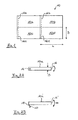
- Fig. 1 is a first preferred embodiment of a training device according to the invention in plan view generally designated 10.
- the training device 10 comprises four substantially identical and separately formed receiving plates 10a, 10b, 10c, 10d for receiving one extremity of a four-legged animal.
- the in Fig. 1 training device designed to stimulate and train the musculoskeletal system of a horse, which stands with his right front hoof on the receiving plate 10a, with his right hind hoof on the receiving plate 10b, with his left Vorderhuf on the receiving plate 10c and with his left Schuhuf on the receiving plate 10d.
- the receiving plates 10a, 10b, 10c, 10d are pivotable about a pivot axis 12a, 12b, 12c, 12d associated therewith (shown in dashed lines) relative to a stator arrangement (not shown).
- the individual receiving plates 10a, 10b, 10c, 10d are thereby driven by a motor by means of a respectively assigned (not shown) drive arrangement.
- a (likewise not shown) control device controls the pivoting movement of the individual receiving plates 10a, 10b, 10c, 10d.
- the receiving plates 10a, 10b, 10c, 10d are dimensioned such that they in the longitudinal direction L, d. H. in a direction perpendicular to the respective pivot axis 12a, 12b, 12c, 12d, has a length approximately equal to the distance the front hooves have to the hind legs of the horse when it is normal.
- the receiving plates 10a, 10b, 10c, 10d on a dimension which corresponds approximately to the distance from left hooves to right hooves when the horse is normal.
- the receiving plates can thus for example have a length L of 1 m and a width of 0.5 m.
- each hoof of the horse can be safely placed approximately in the middle of the respective receiving plate 10a, 10b, 10c, 10d.
- the lifting height can be varied in a simple manner, without the need for any adjustments to the training device 10 itself.
- FIGS. 2A and 2B show two alternative variants, as the receiving plates 10a, 10b, 10c, 10d may be carried out with respect to their storage on a housing, not shown. Shown in both cases by way of example only one receiving plate, namely the receiving plate 10a and 10a '.
- receiving plate 10a is pivotally mounted on a relative to a (not shown) frame of the training device 10 fixed pivot axis. A farthest from the pivot axis 14 portion 16 of the receiving plate 10 a moves when pivoting on a circular arc portion about the pivot axis 14 back and forth.
- a drive assembly not shown, which acts on the receiving plate 10a approximately in the section 16 from below, the maximum stroke of the portion 16 can be adjusted so that it is in this embodiment between 0 and 16 cm.
- receiving plate 10a ' is mounted by means of a leaf spring 18, which in turn is clamped in a relative to a (not shown) frame stationary beam element.
- This type of mounting of the receiving plate 10a ' causes the receiving plate 10a' does not pivot about a pivot axis fixed relative to the (not shown) frame, but that the current pivot axis due to a variable deflection of the leaf spring 18 over time in a limited local area can vary.
- a portion 16 'furthest from the leaf spring 18 not only performs movement on a circular arc portion, but also undergoes some movement in a horizontal direction.
- the thickness D is chosen so that the receiving plates 10a, 10a' on the one hand to withstand the loads acting on them, and on the other such that the risk is minimized that between two adjacent Receiving plates 10a, 10b, 10c, 10d or between the receiving plates 10a, 10b, 10c, 10d and portions of the stand assembly (not shown) any body part of the animal, such as a hoof, or a person operating the training device 10, such as a Hand, can pinch.
- Fig. 3 is a second embodiment of the exercise device according to the invention generally designated 110.
- the training device 110 comprises only two mutually separate, but also substantially identical receiving plates 110a, 110b. These two receiving plates 110a, 110b are pivotally similar to a respective pivot axis (112a, 112b shown in phantom).
- the exercise device 110 is a horse during exercise with his two front hooves on the receiving plate 110a and with his two hind feet on the receiving plate 110b.
- the hooves on the two receiving plates 110a, 110b are placed such that one hoof with respect to the pivot axis 112a or 112b is on one side of the receiving plate 110a or 110b, while the other hoof on the other side of the receiving plate 112a and 112b stands.
- the drive plates 110a, 110b respectively associated drive assembly may be formed substantially identical to that in the in Fig. 1 shown training device 10 is used.
- Fig. 4 a third embodiment of the training device according to the invention is shown, which differs from the in Fig. 3 shown second embodiment differs only in some details. Therefore, in Fig. 4 Analog parts provided with the same reference numerals as in Fig. 3 , but increased by the number 100. Further, the embodiment according to Fig. 4 in the following only insofar described, as they differ from the embodiment according to Fig. 3 which is expressly referred to herewith.
- the two mounting plates 210a, 210b pivotally about their associated pivot axes 212a, 212b with respect to a (not shown) stator assembly substantially rocker similar.
- the two receiving plates 210a, 210b are formed such that a horse to be trained stands on the receiving plate 210a with its right front hoof and right hind hoof, for example, while standing on the receiving plate 210b with its left front hoof and left hoof hoof.
- a hoof is again placed on one side with respect to the respective pivot axis 212a or 212b, whereas the other hoof is placed on the other side.
- the horse can be moved in a similar way as a show horse.
- the antiphase driving of the two Receiving plates 210a, 210b usually preferred, because this also a relative movement between the two front hooves, or between the two hind hooves takes place and the training effect is thus increased.
Landscapes
- Life Sciences & Earth Sciences (AREA)
- Environmental Sciences (AREA)
- Health & Medical Sciences (AREA)
- General Health & Medical Sciences (AREA)
- Physical Education & Sports Medicine (AREA)
- Animal Behavior & Ethology (AREA)
- Zoology (AREA)
- Animal Husbandry (AREA)
- Biodiversity & Conservation Biology (AREA)
- Rehabilitation Tools (AREA)
Applications Claiming Priority (1)
| Application Number | Priority Date | Filing Date | Title |
|---|---|---|---|
| DE200920008083 DE202009008083U1 (de) | 2009-06-10 | 2009-06-10 | Trainingsvorrichtung für vierbeinige Tiere |
Publications (1)
| Publication Number | Publication Date |
|---|---|
| EP2260821A2 true EP2260821A2 (fr) | 2010-12-15 |
Family
ID=42667950
Family Applications (1)
| Application Number | Title | Priority Date | Filing Date |
|---|---|---|---|
| EP20100165466 Withdrawn EP2260821A2 (fr) | 2009-06-10 | 2010-06-10 | Dispositif d'entraînement pour animaux quadrupèdes |
Country Status (2)
| Country | Link |
|---|---|
| EP (1) | EP2260821A2 (fr) |
| DE (1) | DE202009008083U1 (fr) |
Families Citing this family (2)
| Publication number | Priority date | Publication date | Assignee | Title |
|---|---|---|---|---|
| DE102021001824A1 (de) | 2021-04-09 | 2022-10-13 | MARTIM UG (haftungsbeschränkt) | Stimulierender Hufstiefel (VibBoot) |
| DE102022131425A1 (de) * | 2022-11-28 | 2024-05-29 | becorp GmbH | Vorrichtung zur Generierung von therapeutischen und trainingsphysiologischen Reizen zur Stabilisation des Bewegungsapparates durch vertikale Impulse |
Citations (4)
| Publication number | Priority date | Publication date | Assignee | Title |
|---|---|---|---|---|
| US1709410A (en) | 1927-01-25 | 1929-04-16 | Simmons Leo | Kinesitherapy apparatus |
| US5273028A (en) | 1990-07-31 | 1993-12-28 | Mcleod Kenneth J | Non-invasive means for in-vivo bone-growth stimulation |
| DE202006006828U1 (de) | 2006-04-27 | 2006-07-13 | Wilhelm, Christian | Trainingsgerät |
| DE19634396B4 (de) | 1996-08-26 | 2008-03-27 | Schiessl, Hans | Gerät zur Stimulation von Muskeln des Bewegungsapparats |
-
2009
- 2009-06-10 DE DE200920008083 patent/DE202009008083U1/de not_active Expired - Lifetime
-
2010
- 2010-06-10 EP EP20100165466 patent/EP2260821A2/fr not_active Withdrawn
Patent Citations (4)
| Publication number | Priority date | Publication date | Assignee | Title |
|---|---|---|---|---|
| US1709410A (en) | 1927-01-25 | 1929-04-16 | Simmons Leo | Kinesitherapy apparatus |
| US5273028A (en) | 1990-07-31 | 1993-12-28 | Mcleod Kenneth J | Non-invasive means for in-vivo bone-growth stimulation |
| DE19634396B4 (de) | 1996-08-26 | 2008-03-27 | Schiessl, Hans | Gerät zur Stimulation von Muskeln des Bewegungsapparats |
| DE202006006828U1 (de) | 2006-04-27 | 2006-07-13 | Wilhelm, Christian | Trainingsgerät |
Also Published As
| Publication number | Publication date |
|---|---|
| DE202009008083U1 (de) | 2010-11-04 |
Similar Documents
| Publication | Publication Date | Title |
|---|---|---|
| EP3050550B1 (fr) | Dispositif pour l'entraînement et le traitement thérapeutique et/ou le soutien des membres inférieurs d'un être humain | |
| EP2066280B1 (fr) | Déambulateur | |
| DE69107361T2 (de) | Physiotherapiegerät. | |
| DE102017125678A1 (de) | Magnetfeldapplikator zur Magnetfeldbehandlung von Personen auf einer Behandlungsliege und/oder einem Behandlungsstuhl | |
| EP2010121B1 (fr) | Appareil d'entraînement physique | |
| DE102009022560A1 (de) | Vorrichtung zur therapeutischen Behandlung und/oder zum Training der unteren Extremitäten eines Menschen | |
| AT506689A4 (de) | Fusssohlen-massagegerät | |
| EP2421466A1 (fr) | Dispositif permettant de favoriser la guérison d'une blessure ou d'une maladie affectant un sabot ou une jambe d'un animal, en particulier d'un cheval | |
| EP2260821A2 (fr) | Dispositif d'entraînement pour animaux quadrupèdes | |
| DE102006035715A1 (de) | Robotergestützter Laufsimulator | |
| WO2023217627A1 (fr) | Appareil d'exercice physique et appareil de thérapie | |
| EP2789371B1 (fr) | Appareil d'entraînement | |
| EP1925340B1 (fr) | Dispositif de tapis roulant pour le mouvement de marche d'êtres vivants, en particulier d'animaux à sabots, et en particulier de chevaux | |
| EP1683505A1 (fr) | Appareil d'exercise | |
| EP0167845A2 (fr) | Dispositif pour appliquer un mouvement aux jambes à l'aide d'un pédalier | |
| WO2008052504A1 (fr) | Installation de déplacement pour des animaux, notamment pour des chevaux | |
| DE202006011767U1 (de) | Robotergestützter Laufsimulator | |
| DE10308210A1 (de) | Trainingsgerät sowie Verfahren zum Betreiben eines Trainingsgerätes | |
| DE102013201447B3 (de) | Vorrichtung zur Koordinationsschulung von Tieren | |
| DE102004034366B4 (de) | Vorrichtung zum Training der gelenkstabilisierenden Muskulatur bei Tieren | |
| WO2024114864A1 (fr) | Dispositif pour générer des stimuli thérapeutiques et physiologiques d'entraînement pour la stabilisation de l'appareil locomoteur par des impulsions verticales | |
| DE102004008899B3 (de) | Trainingsgerät | |
| AT515879B1 (de) | Trainings- und Therapiegerät | |
| DE202006010067U1 (de) | Passives, isokinetisches Muskelkrafttrainingsgerät | |
| DE9200725U1 (de) | Therapie-/Trainingsgerät |
Legal Events
| Date | Code | Title | Description |
|---|---|---|---|
| PUAI | Public reference made under article 153(3) epc to a published international application that has entered the european phase |
Free format text: ORIGINAL CODE: 0009012 |
|
| AK | Designated contracting states |
Kind code of ref document: A2 Designated state(s): AL AT BE BG CH CY CZ DE DK EE ES FI FR GB GR HR HU IE IS IT LI LT LU LV MC MK MT NL NO PL PT RO SE SI SK SM TR |
|
| AX | Request for extension of the european patent |
Extension state: BA ME RS |
|
| STAA | Information on the status of an ep patent application or granted ep patent |
Free format text: STATUS: THE APPLICATION IS DEEMED TO BE WITHDRAWN |
|
| 18D | Application deemed to be withdrawn |
Effective date: 20130103 |