EP2263473A1 - A butter-like dairy spread and method for production - Google Patents
A butter-like dairy spread and method for production Download PDFInfo
- Publication number
- EP2263473A1 EP2263473A1 EP10185997A EP10185997A EP2263473A1 EP 2263473 A1 EP2263473 A1 EP 2263473A1 EP 10185997 A EP10185997 A EP 10185997A EP 10185997 A EP10185997 A EP 10185997A EP 2263473 A1 EP2263473 A1 EP 2263473A1
- Authority
- EP
- European Patent Office
- Prior art keywords
- butter
- oil
- dairy spread
- fat
- dairy
- Prior art date
- Legal status (The legal status is an assumption and is not a legal conclusion. Google has not performed a legal analysis and makes no representation as to the accuracy of the status listed.)
- Granted
Links
Images

Classifications
-
- A—HUMAN NECESSITIES
- A23—FOODS OR FOODSTUFFS; TREATMENT THEREOF, NOT COVERED BY OTHER CLASSES
- A23D—EDIBLE OILS OR FATS, e.g. MARGARINES, SHORTENINGS OR COOKING OILS
- A23D7/00—Edible oil or fat compositions containing an aqueous phase, e.g. margarines
- A23D7/005—Edible oil or fat compositions containing an aqueous phase, e.g. margarines characterised by ingredients other than fatty acid triglycerides
- A23D7/0056—Spread compositions
-
- A—HUMAN NECESSITIES
- A23—FOODS OR FOODSTUFFS; TREATMENT THEREOF, NOT COVERED BY OTHER CLASSES
- A23C—DAIRY PRODUCTS, e.g. MILK, BUTTER OR CHEESE; MILK OR CHEESE SUBSTITUTES; PREPARATION THEREOF
- A23C15/00—Butter; Butter preparations; Making thereof
- A23C15/12—Butter preparations
- A23C15/126—Butter containing a minority of vegetable oils; Enrichment of butter with fatty acids
-
- A—HUMAN NECESSITIES
- A23—FOODS OR FOODSTUFFS; TREATMENT THEREOF, NOT COVERED BY OTHER CLASSES
- A23D—EDIBLE OILS OR FATS, e.g. MARGARINES, SHORTENINGS OR COOKING OILS
- A23D7/00—Edible oil or fat compositions containing an aqueous phase, e.g. margarines
- A23D7/001—Spread compositions
-
- A—HUMAN NECESSITIES
- A23—FOODS OR FOODSTUFFS; TREATMENT THEREOF, NOT COVERED BY OTHER CLASSES
- A23D—EDIBLE OILS OR FATS, e.g. MARGARINES, SHORTENINGS OR COOKING OILS
- A23D7/00—Edible oil or fat compositions containing an aqueous phase, e.g. margarines
- A23D7/02—Edible oil or fat compositions containing an aqueous phase, e.g. margarines characterised by the production or working-up
- A23D7/04—Working-up
- A23D7/05—Working-up characterised by essential cooling
Definitions
- the present invention relates to a butter-like dairy spread comprising at least butter, edible vegetable fat, and a taste ingredient, such as a milk constituent, and a method for producing such a dairy spread.
- Dairy spreads based on butter mixed with vegetable oils are well-known and highly appreciated as such. Dairy spreads, in contrast to butter, are sufficiently soft to be spread unproblematic on e.g. sliced bread, directly from a refrigerator (temperature of about 4-6°C). Thus, due to their easy use there is a growing demand after such dairy spreads based on butter mixed with vegetable oils.
- AU-B-49373/79 discloses a spreadable butterfat-rich product, which is produced by adding an edible fat or oil to a butterfat product resulting from churning of cream or from subjecting cream to a buttermaking operation, where the edible fat or oil is dispersed through the butterfat product by a working operation which operation is such as to generate shear rates in excess of 50 sec -1 .
- DK 171699 B1 discloses a method for producing a butter-like food fat being directly spreadable at refrigeration temperature (4 to 5°C).
- the butter-like food fat containing 80 to 83% fat is produced by addition of vegetable oil, water, and salt.
- conventional butter is produced, which preferably contains 80 to 83% fat and which is made exclusively from milk.
- the conventional butter is passed continuously through a tight, closed plant, whereby the butter initially passes through a kneading station followed by addition of half the total amount of added vegetable oil.
- the butter mixture passes through a mixer, whereafter the remaining portion of the amount of added vegetable oil and water and salt are added.
- the object of the present invention is to provide a butter-like dairy spread, which is more stable, even after being kept at prolonged periods at room temperature.
- the present invention provides a method for producing a butter-like dairy spread, which is spreadable when taken directly from a refrigerator, and convenient to use.
- the butter-like dairy spread according to the invention keeps its butter-like characteristics and appearance, even after long time at room temperature (approx. 20-23°C).
- the butter-like dairy spread provides an excellent mouth-feel and taste experience for the consumer and, therefore, provides a good alternative for butter, as it may contain lesser fat and a part of the fat present is vegetable fat, which is considered healthier than animal fat.
- the invention provides a method for producing a butter-like dairy spread comprising at least butter, edible vegetable fat, and a taste ingredient, such as a milk constituent, by which edible vegetable fat, which has a solid fat content of 45% or less at 20°C, is mixed with at least butter and taste ingredient at a temperature below 22°C during the production of the butter-like dairy spread.
- the careful mixing of the butter with vegetable fat and taste ingredient at a temperature below 22°C, preferably a temperature below 20°C provides for the excellent properties of the butter-like dairy spread according to the invention, partly due to the fact that the complex crystal structure of the vegetable fat and the butter is substantially maintained during mixing. Thus, a crystallisation step after mixing is not required.
- the edible vegetable fat preferably no more than 45% of the edible vegetable fat is in solid form at 20°C (measured according to IUPAC 2.150a) when the vegetable fat is mixed with butter and taste ingredient(s) and optionally other ingredients.
- the vegetable fat has a solid appearance, without being to hard, If the amount of solid fat content in the edible vegetable fat is to high at normal room temperatures the butter-like dairy spread will not be readily spreadable.
- the solidification is preferably obtained by relatively rapid cool and kneading vegetable fat from an elevated temperature above the melting point of the fat to a temperature below the melting point of the fat, causing at least a part of the fat to solidify.
- the vegetable fat When the vegetable fat is produced this way, it is in normal dairy terminology denoted crystallized fat even though not all of the fat is present as solid fat or fat crystals.
- the optionally remaining non-solid or non-crystalline parts of the vegetable fat may be in a semi-solid amorphous phase or liquid phase, optionally as droplets of fat dispersed within the solid fat. It is believed that at least 10 or suitable 15% crystalline fat is sufficient to form a complex network of fat crystals, which will keep the fat connected with a solid or semi-solid appearance, very similar to the appearance of butter at the same temperature.
- Preferably at least 20%, more preferred 25% of the vegetable fat is on crystalline form during the production of the butter-like diary spread at a temperature below 22°C.
- At least 30% of the vegetable fat is on crystalline form during the production of the butter-like diary spread at a temperature below 22°C.
- the solidification or crystallization of the vegetable fat may be performed in connection with the production of the butter-like dairy spread.
- vegetable fat, which has been crystallized in advance and stored may be used and mixed with the butter, taste ingredient(s) and optionally other ingredients.
- the optimal conditions suitable for solidifying or crystallizing a certain type of vegetable fat can be determined by the skilled person by use of routine experiments.
- the edible vegetable fat with a solid fat content of no more than 45% at 20°C gives the butter-like dairy spread a texture of sufficient softness, so that the butter-like dairy spread is spreadable at temperatures around 5°C, and yet still stable at temperatures around 20°C.
- the solid fat content of the vegetable fat is at least 10% or suitable 15% at 20°C, which will provide the vegetable fat with a solid or semi-solid appearance, very similar to the appearance of butter at the same temperature.
- the solid fat content of the vegetable fat is at least 20%, more preferred 25%, even more preferred at least 30% at 20°C when measured according to IUPAC 2.150a.
- the taste ingredient may comprise rather large amounts of water, which is admixed to the edible vegetable fat and the butter. However, the amount of water is sufficiently low to allow the mixing into the resulting butter-like dairy spread without any use of emulsifying agents.
- the taste ingredient is preferably a milk constituent which may be skimmed-milk, or a skimmed-milk powder dissolved in water, and optionally comprising one or more cultures of lactic bacteria to improve the taste. In this manner the taste ingredient is of natural origin and highly compatible with the butter and vegetable fat.
- the edible vegetable fat is supplied on liquid form at a temperature in the range of 42-60°C, suitable in the range of 45-55°C, and rapidly cooled prior to mixing to a temperature in the range of 7-18°C, suitably 10-15°C to crystallize or at least partly solidify the edible vegetable fat.
- the supply of edible fat on liquid form eases the handling of the fat before its use for the butter-like dairy spread. Moreover, it allows the manufacturer of the butter-like dairy spread more control over the crystallization or solidification of the edible vegetable fat, which is highly advantageously in respect of e.g. quality control.
- the edible vegetable fat is cooled within a period of time in the range from about 15 seconds to about 15 minutes, preferably within a period of time in the range from about 15 seconds to about 7 minutes in order to optimise the crystallization.
- the vegetable fat is essentially free of water.
- the vegetable fat may be mixed with up to about 30-50% of water.
- the cooled edible vegetable fat is post-crystallized at a temperature in the range of 8-18°C, suitable in the range of 10-15°C for a predetermined period of time of at least 30 seconds, preferably a period of time in the range from 2 min to 30 min, conveniently for a period of time in the range 4 min to 18 min, prior to the mixing with butter, taste ingredient and optional other ingredients.
- This procedure ensures a sufficient degree of solidification or crystallization for the formation of the network of crystals to provide the vegetable fat with a solid appearance.
- the edible vegetable fat is crystallized and post-crystallized within a period of time in the range from 2 to 30 min, more preferred within a period of time in the range from 3 to 20 min. to optimise the process.
- the edible fat has a solid fat content when measured according to IUPAC 2.150a in the following range: solid fat content at 10°C 50-70% solid fat content at 20°C 30-45% solid fat content at 30°C 10-20% solid fat content at 40°C ⁇ 3%
- solid fat content at 10°C 50-70% solid fat content at 20°C 30-45% solid fat content at 30°C 10-20% solid fat content at 40°C ⁇ 3% A vegetable edible fat with such a melting profile provides the resulting spread with a rheological behaviour substantially like soft butter, and the vegetable fat appears to be in a solid form at normal room temperatures (18-25°C), although it may comprise major liquid and/or semi-solid phases.
- the crystallized edible fat can have other solid fat contents than the stated ones, e.g.
- the butter may have varying hardness, which can be compensated with more "soft” fat or more "hard” fat, respectively.
- the "hardness” of the fat is correlated to the solid fat content.
- the edible vegetable fat melts in the temperature range 33-48°C, preferably in the temperature range 35-45°. Vegetable fats that melts in such temperature range has proven to be very suitable and provide excellent properties, e.g. in respect of softness and spreadability to the dairy product.
- the edible vegetable fat is substantially free of trans fatty acids.
- trans fatty acids has a negative effect on human health by increasing the level of harmful cholesterol in blood and the risk of heart diseases.
- the edible fat preferably includes 38 to 70%, suitable 44 to 67% saturated fatty acids, 23 to 45%, suitable 26 to 41% monounsaturated fatty acids, and 2-23, suitable 4 to 17% polyunsaturated acids.
- the saturated fatty acids is preferably selected from capric acid(10:0), lauric acid(12:0), myristic acid(14:0), palmitic acid(16:0), stearic acid(18:0), arachidic acid(20:0), docosanoic acid(22:0), lignoceric acid(24:0), and mixtures thereof.
- the saturated fatty acids may also comprise a minor amount of lower saturated fatty acids like e.g. butyric acid(4:0) and caproic acid(6:0).
- the monounsaturated fatty acids is preferably selected from 9-dodecenoic acid(12:1(n-3)), 9-tetradecenoic acid or myrestoleic acid(14:1(n-5)), 9-hexadecenoic acid or palmitoleic acid(16:1(n-7)), 6-octadecenoic acid or petroselinic acid(18:1(n-12)), 9-octadecenoic acid or oleic acid(18:1(n-9)), 11-octadecenoic acid or vaccenic acid(18:1(n-7)), 9-eicosenoic acid(20:1(n-11)), 11-eicosenoic acid (20:1(n-9)), 13-docosenoic acid or eurucic acid(22:1(n-9)), 15-tetracosenoic acid or nervonic acid (24:1(n-9)), and mixtures thereof.
- the polyunsaturated fatty acids is preferably selected from linoleic acid(18:2(N-6)), ⁇ -linoleic acid(18:3(N-6)), homo- ⁇ -linoleic acid(20:3(N-6)), arachidonic acid(20:4(N-6), docasopentenoic acid(22:5(n-6)), ⁇ -linoleic acid(18:3(n-3)), eicsopentanoic acid(20:5(n-3)), docosahexanoic acid(22:6(n-3)), eicosatrienoic acid(20:3(n-9)) and mixtures thereof.
- one or more fatty acids may be added to the vegetable fat, butter and taste ingredient separately, before mixing
- At least one vegetable oil is added to the butter, edible vegetable fat, and taste ingredient prior to mixing.
- the vegetable oil or oils will contribute to the "softness" or spreadability of the butter-like dairy product at low temperatures.
- the vegetable oil is preferably selected from the group consisting of sunflower oil, corn oil, sesame oil, soya bean oil, palm oil, linseed oil, grapeseed oil, rapeseed oil, olive oil, groundnut oil and mixtures thereof.
- the preferred vegetable oils are oils that are relatively neutral in taste compared to butter.
- the edible vegetable fat with a solid fat content not exceeding about 45% at 20°C is added to a mixer in an amount to constitute 7-38 wt%, preferably 9-29 wt% of the butter-like dairy spread based on the total weight of the dairy spread.
- the preferred amount of vegetable fat provides for a butter-like dairy spread with fine properties in respect of softness and mouth-feel.
- the edible vegetable fat is added at a temperature in the range 7 to 16°C, suitable a temperature in the range 10 to 14°C prior to mixing. In this way undesired melting of the vegetable fat is avoided and, moreover, the vegetable fat contributes to keeping the temperature during mixing below 22°C, preferably below 20°C.
- the butter is added in an amount to constitute 32-68 wt%, suitable 35-65 wt% of the butter-like dairy spread based on the total weight of the dairy spread.
- the butter is added at a temperature in the range 7 to 16°C, suitable in the range 10 to 14°C prior to mixing to avoid undesired melting and to contribute to keep the temperature during mixing below 22°C.
- the amount of butter is important. If the amount of butter is less than about 25 wt% the spread will loose its butter-like character. On the other hand, if the amount of butter becomes too high the dairy spread tends to be too hard at refrigerated temperatures, and it has been found that the amount of butter should preferably not exceed 68 wt%.
- the taste ingredient is preferably added in an amount to constitute 3-35 wt%, suitable 5-28 wt% of the butter-like dairy spread based on the total weight of the dairy spread.
- the taste ingredient may contain substantial amounts of water, which may contribute to the softness of the butter-like dairy spread, and as such the taste ingredient may not only add taste to the dairy spread, but also further softness. It is preferred that the taste ingredient is added with a temperature in the range 2 to 13°C, suitable with a temperature in the range 4 to 10°C prior to mixing to cool the butter-like dairy spread during mixing.
- the edible vegetable oil is preferable added in an amount to constitute 3-33 wt%, suitable 5-26 wt% of the butter-like dairy spread based on the total weight of the dairy spread.
- the vegetable oil may contribute to further soften the butter-like dairy spread and the higher the content of butter the higher content of vegetable oil may be desirable.
- Preferably edible vegetable oil is added with a temperature in the range 2 to 20°C, conveniently in the range 4 to 14°C prior to mixing to aid cooling of the butter-like dairy spread during mixing.
- the butter-like dairy spread does not contain emulsifying agents or other artificial additives. Consequently, it is preferred that the butter-like dairy spread according to the invention only includes natural constituents.
- the mixing is carried out at a temperature below 22°C, suitable at a temperature below 20°C, and more preferably at a temperature in the range 14 to 19°C.
- the butter-like dairy spread is subsequent to mixing cooled to a temperature below 16°C, preferably to a temperature in the range 3 to 14°C, more preferred to a temperature in the range 4 to 8°C
- the butter-like dairy spread subsequent to mixing is cooled and stored at a temperature below 16°C, preferably at a temperature in the range 2 to 14°C, preferably at a temperature in the range 4 to 8°C for at least 24 hours. In this way the butter-like dairy spread will "ripen” and get a desired taste and texture due a finishing of solidification or crystallization of fat.
- the invention further relates to a butter-like dairy spread comprising at least butter, edible vegetable fat, and a taste ingredient, such as a milk constituent in which the vegetable fat has a solid fat content of 45% or less at 20°C, and the butter-like dairy spread has a solid fat content at 20°C of at least 15% when measured according to IUPAC 2.150a.
- a dairy spread has proven to have brilliant properties in respect of mouth-feel and spreadability, in fact the butter-like dairy spread can be spread directly from a refrigerator (approx 5°C).
- the edible fat includes 38-70%, suitable 44 to 67% saturated fatty acids, 23-45%, suitable 26 to 41% monounsaturated fatty acids, and 2-23%, suitable 4 to 17% polyunsaturated acids.
- Such a distribution of fatty acid in the edible fat provides an edible fat with good properties in respect of softening the butter-like dairy spread, while still keeping it stable at room temperature.
- the distribution of fatty acids is also advantageously in respect of consumer health.
- the saturated fatty acids, the monounsaturated fatty acids and the polyunsaturated fatty acids preferably are selected from the fatty acids mentioned above.
- the taste ingredient includes water, skimmed-milk powder, salt, and one more cultures of lactic bacteria.
- the taste ingredient comprises only natural substances, and provides a water phase for butter-like dairy spread.
- the water phase which is substantially clear water, may constitute 58-95 wt%, preferably 65-85 wt% of the taste ingredient, solid milk substance preferably 1-8 wt%, more prefered 2-5 wt%, cultures of lactic bacteria preferably 2-20 wt%, more preferred 4-18 wt%, and salt suitable 0.5-4 wt%, preferably 1-3 wt%.
- the butter-like dairy spread has a butter content so that butter constitutes 30-68 wt%, suitable 33-65 wt% of the butter-like dairy spread based on the total weight of the dairy spread. If the content of butter is below about 30 wt%, the dairy spread will loose to much of its butter-like characteristics. If the content of butter exceeds about 68 wt% the butter-like dairy spread tends to be too hard a lower temperatures (e.g. refrigerated temperatures).
- the edible vegetable fat constitutes 7-38 wt%, suitable 9-29 wt% of the butter-like dairy spread based on the total weight of the dairy spread.
- Such an amount of vegetable fat is sufficient to provide both softness and stability to the butter-like dairy spread according to the invention.
- the taste ingredient constitutes 3-35 wt%, suitable 5-28 wt% of the butter-like dairy spread based on the total weight of the dairy spread.
- the taste ingredient may provide both taste and water phase to the butter-like dairy spread according to the invention.
- the butter-like dairy spread further comprises at least one vegetable oil.
- a vegetable oil may contribute to softness and smoothness of the butter-like dairy spread.
- the at least one vegetable oil is selected from sunflower oil, corn oil, sesame oil, soya been oil, palm oil, linseed oil, grapeseed oil, rapeseed oil, olive oil, groundnut oil and mixtures thereof.
- the edible vegetable oil when present, constitutes 3-33 wt%, suitable 5-28 wt% of the butter-like dairy spread based on the total weight of the dairy spread.
- the vegetable oil When the amount of vegetable oil is kept within the preferred limit the vegetable oil will contribute to further softness of the butter-like dairy spread without compromising the stability. In principal it is preferred to add higher amount of vegetable oil if the amount of butter is high.
- Butter is an water-in-oil emulsion, comprising >80% milkfat, but also containing water in the form of tiny droplets, perhaps some milk solids-non-fat, with or without salt; texture is a result of working/kneading during processing at appropriate temperatures, to establish fat crystalline network that results in desired smoothness; butter is used as a spread, a cooking fat, or a baking ingredient. Butter of good quality can be obtained from various creameries.
- Vegetable fat is a fat extracted from plants.
- a fat has a solid appearance a normal room temperature (18-25°C).
- the fat may include fat in liquid form, optionally within the solid fat as tiny droplets.
- Suitable edible vegetable fats are e.g. vegetable fats based on palm oil and palm kernel oil (which can be delivered from e.g. American Palm Oil Council; United States, or from Aarhus United; Denmark).
- Vegetable fats based on palm oil and palm kernel oil are at present preferred, however, other vegetable fats with similar properties may be also be suitable, e.g. vegetable fats like peanut butter, cacao butter or coconut butter.
- the dairy spread should have substantially the same appearance as butter, in respect of exuding oily substances, after being kept at 22°C for two hours.
- the taste ingredient may be any taste ingredient that that provides a butter-like taste, e.g. sourness to the dairy spread.
- the taste ingredient may comprise natural and synthetic flavours and substantial amounts of water.
- ingredients on natural basis are preferred, such as a milk constituent, e.g. comprising milk (full milk, skimmed milk, cream etc. optionally provided as milk powder), one or more cultures of lactic bacterias, salt and water.
- Milk powder, e.g. skimmed milk powder, and lactic bacteria may be obtained from Danisco A/S; Denmark.
- Vegetable oil is based on fatty substances extracted from plants. However, in contrast to vegetable fats, vegetable oil is in liquid form at normal room temperatures (18-25°C). Suitable edible vegetable oils are vegetable oils that are substantially neutral in taste, like e.g. rapeseed oil, linseed oil, corn oil and sunflower oil, which can be obtained from wide range of suppliers (e.g. Aarhus united; Denmark).
- edible vegetable fat kept above its melting point (45-55°C) in a tank 1 is feed to a cooler and crystallization unit 2 where the fat is cooled to below 15°C to at least partly solidify or crystallize to obtain vegetable fat in solid form.
- the vegetable fat remains in the unit 2 for about 15 seconds to 20 minutes.
- the vegetable fat is led to a post-crystallizing unit 3 for further crystallizing at a temperature in the range of approx. 7 to 18°C.
- the vegetable fat, at least partly on solid or crystallized form is led to a pump 4, which via pipe 5 feeds the vegetable fat to mixer 6.
- butter in container 7 with a temperature in the range 7 to 16°C is filled into a stirrer 8 before it via pump 9 and pipe 5 is feed to mixer 6.
- taste ingredient which in these embodiment comprise water and skimmed-milk powder with added cultures of lactic bacteria 11, 12 and salt 13 is feed to the mixer 6 via pump 14 and pipe 5.
- the taste ingredient is feed to the mixer 6 with a temperature in the range 2-13°C.
- the edible vegetable fat is mixed with butter and taste ingredient at a temperature below 22°C to form butter-like dairy spread.
- the butter-like dairy spread is conveyed through a cooler 15, which cools the butter-like dairy spread to a temperature below 16°C. Then the butter-like dairy spread is conveyed to a packing station 16 for packing. Finally, before the butter-like dairy spread is send to supermarkets etc. for sale and consuming, the packed butter-like dairy spread is stored in a storage 17 at a temperature below 16°C for at least 24 hours for ripening.
- edible vegetable fat kept above its melting point (45-55°C) in a tank 101 is feed to a cooler and crystallization unit 102 where the fat is cooled to below 15°C to at least partly solidify or crystallize to obtain vegetable fat in solid form.
- the vegetable fat remains in the unit 102 for about 15 seconds to 20 minutes.
- the vegetable fat is led to a post-crystallizing unit 103 for further crystallizing at a temperature in the range of approx. 7 to 18°C.
- the vegetable fat, at least partly on solid or crystallized form is led to a pump 104, which via pipe 105 feeds the vegetable fat to mixer 106.
- edible vegetable oil from tank 107 with a temperature in the range 2-20°C is feed to the mixer 106 via pump 108 and pipe 105.
- Butter in container 109 with a temperature in the range 7 to 16°C is filled into a stirrer 110 before it via pump 111 and pipe 105 is feed to mixer 106.
- taste ingredient which in these embodiment comprise water and skimmed-milk powder with added cultures of lactic bacteria 113, 114 and salt 115 is feed to the mixer 106 via pump 116 and pipe 105.
- the taste ingredient is feed to the mixer 106 with a temperature in the range 2-13°C.
- the edible vegetable fat is mixed with edible vegetable oil, butter and taste ingredient at a temperature below 22°C to form butter-like dairy spread.
- the butter-like dairy spread is conveyed through a cooler 117, which cools the butter-like dairy spread to a temperature below 16°C. Then the butter-like dairy spread is conveyed to a packing station 118 for packing. Finally, before the butter-like dairy spread is send to supermarkets etc. for sale and consuming, the packed butter-like dairy spread is stored in a storage 119 at a temperature below 16°C for at least 24 hours for ripening.
- Butter-like dairy spreads according to the invention is produced with the following constituents: Butter in the form of regular dairy butter from creamery. Vegetable fat based on palm oil from Aarhus United, with the following characteristic (according to IUPAC 2.150a): solid fat content at 10°C approx. 60% solid fat content at 20°C approx. 30% solid fat content at 30°C approx. 10% Vegetable oil; rapeseed oil from Aarhus United. Taste ingredient; skimmed milk powder and cultures of lactic bacteria from Danisco: Water 78% Salt 3% Skimmed milk powder 14% Lactic bacteria 5%
- Dairy spreads are produced according to the method outlined in figure 1 .
- Composition 1 Butter 56% Vegetable fat 26% Taste ingredient 18%
- Composition 2 Butter 50% Vegetable fat 25% Taste ingredient 25%
- the resulting dairy spreads have texture and taste like butter and can be spread on white bread when taken from a refrigerated temperature of approx. 5°C.
- Dairy spreads are produced according to the method outlined in figure 2 .
- Composition 3 Butter 56% Vegetable fat 15% Vegetable oil 15% Taste ingredient 14%
- Composition 4 Butter 48% Vegetable fat 16% Vegetable oil 16% Taste ingredient 20%
- composition 4 contains less than 50% butter and a substantial amount of water it still has a butter-like appearance and texture when produced according to the invention.
Landscapes
- Chemical & Material Sciences (AREA)
- Oil, Petroleum & Natural Gas (AREA)
- Life Sciences & Earth Sciences (AREA)
- Engineering & Computer Science (AREA)
- Food Science & Technology (AREA)
- Polymers & Plastics (AREA)
- Dairy Products (AREA)
- Edible Oils And Fats (AREA)
- Medicines Containing Material From Animals Or Micro-Organisms (AREA)
Abstract
Description
- The present invention relates to a butter-like dairy spread comprising at least butter, edible vegetable fat, and a taste ingredient, such as a milk constituent, and a method for producing such a dairy spread.
- Dairy spreads based on butter mixed with vegetable oils are well-known and highly appreciated as such. Dairy spreads, in contrast to butter, are sufficiently soft to be spread unproblematic on e.g. sliced bread, directly from a refrigerator (temperature of about 4-6°C). Thus, due to their easy use there is a growing demand after such dairy spreads based on butter mixed with vegetable oils.
-
AU-B-49373/79 - A similar process is known from
DK 171699 B1 - However, the known types of spreads based on butter mixed with vegetable oils or fats suffer from the drawback that they are not particularly stable at room temperature. When dairy spreads are used, after a while at room temperature an oily substance will exude to the surface of the spread, which in the view of consumers is unappetizing. When refrigerated after such an exuding of oily substance the spread will not regain its butter-like appearance.
- The object of the present invention is to provide a butter-like dairy spread, which is more stable, even after being kept at prolonged periods at room temperature.
- The present invention provides a method for producing a butter-like dairy spread, which is spreadable when taken directly from a refrigerator, and convenient to use. The butter-like dairy spread according to the invention keeps its butter-like characteristics and appearance, even after long time at room temperature (approx. 20-23°C). Moreover, the butter-like dairy spread provides an excellent mouth-feel and taste experience for the consumer and, therefore, provides a good alternative for butter, as it may contain lesser fat and a part of the fat present is vegetable fat, which is considered healthier than animal fat.
- Consequently, the invention provides a method for producing a butter-like dairy spread comprising at least butter, edible vegetable fat, and a taste ingredient, such as a milk constituent, by which edible vegetable fat, which has a solid fat content of 45% or less at 20°C, is mixed with at least butter and taste ingredient at a temperature below 22°C during the production of the butter-like dairy spread.
- It is believed that the careful mixing of the butter with vegetable fat and taste ingredient at a temperature below 22°C, preferably a temperature below 20°C, provides for the excellent properties of the butter-like dairy spread according to the invention, partly due to the fact that the complex crystal structure of the vegetable fat and the butter is substantially maintained during mixing. Thus, a crystallisation step after mixing is not required.
- Moreover, it has unexpected appeared that it is possible to mix all the components of the butter-like dairy spread in one single mixing step and, consequently, avoid stepwise addition and mixing of the components. A stepwise procedure would, of course, be possible but not desirable due to the requirements of further mixers, pipes etc.
- In the context of this invention preferably no more than 45% of the edible vegetable fat is in solid form at 20°C (measured according to IUPAC 2.150a) when the vegetable fat is mixed with butter and taste ingredient(s) and optionally other ingredients. Thus the vegetable fat has a solid appearance, without being to hard, If the amount of solid fat content in the edible vegetable fat is to high at normal room temperatures the butter-like dairy spread will not be readily spreadable. The solidification is preferably obtained by relatively rapid cool and kneading vegetable fat from an elevated temperature above the melting point of the fat to a temperature below the melting point of the fat, causing at least a part of the fat to solidify. When the vegetable fat is produced this way, it is in normal dairy terminology denoted crystallized fat even though not all of the fat is present as solid fat or fat crystals. The optionally remaining non-solid or non-crystalline parts of the vegetable fat may be in a semi-solid amorphous phase or liquid phase, optionally as droplets of fat dispersed within the solid fat. It is believed that at least 10 or suitable 15% crystalline fat is sufficient to form a complex network of fat crystals, which will keep the fat connected with a solid or semi-solid appearance, very similar to the appearance of butter at the same temperature. Preferably at least 20%, more preferred 25% of the vegetable fat is on crystalline form during the production of the butter-like diary spread at a temperature below 22°C. Conveniently, at least 30% of the vegetable fat is on crystalline form during the production of the butter-like diary spread at a temperature below 22°C. The solidification or crystallization of the vegetable fat may be performed in connection with the production of the butter-like dairy spread. Alternatively vegetable fat, which has been crystallized in advance and stored may be used and mixed with the butter, taste ingredient(s) and optionally other ingredients. The optimal conditions suitable for solidifying or crystallizing a certain type of vegetable fat can be determined by the skilled person by use of routine experiments.
- By keeping the temperature below 22°C a satisfactory solid fat content or crystallization of the edible vegetable fat is maintained during the mixing process. The gentle mixing caused by keeping the temperatures below 22°C ensures that no undesired melting of fat crystals appears, either in the vegetable fat or in the butter. The edible vegetable fat with a solid fat content of no more than 45% at 20°C gives the butter-like dairy spread a texture of sufficient softness, so that the butter-like dairy spread is spreadable at temperatures around 5°C, and yet still stable at temperatures around 20°C. The solid fat content of the vegetable fat is at least 10% or suitable 15% at 20°C, which will provide the vegetable fat with a solid or semi-solid appearance, very similar to the appearance of butter at the same temperature. Preferably the solid fat content of the vegetable fat is at least 20%, more preferred 25%, even more preferred at least 30% at 20°C when measured according to IUPAC 2.150a.
- The taste ingredient may comprise rather large amounts of water, which is admixed to the edible vegetable fat and the butter. However, the amount of water is sufficiently low to allow the mixing into the resulting butter-like dairy spread without any use of emulsifying agents. Although a wide range of taste ingredients, natural or artificial, may be used, the taste ingredient is preferably a milk constituent which may be skimmed-milk, or a skimmed-milk powder dissolved in water, and optionally comprising one or more cultures of lactic bacteria to improve the taste. In this manner the taste ingredient is of natural origin and highly compatible with the butter and vegetable fat.
- In a preferred embodiment of the method according to the invention the edible vegetable fat is supplied on liquid form at a temperature in the range of 42-60°C, suitable in the range of 45-55°C, and rapidly cooled prior to mixing to a temperature in the range of 7-18°C, suitably 10-15°C to crystallize or at least partly solidify the edible vegetable fat. The supply of edible fat on liquid form eases the handling of the fat before its use for the butter-like dairy spread. Moreover, it allows the manufacturer of the butter-like dairy spread more control over the crystallization or solidification of the edible vegetable fat, which is highly advantageously in respect of e.g. quality control. Preferably the edible vegetable fat is cooled within a period of time in the range from about 15 seconds to about 15 minutes, preferably within a period of time in the range from about 15 seconds to about 7 minutes in order to optimise the crystallization. Preferably the vegetable fat is essentially free of water. However, it is in a non-preferred embodiment possible to mix water to the fat in liquid form and form an emulsion of fat and water. The vegetable fat may be mixed with up to about 30-50% of water.
- According to the above preferred embodiment the cooled edible vegetable fat is post-crystallized at a temperature in the range of 8-18°C, suitable in the range of 10-15°C for a predetermined period of time of at least 30 seconds, preferably a period of time in the range from 2 min to 30 min, conveniently for a period of time in the
range 4 min to 18 min, prior to the mixing with butter, taste ingredient and optional other ingredients. This procedure ensures a sufficient degree of solidification or crystallization for the formation of the network of crystals to provide the vegetable fat with a solid appearance. Preferably the edible vegetable fat is crystallized and post-crystallized within a period of time in the range from 2 to 30 min, more preferred within a period of time in the range from 3 to 20 min. to optimise the process. - In order to obtain the best possible properties of the butter-like dairy spread according to invention it is preferred that the edible fat has a solid fat content when measured according to IUPAC 2.150a in the following range:
solid fat content at 10°C 50-70% solid fat content at 20°C 30-45% solid fat content at 30°C 10-20% solid fat content at 40°C <3% - For the purpose of improving the quality of the butter-like dairy spread in respect of consumer health it is preferred that the edible vegetable fat is substantially free of trans fatty acids. At present it is recognized that trans fatty acids has a negative effect on human health by increasing the level of harmful cholesterol in blood and the risk of heart diseases.
- Moreover, to provide a balanced mixture of fats the edible fat preferably includes 38 to 70%, suitable 44 to 67% saturated fatty acids, 23 to 45%, suitable 26 to 41% monounsaturated fatty acids, and 2-23, suitable 4 to 17% polyunsaturated acids.
- The saturated fatty acids is preferably selected from capric acid(10:0), lauric acid(12:0), myristic acid(14:0), palmitic acid(16:0), stearic acid(18:0), arachidic acid(20:0), docosanoic acid(22:0), lignoceric acid(24:0), and mixtures thereof. The saturated fatty acids may also comprise a minor amount of lower saturated fatty acids like e.g. butyric acid(4:0) and caproic acid(6:0).
- The monounsaturated fatty acids is preferably selected from 9-dodecenoic acid(12:1(n-3)), 9-tetradecenoic acid or myrestoleic acid(14:1(n-5)), 9-hexadecenoic acid or palmitoleic acid(16:1(n-7)), 6-octadecenoic acid or petroselinic acid(18:1(n-12)), 9-octadecenoic acid or oleic acid(18:1(n-9)), 11-octadecenoic acid or vaccenic acid(18:1(n-7)), 9-eicosenoic acid(20:1(n-11)), 11-eicosenoic acid (20:1(n-9)), 13-docosenoic acid or eurucic acid(22:1(n-9)), 15-tetracosenoic acid or nervonic acid (24:1(n-9)), and mixtures thereof.
- The polyunsaturated fatty acids is preferably selected from linoleic acid(18:2(N-6)), γ-linoleic acid(18:3(N-6)), homo-γ-linoleic acid(20:3(N-6)), arachidonic acid(20:4(N-6), docasopentenoic acid(22:5(n-6)), α-linoleic acid(18:3(n-3)), eicsopentanoic acid(20:5(n-3)), docosahexanoic acid(22:6(n-3)), eicosatrienoic acid(20:3(n-9)) and mixtures thereof.
- If desired one or more fatty acids may be added to the vegetable fat, butter and taste ingredient separately, before mixing
- In a preferred embodiment of the method according to the invention at least one vegetable oil is added to the butter, edible vegetable fat, and taste ingredient prior to mixing. The vegetable oil or oils will contribute to the "softness" or spreadability of the butter-like dairy product at low temperatures. The vegetable oil is preferably selected from the group consisting of sunflower oil, corn oil, sesame oil, soya bean oil, palm oil, linseed oil, grapeseed oil, rapeseed oil, olive oil, groundnut oil and mixtures thereof. The preferred vegetable oils are oils that are relatively neutral in taste compared to butter.
- According to the method the edible vegetable fat with a solid fat content not exceeding about 45% at 20°C is added to a mixer in an amount to constitute 7-38 wt%, preferably 9-29 wt% of the butter-like dairy spread based on the total weight of the dairy spread. The preferred amount of vegetable fat provides for a butter-like dairy spread with fine properties in respect of softness and mouth-feel.
- Preferably the edible vegetable fat is added at a temperature in the range 7 to 16°C, suitable a temperature in the
range 10 to 14°C prior to mixing. In this way undesired melting of the vegetable fat is avoided and, moreover, the vegetable fat contributes to keeping the temperature during mixing below 22°C, preferably below 20°C. - In a preferred embodiment of the method according to the invention the butter is added in an amount to constitute 32-68 wt%, suitable 35-65 wt% of the butter-like dairy spread based on the total weight of the dairy spread. Preferably the butter is added at a temperature in the range 7 to 16°C, suitable in the
range 10 to 14°C prior to mixing to avoid undesired melting and to contribute to keep the temperature during mixing below 22°C. In order to obtain the butter-like character of the dairy spread the amount of butter is important. If the amount of butter is less than about 25 wt% the spread will loose its butter-like character. On the other hand, if the amount of butter becomes too high the dairy spread tends to be too hard at refrigerated temperatures, and it has been found that the amount of butter should preferably not exceed 68 wt%. - The taste ingredient is preferably added in an amount to constitute 3-35 wt%, suitable 5-28 wt% of the butter-like dairy spread based on the total weight of the dairy spread. As previously explained the taste ingredient may contain substantial amounts of water, which may contribute to the softness of the butter-like dairy spread, and as such the taste ingredient may not only add taste to the dairy spread, but also further softness. It is preferred that the taste ingredient is added with a temperature in the
range 2 to 13°C, suitable with a temperature in therange 4 to 10°C prior to mixing to cool the butter-like dairy spread during mixing. - In case edible oil is added to the mixture of vegetable fat, butter and taste ingredient, the edible vegetable oil is preferable added in an amount to constitute 3-33 wt%, suitable 5-26 wt% of the butter-like dairy spread based on the total weight of the dairy spread. As mentioned the vegetable oil may contribute to further soften the butter-like dairy spread and the higher the content of butter the higher content of vegetable oil may be desirable.
- Preferably edible vegetable oil is added with a temperature in the
range 2 to 20°C, conveniently in therange 4 to 14°C prior to mixing to aid cooling of the butter-like dairy spread during mixing. - With the aim of avoiding artificial additives it is preferred that the butter-like dairy spread does not contain emulsifying agents or other artificial additives. Consequently, it is preferred that the butter-like dairy spread according to the invention only includes natural constituents.
- In order to avoid undesired melting of vegetable fat and butter during mixing it is preferred that the mixing is carried out at a temperature below 22°C, suitable at a temperature below 20°C, and more preferably at a temperature in the
range 14 to 19°C. - Moreover, for the purpose of avoiding undesired melting the butter-like dairy spread is subsequent to mixing cooled to a temperature below 16°C, preferably to a temperature in the range 3 to 14°C, more preferred to a temperature in the
range 4 to 8°C - After the mixing, and optionally packaging, before delivery to supermarkets etc. for sale it is preferred that the butter-like dairy spread subsequent to mixing is cooled and stored at a temperature below 16°C, preferably at a temperature in the
range 2 to 14°C, preferably at a temperature in therange 4 to 8°C for at least 24 hours. In this way the butter-like dairy spread will "ripen" and get a desired taste and texture due a finishing of solidification or crystallization of fat. - The invention further relates to a butter-like dairy spread comprising at least butter, edible vegetable fat, and a taste ingredient, such as a milk constituent in which the vegetable fat has a solid fat content of 45% or less at 20°C, and the butter-like dairy spread has a solid fat content at 20°C of at least 15% when measured according to IUPAC 2.150a. Such a dairy spread has proven to have brilliant properties in respect of mouth-feel and spreadability, in fact the butter-like dairy spread can be spread directly from a refrigerator (approx 5°C).
- For the purpose of providing a balanced distribution of fats in the butter-like dairy spread according to the invention it is preferred that the edible fat includes 38-70%, suitable 44 to 67% saturated fatty acids, 23-45%, suitable 26 to 41% monounsaturated fatty acids, and 2-23%, suitable 4 to 17% polyunsaturated acids. Such a distribution of fatty acid in the edible fat provides an edible fat with good properties in respect of softening the butter-like dairy spread, while still keeping it stable at room temperature. Moreover, the distribution of fatty acids is also advantageously in respect of consumer health.
- Consequently, the saturated fatty acids, the monounsaturated fatty acids and the polyunsaturated fatty acids preferably are selected from the fatty acids mentioned above.
- In a preferred embodiment of the butter-like dairy spread according to the invention the taste ingredient includes water, skimmed-milk powder, salt, and one more cultures of lactic bacteria. Thus, the taste ingredient comprises only natural substances, and provides a water phase for butter-like dairy spread. The water phase, which is substantially clear water, may constitute 58-95 wt%, preferably 65-85 wt% of the taste ingredient, solid milk substance preferably 1-8 wt%, more prefered 2-5 wt%, cultures of lactic bacteria preferably 2-20 wt%, more preferred 4-18 wt%, and salt suitable 0.5-4 wt%, preferably 1-3 wt%.
- In order to obtain a characteristic similar to that of butter it is preferred that the butter-like dairy spread has a butter content so that butter constitutes 30-68 wt%, suitable 33-65 wt% of the butter-like dairy spread based on the total weight of the dairy spread. If the content of butter is below about 30 wt%, the dairy spread will loose to much of its butter-like characteristics. If the content of butter exceeds about 68 wt% the butter-like dairy spread tends to be too hard a lower temperatures (e.g. refrigerated temperatures).
- Preferably the edible vegetable fat, constitutes 7-38 wt%, suitable 9-29 wt% of the butter-like dairy spread based on the total weight of the dairy spread. Such an amount of vegetable fat is sufficient to provide both softness and stability to the butter-like dairy spread according to the invention.
- Preferably the taste ingredient constitutes 3-35 wt%, suitable 5-28 wt% of the butter-like dairy spread based on the total weight of the dairy spread. The taste ingredient may provide both taste and water phase to the butter-like dairy spread according to the invention.
- In an embodiment, which is particular preferred, the butter-like dairy spread further comprises at least one vegetable oil. A vegetable oil may contribute to softness and smoothness of the butter-like dairy spread.
- Preferable the at least one vegetable oil is selected from sunflower oil, corn oil, sesame oil, soya been oil, palm oil, linseed oil, grapeseed oil, rapeseed oil, olive oil, groundnut oil and mixtures thereof.
- For the purpose of obtaining a balanced distribution between butter, vegetable fat and vegetable oil in the butter-like dairy spread it is preferred that the edible vegetable oil, when present, constitutes 3-33 wt%, suitable 5-28 wt% of the butter-like dairy spread based on the total weight of the dairy spread. When the amount of vegetable oil is kept within the preferred limit the vegetable oil will contribute to further softness of the butter-like dairy spread without compromising the stability. In principal it is preferred to add higher amount of vegetable oil if the amount of butter is high.
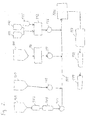
- The invention will now be described in further details with reference to a preferred embodiment and a drawing, in which
- Fig. 1
- depicts a schematic flow-sheet for manufacture of butter-like dairy spread according to the invention.
- Fig. 2
- depicts a schematic flow-sheet for manufacture of butter-like dairy according to the invention including addition of oil.
- Unless other stated, all percentages % are weight percentage wt%.
- Butter is an water-in-oil emulsion, comprising >80% milkfat, but also containing water in the form of tiny droplets, perhaps some milk solids-non-fat, with or without salt; texture is a result of working/kneading during processing at appropriate temperatures, to establish fat crystalline network that results in desired smoothness; butter is used as a spread, a cooking fat, or a baking ingredient. Butter of good quality can be obtained from various creameries.
- Vegetable fat is a fat extracted from plants. A fat has a solid appearance a normal room temperature (18-25°C). The fat may include fat in liquid form, optionally within the solid fat as tiny droplets. Suitable edible vegetable fats are e.g. vegetable fats based on palm oil and palm kernel oil (which can be delivered from e.g. American Palm Oil Council; United States, or from Aarhus United; Denmark). Vegetable fats based on palm oil and palm kernel oil are at present preferred, however, other vegetable fats with similar properties may be also be suitable, e.g. vegetable fats like peanut butter, cacao butter or coconut butter.
- In respect of stability the dairy spread should have substantially the same appearance as butter, in respect of exuding oily substances, after being kept at 22°C for two hours.
- The taste ingredient may be any taste ingredient that that provides a butter-like taste, e.g. sourness to the dairy spread. The taste ingredient may comprise natural and synthetic flavours and substantial amounts of water. However, ingredients on natural basis are preferred, such as a milk constituent, e.g. comprising milk (full milk, skimmed milk, cream etc. optionally provided as milk powder), one or more cultures of lactic bacterias, salt and water. Milk powder, e.g. skimmed milk powder, and lactic bacteria may be obtained from Danisco A/S; Denmark.
- Vegetable oil is based on fatty substances extracted from plants. However, in contrast to vegetable fats, vegetable oil is in liquid form at normal room temperatures (18-25°C). Suitable edible vegetable oils are vegetable oils that are substantially neutral in taste, like e.g. rapeseed oil, linseed oil, corn oil and sunflower oil, which can be obtained from wide range of suppliers (e.g. Aarhus united; Denmark).
- With reference to
figure 1 edible vegetable fat kept above its melting point (45-55°C) in atank 1 is feed to a cooler andcrystallization unit 2 where the fat is cooled to below 15°C to at least partly solidify or crystallize to obtain vegetable fat in solid form. The vegetable fat remains in theunit 2 for about 15 seconds to 20 minutes. From theunit 2 the vegetable fat is led to a post-crystallizing unit 3 for further crystallizing at a temperature in the range of approx. 7 to 18°C. The vegetable fat, at least partly on solid or crystallized form, is led to apump 4, which viapipe 5 feeds the vegetable fat to mixer 6. - Simultaneously, butter in container 7 with a temperature in the range 7 to 16°C is filled into a stirrer 8 before it via
pump 9 andpipe 5 is feed to mixer 6. Fromtank 10 taste ingredient, which in these embodiment comprise water and skimmed-milk powder with added cultures oflactic bacteria 11, 12 andsalt 13 is feed to the mixer 6 viapump 14 andpipe 5. The taste ingredient is feed to the mixer 6 with a temperature in the range 2-13°C. - In the mixer 6 the edible vegetable fat is mixed with butter and taste ingredient at a temperature below 22°C to form butter-like dairy spread.
- After the mixing the butter-like dairy spread is conveyed through a cooler 15, which cools the butter-like dairy spread to a temperature below 16°C. Then the butter-like dairy spread is conveyed to a packing
station 16 for packing. Finally, before the butter-like dairy spread is send to supermarkets etc. for sale and consuming, the packed butter-like dairy spread is stored in astorage 17 at a temperature below 16°C for at least 24 hours for ripening. - In an alternative embodiment outlined in
figure 2 , edible vegetable fat kept above its melting point (45-55°C) in a tank 101 is feed to a cooler and crystallization unit 102 where the fat is cooled to below 15°C to at least partly solidify or crystallize to obtain vegetable fat in solid form. The vegetable fat remains in the unit 102 for about 15 seconds to 20 minutes. From the unit 102 the vegetable fat is led to a post-crystallizing unit 103 for further crystallizing at a temperature in the range of approx. 7 to 18°C. The vegetable fat, at least partly on solid or crystallized form, is led to a pump 104, which viapipe 105 feeds the vegetable fat tomixer 106. - Simultaneously, edible vegetable oil from
tank 107 with a temperature in the range 2-20°C is feed to themixer 106 viapump 108 andpipe 105. Butter incontainer 109 with a temperature in the range 7 to 16°C is filled into astirrer 110 before it viapump 111 andpipe 105 is feed tomixer 106. Fromtank 112 taste ingredient, which in these embodiment comprise water and skimmed-milk powder with added cultures oflactic bacteria 113, 114 andsalt 115 is feed to themixer 106 viapump 116 andpipe 105. The taste ingredient is feed to themixer 106 with a temperature in the range 2-13°C. - In the
mixer 106 the edible vegetable fat is mixed with edible vegetable oil, butter and taste ingredient at a temperature below 22°C to form butter-like dairy spread. - After the mixing the butter-like dairy spread is conveyed through a cooler 117, which cools the butter-like dairy spread to a temperature below 16°C. Then the butter-like dairy spread is conveyed to a packing station 118 for packing. Finally, before the butter-like dairy spread is send to supermarkets etc. for sale and consuming, the packed butter-like dairy spread is stored in a
storage 119 at a temperature below 16°C for at least 24 hours for ripening. - The flow-sheets depicted in
fig. 1 andfig 2 only describes preferred embodiments. It is clear that is it possible to exclude thepipe mixer 6, 106. The means for addingtaste ingredient mixers 6, 106 may vary from 1 to 2 or 3 or more, depending on the capacity of the mixer applied. Thus, more mixers may be used in series, although it may be considered as only one mixing step as all components of the dairy spread are present form the beginning to the end of the mixing. - Butter-like dairy spreads according to the invention is produced with the following constituents:
Butter in the form of regular dairy butter from creamery.
Vegetable fat based on palm oil from Aarhus United, with the following characteristic (according to IUPAC 2.150a):solid fat content at 10°C approx. 60% solid fat content at 20°C approx. 30% solid fat content at 30°C approx. 10%
Taste ingredient; skimmed milk powder and cultures of lactic bacteria from Danisco:Water 78% Salt 3% Skimmed milk powder 14% Lactic bacteria 5% - Dairy spreads are produced according to the method outlined in
figure 1 .Composition 1: Butter 56% Vegetable fat 26% Taste ingredient 18% Composition 2: Butter 50% Vegetable fat 25% Taste ingredient 25% - Dairy spreads are produced according to the method outlined in
figure 2 .Composition 3: Butter 56% Vegetable fat 15 % Vegetable oil 15 % Taste ingredient 14% Composition 4: Butter 48% Vegetable fat 16 % Vegetable oil 16% Taste ingredient 20% - The resulting dairy spreads have texture and taste like butter and can be spread on white bread when taken from a refrigerated temperature of approx. 5°C. Although
composition 4 contains less than 50% butter and a substantial amount of water it still has a butter-like appearance and texture when produced according to the invention.
Claims (23)
- A method for producing a butter-like dairy spread comprising at least butter, edible vegetable fat, and a taste ingredient, such as a milk constituent, characterized in that the edible vegetable fat has a solid fat content of 45% or less at 20°C, said edible vegetable fat is mixed with at least butter and said taste ingredient at a temperature below 22°C during the production of said butter-like dairy spread.
- A method according to claim 1, wherein said edible vegetable fat is supplied on liquid form at a temperature in the range of 42-60°C and rapidly cooled prior to said mixing to a temperature in the range 7-18°C to crystallize, preferably the edible vegetable fat is crystallized and post-crystallized within a period of time in the range from 2 to 30 min.
- A method according to any one of claims 1 and 2, wherein said edible vegetable fat has a solid fat content when measured according to IUPAC 2.150a:
solid fat content at 10°C 50-70% solid fat content at 20°C 30-45% solid fat content at 30°C 10-20% solid fat content at 40°C <3%. - A method according to any one of the preceding claims, wherein said edible vegetable fat is substantially free of trans fatty acid.
- A method according to any one of the preceding claims, wherein said edible fat includes 44 to 67% saturated fatty acids, 26 to 41% monounsaturated fatty acids, and 4 to 17% polyunsaturated acids.
- A method according to any one of the preceding claims, wherein at least one vegetable oil is added to the edible vegetable fat, butter and taste ingredient prior to mixing, preferably the vegetable oil is selected from the group consisting of sunflower oil, corn oil, sesame oil, soya been oil, palm oil, linseed oil, grapeseed oil, rapeseed oil, olive oil, groundnut oil and mixtures thereof.
- A method according to any one of the preceding claims, wherein the edible vegetable fat is added in an amount to constitute 7-38 wt% of the butter-like dairy spread based on the total weight of the dairy spread and/or wherein the butter is added in an amount to constitute 32-68 wt% of the butter-like dairy spread based on the total weight of the dairy spread.
- A method according to any one of the preceding claims, wherein the edible vegetable fat is added with a temperature in the range 7 to 16°C prior to mixing.
- A method according to any one of the preceding claims, wherein the butter is added with a temperature in the range 7 to 16°C prior to mixing.
- A method according to any one of the preceding claims, wherein the taste ingredient is added in an amount to constitute 3-35 wt% of the butter-like dairy spread based on the total weight of the dairy spread and wherein the taste ingredient is optionally added with a temperature in the range 2 to 13°C prior to mixing.
- A method according to any one of the claims 6 to 10, wherein the edible vegetable oil is added in an amount to constitute 3-33 wt% of the butter-like dairy spread based on the total weight of the dairy spread.
- A method according to any one of the preceding claims 6 to 11, wherein the edible vegetable oil is added with a temperature in the range 2 to 20°C prior to mixing
- A method according to any one of the preceding claims, wherein the butter-like dairy spread does not contain emulsifying additives.
- A method according to any one of the preceding claims, wherein the mixing is carried out at a temperature below 20°C, preferably at a temperature in the range 14 to 19°C
- A method according to any one of the preceding claims, wherein the butter-like dairy spread subsequent to mixing is cooled to a temperature below 16°C, preferably to a temperature in the range 4 to 14°C.
- A method according to any one of the preceding claims, wherein the butter-like dairy spread subsequent to mixing is cooled and stored at a temperature below 16°C, preferably at a temperature in the range 2 to 14°C, for at least 24 hours.
- A method according to any one of the preceding claims, wherein the butter, edible vegetable fat and optionally vegetable oil constitutes at least 59%, preferably at least 65% of the butter-like dairy spread.
- A butter-like dairy spread comprising at least butter, edible vegetable fat, and a taste ingredient, such as a milk constituent, characterized in that the edible vegetable fat has a solid fat content of 45% or less at 20°C, and the butter-like dairy spread has a solid fat content at 20°C of at least 15% when measured according to IUPAC 2.150a.
- A butter-like dairy spread according to claim 18, wherein said edible fat includes 44 to 67% saturated fatty acids, 26 to 41% monounsaturated fatty acids, and 4 to 17% polyunsaturated acids.
- A butter-like dairy spread according to claim 18 or 19, wherein said taste ingredient includes water, skimmed-milk powder, salt, and one more cultures of lactic bacteria.
- A butter-like dairy spread according to any one of the preceding claims 18-20, wherein the butter constitutes 30-68 wt% of the butter-like dairy spread based on the total weight of the dairy spread and/or the edible vegetable fat form constitutes 7-38 wt% of the butter-like dairy spread based on the total weight of the dairy spread and/or wherein the taste ingredient constitutes 3-35 wt% of the butter-like dairy spread based on the total weight of the dairy spread.
- A butter-like dairy spread according any one of the preceding claims 18-21, wherein said butter-like dairy spread further comprises at least one vegetable oil, and said vegetable oil preferably being selected from the group consisting of sunflower oil, corn oil, sesame oil, soya been oil, palm oil, linseed oil, grapeseed oil, rapeseed oil, olive oil, groundnut oil and mixtures thereof.
- A butter-like dairy spread according to claim 22, wherein the edible vegetable oil, when present, constitutes 3-33 wt% of the butter-like dairy spread based on the total weight of the dairy spread.
Priority Applications (2)
| Application Number | Priority Date | Filing Date | Title |
|---|---|---|---|
| EP10185997.3A EP2263473B1 (en) | 2005-02-08 | 2005-02-08 | A butter-like dairy spread and method for production |
| DK10185997.3T DK2263473T3 (en) | 2005-02-08 | 2005-02-08 | mixture Product |
Applications Claiming Priority (2)
| Application Number | Priority Date | Filing Date | Title |
|---|---|---|---|
| EP05388011A EP1688044B1 (en) | 2005-02-08 | 2005-02-08 | A butter-like dairy spread and method for production |
| EP10185997.3A EP2263473B1 (en) | 2005-02-08 | 2005-02-08 | A butter-like dairy spread and method for production |
Related Parent Applications (2)
| Application Number | Title | Priority Date | Filing Date |
|---|---|---|---|
| EP05388011A Division EP1688044B1 (en) | 2005-02-08 | 2005-02-08 | A butter-like dairy spread and method for production |
| EP05388011.8 Division | 2005-02-08 |
Publications (2)
| Publication Number | Publication Date |
|---|---|
| EP2263473A1 true EP2263473A1 (en) | 2010-12-22 |
| EP2263473B1 EP2263473B1 (en) | 2018-02-28 |
Family
ID=34942828
Family Applications (2)
| Application Number | Title | Priority Date | Filing Date |
|---|---|---|---|
| EP10185997.3A Expired - Lifetime EP2263473B1 (en) | 2005-02-08 | 2005-02-08 | A butter-like dairy spread and method for production |
| EP05388011A Expired - Lifetime EP1688044B1 (en) | 2005-02-08 | 2005-02-08 | A butter-like dairy spread and method for production |
Family Applications After (1)
| Application Number | Title | Priority Date | Filing Date |
|---|---|---|---|
| EP05388011A Expired - Lifetime EP1688044B1 (en) | 2005-02-08 | 2005-02-08 | A butter-like dairy spread and method for production |
Country Status (4)
| Country | Link |
|---|---|
| EP (2) | EP2263473B1 (en) |
| AT (1) | ATE543388T1 (en) |
| DK (2) | DK1688044T3 (en) |
| PL (1) | PL1688044T3 (en) |
Cited By (1)
| Publication number | Priority date | Publication date | Assignee | Title |
|---|---|---|---|---|
| EP4759143A1 (en) | 2024-12-16 | 2026-06-17 | Rino Goller | Olive oil butter and method for its preparation |
Families Citing this family (8)
| Publication number | Priority date | Publication date | Assignee | Title |
|---|---|---|---|---|
| US20060228459A1 (en) * | 2005-04-11 | 2006-10-12 | The Iams Company | Compositions comprising a cocoa butter component and an animal-derived fat component |
| US9771199B2 (en) | 2008-07-07 | 2017-09-26 | Mars, Incorporated | Probiotic supplement, process for making, and packaging |
| EA201291017A1 (en) † | 2010-04-08 | 2013-05-30 | Арла Фудс Амба | SPREAD ON THE BASIS OF CREAMY OIL AND THE METHOD OF ITS OBTAINING |
| US10470476B2 (en) | 2013-03-15 | 2019-11-12 | Upfield Us Inc. | Spread |
| PL3157348T3 (en) | 2014-05-20 | 2019-12-31 | Upfield Europe B.V. | Process for the manufacture of edible water-in-oil emulsion |
| GB201411693D0 (en) * | 2014-07-01 | 2014-08-13 | Protean Capital Pty Ltd | Butter substitute |
| EP3403508A1 (en) | 2017-05-18 | 2018-11-21 | DMK Deutsches Milchkontor GmbH | Dairy spread composition, its production method and use of the composition |
| EP3906784A1 (en) | 2020-05-06 | 2021-11-10 | DMK Deutsches Milchkontor GmbH | Spreadable or cuttable food products |
Citations (8)
| Publication number | Priority date | Publication date | Assignee | Title |
|---|---|---|---|---|
| AU4937379A (en) | 1978-07-28 | 1980-02-28 | Australian Dairy Corp. | Spreadable butter fat-rich food |
| US4298625A (en) * | 1979-09-11 | 1981-11-03 | P. Ferrero & C. S.P.A. | Sweet protein food product in the form of a foamed plastic mass |
| AU529036B2 (en) * | 1979-12-24 | 1983-05-26 | Dairy Developments Ltd. | Butter/vegetable oil blend |
| DK171699B1 (en) | 1991-05-08 | 1997-04-01 | Apv Pasilac As | Process for making a butter-like food fat |
| WO1999043218A1 (en) * | 1998-02-27 | 1999-09-02 | Spice Sciences Oy | Method for producing a fat mixture |
| WO1999051105A1 (en) * | 1998-04-03 | 1999-10-14 | Unilever N.V. | Acidified butter like spread |
| US6136349A (en) * | 1996-12-30 | 2000-10-24 | Pharmaconsult Oy | Food seasoning, food ingredients and food item compositions and methods for their preparation |
| EP1279338A1 (en) * | 2000-05-05 | 2003-01-29 | Luis Ciuraneta Masip | Use of olive oil for the production of margarines, butters, fats, wheys, creams, chocolate and the like |
Family Cites Families (2)
| Publication number | Priority date | Publication date | Assignee | Title |
|---|---|---|---|---|
| SE428258B (en) * | 1978-01-25 | 1983-06-20 | Svenska Mejeriernas Riksforeni | SET TO CONTINUOUSLY MANUFACTURE A SMALL-LIKE FOOD |
| SE8801743L (en) * | 1988-05-09 | 1989-11-10 | Alfa Laval Food Eng Ab | SEAT AND PLANT FOR MANUFACTURE OF A FAT PRODUCT BASED ON MILK FAT |
-
2005
- 2005-02-08 PL PL05388011T patent/PL1688044T3/en unknown
- 2005-02-08 EP EP10185997.3A patent/EP2263473B1/en not_active Expired - Lifetime
- 2005-02-08 EP EP05388011A patent/EP1688044B1/en not_active Expired - Lifetime
- 2005-02-08 AT AT05388011T patent/ATE543388T1/en active
- 2005-02-08 DK DK05388011.8T patent/DK1688044T3/en active
- 2005-02-08 DK DK10185997.3T patent/DK2263473T3/en active
Patent Citations (9)
| Publication number | Priority date | Publication date | Assignee | Title |
|---|---|---|---|---|
| AU4937379A (en) | 1978-07-28 | 1980-02-28 | Australian Dairy Corp. | Spreadable butter fat-rich food |
| US4298625A (en) * | 1979-09-11 | 1981-11-03 | P. Ferrero & C. S.P.A. | Sweet protein food product in the form of a foamed plastic mass |
| AU529036B2 (en) * | 1979-12-24 | 1983-05-26 | Dairy Developments Ltd. | Butter/vegetable oil blend |
| DK171699B1 (en) | 1991-05-08 | 1997-04-01 | Apv Pasilac As | Process for making a butter-like food fat |
| US6083548A (en) * | 1991-05-08 | 2000-07-04 | Apv Pasilac A/S | Process for producing a butter-like food fat |
| US6136349A (en) * | 1996-12-30 | 2000-10-24 | Pharmaconsult Oy | Food seasoning, food ingredients and food item compositions and methods for their preparation |
| WO1999043218A1 (en) * | 1998-02-27 | 1999-09-02 | Spice Sciences Oy | Method for producing a fat mixture |
| WO1999051105A1 (en) * | 1998-04-03 | 1999-10-14 | Unilever N.V. | Acidified butter like spread |
| EP1279338A1 (en) * | 2000-05-05 | 2003-01-29 | Luis Ciuraneta Masip | Use of olive oil for the production of margarines, butters, fats, wheys, creams, chocolate and the like |
Cited By (1)
| Publication number | Priority date | Publication date | Assignee | Title |
|---|---|---|---|---|
| EP4759143A1 (en) | 2024-12-16 | 2026-06-17 | Rino Goller | Olive oil butter and method for its preparation |
Also Published As
| Publication number | Publication date |
|---|---|
| PL1688044T3 (en) | 2012-07-31 |
| DK2263473T3 (en) | 2018-06-06 |
| EP1688044B1 (en) | 2012-02-01 |
| EP1688044A1 (en) | 2006-08-09 |
| ATE543388T1 (en) | 2012-02-15 |
| DK1688044T3 (en) | 2012-05-07 |
| EP2263473B1 (en) | 2018-02-28 |
Similar Documents
| Publication | Publication Date | Title |
|---|---|---|
| EP2157867B2 (en) | Method for reducing the saturated fatty acid content of milk fat, products obtained and applications thereof | |
| EP2457447B1 (en) | Foamable oil-in-water type emulsified fat composition for whipped cream to be distributed in chilled state, and whipped cream | |
| JP2022027964A (en) | Plant-based butter-like composition | |
| HUP0101554A2 (en) | Process for making sandwich cream, as well as the spreadable cream produced by the process, as well as production line for the production of spreadable cream | |
| CN106665883A (en) | Special grease composition for processed cheese and application thereof | |
| US6322842B1 (en) | Water in oil stick product | |
| EP1688044B1 (en) | A butter-like dairy spread and method for production | |
| CN109007061A (en) | A kind of animals and plants mixing resin acid taste whipping cream and preparation method | |
| US6171624B1 (en) | Water-in-oil spread with water base fruit composition | |
| US11844359B2 (en) | Squeezable spread containing butter and methods of making the same | |
| Rajah | Spreadable products | |
| CZ289192A3 (en) | Process for preparing an article from emulsified fat | |
| JP5697133B2 (en) | Method for producing foamable oil-in-water emulsified oil / fat composition for chilled whipped cream | |
| Lane | Butter and mixed fat spreads | |
| Robinson et al. | Spreadable products | |
| JPS6336734B2 (en) | ||
| US20200383348A1 (en) | Plant oil based fat spread | |
| JP6771342B2 (en) | Butter-like spread with good flavor and its manufacturing method | |
| PL246363B1 (en) | Fat composition and method of its production | |
| JP2010207190A (en) | Foaming oil-in-water emulsified oil-and-fat composition | |
| US20170150732A1 (en) | Butter substitute | |
| HK1238281A1 (en) | Method for reducing the saturated fatty acid content of milk fat, products obtained and applications thereof | |
| DK164627B (en) | Process for producing a fat-containing foodstuff | |
| HK1147027A (en) | Method for reducing the saturated fatty acid content of milk fat, products obtained and applications thereof | |
| MXPA00009572A (en) | Process for preparing a spread |
Legal Events
| Date | Code | Title | Description |
|---|---|---|---|
| PUAI | Public reference made under article 153(3) epc to a published international application that has entered the european phase |
Free format text: ORIGINAL CODE: 0009012 |
|
| AC | Divisional application: reference to earlier application |
Ref document number: 1688044 Country of ref document: EP Kind code of ref document: P |
|
| AK | Designated contracting states |
Kind code of ref document: A1 Designated state(s): AT BE BG CH CY CZ DE DK EE ES FI FR GB GR HU IE IS IT LI LT LU MC NL PL PT RO SE SI SK TR |
|
| AX | Request for extension of the european patent |
Extension state: AL BA HR LV MK YU |
|
| 17P | Request for examination filed |
Effective date: 20110617 |
|
| 17Q | First examination report despatched |
Effective date: 20120113 |
|
| STAA | Information on the status of an ep patent application or granted ep patent |
Free format text: STATUS: EXAMINATION IS IN PROGRESS |
|
| GRAP | Despatch of communication of intention to grant a patent |
Free format text: ORIGINAL CODE: EPIDOSNIGR1 |
|
| STAA | Information on the status of an ep patent application or granted ep patent |
Free format text: STATUS: GRANT OF PATENT IS INTENDED |
|
| INTG | Intention to grant announced |
Effective date: 20170329 |
|
| GRAS | Grant fee paid |
Free format text: ORIGINAL CODE: EPIDOSNIGR3 |
|
| GRAJ | Information related to disapproval of communication of intention to grant by the applicant or resumption of examination proceedings by the epo deleted |
Free format text: ORIGINAL CODE: EPIDOSDIGR1 |
|
| GRAL | Information related to payment of fee for publishing/printing deleted |
Free format text: ORIGINAL CODE: EPIDOSDIGR3 |
|
| STAA | Information on the status of an ep patent application or granted ep patent |
Free format text: STATUS: EXAMINATION IS IN PROGRESS |
|
| GRAP | Despatch of communication of intention to grant a patent |
Free format text: ORIGINAL CODE: EPIDOSNIGR1 |
|
| STAA | Information on the status of an ep patent application or granted ep patent |
Free format text: STATUS: GRANT OF PATENT IS INTENDED |
|
| INTC | Intention to grant announced (deleted) | ||
| INTG | Intention to grant announced |
Effective date: 20170925 |
|
| GRAA | (expected) grant |
Free format text: ORIGINAL CODE: 0009210 |
|
| STAA | Information on the status of an ep patent application or granted ep patent |
Free format text: STATUS: THE PATENT HAS BEEN GRANTED |
|
| AC | Divisional application: reference to earlier application |
Ref document number: 1688044 Country of ref document: EP Kind code of ref document: P |
|
| AK | Designated contracting states |
Kind code of ref document: B1 Designated state(s): AT BE BG CH CY CZ DE DK EE ES FI FR GB GR HU IE IS IT LI LT LU MC NL PL PT RO SE SI SK TR |
|
| REG | Reference to a national code |
Ref country code: GB Ref legal event code: FG4D Ref country code: CH Ref legal event code: EP |
|
| REG | Reference to a national code |
Ref country code: AT Ref legal event code: REF Ref document number: 973143 Country of ref document: AT Kind code of ref document: T Effective date: 20180315 |
|
| REG | Reference to a national code |
Ref country code: IE Ref legal event code: FG4D |
|
| REG | Reference to a national code |
Ref country code: DE Ref legal event code: R096 Ref document number: 602005053586 Country of ref document: DE |
|
| REG | Reference to a national code |
Ref country code: SE Ref legal event code: TRGR |
|
| REG | Reference to a national code |
Ref country code: DK Ref legal event code: T3 Effective date: 20180531 |
|
| REG | Reference to a national code |
Ref country code: NL Ref legal event code: MP Effective date: 20180228 |
|
| REG | Reference to a national code |
Ref country code: LT Ref legal event code: MG4D |
|
| REG | Reference to a national code |
Ref country code: AT Ref legal event code: MK05 Ref document number: 973143 Country of ref document: AT Kind code of ref document: T Effective date: 20180228 |
|
| PG25 | Lapsed in a contracting state [announced via postgrant information from national office to epo] |
Ref country code: ES Free format text: LAPSE BECAUSE OF FAILURE TO SUBMIT A TRANSLATION OF THE DESCRIPTION OR TO PAY THE FEE WITHIN THE PRESCRIBED TIME-LIMIT Effective date: 20180228 Ref country code: NL Free format text: LAPSE BECAUSE OF FAILURE TO SUBMIT A TRANSLATION OF THE DESCRIPTION OR TO PAY THE FEE WITHIN THE PRESCRIBED TIME-LIMIT Effective date: 20180228 Ref country code: LT Free format text: LAPSE BECAUSE OF FAILURE TO SUBMIT A TRANSLATION OF THE DESCRIPTION OR TO PAY THE FEE WITHIN THE PRESCRIBED TIME-LIMIT Effective date: 20180228 Ref country code: FI Free format text: LAPSE BECAUSE OF FAILURE TO SUBMIT A TRANSLATION OF THE DESCRIPTION OR TO PAY THE FEE WITHIN THE PRESCRIBED TIME-LIMIT Effective date: 20180228 Ref country code: CY Free format text: LAPSE BECAUSE OF FAILURE TO SUBMIT A TRANSLATION OF THE DESCRIPTION OR TO PAY THE FEE WITHIN THE PRESCRIBED TIME-LIMIT Effective date: 20180228 |
|
| PG25 | Lapsed in a contracting state [announced via postgrant information from national office to epo] |
Ref country code: GR Free format text: LAPSE BECAUSE OF FAILURE TO SUBMIT A TRANSLATION OF THE DESCRIPTION OR TO PAY THE FEE WITHIN THE PRESCRIBED TIME-LIMIT Effective date: 20180529 Ref country code: BG Free format text: LAPSE BECAUSE OF FAILURE TO SUBMIT A TRANSLATION OF THE DESCRIPTION OR TO PAY THE FEE WITHIN THE PRESCRIBED TIME-LIMIT Effective date: 20180528 Ref country code: AT Free format text: LAPSE BECAUSE OF FAILURE TO SUBMIT A TRANSLATION OF THE DESCRIPTION OR TO PAY THE FEE WITHIN THE PRESCRIBED TIME-LIMIT Effective date: 20180228 |
|
| PG25 | Lapsed in a contracting state [announced via postgrant information from national office to epo] |
Ref country code: PL Free format text: LAPSE BECAUSE OF FAILURE TO SUBMIT A TRANSLATION OF THE DESCRIPTION OR TO PAY THE FEE WITHIN THE PRESCRIBED TIME-LIMIT Effective date: 20180228 Ref country code: EE Free format text: LAPSE BECAUSE OF FAILURE TO SUBMIT A TRANSLATION OF THE DESCRIPTION OR TO PAY THE FEE WITHIN THE PRESCRIBED TIME-LIMIT Effective date: 20180228 Ref country code: RO Free format text: LAPSE BECAUSE OF FAILURE TO SUBMIT A TRANSLATION OF THE DESCRIPTION OR TO PAY THE FEE WITHIN THE PRESCRIBED TIME-LIMIT Effective date: 20180228 |
|
| REG | Reference to a national code |
Ref country code: DE Ref legal event code: R097 Ref document number: 602005053586 Country of ref document: DE |
|
| PG25 | Lapsed in a contracting state [announced via postgrant information from national office to epo] |
Ref country code: CZ Free format text: LAPSE BECAUSE OF FAILURE TO SUBMIT A TRANSLATION OF THE DESCRIPTION OR TO PAY THE FEE WITHIN THE PRESCRIBED TIME-LIMIT Effective date: 20180228 Ref country code: SK Free format text: LAPSE BECAUSE OF FAILURE TO SUBMIT A TRANSLATION OF THE DESCRIPTION OR TO PAY THE FEE WITHIN THE PRESCRIBED TIME-LIMIT Effective date: 20180228 |
|
| PLBE | No opposition filed within time limit |
Free format text: ORIGINAL CODE: 0009261 |
|
| STAA | Information on the status of an ep patent application or granted ep patent |
Free format text: STATUS: NO OPPOSITION FILED WITHIN TIME LIMIT |
|
| 26N | No opposition filed |
Effective date: 20181129 |
|
| PG25 | Lapsed in a contracting state [announced via postgrant information from national office to epo] |
Ref country code: IT Free format text: LAPSE BECAUSE OF FAILURE TO SUBMIT A TRANSLATION OF THE DESCRIPTION OR TO PAY THE FEE WITHIN THE PRESCRIBED TIME-LIMIT Effective date: 20180228 Ref country code: SI Free format text: LAPSE BECAUSE OF FAILURE TO SUBMIT A TRANSLATION OF THE DESCRIPTION OR TO PAY THE FEE WITHIN THE PRESCRIBED TIME-LIMIT Effective date: 20180228 |
|
| REG | Reference to a national code |
Ref country code: CH Ref legal event code: PL |
|
| PG25 | Lapsed in a contracting state [announced via postgrant information from national office to epo] |
Ref country code: LU Free format text: LAPSE BECAUSE OF NON-PAYMENT OF DUE FEES Effective date: 20190208 Ref country code: MC Free format text: LAPSE BECAUSE OF FAILURE TO SUBMIT A TRANSLATION OF THE DESCRIPTION OR TO PAY THE FEE WITHIN THE PRESCRIBED TIME-LIMIT Effective date: 20180228 |
|
| REG | Reference to a national code |
Ref country code: BE Ref legal event code: MM Effective date: 20190228 |
|
| REG | Reference to a national code |
Ref country code: IE Ref legal event code: MM4A |
|
| PG25 | Lapsed in a contracting state [announced via postgrant information from national office to epo] |
Ref country code: CH Free format text: LAPSE BECAUSE OF NON-PAYMENT OF DUE FEES Effective date: 20190228 Ref country code: LI Free format text: LAPSE BECAUSE OF NON-PAYMENT OF DUE FEES Effective date: 20190228 |
|
| PG25 | Lapsed in a contracting state [announced via postgrant information from national office to epo] |
Ref country code: IE Free format text: LAPSE BECAUSE OF NON-PAYMENT OF DUE FEES Effective date: 20190208 |
|
| PG25 | Lapsed in a contracting state [announced via postgrant information from national office to epo] |
Ref country code: BE Free format text: LAPSE BECAUSE OF NON-PAYMENT OF DUE FEES Effective date: 20190228 Ref country code: FR Free format text: LAPSE BECAUSE OF NON-PAYMENT OF DUE FEES Effective date: 20190228 |
|
| PG25 | Lapsed in a contracting state [announced via postgrant information from national office to epo] |
Ref country code: TR Free format text: LAPSE BECAUSE OF FAILURE TO SUBMIT A TRANSLATION OF THE DESCRIPTION OR TO PAY THE FEE WITHIN THE PRESCRIBED TIME-LIMIT Effective date: 20180228 |
|
| PG25 | Lapsed in a contracting state [announced via postgrant information from national office to epo] |
Ref country code: PT Free format text: LAPSE BECAUSE OF FAILURE TO SUBMIT A TRANSLATION OF THE DESCRIPTION OR TO PAY THE FEE WITHIN THE PRESCRIBED TIME-LIMIT Effective date: 20180628 |
|
| PG25 | Lapsed in a contracting state [announced via postgrant information from national office to epo] |
Ref country code: IS Free format text: LAPSE BECAUSE OF FAILURE TO SUBMIT A TRANSLATION OF THE DESCRIPTION OR TO PAY THE FEE WITHIN THE PRESCRIBED TIME-LIMIT Effective date: 20180628 |
|
| PG25 | Lapsed in a contracting state [announced via postgrant information from national office to epo] |
Ref country code: HU Free format text: LAPSE BECAUSE OF FAILURE TO SUBMIT A TRANSLATION OF THE DESCRIPTION OR TO PAY THE FEE WITHIN THE PRESCRIBED TIME-LIMIT; INVALID AB INITIO Effective date: 20050208 |
|
| PGFP | Annual fee paid to national office [announced via postgrant information from national office to epo] |
Ref country code: DE Payment date: 20240117 Year of fee payment: 20 Ref country code: GB Payment date: 20240115 Year of fee payment: 20 |
|
| PGFP | Annual fee paid to national office [announced via postgrant information from national office to epo] |
Ref country code: SE Payment date: 20240115 Year of fee payment: 20 Ref country code: DK Payment date: 20240116 Year of fee payment: 20 |
|
| REG | Reference to a national code |
Ref country code: DE Ref legal event code: R071 Ref document number: 602005053586 Country of ref document: DE |
|
| REG | Reference to a national code |
Ref country code: DK Ref legal event code: EUP Expiry date: 20250208 |
|
| REG | Reference to a national code |
Ref country code: GB Ref legal event code: PE20 Expiry date: 20250207 |
|
| REG | Reference to a national code |
Ref country code: SE Ref legal event code: EUG |
|
| PG25 | Lapsed in a contracting state [announced via postgrant information from national office to epo] |
Ref country code: GB Free format text: LAPSE BECAUSE OF EXPIRATION OF PROTECTION Effective date: 20250207 |