EP2270862A2 - Verfahren zur Herstellung einer Fotoelektrischer Wandler mit Dual-Damascene Verbindungsstrukturen - Google Patents
Verfahren zur Herstellung einer Fotoelektrischer Wandler mit Dual-Damascene Verbindungsstrukturen Download PDFInfo
- Publication number
- EP2270862A2 EP2270862A2 EP10183837A EP10183837A EP2270862A2 EP 2270862 A2 EP2270862 A2 EP 2270862A2 EP 10183837 A EP10183837 A EP 10183837A EP 10183837 A EP10183837 A EP 10183837A EP 2270862 A2 EP2270862 A2 EP 2270862A2
- Authority
- EP
- European Patent Office
- Prior art keywords
- forming
- photoelectric conversion
- plug
- manufacturing
- wiring
- Prior art date
- Legal status (The legal status is an assumption and is not a legal conclusion. Google has not performed a legal analysis and makes no representation as to the accuracy of the status listed.)
- Granted
Links
Images



Classifications
-
- H—ELECTRICITY
- H10—SEMICONDUCTOR DEVICES; ELECTRIC SOLID-STATE DEVICES NOT OTHERWISE PROVIDED FOR
- H10F—INORGANIC SEMICONDUCTOR DEVICES SENSITIVE TO INFRARED RADIATION, LIGHT, ELECTROMAGNETIC RADIATION OF SHORTER WAVELENGTH OR CORPUSCULAR RADIATION
- H10F10/00—Individual photovoltaic cells, e.g. solar cells
-
- H—ELECTRICITY
- H10—SEMICONDUCTOR DEVICES; ELECTRIC SOLID-STATE DEVICES NOT OTHERWISE PROVIDED FOR
- H10F—INORGANIC SEMICONDUCTOR DEVICES SENSITIVE TO INFRARED RADIATION, LIGHT, ELECTROMAGNETIC RADIATION OF SHORTER WAVELENGTH OR CORPUSCULAR RADIATION
- H10F39/00—Integrated devices, or assemblies of multiple devices, comprising at least one element covered by group H10F30/00, e.g. radiation detectors comprising photodiode arrays
- H10F39/80—Constructional details of image sensors
- H10F39/811—Interconnections
-
- H—ELECTRICITY
- H10—SEMICONDUCTOR DEVICES; ELECTRIC SOLID-STATE DEVICES NOT OTHERWISE PROVIDED FOR
- H10F—INORGANIC SEMICONDUCTOR DEVICES SENSITIVE TO INFRARED RADIATION, LIGHT, ELECTROMAGNETIC RADIATION OF SHORTER WAVELENGTH OR CORPUSCULAR RADIATION
- H10F39/00—Integrated devices, or assemblies of multiple devices, comprising at least one element covered by group H10F30/00, e.g. radiation detectors comprising photodiode arrays
- H10F39/011—Manufacture or treatment of image sensors covered by group H10F39/12
- H10F39/014—Manufacture or treatment of image sensors covered by group H10F39/12 of CMOS image sensors
-
- H—ELECTRICITY
- H10—SEMICONDUCTOR DEVICES; ELECTRIC SOLID-STATE DEVICES NOT OTHERWISE PROVIDED FOR
- H10F—INORGANIC SEMICONDUCTOR DEVICES SENSITIVE TO INFRARED RADIATION, LIGHT, ELECTROMAGNETIC RADIATION OF SHORTER WAVELENGTH OR CORPUSCULAR RADIATION
- H10F39/00—Integrated devices, or assemblies of multiple devices, comprising at least one element covered by group H10F30/00, e.g. radiation detectors comprising photodiode arrays
- H10F39/011—Manufacture or treatment of image sensors covered by group H10F39/12
- H10F39/026—Wafer-level processing
-
- H—ELECTRICITY
- H10—SEMICONDUCTOR DEVICES; ELECTRIC SOLID-STATE DEVICES NOT OTHERWISE PROVIDED FOR
- H10W—GENERIC PACKAGES, INTERCONNECTIONS, CONNECTORS OR OTHER CONSTRUCTIONAL DETAILS OF DEVICES COVERED BY CLASS H10
- H10W20/00—Interconnections in chips, wafers or substrates
- H10W20/01—Manufacture or treatment
- H10W20/071—Manufacture or treatment of dielectric parts thereof
- H10W20/074—Manufacture or treatment of dielectric parts thereof of dielectric parts comprising thin functional dielectric layers, e.g. dielectric etch-stop, barrier, capping or liner layers
-
- H—ELECTRICITY
- H10—SEMICONDUCTOR DEVICES; ELECTRIC SOLID-STATE DEVICES NOT OTHERWISE PROVIDED FOR
- H10W—GENERIC PACKAGES, INTERCONNECTIONS, CONNECTORS OR OTHER CONSTRUCTIONAL DETAILS OF DEVICES COVERED BY CLASS H10
- H10W20/00—Interconnections in chips, wafers or substrates
- H10W20/01—Manufacture or treatment
- H10W20/071—Manufacture or treatment of dielectric parts thereof
- H10W20/074—Manufacture or treatment of dielectric parts thereof of dielectric parts comprising thin functional dielectric layers, e.g. dielectric etch-stop, barrier, capping or liner layers
- H10W20/077—Manufacture or treatment of dielectric parts thereof of dielectric parts comprising thin functional dielectric layers, e.g. dielectric etch-stop, barrier, capping or liner layers on sidewalls or on top surfaces of conductors
-
- H—ELECTRICITY
- H10—SEMICONDUCTOR DEVICES; ELECTRIC SOLID-STATE DEVICES NOT OTHERWISE PROVIDED FOR
- H10W—GENERIC PACKAGES, INTERCONNECTIONS, CONNECTORS OR OTHER CONSTRUCTIONAL DETAILS OF DEVICES COVERED BY CLASS H10
- H10W20/00—Interconnections in chips, wafers or substrates
- H10W20/01—Manufacture or treatment
- H10W20/071—Manufacture or treatment of dielectric parts thereof
- H10W20/081—Manufacture or treatment of dielectric parts thereof by forming openings in the dielectric parts
- H10W20/084—Manufacture or treatment of dielectric parts thereof by forming openings in the dielectric parts for dual-damascene structures
-
- H—ELECTRICITY
- H10—SEMICONDUCTOR DEVICES; ELECTRIC SOLID-STATE DEVICES NOT OTHERWISE PROVIDED FOR
- H10W—GENERIC PACKAGES, INTERCONNECTIONS, CONNECTORS OR OTHER CONSTRUCTIONAL DETAILS OF DEVICES COVERED BY CLASS H10
- H10W20/00—Interconnections in chips, wafers or substrates
- H10W20/01—Manufacture or treatment
- H10W20/071—Manufacture or treatment of dielectric parts thereof
- H10W20/081—Manufacture or treatment of dielectric parts thereof by forming openings in the dielectric parts
- H10W20/084—Manufacture or treatment of dielectric parts thereof by forming openings in the dielectric parts for dual-damascene structures
- H10W20/086—Manufacture or treatment of dielectric parts thereof by forming openings in the dielectric parts for dual-damascene structures involving buried masks
-
- H—ELECTRICITY
- H10—SEMICONDUCTOR DEVICES; ELECTRIC SOLID-STATE DEVICES NOT OTHERWISE PROVIDED FOR
- H10W—GENERIC PACKAGES, INTERCONNECTIONS, CONNECTORS OR OTHER CONSTRUCTIONAL DETAILS OF DEVICES COVERED BY CLASS H10
- H10W20/00—Interconnections in chips, wafers or substrates
- H10W20/40—Interconnections external to wafers or substrates, e.g. back-end-of-line [BEOL] metallisations or vias connecting to gate electrodes
- H10W20/41—Interconnections external to wafers or substrates, e.g. back-end-of-line [BEOL] metallisations or vias connecting to gate electrodes characterised by their conductive parts
- H10W20/425—Barrier, adhesion or liner layers
-
- H—ELECTRICITY
- H10—SEMICONDUCTOR DEVICES; ELECTRIC SOLID-STATE DEVICES NOT OTHERWISE PROVIDED FOR
- H10F—INORGANIC SEMICONDUCTOR DEVICES SENSITIVE TO INFRARED RADIATION, LIGHT, ELECTROMAGNETIC RADIATION OF SHORTER WAVELENGTH OR CORPUSCULAR RADIATION
- H10F39/00—Integrated devices, or assemblies of multiple devices, comprising at least one element covered by group H10F30/00, e.g. radiation detectors comprising photodiode arrays
- H10F39/10—Integrated devices
- H10F39/12—Image sensors
- H10F39/18—Complementary metal-oxide-semiconductor [CMOS] image sensors; Photodiode array image sensors
-
- H—ELECTRICITY
- H10—SEMICONDUCTOR DEVICES; ELECTRIC SOLID-STATE DEVICES NOT OTHERWISE PROVIDED FOR
- H10F—INORGANIC SEMICONDUCTOR DEVICES SENSITIVE TO INFRARED RADIATION, LIGHT, ELECTROMAGNETIC RADIATION OF SHORTER WAVELENGTH OR CORPUSCULAR RADIATION
- H10F39/00—Integrated devices, or assemblies of multiple devices, comprising at least one element covered by group H10F30/00, e.g. radiation detectors comprising photodiode arrays
- H10F39/80—Constructional details of image sensors
- H10F39/805—Coatings
- H10F39/8053—Colour filters
-
- Y—GENERAL TAGGING OF NEW TECHNOLOGICAL DEVELOPMENTS; GENERAL TAGGING OF CROSS-SECTIONAL TECHNOLOGIES SPANNING OVER SEVERAL SECTIONS OF THE IPC; TECHNICAL SUBJECTS COVERED BY FORMER USPC CROSS-REFERENCE ART COLLECTIONS [XRACs] AND DIGESTS
- Y02—TECHNOLOGIES OR APPLICATIONS FOR MITIGATION OR ADAPTATION AGAINST CLIMATE CHANGE
- Y02E—REDUCTION OF GREENHOUSE GAS [GHG] EMISSIONS, RELATED TO ENERGY GENERATION, TRANSMISSION OR DISTRIBUTION
- Y02E10/00—Energy generation through renewable energy sources
- Y02E10/50—Photovoltaic [PV] energy
Definitions
- the present invention relates to a photoelectric conversion apparatus, and more particularly to a structure of contact, via and wiring in a photoelectric conversion apparatus including multilayered wiring structure.
- Photoelectric conversion apparatuses such as CCD type photoelectric conversion apparatuses or MOS type photoelectric conversion apparatuses are used for digital still cameras and video cameras.
- the MOS type photoelectric conversion apparatus includes a photoelectric conversion region including MOS transistors and photodiodes, and a peripheral circuit region including MOS transistors for outputting signals of the photoelectric conversion region, and for driving the photoelectric conversion apparatus.
- the photoelectric conversion region and the peripheral circuit region can be manufactured through common process steps by the CMOS manufacturing process.
- the number of wires for driving respective MOS transistors and the number of wires for reading out signals are increased. Accordingly, there is used a multilayered wiring structure in which plural wiring layers are stacked through interlayer insulation films.
- As material of such wire aluminum has been used in the related art in many cases.
- realization of fining of pixels of the photoelectric conversion apparatus is studied.
- An object of the present invention is to provide a MOS type photoelectric conversion apparatus in which incidence efficiency of light onto a photoelectric conversion element is improved without lowering the degree of freedom of wiring layout.
- a photoelectric conversion apparatus comprising a semiconductor substrate, a photoelectric conversion element and a MOS transistor disposed in the semiconductor substrate, a multilayered wiring structure including a stacking of a plurality of wiring layers having a plurality of wirings, and interlayer insulation films mutually isolating wiring layers, wherein the photoelectric conversion apparatus comprises a first interlayer insulation film disposed on the semiconductor substrate, a first plug disposed in a first hole in the first interlayer insulation film, connecting between active regions disposed in the semiconductor substrate, between gate electrodes of the MOS transistors, or between the active region and the gate electrode of the MOS transistor, not through the wiring of the wiring layer, and a second plug disposed in a second hole in the first interlayer insulation film, and electrically connected to the active region, wherein a wiring arranged over the second plug and closest to the second plug is electrically connected to the second plug through a third plug, and the third plug and the wiring arranged closest to the second plug form a dual damascene structure.
- FIG. 1 is a cross sectional diagram illustrating, in a model form, a photoelectric conversion apparatus of a first exemplary embodiment.
- FIGS. 2A, 2B and 2C are model diagrams illustrating manufacturing process steps of the photoelectric conversion apparatus.
- FIGS. 3A and 3B are model diagrams illustrating the manufacturing process steps of the photoelectric conversion apparatus.
- FIGS. 4A, 4B and 4C are model diagrams illustrating the manufacturing process steps of the photoelectric conversion apparatus.
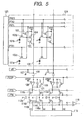
- FIG. 5 illustrates an example of a circuit configuration of the photoelectric conversion apparatus.
- FIG. 6 is a block diagram illustrating an example of an image pickup system.
- an aperture where light is incident on the photoelectric conversion element is prescribed by wiring. Accordingly, in order to enhance incidence efficiency of light to improve the sensitivity, there is required a wiring layout in which an aperture required for allowing light to be incident onto the photoelectric conversion element is caused to be broad. Since a necessary number of wiring layers of the MOS type photoelectric conversion apparatus is larger than that of the CCD type photoelectric conversion apparatus, the degree of freedom of the wiring layout is low. Further, according as pixel becomes fine, the degree of freedom of the wiring layout in the MOS type photoelectric conversion apparatus would be further lowered.
- a MOS type photoelectric conversion apparatus in which incidence efficiency of light onto a photoelectric conversion element is improved can be provided.
- a photoelectric conversion apparatus of the present invention includes a plug disposed in a single hole.
- a plug disposed in a single hole.
- plural active regions disposed in a semiconductor substrate can be electrically connected to each other, gate electrodes of plural MOS transistors disposed therein can be electrically connected to each other, and the active region and the gate electrode of the MOS transistor can be electrically connected.
- this contact structure is called shared contact. Namely, in the case of the related art, contact holes are formed by the number of members subject to electrical connection to make electrical connection through wiring layers. On the contrary, by making connection using the shared contact, plural contacts and wiring layers for connecting those contacts can be eliminated. Thus, the number of wirings is decreased. As a result, the degree of freedom of the wiring layout can be enhanced.
- electrical connection between the active region and the wiring layer, or electrical connection between the gate electrode and the wiring layer is caused to be of stacked structure of ordinary contact plug and dual damascene (stacked contact structure).
- the first wiring layer is formed by dual damascene process to form a portion of the dual damascene structure.
- wiring quantity can be reduced.
- wire can be disposed on the shared contact. Accordingly, the degree of freedom of the wiring layout can be improved. As a result, aperture ratio can be also improved.
- a photoelectric conversion apparatus in which incidence efficiency of light onto the photoelectric conversion element is improved can be provided.
- the stacked contact it is also conceivable to stack a plug of tungsten thereafter to form wiring with a single damascene structure.
- the plug and the dual damascene structure are staked, the height of the device can be reduced.
- a plug directly in contact with the active region and the gate electrode is formed by the process for forming only plug thereafter to form the lowermost wiring layer and plug by dual damascene.
- the degree of freedom of layout of wiring can be improved, and height can be further reduced.
- the aspect ratio of the aperture part is reduced.
- the range of incident angle of incident light can be also enlarged.
- a semiconductor substrate serving as a material substrate will be represented as "substrate”, but also includes the case where a material substrate as described below is processed.
- a member in the state where one or plural semiconductor regions is or are formed, a member in the middle of a series of manufacturing process steps, or a member after undergone a series of manufacturing process steps may be called a substrate.
- the active region is a semiconductor region partitioned by an element isolation region such as LOCOS, and is a region where various elements are formed, or a region forming a part of element.
- a drain region or source region of a transistor is included therein.
- the direction from the principal surface of the semiconductor substrate to the inside of the substrate refers to "lower direction”, and the direction opposite to the above refers to "upper direction”.
- the contact is electrical connecting part between the active region and the wiring, or between the gate electrode and the wiring
- the via is an electrical connecting part between the contact and the wiring, or between wirings.
- Each of the contact and the via includes a plug disposed in a contact hole or via hole, a connecting part between the plug and the active region or other conductor such as wire, and a barrier metal.
- the barrier metal is a film provided for the purpose of suppressing alloy reaction between a plug material and an insulation film or substrate, or diffusion reaction into an insulation film or substrate of a plug material.
- barrier metal is provided also at wiring.
- the dual damascene structure is the structure of wiring and plug formed by the damascene process
- the single damascene structure is the structure of wiring formed by the damascene process.
- the aperture of the photoelectric conversion element is an incident aperture of light onto the photoelectric conversion element, and is generally prescribed by a pattern by wiring or a light shielding film.
- the pattern for prescribing the aperture is a pattern for determining the outer edge of a region incident onto the photoelectric conversion element of light.
- FIG. 5 illustrates one example of the circuit configuration of the MOS type photoelectric conversion apparatus.
- the MOS type photoelectric conversion apparatus includes a pixel unit 124 including photoelectric conversion elements 101a and 101b, transfer MOS transistors 102a and 102b for transferring electric carriers of the photoelectric conversion elements, a reset MOS transistor 103 for resetting the photoelectric conversion elements 101a, 101b and the drain region of each transfer MOS transistor, and an amplification MOS transistor 104 for amplifying electric carriers to output a signal corresponding to the electric carriers to a signal line 106.
- the amplification MOS transistor forms a part of the source-follower circuit.
- the pixel unit 124 further includes a selecting MOS transistor 105 for controlling read-out operation to the signal line.
- the transfer transistors, the reset transistor, the amplification MOS transistor and the selecting MOS transistor are assumed as read-out transistors.
- the transistors 103, 104 and 105 included in these read-out transistors are shared by the two photoelectric conversion elements 101a, 101b.
- a clamping circuit including a clamping capacitor 108, a column amplification unit including an amplifier 120, and a signal holding circuit including capacitors 112a and 112b.
- the circuit configuration forming the photoelectric conversion apparatus further includes scanning circuits 123 and 119. Signals generated by the photoelectric conversion elements 101a and 101b are read out from the signal output line 106 by the read-out transistors driven by the scanning circuits 123 and 119. Further, noises are removed from those signals at the clamping circuit or the signal holding unit. The signals thus obtained are output to horizontal signal lines 116a and 116b. Finally, a differential output thereof is output from the differential amplifier 118.
- the circuit components except for the pixel unit 124 such as the scanning circuits and clamping circuit will be collectively called "a peripheral circuit unit".
- FIG. 1 The cross sectional model diagram of the pixel part of the photoelectric conversion apparatus of the present embodiment is illustrated in FIG. 1 , and description thereof will be made in detail.
- the photoelectric conversion element includes a semiconductor region 1 of the first conductivity type provided on one principal surface of a substrate, a semiconductor region 2 of the second conductivity type, and a semiconductor region 3 of the first conductivity type which covers the second conductivity type semiconductor region 2, wherein the semiconductor region 1 may be a well or a substrate of the first conductivity type.
- the part designated by reference numeral 4 is a gate electrode of a transfer MOS transistor for transferring electric carriers of the photoelectric conversion element accumulated in the second conductivity semiconductor region 2.
- the photoelectric conversion element further includes a semiconductor region 5 of the second conductivity type where electric carriers of the photoelectric conversion element are transferred (floating diffusion region which will be hereinafter abbreviated as FD region), and an element isolation region 6, wherein this element isolation region 6 includes STI (Shallow Trench Isolation) structures.
- the part designated by reference numeral 7 is gate electrode of the amplification MOS transistor forming the source-follower circuit, and the part designated by reference numeral 8 is an active region within pixel.
- the active region refers to a semiconductor region, e.g., photoelectric conversion element, source region or drain region of a MOS transistor or a well where they are disposed.
- the gate electrode may double as wire for supplying voltage to the gate electrode.
- the photoelectric conversion apparatus further includes a plug 9 of contact (shared contact) for connecting the FD region 5 and the gate electrode 7 of the amplification MOS transistor.
- the shared contact structure is a contact for connecting the active region and the gate electrode by the plug disposed in the single contact hole.
- the photoelectric conversion apparatus further incudes a plug 11 for electrically connecting the active region 8 and plug 13 and wiring 15 of the dual damascene structure, and dual damascene structures 13, 14, 15 respectively serving as plug, barrier metal and wiring disposed at the upper part thereof.
- the stacked contact structure is formed by the plug 11 and the plug 13 so that the active region 8 and the wiring 15 are electrically connected.
- the photoelectric conversion apparatus further includes barrier metals 10, 12 for plugs 9, 11, and diffusion prevention films 16, 24 for covering the upper surfaces of the wirings.
- the diffusion prevention films 16 and 24 serve to suppress diffusion of the wiring material.
- the photoelectric conversion apparatus further includes first, second, third and fourth interlayer insulation films 17, 18, 19, 25 for isolating wirings or contacts.
- the first interlayer insulation film 17 is disposed on the semiconductor substrate.
- the photoelectric conversion apparatus further includes side walls 20 for transfer the MOS transistor and amplification the MOS transistor. While the wiring 15 is disposed on the upper part of the plug 11 of the shared contact structure in FIG. 1 , there may be instead disposed a wiring included in the same wiring layer as the wiring 15, which is not electrically connected to the plug 11 of the shared contact structure.
- the plugs 9 and 11 are disposed at the first interlayer insulation film 17.
- the second interlayer insulation film 18 is disposed on the first interlayer insulation film 17.
- plug 13 and wiring 15 of the dual damascene structure are disposed at the second interlayer insulation film 18.
- wiring quantity can be reduced by the shared contact structure.
- wiring can be disposed on the upper part of the shared contact structure. Further, the height of the stacked contact part can be reduced. Accordingly, incidence efficiency of light onto the photoelectric conversion element can be improved while improving the degree of freedom of plane layout of wiring.
- the shared contact structure is applied to an electrical connection between the FD region and the gate electrode of the amplification MOS transistor so that the degree of freedom of the wiring layout in the vicinity of the photoelectric conversion element can be improved. Further, in the case where wirings are disposed on the upper part of the shared contact structure, light-shielding of the FD region can be performed while improving the degree of freedom of the wiring layout.
- FIG. 2 An example of a method of manufacturing the photoelectric conversion apparatus of the present embodiment will now be described with reference to FIG. 2 .
- Reference numerals are caused to respectively correspond to those of FIG. 1 .
- the element isolation region 6, semiconductor region 3 of the second conductivity type, and FD region 5 are formed within the semiconductor region 1.
- the gate electrode 4 containing, e.g., polysilicon and the gate electrode 7 including wiring are formed on the substrate thereafter to form the first interlayer insulation film 17 containing a silicon oxide film to form the structure of FIG. 2A .
- photoresist coated on the first interlayer insulation film 17 is caused to undergo patterning to form resist pattern 20.
- resist pattern 20 as a mask
- apertures for contact (contact holes) 21 and 22 are formed at the first interlayer insulation film 17 by etching.
- the contact hole 21 is an aperture for forming the shared contact structure.
- films for forming the barrier metals 10 and 12 are formed.
- Metallic films (e.g., tungsten film) for forming the plugs 9 and 11 are formed on the upper layer relative thereto.
- the tungsten film is formed through the CVD process by using, e.g., WF6 gas.
- barrier metal in the case where the plug is tungsten there are mentioned single layer film containing Ti or TiN, and laminated film containing both.
- the CMP (Chemical Mechanical Polishing) process may be used in addition to etching. While tungsten is used as material of the plugs 9 and 11, there may be used conductive material having a diffusion coefficient smaller than that of the plug 13. By using such a material, diffusion of material into the substrate can be reduced.
- a dual damascene structure is formed by the damascene process.
- a groove for forming the wiring 15 is formed to form a groove (via hole) for forming the plug 13.
- Photoresist coated on the second interlayer insulation film 18 is caused to undergo patterning to form resist pattern.
- etching is performed with the resist pattern as a mask to form a groove 23 for the wiring 15.
- photoresist is coated again to form resist pattern.
- a groove 24 of the plug 13 forming the via is formed.
- the groove 24 for the plug 13 may be formed before the forming of the groove 23.
- only groove for wiring may be formed at the second interlayer insulation film 18 by the same process step as that of the groove for the wiring 15.
- barrier metal is formed as a film thereafter to deposit, e.g., copper in the grooves 23 and 24. After copper is deposited, excess copper and excess barrier metal are polished by the planarization process such as CMP to form the plug 13 and wiring 15. Next, a film serving as a diffusion prevention film is formed on the wiring 15 to allow the diffusion prevention film 16 to undergo patterning over a predetermined range.
- the barrier metal 14 for the wiring of copper is a Ta-based single layer film, e.g., TaN single layer film.
- the diffusion prevention film 16 is, e.g., silicon carbide or silicon nitride.
- the diffusion prevention film has refractive index different from that of material (e.g., silicon oxide film) of the interlayer insulation film, when the diffusion prevention film is disposed on the upper part of the photoelectric conversion element, reflection takes place so that incident light quantity is reduced. Accordingly, it is desirable that the diffusion prevention film is formed within the range which does not exist across the optical path of the photoelectric conversion element and permits suppression of diffusion of wiring material.
- the present invention is not limited to such a form or implementation.
- the aspect ratio of the plug 11 takes a high value as compared to the plug 13.
- it is desirable for improving burying characteristic in the burying process of metallic material of plug that the upper part area of the contact hole of the plug 11 is large.
- tungsten is used as the plug 11 and copper is used as the plug 13 since burying characteristic of copper is good as compared to tungsten, the bottom part area of hole of the plug 13 can be reduced.
- an etching stop film is included at the lower part of the wiring 15 of the dual damascene structure in addition to the structure of the first exemplary embodiment.
- a second interlayer insulation film 18 is formed as illustrated in FIG. 4A so as to have a predetermine height. Further, a film functioning as an etching stop film is formed on the second interlayer insulation film 18. As the film functioning as this etching stop film, there are, e.g., silicon carbide and silicon nitride. Next, an aperture is formed, with resist pattern as a mask, at a part corresponding to the aperture for the plug 13 of the film functioning as an etching stop film to form an etching stop film 30. At this time, it is desirable to also form an aperture at the upper part of the photoelectric conversion element. Thus, the structure of FIG. 4A is provided.
- a third interlayer insulation film 31 is formed to form the groove 23 for wiring with resist pattern as a mask. Further, after the resist pattern is removed, resist patterning is formed again to form a groove 24 (via hole) for plug. Furthermore, the resist patterning is removed. Thus, the structure of FIG. 4B is provided.
- barrier metal 14 After the barrier metal 14 is formed, copper is deposited in the grooves 23 and 24. After copper is deposited, excess copper and excess barrier metal are polished by the CMP to thereby form the plug 13 and wiring 15. Next, a diffusion prevention film for protecting the wiring 15 is formed to perform etching with resist pattern as a mask to thereby form the diffusion prevention film 16 within a predetermined range.
- the structure of FIG. 4C is provided. Examples of the material of the barrier metal 14 or diffusion prevention film 16 include materials described in the first exemplary embodiment. Process steps subsequent thereto are similar to those of the first exemplary embodiment.
- a hard mask including the etching stop film 30 is used in forming the groove 24 for plug by the dual damascene process.
- the height of the plug 13 can be determined by the film thickness of the second interlayer insulation film 18. For this reason, the distance between the wiring 15 and the plug 9 disposed at the lower part thereof becomes stable. As a result, current leakage between the wiring 15 and the plug 9 becomes difficult to take place. Thus, yield of the photoelectric conversion apparatus including stacked structure can be improved.
- a higher quality photoelectric conversion apparatus can be provided.
- materials and manufacturing methods are not limited to those of respective exemplary embodiments, and the conductivity type of the semiconductor substrate, the configuration of pixels, and wiring layout are not limited to the described configurations.
- the number of stacked layers of plugs of the stacked contact structure may be set as occasion demands.
- FIG. 6 is a block diagram in the case where the photoelectric conversion apparatus each of which has been described in the above-described exemplary embodiments is applied to a video camera which is one example of the image pickup system. As another image pickup system, there is mentioned digital still camera. Description will now be described in detail with reference to FIG. 6 .
- This image pickup system includes an optical system 701 including a focus lens 701A for performing focus adjustment by an imaging lens, a zoom lens 701B for performing zooming operation, and a lens 701C for image formation. Further, the optical system includes an iris and shutter 702.
- the image pickup system further includes a photoelectric conversion apparatus 703 for performing photoelectric conversion of an object image formed on the imaging surface to provide an electric image pickup signal. As the photoelectric conversion apparatus 703, there is used either one of photoelectric conversion apparatuses which have been described in the respective exemplary embodiments.
- the image pickup system further includes a sampling and holding circuit (S/H circuit) 704 for sampling and holding a photoelectric conversion signal which is an output signal of the photoelectric conversion apparatus 703 to amplify level, and serves to output a video signal.
- S/H circuit sampling and holding circuit
- the image pick-up system further includes a process circuit 705 for implementing predetermined processing such as gamma correction, color separation, or blanking processing to the video signal which is output from the sampling and holding circuit 704 to output a luminance signal Y and a chroma signal C.
- the image pickup system further includes a color signal correction circuit 721 for performing correction of white balance and color balance with respect to the chroma signal C which has been output from the process circuit 705 to output corrected signal components thus obtained as color difference signals R-Y and B-Y.
- the image pick-up system further includes an encoder circuit (ENC circuit) 724 for modulating the luminance signal Y which has been output from the process circuit 705 and the color difference signals R-Y, B-Y which have been output from the color signal correction circuit 721 to output a modulated signal thus obtained as a standard television signal.
- the standard television signal thus obtained is delivered to video recorder (not shown) or electronic view-finder such as monitor electronic view finder (EVF).
- the image pick-up system further includes an iris control circuit 706 for controlling an iris drive circuit 707 on the basis of a video signal delivered from the sampling and holding circuit 704.
- the image pickup system is configured to allow an ig meter (iris galvanometer) 708 to be automatically controlled with a view to controlling aperture quantity of the iris 702 so that level of the video signal results in a predetermined value of a predetermined level.
- the image pick-up system further includes band-pass filters (BPF) 713 and 714 for extracting high frequency components necessary for performing in-focus detection from the video signal which has been output from the sampling and holding circuit 704.
- BPF band-pass filters
- Signals which have been output from the first band-pass filter 713 (BPF1) and the second band-pass filter 714 (BPF2) respectively having bandwidth limitations different from each other are gated by a gate circuit 715 and focus gate frame.
- a peak value is detected at a peak detecting circuit 716, and is held thereat. Simultaneously therewith, the signal thus detected is input to a logic control circuit 717. This signal is called focus voltage. Thus, focus is adjusted by this focus voltage.
- the image pick-up system further includes a focus encoder 718 for detecting movement position of the focus lens 701A, a zoom encoder 719 for detecting in-focus of the zoom lens 701B, and an iris encoder 720 for detecting aperture quantity of the iris 702. These detection values of the encoders are delivered to the logic control circuit 717 for performing system control.
- the logic control circuit 717 performs in-focus detection with respect to an object on the basis of a video signal corresponding to the inside of the in-focus detection region which has been set to perform focus adjustment. Namely, peak value information of high frequency components which have been delivered from respective band-pass filters 713, 714 are taken in. Thereafter, the focus lens 701A is driven so that the focus lens 701A is located at the position where peak value of the high frequency component becomes maximum. To realize this, control signals such as rotational direction, rotational velocity, rotation or stop of a focus motor 710 are delivered to a focus drive circuit 709. Thus, the focus motor 710 is controlled.
- a zoom drive circuit 711 rotates a zoom motor 712.
- the zoom motor 712 is rotated, the zoom lens 701B is moved.
- zooming operation is performed.
- the process circuit 705 and logic control circuit 717 are generally called signal processing circuit as occasion may demand.
- the photoelectric conversion apparatus of the present invention in which incident light quantity onto the photoelectric conversion element is increased, and noises are small, image pickup system with high S/N ratio can be provided.
- higher quality photoelectric conversion apparatus and higher quality image pickup system can be provided.
- materials and manufacturing methods are not limited to those of the respective exemplary embodiments, and the conductivity type of the semiconductor substrate, the configuration of pixels and wiring layout are not limited to the described configurations.
- copper wiring and aluminum wiring may be mixed in the stacked wiring structure, and may be thus set as occasion demands.
- the present invention is not necessarily limited to photoelectric conversion apparatus, but may be applied to semiconductor integrated circuit, e.g., SRAM.
- a photoelectric conversion apparatus includes: a first interlayer insulation film disposed on a semiconductor substrate; a first plug disposed in a first hole in the first interlayer insulation film, and serving to electrically connect between a plurality of active regions disposed in the semiconductor substrate, between gate electrodes of a plurality of MOS transistors, or between the active region and the gate electrode of the MOS transistor, not through the wiring of the wiring layer; and a second plug disposed in a second hole in the first interlayer insulation film, the second plug being electrically connected to the active region, wherein a wiring arranged over the second plug and closest to the second plug is electrically connected to the second plug, and the wiring electrically connected to the second plug forms a portion of dual damascene structure.
Landscapes
- Internal Circuitry In Semiconductor Integrated Circuit Devices (AREA)
- Solid State Image Pick-Up Elements (AREA)
- Transforming Light Signals Into Electric Signals (AREA)
- Metal-Oxide And Bipolar Metal-Oxide Semiconductor Integrated Circuits (AREA)
Applications Claiming Priority (2)
| Application Number | Priority Date | Filing Date | Title |
|---|---|---|---|
| JP2007044011A JP4110192B1 (ja) | 2007-02-23 | 2007-02-23 | 光電変換装置及び光電変換装置を用いた撮像システム |
| EP08151687A EP1962345B1 (de) | 2007-02-23 | 2008-02-20 | Fotoelektrischer Wandler und Bildaufnahmesystem mit Dual-Damascene Verbindungsstrukturen |
Related Parent Applications (1)
| Application Number | Title | Priority Date | Filing Date |
|---|---|---|---|
| EP08151687.4 Division | 2008-02-20 |
Publications (3)
| Publication Number | Publication Date |
|---|---|
| EP2270862A2 true EP2270862A2 (de) | 2011-01-05 |
| EP2270862A3 EP2270862A3 (de) | 2011-09-07 |
| EP2270862B1 EP2270862B1 (de) | 2013-04-24 |
Family
ID=39494626
Family Applications (2)
| Application Number | Title | Priority Date | Filing Date |
|---|---|---|---|
| EP10183837.3A Not-in-force EP2270862B1 (de) | 2007-02-23 | 2008-02-20 | Verfahren zur Herstellung eines fotoelektrischen Wandlers mit Dual-Damascene Verbindungsstrukturen |
| EP08151687A Not-in-force EP1962345B1 (de) | 2007-02-23 | 2008-02-20 | Fotoelektrischer Wandler und Bildaufnahmesystem mit Dual-Damascene Verbindungsstrukturen |
Family Applications After (1)
| Application Number | Title | Priority Date | Filing Date |
|---|---|---|---|
| EP08151687A Not-in-force EP1962345B1 (de) | 2007-02-23 | 2008-02-20 | Fotoelektrischer Wandler und Bildaufnahmesystem mit Dual-Damascene Verbindungsstrukturen |
Country Status (6)
| Country | Link |
|---|---|
| US (2) | US7838918B2 (de) |
| EP (2) | EP2270862B1 (de) |
| JP (1) | JP4110192B1 (de) |
| KR (1) | KR100953153B1 (de) |
| CN (2) | CN102142450B (de) |
| AT (1) | ATE518247T1 (de) |
Families Citing this family (29)
| Publication number | Priority date | Publication date | Assignee | Title |
|---|---|---|---|---|
| JP4110192B1 (ja) * | 2007-02-23 | 2008-07-02 | キヤノン株式会社 | 光電変換装置及び光電変換装置を用いた撮像システム |
| US7891494B2 (en) * | 2007-08-14 | 2011-02-22 | Reflex Packaging, Inc. | Light weight product cushioning device |
| JP5441382B2 (ja) * | 2008-09-30 | 2014-03-12 | キヤノン株式会社 | 光電変換装置及び光電変換装置の製造方法 |
| JP5478871B2 (ja) * | 2008-10-17 | 2014-04-23 | キヤノン株式会社 | 光電変換装置、撮像システム、及び光電変換装置の製造方法 |
| KR20100045094A (ko) * | 2008-10-23 | 2010-05-03 | 주식회사 동부하이텍 | 이미지 센서의 제조 방법 |
| JP2010161236A (ja) | 2009-01-08 | 2010-07-22 | Canon Inc | 光電変換装置の製造方法 |
| JP2010212365A (ja) * | 2009-03-09 | 2010-09-24 | Sony Corp | 固体撮像装置、および、その製造方法、電子機器 |
| JP5627202B2 (ja) * | 2009-06-18 | 2014-11-19 | キヤノン株式会社 | 固体撮像装置及びその製造方法 |
| JP5558916B2 (ja) * | 2009-06-26 | 2014-07-23 | キヤノン株式会社 | 光電変換装置の製造方法 |
| JP5563257B2 (ja) * | 2009-08-28 | 2014-07-30 | キヤノン株式会社 | 光電変換装置、撮像システム、及び光電変換装置の製造方法 |
| JP5700945B2 (ja) * | 2010-03-25 | 2015-04-15 | キヤノン株式会社 | 光電変換装置及びその製造方法 |
| US8426310B2 (en) * | 2010-05-25 | 2013-04-23 | Freescale Semiconductor, Inc. | Method of forming a shared contact in a semiconductor device |
| KR101890748B1 (ko) | 2011-02-01 | 2018-08-23 | 삼성전자주식회사 | 멀티 스택 씨모스(cmos) 이미지 센서의 화소 및 그 제조방법 |
| CN102789972B (zh) * | 2011-05-20 | 2015-04-22 | 中芯国际集成电路制造(上海)有限公司 | 半导体器件的制造方法 |
| JP2014049727A (ja) * | 2012-09-04 | 2014-03-17 | Canon Inc | 固体撮像装置 |
| JP6198485B2 (ja) * | 2013-06-28 | 2017-09-20 | キヤノン株式会社 | 光電変換装置、及び撮像システム |
| KR102268707B1 (ko) | 2014-07-28 | 2021-06-28 | 삼성전자주식회사 | 이미지 센서 |
| JP2016033972A (ja) | 2014-07-31 | 2016-03-10 | キヤノン株式会社 | 撮像装置及び撮像システム |
| US9991158B2 (en) * | 2014-09-12 | 2018-06-05 | Taiwan Semiconductor Manufacturing Company, Ltd. | Semiconductor device, layout of semiconductor device, and method of manufacturing semiconductor device |
| JP6736318B2 (ja) * | 2015-09-10 | 2020-08-05 | キヤノン株式会社 | 固体撮像素子、固体撮像素子の製造方法および撮像システム |
| JP6818468B2 (ja) | 2016-08-25 | 2021-01-20 | キヤノン株式会社 | 光電変換装置及びカメラ |
| JP2018060921A (ja) | 2016-10-05 | 2018-04-12 | キヤノン株式会社 | 光電変換装置及びシステム |
| EP3324436B1 (de) * | 2016-11-21 | 2020-08-05 | IMEC vzw | Chip mit integrierter schaltung mit stromversorgungsnetzwerk auf der rückseite des chips |
| US10347543B2 (en) * | 2017-11-13 | 2019-07-09 | Globalfoundries Inc. | FDSOI semiconductor device with contact enhancement layer and method of manufacturing |
| JP2021019058A (ja) * | 2019-07-18 | 2021-02-15 | キヤノン株式会社 | 光電変換装置および機器 |
| CN110634898A (zh) * | 2019-09-23 | 2019-12-31 | 上海华力微电子有限公司 | 一种用于背照式图像传感器的深硅槽及其形成方法 |
| US12029024B2 (en) | 2021-04-05 | 2024-07-02 | Samsung Electronics Co., Ltd. | Semiconductor memory devices and methods of fabricating the same |
| US12310077B2 (en) * | 2021-11-12 | 2025-05-20 | Taiwan Semiconductor Manufacturing Co., Ltd. | Dual damascene structure in forming source/drain contacts |
| US20250126874A1 (en) * | 2023-10-16 | 2025-04-17 | Taiwan Semiconductor Manufacturing Company, Ltd. | Semiconductor device and manufacturing method thereof |
Citations (1)
| Publication number | Priority date | Publication date | Assignee | Title |
|---|---|---|---|---|
| JP2004221527A (ja) | 2003-01-16 | 2004-08-05 | Samsung Electronics Co Ltd | イメージ素子及びその製造方法 |
Family Cites Families (35)
| Publication number | Priority date | Publication date | Assignee | Title |
|---|---|---|---|---|
| US6696101B2 (en) * | 1994-08-08 | 2004-02-24 | Light And Sound Design Ltd. | Medium for a color changer |
| JPH0955440A (ja) * | 1995-08-17 | 1997-02-25 | Sony Corp | 半導体装置及び半導体装置の製造方法 |
| JP3534589B2 (ja) | 1997-10-30 | 2004-06-07 | シャープ株式会社 | 多層配線装置及びその製造方法 |
| JPH11186386A (ja) | 1997-12-19 | 1999-07-09 | Asahi Kasei Micro Syst Co Ltd | 半導体装置およびその製造方法 |
| US6071789A (en) * | 1998-11-10 | 2000-06-06 | Vanguard International Semiconductor Corporation | Method for simultaneously fabricating a DRAM capacitor and metal interconnections |
| JP4565700B2 (ja) * | 1999-05-12 | 2010-10-20 | ルネサスエレクトロニクス株式会社 | 半導体装置 |
| JP2001060590A (ja) * | 1999-08-20 | 2001-03-06 | Denso Corp | 半導体装置の電気配線及びその製造方法 |
| JP2001298175A (ja) | 2000-04-12 | 2001-10-26 | Toshiba Corp | 撮像システム |
| US6352921B1 (en) * | 2000-07-19 | 2002-03-05 | Chartered Semiconductor Manufacturing Ltd. | Use of boron carbide as an etch-stop and barrier layer for copper dual damascene metallization |
| US6696360B2 (en) * | 2001-03-15 | 2004-02-24 | Micron Technology, Inc. | Barrier-metal-free copper damascene technology using atomic hydrogen enhanced reflow |
| JP2002368203A (ja) | 2001-06-05 | 2002-12-20 | Sony Corp | 固体撮像素子 |
| JP4117672B2 (ja) * | 2002-05-01 | 2008-07-16 | ソニー株式会社 | 固体撮像素子及び固体撮像装置、並びにこれらの製造方法 |
| JP3795846B2 (ja) * | 2002-08-29 | 2006-07-12 | 富士通株式会社 | 半導体装置 |
| JP2004165236A (ja) | 2002-11-11 | 2004-06-10 | Sony Corp | 固体撮像装置の製造方法 |
| JP3840214B2 (ja) * | 2003-01-06 | 2006-11-01 | キヤノン株式会社 | 光電変換装置及び光電変換装置の製造方法及び同光電変換装置を用いたカメラ |
| JP4086673B2 (ja) * | 2003-02-04 | 2008-05-14 | Necエレクトロニクス株式会社 | 半導体装置及びその製造方法 |
| KR100499174B1 (ko) | 2003-06-17 | 2005-07-01 | 삼성전자주식회사 | 이미지 소자 |
| KR100500573B1 (ko) * | 2003-07-01 | 2005-07-12 | 삼성전자주식회사 | 금속 배선 및 그 제조 방법, 금속 배선을 포함하는 이미지소자 및 그 제조 방법 |
| KR100471001B1 (ko) * | 2003-07-02 | 2005-03-14 | 삼성전자주식회사 | 리세스형 트랜지스터 및 그의 제조방법 |
| JP4478038B2 (ja) * | 2004-02-27 | 2010-06-09 | 株式会社半導体理工学研究センター | 半導体装置及びその製造方法 |
| US7176125B2 (en) * | 2004-07-23 | 2007-02-13 | Taiwan Semiconductor Manufacturing Company, Ltd. | Method of forming a static random access memory with a buried local interconnect |
| KR100642764B1 (ko) * | 2004-09-08 | 2006-11-10 | 삼성전자주식회사 | 이미지 소자 및 그 제조 방법 |
| US7193289B2 (en) * | 2004-11-30 | 2007-03-20 | International Business Machines Corporation | Damascene copper wiring image sensor |
| KR100628238B1 (ko) * | 2004-12-30 | 2006-09-26 | 동부일렉트로닉스 주식회사 | 시모스 이미지 센서 및 그의 제조 방법 |
| JP4938238B2 (ja) | 2005-01-07 | 2012-05-23 | ソニー株式会社 | 固体撮像素子及び固体撮像素子の製造方法 |
| JP4686201B2 (ja) * | 2005-01-27 | 2011-05-25 | パナソニック株式会社 | 固体撮像装置及びその製造方法 |
| JP4618786B2 (ja) * | 2005-01-28 | 2011-01-26 | キヤノン株式会社 | 固体撮像装置の製造方法 |
| JP4340248B2 (ja) * | 2005-03-17 | 2009-10-07 | 富士通マイクロエレクトロニクス株式会社 | 半導体撮像装置を製造する方法 |
| JP4785433B2 (ja) * | 2005-06-10 | 2011-10-05 | キヤノン株式会社 | 固体撮像装置 |
| CN100524786C (zh) * | 2005-08-18 | 2009-08-05 | 联华电子股份有限公司 | 互补式金属氧化物半导体晶体管影像感测器及其制造方法 |
| JP2007242697A (ja) * | 2006-03-06 | 2007-09-20 | Canon Inc | 撮像装置および撮像システム |
| JP5305622B2 (ja) * | 2006-08-31 | 2013-10-02 | キヤノン株式会社 | 光電変換装置の製造方法 |
| JP4315457B2 (ja) * | 2006-08-31 | 2009-08-19 | キヤノン株式会社 | 光電変換装置及び撮像システム |
| JP5159120B2 (ja) * | 2007-02-23 | 2013-03-06 | キヤノン株式会社 | 光電変換装置およびその製造方法 |
| JP4110192B1 (ja) * | 2007-02-23 | 2008-07-02 | キヤノン株式会社 | 光電変換装置及び光電変換装置を用いた撮像システム |
-
2007
- 2007-02-23 JP JP2007044011A patent/JP4110192B1/ja not_active Expired - Fee Related
-
2008
- 2008-02-06 US US12/026,623 patent/US7838918B2/en not_active Expired - Fee Related
- 2008-02-20 EP EP10183837.3A patent/EP2270862B1/de not_active Not-in-force
- 2008-02-20 AT AT08151687T patent/ATE518247T1/de not_active IP Right Cessation
- 2008-02-20 EP EP08151687A patent/EP1962345B1/de not_active Not-in-force
- 2008-02-22 CN CN2011100423411A patent/CN102142450B/zh not_active Expired - Fee Related
- 2008-02-22 CN CN2008100808751A patent/CN101252138B/zh not_active Expired - Fee Related
- 2008-02-22 KR KR1020080016058A patent/KR100953153B1/ko not_active Expired - Fee Related
-
2010
- 2010-10-14 US US12/904,269 patent/US8304278B2/en not_active Expired - Fee Related
Patent Citations (1)
| Publication number | Priority date | Publication date | Assignee | Title |
|---|---|---|---|---|
| JP2004221527A (ja) | 2003-01-16 | 2004-08-05 | Samsung Electronics Co Ltd | イメージ素子及びその製造方法 |
Also Published As
| Publication number | Publication date |
|---|---|
| US20080203450A1 (en) | 2008-08-28 |
| JP2008210870A (ja) | 2008-09-11 |
| KR100953153B1 (ko) | 2010-04-19 |
| US8304278B2 (en) | 2012-11-06 |
| EP2270862B1 (de) | 2013-04-24 |
| EP1962345A3 (de) | 2009-03-04 |
| KR20080078586A (ko) | 2008-08-27 |
| CN102142450B (zh) | 2013-10-30 |
| JP4110192B1 (ja) | 2008-07-02 |
| CN102142450A (zh) | 2011-08-03 |
| CN101252138B (zh) | 2011-03-30 |
| US7838918B2 (en) | 2010-11-23 |
| US20110027934A1 (en) | 2011-02-03 |
| EP1962345A2 (de) | 2008-08-27 |
| EP2270862A3 (de) | 2011-09-07 |
| EP1962345B1 (de) | 2011-07-27 |
| ATE518247T1 (de) | 2011-08-15 |
| CN101252138A (zh) | 2008-08-27 |
Similar Documents
| Publication | Publication Date | Title |
|---|---|---|
| EP1962345B1 (de) | Fotoelektrischer Wandler und Bildaufnahmesystem mit Dual-Damascene Verbindungsstrukturen | |
| US7842988B2 (en) | Manufacturing method of photoelectric conversion device | |
| US8222682B2 (en) | Photoelectric conversion apparatus and image pickup system using photoelectric conversion apparatus | |
| KR101411800B1 (ko) | 고체 촬상 장치 및 촬상 시스템 | |
| JP4799522B2 (ja) | 撮像装置 | |
| US8248502B2 (en) | Photoelectric conversion device and method for making the same | |
| JP2021027276A (ja) | 光電変換装置および機器 | |
| US10381389B2 (en) | Solid state imaging device, manufacturing method of solid state imaging device, and imaging system | |
| CN100590846C (zh) | 光电转换装置的制造方法 | |
| US20110291217A1 (en) | Photoelectric converter and imaging system including the same | |
| CN105185801B (zh) | 固态图像拾取装置和图像拾取系统 | |
| JP2007165864A (ja) | 光電変換装置、光電変換装置の製造方法及び撮像システム | |
| JP5539458B2 (ja) | 光電変換装置および光電変換装置を用いた撮像システム | |
| WO2020189472A1 (ja) | 半導体装置および半導体装置の製造方法 | |
| CN101471299A (zh) | 制造图像传感器的方法 | |
| JP2015156502A (ja) | 固体撮像装置、固体撮像装置の製造方法、および電子機器 | |
| JPH10112536A (ja) | 固体撮像素子 |
Legal Events
| Date | Code | Title | Description |
|---|---|---|---|
| PUAI | Public reference made under article 153(3) epc to a published international application that has entered the european phase |
Free format text: ORIGINAL CODE: 0009012 |
|
| AC | Divisional application: reference to earlier application |
Ref document number: 1962345 Country of ref document: EP Kind code of ref document: P |
|
| AK | Designated contracting states |
Kind code of ref document: A2 Designated state(s): AT BE BG CH CY CZ DE DK EE ES FI FR GB GR HR HU IE IS IT LI LT LU LV MC MT NL NO PL PT RO SE SI SK TR |
|
| PUAL | Search report despatched |
Free format text: ORIGINAL CODE: 0009013 |
|
| AK | Designated contracting states |
Kind code of ref document: A3 Designated state(s): AT BE BG CH CY CZ DE DK EE ES FI FR GB GR HR HU IE IS IT LI LT LU LV MC MT NL NO PL PT RO SE SI SK TR |
|
| RIC1 | Information provided on ipc code assigned before grant |
Ipc: H01L 27/146 20060101AFI20110729BHEP |
|
| 17P | Request for examination filed |
Effective date: 20120307 |
|
| 17Q | First examination report despatched |
Effective date: 20120521 |
|
| GRAP | Despatch of communication of intention to grant a patent |
Free format text: ORIGINAL CODE: EPIDOSNIGR1 |
|
| GRAS | Grant fee paid |
Free format text: ORIGINAL CODE: EPIDOSNIGR3 |
|
| GRAA | (expected) grant |
Free format text: ORIGINAL CODE: 0009210 |
|
| AC | Divisional application: reference to earlier application |
Ref document number: 1962345 Country of ref document: EP Kind code of ref document: P |
|
| AK | Designated contracting states |
Kind code of ref document: B1 Designated state(s): AT BE BG CH CY CZ DE DK EE ES FI FR GB GR HR HU IE IS IT LI LT LU LV MC MT NL NO PL PT RO SE SI SK TR |
|
| REG | Reference to a national code |
Ref country code: GB Ref legal event code: FG4D |
|
| REG | Reference to a national code |
Ref country code: CH Ref legal event code: EP |
|
| REG | Reference to a national code |
Ref country code: AT Ref legal event code: REF Ref document number: 609071 Country of ref document: AT Kind code of ref document: T Effective date: 20130515 |
|
| REG | Reference to a national code |
Ref country code: IE Ref legal event code: FG4D |
|
| REG | Reference to a national code |
Ref country code: DE Ref legal event code: R096 Ref document number: 602008024183 Country of ref document: DE Effective date: 20130613 |
|
| REG | Reference to a national code |
Ref country code: AT Ref legal event code: MK05 Ref document number: 609071 Country of ref document: AT Kind code of ref document: T Effective date: 20130424 |
|
| REG | Reference to a national code |
Ref country code: LT Ref legal event code: MG4D |
|
| REG | Reference to a national code |
Ref country code: NL Ref legal event code: VDEP Effective date: 20130424 |
|
| PG25 | Lapsed in a contracting state [announced via postgrant information from national office to epo] |
Ref country code: GR Free format text: LAPSE BECAUSE OF FAILURE TO SUBMIT A TRANSLATION OF THE DESCRIPTION OR TO PAY THE FEE WITHIN THE PRESCRIBED TIME-LIMIT Effective date: 20130725 Ref country code: IS Free format text: LAPSE BECAUSE OF FAILURE TO SUBMIT A TRANSLATION OF THE DESCRIPTION OR TO PAY THE FEE WITHIN THE PRESCRIBED TIME-LIMIT Effective date: 20130824 Ref country code: FI Free format text: LAPSE BECAUSE OF FAILURE TO SUBMIT A TRANSLATION OF THE DESCRIPTION OR TO PAY THE FEE WITHIN THE PRESCRIBED TIME-LIMIT Effective date: 20130424 Ref country code: BE Free format text: LAPSE BECAUSE OF FAILURE TO SUBMIT A TRANSLATION OF THE DESCRIPTION OR TO PAY THE FEE WITHIN THE PRESCRIBED TIME-LIMIT Effective date: 20130424 Ref country code: NO Free format text: LAPSE BECAUSE OF FAILURE TO SUBMIT A TRANSLATION OF THE DESCRIPTION OR TO PAY THE FEE WITHIN THE PRESCRIBED TIME-LIMIT Effective date: 20130724 Ref country code: SI Free format text: LAPSE BECAUSE OF FAILURE TO SUBMIT A TRANSLATION OF THE DESCRIPTION OR TO PAY THE FEE WITHIN THE PRESCRIBED TIME-LIMIT Effective date: 20130424 Ref country code: PT Free format text: LAPSE BECAUSE OF FAILURE TO SUBMIT A TRANSLATION OF THE DESCRIPTION OR TO PAY THE FEE WITHIN THE PRESCRIBED TIME-LIMIT Effective date: 20130826 Ref country code: SE Free format text: LAPSE BECAUSE OF FAILURE TO SUBMIT A TRANSLATION OF THE DESCRIPTION OR TO PAY THE FEE WITHIN THE PRESCRIBED TIME-LIMIT Effective date: 20130424 Ref country code: AT Free format text: LAPSE BECAUSE OF FAILURE TO SUBMIT A TRANSLATION OF THE DESCRIPTION OR TO PAY THE FEE WITHIN THE PRESCRIBED TIME-LIMIT Effective date: 20130424 Ref country code: LT Free format text: LAPSE BECAUSE OF FAILURE TO SUBMIT A TRANSLATION OF THE DESCRIPTION OR TO PAY THE FEE WITHIN THE PRESCRIBED TIME-LIMIT Effective date: 20130424 Ref country code: ES Free format text: LAPSE BECAUSE OF FAILURE TO SUBMIT A TRANSLATION OF THE DESCRIPTION OR TO PAY THE FEE WITHIN THE PRESCRIBED TIME-LIMIT Effective date: 20130804 |
|
| PG25 | Lapsed in a contracting state [announced via postgrant information from national office to epo] |
Ref country code: LV Free format text: LAPSE BECAUSE OF FAILURE TO SUBMIT A TRANSLATION OF THE DESCRIPTION OR TO PAY THE FEE WITHIN THE PRESCRIBED TIME-LIMIT Effective date: 20130424 Ref country code: PL Free format text: LAPSE BECAUSE OF FAILURE TO SUBMIT A TRANSLATION OF THE DESCRIPTION OR TO PAY THE FEE WITHIN THE PRESCRIBED TIME-LIMIT Effective date: 20130424 Ref country code: CY Free format text: LAPSE BECAUSE OF FAILURE TO SUBMIT A TRANSLATION OF THE DESCRIPTION OR TO PAY THE FEE WITHIN THE PRESCRIBED TIME-LIMIT Effective date: 20130424 Ref country code: HR Free format text: LAPSE BECAUSE OF FAILURE TO SUBMIT A TRANSLATION OF THE DESCRIPTION OR TO PAY THE FEE WITHIN THE PRESCRIBED TIME-LIMIT Effective date: 20130424 Ref country code: BG Free format text: LAPSE BECAUSE OF FAILURE TO SUBMIT A TRANSLATION OF THE DESCRIPTION OR TO PAY THE FEE WITHIN THE PRESCRIBED TIME-LIMIT Effective date: 20130724 |
|
| PG25 | Lapsed in a contracting state [announced via postgrant information from national office to epo] |
Ref country code: DK Free format text: LAPSE BECAUSE OF FAILURE TO SUBMIT A TRANSLATION OF THE DESCRIPTION OR TO PAY THE FEE WITHIN THE PRESCRIBED TIME-LIMIT Effective date: 20130424 Ref country code: SK Free format text: LAPSE BECAUSE OF FAILURE TO SUBMIT A TRANSLATION OF THE DESCRIPTION OR TO PAY THE FEE WITHIN THE PRESCRIBED TIME-LIMIT Effective date: 20130424 Ref country code: CZ Free format text: LAPSE BECAUSE OF FAILURE TO SUBMIT A TRANSLATION OF THE DESCRIPTION OR TO PAY THE FEE WITHIN THE PRESCRIBED TIME-LIMIT Effective date: 20130424 Ref country code: EE Free format text: LAPSE BECAUSE OF FAILURE TO SUBMIT A TRANSLATION OF THE DESCRIPTION OR TO PAY THE FEE WITHIN THE PRESCRIBED TIME-LIMIT Effective date: 20130424 |
|
| PG25 | Lapsed in a contracting state [announced via postgrant information from national office to epo] |
Ref country code: NL Free format text: LAPSE BECAUSE OF FAILURE TO SUBMIT A TRANSLATION OF THE DESCRIPTION OR TO PAY THE FEE WITHIN THE PRESCRIBED TIME-LIMIT Effective date: 20130424 Ref country code: RO Free format text: LAPSE BECAUSE OF FAILURE TO SUBMIT A TRANSLATION OF THE DESCRIPTION OR TO PAY THE FEE WITHIN THE PRESCRIBED TIME-LIMIT Effective date: 20130424 Ref country code: IT Free format text: LAPSE BECAUSE OF FAILURE TO SUBMIT A TRANSLATION OF THE DESCRIPTION OR TO PAY THE FEE WITHIN THE PRESCRIBED TIME-LIMIT Effective date: 20130424 |
|
| PLBE | No opposition filed within time limit |
Free format text: ORIGINAL CODE: 0009261 |
|
| STAA | Information on the status of an ep patent application or granted ep patent |
Free format text: STATUS: NO OPPOSITION FILED WITHIN TIME LIMIT |
|
| 26N | No opposition filed |
Effective date: 20140127 |
|
| REG | Reference to a national code |
Ref country code: DE Ref legal event code: R097 Ref document number: 602008024183 Country of ref document: DE Effective date: 20140127 |
|
| PG25 | Lapsed in a contracting state [announced via postgrant information from national office to epo] |
Ref country code: MC Free format text: LAPSE BECAUSE OF FAILURE TO SUBMIT A TRANSLATION OF THE DESCRIPTION OR TO PAY THE FEE WITHIN THE PRESCRIBED TIME-LIMIT Effective date: 20130424 Ref country code: LU Free format text: LAPSE BECAUSE OF FAILURE TO SUBMIT A TRANSLATION OF THE DESCRIPTION OR TO PAY THE FEE WITHIN THE PRESCRIBED TIME-LIMIT Effective date: 20140220 |
|
| REG | Reference to a national code |
Ref country code: CH Ref legal event code: PL |
|
| PG25 | Lapsed in a contracting state [announced via postgrant information from national office to epo] |
Ref country code: CH Free format text: LAPSE BECAUSE OF NON-PAYMENT OF DUE FEES Effective date: 20140228 Ref country code: LI Free format text: LAPSE BECAUSE OF NON-PAYMENT OF DUE FEES Effective date: 20140228 |
|
| REG | Reference to a national code |
Ref country code: FR Ref legal event code: ST Effective date: 20141031 |
|
| REG | Reference to a national code |
Ref country code: IE Ref legal event code: MM4A |
|
| PG25 | Lapsed in a contracting state [announced via postgrant information from national office to epo] |
Ref country code: FR Free format text: LAPSE BECAUSE OF NON-PAYMENT OF DUE FEES Effective date: 20140228 Ref country code: IE Free format text: LAPSE BECAUSE OF NON-PAYMENT OF DUE FEES Effective date: 20140220 |
|
| PGFP | Annual fee paid to national office [announced via postgrant information from national office to epo] |
Ref country code: DE Payment date: 20150228 Year of fee payment: 8 |
|
| PGFP | Annual fee paid to national office [announced via postgrant information from national office to epo] |
Ref country code: GB Payment date: 20150220 Year of fee payment: 8 |
|
| PG25 | Lapsed in a contracting state [announced via postgrant information from national office to epo] |
Ref country code: MT Free format text: LAPSE BECAUSE OF FAILURE TO SUBMIT A TRANSLATION OF THE DESCRIPTION OR TO PAY THE FEE WITHIN THE PRESCRIBED TIME-LIMIT Effective date: 20130424 |
|
| PG25 | Lapsed in a contracting state [announced via postgrant information from national office to epo] |
Ref country code: TR Free format text: LAPSE BECAUSE OF FAILURE TO SUBMIT A TRANSLATION OF THE DESCRIPTION OR TO PAY THE FEE WITHIN THE PRESCRIBED TIME-LIMIT Effective date: 20130424 Ref country code: HU Free format text: LAPSE BECAUSE OF FAILURE TO SUBMIT A TRANSLATION OF THE DESCRIPTION OR TO PAY THE FEE WITHIN THE PRESCRIBED TIME-LIMIT; INVALID AB INITIO Effective date: 20080220 |
|
| REG | Reference to a national code |
Ref country code: DE Ref legal event code: R119 Ref document number: 602008024183 Country of ref document: DE |
|
| GBPC | Gb: european patent ceased through non-payment of renewal fee |
Effective date: 20160220 |
|
| PG25 | Lapsed in a contracting state [announced via postgrant information from national office to epo] |
Ref country code: GB Free format text: LAPSE BECAUSE OF NON-PAYMENT OF DUE FEES Effective date: 20160220 Ref country code: DE Free format text: LAPSE BECAUSE OF NON-PAYMENT OF DUE FEES Effective date: 20160901 |