EP2270901A1 - Verfahren zur regelung der anschlussspannung der kathode während berentladung und kathodenaktivmaterial für eine lithium-sekundärbatterie - Google Patents
Verfahren zur regelung der anschlussspannung der kathode während berentladung und kathodenaktivmaterial für eine lithium-sekundärbatterie Download PDFInfo
- Publication number
- EP2270901A1 EP2270901A1 EP10187897A EP10187897A EP2270901A1 EP 2270901 A1 EP2270901 A1 EP 2270901A1 EP 10187897 A EP10187897 A EP 10187897A EP 10187897 A EP10187897 A EP 10187897A EP 2270901 A1 EP2270901 A1 EP 2270901A1
- Authority
- EP
- European Patent Office
- Prior art keywords
- active material
- lithium
- cathode
- cathode active
- battery
- Prior art date
- Legal status (The legal status is an assumption and is not a legal conclusion. Google has not performed a legal analysis and makes no representation as to the accuracy of the status listed.)
- Granted
Links
- 238000000034 method Methods 0.000 title claims abstract description 42
- 229910052744 lithium Inorganic materials 0.000 title claims abstract description 31
- WHXSMMKQMYFTQS-UHFFFAOYSA-N Lithium Chemical compound [Li] WHXSMMKQMYFTQS-UHFFFAOYSA-N 0.000 title claims abstract description 25
- 230000001105 regulatory effect Effects 0.000 title claims abstract description 5
- 239000006182 cathode active material Substances 0.000 claims description 86
- 239000000654 additive Substances 0.000 claims description 80
- 230000000996 additive effect Effects 0.000 claims description 77
- URIIGZKXFBNRAU-UHFFFAOYSA-N lithium;oxonickel Chemical compound [Li].[Ni]=O URIIGZKXFBNRAU-UHFFFAOYSA-N 0.000 claims description 41
- PXHVJJICTQNCMI-UHFFFAOYSA-N Nickel Chemical compound [Ni] PXHVJJICTQNCMI-UHFFFAOYSA-N 0.000 claims description 34
- 230000002427 irreversible effect Effects 0.000 claims description 25
- 229910001416 lithium ion Inorganic materials 0.000 claims description 19
- 150000001875 compounds Chemical class 0.000 claims description 18
- HBBGRARXTFLTSG-UHFFFAOYSA-N Lithium ion Chemical compound [Li+] HBBGRARXTFLTSG-UHFFFAOYSA-N 0.000 claims description 17
- 229910021437 lithium-transition metal oxide Inorganic materials 0.000 claims description 17
- 229910052802 copper Inorganic materials 0.000 claims description 15
- 239000003792 electrolyte Substances 0.000 claims description 15
- 229910052799 carbon Inorganic materials 0.000 claims description 14
- 229910052720 vanadium Inorganic materials 0.000 claims description 14
- 229910052749 magnesium Inorganic materials 0.000 claims description 13
- 229910052782 aluminium Inorganic materials 0.000 claims description 12
- 229910052804 chromium Inorganic materials 0.000 claims description 12
- 229910052742 iron Inorganic materials 0.000 claims description 12
- 229910052748 manganese Inorganic materials 0.000 claims description 12
- 229910052750 molybdenum Inorganic materials 0.000 claims description 12
- 229910052758 niobium Inorganic materials 0.000 claims description 12
- 229910052698 phosphorus Inorganic materials 0.000 claims description 12
- 229910052706 scandium Inorganic materials 0.000 claims description 12
- 229910052719 titanium Inorganic materials 0.000 claims description 12
- 229910052725 zinc Inorganic materials 0.000 claims description 12
- 229910052726 zirconium Inorganic materials 0.000 claims description 12
- 229910052759 nickel Inorganic materials 0.000 claims description 11
- 238000009830 intercalation Methods 0.000 claims description 10
- 230000002687 intercalation Effects 0.000 claims description 10
- 229910003002 lithium salt Inorganic materials 0.000 claims description 10
- 159000000002 lithium salts Chemical class 0.000 claims description 10
- 238000009831 deintercalation Methods 0.000 claims description 9
- OIFBSDVPJOWBCH-UHFFFAOYSA-N Diethyl carbonate Chemical compound CCOC(=O)OCC OIFBSDVPJOWBCH-UHFFFAOYSA-N 0.000 claims description 7
- KMTRUDSVKNLOMY-UHFFFAOYSA-N Ethylene carbonate Chemical compound O=C1OCCO1 KMTRUDSVKNLOMY-UHFFFAOYSA-N 0.000 claims description 7
- 229910032387 LiCoO2 Inorganic materials 0.000 claims description 7
- 229910052796 boron Inorganic materials 0.000 claims description 7
- RUOJZAUFBMNUDX-UHFFFAOYSA-N propylene carbonate Chemical compound CC1COC(=O)O1 RUOJZAUFBMNUDX-UHFFFAOYSA-N 0.000 claims description 7
- 229910052793 cadmium Inorganic materials 0.000 claims description 6
- 238000006243 chemical reaction Methods 0.000 claims description 6
- 239000002131 composite material Substances 0.000 claims description 6
- 229910052710 silicon Inorganic materials 0.000 claims description 6
- 229910052712 strontium Inorganic materials 0.000 claims description 6
- 229910001290 LiPF6 Inorganic materials 0.000 claims description 5
- 229910015509 Ni1-yMy Inorganic materials 0.000 claims description 5
- 229910015258 Ni1−yMy Inorganic materials 0.000 claims description 5
- BVKZGUZCCUSVTD-UHFFFAOYSA-L Carbonate Chemical compound [O-]C([O-])=O BVKZGUZCCUSVTD-UHFFFAOYSA-L 0.000 claims description 4
- 229910003005 LiNiO2 Inorganic materials 0.000 claims description 4
- JBTWLSYIZRCDFO-UHFFFAOYSA-N ethyl methyl carbonate Chemical compound CCOC(=O)OC JBTWLSYIZRCDFO-UHFFFAOYSA-N 0.000 claims description 4
- KKQAVHGECIBFRQ-UHFFFAOYSA-N methyl propyl carbonate Chemical compound CCCOC(=O)OC KKQAVHGECIBFRQ-UHFFFAOYSA-N 0.000 claims description 4
- 239000011255 nonaqueous electrolyte Substances 0.000 claims description 4
- 230000015572 biosynthetic process Effects 0.000 claims description 3
- YEJRWHAVMIAJKC-UHFFFAOYSA-N 4-Butyrolactone Chemical compound O=C1CCCO1 YEJRWHAVMIAJKC-UHFFFAOYSA-N 0.000 claims description 2
- 229910004170 Li(NiaCObMnc)O2 Inorganic materials 0.000 claims description 2
- 229910000552 LiCF3SO3 Inorganic materials 0.000 claims description 2
- 229910011279 LiCoPO4 Inorganic materials 0.000 claims description 2
- 229910052493 LiFePO4 Inorganic materials 0.000 claims description 2
- 229910002993 LiMnO2 Inorganic materials 0.000 claims description 2
- 229910002097 Lithium manganese(III,IV) oxide Inorganic materials 0.000 claims description 2
- 229910003684 NixCoyMnz Inorganic materials 0.000 claims description 2
- IEJIGPNLZYLLBP-UHFFFAOYSA-N dimethyl carbonate Chemical compound COC(=O)OC IEJIGPNLZYLLBP-UHFFFAOYSA-N 0.000 claims description 2
- 229910001540 lithium hexafluoroarsenate(V) Inorganic materials 0.000 claims description 2
- MHCFAGZWMAWTNR-UHFFFAOYSA-M lithium perchlorate Chemical compound [Li+].[O-]Cl(=O)(=O)=O MHCFAGZWMAWTNR-UHFFFAOYSA-M 0.000 claims description 2
- 229910001486 lithium perchlorate Inorganic materials 0.000 claims description 2
- 229910001496 lithium tetrafluoroborate Inorganic materials 0.000 claims description 2
- QSZMZKBZAYQGRS-UHFFFAOYSA-N lithium;bis(trifluoromethylsulfonyl)azanide Chemical compound [Li+].FC(F)(F)S(=O)(=O)[N-]S(=O)(=O)C(F)(F)F QSZMZKBZAYQGRS-UHFFFAOYSA-N 0.000 claims description 2
- 230000008961 swelling Effects 0.000 abstract description 12
- 230000000694 effects Effects 0.000 abstract description 6
- 238000009784 over-discharge test Methods 0.000 description 20
- 230000008859 change Effects 0.000 description 17
- 229910008722 Li2NiO2 Inorganic materials 0.000 description 15
- 239000002002 slurry Substances 0.000 description 13
- 239000010949 copper Substances 0.000 description 11
- 239000011777 magnesium Substances 0.000 description 11
- 230000000052 comparative effect Effects 0.000 description 10
- 238000002441 X-ray diffraction Methods 0.000 description 9
- RYGMFSIKBFXOCR-UHFFFAOYSA-N Copper Chemical compound [Cu] RYGMFSIKBFXOCR-UHFFFAOYSA-N 0.000 description 7
- JPVYNHNXODAKFH-UHFFFAOYSA-N Cu2+ Chemical compound [Cu+2] JPVYNHNXODAKFH-UHFFFAOYSA-N 0.000 description 7
- 229910001431 copper ion Inorganic materials 0.000 description 7
- 239000006183 anode active material Substances 0.000 description 6
- 238000000576 coating method Methods 0.000 description 6
- 239000011230 binding agent Substances 0.000 description 5
- 239000011248 coating agent Substances 0.000 description 5
- 238000007796 conventional method Methods 0.000 description 5
- 230000003247 decreasing effect Effects 0.000 description 5
- 239000000203 mixture Substances 0.000 description 5
- 150000002815 nickel Chemical class 0.000 description 5
- 239000002904 solvent Substances 0.000 description 5
- 238000012360 testing method Methods 0.000 description 5
- 239000002033 PVDF binder Substances 0.000 description 4
- 229910021383 artificial graphite Inorganic materials 0.000 description 4
- 239000011651 chromium Substances 0.000 description 4
- 239000011889 copper foil Substances 0.000 description 4
- 230000007423 decrease Effects 0.000 description 4
- 238000010586 diagram Methods 0.000 description 4
- 238000007599 discharging Methods 0.000 description 4
- 238000004519 manufacturing process Methods 0.000 description 4
- 239000010955 niobium Substances 0.000 description 4
- 150000003839 salts Chemical class 0.000 description 4
- 239000011701 zinc Substances 0.000 description 4
- OKTJSMMVPCPJKN-UHFFFAOYSA-N Carbon Chemical compound [C] OKTJSMMVPCPJKN-UHFFFAOYSA-N 0.000 description 3
- SMZOGRDCAXLAAR-UHFFFAOYSA-N aluminium isopropoxide Chemical compound [Al+3].CC(C)[O-].CC(C)[O-].CC(C)[O-] SMZOGRDCAXLAAR-UHFFFAOYSA-N 0.000 description 3
- 239000006258 conductive agent Substances 0.000 description 3
- 238000004090 dissolution Methods 0.000 description 3
- 238000001914 filtration Methods 0.000 description 3
- 239000012467 final product Substances 0.000 description 3
- 229910052751 metal Inorganic materials 0.000 description 3
- 239000002184 metal Substances 0.000 description 3
- 229920002981 polyvinylidene fluoride Polymers 0.000 description 3
- 238000001556 precipitation Methods 0.000 description 3
- 230000009467 reduction Effects 0.000 description 3
- BNGXYYYYKUGPPF-UHFFFAOYSA-M (3-methylphenyl)methyl-triphenylphosphanium;chloride Chemical compound [Cl-].CC1=CC=CC(C[P+](C=2C=CC=CC=2)(C=2C=CC=CC=2)C=2C=CC=CC=2)=C1 BNGXYYYYKUGPPF-UHFFFAOYSA-M 0.000 description 2
- 239000006245 Carbon black Super-P Substances 0.000 description 2
- LFQSCWFLJHTTHZ-UHFFFAOYSA-N Ethanol Chemical compound CCO LFQSCWFLJHTTHZ-UHFFFAOYSA-N 0.000 description 2
- CPLXHLVBOLITMK-UHFFFAOYSA-N Magnesium oxide Chemical compound [Mg]=O CPLXHLVBOLITMK-UHFFFAOYSA-N 0.000 description 2
- VYPSYNLAJGMNEJ-UHFFFAOYSA-N Silicium dioxide Chemical compound O=[Si]=O VYPSYNLAJGMNEJ-UHFFFAOYSA-N 0.000 description 2
- GWEVSGVZZGPLCZ-UHFFFAOYSA-N Titan oxide Chemical compound O=[Ti]=O GWEVSGVZZGPLCZ-UHFFFAOYSA-N 0.000 description 2
- MCMNRKCIXSYSNV-UHFFFAOYSA-N Zirconium dioxide Chemical compound O=[Zr]=O MCMNRKCIXSYSNV-UHFFFAOYSA-N 0.000 description 2
- 238000005229 chemical vapour deposition Methods 0.000 description 2
- 150000005676 cyclic carbonates Chemical class 0.000 description 2
- 238000002149 energy-dispersive X-ray emission spectroscopy Methods 0.000 description 2
- 239000003960 organic solvent Substances 0.000 description 2
- 125000002524 organometallic group Chemical group 0.000 description 2
- 238000007254 oxidation reaction Methods 0.000 description 2
- 239000012071 phase Substances 0.000 description 2
- -1 polypropylene- Polymers 0.000 description 2
- 239000000047 product Substances 0.000 description 2
- XPGAWFIWCWKDDL-UHFFFAOYSA-N propan-1-olate;zirconium(4+) Chemical compound [Zr+4].CCC[O-].CCC[O-].CCC[O-].CCC[O-] XPGAWFIWCWKDDL-UHFFFAOYSA-N 0.000 description 2
- 238000004626 scanning electron microscopy Methods 0.000 description 2
- 229920003048 styrene butadiene rubber Polymers 0.000 description 2
- 230000007704 transition Effects 0.000 description 2
- 238000001291 vacuum drying Methods 0.000 description 2
- XLYOFNOQVPJJNP-UHFFFAOYSA-N water Substances O XLYOFNOQVPJJNP-UHFFFAOYSA-N 0.000 description 2
- ZOXJGFHDIHLPTG-UHFFFAOYSA-N Boron Chemical compound [B] ZOXJGFHDIHLPTG-UHFFFAOYSA-N 0.000 description 1
- 229910000733 Li alloy Inorganic materials 0.000 description 1
- FYYHWMGAXLPEAU-UHFFFAOYSA-N Magnesium Chemical compound [Mg] FYYHWMGAXLPEAU-UHFFFAOYSA-N 0.000 description 1
- 239000002174 Styrene-butadiene Substances 0.000 description 1
- 239000000956 alloy Substances 0.000 description 1
- AZDRQVAHHNSJOQ-UHFFFAOYSA-N alumane Chemical class [AlH3] AZDRQVAHHNSJOQ-UHFFFAOYSA-N 0.000 description 1
- PNEYBMLMFCGWSK-UHFFFAOYSA-N aluminium oxide Inorganic materials [O-2].[O-2].[O-2].[Al+3].[Al+3] PNEYBMLMFCGWSK-UHFFFAOYSA-N 0.000 description 1
- 229910000147 aluminium phosphate Inorganic materials 0.000 description 1
- 238000004458 analytical method Methods 0.000 description 1
- 238000000975 co-precipitation Methods 0.000 description 1
- 229910052681 coesite Inorganic materials 0.000 description 1
- 229910052593 corundum Inorganic materials 0.000 description 1
- 229910052906 cristobalite Inorganic materials 0.000 description 1
- 238000001035 drying Methods 0.000 description 1
- 238000005516 engineering process Methods 0.000 description 1
- 229910002804 graphite Inorganic materials 0.000 description 1
- 239000010439 graphite Substances 0.000 description 1
- 150000002500 ions Chemical class 0.000 description 1
- FUJCRWPEOMXPAD-UHFFFAOYSA-N lithium oxide Chemical compound [Li+].[Li+].[O-2] FUJCRWPEOMXPAD-UHFFFAOYSA-N 0.000 description 1
- 229910001947 lithium oxide Inorganic materials 0.000 description 1
- UEGPKNKPLBYCNK-UHFFFAOYSA-L magnesium acetate Chemical compound [Mg+2].CC([O-])=O.CC([O-])=O UEGPKNKPLBYCNK-UHFFFAOYSA-L 0.000 description 1
- 229940069446 magnesium acetate Drugs 0.000 description 1
- 235000011285 magnesium acetate Nutrition 0.000 description 1
- 239000011654 magnesium acetate Substances 0.000 description 1
- 239000000463 material Substances 0.000 description 1
- 230000007246 mechanism Effects 0.000 description 1
- 238000010295 mobile communication Methods 0.000 description 1
- 238000012986 modification Methods 0.000 description 1
- 230000004048 modification Effects 0.000 description 1
- 229910000480 nickel oxide Inorganic materials 0.000 description 1
- 230000003647 oxidation Effects 0.000 description 1
- GNRSAWUEBMWBQH-UHFFFAOYSA-N oxonickel Chemical compound [Ni]=O GNRSAWUEBMWBQH-UHFFFAOYSA-N 0.000 description 1
- 229920000098 polyolefin Polymers 0.000 description 1
- 239000002244 precipitate Substances 0.000 description 1
- 239000000377 silicon dioxide Substances 0.000 description 1
- 238000003980 solgel method Methods 0.000 description 1
- 239000007784 solid electrolyte Substances 0.000 description 1
- 239000007790 solid phase Substances 0.000 description 1
- 238000003746 solid phase reaction Methods 0.000 description 1
- 238000004544 sputter deposition Methods 0.000 description 1
- 229910052682 stishovite Inorganic materials 0.000 description 1
- 239000000126 substance Substances 0.000 description 1
- 229910052905 tridymite Inorganic materials 0.000 description 1
- 229910001845 yogo sapphire Inorganic materials 0.000 description 1
Images




Classifications
-
- H—ELECTRICITY
- H01—ELECTRIC ELEMENTS
- H01M—PROCESSES OR MEANS, e.g. BATTERIES, FOR THE DIRECT CONVERSION OF CHEMICAL ENERGY INTO ELECTRICAL ENERGY
- H01M10/00—Secondary cells; Manufacture thereof
- H01M10/42—Methods or arrangements for servicing or maintenance of secondary cells or secondary half-cells
- H01M10/4235—Safety or regulating additives or arrangements in electrodes, separators or electrolyte
-
- H—ELECTRICITY
- H01—ELECTRIC ELEMENTS
- H01M—PROCESSES OR MEANS, e.g. BATTERIES, FOR THE DIRECT CONVERSION OF CHEMICAL ENERGY INTO ELECTRICAL ENERGY
- H01M4/00—Electrodes
- H01M4/02—Electrodes composed of, or comprising, active material
- H01M4/36—Selection of substances as active materials, active masses, active liquids
- H01M4/48—Selection of substances as active materials, active masses, active liquids of inorganic oxides or hydroxides
-
- H—ELECTRICITY
- H01—ELECTRIC ELEMENTS
- H01M—PROCESSES OR MEANS, e.g. BATTERIES, FOR THE DIRECT CONVERSION OF CHEMICAL ENERGY INTO ELECTRICAL ENERGY
- H01M10/00—Secondary cells; Manufacture thereof
- H01M10/05—Accumulators with non-aqueous electrolyte
- H01M10/052—Li-accumulators
-
- H—ELECTRICITY
- H01—ELECTRIC ELEMENTS
- H01M—PROCESSES OR MEANS, e.g. BATTERIES, FOR THE DIRECT CONVERSION OF CHEMICAL ENERGY INTO ELECTRICAL ENERGY
- H01M10/00—Secondary cells; Manufacture thereof
- H01M10/05—Accumulators with non-aqueous electrolyte
- H01M10/052—Li-accumulators
- H01M10/0525—Rocking-chair batteries, i.e. batteries with lithium insertion or intercalation in both electrodes; Lithium-ion batteries
-
- H—ELECTRICITY
- H01—ELECTRIC ELEMENTS
- H01M—PROCESSES OR MEANS, e.g. BATTERIES, FOR THE DIRECT CONVERSION OF CHEMICAL ENERGY INTO ELECTRICAL ENERGY
- H01M4/00—Electrodes
- H01M4/02—Electrodes composed of, or comprising, active material
- H01M4/04—Processes of manufacture in general
- H01M4/0438—Processes of manufacture in general by electrochemical processing
- H01M4/044—Activating, forming or electrochemical attack of the supporting material
- H01M4/0445—Forming after manufacture of the electrode, e.g. first charge, cycling
-
- H—ELECTRICITY
- H01—ELECTRIC ELEMENTS
- H01M—PROCESSES OR MEANS, e.g. BATTERIES, FOR THE DIRECT CONVERSION OF CHEMICAL ENERGY INTO ELECTRICAL ENERGY
- H01M4/00—Electrodes
- H01M4/02—Electrodes composed of, or comprising, active material
- H01M4/13—Electrodes for accumulators with non-aqueous electrolyte, e.g. for lithium-accumulators; Processes of manufacture thereof
- H01M4/131—Electrodes based on mixed oxides or hydroxides, or on mixtures of oxides or hydroxides, e.g. LiCoOx
-
- H—ELECTRICITY
- H01—ELECTRIC ELEMENTS
- H01M—PROCESSES OR MEANS, e.g. BATTERIES, FOR THE DIRECT CONVERSION OF CHEMICAL ENERGY INTO ELECTRICAL ENERGY
- H01M4/00—Electrodes
- H01M4/02—Electrodes composed of, or comprising, active material
- H01M4/36—Selection of substances as active materials, active masses, active liquids
- H01M4/362—Composites
- H01M4/364—Composites as mixtures
-
- H—ELECTRICITY
- H01—ELECTRIC ELEMENTS
- H01M—PROCESSES OR MEANS, e.g. BATTERIES, FOR THE DIRECT CONVERSION OF CHEMICAL ENERGY INTO ELECTRICAL ENERGY
- H01M4/00—Electrodes
- H01M4/02—Electrodes composed of, or comprising, active material
- H01M4/36—Selection of substances as active materials, active masses, active liquids
- H01M4/362—Composites
- H01M4/366—Composites as layered products
-
- H—ELECTRICITY
- H01—ELECTRIC ELEMENTS
- H01M—PROCESSES OR MEANS, e.g. BATTERIES, FOR THE DIRECT CONVERSION OF CHEMICAL ENERGY INTO ELECTRICAL ENERGY
- H01M4/00—Electrodes
- H01M4/02—Electrodes composed of, or comprising, active material
- H01M4/36—Selection of substances as active materials, active masses, active liquids
- H01M4/48—Selection of substances as active materials, active masses, active liquids of inorganic oxides or hydroxides
- H01M4/485—Selection of substances as active materials, active masses, active liquids of inorganic oxides or hydroxides of mixed oxides or hydroxides for inserting or intercalating light metals, e.g. LiTi2O4 or LiTi2OxFy
-
- H—ELECTRICITY
- H01—ELECTRIC ELEMENTS
- H01M—PROCESSES OR MEANS, e.g. BATTERIES, FOR THE DIRECT CONVERSION OF CHEMICAL ENERGY INTO ELECTRICAL ENERGY
- H01M4/00—Electrodes
- H01M4/02—Electrodes composed of, or comprising, active material
- H01M4/36—Selection of substances as active materials, active masses, active liquids
- H01M4/48—Selection of substances as active materials, active masses, active liquids of inorganic oxides or hydroxides
- H01M4/50—Selection of substances as active materials, active masses, active liquids of inorganic oxides or hydroxides of manganese
- H01M4/505—Selection of substances as active materials, active masses, active liquids of inorganic oxides or hydroxides of manganese of mixed oxides or hydroxides containing manganese for inserting or intercalating light metals, e.g. LiMn2O4 or LiMn2OxFy
-
- H—ELECTRICITY
- H01—ELECTRIC ELEMENTS
- H01M—PROCESSES OR MEANS, e.g. BATTERIES, FOR THE DIRECT CONVERSION OF CHEMICAL ENERGY INTO ELECTRICAL ENERGY
- H01M4/00—Electrodes
- H01M4/02—Electrodes composed of, or comprising, active material
- H01M4/36—Selection of substances as active materials, active masses, active liquids
- H01M4/48—Selection of substances as active materials, active masses, active liquids of inorganic oxides or hydroxides
- H01M4/52—Selection of substances as active materials, active masses, active liquids of inorganic oxides or hydroxides of nickel, cobalt or iron
- H01M4/525—Selection of substances as active materials, active masses, active liquids of inorganic oxides or hydroxides of nickel, cobalt or iron of mixed oxides or hydroxides containing iron, cobalt or nickel for inserting or intercalating light metals, e.g. LiNiO2, LiCoO2 or LiCoOxFy
-
- H—ELECTRICITY
- H01—ELECTRIC ELEMENTS
- H01M—PROCESSES OR MEANS, e.g. BATTERIES, FOR THE DIRECT CONVERSION OF CHEMICAL ENERGY INTO ELECTRICAL ENERGY
- H01M2300/00—Electrolytes
- H01M2300/0017—Non-aqueous electrolytes
- H01M2300/0025—Organic electrolyte
-
- H—ELECTRICITY
- H01—ELECTRIC ELEMENTS
- H01M—PROCESSES OR MEANS, e.g. BATTERIES, FOR THE DIRECT CONVERSION OF CHEMICAL ENERGY INTO ELECTRICAL ENERGY
- H01M4/00—Electrodes
- H01M4/02—Electrodes composed of, or comprising, active material
- H01M4/13—Electrodes for accumulators with non-aqueous electrolyte, e.g. for lithium-accumulators; Processes of manufacture thereof
- H01M4/133—Electrodes based on carbonaceous material, e.g. graphite-intercalation compounds or CFx
-
- Y—GENERAL TAGGING OF NEW TECHNOLOGICAL DEVELOPMENTS; GENERAL TAGGING OF CROSS-SECTIONAL TECHNOLOGIES SPANNING OVER SEVERAL SECTIONS OF THE IPC; TECHNICAL SUBJECTS COVERED BY FORMER USPC CROSS-REFERENCE ART COLLECTIONS [XRACs] AND DIGESTS
- Y02—TECHNOLOGIES OR APPLICATIONS FOR MITIGATION OR ADAPTATION AGAINST CLIMATE CHANGE
- Y02E—REDUCTION OF GREENHOUSE GAS [GHG] EMISSIONS, RELATED TO ENERGY GENERATION, TRANSMISSION OR DISTRIBUTION
- Y02E60/00—Enabling technologies; Technologies with a potential or indirect contribution to GHG emissions mitigation
- Y02E60/10—Energy storage using batteries
Definitions
- the present invention relates to a method for regulating terminal voltage of a cathode during overdischarge.
- the present invention also relates to a lithium secondary battery, which is low in capacity loss after overdischarge, having excellent capacity restorability after overdischarge and shows an effect of preventing a battery from swelling at a high temperature.
- a lithium secondary battery may ignite and explode due to extreme heat emission when it is over-charged or is in a short circuit state.
- a lithium secondary battery is overdischarged below a normal voltage range, its capacity is significantly reduced, preventing forthcoming use.
- a safety device like a protection circuit, a PTC element, etc.
- a lithium secondary battery since lithium secondary batteries were first developed.
- protection circuits, PTCs, etc. are not preferable because they are expensive and take up a large volume, thereby increasing the price, volume and weight of a battery. Therefore, batteries with a reduced manufacturing cost and an increased battery capacity without using such a protection circuit, PTC, etc., are very much in demand.
- an organic or an inorganic additive is used in a non-aqueous electrolyte, or the outer structure of a battery is changed for the purpose of ensuring battery safety when a battery is over-charged or has short-circuited.
- the battery capacity is so significantly reduced that the battery are no longer capable of charge/discharge.
- a battery voltage is defined by a difference between a cathode voltage and an anode voltage. Additionally, a battery is continuously discharged at a low electric current, even after the battery voltage is decreased below a general-use voltage. At this case, due to the consumption of Li ion in the anode, the cathode voltage is no longer reduced and thus it is slowly decreased. On the other hand, the anode voltage rapidly increases and eventually rises to 3.6 V, at which point a copper foil used as an anode collector is oxidized. Thus, the copper foil is dissolved in a copper ion state to contaminate an electrolyte.
- the present invention adopted a method of adding an additive having a high irreversible capacity to a cathode.
- the present invention has been made based on this finding. It is an object of the present invention to provide a battery, the discharge of which is limited by a cathode, using a cathode active material comprising a lithium nickel oxide represented by the following formula 1 as an additive, so that the battery capacity may not be significantly reduced after overdischarge.
- the lithium nickel oxide may cause swelling of a battery at a high temperature depending on its added amount.
- a lithium nickel oxide represented by the following formula 1, in which nickel is partially substituted with other elements is used as an additive for a cathode active material, the battery capacity is not significantly reduced after overdischarge while maintaining overall performance of the battery, and furthermore, it is possible to obtain excellent capacity restorability after overdischarge and to prevent a battery from swelling at a high temperature.
- a method for regulating terminal voltage of a cathode for a lithium secondary battery when electric potential difference (voltage) between a cathode and an anode is 0V during overdischarge which comprises forming a cathode by adding to a cathode active material containing a first lithium transition metal oxide capable of lithium ion intercalation/deintercalation, a second lithium transition metal oxide of which an irreversible capacity, (1 - discharge capacity/charge capacity) in the first charge/discharge cycle is greater than that of the first lithium transition metal oxide, as an additive.
- a cathode active material for a lithium secondary battery containing a lithium transition metal oxide capable of lithium ion intercalation/ deintercalation which further comprises a lithium nickel oxide represented by the following formula 1 in which nickel is partially substituted with other elements (with the proviso that y is not 0), or a lithium nickel oxide represented by the following formula 1 that is surface-coated with an oxide other than lithium nickel oxides, as an additive:
- x is a number satisfying -0.5 ⁇ x ⁇ 0.5
- y is a number satisfying 0 ⁇ y ⁇ 1
- a is a number satisfying 0 ⁇ a ⁇ 0.3
- M is at least one element selected from the group consisting of P, B, C, Al, Sc, Sr, Ti, V, Zr, Mn, Fe, Co, Cu, Zn, Cr, Mg, Nb, Mo and Cd.
- a lithium secondary battery comprising the above-described cathode active material.
- the lithium secondary battery according to the present invention comprises: (a) a cathode comprising the cathode active material according to the present invention, (b) an anode, (c) a separator, and (d) a non-aqueous electrolyte containing a lithium salt and an electrolyte compound.
- the lithium nickel oxide used as an additive for a cathode active material according to the present invention is represented by the following formula 1:
- x is a number satisfying -0.5 ⁇ x ⁇ 0.5
- y is a number satisfying 0 ⁇ y ⁇ 1
- a is a number satisfying 0 ⁇ a ⁇ 0.3
- M is at least one element selected from the group consisting of P, B, C, Al, Sc, Sr, Ti, V, Zr, Mn, Fe, Co, Cu, Zn, Cr, Mg, Nb, Mo and Cd.
- the oxide other than lithium nickel oxides, used for surface-coating of the lithium nickel oxide represented by formula 1 is an oxide or composite oxide of at least one element selected from the group consisting of Al, Mg, Si, P, C, Sc, Ti, V, Cr, Mn, Fe, Co, Cu, Zn, Mo, Zr and Nb.
- the oxide or composite oxide include Al 2 O 3 , ZrO 2 , AlPO 4 , SiO 2 , TiO 2 and MgO but are not limited thereto.
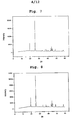
- a lithium nickel oxide of formula 1 in which nickel is partially substituted with other elements shows an X-ray diffraction pattern ( FIGs. 6 to 8 ) similar to that of Li 2 NiO 2 ( FIG. 9 ). This indicates that although nickel in the lithium nickel oxide is partially substituted with other elements, the lithium nickel oxide is not changed in structure.
- Li ion intercalation/deinterlation occurs during the first charge/discharge cycle, wherein the oxidation number of Ni or M is changed from +2 to +4 and the structure of Li 2+x Ni 1-y M y O 2+a experiences a phase transition into Li 2+x-z Ni 1-y M y O 2 (wherein 0 ⁇ z ⁇ 2).
- the compound represented by formula 1 deintercalates at least one mole of lithium ion during the first charge cycle, however, on and after discharge of the first cycle, it becomes a substance capable of lithium ion intercalation/deintercalation in an amount of one mole or less.
- the discharge efficiency (the first discharge capacity/the first charge capacity x 100) of Li 2 NiO 2 in the first charge/ discharge cycle is about 40% or less.
- discharge efficiency in the first charge/discharge slightly varies with the content of the metal M substituting for Ni.
- the cathode active material composition according to the present invention shows a large difference between initial charge capacity and initial discharge capacity.
- This irreversible capacity provides lithium ions at least in such an amount as to compensate for an irreversible lithium-consuming reaction in an anode caused by the SEI film formation on the surface of an anode during the first charge. Therefore, it is possible to compensate for the high irreversible capacity of the anode at the first charge/discharge cycle.
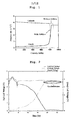
- the cathode active material composition according to the present invention which comprises a lithium transition metal oxide capable of lithium ion intercalation/deintercalation and the lithium nickel oxide represented by formula 1 can inhibit the capacity reduction caused by overdischarge, by virtue of the irreversibility of the lithium nickel oxide represented by formula 1 during the first charge/discharge cycle. This mechanism is shown in FIG. 1 .
- a battery voltage is defined by the difference of electric potentials between a cathode and an anode. Overdischarge of a battery continuously proceeds until the battery voltage becomes 0 V, at which point the electric potentials of a cathode and an anode are the same.
- the voltage of an anode having a relatively high irreversible capacity increases rapidly, when overdischarging occurs, and thus copper ions are dissolved from an anode collector, so that charge/discharge cycles may not progress successfully.
- the above-described overdischarging problem results from that an irreversibility of lithium transition metal oxide used as a cathode active material in general is smaller than that of carbon-based anode active material.
- the present invention adopted a method of adding an additive having a high irreversible capacity to a cathode.
- a cathode for a lithium secondary battery is formed by adding to a cathode active material containing a first lithium transition metal oxide capable of lithium ion intercalation/deintercalation, a second lithium transition metal oxide of which an irreversible capacity, (1 - discharge capacity/charge capacity) in the first charge/discharge cycle is greater than that of the first lithium transition metal oxide, as an additive.
- the irreversible capacity of the additive in the first charge/discharge cycle should be greater than 4%, i.e., the irreversible capacity of the general cathode active material.
- the preferable irreversible capacity of the additive is 30% or greater.
- the irreversible capacity (actual capacity per se rather than capacity ratio) of the additive is relatively high.
- the used amount of the additive can provide irreversibly lithium ions at least in such an amount as to compensate for an irreversible lithium-consuming reaction in an anode caused by the SEI film formation on the surface of an anode during the first charge. Since the irreversible capacity of the anode is 8% in general, the preferable irreversible capacity of the additive is 8% or more in order to reduce the amount of the additive.
- the compound represented by formula 1 when added to a cathode to the extent of compensating for the irreversible capacity of an anode, it is possible to obtain very excellent performance in an overdischarge test of a SCF (safety circuit free) battery, which does not need a protection circuit.
- SCF safety circuit free
- the lithium nickel oxide when added to the cathode of a lithium secondary battery as an additive for the cathode active material, Ni in the lithium nickel oxide, which is present in an oxidized state with a valence of +4, may react with an electrolyte during charge to generate gas. Therefore, swelling of a battery may occur at a high temperature depending on the added amount of the lithium nickel oxide.
- the anode and cathode should be in close contact to each other because a non-aqueous lithium secondary battery has low ion conductivity. Accordingly, when swelling of a battery occurs, the contact degree between an anode and a cathode may decrease, thereby increasing electric resistance.
- a cathode active material for a lithium secondary battery containing a lithium transition metal oxide capable of lithium ion intercalation/deintercalation which further comprises a lithium nickel oxide represented by formula 1 in which nickel is partially substituted with other elements (with the proviso that y is not 0), or a lithium nickel oxide represented by formula 1 that is surface-coated with an oxide other than lithium nickel oxides, as an additive.
- bonds originally present in the lithium nickel oxide are substituted with stronger bonds so that a battery can be prevented from swelling at a high temperature.
- the compound represented by formula 1 may be prepared by reacting a salt, metal salt, organo- metallic salt or oxide of at least one element selected from the group consisting of P, B, C, Al, Sc, Sr, Ti, V, Zr, Mn, Fe, Co, Cu, Zn, Cr, Mg, Nb, Mo and Cd together with a lithium salt and nickel salt by using a reaction method such as a solid phase reaction, co-precipitation method and a sol-gel method. Methods other than the above-mentioned methods may also be used to prepare the compound represented by formula 1.
- the surface-coating as described above can prevent Ni in an oxidized state with a valence of +4 from reacting with an electrolyte and thus prevent gas generation caused by the reaction between Ni and an electrolyte. Therefore, it is possible to prevent swelling of a battery at high temperature.
- the lithium nickel oxide represented by formula 1 that is surface-coated with an oxide other than lithium nickel oxides may be prepared by surface-coating a lithium nickel oxide represented by formula 1 with a solution containing a salt, metal salt or organo-metallic salt of at least one element selected from the group consisting of Al, Mg, Si, P, C, Sc, Ti, V, Cr, Mn, Fe, Co, Cu, Zn, Mo, Zr and Nb, mixed in the form of sol-gel or dissolved in an organic sol vent or water.
- Surface-coating methods may include a precipitation method, a filtering method, a vacuum drying method, a CVD (Chemical Vapor Deposition) method, a sputtering method, etc., but are not limited thereto.
- the precipitation method is carried out by introducing a lithium nickel oxide into a solution containing a compound containing at least one element selected from the group consisting of Al, Mg, Si, P, C, Sc, Ti, V, Cr, Mn, Fe, Co, Cu, Zn, Mo, Zr and Nb, for example, aluminum isopropoxide, zirconium propoxide, aluminum nitrate, magnesium acetate, etc., mixed in the form of sol-gel or dissolved in an organic solvent or water, so that precipitate slurry can be obtained.
- the filtering method is carried out by separating the slurry by using a depressurization filter.
- the vacuum drying method is carried out by completely drying the solvent contained in the slurry in a vacuum drier.
- the additive for a cathode active material according to the present invention is preferably used in an amount of 0.1 to 10 parts by weight based on 100 parts by weight of the cathode active material.
- the content of the additive for a cathode active material is less than 0.1 parts by weight, the voltage of an anode increases in advance of the reduction of the voltage of a cathode during an overdischarge test. Therefore, when the anode voltage reaches a certain range of voltage more than 3.6V (at which point a copper foil as an anode collector is oxidized), the problem of copper ion dissolution may occur in the cases of pouch type batteries, prismatic batteries and cylindrical batteries.
- the cathode potential preferably ranges from 2 V to 3.6 V and the anode potential is preferably 3.6 V or less, when the full cell voltage becomes 0 V.
- the overdischarge test is carried out as follows: discharging to 3.0V at 300 mA, discharging to 2.7V at 3 mA and discharging to 0V at 1 mA.
- the cathode active material used in the present invention is any one of conventional cathode active materials, however, it is preferable to use a lithium transition metal oxide.
- anode active material graphite, carbon, lithium metal and alloys, etc., which are capable of lithium ion intercalation/deintercalation, may be used.
- artificial graphite is used.
- the anode may comprise a binder, the binder being preferably PVDF (Polyvinylidene fluoride) or SBR (Styrene Butadiene Rubber).
- a porous separator is preferably used as a separator.
- a polypropylene-, a polyethylene- or a polyolefin-based porous separator may be used, but it is not limited thereto.
- the electrolyte used in the present invention is a non-aqueous electrolyte and may comprise a cyclic carbonate and a linear carbonate.
- the cyclic carbonate include ethylene carbonate (EC), propylene carbonate (PC) and gamma-butyrolactone (GBL).
- Preferred examples of the linear carbonate include at least one carbonate selected from the group consisting of diethyl carbonate (DEC), dimethyl carbonate (DMC), ethylmethyl carbonate (EMC) and methylpropyl carbonate (MPC).
- the electrolyte used in the present invention comprises a lithium salt in addition to the carbonate compound. More particularly, the lithium salt is preferably selected from the group consisting of LiClO 4 , LiCF 3 SO 3 , LiPF 6 , LiBF 4 , LiAsF 6 and LiN(CF 3 SO 2 ) 2 .
- the lithium secondary battery according to the present invention is manufactured by a conventional method, i.e., by inserting a porous separator between a cathode and an anode and introducing an electrolyte.
- the lithium secondary battery according to the present invention is a cylindrical can-type battery, a prismatic battery or a pouch-type battery.
- the compound represented by formula 1 is added to a cathode as an additive for a cathode active material to improve overdischarge characteristics.
- the additive for a cathode active material can provide lithium ions at least in such an amount as to compensate for the irreversible capacity of an anode. Accordingly, the anode voltage can be prevented from increasing during overdischarge by increasing the irreversibility of a cathode to cause the cathode voltage to be decreased rapidly, so that a battery capacity restorability of 90% or more may be obtained after overdischarge.
- the cathode active material for a lithium secondary battery which comprises a lithium nickel oxide represented by formula 1 in which nickel is partially substituted with other elements (with the proviso that y is not 0), or a lithium nickel oxide represented by formula 1 that is surface-coated with an oxide other than lithium nickel oxides, as an additive for the cathode active material, capacity of a battery is not significantly reduced after overdischarge while maintaining overall performance of the battery. Further, it is possible to obtain excellent capacity restorability and to prevent a battery from swelling at a high temperature.
- a pouch-type bi-cell was manufactured by a conventional method.
- LiCoO 2 was used as a cathode active material and Li 2 NiO 2 was added as an additive in the amount of 2 parts by weight based on 100 parts by weight of the cathode active material. More particularly, 78.4 wt% of LiCoO 2 , 1.6 wt% of Li 2 NiO 2 , 10 wt% of KS-6 (conductive agent) and 10 wt% of PVDF (binder) were added to NMP as a solvent to form cathode mixture slurry, and then the slurry was coated on an Al collector to obtain a cathode.
- KS-6 conductive agent
- PVDF binder
- artificial graphite and copper were used as an anode active material and an anode collector, respectively, and an EC/PC/DEC-based solution containing 1M LiPF 6 was used as an electrolyte to obtain a battery by a conventional method.
- Example 1 was repeated to obtain a battery, except that Li 2 NiO 2 as an additive for a cathode active material was used in the amount of 5 parts by weight based on 100 parts by weight of the cathode active material.
- Example 1 was repeated to obtain a battery, except that Li 2 NiO 2 as an additive for a cathode active material was used in the amount of 9 parts by weight based on 100 parts by weight of the cathode active material.
- Example 1 was repeated to obtain a battery, except that the additive for a cathode active material (Li 2 NiO 2 ) was not used in the cathode.
- a cathode active material Li 2 NiO 2
- a three-pole test is performed for each of the bi-cells according to Examples 1 to 3 and Comparative Example 1. The results are shown in FIGs. 2 to 5 .
- concept of full cell voltage is used.
- the full cell voltage is defined as the difference between the voltage of a cathode and that of an anode in the case of a cell having two electrodes of one cathode and one anode.
- a three-pole cell system includes lithium metal inserted into a cell as a reference electrode, in addition to a cathode and an anode.
- Such a three-pole system is used to determine the behavior of the cathode and anode in an actual cell during charge/discharge cycles, based on the reference electrode (lithium metal), by measuring the voltage difference between the reference electrode (lithium metal) and the cathode and the voltage difference between the reference electrode (lithium metal) and the anode, respectively.
- Comparative Example 1 shows a plateau (represented by a circle) in which copper ion dissolution occurs after the voltage of an anode increases.
- FIGs. 3 to 5 each of Examples 1 to 3 shows no plateau corresponding to copper ion dissolution.
- Lithium oxide as a lithium salt, nickel oxide as a nickel salt and aluminum nitrate as an aluminum salt used to substitute for nickel were mixed in an adequate equivalent ratio and then reacted in a solid phase at 600°C to obtain Li 2 Ni 0.97 Al 0.03 O 2 as an additive for a cathode active material.
- X-ray diffraction pattern of the additive for a cathode active material is shown in FIG. 6 .
- the pouch type battery was charged to 4.2V at 0.2C, heated from room temperature to 90°C for 1 hour, stored at 90°C for 4 hours and then cooled back to room temperature for 1 hour. At this time, change in thickness of the battery was measured. The result is shown in FIG. 11 .
- the overdischarge test result of the battery is shown in Table 1 and FIG. 12 .
- Example 4 was repeated to obtain Li 2 Ni 0.97 Mg 0.03 O 2 as an additive for a cathode active material, except that magnesium was used as an element substituting for nickel.
- X-ray diffraction pattern of the additive for a cathode active material is shown in FIG. 7 .
- a battery was manufactured by using the additive for a cathode active material in the same manner as described in Example 4. Charge/discharge capacity of the battery is shown in FIG. 10 .
- Example 4 was repeated to obtain Li 2 Ni 0.97 B 0.03 O 2 as an additive for a cathode active material, except that boron was used as an element substituting for nickel.
- X-ray diffraction pattern of the additive for a cathode active material is shown in FIG. 8 .
- a battery was manufactured by using the additive for a cathode active material in the same manner as described in Example 4. Charge/discharge capacity of the battery is shown in FIG. 10 .
- a lithium salt and a nickel salt were mixed in an adequate equivalent ratio and reacted together in an electric furnace to obtain Li 2 NiO 2 as an additive for a cathode active material.
- X-ray diffraction pattern of the additive for a cathode active material is shown in FIG. 9 .
- a battery was manufactured by using the additive for a cathode active material in the same manner as described in Example 4. Charge/discharge capacity of the battery is shown in FIG. 10 .
- Example 4 was repeated to obtain a battery, except that the additive for a cathode active material was not added to the cathode active material.
- the overdischarge test result of the battery is shown in Table 1 and FIG. 13 .
- each of the batteries obtained from Examples 4 to 7 shows similar charge/discharge efficiency. Capacity of each battery is not significantly reduced even after overdischarge and each battery has excellent capacity restorability after overdischarge. Additionally, as shown in Table 1 and FIG. 13 , the battery obtained from Comparative Example 2 (to which the additive for a cathode active material for improving overdischarge characteristics according to the present invention is not added) shows poor overdischarge characteristics compared to other batteries.
- Example 4 using Li 2 Ni 0.97 Al 0.03 O 2 as an additive for a cathode active material for improving overdischarge characteristics shows little change in battery thickness.
- Li 2 NiO 2 3 mol% of aluminum isopropoxide based on Li 2 NiO 2 was dissolved in ethanol.
- the slurry was filtered through a depressurization filter to obtain a filtered product and the filtered product was completely dried in an oven at 80°C to obtain a final product.
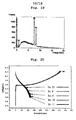
- the final product was analyzed by SEM and EDS. The results are shown in FIGs. 14 and 15 , respectively.
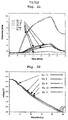
- the pouch type battery was charged to 4.2V at 0.2C, heated from room temperature to 90°C for 1 hour, stored at 90°C for 4 hours and then cooled back to room temperature for 1 hour. At this time, change in thickness of the battery was measured. The result is shown in FIG. 21 .
- the overdischarge test result of the battery is shown in Table 2 and FIG. 22 .
- Example 8 was repeated to obtain an additive for a cathode active material and to manufacture a battery, except that the slurry was separated from the solvent by means of a precipitation method instead of using a depressurization filter. Charge/discharge capacity of the battery is shown in FIG. 20 .
- Example 8 was repeated to obtain an additive for a cathode active material and to manufacture a battery, except that the slurry was dried in a depressurization drier instead of filtering with a depressurization filter. Charge/discharge capacity of the battery is shown in FIG. 20 .
- Example 8 was repeated to obtain an additive for a cathode active material, except that zirconium propoxide was used instead of aluminum isopropoxide.
- the additive was analyzed by SEM and EDS. The results are shown in FIGs. 16 and 17 , respectively.
- a battery was manufactured by using the additive in the same manner as described in Example 8. Charge/discharge capacity of the battery is shown in FIG. 20 .
- Li 2 NiO 2 was analyzed by SEM and EDS. The results are shown in FIGs. 18 and 19 , respectively.
- a battery was manufactured in the same manner as described in Example 8, except that Li 2 NiO 2 was used as an additive for a cathode active material. Charge/discharge capacity of the battery is shown in FIG. 20 .
- a battery was manufactured in the same manner as described in Example 8, except that no additive for a cathode active material was used. By using the same method as described in Example 8, change in thickness of the battery was measured after the battery was stored at a high temperature. The result is shown in FIG. 21 . Additionally, the overdischarge test result of the battery is shown in Table 2 and FIG. 13 .
- each additive for a cathode active material for improving overdischarge characteristics comprises a lithium nickel oxide surface-coated with a material other than lithium nickel oxides.
- such surface-coating does not change the structure of each additive for a cathode active material for improving overdischarge characteristics, significantly.
- each battery obtained from Examples 8 to 12 shows similar charge/discharge efficiency. Capacity of each battery is not significantly reduced even after overdischarge and each battery has excellent capacity restorability after overdischarge.
- the battery obtained from Comparative Example 3 shows poor overdischarge characteristics compared to other batteries.
- Example 8 shows little change in battery thickness.
- Examples 9 to 11 show smaller change in battery thickness compared to Example 12. This indicates that each additive for a cathode active material for improving overdischarge characteristics according to Examples 8 to 11 provides excellent effect of preventing a battery from swelling at a high temperature compared to the additive according to Example 12.
Landscapes
- Chemical & Material Sciences (AREA)
- Chemical Kinetics & Catalysis (AREA)
- Electrochemistry (AREA)
- General Chemical & Material Sciences (AREA)
- Engineering & Computer Science (AREA)
- Inorganic Chemistry (AREA)
- Manufacturing & Machinery (AREA)
- Composite Materials (AREA)
- Materials Engineering (AREA)
- Battery Electrode And Active Subsutance (AREA)
- Secondary Cells (AREA)
Applications Claiming Priority (3)
| Application Number | Priority Date | Filing Date | Title |
|---|---|---|---|
| KR20030066866 | 2003-09-26 | ||
| KR20030066865 | 2003-09-26 | ||
| EP04774711A EP1665420B1 (de) | 2003-09-26 | 2004-09-24 | Verfahren zur regelung der anschlussspannung der kathode während überentladung und kathodenaktivmaterial für eine lithium-sekundärbatterie |
Related Parent Applications (1)
| Application Number | Title | Priority Date | Filing Date |
|---|---|---|---|
| EP04774711.8 Division | 2004-09-24 |
Publications (2)
| Publication Number | Publication Date |
|---|---|
| EP2270901A1 true EP2270901A1 (de) | 2011-01-05 |
| EP2270901B1 EP2270901B1 (de) | 2012-12-26 |
Family
ID=36242424
Family Applications (2)
| Application Number | Title | Priority Date | Filing Date |
|---|---|---|---|
| EP10187897A Expired - Lifetime EP2270901B1 (de) | 2003-09-26 | 2004-09-24 | Verfahren zur Regelung der Entladeschlussspannung der Kathode während einer Überentladung und Kathodenaktivmaterial für eine Lithium-Sekundärbatterie |
| EP04774711A Expired - Lifetime EP1665420B1 (de) | 2003-09-26 | 2004-09-24 | Verfahren zur regelung der anschlussspannung der kathode während überentladung und kathodenaktivmaterial für eine lithium-sekundärbatterie |
Family Applications After (1)
| Application Number | Title | Priority Date | Filing Date |
|---|---|---|---|
| EP04774711A Expired - Lifetime EP1665420B1 (de) | 2003-09-26 | 2004-09-24 | Verfahren zur regelung der anschlussspannung der kathode während überentladung und kathodenaktivmaterial für eine lithium-sekundärbatterie |
Country Status (5)
| Country | Link |
|---|---|
| EP (2) | EP2270901B1 (de) |
| JP (1) | JP4790418B2 (de) |
| KR (1) | KR100612089B1 (de) |
| TW (1) | TWI263369B (de) |
| WO (1) | WO2005031892A2 (de) |
Cited By (5)
| Publication number | Priority date | Publication date | Assignee | Title |
|---|---|---|---|---|
| CN110476279A (zh) * | 2017-06-21 | 2019-11-19 | 株式会社Lg化学 | 锂二次电池 |
| WO2021191613A1 (en) * | 2020-03-27 | 2021-09-30 | Johnson Matthey Public Limited Company | Cathode material and process |
| US11621423B2 (en) | 2017-11-29 | 2023-04-04 | Lg Energy Solution, Ltd. | Additive for cathode, method for preparing the same, cathode including the same, and lithium secondary battery including the same |
| US12191498B2 (en) | 2018-10-31 | 2025-01-07 | Lg Energy Solution, Ltd. | Lithium secondary battery |
| US12418028B2 (en) | 2020-01-31 | 2025-09-16 | Lg Energy Solution, Ltd. | Irreversible additive comprised in cathode material for secondary battery, cathode material comprising the same, and secondary battery comprising cathode material |
Families Citing this family (34)
| Publication number | Priority date | Publication date | Assignee | Title |
|---|---|---|---|---|
| US7811707B2 (en) | 2004-12-28 | 2010-10-12 | Boston-Power, Inc. | Lithium-ion secondary battery |
| US20080008933A1 (en) | 2005-12-23 | 2008-01-10 | Boston-Power, Inc. | Lithium-ion secondary battery |
| WO2006112674A1 (en) | 2005-04-22 | 2006-10-26 | Lg Chem, Ltd. | New system of lithium ion battery containing material with high irreversible capacity |
| CN101263396B (zh) | 2005-07-14 | 2011-04-27 | 波士顿电力公司 | 用于锂离子电池的控制电子元件 |
| TWI426678B (zh) | 2006-06-28 | 2014-02-11 | 波士頓電力公司 | 具有多重充電率之電子裝置、電池組、充電於電子裝置中的鋰離子電荷儲存電源供應器之方法及可攜式電腦 |
| JP5270089B2 (ja) * | 2006-12-18 | 2013-08-21 | 三星エスディアイ株式会社 | 非水二次電池用負極材料の製造方法及びそれを用いた非水二次電池の製造方法 |
| KR101064729B1 (ko) * | 2008-09-30 | 2011-09-14 | 주식회사 에코프로 | 리튬 이차 전지용 양극 활물질 및 이를 포함하는 리튬 이차전지 |
| WO2010137862A2 (ko) | 2009-05-26 | 2010-12-02 | 주식회사 엘지화학 | 고에너지 밀도 리튬이차전지 |
| US8483886B2 (en) | 2009-09-01 | 2013-07-09 | Boston-Power, Inc. | Large scale battery systems and method of assembly |
| US8765306B2 (en) | 2010-03-26 | 2014-07-01 | Envia Systems, Inc. | High voltage battery formation protocols and control of charging and discharging for desirable long term cycling performance |
| JP5707499B2 (ja) * | 2010-10-20 | 2015-04-30 | カウンスィル オブ サイエンティフィック アンド インダストリアル リサーチCouncil Of Scientific & Industrial Research | 正極材料及び該正極材料からのリチウムイオン電池 |
| WO2012077781A1 (ja) | 2010-12-09 | 2012-06-14 | 日本電気株式会社 | 非水電解液二次電池、ならびにそれに用いる正極および負極 |
| KR101255539B1 (ko) * | 2010-12-14 | 2013-04-16 | 삼성에스디아이 주식회사 | 리튬 전지용 양극 활물질 및 이를 이용한 리튬 전지 |
| JP2012142156A (ja) * | 2010-12-28 | 2012-07-26 | Sony Corp | リチウムイオン二次電池、正極活物質、正極、電動工具、電動車両および電力貯蔵システム |
| US9159990B2 (en) | 2011-08-19 | 2015-10-13 | Envia Systems, Inc. | High capacity lithium ion battery formation protocol and corresponding batteries |
| CN104919644A (zh) * | 2013-01-16 | 2015-09-16 | 加拿大巴斯姆有限公司 | 具有降低的阻抗的电化学电池或蓄电池及其生产方法 |
| DE102014220504A1 (de) * | 2014-10-09 | 2016-04-14 | Bayerische Motoren Werke Aktiengesellschaft | Additiv für Alkalimetall-basierte, insbesondere Lithium-basierte Energiespeicher |
| JP6624631B2 (ja) * | 2015-08-24 | 2019-12-25 | 新日本電工株式会社 | リチウム遷移金属複合酸化物及びその製造方法 |
| KR102313090B1 (ko) * | 2017-07-10 | 2021-10-18 | 주식회사 엘지에너지솔루션 | 리튬 이차전지용 양극, 그 제조방법 및 이를 포함하는 리튬 이차전지 |
| KR102268176B1 (ko) * | 2017-08-28 | 2021-06-22 | 주식회사 엘지에너지솔루션 | 리튬 이차전지 |
| DE112018005217T5 (de) * | 2017-10-24 | 2020-06-18 | Gs Yuasa International Ltd. | Schätzvorrichtung, Schätzverfahren und Computerprogramm |
| KR102346153B1 (ko) * | 2017-11-17 | 2022-01-03 | 주식회사 엘지에너지솔루션 | 리튬 이차전지용 양극재에 포함되는 비가역 첨가제의 제조방법, 이에 의해 제조된 비가역 첨가제를 포함하는 양극재, 및 양극재를 포함하는 리튬 이차전지 |
| WO2019107835A1 (ko) * | 2017-11-29 | 2019-06-06 | 주식회사 엘지화학 | 양극 첨가제, 이의 제조 방법, 이를 포함하는 양극 및 리튬 이차 전지 |
| KR102388848B1 (ko) * | 2017-11-30 | 2022-04-20 | 주식회사 엘지에너지솔루션 | 양극 첨가제, 이의 제조 방법, 이를 포함하는 양극 및 리튬 이차 전지 |
| WO2019107808A1 (ko) * | 2017-11-30 | 2019-06-06 | 주식회사 엘지화학 | 양극 첨가제, 이의 제조 방법, 이를 포함하는 양극 및 리튬 이차 전지 |
| KR102715574B1 (ko) * | 2019-05-27 | 2024-10-08 | 주식회사 엘지에너지솔루션 | 양극 첨가제, 이의 제조 방법, 이를 포함하는 양극 및 리튬 이차 전지 |
| KR102568649B1 (ko) | 2019-07-31 | 2023-08-22 | 재단법인대구경북과학기술원 | 리튬 이차전지용 양극 및 이를 포함하는 리튬 이차전지 |
| EP4037035A4 (de) | 2019-11-11 | 2022-11-16 | LG Energy Solution, Ltd. | Irreversibles additiv, kathodenmaterial mit irreversiblem additiv und lithiumsekundärbatterie mit kathodenmaterial |
| CN113471403B (zh) | 2020-03-30 | 2024-03-19 | Tdk株式会社 | 电极和锂离子二次电池 |
| KR102917119B1 (ko) * | 2020-07-28 | 2026-01-23 | 주식회사 엘지에너지솔루션 | 이차전지용 양극재에 포함되는 비가역 첨가제, 이를 포함하는 양극재, 및 양극재를 포함하는 이차전지 |
| WO2022025531A1 (ko) * | 2020-07-28 | 2022-02-03 | 주식회사 엘지에너지솔루션 | 이차전지용 양극재에 포함되는 비가역 첨가제, 이를 포함하는 양극재, 및 양극재를 포함하는 이차전지 |
| ES3062831T3 (en) * | 2020-08-24 | 2026-04-14 | Lg Energy Solution Ltd | Cathode material including irreversible additive, secondary battery including cathode material, and method for manufacturing the same |
| JP7423133B2 (ja) * | 2020-09-21 | 2024-01-29 | エルジー エナジー ソリューション リミテッド | リチウム二次電池の活性化方法及びリチウム二次電池 |
| KR102852669B1 (ko) * | 2020-12-04 | 2025-08-28 | 주식회사 엘지에너지솔루션 | 이차전지용 양극재에 포함되는 비가역 첨가제, 이를 포함하는 양극재, 및 양극재를 포함하는 이차전지 |
Citations (4)
| Publication number | Priority date | Publication date | Assignee | Title |
|---|---|---|---|---|
| EP0794155A1 (de) * | 1996-03-05 | 1997-09-10 | Sharp Kabushiki Kaisha | Lithiumnickelverbundoxid, Verfahren zu seiner Herstellung und seine Verwendung |
| US5759719A (en) * | 1995-12-27 | 1998-06-02 | Motorola, Inc. | Electrode material for lithium intercalation electrochemical cells |
| EP1256996A1 (de) * | 2000-12-27 | 2002-11-13 | Mitsubishi Chemical Corporation | Lithiumsekundärzelle |
| WO2003081697A1 (en) * | 2002-03-22 | 2003-10-02 | Lg Chem, Ltd. | Lithium secondary battery comprising overdischarge-preventing agent |
Family Cites Families (13)
| Publication number | Priority date | Publication date | Assignee | Title |
|---|---|---|---|---|
| CA2102738C (en) * | 1993-11-09 | 1999-01-12 | George T. Fey | Inverse spinel compounds as cathodes for lithium batteries |
| JPH08153541A (ja) * | 1994-11-28 | 1996-06-11 | Mitsubishi Cable Ind Ltd | リチウム二次電池 |
| JP3403569B2 (ja) * | 1996-03-05 | 2003-05-06 | シャープ株式会社 | リチウムニッケル複合酸化物とその製造法及びその用途 |
| JP3403568B2 (ja) * | 1996-03-05 | 2003-05-06 | シャープ株式会社 | リチウムニッケル複合酸化物とその製造法及びその用途 |
| US5783333A (en) * | 1996-11-27 | 1998-07-21 | Polystor Corporation | Lithium nickel cobalt oxides for positive electrodes |
| JPH10158017A (ja) * | 1996-11-29 | 1998-06-16 | Sharp Corp | リチウムニッケル銅複合酸化物とその製造法及びその用途 |
| JPH10208730A (ja) * | 1997-01-24 | 1998-08-07 | Japan Storage Battery Co Ltd | 非水電解質二次電池 |
| JP3024636B2 (ja) * | 1998-08-27 | 2000-03-21 | 日本電気株式会社 | 非水電解液二次電池 |
| JP3911870B2 (ja) * | 1998-09-29 | 2007-05-09 | 宇部興産株式会社 | リチウム二次電池用電解液及びそれを用いたリチウム二次電池 |
| KR100728108B1 (ko) * | 2001-04-02 | 2007-06-13 | 삼성에스디아이 주식회사 | 리튬 이차 전지용 양극 및 그의 제조 방법 |
| JP2004063394A (ja) | 2002-07-31 | 2004-02-26 | Sanyo Electric Co Ltd | 非水電解質電池 |
| JP4232488B2 (ja) * | 2003-03-07 | 2009-03-04 | 日本電気株式会社 | フィルム外装非水電解液二次電池 |
| KR100533095B1 (ko) * | 2003-04-09 | 2005-12-01 | 주식회사 엘지화학 | 과방전 방지제를 포함하는 양극 활물질 및 이를 이용한리튬 이차 전지 |
-
2004
- 2004-09-24 EP EP10187897A patent/EP2270901B1/de not_active Expired - Lifetime
- 2004-09-24 WO PCT/KR2004/002461 patent/WO2005031892A2/en not_active Ceased
- 2004-09-24 EP EP04774711A patent/EP1665420B1/de not_active Expired - Lifetime
- 2004-09-24 TW TW093129031A patent/TWI263369B/zh not_active IP Right Cessation
- 2004-09-24 KR KR1020040076778A patent/KR100612089B1/ko not_active Expired - Lifetime
- 2004-09-24 JP JP2005518284A patent/JP4790418B2/ja not_active Expired - Lifetime
Patent Citations (4)
| Publication number | Priority date | Publication date | Assignee | Title |
|---|---|---|---|---|
| US5759719A (en) * | 1995-12-27 | 1998-06-02 | Motorola, Inc. | Electrode material for lithium intercalation electrochemical cells |
| EP0794155A1 (de) * | 1996-03-05 | 1997-09-10 | Sharp Kabushiki Kaisha | Lithiumnickelverbundoxid, Verfahren zu seiner Herstellung und seine Verwendung |
| EP1256996A1 (de) * | 2000-12-27 | 2002-11-13 | Mitsubishi Chemical Corporation | Lithiumsekundärzelle |
| WO2003081697A1 (en) * | 2002-03-22 | 2003-10-02 | Lg Chem, Ltd. | Lithium secondary battery comprising overdischarge-preventing agent |
Cited By (8)
| Publication number | Priority date | Publication date | Assignee | Title |
|---|---|---|---|---|
| CN110476279A (zh) * | 2017-06-21 | 2019-11-19 | 株式会社Lg化学 | 锂二次电池 |
| EP3550638A4 (de) * | 2017-06-21 | 2020-01-22 | LG Chem, Ltd. | Lithiumsekundärbatterie |
| US11322731B2 (en) | 2017-06-21 | 2022-05-03 | Lg Energy Solution, Ltd. | Lithium secondary battery |
| US11621423B2 (en) | 2017-11-29 | 2023-04-04 | Lg Energy Solution, Ltd. | Additive for cathode, method for preparing the same, cathode including the same, and lithium secondary battery including the same |
| US12191498B2 (en) | 2018-10-31 | 2025-01-07 | Lg Energy Solution, Ltd. | Lithium secondary battery |
| EP3761405B1 (de) * | 2018-10-31 | 2026-02-18 | LG Energy Solution, Ltd. | Lithiumsekundärbatterie |
| US12418028B2 (en) | 2020-01-31 | 2025-09-16 | Lg Energy Solution, Ltd. | Irreversible additive comprised in cathode material for secondary battery, cathode material comprising the same, and secondary battery comprising cathode material |
| WO2021191613A1 (en) * | 2020-03-27 | 2021-09-30 | Johnson Matthey Public Limited Company | Cathode material and process |
Also Published As
| Publication number | Publication date |
|---|---|
| WO2005031892A2 (en) | 2005-04-07 |
| WO2005031892A3 (en) | 2005-06-02 |
| JP4790418B2 (ja) | 2011-10-12 |
| EP1665420A2 (de) | 2006-06-07 |
| EP1665420B1 (de) | 2013-03-27 |
| EP2270901B1 (de) | 2012-12-26 |
| JP2006514776A (ja) | 2006-05-11 |
| TW200527735A (en) | 2005-08-16 |
| EP1665420A4 (de) | 2009-11-11 |
| KR100612089B1 (ko) | 2006-08-11 |
| TWI263369B (en) | 2006-10-01 |
| KR20050030588A (ko) | 2005-03-30 |
Similar Documents
| Publication | Publication Date | Title |
|---|---|---|
| EP1665420B1 (de) | Verfahren zur regelung der anschlussspannung der kathode während überentladung und kathodenaktivmaterial für eine lithium-sekundärbatterie | |
| US9236610B2 (en) | Cathode active material for lithium secondary battery | |
| US7695867B2 (en) | Method for regulating terminal voltage of cathode during overdischarge and cathode active material for lithium secondary battery | |
| JP5232631B2 (ja) | 非水電解質電池 | |
| KR100533095B1 (ko) | 과방전 방지제를 포함하는 양극 활물질 및 이를 이용한리튬 이차 전지 | |
| EP1909345B1 (de) | Aktives Kathodenmaterial für eine Lithiumbatterie | |
| US7927506B2 (en) | Cathode active material and lithium battery using the same | |
| EP2980894B1 (de) | Nichtwässrige Elektrolytbatterie und Batteriepack | |
| KR102294866B1 (ko) | 리튬 이차전지용 비수전해액 및 이를 포함하는 리튬 이차전지 | |
| JPWO2017046895A1 (ja) | 組電池及び電池パック | |
| EP2284934B1 (de) | Elektrodenanordnung und Lithium-Sekundärbatterie dieselbe umfassend | |
| EP3270445B1 (de) | Batterie mit nichtwässrigem elektrolyt und batteriepack | |
| EP3859855A1 (de) | Sekundärbatterie | |
| US12283690B2 (en) | Positive electrode active material for lithium secondary battery and lithium secondary battery | |
| KR20000071371A (ko) | 비수성 전해질 전지 | |
| JP2007042302A (ja) | 電池 | |
| JPH11176421A (ja) | 非水電解液二次電池 | |
| JPH0945330A (ja) | 非水系二次電池 | |
| KR102939734B1 (ko) | 리튬 이차 전지용 양극 활물질, 이의 제조방법 및 이를 포함하는 리튬 이차 전지 | |
| JP4961649B2 (ja) | 非水電解液二次電池 | |
| KR20250066415A (ko) | 리튬 이차전지의 활성화 방법 | |
| JPH04181660A (ja) | 非水溶媒二次電池 | |
| KR20260037601A (ko) | 양극 활물질, 및 이를 포함하는 양극 및 리튬 이차전지 |
Legal Events
| Date | Code | Title | Description |
|---|---|---|---|
| PUAI | Public reference made under article 153(3) epc to a published international application that has entered the european phase |
Free format text: ORIGINAL CODE: 0009012 |
|
| 17P | Request for examination filed |
Effective date: 20101018 |
|
| AC | Divisional application: reference to earlier application |
Ref document number: 1665420 Country of ref document: EP Kind code of ref document: P |
|
| AK | Designated contracting states |
Kind code of ref document: A1 Designated state(s): AT BE BG CH CY CZ DE DK EE ES FI FR GB GR HU IE IT LI LU MC NL PL PT RO SE SI SK TR |
|
| RIN1 | Information on inventor provided before grant (corrected) |
Inventor name: HONG, SEUNG TAE Inventor name: KIM, HYEONG JIN Inventor name: RYU, DUK HYUN Inventor name: JEONG, JUN YONG Inventor name: LEE, HO CHUN Inventor name: GOH, EUN YOUNG Inventor name: CHANG, SUNG KYUN Inventor name: YEON, JIN HEE |
|
| 17Q | First examination report despatched |
Effective date: 20110831 |
|
| RIC1 | Information provided on ipc code assigned before grant |
Ipc: H01M 4/505 20100101ALI20120522BHEP Ipc: H01M 10/42 20060101ALI20120522BHEP Ipc: H01M 4/133 20100101ALN20120522BHEP Ipc: H01M 4/36 20060101ALN20120522BHEP Ipc: H01M 4/04 20060101ALN20120522BHEP Ipc: H01M 10/052 20100101ALI20120522BHEP Ipc: H01M 4/131 20100101AFI20120522BHEP Ipc: H01M 4/485 20100101ALI20120522BHEP Ipc: H01M 4/525 20100101ALI20120522BHEP |
|
| RIC1 | Information provided on ipc code assigned before grant |
Ipc: H01M 4/36 20060101ALN20120531BHEP Ipc: H01M 4/525 20100101ALI20120531BHEP Ipc: H01M 4/133 20100101ALN20120531BHEP Ipc: H01M 4/04 20060101ALN20120531BHEP Ipc: H01M 10/42 20060101ALI20120531BHEP Ipc: H01M 4/131 20100101AFI20120531BHEP Ipc: H01M 4/485 20100101ALI20120531BHEP Ipc: H01M 4/505 20100101ALI20120531BHEP Ipc: H01M 10/052 20100101ALI20120531BHEP |
|
| REG | Reference to a national code |
Ref country code: DE Ref legal event code: R079 Ref document number: 602004040600 Country of ref document: DE Free format text: PREVIOUS MAIN CLASS: H01M0004485000 Ipc: H01M0004131000 |
|
| GRAP | Despatch of communication of intention to grant a patent |
Free format text: ORIGINAL CODE: EPIDOSNIGR1 |
|
| RIC1 | Information provided on ipc code assigned before grant |
Ipc: H01M 10/052 20100101ALI20120710BHEP Ipc: H01M 4/36 20060101ALN20120710BHEP Ipc: H01M 4/505 20100101ALI20120710BHEP Ipc: H01M 4/485 20100101ALI20120710BHEP Ipc: H01M 4/525 20100101ALI20120710BHEP Ipc: H01M 4/133 20100101ALN20120710BHEP Ipc: H01M 4/131 20100101AFI20120710BHEP Ipc: H01M 4/04 20060101ALN20120710BHEP Ipc: H01M 10/42 20060101ALI20120710BHEP |
|
| GRAS | Grant fee paid |
Free format text: ORIGINAL CODE: EPIDOSNIGR3 |
|
| GRAA | (expected) grant |
Free format text: ORIGINAL CODE: 0009210 |
|
| AC | Divisional application: reference to earlier application |
Ref document number: 1665420 Country of ref document: EP Kind code of ref document: P |
|
| AK | Designated contracting states |
Kind code of ref document: B1 Designated state(s): AT BE BG CH CY CZ DE DK EE ES FI FR GB GR HU IE IT LI LU MC NL PL PT RO SE SI SK TR |
|
| REG | Reference to a national code |
Ref country code: GB Ref legal event code: FG4D |
|
| REG | Reference to a national code |
Ref country code: CH Ref legal event code: EP |
|
| REG | Reference to a national code |
Ref country code: AT Ref legal event code: REF Ref document number: 590869 Country of ref document: AT Kind code of ref document: T Effective date: 20130115 |
|
| REG | Reference to a national code |
Ref country code: DE Ref legal event code: R096 Ref document number: 602004040600 Country of ref document: DE Effective date: 20130228 |
|
| PG25 | Lapsed in a contracting state [announced via postgrant information from national office to epo] |
Ref country code: FI Free format text: LAPSE BECAUSE OF FAILURE TO SUBMIT A TRANSLATION OF THE DESCRIPTION OR TO PAY THE FEE WITHIN THE PRESCRIBED TIME-LIMIT Effective date: 20121226 Ref country code: SE Free format text: LAPSE BECAUSE OF FAILURE TO SUBMIT A TRANSLATION OF THE DESCRIPTION OR TO PAY THE FEE WITHIN THE PRESCRIBED TIME-LIMIT Effective date: 20121226 |
|
| REG | Reference to a national code |
Ref country code: AT Ref legal event code: MK05 Ref document number: 590869 Country of ref document: AT Kind code of ref document: T Effective date: 20121226 |
|
| REG | Reference to a national code |
Ref country code: NL Ref legal event code: VDEP Effective date: 20121226 |
|
| PG25 | Lapsed in a contracting state [announced via postgrant information from national office to epo] |
Ref country code: SI Free format text: LAPSE BECAUSE OF FAILURE TO SUBMIT A TRANSLATION OF THE DESCRIPTION OR TO PAY THE FEE WITHIN THE PRESCRIBED TIME-LIMIT Effective date: 20121226 Ref country code: GR Free format text: LAPSE BECAUSE OF FAILURE TO SUBMIT A TRANSLATION OF THE DESCRIPTION OR TO PAY THE FEE WITHIN THE PRESCRIBED TIME-LIMIT Effective date: 20130327 |
|
| PG25 | Lapsed in a contracting state [announced via postgrant information from national office to epo] |
Ref country code: EE Free format text: LAPSE BECAUSE OF FAILURE TO SUBMIT A TRANSLATION OF THE DESCRIPTION OR TO PAY THE FEE WITHIN THE PRESCRIBED TIME-LIMIT Effective date: 20121226 Ref country code: SK Free format text: LAPSE BECAUSE OF FAILURE TO SUBMIT A TRANSLATION OF THE DESCRIPTION OR TO PAY THE FEE WITHIN THE PRESCRIBED TIME-LIMIT Effective date: 20121226 Ref country code: BE Free format text: LAPSE BECAUSE OF FAILURE TO SUBMIT A TRANSLATION OF THE DESCRIPTION OR TO PAY THE FEE WITHIN THE PRESCRIBED TIME-LIMIT Effective date: 20121226 Ref country code: AT Free format text: LAPSE BECAUSE OF FAILURE TO SUBMIT A TRANSLATION OF THE DESCRIPTION OR TO PAY THE FEE WITHIN THE PRESCRIBED TIME-LIMIT Effective date: 20121226 Ref country code: CZ Free format text: LAPSE BECAUSE OF FAILURE TO SUBMIT A TRANSLATION OF THE DESCRIPTION OR TO PAY THE FEE WITHIN THE PRESCRIBED TIME-LIMIT Effective date: 20121226 Ref country code: ES Free format text: LAPSE BECAUSE OF FAILURE TO SUBMIT A TRANSLATION OF THE DESCRIPTION OR TO PAY THE FEE WITHIN THE PRESCRIBED TIME-LIMIT Effective date: 20130406 Ref country code: BG Free format text: LAPSE BECAUSE OF FAILURE TO SUBMIT A TRANSLATION OF THE DESCRIPTION OR TO PAY THE FEE WITHIN THE PRESCRIBED TIME-LIMIT Effective date: 20130326 |
|
| PG25 | Lapsed in a contracting state [announced via postgrant information from national office to epo] |
Ref country code: NL Free format text: LAPSE BECAUSE OF FAILURE TO SUBMIT A TRANSLATION OF THE DESCRIPTION OR TO PAY THE FEE WITHIN THE PRESCRIBED TIME-LIMIT Effective date: 20121226 Ref country code: PT Free format text: LAPSE BECAUSE OF FAILURE TO SUBMIT A TRANSLATION OF THE DESCRIPTION OR TO PAY THE FEE WITHIN THE PRESCRIBED TIME-LIMIT Effective date: 20130426 Ref country code: PL Free format text: LAPSE BECAUSE OF FAILURE TO SUBMIT A TRANSLATION OF THE DESCRIPTION OR TO PAY THE FEE WITHIN THE PRESCRIBED TIME-LIMIT Effective date: 20121226 Ref country code: RO Free format text: LAPSE BECAUSE OF FAILURE TO SUBMIT A TRANSLATION OF THE DESCRIPTION OR TO PAY THE FEE WITHIN THE PRESCRIBED TIME-LIMIT Effective date: 20121226 |
|
| PG25 | Lapsed in a contracting state [announced via postgrant information from national office to epo] |
Ref country code: DK Free format text: LAPSE BECAUSE OF FAILURE TO SUBMIT A TRANSLATION OF THE DESCRIPTION OR TO PAY THE FEE WITHIN THE PRESCRIBED TIME-LIMIT Effective date: 20121226 |
|
| PLBE | No opposition filed within time limit |
Free format text: ORIGINAL CODE: 0009261 |
|
| STAA | Information on the status of an ep patent application or granted ep patent |
Free format text: STATUS: NO OPPOSITION FILED WITHIN TIME LIMIT |
|
| PG25 | Lapsed in a contracting state [announced via postgrant information from national office to epo] |
Ref country code: CY Free format text: LAPSE BECAUSE OF FAILURE TO SUBMIT A TRANSLATION OF THE DESCRIPTION OR TO PAY THE FEE WITHIN THE PRESCRIBED TIME-LIMIT Effective date: 20121226 |
|
| 26N | No opposition filed |
Effective date: 20130927 |
|
| PG25 | Lapsed in a contracting state [announced via postgrant information from national office to epo] |
Ref country code: IT Free format text: LAPSE BECAUSE OF FAILURE TO SUBMIT A TRANSLATION OF THE DESCRIPTION OR TO PAY THE FEE WITHIN THE PRESCRIBED TIME-LIMIT Effective date: 20121226 |
|
| REG | Reference to a national code |
Ref country code: DE Ref legal event code: R097 Ref document number: 602004040600 Country of ref document: DE Effective date: 20130927 |
|
| PG25 | Lapsed in a contracting state [announced via postgrant information from national office to epo] |
Ref country code: MC Free format text: LAPSE BECAUSE OF FAILURE TO SUBMIT A TRANSLATION OF THE DESCRIPTION OR TO PAY THE FEE WITHIN THE PRESCRIBED TIME-LIMIT Effective date: 20121226 |
|
| REG | Reference to a national code |
Ref country code: CH Ref legal event code: PL |
|
| GBPC | Gb: european patent ceased through non-payment of renewal fee |
Effective date: 20130924 |
|
| REG | Reference to a national code |
Ref country code: IE Ref legal event code: MM4A |
|
| PG25 | Lapsed in a contracting state [announced via postgrant information from national office to epo] |
Ref country code: GB Free format text: LAPSE BECAUSE OF NON-PAYMENT OF DUE FEES Effective date: 20130924 Ref country code: LI Free format text: LAPSE BECAUSE OF NON-PAYMENT OF DUE FEES Effective date: 20130930 Ref country code: CH Free format text: LAPSE BECAUSE OF NON-PAYMENT OF DUE FEES Effective date: 20130930 Ref country code: IE Free format text: LAPSE BECAUSE OF NON-PAYMENT OF DUE FEES Effective date: 20130924 |
|
| PG25 | Lapsed in a contracting state [announced via postgrant information from national office to epo] |
Ref country code: TR Free format text: LAPSE BECAUSE OF FAILURE TO SUBMIT A TRANSLATION OF THE DESCRIPTION OR TO PAY THE FEE WITHIN THE PRESCRIBED TIME-LIMIT Effective date: 20121226 |
|
| PG25 | Lapsed in a contracting state [announced via postgrant information from national office to epo] |
Ref country code: HU Free format text: LAPSE BECAUSE OF FAILURE TO SUBMIT A TRANSLATION OF THE DESCRIPTION OR TO PAY THE FEE WITHIN THE PRESCRIBED TIME-LIMIT; INVALID AB INITIO Effective date: 20040924 Ref country code: LU Free format text: LAPSE BECAUSE OF NON-PAYMENT OF DUE FEES Effective date: 20130924 |
|
| REG | Reference to a national code |
Ref country code: FR Ref legal event code: PLFP Year of fee payment: 13 |
|
| REG | Reference to a national code |
Ref country code: FR Ref legal event code: PLFP Year of fee payment: 14 |
|
| REG | Reference to a national code |
Ref country code: FR Ref legal event code: PLFP Year of fee payment: 15 |
|
| REG | Reference to a national code |
Ref country code: DE Ref legal event code: R081 Ref document number: 602004040600 Country of ref document: DE Owner name: LG ENERGY SOLUTION LTD., KR Free format text: FORMER OWNER: LG CHEM. LTD., SEOUL/SOUL, KR Ref country code: DE Ref legal event code: R081 Ref document number: 602004040600 Country of ref document: DE Owner name: LG ENERGY SOLUTION, LTD., KR Free format text: FORMER OWNER: LG CHEM. LTD., SEOUL/SOUL, KR |
|
| P01 | Opt-out of the competence of the unified patent court (upc) registered |
Effective date: 20230323 |
|
| PGFP | Annual fee paid to national office [announced via postgrant information from national office to epo] |
Ref country code: FR Payment date: 20230821 Year of fee payment: 20 Ref country code: DE Payment date: 20230822 Year of fee payment: 20 |
|
| REG | Reference to a national code |
Ref country code: DE Ref legal event code: R081 Ref document number: 602004040600 Country of ref document: DE Owner name: LG ENERGY SOLUTION, LTD., KR Free format text: FORMER OWNER: LG ENERGY SOLUTION LTD., SEOUL, KR |
|
| REG | Reference to a national code |
Ref country code: DE Ref legal event code: R071 Ref document number: 602004040600 Country of ref document: DE |