EP2270916A2 - Matériau d'électrode et batterie secondaire au lithium-ion - Google Patents
Matériau d'électrode et batterie secondaire au lithium-ion Download PDFInfo
- Publication number
- EP2270916A2 EP2270916A2 EP10168047A EP10168047A EP2270916A2 EP 2270916 A2 EP2270916 A2 EP 2270916A2 EP 10168047 A EP10168047 A EP 10168047A EP 10168047 A EP10168047 A EP 10168047A EP 2270916 A2 EP2270916 A2 EP 2270916A2
- Authority
- EP
- European Patent Office
- Prior art keywords
- lithium
- electrode material
- positive electrode
- secondary battery
- ion secondary
- Prior art date
- Legal status (The legal status is an assumption and is not a legal conclusion. Google has not performed a legal analysis and makes no representation as to the accuracy of the status listed.)
- Withdrawn
Links
Images




Classifications
-
- H—ELECTRICITY
- H01—ELECTRIC ELEMENTS
- H01M—PROCESSES OR MEANS, e.g. BATTERIES, FOR THE DIRECT CONVERSION OF CHEMICAL ENERGY INTO ELECTRICAL ENERGY
- H01M10/00—Secondary cells; Manufacture thereof
- H01M10/05—Accumulators with non-aqueous electrolyte
- H01M10/052—Li-accumulators
- H01M10/0525—Rocking-chair batteries, i.e. batteries with lithium insertion or intercalation in both electrodes; Lithium-ion batteries
-
- H—ELECTRICITY
- H01—ELECTRIC ELEMENTS
- H01M—PROCESSES OR MEANS, e.g. BATTERIES, FOR THE DIRECT CONVERSION OF CHEMICAL ENERGY INTO ELECTRICAL ENERGY
- H01M4/00—Electrodes
- H01M4/02—Electrodes composed of, or comprising, active material
- H01M4/36—Selection of substances as active materials, active masses, active liquids
- H01M4/48—Selection of substances as active materials, active masses, active liquids of inorganic oxides or hydroxides
-
- B—PERFORMING OPERATIONS; TRANSPORTING
- B60—VEHICLES IN GENERAL
- B60L—PROPULSION OF ELECTRICALLY-PROPELLED VEHICLES; SUPPLYING ELECTRIC POWER FOR AUXILIARY EQUIPMENT OF ELECTRICALLY-PROPELLED VEHICLES; ELECTRODYNAMIC BRAKE SYSTEMS FOR VEHICLES IN GENERAL; MAGNETIC SUSPENSION OR LEVITATION FOR VEHICLES; MONITORING OPERATING VARIABLES OF ELECTRICALLY-PROPELLED VEHICLES; ELECTRIC SAFETY DEVICES FOR ELECTRICALLY-PROPELLED VEHICLES
- B60L50/00—Electric propulsion with power supplied within the vehicle
- B60L50/50—Electric propulsion with power supplied within the vehicle using propulsion power supplied by batteries or fuel cells
-
- B—PERFORMING OPERATIONS; TRANSPORTING
- B82—NANOTECHNOLOGY
- B82Y—SPECIFIC USES OR APPLICATIONS OF NANOSTRUCTURES; MEASUREMENT OR ANALYSIS OF NANOSTRUCTURES; MANUFACTURE OR TREATMENT OF NANOSTRUCTURES
- B82Y30/00—Nanotechnology for materials or surface science, e.g. nanocomposites
-
- C—CHEMISTRY; METALLURGY
- C01—INORGANIC CHEMISTRY
- C01G—COMPOUNDS CONTAINING METALS NOT COVERED BY SUBCLASSES C01D OR C01F
- C01G31/00—Compounds of vanadium
-
- H—ELECTRICITY
- H01—ELECTRIC ELEMENTS
- H01M—PROCESSES OR MEANS, e.g. BATTERIES, FOR THE DIRECT CONVERSION OF CHEMICAL ENERGY INTO ELECTRICAL ENERGY
- H01M4/00—Electrodes
- H01M4/02—Electrodes composed of, or comprising, active material
- H01M4/13—Electrodes for accumulators with non-aqueous electrolyte, e.g. for lithium-accumulators; Processes of manufacture thereof
- H01M4/131—Electrodes based on mixed oxides or hydroxides, or on mixtures of oxides or hydroxides, e.g. LiCoOx
-
- H—ELECTRICITY
- H01—ELECTRIC ELEMENTS
- H01M—PROCESSES OR MEANS, e.g. BATTERIES, FOR THE DIRECT CONVERSION OF CHEMICAL ENERGY INTO ELECTRICAL ENERGY
- H01M4/00—Electrodes
- H01M4/02—Electrodes composed of, or comprising, active material
- H01M4/36—Selection of substances as active materials, active masses, active liquids
- H01M4/48—Selection of substances as active materials, active masses, active liquids of inorganic oxides or hydroxides
- H01M4/485—Selection of substances as active materials, active masses, active liquids of inorganic oxides or hydroxides of mixed oxides or hydroxides for inserting or intercalating light metals, e.g. LiTi2O4 or LiTi2OxFy
-
- C—CHEMISTRY; METALLURGY
- C01—INORGANIC CHEMISTRY
- C01P—INDEXING SCHEME RELATING TO STRUCTURAL AND PHYSICAL ASPECTS OF SOLID INORGANIC COMPOUNDS
- C01P2002/00—Crystal-structural characteristics
- C01P2002/04—Compounds with a limited amount of crystallinty, e.g. as indicated by a crystallinity index
-
- C—CHEMISTRY; METALLURGY
- C01—INORGANIC CHEMISTRY
- C01P—INDEXING SCHEME RELATING TO STRUCTURAL AND PHYSICAL ASPECTS OF SOLID INORGANIC COMPOUNDS
- C01P2002/00—Crystal-structural characteristics
- C01P2002/70—Crystal-structural characteristics defined by measured X-ray, neutron or electron diffraction data
- C01P2002/72—Crystal-structural characteristics defined by measured X-ray, neutron or electron diffraction data by d-values or two theta-values, e.g. as X-ray diagram
-
- C—CHEMISTRY; METALLURGY
- C01—INORGANIC CHEMISTRY
- C01P—INDEXING SCHEME RELATING TO STRUCTURAL AND PHYSICAL ASPECTS OF SOLID INORGANIC COMPOUNDS
- C01P2004/00—Particle morphology
- C01P2004/60—Particles characterised by their size
- C01P2004/62—Submicrometer sized, i.e. from 0.1-1 micrometer
-
- C—CHEMISTRY; METALLURGY
- C01—INORGANIC CHEMISTRY
- C01P—INDEXING SCHEME RELATING TO STRUCTURAL AND PHYSICAL ASPECTS OF SOLID INORGANIC COMPOUNDS
- C01P2004/00—Particle morphology
- C01P2004/60—Particles characterised by their size
- C01P2004/64—Nanometer sized, i.e. from 1-100 nanometer
-
- H—ELECTRICITY
- H01—ELECTRIC ELEMENTS
- H01M—PROCESSES OR MEANS, e.g. BATTERIES, FOR THE DIRECT CONVERSION OF CHEMICAL ENERGY INTO ELECTRICAL ENERGY
- H01M4/00—Electrodes
- H01M4/02—Electrodes composed of, or comprising, active material
- H01M2004/026—Electrodes composed of, or comprising, active material characterised by the polarity
- H01M2004/028—Positive electrodes
-
- Y—GENERAL TAGGING OF NEW TECHNOLOGICAL DEVELOPMENTS; GENERAL TAGGING OF CROSS-SECTIONAL TECHNOLOGIES SPANNING OVER SEVERAL SECTIONS OF THE IPC; TECHNICAL SUBJECTS COVERED BY FORMER USPC CROSS-REFERENCE ART COLLECTIONS [XRACs] AND DIGESTS
- Y02—TECHNOLOGIES OR APPLICATIONS FOR MITIGATION OR ADAPTATION AGAINST CLIMATE CHANGE
- Y02E—REDUCTION OF GREENHOUSE GAS [GHG] EMISSIONS, RELATED TO ENERGY GENERATION, TRANSMISSION OR DISTRIBUTION
- Y02E60/00—Enabling technologies; Technologies with a potential or indirect contribution to GHG emissions mitigation
- Y02E60/10—Energy storage using batteries
-
- Y—GENERAL TAGGING OF NEW TECHNOLOGICAL DEVELOPMENTS; GENERAL TAGGING OF CROSS-SECTIONAL TECHNOLOGIES SPANNING OVER SEVERAL SECTIONS OF THE IPC; TECHNICAL SUBJECTS COVERED BY FORMER USPC CROSS-REFERENCE ART COLLECTIONS [XRACs] AND DIGESTS
- Y02—TECHNOLOGIES OR APPLICATIONS FOR MITIGATION OR ADAPTATION AGAINST CLIMATE CHANGE
- Y02T—CLIMATE CHANGE MITIGATION TECHNOLOGIES RELATED TO TRANSPORTATION
- Y02T10/00—Road transport of goods or passengers
- Y02T10/60—Other road transportation technologies with climate change mitigation effect
- Y02T10/70—Energy storage systems for electromobility, e.g. batteries
Definitions
- the present invention relates to techniques for lithium ion batteries, and more particularly to a technique well adaptable to an electrode material and a lithium ion secondary battery using the same.
- LIB lithium ion secondary battery
- EV electric vehicle
- Safety is of course needed to apply the LIB to the EV, and in particular, it is necessary to enhance a structural stability of a positive electrode in a charged state.
- a vanadium oxide such as V 2 O 5 and lithium-vanadium composite oxide such as LiV 2 O 5 have high potential as an active material of an LIB positive electrode (electrode material), since they have a large valence. Further, since the vanadium oxide and the lithium-vanadium composite oxide have a thermally stable composition, the use of the vanadium oxide or the lithium-vanadium composite oxide instead of a compound of lithium and cobalt acid, manganese acid or nickel acid has been considered.
- a vanadium oxide having an amorphous phase is prepared with a melt-quenching method and used for a positive electrode material
- a vanadium oxide having an amorphous phase is prepared with a melt-quenching method and used for a positive electrode material
- JP-B Japanese Examined Patent Application Publication
- JP-A Japanese Patent Unexamined Application Publication
- the vanadium oxide is prepared by the melt-quenching method in which a phosphate compound such as P 2 O 5 is added and melted into V 2 O 5 , and then, the resultant is put into water to perform quenching.
- an amorphous electrode (positive electrode) material including a vanadium oxide prepared by the melt-quenching method and a lithium ion source see, for example, JP-A No. 2007-42618 ).
- an electrode structure can be achieved where lithium ions can be supplied to a cell.
- the inclusion of some water into the crystal structure of the positive electrode material is needed.
- the inclusion also forms an inactive amorphous and a phase transition, which entails a problem of deteriorating long-term reliability of the cycle characteristic and the like.
- the present invention is made in view of the aforementioned problems, and aims to provide an electrode material that can form a lithium ion secondary battery having a high capacity and an excellent cycle characteristic, and a lithium ion secondary battery using the same.
- the crystal phase includes a lithium vanadium oxide (LixV 2 O 5 ) having a primary particle diameter of 10 nm or more and 200 nm or less
- the amorphous phase preferably contains a glass material.
- the amorphous phase preferably contains phosphor and lithium, and antimony or iron.
- the lithium ion secondary battery according to a representative embodiment has a positive electrode using the electrode material described above.
- a lithium ion secondary battery having a high capacity and an excellent cycle retention rate can be manufactured.
- the electrode material according to the present invention can suitably be used as an active material of a positive electrode material in a lithium ion secondary battery.
- the electrode material has a crystal phase and an amorphous phase. To achieve a desired effect intended by the present invention, the crystal phase is needed. Although a detail is not known, it is considered that further effect can be obtained by the presence of the amorphous phase. If the electrode material has only an amorphous phase, the operating potential of the battery is reduced to thereby lower the energy density.
- the crystal phase contains Li 0.3 V 2 O 5 .
- This crystal phase is formed into a lattice, and it is considered that the crystal phase has a structure in which a lithium is arranged in the lattice.
- the number of lithium is represented by a decimal number in the chemical formula. If the number of lithium is represented by an integer, the structure is not always matched, and thus this notation is normally used.
- the active material to be used is lithium vanadium oxide (LixV 2 O 5 ) and has only to form a lattice crystal structure of Li 0.3 V 2 O 5 when the amount of lithium is 0.3.
- the electrode material can be in a crystal phase when the amount of lithium is not 0. 3. In a form of an electrode, it is supposed that the amount of lithium becomes less than 0.3 when it is charged, and exceeds 0.3 when it is discharged. This can easily be understood, considering that lithium ions are electrochemically doped or de-doped.
- An amount of lithium in the lithium vanadium oxide can vary according to the charging and discharging of lithium, as indicated by LixV 2 O 5 (0 ⁇ x ⁇ 4.0). Accordingly, the lithium vanadium oxide according to the present invention only has to have a lattice crystal structure of Li 0.3 V 2 O 5 when lithium ions are doped or de-doped such that the amount of lithium becomes 0.3, even if the amount of lithium which the crystal phase contains is not 0.3.
- the size of the particle (crystallite) of the lithium vanadium oxide is set such that the primary particle diameter (crystallite diameter) is 10 nm or more and 200 nm or less., It is more preferable that the primary particle diameter (crystallite diameter) is 30 nm or more and 200 nm or less, particularly 40 nm or more and 200 nm or less, and more particularly 60 nm or more and 200 nm or less since the battery capacity and cycle characteristic can further be enhanced.
- the primary particle diameter exceeds 200 nm, the area of the contact interface with electrolyte solution decreases, so that the resistance increases. Therefore, the battery capacity may be decreased. Further, upon the dope and de-dope of lithium ions, the crystal structure becomes unstable, with the result that the cycle characteristic may be deteriorated.
- the primary particle diameter is less than 10 nm, the battery capacity may be decreased.
- the amorphous phase contains phosphor and lithium, and antimony or iron, in a form of a conductive metal oxide.
- the amorphous phase does not contain vanadium. If the amorphous phase contains vanadium, dissolution reaction of vanadium is caused due to the contact with a small amount of water or protons in the boundary face, whereby the cell performance may be deteriorated.
- the condition in which the electrode material has a crystal phase and an amorphous phase, its structure, and the condition in which the crystal phase and the amorphous phase has the above-mentioned compositions, can be confirmed by an analysis with X-ray diffraction.
- the primary particle diameter of the lithium vanadium oxide can be measured as follows, for example: the primary particle diameter is calculated according to Scherrer' s equation with the use of an X-ray diffraction device so as to obtain an average particle diameter. Alternatively, the primary particle diameter can be measured based on a photograph taken with a transmission electron microscope (TEM) or a scanning electron microscope (SEM).
- the electrode material can be obtained by a melt-quenching method in which a crystallization inhibitor such as P 2 O 5 is added and melted, and then, the resultant is quenched.
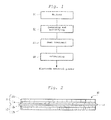
- Fig. 1 is a flowchart illustrating a manufacturing process of an electrode material according to the present invention.
- a powdered crystallization inhibitor is added to a powder that is a raw material of the lithium vanadium oxide, and the resultant is melted at a predetermined temperature.
- the resultant is left for a predetermined time, and put on a room-temperature plate or a cooled plate in order to allow the resultant to be quenched and solidified, whereby a condensate in a glass state is obtained.
- the glassy condensate is subject to a heat treatment to allow crystals to deposit, whereby a condensate having two coexistent phases, i.e., a crystal phase and an amorphous phase, is obtained.
- the resultant is pulverized to prepare an electrode material powder having a particle diameter within the scope of the present invention.
- (Li 2 O)a(P 2 O 5 )b(Fe 2 O 3 )c(V 2 O 5 )d (0 ⁇ a ⁇ 0.5, 0 ⁇ b ⁇ 0.5, 0 ⁇ c ⁇ 0.5, and 0.5 ⁇ d ⁇ 1.0) can preferably be used, for example.
- the composition of O ⁇ a ⁇ 0.2, 0 ⁇ b ⁇ 0.15, 0 ⁇ c ⁇ 0.2, and 0.5 ⁇ d ⁇ 0. 8 is more preferable for the composition of the raw material.
- the melting temperature in the melt-quenching method in S1 only has to be a temperature by which each raw material is melted.
- the melting temperature is 900 degrees Celsius or more, a preferable molten material can be obtained.
- the material In the quenching process in S2, the material only has to be cooled faster than a speed by which a crystal core is formed in order to obtain the glass material from the molten material.
- the cooling speed is 1000 K/sec or more, a preferable glass material can be obtained.
- the crystal deposition from the glass material by the heat treatment in S3 is performed at the temperature of 50 to 550 degrees Celsius.
- crystallization inhibitor for inhibiting the crystallization from the condensate due to the heat treatment examples include TeO 2 , GeO 2 , BaO, PbO, Sb 2 O 5 , etc., in addition to a phosphate compound such as P 2 O 5 .
- a graphite plate or a metal plate such as a copper may be used for the plate used upon the rapid cooling in the melt-quenching method.
- the electrode material is mixed with a binder such as polyvinylidene fluoride (PVDF), and the resultant is formed into an application layer for a positive electrode material in a form of slurry with the use of a solvent such as N-methyl pyrrolidone (NMP).
- PVDF polyvinylidene fluoride
- NMP N-methyl pyrrolidone
- the obtained application layer is applied onto a current collector, whereby a positive electrode can be formed. It is preferable that the application layer is formed to have a thickness of 10 to 100 ⁇ m, for example.
- a conductive base is used in which a surface contacting with the application layer exhibits conductivity.
- the conductive base can be made of a conductive material such as a metal, conductive metal oxide, and conductive carbon. Examples of the preferable conductive material include copper, gold, aluminum, and an alloy thereof, and conductive carbon.
- the current collector may be configured such that a body of the base made of a non-conductive material is covered by a conductive material.
- the electrode material according to the present invention has a crystal phase in the form of lattice containing Li 0.3 V 2 O 5 , wherein lithium is arranged in the lattice.
- Li 0.3 V 2 O 5 has a covalent bond to the vanadium element and oxygen element in a three-dimensional direction, wherein lithium ions are present so as to one-dimensionally occupy the gap.
- Li 0.3 V 2 O 5 has a diffusion path of lithium ions having a one-dimensional tunnel structure.
- the primary particle diameter of the electrode material is set to be 10 nm or more and 200 nm or less, the crystal structure is difficult to be collapsed when the charging and discharging are repeated, compared to a particle having a primary particle diameter larger than the above-mentioned range.
- the one-dimensional tunnel structure is disclosed, for example, in an electronic edition of Nature Materials on 2008, 8. 11.
- a vanadium oxide such as V 2 O 5 has a layered crystal structure, wherein lithium ions go into and out of the portion between the layers.
- V 2 O 5 has a structure in which a vanadium element and an oxygen element are covalently bonded in a two-dimensional direction, and this sheet is laminated by an electrostatic interaction.
- V 2 O 5 has a layered structure. Therefore, as the primary particle diameter increases, the length of the path through which the lithium ions go in or go out of the portion between the layers increases, with a result that the lithium ions are difficult to go in and go out of the portions between the layers. Accordingly, the capacity is reduced.
- the inventors of the present invention has found out that, when the primary particle diameter (layer length) exceeds 30 nm, the crystal structure is collapsed to deteriorate the cycle characteristic.
- the electrode material of the present invention since the electrode material of the present invention has lithium arranged in the lattice crystal structure, a battery having a crystal phase but having an excellent cycle characteristic can be obtained, compared to a vanadium oxide such as V 2 O 5 . Since the upper limit of the primary particle diameter is set to be 200 nm, the internal resistance can be suppressed to be low, whereby not only the cycle characteristic but also the battery capacity can be enhanced. As described above, the electrode material according to the present invention having the crystal phase containing Li 0.3 V 2 O 5 is different from the layered vanadium oxide from the viewpoint of the crystal structure, and hence, the characteristic is greatly different.
- the lithium ion secondary battery according to the present invention has a positive electrode made from the electrode material according to the present invention, a negative electrode, and electrolyte dissolved in a solvent.
- the lithium ion secondary battery further includes a lithium electrode according to need.
- the negative electrode is formed in such a manner that an active material of a lithium material, which is generally used, is mixed with a binder to form slurry like the electrode material of the present invention, and the resultant is applied onto a current collector.
- the lithium material include lithium metal material, intermetallic compound material of a metal and a lithium metal, lithium compound, and lithium intercalation carbon material.
- the lithium metal material include metal lithium and lithium alloy (e.g., Li-Al alloy).
- the intermetallic compound material of a metal and a lithium metal include tin and silicon.
- the lithium compound include a lithium nitride.
- Examples of a usable lithium intercalation carbon material include graphite, carbon-based material, and polyacene-based material.
- Examples of the carbon material include non-graphitizable carbon material.
- Examples of the polyacene-based material include PAS that is an insoluble and infusible base and has a polyacene skeletal structure.
- a negative electrode formed by using any of the lithium intercalation carbon materials allows lithium ions to be reversibly doped.
- doping involves storage, support, adsorb or insert, and specifically a phenomenon where lithium ions and/or anions enter the positive electrode or the negative electrode.
- de-doping involves release, and desorb, and specifically a phenomenon where lithium ions and/or anions go out of the positive electrode or the negative electrode.
- a lithium electrode is separately provided, whereby the lithium ions are pre-doped into the negative electrode from the lithium electrode upon the initial charging.
- the lithium electrode is formed by adhering the above-mentioned current collector onto the lithium ion source.
- a metal lithium or lithium-aluminum alloy can be used for the lithium ion source.
- the material that contains at least lithium elements and can supply lithium ions can be used. It is preferable that the lithium ions are doped by a molar ratio of 0.1 to 6 with respect to the above-mentioned electrode material. When the doping amount of lithium ions is less than 0.1 in a molar ratio, the doping effect cannot sufficiently be exhibited. On the other hand, when the doping amount of lithium ions exceeds 6, the electrode material might be reduced to a metal.
- the lithium-based materials exemplified as the negative electrode material other than the lithium intercalation carbon material can be used for the lithium electrode.
- Lithium salts such as CF 3 SO 3 Li, C 4 F 9 SO 8 Li, (CF 3 SO 2 ) 2 NLi, (CF 3 SO 2 ) 3 CLi, LiBF 4 , LiPF 6 , and LiClO 4 can be used as the electrolyte, for example.
- the solvent that dissolves the electrolyte is a non-aqueous solvent.
- the non-aqueous solvent include electrolyte solution of chain carbonate, cyclic carbonate, cyclic ester, nitrile compound, acid anhydride, amide compound, phosphate compound, and amine compound.
- the electrolyte solution may be solution of non-aqueous solvent or polymer gel (polymer gel electrolyte) containing the electrolyte solution.
- non-aqueous solvent examples include ethylene carbonate (EC), diethyl carbonate (DEC), propylene carbonate, dimethoxyethane, ⁇ -butyloractone, n-methylpyrrolidinone, N,N'-dimethylacetoamide, and acetonitrile. Further, a mixture of propylene carbonate and dimethoxyethane, and a mixture of sulfolane and tetrahydrofuran can be used as the non-aqueous solvent.
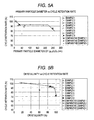
- Fig. 2 is a sectional view illustrating a brief configuration of a lithium ion secondary battery according to the present invention.
- the lithium ion secondary battery 10 illustrated in Fig. 2 has a positive electrode 11 and a negative electrode 12 that are arranged so as to oppose each other across an electrolyte layer 13.
- the positive electrode 11 is composed of a positive electrode active material layer 11a containing the electrode material according to the present invention, and a positive electrode current collector 11b.
- the positive electrode active material layer 11a is applied onto the positive electrode current collector 11b at the side of the electrolyte layer 13 as an application layer.
- the negative electrode 12 is, like the positive electrode 11, composed of a negative electrode active material layer 12a and a negative electrode current collector 12b.
- the negative electrode active material layer 12b is applied onto the negative electrode current collector 12b at the side of the electrolyte layer 13 as an application layer.
- Fig. 3 is a sectional view illustrating a brief configuration of another lithium ion secondary battery according to the present invention.
- the lithium ion secondary battery 20 illustrated in Fig. 3 has an electrode unit 24 that includes a plurality of positive electrodes 21 and negative electrodes 22.
- the positive electrodes 21 and negative electrodes 22 are alternately stacked such that a separator 23 is interposed between each of the positive electrodes 21 and negative electrodes 22.
- the negative electrode 22 is arranged at outermost parts of the electrode unit 24.
- the electrode unit 24 includes, between both negative electrodes 22, a plurality of positive electrodes 21 and negative electrodes 22 that are stacked such that the separator 23 is interposed between each of the positive electrodes 21 and electrodes 22.
- a lithium electrode 25 is arranged so as to oppose to the negative electrode 22 across the separator 23.
- the lithium electrode 25 has, for example, a metal lithium 25a mounted on a lithium current collector 25b.
- the lithium electrode current collector 25b is a porous member formed with a large number of holes (through-holes). Lithium ions dissolved out of the lithium electrode 25 are pre-doped into the negative electrode 22.
- the positive electrode 21 includes a positive electrode active material layer 21a containing the electrode material according to the present invention, and a positive electrode current collector 21b, wherein the positive electrode active material layer 21a is provided on both surfaces of the positive electrode current collector 21b.
- the positive electrode current collector 21b is a porous member like the lithium electrode current collector 25b.
- the negative electrode 22 has negative electrode active material layers 22a formed on both surfaces of a negative electrode current collector 22b.
- the negative electrode current collector 22b is a porous member.
- the separator 23 is composed with, for example, a porous member of polyolefin having durability to the electrolytic solution, positive electrode active material, negative electrode active material, or the like, and having through-holes.
- the plurality of positive electrode current collectors 21b are connected to one another by a lead 26.
- the plurality of negative electrode current collectors 22b and the lithium electrode current collector 25b are connected to one another by a lead 27.
- the lithium ion secondary battery 10 is formed such that the electrode unit 24 thus configured is packaged with an unillustrated laminate film, wherein the electrolyte solution is put therein.
- the lithium ion secondary battery according to the present invention employs the electrode material according to the present invention for the positive electrode material, it has a high capacity and excellent cycle characteristic.
- a positive electrode material powder was obtained by dry-grinding a condensate of an active material made of Li 0.3 V 2 O 5 , which was obtained by the melt-quenching method illustrated in Fig. 1 , using a compound made of 77 mol percent V 2 O 5 , 9 mol percent P 2 O 5 , 3 mol percent Sb 2 O 3 , and 11 mol percent Li 2 O as raw materials.
- the positive electrode material powder was mixed with five weight percent of a binder containing PVDF to prepare slurry by using N-methylpyrrolidone (NMP) as a solvent. Then, the slurry was coated on a porous Al foil by a doctor blade method. The slurry was uniformly applied and molded such a manner that the composite density per one surface was 2 g/cm 3 , and the resultant was cut into a square of 24 mm x 36 mm to form a positive electrode.
- NMP N-methylpyrrolidone
- the crystal structure of the positive electrode material powder was analyzed according to the method described in an Example 2 with the use of an X-ray diffractometer (RINT 2500 HL wide angle X-ray diffractometer by Rigaku Corporation), and it was confirmed that the powder had a crystal phase and an amorphous phase.. Further, the average primary particle diameter of the positive electrode material powders was 63.0 nm, and the crystallinity thereof was 96 percent. It was estimated from the composition ratio of the raw materials that the amorphous phase contained phosphor, lithium and antimony.
- the electrode laminated unit was packaged with an aluminum laminate film, and an electrolyte solution obtained by dissolving lithium fluoroborate (LiBF 4 ) at one mol/l into solvent mixture containing ethylene carbonate (EC) and diethyl carbonate (DEC) at the weight ratio of 1 : 3 was injected. With this process, a lithium ion secondary battery was assembled.
- LiBF 4 lithium fluoroborate
- EC ethylene carbonate
- DEC diethyl carbonate
- Fig. 4A is a graph illustrating a correlation between the primary particle diameter and the initial discharging capacity
- FIG. 4B is a graph illustrating a correlation between the crystallinity and the initial discharging capacity
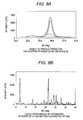
- Fig. 5A is a graph illustrating the correlation between the primary particle diameter and the cycle retention rate
- Fig. 5B is a graph illustrating the correlation between the crystallinity and the cycle retention rate. The results of later-described Examples are similarly illustrated.
- a positive electrode material powder and a lithium ion secondary battery were fabricated in the same manner as in the Example 1 except that the positive electrode material powder was prepared by using a compound made of 70 mol percent V 2 O 5 , 9 mol percent P 2 O 5 , 10 mol percent Fe 2 O 3 , and 11 mol percent Li 2 O as raw materials as illustrated in Table 1.
- the positive electrode material powder was analyzed with the X-ray diffractometer, and it was confirmed that the powder had a crystal phase and an amorphous phase as illustrated in Figs. 6A and 6B .
- the average primary particle diameter of the positive electrode material powder having the peak at 2 ⁇ 26.4°, which was measured by the X-ray diffractometer, was calculated according to Scherrer's equation, and the result was 68.5 nm.
- the crystallinity was 90 percent through the calculation described below with the use of the X-ray diffractometer.
- the initial discharging capacity and the cycle retention rate were measured for the obtained lithium ion secondary battery as in the Example 1: the initial discharging capacity was 376 mAh/g per an active material, and the cycle retention rate was 91.4 percent.
- a positive electrode material powders was prepared by using a compound made of 70 mol percent V 2 O 5 , 9 mol percent P 2 O 5 , 10 mol percent Fe 2 O 3 , and 11 mol percent Li 2 O as raw materials as illustrated in Table 1 in such a manner that the average primary particle diameter measured by the X-ray diffractometer became 103.0 nm. Except for this, the positive electrode material powder and a lithium ion secondary battery were fabricated in the same manner as described above.
- the positive electrode material powder was analyzed with the use of the X-ray diffractometer, and it was confirmed that the powder had a crystal phase and an amorphous phase as in the Example 2. The crystallinity thereof was 89 percent.
- the amorphous phase included phosphor, lithium and iron
- the initial discharging capacity and the cycle retention rate were measured for the obtained lithium ion secondary battery as in the Example 1: the initial discharging capacity was 380 mAh/g per an active material, and the cycle retention rate was 93.0 percent.
- a positive electrode material powder was prepared by using a compound made of 70 mol percent V 2 O 5 , 9 mol percent P 2 O 5 , 10 mol percent Fe 2 O 3 , and 11 mol percent Li 2 O as raw materials as illustrated in Table 1 in such a manner that the average primary particle diameter measured by the X-ray diffractometer became 190.0 nm. Except for this, the positive electrode material powder and a lithium ion secondary battery were fabricated in the same manner as described above.
- the positive electrode material powder was analyzed with the use of the X-ray diffractometer, and it was confirmed that the powder had a crystal phase and an amorphous phase as in the Example 2.
- the crystallinity thereof was 93 percent. It was estimated from the composition ratio of the raw materials that the amorphous phase included phosphor, lithium and iron.
- the initial discharging capacity and the cycle retention rate were measured for the obtained lithium ion secondary battery as in the Example 1: the initial discharging capacity was 360 mAh/g per an active material, and the cycle retention rate was 92.0 percent.
- a positive electrode material powder was prepared by using a compound made of 70 mol percent V 2 O 5 , 9 mol percent P 2 O 5 , 10 mol percent Fe 2 O 3 , and 11 mol percent Li 2 O as raw materials as illustrated in Table 1 in such a manner that the average primary particle diameter measured by the X-ray diffractometer became 40.0 nm. Except for this, the positive electrode material powder and a lithium ion secondary battery were fabricated in the same manner as described above.
- the positive electrode material powder was analyzed with the use of the X-ray diffractometer, and it was confirmed that the powder had a crystal phase and an amorphous phase as in the Example 2.
- the crystallinity thereof was 86 percent. It was estimated from the composition ratio of the raw materials that the amorphous phase included phosphor, lithium and iron.
- the initial discharging capacity and the cycle retention rate were measured for the obtained lithium ion secondary battery as in the Example 1: the initial discharging capacity was 353 mAh/g per an active material, and the cycle retention rate was 92.0 percent.
- a positive electrode material powder was prepared by using a compound made of 70 mol percent V 2 O 5 , 9 mol percent P 2 O 5 , 10 mol percent Fe 2 O 3 , and 11 mol percent Li 2 O as raw materials as illustrated in Table 1 in such a manner that the average primary particle diameter measured by the X-ray diffractometer became 10.0 nm. Except for this, the positive electrode material powder and a lithium ion secondary battery were fabricated in the same manner as described above.
- the positive electrode material powder was analyzed with the use of the X-ray diffractometer, and it was confirmed that the powder had a crystal phase and an amorphous phase as in the Example 2.
- the crystallinity thereof was 82 percent. It was estimated from the composition ratio of the raw materials that the amorphous phase included phosphor, lithium and iron.
- the initial discharging capacity and the cycle retention rate were measured for the obtained lithium ion secondary battery as in the Example 1: the initial discharging capacity was 320 mAh/g per an active material, and the cycle retention rate was 98.0 percent.
- a positive electrode material powder was prepared in the same manner as Example 1 except for such a manner that the average primary particle diameter measured by the X-ray diffractometer became 22.0 nm.
- the positive electrode material powder was analyzed with the use of the X-ray diffractometer, and it was confirmed that the powder had a crystal phase and an amorphous phase as in the Example 1.
- the crystallinity thereof was 84 percent. It was estimated from the composition ratio of the raw materials that the amorphous phase included phosphor, lithium and antimony.
- the initial discharging capacity and the cycle retention rate were measured for the obtained lithium ion secondary battery as in the Example 1: the initial discharging capacity was 328 mAh/g per an active material, and the cycle retention rate was 91.6 percent.
- a positive electrode material powder was prepared in the same manner as in the Example 1 except for such a manner that the average primary particle diameter measured by the X-ray diffractometer became 31.5 nm.
- the positive electrode material powder was analyzed with the use of the X-ray diffractometer, and it was confirmed that the powder had a crystal phase and an amorphous phase as in the Example 1.
- the crystallinity thereof was 86 percent. It was estimated that the amorphous phase included phosphor, lithium and antimony.
- the initial discharging capacity and the cycle retention rate were measured for the obtained lithium ion secondary battery as in the Example 1: the initial discharging capacity was 336 mAh/g per an active material, and the cycle retention rate was 93.0 percent.
- a positive electrode material powder was prepared by using a compound made of 70 mol percent V 2 O 5 , 9 mol percent P 2 O 5 , 10 mol percent Fe 2 O 3 , and 11 mol percent Li 2 O as raw materials as illustrated in Table 1 in such a manner that the average primary particle diameter measured by the X-ray diffractometer became 250.0 nm. Except for the this, the positive electrode material powder and a lithium ion secondary battery were fabricated in the same manner as described above.
- the positive electrode material powder was analyzed with the use of the X-ray diffractometer, and it was confirmed that the powder had a crystal phase and an amorphous phase as in the Example 2.
- the crystallinity thereof was 60 percent. It was estimated from the composition ratio of the raw materials that the amorphous phase included phosphor, lithium and iron.
- the initial discharging capacity and the cycle retention rate were measured for the obtained lithium ion secondary battery as in the Example 1: the initial discharging capacity was 312 mAh/g per an active material, and the cycle retention rate was 85.0 percent.
- a positive electrode material powder and a lithium ion secondary battery were fabricated in the same manner as in the Example 1 except that the positive electrode material powder was prepared to have an average primary particle diameter, measured by the X-ray diffractometer, of 8.0 nm.
- the positive electrode material powder was analyzed with the use of the X-ray diffraction device, and it was confirmed that the powder had a crystal phase and an amorphous phase as in the Example 1.
- the crystallization thereof was 16 percent. It was estimated from the composition ratio of the raw materials that the amorphous phase included phosphor, lithium and antimony.
- the initial discharging capacity and the cycle retention rate were measured for the obtained lithium ion secondary battery as in the Example 1: the initial discharging capacity was 308 mAh/g per an active material, and the cycle retention rate was 101.2 percent.
- a positive electrode material powder and a lithium ion secondary battery were fabricated in the same manner as in the Example 1 except that an active material made of V 2 O 5 , which was produced by a method other than the melt-quenching method, SbOPO 4 , Li 2 PO 6 and Li 6 P 6 O 8 was used for a positive electrode material.
- the positive electrode material powder was analyzed with the X-ray diffractometer, and it was confirmed that the powder had only a crystal phase as illustrated in Figs. 7A and 7B .
- the initial discharging capacity and the cycle retention rate were measured for the obtained lithium ion secondary battery as in the Example 1: the initial discharging capacity was 365 mAh/g per an active material, and the cycle retention rate was 71.6 percent. Since this example does not include Li 0.3 V 2 O 5 , the data of the particle diameter is not illustrated in Tables.
- an active material made of Li 0.3 V 2 O 5 , LiV 10 O 27 , and Li 3 Fe 2 (PO 4 ) 3 which was obtained by a method other than the melt-quenching method, was used for the positive electrode material as in the Example 1.
- the active material was prepared by using a compound made of 63 mol percent V 2 O 5 , 8 mol percent P 2 O 5 , 9 mol percent Fe 2 O 3 , and 20 mol percent Li 2 O as raw materials as illustrated in Table 1. Except for this, a positive electrode material powder and a lithium ion secondary battery were fabricated in the same manner as described above.
- the positive electrode material powder was analyzed with the X-ray diffractometer, and it was confirmed that the powder had only a crystal phase as illustrated in Figs. 8A and 8B .
- the average primary particle diameter of Li 0.3 V 2 O 5 was measured by the X-ray diffractometer, and the result was 49.6 nm.
- the initial discharging capacity greatly exceeds 320 mAh/g per an active material, and the cycle retention rate after 50 charging and discharging cycles exceeds 88 percent, which are excellent results.
- the primary particle diameter of Li 0.3 V 2 O 5 it is necessary to set the primary particle diameter of Li 0.3 V 2 O 5 to be within the range of 10 nm or more and 200 nm or less from the viewpoint of initial discharging capacity and the cycle retention rate. Additionally, in order to obtain such a battery, it is necessary to include an amorphous phase.
- the present invention is well applicable to a field of positive electrode materials for lithium secondary batteries.
Landscapes
- Chemical & Material Sciences (AREA)
- Engineering & Computer Science (AREA)
- Chemical Kinetics & Catalysis (AREA)
- General Chemical & Material Sciences (AREA)
- Electrochemistry (AREA)
- Materials Engineering (AREA)
- Inorganic Chemistry (AREA)
- Organic Chemistry (AREA)
- Nanotechnology (AREA)
- Manufacturing & Machinery (AREA)
- General Physics & Mathematics (AREA)
- Crystallography & Structural Chemistry (AREA)
- Physics & Mathematics (AREA)
- Condensed Matter Physics & Semiconductors (AREA)
- Composite Materials (AREA)
- Life Sciences & Earth Sciences (AREA)
- Sustainable Development (AREA)
- Sustainable Energy (AREA)
- Power Engineering (AREA)
- Transportation (AREA)
- Mechanical Engineering (AREA)
- Battery Electrode And Active Subsutance (AREA)
- Inorganic Compounds Of Heavy Metals (AREA)
Applications Claiming Priority (2)
| Application Number | Priority Date | Filing Date | Title |
|---|---|---|---|
| JP2009157831 | 2009-07-02 | ||
| JP2010080210A JP2011029151A (ja) | 2009-07-02 | 2010-03-31 | 電極材料およびリチウムイオン二次電池 |
Publications (1)
| Publication Number | Publication Date |
|---|---|
| EP2270916A2 true EP2270916A2 (fr) | 2011-01-05 |
Family
ID=42988394
Family Applications (1)
| Application Number | Title | Priority Date | Filing Date |
|---|---|---|---|
| EP10168047A Withdrawn EP2270916A2 (fr) | 2009-07-02 | 2010-07-01 | Matériau d'électrode et batterie secondaire au lithium-ion |
Country Status (5)
| Country | Link |
|---|---|
| US (1) | US20110001084A1 (fr) |
| EP (1) | EP2270916A2 (fr) |
| JP (1) | JP2011029151A (fr) |
| KR (1) | KR20110002793A (fr) |
| CN (1) | CN101944589A (fr) |
Cited By (1)
| Publication number | Priority date | Publication date | Assignee | Title |
|---|---|---|---|---|
| EP2469631A1 (fr) * | 2010-12-24 | 2012-06-27 | Hitachi Ltd. | Matériau actif d'électrode positive pour batterie secondaire et batterie secondaire au magnésium l'utilisant |
Families Citing this family (8)
| Publication number | Priority date | Publication date | Assignee | Title |
|---|---|---|---|---|
| KR101244734B1 (ko) | 2010-11-03 | 2013-03-18 | 삼성에스디아이 주식회사 | 리튬 이차 전지용 양극 및 이를 포함하는 리튬 이차 전지 |
| CN102867947A (zh) * | 2011-07-06 | 2013-01-09 | 东丽纤维研究所(中国)有限公司 | 基于低聚倍半硅氧烷的碳/硅复合负极材料的制备方法 |
| KR20130018435A (ko) * | 2011-07-19 | 2013-02-22 | 가부시키가이샤 히타치세이사쿠쇼 | 이온 이차 전지용 전극, 이온 이차 전지용 전극의 제조 방법, 리튬 이온 이차 전지 및 마그네슘 이온 이차 전지 |
| JP5255143B2 (ja) * | 2011-09-30 | 2013-08-07 | 富士重工業株式会社 | 正極材料、これを用いたリチウムイオン二次電池、及び正極材料の製造方法 |
| JP6102615B2 (ja) * | 2013-08-01 | 2017-03-29 | 日立金属株式会社 | 負極活物質及びそれを用いた二次電池 |
| US9627709B2 (en) * | 2014-10-15 | 2017-04-18 | Sakti3, Inc. | Amorphous cathode material for battery device |
| CN111682193A (zh) * | 2020-06-12 | 2020-09-18 | 成都理工大学 | 一种Li2O-V2O5-Fe2O3非晶态锂离子电池正极材料及其制备方法 |
| CN117352705B (zh) * | 2023-12-04 | 2024-03-01 | 山东省莘县华阳实业有限公司 | 一种超晶格增效的玻璃基电池正极材料及其制备方法 |
Citations (3)
| Publication number | Priority date | Publication date | Assignee | Title |
|---|---|---|---|---|
| JPH0580791B2 (fr) | 1986-09-11 | 1993-11-10 | Toshiba Battery | |
| JPH0883606A (ja) | 1994-09-09 | 1996-03-26 | Hitachi Ltd | リチウム二次電池 |
| JP2007042618A (ja) | 2005-06-30 | 2007-02-15 | Kitakyushu Foundation For The Advancement Of Industry Science & Technology | 電極活物質及びその製造方法ならびに非水電解質二次電池 |
Family Cites Families (5)
| Publication number | Priority date | Publication date | Assignee | Title |
|---|---|---|---|---|
| US5366830A (en) * | 1993-02-12 | 1994-11-22 | Valence Technology, Inc. | Vanadium oxide cathode active material and method of making same |
| JP3687515B2 (ja) * | 2000-10-06 | 2005-08-24 | 日本電気株式会社 | 電池 |
| US8158090B2 (en) * | 2005-08-08 | 2012-04-17 | A123 Systems, Inc. | Amorphous and partially amorphous nanoscale ion storage materials |
| JP2007123251A (ja) * | 2005-09-28 | 2007-05-17 | Sanyo Electric Co Ltd | 非水電解質二次電池 |
| JP5118905B2 (ja) * | 2007-07-06 | 2013-01-16 | トヨタ自動車株式会社 | 電極活物質、電極、非水電解質二次電池、車両、電池搭載機器、および電極活物質の製造方法 |
-
2010
- 2010-03-31 JP JP2010080210A patent/JP2011029151A/ja active Pending
- 2010-06-28 KR KR1020100061178A patent/KR20110002793A/ko not_active Withdrawn
- 2010-07-01 EP EP10168047A patent/EP2270916A2/fr not_active Withdrawn
- 2010-07-01 US US12/828,619 patent/US20110001084A1/en not_active Abandoned
- 2010-07-02 CN CN2010102240054A patent/CN101944589A/zh active Pending
Patent Citations (3)
| Publication number | Priority date | Publication date | Assignee | Title |
|---|---|---|---|---|
| JPH0580791B2 (fr) | 1986-09-11 | 1993-11-10 | Toshiba Battery | |
| JPH0883606A (ja) | 1994-09-09 | 1996-03-26 | Hitachi Ltd | リチウム二次電池 |
| JP2007042618A (ja) | 2005-06-30 | 2007-02-15 | Kitakyushu Foundation For The Advancement Of Industry Science & Technology | 電極活物質及びその製造方法ならびに非水電解質二次電池 |
Non-Patent Citations (3)
| Title |
|---|
| C.DELMASH. CONGNAC-AURADOUJ. M. COCCIANTELLIMENETRIER, J.P. DOUMERC, SOLID STATE IONICS, vol. 69, 1994, pages 257 - 264 |
| NATURE MATERIALS, vol. 8, 2008, pages 11 |
| SOLID STATE IONICS, vol. 69, 1994, pages 257 - 264 |
Cited By (1)
| Publication number | Priority date | Publication date | Assignee | Title |
|---|---|---|---|---|
| EP2469631A1 (fr) * | 2010-12-24 | 2012-06-27 | Hitachi Ltd. | Matériau actif d'électrode positive pour batterie secondaire et batterie secondaire au magnésium l'utilisant |
Also Published As
| Publication number | Publication date |
|---|---|
| US20110001084A1 (en) | 2011-01-06 |
| JP2011029151A (ja) | 2011-02-10 |
| CN101944589A (zh) | 2011-01-12 |
| KR20110002793A (ko) | 2011-01-10 |
Similar Documents
| Publication | Publication Date | Title |
|---|---|---|
| EP2270916A2 (fr) | Matériau d'électrode et batterie secondaire au lithium-ion | |
| KR102591512B1 (ko) | 음극 활물질 및 이를 채용한 리튬 이차 전지, 및 상기 음극 활물질의 제조방법 | |
| JP4306697B2 (ja) | 二次電池 | |
| JP5348706B2 (ja) | 非水電解液二次電池用負極、それを用いた非水電解液二次電池、および非水電解液二次電池用負極の製造方法 | |
| US8048339B2 (en) | Porous anode active material, method of preparing the same, and anode and lithium battery employing the same | |
| KR101378235B1 (ko) | 리튬 이차전지 | |
| KR20090049988A (ko) | 리튬이온 2차전지용 정극, 그 제조 방법 및 리튬이온 2차전지 | |
| US20110108760A1 (en) | Electrode material, production method of same and lithium ion secondary battery | |
| US20140001413A1 (en) | Active material, electrode, lithium ion secondary battery, and method for manufacturing active material | |
| KR102152367B1 (ko) | 복합 양극 활물질의 제조방법, 이에 의해 제조된 복합 양극 활물질 및 이를 채용한 양극과 리튬 전지 | |
| EP0903799A2 (fr) | Batterie secondaire à électrolyte non-aqueux et son anode | |
| US9312534B2 (en) | Nonaqueous electrolytic solution secondary battery, and positive electrode and negative electrode used in the same | |
| EP2573046A1 (fr) | Procédé de production de matériau actif d'électrode positive (LiVPO4F - Lithium vanadium fluorophosphate), électrode positive et dispositif de stockage | |
| KR20250142836A (ko) | 리튬 이차 전지 | |
| KR20160136688A (ko) | 전극 활물질, 이를 포함하는 전극 및 에너지 저장장치, 및 상기 전극 활물질의 제조방법 | |
| KR20170039924A (ko) | 음극 활물질 및 이를 채용한 음극 및 리튬 전지 | |
| US20080299459A1 (en) | Fabrication method of electrode material, electrode material, and non-aqueous lithium ion secondary battery | |
| JPH087895A (ja) | リチウム二次電池電極用炭素材料及びその製造方法 | |
| KR20170042115A (ko) | 음극 활물질 및 이를 채용한 음극 및 리튬 전지 | |
| US7919208B2 (en) | Anode active material and battery | |
| JP2012074339A (ja) | 電極材料、該電極材料を用いた蓄電デバイス、リチウムイオン二次電池、及び電極材料の製造方法。 | |
| US20240113327A1 (en) | Solid-state electrolyte, lithium battery comprising solid-state electrolyte, and preparation method of solid-state electrolyte | |
| WO2012105799A2 (fr) | Matériau actif de cathode pour batterie rechargeable au lithium et batterie rechargeable au lithium comprenant ledit matériau | |
| JP4867218B2 (ja) | リチウムイオン二次電池 | |
| KR101739297B1 (ko) | 음극 활물질, 이를 채용한 리튬 이차 전지, 및 상기 음극 활물질의 제조방법 |
Legal Events
| Date | Code | Title | Description |
|---|---|---|---|
| PUAI | Public reference made under article 153(3) epc to a published international application that has entered the european phase |
Free format text: ORIGINAL CODE: 0009012 |
|
| AK | Designated contracting states |
Kind code of ref document: A2 Designated state(s): AL AT BE BG CH CY CZ DE DK EE ES FI FR GB GR HR HU IE IS IT LI LT LU LV MC MK MT NL NO PL PT RO SE SI SK SM TR |
|
| AX | Request for extension of the european patent |
Extension state: BA ME RS |
|
| STAA | Information on the status of an ep patent application or granted ep patent |
Free format text: STATUS: THE APPLICATION IS DEEMED TO BE WITHDRAWN |
|
| 18D | Application deemed to be withdrawn |
Effective date: 20140201 |