EP2271427B1 - Atténuation des variations de pression dans des broyeurs - Google Patents
Atténuation des variations de pression dans des broyeurs Download PDFInfo
- Publication number
- EP2271427B1 EP2271427B1 EP09726902.1A EP09726902A EP2271427B1 EP 2271427 B1 EP2271427 B1 EP 2271427B1 EP 09726902 A EP09726902 A EP 09726902A EP 2271427 B1 EP2271427 B1 EP 2271427B1
- Authority
- EP
- European Patent Office
- Prior art keywords
- accumulator
- pressure
- hydraulic
- crushing
- hydraulic cylinder
- Prior art date
- Legal status (The legal status is an assumption and is not a legal conclusion. Google has not performed a legal analysis and makes no representation as to the accuracy of the status listed.)
- Active
Links
Images


Classifications
-
- B—PERFORMING OPERATIONS; TRANSPORTING
- B02—CRUSHING, PULVERISING, OR DISINTEGRATING; PREPARATORY TREATMENT OF GRAIN FOR MILLING
- B02C—CRUSHING, PULVERISING, OR DISINTEGRATING IN GENERAL; MILLING GRAIN
- B02C2/00—Crushing or disintegrating by gyratory or cone crushers
- B02C2/02—Crushing or disintegrating by gyratory or cone crushers eccentrically moved
- B02C2/04—Crushing or disintegrating by gyratory or cone crushers eccentrically moved with vertical axis
- B02C2/047—Crushing or disintegrating by gyratory or cone crushers eccentrically moved with vertical axis and with head adjusting or controlling mechanisms
Definitions
- the present invention relates to a crusher system comprising a first crushing surface and a second crushing surface, the two crushing surfaces being operative for crushing material between them, the crusher system further comprising a hydraulic system which is operative for adjusting a gap between the first crushing surface and the second crushing surface by adjusting the position of the first crushing surface by means of an hydraulic cylinder connected to said first crushing surface.
- the present invention further relates to a method of crushing material between a first crushing surface and a second crushing surface.
- Crushers are utilized in many applications for crushing hard material, such as rocks, ore, etc.
- One type of crusher is the gyratory crusher, which has a crushing head which is forced to gyrate inside a fixed crushing shell.
- a crushing chamber, into which pieces of rock are to be fed, is formed between a crushing mantle, which is supported by the crushing head, and the crushing shell.
- the width of the crushing chamber often referred to as the gap or the setting of the crusher, may be adjusted by means of a hydraulic arrangement.
- the crusher is subjected to large load variations. Such load variations causes wear, including metal fatigue, in the crusher, and may decrease the life of the crusher.
- GB 1 517 963 discloses a gyratory crusher having a hydraulic cylinder or an air cylinder for preventing overload situations.
- a pressure buffer is operative for accommodating sudden heavy load changes in the hydraulic system.
- the pressure buffer is connected to the hydraulic system and by a point of constriction provided between the cylinder and the pressure buffer.
- a crusher system comprising a first crushing surface and a second crushing surface, the two crushing surfaces being operative for crushing material between them, the crusher system further comprising a hydraulic system which is operative for adjusting a gap between the first crushing surface and the second crushing surface by adjusting the position of the first crushing surface by means of an hydraulic cylinder connected to said first crushing surface, the crusher system being characterised in that said hydraulic system further comprises an accumulator being connected to said hydraulic cylinder by means of a hydraulic liquid pipe, the accumulator comprising a hydraulic liquid compartment and a gas compartment being separated from the hydraulic liquid compartment, the accumulator being pre-loaded at a pre-loading pressure, being the pressure of the gas compartment when the hydraulic liquid compartment is empty, which is at least 0.3 MPa lower than the mean operating pressure of the hydraulic cylinder, such that the accumulator is active and variations occurring in the hydraulic pressure of the hydraulic cylinder during operation of the crusher system are attenuated.
- An advantage of this crusher system is that the fatigue stresses on the crusher system can be substantially reduced, because the accumulator, being in hydraulic contact with the hydraulic cylinder during normal operation of the crusher system, is operative for attenuating almost all load changes, such that the load on the crusher system, and in particular the pressure in the hydraulic system, will vary much less compared to the prior art crusher system.
- the preloading pressure of the accumulator is 0.3 to 1 MPa lower than the mean operating pressure of the hydraulic cylinder.
- Such a preloading pressure has been found to provide an efficient attenuation of the load on the crusher system, without negatively affecting the crushing of material in the crusher.
- the natural oscillation frequency, ⁇ a of the accumulator fulfils the condition: ⁇ a > 10 * 2 ⁇ ⁇ * f r wherein f r is the number of rounds per second of an eccentric operative to make at least one of the first and second crushing surfaces gyrate.
- the natural frequency, ⁇ n of a system comprising the accumulator and the mass carried by the hydraulic cylinder fulfils the condition: ⁇ n > 4 ⁇ ⁇ * f r wherein f r is the number of rounds per second of an eccentric operative to make at least one of the first and second crushing surfaces gyrate.
- the crusher system comprises a control device, which is operative for controlling the preloading pressure of the accumulator in view of the actual mean operating pressure of the hydraulic cylinder.
- This object is achieved by means of a method of crushing material between a first crushing surface and a second crushing surface, a hydraulic system being operative for adjusting a gap between the first crushing surface and the second crushing surface by adjusting the position of the first crushing surface by means of an hydraulic cylinder connected to said first crushing surface, the method being characterised in that variations occurring in the hydraulic pressure of the hydraulic cylinder are attenuated by means of an accumulator being in contact, via a hydraulic liquid, with said hydraulic cylinder, the accumulator comprising a hydraulic liquid compartment and a gas compartment being separated from the hydraulic liquid compartment, the accumulator being pre-loaded at a pre-loading pressure, being the pressure of the gas compartment when the hydraulic liquid compartment is empty, which is at least 0.3 MPa lower than the mean operating pressure of the hydraulic cylinder.
- An advantage of this method is that the load variations influencing the crusher are attenuated by means of the accummulator. Thanks to this, the lifetime of a crusher can be increased, and/or the crusher can be operated at a higher mean operating pressure.
- Fig. 1 illustrates a crusher system 1.
- the crusher system 1 comprises a gyratory crusher 2, which is per se known in the prior art, see for example GB 1 517 963 .
- the gyratory crusher 2 comprises a crushing head 4, which supports a first crushing surface formed on a crushing mantle 6 and which is fixed to a vertical shaft 8.
- the crushing head 4, being fixed to the vertical shaft 8, is movable in the vertical direction by means of a hydraulic cylinder 10 connected to the lower part of the shaft 8.
- the hydraulic cylinder 10 makes it possible to adjust the width of a gap 12 formed between the crushing mantle 6 and a second crushing surface formed on a stationary crushing shell 14, which surrounds the crushing mantle 6.
- the crusher system 1 further comprises a hydraulic system 16.
- the hydraulic system 16 comprises a pump 18, which is operative for pumping hydraulic liquid to or from the hydraulic cylinder 10 via a pipe 20.
- a dump valve 22 is operative for rapidly dumping hydraulic liquid from the hydraulic cylinder 10, in particular in situations when the gyratory crusher 2 becomes overloaded.
- the dump valve 22 is operative for dumping the hydraulic liquid into a tank 24, which also serves as a pump sump for the pump 18.
- the hydraulic system 16 also comprises an accumulator 26, which will be described in more detail hereinafter.
- the crusher system 1 further comprises a control system 28.
- the control system 28 comprises a control device 30 which is operative for receiving various signals indicating the operation of the gyratory crusher 2.
- the control device 30 is operative for receiving a signal from a position sensor 32 which indicates the present vertical position of the vertical shaft 8. From this signal the width of the gap 12 can be calculated.
- the control device 30 is operative for receiving a signal from a pressure sensor 34, indicating the hydraulic pressure in the hydraulic cylinder 10. Based on the signal from the pressure sensor 34 the control device 30 can calculate the actual mean operating pressure and the peak pressure of the gyratory crusher 2.
- the control device 30 may also receive a signal from a power sensor 36, which is operative for measuring the power supplied to the gyratory crusher 2 from a motor 38, which is operative for making the vertical shaft 8 gyrate in a per se known manner.
- the gyratory movement of the vertical shaft 8 is accomplished by the motor 38 driving an eccentric 39, which is arranged around the vertical shaft 8 in a per se known manner, and which is schematically illustrated in Fig. 1 .
- the power sensor 36 may also send a signal to the control device 30 indicating the number of rounds per second (in the unit 1/s or Hz), f r , of the eccentric 39.
- the control device 30 is operative for controlling the operation of the pump 18, for example in an on/off manner, or in a proportional manner, such that the pump 18 supplies an amount of hydraulic liquid to the hydraulic cylinder 10 that generates a desired vertical position of the vertical shaft 8, and a desired width of the gap 12.
- the control device 30 is also operative for controlling the opening of the dump valve 22. High pressure peaks, such as peaks caused by tramp entering the gap 12, are handled by the control device 30 sending a signal to the dump valve 22 to the extent that immediate opening is required.
- Fig. 2a illustrates, schematically, the hydraulic liquid pressure measured by a pressure sensor, similar to the sensor 34, when operating a gyratory crusher, which is similar to the gyratory crusher 2, in accordance with the teachings of the prior art.
- the Y-axis of the diagram of Fig. 2a represents the pressure, P, in Pascal
- the X-axis of the diagram represents the time, in seconds.
- the total time span, which is illustrated in the diagram of Fig. 2a is about 1 second.
- Fig. 2b illustrates a first component of the pressure, namely the mean operating pressure.
- a high mean operating pressure indicates an efficient operation of the gyratory crusher, meaning higher reduction ratios of rock size, and for that reason it is desired to keep the mean operating pressure as high as possible. Over the mean operating pressure other, unwanted, components are superimposed, as will be illustrated with reference to Fig. 2c and 2d .
- Fig. 2c illustrates a second component of the pressure, namely what can be called the synchronous or sinusoidal component.
- the sinusoidal component is caused by the gyratory movement of the vertical shaft, causing a sinusoidal component having the same frequency as the frequency of gyration of the vertical shaft.
- the period of the sinusoidal component corresponds to one turn of the eccentric making the vertical shaft gyrate.
- the sinusoidal component is mainly caused by an uneven distribution of the material fed to the crusher, geometric eccentricity of the crushing mantle and/or the crushing shell, etc.
- the pressure will have a peak corresponding, in time, to occasions when the gap has, due to the gyratory movement of the vertical shaft, its most narrow width at said one side.
- the peaks of the sinusoidal component indicated by a T in Fig. 2c , correspond to the highest pressure levels in the gyratory crusher, and result in the highest load on the gyratory crusher.
- a control device controlling the operation of a prior art gyratory crusher is operative for controlling a hydraulic pump, which is similar to the pump 18, to supply a hydraulic operating pressure which is as high as possible, without causing damage to the gyratory crusher.
- the peaks, T, of the sinusoidal component is normally what sets the upper limit for such a hydraulic operating pressure.
- Fig. 2d illustrates a third component of the pressure, namely the high frequency component. This component is caused by the nature of the crushing process itself. As can be seen from Fig. 2d the amplitude of the third component is rather small compared to the second component illustrated with reference to Fig. 2c . However, since the three components are in reality added to each other, the third component adds also to the peaks of the sinusoidal component, thereby further increasing the pressure variation.
- the present invention concerns a crusher system 1 in which the pressure variations caused by the second component, i.e., the synchronous or sinusoidal component, and the third component, i.e., the high frequency component, are minimized, and in which the first component, i.e., the mean operating pressure, can be maximized, such that the gyratory crusher 2 operates in an efficient manner, without being exposed to large fatigue stresses.
- the second component i.e., the synchronous or sinusoidal component
- the third component i.e., the high frequency component
- the accumulator 26 has a special design to be operative for filtering out small and rapid pressure changes, pressure changes that cannot be handled by either the pump 18 or the dump valve 22. This function of the accumulator 26 has been made possible by a design of the accumulator 26, which will be described hereinafter and which provides for improved crushing efficiency and an increased life of the gyratory crusher 2, due to the reduced pressure variations.
- Fig. 3 illustrates the accumulator 26 in more detail.
- the accumulator 26 comprises an accumulator body 40 which is connected to the pipe 20, which has been described hereinbefore with reference to Fig. 1 , by means of a connecting pipe 42.
- the accumulator body 40 has a flexible inner membrane 44 which separates a hydraulic liquid compartment 46 from a pressurized gas compartment 48.
- the pipe 20 is connected to the hydraulic cylinder 10 illustrated hereinbefore with reference to Fig. 1 .
- a first parameter in the design of the accumulator 26 is the preloading pressure.
- the pressurized gas compartment 48 is filled by a gas, which is often nitrogen gas, but which could also be air, or another gas.
- the preloading pressure of the accumulator 26 is the pressure of the gas in the pressurized gas compartment 48 when the hydraulic liquid compartment 46 is completely empty.
- the flexible inner membrane 44 will be forced, by the action of the pressurized gas, to the bottom of the accumulator body 40, i.e., towards the point were the connecting pipe 42 is connected to the accumulator body 40, and there will be basically no hydraulic liquid inside the accumulator body 40.
- the pressure in the hydraulic system 16 is lower than the pre-loading pressure the accumulator 26 is not operating.
- the preloading pressure is set to such a value that the accumulator 26 is active during operation of the gyratory crusher 2.
- the preloading pressure is preferably at least 0.3 MPa lower than the lowest mean operating pressure of the gyratory crusher 2. In some cases, operation at the lowest mean operating pressure occurs only rarely. In such cases the preloading pressure could be set to be at least 0.3 MPa lower than the normal mean operating pressure of the gyratory crusher 2.
- the preloading pressure should be 0.3-1.0 MPa lower than the lowest mean operating pressure, or 0.3-1.0 MPa lower than the normal mean operating pressure, as the case may be, of the gyratory crusher 2.
- the gyratory crusher 2 would be operating at a mean operating pressure in the range of 3-5 MPa (absolute pressure), i.e., with a lowest mean operating pressure of 3 MPa (a), then the preloading pressure of the accumulator 26 should, for example, be maximum 2.7 MPa (a). If, on the other hand, operating at the lowest mean operating pressure of 3 MPa (a) is quite rare, and the crusher normally operates at a mean operating pressure of 4 MPa (a), then the preloading pressure of the accumulator 26 could be set to be maximum 3.7 MPa (a).
- the accumulator 26 will, due to the set preloading pressure, be active to attenuate the pressure variations that more or less continuously occur in the hydraulic cylinder 10 due to the normal crushing process. Since the preloading pressure of the accumulator 26 is at least 0.3 MPa lower than the mean operating pressure, there will, during normal operation of the gyratory crusher 2, always be some hydraulic fluid in the hydraulic liquid compartment 46 of the accumulator 26, such that both increases and decreases in the hydraulic pressure of the hydraulic cylinder 10 can be attenuated. As illustrated in for example Fig.
- valve or similar device arranged in the pipe 20 between the hydraulic cylinder 10 and the accumulator 26, which means that the accumulator 26 will be in continuous hydraulic fluid contact with the hydraulic cylinder 10 during normal crushing operation of the crusher system 1 and will be active to attenuate the normal pressure variations occurring in the hydraulic cylinder 10.
- the preloading pressure of the accumulator 26 could be variable.
- a supply 27 of pressurized nitrogen gas is schematically illustrated with dotted lines.
- the control device 30 could be operative to control the supply 27 of pressurized nitrogen gas to supply a suitable nitrogen pressure to the pressurized gas compartment 48 of the accumulator 26.
- the control device 30 could be operative for controlling the preloading pressure of the accumulator 26, such that the preloading pressure is always below the actual mean operating pressure at that specific occasion.
- control device 30 calculates, based on information from the pressure sensor 34, that the mean operating pressure is 4 MPa (a), then it could order the supply 27 of pressurized nitrogen gas to supply a preloading pressure of 3.5 MPa (a) to the accumulator 26.
- the control device 30 calculates the mean operating pressure to be 3.7 MPa (a), and then orders the supply 27 of pressurized nitrogen gas to supply a preloading pressure of 3.2 MPa (a) to the accumulator 26.
- the control device 30 would, in accordance with this option, ensure that the preloading pressure of the accumulator 26 is always lower than the mean operating pressure, and is suitable for the mean operating pressure in question.
- a further option includes a shut-off in the connecting pipe 42, such that the accumulator 26 could be taken off line temporarily when the pressure in the hydraulic system 16 is too low, "too low” meaning that the pressure in the hydraulic system 16 is almost equal to, or lower than, the preloading pressure of the accumulator 26, to avoid that the flexible inner membrane 44 of the accumulator 26 keeps hitting the bottom of the accumulator body 40 causing a risk of damage to the membrane 44.
- Fig. 4a illustrates the hydraulic liquid pressure curve P resulting from operation with an accumulator having a preloading pressure PP which is higher than the actual mean operating pressure M of the crusher. As compared to the pressure curve illustrated in Fig. 2a , the highest peaks are cut by means of this accumulator, but the pressure still varies considerably.
- Fig. 4b illustrates the hydraulic liquid pressure curve P resulting from operation with the accumulator 26, illustrated in Fig. 1 , having a preloading pressure PP that is about 0.5 MPa lower than the lowest mean operating pressure LM, in accordance with the principles of preferred preloading pressures, as described hereinbefore.
- the actual mean operating pressure M is higher than the lowest mean operating pressure LM.
- the accumulator 26 results in very smooth appearance of the hydraulic liquid pressure curve P. Such smooth pressure behaviour decreases the fatigue stresses on the gyratory crusher 2, and also makes it possible to operate at a higher mean operating pressure, without exceeding the maximum pressure limits.
- the accumulator 26 has a very quick response to pressure variations. By this is meant that variations in the volume of hydraulic liquid in the accumulator 26 must occur as soon as possible after a pressure variation has occurred in the hydraulic cylinder 10, which has been described hereinbefore with reference to Fig. 1 .
- the natural oscillation frequency of the accumulator 26 depends on the mass of hydraulic liquid inside the accumulator body 40 and in the connecting pipe 42, both of which have been illustrated hereinbefore with reference to Fig. 3 , and the spring constant of the accumulator 26 at the working point.
- the natural oscillation frequency of the accumulator 26 should be substantially higher than the frequency of rotation of the eccentric 39, illustrated hereinbefore with reference to Fig. 1 .
- Fig. 5a illustrates the relation between the volume of gas in the gas compartment 48 of the accumulator 26, and the pressure of the gas in the gas compartment 48.
- the x-axis is the volume of gas in m 3
- the y-axis is the pressure in Pa.
- the solid curve illustrates the relation between the pressure and the volume of the gas in the gas compartment 48.
- the preloading pressure has been marked at the right of the curve. At the preloading pressure the volume of gas in the gas compartment 48 is maximal.
- the expression ⁇ P/ ⁇ V of eq. 1.1 above is calculated as the derivative of the volume/pressure curve of Fig. 5a at the mean pressure. This derivative is illustrated as a straight dotted line in Fig. 5a .
- ⁇ P/ ⁇ V is to some extent dependent on the mean operating pressure.
- ⁇ P/ ⁇ V is preferably calculated at a mean operating pressure of 4 MPa.
- the natural oscillation frequency of the accumulator 26 is designed to fulfil the following condition: ⁇ a > 10 * 2 ⁇ ⁇ * f r
- the natural oscillation frequency ⁇ a in rad/s of the accumulator 26 is designed to be at least 10 times higher than the frequency of rotation (calculated as the number of rounds per second multiplied by 2 ⁇ ), in rad/s, of the eccentric 39, i.e., to be at least 10 times higher than the frequency of gyration of the vertical shaft 8 in rad/s.
- the number of rounds per second of the eccentric 39 would typically be 3-7 rounds per second.
- Fig. 5b illustrates a situation in which the natural oscillation frequency ⁇ a of the accumulator 26 is too low, i.e., considerably lower than 10 times the frequency of rotation of the eccentric 39, in rad/s.
- the actual operating pressure P swings considerably around the mean operating pressure M.
- Fig. 5c illustrates a situation in which the natural oscillation frequency ⁇ a of the accumulator 26 fulfils the requirement of eq. 1.2.
- Fig. 5b there is in Fig. 5c almost no trace of the sinusoidal shape that is rather marked in Fig. 5b .
- the operating pressure P is, in Fig. 5c , all the time rather close to the mean operating pressure M.
- the distance L is also illustrated schematically in Fig. 1 .
- a pressure wave generated in the hydraulic cylinder 10 has a finite velocity it will take some time for the accumulator 26 to respond to a pressure variation occurring in the hydraulic cylinder 10, thereby causing a response delay.
- the equation 2.1 specifies a design which provides for a small response delay, and, thus, a quick reaction of the accumulator 26 to pressure variations occurring in the hydraulic cylinder 10.
- Fig. 6 illustrates, schematically, a system formed by the accumulator 26 and the vertical shaft 8 of the gyratory crusher 2, the vertical shaft 8 including, in this regard, the weight of the crushing head 4 and the crushing mantle 6.
- the accumulator 26 is in continuous hydraulic fluid contact with the hydraulic cylinder 10 during normal crushing operation in the crusher system and will be active to attenuate the normal pressure variations occurring in the hydraulic cylinder 10.
- the crusher system 1 of Fig. 1 should be designed to avoid oscillation of the system formed by the interaction between the accumulator 26 and the vertical shaft 8.
- a force F is generated by the crushing of material in the gyratory crusher. This force acts on the vertical shaft 8, which in turn co-operates with the hydraulic cylinder 10.
- the force F has a sinusoidal component at the frequency of rotation of the eccentric 39, as illustrated hereinbefore in Fig. 2c . If the natural frequency of the system formed by the vertical shaft 8, the crushing head 4, the crushing mantle 6, the hydraulic cylinder 10, the accumulator 26, and the pipes 20, 42, is too low, and close to the frequency of rotation of the eccentric 39, i.e., too close to the frequency of gyration of the vertical shaft 8, then there is a risk of resonance of the system, resulting in big oscillations.
- the natural oscillation frequency of the system including the vertical shaft 8, the crushing head 4, the crushing mantle 6, and the accumulator 26 is designed to fulfil the following condition: ⁇ n > 4 ⁇ ⁇ * f r
- the natural frequency ⁇ n of the system comprising the vertical shaft 8, the crushing head 4, the crushing mantle 6, and the accumulator 26 is designed to be about 2 times higher than the frequency of rotation (calculated as the number of rounds per second multiplied by 2 ⁇ ) of the eccentric 39, in rad/s, i.e., to be about 2 times higher than the frequency of gyration of the vertical shaft 8, in rad/s.
- Fig. 7a illustrates a situation in which the natural frequency ⁇ n of the system comprising the vertical shaft 8, the crushing head 4, the crushing mantle 6, and the accumulator 26 is too low, i.e., considerably lower than 2 times the frequency of rotation of the eccentric 39, in rad/s.
- the actual operating pressure P swings considerably around the mean operating pressure M.
- the operating pressure swings more with such a wrongly designed accumulator illustrated with reference to Fig. 7a , due a resonance phenomenon, than the case in which no accumulator at all is used, as illustrated in Fig. 2a .
- Fig. 7b illustrates a situation in which the natural oscillation frequency ⁇ n of the system comprising the vertical shaft 8, the crushing head 4, the crushing mantle 6, and the accumulator 26 fulfils the requirement of eq. 3.2.
- Fig. 7a there is in Fig. 7b no resonance at all, and the sinusoidal component illustrated hereinbefore with reference to Fig. 2c , has been almost completely dampened.
- the operating pressure P is all the time rather close to the mean operating pressure M.
- the accumulator 26 With a proper design of the accumulator 26, in accordance with the conditions described hereinbefore, it will work as a spring that attenuates pressure variations.
- the pressure in the hydraulic cylinder 10 tends to fluctuate, as described hereinbefore with reference to Fig. 2a to 2d .
- Pressure peaks in the hydraulic cylinder 10 are attenuated by hydraulic liquid flowing from the hydraulic cylinder 10 to the accumulator 26.
- Pressure drops in the hydraulic cylinder 10 are attenuated by hydraulic liquid flowing from the accumulator 26 to the hydraulic cylinder 10. Hence, the pressure in the hydraulic cylinder 10 is kept more even, compared to the prior art.
- the volume of the accumulator 26 has not been described in detail.
- the volume of the accumulator 26 depends on the volume of hydraulic liquid that will enter, or leave, the accumulator 26 when the accumulator 26 attenuates pressure variations.
- the volume of the accumulator 26 will depend on the size of the crusher, and the expected magnitude of the pressure variations that are to be attenuated.
- a person skilled in the art could find, by routine experimentation, a suitable volume of the accumulator for a certain type of crusher.
- the accumulator 26 results, as described hereinbefore, in a more even pressure in the hydraulic cylinder 10, which results in an increased crusher life, due to decreased fatigue stresses on the gyratory crusher 2. It is also possible, as alternative to increased life, or in combination therewith, to operate the gyratory crusher 2 at a higher mean operating pressure, resulting in an increased crushing efficiency of the gyratory crusher 2.
- the dump valve 22 could be an automatic valve that opens automatically at a certain pressure.
- the control device 30 would then, preferably, be designed to, in addition to the above mentioned function of opening the dump valve 22 in situations when the pressure in the hydraulic liquid is over a preset pressure, opening the dump valve 22 when the width of the gap 12 is under a preset limit, such that the hydraulic liquid from the accumulator 26 is dumped to the tank 24, instead of being forwarded to the hydraulic cylinder 10, in such situations when the vertical shaft 8 tends to move upwards.
- the accumulator 26 is in continuous hydraulic fluid contact with the hydraulic cylinder 10 to be active for attenuating pressure variations occurring during normal crushing operation.
- the accumulator 26 is directly coupled to the hydraulic cylinder 10, and there is no valve arranged in the pipe 20 between the hydraulic cylinder 10 and the accumulator 26.
- a shut-off valve could be arranged in this pipe 20, or more preferably in the connecting pipe 42, for the purpose of isolating the accumulator 26 from the hydraulic system 16 when service or repair needs to be done to the accumulator 26.
- a shut-off valve could be arranged in this pipe 20, or more preferably in the connecting pipe 42, for the purpose of isolating the accumulator 26 from the hydraulic system 16 when service or repair needs to be done to the accumulator 26.
- there is no attenuating function of the accumulator 26 meaning that periods of having such a shut-off valve shut should be kept as short as possible.
Landscapes
- Engineering & Computer Science (AREA)
- Mechanical Engineering (AREA)
- Food Science & Technology (AREA)
- Crushing And Grinding (AREA)
- Disintegrating Or Milling (AREA)
- Percussive Tools And Related Accessories (AREA)
- Supply Devices, Intensifiers, Converters, And Telemotors (AREA)
Claims (9)
- Système de broyeur comprenant une première surface de broyage (6) et une deuxième surface de broyage (14), la première surface de broyage (6) étant supportée par une tête de broyeur (4) et un arbre (8), les deux surfaces de broyage (6, 14) étant actionnables pour broyer un matériau entre elles, le système de broyeur comprenant en outre un système hydraulique (16) lequel est actionnable pour ajuster un intervalle (12) entre la première surface de broyage (6) et la deuxième surface de broyage (14) en ajustant la position de la première surface de broyage (6) au moyen d'un vérin hydraulique (10) relié à ladite première surface de broyage (6), le vérin hydraulique (10) étant actionnable pour ajuster la position verticale de la tête de broyeur (4) actionnable pour supporter la première surface de broyage (6),
ledit système hydraulique (16) comprend en outre un accumulateur (26) qui est relié audit vérin hydraulique (10) au moyen d'un conduit à liquide hydraulique (20, 42), caractérisé en ce que
ledit accumulateur (26) lors du fonctionnement est en contact de fluide hydraulique continu avec le vérin hydraulique (10), ledit vérin hydraulique (10) étant relié à une partie inférieure de l'arbre (8), l'accumulateur (26) comprenant un compartiment à liquide hydraulique (46) et un compartiment à gaz (48) qui est séparé du compartiment à liquide hydraulique (46), l'accumulateur (26) présentant une pression de précharge, qui est la pression du compartiment à gaz (48) lorsque le compartiment à liquide hydraulique (46) est vide, laquelle est inférieure d'au moins 0,3 MPa à la pression de service moyenne du vérin hydraulique (10), de telle sorte que l'accumulateur (26) est actif et des variations de la pression hydraulique du vérin hydraulique (10) lors du fonctionnement du système de broyeur (1) sont atténuées. - Système de broyeur selon la revendication 1, dans lequel la pression de précharge de l'accumulateur (26) est de 0,3 à 1 MPa inférieure à la pression de service moyenne du vérin hydraulique (10).
- Système de broyeur selon l'une quelconque des revendications 1 et 2, dans lequel la fréquence d'oscillation naturelle, ωa, de l'accumulateur (26) satisfait à la condition :

fr est le nombre de tours par seconde d'un excentrique (39) actionnable pour entraîner en giration au moins l'une des première et deuxième surfaces de broyage (6, 14). - Système de broyeur selon l'une quelconque des revendications 1 à 3, dans lequel la distance L, telle qu'observée le long du trajet de liquide hydraulique (20, 42), entre le vérin hydraulique (10) et l'accumulateur (26), satisfait à la condition :
 v est la vitesse du son dans le liquide hydraulique, etfr est le nombre de tours par seconde d'un excentrique (39) actionnable pour entraîner en giration au moins l'une des première et deuxième surfaces de broyage (6, 14).
 - Système de broyeur selon l'une quelconque des revendications 1 à 4, dans lequel la fréquence naturelle, ωn, d'un système incluant l'accumulateur (26) et la masse (4, 6, 8) portée par le vérin hydraulique (10) satisfait à la condition :
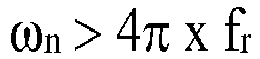
fr est le nombre de tours par seconde d'un excentrique (39) actionnable pour entraîner en giration au moins l'une des première et deuxième surfaces de broyage (6, 14). - Système de broyeur selon l'une quelconque des revendications 1 à 5, où le système de broyeur (1) comprend un dispositif de commande (30), lequel est actionnable pour commander la pression de précharge de l'accumulateur (26) au vu de la pression de service moyenne réelle du vérin hydraulique (10).
- Procédé de broyage de matériau entre une première surface de broyage (6) et une deuxième surface de broyage (14), un système hydraulique (16) étant actionnable pour ajuster un intervalle (12) entre la première surface de broyage (6) et la deuxième surface de broyage (14) en ajustant la position de la première surface de broyage (6) au moyen d'un vérin hydraulique (10) relié à ladite première surface de broyage (6), caractérisé en ce que des variations de la pression hydraulique du vérin hydraulique (10) sont atténuées au moyen d'un accumulateur (26) qui est en contact, via un liquide hydraulique continu, avec ledit vérin hydraulique (10), l'accumulateur (26) comprenant un compartiment à liquide hydraulique (46) et un compartiment à gaz (48) qui est séparé du compartiment à liquide hydraulique (46), l'accumulateur (26) présentant une pression de précharge, qui est la pression du compartiment à gaz (48) lorsque le compartiment à liquide hydraulique (46) est vide, laquelle est inférieure d'au moins 0,3 MPa à la pression de service moyenne du vérin hydraulique (10).
- Procédé de broyage de matériau selon la revendication 7, dans lequel la pression de précharge de l'accumulateur (26) est de 0,3 à 1 MPa inférieure à la pression de service moyenne du vérin hydraulique (10).
- Procédé de broyage de matériau selon l'une quelconque des revendications 7 et 8, dans lequel la pression de précharge réelle de l'accumulateur (26) est régulée au vu de la pression de service moyenne réelle du vérin hydraulique (10).
Applications Claiming Priority (2)
| Application Number | Priority Date | Filing Date | Title |
|---|---|---|---|
| SE0800760A SE532320C2 (sv) | 2008-04-04 | 2008-04-04 | Dämpning av tryckvariationer i krossar |
| PCT/SE2009/000160 WO2009123531A1 (fr) | 2008-04-04 | 2009-03-26 | Atténuation des variations de pression dans des broyeurs |
Publications (3)
| Publication Number | Publication Date |
|---|---|
| EP2271427A1 EP2271427A1 (fr) | 2011-01-12 |
| EP2271427A4 EP2271427A4 (fr) | 2017-05-17 |
| EP2271427B1 true EP2271427B1 (fr) | 2019-07-24 |
Family
ID=41135798
Family Applications (1)
| Application Number | Title | Priority Date | Filing Date |
|---|---|---|---|
| EP09726902.1A Active EP2271427B1 (fr) | 2008-04-04 | 2009-03-26 | Atténuation des variations de pression dans des broyeurs |
Country Status (11)
| Country | Link |
|---|---|
| US (1) | US7883042B2 (fr) |
| EP (1) | EP2271427B1 (fr) |
| CN (1) | CN102046292B (fr) |
| AU (1) | AU2009232465B2 (fr) |
| BR (1) | BRPI0911074A2 (fr) |
| CL (1) | CL2009000818A1 (fr) |
| RU (1) | RU2487761C2 (fr) |
| SE (1) | SE532320C2 (fr) |
| UA (1) | UA100885C2 (fr) |
| WO (1) | WO2009123531A1 (fr) |
| ZA (1) | ZA201007882B (fr) |
Cited By (1)
| Publication number | Priority date | Publication date | Assignee | Title |
|---|---|---|---|---|
| EP4477317A1 (fr) | 2023-06-12 | 2024-12-18 | Sandvik SRP AB | Variation de force de broyage réduite dans des broyeurs |
Families Citing this family (9)
| Publication number | Priority date | Publication date | Assignee | Title |
|---|---|---|---|---|
| SE531340C2 (sv) * | 2007-07-06 | 2009-03-03 | Sandvik Intellectual Property | Mätinstrument för en gyratorisk kross, samt sätt att indikera funktionen hos en sådan kross |
| FI123801B (fi) * | 2012-04-12 | 2013-10-31 | Metso Minerals Inc | Järjestelmä ja menetelmä murskaimen valvomiseksi ja ohjaamiseksi, murskain ja menetelmä murskaimen säätämiseksi |
| EP2774681B1 (fr) * | 2013-03-07 | 2016-05-18 | Sandvik Intellectual Property AB | Soupape de libération de pression hydraulique de concasseur giratoire |
| FI126939B (en) * | 2013-05-28 | 2017-08-15 | Metso Minerals Inc | Method of crusher operation, crushing system and crushing plant |
| CN104525352B (zh) * | 2014-11-18 | 2016-04-13 | 中国矿业大学 | 一种矿用破碎机抗共振的方法 |
| EP3669990B1 (fr) * | 2018-12-21 | 2023-08-16 | Metso Sweden AB | Système de surveillance |
| DE102020114106B4 (de) * | 2020-05-26 | 2024-03-28 | Kleemann Gmbh | Brecher |
| CN113510001B (zh) * | 2021-05-21 | 2022-06-10 | 徐州徐工矿业机械有限公司 | 一种精确调整破碎机排料口的方法 |
| WO2024155210A1 (fr) * | 2023-01-18 | 2024-07-25 | Общество с ограниченной ответственностью "КС-ТЕХНОЛОГИИ" | Concasseur conique avec système hydraulique amélioré |
Family Cites Families (14)
| Publication number | Priority date | Publication date | Assignee | Title |
|---|---|---|---|---|
| SU93125A2 (ru) * | 1949-09-27 | 1950-11-30 | Д.И. Веренов | Гирационна дробилка |
| US2579516A (en) * | 1950-08-28 | 1951-12-25 | Allis Chalmers Mfg Co | Gyratory crushfr with vertically adjustable head |
| GB1517963A (en) | 1975-07-01 | 1978-07-19 | Svedala Arbra Ab | Overload preventing devices in crushers |
| US4060205A (en) * | 1976-11-08 | 1977-11-29 | Allis-Chalmers Corporation | Hydraulic accumulator for use with gyratory crushers and combination of such accumulator with a gyratory crusher |
| FR2402482A1 (fr) * | 1977-09-08 | 1979-04-06 | Babbitless Sa | Dispositif de decharge de la noix de broyage d'un concasseur giratoire |
| US4192472A (en) * | 1978-04-17 | 1980-03-11 | Johnson Louis W | Cone crusher |
| GB2188253B (en) * | 1979-10-15 | 1989-11-29 | Barber Greene Co | Gyratory crusher |
| US4615491A (en) * | 1979-10-15 | 1986-10-07 | Telsmith Division Barber-Greene Company | Gyratory crusher with automatic tramp iron release |
| IT1147385B (it) | 1981-07-16 | 1986-11-19 | Giacomo Ferrero | Cilindraia o mulino a cilindri a regolazione e sicurezza idrauliche |
| SE456138B (sv) * | 1987-09-10 | 1988-09-12 | Boliden Ab | Forfarande for reglering av krosspaltbredden i en gyratorisk kross |
| SE511886C2 (sv) * | 1992-01-31 | 1999-12-13 | Svedala Arbra Ab | Sätt att styra en gyratorisk kross |
| US6446892B1 (en) * | 1992-12-10 | 2002-09-10 | Ralph Fasoli | Rock crushing machine |
| US5927623A (en) * | 1996-03-18 | 1999-07-27 | Cedarapids, Inc. | Gyratory crusher with automatic control system |
| US7832669B2 (en) * | 2007-12-14 | 2010-11-16 | Vendelin John C | Screw adjust cone crusher |
-
2008
- 2008-04-04 SE SE0800760A patent/SE532320C2/sv not_active IP Right Cessation
-
2009
- 2009-03-26 AU AU2009232465A patent/AU2009232465B2/en not_active Ceased
- 2009-03-26 RU RU2010145132/13A patent/RU2487761C2/ru not_active IP Right Cessation
- 2009-03-26 UA UAA201013080A patent/UA100885C2/ru unknown
- 2009-03-26 EP EP09726902.1A patent/EP2271427B1/fr active Active
- 2009-03-26 BR BRPI0911074A patent/BRPI0911074A2/pt not_active Application Discontinuation
- 2009-03-26 CN CN2009801191573A patent/CN102046292B/zh not_active Expired - Fee Related
- 2009-03-26 WO PCT/SE2009/000160 patent/WO2009123531A1/fr not_active Ceased
- 2009-04-02 US US12/385,255 patent/US7883042B2/en active Active
- 2009-04-03 CL CL2009000818A patent/CL2009000818A1/es unknown
-
2010
- 2010-11-03 ZA ZA2010/07882A patent/ZA201007882B/en unknown
Non-Patent Citations (1)
| Title |
|---|
| None * |
Cited By (3)
| Publication number | Priority date | Publication date | Assignee | Title |
|---|---|---|---|---|
| EP4477317A1 (fr) | 2023-06-12 | 2024-12-18 | Sandvik SRP AB | Variation de force de broyage réduite dans des broyeurs |
| WO2024256378A1 (fr) | 2023-06-12 | 2024-12-19 | Sandvik Srp Ab | Variation de force de broyage réduite dans des broyeurs |
| AU2024303969B2 (en) * | 2023-06-12 | 2026-02-19 | Sandvik Srp Ab | Reduced crushing force variation in crushers |
Also Published As
| Publication number | Publication date |
|---|---|
| AU2009232465A1 (en) | 2009-10-08 |
| EP2271427A4 (fr) | 2017-05-17 |
| AU2009232465B2 (en) | 2014-01-09 |
| US20090256015A1 (en) | 2009-10-15 |
| WO2009123531A1 (fr) | 2009-10-08 |
| CN102046292A (zh) | 2011-05-04 |
| EP2271427A1 (fr) | 2011-01-12 |
| SE0800760L (sv) | 2009-10-05 |
| ZA201007882B (en) | 2013-04-24 |
| RU2487761C2 (ru) | 2013-07-20 |
| SE532320C2 (sv) | 2009-12-15 |
| BRPI0911074A2 (pt) | 2016-08-02 |
| US7883042B2 (en) | 2011-02-08 |
| UA100885C2 (ru) | 2013-02-11 |
| RU2010145132A (ru) | 2012-05-20 |
| CL2009000818A1 (es) | 2010-02-05 |
| CN102046292B (zh) | 2013-04-24 |
Similar Documents
| Publication | Publication Date | Title |
|---|---|---|
| EP2271427B1 (fr) | Atténuation des variations de pression dans des broyeurs | |
| AU2010221836B2 (en) | A method and a device for controlling the operation of a gyratory crusher | |
| JP5553257B2 (ja) | ジョークラッシャ | |
| US9084998B2 (en) | Method of controlling the operation of a cone crusher | |
| EP2142301B1 (fr) | Procédé de commande pour un broyeur et broyeur | |
| US4856716A (en) | Gyratory crusher control | |
| RU2654752C2 (ru) | Способ управления дробилкой, дробильная система и дробильная установка | |
| US20210370308A1 (en) | Crusher | |
| AU2020245268B2 (en) | Cone crusher | |
| AU2013336504A1 (en) | Method for controlling a mineral material processing plant and a mineral material processing plant | |
| JP3962670B2 (ja) | 旋動式破砕機の油圧回路およびその油圧回路の制御方法 | |
| JP2008279314A (ja) | 破砕装置 | |
| JP3133766B2 (ja) | ジョークラッシャの出口隙間調整機構 | |
| JPWO1997036683A1 (ja) | ジョークラッシャの出口隙間調整機構 | |
| AU2024303969B2 (en) | Reduced crushing force variation in crushers | |
| WO1999048610A1 (fr) | Broyeur mobile | |
| WO2024080324A1 (fr) | Concasseur giratoire, et son dispositif de commande et son procédé de commande | |
| CN118029381A (zh) | 打桩机的控制方法及打桩机的液压系统 | |
| JPH10128141A (ja) | 粉砕装置 |
Legal Events
| Date | Code | Title | Description |
|---|---|---|---|
| PUAI | Public reference made under article 153(3) epc to a published international application that has entered the european phase |
Free format text: ORIGINAL CODE: 0009012 |
|
| 17P | Request for examination filed |
Effective date: 20101104 |
|
| AK | Designated contracting states |
Kind code of ref document: A1 Designated state(s): AT BE BG CH CY CZ DE DK EE ES FI FR GB GR HR HU IE IS IT LI LT LU LV MC MK MT NL NO PL PT RO SE SI SK TR |
|
| AX | Request for extension of the european patent |
Extension state: AL BA RS |
|
| DAX | Request for extension of the european patent (deleted) | ||
| STAA | Information on the status of an ep patent application or granted ep patent |
Free format text: STATUS: EXAMINATION IS IN PROGRESS |
|
| RA4 | Supplementary search report drawn up and despatched (corrected) |
Effective date: 20170418 |
|
| RIC1 | Information provided on ipc code assigned before grant |
Ipc: B02C 2/04 20060101AFI20170410BHEP |
|
| 17Q | First examination report despatched |
Effective date: 20170510 |
|
| GRAP | Despatch of communication of intention to grant a patent |
Free format text: ORIGINAL CODE: EPIDOSNIGR1 |
|
| STAA | Information on the status of an ep patent application or granted ep patent |
Free format text: STATUS: GRANT OF PATENT IS INTENDED |
|
| INTG | Intention to grant announced |
Effective date: 20190320 |
|
| GRAS | Grant fee paid |
Free format text: ORIGINAL CODE: EPIDOSNIGR3 |
|
| GRAA | (expected) grant |
Free format text: ORIGINAL CODE: 0009210 |
|
| STAA | Information on the status of an ep patent application or granted ep patent |
Free format text: STATUS: THE PATENT HAS BEEN GRANTED |
|
| AK | Designated contracting states |
Kind code of ref document: B1 Designated state(s): AT BE BG CH CY CZ DE DK EE ES FI FR GB GR HR HU IE IS IT LI LT LU LV MC MK MT NL NO PL PT RO SE SI SK TR |
|
| REG | Reference to a national code |
Ref country code: GB Ref legal event code: FG4D |
|
| REG | Reference to a national code |
Ref country code: CH Ref legal event code: EP |
|
| REG | Reference to a national code |
Ref country code: DE Ref legal event code: R096 Ref document number: 602009059214 Country of ref document: DE |
|
| REG | Reference to a national code |
Ref country code: AT Ref legal event code: REF Ref document number: 1157566 Country of ref document: AT Kind code of ref document: T Effective date: 20190815 |
|
| REG | Reference to a national code |
Ref country code: IE Ref legal event code: FG4D |
|
| REG | Reference to a national code |
Ref country code: NL Ref legal event code: MP Effective date: 20190724 |
|
| REG | Reference to a national code |
Ref country code: LT Ref legal event code: MG4D |
|
| REG | Reference to a national code |
Ref country code: AT Ref legal event code: MK05 Ref document number: 1157566 Country of ref document: AT Kind code of ref document: T Effective date: 20190724 |
|
| PG25 | Lapsed in a contracting state [announced via postgrant information from national office to epo] |
Ref country code: NO Free format text: LAPSE BECAUSE OF FAILURE TO SUBMIT A TRANSLATION OF THE DESCRIPTION OR TO PAY THE FEE WITHIN THE PRESCRIBED TIME-LIMIT Effective date: 20191024 Ref country code: NL Free format text: LAPSE BECAUSE OF FAILURE TO SUBMIT A TRANSLATION OF THE DESCRIPTION OR TO PAY THE FEE WITHIN THE PRESCRIBED TIME-LIMIT Effective date: 20190724 Ref country code: BG Free format text: LAPSE BECAUSE OF FAILURE TO SUBMIT A TRANSLATION OF THE DESCRIPTION OR TO PAY THE FEE WITHIN THE PRESCRIBED TIME-LIMIT Effective date: 20191024 Ref country code: LT Free format text: LAPSE BECAUSE OF FAILURE TO SUBMIT A TRANSLATION OF THE DESCRIPTION OR TO PAY THE FEE WITHIN THE PRESCRIBED TIME-LIMIT Effective date: 20190724 Ref country code: PT Free format text: LAPSE BECAUSE OF FAILURE TO SUBMIT A TRANSLATION OF THE DESCRIPTION OR TO PAY THE FEE WITHIN THE PRESCRIBED TIME-LIMIT Effective date: 20191125 Ref country code: HR Free format text: LAPSE BECAUSE OF FAILURE TO SUBMIT A TRANSLATION OF THE DESCRIPTION OR TO PAY THE FEE WITHIN THE PRESCRIBED TIME-LIMIT Effective date: 20190724 Ref country code: AT Free format text: LAPSE BECAUSE OF FAILURE TO SUBMIT A TRANSLATION OF THE DESCRIPTION OR TO PAY THE FEE WITHIN THE PRESCRIBED TIME-LIMIT Effective date: 20190724 Ref country code: SE Free format text: LAPSE BECAUSE OF FAILURE TO SUBMIT A TRANSLATION OF THE DESCRIPTION OR TO PAY THE FEE WITHIN THE PRESCRIBED TIME-LIMIT Effective date: 20190724 Ref country code: FI Free format text: LAPSE BECAUSE OF FAILURE TO SUBMIT A TRANSLATION OF THE DESCRIPTION OR TO PAY THE FEE WITHIN THE PRESCRIBED TIME-LIMIT Effective date: 20190724 |
|
| PG25 | Lapsed in a contracting state [announced via postgrant information from national office to epo] |
Ref country code: ES Free format text: LAPSE BECAUSE OF FAILURE TO SUBMIT A TRANSLATION OF THE DESCRIPTION OR TO PAY THE FEE WITHIN THE PRESCRIBED TIME-LIMIT Effective date: 20190724 Ref country code: GR Free format text: LAPSE BECAUSE OF FAILURE TO SUBMIT A TRANSLATION OF THE DESCRIPTION OR TO PAY THE FEE WITHIN THE PRESCRIBED TIME-LIMIT Effective date: 20191025 Ref country code: IS Free format text: LAPSE BECAUSE OF FAILURE TO SUBMIT A TRANSLATION OF THE DESCRIPTION OR TO PAY THE FEE WITHIN THE PRESCRIBED TIME-LIMIT Effective date: 20191124 Ref country code: LV Free format text: LAPSE BECAUSE OF FAILURE TO SUBMIT A TRANSLATION OF THE DESCRIPTION OR TO PAY THE FEE WITHIN THE PRESCRIBED TIME-LIMIT Effective date: 20190724 |
|
| PG25 | Lapsed in a contracting state [announced via postgrant information from national office to epo] |
Ref country code: RO Free format text: LAPSE BECAUSE OF FAILURE TO SUBMIT A TRANSLATION OF THE DESCRIPTION OR TO PAY THE FEE WITHIN THE PRESCRIBED TIME-LIMIT Effective date: 20190724 Ref country code: IT Free format text: LAPSE BECAUSE OF FAILURE TO SUBMIT A TRANSLATION OF THE DESCRIPTION OR TO PAY THE FEE WITHIN THE PRESCRIBED TIME-LIMIT Effective date: 20190724 Ref country code: EE Free format text: LAPSE BECAUSE OF FAILURE TO SUBMIT A TRANSLATION OF THE DESCRIPTION OR TO PAY THE FEE WITHIN THE PRESCRIBED TIME-LIMIT Effective date: 20190724 Ref country code: DK Free format text: LAPSE BECAUSE OF FAILURE TO SUBMIT A TRANSLATION OF THE DESCRIPTION OR TO PAY THE FEE WITHIN THE PRESCRIBED TIME-LIMIT Effective date: 20190724 Ref country code: PL Free format text: LAPSE BECAUSE OF FAILURE TO SUBMIT A TRANSLATION OF THE DESCRIPTION OR TO PAY THE FEE WITHIN THE PRESCRIBED TIME-LIMIT Effective date: 20190724 |
|
| PG25 | Lapsed in a contracting state [announced via postgrant information from national office to epo] |
Ref country code: IS Free format text: LAPSE BECAUSE OF FAILURE TO SUBMIT A TRANSLATION OF THE DESCRIPTION OR TO PAY THE FEE WITHIN THE PRESCRIBED TIME-LIMIT Effective date: 20200224 Ref country code: SK Free format text: LAPSE BECAUSE OF FAILURE TO SUBMIT A TRANSLATION OF THE DESCRIPTION OR TO PAY THE FEE WITHIN THE PRESCRIBED TIME-LIMIT Effective date: 20190724 Ref country code: CZ Free format text: LAPSE BECAUSE OF FAILURE TO SUBMIT A TRANSLATION OF THE DESCRIPTION OR TO PAY THE FEE WITHIN THE PRESCRIBED TIME-LIMIT Effective date: 20190724 |
|
| REG | Reference to a national code |
Ref country code: DE Ref legal event code: R097 Ref document number: 602009059214 Country of ref document: DE |
|
| PLBE | No opposition filed within time limit |
Free format text: ORIGINAL CODE: 0009261 |
|
| STAA | Information on the status of an ep patent application or granted ep patent |
Free format text: STATUS: NO OPPOSITION FILED WITHIN TIME LIMIT |
|
| PG2D | Information on lapse in contracting state deleted |
Ref country code: IS |
|
| 26N | No opposition filed |
Effective date: 20200603 |
|
| PG25 | Lapsed in a contracting state [announced via postgrant information from national office to epo] |
Ref country code: SI Free format text: LAPSE BECAUSE OF FAILURE TO SUBMIT A TRANSLATION OF THE DESCRIPTION OR TO PAY THE FEE WITHIN THE PRESCRIBED TIME-LIMIT Effective date: 20190724 |
|
| PG25 | Lapsed in a contracting state [announced via postgrant information from national office to epo] |
Ref country code: MC Free format text: LAPSE BECAUSE OF FAILURE TO SUBMIT A TRANSLATION OF THE DESCRIPTION OR TO PAY THE FEE WITHIN THE PRESCRIBED TIME-LIMIT Effective date: 20190724 |
|
| REG | Reference to a national code |
Ref country code: CH Ref legal event code: PL |
|
| REG | Reference to a national code |
Ref country code: BE Ref legal event code: MM Effective date: 20200331 |
|
| PG25 | Lapsed in a contracting state [announced via postgrant information from national office to epo] |
Ref country code: LU Free format text: LAPSE BECAUSE OF NON-PAYMENT OF DUE FEES Effective date: 20200326 |
|
| PG25 | Lapsed in a contracting state [announced via postgrant information from national office to epo] |
Ref country code: CH Free format text: LAPSE BECAUSE OF NON-PAYMENT OF DUE FEES Effective date: 20200331 Ref country code: IE Free format text: LAPSE BECAUSE OF NON-PAYMENT OF DUE FEES Effective date: 20200326 Ref country code: LI Free format text: LAPSE BECAUSE OF NON-PAYMENT OF DUE FEES Effective date: 20200331 |
|
| PG25 | Lapsed in a contracting state [announced via postgrant information from national office to epo] |
Ref country code: BE Free format text: LAPSE BECAUSE OF NON-PAYMENT OF DUE FEES Effective date: 20200331 |
|
| PG25 | Lapsed in a contracting state [announced via postgrant information from national office to epo] |
Ref country code: MT Free format text: LAPSE BECAUSE OF FAILURE TO SUBMIT A TRANSLATION OF THE DESCRIPTION OR TO PAY THE FEE WITHIN THE PRESCRIBED TIME-LIMIT Effective date: 20190724 Ref country code: CY Free format text: LAPSE BECAUSE OF FAILURE TO SUBMIT A TRANSLATION OF THE DESCRIPTION OR TO PAY THE FEE WITHIN THE PRESCRIBED TIME-LIMIT Effective date: 20190724 |
|
| PG25 | Lapsed in a contracting state [announced via postgrant information from national office to epo] |
Ref country code: MK Free format text: LAPSE BECAUSE OF FAILURE TO SUBMIT A TRANSLATION OF THE DESCRIPTION OR TO PAY THE FEE WITHIN THE PRESCRIBED TIME-LIMIT Effective date: 20190724 |
|
| P01 | Opt-out of the competence of the unified patent court (upc) registered |
Effective date: 20230603 |
|
| PGFP | Annual fee paid to national office [announced via postgrant information from national office to epo] |
Ref country code: DE Payment date: 20240130 Year of fee payment: 16 Ref country code: GB Payment date: 20240201 Year of fee payment: 16 |
|
| PGFP | Annual fee paid to national office [announced via postgrant information from national office to epo] |
Ref country code: TR Payment date: 20240227 Year of fee payment: 16 Ref country code: FR Payment date: 20240223 Year of fee payment: 16 |
|
| REG | Reference to a national code |
Ref country code: DE Ref legal event code: R119 Ref document number: 602009059214 Country of ref document: DE |
|
| GBPC | Gb: european patent ceased through non-payment of renewal fee |
Effective date: 20250326 |
|
| PG25 | Lapsed in a contracting state [announced via postgrant information from national office to epo] |
Ref country code: DE Free format text: LAPSE BECAUSE OF NON-PAYMENT OF DUE FEES Effective date: 20251001 |
|
| PG25 | Lapsed in a contracting state [announced via postgrant information from national office to epo] |
Ref country code: GB Free format text: LAPSE BECAUSE OF NON-PAYMENT OF DUE FEES Effective date: 20250326 |
|
| PG25 | Lapsed in a contracting state [announced via postgrant information from national office to epo] |
Ref country code: FR Free format text: LAPSE BECAUSE OF NON-PAYMENT OF DUE FEES Effective date: 20250331 |