EP2272220B1 - Dienstverwaltung in einem multikanal- und multihop-netz - Google Patents
Dienstverwaltung in einem multikanal- und multihop-netz Download PDFInfo
- Publication number
- EP2272220B1 EP2272220B1 EP09742248.9A EP09742248A EP2272220B1 EP 2272220 B1 EP2272220 B1 EP 2272220B1 EP 09742248 A EP09742248 A EP 09742248A EP 2272220 B1 EP2272220 B1 EP 2272220B1
- Authority
- EP
- European Patent Office
- Prior art keywords
- channels
- channel
- transmission
- level
- service
- Prior art date
- Legal status (The legal status is an assumption and is not a legal conclusion. Google has not performed a legal analysis and makes no representation as to the accuracy of the status listed.)
- Active
Links
Images


Classifications
-
- H—ELECTRICITY
- H04—ELECTRIC COMMUNICATION TECHNIQUE
- H04W—WIRELESS COMMUNICATION NETWORKS
- H04W72/00—Local resource management
- H04W72/02—Selection of wireless resources by user or terminal
-
- H—ELECTRICITY
- H04—ELECTRIC COMMUNICATION TECHNIQUE
- H04W—WIRELESS COMMUNICATION NETWORKS
- H04W84/00—Network topologies
- H04W84/18—Self-organising networks, e.g. ad-hoc networks or sensor networks
Definitions
- the present invention relates to the field of transmission networks, and more particularly the transmission networks adapted for multi-hop transmission.
- An example is in US2007 / 225044 .
- These vehicular networks make it possible to offer various services that are particularly suitable for vehicle drivers and / or their passengers.
- These services may for example relate to road safety, and may include reporting road hazards to the vehicles concerned.
- Such services may also relate to navigation services on the Internet network, such as for example offering an online game offer, or to inform of various services available in the geographical surroundings of the vehicle, or to offer an electronic payment possibility for gas, parking, motorway toll, or take-out catering, or even offer IP telephony or video streaming services.
- These networks are based, on the one hand, on a fixed infrastructure that includes roadside entities, as access points, and servers offering different services, as well as bridges connecting the vehicular network considered to other networks, such as the IP network to offer certain services and, on the other hand, mobile entities that are embedded at the level of the vehicles themselves.
- the figure 1 illustrates such a vehicular network whose architecture is based on a fixed infrastructure 10 including access points 12 located at the roadside and mobile entities 13 located at the vehicle.
- the mobile entities of such a network located at the vehicle level are referenced OBU (for 'On Board Unit') and the fixed entities situated at the edge of the road and allowing the mobile entities to access the part of the fixed network, or else access points, are referenced RSU (for 'Road-Side Unit').
- OBU for 'On Board Unit'
- RSU for 'Road-Side Unit'
- the part of the fixed network comprises at least one authentication server, referenced AAA Server 14 (for 'Authentication Authorization and Accounting'), which can concretely correspond to several network entities, and which is in charge of authenticating a mobile entity who wishes to access services of the network in question, before granting access to them.
- AAA Server 14 for 'Authentication Authorization and Accounting'
- this mobile entity can benefit from the services offered in this network, such as those stated above.
- a mobile entity at the level of a vehicle can establish, on the one hand, communications with another mobile entity at the level of another vehicle.
- IVC communication for 'Inter-Vehicle Communications'
- RVC for 'Road-to-Vehicle Communications'
- a vehicle 15 which is not located in the radio coverage of an access point 12 can still benefit from the services offered in this network via a multi-hop communication, if its location allows its mobile entity to communicate with the mobile entity of another vehicle which is able to communicate with an access point 12 of the vehicular network.
- certain OBU mobile entities of vehicles are used by other OBU mobile entities of vehicles to reach the fixed access points 12 of the network, via multi-hop communication.
- Transmissions according to the DSRC standard are performed in the frequency band from 5 850 GHz to 5 925 GHz. This bandwidth is segmented into seven 10 MHz radio channels each. These channels are functionally distributed into one control channel and six service channels, each of which can offer data rates ranging from 6 to 27 Mbps. Such a network enables high-speed communications between mobile entities on vehicles and the fixed infrastructure.
- the figure 2 illustrates the segmentation of DSRC bandwidth into seven channels.
- a control channel 4 is conventionally reserved for the transmission of network management messages. It is also used to transmit messages of high priority as can certain critical messages related to road safety.
- the other six channels, channels 1-3 and channels 5-7, are conventionally dedicated to the transmission of information relating to different services. The association between a service and a service channel is announced on the control channel.
- a mobile entity embedded in a vehicle that does not have direct access to the authentication server in the fixed infrastructure can, however, be authenticated and obtain access authorization to the network by establishing a communication via a network.
- another mobile entity on another vehicle that can communicate with the authentication server can, however, be authenticated and obtain access authorization to the network by establishing a communication via a network.
- the communication between the mobile entity of the vehicle wishing to proceed to an authentication phase and the authentication server, thus established via another mobile entity of another vehicle, is performed on a channel associated with the authentication service. which can sometimes be in a state of congestion such that it can not be able to transmit certain packets.
- a bottleneck problem can be fatal, especially in an authentication phase.
- An object of the present invention is to improve the situation.
- each transmission entity of the network is adapted to transmit a packet on a transmission channel among the N channels considered.
- the network comprises, as a vehicular network, a fixed infrastructure, with fixed transmission entities, and mobile entities.
- steps / 1 / to / 3 / can be implemented for all or part of the packets relating to a given service. In order to obtain the highest level of reliability for a given service, it is necessary to implement these steps for each packet to be transmitted.
- the current occupancy level of a channel may correspond to one of the states of a busy state and a free state; and the next busy level of a channel may indicate a quantity of information awaiting transmission on said channel.
- these channel occupancy levels make it possible to obtain an overall view of the transmission activity that takes place on the channel in question which makes it possible to carry out a selection of transmission channel that is relevant.
- At least one channel of the set of channels has a current free state of occupancy and a future occupation level indicating that there is no information awaiting transmission, said at least one channel is selected in step / 2 /.
- a channel can then be selected from said subset of channels randomly.
- each of the channels of the subset of channels can be selected with the same probability. This allows a distribution of the use of the relevant transmission channels to ensure a certain level of reliability for the service offered.
- step / 2 / it is also possible to select at least one channel having the minimum future occupancy level among the set of channels.
- This type of selection can advantageously be implemented in the case where no transmission channel of the set of channels has both a free current occupation level and a future occupation level with no information to be transmitted. In this case, we are still able to favor the transmission of the package in question.
- a channel is selected from said subset of channels randomly.
- each channel of the sub-set of channels can be equally selected, which makes it possible to optimize the distribution of the packet transmission of the service under consideration on all these channels of the subset and thus make the offer of this service more reliable.
- a transmission entity of the considered network broadcasts in this transmission network an indication relating to the set of N channels associated with the service.
- the entities of the network learn all the transmission channels that are associated with the service in question.
- this indication relating to the set of N channels associated with the service may be received on request.
- the multi-hop transmission network may be a vehicular type network and the service may correspond to a mobile entity authentication step.
- a second aspect of the present invention provides a transmission entity adapted to implement the service management method according to the first aspect of the present invention.
- a third aspect of the present invention provides a system for managing at least one service offered in a multi-hop transmission network comprising at least one transmission entity according to the second aspect of the present invention.
- a fourth aspect of the present invention provides a computer program including instructions for implementing the management method according to the first aspect of the present invention when this program is executed by a processor.
- a fifth aspect of the present invention provides a recording medium on which the computer program according to the fourth aspect of the present invention is stored.
- the present invention is subsequently described in its application to vehicular network type networks comprising a fixed infrastructure and mobile entities that are embedded in mobile vehicles.
- the fixed infrastructure includes fixed entities that are respectively adapted to allow mobile entities to access network services, or access points and fixed entities that correspond to servers in charge of offering a service such as an AAA server in charge of providing a mobile entity authentication service before allowing access to any other service offered in that network.
- the first of these functions corresponds to a registration phase during which the services or applications offered in the network register with the mobile entities and access points 12 of the fixed infrastructure. It can be expected to set a priority level for the application during this registration phase. Thus fixed and mobile entities know this level of priority for each service offered.
- the second function is monitoring the control channel: the mobile entities (or OBUs) regularly listen to the control channel through which they receive announcements relating to applications or services or critical messages related to road safety.
- the third function is an announcement of applications or services in which the fixed access points (or RSUs) advertise the possible services on the control channel periodically or on demand.
- This announcement phase is based on a service table or a PST (for 'Provider Service Table').
- this PST indicates, for a given application, a set of channels on which the application can be implemented as well as parameters related to this application.
- a fourth function corresponds to a phase of initialization and execution of the applications or services during which the applications are initialized and then implemented on the basis of the information indicated in the PST.
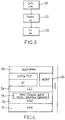
- the figure 3 illustrates the main steps of a service management method in an embodiment of the present invention.
- Such a method according to one embodiment of the present invention can advantageously be implemented at any entity of the network in question, be it a mobile entity or a fixed entity of the fixed infrastructure.
- the entity of the network in question obtains information relating to a current level of occupation of a set of radio channels associated with the service and / or a future occupation level of these radio channels.
- a step 22 based on the respective occupancy levels of these radio channels in the network, one of these channels is selected.
- a channel with a low level of current and / or future occupancy for the transmission of a packet belonging to certain services and of select a channel that may have a relatively high current and / or future occupancy level to transmit a packet belonging to certain other services.
- the concerned network entity transmits the packet awaiting transmission to the protocol layers in charge of transmission for transmission of the packet on that selected channel. This transmission can be performed immediately if the selected channel has a current occupation level to free and a future occupation level equal to zero.
- the figure 4 illustrates a stack of protocol layers according to an embodiment of the present invention adapted to be implemented on entities of a network defined according to the DSRC standard.
- This stack of protocol layers comprises a physical layer 'PHY' 31. Then, there is a medium access control layer 'MAC' 32 (for 'Medium Access Control') above which is positioned a control layer of logical link 'LLC' (or 'Logical Link Control') 34.
- protocol layer 35 that can correspond to either a WSMP (for 'Wave Short Message Protocol') layer, or a TCP / IP (for Transmission Control Protocol / Internet Protocol) layer, or even UDP / IP (for 'User Datagram Protocol / Internet Protocol').
- WSMP for 'Wave Short Message Protocol'
- TCP / IP for Transmission Control Protocol / Internet Protocol
- UDP / IP for 'User Datagram Protocol / Internet Protocol'
- This protocol layer 35 is surmounted by a transport protocol layer of the application 36.
- a multi-channel management protocol layer 33 (or Multi-Channel and / or Multi-Interface Operation) is introduced within the MAC protocol layer 32.
- Such a protocol layer 33 introduced into this protocol stack advantageously makes it possible to determine the state of the radio channels (or in English Channel Sensing), while the protocol transport layer of the application 36 is in charge of implementing the main steps of the management method according to an embodiment of the present invention.
- a field indicates the transmission channel number to be used by the protocols in charge of the transmission.
- the managed service according to the management protocol corresponds to the network access authentication and authorization service for a mobile entity.
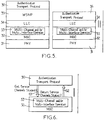
- the figure 5 illustrates two examples of protocol stacks adapted for such an implementation. These two protocol stacks illustrated here are similar to that illustrated and described in the preceding sections, in which the transport layer of the application 36 corresponds to a transport layer of the Authentication Transport Protocol ('Authentication Transport Protocol').
- the transport layer of the authentication protocol is in charge of choosing from radio channels that one wishes to exploit, the radio channel on which the authentication packet will be transmitted.
- a request on the state of the service channels considered is transmitted to the MAC layer which in return returns the different states of the channels.
- the channel information that is passed by the ReturnServiceChannelsStates () function indicates the state of a channel, which is a current level of channel occupancy and a future busy level of the channel.
- the current occupancy level of the index channel i may be free or occupied and indicated by a variable 'Busy i ' which is set to 1 to indicate a busy channel and to 0 to indicate a free channel.
- the future occupancy level of the channel may indicate a queue size of the packets awaiting transmission on the channel in question. This size can be indicated in a 'Length i ' variable expressed in bits for all services using this index channel i.
- all the entities of the considered network whether they belong to the fixed infrastructure or that they are mobile entities, as soon as they are required to transmit an authentication packet , implement the main steps of such a management method. More specifically, the channel selection step 22 can advantageously be implemented as described below and as illustrated in FIG. figure 7 at the transport layer of the authentication protocol 36.
- the transport layer 36 for the service in question knows the current and future occupancy states of the radio channels that can potentially be used for this service.
- the radio channel selection step 22 is implemented.
- This step comprises first of all a test step 601 for detecting whether there is at least one radio channel satisfying the two following selection criteria, a channel having both a free current occupancy level and a level of control. future occupation indicating that no packet is waiting for transmission. If this is the case, it is tested in step 603 if there are several radio channels that verify these two criteria. In the case where there is only one, this channel is selected and its number is then registered in a corresponding field of the authentication transport protocol at a step 606.
- the number of the selected channel is entered in a corresponding field of the authentication transport protocol.
- This channel is advantageously selected, thus enabling transmission of the fast and efficient authentication packet.
- radio channels having the lowest level of occupancy of the next channel that is to say for example the radio channels for which the number of bits awaiting transmission is the lowest.
- a test step 607 if only one radio channel has a minimum channel occupancy level, then that channel is selected and its number is written in a corresponding field of the authentication transport protocol in step 606.
- the selection of the transmission channel for the packet to be transmitted corresponds to the end of the selection step 22, step E (for 'End') 605, according to one embodiment of the present invention.
- Such a step 22 makes it possible, in priority, to select from among a set of channels, a channel on which there is no activity and whose queue of packets awaiting transmission is empty. When such a channel is not available, a channel, whose queue of packets waiting for transmission is the smallest, is then selected.
- step 604 one of a plurality of channels corresponding to one or more selection criteria is selected, so that each of these channels can be selected with the same probability.
- one can use methods well known to those skilled in the art which are based on pseudorandom number generators.
- the range of reals bounded by 0 and 1 it is possible to segment the range of reals bounded by 0 and 1, in sub-ranges of equal size, the number of sub-ranges corresponding to the number of eligible channels.
- the sub-ranges are allocated respectively to the different channels meeting the selection criteria.
- a pseudo-random number of between 0 and 1 is generated by implementing the pseudo-random number generator.
- the number of the finally selected channel then corresponds to the sub-range to which the generated number belongs.
- the figure 8 illustrates an architecture of a fixed or mobile entity according to an embodiment of the present invention.
- the service provision thus managed can advantageously be robust and reliable, since the transmission corresponding packets are performed on a selected channel according to its occupancy level.
- the implementation of a method as described above makes it possible to improve the authentication success rate, especially in the presence of transmission of packets relating to third-party traffics other than those relating to authentication.
- the implementation of an embodiment of the present invention is particularly adapted to the high mobility of mobile entities in vehicular networks since it makes it possible to reduce the delays of transmission of packets that are induced by a large contention on certain channels. network radio at times.
- This solution is transferable to other wireless network technologies supporting multiple transmission channels.
- an embodiment of the present invention can advantageously be implemented at each of the entities requested for the transmission of packets relating to the service in question.
- this selection step 22 may, for example, not select channels having both a current and a free current occupation level and a future occupation level indicating that no packet is waiting for transmission as it is performed in steps 603 and 604 or 606, but to implement only steps 608 and following, i.e. steps for selecting a channel that has a minimum future channel occupancy level. .
- the set of eligible channels does not include the control channel.
- the features of the present invention provide a great deal of priority level configuration flexibility of the different services offered.
- An easy implementation of such a service management method can be based on the protocol stack as described above with reference to FIG. figure 3 , and more specifically, on an interaction between the transport layer of the targeted service protocol and a MAC DSRC layer, which may possibly support multiple interfaces.
- an embodiment of the present invention can advantageously be applied in networks based on other technologies supporting multiple channels and implementing a multi-hop service.
Landscapes
- Engineering & Computer Science (AREA)
- Computer Networks & Wireless Communication (AREA)
- Signal Processing (AREA)
- Mobile Radio Communication Systems (AREA)
Claims (13)
- Verfahren zur Verwaltung wenigstens eines Dienstes, der in einem Multi-Hop-Übertragungsnetz (10) angeboten wird, das dafür ausgelegt ist, Pakete des Dienstes über mehrere Übertragungsentitäten (12, 13) auf einer Menge von N Funkübertragungskanälen zu übertragen, wobei N eine ganze Zahl ist, die größer oder gleich 2 ist,
wobei die Menge von N Kanälen dem Dienst zugeordnet ist;
wobei das Verfahren die folgenden Schritte auf der Ebene einer Entität unter den mehreren Übertragungsentitäten umfasst, um ein Paket zu übertragen:/1/ Gewinnen (21) von Informationen, die einen aktuellen Belegungsgrad und einen zukünftigen Belegungsgrad für jeden der N jeweiligen Kanäle betreffen, wobei der zukünftige Belegungsgrad eines Kanals eine Menge von Informationen angibt, die auf eine Übertragung auf dem Kanal warten, oder wobei der zukünftige Belegungsgrad eines Kanals angibt, ob sich kein Paket in Erwartung einer Übertragung befindet;/2/ Auswählen (22) eines Kanals unter den Kanälen in Abhängigkeit von den Informationen; und/3/ Übertragen (23) des Pakets auf dem ausgewählten Kanal. - Verfahren zur Dienstverwaltung nach Anspruch 1,
wobei die Entität für jedes zu übertragende Paket die Schritte /1/ bis /3/ durchführt. - Verfahren zur Dienstverwaltung nach Anspruch 1,
wobei der aktuelle Belegungsgrad eines Kanals einem der Zustände aus einem belegten Zustand und einem freien Zustand entspricht. - Verfahren zur Dienstverwaltung nach Anspruch 3,
wobei, falls wenigstens ein Kanal der Menge von Kanälen einen aktuellen Belegungsgrad im freien Zustand und einen zukünftigen Belegungsgrad, der angibt, das sich kein Paket in Erwartung einer Übertragung befindet, aufweist, der wenigstens eine Kanal im Schritt /2/ ausgewählt wird. - Verfahren zur Dienstverwaltung nach Anspruch 4,
wobei, falls eine Untermenge von Kanälen der Menge von Kanälen einen aktuellen Belegungsgrad im freien Zustand und einen zukünftigen Belegungsgrad, der angibt, das sich keine Informationen in Erwartung einer Übertragung befinden, aufweist, im Schritt /2/ ein Kanal aus der Untermenge von Kanälen zufällig ausgewählt wird. - Verfahren zur Dienstverwaltung nach Anspruch 5,
wobei im Schritt /2/ wenigstens ein Kanal ausgewählt wird, der in der Menge von Kanälen einen minimalen zukünftigen Belegungsgrad aufweist. - Verfahren zur Dienstverwaltung nach Anspruch 6,
wobei, falls eine Untermenge von Kanälen der Menge von Kanälen einen minimalen zukünftigen Belegungsgrad aufweist, in Schritt /2/ ein Kanal aus der Untermenge von Kanälen zufällig ausgewählt wird. - Verfahren zur Dienstverwaltung nach Anspruch 1,
wobei das Multi-Hop-Übertragungsnetz ein Netz vom Typ eines Fahrzeugnetzes ist, das eine feste Infrastruktur (10) und wenigstens eine mobile Entität (13) umfasst; und wobei der Dienst ein Schritt der Authentifizierung der mobilen Entität ist. - Verfahren zur Dienstverwaltung nach Anspruch 1,
wobei eine Übertragungsentität in dem Übertragungsnetz eine Angabe rundsendet, welche die Menge von N Kanälen betrifft, die dem Dienst zugeordnet ist. - Übertragungsentität (12) in einem Multi-Hop-Übertragungsnetz, das wenigstens einen Dienst anbietet, wobei das Netz wenigstens eine weitere Übertragungsentität (13) umfasst und dafür ausgelegt ist, Pakete des Dienstes auf einer Menge von N Funkübertragungskanälen zu übertragen, wobei N eine ganze Zahl ist, die größer oder gleich 2 ist;
wobei die Übertragungsentität einen Protokollstapel umfasst, welcher beinhaltet:- eine untere erste Protokollschicht (33) zur Zugriffssteuerung für eine Menge von Kanälen, die dafür ausgelegt ist, für die Kanäle der Menge jeweils einen aktuellen und einen zukünftigen Belegungsgrad zu bestimmen, wobei der zukünftige Belegungsgrad eines Kanals eine Menge von Informationen angibt, die auf eine Übertragung auf dem Kanal warten, oder wobei der zukünftige Belegungsgrad eines Kanals angibt, ob sich kein Paket in Erwartung einer Übertragung befindet; und- eine obere zweite Protokollschicht (36) zur Transportverwaltung des Dienstes, welche umfasst:- eine Gewinnungseinheit (81), die dafür ausgelegt ist, Informationen zu gewinnen, die einen aktuellen Belegungsgrad und einen zukünftigen Belegungsgrad der jeweiligen Kanäle auf der Ebene der ersten Schicht betreffen; und- eine Auswahleinheit (82), die dafür ausgelegt ist, in Abhängigkeit von den Informationen einen Kanal unter den Kanälen auszuwählen; wobei der ausgewählte Kanal für die Übertragung eines Pakets des Dienstes verwendet wird. - System zur Verwaltung wenigstens eines Dienstes, der in einem Multi-Hop-Übertragungsnetz angeboten wird, welches wenigstens eine Übertragungsentität nach Anspruch 10 umfasst.
- Computerprogramm, welches Anweisungen zur Ausführung des Verfahrens zur Verwaltung nach Anspruch 1, wenn dieses Programm von einem Prozessor ausgeführt wird, umfasst.
- Aufzeichnungsmedium, auf dem das Computerprogramm nach Anspruch 12 gespeichert ist.
Applications Claiming Priority (2)
| Application Number | Priority Date | Filing Date | Title |
|---|---|---|---|
| FR0852617 | 2008-04-17 | ||
| PCT/FR2009/050583 WO2009136050A1 (fr) | 2008-04-17 | 2009-04-06 | Gestion de service dans un reseau multicanaux et multi sauts |
Publications (2)
| Publication Number | Publication Date |
|---|---|
| EP2272220A1 EP2272220A1 (de) | 2011-01-12 |
| EP2272220B1 true EP2272220B1 (de) | 2017-06-28 |
Family
ID=40085459
Family Applications (1)
| Application Number | Title | Priority Date | Filing Date |
|---|---|---|---|
| EP09742248.9A Active EP2272220B1 (de) | 2008-04-17 | 2009-04-06 | Dienstverwaltung in einem multikanal- und multihop-netz |
Country Status (2)
| Country | Link |
|---|---|
| EP (1) | EP2272220B1 (de) |
| WO (1) | WO2009136050A1 (de) |
Families Citing this family (1)
| Publication number | Priority date | Publication date | Assignee | Title |
|---|---|---|---|---|
| CN110717756B (zh) * | 2019-09-11 | 2022-05-24 | 口碑(上海)信息技术有限公司 | 基于合约的支付数据处理装置及方法 |
Family Cites Families (3)
| Publication number | Priority date | Publication date | Assignee | Title |
|---|---|---|---|---|
| US7702817B2 (en) * | 2003-10-28 | 2010-04-20 | Microsoft Corporation | Wireless network access technologies for retrieving a virtual resource via a plurality of wireless network interfaces |
| KR100717963B1 (ko) * | 2005-12-28 | 2007-05-14 | 전자부품연구원 | Rse와 obe 간의 혼잡 회피 방법 |
| US7817609B2 (en) * | 2006-03-27 | 2010-10-19 | Ka Lun Eddie Law | Multi-channel wireless networks |
-
2009
- 2009-04-06 WO PCT/FR2009/050583 patent/WO2009136050A1/fr not_active Ceased
- 2009-04-06 EP EP09742248.9A patent/EP2272220B1/de active Active
Non-Patent Citations (1)
| Title |
|---|
| None * |
Also Published As
| Publication number | Publication date |
|---|---|
| WO2009136050A1 (fr) | 2009-11-12 |
| EP2272220A1 (de) | 2011-01-12 |
Similar Documents
| Publication | Publication Date | Title |
|---|---|---|
| EP2335431B1 (de) | Verteilung einer authentifikationsfunktion in einem mobilnetz | |
| EP2116015B1 (de) | Verfahren zur schätzung und signalisierung der dichte mobiler knoten in einem strassennetz | |
| Morgan | [Retracted] Managing DSRC and WAVE Standards Operations in a V2V Scenario | |
| EP2078412B1 (de) | Verfahren für den zugang zu einem dienst von einem benutzerendgerät über ein heterogenes netzwerk mit verschiedenen verfügbaren zugangstypen | |
| EP3771161B1 (de) | Auswahl einer instanziierung eines teilnetzes für die uplink-paketübertragung | |
| EP2705723A1 (de) | Verfahren zur herstellung einer ersten und einer zweiten voneinander entkoppelten assoziation | |
| FR2758681A1 (fr) | Allocation a une pluralite d'elements d'autorisations d'acces a une ressource partagee | |
| EP2158735B1 (de) | Verfahren zur kommunikation zwischen quell- und zielknotens, die zu einem fahrzeugnetzwerk gehören | |
| EP3676992B1 (de) | Verfahren zur gebührenabrechnung von daten, die auf einem abschnitt eines kommunikationsnetzwerks geleitet werden | |
| EP2201814B1 (de) | Verfahren zur rundsendung von datenpaketen in einem netzwerk aus mobilen knoten und entsprechendes endgerät | |
| EP2871903A1 (de) | Mehrfachzugangsverfahren und -system mit frequenziellem Multiplexen mehrerer Autorisierungsanfragen zur Datenübertragung über einen Quellenknoten | |
| EP2070276B1 (de) | Verfahren zur bewertung der zuverlässigkeit einer route in einem kooperativen netzwerk | |
| EP2502384B1 (de) | Verfahren und system zur inhaltsverteilung mit lieferzeitskalagarantien in hybriden funknetzen | |
| WO2014087057A1 (fr) | Communication en mode direct dans un système de radiocommunication large bande | |
| EP1999905A1 (de) | Betriebsmittelzuteilung auf der basis der lebenszeit von anforderungen von verschiedenen knoten | |
| EP2220797A2 (de) | Verfahren zum verteilen von datenpaketen in einem mobilknotennetz und diesbezüglicher knoten | |
| EP2272220B1 (de) | Dienstverwaltung in einem multikanal- und multihop-netz | |
| FR3113346A1 (fr) | Procédé de traitement d’un service de transport de données | |
| Luan et al. | Enabling content distribution in vehicular ad hoc networks | |
| EP2294875B1 (de) | Technik zum ausstrahlen über einen kommunikationsnetzknoten | |
| EP3205175B1 (de) | Verfahren zur autorisierung von übertragungsanfragen | |
| EP2854467B1 (de) | System und Verfahren zum Aufteilen der verteilten Kapazität in einem Ad-hoc-Netz | |
| EP2832154B1 (de) | Verfahren und leitweglenkvorrichtung für die kommunikation zwischen fahrzeugen | |
| EP3348043B1 (de) | Verfahren und system zur herstellung des internetzugangs durch die verwendung eines drahtloskommunikationsprotokolls in einem lokalen computernetzwerk von einer mobilen client-station | |
| EP2073450A1 (de) | Verfahren zur Kommunikation zwischen einem Endgerät und einem Kommunikationsnetz |
Legal Events
| Date | Code | Title | Description |
|---|---|---|---|
| PUAI | Public reference made under article 153(3) epc to a published international application that has entered the european phase |
Free format text: ORIGINAL CODE: 0009012 |
|
| 17P | Request for examination filed |
Effective date: 20101110 |
|
| AK | Designated contracting states |
Kind code of ref document: A1 Designated state(s): AT BE BG CH CY CZ DE DK EE ES FI FR GB GR HR HU IE IS IT LI LT LU LV MC MK MT NL NO PL PT RO SE SI SK TR |
|
| AX | Request for extension of the european patent |
Extension state: AL BA RS |
|
| DAX | Request for extension of the european patent (deleted) | ||
| 17Q | First examination report despatched |
Effective date: 20120903 |
|
| RAP1 | Party data changed (applicant data changed or rights of an application transferred) |
Owner name: ORANGE |
|
| REG | Reference to a national code |
Ref country code: DE Ref legal event code: R079 Ref document number: 602009046858 Country of ref document: DE Free format text: PREVIOUS MAIN CLASS: H04L0012560000 Ipc: H04W0072020000 |
|
| GRAP | Despatch of communication of intention to grant a patent |
Free format text: ORIGINAL CODE: EPIDOSNIGR1 |
|
| STAA | Information on the status of an ep patent application or granted ep patent |
Free format text: STATUS: GRANT OF PATENT IS INTENDED |
|
| RIC1 | Information provided on ipc code assigned before grant |
Ipc: H04L 12/801 20130101ALI20170130BHEP Ipc: H04W 72/02 20090101AFI20170130BHEP Ipc: H04W 84/18 20090101ALI20170130BHEP |
|
| INTG | Intention to grant announced |
Effective date: 20170221 |
|
| GRAS | Grant fee paid |
Free format text: ORIGINAL CODE: EPIDOSNIGR3 |
|
| GRAA | (expected) grant |
Free format text: ORIGINAL CODE: 0009210 |
|
| STAA | Information on the status of an ep patent application or granted ep patent |
Free format text: STATUS: THE PATENT HAS BEEN GRANTED |
|
| AK | Designated contracting states |
Kind code of ref document: B1 Designated state(s): AT BE BG CH CY CZ DE DK EE ES FI FR GB GR HR HU IE IS IT LI LT LU LV MC MK MT NL NO PL PT RO SE SI SK TR |
|
| REG | Reference to a national code |
Ref country code: GB Ref legal event code: FG4D Free format text: NOT ENGLISH |
|
| REG | Reference to a national code |
Ref country code: CH Ref legal event code: EP |
|
| REG | Reference to a national code |
Ref country code: AT Ref legal event code: REF Ref document number: 905843 Country of ref document: AT Kind code of ref document: T Effective date: 20170715 |
|
| REG | Reference to a national code |
Ref country code: IE Ref legal event code: FG4D Free format text: LANGUAGE OF EP DOCUMENT: FRENCH |
|
| REG | Reference to a national code |
Ref country code: DE Ref legal event code: R096 Ref document number: 602009046858 Country of ref document: DE |
|
| PG25 | Lapsed in a contracting state [announced via postgrant information from national office to epo] |
Ref country code: GR Free format text: LAPSE BECAUSE OF FAILURE TO SUBMIT A TRANSLATION OF THE DESCRIPTION OR TO PAY THE FEE WITHIN THE PRESCRIBED TIME-LIMIT Effective date: 20170929 Ref country code: HR Free format text: LAPSE BECAUSE OF FAILURE TO SUBMIT A TRANSLATION OF THE DESCRIPTION OR TO PAY THE FEE WITHIN THE PRESCRIBED TIME-LIMIT Effective date: 20170628 Ref country code: LT Free format text: LAPSE BECAUSE OF FAILURE TO SUBMIT A TRANSLATION OF THE DESCRIPTION OR TO PAY THE FEE WITHIN THE PRESCRIBED TIME-LIMIT Effective date: 20170628 Ref country code: FI Free format text: LAPSE BECAUSE OF FAILURE TO SUBMIT A TRANSLATION OF THE DESCRIPTION OR TO PAY THE FEE WITHIN THE PRESCRIBED TIME-LIMIT Effective date: 20170628 Ref country code: NO Free format text: LAPSE BECAUSE OF FAILURE TO SUBMIT A TRANSLATION OF THE DESCRIPTION OR TO PAY THE FEE WITHIN THE PRESCRIBED TIME-LIMIT Effective date: 20170928 |
|
| REG | Reference to a national code |
Ref country code: NL Ref legal event code: MP Effective date: 20170628 |
|
| REG | Reference to a national code |
Ref country code: LT Ref legal event code: MG4D |
|
| REG | Reference to a national code |
Ref country code: AT Ref legal event code: MK05 Ref document number: 905843 Country of ref document: AT Kind code of ref document: T Effective date: 20170628 |
|
| PG25 | Lapsed in a contracting state [announced via postgrant information from national office to epo] |
Ref country code: NL Free format text: LAPSE BECAUSE OF FAILURE TO SUBMIT A TRANSLATION OF THE DESCRIPTION OR TO PAY THE FEE WITHIN THE PRESCRIBED TIME-LIMIT Effective date: 20170628 Ref country code: LV Free format text: LAPSE BECAUSE OF FAILURE TO SUBMIT A TRANSLATION OF THE DESCRIPTION OR TO PAY THE FEE WITHIN THE PRESCRIBED TIME-LIMIT Effective date: 20170628 Ref country code: BG Free format text: LAPSE BECAUSE OF FAILURE TO SUBMIT A TRANSLATION OF THE DESCRIPTION OR TO PAY THE FEE WITHIN THE PRESCRIBED TIME-LIMIT Effective date: 20170928 Ref country code: SE Free format text: LAPSE BECAUSE OF FAILURE TO SUBMIT A TRANSLATION OF THE DESCRIPTION OR TO PAY THE FEE WITHIN THE PRESCRIBED TIME-LIMIT Effective date: 20170628 |
|
| PG25 | Lapsed in a contracting state [announced via postgrant information from national office to epo] |
Ref country code: CZ Free format text: LAPSE BECAUSE OF FAILURE TO SUBMIT A TRANSLATION OF THE DESCRIPTION OR TO PAY THE FEE WITHIN THE PRESCRIBED TIME-LIMIT Effective date: 20170628 Ref country code: SK Free format text: LAPSE BECAUSE OF FAILURE TO SUBMIT A TRANSLATION OF THE DESCRIPTION OR TO PAY THE FEE WITHIN THE PRESCRIBED TIME-LIMIT Effective date: 20170628 Ref country code: RO Free format text: LAPSE BECAUSE OF FAILURE TO SUBMIT A TRANSLATION OF THE DESCRIPTION OR TO PAY THE FEE WITHIN THE PRESCRIBED TIME-LIMIT Effective date: 20170628 Ref country code: EE Free format text: LAPSE BECAUSE OF FAILURE TO SUBMIT A TRANSLATION OF THE DESCRIPTION OR TO PAY THE FEE WITHIN THE PRESCRIBED TIME-LIMIT Effective date: 20170628 Ref country code: AT Free format text: LAPSE BECAUSE OF FAILURE TO SUBMIT A TRANSLATION OF THE DESCRIPTION OR TO PAY THE FEE WITHIN THE PRESCRIBED TIME-LIMIT Effective date: 20170628 |
|
| PG25 | Lapsed in a contracting state [announced via postgrant information from national office to epo] |
Ref country code: IT Free format text: LAPSE BECAUSE OF FAILURE TO SUBMIT A TRANSLATION OF THE DESCRIPTION OR TO PAY THE FEE WITHIN THE PRESCRIBED TIME-LIMIT Effective date: 20170628 Ref country code: PL Free format text: LAPSE BECAUSE OF FAILURE TO SUBMIT A TRANSLATION OF THE DESCRIPTION OR TO PAY THE FEE WITHIN THE PRESCRIBED TIME-LIMIT Effective date: 20170628 Ref country code: IS Free format text: LAPSE BECAUSE OF FAILURE TO SUBMIT A TRANSLATION OF THE DESCRIPTION OR TO PAY THE FEE WITHIN THE PRESCRIBED TIME-LIMIT Effective date: 20171028 Ref country code: ES Free format text: LAPSE BECAUSE OF FAILURE TO SUBMIT A TRANSLATION OF THE DESCRIPTION OR TO PAY THE FEE WITHIN THE PRESCRIBED TIME-LIMIT Effective date: 20170628 |
|
| REG | Reference to a national code |
Ref country code: DE Ref legal event code: R097 Ref document number: 602009046858 Country of ref document: DE |
|
| REG | Reference to a national code |
Ref country code: FR Ref legal event code: PLFP Year of fee payment: 10 |
|
| PG25 | Lapsed in a contracting state [announced via postgrant information from national office to epo] |
Ref country code: DK Free format text: LAPSE BECAUSE OF FAILURE TO SUBMIT A TRANSLATION OF THE DESCRIPTION OR TO PAY THE FEE WITHIN THE PRESCRIBED TIME-LIMIT Effective date: 20170628 |
|
| PLBE | No opposition filed within time limit |
Free format text: ORIGINAL CODE: 0009261 |
|
| STAA | Information on the status of an ep patent application or granted ep patent |
Free format text: STATUS: NO OPPOSITION FILED WITHIN TIME LIMIT |
|
| 26N | No opposition filed |
Effective date: 20180329 |
|
| PG25 | Lapsed in a contracting state [announced via postgrant information from national office to epo] |
Ref country code: SI Free format text: LAPSE BECAUSE OF FAILURE TO SUBMIT A TRANSLATION OF THE DESCRIPTION OR TO PAY THE FEE WITHIN THE PRESCRIBED TIME-LIMIT Effective date: 20170628 |
|
| PG25 | Lapsed in a contracting state [announced via postgrant information from national office to epo] |
Ref country code: MT Free format text: LAPSE BECAUSE OF FAILURE TO SUBMIT A TRANSLATION OF THE DESCRIPTION OR TO PAY THE FEE WITHIN THE PRESCRIBED TIME-LIMIT Effective date: 20170628 |
|
| PG25 | Lapsed in a contracting state [announced via postgrant information from national office to epo] |
Ref country code: MC Free format text: LAPSE BECAUSE OF FAILURE TO SUBMIT A TRANSLATION OF THE DESCRIPTION OR TO PAY THE FEE WITHIN THE PRESCRIBED TIME-LIMIT Effective date: 20170628 |
|
| REG | Reference to a national code |
Ref country code: CH Ref legal event code: PL |
|
| REG | Reference to a national code |
Ref country code: BE Ref legal event code: MM Effective date: 20180430 |
|
| REG | Reference to a national code |
Ref country code: IE Ref legal event code: MM4A |
|
| PG25 | Lapsed in a contracting state [announced via postgrant information from national office to epo] |
Ref country code: LU Free format text: LAPSE BECAUSE OF NON-PAYMENT OF DUE FEES Effective date: 20180406 |
|
| PG25 | Lapsed in a contracting state [announced via postgrant information from national office to epo] |
Ref country code: LI Free format text: LAPSE BECAUSE OF NON-PAYMENT OF DUE FEES Effective date: 20180430 Ref country code: CH Free format text: LAPSE BECAUSE OF NON-PAYMENT OF DUE FEES Effective date: 20180430 Ref country code: BE Free format text: LAPSE BECAUSE OF NON-PAYMENT OF DUE FEES Effective date: 20180430 |
|
| PG25 | Lapsed in a contracting state [announced via postgrant information from national office to epo] |
Ref country code: IE Free format text: LAPSE BECAUSE OF NON-PAYMENT OF DUE FEES Effective date: 20180406 |
|
| PG25 | Lapsed in a contracting state [announced via postgrant information from national office to epo] |
Ref country code: TR Free format text: LAPSE BECAUSE OF FAILURE TO SUBMIT A TRANSLATION OF THE DESCRIPTION OR TO PAY THE FEE WITHIN THE PRESCRIBED TIME-LIMIT Effective date: 20170628 |
|
| PG25 | Lapsed in a contracting state [announced via postgrant information from national office to epo] |
Ref country code: HU Free format text: LAPSE BECAUSE OF FAILURE TO SUBMIT A TRANSLATION OF THE DESCRIPTION OR TO PAY THE FEE WITHIN THE PRESCRIBED TIME-LIMIT; INVALID AB INITIO Effective date: 20090406 Ref country code: PT Free format text: LAPSE BECAUSE OF FAILURE TO SUBMIT A TRANSLATION OF THE DESCRIPTION OR TO PAY THE FEE WITHIN THE PRESCRIBED TIME-LIMIT Effective date: 20170628 |
|
| PG25 | Lapsed in a contracting state [announced via postgrant information from national office to epo] |
Ref country code: MK Free format text: LAPSE BECAUSE OF NON-PAYMENT OF DUE FEES Effective date: 20170628 Ref country code: CY Free format text: LAPSE BECAUSE OF FAILURE TO SUBMIT A TRANSLATION OF THE DESCRIPTION OR TO PAY THE FEE WITHIN THE PRESCRIBED TIME-LIMIT Effective date: 20170628 |
|
| PGFP | Annual fee paid to national office [announced via postgrant information from national office to epo] |
Ref country code: DE Payment date: 20250319 Year of fee payment: 17 |
|
| PGFP | Annual fee paid to national office [announced via postgrant information from national office to epo] |
Ref country code: GB Payment date: 20260319 Year of fee payment: 18 |
|
| PGFP | Annual fee paid to national office [announced via postgrant information from national office to epo] |
Ref country code: FR Payment date: 20260319 Year of fee payment: 18 |