EP2274092B1 - Neue katalysatoren und deren einsatz bei der herstellung von polyurethanen - Google Patents
Neue katalysatoren und deren einsatz bei der herstellung von polyurethanen Download PDFInfo
- Publication number
- EP2274092B1 EP2274092B1 EP09737828A EP09737828A EP2274092B1 EP 2274092 B1 EP2274092 B1 EP 2274092B1 EP 09737828 A EP09737828 A EP 09737828A EP 09737828 A EP09737828 A EP 09737828A EP 2274092 B1 EP2274092 B1 EP 2274092B1
- Authority
- EP
- European Patent Office
- Prior art keywords
- tin
- oxygen
- compounds
- ligands
- ligand
- Prior art date
- Legal status (The legal status is an assumption and is not a legal conclusion. Google has not performed a legal analysis and makes no representation as to the accuracy of the status listed.)
- Active
Links
- QUXMKHBWDKINCJ-UHFFFAOYSA-N CN1CCO[Sn]OCC1 Chemical compound CN1CCO[Sn]OCC1 QUXMKHBWDKINCJ-UHFFFAOYSA-N 0.000 description 1
- WJJMNDUMQPNECX-UHFFFAOYSA-M [O-]C(c1nc(C(O)=O)ccc1)=O Chemical compound [O-]C(c1nc(C(O)=O)ccc1)=O WJJMNDUMQPNECX-UHFFFAOYSA-M 0.000 description 1
Classifications
-
- C—CHEMISTRY; METALLURGY
- C08—ORGANIC MACROMOLECULAR COMPOUNDS; THEIR PREPARATION OR CHEMICAL WORKING-UP; COMPOSITIONS BASED THEREON
- C08G—MACROMOLECULAR COMPOUNDS OBTAINED OTHERWISE THAN BY REACTIONS ONLY INVOLVING UNSATURATED CARBON-TO-CARBON BONDS
- C08G18/00—Polymeric products of isocyanates or isothiocyanates
- C08G18/06—Polymeric products of isocyanates or isothiocyanates with compounds having active hydrogen
- C08G18/08—Processes
- C08G18/16—Catalysts
- C08G18/22—Catalysts containing metal compounds
- C08G18/24—Catalysts containing metal compounds of tin
-
- B—PERFORMING OPERATIONS; TRANSPORTING
- B01—PHYSICAL OR CHEMICAL PROCESSES OR APPARATUS IN GENERAL
- B01J—CHEMICAL OR PHYSICAL PROCESSES, e.g. CATALYSIS OR COLLOID CHEMISTRY; THEIR RELEVANT APPARATUS
- B01J31/00—Catalysts comprising hydrides, coordination complexes or organic compounds
- B01J31/02—Catalysts comprising hydrides, coordination complexes or organic compounds containing organic compounds or metal hydrides
- B01J31/0201—Oxygen-containing compounds
- B01J31/0211—Oxygen-containing compounds with a metal-oxygen link
-
- B—PERFORMING OPERATIONS; TRANSPORTING
- B01—PHYSICAL OR CHEMICAL PROCESSES OR APPARATUS IN GENERAL
- B01J—CHEMICAL OR PHYSICAL PROCESSES, e.g. CATALYSIS OR COLLOID CHEMISTRY; THEIR RELEVANT APPARATUS
- B01J31/00—Catalysts comprising hydrides, coordination complexes or organic compounds
- B01J31/02—Catalysts comprising hydrides, coordination complexes or organic compounds containing organic compounds or metal hydrides
- B01J31/0215—Sulfur-containing compounds
- B01J31/0228—Sulfur-containing compounds with a metal-sulfur link, e.g. mercaptides
-
- B—PERFORMING OPERATIONS; TRANSPORTING
- B01—PHYSICAL OR CHEMICAL PROCESSES OR APPARATUS IN GENERAL
- B01J—CHEMICAL OR PHYSICAL PROCESSES, e.g. CATALYSIS OR COLLOID CHEMISTRY; THEIR RELEVANT APPARATUS
- B01J31/00—Catalysts comprising hydrides, coordination complexes or organic compounds
- B01J31/02—Catalysts comprising hydrides, coordination complexes or organic compounds containing organic compounds or metal hydrides
- B01J31/0234—Nitrogen-, phosphorus-, arsenic- or antimony-containing compounds
- B01J31/0235—Nitrogen containing compounds
- B01J31/0237—Amines
-
- B—PERFORMING OPERATIONS; TRANSPORTING
- B01—PHYSICAL OR CHEMICAL PROCESSES OR APPARATUS IN GENERAL
- B01J—CHEMICAL OR PHYSICAL PROCESSES, e.g. CATALYSIS OR COLLOID CHEMISTRY; THEIR RELEVANT APPARATUS
- B01J31/00—Catalysts comprising hydrides, coordination complexes or organic compounds
- B01J31/02—Catalysts comprising hydrides, coordination complexes or organic compounds containing organic compounds or metal hydrides
- B01J31/0234—Nitrogen-, phosphorus-, arsenic- or antimony-containing compounds
- B01J31/0235—Nitrogen containing compounds
- B01J31/0241—Imines or enamines
-
- C—CHEMISTRY; METALLURGY
- C08—ORGANIC MACROMOLECULAR COMPOUNDS; THEIR PREPARATION OR CHEMICAL WORKING-UP; COMPOSITIONS BASED THEREON
- C08G—MACROMOLECULAR COMPOUNDS OBTAINED OTHERWISE THAN BY REACTIONS ONLY INVOLVING UNSATURATED CARBON-TO-CARBON BONDS
- C08G18/00—Polymeric products of isocyanates or isothiocyanates
- C08G18/06—Polymeric products of isocyanates or isothiocyanates with compounds having active hydrogen
- C08G18/08—Processes
- C08G18/10—Prepolymer processes involving reaction of isocyanates or isothiocyanates with compounds having active hydrogen in a first reaction step
-
- C—CHEMISTRY; METALLURGY
- C08—ORGANIC MACROMOLECULAR COMPOUNDS; THEIR PREPARATION OR CHEMICAL WORKING-UP; COMPOSITIONS BASED THEREON
- C08G—MACROMOLECULAR COMPOUNDS OBTAINED OTHERWISE THAN BY REACTIONS ONLY INVOLVING UNSATURATED CARBON-TO-CARBON BONDS
- C08G18/00—Polymeric products of isocyanates or isothiocyanates
- C08G18/06—Polymeric products of isocyanates or isothiocyanates with compounds having active hydrogen
- C08G18/70—Polymeric products of isocyanates or isothiocyanates with compounds having active hydrogen characterised by the isocyanates or isothiocyanates used
- C08G18/72—Polyisocyanates or polyisothiocyanates
- C08G18/77—Polyisocyanates or polyisothiocyanates having heteroatoms in addition to the isocyanate or isothiocyanate nitrogen and oxygen or sulfur
- C08G18/78—Nitrogen
- C08G18/79—Nitrogen characterised by the polyisocyanates used, these having groups formed by oligomerisation of isocyanates or isothiocyanates
- C08G18/791—Nitrogen characterised by the polyisocyanates used, these having groups formed by oligomerisation of isocyanates or isothiocyanates containing isocyanurate groups
- C08G18/792—Nitrogen characterised by the polyisocyanates used, these having groups formed by oligomerisation of isocyanates or isothiocyanates containing isocyanurate groups formed by oligomerisation of aliphatic and/or cycloaliphatic isocyanates or isothiocyanates
-
- B—PERFORMING OPERATIONS; TRANSPORTING
- B01—PHYSICAL OR CHEMICAL PROCESSES OR APPARATUS IN GENERAL
- B01J—CHEMICAL OR PHYSICAL PROCESSES, e.g. CATALYSIS OR COLLOID CHEMISTRY; THEIR RELEVANT APPARATUS
- B01J2231/00—Catalytic reactions performed with catalysts classified in B01J31/00
- B01J2231/30—Addition reactions at carbon centres, i.e. to either C-C or C-X multiple bonds
- B01J2231/34—Other additions, e.g. Monsanto-type carbonylations, addition to 1,2-C=X or 1,2-C-X triplebonds, additions to 1,4-C=C-C=X or 1,4-C=-C-X triple bonds with X, e.g. O, S, NH/N
- B01J2231/341—1,2-additions, e.g. aldol or Knoevenagel condensations
-
- B—PERFORMING OPERATIONS; TRANSPORTING
- B01—PHYSICAL OR CHEMICAL PROCESSES OR APPARATUS IN GENERAL
- B01J—CHEMICAL OR PHYSICAL PROCESSES, e.g. CATALYSIS OR COLLOID CHEMISTRY; THEIR RELEVANT APPARATUS
- B01J2531/00—Additional information regarding catalytic systems classified in B01J31/00
- B01J2531/40—Complexes comprising metals of Group IV (IVA or IVB) as the central metal
- B01J2531/42—Tin
-
- Y—GENERAL TAGGING OF NEW TECHNOLOGICAL DEVELOPMENTS; GENERAL TAGGING OF CROSS-SECTIONAL TECHNOLOGIES SPANNING OVER SEVERAL SECTIONS OF THE IPC; TECHNICAL SUBJECTS COVERED BY FORMER USPC CROSS-REFERENCE ART COLLECTIONS [XRACs] AND DIGESTS
- Y02—TECHNOLOGIES OR APPLICATIONS FOR MITIGATION OR ADAPTATION AGAINST CLIMATE CHANGE
- Y02P—CLIMATE CHANGE MITIGATION TECHNOLOGIES IN THE PRODUCTION OR PROCESSING OF GOODS
- Y02P20/00—Technologies relating to chemical industry
- Y02P20/50—Improvements relating to the production of bulk chemicals
- Y02P20/52—Improvements relating to the production of bulk chemicals using catalysts, e.g. selective catalysts
Definitions
- the invention relates to novel catalysts and their preparation and their preferred use in the production of polyisocyanate polyaddition products.
- Polyurethanes have been known for a long time and are used in many fields. Frequently, the actual polyurethane reaction must be carried out using catalysts, since otherwise the reaction takes place too slowly and, if appropriate, leads to polyurethane products having poor mechanical properties. In most cases, the reaction between the hydroxyl component and the NCO component must be catalyzed. In the conventional catalysts, a distinction is made between metal-containing and non-metal-containing catalysts. Typical common catalysts are, for example, amine catalysts, such as 1,8-diazabicyclo [5.4.0] undec-7-ene (DBU), 1,4-diazabicyclo [2.2.2] octane (DABCO) or triethanolamine.
- DBU 1,8-diazabicyclo [5.4.0] undec-7-ene
- DABCO 1,4-diazabicyclo [2.2.2] octane
- Metal-containing catalysts are usually Lewis acid compounds, such as dibutyltin dilaurate, lead octoate, tin octoate, titanium and zirconium complexes, but also cadmium, bismuth (for example bismuth neodecanoate) and iron compounds.
- One requirement of the catalyst is that it catalyzes as defined as possible only one of the many polyurethane reactions, such as only the reaction between OH and NCO groups. Side reactions, such as Di- or trimerization of the isocyanate, allophanatization, Biwetmaschineen, water reactions or urea formations should not be catalyzed.
- this also refers to latent catalysts and in the thermal case of thermolatenten catalysts. These catalysts rest until the reaction mixture reaches a certain temperature. Above this temperature, they are then active, preferably abruptly active. These latent catalysts enable long pot lives and fast demolding times.
- the class of latent catalysts known to date and possibly used consists of mercury compounds.
- the most prominent representative here is the phenylmercemic decanoate (Thorcat 535 and Cocure 44).
- This catalyst discloses a latent reaction profile, wherein the Catalyst is initially almost inactive and only after slow heating of the mixture, usually due to the exothermic nature of the uncatalyzed reaction of NCO- with OH groups, at a certain temperature (usually around 70 ° C) is suddenly active.
- This catalyst very long open times can be achieved with very short curing times. This is particularly advantageous when a lot of material must be discharged (eg a large mold must be filled) and after the completion of the reaction, the reaction should be completed quickly and thus economically.
- a particular advantage of the latent catalysts is that, in the finished polyurethane material, they cause the cleavage of urethane groups, for example due to their decreasing catalytic activity. accelerate only slightly at room temperature compared to conventional catalysts. They thus contribute to favorable long-term use properties of the polyurethanes.
- the document EPO 890 576 A2 discloses polyisocyanate polyaddition products which are obtainable by means of polynuclear Sn (IV) compounds as catalysts.
- the invention further provides a process for preparing the dinuclear tetravalent tin compounds of the formula II according to the invention having at least one ligand per Sn atom bound via at least one oxygen or sulfur atom and containing at least one nitrogen, characterized in that they contain mononuclear or polynuclear ones Sn (IV) compounds are prepared via a ligand exchange.
- the invention further provides a process for the preparation of the tetracyclic or polynuclear tetravalent tin compounds of the formula III according to the invention having at least one ligand per Sn atom bound via at least one oxygen or sulfur atom and containing at least one nitrogen - or polynuclear tin (II) compounds by oxidation with simultaneous oligomerization or from corresponding mononuclear or polynuclear Sn (IV) compounds are prepared via a ligand exchange. Preference is given to oxidizing with oxygen / air or peroxo compounds.
- the latent catalysts consisting of the abovementioned tin (IV) compounds are preferably used in the preparation of polyisocyanate polyaddition compounds, in particular polyurethanes.
- the different ligands from the particular ligand are the ligands known from tin chemistry. These ligands can independently or partially be bound to the tin via carbon (organic tin compounds / tin organyls).
- the hydrocarbon radicals directly bonded to the tin are preferably saturated alkyl radicals having 1 to 30 carbon atoms, particularly preferably 1 to 8 carbon atoms.
- the ligands can also be bound to the tin independently of each other via non-carbon atoms (inorganic tin compounds).
- the inorganic tin compounds - ie tin compounds without tin-carbon bonds - are preferred because of their lower toxicity.
- the ligands other than the particular ligand are preferably oxygen bridges, hydroxide, alcoholates, carboxylates, thiolates (each preferably having 1 to 30 carbon atoms, more preferably 1 to 12 carbon atoms) and halides (preferably chloride and bromide), more preferably the binding of the ligands to tin via oxygen, eg as an oxygen bridge, as a hydroxide or in the form of an alkoxy group (alkoxide) or as a carboxylate.
- oxygen bridges hydroxide, alcoholates, carboxylates, thiolates (each preferably having 1 to 30 carbon atoms, more preferably 1 to 12 carbon atoms) and halides (preferably chloride and bromide)
- oxygen bridges eg as an oxygen bridge, as a hydroxide or in the form of an alkoxy group (alkoxide) or as a carboxylate.
- Preferred alkoxide ligands are MeO, EtO, PrO, iPrO, BuO, tBuO, PhO and:
- Preferred carboxylate ligands are formate, acetate, propanoate, butanoate, pentanoate, hexanoate, ethylhexanoate, laurate, lactate and benzoate, more preferably ethylhexanoate, laurate and benzoate.
- the tin compounds - as is well known - tend to oligomerize, so that often polynuclear tin compounds or mixtures of mononuclear and polynuclear tin compounds are present.
- the tin atoms are preferably linked to one another via oxygen atoms.
- Typical oligomeric complexes are formed, for example, by condensation of the tin atoms via oxygen or sulfur, for example [OSn (O-R1-N (R2) -R1-O)] n where n> 1.
- oxygen or sulfur for example [OSn (O-R1-N (R2) -R1-O)] n where n> 1.
- X is preferably oxygen, sulfur or -O-C (O) -.
- the particular ligands -X-Y are preferably a ligand in which X is oxygen, sulfur or -C (O) O-.
- the ligand -XY is a ligand wherein X is sulfur or oxygen and Y is -CH 2 CH 2 N (R) CH 2 CH 2 S or -CH 2 CH 2 N (R) CH 2 CH 2 O.
- R is Me, Et, Bu, tBu, Pr, iPr or Ph.
- the ligand XY is preferably a ligand in which X is -OC (O) and Y is -CH 2 -N (R) CH 2 C (O) O, with R being preferably Me, Et, Bu, t Bu, Pr, iPr or Ph.
- Preferred as a special ligand is also:
- the two radicals R 1 can be different or identical and have the The radical R 2 has the abovementioned meaning:
- the radicals R 'and R "and R 2 are preferably alkyl radicals
- the radicals R 1 are preferably - (CH 2 ) n -, where n is preferably 2.
- R 2 and R' and R" are preferably methyl, butyl, propyl or isopropyl.
- the catalyst can be incorporated into the product in the polyisocyanate polyaddition reaction. It is also possible to carry out incorporation via free NH or NH 2 groups of the ligands. Special advantage This installable catalysts is their greatly reduced fogging behavior, which is particularly important in the use of polyurethanes in automotive interiors.
- the formulas Ik to In show oligomerized (eg dimerized) compounds.
- An advantage of these oligomeric substances is their greatly reduced vapor pressure. This leads to low fogging values in the polyurethanes produced with these compounds, for example. Low fogging values are very important in particular in the use of polyurethanes in the automotive industry.
- the ligands on the tin can exchange with each other or with the solvent (coordinating solvent) and form further, alternatively bridged or condensed structures with higher or differing tin-core content, as is known from tin chemistry. It is a dynamic balance.
- the latent catalysts may be combined with other catalysts / activators known in the art; For example, titanium, zirconium, bismuth, tin (II) and / or iron-containing catalysts, such as those in WO 2005/058996 are described.
- the latent catalyst is added via the NCO-reactive compound or in a solvent of the reaction mixture. Also conceivable is a metered addition via the isocyanate component.
- the tin (IV) compounds are obtainable by oxidation of the corresponding Sn (II) compounds.
- tin (II) compounds can also be oxidized with halogens, preferably chlorine and bromine, to the corresponding dihalo-tin (IV) compounds.
- tin (IV) compounds are obtainable via a ligand exchange.
- polyisocyanates (a) which are suitable for the preparation of polyisocyanate polyaddition compounds, in particular polyurethanes, are the organic aliphatic, cycloaliphatic, aromatic or heterocyclic polyisocyanates known to the person skilled in the art having at least two isocyanate groups per molecule and mixtures thereof.
- Suitable aliphatic or cycloaliphatic polyisocyanates are di- or triisocyanates, such as butane diisocyanate, pentane diisocyanate, hexane diisocyanate (hexamethylene diisocyanate, HDI), 4-isocyanatomethyl-1,8-octane diisocyanate (triisocyanatononane, TIN) and cyclic systems, such as 4.4 'Methylene-bis (cyclohexyl isocyanate), 3,5,5-trimethyl-1-isocyanato-3-isocyanatomethylcyclohexane (isophorone diisocyanate, IPDI), and ⁇ . ⁇ '-diisocyanato-1,3-dimethylcyclohexane (H 6 XDI).
- di- or triisocyanates such as butane diisocyanate, pentane diisocyanate, hexane diisocyanate
- aromatic polyisocyanates examples include 1,5-naphthalene diisocyanate, diisocyanatodiphenylmethane (2,2'-, 2,4'- and 4,4'-MDI or mixtures thereof), diisocyanatomethylbenzene (2,4- and 2,6-tolylene diisocyanate, TDI ) and technical mixtures of the two isomers and 1,3-bis (isocyanatomethyl) benzene (XDI) can be used.
- TODI (3,3'-dimethyl-4,4'-biphenyl diisocyanate)
- PPDI 1,4-paraphenylene diisocyanate
- CHDI cyclohexyl diisocyanate
- the polyisocyanate component (a) may be in a suitable solvent.
- suitable solvents are those which have sufficient solubility of the polyisocyanate component and are free of isocyanate-reactive groups. Examples of such solvents are acetone, methyl ethyl ketone, cyclohexanone, methyl isobutyl ketone, methyl isoamyl ketone, diisobutyl ketone, Ethyl acetate, n-butyl acetate, ethylene glycol diacetate, butyrolactone, diethyl carbonate, propylene carbonate, ethylene carbonate, N, N-dimethylformamide, N, N-dimethylacetamide, N-methylpyrrolidone, N-ethylpyrrolidone, methylal, ethylal, butylal, 1,3-dioxolane, glycerol formal, Benzene, toluene, n-hex
- the isocyanate component may also contain conventional adjuvants and admixtures, e.g. Rheology improvers (for example, ethylene carbonate, propylene carbonate, dibasic esters, citric acid esters), stabilizers (for example, Bronsted and Lewis acids such as hydrochloric acid, phosphoric acid, benzoyl chloride, organomercinic acids such as dibutyl phosphate, adipic acid, malic acid, succinic acid, racemic acid or citric acid), UV Protective agents (for example 2,6-dibutyl-4-methylphenol), hydrolysis stabilizers (for example sterically hindered carbodiimides), emulsifiers and catalysts (for example trialkylamines, diazabicyclooctane, tin dioctoate, dibutyltin dilaurate, N-alkylmorpholine, lead, zinc, tin -, calcium, Magnesiumoctoat, the corresponding naph
- NCO-reactive compounds (b) it is possible to use all compounds known to the person skilled in the art which have an average OH or NH functionality of at least 1.5. These may be, for example, low molecular weight diols (eg 1,2-ethanediol, 1,3- or 1,2-propanediol, 1,4-butanediol), triols (eg glycerol, trimethylolpropane) and tetraols (eg pentaerythritol), but short-chain polyamines also higher molecular weight polyhydroxy compounds such as polyether polyols, polyester polyols, polycarbonate polyols, polysiloxane polyols, polyamines and polyether polyamines and polybutadiene polyols.
- diols eg 1,2-ethanediol, 1,3- or 1,2-propanediol, 1,4-butanediol
- triols e
- Polyether polyols are accessible in a conventional manner by alkoxylation of suitable starter molecules under base catalysis or use of double metal cyanide compounds (DMC compounds).
- Suitable starter molecules for the preparation of polyether polyols are, for example, simple, low molecular weight polyols, water, organic polyamines having at least two NH bonds or any mixtures of such starter molecules.
- Preferred starter molecules for the preparation of polyether polyols by alkoxylation, in particular by the DMC process are in particular simple polyols such as ethylene glycol, 1,3-propylene glycol and 1,4-butanediol, 1,6-hexanediol, neopentyl glycol, 2-ethylhexanediol-1 , 3, glycerol, trimethylolpropane, pentaerythritol and low molecular weight, hydroxyl-containing esters of such polyols with dicarboxylic acids of the type exemplified below or low molecular weight ethoxylation or propoxylation of such simple polyols or any mixtures of such modified or unmodified alcohols.
- Alkylene oxides suitable for the alkoxylation are in particular ethylene oxide and / or propylene oxide, which can be used in any order or in a mixture in the alkoxylation.
- Polyester polyols can in a known manner by polycondensation of low molecular weight polycarboxylic acid such as succinic acid, adipic acid, suberic acid, Azelainsäwe, sebacic acid, dodecanedioic acid, tetrahydrophthalic anhydride, hexahydrophthalic anhydride, tetrachlorophthalic anhydride, endomethylenetetrahydrophthalic anhydride, glutaric anhydride, maleic acid, maleic anhydride, fumaric acid, dimer fatty acid, trimer acid, phthalic acid, phthalic anhydride, isophthalic acid , Terephthalic acid, citric acid or trimellitic acid, with low molecular weight polyols such as ethylene glycol, diethylene glycol, neopentyl glycol, hexanediol, butanediol, propylene glycol, glycerol, trimethylolpropan
- polyester polyols such as, for example, lactic acid, cinnamic acid or ⁇ -hydroxycaproic acid can also be polycondensed to form polyester polyols.
- polyester polyols of oleochemical origin can be prepared, for example, by complete ring opening of epoxidized triglycerides of an at least partially olefinically unsaturated fatty acid-containing fat mixture with one or more alcohols having 1 to 12 carbon atoms and subsequent partial transesterification of the triglyceride derivatives to alkyl ester polyols having 1 to 12 carbon atoms in the Alkyl residue can be produced.
- suitable polyacrylate polyols are known per se to the person skilled in the art. They are obtained by radical polymerization of hydroxyl-containing, olefinically unsaturated monomers or by free-radical copolymerization of hydroxyl-containing, olefinically unsaturated monomers with optionally other olefinically unsaturated monomers, such as.
- Suitable hydroxyl-containing, olefinically unsaturated monomers are, in particular, 2-hydroxyethyl acrylate, 2-hydroxyethyl methacrylate, the hydroxypropyl acrylate isomer mixture obtainable by addition of propylene oxide onto acrylic acid and the hydroxypropyl methacrylate isomer mixture obtainable by addition of propylene oxide onto methacrylic acid.
- Suitable free radical initiators are those from the group of azo compounds, such as azoisobutyronitrile (AIBN), or from the group of peroxides, such as di-tert-butyl peroxide.
- Component (b) may be in a suitable solvent.
- suitable solvents are those which have sufficient solubility of the component. Examples of such solvents are acetone, methyl ethyl ketone, cyclohexanone, methyl isobutyl ketone, methyl isoamyl ketone, diisobutyl ketone, ethyl acetate, n-butyl acetate, ethylene glycol diacetate, butyrolactone, diethyl carbonate, propylene carbonate, ethylene carbonate, N, N-dimethylformamide, N, N-dimethylacetamide, N-methylpyrrolidone, N-ethylpyrrolidone, methylal , Ethylal, butylal, 1,3-dioxolane, glycerol formal, benzene, toluene, n-hexane, cyclohexane, solvent naphtha, 2-methoxy
- the solvents may also carry isocyanate-reactive groups.
- reactive solvents are those which have an average functionality towards isocyanate-reactive groups of at least 1.8.
- These may be, for example, low molecular weight diols (for example 1,2-ethanediol, 1,3- or 1,2-propanediol, 1,4-butanediol), triols (for example glycerol, trimethylolpropane), but also low molecular weight diamines, for example polyaspartic esters, be.
- polyetheramines which can be used as component (b) are, in particular, diamines or triamines. Such compounds are sold, for example, by Huntsman under the name Jeffamine® or by BASF as polyetheramines.
- Crosslinker components or chain extenders are usually short-chain polyols or polyamines.
- Typical chain extenders are diethyltoluenediamine (DETDA), 4,4'-methylenebis- (2,6-diethyl) -aniline (MDEA), 4,4'-methylenebis- (2,6-diisopropyl) -aniline (MDIPA), 4, 4'-methylenebis (3-chloro-2,6-diethyl) -aniline (MCDEA), dimethylthiotoluenediamine (DMTDA, Ethacure® 300), N, N'-di (sec-butyl) -amino-biphenylmethane (DBMDA , Unilink 4200 ®) or N, N'-di-sec-butyl-p-phenylenediamine (Unilink® 4100), 3,3'-dichloro-4,4'-diaminodiphenylmethane (MBOCA), trimethylene glyco
- Aliphatic aminic chain extenders may also be used or co-used.
- 1,3-Propanediol, 1,4-butanediol, 2,3-butanediol, 1,5-pentanediol, 1,6-hexanediol and HQEE (hydroquinone di ( ⁇ -hydroxyethyl) ether) are also usable.
- the process for preparing the polyisocyanate polyaddition products can be carried out in the presence of customary rheology improvers, stabilizers, UV protectants, catalysts, hydrolysis stabilizers, emulsifiers, fillers, optionally incorporable dyes (which therefore have Zerewitinoff-active hydrogen atoms) and / or color pigments. Preference is also given to adding zeolites.
- auxiliaries and additives are blowing agents, fillers, chalk, carbon black or zeolites, flame retardants, color pastes, water, microbe protection agents, flow improvers, thixotropic agents, surface modifiers and retarders in the preparation of the polyisocyanate polyaddition products.
- Other auxiliaries and additives include defoamers, emulsifiers, foam stabilizers and cell regulators.
- Typical foaming agents are fluorohydrocarbons, pentane, cyclopentane, water and / or carbon dioxide.
- the latent catalysts can be used for the production of flexible and rigid foams, coatings, adhesives and sealants, semi-rigid foams, integral foams, spray and cast elastomers, resins and binders in polyurethane chemistry and thermoplastic polyurethanes.
- catalysts according to the invention can be used for the preparation of silicones and polyesters.
- the casting time is the time after which the PUR reaction mixture significantly changes the flow behavior due to appreciable viscosity increase when poured onto a flat steel plate.
- the demolding time is the time after which the PUR specimen can be manually pressed out of the steel cylinder without deformation.
- Desmodur ® MS 192 (. MDI prepolymer from Bayer Material Science AG, 19.2% NCO content) (containing 340 g Baytec ® VP.PU 20GE12 polyol from Bayer Material Science AG, OH number. 64 mg KOH / g), 60 g of 1,4-butanediol and 0.32 g (0.04 wt .-%) of the catalyst 2 at 50 ° C in a 1.51 tin can (diameter: 120 mm, height: 135 mm) mixed. The mixture was poured into a tempered at 60 ° C and equipped with release agent (Indrosil 2000) hollow steel cylinder (diameter: 40 mm, height: 80 mm). The specimen was removed.
- release agent Indrosil 2000
- Desmodur ® MS 192 (. MDI prepolymer from Bayer Material Science AG, 19.2% -NCO) were (with 340 g Baytec ® VP.PU 20GE12 polyol from Bayer Material Science AG, OH number. 64 mg KOH / g), 60 g of 1,4-butanediol and 0.56 g (0.07% by weight) Thorcat 535 at 50 ° C in a 1.51 tin can (diameter: 120 mm, height: 135 mm) mixed. The mixture was poured into a tempered at 60 ° C and equipped with release agent (Indrosil 2000) hollow steel cylinder (diameter: 40 mm, height: 80 mm).
- release agent Indrosil 2000
- Desmodur MS 192 (. MDI prepolymer from Bayer Material Science AG, 19.2% -NCO) were (with 340 g Baytec ® VP.PU 20GE12 polyol from Bayer Material Science AG, OH number. 64 mg KOH / g), 60 g of 1,4-butanediol and 0.20 g (0.025 wt .-%) DABCO at 50 ° C in a 1.51 tinplate can (diameter: 120 mm, height: 135 mm) mixed. The mixture was poured into a tempered at 60 ° C and equipped with release agent (Indrosil 2000) hollow steel cylinder (diameter: 40 mm, height: 80 mm).
- release agent Indrosil 2000
- Desmodur MS 192 (. MDI prepolymer from Bayer Material Science AG, 19.2% -NCO) were (with 340 g Baytec ® VP.PU 20GE12 polyol from Bayer Material Science AG, OH number. 64 mg KOH / g), 60 g 1,4-butanediol and 0.02 g (0.0025 wt.%) DBTL at 50 ° C in a 1.5 liter tinplate tin (diameter: 120 mm, height: 135 mm). The mixture was poured into a hollow steel cylinder (diameter: 40 mm, height: 80 mm) tempered to 60 ° C. and provided with release agent (Indrosil 2000).
- Desmodur MS 192 (MDI prepolymer from Bayer MaterialScience AG, 19.2% -NCO) were mixed with 340 g of Baytec® VP.PU 20GE12 (polyol from Bayer MaterialScience AG, OH number: 64 mg KOH / g), 60 g of 1,4-butanediol and 0.032 g (0.004 wt .-%) of DBTL and N-methyldiethanolamine (1: 1) at 50 ° C in a 1.5 l tinplate can (diameter: 120 mm, height: 135 mm). The mixture was poured into a tempered at 60 ° C and equipped with release agent (Indrosil 2000) hollow steel cylinder (diameter: 40 mm, height: 80 mm).
- release agent Indrosil 2000
- Desmodur MS 192 (. MDI prepolymer from Bayer Material Science AG, 19.2% -NCO) were (with 340 g Baytec ® VP.PU 20GE12 polyol from Bayer Material Science AG, OH number. 64 mg KOH / g), 60 g of 1,4-butanediol and 0.016 g (0.002 wt .-%) DABCO DC-2 at 50 ° C in a 1.5 l tinplate can (diameter: 120 mm, height: 135 mm) mixed. The mixture was poured into a tempered at 60 ° C and equipped with release agent (Indrosil 2000) hollow steel cylinder (diameter: 40 mm, height: 80 mm).
- release agent Indrosil 2000
- the hardness was measured after 72 h at room temperature according to DIN 53505.
- a common and common mercury catalyst in comparison 6 a typical tertiary amine catalyst, in comparison 7 a tin (II) catalyst, in comparison 8 a typical tin (IV) catalyst, in comparison 9 a combination from the catalyst of comparison 8 with an amine and in comparison 10 a tin (IV) catalyst with DABCO ligands used.
- Desmodur ® N3390BA HDI polyisocyanate Fa. Bayer MaterialScience AG, NCO content 19.6%
- Desmophen ® A870BA Polyol Fa. Bayer Material Science AG, 2.95% OH content
- the viscosity was determined as the flow time (DIN 53 211, 4 mm DIN-Auslaufbecher at 23 ° C).
- the drying times T1, T2, T3 and T4 according to DIN 53 150 were determined during storage at room temperature and storage at 60 ° C. and the pendulum hardness [pendulum damping according to König (DIN EN ISO 1522)] according to 7d.
- Desmodur ® N3390BA HDI polyisocyanate Fa. Bayer MaterialScience AG, NCO content 19.6%
- Desmophen ® A870BA Polyol Fa. Bayer Material Science AG, 2.95% OH content
- dibutyltin dilaurate 1 wt% in butyl acetate
- Example 13 From the efflux times, it can be seen that in Example 13, the catalyst 1 at room temperature unfolds only an extremely low catalytic activity compared to DBTL. From the drying times it can be seen that the catalyst 1 unlike DBTL at room temperature, no significant catalytic activity, at 60 ° C, however, develops a significant catalytic activity.
- Compound 4 (Cl 2 Sn (OCH 2 CH 2 ) 2 N-Me) was prepared from 5-methyl- (5-aza-2,8-dioxa-1-stanno) -cyclooctane analogously to the synthesis instructions for Catalyst 3 (Example 14) ) produced.
- Example 16 PUR production with the catalyst (iPrO) 2 Sn (OCH 2 CH 2) 2 NMe prepared by reaction of (iPrO) 4 Sn with N-methyldiethanolamine):
- Desmodur ® MS 192 (. MDI prepolymer from Bayer Material Science AG, 19.2% NCO content) (containing 470 g Baytec ® VP.PU 20GE12 polyol from Bayer Material Science AG, OH number. 64 mg KOH / g), 30 g of 1,4-butanediol and 1.40 g (0.179 wt .-%) catalyst at 50 ° C in a 1.5 1 tinplate can (diameter: 120 mm, height: 135 mm) mixed. The mixture was poured into a tempered at 80 ° C and provided with release agent (Indrosil 2000) hollow steel cylinder (diameter: 40 mm, height: 80 mm). The specimen was removed.
- release agent Indrosil 2000
- Desmodur MS 192 (. MDI prepolymer from Bayer Material Science AG, 19.2% -NCO) Bayer Material Science AG, OH number (containing 470 g Baytec ® VP.PU 20GE12 polyol of Fa. 64 mg KOH / g), 30 g of 1,4-butanediol and 0.024 g (0.003 wt .-%) DABCO at 50 ° C in a 1.5 1 tinplate can (diameter: 120 mm, height: 135 mm) mixed. The mixture was poured into a tempered at 80 ° C and provided with release agent (Indrosil 2000) hollow steel cylinder (diameter: 40 mm, height: 80 mm). The specimen was removed.
- release agent Indrosil 2000
- Desmodur MS 192 (. MDI prepolymer from Bayer Material Science AG, 19.2% -NCO) Bayer Material Science AG, OH number (containing 470 g Baytec ® VP.PU 20GE12 polyol of Fa. 64 mg KOH / g), 30 g of 1,4-butanediol and 0.015 g (0.0019 wt .-%) DABCO DC-2 at 50 ° C in a 1.5 1 tin can (diameter: 120 mm, height: 135 mm) mixed. The mixture was poured into a hollow steel cylinder (diameter: 40 mm, height: 80 mm) tamped at 80 ° C. and provided with release agent (Indrosil 2000).
- the hardness was measured after 72 h at room temperature according to DIN 53505.
- a common and common mercury catalyst in comparison 20 a typical tertiary amine catalyst, in comparison 21 a stannous catalyst, in comparison 22 a typical tin (IV) catalyst and in comparison 23 a tin (IV) catalyst used with DABCO ligands.
Landscapes
- Chemical & Material Sciences (AREA)
- Chemical Kinetics & Catalysis (AREA)
- Organic Chemistry (AREA)
- Health & Medical Sciences (AREA)
- Medicinal Chemistry (AREA)
- Polymers & Plastics (AREA)
- Engineering & Computer Science (AREA)
- Materials Engineering (AREA)
- Polyurethanes Or Polyureas (AREA)
Description
- Die Erfindung betrifft neue Katalysatoren und deren Herstellung sowie deren bevorzugte Verwendung bei der Produktion von Polyisocyanat-Polyadditionsprodukten.
- Polyurethane sind seit langem bekannt und werden in vielen Bereichen eingesetzt. Häufig muss die eigentliche Polyurethanreaktion unter Verwendung von Katalysatoren durchgeführt werden, da ansonsten die Reaktion zu langsam abläuft und gegebenenfalls zu Polyurethanprodukten mit schlechten mechanischen Eigenschaften führt. In den meisten Fällen muss die Reaktion zwischen der Hydroxylkomponente und der NCO-Komponente katalysiert werden. Bei den gebräuchlichen Katalysatoren wird zwischen metallhaltigen und nicht-metallhaltigen Katalysatoren unterschieden. Typische gebräuchliche Katalysatoren sind beispielsweise Aminkatalysatoren, wie etwa 1,8-Diazabicyclo[5.4.0]undec-7-en (DBU), 1,4-Diazabicyclo[2.2.2]octan (DABCO) oder Triethanolamin. Bei metallhaltigen Katalysatoren handelt es sich meist um Lewissäureverbindungen, wie etwa Dibutylzinndilaurat, Bleioctoat, Zinnoctoat, Titan- und Zirkoniumkomplexe, aber auch Cadmium-, Bismut- (beispielsweise Bismutneodecanoat) und Eisenverbindungen. Eine Anforderung an den Katalysator ist, dass dieser möglichst definiert nur eine der vielfältigen Polyurethanreaktionen katalysiert, wie etwa nur die Reaktion zwischen OH- und NCO-Gruppen. Nebenreaktionen, wie z.B. Di- oder Trimerisierungen des Isocyanates, Allophanatisierungen, Biwetisierungen, Wasserreaktionen oder Harnstoffbildungen sollten hierbei nicht katalysiert werden. Die Anforderung geht immer dahin, dass ein optimaler Katalysator exakt die Reaktion katalysiert, die gerade gewünscht ist; beispielsweise nur die Wasserreaktion, so dass ein definiertes Schäumprofil entsteht oder, wie bei Verwendung der Kaliumacetate, bevorzugt die Polyisocyanuratreaktion. Bis jetzt gibt es jedoch kaum Katalysatoren, die nur eine definierte Reaktion katalysieren. Dies ist aber gerade bei den vielfältigen Reaktionsmöglichkeiten bei der Polyurethanherstellung äußerst wünschenswert. Besonders interessant sind nicht nur Katalysatoren, die definiert nur eine Reaktion katalysieren, sondern Katalysatoren, die zusätzlich gezielt aktiv werden und nur unter bestimmten Bedingungen Reaktionen katalysieren. In solchen Fällen spricht man von schaltbaren Katalysatoren. Diese schaltbaren Katalysatoren werden wiederum in thermisch, photochemisch oder optisch schaltbare unterteilt. Allgemein wird hierbei auch von latenten Katalysatoren gesprochen und im thermischen Fall von thermolatenten Katalysatoren. Diese Katalysatoren ruhen bis die Reaktionsmischung eine bestimmte Temperatur erreicht. Oberhalb dieser Temperatur sind sie dann aktiv, bevorzugt schlagartig aktiv. Diese latenten Katalysatoren ermöglichen lange Topfzeiten und schnelle Entformungszeiten.
- Die bis heute bekannte und ggf. verwendete Klasse an latenten Katalysatoren besteht aus Quecksilberverbindungen. Der prominenteste Vertreter ist hierbei das Phenylquecksilbemeodecanoat (Thorcat 535 und Cocure 44). Dieser Katalysator offenbart ein latentes Reaktionsprofil, wobei der Katalysator anfangs nahezu inaktiv ist und erst nach langsamer Erwärmung der Mischung, meist aufgrund der Exothermie der unkatalysierten Umsetzung von NCO- mit OH-Gruppen, bei einer bestimmten Temperatur (meist um die 70°C) schlagartig aktiv wird. Bei Einsatz dieses Katalysators können sehr lange Offenzeiten bei sehr kurzen Aushärtezeiten erreicht werden. Dies ist besonders dann vorteilhaft, wenn sehr viel Material ausgetragen werden muss (z.B. eine große Form gefüllt werden muss) und nach erfolgter Austragung die Reaktion schnell und damit wirtschaftlich beendet werden soll.
- Besonders vorteilhaft beim Einsatz von latenten Katalysatoren ist, wenn zudem folgende Bedingungen erfüllt sind:
- a) Eine Erhöhung der Katalysatormenge beschleunigt die Reaktion, ohne dass der Katalysator die Latenz verliert.
- b) Eine Erniedrigung der Katalysatormenge verlangsamt die Reaktion, ohne dass der Katalysator die Latenz verliert.
- c) Eine Variation der Katalysatormenge, der Kennzahl, des Mischungsverhältnisses, der Ausstoßmenge und/oder des Hartsegmentanteils im Polyurethan beeinträchtigt nicht die Latenz des Katalysators.
- d) Bei allen vorgenannten Variationen sorgt der Katalysator für eine nahezu vollständige Umsetzung der Reaktanden, ohne dass klebrige Stellen zurückbleiben.
- Ein besonderer Vorteil der latenten Katalysatoren ist darin zu sehen, dass sie im fertigen Polyurethan-Werkstoff infolge ihrer mit sinkender Temperatur abnehmenden katalytischen Wirkung die Spaltung von Urethangruppen z.B. bei Raumtemperatur im Vergleich zu konventionellen Katalysatoren nur wenig beschleunigen. Sie tragen somit zu günstigen Dauergebrauchseigenschaften der Polyurethane bei.
- Darüber hinaus ist beim Einsatz von Katalysatoren allgemein darauf zu achten, dass die physikalischen Eigenschaften der Produkte möglichst nicht negativ beeinflusst werden. Dies ist auch der Grund, warum eine gezielte Katalyse einer bestimmten Reaktion so wichtig ist. Gerade bei der Herstellung von Elastomeren, insbesondere von Gießelastomeren ist der Einsatz von Quecksilberkatalysatoren sehr stark verbreitet, da sie breit einsetzbar sind, nicht mit zusätzlichen Katalysatoren kombiniert werden müssen und sehr gezielt die Reaktion zwischen OH- und NCO-Gruppen katalysieren. Einziger - dafür aber sehr bedeutender Nachteil - ist die hohe Toxizität der Quecksilberverbindungen, so dass große Anstrengungen unternommen werden, Alternativen für die Quecksilberkatalysatoren zu finden. Darüber hinaus werden diese Verbindungen in einigen Industrien verboten (Automobil-, Elektroindustrie).
- Ein Überblick über den Stand der Technik wird in
WO 2005/058996 gegeben. Hier wird beschrieben, wie mit Titan- und Zirkoniumkatalysatoren gearbeitet wird. Es werden auch zahlreiche Kombinationsmöglichkciten von verschiedenen Katalysatoren erwähnt. - Systeme, die zumindest weniger toxisch als Quecksilberkatalysatoren sind, z.B. auf Basis von Zinn, Zink, Bismut, Titan oder Zirkonium, aber auch Amidin- und Aminkatalysatoren, sind im Markt zwar bekannt, weisen bis heute jedoch nicht die Robustheit und Einfachheit der Quecksilberverbindungen auf.
- Bestimmte Kombinationen von Katalysatoren bewirken, dass die Gelreaktion weitestgehend von der Aushärtungsreaktion getrennt erfolgt, da viele dieser Katalysatoren nur selektiv agieren. Beispielsweise wird Bismut(III)neodecanoat mit Zinkneodecanoat und Neodecansäure kombiniert. Oft wird noch zusätzlich 1,8-Diazabicyclo[5.4.0]undec-7-en zugegeben. Obwohl diese Kombination zu den bekanntesten gehört, ist sie leider nicht so breit und universell einsetzbar wie z.B. Thorcat 535 (Fa. Thor Especialidades S.A.) und ist darüber hinaus anfällig bei Rezepturschwankungen. Die Verwendung dieser Katalysatoren ist in
DE 10 2004 011 348 beschrieben. Weitere Kombinationen von Katalysatoren sind inWO 2005/058996 ,US 3714077 ,US 4584362 ,US 5011902 ,US 5902835 undUS 6590057 offenbart. - Bei dem im Markt erhältlichen Produkt DABCO DC-2 der Fa. Air Products Chemicals Europe B.V. handelt es sich um eine Katalysatormischung aus 1,4-Diazabicyclo[2.2.2]octan (DABCO) und Dibutylzinndiacetat. Der Nachteil dieser Mischung ist, dass das Amin unmittelbar aktivierend wirkt. Alternative Systeme sind beispielsweise POLYCAT SA-1/10 (Fa. Air Products Chemicals Europe B.V.). Hierbei handelt es sich um mit Säure blockiertes DABCO. Obwohl dieses System thermolatent ist, werden derartige Systeme wegen ihrer schlechten katalytischen Wirkung bei der Aushärtung nicht verwendet; die in Gegenwart dieser Systeme hergestellten Elastomere bleiben am Ende der Reaktion klebrig; man spricht auch vom "Verhungern" der Reaktion.
- Das Dokument
EPO 890 576 A2 - Aufgabe war es daher, daher, Systeme und Katalysatoren zur Verfügung zu stellen, mit denen es möglich ist, Polyisocyanat-Polyadditionsprodukte mit guten mechanischen Eigenschaften herzustellen, und die anfangs eine stark verzögerte und nach dieser Anfangsphase eine beschleunigte Reaktion zum Endprodukt liefern. Das System und der Katalysator sollten zudem frei von toxischen Schwermetallen, wie Cadmium, Quecksilber und Blei sein.
- Diese Aufgabe konnte überraschenderweise durch den Einsatz spezieller Sn(IV)-Katalysatoren gelöst werden.
- Ein weiterer Gegenstand der Erfindung ist ein Verfahren zur Herstellung der erfindungsgemäßen Polyisocyanat-Polyadditionsprodukte, wobei
Polyisocyanate (a) mit NCO-reaktiven Verbindungen (b) in Gegenwart von latenten Katalysatoren (c) und gegebenenfalls zusätzlichen von (c) verschiedenen Katalysatoren und/oder Aktivatoren unter Zusatz von gegebenenfalls Treibmitteln, gegebenenfalls Füllstoffen und/oder Fasermaterialien und gegebenenfalls Hilfs- und/oder Zusatzmitteln umgesetzt werden, dadurch gekennzeichnet, dass als latente Katalysatoren vierwertige einkernige Zinnverbindungen der Formel I mit mindestens einem über wenigstens ein Sauerstoff- oder Schwefelatom gebundenen wenigstens einen Stickstoff enthaltenden Liganden
Sn(IV)(L1)n1(L2)n2(L3)n3(L4)n4 (I)
mit n1, n2, n3, n4 0 oder 1 und L1, L2, L3, L4 ein-, zwei-, drei- oder vierbindige Liganden
oder darauf basierende vierwertige mehrkernige Zinnverbindungen eingesetzt werden, wobei mindestens ein Ligand je Sn-Atom folgende Bedeutung hat:
-X-Y
mit X = O, S, OC(O), OC(S), O(O)S(O)O, O(O)S(O)
Y = -R1-N(R2)(R3) oder -R1-C(R4)=NR2
R1, R2, R3, R4 unabhängig voneinander gesättigte oder ungesättigte, cyclische oder acyclische, verzweigte oder unverzweigte, substituierte oder unsubstituierte, gegebenenfalls durch Heteroatome unterbrochene Kohlenwasserstoffreste oder R2, R3, R4 unabhängig voneinander Wasserstoff, R1-X sind oder R2 und R3 oder R2 und R1 oder R3 und R1 oder R4 und R1 oder R4 und R2 einen Ring bilden
und wobei die übrigen Liganden unabhängig voneinander -X-Y mit der vorgenannten Bedeutung sind oder folgende Bedeutung haben: - gesättigte oder ungesättigte, cyclische oder acyclische, verzweigte oder unverzweigte, substituierte oder unsubstituierte, gegebenenfalls durch Heteroatome unterbrochene Kohlenwasserstoffreste, Halogenide, Hydroxid, Amidreste, Sauerstoff, Schwefel, R2 oder XR2, besonders bevorzugt Sauerstoff, Schwefel, Alkoholate, Thiolate oder Carboxylate.
- Ein weiterer Gegenstand der Erfindung sind zweikernige vierwertige Zinnverbindungen der Formel II mit mindestens einem über wenigstens ein Sauerstoff- oder Schwefelatom gebundenen wenigstens einen Stickstoff enthaltenden Liganden je Sn-Atom
[(L1)n1(L2)n2(L3)Sn(IV)]2O (II)
mit nl, n2 0 oder 1 und L1, L2, L3 ein-, zwei- oder dreibindige Liganden,
wobei mindestens ein Ligand je Sn-Atom folgende Bedeutung hat:
-X-Y
mit X = O, S, OC(O), OC(S), O(O)S(O)O, O(O)S(O)
Y = -R1-N(R2)(R3) oder -RI-C(R4)=NR2
R1, R2, R3, R4 unabhängig voneinander gesättigte oder ungesättigte, cyclische oder acyclische, verzweigte oder unverzweigte, substituierte oder unsubstituierte, gegebenenfalls durch Heteroatome unterbrochene Kohlenwasserstoffreste oder R2, R3, R4 unabhängig voneinander Wasserstoff, R1-X sind oder R2 und R3 oder R2 und R1 oder R3 und R1 oder R4 und R1 oder R4 und R2 einen Ring bilden
und wobei die übrigen Liganden X-Y mit der vorgenannten Bedeutung sind oder folgende Bedeutung haben: - gesättigte oder ungesättigte, cyclische oder acyclische, verzweigte oder unverzweigte, substituierte oder unsubstituierte, gegebenenfalls durch Heteroatome unterbrochene Kohlenwasserstoffreste, Halogenide, Hydroxid, Amidreste, Sauerstoff, Schwefel, R2 oder XR2, besonders bevorzugt Sauerstoff, Schwefel, Alkoholate, Thiolate oder Carboxylate.
- Ein weiterer Gegenstand der Erfindung ist ein Verfahren zur Herstellung der erfindungsgemäßen zweikernigen vierwertigen Zinnverbindungen der Formel II mit mindestens einem über wenigstens ein Sauerstoff- oder Schwefelatom gebundenen wenigstens einen Stickstoff enthaltenden Liganden je Sn-Atom, dadurch gekennzeichnet, dass sie aus entsprechenden ein- oder mehrkernigen Sn(IV)-Verbindungen über einen Ligandenaustausch hergestellt werden.
- Ein weiterer Gegenstand der Erfindung sind zwei- oder mehrkernige vierwertige Zinnverbindungen der Formel III mit mindestens einem über wenigstens ein Sauerstoff- oder Schwefelatom gebundenen wenigstens einen Stickstoff enthaltenden Liganden je Sn-Atom
[(L1)n1(L2)n2Sn(IV)O]n (III)
mit n1, n2 0 oder 1, n größer oder gleich 2 und L1, L2 ein- oder zweibindige Liganden,
wobei mindestens ein Ligand je Sn-Atom folgende Bedeutung hat:
-X-Y
mit X = O, S, OC(O), OC(S), O(O)S(O)O, O(O)S(O)
Y = -R1-N(R2)(R3) oder -R1-C(R4)=NR2
R1, R2, R3, R4 unabhängig voneinander gesättigte oder ungesättigte, cyclische oder acyclische, verzweigte oder unverzweigte, substituierte oder unsubstituierte, gegebenenfalls durch Heteroatome unterbrochene Kohlenwasserstoffreste oder R2, R3, R4 unabhängig voneinander Wasserstoff, R1-X sind oder R2 und R3 oder R2 und R1 oder R3 und R1 oder R4 und R1 oder R4 und R2 einen Ring bilden
und wobei der übrige Ligand -X-Y mit der vorgenannten Bedeutung ist oder folgende Bedeutung hat: - gesättigter oder ungesättigter, cyclischer oder acyclischer, verzweigter oder unverzweigter, substituierter oder unsubstituierter, gegebenenfalls durch Heteroatome unterbrochener Kohlenwasserstoffrest, Halogenid, Hydroxid, Amidrest, Sauerstoff, Schwefel, R2 oder XR2, besonders bevorzugt Sauerstoff, Schwefel, Alkoholate, Thiolate oder Carboxylate.
- Ein weiterer Gegenstand der Erfindung ist ein Verfahren zur Herstellung der erfindungsgemäßen zwei- oder mehrkernigen vierwertigen Zinnverbindungen der Formel III mit mindestens einem über wenigstens ein Sauerstoff- oder Schwefelatom gebundenen wenigstens einen Stickstoff enthaltenden Liganden je Sn-Atom, dadurch gekennzeichnet, dass sie aus entsprechenden ein- oder mehrkernige Zinn(II)-Verbindungen durch Oxidation mit gleichzeitiger Oligomerisierung oder aus entsprechenden ein- oder mehrkernige Sn(IV)-Verbindungen über einen Ligandenaustausch hergestellt werden. Bevorzugt wird mit Sauerstoff/Luft oder Peroxoverbindungen oxidiert.
- Ein weiterer Gegenstand der Erfindung sind latente Katalysatoren bestehend aus vierwertigen einkernigen Zinnverbindungen der Formel I mit mindestens einem über wenigstens ein Sauerstoff-oder Schwefelatom gebundenen wenigstens einen Stickstoff enthaltenden Liganden oder aus zwei-oder mehrkernigen vierwertigen Zinnverbindungen der Formeln II, III oder IV mit mindestens einem über wenigstens ein Sauerstoff- oder Schwefelatom gebundenen wenigstens einen Stickstoff enthaltenden Liganden je Sn-Atom
Sn(IV)(L1)n (L2)n2(L3)n3(L4)n4 (I)
mit n1, n2, n3, n4 0 oder 1 und L1, L2, L3, L4 ein-, zwei-, drei- oder vierbindige Liganden
[(L1)n1(L2)n2(L3)n3Sn(IV)]2O (II)
mit n1, n2 0 oder 1 und L1, L2, L3 ein-, zwei- oder dreibindige Liganden
[(L1)n1(L2)n2Sn(IV)O]n (III)
[(L1)n1 (L2)n2Sn(IV)S]n (IV)
mit n1, n2 0 oder 1, n größer oder gleich 2 und L1, L2 ein- oder zweibindige Liganden,
wobei mindestens ein Ligand je Sn-Atom folgende Bedeutung hat:
-X-Y
mit X = O, S, OC(O), OC(S), O(O)S(O)O, O(O)S(O)
Y = -R1-N(R2)(R3) oder -R1-C(R4)=NR2
R1, R2, R3, R4 unabhängig voneinander gesättigte oder ungesättigte, cyclische oder acyclische, verzweigte oder unverzweigte, substituierte oder unsubstituierte, gegebenenfalls durch Heteroatome unterbrochene Kohlenwasserstoffreste oder R2, R3, R4 unabhängig voneinander Wasserstoff, R1-X sind oder R2 und R3 oder R2 und R1 oder R3 und R1 oder R4 und R1 oder R4 und R2 einen Ring bilden
und wobei die übrigen Liganden unabhängig voneinander -X-Y mit der vorgenannten Bedeutung sind oder folgende Bedeutung haben: - gesättigte oder ungesättigte, cyclische oder acyclische, verzweigte oder unverzweigte, substituierte oder unsubstituierte, gegebenenfalls durch Heteroatome unterbrochene Kohlenwasserstoffreste, Halogenide, Hydroxid, Amidreste, Sauerstoff, Schwefel, R2 oder XR2, besonders bevorzugt Sauerstoff, Schwefel, Alkoholate, Thiolate oder Carboxylate.
- Verfahren zur Herstellung der Verbindungen der Formel I und der Formel IV findet man u.a. in: A. A. Selina, S. S. Karlov, E. Kh. Lermontova, G. S. Zaitseva, Chem. Heterocycl. Comp. 2007, 43, 813, R. C. Mehrotra, V. D. Gupta, Indian J. Chem. 1967, 5, 643, und darin angeführter Literatur.
- Die latenten Katalysatoren bestehend aus den vorgenannten Zinn(IV)-Verbindungen werden vorzugsweise bei der Herstellung von Polyisocyanat-Polyadditionsverbindungen, insbesondere Polyurethanen eingesetzt.
- Bei den vom speziellen Liganden unterschiedlichen Liganden handelt es sich um die aus der Zinnchemie bekannten Liganden. Diese Liganden können unabhängig voneinander teilweise oder ausschließlich über Kohlenstoff an das Zinn gebunden sein (organische Zinnverbindungen/Zinnorganyle). Die direkt an das Zinn gebundenen Kohlenwasserstoffreste sind bevorzugt gesättigte Alkylreste mit 1 bis 30 Kohlenstoffatomen, besonders bevorzugt mit 1 bis 8 Kohlenstoffatomen. Die Liganden können unabhängig voneinander auch ausschließlich über Nicht-Kohlenstoffatome an das Zinn gebunden sein (anorganische Zinnverbindungen). Die anorganischen Zinnverbindungen - also Zinnverbindungen ohne Zinn-Kohlenstofibindungen - sind auf Grund ihrer geringeren Toxizität bevorzugt.
- Bevorzugt handelt es sich bei den vom speziellen Liganden unterschiedlichen Liganden um Sauerstoffbrücken, Hydroxid, Alkoholate, Carboxylate, Thiolate (jeweils bevorzugt mit 1 bis 30 Kohlenstoffatomen, besonders bevorzugt mit 1 bis 12 Kohlenstoffatomen) und Halogenide (bevorzugt Chlorid und Bromid), besonders bevorzugt erfolgt die Bindung der Liganden zum Zinn über Sauerstoff, z.B. als Sauerstoffbrücke, als Hydroxid oder in Form einer Alkoxygruppe (Alkoholat) oder als Carboxylat.
- Bevorzugte Alkoholat-Liganden sind MeO-, EtO-, PrO-, iPrO-, BuO-, tBuO-, PhO- und:

- Me = Methyl-, Et = Ethyl-, Pr = Propyl-, iPr = Isopropyl-, Bu = n-Butyl-, tBu = tert.-Butyl-, Ph = Phenylrest
- Bevorzugte Carboxylat-Liganden sind Formiat, Acetat, Propanoat, Butanoat, Pentanoat, Hexanoat, Ethylhexanoat, Laurat, Lactat und Benzoat, besonders bevorzugt Ethylhexanoat, Laurat und Benzoat.
- Die Zinnverbindungen - wie allgemein bekannt ist - neigen zur Oligomerisierung, so dass häufig mehrkernig Zinnverbindungen oder Gemische aus ein- und mehrkernigen Zinnverbindungen vorliegen. In den mehrkernigen Zinnverbindungen sind die Zinnatome bevorzugt über Sauerstoffatome miteinander verbunden.
- Typische oligomere Komplexe (mehrkernige Zinnverbindungen) entstehen z.B. durch Kondensation der Zinnatome über Sauerstoff oder Schwefel, z.B. [OSn(O-R1-N(R2)-R1-O)]n mit n > 1. Bei niedrigen Oligomerisierungsgraden findet man häufig cyclische, bei höheren Oligomerisierungsgraden lineare Oligomere mit OH-Endgruppen.
- Beim speziellen Liganden -X-Y bedeutet X vorzugsweise Sauerstoff, Schwefel oder -O-C(O) -.
- Bei den speziellen Liganden -X-Y handelt es sich bevorzugt um einen Liganden, bei dem X Sauerstoff, Schwefel oder -C(O)O- ist.
- Vorzugsweise handelt es sich bei dem Liganden -X-Y um einen Liganden, bei dem X Schwefel oder Sauerstoff und Y -CH2CH2N(R)CH2CH2S oder -CH2CH2N(R)CH2CH2O ist mit R bevorzugt Me, Et, Bu, tBu, Pr, iPr oder Ph.
- Vorzugsweise handelt es sich bei dem Liganden X-Y um einen Liganden, bei dem X -O-C(O)-und Y -CH2-N(R)CH2C(O)O ist mit R bevorzugt Me, Et, Bu, tBu, Pr, iPr oder Ph.
- Bevorzugt als spezieller Ligand ist auch:

- Bevorzugte spezielle Liganden X-Y sind:
- Me2NCH2CH2O-, Et2NCH2CH2O-, Me2NCH2CH2Me)O-, Bu2NCH2CH2O-, Me2NCH2CH2CH2O-, PhN(H)CH2CH2O-, PhN(Et)CH2CH2O-, HN[CH2CH2O-]2, -OCH2CH2N(H)CH2CH2CH2O-, HN[CH2CH(Me)O-]2, MeN[CH2CH2O-]2, BuN[CH2CH2O-]2, PhN[CH2CH2O-]2, MeN[CH2CH(Me)O-]2, BuN[CH2CH(Me)O-]2, PhN[CH2CH(Me)O-]2, N[CH2CH2O-]3, N[CH2CH(Me)O-]3,


- In einer bevorzugten Variante besteht die Zinnverbindung aus

- In den Fällen, in denen die Zinnverbindungen Liganden mit freien OH-Resten aufweisen, kann der Katalysator bei der Polyisocyanat-Polyadditionsreaktion in das Produkt eingebaut werden. Auch über freie NH- oder NH2-Gruppen der Liganden kann ein Einbau erfolgen. Besonderer Vorteil dieser einbaubaren Katalysatoren ist ihr stark reduziertes Fogging-Verhalten, was besonders beim Einsatz von Polyurethanen im Automobilinnenraum wichtig ist.
- Die folgenden Formeln Ia bis Ij veranschaulichen einige Ausführungsbeispiele der eingesetzten latenten Katalysatoren.

- Die Formeln Ik bis In zeigen oligomerisierte (z.B. dimerisierte) Verbindungen. Ein Vorteil dieser oligomeren Stoffe ist ihr stark reduzierter Dampfdruck. Dies führt zu geringen Foggingwerten bei den mit diesen Verbindungen z.B. hergestellten Polyurethanen. Geringe Foggingwerte sind insbesondere beim Einsatz der Polyurethane in der Automobilindustrie sehr wichtig.

- In gelöster Form können die Liganden am Zinn untereinander oder mit dem Lösungsmittel (koordinierendes Lösungsmittel) austauschen und weitere, alternative verbrückte oder kondensierte Strukturen mit höherem oder abweichendem Zinnkernanteil bilden, wie es aus der Zinnchemie bekannt ist. Es handelt sich hierbei um ein dynamisches Gleichgewicht.
- Die latenten Katalysatoren können mit weiteren aus dem Stand der Technik bekannten Katalysatoren/Aktivatoren kombiniert werden; zum Beispiel Titan-, Zirkonium-, Bismut-, Zinn(II)-und/oder eisenhaltigen Katalysatoren, wie sie beispielsweise in
WO 2005/058996 beschrieben sind. - Möglich ist auch eine Zugabe von Aminen oder Amidinen. Darüberhinaus können bei der Polyisocyanat-Polyadditionsreaktion auch saure Verbindungen, wie z.B. 2-Ethylhexansäure oder Alkohole zur Reaktionssteuerung zugegeben werden.
- In einer bevorzugten Variante wird der latente Katalysator über die NCO-reaktive Verbindung oder in einem Lösungsmittel der Reaktionsmischung zugegeben. Denkbar ist auch eine Zudosierung über die Isocyanatkomponente.
- Die verschiedenen Herstellungsmethoden für die Zinn(IV)-Verbindungen sind u.a. beschrieben in: A. A. Selina, S. S. Karlov, E. Kh. Lermontova, G. S. Zaitseva, Chem. Heterocycl. Comp. 2007, 43, 813, R. C. Mehrotra, V. D. Gupta, Indian J. Chem. 1967, 5, 643, und darin angeführter Literatur.
- Die Zinn (IV)-Verbindungen sind erhältlich durch Oxidation der entsprechenden Sn(II)-Verbindungen.
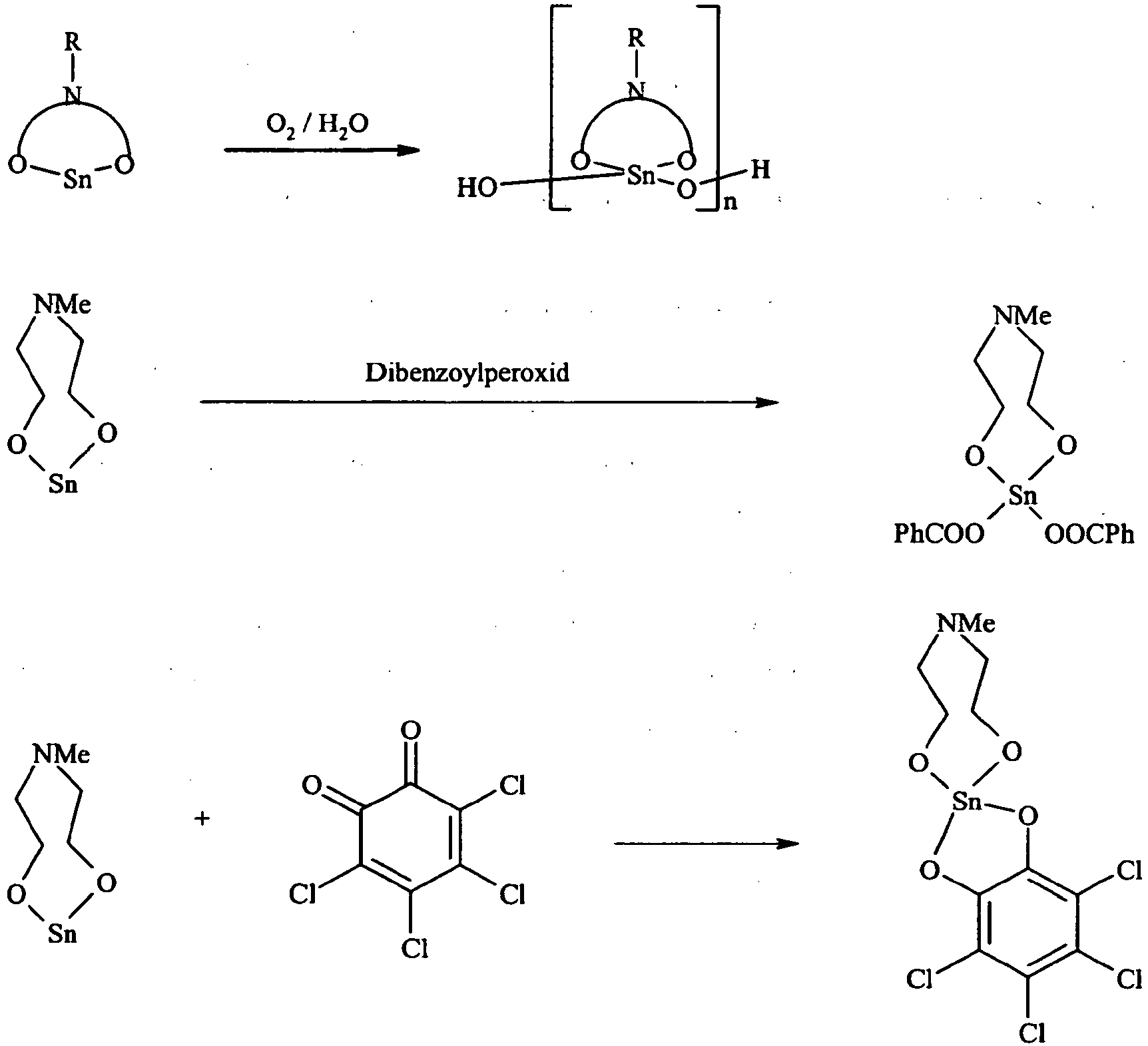
- Die Zinn(II)-Verbindungen können auch mit Halogenen, bevorzugt Chlor und Brom zu den entsprechenden Dihalogen-Zinn(IV)-Verbindungen oxidiert werden.
- Des Weiteren sind die Zinn(IV)-Verbindungen über einen Ligandenaustausch erhältlich. Sn(OR)4 mit R = Alkyl oder Sn(Hal)4 mit Hal = Cl, Br oder I werden beispielsweise mit H-X-Y oder M-X-Y (wobei X und Y die oben genannte Bedeutung haben und M Natrium, Lithium oder Kalium bedeutet) umgesetzt.

- Die für die Herstellung von Polyisocyanat-Polyadditionsverbindungen, insbesondere Polyurethanen geeigneten Polyisocyanate (a) sind die dem Fachmann an sich bekannten organischen aliphatischen, cycloaliphatischen, aromatischen oder heterocyclischen Polyisocyanate mit mindestens zwei Isocyanatgruppen pro Molekül sowie Gemische davon. Beispiele für geeignete aliphatische bzw. cycloaliphatische Polyisocyanate sind Di- oder Triisocyanate, wie z.B. Butandiisocyanat, Pentandiisocyanat, Hexandiisocyanat (Hexamethylendiisocyanat, HDI), 4-Isocyanatomethyl-1,8-octandiisocyanat (Triisocyanatononan, TIN) und cyclische Systeme, wie z.B. 4,4'-Methylen-bis(cyclohexylisocyanat), 3,5,5-Trimethyl-1-isocyanato-3-isocyanatomethylcyclohexan (Isophorondiisocyanat, IPDI), sowie ω.ω'-Diisocyanato-1,3-dimethylcyclohexan (H6XDI). Als aromatische Polyisocyanate können z.B. 1,5-Naphthalindiisocyanat, Diisocyanatodiphenylmethan (2,2'-, 2,4'-und 4,4'-MDI oder Mischungen daraus), Diisocyanatomethylbenzol (2,4- und 2,6-Toluylendiisocyanat, TDI) und technische Gemische der beiden Isomeren sowie 1,3-Bis(isocyanatomethyl)-benzol (XDI) eingesetzt werden. Des Weiteren können TODI (3,3'-Dimethyl-4,4'-biphenyldiisocyanat), PPDI (1,4-Paraphenylendiisocyanat) und CHDI (Cyclohexyldiisocyanat) verwendet werden.
- Überdies können aber auch die an sich bekannten Folgeprodukte der vorgenannten organischen aliphatischen, cycloaliphatischen, aromatischen oder heterocyclischen Polyisocyanate mit Carbodiimid, Uretonimin-, Uretdion-, Allophanat-, Biuret- und/oder Isocyanurat-Struktur, sowie Prepolymere, die durch Umsetzung des Polyisocyanats mit Verbindungen mit gegenüber Isocyanatgruppen reaktiven Gruppen erhalten werden, eingesetzt werden.
- Die Polyisocyanatkomponente (a) kann in einem geeigneten Lösemittel vorliegen. Geeignete Lösemittel sind solche, die eine ausreichende Löslichkeit der Polyisocyanatkomponente aufweisen und frei von gegenüber Isocyanaten reaktiven Gruppen sind. Beispiele für solche Lösemittel sind Aceton, Methylethylketon, Cyclohexanon, Methylisobutylketon, Methylisoamylketon, Diisobutylketon, Ethylacetat, n-Butylacetat, Ethylenglykoldiacetat, Butyrolacton, Diethylcarbonat, Propylencarbonat, Ethylencarbonat, N,N-Dimethylformamid, N,N-Dimethylacetamid, N-Methylpyrrolidon, N-Ethylpyrrolidon, Methylal, Ethylal, Butylal, 1,3-Dioxolan, Glycerolformal, Benzol, Toluol, n-Hexan, Cyclohexan, Solventnaphtha, 2-Methoxypropylacetat (MPA).
- Die Isocyanatkomponente kann darüber hinaus übliche Hilfs- und Zusatzmittel, wie z.B. Rheologieverbesserer (zum Beispiel Ethylencarbonat, Propylencarbonat, dibasische Ester, Zitronensäureester), Stabilisatoren (zum Beispiel Broenstedt- und Lewis-Säuren, wie etwa Salzsäure, Phosphorsäure, Benzoylchlorid, Organomineralsäuren wie Dibutylphosphat, weiterhin Adipinsäure, Äpfelsäure, Bernsteinsäure, Traubensäure oder Zitronensäure), UV-Schutzmittel (zum Beispiel 2,6-Dibutyl-4-methylphenol), Hydrolyseschutzmittel (zum Beispiel sterisch gehinderte Carbodiimide), Emulgatoren sowie Katalysatoren (zum Beispiel Trialkylamine, Diazabicyclooctan, Zinndioctoat, Dibutylzinndilaurat, N-Alkylmorpholin, Blei-, Zink-, Zinn-, Calcium-, Magnesiumoctoat, die entsprechenden Naphthenate und p-Nitrophenolat und/oder auch Quecksilberphenylneodecanoat) und Füllstoffe (zum Beispiel Kreide), gegebenenfalls in das/den später zu bildende/n Polyurethan/Polyhamstoff einbaufähige Farbstoffe (die also über Zerewitinoff-aktive Wasserstoffatome verfügen) und/oder Farbpigmente enthalten.
- Als NCO-reaktive Verbindungen (b) können alle dem Fachmann bekannten Verbindungen eingesetzt werden, welche eine mittlere OH- bzw. NH-Funktionalität von mindestens 1,5 aufweisen. Dies können beispielsweise niedermolekulare Diole (z.B. 1,2-Ethandiol, 1,3- bzw. 1,2-Propandiol, 1,4-Butandiol), Triole (z.B. Glycerin, Trimethylolpropan) und Tetraole (z.B. Pentaerythrit) sein, kurzkettige Polyamine aber auch höhermolekulare Polyhydroxyverbindungen wie Polyetherpolyole, Polyesterpolyole, Polycarbonatpolyole, Polysiloxanpolyole, Polyamine und Polyetherpolyamine sowie Polybutadienpolyole.
- Polyetherpolyole sind in an sich bekannter Weise durch Alkoxylierung von geeigneten Starter-Molekülen unter Basenkatalyse oder Einsatz von Doppelmetallcyanidverbindungen (DMC-Verbindungen) zugänglich. Geeignete Starter-Moleküle für die Herstellung von Polyetherpolyolen sind beispielsweise einfache, niedermolekulare Polyole, Wasser, organische Polyamine mit mindestens zwei N-H-Bindungen oder beliebige Gemische derartiger Starter-Moleküle. Bevorzugte Starter-Moleküle zur Herstellung von Polyetherpolyolen durch Alkoxylierung, insbesondere nach dem DMC-Verfahren, sind insbesondere einfache Polyole wie Ethylenglykol, Propylenglykol-1,3 und Butandiol-1,4, Hexandiol-1,6, Neopentylglykol, 2-Ethylhexandiol-1,3, Glyzerin, Trimethylolpropan, Pentaerythrit sowie niedermolekulare, Hydroxylgruppen aufweisende Ester derartiger Polyole mit Dicarbonsäuren der nachstehend beispielhaft genannten Art oder niedermolekulare Ethoxylierungs- oder Propoxylierungsprodukte derartiger einfacher Polyole oder beliebige Gemische derartiger modifizierter oder nicht modifizierter Alkohole. Für die Alkoxylierung geeignete Alkylenoxide sind insbesondere Ethylenoxid und/oder Propylenoxid, die in beliebiger Reihenfolge oder auch im Gemisch bei der Alkoxylierung eingesetzt werden können.
- Polyesterpolyole können in bekannter Weise durch Polykondensation von niedermolekularen Polycarbonsäurederivaten, wie beispielsweise Bernsteinsäure, Adipinsäure, Korksäure, Azelainsäwe, Sebacinsäure, Dodecandisäure, Tetrahydrophthalsäureanhydrid, Hexahydrophthalsäureanhydrid, Tetrachlorphthalsäureanhydrid, Endomethylentetrahydrophthalsäureanhydrid, Glutarsäureanhydrid, Maleinsäure, Maleinsäureanhydrid, Fumarsäure, Dimerfettsäure, Trimerfettsäure, Phthalsäure, Phthalsäureanhydrid, Isophthalsäure, Terephthalsäure, Zitronensäure oder Trimellithsäure, mit niedermolekularen Polyolen, wie beispielsweise Ethylenglykol, Diethylenglykol, Neopentylglykol, Hexandiol, Butandiol, Propylenglykol, Glycerin, Trimethylolpropan, 1,4-Hydroxymethylcyclohexan, 2-Methyl-1,3-propandiol, Butantriol-1,2,4, Triethylenglykol, Tetraethylenglykol, Polyethylenglykol, Dipropylenglykol, Polypropylenglykol, Dibutylenglykol und Polybutylenglykol, oder durch Ring-öffnende Polymerisation cyclischer Carbonsäureester, wie ε-Caprolacton, hergestellt werden. Darüber hinaus lassen sich auch Hydroxycarbonsäurederivate, wie beispielsweise Milchsäure, Zimtsäure oder ω-Hydroxycapronsäure zu Polyesterpolyolen polykondensieren. Es können aber auch Polyesterpolyole oleochemischer Herkunft verwendet werden. Derartige Polyesterpolyole können beispielsweise durch vollständige Ringöffnung von epoxidierten Triglyceriden eines wenigstens teilweise olefinisch ungesättigten Fettsäwe-enthaltenden Fettgemisches mit einem oder mehreren Alkoholen mit 1 bis 12 C-Atomen und durch anschließende partielle Umesterung der Triglycerid-Derivate zu Alkylesterpolyolen mit 1 bis 12 C-Atomen im Alkylrest hergestellt werden.
- Die Herstellung geeigneter Polyacrylatpolyole ist dem Fachmann an sich bekannt. Sie werden durch radikalische Polymerisation von Hydroxylgruppen aufweisenden, olefinisch ungesättigten Monomeren oder durch radikalische Copolymiersation von Hydroxylgruppen aufweisenden, olefinisch ungesättigten Monomeren mit gegebenenfalls anderen olefinisch ungesättigten Monomeren, wie z.B. Ethylacrylat, Butylacrylat, 2-Ethylhexylacrylat, Isobornylacrylat, Methylmethacrylat, Ethylmethacrylat, Butylmethacrylat, Cyclohexylmethacrylat, Isobomylmethacrylat, Styrol, Acrylsäure, Acrylnitril und/oder Methacrylnitril erhalten. Geeignete Hydroxylgruppen aufweisende, olefinisch ungesättigte Monomere sind insbesondere 2-Hydroxyethyl-acrylat, 2-Hydroxyethyl-methacrylat, das durch Anlagerung von Propylenoxid an Acrylsäure erhältliche Hydroxypropyl-acrylat-Isomerengemisch sowie das durch Anlagerung von Propylenoxid an Methacrylsäure erhältliche Hydroxypropyl-methacrylat-Isomerengemisch. Geeignete Radikalinitiatoren sind die aus der Gruppe der Azoverbindungen, wie zum Beispiel Azoisobutyronitril (AIBN), oder aus der Gruppe der Peroxide, wie beispielsweise Di-tert.-butylperoxid.
- Die Komponente (b) kann in einem geeigneten Lösemittel vorliegen. Geeignete Lösemittel sind solche, die eine ausreichende Löslichkeit der Komponente aufweisen. Beispiele für solche Lösemittel sind Aceton, Methylethylketon, Cyclohexanon, Methylisobutylketon, Methylisoamylketon, Diisobutylketon, Ethylacetat, n-Butylacetat, Ethylenglykoldiacetat, Butyrolacton, Diethylcarbonat, Propylencarbonat, Ethylencarbonat, N,N-Dimethylformamid, N,N-Dimethylacetamid, N-Methylpyrrolidon, N-Ethylpyrrolidon, Methylal, Ethylal, Butylal, 1,3-Dioxolan, Glycerolformal, Benzol, Toluol, n-Hexan, Cyclohexan, Solventnaphtha, 2-Methoxypropylacetat (MPA). Darüber hinaus können die Lösemittel auch gegenüber Isocyanaten reaktive Gruppen tragen. Beispiele für solche Reaktivlösemittel sind solche, die eine mittlere Funktionalität gegenüber Isocyanaten reaktiver Gruppen von mindestens 1,8 aufweisen. Dies können beispielsweise niedermolekulare Diole (z.B. 1,2-Ethandiol, 1,3- bzw. 1,2-Propandiol, 1,4-Butandiol), Triole (z.B. Glycerin, Trimethylolpropan), aber auch niedermolekulare Diamine, wie zum Beispiel Polyasparaginsäureester, sein.
- Die als Komponente (b) einsetzbaren Polyetheramine sind insbesondere Diamine oder Triamine. Derartige Verbindungen werden beispielsweise von der Firma Huntsman unter der Bezeichnung Jeffamine® bzw. von der Firma BASF als Polyetheramine vertrieben.
- Als Vernetzerkomponente bzw. Kettenverlängerer kommen meist kurzkettige Polyole bzw. Polyamine zum Einsatz. Typische Kettenverlängerer sind Diethyltoluoldiamin (DETDA), 4,4'-Methylenbis-(2,6-diethyl)-anilin (MDEA), 4,4'-Methylenbis-(2,6-diisopropyl)-anilin (MDIPA), 4,4'-Methylen-bis-(3-chloro-2,6-diethyl)-anilin (MCDEA), Dimethylthiotoluoldiamin (DMTDA, Ethacure® 300), N,N'-Di(sec-butyl)-amino-biphenylmethan (DBMDA, Unilink® 4200) oder N,N'-Di-sec-butyl-p-phenylendiamin (Unilink® 4100), 3,3'-Dichloro-4,4'-diamino-diphenylmethan (MBOCA), Trimethylenglykol-di-p-aminobenzoat (Polacure 740M). Aliphatische aminische Kettenverlängerer können ebenfalls eingesetzt oder mitverwendet werden. 1,3-Propandiol, 1,4-Butandiol, 2,3-Butandiol, 1,5-Pentandiol, 1,6-Hexandiol und HQEE (Hydrochinon-di(β-hydroxyethyl)ether) sind ebenfalls einsetzbar.
- Das Verfahren zur Herstellung der Polyisocyanat-Polyadditionsprodukte kann in Gegenwart üblicher Rheologieverbesserer, Stabilisatoren, UV-Schutzmittel, Katalyatoren, Hydrolyseschutzmittel, Emulgatoren, Füllstoffe, gegebenenfalls einbaufähiger Farbstoffe (die also über Zerewitinoff-aktive Wasserstoffatome verfügen) und/oder Farbpigmente durchgeführt werden. Bevorzugt ist auch eine Zugabe von Zeolithen.
- Bevorzugte Hilfs- und Zusatzmittel sind Treibmittel, Füllstoffe, Kreide, Ruß oder Zeolithe, Flammschutzmittel, Farbpasten, Wasser, Mikrobenschutzmittel, Fließverbesserer, Thixotropiermittel, Oberflächenmodifizierungsmittel und Verzögerer bei der Herstellung der Polyisocyanat-Polyadditionsprodukte. Weitere Hilfs- und Zusatzstoffe umfassen Entschäumer, Emulgatoren, Schaumstabilisatoren und Zellregler. Eine Übersicht ist in G. Oertel, Polyurethane Handbook, 2nd Edition, Carl Hanser Verlag, München, 1994, Kap. 3.4., enthalten.
- Typische Schäummittel sind Fluorkohlenwasserstoffe, Pentan, Cylclopentan, Wasser und/oder Kohlenstoffdioxid.
- Die latenten Katalysatoren können zur Herstellung von Weich- und Hartschäumen, Beschichtungen, Kleb- und Dichtstoffen, halbharten Schäumen, Integralschäumen, Sprüh- und Gießelastomeren, Harzen und Bindemitteln in der Polyurethan-Chemie sowie von thermoplastischen Polyurethanen eingesetzt werden.
- Darüber hinaus können die erfindungsgemäßen Katalysatoren zur Herstellung von Silikonen und Polyestern eingesetzt werden.
- Die Erfindung soll anhand der nachfolgenden Beispiele näher erläutert werden.
- Aus einer Lösung von Sn(OCH2CH2)2NMe (Herstellung siehe A. Zschunke, C. Mügge, M. Scheer, K. Jurkschat, A. Tzschach, J. Crystallogr. Spectrosc. Res. 1983, 13, 201) in Toluol (0,18 mol/l) wurde bei 25°C an der Atmosphäre über 48 h das Lösungsmittel abgedampft. Zunächst fiel ein farbloser Feststoff aus. Beim weiteren Abdampfen wurde ein gelbes Öl erhalten. Es wurden 100 ml Toluol zugesetzt und danach wieder abgedampft. Es wurden weitere 100 ml Toluol zugesetzt und erneut vollständig abgedampft. Das so erhaltene Öl wurde in Dichlormethan gelöst. Nach Zugabe von Toluol fiel ein farbloser Feststoff mit einem Schmelzpunkt > 250 °C aus.
- 119Sn-NMR (CH2Cl2/D2O-Kapillare, 23 °C, Me4Sn-Standard): δ -450 ppm
- Elementaranalyse [Gew.-%] gef.: C 22,6; H 4,7; N 5,2; Sn 45
- Bei der Verbindung 1 handelt es sich um HO[Sn(OCH2CH2)2NMeO]nH (mit n = 1 bis 2).
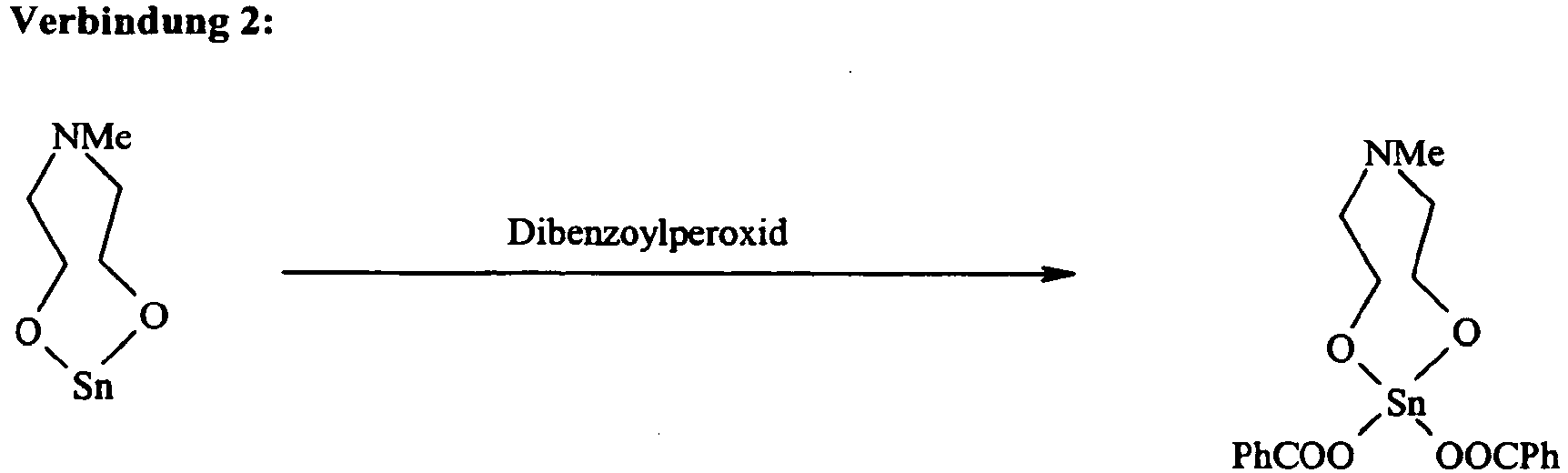
- Eine Lösung von 2,35 g Sn(OCH2CH2)2NMe in 100 ml Dichlormethan wurde bei Raumtemperatur mit 2,42 g Dibenzoylperoxid (gelöst in 50 ml CH2Cl2) umgesetzt. Es wurde drei Stunden gerührt und anschließend das Lösungsmittel im Vakuum entfernt. Die Umkristallisation aus CHCl3 lieferte 4,16 g der Verbindung 2.
- 119Sn-NMR (CDCl3, 28 °C, Me4Sn-Standard): δ -656 ppm
- Elementaranalyse [Gew.-%] (ber.) gef.: C (47,73) 46,1; H (4,43) 4,5; N (2,93) 2,8
- Definition von Gießzeit (Topfzeit) und Entformungszeit bei der Herstellung von Polyurethan (PUR):
- Die Gießzeit ist diejenige Zeit, nach der die PUR-Reaktionsmischung beim Gießen auf eine ebene Stahlplatte das Fließverhalten aufgrund merklichen Viskositätsanstieges signifikant ändert.
- Die Entformungszeit ist diejenige Zeit, nach der der PUR-Probenkörper ohne Deformierung manuell aus dem Stahlzylinder gedrückt werden kann.
- 400 g Desmodur® MS 192 (MDI-Prepolymer der Fa. Bayer MaterialScience AG, 19,2% NCO-Gehalt) wurden mit 340 g Baytec® VP.PU 20GE12 (Polyol der Fa. Bayer MaterialScience AG, OH-Zahl: 64 mg KOH/g), 60 g 1,4-Butandiol und 0,38 g (0,047 Gew.-%) des Katalysators 1 bei 50°C in einer 1,5 1 Weißblechdose (Durchmesser: 120 mm, Höhe: 135 mm) gemischt. Die Mischung wurde in einen auf 60°C temperierten und mit Trennmittel (Indrosil 2000) versehenen hohlen Stahlzylinder (Durchmesser: 40 mm, Höhe: 80 mm) gegossen. Der Probenkörper wurde entnommen.
- 400 g Desmodur® MS 192 (MDI-Prepolymer der Fa. Bayer MaterialScience AG, 19,2% NCO-Gehalt) wurden mit 340 g Baytec® VP.PU 20GE12 (Polyol der Fa. Bayer MaterialScience AG, OH-Zahl: 64 mg KOH/g), 60 g 1,4-Butandiol und 0,32 g (0,04 Gew.-%) des Katalysators 2 bei 50°C in einer 1,51 Weißblechdose (Durchmesser: 120 mm, Höhe: 135 mm) gemischt. Die Mischung wurde in einen auf 60°C temperierten und mit Trennmittel (Indrosil 2000) versehenen hohlen Stahlzylinder (Durchmesser: 40 mm, Höhe: 80 mm) gegossen. Der Probenkörper wurde entnommen.
- 400 g Desmodur® MS 192 (MDI-Prepolymer der Fa. Bayer MaterialScience AG, 19,2%-NCO) wurden mit 340 g Baytec® VP.PU 20GE12 (Polyol der Fa. Bayer MaterialScience AG, OH-Zahl: 64 mg KOH/g), 60 g 1,4-Butandiol und 0,56 g (0,07 Gew.-%) Thorcat 535 bei 50°C in einer 1,51 Weißblechdose (Durchmesser: 120 mm, Höhe: 135 mm) gemischt. Die Mischung wurde in einen auf 60°C temperierten und mit Trennmittel (Indrosil 2000) versehenen hohlen Stahlzylinder (Durchmesser: 40 mm, Höhe: 80 mm) gegossen.
- 400 g Desmodur MS 192 (MDI-Prepolymer der Fa. Bayer MaterialScience AG, 19,2%-NCO) wurden mit 340 g Baytec® VP.PU 20GE12 (Polyol der Fa. Bayer MaterialScience AG, OH-Zahl: 64 mg KOH/g), 60 g 1,4-Butandiol und 0,20 g (0,025 Gew.-%) DABCO bei 50°C in einer 1,51 Weißblechdose (Durchmesser: 120 mm, Höhe: 135 mm) gemischt. Die Mischung wurde in einen auf 60°C temperierten und mit Trennmittel (Indrosil 2000) versehenen hohlen Stahlzylinder (Durchmesser: 40 mm, Höhe: 80 mm) gegossen.
- 400 g Desmodur MS 192 (MDI-Prepolymer der Fa. Bayer MaterialScience AG, 19,2 % NCO-Gehalt) wurden mit 340 g Baytec® VP.PU 20GE12 (Polyol der Fa. Bayer MaterialScience AG, OH-Zahl: 64 mg KOH/g), 60 g 1,4-Butandiol und 0,016 g (0,002 Gew.-%) Sn(OCH2CH2)2NMe bei 50°C in einer 1,51 Weißblechdose (Durchmesser: 120 mm, Höhe: 135 mm) gemischt. Die Mischung wurde in einen auf 60°C temperierten und mit Trennmittel (Indrosil 2000) versehenen hohlen Stahlzylinder (Durchmesser: 40 mm, Höhe: 80 mm) gegossen.
- 400 g Desmodur MS 192 (MDI-Prepolymer der Fa. Bayer MaterialScience AG, 19,2 %-NCO) wurden mit 340 g Baytec® VP.PU 20GE12 (Polyol der Fa. Bayer MaterialScience AG, OH-Zahl: 64 mg KOH/g), 60 g 1,4-Butandiol und 0,02 g (0,0025 Gew.-%) DBTL bei 50°C in einer 1,5 l Weißblechdose (Durchmesser: 120 mm, Höhe: 135 mm) gemischt. Die Mischung wurde in einem auf 60°C temperierten und mit Trennmittel (Indrosil 2000) versehenen hohlen Stahlzylinder (Durchmesser: 40 mm, Höhe: 80 mm) gegossen.
- 400 g Desmodur MS 192 (MDI-Prepolymer der Fa. Bayer MaterialScience AG, 19,2 %-NCO) wurden mit 340 g Baytec® VP.PU 20GE12 (Polyol der Fa. Bayer MaterialScience AG, OH-Zahl: 64 mg KOH/g), 60 g 1,4-Butandiol und 0,032 g (0,004 Gew.-%) DBTL und N-Methyldiethanolamin (1:1) bei 50°C in einer 1,5 l Weißblechdose (Durchmesser: 120 mm, Höhe: 135 mm) gemischt. Die Mischung wurde in einen auf 60°C temperierten und mit Trennmittel (Indrosil 2000) versehenen hohlen Stahlzylinder (Durchmesser: 40 mm, Höhe: 80 mm) gegossen.
- 400 g Desmodur MS 192 (MDI-Prepolymer der Fa. Bayer Materialscience AG, 19,2 %-NCO) wurden mit 340 g Baytec® VP.PU 20GE12 (Polyol der Fa. Bayer MaterialScience AG, OH-Zahl: 64 mg KOH/g), 60 g 1,4-Butandiol und 0,016 g (0,002 Gew.-%) DABCO DC-2 bei 50°C in einer 1,5 l Weißblechdose (Durchmesser: 120 mm, Höhe: 135 mm) gemischt. Die Mischung wurde in einen auf 60°C temperierten und mit Trennmittel (Indrosil 2000) versehenen hohlen Stahlzylinder (Durchmesser: 40 mm, Höhe: 80 mm) gegossen.
Tabelle 1: Katalysator [Gew.-%] Gießzeit [s] Entformung [min] Härte Shore A Beispiel 3 0,047 190 11 91 Beispiel 4 0,04 200 9 91 Vergleich 5 0,07 190 24 92 Vergleich 6 0,004 200 23 92 Vergleich 7 0,002 180 18 92 Vergleich 8 0,0025 190 22 92 Vergleich 9 0,004 185 21 93 Vergleich 10 0,002 190 23 93 - Die Härte wurde nach 72 h bei Raumtemperatur gemäß DIN 53505 gemessen.
- Aus den Daten ist zu entnehmen, dass in den erfindungsgemäßen Beispielen bei sehr langen Gießzeiten die kürzesten Entformungszeiten erhalten werden.
- In Vergleich 5 wurde ein gebräuchlicher und üblicher Quecksilberkatalysator, in Vergleich 6 ein typischer Katalysator auf Basis eines tertiären Amins, in Vergleich 7 ein Zinn(II)-Katalysator, in Vergleich 8 ein typischer Zinn(IV)-Katalysator, in Vergleich 9 eine Kombination aus dem Katalysator aus Vergleich 8 mit einem Amin und in Vergleich 10 ein Zinn(IV)-Katalysator mit DABCO-Liganden eingesetzt.
- 38,1 g Desmodur® N3390BA (HDI-Polyisocyanat der Fa. Bayer MaterialScience AG, 19,6 % NCO-Gehalt) wurden mit 100 g Desmophen® A870BA (Polyol der Fa. Bayer MaterialScience AG, 2,95 % OH-Gehalt) gemischt. Direkt nach der Mischung, nach 60 min, nach 120 min und nach 240 min wurde die Viskosität als Auslaufzeit (DIN 53 211, 4-mm-DIN-Auslaufbecher bei 23°C) bestimmt. Es wurden die Trocknungszeiten T1, T2, T3 und T4 gemäß DIN 53 150 bei einer Lagerung bei Raumtemperatur und einer Lagerung bei 60°C sowie die Pendelhärten [Pendeldämpfung nach König (DIN EN ISO 1522)] nach 7d bestimmt.
- 38,1 g Desmodur® N3390BA (HDI-Polyisocyanat der Fa. Bayer MaterialScience AG, 19,6 % NCO-Gehalt) wurden mit 100 g Desmophen® A870BA (Polyol der Fa. Bayer MaterialScience AG, 2,95 % OH-Gehalt) und 3,2 g Dibutylzinndilaurat (1 Gew.-% in Butylacetat) gemischt. Direkt nach der Mischung, nach 60 min, nach 120 min und nach 240 min wurde die Viskosität als Auslaufzeit (DIN 53 211, 4-mm-DIN-Auslaufbecher bei 23°C) bestimmt. Es wurden die Trocknungszeiten T1, T2, T3 und T4 gemäß DIN 53 150 bei einer Lagerung bei Raumtemperatur und einer Lagerung bei 60°C sowie die Pendelhärten [Pendeldämpfung nach König (DIN EN ISO 1522)] nach 7d bestimmt.
- 38,1 g Desmodur® N3390BA (HDI-Polyisocyanat der Fa. Bayer MaterialScience AG, 19,6 % NCO-gehalt) wurden mit 100 g Desmophen® A870BA (Polyol der Fa. Bayer MaterialScience AG, 2,95 %-OH) und 2,9 g Katalysator 1 (10 Gew.-% in Dichlormethan) gemischt. Direkt nach der Mischung, nach 60 min, nach 120 min und nach 240 min wurde die Viskosität als Auslaufzeit (DIN 53 211, 4-mm-DIN-Auslaufbecher bei 23°C) bestimmt. Es wurden die Trocknungszeiten T1, T2, T3 und T4 gemäß DIN 53 150 bei einer Lagerung bei Raumtemperatur und einer Lagerung bei 60°C sowie die Pendelhärten [Pendeldämpfung nach König (DIN EN ISO 1522)] nach 7d bestimmt.
Tabelle 2: Vergleich 11 Vergleich 12 Beispiel 13 Auslaufzeiten bei RT [s] 0h 19 19 18 1h 20 26 20 2h 21 38 23 4h 22 57 25 Trocknungszeiten bei RT [h] T1 2 2 2 T2 7 5 7 T3 7 7 7 T4 7 7 7 Trocknungszeiten bei 60°C [h] T1 0 0 0 T2 4 0 1 T3 5 0 3 T4 6 1 4 Pendelhärten (Lagerung bei 60°C) [s] 7d 198 177 186 - Aus den Auslaufzeiten ist zu entnehmen, dass in Beispiel 13 der Katalysator 1 bei Raumtemperatur im Vergleich zu DBTL nur eine extrem geringe katalytische Aktivität entfaltet. Aus den Trocknungszeiten ist zu entnehmen, dass der Katalysator 1 im Vergleich zu DBTL bei Raumtemperatur keine merkliche katalytische Aktivität, bei 60°C hingegen eine signifikante katalytische Aktivität entfaltet.
- 5,20 g 5-tert.-Butyl-(5-aza-2,8-dioxa-1-stanno)-cyclooctan wurden in 200 ml Benzol gelöst. Zu der Lösung wurden 25 ml einer Lösung von Chlor in Tetrachlormethan (6,3 g / 100 ml) getropft. Aus der Lösung fiel ein Feststoff aus. Nach Entfernen des Lösungsmittels im Vakuum wurde 5-tert.-Butyl-(5-aza-2,8-dioxa-1-stanno-1,1-dichlor)-cyclooctan (Verbindung 3, Cl2Sn(OCH2CH2)2N-tBu) als farbloser Feststoff in quantitativer Ausbeute erhalten.
- 1H-NMR (300.13 MHz, C6D6): δ = 1.13 (s, 9H, (CH 3)3-C-N), 2.06 (dd, 2H, N-CH 2), 2.92 (s, 2H, N-CH 2), 4.09 (t, 2H, CH 2-O), 4.40 ppm (s, 2H, CH 2-O)
- 13C{1H}-NMR (75.47 MHz, C6D6): δ = 27.1 (s, (CH3)3-C-N), 53.6 (s, N-CH2), 57.1 (s, N-CH2), 62.2 ppm (s, 2x CH2-O).
- Die Verbindung 4 (Cl2Sn(OCH2CH2)2N-Me) wurde aus 5-Methyl-(5-aza-2,8-dioxa-1-stanno)-cyclooctan analog der Synthesevorschrift für Katalysator 3 (Beispiel 14) hergestellt.
- 280 g Desmodur® MS 192 (MDI-Prepolymer der Fa. Bayer MaterialScience AG, 19,2% NCO-Gehalt) wurden mit 470 g Baytec® VP.PU 20GE12 (Polyol der Fa. Bayer MaterialScience AG, OH-Zahl: 64 mg KOH/g), 30 g 1,4-Butandiol und 1,40 g (0,179 Gew.-%) Katalysator bei 50°C in einer 1,5 1 Weißblechdose (Durchmesser: 120 mm, Höhe: 135 mm) gemischt. Die Mischung wurde in einen auf 80°C temperierten und mit Trennmittel (Indrosil 2000) versehenen hohlen Stahlzylinder (Durchmesser: 40 mm, Höhe: 80 mm) gegossen. Der Probenkörper wurde entnommen.
- 280 g Desmodur® MS 192 (MDI-Prepolymer der Fa. Bayer MaterialScience AG, 19,2% NCO-Gehalt) wurden mit 470 g Baytec® VP.PU 20GE12 (Polyol der Fa. Bayer MaterialScience AG, OH-Zahl: 64 mg KOH/g), 30 g 1,4-Butandiol und 0,75 g (0,096 Gew.-%) des Katalysators 3 bei 50°C in einer 1,5 1 Weißblechdose (Durchmesser: 120 mm, Höhe: 135 mm) gemischt. Die Mischung wurde in einen auf 80°C temperierten und mit Trennmittel (Indrosil 2000) versehenen hohlen Stahlzylinder (Durchmesser: 40 mm, Höhe: 80 mm) gegossen. Der Probenkörper wurde entnommen.
- 280 g Desmodur® MS 192 (MDI-Prepolymer der Fa. Bayer MaterialScience AG, 19,2% NCO-Gehalt) wurden mit 470 g Baytec® VP.PU 20GE12 (Polyol der Fa. Bayer MaterialScience AG, OH-Zahl: 64 mg KOH/g), 30 g 1,4-Butandiol und 1,0 g (0,128 Gew.-%) des Katalysators 4 bei 50°C in einer 1,5 1 Weißblechdose (Durchmesser: 120 mm, Höhe: 135 mm) gemischt. Die Mischung wurde in einen auf 80°C temperierten und mit Trennmittel (Indrosil 2000) versehenen hohlen Stahlzylinder (Durchmesser: 40 mm, Höhe: 80 mm) gegossen. Der Probenkörper wurde entnommen.
- 280 g Desmodur® MS 192 (MDI-Prepolymer der Fa. Bayer MaterialScience AG, 19,2%-NCO) wurden mit 470 g Baytec® VP.PU 20GE12 (Polyol der Fa. Bayer MaterialScience AG, OH-Zahl: 64 mg KOH/g), 30 g 1,4-Butandiol und 0,3 g (0,038 Gew.-%) Thorcat 535 bei 50°C in einer 1,5 1 Weißblechdose (Durchmesser: 120 mm, Höhe: 135 mm) gemischt. Die Mischung wurde in einem auf 80°C temperierten und mit Trennmittel (Indrosil 2000) versehenen hohlen Stahlzylinder (Durchmesser: 40 mm, Höhe: 80 mm) gegossen. Der Probenkörper wurde entnommen.
- 280 g Desmodur MS 192 (MDI-Prepolymer der Fa. Bayer MaterialScience AG, 19,2%-NCO) wurden mit 470 g Baytec® VP.PU 20GE12 (Polyol der Fa. Bayer MaterialScience AG, OH-Zahl: 64 mg KOH/g), 30 g 1,4-Butandiol und 0,024 g (0,003 Gew.-%) DABCO bei 50°C in einer 1,5 1 Weißblechdose (Durchmesser: 120 mm, Höhe: 135 mm) gemischt. Die Mischung wurde in einen auf 80°C temperierten und mit Trennmittel (Indrosil 2000) versehenen hohlen Stahlzylinder (Durchmesser: 40 mm, Höhe: 80 mm) gegossen. Der Probenkörper wurde entnommen.
- 280 g Desmodur MS 192 (MDI-Prepolymer der Fa. Bayer MaterialScience AG, 19,2 % NCO-Gehalt) wurden mit 470 g Baytec® VP.PU 20GE12 (Polyol der Fa. Bayer MaterialScience AG, OH-Zahl: 64 mg KOH/g), 30 g 1,4-Butandiol und 0,015 g (0,0019 Gew.-%) Sn(OCH2CH2)2NMe bei 50°C in einer 1,5 1 Weißblechdose (Durchmesser: 120 mm, Höhe: 135 mm) gemischt. Die Mischung wurde in einen auf 80°C temperierten und mit Trennmittel (Indrosil 2000) versehenen hohlen Stahlzylinder (Durchmesser: 40 mm, Höhe: 80 mm) gegossen. Der Probenkörper wurde entnommen.
- 280 g Desmodur MS 192 (MDI-Prepolymer der Fa. Bayer MaterialScience AG, 19,2 %-NCO) wurden mit 470 g Baytec® VP.PU 20GE12 (Polyol der Fa. Bayer MaterialScience AG, OH-Zahl: 64 mg KOH/g), 30 g 1,4-Butandiol und 0,03 g (0,0038 Gew.-%) DBTL bei 50°C in einer 1,5 1 Weißblechdose (Durchmesser: 120 mm, Höhe: 135 mm) gemischt. Die Mischung wurde in einem auf 80°C temperierten und mit Trennmittel (Indrosil 2000) versehenen hohlen Stahlzylinder (Durchmesser: 40 mm, Höhe: 80 mm) gegossen. Der Probenkörper wurde entnommen.
- 280 g Desmodur MS 192 (MDI-Prepolymer der Fa. Bayer MaterialScience AG, 19,2 %-NCO) wurden mit 470 g Baytec® VP.PU 20GE12 (Polyol der Fa. Bayer MaterialScience AG, OH-Zahl: 64 mg KOH/g), 30 g 1,4-Butandiol und 0,015 g (0,0019 Gew.-%) DABCO DC-2 bei 50°C in einer 1,5 1 Weißblechdose (Durchmesser: 120 mm, Höhe: 135 mm) gemischt. Die Mischung wurde in einen auf 80°C tempenerten und mit Trennmittel (Indrosil 2000) versehenen hohlen Stahlzylinder (Durchmesser: 40 mm, Höhe: 80 mm) gegossen. Der Probenkörper wurde entnommen.
Tabelle 3: Katalysator [Gew.-%] Gießzeit [s] Entformung [min] Härte Shore A Beispiel 16 0,179 240 10 71 Beispiel 17 0,096 240 19 72 Bespiel 18 0,128 310 17 72 Vergleich 19 0,038 230 18 73 Vergleich 20 0,003 260 90 72 Vergleich 21 0,0019 230 75 72 Vergleich 22 0,0038 240 100 73 Vergleich 23 0,0019 250 100 72 - Die Härte wurde nach 72 h bei Raumtemperatur gemäß DIN 53505 gemessen.
- Aus den Daten ist zu entnehmen, dass bei etwa gleichen Gießzeiten in den erfindungsgemäßen Beispielen Entformungszeiten erhalten werden, die im Bereich des besten kommerziellen Katalysators (Quecksilberkatalysator) oder darunter liegen. In Beispiel 18 wird bei im Vergleich zum Quecksilberkatalysator (Vergleich 19) deutlich längerer Gießzeit die praktisch gleiche Entformungszeit erreicht.
- In Vergleich 19 wurde ein gebräuchlicher und üblicher Quecksilberkatalysator, in Vergleich 20 ein typischer Katalysator auf Basis eines tertiären Amins, in Vergleich 21 ein Zinn(II)-Katalysator, in Vergleich 22 ein typischer Zinn(IV)-Katalysator und in Vergleich 23 ein Zinn(IV)-Katalysator mit DABCO-Liganden eingesetzt.
Claims (7)
- Verfahren zur Herstellung von Polyisocyanat-Polyadditionsprodukten mit guten mechanischen Eigenschaften, wobei
Polyisocyanate (a) mit NCO-reaktiven Verbindungen (b) in Gegenwart von latenten Katalysatoren (c) und gegebenenfalls zusätzlichen von (c) verschiedenen Katalysatoren und/oder Aktivatoren unter Zusatz von gegebenenfalls Treibmitteln, gegebenenfalls Füllstoffen und/oder Fasermaterialien und gegebenenfalls Hilfs- und/oder Zusatzmitteln umgesetzt werden, dadurch gekennzeichnet, dass als latente Katalysatoren vierwertige einkernige Zinnverbindungen der Formel I mit mindestens einem über wenigstens ein Sauer- . stoff- oder Schwefelatom gebundenen wenigstens einen Stickstoff enthaltenden Liganden
Sn(IV)(L1)n1(L2)n2(L3)n3(L4)n4 ( I )
mit n1, n2, n3, n4 0 oder 1 und L1, L2, L3, L4 ein-, zwei-, drei- oder vierbindige Liganden
oder darauf basierende vierwertige mehrkernige Zinnverbindungen eingesetzt werden, wobei mindestens ein Ligand je Sn-Atom folgende Bedeutung hat:
-X-Y
mit X = O, S, OC(O), OC(S), O(O)S(O)O, O(O)S(O)
Y = -R1-N(R2)(R3) oder -R1-C(R4)=NR2
R1, R2, R3, R4 unabhängig voneinander gesättigte oder ungesättigte, cyclische oder acyclische, verzweigte oder unverzweigte, substituierte oder unsubstituierte, gegebenenfalls durch Heteroatome unterbrochene Kohlenwasserstoffreste oder R2, R3, R4 unabhängig voneinander Wasserstoff, R1-X sind oder R2 und R3 oder R2 und R1 oder R3 und R1 oder R4 und R1 oder R4 und R2 einen Ring bilden
und wobei die übrigen Liganden unabhängig voneinander -X-Y mit der vorgenannten Bedeutung sind oder folgende Bedeutung haben:gesättigte oder ungesättigte, cyclische oder acyclische, verzweigte oder unverzweigte, substituierte oder unsubstituierte, gegebenenfalls durch Heteroatome unterbrochene Kohlenwasserstoffreste, Halogenide, Hydroxid, Amidreste, Sauerstoff, Schwefel, R2 oder XR2. - Zweikernige vierwertige Zinnverbindungen der Formel II mit mindestens einem über wenigstens ein Sauerstoff oder Schwefelatom gebundenen wenigstens einen Stickstoff enthaltenden Liganden je Sn-Atom
[(L1)n1(L2)n2(L3)n3Sn(IV)]2O (II)
mit n1, n2 0 oder 1 und L1, L2, L3 ein-, zwei- oder dreibindige Liganden,
wobei mindestens ein Ligand je Sn-Atom folgende Bedeutung hat:
-X-Y
mit X = O, S, OC(O), OC(S), O(O)S(O)O, O(O)S(O)
Y = -R1-N(R2)(R3) oder -R1-C(R4)=NR2
R1, R2, R3, R4 unabhängig voneinander gesättigte oder ungesättigte, cyclische oder acyclische, verzweigte oder unverzweigte, substituierte oder unsubstituierte, gegebenenfalls durch Heteroatome unterbrochene Kohlenwasserstoffreste oder R2, R3, R4 unabhängig voneinander Wasserstoff, R1-X sind oder R2 und R3 oder R2 und R1 oder R3 und R1 oder R4 und R1 oder R4 und R2 einen Ring bilden
und wobei die übrigen Liganden -X-Y mit der vorgenannten Bedeutung sind oder folgende Bedeutung haben:gesättigte oder ungesättigte, cyclische oder acyclische, verzweigte oder unverzweigte, substituierte oder unsubstituierte, gegebenenfalls durch Heteroatome unterbrochene Kohlenwasserstoffreste, Halogenide, Hydroxid, Amidreste, Sauerstoff, Schwefel, R2 oder XR2. - Verfahren zur Herstellung der zweikernigen vierwertigen Zinnverbindungen der Formel II gemäß Anspruch 2 mit mindestens einem über wenigstens ein Sauerstoff- oder Schwefelatom gebundenen wenigstens einen Stickstoff enthaltenden Liganden je Sn-Atom, dadurch gekennzeichnet, dass sie aus entsprechenden ein- oder mehrkernigen Sn(IV)-Verbindungen über einen Ligandenaustausch hergestellt werden.
- Zwei- oder mehrkernige vierwertige Zinnverbindungen der Formel III mit mindestens einem über wenigstens ein Sauerstoff- oder Schwefelatom gebundenen wenigstens einen Stickstoff enthaltenden Liganden je Sn-Atom
[(L1)n1(L2)n2Sn(IV)O]n (III)
mit n1, n2 0 oder 1, n größer oder gleich 2 und L1, L2 ein- oder zweibindige Liganden,
wobei mindestens ein Ligand je Sn-Atom folgende Bedeutung hat:
-X-Y
mit X = O, S, OC(O), OC(S), O(O)S(O)O, O(O)S(O)
Y = -R1-N(R2)(R3) oder -R1-C(R4)=NR2
R1, R2, R3, R4 unabhängig voneinander gesättigte oder ungesättigte, cyclische oder acyclische, verzweigte oder unverzweigte, substituierte oder unsubstituierte, gegebenenfalls durch Heteroatome unterbrochene Kohlenwasserstoffreste oder R2, R3, R4 unabhängig voneinander Wasserstoff, R1-X sind oder R2 und R3 oder R2 und R1 oder R3 und R1 oder R4 und R1 oder R4 und R2 einen Ring bilden
und wobei der übrige Ligand -X-Y mit der vorgenannten Bedeutung ist oder folgende Bedeutung hat:gesättigter oder ungesättigter, cyclischer oder acyclischer, verzweigter oder unverzweigter, substituierter oder unsubstituierter, gegebenenfalls durch Heteroatome unterbrochener Kohlenwasserstoffrest, Halogenid, Hydroxid, Amidrest, Sauerstoff, Schwefel, R2 oder XR2. - Verfahren zur Herstellung der zwei- oder mehrkernigen vierwertigen Zinnverbindungen der Formel III gemäß Anspruch 4 mit mindestens einem über wenigstens ein Sauerstoff-oder Schwefelatom gebundenen wenigstens einen Stickstoff enthaltenden Liganden je Sn-Atom, dadurch gekennzeichnet, dass sie aus entsprechenden ein- oder mehrkernigen Zinn(II)-Verbindungen durch Oxidation mit gleichzeitiger Oligomerisierung oder aus entsprechenden ein- oder mehrkernigen Sn(IV)-Verbindungen über einen Ligandenaustausch hergestellt werden.
- Latente Katalysatoren bestehend aus vierwertigen einkemigen Zinnverbindungen der Formel I mit mindestens einem über wenigstens ein Sauerstoff- oder Schwefelatom gebundenen wenigstens einen Stickstoff enthaltenden Liganden oder aus zwei- oder mehrkernigen vierwertigen Zinnverbindungen der Formeln II, III oder IV mit jeweils mindestens einem über wenigstens ein Sauerstoff- oder Schwefelatom gebundenen wenigstens einen Stickstoff enthaltenden Liganden je Sn-Atom
Sn(IV)(L1)n1(L1)n2(L3)n3(L4)n4 (I)
mit n1, n2, n3, n4 0 oder 1 und L1, L2, L3, L4 ein-, zwei-, drei- oder vierbindige Liganden
[(L1)n1(L2)n2(L3)n3Sn(IV)]2O (II)
mit n1, n2 0 oder 1 und L1, L2, L3 ein-, zwei- oder dreibindige Liganden
[(L1)n1(L2)n2Sn(IV)O]n (III)
[(L1)n1(L2)n2Sn(IV)]S]n (IV)
mit n1, n2 0 oder 1, n größer oder gleich 2 und L1, L2 ein- oder zweibindige Liganden,
wobei mindestens ein Ligand je Sn-Atom folgende Bedeutung hat:
-X-Y
mit X = O, S, OC(O), OC(S), O(O)S(O)O, O(O)S(O)
Y = -R1-N(R2)(R3)oder-R1-C(R4)=NR2
R1, R2, R3, R4 unabhängig voneinander gesättigte oder ungesättigte, cyclische oder acyclische, verzweigte oder unverzweigte, substituierte oder unsubstituierte, gegebenenfalls durch Heteroatome unterbrochene Kohlenwasserstoffreste oder R2, R3, R4 unabhängig voneinander Wasserstoff, R1-X sind oder R2 und R3 oder R2 und R1 oder R3 und R1 oder R4 und R1 oder R4 und R2 einen Ring bilden
und wobei die übrigen Liganden unabhängig voneinander -X-Y mit der vorgenannten Bedeutung sind oder folgende Bedeutung haben:gesättigte oder ungesättigte, cyclische oder acyclische, verzweigte oder unverzweigte, substituierte oder unsubstituierte, gegebenenfalls durch Heteroatome unterbrochene Kohlenwasserstoffreste, Halogenide, Hydroxid, Amidreste, Sauerstoff, Schwefel, R2 oder XR2. - Verwendung der latenten Katalysatoren gemäß Anspruch 6 zur Herstellung von Polyisocyanat-Polyadditionsprodukten.
Priority Applications (1)
| Application Number | Priority Date | Filing Date | Title |
|---|---|---|---|
| PL09737828T PL2274092T3 (pl) | 2008-05-02 | 2009-04-18 | Nowe katalizatory i ich zastosowanie przy wytwarzaniu poliuretanów |
Applications Claiming Priority (2)
| Application Number | Priority Date | Filing Date | Title |
|---|---|---|---|
| DE102008021980A DE102008021980A1 (de) | 2008-05-02 | 2008-05-02 | Neue Katalysatoren und deren Einsatz bei der Herstellung von Polyurethanen |
| PCT/EP2009/002849 WO2009132784A1 (de) | 2008-05-02 | 2009-04-18 | Neue katalysatoren und deren einsatz bei der herstellung von polyurethanen |
Publications (2)
| Publication Number | Publication Date |
|---|---|
| EP2274092A1 EP2274092A1 (de) | 2011-01-19 |
| EP2274092B1 true EP2274092B1 (de) | 2012-09-05 |
Family
ID=40689572
Family Applications (1)
| Application Number | Title | Priority Date | Filing Date |
|---|---|---|---|
| EP09737828A Active EP2274092B1 (de) | 2008-05-02 | 2009-04-18 | Neue katalysatoren und deren einsatz bei der herstellung von polyurethanen |
Country Status (9)
| Country | Link |
|---|---|
| US (1) | US9416215B2 (de) |
| EP (1) | EP2274092B1 (de) |
| JP (1) | JP5548191B2 (de) |
| KR (1) | KR101614965B1 (de) |
| CN (1) | CN102015096B (de) |
| DE (1) | DE102008021980A1 (de) |
| ES (1) | ES2392756T3 (de) |
| PL (1) | PL2274092T3 (de) |
| WO (1) | WO2009132784A1 (de) |
Cited By (2)
| Publication number | Priority date | Publication date | Assignee | Title |
|---|---|---|---|---|
| WO2021037313A1 (de) | 2019-08-30 | 2021-03-04 | Bindur Gmbh | Verfahren zur herstellung von kernen und formen im sandformverfahren |
| WO2021037312A1 (de) | 2019-08-30 | 2021-03-04 | Bindur Gmbh | Warmhärtender formstoff zur herstellung von kernen und formen im sandformverfahren |
Families Citing this family (27)
| Publication number | Priority date | Publication date | Assignee | Title |
|---|---|---|---|---|
| EP2493614A1 (de) * | 2009-10-28 | 2012-09-05 | Bayer MaterialScience AG | Katalysatoren und ihre verwendung |
| EP2493899B8 (de) * | 2009-10-30 | 2019-01-16 | TIB Chemicals AG | Verfahren zur herstellung von metallverbindungen |
| DE102009051445A1 (de) * | 2009-10-30 | 2011-05-05 | Bayer Materialscience Ag | Verwendung spezieller Katalysatoren für die Herstellung von Polyurethanbeschichtungen |
| CN102753594A (zh) | 2010-02-02 | 2012-10-24 | 拜耳知识产权有限责任公司 | 多异氰酸酯加聚产物、它的制备方法及其应用 |
| DE102010012237A1 (de) | 2010-03-19 | 2011-09-22 | Technische Universität Dortmund | Direktsynthese von Zinn(II)- und Zinn(IV)-Alkoxiden aus elementarem Zinn und Alkoholen |
| JP5978593B2 (ja) * | 2010-10-28 | 2016-08-24 | 三菱化学株式会社 | ホログラム記録媒体用組成物 |
| EP2465886A1 (de) | 2010-12-16 | 2012-06-20 | Bayer MaterialScience AG | Polyisocyanat-Polyadditionsprodukte, ein Verfahren zu ihrer Herstellung und ihre Verwendung |
| WO2013030151A1 (de) * | 2011-09-02 | 2013-03-07 | Bayer Intellectual Property Gmbh | Verbundwerkstoff und verfahren zu dessen herstellung |
| EP2698200B1 (de) | 2012-08-13 | 2015-10-14 | TIB Chemicals AG | Thermolatente Katalysatoren, deren Herstellung und Verwendung |
| US20150240024A1 (en) * | 2012-09-25 | 2015-08-27 | Bayer Materialscience Ag | Polyisocyanate-polyaddition productions |
| WO2014048854A1 (de) * | 2012-09-25 | 2014-04-03 | Bayer Materialscience Ag | Polyisocyanat-polyadditionsprodukte |
| EP2772496A1 (de) * | 2013-02-28 | 2014-09-03 | Bayer MaterialScience AG | Direktsynthese von Zinn(II)- und Zinn(IV)-Alkoxiden aus elementarem Zinn und Alkoholen in Gegenwart von Aktivierungsreagenzien |
| ES2839083T3 (es) * | 2013-05-31 | 2021-07-05 | Elantas Pdg Inc | Composiciones de resina de poliuretano formulado para revestimientos por inundación de placas de circuitos electrónicos |
| DE102014226277A1 (de) * | 2014-12-17 | 2016-06-23 | Henkel Ag & Co. Kgaa | Zwei-Komponenten-Polyurethan-Klebstoff zum Verkleben von Faserformteilen |
| DE102015118428B4 (de) * | 2015-10-28 | 2025-09-18 | Bindur Gmbh | Formstoffgemisch aus natürlichen und/oder keramischen Sanden mit einem Phenol-Formaldehydharz-freien Bindemittel für Gießerei-Formsande |
| WO2017149031A1 (de) | 2016-03-04 | 2017-09-08 | Covestro Deutschland Ag | Verfahren zur herstellung von faserverbundbauteilen |
| MX2018011804A (es) | 2016-03-29 | 2019-01-24 | Dow Global Technologies Llc | Formulaciones adhesivas de laminacion que contienen poliuretano y catalizador latente. |
| US10815330B2 (en) | 2016-04-22 | 2020-10-27 | Covestro Deutschland Ag | Thermolatently catalysed two-component system |
| EP3381959A1 (de) * | 2017-03-27 | 2018-10-03 | Covestro Deutschland AG | Dual cure-verfahren unter verwendung von thermisch latenten zinnkatalysatoren |
| US10773243B2 (en) | 2017-09-07 | 2020-09-15 | Ppg Industries Ohio, Inc. | Thermolatent catalyst and its use in curable compositions |
| JP7553449B2 (ja) | 2018-12-20 | 2024-09-18 | ビーエーエスエフ ソシエタス・ヨーロピア | コンパクトなポリウレタン |
| WO2020211035A1 (en) | 2019-04-18 | 2020-10-22 | Dow Global Technologies Llc | Adhesive composition |
| EP3770198A1 (de) | 2019-07-26 | 2021-01-27 | Covestro Intellectual Property GmbH & Co. KG | Verfahren zur herstellung und aufarbeitung von katalysatorlösungen |
| KR102041854B1 (ko) | 2019-08-05 | 2019-11-08 | (주)에스아이디 | 조형물 외장재 지지용 조립체 |
| JP7753198B2 (ja) | 2019-09-12 | 2025-10-14 | ビーエーエスエフ ソシエタス・ヨーロピア | Pu複合樹脂 |
| EP3922636A1 (de) | 2020-06-08 | 2021-12-15 | Covestro Deutschland AG | Herstellungsprozess für aminoalkoholate |
| EP4534577A1 (de) * | 2023-10-03 | 2025-04-09 | Tech Synt Ltd | Nichttoxische latente polymerisationskatalysatoren für polyurethane auf basis von zinn-(iv)-chelatkomplexen |
Family Cites Families (19)
| Publication number | Priority date | Publication date | Assignee | Title |
|---|---|---|---|---|
| GB899948A (de) * | 1900-01-01 | |||
| NL247436A (de) * | 1959-01-17 | |||
| US3714077A (en) | 1970-04-01 | 1973-01-30 | Gen Tire & Rubber Co | Urethane foam catalyst system |
| US4430456A (en) * | 1981-02-02 | 1984-02-07 | Air Products And Chemicals, Inc. | Polyurethane-forming process using amino and amido dialkyl tin carboxylates |
| US4360670A (en) * | 1981-02-02 | 1982-11-23 | Air Products And Chemicals, Inc. | Amino and amido dialkyl tin carboxylates |
| US4584362A (en) | 1985-02-27 | 1986-04-22 | Cosan Chemical Corporation | Bismuth catalyst system for preparing polyurethane elastomers |
| DD242617A1 (de) * | 1985-11-13 | 1987-02-04 | Akad Wissenschaften Ddr | Verfahren zur herstellung von polyurethanen und polyurethanharnstoffen |
| US4788083A (en) * | 1986-03-27 | 1988-11-29 | Ashland Oil, Inc. | Tin or bismuth complex catalysts and trigger cure of coatings therewith |
| US5011902A (en) | 1989-11-01 | 1991-04-30 | Georgia-Pacific Resins, Inc. | Co-catalyst system for preparing polyurethane based plywood-patch compositions |
| US5633293A (en) | 1995-11-30 | 1997-05-27 | Air Products And Chemicals, Inc. | Hydroxy-functional triamine catalyst compositions for polyurethane production |
| CN1185239C (zh) * | 1997-07-09 | 2005-01-19 | 北美埃尔夫爱托化学股份有限公司 | 可固化聚合物涂料组合物 |
| US5981685A (en) * | 1997-07-09 | 1999-11-09 | Elf Atochem North America, Inc. | Organotin sulfonate catalysts and their manufacture |
| US5902835A (en) | 1998-05-28 | 1999-05-11 | Air Products And Chemicals, Inc. | Group IVB metal blowing catalyst compositions for the production of polyurethane foams |
| DE10142296C1 (de) | 2001-08-29 | 2003-02-13 | Bayer Ag | Polyurethanelastomere, Verfahren zu ihrer Herstellung und ihre Verwendung |
| GB0329272D0 (en) | 2003-12-18 | 2004-01-21 | Johnson Matthey Plc | Catalyst and method of making polyurethane materials |
| DE102004011348A1 (de) | 2004-03-05 | 2005-09-22 | Basf Ag | Katalysatorkombination zur Beschleunigung des Aushärtevorganges bei Polyurethangiessharzsystemen |
| PA8785001A1 (es) * | 2007-06-18 | 2008-06-17 | Johnson Matthey Plc | Compuestos estables en agua, catalizadores y reacciones catalizadas novedosos |
| DE102009051445A1 (de) * | 2009-10-30 | 2011-05-05 | Bayer Materialscience Ag | Verwendung spezieller Katalysatoren für die Herstellung von Polyurethanbeschichtungen |
| EP2493899B8 (de) * | 2009-10-30 | 2019-01-16 | TIB Chemicals AG | Verfahren zur herstellung von metallverbindungen |
-
2008
- 2008-05-02 DE DE102008021980A patent/DE102008021980A1/de not_active Withdrawn
-
2009
- 2009-04-18 US US12/990,664 patent/US9416215B2/en active Active
- 2009-04-18 EP EP09737828A patent/EP2274092B1/de active Active
- 2009-04-18 KR KR1020107024548A patent/KR101614965B1/ko not_active Expired - Fee Related
- 2009-04-18 PL PL09737828T patent/PL2274092T3/pl unknown
- 2009-04-18 CN CN200980115653.1A patent/CN102015096B/zh not_active Expired - Fee Related
- 2009-04-18 JP JP2011506596A patent/JP5548191B2/ja not_active Expired - Fee Related
- 2009-04-18 ES ES09737828T patent/ES2392756T3/es active Active
- 2009-04-18 WO PCT/EP2009/002849 patent/WO2009132784A1/de not_active Ceased
Cited By (2)
| Publication number | Priority date | Publication date | Assignee | Title |
|---|---|---|---|---|
| WO2021037313A1 (de) | 2019-08-30 | 2021-03-04 | Bindur Gmbh | Verfahren zur herstellung von kernen und formen im sandformverfahren |
| WO2021037312A1 (de) | 2019-08-30 | 2021-03-04 | Bindur Gmbh | Warmhärtender formstoff zur herstellung von kernen und formen im sandformverfahren |
Also Published As
| Publication number | Publication date |
|---|---|
| CN102015096A (zh) | 2011-04-13 |
| KR20110008070A (ko) | 2011-01-25 |
| CN102015096B (zh) | 2014-11-26 |
| US20110054140A1 (en) | 2011-03-03 |
| JP2011519988A (ja) | 2011-07-14 |
| WO2009132784A1 (de) | 2009-11-05 |
| EP2274092A1 (de) | 2011-01-19 |
| PL2274092T3 (pl) | 2013-01-31 |
| KR101614965B1 (ko) | 2016-04-22 |
| DE102008021980A1 (de) | 2009-11-05 |
| JP5548191B2 (ja) | 2014-07-16 |
| ES2392756T3 (es) | 2012-12-13 |
| US9416215B2 (en) | 2016-08-16 |
Similar Documents
| Publication | Publication Date | Title |
|---|---|---|
| EP2274092B1 (de) | Neue katalysatoren und deren einsatz bei der herstellung von polyurethanen | |
| EP2493948B1 (de) | Verwendung von zinn-katalysatoren für die herstellung von polyurethanbeschichtungen | |
| EP2900716B1 (de) | Polyisocyanat-polyadditionsprodukte | |
| EP2900717B1 (de) | Polyisocyanat-polyadditionsprodukte | |
| EP2531538A1 (de) | Polyisocyanat-polyadditionsprodukte, ein verfahren zu ihrer herstellung und ihre verwendung | |
| EP2651999B1 (de) | Polyisocyanat-polyadditionsprodukte, ein verfahren zu ihrer herstellung und ihre verwendung | |
| EP2698200B1 (de) | Thermolatente Katalysatoren, deren Herstellung und Verwendung | |
| EP2493614A1 (de) | Katalysatoren und ihre verwendung | |
| DE102007037641A1 (de) | Verfahren zur Herstellung von Urethangruppen und Isocyanatgruppen enthaltenden Prepolymeren | |
| EP4486813A1 (de) | Verwendung spezieller katalysatoren für die herstellung von polyurethanbeschichtungen | |
| EP3652232B1 (de) | Anorganische zinnverbindungen und ihre verwendung | |
| EP2603538A1 (de) | Lichtechte polyurethane und ihre verwendung | |
| KR102054641B1 (ko) | 촉매의 제조 방법 | |
| EP4001334A1 (de) | Verwendung spezieller katalysatoren für die herstellung von polyurethanbeschichtungen |
Legal Events
| Date | Code | Title | Description |
|---|---|---|---|
| PUAI | Public reference made under article 153(3) epc to a published international application that has entered the european phase |
Free format text: ORIGINAL CODE: 0009012 |
|
| 17P | Request for examination filed |
Effective date: 20101202 |
|
| AK | Designated contracting states |
Kind code of ref document: A1 Designated state(s): AT BE BG CH CY CZ DE DK EE ES FI FR GB GR HR HU IE IS IT LI LT LU LV MC MK MT NL NO PL PT RO SE SI SK TR |
|
| AX | Request for extension of the european patent |
Extension state: AL BA RS |
|
| DAX | Request for extension of the european patent (deleted) | ||
| REG | Reference to a national code |
Ref country code: DE Ref legal event code: R079 Ref document number: 502009004621 Country of ref document: DE Free format text: PREVIOUS MAIN CLASS: B01J0023140000 Ipc: C08G0018790000 |
|
| GRAP | Despatch of communication of intention to grant a patent |
Free format text: ORIGINAL CODE: EPIDOSNIGR1 |
|
| RIC1 | Information provided on ipc code assigned before grant |
Ipc: C08G 18/10 20060101ALI20120319BHEP Ipc: B01J 31/02 20060101ALI20120319BHEP Ipc: C08G 18/79 20060101AFI20120319BHEP Ipc: C08G 18/24 20060101ALI20120319BHEP Ipc: B01J 23/14 20060101ALI20120319BHEP Ipc: B01J 31/00 20060101ALI20120319BHEP |
|
| GRAS | Grant fee paid |
Free format text: ORIGINAL CODE: EPIDOSNIGR3 |
|
| GRAA | (expected) grant |
Free format text: ORIGINAL CODE: 0009210 |
|
| AK | Designated contracting states |
Kind code of ref document: B1 Designated state(s): AT BE BG CH CY CZ DE DK EE ES FI FR GB GR HR HU IE IS IT LI LT LU LV MC MK MT NL NO PL PT RO SE SI SK TR |
|
| REG | Reference to a national code |
Ref country code: GB Ref legal event code: FG4D Free format text: NOT ENGLISH |
|
| REG | Reference to a national code |
Ref country code: CH Ref legal event code: EP |
|
| REG | Reference to a national code |
Ref country code: AT Ref legal event code: REF Ref document number: 574112 Country of ref document: AT Kind code of ref document: T Effective date: 20120915 |
|
| REG | Reference to a national code |
Ref country code: IE Ref legal event code: FG4D Free format text: LANGUAGE OF EP DOCUMENT: GERMAN |
|
| REG | Reference to a national code |
Ref country code: DE Ref legal event code: R096 Ref document number: 502009004621 Country of ref document: DE Effective date: 20121025 |
|
| REG | Reference to a national code |
Ref country code: ES Ref legal event code: FG2A Ref document number: 2392756 Country of ref document: ES Kind code of ref document: T3 Effective date: 20121213 |
|
| REG | Reference to a national code |
Ref country code: NL Ref legal event code: VDEP Effective date: 20120905 |
|
| PG25 | Lapsed in a contracting state [announced via postgrant information from national office to epo] |
Ref country code: LT Free format text: LAPSE BECAUSE OF FAILURE TO SUBMIT A TRANSLATION OF THE DESCRIPTION OR TO PAY THE FEE WITHIN THE PRESCRIBED TIME-LIMIT Effective date: 20120905 Ref country code: HR Free format text: LAPSE BECAUSE OF FAILURE TO SUBMIT A TRANSLATION OF THE DESCRIPTION OR TO PAY THE FEE WITHIN THE PRESCRIBED TIME-LIMIT Effective date: 20120905 Ref country code: NO Free format text: LAPSE BECAUSE OF FAILURE TO SUBMIT A TRANSLATION OF THE DESCRIPTION OR TO PAY THE FEE WITHIN THE PRESCRIBED TIME-LIMIT Effective date: 20121205 Ref country code: FI Free format text: LAPSE BECAUSE OF FAILURE TO SUBMIT A TRANSLATION OF THE DESCRIPTION OR TO PAY THE FEE WITHIN THE PRESCRIBED TIME-LIMIT Effective date: 20120905 |
|
| REG | Reference to a national code |
Ref country code: PL Ref legal event code: T3 |
|
| REG | Reference to a national code |
Ref country code: LT Ref legal event code: MG4D Effective date: 20120912 |
|
| PG25 | Lapsed in a contracting state [announced via postgrant information from national office to epo] |
Ref country code: GR Free format text: LAPSE BECAUSE OF FAILURE TO SUBMIT A TRANSLATION OF THE DESCRIPTION OR TO PAY THE FEE WITHIN THE PRESCRIBED TIME-LIMIT Effective date: 20121206 Ref country code: SE Free format text: LAPSE BECAUSE OF FAILURE TO SUBMIT A TRANSLATION OF THE DESCRIPTION OR TO PAY THE FEE WITHIN THE PRESCRIBED TIME-LIMIT Effective date: 20120905 Ref country code: SI Free format text: LAPSE BECAUSE OF FAILURE TO SUBMIT A TRANSLATION OF THE DESCRIPTION OR TO PAY THE FEE WITHIN THE PRESCRIBED TIME-LIMIT Effective date: 20120905 Ref country code: LV Free format text: LAPSE BECAUSE OF FAILURE TO SUBMIT A TRANSLATION OF THE DESCRIPTION OR TO PAY THE FEE WITHIN THE PRESCRIBED TIME-LIMIT Effective date: 20120905 |
|
| PG25 | Lapsed in a contracting state [announced via postgrant information from national office to epo] |
Ref country code: CZ Free format text: LAPSE BECAUSE OF FAILURE TO SUBMIT A TRANSLATION OF THE DESCRIPTION OR TO PAY THE FEE WITHIN THE PRESCRIBED TIME-LIMIT Effective date: 20120905 Ref country code: IS Free format text: LAPSE BECAUSE OF FAILURE TO SUBMIT A TRANSLATION OF THE DESCRIPTION OR TO PAY THE FEE WITHIN THE PRESCRIBED TIME-LIMIT Effective date: 20130105 Ref country code: EE Free format text: LAPSE BECAUSE OF FAILURE TO SUBMIT A TRANSLATION OF THE DESCRIPTION OR TO PAY THE FEE WITHIN THE PRESCRIBED TIME-LIMIT Effective date: 20120905 Ref country code: RO Free format text: LAPSE BECAUSE OF FAILURE TO SUBMIT A TRANSLATION OF THE DESCRIPTION OR TO PAY THE FEE WITHIN THE PRESCRIBED TIME-LIMIT Effective date: 20120905 Ref country code: NL Free format text: LAPSE BECAUSE OF FAILURE TO SUBMIT A TRANSLATION OF THE DESCRIPTION OR TO PAY THE FEE WITHIN THE PRESCRIBED TIME-LIMIT Effective date: 20120905 |
|
| RAP2 | Party data changed (patent owner data changed or rights of a patent transferred) |
Owner name: BAYER INTELLECTUAL PROPERTY GMBH |
|
| PG25 | Lapsed in a contracting state [announced via postgrant information from national office to epo] |
Ref country code: PT Free format text: LAPSE BECAUSE OF FAILURE TO SUBMIT A TRANSLATION OF THE DESCRIPTION OR TO PAY THE FEE WITHIN THE PRESCRIBED TIME-LIMIT Effective date: 20130107 Ref country code: SK Free format text: LAPSE BECAUSE OF FAILURE TO SUBMIT A TRANSLATION OF THE DESCRIPTION OR TO PAY THE FEE WITHIN THE PRESCRIBED TIME-LIMIT Effective date: 20120905 |
|
| PLBE | No opposition filed within time limit |
Free format text: ORIGINAL CODE: 0009261 |
|
| STAA | Information on the status of an ep patent application or granted ep patent |
Free format text: STATUS: NO OPPOSITION FILED WITHIN TIME LIMIT |
|
| PG25 | Lapsed in a contracting state [announced via postgrant information from national office to epo] |
Ref country code: BG Free format text: LAPSE BECAUSE OF FAILURE TO SUBMIT A TRANSLATION OF THE DESCRIPTION OR TO PAY THE FEE WITHIN THE PRESCRIBED TIME-LIMIT Effective date: 20121205 Ref country code: DK Free format text: LAPSE BECAUSE OF FAILURE TO SUBMIT A TRANSLATION OF THE DESCRIPTION OR TO PAY THE FEE WITHIN THE PRESCRIBED TIME-LIMIT Effective date: 20120905 |
|
| 26N | No opposition filed |
Effective date: 20130606 |
|
| REG | Reference to a national code |
Ref country code: DE Ref legal event code: R097 Ref document number: 502009004621 Country of ref document: DE Effective date: 20130606 |
|
| BERE | Be: lapsed |
Owner name: BAYER MATERIALSCIENCE A.G. Effective date: 20130430 |
|
| PG25 | Lapsed in a contracting state [announced via postgrant information from national office to epo] |
Ref country code: CY Free format text: LAPSE BECAUSE OF FAILURE TO SUBMIT A TRANSLATION OF THE DESCRIPTION OR TO PAY THE FEE WITHIN THE PRESCRIBED TIME-LIMIT Effective date: 20120905 Ref country code: MC Free format text: LAPSE BECAUSE OF FAILURE TO SUBMIT A TRANSLATION OF THE DESCRIPTION OR TO PAY THE FEE WITHIN THE PRESCRIBED TIME-LIMIT Effective date: 20120905 |
|
| REG | Reference to a national code |
Ref country code: CH Ref legal event code: PL |
|
| REG | Reference to a national code |
Ref country code: IE Ref legal event code: MM4A |
|
| PG25 | Lapsed in a contracting state [announced via postgrant information from national office to epo] |
Ref country code: LI Free format text: LAPSE BECAUSE OF NON-PAYMENT OF DUE FEES Effective date: 20130430 Ref country code: CH Free format text: LAPSE BECAUSE OF NON-PAYMENT OF DUE FEES Effective date: 20130430 Ref country code: BE Free format text: LAPSE BECAUSE OF NON-PAYMENT OF DUE FEES Effective date: 20130430 |
|
| PG25 | Lapsed in a contracting state [announced via postgrant information from national office to epo] |
Ref country code: IE Free format text: LAPSE BECAUSE OF NON-PAYMENT OF DUE FEES Effective date: 20130418 |
|
| REG | Reference to a national code |
Ref country code: DE Ref legal event code: R081 Ref document number: 502009004621 Country of ref document: DE Owner name: COVESTRO DEUTSCHLAND AG, DE Free format text: FORMER OWNER: BAYER MATERIALSCIENCE AG, 51373 LEVERKUSEN, DE Effective date: 20140526 Ref country code: DE Ref legal event code: R081 Ref document number: 502009004621 Country of ref document: DE Owner name: BAYER INTELLECTUAL PROPERTY GMBH, DE Free format text: FORMER OWNER: BAYER MATERIALSCIENCE AG, 51373 LEVERKUSEN, DE Effective date: 20140526 |
|
| PG25 | Lapsed in a contracting state [announced via postgrant information from national office to epo] |
Ref country code: MT Free format text: LAPSE BECAUSE OF FAILURE TO SUBMIT A TRANSLATION OF THE DESCRIPTION OR TO PAY THE FEE WITHIN THE PRESCRIBED TIME-LIMIT Effective date: 20120905 |
|
| REG | Reference to a national code |
Ref country code: AT Ref legal event code: MM01 Ref document number: 574112 Country of ref document: AT Kind code of ref document: T Effective date: 20140418 |
|
| PG25 | Lapsed in a contracting state [announced via postgrant information from national office to epo] |
Ref country code: HU Free format text: LAPSE BECAUSE OF FAILURE TO SUBMIT A TRANSLATION OF THE DESCRIPTION OR TO PAY THE FEE WITHIN THE PRESCRIBED TIME-LIMIT; INVALID AB INITIO Effective date: 20090418 Ref country code: LU Free format text: LAPSE BECAUSE OF NON-PAYMENT OF DUE FEES Effective date: 20130418 Ref country code: MK Free format text: LAPSE BECAUSE OF FAILURE TO SUBMIT A TRANSLATION OF THE DESCRIPTION OR TO PAY THE FEE WITHIN THE PRESCRIBED TIME-LIMIT Effective date: 20120905 |
|
| PGFP | Annual fee paid to national office [announced via postgrant information from national office to epo] |
Ref country code: TR Payment date: 20150415 Year of fee payment: 7 |
|
| PG25 | Lapsed in a contracting state [announced via postgrant information from national office to epo] |
Ref country code: AT Free format text: LAPSE BECAUSE OF NON-PAYMENT OF DUE FEES Effective date: 20140418 |
|
| PGFP | Annual fee paid to national office [announced via postgrant information from national office to epo] |
Ref country code: PL Payment date: 20150408 Year of fee payment: 7 |
|
| REG | Reference to a national code |
Ref country code: DE Ref legal event code: R081 Ref document number: 502009004621 Country of ref document: DE Owner name: COVESTRO DEUTSCHLAND AG, DE Free format text: FORMER OWNER: BAYER INTELLECTUAL PROPERTY GMBH, 40789 MONHEIM, DE |
|
| REG | Reference to a national code |
Ref country code: FR Ref legal event code: PLFP Year of fee payment: 8 |
|
| REG | Reference to a national code |
Ref country code: FR Ref legal event code: TP Owner name: COVESTRO DEUTSCHLAND AG, DE Effective date: 20161115 |
|
| REG | Reference to a national code |
Ref country code: FR Ref legal event code: PLFP Year of fee payment: 9 |
|
| PG25 | Lapsed in a contracting state [announced via postgrant information from national office to epo] |
Ref country code: PL Free format text: LAPSE BECAUSE OF NON-PAYMENT OF DUE FEES Effective date: 20160418 |
|
| REG | Reference to a national code |
Ref country code: ES Ref legal event code: PC2A Owner name: COVESTRO DEUTSCHLAND AG Effective date: 20171218 |
|
| REG | Reference to a national code |
Ref country code: FR Ref legal event code: PLFP Year of fee payment: 10 |
|
| PG25 | Lapsed in a contracting state [announced via postgrant information from national office to epo] |
Ref country code: TR Free format text: LAPSE BECAUSE OF NON-PAYMENT OF DUE FEES Effective date: 20160418 |
|
| PGFP | Annual fee paid to national office [announced via postgrant information from national office to epo] |
Ref country code: GB Payment date: 20240321 Year of fee payment: 16 |
|
| PGFP | Annual fee paid to national office [announced via postgrant information from national office to epo] |
Ref country code: IT Payment date: 20240326 Year of fee payment: 16 Ref country code: FR Payment date: 20240321 Year of fee payment: 16 |
|
| PGFP | Annual fee paid to national office [announced via postgrant information from national office to epo] |
Ref country code: DE Payment date: 20240319 Year of fee payment: 16 |
|
| PGFP | Annual fee paid to national office [announced via postgrant information from national office to epo] |
Ref country code: ES Payment date: 20240509 Year of fee payment: 16 |
|
| REG | Reference to a national code |
Ref country code: DE Ref legal event code: R119 Ref document number: 502009004621 Country of ref document: DE |
|
| GBPC | Gb: european patent ceased through non-payment of renewal fee |
Effective date: 20250418 |
|
| PG25 | Lapsed in a contracting state [announced via postgrant information from national office to epo] |
Ref country code: DE Free format text: LAPSE BECAUSE OF NON-PAYMENT OF DUE FEES Effective date: 20251104 |
|
| PG25 | Lapsed in a contracting state [announced via postgrant information from national office to epo] |
Ref country code: GB Free format text: LAPSE BECAUSE OF NON-PAYMENT OF DUE FEES Effective date: 20250418 |
|
| PG25 | Lapsed in a contracting state [announced via postgrant information from national office to epo] |
Ref country code: FR Free format text: LAPSE BECAUSE OF NON-PAYMENT OF DUE FEES Effective date: 20250430 |
|
| PG25 | Lapsed in a contracting state [announced via postgrant information from national office to epo] |
Ref country code: IT Free format text: LAPSE BECAUSE OF NON-PAYMENT OF DUE FEES Effective date: 20250418 |