EP2275462B1 - Mit Alkoxy oder Hydroxy Polyalkylene Glycol gepropfte Copolymere und ihre Verwendung - Google Patents
Mit Alkoxy oder Hydroxy Polyalkylene Glycol gepropfte Copolymere und ihre Verwendung Download PDFInfo
- Publication number
- EP2275462B1 EP2275462B1 EP10011527.8A EP10011527A EP2275462B1 EP 2275462 B1 EP2275462 B1 EP 2275462B1 EP 10011527 A EP10011527 A EP 10011527A EP 2275462 B1 EP2275462 B1 EP 2275462B1
- Authority
- EP
- European Patent Office
- Prior art keywords
- group
- equal
- represent
- copolymer
- monomer
- Prior art date
- Legal status (The legal status is an assumption and is not a legal conclusion. Google has not performed a legal analysis and makes no representation as to the accuracy of the status listed.)
- Expired - Lifetime
Links
- 0 CCC(C)C(CC)(*C)C(N)O Chemical compound CCC(C)C(CC)(*C)C(N)O 0.000 description 3
Classifications
-
- C—CHEMISTRY; METALLURGY
- C08—ORGANIC MACROMOLECULAR COMPOUNDS; THEIR PREPARATION OR CHEMICAL WORKING-UP; COMPOSITIONS BASED THEREON
- C08F—MACROMOLECULAR COMPOUNDS OBTAINED BY REACTIONS ONLY INVOLVING CARBON-TO-CARBON UNSATURATED BONDS
- C08F220/00—Copolymers of compounds having one or more unsaturated aliphatic radicals, each having only one carbon-to-carbon double bond, and only one being terminated by only one carboxyl radical or a salt, anhydride ester, amide, imide or nitrile thereof
- C08F220/02—Monocarboxylic acids having less than ten carbon atoms; Derivatives thereof
- C08F220/10—Esters
- C08F220/26—Esters containing oxygen in addition to the carboxy oxygen
- C08F220/32—Esters containing oxygen in addition to the carboxy oxygen containing epoxy radicals
-
- C—CHEMISTRY; METALLURGY
- C08—ORGANIC MACROMOLECULAR COMPOUNDS; THEIR PREPARATION OR CHEMICAL WORKING-UP; COMPOSITIONS BASED THEREON
- C08F—MACROMOLECULAR COMPOUNDS OBTAINED BY REACTIONS ONLY INVOLVING CARBON-TO-CARBON UNSATURATED BONDS
- C08F220/00—Copolymers of compounds having one or more unsaturated aliphatic radicals, each having only one carbon-to-carbon double bond, and only one being terminated by only one carboxyl radical or a salt, anhydride ester, amide, imide or nitrile thereof
- C08F220/02—Monocarboxylic acids having less than ten carbon atoms; Derivatives thereof
- C08F220/10—Esters
- C08F220/26—Esters containing oxygen in addition to the carboxy oxygen
- C08F220/28—Esters containing oxygen in addition to the carboxy oxygen containing no aromatic rings in the alcohol moiety
- C08F220/285—Esters containing oxygen in addition to the carboxy oxygen containing no aromatic rings in the alcohol moiety and containing a polyether chain in the alcohol moiety
- C08F220/286—Esters containing oxygen in addition to the carboxy oxygen containing no aromatic rings in the alcohol moiety and containing a polyether chain in the alcohol moiety and containing polyethylene oxide in the alcohol moiety, e.g. methoxy polyethylene glycol (meth)acrylate
-
- C—CHEMISTRY; METALLURGY
- C08—ORGANIC MACROMOLECULAR COMPOUNDS; THEIR PREPARATION OR CHEMICAL WORKING-UP; COMPOSITIONS BASED THEREON
- C08F—MACROMOLECULAR COMPOUNDS OBTAINED BY REACTIONS ONLY INVOLVING CARBON-TO-CARBON UNSATURATED BONDS
- C08F290/00—Macromolecular compounds obtained by polymerising monomers on to polymers modified by introduction of aliphatic unsaturated end or side groups
- C08F290/02—Macromolecular compounds obtained by polymerising monomers on to polymers modified by introduction of aliphatic unsaturated end or side groups on to polymers modified by introduction of unsaturated end groups
- C08F290/06—Polymers provided for in subclass C08G
- C08F290/062—Polyethers
-
- C—CHEMISTRY; METALLURGY
- C08—ORGANIC MACROMOLECULAR COMPOUNDS; THEIR PREPARATION OR CHEMICAL WORKING-UP; COMPOSITIONS BASED THEREON
- C08F—MACROMOLECULAR COMPOUNDS OBTAINED BY REACTIONS ONLY INVOLVING CARBON-TO-CARBON UNSATURATED BONDS
- C08F297/00—Macromolecular compounds obtained by successively polymerising different monomer systems using a catalyst of the ionic or coordination type without deactivating the intermediate polymer
- C08F297/02—Macromolecular compounds obtained by successively polymerising different monomer systems using a catalyst of the ionic or coordination type without deactivating the intermediate polymer using a catalyst of the anionic type
-
- C—CHEMISTRY; METALLURGY
- C08—ORGANIC MACROMOLECULAR COMPOUNDS; THEIR PREPARATION OR CHEMICAL WORKING-UP; COMPOSITIONS BASED THEREON
- C08J—WORKING-UP; GENERAL PROCESSES OF COMPOUNDING; AFTER-TREATMENT NOT COVERED BY SUBCLASSES C08B, C08C, C08F, C08G or C08H
- C08J3/00—Processes of treating or compounding macromolecular substances
- C08J3/02—Making solutions, dispersions, lattices or gels by other methods than by solution, emulsion or suspension polymerisation techniques
-
- C—CHEMISTRY; METALLURGY
- C08—ORGANIC MACROMOLECULAR COMPOUNDS; THEIR PREPARATION OR CHEMICAL WORKING-UP; COMPOSITIONS BASED THEREON
- C08K—Use of inorganic or non-macromolecular organic substances as compounding ingredients
- C08K3/00—Use of inorganic substances as compounding ingredients
-
- C—CHEMISTRY; METALLURGY
- C09—DYES; PAINTS; POLISHES; NATURAL RESINS; ADHESIVES; COMPOSITIONS NOT OTHERWISE PROVIDED FOR; APPLICATIONS OF MATERIALS NOT OTHERWISE PROVIDED FOR
- C09D—COATING COMPOSITIONS, e.g. PAINTS, VARNISHES OR LACQUERS; FILLING PASTES; CHEMICAL PAINT OR INK REMOVERS; INKS; CORRECTING FLUIDS; WOODSTAINS; PASTES OR SOLIDS FOR COLOURING OR PRINTING; USE OF MATERIALS THEREFOR
- C09D7/00—Features of coating compositions, not provided for in group C09D5/00; Processes for incorporating ingredients in coating compositions
- C09D7/40—Additives
- C09D7/45—Anti-settling agents
-
- D—TEXTILES; PAPER
- D21—PAPER-MAKING; PRODUCTION OF CELLULOSE
- D21H—PULP COMPOSITIONS; PREPARATION THEREOF NOT COVERED BY SUBCLASSES D21C OR D21D; IMPREGNATING OR COATING OF PAPER; TREATMENT OF FINISHED PAPER NOT COVERED BY CLASS B31 OR SUBCLASS D21G; PAPER NOT OTHERWISE PROVIDED FOR
- D21H19/00—Coated paper; Coating material
- D21H19/36—Coatings with pigments
- D21H19/44—Coatings with pigments characterised by the other ingredients, e.g. the binder or dispersing agent
- D21H19/62—Macromolecular organic compounds or oligomers thereof obtained otherwise than by reactions only involving carbon-to-carbon unsaturated bonds
-
- C—CHEMISTRY; METALLURGY
- C08—ORGANIC MACROMOLECULAR COMPOUNDS; THEIR PREPARATION OR CHEMICAL WORKING-UP; COMPOSITIONS BASED THEREON
- C08F—MACROMOLECULAR COMPOUNDS OBTAINED BY REACTIONS ONLY INVOLVING CARBON-TO-CARBON UNSATURATED BONDS
- C08F230/00—Copolymers of compounds having one or more unsaturated aliphatic radicals, each having only one carbon-to-carbon double bond, and containing phosphorus, selenium, tellurium or a metal
- C08F230/04—Copolymers of compounds having one or more unsaturated aliphatic radicals, each having only one carbon-to-carbon double bond, and containing phosphorus, selenium, tellurium or a metal containing a metal
- C08F230/08—Copolymers of compounds having one or more unsaturated aliphatic radicals, each having only one carbon-to-carbon double bond, and containing phosphorus, selenium, tellurium or a metal containing a metal containing silicon
- C08F230/085—Copolymers of compounds having one or more unsaturated aliphatic radicals, each having only one carbon-to-carbon double bond, and containing phosphorus, selenium, tellurium or a metal containing a metal containing silicon the monomer being a polymerisable silane, e.g. (meth)acryloyloxy trialkoxy silanes or vinyl trialkoxysilanes
-
- C—CHEMISTRY; METALLURGY
- C08—ORGANIC MACROMOLECULAR COMPOUNDS; THEIR PREPARATION OR CHEMICAL WORKING-UP; COMPOSITIONS BASED THEREON
- C08F—MACROMOLECULAR COMPOUNDS OBTAINED BY REACTIONS ONLY INVOLVING CARBON-TO-CARBON UNSATURATED BONDS
- C08F2438/00—Living radical polymerisation
- C08F2438/03—Use of a di- or tri-thiocarbonylthio compound, e.g. di- or tri-thioester, di- or tri-thiocarbamate, or a xanthate as chain transfer agent, e.g . Reversible Addition Fragmentation chain Transfer [RAFT] or Macromolecular Design via Interchange of Xanthates [MADIX]
-
- C—CHEMISTRY; METALLURGY
- C08—ORGANIC MACROMOLECULAR COMPOUNDS; THEIR PREPARATION OR CHEMICAL WORKING-UP; COMPOSITIONS BASED THEREON
- C08J—WORKING-UP; GENERAL PROCESSES OF COMPOUNDING; AFTER-TREATMENT NOT COVERED BY SUBCLASSES C08B, C08C, C08F, C08G or C08H
- C08J2333/00—Characterised by the use of homopolymers or copolymers of compounds having one or more unsaturated aliphatic radicals, each having only one carbon-to-carbon double bond, and only one being terminated by only one carboxyl radical, or of salts, anhydrides, esters, amides, imides, or nitriles thereof; Derivatives of such polymers
- C08J2333/04—Characterised by the use of homopolymers or copolymers of compounds having one or more unsaturated aliphatic radicals, each having only one carbon-to-carbon double bond, and only one being terminated by only one carboxyl radical, or of salts, anhydrides, esters, amides, imides, or nitriles thereof; Derivatives of such polymers esters
- C08J2333/14—Characterised by the use of homopolymers or copolymers of compounds having one or more unsaturated aliphatic radicals, each having only one carbon-to-carbon double bond, and only one being terminated by only one carboxyl radical, or of salts, anhydrides, esters, amides, imides, or nitriles thereof; Derivatives of such polymers esters of esters containing halogen, nitrogen, sulfur, or oxygen atoms in addition to the carboxy oxygen
-
- D—TEXTILES; PAPER
- D21—PAPER-MAKING; PRODUCTION OF CELLULOSE
- D21H—PULP COMPOSITIONS; PREPARATION THEREOF NOT COVERED BY SUBCLASSES D21C OR D21D; IMPREGNATING OR COATING OF PAPER; TREATMENT OF FINISHED PAPER NOT COVERED BY CLASS B31 OR SUBCLASS D21G; PAPER NOT OTHERWISE PROVIDED FOR
- D21H19/00—Coated paper; Coating material
- D21H19/66—Coatings characterised by a special visual effect, e.g. patterned, textured
Definitions
- this copolymer may optionally be distilled, and its carboxylic functions may be partially or totally neutralized by one or more neutralization agents having a monovalent neutralizing function or a polyvalent neutralizing function such as, for example, for the monovalent function those selected from the group consisting of alkaline cations, in particular sodium, potassium, lithium, ammonium or primary, secondary or tertiary aliphatic and / or cyclic amines such as, for example, stearylamine, ethanolamines (mono- , di-, triethanolamine), mono and diethylamine, cyclohexylamine, methylcyclohexylamine, amino methyl propanol, morpholine or even for the polyvalent function those selected from the group consisting of divalent alkaline earth cations, in particular magnesium and calcium, or zinc, as well as trivalent cations, especially aluminum, or some higher valence cations.
- a monovalent neutralizing function or a polyvalent neutralizing function such as, for
- the copolymer resulting from the copolymerization reaction may optionally before or after the total or partial neutralization reaction, be treated and separated into several phases, according to static or dynamic methods known to those skilled in the art, by one or more polar solvents belonging in particular to the group consisting of water, methanol, ethanol, propanol, isopropanol, butanols, acetone, tetrahydrofuran or their mixtures.
- polar solvents belonging in particular to the group consisting of water, methanol, ethanol, propanol, isopropanol, butanols, acetone, tetrahydrofuran or their mixtures.
- the iron calendering diameter is 180 mm and 270 mm compared to cotton.
- the output of the Dyno-Mill TM is equipped with a 200 micron mesh separator to separate the suspension resulting from grinding and the grinding body.
- the temperature during each grinding test is maintained at about 60 ° C.
- the pH of the coating color is then controlled and adjusted to a value of 8.6 with a 10% sodium hydroxide solution.
- This example illustrates a method of manufacturing coating color and relates to the use of copolymers according to the invention as additives in the manufacture of paper coating coatings. This example also relates to the measurement of the gloss of the papers thus obtained. Finally, this example is intended to illustrate the effectiveness of copolymers according to the invention as a gloss enhancer for coated papers.
Landscapes
- Chemical & Material Sciences (AREA)
- Chemical Kinetics & Catalysis (AREA)
- Organic Chemistry (AREA)
- Health & Medical Sciences (AREA)
- Medicinal Chemistry (AREA)
- Polymers & Plastics (AREA)
- Dispersion Chemistry (AREA)
- Inorganic Chemistry (AREA)
- Life Sciences & Earth Sciences (AREA)
- Engineering & Computer Science (AREA)
- Materials Engineering (AREA)
- Wood Science & Technology (AREA)
- Paper (AREA)
- Macromonomer-Based Addition Polymer (AREA)
- Addition Polymer Or Copolymer, Post-Treatments, Or Chemical Modifications (AREA)
- Polyethers (AREA)
- Paints Or Removers (AREA)
- Compositions Of Macromolecular Compounds (AREA)
- Detergent Compositions (AREA)
- Polymerisation Methods In General (AREA)
- Materials For Medical Uses (AREA)
- Medicinal Preparation (AREA)
- Ink Jet Recording Methods And Recording Media Thereof (AREA)
- Graft Or Block Polymers (AREA)
- Polymers With Sulfur, Phosphorus Or Metals In The Main Chain (AREA)
- Macromolecular Compounds Obtained By Forming Nitrogen-Containing Linkages In General (AREA)
- Polyesters Or Polycarbonates (AREA)
- Organic Low-Molecular-Weight Compounds And Preparation Thereof (AREA)
Claims (27)
- Verwendung eines schwach ionischen und wasserlöslichen Copolymers als Glanzaktivator, aus was auch immer für einem Blickwinkel, z.B. einem Winkel zwischen 20° und 85°, und bevorzugter zwischen 45° und 75°, wobei das Copolymer wenigstens eine Alkoxy- oder Hydroxypolyalkylen-Funktion aufweist, die auf wenigstens ein ethylenisch ungesättigtes Monomer aufgepfropft ist, und wobei das Copolymer eine intrinsische Viskosität von kleiner oder gleich 100 ml/g aufweist, bestimmt nach der Methode bekannt als "Intrinsische Visco Methode", dadurch gekennzeichnet, dass das Copolymer sich zusammensetzt aus:a) wenigstens einem anionischen Monomer mit Carboxyl- oder Dicarboxyl- oder Phosphor- oder Sulfonsäurefunktion oder deren Gemische,b) wenigstens einem nicht-ionischen Monomer, wobei das nicht-ionische Monomer besteht aus wenigstens einem Monomer der Formel (I)
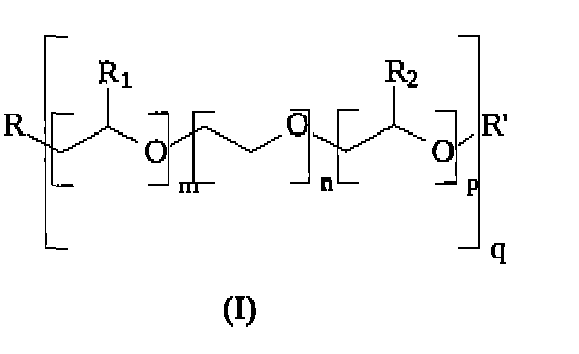 - m und p für eine Anzahl von Alkylenoxideinheiten stehen, die kleiner oder gleich 150 ist,- n für eine Anzahl von Ethylenoxideinheiten steht, die kleiner oder gleich 150 ist,- q für eine ganze Zahl steht, die mindestens gleich 1 ist und derart, dass 5 ≤ (m+n+p)q ≤ 150, und bevorzugt derart, dass 15 (m+n+p)q ≤ 120,- R1 für Wasserstoff oder den Methyl- oder Ethylrest steht- R2 für Wasserstoff oder den Methyl- oder Ethylrest steht- R für einen Rest steht, der eine polymerisierbare ungesättigte Funktion enthält, der bevorzugt zur Gruppe der Vinyle sowie zu der Gruppe der Acryl-, Methacryl-, Malein-, Itacon-, Croton-, Vinylphthalester sowie der Gruppe der ungesättigten Urethane, wie z.B. Acrylurethan, Methacrylurethan, α,α'-Dimethyl-isopropenylbenzylurethan und Allylurethan, oder zur Gruppe der Allyl- oder Vinylester gehört, egal ob, substituiert oder nicht, oder zur Gruppe der ethylenisch ungesättigten Amide oder Imide,- R' für Wasserstoff oder einen Kohlenwasserstoffrest mit 1 bis 40 Kohlenstoffatomen steht, und bevorzugt für einen Kohlenwasserstoffrest mit 1 bis 12 Kohlenstoffatomen steht, und besonders bevorzugt für einen Kohlenwasserstoffrest mit 1 bis 4 Kohlenstoffatomen,oder eine Mischung mehrerer Monomere der Formel (I),c) wenigstens einem Monomer des Acrylamid- oder Methacrylamid-Typs, oder ihren Derivaten, wie N-[3-(dimethylamino)propyl]acrylamid oder N-[3-(di-methylamino)propyl]methacrylamid, und deren Mischungen, oder aus wenigstens einem nicht-wasserlöslichen Monomer, wie den Alkylacrylaten oder Methacrylaten, den ungesättigten Estern, wie N-[2-(dimethylamino)ethyl]methacrylat oder N-[2-(dimethylamino)ethyl]acrylat, den Vinylen, wie Vinylacetat, Vinylpyrrolidon, Styrol, α-Methylstyrol und ihren Derivaten, oder wenigstens einem kationischen Monomer oder quaternärem Ammonium, wie [2-(Methacryloyl-oxy)ethyl]trimethylammoniumchlorid oder -sulfat, [2-(Acryloyl-oxy)ethyl]trimethylammoniumchlorid oder -sulfat, [3-(Acrylamido)propyl]trimethylammoniumchlorid oder -sulfat, Dimethyldiallylammoniumchlorid oder -sulfat, [3-(Methacrylamido)propyl]trimethylammoniumchlorid oder -sulfat, oder wenigstens einem Organofluorat- oder Organosililat-Monomer, oder einer Mischung mehrerer dieser Monomere,d) wenigstens einem Monomer mit wenigstens zwei ethylenischen Unsättigungen, Quervemetzungsmonomer genannt,wobei die Summe der Bestandteile a), b), c) und d) gleich 100% ist, und wobei das Copolymer eine intrinsische Viskosität von kleiner oder gleich 100 ml/g aufweist, bestimmt nach der Methode bekannt als "Intrinsische Visco Methode".
 - Verwendung eines schwach ionischen und wasserlöslichen Copolymers als Glanzaktivator, aus was auch immer für einem Blickwinkel, nach Anspruch 1, dadurch gekennzeichnet, dass das Organosililat-Monomer ausgewählt ist aus Molekülen der Formeln (IIa) oder (IIb):
mit Formel (IIa)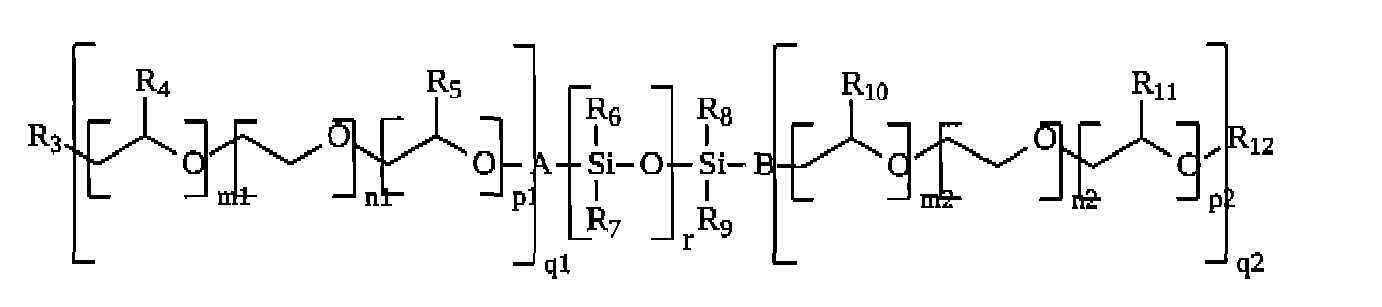 - m1, p1, m2 und p2 für eine Anzahl von Alkylenoxideinheiten kleiner als oder gleich 150 stehen,- n1 und n2 für eine Anzahl von Ethylenoxideinheiten kleiner als oder gleich 150 stehen,- q1 und q2 für eine ganze Zahl, die mindestens gleich 1 ist und derart, dass 0 ≤ (m1+n1+p1)q1 ≤ 150 und 0 ≤ (m2+n2+p2)q2 ≤ 150 stehen,- r für eine Zahl steht, derart, dass 1 ≤ r ≤ 200- R3 für einen Rest steht, der eine polymerisierbare ungesättigte Funktion enthält, der bevorzugt zur Gruppe der Vinyle sowie zu der Gruppe der Acryl-, Methacryl-, Malein-, Itacon-, Croton-, Vinylphthalester sowie der Gruppe der ungesättigten Urethane, wie z.B. Acrylurethan, Methacrylurethan, α,α'-Di¬methyl¬isopropenylbenzylurethan, Allylurethan, oder zur Gruppe der Allyl- oder Vinylester gehört, egal ob, substituiert oder nicht, oder zur Gruppe der ethylenisch ungesättigten Amide oder Imide,- R4, R5, R10 und R11 für Wasserstoff oder den Methyl- oder Ethylrest stehen- R6, R7, R8 und R9 für gerade oder verzweigte Alkyl-, Aryl-, Alkylaryl- oder Arylalkylgruppen mit 1 bis 20 Kohlenstoffatomen, oder deren Mischungen stehen- R12 für einen Kohlenwasserstoffrest mit 1 bis 40 Kohlenstoffatomen steht- A und B Gruppen sind, die vorhanden sein können, in dem Fall stehen sie für einen Kohlenwasserstoffrest mit 1 bis 4 Kohlenstoffatomen,mit Formel (IIb)
R - A - Si (OB)3
worin- R für einen Rest steht, der eine polymerisierbare ungesättigte Funktion enthält, der bevorzugt zur Gruppe der Vinyle sowie zu der Gruppe der Acryl-, Methacryl-, Malein-, Itacon-, Croton-, Vinylphthalester sowie der Gruppe der ungesättigten Urethane, wie z.B. Acrylurethan, Methacrylurethan, α,α'-Di¬methyl¬isopropenylbenzylurethan, Allylurethan, oder zur Gruppe der Allyl- oder Vinylester gehört, egal ob, substituiert oder nicht, oder zur Gruppe der ethylenisch ungesättigten Amide oder Imide,- A eine Gruppe ist, die vorhanden sein kann, in dem Fall steht sie für einen Kohlenwasserstoffrest mit 1 bis 4 Kohlenstoffatomen,- B für einen Kohlenwasserstoffrest mit 1 bis 4 Kohlenstoffatomen steht,oder eine Mischung mehrerer dieser Monomere,
und dadurch, dass das Quervernetzungsmonomer ausgewählt ist aus der Gruppe bestehend aus Ethylenglycoldimethylacrylat, Trimethylolpropantriacrylat, Allylacrylat, den Allylmaleaten, Methylen-bis-acrylamid, Methylen-bis-methacrylamid, Tetrallyloxyethan, den Triallylcyanuraten, den Allylethern, die aus Polyolen, wie Pentaerythritol, Sorbitol, Saccharose oder weiteren erhalten wurden, oder ausgewählt aus Molekülen der Formel (III): - m3, p3, m4 und p4 für eine Anzahl von Alkylenoxideinheiten kleiner als oder gleich 150 stehen- n3 und n4 für eine Anzahl von Ethylenoxideinheiten kleiner als oder gleich 150 stehen- q3 und q4 für eine ganze Zahl, die mindestens gleich 1 ist und derart, dass 0 ≤ (m3+n3+p3)q3 ≤ 150 und 0 ≤ (m4+n4+p4)q4 ≤ 150 stehen,- r' für eine Zahl steht, derart, dass 1 ≤ r' ≤ 200- R13 für einen Rest steht, der eine polymerisierbare ungesättigte Funktion enthält, der bevorzugt zur Gruppe der Vinyle sowie zu der Gruppe der Acryl-, Methacryl-, Malein-, Itacon-, Croton-, Vinylphthalester sowie der Gruppe der ungesättigten Urethane, wie z.B. Acrylurethan, Methacrylurethan, α,α'-Di¬methyl¬isopropenylbenzylurethan, Allylurethan, oder zur Gruppe der Allyl- oder Vinylester gehört, egal ob, substituiert oder nicht, oder zur Gruppe der ethylenisch ungesättigten Amide oder Imide,- R14, R15, R20 und R21 für Wasserstoff oder den Methyl- oder Ethylrest stehen- R16, R17, R18 und R19 für gerade oder verzweigte Alkyl-, oder Aryl-, oder Alkylaryl- oder Arylalkylgruppen mit 1 bis 20 Kohlenstoffatomen, oder deren Mischungen stehen- D und E Gruppen sind, die vorhanden sein können, in dem Fall stehen sie für einen Kohlenwasserstoffrest mit 1 bis 4 Kohlenstoffatomen,oder eine Mischung mehrerer dieser Monomere,
und dadurch, dass das Copolymer eine intrinsische Viskosität von kleiner oder gleich 100 ml/g aufweist, bestimmt nach der Methode bekannt als "Intrinsische Visco Methode. - Verwendung eines schwach ionischen und wasserlöslichen Copolymers als Glanzaktivator, aus was auch immer für einem Blickwinkel, nach einem der Ansprüche 1 bis 2, dadurch gekennzeichnet, dass das das Copolymer besteht, ausgedrückt in Gewicht:a) zwischen 2% und 95%, und spezieller zwischen 5% und 90%, aus wenigstens einem anionischen Monomer mit ethylenischer Unsättigung und einer Monocarboxylfunktion, ausgewählt aus den ethylenisch ungesättigten Monomeren mit einer Monocarboxylfunktion, wie Acryl- oder Methacrylsäure oder den Hemiestem von Diaziden, wie den C1- bis C4-Monoestem von Malein-oder Itaconsäure, oder deren Mischungen, oder ausgewählt aus den Monomeren mit ethylenischer Unsättigung und mit einer Dicarboxylfunktion, wie Croton-, Isocroton-, Zimt-, Itacon-, Maleinsäure, oder den Anhydriden von Carbonsäuren, wie Maleinsäureanhydrid, oder ausgewählt aus den Monomeren mit ethylenischer Unsättigung und mit einer Sulfonfunktion, wie Acrylamidomethylpropansulfonsäure, Natriummethallylsulfonat, Vinylsulfonsäure und Styrolsulfonsäure, oder ausgewählt aus den Monomeren mit ethylenischer Unsättigung und mit einer Phosphorsäurefunktion, wie Vinylphosphorsäure, Ethylenglycolmethacrylatphosphat, Propylenglycolmethacrylatphosphat, Ethyleneglycolacrylatphosphat, Propylenglycolacrylatphosphat und ihren Ethoxylaten, oder ausgewählt aus den Monomeren mit ethylenischer Unsättigung und mit einer Phosphonsäurefunktion, wie Vinylphosphonsäure, oder deren Mischungen,b) zwischen 2 und 95%, und noch bevorzugter zwischen 5% und 90%, aus wenigstens einem Monomer mit einer nicht-ionischen, ethylenischen Unsättigung der Formel (I):
 - m und p für eine Anzahl von Alkylenoxideinheiten stehen, die kleiner oder gleich 150 ist,- n für eine Anzahl von Ethylenoxideinheiten steht, die kleiner oder gleich 150 ist,- q für eine ganze Zahl steht, die mindestens gleich 1 ist und derart, dass 5 ≤ (m+n+p)q ≤ 150, und bevorzugt derart, dass 15 ≤ (m+n+p)q ≤ 120,- R1 für Wasserstoff oder den Methyl- oder Ethylrest steht- R2 für Wasserstoff oder den Methyl- oder Ethylrest steht- R für einen Rest steht, der eine polymerisierbare ungesättigte Funktion enthält, der bevorzugt zur Gruppe der Vinyle sowie zu der Gruppe der Acryl-, Methacryl-, Malein-, Itacon-, Croton-, Vinylphthalester sowie der Gruppe der ungesättigten Urethane, wie z.B. Acrylurethan, Methacrylurethan, α,α'-Dimethyl-isopropenylbenzylurethan und Allylurethan, oder zur Gruppe der Allyl- oder Vinylester gehört, egal ob, substituiert oder nicht, oder zur Gruppe der ethylenisch ungesättigten Amide oder Imide,- R' für Wasserstoff oder einen Kohlenwasserstoffrest mit 1 bis 40 Kohlenstoffatomen steht, und bevorzugt für einen Kohlenwasserstoffrest mit 1 bis 12 Kohlenstoffatomen steht, und besonders bevorzugt für einen Kohlenwasserstoffrest mit 1 bis 4 Kohlenstoffatomen,oder eine Mischung mehrerer Monomere der Formel (I),c) bis zu 50% aus wenigstens einem Monomer des Acrylamid- oder Methacrylamid-Typs, oder ihren Derivaten, wie N-[3-(dimethylamino)propyl]acrylamid oder N-[3-(dimethylamino)propyl]methacrylamid, und deren Mischungen, oder aus wenigstens einem nicht-wasserlöslichen Monomer, wie den Alkylacrylaten oder Methacrylaten, den ungesättigten Estern, wie N-[2-(dimethyl-amino)ethyl]methacrylat oder N-[2-(dimethylamino)ethyl]acrylat, den Vinylen, wie Vinylacetat, Vinylpyrrolidon, Styrol, α-Methylstyrol und ihren Derivaten, oder wenigstens einem kationischen Monomer oder quaternärem Ammonium, wie [2-(Methacryloyloxy)ethyl]trimethylammoniumchlorid oder -sulfat, [2-(Acryloyloxy)ethyl]trimethylammoniumchlorid oder -sulfat, [3-(Acrylamido)propyl]trimethylammoniumchlorid oder -sulfat, Dimethyldiallylammoniumchlorid oder -sulfat, [3-(Methacrylamido)propyl]trimethylammoniumchlorid oder -sulfat, oder wenigstens einem Organofluorat-Monomer, oder wenigstens einem Organosililat-Monomer, bevorzugt ausgewählt aus den Molekülen der Formeln (IIa) oder (IIb):
mit Formel (IIa) - m1, p1, m2 und p2 für eine Anzahl von Alkylenoxideinheiten kleiner als oder gleich 150 stehen,- n1 und n2 für eine Anzahl von Ethylenoxideinheiten kleiner als oder gleich 150 stehen,- q1 und q2 für eine ganze Zahl, die mindestens gleich 1 ist und derart, dass 0 ≤ (m1+n1+p1)q1 ≤ 150 und 0 ≤ (m2+n2+p2)q2 ≤ 150 stehen,- r für eine Zahl steht, derart, dass 1 ≤ r ≤ 200- R3 für einen Rest steht, der eine polymerisierbare ungesättigte Funktion enthält, der bevorzugt zur Gruppe der Vinyle sowie zu der Gruppe der Acryl-, Methacryl-, Malein-, Itacon-, Croton-, Vinylphthalester, sowie zur Gruppe der ungesättigten Urethane, wie Acrylurethan, Methacrylurethan, α,α'-Dimethyl-isopropenylbenzylurethan und Allylurethan, oder zur Gruppe der Allyl- oder Vinylester gehört, egal ob, substituiert oder nicht, oder zur Gruppe der ethylenischen, ungesättigten Amide oder Imide,- R4, R5, R10 und R11 für Wasserstoff oder den Methyl- oder Ethylrest stehen- R6, R7, R8 und R9 für gerade oder verzweigte Alkyl-, Aryl-, Alkylaryl- oder Arylalkylgruppen mit 1 bis 20 Kohlenstoffatomen, oder deren Mischungen stehen- R12 für einen Kohlenwasserstoffrest mit 1 bis 40 Kohlenstoffatomen steht- A und B Gruppen sind, die vorhanden sein können, in dem Fall stehen sie für einen Kohlenwasserstoffrest mit 1 bis 4 Kohlenstoffatomen,mit Formel (IIb)
R - A - Si (OB)3
worin- R für einen Rest steht, der eine polymerisierbare ungesättigte Funktion enthält, der bevorzugt zur Gruppe der Vinyle sowie zu der Gruppe der Acryl-, Methacryl-, Malein-, Itacon-, Croton-, Vinylphthalester, sowie der Gruppe der ungesättigten Urethane, wie Acrylurethan, Methacrylurethan, α,α'-Dimethyl-isopropenylbenzylurethan und Allylurethan, oder zur Gruppe der Allyl- oder Vinylester gehört, egal ob, substituiert oder nicht, oder zur Gruppe der ethylenisch ungesättigten Amide oder Imide,- A eine Gruppe ist, die vorhanden sein kann, in dem Fall steht sie für einen Kohlenwasserstoffrest mit 1 bis 4 Kohlenstoffatomen,- B für einen Kohlenwasserstoffrest mit 1 bis 4 Kohlenstoffatomen steht, oder eine Mischung mehrerer dieser Monomere,d) bis zu 3% aus wenigstens einem Quervemetzungsmonomer, in einer nichtbeschränkenden Art und Weise ausgewählt aus der Gruppe gebildet aus Ethylenglycoldimethylacrylat, Trimethylolpmpantriacrylat, Allylacrylat, den Allylmaleaten, Methylen-bis-acrylamid, Methylen-bis-methacrylamid, Tetrallyloxyethan, den Triallylcyanuraten, den Allylethern, die aus Polyolen, wie Pentaerythritol, Sorbitol, Saccharose oder weiteren erhalten wurden, oder ausgewählt aus den Molekülen der Formel (III):wobei die Summe der Bestandteile a), b), c) und d) 100 % ergibt, und dadurch, dass das Copolymer eine intrinsische Viskosität von kleiner oder gleich 100 ml/g aufweist, bestimmt nach der Methode bekannt als "Intrinsische Visco Methode.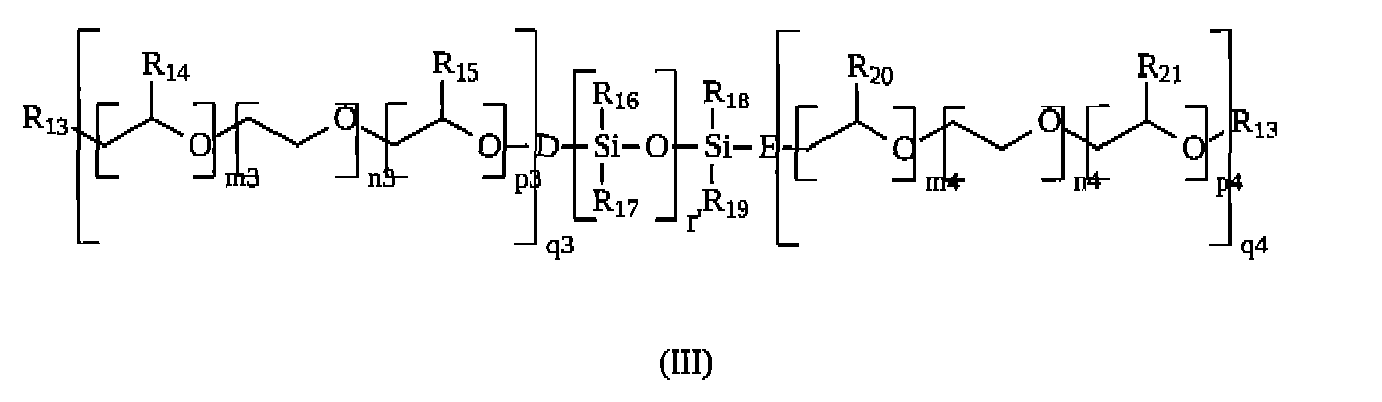 - m3, p3, m4 und p4 für eine Anzahl von Alkylenoxideinhelten kleiner als oder gleich 150 stehen- n3 und n4 für eine Anzahl von Ethylenoxideinheiten kleiner als oder gleich 150 stehen- q3 und q4 für eine ganze Zahl, die mindestens gleich 1 ist und derart, dass 0 ≤ (m3+n3+p3)q3 ≤ 150 und 0 ≤ (m4+n4+p4)q4 ≤ 150 stehen,- r' für eine Zahl steht, derart, dass 1 ≤ r' ≤ 200- R13 für einen Rest steht, der eine polymerisierbare ungesättigte Funktion enthält, der bevorzugt zur Gruppe der Vinyle sowie zu der Gruppe der Acryl-, Methacryl-, Malein-, Itacon-, Croton-, Vinylphthalester sowie der Gruppe der ungesättigten Urethane, wie Acrylurethan, Methacrylurethan, α,α'-Dimethyl-isopropenylbenzylurethan und Allylurethan, oder zur Gruppe der Allyl- oder Vinylester gehört, egal ob, substituiert oder nicht, oder zur Gruppe der ethylenisch ungesättigten Amide oder Imide,- R14, R15, R20 und R21 für Wasserstoff oder den Methyl- oder Ethylrest stehen- R16, R17, R18 und R19 für gerade oder verzweigte Alkyl-, oder Aryl-, oder Alkylaryl- oder Arylalkylgruppen mit 1 bis 20 Kohlenstoffatomen, oder deren Gemische stehen- D und E Gruppen sind, die vorhanden sein können, in dem Fall stehen sie für einen Kohlenwasserstoffrest mit 1 bis 4 Kohlenstoffatomen,oder eine Mischung mehrerer dieser Monomere,
 - Verwendung eines schwach ionischen und wasserlöslichen Copolymers als Glanzaktivator, aus was auch immer für einem Blickwinkel, nach einem der Ansprüche 1 bis 3, dadurch gekennzeichnet, dass das Copolymer ist in seiner sauren Form oder teilweise oder vollständig neutralisiert durch ein oder mehrere Neutralisierungsmittel mit einer ein- oder mehrwertigen neutralisierenden Funktion, wie z. B. für die einwertige Funktion aus denen ausgewählt aus der Gruppe der alkalischen Kationen, wie insbesondere Natrium, Kalium, Lithium, Ammonium, oder den primären, sekundären oder tertiären aliphatischen und/oder cyclischen Aminen wie z.B. Stearylamin, den Ethanolaminen (Mono-, Di-, Triethanolamin), Mono- und Diethylamin, Cyclohexylamin, Methylcyclohexylamin, Aminomethylpropanol, Morpholin oder aber für die mehrwertige Funktion durch Verbindungen aus der Gruppe der divalenten Erdalkalikationen, insbesondere Magnesium und Calcium oder aber Zink, genauso wie dreiwertige Kationen, darunter insbesondere Aluminium, oder aber aus bestimmten Kationen höherer Valenz.
- Glanzaktivator, aus was auch immer für einem Blickwinkel, z.B. einem Winkel zwischen 20° und 85°, und bevorzugter zwischen 45° und 75°, stammend aus der Verwendung eines Copolymers, wie es in Anspruch 1 oder 2 definiert ist, dadurch gekennzeichnet, dass es ein wasserlösliches Copolymer ist, bevorzugt schwach ionisch und wasserlöslich, und wenigstens eine Alkoxy- oder Hydroxypolyalkylen-Funktion aufweist, die auf wenigstens ein ethylenisch ungesättigtes Monomer aufgepfropft ist.
- Glanzaktivator, aus was auch immer für einem Blickwinkel, nach Anspruch 5, dadurch gekennzeichnet, dass es ein wasserlösliches Copolymer ist, bevorzugt schwach und wasserlöslich, bestehend aus wenigstens einem Monomer der Formel (I):
 - m und p für eine Anzahl von Alkylenoxideinheiten stehen, die kleiner oder gleich 150 ist,- n für eine Anzahl von Ethylenoxideinheiten steht, die kleiner oder gleich 150 ist,- q für eine ganze Zahl steht, die mindestens gleich 1 ist und derart, dass 5 ≤ (m+n+p)q ≤ 150, und bevorzugt derart, dass 15 ≤ (m+n+p)q ≤ 120,- R1 für Wasserstoff oder den Methyl- oder Ethylrest steht- R2 für Wasserstoff oder den Methyl- oder Ethylrest steht- R für einen Rest steht, der eine polymerisierbare ungesättigte Funktion enthält, der bevorzugt zur Gruppe der Vinyle sowie zu der Gruppe der Acryl-, Methacryl-, Malein-, Itacon-, Croton-, Vinylphthalester sowie der Gruppe der ungesättigten Urethane, wie z.B. Acrylurethan, Methacrylurethan, α,α'-Dimethyl-isopropenylbenzylurethan und Allylurethan, oder zur Gruppe der Allyl- oder Vinylester gehört, egal ob, substituiert oder nicht, oder zur Gruppe der ethylenisch ungesättigten Amide oder Imide,- R' für Wasserstoff oder einen Kohlenwasserstoffrest mit 1 bis 40 Kohlenstoffatomen steht, und bevorzugt für einen Kohlenwasserstoffrest mit 1 bis 12 Kohlenstoffatomen steht, und besonders bevorzugt für einen Kohlenwasserstoffrest mit 1 bis 4 Kohlenstoffatomen,und dadurch, dass das Copolymer eine intrinsische Viskosität von kleiner oder gleich 100 ml/g aufweist, bestimmt nach der Methode bekannt als "Intrinsische Visco Methode.
 - Glanzaktivator, aus was auch immer für einem Blickwinkel, nach einem der Ansprüche 5 oder 6, dadurch gekennzeichnet, dass es ein wasserlösliches Copolymer ist, bevorzugt schwach und wasserlöslich, bestehend aus:a) wenigstens einem anionischen Monomer mit Carboxyl- oder Dicarboxyl- oder Phosphor- oder Sulfonsäurefunktion oder deren Gemische,b) wenigstens einem nicht-ionischen Monomer, wobei das nicht-ionische Monomer besteht aus wenigstens einem Monomer der Formel (I)
 - m und p für eine Anzahl von Alkylenoxideinheiten stehen, die kleiner oder gleich 150 ist,- n für eine Anzahl von Ethylenoxideinheiten steht, die kleiner oder gleich 150 ist,- q für eine ganze Zahl steht, die mindestens gleich 1, ist und derart, dass 5 ≤ (m+n+p)q ≤ 150, und bevorzugt derart, dass 15 ≤ (m+n+p)q ≤ 120,- R1 für Wasserstoff oder den Methyl- oder Ethylrest steht- R2 für Wasserstoff oder den Methyl- oder Ethylrest steht- R für einen Rest steht, der eine polymerisierbare ungesättigte Funktion enthält, der bevorzugt zur Gruppe der Vinyle sowie zu der Gruppe der Acryl-, Methacryl-, Malein-, Itacon-, Croton-, Vinylphthalester sowie der Gruppe der ungesättigten Urethane, wie z.B. Acrylurethan, Methacrylurethan, α,α'-Dimethyl-isopropenylbenzylurethan und Allylurethan, oder zur Gruppe der Allyl- oder Vinylester gehört, egal ob, substituiert oder nicht, oder zur Gruppe der ethylenisch ungesättigten Amide oder Imide,- R' für Wasserstoff oder einen Kohlenwasserstoffrest mit 1 bis 40 Kohlenstoffatomen steht, und bevorzugt für einen Kohlenwasserstoffrest mit 1 bis 12 Kohlenstoffatomen steht, und besonders bevorzugt für einen Kohlenwasserstoffrest mit 1 bis 4 Kohlenstoffatomen,oder eine Mischung mehrerer Monomere der Formel (I),c) wenigstens einem Monomer des Acrylamid- oder Methacrylamid-Typs, oder ihren Derivaten, wie N-[3-(dimethylamino)propyl]acrylamid oder N-[3-(dimethylamino)propyl]methacrylamid, und deren Mischungen, oder aus wenigstens einem nicht-wasserlöslichen Monomer, wie den Alkylacrylaten oder Methacrylaten, den ungesättigten Estern, wie N-[2-(dimethyl-amino)ethyl]methacrylat oder N-[2-(dimethylamino)ethyl]acrylat, den Vinylen, wie Vinylacetat, Vinylpyrrolidon, Styrol, α-Methylstyrol und ihren Derivaten, oder wenigstens einem kationischen Monomer oder quaternärem Ammonium, wie [2-(Methaeryloyloxy)ethyl]trimethylammoniumchlorid oder -sulfat, [2-(Acryloyloxy)ethyl]trimethylammoniumchlorid oder -sulfat, [3-(Acrylamido)propyl]trimethylammoniumchlorid oder -sulfat, Dimethyldiallylammoniumchlorid oder -sulfat, [3-(Methacrylamido)propyl]trimethylammoniumchlorid oder -sulfat, oder wenigstens einem Organofluorat- oder Organosililat-Monomer, oder einer Mischung mehrerer dieser Monomere,d) wenigstens einem Monomer mit wenigstens zwei ethylenischen Unsättigungen, Quervernetzungsmonomer genannt,wobei die Summe der Bestandteile a), b), c) und d) gleich 100% ist, und wobei das Copolymer eine intrinsische Viskosität von kleiner oder gleich 100 ml/g aufweist, bestimmt nach der Methode bekannt als "Intrinsische Visco Methode".
 - Glanzaktivator, aus was auch immer für einem Blickwinkel, nach einem der Ansprüche 5 bis 7, dadurch gekennzeichnet, dass das Organosililat-Monomer ausgewählt ist aus Molekülen der Formeln (IIa) oder (IIb);
mit Formel (IIa) - m1, p1, m2 und p2 für eine Anzahl von Alkylenoxideinheiten kleiner als oder gleich 150 stehen,- n1 und n2 für eine Anzahl von Ethylenoxideinheiten kleiner als oder gleich 150 stehen,- q1 und q2 für eine ganze Zahl, die mindestens gleich 1 ist und derart, dass 0 ≤ (m1+n1+p1)q1 ≤ 150 und 0 ≤ (m2+n2+p2)q2 ≤ 150 stehen,- r für eine Zahl steht, derart, dass 1 ≤ r ≤ 200- R3 für einen Rest steht, der eine polymerisierbare ungesättigte Funktion enthält, der bevorzugt zur Gruppe der Vinyle sowie zu der Gruppe der Acryl-, Methacryl-, Malein-, Itacon-, Croton-, Vinylphthalester sowie der Gruppe der ungesättigten Urethane, wie z.B. Acrylurethan, Methacrylurethan, α,α'-Di¬methyl¬isopropenylbenzylurethan, Allylurethan, oder zur Gruppe der Allyl- oder Vinylester gehört, egal ob, substituiert oder nicht, oder zur Gruppe der ethylenisch ungesättigten Amide oder Imide,- R4, R5, R10 und R11 für Wasserstoff oder den Methyl- oder Ethylrest stehen- R6, R7, R8 und R9 für gerade oder verzweigte Alkyl-, Aryl-, Alkylaryl- oder Arylalkylgruppen mit 1 bis 20 Kohlenstoffatomen, oder deren Mischungen stehen- R12 für einen Kohlenwasserstoffrest mit 1 bis 40 Kohlenstoffatomen steht- A und B Gruppen sind, die vorhanden sein können, in dem Fall stehen sie für einen Kohlenwasserstoffrest mit 1 bis 4 Kohlenstoffatomen,mit Formel (IIb)
R-A-Si(OB)3
worin- R für einen Rest steht, der eine polymerisierbare ungesättigte Funktion enthält, der bevorzugt zur Gruppe der Vinyle sowie zu der Gruppe der Acryl-, Methacryl-, Malein-, Itacon-, Croton-, Vinylphthalester sowie der Gruppe der ungesättigten Urethane, wie z.B. Acrylurethan, Methacrylurethan, α,α'-Di¬methyl¬isopropenylbenzylurethan, Allylurethan, oder zur Gruppe der Allyl- oder Vinylester gehört, egal ob, substituiert oder nicht, oder zur Gruppe der ethylenisch ungesättigten Amide oder Imide,- A eine Gruppe ist, die vorhanden sein kann, in dem Fall steht sie für einen Kohlenwasserstoffrest mit 1 bis 4 Kohlenstoffatomen,- B für einen Kohlenwasserstoffrest mit 1 bis 4 Kohlenstoffatomen steht,oder eine Mischung mehrerer dieser Monomere,
und dadurch, dass das Quervemetzungsmonomer ausgewählt ist aus der Gruppe bestehend aus Ethylenglycoldimethylacrylat, Trimethylolpropantriacrylat, Allylacrylat, den Allylmaleaten, Methylen-bis-acrylamid, Methylen-bis-methacrylamid, Tetrallyloxyethan, den Triallylcyanuraten, den Allylethern, die aus Polyolen, wie Pentaerythritol, Sorbitol, Saccharose oder weiteren erhalten wurden, oder ausgewählt aus Molekülen der Formel (III): - m3, p3, m4 und p4 für eine Anzahl von Alkylenoxideinheiten kleiner als oder gleich 150 stehen- n3 und n4 für eine Anzahl von Ethylenoxideinheiten kleiner als oder gleich 150 stehen- q3 und q4 für eine ganze Zahl, die mindestens gleich 1 ist und derart, dass 0 ≤ (m3+n3+p3)q3 ≤ 1150 und 0 ≤ (m4+n4+p4)q4 ≤ 150 stehen,- r' für eine Zahl steht, derart, dass 1 ≤ r' ≤ 200- R13 für einen Rest steht, der eine polymerisierbare ungesättigte Funktion enthält, der bevorzugt zur Gruppe der Vinyle sowie zu der Gruppe der Acryl-, Methacryl-, Malein-, Itacon-, Croton-, Vinylphthalester sowie der Gruppe der ungesättigten Urethane, wie z.B. Acrylurethan, Methacrylurethan, α,α'-Di¬methyl¬isopropenylbenzylurethan, Allylurethan, oder zur Gruppe der Allyl- oder Vinylester gehört, egal ob, substituiert oder nicht, oder zur Gruppe der ethylenisch ungesättigten Amide oder Imide,- R14, R15, R20 und R21 für Wasserstoff oder den Methyl- oder Ethylrest stehen- R16, R17, R18 und R19 für gerade oder verzweigte Alkyl-, oder Aryl-, oder Alkylaryl- oder Arylalkylgruppen mit 1 bis 20 Kohlenstoffatomen, oder deren Mischungen stehen- D und E Gruppen sind, die vorhanden sein können, in dem Fall stehen sie für einen Kohlenwasserstoffrest mit 1 bis 4 Kohlenstoffatomen,oder eine Mischung mehrerer dieser Monomere.
 - Glanzaktivator, aus was auch immer für einem Blickwinkel, nach einem der Ansprüche 1 bis 4, dadurch gekennzeichnet, dass es ein wasserlösliches Copolymer ist, bevorzugt schwach und wasserlöslich, bestehend aus, ausgedrückt in Gewicht:a) zwischen 2% und 95%, und spezieller zwischen 5% und 90%, aus wenigstens einem anionischen Monomer mit ethylenischer Unsättigung und einer Monocarboxylfunktion, ausgewählt aus den ethylenisch ungesättigten Monomeren mit einer Monocarboxylfunktion, wie Acryl- oder Methacrylsäure oder den Hemiestem von Diaziden, wie den C1- bis C4-Monoestern von Malein-oder Itaconsäure, oder deren Mischungen, oder ausgewählt aus den Monomeren mit ethylenischer Unsättigung und mit einer Dicarboxylfunktion, wie Croton-, Isocroton-, Zimt-, Itacon-, Maleinsäure, oder den Anhydriden von Carbonsäuren, wie Maleinsäureanhydrid, oder ausgewählt aus den Monomeren mit ethylenischer Unsättigung und mit einer Sulfonfunktion, wie Acrylamidomethylpropansulfonsäure, Natriummethallylsulfonat, Vinylsulfonsäure und Styrolsulfonsäure, oder ausgewählt aus den Monomeren mit ethylenischer Unsättigung und mit einer Phosphorsäurefunktion, wie Vinylphosphorsäure, Ethylenglycolmethacrylatphosphat, Propylenglycolmethacrylatphosphat, Ethyleneglycolacrylatphosphat, Propylenglycolacrylatphosphat und ihren Ethoxylaten, oder ausgewählt aus den Monomeren mit ethylenischer Unsättigung und mit einer Phosphonsäurefunktion, wie Vinylphosphonsäure, oder deren Mischungen,b) zwischen 2 und 95%, und noch bevorzugter zwischen 5% und 90%, aus wenigstens einem Monomer mit einer nicht-ionischen, ethylenischen Unsättigung der Formel (I):
 - m und p für eine Anzahl von Alkylenoxideinheiten stehen, die kleiner oder gleich 150 ist,- n für eine Anzahl von Ethylenoxideinheiten steht, die kleiner oder gleich 150 ist,- q für eine ganze Zahl steht, die mindestens gleich 1 ist und derart, dass 5 ≤ (m+n+p)q ≤ 150, und bevorzugt derart, dass 15 ≤ (m+n+p)q ≤ 120,- R1 für Wasserstoff oder den Methyl- oder Ethylrest steht- R2 für Wasserstoff oder den Methyl- oder Ethylrest steht- R für einen Rest steht, der eine polymerisierbare ungesättigte Funktion enthält, der bevorzugt zur Gruppe der Vinyle sowie zu der Gruppe der Acryl-, Methacryl-, Malein-, Itacon-, Croton-, Vinylphthalester sowie der Gruppe der ungesättigten Urethane, wie z.B. Acrylurethan, Methacrylurethan, α,α'-Dimethyl-isopropenylbenzylurethan und Allylurethan, oder zur Gruppe der Allyl- oder Vinylester gehört, egal ob, substituiert oder nicht, oder zur Gruppe der ethylenisch ungesättigten Amide oder Imide,- R' für Wasserstoff oder einen Kohlenwasserstoffrest mit 1 bis 40 Kohlenstoffatomen steht, und bevorzugt für einen Kohlenwasserstoffrest mit 1 bis 12 Kohlenstoffatomen steht, und besonders bevorzugt für einen Kohlenwasserstoffrest mit 1 bis 4 Kohlenstoffatomen,oder eine Mischung mehrerer Monomere der Formel (I),c) bis zu 50% aus wenigstens einem Monomer des Acrylamid- oder Methacrylamid-Typs, oder ihren Derivaten, wie N-[3-(dimethylamino)propyl]acrylamid oder N-[3-(dimethylamino)propyl]methacrylamid, und deren Mischungen, oder aus wenigstens einem nicht-wasserlöslichen Monomer, wie den Alkylacrylaten oder Methacrylaten, den ungesättigten Estern, wie N-[2-(dimethyl-amino)ethyl]methacrylat oder N-[2-(dimethylamino)ethyl]acrylat, den Vinylen, wie Vinylacetat, Vinylpyrolidon Styrol, α-Methylstyrol und ihren Derivaten, oder wenigstens einem kationischen Monomer oder quaternärem Ammonium, wie [2-(Methacryloyloxy)ethyl]trimethylammoniumchlorid oder -sulfat, [2-(Acryloyloxy)ethyl]trimethylammoniumchlorid oder -sulfat, [3-(Acrylamido)propyl]trimethylammoniumchlorid oder -sulfat, Dimethyldiallylammoniumchlorid oder -sulfat, [3-(Methacrylamido)propyl]trimethylammoniumchlorid oder -sulfat, oder wenigstens einem Organofluorat-Monomer, oder wenigstens einem Organosililat-Monomer, bevorzugt ausgewählt aus den Molekülen der Formeln (IIa) oder (IIb):
mit Formel (IIa) - m1, p1, m2 und p2 für eine Anzahl von Alkylenoxideinheiten kleiner als oder gleich 150 stehen,- n1 und n2 für eine Anzahl von Ethylenoxideinheiten kleiner als oder gleich 150 stehen,- q1 und q2 für eine ganze Zahl, die mindestens gleich 1 ist und derart, dass 0 ≤ (m1+n1+p1)q1 ≤ 150 und 0 ≤ (m2+n2+p2)q2 ≤ 150 stehen,- r für eine Zahl steht, derart, dass 1 ≤ r ≤ 200- R3 für einen Rest steht, der eine polymerisierbare ungesättigte Funktion enthält, der bevorzugt zur Gruppe der Vinyle sowie zu der Gruppe der Acryl-, Methacryl-, Malein-, Itacon-, Croton-, Vinylphthalester, sowie zur Gruppe der ungesättigten Urethane, wie Acrylurethan, Methacrylurethan, α,α'-Dimethyl-isopropenylbenzylurethan und Allylurethan, oder zur Gruppe der Allyl- oder Vinylester gehört, egal ob, substituiert oder nicht, oder zur Gruppe der ethylenischen, ungesättigten Amide oder Imide,- R4, R5, R10 und R11 für Wasserstoff oder den Methyl- oder Ethylrest stehen- R6, R7, R8 und R9 für gerade oder verzweigte Alkyl-, Aryl-, Alkylaryl- oder Arylalkylgruppen mit 1 bis 20 Kohlenstoffatomen, oder deren Mischungen stehen- R12 für einen Kohlenwasserstoffrest mit 1 bis 40 Kohlenstoffatomen steht- A und B Gruppen sind, die vorhanden sein können, in dem Fall stehen sie für einen Kohlenwasserstoffrest mit 1 bis 4 Kohlenstoffatomen,mit Formel (IIb)
R-A-Si (OB)3
worin- R für einen Rest steht, der eine polymerisierbare ungesättigte Funktion enthält, der bevorzugt zur Gruppe der Vinyle sowie zu der Gruppe der Acryl-, Methacryl-, Malein-, Itacon-, Croton-, Vinylphthalester, sowie der Gruppe der ungesättigten Urethane, wie Acrylurethan, Methacrylurethan, α,α'-Dimethyl-isopropenylbenzylurethan und Allylurethan, oder zur Gruppe der Allyl- oder Vinylester gehört, egal ob, substituiert oder nicht, oder zur Gruppe der ethylenisch ungesättigten Amide oder Imide,- A eine Gruppe ist, die vorhanden sein kann, in dem Fall steht sie für einen Kohlenwasserstoffrest mit 1 bis 4 Kohlenstoffatomen,- B für einen Kohlenwasserstoffrest mit 1 bis 4 Kohlenstoffatomen steht, oder eine Mischung mehrerer dieser Monomere,d) bis zu 3% aus wenigstens einem Quervernetzungsmonomer, in einer nichtbeschränkenden Art und Weise ausgewählt aus der Gruppe gebildet aus Ethylenglycoldimethylacrylat, Trimethylolpropantriacrylat, Allylacrylat, den Allylmaleaten, Methylen-bis-acrylamid, Methylen-bis-methacrylamid, Tetrallyloxyethan, den Triallylcyanuraten, den Allylethern, die aus Polyolen, wie Pentaerythritol, Sorbitol, Saccharose oder weiteren erhalten wurden, oder ausgewählt aus den Molekülen der Formel (III):wobei die Summe der Bestandteile a), b), c) und d) 100 % ergibt, und dadurch, dass das Copolymer eine intrinsische Viskosität von kleiner oder gleich 100 ml/g aufweist, bestimmt nach der Methode bekannt als "Intrinsische Visco Methode.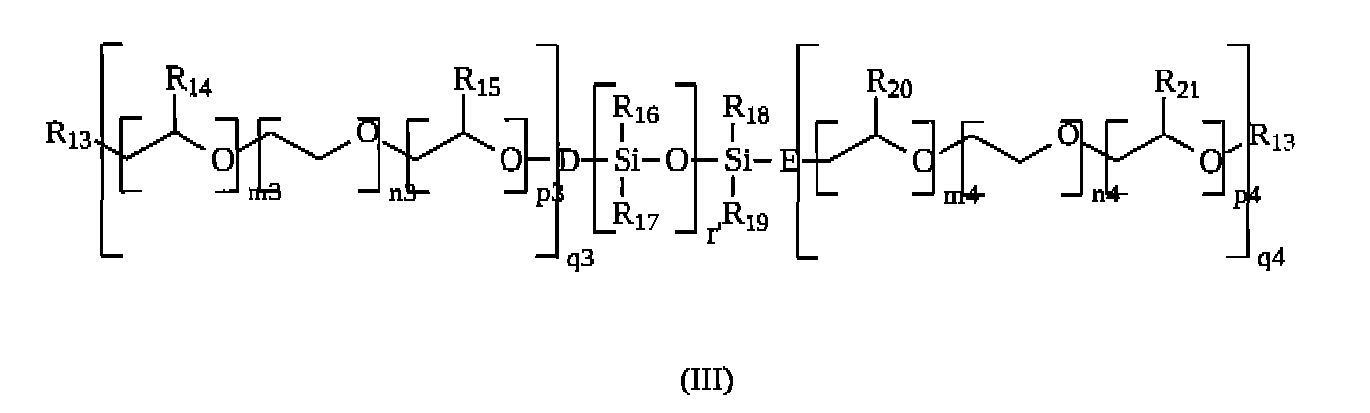 - m3, p3, m4 und p4 für eine Anzahl von Alkylenoxideinheiten kleiner als oder gleich 150 stehen- n3 und n4 für eine Anzahl von Ethylenoxideinheiten kleiner als oder gleich 150 stehen- q3 und q4 für eine ganze Zahl, die mindestens gleich 1 ist und derart, dass 0 ≤ (m3+n3+p3)q3 ≤ 150 und 0 ≤ (m4+n4+p4)q4 ≤ 150 stehen,- r' für eine Zahl steht, derart, dass 1 ≤ r' ≤ 200- R13 für einen Rest steht, der eine polymerisierbare ungesättigte Funktion enthält, der bevorzugt zur Gruppe der Vinyle sowie zu der Gruppe der Acryl-, Methacryl-, Malein-, Itacon-, Croton-, Vinylphthalester sowie der Gruppe der ungesättigten Urethane, wie Acrylurethan, Methacrylurethan, α,α'-Dimethyl-isopropenylbenzylurethan und Allylurethan, oder zur Gruppe der Allyl- oder Vinylester gehört, egal ob, substituiert oder nicht, oder zur Gruppe der ethylenisch ungesättigten Amide oder Imide,- R14, R15, R20 und R21 für Wasserstoff oder den Methyl- oder Ethylrest stehen- R16, R17, R18 und R19 für gerade oder verzweigte Alkyl-, oder Aryl-, oder Alkylaryl- oder Arylalkylgruppen mit 1 bis 20 Kohlenstoffatomen, oder deren Gemische stehen- D und E Gruppen sind, die vorhanden sein können, in dem Fall stehen sie für einen Kohlenwasserstoffrest mit 1 bis 4 Kohlenstoffatomen,oder eine Mischung mehrerer dieser Monomere,
 - Glanzaktivator, aus was auch immer für einem Blickwinkel, nach einem der Ansprüche 5 bis 9, dadurch gekennzeichnet, dass das Copolymer ist in seiner sauren Form oder teilweise oder vollständig neutralisiert durch ein oder mehrere Neutralisierungsmittel mit einer ein- oder mehrwertigen neutralisierenden Funktion, wie z. B. für die einwertige Funktion aus denen ausgewählt aus der Gruppe der alkalischen Kationen, wie insbesondere Natrium, Kalium, Lithium, Ammonium, oder den primären, sekundären oder tertiären aliphatischen und/oder cyclischen Aminen wie z.B. Stearylamin, den Ethanolaminen (Mono-, Di-, Triethanolamin), Mono- und Diethylamin, Cyclohexylamin, Methylcyclohexylamin, Aminomethylpropanol, Morpholin oder aber für die mehrwertige Funktion durch Verbindungen aus der Gruppe der divalenten Erdalkalikationen, insbesondere Magnesium und Calcium oder aber Zink, genauso wie dreiwertige Kationen, darunter insbesondere Aluminium, oder aber aus bestimmten Kationen höherer Valenz.
- Verfahren zur Dispergierung in wässriger Suspension von Mineralstoffmaterialien, dadurch gekennzeichnet, dass das Copolymer gemäss einem der Ansprüche 1 bis 4 verwendet wird.
- Verfahren zur Dispergierung in wässriger Suspension von Mineralstoffmaterialien nach Anspruch 11, dadurch gekennzeichnet, dass 0,05 bis 5 Trockengewichtsprozent des Copolymers, bezogen auf das Trockengewicht der Füllstoffe und/oder Pigmente, verwendet wird, bevorzugter, dass 0,1 bis 2,5 Trockengewichtsprozent des Copolymers, bezogen auf das Trockengewicht der Füllstoffe und/oder Pigmente, verwendet wird.
- Verfahren zur Dispergierung in wässriger Suspension von Mineralstoffmaterialien nach einem der Ansprüche 11 oder 12, dadurch gekennzeichnet, dass das Mineralstoffmaterial ausgewählt ist aus Calciumcarbonat, den Dolomiten, Kaolin, kalzinierten Kaolin, Talk, Gips, Titanoxid, Satinweiss, oder aber Aluminiumhydroxid, Glimmer sowie Gemischen dieser Füllstoffe, wie Talk-Calciumcarbonat- oder Calciumcarbonat-Kaolin Gemische, oder aber Gemische aus Calciumcarbonat mit Aluminiumhydroxid, oder aber Gemische mit synthetischen oder natürlichen Fasern, oder aber mineralische Co-Strukturen wie Talk-Calciumcarbonat- oder Talk-Titandioxide Co-Strukturen, und ist bevorzugt Calciumcarbonat, wie natürliches Calciumcarbonat ausgewählt aus Marmor, Calcit, Kreide oder deren Gemischen.
- Wässrige Suspension von Mineralstoffmaterialien, dispergiert durch das Copolymer wie es in einem der Ansprüche 1 bis 4 beschrieben ist, dadurch gekennzeichnet dass es das Copolymer enthält, und bevorzugter dass es von 0,05 bis 5 Trockengewichtsprozent des Copolymers enthält, bezogen auf das Trockengewicht der Füllstoffe und/oder Pigmente, und noch bevorzugter, dass es von 0,1 bis 2,5 Trockengewichtsprozent des Copolymers enthält, bezogen auf das Trockengewicht der Füllstoffe und/oder Pigmente.
- Wässrige Suspension von dispergierten Mineralstoffmaterialien nach Anspruch 14, dadurch gekennzeichnet, dass das Mineralstoffmaterial ausgewählt ist aus Calciumcarbonat, den Dolomiten, Kaolin, kalzinierten Kaolin, Talk, Gips, Titanoxid, Satinweiss, oder aber Aluminiumhydroxid, Glimmer sowie Gemischen dieser Füllstoffe, wie Talk-Calciumcarbonat- oder Calciumcarbonat-Kaolin Gemische, oder aber Gemische aus Calciumcarbonat mit Aluminiumhydroxid, oder aber Gemische mit synthetischen oder natürlichen Fasern, oder aber mineralische Co-Strukturen wie Talk-Calciumcarbonat- oder Talk-Titandioxide Co-Strukturen, und ist bevorzugt Calciumcarbonat, wie natürliches Calciumcarbonat ausgewählt aus Marmor, Calcit, Kreide oder deren Gemischen.
- Verfahren zum Vermahlen von Mineralstoffmaterialien in wässriger Suspension, dadurch gekennzeichnet, dass das Copolymer gemäss einem der Ansprüche 1 bis 4 verwendet wird.
- Verfahren zum Vermahlen von Mineralstoffmaterialien in wässriger Suspension durch das Copolymer wie es in den Ansprüchen 1 bis 4 beschrieben ist, dadurch gekennzeichnet, dass von 0,05 bis 5 Trockengewichtsprozent des Copolymers, bezogen auf das Trockengewicht der Füllstoffe und/oder Pigmente, verwendet wird, und noch bevorzugter, dass von 0,1 bis 2,5 Trockengewichtsprozent des Copolymers, bezogen auf das Trockengewicht der Füllstoffe und/oder Pigmente, verwendet wird.
- Verfahren zum von Mineralstoffmaterialien Vermahlen in wässriger Suspension nach einem der Ansprüche 16 oder 17, dadurch gekennzeichnet, dass das Mineralstoffmaterial ausgewählt ist aus Calciumcarbonat, den Dolomiten, Kaolin, kalzinierten Kaolin, Talk, Gips, Titanoxid, Satinweiss, oder aber Aluminiumhydroxid, Glimmer sowie Gemischen dieser Füllstoffe, wie Talk-Calciumcarbonat- oder Calciumcarbonat-Kaolin Gemische, oder aber Gemische aus Calciumcarbonat mit Aluminiumhydroxid, oder aber Gemische mit synthetischen oder natürlichen Fasern, oder aber mineralische Co-Strukturen wie Talk-Calciumcarbonat- oder Talk-Titandioxide Co-Strukturen, und ist bevorzugt Calciumcarbonat, wie natürliches Calciumcarbonat ausgewählt aus Marmor, Calcit, Kreide oder deren Gemischen.
- Wässrige Suspension von Mineralstoffmaterial vermahlen durch das Copolymer wie es in einem der Ansprüche 1 bis 4 beschrieben ist, dadurch gekennzeichnet, dass sie das Copolymer enthält, und bevorzugter, dass sie von 0,05 bis 5 Trockengewichtsprozent des Copolymers enthält, bezogen auf das Trockengewicht der Füllstoffe und/oder Pigmente, und noch bevorzugter, dass sie von 0,1 bis 2,5 Trockengewichtsprozent des Copolymers enthält, bezogen auf das Trockengewicht der Füllstoffe und/oder Pigmente.
- Wässrige Suspension von vermahlenem Mineralstoffmaterial nach Anspruch 19, dadurch gekennzeichnet, dass das Mineralstoffmaterial ausgewählt ist aus Calciumcarbonat, den Dolomiten, Kaolin, kalzinierten Kaolin, Talk, Gips, Titanoxid, Satinweiss, oder aber Aluminiumhydroxid, Glimmer sowie Gemischen dieser Füllstoffe, wie Talk-Calciumcarbonat- oder Calciumcarbonat-Kaolin Gemische, oder aber Gemische aus Calciumcarbonat mit Aluminiumhydroxid, oder aber Gemische mit synthetischen oder natürlichen Fasern, oder aber mineralische Co-Strukturen wie Talk-Calciumcarbonat- oder Talk-Titandioxide Co-Strukturen, und ist bevorzugt Calciumcarbonat, wie natürliches Calciumcarbonat ausgewählt aus Marmor, Calcit, Kreide oder deren Gemischen.
- Verwendung der wässrigen Suspension von Mineralstoffmaterialien nach einem der Ansprüche 14 und 15 oder 19 und 20 auf dem Gebiet der Papierherstellung, und bevorzugter beim Streichen von Papier.
- Verfahren zur Herstellung von Beschichtungsmasse, dadurch gekennzeichnet, dass das Copolymer gemäss einem der Ansprüche 1 bis 4 verwendet wird.
- Ein Verfahren zur Herstellung von Beschichtungsmasse nach Anspruch 22, dadurch gekennzeichnet, dass von 0,05 bis 5 Trockengewichtsprozent des Copolymers, bezogen auf das Trockengewicht der Mineralstoffmaterialien, verwendet wird, und noch bevorzugter, dass von 0,1 bis 2,5 Trockengewichtsprozent des Copolymers, bezogen auf das Trockengewicht der Mineralstoffmaterialien, verwendet wird.
- Beschichtungsmasse, dadurch gekennzeichnet, dass sie das Copolymer enthält, und bevorzugter, dass sie von 0,05 bis 5 Trockengewichtsprozent des Copolymers enthält, bezogen auf das Trockengewicht der Mineralstoffmaterialien, und noch bevorzugter, dass sie von 0,1 bis 2,5 Trockengewichtsprozent des Copolymers enthält, bezogen auf das Trockengewicht der Mineralstoffmaterialien.
- Gestrichenes Papier, dadurch gekennzeichnet, dass es das Copolymer gemäss einem der Ansprüche 1 bis 4 enthält.
- Farbenzusammensetzung, dadurch gekennzeichnet dass sie das Copolymer gemäss einem der Ansprüche 1 bis 4 enthält.
- Kunststoffzusammensetzung, dadurch gekennzeichnet, dass sie das Copolymer gemäss einem der Ansprüche 1 bis 4 enthält.
Priority Applications (1)
| Application Number | Priority Date | Filing Date | Title |
|---|---|---|---|
| SI200332279T SI2275462T1 (sl) | 2002-11-08 | 2003-11-07 | Kopolimer, ki ima najmanj eno alkoksi- ali hidroksi-polialkilensko glikol cepljeno funkcijo in njegova uporaba |
Applications Claiming Priority (2)
| Application Number | Priority Date | Filing Date | Title |
|---|---|---|---|
| FR0213999A FR2846971B1 (fr) | 2002-11-08 | 2002-11-08 | Utilisation d'un copolymere disposant d'au moins une fonction greffee alkoxy ou hydroxy polyalkylene glycol, comme agent ameliorant la brillance du papier et produits obtenus |
| EP03769789A EP1569970B1 (de) | 2002-11-08 | 2003-11-07 | Mit alkoxy oder hydroxy polyalkylene glycol gepropfte copolymere und ihre verwendung |
Related Parent Applications (1)
| Application Number | Title | Priority Date | Filing Date |
|---|---|---|---|
| EP03769789.3 Division | 2003-11-07 |
Publications (3)
| Publication Number | Publication Date |
|---|---|
| EP2275462A2 EP2275462A2 (de) | 2011-01-19 |
| EP2275462A3 EP2275462A3 (de) | 2011-03-09 |
| EP2275462B1 true EP2275462B1 (de) | 2013-04-24 |
Family
ID=32116467
Family Applications (2)
| Application Number | Title | Priority Date | Filing Date |
|---|---|---|---|
| EP03769789A Expired - Lifetime EP1569970B1 (de) | 2002-11-08 | 2003-11-07 | Mit alkoxy oder hydroxy polyalkylene glycol gepropfte copolymere und ihre verwendung |
| EP10011527.8A Expired - Lifetime EP2275462B1 (de) | 2002-11-08 | 2003-11-07 | Mit Alkoxy oder Hydroxy Polyalkylene Glycol gepropfte Copolymere und ihre Verwendung |
Family Applications Before (1)
| Application Number | Title | Priority Date | Filing Date |
|---|---|---|---|
| EP03769789A Expired - Lifetime EP1569970B1 (de) | 2002-11-08 | 2003-11-07 | Mit alkoxy oder hydroxy polyalkylene glycol gepropfte copolymere und ihre verwendung |
Country Status (27)
| Country | Link |
|---|---|
| US (1) | US7825192B2 (de) |
| EP (2) | EP1569970B1 (de) |
| JP (2) | JP4741239B2 (de) |
| KR (2) | KR101200632B1 (de) |
| CN (1) | CN100558771C (de) |
| AT (1) | ATE531740T1 (de) |
| AU (1) | AU2003278489B2 (de) |
| BR (1) | BR0316093B1 (de) |
| CA (1) | CA2505074C (de) |
| CO (1) | CO5650169A2 (de) |
| DK (2) | DK2275462T3 (de) |
| EA (1) | EA012405B1 (de) |
| ES (2) | ES2377398T3 (de) |
| FR (1) | FR2846971B1 (de) |
| HR (2) | HRP20050507B1 (de) |
| MX (1) | MXPA05004760A (de) |
| MY (1) | MY139769A (de) |
| NO (1) | NO335886B1 (de) |
| NZ (1) | NZ565212A (de) |
| PL (3) | PL211460B1 (de) |
| PT (2) | PT1569970E (de) |
| SI (2) | SI2275462T1 (de) |
| TW (1) | TWI387606B (de) |
| UA (1) | UA83353C2 (de) |
| UY (1) | UY28066A1 (de) |
| WO (1) | WO2004041883A1 (de) |
| ZA (1) | ZA200503286B (de) |
Families Citing this family (29)
| Publication number | Priority date | Publication date | Assignee | Title |
|---|---|---|---|---|
| FR2846978B1 (fr) * | 2002-11-08 | 2007-05-18 | Coatex Sas | Utilisation d'un copolymere disposant d'au moins une fonction greffee alkoxy ou hydroxy polyalkylene glycol, comme agent ameliorant l'activation de l'azurage optique et produits obtenus |
| FR2846971B1 (fr) * | 2002-11-08 | 2006-09-29 | Omya Ag | Utilisation d'un copolymere disposant d'au moins une fonction greffee alkoxy ou hydroxy polyalkylene glycol, comme agent ameliorant la brillance du papier et produits obtenus |
| FR2885906A1 (fr) * | 2005-05-20 | 2006-11-24 | Coatex Soc Par Actions Simplif | Utilisation de polymeres hydrosolubles obtenus par polymerisation radicalaire controlee comme agent ameliorant l'opacite et/ou la brillance de produits secs les contenant |
| EP1752499A1 (de) | 2005-07-25 | 2007-02-14 | Omya Development AG | Verfahren zur Dispergieren und oder Zerkleinern und oder Konzentrieren von Calcium Carbonat in wässrigem Medium, mittels einer wässrigen Lösung enthaltend Zirkonienverbindungen. |
| FR2893031B1 (fr) * | 2005-11-04 | 2008-02-08 | Coatex Sas | Procede de fabrication d'une resine thermoplastique avec une resistance a l'impact amelioree mettant en oeuvre un polymere peigne avec au moins une fonction greffee oxyde de polyalkylene et resines obtenues. |
| FR2894998A1 (fr) | 2005-12-16 | 2007-06-22 | Coatex Sas | Procede de fabrication de sauces de couchage a la retention d'eau et a la viscosite brookfield ameliorees mettant en oeuvre un polymere peigne avec au moins une fonction greffee oxyde de polyalkylene. |
| FR2896171B1 (fr) | 2006-01-19 | 2010-12-17 | Omya Development Ag | Procede de fabrication de particules a base de carbonate de calcium naturel et de sels d'acide ethylene acrylique, suspensions et pigments secs obtenus, leurs utilisations. |
| FR2913427B1 (fr) * | 2007-03-05 | 2011-10-07 | Omya Development Ag | Procede de broyage a sec d'un ou plusieurs materiaux comprenant au moins un carbonate de calcium |
| FR2917091B1 (fr) * | 2007-06-08 | 2009-08-28 | Coatex S A S Soc Par Actions S | Procede de fabrication d'une formulation aqueuse a base de solution d'un polymere peigne acrylique et d'emulsion epaississante acrylique, formulation obtenue et ses utilisations dans le couchage papetier |
| EP2075374A1 (de) | 2007-12-17 | 2009-07-01 | Omya Development AG | Verfahren zur Herstellung einer Streichmasse unter Einbringung eines acrylischen Verdickers mit verzweigter wasserabweisender Kettenstruktur und so erhaltene Streichmasse |
| EP2208761B1 (de) | 2009-01-16 | 2012-10-10 | Omya Development AG | Verfahren zur Herstellung selbstbindender Pigmentpartikel zur Implementierung von Acrylwaben-Copolymeren mit hydrophoben Gruppen als Haftmittel, selbstbindende Partikel und Verwendungen damit |
| IT1393465B1 (it) | 2009-03-16 | 2012-04-20 | Lamberti Spa | Poliuretano idrofilico a pettine |
| IT1393466B1 (it) | 2009-03-16 | 2012-04-20 | Lamberti Spa | Composizioni per la patinatura della carta |
| FR2945964B1 (fr) * | 2009-05-28 | 2012-02-17 | Coatex Sas | Utilisation d'un polymere peigne (meth)acrylique contenant un ester (meth)acrylique comme agent dispersant et anti-demoussant dans une suspension aqueuse de sulfate de calcium hemihydrate |
| ATE554145T1 (de) | 2009-08-05 | 2012-05-15 | Omya Development Ag | Verwendung von 2-amino-2-methyl-1-propanol als zusatz in wässrigen suspensionen aus calciumcarbonathaltigen materialien |
| FR2961211B1 (fr) | 2010-06-10 | 2012-07-27 | Coatex Sas | Polymeres peignes (meth)acryliques a fonction hydroxy polyalkylene glycol, leur utilisation comme agent rheofluidifiant dans des sauces de couchage et sauces les contenant. |
| FR2963939B1 (fr) | 2010-08-19 | 2013-11-15 | Coatex Sas | Utilisation en sauces de couchage papetieres de polymeres (meth)acryliques peignes amphiphiles et non hydrosolubles |
| FR2963934B1 (fr) | 2010-08-19 | 2013-10-25 | Coatex Sas | Polymeres (meth)acryliques peignes amphiphiles et non hydrosolubles |
| IT1402689B1 (it) | 2010-09-15 | 2013-09-13 | Lamberti Spa | Poliuretani a pettine utili per la patinatura della carta |
| IT1402349B1 (it) | 2010-09-15 | 2013-08-30 | Lamberti Spa | Composizioni per la patinatura della carta |
| CA2834607C (en) * | 2011-06-02 | 2020-01-14 | Rohm And Haas Company | Amphoteric polymer composition |
| CN102432752B (zh) * | 2011-08-18 | 2013-08-07 | 江苏科技大学 | 苯乙烯马来酸酐共聚物酰亚胺化材料及其制备方法 |
| ES2528746T3 (es) | 2011-11-11 | 2015-02-12 | Omya International Ag | Suspensiones acuosas de materiales que comprenden carbonato de calcio con baja formación de depósitos |
| ITVA20110030A1 (it) | 2011-11-11 | 2013-05-12 | Lamberti Spa | Composizione acquosa di polimeri per la patinatura della carta |
| FR2982887B1 (fr) * | 2011-11-18 | 2014-01-31 | Coatex Sas | Polymeres faiblement anioniques pour sauces de couchage destinees a des papiers pour impression de type jet d'encre |
| SI2684999T1 (sl) | 2012-07-13 | 2015-03-31 | Omya International Ag | Visoko trdne in nizko viskozne vodne goĺ äśe snovi, ki vsebujejo kalcijev karbonat, z izboljĺ ano reoloĺ ko stabilnostjo pri poviĺ ani temperaturi |
| US9126866B2 (en) * | 2013-03-06 | 2015-09-08 | Construction Research & Technology Gmbh | Polycarboxylate ethers with branched side chains |
| SI3018174T1 (en) | 2014-11-07 | 2018-07-31 | Omya International Ag | METHOD FOR THE PRODUCTION OF SUSPENSION CONTAINING MATERIAL CONTAINING CALCIUM CARBONATE |
| SE542657C2 (en) * | 2018-05-18 | 2020-06-23 | Stora Enso Oyj | Coating composition for paper and paperboard |
Family Cites Families (20)
| Publication number | Priority date | Publication date | Assignee | Title |
|---|---|---|---|---|
| JPS58109700A (ja) | 1981-12-22 | 1983-06-30 | サンノプコ株式会社 | 紙の表面処理剤および表面処理法 |
| JPS6335899A (ja) * | 1986-07-30 | 1988-02-16 | 新王子製紙株式会社 | 分散剤 |
| CN1092430A (zh) | 1989-10-25 | 1994-09-21 | 陶氏化学公司 | 纸张涂料组合物用的胶乳共聚物 |
| WO1994024202A1 (en) | 1992-04-07 | 1994-10-27 | The Dow Chemical Company | Latex copolymers for paper coating compositions |
| CA2086047C (en) | 1992-12-22 | 1999-11-09 | Clint W. Carpenter | A process for the preparation of a modified copolymer as a pigment dispersant for aqueous coating compositions |
| FR2707182B1 (fr) | 1993-07-09 | 1995-09-29 | Protex Manuf Prod Chimiq | Composition dispersante/fluidifiante à base de sel d'acide polyacrylique et de sel d'acide phosphonique pour suspensions concentrées de matières minérales. |
| JPH0853522A (ja) * | 1994-08-11 | 1996-02-27 | Sanyo Chem Ind Ltd | 水系スラリー用分散剤 |
| JPH0853354A (ja) | 1994-08-11 | 1996-02-27 | Hisamitsu Pharmaceut Co Inc | 皮膚疾患用水性貼付剤 |
| JPH1030010A (ja) * | 1996-07-15 | 1998-02-03 | Toyo Ink Mfg Co Ltd | ノニオン系高分子界面活性剤、その製造方法、及びその顔料分散体 |
| FR2766106B1 (fr) * | 1997-07-18 | 2001-09-07 | Coatex Sa | Utilisation d'un copolymere a structure tensio-active comme agent dispersant et/ou d'aide au broyage |
| FR2766107B1 (fr) | 1997-07-18 | 1999-08-20 | Pluss Stauffer Ag | Suspensions aqueuses de matieres minerales et leurs utilisations |
| PL200670B1 (pl) * | 1998-12-28 | 2009-01-30 | Chugoku Marine Paints | Kopolimer sililo(met)akrylanowy, sposób jego wytwarzania, przeciwporostowa kompozycja do malowania zawierająca kopolimer sililo(met)akrylanowy oraz jej zastosowanie |
| JP2000229233A (ja) * | 1999-02-09 | 2000-08-22 | Denki Kagaku Kogyo Kk | 無機粉末用分散剤 |
| DE19926611A1 (de) | 1999-06-11 | 2000-12-14 | Sueddeutsche Kalkstickstoff | Copolymere auf Basis von ungesättigten Mono- oder Dicarbonsäure-Derivaten und Oxyalkylenglykol-Alkenylethern, Verfahren zu deren Herstellung und ihre Verwendung |
| FR2810261B1 (fr) * | 2000-06-15 | 2002-08-30 | Coatex Sa | Utilisation de copolymeres faiblement anioniques comme agent dispersant et/ou d'aide au broyage de suspension aqueuse de matieres minerales, suspensions aqueuses obtenues et leurs utilisations |
| JP2002011338A (ja) | 2000-06-30 | 2002-01-15 | Lion Corp | 乳化剤及び乳化組成物 |
| US6599973B1 (en) * | 2000-09-27 | 2003-07-29 | E. I. Du Pont De Nemours And Company | Aqueous graft copolymer pigment dispersants |
| FR2846972B1 (fr) * | 2002-11-08 | 2005-02-18 | Omya Ag | Suspensions aqueuses de matieres minerales broyees, faiblement chargees ioniquement et leurs utilisations |
| FR2846978B1 (fr) * | 2002-11-08 | 2007-05-18 | Coatex Sas | Utilisation d'un copolymere disposant d'au moins une fonction greffee alkoxy ou hydroxy polyalkylene glycol, comme agent ameliorant l'activation de l'azurage optique et produits obtenus |
| FR2846971B1 (fr) * | 2002-11-08 | 2006-09-29 | Omya Ag | Utilisation d'un copolymere disposant d'au moins une fonction greffee alkoxy ou hydroxy polyalkylene glycol, comme agent ameliorant la brillance du papier et produits obtenus |
-
2002
- 2002-11-08 FR FR0213999A patent/FR2846971B1/fr not_active Expired - Lifetime
-
2003
- 2003-07-11 UA UAA200505505A patent/UA83353C2/uk unknown
- 2003-11-06 MY MYPI20034245A patent/MY139769A/en unknown
- 2003-11-06 UY UY28066A patent/UY28066A1/es active IP Right Grant
- 2003-11-06 TW TW092131050A patent/TWI387606B/zh not_active IP Right Cessation
- 2003-11-07 PL PL380996A patent/PL211460B1/pl unknown
- 2003-11-07 PL PL390344A patent/PL211432B1/pl unknown
- 2003-11-07 EP EP03769789A patent/EP1569970B1/de not_active Expired - Lifetime
- 2003-11-07 ES ES03769789T patent/ES2377398T3/es not_active Expired - Lifetime
- 2003-11-07 NZ NZ565212A patent/NZ565212A/en not_active IP Right Cessation
- 2003-11-07 BR BRPI0316093-9A patent/BR0316093B1/pt not_active IP Right Cessation
- 2003-11-07 EA EA200500790A patent/EA012405B1/ru not_active IP Right Cessation
- 2003-11-07 WO PCT/IB2003/005082 patent/WO2004041883A1/fr not_active Ceased
- 2003-11-07 KR KR1020117022710A patent/KR101200632B1/ko not_active Expired - Fee Related
- 2003-11-07 SI SI200332279T patent/SI2275462T1/sl unknown
- 2003-11-07 JP JP2004549498A patent/JP4741239B2/ja not_active Expired - Fee Related
- 2003-11-07 KR KR1020057008189A patent/KR101091313B1/ko not_active Expired - Fee Related
- 2003-11-07 PL PL390343A patent/PL211433B1/pl unknown
- 2003-11-07 CA CA2505074A patent/CA2505074C/fr not_active Expired - Fee Related
- 2003-11-07 CN CNB2003801041649A patent/CN100558771C/zh not_active Expired - Fee Related
- 2003-11-07 HR HRP20050507AA patent/HRP20050507B1/hr not_active IP Right Cessation
- 2003-11-07 PT PT03769789T patent/PT1569970E/pt unknown
- 2003-11-07 US US10/532,475 patent/US7825192B2/en active Active
- 2003-11-07 DK DK10011527.8T patent/DK2275462T3/da active
- 2003-11-07 ES ES10011527T patent/ES2422581T3/es not_active Expired - Lifetime
- 2003-11-07 MX MXPA05004760A patent/MXPA05004760A/es active IP Right Grant
- 2003-11-07 HR HRP20140008AA patent/HRP20140008A2/hr not_active Application Discontinuation
- 2003-11-07 AT AT03769789T patent/ATE531740T1/de active
- 2003-11-07 ZA ZA200503286A patent/ZA200503286B/en unknown
- 2003-11-07 SI SI200332103T patent/SI1569970T1/sl unknown
- 2003-11-07 AU AU2003278489A patent/AU2003278489B2/en not_active Ceased
- 2003-11-07 EP EP10011527.8A patent/EP2275462B1/de not_active Expired - Lifetime
- 2003-11-07 DK DK03769789.3T patent/DK1569970T3/da active
- 2003-11-07 PT PT100115278T patent/PT2275462E/pt unknown
-
2005
- 2005-06-03 CO CO05054344A patent/CO5650169A2/es not_active Application Discontinuation
- 2005-06-06 NO NO20052703A patent/NO335886B1/no not_active IP Right Cessation
-
2010
- 2010-04-27 JP JP2010102690A patent/JP5346319B2/ja not_active Expired - Fee Related
Also Published As
Similar Documents
| Publication | Publication Date | Title |
|---|---|---|
| EP2275462B1 (de) | Mit Alkoxy oder Hydroxy Polyalkylene Glycol gepropfte Copolymere und ihre Verwendung | |
| EP1572764B1 (de) | Wässrige lösungen aus bodenmineralmaterialien mit geringer ionenbelastung und deren verwendungen | |
| EP1565504B1 (de) | Verwendung eines polymerisats, geppfropftes alkoxy- oder hydroxypolyalkylenglycol enthaltend, als verbesserer beim optischen aufhellen, und die produkte | |
| EP1966441B1 (de) | Verfahren zur herstellung von streichmassen mit erhöhter wasserretention und erhöhter brookfield-viskosität unter einsatz eines kammpolymers mit mindestens einer aufgepfropften polyalkylenoxidfunktion | |
| EP1888657A2 (de) | Verwendung von wasserlöslichen polymeren, die durch kontrollierte radikalische polymerisation erhalten werden, als mittel zur verbesserung der opazität und/oder helligkeit von diese enthaltenden trockenen produkten |
Legal Events
| Date | Code | Title | Description |
|---|---|---|---|
| PUAI | Public reference made under article 153(3) epc to a published international application that has entered the european phase |
Free format text: ORIGINAL CODE: 0009012 |
|
| AC | Divisional application: reference to earlier application |
Ref document number: 1569970 Country of ref document: EP Kind code of ref document: P |
|
| AK | Designated contracting states |
Kind code of ref document: A2 Designated state(s): AT BE BG CH CY CZ DE DK EE ES FI FR GB GR HU IE IT LI LU MC NL PT RO SE SI SK TR |
|
| PUAL | Search report despatched |
Free format text: ORIGINAL CODE: 0009013 |
|
| AK | Designated contracting states |
Kind code of ref document: A3 Designated state(s): AT BE BG CH CY CZ DE DK EE ES FI FR GB GR HU IE IT LI LU MC NL PT RO SE SI SK TR |
|
| 17P | Request for examination filed |
Effective date: 20110909 |
|
| 17Q | First examination report despatched |
Effective date: 20111019 |
|
| GRAP | Despatch of communication of intention to grant a patent |
Free format text: ORIGINAL CODE: EPIDOSNIGR1 |
|
| GRAS | Grant fee paid |
Free format text: ORIGINAL CODE: EPIDOSNIGR3 |
|
| GRAA | (expected) grant |
Free format text: ORIGINAL CODE: 0009210 |
|
| AC | Divisional application: reference to earlier application |
Ref document number: 1569970 Country of ref document: EP Kind code of ref document: P |
|
| AK | Designated contracting states |
Kind code of ref document: B1 Designated state(s): AT BE BG CH CY CZ DE DK EE ES FI FR GB GR HU IE IT LI LU MC NL PT RO SE SI SK TR |
|
| REG | Reference to a national code |
Ref country code: GB Ref legal event code: FG4D Free format text: NOT ENGLISH |
|
| REG | Reference to a national code |
Ref country code: CH Ref legal event code: EP |
|
| REG | Reference to a national code |
Ref country code: AT Ref legal event code: REF Ref document number: 608622 Country of ref document: AT Kind code of ref document: T Effective date: 20130515 |
|
| REG | Reference to a national code |
Ref country code: IE Ref legal event code: FG4D Free format text: LANGUAGE OF EP DOCUMENT: FRENCH |
|
| REG | Reference to a national code |
Ref country code: DE Ref legal event code: R096 Ref document number: 60343920 Country of ref document: DE Effective date: 20130613 |
|
| REG | Reference to a national code |
Ref country code: PT Ref legal event code: SC4A Free format text: AVAILABILITY OF NATIONAL TRANSLATION Effective date: 20130722 Ref country code: DK Ref legal event code: T3 |
|
| REG | Reference to a national code |
Ref country code: SE Ref legal event code: TRGR |
|
| REG | Reference to a national code |
Ref country code: ES Ref legal event code: FG2A Ref document number: 2422581 Country of ref document: ES Kind code of ref document: T3 Effective date: 20130912 |
|
| REG | Reference to a national code |
Ref country code: NL Ref legal event code: T3 |
|
| REG | Reference to a national code |
Ref country code: NL Ref legal event code: TD Effective date: 20131004 |
|
| PG25 | Lapsed in a contracting state [announced via postgrant information from national office to epo] |
Ref country code: GR Free format text: LAPSE BECAUSE OF FAILURE TO SUBMIT A TRANSLATION OF THE DESCRIPTION OR TO PAY THE FEE WITHIN THE PRESCRIBED TIME-LIMIT Effective date: 20130725 |
|
| PG25 | Lapsed in a contracting state [announced via postgrant information from national office to epo] |
Ref country code: CY Free format text: LAPSE BECAUSE OF FAILURE TO SUBMIT A TRANSLATION OF THE DESCRIPTION OR TO PAY THE FEE WITHIN THE PRESCRIBED TIME-LIMIT Effective date: 20130424 Ref country code: BG Free format text: LAPSE BECAUSE OF FAILURE TO SUBMIT A TRANSLATION OF THE DESCRIPTION OR TO PAY THE FEE WITHIN THE PRESCRIBED TIME-LIMIT Effective date: 20130724 |
|
| REG | Reference to a national code |
Ref country code: SI Ref legal event code: SP73 Owner name: OMYA INTERNATIONAL AG; CH Effective date: 20131024 |
|
| REG | Reference to a national code |
Ref country code: AT Ref legal event code: HC Ref document number: 608622 Country of ref document: AT Kind code of ref document: T Owner name: OMYA INTERNATIONAL AG, CH Effective date: 20131107 |
|
| REG | Reference to a national code |
Ref country code: SK Ref legal event code: T3 Ref document number: E 15067 Country of ref document: SK |
|
| REG | Reference to a national code |
Ref country code: ES Ref legal event code: PC2A Owner name: OMYA INTERNATIONAL AG Effective date: 20140113 |
|
| REG | Reference to a national code |
Ref country code: DE Ref legal event code: R082 Ref document number: 60343920 Country of ref document: DE Representative=s name: MAIWALD PATENTANWALTSGESELLSCHAFT MBH, DE |
|
| PG25 | Lapsed in a contracting state [announced via postgrant information from national office to epo] |
Ref country code: EE Free format text: LAPSE BECAUSE OF FAILURE TO SUBMIT A TRANSLATION OF THE DESCRIPTION OR TO PAY THE FEE WITHIN THE PRESCRIBED TIME-LIMIT Effective date: 20130424 |
|
| REG | Reference to a national code |
Ref country code: FR Ref legal event code: CD Owner name: OMYA INTERNATIONAL AG, CH Effective date: 20140120 |
|
| REG | Reference to a national code |
Ref country code: DE Ref legal event code: R081 Ref document number: 60343920 Country of ref document: DE Owner name: OMYA INTERNATIONAL AG, CH Free format text: FORMER OWNER: OMYA DEVELOPMENT AG, OFTRINGEN, CH Effective date: 20140120 Ref country code: DE Ref legal event code: R082 Ref document number: 60343920 Country of ref document: DE Representative=s name: MAIWALD PATENTANWALTSGESELLSCHAFT MBH, DE Effective date: 20140120 Ref country code: DE Ref legal event code: R082 Ref document number: 60343920 Country of ref document: DE Representative=s name: MAIWALD PATENTANWALTS- UND RECHTSANWALTSGESELL, DE Effective date: 20140120 |
|
| PG25 | Lapsed in a contracting state [announced via postgrant information from national office to epo] |
Ref country code: RO Free format text: LAPSE BECAUSE OF FAILURE TO SUBMIT A TRANSLATION OF THE DESCRIPTION OR TO PAY THE FEE WITHIN THE PRESCRIBED TIME-LIMIT Effective date: 20130424 |
|
| PLBE | No opposition filed within time limit |
Free format text: ORIGINAL CODE: 0009261 |
|
| REG | Reference to a national code |
Ref country code: HU Ref legal event code: HC9C Owner name: OMYA INTERNATIONAL AG, CH Free format text: FORMER OWNER(S): OMYA DEVELOPMENT AG, CH Ref country code: HU Ref legal event code: AG4A |
|
| STAA | Information on the status of an ep patent application or granted ep patent |
Free format text: STATUS: NO OPPOSITION FILED WITHIN TIME LIMIT |
|
| 26N | No opposition filed |
Effective date: 20140127 |
|
| REG | Reference to a national code |
Ref country code: SK Ref legal event code: TC4A Ref document number: E 15067 Country of ref document: SK Owner name: OMYA INTERNATIONAL AG, OFTRINGEN, CH Effective date: 20140410 |
|
| REG | Reference to a national code |
Ref country code: DE Ref legal event code: R097 Ref document number: 60343920 Country of ref document: DE Effective date: 20140127 |
|
| PG25 | Lapsed in a contracting state [announced via postgrant information from national office to epo] |
Ref country code: MC Free format text: LAPSE BECAUSE OF FAILURE TO SUBMIT A TRANSLATION OF THE DESCRIPTION OR TO PAY THE FEE WITHIN THE PRESCRIBED TIME-LIMIT Effective date: 20130424 |
|
| REG | Reference to a national code |
Ref country code: IE Ref legal event code: MM4A |
|
| PG25 | Lapsed in a contracting state [announced via postgrant information from national office to epo] |
Ref country code: IE Free format text: LAPSE BECAUSE OF NON-PAYMENT OF DUE FEES Effective date: 20131107 |
|
| PG25 | Lapsed in a contracting state [announced via postgrant information from national office to epo] |
Ref country code: LU Free format text: LAPSE BECAUSE OF NON-PAYMENT OF DUE FEES Effective date: 20131107 |
|
| REG | Reference to a national code |
Ref country code: CH Ref legal event code: PFA Owner name: OMYA INTERNATIONAL AG, CH Free format text: FORMER OWNER: OMYA DEVELOPMENT AG, CH |
|
| REG | Reference to a national code |
Ref country code: FR Ref legal event code: PLFP Year of fee payment: 13 |
|
| REG | Reference to a national code |
Ref country code: FR Ref legal event code: PLFP Year of fee payment: 14 |
|
| REG | Reference to a national code |
Ref country code: FR Ref legal event code: PLFP Year of fee payment: 15 |
|
| PGFP | Annual fee paid to national office [announced via postgrant information from national office to epo] |
Ref country code: CZ Payment date: 20171106 Year of fee payment: 15 Ref country code: DK Payment date: 20171122 Year of fee payment: 15 Ref country code: SK Payment date: 20171107 Year of fee payment: 15 Ref country code: NL Payment date: 20171120 Year of fee payment: 15 Ref country code: HU Payment date: 20171115 Year of fee payment: 15 |
|
| PGFP | Annual fee paid to national office [announced via postgrant information from national office to epo] |
Ref country code: BE Payment date: 20171120 Year of fee payment: 15 Ref country code: PT Payment date: 20171103 Year of fee payment: 15 Ref country code: SE Payment date: 20171120 Year of fee payment: 15 Ref country code: AT Payment date: 20171121 Year of fee payment: 15 |
|
| REG | Reference to a national code |
Ref country code: DK Ref legal event code: EBP Effective date: 20181130 |
|
| REG | Reference to a national code |
Ref country code: SE Ref legal event code: EUG |
|
| REG | Reference to a national code |
Ref country code: NL Ref legal event code: MM Effective date: 20181201 |
|
| REG | Reference to a national code |
Ref country code: AT Ref legal event code: MM01 Ref document number: 608622 Country of ref document: AT Kind code of ref document: T Effective date: 20181107 |
|
| PG25 | Lapsed in a contracting state [announced via postgrant information from national office to epo] |
Ref country code: SE Free format text: LAPSE BECAUSE OF NON-PAYMENT OF DUE FEES Effective date: 20181108 Ref country code: CZ Free format text: LAPSE BECAUSE OF NON-PAYMENT OF DUE FEES Effective date: 20181107 Ref country code: PT Free format text: LAPSE BECAUSE OF NON-PAYMENT OF DUE FEES Effective date: 20190507 |
|
| REG | Reference to a national code |
Ref country code: SK Ref legal event code: MM4A Ref document number: E 15067 Country of ref document: SK Effective date: 20181107 |
|
| REG | Reference to a national code |
Ref country code: BE Ref legal event code: MM Effective date: 20181130 |
|
| PG25 | Lapsed in a contracting state [announced via postgrant information from national office to epo] |
Ref country code: NL Free format text: LAPSE BECAUSE OF NON-PAYMENT OF DUE FEES Effective date: 20181201 Ref country code: HU Free format text: LAPSE BECAUSE OF NON-PAYMENT OF DUE FEES Effective date: 20181108 Ref country code: SK Free format text: LAPSE BECAUSE OF NON-PAYMENT OF DUE FEES Effective date: 20181107 |
|
| PG25 | Lapsed in a contracting state [announced via postgrant information from national office to epo] |
Ref country code: DK Free format text: LAPSE BECAUSE OF NON-PAYMENT OF DUE FEES Effective date: 20181130 Ref country code: AT Free format text: LAPSE BECAUSE OF NON-PAYMENT OF DUE FEES Effective date: 20181107 |
|
| PG25 | Lapsed in a contracting state [announced via postgrant information from national office to epo] |
Ref country code: BE Free format text: LAPSE BECAUSE OF NON-PAYMENT OF DUE FEES Effective date: 20181130 |
|
| PGFP | Annual fee paid to national office [announced via postgrant information from national office to epo] |
Ref country code: TR Payment date: 20211104 Year of fee payment: 19 Ref country code: DE Payment date: 20211118 Year of fee payment: 19 Ref country code: GB Payment date: 20211119 Year of fee payment: 19 Ref country code: FI Payment date: 20211119 Year of fee payment: 19 Ref country code: FR Payment date: 20211122 Year of fee payment: 19 |
|
| PGFP | Annual fee paid to national office [announced via postgrant information from national office to epo] |
Ref country code: SI Payment date: 20211028 Year of fee payment: 19 Ref country code: IT Payment date: 20211119 Year of fee payment: 19 Ref country code: CH Payment date: 20211119 Year of fee payment: 19 |
|
| PGFP | Annual fee paid to national office [announced via postgrant information from national office to epo] |
Ref country code: ES Payment date: 20220121 Year of fee payment: 19 |
|
| REG | Reference to a national code |
Ref country code: DE Ref legal event code: R119 Ref document number: 60343920 Country of ref document: DE |
|
| REG | Reference to a national code |
Ref country code: CH Ref legal event code: PL |
|
| GBPC | Gb: european patent ceased through non-payment of renewal fee |
Effective date: 20221107 |
|
| PG25 | Lapsed in a contracting state [announced via postgrant information from national office to epo] |
Ref country code: LI Free format text: LAPSE BECAUSE OF NON-PAYMENT OF DUE FEES Effective date: 20221130 Ref country code: CH Free format text: LAPSE BECAUSE OF NON-PAYMENT OF DUE FEES Effective date: 20221130 |
|
| PG25 | Lapsed in a contracting state [announced via postgrant information from national office to epo] |
Ref country code: SI Free format text: LAPSE BECAUSE OF NON-PAYMENT OF DUE FEES Effective date: 20221108 |
|
| REG | Reference to a national code |
Ref country code: SI Ref legal event code: KO00 Effective date: 20230718 |
|
| PG25 | Lapsed in a contracting state [announced via postgrant information from national office to epo] |
Ref country code: IT Free format text: LAPSE BECAUSE OF NON-PAYMENT OF DUE FEES Effective date: 20221107 Ref country code: GB Free format text: LAPSE BECAUSE OF NON-PAYMENT OF DUE FEES Effective date: 20221107 Ref country code: DE Free format text: LAPSE BECAUSE OF NON-PAYMENT OF DUE FEES Effective date: 20230601 |
|
| PG25 | Lapsed in a contracting state [announced via postgrant information from national office to epo] |
Ref country code: FR Free format text: LAPSE BECAUSE OF NON-PAYMENT OF DUE FEES Effective date: 20221130 |
|
| REG | Reference to a national code |
Ref country code: ES Ref legal event code: FD2A Effective date: 20231228 |
|
| PG25 | Lapsed in a contracting state [announced via postgrant information from national office to epo] |
Ref country code: ES Free format text: LAPSE BECAUSE OF NON-PAYMENT OF DUE FEES Effective date: 20221108 |
|
| PG25 | Lapsed in a contracting state [announced via postgrant information from national office to epo] |
Ref country code: ES Free format text: LAPSE BECAUSE OF NON-PAYMENT OF DUE FEES Effective date: 20221108 |
|
| PG25 | Lapsed in a contracting state [announced via postgrant information from national office to epo] |
Ref country code: FI Free format text: LAPSE BECAUSE OF NON-PAYMENT OF DUE FEES Effective date: 20221107 |